GST BILLING SYSTEM
Under Guidance of:
Abhinav N D
Assistant professor
Dept. of ISE, SSIT
Presented by:
Rehan pasha (22IS082)
Navaneeth C G (22IS067)
AGENDA
• INTRODUCTION
• PROBLEM STATEMENT
• SYSTEM ARCHITECTURE
• SYSTEM REQUIREMENTS SPECIFICATION
• CONCLUSION
INTRODUCTION
The introduction of the Goods and Services Tax (GST) billing system
marked a transformative shift in India's tax structure. Implemented to
streamline taxation, GST replaced multiple indirect taxes with a unified,
nationwide tax framework.This simplified system enhances
transparency, reduces tax cascading, and promotes a more efficient
business environment. GST categorizes goods and services into distinct
tax slabs, fostering a uniform tax structure across the country. By
eliminating the complexities of the previous tax regime, GST facilitates
ease of compliance for businesses and ensures a more equitable
distribution of tax burdens, ultimately contributing to the nation's
economic growth and development.
PROBLEM STATEMENT
• The GST billing system faces challenges such as complexity in
compliance, especially for small businesses.The intricate structure of tax
slabs and frequent changes in regulations create confusion and increase
the burden of documentation.Additionally, the technology adaptation
required for GST implementation poses a hurdle for some businesses,
leading to issues in filing returns and understanding the system.There
are concerns about the impact on certain industries, and the need for
constant updates and training further complicates the adoption process.
Addressing these challenges is crucial to ensure the smooth functioning
of the GST billing system and to alleviate the struggles faced by
businesses.
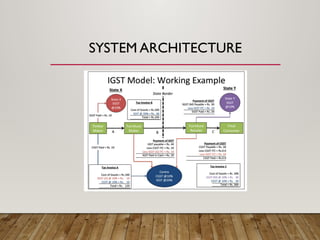
SYSTEM ARCHITECTURE
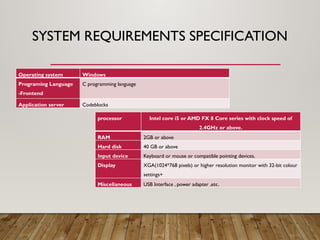
SYSTEM REQUIREMENTS SPECIFICATION
processor Intel core i5 or AMD FX 8 Core series with clock speed of
2.4GHz or above.
RAM 2GB or above
Hard disk 40 GB or above
Input device Keyboard or mouse or compatible pointing devices.
Display XGA(1024*768 pixels) or higher resolution monitor with 32-bit colour
settings+
Miscellaneous USB Interface , power adapter ,etc.
Operating system Windows
Programing Language
-Frontend
C programming language
Application server Codeblocks
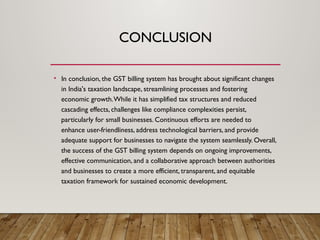
CONCLUSION
• In conclusion, the GST billing system has brought about significant changes
in India's taxation landscape, streamlining processes and fostering
economic growth.While it has simplified tax structures and reduced
cascading effects, challenges like compliance complexities persist,
particularly for small businesses. Continuous efforts are needed to
enhance user-friendliness, address technological barriers, and provide
adequate support for businesses to navigate the system seamlessly. Overall,
the success of the GST billing system depends on ongoing improvements,
effective communication, and a collaborative approach between authorities
and businesses to create a more efficient, transparent, and equitable
taxation framework for sustained economic development.
THANKYOU

GST mini project presentation with data.

  • 1.
    GST BILLING SYSTEM UnderGuidance of: Abhinav N D Assistant professor Dept. of ISE, SSIT Presented by: Rehan pasha (22IS082) Navaneeth C G (22IS067)
  • 2.
    AGENDA • INTRODUCTION • PROBLEMSTATEMENT • SYSTEM ARCHITECTURE • SYSTEM REQUIREMENTS SPECIFICATION • CONCLUSION
  • 3.
    INTRODUCTION The introduction ofthe Goods and Services Tax (GST) billing system marked a transformative shift in India's tax structure. Implemented to streamline taxation, GST replaced multiple indirect taxes with a unified, nationwide tax framework.This simplified system enhances transparency, reduces tax cascading, and promotes a more efficient business environment. GST categorizes goods and services into distinct tax slabs, fostering a uniform tax structure across the country. By eliminating the complexities of the previous tax regime, GST facilitates ease of compliance for businesses and ensures a more equitable distribution of tax burdens, ultimately contributing to the nation's economic growth and development.
  • 4.
    PROBLEM STATEMENT • TheGST billing system faces challenges such as complexity in compliance, especially for small businesses.The intricate structure of tax slabs and frequent changes in regulations create confusion and increase the burden of documentation.Additionally, the technology adaptation required for GST implementation poses a hurdle for some businesses, leading to issues in filing returns and understanding the system.There are concerns about the impact on certain industries, and the need for constant updates and training further complicates the adoption process. Addressing these challenges is crucial to ensure the smooth functioning of the GST billing system and to alleviate the struggles faced by businesses.
  • 5.
  • 6.
    SYSTEM REQUIREMENTS SPECIFICATION processorIntel core i5 or AMD FX 8 Core series with clock speed of 2.4GHz or above. RAM 2GB or above Hard disk 40 GB or above Input device Keyboard or mouse or compatible pointing devices. Display XGA(1024*768 pixels) or higher resolution monitor with 32-bit colour settings+ Miscellaneous USB Interface , power adapter ,etc. Operating system Windows Programing Language -Frontend C programming language Application server Codeblocks
  • 7.
    CONCLUSION • In conclusion,the GST billing system has brought about significant changes in India's taxation landscape, streamlining processes and fostering economic growth.While it has simplified tax structures and reduced cascading effects, challenges like compliance complexities persist, particularly for small businesses. Continuous efforts are needed to enhance user-friendliness, address technological barriers, and provide adequate support for businesses to navigate the system seamlessly. Overall, the success of the GST billing system depends on ongoing improvements, effective communication, and a collaborative approach between authorities and businesses to create a more efficient, transparent, and equitable taxation framework for sustained economic development.
  • 8.