GSP: where we are?GSP: where we are?
Ronald VargasRonald Vargas
Implementation Plans
- Preparation of Pillar 1 Implementation Plan
- Preparation of Pillar 3 Implementation Plan
- Execution of the Global and Regional
Implementation Plans
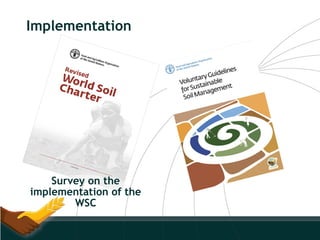
Implementation
Survey on the
implementation of the
WSC
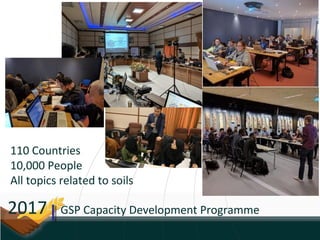
2017 GSP Capacity Development Programme
110 Countries
10,000 People
All topics related to soils
5
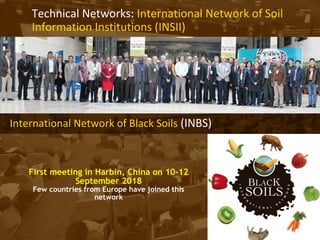
Technical Networks: International Network of Soil
Information Institutions (INSII)
International Network of Black Soils (INBS)
First meeting in Harbin, China on 10-12
September 2018
Few countries from Europe have joined this
network
6
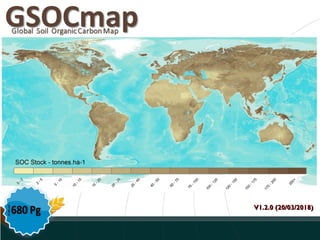
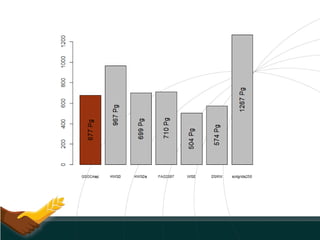
V1.2.0 (20/0V1.2.0 (20/033/2018)/2018)
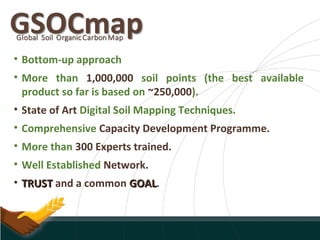
• Bottom-up approach
• More than 1,000,000 soil points (the best available
product so far is based on ~250,000).
• State of Art Digital Soil Mapping Techniques.
• Comprehensive Capacity Development Programme.
• More than 300 Experts trained.
• Well Established Network.
• TRUSTTRUST and a common GOALGOAL.
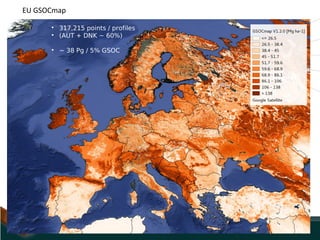
EU GSOCmap

317,215 points / profiles

(AUT + DNK ~ 60%)

~ 38 Pg / 5% GSOC
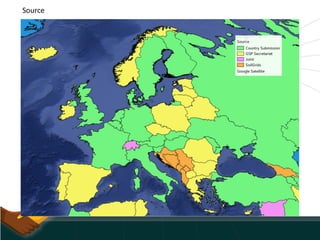
Source
What’s next?What’s next?
•Improvement of GSOCmap (30 cm) as more countries
preparing their maps.
•Training at national level as requested by countries.
•5th
December 2018: GSOCmap 2 including 30-100 cm layer.
•Towards a Global SOC monitoring system
13
• Working group preparing
guidelines for SOC management at
regional level.
• Call for experts for a Working
Group to prepare alternative
guidelines for Measuring, Mapping,
Reporting and Monitoring SOC.
• International network of Black
Soils.
• Contributing to the
implementation of the Koronivia
Joint Work on Agriculture.
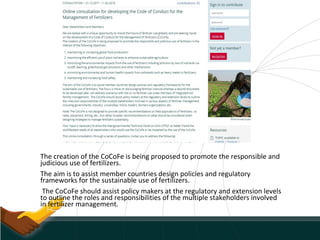
The creation of the CoCoFe is being proposed to promote the responsible and
judicious use of fertilizers.
The aim is to assist member countries design policies and regulatory
frameworks for the sustainable use of fertilizers.
The CoCoFe should assist policy makers at the regulatory and extension levels
to outline the roles and responsibilities of the multiple stakeholders involved
in fertilizer management.
 Online consultation for feedback on the CoCoFe by a broad range of
stakeholders (Completed -February 2018).
 Drafting of the zero draft of the Code of Conduct (Ongoing - March 2018).
 Review of the CoCoFe draft by the ITPS and a panel of experts in fertilizer
management and policy (March/ April 2018).
 Submission of the CoCoFe to members of an open-ended working group
(OEWG) for feedback from member countries (April 2018).
 OEWG meeting to finalize the CoCoFe document (25-27 April 2018).
 Submission of the final draft to the GSP Sixth Plenary Session for
endorsement (11-13 June 2018).
 If endorsed, the CoCoFe draft will be submitted to the Committee on
Agriculture (COAG) for review and possible endorsement (September
2018).
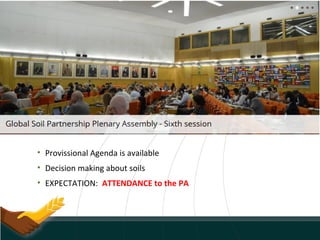
• Provissional Agenda is available
• Decision making about soils
• EXPECTATION: ATTENDANCE to the PA
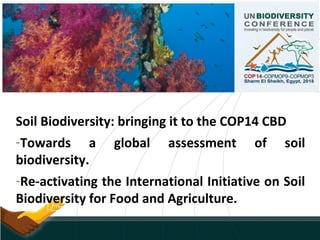
Soil Biodiversity: bringing it to the COP14 CBD
-Towards a global assessment of soil
biodiversity.
-Re-activating the International Initiative on Soil
Biodiversity for Food and Agriculture.

GSP report

  • 1.
    GSP: where weare?GSP: where we are? Ronald VargasRonald Vargas
  • 2.
    Implementation Plans - Preparationof Pillar 1 Implementation Plan - Preparation of Pillar 3 Implementation Plan - Execution of the Global and Regional Implementation Plans
  • 3.
  • 4.
    2017 GSP CapacityDevelopment Programme 110 Countries 10,000 People All topics related to soils
  • 5.
    5 Technical Networks: InternationalNetwork of Soil Information Institutions (INSII) International Network of Black Soils (INBS) First meeting in Harbin, China on 10-12 September 2018 Few countries from Europe have joined this network
  • 6.
  • 7.
  • 9.
    • Bottom-up approach •More than 1,000,000 soil points (the best available product so far is based on ~250,000). • State of Art Digital Soil Mapping Techniques. • Comprehensive Capacity Development Programme. • More than 300 Experts trained. • Well Established Network. • TRUSTTRUST and a common GOALGOAL.
  • 10.
    EU GSOCmap  317,215 points/ profiles  (AUT + DNK ~ 60%)  ~ 38 Pg / 5% GSOC
  • 11.
  • 12.
    What’s next?What’s next? •Improvementof GSOCmap (30 cm) as more countries preparing their maps. •Training at national level as requested by countries. •5th December 2018: GSOCmap 2 including 30-100 cm layer. •Towards a Global SOC monitoring system
  • 13.
    13 • Working grouppreparing guidelines for SOC management at regional level. • Call for experts for a Working Group to prepare alternative guidelines for Measuring, Mapping, Reporting and Monitoring SOC. • International network of Black Soils. • Contributing to the implementation of the Koronivia Joint Work on Agriculture.
  • 14.
    The creation ofthe CoCoFe is being proposed to promote the responsible and judicious use of fertilizers. The aim is to assist member countries design policies and regulatory frameworks for the sustainable use of fertilizers. The CoCoFe should assist policy makers at the regulatory and extension levels to outline the roles and responsibilities of the multiple stakeholders involved in fertilizer management.
  • 15.
     Online consultationfor feedback on the CoCoFe by a broad range of stakeholders (Completed -February 2018).  Drafting of the zero draft of the Code of Conduct (Ongoing - March 2018).  Review of the CoCoFe draft by the ITPS and a panel of experts in fertilizer management and policy (March/ April 2018).  Submission of the CoCoFe to members of an open-ended working group (OEWG) for feedback from member countries (April 2018).  OEWG meeting to finalize the CoCoFe document (25-27 April 2018).  Submission of the final draft to the GSP Sixth Plenary Session for endorsement (11-13 June 2018).  If endorsed, the CoCoFe draft will be submitted to the Committee on Agriculture (COAG) for review and possible endorsement (September 2018).
  • 17.
    • Provissional Agendais available • Decision making about soils • EXPECTATION: ATTENDANCE to the PA
  • 19.
    Soil Biodiversity: bringingit to the COP14 CBD -Towards a global assessment of soil biodiversity. -Re-activating the International Initiative on Soil Biodiversity for Food and Agriculture.

Editor's Notes

  • #6 First Session Workshop of INSII. Establishment of the Global Soil Information System (GLOSIS) , including the International Network of Soil Information Institutions (INSII). So far three workshops (once per year).
  • #7 First Session Workshop of INSII. Establishment of the Global Soil Information System (GLOSIS) , including the International Network of Soil Information Institutions (INSII). So far three workshops (once per year).
  • #14 One of the largest scientific events held at FAO​ Hq First event co-organized by different UN organizations on the role of SOC for climate change, food security and SDGs agendas and gather scientific evidence for policy development​ (UNCCD, IPCC, WMO) Over 100 oral and 34 poster presentations​ Science fair Outcome document​ Booklet on SOC​ Proceedings ​ 488 participants from 111 countries​ New website and targeted communication (social) ​