Austin Hay
VP of Consulting Services, TGP
#ROADMAP @Amplitude_HQ
Growth
Instrumentation
Lessons in designing and implementing Growth in the
enterprise
Austin Hay
ahay@growthpractice.com
About TGP & Me
• VP of Consulting Services at the Growth Practice (TGP)
• TGP is an independent growth consultancy under the mParticle
corporate umbrella.
• Embedded with team as Technical Product Managers at Walmart, Jet,
Turner, Peet’s Coffee, Foursquare and Postmates.
• My Background:
• USC Eng. & Stanford dual MS
• Self Taught Programmer
• 4th
employee at Branch Metrics – helped build, sell and implement
attribution & deeplinking with clients.
• Wore a lot of hats: Product, Marketing, but mostly Technical Sales / Integration
Engineering.
• Scaled team from 1 to 15.
• Launched own mobile growth consulting practice which is now a subsidiary.
• 3-4 employees across 8 clients.
We help customers get stuff done.
The Growth Practice is an
independent, technical consulting
practice that helps Fortune 500
clients understand & implement a
best-in-class technology stack.
WHAT IS THE GROWTH PRACTICE?
Customer
Engagements & the
Work We Do
WHAT DO YOU EVEN DO?
We live and breathe high quality execution.
TGP Core Services:
1. Technology Implementation & Management
2. Growth Stack Design, Strategy, Integration
3. Systems Integration
THE WORK WE DO
Growth starts and
ends with
instrumentation and
tooling.
TONIGHT’S TLDR
Why does it feel like
only startups do
growth very well?
LET’S BE REAL…
Why does it feel like only startups do Growth?
ENTERPRISE LANDSCAPE TODAY
• Many fortune 500 companies are aggressively learning and trying to implement ”Growth”.
Why does it feel like only startups do Growth?
ENTERPRISE LANDSCAPE TODAY
• Many fortune 500 companies are aggressively learning and trying to implement ”Growth”.
• This is great! … however, the problem is that the approach is wrong.
• Folks are taking courses on growth strategy, and firing up their engines to redesign their org charts, without
thinking about tactical execution of growth.
Why does it feel like only startups do Growth?
ENTERPRISE LANDSCAPE TODAY
• Many fortune 500 companies are aggressively learning and trying to implement ”Growth”.
• This is great! … however, the problem is that the approach is wrong.
• Folks are taking courses on growth strategy, and firing up their engines to redesign their org charts, without
thinking about tactical execution of growth.
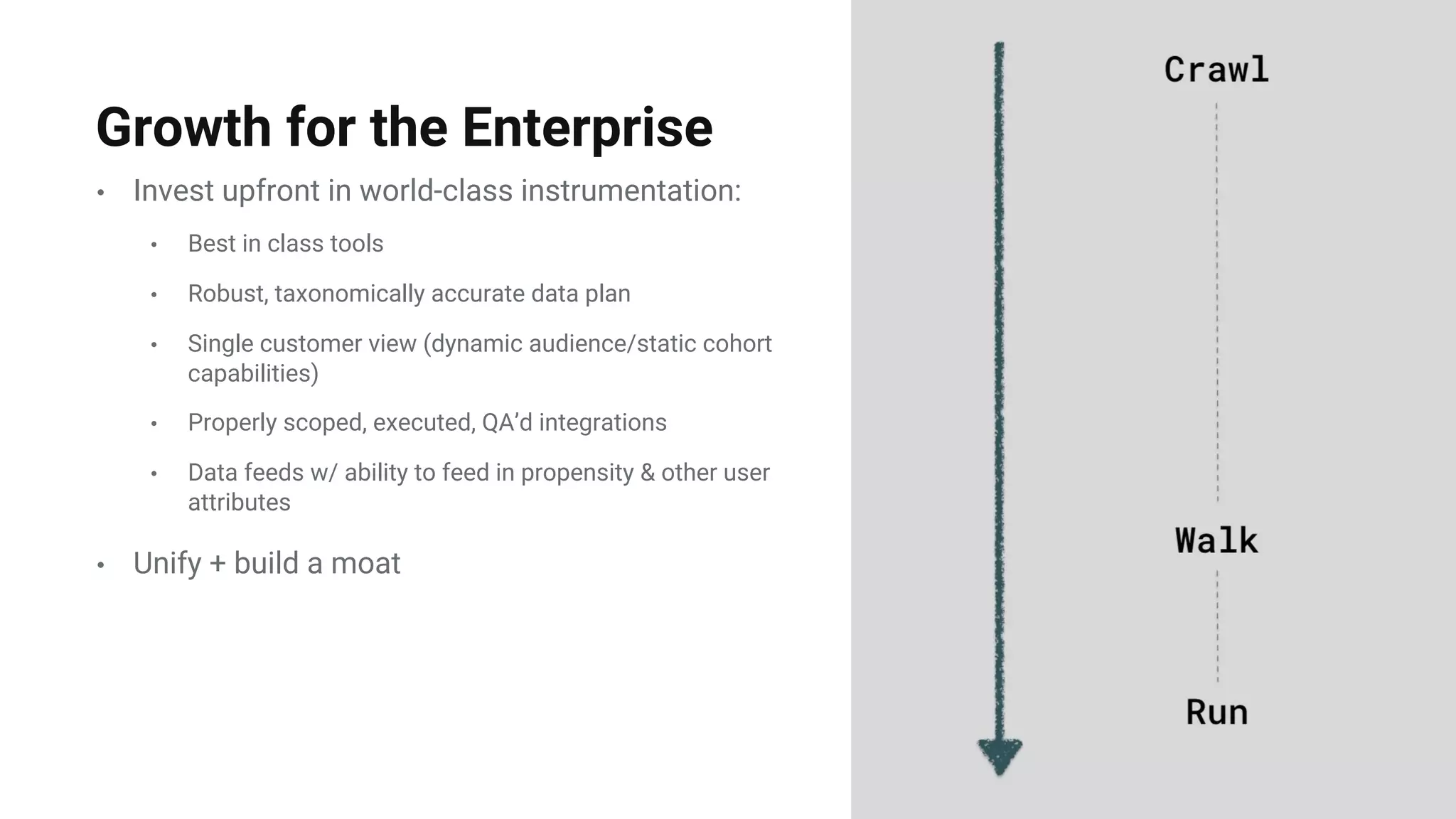
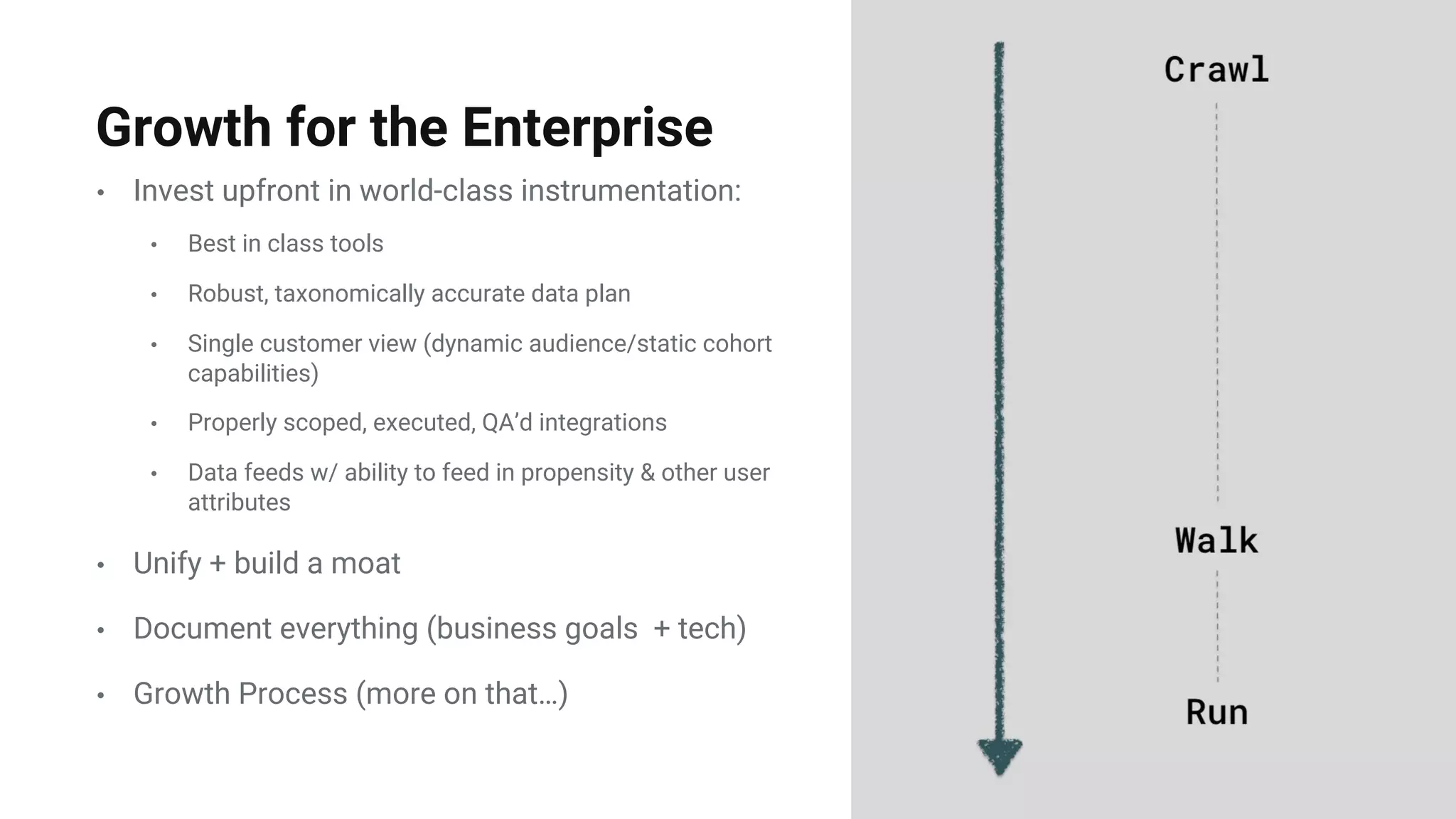
• Before you can run you have to crawl and walk.
• Crawl = investment in tooling, instrumentation.
• Walk = investment in team, structure, people, documentation and systems.
• Run = use your tooling to create leverage, prioritize opportunities, experiment/learn.
Why does it feel like only startups do Growth?
ENTERPRISE LANDSCAPE TODAY
• Many fortune 500 companies are aggressively learning and trying to implement ”Growth”.
• This is great! … however, the problem is that the approach is wrong.
• Folks are taking courses on growth strategy, and firing up their engines to redesign their org charts, without
thinking about tactical execution of growth.
• Before you can run you have to crawl and walk.
• Crawl = investment in tooling, instrumentation.
• Walk = investment in team, structure, people, documentation and systems.
• Run = use your tooling to create leverage, prioritize opportunities, experiment/learn.
• As you consider your growth team strategy, remember that the team success begins and
ends with instrumentation – don’t overinvest in people / strategy and underinvest in
execution on tooling.
Growth for the
Enterprise
EVERYONE LOVES FRAMEWORKS
Growth for the Enterprise
• Invest upfront in world-class instrumentation:
• Best in class tools
• Robust, taxonomically accurate data plan
• Single customer view (dynamic audience/static cohort
capabilities)
• Properly scoped, executed, QA’d integrations
• Data feeds w/ ability to feed in propensity & other user
attributes
• Invest upfront in world-class instrumentation:
• Best in class tools
• Robust, taxonomically accurate data plan
• Single customer view (dynamic audience/static cohort
capabilities)
• Properly scoped, executed, QA’d integrations
• Data feeds w/ ability to feed in propensity & other user
attributes
• Unify + build a moat
Growth for the Enterprise
• Invest upfront in world-class instrumentation:
• Best in class tools
• Robust, taxonomically accurate data plan
• Single customer view (dynamic audience/static cohort
capabilities)
• Properly scoped, executed, QA’d integrations
• Data feeds w/ ability to feed in propensity & other user
attributes
• Unify + build a moat
• Document everything (business goals + tech)
Growth for the Enterprise
• Invest upfront in world-class instrumentation:
• Best in class tools
• Robust, taxonomically accurate data plan
• Single customer view (dynamic audience/static cohort
capabilities)
• Properly scoped, executed, QA’d integrations
• Data feeds w/ ability to feed in propensity & other user
attributes
• Unify + build a moat
• Document everything (business goals + tech)
• Growth Process (more on that…)
Growth for the Enterprise
Growth Execution
EVERYONE LOVES FRAMEWORKS
What executing
Growth actually
looks like
?
• Invest in Instrumentation / Tooling
What executing
Growth actually
looks like
The Best in Class Stack
• Paid Attribution with Deeplinking
• Mobile Affiliate
• Real-time Native Geo
• Customer Data Platform (CDP)
• Email, Push, Engagement
• Product Analytics
• Invest in Instrumentation / Tooling
• Stand up Growth Team Structure (independent
vs functional model)
What executing
Growth actually
looks like
Growth Team Models
• Independent vs functional models
Growth Team Models
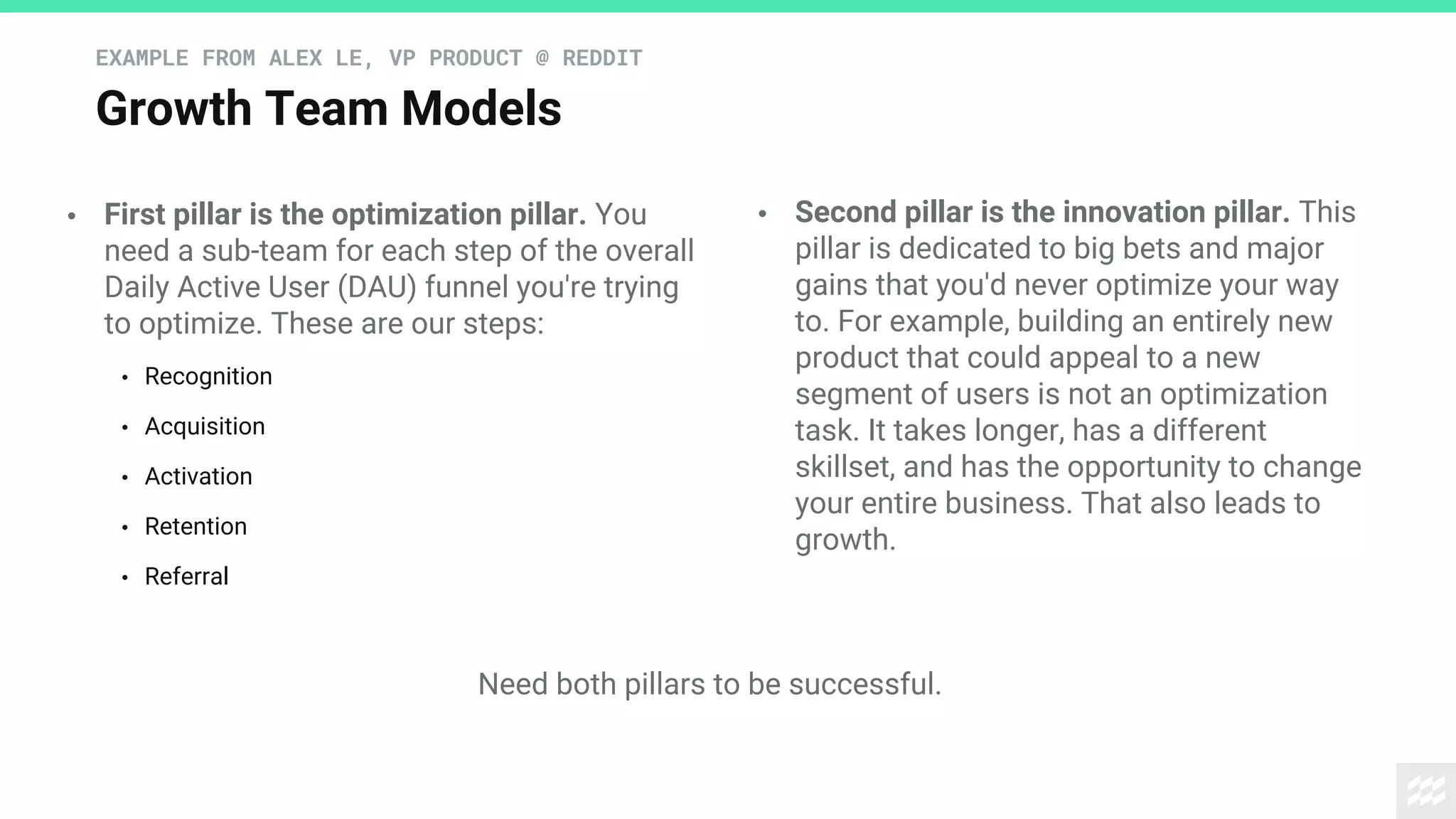
EXAMPLE FROM ALEX LE, VP PRODUCT @ REDDIT
• First pillar is the optimization pillar. You
need a sub-team for each step of the overall
Daily Active User (DAU) funnel you're trying
to optimize. These are our steps:
• Recognition
• Acquisition
• Activation
• Retention
• Referral
• Second pillar is the innovation pillar. This
pillar is dedicated to big bets and major
gains that you'd never optimize your way
to. For example, building an entirely new
product that could appeal to a new
segment of users is not an optimization
task. It takes longer, has a different
skillset, and has the opportunity to change
your entire business. That also leads to
growth.
Need both pillars to be successful.
• Invest in Instrumentation / Tooling
• Stand up Growth Team Structure (independent
vs functional model)
• Define Growth Values & Strategy
What executing
Growth actually
looks like
What are “Growth Values”?
These are the things that define the team and culture you’re trying to create:
• What do you think about measurement and data?
• How do you prioritize and choose what projects?
• What’s your philosophy around shipping products? Quality? Speed? Impact? Define where
and how you fall on this scale.
• What do you think about going from idea to delivery?
• Other cultural or personal values that will influence the team.
• Invest in Instrumentation / Tooling
• Stand up Growth Team Structure (independent
vs functional model)
• Define Growth Values
• Document & Preach your Growth Process.
Example:
• Create leverage, prioritize highest value opportunities,
learn/iterate.
• This starts and ends with instrumentation and tooling
which helps marketing, growth, UA and product
marketing style teams experiment and optimize.
• North star metrics
• Experimentation Framework
What executing
Growth actually
looks like
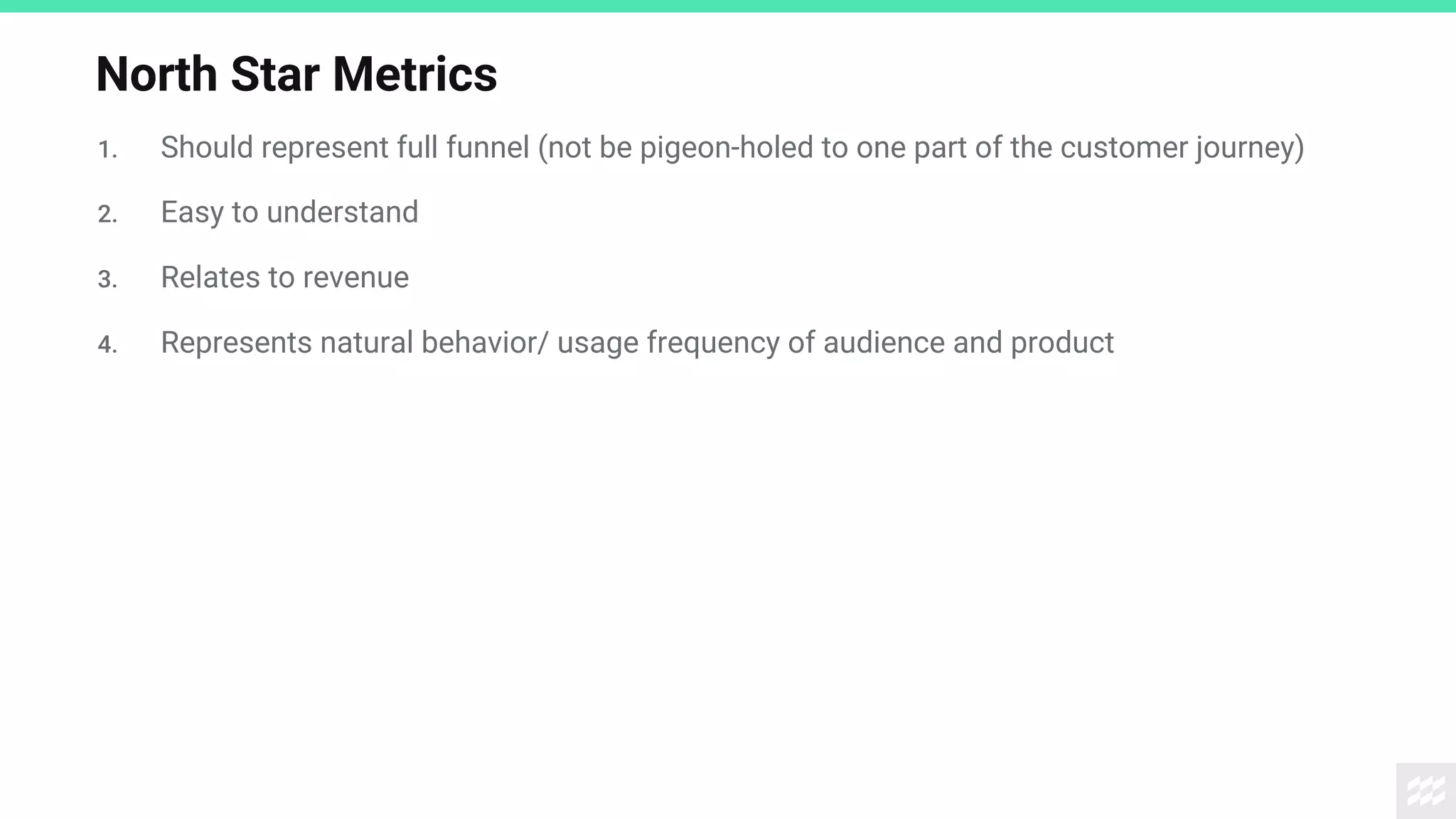
North Star Metrics
1. Should represent full funnel (not be pigeon-holed to one part of the customer journey)
2. Easy to understand
3. Relates to revenue
4. Represents natural behavior/ usage frequency of audience and product
North Star Metrics
Break North Star metrics down into actionable metrics as f(Breadth, Depth, Frequency and
Efficiency).
• Breadth: is how many active/returning users there are performing your action of value.
• Depth: is the extent of their engagement
• Frequency: is how often the Users engage or perform the action of value
• Efficiency: is how quickly the Users are able to achieve the value
North Star Metrics - Example
Breadth Depth Frequency Efficiency
Weekly active
users
# truth signals /
per day
days active per
week
Conversion from
start session to
truth signal
Weekly Content
(Digest)
Streaks (same
category w/w)
purchases, omni
Reminder Push
Reminder Email
(can be intelligent
and dynamic)
Favorites, Likes,
Comment,
Friends,
re-orders, in-store
visits etc.
Deeplink, gmail
actions, email
AMP, beacon to
completion
click through
conversions
Drive North Star
Metrics with a Best in
Class Stack
Tools & instrumentation
enable you do all the cool
stuff you learn about from
blogs and Reforge.
MAIN POINT
1. Don’t neglect
instrumentation.
TAKEAWAYS
1. Don’t neglect
instrumentation.
2. Tooling creates leverage.
TAKEAWAYS
1. Don’t neglect
instrumentation.
2. Tooling creates leverage.
3. Clearly document your
Growth Process.
TAKEAWAYS
Thank you!
GET IN TOUCH!
Learn more
Austin Hay
ahay@growthpractice.com

Growth Instrumentation

  • 1.
    Austin Hay VP ofConsulting Services, TGP #ROADMAP @Amplitude_HQ
  • 2.
    Growth Instrumentation Lessons in designingand implementing Growth in the enterprise Austin Hay ahay@growthpractice.com
  • 3.
    About TGP &Me • VP of Consulting Services at the Growth Practice (TGP) • TGP is an independent growth consultancy under the mParticle corporate umbrella. • Embedded with team as Technical Product Managers at Walmart, Jet, Turner, Peet’s Coffee, Foursquare and Postmates. • My Background: • USC Eng. & Stanford dual MS • Self Taught Programmer • 4th employee at Branch Metrics – helped build, sell and implement attribution & deeplinking with clients. • Wore a lot of hats: Product, Marketing, but mostly Technical Sales / Integration Engineering. • Scaled team from 1 to 15. • Launched own mobile growth consulting practice which is now a subsidiary. • 3-4 employees across 8 clients.
  • 4.
    We help customersget stuff done. The Growth Practice is an independent, technical consulting practice that helps Fortune 500 clients understand & implement a best-in-class technology stack. WHAT IS THE GROWTH PRACTICE?
  • 5.
    Customer Engagements & the WorkWe Do WHAT DO YOU EVEN DO?
  • 6.
    We live andbreathe high quality execution. TGP Core Services: 1. Technology Implementation & Management 2. Growth Stack Design, Strategy, Integration 3. Systems Integration THE WORK WE DO
  • 7.
    Growth starts and endswith instrumentation and tooling. TONIGHT’S TLDR
  • 8.
    Why does itfeel like only startups do growth very well? LET’S BE REAL…
  • 9.
    Why does itfeel like only startups do Growth? ENTERPRISE LANDSCAPE TODAY • Many fortune 500 companies are aggressively learning and trying to implement ”Growth”.
  • 10.
    Why does itfeel like only startups do Growth? ENTERPRISE LANDSCAPE TODAY • Many fortune 500 companies are aggressively learning and trying to implement ”Growth”. • This is great! … however, the problem is that the approach is wrong. • Folks are taking courses on growth strategy, and firing up their engines to redesign their org charts, without thinking about tactical execution of growth.
  • 11.
    Why does itfeel like only startups do Growth? ENTERPRISE LANDSCAPE TODAY • Many fortune 500 companies are aggressively learning and trying to implement ”Growth”. • This is great! … however, the problem is that the approach is wrong. • Folks are taking courses on growth strategy, and firing up their engines to redesign their org charts, without thinking about tactical execution of growth. • Before you can run you have to crawl and walk. • Crawl = investment in tooling, instrumentation. • Walk = investment in team, structure, people, documentation and systems. • Run = use your tooling to create leverage, prioritize opportunities, experiment/learn.
  • 12.
    Why does itfeel like only startups do Growth? ENTERPRISE LANDSCAPE TODAY • Many fortune 500 companies are aggressively learning and trying to implement ”Growth”. • This is great! … however, the problem is that the approach is wrong. • Folks are taking courses on growth strategy, and firing up their engines to redesign their org charts, without thinking about tactical execution of growth. • Before you can run you have to crawl and walk. • Crawl = investment in tooling, instrumentation. • Walk = investment in team, structure, people, documentation and systems. • Run = use your tooling to create leverage, prioritize opportunities, experiment/learn. • As you consider your growth team strategy, remember that the team success begins and ends with instrumentation – don’t overinvest in people / strategy and underinvest in execution on tooling.
  • 13.
  • 14.
    Growth for theEnterprise • Invest upfront in world-class instrumentation: • Best in class tools • Robust, taxonomically accurate data plan • Single customer view (dynamic audience/static cohort capabilities) • Properly scoped, executed, QA’d integrations • Data feeds w/ ability to feed in propensity & other user attributes
  • 15.
    • Invest upfrontin world-class instrumentation: • Best in class tools • Robust, taxonomically accurate data plan • Single customer view (dynamic audience/static cohort capabilities) • Properly scoped, executed, QA’d integrations • Data feeds w/ ability to feed in propensity & other user attributes • Unify + build a moat Growth for the Enterprise
  • 16.
    • Invest upfrontin world-class instrumentation: • Best in class tools • Robust, taxonomically accurate data plan • Single customer view (dynamic audience/static cohort capabilities) • Properly scoped, executed, QA’d integrations • Data feeds w/ ability to feed in propensity & other user attributes • Unify + build a moat • Document everything (business goals + tech) Growth for the Enterprise
  • 17.
    • Invest upfrontin world-class instrumentation: • Best in class tools • Robust, taxonomically accurate data plan • Single customer view (dynamic audience/static cohort capabilities) • Properly scoped, executed, QA’d integrations • Data feeds w/ ability to feed in propensity & other user attributes • Unify + build a moat • Document everything (business goals + tech) • Growth Process (more on that…) Growth for the Enterprise
  • 18.
  • 19.
  • 20.
    • Invest inInstrumentation / Tooling What executing Growth actually looks like
  • 21.
    The Best inClass Stack • Paid Attribution with Deeplinking • Mobile Affiliate • Real-time Native Geo • Customer Data Platform (CDP) • Email, Push, Engagement • Product Analytics
  • 22.
    • Invest inInstrumentation / Tooling • Stand up Growth Team Structure (independent vs functional model) What executing Growth actually looks like
  • 23.
    Growth Team Models •Independent vs functional models
  • 24.
    Growth Team Models EXAMPLEFROM ALEX LE, VP PRODUCT @ REDDIT • First pillar is the optimization pillar. You need a sub-team for each step of the overall Daily Active User (DAU) funnel you're trying to optimize. These are our steps: • Recognition • Acquisition • Activation • Retention • Referral • Second pillar is the innovation pillar. This pillar is dedicated to big bets and major gains that you'd never optimize your way to. For example, building an entirely new product that could appeal to a new segment of users is not an optimization task. It takes longer, has a different skillset, and has the opportunity to change your entire business. That also leads to growth. Need both pillars to be successful.
  • 25.
    • Invest inInstrumentation / Tooling • Stand up Growth Team Structure (independent vs functional model) • Define Growth Values & Strategy What executing Growth actually looks like
  • 26.
    What are “GrowthValues”? These are the things that define the team and culture you’re trying to create: • What do you think about measurement and data? • How do you prioritize and choose what projects? • What’s your philosophy around shipping products? Quality? Speed? Impact? Define where and how you fall on this scale. • What do you think about going from idea to delivery? • Other cultural or personal values that will influence the team.
  • 27.
    • Invest inInstrumentation / Tooling • Stand up Growth Team Structure (independent vs functional model) • Define Growth Values • Document & Preach your Growth Process. Example: • Create leverage, prioritize highest value opportunities, learn/iterate. • This starts and ends with instrumentation and tooling which helps marketing, growth, UA and product marketing style teams experiment and optimize. • North star metrics • Experimentation Framework What executing Growth actually looks like
  • 28.
    North Star Metrics 1.Should represent full funnel (not be pigeon-holed to one part of the customer journey) 2. Easy to understand 3. Relates to revenue 4. Represents natural behavior/ usage frequency of audience and product
  • 29.
    North Star Metrics BreakNorth Star metrics down into actionable metrics as f(Breadth, Depth, Frequency and Efficiency). • Breadth: is how many active/returning users there are performing your action of value. • Depth: is the extent of their engagement • Frequency: is how often the Users engage or perform the action of value • Efficiency: is how quickly the Users are able to achieve the value
  • 30.
    North Star Metrics- Example Breadth Depth Frequency Efficiency Weekly active users # truth signals / per day days active per week Conversion from start session to truth signal Weekly Content (Digest) Streaks (same category w/w) purchases, omni Reminder Push Reminder Email (can be intelligent and dynamic) Favorites, Likes, Comment, Friends, re-orders, in-store visits etc. Deeplink, gmail actions, email AMP, beacon to completion click through conversions
  • 31.
    Drive North Star Metricswith a Best in Class Stack
  • 32.
    Tools & instrumentation enableyou do all the cool stuff you learn about from blogs and Reforge. MAIN POINT
  • 33.
  • 34.
    1. Don’t neglect instrumentation. 2.Tooling creates leverage. TAKEAWAYS
  • 35.
    1. Don’t neglect instrumentation. 2.Tooling creates leverage. 3. Clearly document your Growth Process. TAKEAWAYS
  • 36.
    Thank you! GET INTOUCH! Learn more Austin Hay ahay@growthpractice.com