ANALYZING OPERATING ACTIVITIES
GROUP 4 PRESENTATION
CORPORATE FINANCIAL REPORTING AND ANALYSIS
 DANIEL KIPRUTO D63/60179/2013
 MASIEBI BARASA GEORGE D63/60080/2013
 RUTH W. KARIUKI D63/60485/2013
 WEN WEI D63/60266/2013
 BASIL M. MUDACHI D63/60114/2013
 WILFRED O. SOSI D63/60790/2013
 NDATHO CYPRIAN D63/60103/2013
 MICHAEL WACHIRA D63/60023/2013
 IBRAHIM ABDILADIF D63/60861/2013
 JOAN MURIUKI D63/61124/2013
2
ANALYSIS OBJECTIVES.
 Explain the concept of income measurement and
their implications for analysis of operating activities.
 Describe and analyze the impact of nonrecurring
items including extraordinary items, discontinued
segments, accounting changes, write-offs, and
restructuring changes.
 Analyze revenue and expense recognition and its
risks for financial statement analysis.
 Analyze deferred charges, including expenditures for
research, development and exploration.
 Explain supplementary employee benefits and
analyzing the disclosure of employee stock
options(ESO)
INCOME MEASUREMENT
 Income summarizes the financial effects of a
business’s operating activities.
 Economic income: measures the net change in
shareholder’s wealth during a period and is
typically equal to a period’s cash flows plus
change in present value of expected future cash
flows.
 Permanent income; is an estimate of the stable
average income that a business is expected to
earn over its life time, given the current state of
the business.
INCOME MEASUREMENT.cont……..
 Accounting income is based on accrual accounting and is
determined by recognizing revenues and matching costs to
the recognized revenues.
 Accounting income comprise of three components.These
are;
 Permanent or recurring component, where each dollar is
equal to 1/r dollars of a company’s value( r is the cost of
capital).
 Transitory component; where each dollar is equal to one
dollar of a company value.
 Value irrelevant component; which is irrelevant for
valuation.

Measuring Accounting Income:
 Revenue (and gains) and expenses (and
losses) are the two components of
accounting income.
Revenues and Gains
Revenues
 Are earned inflows or prospective earned
inflows of cash that arise from a company’s
ongoing business activities.These include
cash inflows such as cash sales .and
prospective cash inflows such as credit sales.
Revenues and Gains…..
 Gains
 Are earned inflows or prospective earned
inflows of cash arising from transactions and
events unrelated to a company’s ongoing
business activities
 The distinction between revenues and gains
is based on the ongoing business activities
that produce revenues. Revenues are
expected to persist indefinitely for a going
concern. In contrast, gains are nonrecurring.
Expenses and Losses
 Expenses;
 Are incurred outflows, prospective outflows or
allocation of past outflows of cash that arise
from company’s ongoing business operations.
 Losses:
 Are decreases in a company’s net assets arising
from peripheral or incidental operations of the
company.
 Accounting for expenses and losses often
involves assessing the amount and timing of
their allocation to reporting periods.
Alternative Income
Classification and measures.
 Income can be classified into two major
dimensions:
 Operating versus nonoperating.
 Recurring and nonrecurring.
 Recurring and nonrecurring income:
 The importance of classifying income
component as recurring and nonrecurring
arises from the need to determine the
permanent and transitory component of
income.
Alternative Measure of
Accounting Income:
 Income statement typically report three
alternative income measures.These are;
1.Net income:
 GAAP allows a number of direct adjustments
to equity , called dirty surplus items that
bypass income statement .
2. Comprehensive income:
 Reflects nearly all changes to equity, other
than those from owner activities (such as
dividend and share issuance).
Alternative Measure of
Accounting Income: cont…..
 Unfortunately companies are allowed to
report comprehensive income in the
statement of changes of equity instead of
income statement.
 Comprehensive income differs from net
income in that it reflects certain unrealized
holding gains and losses foreign currency
translation adjustment and minimum pension
liability adjustment.
Alternative Measure of
Accounting Income: cont…..
3. Continuing Income:
 Is a measure that excludes extraordinary
items , cumulative effects of accounting
changes, and the effects of discontinued
operations.
 It is often called income before extraordinary
items, income before discontinued
operations or income before cumulative
effect of accounting change.
Alternative Measure of
Accounting Income : cont…
4. Core Income:
 Is a measure that excludes all nonrecurring
items that are reported as separate line items on
the income statement. In the illustration, Core
income equals the continuing income reported in
2006 and 2004.Yet in 2005, Core income is
different-it excludes the after tax effect of the
restructuring charge of $1016m. In this case, core
income equals continuing income plus the
restructuring charge that is multiplied by one
minus the 35% marginal tax rate, or
$463{computed as $(197) plus the $1016×0.65]
Analysis Implication.
 Accounting Standard requires alternative income
measures so users can identify sustainable and
nonsustainable income components.
 Many analysts prefer an income measure that
corresponds to one of the reported measures or
some variation that excludes or includes some
items.
 Debate range over what constitutes the
“correct” measure of income.There is caution
against such debate for two reasons:
Analysis Implication.cont…
 A correct measure of income is not possible
without specifying analysis objectives. Income
serves two roles: to measure the net change in
equity and to provide an estimate of sustainable
earning power. It is impossible for a single
income measure to satisfy both objectives at the
same time.
 The alternative accounting income measures
results from merely including or excluding,
certain line items.This means they are still
accounting measures of income and are subject
to accounting distortions.
OPERATING AND NONOPERATING
INCOME.
 Operating income.
 Is a measure of company’s income from ongoing
operating business activities.
 There are three important aspect of operating
income.These are;
 Operating income pertains only to income
generated from operating activities.
 Operating income focuses on income for the
company as a whole rather than for debt and equity
holders.
 Operating income pertains only to ongoing business
activities. income.
Nonoperating income.
 Includes all component of income not
included in operating income. It is useful in
analyzing nonoperating income to separate
components pertains to financing activities
from those pertaining discontinued
operations.
Analysis implications.
 The usefulness of operating income arises from an important
goal in corporate finance.That is the desire to separate investing
(and operating) decisions such as capital budgeting, from those
of financing decisions such as dividend policy.
 Operating income can be determined by rearranging the income
statement and making proper adjustments for taxes.
 It is sometimes necessary to draw on more detailed adjustments
using information in notes.
 For example, when a company has operating leases, the entire
lease rental is included as an operating expense even though the
lease payments included an interest component. In this case the
operating income is understated unless the analyst estimates the
interest component and makes the necessary adjustment using
the note information.
Comprehensive income.
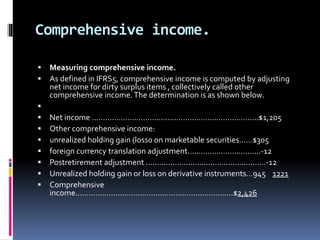
 Measuring comprehensive income.
 As defined in IFRS5, comprehensive income is computed by adjusting
net income for dirty surplus items , collectively called other
comprehensive income.The determination is as shown below.

 Net income ………………………………………………………………...$1,205
 Other comprehensive income:
 unrealized holding gain (loss0 on marketable securities……$305
 foreign currency translation adjustment……………………………-12
 Postretirement adjustment ………………………………………………-12
 Unrealized holding gain or loss on derivative instruments…945 1221
 Comprehensive
income……………………………………………………………..$2,426
Measuring comprehensive income
. cont……
 The other comprehensive income for this
company consists of four component;
 Unrealized holding gains or losses that result
from changes in the fair (market value of
available -for –sale investment securities.
 Foreign currency translation gains and losses.
 Changes in the funded status of postretirement
benefits not included in net income.
 Unrealized holding gains or losses arising from
the effective portion of cash flow hedges .These
amounts are expressed on an after tax basis.
Measuring comprehensive income.
Cont……
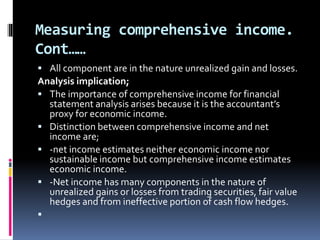
 All component are in the nature unrealized gain and losses.
Analysis implication;
 The importance of comprehensive income for financial
statement analysis arises because it is the accountant’s
proxy for economic income.
 Distinction between comprehensive income and net
income are;
 -net income estimates neither economic income nor
sustainable income but comprehensive income estimates
economic income.
 -Net income has many components in the nature of
unrealized gains or losses from trading securities, fair value
hedges and from ineffective portion of cash flow hedges.

22
NONRECURRENT ITEMS
NONRECURRENT ITEMS
Nonrecurring items include:
1. Extraordinary Items
2. DISCONTINUED
OPERATIONS
3. ACCOUNTING CHANGES
4. SPECIAL ITEMS
23
NONRECURRENT ITEMS
1. Extraordinary Items
 They are distinguished by their unusual
nature and by the infrequency of their
occurrence.
 They are classified separately in the
income statement .
 Because of stringent criteria for
classification, extraordinary items are
uncommon.
24
NONRECURRENT ITEMS
Accounting for extraordinary
items:
 To qualify as an extraordinary, an
item must be both unusual in
nature and infrequence in
occurrence.
25
NONRECURRENT ITEMS
 Unusual in nature:
 An event or transaction that has a
high degree of abnormality and is
unrelated to, or only incidentally
related to, the ordinary and typical
activities of the company.
26
NONRECURRENT ITEMS
 Infrequence in occurrence:
 An event or transaction that is not
reasonably expected to occur in the
foreseeable future.
27
NONRECURRENT ITEMS
 Extraordinary items are reported,
net of tax, as separate line items in
the income statement after
continuing income.
 When a company reports
extraordinary items, continuing
income is called income before
extraordinary items.
28
NONRECURRENT ITEMS
 Practice requires that companies to
not report certain gains and losses
as extraordinary items because they
are not unusual in nature and are
expected to recur as a consequence
of customary and continuing
business activities.
29
NONRECURRENT ITEMS
 Examples include:
Write-down or write-off of
receivables, inventories, equipment
leased to others, deferred R &D
costs, or other intangible assets.
Gain or losses from disposal of
business segment.
30
NONRECURRENT ITEMS
 Examples include (cont):
Gains or losses sale or abandonment of
property, plant and equipment.
Effects of a strike, including those
against competitors and major
suppliers.
Adjustment of accruals on long term
contracts.
31
NONRECURRENT ITEMS
 Analyzing Extraordinary Items
 Extraordinary are nonrecurring in
nature. Analyst therefore excludes
extraordinary items when computing
permanent income.
 They are also excluded from income
when making comparisons over time or
across companies.
32
NONRECURRENT ITEMS
 Yet, while the extraordinary items
are transitory, they yield a cost (or a
benefit on the company, dollar for
dollar, and an analyst must
therefore include the entire amount
of the extra ordinary items when
computing economic income
33
NONRECURRENT ITEMS
 They are often operating in nature.
 However they differ from normal
operating revenues or expenses
because they are nonrecurring .
 For example, a loss of inventory.
34
NONRECURRENT ITEMS
 For example a loss from of
inventory from fire arises as part of
company’s operations (and reveals
the nature of operating risk inherent
in the company’s business), but it is
not expected to occur on a regular
basis.
35
NONRECURRENT ITEMS
 Thus these extraordinary items that
arise from company’s business
operations are included when
computing operating income but
excluded when determining
permanent income.
36
NONRECURRENT ITEMS
 Extraordinary items also reveal
business risk exposure of the
company,
 while these risks may be remote,
their occurrence suggest the
possibility of reoccurrence at some
future date.
37
NONRECURRENT ITEMS
 The large magnitude of most extra
ordinary losses also encourages
analysis even when their occurrence
is infrequent.
 In some cases, extraordinary items
may reoccur, though infrequent.
38
NONRECURRENT ITEMS
 For example, a warehouse by the
beach in an area susceptible to
hurricanes may incur flood damage
every few years.
 An analyst may consider this when
evaluating sustainable earning
power.
39
NONRECURRENT ITEMS
2. DISCONTINUED OPERATIONS
 Companies sometimes dispose of
entire divisions or product lines.
 When this disposition pertains to
separately identifiable business
segments, they are accorded special
accounting treatment in the income
statement.
40
NONRECURRENT ITEMS
The accounting treatment includes
any component of an entity (rather
than a segment of a business.
A component of an entity comprises
operations (and cash flows) that
can be clearly be distinguished,
operationally and for purposes of
financial reporting, form the rest of
the business.
41
NONRECURRENT ITEMS
Accounting for Discontinued
operations
To qualify as discontinued operations,
the assets and the business
activities of the divested segment
must be clearly be distinguished
both physically and operationally
from the assets and business
activities of the remaining entity.
42
NONRECURRENT ITEMS
 Accounting and reporting for
discontinued operation is a two fold:
 1.The income statements for the
current and prior two years are
restated after excluding the effects
of discontinued operations from the
lines items that determine
continuing income.
43
NONRECURRENT ITEMS
 2. Gains or losses pertaining to the
discontinued operations are reported
separately, net of their related tax
effects, and are excluded from the
continuing income.
 Continuing income is called income
before discontinued operations when
discontinued operations are reported.
44
NONRECURRENT ITEMS
 A company reports gains or losses
from discontinued operations for
current and two prior years in two
categories:
 1. Operating income or loss from
discontinued operations until the
management commits to the
disposal.
45
NONRECURRENT ITEMS
 A company reports gains or losses
from discontinued operations for
current and two prior years in two
categories:
 2. Gains and losses on the disposal,
including operating income or loss
during the phase-out period
46
NONRECURRENT ITEMS
 A company reports gains or losses
from discontinued operations for
current and two prior years in two
categories:
 2. Gains and losses on the disposal,
including operating income or loss
during the phase-out period
47
NONRECURRENT ITEMS
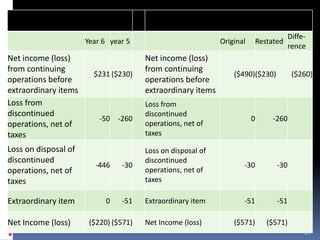
 Illustration:
 BCD agreed to sell a majority stake in
its consolidated subsidiary, Builders
Square.
 Accordingly, BCD recorded an after tax
loss on disposal of discontinued
operations of $385million inYear 6 and
restated its prior two years’ income
statement to reflect this
discontinuance
48
NONRECURRENT ITEMS
 .This restatement resulted in a loss
of $260million in the prior year,
which was the operating loss for
Builders Square for that year.
 The left-side of the excerpt below
shows the lower part of BCD’s
income statements.
49
NONRECURRENT ITEMS
 .This restatement resulted in a loss
of $260million in the prior year,
which was the operating loss for
Builders Square for that year.
50
Lower portion of income
statement.
Original and restated income statement for
year 5
Year 6 year 5 Original Restated
Diffe-
rence
Net income (loss)
from continuing
operations before
extraordinary items
$231 ($230)
Net income (loss)
from continuing
operations before
extraordinary items
($490)($230) ($260)
Loss from
discontinued
operations, net of
taxes
-50 -260
Loss from
discontinued
operations, net of
taxes
0 -260
Loss on disposal of
discontinued
operations, net of
taxes
-446 -30
Loss on disposal of
discontinued
operations, net of
taxes
-30 -30
Extraordinary item 0 -51 Extraordinary item -51 -51
Net Income (loss) ($220) ($571) Net Income (loss) ($571) ($571)
51
NONRECURRENT ITEMS
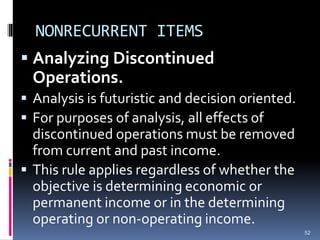
 Analyzing Discontinued
Operations.
 Analysis is futuristic and decision oriented.
 For purposes of analysis, all effects of
discontinued operations must be removed
from current and past income.
 This rule applies regardless of whether the
objective is determining economic or
permanent income or in the determining
operating or non-operating income.
52
NONRECURRENT ITEMS
 The adjustment is a straightforward
for the current and past two years
because companies are required to
restate their income statements and
report the income or loss on
discontinued operations. Such ready
information does not exist for prior
years.
53
NONRECURRENT ITEMS
 Some companies restate summary
financial information, including income for
the past 10 years, which we can use.
 Also , some companies report several prior
years’ information about discontinued
operations separately.
 Yet in most cases this information is
unavailable. In such situations an analyst
must be very careful when conducting
inter-temporal analysis such as evaluating
income patterns over time.
54
NONRECURRENT ITEMS
 Some companies restate summary
financial information, including income for
the past 10 years, which we can use.
 Also , some companies report several prior
years’ information about discontinued
operations separately.
 Yet in most cases this information is
unavailable. In such situations an analyst
must be very careful when conducting
inter-temporal analysis such as evaluating
income patterns over time.
55
NONRECURRENT ITEMS
3. ACCOUNTING CHANGES
 Companies can change accounting methods
and assumptions underlying financial
statement for certain reasons.
I. Accounting methods are changed because of
a new accounting standard.
II. Accounting methods and or assumptions are
changed to better reflect changing business
activities or conditions.
III. Managers wanting to window-dress financial
statements, particular for managing earnings.
56
NONRECURRENT ITEMS
To discourage managers from unjustified
switching from one accounting method to
another , accounting standards require
that in the preparation of financial
statements there is a presumption that an
accounting principle once adopted should
not be changed in accounting for events
and transactions of similar type.
57
NONRECURRENT ITEMS
 Accounting standards distinguish
among four accounting changes:
A change in accounting principles.
A change in accounting estimates.
A change in reporting entity.
Correction of an error.
Reporting of Accounting Changes.
58
NONRECURRENT ITEMS
 Change in accounting principle:
 A change in accounting principle occurs
when a company switches from one
generally accepted accounting principle to
another generally accepted accounting
principle.The phrase accounting principle
refers to both accounting standards and
practices used and the methods of
applying them.
59
NONRECURRENT ITEMS
 Example: A change in depreciation
method from straight line to accelerated.
 Under current accounting standards, when
a change occurs, current period income is
computed using a new method.The
cumulative effect of this change in
principle (net of tax) on retained earnings
as of the beginning of the period when the
change occurred is computed.
60
NONRECURRENT ITEMS
 Change in accounting estimate;
 Accounting requires estimates of items
such as useful lives of assets, warranty
costs, inventory obsolescence, pension
assumptions, and uncollectible
receivables.These are known as
accounting estimates.
 Accounting estimates are approximations
based on unknown future conditions. As
61
NONRECURRENT ITEMS
 There exist certain accounting and disclosure
requirements when changes occur in accounting
estimates.
 Prospective application: A change is accounted for
in the period of change and, if possible, future
periods as and when any effect occur.
 Note disclosure: Disclose the effect of the change
on both net income and income before
extraordinary items including earning per share for
the current period only, even when a change
affects future periods.
62
NONRECURRENT ITEMS
 Illustration
 Delta Airlines previous depreciated its flight
equipment over 15 years using a salvage value of
10%. In the fourth quarter of a recent year , Delta
changed its depreciation policy to one that
assumes a life of 20 years with a salvage value of
5%.This change decreased Delta’s depreciation
expense by %36 million in that fourth quarter and ,
consequently , increased its fiscal year net income
by $22million.
63
NONRECURRENT ITEMS
 Analyzing Accounting Changes.
Points to consider:
1. Accounting changes are ‘cosmetic’ and yield no
cash flow consequences- either present or future.
This means the financial condition of the company
is not affected by a change in accounting.
64
NONRECURRENT ITEMS
2. Accounting changes can sometimes
better reflect economic reality. For
example, a company’s decision to extend
the depreciable lives of its machinery
might be an attempt to better match costs
with actual usage patterns.
3. An analyst must be alert to earning
management.
65
NONRECURRENT ITEMS
4. An analyst must assess the impact of
accounting changes on comparisons
across time. If the company reports the
effects of accounting changes for prior
years’ date in its notes, the income history
can be adjusted. If no such information is
reported , an analyst must be aware of the
potential limitation for any comparisons
across time.
66
NONRECURRENT ITEMS
5. An analyst may want to evaluate the effect of an
accounting change on both economic income and
permanent income. For estimating permanent
income the analyst can use the reported numbers
under the new method and ignore the cumulative
effect. For estimating economic income of the
current period, both the current and cumulative
effect is included.
 The analyst must evaluate the ability of the change
to better reflect the economic reality.
67
NONRECURRENT ITEMS
4. SPECIAL ITEMS
 Refers to transactions and events that are
unusual or infrequent, but not both.These items
are typically reported as separate line items on
the income statement.
 Special items are non-routine items that do not
meet the criteria for classification as
extraordinary.
68
NONRECURRENT ITEMS
 Special items constitutes the most
common and important class of
nonrecurring items.These items, when
they occur, can have a significant impact
on reported profits, often turning a
profitable year to a loss.
 Types of special items;
Asset impairment
Restructuring charges
69
NONRECURRENT ITEMS
 Makeup of one-time special charges
includes:
 Restructuring charges and asset write offs
of goodwill, inventory, and property plant
and equipment.
 Special items pose challenges for analysis:
The economic implications of special items,
such as restructuring charges, are complex.
Many special items are discretionary and
hence, serve earnings management aims.
70
NONRECURRENT ITEMS
Asset Impairments.
 Impairment of long-lived Assets.
 A long-lived asset is said to be impaired
when its fair value ( market value or
value from use within the company) is
below its carrying value( book value in
the balance sheet).
71
NONRECURRENT ITEMS
Reasons for asset impairment:
A decline in the asset market value.
A decline in market demand for the
output from the asset.
Technological obsolescence.
Changes in the company’s business
strategies.
72
NONRECURRENT ITEMS
Differences between asset impairment and
restructuring charges.
1. Restructuring changes are associated with
major reorganizations of a company as a
whole or within a division. Restructuring
often involves a change in a business
strategy, financing, or physical
reorganization of the business. On the other
hand, asset impairments are narrower in
scope, involving the write-down or write-
off of a class of assets.
73
NONRECURRENT ITEMS
Differences between asset impairment
and restructuring charges.
2. Asset impairments are mainly accrual
accounting adjustments, while
restructuring charges often involve
substantial cash flow commitments
either contemporaneously or in the
future.
74
NONRECURRENT ITEMS
Differences between asset impairment
and disposal of business segment
In a disposal the company sells one or
more assets or business segment and
ceases to operate the disposed assets. In
contrast, an impaired asset, while it can
be sold or disposed of in any manner, is
often retained in the company and
operated at a reduced level, made idle,
or abandoned.
75
NONRECURRENT ITEMS
Differences between asset impairment
and disposal of business segment
Accounting view: Disposal of a business
segment is treated as discontinued
operations. While asset impairments are
recorded as special items.
76
NONRECURRENT ITEMS
Procedures of determining the amount
of impairment.
 There are two steps.
1. Asset impairment is recognized when
the carrying value of the asst is below
the undiscounted value of future
expected cash flows from the asset.
77
NONRECURRENT ITEMS
2.The amount of loss is measured as the
difference between the asset carrying
value and its fair value, which equals the
discounted value of future, expected
cash flows from the asset if its fair value
cannot be determined from the market.
78
NONRECURRENT ITEMS
 the standard does not require disclosure
about the determination of the
impairment amount, nor does it require
disclosure about probable asset
impairment.
 The standard also allows flexibility in
determining when and how much of an
asset’s value to write off and does not
require a plan for disposal of the asset.
79
NONRECURRENT ITEMS
IMPAIRMENT OF OTHER ASSETS;
 Companies sometimes write off other
types of assets such as receivables,
inventories and goodwill.While the
values of inventories and receivable are
determinable with reasonable accuracy,
the write off of goodwill is the result of
valuation process and is therefore
sometimes subjective.
80
NONRECURRENT ITEMS
IMPAIRMENT OF OTHER ASSETS;
 Companies sometimes write off other
types of assets such as receivables,
inventories and goodwill.While the
values of inventories and receivable are
determinable with reasonable accuracy,
the write off of goodwill is the result of
valuation process and is therefore
sometimes subjective.
81
NONRECURRENT ITEMS
RESTRUCTURING CHARGES
 Restructuring entails extensive reorganization
including divestment of business units,
termination of contractual agreements,
discontinuation of product lines, work
retrenchment , change in management, and
writing off of assets often combined with new
investments in plant, technology and
manpower
82
NONRECURRENT ITEMS
 Restructuring often comes at a cost.
Divested business units often are sold at
a loss, laid off employees demand
compensation, written off fixed assets
and inventory yield losses, lease buy-
outs are costly , and new investments
and improvements must be paid for.
83
NONRECURRENT ITEMS
 Companies usually make provisions for
the cost of restructuring programme,
including severance accruals and
accruals for assets written down.This
provision is created through a
restructuring charge, which is entirely
charged to the current income
statement a special item.
84
NONRECURRENT ITEMS
 When the restructuring program is
implemented, sometimes over many
years, actual costs are charged against
the provision as and when incurred.
 The remaining balance in the provision
is shown as a restructuring reserve. Any
remaining balance in the reserve at the
completion of the program is reversed
by recording it back to income.
85
NONRECURRENT ITEMS
 When the restructuring program is
implemented, sometimes over many
years, actual costs are charged against
the provision as and when incurred.
 The remaining balance in the provision
is shown as a restructuring reserve. Any
remaining balance in the reserve at the
completion of the program is reversed
by recording it back to income.
86
NONRECURRENT ITEMS
ANALYZING SPECIAL ITEMS.
 Challenges in analyzing special items.
1. The use of estimates creates earning
management.
2. Understanding the underlying
economics of special items , especially
restructuring charges.
87
NONRECURRENT ITEMS
 Importance of special items.
 This arises because of their frequency
and impact on net income of past,
present and future periods.
 Why special items are a popular tool for
earning management?
88
NONRECURRENT ITEMS
Earning Management and special
charges:
 What is the motivation for reporting special
charges?The answer is that one-time charges
are of less concern to investors under the
assumption they are less nonrecurring and,
therefore do not persist into the future. If
classified as transitory (nonrecurring) items by
analysis, their impact on stock price is
considerably lessened.
89
NONRECURRENT ITEMS
Earning Management and special
charges:
 What is the motivation for reporting special
charges?The answer is that one-time charges
are of less concern to investors under the
assumption they are less nonrecurring and,
therefore do not persist into the future. If
classified as transitory (nonrecurring) items by
analysis, their impact on stock price is
considerably lessened.
90
NONRECURRENT ITEMS
Illustration
 Consider a company earning $2 per
share in perpetuity. Given a cost of
capital of 10%, the value of the company
is $20 ($2/0.10). Now alternatively,
assume this company overstates
earnings by $1 per share for four
consecutive periods and then reverses
them with a single charge in the final
91
NONRECURRENT ITEMS
($ per share)
Year
1
Year
2
Year
3
Year
4
Retained earnings. $3 $3 $3 $3
special charge 0 0 0 -4
net income $3 $3 $3 ($1)
92
NONRECURRENT ITEMS
 This pattern of net income suggests a
permanent component of $3 per share
and a transitory component of a
negative $4 per share in year 4.
 The impact of a dollar of permanent
earning to company value is equal to
that dollar divided by its cost of capital.
While the impact of transitory earnings
to company value is a dollar.
93
NONRECURRENT ITEMS
 Many analyst would naïvely value this
company’s stock at $26[($3/0.1)-$4.
Further, if the analyst entirely ignores
this one-time charge, then this
company’s stock is valued at $30($3/0.1).
These amounts are substantially
different than the correct value of $20.
94
NONRECURRENT ITEMS
Income settlement Adjustments.
 Adjustment to determine company’s
permanent income.
 Permanent income should reflect the
profitability of a company under normal
circumstances. Most special charges
constitute operating expenses that need
to be reflected in permanent income.
95
NONRECURRENT ITEMS
Income settlement Adjustments.
 Adjustment to determine company’s
permanent income.
 Permanent income should reflect the
profitability of a company under normal
circumstances. Most special charges
constitute operating expenses that need
to be reflected in permanent income.
96
NONRECURRENT ITEMS
Illustration;
 Consider a company that invests $40 million in
machinery to manufacture a drug.The company
expects the drug to be sold over the remaining
life of its patent , which is eight years.
Accordingly the company depreciates the
machinery on a straight line basis with no
salvage value over an eight year period-
depreciation expense is $5 million per year.
97
NONRECURRENT ITEMS
At the end of forth year; however a competing,
revolutionary product eliminates the market for this
company’s drug. Consequently, the company stops
producing the drug at the end of fourth year. Also the
machinery is scrapped and the company recognizes
an asset impairment charge of 420 million (which is
the machine’s carrying value at the end of the fourth
year). The company reports the impairment
as a one-time charge that is not expected to
occur again.
98
NONRECURRENT ITEMS
Do we concur with this company’s assessment?
We begin by looking the cause of the asset
impairment.The impairment arose because the
company overestimated the economic life of the
drug and, hence, the machine.This led to
undercharging depreciation expense over the
four-year period when the machine was used.
99
NONRECURRENT ITEMS
The proper analysis for this case would be to adjust
depreciation expense assuming a four-year life
and restate past (and current0 earnings.
Specifically we would decrease current period
earnings by $5 million.
100
NONRECURRENT ITEMS
Sometimes special charges are “investments”
for improving future profitability:
 Illustration:
 Consider a company that streamlines its
procurement procedures.These streamlining
results in reducing the workforce in procurement
department by 20%, which is expected to save
the company $1.3 million per year in the future.
101
NONRECURRENT ITEMS
 The laid off workers are paid $4.2 million
as severance compensation.The
company decides to expense this entire
amount as a one-time charge.
 On the surface this accounting
treatment seems reasonable. However,
note the worker severance is expected
to reduce future expenses by $1.3
million per year.
102
NONRECURRENT ITEMS
 Consequently, the $4.2 million severance
compensation is similar to an investment in a
long term asset that is expected to generate net
revenues ( or reduce costs) of $1,3 million per
year in the future.
 This means the proper accounting is to allocate
the $4.2 million over current and future periods
when the benefits are expected to be realized. If
this period cannot be determined, then we can
estimate- say a period of five years.
103
NONRECURRENT ITEMS
 Determination of Economic Income.
 It involves measuring the effects on
equity of all events that occurs in the
period.This means the entire amount of
any special charges is included in the
determining economic income.
104
NONRECURRENT ITEMS
 Restructuring charges often include a provision
for the estimated future costs of the
restructuring program.This entire charge is
taken in the year the program is initiated,
although the actual costs are incurred over
several later periods. In this situation, an
alternative approach in determining economic
income is to only adjust the amounts actually
incurred for each year, rather than for the entire
charge.
105
NONRECURRENT ITEMS
 Restructuring charges often include a provision
for the estimated future costs of the
restructuring program.This entire charge is
taken in the year the program is initiated,
although the actual costs are incurred over
several later periods. In this situation, an
alternative approach in determining economic
income is to only adjust the amounts actually
incurred for each year, rather than for the entire
charge.
106
NONRECURRENT ITEMS
 Example:
 While AT &T took a $923 million
restructuring charge in 2004, only $550
million related to 2004.The remaining
$373 million will be charged to future
years .
107
NONRECURRENT ITEMS
 Adjustment to Balance Sheet.
 A major focus of the asset impairment standards
is the balance sheet.
 Unlike income that is distorted by one-time
charges, these charges especially inventory and
long-term asset write-downs, improve the
ability of the balance sheet to reflect business
reality by reporting assets closer to net
realizable values.
108
NONRECURRENT ITEMS
Points to consider:
 A portion of most restructuring charges is often
in the form of a provision.This means the effects
on assets and liabilities are reflected gradually
over time when the actual costs are incurred.
 A question that arises is should the balance
sheet include the entire provision or should the
remaining balance in the restructuring reserve
be netted against equity?
109
NONRECURRENT ITEMS
 The answer depends on the analysis objectives.
If the analysis is considering a going concern
scenario, it is better to keep the provision in the
balance sheet because it reflects a more realistic
picture of long term assets and liabilities.
However the analysis objective is to determine
the liquidating value of a company, it is better to
offset the restructuring provisions against equity
110
REVENUE RECOGNITION
 Revenues are “inflows or other enhancements of
assets of an entity or settlements of its liabilities”
resulting from a company’s “ongoing major or
central operations.”
 Gains are increases in net assets (equity) resulting
from “peripheral or incidental transactions” of a
company.
 Distinguishing between revenue and gain depend
on the usual business activities of a company.
 This distinction is important because our analysis
treat them differently (i.e. revenue are expected to
persist, while gains are not)
Guidelines for revenue
recognition
Inappropriate accrual recognition of revenues (and
gains) can have one of two undesirable consequences:
1. If a company records revenue prematurely or
belatedly, then revenue is assigned to the wrong
period.
2. If company records revenue prior to reasonable
certainty of realization, then revenue might be in
one period and later cancelled or reversed in
another-this overstates income in the first period
and understates it in the latter period.
Revenue Recognition Criteria
Revenue should be recognized when:
• Earning activities creating revenue are substantially complete,
and no significant effort is necessary to complete the transaction.
• Risk of ownership in sales is effectively passed to the buyer.
• Revenue and the associated expense are measured or estimated
with reasonable accuracy.
• Revenue recognized normally yields an increase in cash,
receivables, or securities. Under certain conditions it yields an
increase in inventories or other assets, or a decrease in liabilities.
• Revenue transaction is at arm’s length with an independent party
(ies) (not with controlled parties).
• Revenue transaction is not subject to revocation (such as a right
of return).
Uncertainty in Revenue Collection
 Companies use a provision for doubtful
(uncollectible) accounts to reflect uncertainty in the
collectability of receivables from credit sales.
 A company makes a judgment, based on the
circumstances, when it can no longer reasonably
assure the collectability of receivables.This
judgment can be conservative or it might use liberal
or optimistic assumptions.
 When collectability is no longer reasonably assured,
a general procedure is to defer recognition of
revenue until cash is collected.
Revenue When Right of Return
Exists
When the buyer has a right of return, revenue is recognized
at the time of sale only if the following conditions are met:
 Price is substantially fixed or determinable at the sale
date.
 Buyer pays the seller or is obligated to pay the seller
(not contingent on resale).
 Buyer’s obligation to seller is unchanged in event of
theft or damage to product.
 Buyer has economic substance apart from the seller.
If these conditions are met, sales revenue and cost of sales
are recorded but reduced to reflect estimated returns and
related expenses; if not met, revenue recognition is
postponed.
Franchise Revenues
Accounting standards for franchisors require that
franchise fee revenue from franchise sales be
recognized only when all material services or
conditions relating to the sale are substantially
performed or satisfied by the franchisor.
This also applies to continuing franchise fees,
continuing product sales, agency sales,
repossessed franchises, franchising costs,
commingled revenue, and relationships between a
franchisor and a franchisee.
Product Financing Arrangements
 This is an agreement involving the transfer or sponsored
acquisition of inventory that (although it sometimes resembles
a sale of inventory) is in substance a means of financing
inventory. For example, if a company transfers inventory to
another company and concurrently agrees to repurchase the
inventory at a later date, this transaction is a product financing
arrangement and not a sale and subsequent purchase of
inventory.
 In essence, if a party bearing the risks and rewards of
ownership transfers inventory to a purchaser and in a related
transaction agrees to repurchase the product at a specified
price over a specified time, or guarantees some specified resale
price for sales of the product to outside parties, the
arrangement is a product financing arrangement and is
accounted for as such. In this case the inventory remains on the
seller’s statements and the seller recognizes no revenue.
Revenue under Contracts
 Accounting for long-term construction contracts for items like
buildings, aircraft, ships, or heavy machinery poses conceptual
problems for the determination of revenue and profit.
 GAAP requires companies to use the percentage-of-
completion method when reasonable estimates exist for both
costs to complete a contract and progress toward completion
of the contract.
 A common basis of profit estimation is to record part of the
estimated total profit based on the ratio of costs incurred to
date divided by expected total costs. Other acceptable
methods of estimation are based on units completed,
engineering estimates, or units delivered. Under this method,
current or anticipated losses are fully recognized in the period
when they are initially identified.
Unearned Revenue
 Under long-term performance contracts such as
product warranty contracts and software
maintenance contracts, revenues are often
collected in advance. Under such circumstances,
revenues are recognized proportionally over the
entire period of the contract.
 The logic for such accounting is that although
revenue in this case is realizable, it is not earned
until the contract’s service period expires.The
amount of revenues that are still unrecognized
appear in the balance sheet as a liability called
unearned revenue.
Analysis Implications of Revenue
Recognition
The income statement is important to the analysis and valuation of
a company.This statement is also important to management for
these same reasons and others, including its role in;
 accounting-based contractual agreements
 management pressure to achieve income-based results
 management compensation linked to income
 The value of stock options
Our analysis must take aim at the accounting methods to ascertain
whether they properly reflect economic reality. For example, if a
manufacturer records profits on sale to a dealer, our analysis must
inquire about dealer inventories and market conditions, because
real earnings activity consists of selling to the ultimate consumer.
Analysis Implications of Revenue
Recognition (cont’d)
Application of accounting principles
 Given management’s incentives, we rationally
expect management to select and apply
accounting principles that best meet their own
interests but are still within acceptable
accounting practice.
 The objectives of income reporting do not
always align with management’s incentives in
this area. An analyst must be alert to
management propensities in this area and the
accounting discretion available.
Analysis Implications of Revenue
Recognition (cont’d)
Management pronouncements
 Managers’ propensities and incentives to
manage revenue yield many
pronouncements on the subject of revenue
recognition by accounting regulatory
agencies.
 In spite of these, an analyst must remain
alert to accounting approaches skirting the
spirit, if not the letter, of these
pronouncements.
Analysis Implications of Revenue
Recognition (cont’d)
Circumstances fueling questions about revenue
recognition
 Lack of substantial equity capital in the purchasing
entity other than that provided by the seller.
 Existence of contingent liabilities such as debt
guarantees or agreements requiring the seller to
infuse cash into the purchasing entity under certain
conditions.
 Sale of assets or operations that have historically
not produced operating cash flows sufficient to fund
future debt service and dividend expectations.
Analysis Implications of Revenue
Recognition (cont’d)
Even when a company receives cash proceeds, any
guarantees or other agreements requiring the
company to infuse cash into the purchasing entity
impacts the validity of revenue recognition. Revenue
should not be recognized until;
 cash flows from operating activities are sufficient to
fund debt service and dividend requirements (on an
accrual basis)
 the company’s investment in the purchasing entity
is or can be readily converted to cash and the
company has no further obligations under any debt
guarantees or other agreements requiring it to
make additional investments in the purchasing
entity.
Analysis Implications of Revenue
Recognition (cont’d)
Amounts of any deferred revenue, including
deferral of interest or dividend revenue are
generally disclosed in a balance sheet as a
deduction from the related asset account. Notes to
the financial statements usually offer a description
of such transactions including any commitments
and contingencies, and the accounting methods
applied.
Current practice generally does not allow for
recognition of revenue in advance of sale.
SUPPLEMENTARY EMPLOYEE
BENEFITS
Some of these benefits and the
accounting for them are:
 Deferred compensation contracts: Are promises to
pay employees in the future , some with
contingencies. It is granted to key executives it
wishes to retain or who desire deferring income to
postretirement or lower tax years.
 Stock appreciation rights (SARs): Are stock rights
granted to an employee on a specified number of
shares. Are based on the increase in market value of
the company’s stock since the date of grant and will
be awarded in cash, stock or a combination. Under
this plan a company records compensation expenses
at the end of each period.
EMPLOYEE STOCK OPTION
Reasons for this popularity are:
 ESOS hence performance by giving employees a
stake in the business and thereby align employ
and the company incentives.
 ESOs are viewed by employees as means of
riches.This has emerged as a tool attracts
talented and enterprising workers.
 They are form of employee compensation.
 Under prior GAAP, ESOs provided employee
benefit without requiring the recording of costs.
Characteristic of employee
option:
 An employee stock option is a contractual opportunity granted
by the company to an employee whereby the employee can
purchase a fixed number of shares of the company at a specified
price on or after a specified future date.
 The exercise price is the price for which the employee has the
right to purchase the shares. Exercise price is often is set equal to
the stock price on the grant date.
 Vesting date is the earliest date the employee can exercise the
option-the employee can exercise the option at any date after
the vesting date.
 Most ESOs have vesting period of between 2 and 10 years.
 When the stock price is higher than the exercise price, the option
is said to be in-the-money.
 It is out-of-money when the stock price is lower than the exercise
price.
Categories of employee stock
option:
 Incentive or tax-favored qualified: Stock options
are not taxed until the stock is sold by the
employee.These options must be granted at fair
market value and the stock must be held for two
years from the date of grant and another one
year from the date they are exercised.
 Nonqualified stock option:They do not have the
tax benefits .They are sometimes granted at a
discount from fair market value and employees
are taxed at the time of exercise on the
difference between the exercise price and the
fair market value.
ECONOMIC BENEFITS OF ESOs.
 Economic befits:
 Potential increase in company value that can
arise through the incentive effects on the
employee behavior. ESOs aim to align incentives
of employees and the company by providing
employees an opportunity to participate in the
shareholders wealth creation.Because incentives
are better aligned , ESOs will induce employees
to work harder and in the best interest of the
company.
Cost for ESOs:
 The cost of employee stock option is their
potential dilutive effect i.e. when exercised;
ESOs transfer wealth from shareholders to
employees by diluting current shareholder’s
stake in the company.
ACCOUNTING AND REPORTING OF ESOs.
 There are two major accounting issues related to ESOs:
 Dilution of earnings per share:
 IAS recognizes the potential dilution of ESOs when
determining diluted earnings per share.
 ESOs in-the-money are considered dilutive securities and
affect diluted EPS.
 ESOs out-of-money are considered antidilutive securities
and do not affect diluted EPS.
 Compensation expense:
 IAS requires companies to determine the value of the ESO
grant and amortize this amount over the expected period
.The value of ESO grant is determined by multiplying the
number of options granted with the fair value of each
option
ACCOUNTING AND REPORTING OF
ESOs . cont….
 IAS requires that companies recognize compensation expense in net
income .
 Factors affecting the fair value of an option.
 Exercise price:
 Stock price on the date of grant: an increase in the market price of the
underlying security will lead to an increase in the value of the option.
 Expected life of the option:The longer the option period the greater the
probability the underlying security will fluctuate in value.
 Risk-free rate of interest:There is a positive correlation between the
value of call option and the risk free rate.The risk free rate provides the
basis of determining the present value for the amount payable.The
higher the risk free rate , the lower the present value and the higher the
value of option.
 Expected volatility of stock; the greater the variability the greater the
probability the option yielding a profit or loss.
 Expected dividend of stock:
DISCLOSURES OF EMPLOYEE STOCK
OPTION.
 Cisco Systems’ 2007 annual report.
 This report gives details on option granted, outstanding and exercisable
along with assumptions used for computing the fair value of options
granted and their effect on income.
 Between July 29, 2006, and July, 28, 2007, Cisco granted $206m to its
employees at a weighted-average exercise price of $23.32.During the
year, 309m options were exercised, and 54m were cancelled.(e.g. when
employees left Cisco without exercising their option).
 On July, 28, 2007, Cisco had 1,289m outstanding option (both vested
and nonvested),of which 829m outstanding options had vested but had
not yet exercised.The weighted-average exercise price on outstanding
options was $26.60, which was slightly below Cisco’s stock price day of
$28.97.the aggregate intrinsic value (total in-the-money value) of the of
the outstanding options on July 28, 2007, was approximately
$9,698m.This is the amount that the Cisco’s employees stood to gain if
all outstanding options were exercised on that date. Also, on July, 28,
2007, Cisco had 294m options available for grant(i.e. have been
authorized by the board of directors) but not yet granted.
DISCLOSURES OF EMPLOYEE STOCK
OPTION. Cont….
 During fiscal year2007,the weighted average fair value per
option was $7,11,which is determined assuming a dividend
yield of 0%,a risk-free interest rate of 4.6%,an expected life
of6.7 years, and a stock price volatility of 26%.Cisco uses
bionomial lattice model for valuing its options , which
requires additional assumptions regarding Cisco’s stock
return’s distribution such as skewness and kurtosis Cisco’s
share based compensation expense ( amortized cost of
granting ESOs)for fiscal year 2007 was $931m,which was
almost 15% of its net income for that year.
 During fiscal2007 , assuming exercise of all vested options
at the earliest opportunity , Cisco’s outstanding shares
would have been diluted by $210m (from 6055m to 6265m),
lowering its EPS from $1.21(basic EPS) to $1.17(diluted
EPS).
ANALYZING EMPLOYEE STOCK
OPTIONS.
 ESOs (in the absence of incentive effect) impose no cash
flow commitment on the company nor involve any resource
allocation away from the shareholders total.
 ESOs do not affect either total liabilities or shareholders
equity.Any wealth transfer occurs only between current
shareholders and prospective shareholders (employees)
 The analysis implication is that while the potential
reduction in the value of current equity shares must be
considered, it can be ignored for evaluating solvency and
liquidity.Therefore credit analyst must exclude share-based
compensation expense from income when evaluating
profitability.
ANALYZING EMPLOYEE STOCK
OPTIONS. Cont….
 On July 28, 2007, Cisco had 1,289m outstanding ESOs at an
aggregate intrinsic value of $9698m.
 The aggregate intrinsic value is the employees; net gain
comes at the expense of the current shareholders, this
amount constitutes the potential transfer of wealth from
current shareholders to employees through dilution from
ESOs grant; it is referred to as option overhang.
 Cisco’s option overhang is around 5.7% of its market value
of equity.
 An analyst can use note information provided to derive
option overhang using the following formula;
 Aggregate intrinsic value(option overhang)=(stock option-
Average exercise price)×outstanding number of options.
For all in-the-money option.
ANALYZING EMPLOYEE STOCK
OPTIONS. Cont….
 Example:
 For the exercise price range of $0.001 to $15.00, the option aggregate
intrinsic value using the note information is ($28.97-
$11.02)×122m=$2190m which approximately equals that reported by
Cisco for that category.
 Example: Accounting for employee stock option.
 Determine diluted EPS.
 Because ESOs potentially dilute current shareholders’ equity holding,
there effect must be considered when determining the diluted EPS.
 Only in-the-money options are considered dilutive securities-those that
will potentially dilute the current shareholders’ equity holdings-and are
included in diluted EPS computation.
 Options that are out-of-money, where the exercise exceeds stock price-
are considered antidilutive and are not included in computing diluted
EPS.
ANALYZING EMPLOYEE STOCK
OPTIONS. Cont….
 Determining compensation expense:This is a two-step
process:
 Determining the cost of ESO granted:
 This is determined at the time of the grant.ESO cost is the
product of the fair value of each individual option and the
number options granted.
 The fair value of the ESO is determined by applying the
option pricing model (Usually Black-Schole Model) as of the
grant date.
 Expected life of the option is based on the expected
exercise date.
 The number of options expected to vest is determined by
adjusting the number of options granted for the expected
employee turnover during the expected life of the option.
ANALYZING EMPLOYEE STOCK
OPTIONS. Cont….
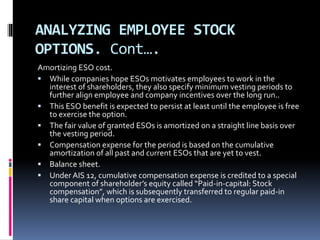
Amortizing ESO cost.
 While companies hope ESOs motivates employees to work in the
interest of shareholders, they also specify minimum vesting periods to
further align employee and company incentives over the long run..
 This ESO benefit is expected to persist at least until the employee is free
to exercise the option.
 The fair value of granted ESOs is amortized on a straight line basis over
the vesting period.
 Compensation expense for the period is based on the cumulative
amortization of all past and current ESOs that are yet to vest.
 Balance sheet.
 Under AIS 12, cumulative compensation expense is credited to a special
component of shareholder’s equity called “Paid-in-capital: Stock
compensation”, which is subsequently transferred to regular paid-in
share capital when options are exercised.
Income Taxes
 Related standards
 IAS 12
 Current GAAP comparisons
 IFRS financial statement disclosures
 Looking ahead
 End-of-chapter practice
143
Related Standards
 FAS 109 Accounting for income taxes
144
Related Standards
 IAS 1 Presentation of financial statements
 IAS 8 Accounting policies, changes in
accounting estimates and errors
 IAS 37 Provisions, contingent liabilities and
contingent assets
 IFRS 3 Business combinations
145
IAS 12 – Overview
 Objective and scope
 Recognition of current tax liabilities and
assets
 Recognition of deferred tax liabilities and
assets
 Measurement
 Recognition of current and deferred tax
 Presentation
 Disclosures
146
IAS 12 – Objective and Scope
 IAS 12 addresses the accounting issues
related to tax effects of
 Current period transactions and events
 Unused tax losses or credits
 Tax consequences when carrying amounts and tax
amounts differ
147
IAS 12 – Recognition of Current
Tax Liabilities and Assets
 Current tax = amount of income taxes payable
or recoverable on the taxable profit or loss for
the period
 If current taxes payable > taxes paid, then
 Income taxes payable
 If current income taxes payable < taxes paid,
then
 Income taxes recoverable/receivable
148
IAS 12 – Recognition of Deferred
Tax Liabilities and Assets
 Underlying assumption of accounting model:
 Assets will be recovered for at least their carrying
amount
 Liabilities will be settled for their carrying amount
 If there are tax consequences when the asset
is recovered or liability settled, this effect
should be reported on the statement of
financial position now
 Future tax effect = deferred tax liability or
deferred tax asset
149
IAS 12 – Recognition of Deferred
Tax Liabilities and Assets
Q.Why a tax consequence?
A. Because carrying amount ofA & L may differ from their
tax amount or tax base = a temporary difference
Taxable temporary difference:
Taxable income is increased in future when asset
recovered/liability settled
Deductible temporary difference:
Taxable income is decreased in future when asset
recovered/liability settled
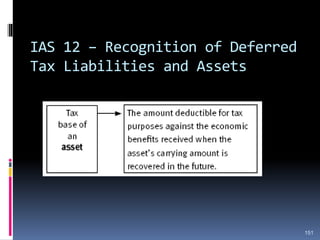
150
IAS 12 – Recognition of Deferred
Tax Liabilities and Assets
151
IAS 12 – Recognition of Deferred
Tax Liabilities and Assets
 Example: Installment A/R carrying amount -
Ksh40; revenues recognized on sale; taxable
when cash received.Tax base = Ksh0
 Why is tax base Ksh0?
 When the Ksh40 is received (asset’s carrying
amount is recovered), it is all taxable. No amount
(Ksh0) is deductible from the Ksh40 received.
 Taxable temporary difference = Ksh40 - Ksh0 =
Ksh40
152
IAS 12 – Recognition of Deferred
Tax Liabilities and Assets
153
IAS 12 – Recognition of Deferred
Tax Liabilities and Assets
 Future tax consequence (assume tax rate of
40%):
 Taxable temporary difference × tax rate* =
deferred tax liability
 Installment A/R temporary difference of Ksh40 ×
40% = Ksh16 deferred tax liability
 * tax rate – statutory rate when temporary
difference is expected to reverse, i.e., enter
into calculation of taxable income
154
IAS 12 – Recognition of Deferred
Tax Liabilities and Assets
 Future tax consequence (assume tax rate of
40%):
 Deductible temporary difference × tax rate* =
deferred tax asset
 Warranty liability temporary difference of Ksh90 ×
40% = Ksh36 deferred tax asset
 * tax rate – statutory rate when temporary
difference is expected to reverse, i.e., enter
into calculation of taxable income
155
IAS 12 – Recognition of Deferred
Tax Liabilities and Assets
 Deferred tax assets
 Result from deductible temporary differences and
unused tax losses/credits
 Rely on having taxable income in the future in
order to benefit
 Recognize deferred tax asset only if probable that
taxable profit will be available
156
IAS 12 – Recognition of Deferred Tax Liabilities
and Assets
 Probable that taxable income will be
available in future? Consider:
 Existence of taxable temporary differences that
will reverse in future resulting in taxable income
 History of profitability
 Tax planning opportunities
 If so, recognize deferred tax asset and benefit
in same year as tax loss; recognize full tax
effect on temporary deductible differences.
Reassess each B/S date.
157
IAS 12 – Recognition of Deferred
Tax Liabilities and Assets
 Complexities arise with differences between
carrying amounts and tax base of
 Goodwill
 A & L in a business combination
 Investments in subsidiaries, associates, joint
ventures
158
IAS 12 – Measurement
 Current tax liability
 Taxable income × current tax rate = current tax
payable
 Current tax asset – if past taxes can be recouped
 Taxable loss × tax rate of past year = current tax
receivable/recoverable
 Current tax asset – if current year’s taxes
overpaid = current tax receivable/recoverable
159
IAS 12 – Measurement
 Deferred tax assets and liabilities
 Measured on an undiscounted basis
 Use tax rates for period when asset is expected to
be recovered or liability settled
 Use rates based on laws enacted or substantively
enacted at B/S date
 Use average rates expected to apply to taxable
profit/loss in period of expected reversal of
temporary difference
 Review carrying amount of deferred tax assets at
each reporting date
160
IAS 12 – Recognition of Current
and Deferred Tax
 Recognize current and deferred taxes in profit
or loss unless
 The related income or expense is recognized
elsewhere such as OCI or directly in other equity
item
 Tax results from a business combination
161
IAS 12 – Presentation
 Classification - deferred taxes are non-
currentA/L (IAS 1)
 Offsetting - both for current and deferred:
only if same taxation authority, legal right to
offset, intent is to settle net or at same time
 Tax expense includes both current and
deferred taxes
 Report tax expense on profit or loss
separately from tax expense in OCI
162
IAS 12 – Disclosures
 Report separately the major components of
tax expense or income
 Current tax expense/income
 Adjustments for current tax of other periods
 Deferred tax expense/income from each type of
temporary difference or change in tax rates or
new taxes
 Benefits recognized currently from previously
unrecognized tax losses/credits, or other
temporary differences
163
IAS 12 – Disclosures
 Report (continued)
 Tax expense recognized directly in equity and in
each component of OCI
 Reconciliation of expected tax rate to effective tax
rate
 Tax expense for discontinued op’ns – separately
for operating results and other gain or loss
164
IAS 12 – Disclosures
 Related to statement of financial position:
 Amount of deferred tax asset/liability for
each type of temporary difference
 Deductible temporary differences and other
balances with unrecognized deferred tax
assets
 Nature of evidence supporting recognition of
uncertain deferred tax assets
165
Accounting For Income Taxes
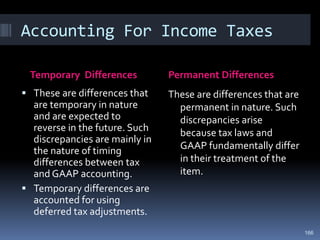
Temporary Differences Permanent Differences
 These are differences that
are temporary in nature
and are expected to
reverse in the future. Such
discrepancies are mainly in
the nature of timing
differences between tax
and GAAP accounting.
 Temporary differences are
accounted for using
deferred tax adjustments.
These are differences that are
permanent in nature. Such
discrepancies arise
because tax laws and
GAAP fundamentally differ
in their treatment of the
item.
166
Accounting For Income Taxes
cont…
 For example, interest income from certain
municipal bonds is tax exempt and therefore
not included in determining taxable income,
while it is included when determining GAAP
income.
167
Accounting For Income Taxes
cont…
 Permanent differences are not accounted for
in the financial statements; instead they are
factored into the effective tax rate, which is
the actual tax rate incurred by the business
during the period.
168
Deferred Taxes
 Temporary differences can cause taxable
income to deviate substantially from pretax
income prepared under GAAP.Therefore,
charging the actual tax payable during the
year (which is computed using taxable
income) against pretax GAAP income violates
the basic matching principle of accounting
and results in after-tax income that can be
volatile and even meaningless.
169
Deferred Taxes cont…
 To avoid these problems, accountants use
inter-period allocations known as deferred
tax adjustments.The basis for deferred tax
adjustments is to better match the tax
expense for the period with the pretax
income reported under GAAP. In the process,
deferred tax accounting creates important
balance sheet items called deferred tax assets
or deferred tax liabilities.
170
Accounting For Deferred Taxes
 Accounting for deferred taxes is specified
under SFAS 109. Although the objective of
deferred tax accounting is matching the tax
expense with pretax GAAP income, the ac-
counting for deferred taxes takes an asset-
liability approach.
 The focus is on computation of the balance
sheet items, deferred tax assets and
liabilities.
171
Accounting For Deferred Taxes cont….
 Deferred taxes are determined separately for
each tax-paying component (an individual
entity or group of entities consolidated for
tax purposes) in each tax jurisdiction.
 Determination includes computing total
deferred tax liability (or assets) for each
taxable temporary difference (and operating
loss carry-forwards, if any) using the
applicable tax rates.
172
Accounting For Deferred Taxes
cont….
 All deferred tax assets need to be evaluated
for the probability of realization. A valuation
allowance must be created to reduce
deferred tax assets to the extent to which it is
deemed that the assets are more likely (more
than 50% probability) to not be realized.
Determination of the valuation allowance is
subjective and thus a potent tool for earnings
management.
173
Analyzing Income Taxes
 deferred tax assets (or liabilities) are not
“true” assets (liabilities) in the sense that they
do not confer any future benefits or impose
any future obligations on the company.
Because of this, many analysts exclude them
from the balance sheet when conducting
ratio analysis.
174
Analyzing Income Taxes cont…
 For example, credit raters such as Moody’s
recommend that deferred tax assets or
liabilities be excluded when determining
solvency or liquidity ratios such as debt-to-
equity ratio or current ratio.To exclude
deferred tax liabilities (or assets) from the
balance sheet, we need to remove them from
wherever they are classified and adjust the
net amount to equity.
175
Present Valuing Deferred Tax Assets and
Liabilities
 Deferred tax assets (or liabilities) represent
potential future cash flows arising from
reversal of temporary differences. However,
these reversals could arise many years later,
in which case the present value of the cash
flow effects will be much smaller than that
recorded on the balance sheet.
176
Forecasting Future Income and Cash Flows
 Income tax disclosures are useful for
forecasting future cash flows. We need to
consider both permanent and temporary
differences in our cash flow forecasts. First,
let us consider permanent differences. Most
valuation textbooks recommend using the
statutory tax rate (currently 35%) when
forecasting future earnings or cash flows.
177
Forecasting Future Income and Cash Flows cont…
 The statutory tax rate is a useful estimate of
the marginal tax rate; that is, it helps us
identify the tax effect for an additional dollar
of income. It is less useful as an estimate of
the average tax rate of a company.This is
because companies may have permanent
differences that can permanently lower (or, in
rare cases, increase) its tax rates.
178
Forecasting Future Income and Cash Flows cont…
 Because earnings (or cash flow) forecasts
need to use average (rather than marginal)
tax rates, effective tax rates may be more
useful for this purpose. However, effective tax
rates have to be used carefully because they
can be very volatile.Thus, a company’s
effective tax rate during a year is unlikely to
be a good estimate of its future effective tax
rates.
179
Forecasting Future Income and Cash Flows cont…
 For this purpose an analyst should examine a
company’s effective tax rates over the past
few years to determine its permanent
component. It is also useful to analyze the
nature of the permanent differences so as to
better estimate the permanent component of
the effective tax rate.
180
Analyzing Permanent and Temporary Differences
 An analyst must evaluate why effective tax
rates differ from statutory tax rates by
examining the components that cause the
divergence. In particular, it is important to
identify any nonrecurring components that
temporarily affect effective tax rates.
 It is also important to analyze the nature of
the temporary differences identified by the
components of deferred tax assets and
liabilities.
181
Analyzing Permanent and Temporary Differences cont…
 An analyst must evaluate the “reversibility” of
the deferrals and also make estimates about
how quickly the reversals are expected to
occur.
182
REFERENCES:
 Financial Statement Analysis 10th Edition by
K.R. Subramanyam and John J.Wild
 International Accounting Standards website
183

Group_4_ANALYZING_OPERATING_ACTIVIIES.ppt

  • 1.
  • 2.
    CORPORATE FINANCIAL REPORTINGAND ANALYSIS  DANIEL KIPRUTO D63/60179/2013  MASIEBI BARASA GEORGE D63/60080/2013  RUTH W. KARIUKI D63/60485/2013  WEN WEI D63/60266/2013  BASIL M. MUDACHI D63/60114/2013  WILFRED O. SOSI D63/60790/2013  NDATHO CYPRIAN D63/60103/2013  MICHAEL WACHIRA D63/60023/2013  IBRAHIM ABDILADIF D63/60861/2013  JOAN MURIUKI D63/61124/2013 2
  • 3.
    ANALYSIS OBJECTIVES.  Explainthe concept of income measurement and their implications for analysis of operating activities.  Describe and analyze the impact of nonrecurring items including extraordinary items, discontinued segments, accounting changes, write-offs, and restructuring changes.  Analyze revenue and expense recognition and its risks for financial statement analysis.  Analyze deferred charges, including expenditures for research, development and exploration.  Explain supplementary employee benefits and analyzing the disclosure of employee stock options(ESO)
  • 4.
    INCOME MEASUREMENT  Incomesummarizes the financial effects of a business’s operating activities.  Economic income: measures the net change in shareholder’s wealth during a period and is typically equal to a period’s cash flows plus change in present value of expected future cash flows.  Permanent income; is an estimate of the stable average income that a business is expected to earn over its life time, given the current state of the business.
  • 5.
    INCOME MEASUREMENT.cont……..  Accountingincome is based on accrual accounting and is determined by recognizing revenues and matching costs to the recognized revenues.  Accounting income comprise of three components.These are;  Permanent or recurring component, where each dollar is equal to 1/r dollars of a company’s value( r is the cost of capital).  Transitory component; where each dollar is equal to one dollar of a company value.  Value irrelevant component; which is irrelevant for valuation. 
  • 6.
    Measuring Accounting Income: Revenue (and gains) and expenses (and losses) are the two components of accounting income. Revenues and Gains Revenues  Are earned inflows or prospective earned inflows of cash that arise from a company’s ongoing business activities.These include cash inflows such as cash sales .and prospective cash inflows such as credit sales.
  • 7.
    Revenues and Gains….. Gains  Are earned inflows or prospective earned inflows of cash arising from transactions and events unrelated to a company’s ongoing business activities  The distinction between revenues and gains is based on the ongoing business activities that produce revenues. Revenues are expected to persist indefinitely for a going concern. In contrast, gains are nonrecurring.
  • 8.
    Expenses and Losses Expenses;  Are incurred outflows, prospective outflows or allocation of past outflows of cash that arise from company’s ongoing business operations.  Losses:  Are decreases in a company’s net assets arising from peripheral or incidental operations of the company.  Accounting for expenses and losses often involves assessing the amount and timing of their allocation to reporting periods.
  • 9.
    Alternative Income Classification andmeasures.  Income can be classified into two major dimensions:  Operating versus nonoperating.  Recurring and nonrecurring.  Recurring and nonrecurring income:  The importance of classifying income component as recurring and nonrecurring arises from the need to determine the permanent and transitory component of income.
  • 10.
    Alternative Measure of AccountingIncome:  Income statement typically report three alternative income measures.These are; 1.Net income:  GAAP allows a number of direct adjustments to equity , called dirty surplus items that bypass income statement . 2. Comprehensive income:  Reflects nearly all changes to equity, other than those from owner activities (such as dividend and share issuance).
  • 11.
    Alternative Measure of AccountingIncome: cont…..  Unfortunately companies are allowed to report comprehensive income in the statement of changes of equity instead of income statement.  Comprehensive income differs from net income in that it reflects certain unrealized holding gains and losses foreign currency translation adjustment and minimum pension liability adjustment.
  • 12.
    Alternative Measure of AccountingIncome: cont….. 3. Continuing Income:  Is a measure that excludes extraordinary items , cumulative effects of accounting changes, and the effects of discontinued operations.  It is often called income before extraordinary items, income before discontinued operations or income before cumulative effect of accounting change.
  • 13.
    Alternative Measure of AccountingIncome : cont… 4. Core Income:  Is a measure that excludes all nonrecurring items that are reported as separate line items on the income statement. In the illustration, Core income equals the continuing income reported in 2006 and 2004.Yet in 2005, Core income is different-it excludes the after tax effect of the restructuring charge of $1016m. In this case, core income equals continuing income plus the restructuring charge that is multiplied by one minus the 35% marginal tax rate, or $463{computed as $(197) plus the $1016×0.65]
  • 14.
    Analysis Implication.  AccountingStandard requires alternative income measures so users can identify sustainable and nonsustainable income components.  Many analysts prefer an income measure that corresponds to one of the reported measures or some variation that excludes or includes some items.  Debate range over what constitutes the “correct” measure of income.There is caution against such debate for two reasons:
  • 15.
    Analysis Implication.cont…  Acorrect measure of income is not possible without specifying analysis objectives. Income serves two roles: to measure the net change in equity and to provide an estimate of sustainable earning power. It is impossible for a single income measure to satisfy both objectives at the same time.  The alternative accounting income measures results from merely including or excluding, certain line items.This means they are still accounting measures of income and are subject to accounting distortions.
  • 16.
    OPERATING AND NONOPERATING INCOME. Operating income.  Is a measure of company’s income from ongoing operating business activities.  There are three important aspect of operating income.These are;  Operating income pertains only to income generated from operating activities.  Operating income focuses on income for the company as a whole rather than for debt and equity holders.  Operating income pertains only to ongoing business activities. income.
  • 17.
    Nonoperating income.  Includesall component of income not included in operating income. It is useful in analyzing nonoperating income to separate components pertains to financing activities from those pertaining discontinued operations.
  • 18.
    Analysis implications.  Theusefulness of operating income arises from an important goal in corporate finance.That is the desire to separate investing (and operating) decisions such as capital budgeting, from those of financing decisions such as dividend policy.  Operating income can be determined by rearranging the income statement and making proper adjustments for taxes.  It is sometimes necessary to draw on more detailed adjustments using information in notes.  For example, when a company has operating leases, the entire lease rental is included as an operating expense even though the lease payments included an interest component. In this case the operating income is understated unless the analyst estimates the interest component and makes the necessary adjustment using the note information.
  • 19.
    Comprehensive income.  Measuringcomprehensive income.  As defined in IFRS5, comprehensive income is computed by adjusting net income for dirty surplus items , collectively called other comprehensive income.The determination is as shown below.   Net income ………………………………………………………………...$1,205  Other comprehensive income:  unrealized holding gain (loss0 on marketable securities……$305  foreign currency translation adjustment……………………………-12  Postretirement adjustment ………………………………………………-12  Unrealized holding gain or loss on derivative instruments…945 1221  Comprehensive income……………………………………………………………..$2,426
  • 20.
    Measuring comprehensive income .cont……  The other comprehensive income for this company consists of four component;  Unrealized holding gains or losses that result from changes in the fair (market value of available -for –sale investment securities.  Foreign currency translation gains and losses.  Changes in the funded status of postretirement benefits not included in net income.  Unrealized holding gains or losses arising from the effective portion of cash flow hedges .These amounts are expressed on an after tax basis.
  • 21.
    Measuring comprehensive income. Cont…… All component are in the nature unrealized gain and losses. Analysis implication;  The importance of comprehensive income for financial statement analysis arises because it is the accountant’s proxy for economic income.  Distinction between comprehensive income and net income are;  -net income estimates neither economic income nor sustainable income but comprehensive income estimates economic income.  -Net income has many components in the nature of unrealized gains or losses from trading securities, fair value hedges and from ineffective portion of cash flow hedges. 
  • 22.
  • 23.
    NONRECURRENT ITEMS Nonrecurring itemsinclude: 1. Extraordinary Items 2. DISCONTINUED OPERATIONS 3. ACCOUNTING CHANGES 4. SPECIAL ITEMS 23
  • 24.
    NONRECURRENT ITEMS 1. ExtraordinaryItems  They are distinguished by their unusual nature and by the infrequency of their occurrence.  They are classified separately in the income statement .  Because of stringent criteria for classification, extraordinary items are uncommon. 24
  • 25.
    NONRECURRENT ITEMS Accounting forextraordinary items:  To qualify as an extraordinary, an item must be both unusual in nature and infrequence in occurrence. 25
  • 26.
    NONRECURRENT ITEMS  Unusualin nature:  An event or transaction that has a high degree of abnormality and is unrelated to, or only incidentally related to, the ordinary and typical activities of the company. 26
  • 27.
    NONRECURRENT ITEMS  Infrequencein occurrence:  An event or transaction that is not reasonably expected to occur in the foreseeable future. 27
  • 28.
    NONRECURRENT ITEMS  Extraordinaryitems are reported, net of tax, as separate line items in the income statement after continuing income.  When a company reports extraordinary items, continuing income is called income before extraordinary items. 28
  • 29.
    NONRECURRENT ITEMS  Practicerequires that companies to not report certain gains and losses as extraordinary items because they are not unusual in nature and are expected to recur as a consequence of customary and continuing business activities. 29
  • 30.
    NONRECURRENT ITEMS  Examplesinclude: Write-down or write-off of receivables, inventories, equipment leased to others, deferred R &D costs, or other intangible assets. Gain or losses from disposal of business segment. 30
  • 31.
    NONRECURRENT ITEMS  Examplesinclude (cont): Gains or losses sale or abandonment of property, plant and equipment. Effects of a strike, including those against competitors and major suppliers. Adjustment of accruals on long term contracts. 31
  • 32.
    NONRECURRENT ITEMS  AnalyzingExtraordinary Items  Extraordinary are nonrecurring in nature. Analyst therefore excludes extraordinary items when computing permanent income.  They are also excluded from income when making comparisons over time or across companies. 32
  • 33.
    NONRECURRENT ITEMS  Yet,while the extraordinary items are transitory, they yield a cost (or a benefit on the company, dollar for dollar, and an analyst must therefore include the entire amount of the extra ordinary items when computing economic income 33
  • 34.
    NONRECURRENT ITEMS  Theyare often operating in nature.  However they differ from normal operating revenues or expenses because they are nonrecurring .  For example, a loss of inventory. 34
  • 35.
    NONRECURRENT ITEMS  Forexample a loss from of inventory from fire arises as part of company’s operations (and reveals the nature of operating risk inherent in the company’s business), but it is not expected to occur on a regular basis. 35
  • 36.
    NONRECURRENT ITEMS  Thusthese extraordinary items that arise from company’s business operations are included when computing operating income but excluded when determining permanent income. 36
  • 37.
    NONRECURRENT ITEMS  Extraordinaryitems also reveal business risk exposure of the company,  while these risks may be remote, their occurrence suggest the possibility of reoccurrence at some future date. 37
  • 38.
    NONRECURRENT ITEMS  Thelarge magnitude of most extra ordinary losses also encourages analysis even when their occurrence is infrequent.  In some cases, extraordinary items may reoccur, though infrequent. 38
  • 39.
    NONRECURRENT ITEMS  Forexample, a warehouse by the beach in an area susceptible to hurricanes may incur flood damage every few years.  An analyst may consider this when evaluating sustainable earning power. 39
  • 40.
    NONRECURRENT ITEMS 2. DISCONTINUEDOPERATIONS  Companies sometimes dispose of entire divisions or product lines.  When this disposition pertains to separately identifiable business segments, they are accorded special accounting treatment in the income statement. 40
  • 41.
    NONRECURRENT ITEMS The accountingtreatment includes any component of an entity (rather than a segment of a business. A component of an entity comprises operations (and cash flows) that can be clearly be distinguished, operationally and for purposes of financial reporting, form the rest of the business. 41
  • 42.
    NONRECURRENT ITEMS Accounting forDiscontinued operations To qualify as discontinued operations, the assets and the business activities of the divested segment must be clearly be distinguished both physically and operationally from the assets and business activities of the remaining entity. 42
  • 43.
    NONRECURRENT ITEMS  Accountingand reporting for discontinued operation is a two fold:  1.The income statements for the current and prior two years are restated after excluding the effects of discontinued operations from the lines items that determine continuing income. 43
  • 44.
    NONRECURRENT ITEMS  2.Gains or losses pertaining to the discontinued operations are reported separately, net of their related tax effects, and are excluded from the continuing income.  Continuing income is called income before discontinued operations when discontinued operations are reported. 44
  • 45.
    NONRECURRENT ITEMS  Acompany reports gains or losses from discontinued operations for current and two prior years in two categories:  1. Operating income or loss from discontinued operations until the management commits to the disposal. 45
  • 46.
    NONRECURRENT ITEMS  Acompany reports gains or losses from discontinued operations for current and two prior years in two categories:  2. Gains and losses on the disposal, including operating income or loss during the phase-out period 46
  • 47.
    NONRECURRENT ITEMS  Acompany reports gains or losses from discontinued operations for current and two prior years in two categories:  2. Gains and losses on the disposal, including operating income or loss during the phase-out period 47
  • 48.
    NONRECURRENT ITEMS  Illustration: BCD agreed to sell a majority stake in its consolidated subsidiary, Builders Square.  Accordingly, BCD recorded an after tax loss on disposal of discontinued operations of $385million inYear 6 and restated its prior two years’ income statement to reflect this discontinuance 48
  • 49.
    NONRECURRENT ITEMS  .Thisrestatement resulted in a loss of $260million in the prior year, which was the operating loss for Builders Square for that year.  The left-side of the excerpt below shows the lower part of BCD’s income statements. 49
  • 50.
    NONRECURRENT ITEMS  .Thisrestatement resulted in a loss of $260million in the prior year, which was the operating loss for Builders Square for that year. 50
  • 51.
    Lower portion ofincome statement. Original and restated income statement for year 5 Year 6 year 5 Original Restated Diffe- rence Net income (loss) from continuing operations before extraordinary items $231 ($230) Net income (loss) from continuing operations before extraordinary items ($490)($230) ($260) Loss from discontinued operations, net of taxes -50 -260 Loss from discontinued operations, net of taxes 0 -260 Loss on disposal of discontinued operations, net of taxes -446 -30 Loss on disposal of discontinued operations, net of taxes -30 -30 Extraordinary item 0 -51 Extraordinary item -51 -51 Net Income (loss) ($220) ($571) Net Income (loss) ($571) ($571) 51
  • 52.
    NONRECURRENT ITEMS  AnalyzingDiscontinued Operations.  Analysis is futuristic and decision oriented.  For purposes of analysis, all effects of discontinued operations must be removed from current and past income.  This rule applies regardless of whether the objective is determining economic or permanent income or in the determining operating or non-operating income. 52
  • 53.
    NONRECURRENT ITEMS  Theadjustment is a straightforward for the current and past two years because companies are required to restate their income statements and report the income or loss on discontinued operations. Such ready information does not exist for prior years. 53
  • 54.
    NONRECURRENT ITEMS  Somecompanies restate summary financial information, including income for the past 10 years, which we can use.  Also , some companies report several prior years’ information about discontinued operations separately.  Yet in most cases this information is unavailable. In such situations an analyst must be very careful when conducting inter-temporal analysis such as evaluating income patterns over time. 54
  • 55.
    NONRECURRENT ITEMS  Somecompanies restate summary financial information, including income for the past 10 years, which we can use.  Also , some companies report several prior years’ information about discontinued operations separately.  Yet in most cases this information is unavailable. In such situations an analyst must be very careful when conducting inter-temporal analysis such as evaluating income patterns over time. 55
  • 56.
    NONRECURRENT ITEMS 3. ACCOUNTINGCHANGES  Companies can change accounting methods and assumptions underlying financial statement for certain reasons. I. Accounting methods are changed because of a new accounting standard. II. Accounting methods and or assumptions are changed to better reflect changing business activities or conditions. III. Managers wanting to window-dress financial statements, particular for managing earnings. 56
  • 57.
    NONRECURRENT ITEMS To discouragemanagers from unjustified switching from one accounting method to another , accounting standards require that in the preparation of financial statements there is a presumption that an accounting principle once adopted should not be changed in accounting for events and transactions of similar type. 57
  • 58.
    NONRECURRENT ITEMS  Accountingstandards distinguish among four accounting changes: A change in accounting principles. A change in accounting estimates. A change in reporting entity. Correction of an error. Reporting of Accounting Changes. 58
  • 59.
    NONRECURRENT ITEMS  Changein accounting principle:  A change in accounting principle occurs when a company switches from one generally accepted accounting principle to another generally accepted accounting principle.The phrase accounting principle refers to both accounting standards and practices used and the methods of applying them. 59
  • 60.
    NONRECURRENT ITEMS  Example:A change in depreciation method from straight line to accelerated.  Under current accounting standards, when a change occurs, current period income is computed using a new method.The cumulative effect of this change in principle (net of tax) on retained earnings as of the beginning of the period when the change occurred is computed. 60
  • 61.
    NONRECURRENT ITEMS  Changein accounting estimate;  Accounting requires estimates of items such as useful lives of assets, warranty costs, inventory obsolescence, pension assumptions, and uncollectible receivables.These are known as accounting estimates.  Accounting estimates are approximations based on unknown future conditions. As 61
  • 62.
    NONRECURRENT ITEMS  Thereexist certain accounting and disclosure requirements when changes occur in accounting estimates.  Prospective application: A change is accounted for in the period of change and, if possible, future periods as and when any effect occur.  Note disclosure: Disclose the effect of the change on both net income and income before extraordinary items including earning per share for the current period only, even when a change affects future periods. 62
  • 63.
    NONRECURRENT ITEMS  Illustration Delta Airlines previous depreciated its flight equipment over 15 years using a salvage value of 10%. In the fourth quarter of a recent year , Delta changed its depreciation policy to one that assumes a life of 20 years with a salvage value of 5%.This change decreased Delta’s depreciation expense by %36 million in that fourth quarter and , consequently , increased its fiscal year net income by $22million. 63
  • 64.
    NONRECURRENT ITEMS  AnalyzingAccounting Changes. Points to consider: 1. Accounting changes are ‘cosmetic’ and yield no cash flow consequences- either present or future. This means the financial condition of the company is not affected by a change in accounting. 64
  • 65.
    NONRECURRENT ITEMS 2. Accountingchanges can sometimes better reflect economic reality. For example, a company’s decision to extend the depreciable lives of its machinery might be an attempt to better match costs with actual usage patterns. 3. An analyst must be alert to earning management. 65
  • 66.
    NONRECURRENT ITEMS 4. Ananalyst must assess the impact of accounting changes on comparisons across time. If the company reports the effects of accounting changes for prior years’ date in its notes, the income history can be adjusted. If no such information is reported , an analyst must be aware of the potential limitation for any comparisons across time. 66
  • 67.
    NONRECURRENT ITEMS 5. Ananalyst may want to evaluate the effect of an accounting change on both economic income and permanent income. For estimating permanent income the analyst can use the reported numbers under the new method and ignore the cumulative effect. For estimating economic income of the current period, both the current and cumulative effect is included.  The analyst must evaluate the ability of the change to better reflect the economic reality. 67
  • 68.
    NONRECURRENT ITEMS 4. SPECIALITEMS  Refers to transactions and events that are unusual or infrequent, but not both.These items are typically reported as separate line items on the income statement.  Special items are non-routine items that do not meet the criteria for classification as extraordinary. 68
  • 69.
    NONRECURRENT ITEMS  Specialitems constitutes the most common and important class of nonrecurring items.These items, when they occur, can have a significant impact on reported profits, often turning a profitable year to a loss.  Types of special items; Asset impairment Restructuring charges 69
  • 70.
    NONRECURRENT ITEMS  Makeupof one-time special charges includes:  Restructuring charges and asset write offs of goodwill, inventory, and property plant and equipment.  Special items pose challenges for analysis: The economic implications of special items, such as restructuring charges, are complex. Many special items are discretionary and hence, serve earnings management aims. 70
  • 71.
    NONRECURRENT ITEMS Asset Impairments. Impairment of long-lived Assets.  A long-lived asset is said to be impaired when its fair value ( market value or value from use within the company) is below its carrying value( book value in the balance sheet). 71
  • 72.
    NONRECURRENT ITEMS Reasons forasset impairment: A decline in the asset market value. A decline in market demand for the output from the asset. Technological obsolescence. Changes in the company’s business strategies. 72
  • 73.
    NONRECURRENT ITEMS Differences betweenasset impairment and restructuring charges. 1. Restructuring changes are associated with major reorganizations of a company as a whole or within a division. Restructuring often involves a change in a business strategy, financing, or physical reorganization of the business. On the other hand, asset impairments are narrower in scope, involving the write-down or write- off of a class of assets. 73
  • 74.
    NONRECURRENT ITEMS Differences betweenasset impairment and restructuring charges. 2. Asset impairments are mainly accrual accounting adjustments, while restructuring charges often involve substantial cash flow commitments either contemporaneously or in the future. 74
  • 75.
    NONRECURRENT ITEMS Differences betweenasset impairment and disposal of business segment In a disposal the company sells one or more assets or business segment and ceases to operate the disposed assets. In contrast, an impaired asset, while it can be sold or disposed of in any manner, is often retained in the company and operated at a reduced level, made idle, or abandoned. 75
  • 76.
    NONRECURRENT ITEMS Differences betweenasset impairment and disposal of business segment Accounting view: Disposal of a business segment is treated as discontinued operations. While asset impairments are recorded as special items. 76
  • 77.
    NONRECURRENT ITEMS Procedures ofdetermining the amount of impairment.  There are two steps. 1. Asset impairment is recognized when the carrying value of the asst is below the undiscounted value of future expected cash flows from the asset. 77
  • 78.
    NONRECURRENT ITEMS 2.The amountof loss is measured as the difference between the asset carrying value and its fair value, which equals the discounted value of future, expected cash flows from the asset if its fair value cannot be determined from the market. 78
  • 79.
    NONRECURRENT ITEMS  thestandard does not require disclosure about the determination of the impairment amount, nor does it require disclosure about probable asset impairment.  The standard also allows flexibility in determining when and how much of an asset’s value to write off and does not require a plan for disposal of the asset. 79
  • 80.
    NONRECURRENT ITEMS IMPAIRMENT OFOTHER ASSETS;  Companies sometimes write off other types of assets such as receivables, inventories and goodwill.While the values of inventories and receivable are determinable with reasonable accuracy, the write off of goodwill is the result of valuation process and is therefore sometimes subjective. 80
  • 81.
    NONRECURRENT ITEMS IMPAIRMENT OFOTHER ASSETS;  Companies sometimes write off other types of assets such as receivables, inventories and goodwill.While the values of inventories and receivable are determinable with reasonable accuracy, the write off of goodwill is the result of valuation process and is therefore sometimes subjective. 81
  • 82.
    NONRECURRENT ITEMS RESTRUCTURING CHARGES Restructuring entails extensive reorganization including divestment of business units, termination of contractual agreements, discontinuation of product lines, work retrenchment , change in management, and writing off of assets often combined with new investments in plant, technology and manpower 82
  • 83.
    NONRECURRENT ITEMS  Restructuringoften comes at a cost. Divested business units often are sold at a loss, laid off employees demand compensation, written off fixed assets and inventory yield losses, lease buy- outs are costly , and new investments and improvements must be paid for. 83
  • 84.
    NONRECURRENT ITEMS  Companiesusually make provisions for the cost of restructuring programme, including severance accruals and accruals for assets written down.This provision is created through a restructuring charge, which is entirely charged to the current income statement a special item. 84
  • 85.
    NONRECURRENT ITEMS  Whenthe restructuring program is implemented, sometimes over many years, actual costs are charged against the provision as and when incurred.  The remaining balance in the provision is shown as a restructuring reserve. Any remaining balance in the reserve at the completion of the program is reversed by recording it back to income. 85
  • 86.
    NONRECURRENT ITEMS  Whenthe restructuring program is implemented, sometimes over many years, actual costs are charged against the provision as and when incurred.  The remaining balance in the provision is shown as a restructuring reserve. Any remaining balance in the reserve at the completion of the program is reversed by recording it back to income. 86
  • 87.
    NONRECURRENT ITEMS ANALYZING SPECIALITEMS.  Challenges in analyzing special items. 1. The use of estimates creates earning management. 2. Understanding the underlying economics of special items , especially restructuring charges. 87
  • 88.
    NONRECURRENT ITEMS  Importanceof special items.  This arises because of their frequency and impact on net income of past, present and future periods.  Why special items are a popular tool for earning management? 88
  • 89.
    NONRECURRENT ITEMS Earning Managementand special charges:  What is the motivation for reporting special charges?The answer is that one-time charges are of less concern to investors under the assumption they are less nonrecurring and, therefore do not persist into the future. If classified as transitory (nonrecurring) items by analysis, their impact on stock price is considerably lessened. 89
  • 90.
    NONRECURRENT ITEMS Earning Managementand special charges:  What is the motivation for reporting special charges?The answer is that one-time charges are of less concern to investors under the assumption they are less nonrecurring and, therefore do not persist into the future. If classified as transitory (nonrecurring) items by analysis, their impact on stock price is considerably lessened. 90
  • 91.
    NONRECURRENT ITEMS Illustration  Considera company earning $2 per share in perpetuity. Given a cost of capital of 10%, the value of the company is $20 ($2/0.10). Now alternatively, assume this company overstates earnings by $1 per share for four consecutive periods and then reverses them with a single charge in the final 91
  • 92.
    NONRECURRENT ITEMS ($ pershare) Year 1 Year 2 Year 3 Year 4 Retained earnings. $3 $3 $3 $3 special charge 0 0 0 -4 net income $3 $3 $3 ($1) 92
  • 93.
    NONRECURRENT ITEMS  Thispattern of net income suggests a permanent component of $3 per share and a transitory component of a negative $4 per share in year 4.  The impact of a dollar of permanent earning to company value is equal to that dollar divided by its cost of capital. While the impact of transitory earnings to company value is a dollar. 93
  • 94.
    NONRECURRENT ITEMS  Manyanalyst would naïvely value this company’s stock at $26[($3/0.1)-$4. Further, if the analyst entirely ignores this one-time charge, then this company’s stock is valued at $30($3/0.1). These amounts are substantially different than the correct value of $20. 94
  • 95.
    NONRECURRENT ITEMS Income settlementAdjustments.  Adjustment to determine company’s permanent income.  Permanent income should reflect the profitability of a company under normal circumstances. Most special charges constitute operating expenses that need to be reflected in permanent income. 95
  • 96.
    NONRECURRENT ITEMS Income settlementAdjustments.  Adjustment to determine company’s permanent income.  Permanent income should reflect the profitability of a company under normal circumstances. Most special charges constitute operating expenses that need to be reflected in permanent income. 96
  • 97.
    NONRECURRENT ITEMS Illustration;  Considera company that invests $40 million in machinery to manufacture a drug.The company expects the drug to be sold over the remaining life of its patent , which is eight years. Accordingly the company depreciates the machinery on a straight line basis with no salvage value over an eight year period- depreciation expense is $5 million per year. 97
  • 98.
    NONRECURRENT ITEMS At theend of forth year; however a competing, revolutionary product eliminates the market for this company’s drug. Consequently, the company stops producing the drug at the end of fourth year. Also the machinery is scrapped and the company recognizes an asset impairment charge of 420 million (which is the machine’s carrying value at the end of the fourth year). The company reports the impairment as a one-time charge that is not expected to occur again. 98
  • 99.
    NONRECURRENT ITEMS Do weconcur with this company’s assessment? We begin by looking the cause of the asset impairment.The impairment arose because the company overestimated the economic life of the drug and, hence, the machine.This led to undercharging depreciation expense over the four-year period when the machine was used. 99
  • 100.
    NONRECURRENT ITEMS The properanalysis for this case would be to adjust depreciation expense assuming a four-year life and restate past (and current0 earnings. Specifically we would decrease current period earnings by $5 million. 100
  • 101.
    NONRECURRENT ITEMS Sometimes specialcharges are “investments” for improving future profitability:  Illustration:  Consider a company that streamlines its procurement procedures.These streamlining results in reducing the workforce in procurement department by 20%, which is expected to save the company $1.3 million per year in the future. 101
  • 102.
    NONRECURRENT ITEMS  Thelaid off workers are paid $4.2 million as severance compensation.The company decides to expense this entire amount as a one-time charge.  On the surface this accounting treatment seems reasonable. However, note the worker severance is expected to reduce future expenses by $1.3 million per year. 102
  • 103.
    NONRECURRENT ITEMS  Consequently,the $4.2 million severance compensation is similar to an investment in a long term asset that is expected to generate net revenues ( or reduce costs) of $1,3 million per year in the future.  This means the proper accounting is to allocate the $4.2 million over current and future periods when the benefits are expected to be realized. If this period cannot be determined, then we can estimate- say a period of five years. 103
  • 104.
    NONRECURRENT ITEMS  Determinationof Economic Income.  It involves measuring the effects on equity of all events that occurs in the period.This means the entire amount of any special charges is included in the determining economic income. 104
  • 105.
    NONRECURRENT ITEMS  Restructuringcharges often include a provision for the estimated future costs of the restructuring program.This entire charge is taken in the year the program is initiated, although the actual costs are incurred over several later periods. In this situation, an alternative approach in determining economic income is to only adjust the amounts actually incurred for each year, rather than for the entire charge. 105
  • 106.
    NONRECURRENT ITEMS  Restructuringcharges often include a provision for the estimated future costs of the restructuring program.This entire charge is taken in the year the program is initiated, although the actual costs are incurred over several later periods. In this situation, an alternative approach in determining economic income is to only adjust the amounts actually incurred for each year, rather than for the entire charge. 106
  • 107.
    NONRECURRENT ITEMS  Example: While AT &T took a $923 million restructuring charge in 2004, only $550 million related to 2004.The remaining $373 million will be charged to future years . 107
  • 108.
    NONRECURRENT ITEMS  Adjustmentto Balance Sheet.  A major focus of the asset impairment standards is the balance sheet.  Unlike income that is distorted by one-time charges, these charges especially inventory and long-term asset write-downs, improve the ability of the balance sheet to reflect business reality by reporting assets closer to net realizable values. 108
  • 109.
    NONRECURRENT ITEMS Points toconsider:  A portion of most restructuring charges is often in the form of a provision.This means the effects on assets and liabilities are reflected gradually over time when the actual costs are incurred.  A question that arises is should the balance sheet include the entire provision or should the remaining balance in the restructuring reserve be netted against equity? 109
  • 110.
    NONRECURRENT ITEMS  Theanswer depends on the analysis objectives. If the analysis is considering a going concern scenario, it is better to keep the provision in the balance sheet because it reflects a more realistic picture of long term assets and liabilities. However the analysis objective is to determine the liquidating value of a company, it is better to offset the restructuring provisions against equity 110
  • 111.
  • 112.
     Revenues are“inflows or other enhancements of assets of an entity or settlements of its liabilities” resulting from a company’s “ongoing major or central operations.”  Gains are increases in net assets (equity) resulting from “peripheral or incidental transactions” of a company.  Distinguishing between revenue and gain depend on the usual business activities of a company.  This distinction is important because our analysis treat them differently (i.e. revenue are expected to persist, while gains are not)
  • 113.
    Guidelines for revenue recognition Inappropriateaccrual recognition of revenues (and gains) can have one of two undesirable consequences: 1. If a company records revenue prematurely or belatedly, then revenue is assigned to the wrong period. 2. If company records revenue prior to reasonable certainty of realization, then revenue might be in one period and later cancelled or reversed in another-this overstates income in the first period and understates it in the latter period.
  • 114.
    Revenue Recognition Criteria Revenueshould be recognized when: • Earning activities creating revenue are substantially complete, and no significant effort is necessary to complete the transaction. • Risk of ownership in sales is effectively passed to the buyer. • Revenue and the associated expense are measured or estimated with reasonable accuracy. • Revenue recognized normally yields an increase in cash, receivables, or securities. Under certain conditions it yields an increase in inventories or other assets, or a decrease in liabilities. • Revenue transaction is at arm’s length with an independent party (ies) (not with controlled parties). • Revenue transaction is not subject to revocation (such as a right of return).
  • 115.
    Uncertainty in RevenueCollection  Companies use a provision for doubtful (uncollectible) accounts to reflect uncertainty in the collectability of receivables from credit sales.  A company makes a judgment, based on the circumstances, when it can no longer reasonably assure the collectability of receivables.This judgment can be conservative or it might use liberal or optimistic assumptions.  When collectability is no longer reasonably assured, a general procedure is to defer recognition of revenue until cash is collected.
  • 116.
    Revenue When Rightof Return Exists When the buyer has a right of return, revenue is recognized at the time of sale only if the following conditions are met:  Price is substantially fixed or determinable at the sale date.  Buyer pays the seller or is obligated to pay the seller (not contingent on resale).  Buyer’s obligation to seller is unchanged in event of theft or damage to product.  Buyer has economic substance apart from the seller. If these conditions are met, sales revenue and cost of sales are recorded but reduced to reflect estimated returns and related expenses; if not met, revenue recognition is postponed.
  • 117.
    Franchise Revenues Accounting standardsfor franchisors require that franchise fee revenue from franchise sales be recognized only when all material services or conditions relating to the sale are substantially performed or satisfied by the franchisor. This also applies to continuing franchise fees, continuing product sales, agency sales, repossessed franchises, franchising costs, commingled revenue, and relationships between a franchisor and a franchisee.
  • 118.
    Product Financing Arrangements This is an agreement involving the transfer or sponsored acquisition of inventory that (although it sometimes resembles a sale of inventory) is in substance a means of financing inventory. For example, if a company transfers inventory to another company and concurrently agrees to repurchase the inventory at a later date, this transaction is a product financing arrangement and not a sale and subsequent purchase of inventory.  In essence, if a party bearing the risks and rewards of ownership transfers inventory to a purchaser and in a related transaction agrees to repurchase the product at a specified price over a specified time, or guarantees some specified resale price for sales of the product to outside parties, the arrangement is a product financing arrangement and is accounted for as such. In this case the inventory remains on the seller’s statements and the seller recognizes no revenue.
  • 119.
    Revenue under Contracts Accounting for long-term construction contracts for items like buildings, aircraft, ships, or heavy machinery poses conceptual problems for the determination of revenue and profit.  GAAP requires companies to use the percentage-of- completion method when reasonable estimates exist for both costs to complete a contract and progress toward completion of the contract.  A common basis of profit estimation is to record part of the estimated total profit based on the ratio of costs incurred to date divided by expected total costs. Other acceptable methods of estimation are based on units completed, engineering estimates, or units delivered. Under this method, current or anticipated losses are fully recognized in the period when they are initially identified.
  • 120.
    Unearned Revenue  Underlong-term performance contracts such as product warranty contracts and software maintenance contracts, revenues are often collected in advance. Under such circumstances, revenues are recognized proportionally over the entire period of the contract.  The logic for such accounting is that although revenue in this case is realizable, it is not earned until the contract’s service period expires.The amount of revenues that are still unrecognized appear in the balance sheet as a liability called unearned revenue.
  • 121.
    Analysis Implications ofRevenue Recognition The income statement is important to the analysis and valuation of a company.This statement is also important to management for these same reasons and others, including its role in;  accounting-based contractual agreements  management pressure to achieve income-based results  management compensation linked to income  The value of stock options Our analysis must take aim at the accounting methods to ascertain whether they properly reflect economic reality. For example, if a manufacturer records profits on sale to a dealer, our analysis must inquire about dealer inventories and market conditions, because real earnings activity consists of selling to the ultimate consumer.
  • 122.
    Analysis Implications ofRevenue Recognition (cont’d) Application of accounting principles  Given management’s incentives, we rationally expect management to select and apply accounting principles that best meet their own interests but are still within acceptable accounting practice.  The objectives of income reporting do not always align with management’s incentives in this area. An analyst must be alert to management propensities in this area and the accounting discretion available.
  • 123.
    Analysis Implications ofRevenue Recognition (cont’d) Management pronouncements  Managers’ propensities and incentives to manage revenue yield many pronouncements on the subject of revenue recognition by accounting regulatory agencies.  In spite of these, an analyst must remain alert to accounting approaches skirting the spirit, if not the letter, of these pronouncements.
  • 124.
    Analysis Implications ofRevenue Recognition (cont’d) Circumstances fueling questions about revenue recognition  Lack of substantial equity capital in the purchasing entity other than that provided by the seller.  Existence of contingent liabilities such as debt guarantees or agreements requiring the seller to infuse cash into the purchasing entity under certain conditions.  Sale of assets or operations that have historically not produced operating cash flows sufficient to fund future debt service and dividend expectations.
  • 125.
    Analysis Implications ofRevenue Recognition (cont’d) Even when a company receives cash proceeds, any guarantees or other agreements requiring the company to infuse cash into the purchasing entity impacts the validity of revenue recognition. Revenue should not be recognized until;  cash flows from operating activities are sufficient to fund debt service and dividend requirements (on an accrual basis)  the company’s investment in the purchasing entity is or can be readily converted to cash and the company has no further obligations under any debt guarantees or other agreements requiring it to make additional investments in the purchasing entity.
  • 126.
    Analysis Implications ofRevenue Recognition (cont’d) Amounts of any deferred revenue, including deferral of interest or dividend revenue are generally disclosed in a balance sheet as a deduction from the related asset account. Notes to the financial statements usually offer a description of such transactions including any commitments and contingencies, and the accounting methods applied. Current practice generally does not allow for recognition of revenue in advance of sale.
  • 127.
  • 128.
    Some of thesebenefits and the accounting for them are:  Deferred compensation contracts: Are promises to pay employees in the future , some with contingencies. It is granted to key executives it wishes to retain or who desire deferring income to postretirement or lower tax years.  Stock appreciation rights (SARs): Are stock rights granted to an employee on a specified number of shares. Are based on the increase in market value of the company’s stock since the date of grant and will be awarded in cash, stock or a combination. Under this plan a company records compensation expenses at the end of each period.
  • 129.
    EMPLOYEE STOCK OPTION Reasonsfor this popularity are:  ESOS hence performance by giving employees a stake in the business and thereby align employ and the company incentives.  ESOs are viewed by employees as means of riches.This has emerged as a tool attracts talented and enterprising workers.  They are form of employee compensation.  Under prior GAAP, ESOs provided employee benefit without requiring the recording of costs.
  • 130.
    Characteristic of employee option: An employee stock option is a contractual opportunity granted by the company to an employee whereby the employee can purchase a fixed number of shares of the company at a specified price on or after a specified future date.  The exercise price is the price for which the employee has the right to purchase the shares. Exercise price is often is set equal to the stock price on the grant date.  Vesting date is the earliest date the employee can exercise the option-the employee can exercise the option at any date after the vesting date.  Most ESOs have vesting period of between 2 and 10 years.  When the stock price is higher than the exercise price, the option is said to be in-the-money.  It is out-of-money when the stock price is lower than the exercise price.
  • 131.
    Categories of employeestock option:  Incentive or tax-favored qualified: Stock options are not taxed until the stock is sold by the employee.These options must be granted at fair market value and the stock must be held for two years from the date of grant and another one year from the date they are exercised.  Nonqualified stock option:They do not have the tax benefits .They are sometimes granted at a discount from fair market value and employees are taxed at the time of exercise on the difference between the exercise price and the fair market value.
  • 132.
    ECONOMIC BENEFITS OFESOs.  Economic befits:  Potential increase in company value that can arise through the incentive effects on the employee behavior. ESOs aim to align incentives of employees and the company by providing employees an opportunity to participate in the shareholders wealth creation.Because incentives are better aligned , ESOs will induce employees to work harder and in the best interest of the company.
  • 133.
    Cost for ESOs: The cost of employee stock option is their potential dilutive effect i.e. when exercised; ESOs transfer wealth from shareholders to employees by diluting current shareholder’s stake in the company.
  • 134.
    ACCOUNTING AND REPORTINGOF ESOs.  There are two major accounting issues related to ESOs:  Dilution of earnings per share:  IAS recognizes the potential dilution of ESOs when determining diluted earnings per share.  ESOs in-the-money are considered dilutive securities and affect diluted EPS.  ESOs out-of-money are considered antidilutive securities and do not affect diluted EPS.  Compensation expense:  IAS requires companies to determine the value of the ESO grant and amortize this amount over the expected period .The value of ESO grant is determined by multiplying the number of options granted with the fair value of each option
  • 135.
    ACCOUNTING AND REPORTINGOF ESOs . cont….  IAS requires that companies recognize compensation expense in net income .  Factors affecting the fair value of an option.  Exercise price:  Stock price on the date of grant: an increase in the market price of the underlying security will lead to an increase in the value of the option.  Expected life of the option:The longer the option period the greater the probability the underlying security will fluctuate in value.  Risk-free rate of interest:There is a positive correlation between the value of call option and the risk free rate.The risk free rate provides the basis of determining the present value for the amount payable.The higher the risk free rate , the lower the present value and the higher the value of option.  Expected volatility of stock; the greater the variability the greater the probability the option yielding a profit or loss.  Expected dividend of stock:
  • 136.
    DISCLOSURES OF EMPLOYEESTOCK OPTION.  Cisco Systems’ 2007 annual report.  This report gives details on option granted, outstanding and exercisable along with assumptions used for computing the fair value of options granted and their effect on income.  Between July 29, 2006, and July, 28, 2007, Cisco granted $206m to its employees at a weighted-average exercise price of $23.32.During the year, 309m options were exercised, and 54m were cancelled.(e.g. when employees left Cisco without exercising their option).  On July, 28, 2007, Cisco had 1,289m outstanding option (both vested and nonvested),of which 829m outstanding options had vested but had not yet exercised.The weighted-average exercise price on outstanding options was $26.60, which was slightly below Cisco’s stock price day of $28.97.the aggregate intrinsic value (total in-the-money value) of the of the outstanding options on July 28, 2007, was approximately $9,698m.This is the amount that the Cisco’s employees stood to gain if all outstanding options were exercised on that date. Also, on July, 28, 2007, Cisco had 294m options available for grant(i.e. have been authorized by the board of directors) but not yet granted.
  • 137.
    DISCLOSURES OF EMPLOYEESTOCK OPTION. Cont….  During fiscal year2007,the weighted average fair value per option was $7,11,which is determined assuming a dividend yield of 0%,a risk-free interest rate of 4.6%,an expected life of6.7 years, and a stock price volatility of 26%.Cisco uses bionomial lattice model for valuing its options , which requires additional assumptions regarding Cisco’s stock return’s distribution such as skewness and kurtosis Cisco’s share based compensation expense ( amortized cost of granting ESOs)for fiscal year 2007 was $931m,which was almost 15% of its net income for that year.  During fiscal2007 , assuming exercise of all vested options at the earliest opportunity , Cisco’s outstanding shares would have been diluted by $210m (from 6055m to 6265m), lowering its EPS from $1.21(basic EPS) to $1.17(diluted EPS).
  • 138.
    ANALYZING EMPLOYEE STOCK OPTIONS. ESOs (in the absence of incentive effect) impose no cash flow commitment on the company nor involve any resource allocation away from the shareholders total.  ESOs do not affect either total liabilities or shareholders equity.Any wealth transfer occurs only between current shareholders and prospective shareholders (employees)  The analysis implication is that while the potential reduction in the value of current equity shares must be considered, it can be ignored for evaluating solvency and liquidity.Therefore credit analyst must exclude share-based compensation expense from income when evaluating profitability.
  • 139.
    ANALYZING EMPLOYEE STOCK OPTIONS.Cont….  On July 28, 2007, Cisco had 1,289m outstanding ESOs at an aggregate intrinsic value of $9698m.  The aggregate intrinsic value is the employees; net gain comes at the expense of the current shareholders, this amount constitutes the potential transfer of wealth from current shareholders to employees through dilution from ESOs grant; it is referred to as option overhang.  Cisco’s option overhang is around 5.7% of its market value of equity.  An analyst can use note information provided to derive option overhang using the following formula;  Aggregate intrinsic value(option overhang)=(stock option- Average exercise price)×outstanding number of options. For all in-the-money option.
  • 140.
    ANALYZING EMPLOYEE STOCK OPTIONS.Cont….  Example:  For the exercise price range of $0.001 to $15.00, the option aggregate intrinsic value using the note information is ($28.97- $11.02)×122m=$2190m which approximately equals that reported by Cisco for that category.  Example: Accounting for employee stock option.  Determine diluted EPS.  Because ESOs potentially dilute current shareholders’ equity holding, there effect must be considered when determining the diluted EPS.  Only in-the-money options are considered dilutive securities-those that will potentially dilute the current shareholders’ equity holdings-and are included in diluted EPS computation.  Options that are out-of-money, where the exercise exceeds stock price- are considered antidilutive and are not included in computing diluted EPS.
  • 141.
    ANALYZING EMPLOYEE STOCK OPTIONS.Cont….  Determining compensation expense:This is a two-step process:  Determining the cost of ESO granted:  This is determined at the time of the grant.ESO cost is the product of the fair value of each individual option and the number options granted.  The fair value of the ESO is determined by applying the option pricing model (Usually Black-Schole Model) as of the grant date.  Expected life of the option is based on the expected exercise date.  The number of options expected to vest is determined by adjusting the number of options granted for the expected employee turnover during the expected life of the option.
  • 142.
    ANALYZING EMPLOYEE STOCK OPTIONS.Cont…. Amortizing ESO cost.  While companies hope ESOs motivates employees to work in the interest of shareholders, they also specify minimum vesting periods to further align employee and company incentives over the long run..  This ESO benefit is expected to persist at least until the employee is free to exercise the option.  The fair value of granted ESOs is amortized on a straight line basis over the vesting period.  Compensation expense for the period is based on the cumulative amortization of all past and current ESOs that are yet to vest.  Balance sheet.  Under AIS 12, cumulative compensation expense is credited to a special component of shareholder’s equity called “Paid-in-capital: Stock compensation”, which is subsequently transferred to regular paid-in share capital when options are exercised.
  • 143.
    Income Taxes  Relatedstandards  IAS 12  Current GAAP comparisons  IFRS financial statement disclosures  Looking ahead  End-of-chapter practice 143
  • 144.
    Related Standards  FAS109 Accounting for income taxes 144
  • 145.
    Related Standards  IAS1 Presentation of financial statements  IAS 8 Accounting policies, changes in accounting estimates and errors  IAS 37 Provisions, contingent liabilities and contingent assets  IFRS 3 Business combinations 145
  • 146.
    IAS 12 –Overview  Objective and scope  Recognition of current tax liabilities and assets  Recognition of deferred tax liabilities and assets  Measurement  Recognition of current and deferred tax  Presentation  Disclosures 146
  • 147.
    IAS 12 –Objective and Scope  IAS 12 addresses the accounting issues related to tax effects of  Current period transactions and events  Unused tax losses or credits  Tax consequences when carrying amounts and tax amounts differ 147
  • 148.
    IAS 12 –Recognition of Current Tax Liabilities and Assets  Current tax = amount of income taxes payable or recoverable on the taxable profit or loss for the period  If current taxes payable > taxes paid, then  Income taxes payable  If current income taxes payable < taxes paid, then  Income taxes recoverable/receivable 148
  • 149.
    IAS 12 –Recognition of Deferred Tax Liabilities and Assets  Underlying assumption of accounting model:  Assets will be recovered for at least their carrying amount  Liabilities will be settled for their carrying amount  If there are tax consequences when the asset is recovered or liability settled, this effect should be reported on the statement of financial position now  Future tax effect = deferred tax liability or deferred tax asset 149
  • 150.
    IAS 12 –Recognition of Deferred Tax Liabilities and Assets Q.Why a tax consequence? A. Because carrying amount ofA & L may differ from their tax amount or tax base = a temporary difference Taxable temporary difference: Taxable income is increased in future when asset recovered/liability settled Deductible temporary difference: Taxable income is decreased in future when asset recovered/liability settled 150
  • 151.
    IAS 12 –Recognition of Deferred Tax Liabilities and Assets 151
  • 152.
    IAS 12 –Recognition of Deferred Tax Liabilities and Assets  Example: Installment A/R carrying amount - Ksh40; revenues recognized on sale; taxable when cash received.Tax base = Ksh0  Why is tax base Ksh0?  When the Ksh40 is received (asset’s carrying amount is recovered), it is all taxable. No amount (Ksh0) is deductible from the Ksh40 received.  Taxable temporary difference = Ksh40 - Ksh0 = Ksh40 152
  • 153.
    IAS 12 –Recognition of Deferred Tax Liabilities and Assets 153
  • 154.
    IAS 12 –Recognition of Deferred Tax Liabilities and Assets  Future tax consequence (assume tax rate of 40%):  Taxable temporary difference × tax rate* = deferred tax liability  Installment A/R temporary difference of Ksh40 × 40% = Ksh16 deferred tax liability  * tax rate – statutory rate when temporary difference is expected to reverse, i.e., enter into calculation of taxable income 154
  • 155.
    IAS 12 –Recognition of Deferred Tax Liabilities and Assets  Future tax consequence (assume tax rate of 40%):  Deductible temporary difference × tax rate* = deferred tax asset  Warranty liability temporary difference of Ksh90 × 40% = Ksh36 deferred tax asset  * tax rate – statutory rate when temporary difference is expected to reverse, i.e., enter into calculation of taxable income 155
  • 156.
    IAS 12 –Recognition of Deferred Tax Liabilities and Assets  Deferred tax assets  Result from deductible temporary differences and unused tax losses/credits  Rely on having taxable income in the future in order to benefit  Recognize deferred tax asset only if probable that taxable profit will be available 156
  • 157.
    IAS 12 –Recognition of Deferred Tax Liabilities and Assets  Probable that taxable income will be available in future? Consider:  Existence of taxable temporary differences that will reverse in future resulting in taxable income  History of profitability  Tax planning opportunities  If so, recognize deferred tax asset and benefit in same year as tax loss; recognize full tax effect on temporary deductible differences. Reassess each B/S date. 157
  • 158.
    IAS 12 –Recognition of Deferred Tax Liabilities and Assets  Complexities arise with differences between carrying amounts and tax base of  Goodwill  A & L in a business combination  Investments in subsidiaries, associates, joint ventures 158
  • 159.
    IAS 12 –Measurement  Current tax liability  Taxable income × current tax rate = current tax payable  Current tax asset – if past taxes can be recouped  Taxable loss × tax rate of past year = current tax receivable/recoverable  Current tax asset – if current year’s taxes overpaid = current tax receivable/recoverable 159
  • 160.
    IAS 12 –Measurement  Deferred tax assets and liabilities  Measured on an undiscounted basis  Use tax rates for period when asset is expected to be recovered or liability settled  Use rates based on laws enacted or substantively enacted at B/S date  Use average rates expected to apply to taxable profit/loss in period of expected reversal of temporary difference  Review carrying amount of deferred tax assets at each reporting date 160
  • 161.
    IAS 12 –Recognition of Current and Deferred Tax  Recognize current and deferred taxes in profit or loss unless  The related income or expense is recognized elsewhere such as OCI or directly in other equity item  Tax results from a business combination 161
  • 162.
    IAS 12 –Presentation  Classification - deferred taxes are non- currentA/L (IAS 1)  Offsetting - both for current and deferred: only if same taxation authority, legal right to offset, intent is to settle net or at same time  Tax expense includes both current and deferred taxes  Report tax expense on profit or loss separately from tax expense in OCI 162
  • 163.
    IAS 12 –Disclosures  Report separately the major components of tax expense or income  Current tax expense/income  Adjustments for current tax of other periods  Deferred tax expense/income from each type of temporary difference or change in tax rates or new taxes  Benefits recognized currently from previously unrecognized tax losses/credits, or other temporary differences 163
  • 164.
    IAS 12 –Disclosures  Report (continued)  Tax expense recognized directly in equity and in each component of OCI  Reconciliation of expected tax rate to effective tax rate  Tax expense for discontinued op’ns – separately for operating results and other gain or loss 164
  • 165.
    IAS 12 –Disclosures  Related to statement of financial position:  Amount of deferred tax asset/liability for each type of temporary difference  Deductible temporary differences and other balances with unrecognized deferred tax assets  Nature of evidence supporting recognition of uncertain deferred tax assets 165
  • 166.
    Accounting For IncomeTaxes Temporary Differences Permanent Differences  These are differences that are temporary in nature and are expected to reverse in the future. Such discrepancies are mainly in the nature of timing differences between tax and GAAP accounting.  Temporary differences are accounted for using deferred tax adjustments. These are differences that are permanent in nature. Such discrepancies arise because tax laws and GAAP fundamentally differ in their treatment of the item. 166
  • 167.
    Accounting For IncomeTaxes cont…  For example, interest income from certain municipal bonds is tax exempt and therefore not included in determining taxable income, while it is included when determining GAAP income. 167
  • 168.
    Accounting For IncomeTaxes cont…  Permanent differences are not accounted for in the financial statements; instead they are factored into the effective tax rate, which is the actual tax rate incurred by the business during the period. 168
  • 169.
    Deferred Taxes  Temporarydifferences can cause taxable income to deviate substantially from pretax income prepared under GAAP.Therefore, charging the actual tax payable during the year (which is computed using taxable income) against pretax GAAP income violates the basic matching principle of accounting and results in after-tax income that can be volatile and even meaningless. 169
  • 170.
    Deferred Taxes cont… To avoid these problems, accountants use inter-period allocations known as deferred tax adjustments.The basis for deferred tax adjustments is to better match the tax expense for the period with the pretax income reported under GAAP. In the process, deferred tax accounting creates important balance sheet items called deferred tax assets or deferred tax liabilities. 170
  • 171.
    Accounting For DeferredTaxes  Accounting for deferred taxes is specified under SFAS 109. Although the objective of deferred tax accounting is matching the tax expense with pretax GAAP income, the ac- counting for deferred taxes takes an asset- liability approach.  The focus is on computation of the balance sheet items, deferred tax assets and liabilities. 171
  • 172.
    Accounting For DeferredTaxes cont….  Deferred taxes are determined separately for each tax-paying component (an individual entity or group of entities consolidated for tax purposes) in each tax jurisdiction.  Determination includes computing total deferred tax liability (or assets) for each taxable temporary difference (and operating loss carry-forwards, if any) using the applicable tax rates. 172
  • 173.
    Accounting For DeferredTaxes cont….  All deferred tax assets need to be evaluated for the probability of realization. A valuation allowance must be created to reduce deferred tax assets to the extent to which it is deemed that the assets are more likely (more than 50% probability) to not be realized. Determination of the valuation allowance is subjective and thus a potent tool for earnings management. 173
  • 174.
    Analyzing Income Taxes deferred tax assets (or liabilities) are not “true” assets (liabilities) in the sense that they do not confer any future benefits or impose any future obligations on the company. Because of this, many analysts exclude them from the balance sheet when conducting ratio analysis. 174
  • 175.
    Analyzing Income Taxescont…  For example, credit raters such as Moody’s recommend that deferred tax assets or liabilities be excluded when determining solvency or liquidity ratios such as debt-to- equity ratio or current ratio.To exclude deferred tax liabilities (or assets) from the balance sheet, we need to remove them from wherever they are classified and adjust the net amount to equity. 175
  • 176.
    Present Valuing DeferredTax Assets and Liabilities  Deferred tax assets (or liabilities) represent potential future cash flows arising from reversal of temporary differences. However, these reversals could arise many years later, in which case the present value of the cash flow effects will be much smaller than that recorded on the balance sheet. 176
  • 177.
    Forecasting Future Incomeand Cash Flows  Income tax disclosures are useful for forecasting future cash flows. We need to consider both permanent and temporary differences in our cash flow forecasts. First, let us consider permanent differences. Most valuation textbooks recommend using the statutory tax rate (currently 35%) when forecasting future earnings or cash flows. 177
  • 178.
    Forecasting Future Incomeand Cash Flows cont…  The statutory tax rate is a useful estimate of the marginal tax rate; that is, it helps us identify the tax effect for an additional dollar of income. It is less useful as an estimate of the average tax rate of a company.This is because companies may have permanent differences that can permanently lower (or, in rare cases, increase) its tax rates. 178
  • 179.
    Forecasting Future Incomeand Cash Flows cont…  Because earnings (or cash flow) forecasts need to use average (rather than marginal) tax rates, effective tax rates may be more useful for this purpose. However, effective tax rates have to be used carefully because they can be very volatile.Thus, a company’s effective tax rate during a year is unlikely to be a good estimate of its future effective tax rates. 179
  • 180.
    Forecasting Future Incomeand Cash Flows cont…  For this purpose an analyst should examine a company’s effective tax rates over the past few years to determine its permanent component. It is also useful to analyze the nature of the permanent differences so as to better estimate the permanent component of the effective tax rate. 180
  • 181.
    Analyzing Permanent andTemporary Differences  An analyst must evaluate why effective tax rates differ from statutory tax rates by examining the components that cause the divergence. In particular, it is important to identify any nonrecurring components that temporarily affect effective tax rates.  It is also important to analyze the nature of the temporary differences identified by the components of deferred tax assets and liabilities. 181
  • 182.
    Analyzing Permanent andTemporary Differences cont…  An analyst must evaluate the “reversibility” of the deferrals and also make estimates about how quickly the reversals are expected to occur. 182
  • 183.
    REFERENCES:  Financial StatementAnalysis 10th Edition by K.R. Subramanyam and John J.Wild  International Accounting Standards website 183