RESIDENTIAL LIGHTING Done by Sayeeda
sumayya
RESIDENTIAL LIGHTING
Good lighting design turns a house into a home. It enhances the interior design and
architecture, and should be designed to reflect how the resident lives in the space.
A house can have the most beautiful interior design and stunning architecture, but
if the lighting is wrong it simply won’t feel like a home.
When lighting a residential space, consider the following:
1. Size and shape of the space
2. Traffic patterns through the home
3. How the room will be used: there is almost always some type of task involved in
each space and some tasks require more light than others
4. The ceiling height and shape: light will be reflected off these surfaces and
contribute to the ambient light level in the room
5. Age of the persons living in the space: the older we get, the more we are
adversely affected by glare
6. Color of the walls: darker walls absorb more light and may require higher levels
of illumination
7. Art work and highlight areas: determining the pieces and places to be
highlighted helps determine the number of accent lights needed
8. Families of luminaries: recessed downlights used as adjustable accents and wall
washers should match in aperture size and trim finish as well as use similar lamp
types. Complement these choices with the same, or similar, finished fixtures to
avoid drawing attention to the lighting system.
Different layers of light include:
CORRELATED COLOR TEMPERATURE
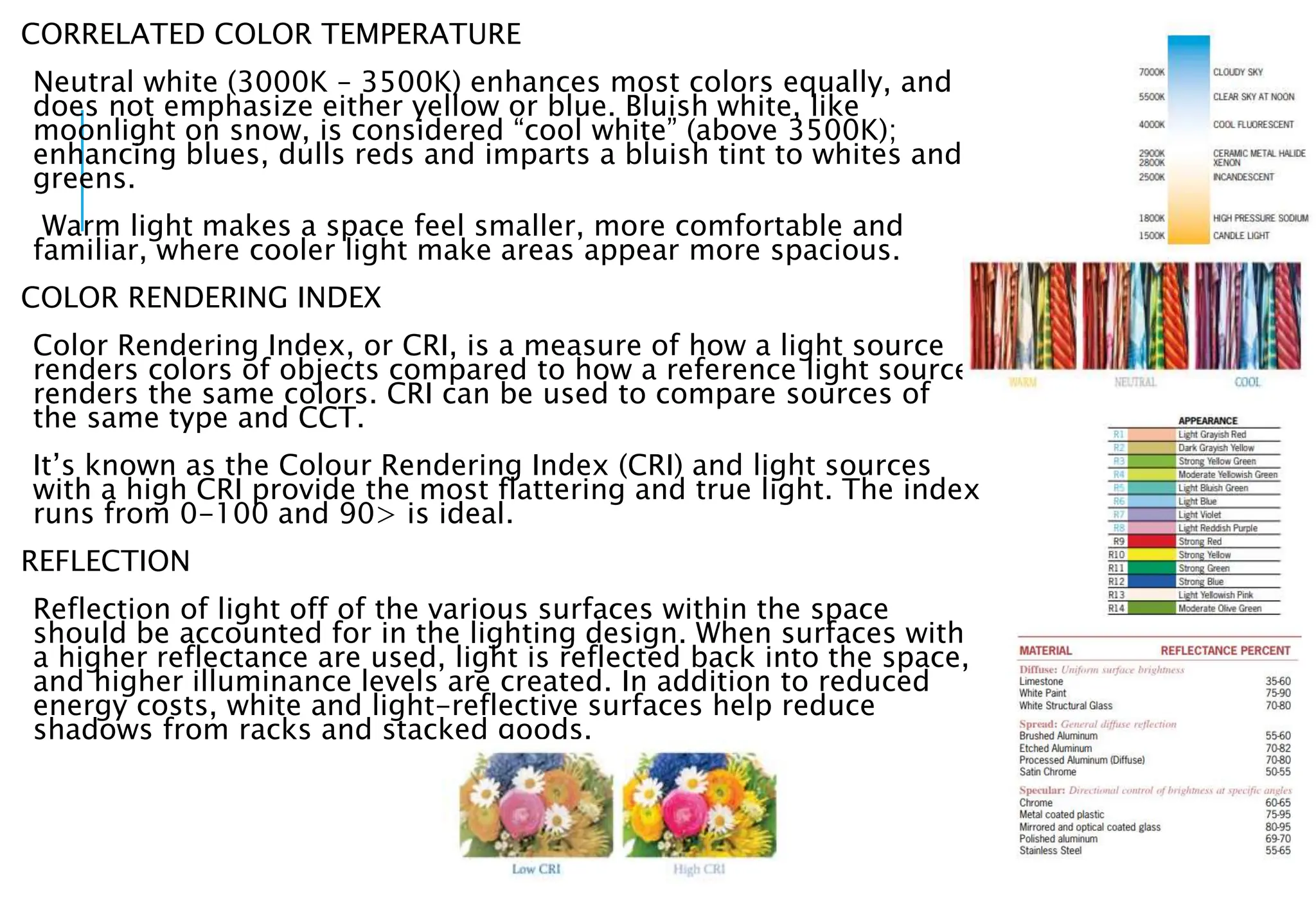
Neutral white (3000K – 3500K) enhances most colors equally, and
does not emphasize either yellow or blue. Bluish white, like
moonlight on snow, is considered “cool white” (above 3500K);
enhancing blues, dulls reds and imparts a bluish tint to whites and
greens.
Warm light makes a space feel smaller, more comfortable and
familiar, where cooler light make areas appear more spacious.
COLOR RENDERING INDEX
Color Rendering Index, or CRI, is a measure of how a light source
renders colors of objects compared to how a reference light source
renders the same colors. CRI can be used to compare sources of
the same type and CCT.
It’s known as the Colour Rendering Index (CRI) and light sources
with a high CRI provide the most flattering and true light. The index
runs from 0-100 and 90> is ideal.
REFLECTION
Reflection of light off of the various surfaces within the space
should be accounted for in the lighting design. When surfaces with
a higher reflectance are used, light is reflected back into the space,
and higher illuminance levels are created. In addition to reduced
energy costs, white and light-reflective surfaces help reduce
shadows from racks and stacked goods.
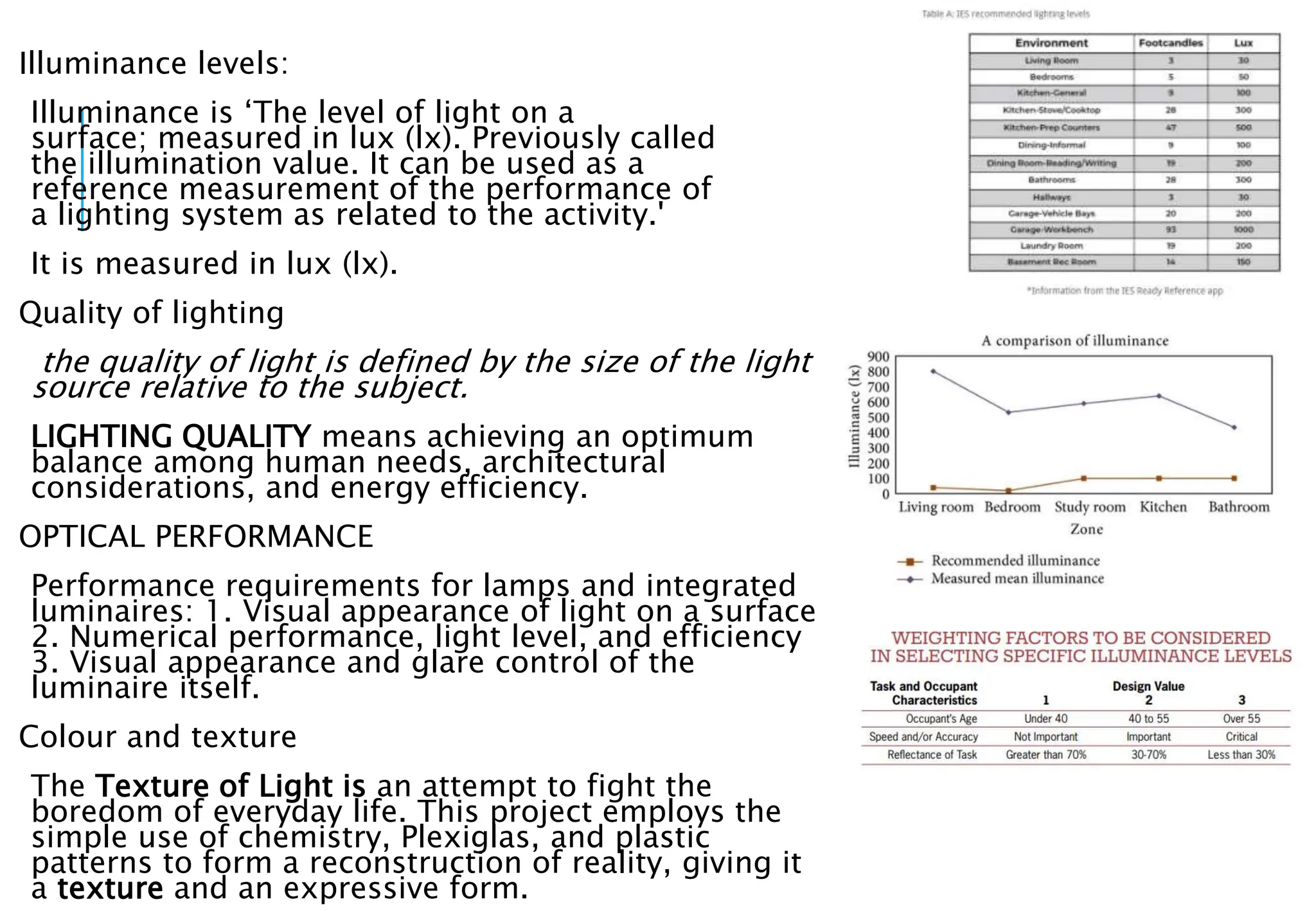
Illuminance levels:
Illuminance is ‘The level of light on a
surface; measured in lux (lx). Previously called
the illumination value. It can be used as a
reference measurement of the performance of
a lighting system as related to the activity.'
It is measured in lux (lx).
Quality of lighting
the quality of light is defined by the size of the light
source relative to the subject.
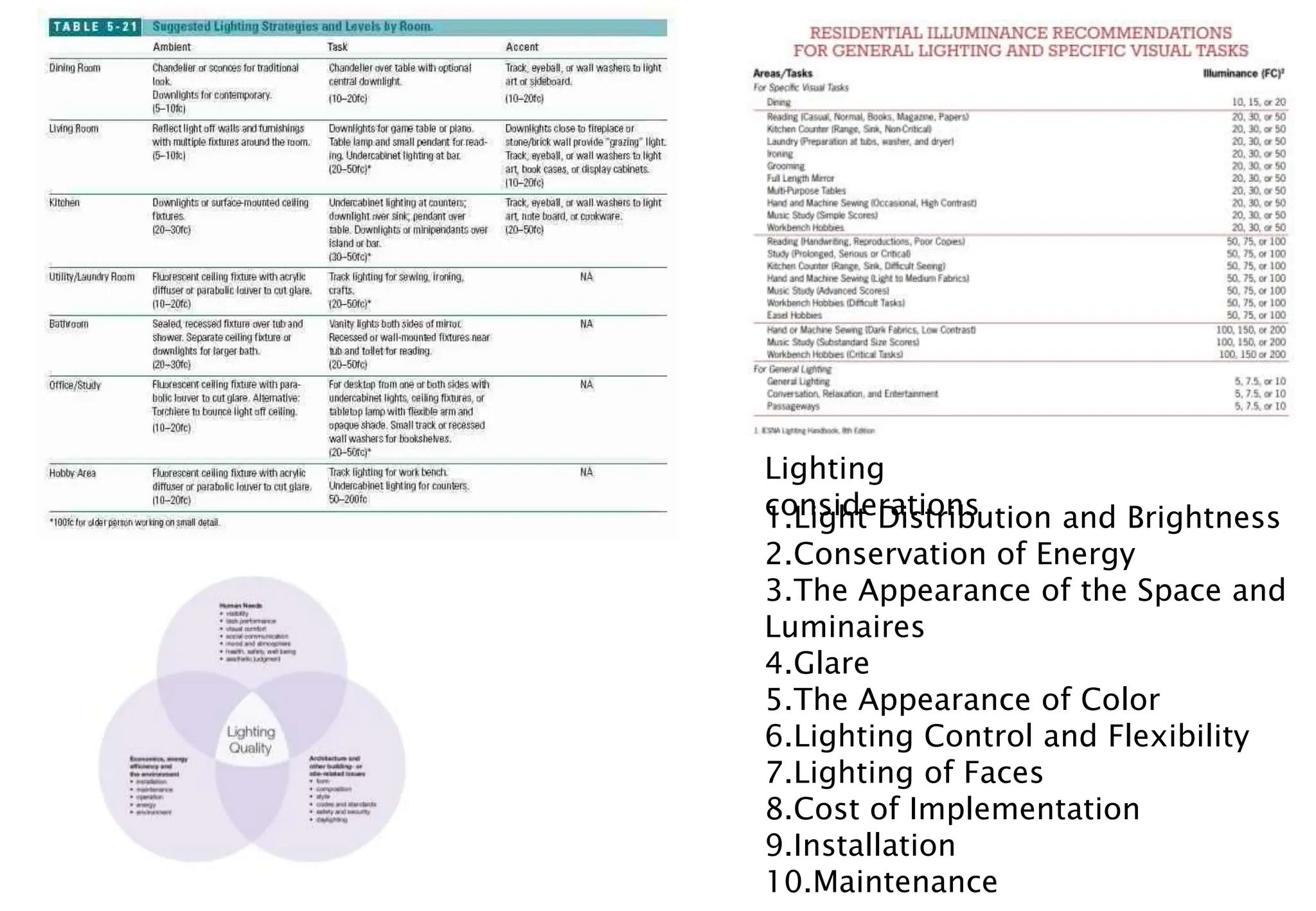
LIGHTING QUALITY means achieving an optimum
balance among human needs, architectural
considerations, and energy efficiency.
OPTICAL PERFORMANCE
Performance requirements for lamps and integrated
luminaires: 1. Visual appearance of light on a surface
2. Numerical performance, light level, and efficiency
3. Visual appearance and glare control of the
luminaire itself.
Colour and texture
The Texture of Light is an attempt to fight the
boredom of everyday life. This project employs the
simple use of chemistry, Plexiglas, and plastic
patterns to form a reconstruction of reality, giving it
a texture and an expressive form.
1.Light Distribution and Brightness
2.Conservation of Energy
3.The Appearance of the Space and
Luminaires
4.Glare
5.The Appearance of Color
6.Lighting Control and Flexibility
7.Lighting of Faces
8.Cost of Implementation
9.Installation
10.Maintenance
Lighting
considerations
Dimensions and Spacing
Spacing Guidelines for Light Fixtures:
The general rule for ambient or task lighting is to
space recessed ceiling fixtures approximately the same
distance apart as the beam spread at the work height,
typically assumed to be 30 inches above the floor (36
inches for kitchen counters).
The light beam spread is the central cone of light,
where the beam is at least 50% of the brightness at the
center of the beam.
For ambient lighting, choose a compact fluorescent, A
lamp, or wide flood with a beam angle of at least 50
degrees. Typical spacing for ambient lighting with
recessed lights is 6 to 7 1/2 feet for an 8-foot ceiling,
or 7 to 8 1/2 feet for a 9-foot ceiling. Spacing from the
first row of lights to the wall is half this distance.
For accent lighting, space recessed or track fixtures so
their light hits the wall at about 30 degrees. For
lighting a large wall area, the distance between fixtures
should be equal to or less than their distance from the
Residential lighting, lighting dimensions

Residential lighting, lighting dimensions

  • 1.
    RESIDENTIAL LIGHTING Doneby Sayeeda sumayya
  • 2.
    RESIDENTIAL LIGHTING Good lightingdesign turns a house into a home. It enhances the interior design and architecture, and should be designed to reflect how the resident lives in the space. A house can have the most beautiful interior design and stunning architecture, but if the lighting is wrong it simply won’t feel like a home. When lighting a residential space, consider the following: 1. Size and shape of the space 2. Traffic patterns through the home 3. How the room will be used: there is almost always some type of task involved in each space and some tasks require more light than others 4. The ceiling height and shape: light will be reflected off these surfaces and contribute to the ambient light level in the room 5. Age of the persons living in the space: the older we get, the more we are adversely affected by glare 6. Color of the walls: darker walls absorb more light and may require higher levels of illumination 7. Art work and highlight areas: determining the pieces and places to be highlighted helps determine the number of accent lights needed 8. Families of luminaries: recessed downlights used as adjustable accents and wall washers should match in aperture size and trim finish as well as use similar lamp types. Complement these choices with the same, or similar, finished fixtures to avoid drawing attention to the lighting system. Different layers of light include:
  • 3.
    CORRELATED COLOR TEMPERATURE Neutralwhite (3000K – 3500K) enhances most colors equally, and does not emphasize either yellow or blue. Bluish white, like moonlight on snow, is considered “cool white” (above 3500K); enhancing blues, dulls reds and imparts a bluish tint to whites and greens. Warm light makes a space feel smaller, more comfortable and familiar, where cooler light make areas appear more spacious. COLOR RENDERING INDEX Color Rendering Index, or CRI, is a measure of how a light source renders colors of objects compared to how a reference light source renders the same colors. CRI can be used to compare sources of the same type and CCT. It’s known as the Colour Rendering Index (CRI) and light sources with a high CRI provide the most flattering and true light. The index runs from 0-100 and 90> is ideal. REFLECTION Reflection of light off of the various surfaces within the space should be accounted for in the lighting design. When surfaces with a higher reflectance are used, light is reflected back into the space, and higher illuminance levels are created. In addition to reduced energy costs, white and light-reflective surfaces help reduce shadows from racks and stacked goods.
  • 4.
    Illuminance levels: Illuminance is‘The level of light on a surface; measured in lux (lx). Previously called the illumination value. It can be used as a reference measurement of the performance of a lighting system as related to the activity.' It is measured in lux (lx). Quality of lighting the quality of light is defined by the size of the light source relative to the subject. LIGHTING QUALITY means achieving an optimum balance among human needs, architectural considerations, and energy efficiency. OPTICAL PERFORMANCE Performance requirements for lamps and integrated luminaires: 1. Visual appearance of light on a surface 2. Numerical performance, light level, and efficiency 3. Visual appearance and glare control of the luminaire itself. Colour and texture The Texture of Light is an attempt to fight the boredom of everyday life. This project employs the simple use of chemistry, Plexiglas, and plastic patterns to form a reconstruction of reality, giving it a texture and an expressive form.
  • 5.
    1.Light Distribution andBrightness 2.Conservation of Energy 3.The Appearance of the Space and Luminaires 4.Glare 5.The Appearance of Color 6.Lighting Control and Flexibility 7.Lighting of Faces 8.Cost of Implementation 9.Installation 10.Maintenance Lighting considerations
  • 6.
    Dimensions and Spacing SpacingGuidelines for Light Fixtures: The general rule for ambient or task lighting is to space recessed ceiling fixtures approximately the same distance apart as the beam spread at the work height, typically assumed to be 30 inches above the floor (36 inches for kitchen counters). The light beam spread is the central cone of light, where the beam is at least 50% of the brightness at the center of the beam. For ambient lighting, choose a compact fluorescent, A lamp, or wide flood with a beam angle of at least 50 degrees. Typical spacing for ambient lighting with recessed lights is 6 to 7 1/2 feet for an 8-foot ceiling, or 7 to 8 1/2 feet for a 9-foot ceiling. Spacing from the first row of lights to the wall is half this distance. For accent lighting, space recessed or track fixtures so their light hits the wall at about 30 degrees. For lighting a large wall area, the distance between fixtures should be equal to or less than their distance from the