University of California Santa CruzUniversity of California Santa Cruz
Groundwater Decision-making:
Case Study of the Pajaro Valley
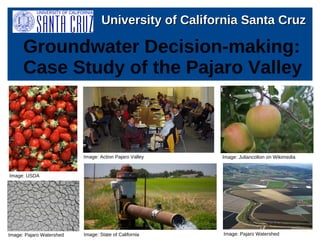
Image: Action Pajaro Valley
Image: USDA
Image: Juliancolton on Wikimedia
Image: Pajaro WatershedImage: Pajaro Watershed Image: State of California
Research TeamResearch Team
Principal Investigator:
Dr. Ruth Langridge, Department of Politics
Co-Principal Investigators:
Nigel Quinn, Ben Crow, Andrew Fisher
Current Graduate Students:
Kirsten Rudestam, Department of Sociology
Abigail Brown, Department of Sociology
- with long-standing support from the National
Oceanographic and Atmospheric Administration and
California State Energy Commission -
Research GoalResearch Goal
The goal of the Pajaro Component research
project is to illuminate the conditions that
motivate a region with long-term declining
groundwater levels to develop strategies that:
a) alleviate deteriorating groundwater
conditions and b) reduce vulnerability to
drought through the development of local
groundwater drought reserves.
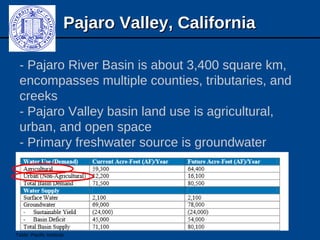
Pajaro Valley, CaliforniaPajaro Valley, California
- Pajaro River Basin is about 3,400 square km,
encompasses multiple counties, tributaries, and
creeks
- Pajaro Valley basin land use is agricultural,
urban, and open space
- Primary freshwater source is groundwater
Table: Pacific Institute
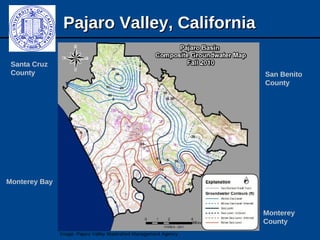
Pajaro Valley, CaliforniaPajaro Valley, California
Image: Pajaro Valley Watershed Management Agency
Monterey Bay
Monterey
County
San Benito
County
Santa Cruz
County
Groundwater HistoryGroundwater History
- Seawater intrusion identified by DWR in 1953
- Groundwater overdraft identified by DWR in 1980
- Pajaro Valley Water Management Agency formed
in 1984 to help manage groundwater
- Challenges to address overdraft: limited available
surface water, increases in urban and rural water
usage, legal and political barriers, etc.
Image: Pajaro Valley Watershed Management Agency
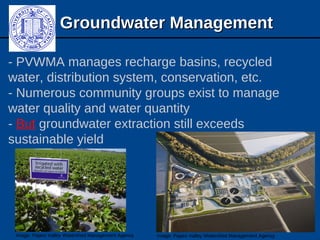
Groundwater ManagementGroundwater Management
- PVWMA manages recharge basins, recycled
water, distribution system, conservation, etc.
- Numerous community groups exist to manage
water quality and water quantity
- But groundwater extraction still exceeds
sustainable yield
Image: Pajaro Valley Watershed Management Agency Image: Pajaro Valley Watershed Management Agency
Research QuestionsResearch Questions
What are community member perceptions of
and behaviors related to groundwater
management?
What considerations influence long-term
groundwater management?
Who participates in groundwater decision-
making practices? How are groundwater
decisions made?
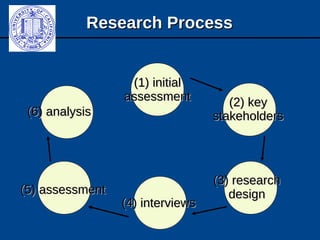
Research ProcessResearch Process
(1) initial(1) initial
assessmentassessment
(2) key(2) key
stakeholdersstakeholders
(3) research(3) research
designdesign
(4) interviews(4) interviews
(5) assessment(5) assessment
(6) analysis(6) analysis
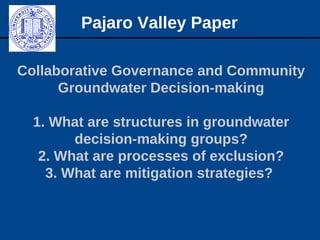
Collaborative Governance and Community
Groundwater Decision-making
1. What are structures in groundwater
decision-making groups?
2. What are processes of exclusion?
3. What are mitigation strategies?
Pajaro Valley Paper
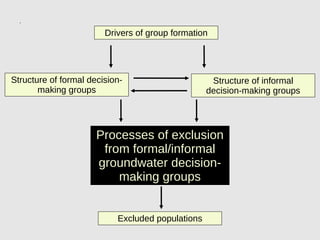
Drivers of group formation
Structure of formal decision-
making groups
Structure of informal
decision-making groups
Processes of exclusion
from formal/informal
groundwater decision-
making groups
Excluded populations
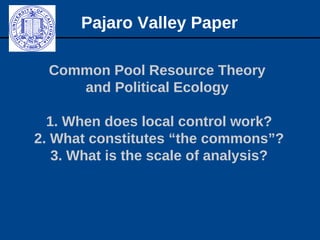
Common Pool Resource Theory
and Political Ecology
1. When does local control work?
2. What constitutes “the commons”?
3. What is the scale of analysis?
Pajaro Valley Paper
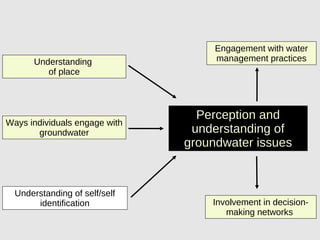
Understanding
of place
Understanding of self/self
identification
Perception and
understanding of
groundwater issues
Engagement with water
management practices
Involvement in decision-
making networks
Ways individuals engage with
groundwater
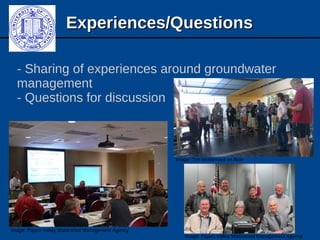
Experiences/QuestionsExperiences/Questions
- Sharing of experiences around groundwater
management
- Questions for discussion
Image: Pajaro Valley Watershed Management Agency
Image: Tim McNamara on flickr
Thank You!Thank You!
http://droughtreserves.ucsc.edu
For more information, please contact
krudestam@ucsc.edu or ablbrown@ucsc.edu
Image: National Resource Conservation Service

Groundwater Decision-making: Case Study of the Pajaro Valley

  • 1.
    University of CaliforniaSanta CruzUniversity of California Santa Cruz Groundwater Decision-making: Case Study of the Pajaro Valley Image: Action Pajaro Valley Image: USDA Image: Juliancolton on Wikimedia Image: Pajaro WatershedImage: Pajaro Watershed Image: State of California
  • 2.
    Research TeamResearch Team PrincipalInvestigator: Dr. Ruth Langridge, Department of Politics Co-Principal Investigators: Nigel Quinn, Ben Crow, Andrew Fisher Current Graduate Students: Kirsten Rudestam, Department of Sociology Abigail Brown, Department of Sociology - with long-standing support from the National Oceanographic and Atmospheric Administration and California State Energy Commission -
  • 3.
    Research GoalResearch Goal Thegoal of the Pajaro Component research project is to illuminate the conditions that motivate a region with long-term declining groundwater levels to develop strategies that: a) alleviate deteriorating groundwater conditions and b) reduce vulnerability to drought through the development of local groundwater drought reserves.
  • 4.
    Pajaro Valley, CaliforniaPajaroValley, California - Pajaro River Basin is about 3,400 square km, encompasses multiple counties, tributaries, and creeks - Pajaro Valley basin land use is agricultural, urban, and open space - Primary freshwater source is groundwater Table: Pacific Institute
  • 5.
    Pajaro Valley, CaliforniaPajaroValley, California Image: Pajaro Valley Watershed Management Agency Monterey Bay Monterey County San Benito County Santa Cruz County
  • 6.
    Groundwater HistoryGroundwater History -Seawater intrusion identified by DWR in 1953 - Groundwater overdraft identified by DWR in 1980 - Pajaro Valley Water Management Agency formed in 1984 to help manage groundwater - Challenges to address overdraft: limited available surface water, increases in urban and rural water usage, legal and political barriers, etc. Image: Pajaro Valley Watershed Management Agency
  • 7.
    Groundwater ManagementGroundwater Management -PVWMA manages recharge basins, recycled water, distribution system, conservation, etc. - Numerous community groups exist to manage water quality and water quantity - But groundwater extraction still exceeds sustainable yield Image: Pajaro Valley Watershed Management Agency Image: Pajaro Valley Watershed Management Agency
  • 8.
    Research QuestionsResearch Questions Whatare community member perceptions of and behaviors related to groundwater management? What considerations influence long-term groundwater management? Who participates in groundwater decision- making practices? How are groundwater decisions made?
  • 9.
    Research ProcessResearch Process (1)initial(1) initial assessmentassessment (2) key(2) key stakeholdersstakeholders (3) research(3) research designdesign (4) interviews(4) interviews (5) assessment(5) assessment (6) analysis(6) analysis
  • 10.
    Collaborative Governance andCommunity Groundwater Decision-making 1. What are structures in groundwater decision-making groups? 2. What are processes of exclusion? 3. What are mitigation strategies? Pajaro Valley Paper
  • 11.
    Drivers of groupformation Structure of formal decision- making groups Structure of informal decision-making groups Processes of exclusion from formal/informal groundwater decision- making groups Excluded populations
  • 12.
    Common Pool ResourceTheory and Political Ecology 1. When does local control work? 2. What constitutes “the commons”? 3. What is the scale of analysis? Pajaro Valley Paper
  • 13.
    Understanding of place Understanding ofself/self identification Perception and understanding of groundwater issues Engagement with water management practices Involvement in decision- making networks Ways individuals engage with groundwater
  • 14.
    Experiences/QuestionsExperiences/Questions - Sharing ofexperiences around groundwater management - Questions for discussion Image: Pajaro Valley Watershed Management Agency Image: Pajaro Valley Watershed Management Agency Image: Tim McNamara on flickr
  • 15.
    Thank You!Thank You! http://droughtreserves.ucsc.edu Formore information, please contact krudestam@ucsc.edu or ablbrown@ucsc.edu Image: National Resource Conservation Service