Discussion Paper SeriesNo. 125/2008
Draft and not to be quoted without Author's permission
Green Banking in India
Pravakar Sahoo Bibhu Prasad Nayak
INSTITUTE OF ECONOMIC GROWTH UNIVERSITY
OF DELHI ENCLAVE NORTH CAMPUS, DELHI - 110
007 Fax: + 91-11-27667410 Gram: GROWTH - Delhi - 110 007
Phones: +91-11-27667101, 27667288, 27667365, WEBSITE:
ieg.nic.in and iegindia.org
1
GREEN BANKING IN INDIA
Pravakar Sahoo1 Bibhu Prasad Nayak
Abstract
Sustainable development can best be achieved by allowing markets to work within an
appropriate framework of cost efficient regulations and economic instruments. One of the major
economic agents influencing overall industrial activity and economic growth is the financial
institutions such as banking sector. In a globalised economy, the industries and firms are vulnerable
to stringent environmental policies, severe law suits or consumer boycotts. Since banking sector is
one of the major stake holders in the Industrial sector, it can find itself faced with credit risk and
liability risks. Further, environmental impact might affect the quality of assets and also rate of return
of banks in the long-run. Thus the banks should go green and play a pro-active role to take
environmental and ecological aspects as part of their lending principle, which would force industries
to go for mandated investment for environmental management, use of appropriate technologies and
management systems. This paper explores the importance of Green Banking, sites international
experiences and highlights important lessons for sustainable banking and development in India.
However, we find that there has not been much initiative in this regard by the banks and other
financial institutions in India though they play an active role in India's emerging economy.
Therefore, we suggest possible policy measures and initiative to promote green banking in India.
GREEN BANKING IN INDIA
I. Introduction
Sustainable development has emerged as a new paradigm of development in response to the
current discourse of development that over-exploits natural environment for economic prosperity. The
sustainable development can best be achieved by allowing markets to work within an appropriate
framework of cost efficient regulations and economic instruments. One of the major economic agents
influencing overall industrial activity and economic growth is the financial institutions such as
banking sector. The banking sector influences the economic growth and development in terms of both
quality and quantity, there by changing the nature of economic growth. Banking sector is one of the
major sources of financing investment for commercial projects which is one of the most important
economic activities for economic growth. Therefore, banking sector can play a crucial role in
1Faculty, Reserve Bank of India Unit, Institute of Economic Growth, Delhi University Enclave, Delhi-7.
pravakar@iegindia. org. # Research Scholar, Jawaherlal Neheru University, Delhi. However, usual
disclaimer applies.
2
promoting environmentally sustainable and socially responsible investment (SRI)2
. Banks may not be
the polluters themselves but they will probably have a banking relationship with some
companies/investment projects that are polluters or could be in future.
Banking sector is generally considered as environmental friendly in terms of emissions and
pollutions. Internal environmental impact of the banking sector such as use of energy, paper and
water are relatively low and clean. Environmental impact of banks is not physically related to their
banking activities but with the customer's activities. Therefore, environmental impact of bank's
external activity is huge though difficult to estimate. Moreover, environment management in the
banking business is like risk management. It increases the enterprise value and lowers loss ratio as
higher quality loan portfolio results in higher earnings. Thus, encouraging environmentally
responsible investments and prudent lending should be one of the responsibilities of the banking
sector. Further, those industries which have already become green and those, which are making
serious attempts to grow green, should be accorded priority to lending by the banks. This method of
finance can be called as "Green Banking', an effort by the banks to make the industries grow green
and in the process restore the natural environment. This concept of "Green Banking" will be mutually
beneficial to the banks, industries and the economy. Not only "Green Banking" will ensure the
greening of the industries but it will also facilitate in improving the asset quality of the banks in
future3
.
Internationally, there is a growing concern about the role of banking and institutional
investors for environmentally responsible/socially responsible investment projects4
. Banking and
other financial institutions are more effective towards achieving this goal for the kind of intermediary
role they play in any economy and for their potential reach to the number of investors. Environment
is no longer the exclusive concern of the government and the direct polluters, but also the other
partners and stake- holders in the business like financial institutions such as banking institutions can
2
Internationally SRI funds are highly demanded for example SRI assets in the U.S. have reached $2.29 trillion in 2005
(Starogiannis, 2006)
3
Non-performing Assets(NPAs)havealready occupied thecenterstage ofthe present daybanking.Allthe banks
are busy in cleaning up the already created NPAs fromtheir asset portfolio.
4
Earth Summit in 1992, the United Nation Environment Programme Initiative on the Environment and
Sustainable Development" was established in order to initiate a constructive dialogue between UNEP and Financial
Institutions.
3
play a very important role in fostering linkage between economic development and environmental
protection. To substantiate, quality of service, the implementation of environmental conservation
measures, support to the deprived section of the society, concern about the quality of life and nature
are the basic principles that the financial institutions are relying on in their business strategy in recent
years.
The banking operation targets a certain long-term rate of return on their credit and
investment. However, every credit extension and investment caries the risk of non-payment and
reduction of value (in case of direct investment) due to environmental liabilities. Therefore, it is of
importance to the banking sector to follow certain environmental evaluation of the projects before
financing. There are studies showing positive correlation between environmental performance and
financial performance (Hamilton, 1995; Hart, 1995; Blacconiere and Pattern, 1993). Thus, it is
imperative for the financial institutions in the present context to consider environmental performance
in deciding whether to invest in companies or advise clients to do so. The formation of different rules
for environmental management like resource conservation, clean water act, clean air act, toxic
substance control act are also viewed as potentially significant contributor to the recent increase in
environmental liability for banking institutions. Adoption of these principles will offer significant
benefits to financial institutions, to consumers and also the stakeholders.
There have been attempts to adopt sustainable development strategies from various quarters
at international level5
. Multilateral agencies, international consortiums, multilateral financial and
development institutions have been advocating for environmental standards and strategies to evaluate
investment projects. In the recent years, the international organization for standardization (ISO) has
issued series of comprehensive guidelines for incorporating environmental protection and pollution
prevention objectives into industrial activity worldwide, known collectively as ISO 14000. It would
certainly give the much needed impetus for the banking industry to expand the use of environmental
information in their credit extension and investment decisions. In this backdrop, the paper aims to
discuss the issues of sustainability in Banking and how banks can play a role for sustainable growth
and development, particularly in the Indian context.
5
The UNEP statement by Financial Institutions on the Environment and Sustainable development in 1992 showed that
80% of the signatories (200 financial institutions) made some kind of assessment of environmental risks of investment
projects before financing.
4
II. Importance of Green Banking
Until recently, environmental concerns were not considered relevant to the business operation
of banks and financial institutions. Traditionally, banking sector's concern for environmentally
degrading activities of clients is like interfering or meddling in their business affairs. However, now
it is being perceived that dealing with environment brings risks to their business. Although the
banking and financial institutions are not directly affected by the environmental degradation, there
are indirect costs to banks. Due to strict environmental disciplines imposed by the competent
authorities across the countries, the industries would have to follow certain standards to run their
business. In the case of failure, it would lead to closure of the industries leading to a likelihood of
default to the bank. For example the enactment of Comprehensive Environmental Response,
Compensation and Liability Act in 1980 (CERCLA) in the US in late 1980s has resulted in huge loss
to the banks in the US as banks held directly responsible for the environmental pollution of their
clients and made to pay the remediation cost. This is the reason for which banks in the US are ahead
of other countries in integrating environmental concerns into their business operations. In the recent
years several other countries (more in Europe) are seen adopting policies that have made banks
responsible for the misdeeds of their clients. Therefore, the financial institutions need to engage
proactively with the stakeholders on environmental and social policy issues and evaluate the impacts
of their client's investment. In turn, that would force the customers to take care of their management
of environmental and social policy issues relating to investment. This should cover all project
financing activities across all industries. The importance of Green Banking is immense for both the
banks and economy by avoiding the following risks involved in banking sector.
Credit Risk. - It can arise indirectly where banks are lending to customers whose businesses
are adversely affected by the cost of cleaning up pollution or due to changes in environmental
regulations. The cost of meeting new requirements on emission levels may be sufficient to put some
companies out of business6. Credit risks may be higher due to the probability of customer default as a
6
Example, in United Kingdom,the breach ofterms of the license given by integrated pollution prevention control would
lead to prohibition,financialpenalties andenforcement notice.Allsuch notices can have significant financial implications
for the businessandas wellas the financialinstitutions those who have put moneyinto it.Thus banks/financialinstitutions
need to take actionsbefore financingthe project.The enactmentofCERCLA in USA in 1980s has resulted in huge loss to
the banks in USA as banks held directly responsible for the environmental pollution of their clients and made to pay the
remediation cost.
5
result of uncalculated expenses for capital investment in production facilities, loss of market share
and third party liability claim. Credit risks are also associated with lending on the security of real
estate whose value has diminished owing to environmental problems (additional loss in the event of
default). Further, risk of loan default by debtors due to environmental liabilities because of fines and
legal liabilities and due to reduced priority of repayment under bankruptcy. In few cases, banks have
been held responsible7
for actions occurring in which they held a secured interest (see Schmidheiny
and Zorraquin, 1996 and Ellis, Millians and Bodeau, 1992).
Legal Risk: - It can occur in different forms. Most obviously, banks like other companies are
at risk if they themselves do not comply with relevant environmental legislation. But more
specifically, they are at risk of direct lender liability for clean up costs or claims for damages if they
have actually taken possession of contaminated or pollution causing assets. An environmental
management system helps a bank to reduce risks and costs, enhance its image and take advantage of
revenue opportunities.
Reputation Risk: - In all likelihood, due to growing awareness about environment safety,
banking institutions are more prone to loose their reputations if they are involved in big projects,
which are viewed as socially and environmentally damaging. There are also few cases where
environmental management system has resulted in cost savings, increase in bond value etc (Heim, G
et al, 2005). In few cases the environmental management system resulted in lower risk, greater
environmental stewardship and increase in operating profit. Reputation risks involved in the financing
of ecologically and ethically questionable projects.
The adoption of green banking strategies will help the bank to deal with these risks involved
in their business operation. Green banking strategies involves two components (1) managing
environment risk and (2) identifying opportunities for innovative environmentally oriented financial
products (IFC, 2007). To manage environmental risk, the banks have to design proper environmental
management systems to evaluate the risks involved in the investment projects. The risks can be
internalized by introducing differential interest rates and other techniques. Moreover, bank can
7
Some US courts (H.Thomson)have sought to hold banks and other financial institutions liable for the environmental
damage causedby theircustomer's actions,such as clean upcosts andotherdamages associatedwith hazardous wastes.For
example Fleet Factors case in 1990 where the bank (Fleet factor corporation) was held liable for environmental damages
incurred in the foreclosure process by a firmthey hired to auction off assets.
6
withdraw itself from financing high-risk projects. The second component of green banking entails
creating financial products and services that support commercial development with environmental
benefits. These includes investment in renewable energy projects, biodiversity conservation, energy
efficiency, investment in cleaner production process and technologies, bonds and mutual funds meant
for environmental investments etc8
.
Thus, the banking and financial institutions should prepare an environmental risk and liability
guidelines on development of protective policies and reporting for each project they finance or invest
(Jeucken, 2001). They can also have an environmental assessment requirement for the projects
seeking finance. Banks also can issue Environmental hazards management procedures for the each
project and follow through9
. International financial institutions like International Financial
Corporation (IFC), Japan Bank for International Cooperation (JBIC) have incorporated environmental
management into their business operation. All project proposals are classified in terms of its potential
environmental impact taking into account factors such as the sector and scale of the project, the
substance, proposed project site, the degree and uncertainty of its potential environmental impact.
Often, the World Bank's loans and grants are associated with certain level of commitment of the
beneficiary countries to adopt environmental protection measures.
The perception towards complying with environmentally norms and standards is changing
over time. Adhering to environmental norms and standards were considered costly and as a
bottleneck to development. If we will consider the economic benefits of these in terms of health care,
productivity and insurance then the benefit is much higher than the cost10
. A study confirms that only
air pollution causes the loss of 200 million working days and the resulting losses in productivity and
medical expenses costs around 14 billion pound to the European Union (Stavros Dimas, 2005). If all
the impacts of environmental degradation are considered and costs are measured, then we can find the
huge economic benefits these protection measures brings in.
8
The growing market for sustainable investment funds such as Scudder Environmental Value Fund (WBCSD, 1997) and
the UBS Eco performance portfolios (UBS 1999) is a good example for this trend.
9
In Philippines,the Land Bankand also DevelopmentBankofthe Philippines has set up a specific environmental unit to
analyse environmentalaspectsofproject financing,to finance waste and water projects and to incorporate environmental
factors into its lending operations.Theyalso expandedtheirenvironmentalunits fortechnical evaluation of each projects.
10
See Chopra et al (2005) for more on Ecosystems and Human Well-Being.
7
Environmental friendly technologies also make economic sense for the industries and actually
lessen the financial burden. The cost of pollution is rising with more awareness about these issues all
over the world. The polluting industries face more resistance and often forced to closedown or face
massive boycott by the consumers. This adds to their cost enormously. Environmental concerns are
integrated into the international trade policy and often act as trade barrier for environmentally
sensitive goods (ESGs). So adopting environmentally sustainable technologies or modes of
production is no more considered as a financial burden, rather it brings new business opportunities
and higher profit. Green banking saves costs, minimizes the risk, enhance banks reputations and
contribute to the common good of environmental sustainability. So it serves both the commercial
objective of the bank as well as its social responsibility. Green banking solves the problem faced by
the environmental regulation and enforcements authorities related to size and location of the polluting
unit. The authorities have practical limitations on enforcing environment standard on small-scale
industries and also industries located in far off places.
III. Green Banking: International Initiatives
The financial sector's growing adherence to environmental management system is attributed
to the direct and indirect pressures from international and local Non Governmental Organisations
(NGOs), multilateral agencies and in some cases the market through consumers. In the early 1990s,
the United Nations Environment Programme (UNEP) launched what is now known as the UNEP
Finance Initiative (UNEPFI). Some 200 financial institutions around the globe are signatories of this
initiative statement to promote sustainable development within the framework of market mechanisms
toward common environmental goals11
. The objective is to integrate the environmental and social
dimension to the financial performance and risk associated with it in the financial sector. As the
commitment of this UNEPFI statement goes, sustainable development is regarded basic to the sound
business management. It advocates for a precautionary approach towards environmental management
and suggests integrating environmental considerations into the regular business operations, asset
management, and other business decisions of the banks12
. IFC's environmental unit was established in
11
34 international banks follow codes of conduct in the lines of UNEP, environmental reporting, environmental
management systems,environmentalpolicy and environmental risk assessment and guidelines to reduce environmental
impact, both internal and external (Jeucken, 2001).
12
In the similar lines,the city of London in 2002 launched the London Principles on Sustainable Financeat Johannesburg
Earth Summit. It focuseson the provision foreco-innovation and access to finance for disadvantaged communities. The
8
1991 for reviewing each project for environmental assessment. Similarly, the US Export-Import Bank
regularly reviews while financing exports on the ground whether they are environmentally sound. It
will be noteworthy to mention that Netherland-based ABN-Amro bank has developed certain
Reputational Risk Management (RRM) policies to identify, asses and mange non- financial present
within it business engagements. Similarly, some of the big international banks like ABN Amro,
Deutsche, Standard Chartered, HSBC Bank etc. look at environment issues discussed under Kyoto
Protocol. Going further, the Dutch Government has made a formal request to banks in achieving
sustainable development. The dialogue between banks and government was established in 1999 to
initiate policies for environmental improvements through the development of new financial products
and services.
Similalrly, Earth (FoE) and the Rainforest Action Network (RAN) challenged the industry
with high-profile campaign that highlighted cases in which commercial banks were "bankrolling
disasters" in 2000 in the US. In 2002, a global coalition of NGOs formed a network named
'BankTract' to promote sustainable finance in the commercial sector. This coalition came up with a
resolution constituting six principles promoting environmental protection and social justice by banks
and this is popularly known as Collevecchio Declaration. The six principles that this declaration
advocated included commitments to sustainability, no-harm, responsibility, accountability,
transparency and sustainable market, and governance. More than 200 organizations have endorsed
this declaration and urged the banks to incorporate these commitments into their business operation.
The declaration states that "Finance and Commerce has been at the center of a historic detachment
between the world's natural resource base, production and consumption. As we reach the boundaries
of ecological boundaries of the ecological limit upon which all commerce relies, the financial sector
should take its share of responsibility for reversing the effects this detachment has produced".
All these concerns for sustainable finance or green finance have compelled the banking
institutions to devise a common and coherent set of environmental and social policies and guidelines
that can be used to evaluate the projects. A small group of banks along with IFC came together to
initiate the process of designing the common guidelines in October 2002 and came up with a
guidelines in June 2003 that is known as Equator Principles with 10 leading commercial banks
London principles constitute sevenprinciplesthat address theenvironmental and social impact of the financial sector and
emphasized such issues as transparency, risk management and equitable access to capital.
9
adopting these voluntary set of principles. This equator principle was subsequently updated and the
new revised sets of principles are launched in July 2006. The coverage of projects being financed are
expanded in this revised set of principles by lowering the finance threshold from $50 million to $10
million. Presently 46 financial institutions from 16 countries with business operation in more than
100 countries have embraced this equator principle. So this principle has become a common standard
of project finance that incorporated environmental and social issues in project finance.
The activities of the equator banks (banks adopting equator principles) are being reviewed
by NGOs worldwide and are being published whenever it is realized that they are not committed to
Equator Principle. IFC along with the Financial Times has initiated 'Sustainable Banking Award'
since 2006. More than 104 financial institutions out of 151 entries from 51 countries have made it to
the final lists of award in 2007. The number of banks applying was up by more than 100 per cent
compared to the previous year's 48 banks from 28 countries.
All the international initiatives towards integrating environmental concerns into business
operation of banks are voluntary in nature and are meant to promote a common good of a better
ecosystem. Voluntary commitment has its own shortcoming in a competitive market. Unless the
market for green money will increase, the lenders will always have an incentive to procrastinate
their social commitment and prioritize the commercial interest in the short run. So demand for green
money is a precondition of green banking if it will be voluntary. A Government legislation that
makes banks accountable for the misdeeds of their clients will help promote green banking.
IV. Green Banking in India
India is on a higher growth trajectory for last one and half decade and the industrial sector
plays the most important role in India's growth story. However, Indian industry faces the challenges
of controlling environmental impact of their business i.e. reducing pollution and emission of their
clients. Though government has been trying to address the issue by framing environmental
legislations and encouraging industry to follow environmental technologies and practices, they would
not be enough given the poor track records of enforcement, public awareness and inability to derive
competitive advantage by producing eco-friendly products.
10
Incidentally, India's is the world's sixth largest and second fastest growing country in terms of
producing green house gases. Delhi, Mumbai and Chennai are the three of the world's ten most
polluted cities. The major polluting industries in India are (a) primary metallurgical industries namely
zinc, copper, steel etc. (b) paper & pulp (c) pesticides/insecticides (d) refines (e) fertilizers (f)
tanneries (g) sugar (h) textiles (i) chemicals/pharmaceuticals etc. The banking operation and
investment by financial institutions should take care of environmental management of these polluting
industries by improving the overall environment, the quality and conversation of life, level of
efficiency in using materials and energy, quality of services and products. In this context, the role of
banking sector, which is on major financing sources to the Industries, assumes high importance.
The environmental regulations in India can be broadly classified into two broad categories i.e.
command and control regulations and liability law. The command and control regulations are ex ante
regulations that are designed to dissuade environmentally damaging projects. This regulation is
implemented by setting industry specific pollution standards, scrutinizing the projects and
granting/denying permissions by the concerned authorities like Ministry of Environment and Forest.
The liability laws are ex post in nature and are implemented by enforcing authorities through
imposing fines, closing down the defaulting industries etc. However there is no law and rule in India
that can hold banks responsible for scrutinizing investment projects before financing and for the
environmental damage created by its client. Once legal framework for the environmental pollution
standards are formulated in India, the polluting industries either have to close down or have to make
necessary investment to comply with the standard. In this process these industries will loose their
competitiveness in the international market, which would directly affect Indian economy and the
banking sector.
Thus in the present context, it is equally important for banks to guard themselves against the
conversion of the now performing assets into non-performing one in the future. Realization of these
facts by banks will certainty make them fast adopt the concept of Green Banking. The industries,
which are ill equipped to control pollution now, are the possible polluters of future. A day may come,
when legislation may take a hard stance against these environmental culprits and may order the closer
of these units. Almost 150 SSI units around Agra and Delhi were forced to close down for their non-
11
compliance to the mandated environmental standards13
. In such an eventuality, the industries cannot
be rescued from becoming the non-performing ones, as the banking institutions continue to overlook
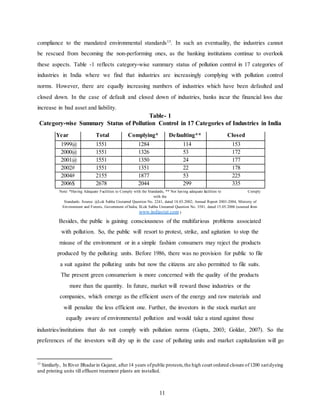
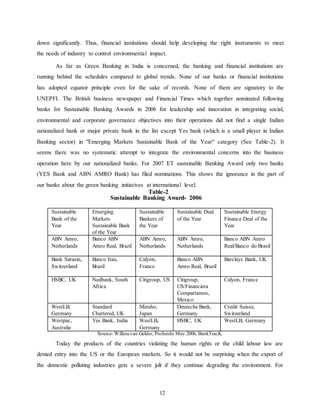
these aspects. Table -1 reflects category-wise summary status of pollution control in 17 categories of
industries in India where we find that industries are increasingly complying with pollution control
norms. However, there are equally increasing numbers of industries which have been defaulted and
closed down. In the case of default and closed down of industries, banks incur the financial loss due
increase in bad asset and liability.
Table- 1
Category-wise Summary Status of Pollution Control in 17 Categories of Industries in India
industries/institutions that do not comply with pollution norms (Gupta, 2003; Goldar, 2007). So the
preferences of the investors will dry up in the case of polluting units and market capitalization will go
13
Similarly, In River Bhadarin Gujarat, after14 years ofpublic protests,the high court ordered closure of1200 saridyeing
and printing units till effluent treatment plants are installed.
Year Total Complying* Defaulting** Closed
1999@ 1551 1284 114 153
2000@ 1551 1326 53 172
2001@ 1551 1350 24 177
2002# 1551 1351 22 178
2004# 2155 1877 53 225
2006$ 2678 2044 299 335
Note: *Having Adequate Facilities to Comply with the Standards, ** Not having adequate facilities to Comply
with the
Standards. Source: @Lok Sabha Unstarred Question No. 2241, dated 18.03.2002; Annual Report 2003-2004, Ministry of
Environment and Forests, Government of India; $Lok Sabha Unstarred Question No. 3581, dated 15.05.2006 (sourced from
www.indiastat.com )
Besides, the public is gaining consciousness of the multifarious problems associated
with pollution. So, the public will resort to protest, strike, and agitation to stop the
misuse of the environment or in a simple fashion consumers may reject the products
produced by the polluting units. Before 1986, there was no provision for public to file
a suit against the polluting units but now the citizens are also permitted to file suits.
The present green consumerism is more concerned with the quality of the products
more than the quantity. In future, market will reward those industries or the
companies, which emerge as the efficient users of the energy and raw materials and
will penalize the less efficient one. Further, the investors in the stock market are
equally aware of environmental pollution and would take a stand against those
12
down significantly. Thus, financial institutions should help developing the right instruments to meet
the needs of industry to control environmental impact.
As far as Green Banking in India is concerned, the banking and financial institutions are
running behind the schedules compared to global trends. None of our banks or financial institutions
has adopted equator principle even for the sake of records. None of them are signatory to the
UNEPFI. The British business newspaper and Financial Times which together nominated following
banks for Sustainable Banking Awards in 2006 for leadership and innovation in integrating social,
environmental and corporate governance objectives into their operations did not find a single Indian
nationalized bank or major private bank in the list except Yes bank (which is a small player in Indian
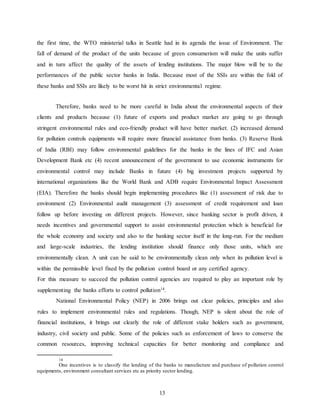
Banking sector) in "Emerging Markets Sustainable Bank of the Year" category (See Table-2). It
seems there was no systematic attempt to integrate the environmental concerns into the business
operation here by our nationalized banks. For 2007 ET sustainable Banking Award only two banks
(YES Bank and ABN AMRO Bank) has filed nominations. This shows the ignorance in the part of
our banks about the green banking initiatives at international level.
Table-2
Sustainable Banking Award- 2006
Today the products of the countries violating the human rights or the child labour law are
denied entry into the US or the European markets. So it would not be surprising when the export of
the domestic polluting industries gets a severe jolt if they continue degrading the environment. For
Sustainable Emerging Sustainable Sustainable Deal Sustainable Energy
Bank of the Markets Bankers of of the Year Finance Deal of the
Year Sustainable Bank
of the Year
the Year Year
ABN Amro, Banco ABN ABN Amro, ABN Amro, Banco ABN Amro
Netherlands Amro Real, Brazil Netherlands Netherlands Real/Banco do Brasil
Bank Sarasin, Banco Itau, Calyon, Banco ABN Barclays Bank, UK
Switzerland Brazil France Amro Real, Brazil
HSBC, UK Nedbank, South
Africa
Citigroup, US Citigroup,
US/Financiera
Compartamos,
Mexico
Calyon, France
WestLB, Standard Mizuho, Deutsche Bank, Credit Suisse,
Germany Chartered, UK Japan Germany Switzerland
Westpac, Yes Bank, India WestLB, HSBC, UK WestLB, Germany
Australia Germany
Source: Willemvan Gelder, Profundo May 2006, BankTracK.
13
the first time, the WTO ministerial talks in Seattle had in its agenda the issue of Environment. The
fall of demand of the product of the units because of green consumerism will make the units suffer
and in turn affect the quality of the assets of lending institutions. The major blow will be to the
performances of the public sector banks in India. Because most of the SSIs are within the fold of
these banks and SSIs are likely to be worst hit in strict environmental regime.
Therefore, banks need to be more careful in India about the environmental aspects of their
clients and products because (1) future of exports and product market are going to go through
stringent environmental rules and eco-friendly product will have better market. (2) increased demand
for pollution controls equipments will require more financial assistance from banks. (3) Reserve Bank
of India (RBI) may follow environmental guidelines for the banks in the lines of IFC and Asian
Development Bank etc (4) recent announcement of the government to use economic instruments for
environmental control may include Banks in future (4) big investment projects supported by
international organizations like the World Bank and ADB require Environmental Impact Assessment
(EIA). Therefore the banks should begin implementing procedures like (1) assessment of risk due to
environment (2) Environmental audit management (3) assessment of credit requirement and loan
follow up before investing on different projects. However, since banking sector is profit driven, it
needs incentives and governmental support to assist environmental protection which is beneficial for
the whole economy and society and also to the banking sector itself in the long-run. For the medium
and large-scale industries, the lending institution should finance only those units, which are
environmentally clean. A unit can be said to be environmentally clean only when its pollution level is
within the permissible level fixed by the pollution control board or any certified agency.
For this measure to succeed the pollution control agencies are required to play an important role by
supplementing the banks efforts to control pollution14
.
National Environmental Policy (NEP) in 2006 brings out clear policies, principles and also
rules to implement environmental rules and regulations. Though, NEP is silent about the role of
financial institutions, it brings out clearly the role of different stake holders such as government,
industry, civil society and public. Some of the policies such as enforcement of laws to conserve the
common resources, improving technical capacities for better monitoring and compliance and
14
One incentives is to classify the lending of the banks to manufacture and purchase of pollution control
equipments, environment consultant services etc as priority sector lending.
14
involvement of local people in the enforcement process are certainly going to improve the
environmental management system in India. Further, NEP emphasizes industries to adopt
standardized environmental management practices by acquiring ISO 14000. Overall, NEP has
brought about clarity in many ways to control environmental degradation and it covers many areas
which would force industries as well as the other stake holders such as banking sector to be more
responsible for environmental management. Further, the emphasis of the NEP on capacity building in
financial institutions for evaluation of proposal for switching existing production facilities in
industries to clean technology is welcome step.
Small Scale Sector in India and Green Banking: - Industries irrespective of their size
(large, medium or small) emit pollutants to the environment in which we all inhabit. Though the
large-scale industries are more capable of degrading the environment, they have adequate financial
resources to install pollution control equipment or waste treatment plants to control pollution.
Moreover, these large-scale industries are always in the eyes of the government or the pollution
control board, these industries strives hard to adhere to set emission standards. On the other hand, the
small-scale industries (SSIs), on account of their financial constraints may not be able to unable to
install the necessary equipment to meet the emission standards prescribed by the competent
authorities. Also because of their small scale of operation, the SSIs escape from the eyes of the
concerned authorities.
SSI constitute major portion of Indian industry. These industries account for about 40 per cent
of industrial production and 30% of total manufacturing exports. Use of western technological
systems in small scale industries produce enormous gaseous, liquid and solid wastes. However, they
may not be in a position to bear additional expenditures on account of environment audit and
pollution control equipments. Therefore, banks need to apply different procedures to promote
pollution controls like (1) environmental pollution status of SSI (2) environmental Clearance from the
appropriate authorities and (3) steps undertaken or proposed for disposal of solid, liquid and gaseous
wastes before lending to SSI in India. This is where the banks and financial institutions can extend
the necessary financial support where pollution is on account of inadequate financial capabilities.
15
Further, SSI exports takes place through merchant exporters, and export houses. They may
also be in the form of export orders from large-scale enterprises for production of parts and
components for use for finished exportable goods. The exports from SSI sector have been clocking
excellent growth rates in recent years and this has been mostly fuelled by the performance of
garments, leather and gems and jewellery exported by this sector. One of the key issues for increasing
the Small and Medium Enterprises (SMEs) manufacturers' role in direct exporting are quality and
conformity. Standards, as well as testing and certification processes, are a massive hindrance to sales
since products cannot be sold if they do not comply with a range of safety, health and other
regulations. SMEs have difficulty in adopting expensive quality management systems, or certification
procedures that sometimes have to be repeated several times. The main external barriers are technical
trade restrictions or non-tariff barriers (like standardization, quality requirements, conformity
assessment, packaging and labeling, ecology requirements, etc.); Different countries specify different
testing and certification procedures. Assistance with product development and innovation, including
product design, packaging, quality and environmental requirements and providing risk taking
investment; obtaining of ISO 9000 series or ISO 14000 certificates. Therefore, a change in the
environmental profile of the SSI industries is called for. Therefore, the lending institutions need to
restructure their credit and financial instruments/products to help SSIs to endorse quality and
conformity with environmental standards.
Realizing the difficulties faced by SSIs in maintaining environmental standards and its huge impact
on economy and society, different state governments provide schemes to encourage small scale
industries to adopt better environmental management practices such as:
• In order to improve the quality of raw materials and also finished products, the SSI units are
allowed for testing facilities for products / raw materials and also to obtain the BIS Certificate
etc.
• Grants and subsidies are given to an extent of 50% of the total for obtaining the ISO 9000
Series (equivalent Indian Standard IS 14000 Series) in many states.
However, SSIs are small but large in number. And most of the industries are in the
unorganized sector. Therefore government and financial institutions must come forward to help these
16
units financially to adopt expensive pollution control technologies developed in the other developed
countries. However, the most practical solution to these large number of SSI enterprises would be
developing low cost pollution abatement technologies, adopt mechanism from pollution control to
pollution prevention activities and international cooperation. Government can further provide tax
incentives and other financial help to SSIs to meet requirements.
V. Environmental Management by the Banking Institutions
Now a days, most of the commercial lending process in different parts of the world
scrutinizes projects with a set of tools by incorporating environmental concerns in their day-today
business15
. The financial institutions should encourage projects which take care of following points
while financing them viz., (a) sustainable development and use of natural renewable natural resources
(b) protection of human health, bio-diversity, occupational health and safety, efficient production,
delivery and use of energy (c) pollution prevention and waste minimization, pollution controls (liquid
effluents and air emissions) and solid and chemical waste management and (d) there should be a third
party expert to draw a plan for the environment management plan.
They should keep following aspects in mind while financing any projects
1. Analyzing the project in terms of scale, nature and the magnitude of environmental impact.
The project should be evaluated on the basis of potential negative and positive environmental
effects and then compared with the 'without project situation'. There should be an
Environmental Impact Assessment (EIA) of each project recommending the measures needed
to prevent, minimize and mitigate the environmental negative impact before financing the
projects.
2. While investing or funding the projects, the financial institutions should assess the sensitive
issues like vulnerable groups; involuntary displacement etc and projects should be evaluated
in terms of environmentally important areas including wetlands, forests, grasslands and other
natural habitats.
15
The Development Bank of Philippines (DBP) initiated an environmental management system (EMS) in 1997 and
recently obtained ISO 14000 certification.
17
3. Banking institutions need to evaluate the value of real property and the potential
environmental liability associated with the real property. Therefore, the banks should have
right to inspect the property or to have an environmental audit performed through the life of
the loan.
4. Banks also need to monitor post transaction for the ideal environmental risk management
program (Rutherford, 1994) during the project implementation and operation. There should be
physical inspections of production, resources, training and support, environmental liability,
audit programs etc
5. The next round of evaluation includes loan structuring, credit approval, credit review and loan
management. Further banks have annual audits, quarterly environmental compliance
certificate from the independent third party and also from the government.
Further the banks can introduce green bank loans and products like (i) investing in
environmental projects (recycling, farming, technology, waste, etc) for example reduced-rate of
interest on loans to homeowners who install a solar energy system (ii) providing option for customers
to invest in environmentally friendly banking products (iii) investing in resources that combine
ecological concerns and social concerns
VI. Enforcement ofEnvironmental Management and Role ofthe Government
The financial institutions also should make sure that the customer is ready to comply with
environment management plan during the construction and operation of the project and provides
regular reports, prepared by in house staff and third party experts. There should be a direct
communication between the lenders and monitoring group. However, much less attention is given for
the environmental risk management after the post transaction period. Recently, western financial
institutions use environmental criteria with credit risk management activities than with formulating
overall lending or investment strategy. With the introduction of ISO 14000 and development of
information network, it is easier now to the credit officers to compare firms and plants regarding their
environmental management and measure the relative environmental liabilities and risks. Though
commercial banking has been more attentive to the investment banking than the environmental
problems, the environmental liabilities would play a larger role in their investment decision in the
near future (Schmidheiny and Zorraquin, 1996). Further, the environmental audits are required to
determine the environmental status of a facility, property, and operation and to identify regulatory
18
compliance status, past present problems and potential environmental risks and liabilities associated
with the project. These should be done by an independent body or by any environment investigation
team.
But to ensure all these work,, there should be legislation, which will enforce the standards
along with training and demonstration skills. Government should enact legislation to force banks to
consider producing a formal environmental policy statement and making this publicly available.
Though Schmidheiny and Zorraquin (1996) conclude from their primary study that banks are not
hindering the achievement of sustainability, banks can also play a hindering role for sustainable
development because (1) they prefer short-terms payback periods where as sustainable development
needs long-term investment (2) investment which take into account of environmental side-effects
usually have lower rate of return in short-term (Jeucken and Bouma, 1999). Therefore, sustainable
investments are unlikely to find sufficient funding within current financial markets. Thus,
government must design proper legislation of environmental rules for banks and ensure enforcement.
The problems in India are the legislation is not yet framed and in few cases, things are not strictly
enforced, but things can change overnight resulting in major compliance problems for the companies
concerned and increased risk for the banks that have lent to them. There should be continuous
dialogue relating to environmental matters with relevant audiences, including stakeholders,
employees, customers, governments and the public.
VII. Conclusion
In a rapidly changing market economy where globalization of markets has intensified the
competition, the industries and firms are vulnerable to stringent public policies, severe law suits or
consumer boycotts. This would affect the banks and financial institutions to recover their return from
investment. Thus, the banks should play a pro-active role to take environmental and ecological
aspects as part of their lending principle which would force industries to go for mandated investment
for environmental management, use of appropriate technologies and management systems.
Green Banking if implemented sincerely will act as an effective ex ante deterrent for the
polluting industries that give a pass by to the other institutional regulatory mechanisms. There has not
been much initiative in this regard by the banks and other financial institutions in India though they
19
play an active role in India's emerging economy. The banking and financial sector should be made to
work for sustainable development. As far as green banking in concerned, India's banks and financial
institutions are running behind time. None of our banks or financial institutions haves adopted
equator principle even for the sake of records. None of them are signatory to the UNEP Financial
Initiative statement. It is time now that India takes some major steps to gradually adhere to the
equator principles-guidelines that use environment-sensitive parameters, apart from financial, to fund
projects.
Reference
Blacconiere, Walter and Dennis Pattern, (1993), "Environment Disclosure, regulatory costs and
changes in firm values," Journal of Accounting and Economics (December).
Chopra, Kanchan and Kumar, Pushpam (2005) "Ecosystems and Human Well-Being, Our Human
Planet, Summary for Decision Makers, Millennium Ecosystem Assessment, Washington d.C,
Island Press.
Down to Earth, "Enter the Green Rating Project' (Science & Environment Fortnight), July 31, 1999.
Ellis, BillieJ, Jr Sharon S Willians and Sandra Y Bodeau, (1992), "Helping a Lender Develop an
Environmental Risk Program," The Practical Real Estate Layer, July.
Goldar, B.N (2007), "Impact of Corporate Environmental Performance or Profitability and Market
Value: A case Study of Indian Firms" Paper presented in National Conference 'Expanding
Freedom: Towards Social and Economic Transformation in Globlised World' April 11-13,
2007, Institute of Economic Growth, Delhi.
Gupta, S, (2003), "Do Stock market penalise Environment-Unfriendly Behaviour? Evidence from
India", Delhi School of Economics working Paper Series, No-116.
Hamilton, James T (1995), "Pollution as News: Media and Stock markets Reactions to the toxics
release inventory data", Journal of Environmental Economics and management 28.
Hart, Stuart. (1995), "Does it Pay to be green? An Empirical Examination of the relationship
between Emissions Reduction and Firm Performance" Business Strategy and the
Environment (September).
Heim, G and Zenklusen, O (2005) "Sustainable Finance: Strategy Options for Development
Financing Institutions" Eco: Fact, Stampfenbachstrass, Zurich, 2005.
Jan Willem van Gelder, (2006), "Sustainable Banking in Practice: A closer look at the nominees for
the 2006 Financial Times Sustainable Banking Awards", Banktrack., Profundo.
Jeucken, M (2001) "Sustainable Finance and Banking, The finance Sector and The Future of the
Planet". London, Earthscan.
Jeucken, M and Bouma, J,J (1999) "The Changing Environment of Banks" GMI Theme Issue, GMI-
27, Autumn, 1999.
Rutherford, Michael (1994),"At what Point can pollution be said to cause damage to the
Environment?", The Banker, January.
Schmidheiny, S and Federico J L Zorraquin, (1996), "Financing Change: The Financial Community,
Eco-Eficiency and Sustainable development", Cambridge, MIT Press.
Sesit, Michael R, (1996), "Disclosure fails to Meet Needs of Big Investors: Survey Shows Institutions
Feel Company Reports YeildInsufficient Data", Wall Street Journal.
Starogiannis, D (2006) "What is Environmental Responsibility of Banks" UNEP FI Conference,
June.
20
Thompson,-Hilary-J, (1995) "The Role of Financial Institutions in Encouraging Improved
Environmental Performance" in Rogers,-Michael-D., ed. Business and the environment. New
York: St. Martin's Press; London: Macmillan Press; 271-81
UNEP Finance Initiatives, 2002, Financial Institution Initiative Signatories, http:/unepfi.
netfii/signatoriescountry.htm
Stavros, Dimas (2005) Speech on European Commission meeting on Responsible for Environment,
Brussels.
RecentDiscussion Papers
Title
Progress of School Education, Gender
And Imbalances: The Case of
Uttaranchal State in India
Mortality Transition in Urban India
1971-2002
Factors Influencing the Phenomenon of
Declining Child Sex Ratio: A Study of
North Western States in India
Unmet And Met Need of Contraception
in India
Aspirational Weddings: The Bridal
Magazine and the Canons of 'Decent
Marriage'
The Age and Sex Structure of Tribal
Population in Central India
India Environmental Outlook
Population Transition in BRIC
Economies: 1950-2050
Women's Reproductive Morbidity and
Treatment Seeking Behaviour in India
Is Caring for Elders an Act of
Altruism? Some Evidence from a
Household Survey In India
Health Status and Access to Health
Services: A Study of Four Slums
Author (s) Name Paper No.
Suresh Sharma 112/2006
Nilabja Ghosh
Alok Ranjan Chaurasia 113/2006
R.S. Bora and R.P. Tyagi 114/2006
S C. Gulati 115/2007
Alok Ranjan Chaurasia Raghubansh M.
Singh
Patricia Uberoi 116/2007
Alok Ranjan Chaurasia 117/2007
M.N. Murty 118/2007
Alok Ranjan Chaurasia 119/2007
S C. Gulati 120/2007
Alok R. Chaurasia Raghubansh M. Singh
Moneer Alam 121/2008
Indrani Gupta 122/2008
Pradeep Guin
123/2008
Threshold Level of Inflation
for India N R. Bhanumurthy
Dony Alex
Population Ageing in South Asia: Moneer Alam
An Overview and Emerging Issues of Poverty and Old Age
Health
"The earlier IEG Occasional Paper Series in
Sociology has been integrated into the IEG
Working Paper Series and IEG Discussion Paper
Series".
This paper is forthcoming in Indian Economic Journal (IEJ). We thank the
anonymous referee of IEJ, Dr. Niranjan Sahoo and Dr. Arup Mitra for their
comments on the previous draft. We also thank Dr. Pushpam Kumar and Mr.
Ramakanta Subudhi fore the encouragement to write this paper.

Green banking in india

  • 1.
    Discussion Paper SeriesNo.125/2008 Draft and not to be quoted without Author's permission Green Banking in India Pravakar Sahoo Bibhu Prasad Nayak INSTITUTE OF ECONOMIC GROWTH UNIVERSITY OF DELHI ENCLAVE NORTH CAMPUS, DELHI - 110 007 Fax: + 91-11-27667410 Gram: GROWTH - Delhi - 110 007 Phones: +91-11-27667101, 27667288, 27667365, WEBSITE: ieg.nic.in and iegindia.org
  • 2.
    1 GREEN BANKING ININDIA Pravakar Sahoo1 Bibhu Prasad Nayak Abstract Sustainable development can best be achieved by allowing markets to work within an appropriate framework of cost efficient regulations and economic instruments. One of the major economic agents influencing overall industrial activity and economic growth is the financial institutions such as banking sector. In a globalised economy, the industries and firms are vulnerable to stringent environmental policies, severe law suits or consumer boycotts. Since banking sector is one of the major stake holders in the Industrial sector, it can find itself faced with credit risk and liability risks. Further, environmental impact might affect the quality of assets and also rate of return of banks in the long-run. Thus the banks should go green and play a pro-active role to take environmental and ecological aspects as part of their lending principle, which would force industries to go for mandated investment for environmental management, use of appropriate technologies and management systems. This paper explores the importance of Green Banking, sites international experiences and highlights important lessons for sustainable banking and development in India. However, we find that there has not been much initiative in this regard by the banks and other financial institutions in India though they play an active role in India's emerging economy. Therefore, we suggest possible policy measures and initiative to promote green banking in India. GREEN BANKING IN INDIA I. Introduction Sustainable development has emerged as a new paradigm of development in response to the current discourse of development that over-exploits natural environment for economic prosperity. The sustainable development can best be achieved by allowing markets to work within an appropriate framework of cost efficient regulations and economic instruments. One of the major economic agents influencing overall industrial activity and economic growth is the financial institutions such as banking sector. The banking sector influences the economic growth and development in terms of both quality and quantity, there by changing the nature of economic growth. Banking sector is one of the major sources of financing investment for commercial projects which is one of the most important economic activities for economic growth. Therefore, banking sector can play a crucial role in 1Faculty, Reserve Bank of India Unit, Institute of Economic Growth, Delhi University Enclave, Delhi-7. pravakar@iegindia. org. # Research Scholar, Jawaherlal Neheru University, Delhi. However, usual disclaimer applies.
  • 3.
    2 promoting environmentally sustainableand socially responsible investment (SRI)2 . Banks may not be the polluters themselves but they will probably have a banking relationship with some companies/investment projects that are polluters or could be in future. Banking sector is generally considered as environmental friendly in terms of emissions and pollutions. Internal environmental impact of the banking sector such as use of energy, paper and water are relatively low and clean. Environmental impact of banks is not physically related to their banking activities but with the customer's activities. Therefore, environmental impact of bank's external activity is huge though difficult to estimate. Moreover, environment management in the banking business is like risk management. It increases the enterprise value and lowers loss ratio as higher quality loan portfolio results in higher earnings. Thus, encouraging environmentally responsible investments and prudent lending should be one of the responsibilities of the banking sector. Further, those industries which have already become green and those, which are making serious attempts to grow green, should be accorded priority to lending by the banks. This method of finance can be called as "Green Banking', an effort by the banks to make the industries grow green and in the process restore the natural environment. This concept of "Green Banking" will be mutually beneficial to the banks, industries and the economy. Not only "Green Banking" will ensure the greening of the industries but it will also facilitate in improving the asset quality of the banks in future3 . Internationally, there is a growing concern about the role of banking and institutional investors for environmentally responsible/socially responsible investment projects4 . Banking and other financial institutions are more effective towards achieving this goal for the kind of intermediary role they play in any economy and for their potential reach to the number of investors. Environment is no longer the exclusive concern of the government and the direct polluters, but also the other partners and stake- holders in the business like financial institutions such as banking institutions can 2 Internationally SRI funds are highly demanded for example SRI assets in the U.S. have reached $2.29 trillion in 2005 (Starogiannis, 2006) 3 Non-performing Assets(NPAs)havealready occupied thecenterstage ofthe present daybanking.Allthe banks are busy in cleaning up the already created NPAs fromtheir asset portfolio. 4 Earth Summit in 1992, the United Nation Environment Programme Initiative on the Environment and Sustainable Development" was established in order to initiate a constructive dialogue between UNEP and Financial Institutions.
  • 4.
    3 play a veryimportant role in fostering linkage between economic development and environmental protection. To substantiate, quality of service, the implementation of environmental conservation measures, support to the deprived section of the society, concern about the quality of life and nature are the basic principles that the financial institutions are relying on in their business strategy in recent years. The banking operation targets a certain long-term rate of return on their credit and investment. However, every credit extension and investment caries the risk of non-payment and reduction of value (in case of direct investment) due to environmental liabilities. Therefore, it is of importance to the banking sector to follow certain environmental evaluation of the projects before financing. There are studies showing positive correlation between environmental performance and financial performance (Hamilton, 1995; Hart, 1995; Blacconiere and Pattern, 1993). Thus, it is imperative for the financial institutions in the present context to consider environmental performance in deciding whether to invest in companies or advise clients to do so. The formation of different rules for environmental management like resource conservation, clean water act, clean air act, toxic substance control act are also viewed as potentially significant contributor to the recent increase in environmental liability for banking institutions. Adoption of these principles will offer significant benefits to financial institutions, to consumers and also the stakeholders. There have been attempts to adopt sustainable development strategies from various quarters at international level5 . Multilateral agencies, international consortiums, multilateral financial and development institutions have been advocating for environmental standards and strategies to evaluate investment projects. In the recent years, the international organization for standardization (ISO) has issued series of comprehensive guidelines for incorporating environmental protection and pollution prevention objectives into industrial activity worldwide, known collectively as ISO 14000. It would certainly give the much needed impetus for the banking industry to expand the use of environmental information in their credit extension and investment decisions. In this backdrop, the paper aims to discuss the issues of sustainability in Banking and how banks can play a role for sustainable growth and development, particularly in the Indian context. 5 The UNEP statement by Financial Institutions on the Environment and Sustainable development in 1992 showed that 80% of the signatories (200 financial institutions) made some kind of assessment of environmental risks of investment projects before financing.
  • 5.
    4 II. Importance ofGreen Banking Until recently, environmental concerns were not considered relevant to the business operation of banks and financial institutions. Traditionally, banking sector's concern for environmentally degrading activities of clients is like interfering or meddling in their business affairs. However, now it is being perceived that dealing with environment brings risks to their business. Although the banking and financial institutions are not directly affected by the environmental degradation, there are indirect costs to banks. Due to strict environmental disciplines imposed by the competent authorities across the countries, the industries would have to follow certain standards to run their business. In the case of failure, it would lead to closure of the industries leading to a likelihood of default to the bank. For example the enactment of Comprehensive Environmental Response, Compensation and Liability Act in 1980 (CERCLA) in the US in late 1980s has resulted in huge loss to the banks in the US as banks held directly responsible for the environmental pollution of their clients and made to pay the remediation cost. This is the reason for which banks in the US are ahead of other countries in integrating environmental concerns into their business operations. In the recent years several other countries (more in Europe) are seen adopting policies that have made banks responsible for the misdeeds of their clients. Therefore, the financial institutions need to engage proactively with the stakeholders on environmental and social policy issues and evaluate the impacts of their client's investment. In turn, that would force the customers to take care of their management of environmental and social policy issues relating to investment. This should cover all project financing activities across all industries. The importance of Green Banking is immense for both the banks and economy by avoiding the following risks involved in banking sector. Credit Risk. - It can arise indirectly where banks are lending to customers whose businesses are adversely affected by the cost of cleaning up pollution or due to changes in environmental regulations. The cost of meeting new requirements on emission levels may be sufficient to put some companies out of business6. Credit risks may be higher due to the probability of customer default as a 6 Example, in United Kingdom,the breach ofterms of the license given by integrated pollution prevention control would lead to prohibition,financialpenalties andenforcement notice.Allsuch notices can have significant financial implications for the businessandas wellas the financialinstitutions those who have put moneyinto it.Thus banks/financialinstitutions need to take actionsbefore financingthe project.The enactmentofCERCLA in USA in 1980s has resulted in huge loss to the banks in USA as banks held directly responsible for the environmental pollution of their clients and made to pay the remediation cost.
  • 6.
    5 result of uncalculatedexpenses for capital investment in production facilities, loss of market share and third party liability claim. Credit risks are also associated with lending on the security of real estate whose value has diminished owing to environmental problems (additional loss in the event of default). Further, risk of loan default by debtors due to environmental liabilities because of fines and legal liabilities and due to reduced priority of repayment under bankruptcy. In few cases, banks have been held responsible7 for actions occurring in which they held a secured interest (see Schmidheiny and Zorraquin, 1996 and Ellis, Millians and Bodeau, 1992). Legal Risk: - It can occur in different forms. Most obviously, banks like other companies are at risk if they themselves do not comply with relevant environmental legislation. But more specifically, they are at risk of direct lender liability for clean up costs or claims for damages if they have actually taken possession of contaminated or pollution causing assets. An environmental management system helps a bank to reduce risks and costs, enhance its image and take advantage of revenue opportunities. Reputation Risk: - In all likelihood, due to growing awareness about environment safety, banking institutions are more prone to loose their reputations if they are involved in big projects, which are viewed as socially and environmentally damaging. There are also few cases where environmental management system has resulted in cost savings, increase in bond value etc (Heim, G et al, 2005). In few cases the environmental management system resulted in lower risk, greater environmental stewardship and increase in operating profit. Reputation risks involved in the financing of ecologically and ethically questionable projects. The adoption of green banking strategies will help the bank to deal with these risks involved in their business operation. Green banking strategies involves two components (1) managing environment risk and (2) identifying opportunities for innovative environmentally oriented financial products (IFC, 2007). To manage environmental risk, the banks have to design proper environmental management systems to evaluate the risks involved in the investment projects. The risks can be internalized by introducing differential interest rates and other techniques. Moreover, bank can 7 Some US courts (H.Thomson)have sought to hold banks and other financial institutions liable for the environmental damage causedby theircustomer's actions,such as clean upcosts andotherdamages associatedwith hazardous wastes.For example Fleet Factors case in 1990 where the bank (Fleet factor corporation) was held liable for environmental damages incurred in the foreclosure process by a firmthey hired to auction off assets.
  • 7.
    6 withdraw itself fromfinancing high-risk projects. The second component of green banking entails creating financial products and services that support commercial development with environmental benefits. These includes investment in renewable energy projects, biodiversity conservation, energy efficiency, investment in cleaner production process and technologies, bonds and mutual funds meant for environmental investments etc8 . Thus, the banking and financial institutions should prepare an environmental risk and liability guidelines on development of protective policies and reporting for each project they finance or invest (Jeucken, 2001). They can also have an environmental assessment requirement for the projects seeking finance. Banks also can issue Environmental hazards management procedures for the each project and follow through9 . International financial institutions like International Financial Corporation (IFC), Japan Bank for International Cooperation (JBIC) have incorporated environmental management into their business operation. All project proposals are classified in terms of its potential environmental impact taking into account factors such as the sector and scale of the project, the substance, proposed project site, the degree and uncertainty of its potential environmental impact. Often, the World Bank's loans and grants are associated with certain level of commitment of the beneficiary countries to adopt environmental protection measures. The perception towards complying with environmentally norms and standards is changing over time. Adhering to environmental norms and standards were considered costly and as a bottleneck to development. If we will consider the economic benefits of these in terms of health care, productivity and insurance then the benefit is much higher than the cost10 . A study confirms that only air pollution causes the loss of 200 million working days and the resulting losses in productivity and medical expenses costs around 14 billion pound to the European Union (Stavros Dimas, 2005). If all the impacts of environmental degradation are considered and costs are measured, then we can find the huge economic benefits these protection measures brings in. 8 The growing market for sustainable investment funds such as Scudder Environmental Value Fund (WBCSD, 1997) and the UBS Eco performance portfolios (UBS 1999) is a good example for this trend. 9 In Philippines,the Land Bankand also DevelopmentBankofthe Philippines has set up a specific environmental unit to analyse environmentalaspectsofproject financing,to finance waste and water projects and to incorporate environmental factors into its lending operations.Theyalso expandedtheirenvironmentalunits fortechnical evaluation of each projects. 10 See Chopra et al (2005) for more on Ecosystems and Human Well-Being.
  • 8.
    7 Environmental friendly technologiesalso make economic sense for the industries and actually lessen the financial burden. The cost of pollution is rising with more awareness about these issues all over the world. The polluting industries face more resistance and often forced to closedown or face massive boycott by the consumers. This adds to their cost enormously. Environmental concerns are integrated into the international trade policy and often act as trade barrier for environmentally sensitive goods (ESGs). So adopting environmentally sustainable technologies or modes of production is no more considered as a financial burden, rather it brings new business opportunities and higher profit. Green banking saves costs, minimizes the risk, enhance banks reputations and contribute to the common good of environmental sustainability. So it serves both the commercial objective of the bank as well as its social responsibility. Green banking solves the problem faced by the environmental regulation and enforcements authorities related to size and location of the polluting unit. The authorities have practical limitations on enforcing environment standard on small-scale industries and also industries located in far off places. III. Green Banking: International Initiatives The financial sector's growing adherence to environmental management system is attributed to the direct and indirect pressures from international and local Non Governmental Organisations (NGOs), multilateral agencies and in some cases the market through consumers. In the early 1990s, the United Nations Environment Programme (UNEP) launched what is now known as the UNEP Finance Initiative (UNEPFI). Some 200 financial institutions around the globe are signatories of this initiative statement to promote sustainable development within the framework of market mechanisms toward common environmental goals11 . The objective is to integrate the environmental and social dimension to the financial performance and risk associated with it in the financial sector. As the commitment of this UNEPFI statement goes, sustainable development is regarded basic to the sound business management. It advocates for a precautionary approach towards environmental management and suggests integrating environmental considerations into the regular business operations, asset management, and other business decisions of the banks12 . IFC's environmental unit was established in 11 34 international banks follow codes of conduct in the lines of UNEP, environmental reporting, environmental management systems,environmentalpolicy and environmental risk assessment and guidelines to reduce environmental impact, both internal and external (Jeucken, 2001). 12 In the similar lines,the city of London in 2002 launched the London Principles on Sustainable Financeat Johannesburg Earth Summit. It focuseson the provision foreco-innovation and access to finance for disadvantaged communities. The
  • 9.
    8 1991 for reviewingeach project for environmental assessment. Similarly, the US Export-Import Bank regularly reviews while financing exports on the ground whether they are environmentally sound. It will be noteworthy to mention that Netherland-based ABN-Amro bank has developed certain Reputational Risk Management (RRM) policies to identify, asses and mange non- financial present within it business engagements. Similarly, some of the big international banks like ABN Amro, Deutsche, Standard Chartered, HSBC Bank etc. look at environment issues discussed under Kyoto Protocol. Going further, the Dutch Government has made a formal request to banks in achieving sustainable development. The dialogue between banks and government was established in 1999 to initiate policies for environmental improvements through the development of new financial products and services. Similalrly, Earth (FoE) and the Rainforest Action Network (RAN) challenged the industry with high-profile campaign that highlighted cases in which commercial banks were "bankrolling disasters" in 2000 in the US. In 2002, a global coalition of NGOs formed a network named 'BankTract' to promote sustainable finance in the commercial sector. This coalition came up with a resolution constituting six principles promoting environmental protection and social justice by banks and this is popularly known as Collevecchio Declaration. The six principles that this declaration advocated included commitments to sustainability, no-harm, responsibility, accountability, transparency and sustainable market, and governance. More than 200 organizations have endorsed this declaration and urged the banks to incorporate these commitments into their business operation. The declaration states that "Finance and Commerce has been at the center of a historic detachment between the world's natural resource base, production and consumption. As we reach the boundaries of ecological boundaries of the ecological limit upon which all commerce relies, the financial sector should take its share of responsibility for reversing the effects this detachment has produced". All these concerns for sustainable finance or green finance have compelled the banking institutions to devise a common and coherent set of environmental and social policies and guidelines that can be used to evaluate the projects. A small group of banks along with IFC came together to initiate the process of designing the common guidelines in October 2002 and came up with a guidelines in June 2003 that is known as Equator Principles with 10 leading commercial banks London principles constitute sevenprinciplesthat address theenvironmental and social impact of the financial sector and emphasized such issues as transparency, risk management and equitable access to capital.
  • 10.
    9 adopting these voluntaryset of principles. This equator principle was subsequently updated and the new revised sets of principles are launched in July 2006. The coverage of projects being financed are expanded in this revised set of principles by lowering the finance threshold from $50 million to $10 million. Presently 46 financial institutions from 16 countries with business operation in more than 100 countries have embraced this equator principle. So this principle has become a common standard of project finance that incorporated environmental and social issues in project finance. The activities of the equator banks (banks adopting equator principles) are being reviewed by NGOs worldwide and are being published whenever it is realized that they are not committed to Equator Principle. IFC along with the Financial Times has initiated 'Sustainable Banking Award' since 2006. More than 104 financial institutions out of 151 entries from 51 countries have made it to the final lists of award in 2007. The number of banks applying was up by more than 100 per cent compared to the previous year's 48 banks from 28 countries. All the international initiatives towards integrating environmental concerns into business operation of banks are voluntary in nature and are meant to promote a common good of a better ecosystem. Voluntary commitment has its own shortcoming in a competitive market. Unless the market for green money will increase, the lenders will always have an incentive to procrastinate their social commitment and prioritize the commercial interest in the short run. So demand for green money is a precondition of green banking if it will be voluntary. A Government legislation that makes banks accountable for the misdeeds of their clients will help promote green banking. IV. Green Banking in India India is on a higher growth trajectory for last one and half decade and the industrial sector plays the most important role in India's growth story. However, Indian industry faces the challenges of controlling environmental impact of their business i.e. reducing pollution and emission of their clients. Though government has been trying to address the issue by framing environmental legislations and encouraging industry to follow environmental technologies and practices, they would not be enough given the poor track records of enforcement, public awareness and inability to derive competitive advantage by producing eco-friendly products.
  • 11.
    10 Incidentally, India's isthe world's sixth largest and second fastest growing country in terms of producing green house gases. Delhi, Mumbai and Chennai are the three of the world's ten most polluted cities. The major polluting industries in India are (a) primary metallurgical industries namely zinc, copper, steel etc. (b) paper & pulp (c) pesticides/insecticides (d) refines (e) fertilizers (f) tanneries (g) sugar (h) textiles (i) chemicals/pharmaceuticals etc. The banking operation and investment by financial institutions should take care of environmental management of these polluting industries by improving the overall environment, the quality and conversation of life, level of efficiency in using materials and energy, quality of services and products. In this context, the role of banking sector, which is on major financing sources to the Industries, assumes high importance. The environmental regulations in India can be broadly classified into two broad categories i.e. command and control regulations and liability law. The command and control regulations are ex ante regulations that are designed to dissuade environmentally damaging projects. This regulation is implemented by setting industry specific pollution standards, scrutinizing the projects and granting/denying permissions by the concerned authorities like Ministry of Environment and Forest. The liability laws are ex post in nature and are implemented by enforcing authorities through imposing fines, closing down the defaulting industries etc. However there is no law and rule in India that can hold banks responsible for scrutinizing investment projects before financing and for the environmental damage created by its client. Once legal framework for the environmental pollution standards are formulated in India, the polluting industries either have to close down or have to make necessary investment to comply with the standard. In this process these industries will loose their competitiveness in the international market, which would directly affect Indian economy and the banking sector. Thus in the present context, it is equally important for banks to guard themselves against the conversion of the now performing assets into non-performing one in the future. Realization of these facts by banks will certainty make them fast adopt the concept of Green Banking. The industries, which are ill equipped to control pollution now, are the possible polluters of future. A day may come, when legislation may take a hard stance against these environmental culprits and may order the closer of these units. Almost 150 SSI units around Agra and Delhi were forced to close down for their non-
  • 12.
    11 compliance to themandated environmental standards13 . In such an eventuality, the industries cannot be rescued from becoming the non-performing ones, as the banking institutions continue to overlook these aspects. Table -1 reflects category-wise summary status of pollution control in 17 categories of industries in India where we find that industries are increasingly complying with pollution control norms. However, there are equally increasing numbers of industries which have been defaulted and closed down. In the case of default and closed down of industries, banks incur the financial loss due increase in bad asset and liability. Table- 1 Category-wise Summary Status of Pollution Control in 17 Categories of Industries in India industries/institutions that do not comply with pollution norms (Gupta, 2003; Goldar, 2007). So the preferences of the investors will dry up in the case of polluting units and market capitalization will go 13 Similarly, In River Bhadarin Gujarat, after14 years ofpublic protests,the high court ordered closure of1200 saridyeing and printing units till effluent treatment plants are installed. Year Total Complying* Defaulting** Closed 1999@ 1551 1284 114 153 2000@ 1551 1326 53 172 2001@ 1551 1350 24 177 2002# 1551 1351 22 178 2004# 2155 1877 53 225 2006$ 2678 2044 299 335 Note: *Having Adequate Facilities to Comply with the Standards, ** Not having adequate facilities to Comply with the Standards. Source: @Lok Sabha Unstarred Question No. 2241, dated 18.03.2002; Annual Report 2003-2004, Ministry of Environment and Forests, Government of India; $Lok Sabha Unstarred Question No. 3581, dated 15.05.2006 (sourced from www.indiastat.com ) Besides, the public is gaining consciousness of the multifarious problems associated with pollution. So, the public will resort to protest, strike, and agitation to stop the misuse of the environment or in a simple fashion consumers may reject the products produced by the polluting units. Before 1986, there was no provision for public to file a suit against the polluting units but now the citizens are also permitted to file suits. The present green consumerism is more concerned with the quality of the products more than the quantity. In future, market will reward those industries or the companies, which emerge as the efficient users of the energy and raw materials and will penalize the less efficient one. Further, the investors in the stock market are equally aware of environmental pollution and would take a stand against those
  • 13.
    12 down significantly. Thus,financial institutions should help developing the right instruments to meet the needs of industry to control environmental impact. As far as Green Banking in India is concerned, the banking and financial institutions are running behind the schedules compared to global trends. None of our banks or financial institutions has adopted equator principle even for the sake of records. None of them are signatory to the UNEPFI. The British business newspaper and Financial Times which together nominated following banks for Sustainable Banking Awards in 2006 for leadership and innovation in integrating social, environmental and corporate governance objectives into their operations did not find a single Indian nationalized bank or major private bank in the list except Yes bank (which is a small player in Indian Banking sector) in "Emerging Markets Sustainable Bank of the Year" category (See Table-2). It seems there was no systematic attempt to integrate the environmental concerns into the business operation here by our nationalized banks. For 2007 ET sustainable Banking Award only two banks (YES Bank and ABN AMRO Bank) has filed nominations. This shows the ignorance in the part of our banks about the green banking initiatives at international level. Table-2 Sustainable Banking Award- 2006 Today the products of the countries violating the human rights or the child labour law are denied entry into the US or the European markets. So it would not be surprising when the export of the domestic polluting industries gets a severe jolt if they continue degrading the environment. For Sustainable Emerging Sustainable Sustainable Deal Sustainable Energy Bank of the Markets Bankers of of the Year Finance Deal of the Year Sustainable Bank of the Year the Year Year ABN Amro, Banco ABN ABN Amro, ABN Amro, Banco ABN Amro Netherlands Amro Real, Brazil Netherlands Netherlands Real/Banco do Brasil Bank Sarasin, Banco Itau, Calyon, Banco ABN Barclays Bank, UK Switzerland Brazil France Amro Real, Brazil HSBC, UK Nedbank, South Africa Citigroup, US Citigroup, US/Financiera Compartamos, Mexico Calyon, France WestLB, Standard Mizuho, Deutsche Bank, Credit Suisse, Germany Chartered, UK Japan Germany Switzerland Westpac, Yes Bank, India WestLB, HSBC, UK WestLB, Germany Australia Germany Source: Willemvan Gelder, Profundo May 2006, BankTracK.
  • 14.
    13 the first time,the WTO ministerial talks in Seattle had in its agenda the issue of Environment. The fall of demand of the product of the units because of green consumerism will make the units suffer and in turn affect the quality of the assets of lending institutions. The major blow will be to the performances of the public sector banks in India. Because most of the SSIs are within the fold of these banks and SSIs are likely to be worst hit in strict environmental regime. Therefore, banks need to be more careful in India about the environmental aspects of their clients and products because (1) future of exports and product market are going to go through stringent environmental rules and eco-friendly product will have better market. (2) increased demand for pollution controls equipments will require more financial assistance from banks. (3) Reserve Bank of India (RBI) may follow environmental guidelines for the banks in the lines of IFC and Asian Development Bank etc (4) recent announcement of the government to use economic instruments for environmental control may include Banks in future (4) big investment projects supported by international organizations like the World Bank and ADB require Environmental Impact Assessment (EIA). Therefore the banks should begin implementing procedures like (1) assessment of risk due to environment (2) Environmental audit management (3) assessment of credit requirement and loan follow up before investing on different projects. However, since banking sector is profit driven, it needs incentives and governmental support to assist environmental protection which is beneficial for the whole economy and society and also to the banking sector itself in the long-run. For the medium and large-scale industries, the lending institution should finance only those units, which are environmentally clean. A unit can be said to be environmentally clean only when its pollution level is within the permissible level fixed by the pollution control board or any certified agency. For this measure to succeed the pollution control agencies are required to play an important role by supplementing the banks efforts to control pollution14 . National Environmental Policy (NEP) in 2006 brings out clear policies, principles and also rules to implement environmental rules and regulations. Though, NEP is silent about the role of financial institutions, it brings out clearly the role of different stake holders such as government, industry, civil society and public. Some of the policies such as enforcement of laws to conserve the common resources, improving technical capacities for better monitoring and compliance and 14 One incentives is to classify the lending of the banks to manufacture and purchase of pollution control equipments, environment consultant services etc as priority sector lending.
  • 15.
    14 involvement of localpeople in the enforcement process are certainly going to improve the environmental management system in India. Further, NEP emphasizes industries to adopt standardized environmental management practices by acquiring ISO 14000. Overall, NEP has brought about clarity in many ways to control environmental degradation and it covers many areas which would force industries as well as the other stake holders such as banking sector to be more responsible for environmental management. Further, the emphasis of the NEP on capacity building in financial institutions for evaluation of proposal for switching existing production facilities in industries to clean technology is welcome step. Small Scale Sector in India and Green Banking: - Industries irrespective of their size (large, medium or small) emit pollutants to the environment in which we all inhabit. Though the large-scale industries are more capable of degrading the environment, they have adequate financial resources to install pollution control equipment or waste treatment plants to control pollution. Moreover, these large-scale industries are always in the eyes of the government or the pollution control board, these industries strives hard to adhere to set emission standards. On the other hand, the small-scale industries (SSIs), on account of their financial constraints may not be able to unable to install the necessary equipment to meet the emission standards prescribed by the competent authorities. Also because of their small scale of operation, the SSIs escape from the eyes of the concerned authorities. SSI constitute major portion of Indian industry. These industries account for about 40 per cent of industrial production and 30% of total manufacturing exports. Use of western technological systems in small scale industries produce enormous gaseous, liquid and solid wastes. However, they may not be in a position to bear additional expenditures on account of environment audit and pollution control equipments. Therefore, banks need to apply different procedures to promote pollution controls like (1) environmental pollution status of SSI (2) environmental Clearance from the appropriate authorities and (3) steps undertaken or proposed for disposal of solid, liquid and gaseous wastes before lending to SSI in India. This is where the banks and financial institutions can extend the necessary financial support where pollution is on account of inadequate financial capabilities.
  • 16.
    15 Further, SSI exportstakes place through merchant exporters, and export houses. They may also be in the form of export orders from large-scale enterprises for production of parts and components for use for finished exportable goods. The exports from SSI sector have been clocking excellent growth rates in recent years and this has been mostly fuelled by the performance of garments, leather and gems and jewellery exported by this sector. One of the key issues for increasing the Small and Medium Enterprises (SMEs) manufacturers' role in direct exporting are quality and conformity. Standards, as well as testing and certification processes, are a massive hindrance to sales since products cannot be sold if they do not comply with a range of safety, health and other regulations. SMEs have difficulty in adopting expensive quality management systems, or certification procedures that sometimes have to be repeated several times. The main external barriers are technical trade restrictions or non-tariff barriers (like standardization, quality requirements, conformity assessment, packaging and labeling, ecology requirements, etc.); Different countries specify different testing and certification procedures. Assistance with product development and innovation, including product design, packaging, quality and environmental requirements and providing risk taking investment; obtaining of ISO 9000 series or ISO 14000 certificates. Therefore, a change in the environmental profile of the SSI industries is called for. Therefore, the lending institutions need to restructure their credit and financial instruments/products to help SSIs to endorse quality and conformity with environmental standards. Realizing the difficulties faced by SSIs in maintaining environmental standards and its huge impact on economy and society, different state governments provide schemes to encourage small scale industries to adopt better environmental management practices such as: • In order to improve the quality of raw materials and also finished products, the SSI units are allowed for testing facilities for products / raw materials and also to obtain the BIS Certificate etc. • Grants and subsidies are given to an extent of 50% of the total for obtaining the ISO 9000 Series (equivalent Indian Standard IS 14000 Series) in many states. However, SSIs are small but large in number. And most of the industries are in the unorganized sector. Therefore government and financial institutions must come forward to help these
  • 17.
    16 units financially toadopt expensive pollution control technologies developed in the other developed countries. However, the most practical solution to these large number of SSI enterprises would be developing low cost pollution abatement technologies, adopt mechanism from pollution control to pollution prevention activities and international cooperation. Government can further provide tax incentives and other financial help to SSIs to meet requirements. V. Environmental Management by the Banking Institutions Now a days, most of the commercial lending process in different parts of the world scrutinizes projects with a set of tools by incorporating environmental concerns in their day-today business15 . The financial institutions should encourage projects which take care of following points while financing them viz., (a) sustainable development and use of natural renewable natural resources (b) protection of human health, bio-diversity, occupational health and safety, efficient production, delivery and use of energy (c) pollution prevention and waste minimization, pollution controls (liquid effluents and air emissions) and solid and chemical waste management and (d) there should be a third party expert to draw a plan for the environment management plan. They should keep following aspects in mind while financing any projects 1. Analyzing the project in terms of scale, nature and the magnitude of environmental impact. The project should be evaluated on the basis of potential negative and positive environmental effects and then compared with the 'without project situation'. There should be an Environmental Impact Assessment (EIA) of each project recommending the measures needed to prevent, minimize and mitigate the environmental negative impact before financing the projects. 2. While investing or funding the projects, the financial institutions should assess the sensitive issues like vulnerable groups; involuntary displacement etc and projects should be evaluated in terms of environmentally important areas including wetlands, forests, grasslands and other natural habitats. 15 The Development Bank of Philippines (DBP) initiated an environmental management system (EMS) in 1997 and recently obtained ISO 14000 certification.
  • 18.
    17 3. Banking institutionsneed to evaluate the value of real property and the potential environmental liability associated with the real property. Therefore, the banks should have right to inspect the property or to have an environmental audit performed through the life of the loan. 4. Banks also need to monitor post transaction for the ideal environmental risk management program (Rutherford, 1994) during the project implementation and operation. There should be physical inspections of production, resources, training and support, environmental liability, audit programs etc 5. The next round of evaluation includes loan structuring, credit approval, credit review and loan management. Further banks have annual audits, quarterly environmental compliance certificate from the independent third party and also from the government. Further the banks can introduce green bank loans and products like (i) investing in environmental projects (recycling, farming, technology, waste, etc) for example reduced-rate of interest on loans to homeowners who install a solar energy system (ii) providing option for customers to invest in environmentally friendly banking products (iii) investing in resources that combine ecological concerns and social concerns VI. Enforcement ofEnvironmental Management and Role ofthe Government The financial institutions also should make sure that the customer is ready to comply with environment management plan during the construction and operation of the project and provides regular reports, prepared by in house staff and third party experts. There should be a direct communication between the lenders and monitoring group. However, much less attention is given for the environmental risk management after the post transaction period. Recently, western financial institutions use environmental criteria with credit risk management activities than with formulating overall lending or investment strategy. With the introduction of ISO 14000 and development of information network, it is easier now to the credit officers to compare firms and plants regarding their environmental management and measure the relative environmental liabilities and risks. Though commercial banking has been more attentive to the investment banking than the environmental problems, the environmental liabilities would play a larger role in their investment decision in the near future (Schmidheiny and Zorraquin, 1996). Further, the environmental audits are required to determine the environmental status of a facility, property, and operation and to identify regulatory
  • 19.
    18 compliance status, pastpresent problems and potential environmental risks and liabilities associated with the project. These should be done by an independent body or by any environment investigation team. But to ensure all these work,, there should be legislation, which will enforce the standards along with training and demonstration skills. Government should enact legislation to force banks to consider producing a formal environmental policy statement and making this publicly available. Though Schmidheiny and Zorraquin (1996) conclude from their primary study that banks are not hindering the achievement of sustainability, banks can also play a hindering role for sustainable development because (1) they prefer short-terms payback periods where as sustainable development needs long-term investment (2) investment which take into account of environmental side-effects usually have lower rate of return in short-term (Jeucken and Bouma, 1999). Therefore, sustainable investments are unlikely to find sufficient funding within current financial markets. Thus, government must design proper legislation of environmental rules for banks and ensure enforcement. The problems in India are the legislation is not yet framed and in few cases, things are not strictly enforced, but things can change overnight resulting in major compliance problems for the companies concerned and increased risk for the banks that have lent to them. There should be continuous dialogue relating to environmental matters with relevant audiences, including stakeholders, employees, customers, governments and the public. VII. Conclusion In a rapidly changing market economy where globalization of markets has intensified the competition, the industries and firms are vulnerable to stringent public policies, severe law suits or consumer boycotts. This would affect the banks and financial institutions to recover their return from investment. Thus, the banks should play a pro-active role to take environmental and ecological aspects as part of their lending principle which would force industries to go for mandated investment for environmental management, use of appropriate technologies and management systems. Green Banking if implemented sincerely will act as an effective ex ante deterrent for the polluting industries that give a pass by to the other institutional regulatory mechanisms. There has not been much initiative in this regard by the banks and other financial institutions in India though they
  • 20.
    19 play an activerole in India's emerging economy. The banking and financial sector should be made to work for sustainable development. As far as green banking in concerned, India's banks and financial institutions are running behind time. None of our banks or financial institutions haves adopted equator principle even for the sake of records. None of them are signatory to the UNEP Financial Initiative statement. It is time now that India takes some major steps to gradually adhere to the equator principles-guidelines that use environment-sensitive parameters, apart from financial, to fund projects. Reference Blacconiere, Walter and Dennis Pattern, (1993), "Environment Disclosure, regulatory costs and changes in firm values," Journal of Accounting and Economics (December). Chopra, Kanchan and Kumar, Pushpam (2005) "Ecosystems and Human Well-Being, Our Human Planet, Summary for Decision Makers, Millennium Ecosystem Assessment, Washington d.C, Island Press. Down to Earth, "Enter the Green Rating Project' (Science & Environment Fortnight), July 31, 1999. Ellis, BillieJ, Jr Sharon S Willians and Sandra Y Bodeau, (1992), "Helping a Lender Develop an Environmental Risk Program," The Practical Real Estate Layer, July. Goldar, B.N (2007), "Impact of Corporate Environmental Performance or Profitability and Market Value: A case Study of Indian Firms" Paper presented in National Conference 'Expanding Freedom: Towards Social and Economic Transformation in Globlised World' April 11-13, 2007, Institute of Economic Growth, Delhi. Gupta, S, (2003), "Do Stock market penalise Environment-Unfriendly Behaviour? Evidence from India", Delhi School of Economics working Paper Series, No-116. Hamilton, James T (1995), "Pollution as News: Media and Stock markets Reactions to the toxics release inventory data", Journal of Environmental Economics and management 28. Hart, Stuart. (1995), "Does it Pay to be green? An Empirical Examination of the relationship between Emissions Reduction and Firm Performance" Business Strategy and the Environment (September). Heim, G and Zenklusen, O (2005) "Sustainable Finance: Strategy Options for Development Financing Institutions" Eco: Fact, Stampfenbachstrass, Zurich, 2005. Jan Willem van Gelder, (2006), "Sustainable Banking in Practice: A closer look at the nominees for the 2006 Financial Times Sustainable Banking Awards", Banktrack., Profundo. Jeucken, M (2001) "Sustainable Finance and Banking, The finance Sector and The Future of the Planet". London, Earthscan. Jeucken, M and Bouma, J,J (1999) "The Changing Environment of Banks" GMI Theme Issue, GMI- 27, Autumn, 1999. Rutherford, Michael (1994),"At what Point can pollution be said to cause damage to the Environment?", The Banker, January. Schmidheiny, S and Federico J L Zorraquin, (1996), "Financing Change: The Financial Community, Eco-Eficiency and Sustainable development", Cambridge, MIT Press. Sesit, Michael R, (1996), "Disclosure fails to Meet Needs of Big Investors: Survey Shows Institutions Feel Company Reports YeildInsufficient Data", Wall Street Journal. Starogiannis, D (2006) "What is Environmental Responsibility of Banks" UNEP FI Conference, June.
  • 21.
    20 Thompson,-Hilary-J, (1995) "TheRole of Financial Institutions in Encouraging Improved Environmental Performance" in Rogers,-Michael-D., ed. Business and the environment. New York: St. Martin's Press; London: Macmillan Press; 271-81 UNEP Finance Initiatives, 2002, Financial Institution Initiative Signatories, http:/unepfi. netfii/signatoriescountry.htm Stavros, Dimas (2005) Speech on European Commission meeting on Responsible for Environment, Brussels.
  • 22.
    RecentDiscussion Papers Title Progress ofSchool Education, Gender And Imbalances: The Case of Uttaranchal State in India Mortality Transition in Urban India 1971-2002 Factors Influencing the Phenomenon of Declining Child Sex Ratio: A Study of North Western States in India Unmet And Met Need of Contraception in India Aspirational Weddings: The Bridal Magazine and the Canons of 'Decent Marriage' The Age and Sex Structure of Tribal Population in Central India India Environmental Outlook Population Transition in BRIC Economies: 1950-2050 Women's Reproductive Morbidity and Treatment Seeking Behaviour in India Is Caring for Elders an Act of Altruism? Some Evidence from a Household Survey In India Health Status and Access to Health Services: A Study of Four Slums Author (s) Name Paper No. Suresh Sharma 112/2006 Nilabja Ghosh Alok Ranjan Chaurasia 113/2006 R.S. Bora and R.P. Tyagi 114/2006 S C. Gulati 115/2007 Alok Ranjan Chaurasia Raghubansh M. Singh Patricia Uberoi 116/2007 Alok Ranjan Chaurasia 117/2007 M.N. Murty 118/2007 Alok Ranjan Chaurasia 119/2007 S C. Gulati 120/2007 Alok R. Chaurasia Raghubansh M. Singh Moneer Alam 121/2008 Indrani Gupta 122/2008 Pradeep Guin 123/2008 Threshold Level of Inflation for India N R. Bhanumurthy Dony Alex Population Ageing in South Asia: Moneer Alam An Overview and Emerging Issues of Poverty and Old Age Health
  • 23.
    "The earlier IEGOccasional Paper Series in Sociology has been integrated into the IEG
  • 24.
    Working Paper Seriesand IEG Discussion Paper Series". This paper is forthcoming in Indian Economic Journal (IEJ). We thank the anonymous referee of IEJ, Dr. Niranjan Sahoo and Dr. Arup Mitra for their
  • 25.
    comments on theprevious draft. We also thank Dr. Pushpam Kumar and Mr. Ramakanta Subudhi fore the encouragement to write this paper.