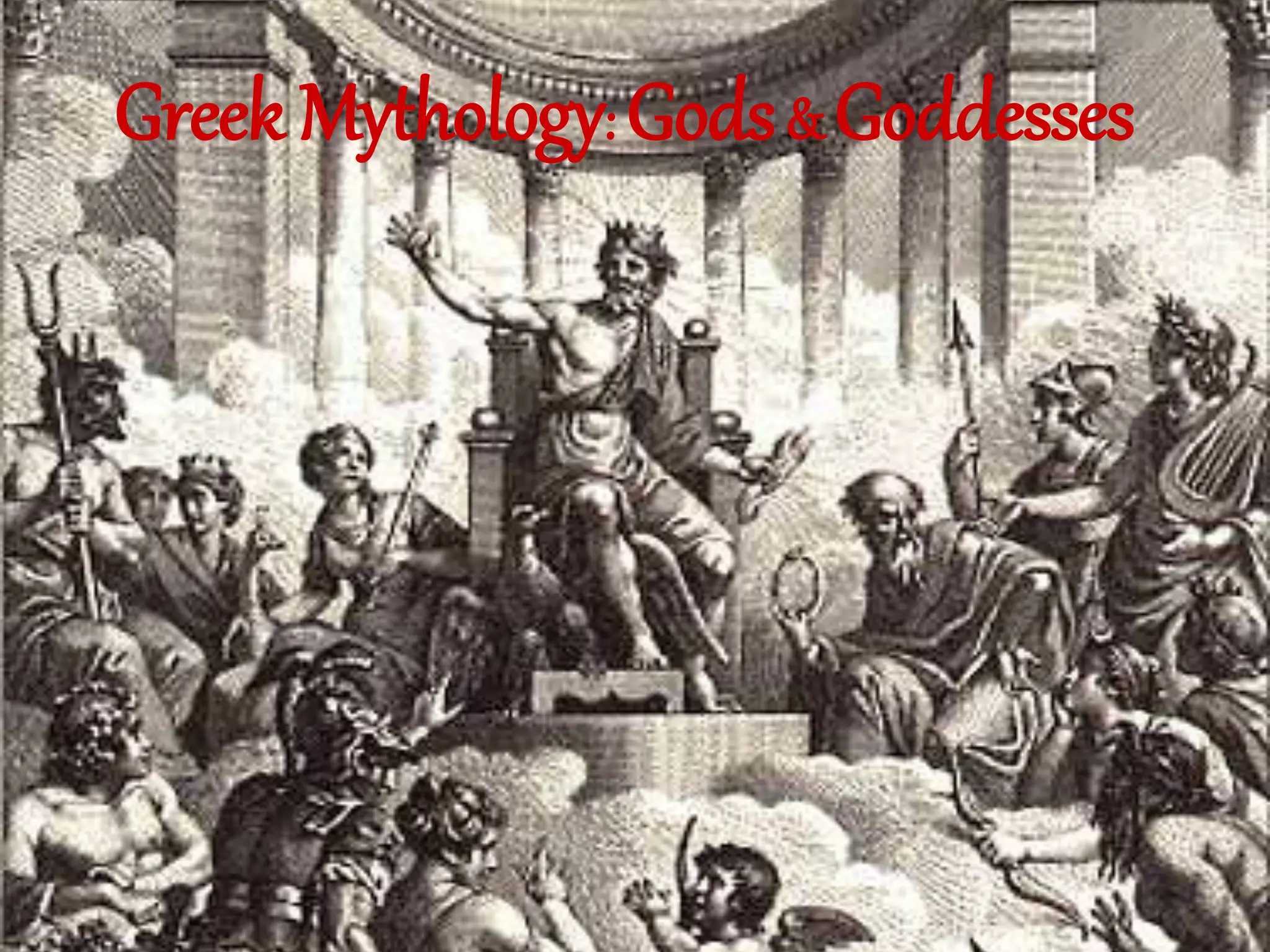
Greek Mythology: Gods& Goddesses
Mythology
• a traditional story of the early history
of a people or explaining some natural or
social phenomenon, and typically
involving supernatural beings or events.
• FICTION!
• in early times handed down orally from
one generation to another
Mythology
Ancient cultures used mythology belief
systems much the same way that people
use modern religion.
• to explain the world/
nature, man, and gods
• to instruct or guide
proper behavior
• to give a sense of
community
Origins of Mythology
Ancient mythology belongs to the oral
tradition (folklore, legends, etc.)
1. stories passed orally appealed to the
non-literate (non-readers)
2. these stories were a form of
entertainment
3. the stories enabled the
passing of history and
culture from one group
to the next
Greek Mythology
1. The Greeks were the earliest people to give
their gods human forms
2. The Greeks also
gave the gods
human qualities
and emotions
3. Greeks were able to
determine proper
behavior based on what
would “anger the gods”
or “please the gods.”
Greek Myth Categories
The Greek myths fall into the following
categories:
a. Explains
b. Instructs
c. Entertains
Remember the Titans?
• Gaea: Earth Goddess; made the rest of the
Titans by mating with her son, Uranus.
• Uranus: Sky god; first ruler. Dethroned by
Cronus.
• Cronus: Fathered the first of the Olympians.
Swallowed his children except for Zeus.
• Prometheus: “Forethought” ;
Protector of man; inventor of fire.
• Atlas: Punished by having
to hold the world on his back.
Who Were the Olympians?
• The offspring of the Titans
• Overthrew the Titans in a war to control the
universe.
• Led by Zeus, the god of the other gods.
• Zeus and his brothers split territory (Zeus-
earth/sky, Poseidon- the seas, Hades- the
underworld)
The Twelve Olympians
• Aphrodite: the daughter of Zeus, wife to Hephaestus
(but had many lovers). She is the goddess of love and
beauty. Arguable that her vanity caused the Trojan
War. She represents affection and can make anyone
love her or fall in love. Her beauty was the source of
much rivalry. Her symbols were the dove, and myrtle,
a type of evergreen shrub.
• Ares: Ares was the god of war, and
son of Zeus and Hera.
• He was the lover of his sister,
Aphrodite, who was married to
Hephaestus.
• Apollo was the son of
Zeus and Leto, twin
brother of Artemis. He
was the god of
prophecy, music, and he
is often depicted
playing a golden lyre. He
was also known as the
Archer, far shooting
with a silver bow; the
god of healing, giving
the science of medicine
to man; the god of
light; and the god of
truth.
• Artemis: Artemis was the
goddess of chastity, the
hunt, the moon, and the
natural environment.
• She was the daughter of
Zeus and Leto, twin sister
of Apollo. As soon as
Artemis was born, she
helped her mother give
birth to her twin brother,
thereby becoming the
protector of childbirth
and labor
• Athena: Athena was the Greek goddess
of wisdom/reason, war, the arts and
literature. She was the daughter of
Zeus; her birth is unique in that she did
not have a mother. Instead, she sprang
full grown and clad in armor from Zeus'
forehead.
• She was Zeus' favorite child and was
allowed to use his weapons including his
thunderbolt.
• Demeter: Demeter was the
goddess of agriculture.
She was the daughter of
Cronus and Rhea.Sacred to
her are livestock and
agricultural products,
wheat and the poppy.
• Hephaestus: Hephaestus was
the Greek god of fire,
blacksmiths, sculptors,
metallurgy, volcanoes; thus, he
is symbolized with a hammer, an
anvil and a pair of tongs.
• Hera: Hera was Zeus' wife and sister, and
was raised by the Titans Oceanus and
Tethys. She was the supreme goddess,
patron of marriage and childbirth, having a
special interest in protecting married women.
Her sacred animals were the cow and the
peacock, and she favored the city of Argos.
• Hermes: Hermes was the Greek
messenger god, or the god of commerce,
son of Zeus and Maia. Quick acting and
cunning, he was able to move swiftly
between the world of man and the world
of gods, acting as a messenger of the
gods and the link between mortals and
the Olympians.
Dionysus: He was the god of pleasure and
wine, later considered a patron of the
arts. He had a dual nature; on one hand,
he brought joy and divine ecstasy; or he
would bring brutal and blinding rage, thus
reflecting the dual nature of wine. Was
born from a mortal mother, Semele,
daughter of a king
• Poseidon: Poseidon is the god of the sea
and protector of all aquatic features.
Brother of Zeus and Hades, after the
overthrow of their father, Cronus, he
drew lots with them to share the
universe. He ended up becoming lord of
the sea. He was widely worshiped by
seamen. He married Amphitrite, one of
the granddaughters of Titan Oceanus.
• Hades - lord of the underworld
and ruler of the dead. Greedy like
his brother Poseidon, he was
mainly interested in increasing his
subjects, and anyone whose deeds
resulted in people dying was
favored by him.
• Although an Olympian, Hades
preferred the Underworld and
rarely left his kingdom. His
weapon was a pitchfork, which he
used to create earthquakes,
similar to the way Poseidon used
his trident. He also had a helmet
of invisibility.
• Zeus: Zeus was the god of the sky and
ruler of the Olympian gods. He
overthrew his father, Cronus, and then
drew lots with his brothers Poseidon
and Hades, in order to decide who would
succeed their father on the throne.
Zeus won the draw and became the
supreme ruler of the gods, as well as
lord of the sky and rain. His weapon was
a thunderbolt which he hurled at those
who displeased or defied him, especially
liars and oath-breakers. He was married
to Hera but often tested her patience,
as he was infamous for his many affairs.
• Zeus continued - As the
father of the gods, Zeus
ascertained that each
deity perform their
individual duty, punished
their misdeeds, settled
their disputes, and acted
towards them on all
occasions as their all-
knowing counselor and
mighty friend.
Family Tree
Other Gods and Goddesses
Eris - Goddess of Discord.
Eros - God of Love.
Helios - Personification of the Sun.
Heracles - Greatest hero of the Greek myths.
Iris - Personification of the Rainbow, also the
messenger of Olympus along with Hermes.
Morpheus - God of Dreams.
Muses - Nine ladies of science and arts.
Nemesis - Greek goddess of retribution.
Nike - Goddess of victory.
Can you label the Gods and Goddesses
on Mount Olympus?

Greek Mythology Notes.ppt

  • 1.
  • 2.
    Mythology • a traditionalstory of the early history of a people or explaining some natural or social phenomenon, and typically involving supernatural beings or events. • FICTION! • in early times handed down orally from one generation to another
  • 3.
    Mythology Ancient cultures usedmythology belief systems much the same way that people use modern religion. • to explain the world/ nature, man, and gods • to instruct or guide proper behavior • to give a sense of community
  • 4.
    Origins of Mythology Ancientmythology belongs to the oral tradition (folklore, legends, etc.) 1. stories passed orally appealed to the non-literate (non-readers) 2. these stories were a form of entertainment 3. the stories enabled the passing of history and culture from one group to the next
  • 5.
    Greek Mythology 1. TheGreeks were the earliest people to give their gods human forms 2. The Greeks also gave the gods human qualities and emotions 3. Greeks were able to determine proper behavior based on what would “anger the gods” or “please the gods.”
  • 6.
    Greek Myth Categories TheGreek myths fall into the following categories: a. Explains b. Instructs c. Entertains
  • 7.
    Remember the Titans? •Gaea: Earth Goddess; made the rest of the Titans by mating with her son, Uranus. • Uranus: Sky god; first ruler. Dethroned by Cronus. • Cronus: Fathered the first of the Olympians. Swallowed his children except for Zeus. • Prometheus: “Forethought” ; Protector of man; inventor of fire. • Atlas: Punished by having to hold the world on his back.
  • 8.
    Who Were theOlympians? • The offspring of the Titans • Overthrew the Titans in a war to control the universe. • Led by Zeus, the god of the other gods. • Zeus and his brothers split territory (Zeus- earth/sky, Poseidon- the seas, Hades- the underworld)
  • 9.
    The Twelve Olympians •Aphrodite: the daughter of Zeus, wife to Hephaestus (but had many lovers). She is the goddess of love and beauty. Arguable that her vanity caused the Trojan War. She represents affection and can make anyone love her or fall in love. Her beauty was the source of much rivalry. Her symbols were the dove, and myrtle, a type of evergreen shrub.
  • 10.
    • Ares: Areswas the god of war, and son of Zeus and Hera. • He was the lover of his sister, Aphrodite, who was married to Hephaestus.
  • 11.
    • Apollo wasthe son of Zeus and Leto, twin brother of Artemis. He was the god of prophecy, music, and he is often depicted playing a golden lyre. He was also known as the Archer, far shooting with a silver bow; the god of healing, giving the science of medicine to man; the god of light; and the god of truth.
  • 12.
    • Artemis: Artemiswas the goddess of chastity, the hunt, the moon, and the natural environment. • She was the daughter of Zeus and Leto, twin sister of Apollo. As soon as Artemis was born, she helped her mother give birth to her twin brother, thereby becoming the protector of childbirth and labor
  • 13.
    • Athena: Athenawas the Greek goddess of wisdom/reason, war, the arts and literature. She was the daughter of Zeus; her birth is unique in that she did not have a mother. Instead, she sprang full grown and clad in armor from Zeus' forehead. • She was Zeus' favorite child and was allowed to use his weapons including his thunderbolt.
  • 14.
    • Demeter: Demeterwas the goddess of agriculture. She was the daughter of Cronus and Rhea.Sacred to her are livestock and agricultural products, wheat and the poppy.
  • 15.
    • Hephaestus: Hephaestuswas the Greek god of fire, blacksmiths, sculptors, metallurgy, volcanoes; thus, he is symbolized with a hammer, an anvil and a pair of tongs.
  • 16.
    • Hera: Herawas Zeus' wife and sister, and was raised by the Titans Oceanus and Tethys. She was the supreme goddess, patron of marriage and childbirth, having a special interest in protecting married women. Her sacred animals were the cow and the peacock, and she favored the city of Argos.
  • 17.
    • Hermes: Hermeswas the Greek messenger god, or the god of commerce, son of Zeus and Maia. Quick acting and cunning, he was able to move swiftly between the world of man and the world of gods, acting as a messenger of the gods and the link between mortals and the Olympians.
  • 18.
    Dionysus: He wasthe god of pleasure and wine, later considered a patron of the arts. He had a dual nature; on one hand, he brought joy and divine ecstasy; or he would bring brutal and blinding rage, thus reflecting the dual nature of wine. Was born from a mortal mother, Semele, daughter of a king
  • 19.
    • Poseidon: Poseidonis the god of the sea and protector of all aquatic features. Brother of Zeus and Hades, after the overthrow of their father, Cronus, he drew lots with them to share the universe. He ended up becoming lord of the sea. He was widely worshiped by seamen. He married Amphitrite, one of the granddaughters of Titan Oceanus.
  • 20.
    • Hades -lord of the underworld and ruler of the dead. Greedy like his brother Poseidon, he was mainly interested in increasing his subjects, and anyone whose deeds resulted in people dying was favored by him. • Although an Olympian, Hades preferred the Underworld and rarely left his kingdom. His weapon was a pitchfork, which he used to create earthquakes, similar to the way Poseidon used his trident. He also had a helmet of invisibility.
  • 21.
    • Zeus: Zeuswas the god of the sky and ruler of the Olympian gods. He overthrew his father, Cronus, and then drew lots with his brothers Poseidon and Hades, in order to decide who would succeed their father on the throne. Zeus won the draw and became the supreme ruler of the gods, as well as lord of the sky and rain. His weapon was a thunderbolt which he hurled at those who displeased or defied him, especially liars and oath-breakers. He was married to Hera but often tested her patience, as he was infamous for his many affairs.
  • 22.
    • Zeus continued- As the father of the gods, Zeus ascertained that each deity perform their individual duty, punished their misdeeds, settled their disputes, and acted towards them on all occasions as their all- knowing counselor and mighty friend.
  • 23.
  • 24.
    Other Gods andGoddesses Eris - Goddess of Discord. Eros - God of Love. Helios - Personification of the Sun. Heracles - Greatest hero of the Greek myths. Iris - Personification of the Rainbow, also the messenger of Olympus along with Hermes. Morpheus - God of Dreams. Muses - Nine ladies of science and arts. Nemesis - Greek goddess of retribution. Nike - Goddess of victory.
  • 25.
    Can you labelthe Gods and Goddesses on Mount Olympus?

Editor's Notes

  • #11 In the Iliad, it is mentioned that Zeus hated him more than anyone else; Ares was also on the losing side of the Trojan War, favoring the Trojans. He was the lover of his sister, Aphrodite, who was married to Hephaestus. The union of Ares and Aphrodite resulted in the birth of eight children, including Eros, god of love. His symbols were armor, dogs, and vultures.
  • #12 The Oracle in Delphi was devoted to Apollo. People from all over the known world travelled there to learn what the future held for them.
  • #13 . She asked her father to grant her eternal chastity and virginity, and never gave in to any potential lovers; devoted to hunting and nature, she rejected marriage and love. She was the protector of nature and the hunt; both wild and tame animals were under her protection. She also protected the agriculture and animal herding. Her symbols were weapons, stags, and the crescent moon.
  • #15 . Zeus, alarmed for the barren earth, sought for Persephone's return. However, because she had eaten while in the underworld, Hades had a claim on her. Therefore, it was decreed that Persephone would spend four months each year in the underworld to grieve for her daughter's absence, withdrawing her gifts from the world and creating winter. Her return brought the spring.
  • #16 According to Homer's epics, the Iliad and the Odyssey, he was the son of Zeus and Hera. However, Hesiod informs us that Hera bore Hephaestus alone. According to an account, after Hephaestus was born, Hera threw him from Olympus because he was crippled; he fell into the ocean and was raised by Thetis and Eurynome. He was later accepted back to Olympus, and became the craftsman of the gods, creating majestic armors, shields and weapons.
  • #17 She often interfered with Zeus's plans and she was often able to outwit him. Most stories concerning Hera deal with her jealousy and her plans of revenge for Zeus's infidelities.
  • #20 His weapon was a trident, with which he could make the earth shake, causing earthquakes, and shatter any object. He was second to Zeus in power amongst the gods. He was considered by Greeks to have a difficult quarrelsome personality.