GREEK DEBT CRISIS
BY ZAKIR & WADOOD
HISTORY AND BACKGROUND
• European Union is a conglomeration of 28 nations.
 Greece joined in 1981
• Euro Currency introduced as a single currency in Jan 1999 binds 19
nations. It is watched over by ECB ( European Central Bank).
• Budget and tax policy is in the hands of each country.
• Greece had been understating its deficit figures for years.
• The Greek Financial Crisis surfaced in 2010 when most international
banks and foreign investors had sold their Greek bonds and other
holdings in the wake of the announcement made by Greece in Oct 2009.
• By March 2010, Greece was turning towards bankruptcy which had
threatened to set off a new financial crisis.
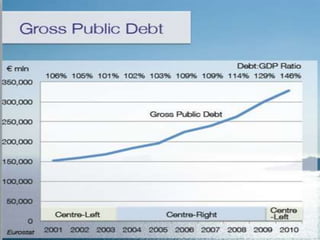
• The current debt owed by Greece to different entities reached
• 350 Billion Euros.
The Breakdown Of 320 Billion Euros Current Debt Which Greece Owes To Different
Entities:
Germany: 57 Billion, France: 43 billion, Italy: 38 billion, Spain : 25 billion, others 32 billion. This
constitutes 195 Billion bail out given by European countries through two newly created
institutions in terms of Bilateral Loan Facility ( 53 billion) and European Financial Stability
Facility ( 142 Billion).
Privately held debt: 63 Billion ( this includes Government Bonds and Treasury bills
IMF: 24 Billion, Bonds held by ECB: 27 Billion, Other bonds : 11 Billion
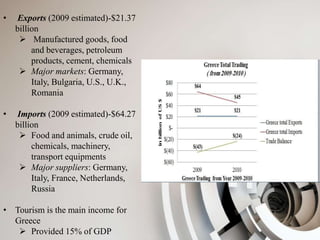
• Exports (2009 estimated)-$21.37
billion
 Manufactured goods, food
and beverages, petroleum
products, cement, chemicals
 Major markets: Germany,
Italy, Bulgaria, U.S., U.K.,
Romania
• Imports (2009 estimated)-$64.27
billion
 Food and animals, crude oil,
chemicals, machinery,
transport equipments
 Major suppliers: Germany,
Italy, France, Netherlands,
Russia
• Tourism is the main income for
Greece
 Provided 15% of GDP
THE IMPACT AND INTERVENTINOS
• The Greek Crisis triggered market fears in the wake of 2008 financial meltdown
• It threatened break up of EU and raised the fears of political and economic
destabilization
• The troika (ECB, IMF and EC ) issued two international bail out for Greece totaling 240
Billion Euros with conditions.
• Harsh austerity in terms of deep budget cut and steep tax increase were part of
conditions which required overhauling of economy.
• Greece had to pay interest for the bail out loans and the conditions
imposed on Greece were for the benefit of the lenders.
• Greece used the bail out loans to pay off its international loans rather than making its
way into the economy.
• The left oriented govt. came into power in Greece which initially refused to give any
proposal.
• Reached into an agreement with ECB for another bail out loan of Euros89 Billion with
stringent conditions which was against the result of the Greek referendum.
• Recent Developments: Governing party got divided, Greek prime minister resigned and
Greece is heading for another election.
THE IMPACT AND INTERVENTIONS
ROOT CAUSE, CONSEQUENCES & SOLUTIONS
The root cause of the problem :
1. As a political entity, EU does not have any control over the budget and tax policy of
the member countries. It is the Achilles heel of both Euro currency and EU.
2. The member countries doesn’t have financial autonomy or control over monitory
policy.
Consequences:
The crisis is not yet over. It might re-emerge within years. Greece finally might be forced
to leave Euro zone.
The crisis my spill over to the countries with huge GPD in comparison with GDP. Portugal
and Italy (135%), Ireland and Cyprus (110%) and Spain (100%).
Legal complexities of Euro currency: No provision for voluntary or forced departure from
the currency union
Solution: European Union needs to evolve into a federal nation like USA, so that the
Union has control over the budget and tax policy of the member states
ROOT CAUSE, CONSEQUENCES & SOLUTIONS

Greek Crisis

  • 1.
    GREEK DEBT CRISIS BYZAKIR & WADOOD
  • 2.
    HISTORY AND BACKGROUND •European Union is a conglomeration of 28 nations.  Greece joined in 1981 • Euro Currency introduced as a single currency in Jan 1999 binds 19 nations. It is watched over by ECB ( European Central Bank). • Budget and tax policy is in the hands of each country. • Greece had been understating its deficit figures for years. • The Greek Financial Crisis surfaced in 2010 when most international banks and foreign investors had sold their Greek bonds and other holdings in the wake of the announcement made by Greece in Oct 2009. • By March 2010, Greece was turning towards bankruptcy which had threatened to set off a new financial crisis. • The current debt owed by Greece to different entities reached • 350 Billion Euros.
  • 4.
    The Breakdown Of320 Billion Euros Current Debt Which Greece Owes To Different Entities: Germany: 57 Billion, France: 43 billion, Italy: 38 billion, Spain : 25 billion, others 32 billion. This constitutes 195 Billion bail out given by European countries through two newly created institutions in terms of Bilateral Loan Facility ( 53 billion) and European Financial Stability Facility ( 142 Billion). Privately held debt: 63 Billion ( this includes Government Bonds and Treasury bills IMF: 24 Billion, Bonds held by ECB: 27 Billion, Other bonds : 11 Billion
  • 5.
    • Exports (2009estimated)-$21.37 billion  Manufactured goods, food and beverages, petroleum products, cement, chemicals  Major markets: Germany, Italy, Bulgaria, U.S., U.K., Romania • Imports (2009 estimated)-$64.27 billion  Food and animals, crude oil, chemicals, machinery, transport equipments  Major suppliers: Germany, Italy, France, Netherlands, Russia • Tourism is the main income for Greece  Provided 15% of GDP
  • 6.
    THE IMPACT ANDINTERVENTINOS • The Greek Crisis triggered market fears in the wake of 2008 financial meltdown • It threatened break up of EU and raised the fears of political and economic destabilization • The troika (ECB, IMF and EC ) issued two international bail out for Greece totaling 240 Billion Euros with conditions. • Harsh austerity in terms of deep budget cut and steep tax increase were part of conditions which required overhauling of economy. • Greece had to pay interest for the bail out loans and the conditions imposed on Greece were for the benefit of the lenders.
  • 7.
    • Greece usedthe bail out loans to pay off its international loans rather than making its way into the economy. • The left oriented govt. came into power in Greece which initially refused to give any proposal. • Reached into an agreement with ECB for another bail out loan of Euros89 Billion with stringent conditions which was against the result of the Greek referendum. • Recent Developments: Governing party got divided, Greek prime minister resigned and Greece is heading for another election. THE IMPACT AND INTERVENTIONS
  • 8.
    ROOT CAUSE, CONSEQUENCES& SOLUTIONS The root cause of the problem : 1. As a political entity, EU does not have any control over the budget and tax policy of the member countries. It is the Achilles heel of both Euro currency and EU. 2. The member countries doesn’t have financial autonomy or control over monitory policy.
  • 9.
    Consequences: The crisis isnot yet over. It might re-emerge within years. Greece finally might be forced to leave Euro zone. The crisis my spill over to the countries with huge GPD in comparison with GDP. Portugal and Italy (135%), Ireland and Cyprus (110%) and Spain (100%). Legal complexities of Euro currency: No provision for voluntary or forced departure from the currency union Solution: European Union needs to evolve into a federal nation like USA, so that the Union has control over the budget and tax policy of the member states ROOT CAUSE, CONSEQUENCES & SOLUTIONS