Greek banking reboot
Bella Wu
The Euro Situation
1992 Members of the EU (European Union) signed the
Maastricht Treaty where they promised to limit deficit
spending and debt levels
Early 2000s, many of the members of the EU were not
able to stay within the restrictions, so many began to
utilize different methods to hide their debt levels
Greece was guilty of this. In 2009 George Papandreou
became prime minister and discovered that the gov’t
had understated its public debt for years.
The Euro Situation
(cont’d)
The debt continued to grow to €290 billion. This is a ratio
quadruple the allowable ratio based on the Growth Pact
of the Euro Zone.
In April 2010 the Greek government debt was
downgraded to “junk bond” status. Because of this the
Greek government could no longer borrow money from
the private capital markets.
The Eurozone countries and International Money Fund
(IMF) created 2 bail out packages. One in May 2010 of
€110 billion and one in October 2011 of €130 billion.
Why Greece?
Government Spending:
Greece has always had high budget deficits b/c of
heavy spending on public sector jobs, pensions, and
other social benefits.
Global Economic Crisis
Greece’s two biggest earners were tourism and
shipping and both were hit particularly hard during
the downturn. Revenue fell 15% in 2009.
Why Greece? (Cont’d)
Tax evasion and Corruption
Every year the gov’t’s tax income is well below the
expected level. In 2010 the estimated tax ecasion
costs were over €20 billion.
From 2000-2010, Greece has been beyond the
Eurozone stability criteria but was able to hide this for
many years with a variety of financial tricks aided by
banks including Goldman Sachs.
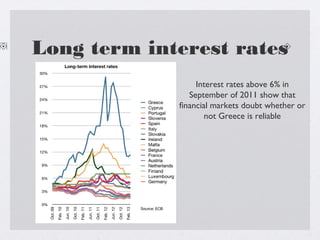
Long term interest rates
Interest rates above 6% in
September of 2011 show that
financial markets doubt whether or
not Greece is reliable
Greek debt compared to
Eurozone
Countries like Greece are
bringing down the entire
Eurozone because they are
now connected.
The debt ridden countries
need help from the
stronger economies like
Germany. If one goes
down, they all go down.
The U.S. is also heavily
dependent on trade with
Europe.
Implications for U.S.
If investors lost confidence in the Eurozone, the euro
would weaken. A weakened euro would mean an
decrease in U.S. exports to the Eurozone and an
increase in imports from the Eurozone. This would
widen the U.S. trade deficit.
The U.S. also has a large financial stake in the EU. The
EU is the the United States biggest trading partner.
The entire global economy would be affected b/c
basically every country is directly or indirectly affected
by the U.S. and the Eurozone.
“System Reboot - Recapitalisation
approaches the finishing line”
- The Economist - May 25th 2013
- The Economist - May 25th 2013This article talks about the status of the recapitalisation of the
banking system of Greece.
In 2011 a second bailout package was created for Greece that
includes $65 billion (€50 billion) for the “Hellenic Financial
Stability Fund” (HFSF).
Within the HFSF €27.5 billion is supposed to go to Greece’s
four biggest banks - Alpha, National Bank of Greece (NBG),
Piraeus, and Eurobank
If any of these banks can raise at least 10% of the capital
requirement it can remain privately owned. Otherwise it will be
owned by the Greek state. The banks have until June 14th
which means everything must be approved by the end of May.
Pros for investors
The banking system will be much more concentrated.
Before the 4 banks held 70% of the assets in Greece
b/c of foreign owned firms. After they will own 95%.
With each share investors buy, they have a warrant to
buy more at the price of the rights issue (adjusted by
interest rates) for the next 4 1/2 years.
Cons for investors
High political risks. Greek politicians may meddle in the
banks’ affairs. These investments depend on HFSF
keeping its promise of privatising holdings based on a
strict schedule.
Losses have turned out heavier than expected.
According to IMF recapitalisation is able to cope w/
“non performing loans” reaching 40% of total lending.
The ratio is already at 29.5%.
Status of the banks
Alpha: Consortium of banks led by J. P. Morgan has
committed €457 million. In total they have raised €550
million which is 12% of its capital requirement.
National Bank of Greece (NBG): May succeed
Piraeus: Will reach the 10% needed
Eurobank: Will be state owned/fully capitalised by the
HFSF

Econ greece economy ppt

  • 1.
  • 2.
    The Euro Situation 1992Members of the EU (European Union) signed the Maastricht Treaty where they promised to limit deficit spending and debt levels Early 2000s, many of the members of the EU were not able to stay within the restrictions, so many began to utilize different methods to hide their debt levels Greece was guilty of this. In 2009 George Papandreou became prime minister and discovered that the gov’t had understated its public debt for years.
  • 3.
    The Euro Situation (cont’d) Thedebt continued to grow to €290 billion. This is a ratio quadruple the allowable ratio based on the Growth Pact of the Euro Zone. In April 2010 the Greek government debt was downgraded to “junk bond” status. Because of this the Greek government could no longer borrow money from the private capital markets. The Eurozone countries and International Money Fund (IMF) created 2 bail out packages. One in May 2010 of €110 billion and one in October 2011 of €130 billion.
  • 4.
    Why Greece? Government Spending: Greecehas always had high budget deficits b/c of heavy spending on public sector jobs, pensions, and other social benefits. Global Economic Crisis Greece’s two biggest earners were tourism and shipping and both were hit particularly hard during the downturn. Revenue fell 15% in 2009.
  • 5.
    Why Greece? (Cont’d) Taxevasion and Corruption Every year the gov’t’s tax income is well below the expected level. In 2010 the estimated tax ecasion costs were over €20 billion. From 2000-2010, Greece has been beyond the Eurozone stability criteria but was able to hide this for many years with a variety of financial tricks aided by banks including Goldman Sachs.
  • 6.
    Long term interestrates Interest rates above 6% in September of 2011 show that financial markets doubt whether or not Greece is reliable
  • 7.
    Greek debt comparedto Eurozone Countries like Greece are bringing down the entire Eurozone because they are now connected. The debt ridden countries need help from the stronger economies like Germany. If one goes down, they all go down. The U.S. is also heavily dependent on trade with Europe.
  • 8.
    Implications for U.S. Ifinvestors lost confidence in the Eurozone, the euro would weaken. A weakened euro would mean an decrease in U.S. exports to the Eurozone and an increase in imports from the Eurozone. This would widen the U.S. trade deficit. The U.S. also has a large financial stake in the EU. The EU is the the United States biggest trading partner. The entire global economy would be affected b/c basically every country is directly or indirectly affected by the U.S. and the Eurozone.
  • 9.
    “System Reboot -Recapitalisation approaches the finishing line” - The Economist - May 25th 2013 - The Economist - May 25th 2013This article talks about the status of the recapitalisation of the banking system of Greece. In 2011 a second bailout package was created for Greece that includes $65 billion (€50 billion) for the “Hellenic Financial Stability Fund” (HFSF). Within the HFSF €27.5 billion is supposed to go to Greece’s four biggest banks - Alpha, National Bank of Greece (NBG), Piraeus, and Eurobank If any of these banks can raise at least 10% of the capital requirement it can remain privately owned. Otherwise it will be owned by the Greek state. The banks have until June 14th which means everything must be approved by the end of May.
  • 10.
    Pros for investors Thebanking system will be much more concentrated. Before the 4 banks held 70% of the assets in Greece b/c of foreign owned firms. After they will own 95%. With each share investors buy, they have a warrant to buy more at the price of the rights issue (adjusted by interest rates) for the next 4 1/2 years.
  • 11.
    Cons for investors Highpolitical risks. Greek politicians may meddle in the banks’ affairs. These investments depend on HFSF keeping its promise of privatising holdings based on a strict schedule. Losses have turned out heavier than expected. According to IMF recapitalisation is able to cope w/ “non performing loans” reaching 40% of total lending. The ratio is already at 29.5%.
  • 12.
    Status of thebanks Alpha: Consortium of banks led by J. P. Morgan has committed €457 million. In total they have raised €550 million which is 12% of its capital requirement. National Bank of Greece (NBG): May succeed Piraeus: Will reach the 10% needed Eurobank: Will be state owned/fully capitalised by the HFSF