
10 lessons from a first time
entrepreneur.
@scotchisholm
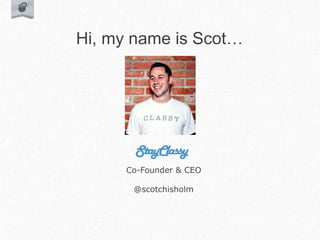
Hi, my name is Scot…
Co-Founder & CEO
@scotchisholm
…and I’m a 1st time entrepreneur.
This deck highlights some key
learnings from our own eight-year
journey (and counting) as first-time
entrepreneurs.
In no way do I have all the answers,
but hopefully this deck can help other
first-time entrepreneurs who feel
like…
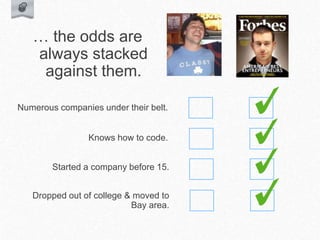
Started a company before 15.
Knows how to code.
Numerous companies under their belt.
Dropped out of college & moved to
Bay area.
… the odds are
always stacked
against them.
Books / Blogs / Follow
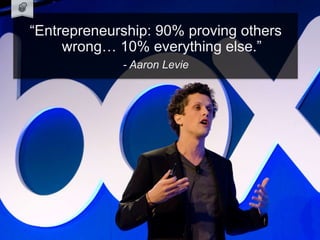
“Entrepreneurship: 90% proving others
wrong… 10% everything else.”
- Aaron Levie
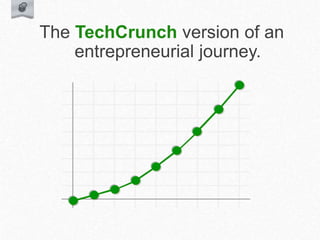
The TechCrunch version of an
entrepreneurial journey.
The real life version…
?
Here’s our journey (so far)
in 5 slides…
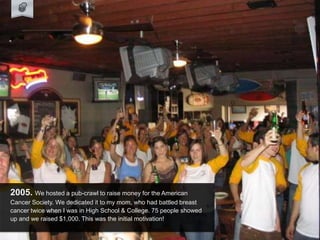
2005. We hosted a pub-crawl to raise money for the American
Cancer Society. We dedicated it to my mom, who had battled breast
cancer twice when I was in High School & College. 75 people showed
up and we raised $1,000. This was the initial motivation!
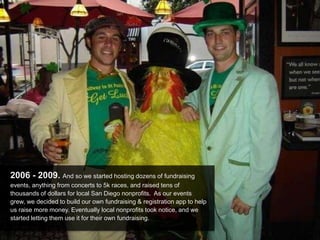
2006 - 2009. And so we started hosting dozens of fundraising
events, anything from concerts to 5k races, and raised tens of
thousands of dollars for local San Diego nonprofits. As our events
grew, we decided to build our own fundraising & registration app to help
us raise more money. Eventually local nonprofits took notice, and we
started letting them use it for their own fundraising.
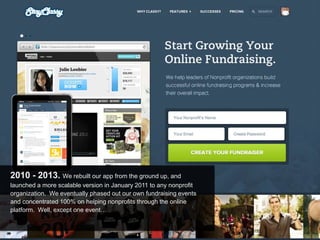
2010 - 2013. We rebuilt our app from the ground up, and
launched a more scalable version in January 2011 to any nonprofit
organization. We eventually phased out our own fundraising events
and concentrated 100% on helping nonprofits through the online
platform. Well, except one event…
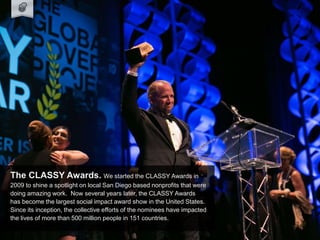
The CLASSY Awards. We started the CLASSY Awards in
2009 to shine a spotlight on local San Diego based nonprofits that were
doing amazing work. Now several years later, the CLASSY Awards
has become the largest social impact award show in the United States.
Since its inception, the collective efforts of the nominees have impacted
the lives of more than 500 million people in 151 countries.
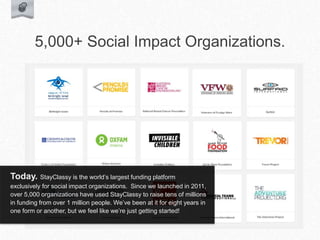
5,000+ Social Impact Organizations.
Today. StayClassy is the world’s largest funding platform
exclusively for social impact organizations. Since we launched in 2011,
over 5,000 organizations have used StayClassy to raise tens of millions
in funding from over 1 million people. We’ve been at it for eight years in
one form or another, but we feel like we’re just getting started!
And now, some of what we’ve
learned along the way …
Embrace the grind.
(aka, this shit ain’t easy)
#1
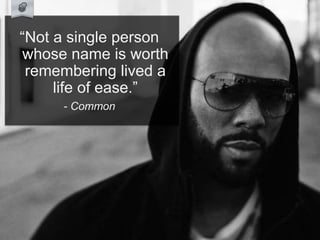
“Not a single person
whose name is worth
remembering lived a
life of ease.”
- Common
• There’s no such thing as an overnight success.
• Entrepreneurship is not a side-hobby.
• Find a passion, keep pursuing and you’ll probably
discover a business opportunity.
• Most people will doubt you (at first).
• Most investors will say “no” (at first).
• You’ll even doubt yourself and your idea many times
along the way.
Embrace the grind.
#1
Accelerate your learning.
#2
Accelerate your learning.
#2
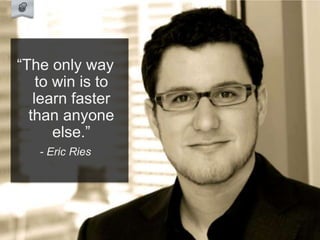
“The only way
to win is to
learn faster
than anyone
else.”
- Eric Ries
• Know what you don’t know (which is a lot).
• Validate assumptions with least amount of work.
• “Get out of the building” – Steve Blank
• Listen to customers: decipher needs vs. wants.
• Personal development is equally as important as
customer development.
• Read, follow, post, get advice. Learn how to talk the talk
& walk the walk.
Accelerate your learning.
#2
Create a data-driven culture.
#3
Quote .
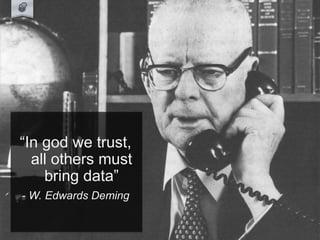
“In god we trust,
all others must
bring data”
- W. Edwards Deming
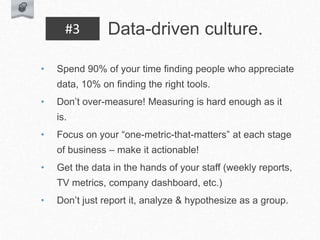
• Spend 90% of your time finding people who appreciate
data, 10% on finding the right tools.
• Don’t over-measure! Measuring is hard enough as it
is.
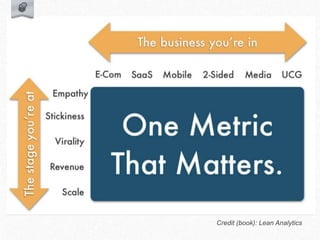
• Focus on your “one-metric-that-matters” at each stage
of business – make it actionable!
• Get the data in the hands of your staff (weekly reports,
TV metrics, company dashboard, etc.)
• Don’t just report it, analyze & hypothesize as a group.
Data-driven culture.
#3
Credit (book): Lean Analytics
Raise traction before money.
#4
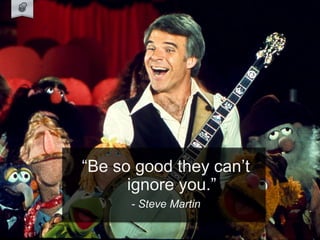
“Be so good they can’t
ignore you.”
- Steve Martin
• As 1st-time entrepreneur, traction is all you have for
credibility.
• Lack of focus (or perception of) is your worst enemy.
• Prove you can grow your “One Metric That Matters”
over time – shows traction & focus.
• Demonstrate what you learned along the way.
• Traction & personal discipline “de-risks” things in the
eyes of the investor.
Raise traction before money.
#4
Charge as soon as possible.
#5
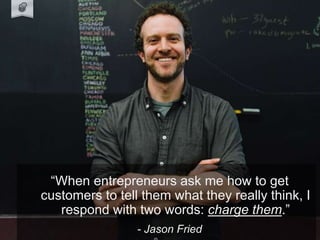
Jason Fried Quote.
“When entrepreneurs ask me how to get
customers to tell them what they really think, I
respond with two words: charge them.”
- Jason Fried
• It’s scary to charge, but its the best way to get honest
customer feedback (and make money).
• Keep pricing simple & align with customer value.
• No right or wrong when selecting initial price points…
use your best educated guess.
• Learn pricing thresholds from new customers without
disrupting the existing ones (i.e. A/B test pricing page).
• Consider 2nd pricing-axis & upgrade paths.
Charge as soon as possible.
#5
Don’t be afraid to change your model.
#6
Create a founding narrative.
#7
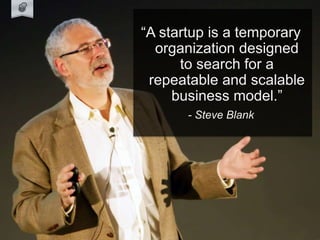
“A startup is a temporary
organization designed
to search for a
repeatable and scalable
business model.”
- Steve Blank
• Search for the product and business model that best
matches your customer’s needs and behaviors (round peg
in a round hole).
• Product-Market-Fit… wtf is that?
• “When over 40% of your customers say they would be ‘very
disappointed’ if your product went away” – Sean Ellis
• After PMF, the fine-tuning never stops (product, pricing,
acquisition strategy, etc.)
• Don’t scale until each new customer is profitable.
Don’t be afraid to change model.
#6
Your team is a system too.
#7
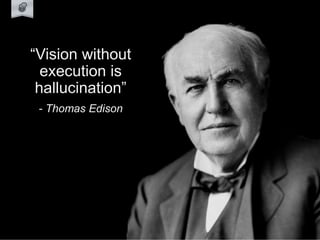
“Vision without
execution is
hallucination”
- Thomas Edison
• “At the root of every technical problem is a human
problem.”
• How do you get the optimal output from each person on
your team, including yourself?
• Get the right people on the bus first, then swap seats if
necessary.
• Culture of empowerment: Shared power & involvement.
• Create autonomy with boundaries & accountability (goal
setting; “Objectives & Key Results”).
Your team is a system too.
#7
Find your blue ocean.
#8
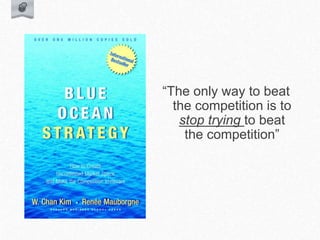
“The only way to beat
the competition is to
stop trying to beat
the competition”
• Observe your competition, but don’t follow.
• Find a game that your competitors can’t play.
• In blue oceans, rules of the game are waiting to be set.
• Continuous search for new and uncontested market
space – never stop innovating.
• Build a defensible moat, but remember that blue oceans
don’t last forever.
• No change, no future.
Find your blue ocean.
#8
Lay out a clear vision.
#9
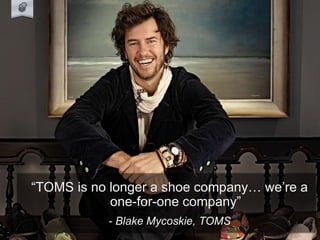
“TOMS is no longer a shoe company… we’re a
one-for-one company”
- Blake Mycoskie, TOMS
• It’s never too early to lay out a vision.
• Clear and compelling description of the future.
• Unifying focal point and catalyst for team spirit.
• BHAG’s = Big Hairy Audacious Goals [Jim Collins]
• 20-30 year goals with clear finish lines, 50-70%
probability of success, but team believes it can be done.
• BHAG’s measure progress against vision.
• Amazon: Every book, ever printed, in any language, all
available in 60 seconds.
Lay out a clear vision.
#9
Stand for something.
#10
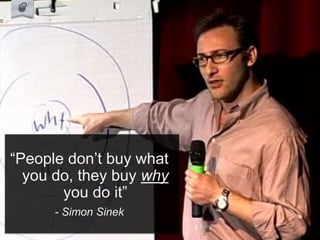
“People don’t buy what
you do, they buy why
you do it”
- Simon Sinek
• Core purpose is your company’s backbone (and can be
your backbone too).
• Why do you exist? What values do you hold dear?
• Should be relevant 100 years from now.
• No competitor can take purpose away from you.
• “Making money” or “pleasing shareholders” are not good
answers.
• The greatest companies all have non-monetary core-
purposes. Disney: To make people happy.
Stand for something.
#10
Stand for something.
#10
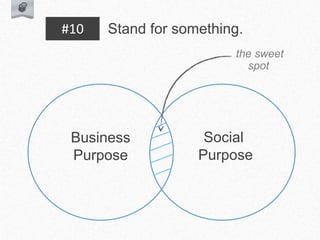
Business
Purpose
Social
Purpose
the sweet
spot
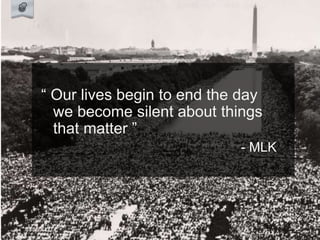
“ Our lives begin to end the day
we become silent about things
that matter ”
- MLK
Helpful Resources.
p.s. there’s lots of great stuff out there, these just
happen to be some of my personal favorites.
Leadership, Core Ideology, Culture, Socent
James Collins: Building Your Company’s Vision [Article]
Dharmesh Shah: Culture Code: Creating a Lovable Company [Pres]
Tony Hsieh: Zappos Lessons: Building a Customer Focused Culture [Pres]
David Bornstein’s New York Times Social Entrepreneurship Blog [Blog]
Startups, Metrics, Product, Growth
KISSMetrics Blog: https://blog.kissmetrics.com
Andrew Chen Blog: http://andrewchen.co
Dan Martell Blog: http://danmartell.com
Signals vs. Noise Blog: http://37signals.com/svn/
Dave McClure: Startup Metrics for Pirates [Pres]
Eric Ries Blog: http://www.startuplessonslearned.com/
David Skok Blog: http://www.forentrepreneurs.com/
Ryan Allis: How to be a Startup CEO [Article]
Drew Houston: Dropbox Startup Lessons Learned [Pres]
Gail Goodman: How to Negotiate the Long, Slow, SaaS Ramp of Death [Video]
Steve Blank: The Customer Development Methodology [Pres]
Mattan Griffel: Growth Hacking [Pres]
Chad Dickerson: Optimizing for Developer Happiness [Pres & Video]
Startups, Metrics, Product, Growth
Marketing, Sales, Fundraising
Hubspot Blog: http://blog.hubspot.com/
Sean Ellis Blog: http://www.startup-marketing.com
Neil Patel Blog: http://www.quicksprout.com/
Dave McClure: How to Pitch a VC [Pres]
Ryan Allis: How to Raise Venture Capital [Article]
Rand Fishkin: SEOmoz Venture Capital Process [Article]
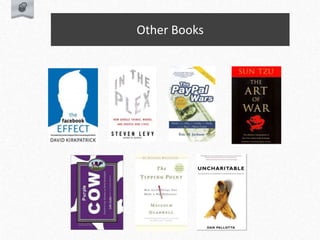
Other Books
@scotchisholm
Thank you!
http://www.stayclassy.org

10 Lessons from a First Time Entrepreneur.

  • 1.
    10 lessons froma first time entrepreneur. @scotchisholm
  • 2.
    Hi, my nameis Scot… Co-Founder & CEO @scotchisholm
  • 3.
    …and I’m a1st time entrepreneur.
  • 4.
    This deck highlightssome key learnings from our own eight-year journey (and counting) as first-time entrepreneurs. In no way do I have all the answers, but hopefully this deck can help other first-time entrepreneurs who feel like…
  • 5.
    Started a companybefore 15. Knows how to code. Numerous companies under their belt. Dropped out of college & moved to Bay area. … the odds are always stacked against them.
  • 6.
    Books / Blogs/ Follow “Entrepreneurship: 90% proving others wrong… 10% everything else.” - Aaron Levie
  • 7.
    The TechCrunch versionof an entrepreneurial journey.
  • 8.
    The real lifeversion… ?
  • 9.
    Here’s our journey(so far) in 5 slides…
  • 10.
    2005. We hosteda pub-crawl to raise money for the American Cancer Society. We dedicated it to my mom, who had battled breast cancer twice when I was in High School & College. 75 people showed up and we raised $1,000. This was the initial motivation!
  • 11.
    2006 - 2009.And so we started hosting dozens of fundraising events, anything from concerts to 5k races, and raised tens of thousands of dollars for local San Diego nonprofits. As our events grew, we decided to build our own fundraising & registration app to help us raise more money. Eventually local nonprofits took notice, and we started letting them use it for their own fundraising.
  • 12.
    2010 - 2013.We rebuilt our app from the ground up, and launched a more scalable version in January 2011 to any nonprofit organization. We eventually phased out our own fundraising events and concentrated 100% on helping nonprofits through the online platform. Well, except one event…
  • 13.
    The CLASSY Awards.We started the CLASSY Awards in 2009 to shine a spotlight on local San Diego based nonprofits that were doing amazing work. Now several years later, the CLASSY Awards has become the largest social impact award show in the United States. Since its inception, the collective efforts of the nominees have impacted the lives of more than 500 million people in 151 countries.
  • 14.
    5,000+ Social ImpactOrganizations. Today. StayClassy is the world’s largest funding platform exclusively for social impact organizations. Since we launched in 2011, over 5,000 organizations have used StayClassy to raise tens of millions in funding from over 1 million people. We’ve been at it for eight years in one form or another, but we feel like we’re just getting started!
  • 15.
    And now, someof what we’ve learned along the way …
  • 16.
    Embrace the grind. (aka,this shit ain’t easy) #1
  • 17.
    “Not a singleperson whose name is worth remembering lived a life of ease.” - Common
  • 18.
    • There’s nosuch thing as an overnight success. • Entrepreneurship is not a side-hobby. • Find a passion, keep pursuing and you’ll probably discover a business opportunity. • Most people will doubt you (at first). • Most investors will say “no” (at first). • You’ll even doubt yourself and your idea many times along the way. Embrace the grind. #1
  • 19.
  • 20.
    Accelerate your learning. #2 “Theonly way to win is to learn faster than anyone else.” - Eric Ries
  • 21.
    • Know whatyou don’t know (which is a lot). • Validate assumptions with least amount of work. • “Get out of the building” – Steve Blank • Listen to customers: decipher needs vs. wants. • Personal development is equally as important as customer development. • Read, follow, post, get advice. Learn how to talk the talk & walk the walk. Accelerate your learning. #2
  • 22.
  • 23.
    Quote . “In godwe trust, all others must bring data” - W. Edwards Deming
  • 24.
    • Spend 90%of your time finding people who appreciate data, 10% on finding the right tools. • Don’t over-measure! Measuring is hard enough as it is. • Focus on your “one-metric-that-matters” at each stage of business – make it actionable! • Get the data in the hands of your staff (weekly reports, TV metrics, company dashboard, etc.) • Don’t just report it, analyze & hypothesize as a group. Data-driven culture. #3
  • 25.
  • 26.
  • 27.
    “Be so goodthey can’t ignore you.” - Steve Martin
  • 28.
    • As 1st-timeentrepreneur, traction is all you have for credibility. • Lack of focus (or perception of) is your worst enemy. • Prove you can grow your “One Metric That Matters” over time – shows traction & focus. • Demonstrate what you learned along the way. • Traction & personal discipline “de-risks” things in the eyes of the investor. Raise traction before money. #4
  • 29.
    Charge as soonas possible. #5
  • 30.
    Jason Fried Quote. “Whenentrepreneurs ask me how to get customers to tell them what they really think, I respond with two words: charge them.” - Jason Fried
  • 31.
    • It’s scaryto charge, but its the best way to get honest customer feedback (and make money). • Keep pricing simple & align with customer value. • No right or wrong when selecting initial price points… use your best educated guess. • Learn pricing thresholds from new customers without disrupting the existing ones (i.e. A/B test pricing page). • Consider 2nd pricing-axis & upgrade paths. Charge as soon as possible. #5
  • 32.
    Don’t be afraidto change your model. #6
  • 33.
    Create a foundingnarrative. #7 “A startup is a temporary organization designed to search for a repeatable and scalable business model.” - Steve Blank
  • 34.
    • Search forthe product and business model that best matches your customer’s needs and behaviors (round peg in a round hole). • Product-Market-Fit… wtf is that? • “When over 40% of your customers say they would be ‘very disappointed’ if your product went away” – Sean Ellis • After PMF, the fine-tuning never stops (product, pricing, acquisition strategy, etc.) • Don’t scale until each new customer is profitable. Don’t be afraid to change model. #6
  • 35.
    Your team isa system too. #7
  • 36.
  • 37.
    • “At theroot of every technical problem is a human problem.” • How do you get the optimal output from each person on your team, including yourself? • Get the right people on the bus first, then swap seats if necessary. • Culture of empowerment: Shared power & involvement. • Create autonomy with boundaries & accountability (goal setting; “Objectives & Key Results”). Your team is a system too. #7
  • 38.
    Find your blueocean. #8
  • 39.
    “The only wayto beat the competition is to stop trying to beat the competition”
  • 40.
    • Observe yourcompetition, but don’t follow. • Find a game that your competitors can’t play. • In blue oceans, rules of the game are waiting to be set. • Continuous search for new and uncontested market space – never stop innovating. • Build a defensible moat, but remember that blue oceans don’t last forever. • No change, no future. Find your blue ocean. #8
  • 41.
    Lay out aclear vision. #9
  • 42.
    “TOMS is nolonger a shoe company… we’re a one-for-one company” - Blake Mycoskie, TOMS
  • 43.
    • It’s nevertoo early to lay out a vision. • Clear and compelling description of the future. • Unifying focal point and catalyst for team spirit. • BHAG’s = Big Hairy Audacious Goals [Jim Collins] • 20-30 year goals with clear finish lines, 50-70% probability of success, but team believes it can be done. • BHAG’s measure progress against vision. • Amazon: Every book, ever printed, in any language, all available in 60 seconds. Lay out a clear vision. #9
  • 44.
  • 45.
    “People don’t buywhat you do, they buy why you do it” - Simon Sinek
  • 46.
    • Core purposeis your company’s backbone (and can be your backbone too). • Why do you exist? What values do you hold dear? • Should be relevant 100 years from now. • No competitor can take purpose away from you. • “Making money” or “pleasing shareholders” are not good answers. • The greatest companies all have non-monetary core- purposes. Disney: To make people happy. Stand for something. #10
  • 47.
  • 48.
    “ Our livesbegin to end the day we become silent about things that matter ” - MLK
  • 49.
    Helpful Resources. p.s. there’slots of great stuff out there, these just happen to be some of my personal favorites.
  • 50.
    Leadership, Core Ideology,Culture, Socent James Collins: Building Your Company’s Vision [Article] Dharmesh Shah: Culture Code: Creating a Lovable Company [Pres] Tony Hsieh: Zappos Lessons: Building a Customer Focused Culture [Pres] David Bornstein’s New York Times Social Entrepreneurship Blog [Blog]
  • 51.
    Startups, Metrics, Product,Growth KISSMetrics Blog: https://blog.kissmetrics.com Andrew Chen Blog: http://andrewchen.co Dan Martell Blog: http://danmartell.com Signals vs. Noise Blog: http://37signals.com/svn/ Dave McClure: Startup Metrics for Pirates [Pres]
  • 52.
    Eric Ries Blog:http://www.startuplessonslearned.com/ David Skok Blog: http://www.forentrepreneurs.com/ Ryan Allis: How to be a Startup CEO [Article] Drew Houston: Dropbox Startup Lessons Learned [Pres] Gail Goodman: How to Negotiate the Long, Slow, SaaS Ramp of Death [Video] Steve Blank: The Customer Development Methodology [Pres] Mattan Griffel: Growth Hacking [Pres] Chad Dickerson: Optimizing for Developer Happiness [Pres & Video] Startups, Metrics, Product, Growth
  • 53.
    Marketing, Sales, Fundraising HubspotBlog: http://blog.hubspot.com/ Sean Ellis Blog: http://www.startup-marketing.com Neil Patel Blog: http://www.quicksprout.com/ Dave McClure: How to Pitch a VC [Pres] Ryan Allis: How to Raise Venture Capital [Article] Rand Fishkin: SEOmoz Venture Capital Process [Article]
  • 54.
  • 55.

Editor's Notes

  • #20 Know what you don’t know. Start to talk the talk and walk the walk.
  • #21 Customer learning is of critical importance, but so is personal learning: Be able to build credibility, talk the talk and walk the walk. Basic finance. Metrics frameworks. Leadership methodologies. Key Metrics for your industry. Know what you don’t know. Start to talk the talk and walk the walk. Time wasted. First versions of websites. We failed too slow. What were all the things that we did that could have been tested upfront?
  • #24 The more cash you have, the more shots (experiments) you can take. Measuring systems in place. Cohorts. Measuring gets harder, suck it up
  • #27 “I think frugality drives innovation, just like other constraints do.” – Jeff Bezos
  • #28 How do you know what stage your in? Stop lying to yourself. Sean Ellis: If no one calls you when you’re site goes down.
  • #30 The more cash you have, the more shots (experiments) you can take. “When entrepreneurs ask me how to get customers to tell us what they really think, I respond with two words: Charge them.” They'll tell you what they think, demand excellence, and take the product seriously in a way they never would if they were just using it for freeThey'll tell you what they think, demand excellence, and take the product seriously in a way they never would if they were just using it for free
  • #31 The more cash you have, the more shots (experiments) you can take. “When entrepreneurs ask me how to get customers to tell us what they really think, I respond with two words: Charge them.” They'll tell you what they think, demand excellence, and take the product seriously in a way they never would if they were just using it for freeThey'll tell you what they think, demand excellence, and take the product seriously in a way they never would if they were just using it for free
  • #34 Your interests are aligned if you both see the same path to liquidation. Optimize for partner, not valuation. Also, don’t confuse raising money with success.
  • #36 Not from the top down. Hire better people than yourself 90% of your time should be spent on hiring great people who appreciate data, 10% on implementing the tools. It doesn’t always work out this way. Thought-leadership matters. “Leadership is not something you do TO people, it’s something you do WITH people.” “Great teams are audible ready” – Don Shula “A leader must be inspired by the people before a leader can inspire the people.” “It’s really complex to make something simple”. – Jack Dorsey “Everyone should be the CEO of something” -
  • #37 Not from the top down. Hire better people than yourself Thought-leadership matters. “Leadership is not something you do TO people, it’s something you do WITH people.” “Great teams are audible ready” – Don Shula “A leader must be inspired by the people before a leader can inspire the people.” “It’s really complex to make something simple”. – Jack Dorsey “Everyone should be the CEO of something” -
  • #39 Differentiate yourself from competitors is a given. But if you can find blue ocean, you are creating new markets, not competing in existing ones. “The best startups make markets bigger, not just extract all the value out of an existing one.” “No change. No Future”
  • #40 “The best startups make markets bigger, not just extract all the value out of an existing one.” “No change. No Future”  In red oceans, the industry boundaries are defined and accepted, and the competitive rules of the game are known. In blue oceans, competition is irrelevant because the rules of the game are waiting to be set. ...The companies caught in the red ocean followed a conventional approach, racing to beat the competition by building a defensible position within the existing industry order. The creators of blue oceans, surprisingly, didn't use the competition as their benchmark. ...Instead of focusing on beating the competition, they focus on making the competition irrelevant by creating a leap in value for buyers and your company, thereby opening up new and uncontested market space
  • #42 “People don’t buy what you do, they buy why you do it” Attract customers, attract future employees, keep employees around. Vision / Purpose
  • #43 Where does this go? What’s the big idea? A p2p fundraising solution is not a big idea. Becoming the world’s social impact platform is. You don’t have to be there yet, just know where it COULD go and paint it for your audience, staff, investors, advisors, pretty much everyone.
  • #45 Create a founding narrative.