Objectives
The student will be able to:
1. graph linear functions.
2. write equations in standard form.
SOL: A.6
Designed by Skip Tyler, Varina High School
Graphing Steps
1) Isolate the variable (solve for y).
2) Make a t-table. If the domain is
not given, pick your own values.
3) Plot the points on a graph.
4) Connect the points.
1) Review: Solve for y
2x + y = 4
1. Draw “the river”
2. Subtract 2x from
both sides
- 2x - 2x
y = -2x + 4
2) Solve for y: 4x + 2y = -6
1. Subtract 4x
2. Simplify
3. Divide both sides by 2
4. Simplify
- 4x - 4x
2y = -4x - 6
2 2
y = -2x - 3
3) Solve for y: x - 3y = 6
1. Subtract x
2. Simplify
3. Divide both sides by -3
4. Simplify
- x - x
-3y = -x + 6
-3 -3
6
3
x
y
 


2
3
x
y  
or
4) Review: Make a t-table
If f(x) = 2x + 4, complete a table
using the domain {-2, -1, 0, 1, 2}.
2(-2) + 4 = 0 (-2, 0)
2(-1) + 4 = 2 (-1, 2)
2(0) + 4 = 4 (0, 4)
2(1) + 4 = 6 (1, 6)
2(2) + 4 = 8 (2, 8)
x f(x)
-2
-1
0
1
2
ordered pair
5) Given the domain {-2, -1, 0, 1, 2},
graph 3x + y = 6
-3(-2) + 6 = 12 (-2, 12)
-3(-1) + 6 = 9 (-1, 9)
-3(0) + 6 = 6 (0, 6)
-3(1) + 6 = 3 (1, 3)
-3(2) + 6 = 0 (2, 0)
x -3x + 6 ordered pair
1. Solve for y: 3x + y = 6
Subtract 3x - 3x - 3x
y = -3x + 6
2. Make a table
-2
-1
0
1
2
Bonus questions!
What is the x-intercept?
(2, 0)
What is the y-intercept?
(0, 6)
Does the line increase or decrease?
Decrease
5) Given the domain {-2, -1, 0, 1, 2},
graph 3x + y = 6
3. Plot the points
(-2,12), (-1,9), (0,6), (1,3),
(2,0)
4. Connect the points.
1. .
2. .
3. .
4. .
Which is the graph of y = x – 4?
Standard Form
Ax + By = C
A, B, and C have to be integers
An equation is LINEAR (the graph
is a straight line) if it can be written
in standard form.
This form is useful for graphing
(later on…).
Determine whether each equation is
a linear equation.
1) 4x = 7 + 2y
Can you write this in the form
Ax + By = C?
4x - 2y = 7
A = 4, B = -2, C = 7
This is linear!
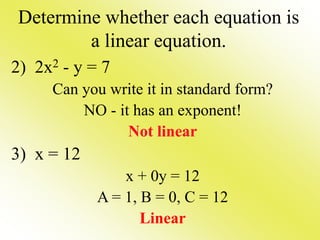
2) 2x2 - y = 7
Can you write it in standard form?
NO - it has an exponent!
Not linear
3) x = 12
x + 0y = 12
A = 1, B = 0, C = 12
Linear
Determine whether each equation is
a linear equation.
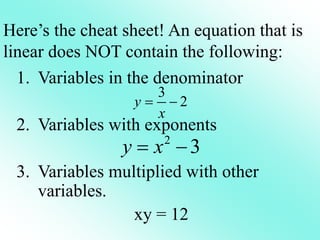
Here’s the cheat sheet! An equation that is
linear does NOT contain the following:
1. Variables in the denominator
2. Variables with exponents
3. Variables multiplied with other
variables.
xy = 12
3
2
y
x
 
2
3
y x
 
Is this equation linear?
1. Yes
2. No
4 3
x y
 
Standard Form
x – 4y = 3
Is this equation linear?
1. Yes
2. No
2
9 4y x
 
Exponents are
not allowed!
Is this equation linear?
y = -3
1. Yes
2. No
Standard Form
0x + y = -3

Graphinnng Linear Functions presentation

  • 1.
    Objectives The student willbe able to: 1. graph linear functions. 2. write equations in standard form. SOL: A.6 Designed by Skip Tyler, Varina High School
  • 2.
    Graphing Steps 1) Isolatethe variable (solve for y). 2) Make a t-table. If the domain is not given, pick your own values. 3) Plot the points on a graph. 4) Connect the points.
  • 3.
    1) Review: Solvefor y 2x + y = 4 1. Draw “the river” 2. Subtract 2x from both sides - 2x - 2x y = -2x + 4 2) Solve for y: 4x + 2y = -6 1. Subtract 4x 2. Simplify 3. Divide both sides by 2 4. Simplify - 4x - 4x 2y = -4x - 6 2 2 y = -2x - 3
  • 4.
    3) Solve fory: x - 3y = 6 1. Subtract x 2. Simplify 3. Divide both sides by -3 4. Simplify - x - x -3y = -x + 6 -3 -3 6 3 x y     2 3 x y   or
  • 5.
    4) Review: Makea t-table If f(x) = 2x + 4, complete a table using the domain {-2, -1, 0, 1, 2}. 2(-2) + 4 = 0 (-2, 0) 2(-1) + 4 = 2 (-1, 2) 2(0) + 4 = 4 (0, 4) 2(1) + 4 = 6 (1, 6) 2(2) + 4 = 8 (2, 8) x f(x) -2 -1 0 1 2 ordered pair
  • 6.
    5) Given thedomain {-2, -1, 0, 1, 2}, graph 3x + y = 6 -3(-2) + 6 = 12 (-2, 12) -3(-1) + 6 = 9 (-1, 9) -3(0) + 6 = 6 (0, 6) -3(1) + 6 = 3 (1, 3) -3(2) + 6 = 0 (2, 0) x -3x + 6 ordered pair 1. Solve for y: 3x + y = 6 Subtract 3x - 3x - 3x y = -3x + 6 2. Make a table -2 -1 0 1 2
  • 7.
    Bonus questions! What isthe x-intercept? (2, 0) What is the y-intercept? (0, 6) Does the line increase or decrease? Decrease 5) Given the domain {-2, -1, 0, 1, 2}, graph 3x + y = 6 3. Plot the points (-2,12), (-1,9), (0,6), (1,3), (2,0) 4. Connect the points.
  • 8.
    1. . 2. . 3.. 4. . Which is the graph of y = x – 4?
  • 9.
    Standard Form Ax +By = C A, B, and C have to be integers An equation is LINEAR (the graph is a straight line) if it can be written in standard form. This form is useful for graphing (later on…).
  • 10.
    Determine whether eachequation is a linear equation. 1) 4x = 7 + 2y Can you write this in the form Ax + By = C? 4x - 2y = 7 A = 4, B = -2, C = 7 This is linear!
  • 11.
    2) 2x2 -y = 7 Can you write it in standard form? NO - it has an exponent! Not linear 3) x = 12 x + 0y = 12 A = 1, B = 0, C = 12 Linear Determine whether each equation is a linear equation.
  • 12.
    Here’s the cheatsheet! An equation that is linear does NOT contain the following: 1. Variables in the denominator 2. Variables with exponents 3. Variables multiplied with other variables. xy = 12 3 2 y x   2 3 y x  
  • 13.
    Is this equationlinear? 1. Yes 2. No 4 3 x y   Standard Form x – 4y = 3
  • 14.
    Is this equationlinear? 1. Yes 2. No 2 9 4y x   Exponents are not allowed!
  • 15.
    Is this equationlinear? y = -3 1. Yes 2. No Standard Form 0x + y = -3