Application of Artificial Intelligence and
Machine Learning in the Field of
Materials Science
Exploring AI-driven advancements in material
discovery and development
Name: Hasan Galiv (韩篙夫)
Student I’d: 22430010519
Professor Name: Zhao Hongyang
Introduction to Materials
Science
 Title: What is Materials Science?
• Definition: Study of the properties and
applications of materials, including metals,
ceramics, polymers, and composites.
• Importance: Materials science plays a critical
role in engineering, electronics, and industrial
development.
• Limitations: Traditional materials discovery is
time-consuming and expensive.
Role of Artificial Intelligence in Materials
Science
 How AI is Transforming Materials
Science
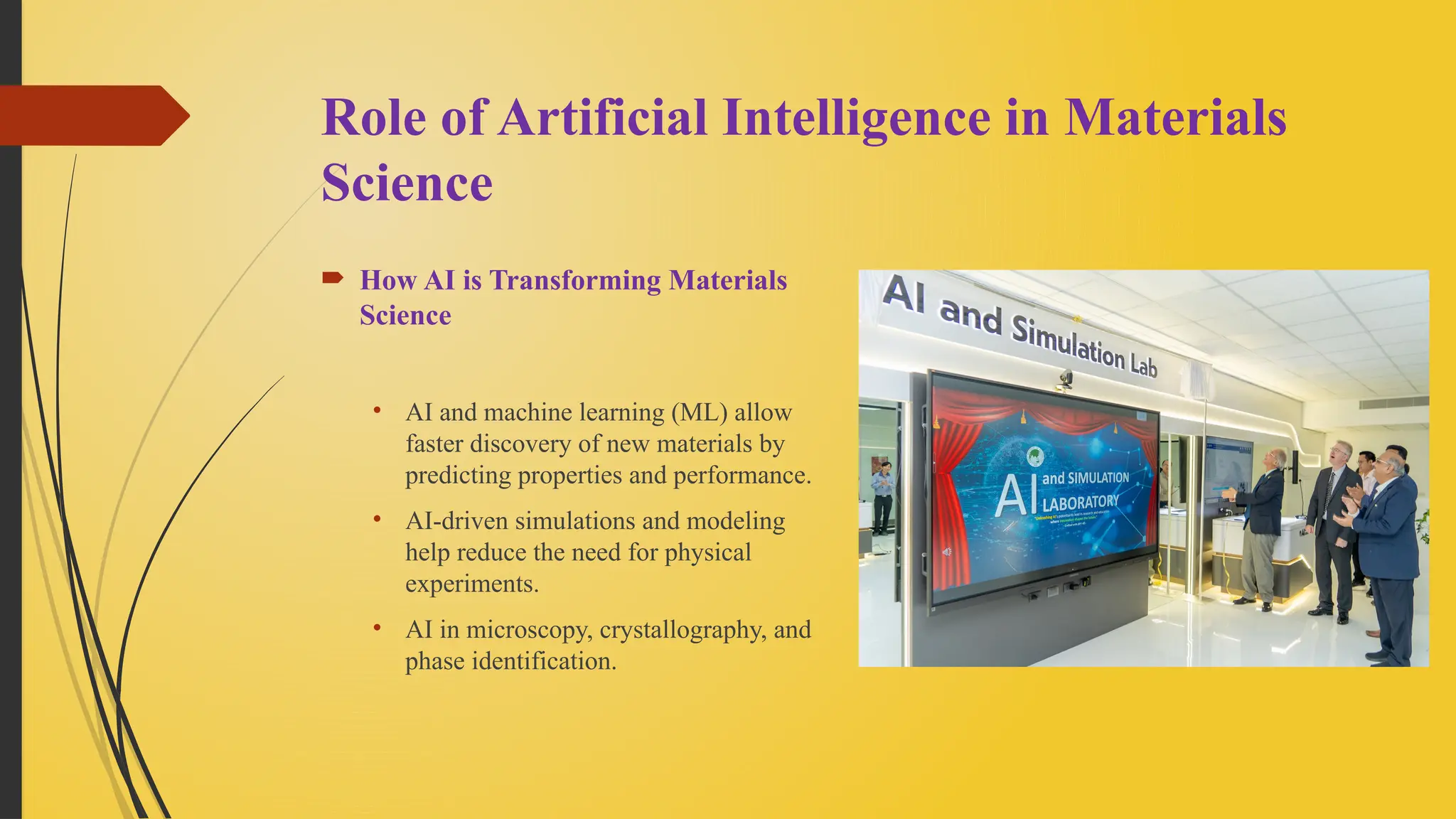
• AI and machine learning (ML) allow
faster discovery of new materials by
predicting properties and performance.
• AI-driven simulations and modeling
help reduce the need for physical
experiments.
• AI in microscopy, crystallography, and
phase identification.
Machine Learning Applications in Materials
Discovery
 Machine Learning for Predicting
Material Properties
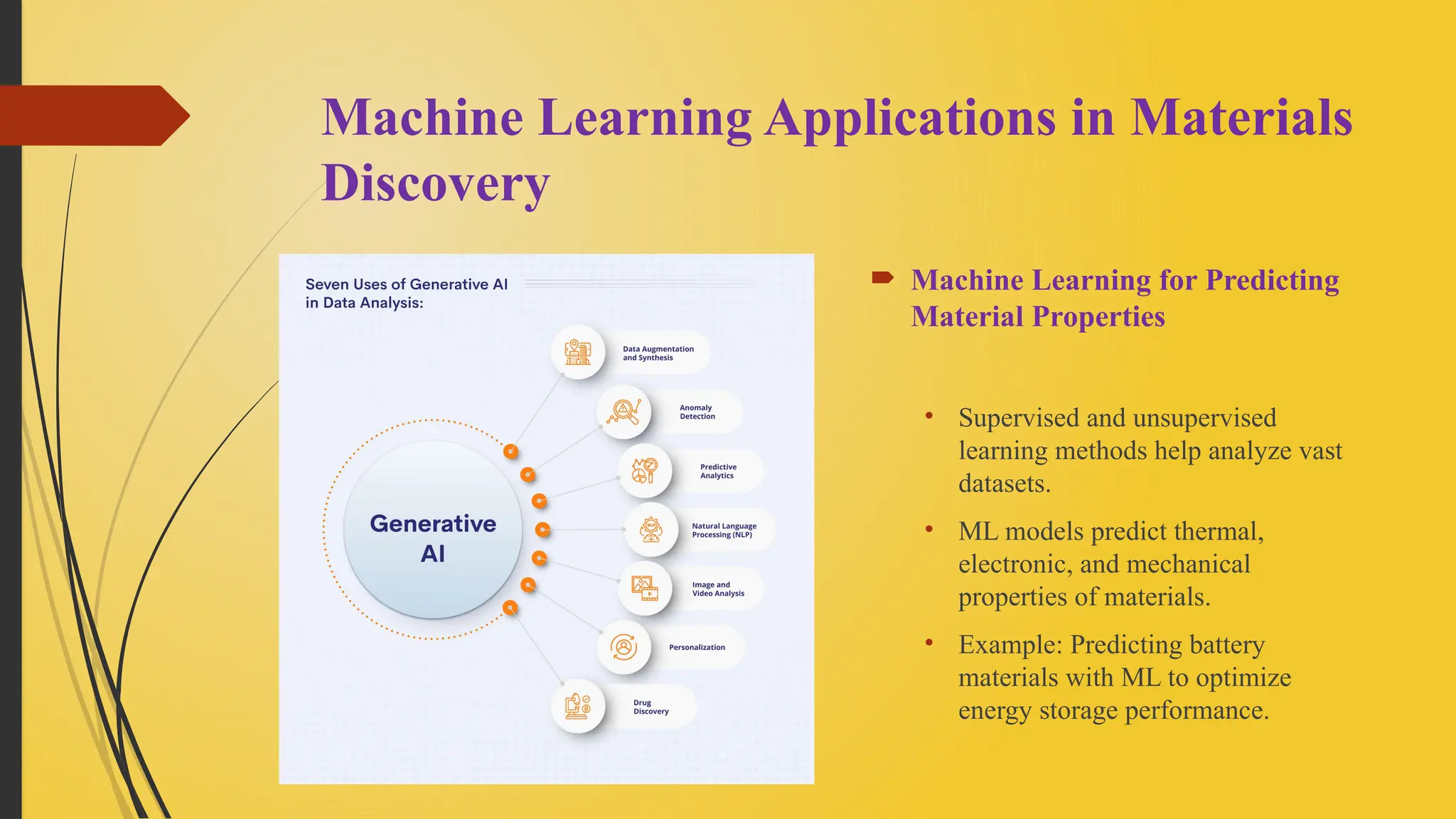
• Supervised and unsupervised
learning methods help analyze vast
datasets.
• ML models predict thermal,
electronic, and mechanical
properties of materials.
• Example: Predicting battery
materials with ML to optimize
energy storage performance.
AI in Material Design and Optimization
 Designing and Optimizing
Materials with AI
• AI helps optimize materials for
specific properties, such as strength,
conductivity, and flexibility.
• Use cases: Designing lighter,
stronger alloys for aerospace and
new polymers for medical devices.
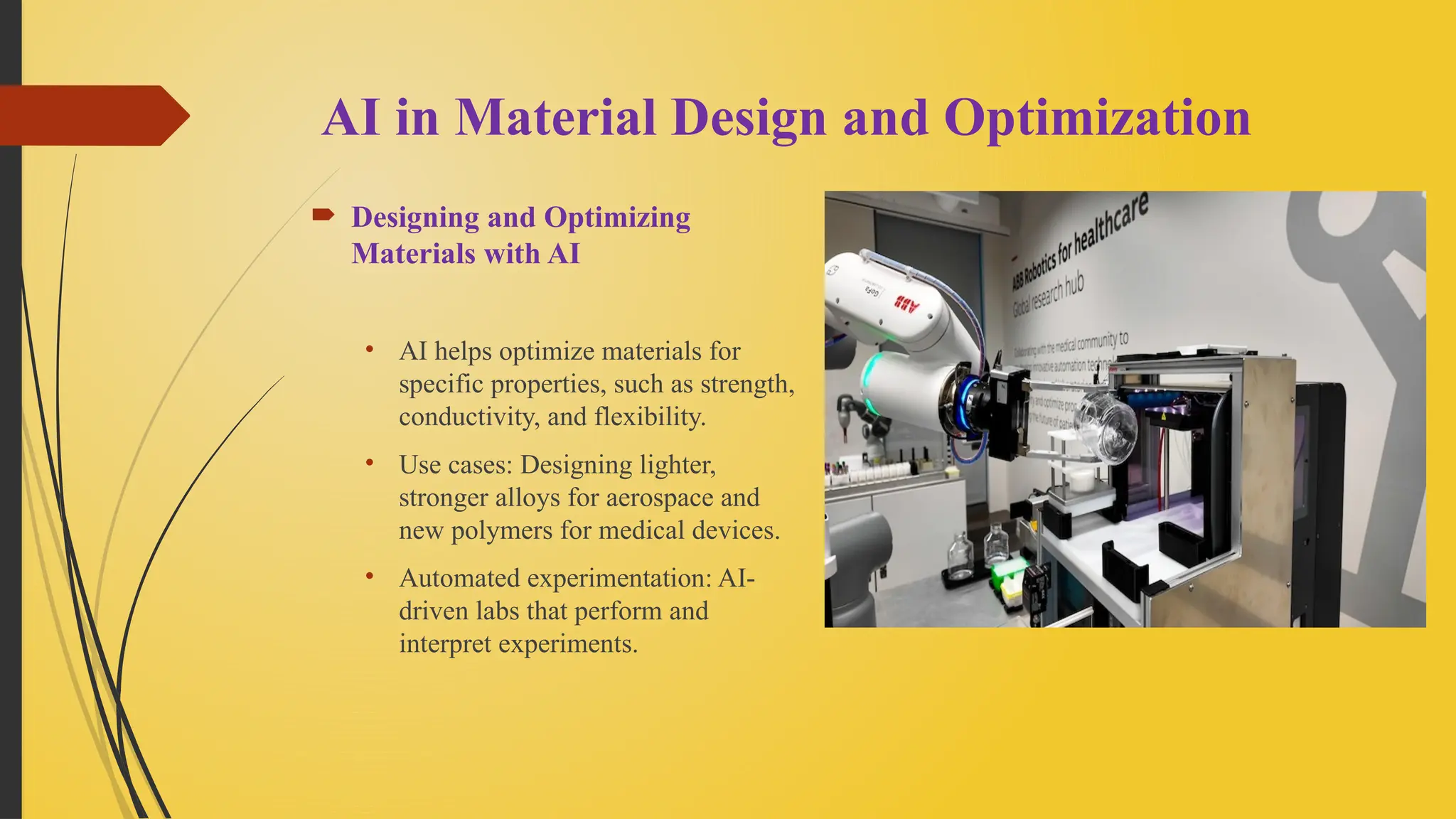
• Automated experimentation: AI-
driven labs that perform and
interpret experiments.
Ambition of AI and ML in Materials Science
 Revolutionizing Material Discovery:
• AI and ML significantly speed up the
discovery of new materials by predicting
properties and outcomes.
• Enables exploration of complex material
combinations, leading to advanced
materials with optimized properties.
 Sustainability and Efficiency:
• AI-driven materials design promotes the
development of more sustainable and
eco-friendly materials.
• Optimizes resource usage and minimizes
waste in production processes.
 Accelerating Research and
Innovation:
• Reduces the need for exhaustive trial-
and-error experiments.
• Enhances understanding of structure-
property relationships in materials,
aiding in faster innovation cycles.
Goal:
Leveraging AI and ML to transform
materials science into a data-driven,
highly efficient field with potential
breakthroughs in technology and
sustainability.
Planning for AI and ML Integration in
Materials Science
 Data Collection and Management:
• Building comprehensive databases of
material properties and experimental data.
• Integration of high-throughput
experimentation and AI to generate new
datasets for ML training.
 Development of AI Models:
• Designing predictive models based on
existing data to forecast material properties
and performance.
• Implementing ML algorithms for anomaly
detection and optimization in material
synthesis.
 Industry Collaboration and Cross-
Disciplinary Research:
• Collaboration between materials scientists,
computer scientists, and industry experts
for effective AI/ML implementation.
• Fostering interdisciplinary research to
bridge the gap between theoretical models
and practical applications.
 Real-World Application and Scaling:
• Developing AI models that can be used in
industrial-scale material production.
• Applying AI to enhance material testing,
ensuring reliability and consistency.
Future Trends and Conclusion
 The Future of AI in Materials
Science
• AI will play an even larger role in
accelerating materials innovation.
• Cross-disciplinary collaboration will
become critical.
• Challenges: Data quality,
computational limits, and
integration into traditional practices.
谢谢你们

Graduation science and technology english writing Presentation.pptx

  • 1.
    Application of ArtificialIntelligence and Machine Learning in the Field of Materials Science Exploring AI-driven advancements in material discovery and development Name: Hasan Galiv (韩篙夫) Student I’d: 22430010519 Professor Name: Zhao Hongyang
  • 2.
    Introduction to Materials Science Title: What is Materials Science? • Definition: Study of the properties and applications of materials, including metals, ceramics, polymers, and composites. • Importance: Materials science plays a critical role in engineering, electronics, and industrial development. • Limitations: Traditional materials discovery is time-consuming and expensive.
  • 3.
    Role of ArtificialIntelligence in Materials Science  How AI is Transforming Materials Science • AI and machine learning (ML) allow faster discovery of new materials by predicting properties and performance. • AI-driven simulations and modeling help reduce the need for physical experiments. • AI in microscopy, crystallography, and phase identification.
  • 4.
    Machine Learning Applicationsin Materials Discovery  Machine Learning for Predicting Material Properties • Supervised and unsupervised learning methods help analyze vast datasets. • ML models predict thermal, electronic, and mechanical properties of materials. • Example: Predicting battery materials with ML to optimize energy storage performance.
  • 5.
    AI in MaterialDesign and Optimization  Designing and Optimizing Materials with AI • AI helps optimize materials for specific properties, such as strength, conductivity, and flexibility. • Use cases: Designing lighter, stronger alloys for aerospace and new polymers for medical devices. • Automated experimentation: AI- driven labs that perform and interpret experiments.
  • 6.
    Ambition of AIand ML in Materials Science  Revolutionizing Material Discovery: • AI and ML significantly speed up the discovery of new materials by predicting properties and outcomes. • Enables exploration of complex material combinations, leading to advanced materials with optimized properties.  Sustainability and Efficiency: • AI-driven materials design promotes the development of more sustainable and eco-friendly materials. • Optimizes resource usage and minimizes waste in production processes.  Accelerating Research and Innovation: • Reduces the need for exhaustive trial- and-error experiments. • Enhances understanding of structure- property relationships in materials, aiding in faster innovation cycles. Goal: Leveraging AI and ML to transform materials science into a data-driven, highly efficient field with potential breakthroughs in technology and sustainability.
  • 7.
    Planning for AIand ML Integration in Materials Science  Data Collection and Management: • Building comprehensive databases of material properties and experimental data. • Integration of high-throughput experimentation and AI to generate new datasets for ML training.  Development of AI Models: • Designing predictive models based on existing data to forecast material properties and performance. • Implementing ML algorithms for anomaly detection and optimization in material synthesis.  Industry Collaboration and Cross- Disciplinary Research: • Collaboration between materials scientists, computer scientists, and industry experts for effective AI/ML implementation. • Fostering interdisciplinary research to bridge the gap between theoretical models and practical applications.  Real-World Application and Scaling: • Developing AI models that can be used in industrial-scale material production. • Applying AI to enhance material testing, ensuring reliability and consistency.
  • 8.
    Future Trends andConclusion  The Future of AI in Materials Science • AI will play an even larger role in accelerating materials innovation. • Cross-disciplinary collaboration will become critical. • Challenges: Data quality, computational limits, and integration into traditional practices.
  • 9.