Grade 12 Agricultural Sciences Notes
Agricultural Sciences (High School - South Africa)
Scan to open on Studocu
Studocu is not sponsored or endorsed by any college or university
Grade 12 Agricultural Sciences Notes
Agricultural Sciences (High School - South Africa)
Scan to open on Studocu
Studocu is not sponsored or endorsed by any college or university
Downloaded by Surprise Ramahlo (surpriseramahlo1930@gmail.com)
lOMoARcPSD|29919704
GRADE 12 NOTES
AGRICULTURAL SCIENCES
Downloaded by Surprise Ramahlo (surpriseramahlo1930@gmail.com)
lOMoARcPSD|29919704
Reproductive organs of the bull
The reproductive organs of the bull can be divided into the:
 primary reproductive organs (mainly involved in reproduction) and
 the secondary reproductive organs (accessory or additional organs that assist with
the production and delivery of semen).
Structure of primary male reproductive organs
Each primary male reproductive organ has a unique structure.
Structure of primary male reproductive organs
Organ Structure
Scrotum Composed of skin on the outside and connective tissue and muscle on the
inside. It holds the two testes in place outside the body. The scrotum hangs
down between the hind legs of the bull.
Testes A bull has two testes which are contained in a bag of skin or scrotum. When the
bull calf is born the testes are held inside the body cavity, but soon after birth
the testes descend through the inguinal canal into the scrotum. The testes then
hang inside the scrotum between the hind legs of the animal, suspended by a
spermatic cord which consists of connective tissue and blood vessels.
The testes are composed mostly of long, winding seminiferous tubules
which are about 1 km in length. The seminiferous tubules are surrounded
by interstitial or supporting tissue.
Epididymis An organ which lies next to the testes. It contains a long, convoluted tube called
the ductus epididymis. The head of the epididymis lies against the upper part
of the testes, the body lies over the surface of the testes and the tail on the
lower edge of the testes.
Vas deferens The tail of the epididymis passes into a tube called the vas deferens. The last
10 cm of the vas deferens is thicker than the start of the tube and it is known as
the ampulla. The vas deferens connects the epididymis to the urethra.
Penis The male organ which lies outside the body and allows mating (copulation) to
take place. Consists mainly of spongy tissue which becomes firm or erect when
the blood vessels become filled.
The root of the penis is attached internally to the pelvis. The body of the non-
erect penis lies in an S-shaped curve which is referred to as a sigmoid flexure.
The tip is known as the glans penis. The penis at rest lies within a sheath of
skin called the prepuce. The penis is extruded through the preputial opening in
the sheath when bulls mate or urinate.
Urethra A muscular tube extending from the bladder. It passes through the inside of
the penis and opens at the glans penis. The vas deferens and the ducts of the
accessory sex glands also open into the urethra.
1
Downloaded by Surprise Ramahlo (surpriseramahlo1930@gmail.com)
lOMoARcPSD|29919704
Process of sperm formation
The male cell of reproduction is the spermatozoan or sperm cell. It is a microscopically
small body that appears to have a head, neck and tail. The process of spermatozoa
formation is called spermatogenesis. There are four stages in the process:
 Division of the spermatogonia (mitosis)
- Spermatogonia are cells in the wall of the seminiferous tubules of the testes.
*These cells divide by mitotic division and produce primary spermatocytes.
 Division of the primary spermatocytes (first meiosis)
- A primary spermatocyte undergoes meiosis to produce two secondary haploid
spermatocytes.
 Division of the secondary spermatocytes (second meiosis)
- Each secondary spermatocyte produces two spermatids.
 Development of sperm cells
- The spermatids now develop into sperm cells (spermatozoa)
*consists of a head, neck and tail
*DNA is contained in the head of the spermatozoa.
Factors causing infertility and sterility in bulls
In some cases infertility may be permanent, in which case the bull is called sterile.
 Lack of libido as a cause of infertility: Healthy adult bulls may show lack of libido or
sexual urge due to the following reasons.
- Immaturity:
*Young bulls that have not reached full puberty may have low or no
libido. Onset of puberty varies with breed but is usually at 12–15 months
of age.
- Inexperience:
*Young and inexperienced bulls may have poor erections. They will
require some time to practice mating.
- Overwork:
*Bulls that have to walk far to search for females over a wide area can often
be exhausted from walking and lack of food or water. They will recover if
rested and cared for properly.
- Disease:
*Various diseases which cause pain or loss of condition will reduce the bull’s
libido.
- Temperament:
*Poor handling and change of environment may stress the bull and reduce
his libido.
- Breed differences:
*European breeds mount animals frequently while Zebu animals will
only mount females in oestrus.
2
Downloaded by Surprise Ramahlo (surpriseramahlo1930@gmail.com)
lOMoARcPSD|29919704
- Old age:
*When bulls become too old they may show a lack of libido as a result of
reduced testosterone secretion.
- Incorrect feeding
*Bulls may have poor libido due to nutritional problems. Underfeeding will
cause a lack of energy while overfeeding will cause the bull to become fat and
lazy. Specific deficiencies like vitamin A or protein deficiencies may cause
poor libido.
Inability to mate as a cause of infertility: Bulls may produce semen of good quality
but be unable to mount the cow or mate successfully. Reasons include:
- Conformation:
*Poorly developed hind legs or back muscles will affect the ability of the bull
to mount the cow.
- Conditions of limbs:
*Foot or joint diseases can cause problems with mating because they
prevent the bull from mounting.
- Injuries:
*An injury to the bull’s penis may prevent the bull from mating. This can be
caused by thorns or barbed wire.
- Congenital abnormalities:
*A small number of bulls may be born with abnormalities of the genitalia
which prevent them mating successfully.
Inability to fertilise as a cause of sterility: This happens when a bull shows good
libido and is able to mate normally but fails to fertilise cows. Reasons include:
- Climate:
*Bulls that are not adapted to a hot climate may have a low sperm count.
- Diseases:
*Various diseases (e.g. vibrio or campylobacteriosis and
trichomoniasis) transmitted during mating may cause the failure of
conception.
*Diseases that cause a high fever (e.g. heartwater and redwater) may
temporarily affect the sperm production of the bull. Lumpy skin disease (a
viral infection) can cause permanent damage to the scrotum and testes. Some
infections can cause orchitis (inflammation of the tissues of the testes).
- Malnutrition and exhaustion:
*These factors will cause a temporary reduction in sperm count which can
be reversed if the bull is rested and fed correctly.
- Congenital defects:
*Inborn defects of the testes can make the bull sterile. e.g. producing abnormal
sperm, scrotal hernia (testes become damaged) and cryptorchidism (testes fail
to descend).
3
Downloaded by Surprise Ramahlo (surpriseramahlo1930@gmail.com)
lOMoARcPSD|29919704
The female reproductive system
Reproductive organs of the cow
The reproductive organs of the cow are involved in the processes of ovulation, mating,
fertilisation, pregnancy and calving. They are mostly located inside the abdominal
cavity. They can be divided into two categories:
 the primary reproductive organs and
 the secondary reproductive organs.
Primary reproductive organ of the cow
The ovary is the primary reproductive organ of the cow.
There are two ovaries, one on either side of the abdomen.
 They are attached by the fallopian tubes to the point of the horn of the uterus.
 They contain the ova or eggs of the cow.
When the heifer is born her ovary contains 30–400 000 unripe haploid
ova or primary oocytes. When the cow reaches puberty a few ova will ripen every 21 days.
4
Downloaded by Surprise Ramahlo (surpriseramahlo1930@gmail.com)
lOMoARcPSD|29919704
Structure of female secondary reproductive organs
Structure of secondary female reproductive organs
Organ Structure
Fallopian
tubes
These tubes are also called the oviducts and they are two winding tubes which pass from
the horns of the uterus to the ovaries. Each tube forms a funnel shaped body at the ovary
called the infundibulum.
Uterus A muscular tube which can be divided into various parts: the thick neck or cervix, the body
and the horns. The uterus is lined on the inside with a layer called the endometrium.
Vagina A muscular tube. It is adjacent to the cervix of the uterus on one end and it opens to
the outside through the vulva or lips of the vagina on the other end. The hymen is the
membrane at the entrance of the vagina.
Udder Also known as the mammary gland, it is situated outside the body cavity of the cow.
Functions of the female reproductive organs
Function of female reproductive organs
Organ Structure
Ovaries Produce the female sex cells called the ova or eggs which are then released into the funnel
of the fallopian tubes during the process of ovulation. The ova develop inside a fluid-filled
follicle (Graafian follicle). Oocytes develop every 21 days in response to the hormone FSH.
Fallopian
tubes
They pick up the ovum which is released from the ovary during ovulation. Fine hairs or cilia
help to move the ovum down the tube to the waiting sperm.
Uterus Is usually tightly closed but during oestrus the wall relaxes and the cervix opens. The lining
or endometrium contains glands which nourish the embryo before it implants. When the
embryo implants, the blood supply of the endometrium nourishes it by being in close
contact through the cotyledons that form on the foetal membrane. This forms the placenta
in cattle.
Vagina Has a number of functions. It receives the penis of the bull during mating and the semen
released during mating. The semen travels up the vagina and through the cervix and the
uterus. It then enters the fallopian tubes to effect fertilisation. The vagina is also the birth
canal through which the foetus passes into the outside world.
Udder Produces milk to feed the newborn animal.
Process of ovigenesis/oogenesis and ovulation
The process of development of the egg (female sex cells or ova) in a cow is called
ovigenesis or oogenesis.
 At birth, a heifer’s ovary contains thousands of primary oocytes or follicles.
 When she reaches puberty, under the influence of a number of hormones, a few
primary follicles begin to develop. They contain a primary oocyte or egg cell which is
surrounded by a layer of cells.
-
-
These cells multiply and form a fluid-filled cavity in which the oocyte is
suspended (Graafian follicle).
When the oocyte becomes a mature ovum, the follicle ruptures and the ripe
ovum is released into the fallopian tube which is called ovulation.
5
Downloaded by Surprise Ramahlo (surpriseramahlo1930@gmail.com)
lOMoARcPSD|29919704
Oestrus and the oestrus cycle
Oestrus is the term used to describe the readiness of the cow for mating. It occurs at the
stage in the 21-day oestrus cycle at which the cow ovulates (in heat) and is therefore
ready to be fertilised by the bull.
Oestrus cycle
The oestrus cycle is a 21-day period during which a follicle (or follicles) develops into
a mature ovum which is then released during the process of ovulation. The cycle is
controlled by various hormones. A number of different processes take place during the
oestrus cycle, which is divided into four phases.
Phase 1: Oestrus
- Days 0–1:
*The cow is in oestrus (on heat) for about 18 hours. The mature follicle
usually ruptures 12 hours later.
Phase 2: Metoestrus
- Days 1–2:
*The cells of the ruptured follicle develop into a corpus luteum (CL).
- Days 2–5:
*The CL grows rapidly and developing follicles regress.
Phase 3: Dioestrus
- Days 5–16:
*The CL develops to its maximum size and function and produces the
hormone progesterone. This hormone suppresses the formation of other
follicles.
Phase 4: Proestrus
-Days 16–18:
*If fertilisation has not yet taken place, the uterus secretes the
substance prostaglandin which signals the CL to regress rapidly.
-Days 18–20:
*Primary follicles begin to grow again and release oestrogen.
-Day 21:
*The oestrogen level rises and causes the onset of heat. The progesterone
level decreases, the mature follicle ruptures and ovulation occurs.
However, if fertilisation occurs then the CL continues to produce progesterone:
no follicles mature
no ovulation takes place
the cow will not return to heat again.
The progesterone produced then prepares the uterus for the implantation of the foetus.
6
Downloaded by Surprise Ramahlo (surpriseramahlo1930@gmail.com)
lOMoARcPSD|29919704
External signs of oestrus
Cows show certain external signs and changes in behaviour under the influence of the
hormone oestrogen, which show that she is ready for mating.
 Behavioural changes
- The cow becomes excitable and begins to sniff, ride or mount other cows. A cow
that has been ridden will show soiling with dung or mud around the hip bones.
Cows in oestrus often stop eating
and their milk production drops.
They show an interest in the bull
and will stand to be mounted when
ready to be mated. This is called
standing heat.
 Anatomical changes
- The vulva becomes moist, red and
slightly swollen.
- The cow may also secrete a
bullstring – a clear mucous
secretion that dangles from the
vagina.
Female sex hormones and their function
Sex hormones secreted by endocrine glands control the oestrus cycle of the female.
 Follicle-stimulating hormone (FSH)
- The pituitary gland found at the base of the brain secretes FSH which stimulates
the follicles to develop. These follicles secrete oestrogen as they develop.
- When oestrogen reaches a certain level, FSH secretion is inhibited and the
pituitary gland secretes luteinising hormone (LH).
 Luteinising hormone (LH)
- This hormone is secreted by the pituitary gland in response to the maturation of
the Graafian follicle. This causes the follicle to rupture and develop a CL.
 Oestrogen
- Oestrogen is produced mainly by the developing egg or Graafian follicle.
*The hormone is responsible for the development of the secondary
sexual organs at puberty and the oestrus cycle after puberty.
*The hormone causes the external signs of oestrus and the
behavioural changes in the cow which cause her to seek out and
accept the bull.
 Progesterone
-
-
Progesterone is produced by the developing CL and prepares the uterus lining for
the fertilised ovum (embryo).
If fertilisation occurs, the CL will remain on the ovary and continue to produce
progesterone throughout the development of the foetus (pregnancy).
7
Downloaded by Surprise Ramahlo (surpriseramahlo1930@gmail.com)
lOMoARcPSD|29919704
Synchronisation of oestrus
Synchronisation of oestrus is when all the cows are on heat (oestrus) at the same time.
Techniques of synchronisation of oestrus (heat)
There are various techniques, involving the administration of different hormones or
substances which affect the oestrus cycle, to synchronise oestrus.
 Prostaglandin injections
- Injection of this hormone in a herd of cows causes a regression of the CL.
Stimulates the cow’s own FSH which begins the maturation of the follicles on
the ovary. Ensures that all of the cows in the herd will come into heat at more or
less the same time.
 Gonadotropin releasing hormone (GnRH) injections
- Causes new follicles to develop. Results in the appearance of oestrus in the
group. Can be injected into cows at various stages of the oestrus cycle.
 Progestin or progestogen administration
- Synthetic forms of progesterone are used as vaginal implants or they are given
in feed. The release of progesterone into the cow’s system at a constant rate
prolongs the luteal phase. When the implant is removed or the feeding is
stopped, the CL regresses and oestrus begins 36–60 hours later.
Advantages and disadvantages of synchronisation of oestrus
Table 1 The advantages and disadvantages of synchronisation of oestrus
Advantages of synchronisation of oestrus Disadvantages of synchronisation of oestrus
● It easier to manage beef cows as they can be
mated or inseminated in a short period of time.
● It allows the farmer to make maximal use of a
good bull or good semen.
● It makes the management of calving easier
because the cows all calve at more or less at the
same time. This allows for proper supervision
of the birth process and prevention of problems
that can arise, either in the mother or with the
young animals.
● Some of the drugs required to synchronise
oestrus are very expensive.
● The results of some methods are
variable, which means the outcome of the
synchronisation of oestrus process is not
always consistent.
● Prostaglandins cause abortions in pregnant
animals.
● Progesterone administration is a lengthy
process.
Factors causing infertility and sterility in cows
 Congenital or inborn factors include:
- underdevelopment of the reproductive organs, defects of the reproductive
organs, freemartinism, prolapse or dropping out of the vagina, and persistence
of the hymen which prevents sperm from entering the reproductive tract.
 Injuries to the reproductive tract during mating, birth or the passing of the placenta
can cause adhesions or blockages in the reproductive tract.
- This may prevent fertilisation.
8
Downloaded by Surprise Ramahlo (surpriseramahlo1930@gmail.com)
lOMoARcPSD|29919704
 Ovarian problems may cause a number of reproductive difficulties.
- These problems include failure to come on heat (anoestrus) and failure to
ovulate. Some of the causes of ovarian problems are disease, poor nutrition and
very hot temperatures.
 Diseases can cause infertility in cows.
- These include specific diseases of the reproductive tract like brucellosis,
trichomoniasis and vibriosis (campylobacteriosis), general diseases which affect
the overall health of the animal and non-specific infections such as those that
result from tissue damage during difficult calving.
 Malnutrition can affect the fertility of the cow. For example:
- underfeeding will cause a delay in puberty, while overweight cows will also
show fertility problems.
 Management must be handled correctly. For example:
- cows that are mated at the wrong time, subjected to unhygienic conditions and
poorly adapted to their environment may develop fertility problems.
Factors causing infertility in cows
Cows are infertile when they are neither normally fertile nor completely sterile. So,
infertility is thus not necessarily permanent, and can be caused by factors such as
injuries to the reproductive tract, ovarian problems, diseases, malnutrition and poor
livestock management.
Factors causing sterility in cows
Cows are deemed sterile when they have the physiological inability to effect sexual
reproduction. In other words, sterility is a total loss of fertility. Sterility is thus caused
when the factors that result in infertility persist. These can be:
 diseases of the genital organs (e.g. retained placenta)
 infections (e.g. trichomoniasis)
 physiological (e.g. repeat breeding) anatomical (e.g. freemartinism).
9
Downloaded by Surprise Ramahlo (surpriseramahlo1930@gmail.com)
lOMoARcPSD|29919704
Natural mating and other forms of reproduction
Mating or copulation and ejaculation
Mating or copulation is when the male inseminates the female by penetrating the
female genital tract and ejaculating sperm from the epididymis of the testis.
Natural mating
The normal method and most important form of insemination in farm animals is
natural mating. This is when the bull identifies a cow on heat and mates with her.
 The bull is stimulated to mate by the presence of the oestrus cow.
 The drive to mate is regulated by his libido, which is under hormonal control.
The five main stages of mating or copulation
 Sexual display/courtship behaviour/pattern
- The bull is attracted to a cow on heat by her behaviour and shows an interest in
her. He may sniff her hindquarters and curl his lip in a flehmen reaction. He may
also rest his head on her rump.
 Erection
- The penis of the bull becomes erect when he identifies a cow on heat.
The erection occurs due to the dilation of blood vessels in the spongy tissue.
Then the accessory glands begin to discharge their secretions into the urethra to
lubricate and protect the sperm during ejaculation.
 Mounting
- The cow will stand still if she is ready to be mated and allow the bull to jump,
raise his forequarters and straddle her back. He is able to place the penis near to
the vulva in this position.
 Penetration
- The bull drives his erect penis into the vagina of the cow when he is in the
correct position.
 Ejaculation
- The sperm is now discharged from the epididymis. It travels down the vas
deferens, enters the urethra and is discharged through the tip of the penis into
the vagina. The bull dismounts from the cow once he has ejaculated.
Artificial insemination (AI)
Artificial insemination (AI) in cattle was originally developed to prevent the infection of
cows with venereal diseases such as vibriosis.
 Later scientists realised that this method was a very quick way to improve the quality
of herds by using semen from bulls that had superior genetic characteristics
- One good bull can be used to inseminate many more cows than it is able to serve
*Today AI is used for genetic improvement in dairy and beef herds.
10
Downloaded by Surprise Ramahlo (surpriseramahlo1930@gmail.com)
lOMoARcPSD|29919704
In AI semen is collected from the male animal under controlled conditions and then it is
artificially inserted (inseminating) into the reproductive tract of the female.
Basic requirements for successul AI
Proper collection and storage of
semen:
- Semen is collected by
leading a bull to a ‘cow’ (a
dummy) or another bull (the
teaser bull).
*When the bull mounts
the ‘cow’ or dummy, an
artificial vagina (AV) is
placed over the bull’s
penis to collect the
ejaculate.
*Some operators use
electrical stimulation or
an electro-ejaculator to
cause ejaculation.
Good quality semen:
- Good quality semen contains a large number of spermatozoa that move
around rapidly and a low percentage of abnormalities such as loose tails or
double heads.
Good technique (insemination):
- The plastic straw is taken out of the liquid nitrogen and the thawed semen is
inserted into a special pipette.
- The operator then places an arm in the cow’s rectum, grasps the cervix and
pushes it downwards gently. The operator uses the other hand to insert the
pipette through the vulva and then through the cervix
*Half of the semen is deposited (as above) and the rest is deposited into the
uterine horn.
*The pipette is then withdrawn and the cervix is then massaged
→ This causes the secretion of oxytocin, which causes the uterus to
contract. This action forces the sperm forward in the reproductive tract.
Accurate timing (detecting oestrus in cow): Beef cows need to be inseminated as
soon as they show signs of heat, whereas dairy cows should be inseminated 12
hours after the detection of heat.
11
Downloaded by Surprise Ramahlo (surpriseramahlo1930@gmail.com)
lOMoARcPSD|29919704
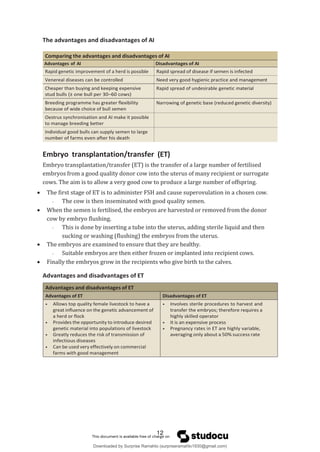
The advantages and disadvantages of AI
Comparing the advantages and disadvantages of AI
Advantages of AI Disadvantages of AI
Rapid genetic improvement of a herd is possible Rapid spread of disease if semen is infected
Venereal diseases can be controlled Need very good hygienic practice and management
Cheaper than buying and keeping expensive
stud bulls (± one bull per 30–60 cows)
Rapid spread of undesirable genetic material
Breeding programme has greater flexibility
because of wide choice of bull semen
Narrowing of genetic base (reduced genetic diversity)
Oestrus synchronisation and AI make it possible
to manage breeding better
Individual good bulls can supply semen to large
number of farms even after his death
Embryo transplantation/transfer (ET)
Embryo transplantation/transfer (ET) is the transfer of a large number of fertilised
embryos from a good quality donor cow into the uterus of many recipient or surrogate
cows. The aim is to allow a very good cow to produce a large number of offspring.
 The first stage of ET is to administer FSH and cause superovulation in a chosen cow.
- The cow is then inseminated with good quality semen.
 When the semen is fertilised, the embryos are harvested or removed from the donor
cow by embryo flushing.
- This is done by inserting a tube into the uterus, adding sterile liquid and then
sucking or washing (flushing) the embryos from the uterus.
 The embryos are examined to ensure that they are healthy.
- Suitable embryos are then either frozen or implanted into recipient cows.
 Finally the embryos grow in the recipients who give birth to the calves.
Advantages and disadvantages of ET
Advantages of ET Disadvantages of ET
● Allows top quality female livestock to have a
great influence on the genetic advancement of
a herd or flock
● Provides the opportunity to introduce desired
genetic material into populations of livestock
● Greatly reduces the risk of transmission of
infectious diseases
● Can be used very effectively on commercial
farms with good management
● Involves sterile procedures to harvest and
transfer the embryos; therefore requires a
highly skilled operator
● It is an expensive process
● Pregnancy rates in ET are highly variable,
averaging only about a 50% success rate
12
Downloaded by Surprise Ramahlo (surpriseramahlo1930@gmail.com)
lOMoARcPSD|29919704
Cloning by nuclear transfer
Cloning in biotechnology refers to processes used to create copies of DNA fragments
(molecular cloning), cells (cell cloning) or organisms. Cloning by nuclear transfer
involves producing an exact copy of an existing animal. It is done by injecting the
nucleus of a somatic cell from the animal to be cloned into an unfertilised ovum or
egg cell. The ovum’s own DNA is removed. This results in a new cell that will divide
normally, forming an embryo that is identical to the donor animal. The embryo is placed
in the uterus of a surrogate mother where it grows to term.
 Types and aims of cloning:
- Reproductive cloning
*Farm animals are cloned to reproduce individuals with valuable genetic
material (e.g. farmers may want to reproduce animals that have a
particular advantage such as disease resistance or exceptional production
characteristics).
- Therapeutic cloning
*The main aim is to use embryonic stem cells, which have the unique ability
to generate virtually all types of cells in an organism, to grow tissues in
the laboratory that can be used to grow healthy tissue to replace injured or
diseased tissues.
*It may also be possible to learn more about the molecular causes of disease
by studying embryonic stem cell lines from cloned embryos derived from the
cells of animals or humans with different diseases.
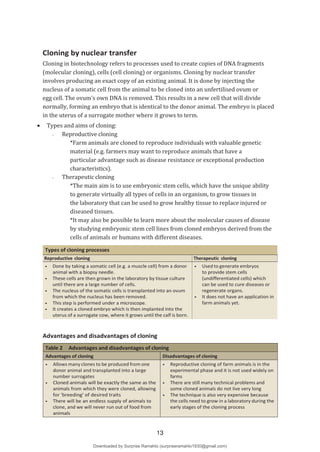
Types of cloning processes
Reproductive cloning Therapeutic cloning
● Done by taking a somatic cell (e.g. a muscle cell) from a donor
animal with a biopsy needle.
● These cells are then grown in the laboratory by tissue culture
until there are a large number of cells.
● The nucleus of the somatic cells is transplanted into an ovum
from which the nucleus has been removed.
● This step is performed under a microscope.
● It creates a cloned embryo which is then implanted into the
uterus of a surrogate cow, where it grows until the calf is born.
● Used to generate embryos
to provide stem cells
(undifferentiated cells) which
can be used to cure diseases or
regenerate organs.
● It does not have an application in
farm animals yet.
Advantages and disadvantages of cloning
Table 2 Advantages and disadvantages of cloning
Advantages of cloning Disadvantages of cloning
● Allows many clones to be produced from one
donor animal and transplanted into a large
number surrogates
● Cloned animals will be exactly the same as the
animals from which they were cloned, allowing
for 'breeding' of desired traits
● There will be an endless supply of animals to
clone, and we will never run out of food from
animals
● Reproductive cloning of farm animals is in the
experimental phase and it is not used widely on
farms
● There are still many technical problems and
some cloned animals do not live very long
● The technique is also very expensive because
the cells need to grow in a laboratory during the
early stages of the cloning process
13
Downloaded by Surprise Ramahlo (surpriseramahlo1930@gmail.com)
lOMoARcPSD|29919704
Fertilisation and pregnancy
Reproduction terminology
 Fertilisation:
- In animals, this involves the fusion of an ovum with a sperm, which eventually
leads to the development of an embryo. It starts with copulation.
*After a male ejaculates, a large number of sperm cells move to the upper
vagina (via contractions from the vagina) through the cervix and across the
length of the uterus to meet the ovum.
*In cases where fertilisation occurs, the female usually ovulates during a
period that extends from hours before copulation to a few days after.
 Pregnancy:
- In animals, this is the period of reproduction during which a female carries one
or more live offspring in the uterus through gestation.
*It begins when a fertilised zygote implants in the female’s uterus and
ends once it leaves the uterus.
 Placenta:
- This is a flattened circular organ in the uterus of pregnant mammals.
*It consists of vascular tissue in which oxygen and nutrients can pass from
the mother’s blood into that of the foetus, and waste products can pass in the
reverse direction.
*The placenta is expelled from the uterus at the birth of the foetus.
 Freemartin:
- An imperfect sterile female calf that is the twin of a male calf whose hormones
affected its development.
*Freemartinism occurs occasionally in twins which are male and female.
*It results from the fusion of placentas of the two foetuses.
*This causes the female foetus to be exposed to testosterone, resulting in
a masculinised and infertile animal.
Fertilisation process
After mating or AI, millions of spermatozoa use the lashing movements of their tails to
swim very rapidly up the reproductive tract to the fallopian tube.
 They are assisted by the contractions of the uterus.
 They wait for the ovum to arrive when they reach the fallopian tube.
- Once the ovum is released from the ovary, it is picked up by the fallopian tube
and moved down the fallopian tube where the spermatozoa are waiting.
- At this stage many of the spermatozoa that reached the fallopian tube will have
died off.
14
Downloaded by Surprise Ramahlo (surpriseramahlo1930@gmail.com)
lOMoARcPSD|29919704
*These sperm release an enzyme called hyaluronidase which breaks down
the outer layer of the ovum in a process called capacitation.
→It allows a single sperm to finally enter the ovum and join its DNA with that
of the ovum which is called fertilisation.
→ The fertilised cell is called a zygote. It starts to divide and it is has different
names at various stages of division (morula, blastocyst and finally embryo).
Multiple births, twinning and freemartins
 Formation of multiple births (twins)
If more than one ovum is shed during ovulation, then more than one zygote
can be formed. For example, pigs normally have 6–14 piglets and sheep can
give birth to twins or triplets. Multiple births are less common in cows but
does occur. The formation of the twins is dizygotic if two ova are fertilised and
monozygotic when the embryo splits into two during development.
 Formation of freemartins
Dizygotic twins of different sexes occasionally develop an interconnected blood
supply. If this happens, the heifer receives testosterone which causes the
underdevelopment of the female sex organs and the formation of tiny ovaries.
This results in a sterile freemartin. These heifers can be identified by external
signs such as excess hair on the vulva and an underdeveloped udder and teats.
Phases or stages of pregnancy
The embryo remains in the fallopian tube for 4–5 days. It then moves down into the
uterus where it lies loose in the uterus for the first month.
 The embryo then differentiates into three different layers, namely the endoderm,
mesoderm and ectoderm which give rise to the various tissues and organs.
 Between the first and fourth months of pregnancy, the foetus attaches to the uterus
and is enclosed in a number of membranes or layers.
 The amnion membrane surrounds the foetus directly and contains amniotic fluid
 The chorion, which is attached to the umbilicus of the foetus like the amnion, lies
against the uterus wall and is filled with fluid.
 A small sac (allantois) gradually enlarges and becomes attached to the chorion.
 The embryo excretes urinary waste through
the umbilicus into the allantoic sac.
 The fused chorio-allantois forms round
the area in which the blood supply of the
foetus and the mother are closely in contact.
This allows the embryo to receive oxygen and
nutrients by diffusion and osmosis.
areas of attachment to the uterine wall
called cotyledons.
 In cows, cotyledons represent the placenta, or
15
Downloaded by Surprise Ramahlo (surpriseramahlo1930@gmail.com)
lOMoARcPSD|29919704
Problems arising in pregnancy
 Resorption
- Occurs when a young embryo dies off before it implants and is partially or
completely re-absorbed. Resorption is the most common cause of failed
pregnancies. No external signs will be seen with resorption because the small
and soft tissues are absorbed by the cow’s body.
- The reasons for resorption
*genetic problems which cause faulty development
*infections of the reproductive tract
*the breakdown of the corpus luteum which results in decreased
progesterone levels and a deterioration of the uterine lining.
 Abortions
- This is when the foetus dies and is passed out through the vagina. External signs
of an abortion include if the foetus is found or the placental membranes are seen
hanging from the vulva of the cow. The foetus may also remain in the uterus after
infection (in the form of macerated, decomposed or mummified material). The
soft tissues will disappear and leave a dry, hard foetus.
- The reasons for abortions
*Infections: Most common cause of an abortion. An infection often damages
the organs or causes them to be malformed which results in death of the
foetus. In some cases it causes placentitis or inflammation of the cotyledons
or placenta which disrupts the mother’s blood supply.
*Genetic factors: A genetic defect to a vital organ may cause the foetus to
die off and be aborted.
*Environmental factors: Malnutrition or rough handling will injure a
pregnant cow and may cause the foetus to be aborted.
*Toxins: Various toxins, such as those found in poisonous plants, may cause
the cow to abort.
*Hormonal disturbances: A breakdown of the corpus luteum during
pregnancy will lead to a decrease in the progesterone levels and cause the cow
to abort.
16
Downloaded by Surprise Ramahlo (surpriseramahlo1930@gmail.com)
lOMoARcPSD|29919704
The birth process (parturition)
Parturition (birth)
Physical signs show that the cow is approaching parturition:
 abdomen: becomes enlarged during the foetal stages and appears to drop due to the
relaxation of the ligaments of the pelvic canal
 udder: begins to develop in the last few weeks of pregnancy and shows signs of
producing milk a few days before calving
 vulva: begins to swell and discharge a thick mucous
 behaviour: on the day of calving the cow stops eating, isolates herself, searches for a
place to give birth, shows restlessness and discomfort, and attempts to urinate often.
Foetal membranes/layers and their functions
Foetal membrane/layer Function
amnion (inner membrane) Encloses amniotic fluid which serves as shock absorber around foetus
and provides lubrication for birth of calf
chorion Fuses with allantois
allantois (outer membrane) Encloses the allantoic fluid which collects the excretory products from
the foetus
chorio-allantois Attaches to uterus wall and forms the cotyledons of the placenta which
allows exchange of nutrients between the foetus and mother
Stages/phases of parturition
 Stage 1: Preparatory
- The uterus begins to contract involuntarily at intervals during the preparatory
stage. The cervix opens as a result of hormone secretion and is pushed open
further by the fluid-filled foetal membranes that press against the uterine end of
the cervix. The allantois or outer membrane ruptures and releases allantoic fluid
which lubricates the birth canal.
 Stage 2: Expulsion of the foetus
- The cow usually lies down in this stage. In addition to involuntary uterine
contractions, the cow begins to strain using her abdominal muscles to expel
the foetus from the birth canal. These combined contractions propel the foetus
through the dilated cervix. The amnion (inner membrane) ruptures which
releases fluid to help lubricate the passage of the foetus. The foetus is expelled
and the umbilicus pulls loose from the uterine wall. The calf’s breathing reflex is
stimulated because it no longer receives oxygen through the umbilicus or navel.
 Stage 3: Expulsion of the afterbirth
- A period of rest follows the expulsion of the foetus from the uterus. The uterine
muscles then contract again and expel the so-called afterbirth, which is
composed of the placenta, umbilical cord and foetal membranes.
17
Downloaded by Surprise Ramahlo (surpriseramahlo1930@gmail.com)
lOMoARcPSD|29919704
Conditions that interfere with normal parturition
Dystocia
Signs of dystocia (birth
problems) include the
bursting of the allantois,
straining by the cow or
the appearance of the
feet or head followed by
no further activity.
Causes of dystocia
The causes of dystocia
can be maternal (due
to the cow) or of foetal
origin.
Causes of dystocia
Foetal causes Maternal causes
Abnormal presentation
Twin pregnancy
Over large calves
Dead calves
Deformed calves
Uterine torsion
Metabolic diseases
Over fat cows
Anatomical defects of pelvis
Injuries
Other conditions that can interfere with normal parturition
 Vaginal or vulval tears
- Vaginal or vulval tears usually result from the use of force to remove a calf. The
most common causes are not using lubrication, allowing the hooves of the calf to
penetrate the vagina or the use of extreme force.
 Prolapsed uterus
18
Downloaded by Surprise Ramahlo (surpriseramahlo1930@gmail.com)
lOMoARcPSD|29919704
- The uterus may come out of the vagina after the birth process under certain
conditions, for example when the cow has to strain very hard during labour.
 Calving paralysis
- If a calf is pressed against the cow’s pelvic cavity, a nerve will be pinched
between the pelvic cavity and the bulk of the calf. This nerve damage can result
in paralysis. The cow will be able to stand but will not be able to use the hind leg
on one side.
Principal factors causing retention of the placenta in cows
The expulsion of the placenta usually takes place naturally when the uterus contracts
some hours after the birth process. However, some direct and indirect factors can cause
the placenta to remain inside the uterus where it may rot and cause health problems.
Table 3 Direct and indirect factors causing the retention of the placenta in cows
Direct factors Indirect factors
● Abnormal deliveries (e.g. twins, caesareans,
dystocia, abortions or premature calving
● Failure of the uterus to contract, (e.g. cows with
milk fever)
● Rapid closure of the cervix may trap released
placenta membranes, especially with exceptionally
large foetus
● Intensive stress and nutritional deficiencies
or imbalances (management problems)
● Cows infected with infectious organisms
(brucellosis, infectious bovine
rhinotracheitis, etc.)
● Shortened or prolonged pregnancies
19
Downloaded by Surprise Ramahlo (surpriseramahlo1930@gmail.com)
lOMoARcPSD|29919704
Lactation
Structure and functions of the cow udder
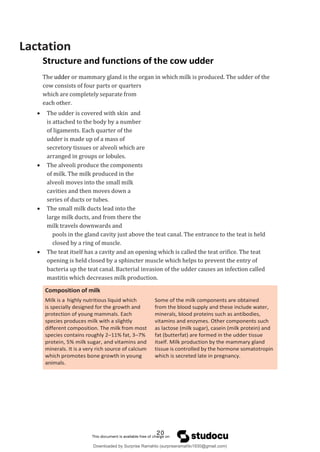
The udder or mammary gland is the organ in which milk is produced. The udder of the
cow consists of four parts or quarters
which are completely separate from
each other.
 The udder is covered with skin and
is attached to the body by a number
of ligaments. Each quarter of the
udder is made up of a mass of
secretory tissues or alveoli which are
arranged in groups or lobules.
 The alveoli produce the components
of milk. The milk produced in the
alveoli moves into the small milk
cavities and then moves down a
series of ducts or tubes.
 The small milk ducts lead into the
large milk ducts, and from there the
milk travels downwards and
pools in the gland cavity just above the teat canal. The entrance to the teat is held
closed by a ring of muscle.
 The teat itself has a cavity and an opening which is called the teat orifice. The teat
opening is held closed by a sphincter muscle which helps to prevent the entry of
bacteria up the teat canal. Bacterial invasion of the udder causes an infection called
mastitis which decreases milk production.
Composition of milk
Milk is a highly nutritious liquid which
is specially designed for the growth and
protection of young mammals. Each
species produces milk with a slightly
different composition. The milk from most
species contains roughly 2–11% fat, 3–7%
protein, 5% milk sugar, and vitamins and
minerals. It is a very rich source of calcium
which promotes bone growth in young
animals.
Some of the milk components are obtained
from the blood supply and these include water,
minerals, blood proteins such as antibodies,
vitamins and enzymes. Other components such
as lactose (milk sugar), casein (milk protein) and
fat (butterfat) are formed in the udder tissue
itself. Milk production by the mammary gland
tissue is controlled by the hormone somatotropin
which is secreted late in pregnancy.
20
Downloaded by Surprise Ramahlo (surpriseramahlo1930@gmail.com)
lOMoARcPSD|29919704
Hormones and milk ejection/milk let down
Two processes are important for the removal of milk from the udder: passive withdrawal
and milk ejection or let down through the milk ejection reflex.
Passive withdrawal
Passive withdrawal of milk is the emptying of the larger ducts and cavities of the udder by neural
stimulation of the skin and teats of the udder. This phase begins 5 to 10 seconds after stimulation
of the udder. Between 40 and 50% of the milk can be removed passively from the udder.
Hormones involved in milk ejection/milk let down
For the remaining 50 to 60% milk to be removed, successful milk ejection has to take
place. This happens due to the milk ejection reflex, which is a neuro-hormonal reflex.
 Milking or suckling stimulates nerve endings in the teats, bringing about the release of
the hormone oxytocin from the pituitary gland 20 to 40 seconds later.
- Oxytocin causes the expulsion of milk from the alveoli by stimulating the
epithelial cells of the ducts to push the milk down into the gland cavities and
then into the teats.
*Oxytocin is present in the bloodstream for 6 to 7 minutes after stimulation,
which therefore is the time available for milking a cow if the maximum yield
is to be obtained from her.
*An excited or scared cow will secrete the hormone adrenalin. This
hormone will inhibit milk ejection, which will prevent the cow from being
milked properly.
Importance and functions of colostrum
The milk which is secreted just after the birth of the calf is called colostrum or first milk.
It is very thick and provides nutrient rich food for the newborn as well as antibodies that are
concentrated from the mother’s blood. The intestine of the calf is able to absorb the antibodies
for the first 48 days of its life. The colostral antibodies are absorbed into the calf’s bloodstream
instead of being broken down. They protect the calf against infectious diseases
until the young animal develops its own. It is therefore very important that a newborn animal
receives enough colostrum as soon as possible after birth and always within the first 48 hours.
21
Downloaded by Surprise Ramahlo (surpriseramahlo1930@gmail.com)
lOMoARcPSD|29919704
The lactation cycle and lactation curve
The lactation cycle (period)
The dairy cow has been bred to supply a large quantity of milk for as long as possible.
To achieve this, the cow must give birth to one calf a year.
 The lactation period begins after calving and three months later she should come on
heat and be mated or inseminated.
- The cow is dried off in the last two months before she is due to calve again. This
is known as the drying period.
- This means that her milk production is halted by reducing the milking of
the udder.
- Drying off allows the udder two months to rest and recover before the cow
calves again.
*The cow is therefore in lactation for roughly 300 days or 10 months.
*This 12 month cycle is called the lactation cycle. Farmers need to
monitor the lactation cycle of their herd in order to manage them
effectively. It is important to get cows pregnant as early as possible
within the 12 month period.
*Dairy cows usually have 5–6 lactation cycles during their lifetime.
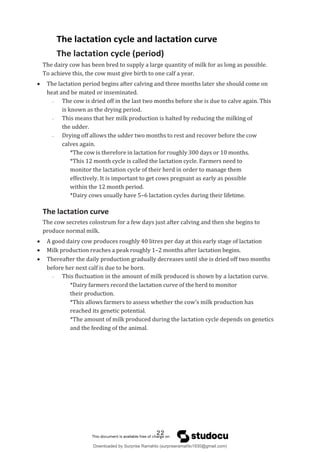
The lactation curve
The cow secretes colostrum for a few days just after calving and then she begins to
produce normal milk.
 A good dairy cow produces roughly 40 litres per day at this early stage of lactation
 Milk production reaches a peak roughly 1–2 months after lactation begins.
 Thereafter the daily production gradually decreases until she is dried off two months
before her next calf is due to be born.
- This fluctuation in the amount of milk produced is shown by a lactation curve.
*Dairy farmers record the lactation curve of the herd to monitor
their production.
*This allows farmers to assess whether the cow’s milk production has
reached its genetic potential.
*The amount of milk produced during the lactation cycle depends on genetics
and the feeding of the animal.
22
Downloaded by Surprise Ramahlo (surpriseramahlo1930@gmail.com)
lOMoARcPSD|29919704
QUESTIONS
1 Name the reproductive organ in which the following processes take place:
1.1 ovulation
1.2 fertilisation
1.3 spermatogenesis
1.4 implantation
1.5 lactation
1.6 parturition.
2 Hormones are release during the oestrus cycle. Name a function of the following
hormones in the oestrus cycle:
2.1 Progesterone
2.2 Oestrogen
3 Outline the main difference between infertility and sterility.
4 List FIVE important factors to consider in the collection, examination and
storage of semen to ensure that the product is of good quality.
5 It is important for a farmer to be able to detect oestrus in a cow.
5.1 Explain why it is important.
5.2 Describe TWO signs of oestrus/heat in a cow.
5.3 What is standing heat?
5.4 When is the best time to mate/inseminate a cow? Distinguish between
beef cattle and dairy cows.
5.5 Is the oestrus cycle in cows seasonal?
6 Describe the process of fertilisation. Explain where and how it takes place.
7 Can a monozygotic twin be a freemartin? Explain your answer.
23
Downloaded by Surprise Ramahlo (surpriseramahlo1930@gmail.com)
lOMoARcPSD|29919704
8 Describe the difference between resorption and abortion.
9 Outline the sequence of events when a cow gives birth. List and briefly describe
all of the important processes.
10 Incorrect foetal presentation is one of the main causes of dystocia in cows
because it prevents the calf from moving through the birth canal.
10.1 What are the main incorrect foetal positions that cause problems?
10.2 How are the positions referred to in (10.1) usually corrected?
11 Milk production is under hormonal control.
11.1 Which hormone is involved in the control of lactation?
11.2 Name FOUR common causes of a drop in milk production.
11.3 What normal physiological process can cause a drop in milk production
three months after calving?
12 Name the main categories of causes for a lack of libido in bulls.
12.1 List four and provide a brief description of each one.
13 Discuss the role of disease in the reproductive failure of cows.
14 Cloning is the process of producing an exact replica of an animal.
14.1 Would you use this technique as a replacement for natural mating?
14.2 Give reasons for your answer.
15 Discuss the importance of correct feeding during the reproductive process.
Provide and elaborate on at least two factors.
16 Which THREE of these foetal presentations can cause dystocia?
16.1 Anterior presentation
16.2 Posterior presentation
16.3 Breech presentation
16.4 Anterior presentation with head retained
16.5 Posterior presentation with limb retained
17 Name THREE conditions of the calf that can cause dystocia.
24
Downloaded by Surprise Ramahlo (surpriseramahlo1930@gmail.com)
lOMoARcPSD|29919704
18 Name FOUR signs that indicate that a cow is about to calve.
19 Define milk let down.
20 Use the information below to draw a lactation curve.
25
Downloaded by Surprise Ramahlo (surpriseramahlo1930@gmail.com)
lOMoARcPSD|29919704
nit
U
Signs of poor health/sick animals
 We can tell if animals are in poor
health or sick by
- comparing their normal
behaviour and functions with
their behaviour and functions
when they do not seem well.
Signs of poor health/sickness in ruminants (cattle, sheep and goats)
Function or body system Healthy animal Sick animal
Appetite
Eats, drinks and ruminates Not interested in food, does not
ruminate
Behaviour
Alert, ears erect, interested in
surroundings, stands up when
approached by humans
Depressed, walks slowly or lies down
and will not get up, ears hanging
Body temperature
Cattle: 37,8–39,8 °C
Sheep: 38,9–40 °C
Goats: 38,6–40,2 °C
Fever (>1 °C above normal), sign of an
infection
Excretion Passes normal faeces Hard, runny or blood-stained faeces
Mucous membranes
Pink and moist Yellow, dark red, white, brownish or
bluish
Paralumbar fossa
Strong rumen contractions can be felt Weak or no rumen contractions
Urination
A strong stream of light yellow urine Intermittent urination in bulls/rams,
red urine
Signs of poor health/sickness in pigs
Function or body part Healthy animal Sick animal
Appetite Interested in food, drinks water No or little interest in food/water
Behaviour
Alert with erect ears, interested in
surroundings
Depressed with hanging ears
Excretion
Faeces of normal consistency Hard faeces or runny possibly with
blood clots
Eyes Clear and moist Dull and runny
Mucous membranes Pale pink Dark red, pale or bluish
Skin
Unpigmented pigs should be light pink
(depends on breed)
Red raised spots, bluish discolouration
on unpigmented areas
Temperature 37,8–39,9 °C Fever (>1 °C above normal)
26
Downloaded by Surprise Ramahlo (surpriseramahlo1930@gmail.com)
lOMoARcPSD|29919704
Signs of poor health/sickness in poultry
Function or body part Healthy animal Sick animal
Appetite
Actively looks for food, eats well,
drinks water
Refuses to eat/drink
Behaviour
Alert, interested in surroundings Depressed, feathers fluffed up, eyes
closed, doesn’t move away when
approached
Breathing
Regular close-mouthed breathing, may
pant on hot days
Noisy wet sounds, difficult breathing
with open mouth
Egg production
(layers)
Normal production Reduced production
Excretion Normal faeces Very wet faeces
Eyes Clear and open Eyelids swollen closed
Feathers
Smooth and clean, may lose some
feathers at certain times of year
(moulting)
Brittle, broken and falling out
Legs and feet Smooth Scaly, birds pecking at scales
Wattles and combs
Usually red and smooth May be pale/blue in colour, show
lumps or swellings
Methods of testing animal health
Methods to investigate, test or diagnose suspected ill health in an animal or herd.
Clinical examination
- A clinical examination of an animal is done to help determine the cause of a
disease or make a diagnosis. This involves the examination of various body
parts and functions. This is important because similar symptoms can be seen in
diseases or conditions that have different causes.
Laboratory tests
- Various laboratory tests can be done on live animals to help make a diagnosis.
*Blood smears: These can be made to diagnose diseases like anthrax or
various blood-borne diseases in which parasites can be seen in blood cells.
8Serology: Blood samples can be tested for antibodies to infectious agents.
*Cultures: You can do a culture for an infectious agent. This involves the
growth of the culturing material in a laboratory from an abscess or a milk
sample in order to identify the bacteria that caused it.
*Faecal examination: Faecal samples can be tested for signs of roundworm and
fluke eggs will indicate the severity of the infestation.
Postmortem
- A postmortem (or PM) is the procedure when you cut open the carcass of a dead
animal to determine the cause of death.
- The cause may be obvious such as when a large number of internal parasites are
found. But if no macroscopic signs are found, then
*samples must be taken for microscopic examination of tissue samples
to determine a specific diagnosis → This is called histology.
27
Downloaded by Surprise Ramahlo (surpriseramahlo1930@gmail.com)
lOMoARcPSD|29919704
Methods of administering medicine to animals
 Injections (can be intravenous, intramuscular or subcutaneous)
- Sick animals suffering from bacterial infections can be treated with injections of
antibiotics. Some worm remedies are either injected as a once-off treatment or
given on a sustained basis as part of a worm control programme.
 Dosing
- Dosing is when remedies are given by mouth. These treatments include worming
remedies, diarrhoea medications and antibiotics. Worm remedies can be used
as a once-off treatment or on a sustained basis as part of a programme. Dosing
must be done correctly to ensure that the animal is not harmed.
 Vaccinations
- Vaccinations are used to prevent various diseases. Most vaccines are injected
subcutaneously or intramuscularly.
In poultry some vaccines are applied
as eye drops or a spray which is
inhaled by the birds.
 In-feeds
- Some medications are given in
the animal feed. This method is
used for some growth promotants
or antibiotics given to prevent
infections in animals. It is often
done on a sustained basis in
intensive animal production
systems.
 Dipping
- Animals can either be dipped or the
dip can be applied by spray or pour-
on methods. This is used mainly to
treat or control external parasites.
 Footbaths
- Can be used to control ticks found
on the feet of animals. It can also be
used to treat and prevent diseases
28
Downloaded by Surprise Ramahlo (surpriseramahlo1930@gmail.com)
lOMoARcPSD|29919704
Infectious, non-infectious and metabolic diseases
 Infectious diseases
- Caused by various infectious agents such as bacteria,
fungi, protozoa and viruses, resulting in a fever
reaction, which is the body’s defensive reaction to try
and kill the infectious organism.
- Infectious diseases are contracted by coming into
contact with infected animals or objects that
have been contaminated with the infectious organism, while others can be
transmitted by insects and ticks.
 Non-infectious diseases
- Are not caused by infectious agents and they cannot be transmitted between
animals. There are various causes and risk factors:
*Environmental causes – Non-infectious diseases can be caused by the
interaction between the animal and its environment. Environmental causes
include injury (cuts or broken bones), sun damage (cancer), drowning,
lightning strike, heat stroke, burns and exposure to the cold.
*Parasites – Parasites are a serious threat to farm animals in South
Africa. External and internal parasites cause a loss of production and
deaths.
*Poisons – Animals that ingest poisonous substances may die or suffer
severe organ damage which can affect their productivity. These substances
include chemicals and poisonous plants.
*Genetic or congenital problems – These are conditions which the animal is
born with. These are not always life threatening but some of them can be fatal.
 Metabolic diseases
- Occur in farm animals due to an increased need for a nutrient. For example, a
calcium deficiency in highly productive dairy cows causes milk fever. The
animals show nervous symptoms and they may die if they are untreated.
29
Downloaded by Surprise Ramahlo (surpriseramahlo1930@gmail.com)
lOMoARcPSD|29919704
Animal diseases
Main micro-organisms causing diseases in animals
Infectious diseases are caused by infectious agents or microorganisms, including
viruses, bacteria, protozoa and fungi, resulting in the four main types of diseases: viral,
bacterial, protozoan and fungal.
Viral diseases
Viruses cause viral diseases. A virus is an infective agent that typically consists of a
nucleic acid molecule in a protein coat, is too small to be seen by light microscopy, and
is able to multiply only within the living cells of a host. There are six important viral
diseases that occur in South Africa. They can spread very quickly, and are not treatable.
Foot-and-mouth disease (FMD): It is the most important threat to food security in
a country because it affects the production of animals and it limits the export of
agricultural products to developed countries. It is a state controlled disease.
- Host
*FMD is a viral disease of cloven-hoofed animals such as cattle, sheep, goats,
pigs and some antelope species.
- Transmission
*The FMD virus is very infectious. It can spread rapidly by direct
transmission from animal to animal and by infected objects.
*It can also be spread by indirect transmission from one farm to another
by infected animals or by trucks, clothes and instruments.
*Some animals become sub-clinical carriers of the disease when they recover.
- Symptoms
*Cattle develop blisters on their tongue and the mucous membranes of
their mouth and feet. These can rupture and cause painful sores.
*They salivate and are unable to eat.
*Dairy cows develop blisters on their teats which allow mastitis-
causing bacteria to enter and severely affects milk production.
*Sheep and goats develop less severe symptoms, and lesions are
often unnoticed by the stock owner.
8Pigs in commercial systems are severely affected and they lose a lot of weight.
-
*There is no treatment for the disease. The state veterinary department
controls FMD by fencing the South African borders and the Kruger National
Park , where the buffalo are carriers of FMD.
*They also control animal movement during outbreaks by
imposing quarantines and testing and slaughtering infected
animals.
Treatment and control
30
Downloaded by Surprise Ramahlo (surpriseramahlo1930@gmail.com)
lOMoARcPSD|29919704
Rabies: This is an important animal disease because it can spread to humans and it is
almost always fatal. It is a controlled disease.
- Host
*Rabies is a viral disease that can occur in all warm-blooded animals,
including humans.
- Transmission
*It is transmitted through bites although sometimes it can be transmitted by
saliva alone. The source of the virus varies in different parts of South Africa.
*Cattle are the most commonly affected livestock species.
*They become infected when bitten by infected mongooses or jackals.
*The virus has become established in domestic dogs in KwaZulu-Natal and
the Eastern Cape which poses a danger to humans and other dogs.
- Symptoms
*The virus moves to the nearest nerve and then travels up to the brain.
*It can take up to a month for the first symptoms to develop.
*The same symptoms are evident in all animal species, namely a change of
behaviour which usually leads to sudden bouts of aggression.
- Treatment and control
*There is no treatment for rabies in domestic animals.
*Cattle in areas affected by rabies can be vaccinated against the disease.
*All cats and dogs should be vaccinated regularly against rabies to prevent
the exposure of humans to the disease.
Rift Valley fever (RVF): Outbreaks occur periodically as epidemics because the
occurrence of RVF is affected by summer rainfall.
- Host
*Affects domestic ruminants but humans can become infected when they
handle infected animal tissue.
- Transmission
*It is transmitted by mosquito species which prefer to bite livestock.
*Outbreaks usually occur in late summer and autumn.
*It is particularly common after heavy spring rains because this allows
large numbers of mosquitoes to breed.
- Symptoms
*When an animal is infected by a mosquito bite, the virus is
transmitted through the blood to the liver which becomes infected.
*The liver of an unborn foetus will be destroyed and it will die and be aborted
*During RVF outbreaks, 80–100% of pregnant animals abort if they have
not been vaccinated. Large numbers of newborn and young lambs (most
commonly affected), kids and calves die.
- Treatment and control
*There is no treatment. The control of the mosquito vectors is impractical in
livestock. Annual vaccination with a live RVF vaccine before the late summer
will protect animals from infections.
31
Downloaded by Surprise Ramahlo (surpriseramahlo1930@gmail.com)
lOMoARcPSD|29919704
Avian/bird flu: This disease has become important worldwide because of its ability
to mutate. This enables it to cause epidemics in humans. It is a controlled disease.
- Host
*Avian flu is caused by an influenza virus which is adapted to birds. But it can
spread to other species, including humans, under certain conditions.
- Transmission
*Wild birds and ostriches can serve as asymptomatic carriers of the virus
and they can spread the disease to commercial poultry farms.
*The virus is transmitted by direct contact with infected birds or
indirect contact with contaminated objects.
- Symptoms
*In poultry the virus causes a wide range of symptoms including
depression, breathing problems, a fall in egg production and sudden deaths.
- Treatment and control
*There is no treatment for avian flu.
*Infected birds like ostriches are slaughtered to eradicate the virus because
of concerns about the potential spread to humans.
*Vaccines can be used in poultry houses to prevent the rapid spread of
the virus.
African swine fever (ASF): Is a tick-borne viral disease which is confined to the
African continent. It should not be confused with swine flu and European swine
fever (or hog cholera) which do not occur in domestic or wild pigs in South Africa at
present. ASF is a controlled disease.
- Host
*The ASF virus occurs asymptomatically in warthogs and bush pigs. It causes
disease symptoms in domestic pigs.
- Transmission
*The virus is carried by a tampan which occurs in the burrows of warthogs
and bush pigs in the northern areas of the country (Limpopo).
*Domestic pigs will develop ASF if they are bitten by an infected tampan.
- Symptoms
*The first signs of ASF infection in domestic pigs are high temperature, loss
of appetite, listlessness and unsteadiness.
*Later on infected pigs can have bluish mucous membranes and exhibit
breathing difficulties, vomiting and diarrhoea. They often die within four days
after the first symptoms appear.
- Treatment and control
*There is no treatment or vaccine for ASF. So it is controlled by the state to
prevent the spread of the disease from the limited area in the north of the
country (Limpopo Province) where it often occurs. Veterinary services restrict
the movement of wild pigs or their meat from Limpopo Province into other
areas. Piggeries in this area are built according to certain specifications to
avoid contact with wild pig species.
32
Downloaded by Surprise Ramahlo (surpriseramahlo1930@gmail.com)
lOMoARcPSD|29919704
Newcastle disease (NCD): One of the most important diseases affecting the
productivity of commercial and small-scale poultry. It is a controlled disease.
- Host
*NCD is an acute viral disease of domestic poultry. It also affects some
other bird species such as waterfowl, pigeons and imported parrots.
- Transmission
*Transmitted when infected birds shed the virus through droplets that
are spread when they cough, as well as through their faeces and eggs.
*Birds can be infected when they breathe in the virus or take it in by mouth
*The virus can be carried into poultry houses or onto properties when
people handle sick birds or visit infected farms.
*The virus can be carried on people’s hands, clothes and shoes or on equipment.
- Symptoms
*Signs of the disease appear within five days.
*The virus can affect the respiratory, digestive and nervous
systems. These systems can be affected in combination or in
sequence.
→ The respiratory signs are gasping, coughing, sneezing and noisy breathing.
→ Nervous system signs include trembling, paralysis of the wings and legs,
and twisting of the neck. Watery, greenish diarrhoea indicates that the
digestive system has been affected.
→ Other typical symptoms are a severe decrease in egg production and the
appearance of abnormal-looking eggs.
- Treatment and control
*There is no treatment for NCD. Birds in small-scale systems and
commercial houses must be vaccinated because the disease affects egg
production and weight gain.
*Several NCD vaccines are available.
*The B1 and La Sota strains are used commonly to vaccinate day-old
chicks. These vaccines are given in their drinking water or sprayed in bird
houses.
Bacterial diseases
 Anthrax: A serious disease caused by the bacterium Bacillus anthracis. It is a
controlled disease.
- Host
*Ruminants, pigs, horses, various wild animal species and humans.
- Transmission
*Farm animals become infected by direct contact with sick animals or by
exposure to Bacillus anthracis bacterial spores in the soil. Spores are on the
carcasses of dead animals which have died from the disease and been buried.
*Outbreaks usually begin when the anthrax spores are exposed by
droughts or floods. The disease spreads rapidly when the carcasses are
33
Downloaded by Surprise Ramahlo (surpriseramahlo1930@gmail.com)
lOMoARcPSD|29919704
opened by scavengers or cut up by farmers. The infection may then spread
to other species.
- Symptoms
*The disease is usually per-acute in ruminants. The animals commonly show
very few symptoms and die rapidly. Anthrax should always be suspected in
cases of acute death. Carcasses must not be opened until an animal health
technician or veterinarian has made a blood smear. Brick-like anthrax
bacteria are seen in the blood in positive cases.
*They may show a leakage of blood from body openings such as the nose and
anus after death.
*Pigs may have a swollen throat and die more slowly.
- Treatment and control
*Treat animals with a high temperature with penicillin.
*The farm must be quarantined if an anthrax outbreak is suspected to
control its spread. The quarantine lasts until 14 days after the last confirmed
case
of the disease.
*Carcasses must be buried and covered with lime to help break down
the bacterium.
*All farms must vaccinate their animals every year to prevent an anthrax
outbreak since it is impossible to eliminate anthrax spores from the soil.
Mastitis: An infection of the udder that usually occurs during lactation.
- Host
*Caused by various species of bacteria that infect cattle, sheep or goats. It is
most important in dairy animals as it causes a loss of production.
- Transmission
*The bacteria are usually transmitted by contact with infected
animals, either by milkers on the hands or milking machines.
*Infected cows serve as carriers of certain bacteria for healthy cows.
*The udders of cows can be infected by some environmental or soil
bacteria, especially under muddy conditions.
- Symptoms
*There are different severities of mastitis and they range from per-acute to
chronic cases. Chronic mastitis is usually only detected by somatic cell counts
or cow-side tests like the California Mastitis Test.
*In very severe cases the udder can become swollen and inflamed. It
eventually turns blue and gangrenous and animals may die because of toxin
production by the bacteria.
*Acute and sub-acute cases show clots in the milk and painful swelling of the
infected quart.
- Treatment and control
*Mastitis can be treated with antibiotics which are injected into the
udder (intra-mammary preparations).
*Cows with badly damaged udders must be culled. There are many
management practices to prevent mastitis in dairies and these include
hygiene and the proper use of milking machines.
34
Downloaded by Surprise Ramahlo (surpriseramahlo1930@gmail.com)
lOMoARcPSD|29919704
Tuberculosis: Bovine tuberculosis (or BTB) is a chronic disease of cattle and it
causes a severe drop in milk production in cows. It is a controlled disease.
- Host
*Cattle are the main hosts of BTB although it can also infect humans.
- Transmission
*Mycobacterium bovis is the bacterium which causes BTB. It is transmitted
directly by infected cows or indirectly on grazing or by equipment.
- Symptoms
*BTB is a chronic disease that develops very slowly. The first symptoms
only become visible a few years after infection by which time the animal is
sick.
*The bacteria cause the formation of small nodules in the lungs and other
organs. Once the infection is widespread, the animal shows severe weight
loss, swollen lymph nodes and it may develop a cough if the lungs are
affected. Milk production of infected cows drops dramatically. Infected
animals will die eventually.
Treatment and control
*Antibiotic treatment of BTB is not economical.
*BTB cases must be reported to the state veterinary authorities who brand
the animal with a T and supervise the slaughter in a special abattoir.
*All other cattle in the herd must be tested to identify infected animals.
Cattle farmers must test animals for BTB before they buy them.
Protozoan or blood-borne diseases
Redwater: Caused by Babesia bovis and Babesia bigemina.
- Host
*The redwater parasite causes this disease in cattle.
- Transmission
*The protozoal organisms are transmitted by certain tick species which
occur mainly in the northern and eastern parts of South Africa.
- Symptoms
*The two Babesia species cause similar symptoms initially. The Babesia
parasites travel to the liver when cattle are bitten by infected ticks.
*The parasites spread to the red blood cells where they attach and
multiply, and cause a fever.
*They eventually break down the red blood cells which causes anaemia
and red discolouration of the urine (redwater).
*Animals become weak, stop eating and die within a short time unless they are
treated.
*Nervous symptoms develop later with Babesia bovis. A cerebral or brain
infection can give rise to increased excitability, convulsions and paralysis.
- Treatment and control
*Can be treated with babesicides. Calves can be vaccinated to control
35
Downloaded by Surprise Ramahlo (surpriseramahlo1930@gmail.com)
lOMoARcPSD|29919704
the disease. Exposure to infected ticks will also stimulate their
immunity.
Anaplasmosis or gallsickness (Anaplasma marginale): Affects the red blood cells
very chronically.
- Host
*It occurs in cattle.
- Transmission
*It is caused by the organism Anaplasma marginale. It is transmitted by ticks
and attacks the red blood cells.
- Symptoms
*Animals develop a fever for a short time after being bitten by an infected tick
*Thereafter they gradually lose their appetite and their condition deteriorates
*They develop jaundice as their red blood cells begin to break down
*Eventually the rumen stops functioning due to lack of food and the animals
become very weak.
- Treatment and control
*Can be treated with a dose of tetracyclines.
*Farmers may have to treat animals in chronic cases to get the
rumen functional again.
*Calves can be vaccinated against anaplasmosis to prevent infection and their
continual exposure to infected ticks will stimulate their immunity.
Heartwater: A very important tick-borne disease because it is fatal if untreated.
- Host
*This is a disease of cattle and small ruminants caused by Erlichia (Cowdria)
ruminantium, which is a rickettsia or type of bacterial disease.
- Transmission
*Transmitted by the bont tick (Amblyomma hebraeum) which occurs in the
eastern and northern areas of South Africa.
- Symptoms
*Animals that have been bitten by an infected tick develop a very high
temperature, lose their appetite and later begin to show various symptoms as
a result of damage to blood vessels.
*Fluid can build up in the brain which causes nervous symptoms such as high
stepping, walking in circles and then lying down and paddling of the legs
*Fluid collects in the lungs and makes it difficult to breathe.
*Froth may be seen from the nose and the animals will die at this stage if
they are not treated.
- Treatment and control
*Treatment with tetracyclines can save sick animals.
*Calves can be vaccinated against heartwater and this will protect them
until adulthood.
*Adult cattle will be immunised by their continual exposure to infected ticks
*Sheep and goats must be dipped to prevent heartwater.
36
Downloaded by Surprise Ramahlo (surpriseramahlo1930@gmail.com)
lOMoARcPSD|29919704
Coccidiosis: A protozoan disease that occurs in young ruminants and poultry. It
occurs especially when animals are kept in crowded conditions. There are a large
number of species of the coccidian parasite, such as Isospora and Eimeria.
- Host
*The condition occurs in young calves, sheep and goats up to the age of 2–3
months, and in poultry in intensive systems. Older animals become immune
to the disease but they remain carriers.
- Transmission
*Coccidia infect the intestinal wall of their hosts. They multiply and produce
oocytes which are shed in the faeces. These oocytes land on pastures or floors
of poultry houses where they are picked up by susceptible animals.
- Symptoms
*The most typical symptom of coccidiosis in ruminants is diarrhoea. It can be
mild or very severe and sometimes even bloody. Symptoms in birds are poor
growth, depression and diarrhoea. A large number of deaths can occur.
- Treatment and control
*Anti-coccidials are given in the water or by injection to treat coccidiosis.
*Drugs called coccidiostats are used to reduce the number of organisms in
the herd/flock.
*Vaccines are also available to control coccidiosis on intensive poultry farms
*Various management factors (e.g. improved hygiene, reducing crowding
and stress factors) can be used to control the disease.
Fungal diseases
Lumpy wool: Caused by a fungus-like bacterium or actinomycete called
Dermatophilus congolensis.
- Host
*This condition is seen in sheep as a result of continual wetting of the fleece.
- Transmission
*The spores of the organism are spread from one sheep to another. This
occurs when the fleece remains wet from heavy rain or when sheep are
dipped during cool weather.
- Symptoms
*The organism infects the skin and causes matting of the fleece or so-called
lumpy wool. This damages and reduces the value of the fleece. It causes loss
of condition in non-woolled sheep like dorpers.
- Treatment and control
*Antibiotics can be used to treat badly infected animals. Farmers should also
prevent prolonged wetting of fleece and the contact of these sheep with
unaffected ones.
37
Downloaded by Surprise Ramahlo (surpriseramahlo1930@gmail.com)
lOMoARcPSD|29919704
Ringworm: An infection caused by a skin fungus. It is commonly caused by the
fungus Trichophyton spp.
- Host
*It is seen in various domestic animal species but it is most common in young
calves and Karakul sheep.
- Transmission
*Commonly found in young animals that are kept in unhygienic housing or
poor conditions.
*The fungus is easily transmitted because it forms resistant spores which can
be transmitted to other animals by direct contact or by indirect contact with
infected pens or kraals.
- Symptoms
*The fungus infects the hair follicle and causes the hair to break off.
*Circular, hairless patches are usually seen and they are not itchy
*These patches usually appear on the head and neck but they can extend over
the whole body.
*The condition is unsightly and reflects the poor condition of an animal.
- Treatment and control
*Apply iodine or sulphur preparations once a week to treat cases of ringworm.
Economic implications of animal disease
Death or mortalities
A high mortality rate can cause the farmer huge economic losses. Anthrax is an example
of a disease that causes a large number
of mortalities.
Economic loss
Diseases that do not cause a high
percentage of mortalities may cause
economic loss because of a decrease
in production. In these cases animals
lose weight, show a drop in milk or egg
production, fail to reproduce or suffer
abortions.
Trade restrictions (export)
Some diseases cause huge economic
losses because exports to countries that
are free of those specific diseases are
stopped.
38
Downloaded by Surprise Ramahlo (surpriseramahlo1930@gmail.com)
lOMoARcPSD|29919704
Unit X
2
X
Prevention and control of animal diseases
It is very important to prevent and control animal diseases in South Africa because:
 viral diseases cannot be treated economically
 some bacterial infections cannot be treated, e.g. bovine tuberculosis (BTB)
 diseased animals suffer a loss of production
 treatment is often too late for some acute diseases
 some animal diseases are transmissible to humans (this is called zoonosis).
There are various methods to prevent and control diseases.
 Vaccination
- This is one of the most important means of disease control. It is a simple
intervention which is harmless to the animal and it can be used to prevent
disease. This means that there is no production loss and the cost is very low
when compared to the value of the animal.
 Testing
- Some diseases are controlled by testing animals before they are purchased. The
intra-dermal or skin test is a convenient method to identify TB infected herds.
 Maintaining closed herds
- To prevent diseases such as tuberculosis, a closed herd is maintained. Only clean
animals are kept and all new animals are tested before they are introduced to
the herd. Fences must be maintained so that the herd is not exposed to infected
animals.
 Fencing, buffering and inspection
- This method can be illustrated by the example of a foot-and-mouth disease
outbreak in the Kruger National Park. Animals are vaccinated in a buffer zone
around the park. Disease transmission is monitored by maintaining fencing and
frequently inspecting animals to monitor the possible spread of disease.
 Quarantine
- It is very important to quarantine or isolate new animals before they are mixed
39
Downloaded by Surprise Ramahlo (surpriseramahlo1930@gmail.com)
lOMoARcPSD|29919704

grade-12-agricultural-sciences-notes.pdf

  • 1.
    Grade 12 AgriculturalSciences Notes Agricultural Sciences (High School - South Africa) Scan to open on Studocu Studocu is not sponsored or endorsed by any college or university Grade 12 Agricultural Sciences Notes Agricultural Sciences (High School - South Africa) Scan to open on Studocu Studocu is not sponsored or endorsed by any college or university Downloaded by Surprise Ramahlo (surpriseramahlo1930@gmail.com) lOMoARcPSD|29919704
  • 2.
    GRADE 12 NOTES AGRICULTURALSCIENCES Downloaded by Surprise Ramahlo (surpriseramahlo1930@gmail.com) lOMoARcPSD|29919704
  • 3.
    Reproductive organs ofthe bull The reproductive organs of the bull can be divided into the:  primary reproductive organs (mainly involved in reproduction) and  the secondary reproductive organs (accessory or additional organs that assist with the production and delivery of semen). Structure of primary male reproductive organs Each primary male reproductive organ has a unique structure. Structure of primary male reproductive organs Organ Structure Scrotum Composed of skin on the outside and connective tissue and muscle on the inside. It holds the two testes in place outside the body. The scrotum hangs down between the hind legs of the bull. Testes A bull has two testes which are contained in a bag of skin or scrotum. When the bull calf is born the testes are held inside the body cavity, but soon after birth the testes descend through the inguinal canal into the scrotum. The testes then hang inside the scrotum between the hind legs of the animal, suspended by a spermatic cord which consists of connective tissue and blood vessels. The testes are composed mostly of long, winding seminiferous tubules which are about 1 km in length. The seminiferous tubules are surrounded by interstitial or supporting tissue. Epididymis An organ which lies next to the testes. It contains a long, convoluted tube called the ductus epididymis. The head of the epididymis lies against the upper part of the testes, the body lies over the surface of the testes and the tail on the lower edge of the testes. Vas deferens The tail of the epididymis passes into a tube called the vas deferens. The last 10 cm of the vas deferens is thicker than the start of the tube and it is known as the ampulla. The vas deferens connects the epididymis to the urethra. Penis The male organ which lies outside the body and allows mating (copulation) to take place. Consists mainly of spongy tissue which becomes firm or erect when the blood vessels become filled. The root of the penis is attached internally to the pelvis. The body of the non- erect penis lies in an S-shaped curve which is referred to as a sigmoid flexure. The tip is known as the glans penis. The penis at rest lies within a sheath of skin called the prepuce. The penis is extruded through the preputial opening in the sheath when bulls mate or urinate. Urethra A muscular tube extending from the bladder. It passes through the inside of the penis and opens at the glans penis. The vas deferens and the ducts of the accessory sex glands also open into the urethra. 1 Downloaded by Surprise Ramahlo (surpriseramahlo1930@gmail.com) lOMoARcPSD|29919704
  • 4.
    Process of spermformation The male cell of reproduction is the spermatozoan or sperm cell. It is a microscopically small body that appears to have a head, neck and tail. The process of spermatozoa formation is called spermatogenesis. There are four stages in the process:  Division of the spermatogonia (mitosis) - Spermatogonia are cells in the wall of the seminiferous tubules of the testes. *These cells divide by mitotic division and produce primary spermatocytes.  Division of the primary spermatocytes (first meiosis) - A primary spermatocyte undergoes meiosis to produce two secondary haploid spermatocytes.  Division of the secondary spermatocytes (second meiosis) - Each secondary spermatocyte produces two spermatids.  Development of sperm cells - The spermatids now develop into sperm cells (spermatozoa) *consists of a head, neck and tail *DNA is contained in the head of the spermatozoa. Factors causing infertility and sterility in bulls In some cases infertility may be permanent, in which case the bull is called sterile.  Lack of libido as a cause of infertility: Healthy adult bulls may show lack of libido or sexual urge due to the following reasons. - Immaturity: *Young bulls that have not reached full puberty may have low or no libido. Onset of puberty varies with breed but is usually at 12–15 months of age. - Inexperience: *Young and inexperienced bulls may have poor erections. They will require some time to practice mating. - Overwork: *Bulls that have to walk far to search for females over a wide area can often be exhausted from walking and lack of food or water. They will recover if rested and cared for properly. - Disease: *Various diseases which cause pain or loss of condition will reduce the bull’s libido. - Temperament: *Poor handling and change of environment may stress the bull and reduce his libido. - Breed differences: *European breeds mount animals frequently while Zebu animals will only mount females in oestrus. 2 Downloaded by Surprise Ramahlo (surpriseramahlo1930@gmail.com) lOMoARcPSD|29919704
  • 5.
    - Old age: *Whenbulls become too old they may show a lack of libido as a result of reduced testosterone secretion. - Incorrect feeding *Bulls may have poor libido due to nutritional problems. Underfeeding will cause a lack of energy while overfeeding will cause the bull to become fat and lazy. Specific deficiencies like vitamin A or protein deficiencies may cause poor libido. Inability to mate as a cause of infertility: Bulls may produce semen of good quality but be unable to mount the cow or mate successfully. Reasons include: - Conformation: *Poorly developed hind legs or back muscles will affect the ability of the bull to mount the cow. - Conditions of limbs: *Foot or joint diseases can cause problems with mating because they prevent the bull from mounting. - Injuries: *An injury to the bull’s penis may prevent the bull from mating. This can be caused by thorns or barbed wire. - Congenital abnormalities: *A small number of bulls may be born with abnormalities of the genitalia which prevent them mating successfully. Inability to fertilise as a cause of sterility: This happens when a bull shows good libido and is able to mate normally but fails to fertilise cows. Reasons include: - Climate: *Bulls that are not adapted to a hot climate may have a low sperm count. - Diseases: *Various diseases (e.g. vibrio or campylobacteriosis and trichomoniasis) transmitted during mating may cause the failure of conception. *Diseases that cause a high fever (e.g. heartwater and redwater) may temporarily affect the sperm production of the bull. Lumpy skin disease (a viral infection) can cause permanent damage to the scrotum and testes. Some infections can cause orchitis (inflammation of the tissues of the testes). - Malnutrition and exhaustion: *These factors will cause a temporary reduction in sperm count which can be reversed if the bull is rested and fed correctly. - Congenital defects: *Inborn defects of the testes can make the bull sterile. e.g. producing abnormal sperm, scrotal hernia (testes become damaged) and cryptorchidism (testes fail to descend). 3 Downloaded by Surprise Ramahlo (surpriseramahlo1930@gmail.com) lOMoARcPSD|29919704
  • 6.
    The female reproductivesystem Reproductive organs of the cow The reproductive organs of the cow are involved in the processes of ovulation, mating, fertilisation, pregnancy and calving. They are mostly located inside the abdominal cavity. They can be divided into two categories:  the primary reproductive organs and  the secondary reproductive organs. Primary reproductive organ of the cow The ovary is the primary reproductive organ of the cow. There are two ovaries, one on either side of the abdomen.  They are attached by the fallopian tubes to the point of the horn of the uterus.  They contain the ova or eggs of the cow. When the heifer is born her ovary contains 30–400 000 unripe haploid ova or primary oocytes. When the cow reaches puberty a few ova will ripen every 21 days. 4 Downloaded by Surprise Ramahlo (surpriseramahlo1930@gmail.com) lOMoARcPSD|29919704
  • 7.
    Structure of femalesecondary reproductive organs Structure of secondary female reproductive organs Organ Structure Fallopian tubes These tubes are also called the oviducts and they are two winding tubes which pass from the horns of the uterus to the ovaries. Each tube forms a funnel shaped body at the ovary called the infundibulum. Uterus A muscular tube which can be divided into various parts: the thick neck or cervix, the body and the horns. The uterus is lined on the inside with a layer called the endometrium. Vagina A muscular tube. It is adjacent to the cervix of the uterus on one end and it opens to the outside through the vulva or lips of the vagina on the other end. The hymen is the membrane at the entrance of the vagina. Udder Also known as the mammary gland, it is situated outside the body cavity of the cow. Functions of the female reproductive organs Function of female reproductive organs Organ Structure Ovaries Produce the female sex cells called the ova or eggs which are then released into the funnel of the fallopian tubes during the process of ovulation. The ova develop inside a fluid-filled follicle (Graafian follicle). Oocytes develop every 21 days in response to the hormone FSH. Fallopian tubes They pick up the ovum which is released from the ovary during ovulation. Fine hairs or cilia help to move the ovum down the tube to the waiting sperm. Uterus Is usually tightly closed but during oestrus the wall relaxes and the cervix opens. The lining or endometrium contains glands which nourish the embryo before it implants. When the embryo implants, the blood supply of the endometrium nourishes it by being in close contact through the cotyledons that form on the foetal membrane. This forms the placenta in cattle. Vagina Has a number of functions. It receives the penis of the bull during mating and the semen released during mating. The semen travels up the vagina and through the cervix and the uterus. It then enters the fallopian tubes to effect fertilisation. The vagina is also the birth canal through which the foetus passes into the outside world. Udder Produces milk to feed the newborn animal. Process of ovigenesis/oogenesis and ovulation The process of development of the egg (female sex cells or ova) in a cow is called ovigenesis or oogenesis.  At birth, a heifer’s ovary contains thousands of primary oocytes or follicles.  When she reaches puberty, under the influence of a number of hormones, a few primary follicles begin to develop. They contain a primary oocyte or egg cell which is surrounded by a layer of cells. - - These cells multiply and form a fluid-filled cavity in which the oocyte is suspended (Graafian follicle). When the oocyte becomes a mature ovum, the follicle ruptures and the ripe ovum is released into the fallopian tube which is called ovulation. 5 Downloaded by Surprise Ramahlo (surpriseramahlo1930@gmail.com) lOMoARcPSD|29919704
  • 8.
    Oestrus and theoestrus cycle Oestrus is the term used to describe the readiness of the cow for mating. It occurs at the stage in the 21-day oestrus cycle at which the cow ovulates (in heat) and is therefore ready to be fertilised by the bull. Oestrus cycle The oestrus cycle is a 21-day period during which a follicle (or follicles) develops into a mature ovum which is then released during the process of ovulation. The cycle is controlled by various hormones. A number of different processes take place during the oestrus cycle, which is divided into four phases. Phase 1: Oestrus - Days 0–1: *The cow is in oestrus (on heat) for about 18 hours. The mature follicle usually ruptures 12 hours later. Phase 2: Metoestrus - Days 1–2: *The cells of the ruptured follicle develop into a corpus luteum (CL). - Days 2–5: *The CL grows rapidly and developing follicles regress. Phase 3: Dioestrus - Days 5–16: *The CL develops to its maximum size and function and produces the hormone progesterone. This hormone suppresses the formation of other follicles. Phase 4: Proestrus -Days 16–18: *If fertilisation has not yet taken place, the uterus secretes the substance prostaglandin which signals the CL to regress rapidly. -Days 18–20: *Primary follicles begin to grow again and release oestrogen. -Day 21: *The oestrogen level rises and causes the onset of heat. The progesterone level decreases, the mature follicle ruptures and ovulation occurs. However, if fertilisation occurs then the CL continues to produce progesterone: no follicles mature no ovulation takes place the cow will not return to heat again. The progesterone produced then prepares the uterus for the implantation of the foetus. 6 Downloaded by Surprise Ramahlo (surpriseramahlo1930@gmail.com) lOMoARcPSD|29919704
  • 9.
    External signs ofoestrus Cows show certain external signs and changes in behaviour under the influence of the hormone oestrogen, which show that she is ready for mating.  Behavioural changes - The cow becomes excitable and begins to sniff, ride or mount other cows. A cow that has been ridden will show soiling with dung or mud around the hip bones. Cows in oestrus often stop eating and their milk production drops. They show an interest in the bull and will stand to be mounted when ready to be mated. This is called standing heat.  Anatomical changes - The vulva becomes moist, red and slightly swollen. - The cow may also secrete a bullstring – a clear mucous secretion that dangles from the vagina. Female sex hormones and their function Sex hormones secreted by endocrine glands control the oestrus cycle of the female.  Follicle-stimulating hormone (FSH) - The pituitary gland found at the base of the brain secretes FSH which stimulates the follicles to develop. These follicles secrete oestrogen as they develop. - When oestrogen reaches a certain level, FSH secretion is inhibited and the pituitary gland secretes luteinising hormone (LH).  Luteinising hormone (LH) - This hormone is secreted by the pituitary gland in response to the maturation of the Graafian follicle. This causes the follicle to rupture and develop a CL.  Oestrogen - Oestrogen is produced mainly by the developing egg or Graafian follicle. *The hormone is responsible for the development of the secondary sexual organs at puberty and the oestrus cycle after puberty. *The hormone causes the external signs of oestrus and the behavioural changes in the cow which cause her to seek out and accept the bull.  Progesterone - - Progesterone is produced by the developing CL and prepares the uterus lining for the fertilised ovum (embryo). If fertilisation occurs, the CL will remain on the ovary and continue to produce progesterone throughout the development of the foetus (pregnancy). 7 Downloaded by Surprise Ramahlo (surpriseramahlo1930@gmail.com) lOMoARcPSD|29919704
  • 10.
    Synchronisation of oestrus Synchronisationof oestrus is when all the cows are on heat (oestrus) at the same time. Techniques of synchronisation of oestrus (heat) There are various techniques, involving the administration of different hormones or substances which affect the oestrus cycle, to synchronise oestrus.  Prostaglandin injections - Injection of this hormone in a herd of cows causes a regression of the CL. Stimulates the cow’s own FSH which begins the maturation of the follicles on the ovary. Ensures that all of the cows in the herd will come into heat at more or less the same time.  Gonadotropin releasing hormone (GnRH) injections - Causes new follicles to develop. Results in the appearance of oestrus in the group. Can be injected into cows at various stages of the oestrus cycle.  Progestin or progestogen administration - Synthetic forms of progesterone are used as vaginal implants or they are given in feed. The release of progesterone into the cow’s system at a constant rate prolongs the luteal phase. When the implant is removed or the feeding is stopped, the CL regresses and oestrus begins 36–60 hours later. Advantages and disadvantages of synchronisation of oestrus Table 1 The advantages and disadvantages of synchronisation of oestrus Advantages of synchronisation of oestrus Disadvantages of synchronisation of oestrus ● It easier to manage beef cows as they can be mated or inseminated in a short period of time. ● It allows the farmer to make maximal use of a good bull or good semen. ● It makes the management of calving easier because the cows all calve at more or less at the same time. This allows for proper supervision of the birth process and prevention of problems that can arise, either in the mother or with the young animals. ● Some of the drugs required to synchronise oestrus are very expensive. ● The results of some methods are variable, which means the outcome of the synchronisation of oestrus process is not always consistent. ● Prostaglandins cause abortions in pregnant animals. ● Progesterone administration is a lengthy process. Factors causing infertility and sterility in cows  Congenital or inborn factors include: - underdevelopment of the reproductive organs, defects of the reproductive organs, freemartinism, prolapse or dropping out of the vagina, and persistence of the hymen which prevents sperm from entering the reproductive tract.  Injuries to the reproductive tract during mating, birth or the passing of the placenta can cause adhesions or blockages in the reproductive tract. - This may prevent fertilisation. 8 Downloaded by Surprise Ramahlo (surpriseramahlo1930@gmail.com) lOMoARcPSD|29919704
  • 11.
     Ovarian problemsmay cause a number of reproductive difficulties. - These problems include failure to come on heat (anoestrus) and failure to ovulate. Some of the causes of ovarian problems are disease, poor nutrition and very hot temperatures.  Diseases can cause infertility in cows. - These include specific diseases of the reproductive tract like brucellosis, trichomoniasis and vibriosis (campylobacteriosis), general diseases which affect the overall health of the animal and non-specific infections such as those that result from tissue damage during difficult calving.  Malnutrition can affect the fertility of the cow. For example: - underfeeding will cause a delay in puberty, while overweight cows will also show fertility problems.  Management must be handled correctly. For example: - cows that are mated at the wrong time, subjected to unhygienic conditions and poorly adapted to their environment may develop fertility problems. Factors causing infertility in cows Cows are infertile when they are neither normally fertile nor completely sterile. So, infertility is thus not necessarily permanent, and can be caused by factors such as injuries to the reproductive tract, ovarian problems, diseases, malnutrition and poor livestock management. Factors causing sterility in cows Cows are deemed sterile when they have the physiological inability to effect sexual reproduction. In other words, sterility is a total loss of fertility. Sterility is thus caused when the factors that result in infertility persist. These can be:  diseases of the genital organs (e.g. retained placenta)  infections (e.g. trichomoniasis)  physiological (e.g. repeat breeding) anatomical (e.g. freemartinism). 9 Downloaded by Surprise Ramahlo (surpriseramahlo1930@gmail.com) lOMoARcPSD|29919704
  • 12.
    Natural mating andother forms of reproduction Mating or copulation and ejaculation Mating or copulation is when the male inseminates the female by penetrating the female genital tract and ejaculating sperm from the epididymis of the testis. Natural mating The normal method and most important form of insemination in farm animals is natural mating. This is when the bull identifies a cow on heat and mates with her.  The bull is stimulated to mate by the presence of the oestrus cow.  The drive to mate is regulated by his libido, which is under hormonal control. The five main stages of mating or copulation  Sexual display/courtship behaviour/pattern - The bull is attracted to a cow on heat by her behaviour and shows an interest in her. He may sniff her hindquarters and curl his lip in a flehmen reaction. He may also rest his head on her rump.  Erection - The penis of the bull becomes erect when he identifies a cow on heat. The erection occurs due to the dilation of blood vessels in the spongy tissue. Then the accessory glands begin to discharge their secretions into the urethra to lubricate and protect the sperm during ejaculation.  Mounting - The cow will stand still if she is ready to be mated and allow the bull to jump, raise his forequarters and straddle her back. He is able to place the penis near to the vulva in this position.  Penetration - The bull drives his erect penis into the vagina of the cow when he is in the correct position.  Ejaculation - The sperm is now discharged from the epididymis. It travels down the vas deferens, enters the urethra and is discharged through the tip of the penis into the vagina. The bull dismounts from the cow once he has ejaculated. Artificial insemination (AI) Artificial insemination (AI) in cattle was originally developed to prevent the infection of cows with venereal diseases such as vibriosis.  Later scientists realised that this method was a very quick way to improve the quality of herds by using semen from bulls that had superior genetic characteristics - One good bull can be used to inseminate many more cows than it is able to serve *Today AI is used for genetic improvement in dairy and beef herds. 10 Downloaded by Surprise Ramahlo (surpriseramahlo1930@gmail.com) lOMoARcPSD|29919704
  • 13.
    In AI semenis collected from the male animal under controlled conditions and then it is artificially inserted (inseminating) into the reproductive tract of the female. Basic requirements for successul AI Proper collection and storage of semen: - Semen is collected by leading a bull to a ‘cow’ (a dummy) or another bull (the teaser bull). *When the bull mounts the ‘cow’ or dummy, an artificial vagina (AV) is placed over the bull’s penis to collect the ejaculate. *Some operators use electrical stimulation or an electro-ejaculator to cause ejaculation. Good quality semen: - Good quality semen contains a large number of spermatozoa that move around rapidly and a low percentage of abnormalities such as loose tails or double heads. Good technique (insemination): - The plastic straw is taken out of the liquid nitrogen and the thawed semen is inserted into a special pipette. - The operator then places an arm in the cow’s rectum, grasps the cervix and pushes it downwards gently. The operator uses the other hand to insert the pipette through the vulva and then through the cervix *Half of the semen is deposited (as above) and the rest is deposited into the uterine horn. *The pipette is then withdrawn and the cervix is then massaged → This causes the secretion of oxytocin, which causes the uterus to contract. This action forces the sperm forward in the reproductive tract. Accurate timing (detecting oestrus in cow): Beef cows need to be inseminated as soon as they show signs of heat, whereas dairy cows should be inseminated 12 hours after the detection of heat. 11 Downloaded by Surprise Ramahlo (surpriseramahlo1930@gmail.com) lOMoARcPSD|29919704
  • 14.
    The advantages anddisadvantages of AI Comparing the advantages and disadvantages of AI Advantages of AI Disadvantages of AI Rapid genetic improvement of a herd is possible Rapid spread of disease if semen is infected Venereal diseases can be controlled Need very good hygienic practice and management Cheaper than buying and keeping expensive stud bulls (± one bull per 30–60 cows) Rapid spread of undesirable genetic material Breeding programme has greater flexibility because of wide choice of bull semen Narrowing of genetic base (reduced genetic diversity) Oestrus synchronisation and AI make it possible to manage breeding better Individual good bulls can supply semen to large number of farms even after his death Embryo transplantation/transfer (ET) Embryo transplantation/transfer (ET) is the transfer of a large number of fertilised embryos from a good quality donor cow into the uterus of many recipient or surrogate cows. The aim is to allow a very good cow to produce a large number of offspring.  The first stage of ET is to administer FSH and cause superovulation in a chosen cow. - The cow is then inseminated with good quality semen.  When the semen is fertilised, the embryos are harvested or removed from the donor cow by embryo flushing. - This is done by inserting a tube into the uterus, adding sterile liquid and then sucking or washing (flushing) the embryos from the uterus.  The embryos are examined to ensure that they are healthy. - Suitable embryos are then either frozen or implanted into recipient cows.  Finally the embryos grow in the recipients who give birth to the calves. Advantages and disadvantages of ET Advantages and disadvantages of ET Advantages of ET Disadvantages of ET ● Allows top quality female livestock to have a great influence on the genetic advancement of a herd or flock ● Provides the opportunity to introduce desired genetic material into populations of livestock ● Greatly reduces the risk of transmission of infectious diseases ● Can be used very effectively on commercial farms with good management ● Involves sterile procedures to harvest and transfer the embryos; therefore requires a highly skilled operator ● It is an expensive process ● Pregnancy rates in ET are highly variable, averaging only about a 50% success rate 12 Downloaded by Surprise Ramahlo (surpriseramahlo1930@gmail.com) lOMoARcPSD|29919704
  • 15.
    Cloning by nucleartransfer Cloning in biotechnology refers to processes used to create copies of DNA fragments (molecular cloning), cells (cell cloning) or organisms. Cloning by nuclear transfer involves producing an exact copy of an existing animal. It is done by injecting the nucleus of a somatic cell from the animal to be cloned into an unfertilised ovum or egg cell. The ovum’s own DNA is removed. This results in a new cell that will divide normally, forming an embryo that is identical to the donor animal. The embryo is placed in the uterus of a surrogate mother where it grows to term.  Types and aims of cloning: - Reproductive cloning *Farm animals are cloned to reproduce individuals with valuable genetic material (e.g. farmers may want to reproduce animals that have a particular advantage such as disease resistance or exceptional production characteristics). - Therapeutic cloning *The main aim is to use embryonic stem cells, which have the unique ability to generate virtually all types of cells in an organism, to grow tissues in the laboratory that can be used to grow healthy tissue to replace injured or diseased tissues. *It may also be possible to learn more about the molecular causes of disease by studying embryonic stem cell lines from cloned embryos derived from the cells of animals or humans with different diseases. Types of cloning processes Reproductive cloning Therapeutic cloning ● Done by taking a somatic cell (e.g. a muscle cell) from a donor animal with a biopsy needle. ● These cells are then grown in the laboratory by tissue culture until there are a large number of cells. ● The nucleus of the somatic cells is transplanted into an ovum from which the nucleus has been removed. ● This step is performed under a microscope. ● It creates a cloned embryo which is then implanted into the uterus of a surrogate cow, where it grows until the calf is born. ● Used to generate embryos to provide stem cells (undifferentiated cells) which can be used to cure diseases or regenerate organs. ● It does not have an application in farm animals yet. Advantages and disadvantages of cloning Table 2 Advantages and disadvantages of cloning Advantages of cloning Disadvantages of cloning ● Allows many clones to be produced from one donor animal and transplanted into a large number surrogates ● Cloned animals will be exactly the same as the animals from which they were cloned, allowing for 'breeding' of desired traits ● There will be an endless supply of animals to clone, and we will never run out of food from animals ● Reproductive cloning of farm animals is in the experimental phase and it is not used widely on farms ● There are still many technical problems and some cloned animals do not live very long ● The technique is also very expensive because the cells need to grow in a laboratory during the early stages of the cloning process 13 Downloaded by Surprise Ramahlo (surpriseramahlo1930@gmail.com) lOMoARcPSD|29919704
  • 16.
    Fertilisation and pregnancy Reproductionterminology  Fertilisation: - In animals, this involves the fusion of an ovum with a sperm, which eventually leads to the development of an embryo. It starts with copulation. *After a male ejaculates, a large number of sperm cells move to the upper vagina (via contractions from the vagina) through the cervix and across the length of the uterus to meet the ovum. *In cases where fertilisation occurs, the female usually ovulates during a period that extends from hours before copulation to a few days after.  Pregnancy: - In animals, this is the period of reproduction during which a female carries one or more live offspring in the uterus through gestation. *It begins when a fertilised zygote implants in the female’s uterus and ends once it leaves the uterus.  Placenta: - This is a flattened circular organ in the uterus of pregnant mammals. *It consists of vascular tissue in which oxygen and nutrients can pass from the mother’s blood into that of the foetus, and waste products can pass in the reverse direction. *The placenta is expelled from the uterus at the birth of the foetus.  Freemartin: - An imperfect sterile female calf that is the twin of a male calf whose hormones affected its development. *Freemartinism occurs occasionally in twins which are male and female. *It results from the fusion of placentas of the two foetuses. *This causes the female foetus to be exposed to testosterone, resulting in a masculinised and infertile animal. Fertilisation process After mating or AI, millions of spermatozoa use the lashing movements of their tails to swim very rapidly up the reproductive tract to the fallopian tube.  They are assisted by the contractions of the uterus.  They wait for the ovum to arrive when they reach the fallopian tube. - Once the ovum is released from the ovary, it is picked up by the fallopian tube and moved down the fallopian tube where the spermatozoa are waiting. - At this stage many of the spermatozoa that reached the fallopian tube will have died off. 14 Downloaded by Surprise Ramahlo (surpriseramahlo1930@gmail.com) lOMoARcPSD|29919704
  • 17.
    *These sperm releasean enzyme called hyaluronidase which breaks down the outer layer of the ovum in a process called capacitation. →It allows a single sperm to finally enter the ovum and join its DNA with that of the ovum which is called fertilisation. → The fertilised cell is called a zygote. It starts to divide and it is has different names at various stages of division (morula, blastocyst and finally embryo). Multiple births, twinning and freemartins  Formation of multiple births (twins) If more than one ovum is shed during ovulation, then more than one zygote can be formed. For example, pigs normally have 6–14 piglets and sheep can give birth to twins or triplets. Multiple births are less common in cows but does occur. The formation of the twins is dizygotic if two ova are fertilised and monozygotic when the embryo splits into two during development.  Formation of freemartins Dizygotic twins of different sexes occasionally develop an interconnected blood supply. If this happens, the heifer receives testosterone which causes the underdevelopment of the female sex organs and the formation of tiny ovaries. This results in a sterile freemartin. These heifers can be identified by external signs such as excess hair on the vulva and an underdeveloped udder and teats. Phases or stages of pregnancy The embryo remains in the fallopian tube for 4–5 days. It then moves down into the uterus where it lies loose in the uterus for the first month.  The embryo then differentiates into three different layers, namely the endoderm, mesoderm and ectoderm which give rise to the various tissues and organs.  Between the first and fourth months of pregnancy, the foetus attaches to the uterus and is enclosed in a number of membranes or layers.  The amnion membrane surrounds the foetus directly and contains amniotic fluid  The chorion, which is attached to the umbilicus of the foetus like the amnion, lies against the uterus wall and is filled with fluid.  A small sac (allantois) gradually enlarges and becomes attached to the chorion.  The embryo excretes urinary waste through the umbilicus into the allantoic sac.  The fused chorio-allantois forms round the area in which the blood supply of the foetus and the mother are closely in contact. This allows the embryo to receive oxygen and nutrients by diffusion and osmosis. areas of attachment to the uterine wall called cotyledons.  In cows, cotyledons represent the placenta, or 15 Downloaded by Surprise Ramahlo (surpriseramahlo1930@gmail.com) lOMoARcPSD|29919704
  • 18.
    Problems arising inpregnancy  Resorption - Occurs when a young embryo dies off before it implants and is partially or completely re-absorbed. Resorption is the most common cause of failed pregnancies. No external signs will be seen with resorption because the small and soft tissues are absorbed by the cow’s body. - The reasons for resorption *genetic problems which cause faulty development *infections of the reproductive tract *the breakdown of the corpus luteum which results in decreased progesterone levels and a deterioration of the uterine lining.  Abortions - This is when the foetus dies and is passed out through the vagina. External signs of an abortion include if the foetus is found or the placental membranes are seen hanging from the vulva of the cow. The foetus may also remain in the uterus after infection (in the form of macerated, decomposed or mummified material). The soft tissues will disappear and leave a dry, hard foetus. - The reasons for abortions *Infections: Most common cause of an abortion. An infection often damages the organs or causes them to be malformed which results in death of the foetus. In some cases it causes placentitis or inflammation of the cotyledons or placenta which disrupts the mother’s blood supply. *Genetic factors: A genetic defect to a vital organ may cause the foetus to die off and be aborted. *Environmental factors: Malnutrition or rough handling will injure a pregnant cow and may cause the foetus to be aborted. *Toxins: Various toxins, such as those found in poisonous plants, may cause the cow to abort. *Hormonal disturbances: A breakdown of the corpus luteum during pregnancy will lead to a decrease in the progesterone levels and cause the cow to abort. 16 Downloaded by Surprise Ramahlo (surpriseramahlo1930@gmail.com) lOMoARcPSD|29919704
  • 19.
    The birth process(parturition) Parturition (birth) Physical signs show that the cow is approaching parturition:  abdomen: becomes enlarged during the foetal stages and appears to drop due to the relaxation of the ligaments of the pelvic canal  udder: begins to develop in the last few weeks of pregnancy and shows signs of producing milk a few days before calving  vulva: begins to swell and discharge a thick mucous  behaviour: on the day of calving the cow stops eating, isolates herself, searches for a place to give birth, shows restlessness and discomfort, and attempts to urinate often. Foetal membranes/layers and their functions Foetal membrane/layer Function amnion (inner membrane) Encloses amniotic fluid which serves as shock absorber around foetus and provides lubrication for birth of calf chorion Fuses with allantois allantois (outer membrane) Encloses the allantoic fluid which collects the excretory products from the foetus chorio-allantois Attaches to uterus wall and forms the cotyledons of the placenta which allows exchange of nutrients between the foetus and mother Stages/phases of parturition  Stage 1: Preparatory - The uterus begins to contract involuntarily at intervals during the preparatory stage. The cervix opens as a result of hormone secretion and is pushed open further by the fluid-filled foetal membranes that press against the uterine end of the cervix. The allantois or outer membrane ruptures and releases allantoic fluid which lubricates the birth canal.  Stage 2: Expulsion of the foetus - The cow usually lies down in this stage. In addition to involuntary uterine contractions, the cow begins to strain using her abdominal muscles to expel the foetus from the birth canal. These combined contractions propel the foetus through the dilated cervix. The amnion (inner membrane) ruptures which releases fluid to help lubricate the passage of the foetus. The foetus is expelled and the umbilicus pulls loose from the uterine wall. The calf’s breathing reflex is stimulated because it no longer receives oxygen through the umbilicus or navel.  Stage 3: Expulsion of the afterbirth - A period of rest follows the expulsion of the foetus from the uterus. The uterine muscles then contract again and expel the so-called afterbirth, which is composed of the placenta, umbilical cord and foetal membranes. 17 Downloaded by Surprise Ramahlo (surpriseramahlo1930@gmail.com) lOMoARcPSD|29919704
  • 20.
    Conditions that interferewith normal parturition Dystocia Signs of dystocia (birth problems) include the bursting of the allantois, straining by the cow or the appearance of the feet or head followed by no further activity. Causes of dystocia The causes of dystocia can be maternal (due to the cow) or of foetal origin. Causes of dystocia Foetal causes Maternal causes Abnormal presentation Twin pregnancy Over large calves Dead calves Deformed calves Uterine torsion Metabolic diseases Over fat cows Anatomical defects of pelvis Injuries Other conditions that can interfere with normal parturition  Vaginal or vulval tears - Vaginal or vulval tears usually result from the use of force to remove a calf. The most common causes are not using lubrication, allowing the hooves of the calf to penetrate the vagina or the use of extreme force.  Prolapsed uterus 18 Downloaded by Surprise Ramahlo (surpriseramahlo1930@gmail.com) lOMoARcPSD|29919704
  • 21.
    - The uterusmay come out of the vagina after the birth process under certain conditions, for example when the cow has to strain very hard during labour.  Calving paralysis - If a calf is pressed against the cow’s pelvic cavity, a nerve will be pinched between the pelvic cavity and the bulk of the calf. This nerve damage can result in paralysis. The cow will be able to stand but will not be able to use the hind leg on one side. Principal factors causing retention of the placenta in cows The expulsion of the placenta usually takes place naturally when the uterus contracts some hours after the birth process. However, some direct and indirect factors can cause the placenta to remain inside the uterus where it may rot and cause health problems. Table 3 Direct and indirect factors causing the retention of the placenta in cows Direct factors Indirect factors ● Abnormal deliveries (e.g. twins, caesareans, dystocia, abortions or premature calving ● Failure of the uterus to contract, (e.g. cows with milk fever) ● Rapid closure of the cervix may trap released placenta membranes, especially with exceptionally large foetus ● Intensive stress and nutritional deficiencies or imbalances (management problems) ● Cows infected with infectious organisms (brucellosis, infectious bovine rhinotracheitis, etc.) ● Shortened or prolonged pregnancies 19 Downloaded by Surprise Ramahlo (surpriseramahlo1930@gmail.com) lOMoARcPSD|29919704
  • 22.
    Lactation Structure and functionsof the cow udder The udder or mammary gland is the organ in which milk is produced. The udder of the cow consists of four parts or quarters which are completely separate from each other.  The udder is covered with skin and is attached to the body by a number of ligaments. Each quarter of the udder is made up of a mass of secretory tissues or alveoli which are arranged in groups or lobules.  The alveoli produce the components of milk. The milk produced in the alveoli moves into the small milk cavities and then moves down a series of ducts or tubes.  The small milk ducts lead into the large milk ducts, and from there the milk travels downwards and pools in the gland cavity just above the teat canal. The entrance to the teat is held closed by a ring of muscle.  The teat itself has a cavity and an opening which is called the teat orifice. The teat opening is held closed by a sphincter muscle which helps to prevent the entry of bacteria up the teat canal. Bacterial invasion of the udder causes an infection called mastitis which decreases milk production. Composition of milk Milk is a highly nutritious liquid which is specially designed for the growth and protection of young mammals. Each species produces milk with a slightly different composition. The milk from most species contains roughly 2–11% fat, 3–7% protein, 5% milk sugar, and vitamins and minerals. It is a very rich source of calcium which promotes bone growth in young animals. Some of the milk components are obtained from the blood supply and these include water, minerals, blood proteins such as antibodies, vitamins and enzymes. Other components such as lactose (milk sugar), casein (milk protein) and fat (butterfat) are formed in the udder tissue itself. Milk production by the mammary gland tissue is controlled by the hormone somatotropin which is secreted late in pregnancy. 20 Downloaded by Surprise Ramahlo (surpriseramahlo1930@gmail.com) lOMoARcPSD|29919704
  • 23.
    Hormones and milkejection/milk let down Two processes are important for the removal of milk from the udder: passive withdrawal and milk ejection or let down through the milk ejection reflex. Passive withdrawal Passive withdrawal of milk is the emptying of the larger ducts and cavities of the udder by neural stimulation of the skin and teats of the udder. This phase begins 5 to 10 seconds after stimulation of the udder. Between 40 and 50% of the milk can be removed passively from the udder. Hormones involved in milk ejection/milk let down For the remaining 50 to 60% milk to be removed, successful milk ejection has to take place. This happens due to the milk ejection reflex, which is a neuro-hormonal reflex.  Milking or suckling stimulates nerve endings in the teats, bringing about the release of the hormone oxytocin from the pituitary gland 20 to 40 seconds later. - Oxytocin causes the expulsion of milk from the alveoli by stimulating the epithelial cells of the ducts to push the milk down into the gland cavities and then into the teats. *Oxytocin is present in the bloodstream for 6 to 7 minutes after stimulation, which therefore is the time available for milking a cow if the maximum yield is to be obtained from her. *An excited or scared cow will secrete the hormone adrenalin. This hormone will inhibit milk ejection, which will prevent the cow from being milked properly. Importance and functions of colostrum The milk which is secreted just after the birth of the calf is called colostrum or first milk. It is very thick and provides nutrient rich food for the newborn as well as antibodies that are concentrated from the mother’s blood. The intestine of the calf is able to absorb the antibodies for the first 48 days of its life. The colostral antibodies are absorbed into the calf’s bloodstream instead of being broken down. They protect the calf against infectious diseases until the young animal develops its own. It is therefore very important that a newborn animal receives enough colostrum as soon as possible after birth and always within the first 48 hours. 21 Downloaded by Surprise Ramahlo (surpriseramahlo1930@gmail.com) lOMoARcPSD|29919704
  • 24.
    The lactation cycleand lactation curve The lactation cycle (period) The dairy cow has been bred to supply a large quantity of milk for as long as possible. To achieve this, the cow must give birth to one calf a year.  The lactation period begins after calving and three months later she should come on heat and be mated or inseminated. - The cow is dried off in the last two months before she is due to calve again. This is known as the drying period. - This means that her milk production is halted by reducing the milking of the udder. - Drying off allows the udder two months to rest and recover before the cow calves again. *The cow is therefore in lactation for roughly 300 days or 10 months. *This 12 month cycle is called the lactation cycle. Farmers need to monitor the lactation cycle of their herd in order to manage them effectively. It is important to get cows pregnant as early as possible within the 12 month period. *Dairy cows usually have 5–6 lactation cycles during their lifetime. The lactation curve The cow secretes colostrum for a few days just after calving and then she begins to produce normal milk.  A good dairy cow produces roughly 40 litres per day at this early stage of lactation  Milk production reaches a peak roughly 1–2 months after lactation begins.  Thereafter the daily production gradually decreases until she is dried off two months before her next calf is due to be born. - This fluctuation in the amount of milk produced is shown by a lactation curve. *Dairy farmers record the lactation curve of the herd to monitor their production. *This allows farmers to assess whether the cow’s milk production has reached its genetic potential. *The amount of milk produced during the lactation cycle depends on genetics and the feeding of the animal. 22 Downloaded by Surprise Ramahlo (surpriseramahlo1930@gmail.com) lOMoARcPSD|29919704
  • 25.
    QUESTIONS 1 Name thereproductive organ in which the following processes take place: 1.1 ovulation 1.2 fertilisation 1.3 spermatogenesis 1.4 implantation 1.5 lactation 1.6 parturition. 2 Hormones are release during the oestrus cycle. Name a function of the following hormones in the oestrus cycle: 2.1 Progesterone 2.2 Oestrogen 3 Outline the main difference between infertility and sterility. 4 List FIVE important factors to consider in the collection, examination and storage of semen to ensure that the product is of good quality. 5 It is important for a farmer to be able to detect oestrus in a cow. 5.1 Explain why it is important. 5.2 Describe TWO signs of oestrus/heat in a cow. 5.3 What is standing heat? 5.4 When is the best time to mate/inseminate a cow? Distinguish between beef cattle and dairy cows. 5.5 Is the oestrus cycle in cows seasonal? 6 Describe the process of fertilisation. Explain where and how it takes place. 7 Can a monozygotic twin be a freemartin? Explain your answer. 23 Downloaded by Surprise Ramahlo (surpriseramahlo1930@gmail.com) lOMoARcPSD|29919704
  • 26.
    8 Describe thedifference between resorption and abortion. 9 Outline the sequence of events when a cow gives birth. List and briefly describe all of the important processes. 10 Incorrect foetal presentation is one of the main causes of dystocia in cows because it prevents the calf from moving through the birth canal. 10.1 What are the main incorrect foetal positions that cause problems? 10.2 How are the positions referred to in (10.1) usually corrected? 11 Milk production is under hormonal control. 11.1 Which hormone is involved in the control of lactation? 11.2 Name FOUR common causes of a drop in milk production. 11.3 What normal physiological process can cause a drop in milk production three months after calving? 12 Name the main categories of causes for a lack of libido in bulls. 12.1 List four and provide a brief description of each one. 13 Discuss the role of disease in the reproductive failure of cows. 14 Cloning is the process of producing an exact replica of an animal. 14.1 Would you use this technique as a replacement for natural mating? 14.2 Give reasons for your answer. 15 Discuss the importance of correct feeding during the reproductive process. Provide and elaborate on at least two factors. 16 Which THREE of these foetal presentations can cause dystocia? 16.1 Anterior presentation 16.2 Posterior presentation 16.3 Breech presentation 16.4 Anterior presentation with head retained 16.5 Posterior presentation with limb retained 17 Name THREE conditions of the calf that can cause dystocia. 24 Downloaded by Surprise Ramahlo (surpriseramahlo1930@gmail.com) lOMoARcPSD|29919704
  • 27.
    18 Name FOURsigns that indicate that a cow is about to calve. 19 Define milk let down. 20 Use the information below to draw a lactation curve. 25 Downloaded by Surprise Ramahlo (surpriseramahlo1930@gmail.com) lOMoARcPSD|29919704
  • 28.
    nit U Signs of poorhealth/sick animals  We can tell if animals are in poor health or sick by - comparing their normal behaviour and functions with their behaviour and functions when they do not seem well. Signs of poor health/sickness in ruminants (cattle, sheep and goats) Function or body system Healthy animal Sick animal Appetite Eats, drinks and ruminates Not interested in food, does not ruminate Behaviour Alert, ears erect, interested in surroundings, stands up when approached by humans Depressed, walks slowly or lies down and will not get up, ears hanging Body temperature Cattle: 37,8–39,8 °C Sheep: 38,9–40 °C Goats: 38,6–40,2 °C Fever (>1 °C above normal), sign of an infection Excretion Passes normal faeces Hard, runny or blood-stained faeces Mucous membranes Pink and moist Yellow, dark red, white, brownish or bluish Paralumbar fossa Strong rumen contractions can be felt Weak or no rumen contractions Urination A strong stream of light yellow urine Intermittent urination in bulls/rams, red urine Signs of poor health/sickness in pigs Function or body part Healthy animal Sick animal Appetite Interested in food, drinks water No or little interest in food/water Behaviour Alert with erect ears, interested in surroundings Depressed with hanging ears Excretion Faeces of normal consistency Hard faeces or runny possibly with blood clots Eyes Clear and moist Dull and runny Mucous membranes Pale pink Dark red, pale or bluish Skin Unpigmented pigs should be light pink (depends on breed) Red raised spots, bluish discolouration on unpigmented areas Temperature 37,8–39,9 °C Fever (>1 °C above normal) 26 Downloaded by Surprise Ramahlo (surpriseramahlo1930@gmail.com) lOMoARcPSD|29919704
  • 29.
    Signs of poorhealth/sickness in poultry Function or body part Healthy animal Sick animal Appetite Actively looks for food, eats well, drinks water Refuses to eat/drink Behaviour Alert, interested in surroundings Depressed, feathers fluffed up, eyes closed, doesn’t move away when approached Breathing Regular close-mouthed breathing, may pant on hot days Noisy wet sounds, difficult breathing with open mouth Egg production (layers) Normal production Reduced production Excretion Normal faeces Very wet faeces Eyes Clear and open Eyelids swollen closed Feathers Smooth and clean, may lose some feathers at certain times of year (moulting) Brittle, broken and falling out Legs and feet Smooth Scaly, birds pecking at scales Wattles and combs Usually red and smooth May be pale/blue in colour, show lumps or swellings Methods of testing animal health Methods to investigate, test or diagnose suspected ill health in an animal or herd. Clinical examination - A clinical examination of an animal is done to help determine the cause of a disease or make a diagnosis. This involves the examination of various body parts and functions. This is important because similar symptoms can be seen in diseases or conditions that have different causes. Laboratory tests - Various laboratory tests can be done on live animals to help make a diagnosis. *Blood smears: These can be made to diagnose diseases like anthrax or various blood-borne diseases in which parasites can be seen in blood cells. 8Serology: Blood samples can be tested for antibodies to infectious agents. *Cultures: You can do a culture for an infectious agent. This involves the growth of the culturing material in a laboratory from an abscess or a milk sample in order to identify the bacteria that caused it. *Faecal examination: Faecal samples can be tested for signs of roundworm and fluke eggs will indicate the severity of the infestation. Postmortem - A postmortem (or PM) is the procedure when you cut open the carcass of a dead animal to determine the cause of death. - The cause may be obvious such as when a large number of internal parasites are found. But if no macroscopic signs are found, then *samples must be taken for microscopic examination of tissue samples to determine a specific diagnosis → This is called histology. 27 Downloaded by Surprise Ramahlo (surpriseramahlo1930@gmail.com) lOMoARcPSD|29919704
  • 30.
    Methods of administeringmedicine to animals  Injections (can be intravenous, intramuscular or subcutaneous) - Sick animals suffering from bacterial infections can be treated with injections of antibiotics. Some worm remedies are either injected as a once-off treatment or given on a sustained basis as part of a worm control programme.  Dosing - Dosing is when remedies are given by mouth. These treatments include worming remedies, diarrhoea medications and antibiotics. Worm remedies can be used as a once-off treatment or on a sustained basis as part of a programme. Dosing must be done correctly to ensure that the animal is not harmed.  Vaccinations - Vaccinations are used to prevent various diseases. Most vaccines are injected subcutaneously or intramuscularly. In poultry some vaccines are applied as eye drops or a spray which is inhaled by the birds.  In-feeds - Some medications are given in the animal feed. This method is used for some growth promotants or antibiotics given to prevent infections in animals. It is often done on a sustained basis in intensive animal production systems.  Dipping - Animals can either be dipped or the dip can be applied by spray or pour- on methods. This is used mainly to treat or control external parasites.  Footbaths - Can be used to control ticks found on the feet of animals. It can also be used to treat and prevent diseases 28 Downloaded by Surprise Ramahlo (surpriseramahlo1930@gmail.com) lOMoARcPSD|29919704
  • 31.
    Infectious, non-infectious andmetabolic diseases  Infectious diseases - Caused by various infectious agents such as bacteria, fungi, protozoa and viruses, resulting in a fever reaction, which is the body’s defensive reaction to try and kill the infectious organism. - Infectious diseases are contracted by coming into contact with infected animals or objects that have been contaminated with the infectious organism, while others can be transmitted by insects and ticks.  Non-infectious diseases - Are not caused by infectious agents and they cannot be transmitted between animals. There are various causes and risk factors: *Environmental causes – Non-infectious diseases can be caused by the interaction between the animal and its environment. Environmental causes include injury (cuts or broken bones), sun damage (cancer), drowning, lightning strike, heat stroke, burns and exposure to the cold. *Parasites – Parasites are a serious threat to farm animals in South Africa. External and internal parasites cause a loss of production and deaths. *Poisons – Animals that ingest poisonous substances may die or suffer severe organ damage which can affect their productivity. These substances include chemicals and poisonous plants. *Genetic or congenital problems – These are conditions which the animal is born with. These are not always life threatening but some of them can be fatal.  Metabolic diseases - Occur in farm animals due to an increased need for a nutrient. For example, a calcium deficiency in highly productive dairy cows causes milk fever. The animals show nervous symptoms and they may die if they are untreated. 29 Downloaded by Surprise Ramahlo (surpriseramahlo1930@gmail.com) lOMoARcPSD|29919704
  • 32.
    Animal diseases Main micro-organismscausing diseases in animals Infectious diseases are caused by infectious agents or microorganisms, including viruses, bacteria, protozoa and fungi, resulting in the four main types of diseases: viral, bacterial, protozoan and fungal. Viral diseases Viruses cause viral diseases. A virus is an infective agent that typically consists of a nucleic acid molecule in a protein coat, is too small to be seen by light microscopy, and is able to multiply only within the living cells of a host. There are six important viral diseases that occur in South Africa. They can spread very quickly, and are not treatable. Foot-and-mouth disease (FMD): It is the most important threat to food security in a country because it affects the production of animals and it limits the export of agricultural products to developed countries. It is a state controlled disease. - Host *FMD is a viral disease of cloven-hoofed animals such as cattle, sheep, goats, pigs and some antelope species. - Transmission *The FMD virus is very infectious. It can spread rapidly by direct transmission from animal to animal and by infected objects. *It can also be spread by indirect transmission from one farm to another by infected animals or by trucks, clothes and instruments. *Some animals become sub-clinical carriers of the disease when they recover. - Symptoms *Cattle develop blisters on their tongue and the mucous membranes of their mouth and feet. These can rupture and cause painful sores. *They salivate and are unable to eat. *Dairy cows develop blisters on their teats which allow mastitis- causing bacteria to enter and severely affects milk production. *Sheep and goats develop less severe symptoms, and lesions are often unnoticed by the stock owner. 8Pigs in commercial systems are severely affected and they lose a lot of weight. - *There is no treatment for the disease. The state veterinary department controls FMD by fencing the South African borders and the Kruger National Park , where the buffalo are carriers of FMD. *They also control animal movement during outbreaks by imposing quarantines and testing and slaughtering infected animals. Treatment and control 30 Downloaded by Surprise Ramahlo (surpriseramahlo1930@gmail.com) lOMoARcPSD|29919704
  • 33.
    Rabies: This isan important animal disease because it can spread to humans and it is almost always fatal. It is a controlled disease. - Host *Rabies is a viral disease that can occur in all warm-blooded animals, including humans. - Transmission *It is transmitted through bites although sometimes it can be transmitted by saliva alone. The source of the virus varies in different parts of South Africa. *Cattle are the most commonly affected livestock species. *They become infected when bitten by infected mongooses or jackals. *The virus has become established in domestic dogs in KwaZulu-Natal and the Eastern Cape which poses a danger to humans and other dogs. - Symptoms *The virus moves to the nearest nerve and then travels up to the brain. *It can take up to a month for the first symptoms to develop. *The same symptoms are evident in all animal species, namely a change of behaviour which usually leads to sudden bouts of aggression. - Treatment and control *There is no treatment for rabies in domestic animals. *Cattle in areas affected by rabies can be vaccinated against the disease. *All cats and dogs should be vaccinated regularly against rabies to prevent the exposure of humans to the disease. Rift Valley fever (RVF): Outbreaks occur periodically as epidemics because the occurrence of RVF is affected by summer rainfall. - Host *Affects domestic ruminants but humans can become infected when they handle infected animal tissue. - Transmission *It is transmitted by mosquito species which prefer to bite livestock. *Outbreaks usually occur in late summer and autumn. *It is particularly common after heavy spring rains because this allows large numbers of mosquitoes to breed. - Symptoms *When an animal is infected by a mosquito bite, the virus is transmitted through the blood to the liver which becomes infected. *The liver of an unborn foetus will be destroyed and it will die and be aborted *During RVF outbreaks, 80–100% of pregnant animals abort if they have not been vaccinated. Large numbers of newborn and young lambs (most commonly affected), kids and calves die. - Treatment and control *There is no treatment. The control of the mosquito vectors is impractical in livestock. Annual vaccination with a live RVF vaccine before the late summer will protect animals from infections. 31 Downloaded by Surprise Ramahlo (surpriseramahlo1930@gmail.com) lOMoARcPSD|29919704
  • 34.
    Avian/bird flu: Thisdisease has become important worldwide because of its ability to mutate. This enables it to cause epidemics in humans. It is a controlled disease. - Host *Avian flu is caused by an influenza virus which is adapted to birds. But it can spread to other species, including humans, under certain conditions. - Transmission *Wild birds and ostriches can serve as asymptomatic carriers of the virus and they can spread the disease to commercial poultry farms. *The virus is transmitted by direct contact with infected birds or indirect contact with contaminated objects. - Symptoms *In poultry the virus causes a wide range of symptoms including depression, breathing problems, a fall in egg production and sudden deaths. - Treatment and control *There is no treatment for avian flu. *Infected birds like ostriches are slaughtered to eradicate the virus because of concerns about the potential spread to humans. *Vaccines can be used in poultry houses to prevent the rapid spread of the virus. African swine fever (ASF): Is a tick-borne viral disease which is confined to the African continent. It should not be confused with swine flu and European swine fever (or hog cholera) which do not occur in domestic or wild pigs in South Africa at present. ASF is a controlled disease. - Host *The ASF virus occurs asymptomatically in warthogs and bush pigs. It causes disease symptoms in domestic pigs. - Transmission *The virus is carried by a tampan which occurs in the burrows of warthogs and bush pigs in the northern areas of the country (Limpopo). *Domestic pigs will develop ASF if they are bitten by an infected tampan. - Symptoms *The first signs of ASF infection in domestic pigs are high temperature, loss of appetite, listlessness and unsteadiness. *Later on infected pigs can have bluish mucous membranes and exhibit breathing difficulties, vomiting and diarrhoea. They often die within four days after the first symptoms appear. - Treatment and control *There is no treatment or vaccine for ASF. So it is controlled by the state to prevent the spread of the disease from the limited area in the north of the country (Limpopo Province) where it often occurs. Veterinary services restrict the movement of wild pigs or their meat from Limpopo Province into other areas. Piggeries in this area are built according to certain specifications to avoid contact with wild pig species. 32 Downloaded by Surprise Ramahlo (surpriseramahlo1930@gmail.com) lOMoARcPSD|29919704
  • 35.
    Newcastle disease (NCD):One of the most important diseases affecting the productivity of commercial and small-scale poultry. It is a controlled disease. - Host *NCD is an acute viral disease of domestic poultry. It also affects some other bird species such as waterfowl, pigeons and imported parrots. - Transmission *Transmitted when infected birds shed the virus through droplets that are spread when they cough, as well as through their faeces and eggs. *Birds can be infected when they breathe in the virus or take it in by mouth *The virus can be carried into poultry houses or onto properties when people handle sick birds or visit infected farms. *The virus can be carried on people’s hands, clothes and shoes or on equipment. - Symptoms *Signs of the disease appear within five days. *The virus can affect the respiratory, digestive and nervous systems. These systems can be affected in combination or in sequence. → The respiratory signs are gasping, coughing, sneezing and noisy breathing. → Nervous system signs include trembling, paralysis of the wings and legs, and twisting of the neck. Watery, greenish diarrhoea indicates that the digestive system has been affected. → Other typical symptoms are a severe decrease in egg production and the appearance of abnormal-looking eggs. - Treatment and control *There is no treatment for NCD. Birds in small-scale systems and commercial houses must be vaccinated because the disease affects egg production and weight gain. *Several NCD vaccines are available. *The B1 and La Sota strains are used commonly to vaccinate day-old chicks. These vaccines are given in their drinking water or sprayed in bird houses. Bacterial diseases  Anthrax: A serious disease caused by the bacterium Bacillus anthracis. It is a controlled disease. - Host *Ruminants, pigs, horses, various wild animal species and humans. - Transmission *Farm animals become infected by direct contact with sick animals or by exposure to Bacillus anthracis bacterial spores in the soil. Spores are on the carcasses of dead animals which have died from the disease and been buried. *Outbreaks usually begin when the anthrax spores are exposed by droughts or floods. The disease spreads rapidly when the carcasses are 33 Downloaded by Surprise Ramahlo (surpriseramahlo1930@gmail.com) lOMoARcPSD|29919704
  • 36.
    opened by scavengersor cut up by farmers. The infection may then spread to other species. - Symptoms *The disease is usually per-acute in ruminants. The animals commonly show very few symptoms and die rapidly. Anthrax should always be suspected in cases of acute death. Carcasses must not be opened until an animal health technician or veterinarian has made a blood smear. Brick-like anthrax bacteria are seen in the blood in positive cases. *They may show a leakage of blood from body openings such as the nose and anus after death. *Pigs may have a swollen throat and die more slowly. - Treatment and control *Treat animals with a high temperature with penicillin. *The farm must be quarantined if an anthrax outbreak is suspected to control its spread. The quarantine lasts until 14 days after the last confirmed case of the disease. *Carcasses must be buried and covered with lime to help break down the bacterium. *All farms must vaccinate their animals every year to prevent an anthrax outbreak since it is impossible to eliminate anthrax spores from the soil. Mastitis: An infection of the udder that usually occurs during lactation. - Host *Caused by various species of bacteria that infect cattle, sheep or goats. It is most important in dairy animals as it causes a loss of production. - Transmission *The bacteria are usually transmitted by contact with infected animals, either by milkers on the hands or milking machines. *Infected cows serve as carriers of certain bacteria for healthy cows. *The udders of cows can be infected by some environmental or soil bacteria, especially under muddy conditions. - Symptoms *There are different severities of mastitis and they range from per-acute to chronic cases. Chronic mastitis is usually only detected by somatic cell counts or cow-side tests like the California Mastitis Test. *In very severe cases the udder can become swollen and inflamed. It eventually turns blue and gangrenous and animals may die because of toxin production by the bacteria. *Acute and sub-acute cases show clots in the milk and painful swelling of the infected quart. - Treatment and control *Mastitis can be treated with antibiotics which are injected into the udder (intra-mammary preparations). *Cows with badly damaged udders must be culled. There are many management practices to prevent mastitis in dairies and these include hygiene and the proper use of milking machines. 34 Downloaded by Surprise Ramahlo (surpriseramahlo1930@gmail.com) lOMoARcPSD|29919704
  • 37.
    Tuberculosis: Bovine tuberculosis(or BTB) is a chronic disease of cattle and it causes a severe drop in milk production in cows. It is a controlled disease. - Host *Cattle are the main hosts of BTB although it can also infect humans. - Transmission *Mycobacterium bovis is the bacterium which causes BTB. It is transmitted directly by infected cows or indirectly on grazing or by equipment. - Symptoms *BTB is a chronic disease that develops very slowly. The first symptoms only become visible a few years after infection by which time the animal is sick. *The bacteria cause the formation of small nodules in the lungs and other organs. Once the infection is widespread, the animal shows severe weight loss, swollen lymph nodes and it may develop a cough if the lungs are affected. Milk production of infected cows drops dramatically. Infected animals will die eventually. Treatment and control *Antibiotic treatment of BTB is not economical. *BTB cases must be reported to the state veterinary authorities who brand the animal with a T and supervise the slaughter in a special abattoir. *All other cattle in the herd must be tested to identify infected animals. Cattle farmers must test animals for BTB before they buy them. Protozoan or blood-borne diseases Redwater: Caused by Babesia bovis and Babesia bigemina. - Host *The redwater parasite causes this disease in cattle. - Transmission *The protozoal organisms are transmitted by certain tick species which occur mainly in the northern and eastern parts of South Africa. - Symptoms *The two Babesia species cause similar symptoms initially. The Babesia parasites travel to the liver when cattle are bitten by infected ticks. *The parasites spread to the red blood cells where they attach and multiply, and cause a fever. *They eventually break down the red blood cells which causes anaemia and red discolouration of the urine (redwater). *Animals become weak, stop eating and die within a short time unless they are treated. *Nervous symptoms develop later with Babesia bovis. A cerebral or brain infection can give rise to increased excitability, convulsions and paralysis. - Treatment and control *Can be treated with babesicides. Calves can be vaccinated to control 35 Downloaded by Surprise Ramahlo (surpriseramahlo1930@gmail.com) lOMoARcPSD|29919704
  • 38.
    the disease. Exposureto infected ticks will also stimulate their immunity. Anaplasmosis or gallsickness (Anaplasma marginale): Affects the red blood cells very chronically. - Host *It occurs in cattle. - Transmission *It is caused by the organism Anaplasma marginale. It is transmitted by ticks and attacks the red blood cells. - Symptoms *Animals develop a fever for a short time after being bitten by an infected tick *Thereafter they gradually lose their appetite and their condition deteriorates *They develop jaundice as their red blood cells begin to break down *Eventually the rumen stops functioning due to lack of food and the animals become very weak. - Treatment and control *Can be treated with a dose of tetracyclines. *Farmers may have to treat animals in chronic cases to get the rumen functional again. *Calves can be vaccinated against anaplasmosis to prevent infection and their continual exposure to infected ticks will stimulate their immunity. Heartwater: A very important tick-borne disease because it is fatal if untreated. - Host *This is a disease of cattle and small ruminants caused by Erlichia (Cowdria) ruminantium, which is a rickettsia or type of bacterial disease. - Transmission *Transmitted by the bont tick (Amblyomma hebraeum) which occurs in the eastern and northern areas of South Africa. - Symptoms *Animals that have been bitten by an infected tick develop a very high temperature, lose their appetite and later begin to show various symptoms as a result of damage to blood vessels. *Fluid can build up in the brain which causes nervous symptoms such as high stepping, walking in circles and then lying down and paddling of the legs *Fluid collects in the lungs and makes it difficult to breathe. *Froth may be seen from the nose and the animals will die at this stage if they are not treated. - Treatment and control *Treatment with tetracyclines can save sick animals. *Calves can be vaccinated against heartwater and this will protect them until adulthood. *Adult cattle will be immunised by their continual exposure to infected ticks *Sheep and goats must be dipped to prevent heartwater. 36 Downloaded by Surprise Ramahlo (surpriseramahlo1930@gmail.com) lOMoARcPSD|29919704
  • 39.
    Coccidiosis: A protozoandisease that occurs in young ruminants and poultry. It occurs especially when animals are kept in crowded conditions. There are a large number of species of the coccidian parasite, such as Isospora and Eimeria. - Host *The condition occurs in young calves, sheep and goats up to the age of 2–3 months, and in poultry in intensive systems. Older animals become immune to the disease but they remain carriers. - Transmission *Coccidia infect the intestinal wall of their hosts. They multiply and produce oocytes which are shed in the faeces. These oocytes land on pastures or floors of poultry houses where they are picked up by susceptible animals. - Symptoms *The most typical symptom of coccidiosis in ruminants is diarrhoea. It can be mild or very severe and sometimes even bloody. Symptoms in birds are poor growth, depression and diarrhoea. A large number of deaths can occur. - Treatment and control *Anti-coccidials are given in the water or by injection to treat coccidiosis. *Drugs called coccidiostats are used to reduce the number of organisms in the herd/flock. *Vaccines are also available to control coccidiosis on intensive poultry farms *Various management factors (e.g. improved hygiene, reducing crowding and stress factors) can be used to control the disease. Fungal diseases Lumpy wool: Caused by a fungus-like bacterium or actinomycete called Dermatophilus congolensis. - Host *This condition is seen in sheep as a result of continual wetting of the fleece. - Transmission *The spores of the organism are spread from one sheep to another. This occurs when the fleece remains wet from heavy rain or when sheep are dipped during cool weather. - Symptoms *The organism infects the skin and causes matting of the fleece or so-called lumpy wool. This damages and reduces the value of the fleece. It causes loss of condition in non-woolled sheep like dorpers. - Treatment and control *Antibiotics can be used to treat badly infected animals. Farmers should also prevent prolonged wetting of fleece and the contact of these sheep with unaffected ones. 37 Downloaded by Surprise Ramahlo (surpriseramahlo1930@gmail.com) lOMoARcPSD|29919704
  • 40.
    Ringworm: An infectioncaused by a skin fungus. It is commonly caused by the fungus Trichophyton spp. - Host *It is seen in various domestic animal species but it is most common in young calves and Karakul sheep. - Transmission *Commonly found in young animals that are kept in unhygienic housing or poor conditions. *The fungus is easily transmitted because it forms resistant spores which can be transmitted to other animals by direct contact or by indirect contact with infected pens or kraals. - Symptoms *The fungus infects the hair follicle and causes the hair to break off. *Circular, hairless patches are usually seen and they are not itchy *These patches usually appear on the head and neck but they can extend over the whole body. *The condition is unsightly and reflects the poor condition of an animal. - Treatment and control *Apply iodine or sulphur preparations once a week to treat cases of ringworm. Economic implications of animal disease Death or mortalities A high mortality rate can cause the farmer huge economic losses. Anthrax is an example of a disease that causes a large number of mortalities. Economic loss Diseases that do not cause a high percentage of mortalities may cause economic loss because of a decrease in production. In these cases animals lose weight, show a drop in milk or egg production, fail to reproduce or suffer abortions. Trade restrictions (export) Some diseases cause huge economic losses because exports to countries that are free of those specific diseases are stopped. 38 Downloaded by Surprise Ramahlo (surpriseramahlo1930@gmail.com) lOMoARcPSD|29919704
  • 41.
    Unit X 2 X Prevention andcontrol of animal diseases It is very important to prevent and control animal diseases in South Africa because:  viral diseases cannot be treated economically  some bacterial infections cannot be treated, e.g. bovine tuberculosis (BTB)  diseased animals suffer a loss of production  treatment is often too late for some acute diseases  some animal diseases are transmissible to humans (this is called zoonosis). There are various methods to prevent and control diseases.  Vaccination - This is one of the most important means of disease control. It is a simple intervention which is harmless to the animal and it can be used to prevent disease. This means that there is no production loss and the cost is very low when compared to the value of the animal.  Testing - Some diseases are controlled by testing animals before they are purchased. The intra-dermal or skin test is a convenient method to identify TB infected herds.  Maintaining closed herds - To prevent diseases such as tuberculosis, a closed herd is maintained. Only clean animals are kept and all new animals are tested before they are introduced to the herd. Fences must be maintained so that the herd is not exposed to infected animals.  Fencing, buffering and inspection - This method can be illustrated by the example of a foot-and-mouth disease outbreak in the Kruger National Park. Animals are vaccinated in a buffer zone around the park. Disease transmission is monitored by maintaining fencing and frequently inspecting animals to monitor the possible spread of disease.  Quarantine - It is very important to quarantine or isolate new animals before they are mixed 39 Downloaded by Surprise Ramahlo (surpriseramahlo1930@gmail.com) lOMoARcPSD|29919704