TEACHING GUIDE
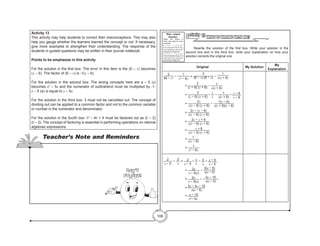
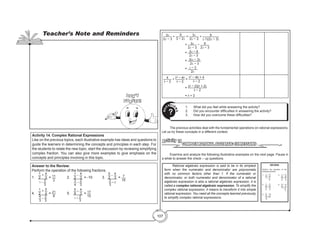
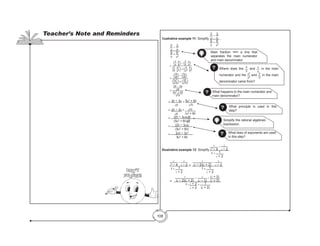
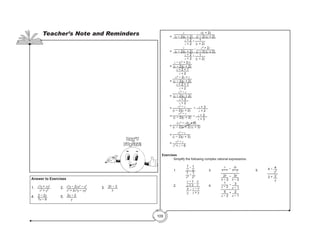
Module 2: Rational Algebraic Expressions and Algebraic Expressions with Integral Exponents
A.	 Learning Outcomes
	 1.	 Grade Level Standard
	 The learner demonstrates understanding of key concepts and principles of algebra, geometry, probability and
statistics as applied, using appropriate technology, in critical thinking, problem solving, reasoning, communicating,
making connections, representations, and decisions in real life.
	 2.	 Content and Performance Standards
		Content Standards:
	 The learner demonstrates understanding of key concepts and principles of rational algebraic expressions and
algebraic expressions with integral exponents.
		Performance Standards:
	 The learner is able to formulate real – life problems involving rational algebraic expressions and algebraic
expressions with integral exponents and solves these with utmost accuracy using a variety of strategies.
63
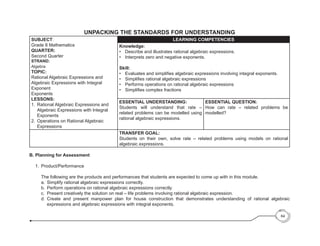
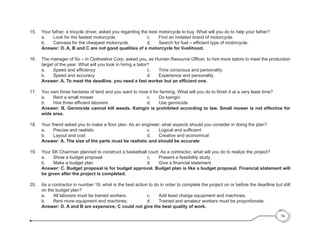
UNPACKING THE STANDARDS FOR UNDERSTANDING
SUBJECT:
Grade 8 Mathematics
QUARTER:
Second Quarter
STRAND:
Algebra
TOPIC:
Rational Algebraic Expressions and
Algebraic Expressions with Integral
Exponent
Exponents
LESSONS:
1.	 Rational Algebraic Expressions and
Algebraic Expressions with Integral
Exponents
2.	 Operations on Rational Algebraic
Expressions
LEARNING COMPETENCIES
Knowledge:
•	 Describe and illustrates rational algebraic expressions.
•	 Interprets zero and negative exponents.
Skill:
•	 Evaluates and simplifies algebraic expressions involving integral exponents.
•	 Simplifies rational algebraic expressions
•	 Performs operations on rational algebraic expressions
•	 Simplifies complex fractions
ESSENTIAL UNDERSTANDING:
Students will understand that rate –
related problems can be modelled using
rational algebraic expressions.
ESSENTIAL QUESTION:
How can rate – related problems be
modelled?
TRANSFER GOAL:
Students on their own, solve rate – related problems using models on rational
algebraic expressions.
B.	Planning for Assessment
1.	Product/Performance
	 The following are the products and performances that students are expected to come up with in this module.
a.	 Simplify rational algebraic expressions correctly.
b.	 Perform operations on rational algebraic expressions correctly.
c.	 Present creatively the solution on real – life problems involving rational algebraic expression.
d.	Create and present manpower plan for house construction that demonstrates understanding of rational algebraic
expressions and algebraic expressions with integral exponents.
64
65
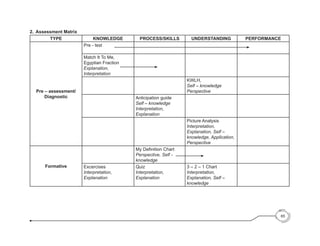
2.	 Assessment Matrix
TYPE KNOWLEDGE PROCESS/SKILLS UNDERSTANDING PERFORMANCE
Pre – assessment/
Diagnostic
Pre - test
Match It To Me,
Egyptian Fraction
Explanation,
Interpretation
KWLH,
Self – knowledge
Perspective
Anticipation guide
Self – knowledge
Interpretation,
Explanation
Picture Analysis
Interpretation,
Explanation, Self –
knowledge, Application,
Perspective
Formative
My Definition Chart
Perspective, Self -
knowledge
Excercises
Interpretation,
Explanation
Quiz
Interpretation,
Explanation
3 – 2 – 1 Chart
Interpretation,
Explanation, Self –
knowledge
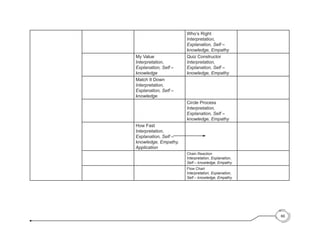
Who’s Right
Interpretation,
Explanation, Self –
knowledge, Empathy
My Value
Interpretation,
Explanation, Self –
knowledge
Quiz Constructor
Interpretation,
Explanation, Self –
knowledge, Empathy
Match It Down
Interpretation,
Explanation, Self –
knowledge
Circle Process
Interpretation,
Explanation, Self –
knowledge, Empathy
How Fast
Interpretation,
Explanation, Self –
knowledge, Empathy,
Application
Chain Reaction
Interpretation, Explanation,
Self – knowledge, Empathy
Flow Chart
Interpretation, Explanation,
Self – knowledge, Empathy
66
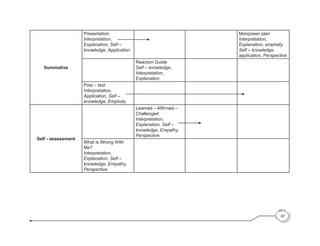
Summative
Presentation
Interpretation,
Explanation, Self –
knowledge, Application
Manpower plan
Interpretation,
Explanation, emphaty,
Self – knowledge,
application, Perspective
Reaction Guide
Self – knowledge,
Interpretation,
Explanation
Post – test
Interpretation,
Application, Self –
knowledge, Emphaty
Self - assessment
Learned – Affirmed –
Challenged
Interpretation,
Explanation, Self –
knowledge, Empathy,
Perspective
What is Wrong With
Me?
Interpretation,
Explanation, Self –
knowledge, Empathy,
Perspective
67
68
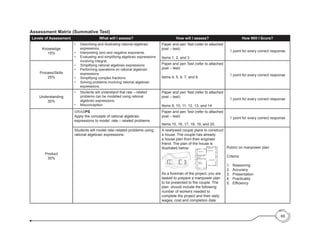
Assessment Matrix (Summative Test)
Levels of Assessment What will I assess? How will I assess? How Will I Score?
Knowledge
15%
•	 Describing and illustrating rational algebraic
expressions.
•	 Interpreting zero and negative exponents.
•	 Evaluating and simplifying algebraic expressions
involving integral.
•	 Simplifying rational algebraic expressions
•	 Performing operations on rational algebraic
expressions
•	 Simplifying complex fractions
•	 Solving problems involving rational algebraic
expressions.
Paper and pen Test (refer to attached
post – test)
Items 1, 2, and 3
1 point for every correct response
Process/Skills
25%
Paper and pen Test (refer to attached
post – test)
Items 4, 5, 6, 7, and 8
1 point for every correct response
Understanding
30%
•	 Students will understand that rate – related
problems can be modelled using rational
algebraic expressions.
•	 Misconception
Paper and pen Test (refer to attached
post – test)
Items 9, 10, 11, 12, 13, and 14
1 point for every correct response
Product
30%
GRASPS
Apply the concepts of rational algebraic
expressions to model rate – related problems
Paper and pen Test (refer to attached
post – test)
Items 15, 16, 17, 18, 19, and 20.
1 point for every correct response
Students will model rate–related problems using
rational algebraic expressions.
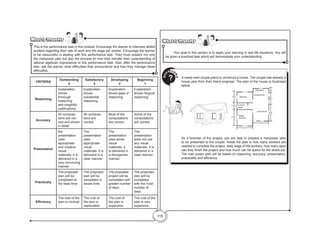
A newlywed couple plans to construct
a house. The couple has already
a house plan from their engineer
friend. The plan of the house is
illustrated below:
As a foreman of the project, you are
tasked to prepare a manpower plan
to be presented to the couple. The
plan should include the following:
number of workers needed to
complete the project and their daily
wages, cost and completion date.
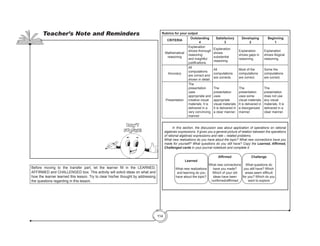
Rubric on manpower plan.
Criteria:
1.	Reasoning
2.	Accuracy
3.	Presentation
4.	Practicality
5.	 Efficiency
3 m
1 m
2 m
2 m
1.5 m
2.5 m
3 m
3 m
Bedroom
Comfort
Room
Master
Bedroom
Living Room
Dining Room
Laboratory
69
C.	 Planning for Teaching-Learning
Introduction:
	 This module covers key concepts of rational algebraic expressions and expressions with integral exponents. This
module is divided into lessons. The first lesson is the introduction to rational algebraic expressions and algebraic expressions
with integral exponents and the second lesson is on operations on rational algebraic expressions.
	 The first lesson will describe the rational algebraic expressions, interpret algebraic expressions with negative and zero
exponents, evaluate and simplify algebraic expressions with integral exponents, and simplify rational algebraic expressions.
In the second lesson, learner will perform operations on rational algebraic expressions, simplifies complex fraction, and solve
problems involving rational algebraic expressions.
	 In this module, learner are given the opportunity to use their prior knowledge and skills in dealing with rational algebraic
expressions and algebraic expressions with integral exponents. They are also given varied activities to process their knowledge
and skills learned and deepen and transfer their understanding of the different lessons.
	 To introduce the lesson, let the students reflect on the introduction and focus questions in the learner’s guide.
INTRODUCTION AND FOCUS QUESTIONS:
	 You have learned special products and factoring polynomials in Module 1. Your knowledge on these will help you better
understand the lessons in this module.
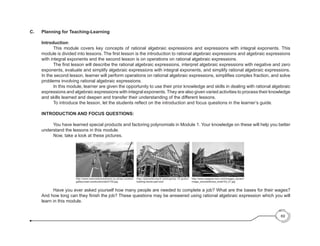
	 Now, take a look at these pictures.
	 Have you ever asked yourself how many people are needed to complete a job? What are the bases for their wages?
And how long can they finish the job? These questions may be answered using rational algebraic expression which you will
learn in this module.
http://www.waagner-biro.com/images_dynam/
image_zoomed/korea_small103_01.jpg
http://www.newroadcontractors.co.uk/wp-content/
gallery/road-construction/dscf1702.jpg
http://planetforward.ca/blog/top-10-green-
building-trends-part-one/
70
	 After you finished the module, you should be able to answer the following questions:
		 a.	 What is a rational algebraic expression?
		 b.	 How will you simplify rational algebraic expressions?
		 c.	 How will you perform operations on rational algebraic expressions?
		d.	 How will you model rate – related problems?
Objectives:
	 At the end of the module, learner will be able to:
		 1.	 describe and illustrate rational algebraic expressions.
	 	 2.	 interpret zero and negative exponents.
		 3.	 evaluate and simplify algebraic expressions involving integral exponents.
	 	 4.	 simplifie rational algebraic expressions
		 5.	 perform operations on rational algebraic expressions.
	 	 6.	 simplifie complex fractions.
		 7.	 solve problems involving rational algebraic expressions.
Pre – test
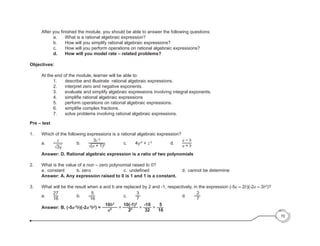
1.	 Which of the following expressions is a rational algebraic expression?
		a.		
x
√3y
			b.		
3c-3
√(a + 1)0				c.		4y-2
+ z-3
				d.		
a − b
a + b
	
	 Answer: D. Rational algebraic expression is a ratio of two polynomials
2.	 What is the value of a non – zero polynomial raised to 0?
	 	 a.	 constant		 	 b. zer	
o	 	 	 	 	 	 c. 	undefined	 	 	 	 	 	 d. 	cannot be determine
	 Answer: A. Any expression raised to 0 is 1 and 1 is a constant.
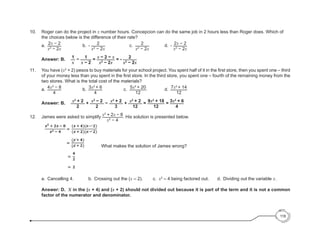
3.	 What will be the result when a and b are replaced by 2 and -1, respectively, in the expression (-5a – 2b)(-2a – 3b2
)?
		a.		
27
16
				b.		-
5
16
					c.		
3
7
								d.		-
2
7
	
	 Answer: B. (-5a-2
b)(-2a-3
b2
) =
10b3
a5 =
10(-1)3
25 =
-10
32
= -
5
16
71
	
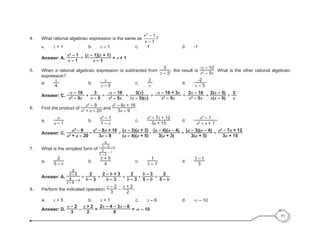
4.	 What rational algebraic expression is the same as ?
		a.		 x + 1					b.		x – 1					c.		1						d.		-1
		Answer: A.
x2
– 1
x – 1
=
(x – 1)(x + 1)
x – 1
= x + 1
5.	 When a rational algebraic expression is subtracted from
3
x – 5
, the result is
-x – 10
x2
– 5x
. What is the other rational algebraic
expression?
	a.	
x
4
			b.	
x
x – 5
			c.	
2
x
			d. 	
-2
x – 5
Answer: C.
-x – 10
x2
– 5x
+
3
x – 5
=
-x – 10
x2
– 5x
+
3(x)
(x – 5)(x)
=
-x – 10 + 3x
x2
– 5x
=
2x – 10
x2
– 5x
=
2(x – 5)
x(x – 5)
=
2
x
6.	 Find the product of
a2
– 9
a2
+ a – 20
and
a2
– 8a + 16
3a – 9
.
	a.	
a
a – 1
			b.	
a2
– 1
1 – a
			c. 	
a2
– 7a + 12
3a + 15
	 d. 	
a2
– 1
a2
– a + 1
	 Answer: C.
a2
– 9
a2
+ a – 20
•
a2
– 8a + 16
3a – 9
=
(a – 3)(a + 3)
(a – 4)(a + 5)
•
(a – 4)(a – 4)
3(a + 3)
=
(a – 3)(a – 4)
3(a + 5)
=
a2
– 7a + 12
3a + 15
7. 	 What is the simplest form of
2
b – 3
2
b – 3
– 1
?
	a.	
2
5 – b
	 		 b. 	
b + 5
4
	 		 c. 	
1
b – 1
	 		 d. 	
1 – b
3
	 Answer: A.
2
b – 3
2
b – 3
– 1
=
2
b – 3
÷
2 – b + 3
b – 3
=
2
b – 3
•
b – 3
5 – b
=
2
5 – b
8. 	 Perform the indicated operation
x – 2
3
–
x + 2
2
.
	 a. 	 x + 5 		 b. 	 x + 1 		 c. 	 x – 6 			 d. 	 -x – 10
	 Answer: D.
x – 2
3
–
x + 2
2
=
2x – 4 – 3x – 6
6
= -x – 10
72
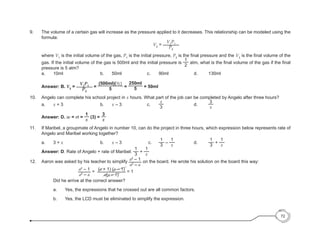
9. 	 The volume of a certain gas will increase as the pressure applied to it decreases. This relationship can be modeled using the
formula:
	 V2
=
V1
P1
P2
	where V1
is the initial volume of the gas, P1
is the initial pressure, P2
is the final pressure and the V2
is the final volume of the
gas. If the initial volume of the gas is 500ml and the initial pressure is
1
2
atm, what is the final volume of the gas if the final
pressure is 5 atm?
	a.	
10ml 			b. 	
50ml			c. 	
90ml			d. 	
130ml
	 Answer: B. V2
=
V1
P1
P2
=
(500ml)(1/2)
5
=
250ml
5 = 50ml
10. 	 Angelo can complete his school project in x hours. What part of the job can be completed by Angelo after three hours?
	 a. 	 x + 3			 	 b. 	 x – 3	 		 c. 	
x
3
			 d. 	
3
x
	 Answer: D. w = rt =
1
x
(3) =
3
x
11. 	 If Maribel, a groupmate of Angelo in number 10, can do the project in three hours, which expression below represents rate of
Angelo and Maribel working together?
	 a.	 3 + x 			 b. 	 x – 3 	 	 c.	
1
3
–
1
x
	 	 d. 	
1
3
+
1
x
	 Answer: D. Rate of Angelo + rate of Maribel:
1
3
+
1
x
12. 	 Aaron was asked by his teacher to simplify
a2
– 1
a2
– a
on the board. He wrote his solution on the board this way:
			
a2
– 1
a2
– a
=
(a + 1) (a – 1)
a(a – 1)
= 1
	 Did he arrive at the correct answer?
	 a. 	 Yes, the expressions that he crossed out are all common factors.
	 b. 	 Yes, the LCD must be eliminated to simplify the expression.
c. 	 No, a2
must be cancelled out so that the answer is
1
a
.
	 d. 	 No, a is not a common factor of numerator
	 Answer: D. In simplifying rational algebraic expression, we can only divide out the common factor but not the
common variable.
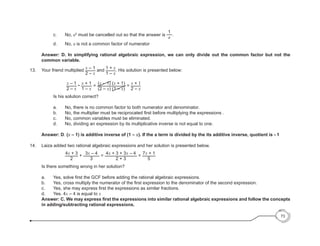
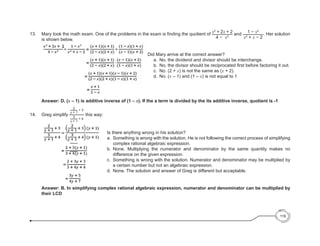
13.	 Your friend multiplied
x – 1
2 – x
and
1 + x
1 – x
. His solution is presented below:
			
x – 1
2 – x
•
x + 1
1 – x
=
(x – 1) (x + 1)
(2 – x) (1 – x)
=
x + 1
2 – x
		 Is his solution correct?
		 a.	 No, there is no common factor to both numerator and denominator.
	 	 b.	 No, the multiplier must be reciprocated first before multiplying the expressions .
		 c.	 No, common variables must be eliminated.
	 	 d.	 No, dividing an expression by its multiplicative inverse is not equal to one.
	 Answer: D. (x – 1) is additive inverse of (1 – x). If the a term is divided by the its additive inverse, quotient is - 1
14. 	 Laiza added two rational algebraic expressions and her solution is presented below.
			
4x + 3
2
+
3x – 4
3
=
4x + 3 + 3x – 4
2 + 3
=
7x + 1
5
	 Is there something wrong in her solution?
	 a. 	 Yes, solve first the GCF before adding the rational algebraic expressions.
	 b. 	 Yes, cross multiply the numerator of the first expression to the denominator of the second expression.
	 c.	 Yes, she may express first the expressions as similar fractions.
	 d.	 Yes. 4x – 4 is equal to x
	 Answer: C. We may express first the expressions into similar rational algebraic expressions and follow the concepts
in adding/subtracting rational expressions.
73
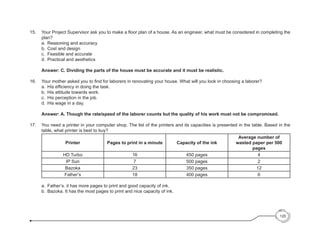
15. 	 Your father, a tricycle driver, asked you regarding the best motorcycle to buy. What will you do to help your father?
	 a. 	 Look for the fastest motorcycle. 			 c. 	 Find an imitated brand of motorcycle.
	 b. 	 Canvass for the cheapest motorcycle. 	 	 d. 	 Search for fuel – efficient type of motorcycle.
	 Answer: D. A, B and C are not good qualities of a motorcycle for livelihood.
16. 	 The manager of So – In Clothesline Corp. asked you, as Human Resource Officer, to hire more tailors to meet the production
target of the year. What will you look in hiring a tailor?
	 a. 	 Speed and efficiency 	 	 	 	 	 c. 	 Time conscious and personality
	 b. 	 Speed and accuracy 					 d. 	 Experience and personality
	 Answer: A. To meet the deadline, you need a fast worker but an efficient one.
17. 	 You own three hectares of land and you want to mow it for farming. What will you do to finish it at a very least time?
	 a. 	 Rent a small mower 	 	 	 	 	 c. 	 Do kaingin
	 b. 	 Hire three efficient laborers 	 	 	 	 d. 	 Use germicide
	 Answer: B. Germicide cannot kill weeds. Kaingin is prohibited according to law. Small mower is not effective for
wide area.
18. 	 Your friend asked you to make a floor plan. As an engineer, what aspects should you consider in doing the plan?
	 a. 	 Precise and realistic 	 	 	 	 	 c. 	 Logical and sufficient
	 b. 	 Layout and cost 						 d. 	 Creative and economical
	 Answer: A. The size of the parts must be realistic and should be accurate
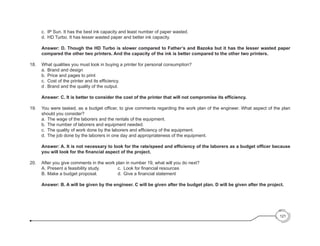
19. 	 Your SK Chairman planned to construct a basketball court. As a contractor, what will you do to realize the project?
	 a. 	 Show a budget proposal				 c. 	 Present a feasibility study
	 b.	 Make a budget plan	 	 	 	 	 d. 	 Give a financial statement
	 Answer: C. Budget proposal is for budget approval. Budget plan is like a budget proposal. Financial statement will
be given after the project is completed.
20. 	 As a contractor in number 19, what is the best action to do in order to complete the project on or before the deadline but still
on the budget plan?
	 a. 	 All laborers must be trained workers.	 	 c. 	 Add least charge equipment and machines.
	 b. 	 Rent more equipment and machines.	 	 d. 	 Trained and amateur workers must be proportionate.
	 Answer: D. A and B are expensive; C could not give the best quality of work.
74
75
Learning Goals and Targets:
	 In this module, learners will have the following targets:
•	 Demonstrate understanding of the key concepts of rational algebraic expressions and algebraic expressions with
integral and zero exponents.
•	 Formulate real–life problems involving rational algebraic expressions and algebraic expressions with integral and zero
exponents and solve these with utmost accuracy using a variety of strategies.
Teacher’s Note and Reminders
Don’t
Forget!
76
What to Know
What to Know
Activity 1 elicits prior knowledge of the learner in translating verbal
phrases to mathematical phrases which is one of the key concepts that
the student should learned in solving word problems in algebra. The result
of this activity may become a benchmark on how to start facilitating word
problems later on.
Aside from that, this also assesses the learner regarding the concepts
in polynomial. They should have a firm background regarding concepts in
polynomial for rational algebraic expression.
Answers Key
Activity 1
1.	
x
4
+ 2	 	 2.	 √3y		 3. 	 a2
+ 2a		 4. 	 b2
– (b+2)		 5.	
pq
3
6. 	
c2
3
			7. 	
10y + 6	 8. 	 z3
– 9		 9. 	 w – √9			10. h4
1
1 Rational Algebraic
Expressions
What to Know
What to Know
	 Let’s begin the lesson by reviewing some of the previous lessons and gathering
your thoughts in the lesson.
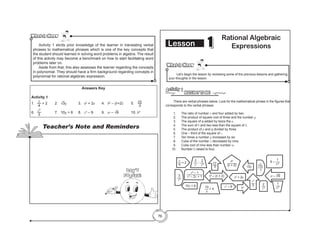
MATCH IT TO ME
Activity 1
	 There are verbal phrases below. Look for the mathematical phrase in the figures that
corresponds to the verbal phrases.
1.	 The ratio of number x and four added by two.
2.	 The product of square root of three and the number y.
3.	 The square of a added by twice the a.
4.	 The sum of b and two less than the square of b.
5.	 The product of p and q divided by three
6.	 One – third of the square of c.
7.	 Ten times a number y increased by six
8.	 Cube of the number z decreased by nine.
9.	 Cube root of nine less than number w.
10.	Number h raised to four.	
Lesson
x
4
pq
3
2
x
–
2
x2
3
c2
x2
– 1
x2
– 2x + 1
10x + 6
b2
– (b + 2) a2
+ 2a
+ 4
10
y
b2
(b + 2) √3y √3y
y
+ 2
1
w2
9 –
w – ∛9
1
n3
2
z3
c2
3
z3
– 9 h4
Teacher’s Note and Reminders
Don’t
Forget!
77
Activity 2 How Fast
The learner is not expected to have correct answers in this activity. The aim
of this activity is to find out whether he/she has a background on rational
algebraic expressions applied in a real-life situation. The response to this
activity could help the teaching – learning process more efficient and effective
as basis for teaching – learning process. The answers may be written in a
clean sheet of paper.
Q
U
ESTIO
N
S
?
1.	 What did you feel in translating verbal phrases to mathematical
phases?
2.	 What must be considered in translating verbal phases to
mathematical phrases?
3.	 Will you consider these mathematical phases as polynomial?
Why yes or why not?
4.	 How will you describe a polynomial?
	 The above activity deals with translating verbal phrases to polynomial and you
encountered some of the examples of non - polynomials. Translating verbal phases to
polynomial is one of the key concepts in answering worded problem.
	 All polynomials are expressions but not all expressions are polynomials. In this
lesson you will encounter some of these expressions that are not polynomials.
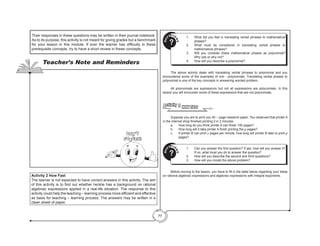
HOW FAST
Activity 2
	 Suppose you are to print you 40 – page research paper. You observed that printer A
in the internet shop finished printing it in 2 minutes.
	 a.	 How long do you think printer A can finish 100 pages?
	 b.	 How long will it take printer A finish printing the p pages?
	 c.	 If printer B can print x pages per minute, how long will printer B take to print p
pages?
Q
U
ESTIO
N
S
?
1.	 Can you answer the first question? If yes, how will you answer it?
If no, what must you do to answer the question?
2.	 How will you describe the second and third questions?
3.	 How will you model the above problem?
	 Before moving to the lesson, you have to fill in the table below regarding your ideas
on rational algebraic expressions and algebraic expressions with integral exponents.
Their responses in these questions may be written in their journal notebook.
As to its purpose, this activity is not meant for giving grades but a benchmark
for your lesson in this module. If ever the learner has difficulty in these
prerequisite concepts, try to have a short review in these concepts.
Teacher’s Note and Reminders
Don’t
Forget!
78
KWLH
Activity 3
	 Write your ideas on the rational algebraic expressions and algebraic expressions
with integral exponents. Answer the unshaded portion of the table and submit it to your
teacher.
What I Know What I Want to
Find Out
What I Learned How Can I Learn
More
	 You were engaged in some of the concepts in the lesson but there are questions
in your mind. The next lessons will answer your queries and clarify your thoughts
regarding to our lesson.
What to Process
What to Process
	 Your goal in this section is to learn and understand the key concepts on rational
algebraic expressions and algebraic expressions with integral exponents.
	 As the concepts on rational algebraic expressions and algebraic expressions
with integral exponents become clear to you through the succeeding activities, do not
forget to think about how to apply these concepts in real – life problems especially
rate – related problems.
MATCH IT TO ME – REVISITED
(REFER TO ACTIVITY 1)
Activity 4
1.	 What are the polynomials in the activity “Match It To Me”? List these polynomials
under set P.
2.	 Describe these polynomials.
3.	 In the activity, which are not polynomials? List these non – polynomials under set R.
4.	 How do these non – polynomials differ from the polynomial?
5.	 Describe these non – polynomials.
MAP OF CONCEPTUAL CHANGE
Activity 3: KWHL
Aside from Activity 2, KWHL is also an activity eliciting the background of
the learner regarding the rational algebraic expressions. He/She could use
his/her understanding in activity 2 in doing this activity. Keep their response
because at the end of this lesson, they will continue to answer this activity
to track their learning.
Activity 4: Match It to Me – Revisited
Going back to activity 1, let them distinguish the polynomials from the
non–polynomials in this activity by describing it. Give emphasis on the
non–polynomial examples in the activity. Remind them that these non–
polynomials in the activity are not the only non–polynomials. Be guided
that these non–polynomials are just rational expressions and that not all
non–polynomials are rational algebraic expressions.
What to Process
What to Process
Topic: Introduction to Rational Algebraic Expressions
Teacher’s Note and Reminders
Don’t
Forget!
79
Activity 5: Compare and Contrast
As they describe the polynomials and non–polynomials in Activity 4, they will
summarize their work by completing the given graphic organizer. This activity
will enable them to describe rational algebraic expressions and distinguish
it from polynomials. The learner may present his/her output to the class but
this is not meant for rating the learner. This activity will guide the learner to
describe the rational algebraic expressions. After the presentation, discuss
that these non–polynomials are rational algebraic expressions. This activity
may be done individually or by group.
COMPARE AND CONTRAST
Activity 5
	 Use your answers in the activity “Match It To Me – Revisited” to complete the
graphic organizer compare and contrast. Write the similarities and differences between
polynomials and non – polynomials in the first activity.
POLYNOMIALS
NON -
POLYNOMIALS
How Alike?
How Different?
In terms of ...
____________________________________
____________________________________
____________________________________
____________
______________________
______________________
______________________
______________________
______________________
________________
______________________
______________________
______________________
______________________
______________________
________________
_________________
_________________
_________________
_________________
_________________
_________________
_________________
_______
	 In the activity “Match It to Me”, the non – polynomials are called rational algebraic
expressions. Your observations regarding the difference between polynomials and
non – polynomials in activities 4 and 5 are the descriptions of rational expression. Now,
can you define rational algebraic expressions? Write your own definition about rational
algebraic expressions in the chart below.
Teacher’s Note and Reminders
Don’t
Forget!
80
MY DEFINITION CHART
Activity 6
	 Write your initial definition on rational algebraic expressions in the appropriate box.
Your final definition will be written after some activities.
	 Try to firm up your own definition regarding the rational algebraic expressions by
doing the next activity.
CLASSIFY ME
Activity 7
	 Classify the different expressions below into rational algebraic expression or not
rational algebraic expression. Write the expression into the appropriate column.
m + 2
√2	
c4
√5	
k
3k2 – 6k
y + 2
y – 2
a
y2
– x9
c
a – 2
1 – m
m3
1
a6
8
Rational Algebraic
Expressions
Not Rational
Algebraic
Expressions
_____________________________________
_____________________________________
______________________________________
_____________________________________
My Initial
Definition
_________________________________
_____________________________________
_____________________________________
______________________________________
_____________________________________
My Final
Definition
Q
U
ESTIO
N
S
?
1.	 How many expressions did you place in the rational algebraic
expression column?
2.	 How many expressions did you placed in the not rational algebraic
expression column?
3.	 How did you classify a rational algebraic expression from a not
rational algebraic expression?
4.	 Were you able to place each expression to its appropriate column?
5.	 What difficulty did you encounter in classifying the expressions?
Activity 6: My Definition Chart
After they have described the rational algebraic expressions, let them define
rational algebraic expression on their own. Their response may be different
from the axiomatic definition of rational algebraic expressions but let it be.
The purpose of this activity is to generate their ideas on rational algebraic
expressions based on the examples and illustrations of rational algebraic
expressions given. They can exchange their initial definitions with their
classmates and discuss how they are alike or different.
Activity 7: Classify Me
m + 2
√2
and c4
√5
are the only expressions that belong to the Not Rational
Algebraic Expressions column. After they classify the expressions, let them
describe the expressions in each column and compare and contrast the
expressions in the two columns. This activity may guide them in formulating
definition similar to the axiomatic definition of rational algebraic expressions.
3
Teacher’s Note and Reminders
Don’t
Forget!
81
Activity 8: My Definition Chart - Continuation
After Activity 7, they can now finalize their initial definitions on rational
algebraic expressions. Let them exchange their final definition and discuss
it with their classmate. In this stage, you can discuss further if there are
questions that need to be answered.
Process their final definition. You may give emphasis on the axiomatic
definition of rational algebraic expression. After they defined rational
algebraic expressions, let them illustrate it and give at least three examples.
You can discuss rational algebraic expression for clarification purposes.
Mathematical Investigation: Learner may investigate the concept,
“polynomial divided by zero”. Ask the learner why the denominator should not
be equal to zero. Let him/her investigate the clue given. You can give more
clues if needed to generate the pattern and will lead them to the concept of
undefined numbers.
	 In the previous activities, there might be some confusions to you regarding
rational algebraic expressions, but this activity firmed up your idea regarding rational
algebraic expressions. Now, put into words your final definition on rational algebraic
expression.
MY DEFINITION CHART
Activity 8
Write your final definition on rational algebraic expressions in the appropriate box.
______________________________________
______________________________________
______________________________________
_____
My Initial
Definition
______________________________________
______________________________________
______________________________________
_____
My Final
Definition
	 Compare your initial definition and your final definition on rational algebraic
expressions. Is your final definition clears your confusions? How? Give at least 3
rational algebraic expressions differ from your classmate.
Remember:
	 Rational algebraic expression is a ratio of two polynomials
provided that the numerator is not equal to zero. In symbols: P
Q
,where P and Q are polynomials and Q ≠ 0.
	 In the activities above, you had encountered the rational algebraic expressions. You
might encounter some algebraic expressions with negative or zero exponents. In the next
activities, you will define the meaning of algebraic expressions with integral exponents
including negative and zero exponents .
MATH DETECTIVE
Rational algebraic
expression is a ratio of
two polynomials where the
denominator is not equal
to zero. What will happen
when the denominator of
a fraction becomes zero?
Clue: Start investigating in
4
2
= 2 ≫≫ 4 = (2)(2) 4
1
= 4
≫≫ 4 = (1)(4)
Teacher’s Note and Reminders
Don’t
Forget!
82
LET THE PATTERN ANSWER IT
Activity 9
	 Complete the table below and observe the pattern.
A B A B C A B C A B
2•2•2•2•2 25
3•3•3•3•3 35
243 4•4•4•4•4 45
1,024 x•x•x•x•x x5
2•2•2•2 3•3•3•3 4•4•4•4 x•x•x•x
2•2•2 3•3•3 4•4•4 x•x•x
2•2 3•3 4•4 x•x
2 3 4 x
RECALL
LAWS OF
EXPONENTS
I – Product of Powers
	If the expressions
multiplied have the same base,
add the exponents.
		xa
•xb
= xa+b
II – Power of a Power
	 If the expression raised to
a number is raised by another
number, multiply the exponents.
		(xa
)b
= xab
III – Power of a Product
	 If the multiplied expressions
is raised by a number, multiply
the exponents then multiply the
expressions.
	(xa
yb
)c
= xac
ybc
	 (xy)a
= xa
ya
IV – Quotient of Power
	 If the ratio of two
expressions is raised to a
number, then
Case I.	 xa
xb
= xa-b
, where a > b
Case II.	 xa
xb
= 1
xb-a
, where a < b
Q
U
ESTIO
N
S
?
1.	 What do you observe as you answer the column B?
2.	 What do you observe as you answer the column C?
3.	 What happens to its value when the exponent decreases?
4.	 In the column B, how is the value in the each cell/box related to its
upper or lower cell/box?
	 Now, use your observations in the activity above to complete the table below.
A B A B A B A B
25
32 35
243 45
1,024 x5
x•x•x•x•x
24
34
44
x4
23
33
43
x3
22
32
42
x2
2 3 4 x
20
30
40
x0
2-1
3-1
4-1
x-1
2-2
3-2
4-2
x-2
2-3
3-3
4-3
x-3
Before moving to the next activity, review the laws of exponents
Teacher’s Note and Reminders
Activity 9: Let the Pattern Answer It
This activity will serve as a review on laws of exponents. Let the learner
complete the table to recall the concept on laws of exponents. Let the learner
examine and analyze the pattern in this activity.
The pattern in this activity: the first row under in column III is divided by the
base of the expression.
This activity may be done by group or individual work.
Activity 9: Let the Pattern Answer It
Based on the pattern that they observe in the first table in this activity, let them
complete the table. This will enable the learner to interpret the expressions
with negative exponents. He/she will discover that the implication of negative
exponents is the multiplicative inverse of the expression.
Don’t
Forget!
83
MAP OF CONCEPTUAL CHANGE
Activity 10: 3 – 2 – 1 Chart
Before moving to the next lesson, the learner should complete the 3 – 2 – 1
chart. This activity will give the learner a chance to summarize the key concepts
in algebraic expressions with integral exponents. Address the question of the
learner before moving to the next activity.
Q
U
ESTIO
N
S
?
1.	 What do you observe as you answer the column A?
2.	 What do you observe as you answer the column B?
3.	 What happen to its value when the exponent decreases?
4.	 In the column A, how is the value in the each cell/box related to its
upper or lower cell/box?
5.	 What do you observe when the number has zero exponent?
6.	 Do you think that when a number raised to zero is the same to
another number raised to zero? Justify your answer.
7.	 What do you observe to the value of the number raised to a
negative integer?
8.	 What can you say about an expression with negative integral
exponent?
9.	 Do you think it is true to all numbers? Cite some examples?
Exercises
	 Rewrite each item to expressions with positive exponents.
3 – 2 – 1 CHART
Activity 10
	 Complete the chart below.
____________________________________________________________________________________
________________________________________________________________________________
_____________________________________________________________________________
_________________________________________________________________________
_____________________________________________________________________
____________________________________________________
______________________________________________________
___________________________________________________
_______________________________________________
___________________________________________
_______________________________________
____________________________________
_________________________
________________________
____________________
________________
____________
_________
_____
3 things you
found out
1 question
you still
have
2 interesting
things
	1.	
b-4
				5.	
de-5
f				9.	
l0
p0 	
	2.	
c-2
d-8 				6. 	
x + y
(x – y)0
			10.
2
(a – b+c)0
		
	3.	
w-3
z-2
			7.	
( (
a6
b8
c10
a5
b2
e8
0
	
	4.	
n2
m-2
o			8. 	
14t0
Teacher’s Note and Reminders
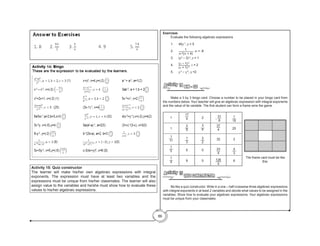
Answer to Exercises
1.	 1
b4
			2.	
d8
c2
			3.	
1
b4
			4.	
no
m2
			5.	
df
e5
	
6.	 x + y		7.	
1			8.	
14			9.	
1			10.	
2
Don’t
Forget!
84
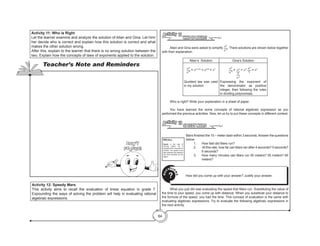
Activity 11: Who is Right
Let the learner examine and analyze the solution of Allan and Gina. Let him/
her decide who is correct and explain how this solution is correct and what
makes the other solution wrong.
After this, explain to the learner that there is no wrong solution between the
two. Explain how the concepts of laws of exponents applied to the solution.
Activity 12: Speedy Mars
This activity aims to recall the evaluation of linear equation in grade 7.
Expounding the ways of solving the problem will help in evaluating rational
algebraic expressions.
Teacher’s Note and Reminders
Don’t
Forget!
WHO IS RIGHT?
Activity 11
	 Allan and Gina were asked to simplify n3
n-4
. There solutions are shown below together
with their explanation.
Allan’s Solution Gina’s Solution
n3
n-4
= n3–(-4)
= n3+4
= n7
Quotient law was used
in my solution
n3
n-4
= n3
1
n-4
= n3 n4
1
= n7
Expressing the exponent of
the denominator as positive
integer, then following the rules
in dividing polynomials.
	 Who is right? Write your explanation in a sheet of paper.
	 You have learned the some concepts of rational algebraic expression as you
performed the previous activities. Now, let us try to put these concepts in different context.
SPEEDY MARS
Activity 12
	 Mars finished the 15 – meter dash within 3 seconds.Answer the questions
below.
1.	 How fast did Mars run?
2.	 At this rate, how far can Mars ran after 4 seconds? 5 seconds?
6 seconds?
3.	 How many minutes can Mars run 50 meters? 55 meters? 60
meters?
Q
U
ESTIO
N
S
? 	 How did you come up with your answer? Justify your answer.
	 What you just did was evaluating the speed that Mars run. Substituting the value of
the time to your speed, you come up with distance. When you substitute your distance to
the formula of the speed, you had the time. This concept of evaluation is the same with
evaluating algebraic expressions. Try to evaluate the following algebraic expressions in
the next activity.
RECALL
Speed is the rate of
moving object as it
transfers from one point to
another. The speed is the
ratio between the distance
and time travelled by the
object.
85
Activity 13. My Value (Answer)
You can discuss the examples in this activity to the class and give more
examples, if necessary. The activity may be done in group or individual.
a2
+ b3
----- 32
+ 43 = 73
a-2
b-3 ------
27
4
		 a-1
b0
-
1
4
-----22
+ 43 = 68	 ------
8
9
MY VALUE
Activity 13
	 Find the value of each expression below by evaluation.
My
Expression
Value of a Value of b My solution My
Value
a2
+ b3
2 3 Example:
a2
+ b2
	 = 22
+ 33
			 = 4 + 9
			= 13
13
3 4 Your solution here:
2 4
a-2
b-3 -2 3
Example:
a-2
b-3 =
(-2)-2
3-3
	=
33
(-2)2 	
	= 27
4
27
4
a-2
b-3 3 2
Your solution here
a-1
b0
2 3
Q
U
ESTIO
N
S
? 1.	 What have you observed in the solution of the examples?
2.	 How these examples help you to find the value of the expression?
3.	 How did you find the value of the expression?
Teacher’s Note and Reminders
Don’t
Forget!
86
Exercises	
	 Evaluate the following algebraic expressions
	 1.	40y-1
, y = 5
	2.	 1
m-2
(m + 4)
, m = -8
	 3.	(p2
– 3)-2
, p = 1
	4.	
(x – 1)-2
(x + 1)-2
, x = 2
	5.	
y-3
– y-2
, y =2
BIN - GO
Activity 14
	 Make a 3 by 3 bingo card. Choose a number to be placed in your bingo card from
the numbers below. Your teacher will give an algebraic expression with integral exponents
and the value of its variable. The first student can form a frame wins the game.
		
1
17
4 2 -
31
8
1
15
1
2
9
3
4
37
4 25
1
11
1
3
3
2
32 2
1
5 5 0 23
4
4
3
1
4 9 0 126
5
6
QUIZ CONSTRUCTOR
Activity 15
	 Be like a quiz constructor. Write in a one – half crosswise three algebraic expressions
with integral exponents in at least 2 variables and decide what values to be assigned in the
variables. Show how to evaluate your algebraic expressions. Your algebraic expressions
must be unique from your classmates.
The frame card must be like
this:
Activity 15: Quiz constructor
The learner will make his/her own algebraic expressions with integral
exponents. The expression must have at least two variables and the
expressions must be unique from his/her classmates. The learner will also
assign value to the variables and he/she must show how to evaluate these
values to his/her algebraic expressions.
14
87
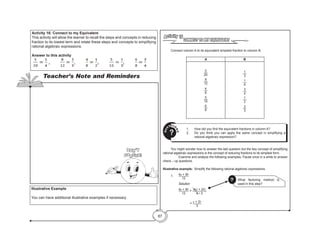
Activity 16: Connect to my Equivalent
This activity will allow the learner to recall the steps and concepts in reducing
fraction to its lowest term and relate these steps and concepts to simplifying
rational algebraic expressions.
Answer to this activity
Illustrative Example
You can have additional illustrative examples if necessary.
CONNECT TO MY EQUIVALENT
Activity 16
	 Connect column A to its equivalent simplest fraction to column B.
A B
5
20
8
12
4
8
5
15
6
8
1
3
1
4
3
4
1
2
2
3
Q
U
ESTIO
N
S
?
1.	 How did you find the equivalent fractions in column A?
2.	 Do you think you can apply the same concept in simplifying a
rational algebraic expression?
	
	 You might wonder how to answer the last question but the key concept of simplifying
rational algebraic expressions is the concept of reducing fractions to its simplest form. 	
	 	 Examine and analyze the following examples. Pause once in a while to answer
check – up questions.
Illustrative example:	 Simplify the following rational algebraic expressions.
	1.	
4a + 8b
12
		Solution
		4a + 8b
12
= 4(a + 2b)
4 • 3
			 = a + 2b
3
? What factoring method is
used in this step?
Teacher’s Note and Reminders
Don’t
Forget!
88
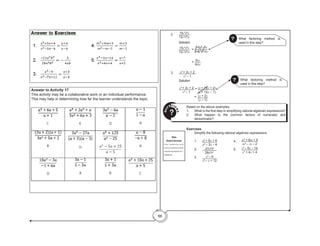
Answer to Activity 17
This activity may be a collaborative work or an individual performance.
This may help in determining how far the learner understands the topic.
	2.	
15c3
d4
e
12c2
d5
w
		Solution
		 15c3
d4
e
12c2
d5
w
=
3•5c2
cd4
e
3•4c2
d4
dw
			 = 5ce
4dw
	3.	
x2
+ 3x + 2
x2
– 1
		Solution
		 x2
+ 3x + 2
x2
– 1
= (x + 1)(x + 2)
(x + 1)(x – 1)
			 = (x + 2)
(x – 1)
Q
U
ESTIO
N
S
?
Based on the above examples,
1.	 What is the first step in simplifying rational algebraic expressions?
2.	 What happen to the common factors of numerator and
denominator?
Exercises	
	 Simplify the following rational algebraic expressions
	1.	
y2
+ 5x + 4
y2
– 3x – 4
		 4. 	 m2
+ 6m + 5
m2
– m – 2
	2.	-21a2
b2
28a3
b3
			5. 	
x2
– 5x – 14
x2
+ 4x + 4
	3.	 x2
– 9
x2
– x + 12
? What factoring method is
used in this step?
? What factoring method is
used in this step?
Web
Based Booster
http://mathvids.com/
lesson/mathhelp/845-
rational-expressions-2---
simplifying
7
89
CONCEPTUAL CHANGE
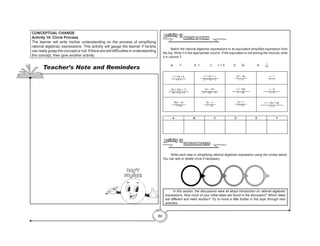
Activity 18. Circle Process
The learner will write his/her understanding on the process of simplifying
rational algebraic expressions. This activity will gauge the learner if he/she
can really grasp the concept or not. If there are still difficulties in understanding
the concept, then give another activity.
Teacher’s Note and Reminders
Don’t
Forget!
MATCH IT DOWN
Activity 17
	 Match the rational algebraic expressions to its equivalent simplified expression from
the top. Write it in the appropriate column. If the equivalent is not among the choices, write
it in column F.
	a.	
-1		b. 1		c. 	
a + 5		 d. 	 3a		 e. 	 a
3
a2
+ 6a + 5
a + 1
a3
+ 2a2
+ a
3a2
+ 6a + 3
3a2
– 6a
a – 2
a – 1
1 – a
(3a + 2)(a + 1)
3a2
+ 5a + 2
3a3
– 27a
(a + 3)(a – 3)
a3
+ 125
a2
– 25
a – 8
-a + 8
18a2
– 3a
-1+ 6a
3a – 1
1 – 3a
3a + 1
1 + 3a
a2
+ 10a + 25
a + 5
A B C D E F
CIRCLE PROCESS
Activity 18
	 Write each step in simplifying rational algebraic expression using the circles below.
You can add or delete circle if necessary.
	 In this section, the discussions were all about introduction on rational algebraic
expressions. How much of your initial ideas are found in the discussion? Which ideas
are different and need revision? Try to move a little further in this topic through next
activities.
90
What to Understand
What to Understand
	 Your goal in this section is to relate the operations of rational expressions to
a real – life problems, especially the rate problems.
What to Understand
What to Understand
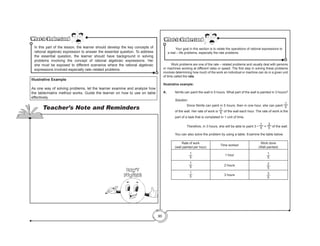
In this part of the lesson, the learner should develop the key concepts of
rational algebraic expression to answer the essential question. To address
the essential question, the learner should have background in solving
problems involving the concept of rational algebraic expressions. He/
she must be exposed to different scenarios where the rational algebraic
expressions involved especially rate–related problems
	 Work problems are one of the rate – related problems and usually deal with persons
or machines working at different rates or speed. The first step in solving these problems
involves determining how much of the work an individual or machine can do in a given unit
of time called the rate.
Illustrative example:
A.	 Nimfa can paint the wall in 5 hours. What part of the wall is painted in 3 hours?
	 Solution:
	 Since Nimfa can paint in 5 hours, then in one hour, she can paint
1
5
of the wall. Her rate of work is
1
5 of the wall each hour. The rate of work is the
part of a task that is completed in 1 unit of time.
	 Therefore, in 3 hours, she will be able to paint 3 •
1
5 =
3
5 of the wall.
You can also solve the problem by using a table. Examine the table below.
Rate of work
(wall painted per hour)
Time worked
Work done
(Wall painted)
1
5
1 hour 1
5
1
5 2 hours 2
5
1
5 3 hours 3
5
Illustrative Example
As one way of solving problems, let the learner examine and analyze how
the table/matrix method works. Guide the learner on how to use on table
effectively.
Teacher’s Note and Reminders
Don’t
Forget!
91
Activity 19: How Fast 2 - Revisited
Learner will fill in necessary data in this table. This will assess the learner
if he/she grasps the concept of rational algebraic expressions in different
context.
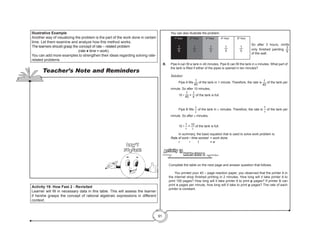
	 You can also illustrate the problem.
			 			
B.	 Pipe A can fill a tank in 40 minutes. Pipe B can fill the tank in x minutes. What part of
the tank is filled if either of the pipes is opened in ten minutes?
	 Solution:
	 	 Pipe A fills
1
40
of the tank in 1 minute. Therefore, the rate is 1
40
of the tank per
minute. So after 10 minutes,
	 	 10 •
1
40 =
1
4
of the tank is full.
	 	 Pipe B fills
1
x
of the tank in x minutes. Therefore, the rate is
1
x
of the tank per
minute. So after x minutes,
	 	 10 •
1
x
= 10
x
of the tank is full.
	 	 In summary, the basic equation that is used to solve work problem is:
	 Rate of work • time worked	 = work done.
		 r	 •	 t	 	 = w
HOWS FAST 2
Activity 19
Complete the table on the next page and answer question that follows.
	
	 You printed your 40 – page reaction paper, you observed that the printer A in
the internet shop finished printing in 2 minutes. How long will it take printer A to
print 150 pages? How long will it take printer A to print p pages? If printer B can
print x pages per minute, how long will it take to print p pages? The rate of each
printer is constant.
1
5
1
5
1
5
1
5
1
5
So after 3 hours, nimfa
only finished painting
3
5
of the wall.
Illustrative Example
Another way of visualizing the problem is the part of the work done in certain
time. Let them examine and analyze how this method works.
The learners should grasp the concept of rate – related problem
(rate ● time = work).
You can add more examples to strengthen their ideas regarding solving rate-
related problems
Teacher’s Note and Reminders
Don’t
Forget!
1st
hour 2nd
hour 3rd
hour 4th
hour 5th
hour
92
Printer Pages Time Rate
Printer A
40 pages 2 minutes
45 pages
150 pages
p pages
Printer B
p pages x ppm
30 pages
35 pages
40 pages
Q
U
ESTIO
N
S
?
1.	 How did you solve the rate of each printer?
2.	 How did you compute the time of each printer?
3.	 What will happen if the rate of the printer increases?
4.	 How do time and number of pages affect to the rate of the printer?
	 The concepts of rational algebraic expressions were used to answer the situation
above. The situation above gives you a picture how the concepts of rational algebraic
expressions were used in solving rate – related problems.
	 What new realizations do you have about the topic? What new connections
have you made for yourself? What questions do you still have? Fill-in the Learned,
Affirmed, Challenged cards given below.
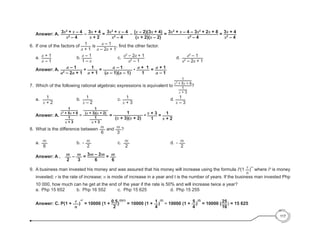
Learned
What new realizations
and learning do you have
about the topic?
Affirmed
What new connections
have you made?
Which of your old ideas
have veen confirmed/
affirmed?
Challenged
What questions do you
still have? Which areas
seem difficult for you?
Which do you want to
explore
To ensure the understanding of the learner, he/she will do this activity before
moving to transfer stage. This will enable the learner to recall and reflect
what has been discussed in this lesson and solicit ideas on what and how
the students learned in this lesson. Try to clear his/her thought by addressing
the questions regarding the topics in this lesson. Responses may be written
in journal notebook.
Teacher’s Note and Reminders
Don’t
Forget!
93
What to Transfer
What to Transfer
	 Your goal in this section is to apply your learning in real life situations. You will
be given a practical task which will demonstrate your understanding.
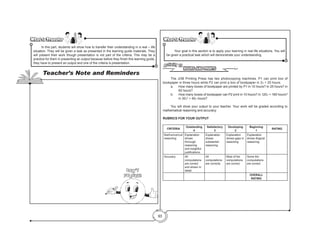
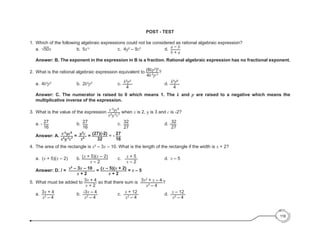
RUBRICS FOR YOUR OUTPUT
CRITERIA
Outstanding
4
Satisfactory
3
Developing
2
Beginning
1
RATING
Mathematical
reasoning
Explanation
shows
thorough
reasoning
and insightful
justifications.
Explanation
shows
substantial
reasoning.
Explanation
shows gaps in
reasoning.
Explanation
shows illogical
reasoning.
Accuracy All
computations
are correct
and shown in
detail.
All
computations
are corrects.
Most of the
computations
are correct.
Some the
computations
are correct.
OVERALL
RATING
What to Transfer
What to Transfer
	 In this part, students will show how to transfer their understanding in a real – life
situation. They will be given a task as presented in the learning guide materials. They
will present their work though presentation is not part of the criteria. This may be a
practice for them in presenting an output because before they finish this learning guide,
they have to present an output and one of the criteria is presentation.
Teacher’s Note and Reminders
Don’t
Forget!
HOURS AND PRINTS
Activity 20
	 The JOB Printing Press has two photocopying machines. P1 can print box of
bookpaper in three hours while P2 can print a box of bookpaper in 3x + 20 hours.
a.	 How many boxes of bookpaper are printed by P1 in 10 hours? In 25 hours? in
65 hours?
b.	 How many boxes of bookpaper can P2 print in 10 hours? in 120x + 160 hours?
in 30x2
+ 40x hours?
	 You will show your output to your teacher. Your work will be graded according to
mathematical reasoning and accuracy.
94
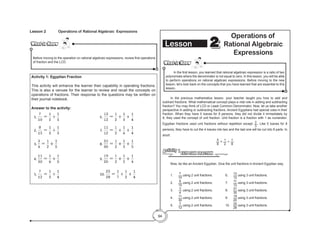
Activity 1: Egyptian Fraction
This activity will enhance the learner their capability in operating fractions.
This is also a venuee for the learner to review and recall the concepts on
operations of fractions. Their response to the questions may be written on
their journal notebook.
Answer to the activity:
What to Know
What to Know
	 In the first lesson, you learned that rational algebraic expression is a ratio of two
polynomials where the denominator is not equal to zero. In this lesson, you will be able
to perform operations on rational algebraic expressions. Before moving to the new
lesson, let’s look back on the concepts that you have learned that are essential to this
lesson.
	 In the previous mathematics lesson, your teacher taught you how to add and
subtract fractions. What mathematical concept plays a vital role in adding and subtracting
fraction? You may think of LCD or Least Common Denominator. Now, let us take another
perspective in adding or subtracting fractions. Ancient Egyptians had special rules in their
fraction. When they have 5 loaves for 8 persons, they did not divide it immediately by
8, they used the concept of unit fraction. Unit fraction is a fraction with 1 as numerator.
Egyptian fractions used unit fractions without repetition except 2
3
. Like 5 loaves for 8
persons, they have to cut the 4 loaves into two and the last one will be cut into 8 parts. In
short:
5
8
= 1
2
+ 1
8
EGYPTIAN FRACTION
Activity 1
	 Now, be like an Ancient Egyptian. Give the unit fractions in Ancient Egyptian way.
	1.	
7
10
using 2 unit fractions.		 6. 	 13
12
using 3 unit fractions.
	2.	
8
15
using 2 unit fractions.		 7. 	 11
12
using 3 unit fractions.
	3.	
3
4
using 2 unit fractions.		 8. 	 31
30
using 3 unit fractions.
	4.	
11
30
using 2 unit fractions.		 9. 	 19
20
using 3 unit fractions.	
	5.	
7
12
using 2 unit fractions. 		 10. 	 25
28
using 3 unit fractions.
Lesson 2
2
Operations of
Rational Algebraic
Expressions
Lesson 2 Operations of Rational Algebraic Expressions
What to Know
What to Know
Before moving to the operation on rational algebraic expressions, review first operations
of fraction and the LCD.
95
1.	 What did you do in giving the unit fraction?
2.	 How do you feel giving the unit fractions?
3.	 What difficulties do you encountered in giving unit fraction?
4.	 What will you do in overcoming these difficulties?
Q
U
ESTIO
N
S
?
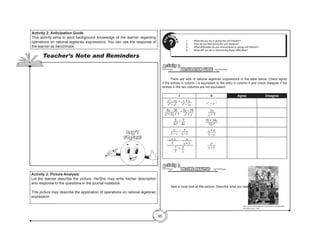
ANTICIPATION GUIDE
Activity 2
	 There are sets of rational algebraic expressions in the table below. Check agree
if the entries in column I is equivalent to the entry in column II and check disagree if the
entries in the two columns are not equivalent.
I II Agree Disagree
x2
– xy
x2
– y2
• x + y
x2
– xy x-1
– y -1
6y – 30
y2
+ 2y + 1
÷ 3y – 15
y2
+ y
2y
y + 1
5
4x2
+ 7
6x
15 + 14x
12x2
a
b – a
– b
a – b
a + b
b – a
a + b
b
– b
a + b
1
b
+ 2
a
a2
a + b
PICTURE ANALYSIS
Activity 3
	 Take a close look at this picture. Describe what you see.
http://www.portlandground.com/archives/2004/05/
volunteers_buil_1.php
Activity 2: Anticipation Guide
This activity aims to elicit background knowledge of the learner regarding
operations on rational algebraic expressions. You can use the response of
the learner as benchmark.
Activity 3: Picture Analysis
Let the learner describe the picture. He/She may write his/her description
and response to the questions in the journal notebook.
This picture may describe the application of operations on rational algebraic
expression.
Teacher’s Note and Reminders
Don’t
Forget!
96
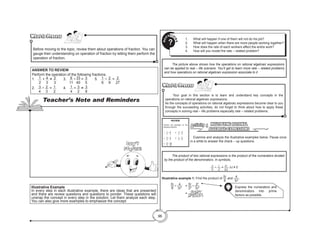
1.	 What will happen if one of them will not do his job?
2.	 What will happen when there are more people working together?
3.	 How does the rate of each workers affect the entire work?
4.	 How will you model the rate – related problem?
Q
U
ESTIO
N
S
?
	 The picture above shows how the operations on rational algebraic expressions
can be applied to real – life scenario. You’ll get to learn more rate – related problems
and how operations on rational algebraic expression associate to it
What to Process
What to Process
	 Your goal in this section is to learn and understand key concepts in the
operations on rational algebraic expressions.
As the concepts of operations on rational algebraic expressions become clear to you
through the succeeding activities, do not forget to think about how to apply these
concepts in solving real – life problems especially rate – related problems.
MULTIPLYING RATIONAL
ALGEBRAIC EXPRESSIONS
Activity 4
	 Examine and analyze the illustrative examples below. Pause once
in a while to answer the check – up questions.
	 The product of two rational expressions is the product of the numerators divided
by the product of the denominators. In symbols,
a
b
• c
d
= ac
bd
, bd ≠ 0
Illustrative example 1: Find the product of 5t
8
and 4
3t2
.
		 5t
8
• 4
3t2
	 = 5t
23
• 22
3t2
						= (5t)(22
)
(22
)(2)(3t2
)
			
REVIEW
Perform the operation of the
following fractions.
1. 1
2
• 4
3
		 4. 1
4
• 3
2
2. 3
4
• 2
3
	 5. 1
6
• 2
9
3. 8
11
• 33
40
Express the numerators and
denominators into prime
factors as possible.
What to Process
What to Process
Before moving to the topic, review them about operations of fraction. You can
gauge their understanding on operation of fraction by letting them perform the
operation of fraction.
ANSWER TO REVIEW
Perform the operation of the following fractions.
1. 1
2
• 4
3
= 2
3
		 3. 8
11
• 33
40
= 3
5
		 5. 1
6
• 2
9
= 2
27
2. 3
4
• 2
3
= 1
2
		 4. 1
4
• 3
2
= 3
8
	
Illustrative Example
In every step in each illustrative example, there are ideas that are presented
and there are review questions and questions to ponder. These questions will
unwrap the concept in every step in the solution. Let them analyze each step.
You can also give more examples to emphasize the concept.
Teacher’s Note and Reminders
Don’t
Forget!
97
						= 5
(2)(3t)
						= 5
6t
Illustrative example 2: Multiply 4x
3y
and 3x2
y2
10
.
	 4x
3y
• 3x2
y2
10
= (22
)x
3y
• 3x2
y2
(2)(5)
					 =	
(2)(2)(x)(3)(x2
)(y)(y)
(3)(y)(2)(5)
					 =	
(2)(x3
)(y)
(5)
					 =	
2x3
y
5
Illustrative example 3: What is the product of x – 5
(4x2
– 9)
and 4x2
+ 12x + 9
2x2
– 11x + 5
?
	 x – 5
4x2
– 9
• 4x2
– 12x + 9
2x2
– 11x + 5
= x – 5
(2x – 3)(2x + 3)
• (2x + 3)2
(2x – 1)(x – 5)
									 = (x – 5)(2x + 3)(2x + 3)
(2x – 3)(2x + 3) (2x – 1)(x – 5)
									 = 2x + 3
(2x – 3)(2x – 1)
									 = 2x + 3
4x2
– 8x + 4
1.	 What are the steps in multiplying rational algebraic expressions?
2.	 What do you observe from each step in multiplying rational
algebraic expressions?
Q
U
ESTIO
N
S
?
Exercises
	 Find the product of the following rational algebraic expressions.
1.	 10uv2
3xy2
• 6x2
y2
5u2
v2
			4.	
x2
+ 2x + 1
y2
– 2y + 1
• y2
– 1
x2
– 1
	
2.	 a2
– b2
2ab
• a2
a – b
			5.	
a2
– 2ab + b2
a2
– 1
• a – 1
a – b
	
3.	 x2
– 3x
x2
+ 3x – 10
• x2
– 4
x2
– x – 6
	
Simplify rational expression
using laws of exponents.
? What laws of exponents were
used in these steps?
? What factoring
methods were
used in this
step?
? What are the rational algebraic
expressions equivalent to 1 in
this step?
Teacher’s Note and Reminders
Don’t
Forget!
98
WHAT’S MY AREA?
Activity 5
	 Find the area of the plane figures below.
	a.					b.					 c.	
1.	 How did you find the area of the figures?
2.	 What are your steps in finding the area of the figures?
Q
U
ESTIO
N
S
?
THE CIRCLE ARROW PROCESS
Activity 6
	 Based on the steps that you made in the previous activity, make a conceptual map
on the steps in multiplying rational algebraic expressions. Write the procedure or important
concepts in every step inside the circle. If necessary, add a new circle.
1.	 Does every step have a mathematical concept involved?
2.	 What makes that mathematical concept important to every step?
3.	 Can the mathematical concepts used in every step be
interchanged? How?
4.	 Can you give another method in multiplying rational algebraic
expressions?
Q
U
ESTIO
N
S
?
Step 1
Step 2
Step 3
Step 4
Final Step
Web – based
Booster:
Watch the videos in this
web – sites for more
examples. http://www.
o n l i n e m a t h l e a r n i n g .
com/multiplying-rational-
expressions-help.html
Answers to Activity 5: What’s My Area
1. -
b
4
		2.
1
3
		 3.
y − 2
3
This activity is multiplying rational algebraic expressions but in a different
context. After this activity, let them sequence the steps in multiplying rational
algebraic expression. Let them identify the concepts and principles for every
step.
CONCEPT CHANGE MAP
Activity 6: The Circle Arrow Process
As the learner sequences the steps, he/she will identify the mathematical
concepts behind each step. Place the mathematical concept inside the circle
until he/she arrived at the final answer.
Teacher’s Note and Reminders
Don’t
Forget!
99
Activity 7: Dividing Rational Algebraic Expressions
The same as the illustrative examples in multiplying rational algebraic
expressions, each illustrative example in this operation has key ideas, review
question to unveil the concept on each step. But before they begin dividing
rational algebraic expressions, they have to review how to divide fractions.
Dividing Rational Algebraic Expressions
Activity 7
	 Examine and analyze the illustrative examples below. Pause once
in a while to answer the check – up questions.
	 The quotient of two rational algebraic expressions is the product of the dividend
and the reciprocal of the divisor. In symbols,
a
b
÷ c
d
= a
b
• d
c
= ad
bc
, bc ≠ 0
Illustrative example 4: Find the quotient of 6ab2
4cd
and 9a2
b2
8dc2
.
	 6ab2
4cd
÷ 9a2
b2
8dc2
= 6ab2
4cd
÷ 8dc2
9a2
b2
			 = (2)(3)ab2
(2)2
cd
÷ (23
)dc2
(32
)a2
b2
			 = (22
)(22
)(3)ab2
dcc
(22
)(3)(3)cdaab2
			 = (2)2
c
(3)a
			 = 4c
3a
Illustrative example 5: Divide 2x2
+ x – 6
2x2
+ 7x + 5
by x2
– 2x – 8
2x2
– 3x – 20
.
	 2x2
+ x – 6
2x2
+ 7x + 5
÷ x2
– 2x – 8
2x2
– 3x – 20
			= 2x2
+ x – 6
2x2
+ 7x + 5
• 2x2
– 3x – 20
x2
– 2x – 8
			= (2x – 3)(x + 2)
(2x + 5)(x + 1)
• (x – 4)(2x + 5)
(x + 2)(x – 4)
			= (2x – 3)(x + 2)(x – 4)(2x + 5)
(2x­
+ 5)(x + 1)(x + 2) (x – 4)
			= (2x – 3)
(x + 1)
			= 2x – 3
x + 1
REVIEW
Perform the operation of
the following fractions.
1. 1
2
÷ 3
4
4. 10
16
÷ 5
4
2. 5
2
÷ 9
4
5. 1
2
÷ 1
4
3. 9
2
÷ 3
4
Multiply the dividend by the
reciprocal of the divisor.
Perform the steps in multiplying
rational algebraic expressions.
? Why do we need to factor
out the numerators and
denominators?
? What happens to the common
factors between numerator
and denominator?
Teacher’s Note and Reminders
Don’t
Forget!
100
Exercises
	 Find the quotient of the following rational algebraic expressions.
	1.	
81xz3
36y
÷ 27x2
z2
12xy
				4.	
x2
+ 2x + 1
x2
+ 4x + 3
÷ x2
– 1
x2
+ 2x + 1
	2.	
2a + 2b
a2
+ ab
÷
4
a
					5.	
x – 1
x + 1
÷ 1 – x
x2
+ 2x + 1
	
	3.	16x2
– 9
6 – 5x – 4x2
÷ 16x2
+ 24x + 9
4x2
+ 11x + 6
	
MISSING DIMENSION
Activity 8
	 Find the missing length of the figures.
1.	 The area of the rectangle is x2
– 100
8
while the length is 2x2
+ 20
20
. Find the
height of the rectangle.
2.	 The base of the triangle is 21
3x – 21
and the area is x2
35
. Find the height of the
triangle.
1.	 How did you find the missing dimension of the figures?
2.	 Enumerate the steps in solving the problems.
Q
U
ESTIO
N
S
?
Answers to Activity 8
1. 5x − 50
4
	 		2. 2x3
− 14x2
245
This activity may assess the learner’s understanding in dividing rational
algebraic expression. This may help learner consider the division of rational
algebraic expressions in different context.
Let them enumerate the steps in dividing rational algebraic expressions and
identify the concepts and principle involved in every step
		
Teacher’s Note and Reminders
Don’t
Forget!
101
MAP OF CONCEPTUAL CHANGE
Activity 9: Chain Reaction
As the learner enumerates the steps in dividing rational algebraic
expression, his/her can identify mathematical concepts in each step. Place
the mathematical concept inside the chamber until he/she arrived at the final
answer. This activity may be individual or collaborative work.
Activity 10
The illustrative examples in this topic also have ideas and questions to
guide the students in identifying concepts and principle involved in every
step. Before discussing and giving more examples in adding and subtracting
rational algebraic expressions, review them on how to add and subtract
fractions.
ANSWER TO REVIEW
Perform the operation of the following fractions.
1.	
1
2 +
3
2 	
= 2			2.
5
4 +
9
4 =
7
2 		 3.
9
5 +
3
5 =
12
5
4.
10
13 −
5
13 =
5
13 		 5.
5
4 −
1
4 = 1
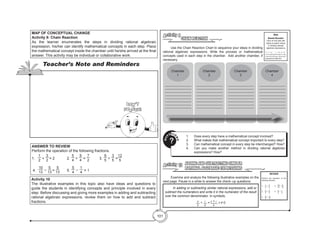
1.	 Does every step have a mathematical concept involved?
2.	 What makes that mathematical concept important to every step?
3.	 Can mathematical concept in every step be interchanged? How?
4.	 Can you make another method in dividing rational algebraic
expressions? How?
Q
U
ESTIO
N
S
?
CHAIN REACTION
Activity 9
	 Use the Chain Reaction Chart to sequence your steps in dividing
rational algebraic expressions. Write the process or mathematical
concepts used in each step in the chamber. Add another chamber, if
necessary.
Web
Based Booster
Click on this web site
below to watch videos
in dividing rational
algebraic expressions
h t t p : / / w w w .
o n l i n e m a t h l e a r n i n g .
com/dividing-rational-
expressions-help.html
Chamber
1
__________________
__________________
_________________
_________________
_________________
__________________
_________________
__________________
Chamber
3
__________________
__________________
_________________
_________________
_________________
__________________
_________________
__________________
Chamber
2
__________________
__________________
_________________
_________________
_________________
__________________
_________________
__________________
Chamber
4
__________________
__________________
_________________
_________________
_________________
__________________
_________________
__________________
ADDING AND SUBTRACTING SIMILAR
RATIONAL ALGEBRAIC EXPRESSIONS
Activity 10
	 Examine and analyze the following illustrative examples on the
next page. Pause in a while to answer the check–up questions.
REVIEW
Perform the operation of the
following fractions.
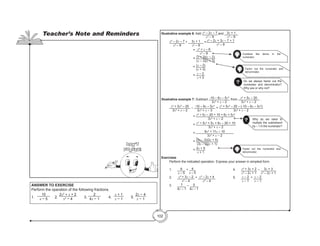
1. 1
2
+ 3
2
	 4. 10
13
– 5
13
2. 5
4
+ 9
4
	 5. 5
4
– 1
4
3. 9
5
+ 3
5
	 In adding or subtracting similar rational expressions, add or
subtract the numerators and write it in the numerator of the result
over the common denominator. In symbols,
a
b
+ c
b
= a + c
b
, b ≠ 0
Teacher’s Note and Reminders
Don’t
Forget!
102
Illustrative example 6: Add x2
– 2x – 7
x2
– 9
and 3x + 1
x2
– 9
.
	 x2
– 2x – 7
x2
– 9
+ 3x + 1
x2
– 9
= x2
– 2x + 3x – 7 + 1
x2
– 9
				= x2
+ x – 6
x2
– 9
				= (x + 3)(x – 2)
(x – 3)(x + 3)
				
				= (x – 2)
(x + 3)
				= x – 2
x + 3
Illustrative example 7: Subtract -10 – 6x – 5x2
3x2
+ x – 2
from x2
+ 5x – 20
3x2
+ x – 2
.
	 x2
+ 5x2
– 20
3x2
+ x – 2
– -10 – 6x – 5x2
3x2
+ x – 3
= x2
+ 5x2
– 20 – (-10 – 6x – 5x2
)
3x2
+ x – 2
				= x2
+ 5x – 20 + 10 + 6x + 5x2
3x2
+ x – 2
				= x2
+ 5x2
+ 5x + 6x – 20 + 10
3x2
+ x – 2
				= 6x2
+ 11x – 10
3x2
+ x – 2
				= (3x – 2)(2x + 5)
(3x – 2)(x + 1)
				= 2x + 5
x + 1
Exercises
	 Perform the indicated operation. Express your answer in simplest form.
	1.	 6
a – 5
+ 4
a – 5
					4. 	
x2
+ 3x + 2
x2
– 2x + 1
– 3x + 3
x2
– 2x + 1
	
	2.	
x2
+ 3x – 2
x2
– 4
+ x2
– 2x + 4
x2
– 4
			5.	
x – 2
x – 1
+ x – 2
x – 1
	3.	 7
4x – 1
– 5
4x – 1
Combine like terms in the
numerator.
Factor out the numerator and
denominator.
? Do we always factor out the
numerator and denominator?
Why yes or why not?
? Why do we need to
multiply the subtrahend
by – 1 in the numerator?
Factor out the numerator and
denominator.
Teacher’s Note and Reminders
Don’t
Forget!
ANSWER TO EXERCISE
Perform the operation of the following fractions.
1.	
10
a − 5 	2.
2x2
+ x + 2
x2
− 4 	 	 3.
2
4x − 1 		 4.
x + 1
x − 1 		 5.
2x − 4
x − 1
103
REVIEW
Perform the operation of the
following fractions.
1. 1
2
+ 4
3
		 4. 1
4
– 3
2
2. 3
4
+ 2
3
		 5. 1
6
– 2
9
3. 3
4
+ 1
8
ADDING AND SUBTRACTING DISSIMILAR
RATIONAL ALGEBRAIC EXPRESSIONS
Activity 11
	 Examine and analyze the following illustrative examples below.
Pause in a while to answer the check–up questions.
	 In adding or subtracting dissimilar rational expressions
change the rational algebraic expressions into similar rational
algebraic expressions using the least common denominator or
LCD and proceed as in adding similar fractions.
illustrative example 8: Find the sum of 5
18a4
b
and 2
27a3
b2
c
.
	 5
18a4
b
+ 2
27a3
b2
c
= 5
(32
)(2)a4
b
+ 2
(33
)a3
b2
c
			
			= 5
(32
)(2)a4
b
•  3bc
3bc
+ 2
(33
)a3
b2
c
• 2a
2a
			= (5)(3)bc
(33
)(2)a4
b2
c
+ (22
)a
(33
)(2)a4
b2
c
			= 15bc
54a4
b2
c
+ 4a
54a4
b2
c
			= 15bc + 4a
54a4
b2
c
LCD of 5
(32
)(2)a4
b
and 2
(33
)a3
b2
c
	(32
)(2)a4
b and (33
)a3
b2
c
The LCD is (33
)(2)(a4
)(b2
)(c)
Denominators of the rational
algebraic expressions
Take the factors of the denominators.
When the same factor is present in more
than one denominator, take the factor with
the highest exponent. The product of these
factors is the LCD.
Find a number equivalent to 1 that
should be multiplied to the rational
algebraic expressions so that the
denominators are the same with the
LCD.
Express the denominators
as prime factors.	
ANSWER TO REVIEW
Perform the operation of the following fractions.
1.	
1
2 	+
4
3 =
11
6 		 2.
3
4 +
2
3 =
17
12 		 3.
3
4 −
1
8 =
5
8 	
4.
1
4 −
3
2 = -
5
4 		 5.
1
6 −
2
9 =
1
18
Activity 11
Before introducing the addition/subtraction of dissimilar rational algebraic
expressions, learners must review how to add/subtract dissimilar fractions. Let
them perform addition/subtraction of fraction and process their answers.
Illustrative Example 8
Each example in this topic has a box below the first step. Emphasize to them
the process of finding the LCD between rational algebraic expressions. As much
as possible, link this process to how LCD of fraction is being derived so that
they can relate the process easily. If needed, before discussing the addition/
subtraction of rational algebraic expression, give them examples of finding LCD
of rational algebraic expressions.
Give more examples in adding/subtracting dissimilar rational algebraic
expressions if needed. In this topic, more examples are presented in the
learning guide.
Teacher’s Note and Reminders
Don’t
Forget!
104
Illustrative example 9: Subtract t + 3
t2
– 6t + 9
by 8t – 24
t2
– 9
.
	 t + 3
t2
– 6t + 9
– 8t – 24
t2
– 9
= t + 3
(t – 3)2
– 8t – 24
(t – 3)(t + 3)
			= t + 3
(t – 3)2
• t + 3
t + 3
– (8t – 24)
(t – 3)2
(t + 3)
• t – 3
t – 3
			= (t + 3)(t + 3)
(t – 3)2
(t + 3)
– (8t – 24)
(t – 3)2
(t + 3)
			= t2
+ 6t + 9
t3
– 9t2
+ 27t – 27
– 8t – 48t + 72
t3
– 9t2
+ 27t – 27
			= t2
+ 6t + 9 – (8t2
– 48t + 72)
t3
– 9t2
+ 27t – 27
			= t2
+ 6t + 9 – 8t2
+ 48t – 72
t3
– 9t2
+ 27t – 27
			= –7t2
+ 54t – 63
t3
– 9t2
+ 27t – 27
Illustrative example 10: Find the sum of 2x
x2
+ 4x + 3
by 3x – 6
x2
+ 5x + 6
.
	 2x
x2
+ 4x + 3
+ 3x – 6
x2
+ 5x + 6
= 2x
(x + 3)(x + 1)
+ 3x – 6
(x + 3)(x + 2)
			= 2x
(x + 3)(x + 1)
• (x + 2)
(x + 2)
+
(3x − 6)
(x + 3)(x + 2)
•
(x + 1)
(x + 1)
			= (2x)(x + 2)
(x + 3)(x + 1)(x + 2)
+
(3x − 6)(x + 1)
(x + 3)(x + 2)(x + 1)
			= 2x2
+ 4x
x3
+ 6x2
+ 11x + 6
+ 3x2
− 3x − 6
x3
+ 6x2
+ 11x + 6
LCDof t + 3
(t – 3t)2
and 8t – 24
(t – 3)(t + 3)
(t – 3)2
and (t – 3)(t + 3)
The LCD is (t – 3)2
(t + 3)
LCD of 2x
(x + 3)(x + 1)
and 3x – 6
(x + 3)(x + 2)
(x + 3)(x + 1) and (x + 3)(x + 2)
The LCD is (x + 3) (x + 1) (x + 2)
? What property
of equality is illustrated
in this step?
? What special products
are illustrated in this
step?
? What special products
are illustrated in this
step?
? What property of equality
was used in this step?
Express the denominators
as prime factors.
Teacher’s Note and Reminders
Don’t
Forget!
105
			= 2x2
+ 3x2
+ 4x − 3x − 6
x3
+ 6x2
+ 11x + 6
			= 5x2
+ x − 6
x3
+ 6x2
+ 11x + 6
Exercises
	 Perform the indicated operation. Express your answer in simplest form.
	1.	
3
x + 1
+
4
x
					4. 	 3
x2
– x – 2
– 2
x2
– 5x + 6
	
	2.	 x + 8
x2
− 4x + 4
+ 3x − 2
x2
− 4
			5.	
x + 2
x
– x + 2
2
	3.	2x
x2
− 9
– 3
x – 3
FLOW CHART
Activity 12
	 Now that you have learned adding and subtracting rational algebraic expressions.
You are now able to fill in the graphic organizer below. Write each step in adding or
subtracting rational algebraic expression in the boxes below.
Adding or subtracting
Rational Algebraic
Expressions
STEPS STEPS
If similar rational
algebraic expressions
If dissimilar rational
algebraic expressions
1.	 Does every step have a
mathematical concept
involved?
2.	
What makes that
mathematical concept
important to every step?
3.	 Can mathematical concept in
every step be interchanged?
How?
4.	 Can you make another
method in adding or
subtracting rational algebraic
expressions? How?
Q
U
E
STIO
N
S
?
ANSWER TO EXERCISE
Perform the operation of the following fractions.
1.	
7x + 4
x2
+ x 			 2. 	
4x2
+ 2x + 20
x3
− 2x2
− 4x + 8 			3. 	
-x − 9
x2
− 9
4.
x − 11
x3
− 4x2
+ x + 6	 5. 	
-x2
+ 4
2x 	
MAP OF CONCEPTUAL CHANGE
Activity 12: Flow Chart
Let them enumerate the steps in adding/subtracting rational algebraic
expressions, both similar and dissimilar expressions. Let them organize these
steps by completing the flow chart below. You can validate their work by adding/
subtracting rational algebraic expressions using their flow chart.
Teacher’s Note and Reminders
Don’t
Forget!
106
WHAT IS WRONG WITH ME?
Activity 13
	 		 Rewrite the solution of the first box. Write your solution in the
second box and in the third box, write your explanation on how your
solution corrects the original one .
Original My Solution
My
Explanation
2
36 − x2 −
1
x2
− 6x
=
2
(6 − x) (6 − x) −
1
x(x + 6)
=
2
(x − 6) (x + 6)
− 1
x(x + 6)
=
2
(x − 6) (x + 6)
•
x
x
−
1
x(x + 6)
• x − 6
x − 6
=
2x
x(x − 6) (x + 6)
−
1(x − 6)
x(x + 6)(x − 6)
=
2x − (x − 6)
x(x − 6) (x + 6)
=
2x − x + 6
x(x − 6) (x + 6)
= x + 6
x(x − 6) (x + 6)
=
1
x(x − 6)
=
1
x2
− 6x
2
a − 5
− 3
a
= 2
a − 5
• a
a
− 3
a
• a − 5
a − 5
= 2a
a − 5(a)
−
3(a − 5)
a(a − 5)
= 2a
a − 5(a)
−
3a − 15
a(a − 5)
=
2a − 3a − 15
a(a − 5)
= -a − 15
a2
− 5a
Web – based
Booster:
Watch the videos in
these web sites for more
examples.
h t t p : / / w w w .
o n l i n e m a t h l e a r n i n g .
com/adding-rational-
expressions-help.html
h t t p : / / w w w .
onlinemathlearning.com/
subtracting-rational-
expressions-help.html
Activity 13
This activity may help students to correct their misconceptions. This may also
help you gauge whether the learners learned the concept or not. If necessary,
give more examples to strengthen their understanding. The response of the
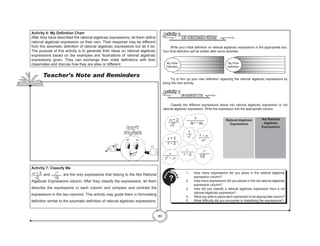
students in guided questions may be written in their journal notebook.
Points to be emphasize in this activity
For the solution in the first box: The error in this item is the (6 – x) becomes
(x – 6). The factor of (6 – x) is -1(x – 6).
For the solution in the second box: The wrong concepts here are a – 5 (a)
becomes a2
– 5a and the numerator of subtrahend must be multiplied by -1.
a – 5 (a) is equal to a – 5a.
For the solution in the third box: 3 must not be cancelled out. The concept of
dividing out can be applied to a common factor and not to the common variable
or number in the numerator and denominator.
For the solution in the fourth box: b2
– 4b + 4 must be factored out as (b – 2)
(b – 2). The concept of factoring is essential in performing operations on rational
algebraic expressions.
Teacher’s Note and Reminders
Don’t
Forget!
107
3x
2x − 3
+
9
3 − 2x
= 3x
2x − 3
+ 9
(-1)(2x − 3)
= 3x
2x − 3
− 9
2x − 3
= 3x − 9
2x − 3
= 3(x − 3)
2x − 3
= x − 3
2x
4
b − 2
+ b2
− 4b
b − 2
=
b2
− 4b + 4
b − 2
= (b − 2)(b + 2)
b − 2
= b + 2
1.	 What did you feel while answering the activity?
2.	 Did you encounter difficulties in answering the activity?
3.	 How did you overcome these difficulties?
Q
U
ESTIO
N
S
?
	 The previous activities deal with the fundamental operations on rational expressions.
Let us try these concepts in a different context.
COMPLEX RATIONAL ALGEBRAIC EXPRESSIONS
Activity 14
	 Examine and analyze the following illustrative examples on the next page. Pause in
a while to answer the check – up questions.
REVIEW
Perform the operation of the
following fractions.
1. 1
2
+ 4
3
		 4. 1
2
+ 5
4
2. 1
2
– 4
3
		 5. 5
9
+ 4
3
3. 5
2
– 4
3
1 – 2
3
4
3
– 2
3
3
4
– 2
3
2
3
+ 2
1 + 2
3
	 Rational algebraic expression is said to be in its simplest
form when the numerator and denominator are polynomials
with no common factors other than 1. If the numerator or
denominator, or both numerator and denominator of a rational
algebraic expression is also a rational algebraic expression, it is
called a complex rational algebraic expression. To simplify the
complex rational expression, it means to transform it into simple
rational expression. You need all the concepts learned previously
to simplify complex rational expressions.
Activity 14. Complex Rational Expressions
Like on the previous topics, each illustrative example has ideas and questions to
guide the learners in determining the concepts and principles in each step. For
the students to relate the new topic, start the discussion by reviewing simplifying
complex fraction. You can also give more examples to give emphasis on the
concepts and principles involving in this topic.
Answer to the Review:
Perform the operation of the following fractions.
1. 	
1
2
+ 4
3
1 −
2
3
= 11
2
		 2. 	
1
2
−
4
3
3
4
−
2
3
= -10		 3.
5
2
−
4
3
2
3
+ 2
= 7
16
4. 	
1
2
+ 5
4
4
3
−
2
3
= 21
8
		 5. 	
5
9
+
4
3
1 +
2
3
= 17
15
Teacher’s Note and Reminders
Don’t
Forget!
108
Illustrative example 11: Simplify
2
a
−
3
b
5
b
+ 6
a2
.
	
2
a
−
3
b
5
b
+ 6
a2
= 2b − 3a
ab
÷ 5a2
+ 6b
a2
b
= 2b − 3a
ab
• a2
b
5a2
+ 6b
= (2b − 3a)aab
(5a2
+ 6b)ab
= (2b − 3a)a
(5a2
+ 6b)
= 2ab − 3a2
5a2
+ 6b
Illustrative example 12: Simplify
c
c2
− 4
− c
c − 2
1 + 1
c + 2
.
	
c
c2
− 4
− c
c − 2
1 + 1
c + 2
=
c
(c − 2)(c + 2)
− c
c − 2
1 + 1
c + 2
	
	=
c
(c − 2)(c + 2)
− c
(c − 2)
• (c + 2)
(c + 2)
1 • c + 2
c + 2
+ 1
(c + 2)
Main fraction a line that
separates the main numerator
and main denominator.
? Where does the b
b
and a
a
in the main
numerator and the a2
a2
and b
b
in the main
denominator came from?
? What happens to the main numerator and
main denominator?
? What principle is used in this
step?
? What laws of exponents are used
in this step?
Simplify the rational algebraic
expression.
Teacher’s Note and Reminders
Don’t
Forget!
109
	=
c
(c − 2)(c + 2)
− c(c + 2)
(c − 2) (c + 2)
c + 2
c + 2
+ 1
(c + 2)
	=
c
(c − 2)(c + 2)
− c2
+ 2c
(c − 2) (c + 2)
c + 2
c + 2
+ 1
(c + 2)
	=
c − (c2
+ 2c)
(c − 2)(c + 2)
c + 2 + 1
c + 2
	=
-c2
− 2c + c
(c − 2)(c + 2)
c + 2 + 1
c + 2
	=
-c2
− c
(c − 2)(c + 2)
c + 3
c + 2
	= -c2
− c
(c − 2)(c + 2)
÷ c + 3
c + 2
	=
-c2
− c
(c − 2)(c + 2) • c + 2
c + 3
	=
(-c2
− c)(c + 2)
(c − 2)(c + 2) (c + 3)
	=
-c2
− c
(c − 2)(c + 3)
	= -c2
− c
c2
+ c − 6
Exercises
	 Simplify the following complex rational expressions.
	1.	
1
x
− 1
y
1
x2
+
1
y2
		 3.	
b
b − 1
− 2b
b − 2
2b
b − 2
− 3b
b − 3
		 5.	 4 − 4
y2
2 + 2
y
	
	2.	
x − y
x + y
−
y
x
x
y
+
x − y
x + y
	 4.	
1
a − 2
− 3
a − 1
5
a − 2
+ 2
a − 1
	
Answer to Exercises
1. 	 x2
y + xy2
x2
+ y2
		 2.	
x2
y − 2xy2
− y3
x3
+ 2x2
y − xy2
			3. 	
2b − 3
b
	
4.	 2 − 2a
7a − 9
			5. 	
2y − 2
y
	
Teacher’s Note and Reminders
Don’t
Forget!
110
TREASURE HUNTING
Activity 15
	 Find the box that contains treasure by simplifying rational expressions below. Find
the answer of each expression in the hub. Each answer contains direction. The correct
direction will lead you to the treasure. Go hunting now.
		 1.	
x2
− 4
x2
x + 2
y
		 2.	
x
2
+ x
3
1
2
		 3.	
3
x2
+ 3x +2
x
x + 2
THE HUB
5x
3
x2
− 2
x
1
x − 1
x2
+ 2
x2
+ x − 6
3
x2
+ x
2 steps to the
right
Down 4 steps
3 steps to the
left
4 steps to the
right
Up 3 steps
Based on the above activity, what are your steps in simplifying complex
rational algebraic expressions?
Q
U
ESTIO
N
S
?
START HERE
Activity 15: Treasure Hunting
This activity may strengthen the understanding of the learner regarding the
topic. Give extra points for correct answer.
The steps:
1.	 Down 4 steps
2.	 2 steps to the right
3.	 Up 3 steps
Let them enumerate the steps they did in simplifying complex rational algebraic
expressions and identify the principles in each step.
Teacher’s Note and Reminders
Don’t
Forget!
111
VERTICAL CHEVRON LIST
Activity 16
	 Make a conceptual map in simplifying complex rational expression
using vertical chevron list. Write the procedure or important concepts in
every step inside the box. If necessary, add another chevron to complete
your conceptual map.
REACTION GUIDE
Activity 17
	 Revisit the second activity. There are sets of rational algebraic expressions in the
following table. Check agree if column I is the same as column II and check disagree if the
two columns are not the same.
I II Agree Disagree
x2
− xy
x2
− y2
• x + y
x2
− xy x-1
− y-1
6y − 30
y2
+ 2y + 1
÷ 3y − 15
y2
+ y
2y
y + 1
5
4x2
+ 7
6x
15 + 14x
12x2
Web – based
Booster:
Watch the videos in
these web sites for more
examples
http://www.wtamu.edu/
academic/anns/mps/math/
mathlab/col_algebra/col_
alg_tut11_complexrat.htm
http://www.youtube.com/
watch?v=-jli9PP_4HA
h t t p : / / s p o t . p c c .
edu/~kkling/Mth_95/
SectionIII_Rational_
Expressions_Equations_
and_Functions/Module4/
M o d u l e 4 _ C o m p l e x _
Rational_Expressions.pdf
STEP 1
STEP 3
STEP 2
STEP 4
Activity 16: Vertical Chevron List
In the previous activity, the learner identified the steps in simplifying complex
rational algebraic expressions. Let his/her organize these steps and principles
using vertical chevron list.
Activity 17: Reaction Guide
In activity 2, students were given anticipation guide. They will answer the same
items in the anticipation guide, but this time they are expected to answer each
item correctly. Let them compare their answer in the anticipation and reaction
guide. Their answer on the questions may be written in the journal notebook.
This activity will enable the students to correct their initial understanding before
the lesson was presented. Let them compare their response in the anticipation
guide and their response in this activity.
Teacher’s Note and Reminders
Don’t
Forget!
112
a
b − a
– b
a − b
a + b
b − a
a + b
b
− b
a + b
1
b
+ 2
a
a2
a + b
Compare your answer from the anticipation guide to the reaction guide. Do
they differ from each other? Why it so?
Q
U
ESTIO
N
S
?
	 In this section, the discussion was all about operations on rational algebraic
expressions. How much of your initial ideas are found in the discussion? Which ideas
are different and need revision? The skills in performing the operations on rational
algebraic expressions is one of the key concepts in solving rate – related problems.
What to Understand
What to Understand
	 Your goal in this section is to relate the operations of rational expressions to
a real – life problems, especially the rate problems.
WORD PROBLEM
Activity 18
	 Read the problems below and answer the questions that follow.
	 1.	 Two vehicles travelled (x + 4) kilometers. The first vehicle travelled for (x2
– 16)
hours while the second travelled for
2
x – 4
hours.
	 a.	 Complete the table below.
Vehicles Distance Time Speed
Vehicle A
Vehicle B
Activity 18: WORD PROBLEM
In this part, learner will be exposed more to how rational algebraic expressions
can modelled the rate–related problems. You can discuss and give more
examples similar to the items in this activity so that the students are guided
on how the concepts of rational algebraic expressions modelled rate–related
problems. Let them answer the activity individually or in collaborate work. Let
them also enumerate the steps in solving these problems.
Teacher’s Note and Reminders
Don’t
Forget!
113
b.	 How did you compute the speed of the two vehicles?
c.	 Which of the two vehicles travelled faster? How did you find your answer?
	 2.	 Jem Boy and Roger were asked to fill the tank with water. Jem Boy can fill the
tank in x minutes alone while Roger is slower by 2 minutes compared to Jem
Boy if working alone.
a.	 What part of the job can Jem Boy finish in 1 minute?
b.	 What part of the job can Roger finish in 1 minute?
c.	 Jem Boy and Roger can finish filling the tank together within certain
number of minutes. How will you represent algebraically, in simplest
form, the job done by the two if they worked together?
ACCENT PROCESS
Activity 19
	 List down the concepts and principles in solving problems involving operations of
rational algebraic expressions in every step. You can add a box in necessary.
______________________
______________________
______________________
______________________
______________________
Step 1
_____________________
_____________________
_____________________
______________________
______
Step 2
_____________________
_____________________
_____________________
______________________
______
Step 3
PRESENTATION
Activity 20
Present and discuss to the class the process of answering the questions below. Your
output will be graded according to reasoning, accuracy, and presentation.
Alex can pour a concrete walkway in x hours alone while Andy can pour the same
walkway in two more hours than Alex.
	 a.	 How fast can they pour together the walkway?
	 b.	 If Emman can pour the same walkway in one more hours than Alex and
Roger can pour the same walkway in one hour less than Andy, who must
work together to finish the job with the least time?
Activity 19: Accent Process
Let the students enumerate the steps that they do in the previous activity. In this
activity, let them organize these steps using accent process chart.
Activity 20: Presentation
In preparation for the performance task in this module, let the learner perform
this activity. The learner is expected to present his/her output appropriately.
Teacher’s Note and Reminders
Don’t
Forget!
114
Rubrics for your output
CRITERIA
Outstanding
4
Satisfactory
3
Developing
2
Beginning
1
Mathematical
reasoning
Explanation
shows thorough
reasoning
and insightful
justifications.
Explanation
shows
substantial
reasoning
Explanation
shows gaps in
reasoning.
Explanation
shows illogical
reasoning.
Accuracy
All
computations
are correct and
shown in detail.
All
computations
are corrects.
Most of the
computations
are correct.
Some the
computations
are correct.
Presentation
The
presentation
uses
appropriate and
creative visual
materials. It is
delivered in a
very convincing
manner.
The
presentation
uses
appropriate
visual materials.
It is delivered in
a clear manner.
The
presentation
uses some
visual materials.
It is delivered in
a disorganized
manner.
The
presentation
does not use
any visual
materials. It is
delivered in a
clear manner.
	 In this section, the discussion was about application of operations on rational
algebraic expressions. It gives you a general picture of relation between the operations
of rational algebraic expressions and rate – related problems.
What new realizations do you have about the topic? What new connections have you
made for yourself? What questions do you still have? Copy the Learned, Affirmed,
Challenged cards in your journal notebook and complete it.
Learned
What new realizations
and learning do you
have about the topic?
Affirmed
What new connections
have you made?
Which of your old
ideas have been
confirmed/affirmed
Challenge
What questions do
you still have? Which
areas seem difficult
for you? Which do you
want to explore
Before moving to the transfer part, let the learner fill in the LEARNED,
AFFIRMED and CHALLENGED box. This activity will solicit ideas on what and
how the learner learned this lesson. Try to clear his/her thought by addressing
the questions regarding in this lesson.
Teacher’s Note and Reminders
Don’t
Forget!
115
What to Transfer
What to Transfer
	 Your goal in this section is to apply your learning in real life situations. You will
be given a practical task which will demonstrate your understanding.
A newly-wed couple plans to construct a house. The couple has already a
house plan from their friend engineer. The plan of the house is illustrated
below:
	 	
Bedroom
Comfort
Room
Master
Bedroom
Living Room
Dining Room
Laboratory
As a foreman of the project, you are task to prepare a manpower plan
to be presented to the couple. Inside the plan is how many workers are
needed to complete the project, daily wage of the workers, how many days
can they finish the project and how much can be spend for the entire job.
The man power plan will be based on reasoning, accuracy, presentation,
practicality and efficiency.
Q
U
ESTIO
N
S
?
1 m
2 m
3 m
2 m
1.5 m
2.5 m
3 m
3 m
What to Transfer
What to Transfer
This is the performance task in this module. Encourage the learner to interview skilled
workers regarding their rate of work and the wage per worker. Encourage the learner
to be resourceful in dealing with this performance task. They must present not only
the manpower plan but also the process on how they transfer their understanding of
rational algebraic expressions to this performance task. Also, after the performance
task, ask the learner what difficulties they encountered and how they manage these
difficulties.
CRITERIA
Outstanding
4
Satisfactory
3
Developing
2
Beginning
1
Reasoning
Explanation
shows
thorough
reasoning
and insightful
justifications.
Explanation
shows
substantial
reasoning.
Explanation
shows gaps in
reasoning.
Explanation
shows illogical
reasoning.
Accuracy
All computa-
tions are cor-
rect and shown
in detail
All computa-
tions are
correct.
Most of the
computations
are correct.
Some of the
computations
are correct.
Presentation
the
presentation
uses
appropriate
and creative
visual
materials. it is
delivered in a
very convincing
manner
The
presentation
uses
appropriate
visual
materials. It is
delivered in a
clear manner.
The
presentation
uses some
visual
materials. It
is delivered in
a disorganize
manner.
The
presentation
does not use
any visual
materials. It is
delivered in a
clear manner.
Practically
The proposed
plan will be
completed at
the least time.
The proposed
plan will be
completed in
lesses time.
The proposed
project will be
completed with
greater number
of days.
The proposed
plan will be
completed
with the most
number of
days.
Efficiency
The cost of the
plan is minimal.
The cost of
the plan is
reasonable.
The cost of
the plan is
expensive.
The cost of the
plan is very
expensive.
POST - TEST
1.	 Which of the following algebraic expressions could not be considered as rational algebraic expression?
	 a.	 √50x					b.	
5x1/2
					c. 	
4y2
– 9z2
					d. 	
a − b
b + a
	
	 Answer: B. The exponent in the expression in B is a fraction. Rational algebraic expression has no fractional exponent.
2.	 What is the rational algebraic expression equivalent to (8kp3
)0
4k-2
p-3
?
	 a.	4k2
p3
					b. 	
2k2
p3
					c. k2
p3
4
						d. k5
p6
4
Answer: C. The numerator is raised to 0 which means 1. The k and p are raised to a negative which means the
multiplicative inverse of the expression.
3.	 What is the value of the expression x-3
yc8
x2
y-2
c7
when x is 2, y is 3 and c is -2?
	 a. - 27
16
					b.	
27
16
						c. 	
32
27
							d. -32
27
	
	 Answer: A. x-3
yc8
x2
y-2
c7
= y3
c
x5
= (27)(-2)
32
= - 27
16
4. 	The area of the rectangle is x2
– 3x – 10. What is the length of the rectangle if the width is x + 2?
	 a. (x + 5)(x – 2)		 b. (x + 5)(x – 2)
x – 2
		 c.	 x + 5
x – 2
					d.	
x – 5
	 Answer: D. l = x2
– 3x – 10
x + 2
= (x – 5)(x + 2)
x + 2
= x – 5
5. 	What must be added to 3x + 4
x + 2
so that there sum is 3x2
+ x – 4
x2
– 4
?
	
	a.	
3x + 4
x2
– 4
				b.	
-3x – 4
x2
– 4
				c. 	
x + 12
x2
– 4
					d.	
x – 12
x2
– 4
116
Answer: A. 3x2
+ x – 4
x2
– 4
– 3x + 4
x + 2
= 3x2
+ x – 4
x2
– 4
– (x – 2)(3x + 4)
(x + 2)(x – 2)
= 3x2
+ x – 4 – 3x2
+ 2x + 8
x2
– 4
= 3x + 4
x2
– 4
	
6.	 If one of the factors of 1
a + 1
is a – 1
a – 2a + 1
, find the other factor.
	a.	
a + 1
a – 1
					b. a – 1
1 – a
					c.	
a2
– 2a + 1
a2
– 1
						d.	 a2
– 1
a2
– 2a + 1
	
	
	 Answer: A. a – 1
a2
– 2a + 1
÷ 1
a + 1
= a – 1
(a – 1)(a – 1)
• a + 1
1
= a + 1
a – 1
	
7.	 Which of the following rational algebraic expressions is equivalent to
1
x2
+ 5x + 6
1
x + 3
?
	 a.	 1
x + 2
	 		 b.	 1
x – 2
	 			 c. 1
x + 3
						 d. 1
x – 3
	 Answer: A.
1
x2
+ 5x + 6
1
x + 3
=
1
(x + 3)(x + 2)
1
x + 3
=
1
(x + 3)(x + 2)
• x + 3
1
= 1
x + 2
8. 	What is the difference between m
6
and m
3
?
	a.	
m
6
				 b.	 - m
2
	 			 c.	 m
2
						 d.	 - m
2
	 Answer: A .	 m
2
– m
3
= 3m – 2m
6
= m
6
9.	 A business man invested his money and was assured that his money will increase using the formula P(1 r
n
)
nt
where P is money
invested; r is the rate of increase; n is mode of increase in a year and t is the number of years. If the business man invested Php
10 000, how much can he get at the end of the year if the rate is 50% and will increase twice a year?
a.	 Php 15 652 	 b. 	Php 16 552		 	 c.	 Php 15 625		 		 d.	 Php 15 255
	
	 Answer: C. P(1 + r
n
)
nt
= 10000 (1 + 0.5
2
)
(2)(1)
= 10000 (1 + 1
4
)
(2)
= 10000 (1 + 5
4
)
(2)
= 10000 (25
16
) = 15 625
117
10.	 Roger can do the project in x number hours. Concepcion can do the same job in 2 hours less than Roger does. Which of
the choices below is the difference of their rate?
		a.	
2x − 2
x2
− 2x
			 b.	 - 2
x2
− 2x
				c. 	 2
x2
− 2x
		 d.	 - 2x − 2
x2
− 2x
		
		Answer: B.	 1
x
− 1
x − 2
= x − 2 − x
x2
− 2x
= - 2
x2
− 2x
11. 	 You have (x2
+ 2) pesos to buy materials for your school project. You spent half of it in the first store, then you spent one – third
of your money less than you spent in the first store. In the third store, you spent one – fourth of the remaining money from the
two stores. What is the total cost of the materials?
		a.	
4x2
− 8
4
			 b.	 3x2
+ 6
4
				c. 	
5x2
+ 20
12
		 d.	 7x2
+ 14
12
		Answer: B.	 x2
+ 2
2
+ x2
− 2
2
− x2
+ 2
3
+ x2
+ 2
12
= 9x2
+ 18
12
= 3x2
+ 6
4
12.	 James were asked to simplify x2
+ 2x − 8
x2
− 4
. His solution is presented below.
		 What makes the solution of James wrong?
	
		 a.	 Cancelling 4.			 b. 	Crossing out the (x – 2).		 c.	 x2
– 4 being factored out.	 	 d. 	Dividing out the variable x.
		
		Answer: D. X in the (x + 4) and (x + 2) should not divided out because it is part of the term and it is not a common
factor of the numerator and denominator.
118
13. 	 Mary took the math exam. One of the problems in the exam is finding the quotient of x2
+ 2x + 2
4 −  x2
and 1 − x2
x2
+ x − 2  
. Her solution
is shown below.
		
		Answer: D. (x – 1) is additive inverse of (1 – x). If the a term is divided by the its additive inverse, quotient is -1
14. 	 Greg simplify
2
y + 1
+ 3
3
y + 1
+ 4
this way:
		
		Answer: B. In simplifying complex rational algebraic expression, numerator and denominator can be multiplied by
their LCD
	 Did Mary arrive at the correct answer?
		 a.	 No, the dividend and divisor should be interchange.
	 	 b.	 No, the divisor should be reciprocated first before factoring it out.
		 c.	 No. (2 + x) is not the same as (x + 2).
		d.	
No. (x – 1) and (1 – x) is not equal to 1
	 Is there anything wrong in his solution?
	 a.	 Something is wrong with the solution. He is not following the correct process of simplifying
complex rational algebraic expression.
	 b.	 None. Multiplying the numerator and denominator by the same quantity makes no
difference on the given expression.
	 c.	 Something is wrong with the solution. Numerator and denominator may be multiplied by
a certain number but not an algebraic expression.
	 d.	 None. The solution and answer of Greg is different but acceptable.
119
15. 	 Your Project Supervisor ask you to make a floor plan of a house. As an engineer, what must be considered in completing the
plan?
		a. 	
Reasoning and accuracy				
		 b. 	Cost and design		
		 c. 	Feasible and accurate
		 d. 	Practical and aesthetics
		Answer: C. Dividing the parts of the house must be accurate and it must be realistic.
16. 	 Your mother asked you to find for laborers in renovating your house. What will you look in choosing a laborer?
	 	 a.	 His efficiency in doing the task.	 	
		 b.	 His attitude towards work.	
		 c. 	His perception in the job.
		 d. 	His wage in a day.
		Answer: A. Though the rate/speed of the laborer counts but the quality of his work must not be compromised.
17. 	 You need a printer in your computer shop. The list of the printers and its capacities is presented in the table. Based in the
table, what printer is best to buy?
Printer Pages to print in a minute Capacity of the ink
Average number of
wasted paper per 500
pages
HD Turbo 16 450 pages 4
IP Sun 7 500 pages 2
Bazoka 23 350 pages 12
Father’s 18 400 pages 6
		 a.	 Father’s. it has more pages to print and good capacity of ink.
	 	 b.	 Bazoka. It has the most pages to print and nice capacity of ink.
120
c.	 IP Sun. It has the best ink capacity and least number of paper wasted.
	 	 d.	 HD Turbo. It has lesser wasted paper and better ink capacity.
		Answer: D. Though the HD Turbo is slower compared to Father’s and Bazoka but it has the lesser wasted paper
compared the other two printers. And the capacity of the ink is better compared to the other two printers.
18. 	 What qualities you must look in buying a printer for personal consumption?
		a. 	
Brand and design						
		 b. 	Price and pages to print			
	 	 c. 	Cost of the printer and its efficiency.
	 	 d .	Brand and the quality of the output.
	 	 Answer: C. It is better to consider the cost of the printer that will not compromise its efficiency.
19.  	 You were tasked, as a budget officer, to give comments regarding the work plan of the engineer. What aspect of the plan
should you consider?
	 	 a. 	The wage of the laborers and the rentals of the equipment.
	 	 b. 	The number of laborers and equipment needed.
	 	 c. 	The quality of work done by the laborers and efficiency of the equipment.
	 	 d. 	The job done by the laborers in one day and appropriateness of the equipment.
		Answer: A. It is not necessary to look for the rate/speed and efficiency of the laborers as a budget officer because
you will look for the financial aspect of the project.
20. 	 After you give comments in the work plan in number 19, what will you do next?
	 	 A. 	
Present a feasibility study.     	 	 c.	 Look for financial resources
	 	 B. 	
Make a budget proposal.	 	 	     	d. 	Give a financial statement
		Answer: B. A will be given by the engineer. C will be given after the budget plan. D will be given after the project.
121
SUMMARY
	 Now that you have completed this module, let us summarize what have you learned:
	 1.	 Rate–related problems can be modeled using rational algebraic expressions.
	 2.	 Rational algebraic expression is a ratio of two polynomials where the denominator is not equal to one.
	 3.	 Any expression raised to zero is always equal to one.
	 4.	 When an expression is raised by a negative integer, it is the multiplicative inverse of the expression.
5.	 Rational algebraic expression is in its simplest form if there is no common factor between numerator and denominator 	
except 1.
	 6.	 To multiply rational algebraic expression, multiply the numerator and denominator then simplify.
	 7.	 To divide rational algebraic expression, multiply the dividend by the reciprocal of the divisor then multiply.
	 8.	 To add/subtract similar rational algebraic expressions, add/subtract the numerators and copy the common denominator.
9.	 To add/subtract dissimilar rational algebraic expressions, express each expression into similar one then add/subtract
the numerators and copy the common denominator.
10.	 Complex rational algebraic expression is an expression where the numerator or denominator, or both numerator and
denominator are rational algebraic expressions.
GLOSSARY OF TERMS USED IN THIS MODULE
Complex rational algebraic expression – an expression where the numerator or denominator or both numerator and
denominator are rational algebraic expressions.
LCD – also known as Least Common Denominator is the least common multiple of the denominators.
122
Manpower plan – a plan where the number of workers needed to complete the project, wages of each worker in a day, how
many days can workers finish the job and how much can be spend on the workers for the entire project.
Rate–related problems – Problems involving rates (e.g., speed, percentage, ratio, work)
Rational algebraic expression – ratio of two polynomials where the denominator is not equal to one.
REFERENCES AND WEBSITE LINKS USED IN THIS MODULE:
Learning Package no. 8, 9, 10, 11, 12, 13. Mathematics Teacher’s Guide, Funds for assistance to private education, 2007
Malaborbor, P., Sabangan, L., Carreon, E., Lorenzo, J.,  Intermediate algebra. Educational Resources Corporation, Cubao,
Quezon City, Philippines, 2005
Orines, F., Diaz, Z., Mojica, M., Next century mathematics intermediate algebra, Pheoenix Publishing House, Quezon Ave.,
Quezon City 2007
Oronce, O., Mendoza, M., e – math intermediate algebra, Rex Book Store, Manila, Philippines, 2010
Padua, A. L, Crisostomo, R. M., Painless math, intermediate algebra. Anvil Publishing Inc. Pasig City Philippines, 2008
Worktext in Intermediate Algebra. United Eferza Academic Publication Co. Lipa City, Batangas, Philippines. 2011
123
http://www.wtamu.edu/academic/anns/mps/math/mathlab/col_algebra/col_alg_tut11_complexrat.htm
http://www.youtube.com/watch?v=-jli9PP_4HA
http://www.onlinemathlearning.com/adding-rational-expressions-help.html
http://www.onlinemathlearning.com/subtracting-rational-expressions-help.html
http://www.onlinemathlearning.com/dividing-rational-expressions-help.html
http://www.onlinemathlearning.com/multiplying-rational-expressions-help.html
http://spot.pcc.edu/~kkling/Mth_95/SectionIII_Rational_Expressions_Equations_and_Functions/Module4/Module4_
Complex_Rational_Expressions.pdf
Image credits
http://www.portlandground.com/archives/2004/05/volunteers_buil_1.php
124

Grade 8 TG Math Module 2.pdf

  • 1.
    TEACHING GUIDE Module 2:Rational Algebraic Expressions and Algebraic Expressions with Integral Exponents A. Learning Outcomes 1. Grade Level Standard The learner demonstrates understanding of key concepts and principles of algebra, geometry, probability and statistics as applied, using appropriate technology, in critical thinking, problem solving, reasoning, communicating, making connections, representations, and decisions in real life. 2. Content and Performance Standards Content Standards: The learner demonstrates understanding of key concepts and principles of rational algebraic expressions and algebraic expressions with integral exponents. Performance Standards: The learner is able to formulate real – life problems involving rational algebraic expressions and algebraic expressions with integral exponents and solves these with utmost accuracy using a variety of strategies. 63
  • 2.
    UNPACKING THE STANDARDSFOR UNDERSTANDING SUBJECT: Grade 8 Mathematics QUARTER: Second Quarter STRAND: Algebra TOPIC: Rational Algebraic Expressions and Algebraic Expressions with Integral Exponent Exponents LESSONS: 1. Rational Algebraic Expressions and Algebraic Expressions with Integral Exponents 2. Operations on Rational Algebraic Expressions LEARNING COMPETENCIES Knowledge: • Describe and illustrates rational algebraic expressions. • Interprets zero and negative exponents. Skill: • Evaluates and simplifies algebraic expressions involving integral exponents. • Simplifies rational algebraic expressions • Performs operations on rational algebraic expressions • Simplifies complex fractions ESSENTIAL UNDERSTANDING: Students will understand that rate – related problems can be modelled using rational algebraic expressions. ESSENTIAL QUESTION: How can rate – related problems be modelled? TRANSFER GOAL: Students on their own, solve rate – related problems using models on rational algebraic expressions. B. Planning for Assessment 1. Product/Performance The following are the products and performances that students are expected to come up with in this module. a. Simplify rational algebraic expressions correctly. b. Perform operations on rational algebraic expressions correctly. c. Present creatively the solution on real – life problems involving rational algebraic expression. d. Create and present manpower plan for house construction that demonstrates understanding of rational algebraic expressions and algebraic expressions with integral exponents. 64
  • 3.
    65 2. Assessment Matrix TYPEKNOWLEDGE PROCESS/SKILLS UNDERSTANDING PERFORMANCE Pre – assessment/ Diagnostic Pre - test Match It To Me, Egyptian Fraction Explanation, Interpretation KWLH, Self – knowledge Perspective Anticipation guide Self – knowledge Interpretation, Explanation Picture Analysis Interpretation, Explanation, Self – knowledge, Application, Perspective Formative My Definition Chart Perspective, Self - knowledge Excercises Interpretation, Explanation Quiz Interpretation, Explanation 3 – 2 – 1 Chart Interpretation, Explanation, Self – knowledge
  • 4.
    Who’s Right Interpretation, Explanation, Self– knowledge, Empathy My Value Interpretation, Explanation, Self – knowledge Quiz Constructor Interpretation, Explanation, Self – knowledge, Empathy Match It Down Interpretation, Explanation, Self – knowledge Circle Process Interpretation, Explanation, Self – knowledge, Empathy How Fast Interpretation, Explanation, Self – knowledge, Empathy, Application Chain Reaction Interpretation, Explanation, Self – knowledge, Empathy Flow Chart Interpretation, Explanation, Self – knowledge, Empathy 66
  • 5.
    Summative Presentation Interpretation, Explanation, Self – knowledge,Application Manpower plan Interpretation, Explanation, emphaty, Self – knowledge, application, Perspective Reaction Guide Self – knowledge, Interpretation, Explanation Post – test Interpretation, Application, Self – knowledge, Emphaty Self - assessment Learned – Affirmed – Challenged Interpretation, Explanation, Self – knowledge, Empathy, Perspective What is Wrong With Me? Interpretation, Explanation, Self – knowledge, Empathy, Perspective 67
  • 6.
    68 Assessment Matrix (SummativeTest) Levels of Assessment What will I assess? How will I assess? How Will I Score? Knowledge 15% • Describing and illustrating rational algebraic expressions. • Interpreting zero and negative exponents. • Evaluating and simplifying algebraic expressions involving integral. • Simplifying rational algebraic expressions • Performing operations on rational algebraic expressions • Simplifying complex fractions • Solving problems involving rational algebraic expressions. Paper and pen Test (refer to attached post – test) Items 1, 2, and 3 1 point for every correct response Process/Skills 25% Paper and pen Test (refer to attached post – test) Items 4, 5, 6, 7, and 8 1 point for every correct response Understanding 30% • Students will understand that rate – related problems can be modelled using rational algebraic expressions. • Misconception Paper and pen Test (refer to attached post – test) Items 9, 10, 11, 12, 13, and 14 1 point for every correct response Product 30% GRASPS Apply the concepts of rational algebraic expressions to model rate – related problems Paper and pen Test (refer to attached post – test) Items 15, 16, 17, 18, 19, and 20. 1 point for every correct response Students will model rate–related problems using rational algebraic expressions. A newlywed couple plans to construct a house. The couple has already a house plan from their engineer friend. The plan of the house is illustrated below: As a foreman of the project, you are tasked to prepare a manpower plan to be presented to the couple. The plan should include the following: number of workers needed to complete the project and their daily wages, cost and completion date. Rubric on manpower plan. Criteria: 1. Reasoning 2. Accuracy 3. Presentation 4. Practicality 5. Efficiency 3 m 1 m 2 m 2 m 1.5 m 2.5 m 3 m 3 m Bedroom Comfort Room Master Bedroom Living Room Dining Room Laboratory
  • 7.
    69 C. Planning forTeaching-Learning Introduction: This module covers key concepts of rational algebraic expressions and expressions with integral exponents. This module is divided into lessons. The first lesson is the introduction to rational algebraic expressions and algebraic expressions with integral exponents and the second lesson is on operations on rational algebraic expressions. The first lesson will describe the rational algebraic expressions, interpret algebraic expressions with negative and zero exponents, evaluate and simplify algebraic expressions with integral exponents, and simplify rational algebraic expressions. In the second lesson, learner will perform operations on rational algebraic expressions, simplifies complex fraction, and solve problems involving rational algebraic expressions. In this module, learner are given the opportunity to use their prior knowledge and skills in dealing with rational algebraic expressions and algebraic expressions with integral exponents. They are also given varied activities to process their knowledge and skills learned and deepen and transfer their understanding of the different lessons. To introduce the lesson, let the students reflect on the introduction and focus questions in the learner’s guide. INTRODUCTION AND FOCUS QUESTIONS: You have learned special products and factoring polynomials in Module 1. Your knowledge on these will help you better understand the lessons in this module. Now, take a look at these pictures. Have you ever asked yourself how many people are needed to complete a job? What are the bases for their wages? And how long can they finish the job? These questions may be answered using rational algebraic expression which you will learn in this module. http://www.waagner-biro.com/images_dynam/ image_zoomed/korea_small103_01.jpg http://www.newroadcontractors.co.uk/wp-content/ gallery/road-construction/dscf1702.jpg http://planetforward.ca/blog/top-10-green- building-trends-part-one/
  • 8.
    70 After youfinished the module, you should be able to answer the following questions: a. What is a rational algebraic expression? b. How will you simplify rational algebraic expressions? c. How will you perform operations on rational algebraic expressions? d. How will you model rate – related problems? Objectives: At the end of the module, learner will be able to: 1. describe and illustrate rational algebraic expressions. 2. interpret zero and negative exponents. 3. evaluate and simplify algebraic expressions involving integral exponents. 4. simplifie rational algebraic expressions 5. perform operations on rational algebraic expressions. 6. simplifie complex fractions. 7. solve problems involving rational algebraic expressions. Pre – test 1. Which of the following expressions is a rational algebraic expression? a. x √3y b. 3c-3 √(a + 1)0 c. 4y-2 + z-3 d. a − b a + b Answer: D. Rational algebraic expression is a ratio of two polynomials 2. What is the value of a non – zero polynomial raised to 0? a. constant b. zer o c. undefined d. cannot be determine Answer: A. Any expression raised to 0 is 1 and 1 is a constant. 3. What will be the result when a and b are replaced by 2 and -1, respectively, in the expression (-5a – 2b)(-2a – 3b2 )? a. 27 16 b. - 5 16 c. 3 7 d. - 2 7 Answer: B. (-5a-2 b)(-2a-3 b2 ) = 10b3 a5 = 10(-1)3 25 = -10 32 = - 5 16
  • 9.
    71 4. What rationalalgebraic expression is the same as ? a. x + 1 b. x – 1 c. 1 d. -1 Answer: A. x2 – 1 x – 1 = (x – 1)(x + 1) x – 1 = x + 1 5. When a rational algebraic expression is subtracted from 3 x – 5 , the result is -x – 10 x2 – 5x . What is the other rational algebraic expression? a. x 4 b. x x – 5 c. 2 x d. -2 x – 5 Answer: C. -x – 10 x2 – 5x + 3 x – 5 = -x – 10 x2 – 5x + 3(x) (x – 5)(x) = -x – 10 + 3x x2 – 5x = 2x – 10 x2 – 5x = 2(x – 5) x(x – 5) = 2 x 6. Find the product of a2 – 9 a2 + a – 20 and a2 – 8a + 16 3a – 9 . a. a a – 1 b. a2 – 1 1 – a c. a2 – 7a + 12 3a + 15 d. a2 – 1 a2 – a + 1 Answer: C. a2 – 9 a2 + a – 20 • a2 – 8a + 16 3a – 9 = (a – 3)(a + 3) (a – 4)(a + 5) • (a – 4)(a – 4) 3(a + 3) = (a – 3)(a – 4) 3(a + 5) = a2 – 7a + 12 3a + 15 7. What is the simplest form of 2 b – 3 2 b – 3 – 1 ? a. 2 5 – b b. b + 5 4 c. 1 b – 1 d. 1 – b 3 Answer: A. 2 b – 3 2 b – 3 – 1 = 2 b – 3 ÷ 2 – b + 3 b – 3 = 2 b – 3 • b – 3 5 – b = 2 5 – b 8. Perform the indicated operation x – 2 3 – x + 2 2 . a. x + 5 b. x + 1 c. x – 6 d. -x – 10 Answer: D. x – 2 3 – x + 2 2 = 2x – 4 – 3x – 6 6 = -x – 10
  • 10.
    72 9. Thevolume of a certain gas will increase as the pressure applied to it decreases. This relationship can be modeled using the formula: V2 = V1 P1 P2 where V1 is the initial volume of the gas, P1 is the initial pressure, P2 is the final pressure and the V2 is the final volume of the gas. If the initial volume of the gas is 500ml and the initial pressure is 1 2 atm, what is the final volume of the gas if the final pressure is 5 atm? a. 10ml b. 50ml c. 90ml d. 130ml Answer: B. V2 = V1 P1 P2 = (500ml)(1/2) 5 = 250ml 5 = 50ml 10. Angelo can complete his school project in x hours. What part of the job can be completed by Angelo after three hours? a. x + 3 b. x – 3 c. x 3 d. 3 x Answer: D. w = rt = 1 x (3) = 3 x 11. If Maribel, a groupmate of Angelo in number 10, can do the project in three hours, which expression below represents rate of Angelo and Maribel working together? a. 3 + x b. x – 3 c. 1 3 – 1 x d. 1 3 + 1 x Answer: D. Rate of Angelo + rate of Maribel: 1 3 + 1 x 12. Aaron was asked by his teacher to simplify a2 – 1 a2 – a on the board. He wrote his solution on the board this way: a2 – 1 a2 – a = (a + 1) (a – 1) a(a – 1) = 1 Did he arrive at the correct answer? a. Yes, the expressions that he crossed out are all common factors. b. Yes, the LCD must be eliminated to simplify the expression.
  • 11.
    c. No,a2 must be cancelled out so that the answer is 1 a . d. No, a is not a common factor of numerator Answer: D. In simplifying rational algebraic expression, we can only divide out the common factor but not the common variable. 13. Your friend multiplied x – 1 2 – x and 1 + x 1 – x . His solution is presented below: x – 1 2 – x • x + 1 1 – x = (x – 1) (x + 1) (2 – x) (1 – x) = x + 1 2 – x Is his solution correct? a. No, there is no common factor to both numerator and denominator. b. No, the multiplier must be reciprocated first before multiplying the expressions . c. No, common variables must be eliminated. d. No, dividing an expression by its multiplicative inverse is not equal to one. Answer: D. (x – 1) is additive inverse of (1 – x). If the a term is divided by the its additive inverse, quotient is - 1 14. Laiza added two rational algebraic expressions and her solution is presented below. 4x + 3 2 + 3x – 4 3 = 4x + 3 + 3x – 4 2 + 3 = 7x + 1 5 Is there something wrong in her solution? a. Yes, solve first the GCF before adding the rational algebraic expressions. b. Yes, cross multiply the numerator of the first expression to the denominator of the second expression. c. Yes, she may express first the expressions as similar fractions. d. Yes. 4x – 4 is equal to x Answer: C. We may express first the expressions into similar rational algebraic expressions and follow the concepts in adding/subtracting rational expressions. 73
  • 12.
    15. Yourfather, a tricycle driver, asked you regarding the best motorcycle to buy. What will you do to help your father? a. Look for the fastest motorcycle. c. Find an imitated brand of motorcycle. b. Canvass for the cheapest motorcycle. d. Search for fuel – efficient type of motorcycle. Answer: D. A, B and C are not good qualities of a motorcycle for livelihood. 16. The manager of So – In Clothesline Corp. asked you, as Human Resource Officer, to hire more tailors to meet the production target of the year. What will you look in hiring a tailor? a. Speed and efficiency c. Time conscious and personality b. Speed and accuracy d. Experience and personality Answer: A. To meet the deadline, you need a fast worker but an efficient one. 17. You own three hectares of land and you want to mow it for farming. What will you do to finish it at a very least time? a. Rent a small mower c. Do kaingin b. Hire three efficient laborers d. Use germicide Answer: B. Germicide cannot kill weeds. Kaingin is prohibited according to law. Small mower is not effective for wide area. 18. Your friend asked you to make a floor plan. As an engineer, what aspects should you consider in doing the plan? a. Precise and realistic c. Logical and sufficient b. Layout and cost d. Creative and economical Answer: A. The size of the parts must be realistic and should be accurate 19. Your SK Chairman planned to construct a basketball court. As a contractor, what will you do to realize the project? a. Show a budget proposal c. Present a feasibility study b. Make a budget plan d. Give a financial statement Answer: C. Budget proposal is for budget approval. Budget plan is like a budget proposal. Financial statement will be given after the project is completed. 20. As a contractor in number 19, what is the best action to do in order to complete the project on or before the deadline but still on the budget plan? a. All laborers must be trained workers. c. Add least charge equipment and machines. b. Rent more equipment and machines. d. Trained and amateur workers must be proportionate. Answer: D. A and B are expensive; C could not give the best quality of work. 74
  • 13.
    75 Learning Goals andTargets: In this module, learners will have the following targets: • Demonstrate understanding of the key concepts of rational algebraic expressions and algebraic expressions with integral and zero exponents. • Formulate real–life problems involving rational algebraic expressions and algebraic expressions with integral and zero exponents and solve these with utmost accuracy using a variety of strategies. Teacher’s Note and Reminders Don’t Forget!
  • 14.
    76 What to Know Whatto Know Activity 1 elicits prior knowledge of the learner in translating verbal phrases to mathematical phrases which is one of the key concepts that the student should learned in solving word problems in algebra. The result of this activity may become a benchmark on how to start facilitating word problems later on. Aside from that, this also assesses the learner regarding the concepts in polynomial. They should have a firm background regarding concepts in polynomial for rational algebraic expression. Answers Key Activity 1 1. x 4 + 2 2. √3y 3. a2 + 2a 4. b2 – (b+2) 5. pq 3 6. c2 3 7. 10y + 6 8. z3 – 9 9. w – √9 10. h4 1 1 Rational Algebraic Expressions What to Know What to Know Let’s begin the lesson by reviewing some of the previous lessons and gathering your thoughts in the lesson. MATCH IT TO ME Activity 1 There are verbal phrases below. Look for the mathematical phrase in the figures that corresponds to the verbal phrases. 1. The ratio of number x and four added by two. 2. The product of square root of three and the number y. 3. The square of a added by twice the a. 4. The sum of b and two less than the square of b. 5. The product of p and q divided by three 6. One – third of the square of c. 7. Ten times a number y increased by six 8. Cube of the number z decreased by nine. 9. Cube root of nine less than number w. 10. Number h raised to four. Lesson x 4 pq 3 2 x – 2 x2 3 c2 x2 – 1 x2 – 2x + 1 10x + 6 b2 – (b + 2) a2 + 2a + 4 10 y b2 (b + 2) √3y √3y y + 2 1 w2 9 – w – ∛9 1 n3 2 z3 c2 3 z3 – 9 h4 Teacher’s Note and Reminders Don’t Forget!
  • 15.
    77 Activity 2 HowFast The learner is not expected to have correct answers in this activity. The aim of this activity is to find out whether he/she has a background on rational algebraic expressions applied in a real-life situation. The response to this activity could help the teaching – learning process more efficient and effective as basis for teaching – learning process. The answers may be written in a clean sheet of paper. Q U ESTIO N S ? 1. What did you feel in translating verbal phrases to mathematical phases? 2. What must be considered in translating verbal phases to mathematical phrases? 3. Will you consider these mathematical phases as polynomial? Why yes or why not? 4. How will you describe a polynomial? The above activity deals with translating verbal phrases to polynomial and you encountered some of the examples of non - polynomials. Translating verbal phases to polynomial is one of the key concepts in answering worded problem. All polynomials are expressions but not all expressions are polynomials. In this lesson you will encounter some of these expressions that are not polynomials. HOW FAST Activity 2 Suppose you are to print you 40 – page research paper. You observed that printer A in the internet shop finished printing it in 2 minutes. a. How long do you think printer A can finish 100 pages? b. How long will it take printer A finish printing the p pages? c. If printer B can print x pages per minute, how long will printer B take to print p pages? Q U ESTIO N S ? 1. Can you answer the first question? If yes, how will you answer it? If no, what must you do to answer the question? 2. How will you describe the second and third questions? 3. How will you model the above problem? Before moving to the lesson, you have to fill in the table below regarding your ideas on rational algebraic expressions and algebraic expressions with integral exponents. Their responses in these questions may be written in their journal notebook. As to its purpose, this activity is not meant for giving grades but a benchmark for your lesson in this module. If ever the learner has difficulty in these prerequisite concepts, try to have a short review in these concepts. Teacher’s Note and Reminders Don’t Forget!
  • 16.
    78 KWLH Activity 3 Writeyour ideas on the rational algebraic expressions and algebraic expressions with integral exponents. Answer the unshaded portion of the table and submit it to your teacher. What I Know What I Want to Find Out What I Learned How Can I Learn More You were engaged in some of the concepts in the lesson but there are questions in your mind. The next lessons will answer your queries and clarify your thoughts regarding to our lesson. What to Process What to Process Your goal in this section is to learn and understand the key concepts on rational algebraic expressions and algebraic expressions with integral exponents. As the concepts on rational algebraic expressions and algebraic expressions with integral exponents become clear to you through the succeeding activities, do not forget to think about how to apply these concepts in real – life problems especially rate – related problems. MATCH IT TO ME – REVISITED (REFER TO ACTIVITY 1) Activity 4 1. What are the polynomials in the activity “Match It To Me”? List these polynomials under set P. 2. Describe these polynomials. 3. In the activity, which are not polynomials? List these non – polynomials under set R. 4. How do these non – polynomials differ from the polynomial? 5. Describe these non – polynomials. MAP OF CONCEPTUAL CHANGE Activity 3: KWHL Aside from Activity 2, KWHL is also an activity eliciting the background of the learner regarding the rational algebraic expressions. He/She could use his/her understanding in activity 2 in doing this activity. Keep their response because at the end of this lesson, they will continue to answer this activity to track their learning. Activity 4: Match It to Me – Revisited Going back to activity 1, let them distinguish the polynomials from the non–polynomials in this activity by describing it. Give emphasis on the non–polynomial examples in the activity. Remind them that these non– polynomials in the activity are not the only non–polynomials. Be guided that these non–polynomials are just rational expressions and that not all non–polynomials are rational algebraic expressions. What to Process What to Process Topic: Introduction to Rational Algebraic Expressions Teacher’s Note and Reminders Don’t Forget!
  • 17.
    79 Activity 5: Compareand Contrast As they describe the polynomials and non–polynomials in Activity 4, they will summarize their work by completing the given graphic organizer. This activity will enable them to describe rational algebraic expressions and distinguish it from polynomials. The learner may present his/her output to the class but this is not meant for rating the learner. This activity will guide the learner to describe the rational algebraic expressions. After the presentation, discuss that these non–polynomials are rational algebraic expressions. This activity may be done individually or by group. COMPARE AND CONTRAST Activity 5 Use your answers in the activity “Match It To Me – Revisited” to complete the graphic organizer compare and contrast. Write the similarities and differences between polynomials and non – polynomials in the first activity. POLYNOMIALS NON - POLYNOMIALS How Alike? How Different? In terms of ... ____________________________________ ____________________________________ ____________________________________ ____________ ______________________ ______________________ ______________________ ______________________ ______________________ ________________ ______________________ ______________________ ______________________ ______________________ ______________________ ________________ _________________ _________________ _________________ _________________ _________________ _________________ _________________ _______ In the activity “Match It to Me”, the non – polynomials are called rational algebraic expressions. Your observations regarding the difference between polynomials and non – polynomials in activities 4 and 5 are the descriptions of rational expression. Now, can you define rational algebraic expressions? Write your own definition about rational algebraic expressions in the chart below. Teacher’s Note and Reminders Don’t Forget!
  • 18.
    80 MY DEFINITION CHART Activity6 Write your initial definition on rational algebraic expressions in the appropriate box. Your final definition will be written after some activities. Try to firm up your own definition regarding the rational algebraic expressions by doing the next activity. CLASSIFY ME Activity 7 Classify the different expressions below into rational algebraic expression or not rational algebraic expression. Write the expression into the appropriate column. m + 2 √2 c4 √5 k 3k2 – 6k y + 2 y – 2 a y2 – x9 c a – 2 1 – m m3 1 a6 8 Rational Algebraic Expressions Not Rational Algebraic Expressions _____________________________________ _____________________________________ ______________________________________ _____________________________________ My Initial Definition _________________________________ _____________________________________ _____________________________________ ______________________________________ _____________________________________ My Final Definition Q U ESTIO N S ? 1. How many expressions did you place in the rational algebraic expression column? 2. How many expressions did you placed in the not rational algebraic expression column? 3. How did you classify a rational algebraic expression from a not rational algebraic expression? 4. Were you able to place each expression to its appropriate column? 5. What difficulty did you encounter in classifying the expressions? Activity 6: My Definition Chart After they have described the rational algebraic expressions, let them define rational algebraic expression on their own. Their response may be different from the axiomatic definition of rational algebraic expressions but let it be. The purpose of this activity is to generate their ideas on rational algebraic expressions based on the examples and illustrations of rational algebraic expressions given. They can exchange their initial definitions with their classmates and discuss how they are alike or different. Activity 7: Classify Me m + 2 √2 and c4 √5 are the only expressions that belong to the Not Rational Algebraic Expressions column. After they classify the expressions, let them describe the expressions in each column and compare and contrast the expressions in the two columns. This activity may guide them in formulating definition similar to the axiomatic definition of rational algebraic expressions. 3 Teacher’s Note and Reminders Don’t Forget!
  • 19.
    81 Activity 8: MyDefinition Chart - Continuation After Activity 7, they can now finalize their initial definitions on rational algebraic expressions. Let them exchange their final definition and discuss it with their classmate. In this stage, you can discuss further if there are questions that need to be answered. Process their final definition. You may give emphasis on the axiomatic definition of rational algebraic expression. After they defined rational algebraic expressions, let them illustrate it and give at least three examples. You can discuss rational algebraic expression for clarification purposes. Mathematical Investigation: Learner may investigate the concept, “polynomial divided by zero”. Ask the learner why the denominator should not be equal to zero. Let him/her investigate the clue given. You can give more clues if needed to generate the pattern and will lead them to the concept of undefined numbers. In the previous activities, there might be some confusions to you regarding rational algebraic expressions, but this activity firmed up your idea regarding rational algebraic expressions. Now, put into words your final definition on rational algebraic expression. MY DEFINITION CHART Activity 8 Write your final definition on rational algebraic expressions in the appropriate box. ______________________________________ ______________________________________ ______________________________________ _____ My Initial Definition ______________________________________ ______________________________________ ______________________________________ _____ My Final Definition Compare your initial definition and your final definition on rational algebraic expressions. Is your final definition clears your confusions? How? Give at least 3 rational algebraic expressions differ from your classmate. Remember: Rational algebraic expression is a ratio of two polynomials provided that the numerator is not equal to zero. In symbols: P Q ,where P and Q are polynomials and Q ≠ 0. In the activities above, you had encountered the rational algebraic expressions. You might encounter some algebraic expressions with negative or zero exponents. In the next activities, you will define the meaning of algebraic expressions with integral exponents including negative and zero exponents . MATH DETECTIVE Rational algebraic expression is a ratio of two polynomials where the denominator is not equal to zero. What will happen when the denominator of a fraction becomes zero? Clue: Start investigating in 4 2 = 2 ≫≫ 4 = (2)(2) 4 1 = 4 ≫≫ 4 = (1)(4) Teacher’s Note and Reminders Don’t Forget!
  • 20.
    82 LET THE PATTERNANSWER IT Activity 9 Complete the table below and observe the pattern. A B A B C A B C A B 2•2•2•2•2 25 3•3•3•3•3 35 243 4•4•4•4•4 45 1,024 x•x•x•x•x x5 2•2•2•2 3•3•3•3 4•4•4•4 x•x•x•x 2•2•2 3•3•3 4•4•4 x•x•x 2•2 3•3 4•4 x•x 2 3 4 x RECALL LAWS OF EXPONENTS I – Product of Powers If the expressions multiplied have the same base, add the exponents. xa •xb = xa+b II – Power of a Power If the expression raised to a number is raised by another number, multiply the exponents. (xa )b = xab III – Power of a Product If the multiplied expressions is raised by a number, multiply the exponents then multiply the expressions. (xa yb )c = xac ybc (xy)a = xa ya IV – Quotient of Power If the ratio of two expressions is raised to a number, then Case I. xa xb = xa-b , where a > b Case II. xa xb = 1 xb-a , where a < b Q U ESTIO N S ? 1. What do you observe as you answer the column B? 2. What do you observe as you answer the column C? 3. What happens to its value when the exponent decreases? 4. In the column B, how is the value in the each cell/box related to its upper or lower cell/box? Now, use your observations in the activity above to complete the table below. A B A B A B A B 25 32 35 243 45 1,024 x5 x•x•x•x•x 24 34 44 x4 23 33 43 x3 22 32 42 x2 2 3 4 x 20 30 40 x0 2-1 3-1 4-1 x-1 2-2 3-2 4-2 x-2 2-3 3-3 4-3 x-3 Before moving to the next activity, review the laws of exponents Teacher’s Note and Reminders Activity 9: Let the Pattern Answer It This activity will serve as a review on laws of exponents. Let the learner complete the table to recall the concept on laws of exponents. Let the learner examine and analyze the pattern in this activity. The pattern in this activity: the first row under in column III is divided by the base of the expression. This activity may be done by group or individual work. Activity 9: Let the Pattern Answer It Based on the pattern that they observe in the first table in this activity, let them complete the table. This will enable the learner to interpret the expressions with negative exponents. He/she will discover that the implication of negative exponents is the multiplicative inverse of the expression. Don’t Forget!
  • 21.
    83 MAP OF CONCEPTUALCHANGE Activity 10: 3 – 2 – 1 Chart Before moving to the next lesson, the learner should complete the 3 – 2 – 1 chart. This activity will give the learner a chance to summarize the key concepts in algebraic expressions with integral exponents. Address the question of the learner before moving to the next activity. Q U ESTIO N S ? 1. What do you observe as you answer the column A? 2. What do you observe as you answer the column B? 3. What happen to its value when the exponent decreases? 4. In the column A, how is the value in the each cell/box related to its upper or lower cell/box? 5. What do you observe when the number has zero exponent? 6. Do you think that when a number raised to zero is the same to another number raised to zero? Justify your answer. 7. What do you observe to the value of the number raised to a negative integer? 8. What can you say about an expression with negative integral exponent? 9. Do you think it is true to all numbers? Cite some examples? Exercises Rewrite each item to expressions with positive exponents. 3 – 2 – 1 CHART Activity 10 Complete the chart below. ____________________________________________________________________________________ ________________________________________________________________________________ _____________________________________________________________________________ _________________________________________________________________________ _____________________________________________________________________ ____________________________________________________ ______________________________________________________ ___________________________________________________ _______________________________________________ ___________________________________________ _______________________________________ ____________________________________ _________________________ ________________________ ____________________ ________________ ____________ _________ _____ 3 things you found out 1 question you still have 2 interesting things 1. b-4 5. de-5 f 9. l0 p0 2. c-2 d-8 6. x + y (x – y)0 10. 2 (a – b+c)0 3. w-3 z-2 7. ( ( a6 b8 c10 a5 b2 e8 0 4. n2 m-2 o 8. 14t0 Teacher’s Note and Reminders Answer to Exercises 1. 1 b4 2. d8 c2 3. 1 b4 4. no m2 5. df e5 6. x + y 7. 1 8. 14 9. 1 10. 2 Don’t Forget!
  • 22.
    84 Activity 11: Whois Right Let the learner examine and analyze the solution of Allan and Gina. Let him/ her decide who is correct and explain how this solution is correct and what makes the other solution wrong. After this, explain to the learner that there is no wrong solution between the two. Explain how the concepts of laws of exponents applied to the solution. Activity 12: Speedy Mars This activity aims to recall the evaluation of linear equation in grade 7. Expounding the ways of solving the problem will help in evaluating rational algebraic expressions. Teacher’s Note and Reminders Don’t Forget! WHO IS RIGHT? Activity 11 Allan and Gina were asked to simplify n3 n-4 . There solutions are shown below together with their explanation. Allan’s Solution Gina’s Solution n3 n-4 = n3–(-4) = n3+4 = n7 Quotient law was used in my solution n3 n-4 = n3 1 n-4 = n3 n4 1 = n7 Expressing the exponent of the denominator as positive integer, then following the rules in dividing polynomials. Who is right? Write your explanation in a sheet of paper. You have learned the some concepts of rational algebraic expression as you performed the previous activities. Now, let us try to put these concepts in different context. SPEEDY MARS Activity 12 Mars finished the 15 – meter dash within 3 seconds.Answer the questions below. 1. How fast did Mars run? 2. At this rate, how far can Mars ran after 4 seconds? 5 seconds? 6 seconds? 3. How many minutes can Mars run 50 meters? 55 meters? 60 meters? Q U ESTIO N S ? How did you come up with your answer? Justify your answer. What you just did was evaluating the speed that Mars run. Substituting the value of the time to your speed, you come up with distance. When you substitute your distance to the formula of the speed, you had the time. This concept of evaluation is the same with evaluating algebraic expressions. Try to evaluate the following algebraic expressions in the next activity. RECALL Speed is the rate of moving object as it transfers from one point to another. The speed is the ratio between the distance and time travelled by the object.
  • 23.
    85 Activity 13. MyValue (Answer) You can discuss the examples in this activity to the class and give more examples, if necessary. The activity may be done in group or individual. a2 + b3 ----- 32 + 43 = 73 a-2 b-3 ------ 27 4 a-1 b0 - 1 4 -----22 + 43 = 68 ------ 8 9 MY VALUE Activity 13 Find the value of each expression below by evaluation. My Expression Value of a Value of b My solution My Value a2 + b3 2 3 Example: a2 + b2 = 22 + 33 = 4 + 9 = 13 13 3 4 Your solution here: 2 4 a-2 b-3 -2 3 Example: a-2 b-3 = (-2)-2 3-3 = 33 (-2)2 = 27 4 27 4 a-2 b-3 3 2 Your solution here a-1 b0 2 3 Q U ESTIO N S ? 1. What have you observed in the solution of the examples? 2. How these examples help you to find the value of the expression? 3. How did you find the value of the expression? Teacher’s Note and Reminders Don’t Forget!
  • 24.
    86 Exercises Evaluate thefollowing algebraic expressions 1. 40y-1 , y = 5 2. 1 m-2 (m + 4) , m = -8 3. (p2 – 3)-2 , p = 1 4. (x – 1)-2 (x + 1)-2 , x = 2 5. y-3 – y-2 , y =2 BIN - GO Activity 14 Make a 3 by 3 bingo card. Choose a number to be placed in your bingo card from the numbers below. Your teacher will give an algebraic expression with integral exponents and the value of its variable. The first student can form a frame wins the game. 1 17 4 2 - 31 8 1 15 1 2 9 3 4 37 4 25 1 11 1 3 3 2 32 2 1 5 5 0 23 4 4 3 1 4 9 0 126 5 6 QUIZ CONSTRUCTOR Activity 15 Be like a quiz constructor. Write in a one – half crosswise three algebraic expressions with integral exponents in at least 2 variables and decide what values to be assigned in the variables. Show how to evaluate your algebraic expressions. Your algebraic expressions must be unique from your classmates. The frame card must be like this: Activity 15: Quiz constructor The learner will make his/her own algebraic expressions with integral exponents. The expression must have at least two variables and the expressions must be unique from his/her classmates. The learner will also assign value to the variables and he/she must show how to evaluate these values to his/her algebraic expressions. 14
  • 25.
    87 Activity 16: Connectto my Equivalent This activity will allow the learner to recall the steps and concepts in reducing fraction to its lowest term and relate these steps and concepts to simplifying rational algebraic expressions. Answer to this activity Illustrative Example You can have additional illustrative examples if necessary. CONNECT TO MY EQUIVALENT Activity 16 Connect column A to its equivalent simplest fraction to column B. A B 5 20 8 12 4 8 5 15 6 8 1 3 1 4 3 4 1 2 2 3 Q U ESTIO N S ? 1. How did you find the equivalent fractions in column A? 2. Do you think you can apply the same concept in simplifying a rational algebraic expression? You might wonder how to answer the last question but the key concept of simplifying rational algebraic expressions is the concept of reducing fractions to its simplest form. Examine and analyze the following examples. Pause once in a while to answer check – up questions. Illustrative example: Simplify the following rational algebraic expressions. 1. 4a + 8b 12 Solution 4a + 8b 12 = 4(a + 2b) 4 • 3 = a + 2b 3 ? What factoring method is used in this step? Teacher’s Note and Reminders Don’t Forget!
  • 26.
    88 Answer to Activity17 This activity may be a collaborative work or an individual performance. This may help in determining how far the learner understands the topic. 2. 15c3 d4 e 12c2 d5 w Solution 15c3 d4 e 12c2 d5 w = 3•5c2 cd4 e 3•4c2 d4 dw = 5ce 4dw 3. x2 + 3x + 2 x2 – 1 Solution x2 + 3x + 2 x2 – 1 = (x + 1)(x + 2) (x + 1)(x – 1) = (x + 2) (x – 1) Q U ESTIO N S ? Based on the above examples, 1. What is the first step in simplifying rational algebraic expressions? 2. What happen to the common factors of numerator and denominator? Exercises Simplify the following rational algebraic expressions 1. y2 + 5x + 4 y2 – 3x – 4 4. m2 + 6m + 5 m2 – m – 2 2. -21a2 b2 28a3 b3 5. x2 – 5x – 14 x2 + 4x + 4 3. x2 – 9 x2 – x + 12 ? What factoring method is used in this step? ? What factoring method is used in this step? Web Based Booster http://mathvids.com/ lesson/mathhelp/845- rational-expressions-2--- simplifying 7
  • 27.
    89 CONCEPTUAL CHANGE Activity 18.Circle Process The learner will write his/her understanding on the process of simplifying rational algebraic expressions. This activity will gauge the learner if he/she can really grasp the concept or not. If there are still difficulties in understanding the concept, then give another activity. Teacher’s Note and Reminders Don’t Forget! MATCH IT DOWN Activity 17 Match the rational algebraic expressions to its equivalent simplified expression from the top. Write it in the appropriate column. If the equivalent is not among the choices, write it in column F. a. -1 b. 1 c. a + 5 d. 3a e. a 3 a2 + 6a + 5 a + 1 a3 + 2a2 + a 3a2 + 6a + 3 3a2 – 6a a – 2 a – 1 1 – a (3a + 2)(a + 1) 3a2 + 5a + 2 3a3 – 27a (a + 3)(a – 3) a3 + 125 a2 – 25 a – 8 -a + 8 18a2 – 3a -1+ 6a 3a – 1 1 – 3a 3a + 1 1 + 3a a2 + 10a + 25 a + 5 A B C D E F CIRCLE PROCESS Activity 18 Write each step in simplifying rational algebraic expression using the circles below. You can add or delete circle if necessary. In this section, the discussions were all about introduction on rational algebraic expressions. How much of your initial ideas are found in the discussion? Which ideas are different and need revision? Try to move a little further in this topic through next activities.
  • 28.
    90 What to Understand Whatto Understand Your goal in this section is to relate the operations of rational expressions to a real – life problems, especially the rate problems. What to Understand What to Understand In this part of the lesson, the learner should develop the key concepts of rational algebraic expression to answer the essential question. To address the essential question, the learner should have background in solving problems involving the concept of rational algebraic expressions. He/ she must be exposed to different scenarios where the rational algebraic expressions involved especially rate–related problems Work problems are one of the rate – related problems and usually deal with persons or machines working at different rates or speed. The first step in solving these problems involves determining how much of the work an individual or machine can do in a given unit of time called the rate. Illustrative example: A. Nimfa can paint the wall in 5 hours. What part of the wall is painted in 3 hours? Solution: Since Nimfa can paint in 5 hours, then in one hour, she can paint 1 5 of the wall. Her rate of work is 1 5 of the wall each hour. The rate of work is the part of a task that is completed in 1 unit of time. Therefore, in 3 hours, she will be able to paint 3 • 1 5 = 3 5 of the wall. You can also solve the problem by using a table. Examine the table below. Rate of work (wall painted per hour) Time worked Work done (Wall painted) 1 5 1 hour 1 5 1 5 2 hours 2 5 1 5 3 hours 3 5 Illustrative Example As one way of solving problems, let the learner examine and analyze how the table/matrix method works. Guide the learner on how to use on table effectively. Teacher’s Note and Reminders Don’t Forget!
  • 29.
    91 Activity 19: HowFast 2 - Revisited Learner will fill in necessary data in this table. This will assess the learner if he/she grasps the concept of rational algebraic expressions in different context. You can also illustrate the problem. B. Pipe A can fill a tank in 40 minutes. Pipe B can fill the tank in x minutes. What part of the tank is filled if either of the pipes is opened in ten minutes? Solution: Pipe A fills 1 40 of the tank in 1 minute. Therefore, the rate is 1 40 of the tank per minute. So after 10 minutes, 10 • 1 40 = 1 4 of the tank is full. Pipe B fills 1 x of the tank in x minutes. Therefore, the rate is 1 x of the tank per minute. So after x minutes, 10 • 1 x = 10 x of the tank is full. In summary, the basic equation that is used to solve work problem is: Rate of work • time worked = work done. r • t = w HOWS FAST 2 Activity 19 Complete the table on the next page and answer question that follows. You printed your 40 – page reaction paper, you observed that the printer A in the internet shop finished printing in 2 minutes. How long will it take printer A to print 150 pages? How long will it take printer A to print p pages? If printer B can print x pages per minute, how long will it take to print p pages? The rate of each printer is constant. 1 5 1 5 1 5 1 5 1 5 So after 3 hours, nimfa only finished painting 3 5 of the wall. Illustrative Example Another way of visualizing the problem is the part of the work done in certain time. Let them examine and analyze how this method works. The learners should grasp the concept of rate – related problem (rate ● time = work). You can add more examples to strengthen their ideas regarding solving rate- related problems Teacher’s Note and Reminders Don’t Forget! 1st hour 2nd hour 3rd hour 4th hour 5th hour
  • 30.
    92 Printer Pages TimeRate Printer A 40 pages 2 minutes 45 pages 150 pages p pages Printer B p pages x ppm 30 pages 35 pages 40 pages Q U ESTIO N S ? 1. How did you solve the rate of each printer? 2. How did you compute the time of each printer? 3. What will happen if the rate of the printer increases? 4. How do time and number of pages affect to the rate of the printer? The concepts of rational algebraic expressions were used to answer the situation above. The situation above gives you a picture how the concepts of rational algebraic expressions were used in solving rate – related problems. What new realizations do you have about the topic? What new connections have you made for yourself? What questions do you still have? Fill-in the Learned, Affirmed, Challenged cards given below. Learned What new realizations and learning do you have about the topic? Affirmed What new connections have you made? Which of your old ideas have veen confirmed/ affirmed? Challenged What questions do you still have? Which areas seem difficult for you? Which do you want to explore To ensure the understanding of the learner, he/she will do this activity before moving to transfer stage. This will enable the learner to recall and reflect what has been discussed in this lesson and solicit ideas on what and how the students learned in this lesson. Try to clear his/her thought by addressing the questions regarding the topics in this lesson. Responses may be written in journal notebook. Teacher’s Note and Reminders Don’t Forget!
  • 31.
    93 What to Transfer Whatto Transfer Your goal in this section is to apply your learning in real life situations. You will be given a practical task which will demonstrate your understanding. RUBRICS FOR YOUR OUTPUT CRITERIA Outstanding 4 Satisfactory 3 Developing 2 Beginning 1 RATING Mathematical reasoning Explanation shows thorough reasoning and insightful justifications. Explanation shows substantial reasoning. Explanation shows gaps in reasoning. Explanation shows illogical reasoning. Accuracy All computations are correct and shown in detail. All computations are corrects. Most of the computations are correct. Some the computations are correct. OVERALL RATING What to Transfer What to Transfer In this part, students will show how to transfer their understanding in a real – life situation. They will be given a task as presented in the learning guide materials. They will present their work though presentation is not part of the criteria. This may be a practice for them in presenting an output because before they finish this learning guide, they have to present an output and one of the criteria is presentation. Teacher’s Note and Reminders Don’t Forget! HOURS AND PRINTS Activity 20 The JOB Printing Press has two photocopying machines. P1 can print box of bookpaper in three hours while P2 can print a box of bookpaper in 3x + 20 hours. a. How many boxes of bookpaper are printed by P1 in 10 hours? In 25 hours? in 65 hours? b. How many boxes of bookpaper can P2 print in 10 hours? in 120x + 160 hours? in 30x2 + 40x hours? You will show your output to your teacher. Your work will be graded according to mathematical reasoning and accuracy.
  • 32.
    94 Activity 1: EgyptianFraction This activity will enhance the learner their capability in operating fractions. This is also a venuee for the learner to review and recall the concepts on operations of fractions. Their response to the questions may be written on their journal notebook. Answer to the activity: What to Know What to Know In the first lesson, you learned that rational algebraic expression is a ratio of two polynomials where the denominator is not equal to zero. In this lesson, you will be able to perform operations on rational algebraic expressions. Before moving to the new lesson, let’s look back on the concepts that you have learned that are essential to this lesson. In the previous mathematics lesson, your teacher taught you how to add and subtract fractions. What mathematical concept plays a vital role in adding and subtracting fraction? You may think of LCD or Least Common Denominator. Now, let us take another perspective in adding or subtracting fractions. Ancient Egyptians had special rules in their fraction. When they have 5 loaves for 8 persons, they did not divide it immediately by 8, they used the concept of unit fraction. Unit fraction is a fraction with 1 as numerator. Egyptian fractions used unit fractions without repetition except 2 3 . Like 5 loaves for 8 persons, they have to cut the 4 loaves into two and the last one will be cut into 8 parts. In short: 5 8 = 1 2 + 1 8 EGYPTIAN FRACTION Activity 1 Now, be like an Ancient Egyptian. Give the unit fractions in Ancient Egyptian way. 1. 7 10 using 2 unit fractions. 6. 13 12 using 3 unit fractions. 2. 8 15 using 2 unit fractions. 7. 11 12 using 3 unit fractions. 3. 3 4 using 2 unit fractions. 8. 31 30 using 3 unit fractions. 4. 11 30 using 2 unit fractions. 9. 19 20 using 3 unit fractions. 5. 7 12 using 2 unit fractions. 10. 25 28 using 3 unit fractions. Lesson 2 2 Operations of Rational Algebraic Expressions Lesson 2 Operations of Rational Algebraic Expressions What to Know What to Know Before moving to the operation on rational algebraic expressions, review first operations of fraction and the LCD.
  • 33.
    95 1. What didyou do in giving the unit fraction? 2. How do you feel giving the unit fractions? 3. What difficulties do you encountered in giving unit fraction? 4. What will you do in overcoming these difficulties? Q U ESTIO N S ? ANTICIPATION GUIDE Activity 2 There are sets of rational algebraic expressions in the table below. Check agree if the entries in column I is equivalent to the entry in column II and check disagree if the entries in the two columns are not equivalent. I II Agree Disagree x2 – xy x2 – y2 • x + y x2 – xy x-1 – y -1 6y – 30 y2 + 2y + 1 ÷ 3y – 15 y2 + y 2y y + 1 5 4x2 + 7 6x 15 + 14x 12x2 a b – a – b a – b a + b b – a a + b b – b a + b 1 b + 2 a a2 a + b PICTURE ANALYSIS Activity 3 Take a close look at this picture. Describe what you see. http://www.portlandground.com/archives/2004/05/ volunteers_buil_1.php Activity 2: Anticipation Guide This activity aims to elicit background knowledge of the learner regarding operations on rational algebraic expressions. You can use the response of the learner as benchmark. Activity 3: Picture Analysis Let the learner describe the picture. He/She may write his/her description and response to the questions in the journal notebook. This picture may describe the application of operations on rational algebraic expression. Teacher’s Note and Reminders Don’t Forget!
  • 34.
    96 1. What willhappen if one of them will not do his job? 2. What will happen when there are more people working together? 3. How does the rate of each workers affect the entire work? 4. How will you model the rate – related problem? Q U ESTIO N S ? The picture above shows how the operations on rational algebraic expressions can be applied to real – life scenario. You’ll get to learn more rate – related problems and how operations on rational algebraic expression associate to it What to Process What to Process Your goal in this section is to learn and understand key concepts in the operations on rational algebraic expressions. As the concepts of operations on rational algebraic expressions become clear to you through the succeeding activities, do not forget to think about how to apply these concepts in solving real – life problems especially rate – related problems. MULTIPLYING RATIONAL ALGEBRAIC EXPRESSIONS Activity 4 Examine and analyze the illustrative examples below. Pause once in a while to answer the check – up questions. The product of two rational expressions is the product of the numerators divided by the product of the denominators. In symbols, a b • c d = ac bd , bd ≠ 0 Illustrative example 1: Find the product of 5t 8 and 4 3t2 . 5t 8 • 4 3t2 = 5t 23 • 22 3t2 = (5t)(22 ) (22 )(2)(3t2 ) REVIEW Perform the operation of the following fractions. 1. 1 2 • 4 3 4. 1 4 • 3 2 2. 3 4 • 2 3 5. 1 6 • 2 9 3. 8 11 • 33 40 Express the numerators and denominators into prime factors as possible. What to Process What to Process Before moving to the topic, review them about operations of fraction. You can gauge their understanding on operation of fraction by letting them perform the operation of fraction. ANSWER TO REVIEW Perform the operation of the following fractions. 1. 1 2 • 4 3 = 2 3 3. 8 11 • 33 40 = 3 5 5. 1 6 • 2 9 = 2 27 2. 3 4 • 2 3 = 1 2 4. 1 4 • 3 2 = 3 8 Illustrative Example In every step in each illustrative example, there are ideas that are presented and there are review questions and questions to ponder. These questions will unwrap the concept in every step in the solution. Let them analyze each step. You can also give more examples to emphasize the concept. Teacher’s Note and Reminders Don’t Forget!
  • 35.
    97 = 5 (2)(3t) = 5 6t Illustrativeexample 2: Multiply 4x 3y and 3x2 y2 10 . 4x 3y • 3x2 y2 10 = (22 )x 3y • 3x2 y2 (2)(5) = (2)(2)(x)(3)(x2 )(y)(y) (3)(y)(2)(5) = (2)(x3 )(y) (5) = 2x3 y 5 Illustrative example 3: What is the product of x – 5 (4x2 – 9) and 4x2 + 12x + 9 2x2 – 11x + 5 ? x – 5 4x2 – 9 • 4x2 – 12x + 9 2x2 – 11x + 5 = x – 5 (2x – 3)(2x + 3) • (2x + 3)2 (2x – 1)(x – 5) = (x – 5)(2x + 3)(2x + 3) (2x – 3)(2x + 3) (2x – 1)(x – 5) = 2x + 3 (2x – 3)(2x – 1) = 2x + 3 4x2 – 8x + 4 1. What are the steps in multiplying rational algebraic expressions? 2. What do you observe from each step in multiplying rational algebraic expressions? Q U ESTIO N S ? Exercises Find the product of the following rational algebraic expressions. 1. 10uv2 3xy2 • 6x2 y2 5u2 v2 4. x2 + 2x + 1 y2 – 2y + 1 • y2 – 1 x2 – 1 2. a2 – b2 2ab • a2 a – b 5. a2 – 2ab + b2 a2 – 1 • a – 1 a – b 3. x2 – 3x x2 + 3x – 10 • x2 – 4 x2 – x – 6 Simplify rational expression using laws of exponents. ? What laws of exponents were used in these steps? ? What factoring methods were used in this step? ? What are the rational algebraic expressions equivalent to 1 in this step? Teacher’s Note and Reminders Don’t Forget!
  • 36.
    98 WHAT’S MY AREA? Activity5 Find the area of the plane figures below. a. b. c. 1. How did you find the area of the figures? 2. What are your steps in finding the area of the figures? Q U ESTIO N S ? THE CIRCLE ARROW PROCESS Activity 6 Based on the steps that you made in the previous activity, make a conceptual map on the steps in multiplying rational algebraic expressions. Write the procedure or important concepts in every step inside the circle. If necessary, add a new circle. 1. Does every step have a mathematical concept involved? 2. What makes that mathematical concept important to every step? 3. Can the mathematical concepts used in every step be interchanged? How? 4. Can you give another method in multiplying rational algebraic expressions? Q U ESTIO N S ? Step 1 Step 2 Step 3 Step 4 Final Step Web – based Booster: Watch the videos in this web – sites for more examples. http://www. o n l i n e m a t h l e a r n i n g . com/multiplying-rational- expressions-help.html Answers to Activity 5: What’s My Area 1. - b 4 2. 1 3 3. y − 2 3 This activity is multiplying rational algebraic expressions but in a different context. After this activity, let them sequence the steps in multiplying rational algebraic expression. Let them identify the concepts and principles for every step. CONCEPT CHANGE MAP Activity 6: The Circle Arrow Process As the learner sequences the steps, he/she will identify the mathematical concepts behind each step. Place the mathematical concept inside the circle until he/she arrived at the final answer. Teacher’s Note and Reminders Don’t Forget!
  • 37.
    99 Activity 7: DividingRational Algebraic Expressions The same as the illustrative examples in multiplying rational algebraic expressions, each illustrative example in this operation has key ideas, review question to unveil the concept on each step. But before they begin dividing rational algebraic expressions, they have to review how to divide fractions. Dividing Rational Algebraic Expressions Activity 7 Examine and analyze the illustrative examples below. Pause once in a while to answer the check – up questions. The quotient of two rational algebraic expressions is the product of the dividend and the reciprocal of the divisor. In symbols, a b ÷ c d = a b • d c = ad bc , bc ≠ 0 Illustrative example 4: Find the quotient of 6ab2 4cd and 9a2 b2 8dc2 . 6ab2 4cd ÷ 9a2 b2 8dc2 = 6ab2 4cd ÷ 8dc2 9a2 b2 = (2)(3)ab2 (2)2 cd ÷ (23 )dc2 (32 )a2 b2 = (22 )(22 )(3)ab2 dcc (22 )(3)(3)cdaab2 = (2)2 c (3)a = 4c 3a Illustrative example 5: Divide 2x2 + x – 6 2x2 + 7x + 5 by x2 – 2x – 8 2x2 – 3x – 20 . 2x2 + x – 6 2x2 + 7x + 5 ÷ x2 – 2x – 8 2x2 – 3x – 20 = 2x2 + x – 6 2x2 + 7x + 5 • 2x2 – 3x – 20 x2 – 2x – 8 = (2x – 3)(x + 2) (2x + 5)(x + 1) • (x – 4)(2x + 5) (x + 2)(x – 4) = (2x – 3)(x + 2)(x – 4)(2x + 5) (2x­ + 5)(x + 1)(x + 2) (x – 4) = (2x – 3) (x + 1) = 2x – 3 x + 1 REVIEW Perform the operation of the following fractions. 1. 1 2 ÷ 3 4 4. 10 16 ÷ 5 4 2. 5 2 ÷ 9 4 5. 1 2 ÷ 1 4 3. 9 2 ÷ 3 4 Multiply the dividend by the reciprocal of the divisor. Perform the steps in multiplying rational algebraic expressions. ? Why do we need to factor out the numerators and denominators? ? What happens to the common factors between numerator and denominator? Teacher’s Note and Reminders Don’t Forget!
  • 38.
    100 Exercises Find thequotient of the following rational algebraic expressions. 1. 81xz3 36y ÷ 27x2 z2 12xy 4. x2 + 2x + 1 x2 + 4x + 3 ÷ x2 – 1 x2 + 2x + 1 2. 2a + 2b a2 + ab ÷ 4 a 5. x – 1 x + 1 ÷ 1 – x x2 + 2x + 1 3. 16x2 – 9 6 – 5x – 4x2 ÷ 16x2 + 24x + 9 4x2 + 11x + 6 MISSING DIMENSION Activity 8 Find the missing length of the figures. 1. The area of the rectangle is x2 – 100 8 while the length is 2x2 + 20 20 . Find the height of the rectangle. 2. The base of the triangle is 21 3x – 21 and the area is x2 35 . Find the height of the triangle. 1. How did you find the missing dimension of the figures? 2. Enumerate the steps in solving the problems. Q U ESTIO N S ? Answers to Activity 8 1. 5x − 50 4 2. 2x3 − 14x2 245 This activity may assess the learner’s understanding in dividing rational algebraic expression. This may help learner consider the division of rational algebraic expressions in different context. Let them enumerate the steps in dividing rational algebraic expressions and identify the concepts and principle involved in every step Teacher’s Note and Reminders Don’t Forget!
  • 39.
    101 MAP OF CONCEPTUALCHANGE Activity 9: Chain Reaction As the learner enumerates the steps in dividing rational algebraic expression, his/her can identify mathematical concepts in each step. Place the mathematical concept inside the chamber until he/she arrived at the final answer. This activity may be individual or collaborative work. Activity 10 The illustrative examples in this topic also have ideas and questions to guide the students in identifying concepts and principle involved in every step. Before discussing and giving more examples in adding and subtracting rational algebraic expressions, review them on how to add and subtract fractions. ANSWER TO REVIEW Perform the operation of the following fractions. 1. 1 2 + 3 2 = 2 2. 5 4 + 9 4 = 7 2 3. 9 5 + 3 5 = 12 5 4. 10 13 − 5 13 = 5 13 5. 5 4 − 1 4 = 1 1. Does every step have a mathematical concept involved? 2. What makes that mathematical concept important to every step? 3. Can mathematical concept in every step be interchanged? How? 4. Can you make another method in dividing rational algebraic expressions? How? Q U ESTIO N S ? CHAIN REACTION Activity 9 Use the Chain Reaction Chart to sequence your steps in dividing rational algebraic expressions. Write the process or mathematical concepts used in each step in the chamber. Add another chamber, if necessary. Web Based Booster Click on this web site below to watch videos in dividing rational algebraic expressions h t t p : / / w w w . o n l i n e m a t h l e a r n i n g . com/dividing-rational- expressions-help.html Chamber 1 __________________ __________________ _________________ _________________ _________________ __________________ _________________ __________________ Chamber 3 __________________ __________________ _________________ _________________ _________________ __________________ _________________ __________________ Chamber 2 __________________ __________________ _________________ _________________ _________________ __________________ _________________ __________________ Chamber 4 __________________ __________________ _________________ _________________ _________________ __________________ _________________ __________________ ADDING AND SUBTRACTING SIMILAR RATIONAL ALGEBRAIC EXPRESSIONS Activity 10 Examine and analyze the following illustrative examples on the next page. Pause in a while to answer the check–up questions. REVIEW Perform the operation of the following fractions. 1. 1 2 + 3 2 4. 10 13 – 5 13 2. 5 4 + 9 4 5. 5 4 – 1 4 3. 9 5 + 3 5 In adding or subtracting similar rational expressions, add or subtract the numerators and write it in the numerator of the result over the common denominator. In symbols, a b + c b = a + c b , b ≠ 0 Teacher’s Note and Reminders Don’t Forget!
  • 40.
    102 Illustrative example 6:Add x2 – 2x – 7 x2 – 9 and 3x + 1 x2 – 9 . x2 – 2x – 7 x2 – 9 + 3x + 1 x2 – 9 = x2 – 2x + 3x – 7 + 1 x2 – 9 = x2 + x – 6 x2 – 9 = (x + 3)(x – 2) (x – 3)(x + 3) = (x – 2) (x + 3) = x – 2 x + 3 Illustrative example 7: Subtract -10 – 6x – 5x2 3x2 + x – 2 from x2 + 5x – 20 3x2 + x – 2 . x2 + 5x2 – 20 3x2 + x – 2 – -10 – 6x – 5x2 3x2 + x – 3 = x2 + 5x2 – 20 – (-10 – 6x – 5x2 ) 3x2 + x – 2 = x2 + 5x – 20 + 10 + 6x + 5x2 3x2 + x – 2 = x2 + 5x2 + 5x + 6x – 20 + 10 3x2 + x – 2 = 6x2 + 11x – 10 3x2 + x – 2 = (3x – 2)(2x + 5) (3x – 2)(x + 1) = 2x + 5 x + 1 Exercises Perform the indicated operation. Express your answer in simplest form. 1. 6 a – 5 + 4 a – 5 4. x2 + 3x + 2 x2 – 2x + 1 – 3x + 3 x2 – 2x + 1 2. x2 + 3x – 2 x2 – 4 + x2 – 2x + 4 x2 – 4 5. x – 2 x – 1 + x – 2 x – 1 3. 7 4x – 1 – 5 4x – 1 Combine like terms in the numerator. Factor out the numerator and denominator. ? Do we always factor out the numerator and denominator? Why yes or why not? ? Why do we need to multiply the subtrahend by – 1 in the numerator? Factor out the numerator and denominator. Teacher’s Note and Reminders Don’t Forget! ANSWER TO EXERCISE Perform the operation of the following fractions. 1. 10 a − 5 2. 2x2 + x + 2 x2 − 4 3. 2 4x − 1 4. x + 1 x − 1 5. 2x − 4 x − 1
  • 41.
    103 REVIEW Perform the operationof the following fractions. 1. 1 2 + 4 3 4. 1 4 – 3 2 2. 3 4 + 2 3 5. 1 6 – 2 9 3. 3 4 + 1 8 ADDING AND SUBTRACTING DISSIMILAR RATIONAL ALGEBRAIC EXPRESSIONS Activity 11 Examine and analyze the following illustrative examples below. Pause in a while to answer the check–up questions. In adding or subtracting dissimilar rational expressions change the rational algebraic expressions into similar rational algebraic expressions using the least common denominator or LCD and proceed as in adding similar fractions. illustrative example 8: Find the sum of 5 18a4 b and 2 27a3 b2 c . 5 18a4 b + 2 27a3 b2 c = 5 (32 )(2)a4 b + 2 (33 )a3 b2 c = 5 (32 )(2)a4 b • 3bc 3bc + 2 (33 )a3 b2 c • 2a 2a = (5)(3)bc (33 )(2)a4 b2 c + (22 )a (33 )(2)a4 b2 c = 15bc 54a4 b2 c + 4a 54a4 b2 c = 15bc + 4a 54a4 b2 c LCD of 5 (32 )(2)a4 b and 2 (33 )a3 b2 c (32 )(2)a4 b and (33 )a3 b2 c The LCD is (33 )(2)(a4 )(b2 )(c) Denominators of the rational algebraic expressions Take the factors of the denominators. When the same factor is present in more than one denominator, take the factor with the highest exponent. The product of these factors is the LCD. Find a number equivalent to 1 that should be multiplied to the rational algebraic expressions so that the denominators are the same with the LCD. Express the denominators as prime factors. ANSWER TO REVIEW Perform the operation of the following fractions. 1. 1 2 + 4 3 = 11 6 2. 3 4 + 2 3 = 17 12 3. 3 4 − 1 8 = 5 8 4. 1 4 − 3 2 = - 5 4 5. 1 6 − 2 9 = 1 18 Activity 11 Before introducing the addition/subtraction of dissimilar rational algebraic expressions, learners must review how to add/subtract dissimilar fractions. Let them perform addition/subtraction of fraction and process their answers. Illustrative Example 8 Each example in this topic has a box below the first step. Emphasize to them the process of finding the LCD between rational algebraic expressions. As much as possible, link this process to how LCD of fraction is being derived so that they can relate the process easily. If needed, before discussing the addition/ subtraction of rational algebraic expression, give them examples of finding LCD of rational algebraic expressions. Give more examples in adding/subtracting dissimilar rational algebraic expressions if needed. In this topic, more examples are presented in the learning guide. Teacher’s Note and Reminders Don’t Forget!
  • 42.
    104 Illustrative example 9:Subtract t + 3 t2 – 6t + 9 by 8t – 24 t2 – 9 . t + 3 t2 – 6t + 9 – 8t – 24 t2 – 9 = t + 3 (t – 3)2 – 8t – 24 (t – 3)(t + 3) = t + 3 (t – 3)2 • t + 3 t + 3 – (8t – 24) (t – 3)2 (t + 3) • t – 3 t – 3 = (t + 3)(t + 3) (t – 3)2 (t + 3) – (8t – 24) (t – 3)2 (t + 3) = t2 + 6t + 9 t3 – 9t2 + 27t – 27 – 8t – 48t + 72 t3 – 9t2 + 27t – 27 = t2 + 6t + 9 – (8t2 – 48t + 72) t3 – 9t2 + 27t – 27 = t2 + 6t + 9 – 8t2 + 48t – 72 t3 – 9t2 + 27t – 27 = –7t2 + 54t – 63 t3 – 9t2 + 27t – 27 Illustrative example 10: Find the sum of 2x x2 + 4x + 3 by 3x – 6 x2 + 5x + 6 . 2x x2 + 4x + 3 + 3x – 6 x2 + 5x + 6 = 2x (x + 3)(x + 1) + 3x – 6 (x + 3)(x + 2) = 2x (x + 3)(x + 1) • (x + 2) (x + 2) + (3x − 6) (x + 3)(x + 2) • (x + 1) (x + 1) = (2x)(x + 2) (x + 3)(x + 1)(x + 2) + (3x − 6)(x + 1) (x + 3)(x + 2)(x + 1) = 2x2 + 4x x3 + 6x2 + 11x + 6 + 3x2 − 3x − 6 x3 + 6x2 + 11x + 6 LCDof t + 3 (t – 3t)2 and 8t – 24 (t – 3)(t + 3) (t – 3)2 and (t – 3)(t + 3) The LCD is (t – 3)2 (t + 3) LCD of 2x (x + 3)(x + 1) and 3x – 6 (x + 3)(x + 2) (x + 3)(x + 1) and (x + 3)(x + 2) The LCD is (x + 3) (x + 1) (x + 2) ? What property of equality is illustrated in this step? ? What special products are illustrated in this step? ? What special products are illustrated in this step? ? What property of equality was used in this step? Express the denominators as prime factors. Teacher’s Note and Reminders Don’t Forget!
  • 43.
    105 = 2x2 + 3x2 +4x − 3x − 6 x3 + 6x2 + 11x + 6 = 5x2 + x − 6 x3 + 6x2 + 11x + 6 Exercises Perform the indicated operation. Express your answer in simplest form. 1. 3 x + 1 + 4 x 4. 3 x2 – x – 2 – 2 x2 – 5x + 6 2. x + 8 x2 − 4x + 4 + 3x − 2 x2 − 4 5. x + 2 x – x + 2 2 3. 2x x2 − 9 – 3 x – 3 FLOW CHART Activity 12 Now that you have learned adding and subtracting rational algebraic expressions. You are now able to fill in the graphic organizer below. Write each step in adding or subtracting rational algebraic expression in the boxes below. Adding or subtracting Rational Algebraic Expressions STEPS STEPS If similar rational algebraic expressions If dissimilar rational algebraic expressions 1. Does every step have a mathematical concept involved? 2. What makes that mathematical concept important to every step? 3. Can mathematical concept in every step be interchanged? How? 4. Can you make another method in adding or subtracting rational algebraic expressions? How? Q U E STIO N S ? ANSWER TO EXERCISE Perform the operation of the following fractions. 1. 7x + 4 x2 + x 2. 4x2 + 2x + 20 x3 − 2x2 − 4x + 8 3. -x − 9 x2 − 9 4. x − 11 x3 − 4x2 + x + 6 5. -x2 + 4 2x MAP OF CONCEPTUAL CHANGE Activity 12: Flow Chart Let them enumerate the steps in adding/subtracting rational algebraic expressions, both similar and dissimilar expressions. Let them organize these steps by completing the flow chart below. You can validate their work by adding/ subtracting rational algebraic expressions using their flow chart. Teacher’s Note and Reminders Don’t Forget!
  • 44.
    106 WHAT IS WRONGWITH ME? Activity 13 Rewrite the solution of the first box. Write your solution in the second box and in the third box, write your explanation on how your solution corrects the original one . Original My Solution My Explanation 2 36 − x2 − 1 x2 − 6x = 2 (6 − x) (6 − x) − 1 x(x + 6) = 2 (x − 6) (x + 6) − 1 x(x + 6) = 2 (x − 6) (x + 6) • x x − 1 x(x + 6) • x − 6 x − 6 = 2x x(x − 6) (x + 6) − 1(x − 6) x(x + 6)(x − 6) = 2x − (x − 6) x(x − 6) (x + 6) = 2x − x + 6 x(x − 6) (x + 6) = x + 6 x(x − 6) (x + 6) = 1 x(x − 6) = 1 x2 − 6x 2 a − 5 − 3 a = 2 a − 5 • a a − 3 a • a − 5 a − 5 = 2a a − 5(a) − 3(a − 5) a(a − 5) = 2a a − 5(a) − 3a − 15 a(a − 5) = 2a − 3a − 15 a(a − 5) = -a − 15 a2 − 5a Web – based Booster: Watch the videos in these web sites for more examples. h t t p : / / w w w . o n l i n e m a t h l e a r n i n g . com/adding-rational- expressions-help.html h t t p : / / w w w . onlinemathlearning.com/ subtracting-rational- expressions-help.html Activity 13 This activity may help students to correct their misconceptions. This may also help you gauge whether the learners learned the concept or not. If necessary, give more examples to strengthen their understanding. The response of the students in guided questions may be written in their journal notebook. Points to be emphasize in this activity For the solution in the first box: The error in this item is the (6 – x) becomes (x – 6). The factor of (6 – x) is -1(x – 6). For the solution in the second box: The wrong concepts here are a – 5 (a) becomes a2 – 5a and the numerator of subtrahend must be multiplied by -1. a – 5 (a) is equal to a – 5a. For the solution in the third box: 3 must not be cancelled out. The concept of dividing out can be applied to a common factor and not to the common variable or number in the numerator and denominator. For the solution in the fourth box: b2 – 4b + 4 must be factored out as (b – 2) (b – 2). The concept of factoring is essential in performing operations on rational algebraic expressions. Teacher’s Note and Reminders Don’t Forget!
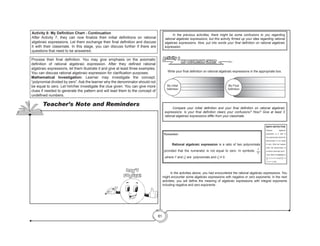
  • 45.
    107 3x 2x − 3 + 9 3− 2x = 3x 2x − 3 + 9 (-1)(2x − 3) = 3x 2x − 3 − 9 2x − 3 = 3x − 9 2x − 3 = 3(x − 3) 2x − 3 = x − 3 2x 4 b − 2 + b2 − 4b b − 2 = b2 − 4b + 4 b − 2 = (b − 2)(b + 2) b − 2 = b + 2 1. What did you feel while answering the activity? 2. Did you encounter difficulties in answering the activity? 3. How did you overcome these difficulties? Q U ESTIO N S ? The previous activities deal with the fundamental operations on rational expressions. Let us try these concepts in a different context. COMPLEX RATIONAL ALGEBRAIC EXPRESSIONS Activity 14 Examine and analyze the following illustrative examples on the next page. Pause in a while to answer the check – up questions. REVIEW Perform the operation of the following fractions. 1. 1 2 + 4 3 4. 1 2 + 5 4 2. 1 2 – 4 3 5. 5 9 + 4 3 3. 5 2 – 4 3 1 – 2 3 4 3 – 2 3 3 4 – 2 3 2 3 + 2 1 + 2 3 Rational algebraic expression is said to be in its simplest form when the numerator and denominator are polynomials with no common factors other than 1. If the numerator or denominator, or both numerator and denominator of a rational algebraic expression is also a rational algebraic expression, it is called a complex rational algebraic expression. To simplify the complex rational expression, it means to transform it into simple rational expression. You need all the concepts learned previously to simplify complex rational expressions. Activity 14. Complex Rational Expressions Like on the previous topics, each illustrative example has ideas and questions to guide the learners in determining the concepts and principles in each step. For the students to relate the new topic, start the discussion by reviewing simplifying complex fraction. You can also give more examples to give emphasis on the concepts and principles involving in this topic. Answer to the Review: Perform the operation of the following fractions. 1. 1 2 + 4 3 1 − 2 3 = 11 2 2. 1 2 − 4 3 3 4 − 2 3 = -10 3. 5 2 − 4 3 2 3 + 2 = 7 16 4. 1 2 + 5 4 4 3 − 2 3 = 21 8 5. 5 9 + 4 3 1 + 2 3 = 17 15 Teacher’s Note and Reminders Don’t Forget!
  • 46.
    108 Illustrative example 11:Simplify 2 a − 3 b 5 b + 6 a2 . 2 a − 3 b 5 b + 6 a2 = 2b − 3a ab ÷ 5a2 + 6b a2 b = 2b − 3a ab • a2 b 5a2 + 6b = (2b − 3a)aab (5a2 + 6b)ab = (2b − 3a)a (5a2 + 6b) = 2ab − 3a2 5a2 + 6b Illustrative example 12: Simplify c c2 − 4 − c c − 2 1 + 1 c + 2 . c c2 − 4 − c c − 2 1 + 1 c + 2 = c (c − 2)(c + 2) − c c − 2 1 + 1 c + 2 = c (c − 2)(c + 2) − c (c − 2) • (c + 2) (c + 2) 1 • c + 2 c + 2 + 1 (c + 2) Main fraction a line that separates the main numerator and main denominator. ? Where does the b b and a a in the main numerator and the a2 a2 and b b in the main denominator came from? ? What happens to the main numerator and main denominator? ? What principle is used in this step? ? What laws of exponents are used in this step? Simplify the rational algebraic expression. Teacher’s Note and Reminders Don’t Forget!
  • 47.
    109 = c (c − 2)(c+ 2) − c(c + 2) (c − 2) (c + 2) c + 2 c + 2 + 1 (c + 2) = c (c − 2)(c + 2) − c2 + 2c (c − 2) (c + 2) c + 2 c + 2 + 1 (c + 2) = c − (c2 + 2c) (c − 2)(c + 2) c + 2 + 1 c + 2 = -c2 − 2c + c (c − 2)(c + 2) c + 2 + 1 c + 2 = -c2 − c (c − 2)(c + 2) c + 3 c + 2 = -c2 − c (c − 2)(c + 2) ÷ c + 3 c + 2 = -c2 − c (c − 2)(c + 2) • c + 2 c + 3 = (-c2 − c)(c + 2) (c − 2)(c + 2) (c + 3) = -c2 − c (c − 2)(c + 3) = -c2 − c c2 + c − 6 Exercises Simplify the following complex rational expressions. 1. 1 x − 1 y 1 x2 + 1 y2 3. b b − 1 − 2b b − 2 2b b − 2 − 3b b − 3 5. 4 − 4 y2 2 + 2 y 2. x − y x + y − y x x y + x − y x + y 4. 1 a − 2 − 3 a − 1 5 a − 2 + 2 a − 1 Answer to Exercises 1. x2 y + xy2 x2 + y2 2. x2 y − 2xy2 − y3 x3 + 2x2 y − xy2 3. 2b − 3 b 4. 2 − 2a 7a − 9 5. 2y − 2 y Teacher’s Note and Reminders Don’t Forget!
  • 48.
    110 TREASURE HUNTING Activity 15 Find the box that contains treasure by simplifying rational expressions below. Find the answer of each expression in the hub. Each answer contains direction. The correct direction will lead you to the treasure. Go hunting now. 1. x2 − 4 x2 x + 2 y 2. x 2 + x 3 1 2 3. 3 x2 + 3x +2 x x + 2 THE HUB 5x 3 x2 − 2 x 1 x − 1 x2 + 2 x2 + x − 6 3 x2 + x 2 steps to the right Down 4 steps 3 steps to the left 4 steps to the right Up 3 steps Based on the above activity, what are your steps in simplifying complex rational algebraic expressions? Q U ESTIO N S ? START HERE Activity 15: Treasure Hunting This activity may strengthen the understanding of the learner regarding the topic. Give extra points for correct answer. The steps: 1. Down 4 steps 2. 2 steps to the right 3. Up 3 steps Let them enumerate the steps they did in simplifying complex rational algebraic expressions and identify the principles in each step. Teacher’s Note and Reminders Don’t Forget!
  • 49.
    111 VERTICAL CHEVRON LIST Activity16 Make a conceptual map in simplifying complex rational expression using vertical chevron list. Write the procedure or important concepts in every step inside the box. If necessary, add another chevron to complete your conceptual map. REACTION GUIDE Activity 17 Revisit the second activity. There are sets of rational algebraic expressions in the following table. Check agree if column I is the same as column II and check disagree if the two columns are not the same. I II Agree Disagree x2 − xy x2 − y2 • x + y x2 − xy x-1 − y-1 6y − 30 y2 + 2y + 1 ÷ 3y − 15 y2 + y 2y y + 1 5 4x2 + 7 6x 15 + 14x 12x2 Web – based Booster: Watch the videos in these web sites for more examples http://www.wtamu.edu/ academic/anns/mps/math/ mathlab/col_algebra/col_ alg_tut11_complexrat.htm http://www.youtube.com/ watch?v=-jli9PP_4HA h t t p : / / s p o t . p c c . edu/~kkling/Mth_95/ SectionIII_Rational_ Expressions_Equations_ and_Functions/Module4/ M o d u l e 4 _ C o m p l e x _ Rational_Expressions.pdf STEP 1 STEP 3 STEP 2 STEP 4 Activity 16: Vertical Chevron List In the previous activity, the learner identified the steps in simplifying complex rational algebraic expressions. Let his/her organize these steps and principles using vertical chevron list. Activity 17: Reaction Guide In activity 2, students were given anticipation guide. They will answer the same items in the anticipation guide, but this time they are expected to answer each item correctly. Let them compare their answer in the anticipation and reaction guide. Their answer on the questions may be written in the journal notebook. This activity will enable the students to correct their initial understanding before the lesson was presented. Let them compare their response in the anticipation guide and their response in this activity. Teacher’s Note and Reminders Don’t Forget!
  • 50.
    112 a b − a –b a − b a + b b − a a + b b − b a + b 1 b + 2 a a2 a + b Compare your answer from the anticipation guide to the reaction guide. Do they differ from each other? Why it so? Q U ESTIO N S ? In this section, the discussion was all about operations on rational algebraic expressions. How much of your initial ideas are found in the discussion? Which ideas are different and need revision? The skills in performing the operations on rational algebraic expressions is one of the key concepts in solving rate – related problems. What to Understand What to Understand Your goal in this section is to relate the operations of rational expressions to a real – life problems, especially the rate problems. WORD PROBLEM Activity 18 Read the problems below and answer the questions that follow. 1. Two vehicles travelled (x + 4) kilometers. The first vehicle travelled for (x2 – 16) hours while the second travelled for 2 x – 4 hours. a. Complete the table below. Vehicles Distance Time Speed Vehicle A Vehicle B Activity 18: WORD PROBLEM In this part, learner will be exposed more to how rational algebraic expressions can modelled the rate–related problems. You can discuss and give more examples similar to the items in this activity so that the students are guided on how the concepts of rational algebraic expressions modelled rate–related problems. Let them answer the activity individually or in collaborate work. Let them also enumerate the steps in solving these problems. Teacher’s Note and Reminders Don’t Forget!
  • 51.
    113 b. How didyou compute the speed of the two vehicles? c. Which of the two vehicles travelled faster? How did you find your answer? 2. Jem Boy and Roger were asked to fill the tank with water. Jem Boy can fill the tank in x minutes alone while Roger is slower by 2 minutes compared to Jem Boy if working alone. a. What part of the job can Jem Boy finish in 1 minute? b. What part of the job can Roger finish in 1 minute? c. Jem Boy and Roger can finish filling the tank together within certain number of minutes. How will you represent algebraically, in simplest form, the job done by the two if they worked together? ACCENT PROCESS Activity 19 List down the concepts and principles in solving problems involving operations of rational algebraic expressions in every step. You can add a box in necessary. ______________________ ______________________ ______________________ ______________________ ______________________ Step 1 _____________________ _____________________ _____________________ ______________________ ______ Step 2 _____________________ _____________________ _____________________ ______________________ ______ Step 3 PRESENTATION Activity 20 Present and discuss to the class the process of answering the questions below. Your output will be graded according to reasoning, accuracy, and presentation. Alex can pour a concrete walkway in x hours alone while Andy can pour the same walkway in two more hours than Alex. a. How fast can they pour together the walkway? b. If Emman can pour the same walkway in one more hours than Alex and Roger can pour the same walkway in one hour less than Andy, who must work together to finish the job with the least time? Activity 19: Accent Process Let the students enumerate the steps that they do in the previous activity. In this activity, let them organize these steps using accent process chart. Activity 20: Presentation In preparation for the performance task in this module, let the learner perform this activity. The learner is expected to present his/her output appropriately. Teacher’s Note and Reminders Don’t Forget!
  • 52.
    114 Rubrics for youroutput CRITERIA Outstanding 4 Satisfactory 3 Developing 2 Beginning 1 Mathematical reasoning Explanation shows thorough reasoning and insightful justifications. Explanation shows substantial reasoning Explanation shows gaps in reasoning. Explanation shows illogical reasoning. Accuracy All computations are correct and shown in detail. All computations are corrects. Most of the computations are correct. Some the computations are correct. Presentation The presentation uses appropriate and creative visual materials. It is delivered in a very convincing manner. The presentation uses appropriate visual materials. It is delivered in a clear manner. The presentation uses some visual materials. It is delivered in a disorganized manner. The presentation does not use any visual materials. It is delivered in a clear manner. In this section, the discussion was about application of operations on rational algebraic expressions. It gives you a general picture of relation between the operations of rational algebraic expressions and rate – related problems. What new realizations do you have about the topic? What new connections have you made for yourself? What questions do you still have? Copy the Learned, Affirmed, Challenged cards in your journal notebook and complete it. Learned What new realizations and learning do you have about the topic? Affirmed What new connections have you made? Which of your old ideas have been confirmed/affirmed Challenge What questions do you still have? Which areas seem difficult for you? Which do you want to explore Before moving to the transfer part, let the learner fill in the LEARNED, AFFIRMED and CHALLENGED box. This activity will solicit ideas on what and how the learner learned this lesson. Try to clear his/her thought by addressing the questions regarding in this lesson. Teacher’s Note and Reminders Don’t Forget!
  • 53.
    115 What to Transfer Whatto Transfer Your goal in this section is to apply your learning in real life situations. You will be given a practical task which will demonstrate your understanding. A newly-wed couple plans to construct a house. The couple has already a house plan from their friend engineer. The plan of the house is illustrated below: Bedroom Comfort Room Master Bedroom Living Room Dining Room Laboratory As a foreman of the project, you are task to prepare a manpower plan to be presented to the couple. Inside the plan is how many workers are needed to complete the project, daily wage of the workers, how many days can they finish the project and how much can be spend for the entire job. The man power plan will be based on reasoning, accuracy, presentation, practicality and efficiency. Q U ESTIO N S ? 1 m 2 m 3 m 2 m 1.5 m 2.5 m 3 m 3 m What to Transfer What to Transfer This is the performance task in this module. Encourage the learner to interview skilled workers regarding their rate of work and the wage per worker. Encourage the learner to be resourceful in dealing with this performance task. They must present not only the manpower plan but also the process on how they transfer their understanding of rational algebraic expressions to this performance task. Also, after the performance task, ask the learner what difficulties they encountered and how they manage these difficulties. CRITERIA Outstanding 4 Satisfactory 3 Developing 2 Beginning 1 Reasoning Explanation shows thorough reasoning and insightful justifications. Explanation shows substantial reasoning. Explanation shows gaps in reasoning. Explanation shows illogical reasoning. Accuracy All computa- tions are cor- rect and shown in detail All computa- tions are correct. Most of the computations are correct. Some of the computations are correct. Presentation the presentation uses appropriate and creative visual materials. it is delivered in a very convincing manner The presentation uses appropriate visual materials. It is delivered in a clear manner. The presentation uses some visual materials. It is delivered in a disorganize manner. The presentation does not use any visual materials. It is delivered in a clear manner. Practically The proposed plan will be completed at the least time. The proposed plan will be completed in lesses time. The proposed project will be completed with greater number of days. The proposed plan will be completed with the most number of days. Efficiency The cost of the plan is minimal. The cost of the plan is reasonable. The cost of the plan is expensive. The cost of the plan is very expensive.
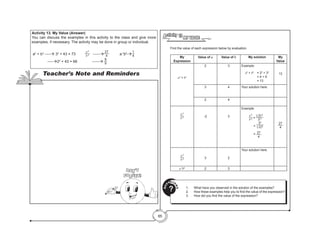
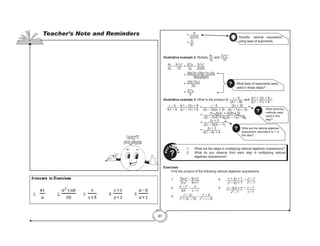
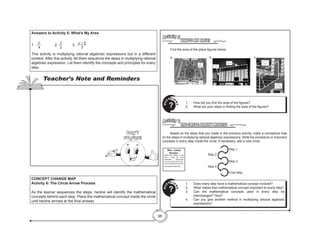
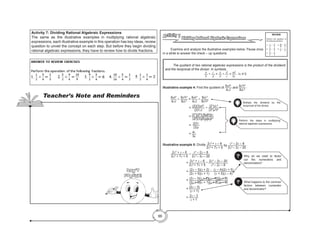
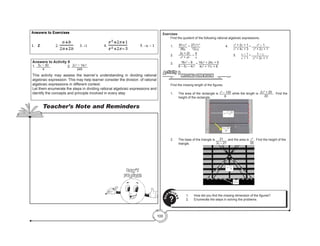
  • 54.
    POST - TEST 1. Which of the following algebraic expressions could not be considered as rational algebraic expression? a. √50x b. 5x1/2 c. 4y2 – 9z2 d. a − b b + a Answer: B. The exponent in the expression in B is a fraction. Rational algebraic expression has no fractional exponent. 2. What is the rational algebraic expression equivalent to (8kp3 )0 4k-2 p-3 ? a. 4k2 p3 b. 2k2 p3 c. k2 p3 4 d. k5 p6 4 Answer: C. The numerator is raised to 0 which means 1. The k and p are raised to a negative which means the multiplicative inverse of the expression. 3. What is the value of the expression x-3 yc8 x2 y-2 c7 when x is 2, y is 3 and c is -2? a. - 27 16 b. 27 16 c. 32 27 d. -32 27 Answer: A. x-3 yc8 x2 y-2 c7 = y3 c x5 = (27)(-2) 32 = - 27 16 4. The area of the rectangle is x2 – 3x – 10. What is the length of the rectangle if the width is x + 2? a. (x + 5)(x – 2) b. (x + 5)(x – 2) x – 2 c. x + 5 x – 2 d. x – 5 Answer: D. l = x2 – 3x – 10 x + 2 = (x – 5)(x + 2) x + 2 = x – 5 5. What must be added to 3x + 4 x + 2 so that there sum is 3x2 + x – 4 x2 – 4 ? a. 3x + 4 x2 – 4 b. -3x – 4 x2 – 4 c. x + 12 x2 – 4 d. x – 12 x2 – 4 116
  • 55.
    Answer: A. 3x2 +x – 4 x2 – 4 – 3x + 4 x + 2 = 3x2 + x – 4 x2 – 4 – (x – 2)(3x + 4) (x + 2)(x – 2) = 3x2 + x – 4 – 3x2 + 2x + 8 x2 – 4 = 3x + 4 x2 – 4 6. If one of the factors of 1 a + 1 is a – 1 a – 2a + 1 , find the other factor. a. a + 1 a – 1 b. a – 1 1 – a c. a2 – 2a + 1 a2 – 1 d. a2 – 1 a2 – 2a + 1 Answer: A. a – 1 a2 – 2a + 1 ÷ 1 a + 1 = a – 1 (a – 1)(a – 1) • a + 1 1 = a + 1 a – 1 7. Which of the following rational algebraic expressions is equivalent to 1 x2 + 5x + 6 1 x + 3 ? a. 1 x + 2 b. 1 x – 2 c. 1 x + 3 d. 1 x – 3 Answer: A. 1 x2 + 5x + 6 1 x + 3 = 1 (x + 3)(x + 2) 1 x + 3 = 1 (x + 3)(x + 2) • x + 3 1 = 1 x + 2 8. What is the difference between m 6 and m 3 ? a. m 6 b. - m 2 c. m 2 d. - m 2 Answer: A . m 2 – m 3 = 3m – 2m 6 = m 6 9. A business man invested his money and was assured that his money will increase using the formula P(1 r n ) nt where P is money invested; r is the rate of increase; n is mode of increase in a year and t is the number of years. If the business man invested Php 10 000, how much can he get at the end of the year if the rate is 50% and will increase twice a year? a. Php 15 652 b. Php 16 552 c. Php 15 625 d. Php 15 255 Answer: C. P(1 + r n ) nt = 10000 (1 + 0.5 2 ) (2)(1) = 10000 (1 + 1 4 ) (2) = 10000 (1 + 5 4 ) (2) = 10000 (25 16 ) = 15 625 117
  • 56.
    10. Roger cando the project in x number hours. Concepcion can do the same job in 2 hours less than Roger does. Which of the choices below is the difference of their rate? a. 2x − 2 x2 − 2x b. - 2 x2 − 2x c. 2 x2 − 2x d. - 2x − 2 x2 − 2x Answer: B. 1 x − 1 x − 2 = x − 2 − x x2 − 2x = - 2 x2 − 2x 11. You have (x2 + 2) pesos to buy materials for your school project. You spent half of it in the first store, then you spent one – third of your money less than you spent in the first store. In the third store, you spent one – fourth of the remaining money from the two stores. What is the total cost of the materials? a. 4x2 − 8 4 b. 3x2 + 6 4 c. 5x2 + 20 12 d. 7x2 + 14 12 Answer: B. x2 + 2 2 + x2 − 2 2 − x2 + 2 3 + x2 + 2 12 = 9x2 + 18 12 = 3x2 + 6 4 12. James were asked to simplify x2 + 2x − 8 x2 − 4 . His solution is presented below. What makes the solution of James wrong? a. Cancelling 4. b. Crossing out the (x – 2). c. x2 – 4 being factored out. d. Dividing out the variable x. Answer: D. X in the (x + 4) and (x + 2) should not divided out because it is part of the term and it is not a common factor of the numerator and denominator. 118
  • 57.
    13. Marytook the math exam. One of the problems in the exam is finding the quotient of x2 + 2x + 2 4 − x2 and 1 − x2 x2 + x − 2 . Her solution is shown below. Answer: D. (x – 1) is additive inverse of (1 – x). If the a term is divided by the its additive inverse, quotient is -1 14. Greg simplify 2 y + 1 + 3 3 y + 1 + 4 this way: Answer: B. In simplifying complex rational algebraic expression, numerator and denominator can be multiplied by their LCD Did Mary arrive at the correct answer? a. No, the dividend and divisor should be interchange. b. No, the divisor should be reciprocated first before factoring it out. c. No. (2 + x) is not the same as (x + 2). d. No. (x – 1) and (1 – x) is not equal to 1 Is there anything wrong in his solution? a. Something is wrong with the solution. He is not following the correct process of simplifying complex rational algebraic expression. b. None. Multiplying the numerator and denominator by the same quantity makes no difference on the given expression. c. Something is wrong with the solution. Numerator and denominator may be multiplied by a certain number but not an algebraic expression. d. None. The solution and answer of Greg is different but acceptable. 119
  • 58.
    15. YourProject Supervisor ask you to make a floor plan of a house. As an engineer, what must be considered in completing the plan? a. Reasoning and accuracy b. Cost and design c. Feasible and accurate d. Practical and aesthetics Answer: C. Dividing the parts of the house must be accurate and it must be realistic. 16. Your mother asked you to find for laborers in renovating your house. What will you look in choosing a laborer? a. His efficiency in doing the task. b. His attitude towards work. c. His perception in the job. d. His wage in a day. Answer: A. Though the rate/speed of the laborer counts but the quality of his work must not be compromised. 17. You need a printer in your computer shop. The list of the printers and its capacities is presented in the table. Based in the table, what printer is best to buy? Printer Pages to print in a minute Capacity of the ink Average number of wasted paper per 500 pages HD Turbo 16 450 pages 4 IP Sun 7 500 pages 2 Bazoka 23 350 pages 12 Father’s 18 400 pages 6 a. Father’s. it has more pages to print and good capacity of ink. b. Bazoka. It has the most pages to print and nice capacity of ink. 120
  • 59.
    c. IP Sun.It has the best ink capacity and least number of paper wasted. d. HD Turbo. It has lesser wasted paper and better ink capacity. Answer: D. Though the HD Turbo is slower compared to Father’s and Bazoka but it has the lesser wasted paper compared the other two printers. And the capacity of the ink is better compared to the other two printers. 18. What qualities you must look in buying a printer for personal consumption? a. Brand and design b. Price and pages to print c. Cost of the printer and its efficiency. d . Brand and the quality of the output. Answer: C. It is better to consider the cost of the printer that will not compromise its efficiency. 19. You were tasked, as a budget officer, to give comments regarding the work plan of the engineer. What aspect of the plan should you consider? a. The wage of the laborers and the rentals of the equipment. b. The number of laborers and equipment needed. c. The quality of work done by the laborers and efficiency of the equipment. d. The job done by the laborers in one day and appropriateness of the equipment. Answer: A. It is not necessary to look for the rate/speed and efficiency of the laborers as a budget officer because you will look for the financial aspect of the project. 20. After you give comments in the work plan in number 19, what will you do next? A. Present a feasibility study. c. Look for financial resources B. Make a budget proposal. d. Give a financial statement Answer: B. A will be given by the engineer. C will be given after the budget plan. D will be given after the project. 121
  • 60.
    SUMMARY Now thatyou have completed this module, let us summarize what have you learned: 1. Rate–related problems can be modeled using rational algebraic expressions. 2. Rational algebraic expression is a ratio of two polynomials where the denominator is not equal to one. 3. Any expression raised to zero is always equal to one. 4. When an expression is raised by a negative integer, it is the multiplicative inverse of the expression. 5. Rational algebraic expression is in its simplest form if there is no common factor between numerator and denominator except 1. 6. To multiply rational algebraic expression, multiply the numerator and denominator then simplify. 7. To divide rational algebraic expression, multiply the dividend by the reciprocal of the divisor then multiply. 8. To add/subtract similar rational algebraic expressions, add/subtract the numerators and copy the common denominator. 9. To add/subtract dissimilar rational algebraic expressions, express each expression into similar one then add/subtract the numerators and copy the common denominator. 10. Complex rational algebraic expression is an expression where the numerator or denominator, or both numerator and denominator are rational algebraic expressions. GLOSSARY OF TERMS USED IN THIS MODULE Complex rational algebraic expression – an expression where the numerator or denominator or both numerator and denominator are rational algebraic expressions. LCD – also known as Least Common Denominator is the least common multiple of the denominators. 122
  • 61.
    Manpower plan –a plan where the number of workers needed to complete the project, wages of each worker in a day, how many days can workers finish the job and how much can be spend on the workers for the entire project. Rate–related problems – Problems involving rates (e.g., speed, percentage, ratio, work) Rational algebraic expression – ratio of two polynomials where the denominator is not equal to one. REFERENCES AND WEBSITE LINKS USED IN THIS MODULE: Learning Package no. 8, 9, 10, 11, 12, 13. Mathematics Teacher’s Guide, Funds for assistance to private education, 2007 Malaborbor, P., Sabangan, L., Carreon, E., Lorenzo, J., Intermediate algebra. Educational Resources Corporation, Cubao, Quezon City, Philippines, 2005 Orines, F., Diaz, Z., Mojica, M., Next century mathematics intermediate algebra, Pheoenix Publishing House, Quezon Ave., Quezon City 2007 Oronce, O., Mendoza, M., e – math intermediate algebra, Rex Book Store, Manila, Philippines, 2010 Padua, A. L, Crisostomo, R. M., Painless math, intermediate algebra. Anvil Publishing Inc. Pasig City Philippines, 2008 Worktext in Intermediate Algebra. United Eferza Academic Publication Co. Lipa City, Batangas, Philippines. 2011 123
  • 62.