T H E N O RT H S TA R S O F L U Z O N
ARTS AND CRAFTS
ARTS AND CRAFTS IN THE HIGHLANDS
OF LUZON
When our forefathers first set foot in our country, they
made use of the available materials for their daily needs.
They used Hardwood, and Timbers for posts, coconut
fronds (Leaves) as roofs and walls of huts, and flattened
bamboo slices for the floors.
They used bamboo tubes as cooking utensils and rattan
or Nito for baskets.
THE VARIOUS CULTURAL
COMMUNITIES OF LUZON AND THEIR
FAMOUS ART AND CRAFTS
• Ifugao – the ifugao lived in mountainous part of the
Cordillera Central in Northern Luzon. They are excellent
weavers, potterers, and skillful craftsmen. The ifugao are
also well-known for carving the mountain slopes of the
world-famous Banaue Rice Terraces.
• Ivatan – the ivatan are from the province of Batanes, the
northernmost island of our country. The place is often
visited by typhoons as the island is surrounded by wide
and trubulent seas. Many ivatan wear vakul, an abaca
fiber made headgear.
THE VARIOUS CULTURAL
COMMUNITIES OF LUZON AND THEIR
FAMOUS ART AND CRAFTS
• Gaddang – the Gaddang live in Cagayan, Quirino,
Central Isabela, and Nueva Vizcaya. They weave their
textile using fibers from cotton, pineapple, and abaca.
They are fond of colorful necklaces, beadworks,
wristbands, and bracelets made of copper. During
ceremonies men wore loin clothes (Dinega), a small-
beaded jacket (koton), and cape (tapit) while women
wore elaborate and decorative (Western-inspired)
clothes with beads, shells, buttons, and coins.
WHAT ARE IFUGAO’S OTHER FAMOUS
ARTWORKS
• Ifugao woodcarvings – the ifugao are known for their
mastery of sculpting their deity, bul-ul. They believe that
they can have an abundant harvest when this sculpture
is placed near rice granaries. The bul-ul is an artistic
sculptural representation of a human figure in wood. It
appears in spoons, bowls, grain containers, chili
crushers, and walking sticks.
WOODCARVING
• Hagabi - Another important woodcarving of the Ifugao. It
is a unique piece of wood used as a bench. The Hagabi
is a symbol of prosperity; thus many wealthy Ifugao have
hagabi on their posession.
TEXTILE WEAVING
• Ifugao weave blankets, upper garments, G-strings,
handbags, belts, and other accessories.
BASKET WEAVING
• The ifugao make baskets for storing grains and cooked
food. Baskets are used at home to keep household
utensils, clothes, and personal belongings. Outside of
the house, baskets are used for catching pests and
domesticating animals. Baskets are used for rituals and
religious ceremonies.
• The most popular material in basket weaving is the
rattan because of its durability. It is commonly used in
making labba or farm bowl, ligao or winnowing tray.
DID YOU KNOW THAT
• The Kiangan Museum an ethnic museum in the
province of Ifugao, has a rich display of priceless Ifugao
arts and artifacts. Aside from the famous Ifugao
carvings, find out the collections displayed in the
museum. Be inspired by the idea that visiting museums
and art galleries helps in understanding the culture and
history of a community and a country. Thus in a way it
helps in understanding a community better.
ELEMENTS AND DESIGN PRINCIPLES OF
THE ARTS OF HIGHLAND LUZON
Art elements are considered as the building blocks of art.
Similar colors when grouped together can also form a line.
1. Lines
2. Shape and Form
3. Value/Tone
4. Color
5. Texture
6. Space
LINES
In art, a line represent many things such as an actual line,
an object, a person or a building. A line can be thick or
thin; straight, wavy, curved, or angular; continuous or
broken; and dotted, dashed, or a combination of any of
these. Artist uses lines to define and enclose spaces.
TYPES OF LINES AND THE IDEA IT
SUGGEST
Both Vertical lines and Horizontal lines are considered
static lines. They suggest firmness and
straightforwardness.
VERTICAL LINES
These lines convey uprightness, dignity, and
assurance.
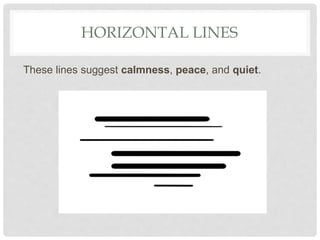
HORIZONTAL LINES
These lines suggest calmness, peace, and quiet.
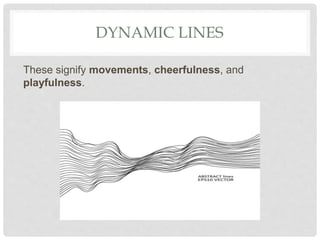
DYNAMIC LINES
These signify movements, cheerfulness, and
playfulness.
JAGGED LINES
These lines give the impression of chaos and disorder.
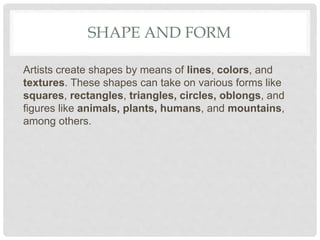
SHAPE AND FORM
Artists create shapes by means of lines, colors, and
textures. These shapes can take on various forms like
squares, rectangles, triangles, circles, oblongs, and
figures like animals, plants, humans, and mountains,
among others.
PUNAMHAN
TRADITIONAL WEAR
VALUE/TONE
Value or tone refers to the use of light and dark shades in
a piece of art. The contrast between the light and dark
shades can be used to create depth. This is shown by
shading a portion of the drawing of an object to make it
appear three-dimensional.
COLOR
Color is produced when artists decide to use various
pigments and dyes to create different hues in their
works. The result is seen as colors by the viewer whose
eyes and brain interpret it as such.
THREE BASIC TERMS TO DESCRIBE
COLORS
a. Hue – it is the basic name of color. Red, for example is
a hue from among the hundreds of other colors.
b. Value – it indicates how light or dark a color is. Red
color, if mixed with white, produces a tint, which is pink,
if green is mixed with a tint of violet, the result is forest
green.
c. Intensity – it is the brightness or dullness of color.
TEXTURE
This is the appearance of roughness or smoothness in
visual arts. The actual surface feel of a work of art or craft
is also called as texture. In sculpture, the texture
depends on the type of material that is used. The
surface of the object can be manipulated to appear as how
the artist wishes. Soft materials, such as clay or wax, may
send delicate sensations but they may also give a “hard
feel,” depending on how the artist uses the materials.
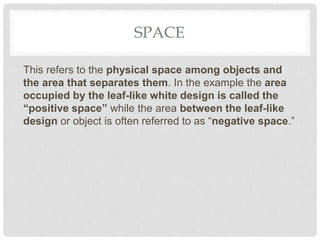
SPACE
This refers to the physical space among objects and
the area that separates them. In the example the area
occupied by the leaf-like white design is called the
“positive space” while the area between the leaf-like
design or object is often referred to as “negative space.”
PRINCIPLES OF DESIGN IN
ART
The “principle and design” are used by
artists to create artworks. Likewise they
can also be used to define and describe a
certain artwork.
PRINCIPLES OF DESIGN IN ART
1. Rhythm and Movement – Rhythm in art refers to the
repetition of a motif or elements of art at a regular or
irregular intervals.
2. Balance – refers to the idea of maintaining consistency
and equality of art elements in various areas of an
artwork.
Balance could be in the form of:
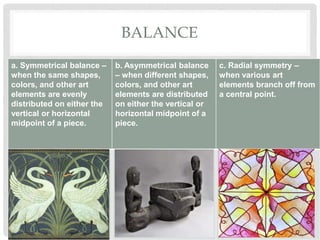
BALANCE
a. Symmetrical balance –
when the same shapes,
colors, and other art
elements are evenly
distributed on either the
vertical or horizontal
midpoint of a piece.
b. Asymmetrical balance
– when different shapes,
colors, and other art
elements are distributed
on either the vertical or
horizontal midpoint of a
piece.
c. Radial symmetry –
when various art
elements branch off from
a central point.
EMPHASIS AND HARMONY
There is emphasis when an
extraordinary or a different line,
color, or shape is placed in the midst
of a regular pattern.
When the art elements like colors,
shapes, and lines compliment, they
create Harmony.
UNITY, VARIETY AND PROPORTION
Unity – refers to the
sense of oneness,
wholeness, or order in a
work of art.
Variety – is a principle of
design that emphasizes
beauty when there is
diversity or the presence
of contrasting art
elements.
Proportion – refers to the
relationship of certain art
elements.
ARTS AND CRAFTS IN
THE LOWLAND LUZON
Pot making – Before the Spaniards came, native folks created ceramic jars to
keep the remains of their dead relatives and loved ones.
Mat weaving – is an old folk-art practice of our forefathers for centuries. Mats or
banig are woven dried leaves used for sleeping and sitting.
Other Forms of Arts and Crafts in Lowland
Luzon – Furniture making, cloth weaving,
wood carving, and blacksmithing are popular
cottage industries in Ilocos Norte. In Taal,
Batangas, the making of dainty and delicate
hand-sewn embroidery shown in tablecloths,
seat cushions, and formal gowns and dresses is
prevalent.
OTHER WELL-KNOWN PLACES IN
LUZON FOR ARTS AND CRAFTS
1. Paete, Laguna – is known as the capital of
woodcarving in the Philippines.
OTHER WELL-KNOWN PLACES IN
LUZON FOR ARTS AND CRAFTS
2. Angono, Rizal – is known as the “Art Capital of the
Philippines” All over the town, sculptures and 3D crafts
abound. Angono is also noted for the higantes that are
made of paper mache.
Grade 7-Arts-1st quarter.pptx

Grade 7-Arts-1st quarter.pptx

  • 1.
    T H EN O RT H S TA R S O F L U Z O N ARTS AND CRAFTS
  • 2.
    ARTS AND CRAFTSIN THE HIGHLANDS OF LUZON When our forefathers first set foot in our country, they made use of the available materials for their daily needs. They used Hardwood, and Timbers for posts, coconut fronds (Leaves) as roofs and walls of huts, and flattened bamboo slices for the floors. They used bamboo tubes as cooking utensils and rattan or Nito for baskets.
  • 3.
    THE VARIOUS CULTURAL COMMUNITIESOF LUZON AND THEIR FAMOUS ART AND CRAFTS • Ifugao – the ifugao lived in mountainous part of the Cordillera Central in Northern Luzon. They are excellent weavers, potterers, and skillful craftsmen. The ifugao are also well-known for carving the mountain slopes of the world-famous Banaue Rice Terraces. • Ivatan – the ivatan are from the province of Batanes, the northernmost island of our country. The place is often visited by typhoons as the island is surrounded by wide and trubulent seas. Many ivatan wear vakul, an abaca fiber made headgear.
  • 4.
    THE VARIOUS CULTURAL COMMUNITIESOF LUZON AND THEIR FAMOUS ART AND CRAFTS • Gaddang – the Gaddang live in Cagayan, Quirino, Central Isabela, and Nueva Vizcaya. They weave their textile using fibers from cotton, pineapple, and abaca. They are fond of colorful necklaces, beadworks, wristbands, and bracelets made of copper. During ceremonies men wore loin clothes (Dinega), a small- beaded jacket (koton), and cape (tapit) while women wore elaborate and decorative (Western-inspired) clothes with beads, shells, buttons, and coins.
  • 5.
    WHAT ARE IFUGAO’SOTHER FAMOUS ARTWORKS • Ifugao woodcarvings – the ifugao are known for their mastery of sculpting their deity, bul-ul. They believe that they can have an abundant harvest when this sculpture is placed near rice granaries. The bul-ul is an artistic sculptural representation of a human figure in wood. It appears in spoons, bowls, grain containers, chili crushers, and walking sticks.
  • 7.
    WOODCARVING • Hagabi -Another important woodcarving of the Ifugao. It is a unique piece of wood used as a bench. The Hagabi is a symbol of prosperity; thus many wealthy Ifugao have hagabi on their posession.
  • 8.
    TEXTILE WEAVING • Ifugaoweave blankets, upper garments, G-strings, handbags, belts, and other accessories.
  • 9.
    BASKET WEAVING • Theifugao make baskets for storing grains and cooked food. Baskets are used at home to keep household utensils, clothes, and personal belongings. Outside of the house, baskets are used for catching pests and domesticating animals. Baskets are used for rituals and religious ceremonies. • The most popular material in basket weaving is the rattan because of its durability. It is commonly used in making labba or farm bowl, ligao or winnowing tray.
  • 11.
    DID YOU KNOWTHAT • The Kiangan Museum an ethnic museum in the province of Ifugao, has a rich display of priceless Ifugao arts and artifacts. Aside from the famous Ifugao carvings, find out the collections displayed in the museum. Be inspired by the idea that visiting museums and art galleries helps in understanding the culture and history of a community and a country. Thus in a way it helps in understanding a community better.
  • 12.
    ELEMENTS AND DESIGNPRINCIPLES OF THE ARTS OF HIGHLAND LUZON Art elements are considered as the building blocks of art. Similar colors when grouped together can also form a line. 1. Lines 2. Shape and Form 3. Value/Tone 4. Color 5. Texture 6. Space
  • 13.
    LINES In art, aline represent many things such as an actual line, an object, a person or a building. A line can be thick or thin; straight, wavy, curved, or angular; continuous or broken; and dotted, dashed, or a combination of any of these. Artist uses lines to define and enclose spaces.
  • 14.
    TYPES OF LINESAND THE IDEA IT SUGGEST Both Vertical lines and Horizontal lines are considered static lines. They suggest firmness and straightforwardness.
  • 15.
    VERTICAL LINES These linesconvey uprightness, dignity, and assurance.
  • 16.
    HORIZONTAL LINES These linessuggest calmness, peace, and quiet.
  • 17.
    DYNAMIC LINES These signifymovements, cheerfulness, and playfulness.
  • 18.
    JAGGED LINES These linesgive the impression of chaos and disorder.
  • 19.
    SHAPE AND FORM Artistscreate shapes by means of lines, colors, and textures. These shapes can take on various forms like squares, rectangles, triangles, circles, oblongs, and figures like animals, plants, humans, and mountains, among others.
  • 20.
  • 21.
  • 22.
    VALUE/TONE Value or tonerefers to the use of light and dark shades in a piece of art. The contrast between the light and dark shades can be used to create depth. This is shown by shading a portion of the drawing of an object to make it appear three-dimensional.
  • 23.
    COLOR Color is producedwhen artists decide to use various pigments and dyes to create different hues in their works. The result is seen as colors by the viewer whose eyes and brain interpret it as such.
  • 24.
    THREE BASIC TERMSTO DESCRIBE COLORS a. Hue – it is the basic name of color. Red, for example is a hue from among the hundreds of other colors. b. Value – it indicates how light or dark a color is. Red color, if mixed with white, produces a tint, which is pink, if green is mixed with a tint of violet, the result is forest green. c. Intensity – it is the brightness or dullness of color.
  • 25.
    TEXTURE This is theappearance of roughness or smoothness in visual arts. The actual surface feel of a work of art or craft is also called as texture. In sculpture, the texture depends on the type of material that is used. The surface of the object can be manipulated to appear as how the artist wishes. Soft materials, such as clay or wax, may send delicate sensations but they may also give a “hard feel,” depending on how the artist uses the materials.
  • 26.
    SPACE This refers tothe physical space among objects and the area that separates them. In the example the area occupied by the leaf-like white design is called the “positive space” while the area between the leaf-like design or object is often referred to as “negative space.”
  • 28.
  • 29.
    The “principle anddesign” are used by artists to create artworks. Likewise they can also be used to define and describe a certain artwork.
  • 30.
    PRINCIPLES OF DESIGNIN ART 1. Rhythm and Movement – Rhythm in art refers to the repetition of a motif or elements of art at a regular or irregular intervals. 2. Balance – refers to the idea of maintaining consistency and equality of art elements in various areas of an artwork. Balance could be in the form of:
  • 31.
    BALANCE a. Symmetrical balance– when the same shapes, colors, and other art elements are evenly distributed on either the vertical or horizontal midpoint of a piece. b. Asymmetrical balance – when different shapes, colors, and other art elements are distributed on either the vertical or horizontal midpoint of a piece. c. Radial symmetry – when various art elements branch off from a central point.
  • 32.
    EMPHASIS AND HARMONY Thereis emphasis when an extraordinary or a different line, color, or shape is placed in the midst of a regular pattern. When the art elements like colors, shapes, and lines compliment, they create Harmony.
  • 33.
    UNITY, VARIETY ANDPROPORTION Unity – refers to the sense of oneness, wholeness, or order in a work of art. Variety – is a principle of design that emphasizes beauty when there is diversity or the presence of contrasting art elements. Proportion – refers to the relationship of certain art elements.
  • 34.
    ARTS AND CRAFTSIN THE LOWLAND LUZON
  • 35.
    Pot making –Before the Spaniards came, native folks created ceramic jars to keep the remains of their dead relatives and loved ones.
  • 36.
    Mat weaving –is an old folk-art practice of our forefathers for centuries. Mats or banig are woven dried leaves used for sleeping and sitting.
  • 37.
    Other Forms ofArts and Crafts in Lowland Luzon – Furniture making, cloth weaving, wood carving, and blacksmithing are popular cottage industries in Ilocos Norte. In Taal, Batangas, the making of dainty and delicate hand-sewn embroidery shown in tablecloths, seat cushions, and formal gowns and dresses is prevalent.
  • 38.
    OTHER WELL-KNOWN PLACESIN LUZON FOR ARTS AND CRAFTS 1. Paete, Laguna – is known as the capital of woodcarving in the Philippines.
  • 39.
    OTHER WELL-KNOWN PLACESIN LUZON FOR ARTS AND CRAFTS 2. Angono, Rizal – is known as the “Art Capital of the Philippines” All over the town, sculptures and 3D crafts abound. Angono is also noted for the higantes that are made of paper mache.