P
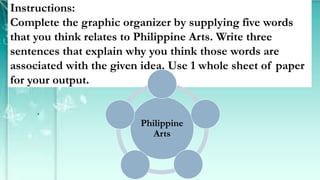
Instructions:
Complete the graphicorganizer by supplying five words
that you think relates to Philippine Arts. Write three
sentences that explain why you think those words are
associated with the given idea. Use 1 whole sheet of paper
for your output.
Philippine
Arts
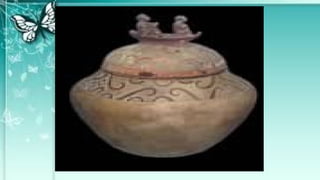
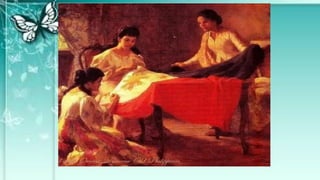
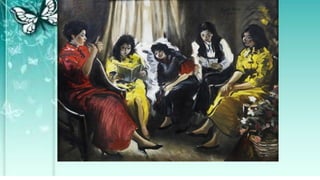
1. What dothe pictures of arts
reflect?
2. How these arts reflect the
development of Philippine
arts?
10.
Define Contemporary art
Describethe various art
forms and practices from the
various regions through the
development of Philippine
Arts.
11.
What is Artor Sining?
Defined as the different manners of
expressing human skills and imagination
in the creation of aesthetic conditions,
objects and presentations.
It is not confined only to what is seen.
It involves the use of all physical senses
in order to appreciate it.
Development of thePhilippine
Arts
◦Ethnic Tradition
◦Spanish Colonial Tradition
◦American Colonial and Contemporary
Art Traditions
14.
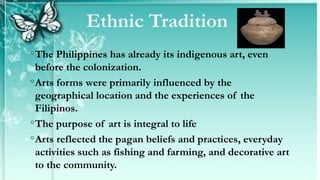
◦The Philippines hasalready its indigenous art, even
before the colonization.
◦Arts forms were primarily influenced by the
geographical location and the experiences of the
Filipinos.
◦The purpose of art is integral to life
◦Arts reflected the pagan beliefs and practices, everyday
activities such as fishing and farming, and decorative art
to the community.
Ethnic Tradition
15.
Examples of Artduring the Ethnic
tradition
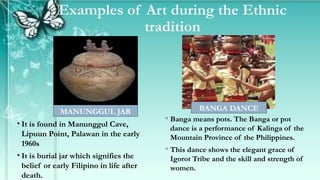
◦ Banga means pots. The Banga or pot
dance is a performance of Kalinga of the
Mountain Province of the Philippines.
◦ This dance shows the elegant grace of
Igorot Tribe and the skill and strength of
women.
• It is found in Manunggul Cave,
Lipuun Point, Palawan in the early
1960s
• It is burial jar which signifies the
belief or early Filipino in life after
death.
MANUNGGUL JAR BANGA DANCE
16.
◦ Indigenous artswere replaced with Western
arts.
◦Art forms were primarily influenced by
religion and secularization.
◦ During this time, Spaniards used arts to
propagate the Catholic faith.
Spanish Colonial Tradition
17.
Examples of Artduring the Spanish
tradition
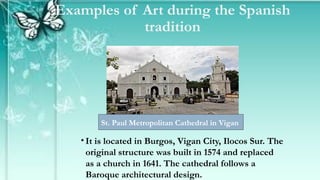
• It is located in Burgos, Vigan City, Ilocos Sur. The
original structure was built in 1574 and replaced
as a church in 1641. The cathedral follows a
Baroque architectural design.
St. Paul Metropolitan Cathedral in Vigan
18.
◦ Modern Artrefers to the practice of art
from 1860s to the 1960s.
◦The main theme of art works in this
time is national identity.
American Colonial and Contemporary
Arts Traditions
19.
◦Refers to thepractice of art from 1970’s to the
present.
◦Contemporary arts mirror contemporary culture
and society.
◦Diverse and emerging art practices were being
introduced.
◦Contemporary Arts mirror contemporary culture
and society.
Contemporary Arts
20.
Let’s check yourlearnings!
Summarize the development of
Arts in the Philippines.
In your own understanding,
what is contemporary art?
21.
Describe the variouscontemporary
art forms from the regions through
its elements and principles.
22.
1. SPACE
it pertainsto emptiness which may either be positive
space or negative space.
Positive space refers to a part which is enclosed in a
shape
Negative space refers to the opposite part which the
shape is enclosing
ELEMENTS OF ART
23.
2. LINE
it isa series of connected points.
it may come in two characteristics:
ELEMENTS OF ART
24.
TWO CHARACTERISTICS OFLINE
form – curved, dotted, or broken lines
- curved lines create an impression of a gradual change of
direction
-circular lines may pertain to abrupt changes in direction
direction – vertical, horizontal, or diagonal
- horizontal line usually suggests calmness
- vertical lines may convey strength
- diagonal lines create an impression of section
ELEMENTS OF ART
25.
3. SHAPE andFORM
Shape is an area that is enclosed by a line or lines.
- these are two-dimensional figures with height and width.
- shapes are of different kinds:
•Geometric shapes – triangles, squares, rectangles, etc.
•Organic shapes – shapes found in nature like the shape of a
leaf or a cloud
•Abstract shape – asymmetrical and free-flowing shapes
ELEMENTS OF ART
26.
SHAPE and FORM
-Forms are three dimensional figures
with height, width, and volume. It has more
depth compare to shape.
ELEMENTS OF ART
27.
4. COLOR
- Coloris associated with the natural phenomenon in
our environment. Scientifically, when light passes
through a prism, it will produce different hues of
different wavelengths. This color pertains to:
•lightness
•darkness
•coolness
•warmth
ELEMENTS OF ART
28.
5. VALUE
- Invisual arts, value is considered a property
of a color which pertains to its lightness or
darkness.
ELEMENTS OF ART
29.
7. TEXTURE
- Invisual arts, texture is the element that appeals to
our sense of feel on things such as:
•Rough
•Smooth
•Bumpy
•Slippery
- It pertains to the surface of an art piece.
ELEMENTS OF ART
1. Proportion
- Refersto the relationship of the size of
the elements in a body of art.
Example: when drawing a human standing
beside a house, it is important to ensure that
the size of the human is proportional to the
size of the house.
Principles of Art
47.
2. Harmony
- invisual arts, it is the unity of the
artwork, specifically about the
arrangement of the related elements.
Principles of Art
48.
3. Variety
- itcan also be referred to as diversity.
- this means adding multiple, different
elements to break the monotony of an
artwork and make it more interesting.
Principles of Art
49.
4. Movement
- inarts, movement is the illusion of
motion in a painting, sculpture design, or
in a piece of art.
Principles of Art
50.
5. Rhythm
- refersto the repetition of certain
elements to produce a pattern.
In visual arts, repeated design elements
may create a certain flow and may lead
the viewer’s eyes.
Principles of Art
51.
6. Balance
- refersto the even and equal distribution
of elements.
Principles of Art
52.
7. Emphasis
- aprinciple which may refer to the greater
impact given on a certain element.
Principles of Art
53.
Why do weneed to know
the elements and principles
of Art?
54.
Take Note:
In thefield of arts, knowing the its
elements and principles is important
to both the artist and the viewer to
have a clear and deeper understanding
the meaning of an artwork.
55.
A. Identify thetradition that is referred to
in the following statements.
1.
Let’s gauge your learnings!
56.
B. Determine theelement or principle of
art described in each statement.
1.
Quiz #1
#11 Aesthetic - concerned with beauty or the appreciation of beauty.
#16 Secular - attitudes, activities, or other things that have no religious or spiritual basis
Propagate – to spread or to dissiminate
#17 Baroque architecture is a style that originated in Italy in the late 16th century and spread to other parts of Europe and the world in the 17th and 18th centuries. It is characterized by ornate details, curved shapes, large-scale decoration, and dramatic effects of light and shadow1




![Elements of Arts in Yellow Playful Lesson Presentation [Autosaved].pptx](https://cdn.slidesharecdn.com/ss_thumbnails/elementsofartsinyellowplayfullessonpresentationautosaved-251013045727-44211bc0-thumbnail.jpg?width=640&height=640&fit=bounds)


