The Major Scales
Quarter 2 Week 2
MAPEH – Music 6
D
A
Y
1
Let’s Start
Have you tried to play guitar?
What cord do you know?
Are you familiar with the scale
that you learned?
Let’s Discuss
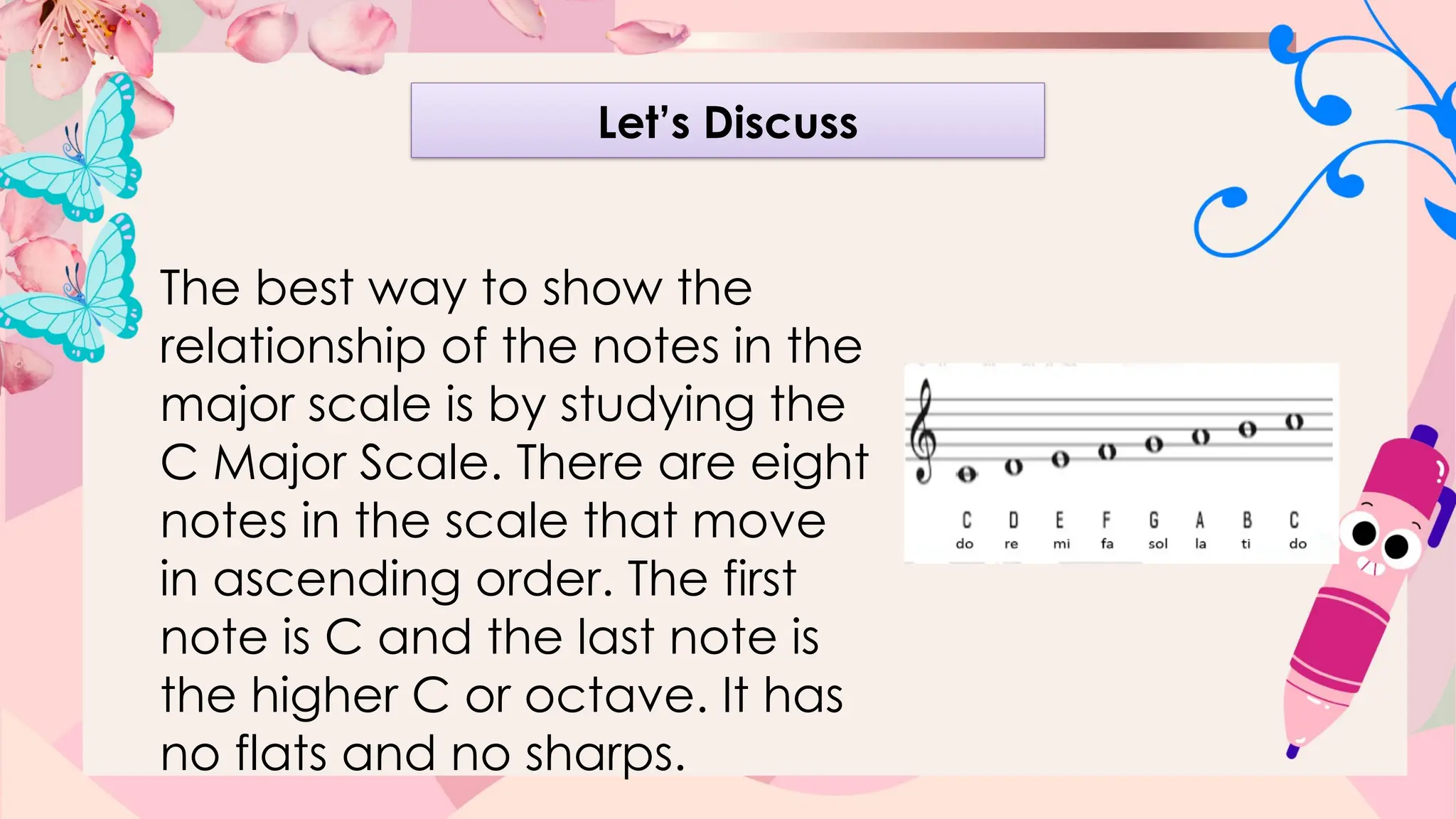
The best way to show the
relationship of the notes in the
major scale is by studying the
C Major Scale. There are eight
notes in the scale that move
in ascending order. The first
note is C and the last note is
the higher C or octave. It has
no flats and no sharps.
Let’s Discuss
Another major scale is G MAJOR. In this scale,
the first note or home tone is G. it is followed by
other seven notes in ascending order. It also has
a note with a sharp before it.
The sharp helps in achieving the correct interval
of half and whole steps of the major scale. In
this case, G Major has one sharp which is F#.
Let’s Discuss
Another example of a major scale is the F Major.
Its name is taken from the first note or its home
tone F. The scale is composed of eight notes
arranged in succession.
This scale utilizes a flat sign instead of a sharp
sign. The flat sign on B helps in making sure that
the scale follows the pattern of half steps and
whole steps for major scales.
Let’s Discuss
Key Signature is the number of flats and sharps
on the staff. It is written after the clef. In G Major
Scale the key signature is one sharp and it is
located on the fifth line of the staff. It tells us that
all notes in F carries the sharp sign unless there is
a natural sign written before the note.
Let’s Discuss
In F major Scale, the Key Signature is one flat. It
is written on the third line of the staff. It tell us
that all the notes in B carries the flat sign unless
there is a natural sign written before the note.
Another Scale is the Pentatonic Scale. It consists
of 5 different whole tones.
This is found primarily in Chinese music.
Examples:
Do- Re-Mi -So- La
Do-Re - Fa- So - la
Let’s Try
To familiarize yourself with the different musical
symbols, practice on illustrating the following on
a sheet of paper.
Let’s Group
Group Activity:
Direction: Draw the illustration of C major scale,
G major scale and F major scale with pitch
name or so-fa syllables. Discuss in the class after.
Group 1 – C Major Scale
Group 2 – G Major Scale
Group 3 – F Major Scale
Let’s Remember
1. A scale is composed of notes based on a sound
pattern.
2. The diatonic scale is the most common type of
scale.
3. The Major Scale follows the WS-WS-HS-WS-WS-WS-
HS interval pattern.
4. These are the first note of each major scale and its
key signature:
C Major Scale - C or do ( no sharp and no flat sign )
G Major Scale - G or so (one sharp on the 5th line)
F Major Scale - F or fa ( one flat on the third line)
Let’s Remember
Give an example of songs that
have scale of C Major, G Major, F
Major
Elements and Principles in
Digital Art
Quarter 2 Week 2
MAPEH – Arts 6
D
A
Y
2
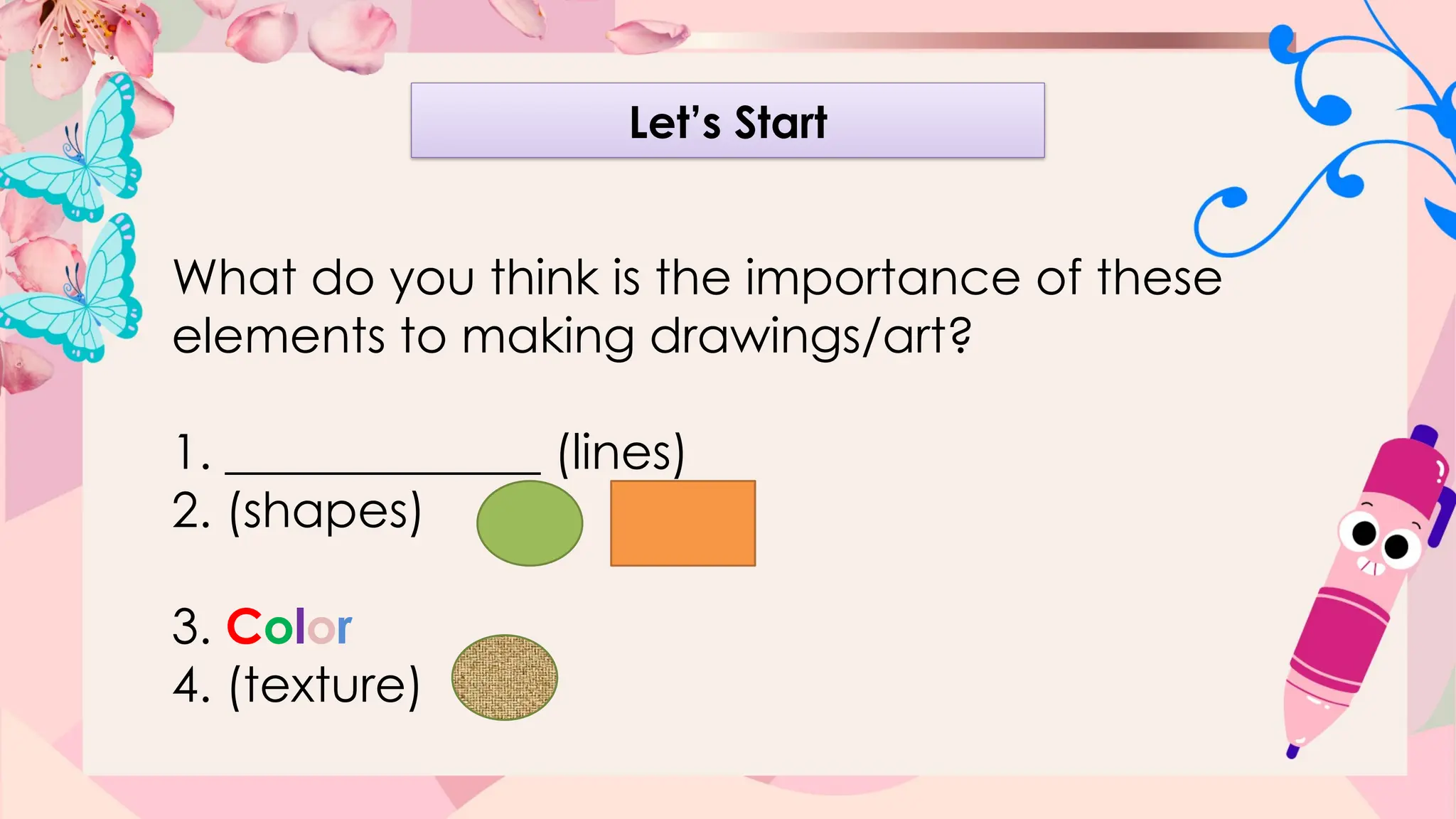
Let’s Start
What do you think is the importance of these
elements to making drawings/art?
1. _____________ (lines)
2. (shapes)
3. Color
4. (texture)
Let’s Discuss
Elements of Arts
1. Line is a mark with greater length than width. Lines
can be horizontal, vertical, or diagonal; straight or
curved; thick or thin.
2. Shape is a closed line. Shapes can be geometric,
like squares and circles; or organic, like free-form or
natural shapes. Shapes are flat and can express
length and width.
Let’s Discuss
Elements of Arts
3. Forms are three-dimensional shapes expressing
length, width, and depth. Balls, cylinders, boxes, and
pyramids are forms.
4. Space is the area between and around objects. The
space around objects is often called negative space;
negative space has shape. Space can also refer to the
feeling of depth. Real space is three-dimensional; in
visual art, when we create the feeling or illusion of
depth, we call it space.
Let’s Discuss
Elements of Arts
5. Color is light reflected off objects. Color has three
main characteristics: hue (the name of the color, such
as red, green, blue, etc.), value (how light or dark it is),
and intensity (how bright or dull it is).
6. Texture is the surface quality that can be seen and
felt. Textures can be rough or smooth, soft or hard.
Textures do not always feel the way they look; for
example, a drawing of a porcupine may look prickly,
but if you touch the drawing, the paper is still smooth..
Let’s Discuss
Principles of Arts
1. Balance is the distribution of the visual weight of
objects, colors, texture, and space. If the design was a
scale, these elements should be balanced to make a
design feel stable.
2. Emphasis is the part of the design that catches the
viewer’s attention. Usually the artist will make one area
stand out by contrasting it with other areas. The area
could be different in size, color, texture, shape, etc.
Let’s Discuss
Principles of Arts
3. Movement is the path the viewer’s eye takes through the
work of art, often to focal areas. Such movement can be
directed along lines, edges, shape, and color within the work
of art.
4. Pattern and Repetition is the repeating of an object or
symbol all over the work of art.
5. Proportion is the feeling of unity created when all parts
(sizes, amounts, or number) relate well with each other. When
drawing the human figure, proportion can refer to the size of
the head compared to the rest of the body.
Let’s Discuss
Principles of Arts
6. Rhythm is created when one or more elements of design
are used repeatedly to create a feeling of organized
movement. Rhythm creates a mood like music or dancing. To
keep rhythm exciting and active, variety is essential.
7. Variety is the use of several elements of design to hold the
viewer’s attention and to guide the viewer’s eye through and
around the work of art.
8. Unity is the feeling of harmony between all parts of the
work of art, which creates a sense of completeness.
Let’s Examine
Examine the picture if it follows the elements and
principles of arts. Do you this picture have elements and
principle? Explain.
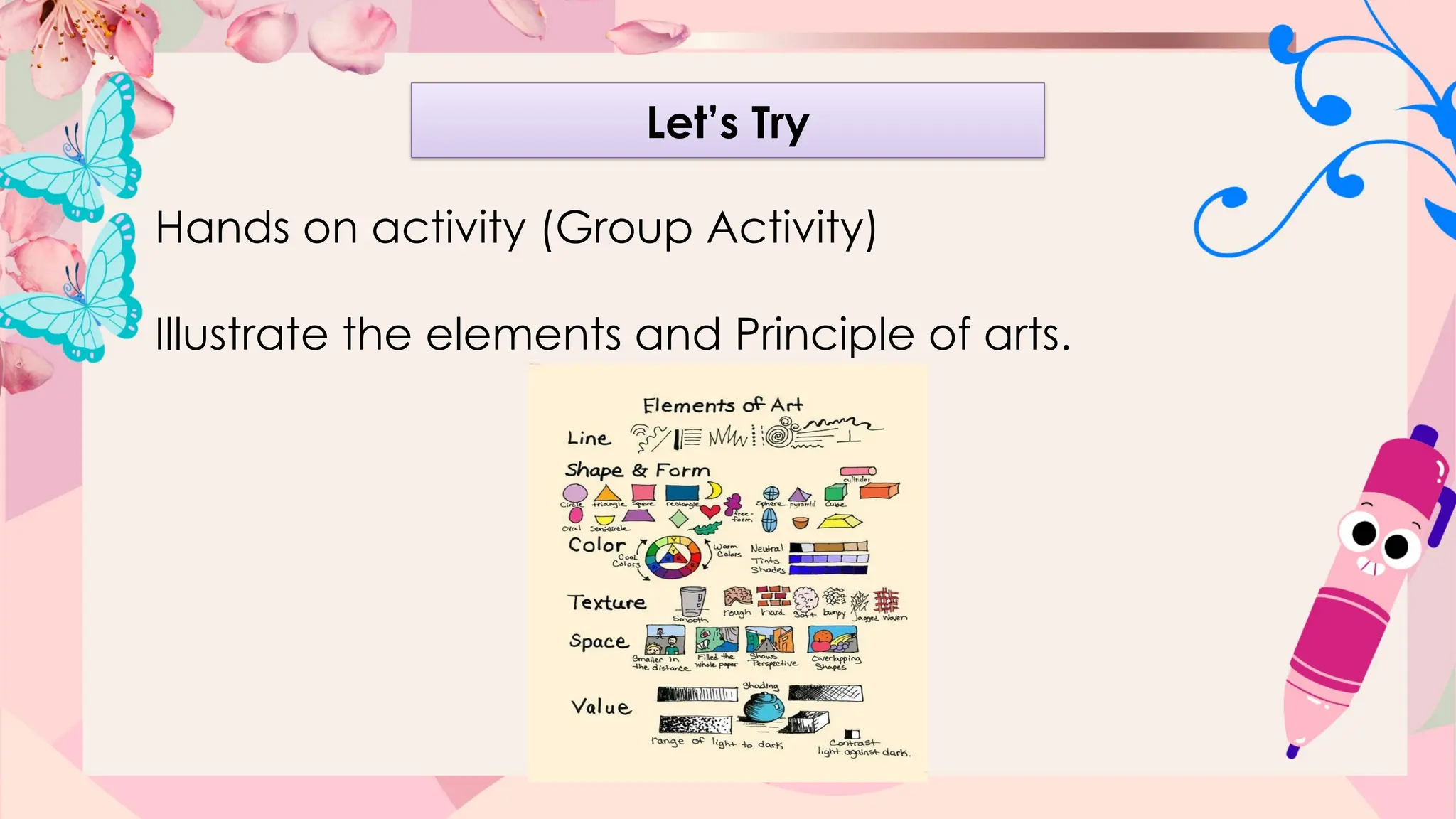
Let’s Try
Hands on activity (Group Activity)
Illustrate the elements and Principle of arts.
Let’s Answer
Choose the letter of the best answer. Write the
chosen letter on your notebook.
1. The element of art that can be horizontal,
vertical or diagonal; straight or curved; thick or thin
is __.
A. shape C. color
B. line D. form
Let’s Answer
2. The element of art that pertains to the area
between and around objects is ___.
A. space C. form
B. color D. texture
3. The element of art that shows the surface quality
that can be seen and felt is called __.
A. line C. texture
B. form D. color
Let’s Answer
4. The principle of art that pertains to the distribution of
the visual weight of objects, colors, texture and space is
called ___.
A. balance C. movement
B. emphasis D. pattern
5. The principle of art that is the path the viewer’s eye
takes through the work of art, often to focal areas is
called __.
A. variety C. movement
B. unity D. proportion
Importance of Physical
Fitness
Quarter 2 Week 2
MAPEH – PE 6
D
A
Y
3
Let’s Start
What comes in your mind whenever we talk about
physical fitness?
Physical Fitness
Let’s Discuss
A physical fitness test, as defined
by the Department of Education
(DepEd), is a set of measures
designed to determine one's
level of physical fitness.
It is divided into two parts or
components of fitness the
health-related and skill-related
fitness.
Let’s Discuss
All around the world there are
different physical fitness testing
programs being implemented.
These may vary from school to
school. Never-theless, they all
use almost the same sets of tests.
The choice of test for a school
varies in each country.
Let’s Discuss
All around the world there are different
physical fitness testing programs being
implemented. These may vary from
school to school. Nevertheless, they all
use almost the The tests depend on the
availability of equipment, the
practicality and simplicity of the
procedure, and its ease of
administration, among others. The
school is free to design its own physical
fitness testing.
Let’s Discuss
However, it needs to be patterned
after other standard fitness testing
programs. One can find various
suggestions for the type of testing the
school wants to use. It does not have
to be time-consuming or a
complicated task. Some of the tests
are quite simple to accomplish.same
sets of tests. The choice of test for a
school varies in each country.
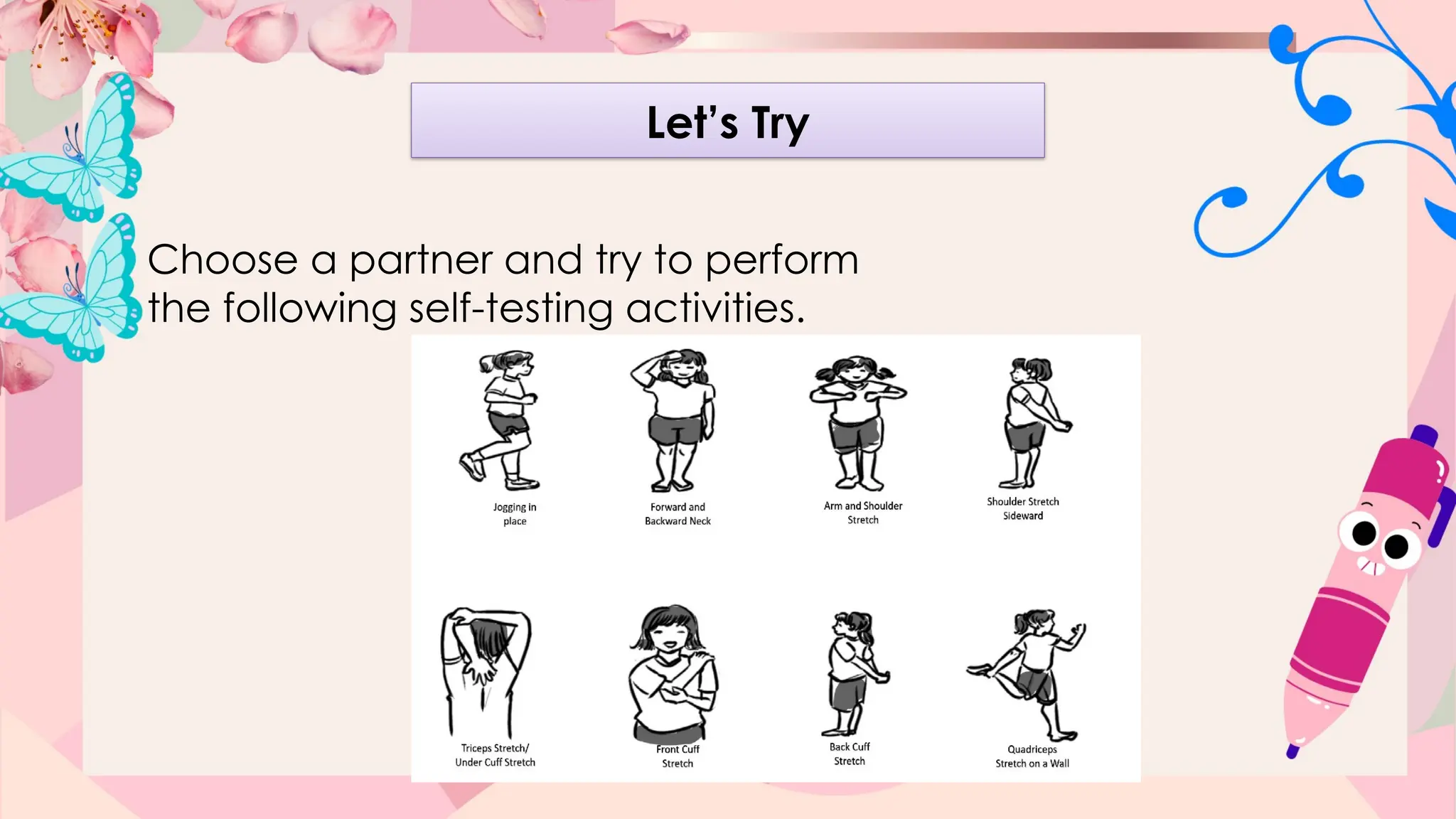
Let’s Try
Choose a partner and try to perform
the following self-testing activities.
Let’s Try
Guide Questions:
1. What activities may be given to measure
participation in activities?
2. Self –testing activities are said to be helpful in
achieving your level of fitness, what are some
examples of these activities? How these activities
are may be done?
Let’s Try
Practical Activity
Pairing Activity
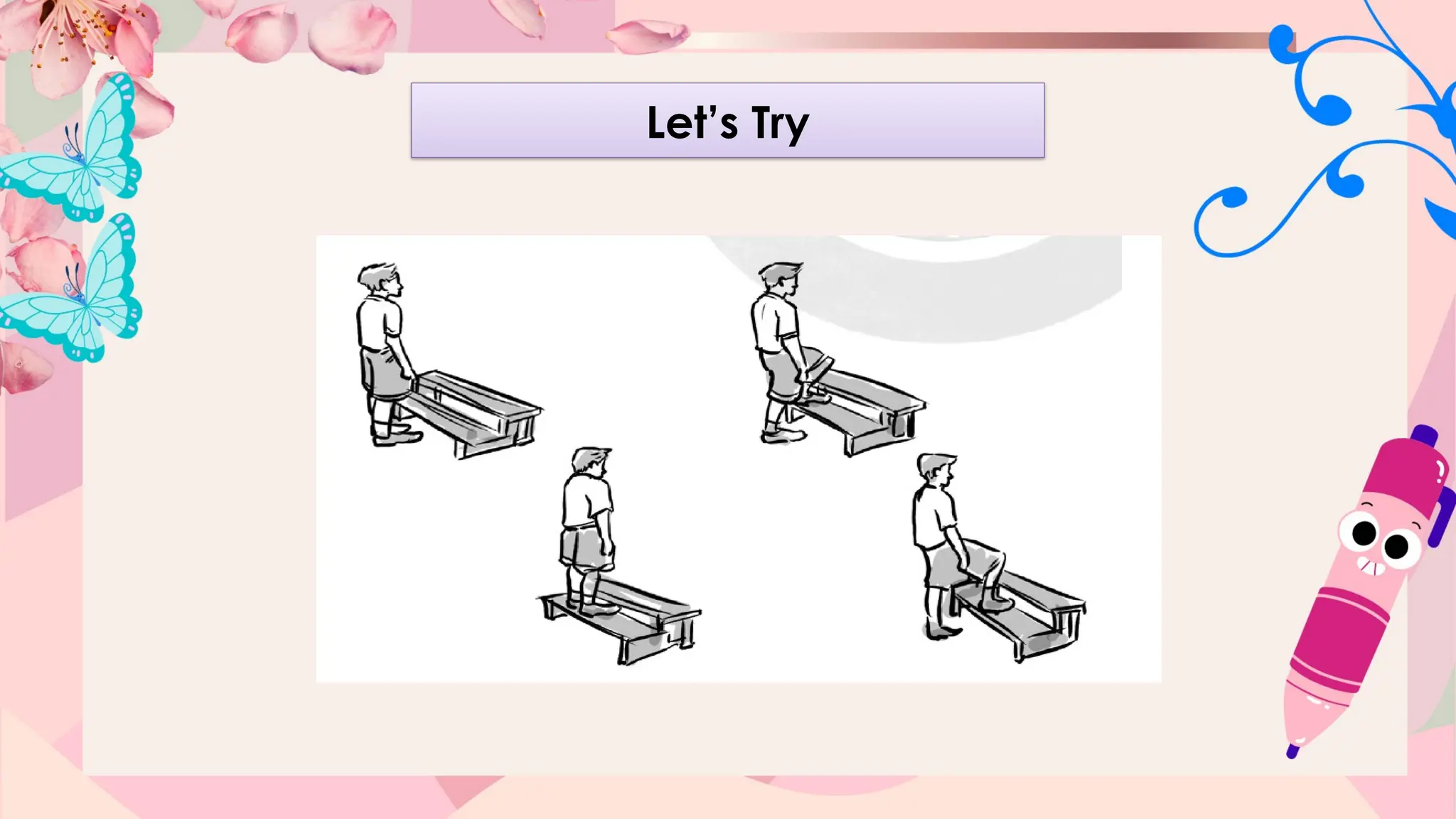
Activity 1: 3-Minute Step Test
Procedure:
A. Stand at least 1 foot away from the
step or bench with trunk erect and eyes
looking straight forward.
Let’s Try
B. At the signal “Go”, step up and down on a
bench for 3 minutes at a rate of 24 steps per
minute. One step consists of 4 beats, – that is, “up
with the left foot, up with the right foot, down with
the left foot, down with the right foot.”
C. Immediately after the exercise, stand and locate
your pulse in 5 seconds.
(the first beat is zero.)
D. Count the pulse for 10 seconds. Multiply by 6.
Let’s Try
Let’s Try
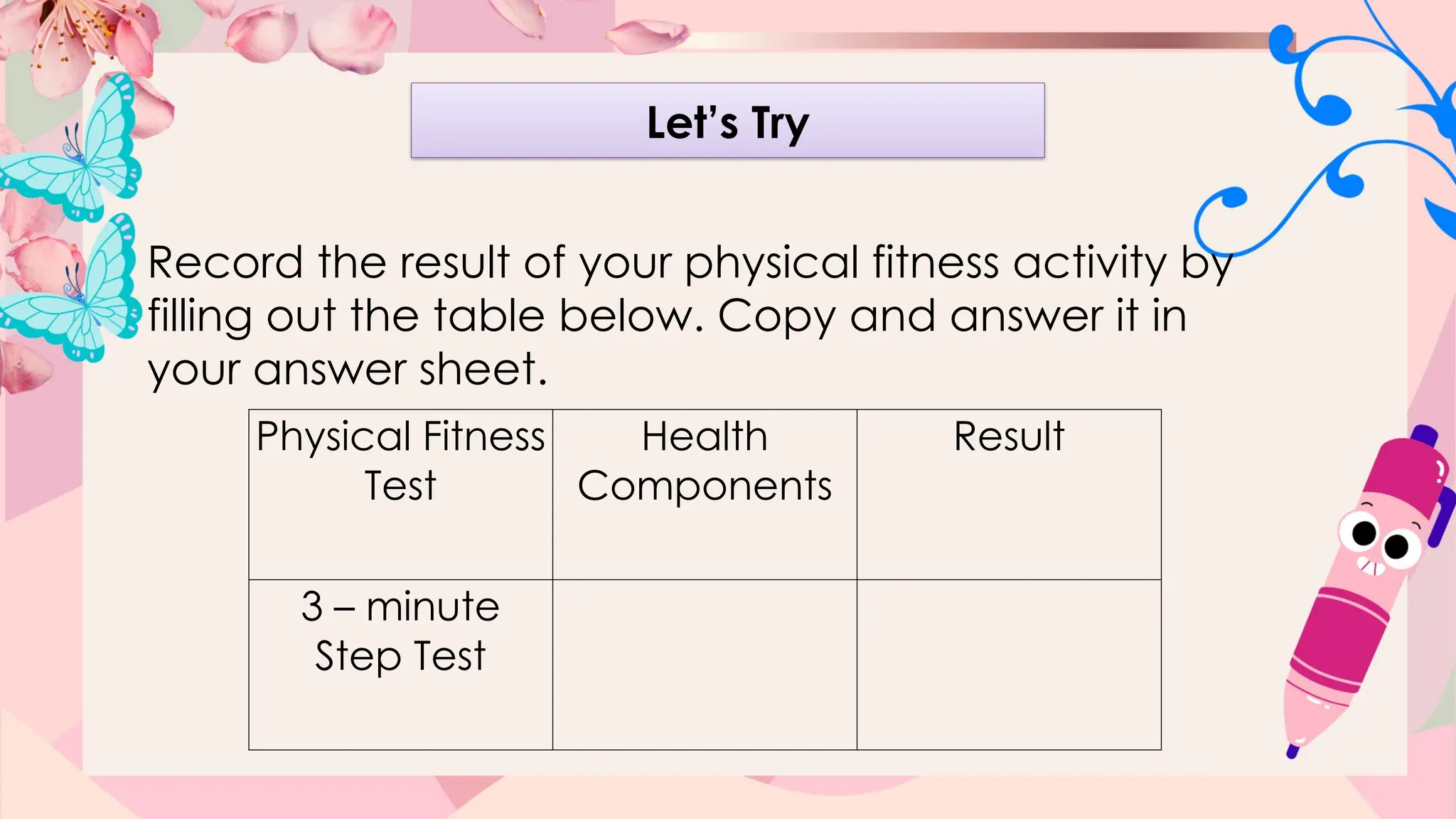
Record the result of your physical fitness activity by
filling out the table below. Copy and answer it in
your answer sheet.
Physical Fitness
Test
Health
Components
Result
3 – minute
Step Test
You and Your Healthy
Environment
Quarter 2 Week 2
MAPEH – HEALTH 6
D
A
Y
4
Let’s Start
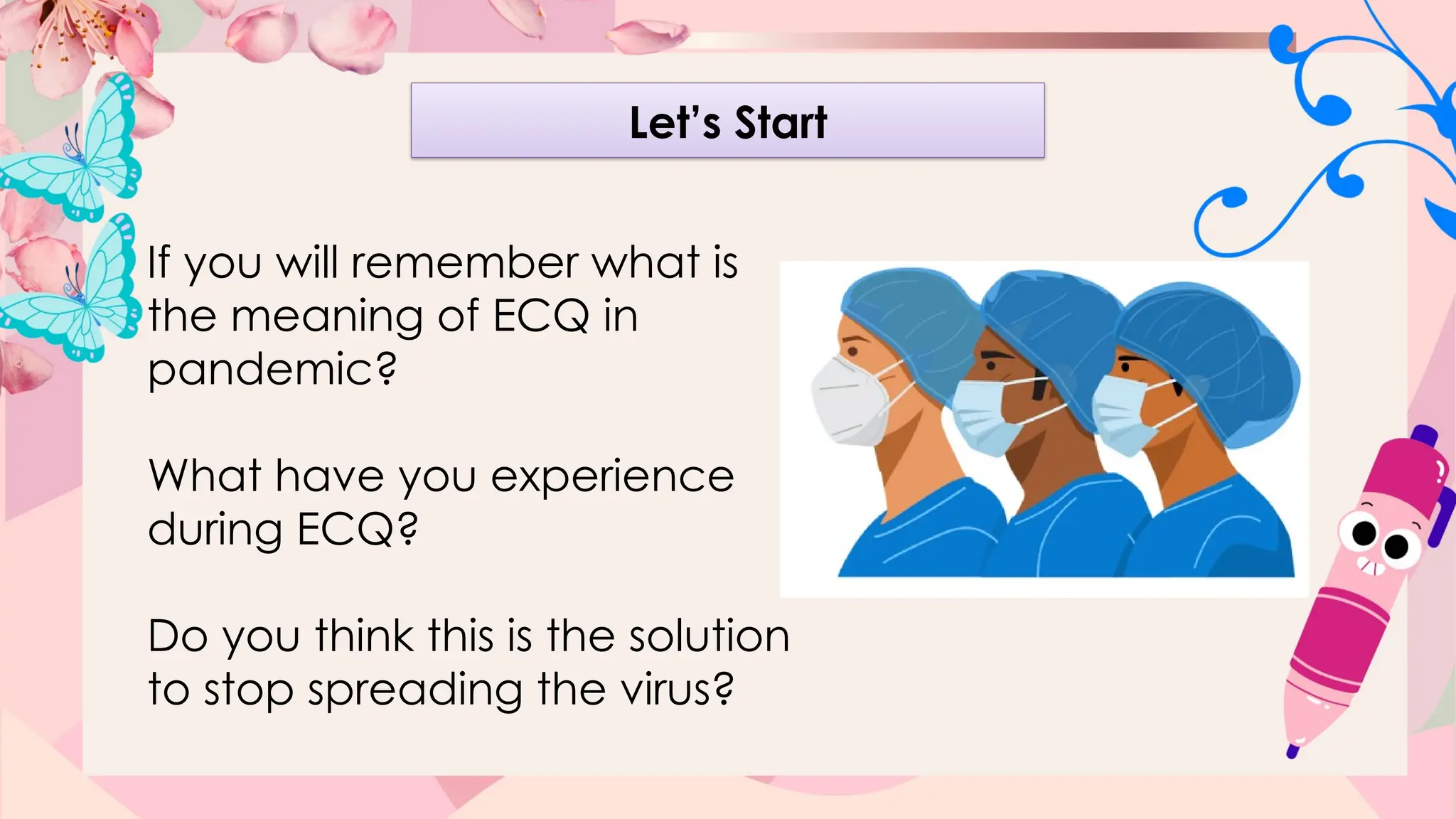
If you will remember what is
the meaning of ECQ in
pandemic?
What have you experience
during ECQ?
Do you think this is the solution
to stop spreading the virus?
Let’s Discuss
What Does “Community” Mean?
A community is a group of people living
together in a given place, and sharing
common interests, cultural and
traditional practices, and historical
heritage. Communities can be
categorized according to their beliefs,
traditions and culture. The following are
their common categories:
Let’s Discuss
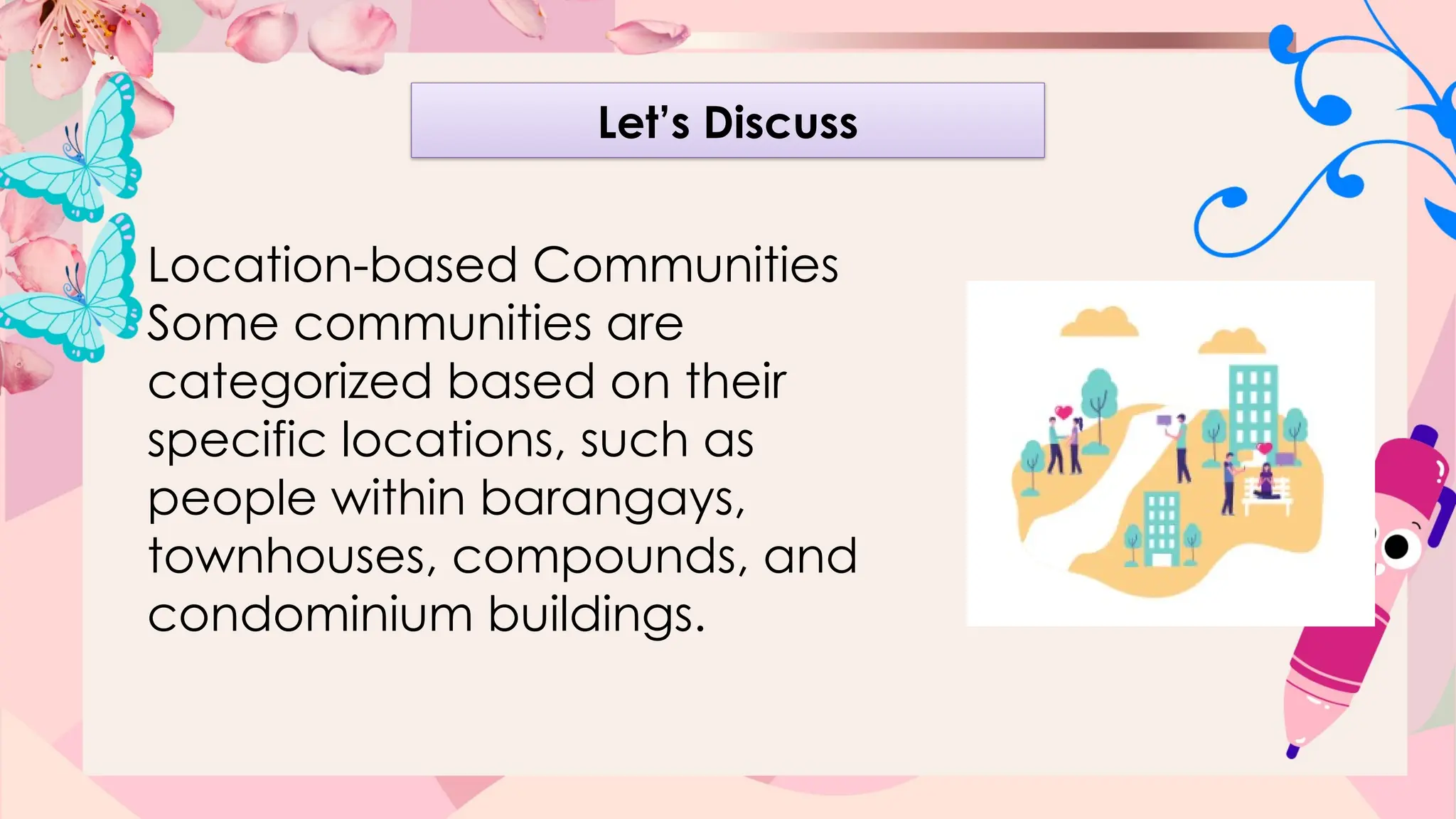
Location-based Communities
Some communities are
categorized based on their
specific locations, such as
people within barangays,
townhouses, compounds, and
condominium buildings.
Let’s Discuss
The following are examples of
location-based communities:
• Barangay Kapayapaan
• Greatfields Town Homes
• Dela Cruz Compound
• New Country
• Condominium
Let’s Discuss
Identity-based Communities
Some communities have same cultural
and traditional beliefs and practices.
Examples are religious groups, ethnic
groups, culture and arts performers, as
well as persons with disabilities (PWD).
Some examples are:
• San Isidro Parish Church
• T’boli tribe
• Tahanang walang hagdan
Let’s Discuss
Organizational-based Communities
Some communities are formed based on
organizational structure and beliefs. These can be
family-owned business groups, corporations and
national and international organizations.
The following are organizational-based
communities:
• schools
• fast food chains
• pharmaceutical companies
• political parties
• global companies
Let’s Discuss
What Does “Environment” Mean?
Environment refers to the natural
surroundings one lives in. It is
something that you are very
familiar with. It makes up
everything that affects your life
on earth— the water you drink,
the air you breath, the plants and
animals around you, and much,
much more.
Let’s Discuss
There are factors in the
environment that affect human
growth and development, as
well as behavioral, social and
cultural changes, Some of them
include the following:
Let’s Discuss
1. Agricultural and irrigation methods
2. Climate Change
3. Communicable diseases, water and
food-borne diseases, and those caused
by vectors like insects and rats
4. Natural biological agents like pollen
and dust
5. Personal hygiene
6. Ultraviolet rays from the sun
7. air, land and water pollution
8. natural and man-made disasters
Let’s Answer
Direction: Answer the following question.
1. What is a community?
2. What are the different types of
community and its descriptions?
3. Which type of community do you
belong? Explain your answer.
4. What is the broader sense of
environment?
5. How can these environmental factors
affect us in our community?
Let’s Group
Complete the pizza graphic organizer below by
writing in every slice the different words that describes
your school and community environment in any
aspects.
Let’s Try
Write the word GOOD if the statement describes a
healthy school environment and BAD if not.
Accomplish this task on your answer sheet.
_______________1. gender-sensitive
_______________2. clean with good air and water
quality
_______________3. always under construction
_______________4. safe and free from abuses
_______________5. with flexible spaces
Let’s Try
Write TRUE if the given statement describes the psychological
environment of healthy school and community and FALSE if not.
Do this on your answer sheet.
__________1. Healthy school and community enable people to
maintain a high quality of life and productivity.
__________2. A healthy school and community environment are
free from abuses and discrimination.
__________3. A sustainable use of available resources in community
and school for all are limited.
__________4. The environment of healthy school and community do
not promote social harmony and inactively involves everyone.
__________5. The healthy environment of school and community
meet everyone’s basic needs.
Let’s Try
Put a check (/) on the blank if the statement describes a
healthy community and mark it cross (X) if not. Do this in your
answer sheet.
A healthy community……
_____1. promotes social harmony and actively involves
everyone.
_____2. understands the local health and environmental issues.
_____3. have undisciplined people.
_____4. participates in identifying local solutions to local
problems.
_____5. have access to varied experiences and has means of
interaction and communication.
Let’s Try
Complete the paragraph with the appropriate words inside
the box about Psychosocial Environment of Healthy School
and Community.
_______________ school should be the place where children
develop their potentials so pupils should not
__________________ bullying and discrimination. In school,
teachers and adults serve as _________________ of kindness
and respect where pupils are accepted for who they are.
They are also supported, guided at their ______________ age.
Weekly Test
Quarter 2 Week 2
MAPEH 6
D
A
Y
5

Grade 6 - PPT_MAPEH_Quarter 2_Week 2.pptx

  • 1.
    The Major Scales Quarter2 Week 2 MAPEH – Music 6 D A Y 1
  • 2.
    Let’s Start Have youtried to play guitar? What cord do you know? Are you familiar with the scale that you learned?
  • 3.
    Let’s Discuss The bestway to show the relationship of the notes in the major scale is by studying the C Major Scale. There are eight notes in the scale that move in ascending order. The first note is C and the last note is the higher C or octave. It has no flats and no sharps.
  • 4.
    Let’s Discuss Another majorscale is G MAJOR. In this scale, the first note or home tone is G. it is followed by other seven notes in ascending order. It also has a note with a sharp before it. The sharp helps in achieving the correct interval of half and whole steps of the major scale. In this case, G Major has one sharp which is F#.
  • 5.
    Let’s Discuss Another exampleof a major scale is the F Major. Its name is taken from the first note or its home tone F. The scale is composed of eight notes arranged in succession. This scale utilizes a flat sign instead of a sharp sign. The flat sign on B helps in making sure that the scale follows the pattern of half steps and whole steps for major scales.
  • 6.
    Let’s Discuss Key Signatureis the number of flats and sharps on the staff. It is written after the clef. In G Major Scale the key signature is one sharp and it is located on the fifth line of the staff. It tells us that all notes in F carries the sharp sign unless there is a natural sign written before the note.
  • 7.
    Let’s Discuss In Fmajor Scale, the Key Signature is one flat. It is written on the third line of the staff. It tell us that all the notes in B carries the flat sign unless there is a natural sign written before the note. Another Scale is the Pentatonic Scale. It consists of 5 different whole tones. This is found primarily in Chinese music. Examples: Do- Re-Mi -So- La Do-Re - Fa- So - la
  • 8.
    Let’s Try To familiarizeyourself with the different musical symbols, practice on illustrating the following on a sheet of paper.
  • 9.
    Let’s Group Group Activity: Direction:Draw the illustration of C major scale, G major scale and F major scale with pitch name or so-fa syllables. Discuss in the class after. Group 1 – C Major Scale Group 2 – G Major Scale Group 3 – F Major Scale
  • 10.
    Let’s Remember 1. Ascale is composed of notes based on a sound pattern. 2. The diatonic scale is the most common type of scale. 3. The Major Scale follows the WS-WS-HS-WS-WS-WS- HS interval pattern. 4. These are the first note of each major scale and its key signature: C Major Scale - C or do ( no sharp and no flat sign ) G Major Scale - G or so (one sharp on the 5th line) F Major Scale - F or fa ( one flat on the third line)
  • 11.
    Let’s Remember Give anexample of songs that have scale of C Major, G Major, F Major
  • 12.
    Elements and Principlesin Digital Art Quarter 2 Week 2 MAPEH – Arts 6 D A Y 2
  • 13.
    Let’s Start What doyou think is the importance of these elements to making drawings/art? 1. _____________ (lines) 2. (shapes) 3. Color 4. (texture)
  • 14.
    Let’s Discuss Elements ofArts 1. Line is a mark with greater length than width. Lines can be horizontal, vertical, or diagonal; straight or curved; thick or thin. 2. Shape is a closed line. Shapes can be geometric, like squares and circles; or organic, like free-form or natural shapes. Shapes are flat and can express length and width.
  • 15.
    Let’s Discuss Elements ofArts 3. Forms are three-dimensional shapes expressing length, width, and depth. Balls, cylinders, boxes, and pyramids are forms. 4. Space is the area between and around objects. The space around objects is often called negative space; negative space has shape. Space can also refer to the feeling of depth. Real space is three-dimensional; in visual art, when we create the feeling or illusion of depth, we call it space.
  • 16.
    Let’s Discuss Elements ofArts 5. Color is light reflected off objects. Color has three main characteristics: hue (the name of the color, such as red, green, blue, etc.), value (how light or dark it is), and intensity (how bright or dull it is). 6. Texture is the surface quality that can be seen and felt. Textures can be rough or smooth, soft or hard. Textures do not always feel the way they look; for example, a drawing of a porcupine may look prickly, but if you touch the drawing, the paper is still smooth..
  • 17.
    Let’s Discuss Principles ofArts 1. Balance is the distribution of the visual weight of objects, colors, texture, and space. If the design was a scale, these elements should be balanced to make a design feel stable. 2. Emphasis is the part of the design that catches the viewer’s attention. Usually the artist will make one area stand out by contrasting it with other areas. The area could be different in size, color, texture, shape, etc.
  • 18.
    Let’s Discuss Principles ofArts 3. Movement is the path the viewer’s eye takes through the work of art, often to focal areas. Such movement can be directed along lines, edges, shape, and color within the work of art. 4. Pattern and Repetition is the repeating of an object or symbol all over the work of art. 5. Proportion is the feeling of unity created when all parts (sizes, amounts, or number) relate well with each other. When drawing the human figure, proportion can refer to the size of the head compared to the rest of the body.
  • 19.
    Let’s Discuss Principles ofArts 6. Rhythm is created when one or more elements of design are used repeatedly to create a feeling of organized movement. Rhythm creates a mood like music or dancing. To keep rhythm exciting and active, variety is essential. 7. Variety is the use of several elements of design to hold the viewer’s attention and to guide the viewer’s eye through and around the work of art. 8. Unity is the feeling of harmony between all parts of the work of art, which creates a sense of completeness.
  • 20.
    Let’s Examine Examine thepicture if it follows the elements and principles of arts. Do you this picture have elements and principle? Explain.
  • 21.
    Let’s Try Hands onactivity (Group Activity) Illustrate the elements and Principle of arts.
  • 22.
    Let’s Answer Choose theletter of the best answer. Write the chosen letter on your notebook. 1. The element of art that can be horizontal, vertical or diagonal; straight or curved; thick or thin is __. A. shape C. color B. line D. form
  • 23.
    Let’s Answer 2. Theelement of art that pertains to the area between and around objects is ___. A. space C. form B. color D. texture 3. The element of art that shows the surface quality that can be seen and felt is called __. A. line C. texture B. form D. color
  • 24.
    Let’s Answer 4. Theprinciple of art that pertains to the distribution of the visual weight of objects, colors, texture and space is called ___. A. balance C. movement B. emphasis D. pattern 5. The principle of art that is the path the viewer’s eye takes through the work of art, often to focal areas is called __. A. variety C. movement B. unity D. proportion
  • 25.
    Importance of Physical Fitness Quarter2 Week 2 MAPEH – PE 6 D A Y 3
  • 26.
    Let’s Start What comesin your mind whenever we talk about physical fitness? Physical Fitness
  • 27.
    Let’s Discuss A physicalfitness test, as defined by the Department of Education (DepEd), is a set of measures designed to determine one's level of physical fitness. It is divided into two parts or components of fitness the health-related and skill-related fitness.
  • 28.
    Let’s Discuss All aroundthe world there are different physical fitness testing programs being implemented. These may vary from school to school. Never-theless, they all use almost the same sets of tests. The choice of test for a school varies in each country.
  • 29.
    Let’s Discuss All aroundthe world there are different physical fitness testing programs being implemented. These may vary from school to school. Nevertheless, they all use almost the The tests depend on the availability of equipment, the practicality and simplicity of the procedure, and its ease of administration, among others. The school is free to design its own physical fitness testing.
  • 30.
    Let’s Discuss However, itneeds to be patterned after other standard fitness testing programs. One can find various suggestions for the type of testing the school wants to use. It does not have to be time-consuming or a complicated task. Some of the tests are quite simple to accomplish.same sets of tests. The choice of test for a school varies in each country.
  • 31.
    Let’s Try Choose apartner and try to perform the following self-testing activities.
  • 32.
    Let’s Try Guide Questions: 1.What activities may be given to measure participation in activities? 2. Self –testing activities are said to be helpful in achieving your level of fitness, what are some examples of these activities? How these activities are may be done?
  • 33.
    Let’s Try Practical Activity PairingActivity Activity 1: 3-Minute Step Test Procedure: A. Stand at least 1 foot away from the step or bench with trunk erect and eyes looking straight forward.
  • 34.
    Let’s Try B. Atthe signal “Go”, step up and down on a bench for 3 minutes at a rate of 24 steps per minute. One step consists of 4 beats, – that is, “up with the left foot, up with the right foot, down with the left foot, down with the right foot.” C. Immediately after the exercise, stand and locate your pulse in 5 seconds. (the first beat is zero.) D. Count the pulse for 10 seconds. Multiply by 6.
  • 35.
  • 36.
    Let’s Try Record theresult of your physical fitness activity by filling out the table below. Copy and answer it in your answer sheet. Physical Fitness Test Health Components Result 3 – minute Step Test
  • 37.
    You and YourHealthy Environment Quarter 2 Week 2 MAPEH – HEALTH 6 D A Y 4
  • 38.
    Let’s Start If youwill remember what is the meaning of ECQ in pandemic? What have you experience during ECQ? Do you think this is the solution to stop spreading the virus?
  • 39.
    Let’s Discuss What Does“Community” Mean? A community is a group of people living together in a given place, and sharing common interests, cultural and traditional practices, and historical heritage. Communities can be categorized according to their beliefs, traditions and culture. The following are their common categories:
  • 40.
    Let’s Discuss Location-based Communities Somecommunities are categorized based on their specific locations, such as people within barangays, townhouses, compounds, and condominium buildings.
  • 41.
    Let’s Discuss The followingare examples of location-based communities: • Barangay Kapayapaan • Greatfields Town Homes • Dela Cruz Compound • New Country • Condominium
  • 42.
    Let’s Discuss Identity-based Communities Somecommunities have same cultural and traditional beliefs and practices. Examples are religious groups, ethnic groups, culture and arts performers, as well as persons with disabilities (PWD). Some examples are: • San Isidro Parish Church • T’boli tribe • Tahanang walang hagdan
  • 43.
    Let’s Discuss Organizational-based Communities Somecommunities are formed based on organizational structure and beliefs. These can be family-owned business groups, corporations and national and international organizations. The following are organizational-based communities: • schools • fast food chains • pharmaceutical companies • political parties • global companies
  • 44.
    Let’s Discuss What Does“Environment” Mean? Environment refers to the natural surroundings one lives in. It is something that you are very familiar with. It makes up everything that affects your life on earth— the water you drink, the air you breath, the plants and animals around you, and much, much more.
  • 45.
    Let’s Discuss There arefactors in the environment that affect human growth and development, as well as behavioral, social and cultural changes, Some of them include the following:
  • 46.
    Let’s Discuss 1. Agriculturaland irrigation methods 2. Climate Change 3. Communicable diseases, water and food-borne diseases, and those caused by vectors like insects and rats 4. Natural biological agents like pollen and dust 5. Personal hygiene 6. Ultraviolet rays from the sun 7. air, land and water pollution 8. natural and man-made disasters
  • 47.
    Let’s Answer Direction: Answerthe following question. 1. What is a community? 2. What are the different types of community and its descriptions? 3. Which type of community do you belong? Explain your answer. 4. What is the broader sense of environment? 5. How can these environmental factors affect us in our community?
  • 48.
    Let’s Group Complete thepizza graphic organizer below by writing in every slice the different words that describes your school and community environment in any aspects.
  • 49.
    Let’s Try Write theword GOOD if the statement describes a healthy school environment and BAD if not. Accomplish this task on your answer sheet. _______________1. gender-sensitive _______________2. clean with good air and water quality _______________3. always under construction _______________4. safe and free from abuses _______________5. with flexible spaces
  • 50.
    Let’s Try Write TRUEif the given statement describes the psychological environment of healthy school and community and FALSE if not. Do this on your answer sheet. __________1. Healthy school and community enable people to maintain a high quality of life and productivity. __________2. A healthy school and community environment are free from abuses and discrimination. __________3. A sustainable use of available resources in community and school for all are limited. __________4. The environment of healthy school and community do not promote social harmony and inactively involves everyone. __________5. The healthy environment of school and community meet everyone’s basic needs.
  • 51.
    Let’s Try Put acheck (/) on the blank if the statement describes a healthy community and mark it cross (X) if not. Do this in your answer sheet. A healthy community…… _____1. promotes social harmony and actively involves everyone. _____2. understands the local health and environmental issues. _____3. have undisciplined people. _____4. participates in identifying local solutions to local problems. _____5. have access to varied experiences and has means of interaction and communication.
  • 52.
    Let’s Try Complete theparagraph with the appropriate words inside the box about Psychosocial Environment of Healthy School and Community. _______________ school should be the place where children develop their potentials so pupils should not __________________ bullying and discrimination. In school, teachers and adults serve as _________________ of kindness and respect where pupils are accepted for who they are. They are also supported, guided at their ______________ age.
  • 53.
    Weekly Test Quarter 2Week 2 MAPEH 6 D A Y 5