Class-2
Math
Subtraction of 3 Digit Numbers (Without Borrowing)
• Subtraction of 3 Digit Numbers (Without Borrowing)
• Subtraction of 3 Digit Numbers (Without Borrowing) - QuestionsPage
Subtraction of 3 Digit Numbers (Without Borrowing)
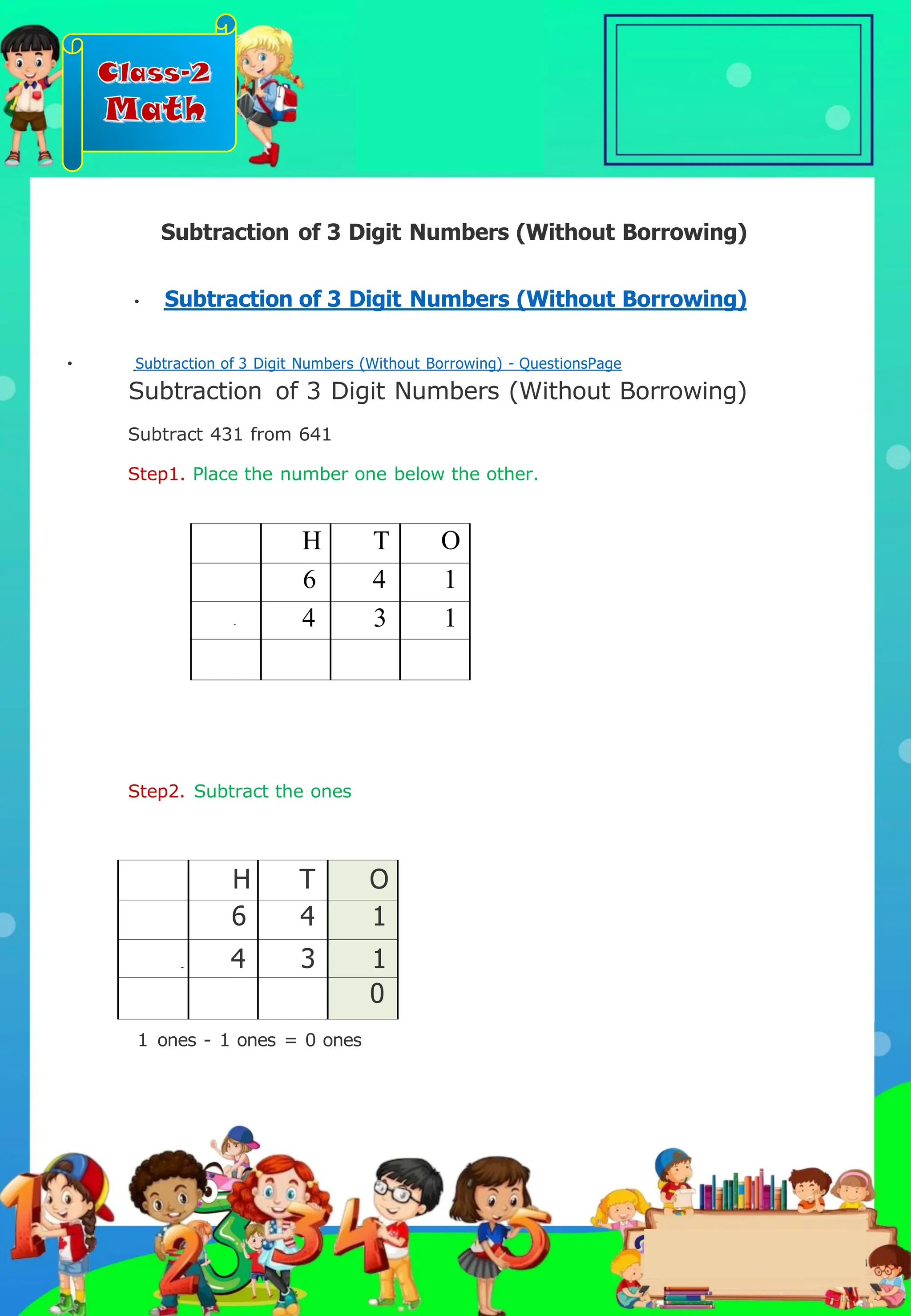
Subtract 431 from 641
Step1. Place the number one below the other.
H T O
6 4 1
- 4 3 1
0
H T O
6 4 1
- 4 3 1
1 ones - 1 ones = 0 ones
Step2. Subtract the ones
.
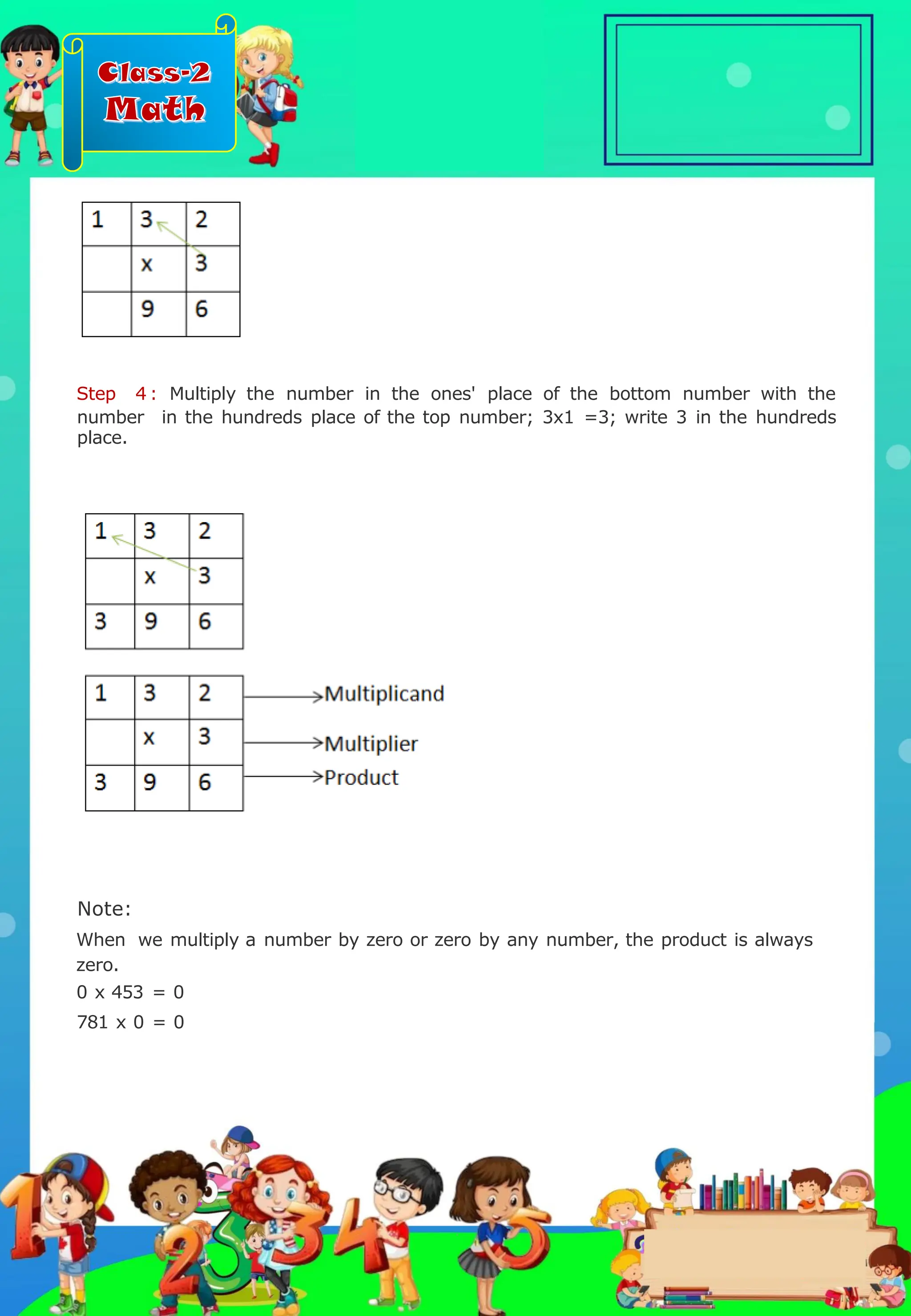
Class-2
Math
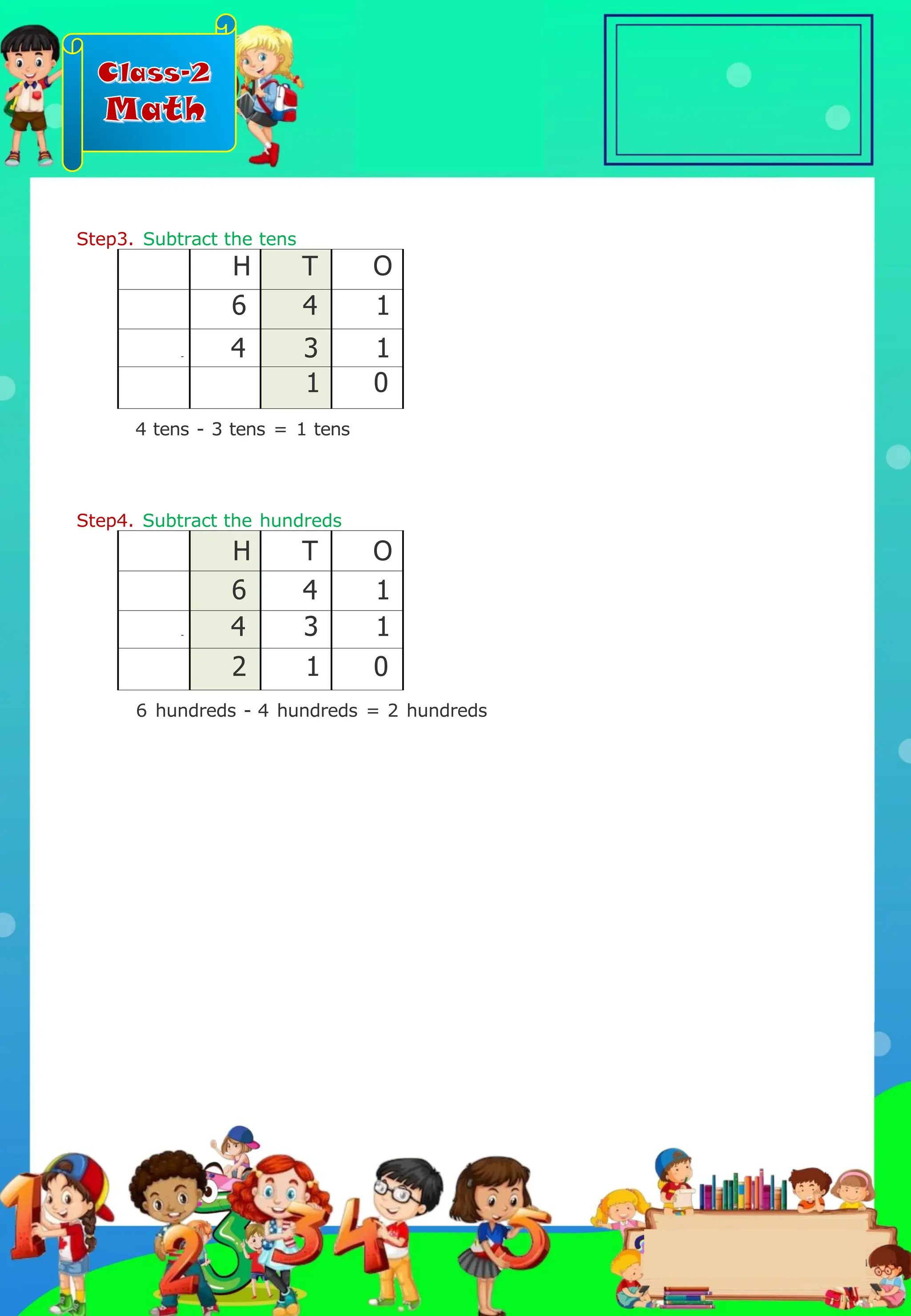
Step4. Subtract the hundreds
H T O
6 4 1
- 4 3 1
2 1 0
Step3. Subtract the tens
H T O
6 4 1
- 4 3 1
1 0
6 hundreds - 4 hundreds = 2 hundreds
4 tens - 3 tens = 1 tens
.
Class-2
Math
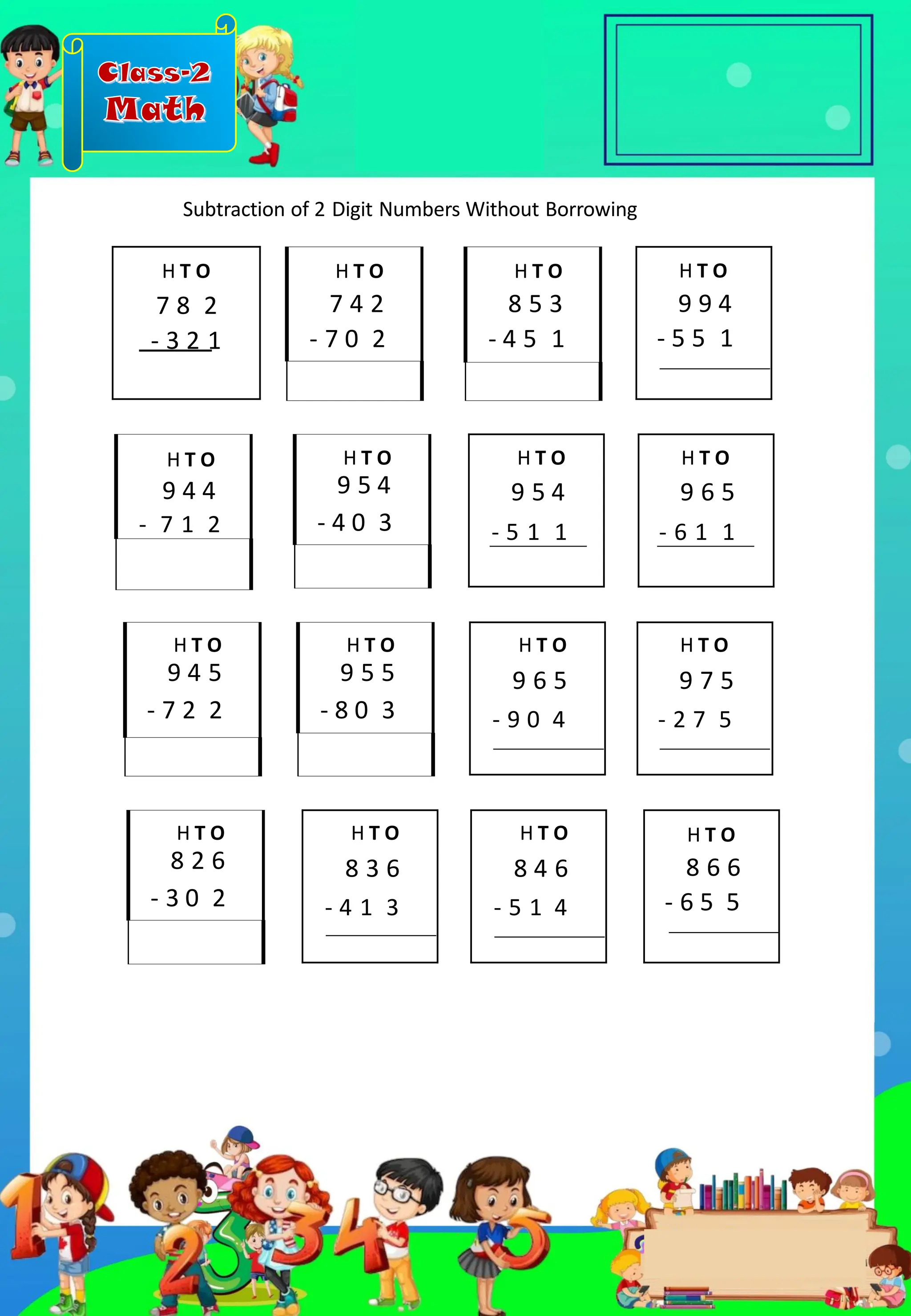
H T O
7 8 2
- 3 2 1
H T O
9 6 5
- 6 1 1
H T O
8 2 6
- 3 0 2
H T O
9 9 4
- 5 5 1
H T O
9 4 4
- 7 1 2
H T O
9 4 5
- 7 2 2
H T O
9 5 4
- 4 0 3
H T O
9 5 5
- 8 0 3
H T O
8 3 6
- 4 1 3
H T O
9 5 4
- 5 1 1
H T O
9 6 5
- 9 0 4
H T O
8 4 6
- 5 1 4
H T O
7 4 2
- 7 0 2
H T O
8 5 3
- 4 5 1
H T O
9 7 5
- 2 7 5
H T O
8 6 6
- 6 5 5
Subtraction of 2 Digit Numbers Without Borrowing
.
Class-2
Math
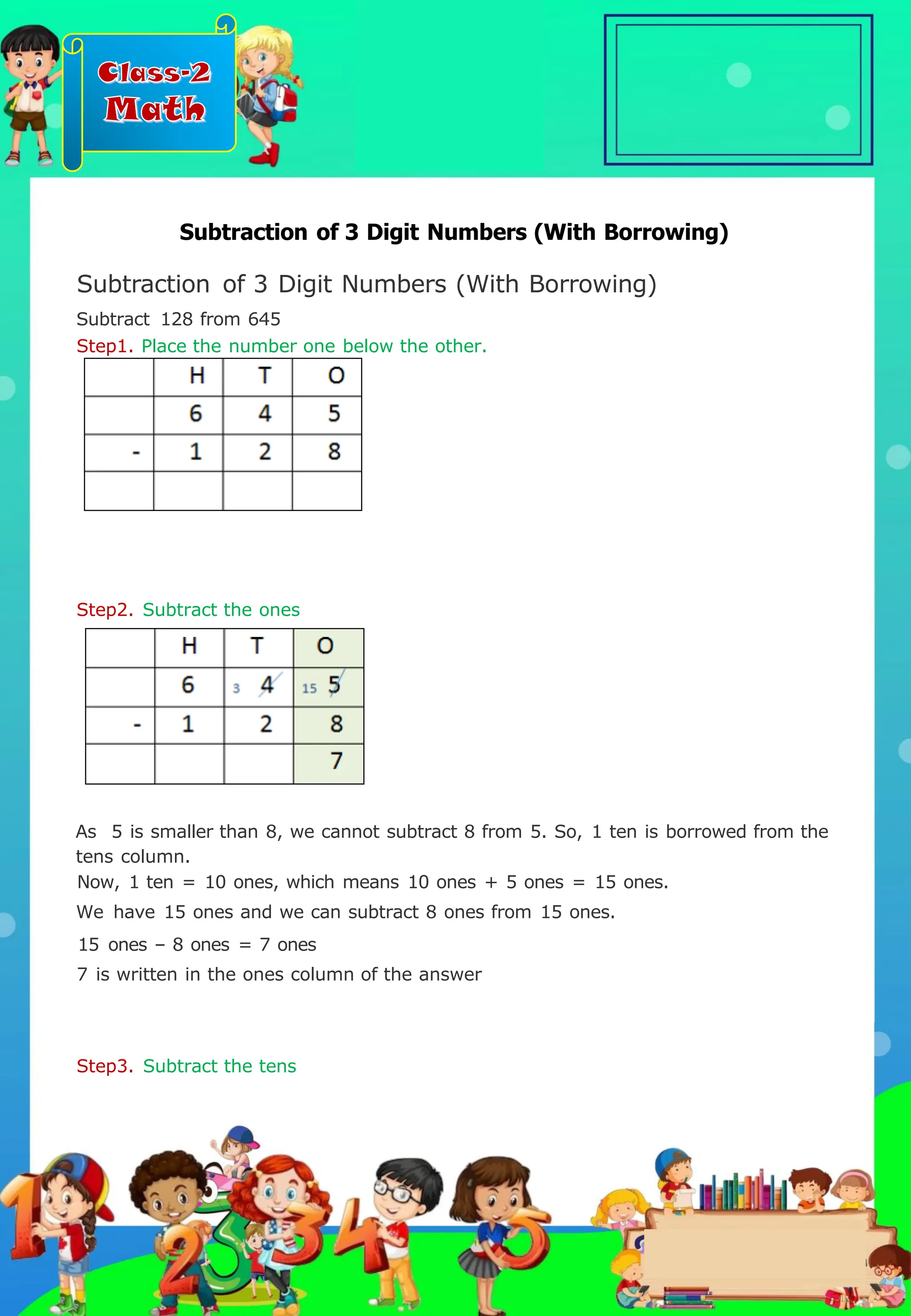
As 5 is smaller than 8, we cannot subtract 8 from 5. So, 1 ten is borrowed from the
tens column.
Now, 1 ten = 10 ones, which means 10 ones + 5 ones = 15 ones.
We have 15 ones and we can subtract 8 ones from 15 ones.
15 ones – 8 ones = 7 ones
7 is written in the ones column of the answer
Subtraction of 3 Digit Numbers (With Borrowing)
Subtract 128 from 645
Step1. Place the number one below the other.
Step2. Subtract the ones
Step3. Subtract the tens
.
Class-2
Math
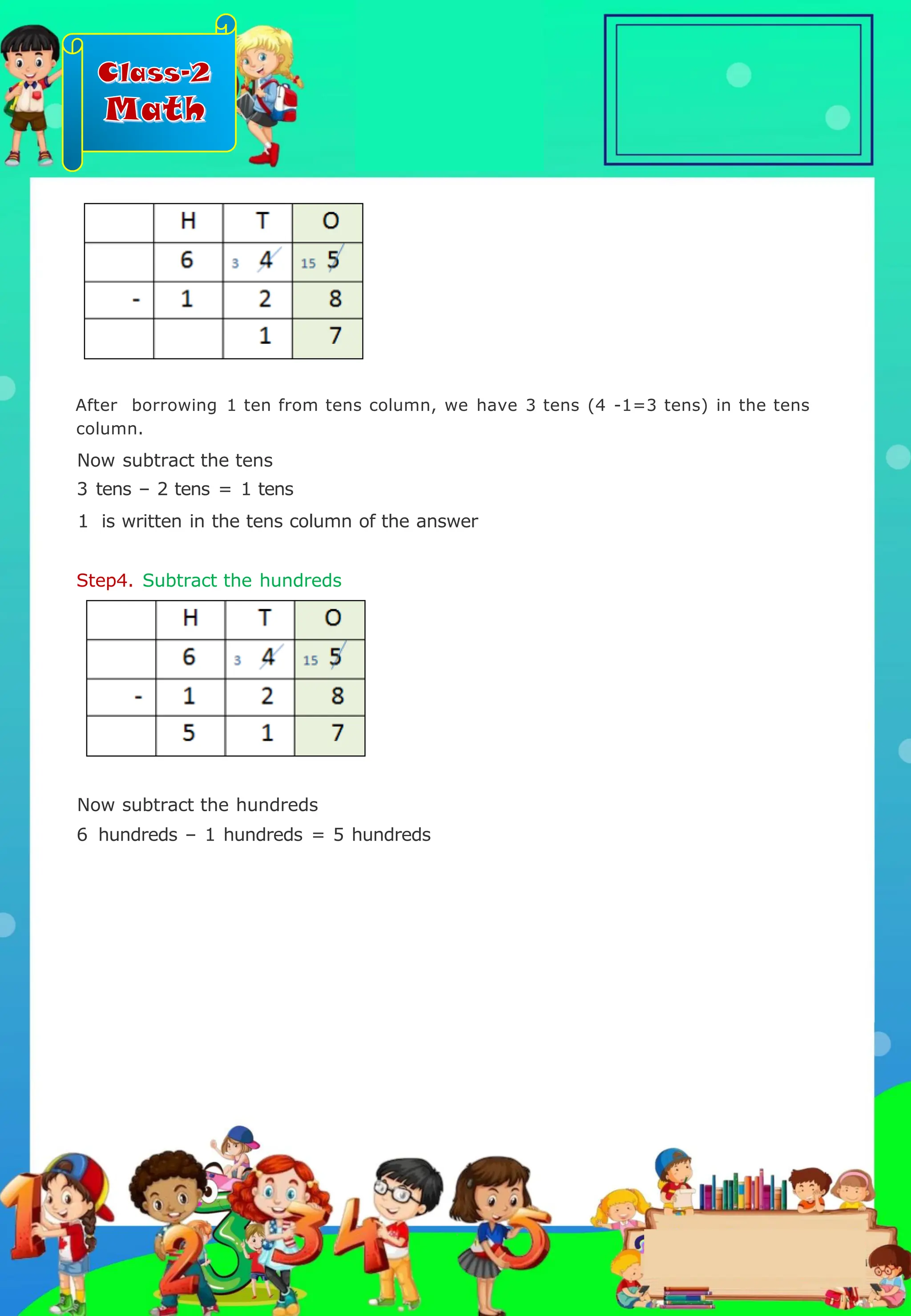
After borrowing 1 ten from tens column, we have 3 tens (4 -1=3 tens) in the tens
column.
Now subtract the tens
3 tens – 2 tens = 1 tens
1 is written in the tens column of the answer
Step4. Subtract the hundreds
Now subtract the hundreds
6 hundreds – 1 hundreds = 5 hundreds
.
Class-2
Math
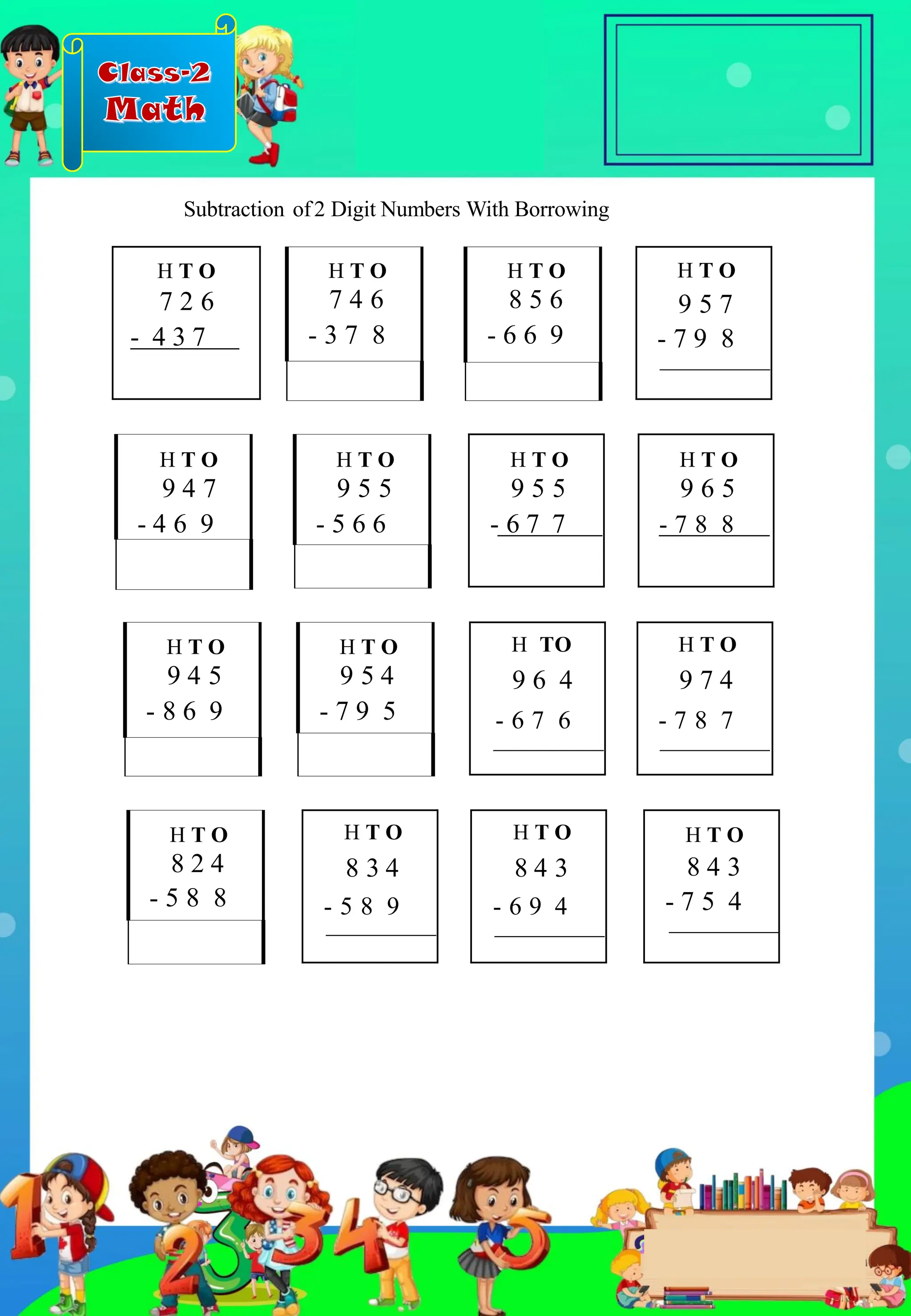
H T O
7 2 6
- 4 3 7
H T O
9 6 5
- 7 8 8
H T O
8 2 4
- 5 8 8
H T O
9 5 7
- 7 9 8
H T O
9 4 7
- 4 6 9
H T O
9 4 5
- 8 6 9
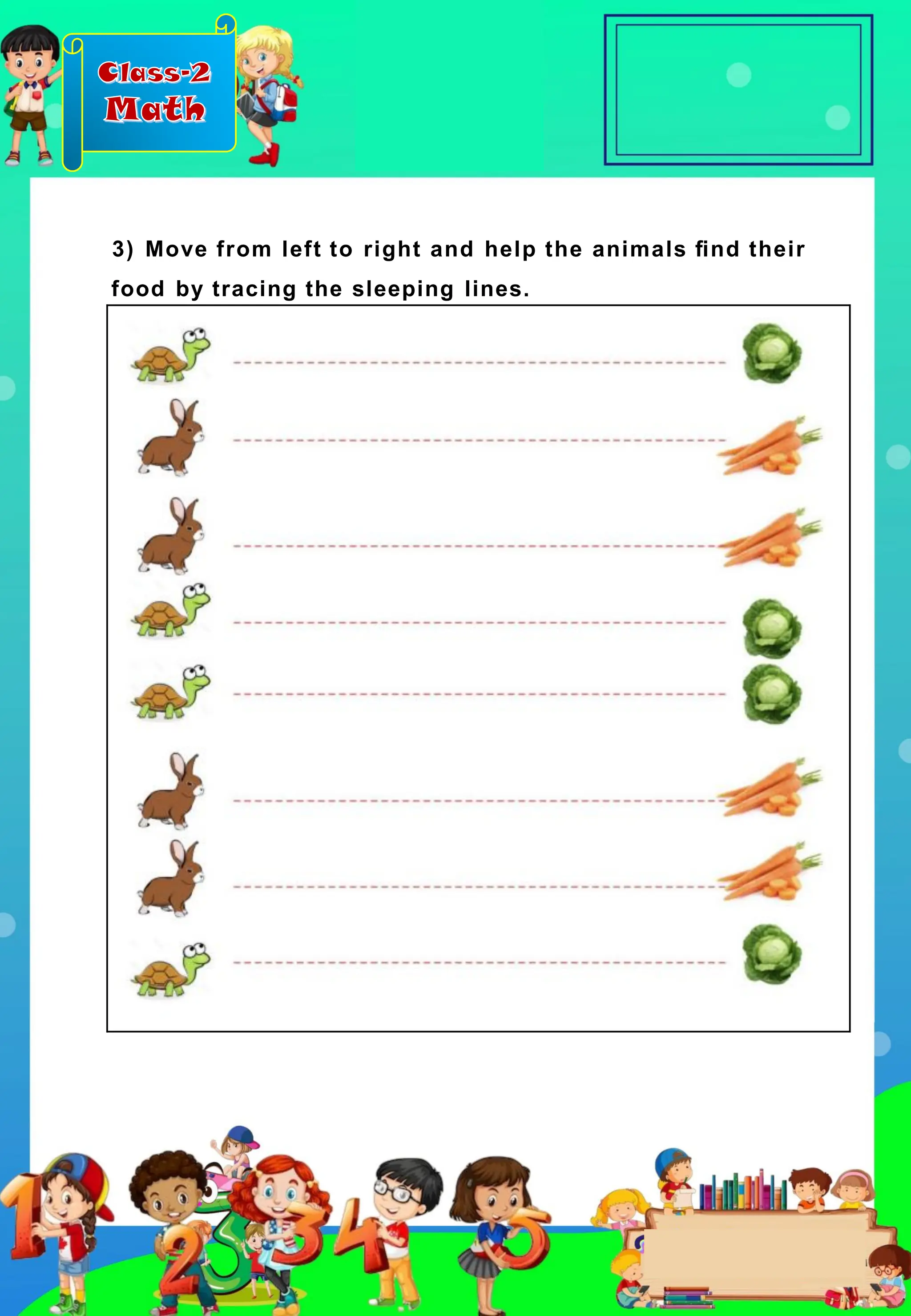
H T O
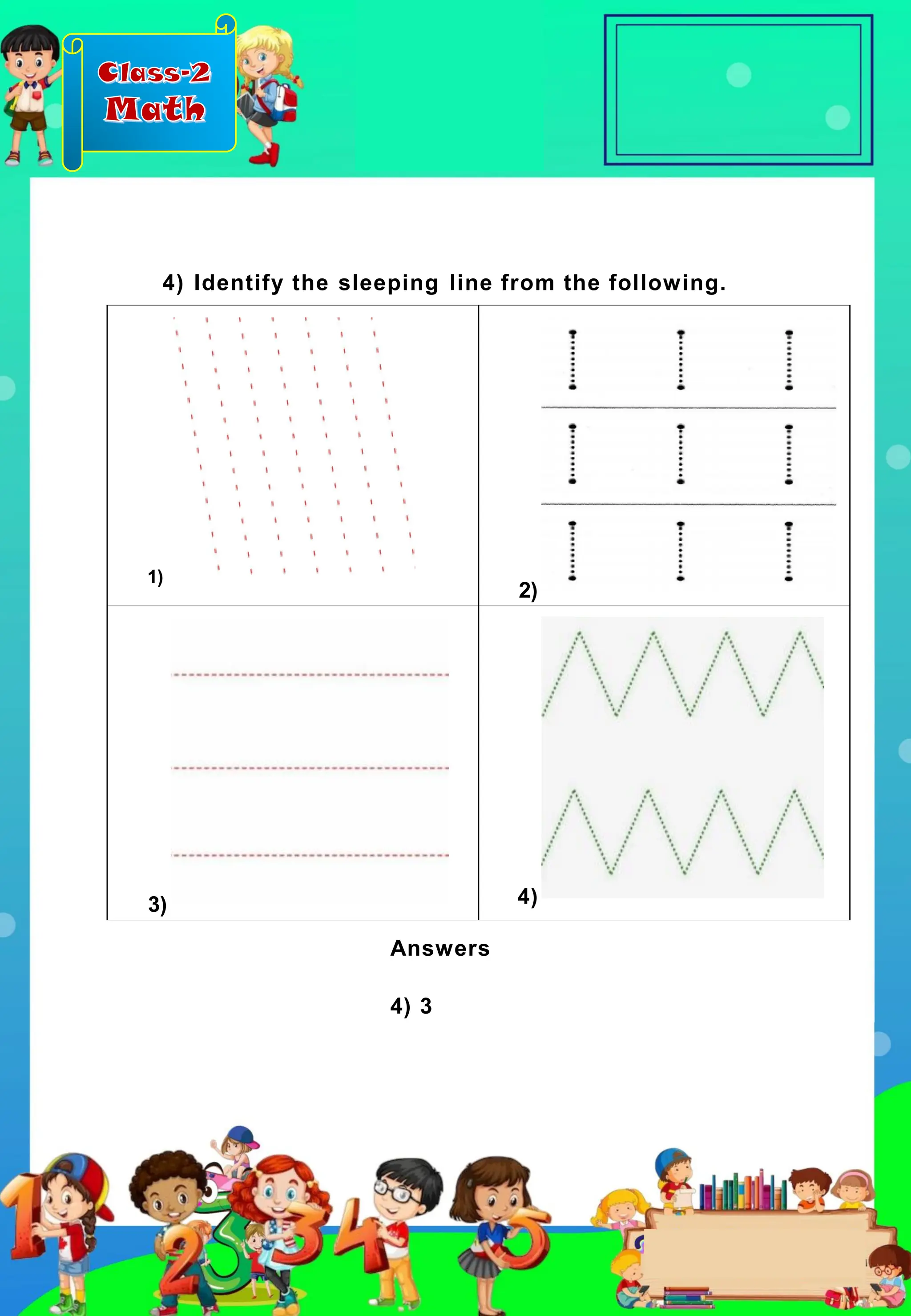
9 5 5
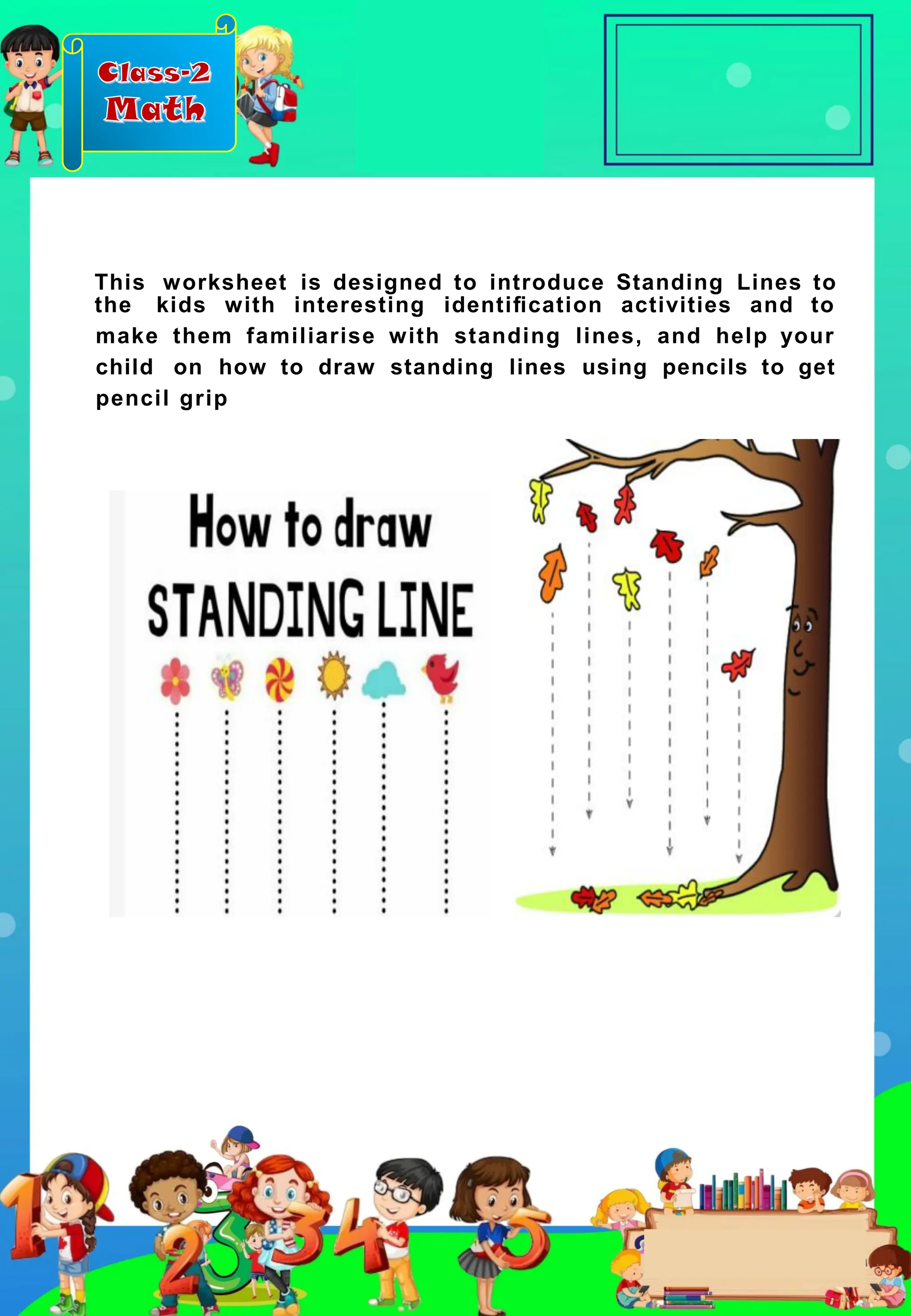
- 5 6 6
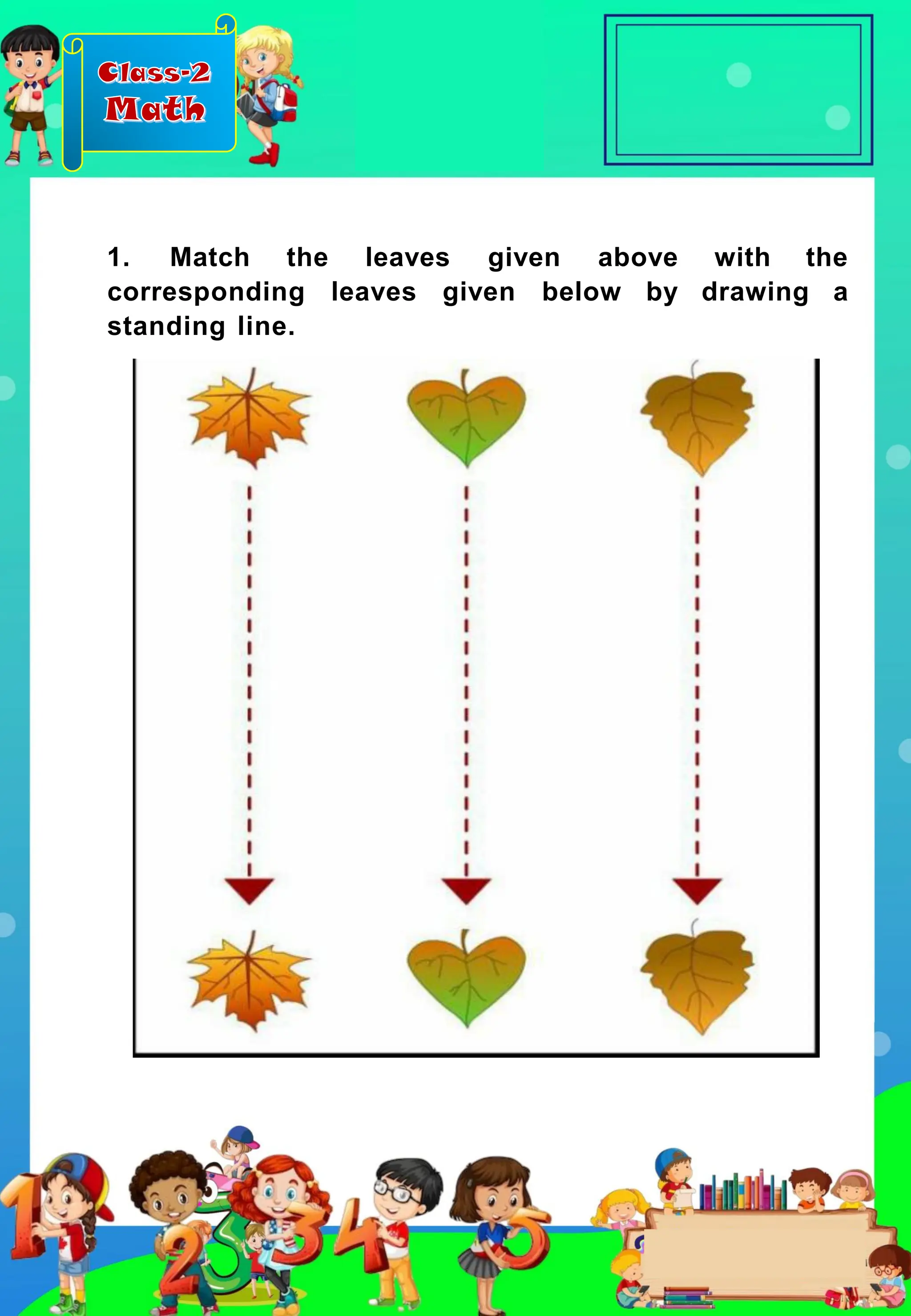
H T O
9 5 4
- 7 9 5
H T O
8 3 4
- 5 8 9
H T O
9 5 5
- 6 7 7
H TO
9 6 4
- 6 7 6
H T O
8 4 3
- 6 9 4
H T O
7 4 6
- 3 7 8
H T O
8 5 6
- 6 6 9
H T O
9 7 4
- 7 8 7
H T O
8 4 3
- 7 5 4
Subtraction of2 Digit Numbers With Borrowing
.
Class-2
Math
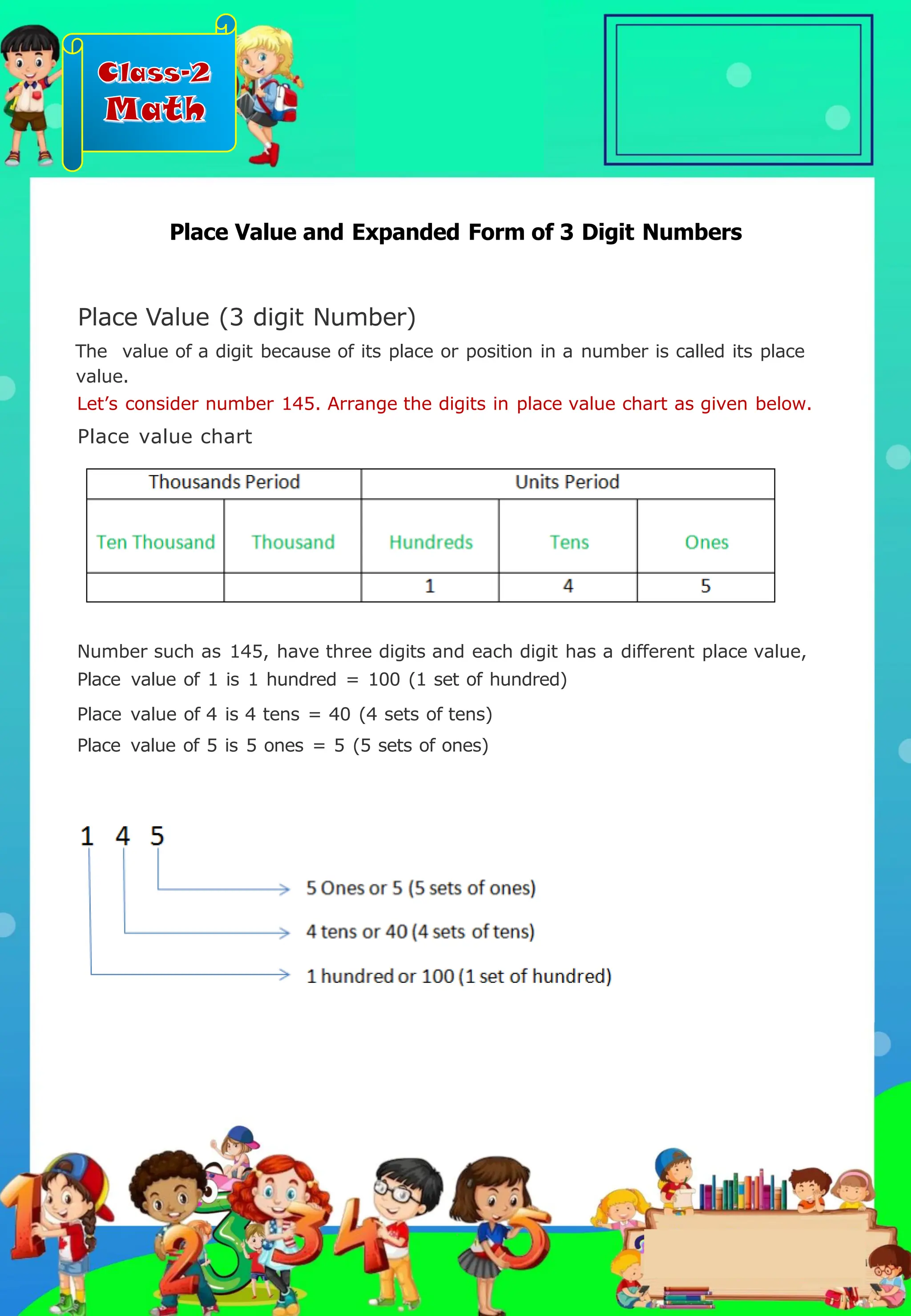
Place Value (3 digit Number)
The value of a digit because of its place or position in a number is called its place
value.
Let’s consider number 145. Arrange the digits in place value chart as given below.
Place value chart
Number such as 145, have three digits and each digit has a different place value,
Place value of 1 is 1 hundred = 100 (1 set of hundred)
Place value of 4 is 4 tens = 40 (4 sets of tens)
Place value of 5 is 5 ones = 5 (5 sets of ones)
Place Value and Expanded Form of 3 Digit Numbers
.
Class-2
Math
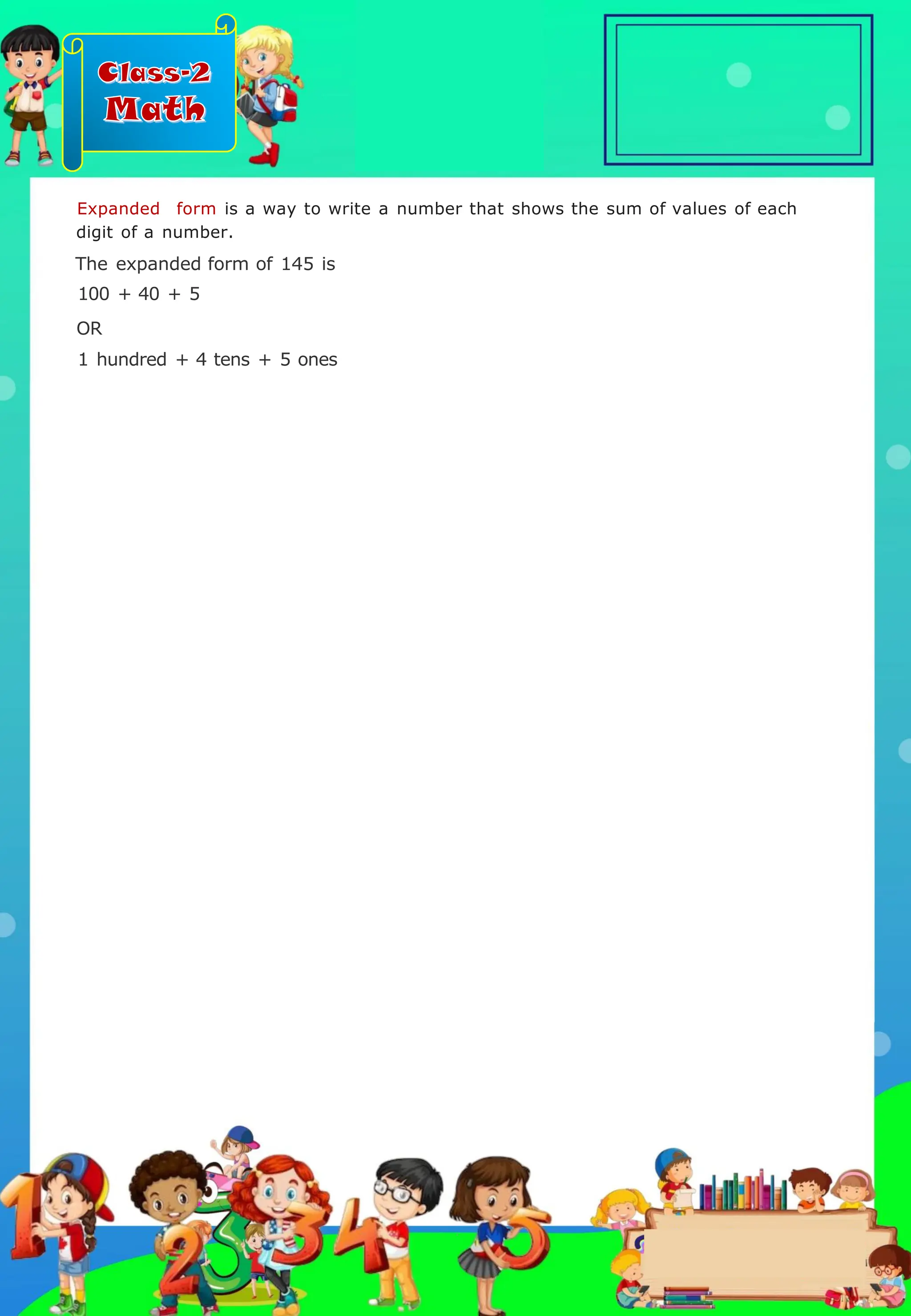
Expanded form is a way to write a number that shows the sum of values of each
digit of a number.
The expanded form of 145 is
100 + 40 + 5
OR
1 hundred + 4 tens + 5 ones
.
Class-2
Math
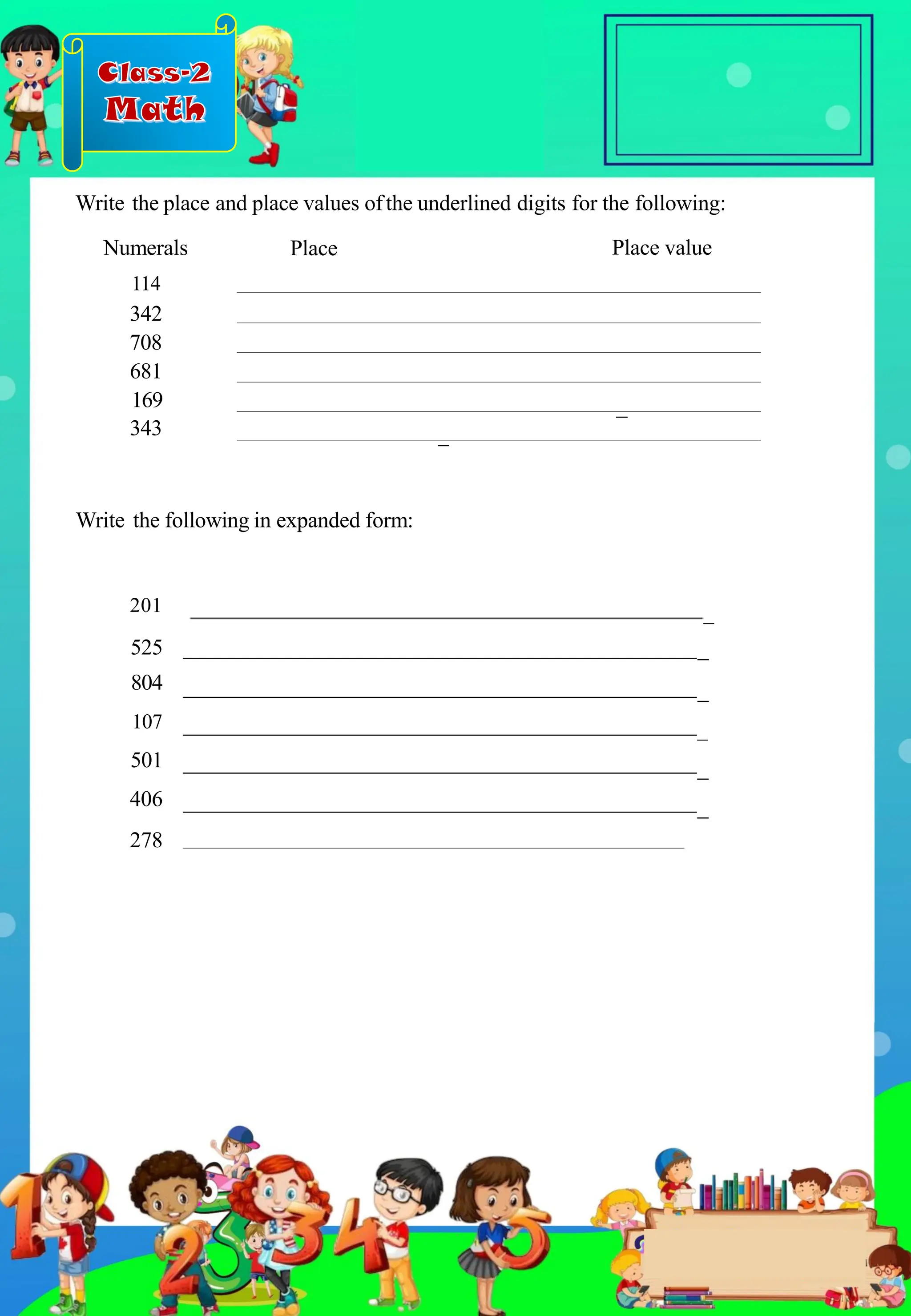
201 _
525
804 _
107 _
501 _
406 _
278
Write the place and place values ofthe underlined digits for the following:
Numerals
114
342
708
681
169
343
Write the following in expanded form:
_
_
Place value
Place
_
.
Class-2
Math
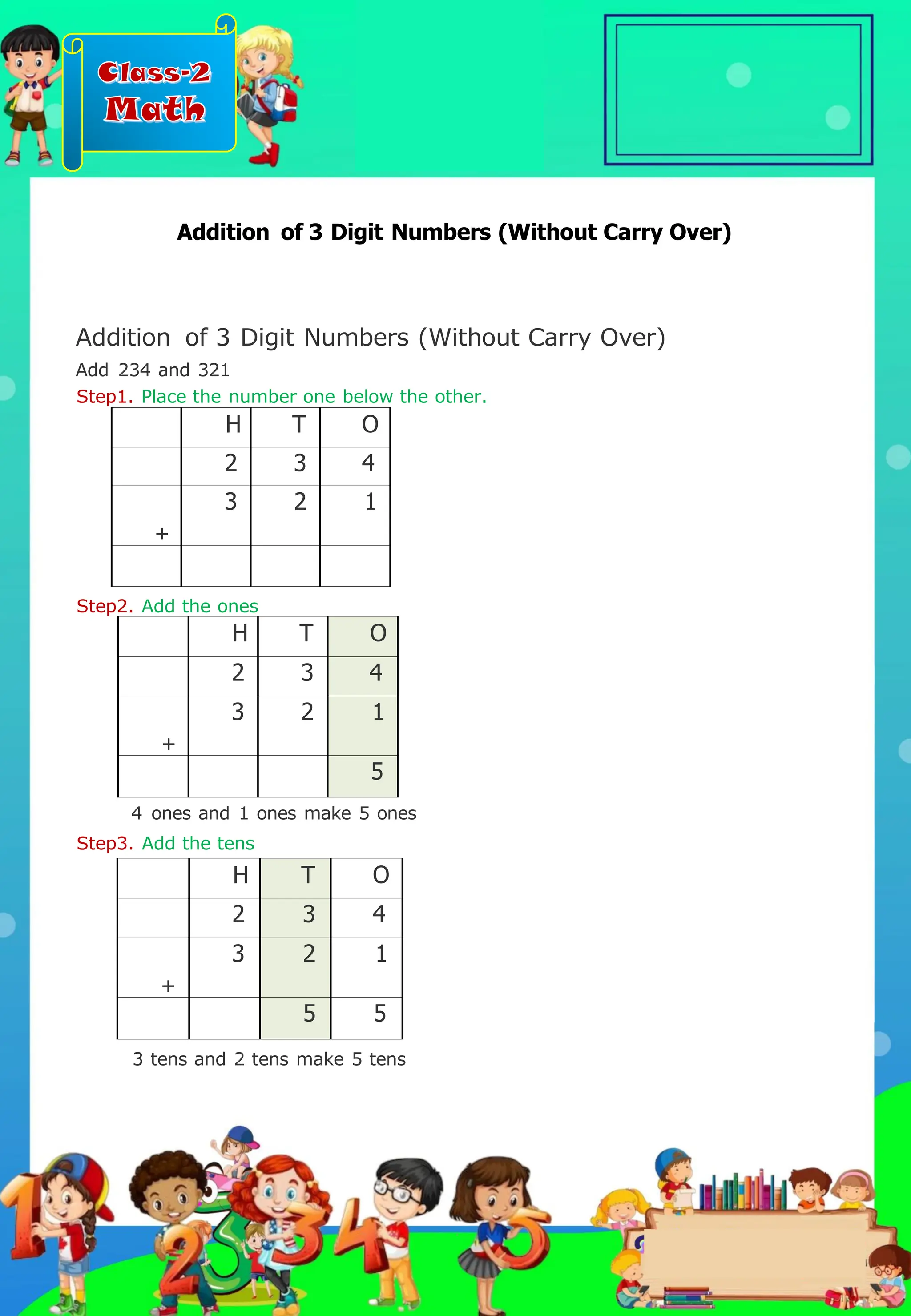
Addition of 3 Digit Numbers (Without Carry Over)
Add 234 and 321
Step1. Place the number one below the other.
H T O
2 3 4
+
3 2 1
5 5
Step2. Add the ones
H T O
2 3 4
+
3 2 1
5
H T O
2 3 4
+
3 2 1
4 ones and 1 ones make 5 ones
Step3. Add the tens
Addition of 3 Digit Numbers (Without Carry Over)
3 tens and 2 tens make 5 tens
.
Class-2
Math
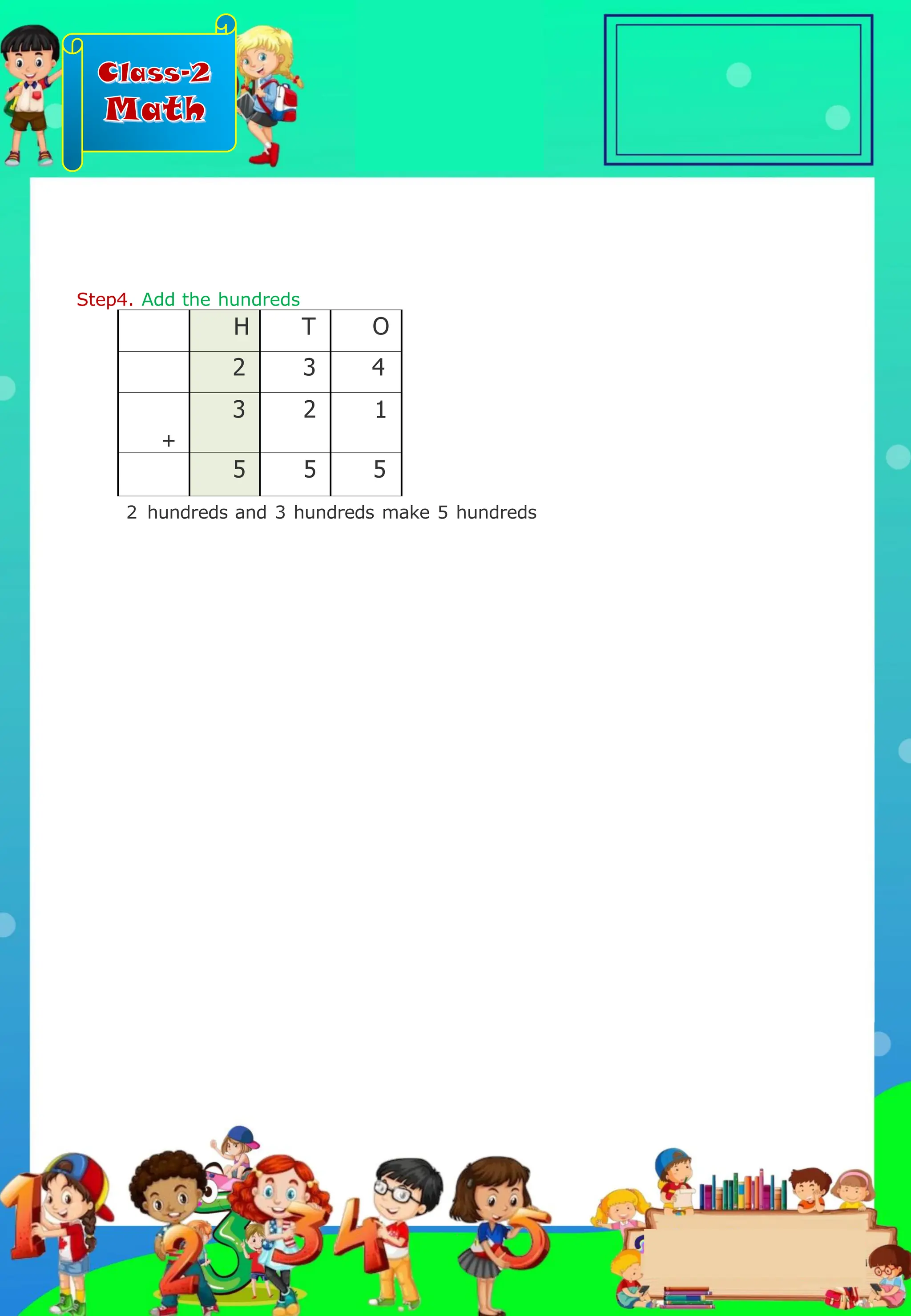
Step4. Add the hundreds
H T O
2 3 4
+
3 2 1
5 5 5
2 hundreds and 3 hundreds make 5 hundreds
.
Class-2
Math
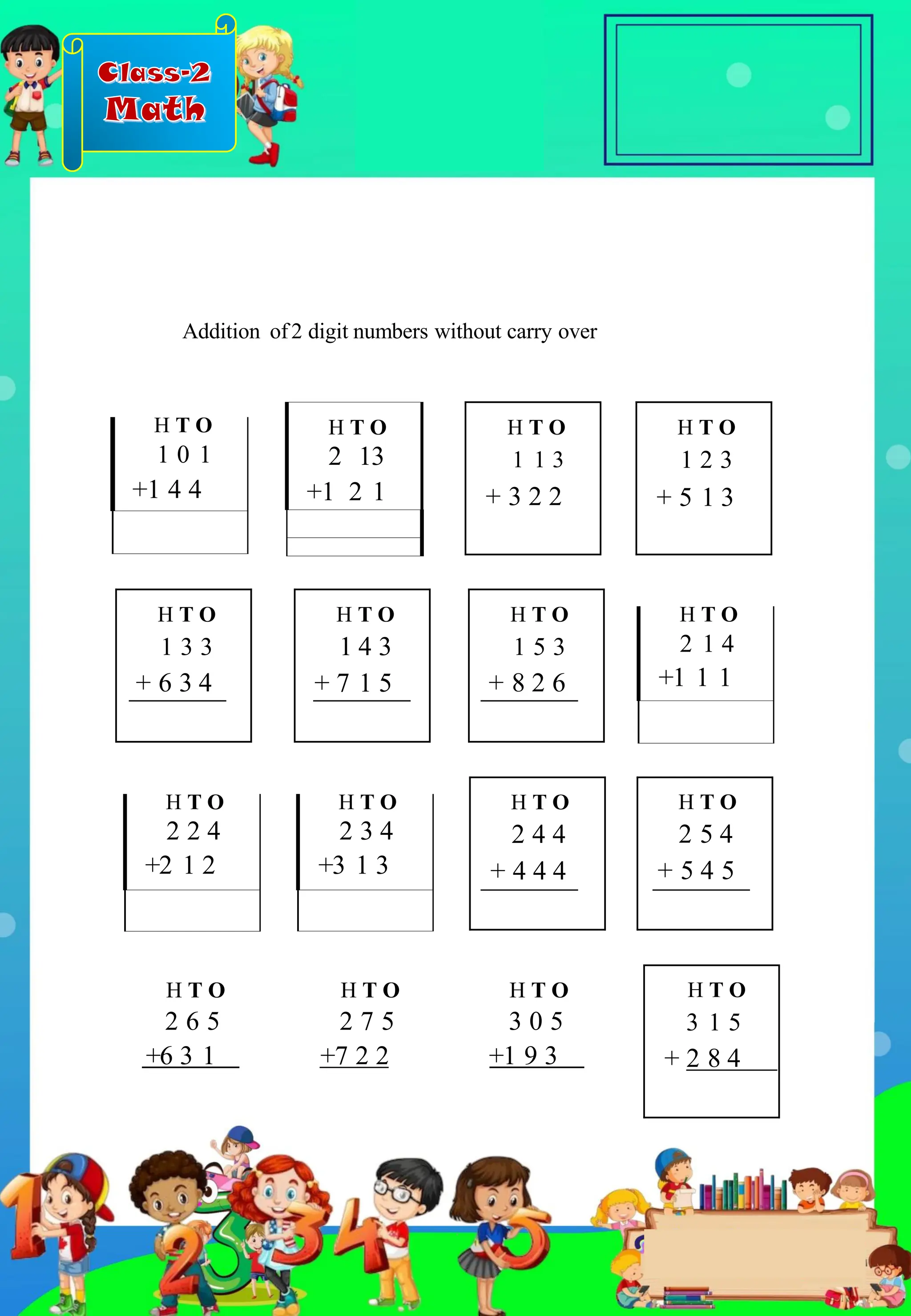
H T O
1 2 3
+ 5 1 3
H T O
1 3 3
+ 6 3 4
H T O
1 4 3
+ 7 1 5
H T O
2 13
+1 2 1
H T O
2 4 4
+ 4 4 4
H T O
1 5 3
+ 8 2 6
H T O
1 1 3
+ 3 2 2
H T O
2 5 4
+ 5 4 5
H T O
3 1 5
+ 2 8 4
H T O
2 2 4
+2 1 2
H T O
2 3 4
+3 1 3
H T O
2 1 4
+1 1 1
H T O
1 0 1
+1 4 4
+6 3 1 +1 9 3
+7 2 2
Addition of2 digit numbers without carry over
H T O
2 6 5
H T O
2 7 5
H T O
3 0 5
.
Class-2
Math
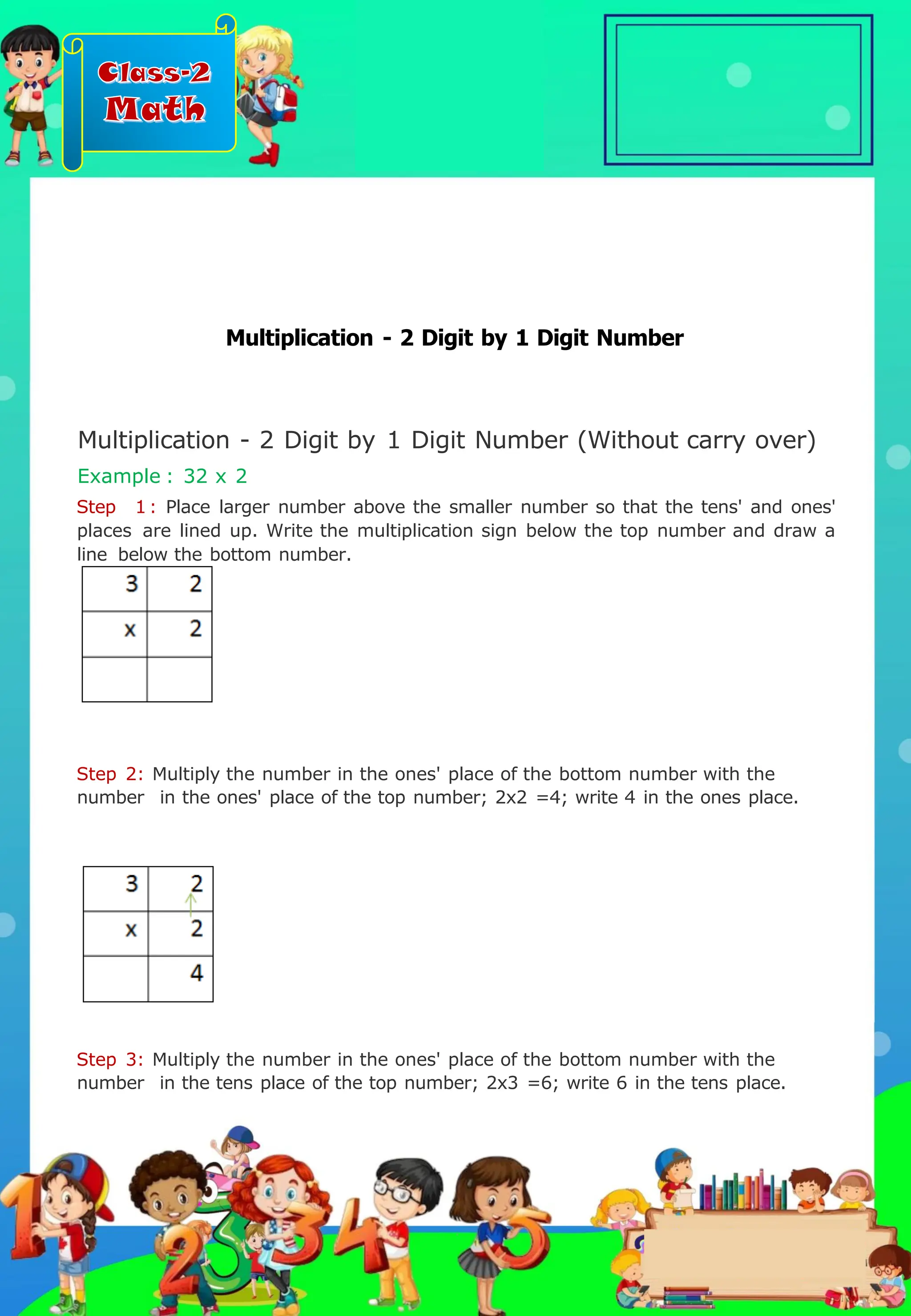
Multiplication - 2 Digit by 1 Digit Number (Without carry over)
Example : 32 x 2
Step 1: Place larger number above the smaller number so that the tens' and ones'
places are lined up. Write the multiplication sign below the top number and draw a
line below the bottom number.
Step 2: Multiply the number in the ones' place of the bottom number with the
number in the ones' place of the top number; 2x2 =4; write 4 in the ones place.
Step 3: Multiply the number in the ones' place of the bottom number with the
number in the tens place of the top number; 2x3 =6; write 6 in the tens place.
Multiplication - 2 Digit by 1 Digit Number
.
Class-2
Math
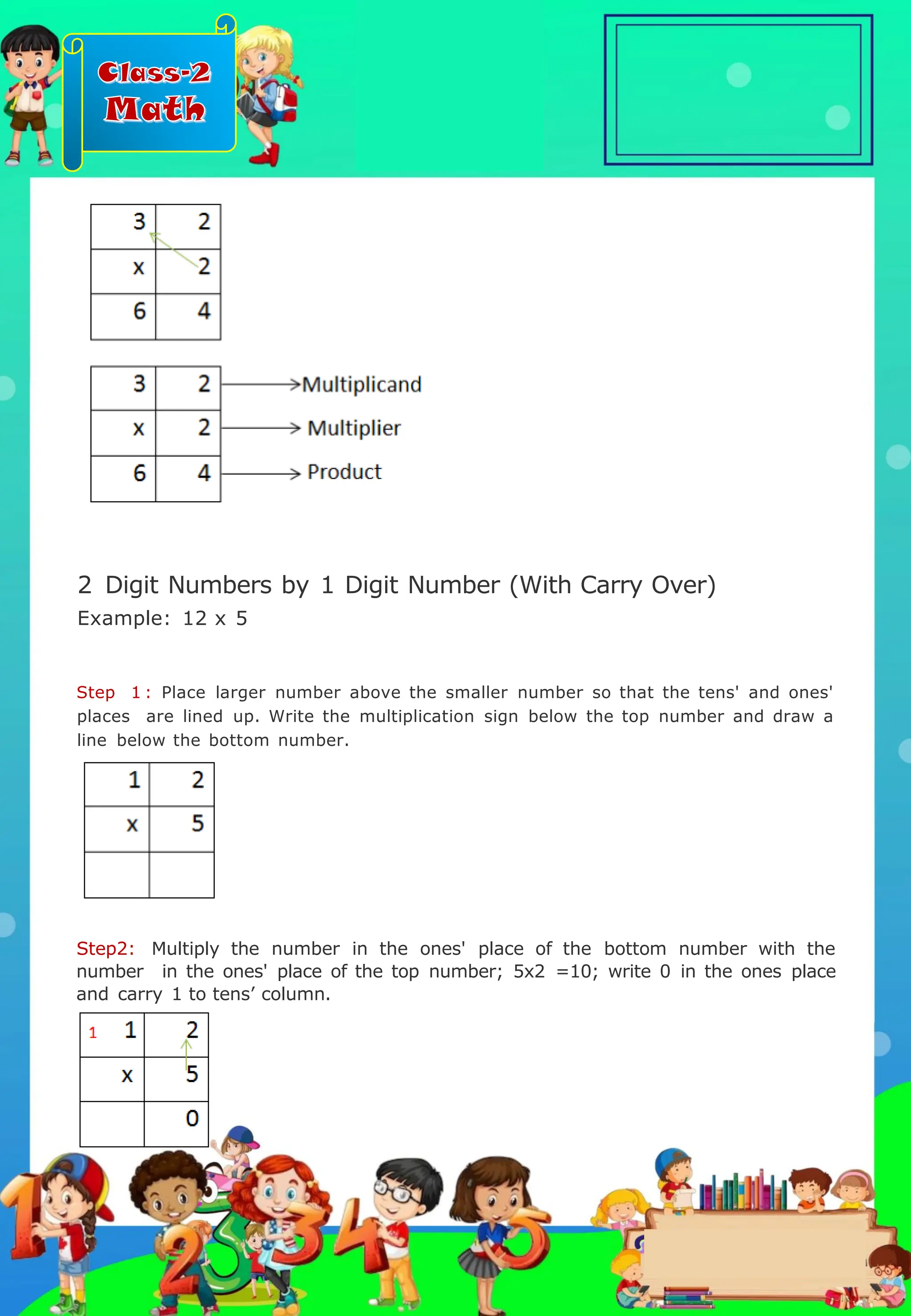
Step 1 : Place larger number above the smaller number so that the tens' and ones'
places are lined up. Write the multiplication sign below the top number and draw a
line below the bottom number.
Step2: Multiply the number in the ones' place of the bottom number with the
number in the ones' place of the top number; 5x2 =10; write 0 in the ones place
and carry 1 to tens’ column.
2 Digit Numbers by 1 Digit Number (With Carry Over)
Example: 12 x 5
.
Class-2
Math
When we multiply a number by 10, we add 1 zero on its right side.
55 x 10 = 550
When we multiply a number by 100, we add two zero on its right side.
5 x 100 = 500
When we multiply a number by zero or zero by any number, the product is always
zero
0 x 45 = 0
78 x 0 = 0
When we multiply a number by one or one by any number, the product is always
the number itself.
56 x 1 = 56
1 x 89 = 89
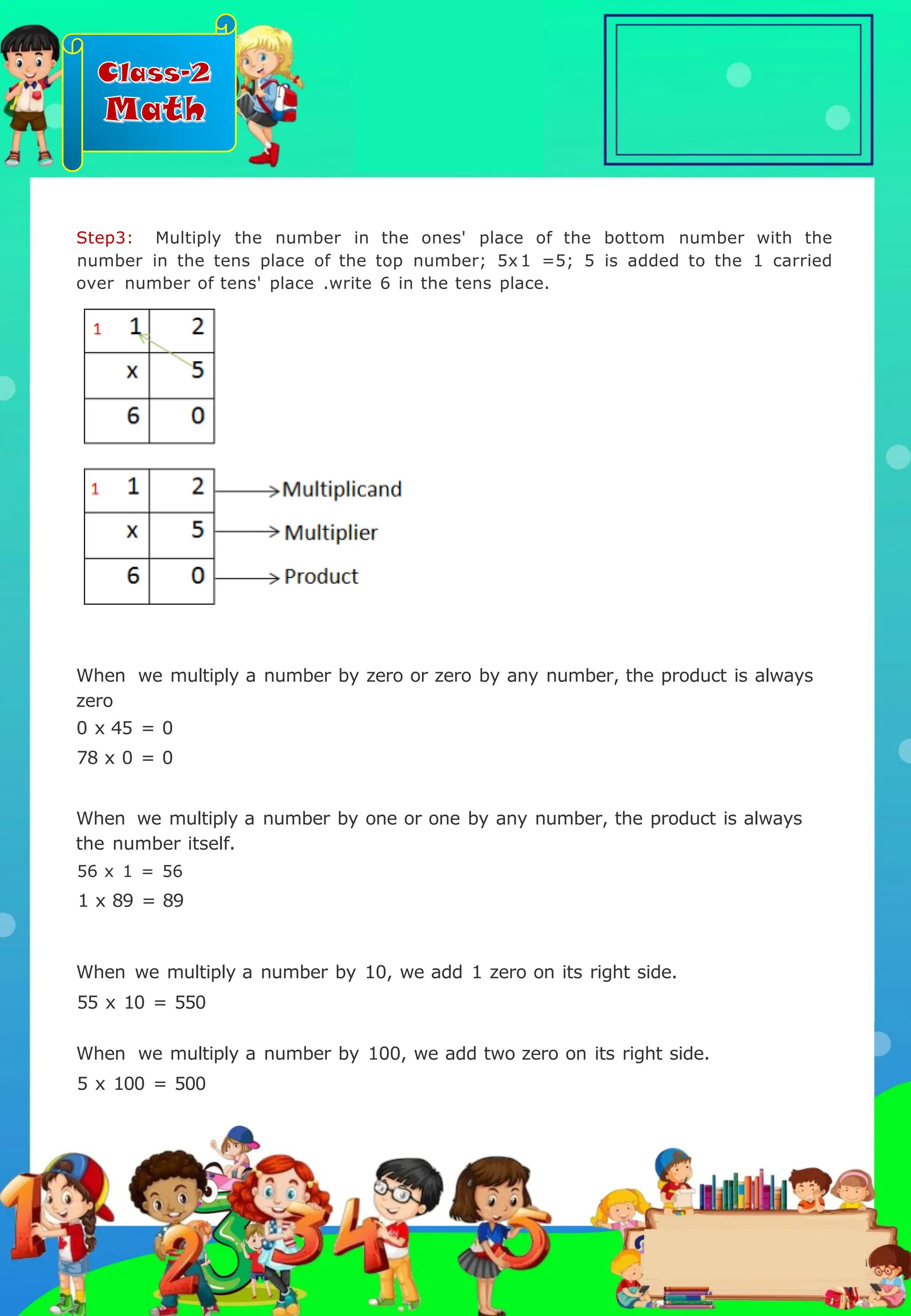
Step3: Multiply the number in the ones' place of the bottom number with the
number in the tens place of the top number; 5x 1 =5; 5 is added to the 1 carried
over number of tens' place .write 6 in the tens place.
.
Class-2
Math
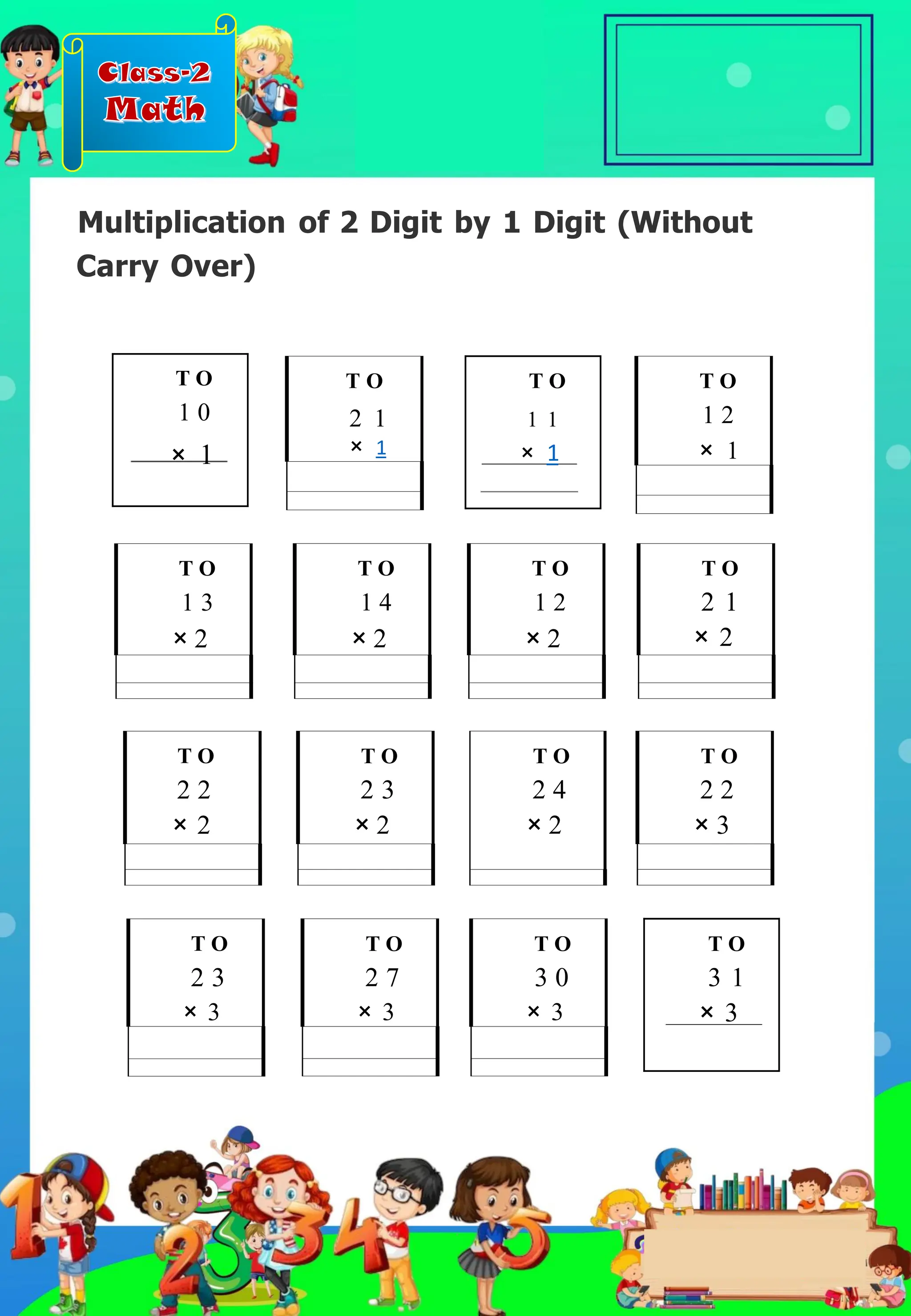
Multiplication of 2 Digit by 1 Digit (Without
Carry Over)
T O
2 1
× 2
T O
2 3
× 3
T O
1 2
× 1
T O
1 3
× 2
T O
2 2
× 2
T O
1 4
× 2
T O
2 4
× 2
T O
2 3
× 2
T O
1 2
× 2
T O
3 0
× 3
T O
2 7
× 3
T O
1 0
× 1
T O
2 1
× 1
T O
1 1
× 1
T O
2 2
× 3
T O
3 1
× 3
.
Class-2
Math
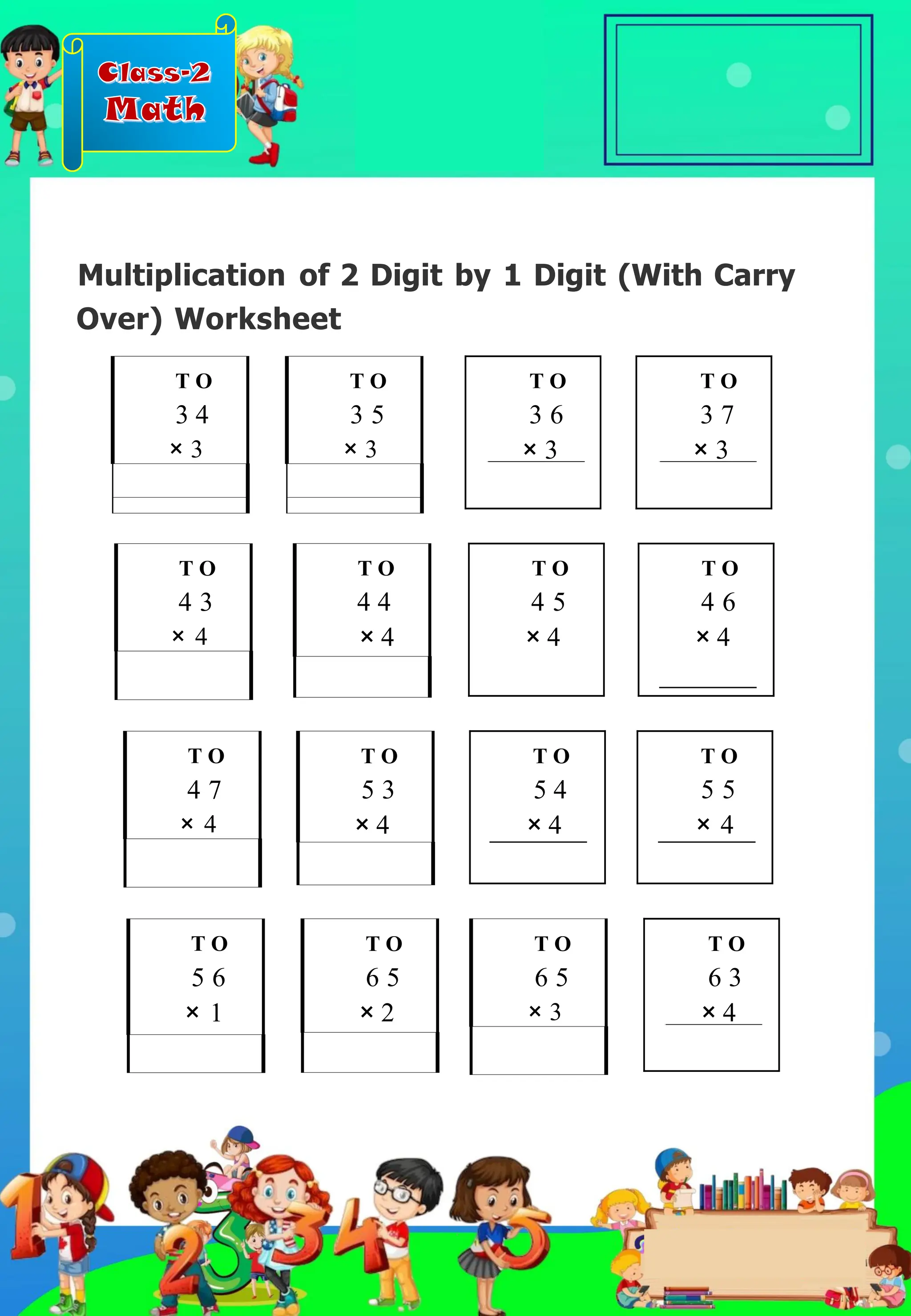
Multiplication of 2 Digit by 1 Digit (With Carry
Over) Worksheet
T O
4 6
× 4
T O
5 6
× 1
T O
3 7
× 3
T O
4 3
× 4
T O
4 7
× 4
T O
4 4
× 4
T O
5 3
× 4
T O
4 5
× 4
T O
5 4
× 4
T O
6 5
× 3
T O
6 5
× 2
T O
3 4
× 3
T O
3 5
× 3
T O
3 6
× 3
T O
5 5
× 4
T O
6 3
× 4
.
Class-2
Math
Multiplication of 3 Digit Number by 1 Digit Number (Without
carry over)
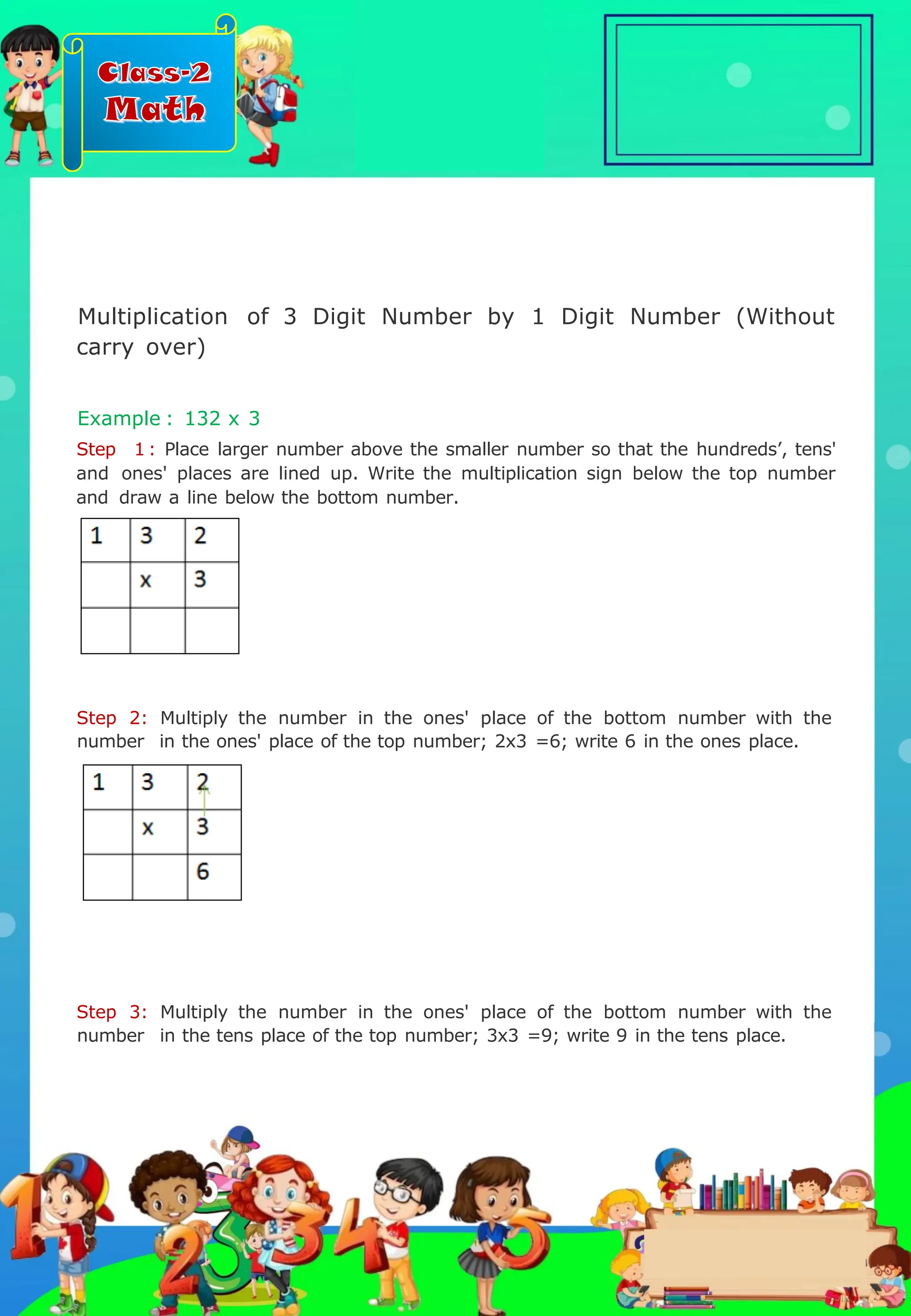
Example : 132 x 3
Step 1 : Place larger number above the smaller number so that the hundreds’, tens'
and ones' places are lined up. Write the multiplication sign below the top number
and draw a line below the bottom number.
Step 3: Multiply the number in the ones' place of the bottom number with the
number in the tens place of the top number; 3x3 =9; write 9 in the tens place.
Step 2: Multiply the number in the ones' place of the bottom number with the
number in the ones' place of the top number; 2x3 =6; write 6 in the ones place.
.
Class-2
Math
Note:
When we multiply a number by zero or zero by any number, the product is always
zero.
0 x 453 = 0
781 x 0 = 0
Step 4 : Multiply the number in the ones' place of the bottom number with the
number in the hundreds place of the top number; 3x1 =3; write 3 in the hundreds
place.
.
Class-2
Math
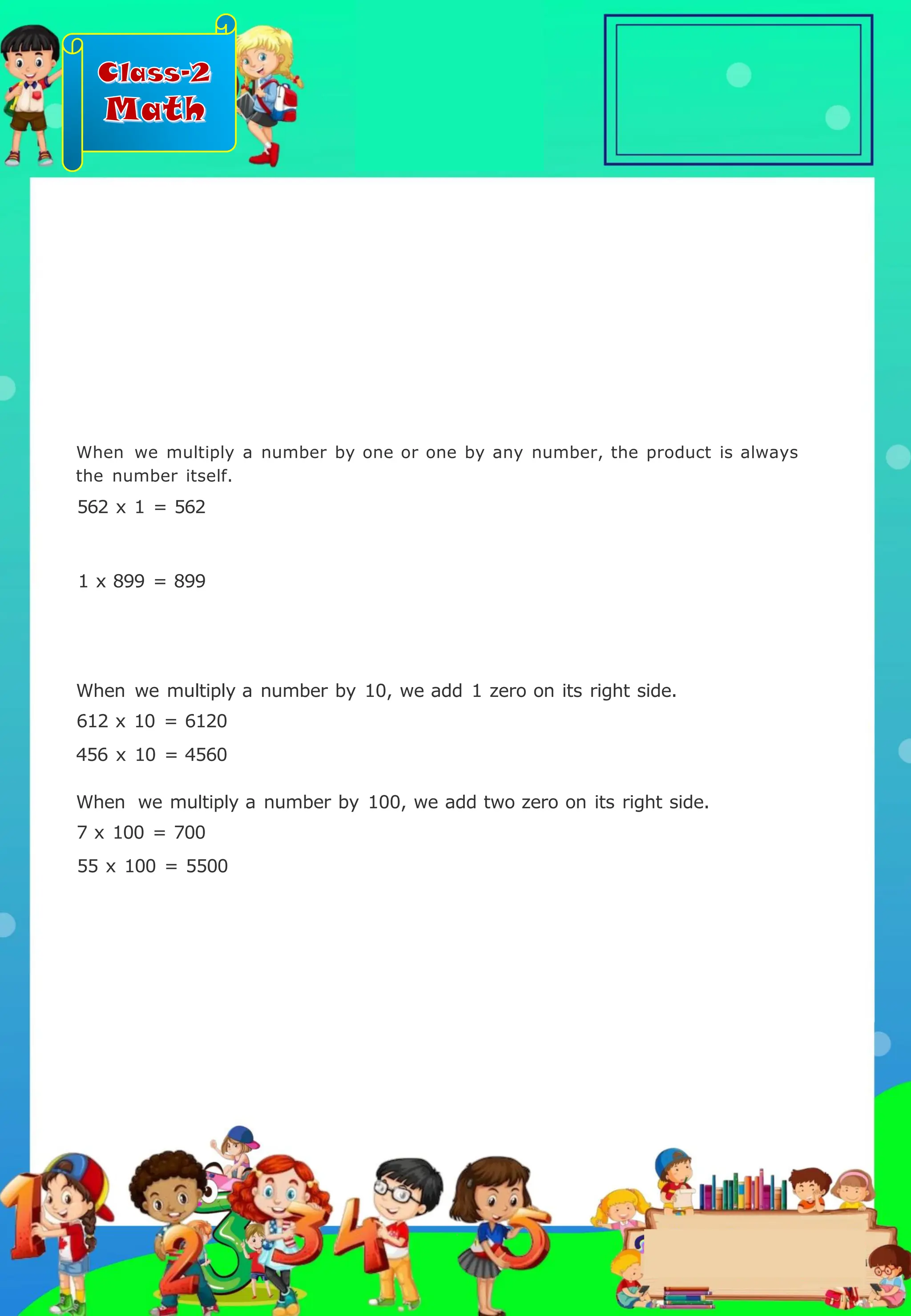
When we multiply a number by 10, we add 1 zero on its right side.
612 x 10 = 6120
456 x 10 = 4560
When we multiply a number by 100, we add two zero on its right side.
7 x 100 = 700
55 x 100 = 5500
When we multiply a number by one or one by any number, the product is always
the number itself.
562 x 1 = 562
1 x 899 = 899
.
Class-2
Math
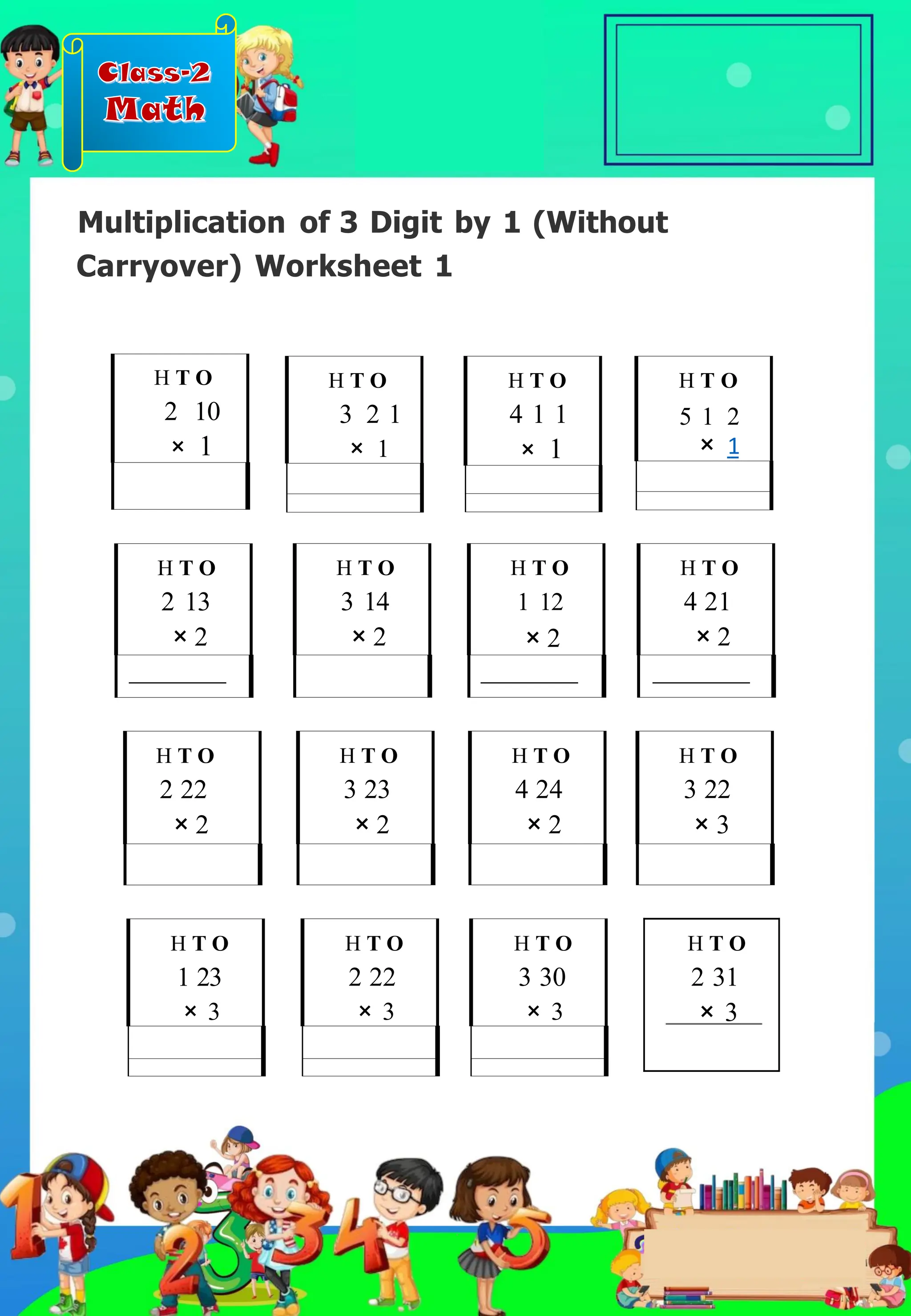
Multiplication of 3 Digit by 1 (Without
Carryover) Worksheet 1
H T O
4 21
× 2
H T O
1 23
× 3
H T O
5 1 2
× 1
H T O
2 13
× 2
H T O
2 22
× 2
H T O
3 14
× 2
H T O
3 23
× 2
H T O
4 24
× 2
H T O
1 12
× 2
H T O
3 30
× 3
H T O
2 22
× 3
H T O
2 10
× 1
H T O
3 2 1
× 1
H T O
4 1 1
× 1
H T O
3 22
× 3
H T O
2 31
× 3
.
Class-2
Math
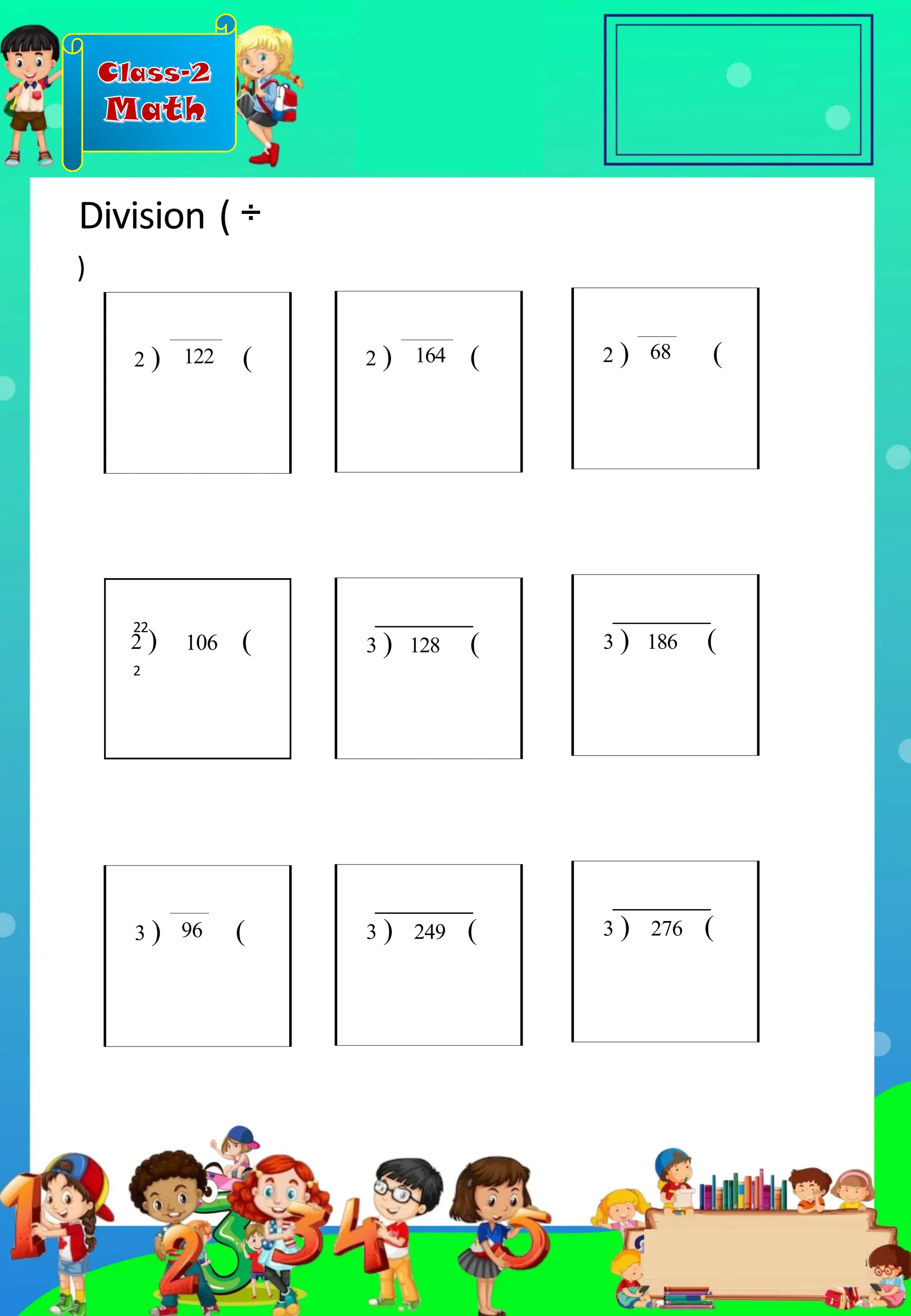
2 ) (
68
2 ) (
164
3 ) 276 (
3 ) 186 (
3 ) 128 (
3 ) 249 (
2 ) (
122
3 ) (
96
22
106 (
2
Division ( ÷
)
2 )
.
Class-2
Math
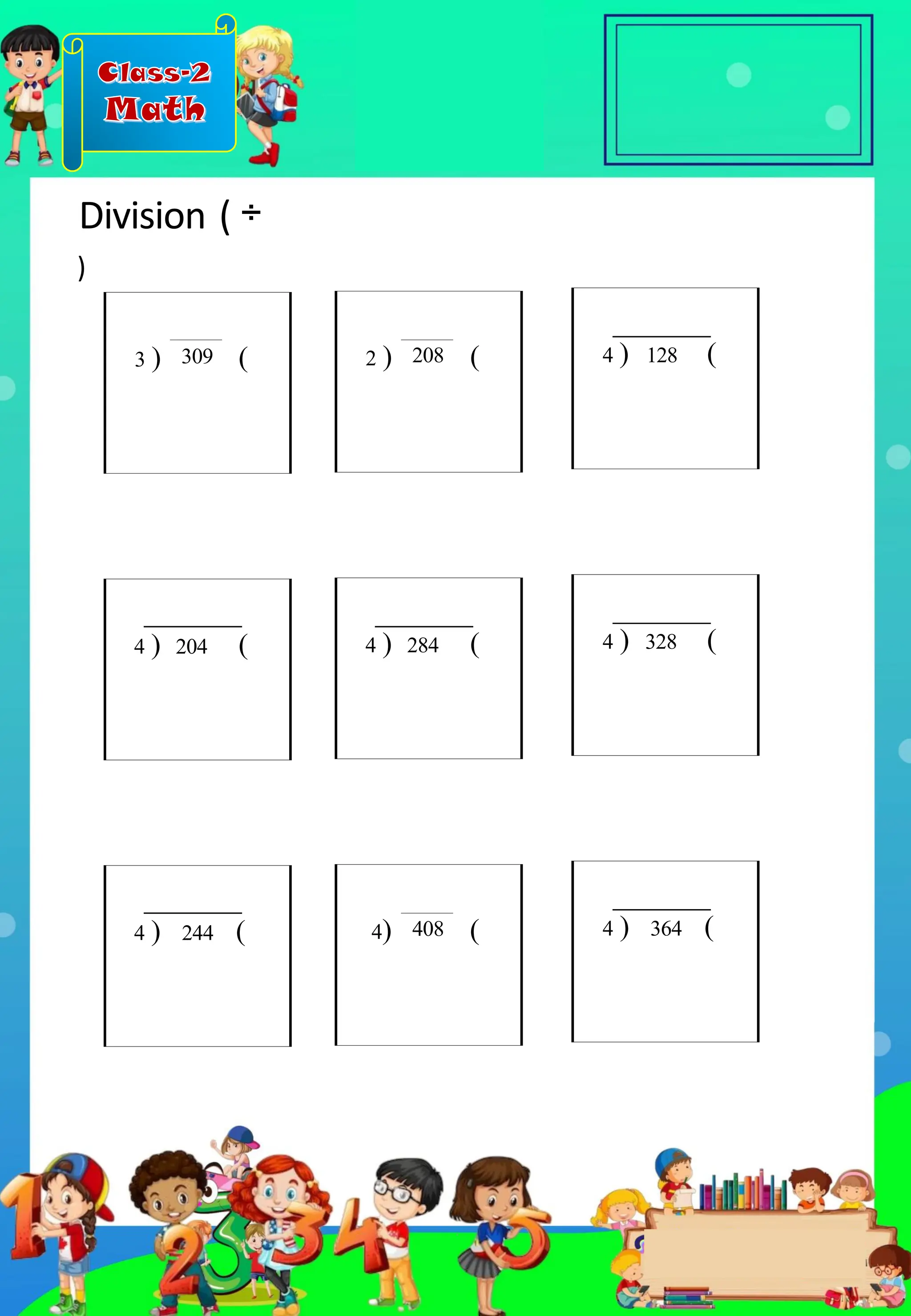
4 ) 128 (
2 ) (
208
4 ) 364 (
4 ) 328 (
4) (
408
4 ) 284 (
3 ) (
309
4 ) 204 (
4 ) 244 (
Division ( ÷
)
.
Class-2
Math
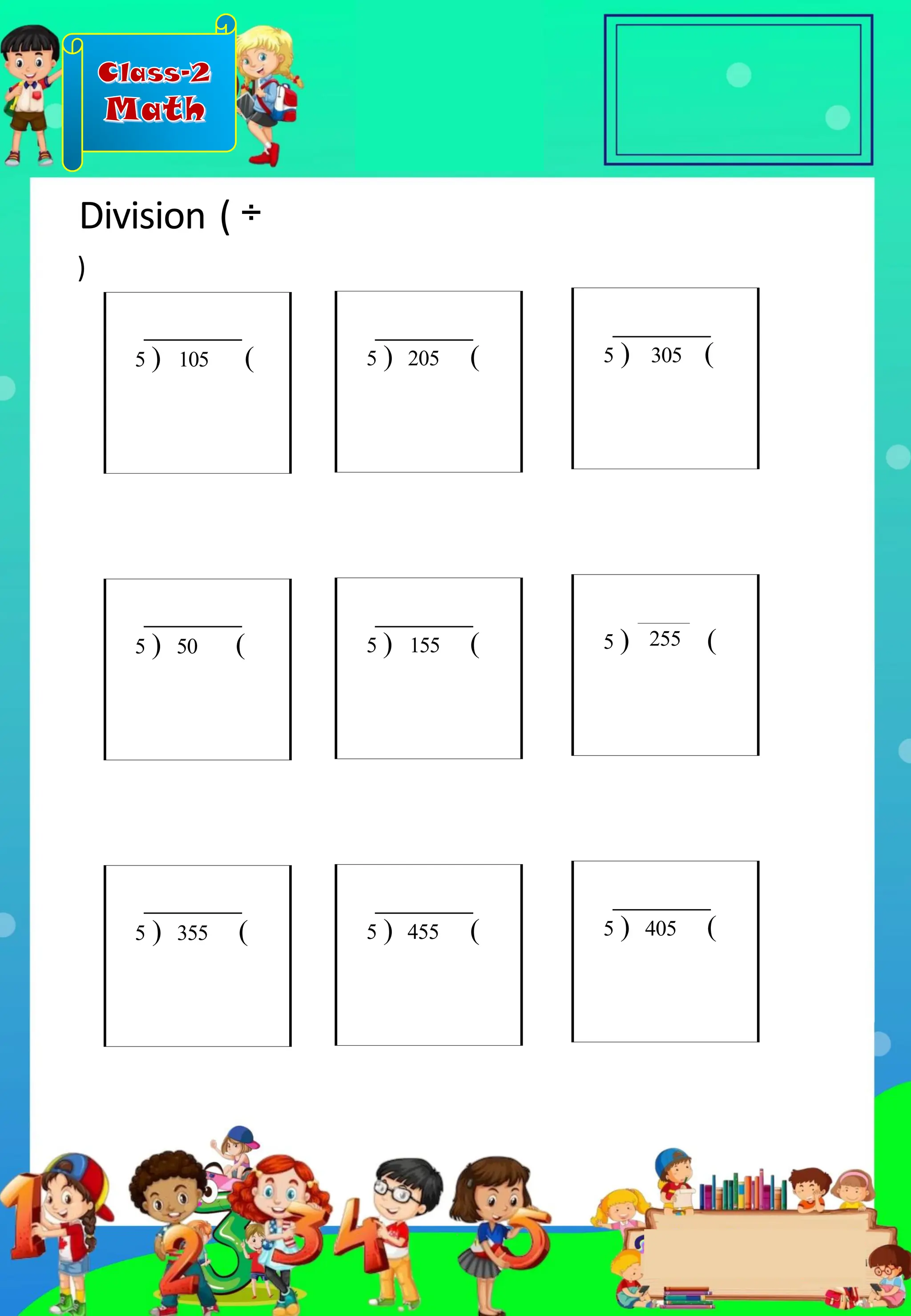
5 ) 305 (
5 ) 205 (
5 ) (
255
5 ) 405 (
5 ) 455 (
5 ) 155 (
5 ) 105 (
5 ) 355 (
5 ) 50 (
Division ( ÷
)
.
Class-2
Math
Concept of Fractions (Halves and Quarters)
Half or ½
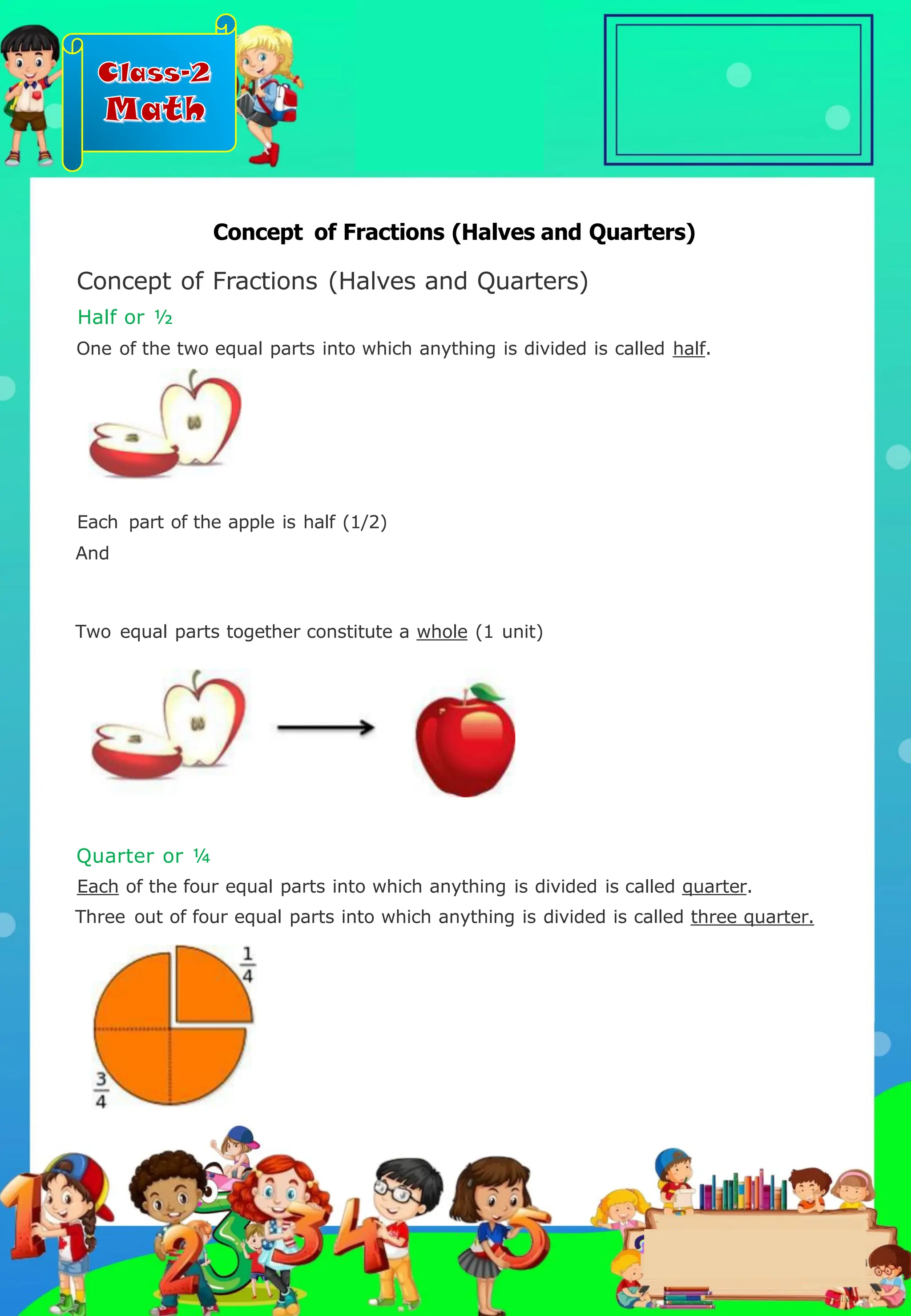
One of the two equal parts into which anything is divided is called half.
Quarter or ¼
Each of the four equal parts into which anything is divided is called quarter.
Three out of four equal parts into which anything is divided is called three quarter.
Each part of the apple is half (1/2)
And
Two equal parts together constitute a whole (1 unit)
.
Class-2
Math
Fraction of a Rectangle
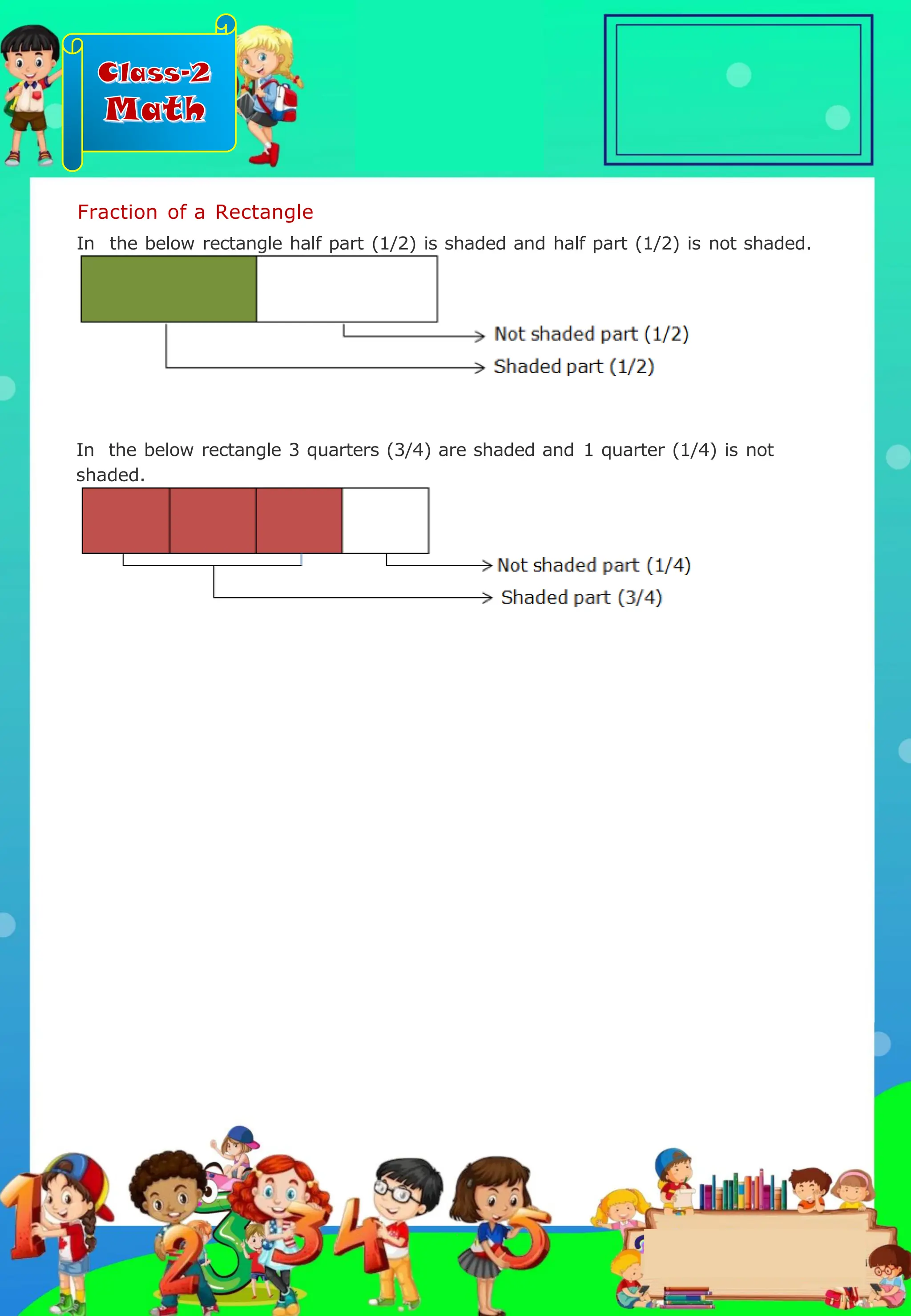
In the below rectangle half part (1/2) is shaded and half part (1/2) is not shaded.
In the below rectangle 3 quarters (3/4) are shaded and 1 quarter (1/4) is not
shaded.
.
Class-2
Math
Student’s Name:-
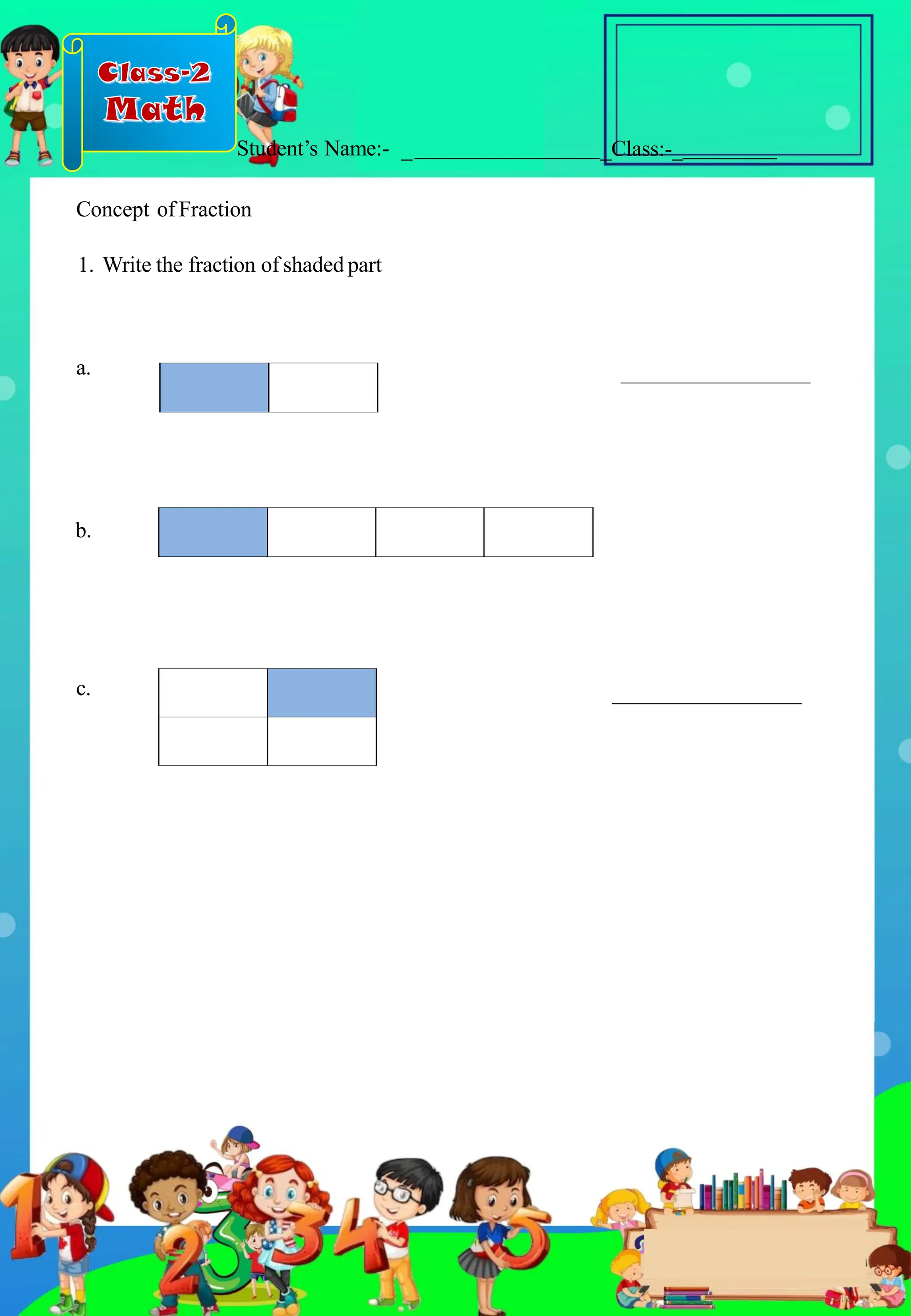
Concept of Fraction
1. Write the fraction of shaded part
_ _Class:-_
b.
c.
a.
.
Class-2
Math
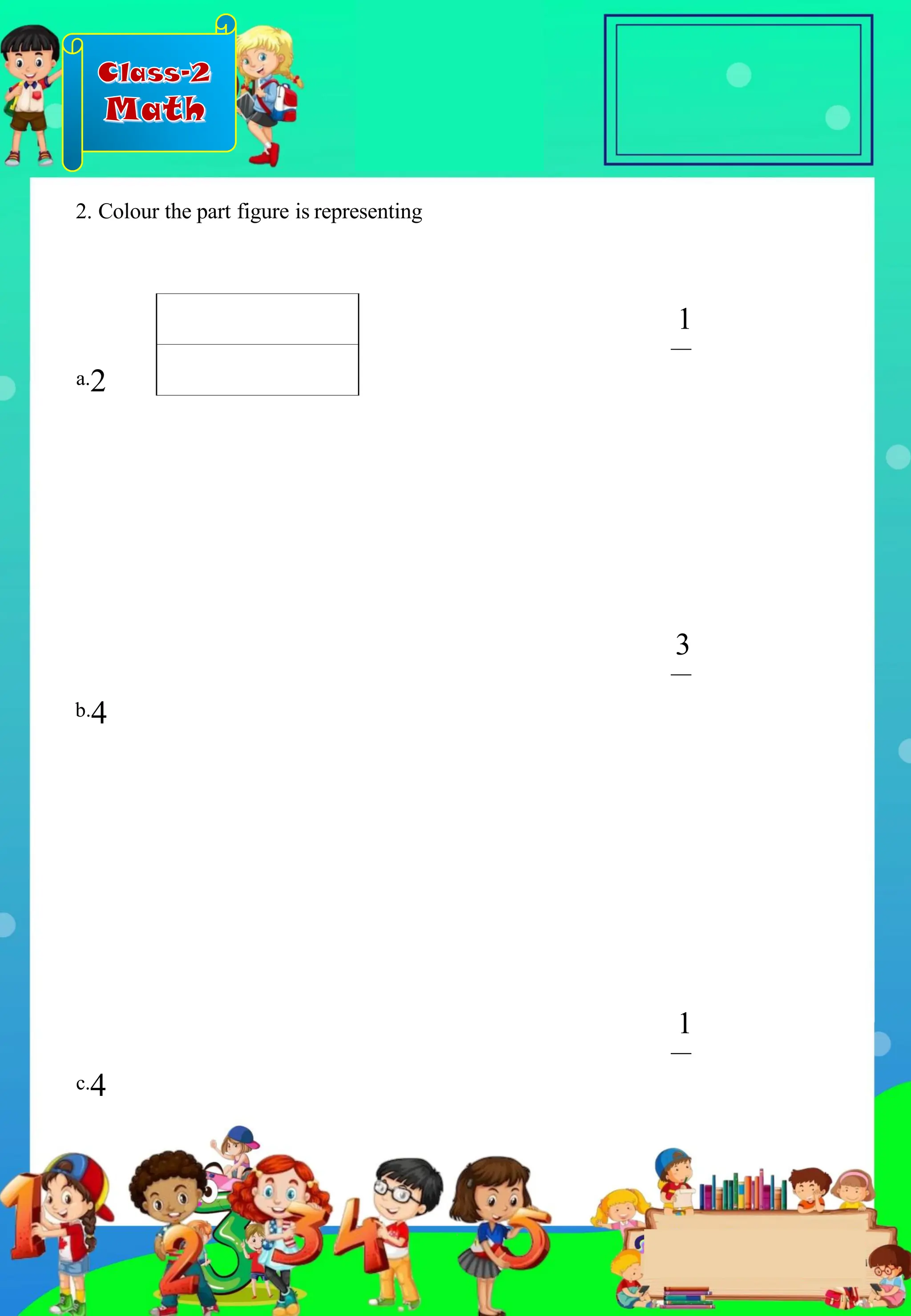
2. Colour the part figure is representing
b.4
3
1
1
c.4
a.2
.
Class-2
Math
Data Handling
Pictograph
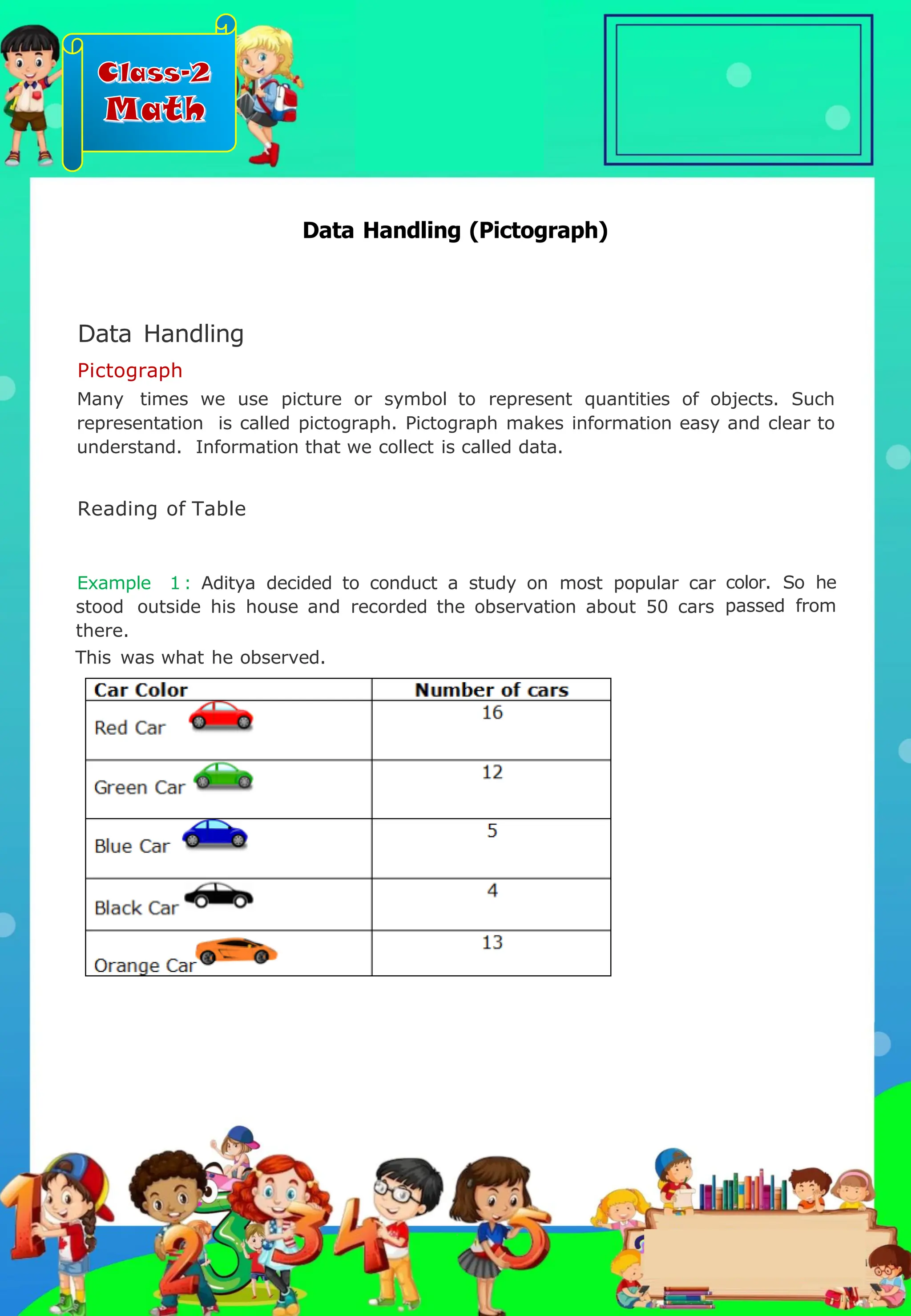
Many times we use picture or symbol to represent quantities of objects. Such
representation is called pictograph. Pictograph makes information easy and clear to
understand. Information that we collect is called data.
Reading of Table
Example 1 : Aditya decided to conduct a study on most popular car
stood outside his house and recorded the observation about 50 cars
there.
This was what he observed.
Data Handling (Pictograph)
color. So he
passed from
.
Class-2
Math
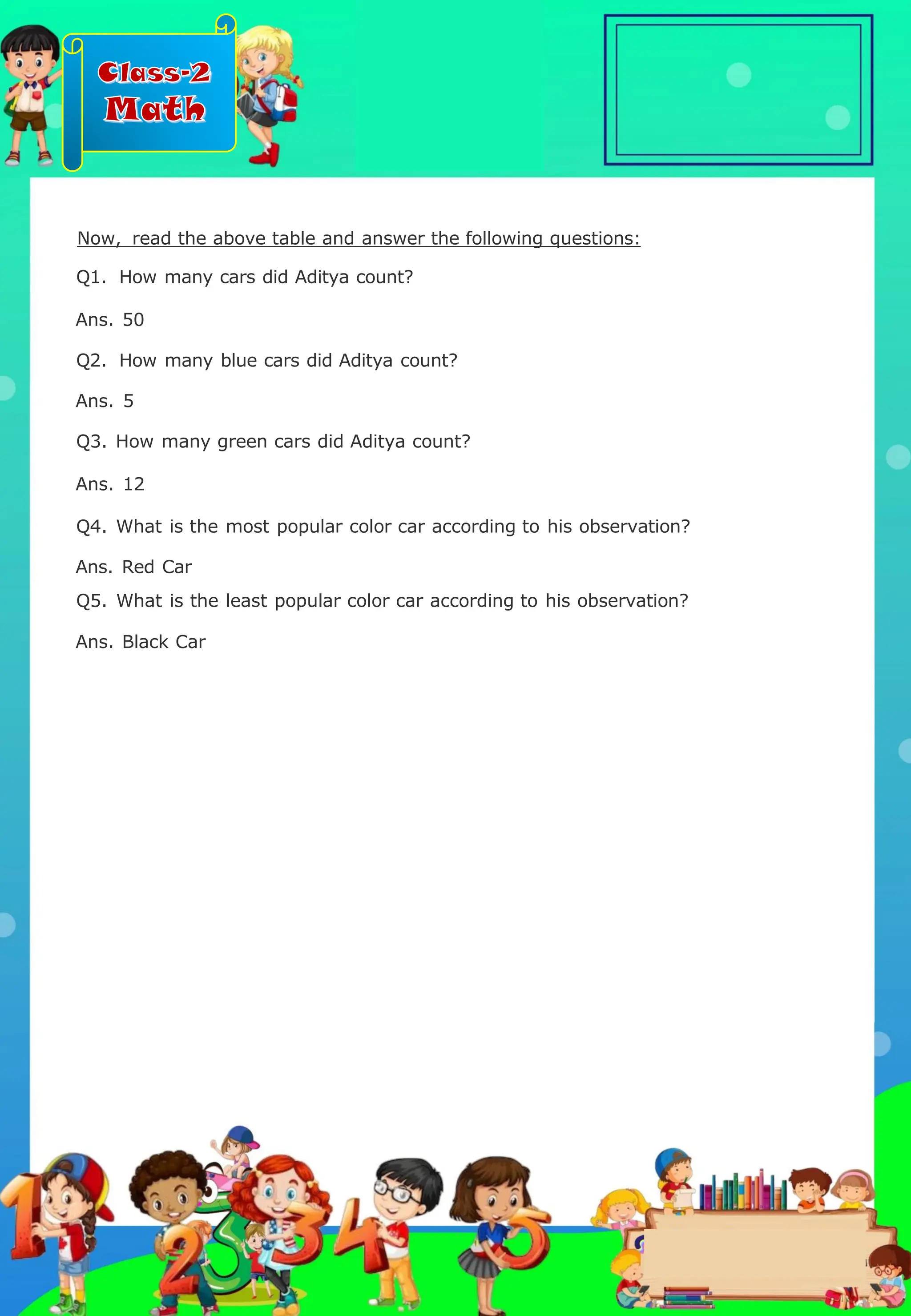
Now, read the above table and answer the following questions:
Q1. How many cars did Aditya count?
Ans. 50
Q2. How many blue cars did Aditya count?
Ans. 5
Q3. How many green cars did Aditya count?
Ans. 12
Q4. What is the most popular color car according to his observation?
Ans. Red Car
Q5. What is the least popular color car according to his observation?
Ans. Black Car
.
Class-2
Math
Now, read the above table and answer the following questions:
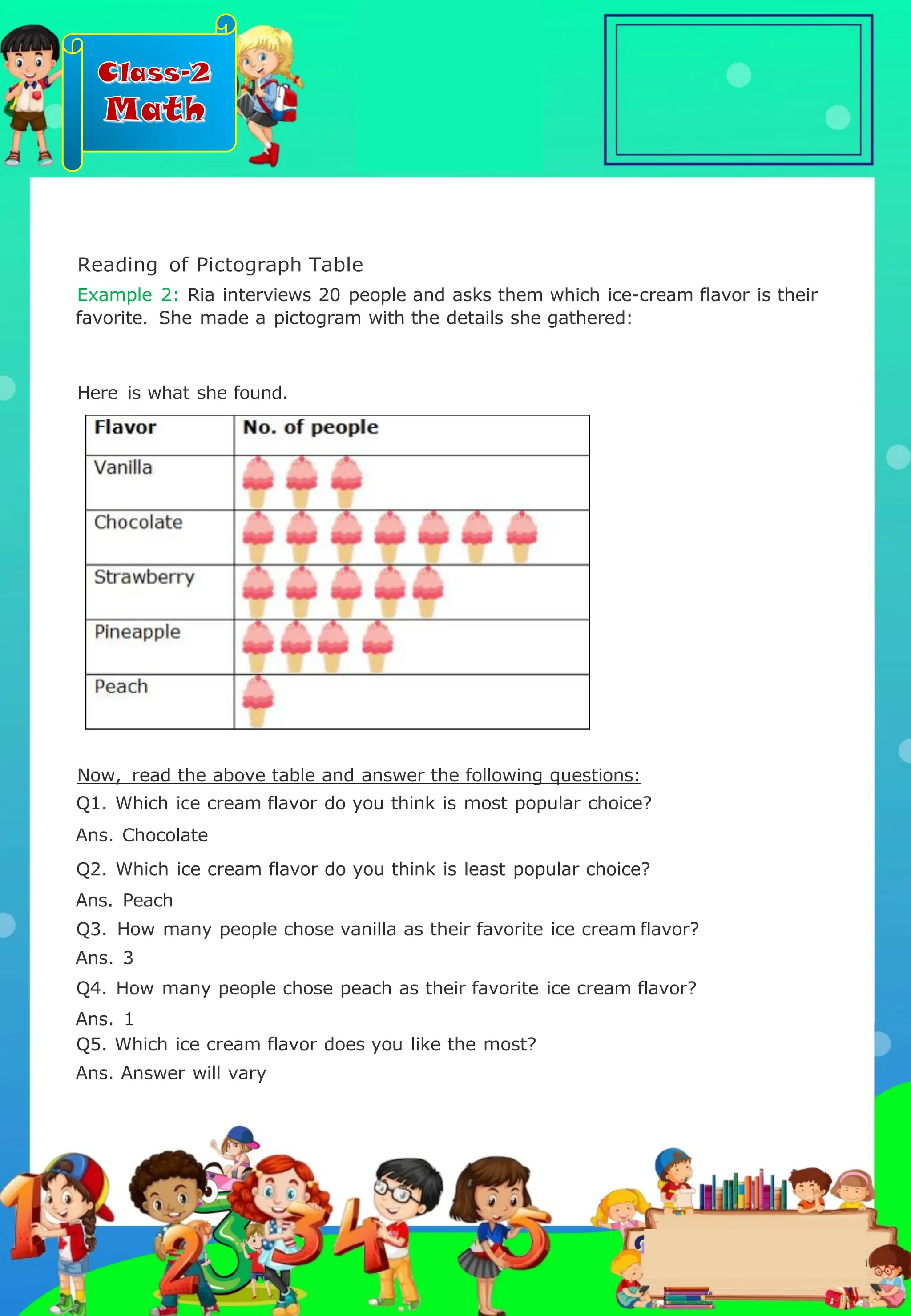
Q1. Which ice cream flavor do you think is most popular choice?
Ans. Chocolate
Q2. Which ice cream flavor do you think is least popular choice?
Ans. Peach
Q3. How many people chose vanilla as their favorite ice cream flavor?
Ans. 3
Q4. How many people chose peach as their favorite ice cream flavor?
Ans. 1
Q5. Which ice cream flavor does you like the most?
Ans. Answer will vary
Reading of Pictograph Table
Example 2: Ria interviews 20 people and asks them which ice-cream flavor is their
favorite. She made a pictogram with the details she gathered:
Here is what she found.
.
Class-2
Math
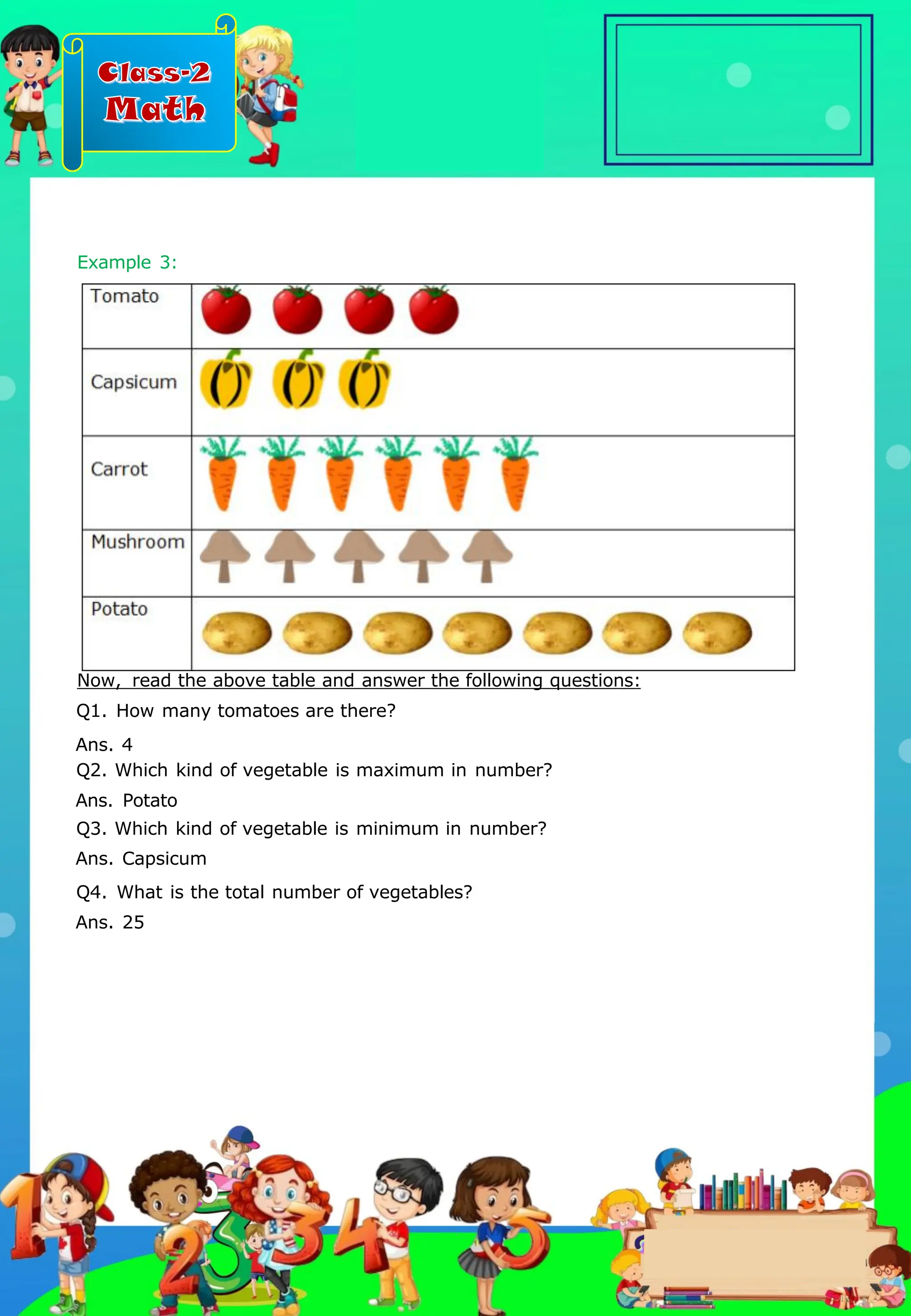
Now, read the above table and answer the following questions:
Q1. How many tomatoes are there?
Ans. 4
Q2. Which kind of vegetable is maximum in number?
Ans. Potato
Q3. Which kind of vegetable is minimum in number?
Ans. Capsicum
Q4. What is the total number of vegetables?
Ans. 25
Example 3:
.
Class-2
Math
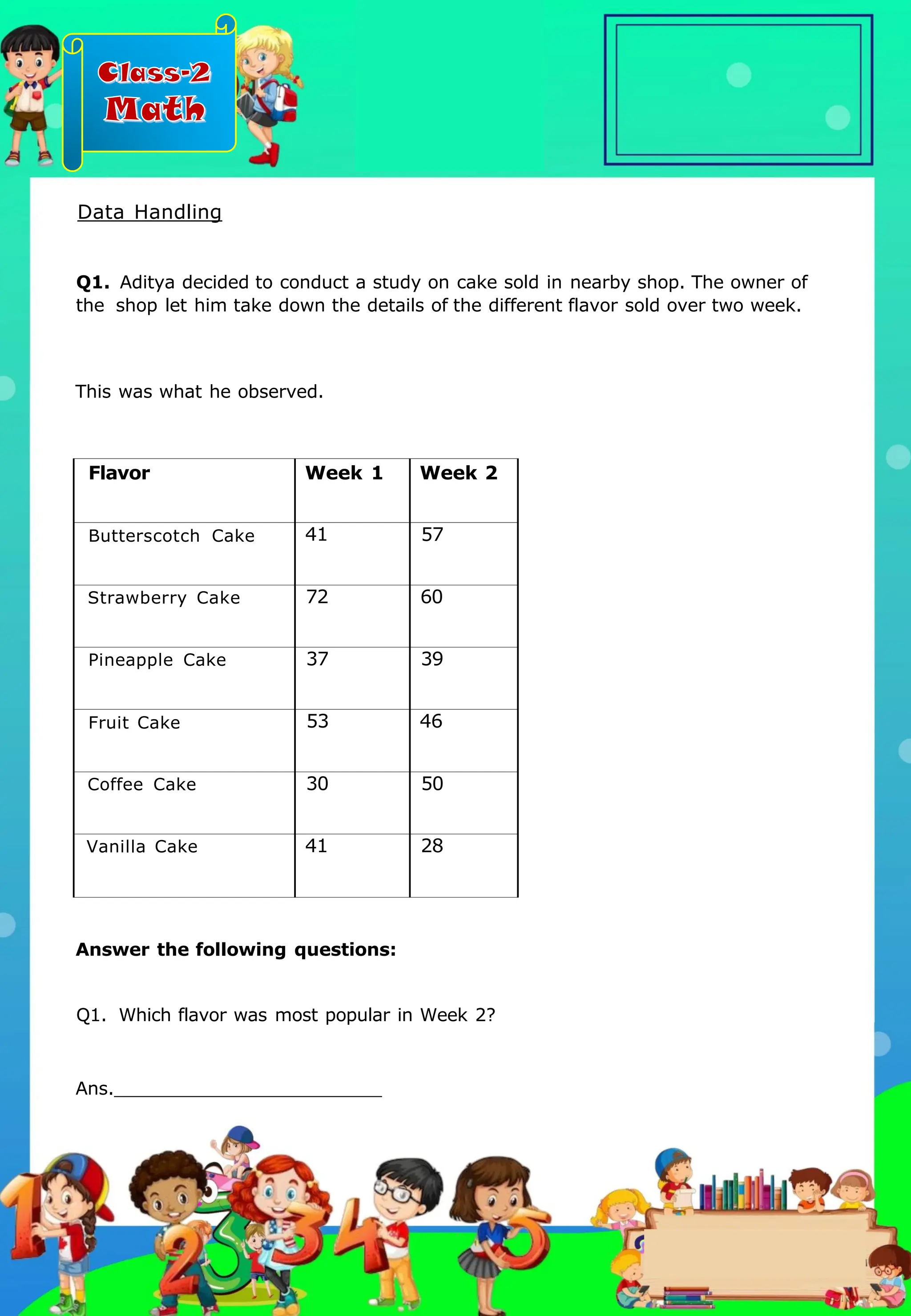
Flavor Week 1 Week 2
Butterscotch Cake 41 57
Strawberry Cake 72 60
Pineapple Cake 37 39
Fruit Cake 53 46
Coffee Cake 30 50
Vanilla Cake 41 28
Answer the following questions:
Q1. Which flavor was most popular in Week 2?
Ans.
Q1. Aditya decided to conduct a study on cake sold in nearby shop. The owner of
the shop let him take down the details of the different flavor sold over two week.
This was what he observed.
Data Handling
.
Class-2
Math
Q2. Which flavor had the maximum sales in Week 1?
Ans.
Q3. Which flavor had the minimum sales in Week 2?
Ans.
Q4. Which flavor was least popular in Week 2?
Ans.
Q5. How many more butterscotch cakes were sold in Week 2?
Ans.
.
Class-2
Math
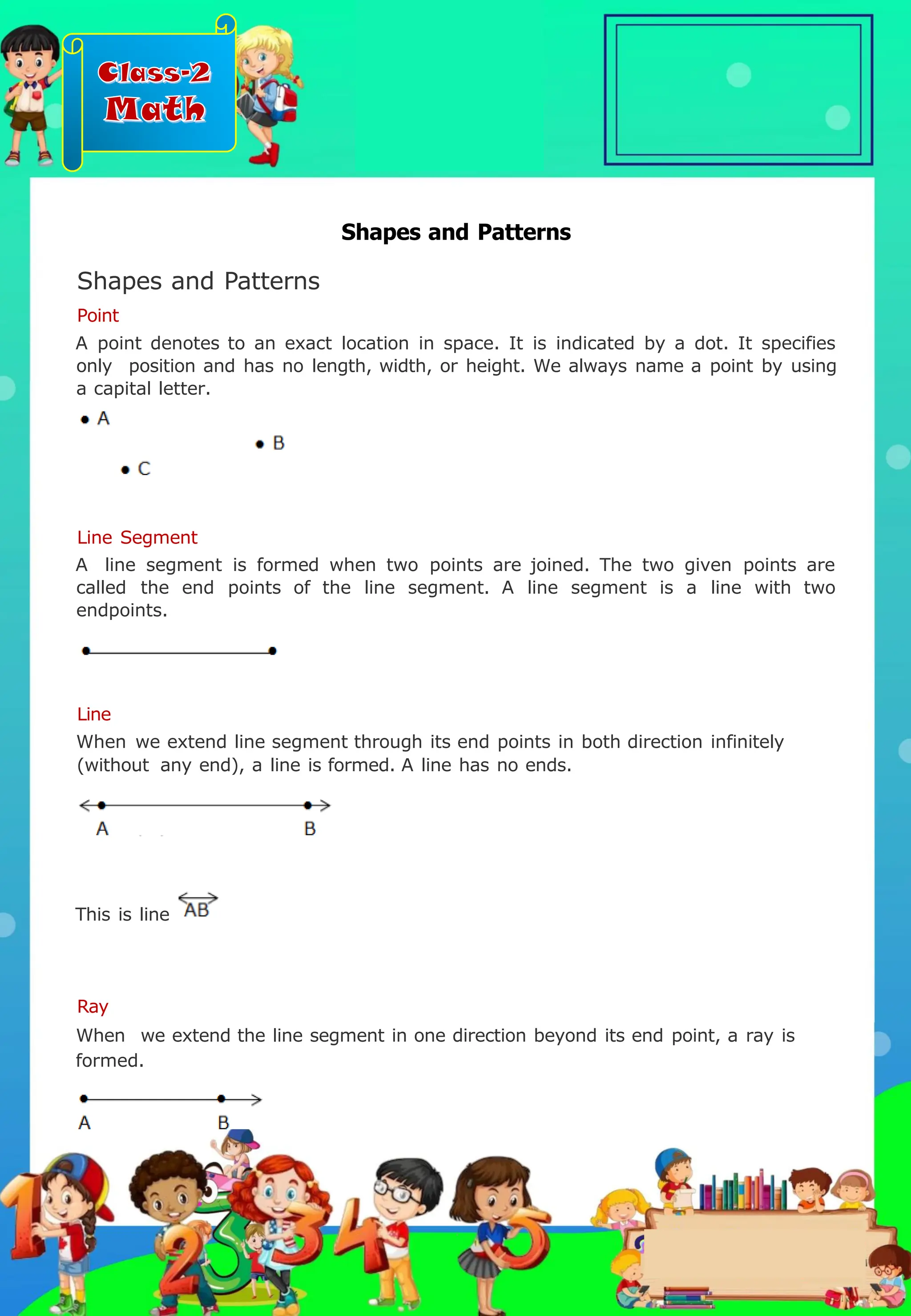
Line Segment
A line segment is formed when two points are joined. The two given points are
called the end points of the line segment. A line segment is a line with two
endpoints.
Shapes and Patterns
Shapes and Patterns
Point
Ray
When we extend the line segment in one direction beyond its end point, a ray is
formed.
Line
When we extend line segment through its end points in both direction infinitely
(without any end), a line is formed. A line has no ends.
A point denotes to an exact location in space. It is indicated by a dot. It specifies
only position and has no length, width, or height. We always name a point by using
a capital letter.
This is line
.
Class-2
Math
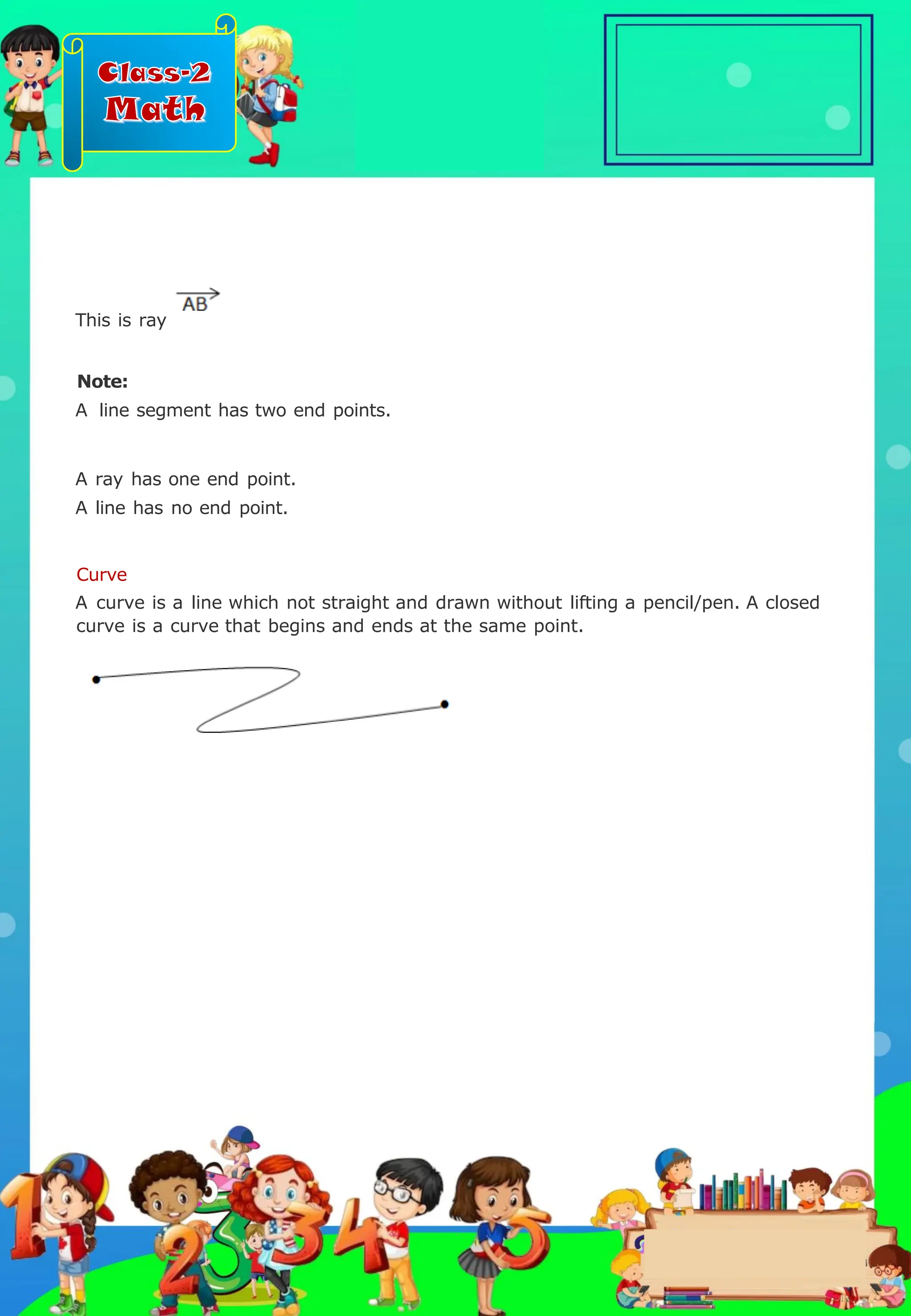
This is ray
Note:
A line segment has two end points.
A ray has one end point.
A line has no end point.
Curve
A curve is a line which not straight and drawn without lifting a pencil/pen. A closed
curve is a curve that begins and ends at the same point.
.
Class-2
Math
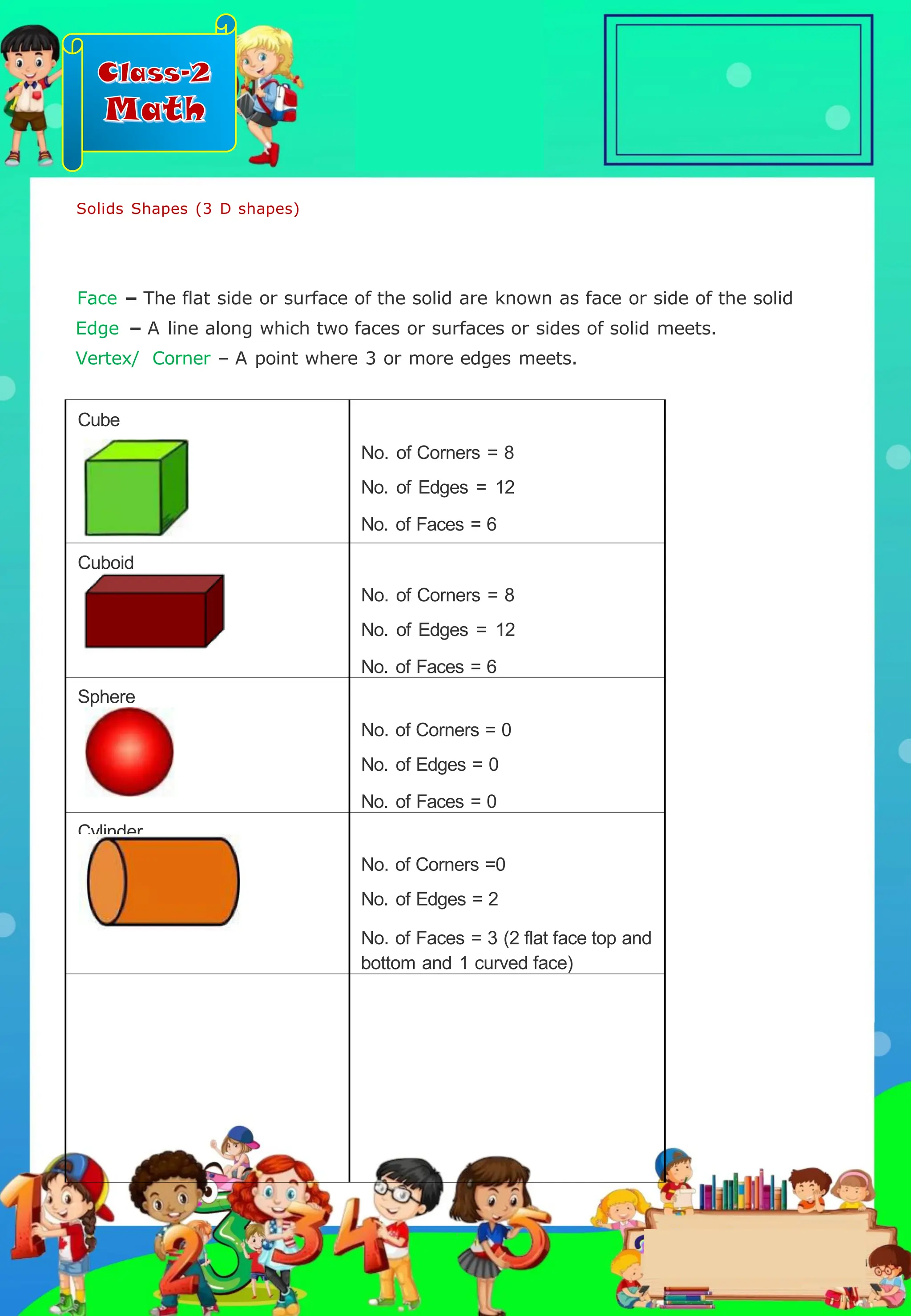
Cube
No. of Corners = 8
No. of Edges = 12
No. of Faces = 6
Cuboid
No. of Corners = 8
No. of Edges = 12
No. of Faces = 6
Sphere
No. of Corners = 0
No. of Edges = 0
No. of Faces = 0
Cylinder
No. of Corners =0
No. of Edges = 2
No. of Faces = 3 (2 flat face top and
bottom and 1 curved face)
Face – The flat side or surface of the solid are known as face or side of the solid
Edge – A line along which two faces or surfaces or sides of solid meets.
Vertex/ Corner – A point where 3 or more edges meets.
Solids Shapes (3 D shapes)
.
Class-2
Math
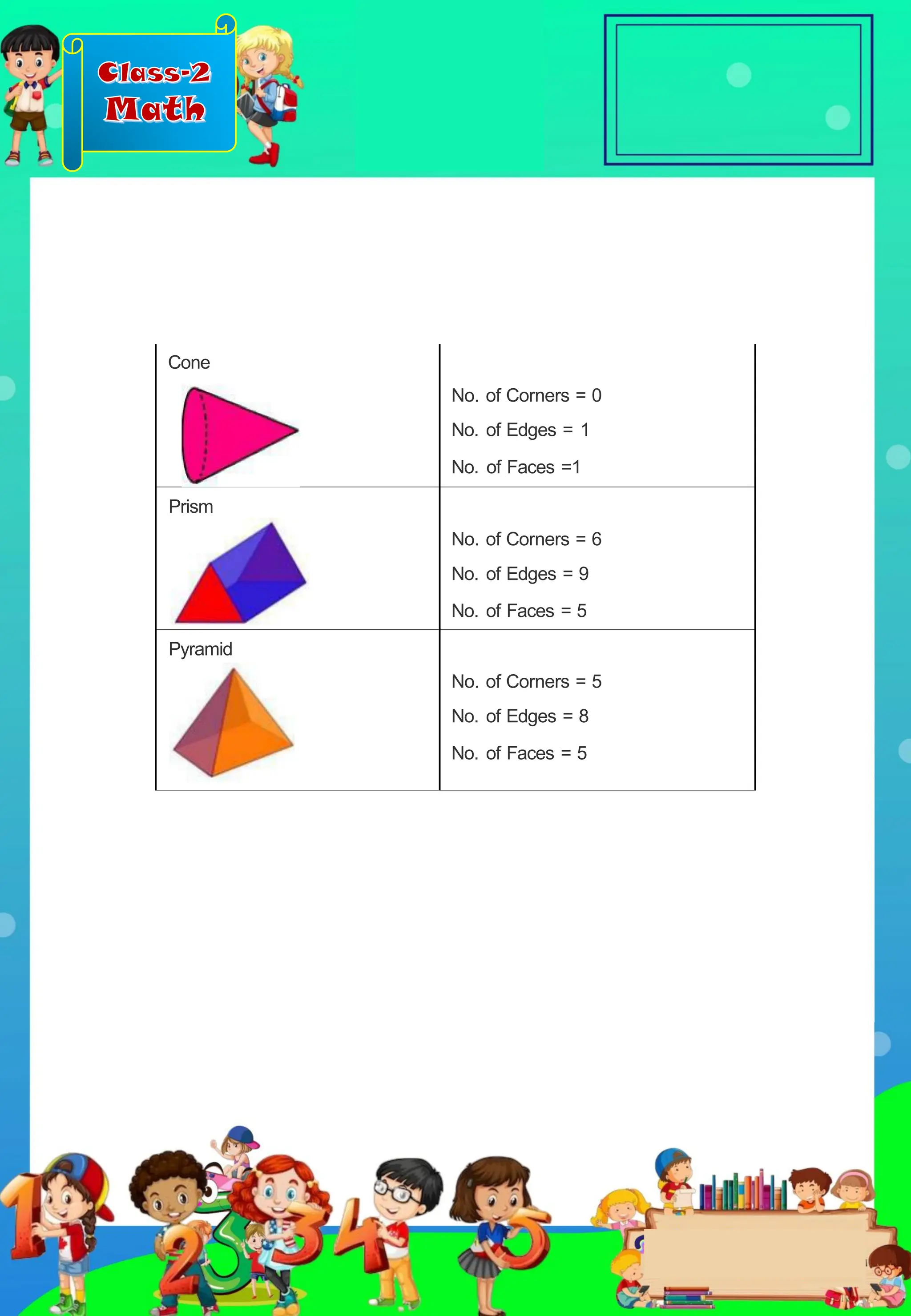
Cone
No. of Corners = 0
No. of Edges = 1
No. of Faces =1
Prism
No. of Corners = 6
No. of Edges = 9
No. of Faces = 5
Pyramid
No. of Corners = 5
No. of Edges = 8
No. of Faces = 5
Class-2
Math
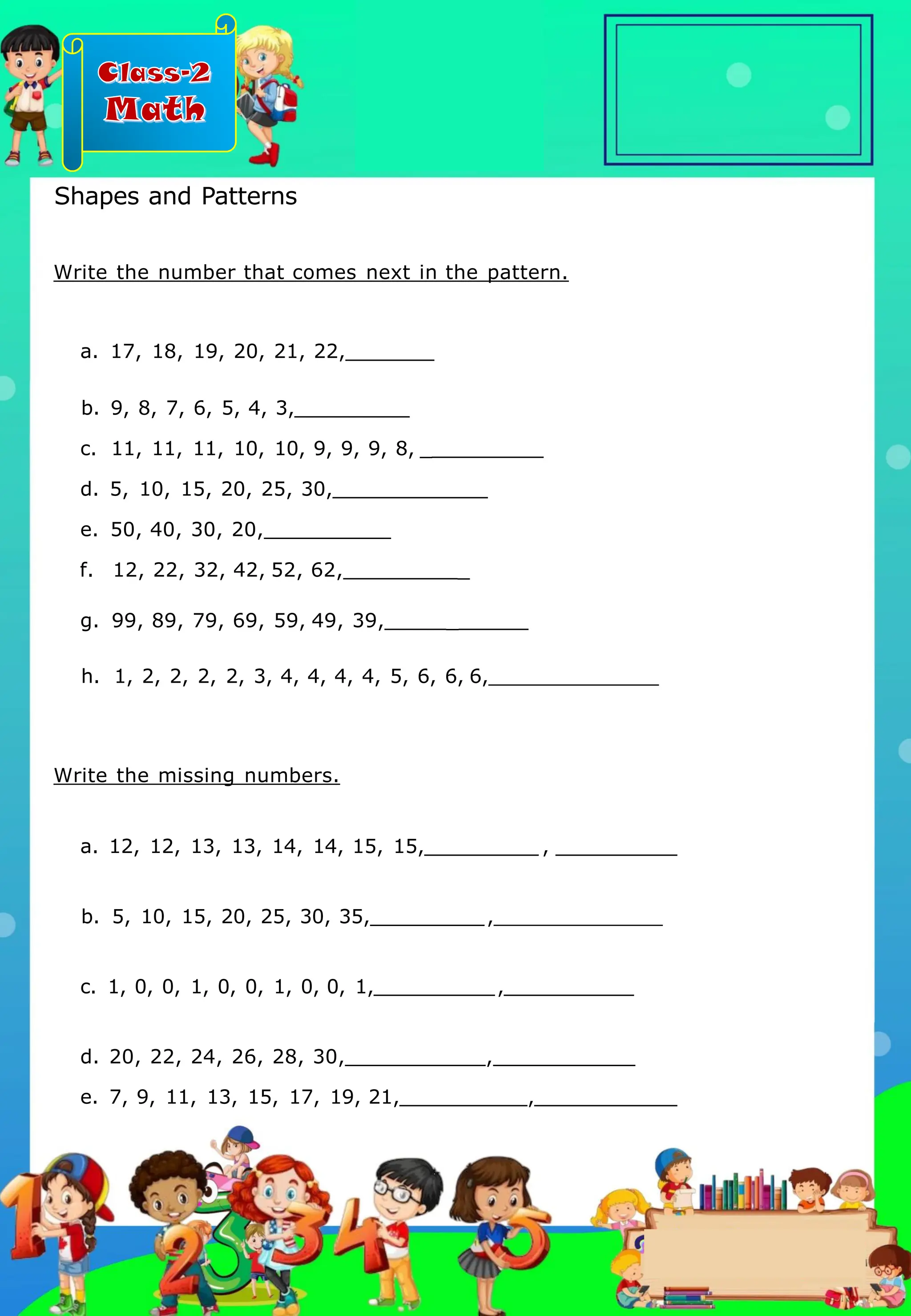
Write the number that comes next in the pattern.
a. 17, 18, 19, 20, 21, 22,
b. 9, 8, 7, 6, 5, 4, 3,
c. 11, 11, 11, 10, 10, 9, 9, 9, 8, _
d. 5, 10, 15, 20, 25, 30,
e. 50, 40, 30, 20,
f. 12, 22, 32, 42, 52, 62, _
g. 99, 89, 79, 69, 59, 49, 39, _
h. 1, 2, 2, 2, 2, 3, 4, 4, 4, 4, 5, 6, 6, 6,
Write the missing numbers.
a. 12, 12, 13, 13, 14, 14, 15, 15, , _
b. 5, 10, 15, 20, 25, 30, 35, ,
c. 1, 0, 0, 1, 0, 0, 1, 0, 0, 1, ,
d. 20, 22, 24, 26, 28, 30, ,
e. 7, 9, 11, 13, 15, 17, 19, 21, ,
Shapes and Patterns
.
Class-2
Math
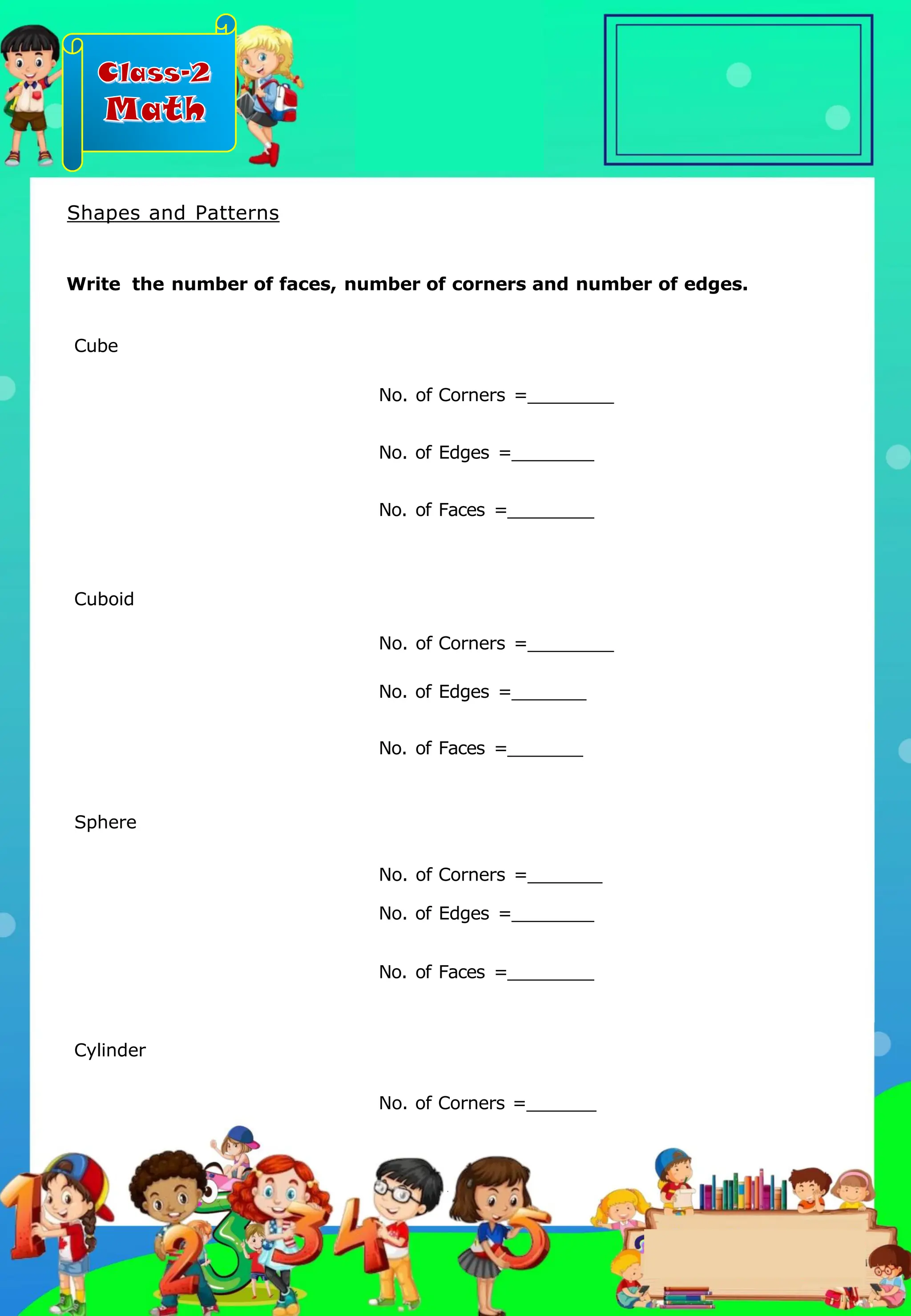
Shapes and Patterns
Write the number of faces, number of corners and number of edges.
Cube
No. of Corners =
No. of Edges =
No. of Faces =
Cuboid
No. of Corners =
No. of Edges =
No. of Faces =
Sphere
No. of Corners =
No. of Edges =
No. of Faces =
Cylinder
No. of Corners =
.
Class-2
Math
Cone
No. of Corners =
No. of Edges =
No. of Faces =
Prism
No. of Corners =
No. of Edges =
No. of Faces =
Pyramid
No. of Corners =
No. of Edges =
No. of Faces =
No. of Edges =
No. of Faces =
.
Class-2
Math
Measurement of Length
Length means how long something is. We see many things around us. Some are
short in length such as paper clip, pencil, pen, notebook etc., some are long in
length such as tree, electric pole, cloth, room, train track and some are very long
such as distance between two places. We need to select suitable unit to measure
these lengths.
Non Standard Units of Measurement
In early days body parts were used to measure length. But measurements taken by
these means are not accurate and consistent. If we use our hand span to measure
length, the measurement taken by different person will vary as our hand spans are
not equal.
Example : a child hand span is smaller than the adult. So, hand span, hand, foot
and cubit are not standard units of measurement.
Standard Units of Measurement
We observed that nonstandard unit of measurement does not give same results.
So, we need to use some standard units for measuring lengths. Otherwise the
measurements of an object will be different when measured in different ways. We
use different units of length to measure different lengths.
Example: We measure length of table edge, length of chalk, length of pencil etc. in
centimeters (cm), length of a room, height of tree, length of cloth, height of an
electric pole etc. in meters (m) and longer distance such distance between two
places in kilometers (km).
Points to be remembered
The standard unit of length is meter.
One meter is divided into 100 smaller units called centimeters.
.
Class-2
Math
Instrument of Measurement of Length
We use metric ruler, metric stick, tape, rod etc. to measure length.
Word Problem
Example 1: Length of blue rope is 7m and length of red rope is 5m. Which rope is
bigger and by how much?
Solution:
So, 1m = 100cm
Short form of meter is “m”, centimeter is “cm” and kilometer is “km”.
1000 m put together to make a bigger unit called a kilometer.
1km =1000m
Example 2: Ria travelled 2km by car and 5 km by bus. How much distance did she
travel in all?
Solution:
.
Class-2
Math
Measurement of Length
Q1. Circle the unit you will use to measure the length in each of the
following:
a. Length of pen.
b. Length of a paper clip.
c. Length of race track.
d. Length of a train.
e. Distance between two cities.
f. Length of desktop.
cm / m / km
cm / m / km
cm / m / km
cm / m / km
cm / m / km
cm / m / km
Q2. Measure the following lengths in centimeters
a.
cm
b.
cm
.
Class-2
Math
My pencil is 10 long.
My room is 6 long.
Distance between my house and school is 6 .
Length of a pole is 3
Length of paint brush is 12
Length of of a thermometer is 20
Q3. Fill in the blanks with ‘m’, ‘cm’ or ‘km’.
.
Class-2
Math
Measurement of Length
Q1. Answer the following:
a. 1 meter = cm
b. 1 km = m
c. 100 cm = m
d. 1000m = km
e. Distance between two cities is measured in .
f. Length of spoon is measured in .
Q2. Draw the following lengths.
a. 3cm
b. 5cm
c. 8cm
d. 10cm
.
Class-2
Math
Length of your desktop........................... cm
Length of your pencil............................ cm
Length of your tie ................................
cm
Q3. Measure the following length in centimeters.
Length of your bag.............................cm
.
Class-2
Math
Measurement of Mass (Weight)
In everyday life we usually compare the mass of different objects. We can compare
the mass of two things by lifting or holding the objects with our hands and find out
which object is heavier or lighter. But everything we can lift or hold and this type of
measurement are not accurate, they are just rough estimates.
Example : If we hold pencil on one hand and book on other hand, we can easily say
that book is heavier than the pencil.
Measuring the mass of an object is also known as weighing the object . We use
different weighing scales or weighing machines to weigh objects.
We need to use suitable units to measure the masses of objects. The standard unit
of mass is the gram. We write gram as ‘g’.
1000 grams put together make a bigger unit called kilogram. Kilogram is written as
‘kg’ in short.
1kg = 1000g
Or
1000g = 1kg
We measure lighter objects in grams whereas heavier objects in kilograms.
In case of balance scale, when two objects weigh the equal, the two pans of the
weighing scales are said to be balanced and stay at the equal level and when one
object heavy and other is lighter, the pan with the heavier object goes down and
the pan with the lighter object goes up.
.
Class-2
Math
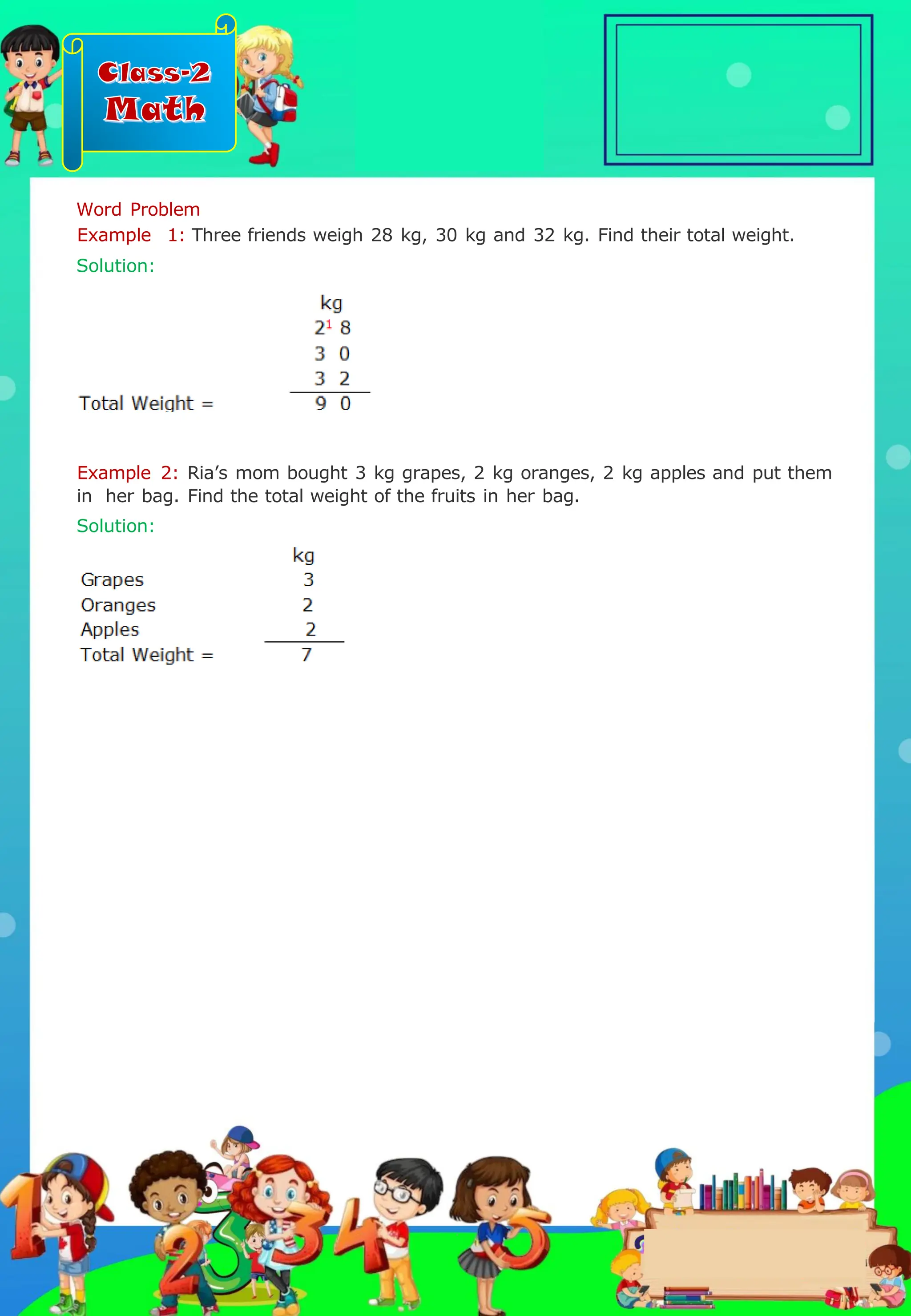
Word Problem
Example 1: Three friends weigh 28 kg, 30 kg and 32 kg. Find their total weight.
Solution:
Example 2: Ria’s mom bought 3 kg grapes, 2 kg oranges, 2 kg apples and put them
in her bag. Find the total weight of the fruits in her bag.
Solution:
.
Class-2
Math
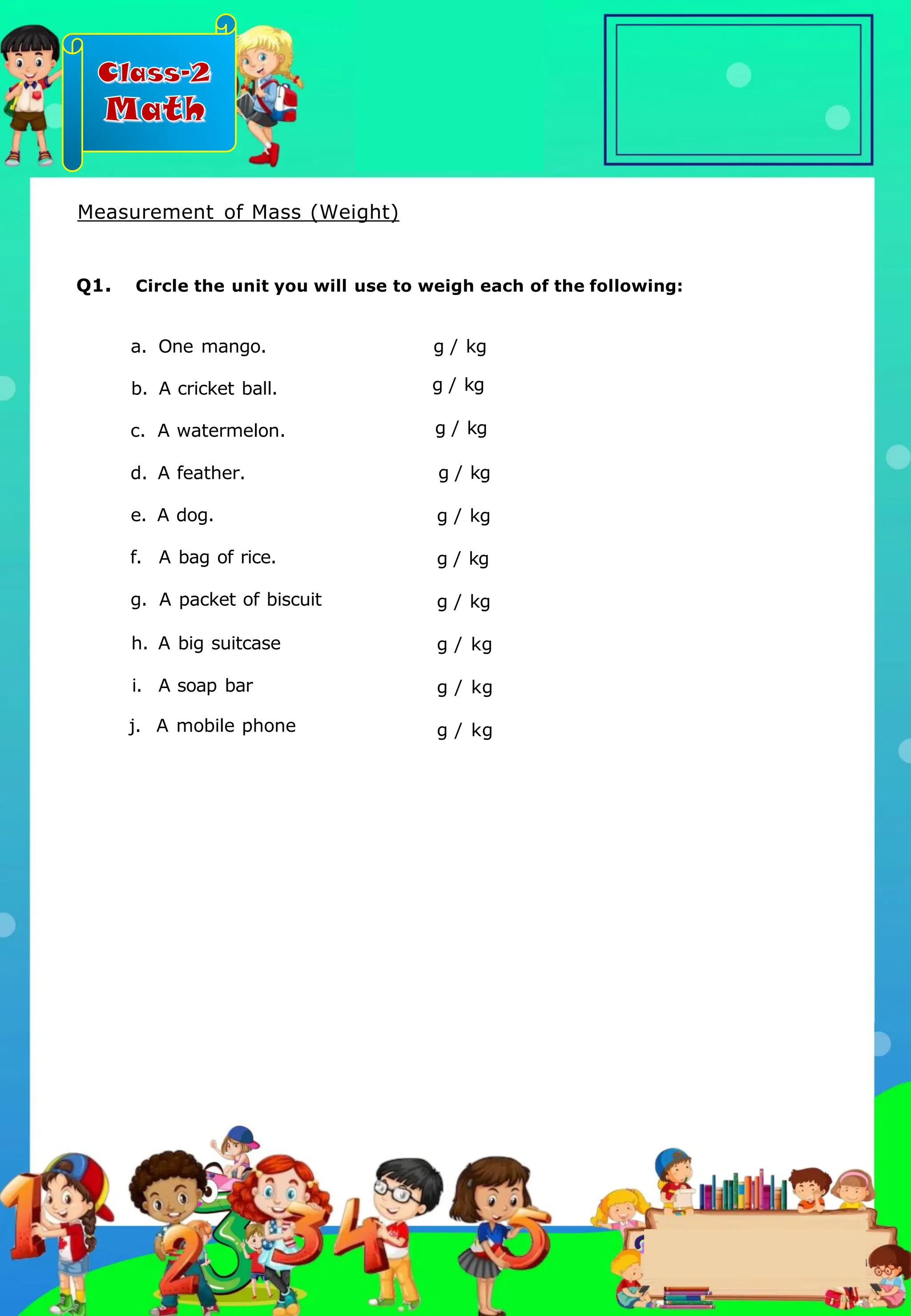
a. One mango.
b. A cricket ball.
c. A watermelon.
d. A feather.
e. A dog.
f. A bag of rice.
g. A packet of biscuit
h. A big suitcase
i. A soap bar
j. A mobile phone
g / kg
g / kg
g / kg
g / kg
g / kg
g / kg
g / kg
g / kg
g / kg
g / kg
Q1. Circle the unit you will use to weigh each of the following:
Measurement of Mass (Weight)
.
Class-2
Math
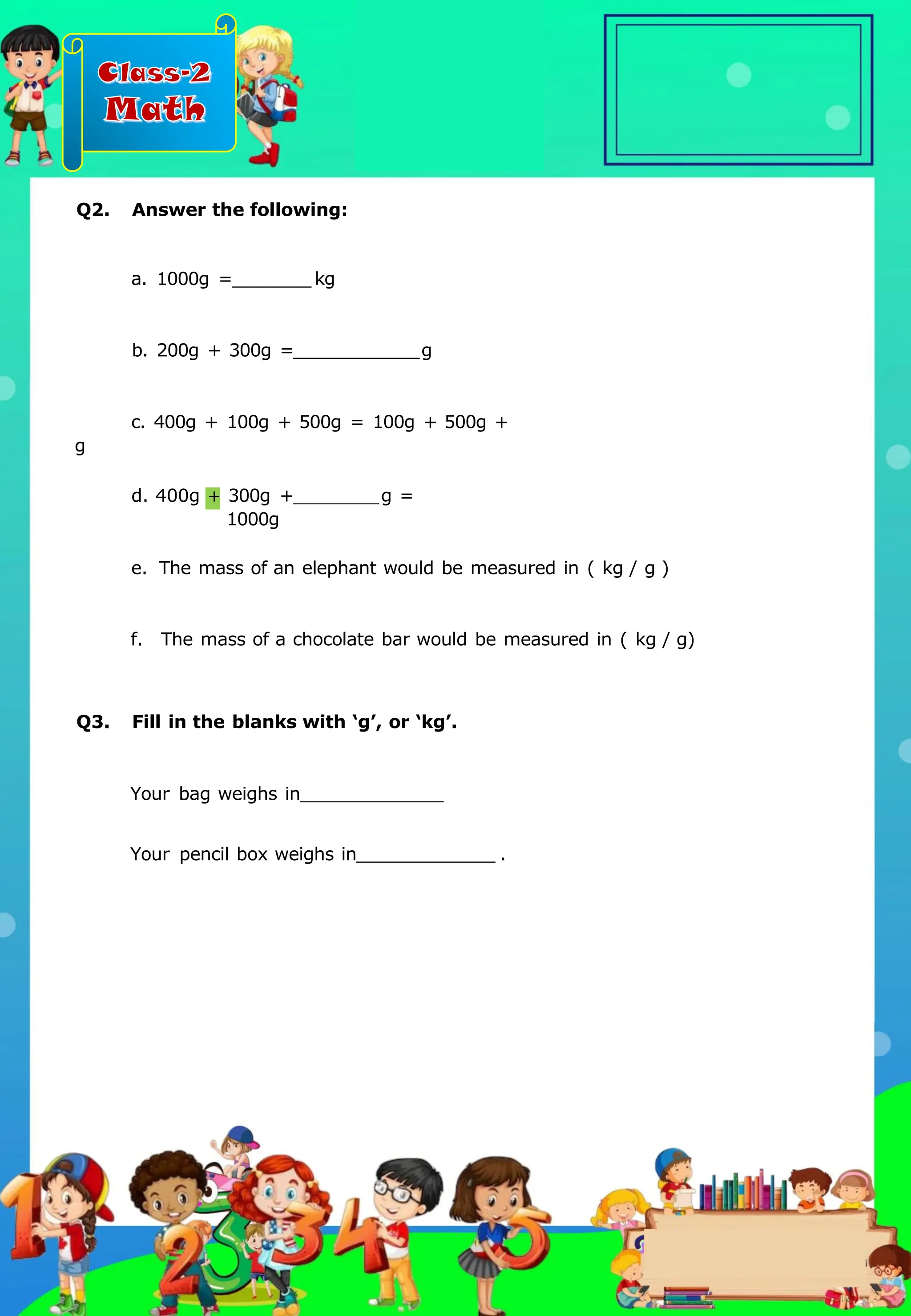
e. The mass of an elephant would be measured in ( kg / g )
f. The mass of a chocolate bar would be measured in ( kg / g)
Q3. Fill in the blanks with ‘g’, or ‘kg’.
Your bag weighs in
Your pencil box weighs in .
Q2. Answer the following:
a. 1000g = kg
b. 200g + 300g = g
c. 400g + 100g + 500g = 100g + 500g +
g
300g + g =
1000g
d. 400g +
.
Class-2
Math
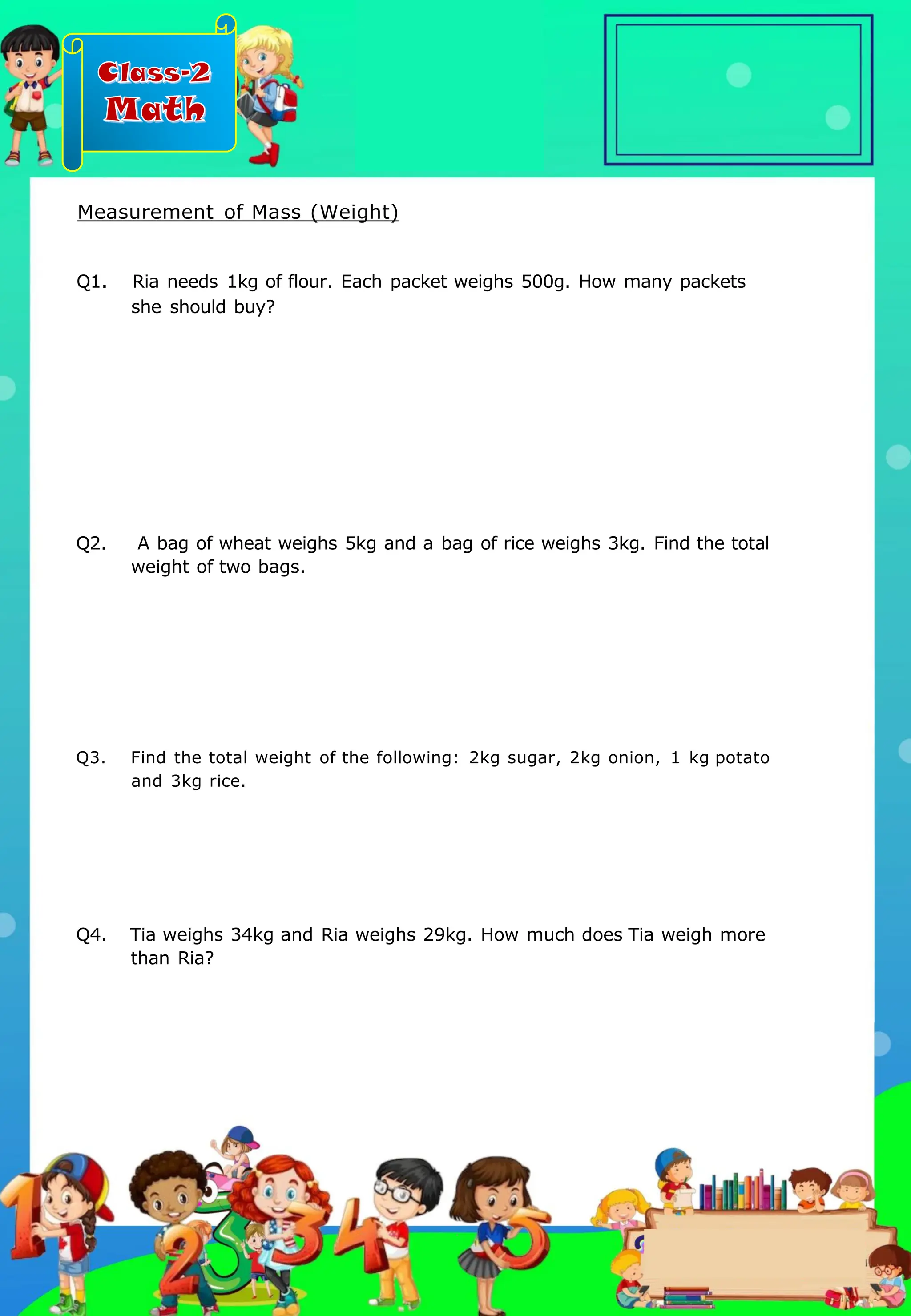
Q2. A bag of wheat weighs 5kg and a bag of rice weighs 3kg. Find the total
weight of two bags.
Q4. Tia weighs 34kg and Ria weighs 29kg. How much does Tia weigh more
than Ria?
Q1. Ria needs 1kg of flour. Each packet weighs 500g. How many packets
she should buy?
Q3. Find the total weight of the following: 2kg sugar, 2kg onion, 1 kg potato
and 3kg rice.
Measurement of Mass (Weight)
.
Class-2
Math
Measurement of Capacity
Capacity means how much liquid a container can hold. Bigger container can hold
more compared to smaller container. This means big container has larger capacity
whereas smaller has lesser capacity.
The standard unit of measuring capacity is the liter and we write “l” in
short. Smaller quantities of liquid are measured in milliliters and we write “ml” in
short. Medicines, water in glass, small juice packets etc. are measured in milliliters
and milk, petrol, water etc. are usually measured in liters.
1000 ml makes 1l
1000ml = 1l
Or
1l =1000ml
Word Problem
Example 1: A tub contains 10 l of water and another tub contains 5 l. Find the total
amount of water in the two tubs.
Solution:
Example 2: A petrol pump sells 445 liters of petrol in first week and 321 liters in
second week. How much petrol did it sell in 2 weeks?
Solution:
.
Class-2
Math
Q2. Solve the following:
a. 100 ml + 100 ml + 100 ml +100 ml = ml
b. 150 ml +50 ml = ml
c. 100 ml + ml = 200 ml
d. 300 ml + = 300 ml
Q3. Fill in the blanks.
a. 1000 ml = l
b. Capacity of spoon would be measured in .
c. Capacity of bath tub would be measured in .
d. Capacity of water tank would be measured in .
e. Order the capacity from larger to smaller.
5ml, 3l, 17ml, 10l, 150ml _ _
a. A glass of milk.
b. Water in the water bottle.
c. Water in the tank.
d. A medicine bottle.
e. Tea in a cup.
f. A glass of cold drink.
g. A bottle of perfume.
Q1. Circle the unit you will use to measure the capacity in each of the
following:
ml / l
ml / l
ml / l
ml / l
ml / l
ml / l
ml / l
Measurement of Capacity
.
Class-2
Math
Q1. Ria bought 1l of white paint, 3l of blue paint and 4l of red paint. What
is
the total quantity of paint she bought?
Q2. A juice carton contained 500 ml of juice. The carton fell and 150 ml of juice spill
on the ground. How much juice was left in the carton?
Q4. A dairy farm sells 145 liters in the month of January and 120 liters in the
month of February. How much milk did it sell in 2 months?
Q3. Red tank can hold 50 l of water and Blue tank can hold 45 l of water.
What is the total capacity of both tank together?
Measurement of Capacity
.
Class-2
Math
This worksheet is designed to refresh and recall the
number 8 and the topic about ‘fruits’ through various
identification activities and super fun examples.
Class-2
Math
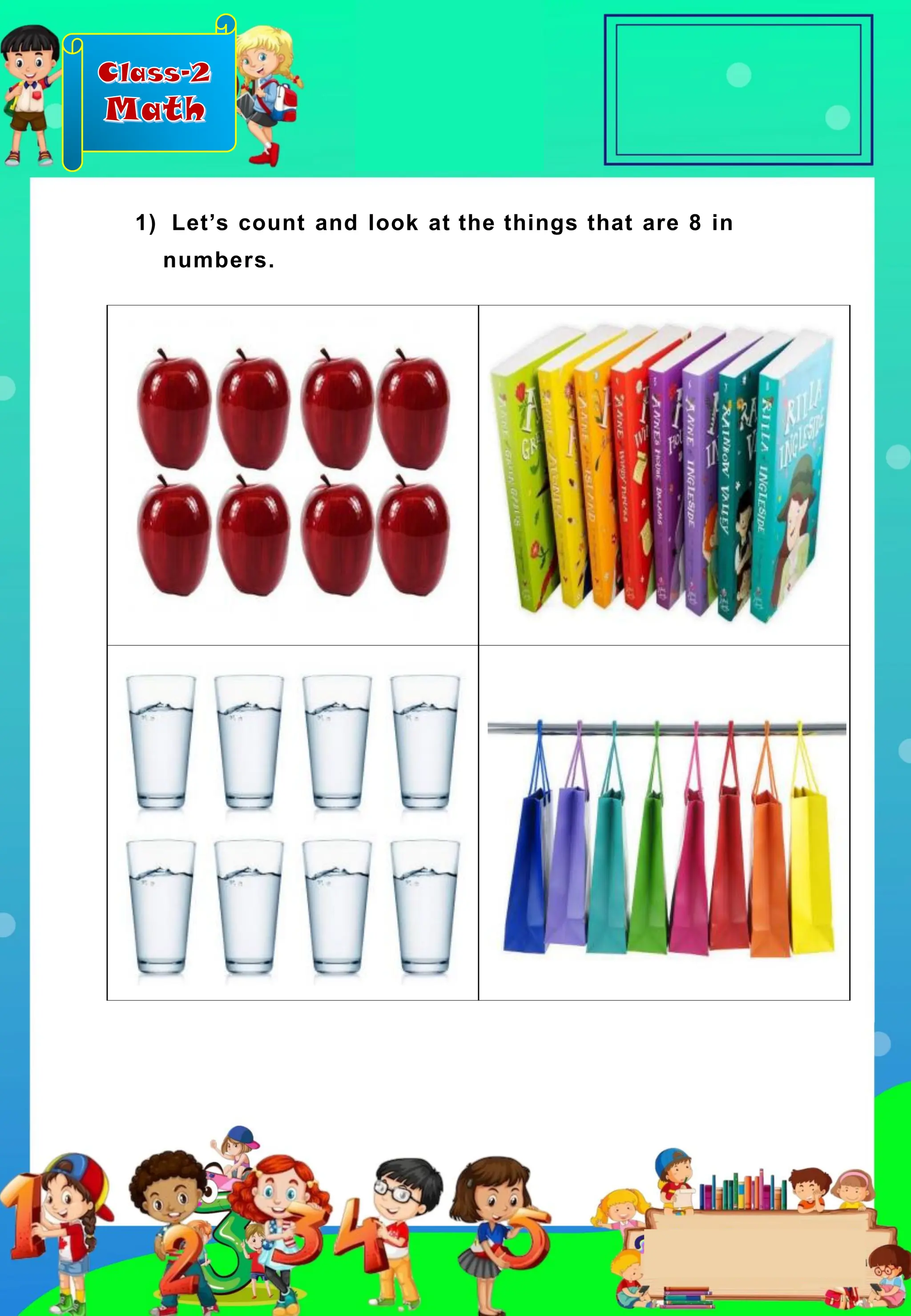
1) Let’s count and look at the things that are 8 in
numbers.
Class-2
Math
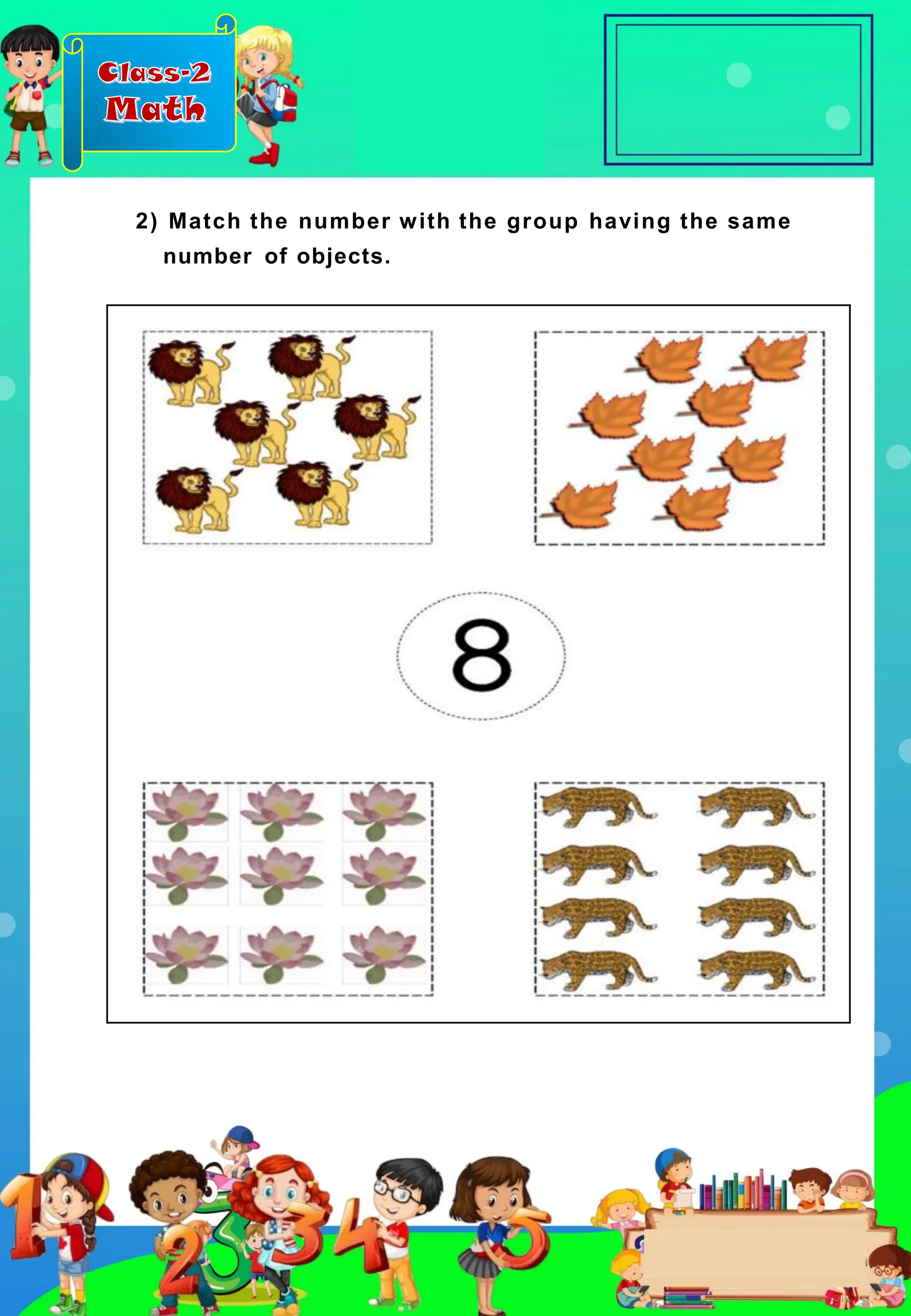
2) Match the number with the group having the same
number of objects.
Class-2
Math
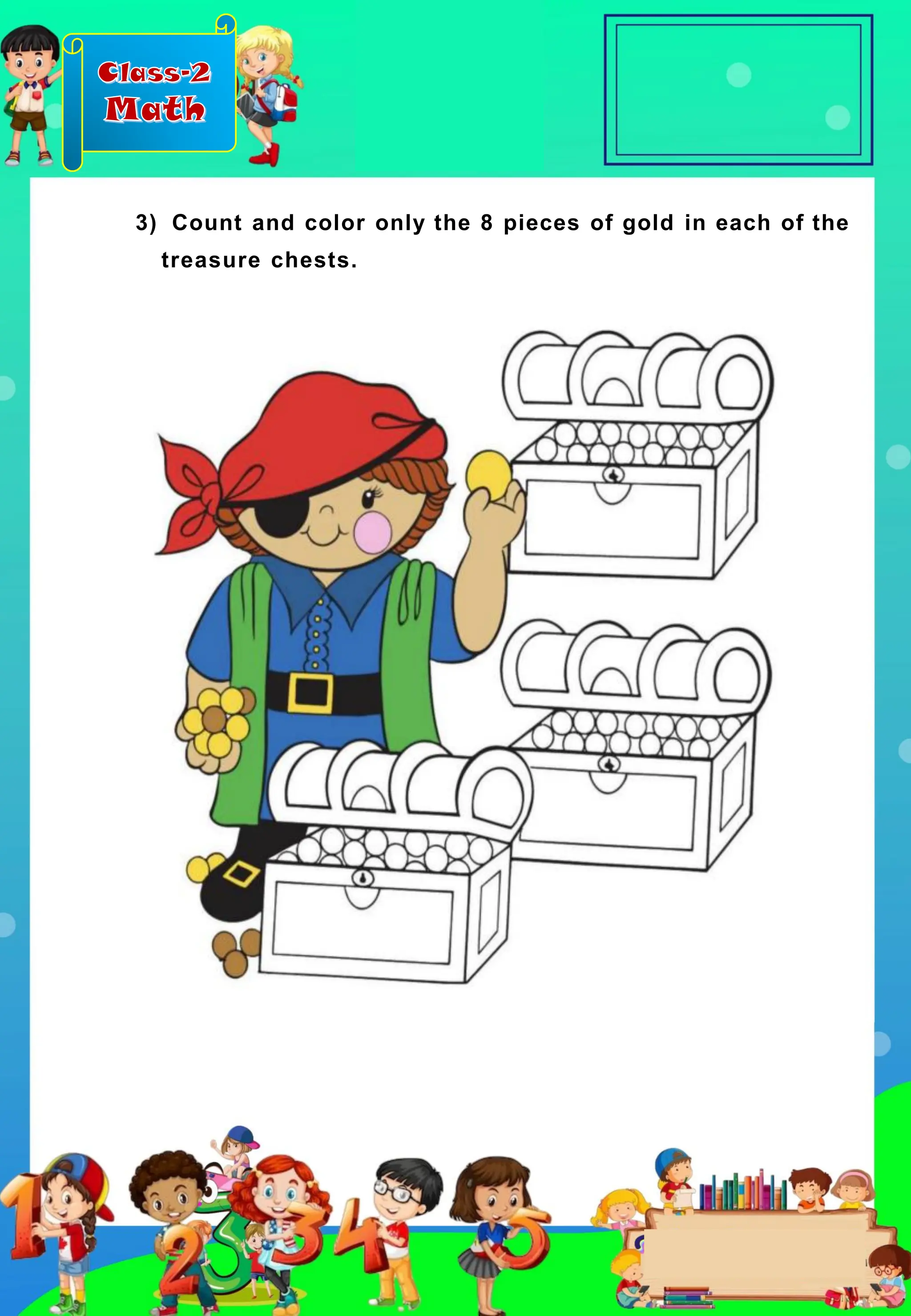
3) Count and color only the 8 pieces of gold in each of the
treasure chests.
Class-2
Math
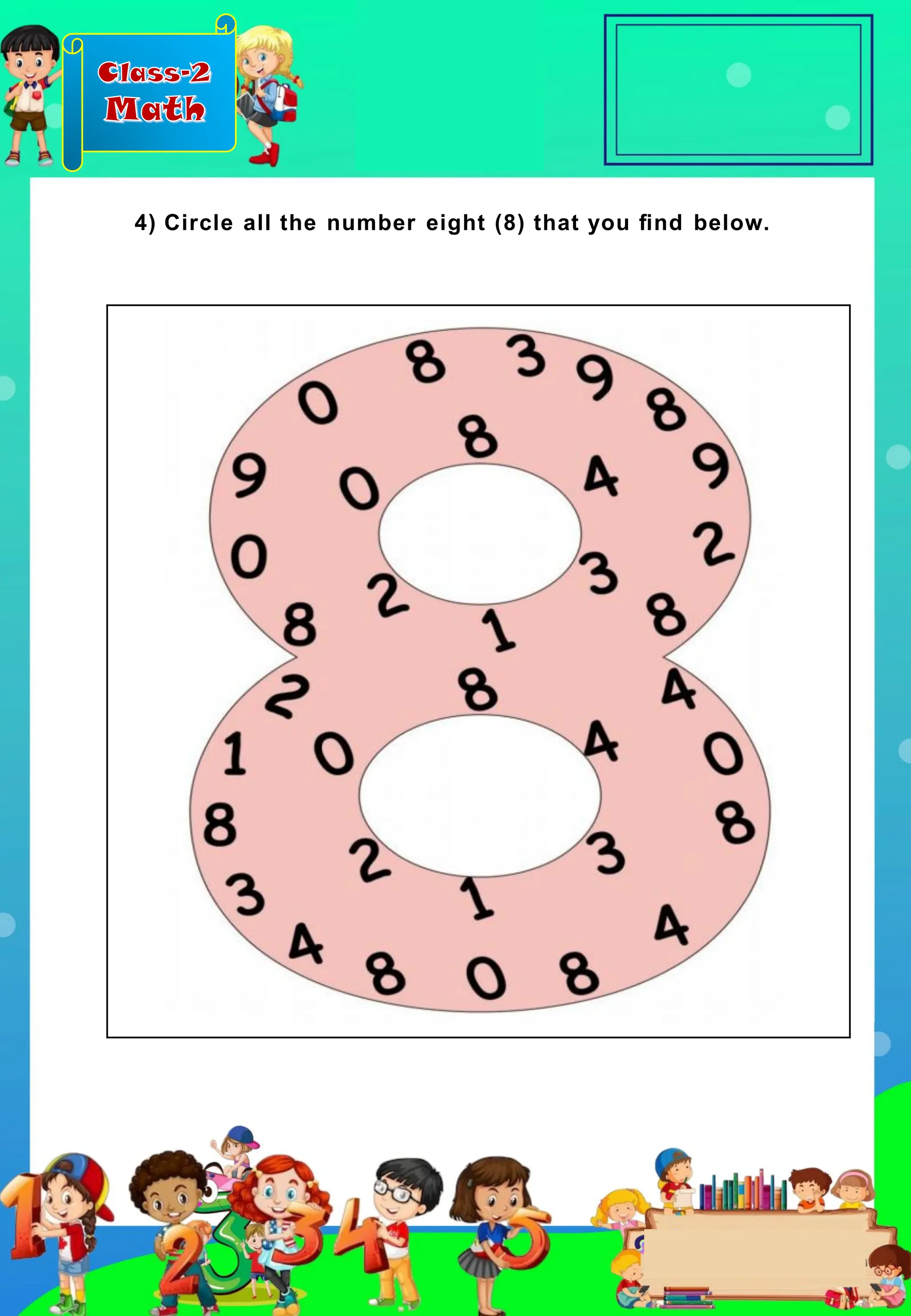
4) Circle all the number eight (8) that you find below.
Class-2
Math
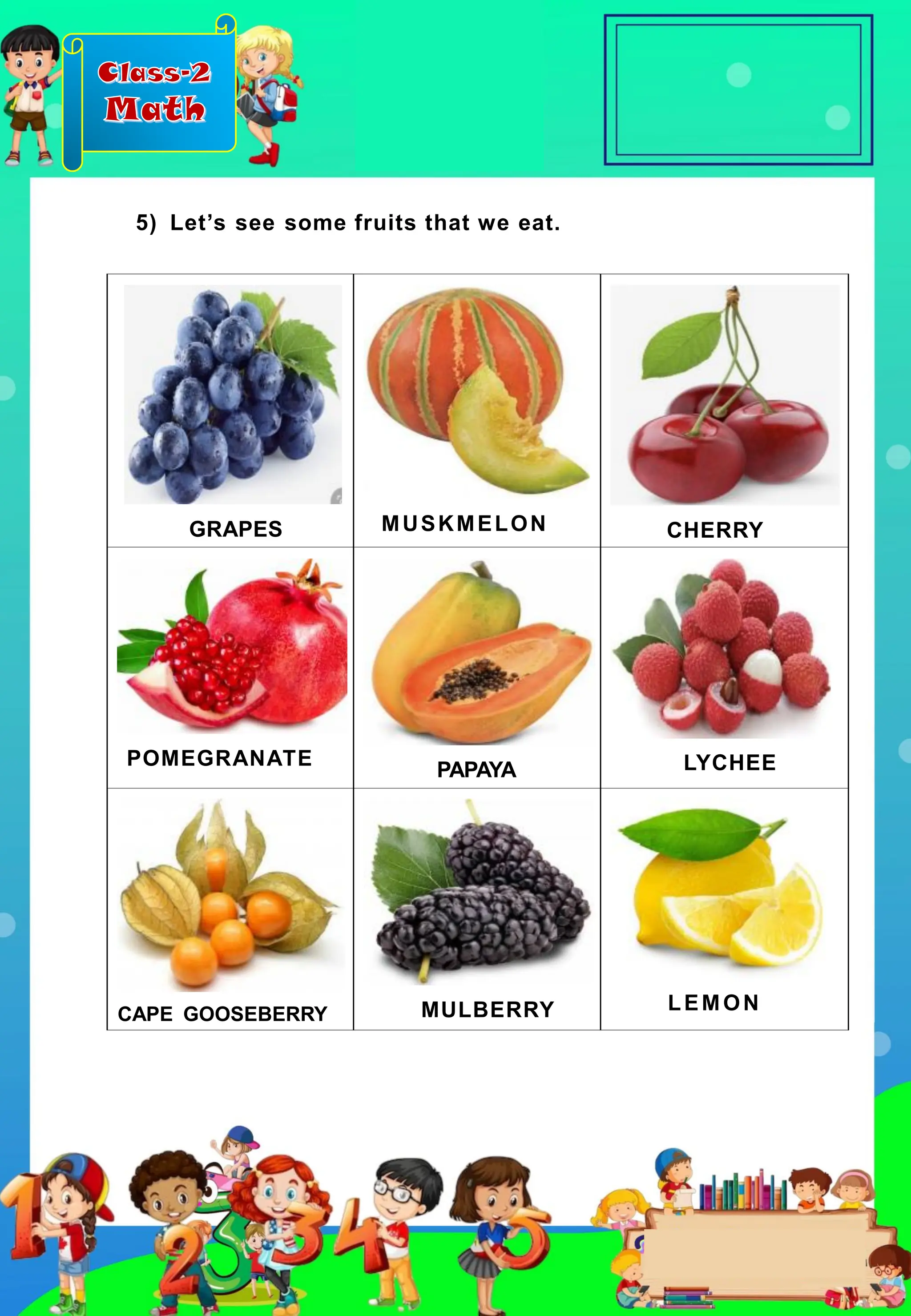
GRAPES MUSKMELON CHERRY
POMEGRANATE
PAPAYA LYCHEE
CAPE GOOSEBERRY MULBERRY LEMON
5) Let’s see some fruits that we eat.
Class-2
Math
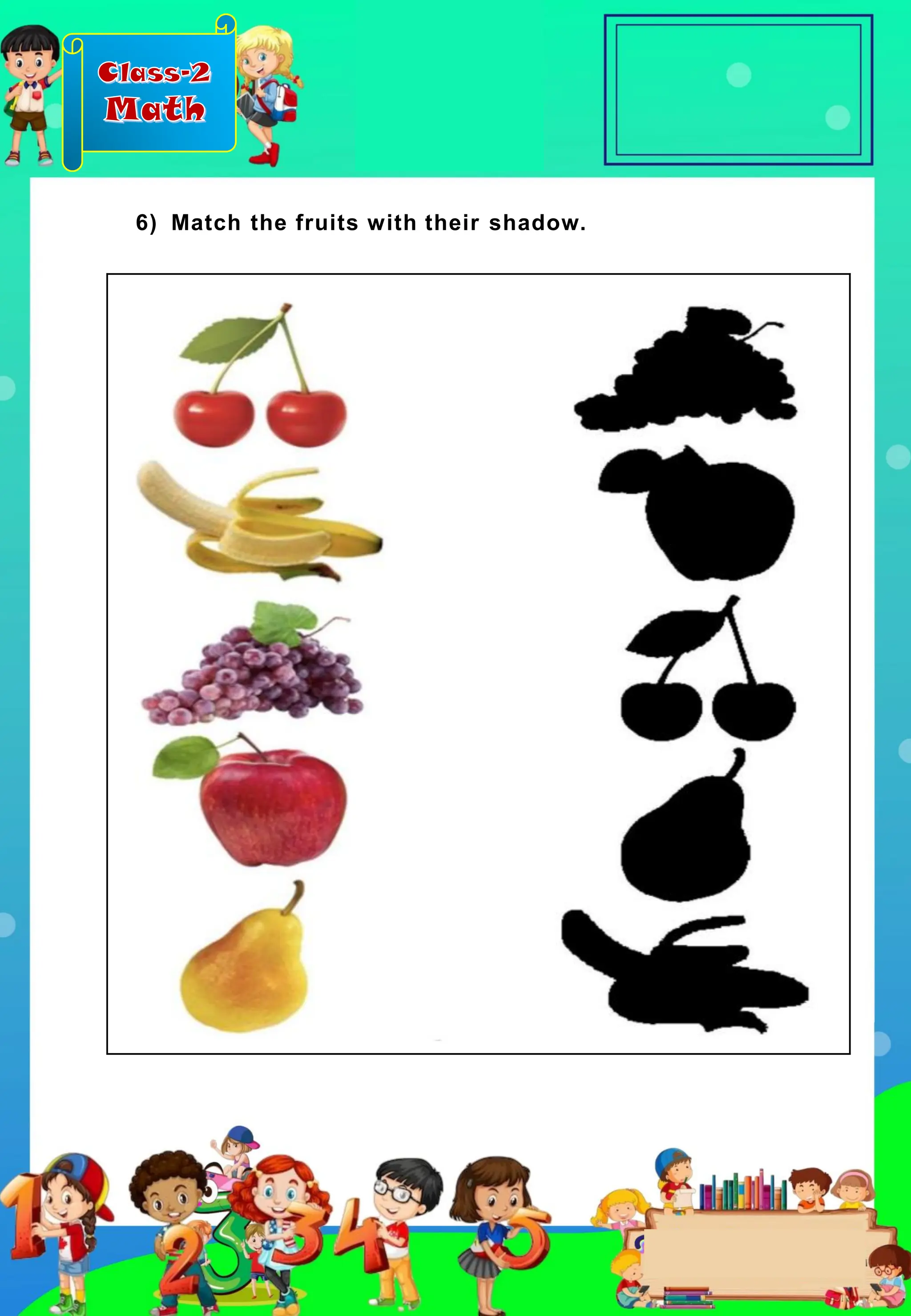
6) Match the fruits with their shadow.
Class-2
Math
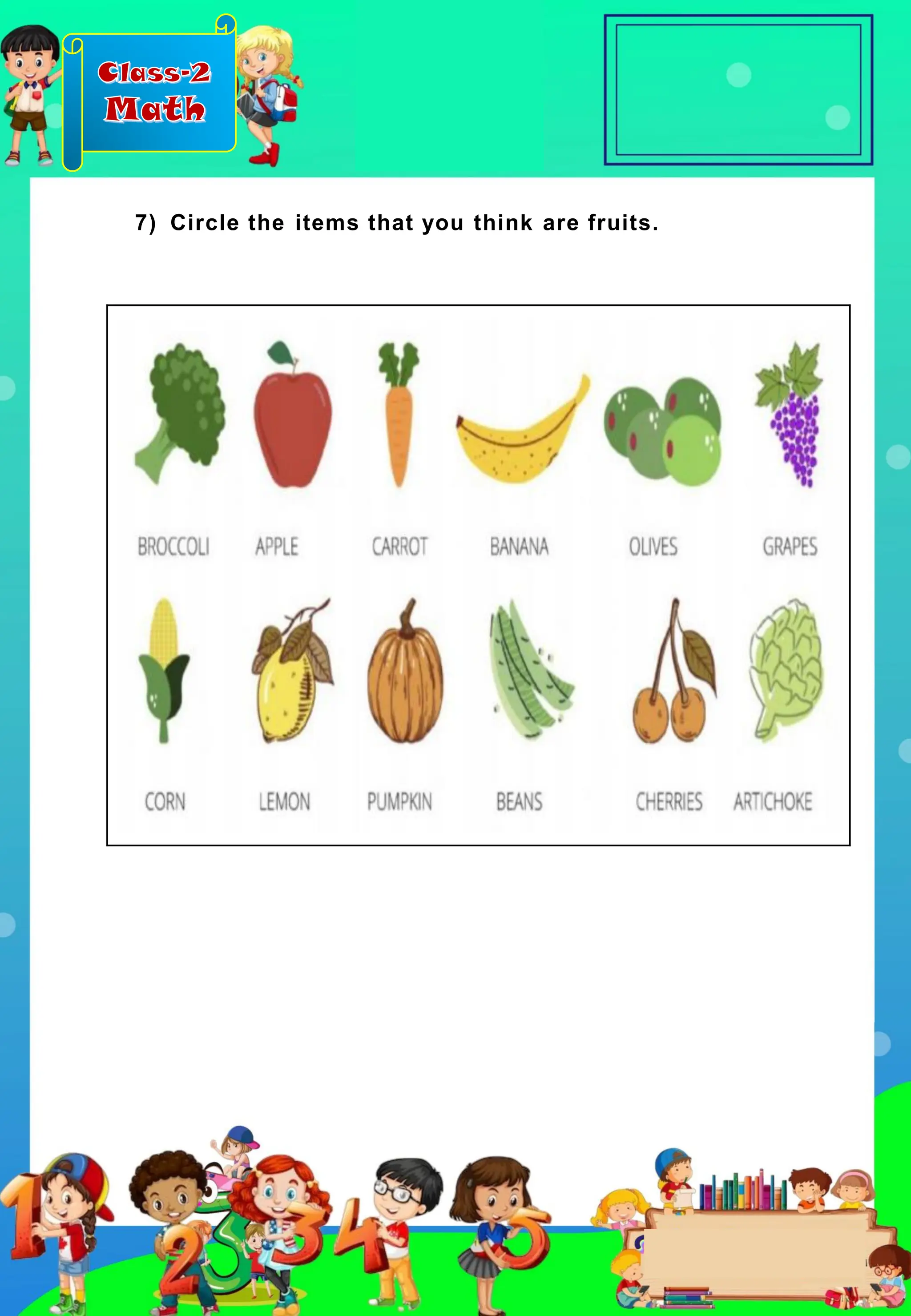
7) Circle the items that you think are fruits.
Class-2
Math
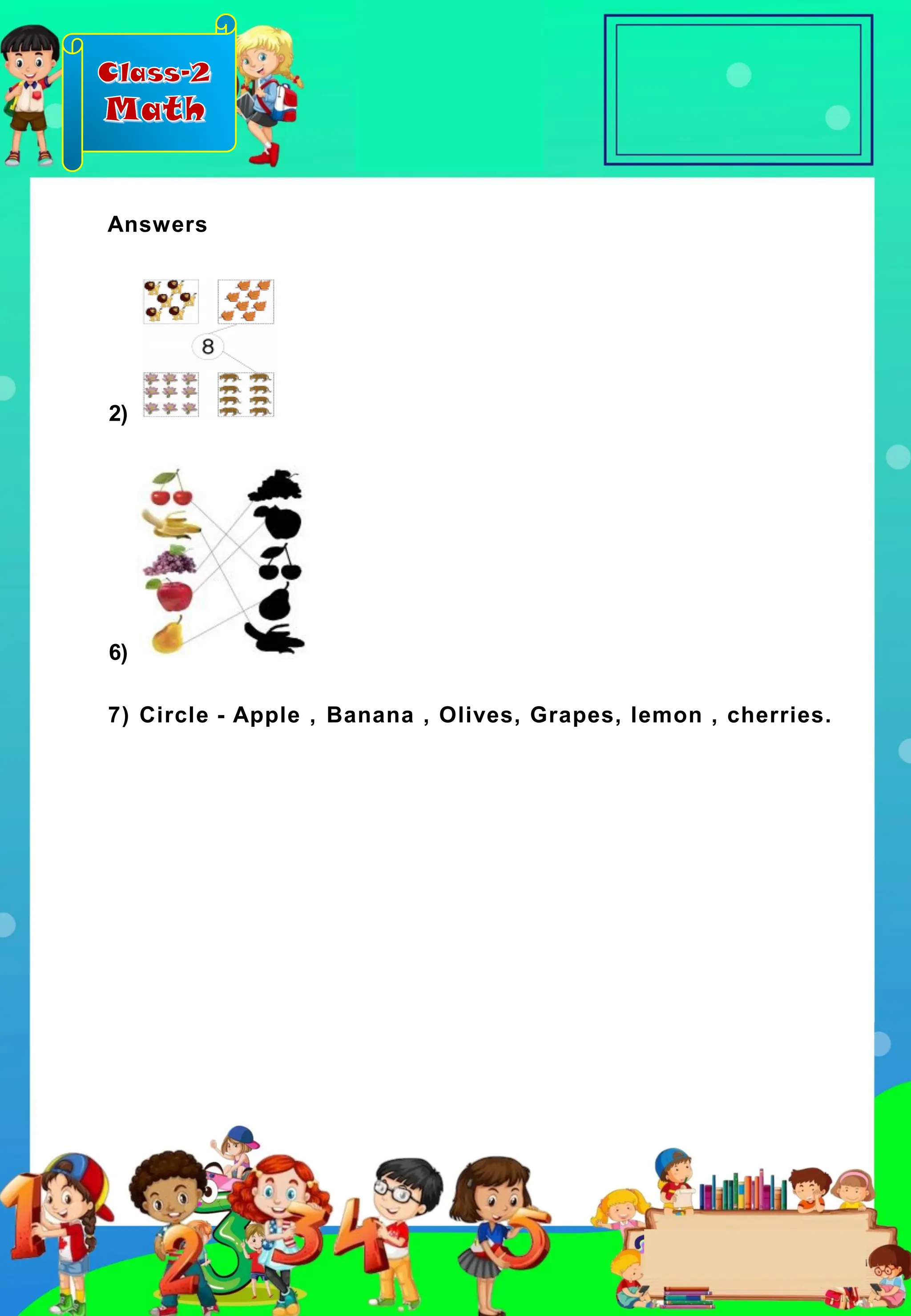
Answers
2)
6)
7) Circle - Apple , Banana , Olives, Grapes, lemon , cherries.
Class-2
Math
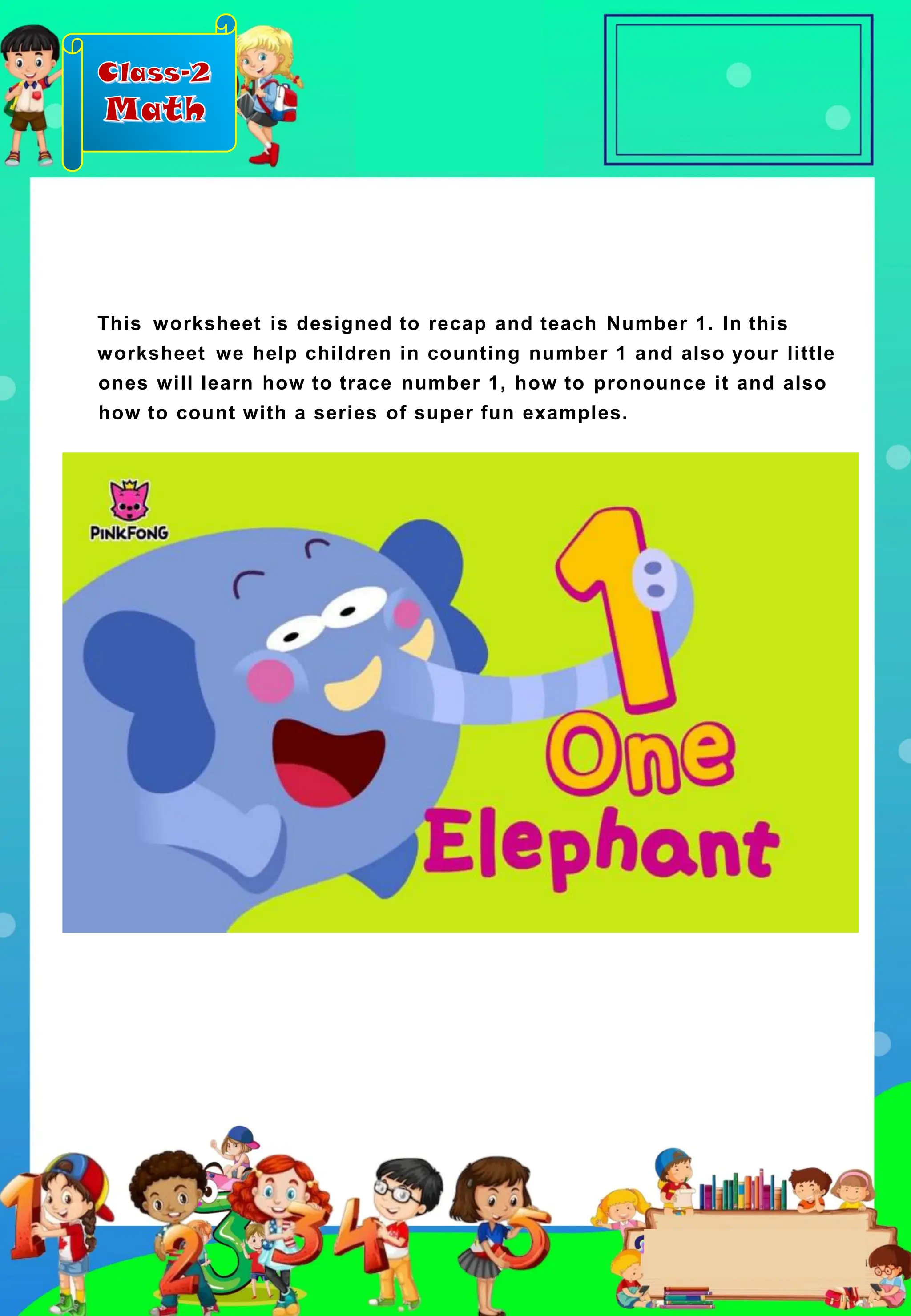
This worksheet is designed to recap and teach Number 1. In this
worksheet we help children in counting number 1 and also your little
ones will learn how to trace number 1, how to pronounce it and also
how to count with a series of super fun examples.
Class-2
Math
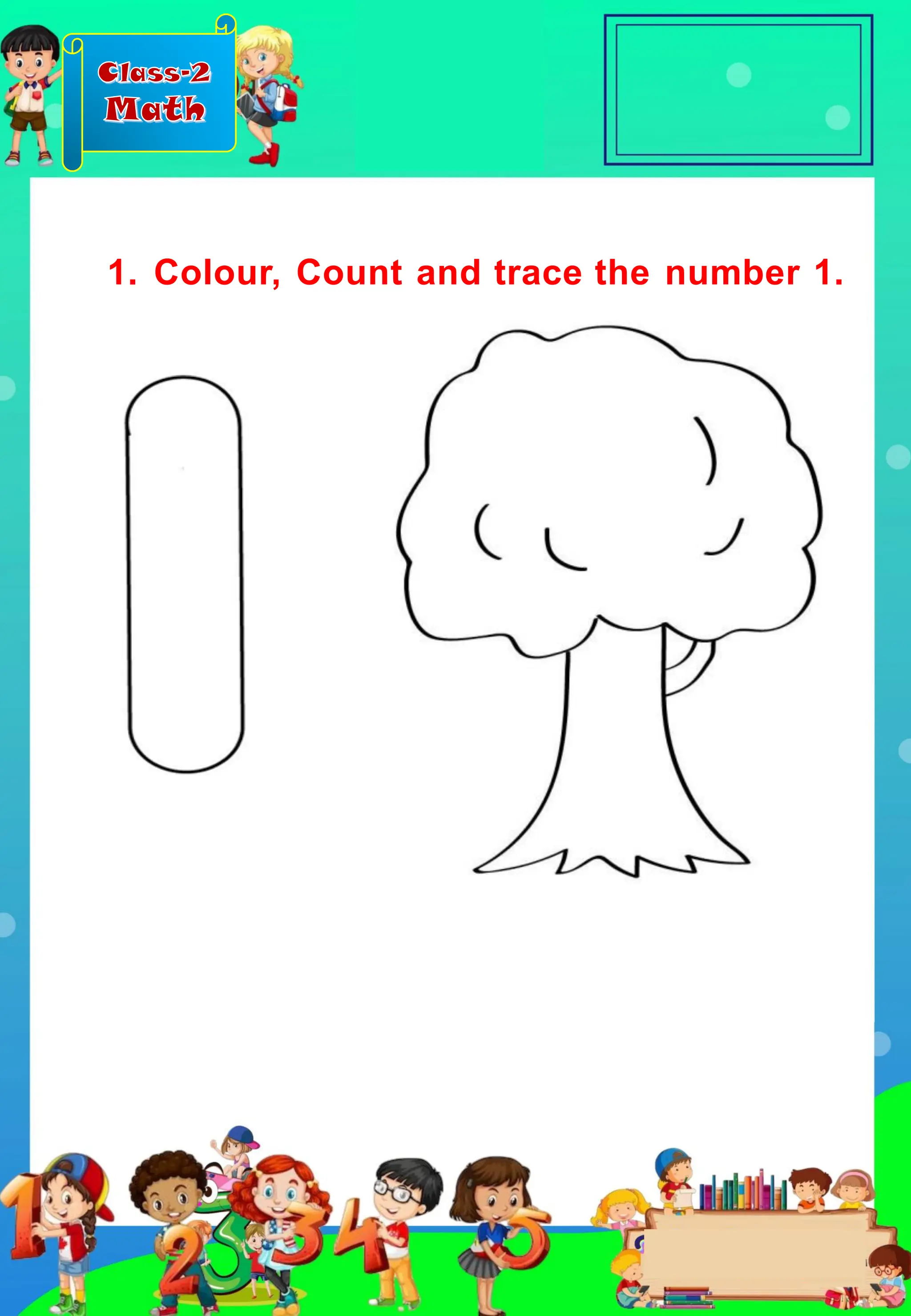
1. Colour, Count and trace the number 1.
Class-2
Math
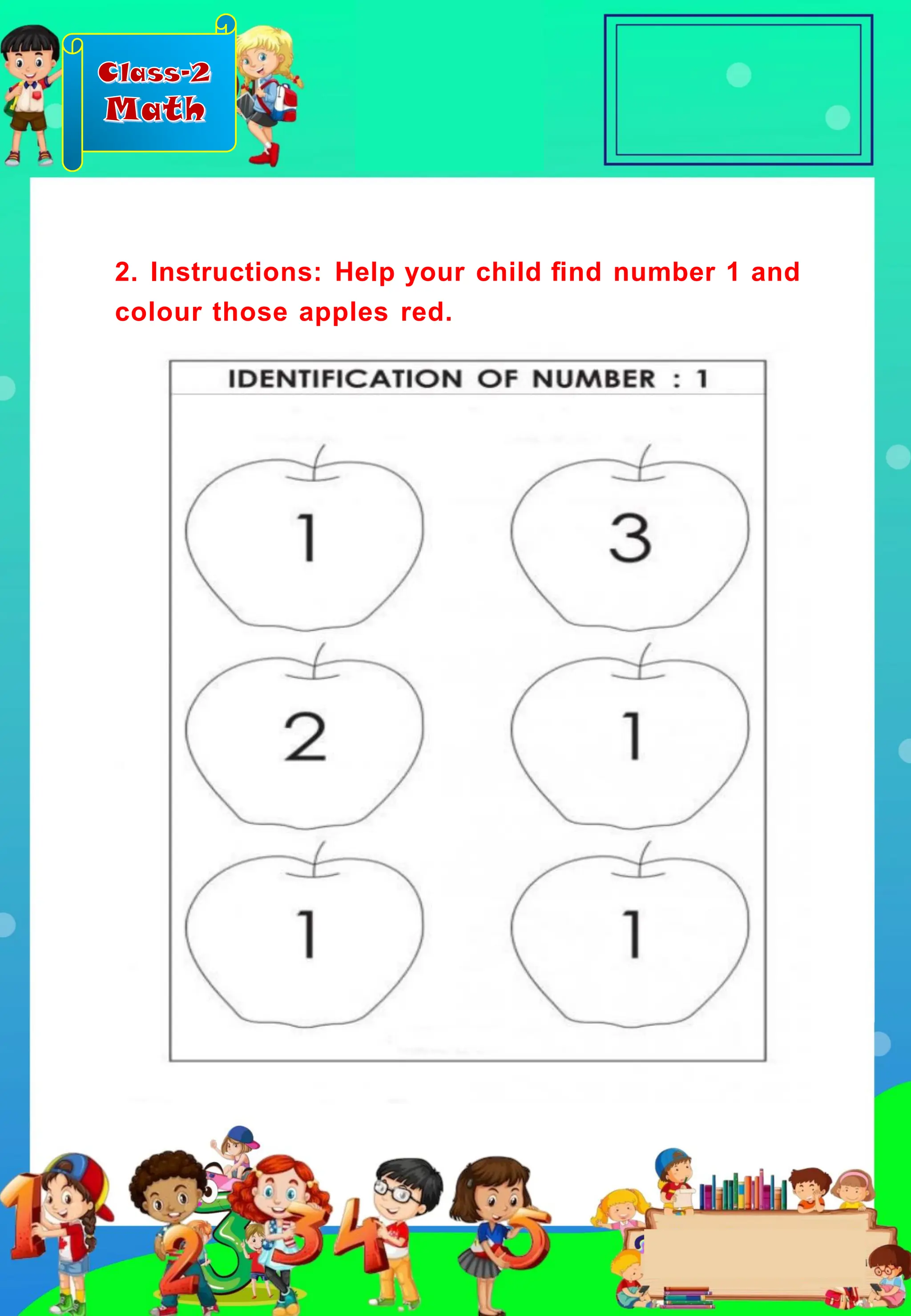
2. Instructions: Help your child find number 1 and
colour those apples red.
Class-2
Math
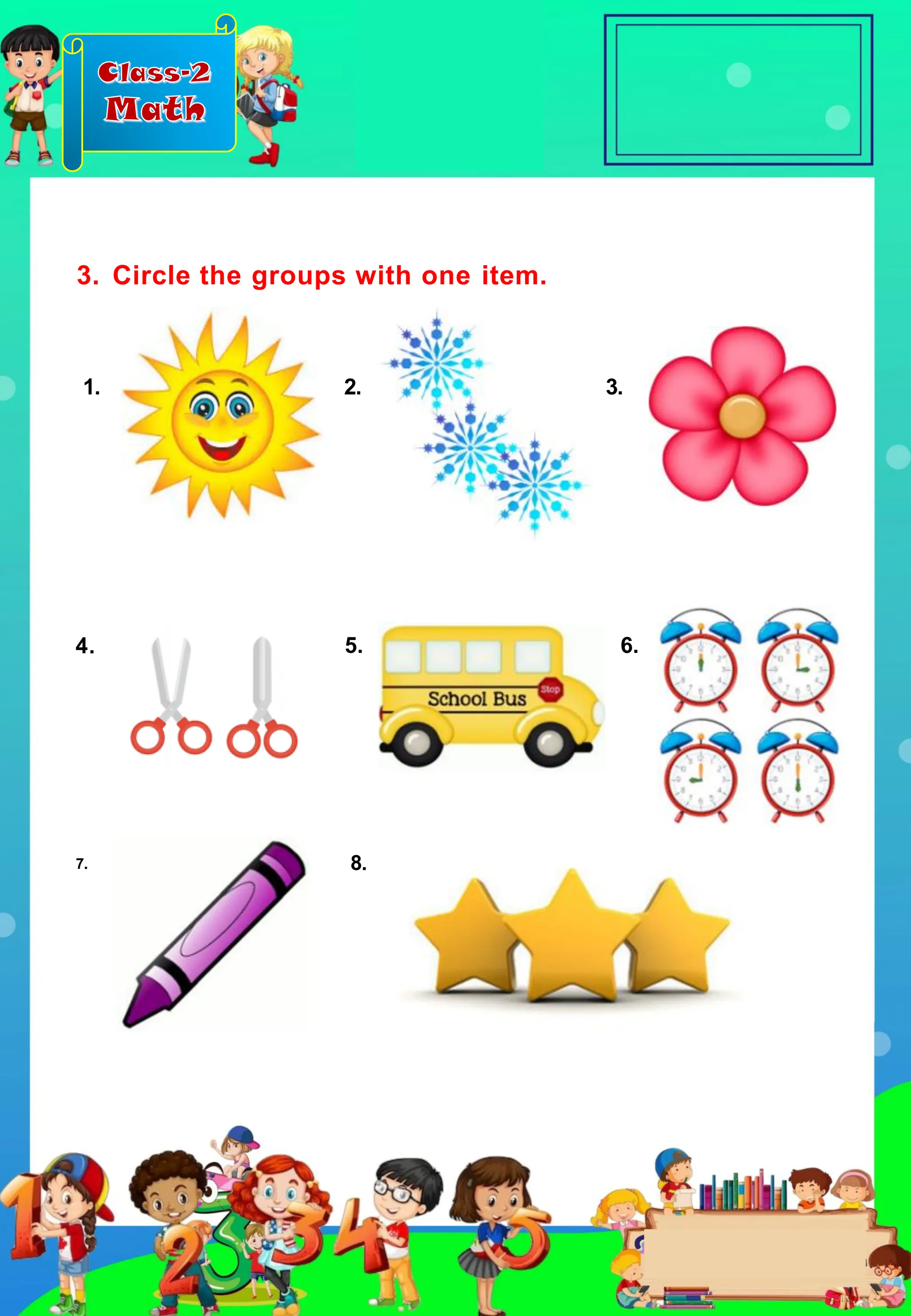
3. Circle the groups with one item.
1. 2. 3.
4. 5. 6.
8.
7.
Class-2
Math
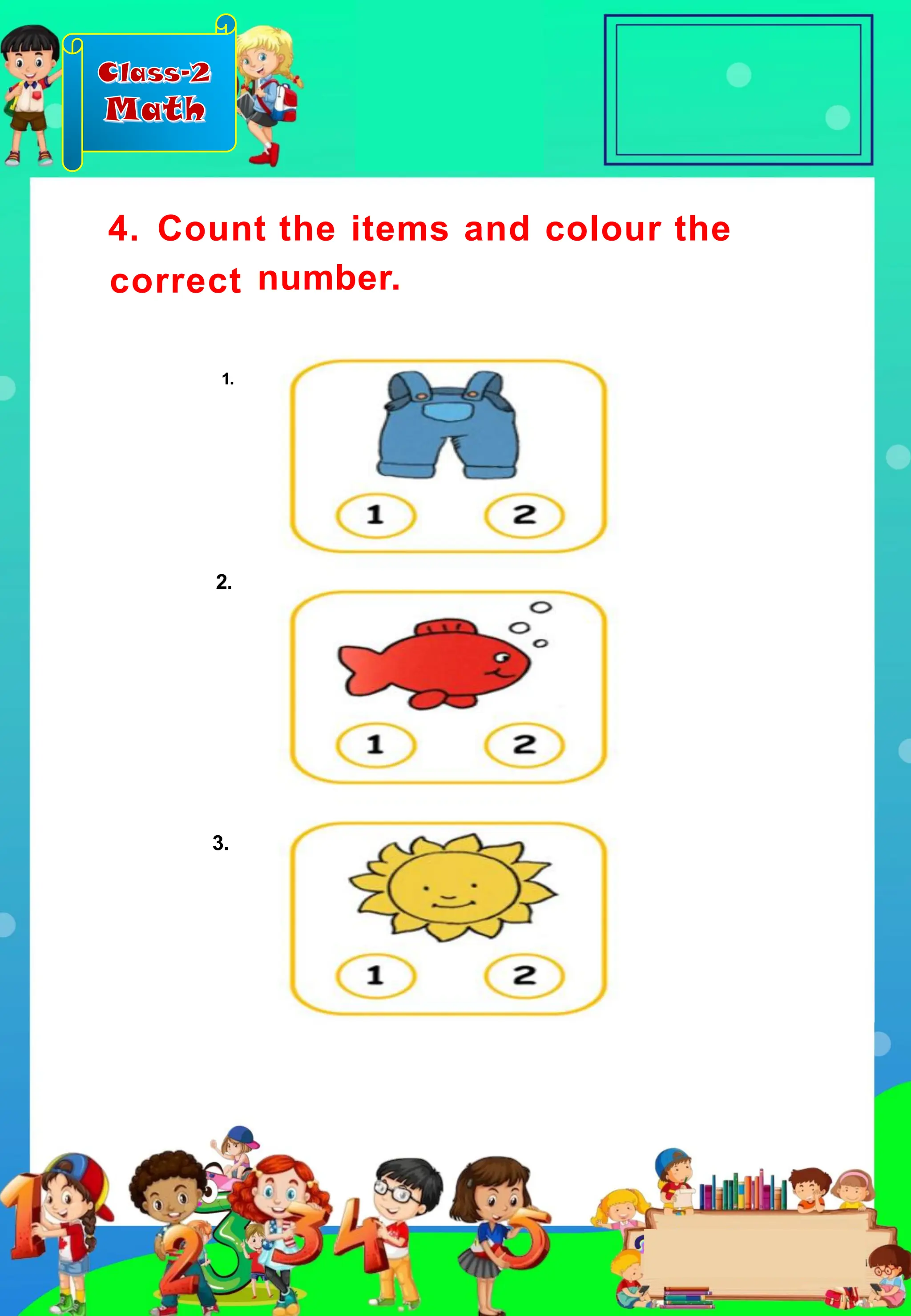
4. Count the items and colour the
number.
correct
3.
2.
1.
Class-2
Math
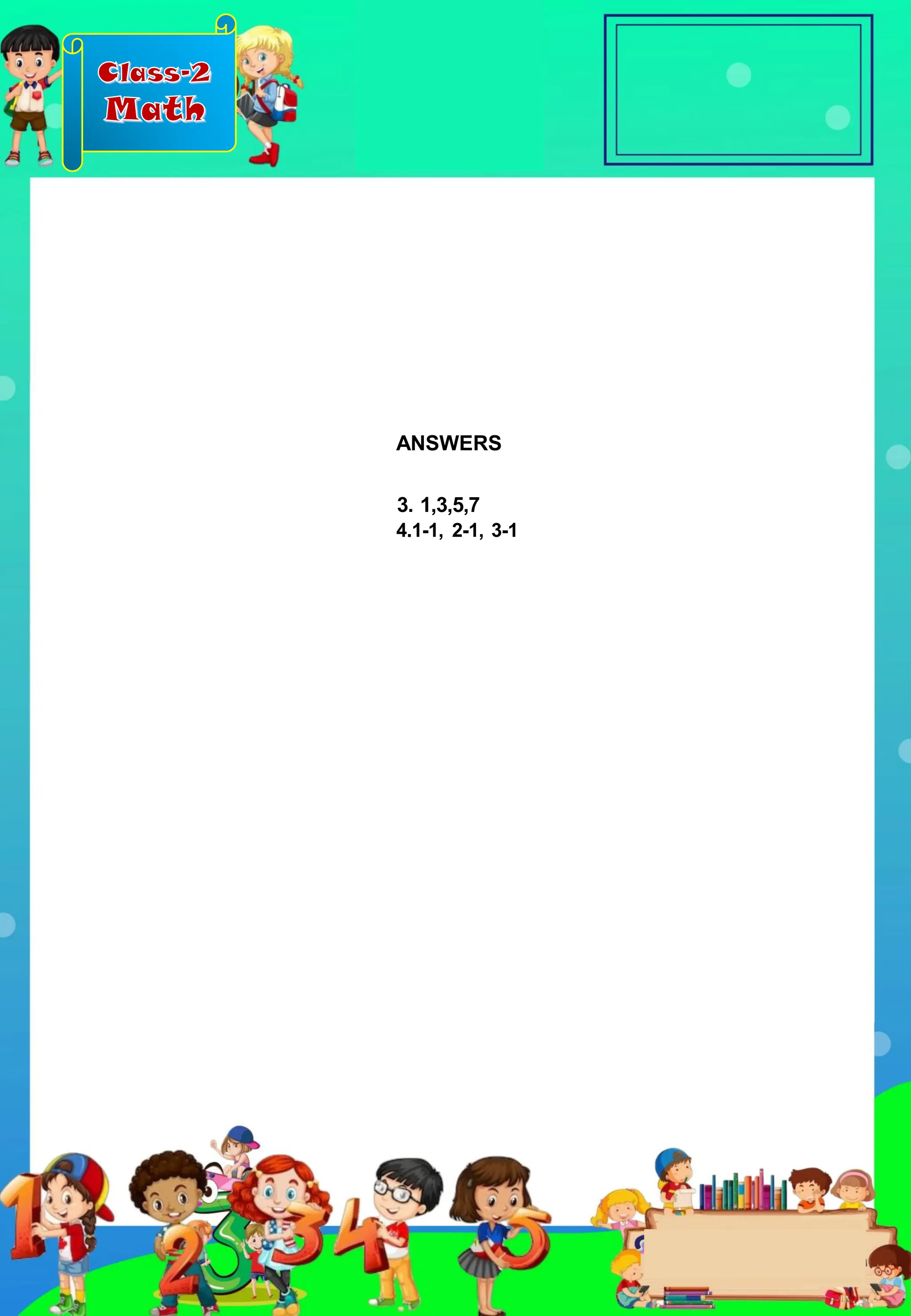
3. 1,3,5,7
4.1-1, 2-1, 3-1
ANSWERS
Class-2
Math
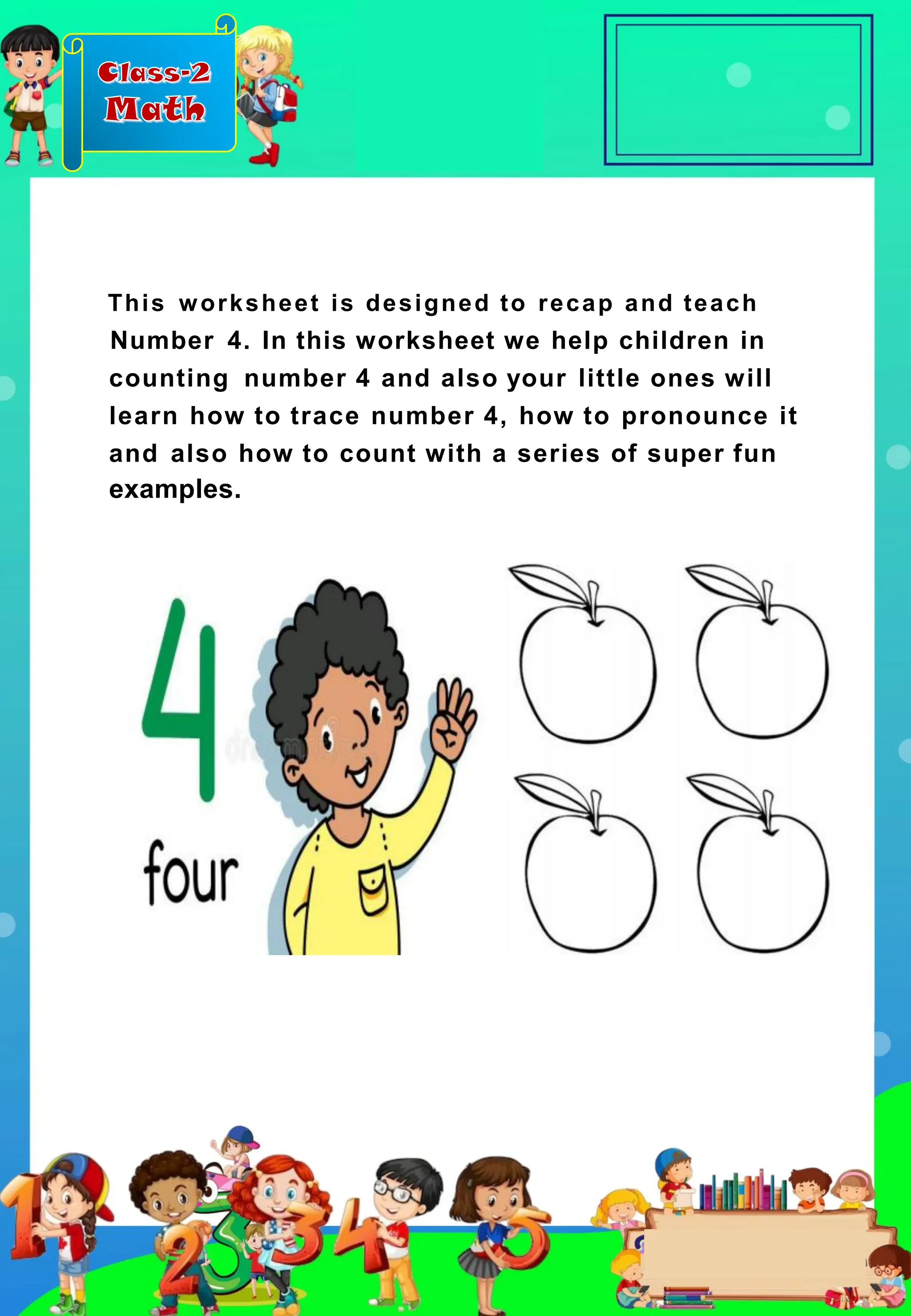
This worksheet is designed to recap and teach
Number 4. In this worksheet we help children in
counting number 4 and also your little ones will
learn how to trace number 4, how to pronounce it
and also how to count with a series of super fun
examples.
Class-2
Math
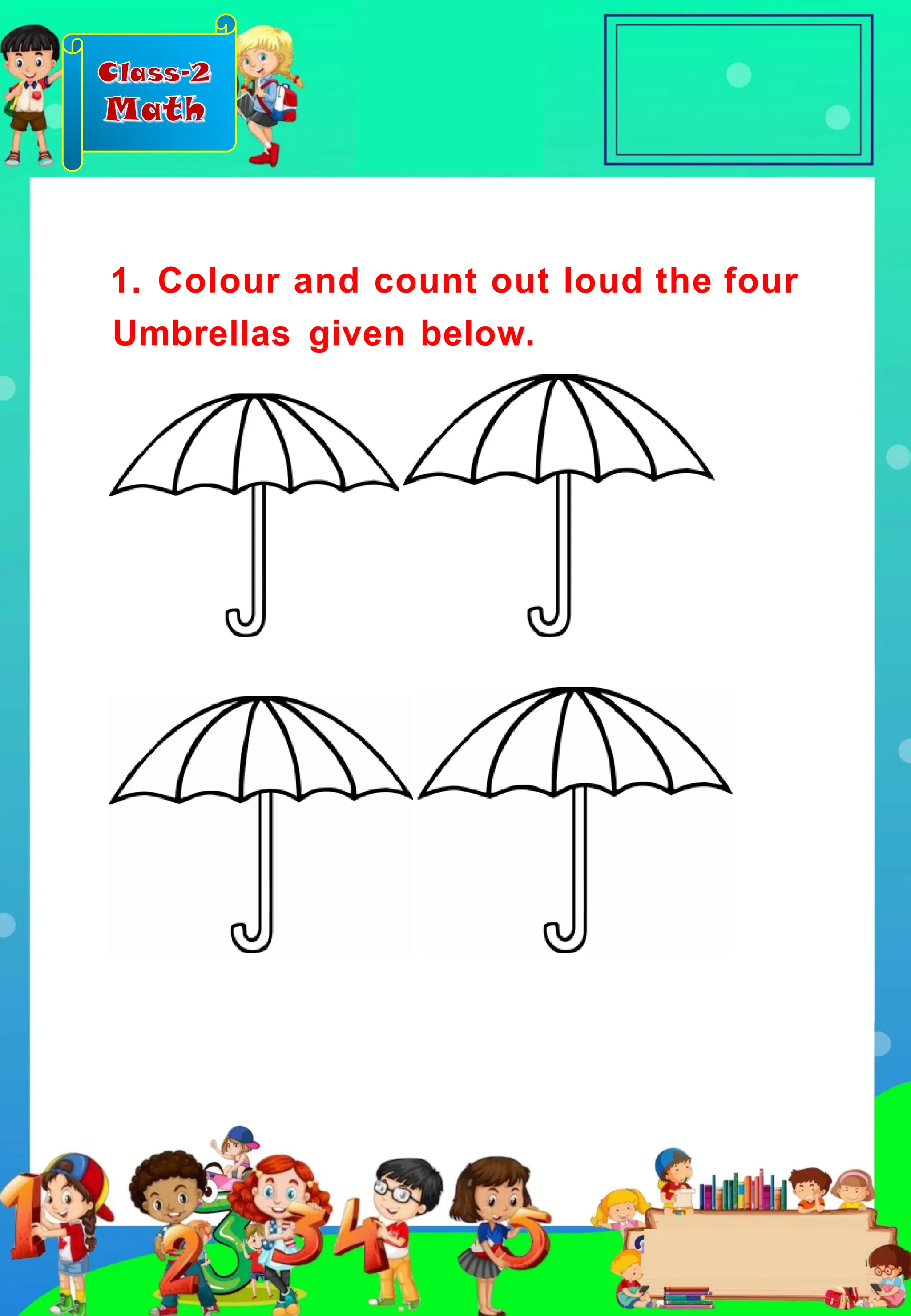
1. Colour and count out loud the four
Umbrellas given below.
Class-2
Math
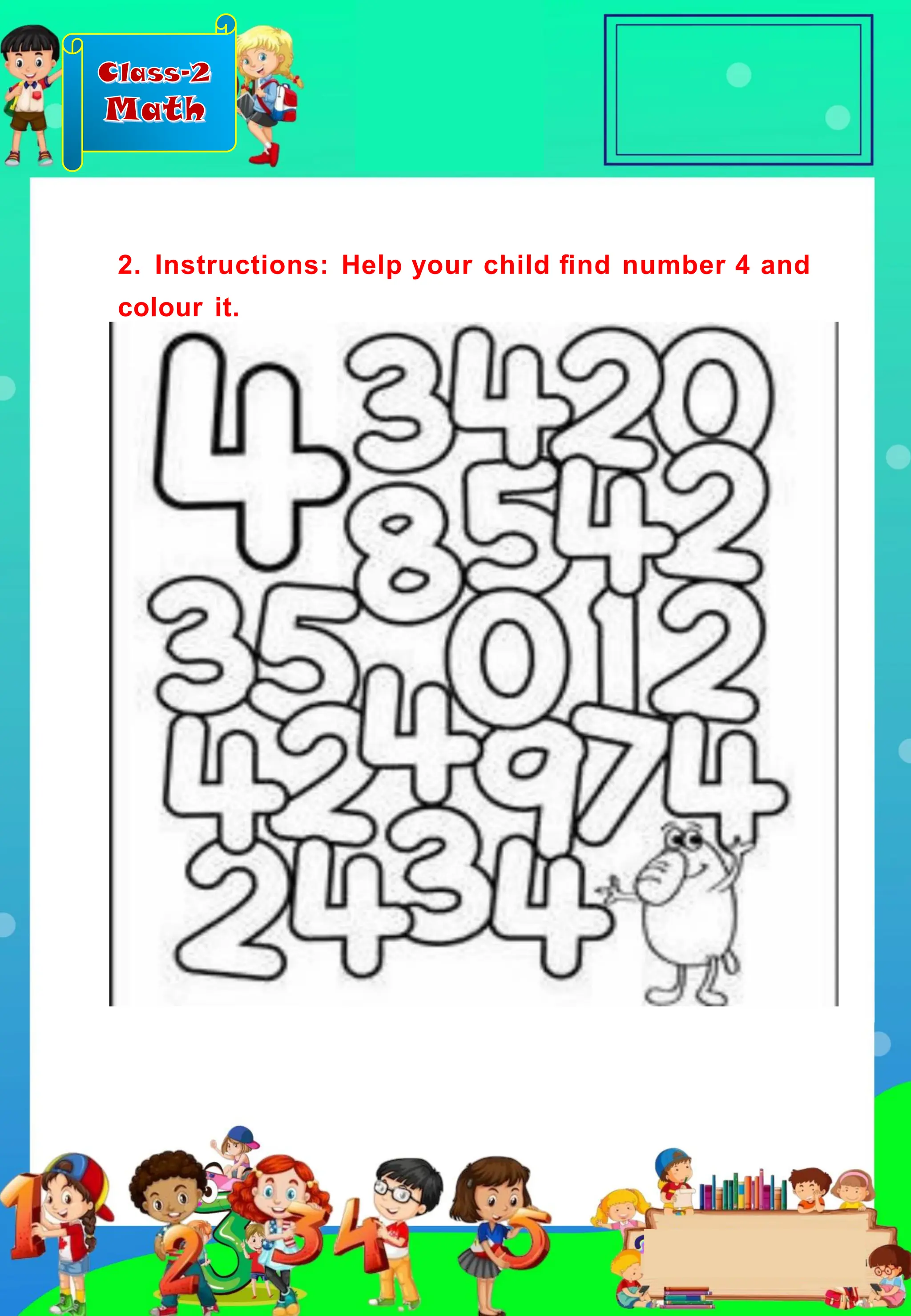
2. Instructions: Help your child find number 4 and
colour it.
Class-2
Math
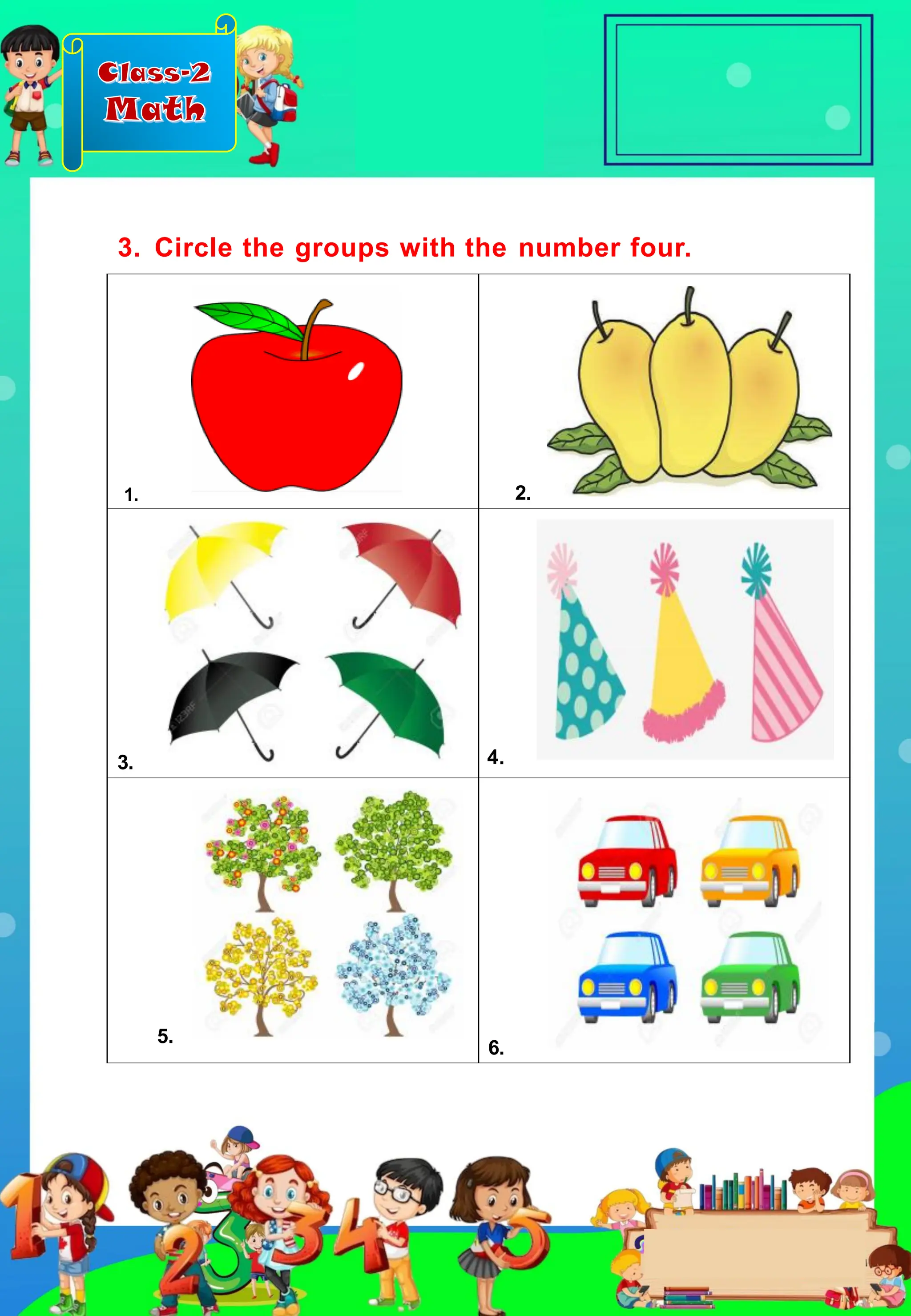
1. 2.
3. 4.
5.
6.
3. Circle the groups with the number four.
Class-2
Math
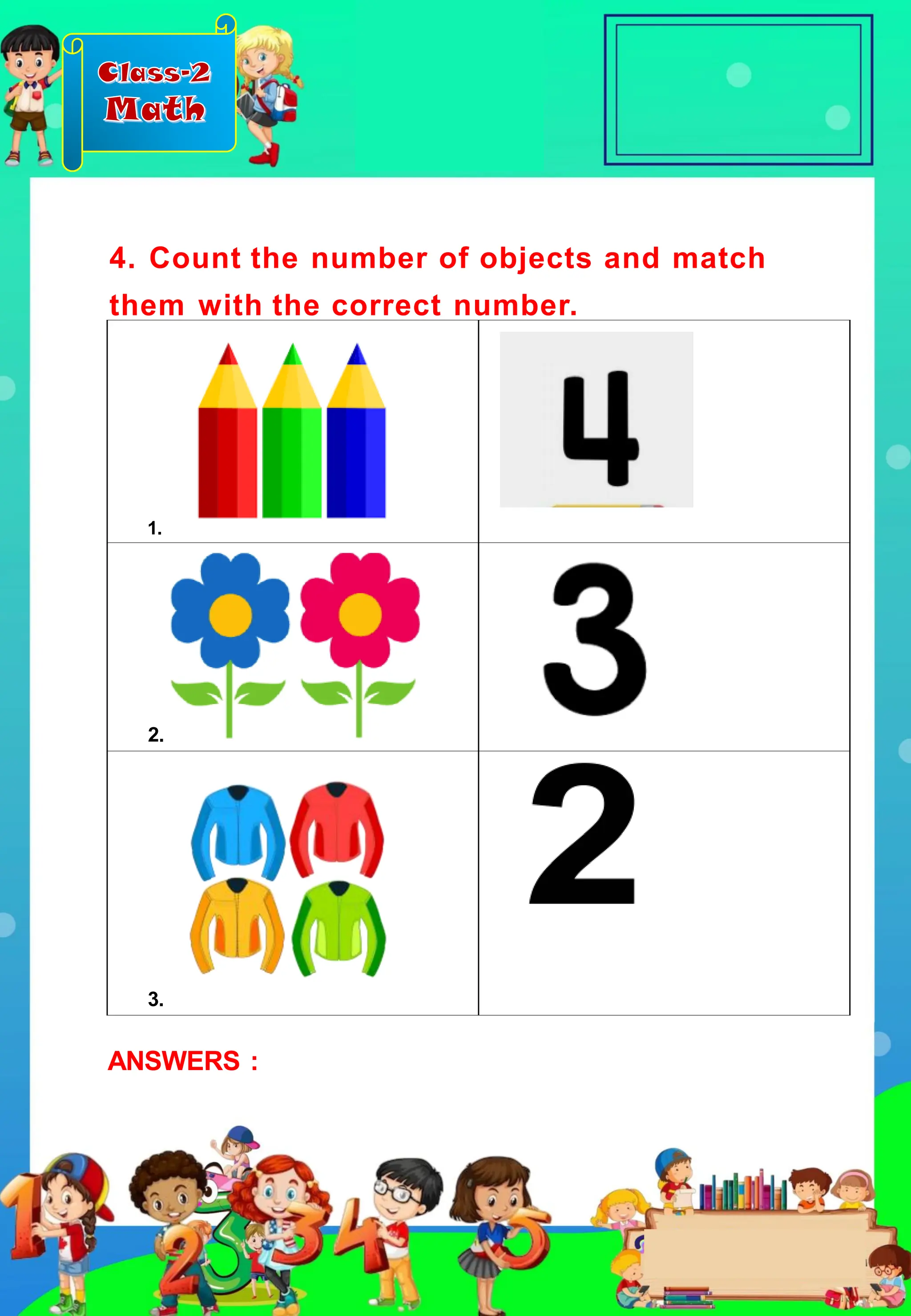
1.
2.
3.
4. Count the number of objects and match
them with the correct number.
ANSWERS :
Class-2
Math
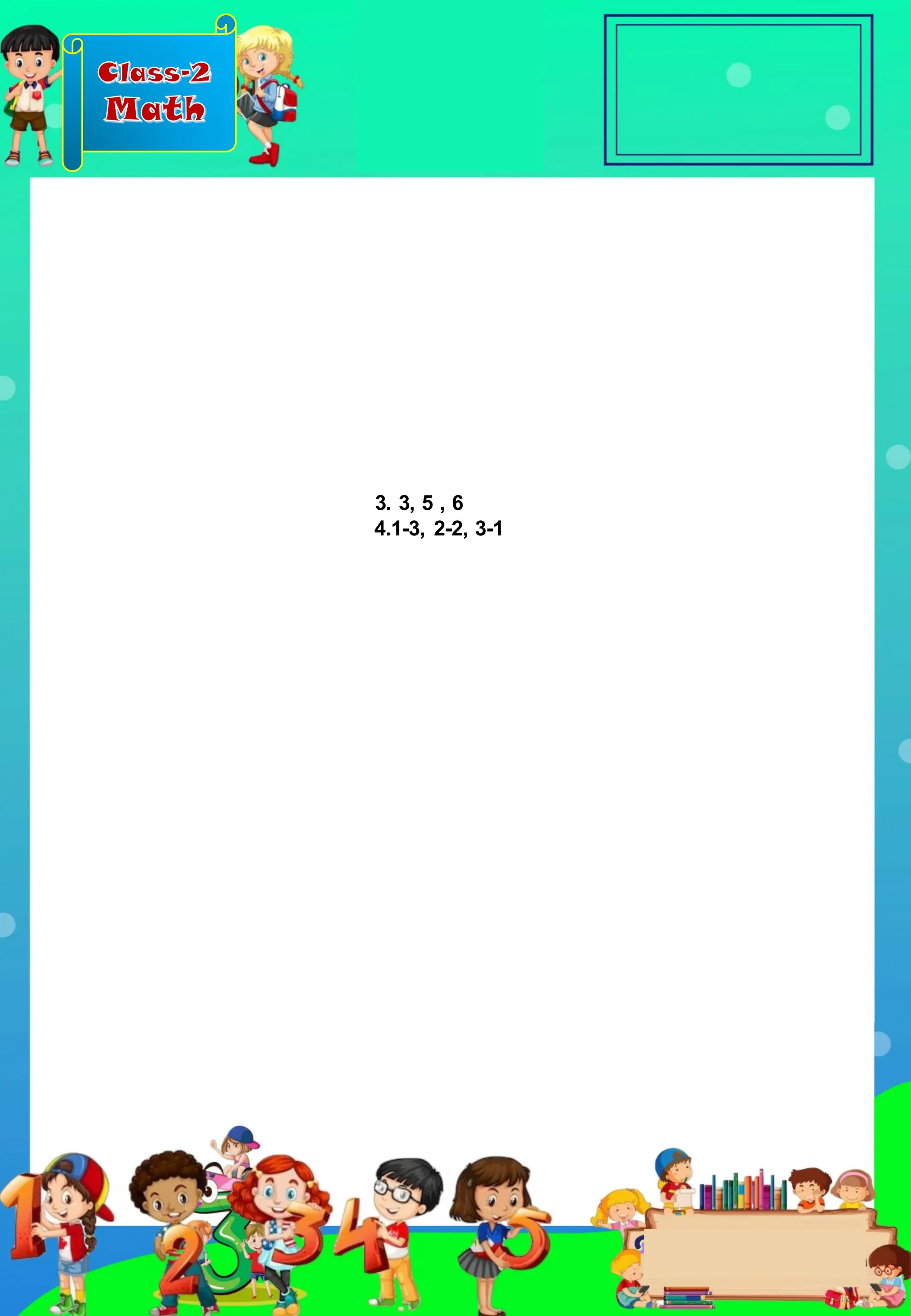
3. 3, 5 , 6
4.1-3, 2-2, 3-1
Class-2
Math
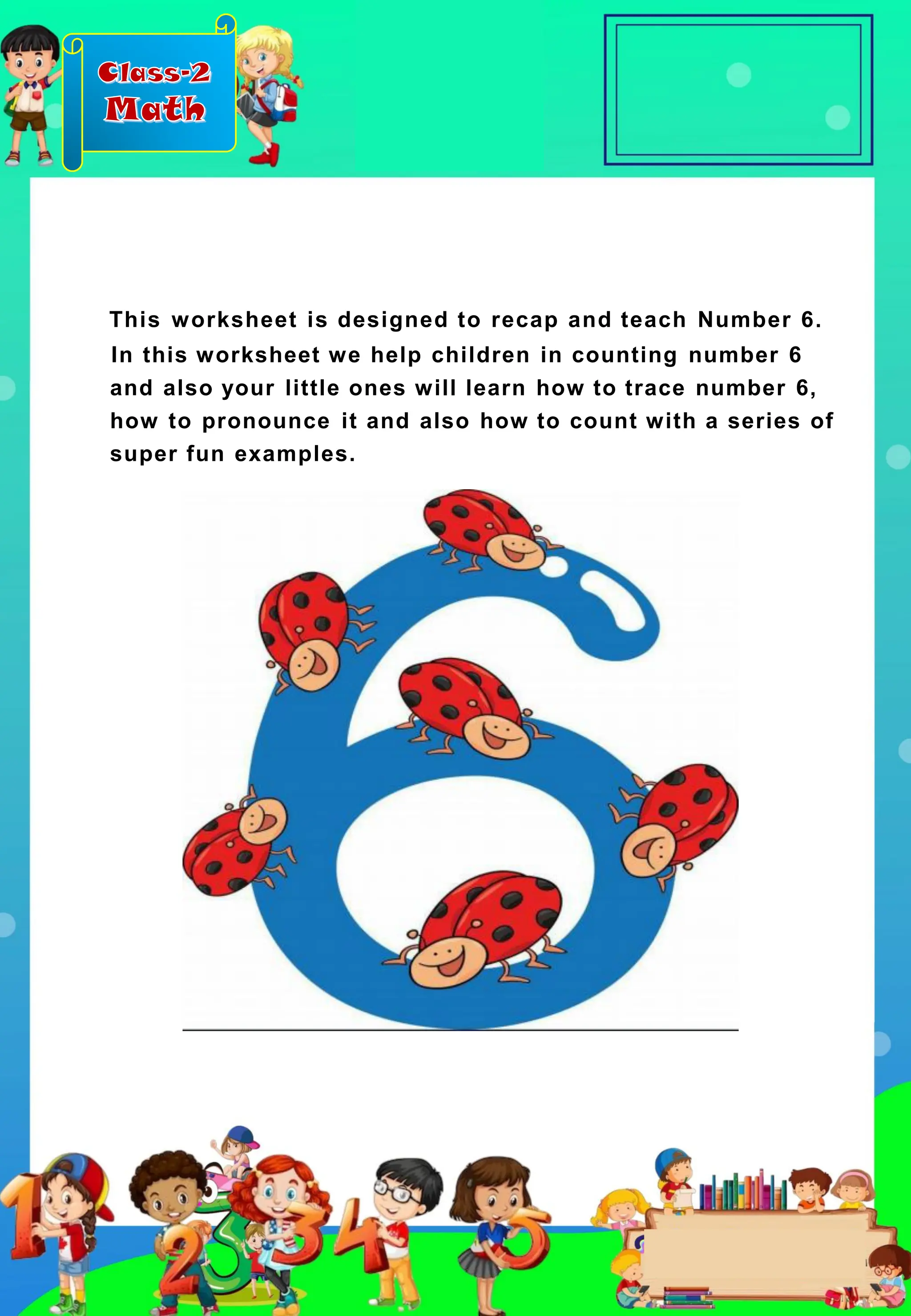
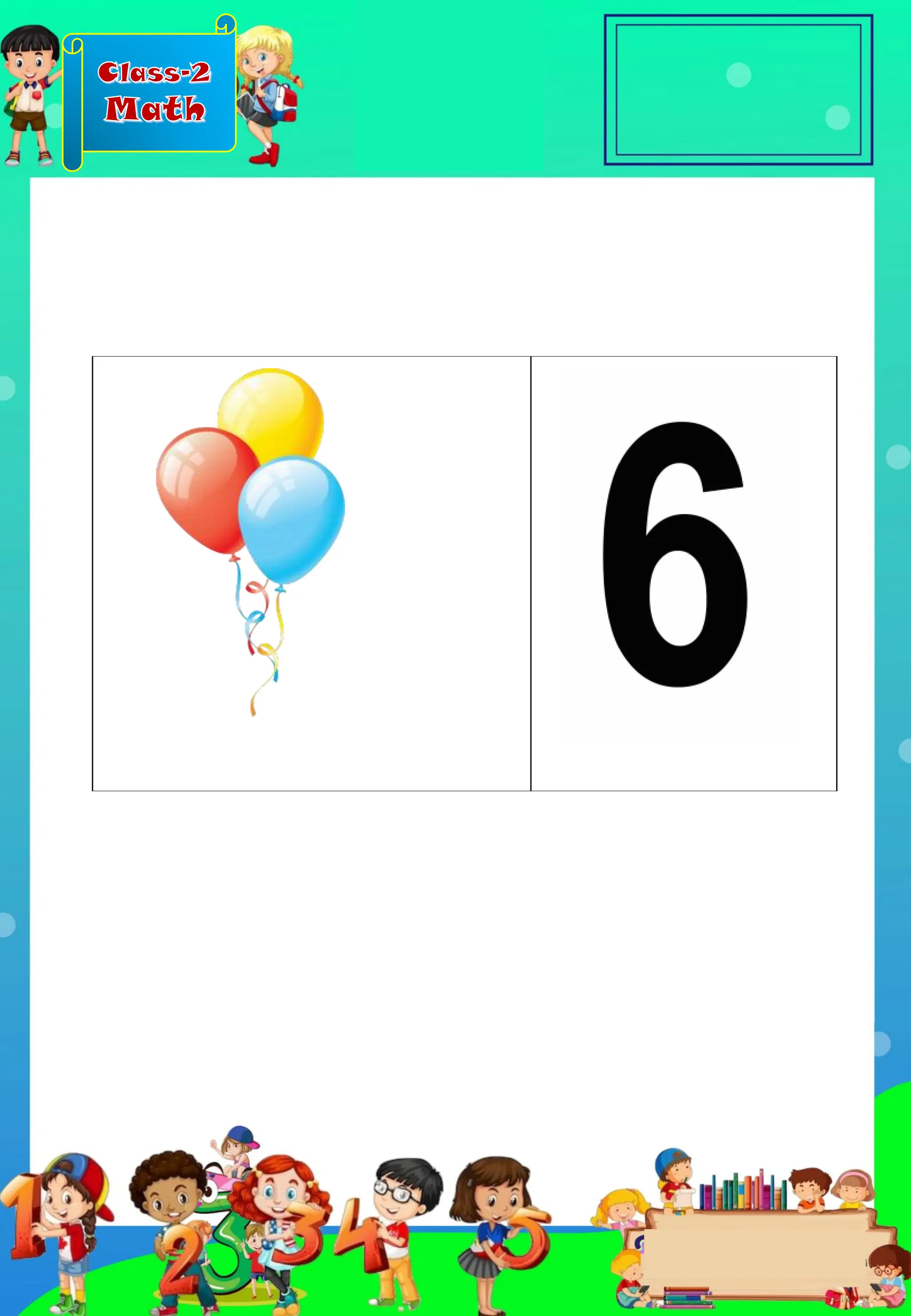
This worksheet is designed to recap and teach Number 6.
In this worksheet we help children in counting number 6
and also your little ones will learn how to trace number 6,
how to pronounce it and also how to count with a series of
super fun examples.
Class-2
Math
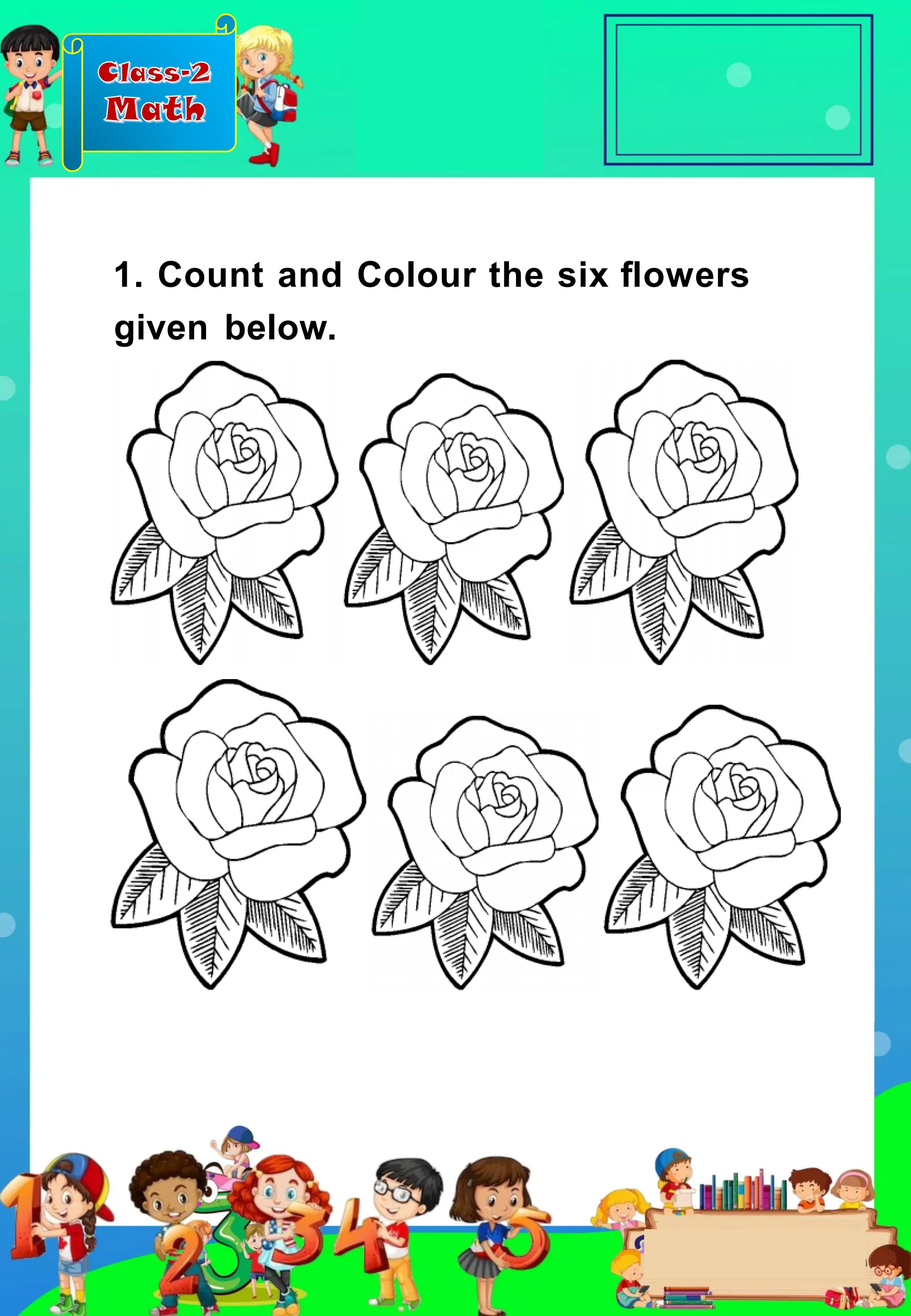
1. Count and Colour the six flowers
given below.
Class-2
Math
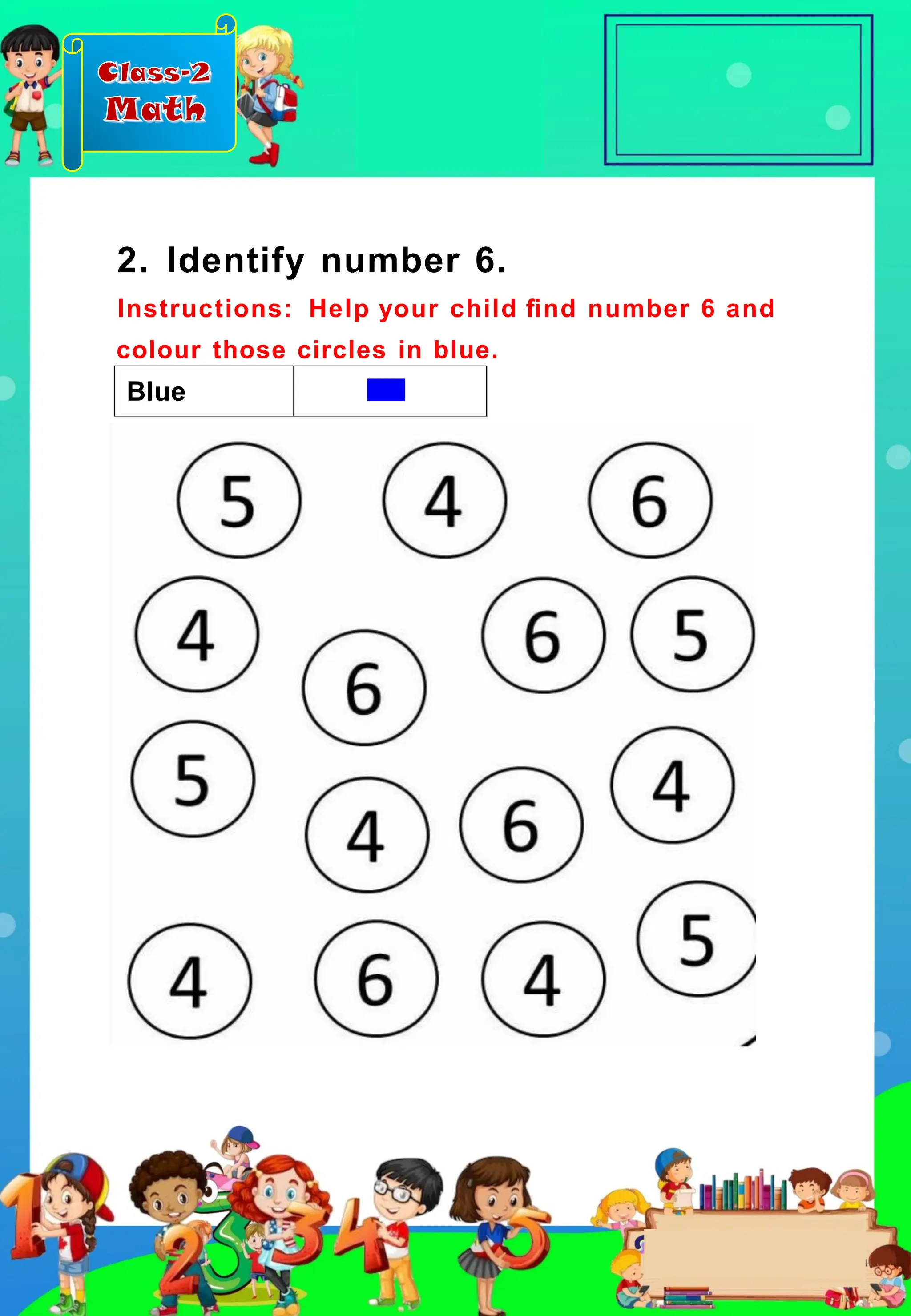
2. Identify number 6.
Instructions: Help your child find number 6 and
colour those circles in blue.
Blue
Class-2
Math
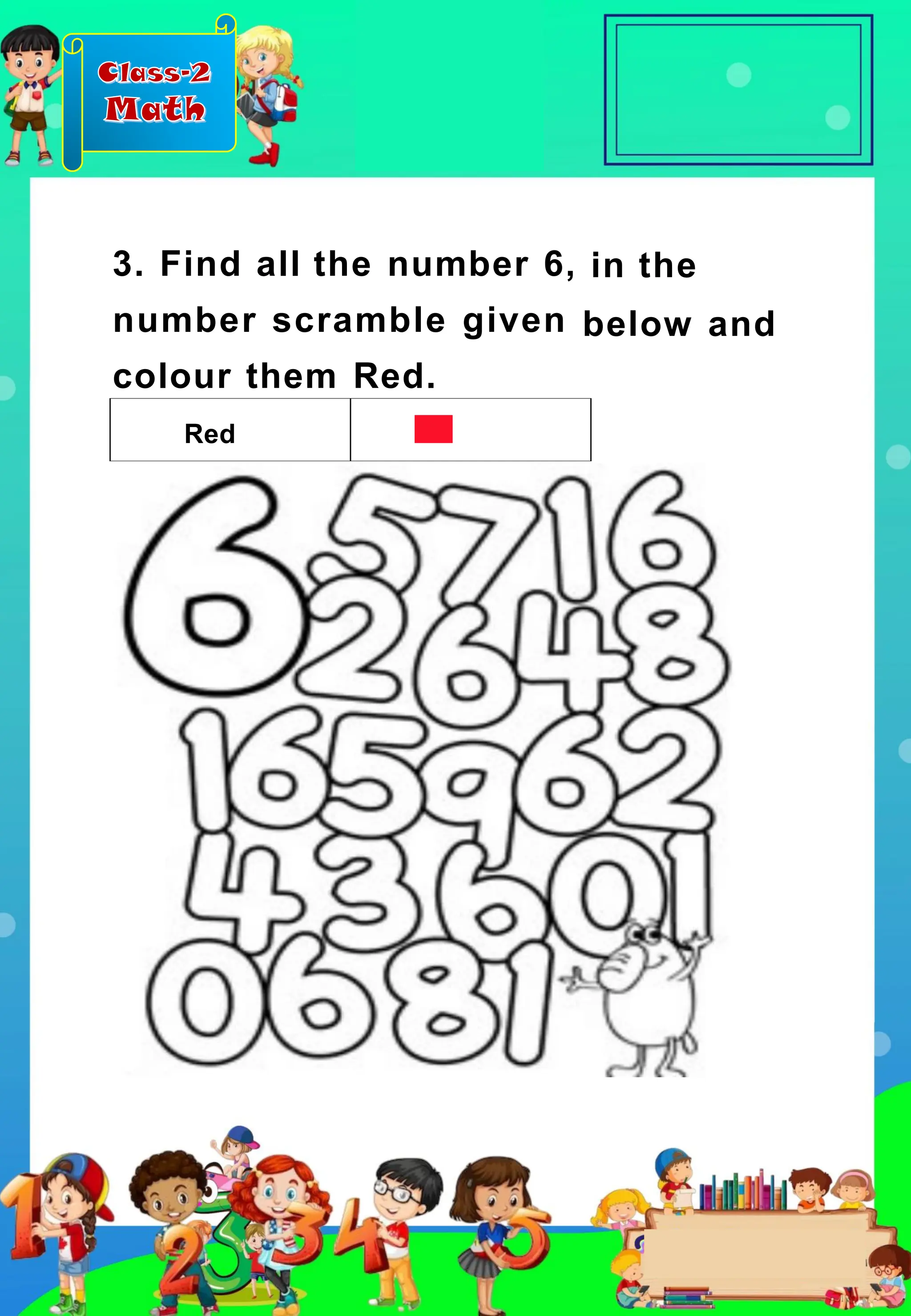
3. Find all the number 6,
number scramble given
colour them Red.
Red
in the
below and
Class-2
Math
1.
2.
3.
4.
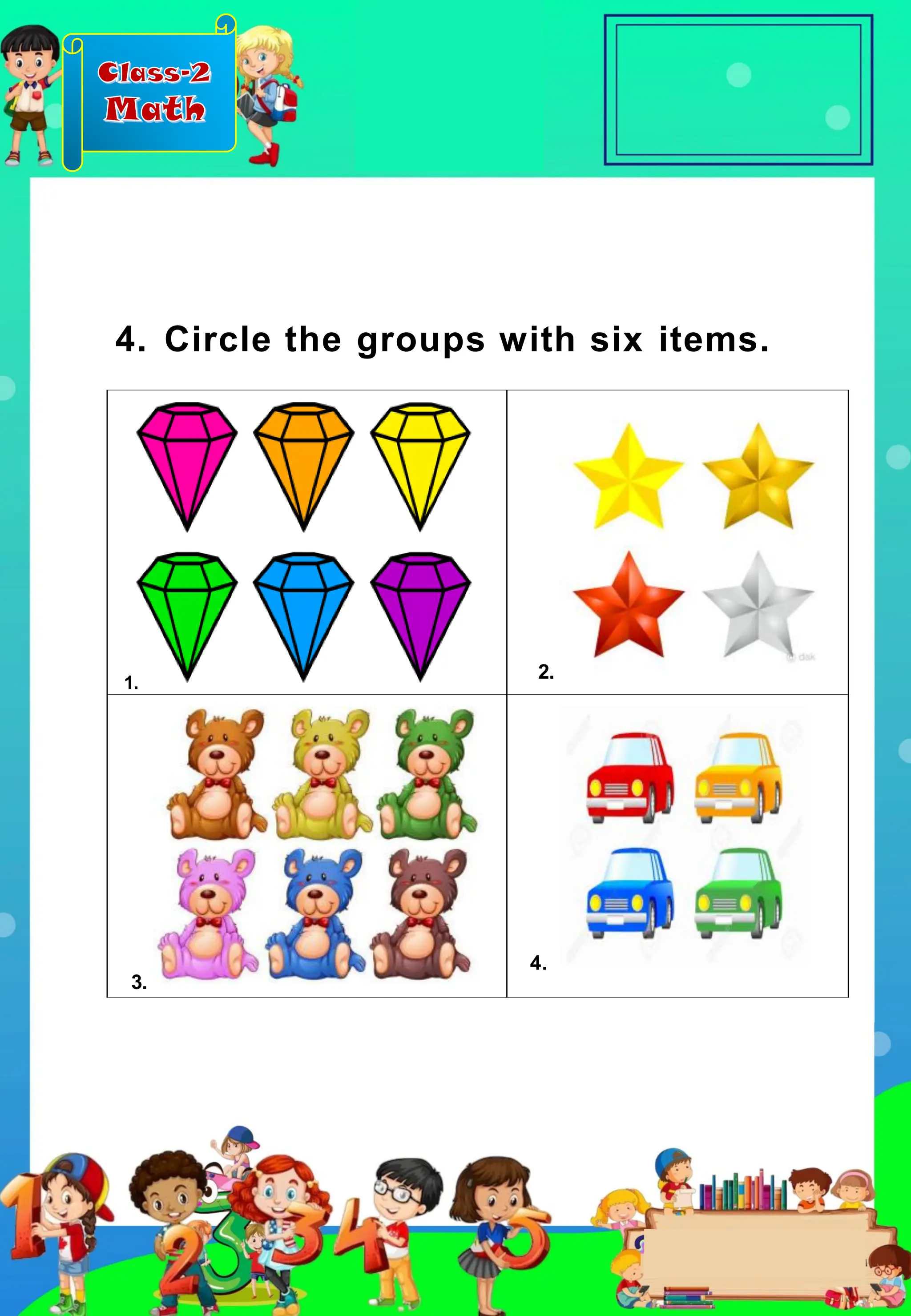
4. Circle the groups with six items.
Class-2
Math
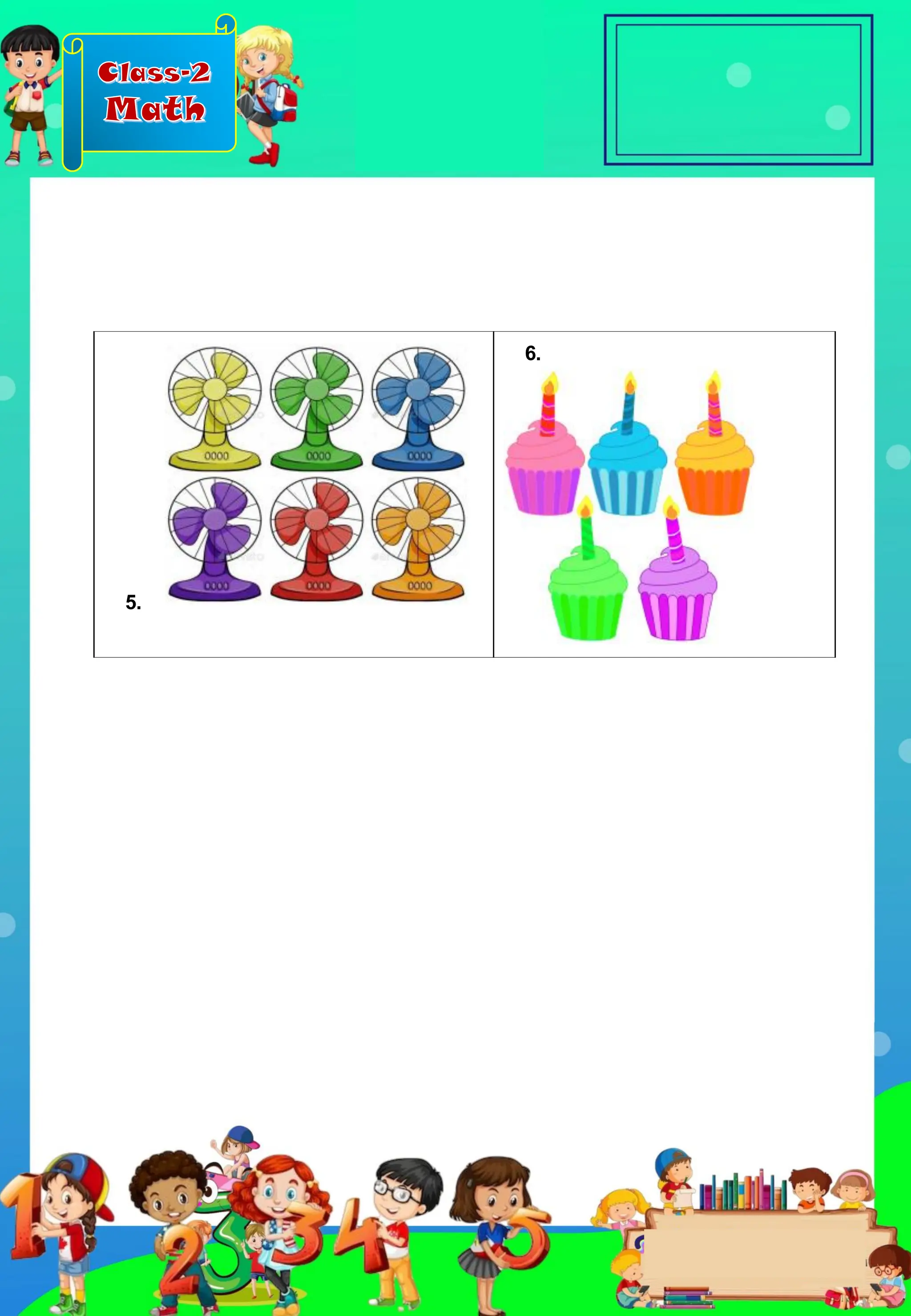
5.
6.
Class-2
Math
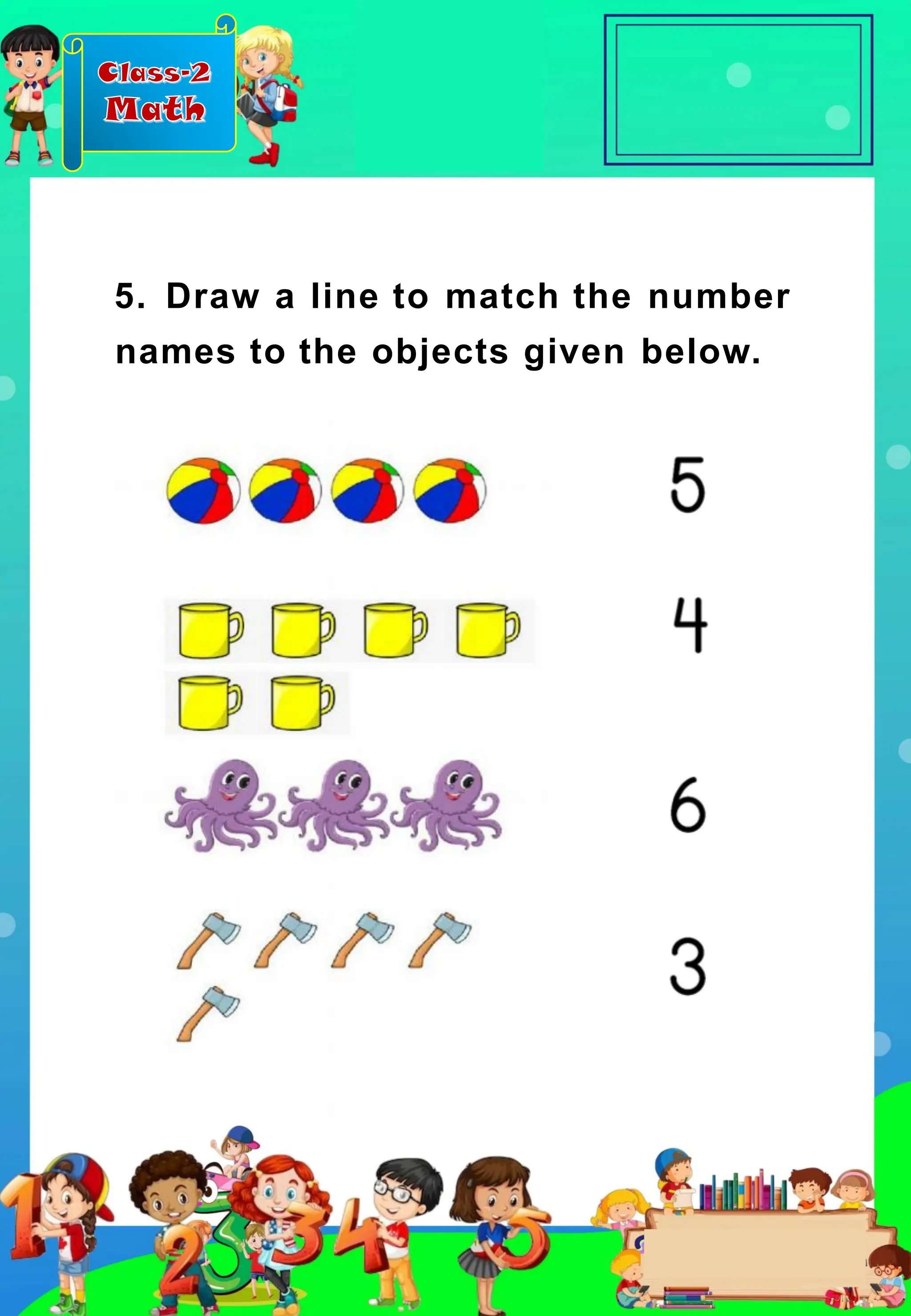
5. Draw a line to match the number
names to the objects given below.
Class-2
Math
1.
2.
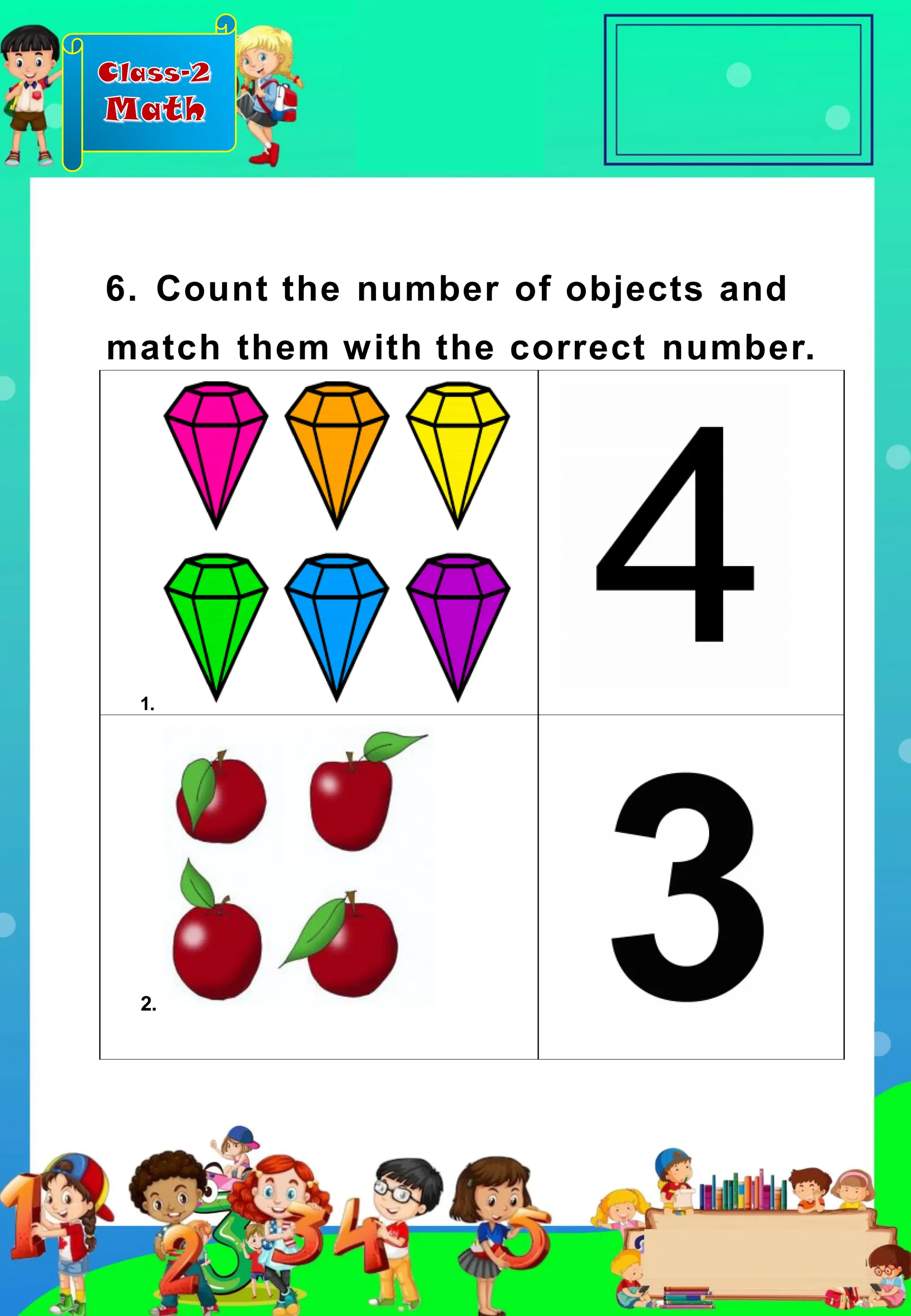
6. Count the number of objects and
match them with the correct number.
Class-2
Math
Class-2
Math
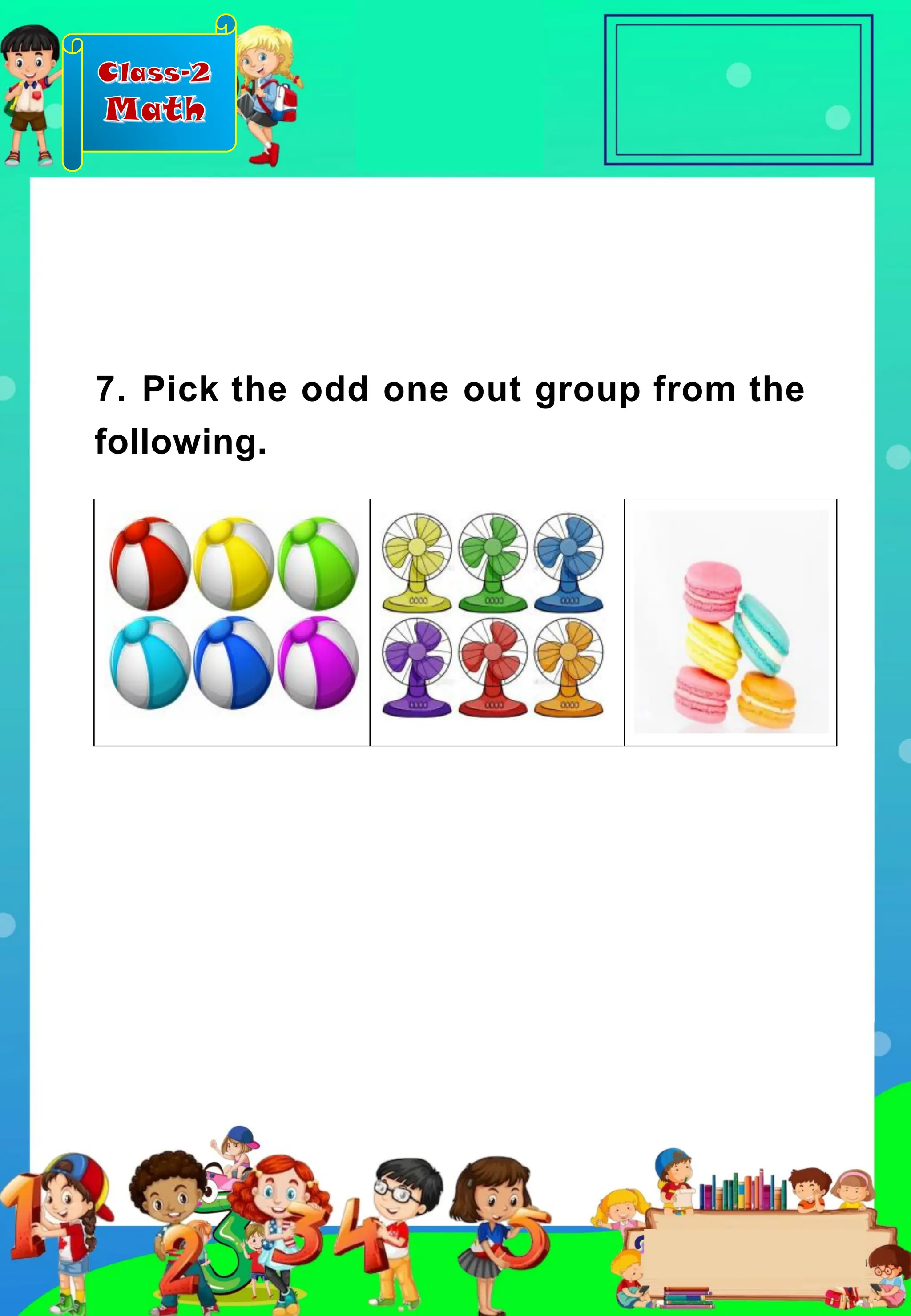
7. Pick the odd one out group from the
following.
Class-2
Math
3. 1,3,5
5. 1-6, 2-4, 3-3
6. 5 cupcakes
ANSWERS
Class-2
Math
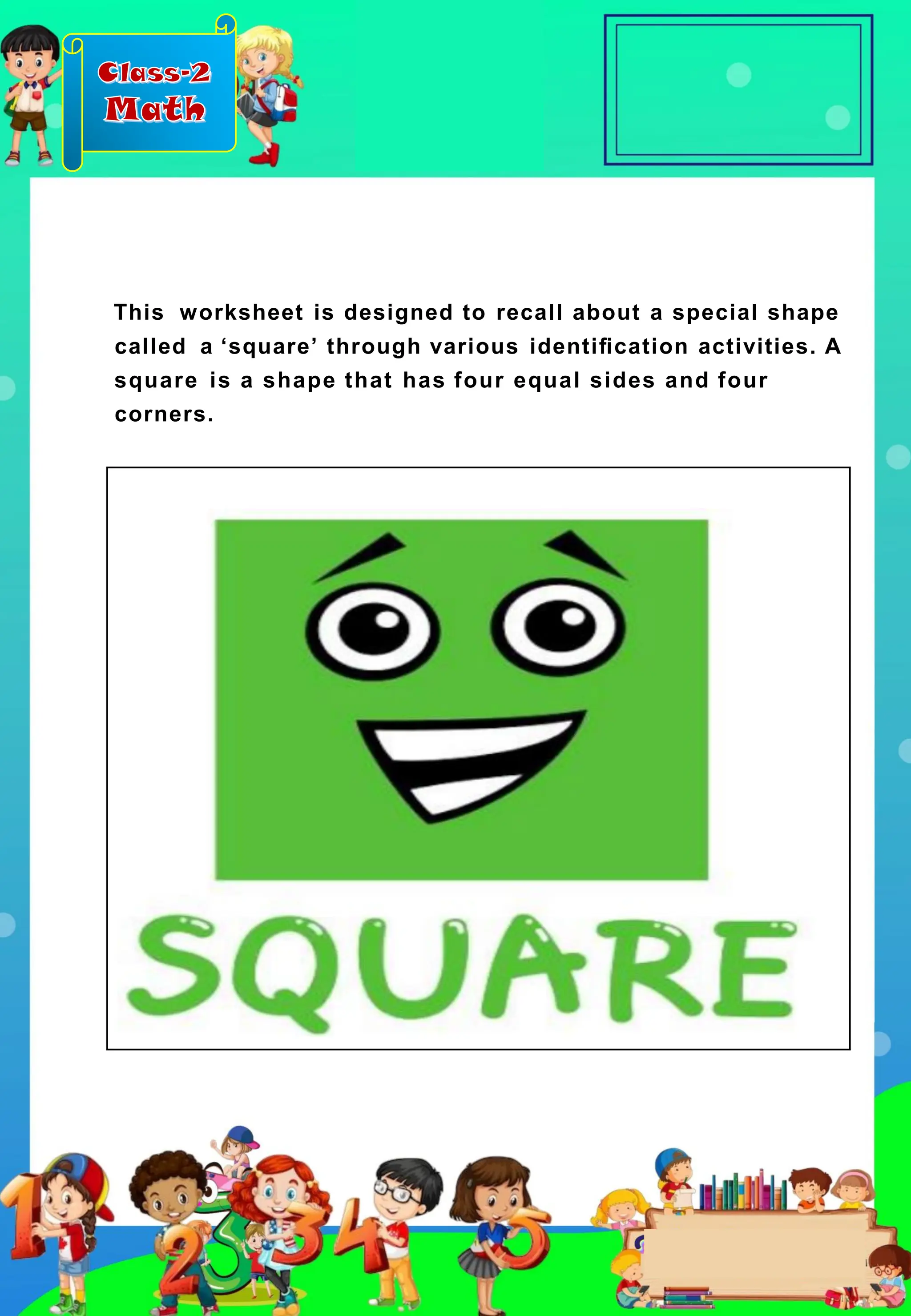
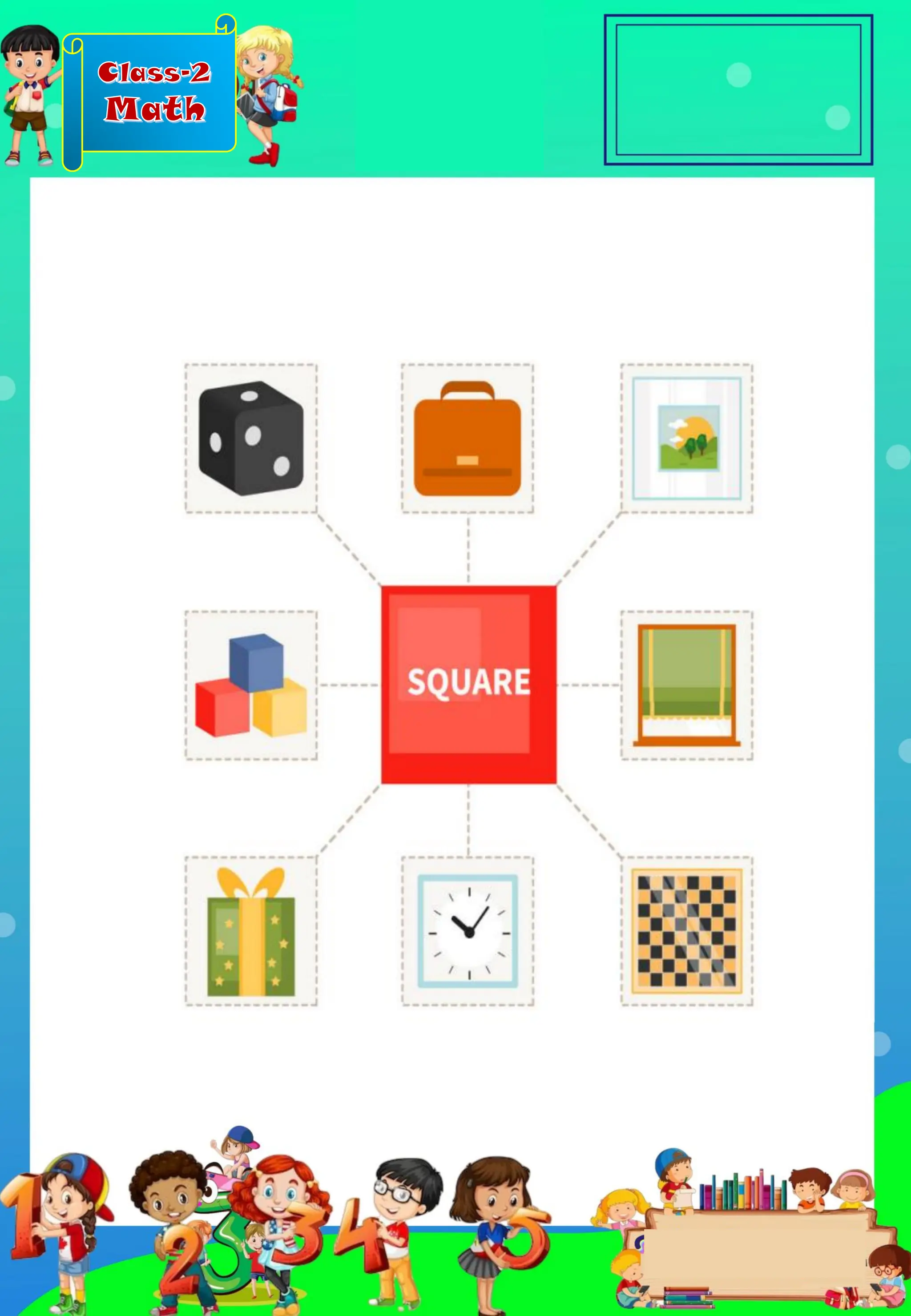
This worksheet is designed to recall about a special shape
called a ‘square’ through various identification activities. A
square is a shape that has four equal sides and four
corners.
Class-2
Math
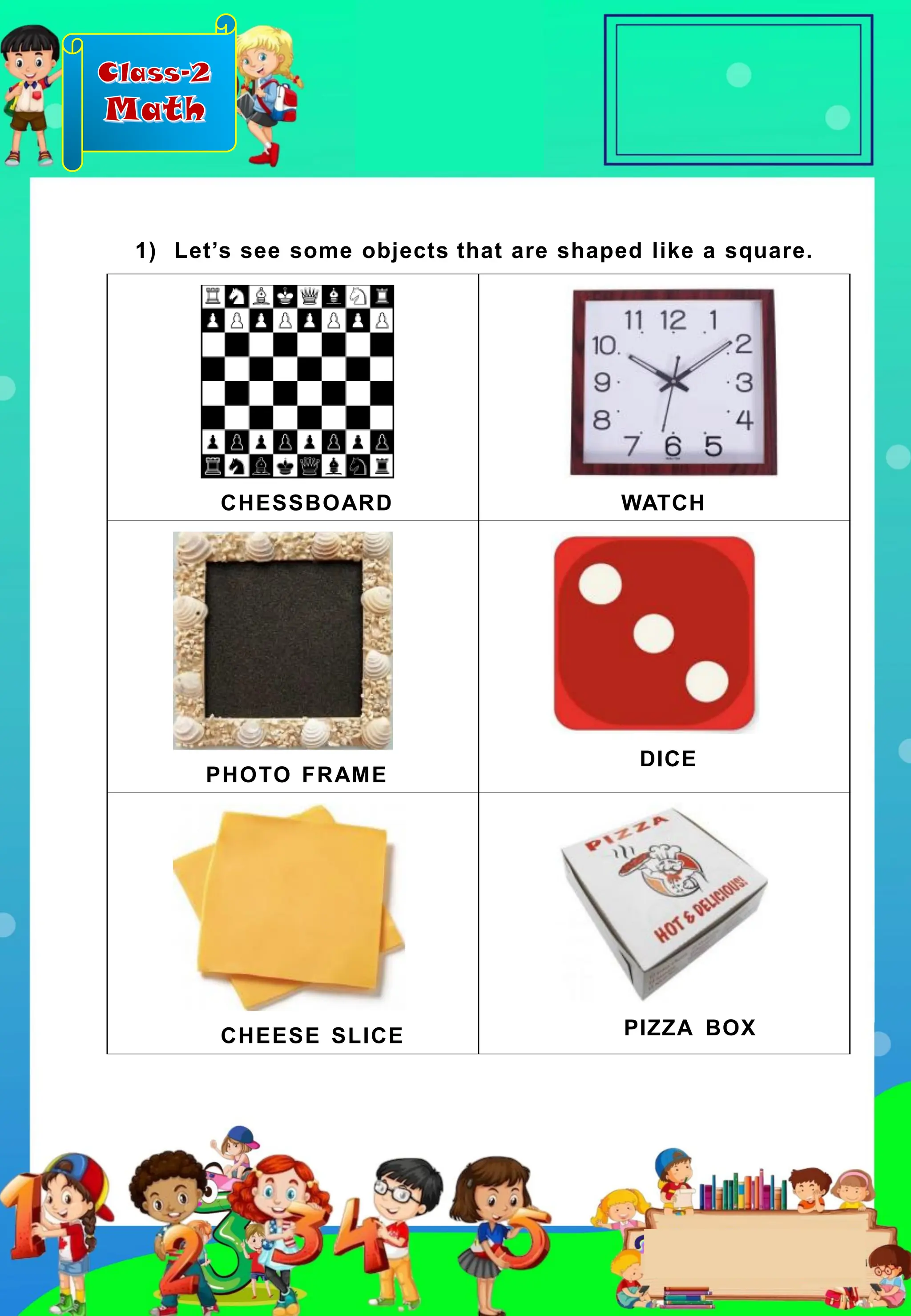
CHESSBOARD WATCH
PHOTO FRAME
DICE
CHEESE SLICE PIZZA BOX
1) Let’s see some objects that are shaped like a square.
Class-2
Math
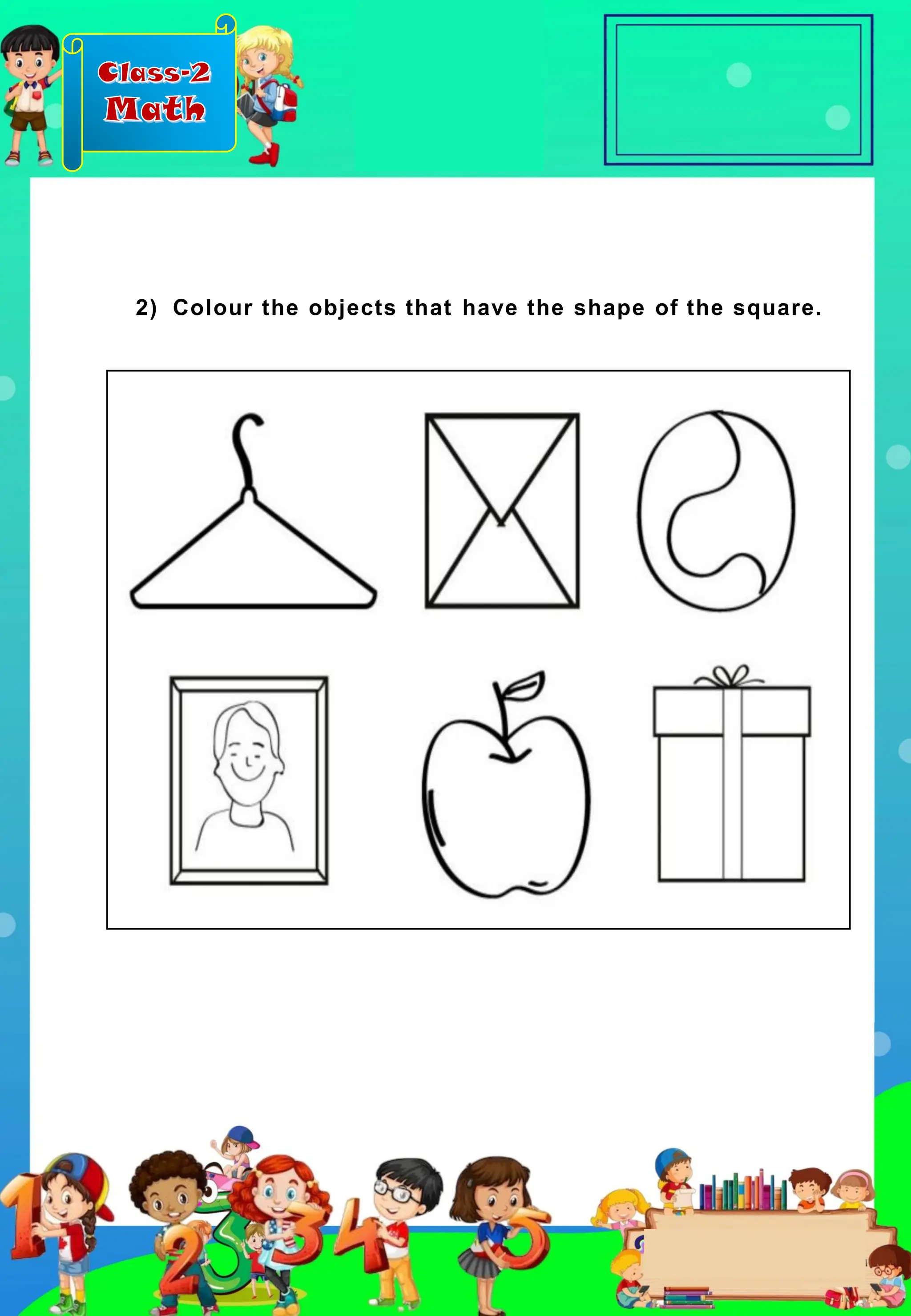
2) Colour the objects that have the shape of the square.
Class-2
Math
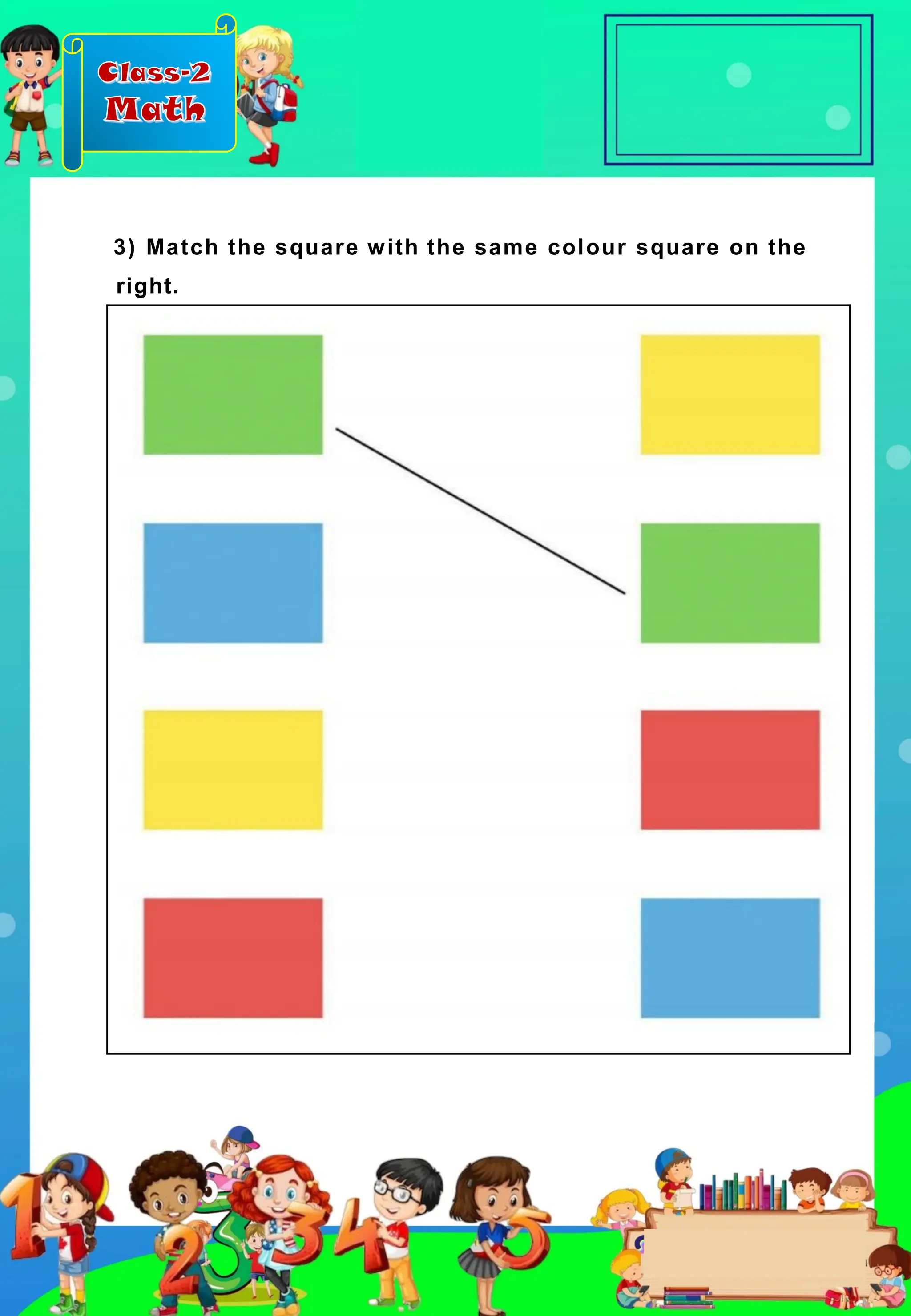
3) Match the square with the same colour square on the
right.
Class-2
Math
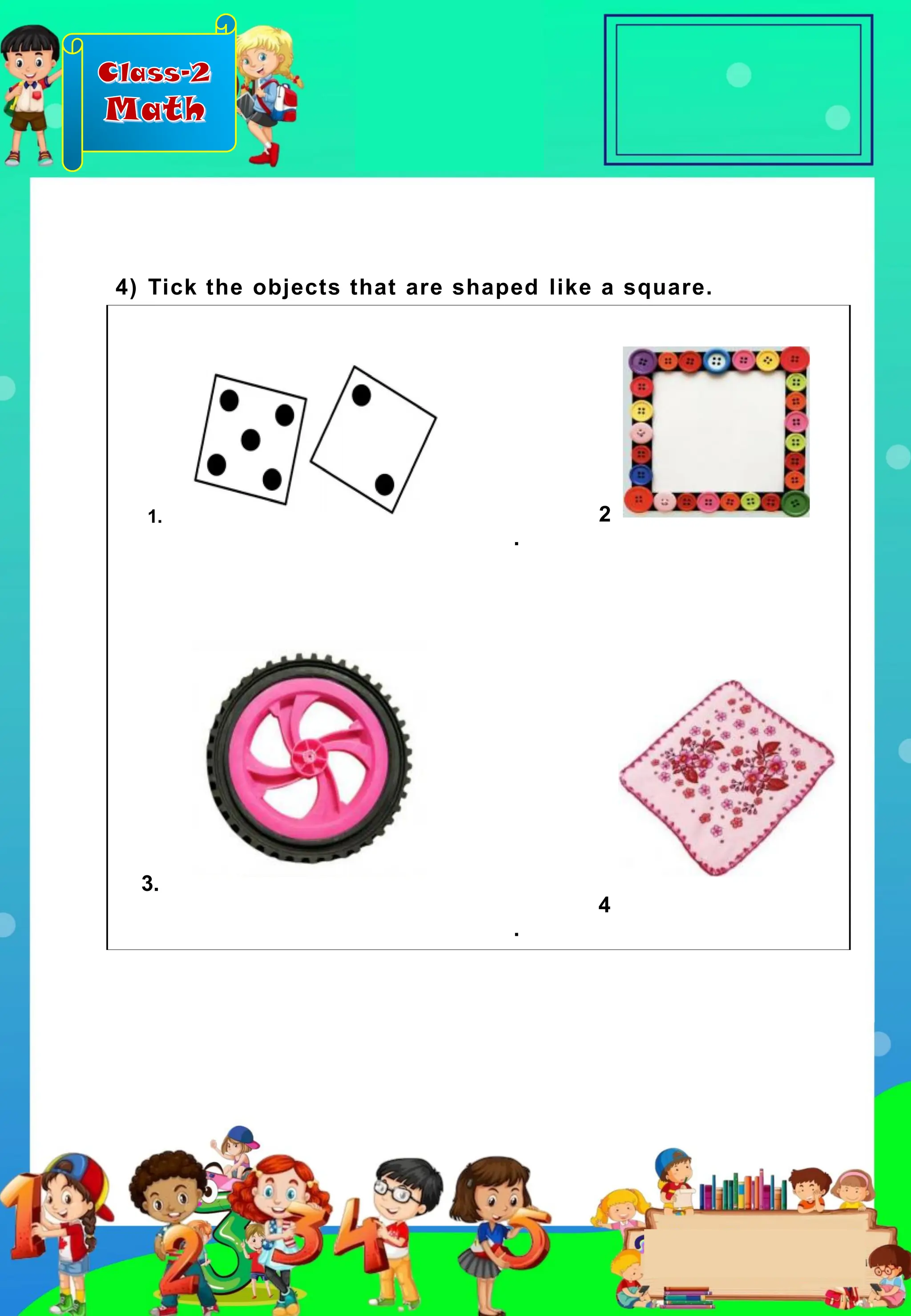
1.
3.
2
.
4
.
4) Tick the objects that are shaped like a square.
Class-2
Math
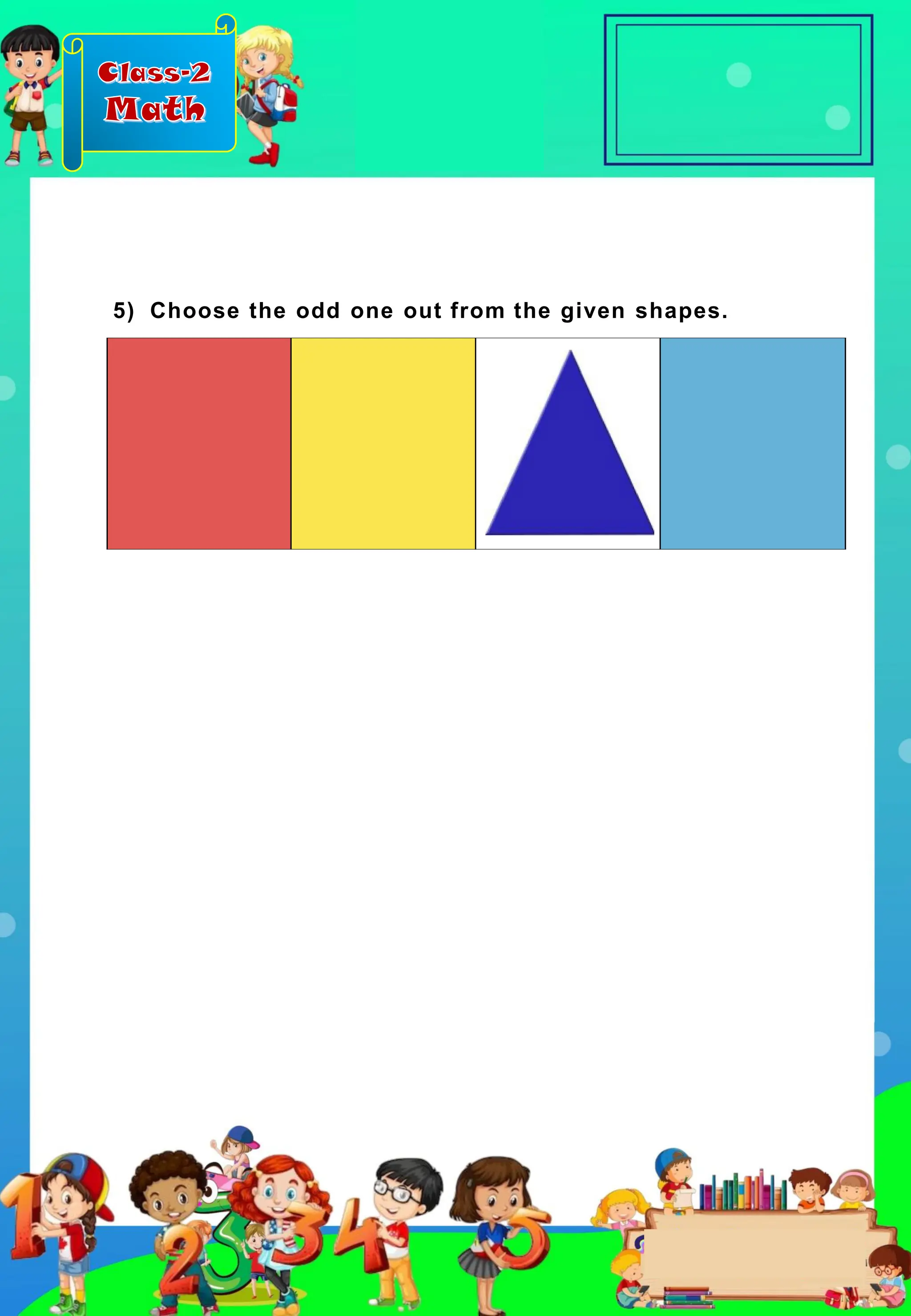
5) Choose the odd one out from the given shapes.
Class-2
Math
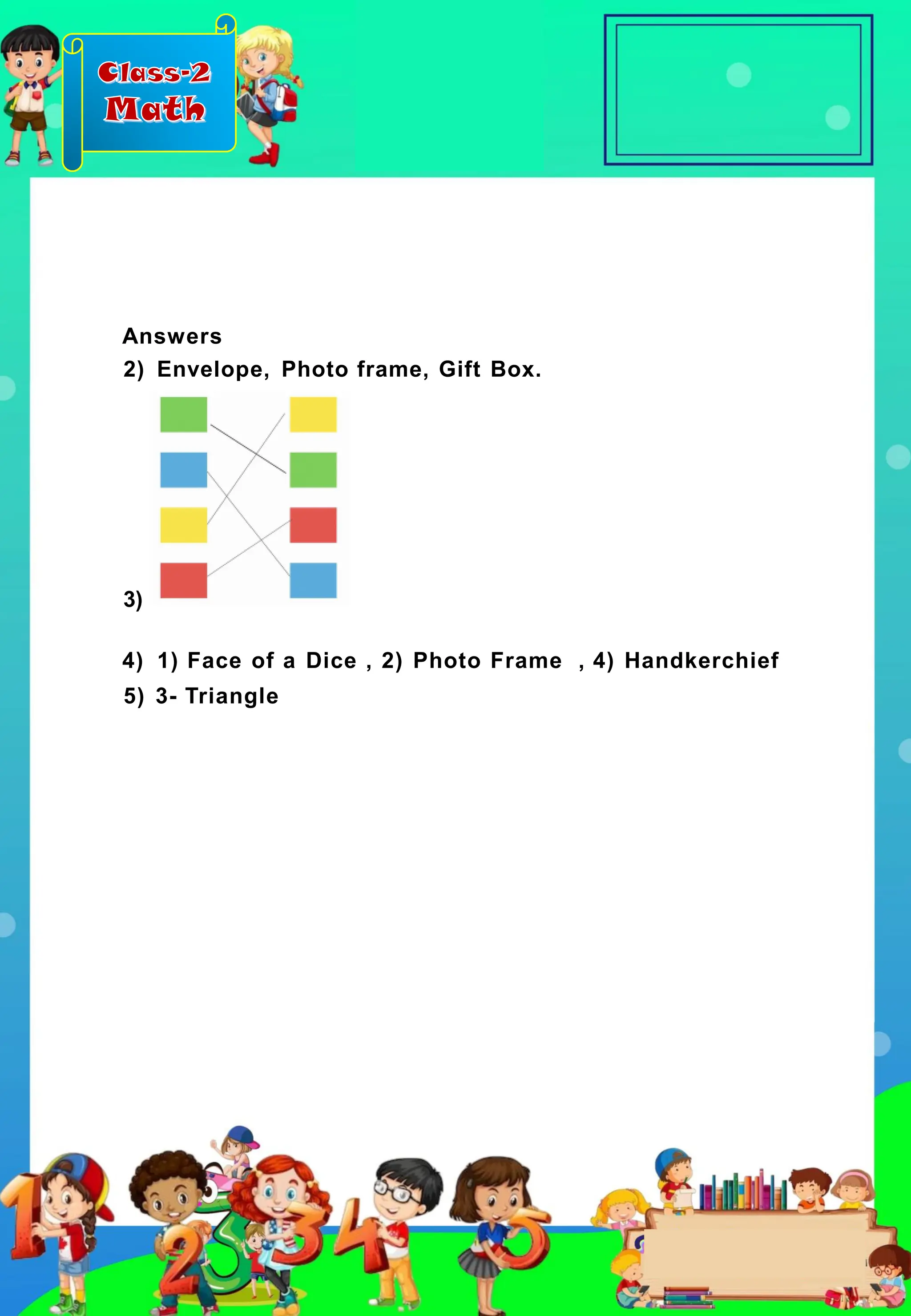
Answers
2) Envelope, Photo frame, Gift Box.
3)
4) 1) Face of a Dice , 2) Photo Frame , 4) Handkerchief
5) 3- Triangle
Class-2
Math
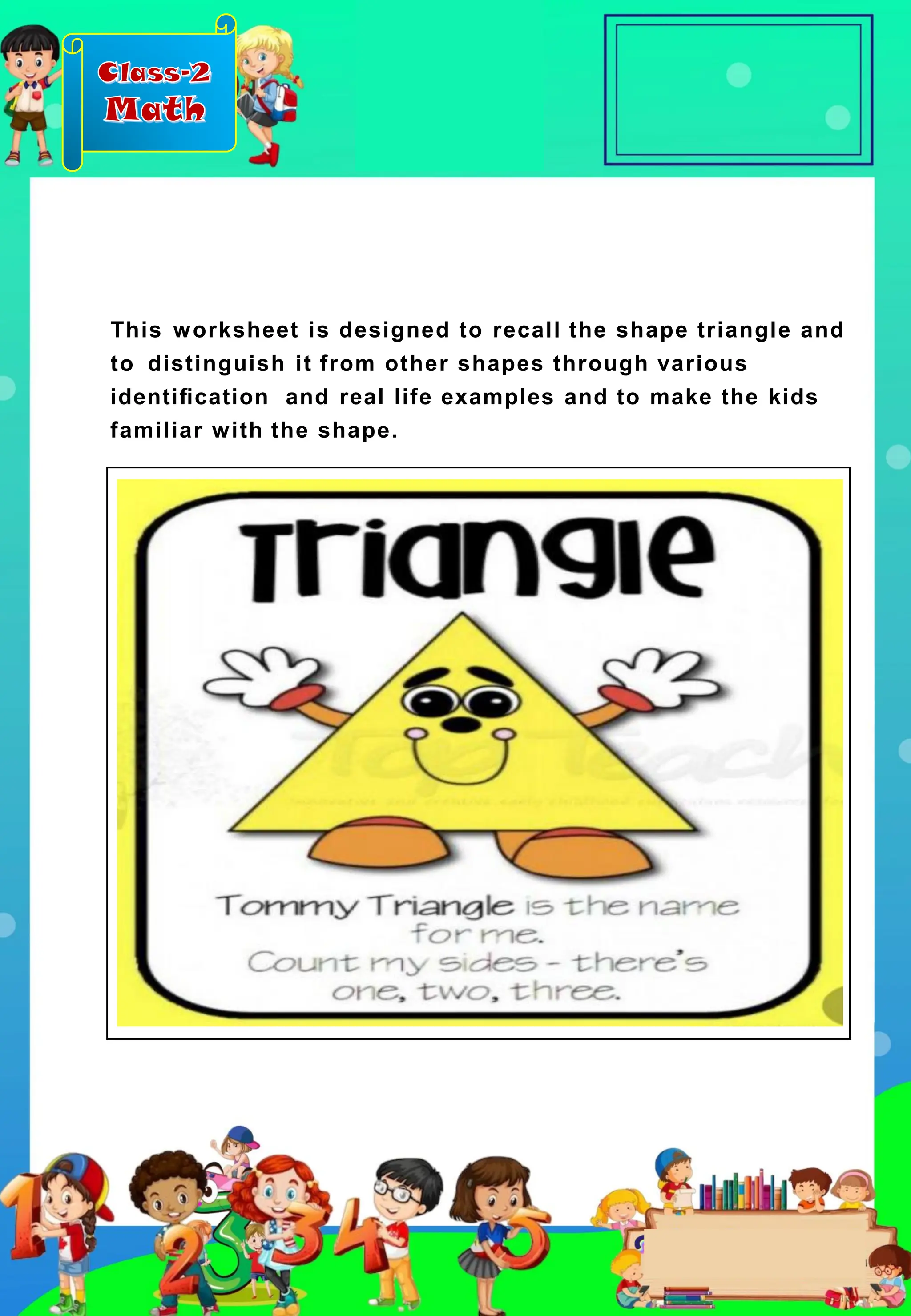
This worksheet is designed to recall the shape triangle and
to distinguish it from other shapes through various
identification and real life examples and to make the kids
familiar with the shape.
Class-2
Math
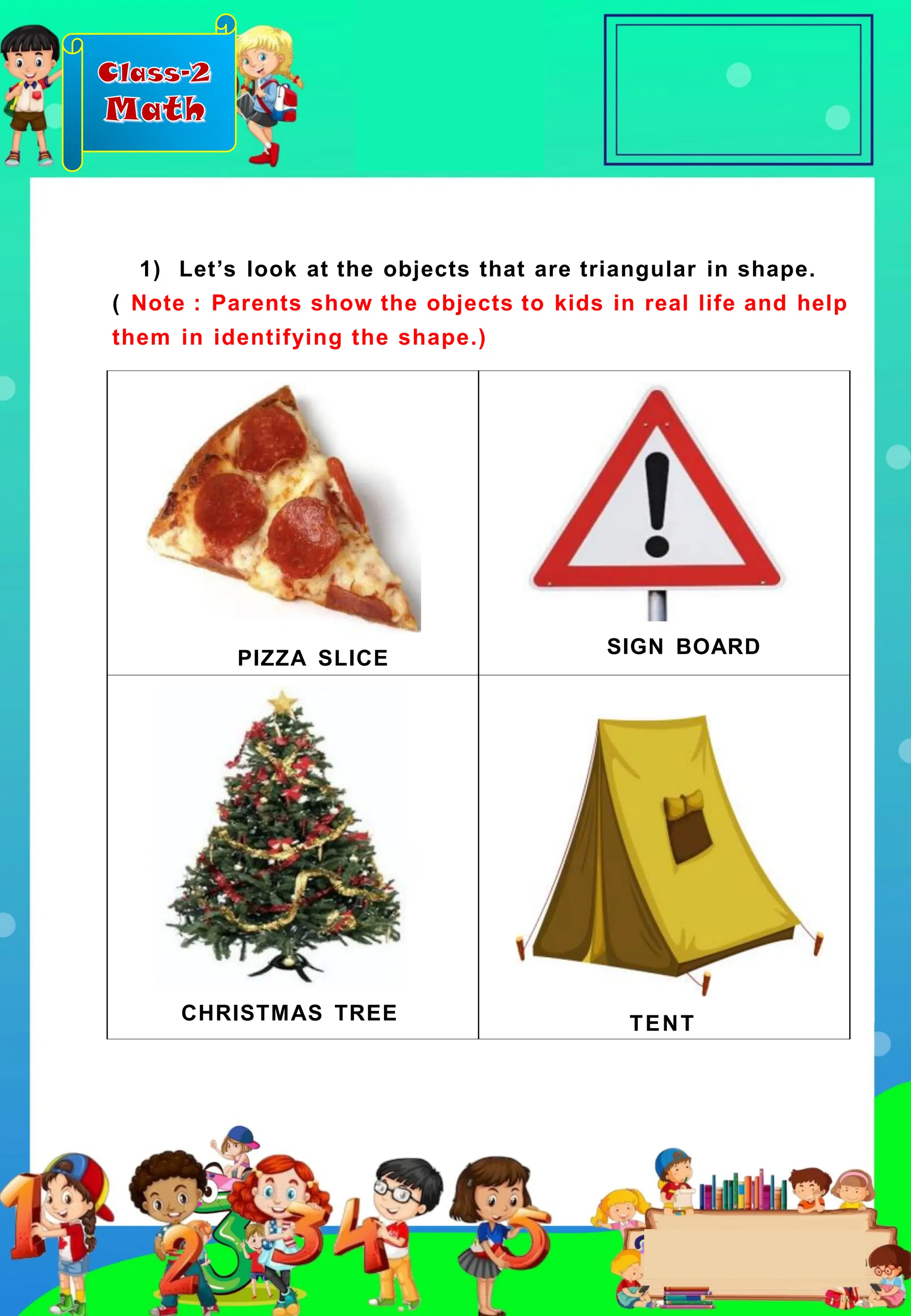
PIZZA SLICE
SIGN BOARD
CHRISTMAS TREE TENT
1) Let’s look at the objects that are triangular in shape.
( Note : Parents show the objects to kids in real life and help
them in identifying the shape.)
Class-2
Math
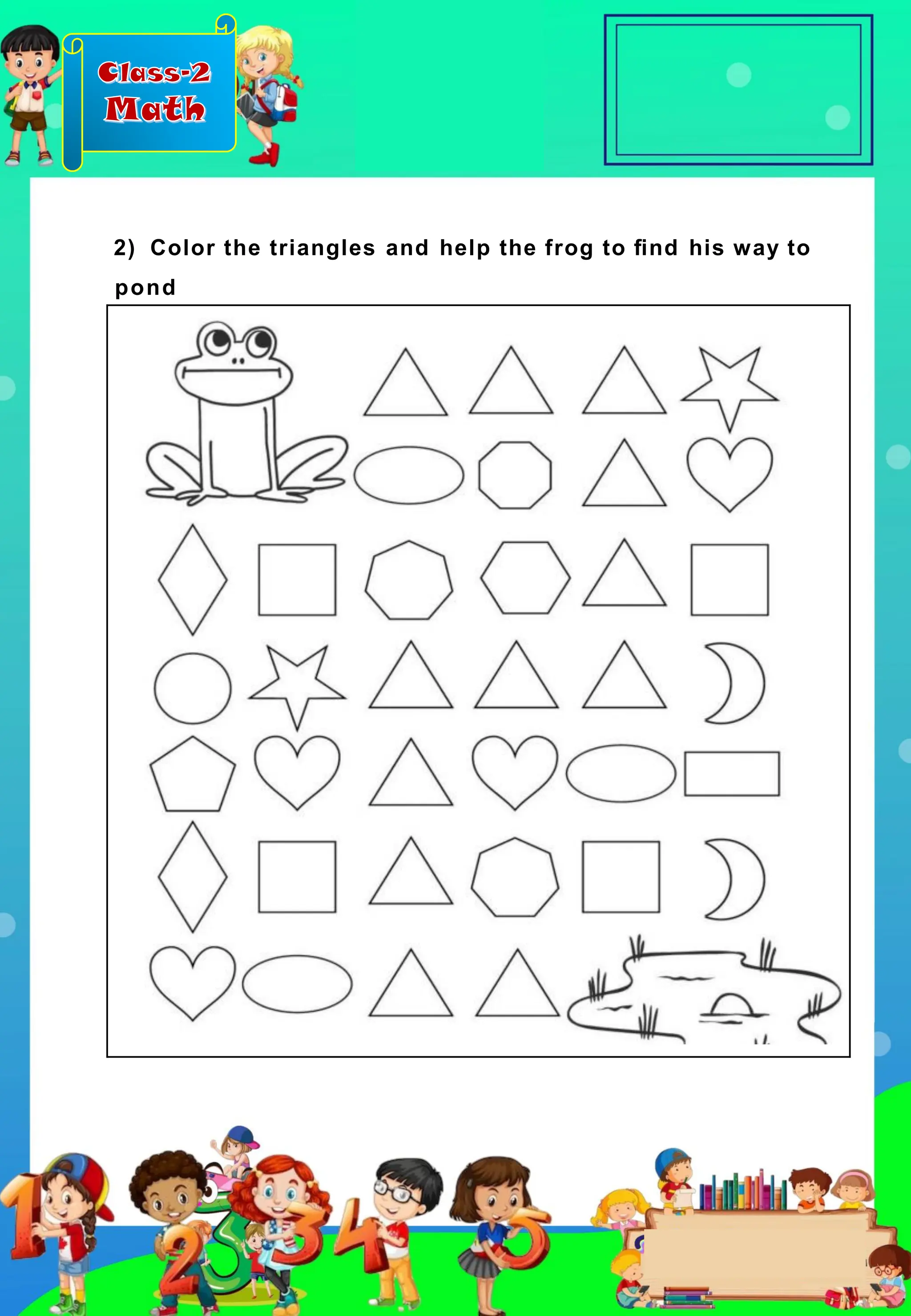
2) Color the triangles and help the frog to find his way to
pond
Class-2
Math
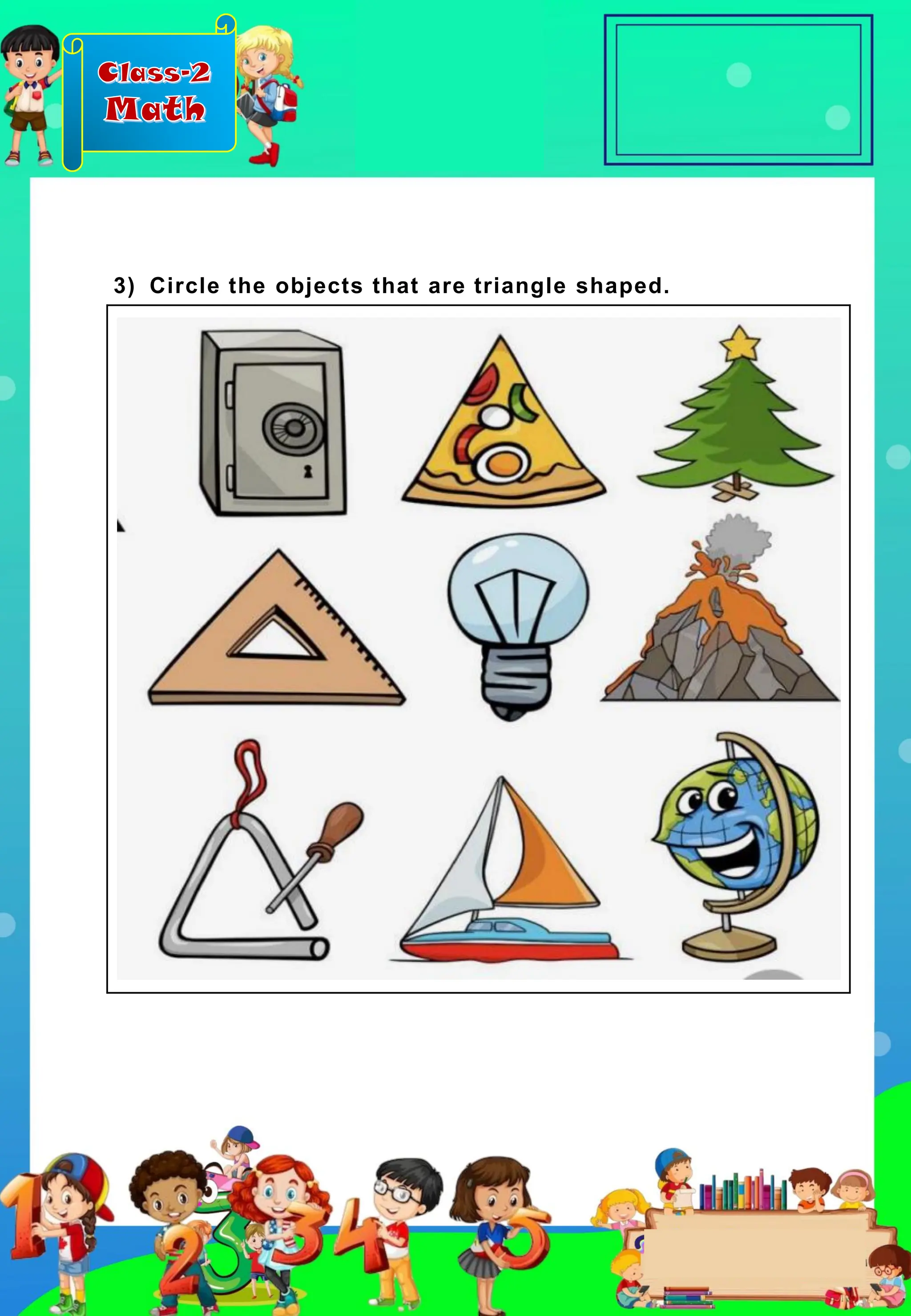
3) Circle the objects that are triangle shaped.
Class-2
Math
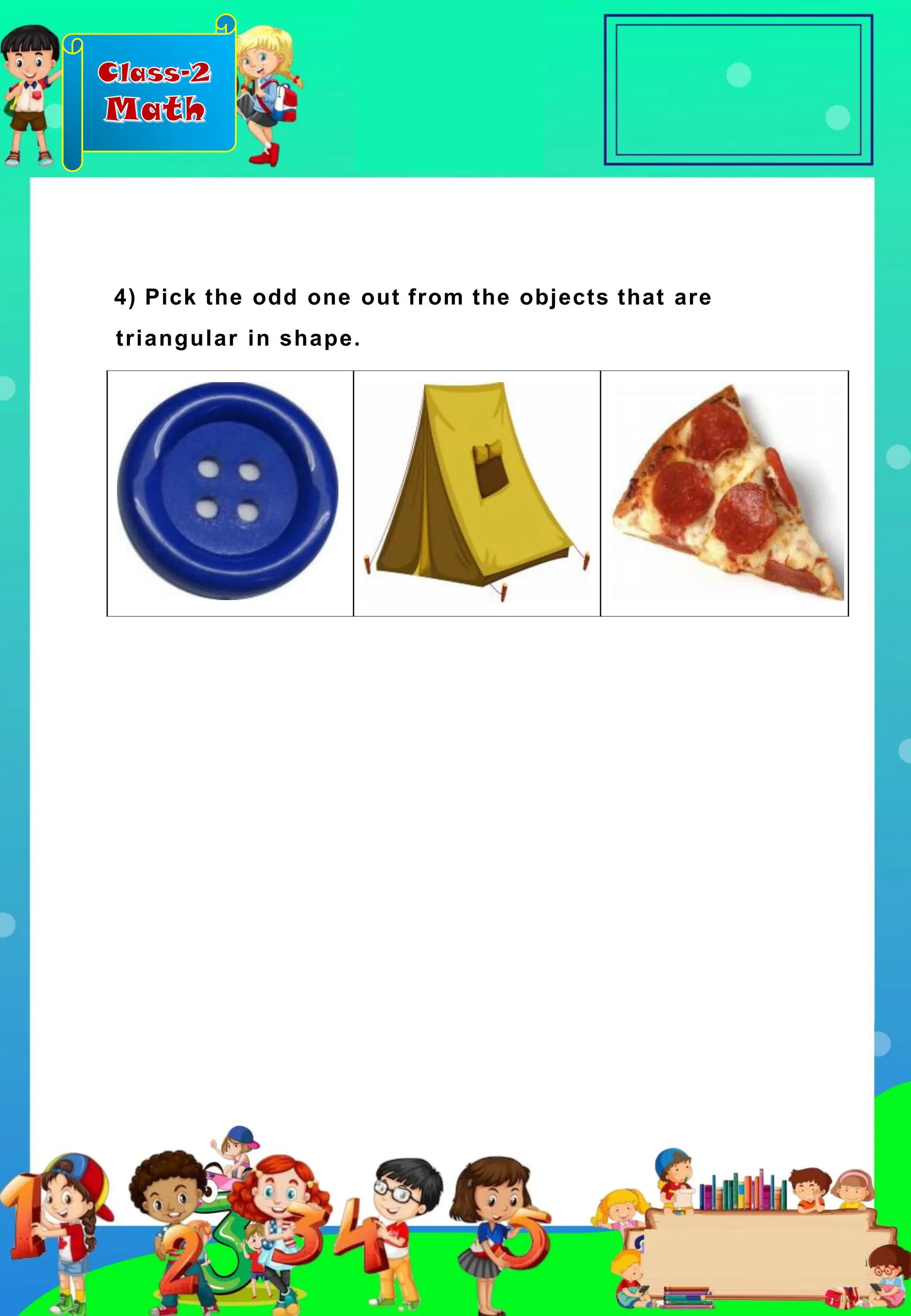
4) Pick the odd one out from the objects that are
triangular in shape.
Class-2
Math
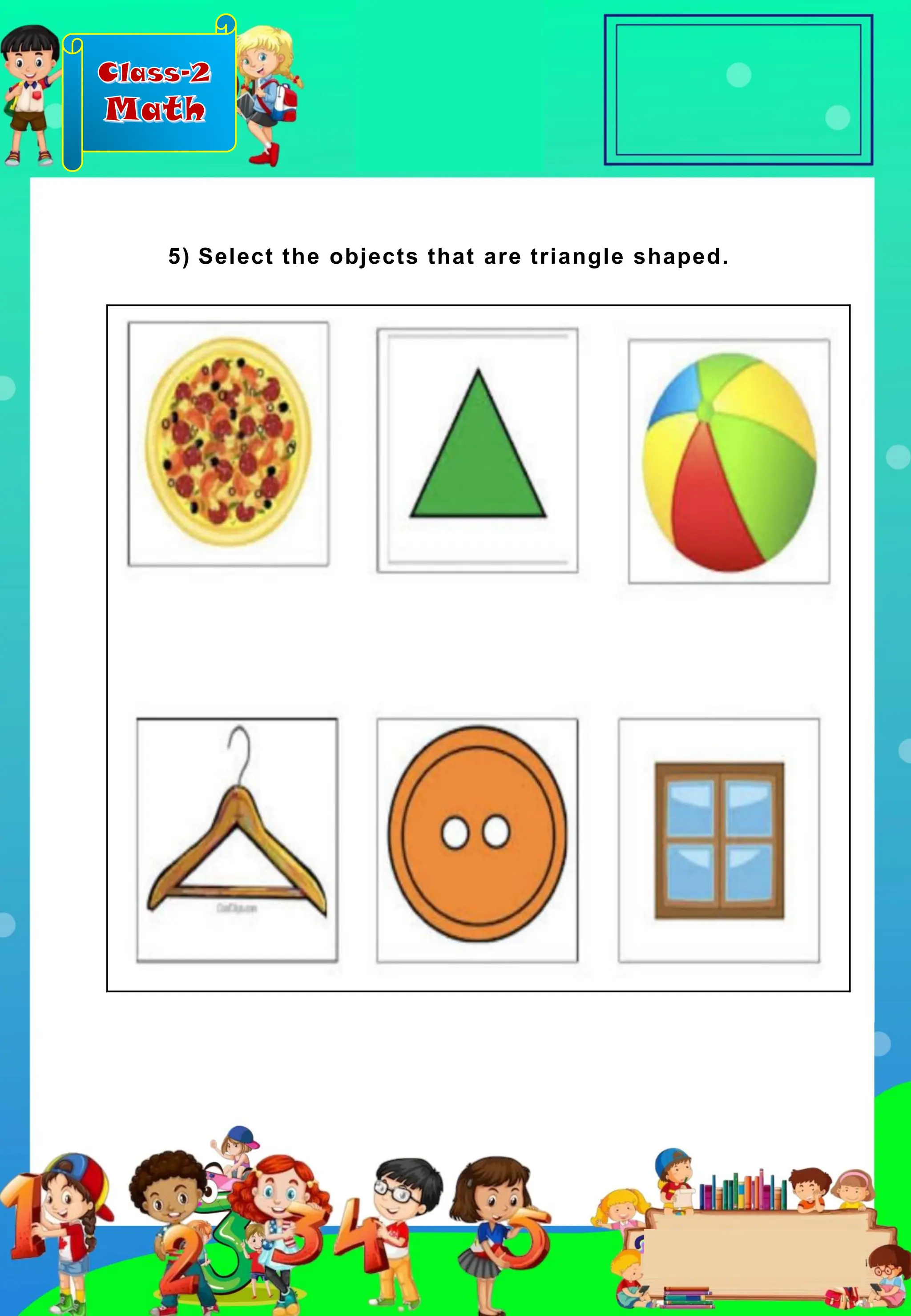
5) Select the objects that are triangle shaped.
Class-2
Math
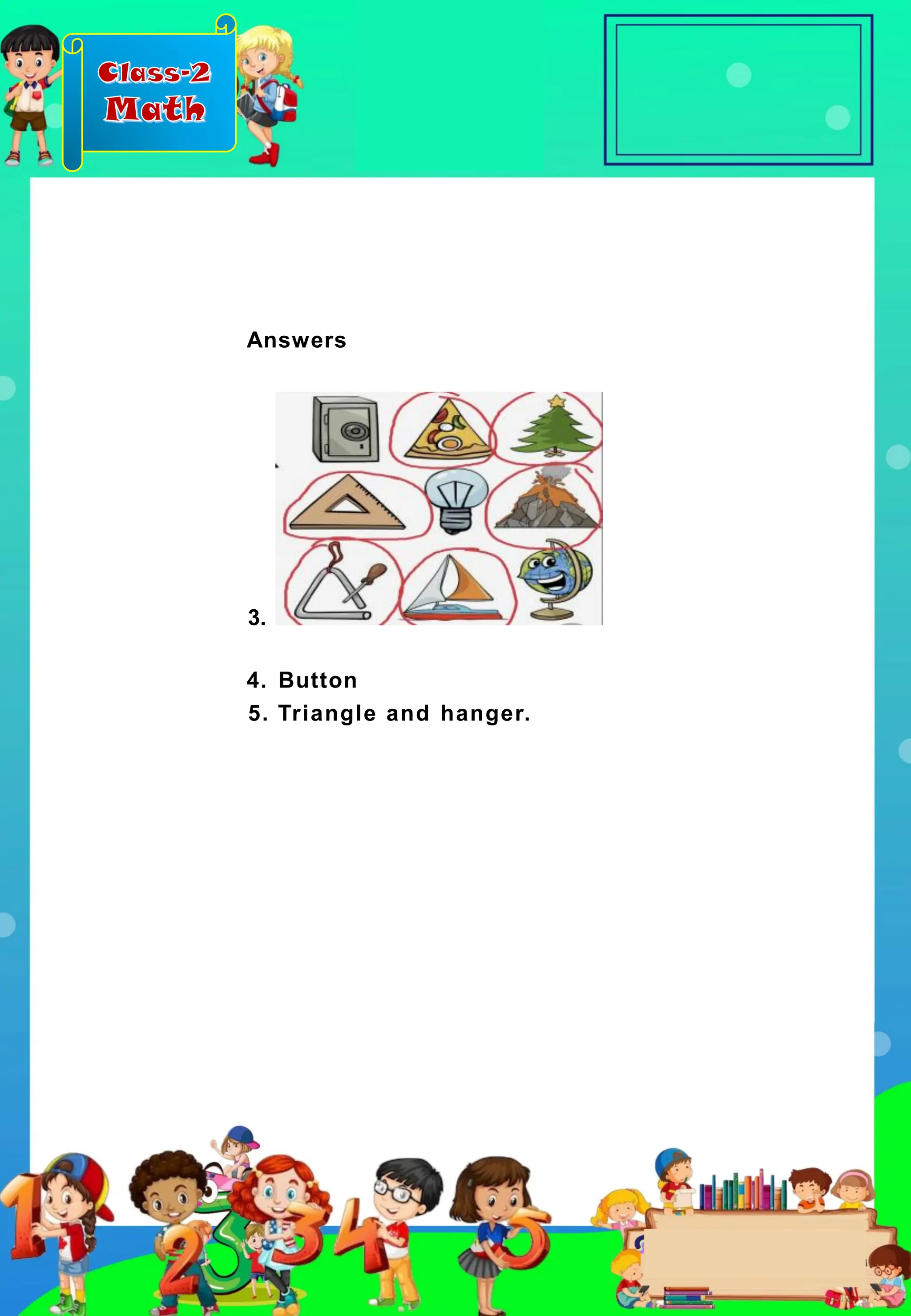
Answers
3.
4. Button
5. Triangle and hanger.
Class-2
Math
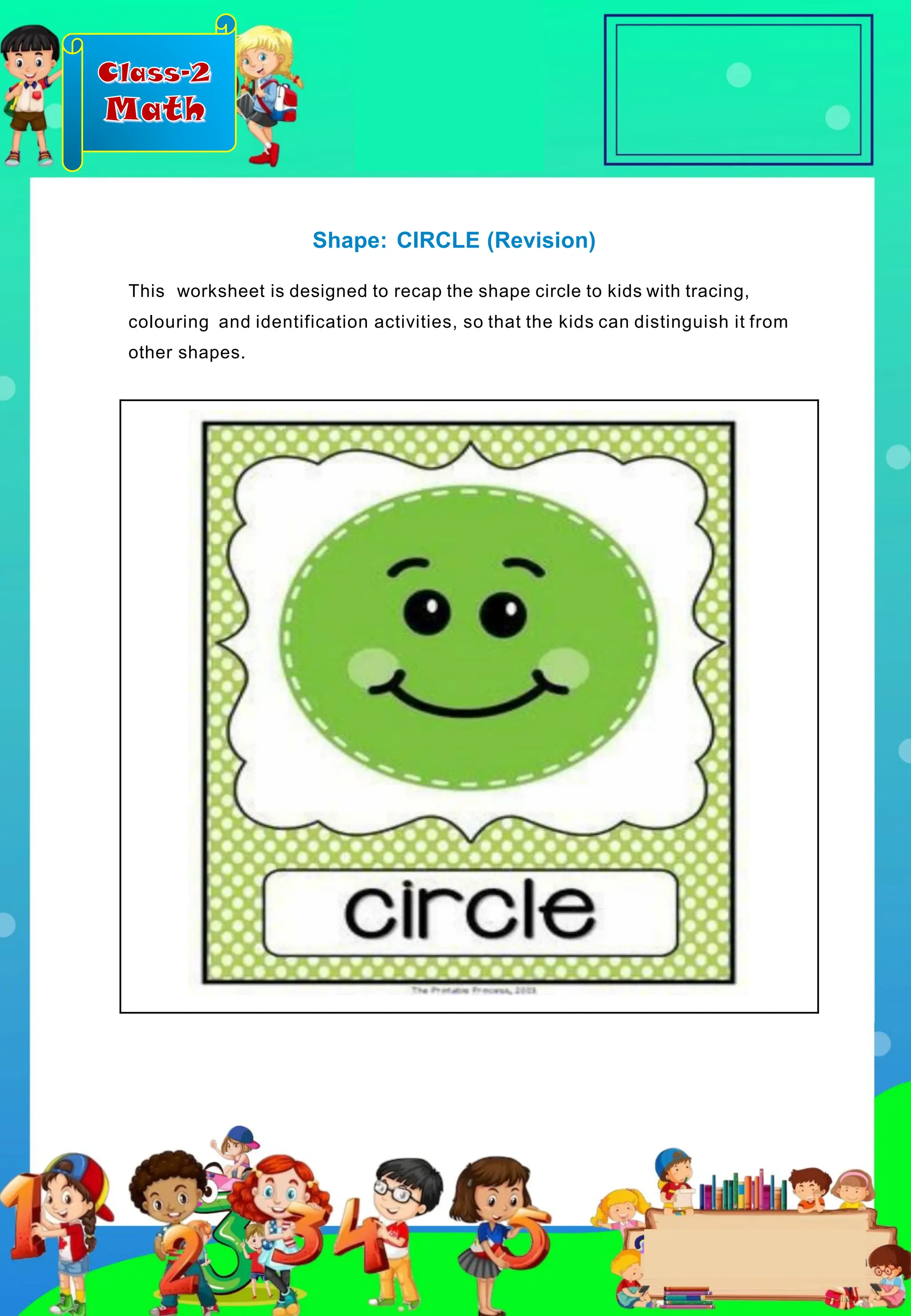
Shape: CIRCLE (Revision)
This worksheet is designed to recap the shape circle to kids with tracing,
colouring and identification activities, so that the kids can distinguish it from
other shapes.
Class-2
Math
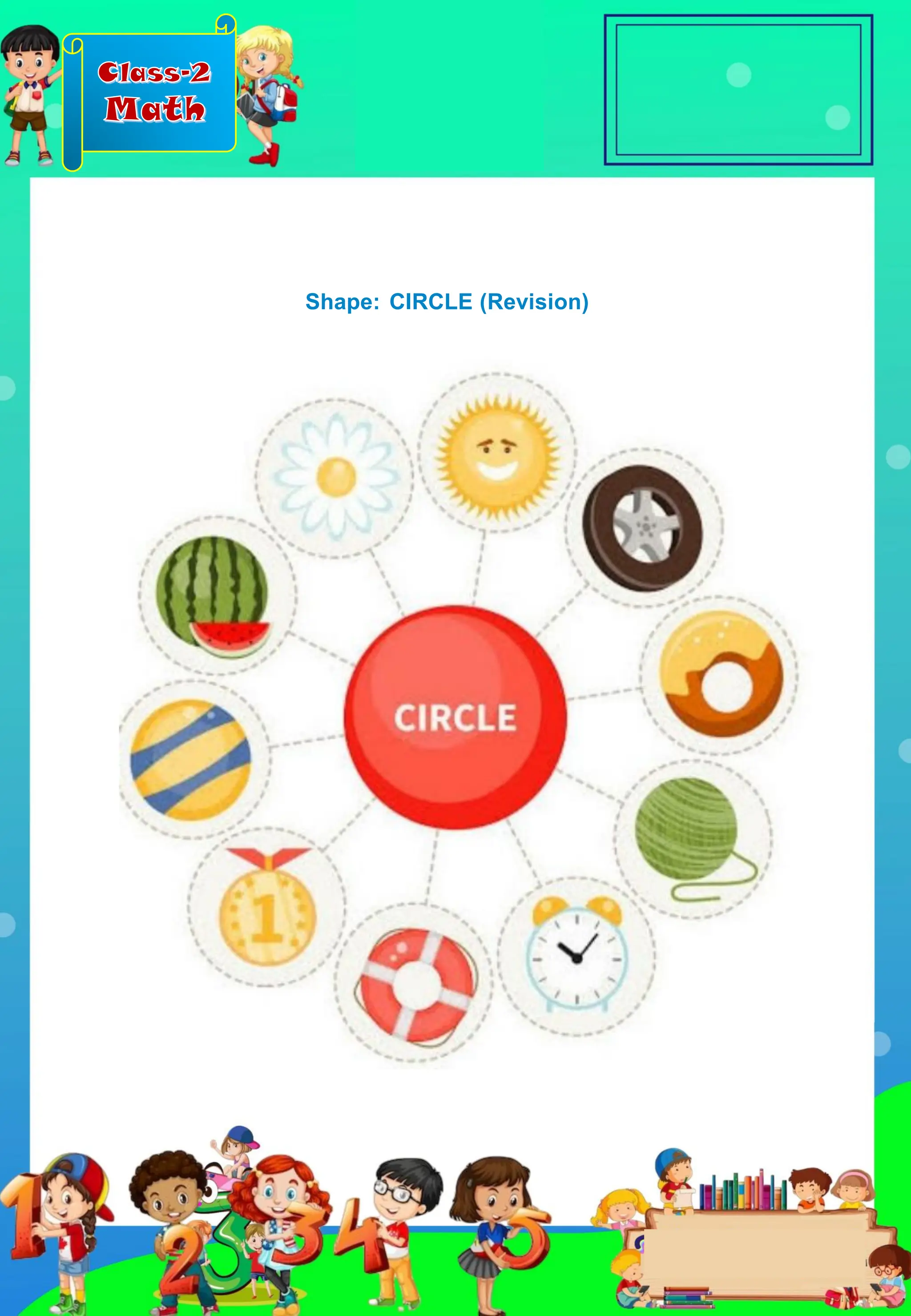
Shape: CIRCLE (Revision)
Class-2
Math
Shape: CIRCLE (Revision)
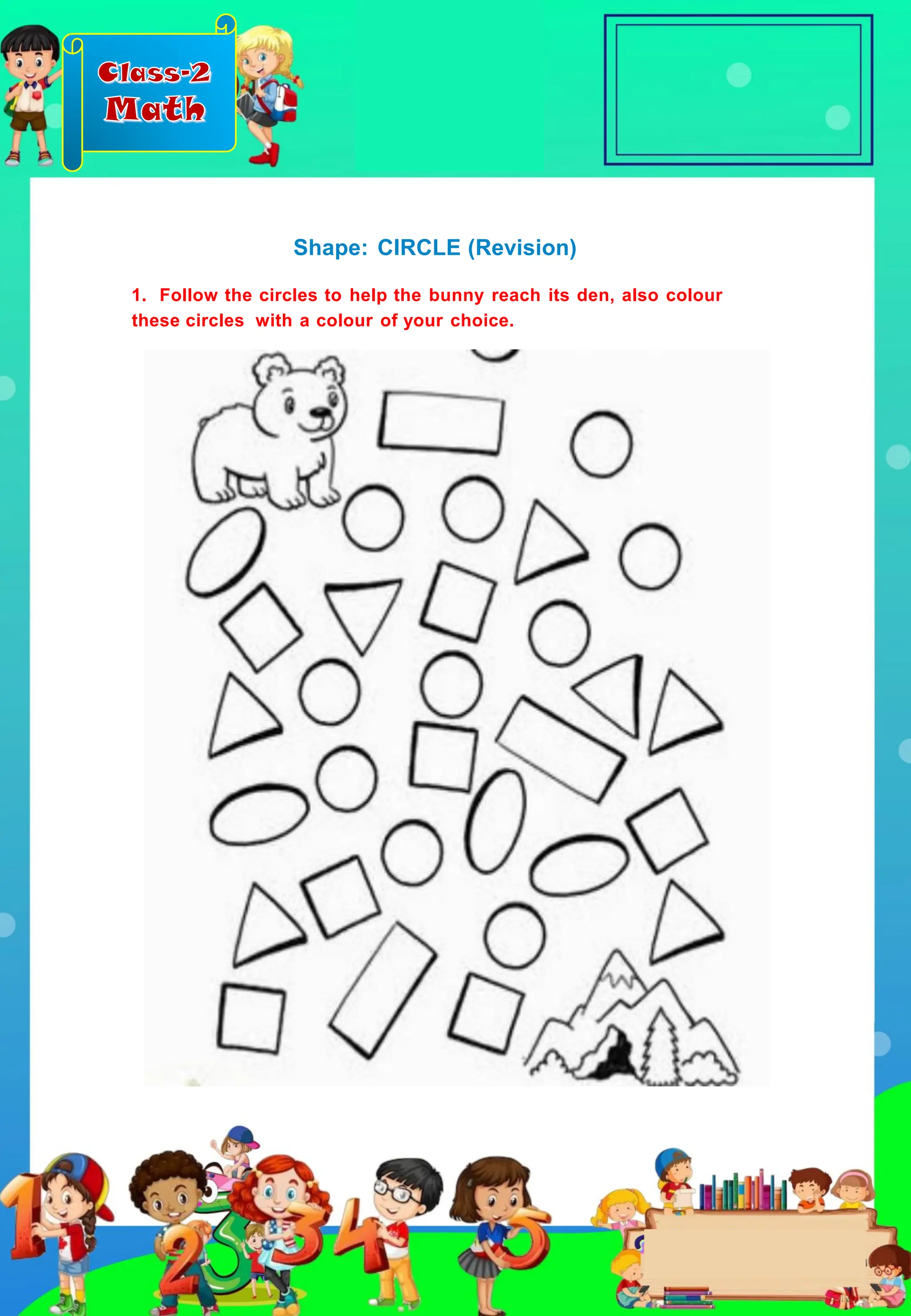
1. Follow the circles to help the bunny reach its den, also colour
these circles with a colour of your choice.
Class-2
Math
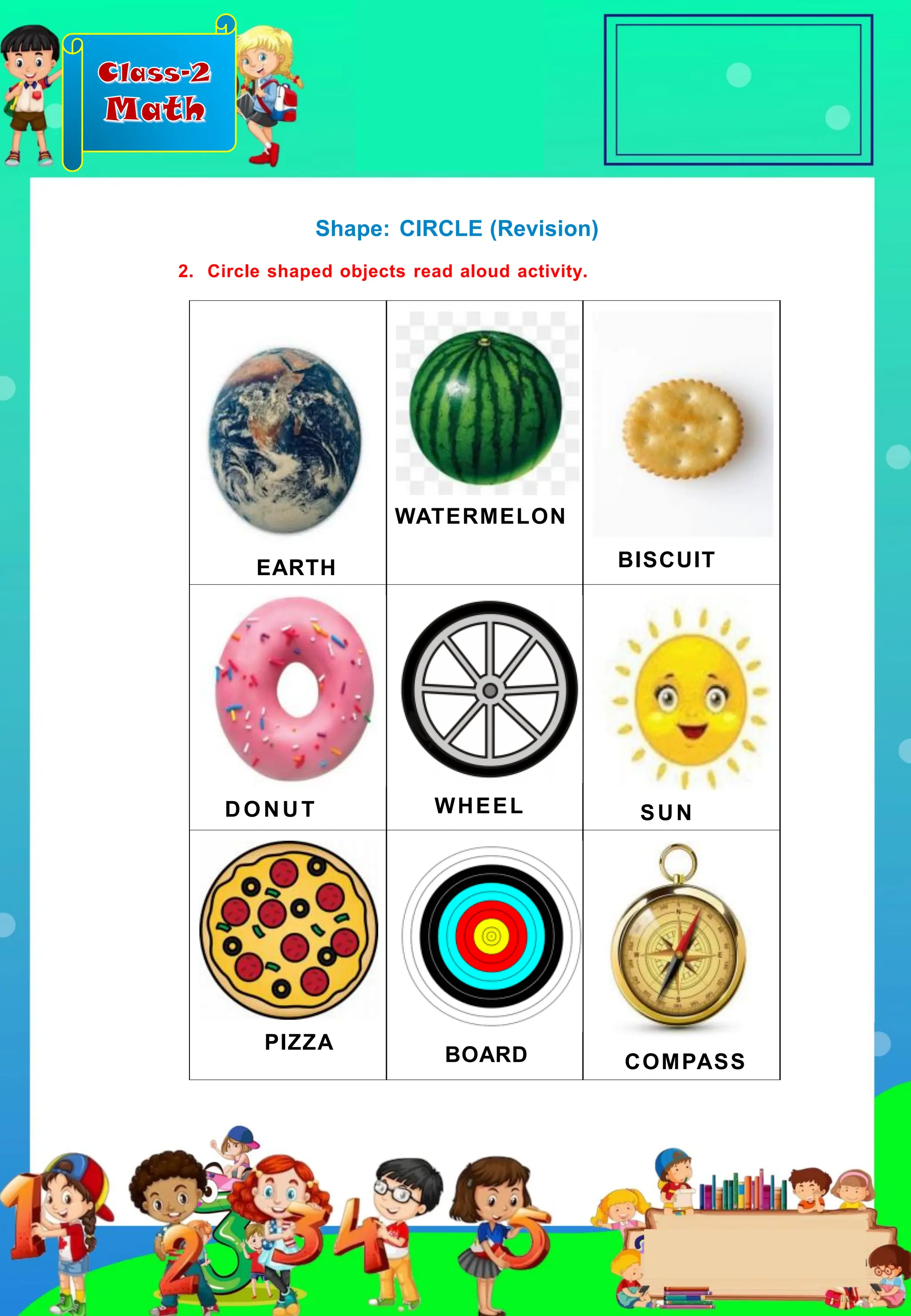
EARTH
WATERMELON
BISCUIT
DONUT WHEEL SUN
PIZZA
BOARD COMPASS
Shape: CIRCLE (Revision)
2. Circle shaped objects read aloud activity.
Class-2
Math
1.
2.
3.
4.
5. 6.
Shape: CIRCLE (Revision)
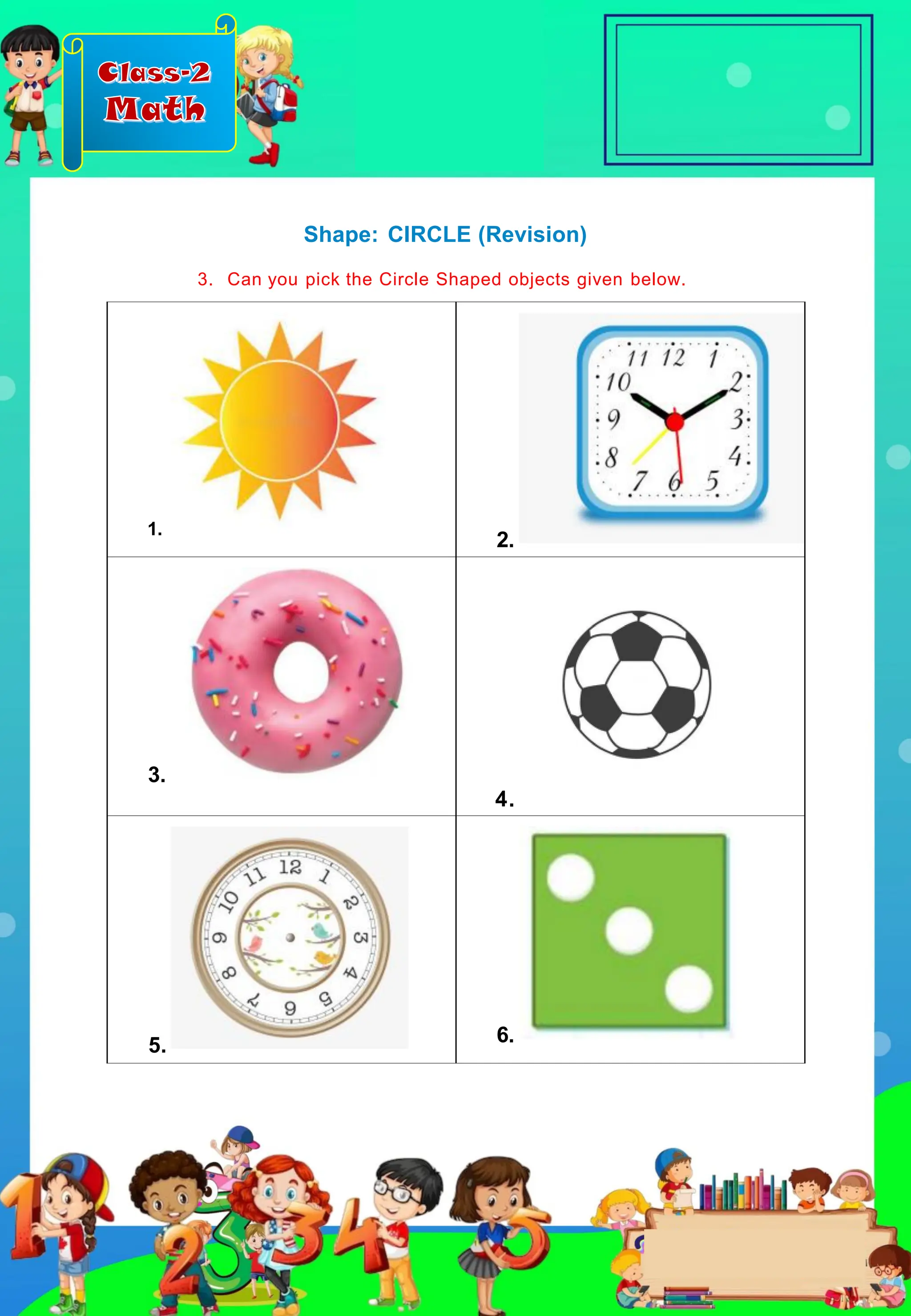
3. Can you pick the Circle Shaped objects given below.
Class-2
Math
Shape: CIRCLE (Revision)
3.
1,3,4,5
Answers:-
Class-2
Math
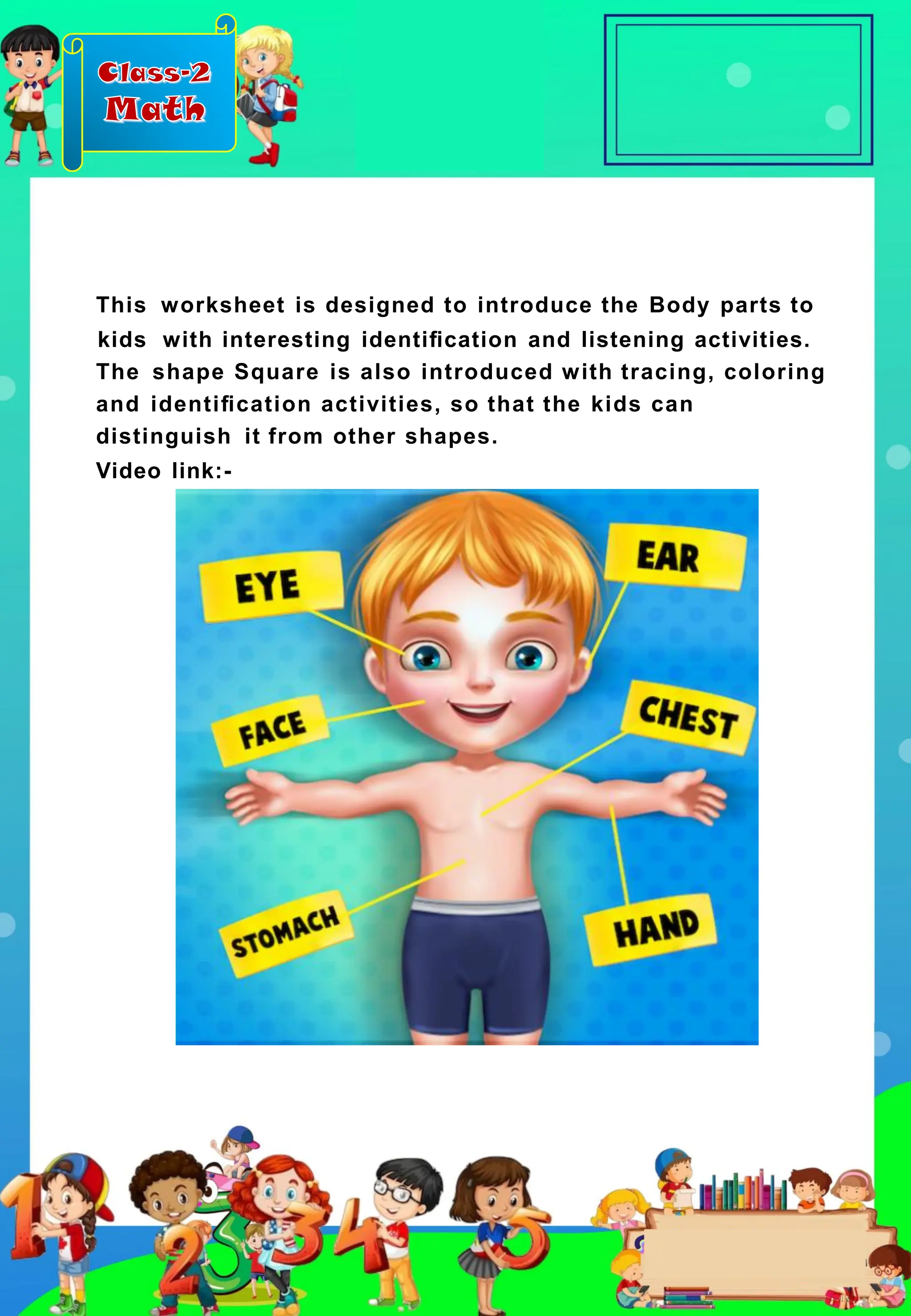
This worksheet is designed to introduce the Body parts to
kids with interesting identification and listening activities.
The shape Square is also introduced with tracing, coloring
and identification activities, so that the kids can
distinguish it from other shapes.
Video link:-
Class-2
Math
Class-2
Math
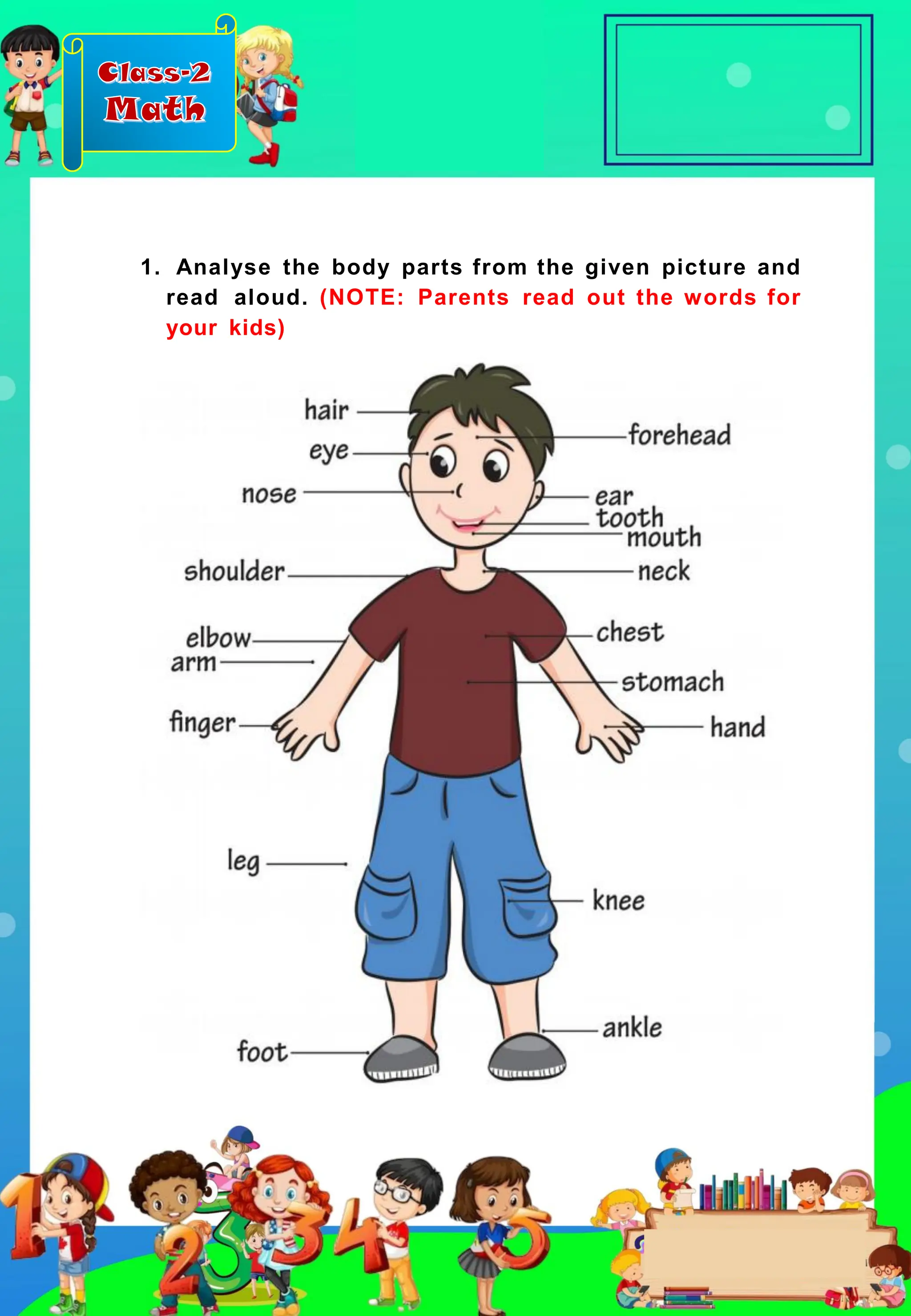
1. Analyse the body parts from the given picture and
read aloud. (NOTE: Parents read out the words for
your kids)
Class-2
Math
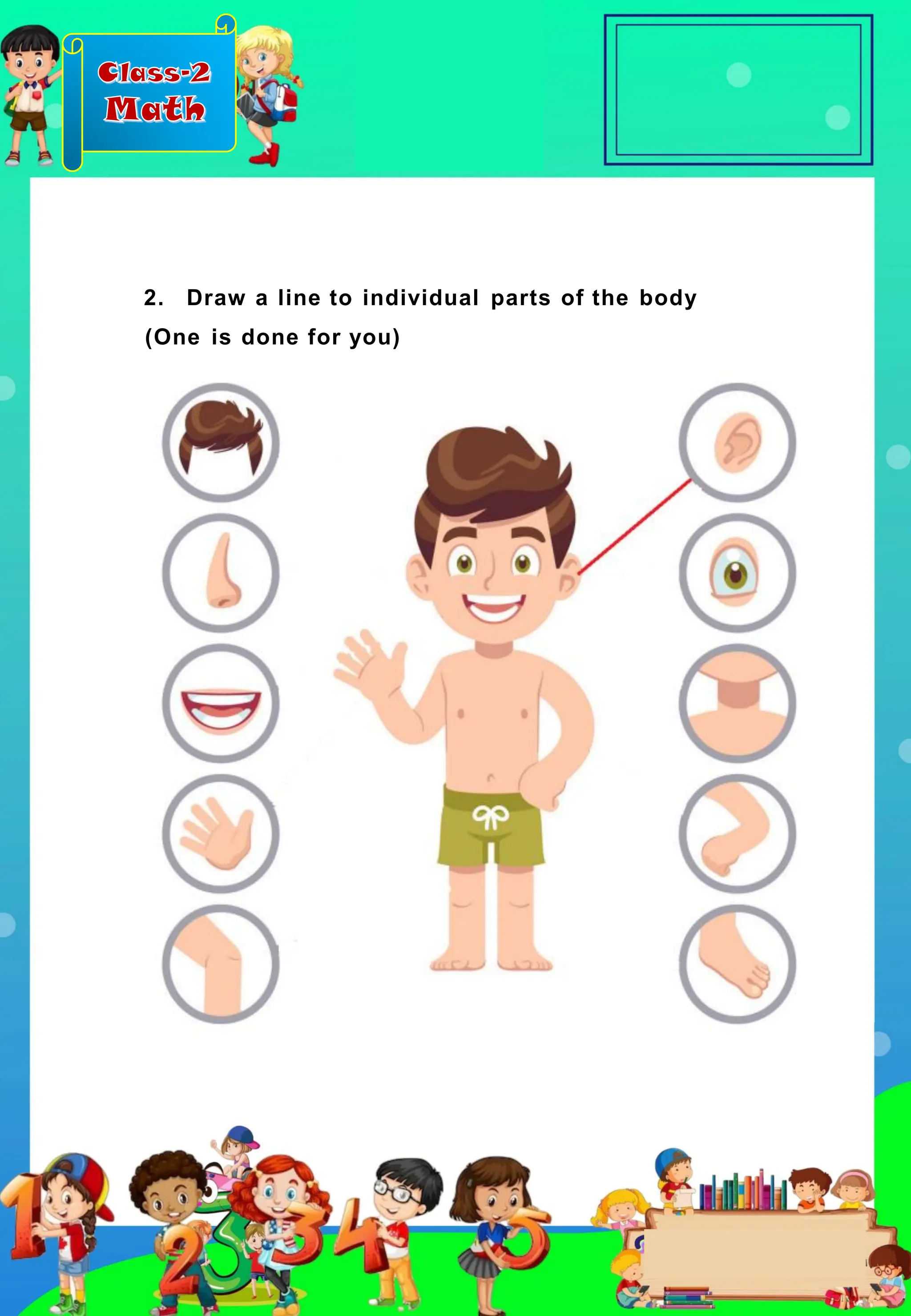
2. Draw a line to individual parts of the body
(One is done for you)
Class-2
Math
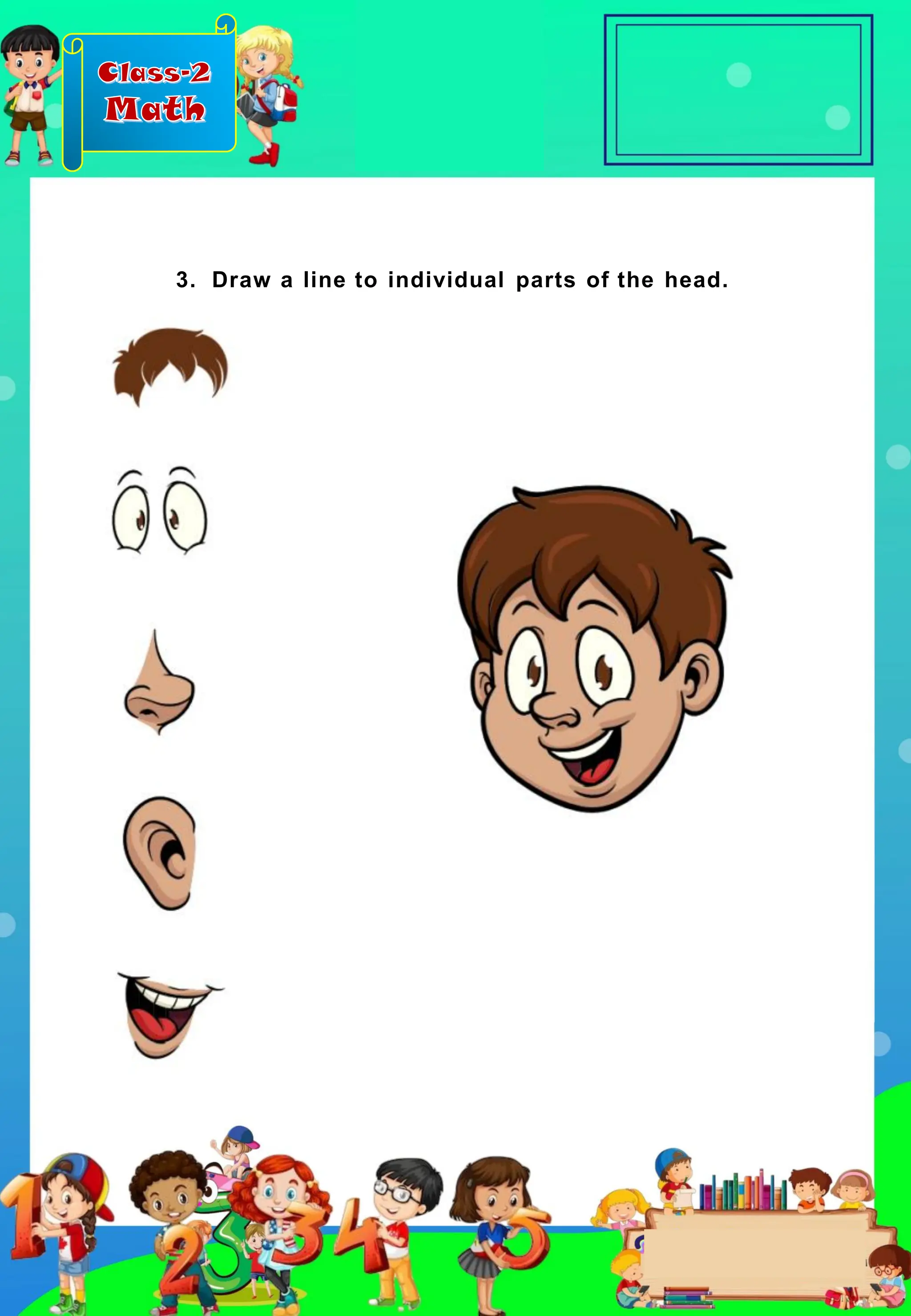
3. Draw a line to individual parts of the head.
Class-2
Math
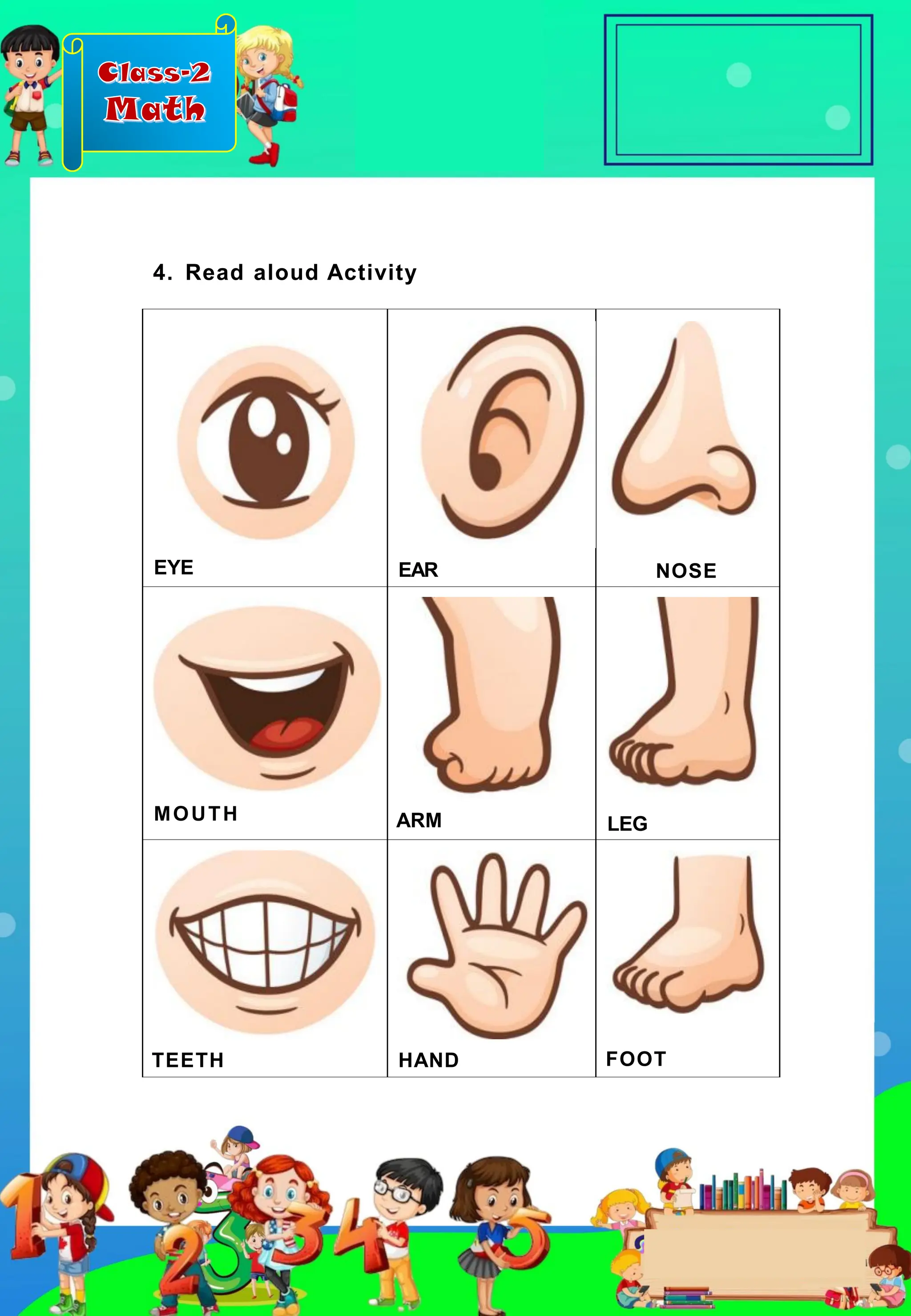
EYE EAR NOSE
MOUTH ARM LEG
TEETH HAND FOOT
4. Read aloud Activity
Class-2
Math
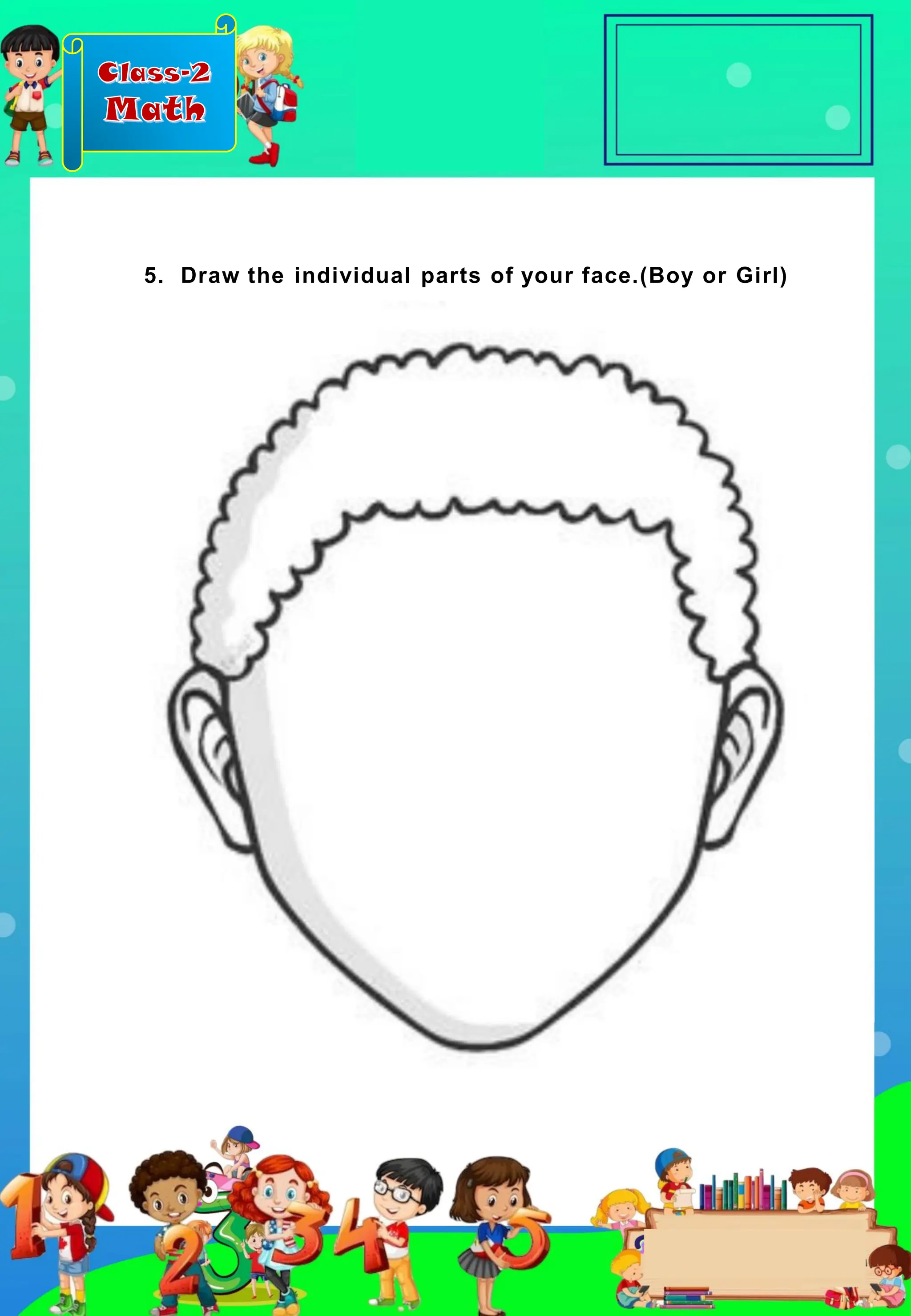
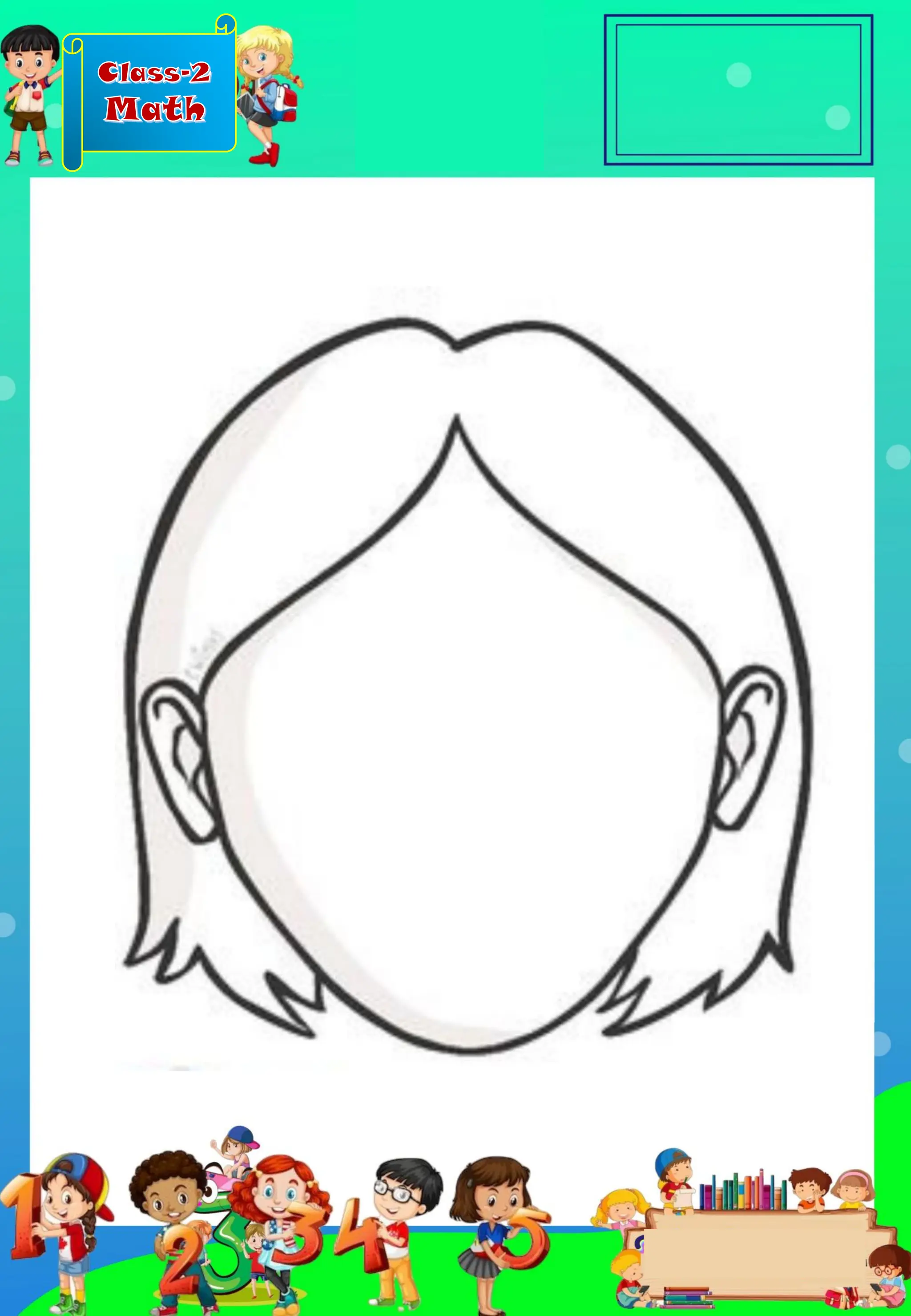
5. Draw the individual parts of your face.(Boy or Girl)
Class-2
Math
Class-2
Math
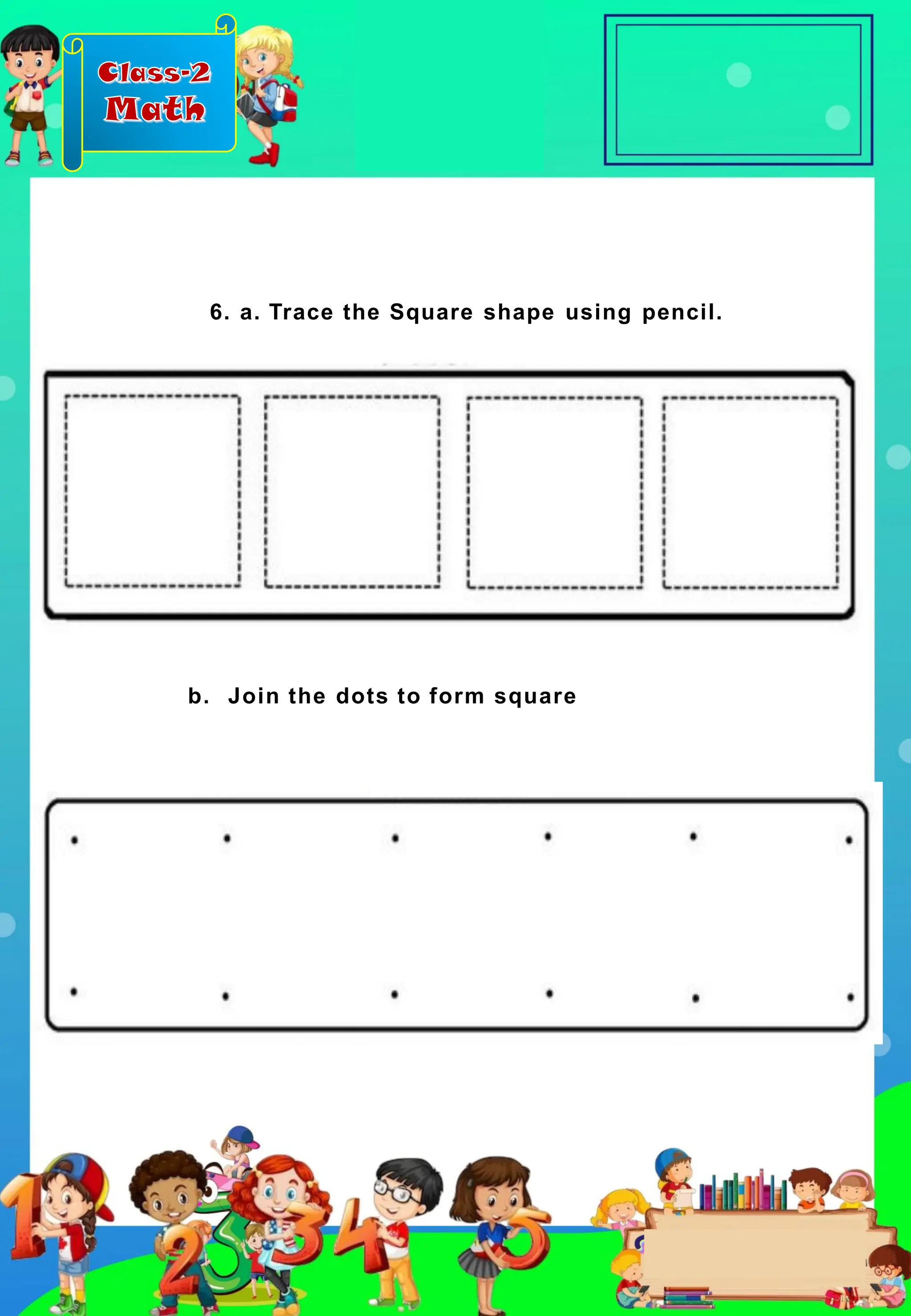
6. a. Trace the Square shape using pencil.
b. Join the dots to form square
Class-2
Math
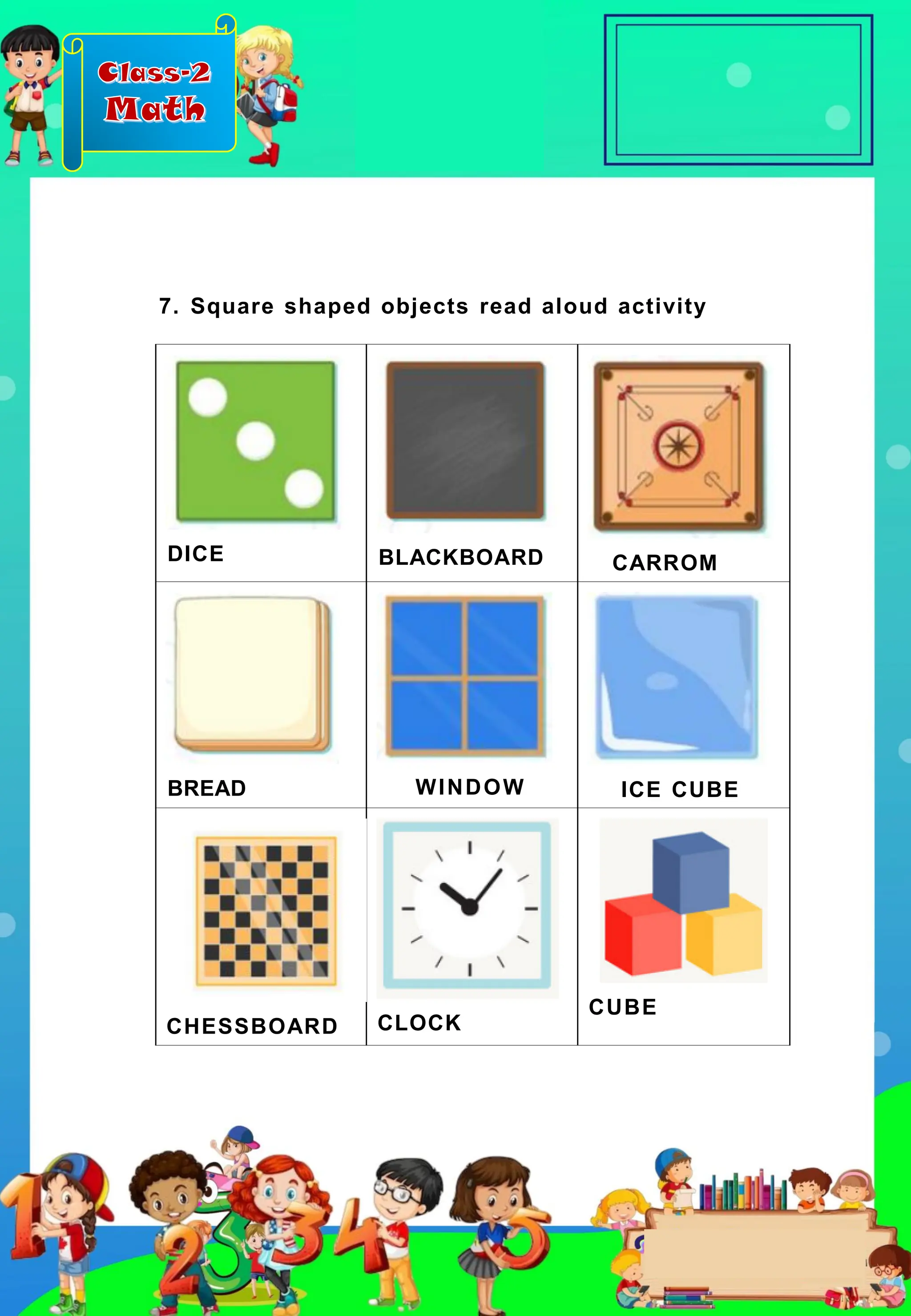
DICE BLACKBOARD CARROM
BREAD WINDOW ICE CUBE
CHESSBOARD CLOCK
CUBE
7. Square shaped objects read aloud activity
Class-2
Math
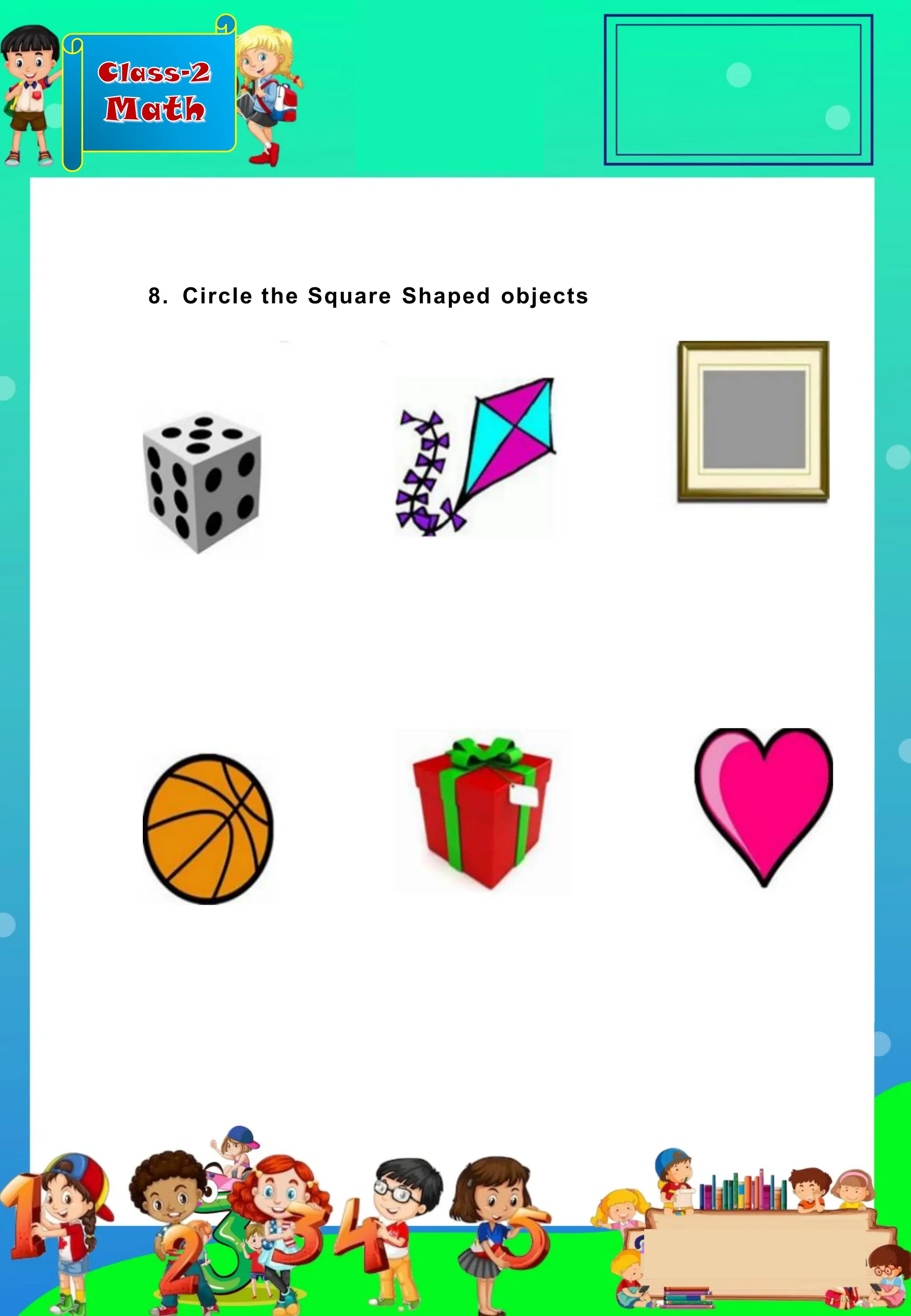
8. Circle the Square Shaped objects
Class-2
Math
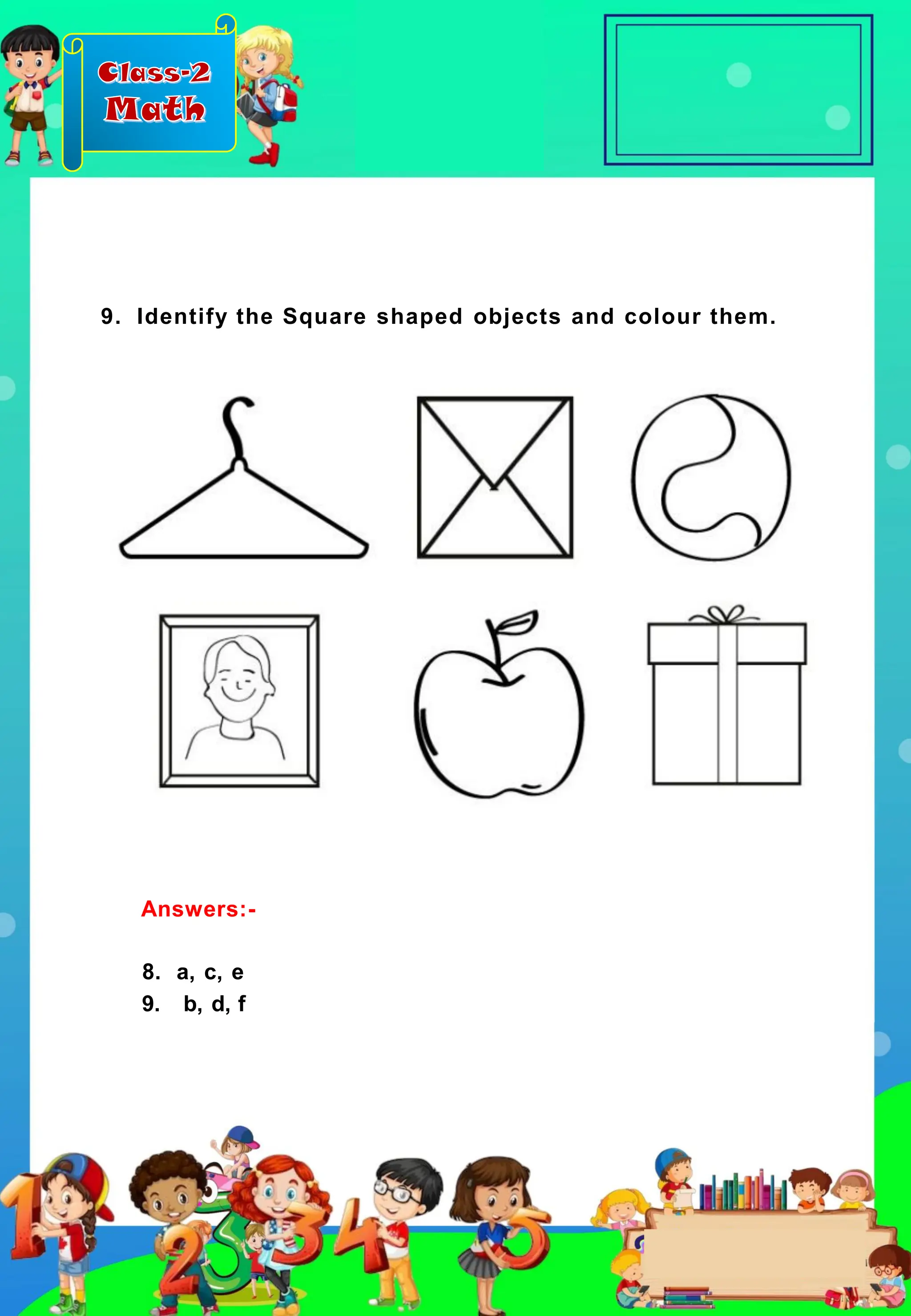
9. Identify the Square shaped objects and colour them.
8. a, c, e
9. b, d, f
Answers:-
Class-2
Math
Sharing is Caring
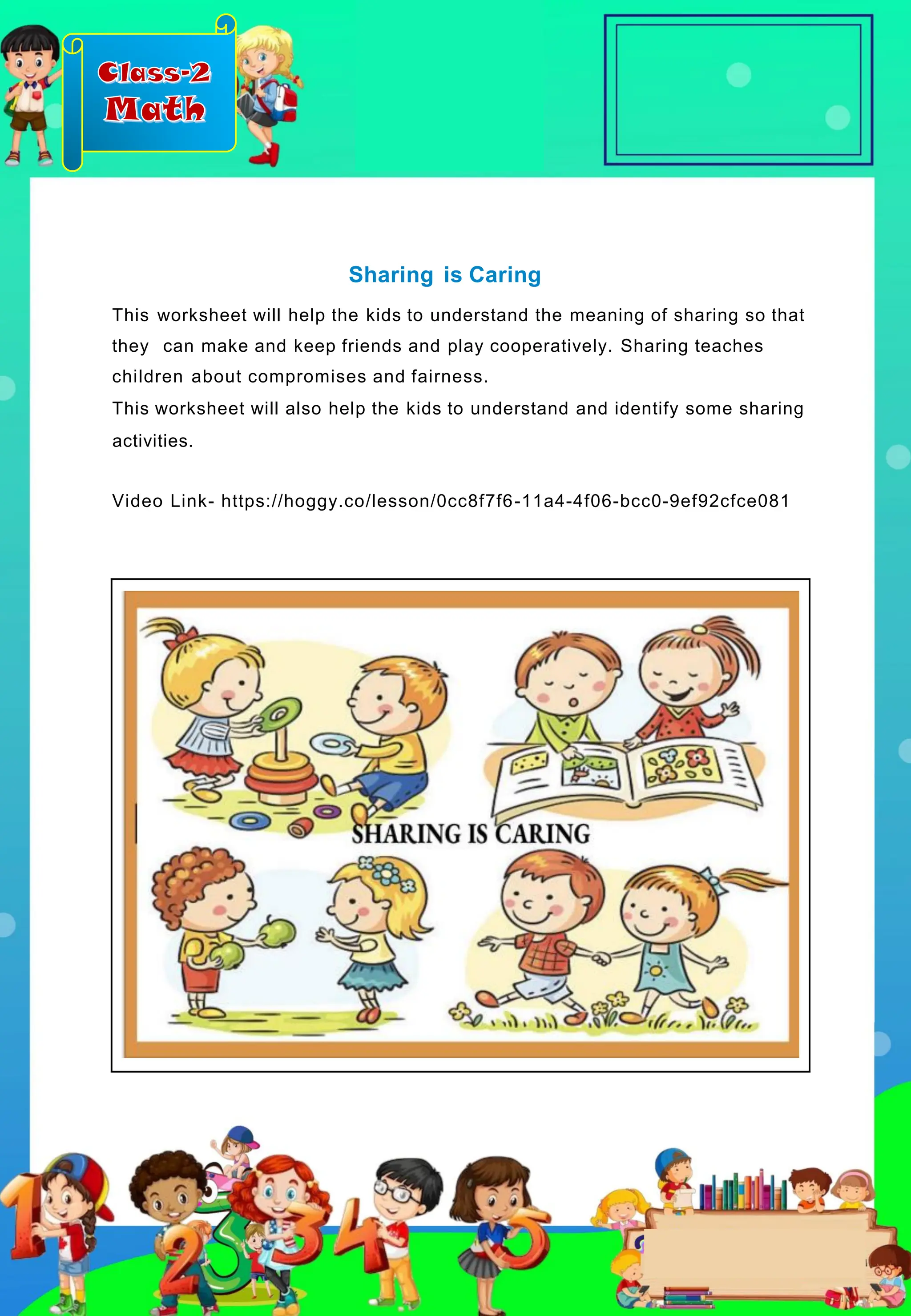
This worksheet will help the kids to understand the meaning of sharing so that
they can make and keep friends and play cooperatively. Sharing teaches
children about compromises and fairness.
This worksheet will also help the kids to understand and identify some sharing
activities.
Video Link- https://hoggy.co/lesson/0cc8f7f6-11a4-4f06-bcc0-9ef92cfce081
Class-2
Math
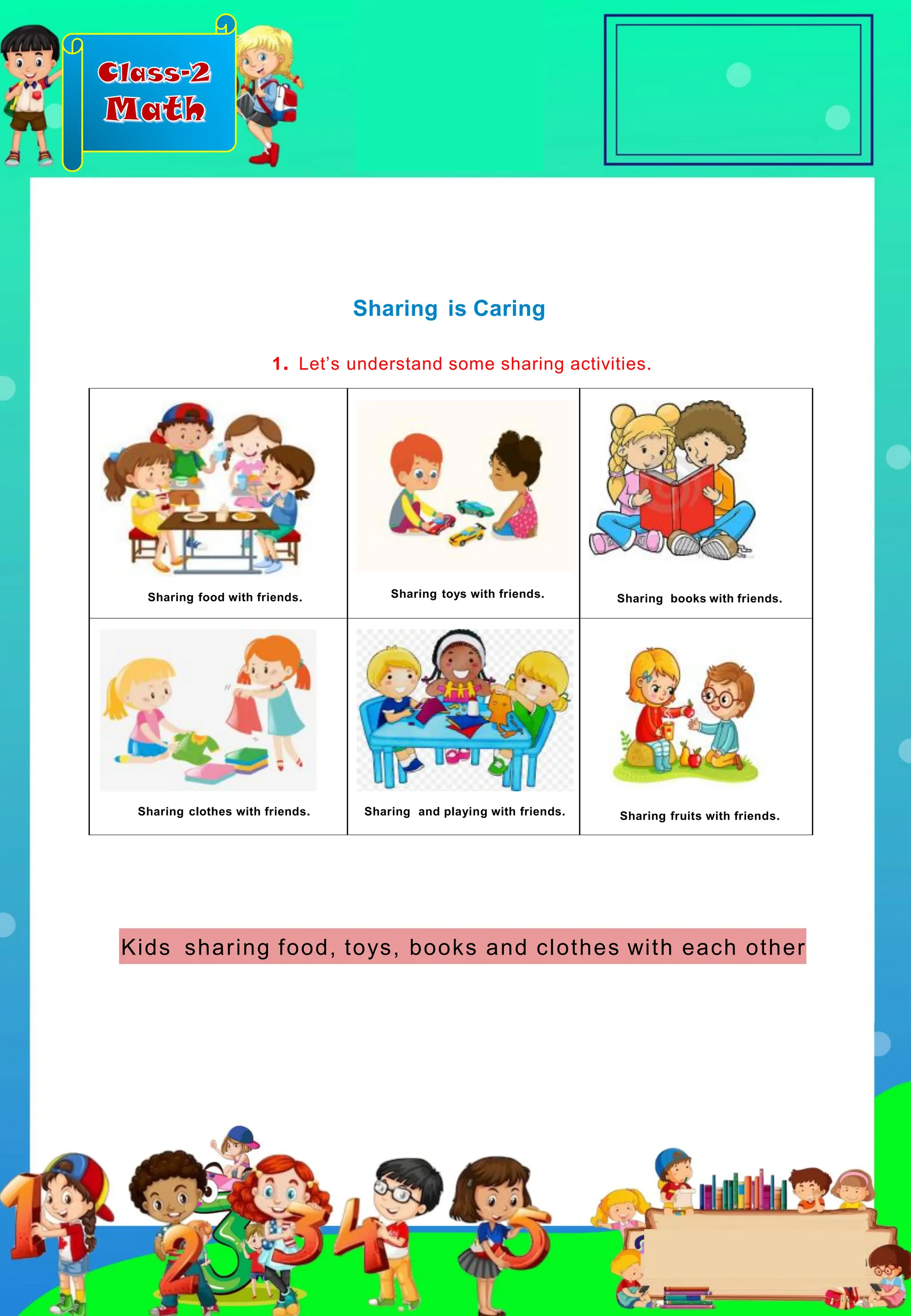
Sharing food with friends. Sharing toys with friends. Sharing books with friends.
Sharing clothes with friends. Sharing and playing with friends. Sharing fruits with friends.
Sharing is Caring
1. Let’s understand some sharing activities.
Kids sharing food, toys, books and clothes with each other
Class-2
Math
Sharing is Caring
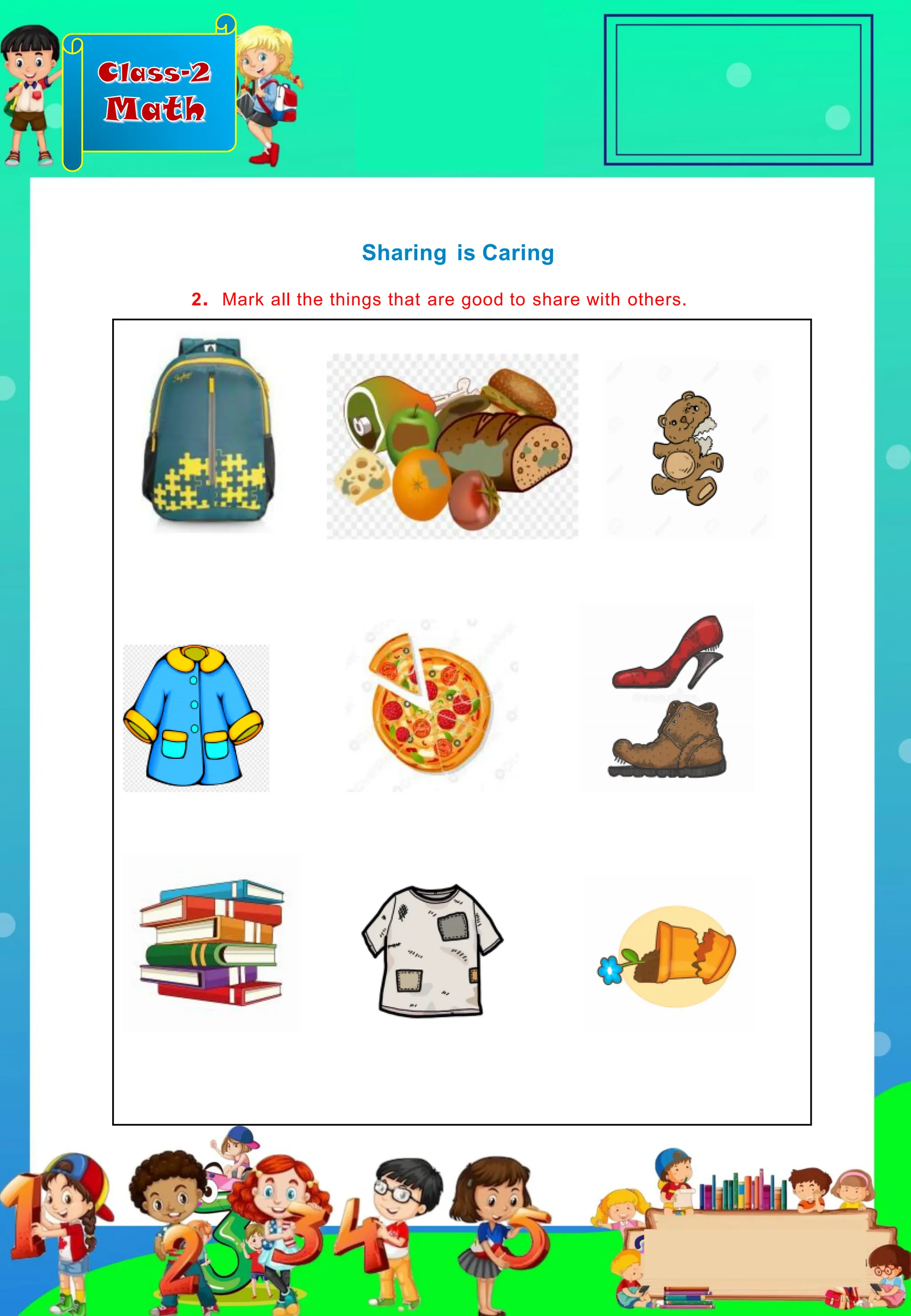
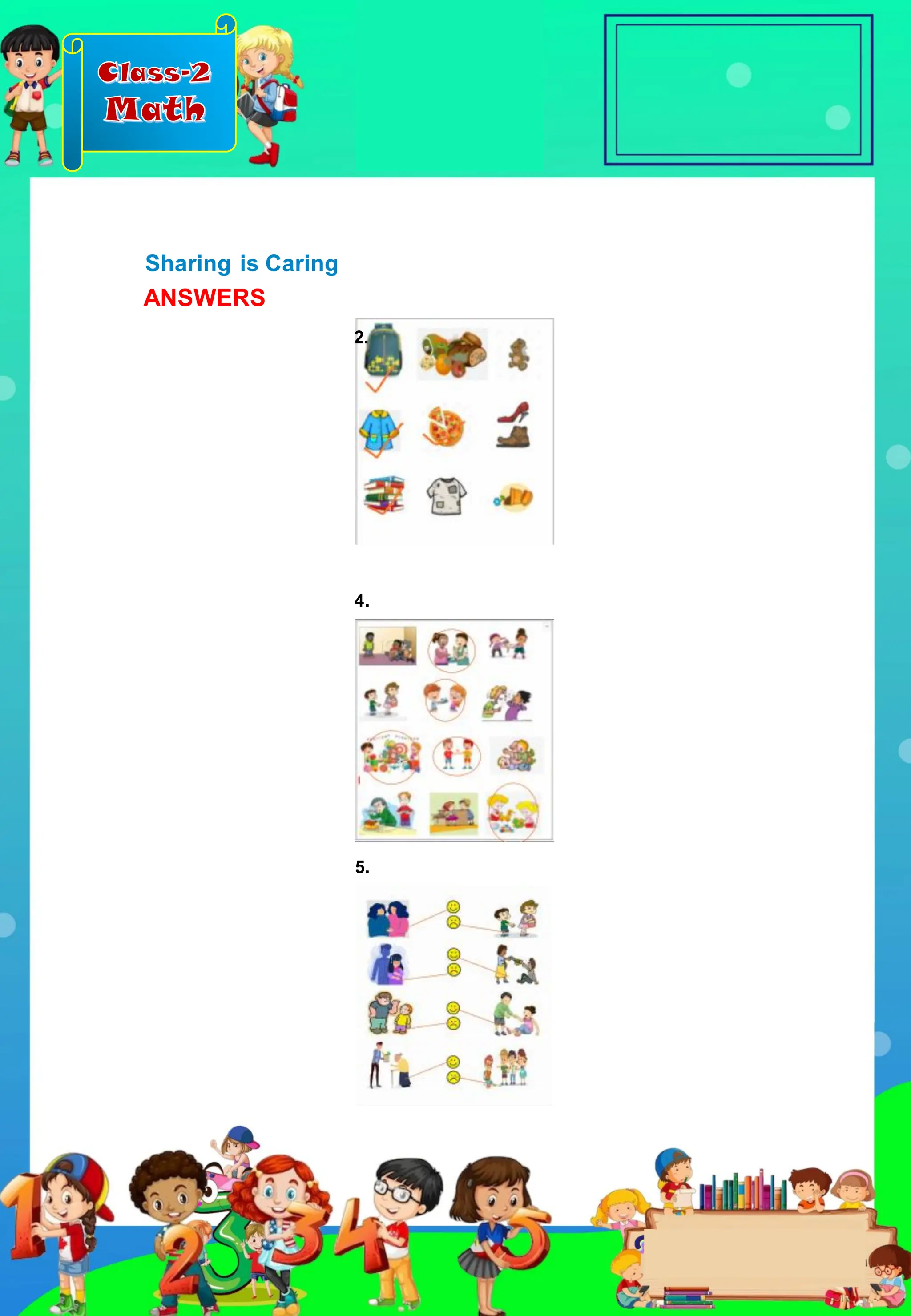
2. Mark all the things that are good to share with others.
Class-2
Math
Sharing is Caring
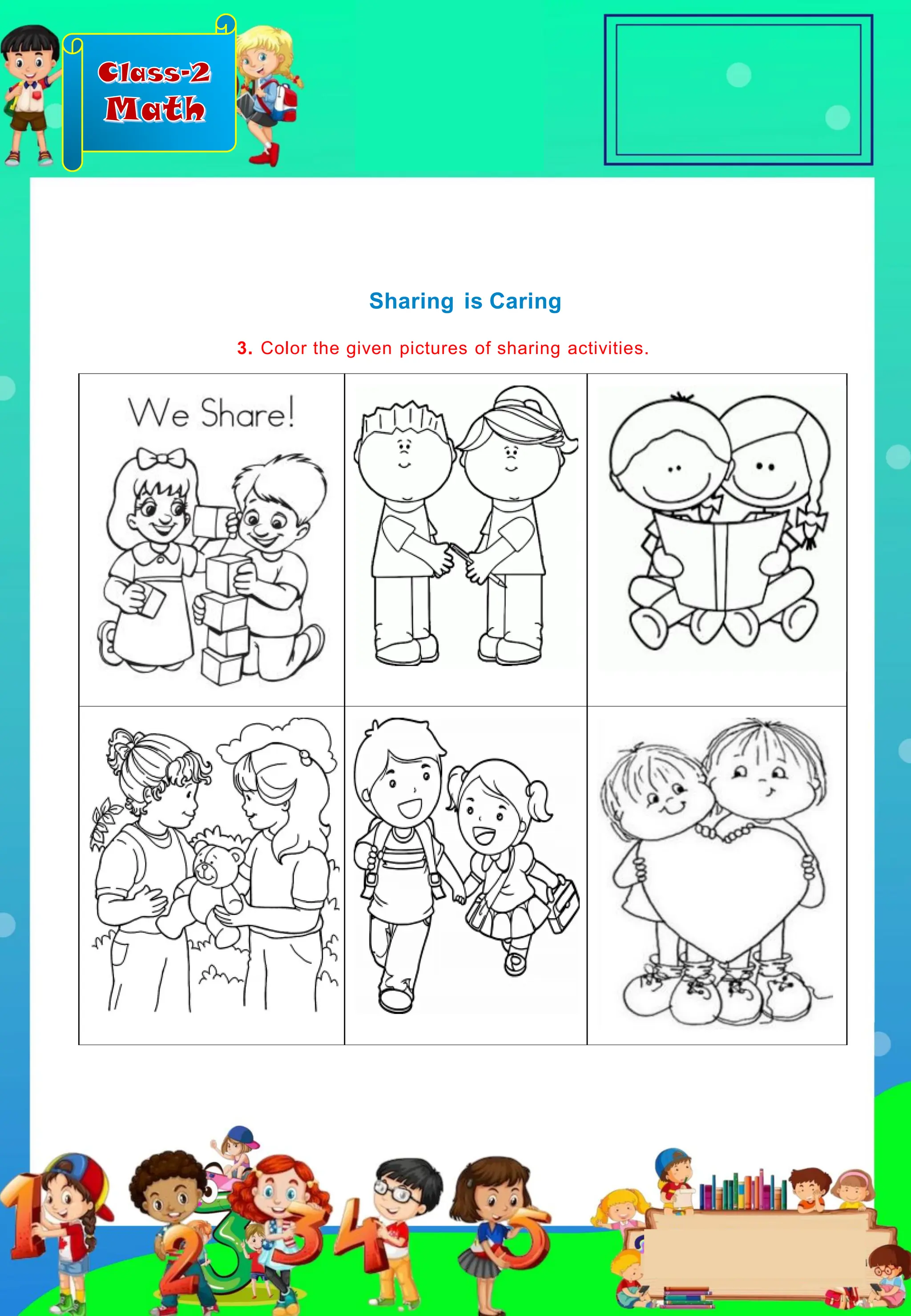
3. Color the given pictures of sharing activities.
Class-2
Math
Sharing is Caring
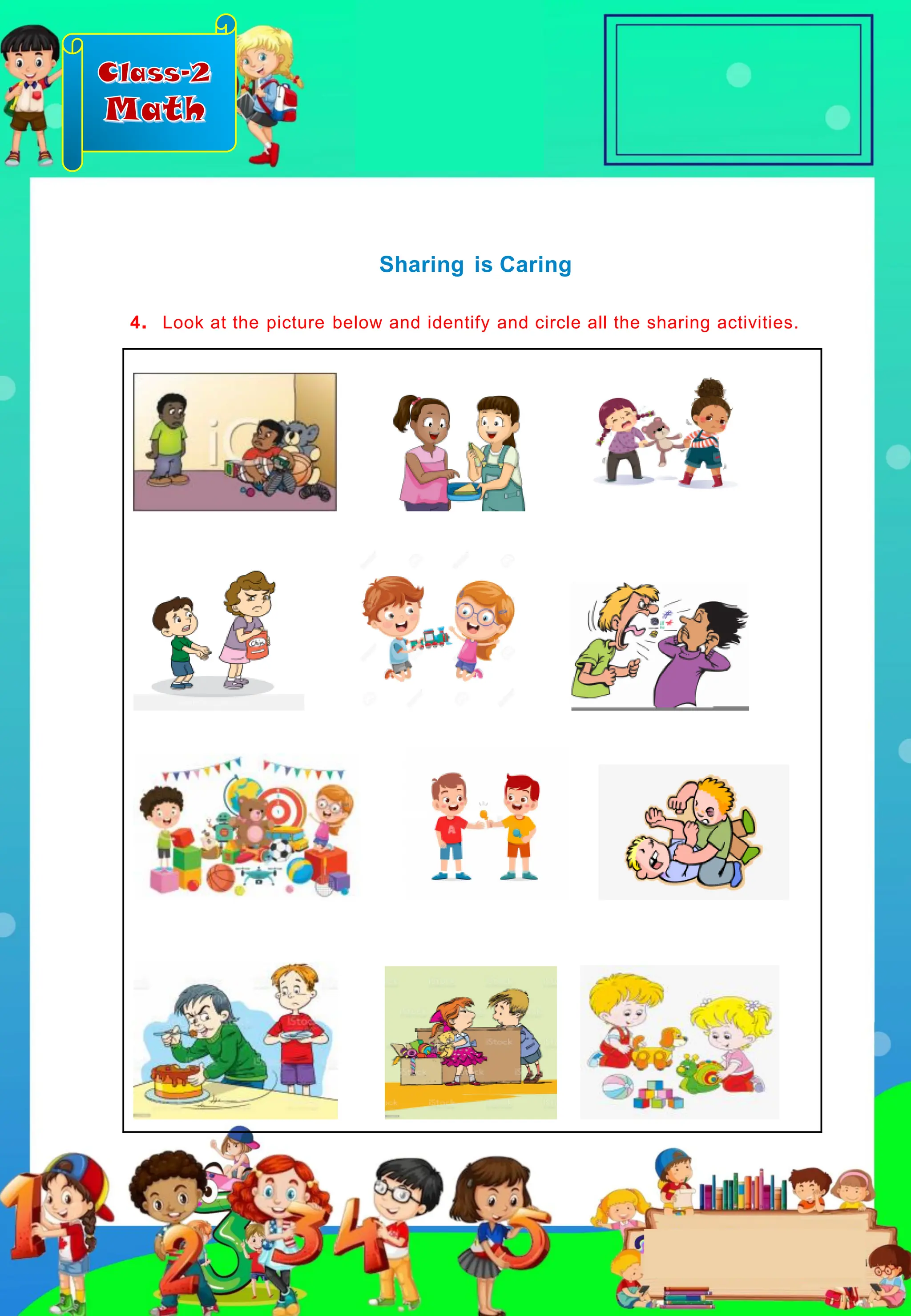
4. Look at the picture below and identify and circle all the sharing activities.
Class-2
Math
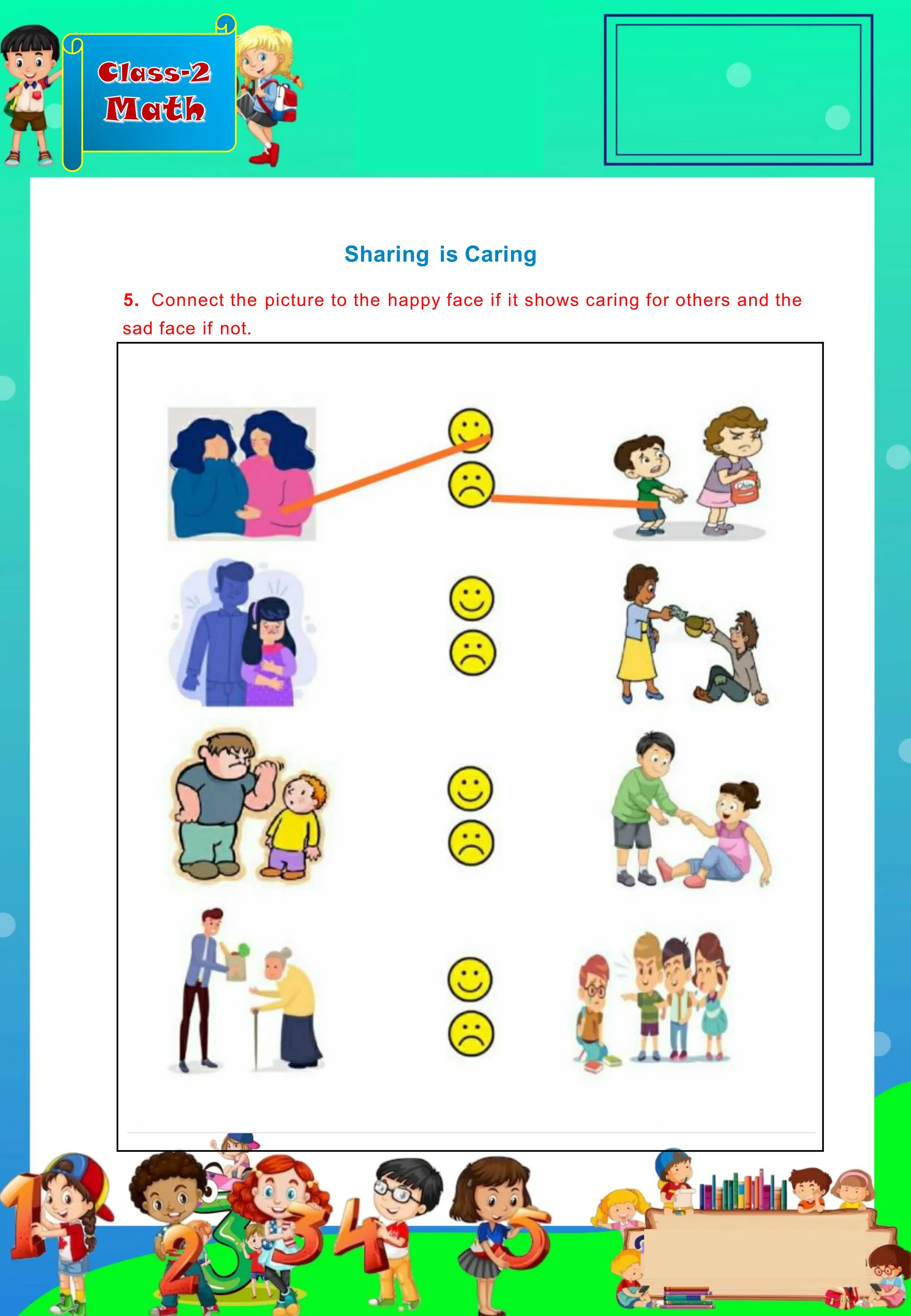
5. Connect the picture to the happy face if it shows caring for others and the
sad face if not.
Sharing is Caring
Class-2
Math
Sharing is Caring
ANSWERS
2.
4.
5.
Class-2
Math
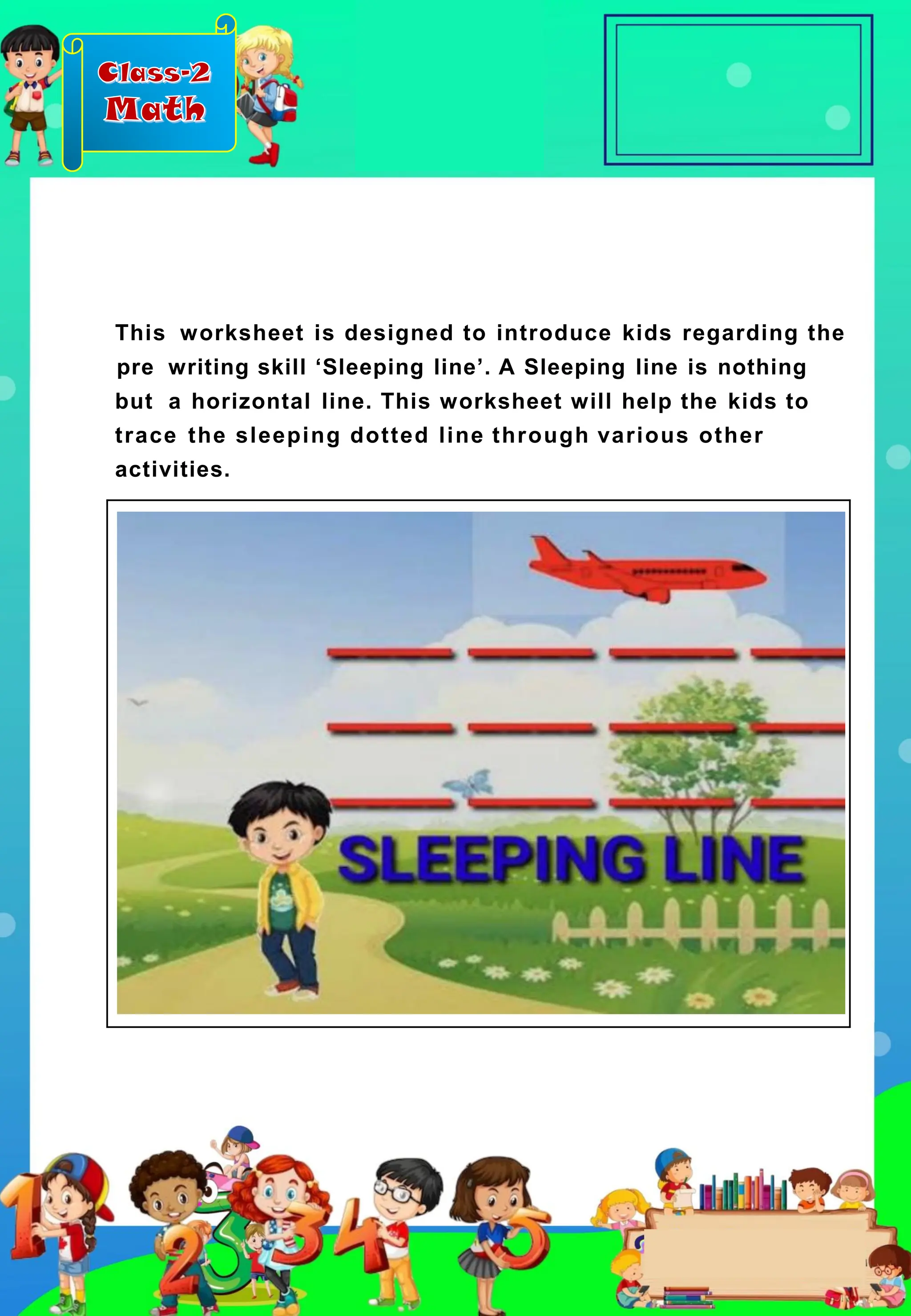
This worksheet is designed to introduce kids regarding the
pre writing skill ‘Sleeping line’. A Sleeping line is nothing
but a horizontal line. This worksheet will help the kids to
trace the sleeping dotted line through various other
activities.
Class-2
Math
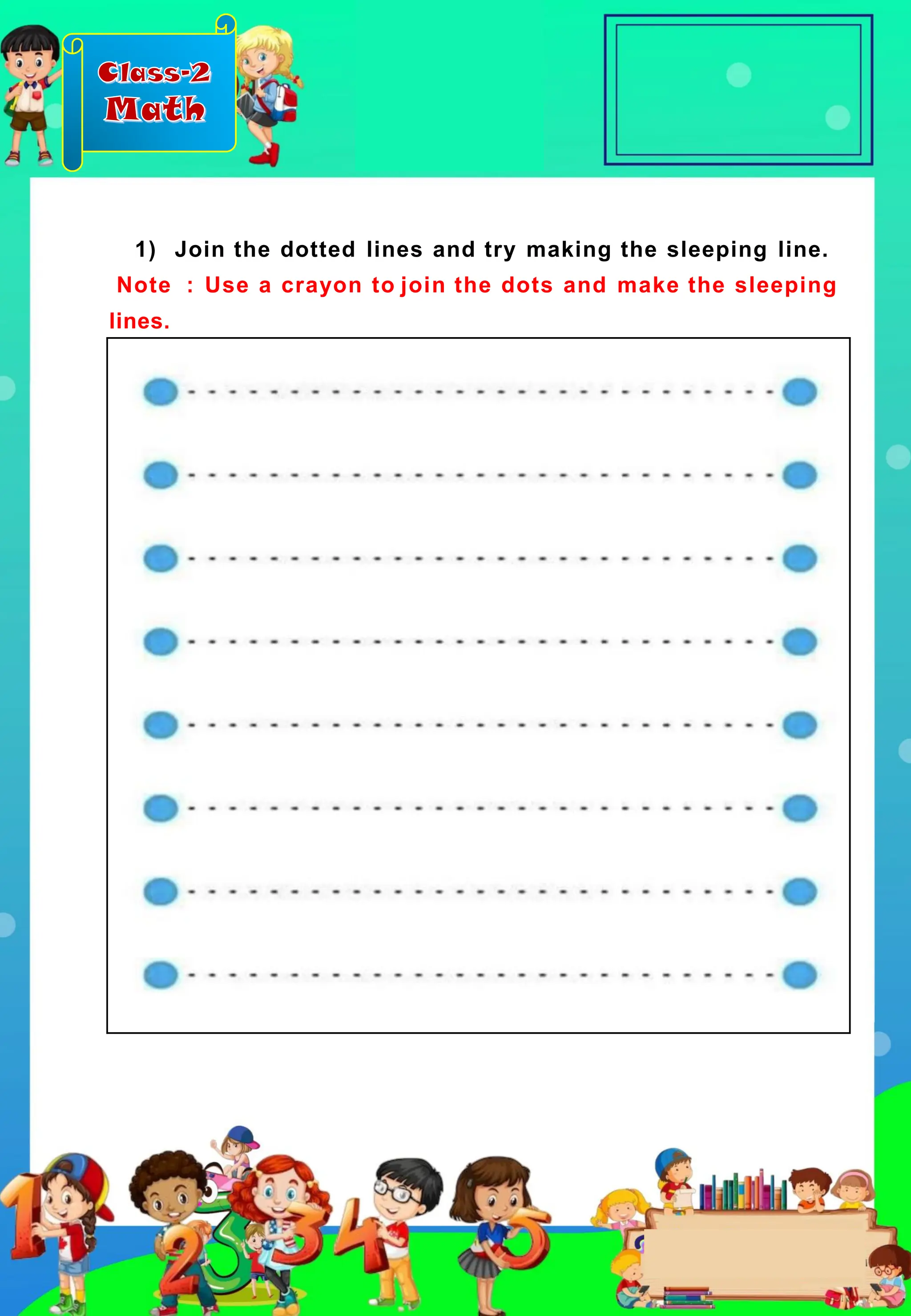
1) Join the dotted lines and try making the sleeping line.
Note : Use a crayon to join the dots and make the sleeping
lines.
Class-2
Math
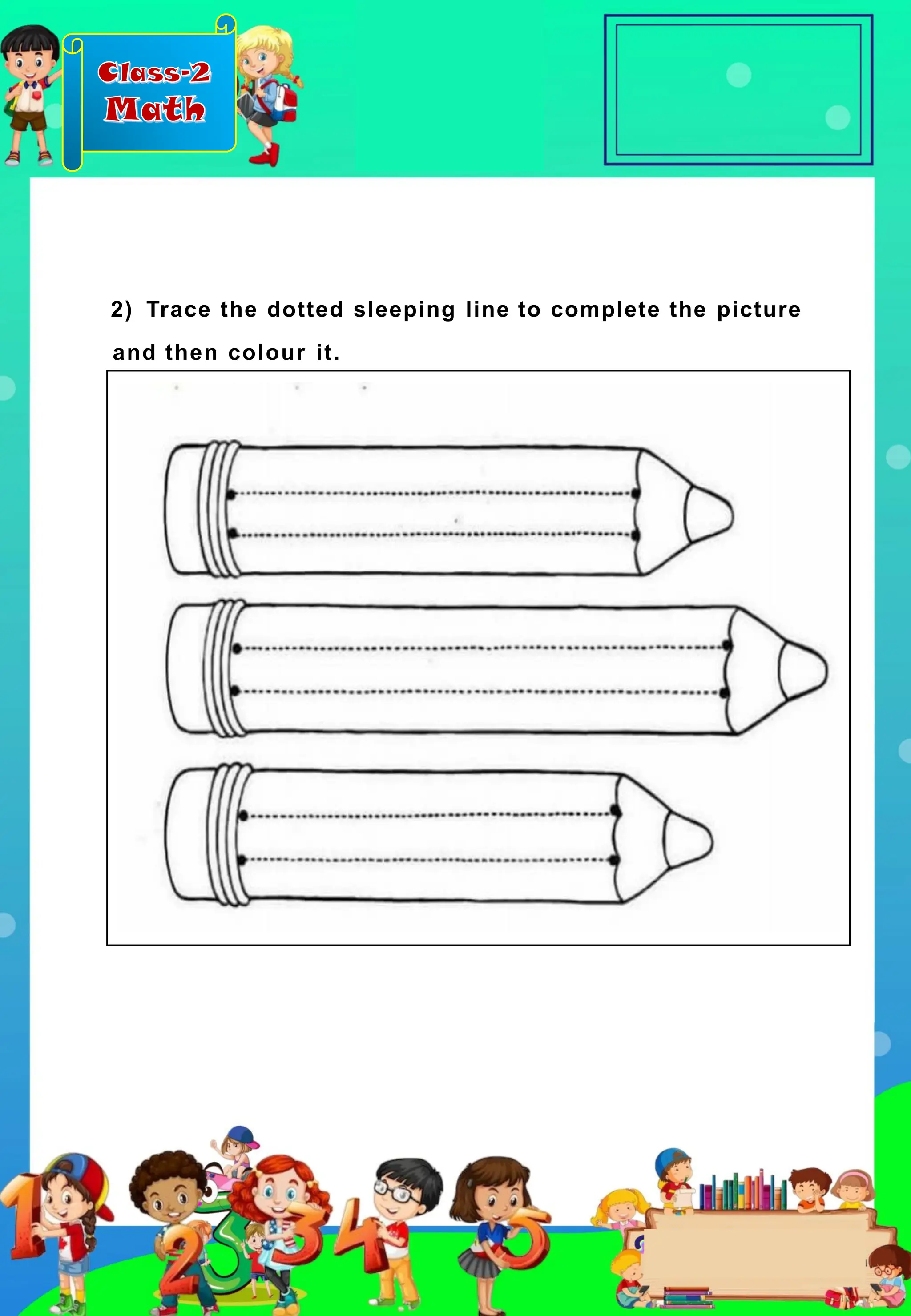
2) Trace the dotted sleeping line to complete the picture
and then colour it.
Class-2
Math
3) Move from left to right and help the animals find their
food by tracing the sleeping lines.
Class-2
Math
1)
2)
3) 4)
4) Identify the sleeping line from the following.
Answers
4) 3
Class-2
Math
This worksheet is designed to introduce Standing Lines to
the kids with interesting identification activities and to
make them familiarise with standing lines, and help your
child on how to draw standing lines using pencils to get
pencil grip
Class-2
Math
1. Match the leaves given above with the
corresponding leaves given below by drawing a
standing line.
Class-2
Math
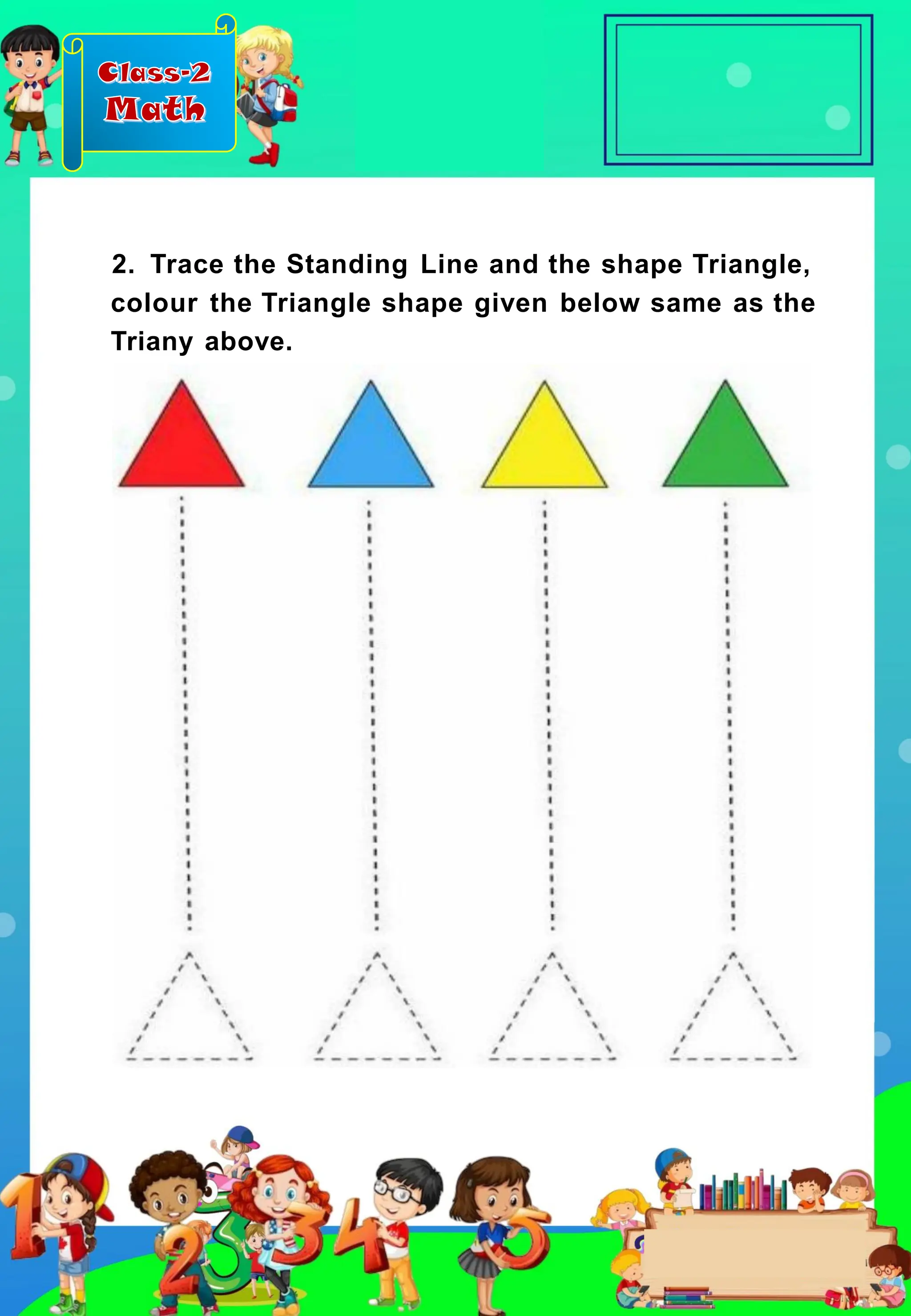
2. Trace the Standing Line and the shape Triangle,
colour the Triangle shape given below same as the
Triany above.
Class-2
Math
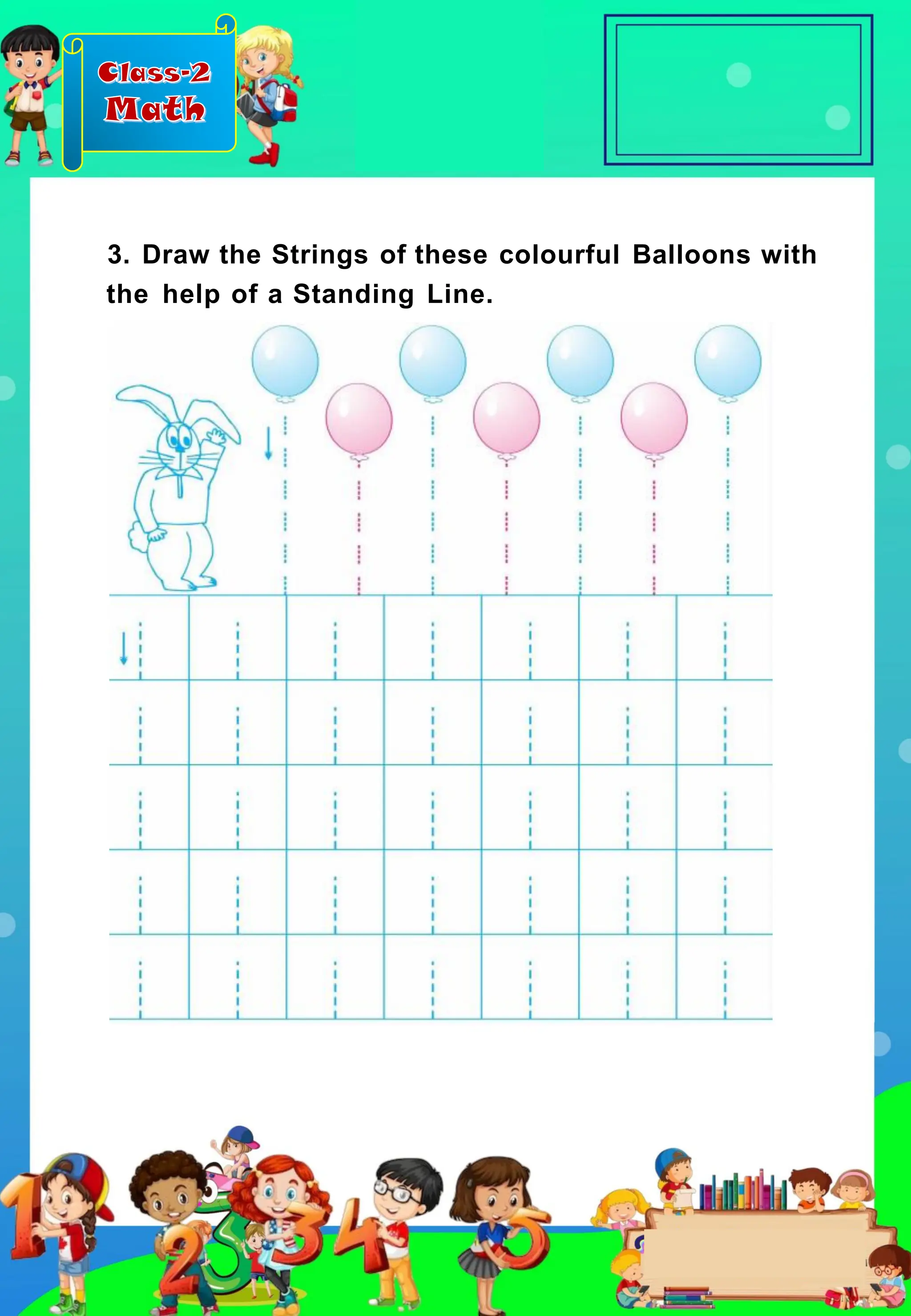
3. Draw the Strings of these colourful Balloons with
the help of a Standing Line.
Class-2
Math
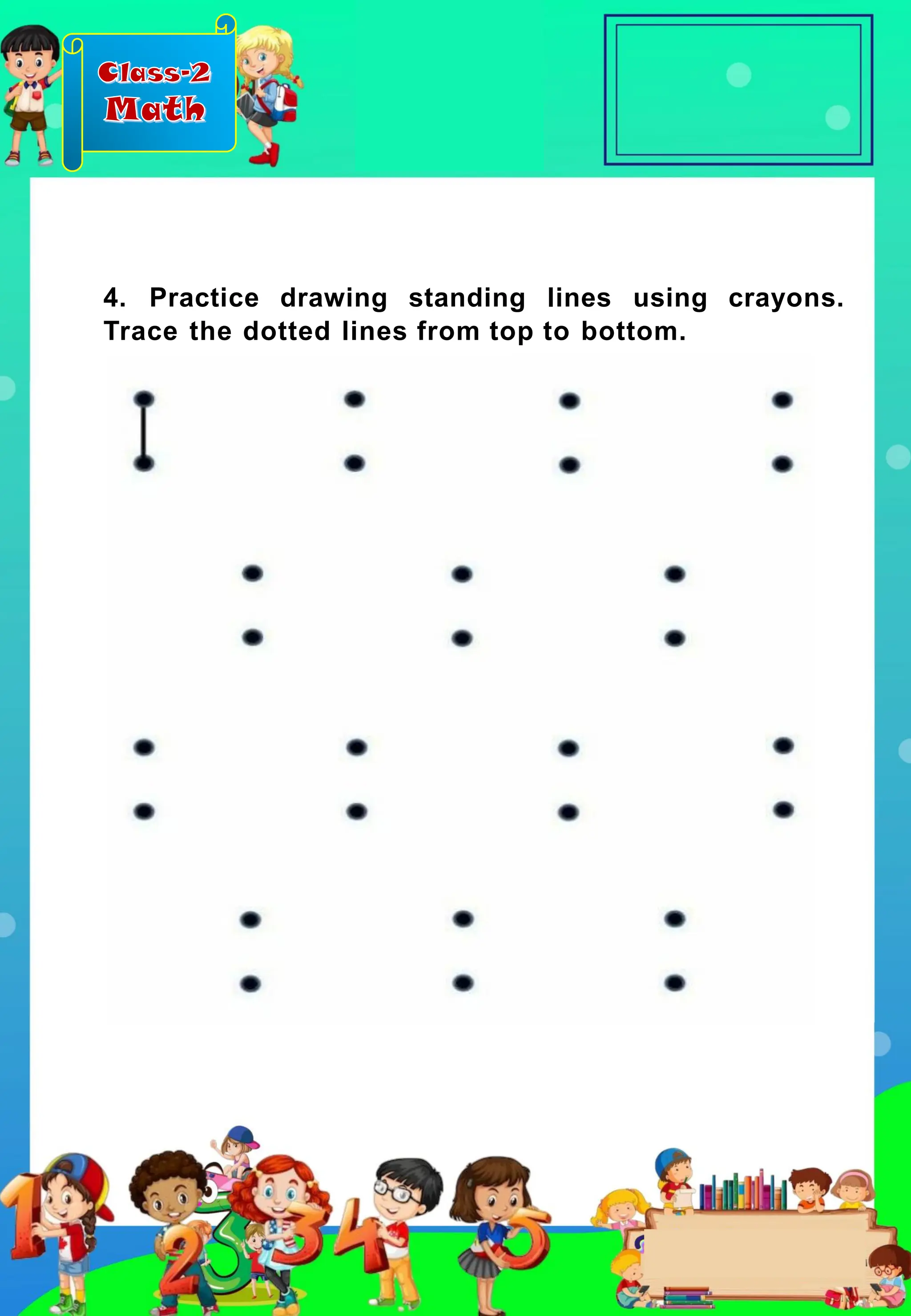
4. Practice drawing standing lines using crayons.
Trace the dotted lines from top to bottom.
Class-2
Math
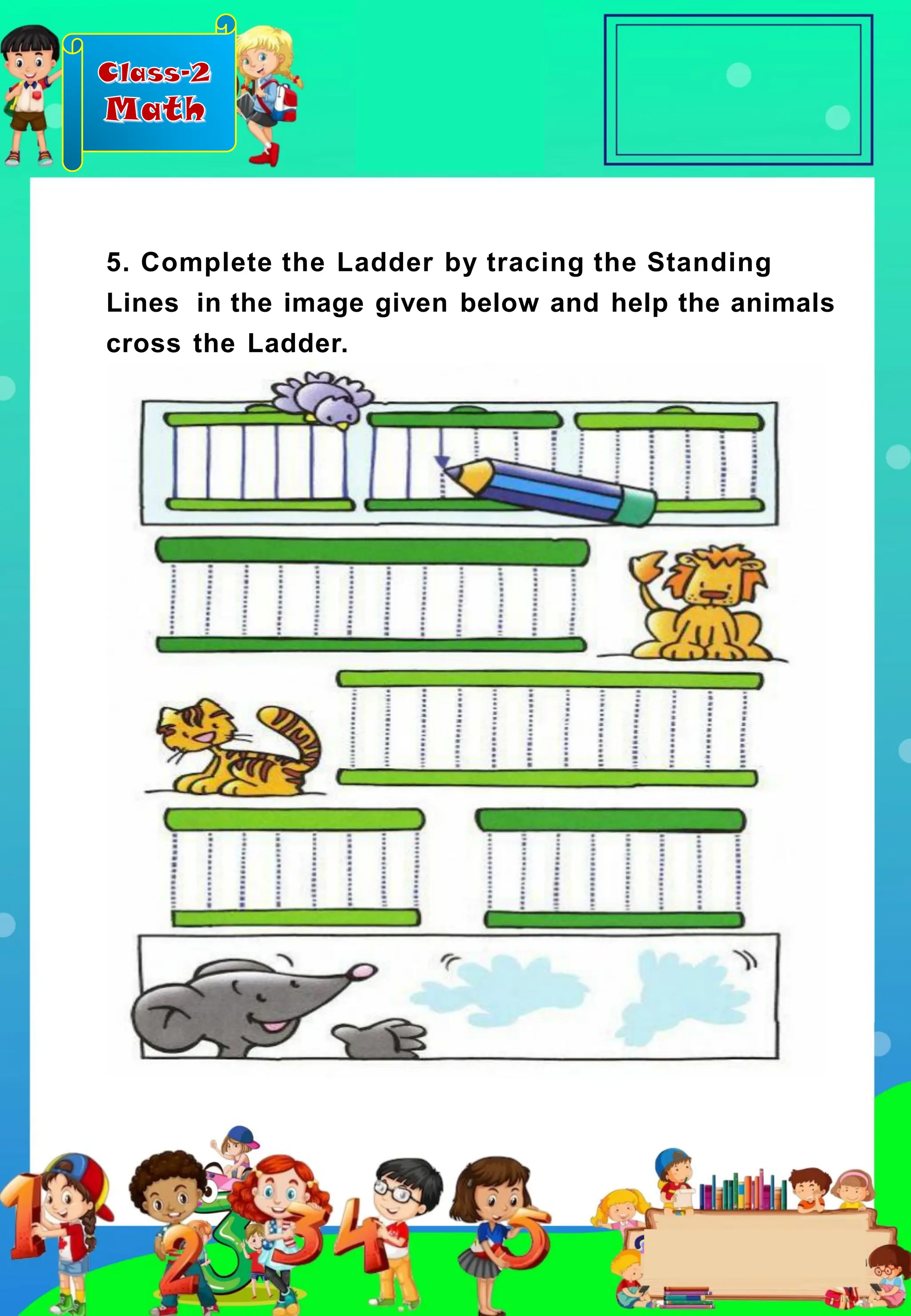
5. Complete the Ladder by tracing the Standing
Lines in the image given below and help the animals
cross the Ladder.
Class-2
Math
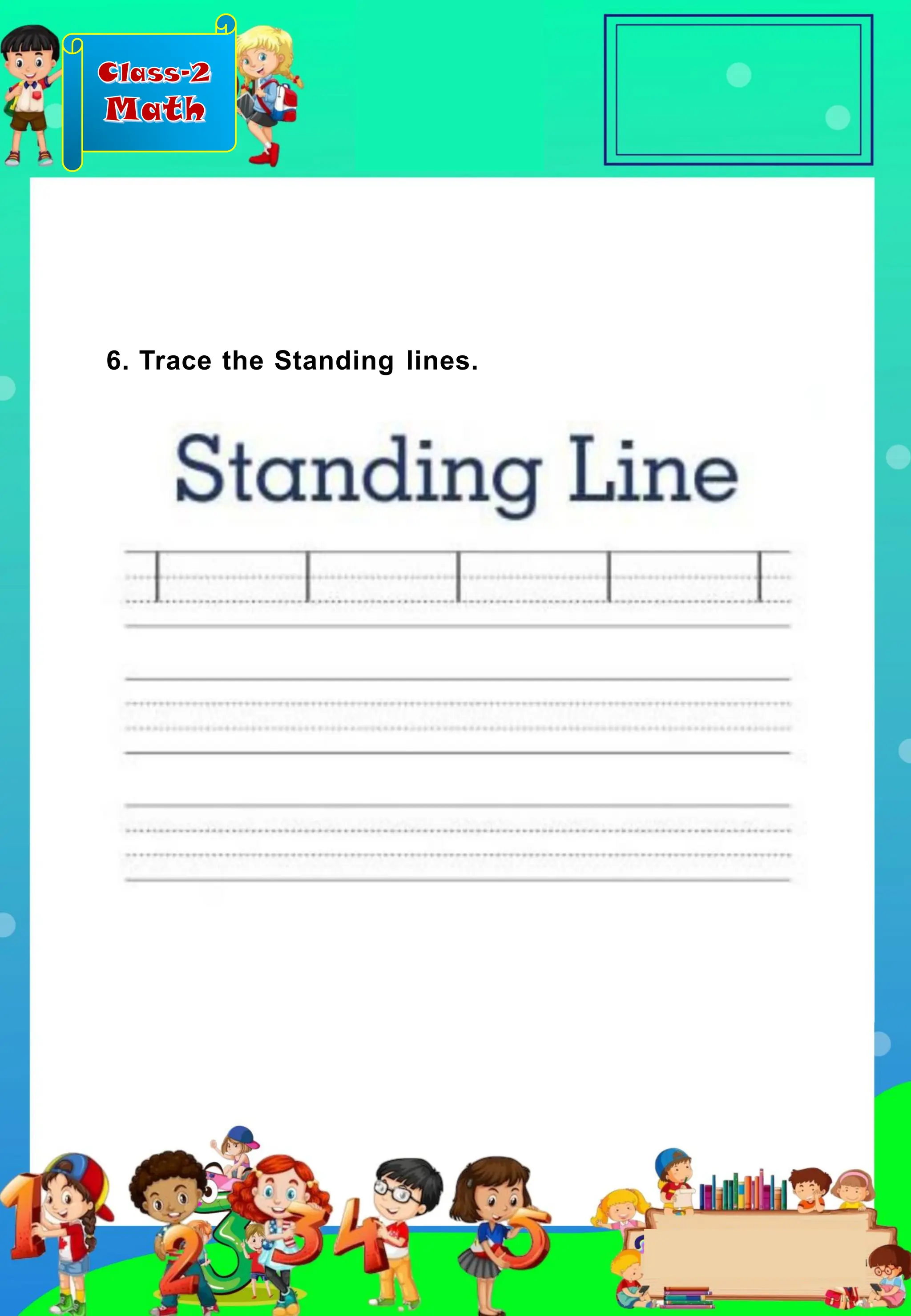
6. Trace the Standing lines.
Class-2
Math
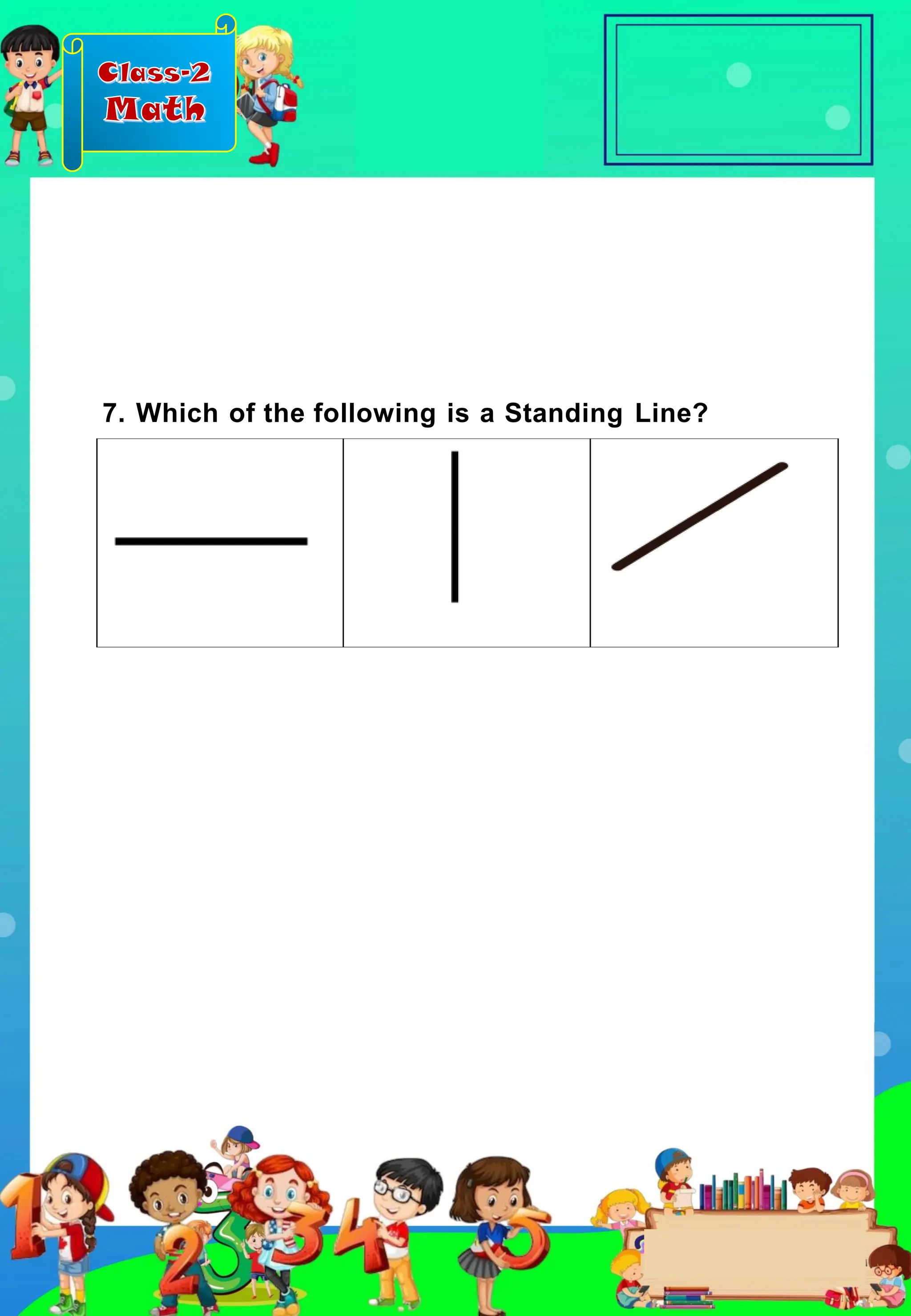
7. Which of the following is a Standing Line?
Class-2
Math
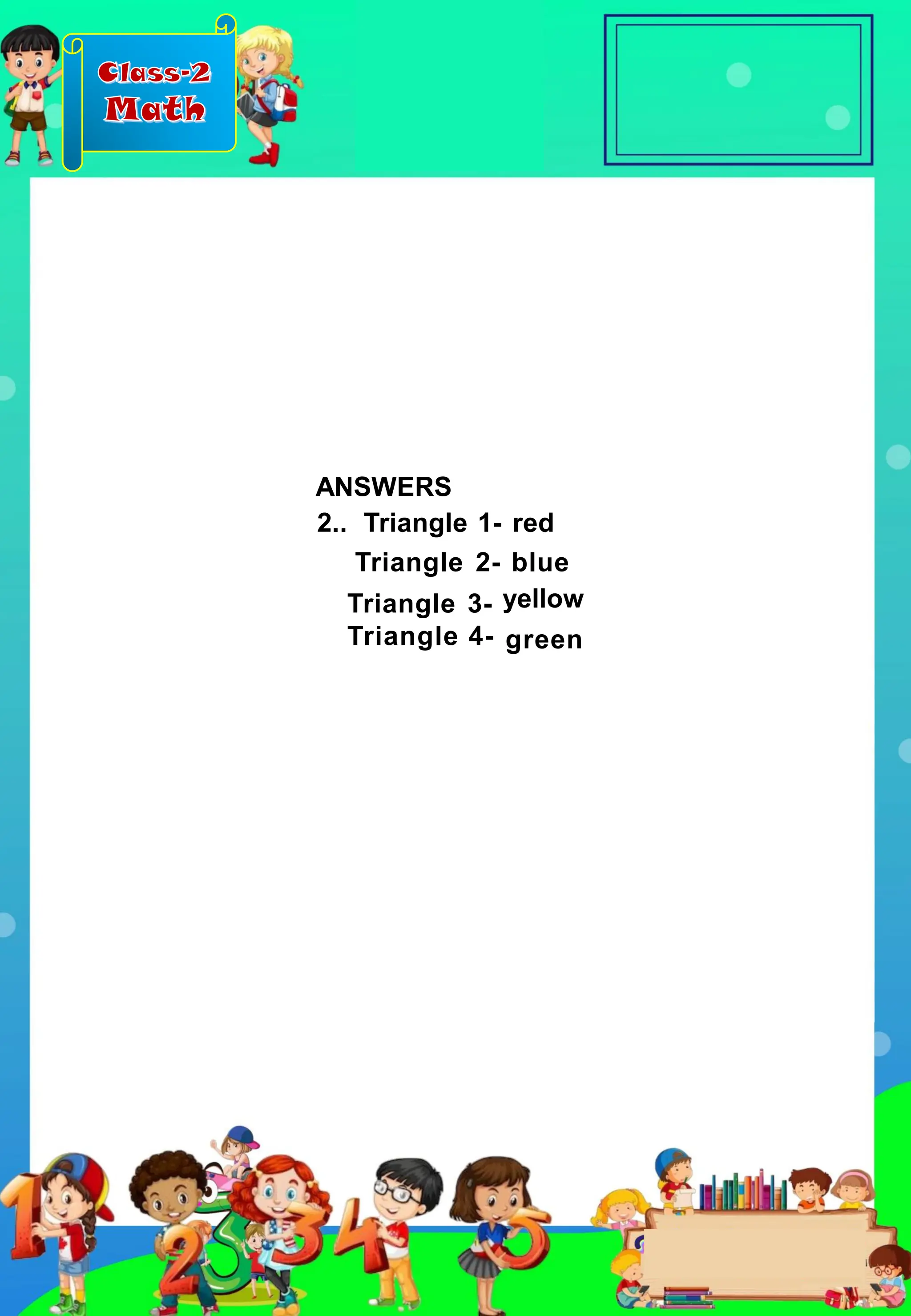
ANSWERS
2.. Triangle 1- red
Triangle 2- blue
Triangle 3-
Triangle 4-
yellow
green

Grade 2 - Mathematics - Printable Worksheet

  • 1.
    Class-2 Math Subtraction of 3Digit Numbers (Without Borrowing) • Subtraction of 3 Digit Numbers (Without Borrowing) • Subtraction of 3 Digit Numbers (Without Borrowing) - QuestionsPage Subtraction of 3 Digit Numbers (Without Borrowing) Subtract 431 from 641 Step1. Place the number one below the other. H T O 6 4 1 - 4 3 1 0 H T O 6 4 1 - 4 3 1 1 ones - 1 ones = 0 ones Step2. Subtract the ones .
  • 2.
    Class-2 Math Step4. Subtract thehundreds H T O 6 4 1 - 4 3 1 2 1 0 Step3. Subtract the tens H T O 6 4 1 - 4 3 1 1 0 6 hundreds - 4 hundreds = 2 hundreds 4 tens - 3 tens = 1 tens .
  • 3.
    Class-2 Math H T O 78 2 - 3 2 1 H T O 9 6 5 - 6 1 1 H T O 8 2 6 - 3 0 2 H T O 9 9 4 - 5 5 1 H T O 9 4 4 - 7 1 2 H T O 9 4 5 - 7 2 2 H T O 9 5 4 - 4 0 3 H T O 9 5 5 - 8 0 3 H T O 8 3 6 - 4 1 3 H T O 9 5 4 - 5 1 1 H T O 9 6 5 - 9 0 4 H T O 8 4 6 - 5 1 4 H T O 7 4 2 - 7 0 2 H T O 8 5 3 - 4 5 1 H T O 9 7 5 - 2 7 5 H T O 8 6 6 - 6 5 5 Subtraction of 2 Digit Numbers Without Borrowing .
  • 4.
    Class-2 Math As 5 issmaller than 8, we cannot subtract 8 from 5. So, 1 ten is borrowed from the tens column. Now, 1 ten = 10 ones, which means 10 ones + 5 ones = 15 ones. We have 15 ones and we can subtract 8 ones from 15 ones. 15 ones – 8 ones = 7 ones 7 is written in the ones column of the answer Subtraction of 3 Digit Numbers (With Borrowing) Subtraction of 3 Digit Numbers (With Borrowing) Subtract 128 from 645 Step1. Place the number one below the other. Step2. Subtract the ones Step3. Subtract the tens .
  • 5.
    Class-2 Math After borrowing 1ten from tens column, we have 3 tens (4 -1=3 tens) in the tens column. Now subtract the tens 3 tens – 2 tens = 1 tens 1 is written in the tens column of the answer Step4. Subtract the hundreds Now subtract the hundreds 6 hundreds – 1 hundreds = 5 hundreds .
  • 6.
    Class-2 Math H T O 72 6 - 4 3 7 H T O 9 6 5 - 7 8 8 H T O 8 2 4 - 5 8 8 H T O 9 5 7 - 7 9 8 H T O 9 4 7 - 4 6 9 H T O 9 4 5 - 8 6 9 H T O 9 5 5 - 5 6 6 H T O 9 5 4 - 7 9 5 H T O 8 3 4 - 5 8 9 H T O 9 5 5 - 6 7 7 H TO 9 6 4 - 6 7 6 H T O 8 4 3 - 6 9 4 H T O 7 4 6 - 3 7 8 H T O 8 5 6 - 6 6 9 H T O 9 7 4 - 7 8 7 H T O 8 4 3 - 7 5 4 Subtraction of2 Digit Numbers With Borrowing .
  • 7.
    Class-2 Math Place Value (3digit Number) The value of a digit because of its place or position in a number is called its place value. Let’s consider number 145. Arrange the digits in place value chart as given below. Place value chart Number such as 145, have three digits and each digit has a different place value, Place value of 1 is 1 hundred = 100 (1 set of hundred) Place value of 4 is 4 tens = 40 (4 sets of tens) Place value of 5 is 5 ones = 5 (5 sets of ones) Place Value and Expanded Form of 3 Digit Numbers .
  • 8.
    Class-2 Math Expanded form isa way to write a number that shows the sum of values of each digit of a number. The expanded form of 145 is 100 + 40 + 5 OR 1 hundred + 4 tens + 5 ones .
  • 9.
    Class-2 Math 201 _ 525 804 _ 107_ 501 _ 406 _ 278 Write the place and place values ofthe underlined digits for the following: Numerals 114 342 708 681 169 343 Write the following in expanded form: _ _ Place value Place _ .
  • 10.
    Class-2 Math Addition of 3Digit Numbers (Without Carry Over) Add 234 and 321 Step1. Place the number one below the other. H T O 2 3 4 + 3 2 1 5 5 Step2. Add the ones H T O 2 3 4 + 3 2 1 5 H T O 2 3 4 + 3 2 1 4 ones and 1 ones make 5 ones Step3. Add the tens Addition of 3 Digit Numbers (Without Carry Over) 3 tens and 2 tens make 5 tens .
  • 11.
    Class-2 Math Step4. Add thehundreds H T O 2 3 4 + 3 2 1 5 5 5 2 hundreds and 3 hundreds make 5 hundreds .
  • 12.
    Class-2 Math H T O 12 3 + 5 1 3 H T O 1 3 3 + 6 3 4 H T O 1 4 3 + 7 1 5 H T O 2 13 +1 2 1 H T O 2 4 4 + 4 4 4 H T O 1 5 3 + 8 2 6 H T O 1 1 3 + 3 2 2 H T O 2 5 4 + 5 4 5 H T O 3 1 5 + 2 8 4 H T O 2 2 4 +2 1 2 H T O 2 3 4 +3 1 3 H T O 2 1 4 +1 1 1 H T O 1 0 1 +1 4 4 +6 3 1 +1 9 3 +7 2 2 Addition of2 digit numbers without carry over H T O 2 6 5 H T O 2 7 5 H T O 3 0 5 .
  • 13.
    Class-2 Math Multiplication - 2Digit by 1 Digit Number (Without carry over) Example : 32 x 2 Step 1: Place larger number above the smaller number so that the tens' and ones' places are lined up. Write the multiplication sign below the top number and draw a line below the bottom number. Step 2: Multiply the number in the ones' place of the bottom number with the number in the ones' place of the top number; 2x2 =4; write 4 in the ones place. Step 3: Multiply the number in the ones' place of the bottom number with the number in the tens place of the top number; 2x3 =6; write 6 in the tens place. Multiplication - 2 Digit by 1 Digit Number .
  • 14.
    Class-2 Math Step 1 :Place larger number above the smaller number so that the tens' and ones' places are lined up. Write the multiplication sign below the top number and draw a line below the bottom number. Step2: Multiply the number in the ones' place of the bottom number with the number in the ones' place of the top number; 5x2 =10; write 0 in the ones place and carry 1 to tens’ column. 2 Digit Numbers by 1 Digit Number (With Carry Over) Example: 12 x 5 .
  • 15.
    Class-2 Math When we multiplya number by 10, we add 1 zero on its right side. 55 x 10 = 550 When we multiply a number by 100, we add two zero on its right side. 5 x 100 = 500 When we multiply a number by zero or zero by any number, the product is always zero 0 x 45 = 0 78 x 0 = 0 When we multiply a number by one or one by any number, the product is always the number itself. 56 x 1 = 56 1 x 89 = 89 Step3: Multiply the number in the ones' place of the bottom number with the number in the tens place of the top number; 5x 1 =5; 5 is added to the 1 carried over number of tens' place .write 6 in the tens place. .
  • 16.
    Class-2 Math Multiplication of 2Digit by 1 Digit (Without Carry Over) T O 2 1 × 2 T O 2 3 × 3 T O 1 2 × 1 T O 1 3 × 2 T O 2 2 × 2 T O 1 4 × 2 T O 2 4 × 2 T O 2 3 × 2 T O 1 2 × 2 T O 3 0 × 3 T O 2 7 × 3 T O 1 0 × 1 T O 2 1 × 1 T O 1 1 × 1 T O 2 2 × 3 T O 3 1 × 3 .
  • 17.
    Class-2 Math Multiplication of 2Digit by 1 Digit (With Carry Over) Worksheet T O 4 6 × 4 T O 5 6 × 1 T O 3 7 × 3 T O 4 3 × 4 T O 4 7 × 4 T O 4 4 × 4 T O 5 3 × 4 T O 4 5 × 4 T O 5 4 × 4 T O 6 5 × 3 T O 6 5 × 2 T O 3 4 × 3 T O 3 5 × 3 T O 3 6 × 3 T O 5 5 × 4 T O 6 3 × 4 .
  • 18.
    Class-2 Math Multiplication of 3Digit Number by 1 Digit Number (Without carry over) Example : 132 x 3 Step 1 : Place larger number above the smaller number so that the hundreds’, tens' and ones' places are lined up. Write the multiplication sign below the top number and draw a line below the bottom number. Step 3: Multiply the number in the ones' place of the bottom number with the number in the tens place of the top number; 3x3 =9; write 9 in the tens place. Step 2: Multiply the number in the ones' place of the bottom number with the number in the ones' place of the top number; 2x3 =6; write 6 in the ones place. .
  • 19.
    Class-2 Math Note: When we multiplya number by zero or zero by any number, the product is always zero. 0 x 453 = 0 781 x 0 = 0 Step 4 : Multiply the number in the ones' place of the bottom number with the number in the hundreds place of the top number; 3x1 =3; write 3 in the hundreds place. .
  • 20.
    Class-2 Math When we multiplya number by 10, we add 1 zero on its right side. 612 x 10 = 6120 456 x 10 = 4560 When we multiply a number by 100, we add two zero on its right side. 7 x 100 = 700 55 x 100 = 5500 When we multiply a number by one or one by any number, the product is always the number itself. 562 x 1 = 562 1 x 899 = 899 .
  • 21.
    Class-2 Math Multiplication of 3Digit by 1 (Without Carryover) Worksheet 1 H T O 4 21 × 2 H T O 1 23 × 3 H T O 5 1 2 × 1 H T O 2 13 × 2 H T O 2 22 × 2 H T O 3 14 × 2 H T O 3 23 × 2 H T O 4 24 × 2 H T O 1 12 × 2 H T O 3 30 × 3 H T O 2 22 × 3 H T O 2 10 × 1 H T O 3 2 1 × 1 H T O 4 1 1 × 1 H T O 3 22 × 3 H T O 2 31 × 3 .
  • 22.
    Class-2 Math 2 ) ( 68 2) ( 164 3 ) 276 ( 3 ) 186 ( 3 ) 128 ( 3 ) 249 ( 2 ) ( 122 3 ) ( 96 22 106 ( 2 Division ( ÷ ) 2 ) .
  • 23.
    Class-2 Math 4 ) 128( 2 ) ( 208 4 ) 364 ( 4 ) 328 ( 4) ( 408 4 ) 284 ( 3 ) ( 309 4 ) 204 ( 4 ) 244 ( Division ( ÷ ) .
  • 24.
    Class-2 Math 5 ) 305( 5 ) 205 ( 5 ) ( 255 5 ) 405 ( 5 ) 455 ( 5 ) 155 ( 5 ) 105 ( 5 ) 355 ( 5 ) 50 ( Division ( ÷ ) .
  • 25.
    Class-2 Math Concept of Fractions(Halves and Quarters) Concept of Fractions (Halves and Quarters) Half or ½ One of the two equal parts into which anything is divided is called half. Quarter or ¼ Each of the four equal parts into which anything is divided is called quarter. Three out of four equal parts into which anything is divided is called three quarter. Each part of the apple is half (1/2) And Two equal parts together constitute a whole (1 unit) .
  • 26.
    Class-2 Math Fraction of aRectangle In the below rectangle half part (1/2) is shaded and half part (1/2) is not shaded. In the below rectangle 3 quarters (3/4) are shaded and 1 quarter (1/4) is not shaded. .
  • 27.
    Class-2 Math Student’s Name:- Concept ofFraction 1. Write the fraction of shaded part _ _Class:-_ b. c. a. .
  • 28.
    Class-2 Math 2. Colour thepart figure is representing b.4 3 1 1 c.4 a.2 .
  • 29.
    Class-2 Math Data Handling Pictograph Many timeswe use picture or symbol to represent quantities of objects. Such representation is called pictograph. Pictograph makes information easy and clear to understand. Information that we collect is called data. Reading of Table Example 1 : Aditya decided to conduct a study on most popular car stood outside his house and recorded the observation about 50 cars there. This was what he observed. Data Handling (Pictograph) color. So he passed from .
  • 30.
    Class-2 Math Now, read theabove table and answer the following questions: Q1. How many cars did Aditya count? Ans. 50 Q2. How many blue cars did Aditya count? Ans. 5 Q3. How many green cars did Aditya count? Ans. 12 Q4. What is the most popular color car according to his observation? Ans. Red Car Q5. What is the least popular color car according to his observation? Ans. Black Car .
  • 31.
    Class-2 Math Now, read theabove table and answer the following questions: Q1. Which ice cream flavor do you think is most popular choice? Ans. Chocolate Q2. Which ice cream flavor do you think is least popular choice? Ans. Peach Q3. How many people chose vanilla as their favorite ice cream flavor? Ans. 3 Q4. How many people chose peach as their favorite ice cream flavor? Ans. 1 Q5. Which ice cream flavor does you like the most? Ans. Answer will vary Reading of Pictograph Table Example 2: Ria interviews 20 people and asks them which ice-cream flavor is their favorite. She made a pictogram with the details she gathered: Here is what she found. .
  • 32.
    Class-2 Math Now, read theabove table and answer the following questions: Q1. How many tomatoes are there? Ans. 4 Q2. Which kind of vegetable is maximum in number? Ans. Potato Q3. Which kind of vegetable is minimum in number? Ans. Capsicum Q4. What is the total number of vegetables? Ans. 25 Example 3: .
  • 33.
    Class-2 Math Flavor Week 1Week 2 Butterscotch Cake 41 57 Strawberry Cake 72 60 Pineapple Cake 37 39 Fruit Cake 53 46 Coffee Cake 30 50 Vanilla Cake 41 28 Answer the following questions: Q1. Which flavor was most popular in Week 2? Ans. Q1. Aditya decided to conduct a study on cake sold in nearby shop. The owner of the shop let him take down the details of the different flavor sold over two week. This was what he observed. Data Handling .
  • 34.
    Class-2 Math Q2. Which flavorhad the maximum sales in Week 1? Ans. Q3. Which flavor had the minimum sales in Week 2? Ans. Q4. Which flavor was least popular in Week 2? Ans. Q5. How many more butterscotch cakes were sold in Week 2? Ans. .
  • 35.
    Class-2 Math Line Segment A linesegment is formed when two points are joined. The two given points are called the end points of the line segment. A line segment is a line with two endpoints. Shapes and Patterns Shapes and Patterns Point Ray When we extend the line segment in one direction beyond its end point, a ray is formed. Line When we extend line segment through its end points in both direction infinitely (without any end), a line is formed. A line has no ends. A point denotes to an exact location in space. It is indicated by a dot. It specifies only position and has no length, width, or height. We always name a point by using a capital letter. This is line .
  • 36.
    Class-2 Math This is ray Note: Aline segment has two end points. A ray has one end point. A line has no end point. Curve A curve is a line which not straight and drawn without lifting a pencil/pen. A closed curve is a curve that begins and ends at the same point. .
  • 37.
    Class-2 Math Cube No. of Corners= 8 No. of Edges = 12 No. of Faces = 6 Cuboid No. of Corners = 8 No. of Edges = 12 No. of Faces = 6 Sphere No. of Corners = 0 No. of Edges = 0 No. of Faces = 0 Cylinder No. of Corners =0 No. of Edges = 2 No. of Faces = 3 (2 flat face top and bottom and 1 curved face) Face – The flat side or surface of the solid are known as face or side of the solid Edge – A line along which two faces or surfaces or sides of solid meets. Vertex/ Corner – A point where 3 or more edges meets. Solids Shapes (3 D shapes) .
  • 38.
    Class-2 Math Cone No. of Corners= 0 No. of Edges = 1 No. of Faces =1 Prism No. of Corners = 6 No. of Edges = 9 No. of Faces = 5 Pyramid No. of Corners = 5 No. of Edges = 8 No. of Faces = 5
  • 39.
    Class-2 Math Write the numberthat comes next in the pattern. a. 17, 18, 19, 20, 21, 22, b. 9, 8, 7, 6, 5, 4, 3, c. 11, 11, 11, 10, 10, 9, 9, 9, 8, _ d. 5, 10, 15, 20, 25, 30, e. 50, 40, 30, 20, f. 12, 22, 32, 42, 52, 62, _ g. 99, 89, 79, 69, 59, 49, 39, _ h. 1, 2, 2, 2, 2, 3, 4, 4, 4, 4, 5, 6, 6, 6, Write the missing numbers. a. 12, 12, 13, 13, 14, 14, 15, 15, , _ b. 5, 10, 15, 20, 25, 30, 35, , c. 1, 0, 0, 1, 0, 0, 1, 0, 0, 1, , d. 20, 22, 24, 26, 28, 30, , e. 7, 9, 11, 13, 15, 17, 19, 21, , Shapes and Patterns .
  • 40.
    Class-2 Math Shapes and Patterns Writethe number of faces, number of corners and number of edges. Cube No. of Corners = No. of Edges = No. of Faces = Cuboid No. of Corners = No. of Edges = No. of Faces = Sphere No. of Corners = No. of Edges = No. of Faces = Cylinder No. of Corners = .
  • 41.
    Class-2 Math Cone No. of Corners= No. of Edges = No. of Faces = Prism No. of Corners = No. of Edges = No. of Faces = Pyramid No. of Corners = No. of Edges = No. of Faces = No. of Edges = No. of Faces = .
  • 42.
    Class-2 Math Measurement of Length Measurementof Length Length means how long something is. We see many things around us. Some are short in length such as paper clip, pencil, pen, notebook etc., some are long in length such as tree, electric pole, cloth, room, train track and some are very long such as distance between two places. We need to select suitable unit to measure these lengths. Non Standard Units of Measurement In early days body parts were used to measure length. But measurements taken by these means are not accurate and consistent. If we use our hand span to measure length, the measurement taken by different person will vary as our hand spans are not equal. Example : a child hand span is smaller than the adult. So, hand span, hand, foot and cubit are not standard units of measurement. Standard Units of Measurement We observed that nonstandard unit of measurement does not give same results. So, we need to use some standard units for measuring lengths. Otherwise the measurements of an object will be different when measured in different ways. We use different units of length to measure different lengths. Example: We measure length of table edge, length of chalk, length of pencil etc. in centimeters (cm), length of a room, height of tree, length of cloth, height of an electric pole etc. in meters (m) and longer distance such distance between two places in kilometers (km). Points to be remembered The standard unit of length is meter. One meter is divided into 100 smaller units called centimeters. .
  • 43.
    Class-2 Math Instrument of Measurementof Length We use metric ruler, metric stick, tape, rod etc. to measure length. Word Problem Example 1: Length of blue rope is 7m and length of red rope is 5m. Which rope is bigger and by how much? Solution: So, 1m = 100cm Short form of meter is “m”, centimeter is “cm” and kilometer is “km”. 1000 m put together to make a bigger unit called a kilometer. 1km =1000m Example 2: Ria travelled 2km by car and 5 km by bus. How much distance did she travel in all? Solution: .
  • 44.
    Class-2 Math Measurement of Length Q1.Circle the unit you will use to measure the length in each of the following: a. Length of pen. b. Length of a paper clip. c. Length of race track. d. Length of a train. e. Distance between two cities. f. Length of desktop. cm / m / km cm / m / km cm / m / km cm / m / km cm / m / km cm / m / km Q2. Measure the following lengths in centimeters a. cm b. cm .
  • 45.
    Class-2 Math My pencil is10 long. My room is 6 long. Distance between my house and school is 6 . Length of a pole is 3 Length of paint brush is 12 Length of of a thermometer is 20 Q3. Fill in the blanks with ‘m’, ‘cm’ or ‘km’. .
  • 46.
    Class-2 Math Measurement of Length Q1.Answer the following: a. 1 meter = cm b. 1 km = m c. 100 cm = m d. 1000m = km e. Distance between two cities is measured in . f. Length of spoon is measured in . Q2. Draw the following lengths. a. 3cm b. 5cm c. 8cm d. 10cm .
  • 47.
    Class-2 Math Length of yourdesktop........................... cm Length of your pencil............................ cm Length of your tie ................................ cm Q3. Measure the following length in centimeters. Length of your bag.............................cm .
  • 48.
    Class-2 Math Measurement of Mass(Weight) Measurement of Mass (Weight) In everyday life we usually compare the mass of different objects. We can compare the mass of two things by lifting or holding the objects with our hands and find out which object is heavier or lighter. But everything we can lift or hold and this type of measurement are not accurate, they are just rough estimates. Example : If we hold pencil on one hand and book on other hand, we can easily say that book is heavier than the pencil. Measuring the mass of an object is also known as weighing the object . We use different weighing scales or weighing machines to weigh objects. We need to use suitable units to measure the masses of objects. The standard unit of mass is the gram. We write gram as ‘g’. 1000 grams put together make a bigger unit called kilogram. Kilogram is written as ‘kg’ in short. 1kg = 1000g Or 1000g = 1kg We measure lighter objects in grams whereas heavier objects in kilograms. In case of balance scale, when two objects weigh the equal, the two pans of the weighing scales are said to be balanced and stay at the equal level and when one object heavy and other is lighter, the pan with the heavier object goes down and the pan with the lighter object goes up. .
  • 49.
    Class-2 Math Word Problem Example 1:Three friends weigh 28 kg, 30 kg and 32 kg. Find their total weight. Solution: Example 2: Ria’s mom bought 3 kg grapes, 2 kg oranges, 2 kg apples and put them in her bag. Find the total weight of the fruits in her bag. Solution: .
  • 50.
    Class-2 Math a. One mango. b.A cricket ball. c. A watermelon. d. A feather. e. A dog. f. A bag of rice. g. A packet of biscuit h. A big suitcase i. A soap bar j. A mobile phone g / kg g / kg g / kg g / kg g / kg g / kg g / kg g / kg g / kg g / kg Q1. Circle the unit you will use to weigh each of the following: Measurement of Mass (Weight) .
  • 51.
    Class-2 Math e. The massof an elephant would be measured in ( kg / g ) f. The mass of a chocolate bar would be measured in ( kg / g) Q3. Fill in the blanks with ‘g’, or ‘kg’. Your bag weighs in Your pencil box weighs in . Q2. Answer the following: a. 1000g = kg b. 200g + 300g = g c. 400g + 100g + 500g = 100g + 500g + g 300g + g = 1000g d. 400g + .
  • 52.
    Class-2 Math Q2. A bagof wheat weighs 5kg and a bag of rice weighs 3kg. Find the total weight of two bags. Q4. Tia weighs 34kg and Ria weighs 29kg. How much does Tia weigh more than Ria? Q1. Ria needs 1kg of flour. Each packet weighs 500g. How many packets she should buy? Q3. Find the total weight of the following: 2kg sugar, 2kg onion, 1 kg potato and 3kg rice. Measurement of Mass (Weight) .
  • 53.
    Class-2 Math Measurement of Capacity Measurementof Capacity Capacity means how much liquid a container can hold. Bigger container can hold more compared to smaller container. This means big container has larger capacity whereas smaller has lesser capacity. The standard unit of measuring capacity is the liter and we write “l” in short. Smaller quantities of liquid are measured in milliliters and we write “ml” in short. Medicines, water in glass, small juice packets etc. are measured in milliliters and milk, petrol, water etc. are usually measured in liters. 1000 ml makes 1l 1000ml = 1l Or 1l =1000ml Word Problem Example 1: A tub contains 10 l of water and another tub contains 5 l. Find the total amount of water in the two tubs. Solution: Example 2: A petrol pump sells 445 liters of petrol in first week and 321 liters in second week. How much petrol did it sell in 2 weeks? Solution: .
  • 54.
    Class-2 Math Q2. Solve thefollowing: a. 100 ml + 100 ml + 100 ml +100 ml = ml b. 150 ml +50 ml = ml c. 100 ml + ml = 200 ml d. 300 ml + = 300 ml Q3. Fill in the blanks. a. 1000 ml = l b. Capacity of spoon would be measured in . c. Capacity of bath tub would be measured in . d. Capacity of water tank would be measured in . e. Order the capacity from larger to smaller. 5ml, 3l, 17ml, 10l, 150ml _ _ a. A glass of milk. b. Water in the water bottle. c. Water in the tank. d. A medicine bottle. e. Tea in a cup. f. A glass of cold drink. g. A bottle of perfume. Q1. Circle the unit you will use to measure the capacity in each of the following: ml / l ml / l ml / l ml / l ml / l ml / l ml / l Measurement of Capacity .
  • 55.
    Class-2 Math Q1. Ria bought1l of white paint, 3l of blue paint and 4l of red paint. What is the total quantity of paint she bought? Q2. A juice carton contained 500 ml of juice. The carton fell and 150 ml of juice spill on the ground. How much juice was left in the carton? Q4. A dairy farm sells 145 liters in the month of January and 120 liters in the month of February. How much milk did it sell in 2 months? Q3. Red tank can hold 50 l of water and Blue tank can hold 45 l of water. What is the total capacity of both tank together? Measurement of Capacity .
  • 56.
    Class-2 Math This worksheet isdesigned to refresh and recall the number 8 and the topic about ‘fruits’ through various identification activities and super fun examples.
  • 57.
    Class-2 Math 1) Let’s countand look at the things that are 8 in numbers.
  • 58.
    Class-2 Math 2) Match thenumber with the group having the same number of objects.
  • 59.
    Class-2 Math 3) Count andcolor only the 8 pieces of gold in each of the treasure chests.
  • 60.
    Class-2 Math 4) Circle allthe number eight (8) that you find below.
  • 61.
    Class-2 Math GRAPES MUSKMELON CHERRY POMEGRANATE PAPAYALYCHEE CAPE GOOSEBERRY MULBERRY LEMON 5) Let’s see some fruits that we eat.
  • 62.
    Class-2 Math 6) Match thefruits with their shadow.
  • 63.
    Class-2 Math 7) Circle theitems that you think are fruits.
  • 64.
    Class-2 Math Answers 2) 6) 7) Circle -Apple , Banana , Olives, Grapes, lemon , cherries.
  • 65.
    Class-2 Math This worksheet isdesigned to recap and teach Number 1. In this worksheet we help children in counting number 1 and also your little ones will learn how to trace number 1, how to pronounce it and also how to count with a series of super fun examples.
  • 66.
    Class-2 Math 1. Colour, Countand trace the number 1.
  • 67.
    Class-2 Math 2. Instructions: Helpyour child find number 1 and colour those apples red.
  • 68.
    Class-2 Math 3. Circle thegroups with one item. 1. 2. 3. 4. 5. 6. 8. 7.
  • 69.
    Class-2 Math 4. Count theitems and colour the number. correct 3. 2. 1.
  • 70.
  • 71.
    Class-2 Math This worksheet isdesigned to recap and teach Number 4. In this worksheet we help children in counting number 4 and also your little ones will learn how to trace number 4, how to pronounce it and also how to count with a series of super fun examples.
  • 72.
    Class-2 Math 1. Colour andcount out loud the four Umbrellas given below.
  • 73.
    Class-2 Math 2. Instructions: Helpyour child find number 4 and colour it.
  • 74.
    Class-2 Math 1. 2. 3. 4. 5. 6. 3.Circle the groups with the number four.
  • 75.
    Class-2 Math 1. 2. 3. 4. Count thenumber of objects and match them with the correct number. ANSWERS :
  • 76.
    Class-2 Math 3. 3, 5, 6 4.1-3, 2-2, 3-1
  • 77.
    Class-2 Math This worksheet isdesigned to recap and teach Number 6. In this worksheet we help children in counting number 6 and also your little ones will learn how to trace number 6, how to pronounce it and also how to count with a series of super fun examples.
  • 78.
    Class-2 Math 1. Count andColour the six flowers given below.
  • 79.
    Class-2 Math 2. Identify number6. Instructions: Help your child find number 6 and colour those circles in blue. Blue
  • 80.
    Class-2 Math 3. Find allthe number 6, number scramble given colour them Red. Red in the below and
  • 81.
  • 82.
  • 83.
    Class-2 Math 5. Draw aline to match the number names to the objects given below.
  • 84.
    Class-2 Math 1. 2. 6. Count thenumber of objects and match them with the correct number.
  • 85.
  • 86.
    Class-2 Math 7. Pick theodd one out group from the following.
  • 87.
    Class-2 Math 3. 1,3,5 5. 1-6,2-4, 3-3 6. 5 cupcakes ANSWERS
  • 88.
    Class-2 Math This worksheet isdesigned to recall about a special shape called a ‘square’ through various identification activities. A square is a shape that has four equal sides and four corners.
  • 89.
    Class-2 Math CHESSBOARD WATCH PHOTO FRAME DICE CHEESESLICE PIZZA BOX 1) Let’s see some objects that are shaped like a square.
  • 90.
    Class-2 Math 2) Colour theobjects that have the shape of the square.
  • 91.
    Class-2 Math 3) Match thesquare with the same colour square on the right.
  • 92.
    Class-2 Math 1. 3. 2 . 4 . 4) Tick theobjects that are shaped like a square.
  • 93.
    Class-2 Math 5) Choose theodd one out from the given shapes.
  • 94.
    Class-2 Math Answers 2) Envelope, Photoframe, Gift Box. 3) 4) 1) Face of a Dice , 2) Photo Frame , 4) Handkerchief 5) 3- Triangle
  • 95.
    Class-2 Math This worksheet isdesigned to recall the shape triangle and to distinguish it from other shapes through various identification and real life examples and to make the kids familiar with the shape.
  • 96.
    Class-2 Math PIZZA SLICE SIGN BOARD CHRISTMASTREE TENT 1) Let’s look at the objects that are triangular in shape. ( Note : Parents show the objects to kids in real life and help them in identifying the shape.)
  • 97.
    Class-2 Math 2) Color thetriangles and help the frog to find his way to pond
  • 98.
    Class-2 Math 3) Circle theobjects that are triangle shaped.
  • 99.
    Class-2 Math 4) Pick theodd one out from the objects that are triangular in shape.
  • 100.
    Class-2 Math 5) Select theobjects that are triangle shaped.
  • 101.
  • 102.
    Class-2 Math Shape: CIRCLE (Revision) Thisworksheet is designed to recap the shape circle to kids with tracing, colouring and identification activities, so that the kids can distinguish it from other shapes.
  • 103.
  • 104.
    Class-2 Math Shape: CIRCLE (Revision) 1.Follow the circles to help the bunny reach its den, also colour these circles with a colour of your choice.
  • 105.
    Class-2 Math EARTH WATERMELON BISCUIT DONUT WHEEL SUN PIZZA BOARDCOMPASS Shape: CIRCLE (Revision) 2. Circle shaped objects read aloud activity.
  • 106.
    Class-2 Math 1. 2. 3. 4. 5. 6. Shape: CIRCLE(Revision) 3. Can you pick the Circle Shaped objects given below.
  • 107.
  • 108.
    Class-2 Math This worksheet isdesigned to introduce the Body parts to kids with interesting identification and listening activities. The shape Square is also introduced with tracing, coloring and identification activities, so that the kids can distinguish it from other shapes. Video link:-
  • 109.
  • 110.
    Class-2 Math 1. Analyse thebody parts from the given picture and read aloud. (NOTE: Parents read out the words for your kids)
  • 111.
    Class-2 Math 2. Draw aline to individual parts of the body (One is done for you)
  • 112.
    Class-2 Math 3. Draw aline to individual parts of the head.
  • 113.
    Class-2 Math EYE EAR NOSE MOUTHARM LEG TEETH HAND FOOT 4. Read aloud Activity
  • 114.
    Class-2 Math 5. Draw theindividual parts of your face.(Boy or Girl)
  • 115.
  • 116.
    Class-2 Math 6. a. Tracethe Square shape using pencil. b. Join the dots to form square
  • 117.
    Class-2 Math DICE BLACKBOARD CARROM BREADWINDOW ICE CUBE CHESSBOARD CLOCK CUBE 7. Square shaped objects read aloud activity
  • 118.
    Class-2 Math 8. Circle theSquare Shaped objects
  • 119.
    Class-2 Math 9. Identify theSquare shaped objects and colour them. 8. a, c, e 9. b, d, f Answers:-
  • 120.
    Class-2 Math Sharing is Caring Thisworksheet will help the kids to understand the meaning of sharing so that they can make and keep friends and play cooperatively. Sharing teaches children about compromises and fairness. This worksheet will also help the kids to understand and identify some sharing activities. Video Link- https://hoggy.co/lesson/0cc8f7f6-11a4-4f06-bcc0-9ef92cfce081
  • 121.
    Class-2 Math Sharing food withfriends. Sharing toys with friends. Sharing books with friends. Sharing clothes with friends. Sharing and playing with friends. Sharing fruits with friends. Sharing is Caring 1. Let’s understand some sharing activities. Kids sharing food, toys, books and clothes with each other
  • 122.
    Class-2 Math Sharing is Caring 2.Mark all the things that are good to share with others.
  • 123.
    Class-2 Math Sharing is Caring 3.Color the given pictures of sharing activities.
  • 124.
    Class-2 Math Sharing is Caring 4.Look at the picture below and identify and circle all the sharing activities.
  • 125.
    Class-2 Math 5. Connect thepicture to the happy face if it shows caring for others and the sad face if not. Sharing is Caring
  • 126.
  • 127.
    Class-2 Math This worksheet isdesigned to introduce kids regarding the pre writing skill ‘Sleeping line’. A Sleeping line is nothing but a horizontal line. This worksheet will help the kids to trace the sleeping dotted line through various other activities.
  • 128.
    Class-2 Math 1) Join thedotted lines and try making the sleeping line. Note : Use a crayon to join the dots and make the sleeping lines.
  • 129.
    Class-2 Math 2) Trace thedotted sleeping line to complete the picture and then colour it.
  • 130.
    Class-2 Math 3) Move fromleft to right and help the animals find their food by tracing the sleeping lines.
  • 131.
    Class-2 Math 1) 2) 3) 4) 4) Identifythe sleeping line from the following. Answers 4) 3
  • 132.
    Class-2 Math This worksheet isdesigned to introduce Standing Lines to the kids with interesting identification activities and to make them familiarise with standing lines, and help your child on how to draw standing lines using pencils to get pencil grip
  • 133.
    Class-2 Math 1. Match theleaves given above with the corresponding leaves given below by drawing a standing line.
  • 134.
    Class-2 Math 2. Trace theStanding Line and the shape Triangle, colour the Triangle shape given below same as the Triany above.
  • 135.
    Class-2 Math 3. Draw theStrings of these colourful Balloons with the help of a Standing Line.
  • 136.
    Class-2 Math 4. Practice drawingstanding lines using crayons. Trace the dotted lines from top to bottom.
  • 137.
    Class-2 Math 5. Complete theLadder by tracing the Standing Lines in the image given below and help the animals cross the Ladder.
  • 138.
  • 139.
    Class-2 Math 7. Which ofthe following is a Standing Line?
  • 140.
    Class-2 Math ANSWERS 2.. Triangle 1-red Triangle 2- blue Triangle 3- Triangle 4- yellow green