STRATEGIES OVERVIEW
The following overview provides examples of the various math problem types and skill sets taught in Singapore Math.
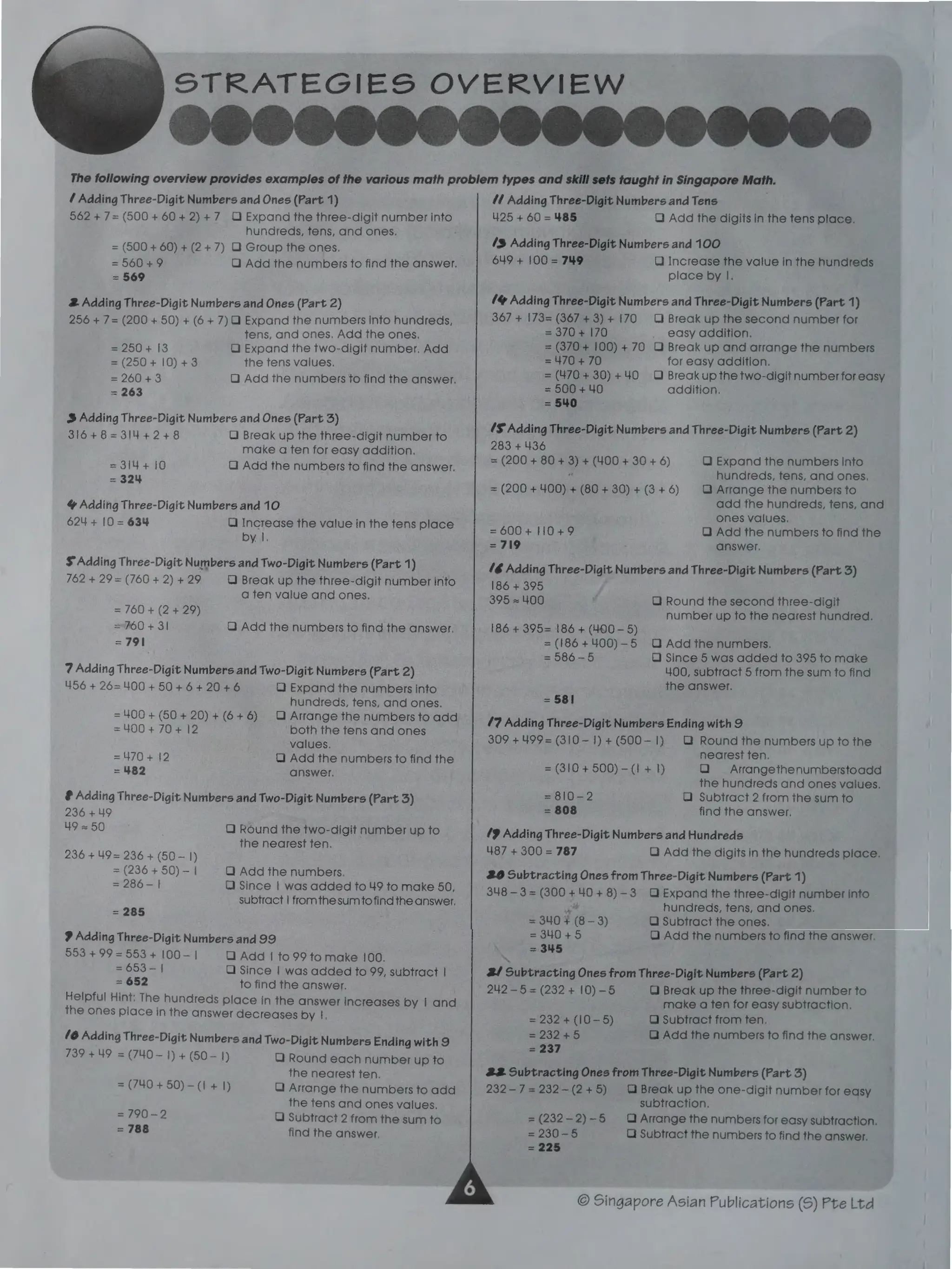
¢ Adding Three-Digit Numbers and Ones (Part 1)
562 + 7= (500 + 60+ 2)+7 UO Expand the three-digit number into
hundreds, tens, and ones,
= (500 + 60) + (2+ 7) G Group the ones.
=560+9 Q Add the numbers to find the answer.
= 569
2 Adding Three-Digit Numbers and Ones (Part 2)
256 + 7= (200 + 50) + (6+ 7) Expand the numbers Into hundreds,
tens, and ones. Add the ones.
= 250+ I3 QO Expand the two-digit number. Add
= (250+ 10) +3 the tens values,
= 260+ 3 QO Add the numbers to find the answer.
= 263
3S Adding Three-Digit Numbers and Ones (Part 3)
316+8=3144+2+8 QO Break up the three-digit number to
make a ten for easy addition.
= 314+ 10 Qi Add the numbers to find the answer.
= 324
% Adding Three-Digit Numbers and 10
624 + 10 = 634 Q Increase the value in the tens place
by |.
§ Adding Three-Digit Numbers and Two-Digit Numbers (Part 1)
762 + 29= (760 + 2) + 29 O Break up the three-digit number into
q ten value and ones.
= 760 + (2+ 29)
=760 + 31
=791
QO} Add the numbers to find the answer,
7 Adding Three-Digit Numbers and Two-Digit Numbers (Part 2)
456 + 26=400 +50+6+20+6 Q Expand the numbers into
hundreds, tens, and ones.
=400+ (50+ 20)+(6+6) OQ Arrange the numbers to add
=400+ 70+ |2 both the tens and ones
values.
=470+ 12 QO Add the numbers to find the
= 482 answer.
& Adding Three-Digit Numbers and Two-Digit Numbers (Part 3)
236 + 49
49 = 50 QO Round the two-digit number up to
the nearest ten.
236 + 49= 236 + (50-1)
= (236 + 50) - | Q Add the numbers.
= 286 - | QO Since | was added to 49 to make 50,
subtract |fromthe
sum tofind the answer.
= 285
? Adding Three-Digit Numbers and 99
553 + 99 = 553 + 100-| Q Add | to 99 to make 100.
= 653 - | Q Since | was added to 99, subtract |
= 652 to find the answer.
Helpful Hint: The hundreds place in the answer increases by | and
the ones place in the answer decreases by |.
16 Adding Three-Digit Numbers and Two-Digit Numbers Ending with 9
739 +49 = (740-1) + (50-1) QO Round each number up to
the nearest ten.
O Arrange the numbers to add
the tens and ones values.
= 790-2 Q Subtract 2 from the sum to
= 788 find the answer,
= (740
+ 50) —(1 + 1)
“ Adding Three-Digit Numbers and Tens
425 +60=485 OQ Add the digits In the tens place.
43 Adding Three-Digit Numbers and 100
649 + 100 = 749 Q Increase the value in the hundreds
place by |.
(4 Adding Three-Digit Numbers and Three-Digit Numbers (Part 1)
367 + 173= (367 +3)+170 QO Break up the second number for
= 370+ 170 easy addition.
= (370+ 100) + 70 O Break up and arrange the numbers
=470+70 for easy addition.
= (470+ 30)+40 QO Breakup the two-digit number
for easy
= 500 + 40 addition.
= 540
4Adding Three-Digit Numbers and Three-Digit Numbers (Part 2)
283 + 436
= (200 + 80 + 3) + (400 + 30 + 6) Q Expand the numbers into
“ hundreds, tens, and ones,
Q Arrange the numbers to
add the hundreds, tens, and
ones values.
= 600+ 110+9 Q Add the numbers to find the
=719 answer.
= (200 + 400) + (80 + 30) + (3 + 6)
46 Adding Three-Digit Numbers and Three-Digit Numbers (Part 3)
186 + 395
395 = 400 QO Round the second three-digit
number up to the nearest hundred.
186 + 395= 186 + (400
— 5)
= (186+400)—5 OQ Add the numbers.
= 586-5 QO Since 5 was added to 395 to make
400, subtract 5 from the sum fo find
the answer.
= 581
17 Adding Three-Digit Numbers Ending with 9
309 +499= (310-1) + (S00-—1) QO Round the numbers up to the
nearest ten.
= (310 + 500) —(1 + 1) Q Arrangethenumberstoadd
the hundreds and ones values.
QO Subtract 2 from the sum to
find the answer.
= 810-2
= 808
¢9 Adding Three-Digit Numbers and Hundreds
487 + 300 = 787 QO Add the digits in the hundreds place.
20 Subtracting Ones from Three-Digit Numbers (Part 1)
348 —3=(300+40+8)-—3 QO Expand the three-digit number into
is hundreds, tens, and ones.
= 340 #(8-3) Q Subtract the ones.
= 340+5 Q Add the numbers to find the answer.
= 345
2/ Subtracting Ones from Three-Digit Numbers (Part 2)
242 —6 = (232 + 10)-5 Q Break up the three-digit number to
make a ten for easy subtraction.
= 232 + (JO—5) Q Subtract from ten.
= 23240 Q Add the numbers to find the answer,
= 237
22 Subtracting Ones from Three-Digit Numbers (Part 3)
232-7 =232-(2+5) Break up the one-digit number for easy
subtraction,
= (232-2)-5 OQ Arrange the numbers for easy subtraction.
= 230-5 Q Subtract the numbers to find the answer.
= 225
© Singapore Asian Publications (S) Pte Ltd
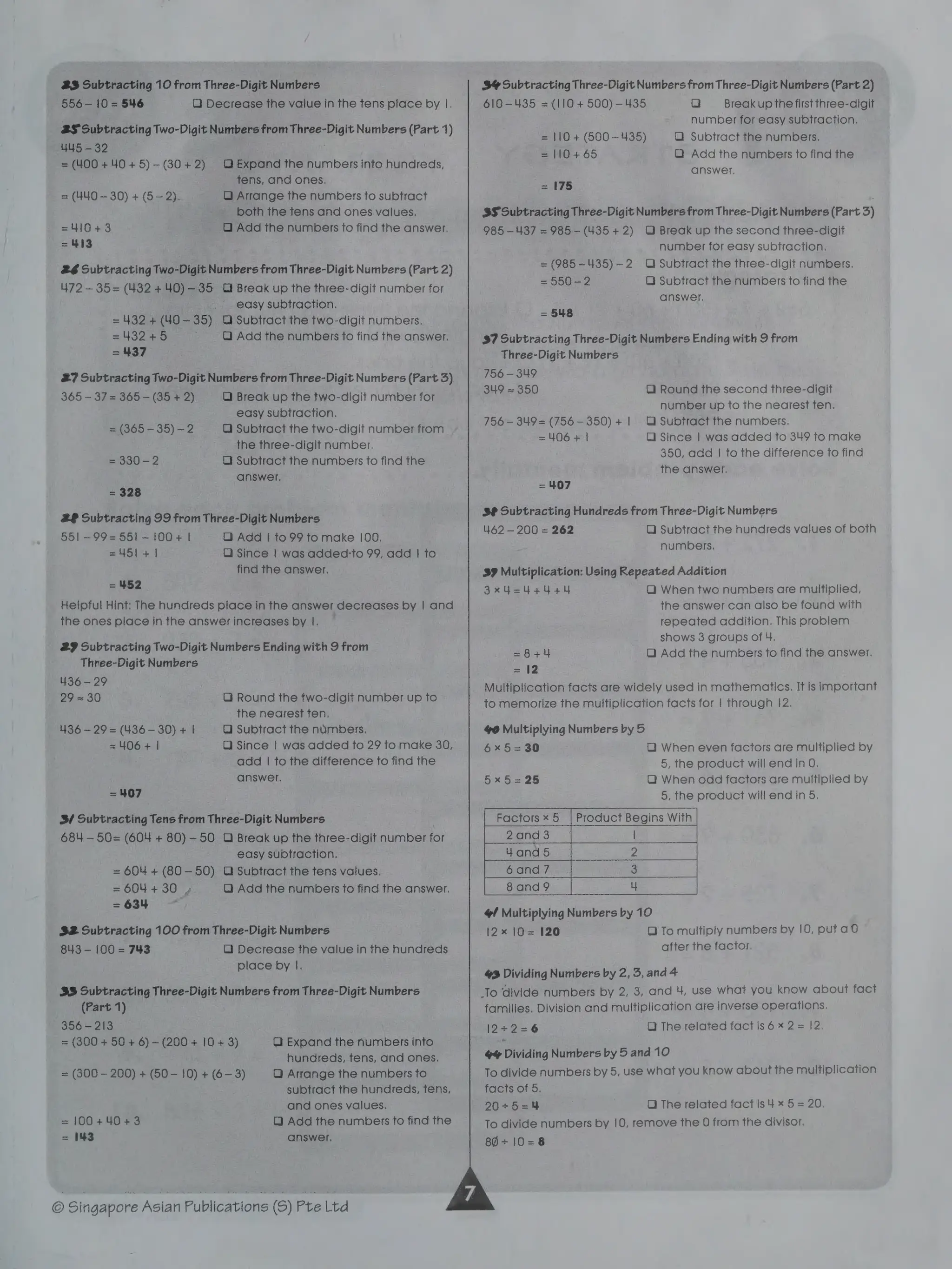
23 Subtracting 10 from Three-Digit Numbers
556— 10 = 546 Q Decrease the value in the tens place by |.
2S Subtracting Two-Digit Numbers from Three-Digit Numbers (Part 1)
445 —32
= (400 +40+5)-(30+2) OQExpand the numbers into hundreds,
tens, and ones.
QO Arrange the numbers to subtract
both the tens and ones values.
Q Add the numbers to find the answer.
= (440
— 30) + (5-2).
=410+3
=413
26 Subtracting Two-Digit Numbers from Three-Digit Numbers (Part 2)
472 —35= (432 + 40)-—35 QO Break up the three-digit number for
: easy subtraction.
= 432 + (40-35) O Subtract the two-digit numbers.
=432+5 QO Add the numbers to find the answer.
= 437
27 Subtracting Two-Digit Numbers from Three-Digit Numbers (Part 3)
365 — 37=365 — (35 + 2) Q Break up the two-digit number for
easy subtraction.
= (365 - 35) -2 Q Subtract the two-digit number from
the three-digit number.
= 330-2 O Subtract the numbers to find the
answer.
= 328
2 Subtracting 99 from Three-Digit Numbers
551 —99= 651 - 100+ | QO Add | to 99 tomake 100.
=4514+ 1 Q Since | was addea-to 99, add | to
find the answer.
= 452
Helpful Hint: The hundreds place in the answer decreases by | and
the ones place in the answer increases by |.
29 Subtracting Two-Digit Numbers Ending with 9 from
Three-Digit Numbers
436-29
29 =~ 30 Q Round the two-digit number up to
the nearest ten.
436
— 29 = (436
— 30) + | Q Subtract the numbers,
= 406+ | Q Since | was added to 29 to make 30,
add | to the difference to find the
answer.
= 407
S/ Subtracting Tens from Three-Digit Numbers
684 —50= (604 + 80)-—50 QO Break up the three-digit number for
easy subtraction.
= 604 + (80-50) O Subtract the tens values.
= 604 + 30 Q Add the numbers to find the answer.
= 634
32 Subtracting 100 from Three-Digit Numbers
843 -— 100 = 743 Q Decrease the value in the hundreds
place by |.
33 Subtracting Three-Digit Numbers from Three-Digit Numbers
(Part 1)
356 — 213
= (300 + 50 + 6)—(200 + 10 + 3) Q Expand the numbers into
hundreds, tens, and ones.
QO Arrange the numbers to
subtract the hundreds, tens,
and ones values.
QO Add the numbers to find the
answer.
= (300
— 200) + (50— 10) + (6—3)
= 100+40+3
= 143
© Singapore Asian Publications (S) Pte Ltd
34 Subtracting Three-Digit Numbers from Three-Digit Numbers (Part 2)
610-435 = (110 + 500) —435 Q Break up the first three-digit
number for easy subtraction.
QO Subtract the numbers.
Q Add the numbers to find the
answer.
= 110+ (600-435)
= {(10+65
= 175
SS Subtracting Three-Digit Numbers from Three-Digit Numbers (Part 3)
985 —437 = 985- (435+ 2) O Break up the second three-digit
number for easy subtraction.
= (985 -—435)—-2 QO Subtract the three-digit numbers.
= 550-2 QO Subtract the numbers to find the
answer.
= 548
37 Subtracting Three-Digit Numbers Ending with 9 from
Three-Digit Numbers
756-349
349 = 350 Q Round the second three-digit
number up to the nearest ten.
756—349= (756-350) + 1 UO Subtract the numbers.
= 406 + | Q Since | was added to 349 to make
350, add | to the difference to find
the answer.
= 407
3 Subtracting Hundreds from Three-Digit Numbers
462 —200 = 262 QO Subtract the hundreds values of both
numbers.
39 Multiplication: Using Repeated Addition
3x4Y=4HHU44 O When two numbers are multiplied,
the answer can also be found with
repeated addition. This problem
shows 3 groups of 4.
O Add the numbers to find the answer.
=8+4
= (2
Multiplication facts are widely used in mathematics. It is important
to memorize the multiplication facts for | through 12.
40 Multiplying Numbers by 5
6x5=30 Q When even factors are multiplied by
5, the product will end in 0,
§x5=25 Q When odd factors are multiplied by
5, the product will end in 5.
Factors x 5 | Product Begins With
2and 3 |
4Yand5 2
éand 7 3
8and9 4
4 Multiplying Numbers by 10
12x |0= 120 Q To multiply numbers by 10, put a0
after the factor.
3 Dividing Numbers by 2, 3, and 4
To divide numbers by 2, 3, and 4, use what you know about fact
families. Division and multiplication are inverse operations.
[2+ 2=6 Q The related fact is 6 x 2 = 12.
4 Dividing Numbers by 5 and 10
To divide numbers by 5, use what you know about the multiplication
facts of 5.
20+5=4 O The related fact is4
x 5 = 20.
To divide numbers by 10, remove the 0 from the divisor.
80+ 10=8
STRATEGIES OVERVIEW
The following ‘overview provides examples of the various math problem types and skill sets taught in Singapore Math.
¢ Adding Using Place Values
1,286 + 513
= |,000 + 200 + 80+ 6+ 500+ 10+3 Q Expand the numbers by
their place values.
1,000 + (200 + 500) + (80 + 10) + (6+ 3) OQ Add the similar values.
1,000+ 700
+ 90 +9
Wout
ut 1,799
2 Adding Doubles
2,516+6=2,510+6+6 Q Identify the doubles and add them.
=2,510+ 12 Q Add the numbers to find the answer.
= 2,522
3 Adding Near Doubles
4613+ I4= (4,613 + 1) + 14-1 QO Add | to 4,613 to create a double.
= (4,614 + 14)-] QO Add the doubles.
= 4,628 - | Q Subtract | to find the answer,
= 4,627
Addition: Rounding Numbers (Part 1)
2,734 + 999 = (2,734 + |,000) — | GQ Round 999 up to the nearest thousand.
Add 1,000 to the number.
= 3,734 = | Q Subtract | to find the answer.
= 3,733
$ Addition: Rounding Numbers (Part 2)
4462 + 998 = (4,462 + 1,000) —.2 O Round 998 up to the nearest thousand.
Add 1,000 to the number.
= 5,462-—2 QO Subtract 2 to find the answer.
= 5,460
7 Addition: Rounding Numbers (Part 3)
4,229 + 179
179 + 21 = 200 QRound |79 up to the nearest
hundred by adding 21.
4,229 + 179 = (4,229 -21) + (179 +21) OSince 21 was added to make
200, subtract 21 from 4,229,
= 4,208 + 200 Q Add the numbers to find the
= 4,408 answer.
# Adding Thousands
3,000 + 5,000 = 3 thousands + 5 thousands
= 8 thousands
= 8,000
9 Adding a String of Numbers
102+ 103 + 107+ 109+ 111 + 108
= (102 + 108) + (103 + 107) + (109+ 111) GQArrange the numbers
so
= 210+ 210+ 220 that they can be added to
= 640 the nearest ten. Then, add
to find the answer.
OQ Read the numbers by
their place values
and add them,
10 Subtracting Using Place Values
2,573 — 45 = (2,000 + 500 + 70+ 3)—(40 +5) UExXpand the numbers.
= 2,000 + 500 + (60 + 13) —-(40 + 5) URegroup one ten.
= (2,000 + 500) + (60-40) + (13-5) OSubtract. Then, add to
= 2,528 find the answer.
¢¢ Subtracting Doubles
6,122—11 = 6,100 + (22-11) O Identify the doubles and subtract them.
= 6,100 + || Q Add the numbers to find the answer.
= 6,111
¢% Subtracting Near Doubles
6817-18 =(6,817+ 1)—18-| OAdd | to the minuend to create a
double, This will make 6,818,
= (6,818 — 18) —| OSubtract the double.
= 6,800 — | O Subtract | to find the answer.
= 6,799
¢ Subtraction: Rounding Numbers (Part 1)
6,125—999 = (6,125— 1,000) + | QRound 999 up to the nearest thousand.
Subtract |,000 from the minuend,
=5,125+ 1 QAdd | to find the answer,
= 5,126
¢$ Subtraction: Rounding Numbers (Part 2)
7,232 — 998 = (7,232 — |,000) + 2 O Round 998 up to the nearest
thousand, Subtract |,000 from
the minuend,
Q Add 2 to find the answer.
16 Subtraction: Rounding Numbers (Part 3)
3,815 — 286 = (3,815 + 14) — (286+ 14) GO Round 286 up to the nearest
hundred by adding !4 and
add |4 to 3,815.
= 3,829 — 300 QO Subtract the numbers to find
= 3,529 the answer. )
¢7 Subtracting Thousands
8,000 — 7,000 = 8 thousands—7 thousands UORead the numbers by
| thousand their place values and
1,000 subtract them.
9 Multiplying Numbers by 6
§x6=5x2x3
wou
Q Break up the second factor for easy
multiplication with the first factor.
0x3 Q Multiply the numbers to find the answer.
20 Multiplying Numbers by 7
8x 7=(5%7)+(3*/7) O Break up the first factor into numbers
‘ that you are confident in multiplying.
= 35+ 2] O Add the numbers to find the answer.
= 56
2/ Multiplying Numbers by &
5 x 8 = (3 x 8) + (2x 8) QO Break up the first factor into numbers
that you are confident in multiplying.
=24 +16 Q Add the numbers to find the answer,
= 40
22 Multiplying Numbers by 9
This is a simple method to help you with the multiplication table of 9.
O Bend the little finger of your left hand,
-and count 9 fingers. Therefore, the
|x9=9
answer is 9.
2x9=18 OBend the ting finger of your left hand,
and you will notice that | finger is on
the left and 8 fingers are on the right.
3*x9=27 OBend the middle finger of your left
hand, and you will notice that 2 fingers
are on the left and 7 fingers are on the
tight. Therefore, the answer is 27.
Therefore, the answer Is 18.
4x9=36 OBend the index finger of your left hand,
and you will notice that 3 fingers are on
the left and 6 fingers are on the right.
Therefore, the answer is 36.
5*x9=45 OBend the thumb of your left hand, and
you will notice that 4 fingers are on
the left and 5 fingers are on the right.
Therefore, the answer is 45.
6*9=54 OUBend the thumb of your right hand,
and you will notice that 5 fingers are on
the left and 4 fingers are on the right.
Therefore, the answer is 54.
t 7x9=63 UOBend the index finger of your right hand,
and you will notice that 6 fingers are on
the left and 3 fingers are on the right.
Therefore, the answer is 63.
8x9=72 UBend the middle finger of your right
hand, and you will notice that 7 fingers
are on the left and 2 fingers are on the
right. Therefore, the answer is 72.
9x9= 81 OBend the ting finger of your right hand,
and you will notice that 8 fingers are
on the left and | finger is on the right.
Therefore, the answer is 81.
10x 9=90 OBend the little finger of your right hand,
and you will notice that 9 fingers are on
the left. Therefore, the answer is 90.
© Singapore Asian Publications (S) Pte Ltd
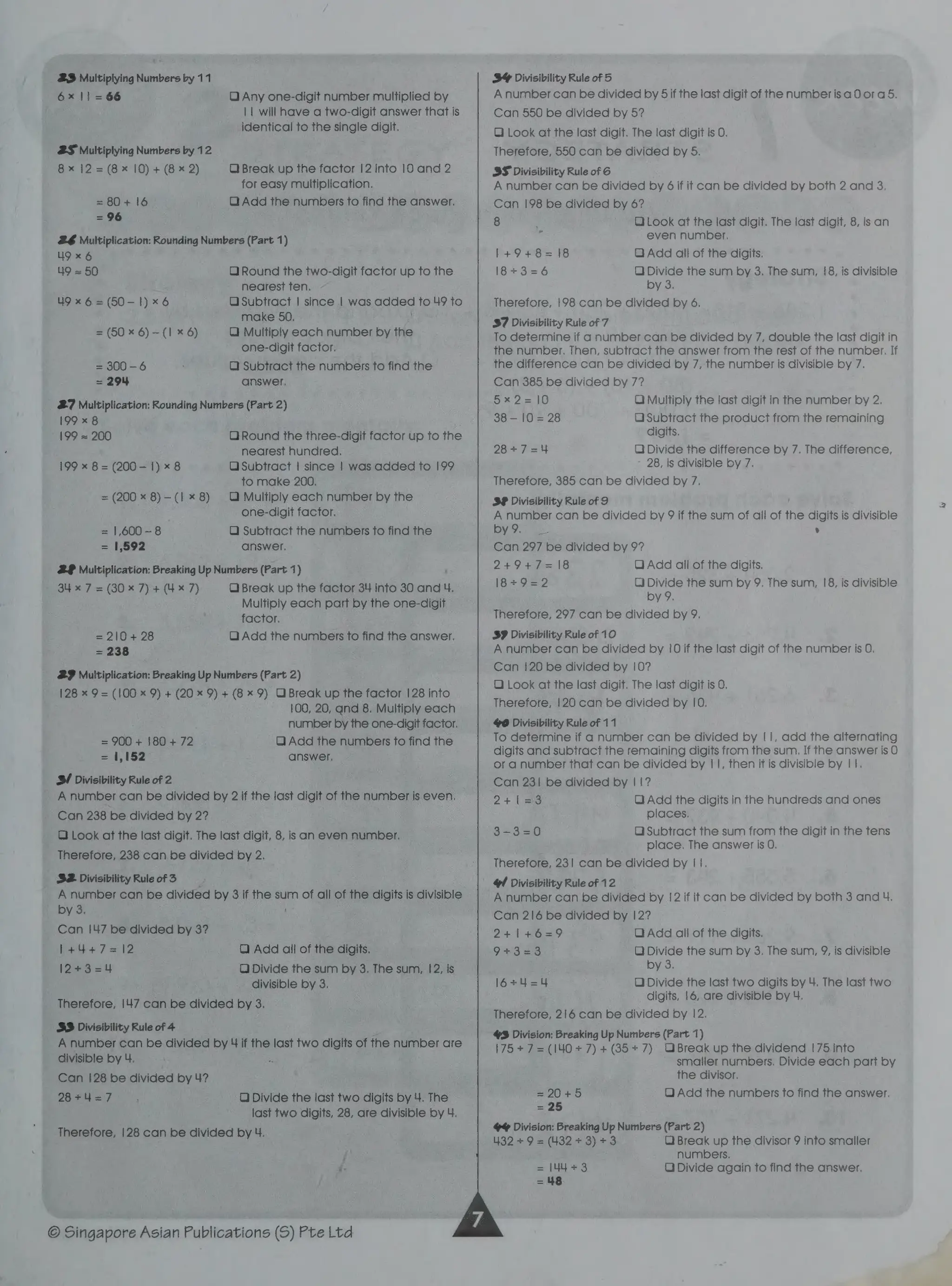
23 Multiplying Numbers by 11
6x11 =66 O Any one-digit number multiplied by
11 will have a two-digit answer that is
identical to the single digit.
2S Multiplying Numbers by 12
8x 12 = (8x 10)+ (8 x 2) O Break up the factor 12 into 10 and 2
for easy multiplication.
= 80+ 16 Q Add the numbers to find the answer.
= 96
26 Multiplication: Rounding Numbers (Part 1)
49x 6
49 = 50 Q Round the two-digit factor up to the
nearest ten.
O Subtract | since | was added to 49 to
make 50,
Q Multiply each number by the
one-digit factor.
u9 x 6 = (50-1)
x6
= (50 x 6) - (1 x 6)
= 300-6 QO Subtract the numbers to find the
= 294 answer.
27 Multiplication: Rounding Numbers (Part 2)
199 x 8
199 = 200 QO Round the three-digit factor up to the
nearest hundred,
O Subtract | since | was added to 199
to make 200.
QO Multiply each number by the
one-digit factor.
Q Subtract the numbers fo find the
answer.
199 x 8= (200-1)
x8
= (200
«8)-(1x 8)
1,600 —- 8
1,592
2 Multiplication: Breaking Up Numbers (Part 1)
34 x 7 = (30 x 7) + (4x 7) Q Break up the factor 34 into 30 and 4.
Multiply each part by the one-digit
factor.
Q Add the numbers to find the answer.
= 210+
28
= 238
293 Multiplication; Breaking Up Numbers (Part 2)
128 x 9= (100 x 9) + (20x 9) + (8x 9) O Break up the factor |28 into
100, 20, and 8. Multiply each
number by the one-digit factor.
QO) Add the numbers fo find the
answer.
= 900+ 180+ 72
= 1,152
SI Divisibility Rule of2
A number can be divided by 2 if the last digit of the number is even.
Can 238 be divided by 2?
QO Look at the last digit. The last digit, 8, is an even number.
Therefore, 238 can be divided by 2.
S2. Divisibility Rule of 3
A number can be divided by 3 if fhe sum of all of the digits is divisible
by 3. '
Can |47 be divided by 3?
1+444+7=12
12+3=4
Q Add all of the digits.
QO Divide the sum by 3, The sum, 12, is
divisible by 3.
Therefore, 147 can be divided by 3.
3S Divisibility Rule of 4
A number can be divided by 4 if the last two digits of fhe number are
divisible by 4. :
Can 128 be divided by 4?
28+4=7 QO Divide the last two digits by 4. The
last two digits, 28, are divisible by 4.
Therefore, 128 can be divided by 4.
© Singapore Asian Publications (S) Pte Ltd
3 Divisibility Rule of 5
A number can be divided by 5if the last digit of the numberisaQora 5.
Can 550 be divided by 5?
Q Look at the last digit. The last digit is 0.
Therefore, 550 can be divided by 5.
3S Divisibility Rule of 6
A number can be divided by 6 if it can be divided by both 2 and 3.
Can 198 be divided by 6?
8 OLook at the last digit. The last digit, 8, is an
2 even number.
QAdd all of the digits.
QO Divide the sum by 3. The sum, 18, is divisible
by 3.
Therefore, 198 can be divided by 6,
387 Divisibility Rule of 7
To determine if a number can be divided by 7, double the last digit in
the number. Then, subtract the answer from the rest of the number. If
the difference can be divided by 7, the number is divisible by 7.
Can 385 be divided by 7?
1+9+8=18
18+3=6
Sx 27= 10 Q Multiply the last digit in the number by 2,
38 — 10 = 28 O Subtract the product from the remaining
digits.
28+7=4 Q Divide the difference by 7. The difference,
28, is divisible by 7.
Therefore, 385 can be divided by 7.
S® Divisibility Rule of 9
A number can be divided by 9 if the sum of all of the digits is divisible
by O% .
Can 297 be divided by 9?
2+9+7=18 Q Add all of the digits.
1I8=9=2 QO Divide the sum by 9. The sum, 18, is divisible
by 9.
Therefore, 297 can be divided by 9.
SP Divisibility Rule of 10
A number can be divided by 10 if the last digit of the number is O.
Can 120 be divided by 10?
Q Look at the last digit. The last digit is 0.
Therefore, 120 can be divided by |0.
$@ Divisibility Rule of 11
To determine if a number can be divided by |1, add the alternating
digits and subtract the remaining digits from the sum. If the answer is 0
or a number that can be divided by | 1, then it is divisible by | 1.
Can 231 be divided by | 1?
2+[=3 QOAdd the digits in the hundreds and ones
places.
3-3=0 O Subtract the sum from the digit in the tens
place. The answer is 0.
Therefore, 231 can be divided by ||.
4 Divisibility Rule of 12
A number can be divided by 12 if it can be divided by both 3 and U.
Can 216 be divided by 12?
2+1+6=9 QO Add all of the digits.
9+3=3 O Divide the sum by 3. The sum, 9, is divisible
by 3.
16+4=4 QO Divide the last two digits by 4. The last two
digits, 16, are divisible by 4.
Therefore, 216 can be divided by 12.
8 Division: Breaking Up Numbers (Part 1)
175+ 7 =(140 +7) + (35+ 7) OBreak up the dividend |75 into
smaller numbers, Divide each part by
the divisor.
=20+5 QO Add the numbers to find the answer.
=o
4% Division: Breaking Up Numbers (Part 2)
432 +9 = (432+ 3)+3 O Break up the divisor 9 into smaller
numbers.
QO Divide again to find the answer.
The following overview provides examples of the various math pro
? Addition: Breaking Up Numbers
10,234 + 14,567
= (10,200 + 14,500) + (34467) O Break up the numbers by separating
the thousands and the hundreds from
the tens and ones.
= 24,700 + |01 Add the numbers fo find the answer.
= 24,801
2 Addition: Rounding Numbers
13,520 + 12,519
= (13,600 + 12,519) — 80 Round one of the numbers up to the
nearest hundred. Add the numbers.
Subtract the amount you needed to
round the number from the sum.
= 26,119 — 80
= 26,039
3 Subtraction: Breaking Up Numbers
83,450 — 20,460
= (83,400 — 20,400) — (60-50) OU Break up the numbers by separating
the thousands and the hundreds
from the tens.
= 63,000 - 10 Subtract the numbers to find the
= 62,990
answet.
& Subtraction: Rounding Numbers
76,758 — 63,717
= (76,758 — 63,720) + 3 Round the second number up to the
nearest ten. Subtract the numbers.
= 13,038 + 3 OQ Add the amount you needed to
= 13,041 round the number to the difference.
6 Multiplying 2-Digit Numbers by 11
27 I
PE Sesh) OQ Add the tens and the ones digits of the first factor.
297 O Place the sum obtained between the first factor’s digits.
27 x | = 297
7 Multiplying 3-Digit Numbers by 11
273 * I
973 x |0 = 2,730 O Multiply the first factor by 10.
2,730 + 273 = 3,003
273 x || = 3,003
@ Multiplication: Breaking Up Numbers (Part 1)
45 x 5
45 =40+5 Q Expand the two-digit factor by place value.
45 x 5= (YO x 5) + (5 * 5) O Multiply each expanded number by the
one-digit factor.
O Add the product to the first factor to find the
answer.
= 200 + 25 Add the products to find the answer.
= 225
9 Multiplication: Breaking Up Numbers (Part 2)
159 x4
159 = 100+50+9 O Expand the three-digit factor by
place value.
159 x4
= (100 x 4) + (60 x4) + gox4 OU Multiply each expanded number
by the one-digit factor.
= ay + 200 + 36 Add the products to find the answer.
= 636
1 Multiplication: Breaking Up Numbers (Part 3)
43 x 16
= (40 + 3) x (10 + 6)
= (HOx 10) + (3 * 10) +
(HO x 6) + (5 6)
= 400 + 30 + 240 + 18
2430 +2U0+18
OQ Expand both factors by place value,
Multiply each expanded number in the first
factor by each expanded number in the
second factor. ;
QAdd the products to find the answer.
= 688
12 Multiplication: Rounding Numbers Ending with 9
ta eee
BL x 19 = 81 x 20 OQ Round the second factor up to the nearest ten.
= 1,620 QO Multiply to find the estimated product.
Subtract the first factor from the estimated
= |,620-81
; product to find the answer.
= 1,539
STRATEGIES OVERVIEW
blem types and skill sets taught in Singapore Math.
13 Multiplication: Identical First Digits, Sum of Last Digits Is 10
4 x 16
(J+ l)xl=2* 1=2 Step |: Add | to the first digit of the first factor.
Then, multiply the sum by the first digit of
the second factor. The product is the first
digit or digits of the answet.
ux6=24 Step 2: Multiply the ones digits of both factors.
The product is the last two digits of the
4x 16= 224 answer.
14 Multiplication: Identical Last Digits, Sum of First Digits Is 10
36 «x 76
6x6=36 Step |: Multiply the identical digits from the ones
place of both factors. The product is the last
two digits of the answer,
(3% 7)+6=21 + 6 Step 2: Multiply the tens digits from both factors and
inh add the identical digit from the ones place
to the product. The result is the first two digits
36 x 76 = 2,736 of the answer.
16 Multiplication: Identical First Digits for 2-Digit Numbers
Qu x 27
Ux 7=28 Step |: Multiply the ones digits of both
factors. The last digit of the product
is the last digit of the answer.
*Carry the 2 to the next step.
Step 2: Multiply the ones and tens digits in
= Oe WE each factor. Add the products and
= OO» 2 the number carried from Step |.
= Ou
The product is the next-to-last digit
of the answer.
*Carry the 2 to the next step.
(2x 2)+2 Step 3: Multiply the identical tens digit of
=Y42 both factors and add the number
bey
carried from Step 2. The product is
oy x 27 = 648 the first digit or digits of the answer.
(7 Multiplication: Identical First Digits, Sum of Last Digits Is 5
yo x 43
(2x4) +(2*7)+2
2x3=6 Step |: Multiply the ones digits of both factors.
The product is the last digit of the answer.
(2+ 3) x4 Step 2: Add the ones digits of both factors.
=65x4
Multiply the sum by the identical tens
= 20 digit. The last digit of the product is the
next-to-last digit of the answer.
*Carry the 2 to the next step.
(4x4) +2 Step 3: Multiply the identical tens digit of both
= Gee factors and add the number carried
= 18 from Step 2. The product is the first two
u2 x U3 = 1,806 digits of the answef.
1% Multiplication: Multiplying 2-Digit Numbers by Hundreds
29 x 4OO
29 x UD OMentally remove the two zeros from the
second factor.
29 x4= 116 QMultiply the first factor by the hundreds
digit in the second factor.
29 x 4OO = 11,600 (Put zeros in the tens and ones places.
/9 Division: Breaking Up Numbers
7,200 +3
one = Save + 1,200 O Break up.the dividend for easy division,
r +
= (6,000 + 3) + (1,200 + 3) ODivide each part by the divisor.
= ts 4OO QO Add the numbers to find the answer.
= &;
21 Division: Finding Remainders When Dividing by 3
Find the remainder of 9,613 + 3.
94+64+14+3=19 OQ Add all four digits of the dividend.
+ ;= My O Add until the sum becomes a single digit.
+ 3
1+3=ORI] O Divide the single digit by the divisor 3 to
find the remainder.
The remainder of 9,613 + 3 is I.
© Singapore Asia Publishers Pte Ltd
22 Division: Finding Remainders When Dividing by 4
Find the remainder of 3,450 « 4.
50+4=12R2 QO Divide the last two digits of the dividend
by the divisor,
The remainder of 3,450 + 4 is 2.
23 Adding Fractions with 1 as the Numerator
72*5
12+5=17 OTo find the numerator of the answer,
add both denominators,
I2x5=60 OTo find the denominator of the answer,
multiply both denominators.
<! | 17 -012+5
12°*5~ 66 -112*«5)
24% Adding Fractions with the Same Numerator
44
ae
9+7=16 QTo find the numerator of the answer,
l6x4= 64 add both denominators. Then, multiply the
sum by the common numerator.
9x7=63 OTo find the denominator of the answer,
4 : ey eee multiply both denominators.
9 7 63->°*?)
26 Subtracting Fractions with 1 as the Numerator
ie
5 10
10-5=5 OTo find the numerator of the answer,
subtract both denominators.
10x 5=50 OTo find the denominator of the answer,
multiply both denominators.
| | 5 - 10-5)
27 Decimals: Multiplying by 10
0.69 x 10
0.69 x 10 = 049 O) Move the decimal point one place to
= 6.9 the right because |0 has one 0.
2? Decimais: Multiplying by 100
43.861 x 100
43.861 x 100 = 43.86! QO Move the decimal point two places to
= 4,386.1 the right because |100 has two zeros.
27 Decimals: Multiplying 2-Digit Numbers by Decimals Ending with 0.9
45 x 2.9
2.9 23 QO Round the decimal factor up to the
nearest whole number.
45 x 3= 135 Q Multiply the first factor by the whole
number factor.
45x 0.1 =4.5 QO Multiply the first factor by 0.1.
135-45 = 130.5 QO Subtract the decimal number from the
45 x 2.9 = 130.5
3/4 Decimals: Multiplying 2-Digit Numbers by 1.1
88 x I.1
I=
whole number to find the answer.
Ui Move the decimal point one place to
the right to create a whole number.
88 x |] = (88 x 10) + (88 x 1) QExpand || into 10 and |. Multiply each
= 880 + 88 part by the first factor.
= 948
88 x I.1 = 96.8 QO Move the decimal point one place to
the left.
32 Decimals: Breaking Up Numbers to Multiply
25 x 4.3
43=43 O Move the decimal point one place to
the right to create a whole number.
25 x 43 = (25 x 40) + (25 x 3) Break up the second factor into tens
= 1,000 + 75 and ones, Multiply each part by the first
= 1,075 factor.
25 x 4.3 = 107.5 OQ Move the decimal point one place to
the left.
33 Decimals: Breaking Up Numbers Ending in O to Multiply
20 « 7.43
743 = 743 QO Move the decimal point two places to
the right to create a whole number.
20 QO) Mentally remove the O from the first
2 x 743 = 1,486 factor. Multiply it by the whole number.
1,486 x 10 = 14,860 QO Multiply the product by 10.
20 = 7.43 = 148.60 OQ Move the decimal point two places to
the left.
© Singapore Asia Publishers Pte Ltd
34% Decimals: Dividing by 10
67+ 10
67+ |0= 67 QO) Move the decimal point one place to
= 6.7 the left because 10 has one O,
36 Decimals: Dividing by 100
34 + 100
34 + 100 = 34 O Move the decimal point two places to the
= 0.34 left because 100 has two zeros,
37 Decimals: Breaking Up Numbers to Divide
30,15 +5
30 — whole number
0,15 — decimal number
O Break up the decimal number by
separating it into a whole number and
a decimal number.
SO +26 Q Divide the whole number first.
0.15 +5 =0,03 QO) Divide the decimal number.
6 + 0.03 = 6.03 Q Add the whole number and the
30,15 + 5 = 6.03 decimal number to find the answer.
38 Squaring Numbers Ending with O
30 x 30
O) To square 30, find the value of 30 x 30,
3*x3=9 Step |; Multiply the identical first digits of both factors.
900 Step 2; Add two zeros.
30 x 30 = 900
39 Squaring Even Numbers
18 x 18
OQ To square 18, find the value of |8 x 18.
[efi eae) Step |: Divide the number by 2.
9x9=8l Step 2: Square the quotient.
81 x 4 = 324 Step 3: Multiply the product obtained by 4.
18 x |8 = 324
41 Squaring Odd Numbers
13 x 13
QO) To square 13, find the value of 13 x 13.
I3-1l=12 Step |: Subtract | from the number to create
an even number.
12* 12 = |44 Step 2: Find the square of the even number.
444+ 12+ 13 = 169 Step 3: Add the numbers obtained in Steps |
13 x 13 = 169 and 2 and the original odd number.
42 Squaring Numbers Ending with 1
21 x 2
QO To square 21, find the value of 21 x 21.
2!1-—1!=20 Step |; Subtract | from the number to create
an even number.
20 x 20 = 400 Step 2: Find the square of the even number.
20 x 2=40 Step 3: Multiply the even number by 2.
400 + 40+ | =44] Step 4; Add the numbers obtained in Steps 2
21x 21 =441 and 3 and the number |.
43 Squaring Numbers Ending with 2
32 x 32
UO To square 32, find the value of 32 x 32.
32-2=30 Step |: Subtract 2 from the number to create
an even number ending with 0.
30 x 30 = 900 Step 2: Find the square of the even number.
30 x 4 = 120 Step 3; Multiply the even number by 4.
900 + 120 + 4 = 1,024 Step 4: Add the numbers obtained in Steps 2
32 x 32 = 1,024 and 3 and the number 4,
44% Squaring Numbers Ending with 3
63 * 63
QO To square 63, find the value of 63 x 63,
63-3 = 60 Step |: Subtract 3 from the number to create
an even number ending with 0.
60 x 60 = 3,600 Step 2: Find the square of the even number.
60 x 6 = 360 Step 3: Multiply the even number by 6.
3,600 + 360 + 9 = 3,969 Step 4: Add the numbers obtained in Steps 2
63 * 63 = 3,969 and 3 and the number 9.
4S Squaring Numbers Beginning with 5
59 x 59
Q To square 59, find the value of 59 x 59,
tai alee lePAe Step |: Square the tens digit.
25+9=34 Step 2; Add the ones digit to the product. The
result is the first two digits of the answer.
9x9=81 Step 3: Square the ones digit. The result is the
59 x 59 = 3,481 last two digits of the answer.
STRATEGIES OVERVIEW
The following overview provides examples of the various math problem types and skill sets taught in Singapore Math.
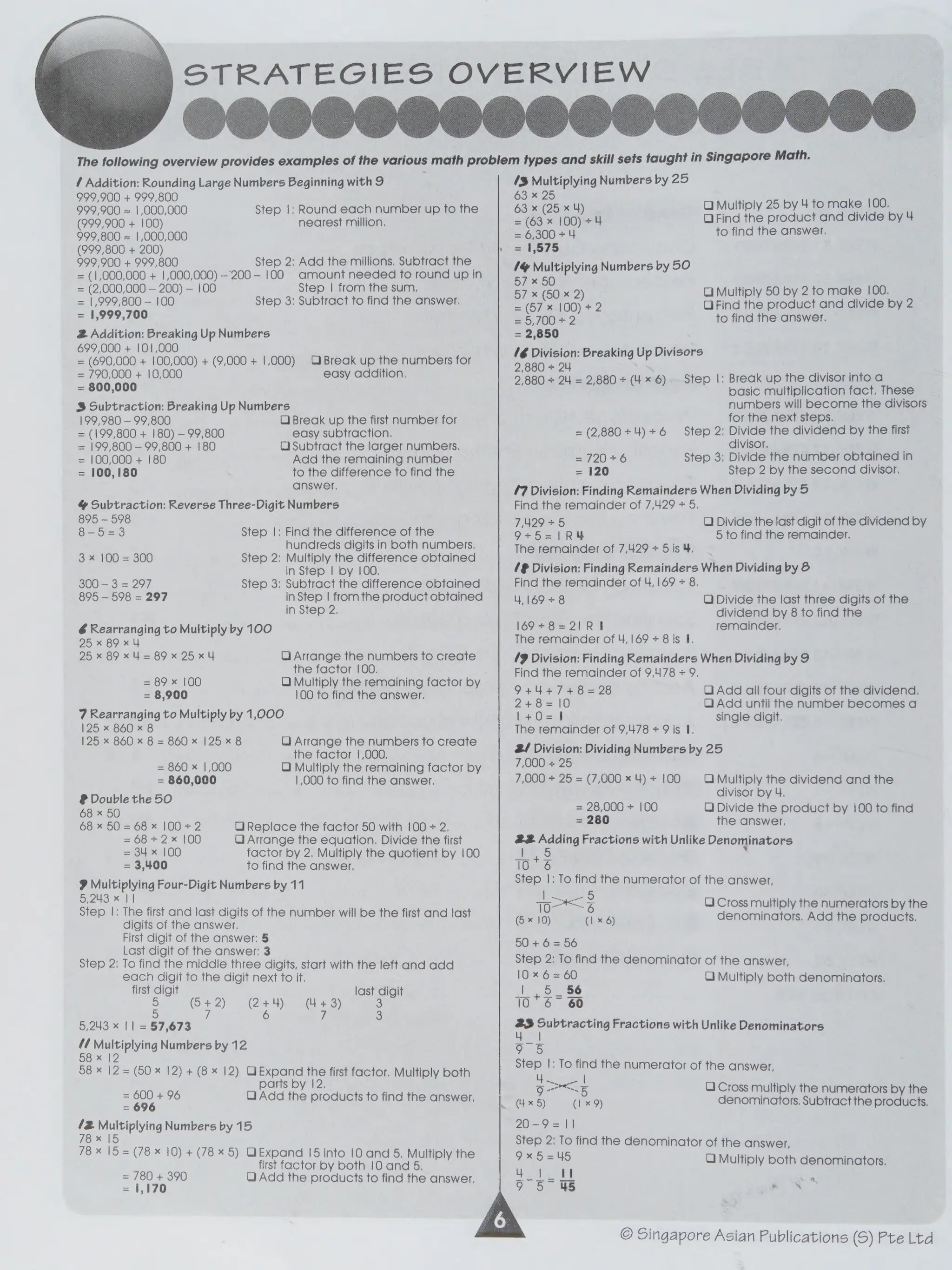
¢ Addition: Rounding Large Numbers Beginning with 9
999,900 + 999,800
999,900 = |,000,000
(999,900 + 100)
999,800 = 1,000,000
(999,800 + 200)
999,900 + 999,800 Step 2: Add the millions. Subtract the
= (1,000,000 + 1,000,000) -200- 100 amount needed to round up in
= (2,000,000— 200) — !00 Step | from the sum.
= 1,999,800 — 100 Step 3: Subtract to find the answer,
= 1,999,700
2 Addition: Breaking Up Numbers
699,000 + 101,000
= (690,000 + 100,000) + (9,000 + 1,000)
= 790,000 + 10,000
= 800,000
3 Subtraction: Breaking Up Numbers
199,980 — 99,800 O Break up the first number for
= (199,800 + 180) — 99,800 easy subtraction.
= 199,800 — 99,800 + 180 O Subtract the larger numbers.
Step |: Round each number up to the
nearest million.
O Break up the numbers for
easy addition.
= 100,000 + 180 Add the remaining number
= 100,180 to the difference to find the
answer.
& Subtraction: Reverse Three-Digit Numbers
895 — 598
8-5=3 Step |: Find the difference of the
hundreds digits in both numbers,
3 x 100 = 300 Step 2: Multiply the difference obtained
in Step | by 100.
300 — 3 = 297 Step 3: Subtract the difference obtained
895 — 598 = 297 in Step |fromthe product obtained
in Step 2.
6 Rearranging to Multiply by 100
25 x 89 x 4
25 x 89 x 4 = 89 x 25 x 4 O Arrange the numbers to create
the factor 100.
= 89 x 100 QO Multiply the remaining factor by
= 8,900 100 to find the answer.
7 Rearranging to Multiply by 1,000
125 x 860 x 8
125 x 860 x 8 = 860 x 125 x 8 O Arrange the numbers to create
the factor |,000,
= 860 x |,000 Q Multiply the remaining factor by
= 860,000 |,000 to find the answer.
# Double the 50
68 x 50
68 x 50 = 68 x 100+ 2 OReplace the factor 50 with 100 + 2.
= 68+ 2x 100 OQ)Arrange the equation, Divide the first
= 34 x 100 factor by 2. Multiply the quotient by 100
= 3,400 to find the answer,
? Multiplying Four-Digit Numbers by 11
5,243 x | |
Step |: The first and last digits of the number will be the first and last
digits of the answer.
First digit of the answer: 5
Last digit of the answer: 3
Step 2: To find the middle three digits, start with the left and add
each digit to the digit next to it.
first digit
5 (S q2)
5
5,243 x || = 57,673
¢¢ Multiplying Numbers by 12
58 x 12
58 x 12 = (50 x 12) + (8 x 12) QExpand the first factor. Multiply both
parts by 12.
= is 96 OQ Add the products to find the answer,
(2 Multiplying Numbers by 15
78 x 15
78 x |5 = (78 x 10) + (78 x 5) QExpand 15 into 10 and 5. Multiply the
first factor by both 10 and 5,
= ae QO)Add the products to find the answer.
last digit
3
(2 +4) (4 + 3)
6 uy 3
/3 Multiplying Numbers by 25
63 x 25
63 x (25 x 4) Q Multiply 25 by 4 to make 100.
= (63 x 100) +4 OFind the product and divide by 4
= 6,300 = 4 to find the answer.
= 1,575
1% Multiplying Numbers by 50
57 x 50
57 x (50 x 2) Q Multiply 50 by 2 to make 100.
= (57 x 100) +2 OFind the product and divide by 2
=0,/00'+ 2 to find the answer.
= 2,850
(6 Division: Breaking Up Divisors
2,880 + 24
Step |: Break up the divisor into a
basic multiplication fact. These
numbers will become the divisors
for the next steps.
2,880 + 2U = 2,880 + (4 x 6)
= (2,880+4)+6 Step 2: Divide the dividend by the first
divisor.
= 20 £0 Step 3: Divide the number obtained in
= 120 Step 2 by the second divisor.
17 Division: Finding Remainders When Dividing by 5
Find the remainder of 7,429 = 5,
7,429 +5
9-+5=1R4
The remainder of 7,429 + Sis 4.
(8% Division: Finding Remainders When Dividing by &
Find the remainder of 4,169 = 8.
QO Divide the last digit of the dividend by
5 to find the remainder.
4,169 +8 O Divide the last three digits of the
dividend by 8 to find the
169+8=2I1R1 remainder.
The remainder of 4,169 + 8 is I.
(9 Division: Finding Remainders When Dividing by 9
Find the remainder of 9,478 + 9.
9+44+7+8=28
2+8=10
1+0=1
The remainder of 9,478 + 9 is I.
2/ Division: Dividing Numbers by 25
7,000 + 25
7,000 + 25 = (7,000 x 4) + 100
QO Add all four digits of the dividend.
Q Add until the number becomes a
single digit.
Q Multiply the dividend and the
divisor by 4.
= 28,000 + 100 Q) Divide the product by 100 to find
= 280 the answer.
22 Adding Fractions with Unlike Denominators
ee 6
To*S
Step |; To find the numerator of the answer,
oo 3 Q) Cross multiply the numerators by the
(6 x 10) (1 x6) denominators. Add the products.
50 + 6 = 56
Step 2: To find the denominator of the answer,
10x6=60 Qi Multiply both denominators.
2. 0 88
| 6° 60
ieSubtracting Fractions with Unlike Denominators
|
9°56
Step |: To find the numerator of the answer,
i eacore| f
ae QO) Cross multiply the numerators by the
(u x 5) (1x9) denominators. Subtract
theproducts,
20-9 = |1
Step 2: To find the denominator of the answer,
9x5=45 QO Multiply both denominators.
%
~5 5 HS.
© Singapore Asian Publications (S) Pte Ltd
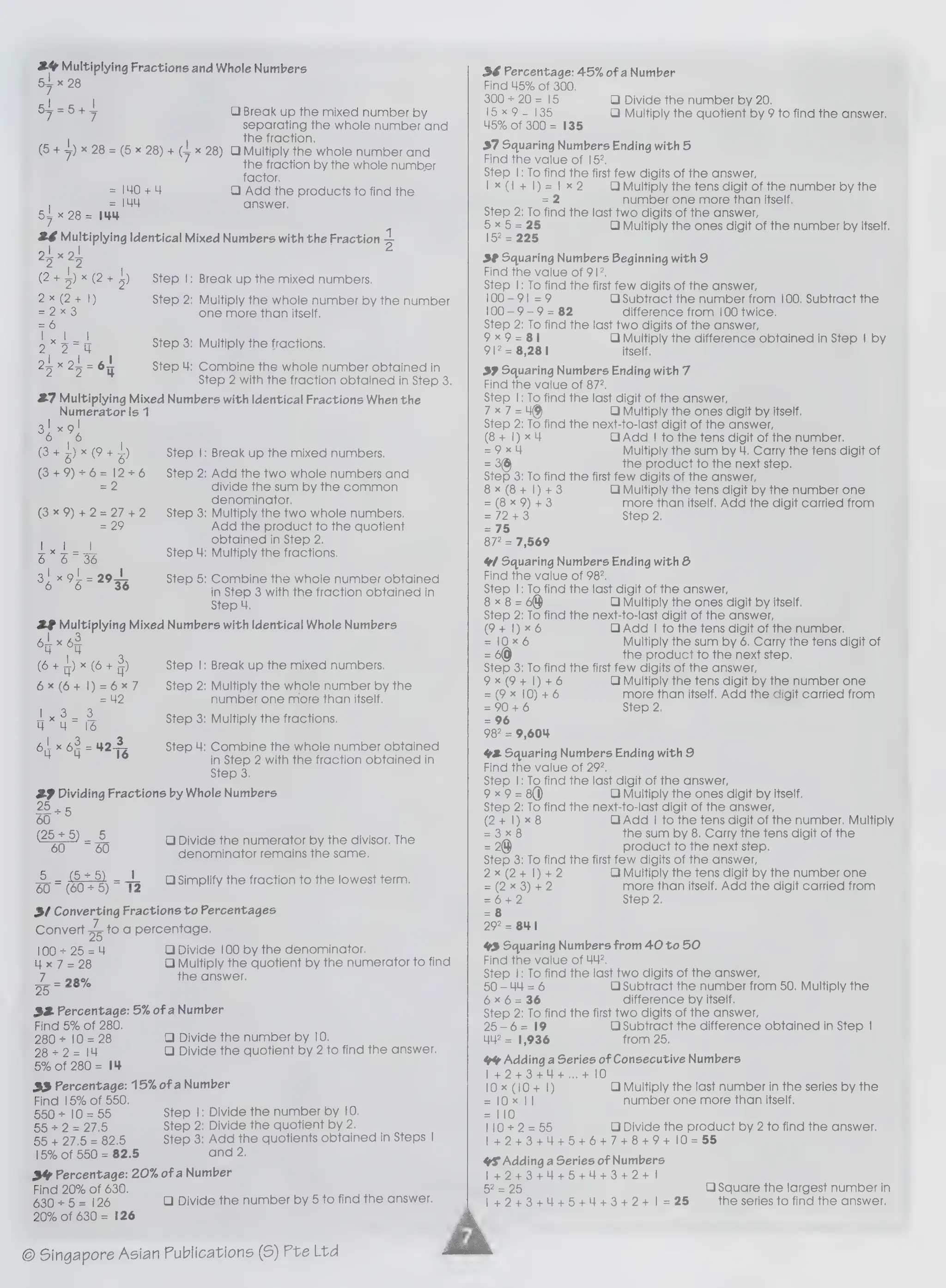
=, Multiplying Fractions and Whole Numbers
Sz x 28
ee |
ope Ota C1 Break up the mixed number by
separating the whole number and
the fraction.
(5 + 5)x 28 = (6 x 28)+ (1x 28)Q Multiply the whole number and
26 Multiplying Identical Mixed Numbers with the Fraction alk
| |
25 X 25
(2+5)*(244)
the fraction by the whole number
factor.
QC) Add the products to find the
answer,
2
Step |: Break up the mixed numbers.
Step 2; Multiply the whole number by the number
one more than itself.
Step 3: Multiply the fractions.
Step 4: Combine the whole number obtained in
Step 2 with the fraction obtained in Step 3.
27 Multiplying Mixed Numbers with Identical Fractions When the
Numerator Is 1
| |
Rete) IP tz)
(3+9)+6=12+6
ae
(3*9)+2=27+2
Step |: Break up the mixed numbers.
Step 2: Add the two whole numbers and
divide the sum by the common
denominator.
Step 3: Multiply the two whole numbers.
Add the product to the quotient
obtained in Step 2,
Step 4: Multiply the fractions.
Step 5: Combine the whole number obtained
in Step 3 with the fraction obtained in
Step 4.
2 Multiplying Mixed Numbers with Identical Whole Numbers
| )
on.
ou
(6+ x6+3%)
6x (641) =6%7
2
Step |: Break up the mixed numbers.
Step 2: Multiply the whole number by the
number one more than itself.
Step 3: Multiply the fractions.
Step 4: Combine the whole number obtained
in Step 2 with the fraction obtained in
Step 3.
29 Dividing Fractions by Whole Numbers
25
so+8
25+5)_ 5
60 ~ 60
(55) |
60 (6075)
12
OQ Divide the numerator by the divisor. The
denominator remains the same.
OiSimplify the fraction to the lowest term.
3/ Converting Fractions to Percentages
Convert - to a percentage,
100+ 25=4
Ux
7=28
Lo nae
Je = 28%
O Divide 100 by the denominator.
Q Multiply the quotient by the numerator to find
the answer.
S32 Percentage: 5% of aNumber
Find 5% of 280.
280+ 10
= 28
2822 =)/4
5% of 280= 14
Q Divide the number by 10.
O) Divide the quotient by 2 to find the answer.
33 Percentage: 15% of aNumber
Find 15% of 550.
550 + 10 =55
SO 2a 270
55 + 27.5 = 82.5
15% of 550 = 82.5
Step |: Divide the number by 10.
Step 2: Divide the quotient by 2.
Step 3; Add the quotients obtained in Steps |
and 2.
BY Percentage: 20% of aNumber
Find 20% of 630.
680'4 .5:= 126
20% of 630 = 126
© Singapore Asian Publications (S) Pte Ltd
O Divide the number by 5 to find the answer.
36 Percentage: 45% of aNumber
Find 45% of 300,
300 + 20 = 15
Loe 97135
45% of 300 = 135
37 Squaring Numbers Ending with 5
Find the value of 152,
Step |: To find the first few digits of the answer,
Ix(l+l)=1x2 QO Multiply the tens digit of the number by the
=2 number one more than itself.
Step 2: To find the last two digits of the answer,
ie 5=25 O Multiply the ones digit of the number by itself.
225
3® Squaring Numbers Beginning with 9
Find the value of 91?,
Step |: To find the first few digits of the answer,
100-91 =9 O Subtract the number from 100. Subtract the
100-9-9 = 82 difference from 100 twice.
Step 2: To find the last two digits of the answer,
9x9=81 QO Multiply the difference obtained in Step | by
9? = 8,281 itself.
39 Squaring Numbers Ending with 7
Find the value of 872.
Step |: To find the last digit of the answer,
7x7 =49 OQ Multiply the ones digit by itself.
Step 2: To find the next-to-last digit of the answer,
(8+ 1)x4 Q Add | to the tens digit of the number.
=9x4 Multiply the sum by 4. Carry the tens digit of
=o the product to the next step.
Step 3: To find the first few digits of the answer,
QO) Divide the number by 20.
QO) Multiply the quotient by 9 to find the answer.
8x (8+ 1)4+3 QO Multiply the tens digit by the number one
=(8x9)+3 more than itself. Add the digit carried from
=/2+3 Step 2,
=75
87° = 7,569
4 Squaring Numbers Ending with &
Find the value of 982.
Step |: To find the last digit of the answer,
8x8=68 CQ) Multiply the ones digit by itself.
Step 2: To find the next-to-last digit of the answer,
(9+ 1)*x6 Qi Add | to the tens digit of the number.
= 10:%.6 Multiply the sum by 6. Carry the tens digit of
= 60 the product to the next step.
Step 3: To find the first few digits of the answer,
9x 9+ 1) +6 QO) Multiply the tens digit by the number one
=(9x 10) +6 more than itself. Add the digit carried from
=90+6 Step 2.
= 96
98" = 9,604
42 Squaring Numbers Ending with 9
Find the value of 297.
Step |: To find the last digit of the answer,
9x9 =8() O Multiply the ones digit by itself.
Step 2: To find the next-to-last digit of the answer,
(2+ 1)*8 QO) Add | to the tens digit of the number. Multiply
=o x8 the sum by 8. Carry the tens digit of the
= 2) product to the next step.
Step 3: To find the first few digits of the answer,
2x(2+1)+2 Q) Multiply the tens digit by the number one
=(2x3)+2 more than itself. Add the digit carried from
=6+2 Step 2,
=8
297 = BUI
43 Squaring Numbers from 40 to 50
Find the value of 44.
Step |: To find the last two digits of the answer,
50-44 =6 O Subtract the number from 50. Multiply the
6x6=36 difference by itself.
Step 2: To find the first two digits of the answer,
25-6= 19 O Subtract the difference obtained in Step |
4? = 1,936 from 25,
4 Adding a Series of Consecutive Numbers
1+424+34+4+.,,4+10
10x (10+ |) QO) Multiply the last number in the series by the
= 02a! number one more than itself.
= 10
HO 255 Q) Divide the product by 2 to find the answer.
1424+3444+54+6+74+8+9+10=55
YS Adding
a Series of Numbers
1424344454+44+3+2+ 1
bee 20)
1424+3444+54+44+34+2+/=25
O Square the largest number in
the series to find the answer,

Singapore Math Mental Math Strategies.pdf

  • 1.
    STRATEGIES OVERVIEW The followingoverview provides examples of the various math problem types and skill sets taught in Singapore Math. ¢ Adding Three-Digit Numbers and Ones (Part 1) 562 + 7= (500 + 60+ 2)+7 UO Expand the three-digit number into hundreds, tens, and ones, = (500 + 60) + (2+ 7) G Group the ones. =560+9 Q Add the numbers to find the answer. = 569 2 Adding Three-Digit Numbers and Ones (Part 2) 256 + 7= (200 + 50) + (6+ 7) Expand the numbers Into hundreds, tens, and ones. Add the ones. = 250+ I3 QO Expand the two-digit number. Add = (250+ 10) +3 the tens values, = 260+ 3 QO Add the numbers to find the answer. = 263 3S Adding Three-Digit Numbers and Ones (Part 3) 316+8=3144+2+8 QO Break up the three-digit number to make a ten for easy addition. = 314+ 10 Qi Add the numbers to find the answer. = 324 % Adding Three-Digit Numbers and 10 624 + 10 = 634 Q Increase the value in the tens place by |. § Adding Three-Digit Numbers and Two-Digit Numbers (Part 1) 762 + 29= (760 + 2) + 29 O Break up the three-digit number into q ten value and ones. = 760 + (2+ 29) =760 + 31 =791 QO} Add the numbers to find the answer, 7 Adding Three-Digit Numbers and Two-Digit Numbers (Part 2) 456 + 26=400 +50+6+20+6 Q Expand the numbers into hundreds, tens, and ones. =400+ (50+ 20)+(6+6) OQ Arrange the numbers to add =400+ 70+ |2 both the tens and ones values. =470+ 12 QO Add the numbers to find the = 482 answer. & Adding Three-Digit Numbers and Two-Digit Numbers (Part 3) 236 + 49 49 = 50 QO Round the two-digit number up to the nearest ten. 236 + 49= 236 + (50-1) = (236 + 50) - | Q Add the numbers. = 286 - | QO Since | was added to 49 to make 50, subtract |fromthe sum tofind the answer. = 285 ? Adding Three-Digit Numbers and 99 553 + 99 = 553 + 100-| Q Add | to 99 to make 100. = 653 - | Q Since | was added to 99, subtract | = 652 to find the answer. Helpful Hint: The hundreds place in the answer increases by | and the ones place in the answer decreases by |. 16 Adding Three-Digit Numbers and Two-Digit Numbers Ending with 9 739 +49 = (740-1) + (50-1) QO Round each number up to the nearest ten. O Arrange the numbers to add the tens and ones values. = 790-2 Q Subtract 2 from the sum to = 788 find the answer, = (740 + 50) —(1 + 1) “ Adding Three-Digit Numbers and Tens 425 +60=485 OQ Add the digits In the tens place. 43 Adding Three-Digit Numbers and 100 649 + 100 = 749 Q Increase the value in the hundreds place by |. (4 Adding Three-Digit Numbers and Three-Digit Numbers (Part 1) 367 + 173= (367 +3)+170 QO Break up the second number for = 370+ 170 easy addition. = (370+ 100) + 70 O Break up and arrange the numbers =470+70 for easy addition. = (470+ 30)+40 QO Breakup the two-digit number for easy = 500 + 40 addition. = 540 4Adding Three-Digit Numbers and Three-Digit Numbers (Part 2) 283 + 436 = (200 + 80 + 3) + (400 + 30 + 6) Q Expand the numbers into “ hundreds, tens, and ones, Q Arrange the numbers to add the hundreds, tens, and ones values. = 600+ 110+9 Q Add the numbers to find the =719 answer. = (200 + 400) + (80 + 30) + (3 + 6) 46 Adding Three-Digit Numbers and Three-Digit Numbers (Part 3) 186 + 395 395 = 400 QO Round the second three-digit number up to the nearest hundred. 186 + 395= 186 + (400 — 5) = (186+400)—5 OQ Add the numbers. = 586-5 QO Since 5 was added to 395 to make 400, subtract 5 from the sum fo find the answer. = 581 17 Adding Three-Digit Numbers Ending with 9 309 +499= (310-1) + (S00-—1) QO Round the numbers up to the nearest ten. = (310 + 500) —(1 + 1) Q Arrangethenumberstoadd the hundreds and ones values. QO Subtract 2 from the sum to find the answer. = 810-2 = 808 ¢9 Adding Three-Digit Numbers and Hundreds 487 + 300 = 787 QO Add the digits in the hundreds place. 20 Subtracting Ones from Three-Digit Numbers (Part 1) 348 —3=(300+40+8)-—3 QO Expand the three-digit number into is hundreds, tens, and ones. = 340 #(8-3) Q Subtract the ones. = 340+5 Q Add the numbers to find the answer. = 345 2/ Subtracting Ones from Three-Digit Numbers (Part 2) 242 —6 = (232 + 10)-5 Q Break up the three-digit number to make a ten for easy subtraction. = 232 + (JO—5) Q Subtract from ten. = 23240 Q Add the numbers to find the answer, = 237 22 Subtracting Ones from Three-Digit Numbers (Part 3) 232-7 =232-(2+5) Break up the one-digit number for easy subtraction, = (232-2)-5 OQ Arrange the numbers for easy subtraction. = 230-5 Q Subtract the numbers to find the answer. = 225 © Singapore Asian Publications (S) Pte Ltd
  • 2.
    23 Subtracting 10from Three-Digit Numbers 556— 10 = 546 Q Decrease the value in the tens place by |. 2S Subtracting Two-Digit Numbers from Three-Digit Numbers (Part 1) 445 —32 = (400 +40+5)-(30+2) OQExpand the numbers into hundreds, tens, and ones. QO Arrange the numbers to subtract both the tens and ones values. Q Add the numbers to find the answer. = (440 — 30) + (5-2). =410+3 =413 26 Subtracting Two-Digit Numbers from Three-Digit Numbers (Part 2) 472 —35= (432 + 40)-—35 QO Break up the three-digit number for : easy subtraction. = 432 + (40-35) O Subtract the two-digit numbers. =432+5 QO Add the numbers to find the answer. = 437 27 Subtracting Two-Digit Numbers from Three-Digit Numbers (Part 3) 365 — 37=365 — (35 + 2) Q Break up the two-digit number for easy subtraction. = (365 - 35) -2 Q Subtract the two-digit number from the three-digit number. = 330-2 O Subtract the numbers to find the answer. = 328 2 Subtracting 99 from Three-Digit Numbers 551 —99= 651 - 100+ | QO Add | to 99 tomake 100. =4514+ 1 Q Since | was addea-to 99, add | to find the answer. = 452 Helpful Hint: The hundreds place in the answer decreases by | and the ones place in the answer increases by |. 29 Subtracting Two-Digit Numbers Ending with 9 from Three-Digit Numbers 436-29 29 =~ 30 Q Round the two-digit number up to the nearest ten. 436 — 29 = (436 — 30) + | Q Subtract the numbers, = 406+ | Q Since | was added to 29 to make 30, add | to the difference to find the answer. = 407 S/ Subtracting Tens from Three-Digit Numbers 684 —50= (604 + 80)-—50 QO Break up the three-digit number for easy subtraction. = 604 + (80-50) O Subtract the tens values. = 604 + 30 Q Add the numbers to find the answer. = 634 32 Subtracting 100 from Three-Digit Numbers 843 -— 100 = 743 Q Decrease the value in the hundreds place by |. 33 Subtracting Three-Digit Numbers from Three-Digit Numbers (Part 1) 356 — 213 = (300 + 50 + 6)—(200 + 10 + 3) Q Expand the numbers into hundreds, tens, and ones. QO Arrange the numbers to subtract the hundreds, tens, and ones values. QO Add the numbers to find the answer. = (300 — 200) + (50— 10) + (6—3) = 100+40+3 = 143 © Singapore Asian Publications (S) Pte Ltd 34 Subtracting Three-Digit Numbers from Three-Digit Numbers (Part 2) 610-435 = (110 + 500) —435 Q Break up the first three-digit number for easy subtraction. QO Subtract the numbers. Q Add the numbers to find the answer. = 110+ (600-435) = {(10+65 = 175 SS Subtracting Three-Digit Numbers from Three-Digit Numbers (Part 3) 985 —437 = 985- (435+ 2) O Break up the second three-digit number for easy subtraction. = (985 -—435)—-2 QO Subtract the three-digit numbers. = 550-2 QO Subtract the numbers to find the answer. = 548 37 Subtracting Three-Digit Numbers Ending with 9 from Three-Digit Numbers 756-349 349 = 350 Q Round the second three-digit number up to the nearest ten. 756—349= (756-350) + 1 UO Subtract the numbers. = 406 + | Q Since | was added to 349 to make 350, add | to the difference to find the answer. = 407 3 Subtracting Hundreds from Three-Digit Numbers 462 —200 = 262 QO Subtract the hundreds values of both numbers. 39 Multiplication: Using Repeated Addition 3x4Y=4HHU44 O When two numbers are multiplied, the answer can also be found with repeated addition. This problem shows 3 groups of 4. O Add the numbers to find the answer. =8+4 = (2 Multiplication facts are widely used in mathematics. It is important to memorize the multiplication facts for | through 12. 40 Multiplying Numbers by 5 6x5=30 Q When even factors are multiplied by 5, the product will end in 0, §x5=25 Q When odd factors are multiplied by 5, the product will end in 5. Factors x 5 | Product Begins With 2and 3 | 4Yand5 2 éand 7 3 8and9 4 4 Multiplying Numbers by 10 12x |0= 120 Q To multiply numbers by 10, put a0 after the factor. 3 Dividing Numbers by 2, 3, and 4 To divide numbers by 2, 3, and 4, use what you know about fact families. Division and multiplication are inverse operations. [2+ 2=6 Q The related fact is 6 x 2 = 12. 4 Dividing Numbers by 5 and 10 To divide numbers by 5, use what you know about the multiplication facts of 5. 20+5=4 O The related fact is4 x 5 = 20. To divide numbers by 10, remove the 0 from the divisor. 80+ 10=8
  • 3.
    STRATEGIES OVERVIEW The following‘overview provides examples of the various math problem types and skill sets taught in Singapore Math. ¢ Adding Using Place Values 1,286 + 513 = |,000 + 200 + 80+ 6+ 500+ 10+3 Q Expand the numbers by their place values. 1,000 + (200 + 500) + (80 + 10) + (6+ 3) OQ Add the similar values. 1,000+ 700 + 90 +9 Wout ut 1,799 2 Adding Doubles 2,516+6=2,510+6+6 Q Identify the doubles and add them. =2,510+ 12 Q Add the numbers to find the answer. = 2,522 3 Adding Near Doubles 4613+ I4= (4,613 + 1) + 14-1 QO Add | to 4,613 to create a double. = (4,614 + 14)-] QO Add the doubles. = 4,628 - | Q Subtract | to find the answer, = 4,627 Addition: Rounding Numbers (Part 1) 2,734 + 999 = (2,734 + |,000) — | GQ Round 999 up to the nearest thousand. Add 1,000 to the number. = 3,734 = | Q Subtract | to find the answer. = 3,733 $ Addition: Rounding Numbers (Part 2) 4462 + 998 = (4,462 + 1,000) —.2 O Round 998 up to the nearest thousand. Add 1,000 to the number. = 5,462-—2 QO Subtract 2 to find the answer. = 5,460 7 Addition: Rounding Numbers (Part 3) 4,229 + 179 179 + 21 = 200 QRound |79 up to the nearest hundred by adding 21. 4,229 + 179 = (4,229 -21) + (179 +21) OSince 21 was added to make 200, subtract 21 from 4,229, = 4,208 + 200 Q Add the numbers to find the = 4,408 answer. # Adding Thousands 3,000 + 5,000 = 3 thousands + 5 thousands = 8 thousands = 8,000 9 Adding a String of Numbers 102+ 103 + 107+ 109+ 111 + 108 = (102 + 108) + (103 + 107) + (109+ 111) GQArrange the numbers so = 210+ 210+ 220 that they can be added to = 640 the nearest ten. Then, add to find the answer. OQ Read the numbers by their place values and add them, 10 Subtracting Using Place Values 2,573 — 45 = (2,000 + 500 + 70+ 3)—(40 +5) UExXpand the numbers. = 2,000 + 500 + (60 + 13) —-(40 + 5) URegroup one ten. = (2,000 + 500) + (60-40) + (13-5) OSubtract. Then, add to = 2,528 find the answer. ¢¢ Subtracting Doubles 6,122—11 = 6,100 + (22-11) O Identify the doubles and subtract them. = 6,100 + || Q Add the numbers to find the answer. = 6,111 ¢% Subtracting Near Doubles 6817-18 =(6,817+ 1)—18-| OAdd | to the minuend to create a double, This will make 6,818, = (6,818 — 18) —| OSubtract the double. = 6,800 — | O Subtract | to find the answer. = 6,799 ¢ Subtraction: Rounding Numbers (Part 1) 6,125—999 = (6,125— 1,000) + | QRound 999 up to the nearest thousand. Subtract |,000 from the minuend, =5,125+ 1 QAdd | to find the answer, = 5,126 ¢$ Subtraction: Rounding Numbers (Part 2) 7,232 — 998 = (7,232 — |,000) + 2 O Round 998 up to the nearest thousand, Subtract |,000 from the minuend, Q Add 2 to find the answer. 16 Subtraction: Rounding Numbers (Part 3) 3,815 — 286 = (3,815 + 14) — (286+ 14) GO Round 286 up to the nearest hundred by adding !4 and add |4 to 3,815. = 3,829 — 300 QO Subtract the numbers to find = 3,529 the answer. ) ¢7 Subtracting Thousands 8,000 — 7,000 = 8 thousands—7 thousands UORead the numbers by | thousand their place values and 1,000 subtract them. 9 Multiplying Numbers by 6 §x6=5x2x3 wou Q Break up the second factor for easy multiplication with the first factor. 0x3 Q Multiply the numbers to find the answer. 20 Multiplying Numbers by 7 8x 7=(5%7)+(3*/7) O Break up the first factor into numbers ‘ that you are confident in multiplying. = 35+ 2] O Add the numbers to find the answer. = 56 2/ Multiplying Numbers by & 5 x 8 = (3 x 8) + (2x 8) QO Break up the first factor into numbers that you are confident in multiplying. =24 +16 Q Add the numbers to find the answer, = 40 22 Multiplying Numbers by 9 This is a simple method to help you with the multiplication table of 9. O Bend the little finger of your left hand, -and count 9 fingers. Therefore, the |x9=9 answer is 9. 2x9=18 OBend the ting finger of your left hand, and you will notice that | finger is on the left and 8 fingers are on the right. 3*x9=27 OBend the middle finger of your left hand, and you will notice that 2 fingers are on the left and 7 fingers are on the tight. Therefore, the answer is 27. Therefore, the answer Is 18. 4x9=36 OBend the index finger of your left hand, and you will notice that 3 fingers are on the left and 6 fingers are on the right. Therefore, the answer is 36. 5*x9=45 OBend the thumb of your left hand, and you will notice that 4 fingers are on the left and 5 fingers are on the right. Therefore, the answer is 45. 6*9=54 OUBend the thumb of your right hand, and you will notice that 5 fingers are on the left and 4 fingers are on the right. Therefore, the answer is 54. t 7x9=63 UOBend the index finger of your right hand, and you will notice that 6 fingers are on the left and 3 fingers are on the right. Therefore, the answer is 63. 8x9=72 UBend the middle finger of your right hand, and you will notice that 7 fingers are on the left and 2 fingers are on the right. Therefore, the answer is 72. 9x9= 81 OBend the ting finger of your right hand, and you will notice that 8 fingers are on the left and | finger is on the right. Therefore, the answer is 81. 10x 9=90 OBend the little finger of your right hand, and you will notice that 9 fingers are on the left. Therefore, the answer is 90. © Singapore Asian Publications (S) Pte Ltd
  • 4.
    23 Multiplying Numbersby 11 6x11 =66 O Any one-digit number multiplied by 11 will have a two-digit answer that is identical to the single digit. 2S Multiplying Numbers by 12 8x 12 = (8x 10)+ (8 x 2) O Break up the factor 12 into 10 and 2 for easy multiplication. = 80+ 16 Q Add the numbers to find the answer. = 96 26 Multiplication: Rounding Numbers (Part 1) 49x 6 49 = 50 Q Round the two-digit factor up to the nearest ten. O Subtract | since | was added to 49 to make 50, Q Multiply each number by the one-digit factor. u9 x 6 = (50-1) x6 = (50 x 6) - (1 x 6) = 300-6 QO Subtract the numbers to find the = 294 answer. 27 Multiplication: Rounding Numbers (Part 2) 199 x 8 199 = 200 QO Round the three-digit factor up to the nearest hundred, O Subtract | since | was added to 199 to make 200. QO Multiply each number by the one-digit factor. Q Subtract the numbers fo find the answer. 199 x 8= (200-1) x8 = (200 «8)-(1x 8) 1,600 —- 8 1,592 2 Multiplication: Breaking Up Numbers (Part 1) 34 x 7 = (30 x 7) + (4x 7) Q Break up the factor 34 into 30 and 4. Multiply each part by the one-digit factor. Q Add the numbers to find the answer. = 210+ 28 = 238 293 Multiplication; Breaking Up Numbers (Part 2) 128 x 9= (100 x 9) + (20x 9) + (8x 9) O Break up the factor |28 into 100, 20, and 8. Multiply each number by the one-digit factor. QO) Add the numbers fo find the answer. = 900+ 180+ 72 = 1,152 SI Divisibility Rule of2 A number can be divided by 2 if the last digit of the number is even. Can 238 be divided by 2? QO Look at the last digit. The last digit, 8, is an even number. Therefore, 238 can be divided by 2. S2. Divisibility Rule of 3 A number can be divided by 3 if fhe sum of all of the digits is divisible by 3. ' Can |47 be divided by 3? 1+444+7=12 12+3=4 Q Add all of the digits. QO Divide the sum by 3, The sum, 12, is divisible by 3. Therefore, 147 can be divided by 3. 3S Divisibility Rule of 4 A number can be divided by 4 if the last two digits of fhe number are divisible by 4. : Can 128 be divided by 4? 28+4=7 QO Divide the last two digits by 4. The last two digits, 28, are divisible by 4. Therefore, 128 can be divided by 4. © Singapore Asian Publications (S) Pte Ltd 3 Divisibility Rule of 5 A number can be divided by 5if the last digit of the numberisaQora 5. Can 550 be divided by 5? Q Look at the last digit. The last digit is 0. Therefore, 550 can be divided by 5. 3S Divisibility Rule of 6 A number can be divided by 6 if it can be divided by both 2 and 3. Can 198 be divided by 6? 8 OLook at the last digit. The last digit, 8, is an 2 even number. QAdd all of the digits. QO Divide the sum by 3. The sum, 18, is divisible by 3. Therefore, 198 can be divided by 6, 387 Divisibility Rule of 7 To determine if a number can be divided by 7, double the last digit in the number. Then, subtract the answer from the rest of the number. If the difference can be divided by 7, the number is divisible by 7. Can 385 be divided by 7? 1+9+8=18 18+3=6 Sx 27= 10 Q Multiply the last digit in the number by 2, 38 — 10 = 28 O Subtract the product from the remaining digits. 28+7=4 Q Divide the difference by 7. The difference, 28, is divisible by 7. Therefore, 385 can be divided by 7. S® Divisibility Rule of 9 A number can be divided by 9 if the sum of all of the digits is divisible by O% . Can 297 be divided by 9? 2+9+7=18 Q Add all of the digits. 1I8=9=2 QO Divide the sum by 9. The sum, 18, is divisible by 9. Therefore, 297 can be divided by 9. SP Divisibility Rule of 10 A number can be divided by 10 if the last digit of the number is O. Can 120 be divided by 10? Q Look at the last digit. The last digit is 0. Therefore, 120 can be divided by |0. $@ Divisibility Rule of 11 To determine if a number can be divided by |1, add the alternating digits and subtract the remaining digits from the sum. If the answer is 0 or a number that can be divided by | 1, then it is divisible by | 1. Can 231 be divided by | 1? 2+[=3 QOAdd the digits in the hundreds and ones places. 3-3=0 O Subtract the sum from the digit in the tens place. The answer is 0. Therefore, 231 can be divided by ||. 4 Divisibility Rule of 12 A number can be divided by 12 if it can be divided by both 3 and U. Can 216 be divided by 12? 2+1+6=9 QO Add all of the digits. 9+3=3 O Divide the sum by 3. The sum, 9, is divisible by 3. 16+4=4 QO Divide the last two digits by 4. The last two digits, 16, are divisible by 4. Therefore, 216 can be divided by 12. 8 Division: Breaking Up Numbers (Part 1) 175+ 7 =(140 +7) + (35+ 7) OBreak up the dividend |75 into smaller numbers, Divide each part by the divisor. =20+5 QO Add the numbers to find the answer. =o 4% Division: Breaking Up Numbers (Part 2) 432 +9 = (432+ 3)+3 O Break up the divisor 9 into smaller numbers. QO Divide again to find the answer.
  • 5.
    The following overviewprovides examples of the various math pro ? Addition: Breaking Up Numbers 10,234 + 14,567 = (10,200 + 14,500) + (34467) O Break up the numbers by separating the thousands and the hundreds from the tens and ones. = 24,700 + |01 Add the numbers fo find the answer. = 24,801 2 Addition: Rounding Numbers 13,520 + 12,519 = (13,600 + 12,519) — 80 Round one of the numbers up to the nearest hundred. Add the numbers. Subtract the amount you needed to round the number from the sum. = 26,119 — 80 = 26,039 3 Subtraction: Breaking Up Numbers 83,450 — 20,460 = (83,400 — 20,400) — (60-50) OU Break up the numbers by separating the thousands and the hundreds from the tens. = 63,000 - 10 Subtract the numbers to find the = 62,990 answet. & Subtraction: Rounding Numbers 76,758 — 63,717 = (76,758 — 63,720) + 3 Round the second number up to the nearest ten. Subtract the numbers. = 13,038 + 3 OQ Add the amount you needed to = 13,041 round the number to the difference. 6 Multiplying 2-Digit Numbers by 11 27 I PE Sesh) OQ Add the tens and the ones digits of the first factor. 297 O Place the sum obtained between the first factor’s digits. 27 x | = 297 7 Multiplying 3-Digit Numbers by 11 273 * I 973 x |0 = 2,730 O Multiply the first factor by 10. 2,730 + 273 = 3,003 273 x || = 3,003 @ Multiplication: Breaking Up Numbers (Part 1) 45 x 5 45 =40+5 Q Expand the two-digit factor by place value. 45 x 5= (YO x 5) + (5 * 5) O Multiply each expanded number by the one-digit factor. O Add the product to the first factor to find the answer. = 200 + 25 Add the products to find the answer. = 225 9 Multiplication: Breaking Up Numbers (Part 2) 159 x4 159 = 100+50+9 O Expand the three-digit factor by place value. 159 x4 = (100 x 4) + (60 x4) + gox4 OU Multiply each expanded number by the one-digit factor. = ay + 200 + 36 Add the products to find the answer. = 636 1 Multiplication: Breaking Up Numbers (Part 3) 43 x 16 = (40 + 3) x (10 + 6) = (HOx 10) + (3 * 10) + (HO x 6) + (5 6) = 400 + 30 + 240 + 18 2430 +2U0+18 OQ Expand both factors by place value, Multiply each expanded number in the first factor by each expanded number in the second factor. ; QAdd the products to find the answer. = 688 12 Multiplication: Rounding Numbers Ending with 9 ta eee BL x 19 = 81 x 20 OQ Round the second factor up to the nearest ten. = 1,620 QO Multiply to find the estimated product. Subtract the first factor from the estimated = |,620-81 ; product to find the answer. = 1,539 STRATEGIES OVERVIEW blem types and skill sets taught in Singapore Math. 13 Multiplication: Identical First Digits, Sum of Last Digits Is 10 4 x 16 (J+ l)xl=2* 1=2 Step |: Add | to the first digit of the first factor. Then, multiply the sum by the first digit of the second factor. The product is the first digit or digits of the answet. ux6=24 Step 2: Multiply the ones digits of both factors. The product is the last two digits of the 4x 16= 224 answer. 14 Multiplication: Identical Last Digits, Sum of First Digits Is 10 36 «x 76 6x6=36 Step |: Multiply the identical digits from the ones place of both factors. The product is the last two digits of the answer, (3% 7)+6=21 + 6 Step 2: Multiply the tens digits from both factors and inh add the identical digit from the ones place to the product. The result is the first two digits 36 x 76 = 2,736 of the answer. 16 Multiplication: Identical First Digits for 2-Digit Numbers Qu x 27 Ux 7=28 Step |: Multiply the ones digits of both factors. The last digit of the product is the last digit of the answer. *Carry the 2 to the next step. Step 2: Multiply the ones and tens digits in = Oe WE each factor. Add the products and = OO» 2 the number carried from Step |. = Ou The product is the next-to-last digit of the answer. *Carry the 2 to the next step. (2x 2)+2 Step 3: Multiply the identical tens digit of =Y42 both factors and add the number bey carried from Step 2. The product is oy x 27 = 648 the first digit or digits of the answer. (7 Multiplication: Identical First Digits, Sum of Last Digits Is 5 yo x 43 (2x4) +(2*7)+2 2x3=6 Step |: Multiply the ones digits of both factors. The product is the last digit of the answer. (2+ 3) x4 Step 2: Add the ones digits of both factors. =65x4 Multiply the sum by the identical tens = 20 digit. The last digit of the product is the next-to-last digit of the answer. *Carry the 2 to the next step. (4x4) +2 Step 3: Multiply the identical tens digit of both = Gee factors and add the number carried = 18 from Step 2. The product is the first two u2 x U3 = 1,806 digits of the answef. 1% Multiplication: Multiplying 2-Digit Numbers by Hundreds 29 x 4OO 29 x UD OMentally remove the two zeros from the second factor. 29 x4= 116 QMultiply the first factor by the hundreds digit in the second factor. 29 x 4OO = 11,600 (Put zeros in the tens and ones places. /9 Division: Breaking Up Numbers 7,200 +3 one = Save + 1,200 O Break up.the dividend for easy division, r + = (6,000 + 3) + (1,200 + 3) ODivide each part by the divisor. = ts 4OO QO Add the numbers to find the answer. = &; 21 Division: Finding Remainders When Dividing by 3 Find the remainder of 9,613 + 3. 94+64+14+3=19 OQ Add all four digits of the dividend. + ;= My O Add until the sum becomes a single digit. + 3 1+3=ORI] O Divide the single digit by the divisor 3 to find the remainder. The remainder of 9,613 + 3 is I. © Singapore Asia Publishers Pte Ltd
  • 6.
    22 Division: FindingRemainders When Dividing by 4 Find the remainder of 3,450 « 4. 50+4=12R2 QO Divide the last two digits of the dividend by the divisor, The remainder of 3,450 + 4 is 2. 23 Adding Fractions with 1 as the Numerator 72*5 12+5=17 OTo find the numerator of the answer, add both denominators, I2x5=60 OTo find the denominator of the answer, multiply both denominators. <! | 17 -012+5 12°*5~ 66 -112*«5) 24% Adding Fractions with the Same Numerator 44 ae 9+7=16 QTo find the numerator of the answer, l6x4= 64 add both denominators. Then, multiply the sum by the common numerator. 9x7=63 OTo find the denominator of the answer, 4 : ey eee multiply both denominators. 9 7 63->°*?) 26 Subtracting Fractions with 1 as the Numerator ie 5 10 10-5=5 OTo find the numerator of the answer, subtract both denominators. 10x 5=50 OTo find the denominator of the answer, multiply both denominators. | | 5 - 10-5) 27 Decimals: Multiplying by 10 0.69 x 10 0.69 x 10 = 049 O) Move the decimal point one place to = 6.9 the right because |0 has one 0. 2? Decimais: Multiplying by 100 43.861 x 100 43.861 x 100 = 43.86! QO Move the decimal point two places to = 4,386.1 the right because |100 has two zeros. 27 Decimals: Multiplying 2-Digit Numbers by Decimals Ending with 0.9 45 x 2.9 2.9 23 QO Round the decimal factor up to the nearest whole number. 45 x 3= 135 Q Multiply the first factor by the whole number factor. 45x 0.1 =4.5 QO Multiply the first factor by 0.1. 135-45 = 130.5 QO Subtract the decimal number from the 45 x 2.9 = 130.5 3/4 Decimals: Multiplying 2-Digit Numbers by 1.1 88 x I.1 I= whole number to find the answer. Ui Move the decimal point one place to the right to create a whole number. 88 x |] = (88 x 10) + (88 x 1) QExpand || into 10 and |. Multiply each = 880 + 88 part by the first factor. = 948 88 x I.1 = 96.8 QO Move the decimal point one place to the left. 32 Decimals: Breaking Up Numbers to Multiply 25 x 4.3 43=43 O Move the decimal point one place to the right to create a whole number. 25 x 43 = (25 x 40) + (25 x 3) Break up the second factor into tens = 1,000 + 75 and ones, Multiply each part by the first = 1,075 factor. 25 x 4.3 = 107.5 OQ Move the decimal point one place to the left. 33 Decimals: Breaking Up Numbers Ending in O to Multiply 20 « 7.43 743 = 743 QO Move the decimal point two places to the right to create a whole number. 20 QO) Mentally remove the O from the first 2 x 743 = 1,486 factor. Multiply it by the whole number. 1,486 x 10 = 14,860 QO Multiply the product by 10. 20 = 7.43 = 148.60 OQ Move the decimal point two places to the left. © Singapore Asia Publishers Pte Ltd 34% Decimals: Dividing by 10 67+ 10 67+ |0= 67 QO) Move the decimal point one place to = 6.7 the left because 10 has one O, 36 Decimals: Dividing by 100 34 + 100 34 + 100 = 34 O Move the decimal point two places to the = 0.34 left because 100 has two zeros, 37 Decimals: Breaking Up Numbers to Divide 30,15 +5 30 — whole number 0,15 — decimal number O Break up the decimal number by separating it into a whole number and a decimal number. SO +26 Q Divide the whole number first. 0.15 +5 =0,03 QO) Divide the decimal number. 6 + 0.03 = 6.03 Q Add the whole number and the 30,15 + 5 = 6.03 decimal number to find the answer. 38 Squaring Numbers Ending with O 30 x 30 O) To square 30, find the value of 30 x 30, 3*x3=9 Step |; Multiply the identical first digits of both factors. 900 Step 2; Add two zeros. 30 x 30 = 900 39 Squaring Even Numbers 18 x 18 OQ To square 18, find the value of |8 x 18. [efi eae) Step |: Divide the number by 2. 9x9=8l Step 2: Square the quotient. 81 x 4 = 324 Step 3: Multiply the product obtained by 4. 18 x |8 = 324 41 Squaring Odd Numbers 13 x 13 QO) To square 13, find the value of 13 x 13. I3-1l=12 Step |: Subtract | from the number to create an even number. 12* 12 = |44 Step 2: Find the square of the even number. 444+ 12+ 13 = 169 Step 3: Add the numbers obtained in Steps | 13 x 13 = 169 and 2 and the original odd number. 42 Squaring Numbers Ending with 1 21 x 2 QO To square 21, find the value of 21 x 21. 2!1-—1!=20 Step |; Subtract | from the number to create an even number. 20 x 20 = 400 Step 2: Find the square of the even number. 20 x 2=40 Step 3: Multiply the even number by 2. 400 + 40+ | =44] Step 4; Add the numbers obtained in Steps 2 21x 21 =441 and 3 and the number |. 43 Squaring Numbers Ending with 2 32 x 32 UO To square 32, find the value of 32 x 32. 32-2=30 Step |: Subtract 2 from the number to create an even number ending with 0. 30 x 30 = 900 Step 2: Find the square of the even number. 30 x 4 = 120 Step 3; Multiply the even number by 4. 900 + 120 + 4 = 1,024 Step 4: Add the numbers obtained in Steps 2 32 x 32 = 1,024 and 3 and the number 4, 44% Squaring Numbers Ending with 3 63 * 63 QO To square 63, find the value of 63 x 63, 63-3 = 60 Step |: Subtract 3 from the number to create an even number ending with 0. 60 x 60 = 3,600 Step 2: Find the square of the even number. 60 x 6 = 360 Step 3: Multiply the even number by 6. 3,600 + 360 + 9 = 3,969 Step 4: Add the numbers obtained in Steps 2 63 * 63 = 3,969 and 3 and the number 9. 4S Squaring Numbers Beginning with 5 59 x 59 Q To square 59, find the value of 59 x 59, tai alee lePAe Step |: Square the tens digit. 25+9=34 Step 2; Add the ones digit to the product. The result is the first two digits of the answer. 9x9=81 Step 3: Square the ones digit. The result is the 59 x 59 = 3,481 last two digits of the answer.
  • 7.
    STRATEGIES OVERVIEW The followingoverview provides examples of the various math problem types and skill sets taught in Singapore Math. ¢ Addition: Rounding Large Numbers Beginning with 9 999,900 + 999,800 999,900 = |,000,000 (999,900 + 100) 999,800 = 1,000,000 (999,800 + 200) 999,900 + 999,800 Step 2: Add the millions. Subtract the = (1,000,000 + 1,000,000) -200- 100 amount needed to round up in = (2,000,000— 200) — !00 Step | from the sum. = 1,999,800 — 100 Step 3: Subtract to find the answer, = 1,999,700 2 Addition: Breaking Up Numbers 699,000 + 101,000 = (690,000 + 100,000) + (9,000 + 1,000) = 790,000 + 10,000 = 800,000 3 Subtraction: Breaking Up Numbers 199,980 — 99,800 O Break up the first number for = (199,800 + 180) — 99,800 easy subtraction. = 199,800 — 99,800 + 180 O Subtract the larger numbers. Step |: Round each number up to the nearest million. O Break up the numbers for easy addition. = 100,000 + 180 Add the remaining number = 100,180 to the difference to find the answer. & Subtraction: Reverse Three-Digit Numbers 895 — 598 8-5=3 Step |: Find the difference of the hundreds digits in both numbers, 3 x 100 = 300 Step 2: Multiply the difference obtained in Step | by 100. 300 — 3 = 297 Step 3: Subtract the difference obtained 895 — 598 = 297 in Step |fromthe product obtained in Step 2. 6 Rearranging to Multiply by 100 25 x 89 x 4 25 x 89 x 4 = 89 x 25 x 4 O Arrange the numbers to create the factor 100. = 89 x 100 QO Multiply the remaining factor by = 8,900 100 to find the answer. 7 Rearranging to Multiply by 1,000 125 x 860 x 8 125 x 860 x 8 = 860 x 125 x 8 O Arrange the numbers to create the factor |,000, = 860 x |,000 Q Multiply the remaining factor by = 860,000 |,000 to find the answer. # Double the 50 68 x 50 68 x 50 = 68 x 100+ 2 OReplace the factor 50 with 100 + 2. = 68+ 2x 100 OQ)Arrange the equation, Divide the first = 34 x 100 factor by 2. Multiply the quotient by 100 = 3,400 to find the answer, ? Multiplying Four-Digit Numbers by 11 5,243 x | | Step |: The first and last digits of the number will be the first and last digits of the answer. First digit of the answer: 5 Last digit of the answer: 3 Step 2: To find the middle three digits, start with the left and add each digit to the digit next to it. first digit 5 (S q2) 5 5,243 x || = 57,673 ¢¢ Multiplying Numbers by 12 58 x 12 58 x 12 = (50 x 12) + (8 x 12) QExpand the first factor. Multiply both parts by 12. = is 96 OQ Add the products to find the answer, (2 Multiplying Numbers by 15 78 x 15 78 x |5 = (78 x 10) + (78 x 5) QExpand 15 into 10 and 5. Multiply the first factor by both 10 and 5, = ae QO)Add the products to find the answer. last digit 3 (2 +4) (4 + 3) 6 uy 3 /3 Multiplying Numbers by 25 63 x 25 63 x (25 x 4) Q Multiply 25 by 4 to make 100. = (63 x 100) +4 OFind the product and divide by 4 = 6,300 = 4 to find the answer. = 1,575 1% Multiplying Numbers by 50 57 x 50 57 x (50 x 2) Q Multiply 50 by 2 to make 100. = (57 x 100) +2 OFind the product and divide by 2 =0,/00'+ 2 to find the answer. = 2,850 (6 Division: Breaking Up Divisors 2,880 + 24 Step |: Break up the divisor into a basic multiplication fact. These numbers will become the divisors for the next steps. 2,880 + 2U = 2,880 + (4 x 6) = (2,880+4)+6 Step 2: Divide the dividend by the first divisor. = 20 £0 Step 3: Divide the number obtained in = 120 Step 2 by the second divisor. 17 Division: Finding Remainders When Dividing by 5 Find the remainder of 7,429 = 5, 7,429 +5 9-+5=1R4 The remainder of 7,429 + Sis 4. (8% Division: Finding Remainders When Dividing by & Find the remainder of 4,169 = 8. QO Divide the last digit of the dividend by 5 to find the remainder. 4,169 +8 O Divide the last three digits of the dividend by 8 to find the 169+8=2I1R1 remainder. The remainder of 4,169 + 8 is I. (9 Division: Finding Remainders When Dividing by 9 Find the remainder of 9,478 + 9. 9+44+7+8=28 2+8=10 1+0=1 The remainder of 9,478 + 9 is I. 2/ Division: Dividing Numbers by 25 7,000 + 25 7,000 + 25 = (7,000 x 4) + 100 QO Add all four digits of the dividend. Q Add until the number becomes a single digit. Q Multiply the dividend and the divisor by 4. = 28,000 + 100 Q) Divide the product by 100 to find = 280 the answer. 22 Adding Fractions with Unlike Denominators ee 6 To*S Step |; To find the numerator of the answer, oo 3 Q) Cross multiply the numerators by the (6 x 10) (1 x6) denominators. Add the products. 50 + 6 = 56 Step 2: To find the denominator of the answer, 10x6=60 Qi Multiply both denominators. 2. 0 88 | 6° 60 ieSubtracting Fractions with Unlike Denominators | 9°56 Step |: To find the numerator of the answer, i eacore| f ae QO) Cross multiply the numerators by the (u x 5) (1x9) denominators. Subtract theproducts, 20-9 = |1 Step 2: To find the denominator of the answer, 9x5=45 QO Multiply both denominators. % ~5 5 HS. © Singapore Asian Publications (S) Pte Ltd
  • 8.
    =, Multiplying Fractionsand Whole Numbers Sz x 28 ee | ope Ota C1 Break up the mixed number by separating the whole number and the fraction. (5 + 5)x 28 = (6 x 28)+ (1x 28)Q Multiply the whole number and 26 Multiplying Identical Mixed Numbers with the Fraction alk | | 25 X 25 (2+5)*(244) the fraction by the whole number factor. QC) Add the products to find the answer, 2 Step |: Break up the mixed numbers. Step 2; Multiply the whole number by the number one more than itself. Step 3: Multiply the fractions. Step 4: Combine the whole number obtained in Step 2 with the fraction obtained in Step 3. 27 Multiplying Mixed Numbers with Identical Fractions When the Numerator Is 1 | | Rete) IP tz) (3+9)+6=12+6 ae (3*9)+2=27+2 Step |: Break up the mixed numbers. Step 2: Add the two whole numbers and divide the sum by the common denominator. Step 3: Multiply the two whole numbers. Add the product to the quotient obtained in Step 2, Step 4: Multiply the fractions. Step 5: Combine the whole number obtained in Step 3 with the fraction obtained in Step 4. 2 Multiplying Mixed Numbers with Identical Whole Numbers | ) on. ou (6+ x6+3%) 6x (641) =6%7 2 Step |: Break up the mixed numbers. Step 2: Multiply the whole number by the number one more than itself. Step 3: Multiply the fractions. Step 4: Combine the whole number obtained in Step 2 with the fraction obtained in Step 3. 29 Dividing Fractions by Whole Numbers 25 so+8 25+5)_ 5 60 ~ 60 (55) | 60 (6075) 12 OQ Divide the numerator by the divisor. The denominator remains the same. OiSimplify the fraction to the lowest term. 3/ Converting Fractions to Percentages Convert - to a percentage, 100+ 25=4 Ux 7=28 Lo nae Je = 28% O Divide 100 by the denominator. Q Multiply the quotient by the numerator to find the answer. S32 Percentage: 5% of aNumber Find 5% of 280. 280+ 10 = 28 2822 =)/4 5% of 280= 14 Q Divide the number by 10. O) Divide the quotient by 2 to find the answer. 33 Percentage: 15% of aNumber Find 15% of 550. 550 + 10 =55 SO 2a 270 55 + 27.5 = 82.5 15% of 550 = 82.5 Step |: Divide the number by 10. Step 2: Divide the quotient by 2. Step 3; Add the quotients obtained in Steps | and 2. BY Percentage: 20% of aNumber Find 20% of 630. 680'4 .5:= 126 20% of 630 = 126 © Singapore Asian Publications (S) Pte Ltd O Divide the number by 5 to find the answer. 36 Percentage: 45% of aNumber Find 45% of 300, 300 + 20 = 15 Loe 97135 45% of 300 = 135 37 Squaring Numbers Ending with 5 Find the value of 152, Step |: To find the first few digits of the answer, Ix(l+l)=1x2 QO Multiply the tens digit of the number by the =2 number one more than itself. Step 2: To find the last two digits of the answer, ie 5=25 O Multiply the ones digit of the number by itself. 225 3® Squaring Numbers Beginning with 9 Find the value of 91?, Step |: To find the first few digits of the answer, 100-91 =9 O Subtract the number from 100. Subtract the 100-9-9 = 82 difference from 100 twice. Step 2: To find the last two digits of the answer, 9x9=81 QO Multiply the difference obtained in Step | by 9? = 8,281 itself. 39 Squaring Numbers Ending with 7 Find the value of 872. Step |: To find the last digit of the answer, 7x7 =49 OQ Multiply the ones digit by itself. Step 2: To find the next-to-last digit of the answer, (8+ 1)x4 Q Add | to the tens digit of the number. =9x4 Multiply the sum by 4. Carry the tens digit of =o the product to the next step. Step 3: To find the first few digits of the answer, QO) Divide the number by 20. QO) Multiply the quotient by 9 to find the answer. 8x (8+ 1)4+3 QO Multiply the tens digit by the number one =(8x9)+3 more than itself. Add the digit carried from =/2+3 Step 2, =75 87° = 7,569 4 Squaring Numbers Ending with & Find the value of 982. Step |: To find the last digit of the answer, 8x8=68 CQ) Multiply the ones digit by itself. Step 2: To find the next-to-last digit of the answer, (9+ 1)*x6 Qi Add | to the tens digit of the number. = 10:%.6 Multiply the sum by 6. Carry the tens digit of = 60 the product to the next step. Step 3: To find the first few digits of the answer, 9x 9+ 1) +6 QO) Multiply the tens digit by the number one =(9x 10) +6 more than itself. Add the digit carried from =90+6 Step 2. = 96 98" = 9,604 42 Squaring Numbers Ending with 9 Find the value of 297. Step |: To find the last digit of the answer, 9x9 =8() O Multiply the ones digit by itself. Step 2: To find the next-to-last digit of the answer, (2+ 1)*8 QO) Add | to the tens digit of the number. Multiply =o x8 the sum by 8. Carry the tens digit of the = 2) product to the next step. Step 3: To find the first few digits of the answer, 2x(2+1)+2 Q) Multiply the tens digit by the number one =(2x3)+2 more than itself. Add the digit carried from =6+2 Step 2, =8 297 = BUI 43 Squaring Numbers from 40 to 50 Find the value of 44. Step |: To find the last two digits of the answer, 50-44 =6 O Subtract the number from 50. Multiply the 6x6=36 difference by itself. Step 2: To find the first two digits of the answer, 25-6= 19 O Subtract the difference obtained in Step | 4? = 1,936 from 25, 4 Adding a Series of Consecutive Numbers 1+424+34+4+.,,4+10 10x (10+ |) QO) Multiply the last number in the series by the = 02a! number one more than itself. = 10 HO 255 Q) Divide the product by 2 to find the answer. 1424+3444+54+6+74+8+9+10=55 YS Adding a Series of Numbers 1424344454+44+3+2+ 1 bee 20) 1424+3444+54+44+34+2+/=25 O Square the largest number in the series to find the answer,