Social Science
Approaches:
Psychoanalysis
and Rational
Choice
by johnmarklee limo
• a. Psychoanalysis
• b. Rational Choice Theory
After going this module, you are
expected to
Analyze the basic concepts and principles
of the major Social Science ideas:
Objectives:
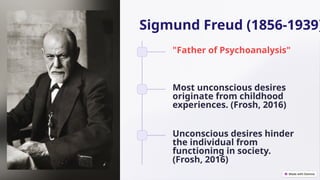
Sigmund Freud (1856-1939)
"Father of Psychoanalysis"
Most unconscious desires
originate from childhood
experiences. (Frosh, 2016)
Unconscious desires hinder
the individual from
functioning in society.
(Frosh, 2016)
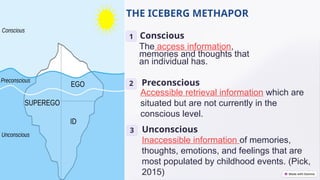
1 Conscious
The access information,
memories and thoughts that
an individual has.
2 Preconscious
3 Unconscious
Accessible retrieval information which are
situated but are not currently in the
conscious level.
THE ICEBERG METHAPOR
Inaccessible information of memories,
thoughts, emotions, and feelings that are
most populated by childhood events. (Pick,
2015)
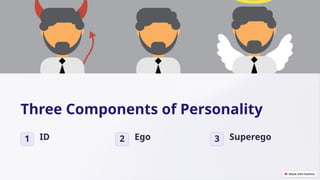
Three Components of Personality
1 ID 2 Ego 3 Superego
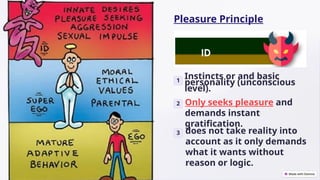
Pleasure Principle
1
2
3
Instincts or and basic
personality (unconscious
level).
Only seeks pleasure and
demands instant
gratification.
does not take reality into
account as it only demands
what it wants without
reason or logic.
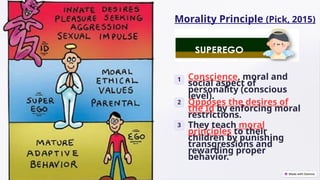
Morality Principle (Pick, 2015)
1 Conscience, moral and
social aspect of
personality (conscious
level).
2 Opposes the desires of
the Id by enforcing moral
restrictions.
3 They teach moral
principles to their
children by punishing
transgressions and
rewarding proper
behavior.
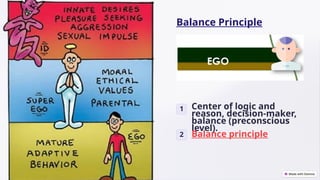
Balance Principle
1 Center of logic and
reason, decision-maker,
balance (preconscious
level).
2 Balance principle
The Bottom Line
•In short, psychoanalysis is a complex topic
that explores the depths of the human
psyche, emphasizing the unconscious,
childhood experiences, and the therapeutic
bond. Although criticized for its absence of
scientific evidence and focus on individuals,
it still serves as a valuable tool for
comprehending psychological distress.
Psychoanalysis is continuously developing,
underscoring the need for ongoing research
and critical dialogue to enhance our
comprehension of the human psyche.
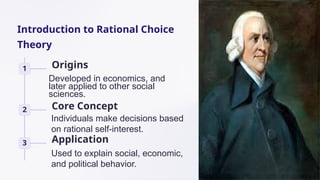
Introduction to Rational Choice
Theory
1 Origins
2 Core Concept
3 Application
Individuals make decisions based
on rational self-interest.
Used to explain social, economic,
and political behavior.
Developed in economics, and
later applied to other social
sciences.
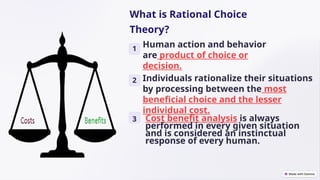
What is Rational Choice
Theory?
1
2
3
Human action and behavior
are product of choice or
decision.
Individuals rationalize their situations
by processing between the most
beneficial choice and the lesser
individual cost.
Cost benefit analysis is always
performed in every given situation
and is considered an instinctual
response of every human.
• An amount that has to be paid or
spent to buy or obtain something.
• An advantage or profit gained
from something.
Benefit
Cost
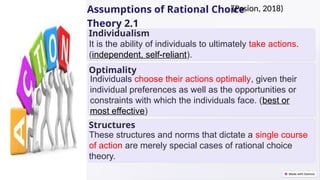
Assumptions of Rational Choice
Theory 2.1
Individualism
Optimality
Structures
It is the ability of individuals to ultimately take actions.
(independent, self-reliant).
Individuals choose their actions optimally, given their
individual preferences as well as the opportunities or
constraints with which the individuals face. (best or
most effective)
These structures and norms that dictate a single course
of action are merely special cases of rational choice
theory.
(Pasion, 2018)
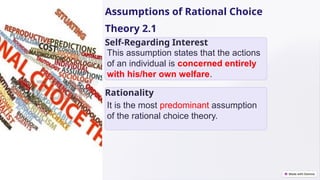
Assumptions of Rational Choice
Theory 2.1
Self-Regarding Interest
Rationality
This assumption states that the actions
of an individual is concerned entirely
with his/her own welfare.
It is the most predominant assumption
of the rational choice theory.
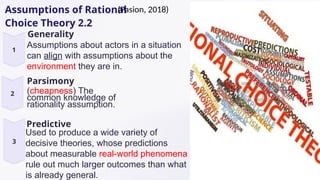
Assumptions of Rational
Choice Theory 2.2
Generality
Parsimony
(cheapness) The
common knowledge of
rationality assumption.
Predictive
Assumptions about actors in a situation
can align with assumptions about the
environment they are in.
Used to produce a wide variety of
decisive theories, whose predictions
about measurable real-world phenomena
rule out much larger outcomes than what
is already general.
(Pasion, 2018)
Pros of Rational Choice
Theory
• Helpful in explaining individual
and collective behaviors.
• All theories attempt to give
meaning to the things we
observe in the world.
• Can help to explain
behavior that seems
irrational.
Cons of Rational Choice
Theory
• Individuals do not always
make rational decisions.
• People are often moved by external
factors that are not rational, such as
emotions.
• Individuals do not have perfect
access to the information they
would need to make the most
rational decision every time.
• People value some dollars more
than others.
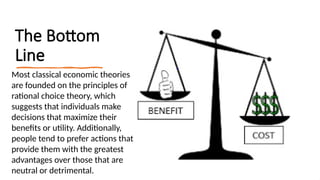
The Bottom
Line
Most classical economic theories
are founded on the principles of
rational choice theory, which
suggests that individuals make
decisions that maximize their
benefits or utility. Additionally,
people tend to prefer actions that
provide them with the greatest
advantages over those that are
neutral or detrimental.

Grade 11 Psychoanalysis and Rational Choice Theory

  • 1.
  • 2.
    • a. Psychoanalysis •b. Rational Choice Theory After going this module, you are expected to Analyze the basic concepts and principles of the major Social Science ideas: Objectives:
  • 3.
    Sigmund Freud (1856-1939) "Fatherof Psychoanalysis" Most unconscious desires originate from childhood experiences. (Frosh, 2016) Unconscious desires hinder the individual from functioning in society. (Frosh, 2016)
  • 4.
    1 Conscious The accessinformation, memories and thoughts that an individual has. 2 Preconscious 3 Unconscious Accessible retrieval information which are situated but are not currently in the conscious level. THE ICEBERG METHAPOR Inaccessible information of memories, thoughts, emotions, and feelings that are most populated by childhood events. (Pick, 2015)
  • 5.
    Three Components ofPersonality 1 ID 2 Ego 3 Superego
  • 6.
    Pleasure Principle 1 2 3 Instincts orand basic personality (unconscious level). Only seeks pleasure and demands instant gratification. does not take reality into account as it only demands what it wants without reason or logic.
  • 7.
    Morality Principle (Pick,2015) 1 Conscience, moral and social aspect of personality (conscious level). 2 Opposes the desires of the Id by enforcing moral restrictions. 3 They teach moral principles to their children by punishing transgressions and rewarding proper behavior.
  • 8.
    Balance Principle 1 Centerof logic and reason, decision-maker, balance (preconscious level). 2 Balance principle
  • 9.
    The Bottom Line •Inshort, psychoanalysis is a complex topic that explores the depths of the human psyche, emphasizing the unconscious, childhood experiences, and the therapeutic bond. Although criticized for its absence of scientific evidence and focus on individuals, it still serves as a valuable tool for comprehending psychological distress. Psychoanalysis is continuously developing, underscoring the need for ongoing research and critical dialogue to enhance our comprehension of the human psyche.
  • 10.
    Introduction to RationalChoice Theory 1 Origins 2 Core Concept 3 Application Individuals make decisions based on rational self-interest. Used to explain social, economic, and political behavior. Developed in economics, and later applied to other social sciences.
  • 11.
    What is RationalChoice Theory? 1 2 3 Human action and behavior are product of choice or decision. Individuals rationalize their situations by processing between the most beneficial choice and the lesser individual cost. Cost benefit analysis is always performed in every given situation and is considered an instinctual response of every human.
  • 12.
    • An amountthat has to be paid or spent to buy or obtain something. • An advantage or profit gained from something. Benefit Cost
  • 13.
    Assumptions of RationalChoice Theory 2.1 Individualism Optimality Structures It is the ability of individuals to ultimately take actions. (independent, self-reliant). Individuals choose their actions optimally, given their individual preferences as well as the opportunities or constraints with which the individuals face. (best or most effective) These structures and norms that dictate a single course of action are merely special cases of rational choice theory. (Pasion, 2018)
  • 14.
    Assumptions of RationalChoice Theory 2.1 Self-Regarding Interest Rationality This assumption states that the actions of an individual is concerned entirely with his/her own welfare. It is the most predominant assumption of the rational choice theory.
  • 15.
    Assumptions of Rational ChoiceTheory 2.2 Generality Parsimony (cheapness) The common knowledge of rationality assumption. Predictive Assumptions about actors in a situation can align with assumptions about the environment they are in. Used to produce a wide variety of decisive theories, whose predictions about measurable real-world phenomena rule out much larger outcomes than what is already general. (Pasion, 2018)
  • 16.
    Pros of RationalChoice Theory • Helpful in explaining individual and collective behaviors. • All theories attempt to give meaning to the things we observe in the world. • Can help to explain behavior that seems irrational. Cons of Rational Choice Theory • Individuals do not always make rational decisions. • People are often moved by external factors that are not rational, such as emotions. • Individuals do not have perfect access to the information they would need to make the most rational decision every time. • People value some dollars more than others.
  • 17.
    The Bottom Line Most classicaleconomic theories are founded on the principles of rational choice theory, which suggests that individuals make decisions that maximize their benefits or utility. Additionally, people tend to prefer actions that provide them with the greatest advantages over those that are neutral or detrimental.

Editor's Notes

  • #12 Rational Actors Rational Actors are individuals who are believed to make decisions based on their self-interest, and who consider the advantages and disadvantages of the options available to them before selecting the one that maximizes their own personal satisfaction or utility. Self-Interest It presumes that people pursue their self-interest, behaving in ways that will benefit them. Invisible Hand The term “the invisible hand” refers to the way in which individuals who are rational and who are participating in a free market are guided to produce the best results for society as a whole even though there is no central coordination involved.
  • #13  Individual agency refers to the capacity of individuals to make independent decisions and take actions based on their own beliefs, values, and goals. It emphasizes self-reliance and the ability to act autonomously without being overly influenced by external factors. Individuals make choices that are best suited to their preferences and the circumstances they are in, aiming to optimize their outcomes.