Enabling
Heterogeneous
Computing in
Java with
Graal
Juan Fumero,
Michel
Steuwer,
Christophe
Dubach
Introduction
API
Runtime Code
Generation
Data
Management
Results
Conclusion
Enabling Heterogeneous Computing in Java
with Graal
Juan Fumero, Michel Steuwer, Christophe Dubach
The University of Edinburgh
7 July 2015
Truffle Workshop
1 / 26
Enabling
Heterogeneous
Computing in
Java with
Graal
Juan Fumero,
Michel
Steuwer,
Christophe
Dubach
Introduction
API
Runtime Code
Generation
Data
Management
Results
Conclusion
1 Introduction
2 API
3 Runtime Code Generation
4 Data Management
5 Results
6 Conclusion
2 / 26
Enabling
Heterogeneous
Computing in
Java with
Graal
Juan Fumero,
Michel
Steuwer,
Christophe
Dubach
Introduction
API
Runtime Code
Generation
Data
Management
Results
Conclusion
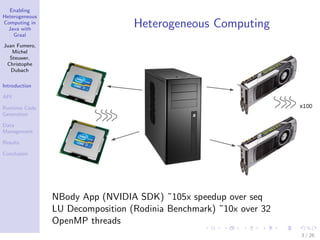
Heterogeneous Computing
NBody App (NVIDIA SDK) ˜105x speedup over seq
LU Decomposition (Rodinia Benchmark) ˜10x over 32
OpenMP threads
3 / 26
Enabling
Heterogeneous
Computing in
Java with
Graal
Juan Fumero,
Michel
Steuwer,
Christophe
Dubach
Introduction
API
Runtime Code
Generation
Data
Management
Results
Conclusion
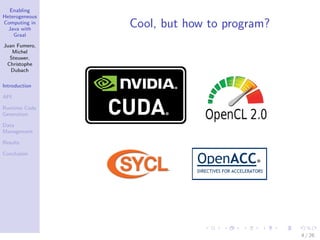
Cool, but how to program?
4 / 26
Enabling
Heterogeneous
Computing in
Java with
Graal
Juan Fumero,
Michel
Steuwer,
Christophe
Dubach
Introduction
API
Runtime Code
Generation
Data
Management
Results
Conclusion
Example in OpenCL
1 // create host buffers
2 i n t ∗A, . . . .
3 //Initialization
4 . . .
5 // platform
6 c l u i n t numPlatforms = 0;
7 c l p l a t f o r m i d ∗ p l a t f o r m s ;
8 s t a t u s = clGetPlatf ormIDs (0 , NULL, &numPlatforms ) ;
9 p l a t f o r m s = ( c l p l a t f o r m i d ∗) malloc ( numPlatforms∗ s i z e o f ( c l p l a t f o r m i d ) ) ;
10 s t a t u s = c lGetPlatform IDs ( numPlatforms , platforms , NULL) ;
11 c l u i n t numDevices = 0;
12 c l d e v i c e i d ∗ d e v i c e s ;
13 s t a t u s = clGetDeviceIDs ( p l a t f o r m s [ 0 ] , CL DEVICE TYPE ALL , 0 , NULL, &
numDevices ) ;
14 // Allocate space for each device
15 d e v i c e s = ( c l d e v i c e i d ∗) malloc ( numDevices∗ s i z e o f ( c l d e v i c e i d ) ) ;
16 // Fill in devices
17 s t a t u s = clGetDeviceIDs ( p l a t f o r m s [ 0 ] , CL DEVICE TYPE ALL , numDevices ,
devices , NULL) ;
18 c l c o n t e x t context ;
19 context = c l C r e a t e C o n t e x t (NULL, numDevices , devices , NULL, NULL, &s t a t u s ) ;
20 cl command queue cmdQ ;
21 cmdQ = clCreateCommandQueue ( context , d e v i c e s [ 0 ] , 0 , &s t a t u s ) ;
22 cl mem d A , d B , d C ;
23 d A = c l C r e a t e B u f f e r ( context , CL MEM READ ONLY|CL MEM COPY HOST PTR,
d a t a s i z e , A, &s t a t u s ) ;
24 d B = c l C r e a t e B u f f e r ( context , CL MEM READ ONLY|CL MEM COPY HOST PTR,
d a t a s i z e , B, &s t a t u s ) ;
25 d C = c l C r e a t e B u f f e r ( context , CL MEM WRITE ONLY, d a t a s i z e , NULL, &s t a t u s ) ;
26 . . .
27 // Check errors
28 . . .
5 / 26
Enabling
Heterogeneous
Computing in
Java with
Graal
Juan Fumero,
Michel
Steuwer,
Christophe
Dubach
Introduction
API
Runtime Code
Generation
Data
Management
Results
Conclusion
Example in OpenCL
1 const char ∗ s o u r c e F i l e = ” k e r n e l . c l ” ;
2 source = r e a d s o u r c e ( s o u r c e F i l e ) ;
3 program = clCreateProgramWithSource ( context , 1 , ( const char ∗∗)&source , NULL,
&s t a t u s ) ;
4 c l i n t b u i l d E r r ;
5 b u i l d E r r = clBuildProgram ( program , numDevices , devices , NULL, NULL, NULL) ;
6 // Create a kernel
7 k e r n e l = c l C r e a t e K e r n e l ( program , ” vecadd ” , &s t a t u s ) ;
8
9 s t a t u s = c l S e t K e r n e l A r g ( kernel , 0 , s i z e o f ( cl mem ) , &d A ) ;
10 s t a t u s |= c l S e t K e r n e l A r g ( kernel , 1 , s i z e o f ( cl mem ) , &d B ) ;
11 s t a t u s |= c l S e t K e r n e l A r g ( kernel , 2 , s i z e o f ( cl mem ) , &d C ) ;
12
13 s i z e t globalWorkSize [ 1 ] = { ELEMENTS};
14 s i z e t l o c a l i t e m s i z e [ 1 ] = {5};
15
16 clEnqueueNDRangeKernel (cmdQ, kernel , 1 , NULL, globalWorkSize , NULL, 0 , NULL,
NULL) ;
17
18 clEnqueueReadBuffer (cmdQ, d C , CL TRUE , 0 , d a t a s i z e , C, 0 , NULL, NULL) ;
19
20 // Free memory
6 / 26
Enabling
Heterogeneous
Computing in
Java with
Graal
Juan Fumero,
Michel
Steuwer,
Christophe
Dubach
Introduction
API
Runtime Code
Generation
Data
Management
Results
Conclusion
OpenCL example
1 k e r n e l void
vecadd (
2 g l o b a l i n t ∗a ,
3 g l o b a l i n t ∗b ,
4 g l o b a l i n t ∗c ) {
5
6 i n t i d x =
7 g e t g l o b a l i d (0) ;
8 c [ i d x ] = a [ i d x ] ∗
b [ i d x ] ;
9 }
• Hello world App ˜ 250 lines of
code (including error
checking)
• Low-level and specific code
• Knowledge about target
architecture
• If GPU/accelerator changes,
tuning is required
7 / 26
Enabling
Heterogeneous
Computing in
Java with
Graal
Juan Fumero,
Michel
Steuwer,
Christophe
Dubach
Introduction
API
Runtime Code
Generation
Data
Management
Results
Conclusion
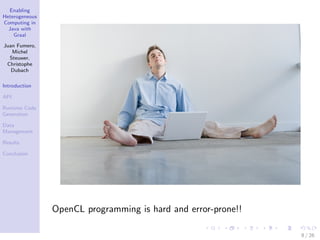
OpenCL programming is hard and error-prone!!
8 / 26
Enabling
Heterogeneous
Computing in
Java with
Graal
Juan Fumero,
Michel
Steuwer,
Christophe
Dubach
Introduction
API
Runtime Code
Generation
Data
Management
Results
Conclusion
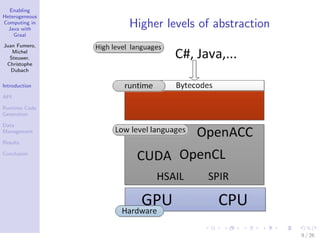
Higher levels of abstraction
9 / 26
Enabling
Heterogeneous
Computing in
Java with
Graal
Juan Fumero,
Michel
Steuwer,
Christophe
Dubach
Introduction
API
Runtime Code
Generation
Data
Management
Results
Conclusion
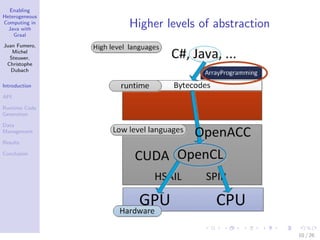
Higher levels of abstraction
10 / 26
Enabling
Heterogeneous
Computing in
Java with
Graal
Juan Fumero,
Michel
Steuwer,
Christophe
Dubach
Introduction
API
Runtime Code
Generation
Data
Management
Results
Conclusion
Similar works
• Sumatra API (discontinued): Stream API for HSAIL
• AMD Aparapi: Java API for OpenCL
• NVIDIA Nova: functional programming language for
CPU/GPU
• Cooperhead: subset of python than can be executed on
heterogeneous platforms.
11 / 26
Enabling
Heterogeneous
Computing in
Java with
Graal
Juan Fumero,
Michel
Steuwer,
Christophe
Dubach
Introduction
API
Runtime Code
Generation
Data
Management
Results
Conclusion
Our Approach
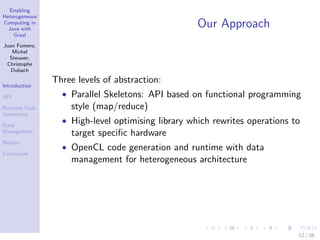
Three levels of abstraction:
• Parallel Skeletons: API based on functional programming
style (map/reduce)
• High-level optimising library which rewrites operations to
target specific hardware
• OpenCL code generation and runtime with data
management for heterogeneous architecture
12 / 26
Enabling
Heterogeneous
Computing in
Java with
Graal
Juan Fumero,
Michel
Steuwer,
Christophe
Dubach
Introduction
API
Runtime Code
Generation
Data
Management
Results
Conclusion
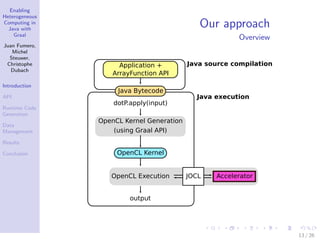
Our approach
Overview
Application +
ArrayFunction API
Java Bytecode
(using Graal API)
OpenCL Kernel Generation
OpenCL Execution
Java source compilation
Java execution
dotP.apply(input)
Accelerator
OpenCL Kernel
JOCL
output
13 / 26
Enabling
Heterogeneous
Computing in
Java with
Graal
Juan Fumero,
Michel
Steuwer,
Christophe
Dubach
Introduction
API
Runtime Code
Generation
Data
Management
Results
Conclusion
Example: Saxpy
1 // Computation function
2 ArrayFunc<Tuple2<Float , Float >, Float > mult = new
MapFunction<>(t −> 2.5 f ∗ t . 1 () + t . 2 () ) ;
3
4 // Prepare the input
5 Tuple2<Float , Float >[] i n p ut = new Tuple2 [ s i z e ] ;
6 f o r ( i n t i = 0; i < i np u t . l e n g t h ; ++i ) {
7 i n pu t [ i ] . 1 = ( f l o a t ) ( i ∗ 0.323) ;
8 i n pu t [ i ] . 2 = ( f l o a t ) ( i + 2 . 0 ) ;
9 }
10
11 // Computation
12 Flo at [ ] output = mult . apply ( i np u t ) ;
If accelerator enabled, the map expression is rewritten in lower
level operations automatically.
map(λ) = MapAccelerator(λ) =
CopyIn().computeOCL(λ).CopyOut()
14 / 26
Enabling
Heterogeneous
Computing in
Java with
Graal
Juan Fumero,
Michel
Steuwer,
Christophe
Dubach
Introduction
API
Runtime Code
Generation
Data
Management
Results
Conclusion
Our Approach
Overview
Ar r ayFunc
Map
MapThr eads
MapOpenCL
Reduce. . .
appl y( ) {
f or ( i = 0; i < si ze; ++i )
out [ i ] = f . appl y( i n[ i ] ) ) ;
}
appl y( ) {
f or ( t hr ead : t hr eads)
t hr ead. per f or mMapSeq( ) ;
}
appl y( ) {
copyToDevi ce( ) ;
execut e( ) ;
copyToHost ( ) ;
}
Funct i on
15 / 26
Enabling
Heterogeneous
Computing in
Java with
Graal
Juan Fumero,
Michel
Steuwer,
Christophe
Dubach
Introduction
API
Runtime Code
Generation
Data
Management
Results
Conclusion
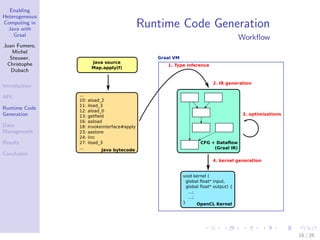
Runtime Code Generation
Workflow
...
10: aload_2
11: iload_3
12: aload_0
13: getfield
16: aaload
18: invokeinterface#apply
23: aastore
24: iinc
27: iload_3
...
Java source
Map.apply(f)
Java bytecode
Graal VM
CFG + Dataflow
(Graal IR)
void kernel (
global float* input,
global float* output) {
...;
...;
} OpenCL Kernel
3. optimizations
2. IR generation
4. kernel generation
1. Type inference
16 / 26
Enabling
Heterogeneous
Computing in
Java with
Graal
Juan Fumero,
Michel
Steuwer,
Christophe
Dubach
Introduction
API
Runtime Code
Generation
Data
Management
Results
Conclusion
OpenCL code generated
1 double lambda0 ( f l o a t p0 ) {
2 double c a s t 1 = ( double ) p0 ;
3 double r e s u l t 2 = c a s t 1 ∗ 2 . 0 ;
4 return r e s u l t 2 ;
5 }
6 k e r n e l void lambdaComputationKernel (
7 g l o b a l f l o a t ∗ p0 ,
8 g l o b a l i n t ∗ p0 index data ,
9 g l o b a l double ∗p1 ,
10 g l o b a l i n t ∗ p 1 i n d e x d a t a ) {
11 i n t p0 dim 1 = 0; i n t p1 dim 1 = 0;
12 i n t gs = g e t g l o b a l s i z e (0) ;
13 i n t loop 1 = g e t g l o b a l i d (0) ;
14 f o r ( ; ; loop 1 += gs ) {
15 i n t p 0 l e n d i m 1 = p 0 i n d e x d a t a [ p0 dim 1 ] ;
16 bool cond 2 = loop 1 < p 0 l e n d i m 1 ;
17 i f ( cond 2 ) {
18 f l o a t auxVar0 = p0 [ loop 1 ] ;
19 double r e s = lambd0 ( auxVar0 ) ;
20 p1 [ p 1 i n d e x d a t a [ p1 dim 1 + 1] + loop 1 ]
21 = r e s ;
22 } e l s e { break ; }
23 }
24 }
17 / 26
Enabling
Heterogeneous
Computing in
Java with
Graal
Juan Fumero,
Michel
Steuwer,
Christophe
Dubach
Introduction
API
Runtime Code
Generation
Data
Management
Results
Conclusion
Investigation of runtime for BS
Black-scholes benchmark.
Float[] =⇒ Tuple2 < Float, Float > []
0.0
0.2
0.4
0.6
0.8
1.0
Amountoftotalruntimein%
Unmarshaling
CopyToCPU
GPU Execution
CopyToGPU
Marshaling
Java overhead
• Un/marshal data takes
up to 90% of the time
• Computation step
should be dominant
This is not acceptable. Can we do better?
18 / 26
Enabling
Heterogeneous
Computing in
Java with
Graal
Juan Fumero,
Michel
Steuwer,
Christophe
Dubach
Introduction
API
Runtime Code
Generation
Data
Management
Results
Conclusion
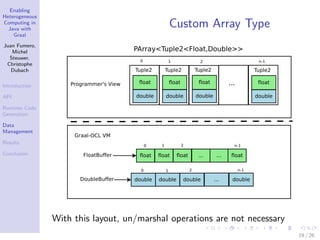
Custom Array Type
Programmer's View
Tuple2
...
Graal-OCL VM
float float float float...
double double double double...
FloatBuffer
DoubleBuffer
...
0 1 2 n-1
...
0 1 2 n-1
0 1 2 n-1
float
double
Tuple2
float
double
Tuple2
float
double
Tuple2
float
double
...
PArray<Tuple2<Float,Double>>
With this layout, un/marshal operations are not necessary
19 / 26
Enabling
Heterogeneous
Computing in
Java with
Graal
Juan Fumero,
Michel
Steuwer,
Christophe
Dubach
Introduction
API
Runtime Code
Generation
Data
Management
Results
Conclusion
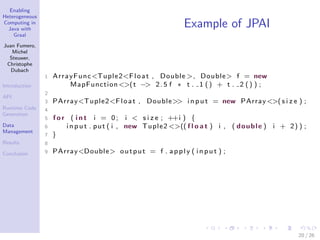
Example of JPAI
1 ArrayFunc<Tuple2<Float , Double >, Double> f = new
MapFunction<>(t −> 2.5 f ∗ t . 1 () + t . 2 () ) ;
2
3 PArray<Tuple2<Float , Double>> i n pu t = new PArray<>( s i z e ) ;
4
5 f o r ( i n t i = 0; i < s i z e ; ++i ) {
6 i np u t . put ( i , new Tuple2 <>(( f l o a t ) i , ( double ) i + 2) ) ;
7 }
8
9 PArray<Double> output = f . apply ( i n pu t ) ;
20 / 26
Enabling
Heterogeneous
Computing in
Java with
Graal
Juan Fumero,
Michel
Steuwer,
Christophe
Dubach
Introduction
API
Runtime Code
Generation
Data
Management
Results
Conclusion
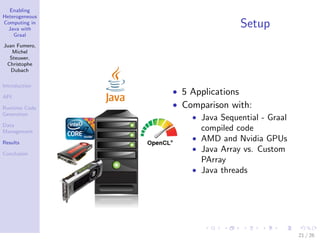
Setup
• 5 Applications
• Comparison with:
• Java Sequential - Graal
compiled code
• AMD and Nvidia GPUs
• Java Array vs. Custom
PArray
• Java threads
21 / 26
Enabling
Heterogeneous
Computing in
Java with
Graal
Juan Fumero,
Michel
Steuwer,
Christophe
Dubach
Introduction
API
Runtime Code
Generation
Data
Management
Results
Conclusion
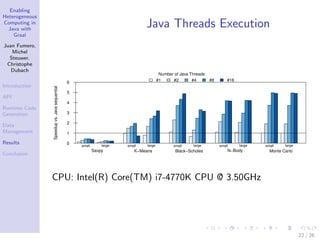
Java Threads Execution
0
1
2
3
4
5
6
small large
Saxpy
small large
K−Means
small large
Black−Scholes
small large
N−Body
small large
Monte Carlo
Speedupvs.Javasequential
Number of Java Threads
#1 #2 #4 #8 #16
CPU: Intel(R) Core(TM) i7-4770K CPU @ 3.50GHz
22 / 26
Enabling
Heterogeneous
Computing in
Java with
Graal
Juan Fumero,
Michel
Steuwer,
Christophe
Dubach
Introduction
API
Runtime Code
Generation
Data
Management
Results
Conclusion
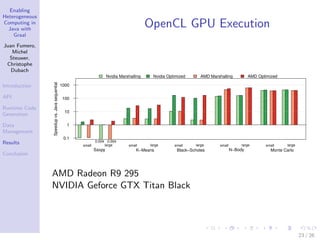
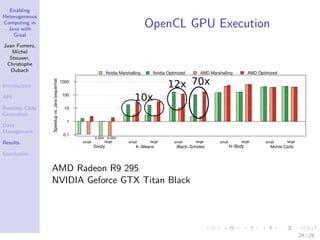
OpenCL GPU Execution
0.1
1
10
100
1000
small large
Saxpy
0.004 0.004
small large
K−Means
small large
Black−Scholes
small large
N−Body
small large
Monte Carlo
Speedupvs.Javasequential
Nvidia Marshalling Nvidia Optimized AMD Marshalling AMD Optimized
AMD Radeon R9 295
NVIDIA Geforce GTX Titan Black
23 / 26
Enabling
Heterogeneous
Computing in
Java with
Graal
Juan Fumero,
Michel
Steuwer,
Christophe
Dubach
Introduction
API
Runtime Code
Generation
Data
Management
Results
Conclusion
OpenCL GPU Execution
0.1
1
10
100
1000
small large
Saxpy
0.004 0.004
small large
K−Means
small large
Black−Scholes
small large
N−Body
small large
Monte Carlo
Speedupvs.Javasequential
Nvidia Marshalling Nvidia Optimized AMD Marshalling AMD Optimized
10x
12x 70x
AMD Radeon R9 295
NVIDIA Geforce GTX Titan Black
24 / 26
Enabling
Heterogeneous
Computing in
Java with
Graal
Juan Fumero,
Michel
Steuwer,
Christophe
Dubach
Introduction
API
Runtime Code
Generation
Data
Management
Results
Conclusion
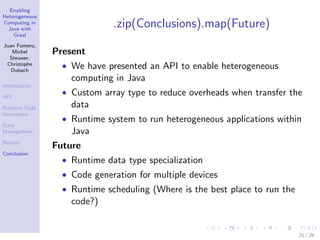
.zip(Conclusions).map(Future)
Present
• We have presented an API to enable heterogeneous
computing in Java
• Custom array type to reduce overheads when transfer the
data
• Runtime system to run heterogeneous applications within
Java
Future
• Runtime data type specialization
• Code generation for multiple devices
• Runtime scheduling (Where is the best place to run the
code?)
25 / 26
Enabling
Heterogeneous
Computing in
Java with
Graal
Juan Fumero,
Michel
Steuwer,
Christophe
Dubach
Introduction
API
Runtime Code
Generation
Data
Management
Results
Conclusion
Thanks so much for your attention
This work was supported by
a grant from:
Juan Jos´e Fumero
juan.fumero@ed.ac.uk
26 / 26

Gpus graal

  • 1.
    Enabling Heterogeneous Computing in Java with Graal JuanFumero, Michel Steuwer, Christophe Dubach Introduction API Runtime Code Generation Data Management Results Conclusion Enabling Heterogeneous Computing in Java with Graal Juan Fumero, Michel Steuwer, Christophe Dubach The University of Edinburgh 7 July 2015 Truffle Workshop 1 / 26
  • 2.
    Enabling Heterogeneous Computing in Java with Graal JuanFumero, Michel Steuwer, Christophe Dubach Introduction API Runtime Code Generation Data Management Results Conclusion 1 Introduction 2 API 3 Runtime Code Generation 4 Data Management 5 Results 6 Conclusion 2 / 26
  • 3.
    Enabling Heterogeneous Computing in Java with Graal JuanFumero, Michel Steuwer, Christophe Dubach Introduction API Runtime Code Generation Data Management Results Conclusion Heterogeneous Computing NBody App (NVIDIA SDK) ˜105x speedup over seq LU Decomposition (Rodinia Benchmark) ˜10x over 32 OpenMP threads 3 / 26
  • 4.
    Enabling Heterogeneous Computing in Java with Graal JuanFumero, Michel Steuwer, Christophe Dubach Introduction API Runtime Code Generation Data Management Results Conclusion Cool, but how to program? 4 / 26
  • 5.
    Enabling Heterogeneous Computing in Java with Graal JuanFumero, Michel Steuwer, Christophe Dubach Introduction API Runtime Code Generation Data Management Results Conclusion Example in OpenCL 1 // create host buffers 2 i n t ∗A, . . . . 3 //Initialization 4 . . . 5 // platform 6 c l u i n t numPlatforms = 0; 7 c l p l a t f o r m i d ∗ p l a t f o r m s ; 8 s t a t u s = clGetPlatf ormIDs (0 , NULL, &numPlatforms ) ; 9 p l a t f o r m s = ( c l p l a t f o r m i d ∗) malloc ( numPlatforms∗ s i z e o f ( c l p l a t f o r m i d ) ) ; 10 s t a t u s = c lGetPlatform IDs ( numPlatforms , platforms , NULL) ; 11 c l u i n t numDevices = 0; 12 c l d e v i c e i d ∗ d e v i c e s ; 13 s t a t u s = clGetDeviceIDs ( p l a t f o r m s [ 0 ] , CL DEVICE TYPE ALL , 0 , NULL, & numDevices ) ; 14 // Allocate space for each device 15 d e v i c e s = ( c l d e v i c e i d ∗) malloc ( numDevices∗ s i z e o f ( c l d e v i c e i d ) ) ; 16 // Fill in devices 17 s t a t u s = clGetDeviceIDs ( p l a t f o r m s [ 0 ] , CL DEVICE TYPE ALL , numDevices , devices , NULL) ; 18 c l c o n t e x t context ; 19 context = c l C r e a t e C o n t e x t (NULL, numDevices , devices , NULL, NULL, &s t a t u s ) ; 20 cl command queue cmdQ ; 21 cmdQ = clCreateCommandQueue ( context , d e v i c e s [ 0 ] , 0 , &s t a t u s ) ; 22 cl mem d A , d B , d C ; 23 d A = c l C r e a t e B u f f e r ( context , CL MEM READ ONLY|CL MEM COPY HOST PTR, d a t a s i z e , A, &s t a t u s ) ; 24 d B = c l C r e a t e B u f f e r ( context , CL MEM READ ONLY|CL MEM COPY HOST PTR, d a t a s i z e , B, &s t a t u s ) ; 25 d C = c l C r e a t e B u f f e r ( context , CL MEM WRITE ONLY, d a t a s i z e , NULL, &s t a t u s ) ; 26 . . . 27 // Check errors 28 . . . 5 / 26
  • 6.
    Enabling Heterogeneous Computing in Java with Graal JuanFumero, Michel Steuwer, Christophe Dubach Introduction API Runtime Code Generation Data Management Results Conclusion Example in OpenCL 1 const char ∗ s o u r c e F i l e = ” k e r n e l . c l ” ; 2 source = r e a d s o u r c e ( s o u r c e F i l e ) ; 3 program = clCreateProgramWithSource ( context , 1 , ( const char ∗∗)&source , NULL, &s t a t u s ) ; 4 c l i n t b u i l d E r r ; 5 b u i l d E r r = clBuildProgram ( program , numDevices , devices , NULL, NULL, NULL) ; 6 // Create a kernel 7 k e r n e l = c l C r e a t e K e r n e l ( program , ” vecadd ” , &s t a t u s ) ; 8 9 s t a t u s = c l S e t K e r n e l A r g ( kernel , 0 , s i z e o f ( cl mem ) , &d A ) ; 10 s t a t u s |= c l S e t K e r n e l A r g ( kernel , 1 , s i z e o f ( cl mem ) , &d B ) ; 11 s t a t u s |= c l S e t K e r n e l A r g ( kernel , 2 , s i z e o f ( cl mem ) , &d C ) ; 12 13 s i z e t globalWorkSize [ 1 ] = { ELEMENTS}; 14 s i z e t l o c a l i t e m s i z e [ 1 ] = {5}; 15 16 clEnqueueNDRangeKernel (cmdQ, kernel , 1 , NULL, globalWorkSize , NULL, 0 , NULL, NULL) ; 17 18 clEnqueueReadBuffer (cmdQ, d C , CL TRUE , 0 , d a t a s i z e , C, 0 , NULL, NULL) ; 19 20 // Free memory 6 / 26
  • 7.
    Enabling Heterogeneous Computing in Java with Graal JuanFumero, Michel Steuwer, Christophe Dubach Introduction API Runtime Code Generation Data Management Results Conclusion OpenCL example 1 k e r n e l void vecadd ( 2 g l o b a l i n t ∗a , 3 g l o b a l i n t ∗b , 4 g l o b a l i n t ∗c ) { 5 6 i n t i d x = 7 g e t g l o b a l i d (0) ; 8 c [ i d x ] = a [ i d x ] ∗ b [ i d x ] ; 9 } • Hello world App ˜ 250 lines of code (including error checking) • Low-level and specific code • Knowledge about target architecture • If GPU/accelerator changes, tuning is required 7 / 26
  • 8.
    Enabling Heterogeneous Computing in Java with Graal JuanFumero, Michel Steuwer, Christophe Dubach Introduction API Runtime Code Generation Data Management Results Conclusion OpenCL programming is hard and error-prone!! 8 / 26
  • 9.
    Enabling Heterogeneous Computing in Java with Graal JuanFumero, Michel Steuwer, Christophe Dubach Introduction API Runtime Code Generation Data Management Results Conclusion Higher levels of abstraction 9 / 26
  • 10.
    Enabling Heterogeneous Computing in Java with Graal JuanFumero, Michel Steuwer, Christophe Dubach Introduction API Runtime Code Generation Data Management Results Conclusion Higher levels of abstraction 10 / 26
  • 11.
    Enabling Heterogeneous Computing in Java with Graal JuanFumero, Michel Steuwer, Christophe Dubach Introduction API Runtime Code Generation Data Management Results Conclusion Similar works • Sumatra API (discontinued): Stream API for HSAIL • AMD Aparapi: Java API for OpenCL • NVIDIA Nova: functional programming language for CPU/GPU • Cooperhead: subset of python than can be executed on heterogeneous platforms. 11 / 26
  • 12.
    Enabling Heterogeneous Computing in Java with Graal JuanFumero, Michel Steuwer, Christophe Dubach Introduction API Runtime Code Generation Data Management Results Conclusion Our Approach Three levels of abstraction: • Parallel Skeletons: API based on functional programming style (map/reduce) • High-level optimising library which rewrites operations to target specific hardware • OpenCL code generation and runtime with data management for heterogeneous architecture 12 / 26
  • 13.
    Enabling Heterogeneous Computing in Java with Graal JuanFumero, Michel Steuwer, Christophe Dubach Introduction API Runtime Code Generation Data Management Results Conclusion Our approach Overview Application + ArrayFunction API Java Bytecode (using Graal API) OpenCL Kernel Generation OpenCL Execution Java source compilation Java execution dotP.apply(input) Accelerator OpenCL Kernel JOCL output 13 / 26
  • 14.
    Enabling Heterogeneous Computing in Java with Graal JuanFumero, Michel Steuwer, Christophe Dubach Introduction API Runtime Code Generation Data Management Results Conclusion Example: Saxpy 1 // Computation function 2 ArrayFunc<Tuple2<Float , Float >, Float > mult = new MapFunction<>(t −> 2.5 f ∗ t . 1 () + t . 2 () ) ; 3 4 // Prepare the input 5 Tuple2<Float , Float >[] i n p ut = new Tuple2 [ s i z e ] ; 6 f o r ( i n t i = 0; i < i np u t . l e n g t h ; ++i ) { 7 i n pu t [ i ] . 1 = ( f l o a t ) ( i ∗ 0.323) ; 8 i n pu t [ i ] . 2 = ( f l o a t ) ( i + 2 . 0 ) ; 9 } 10 11 // Computation 12 Flo at [ ] output = mult . apply ( i np u t ) ; If accelerator enabled, the map expression is rewritten in lower level operations automatically. map(λ) = MapAccelerator(λ) = CopyIn().computeOCL(λ).CopyOut() 14 / 26
  • 15.
    Enabling Heterogeneous Computing in Java with Graal JuanFumero, Michel Steuwer, Christophe Dubach Introduction API Runtime Code Generation Data Management Results Conclusion Our Approach Overview Ar r ayFunc Map MapThr eads MapOpenCL Reduce. . . appl y( ) { f or ( i = 0; i < si ze; ++i ) out [ i ] = f . appl y( i n[ i ] ) ) ; } appl y( ) { f or ( t hr ead : t hr eads) t hr ead. per f or mMapSeq( ) ; } appl y( ) { copyToDevi ce( ) ; execut e( ) ; copyToHost ( ) ; } Funct i on 15 / 26
  • 16.
    Enabling Heterogeneous Computing in Java with Graal JuanFumero, Michel Steuwer, Christophe Dubach Introduction API Runtime Code Generation Data Management Results Conclusion Runtime Code Generation Workflow ... 10: aload_2 11: iload_3 12: aload_0 13: getfield 16: aaload 18: invokeinterface#apply 23: aastore 24: iinc 27: iload_3 ... Java source Map.apply(f) Java bytecode Graal VM CFG + Dataflow (Graal IR) void kernel ( global float* input, global float* output) { ...; ...; } OpenCL Kernel 3. optimizations 2. IR generation 4. kernel generation 1. Type inference 16 / 26
  • 17.
    Enabling Heterogeneous Computing in Java with Graal JuanFumero, Michel Steuwer, Christophe Dubach Introduction API Runtime Code Generation Data Management Results Conclusion OpenCL code generated 1 double lambda0 ( f l o a t p0 ) { 2 double c a s t 1 = ( double ) p0 ; 3 double r e s u l t 2 = c a s t 1 ∗ 2 . 0 ; 4 return r e s u l t 2 ; 5 } 6 k e r n e l void lambdaComputationKernel ( 7 g l o b a l f l o a t ∗ p0 , 8 g l o b a l i n t ∗ p0 index data , 9 g l o b a l double ∗p1 , 10 g l o b a l i n t ∗ p 1 i n d e x d a t a ) { 11 i n t p0 dim 1 = 0; i n t p1 dim 1 = 0; 12 i n t gs = g e t g l o b a l s i z e (0) ; 13 i n t loop 1 = g e t g l o b a l i d (0) ; 14 f o r ( ; ; loop 1 += gs ) { 15 i n t p 0 l e n d i m 1 = p 0 i n d e x d a t a [ p0 dim 1 ] ; 16 bool cond 2 = loop 1 < p 0 l e n d i m 1 ; 17 i f ( cond 2 ) { 18 f l o a t auxVar0 = p0 [ loop 1 ] ; 19 double r e s = lambd0 ( auxVar0 ) ; 20 p1 [ p 1 i n d e x d a t a [ p1 dim 1 + 1] + loop 1 ] 21 = r e s ; 22 } e l s e { break ; } 23 } 24 } 17 / 26
  • 18.
    Enabling Heterogeneous Computing in Java with Graal JuanFumero, Michel Steuwer, Christophe Dubach Introduction API Runtime Code Generation Data Management Results Conclusion Investigation of runtime for BS Black-scholes benchmark. Float[] =⇒ Tuple2 < Float, Float > [] 0.0 0.2 0.4 0.6 0.8 1.0 Amountoftotalruntimein% Unmarshaling CopyToCPU GPU Execution CopyToGPU Marshaling Java overhead • Un/marshal data takes up to 90% of the time • Computation step should be dominant This is not acceptable. Can we do better? 18 / 26
  • 19.
    Enabling Heterogeneous Computing in Java with Graal JuanFumero, Michel Steuwer, Christophe Dubach Introduction API Runtime Code Generation Data Management Results Conclusion Custom Array Type Programmer's View Tuple2 ... Graal-OCL VM float float float float... double double double double... FloatBuffer DoubleBuffer ... 0 1 2 n-1 ... 0 1 2 n-1 0 1 2 n-1 float double Tuple2 float double Tuple2 float double Tuple2 float double ... PArray<Tuple2<Float,Double>> With this layout, un/marshal operations are not necessary 19 / 26
  • 20.
    Enabling Heterogeneous Computing in Java with Graal JuanFumero, Michel Steuwer, Christophe Dubach Introduction API Runtime Code Generation Data Management Results Conclusion Example of JPAI 1 ArrayFunc<Tuple2<Float , Double >, Double> f = new MapFunction<>(t −> 2.5 f ∗ t . 1 () + t . 2 () ) ; 2 3 PArray<Tuple2<Float , Double>> i n pu t = new PArray<>( s i z e ) ; 4 5 f o r ( i n t i = 0; i < s i z e ; ++i ) { 6 i np u t . put ( i , new Tuple2 <>(( f l o a t ) i , ( double ) i + 2) ) ; 7 } 8 9 PArray<Double> output = f . apply ( i n pu t ) ; 20 / 26
  • 21.
    Enabling Heterogeneous Computing in Java with Graal JuanFumero, Michel Steuwer, Christophe Dubach Introduction API Runtime Code Generation Data Management Results Conclusion Setup • 5 Applications • Comparison with: • Java Sequential - Graal compiled code • AMD and Nvidia GPUs • Java Array vs. Custom PArray • Java threads 21 / 26
  • 22.
    Enabling Heterogeneous Computing in Java with Graal JuanFumero, Michel Steuwer, Christophe Dubach Introduction API Runtime Code Generation Data Management Results Conclusion Java Threads Execution 0 1 2 3 4 5 6 small large Saxpy small large K−Means small large Black−Scholes small large N−Body small large Monte Carlo Speedupvs.Javasequential Number of Java Threads #1 #2 #4 #8 #16 CPU: Intel(R) Core(TM) i7-4770K CPU @ 3.50GHz 22 / 26
  • 23.
    Enabling Heterogeneous Computing in Java with Graal JuanFumero, Michel Steuwer, Christophe Dubach Introduction API Runtime Code Generation Data Management Results Conclusion OpenCL GPU Execution 0.1 1 10 100 1000 small large Saxpy 0.004 0.004 small large K−Means small large Black−Scholes small large N−Body small large Monte Carlo Speedupvs.Javasequential Nvidia Marshalling Nvidia Optimized AMD Marshalling AMD Optimized AMD Radeon R9 295 NVIDIA Geforce GTX Titan Black 23 / 26
  • 24.
    Enabling Heterogeneous Computing in Java with Graal JuanFumero, Michel Steuwer, Christophe Dubach Introduction API Runtime Code Generation Data Management Results Conclusion OpenCL GPU Execution 0.1 1 10 100 1000 small large Saxpy 0.004 0.004 small large K−Means small large Black−Scholes small large N−Body small large Monte Carlo Speedupvs.Javasequential Nvidia Marshalling Nvidia Optimized AMD Marshalling AMD Optimized 10x 12x 70x AMD Radeon R9 295 NVIDIA Geforce GTX Titan Black 24 / 26
  • 25.
    Enabling Heterogeneous Computing in Java with Graal JuanFumero, Michel Steuwer, Christophe Dubach Introduction API Runtime Code Generation Data Management Results Conclusion .zip(Conclusions).map(Future) Present • We have presented an API to enable heterogeneous computing in Java • Custom array type to reduce overheads when transfer the data • Runtime system to run heterogeneous applications within Java Future • Runtime data type specialization • Code generation for multiple devices • Runtime scheduling (Where is the best place to run the code?) 25 / 26
  • 26.
    Enabling Heterogeneous Computing in Java with Graal JuanFumero, Michel Steuwer, Christophe Dubach Introduction API Runtime Code Generation Data Management Results Conclusion Thanks so much for your attention This work was supported by a grant from: Juan Jos´e Fumero juan.fumero@ed.ac.uk 26 / 26