MANAGEMENT AND ADMINISTRATION IN NURSING.
GROUP 4.
• A GROUP PRESENTATION ON : HEALTH INSTITUTIONS AND THEIR
SERVICES
LEARNING OBJECTIVES
By the end of this presentation, colleague
students should be able to;
1. Define The various health institutions
2. Know some of their respective structures
3. And the services they render
INTRODUCTION:
• Health institutions are organizations that provides health care and related services to the
provision of in-patient and out-patient care, such as diagnostic and therapeutic services,
laboratory services, medicinal drugs and other health services.
• The workers undergo extensive education and training so they can provide high-quality
medical care to those who need it.
• The various health institutions are as follows;
• Hospital
• Polyclinic
• Health centres
• Health post
• Community clinics
• Traditional Medicine
HOSPITAL
• The word ‘hospital’ derived from the latin word ‘hospitalis’ which in turn
derived from the French word ‘hospes’ meaning a host or guest.
• DEFINITIONS
• Hospitals are institutions, which are mainly designed for care of the sick, injured
and well.
• Hospital is an integral part of a social and medical organization, the functions of
which is to provide for the population complete health care both curative and
preventive, and whose outpatients services reach out to the family and its home
environment.
• Hospital, an institution that is built, staffed, and equipped for the diagnosis of
disease; for the treatment, medical and surgical, of the sick and injured; and for
their housing during this process.
• The modern hospital often serves as a centre for investigation and teaching.
CLASSIFICATION OF HOSPITALS
•Hospitals are classified according to:
•Length of stay of the patient
•Clinical basis
•Ownership /control basis
•Objectives
•Size
•Management
•System of medicine
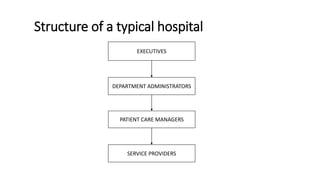
Structure of a typical hospital
EXECUTIVES
DEPARTMENT ADMINISTRATORS
PATIENT CARE MANAGERS
SERVICE PROVIDERS
EXECUTIVES
• Boards of directors leave it to their executives to see that
their decisions are carried out and that the day-to-day
operation of the hospital are performed successfully.
• The chief executive officer is the top boss responsible for
everything that goes on in a hospital.
• However , hospital usually have chief nursing officers, chief
medical officers, chief information officers, chief financial
officers and sometimes chief operating officers who also
carry a lot of weight.
• This group of top executives forms the central core
management.
DEPARTMENT ADMINISTRATORS
• The top managers of each hospital department report to the core
management.
• These people are responsible for one type of medical or operational
services.
• Most departments are areas of patient care such as orthopaedics,
labour and delivery or the emergency department.
• There also are non-patient-care departments such as food services and
billing.
• Therefore , administrators often have assistant administrators who
help them oversee their multifaceted operation.
Patient care managers
• Within a department, there are the people who directly oversee
patient care.
• Nurse managers, directors of rehabilitation services and
supervising physicians have people under them who give heads-on
patient care.
• This level of management ensures that the staff members are
acting appropriately, giving the best care, addressing all of their
duties, complying with hospital and legal requirements and for
nurses and allied health care workers, following physician orders.
• When something goes wrong with a patient or a clinician, these
people handle the problem.
Service providers
• Among the hospital staff, service-providing staff are the
most.
• Nurses and physiotherapists to line cooks and laundry
workers, it takes a lot of hands-on staff to make
everything happen.
• These people have very specific job descriptions and
duties , which hospitals need them to perform very well
to ensure the safety and health of patients.
SERVICES RENDERED BY THE HOSPITAL
• Patient care: Patient care involves diagnosis, treatment of illness or
injury, preventive medicine, rehabilitation, convalescent care, dental
care, personalised services .
• Patient education: children, general education, social education for
rehabilitation health care and also patient counselling.
• Medical and nursing Research : Research is important to advance
medical knowledge against diseases and improve hospital services. This
is important for better health care of patients.
• Public health care: Public health care is important to assist the
community to reduce chance of illness and to improve general health of
the population.
Polyclinics
• A polyclinic is a place where a wide range of health care services (including
diagnostics) can be obtained without the need for an overnight stay.
• Polyclinics are sometimes co-located with a hospital.
• A typical polyclinic is an outpatient facility that houses general medical
practitioners to provide ambulatory care and some acute care services but
lacks the major surgical and pre-and post-operative care facilities commonly
associated with hospitals.
• Besides GPs, a polyclinic can house outpatient departments of some medical
specialties i.e. gynecology, dermatology, ENT, cardiology, pulmonology,
endocrinology, neurology, ophthalmology etc
Services of a polyclinic
• Performs immediate minor surgery, blood tests, x-rays and access
to pharmacy services.
• A wide range of well-being and support services such as benefits
and housing advices, health information.
• Long term conditions support. E.g. Diabetes. Hypertension etc.
• Also offer solutions to the problems of accident and emergency
department.
• Conduct annual medical and dental examination.
• Attend to daily consultations with corresponding treatment and
keeping an accurate record.
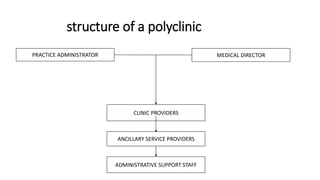
structure of a polyclinic
PRACTICE ADMINISTRATOR
CLINIC PROVIDERS
ADMINISTRATIVE SUPPORT STAFF
ANCILLARY SERVICE PROVIDERS
MEDICAL DIRECTOR
MEDICAL DIRECTOR
• Is a physician who has been licensed by the state to
provide direct care.
• He/she also oversees all clinical aspects of the clinic.
• His responsibilities include; recruiting of clinicians,
developing clinical protocol, training providers in their
use and collecting and analysing clinical outcome
data.
PRACTICE ADMINISTRATOR
•Is a non-physician who has ultimate responsibility for the
day to day administrative operations of the clinic.
•He manages all outpatient clinic personnel and coordinate
their schedules.
•He serves as a liaison to the physicians, holding regular
team meetings that include data review and decision
making.
•He oversees the clinic marketing and growth as well as
financial and facilities management.
CLINIC PROVIDERS
•Clinical providers comprises of physicians and nurses.
•Physicians typically provide physical examination,
immunization, health maintenance and acute and urgent
medical, paediatric, obstetric, gynaecological and psychiatric
care.
•Nurses play a supporting role, assisting with examination,
administering injections and performing duties such as
triage, lab reporting and lab transport.
ANCILLARY SERVICE PROVIDERS
• Clinic services are supported by ancillary service providers that help
patients move through the entire medical process smoothly and
assist with other well-being services.
• Examples ; social workers address acute and chronic mental health,
including domestic violence and substance abuse. They offer
evaluations , counselling and referral for external support.
• Financial specialist conduct insurance eligibility screening and
facilitate patient assess to health care coverage.
• Visiting nurses and health educators are also examples of ancillary
service providers.
ADMINISTRATIVE SUPPORT STAFF
• Administrative staff members support administrative
processes throughout the entire clinic.
Health centres
•A network of clinic staffed by a group of general practitioners
and nurses providing health care services to people in certain
areas.
•Sometimes refers to as public centres which are state owned
rural health care facilities. They are essentially single-physician
clinics usually with facilities for minor surgeries and other
health care delivery.
•Health centres are community-based organizations that offer
essential primary, preventive, and promotive care services to
populations with limited access to health care.
Services of health centres
• Infant immunization programs.
• Provide pregnancy related care and education.
• Building capacity to address health issues.
• Providing informal counselling.
• Creating connections between the vulnerable populations and
health care system.
• Advocating for underserved individuals to receive appropriate
services.
• Health screenings
• Mental health services
Health post
• Is usually situated in small towns to provide basic
health care and family planning in the rural areas. It is
the first institutional contact point for basic health
services and it monitors the activities of female
community health volunteer program.
• The main purpose of health post is to provide basic
health services to people who lives in rural areas and
remote places.
Services of health post
• Serves as the first line of treatment for minor health conditions.
• Provision of services including basic health care, preventive medication
through primary health posts in remote areas.
• Also raise nutritional programs with family planning thereby help enhance
the health and living standard of community residents.
• Conduct training and educational activities to generate positive
participation of community volunteers in the integrated program.
• Centre for public health activities
• Assessment and decision-making for making further diagnosis and/or
referral to a higher facility.
Community clinics
• Also known as health centre program (grantee) are non-profit
clinic located in medically underserved areas- both rural and
urban. They have a mission of making comprehensive primary
care accessible to anyone regardless of insurance status.
• Is a major field of study within the medical and clinical science
which focus on the maintenance, protection, improvement of
the health status of the population groups and communities
that are underserved.
services of community clinics
• They supervise the treatment of patients living with terminal illness so that they
can live healthier and longer lives.
• Patients are sometimes trained as community health workers so that they can
initiate outreach programs to help their peer.
• Basic primary care related to family medicine, internal medicine, paediatrics,
obstetrics or gynecology.
• Patient case management, including counselling, referral and follow ups service.
• Diagnostic laboratory and radiology services.
• Preventive health service including prenatal and perinatal care, immunization.
Traditional medicine
• Traditional medicine (also known as indigenous or folk medicine) comprises
medical aspect of traditional knowledge that developed generations within
various societies before the era of modern medicine.
• The world health organization (WHO) defines traditional medicine as the sum
total of the knowledge, skills, and practices based on theories, beliefs and
experiences indigenous to different cultures, whether explicable or not, used
in the maintenance as well as its prevention, diagnosis, improvement or
treatment of physical and mental illness.
• TM ultimately aims at restoring the physical, mental and social wellbeing of
the patient through alternative health care delivery to the orthodox medicine
Services of traditional medical practitioners
• The services rendered by a traditional medical practitioner
varies from one another depending on the type and mode of
operation which includes;
• Herbalist
• Bone setters
• Spiritualist
• Diviners
•THANK YOU FOR YOUR ATTENTION
NAMES OF GROUP MEMBERS
• DANIEL AYINSOMBA AMOAH
• AWINI PROSPER MBAWIN
• MUHAMMED AWAL SALIHU
• HARUNA FAISAL
• SEIBA IDDRISU
• ANANE VIVIAN AWINMA
• MICHAEL ADJEI BADU
• ALETANA MONICA
• SERAPHINA OKINE
• YAHAYA FAISAL

Gp managment.pptx

  • 1.
    MANAGEMENT AND ADMINISTRATIONIN NURSING. GROUP 4. • A GROUP PRESENTATION ON : HEALTH INSTITUTIONS AND THEIR SERVICES
  • 2.
    LEARNING OBJECTIVES By theend of this presentation, colleague students should be able to; 1. Define The various health institutions 2. Know some of their respective structures 3. And the services they render
  • 3.
    INTRODUCTION: • Health institutionsare organizations that provides health care and related services to the provision of in-patient and out-patient care, such as diagnostic and therapeutic services, laboratory services, medicinal drugs and other health services. • The workers undergo extensive education and training so they can provide high-quality medical care to those who need it. • The various health institutions are as follows; • Hospital • Polyclinic • Health centres • Health post • Community clinics • Traditional Medicine
  • 4.
    HOSPITAL • The word‘hospital’ derived from the latin word ‘hospitalis’ which in turn derived from the French word ‘hospes’ meaning a host or guest. • DEFINITIONS • Hospitals are institutions, which are mainly designed for care of the sick, injured and well. • Hospital is an integral part of a social and medical organization, the functions of which is to provide for the population complete health care both curative and preventive, and whose outpatients services reach out to the family and its home environment. • Hospital, an institution that is built, staffed, and equipped for the diagnosis of disease; for the treatment, medical and surgical, of the sick and injured; and for their housing during this process. • The modern hospital often serves as a centre for investigation and teaching.
  • 5.
    CLASSIFICATION OF HOSPITALS •Hospitalsare classified according to: •Length of stay of the patient •Clinical basis •Ownership /control basis •Objectives •Size •Management •System of medicine
  • 6.
    Structure of atypical hospital EXECUTIVES DEPARTMENT ADMINISTRATORS PATIENT CARE MANAGERS SERVICE PROVIDERS
  • 7.
    EXECUTIVES • Boards ofdirectors leave it to their executives to see that their decisions are carried out and that the day-to-day operation of the hospital are performed successfully. • The chief executive officer is the top boss responsible for everything that goes on in a hospital. • However , hospital usually have chief nursing officers, chief medical officers, chief information officers, chief financial officers and sometimes chief operating officers who also carry a lot of weight. • This group of top executives forms the central core management.
  • 8.
    DEPARTMENT ADMINISTRATORS • Thetop managers of each hospital department report to the core management. • These people are responsible for one type of medical or operational services. • Most departments are areas of patient care such as orthopaedics, labour and delivery or the emergency department. • There also are non-patient-care departments such as food services and billing. • Therefore , administrators often have assistant administrators who help them oversee their multifaceted operation.
  • 9.
    Patient care managers •Within a department, there are the people who directly oversee patient care. • Nurse managers, directors of rehabilitation services and supervising physicians have people under them who give heads-on patient care. • This level of management ensures that the staff members are acting appropriately, giving the best care, addressing all of their duties, complying with hospital and legal requirements and for nurses and allied health care workers, following physician orders. • When something goes wrong with a patient or a clinician, these people handle the problem.
  • 10.
    Service providers • Amongthe hospital staff, service-providing staff are the most. • Nurses and physiotherapists to line cooks and laundry workers, it takes a lot of hands-on staff to make everything happen. • These people have very specific job descriptions and duties , which hospitals need them to perform very well to ensure the safety and health of patients.
  • 11.
    SERVICES RENDERED BYTHE HOSPITAL • Patient care: Patient care involves diagnosis, treatment of illness or injury, preventive medicine, rehabilitation, convalescent care, dental care, personalised services . • Patient education: children, general education, social education for rehabilitation health care and also patient counselling. • Medical and nursing Research : Research is important to advance medical knowledge against diseases and improve hospital services. This is important for better health care of patients. • Public health care: Public health care is important to assist the community to reduce chance of illness and to improve general health of the population.
  • 12.
    Polyclinics • A polyclinicis a place where a wide range of health care services (including diagnostics) can be obtained without the need for an overnight stay. • Polyclinics are sometimes co-located with a hospital. • A typical polyclinic is an outpatient facility that houses general medical practitioners to provide ambulatory care and some acute care services but lacks the major surgical and pre-and post-operative care facilities commonly associated with hospitals. • Besides GPs, a polyclinic can house outpatient departments of some medical specialties i.e. gynecology, dermatology, ENT, cardiology, pulmonology, endocrinology, neurology, ophthalmology etc
  • 13.
    Services of apolyclinic • Performs immediate minor surgery, blood tests, x-rays and access to pharmacy services. • A wide range of well-being and support services such as benefits and housing advices, health information. • Long term conditions support. E.g. Diabetes. Hypertension etc. • Also offer solutions to the problems of accident and emergency department. • Conduct annual medical and dental examination. • Attend to daily consultations with corresponding treatment and keeping an accurate record.
  • 14.
    structure of apolyclinic PRACTICE ADMINISTRATOR CLINIC PROVIDERS ADMINISTRATIVE SUPPORT STAFF ANCILLARY SERVICE PROVIDERS MEDICAL DIRECTOR
  • 15.
    MEDICAL DIRECTOR • Isa physician who has been licensed by the state to provide direct care. • He/she also oversees all clinical aspects of the clinic. • His responsibilities include; recruiting of clinicians, developing clinical protocol, training providers in their use and collecting and analysing clinical outcome data.
  • 16.
    PRACTICE ADMINISTRATOR •Is anon-physician who has ultimate responsibility for the day to day administrative operations of the clinic. •He manages all outpatient clinic personnel and coordinate their schedules. •He serves as a liaison to the physicians, holding regular team meetings that include data review and decision making. •He oversees the clinic marketing and growth as well as financial and facilities management.
  • 17.
    CLINIC PROVIDERS •Clinical providerscomprises of physicians and nurses. •Physicians typically provide physical examination, immunization, health maintenance and acute and urgent medical, paediatric, obstetric, gynaecological and psychiatric care. •Nurses play a supporting role, assisting with examination, administering injections and performing duties such as triage, lab reporting and lab transport.
  • 18.
    ANCILLARY SERVICE PROVIDERS •Clinic services are supported by ancillary service providers that help patients move through the entire medical process smoothly and assist with other well-being services. • Examples ; social workers address acute and chronic mental health, including domestic violence and substance abuse. They offer evaluations , counselling and referral for external support. • Financial specialist conduct insurance eligibility screening and facilitate patient assess to health care coverage. • Visiting nurses and health educators are also examples of ancillary service providers.
  • 19.
    ADMINISTRATIVE SUPPORT STAFF •Administrative staff members support administrative processes throughout the entire clinic.
  • 20.
    Health centres •A networkof clinic staffed by a group of general practitioners and nurses providing health care services to people in certain areas. •Sometimes refers to as public centres which are state owned rural health care facilities. They are essentially single-physician clinics usually with facilities for minor surgeries and other health care delivery. •Health centres are community-based organizations that offer essential primary, preventive, and promotive care services to populations with limited access to health care.
  • 21.
    Services of healthcentres • Infant immunization programs. • Provide pregnancy related care and education. • Building capacity to address health issues. • Providing informal counselling. • Creating connections between the vulnerable populations and health care system. • Advocating for underserved individuals to receive appropriate services. • Health screenings • Mental health services
  • 22.
    Health post • Isusually situated in small towns to provide basic health care and family planning in the rural areas. It is the first institutional contact point for basic health services and it monitors the activities of female community health volunteer program. • The main purpose of health post is to provide basic health services to people who lives in rural areas and remote places.
  • 23.
    Services of healthpost • Serves as the first line of treatment for minor health conditions. • Provision of services including basic health care, preventive medication through primary health posts in remote areas. • Also raise nutritional programs with family planning thereby help enhance the health and living standard of community residents. • Conduct training and educational activities to generate positive participation of community volunteers in the integrated program. • Centre for public health activities • Assessment and decision-making for making further diagnosis and/or referral to a higher facility.
  • 24.
    Community clinics • Alsoknown as health centre program (grantee) are non-profit clinic located in medically underserved areas- both rural and urban. They have a mission of making comprehensive primary care accessible to anyone regardless of insurance status. • Is a major field of study within the medical and clinical science which focus on the maintenance, protection, improvement of the health status of the population groups and communities that are underserved.
  • 25.
    services of communityclinics • They supervise the treatment of patients living with terminal illness so that they can live healthier and longer lives. • Patients are sometimes trained as community health workers so that they can initiate outreach programs to help their peer. • Basic primary care related to family medicine, internal medicine, paediatrics, obstetrics or gynecology. • Patient case management, including counselling, referral and follow ups service. • Diagnostic laboratory and radiology services. • Preventive health service including prenatal and perinatal care, immunization.
  • 26.
    Traditional medicine • Traditionalmedicine (also known as indigenous or folk medicine) comprises medical aspect of traditional knowledge that developed generations within various societies before the era of modern medicine. • The world health organization (WHO) defines traditional medicine as the sum total of the knowledge, skills, and practices based on theories, beliefs and experiences indigenous to different cultures, whether explicable or not, used in the maintenance as well as its prevention, diagnosis, improvement or treatment of physical and mental illness. • TM ultimately aims at restoring the physical, mental and social wellbeing of the patient through alternative health care delivery to the orthodox medicine
  • 27.
    Services of traditionalmedical practitioners • The services rendered by a traditional medical practitioner varies from one another depending on the type and mode of operation which includes; • Herbalist • Bone setters • Spiritualist • Diviners
  • 28.
    •THANK YOU FORYOUR ATTENTION
  • 29.
    NAMES OF GROUPMEMBERS • DANIEL AYINSOMBA AMOAH • AWINI PROSPER MBAWIN • MUHAMMED AWAL SALIHU • HARUNA FAISAL • SEIBA IDDRISU • ANANE VIVIAN AWINMA • MICHAEL ADJEI BADU • ALETANA MONICA • SERAPHINA OKINE • YAHAYA FAISAL