The MBA lessons of the last century: effective management,
business processes, quality systems, intelligent
organizations, finely tuned leadership and more are still
driving enterprises into the second decade of this
millennium.
Much of this approach to business administration is based
on the premise that if all elements of the organization
function well (” the cogwheels”), then the enterprise as a
whole (“the machine”) will perform well too.
However, the world has changed. The information age has
fully dawned on us at the start of the 21
st
century and the
rules, the challenges and the opportunities have changed
dramatically.
The information crisis: a twin tsunami of
data and regulation
According to McKinsey, global data volumes grow 40% per
year, i.e. it doubles every two years. We just have to look at
the capacity of our mobile phones to verify this.
On the other hand the
number of standards
and regulations that
are imposed on us,
internally or
externally, are only
increasing. The recent
banking crisis has had
the regulators doing
overtime in imposing
many new rules for
transparency and
reporting.
The industrial
approach to business
administration based on management systems that often
take years to implement is incompatible with the speed,
agility required by the information age. The mechanistic
view of the enterprise has to be forgotten and replaced by a
completely new paradigm that fits the information age.
The necessary paradigm shift: Govern by
Value
The new paradigm to Govern By Value turns our old
management practices on their head. Instead of building
the most performing corporate machines by concentrating
on the quality of the cogwheels, i.e. people, tools,
processes etc, now, in the information age we should single
mindedly focus on the output of the enterprise: the
ultimate value created.
The effectiveness of the resources needed to generate
products and services should not be measured by their
performance but by their impact on the ultimate value
creation of the entire enterprise. We need to focus on Key
Value Indicators (KVIs). Refer to info box “KVIs versus KPIs”
This paradigm shift changes everything. The question we
ask as managers when assessing our resource productivity
and prioritization has to shift from “is this part performing
well and is it aligned with my objectives?” to “how much
does this resource add to the ultimate value creation
requirements?”
Instead of building organizations from their constituents to
meet our strategic objectives, we will now trace the value
creation from the top and enable it at lower levels as
needed. This is: Govern by Value.
The implementation of this approach to driving business
excellence has radical consequences. When we can express
the ultimate value contribution of each our resources we
are quickly able to determine whether we need them at all
and if so, what degree of priority (time, budget etc) they
require. In practice, this approach to resource allocation
leads to very different outcomes.
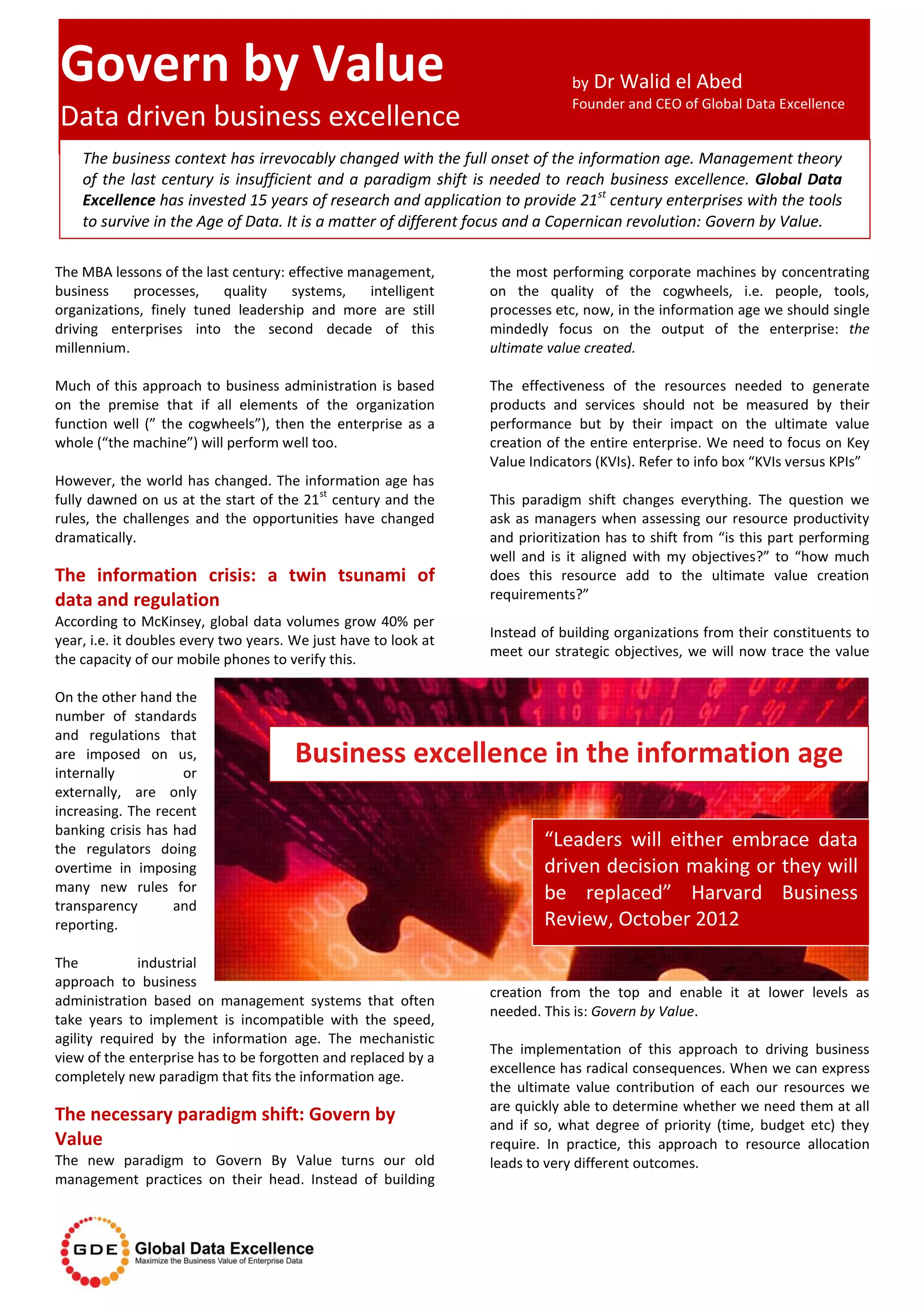
“Leaders will either embrace data
driven decision making or they will
be replaced” Harvard Business
Review, October 2012
Business excellence in the information age
Govern by Value
Data driven business excellence
The business context has irrevocably changed with the full onset of the information age. Management theory
of the last century is insufficient and a paradigm shift is needed to reach business excellence. Global Data
Excellence has invested 15 years of research and application to provide 21st
century enterprises with the tools
to survive in the Age of Data. It is a matter of different focus and a Copernican revolution: Govern by Value.
by Dr Walid el Abed
Founder and CEO of Global Data Excellence
Govern by Value: data driven business excellence
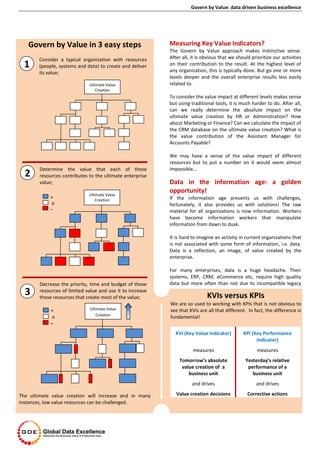
Govern by Value in 3 easy steps
Consider a typical organization with resources
(people, systems and data) to create and deliver
its value;
Determine the value that each of these
resources contributes to the ultimate enterprise
value;
Decrease the priority, time and budget of those
resources of limited value and use it to increase
those resources that create most of the value;
The ultimate value creation will increase and in many
instances, low value resources can be challenged.
Measuring Key Value Indicators?
The Govern by Value approach makes instinctive sense.
After all, it is obvious that we should prioritize our activities
on their contribution to the result. At the highest level of
any organization, this is typically done. But go one or more
levels deeper and the overall enterprise results less easily
related to.
To consider the value impact at different levels makes sense
but using traditional tools, it is much harder to do. After all,
can we really determine the absolute impact on the
ultimate value creation by HR or Administration? How
about Marketing or Finance? Can we calculate the impact of
the CRM database on the ultimate value creation? What is
the value contribution of the Assistant Manager for
Accounts Payable?
We may have a sense of the value impact of different
resources but to put a number on it would seem almost
impossible…
Data in the information age: a golden
opportunity!
If the information age presents us with challenges,
fortunately, it also provides us with solutions! The raw
material for all organizations is now information. Workers
have become information workers that manipulate
information from dawn to dusk.
It is hard to imagine an activity in current organizations that
is not associated with some form of information, i.e. data.
Data is a reflection, an image, of value created by the
enterprise.
For many enterprises, data is a huge headache. Their
systems, ERP, CRM, eCommerce etc, require high quality
data but more often than not due to incompatible legacy
KVIs versus KPIs
We are so used to working with KPIs that is not obvious to
see that KVIs are all that different. In fact, the difference is
fundamental!
KVI (Key Value Indicator) KPI (Key Performance
Indicator)
measures measures
Tomorrow’s absolute
value creation of a
business unit
Yesterday’s relative
performance of a
business unit
and drives and drives
Value creation decisions Corrective actions
Ultimate Value
Creation
1
2
Ultimate Value
Creation
+
o
-
-
3
Ultimate Value
Creation
+
o
-
Govern by Value: data driven business excellence
architecture, the data is often lacking in completeness,
transparency, trust or other data quality dimensions. In
response to this challenge these enterprises are
implementing Master Data Management systems whose
cost overruns are legendary.
When we Govern by Value, we take the view that data
allows us to determine the contribution of resources to the
ultimate value creation. Conversely, and significantly, when
we understand the value contribution that this data
represents, we are now able to determine where we should
focus our data quality efforts. This is typically a much
smaller subset of the total.
In the Govern By Value paradigm data becomes a golden
opportunity. It drives the ultimate value creation and, for
the first time, we can determine what value that data
represents!
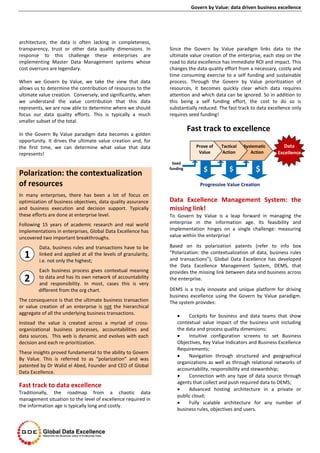
Fast track to data excellence
Traditionally, the roadmap from a chaotic data
management situation to the level of excellence required in
the information age is typically long and costly.
Since the Govern by Value paradigm links data to the
ultimate value creation of the enterprise, each step on the
road to data excellence has immediate ROI and impact. This
changes the data quality effort from a necessary, costly and
time consuming exercise to a self funding and sustainable
process. Through the Govern by Value prioritization of
resources, it becomes quickly clear which data requires
attention and which data can be ignored. So in addition to
this being a self funding effort, the cost to do so is
substantially reduced. The fast track to data excellence only
requires seed funding!
Data Excellence Management System: the
missing link!
To Govern by Value is a leap forward in managing the
enterprise in the information age. Its feasibility and
implementation hinges on a single challenge: measuring
value within the enterprise!
Based on its polarization patents (refer to info box
“Polarization: the contextualization of data, business rules
and transactions”), Global Data Excellence has developed
the Data Excellence Management System, DEMS, that
provides the missing link between data and business across
the enterprise.
DEMS is a truly innovate and unique platform for driving
business excellence using the Govern by Value paradigm.
The system provides:
 Cockpits for business and data teams that show
contextual value impact of the business unit including
the data and process quality dimensions;
 Intuitive configuration screens to set Business
Objectives, Key Value Indicators and Business Excellence
Requirements;
 Navigation through structured and geographical
organizations as well as through relational networks of
accountability, responsibility and stewardship;
 Connection with any type of data source through
agents that collect and push required data to DEMS;
 Advanced hosting architecture in a private or
public cloud;
 Fully scalable architecture for any number of
business rules, objectives and users.
Polarization: the contextualization
of resources
In many enterprises, there has been a lot of focus on
optimization of business objectives, data quality assurance
and business execution and decision support. Typically
these efforts are done at enterprise level.
Following 15 years of academic research and real world
implementations in enterprises, Global Data Excellence has
uncovered two important breakthroughs.
Data, business rules and transactions have to be
linked and applied at all the levels of granularity,
i.e. not only the highest;
Each business process gives contextual meaning
to data and has its own network of accountability
and responsibility. In most, cases this is very
different from the org chart.
The consequence is that the ultimate business transaction
or value creation of an enterprise is not the hierarchical
aggregate of all the underlying business transactions.
Instead the value is created across a myriad of cross-
organizational business processes, accountabilities and
data sources. This web is dynamic and evolves with each
decision and each re-prioritization.
These insights proved fundamental to the ability to Govern
By Value. This is referred to as “polarization” and was
patented by Dr Walid el Abed, Founder and CEO of Global
Data Excellence.
Prove of
Value
Tactical
Action
Systematic
Action
Seed
funding
Progressive Value Creation
$ $ $
Fast track to excellence
Data
Excellence
1
2
Govern by Value: data driven business excellence
DEMS is the only tip of the iceberg. The system is proposed
by Global Data Excellence, a Swiss company with a culture
of precision and innovation was founded in 2007. Its
expanding presence is currently in Switzerland, France,
United Kingdom, United States, Middle East, and South
Africa. It is driven by a highly experienced team of senior
data and business experts. Global Data Excellence is your
partner to maximize the business value of enterprise data.
Our clients
Global Data Excellence is proud of its fast growing customer
base. Our clients are found in banking and finance,
transportation, insurance, telecoms, consumer electronics,
construction, non-profits, food and beverage, chemicals
and energy. Due its industry agnostic approach, the
deployment of Govern by Value and DEMS is reaching more
and more industries.
To Govern by Value can have significant impact on the
business. Chris Johnson of Nestlé was quoted in the
Economist, saying: “For just one ingredient, vanilla, its
American operation was able to reduce the number of
specifications and use fewer suppliers, saving $30m a year.
Overall, such operational improvements save more than $1
billion annually.”
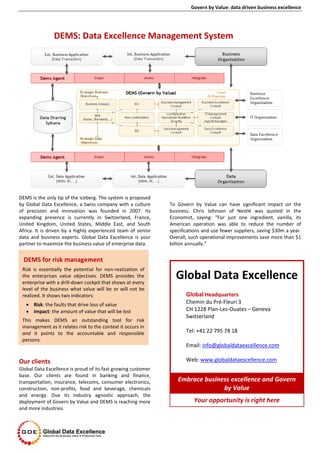
DEMS: Data Excellence Management System
DEMS for risk management
Risk is essentially the potential for non-realization of
the enterprises value objectives. DEMS provides the
enterprise with a drill-down cockpit that shows at every
level of the business what value will be or will not be
realized. It shows two indicators:
 Risk: the faults that drive loss of value
 Impact: the amount of value that will be lost
This makes DEMS an outstanding tool for risk
management as it relates risk to the context it occurs in
and it points to the accountable and responsible
persons.
Global Data Excellence
Global Headquarters
Chemin du Pré-Fleuri 3
CH 1228 Plan-Les-Ouates – Geneva
Switzerland
Tel: +41 22 795 78 18
Email: info@globaldataexcellence.com
Web: www.globaldataexcellence.com
Embrace business excellence and Govern
by Value
Your opportunity is right here

Govern by-value

  • 1.
    The MBA lessonsof the last century: effective management, business processes, quality systems, intelligent organizations, finely tuned leadership and more are still driving enterprises into the second decade of this millennium. Much of this approach to business administration is based on the premise that if all elements of the organization function well (” the cogwheels”), then the enterprise as a whole (“the machine”) will perform well too. However, the world has changed. The information age has fully dawned on us at the start of the 21 st century and the rules, the challenges and the opportunities have changed dramatically. The information crisis: a twin tsunami of data and regulation According to McKinsey, global data volumes grow 40% per year, i.e. it doubles every two years. We just have to look at the capacity of our mobile phones to verify this. On the other hand the number of standards and regulations that are imposed on us, internally or externally, are only increasing. The recent banking crisis has had the regulators doing overtime in imposing many new rules for transparency and reporting. The industrial approach to business administration based on management systems that often take years to implement is incompatible with the speed, agility required by the information age. The mechanistic view of the enterprise has to be forgotten and replaced by a completely new paradigm that fits the information age. The necessary paradigm shift: Govern by Value The new paradigm to Govern By Value turns our old management practices on their head. Instead of building the most performing corporate machines by concentrating on the quality of the cogwheels, i.e. people, tools, processes etc, now, in the information age we should single mindedly focus on the output of the enterprise: the ultimate value created. The effectiveness of the resources needed to generate products and services should not be measured by their performance but by their impact on the ultimate value creation of the entire enterprise. We need to focus on Key Value Indicators (KVIs). Refer to info box “KVIs versus KPIs” This paradigm shift changes everything. The question we ask as managers when assessing our resource productivity and prioritization has to shift from “is this part performing well and is it aligned with my objectives?” to “how much does this resource add to the ultimate value creation requirements?” Instead of building organizations from their constituents to meet our strategic objectives, we will now trace the value creation from the top and enable it at lower levels as needed. This is: Govern by Value. The implementation of this approach to driving business excellence has radical consequences. When we can express the ultimate value contribution of each our resources we are quickly able to determine whether we need them at all and if so, what degree of priority (time, budget etc) they require. In practice, this approach to resource allocation leads to very different outcomes. “Leaders will either embrace data driven decision making or they will be replaced” Harvard Business Review, October 2012 Business excellence in the information age Govern by Value Data driven business excellence The business context has irrevocably changed with the full onset of the information age. Management theory of the last century is insufficient and a paradigm shift is needed to reach business excellence. Global Data Excellence has invested 15 years of research and application to provide 21st century enterprises with the tools to survive in the Age of Data. It is a matter of different focus and a Copernican revolution: Govern by Value. by Dr Walid el Abed Founder and CEO of Global Data Excellence
  • 2.
    Govern by Value:data driven business excellence Govern by Value in 3 easy steps Consider a typical organization with resources (people, systems and data) to create and deliver its value; Determine the value that each of these resources contributes to the ultimate enterprise value; Decrease the priority, time and budget of those resources of limited value and use it to increase those resources that create most of the value; The ultimate value creation will increase and in many instances, low value resources can be challenged. Measuring Key Value Indicators? The Govern by Value approach makes instinctive sense. After all, it is obvious that we should prioritize our activities on their contribution to the result. At the highest level of any organization, this is typically done. But go one or more levels deeper and the overall enterprise results less easily related to. To consider the value impact at different levels makes sense but using traditional tools, it is much harder to do. After all, can we really determine the absolute impact on the ultimate value creation by HR or Administration? How about Marketing or Finance? Can we calculate the impact of the CRM database on the ultimate value creation? What is the value contribution of the Assistant Manager for Accounts Payable? We may have a sense of the value impact of different resources but to put a number on it would seem almost impossible… Data in the information age: a golden opportunity! If the information age presents us with challenges, fortunately, it also provides us with solutions! The raw material for all organizations is now information. Workers have become information workers that manipulate information from dawn to dusk. It is hard to imagine an activity in current organizations that is not associated with some form of information, i.e. data. Data is a reflection, an image, of value created by the enterprise. For many enterprises, data is a huge headache. Their systems, ERP, CRM, eCommerce etc, require high quality data but more often than not due to incompatible legacy KVIs versus KPIs We are so used to working with KPIs that is not obvious to see that KVIs are all that different. In fact, the difference is fundamental! KVI (Key Value Indicator) KPI (Key Performance Indicator) measures measures Tomorrow’s absolute value creation of a business unit Yesterday’s relative performance of a business unit and drives and drives Value creation decisions Corrective actions Ultimate Value Creation 1 2 Ultimate Value Creation + o - - 3 Ultimate Value Creation + o -
  • 3.
    Govern by Value:data driven business excellence architecture, the data is often lacking in completeness, transparency, trust or other data quality dimensions. In response to this challenge these enterprises are implementing Master Data Management systems whose cost overruns are legendary. When we Govern by Value, we take the view that data allows us to determine the contribution of resources to the ultimate value creation. Conversely, and significantly, when we understand the value contribution that this data represents, we are now able to determine where we should focus our data quality efforts. This is typically a much smaller subset of the total. In the Govern By Value paradigm data becomes a golden opportunity. It drives the ultimate value creation and, for the first time, we can determine what value that data represents! Fast track to data excellence Traditionally, the roadmap from a chaotic data management situation to the level of excellence required in the information age is typically long and costly. Since the Govern by Value paradigm links data to the ultimate value creation of the enterprise, each step on the road to data excellence has immediate ROI and impact. This changes the data quality effort from a necessary, costly and time consuming exercise to a self funding and sustainable process. Through the Govern by Value prioritization of resources, it becomes quickly clear which data requires attention and which data can be ignored. So in addition to this being a self funding effort, the cost to do so is substantially reduced. The fast track to data excellence only requires seed funding! Data Excellence Management System: the missing link! To Govern by Value is a leap forward in managing the enterprise in the information age. Its feasibility and implementation hinges on a single challenge: measuring value within the enterprise! Based on its polarization patents (refer to info box “Polarization: the contextualization of data, business rules and transactions”), Global Data Excellence has developed the Data Excellence Management System, DEMS, that provides the missing link between data and business across the enterprise. DEMS is a truly innovate and unique platform for driving business excellence using the Govern by Value paradigm. The system provides:  Cockpits for business and data teams that show contextual value impact of the business unit including the data and process quality dimensions;  Intuitive configuration screens to set Business Objectives, Key Value Indicators and Business Excellence Requirements;  Navigation through structured and geographical organizations as well as through relational networks of accountability, responsibility and stewardship;  Connection with any type of data source through agents that collect and push required data to DEMS;  Advanced hosting architecture in a private or public cloud;  Fully scalable architecture for any number of business rules, objectives and users. Polarization: the contextualization of resources In many enterprises, there has been a lot of focus on optimization of business objectives, data quality assurance and business execution and decision support. Typically these efforts are done at enterprise level. Following 15 years of academic research and real world implementations in enterprises, Global Data Excellence has uncovered two important breakthroughs. Data, business rules and transactions have to be linked and applied at all the levels of granularity, i.e. not only the highest; Each business process gives contextual meaning to data and has its own network of accountability and responsibility. In most, cases this is very different from the org chart. The consequence is that the ultimate business transaction or value creation of an enterprise is not the hierarchical aggregate of all the underlying business transactions. Instead the value is created across a myriad of cross- organizational business processes, accountabilities and data sources. This web is dynamic and evolves with each decision and each re-prioritization. These insights proved fundamental to the ability to Govern By Value. This is referred to as “polarization” and was patented by Dr Walid el Abed, Founder and CEO of Global Data Excellence. Prove of Value Tactical Action Systematic Action Seed funding Progressive Value Creation $ $ $ Fast track to excellence Data Excellence 1 2
  • 4.
    Govern by Value:data driven business excellence DEMS is the only tip of the iceberg. The system is proposed by Global Data Excellence, a Swiss company with a culture of precision and innovation was founded in 2007. Its expanding presence is currently in Switzerland, France, United Kingdom, United States, Middle East, and South Africa. It is driven by a highly experienced team of senior data and business experts. Global Data Excellence is your partner to maximize the business value of enterprise data. Our clients Global Data Excellence is proud of its fast growing customer base. Our clients are found in banking and finance, transportation, insurance, telecoms, consumer electronics, construction, non-profits, food and beverage, chemicals and energy. Due its industry agnostic approach, the deployment of Govern by Value and DEMS is reaching more and more industries. To Govern by Value can have significant impact on the business. Chris Johnson of Nestlé was quoted in the Economist, saying: “For just one ingredient, vanilla, its American operation was able to reduce the number of specifications and use fewer suppliers, saving $30m a year. Overall, such operational improvements save more than $1 billion annually.” DEMS: Data Excellence Management System DEMS for risk management Risk is essentially the potential for non-realization of the enterprises value objectives. DEMS provides the enterprise with a drill-down cockpit that shows at every level of the business what value will be or will not be realized. It shows two indicators:  Risk: the faults that drive loss of value  Impact: the amount of value that will be lost This makes DEMS an outstanding tool for risk management as it relates risk to the context it occurs in and it points to the accountable and responsible persons. Global Data Excellence Global Headquarters Chemin du Pré-Fleuri 3 CH 1228 Plan-Les-Ouates – Geneva Switzerland Tel: +41 22 795 78 18 Email: info@globaldataexcellence.com Web: www.globaldataexcellence.com Embrace business excellence and Govern by Value Your opportunity is right here