Making Open science hardware
ubiquitous by 2025
Africa Open Science & Hardware summit
Kumasi, 13-15 April 2018
Thomas Hervé Mboa Nkoudou
Université Laval
APSOHA
• GLOBAL OPEN SCIENCE HARDWARE COMMUNITY (GOSH)
IS A DIVERSE GROUP OF PEOPLE UNITED BY THE GOAL OF MAKING OPEN SCIENCE HARDWARE UBIQUITOUS BY 2025.
• The GOSH Roadmap
■ Actions In order to
achieve the 2025 goal.
LEARN about itself,
the contexts in which
it currently operates,
and the ways in
which OScH impacts
society.
■03 priorities
For identifying and changing the structures and processes that affect wider production and adoption of OScH
• Setting a collaborative research agenda;
• increasing knowledge about Open Hardware licensing;
• better understanding how to monitor and evaluate OScH projects.
■Collaborative research agenda
• Challenges and opportunities
• Interest in studying OScH is growing but research is still very limited, both
within and outside academia.
• Recommendations.
1. Organize a network of researchers and other interested
community members with regular meetings.
2. Create a common research agenda, prioritizing topics that are
relevant to the 2025 goal
3. Publish research findings in OScH community forums and venues.
■Open hardware licensing
• Challenges and opportunities
• Open hardware licensing is complex, multifaceted, and heterogeneous. There is a
lack of clarity with respect to degrees of openness, forms of protection, license
compatibility and interactions between different forms of intellectual property.
• Recommendations.
1. Convene and collaborate with community members, researchers,
businesses, and lawyers to improve Open Hardware licensing and
contracting strategies for OScH.
2. Create templates for contracts, to help people make informed decisions
about contracts and open licenses for their projects and products.
■Quality monitoring and evaluation
• Challenges and opportunities
• Evaluating and monitoring are key for learning more about OScH initiatives, but there are
few existing frameworks to identify ways to support OScH and assess which actions lead
to greater accessibility of hardware for science.
• Recommendations.
1. Build a common pool of open data on OScH projects to support the design of
metrics based on concrete challenges and solutions across cases.
2. Create contextualized metrics for assessing the impact of OScH projects and
promote their adoption by funders.
3. Engage researchers in Science and Technology Studies (STS) who can
contribute empirical studies of socio-technical contexts for OScH design and
development.
SUPPORT individuals
and forge partnerships
to create the conditions
under which OScH can
flourish.
■03 priorities
to ensure equitable distribution of resources and tasks, supporting people with different skills and types of expertise.
• Institutional support;
• Funding;
• Mutual support.
■Institutional support
• Challenges and opportunities
• Governance structures for OScH present different challenges and opportunities compared to
traditional configurations;
• OScH could have substantial benefits for knowledge transfer, but its uptake is hampered by a lack of
clear institutional policies on open approaches to dissemination and commercialization;
• OScH has potential both to broaden participation in science and to advance knowledge production,
but very few institutional programs contribute to a culture of hardware sharing.
• Recommendations.
1. Providing appropriate support for OScH translation and commercialization through
technology transfer offices.
2. Ensuring that OScH is part of Open Science conversations.
3. Offering direct support for OScH development through shared facilities such as
hackerspaces, maker spaces and Fab Labs combined with professional engineering and
technical support.
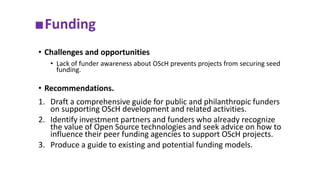
■Funding
• Challenges and opportunities
• Lack of funder awareness about OScH prevents projects from securing seed
funding.
• Recommendations.
1. Draft a comprehensive guide for public and philanthropic funders
on supporting OScH development and related activities.
2. Identify investment partners and funders who already recognize
the value of Open Source technologies and seek advice on how to
influence their peer funding agencies to support OScH projects.
3. Produce a guide to existing and potential funding models.
■Community support for OScH Projects
• Challenges and opportunities
• Many people are discouraged from using and developing Open Hardware due to poor documentation.
• There is little guidance on documentation practices even at a basic level;
• OScH is generally seen as being lower quality than proprietary alternatives, but there is an opportunity to change this perception, surpassing proprietary
offerings.
• Quality control and validation is key for building the credibility of OScH projects.
• User support is a limiting factor for many projects, particularly for volunteer developers.
• Technical assistance and training are not prioritized due to the difficulty of distributing the project workload.
• OScH designs can be very complex, and so require distributed forms of collaboration for which existing tools and practices are not optimized.
• Recommendations
1. Prepare and disseminate OScH documentation “best practices.”
2. Build a shared publication framework for OScH documentation.
3. Support the development of Free and Open Source tools for hardware design to allow OScH design files to be shared and edited by
anyone.
4. Create guidelines for testing, calibration, and validation of OScH with respect to existing standards, sharing testing rigs with assembly
instructions whenever possible.
5. Provide training sessions and workshops to support current OScH projects.
6. Identify and encourage the development of modular software and hardware components, libraries and resources that make it easier
for non-experts to build, assess and contribute to OScH projects.
GROW with respect to
local differences,
increasing the diversity,
scale and impact of the
OScH community
■03 priorities
Changing the status quo and acquiring critical mass to transform a small, niche community of practice into the
mainstream mode of design and development for scientific hardware.
• increasing the number and the diversity of OScH community
• advocating for OScH within established institutions and ensuring OScH is
supported by policy makers,
• Facilitating wider distribution of OScH.
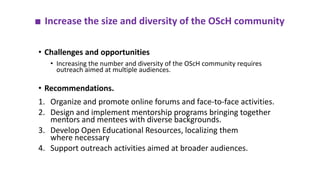
■ Increase the size and diversity of the OScH community
• Challenges and opportunities
• Increasing the number and diversity of the OScH community requires
outreach aimed at multiple audiences.
• Recommendations.
1. Organize and promote online forums and face-to-face activities.
2. Design and implement mentorship programs bringing together
mentors and mentees with diverse backgrounds.
3. Develop Open Educational Resources, localizing them
where necessary
4. Support outreach activities aimed at broader audiences.
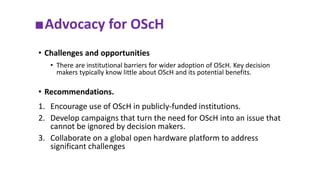
■Advocacy for OScH
• Challenges and opportunities
• There are institutional barriers for wider adoption of OScH. Key decision
makers typically know little about OScH and its potential benefits.
• Recommendations.
1. Encourage use of OScH in publicly-funded institutions.
2. Develop campaigns that turn the need for OScH into an issue that
cannot be ignored by decision makers.
3. Collaborate on a global open hardware platform to address
significant challenges
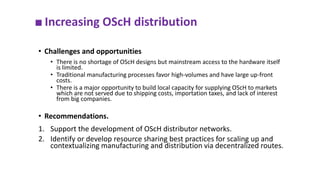
■ Increasing OScH distribution
• Challenges and opportunities
• There is no shortage of OScH designs but mainstream access to the hardware itself
is limited.
• Traditional manufacturing processes favor high-volumes and have large up-front
costs.
• There is a major opportunity to build local capacity for supplying OScH to markets
which are not served due to shipping costs, importation taxes, and lack of interest
from big companies.
• Recommendations.
1. Support the development of OScH distributor networks.
2. Identify or develop resource sharing best practices for scaling up and
contextualizing manufacturing and distribution via decentralized routes.
The necessity to
africanize the GOSH
Roadmap

Making Open science hardware ubiquitous by 2025

  • 1.
    Making Open sciencehardware ubiquitous by 2025 Africa Open Science & Hardware summit Kumasi, 13-15 April 2018 Thomas Hervé Mboa Nkoudou Université Laval APSOHA
  • 2.
    • GLOBAL OPENSCIENCE HARDWARE COMMUNITY (GOSH) IS A DIVERSE GROUP OF PEOPLE UNITED BY THE GOAL OF MAKING OPEN SCIENCE HARDWARE UBIQUITOUS BY 2025.
  • 3.
    • The GOSHRoadmap
  • 4.
    ■ Actions Inorder to achieve the 2025 goal.
  • 5.
    LEARN about itself, thecontexts in which it currently operates, and the ways in which OScH impacts society.
  • 6.
    ■03 priorities For identifyingand changing the structures and processes that affect wider production and adoption of OScH • Setting a collaborative research agenda; • increasing knowledge about Open Hardware licensing; • better understanding how to monitor and evaluate OScH projects.
  • 7.
    ■Collaborative research agenda •Challenges and opportunities • Interest in studying OScH is growing but research is still very limited, both within and outside academia. • Recommendations. 1. Organize a network of researchers and other interested community members with regular meetings. 2. Create a common research agenda, prioritizing topics that are relevant to the 2025 goal 3. Publish research findings in OScH community forums and venues.
  • 8.
    ■Open hardware licensing •Challenges and opportunities • Open hardware licensing is complex, multifaceted, and heterogeneous. There is a lack of clarity with respect to degrees of openness, forms of protection, license compatibility and interactions between different forms of intellectual property. • Recommendations. 1. Convene and collaborate with community members, researchers, businesses, and lawyers to improve Open Hardware licensing and contracting strategies for OScH. 2. Create templates for contracts, to help people make informed decisions about contracts and open licenses for their projects and products.
  • 9.
    ■Quality monitoring andevaluation • Challenges and opportunities • Evaluating and monitoring are key for learning more about OScH initiatives, but there are few existing frameworks to identify ways to support OScH and assess which actions lead to greater accessibility of hardware for science. • Recommendations. 1. Build a common pool of open data on OScH projects to support the design of metrics based on concrete challenges and solutions across cases. 2. Create contextualized metrics for assessing the impact of OScH projects and promote their adoption by funders. 3. Engage researchers in Science and Technology Studies (STS) who can contribute empirical studies of socio-technical contexts for OScH design and development.
  • 10.
    SUPPORT individuals and forgepartnerships to create the conditions under which OScH can flourish.
  • 11.
    ■03 priorities to ensureequitable distribution of resources and tasks, supporting people with different skills and types of expertise. • Institutional support; • Funding; • Mutual support.
  • 12.
    ■Institutional support • Challengesand opportunities • Governance structures for OScH present different challenges and opportunities compared to traditional configurations; • OScH could have substantial benefits for knowledge transfer, but its uptake is hampered by a lack of clear institutional policies on open approaches to dissemination and commercialization; • OScH has potential both to broaden participation in science and to advance knowledge production, but very few institutional programs contribute to a culture of hardware sharing. • Recommendations. 1. Providing appropriate support for OScH translation and commercialization through technology transfer offices. 2. Ensuring that OScH is part of Open Science conversations. 3. Offering direct support for OScH development through shared facilities such as hackerspaces, maker spaces and Fab Labs combined with professional engineering and technical support.
  • 13.
    ■Funding • Challenges andopportunities • Lack of funder awareness about OScH prevents projects from securing seed funding. • Recommendations. 1. Draft a comprehensive guide for public and philanthropic funders on supporting OScH development and related activities. 2. Identify investment partners and funders who already recognize the value of Open Source technologies and seek advice on how to influence their peer funding agencies to support OScH projects. 3. Produce a guide to existing and potential funding models.
  • 14.
    ■Community support forOScH Projects • Challenges and opportunities • Many people are discouraged from using and developing Open Hardware due to poor documentation. • There is little guidance on documentation practices even at a basic level; • OScH is generally seen as being lower quality than proprietary alternatives, but there is an opportunity to change this perception, surpassing proprietary offerings. • Quality control and validation is key for building the credibility of OScH projects. • User support is a limiting factor for many projects, particularly for volunteer developers. • Technical assistance and training are not prioritized due to the difficulty of distributing the project workload. • OScH designs can be very complex, and so require distributed forms of collaboration for which existing tools and practices are not optimized. • Recommendations 1. Prepare and disseminate OScH documentation “best practices.” 2. Build a shared publication framework for OScH documentation. 3. Support the development of Free and Open Source tools for hardware design to allow OScH design files to be shared and edited by anyone. 4. Create guidelines for testing, calibration, and validation of OScH with respect to existing standards, sharing testing rigs with assembly instructions whenever possible. 5. Provide training sessions and workshops to support current OScH projects. 6. Identify and encourage the development of modular software and hardware components, libraries and resources that make it easier for non-experts to build, assess and contribute to OScH projects.
  • 15.
    GROW with respectto local differences, increasing the diversity, scale and impact of the OScH community
  • 16.
    ■03 priorities Changing thestatus quo and acquiring critical mass to transform a small, niche community of practice into the mainstream mode of design and development for scientific hardware. • increasing the number and the diversity of OScH community • advocating for OScH within established institutions and ensuring OScH is supported by policy makers, • Facilitating wider distribution of OScH.
  • 17.
    ■ Increase thesize and diversity of the OScH community • Challenges and opportunities • Increasing the number and diversity of the OScH community requires outreach aimed at multiple audiences. • Recommendations. 1. Organize and promote online forums and face-to-face activities. 2. Design and implement mentorship programs bringing together mentors and mentees with diverse backgrounds. 3. Develop Open Educational Resources, localizing them where necessary 4. Support outreach activities aimed at broader audiences.
  • 18.
    ■Advocacy for OScH •Challenges and opportunities • There are institutional barriers for wider adoption of OScH. Key decision makers typically know little about OScH and its potential benefits. • Recommendations. 1. Encourage use of OScH in publicly-funded institutions. 2. Develop campaigns that turn the need for OScH into an issue that cannot be ignored by decision makers. 3. Collaborate on a global open hardware platform to address significant challenges
  • 19.
    ■ Increasing OScHdistribution • Challenges and opportunities • There is no shortage of OScH designs but mainstream access to the hardware itself is limited. • Traditional manufacturing processes favor high-volumes and have large up-front costs. • There is a major opportunity to build local capacity for supplying OScH to markets which are not served due to shipping costs, importation taxes, and lack of interest from big companies. • Recommendations. 1. Support the development of OScH distributor networks. 2. Identify or develop resource sharing best practices for scaling up and contextualizing manufacturing and distribution via decentralized routes.
  • 20.