AAMIR HILAL
Seminar by
Google is an American multinational technology company specializing in Internet-
related services and products. These include online advertising technologies, search,
cloud computing, and software.
Google also have many some research and development sub-companies like Google
ATAP and Google X. These companies work on developing future techs.
What is Project Tango?
 Project Tango is a smartphone and tablet project by
Google's Advanced Technology and Projects group
(ATAP), formerly a division of Motorola. The "Project
Tango" prototype is an Android smartphone-like device
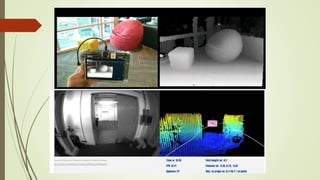
which tracks the 3D motion of the device, and creates a
3D model of the environment around it without
using GPS or other external signals.
 Project Tango strives to give mobile devices a human-
like understanding of space and motion through
advanced sensors and computer vision.
Google unveiled Project Tango, an
experimental project from the company’s
Advanced Technology and Projects (ATAP)
group.
• Project Tango was introduced by Google initially in early 2013, they described
this as a Simultaneous Localization and Mapping (SLAM) system capable of
operating in real-time on a phone. Google’s ATAP teamed up with a number of
organizations to create Project Tango from this description.
Project Tango was developed by a team led by
computer scientist Johnny Lee, a core
contributor to Microsoft's Kinect.
INTRODUCTION
 A device which tracks the 3D motion of the
device, and creates a 3D model of the
environment around it.
 First device launched in 2014, but only for
developers.
 A mobile device that shares our sense of space
and movement, that understands and perceives
the world the same way we do.
Why Project Tango?
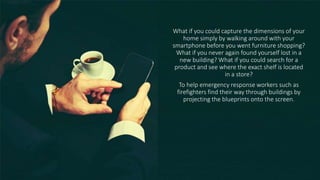
What if you could capture the dimensions of your
home simply by walking around with your
smartphone before you went furniture shopping?
What if you never again found yourself lost in a
new building? What if you could search for a
product and see where the exact shelf is located
in a store?
To help emergency response workers such as
firefighters find their way through buildings by
projecting the blueprints onto the screen.
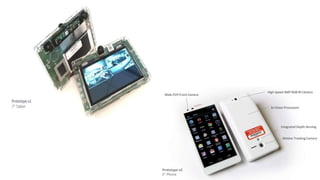
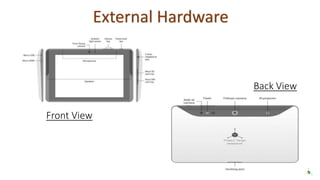
WHAT DOES THE PHONE LOOK LIKE?
Hardware
Front View
Back View
External Hardware
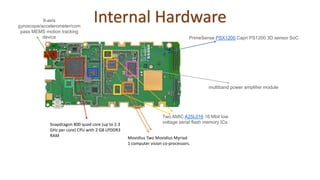
Internal Hardware
Snapdragon 800 quad core (up to 2.3
GHz per core) CPU with 2 GB LPDDR3
RAM Movidius Two Movidius Myriad
1 computer vision co-processors.
Two AMIC A25L016 16 Mbit low
voltage serial flash memory ICs
9-axis
gyroscope/accelerometer/com
pass MEMS motion tracking
device
multiband power amplifier module
PrimeSense PSX1200 Capri PS1200 3D sensor SoC
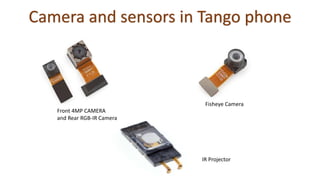
Camera and sensors in Tango phone
Front 4MP CAMERA
and Rear RGB-IR Camera
Fisheye Camera
IR Projector
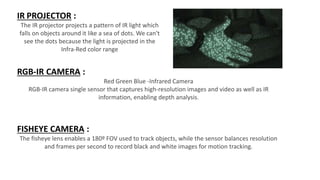
IR PROJECTOR :
The IR projector projects a pattern of IR light which
falls on objects around it like a sea of dots. We can't
see the dots because the light is projected in the
Infra-Red color range
RGB-IR CAMERA :
Red Green Blue -Infrared Camera
RGB-IR camera single sensor that captures high-resolution images and video as well as IR
information, enabling depth analysis.
FISHEYE CAMERA :
The fisheye lens enables a 180º FOV used to track objects, while the sensor balances resolution
and frames per second to record black and white images for motion tracking.
Working Concept
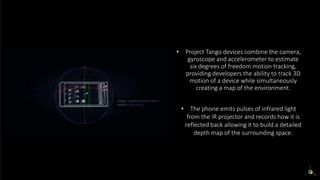
• Project Tango devices combine the camera,
gyroscope and accelerometer to estimate
six degrees of freedom motion tracking,
providing developers the ability to track 3D
motion of a device while simultaneously
creating a map of the environment.
• The phone emits pulses of infrared light
from the IR projector and records how it is
reflected back allowing it to build a detailed
depth map of the surrounding space.
 Myriad 1 vision processor platform.
 The sensors allow the device to make "over a quarter million
3D measurements every second, updating its position and
orientation in real time, combining that data into a single 3D
model of the space around you.“
 Myriad 1 low-power computer-vision processor, process the
data and feed it to apps through a set of APIs.
TANGO’S PROCESSOR
Project Tango Concepts
Motion Tracking
Area Learning
Depth Perception
Motion Tracking
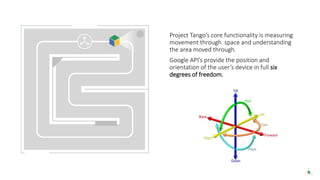
Project Tango’s core functionality is measuring
movement through space and understanding
the area moved through.
Google API’s provide the position and
orientation of the user’s device in full six
degrees of freedom.
Area Learning
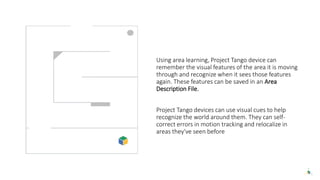
Using area learning, Project Tango device can
remember the visual features of the area it is moving
through and recognize when it sees those features
again. These features can be saved in an Area
Description File.
Project Tango devices can use visual cues to help
recognize the world around them. They can self-
correct errors in motion tracking and relocalize in
areas they've seen before
Depth Perception
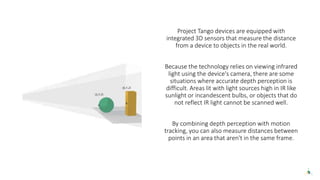
Project Tango devices are equipped with
integrated 3D sensors that measure the distance
from a device to objects in the real world.
Because the technology relies on viewing infrared
light using the device's camera, there are some
situations where accurate depth perception is
difficult. Areas lit with light sources high in IR like
sunlight or incandescent bulbs, or objects that do
not reflect IR light cannot be scanned well.
By combining depth perception with motion
tracking, you can also measure distances between
points in an area that aren't in the same frame.
Things Project Tango can
do .
DIRECTIONS
When you need directions inside a building or structure that current mapping
solutions just don’t provide.
Indoor Mapping and Navigation
It tracks position all around the world and also make a 3D map of that
Game Development
It could combine the room-mapping with augmented reality. “Imagine competing against a
friend for control over territories in your own home with your own miniature army.
The Future
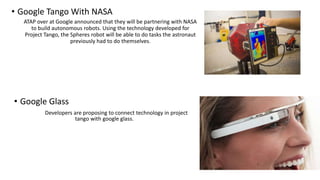
• Google Tango With NASA
ATAP over at Google announced that they will be partnering with NASA
to build autonomous robots. Using the technology developed for
Project Tango, the Spheres robot will be able to do tasks the astronaut
previously had to do themselves.
• Google Glass
Developers are proposing to connect technology in project
tango with google glass.
Companies Working With Google
Thank You!

Google's project tango seminar ppt

  • 1.
  • 2.
    Google is anAmerican multinational technology company specializing in Internet- related services and products. These include online advertising technologies, search, cloud computing, and software. Google also have many some research and development sub-companies like Google ATAP and Google X. These companies work on developing future techs.
  • 3.
  • 4.
     Project Tangois a smartphone and tablet project by Google's Advanced Technology and Projects group (ATAP), formerly a division of Motorola. The "Project Tango" prototype is an Android smartphone-like device which tracks the 3D motion of the device, and creates a 3D model of the environment around it without using GPS or other external signals.  Project Tango strives to give mobile devices a human- like understanding of space and motion through advanced sensors and computer vision.
  • 5.
    Google unveiled ProjectTango, an experimental project from the company’s Advanced Technology and Projects (ATAP) group. • Project Tango was introduced by Google initially in early 2013, they described this as a Simultaneous Localization and Mapping (SLAM) system capable of operating in real-time on a phone. Google’s ATAP teamed up with a number of organizations to create Project Tango from this description. Project Tango was developed by a team led by computer scientist Johnny Lee, a core contributor to Microsoft's Kinect.
  • 6.
    INTRODUCTION  A devicewhich tracks the 3D motion of the device, and creates a 3D model of the environment around it.  First device launched in 2014, but only for developers.  A mobile device that shares our sense of space and movement, that understands and perceives the world the same way we do.
  • 7.
  • 8.
    What if youcould capture the dimensions of your home simply by walking around with your smartphone before you went furniture shopping? What if you never again found yourself lost in a new building? What if you could search for a product and see where the exact shelf is located in a store? To help emergency response workers such as firefighters find their way through buildings by projecting the blueprints onto the screen.
  • 9.
    WHAT DOES THEPHONE LOOK LIKE?
  • 11.
  • 12.
  • 13.
    Internal Hardware Snapdragon 800quad core (up to 2.3 GHz per core) CPU with 2 GB LPDDR3 RAM Movidius Two Movidius Myriad 1 computer vision co-processors. Two AMIC A25L016 16 Mbit low voltage serial flash memory ICs 9-axis gyroscope/accelerometer/com pass MEMS motion tracking device multiband power amplifier module PrimeSense PSX1200 Capri PS1200 3D sensor SoC
  • 14.
    Camera and sensorsin Tango phone Front 4MP CAMERA and Rear RGB-IR Camera Fisheye Camera IR Projector
  • 15.
    IR PROJECTOR : TheIR projector projects a pattern of IR light which falls on objects around it like a sea of dots. We can't see the dots because the light is projected in the Infra-Red color range RGB-IR CAMERA : Red Green Blue -Infrared Camera RGB-IR camera single sensor that captures high-resolution images and video as well as IR information, enabling depth analysis. FISHEYE CAMERA : The fisheye lens enables a 180º FOV used to track objects, while the sensor balances resolution and frames per second to record black and white images for motion tracking.
  • 16.
  • 17.
    • Project Tangodevices combine the camera, gyroscope and accelerometer to estimate six degrees of freedom motion tracking, providing developers the ability to track 3D motion of a device while simultaneously creating a map of the environment. • The phone emits pulses of infrared light from the IR projector and records how it is reflected back allowing it to build a detailed depth map of the surrounding space.
  • 18.
     Myriad 1vision processor platform.  The sensors allow the device to make "over a quarter million 3D measurements every second, updating its position and orientation in real time, combining that data into a single 3D model of the space around you.“  Myriad 1 low-power computer-vision processor, process the data and feed it to apps through a set of APIs. TANGO’S PROCESSOR
  • 20.
  • 21.
  • 22.
  • 23.
    Project Tango’s corefunctionality is measuring movement through space and understanding the area moved through. Google API’s provide the position and orientation of the user’s device in full six degrees of freedom.
  • 24.
  • 25.
    Using area learning,Project Tango device can remember the visual features of the area it is moving through and recognize when it sees those features again. These features can be saved in an Area Description File. Project Tango devices can use visual cues to help recognize the world around them. They can self- correct errors in motion tracking and relocalize in areas they've seen before
  • 26.
  • 27.
    Project Tango devicesare equipped with integrated 3D sensors that measure the distance from a device to objects in the real world. Because the technology relies on viewing infrared light using the device's camera, there are some situations where accurate depth perception is difficult. Areas lit with light sources high in IR like sunlight or incandescent bulbs, or objects that do not reflect IR light cannot be scanned well. By combining depth perception with motion tracking, you can also measure distances between points in an area that aren't in the same frame.
  • 28.
  • 29.
    DIRECTIONS When you needdirections inside a building or structure that current mapping solutions just don’t provide. Indoor Mapping and Navigation It tracks position all around the world and also make a 3D map of that Game Development It could combine the room-mapping with augmented reality. “Imagine competing against a friend for control over territories in your own home with your own miniature army.
  • 30.
  • 31.
    • Google TangoWith NASA ATAP over at Google announced that they will be partnering with NASA to build autonomous robots. Using the technology developed for Project Tango, the Spheres robot will be able to do tasks the astronaut previously had to do themselves. • Google Glass Developers are proposing to connect technology in project tango with google glass.
  • 33.
  • 34.