





V8 Engine
Septeni Technology 2018
Hello!
I am ThuNx
Programming & Photography
Find out more:
@hitamu
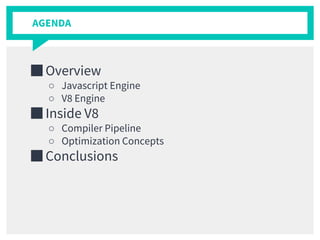
AGENDA
■ Overview
○ Javascript Engine
○ V8 Engine
■ Inside V8
○ Compiler Pipeline
○ Optimization Concepts
■ Conclusions
1.
Overview
Javascript Engine
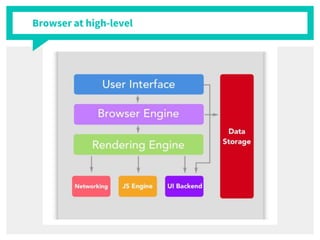
Browser at high-level
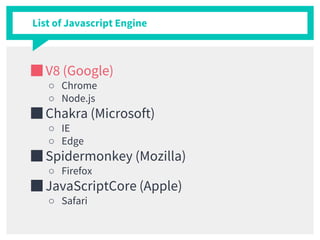
List of Javascript Engine
■ V8 (Google)
○ Chrome
○ Node.js
■ Chakra (Microsoft)
○ IE
○ Edge
■ Spidermonkey (Mozilla)
○ Firefox
■ JavaScriptCore (Apple)
○ Safari
Chrome V8 Engine
V8 Engine
■ V8 is Google's open source.
■ V8 is written in C++ and is used
in Google Chrome
■ V8 is embed in Node.js
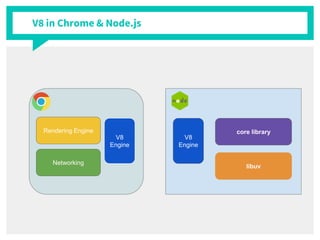
V8 in Chrome & Node.js
V8
Engine
V8
Engine
core libraryRendering Engine
Networking
libuv
V8’s Performance
■ Fast Property Access
■ Dynamic Machine Code Generation *
■ Efficient Garbage Collection
2.
Inside V8 Engine
Compiler Pipeline
Optimization
Concepts
2.1
Compiler Pipeline
A brief history of time...
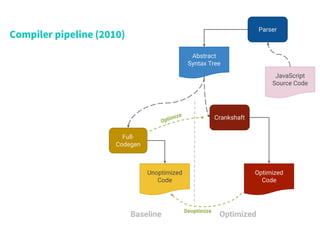
Compiler pipeline (2010)
Full-
Codegen
Unoptimized
Code
Crankshaft
Optimized
Code
Parser
Abstract
Syntax Tree
JavaScript
Source Code
OptimizedBaseline
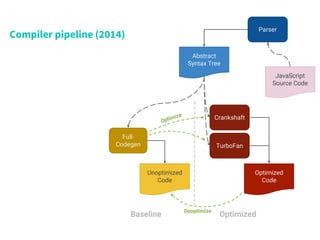
Compiler pipeline (2014)
Full-
Codegen
Unoptimized
Code
Crankshaft
Optimized
Code
TurboFan
Parser
Abstract
Syntax Tree
JavaScript
Source Code
OptimizedBaseline
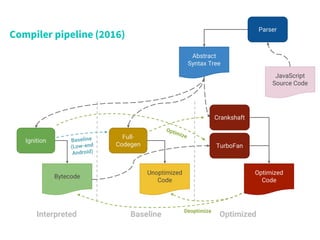
Compiler pipeline (2016)
Full-
Codegen
Unoptimized
Code
Crankshaft
Optimized
Code
TurboFan
Parser
Abstract
Syntax Tree
Ignition
Bytecode
JavaScript
Source Code
OptimizedBaselineInterpreted
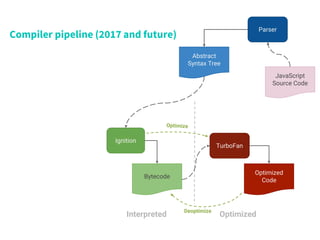
Compiler pipeline (2017 and future)
Optimized
Code
TurboFan
Parser
Abstract
Syntax Tree
Ignition
Bytecode
JavaScript
Source Code
OptimizedInterpreted
2.2
Optimization Concepts
Hidden Class
Inlining Cache
Hidden Class
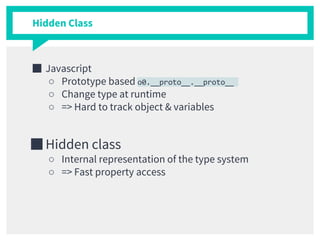
Hidden Class
■ Javascript
○ Prototype based o0.__proto__.__proto__
○ Change type at runtime
○ => Hard to track object & variables
■ Hidden class
○ Internal representation of the type system
○ => Fast property access
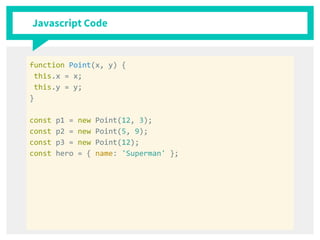
function Point(x, y) {
this.x = x;
this.y = y;
}
const p1 = new Point(12, 3);
const p2 = new Point(5, 9);
const p3 = new Point(12);
const hero = { name: 'Superman' };
Javascript Code
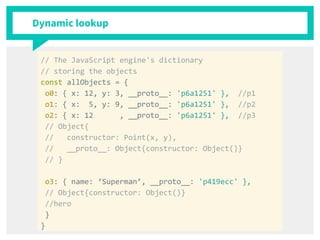
// The JavaScript engine's dictionary
// storing the objects
const allObjects = {
o0: { x: 12, y: 3, __proto__: 'p6a1251' }, //p1
o1: { x: 5, y: 9, __proto__: 'p6a1251' }, //p2
o2: { x: 12 , __proto__: 'p6a1251' }, //p3
// Object{
// constructor: Point(x, y),
// __proto__: Object{constructor: Object()}
// }
o3: { name: ‘Superman’, __proto__: 'p419ecc' },
// Object{constructor: Object()}
//hero
}
}
Dynamic lookup
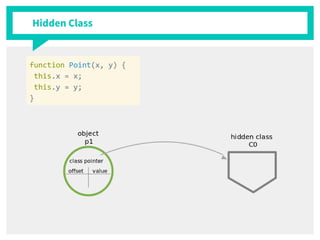
Hidden Class
function Point(x, y) {
this.x = x;
this.y = y;
}
Hidden Class
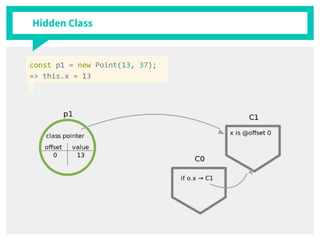
const p1 = new Point(13, 37);
=> this.x = 13
Hidden Class
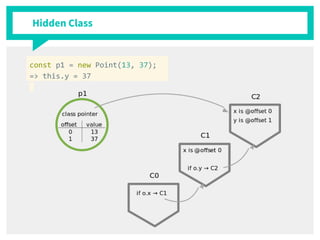
const p1 = new Point(13, 37);
=> this.y = 37
Hidden Class
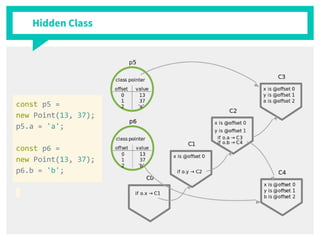
const p5 =
new Point(13, 37);
p5.a = 'a';
const p6 =
new Point(13, 37);
p6.b = 'b';
Hidden Class
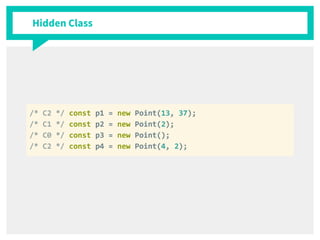
/* C2 */ const p1 = new Point(13, 37);
/* C1 */ const p2 = new Point(2);
/* C0 */ const p3 = new Point();
/* C2 */ const p4 = new Point(4, 2);
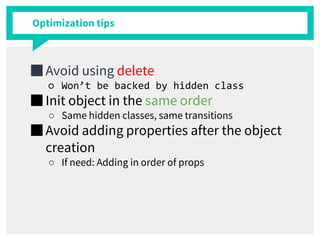
Optimization tips
■ Avoid using delete
○ Won’t be backed by hidden class
■ Init object in the same order
○ Same hidden classes, same transitions
■ Avoid adding properties after the object
creation
○ If need: Adding in order of props
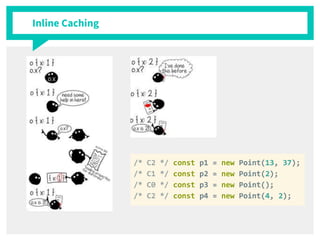
Inline Caching
Inline Caching
/* C2 */ const p1 = new Point(13, 37);
/* C1 */ const p2 = new Point(2);
/* C0 */ const p3 = new Point();
/* C2 */ const p4 = new Point(4, 2);
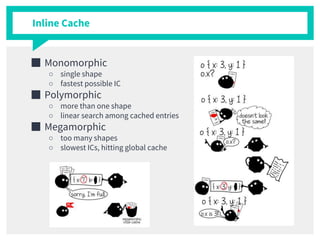
Inline Cache
■ Monomorphic
○ single shape
○ fastest possible IC
■ Polymorphic
○ more than one shape
○ linear search among cached entries
■ Megamorphic
○ too many shapes
○ slowest ICs, hitting global cache
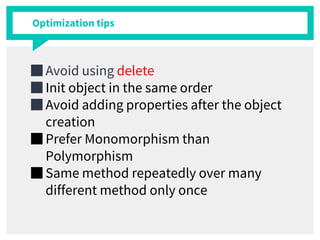
Optimization tips
■ Prefer Monomorphism than Polymorphism
■ Same method repeatedly over many different method
only once
Conclusion
Optimization tips
■ Avoid using delete
■ Init object in the same order
■ Avoid adding properties after the object
creation
■ Prefer Monomorphism than
Polymorphism
■ Same method repeatedly over many
different method only once
Digging Deeper
● Deeper in Inline Caching
● Type Feedback, Type Guard
● Intermediate Representation, Deoptimization
● Garbage Collection
References
● http://mrale.ph/blog/2015/01/11/whats-up-with-
monomorphism.html
● http://mrale.ph/blog/2012/06/03/explaining-js-vms-in-
js-inline-caches.html
● https://draft.li/blog/2016/12/22/javascript-engines-
hidden-classes/
● https://github.com/v8/v8/wiki/Design%20Elements
● Google I/O 2016, 2017
● https://v8project.blogspot.com/
THANK YOU

Google V8 engine

Editor's Notes

  • #7 JavascriptCore: underlies WebKit implementations
  • #10  Most JavaScript engines use a dictionary-like data structure as storage for object properties - each property access requires a dynamic lookup to resolve the property's location in memory GC: Pause time: 4.4ms
  • #19 It’s rather hard to optimize a dynamically typed, prototype-based language, such as JavaScript. Objects can change their type during runtime and it happens implicitly. To track types of JavaScript object and variables, V8 introduced the concept of hidden classes. During runtime V8 creates hidden classes that get attached to each and every object to track its shape/layout. That allows to optimize the property access time.
  • #21 Find o0 in allObjects (lookup to resolve the object’s location in memory), Find a property named "z" in o0 (dynamic lookup to resolve the property’s location in memory) and return its value. (Should we have tried p1.x, we could have stopped here, returning 12.) Since o0 does not have a property named "z", fetch o0.__proto__ to see if it has a property named "z", otherwise look if o0.__proto__.__proto__ has a property named "z", repeat this process down the prototype chain until __proto__ is null (which means no object prototype was found).
  • #23 creates a new hidden class everytime the constructor function declares a property
  • #25 Directed acyclic graph