GOOGLE
IT STRATEGY
CASE STUDY
Instructor: Prof. Martin Knahl
Presented by: Nguyen Minh Tuan
Nguyen Vo Huy Bao
AGENDA
1. THE EVOLUTION OF GOOGLE
2. MISSION, VISSION
3. CORPORATE STRATEGY
4. TECHNOLOGY INNOVATION
5. INFORMATION TECHNOLOGY
1.
THE EVOLUTION
OF GOOGLE
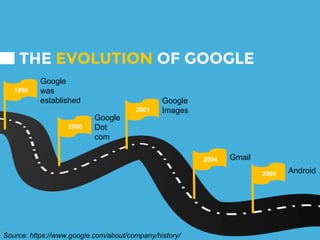
THE EVOLUTION OF GOOGLE
1998
Google
was
established
2000
Google
Dot
com
2001
Google
Images
2004 Gmail
2005 Android
Source: https://www.google.com/about/company/history/
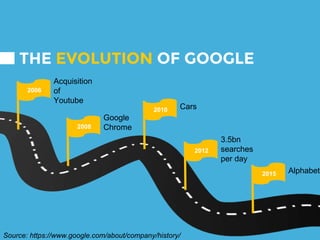
THE EVOLUTION OF GOOGLE
2006
Acquisition
of
Youtube
2008
Google
Chrome
2010 Cars
2012
3.5bn
searches
per day
2015 Alphabet
Source: https://www.google.com/about/company/history/
2.
MISSION, VISION
VISION
“To provide access to the world’s information in
one click”
- Google-
MISSION
“To organize the world’s information and make
it universally accessible and useful”
- Google-
3.
GOOGLE’S CORPORATE
STRATEGY
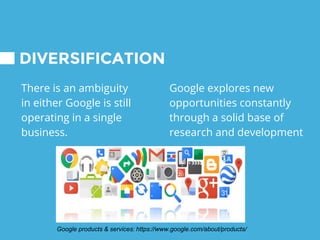
DIVERSIFICATION
There is an ambiguity
in either Google is still
operating in a single
business.
Google explores new
opportunities constantly
through a solid base of
research and development
Google products & services: https://www.google.com/about/products/
ACQUISITIONS
Strategic global &
local acquisitions in
Digital and
traditional
Advertising
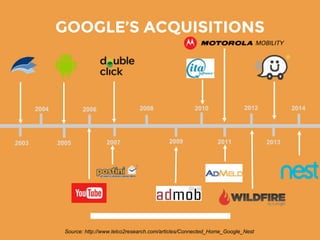
GOOGLE’S ACQUISITIONS
2004
20052003
2006
2007
2008
2009
2010
2011
2012
2013
2014
Source: http://www.telco2research.com/articles/Connected_Home_Google_Nest
STRATEGIC
PARTNERING
World presence
with local focus on
content
acquisition
Revenue
Google Adwords Google Adsense
4.
TECHNOLOY INNOVATION
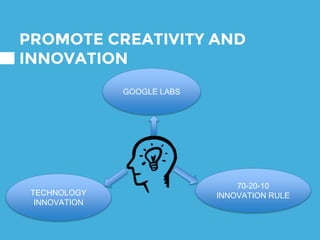
PROMOTE CREATIVITY AND
INNOVATION
GOOGLE LABS
70-20-10
INNOVATION RULETECHNOLOGY
INNOVATION
GOOGLE LABS
○A site demonstrates new experimental
products developed by Google employees.
○User can play around and give a sense of
satisfaction that his ideas turn in the
product.
GMail Calendar Map
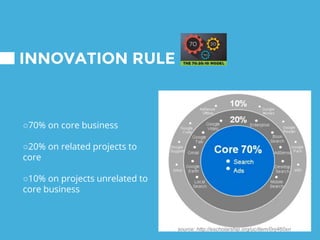
INNOVATION RULE
○70% on core business
○20% on related projects to
core
○10% on projects unrelated to
core business
source: http://escholarship.org/uc/item/0nj460xn
TECHNOLOGY INNOVATION
○Encourage development own software
○Internship programs
○More than 2/3 company employees are
engineers and scientists
○Google’s innovative thinking is attributed
to its work atmosphere “Googleplex”
5.
INFORMATION
TECHNOLOGY AT
GOOGLE
INFORMATION TECHNOLOGY AT
GOOGLE
• Build high-performance systems that scale to massive
workloads
• Develop custom libraries to support programming of
massively parallel systems
• Commodity hardware & free software are seeds of empire.
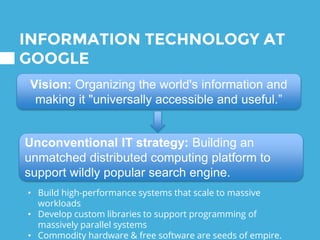
Vision: Organizing the world's information and
making it "universally accessible and useful.”
Unconventional IT strategy: Building an
unmatched distributed computing platform to
support wildly popular search engine.
THE SECRET BEHIND THE SEARCH
ENGINE
○Pimp the Server
○Custom Tailored
○Keep It Interesting
○Culture Of Choice
A unique mix of internally developed
software, open source, made-to-order
hardware, and people management.
PIMP THE SERVERS
○Google orders computer systems to its
own specifications.
○Use open source software to keep secrets
of Google infrastructure (no software
license, no code license)
○Organize machines which run Linux into
“cells” as a kind of disk drive for internet
service so programmers decide how much
redundancy
CUSTOM TAILORED
○Write a lot of custom software (MapReduce,
BigTable, Sawzall, Google File System & Google
Workqueue)
○Modify Linux kernel to solve data corruption
bottleneck problems so computer clusters can
communicate more efficiently.
○Created its own Web server instead of using
the open source Apache Web server
○Built own CRM to support its business of
selling internet Ads
KEEP IT INTERESTING
○Employs a matrix management system
where managers have many direct reports,
and engineers report to multiple people.
○Can change projects every three months
○Don’t keep people working on the same
problems for very long.
CULTURE OF CHOICE
○Linux, Mac OS, and Windows can be used
on desktop computers, depending on needs
and desires.
○Software can be requested through the
company intranet.
○Encourage “Talk a lot, use data, not
intuition, automate wherever you can”
Let’s review some concepts
Business Strategy
- Vision “To provide access
to the world’s
information in one click “
- Mission “To organize the
world’s information and
make it universally
accessible and useful “
- Cooperation Strategies :
Diversification,
Acquisitions & Partnering
Technology Innovation
- Google Laps
- Innovation rule (70-20-
10)
- Technology Innovation
(use open source, 2/3
employees are
engineers & scientists,
good working
environment like
“Googleplex”
IT Strategy
- Pimp the servers
- Custom tailored
- Keep IT Interesting
- Culture of choice
REFERENCES
 Chen, Rex, Lam, Oisze Kraemer, Kenneth ,Strategic Use Of IT –
Google, http://escholarship.org/uc/item/0nj460xn, last
accessed March 08 2015
 https://en.wikipedia.org/wiki/Google Labs, last accessed
March 07 2016
 Thomas Claburn, Google Revealed: The IT Strategy That Makes
It Work, http://www.informationweek.com/google-revealed-
the-it-strategy-that-makes-it-work/d/d-id/1046472?, last
accessed March 08 2016
 The history of Google,
http://www.telegraph.co.uk/technology/google/11984555/Rise-
of-a-tech-giant-the-history-of-Google.html, last accessed March
04 2016
THANKS!
Any questions?

Google it strategy

  • 1.
    GOOGLE IT STRATEGY CASE STUDY Instructor:Prof. Martin Knahl Presented by: Nguyen Minh Tuan Nguyen Vo Huy Bao
  • 2.
    AGENDA 1. THE EVOLUTIONOF GOOGLE 2. MISSION, VISSION 3. CORPORATE STRATEGY 4. TECHNOLOGY INNOVATION 5. INFORMATION TECHNOLOGY
  • 3.
  • 4.
    THE EVOLUTION OFGOOGLE 1998 Google was established 2000 Google Dot com 2001 Google Images 2004 Gmail 2005 Android Source: https://www.google.com/about/company/history/
  • 5.
    THE EVOLUTION OFGOOGLE 2006 Acquisition of Youtube 2008 Google Chrome 2010 Cars 2012 3.5bn searches per day 2015 Alphabet Source: https://www.google.com/about/company/history/
  • 6.
  • 7.
    VISION “To provide accessto the world’s information in one click” - Google-
  • 8.
    MISSION “To organize theworld’s information and make it universally accessible and useful” - Google-
  • 9.
  • 10.
    DIVERSIFICATION There is anambiguity in either Google is still operating in a single business. Google explores new opportunities constantly through a solid base of research and development Google products & services: https://www.google.com/about/products/
  • 11.
    ACQUISITIONS Strategic global & localacquisitions in Digital and traditional Advertising
  • 12.
  • 13.
  • 14.
  • 15.
  • 16.
    PROMOTE CREATIVITY AND INNOVATION GOOGLELABS 70-20-10 INNOVATION RULETECHNOLOGY INNOVATION
  • 17.
    GOOGLE LABS ○A sitedemonstrates new experimental products developed by Google employees. ○User can play around and give a sense of satisfaction that his ideas turn in the product. GMail Calendar Map
  • 18.
    INNOVATION RULE ○70% oncore business ○20% on related projects to core ○10% on projects unrelated to core business source: http://escholarship.org/uc/item/0nj460xn
  • 19.
    TECHNOLOGY INNOVATION ○Encourage developmentown software ○Internship programs ○More than 2/3 company employees are engineers and scientists ○Google’s innovative thinking is attributed to its work atmosphere “Googleplex”
  • 20.
  • 21.
    INFORMATION TECHNOLOGY AT GOOGLE •Build high-performance systems that scale to massive workloads • Develop custom libraries to support programming of massively parallel systems • Commodity hardware & free software are seeds of empire. Vision: Organizing the world's information and making it "universally accessible and useful.” Unconventional IT strategy: Building an unmatched distributed computing platform to support wildly popular search engine.
  • 22.
    THE SECRET BEHINDTHE SEARCH ENGINE ○Pimp the Server ○Custom Tailored ○Keep It Interesting ○Culture Of Choice A unique mix of internally developed software, open source, made-to-order hardware, and people management.
  • 23.
    PIMP THE SERVERS ○Googleorders computer systems to its own specifications. ○Use open source software to keep secrets of Google infrastructure (no software license, no code license) ○Organize machines which run Linux into “cells” as a kind of disk drive for internet service so programmers decide how much redundancy
  • 24.
    CUSTOM TAILORED ○Write alot of custom software (MapReduce, BigTable, Sawzall, Google File System & Google Workqueue) ○Modify Linux kernel to solve data corruption bottleneck problems so computer clusters can communicate more efficiently. ○Created its own Web server instead of using the open source Apache Web server ○Built own CRM to support its business of selling internet Ads
  • 25.
    KEEP IT INTERESTING ○Employsa matrix management system where managers have many direct reports, and engineers report to multiple people. ○Can change projects every three months ○Don’t keep people working on the same problems for very long.
  • 26.
    CULTURE OF CHOICE ○Linux,Mac OS, and Windows can be used on desktop computers, depending on needs and desires. ○Software can be requested through the company intranet. ○Encourage “Talk a lot, use data, not intuition, automate wherever you can”
  • 27.
    Let’s review someconcepts Business Strategy - Vision “To provide access to the world’s information in one click “ - Mission “To organize the world’s information and make it universally accessible and useful “ - Cooperation Strategies : Diversification, Acquisitions & Partnering Technology Innovation - Google Laps - Innovation rule (70-20- 10) - Technology Innovation (use open source, 2/3 employees are engineers & scientists, good working environment like “Googleplex” IT Strategy - Pimp the servers - Custom tailored - Keep IT Interesting - Culture of choice
  • 28.
    REFERENCES  Chen, Rex,Lam, Oisze Kraemer, Kenneth ,Strategic Use Of IT – Google, http://escholarship.org/uc/item/0nj460xn, last accessed March 08 2015  https://en.wikipedia.org/wiki/Google Labs, last accessed March 07 2016  Thomas Claburn, Google Revealed: The IT Strategy That Makes It Work, http://www.informationweek.com/google-revealed- the-it-strategy-that-makes-it-work/d/d-id/1046472?, last accessed March 08 2016  The history of Google, http://www.telegraph.co.uk/technology/google/11984555/Rise- of-a-tech-giant-the-history-of-Google.html, last accessed March 04 2016
  • 29.