Google Ad-words
Social Innovation Program
Search Engine Optimization
• Process of improving visibility of a website
• It is organic and un-paid
• Three basic areas-
• On-page optimization: refers to website elements which comprise a
web page, such as HTML code, textual content, and images
• Off-page optimization: refers, predominantly, to backlinks (links
pointing to the site which is being optimized, from other relevant
websites)
• Local SEO: the process of optimizing your website so that you can gain
higher local search rankings
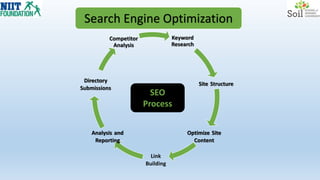
Search Engine Optimization
Keyword
Research
Site Structure
Optimize Site
Content
Link
Building
Analysis and
Reporting
Directory
Submissions
Competitor
Analysis
SEO
Process
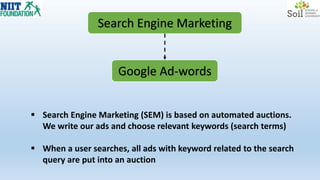
Search Engine Marketing
Google Ad-words
 Search Engine Marketing (SEM) is based on automated auctions.
We write our ads and choose relevant keywords (search terms)
 When a user searches, all ads with keyword related to the search
query are put into an auction
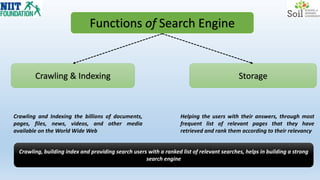
Functions of Search Engine
Crawling & Indexing Storage
Crawling and Indexing the billions of documents,
pages, files, news, videos, and other media
available on the World Wide Web
Helping the users with their answers, through most
frequent list of relevant pages that they have
retrieved and rank them according to their relevancy
Crawling, building index and providing search users with a ranked list of relevant searches, helps in building a strong
search engine
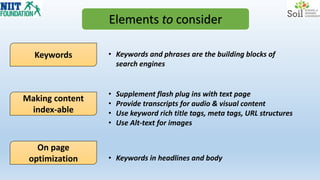
Elements to consider
Keywords
On page
optimization
Making content
index-able
• Keywords and phrases are the building blocks of
search engines
• Supplement flash plug ins with text page
• Provide transcripts for audio & visual content
• Use keyword rich title tags, meta tags, URL structures
• Use Alt-text for images
• Keywords in headlines and body
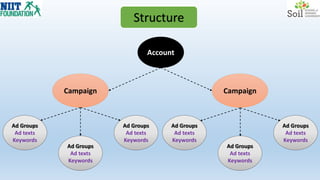
Structure
Account
Campaign Campaign
Ad Groups
Ad texts
Keywords
Ad Groups
Ad texts
Keywords
Ad Groups
Ad texts
Keywords
Ad Groups
Ad texts
Keywords
Ad Groups
Ad texts
Keywords
Ad Groups
Ad texts
Keywords
Keywords
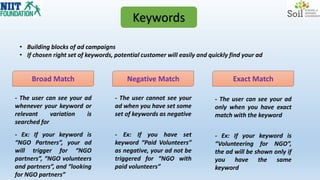
• Building blocks of ad campaigns
• If chosen right set of keywords, potential customer will easily and quickly find your ad
Broad Match Negative Match Exact Match
- The user can see your ad
whenever your keyword or
relevant variation is
searched for
- Ex: If your keyword is
“NGO Partners”, your ad
will trigger for “NGO
partners”, “NGO volunteers
and partners”, and “looking
for NGO partners”
- The user cannot see your
ad when you have set some
set of keywords as negative
- Ex: If you have set
keyword “Paid Volunteers”
as negative, your ad not be
triggered for “NGO with
paid volunteers”
- The user can see your ad
only when you have exact
match with the keyword
- Ex: If your keyword is
“Volunteering for NGO”,
the ad will be shown only if
you have the same
keyword
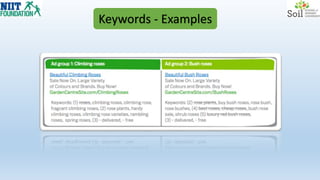
Keywords - Examples
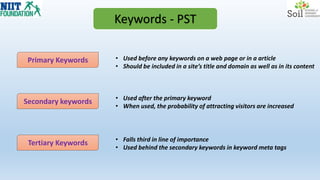
Keywords - PST
Primary Keywords
Secondary keywords
Tertiary Keywords
• Used before any keywords on a web page or in a article
• Should be included in a site’s title and domain as well as in its content
• Used after the primary keyword
• When used, the probability of attracting visitors are increased
• Falls third in line of importance
• Used behind the secondary keywords in keyword meta tags
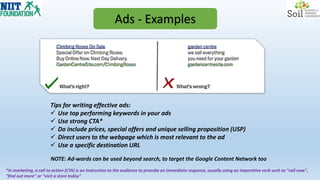
Ads - Examples
Tips for writing effective ads:
 Use top performing keywords in your ads
 Use strong CTA*
 Do include prices, special offers and unique selling proposition (USP)
 Direct users to the webpage which is most relevant to the ad
 Use a specific destination URL
*In marketing, a call to action (CTA) is an instruction to the audience to provoke an immediate response, usually using an imperative verb such as "call now",
"find out more" or "visit a store today"
NOTE: Ad-words can be used beyond search, to target the Google Content Network too
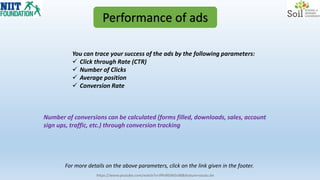
Performance of ads
You can trace your success of the ads by the following parameters:
 Click through Rate (CTR)
 Number of Clicks
 Average position
 Conversion Rate
https://www.youtube.com/watch?v=JfPoRGWGs98&feature=youtu.be
For more details on the above parameters, click on the link given in the footer.
Number of conversions can be calculated (forms filled, downloads, sales, account
sign ups, traffic, etc.) through conversion tracking
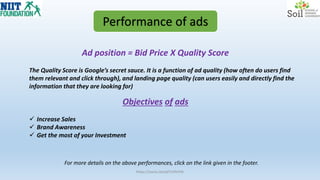
Ad position = Bid Price X Quality Score
Performance of ads
The Quality Score is Google’s secret sauce. It is a function of ad quality (how often do users find
them relevant and click through), and landing page quality (can users easily and directly find the
information that they are looking for)
Objectives of ads
 Increase Sales
 Brand Awareness
 Get the most of your Investment
https://youtu.be/q07Jr9Vihlk
For more details on the above performances, click on the link given in the footer.
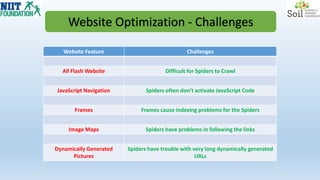
Website Feature Challenges
All Flash Website Difficult for Spiders to Crawl
JavaScript Navigation Spiders often don’t activate JavaScript Code
Frames Frames cause indexing problems for the Spiders
Image Maps Spiders have problems in following the links
Dynamically Generated
Pictures
Spiders have trouble with very long dynamically generated
URLs
Website Optimization - Challenges
Presented by-

Google Ad-words_SOIL

  • 1.
  • 2.
    Search Engine Optimization •Process of improving visibility of a website • It is organic and un-paid • Three basic areas- • On-page optimization: refers to website elements which comprise a web page, such as HTML code, textual content, and images • Off-page optimization: refers, predominantly, to backlinks (links pointing to the site which is being optimized, from other relevant websites) • Local SEO: the process of optimizing your website so that you can gain higher local search rankings
  • 3.
    Search Engine Optimization Keyword Research SiteStructure Optimize Site Content Link Building Analysis and Reporting Directory Submissions Competitor Analysis SEO Process
  • 4.
    Search Engine Marketing GoogleAd-words  Search Engine Marketing (SEM) is based on automated auctions. We write our ads and choose relevant keywords (search terms)  When a user searches, all ads with keyword related to the search query are put into an auction
  • 5.
    Functions of SearchEngine Crawling & Indexing Storage Crawling and Indexing the billions of documents, pages, files, news, videos, and other media available on the World Wide Web Helping the users with their answers, through most frequent list of relevant pages that they have retrieved and rank them according to their relevancy Crawling, building index and providing search users with a ranked list of relevant searches, helps in building a strong search engine
  • 6.
    Elements to consider Keywords Onpage optimization Making content index-able • Keywords and phrases are the building blocks of search engines • Supplement flash plug ins with text page • Provide transcripts for audio & visual content • Use keyword rich title tags, meta tags, URL structures • Use Alt-text for images • Keywords in headlines and body
  • 7.
    Structure Account Campaign Campaign Ad Groups Adtexts Keywords Ad Groups Ad texts Keywords Ad Groups Ad texts Keywords Ad Groups Ad texts Keywords Ad Groups Ad texts Keywords Ad Groups Ad texts Keywords
  • 8.
    Keywords • Building blocksof ad campaigns • If chosen right set of keywords, potential customer will easily and quickly find your ad Broad Match Negative Match Exact Match - The user can see your ad whenever your keyword or relevant variation is searched for - Ex: If your keyword is “NGO Partners”, your ad will trigger for “NGO partners”, “NGO volunteers and partners”, and “looking for NGO partners” - The user cannot see your ad when you have set some set of keywords as negative - Ex: If you have set keyword “Paid Volunteers” as negative, your ad not be triggered for “NGO with paid volunteers” - The user can see your ad only when you have exact match with the keyword - Ex: If your keyword is “Volunteering for NGO”, the ad will be shown only if you have the same keyword
  • 9.
  • 10.
    Keywords - PST PrimaryKeywords Secondary keywords Tertiary Keywords • Used before any keywords on a web page or in a article • Should be included in a site’s title and domain as well as in its content • Used after the primary keyword • When used, the probability of attracting visitors are increased • Falls third in line of importance • Used behind the secondary keywords in keyword meta tags
  • 11.
    Ads - Examples Tipsfor writing effective ads:  Use top performing keywords in your ads  Use strong CTA*  Do include prices, special offers and unique selling proposition (USP)  Direct users to the webpage which is most relevant to the ad  Use a specific destination URL *In marketing, a call to action (CTA) is an instruction to the audience to provoke an immediate response, usually using an imperative verb such as "call now", "find out more" or "visit a store today" NOTE: Ad-words can be used beyond search, to target the Google Content Network too
  • 12.
    Performance of ads Youcan trace your success of the ads by the following parameters:  Click through Rate (CTR)  Number of Clicks  Average position  Conversion Rate https://www.youtube.com/watch?v=JfPoRGWGs98&feature=youtu.be For more details on the above parameters, click on the link given in the footer. Number of conversions can be calculated (forms filled, downloads, sales, account sign ups, traffic, etc.) through conversion tracking
  • 13.
    Ad position =Bid Price X Quality Score Performance of ads The Quality Score is Google’s secret sauce. It is a function of ad quality (how often do users find them relevant and click through), and landing page quality (can users easily and directly find the information that they are looking for) Objectives of ads  Increase Sales  Brand Awareness  Get the most of your Investment https://youtu.be/q07Jr9Vihlk For more details on the above performances, click on the link given in the footer.
  • 14.
    Website Feature Challenges AllFlash Website Difficult for Spiders to Crawl JavaScript Navigation Spiders often don’t activate JavaScript Code Frames Frames cause indexing problems for the Spiders Image Maps Spiders have problems in following the links Dynamically Generated Pictures Spiders have trouble with very long dynamically generated URLs Website Optimization - Challenges
  • 15.