History
• 1996:
– Larry Page and Sergey Brin, Stanford computer
science grad students, begin collaborating on a
search engine called BackRub
– BackRub operates on Stanford servers for more
than a year—eventually taking up too much
bandwidth to suit the university
History
• 1997:
– Larry and Sergey decide that the BackRub search
engine needs a new name. After some
brainstorming, they go with Google—a play on the
word “googol,” a mathematical term for the
number represented by the numeral 1 followed by
100 zeros. The use of the term reflects their
mission to organize a seemingly infinite amount of
information on the web.
History
• 1998:
– “PC Magazine” reports that Google “has an
uncanny knack for returning extremely relevant
results” and recognizes it as the search engine of
choice in the Top 100 Web Sites for 1998.
History
• 1999:
– Outgrow its garage office
– Move to Mountain View
History
• 2000:
– 15 supported languages
– Forge a partnership with Yahoo! to become their
default search provider
– The first billion-URL index
History
• 2001:
– Google.com is available in 26 languages
– Image Search launches, offering access to 250
million images
– Index size grows to 3 billion
History
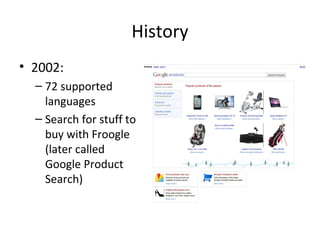
• 2002:
– 72 supported
languages
– Search for stuff to
buy with Froogle
(later called
Google Product
Search)
History
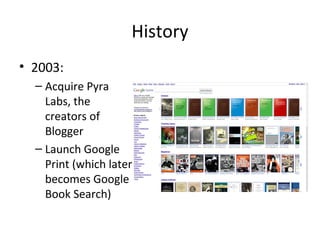
• 2003:
– Acquire Pyra
Labs, the
creators of
Blogger
– Launch Google
Print (which later
becomes Google
Book Search)
History
• 2004:
– Search index hits a new milestone: 6 billion items,
including 4.28 billion web pages and 880 million
images
– There are more than 100 Google domains
– Google Desktop Search is introduced
– Acquire Keyhole, a digital mapping company
whose technology will later become Google Earth
History
• 2005:
– Google Maps goes live
– Google Mobile Web Search is released, specially
formulated for viewing search results on mobile
phones
– Launch Google Talk
– Release Google Analytics for measuring the
impact of websites and marketing campaigns
History
• 2006
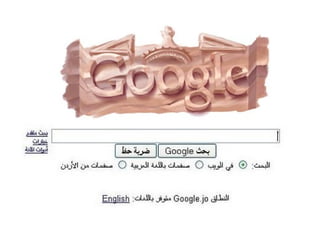
– Google.cn, a local domain version of Google, goes
live in China
– Acquisition of Writely, a web-based word
processing application that subsequently becomes
the basis for Google Docs
– Acquire JotSpot, a collaborative wiki platform,
which later becomes Google Sites
History
• 2007:
– Announce Google Gears (now known just as
Gears), an open source technology for creating
offline web applications
– Android, the first open platform for mobile
devices, and a collaboration with other companies
in the Open Handset Alliance, is announced
– The Queen of England launches The Royal Channel
on YouTube
History
• 2008:
– Google search becomes available over Ipv6
– Release Google Health to the public, allowing
people to safely and securely collect, store and
manage their medical records and health
information online
– 1 trillion unique URLs
History
• 2009:
– Google Translate is capable of automatic
translation between 41 languages
– Add a search options panel to Google Images,
making it easier to find images
– Mac and Linux versions of Google Chrome
History
• 2010:
– SSL-encrypted Google web search
– Acquire Slide, a social technology company with
an extensive history of building new ways for
people to connect with others across numerous
platforms online
– Google Instant predicts what you’re interested in
and shows you search results as you type so you
can quickly get to the information you’re looking
for
Google Mission
To organize the world’s information & make it
universally accessible & useful
Google Services
Google Services
Financial Performance
• In 2004 they listed in NASDAQ, Google got
$1.67 billion as Initial public offering
• In 2005, Google had a positive cash flow of
$3.45 billion & starting in 2006, was
generating more than $1 billion in cash every
quarter
• Its revenues come from ads, Google had
revenue of $23.651 billion & a net income of
$6.520 billion in 2010
Grow
• Google grew solely by word of mouth
• While growing domestically, Google had
started to focus more on its global strategy.
The majority of searches were international
Human Resources
• The company’s human resources are 23,331
employees around the world in 2010
• It focused on employees more than
customers, it allow employees to own Google
shares at Initial public offering
China
• 1.6 billion people, making an attractive market
• More than 100 U.S. based multinationals had
projects in China in 2006
The Internet & China
• Yahoo! Was the first American Internet
company to enter China with Chineselanguage website and an office in Beijing
• Uncensored nature of the Internet was not
welcomed by Chinese authorities
• Officials implemented rules regulating the
Internet
• Harmful content: freedom, religious cults,
antigovernment protests
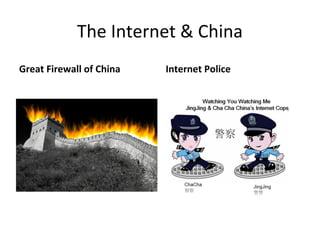
The Internet & China
Great Firewall of China

Internet Police
China

•Economic
•Human Rights
•Internet
www.google.cn

•History
•Location
•Objectives
•Business
•Change
•Competitors
•Defense

Google

  • 1.
    History • 1996: – LarryPage and Sergey Brin, Stanford computer science grad students, begin collaborating on a search engine called BackRub – BackRub operates on Stanford servers for more than a year—eventually taking up too much bandwidth to suit the university
  • 2.
    History • 1997: – Larryand Sergey decide that the BackRub search engine needs a new name. After some brainstorming, they go with Google—a play on the word “googol,” a mathematical term for the number represented by the numeral 1 followed by 100 zeros. The use of the term reflects their mission to organize a seemingly infinite amount of information on the web.
  • 3.
    History • 1998: – “PCMagazine” reports that Google “has an uncanny knack for returning extremely relevant results” and recognizes it as the search engine of choice in the Top 100 Web Sites for 1998.
  • 4.
    History • 1999: – Outgrowits garage office – Move to Mountain View
  • 5.
    History • 2000: – 15supported languages – Forge a partnership with Yahoo! to become their default search provider – The first billion-URL index
  • 6.
    History • 2001: – Google.comis available in 26 languages – Image Search launches, offering access to 250 million images – Index size grows to 3 billion
  • 7.
    History • 2002: – 72supported languages – Search for stuff to buy with Froogle (later called Google Product Search)
  • 8.
    History • 2003: – AcquirePyra Labs, the creators of Blogger – Launch Google Print (which later becomes Google Book Search)
  • 9.
    History • 2004: – Searchindex hits a new milestone: 6 billion items, including 4.28 billion web pages and 880 million images – There are more than 100 Google domains – Google Desktop Search is introduced – Acquire Keyhole, a digital mapping company whose technology will later become Google Earth
  • 10.
    History • 2005: – GoogleMaps goes live – Google Mobile Web Search is released, specially formulated for viewing search results on mobile phones – Launch Google Talk – Release Google Analytics for measuring the impact of websites and marketing campaigns
  • 11.
    History • 2006 – Google.cn,a local domain version of Google, goes live in China – Acquisition of Writely, a web-based word processing application that subsequently becomes the basis for Google Docs – Acquire JotSpot, a collaborative wiki platform, which later becomes Google Sites
  • 12.
    History • 2007: – AnnounceGoogle Gears (now known just as Gears), an open source technology for creating offline web applications – Android, the first open platform for mobile devices, and a collaboration with other companies in the Open Handset Alliance, is announced – The Queen of England launches The Royal Channel on YouTube
  • 13.
    History • 2008: – Googlesearch becomes available over Ipv6 – Release Google Health to the public, allowing people to safely and securely collect, store and manage their medical records and health information online – 1 trillion unique URLs
  • 14.
    History • 2009: – GoogleTranslate is capable of automatic translation between 41 languages – Add a search options panel to Google Images, making it easier to find images – Mac and Linux versions of Google Chrome
  • 15.
    History • 2010: – SSL-encryptedGoogle web search – Acquire Slide, a social technology company with an extensive history of building new ways for people to connect with others across numerous platforms online – Google Instant predicts what you’re interested in and shows you search results as you type so you can quickly get to the information you’re looking for
  • 16.
    Google Mission To organizethe world’s information & make it universally accessible & useful
  • 17.
  • 18.
  • 20.
    Financial Performance • In2004 they listed in NASDAQ, Google got $1.67 billion as Initial public offering • In 2005, Google had a positive cash flow of $3.45 billion & starting in 2006, was generating more than $1 billion in cash every quarter • Its revenues come from ads, Google had revenue of $23.651 billion & a net income of $6.520 billion in 2010
  • 21.
    Grow • Google grewsolely by word of mouth • While growing domestically, Google had started to focus more on its global strategy. The majority of searches were international
  • 22.
    Human Resources • Thecompany’s human resources are 23,331 employees around the world in 2010 • It focused on employees more than customers, it allow employees to own Google shares at Initial public offering
  • 23.
    China • 1.6 billionpeople, making an attractive market • More than 100 U.S. based multinationals had projects in China in 2006
  • 24.
    The Internet &China • Yahoo! Was the first American Internet company to enter China with Chineselanguage website and an office in Beijing • Uncensored nature of the Internet was not welcomed by Chinese authorities • Officials implemented rules regulating the Internet • Harmful content: freedom, religious cults, antigovernment protests
  • 25.
    The Internet &China Great Firewall of China Internet Police
  • 26.
  • 27.