WORKING FOR A HEALTHY FUTURE


"Good Work Good Health" - Identifying
Good Practice in Managing Mental
Wellbeing in the EU Telecoms Industry

Joanne Crawford, Hilary Cowie, Richard Graveling,
Phil George and Ken Dixon


INSTITUTE OF OCCUPATIONAL MEDICINE . Edinburgh . UK                www.iom-world.org
Summary of Presentation
•    Aims
•    Methods
    •   Systematic Review
    •   Data collection
•    Findings
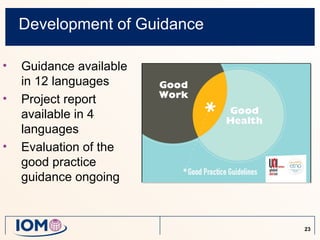
•    Development of Guidance
•    Conclusions


                               2
GWGH Project
•    The work was carried out on behalf of
    •   ETNO (European Telecommunication Network Operators
        Association) and
    •   the Trade Unions federation, Uni-europa
•    With financial support from the European
     Commission


                                                             3
Aims
•   The aim of the study was to gather
    evidence on good practice in
    managing mental wellbeing in the
    industry and from this to feed into the
    development of guidelines to be
    disseminated across the
    telecommunications sector.


                                              4
Systematic Review

•    A systematic review of secondary research was
     carried out to answer the following questions:
     •   What are the work factors that are associated with impaired
         mental wellbeing?
     •   What work factors are associated with enhanced mental
         wellbeing?
     •   What work arrangements can mitigate or facilitate return to work
         for individuals who have poor mental wellbeing?

     •   Searches carried out on 17 electronic databases and 35 websites
     •   In total 39 publications included and these were rated for quality
         using the three-star system


                                                                              5
Systematic Review Findings

•    Work factors associated with impaired mental
     wellbeing
       •   Demands and controls (***)
       •   Low job satisfaction (***)
       •   Lack of manager support (***)
       •   High emotional demands, an undervalued social
           position, monotony, poor communication (***)
       •   Role conflict and ambiguity, career stagnation,
           home/work conflict, tight deadlines, poor
           management style (*)


                                                             6
Systematic Review Findings

•    Work Factors associated with enhanced mental
     wellbeing
     •   Positive impact of summer vacation (***)
     •   Increasing job control, improving task design (**)
     •   Good work relationships, clear roles and having a
         participatory approach (**)
     •   Multi-modal interventions that include support, social
         and coping skills training (**)
     •   Compressed working week (**)
     •   Flexible working, improving job satisfaction and valuing
         the workforce (*)

                                                                    7
Systematic Review Findings

•    Work factors that mitigate or enhance return-
     to-work for individuals with poor mental
     wellbeing
     •   These have the potential to be positive
         • Phased return-to-work
         • Psychological rehabilitation
         • Maintaining regular contact with the employee
         • Problem identification and workplace
            adjustments


                                                           8
Systematic Review Findings

•    Evidence Gaps
     •   Lack of high quality primary research
     •   Lack of quantification or evaluation of the impact
         of workplace interventions
     •   Little evidence-based guidance available


                                                              9
Development of Interview
•    On completion of the systematic review a
     template of questions was developed to use with
     companies covering the following areas
     •   Measurement of mental wellbeing
     •   Organisational interventions for mental wellbeing
     •   Person-directed interventions for mental wellbeing
     •   Return-to-work after sickness absence
     •   Working Time
     •   Organisational Justice
     •   Managers and supervisors
     •   Training and new technology


                                                              10
Companies Interviewed
•    Eight companies agreed to take part including:
         •   Belgacom
         •   BT
         •   Deutsche Telekom
         •   France Télècom - Orange
         •   Portugal Telecom
         •   Romtelecom
         •   Telefonica
         •   Telenor
     •   Interviews carried out with stakeholders in each
         company and union representatives


                                                            11
What were the good practices identified?

•    Measurement of mental wellbeing
     •   Mental wellbeing assessed by examination, risk assessment
         and or questionnaire survey.
     •   Assessment tools developed based on recognised models of
         workplace stress including demands and control at work.
     •   Where different groups such as call centre workers or field
         engineers show poor mental wellbeing, this can provide a
         focus for intervention
     •   Induction processes had been put in place for new
         employees in relation to their role, training, how and where to
         access support


                                                                           12
What were the good practices identified?

•    Measurement of mental wellbeing
     •   If individuals feel they have role conflicts, role ambiguity,
         poor work-life balance, too tight deadlines or
         underutilisation then procedures are in place to help.
     •   Contact was maintained with individuals working outside
         the office (Field Technicians and Home Workers)
     •   Procedures were in place for any incidents of bullying,
         mobbing, violence or aggression against employees
     •   Discrimination was not acceptable at any level and
         procedures are in place to deal with such incidents.


                                                                         13
What were the good practices identified?

•    Organisational Level Interventions
     •   The use of risk assessment or toolkits to evaluate the impact
         of change management
     •   Campaigns on mental wellbeing across companies
     •   Use of the intranet and company newsletters to advertise
         initiatives
     •   The involvement of all stakeholders in the development of
         organisational interventions
     •   Encouraging people to increase levels of physical activity
     •   Evaluation of levels of engagement within the workforce
     •   Access to senior management


                                                                     14
What were the good practices identified?

•    Person-directed Interventions
     •   A reporting system in place for individuals who are having
         problems that is both accessible and used by employees
     •   Immediate access to help and support
     •   Help and support available whether the source of the
         problem was at work or at home
     •   Recognition of good work through either bonus systems or
         highlighting of an individual or team achievement
     •   Having a code of conduct for individuals to work to that
         encompasses the values of the company


                                                                      15
What were the good practices identified?

•    Return to work after absence
     •   Contact being made as soon as possible between the
         company and the employee
     •   Having a management system in place for individuals who
         take frequent short-term sickness absence
     •   For long term absence maintaining contact with the individual
         for the duration of the illness (where local legislation allows
         this)
     •   Offering continued support to individuals on return to work
         after long term absence
     •   Allowing time for individuals to come back to full capacity or
         using a graduated return to work.

                                                                       16
What were the good practices identified?

•    Working Time
     •   Where possible allowing flexible working practices
     •   Monitoring levels of overtime and ensuring this is
         not excessive
     •   Having annual leave and ensuring employees take
         leave
     •   Where individuals become ill on annual leave,
         recording this as sick leave not annual leave
     •   Having rest breaks built into the working day and
         ensuring breaks are taken


                                                              17
What were the good practices identified?

•    Organisational Justice
     •   Clear and transparent recruitment and promotion processes
          agreed by all stakeholders
     •   The use of talent management programmes to improve
         retention and development of employees
     •   Clear appraisal processes which allow training needs to be
         identified and goals to be set for the individual employee;
         with an opportunity for appeal
     •   The use of job descriptions and job families to allow role
         clarity


                                                                       18
What were the good practices identified?

•    Organisational Justice
     •   Consulting with employees to evaluate decision
         making and having routes to bring any complaints such
         as local human resources
     •   Dealing with employees with respect and fairness
         (dignity?)
     •   Having a communications strategy including both
         electronic and paper based media
     •   Ensuring a top down approach for communications that
         comes down to every employee
     •   The use of mediation where it is perceived the wrong
         decisions have been made
                                                                 19
What were the good practices identified?

•    Managers and Supervisors
     •   Employing managers who have both business
         skills and people skills
     •   Training managers to identify poor identify poor
         mental health within their teams
     •   Giving professional support to managers when
         dealing with team members with poor mental
         wellbeing


                                                            20
What were the good practices identified?

•     Training and New Technology
     •   Having access to training and identifying training
         needs for all level of employees
     •   Ensuring line managers encourage and are not a
         block to training opportunities
     •   Access to specific training for different groups
     •   Ensuring adequate training and support for new
         product launches


                                                              21
Evaluation of outcomes of interventions
•    A problem common to a lot of occupational
     health/ergonomic/health promotion initiatives – it
     doesn’t always happen
     •   A need to build evaluation of effectiveness in over time – one
         example within the visits
     •   Helps develop the business case and to show something is
         working (or not)
•    One advantage of taking a sector approach is that
     people can see interventions that work in their field


                                                                          22
Development of Guidance

•   Guidance available
    in 12 languages
•   Project report
    available in 4
    languages
•   Evaluation of the
    good practice
    guidance ongoing


                              23
Project website available at…

Details of the project are on our website…
http://www.iom-world.org/research/goodworkgoodhealth.


And the project website
http://www.gwgh.eu/

Thank you for listening
Joanne.crawford@iom-world.org

                                                 24

Good Work Good Health (2)

  • 1.
    WORKING FOR AHEALTHY FUTURE "Good Work Good Health" - Identifying Good Practice in Managing Mental Wellbeing in the EU Telecoms Industry Joanne Crawford, Hilary Cowie, Richard Graveling, Phil George and Ken Dixon INSTITUTE OF OCCUPATIONAL MEDICINE . Edinburgh . UK www.iom-world.org
  • 2.
    Summary of Presentation • Aims • Methods • Systematic Review • Data collection • Findings • Development of Guidance • Conclusions 2
  • 3.
    GWGH Project • The work was carried out on behalf of • ETNO (European Telecommunication Network Operators Association) and • the Trade Unions federation, Uni-europa • With financial support from the European Commission 3
  • 4.
    Aims • The aim of the study was to gather evidence on good practice in managing mental wellbeing in the industry and from this to feed into the development of guidelines to be disseminated across the telecommunications sector. 4
  • 5.
    Systematic Review • A systematic review of secondary research was carried out to answer the following questions: • What are the work factors that are associated with impaired mental wellbeing? • What work factors are associated with enhanced mental wellbeing? • What work arrangements can mitigate or facilitate return to work for individuals who have poor mental wellbeing? • Searches carried out on 17 electronic databases and 35 websites • In total 39 publications included and these were rated for quality using the three-star system 5
  • 6.
    Systematic Review Findings • Work factors associated with impaired mental wellbeing • Demands and controls (***) • Low job satisfaction (***) • Lack of manager support (***) • High emotional demands, an undervalued social position, monotony, poor communication (***) • Role conflict and ambiguity, career stagnation, home/work conflict, tight deadlines, poor management style (*) 6
  • 7.
    Systematic Review Findings • Work Factors associated with enhanced mental wellbeing • Positive impact of summer vacation (***) • Increasing job control, improving task design (**) • Good work relationships, clear roles and having a participatory approach (**) • Multi-modal interventions that include support, social and coping skills training (**) • Compressed working week (**) • Flexible working, improving job satisfaction and valuing the workforce (*) 7
  • 8.
    Systematic Review Findings • Work factors that mitigate or enhance return- to-work for individuals with poor mental wellbeing • These have the potential to be positive • Phased return-to-work • Psychological rehabilitation • Maintaining regular contact with the employee • Problem identification and workplace adjustments 8
  • 9.
    Systematic Review Findings • Evidence Gaps • Lack of high quality primary research • Lack of quantification or evaluation of the impact of workplace interventions • Little evidence-based guidance available 9
  • 10.
    Development of Interview • On completion of the systematic review a template of questions was developed to use with companies covering the following areas • Measurement of mental wellbeing • Organisational interventions for mental wellbeing • Person-directed interventions for mental wellbeing • Return-to-work after sickness absence • Working Time • Organisational Justice • Managers and supervisors • Training and new technology 10
  • 11.
    Companies Interviewed • Eight companies agreed to take part including: • Belgacom • BT • Deutsche Telekom • France Télècom - Orange • Portugal Telecom • Romtelecom • Telefonica • Telenor • Interviews carried out with stakeholders in each company and union representatives 11
  • 12.
    What were thegood practices identified? • Measurement of mental wellbeing • Mental wellbeing assessed by examination, risk assessment and or questionnaire survey. • Assessment tools developed based on recognised models of workplace stress including demands and control at work. • Where different groups such as call centre workers or field engineers show poor mental wellbeing, this can provide a focus for intervention • Induction processes had been put in place for new employees in relation to their role, training, how and where to access support 12
  • 13.
    What were thegood practices identified? • Measurement of mental wellbeing • If individuals feel they have role conflicts, role ambiguity, poor work-life balance, too tight deadlines or underutilisation then procedures are in place to help. • Contact was maintained with individuals working outside the office (Field Technicians and Home Workers) • Procedures were in place for any incidents of bullying, mobbing, violence or aggression against employees • Discrimination was not acceptable at any level and procedures are in place to deal with such incidents. 13
  • 14.
    What were thegood practices identified? • Organisational Level Interventions • The use of risk assessment or toolkits to evaluate the impact of change management • Campaigns on mental wellbeing across companies • Use of the intranet and company newsletters to advertise initiatives • The involvement of all stakeholders in the development of organisational interventions • Encouraging people to increase levels of physical activity • Evaluation of levels of engagement within the workforce • Access to senior management 14
  • 15.
    What were thegood practices identified? • Person-directed Interventions • A reporting system in place for individuals who are having problems that is both accessible and used by employees • Immediate access to help and support • Help and support available whether the source of the problem was at work or at home • Recognition of good work through either bonus systems or highlighting of an individual or team achievement • Having a code of conduct for individuals to work to that encompasses the values of the company 15
  • 16.
    What were thegood practices identified? • Return to work after absence • Contact being made as soon as possible between the company and the employee • Having a management system in place for individuals who take frequent short-term sickness absence • For long term absence maintaining contact with the individual for the duration of the illness (where local legislation allows this) • Offering continued support to individuals on return to work after long term absence • Allowing time for individuals to come back to full capacity or using a graduated return to work. 16
  • 17.
    What were thegood practices identified? • Working Time • Where possible allowing flexible working practices • Monitoring levels of overtime and ensuring this is not excessive • Having annual leave and ensuring employees take leave • Where individuals become ill on annual leave, recording this as sick leave not annual leave • Having rest breaks built into the working day and ensuring breaks are taken 17
  • 18.
    What were thegood practices identified? • Organisational Justice • Clear and transparent recruitment and promotion processes agreed by all stakeholders • The use of talent management programmes to improve retention and development of employees • Clear appraisal processes which allow training needs to be identified and goals to be set for the individual employee; with an opportunity for appeal • The use of job descriptions and job families to allow role clarity 18
  • 19.
    What were thegood practices identified? • Organisational Justice • Consulting with employees to evaluate decision making and having routes to bring any complaints such as local human resources • Dealing with employees with respect and fairness (dignity?) • Having a communications strategy including both electronic and paper based media • Ensuring a top down approach for communications that comes down to every employee • The use of mediation where it is perceived the wrong decisions have been made 19
  • 20.
    What were thegood practices identified? • Managers and Supervisors • Employing managers who have both business skills and people skills • Training managers to identify poor identify poor mental health within their teams • Giving professional support to managers when dealing with team members with poor mental wellbeing 20
  • 21.
    What were thegood practices identified? • Training and New Technology • Having access to training and identifying training needs for all level of employees • Ensuring line managers encourage and are not a block to training opportunities • Access to specific training for different groups • Ensuring adequate training and support for new product launches 21
  • 22.
    Evaluation of outcomesof interventions • A problem common to a lot of occupational health/ergonomic/health promotion initiatives – it doesn’t always happen • A need to build evaluation of effectiveness in over time – one example within the visits • Helps develop the business case and to show something is working (or not) • One advantage of taking a sector approach is that people can see interventions that work in their field 22
  • 23.
    Development of Guidance • Guidance available in 12 languages • Project report available in 4 languages • Evaluation of the good practice guidance ongoing 23
  • 24.
    Project website availableat… Details of the project are on our website… http://www.iom-world.org/research/goodworkgoodhealth. And the project website http://www.gwgh.eu/ Thank you for listening Joanne.crawford@iom-world.org 24