Good Laboratory Practice, personal protective equipments
1.
Good Laboratory Practice
GroupMembers
Sharjeel Ahmad (2024-Mphil-2175)
Mir Muhammad Bilal (2024-Mphil-2299)
Arooj Yaseen (2024-Mphil-2173)
Rizwana Asif (2024-Mphil-2176))
M.Phil MBBT (Semester II)
Subject: Principles of Biotechnology
2.
2
Definition
Good LaboratoryPractice (GLP) is a standardized way of planning, performing and
reporting laboratory-based studies to ensure a high standard of quality and reliability.
Organization for Economic Cooperation and Development (OECD) defined the Good
Laboratory Practices as follows:
“A set of rules and criteria for quality systems concerned with the organizational
process and the conditions under which non-clinical health and environmental safety
studies are planned, performed, monitored, recorded, reported, and archived.”
3.
3
History
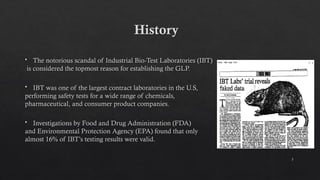
The notoriousscandal of Industrial Bio-Test Laboratories (IBT)
is considered the topmost reason for establishing the GLP.
IBT was one of the largest contract laboratories in the U.S,
performing safety tests for a wide range of chemicals,
pharmaceutical, and consumer product companies.
Investigations by Food and Drug Administration (FDA)
and Environmental Protection Agency (EPA) found that only
almost 16% of IBT’s testing results were valid.
4.
4
GLP principleis only applicable in those laboratories that are conducting non-clinical
safety studies, which will be submitted to government regulatory agencies to support the
approval of a product.
These government regulatory agencies may be Food and Drug Administration (FDA) in
USA, European Medicines Agency (EMA) in UK, and Drug Regulatory Authority of
Pakistan (DRAP) in Pakistan.
Applications
5.
5
GLP versus SOPs
GLP is a broad, regulatory quality system that sets the framework for non-clinical studies
while SOPs are specific, detailed written instructions that describes how to perform the
routine tasks and are a required component of GLP.
In essence, GLP is the what and why (the principles and rules for data quality and
integrity) and SOPs are the how (the step-by-step method to comply with those principles).
6.
6
Guidelines
The guidelines ofGood Laboratory Practice for various elements of studies are following:
1. Personnel: There must be a director/manager who will be responsible for the
overall conduct of the research and its GLP compliance.
2. Facility and Equipment: There must be separate areas for different activities to
avoid interference and other disturbances which may compromise the study. All the
equipment used must be calibrated and maintained.
7.
7
3. Characterization: Personnelperforming the study should know following about
each test and control subjects:
a. identity, composition, and stability
b. expiry date and storage instructions
c. quantity received and quantity used
4. Study Plan: It is the master guidance document for the conduct of study. This plan
must go through approval, review and discussion before the study begins.
8.
8
5. Standard OperatingProcedures (SOPs): Every area in the testing facility must
have SOPs and any deviations from these need to be authorized by the director/manager
6. Final Report: A final report must be devised by director/manager whose salient
features must be as follows:
a. a complete and accurate account of the conducted research/study
b. any deviation from SOPs
c. scientific interpretation of the results