1
GOOD DISTRIBUTION PRACTICE
as one of the KEY elements for
Quality of Medicinal Products
Muhammad Lukmani Ibrahim
National Pharmaceutical Control Bureau
Ministry of Health
Malaysia
2
Introduction
Distribution
Good Distribution Practice (GDP)
GDP in Malaysia
3
4
INTRODUCTION TO THE LICENSING
ACTIVITIES IN MALAYSIA
However , the activities are carried out by the
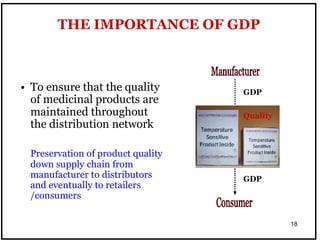
National Pharmaceutical Control Bureau
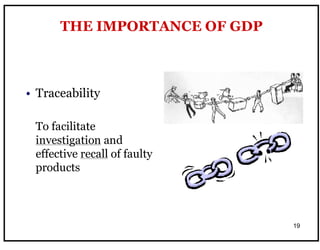
which serves as the Secretariat of the DCA
The Control of Drugs & Cosmetics Regulations
1984 empower the Drug Control Authority (DCA),
Ministry of Health to implement the Registration
of Products and the Licensing of Premises
(Manufacturers, Importers , Wholesalers)
5
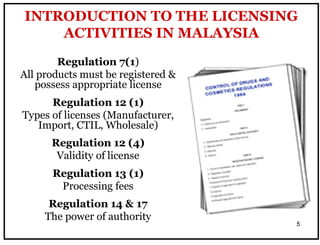
Regulation 7(1)
All products must be registered &
possess appropriate license
Regulation 12 (1)
Types of licenses (Manufacturer,
Import, CTIL, Wholesale)
Regulation 12 (4)
Validity of license
Regulation 13 (1)
Processing fees
Regulation 14 & 17
The power of authority
INTRODUCTION TO THE LICENSING
ACTIVITIES IN MALAYSIA
1
6
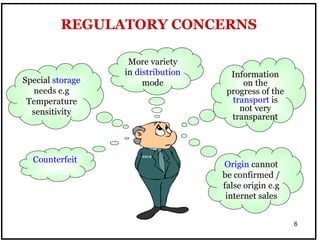
REGULATORY CONCERNS
More variety
in distribution
mode
Information
on the
progress of the
transport is
not very
transparent
Counterfeit
Special storage
needs e.g
Temperature
sensitivity
Origin cannot
be confirmed /
false origin e.g
internet sales
NPCB
7
8
DEFINITION
“The division and movement of pharmaceutical
products from the premises of the manufacturer of
such products or another central point, to the end
user thereof or to an intermediate point by means
of various transport methods, via various storage
and/or health establishments”
WHO (Working Document QAS/08.252, January 2008)
DISTRIBUTION
9
• Forms an important activity of the integrated
supply chain management of medicinal products.
• Various persons and entities are often responsible
for the handling, storage and distribution of such
product
• The quality of medicinal products can be affected
by a lack of adequate control over numerous
activities which occur during the distribution
process
• The storage, trade and distribution of medicinal
products are activities that are carried out by
various companies, institutions and individuals
DISTRIBUTION
10
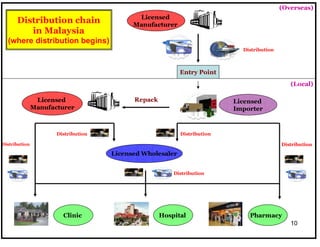
Licensed
Manufacturer
Licensed
Manufacturer
Licensed
Importer
Licensed Wholesaler
Hospital
(Local)
Entry Point
(Overseas)
Pharmacy
Clinic
Distribution chain
in Malaysia
(where distribution begins)
Repack
Distribution
Distribution
Distribution
Distribution
Distribution
Distribution
11
• The nature of the risks involved may generally,
however, be the same as those in the
manufacturing environment e.g mix-ups,
contamination and cross contamination
• There are thus aspects in distribution to which
the principles of Good Manufacturing Practice
(GMP) should be applied
• These include, but are not limited to, storage,
distribution, transportation, packaging, labeling,
documentation and record-keeping practices.
GMP VS DISTRIBUTION
2
12
 Chapter 1
requires satisfactory arrangements for storage and
distribution to maintain quality
 Chapter 4
requires batch distribution records to be kept
 Chapter 5
deals with storage after release and the handling of
product returned from the market
 Chapter 8
deals with product complaints and recalls
GMP VS DISTRIBUTION
Distribution is included within the definition
of manufacture in the PIC/S Guidelines
13
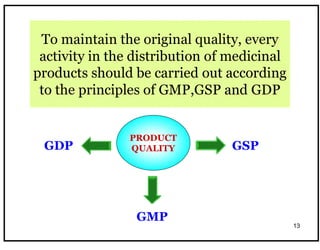
PRODUCT
QUALITY
To maintain the original quality, every
activity in the distribution of medicinal
products should be carried out according
to the principles of GMP,GSP and GDP
GMP
GDP GSP
14
GOOD MANUFACTURING PRACTICE
GMP is that part of Quality Assurance which
ensures that products are consistently
produced and controlled to the quality
standards appropriate to their intended use
and as required by the marketing
authorization or product specification
15
GOOD STORAGE PRACTICE
The special measures that need to be considered in the
storage, transportation and distribution of registered
products, such that the registered product will be of the
nature and quality intended when it reaches the
consumer
Guidelines on Good Storage Practice (GSP),2nd Edition, 2004
That part of quality assurance that ensures that the quality of
pharmaceutical products is maintained by means of
adequate control throughout the storage thereof
WHO (Working Document QAS/08.252, January 2008)
16
17
Good Distribution Practice (GDP) is that part of
quality assurance which ensures that products are
consistently stored, transported and handled under
suitable condition as required by the marketing
authorization (MA) or product specification
- MHRA, UK -
A quality system to ensure that medicinal products
are procured, stored, transported, distributed and
handled systematically and in an appropriate
manner.
- HSA, SINGAPORE -
GOOD DISTRIBUTION PRACTICE
3
18
• To ensure that the quality
of medicinal products are
maintained throughout
the distribution network
Preservation of product quality
down supply chain from
manufacturer to distributors
and eventually to retailers
/consumers
GDP
Quality
GDP
THE IMPORTANCE OF GDP
19
• Traceability
To facilitate
investigation and
effective recall of faulty
products
THE IMPORTANCE OF GDP
20
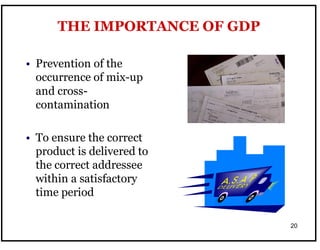
• Prevention of the
occurrence of mix-up
and cross-
contamination
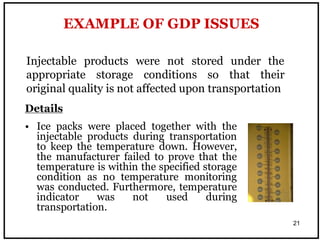
• To ensure the correct
product is delivered to
the correct addressee
within a satisfactory
time period
THE IMPORTANCE OF GDP
21
Injectable products were not stored under the
appropriate storage conditions so that their
original quality is not affected upon transportation
EXAMPLE OF GDP ISSUES
Details
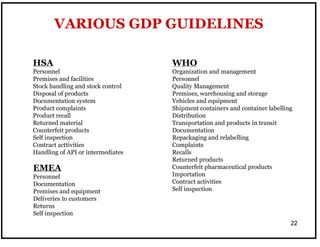
• Ice packs were placed together with the
injectable products during transportation
to keep the temperature down. However,
the manufacturer failed to prove that the
temperature is within the specified storage
condition as no temperature monitoring
was conducted. Furthermore, temperature
indicator was not used during
transportation.
22
WHO
Organization and management
Personnel
Quality Management
Premises, warehousing and storage
Vehicles and equipment
Shipment containers and container labelling
Distribution
Transportation and products in transit
Documentation
Repackaging and relabelling
Complaints
Recalls
Returned products
Counterfeit pharmaceutical products
Importation
Contract activities
Self inspection
HSA
Personnel
Premises and facilities
Stock handling and stock control
Disposal of products
Documentation system
Product complaints
Product recall
Returned material
Counterfeit products
Self inspection
Contract acttivities
Handling of API or intermediates
EMEA
Personnel
Documentation
Premises and equipment
Deliveries to customers
Returns
Self inspection
VARIOUS GDP GUIDELINES
23
4
24
GDP in Malaysia is currently conducted by adopting the GSP
Guidelines
(Guidelines on Good Storage Practice (GSP),2nd Edition, 2004 )
PART ONE
Personnel
Premises and facilities
Stock handling and stock control
Disposal of pharmaceutical products
Documentation
PART TWO
Product complaints
Product recall
GDP IN MALAYSIA
25
• Working group on the establishment of
GDP Guidelines (incorporating current
GSP Guidelines)
• Comparison of GDP guidelines that are
available
PROGRESS .. MALAYSIA
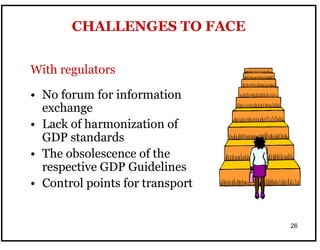
26
• No forum for information
exchange
• Lack of harmonization of
GDP standards
• The obsolescence of the
respective GDP Guidelines
• Control points for transport
CHALLENGES TO FACE
With regulators
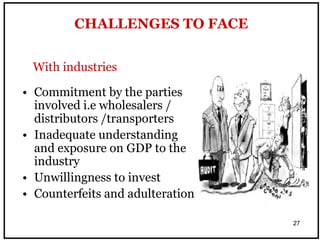
27
• Commitment by the parties
involved i.e wholesalers /
distributors /transporters
• Inadequate understanding
and exposure on GDP to the
industry
• Unwillingness to invest
• Counterfeits and adulteration
CHALLENGES TO FACE
With industries
28
1. WHO (Working Document QAS/08.252,
January 2008)
2. EMEA, Guidelines on Good Distribution
Practice of Medicinal Products for Human
Use,1992.
3. HSA, Guidance Notes on Good Distribution
Practices,Guide-MQA-013-005,2005
4. Guidelines on Good Storage Practice (GSP),2nd
Edition, 2004
REFERENCE
29
Thank you
5

GOOD DISTRIBUTION PRACTICE details cut more

  • 1.
    1 GOOD DISTRIBUTION PRACTICE asone of the KEY elements for Quality of Medicinal Products Muhammad Lukmani Ibrahim National Pharmaceutical Control Bureau Ministry of Health Malaysia
  • 2.
  • 3.
  • 4.
    4 INTRODUCTION TO THELICENSING ACTIVITIES IN MALAYSIA However , the activities are carried out by the National Pharmaceutical Control Bureau which serves as the Secretariat of the DCA The Control of Drugs & Cosmetics Regulations 1984 empower the Drug Control Authority (DCA), Ministry of Health to implement the Registration of Products and the Licensing of Premises (Manufacturers, Importers , Wholesalers)
  • 5.
    5 Regulation 7(1) All productsmust be registered & possess appropriate license Regulation 12 (1) Types of licenses (Manufacturer, Import, CTIL, Wholesale) Regulation 12 (4) Validity of license Regulation 13 (1) Processing fees Regulation 14 & 17 The power of authority INTRODUCTION TO THE LICENSING ACTIVITIES IN MALAYSIA
  • 6.
    1 6 REGULATORY CONCERNS More variety indistribution mode Information on the progress of the transport is not very transparent Counterfeit Special storage needs e.g Temperature sensitivity Origin cannot be confirmed / false origin e.g internet sales NPCB
  • 7.
  • 8.
    8 DEFINITION “The division andmovement of pharmaceutical products from the premises of the manufacturer of such products or another central point, to the end user thereof or to an intermediate point by means of various transport methods, via various storage and/or health establishments” WHO (Working Document QAS/08.252, January 2008) DISTRIBUTION
  • 9.
    9 • Forms animportant activity of the integrated supply chain management of medicinal products. • Various persons and entities are often responsible for the handling, storage and distribution of such product • The quality of medicinal products can be affected by a lack of adequate control over numerous activities which occur during the distribution process • The storage, trade and distribution of medicinal products are activities that are carried out by various companies, institutions and individuals DISTRIBUTION
  • 10.
    10 Licensed Manufacturer Licensed Manufacturer Licensed Importer Licensed Wholesaler Hospital (Local) Entry Point (Overseas) Pharmacy Clinic Distributionchain in Malaysia (where distribution begins) Repack Distribution Distribution Distribution Distribution Distribution Distribution
  • 11.
    11 • The natureof the risks involved may generally, however, be the same as those in the manufacturing environment e.g mix-ups, contamination and cross contamination • There are thus aspects in distribution to which the principles of Good Manufacturing Practice (GMP) should be applied • These include, but are not limited to, storage, distribution, transportation, packaging, labeling, documentation and record-keeping practices. GMP VS DISTRIBUTION
  • 12.
    2 12  Chapter 1 requiressatisfactory arrangements for storage and distribution to maintain quality  Chapter 4 requires batch distribution records to be kept  Chapter 5 deals with storage after release and the handling of product returned from the market  Chapter 8 deals with product complaints and recalls GMP VS DISTRIBUTION Distribution is included within the definition of manufacture in the PIC/S Guidelines
  • 13.
    13 PRODUCT QUALITY To maintain theoriginal quality, every activity in the distribution of medicinal products should be carried out according to the principles of GMP,GSP and GDP GMP GDP GSP
  • 14.
    14 GOOD MANUFACTURING PRACTICE GMPis that part of Quality Assurance which ensures that products are consistently produced and controlled to the quality standards appropriate to their intended use and as required by the marketing authorization or product specification
  • 15.
    15 GOOD STORAGE PRACTICE Thespecial measures that need to be considered in the storage, transportation and distribution of registered products, such that the registered product will be of the nature and quality intended when it reaches the consumer Guidelines on Good Storage Practice (GSP),2nd Edition, 2004 That part of quality assurance that ensures that the quality of pharmaceutical products is maintained by means of adequate control throughout the storage thereof WHO (Working Document QAS/08.252, January 2008)
  • 16.
  • 17.
    17 Good Distribution Practice(GDP) is that part of quality assurance which ensures that products are consistently stored, transported and handled under suitable condition as required by the marketing authorization (MA) or product specification - MHRA, UK - A quality system to ensure that medicinal products are procured, stored, transported, distributed and handled systematically and in an appropriate manner. - HSA, SINGAPORE - GOOD DISTRIBUTION PRACTICE
  • 18.
    3 18 • To ensurethat the quality of medicinal products are maintained throughout the distribution network Preservation of product quality down supply chain from manufacturer to distributors and eventually to retailers /consumers GDP Quality GDP THE IMPORTANCE OF GDP
  • 19.
    19 • Traceability To facilitate investigationand effective recall of faulty products THE IMPORTANCE OF GDP
  • 20.
    20 • Prevention ofthe occurrence of mix-up and cross- contamination • To ensure the correct product is delivered to the correct addressee within a satisfactory time period THE IMPORTANCE OF GDP
  • 21.
    21 Injectable products werenot stored under the appropriate storage conditions so that their original quality is not affected upon transportation EXAMPLE OF GDP ISSUES Details • Ice packs were placed together with the injectable products during transportation to keep the temperature down. However, the manufacturer failed to prove that the temperature is within the specified storage condition as no temperature monitoring was conducted. Furthermore, temperature indicator was not used during transportation.
  • 22.
    22 WHO Organization and management Personnel QualityManagement Premises, warehousing and storage Vehicles and equipment Shipment containers and container labelling Distribution Transportation and products in transit Documentation Repackaging and relabelling Complaints Recalls Returned products Counterfeit pharmaceutical products Importation Contract activities Self inspection HSA Personnel Premises and facilities Stock handling and stock control Disposal of products Documentation system Product complaints Product recall Returned material Counterfeit products Self inspection Contract acttivities Handling of API or intermediates EMEA Personnel Documentation Premises and equipment Deliveries to customers Returns Self inspection VARIOUS GDP GUIDELINES
  • 23.
  • 24.
    4 24 GDP in Malaysiais currently conducted by adopting the GSP Guidelines (Guidelines on Good Storage Practice (GSP),2nd Edition, 2004 ) PART ONE Personnel Premises and facilities Stock handling and stock control Disposal of pharmaceutical products Documentation PART TWO Product complaints Product recall GDP IN MALAYSIA
  • 25.
    25 • Working groupon the establishment of GDP Guidelines (incorporating current GSP Guidelines) • Comparison of GDP guidelines that are available PROGRESS .. MALAYSIA
  • 26.
    26 • No forumfor information exchange • Lack of harmonization of GDP standards • The obsolescence of the respective GDP Guidelines • Control points for transport CHALLENGES TO FACE With regulators
  • 27.
    27 • Commitment bythe parties involved i.e wholesalers / distributors /transporters • Inadequate understanding and exposure on GDP to the industry • Unwillingness to invest • Counterfeits and adulteration CHALLENGES TO FACE With industries
  • 28.
    28 1. WHO (WorkingDocument QAS/08.252, January 2008) 2. EMEA, Guidelines on Good Distribution Practice of Medicinal Products for Human Use,1992. 3. HSA, Guidance Notes on Good Distribution Practices,Guide-MQA-013-005,2005 4. Guidelines on Good Storage Practice (GSP),2nd Edition, 2004 REFERENCE
  • 29.
  • 30.