GOLD MONETIZATION SCHEME
Finance Minister, Arun Jaitley during his budget speech stated, “India is
one of the largest consumers of gold in the world and imports as much as
800-1000 tonnes of gold each year. Though stocks of gold in India are
estimated to be over 20,000 tonnes, mostly this gold is neither traded,
nor monetized”.
In order to bring into circulation a part of the 20,000 tonnes of gold held
by households and institutions, the Finance Minister introduced the Gold
Monetization Scheme that will enable investors to deploy their gold and
earn interest.
Also, this will increase recycling
of domestically held gold and
reduce jewellers’ reliance on
imported gold.
GOLD MONETIZATION SCHEME
High gold import was one of the reasons for high current account deficit in
recent years, which resulted in a crisis-like situation in the second half of
2013. Imports came down due to restrictions in the form of high import
duties and fall in international gold prices.
Since India imports large amounts of gold, which are to be paid in foreign
exchange, the government devised to recycle the gold stock available in the
country in order to save foreign currency, which will also reduce vulnerability
in the external account.
What is Gold Monetisation
Scheme (GMS)?
Gold Monetisation Scheme allows
depositors of gold to earn interest on
their metal accounts with banks.
Once the gold is deposited in metal
account, it will start earning interest.
GOLD MONETIZATION SCHEME
The interest earned on it will
be exempt from income tax
as well as capital gains tax.
Let us see the formula of the Current Account Balance (CAB)
CAB = X - M + NI + NCT
X = Exports of goods and services
M = Imports of goods and services
NI = Net income abroad  [Salaries paid or received,
credit / debit of income from
FII & FDI etc. ]
NCT = Net current transfers [Workers' Remittances
(unilateral),
Donations, Aids & Grants,
Official, Assistance and
Pensions etc]
CURRENT ACCOUNT DEFICIT
What are its objectives?
GOLD MONETIZATION SCHEME
The scheme has three basic objectives:
 To mobilize gold held by households and institutions in the
country.
 Make gold available on loan from banks to jewellery businesses.
 To reduce dependence on imports.
How it generally works?
GOLD MONETIZATION SCHEME
 When a customer brings in gold (jewellery) to the bank, it will first be tested
for purity and after the consent of the customer, it will be melted.
 A certificate by the collection centre will be given stating the amount and
purity of gold which will have to be produced in the bank for opening the gold
savings account. The quantity of gold will be credited into the customer's
account.
GOLD MONETIZATION SCHEME
 Also, customers may be asked to complete KYC (know-your-customer)
process.
 The deposited gold will be lent by banks to jewellers at an interest rate little
higher than the interest paid to customer.
What is the tenure?
GOLD MONETIZATION SCHEME
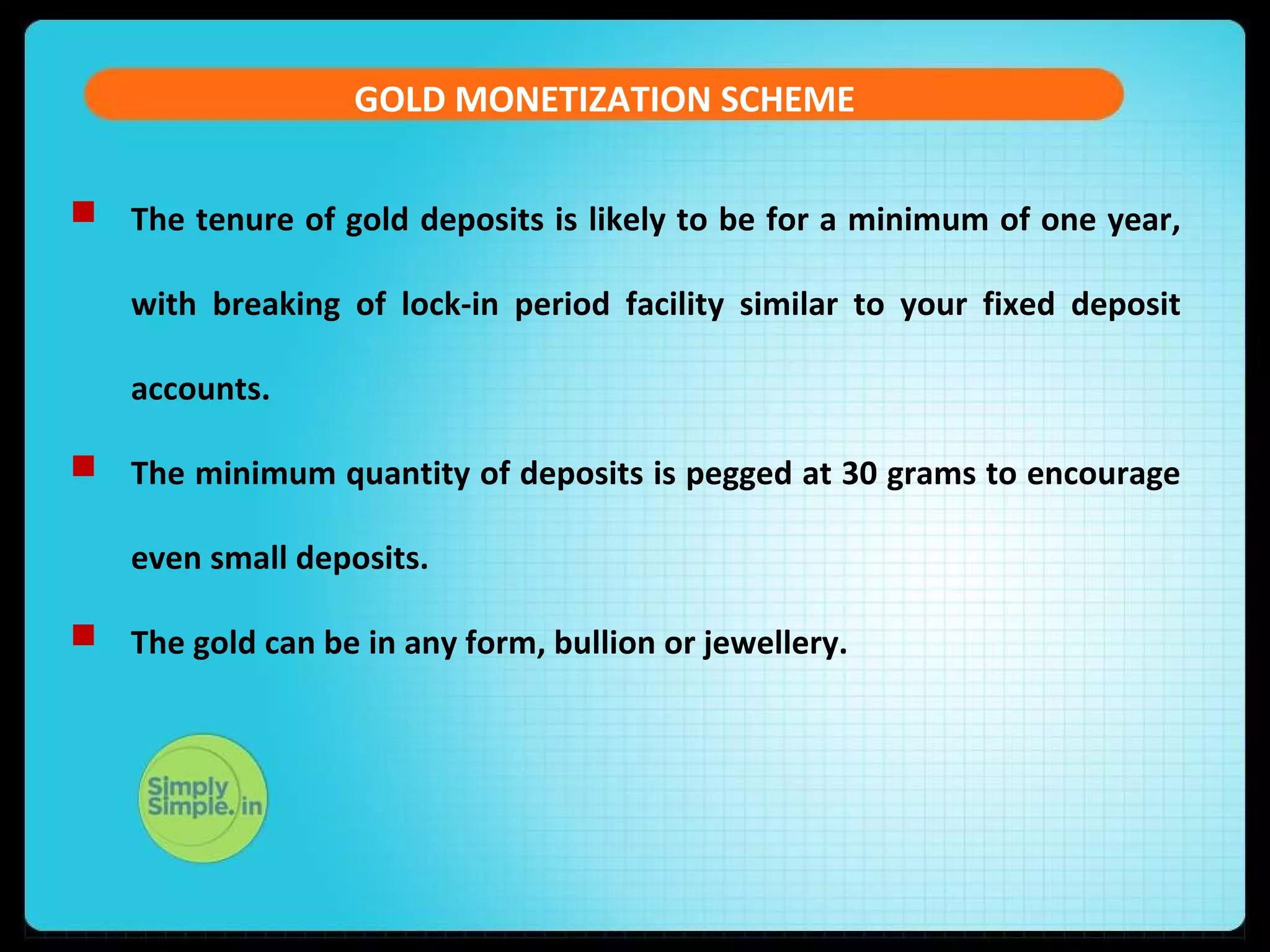
 The tenure of gold deposits is likely to be for a minimum of one year,
with breaking of lock-in period facility similar to your fixed deposit
accounts.
 The minimum quantity of deposits is pegged at 30 grams to encourage
even small deposits.
 The gold can be in any form, bullion or jewellery.
How the redemption
takes place?
GOLD MONETIZATION SCHEME
Customer will have the choice to take cash or gold on redemption, but
the preference has to be stated at the time of deposit.
How is the interest rate
calculated?
GOLD MONETIZATION SCHEME
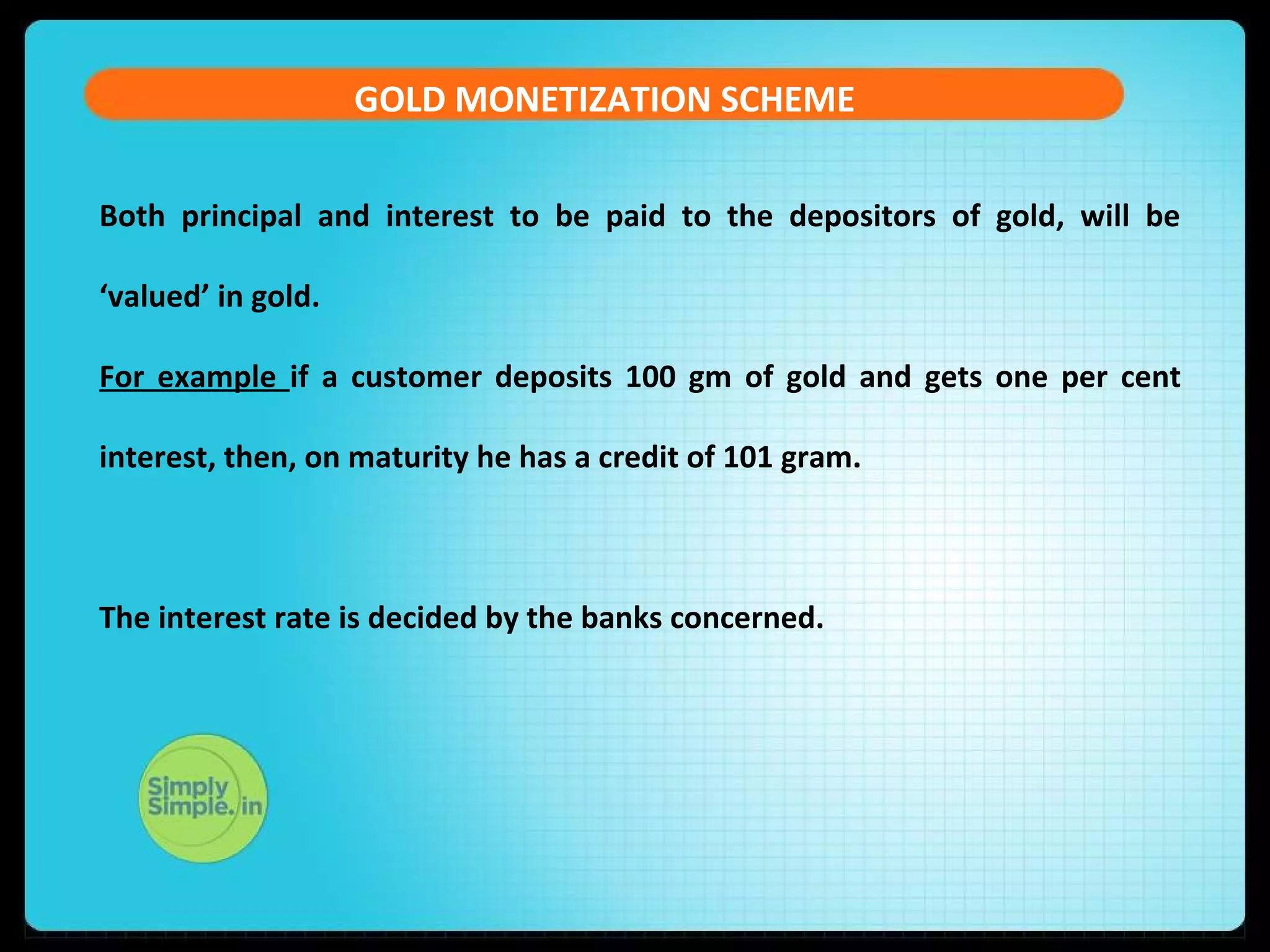
Both principal and interest to be paid to the depositors of gold, will be
‘valued’ in gold.
For example if a customer deposits 100 gm of gold and gets one per cent
interest, then, on maturity he has a credit of 101 gram.
The interest rate is decided by the banks concerned.
How will the banks get
incentivized?
GOLD MONETIZATION SCHEME
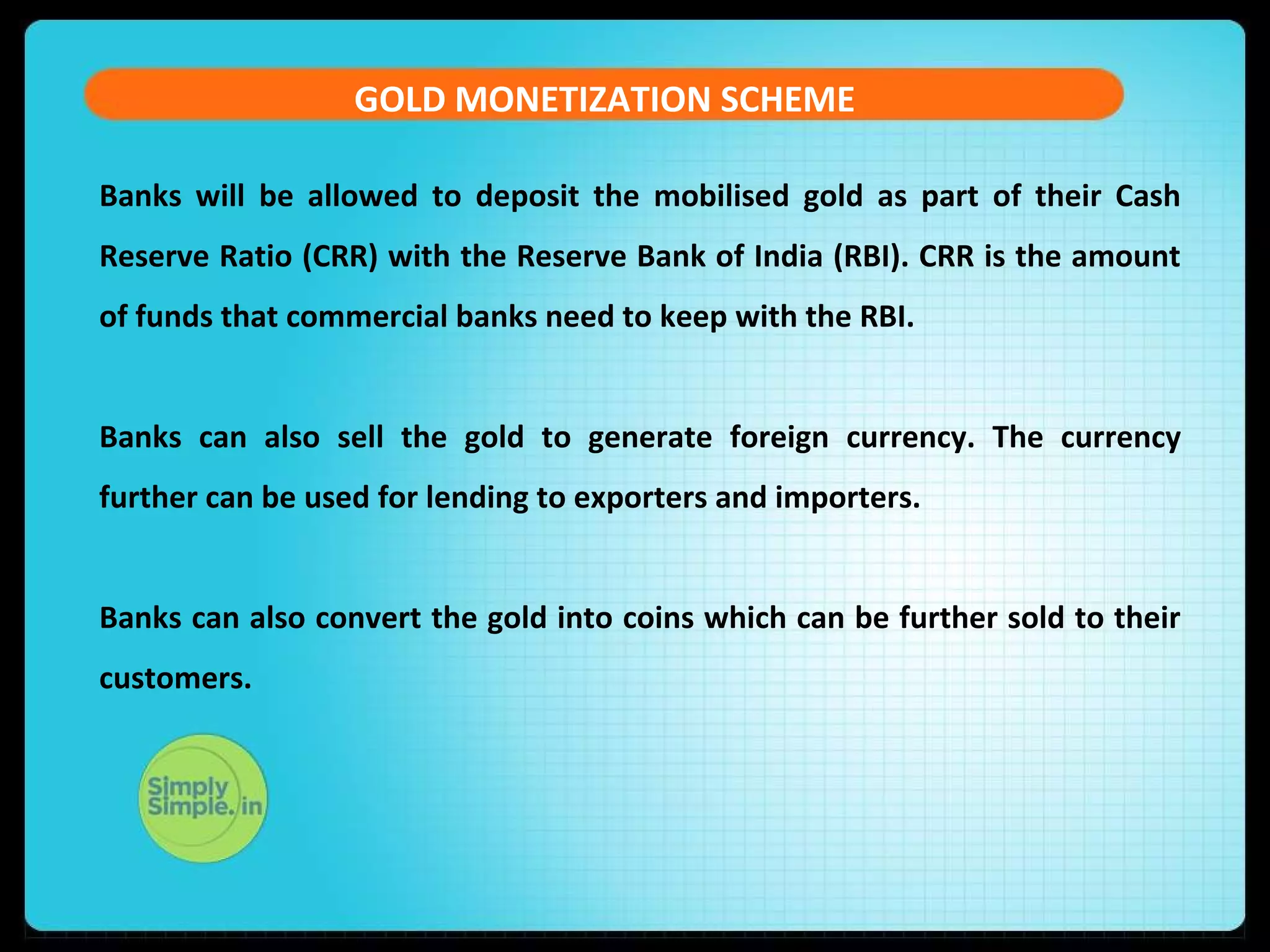
Banks will be allowed to deposit the mobilised gold as part of their Cash
Reserve Ratio (CRR) with the Reserve Bank of India (RBI). CRR is the amount
of funds that commercial banks need to keep with the RBI.
Banks can also sell the gold to generate foreign currency. The currency
further can be used for lending to exporters and importers.
Banks can also convert the gold into coins which can be further sold to their
customers.
What Jewellers need to
know?
GOLD MONETIZATION SCHEME
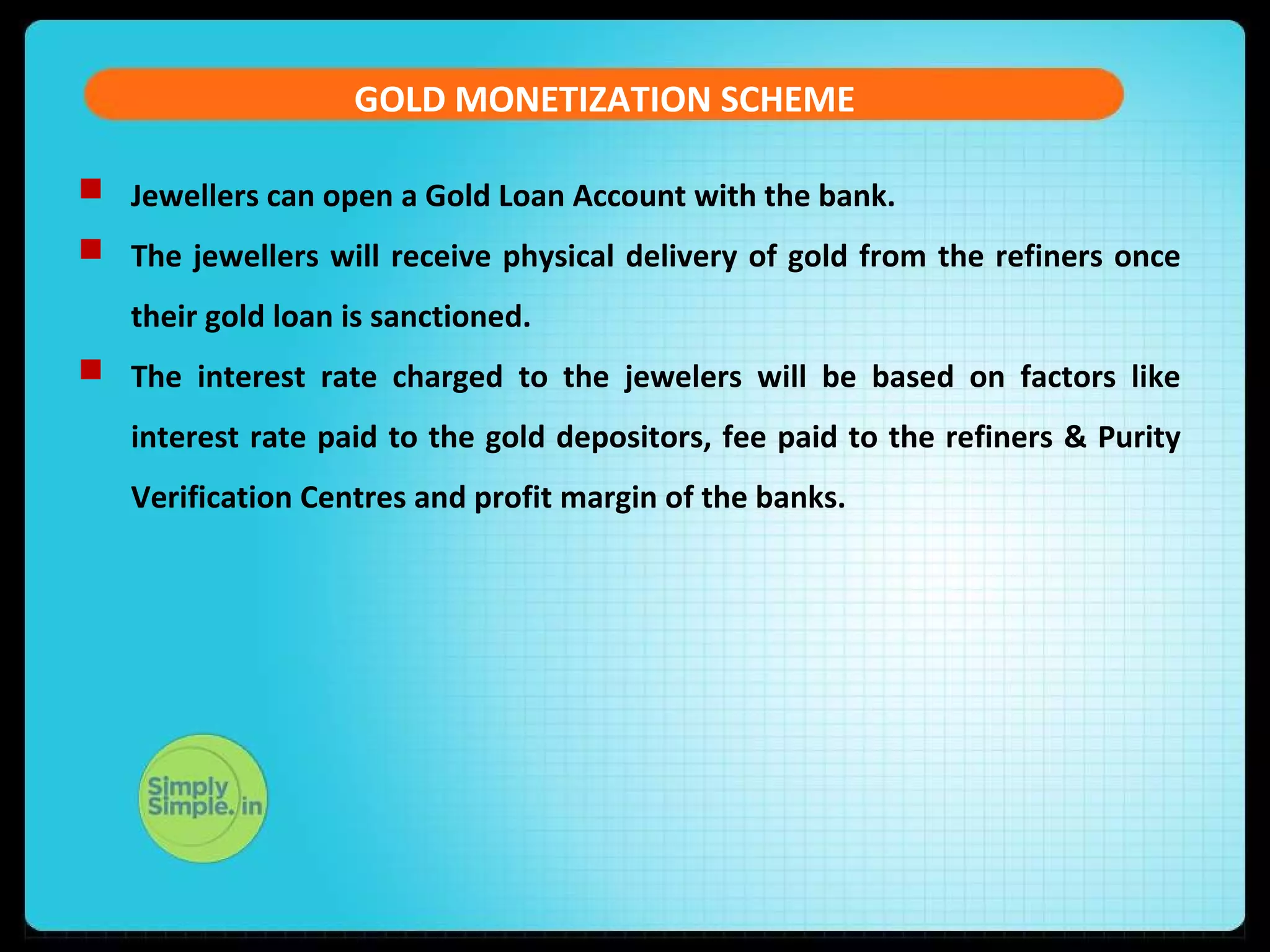
 Jewellers can open a Gold Loan Account with the bank.
 The jewellers will receive physical delivery of gold from the refiners once
their gold loan is sanctioned.
 The interest rate charged to the jewelers will be based on factors like
interest rate paid to the gold depositors, fee paid to the refiners & Purity
Verification Centres and profit margin of the banks.
Let us see the formula of the Current Account Balance (CAB)
CAB = X - M + NI + NCT
X = Exports of goods and services
M = Imports of goods and services
NI = Net income abroad  [Salaries paid or received,
credit / debit of income from
FII & FDI etc. ]
NCT = Net current transfers [Workers' Remittances
(unilateral),
Donations, Aids & Grants,
Official, Assistance and
Pensions etc]
CURRENT ACCOUNT DEFICIT
Hope you have understood the
concept of ‘Gold Monetization
Scheme’.
GOLD MONETIZATION SCHEME
Please give us
your feedback at
professor@tataamc.com
DISCLAIMER
The views expressed in this lesson are for information purposes only and do not construe to be
any investment, legal or taxation advice. The lesson is a conceptual representation and may not
include several nuances that are associated and vital. The purpose of this lesson is to clarify the
basics of the concept so that readers at large can relate and thereby take more interest in the
product / concept. In a nutshell, Professor Simply Simple lessons should be seen from the
perspective of it being a primer on financial concepts. The contents are topical in nature and
held true at the time of creation of the lesson. This is not indicative of future market trends, nor
is Tata Asset Management Ltd. attempting to predict the same. Reprinting any part of this
material will be at your own risk. Tata Asset Management Ltd. will not be liable for the
consequences of such action.
Mutual Fund investments are subject to market risks, read all
scheme related documents carefully.

Gold monetization-scheme

  • 1.
  • 2.
    GOLD MONETIZATION SCHEME FinanceMinister, Arun Jaitley during his budget speech stated, “India is one of the largest consumers of gold in the world and imports as much as 800-1000 tonnes of gold each year. Though stocks of gold in India are estimated to be over 20,000 tonnes, mostly this gold is neither traded, nor monetized”. In order to bring into circulation a part of the 20,000 tonnes of gold held by households and institutions, the Finance Minister introduced the Gold Monetization Scheme that will enable investors to deploy their gold and earn interest.
  • 3.
    Also, this willincrease recycling of domestically held gold and reduce jewellers’ reliance on imported gold. GOLD MONETIZATION SCHEME
  • 4.
    GOLD MONETIZATION SCHEME Highgold import was one of the reasons for high current account deficit in recent years, which resulted in a crisis-like situation in the second half of 2013. Imports came down due to restrictions in the form of high import duties and fall in international gold prices. Since India imports large amounts of gold, which are to be paid in foreign exchange, the government devised to recycle the gold stock available in the country in order to save foreign currency, which will also reduce vulnerability in the external account.
  • 5.
    What is GoldMonetisation Scheme (GMS)?
  • 6.
    Gold Monetisation Schemeallows depositors of gold to earn interest on their metal accounts with banks. Once the gold is deposited in metal account, it will start earning interest. GOLD MONETIZATION SCHEME
  • 7.
    The interest earnedon it will be exempt from income tax as well as capital gains tax.
  • 8.
    Let us seethe formula of the Current Account Balance (CAB) CAB = X - M + NI + NCT X = Exports of goods and services M = Imports of goods and services NI = Net income abroad  [Salaries paid or received, credit / debit of income from FII & FDI etc. ] NCT = Net current transfers [Workers' Remittances (unilateral), Donations, Aids & Grants, Official, Assistance and Pensions etc] CURRENT ACCOUNT DEFICIT What are its objectives? GOLD MONETIZATION SCHEME
  • 9.
    GOLD MONETIZATION SCHEME Thescheme has three basic objectives:  To mobilize gold held by households and institutions in the country.  Make gold available on loan from banks to jewellery businesses.  To reduce dependence on imports.
  • 10.
    How it generallyworks? GOLD MONETIZATION SCHEME
  • 11.
    GOLD MONETIZATION SCHEME When a customer brings in gold (jewellery) to the bank, it will first be tested for purity and after the consent of the customer, it will be melted.  A certificate by the collection centre will be given stating the amount and purity of gold which will have to be produced in the bank for opening the gold savings account. The quantity of gold will be credited into the customer's account.
  • 12.
    GOLD MONETIZATION SCHEME Also, customers may be asked to complete KYC (know-your-customer) process.  The deposited gold will be lent by banks to jewellers at an interest rate little higher than the interest paid to customer.
  • 13.
    What is thetenure?
  • 14.
    GOLD MONETIZATION SCHEME The tenure of gold deposits is likely to be for a minimum of one year, with breaking of lock-in period facility similar to your fixed deposit accounts.  The minimum quantity of deposits is pegged at 30 grams to encourage even small deposits.  The gold can be in any form, bullion or jewellery.
  • 15.
  • 16.
    GOLD MONETIZATION SCHEME Customerwill have the choice to take cash or gold on redemption, but the preference has to be stated at the time of deposit.
  • 17.
    How is theinterest rate calculated?
  • 18.
    GOLD MONETIZATION SCHEME Bothprincipal and interest to be paid to the depositors of gold, will be ‘valued’ in gold. For example if a customer deposits 100 gm of gold and gets one per cent interest, then, on maturity he has a credit of 101 gram. The interest rate is decided by the banks concerned.
  • 19.
    How will thebanks get incentivized?
  • 20.
    GOLD MONETIZATION SCHEME Bankswill be allowed to deposit the mobilised gold as part of their Cash Reserve Ratio (CRR) with the Reserve Bank of India (RBI). CRR is the amount of funds that commercial banks need to keep with the RBI. Banks can also sell the gold to generate foreign currency. The currency further can be used for lending to exporters and importers. Banks can also convert the gold into coins which can be further sold to their customers.
  • 21.
  • 22.
    GOLD MONETIZATION SCHEME Jewellers can open a Gold Loan Account with the bank.  The jewellers will receive physical delivery of gold from the refiners once their gold loan is sanctioned.  The interest rate charged to the jewelers will be based on factors like interest rate paid to the gold depositors, fee paid to the refiners & Purity Verification Centres and profit margin of the banks.
  • 23.
    Let us seethe formula of the Current Account Balance (CAB) CAB = X - M + NI + NCT X = Exports of goods and services M = Imports of goods and services NI = Net income abroad  [Salaries paid or received, credit / debit of income from FII & FDI etc. ] NCT = Net current transfers [Workers' Remittances (unilateral), Donations, Aids & Grants, Official, Assistance and Pensions etc] CURRENT ACCOUNT DEFICIT Hope you have understood the concept of ‘Gold Monetization Scheme’. GOLD MONETIZATION SCHEME
  • 24.
    Please give us yourfeedback at professor@tataamc.com
  • 25.
    DISCLAIMER The views expressedin this lesson are for information purposes only and do not construe to be any investment, legal or taxation advice. The lesson is a conceptual representation and may not include several nuances that are associated and vital. The purpose of this lesson is to clarify the basics of the concept so that readers at large can relate and thereby take more interest in the product / concept. In a nutshell, Professor Simply Simple lessons should be seen from the perspective of it being a primer on financial concepts. The contents are topical in nature and held true at the time of creation of the lesson. This is not indicative of future market trends, nor is Tata Asset Management Ltd. attempting to predict the same. Reprinting any part of this material will be at your own risk. Tata Asset Management Ltd. will not be liable for the consequences of such action. Mutual Fund investments are subject to market risks, read all scheme related documents carefully.