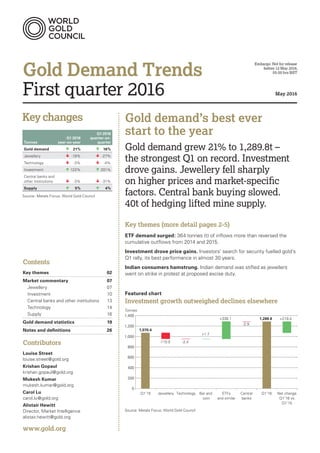
Gold Demand Trends
First quarter 2016 May 2016
Gold demand’s best ever
start to the year
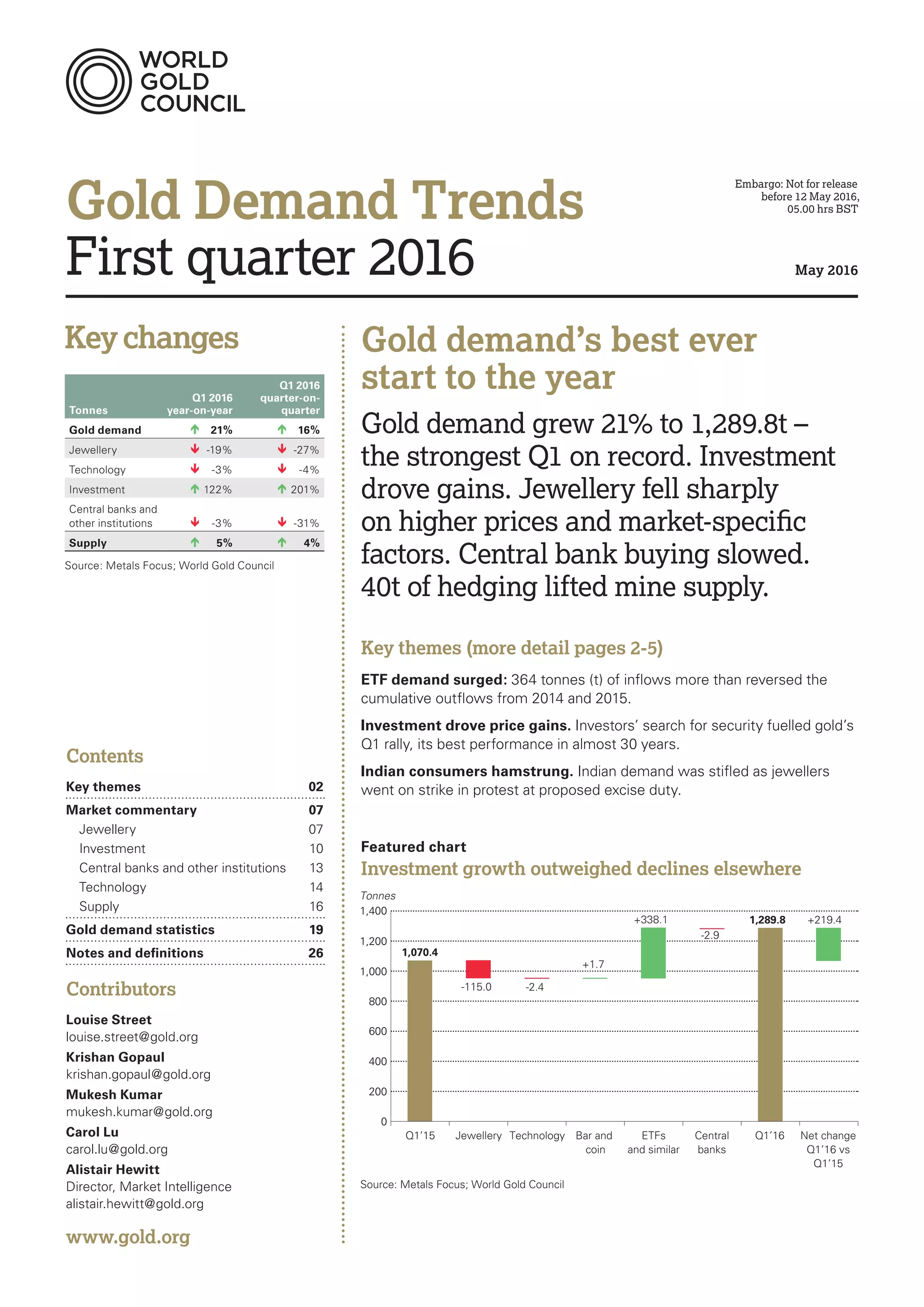
Gold demand grew 21% to 1,289.8t –
the strongest Q1 on record. Investment
drove gains. Jewellery fell sharply
on higher prices and market-specific
factors. Central bank buying slowed.
40t of hedging lifted mine supply.
Key themes (more detail pages 2-5)
ETF demand surged: 364 tonnes (t) of inflows more than reversed the
cumulative outflows from 2014 and 2015.
Investment drove price gains. Investors’ search for security fuelled gold’s
Q1 rally, its best performance in almost 30 years.
Indian consumers hamstrung. Indian demand was stifled as jewellers
went on strike in protest at proposed excise duty.
Featured chart
Investment growth outweighed declines elsewhere
-115.0 -2.4
+1.7
+338.1
-2.9
+219.4
0
200
400
600
800
1,000
1,200
1,400
Q1’15 Jewellery Bar and
coin
Technology Central
banks
Q1’16 Net change
Q1’16 vs
Q1’15
ETFs
and similar
Source: Metals Focus; World Gold Council
Tonnes
Gains in investment demand outweighed declines in other sectors
1,070.4
1,289.8
Embargo: Not for release
before 12 May 2016,
05.00 hrs BST
Tonnes
Q1 2016
year-on-year
Q1 2016
quarter-on-
quarter
Gold demand 	 	21% 	 	16%
Jewellery 	 	-19% 	 	-27%
Technology 	 	-3% 	 	-4%
Investment 	 	122% 	 	201%
Central banks and
other institutions 	 	-3% 	 	-31%
Supply 	 	 5% 	 	 4%
Source: Metals Focus; World Gold Council
Keychanges
Contents
Key themes	 02
Market commentary	 07
	Jewellery	 07
	Investment	 10
	 Central banks and other institutions	 13
	Technology	 14
	Supply	 16
Gold demand statistics	 19
Notes and definitions	 26
Contributors
Louise Street
louise.street@gold.org
Krishan Gopaul
krishan.gopaul@gold.org
Mukesh Kumar
mukesh.kumar@gold.org
Carol Lu
carol.lu@gold.org
Alistair Hewitt
Director, Market Intelligence
alistair.hewitt@gold.org
www.gold.org
02Gold Demand Trends  |  First quarter 2016
Key themes
ETF investors rekindle
their interest
Inflows into ETFs of 363.7t were the highest
since Q1 2009 as sentiment towards gold
improved markedly.
Shifts in the global economic and financial landscape have
created a positive environment for gold investment in
recent months. Uncertainty abounds:
•	The Negative Interest Rate Policies (NIRP) implemented
by central banks in Japan and Europe represent a
shift to ‘unconventional policies’ which create
‘great uncertainty’.1
•	China’s devaluation of the yuan fuelled fears over the
country’s economic health and the potential impact on
global growth.
•	And the pace of US interest rate rises is now widely
expected to slow.
The swirling uncertainty created by this mix of factors
undermined confidence in traditional asset classes.
Turbulence hit stock markets around the world. The impact
of NIRP in particular significantly reduced the appeal of
sovereign bonds as a stable, low-risk asset. Enter gold-
backed ETFs.
1	 http://www.bis.org/publ/qtrpdf/r_qt1603e.htm
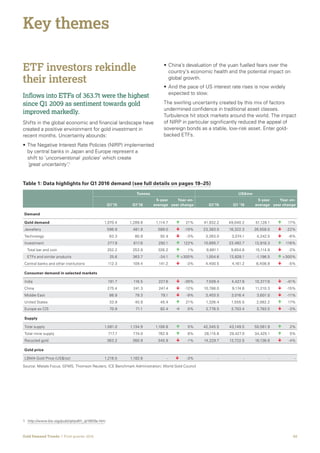
Table 1: Data highlights for Q1 2016 demand (see full details on pages 19–25)	
Tonnes US$mn
Q1’15 Q1’16
5-year
average
Year-on-
year change Q1’15 Q1 ’16
5-year
average
Year-on-
year change
Demand
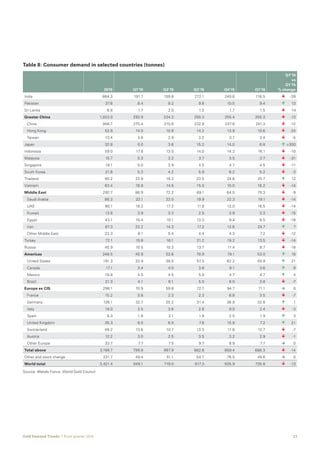
Gold demand 1,070.4 1,289.8 1,114.7 	 	 21% 41,932.2 49,040.2 51,128.1 	 	 17%
Jewellery 596.9 481.9 589.0 	 	 -19% 23,383.0 18,322.3 26,558.5 	 	 -22%
Technology 83.3 80.9 92.4 	 	 -3% 3,263.0 3,074.1 4,242.5 	 	 -6%
Investment 277.9 617.6 292.1 	 	122% 10,885.7 23,482.7 13,918.3 	 	 116%
	 Total bar and coin 252.2 253.9 326.2 	 	 1% 9,881.1 9,654.6 15,114.8 	 	 -2%
	 ETFs and similar products 25.6 363.7 -34.1 	 	>300% 1,004.6 13,828.1 -1,196.5 	 	>300%
Central banks and other institutions 112.3 109.4 141.2 	 	 -3% 4,400.5 4,161.2 6,408.8 	 	 -5%
Consumer demand in selected markets
India 191.7 116.5 227.6 	 	 -39% 7,509.4 4,427.8 10,377.6 	 	 -41%
China 275.4 241.3 247.4 	 	 -12% 10,788.0 9,174.6 11,210.3 	 	 -15%
Middle East 86.9 79.3 79.1 	 	 -9% 3,403.5 3,016.4 3,601.0 	 	 -11%
United States 33.9 40.9 45.4 	 	 21% 1,326.4 1,555.5 2,062.2 	 	 17%
Europe ex CIS 70.9 71.1 82.4 	 	 0% 2,778.5 2,703.4 3,793.5 	 	 -3%
Supply
Total supply 1,081.0 1,134.9 1,108.8 	 	 5% 42,345.5 43,149.5 50,561.9 	 	 2%
Total mine supply 717.7 774.0 762.9 	 	 8% 28,115.8 29,427.0 34,425.1 	 	 5%
Recycled gold 363.2 360.9 345.9 	 	 -1% 14,229.7 13,722.5 16,136.8 	 	 -4%
Gold price
LBMA Gold Price (US$/oz) 1,218.5 1,182.6 - 	 	 -3% - - - 	 -
Source: Metals Focus; GFMS, Thomson Reuters; ICE Benchmark Administration; World Gold Council
03Gold Demand Trends  |  First quarter 2016
Having seen regular – and at times substantial – outflows
over the last three years, ETFs had a stand-out quarter as
gold’s investment qualities came back into sharp focus
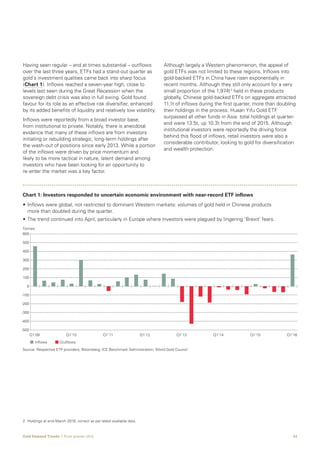
(Chart 1). Inflows reached a seven-year high, close to
levels last seen during the Great Recession when the
sovereign debt crisis was also in full swing. Gold found
favour for its role as an effective risk diversifier, enhanced
by its added benefits of liquidity and relatively low volatility.
Inflows were reportedly from a broad investor base,
from institutional to private. Notably, there is anecdotal
evidence that many of these inflows are from investors
initiating or rebuilding strategic, long-term holdings after
the wash-out of positions since early 2013. While a portion
of the inflows were driven by price momentum and
likely to be more tactical in nature, latent demand among
investors who have been looking for an opportunity to
re-enter the market was a key factor.
Although largely a Western phenomenon, the appeal of
gold ETFs was not limited to these regions. Inflows into
gold-backed ETFs in China have risen exponentially in
recent months. Although they still only account for a very
small proportion of the 1,974t2
held in these products
globally, Chinese gold-backed ETFs on aggregate attracted
11.1t of inflows during the first quarter, more than doubling
their holdings in the process. Huaan Yifu Gold ETF
surpassed all other funds in Asia: total holdings at quarter-
end were 13.5t, up 10.3t from the end of 2015. Although
institutional investors were reportedly the driving force
behind this flood of inflows, retail investors were also a
considerable contributor, looking to gold for diversification
and wealth protection.
2	Holdings at end-March 2016, correct as per latest available data.
• Inflows were global, not restricted to dominant Western markets: volumes of gold held in Chinese products
more than doubled during the quarter.
• The trend continued into April, particularly in Europe where investors were plagued by lingering ‘Brexit’ fears.
-500
-400
-300
-200
-100
0
100
200
300
400
500
600
Inflows Outflows
Source: Respective ETP providers; Bloomberg; ICE Benchmark Administration; World Gold Council
Q1’09 Q1’10 Q1’11 Q1’12 Q1’13 Q1’14 Q1’15 Q1’16
Chart 1: Investors responded to uncertain economic environment with near-record ETF inflows
Tonnes
04Gold Demand Trends  |  First quarter 2016
Investment demand
ignites price rally
During the first quarter, the US$ gold price
appreciated by 17% on the strength of investor
conviction. This was matched by local price
gains in markets across the globe.
The enthusiasm with which investors renewed their
appetite for gold ETFs in Q1 was palpable – the gold price
surged by 17% in response to such large-scale inflows.
This was the best performance in almost three decades
and gold ranked as one of the best performing assets
globally during the quarter.3
The effect was also felt in the
price of gold measured in other currencies, with double
digit gains in the euro (+11%), British pound (+20%),
Chinese renminbi (+16%), Indian rupee (+17%) and
Turkish lira (+13%) (Chart 2).
The investment response in the ETF market was echoed
in surging physical demand for bars and coins in a handful
of markets. US investors in particular were keen to add to
their holdings, wanting the security of gold amid economic
uncertainty. Demand jumped by 55% to 18.3t, albeit that
this was being compared with a particularly weak Q1
2015. Bar and coin demand in the UK grew by a similar
magnitude (+61%) although absolute volumes remained
low (3.2t). And, powered by a strong German market,
European demand remains resolute – at 58.4t it remains
one of the largest markets for gold investment. China also
increased its demand for bars and coins, encouraged by
Chinese New Year festive purchasing and the rising gold
price. Demand grew by 5% to 61.9t.
For the most part, however, the sharp price rally
suppressed demand for bars and coins in the Middle
East and Asia. This was to be expected among these
particularly price sensitive markets, where demand
typically subsides on a strong price rally before picking up
again once the price stabilises.
Chief among these markets was India, where investment
demand slumped in response to the price rally. Bar and
coin demand fell by 31% to 28t, the lowest quarterly
investment total for India in seven years. But it was Indian
jewellery demand that garnered all the headlines.
• Gold closed the quarter at US$1,237/oz, 17% above the end-2015 price of US$1,060/oz. Double-digit gains
were seen in a range of currencies, too.
• Sharp price rise had mixed effects on the market: jewellery demand fell, investment grew and recycling
in some markets jumped.
January 2015 May 2015 September 2015 January 2016
80
90
100
110
120
130
140
US dollar Euro Indian rupee Chinese renminbi Turkish lira Pound sterling
Source: ICE Benchmark Administration; Thomson Reuters Datastream; World Gold Council
Chart 2: Gold was a top-performing asset in Q1
Index level
3	World Gold Council, Market update, Gold outshines the market in Q1 2016, April 2016.
05Gold Demand Trends  |  First quarter 2016
Industrial action snuffs
Indian jewellery demand
Jewellers respond to government tax rises
with country-wide strikes, forcing Indian
consumers to postpone Q1 demand.
India’s jewellery market virtually ground to a halt in March
as a combination of surging prices and industrial action
in protest at government policy made for an extremely
challenging quarter.
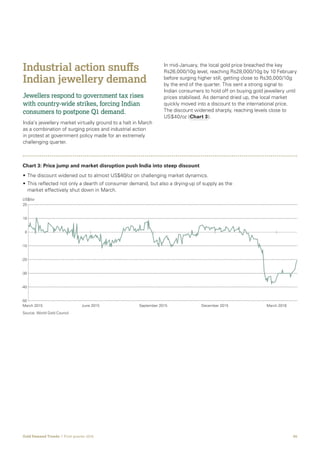
In mid-January, the local gold price breached the key
Rs26,000/10g level, reaching Rs28,000/10g by 10 February
before surging higher still, getting close to Rs30,000/10g
by the end of the quarter. This sent a strong signal to
Indian consumers to hold off on buying gold jewellery until
prices stabilised. As demand dried up, the local market
quickly moved into a discount to the international price.
The discount widened sharply, reaching levels close to
US$40/oz (Chart 3).
• The discount widened out to almost US$40/oz on challenging market dynamics.
• This reflected not only a dearth of consumer demand, but also a drying-up of supply as the
market effectively shut down in March.
March 2015 June 2015 September 2015 December 2015 March 2016
Source: World Gold Council
-50
-40
-30
-20
-10
0
10
20
Chart 3: Price jump and market disruption push India into steep discount
US$/oz
06Gold Demand Trends  |  First quarter 2016
Then, in the government’s budget on 29 February, the
Finance Ministry announced plans to impose a 1% excise
duty on jewellery manufacturing.4
The response from the
jewellery sector was swift and decisive: a nationwide
strike was called from 2 March with the support of national
industry associations.5
While jewellery stores in the south
of India re-opened on 19 March, retailers across vast
swathes of the country remained shut for the remainder of
the quarter and into April. Given the higher penetration of
single store retailers in the North, East and West of India,
the impact on sales was more prominent for unorganised
players, while branded chain stores were relatively resilient.
The widespread media coverage of the strike ensured that
customers stayed away, even from those shops that chose
not to strike. In its quarterly update to investors, jewellery
giant Titan noted that it’s premier brand, Tanishq was
“not participating in the strike but many of the stores had
to be shut down on many occasions across the country
due to agitations by striking jewellery associations.
The customer walk-ins in the ensuing period have also
been poor due to the customer perception that [the] entire
industry is on strike due to which the sales performance for
the month of March has been affected adversely.” 6
Taken in this context, demand for gold jewellery was
unsurprisingly weak. Quarterly demand of 88.4t was down
41% year-on-year and the lowest quarterly total since
Q1 2009. Importantly, though, we believe demand from
Q1 is postponed rather than lost. Most stores re-opened
in the second half of April, ahead of the Akshaya Tritiya
festival in early May and the start of the wedding season.
This view is also supported by the sharp narrowing of the
local discount as manufacturing activity resumed in April.7
The pro-rural budget and expectations for an above-average
monsoon should further support rural incomes, which
has positive implications for gold demand over the
coming quarters.
4	An excise duty of 1% on jewellery manufacturing was proposed in the budget. The introduction of this tax is a prelude to the Goods and Services Tax
(GST) Bill. Jewellery manufacturers whose turnover exceeded Rs12 crore during the preceding financial year will be liable to pay this additional tax
during current financial year.
5	All India Gems and Jewellery Trade Federation (http://gjf.in/domestic_news.html) and Indian Bullion and Jewellers Association
(http://ibja.co/ibja-news.aspx)
6	 http://www.titan.co.in/TitanEcom/corporate/pdflinks/Investor%20Update/Q4%20FY%2015-16.pdf
7	 The local discount immediately narrowed to US$16/oz as soon as the strike ended on 13 April, shrinking further to US$4/oz by the end of the month.
07Gold Demand Trends  |  First quarter 2016
Market commentary
Jewellery
Soaring gold prices, market disruption
in India and supply-constraints in China
combine to impede gold jewellery demand.
Global jewellery demand fell 19% year-on-year to
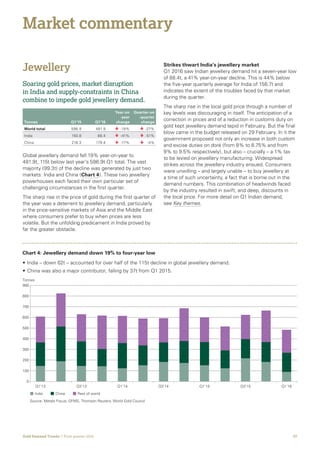
481.9t, 115t below last year’s 596.9t Q1 total. The vast
majority (99.3t) of the decline was generated by just two
markets: India and China (Chart 4). These two jewellery
powerhouses each faced their own particular set of
challenging circumstances in the first quarter.
The sharp rise in the price of gold during the first quarter of
the year was a deterrent to jewellery demand, particularly
in the price-sensitive markets of Asia and the Middle East
where consumers prefer to buy when prices are less
volatile. But the unfolding predicament in India proved by
far the greater obstacle.
Tonnes Q1’15 Q1’16
Year-on
-year
change
Quarter-on
-quarter
change
World total 596.9 481.9 	 	-19% 	 	-27%
India 150.8 88.4 	 	-41% 	 	-51%
China 216.3 179.4 	 	-17% 	 	-4%
Strikes thwart India’s jewellery market
Q1 2016 saw Indian jewellery demand hit a seven-year low
of 88.4t, a 41% year-on-year decline. This is 44% below
the five-year quarterly average for India of 156.7t and
indicates the extent of the troubles faced by that market
during the quarter.
The sharp rise in the local gold price through a number of
key levels was discouraging in itself. The anticipation of a
correction in prices and of a reduction in customs duty on
gold kept jewellery demand tepid in February. But the final
blow came in the budget released on 29 February. In it the
government proposed not only an increase in both custom
and excise duties on doré (from 8% to 8.75% and from
9% to 9.5% respectively), but also – crucially – a 1% tax
to be levied on jewellery manufacturing. Widespread
strikes across the jewellery industry ensued. Consumers
were unwilling – and largely unable – to buy jewellery at
a time of such uncertainty, a fact that is borne out in the
demand numbers. This combination of headwinds faced
by the industry resulted in swift, and deep, discounts in
the local price. For more detail on Q1 Indian demand,
see Key themes.
• India – down 62t – accounted for over half of the 115t decline in global jewellery demand.
• China was also a major contributor, falling by 37t from Q1 2015.
India China Rest of world
Source: Metals Focus; GFMS, Thomson Reuters; World Gold Council
0
100
200
300
400
500
600
700
800
900
Q1’13 Q3’13 Q1’14 Q3’14 Q1’15 Q3’15 Q1’16
Chart 4: Jewellery demand down 19% to four-year low
Tonnes
08Gold Demand Trends  |  First quarter 2016
But the outlook for India is more positive: consumers
are waiting for their opportunity to re-enter the market.
The steep local price discount has already been largely
eradicated. The industry expects the pent-up demand
that accumulated during Q1 to be released in the coming
weeks as the market adjusts to the new tax structure
and buying for the wedding season gathers momentum.
In 2015, demand in H1 slumped in the face of numerous
challenges before staging a strong recovery in the second
half; 2016 is likely to play out in a similar way.
China: supply-side crunch
Demand for gold jewellery in China fell 17% in Q1, to
179.4t. Appetite for gold jewellery was curbed by the
sharply rising gold price against a background of continued
economic slowdown.
Despite receiving a lift in January and early February from
the Chinese New Year effect, jewellery demand tailed
off sharply in the second half of the quarter. The sector
suffered marked losses as China’s relatively anaemic
economic performance weighed on consumer sentiment.
Q1 GDP growth of 6.7%, while exceptional by Western
standards and within the government’s target range of
6.5%-7%, was the lowest Q1 rate since 2009. This took
its toll on consumers: official data showed a drop of 3.9%
in retail sales of gold and silver jewellery.8
Meanwhile, a supply-side crunch further hampered China’s
jewellery market. A new national standard for hallmarking
of gold jewellery (the National Gold Standard Mark)
came into force on May 4, which requires that all gold
jewellery of 99% purity be hallmarked as Chuk Kam.9
During March, retailers nationwide were busy adjusting
their inventories in order to replace existing stocks with
inventory that complies with the new requirements,
in time for the early May deadline. This surge in stock
replacement activity led to a temporary supply squeeze
that intensified the slump in demand. But jewellers also
took the opportunity to refresh their stocks with more
interesting, higher-margin product offerings (e.g. 18k,
gem-set, 3-D hard gold etc). These may entice consumers,
and help support profits in the coming quarters, but may
be detrimental to gold volumes, given that they have
largely replaced plain 24k pieces.
The supply of gold jewellery in China came under further
pressure as lines of available capital were constrained.
During the quarter, domestic banks tightened the
conditions under which they will lend to jewellery
manufacturers and retailers. Retailers are gradually
streamlining their operations in response to the tougher
business climate and reducing overall inventories and
order volumes, adding to the supply side-side pressure
in the market.
Price rise takes toll in smaller Asian markets
Consumers across Asia were largely price-responsive
in their behaviour: jewellery demand fell in most of the
region’s smaller markets. Of these, Malaysia (-23%)
and Indonesia (-10%) were the weakest performers.
In the former, the decline was again influenced by the
introduction of the GST in April 2015 (consumers made
their purchases in advance of the April tax increase,
boosting the Q1 2015 number). Going forward, this effect
should now begin to drop out of year-on-year comparisons.
In Indonesia, despite seasonal factors being supportive
of demand, the price rally quickly dampened it, while a
continued focus on lower carat jewellery weighed on fine
gold volumes.
Vietnam was, however, an exception to the depressed
regional market, with jewellery demand 6% higher than
Q1 2015. Although this can be partly explained by the
relatively positive economic scenario (GDP growth in
Q1 accelerated to 6.7% from 6.5% in 2015), the numbers
are in fact more representative of investment demand.
In Vietnam, a large portion of jewellery demand is
accounted for by ‘chi’ rings. Although they are classified as
jewellery, these crude products have very limited added
value above the value of the gold they contain, being of
very simple design and requiring limited labour input; the
motive for buying them is therefore often investment-
driven. As the premium on tael bars remains punitive
in Vietnam, domestic consumers are forced to look
elsewhere to satisfy their need for an asset that preserves
wealth and protects against the ravages of inflation.10
All of the above notwithstanding, de facto jewellery
demand was also lifted by the seasonal impact of
Vietnamese New Year, as well as the Day of the God of
Fortune (10th day of the 1st month of the Lunar Calendar).
8		 National Bureau of Statistics of China, http://data.stats.gov.cn/english/easyquery.htm?cn=A01
9		‘Pure gold’ jewellery, known as Zu Jin in Putonhua and Chuk Kam in Cantonese is 24 carat jewellery, typically of 99.9% gold content (999 fineness).
It is the mainstay of Chinese jewellery fabrication and consumption. Under previous hallmarking system, only 24k gold (of 99.9% purity) could be
hallmarked as Chuk Kam.
10	State-owned Saigon Jewellery Corporation has the monopoly on the manufacture and sale of government-approved gold bars, of which the
supply is limited.
09Gold Demand Trends  |  First quarter 2016
Iran the only bright spot in a Middle Eastern region
beset by difficulties
Gold jewellery demand in Iran rallied by 10% year-on-
year (to 9.9t vs 9t in Q1 2015) as the market continued
to feel the benefit of the lifting of Western sanctions.
Nevertheless, this growth was tempered by the impact
of 9% VAT.
The remaining Middle Eastern markets uniformly saw
double-digit losses in Q1 jewellery demand, beset as
they were by a mix of ongoing geo-political issues, low oil
prices and weak tourism revenues. And that’s before the
gold price rally is added into the mix. Egypt was the worst
casualty: demand fell to a fresh low of 7.7t (-18% year-on-
year), slipping below the previous low of 7.9t from
Q2 2011. The market was crippled by government
restrictions on bank withdrawals. These were limited to no
more than US$50k at a time – a relatively paltry sum for
jewellery retailers and wholesalers.
It was a similar story for Turkey in Q1. Demand of 8.5t
(-18% year-on-year) was the lowest quarterly total
since Q4 2012 as the high gold price, piled on top of the
struggling domestic economy, added to consumer woes.
Terrorist atrocities further weighed on sentiment.
Startling import growth heralds strong quarter for
US jewellery demand
In the US, demand for gold jewellery gained 2% year-on-
year. This is the ninth consecutive quarter of year-on-year
gains, impressive for a market where economic growth
has remained relatively anaemic. The industry continues to
benefit from retailers re-entering the gold segment, having
previously slashed – if not completely eradicated – their
gold product offerings.
The strength of gold jewellery imports in to the US
in January and February was a clear indication of US
consumers’ continued desire for gold jewellery. Double
digit gains were reported in imports (in fine gold volume
terms) in both January and February, reflecting continued
restocking among some larger retailers that continue to
build up their gold allocation.
The positive consumer demand trend was echoed in
upbeat official sales data, which showed stronger than
expected growth in jewellery sales in January. The outlook
for the remainder of the year is cautiously optimistic. While
prospects for global personal luxury goods are positive –
as highlighted by a report by Bain  Co which expects a
resurgence in demand for these items over the course of
201611
– the Presidential elections in the second half of the
year loom over the market and may increasingly temper
consumer enthusiasm as they draw closer.
European jewellery demand has less than sterling
start to the year
In Europe, jewellery demand continued in a similar fashion
to the last 4-5 years: after a seasonal jump in Q4, demand
subsided straight back to levels that are in line with the
13.3t Q1-Q3 average since 2012. Demand for the quarter
amounted to 12.7t. The UK eked out a 1% increase in
demand, to 4t. Data on the number of articles being
hallmarked by the Birmingham Assay Office suggest that
interest picked up in the latter half of the quarter, having
been quiet in January after the usual Q4 seasonal rally.
11	 Bain  Company, Luxury Goods Worldwide Market Study, Fall-Winter 2015.
10Gold Demand Trends  |  First quarter 2016
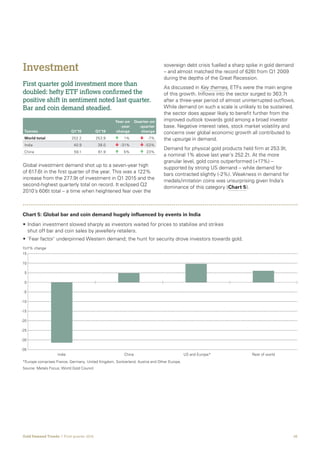
• Indian investment slowed sharply as investors waited for prices to stabilise and strikes
shut off bar and coin sales by jewellery retailers.
• ‘Fear factor’ underpinned Western demand; the hunt for security drove investors towards gold.
India China US and Europe* Rest of world
*Europe comprises France, Germany, United Kingdom, Switzerland, Austria and Other Europe.
Source: Metals Focus; World Gold Council
-35
-30
-25
-20
-15
-10
-5
0
5
10
15
Chart 5: Global bar and coin demand hugely influenced by events in India
YoY% change
Investment
First quarter gold investment more than
doubled: hefty ETF inflows confirmed the
positive shift in sentiment noted last quarter.
Bar and coin demand steadied.
Global investment demand shot up to a seven-year high
of 617.6t in the first quarter of the year. This was a 122%
increase from the 277.9t of investment in Q1 2015 and the
second-highest quarterly total on record. It eclipsed Q2
2010’s 606t total – a time when heightened fear over the
Tonnes Q1’15 Q1’16
Year-on
-year
change
Quarter-on
-quarter
change
World total 252.2 253.9 	 	 1% 	 	-7%
India 40.9 28.0 	 	-31% 	 	-53%
China 59.1 61.9 	 	 5% 	 	23%
sovereign debt crisis fuelled a sharp spike in gold demand
– and almost matched the record of 626t from Q1 2009
during the depths of the Great Recession.
As discussed in Key themes, ETFs were the main engine
of this growth. Inflows into the sector surged to 363.7t
after a three-year period of almost uninterrupted outflows.
While demand on such a scale is unlikely to be sustained,
the sector does appear likely to benefit further from the
improved outlook towards gold among a broad investor
base. Negative interest rates, stock market volatility and
concerns over global economic growth all contributed to
the upsurge in demand.
Demand for physical gold products held firm at 253.9t,
a nominal 1% above last year’s 252.2t. At the more
granular level, gold coins outperformed (+17%) –
supported by strong US demand – while demand for
bars contracted slightly (-2%). Weakness in demand for
medals/imitation coins was unsurprising given India’s
dominance of this category (Chart 5).
11Gold Demand Trends  |  First quarter 2016
Indian bar and coin demand beats sharp retreat
Retail investment in India fell by a third in Q1. Bar and
coin demand dropped to 28t from 40.9t in Q1 2015.
Investment in January was broadly flat, tapering off in
February before coming to a standstill in March.
The sharp price increase was the initial reason for the
slowdown in demand for bars and coins (Indian consumers
are similarly cautious towards purchasing gold investment
products during times of price volatility as they are towards
jewellery). Subsequently, the disturbances which followed
the government’s budget announcement rippled through
the investment market. Although the duty hike and strikes
were primarily a jewellery issue, the rural population has
limited access to the banking system, which means many
consumers buy their gold investment products from the
broad network of jewellery stores. And nationwide strikes
meant that this channel for purchasing was choked.
During the quarter, the Reserve Bank of India announced
it would permit banks to sell the Indian Gold Coin (IGC)
– India’s first official gold coin. These coins are minted at
the Indian government mint, hallmarked by the Bureau
of Indian Standards (BIS) and the scheme is managed
by MMTC Ltd. Indian Overseas Bank was the first to
begin distribution of the coins in March and recent
announcements have confirmed that the coins will also
be distributed through India’s post office network. The
developing infrastructure for the sale of the IGC should,
in future, help to relieve any such supply-side pressure on
investment demand.
Chinese investors buy into price rally
Chinese investors increased their demand for gold bars
and coins. Demand expanded by 5% year-on-year to 61.9t.
The usual seasonal uplift from Chinese New Year drove
demand in the first six weeks of the quarter, aided by the
rising price. Chinese investors differ from others in Asia
in their investment attitude in that they tend to prefer to
buy into a rising trend, rather than waiting until the price
stabilises. Demand then waned as currency volatility
subsided: the Chinese yuan stabilised and the currency
settled into a relatively steady trading band against the
US dollar after the People’s Bank of China intervened to
stabilise the currency.
A number of major commercial banks reported increases
in sales of gold investment products, although regional
differences were noted with robust demand in the East
of the country countered by relatively subdued demand in
the South.
US Mint coin sales leap as investors seek
safety in gold
The behaviour of bar and coin investors closely echoed that
of investors in the ETF market in Q1. Demand shot up by
55% year-on-year from 11.8t to 18.3t. This was 11% above
the five-year quarterly average of 16.4t. Sales of American
Eagle coins by the US Mint jumped by 68% year-on-year,
to 245,500oz (7.6t), while sales of 24k American Buffalo
coins increased 7% to 60,000oz (1.9t). Imports of other
Sovereign minted bullion coins rose by almost 60%.
The noxious atmosphere of uncertainty created by global
monetary policies and shifting expectations for US interest
rate rises were cause for concern. Investors sought the
safety of gold. As the price responded, the move was
further fuelled by those keen not to miss out on the
investment opportunity. This demand momentum then
tailed off in March as gold’s price rally ran out of steam
at around US$1,275/oz, before holding in a sideways range
around US$1,250/oz, where it remained throughout the
remainder of the quarter and into April.
Europe again a stalwart of gold investment
European investment remained strong. Bar and coin
demand was steadfast at 58.4t as the negative interest
rate environment, migration crisis and rumbling ‘Brexit’
speculation continued to highlight gold’s investment
properties, specifically its role as a secure store of wealth.
The fear factor underpinning demand reverberated around
regional investment markets: there were anecdotal reports
of a rise in demand for safety deposit boxes in Germany as
some customers looked for alternative options in case of
further interest rate cuts. This appears to be backed up by
market research. Initial results of a large-scale consumer
research programme indicate that German investors
are motivated by a desire for low-risk, ‘straightforward,’
tangible investments and feel a strong need to invest
in assets that protect their wealth against economic
downturn, government policies and currency fluctuations.
12Gold Demand Trends  |  First quarter 2016
Germany accounts for the bulk of the region’s demand
and the first quarter was no exception: 31.1t of bar and
coin demand equated to 53% of Europe’s total. But the
UK was the star performer. Although volumes remain
small, demand grew by 61% to 3.2t. That was the highest
quarter for UK investment since Q2 2013, when demand
totalled 3.7t.
Turkish investors focus on profit-taking opportunities
The 5% year-on-year decline in Turkish investment
demand may, on the face of it, suggest that investment
demand was more robust than that for jewellery. But this
was largely a function of the comparison being made with
a very weak Q1 2015.
The rise in the local gold price during the quarter meant
that Turkish investors proved to be more interested in
opportunities to take profits on their holdings than to add
to them, demonstrated by considerable recycling activity.
Middle Eastern investors reacted to higher gold prices in
a similar way. Investment in Egypt fell by 22% year-on-
year. A swift and sharp depreciation in the Egyptian pound
versus the dollar caused a surge in recycling, which in turn
led to a discount of around 4% in the local price.
Asian investors remain on the sidelines as
price surges
The focus was also on recycling throughout east Asia.
Consequently, investment demand saw widespread
declines. The largest losses were seen in Malaysia,
where demand dropped 40% to 1.5t, the lowest quarter
since Q3 2012. The 21% year-on-year fall in Vietnamese
investment (to 11.5t) was due to the rising price of – and
premiums on – official gold tael bars. Demand instead
shifted to quasi-investment jewellery items (packaged ‘chi’
rings of 99.99% purity, which effectively function as low-
denomination investment products).
A more positive quarter was seen in Japan, which notched
up its third successive quarter of positive net investment
demand (3.3t vs -3.2t in Q1 2015). However, as the gold
price rallied, demand lost momentum as evidenced by the
sharp quarter-on-quarter decline from Q4 2015 (-63%).
Japanese investors showed a similar inclination to those in
Vietnam, with a preference for investment-by-proxy in plain
gold jewellery. In Japan’s case, the focus was on kihei
chains: low-premium, plain gold chains. Producers of these
products reported impressive sales growth.
Thailand was the only other east Asian market market to
see growth in bar and coin demand: investment here grew
by 15% to 22.4t. Festival-related demand from Chinese
communities was boosted by stock market turmoil, which
drove domestic investors to look for wealth protection.
The upsurge in demand was concentrated in the first
few weeks of the year before the rallying price prompted
profit-taking.
13Gold Demand Trends  |  First quarter 2016
Central banks and
other institutions
As unconventional monetary policies –
including the use of negative interest rates
– expand, central banks continue to purchase
gold as diversification remains a top priority.
There is little doubt that central banks’ enthusiasm for
gold remains resolute. Having been particularly evident
in the second half of 2015, when purchases amounted to
the largest semi-annual total on record, 2016 has begun
in similar fashion. In Q1, central banks purchased – on a
net basis – 109.4t, slightly lower (-3%) than the 112.3t in
the first quarter of 2015. This is now the 21st consecutive
quarter of net purchases, dating back to 2011.
As discussed in Key themes, the first three months of
2016 were primarily defined by heightened levels of
uncertainty amid growing investor concern about the
effectiveness of negative interest rate policies, now
prevalent throughout Europe and Japan. Aside from
reducing the opportunity cost of holding gold, there are
three other factors that arise from NIRP which support
central bank investment in gold:
Tonnes Q1’15 Q1’16
Year-on
-year
change
Quarter-on
-quarter
change
Central banks and
other institutions 112.3 109.4 	 	-3% 	 	-31%
•	Negative rates significantly reduce the pool of assets in
which central banks are likely to invest, as many will be
hesitant to commit to a loss-making investment strategy.
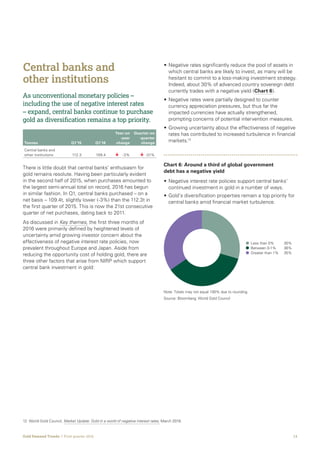
Indeed, about 30% of advanced country sovereign debt
currently trades with a negative yield (Chart 6).
•	Negative rates were partially designed to counter
currency appreciation pressures, but thus far the
impacted currencies have actually strengthened,
prompting concerns of potential intervention measures.
•	Growing uncertainty about the effectiveness of negative
rates has contributed to increased turbulence in financial
markets.12
• Negative interest rate policies support central banks’
continued investment in gold in a number of ways.
• Gold’s diversification properties remain a top priority for
central banks amid financial market turbulence.
Chart 6: Around a third of global government
debt has a negative yield
Less than 0% 30%
Between 0-1% 36%
Greater than 1% 35%
Note: Totals may not equal 100% due to rounding.
Source: Bloomberg; World Gold Council
12	World Gold Council, Market Update: Gold in a world of negative interest rates, March 2016.
14Gold Demand Trends  |  First quarter 2016
13	 HSBC Reserve Management Trends 2016, April 2016.
14	 Lack of data availability means no comparison can be made with Q1 2015.
15	 Department of Finance, Official Reserves April 2016.
16	In 1980, Canada initiated a programme to sell its gold reserves“at a gradual and controlled pace,”with the last gold bullion sold in December 2003.
Since the end of 2003, Canada’s gold reserves have been entirely in the form of gold coins.
Technology
Long-term decline in gold used in technology
continues, although trend slows as China’s
smartphone segment offered some respite.
The volume of gold used in technological applications
dropped to 80.9t (-3% year-on-year) in the first quarter.
Improvements in smartphone shipments in China and an
uptick in decorative demand countered declines elsewhere
in electronics and buffered the secular downward
trend in dentistry.
Widespread declines in electronics demand;
outlook is bleak
Demand for gold in electronics weakened by a further
3%, to 63.9t, the lowest quarter since Q4 2013. Despite
positive signs in some segments, global demand remained
under pressure as uncertainty over global economic
growth, and the rising gold price, drove continued thrifting
and substitution.
These declines were geographically widespread. Double
digit falls were witnessed in the main electronics hubs of
Taiwan, Japan and South Korea. Taiwan was impacted by
lower-than-expected demand for Apple products. In South
Korea, the volume of gold used in LEDs was stagnant.
Tonnes Q1’15 Q1’16
Year-on
-year
change
Quarter-on
-quarter
change
Technology 83.3 80.9 	 	-3% 	 	-4%
Electronics 66.3 63.9 	 	-3% 	 	-4%
Other Industrial 12.3 12.4 	 	 1% 	 	-2%
Dentistry 4.7 4.5 	 	-4% 	 	-3%
According to a recent HSBC survey,13
reserve managers
are finding it increasingly difficult to navigate the
divergence in monetary policies around the globe. 80%
of respondents agreed that negative rates had impacted
reserve management, while negative rates we also
described as “counterintuitive” to the “first priority of
reserve management”– namely, security. The growing
use of negative interest rates means reserve managers
are having to consider alternative – and potentially less
conservative – investments and currencies. The case for
diversification of reserves using gold remains as
irrefutable as ever.
Russia and China – the two largest purchasers last year
– continue to accumulate significant quantities of gold.
Russia increased its gold reserves by 45.8t in the first
quarter, 52% higher than the same period in 2015 (30.1t).
And China purchased 35.1t between January-March,14
adding to the 103.9t bought in H2 2015. Kazakhstan’s gold
reserves increased in each of the first three months of
2016, extending the country’s impressive buying streak to
42 consecutive months.
Conversely, selling activity remains contained. Although
Canada sold 1.7t in Q1, notably reducing its gold reserves
to a mere 68 ounces,15
this was part of a longer term
policy initiated almost four decades ago.16
Malaysia (1.9t),
Mozambique (1.9t) and Mongolia (1.3t) were the only other
significant net sellers during the quarter.
15Gold Demand Trends  |  First quarter 2016
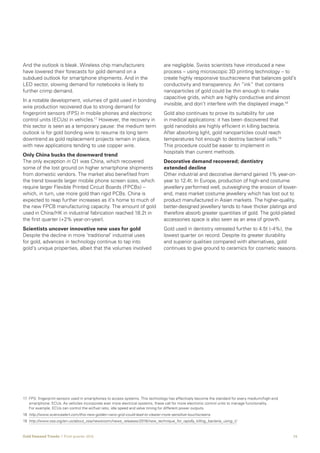
And the outlook is bleak. Wireless chip manufacturers
have lowered their forecasts for gold demand on a
subdued outlook for smartphone shipments. And in the
LED sector, slowing demand for notebooks is likely to
further crimp demand.
In a notable development, volumes of gold used in bonding
wire production recovered due to strong demand for
fingerprint sensors (FPS) in mobile phones and electronic
control units (ECUs) in vehicles.17
However, the recovery in
this sector is seen as a temporary pause: the medium term
outlook is for gold bonding wire to resume its long term
downtrend as gold replacement projects remain in place,
with new applications tending to use copper wire.
Only China bucks the downward trend
The only exception in Q1 was China, which recovered
some of the lost ground on higher smartphone shipments
from domestic vendors. The market also benefited from
the trend towards larger mobile phone screen sizes, which
require larger Flexible Printed Circuit Boards (FPCBs) –
which, in turn, use more gold than rigid PCBs. China is
expected to reap further increases as it’s home to much of
the new FPCB manufacturing capacity. The amount of gold
used in China/HK in industrial fabrication reached 18.2t in
the first quarter (+2% year-on-year).
Scientists uncover innovative new uses for gold
Despite the decline in more ‘traditional’ industrial uses
for gold, advances in technology continue to tap into
gold’s unique properties, albeit that the volumes involved
17	FPS: fingerprint sensors used in smartphones to access systems. This technology has effectively become the standard for every medium/high-end
smartphone. ECUs: As vehicles incorporate ever more electrical systems, these call for more electronic control units to manage functionality.
For example, ECUs can control the air/fuel ratio, idle speed and valve timing for different power outputs.
18	http://www.sciencealert.com/this-new-golden-nano-grid-could-lead-to-clearer-more-sensitive-touchscreens
19	 http://www.osa.org/en-us/about_osa/newsroom/news_releases/2016/new_technique_for_rapidly_killing_bacteria_using_t/
are negligible. Swiss scientists have introduced a new
process – using microscopic 3D printing technology – to
create highly responsive touchscreens that balances gold’s
conductivity and transparency. An “ink” that contains
nanoparticles of gold could be thin enough to make
capacitive grids, which are highly conductive and almost
invisible, and don’t interfere with the displayed image.18
Gold also continues to prove its suitability for use
in medical applications: it has been discovered that
gold nanodisks are highly efficient in killing bacteria.
After absorbing light, gold nanoparticles could reach
temperatures hot enough to destroy bacterial cells.19
This procedure could be easier to implement in
hospitals than current methods.
Decorative demand recovered; dentistry
extended decline
Other industrial and decorative demand gained 1% year-on-
year to 12.4t. In Europe, production of high-end costume
jewellery performed well, outweighing the erosion of lower-
end, mass market costume jewellery which has lost out to
product manufactured in Asian markets. The higher-quality,
better-designed jewellery tends to have thicker platings and
therefore absorb greater quantities of gold. The gold-plated
accessories space is also seen as an area of growth.
Gold used in dentistry retreated further to 4.5t (-4%), the
lowest quarter on record. Despite its greater durability
and superior qualities compared with alternatives, gold
continues to give ground to ceramics for cosmetic reasons.
16Gold Demand Trends  |  First quarter 2016
Supply
Increased hedging coupled with a slight
uptick in mine production outweighed a
marginal decline in recycling. Overall, total
gold supply grew 5%.
Tonnes Q1’15 Q1’16
Year-on
-year
change
Quarter-on
-quarter
change
Total supply 1,081.0 1,134.9 	 	 5% 	 	 4%
Total mine supply 717.7 774.0 	 	 8% 	 	-10%
Recycled gold 363.2 360.9 	 	-1% 	 	53%
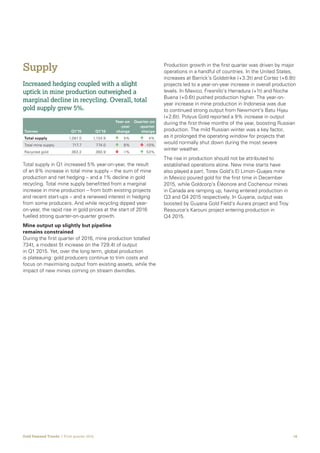
Total supply in Q1 increased 5% year-on-year, the result
of an 8% increase in total mine supply – the sum of mine
production and net hedging – and a 1% decline in gold
recycling. Total mine supply benefitted from a marginal
increase in mine production – from both existing projects
and recent start-ups – and a renewed interest in hedging
from some producers. And while recycling dipped year-
on-year, the rapid rise in gold prices at the start of 2016
fuelled strong quarter-on-quarter growth.
Mine output up slightly but pipeline
remains constrained
During the first quarter of 2016, mine production totalled
734t, a modest 5t increase on the 729.4t of output
in Q1 2015. Yet, over the long term, global production
is plateauing: gold producers continue to trim costs and
focus on maximising output from existing assets, while the
impact of new mines coming on stream dwindles.
Production growth in the first quarter was driven by major
operations in a handful of countries. In the United States,
increases at Barrick’s Goldstrike (+3.3t) and Cortez (+6.8t)
projects led to a year-on-year increase in overall production
levels. In Mexico, Fresnillo’s Herradura (+1t) and Noche
Buena (+0.6t) pushed production higher. The year-on-
year increase in mine production in Indonesia was due
to continued strong output from Newmont’s Batu Hijau
(+2.6t). Polyus Gold reported a 9% increase in output
during the first three months of the year, boosting Russian
production. The mild Russian winter was a key factor,
as it prolonged the operating window for projects that
would normally shut down during the most severe
winter weather.
The rise in production should not be attributed to
established operations alone. New mine starts have
also played a part. Torex Gold’s El Limon-Guajes mine
in Mexico poured gold for the first time in December
2015, while Goldcorp’s Éléonore and Cochenour mines
in Canada are ramping up, having entered production in
Q3 and Q4 2015 respectively. In Guyana, output was
boosted by Guyana Gold Field’s Aurara project and Troy
Resource’s Karouni project entering production in
Q4 2015.
17Gold Demand Trends  |  First quarter 2016
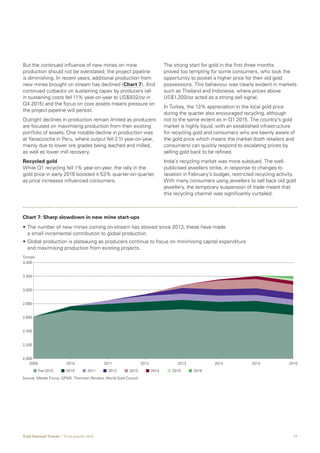
But the continued influence of new mines on mine
production should not be overstated; the project pipeline
is diminishing. In recent years, additional production from
new mines brought on stream has declined (Chart 7). And
continued cutbacks on sustaining capex by producers (all-
in sustaining costs fell 11% year-on-year to US$832/oz in
Q4 2015) and the focus on core assets means pressure on
the project pipeline will persist.
Outright declines in production remain limited as producers
are focused on maximising production from their existing
portfolio of assets. One notable decline in production was
at Yanaccocha in Peru, where output fell 2.1t year-on-year,
mainly due to lower ore grades being leached and milled,
as well as lower mill recovery.
Recycled gold
While Q1 recycling fell 1% year-on-year, the rally in the
gold price in early 2016 boosted it 53% quarter-on-quarter,
as price increases influenced consumers.
The strong start for gold in the first three months
proved too tempting for some consumers, who took the
opportunity to pocket a higher price for their old gold
possessions. This behaviour was clearly evident in markets
such as Thailand and Indonesia, where prices above
US$1,200/oz acted as a strong sell signal.
In Turkey, the 13% appreciation in the local gold price
during the quarter also encouraged recycling, although
not to the same extent as in Q1 2015. The country’s gold
market is highly liquid, with an established infrastructure
for recycling gold and consumers who are keenly aware of
the gold price which means the market (both retailers and
consumers) can quickly respond to escalating prices by
selling gold back to be refined.
India’s recycling market was more subdued. The well-
publicised jewellers strike, in response to changes to
taxation in February’s budget, restricted recycling activity.
With many consumers using jewellers to sell back old gold
jewellery, the temporary suspension of trade meant that
this recycling channel was significantly curtailed.
• The number of new mines coming on-stream has slowed since 2013; these have made
a small incremental contribution to global production.
• Global production is plateauing as producers continue to focus on minimising capital expenditure
and maximising production from existing projects.
2009 2010 2011 2012 2013 2014 2015 2016
Pre-2010 2010 2011 2012 2013 2014 2015 2016
Source: Metals Focus; GFMS, Thomson Reuters; World Gold Council
2,000
2,200
2,400
2,600
2,800
3,000
3,200
3,400
Chart 7: Sharp slowdown in new mine start-ups
Tonnes
18Gold Demand Trends  |  First quarter 2016
Hedging finds favour with some
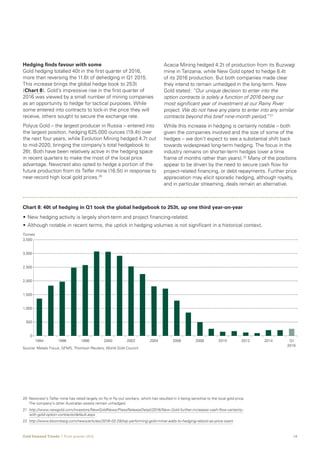
Gold hedging totalled 40t in the first quarter of 2016,
more than reversing the 11.6t of dehedging in Q1 2015.
This increase brings the global hedge book to 253t
(Chart 8). Gold’s impressive rise in the first quarter of
2016 was viewed by a small number of mining companies
as an opportunity to hedge for tactical purposes. While
some entered into contracts to lock-in the price they will
receive, others sought to secure the exchange rate.
Polyus Gold – the largest producer in Russia – entered into
the largest position, hedging 625,000 ounces (19.4t) over
the next four years, while Evolution Mining hedged 4.7t out
to mid-2020, bringing the company’s total hedgebook to
26t. Both have been relatively active in the hedging space
in recent quarters to make the most of the local price
advantage. Newcrest also opted to hedge a portion of the
future production from its Telfer mine (16.5t) in response to
near-record high local gold prices.20
Acacia Mining hedged 4.2t of production from its Buzwagi
mine in Tanzania, while New Gold opted to hedge 8.4t
of its 2016 production. But both companies made clear
they intend to remain unhedged in the long-term. New
Gold stated: “Our unique decision to enter into the
option contracts is solely a function of 2016 being our
most significant year of investment at our Rainy River
project. We do not have any plans to enter into any similar
contracts beyond this brief nine-month period.”21
While this increase in hedging is certainly notable – both
given the companies involved and the size of some of the
hedges – we don’t expect to see a substantial shift back
towards widespread long-term hedging. The focus in the
industry remains on shorter-term hedges (over a time
frame of months rather than years).22
Many of the positions
appear to be driven by the need to secure cash flow for
project-related financing, or debt repayments. Further price
appreciation may elicit sporadic hedging, although royalty,
and in particular streaming, deals remain an alternative.
20	Newcrest’s Telfer mine has relied largely on fly-in fly-out workers, which has resulted in it being sensitive to the local gold price.
The company’s other Australian assets remain unhedged.
21	 http://www.newgold.com/investors/NewGoldNews/PressReleaseDetail/2016/New-Gold-further-increases-cash-flow-certainty-
with-gold-option-contracts/default.aspx
22	 http://www.bloomberg.com/news/articles/2016-02-29/top-performing-gold-miner-adds-to-hedging-reboot-as-price-soars
• New hedging activity is largely short-term and project financing-related.
• Although notable in recent terms, the uptick in hedging volumes is not significant in a historical context.
1994 1996 1998 2000 2002 2004 2006 2008 2010 2012 2014 Q1
2016
Source: Metals Focus; GFMS, Thomson Reuters; World Gold Council
0
500
1,000
1,500
2,000
2,500
3,000
3,500
Chart 8: 40t of hedging in Q1 took the global hedgebook to 253t, up one third year-on-year
Tonnes
19Gold Demand Trends  |  First quarter 2016
Gold demand statistics
Table 2: Gold demand (tonnes)	
2014 2015 Q2’14 Q3’14 Q4’14 Q1’15 Q2’15 Q3’15 Q4’15 Q1’16
Q1’16
vs
Q1’15
% change
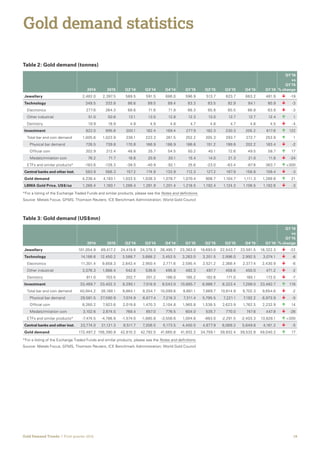
Jewellery 2,482.0 2,397.5 589.5 591.5 686.0 596.9 513.7 623.7 663.2 481.9 		 -19
Technology 348.5 333.8 86.6 89.5 89.4 83.3 83.5 82.9 84.1 80.9 		 -3
	Electronics 277.6 264.3 68.6 71.6 71.8 66.3 65.8 65.5 66.8 63.9 		 -3
	 Other industrial 51.0 50.6 13.1 13.0 12.8 12.3 13.0 12.7 12.7 12.4 		 1
	Dentistry 19.9 18.9 4.9 4.9 4.8 4.7 4.8 4.7 4.6 4.5 		 -4
Investment 822.0 895.6 200.1 182.4 169.4 277.9 182.3 230.3 205.2 617.6 		122
	 Total bar and coin demand 1,005.6 1,023.9 238.1 223.3 261.5 252.2 205.3 293.7 272.7 253.9 		 1
		 Physical bar demand 726.5 739.8 170.8 166.9 186.9 186.6 151.2 199.8 202.2 183.4 		 -2
		Official coin 202.9 212.4 48.8 35.7 54.5 50.2 40.1 72.6 49.5 58.7 		 17
		Medals/imitation coin 76.2 71.7 18.6 20.8 20.1 15.4 14.0 21.3 21.0 11.8 		 -24
	 ETFs and similar products* -183.6 -128.3 -38.0 -40.9 -92.1 25.6 -23.0 -63.4 -67.6 363.7 	 	300
Central banks and other inst. 583.9 566.3 157.2 174.9 133.9 112.3 127.2 167.9 158.8 109.4 		 -3
Gold demand 4,236.4 4,193.1 1,033.5 1,038.3 1,078.7 1,070.4 906.7 1,104.7 1,111.3 1,289.8 		 21
LBMA Gold Price, US$/oz 1,266.4 1,160.1 1,288.4 1,281.9 1,201.4 1,218.5 1,192.4 1,124.3 1,106.5 1,182.6 		 -3
*For a listing of the Exchange Traded Funds and similar products, please see the Notes and definitions.	
Source: Metals Focus; GFMS, Thomson Reuters; ICE Benchmark Administration; World Gold Council
Table 3: Gold demand (US$mn)	
2014 2015 Q2’14 Q3’14 Q4’14 Q1’15 Q2’15 Q3’15 Q4’15 Q1’16
Q1’16
vs
Q1’15
% change
Jewellery 101,054.9 89,417.2 24,419.8 24,378.3 26,495.7 23,383.0 19,693.0 22,543.7 23,591.5 18,322.3 		 -22
Technology 14,188.6 12,450.2 3,588.7 3,688.2 3,453.5 3,263.0 3,201.5 2,996.0 2,992.5 3,074.1 		 -6
	Electronics 11,301.4 9,858.3 2,843.4 2,950.4 2,771.6 2,595.4 2,521.2 2,366.4 2,377.4 2,430.9 		 -6
	 Other industrial 2,076.3 1,888.4 542.6 536.6 495.8 482.3 497.7 458.6 450.0 471.2 		 -2
	Dentistry 811.0 703.5 202.7 201.2 186.0 185.2 182.6 171.0 165.1 172.0 		 -7
Investment 33,469.7 33,402.3 8,290.1 7,518.9 6,543.0 10,885.7 6,986.7 8,323.4 7,299.0 23,482.7 		116
	 Total bar and coin demand 40,944.2 38,189.1 9,864.1 9,204.7 10,099.6 9,881.1 7,869.7 10,614.9 9,702.3 9,654.6 		 -2
		 Physical bar demand 29,581.5 27,590.9 7,074.9 6,877.4 7,218.3 7,311.4 5,795.5 7,221.1 7,192.2 6,973.9 		 -5
		Official coin 8,260.2 7,923.6 2,019.8 1,470.3 2,104.8 1,965.8 1,538.5 2,623.9 1,762.5 2,232.9 		 14
		Medals/imitation coin 3,102.6 2,674.5 769.4 857.0 776.5 604.0 535.7 770.0 747.6 447.8 		 -26
	 ETFs and similar products* -7,474.5 -4,786.8 -1,574.0 -1,685.8 -3,556.6 1,004.6 -883.0 -2,291.5 -2,403.3 13,828.1 	 	300
Central banks and other inst. 23,774.0 21,121.3 6,511.7 7,206.5 5,173.5 4,400.5 4,877.9 6,069.2 5,649.8 4,161.2 		 -5
Gold demand 172,487.2 156,390.9 42,810.3 42,792.0 41,665.6 41,932.2 34,759.1 39,932.4 39,532.8 49,040.2 		 17
*For a listing of the Exchange Traded Funds and similar products, please see the Notes and definitions.	
Source: Metals Focus; GFMS, Thomson Reuters; ICE Benchmark Administration; World Gold Council
20Gold Demand Trends  |  First quarter 2016
Table 4: Gold supply and demand World Gold Council presentation	
2014 2015 Q2’14 Q3’14 Q4’14 Q1’15 Q2’15 Q3’15 Q4’15 Q1’16
Q1’16
vs
Q1’15
% change
Supply
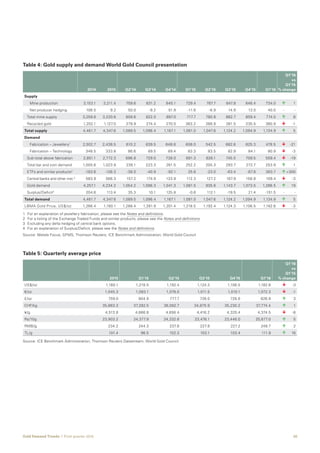
		Mine production 3,153.1 3,211.4 759.6 831.2 845.1 729.4 787.7 847.8 846.4 734.0 		 1
		 Net producer hedging 106.5 9.2 50.0 -9.2 51.9 -11.6 -6.9 14.9 13.0 40.0 	 -	 -
	 Total mine supply 3,259.6 3,220.6 809.6 822.0 897.0 717.7 780.8 862.7 859.4 774.0 		 8
	 Recycled gold 1,202.1 1,127.0 279.9 274.4 270.0 363.2 266.8 261.5 235.5 360.9 		 -1
Total supply 4,461.7 4,347.6 1,089.5 1,096.4 1,167.1 1,081.0 1,047.6 1,124.2 1,094.9 1,134.9 		 5
Demand
		 Fabrication – Jewellery1
2,502.7 2,438.5 610.2 639.5 648.6 608.0 542.5 662.6 625.3 478.5 		 -21
		 Fabrication – Technology 348.5 333.8 86.6 89.5 89.4 83.3 83.5 82.9 84.1 80.9 		 -3
	 Sub-total above fabrication 2,851.1 2,772.3 696.8 729.0 738.0 691.3 626.1 745.5 709.5 559.4 	 	-19
	 Total bar and coin demand 1,005.6 1,023.9 238.1 223.3 261.5 252.2 205.3 293.7 272.7 253.9 		 1
	 ETFs and similar products2
-183.6 -128.3 -38.0 -40.9 -92.1 25.6 -23.0 -63.4 -67.6 363.7 		300
	 Central banks and other inst.3
583.9 566.3 157.2 174.9 133.9 112.3 127.2 167.9 158.8 109.4 		 -3
	 Gold demand 4,257.1 4,234.2 1,054.2 1,086.3 1,041.3 1,081.5 935.6 1,143.7 1,073.5 1,286.5 		 19
	Surplus/Deficit4
204.6 113.4 35.3 10.1 125.8 -0.6 112.1 -19.5 21.4 -151.5 	 -	 -
Total demand 4,461.7 4,347.6 1,089.5 1,096.4 1,167.1 1,081.0 1,047.6 1,124.2 1,094.9 1,134.9 		 5
LBMA Gold Price, US$/oz 1,266.4 1,160.1 1,288.4 1,281.9 1,201.4 1,218.5 1,192.4 1,124.3 1,106.5 1,182.6 		 -3
1	 For an explanation of jewellery fabrication, please see the Notes and definitions.								
2	 For a listing of the Exchange Traded Funds and similar products, please see the Notes and definitions.						
3	Excluding any delta hedging of central bank options.										
4	 For an explanation of Surplus/Deficit, please see the Notes and definitions.						
Source: Metals Focus; GFMS, Thomson Reuters; ICE Benchmark Administration; World Gold Council		
Table 5: Quarterly average price	
2015 Q1'15 Q2'15 Q3'15 Q4'15 Q1'16
Q1’16
vs
Q1’15
% change
US$/oz 1,160.1 1,218.5 1,192.4 1,124.3 1,106.5 1,182.6 	 	 -3
€/oz 1,045.3 1,083.1 1,078.0 1,011.5 1,010.1 1,072.3 	 	 -1
£/oz 759.0 804.9 777.7 726.0 728.6 826.9 	 	 3
CHF/kg 35,863.3 37,292.5 36,082.7 34,875.9 35,230.2 37,774.4 	 	1
¥/g 4,513.8 4,666.8 4,656.4 4,416.2 4,320.4 4,374.5 	 	 -6
Rs/10g 23,903.2 24,377.9 24,332.8 23,476.1 23,446.0 25,677.0 	 	 5
RMB/g 234.2 244.3 237.8 227.8 227.2 248.7 	 	 2
TL/g 101.4 96.5 102.3 103.1 103.4 111.9 	 	 16
Source: ICE Benchmark Administration; Thomson Reuters Datastream; World Gold Council
21Gold Demand Trends  |  First quarter 2016
Table 6: Jewellery demand in selected countries (tonnes)				
2015 Q1'15 Q2'15 Q3'15 Q4'15 Q1'16
Q1’16
vs
Q1’15
% change
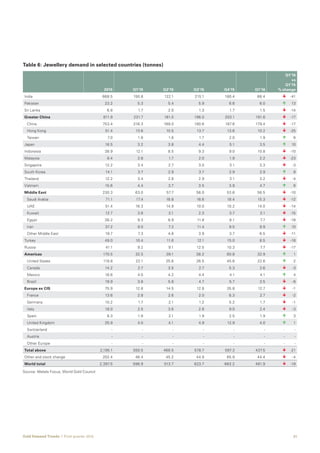
India 668.5 150.8 122.1 215.1 180.4 88.4 	 	-41
Pakistan 23.2 5.3 5.4 5.9 6.6 6.0 	 	 13
Sri Lanka 6.8 1.7 2.0 1.3 1.7 1.5 	 	 -14
Greater China 811.9 231.7 181.0 196.0 203.1 191.6 	 	 -17
	China 753.4 216.3 169.0 180.6 187.6 179.4 	 	 -17
	 Hong Kong 51.4 13.6 10.5 13.7 13.6 10.2 	 	-25
	Taiwan 7.0 1.8 1.6 1.7 2.0 1.9 	 	 6
Japan 16.5 3.2 3.8 4.4 5.1 3.5 	 	 10
Indonesia 38.9 12.1 8.5 9.3 9.0 10.8 	 	 -10
Malaysia 8.4 2.8 1.7 2.0 1.9 2.2 	 	-23
Singapore 12.2 3.4 2.7 3.0 3.1 3.3 	 	 -3
South Korea 14.1 3.7 2.9 3.7 3.9 3.9 	 	 8
Thailand 12.2 3.4 2.8 2.9 3.1 3.2 	 	 -4
Vietnam 15.6 4.4 3.7 3.5 3.9 4.7 	 	 6
Middle East 230.3 63.0 57.7 56.0 53.6 56.5 	 	 -10
	 Saudi Arabia 71.1 17.4 18.8 16.6 18.4 15.3 	 	 -12
	UAE 51.4 16.3 14.9 10.0 10.2 14.0 	 	 -14
	Kuwait 12.7 3.6 3.1 2.3 3.7 3.1 	 	 -15
	Egypt 38.2 9.3 8.9 11.8 8.1 7.7 	 	 -18
	Iran 37.2 9.0 7.2 11.4 9.5 9.9 	 	 10
	 Other Middle East 19.7 7.3 4.8 3.9 3.7 6.5 	 	 -11
Turkey 49.0 10.4 11.6 12.1 15.0 8.5 	 	 -18
Russia 41.1 9.2 9.1 12.5 10.3 7.7 	 	 -17
Americas 170.5 32.5 39.1 38.2 60.8 32.9 	 	 1
	 United States 119.8 22.1 25.6 26.5 45.6 22.6 	 	 2
	Canada 14.2 2.7 3.5 2.7 5.3 2.6 	 	 -3
	Mexico 16.6 4.0 4.2 4.4 4.1 4.1 	 	 4
	Brazil 19.9 3.8 5.8 4.7 5.7 3.5 	 	 -6
Europe ex CIS 75.9 12.8 14.5 12.8 35.8 12.7 	 	 -1
	France 13.6 2.8 2.6 2.0 6.3 2.7 	 	 -2
	Germany 10.2 1.7 2.1 1.2 5.2 1.7 	 	 -1
	Italy 18.0 2.5 3.6 2.8 9.0 2.4 	 	 -3
	Spain 8.3 1.8 2.1 1.9 2.5 1.9 	 	 3
	 United Kingdom 25.9 4.0 4.1 4.9 12.9 4.0 	 	 1
	Switzerland - - - - - - 	 -	 -
	Austria - - - - - - 	 -	 -
	 Other Europe - - - - - - 	 -	-
Total above 2,195.1 550.5 468.5 578.7 597.3 437.5 	 	 -21
Other and stock change 202.4 46.4 45.2 44.9 65.9 44.4 	 	 -4
World total 2,397.5 596.9 513.7 623.7 663.2 481.9 	 	 -19
Source: Metals Focus; World Gold Council
22Gold Demand Trends  |  First quarter 2016
Table 7: Total bar and coin demand in selected countries (tonnes)				
2015 Q1'15 Q2'15 Q3'15 Q4'15 Q1'16
Q1’16
vs
Q1’15
% change
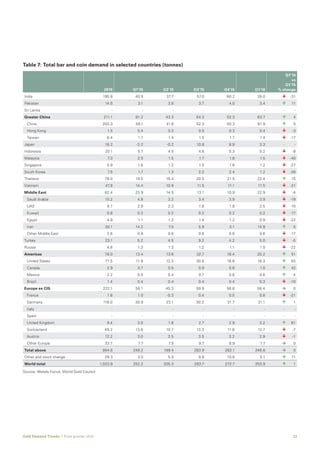
India 195.8 40.9 37.7 57.0 60.2 28.0 	 	 -31
Pakistan 14.5 3.1 3.8 3.7 4.0 3.4 	 	 11
Sri Lanka - - - - - - 	 -	-
Greater China 211.1 61.2 43.3 54.3 52.3 63.7 	 	 4
	China 203.3 59.1 41.6 52.3 50.3 61.9 	 	 5
	 Hong Kong 1.5 0.4 0.3 0.5 0.3 0.4 	 	 -3
	Taiwan 6.4 1.7 1.4 1.5 1.7 1.4 	 	 -17
Japan 16.2 -3.2 -0.2 10.8 8.9 3.3 	 -	-
Indonesia 20.1 5.7 4.5 4.6 5.3 5.2 	 	 -8
Malaysia 7.3 2.5 1.5 1.7 1.6 1.5 	 	-40
Singapore 5.9 1.6 1.2 1.5 1.6 1.2 	 	 -27
South Korea 7.5 1.7 1.3 2.2 2.4 1.2 	 	 -26
Thailand 78.0 19.5 16.4 20.5 21.5 22.4 	 	 15
Vietnam 47.8 14.4 10.8 11.5 11.1 11.5 	 	 -21
Middle East 62.4 23.9 14.5 13.1 10.9 22.9 	 	 -4
	 Saudi Arabia 15.2 4.8 3.2 3.4 3.9 3.9 	 	 -19
	UAE 8.7 2.9 2.3 1.8 1.8 2.5 	 	 -15
	Kuwait 0.8 0.2 0.2 0.2 0.2 0.2 	 	 -17
	Egypt 4.9 1.1 1.2 1.4 1.2 0.9 	 	 -22
	Iran 30.1 14.2 7.0 5.8 3.1 14.9 	 	 5
	 Other Middle East 2.6 0.8 0.6 0.6 0.6 0.6 	 	 -17
Turkey 23.1 5.2 4.5 9.2 4.2 5.0 	 	 -5
Russia 4.8 1.3 1.3 1.2 1.1 1.0 	 	 -22
Americas 78.0 13.4 13.6 32.7 18.4 20.2 	 	 51
	 United States 71.5 11.8 12.3 30.8 16.6 18.3 	 	 55
	Canada 2.9 0.7 0.5 0.9 0.8 1.0 	 	 42
	Mexico 2.2 0.5 0.4 0.7 0.6 0.6 	 	 4
	Brazil 1.4 0.4 0.4 0.4 0.4 0.3 	 	 -10
Europe ex CIS 222.1 58.1 45.3 59.9 58.8 58.4 	 	 0
	France 1.6 1.0 -0.3 0.4 0.5 0.8 	 	 -21
	Germany 116.0 30.9 23.1 30.2 31.7 31.1 	 	 1
	Italy - - - - - - 	 -	-
	Spain - - - - - - 	 -	-
	 United Kingdom 9.4 2.0 1.8 2.7 2.9 3.2 	 	 61
	Switzerland 49.2 13.6 10.7 13.3 11.6 12.7 	 	 -7
	Austria 12.2 3.0 2.5 3.5 3.2 2.9 	 	 -1
	 Other Europe 33.7 7.7 7.5 9.7 8.9 7.7 	 	 0
Total above 994.6 249.2 199.4 283.9 262.1 248.8 	 	 0
Other and stock change 29.3 3.0 5.9 9.8 10.6 5.1 	 	 71
World total 1,023.9 252.2 205.3 293.7 272.7 253.9 	 	 1
Source: Metals Focus; World Gold Council
23Gold Demand Trends  |  First quarter 2016
Table 8: Consumer demand in selected countries (tonnes)				
2015 Q1'15 Q2'15 Q3'15 Q4'15 Q1'16
Q1’16
vs
Q1’15
% change
India 864.3 191.7 159.8 272.1 240.6 116.5 	 	 -39
Pakistan 37.6 8.4 9.2 9.6 10.5 9.4 	 	 13
Sri Lanka 6.8 1.7 2.0 1.3 1.7 1.5 	 	 -14
Greater China 1,023.0 292.9 224.3 250.3 255.4 255.3 	 	 -13
	China 956.7 275.4 210.6 232.9 237.8 241.3 	 	 -12
	 Hong Kong 52.8 14.0 10.8 14.2 13.9 10.6 	 	 -24
	Taiwan 13.4 3.6 2.9 3.2 3.7 3.4 	 	 -5
Japan 32.8 0.0 3.6 15.2 14.0 6.8 	 	300
Indonesia 59.0 17.8 13.0 14.0 14.3 16.1 	 	 -10
Malaysia 15.7 5.3 3.2 3.7 3.5 3.7 	 	 -31
Singapore 18.1 5.0 3.9 4.5 4.7 4.5 	 	 -11
South Korea 21.6 5.3 4.2 5.9 6.2 5.2 	 	 -3
Thailand 90.2 22.9 19.2 23.5 24.6 25.7 	 	 12
Vietnam 63.4 18.9 14.5 15.0 15.0 16.2 	 	 -14
Middle East 292.7 86.9 72.2 69.1 64.5 79.3 	 	 -9
	 Saudi Arabia 86.3 22.1 22.0 19.9 22.3 19.1 	 	 -14
	UAE 60.1 19.2 17.2 11.8 12.0 16.5 	 	 -14
	Kuwait 13.6 3.9 3.3 2.5 3.9 3.3 	 	 -15
	Egypt 43.1 10.4 10.1 13.3 9.4 8.5 	 	 -18
	Iran 67.3 23.2 14.3 17.2 12.6 24.7 	 	 7
	 Other Middle East 22.3 8.1 5.4 4.4 4.3 7.2 	 	 -12
Turkey 72.1 15.6 16.1 21.2 19.2 13.5 	 	 -14
Russia 45.9 10.5 10.3 13.7 11.4 8.7 	 	 -18
Americas 248.5 45.9 52.6 70.9 79.1 53.0 	 	 16
	 United States 191.3 33.9 38.0 57.3 62.2 40.9 	 	 21
	Canada 17.1 3.4 4.0 3.6 6.1 3.6 	 	 6
	Mexico 18.8 4.5 4.5 5.0 4.7 4.7 	 	 4
	Brazil 21.3 4.1 6.1 5.0 6.0 3.8 	 	 -7
Europe ex CIS 298.1 70.9 59.8 72.7 94.7 71.1 	 	 0
	France 15.2 3.8 2.3 2.3 6.8 3.5 	 	 -7
	Germany 126.1 32.7 25.2 31.4 36.9 32.8 	 	 1
	Italy 18.0 2.5 3.6 2.8 9.0 2.4 	 	 -3
	Spain 8.3 1.8 2.1 1.9 2.5 1.9 	 	 3
	 United Kingdom 35.3 6.0 6.0 7.6 15.8 7.2 	 	 21
	Switzerland 49.2 13.6 10.7 13.3 11.6 12.7 	 	 -7
	Austria 12.2 3.0 2.5 3.5 3.2 2.9 	 	 -1
	 Other Europe 33.7 7.7 7.5 9.7 8.9 7.7 	 	 0
Total above 3,189.7 799.8 667.9 862.6 859.4 686.3 	 	 -14
Other and stock change 231.7 49.4 51.1 54.7 76.5 49.6 	 	 0
World total 3,421.4 849.1 719.0 917.3 935.9 735.8 	 	 -13
Source: Metals Focus; World Gold Council
24Gold Demand Trends  |  First quarter 2016
Table 9: Indian supply estimates (tonnes)		
2015 Q1'15 Q2'15 Q3'15 Q4'15 Q1'16
Q1’16
vs
Q1’15
% change
Supply
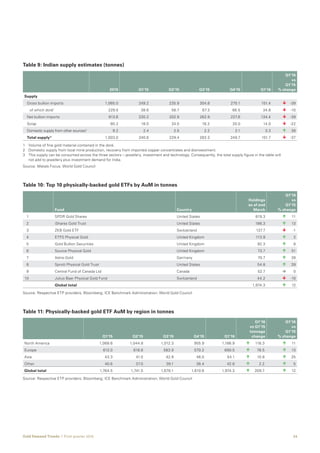
	 Gross bullion imports 1,065.0 249.2 235.9 304.8 275.1 151.4 	 	-39
		 of which doré1
229.0 38.6 56.7 67.3 66.5 34.8 	 	 -10
	 Net bullion imports 913.6 220.2 202.9 262.9 227.6 134.4 	 	-39
	Scrap 80.2 18.0 24.0 18.2 20.0 14.0 	 	-22
	 Domestic supply from other sources2
9.2 2.4 2.5 2.2 2.1 3.3 	 	 38
	 Total supply3
1,003.0 240.6 229.4 283.3 249.7 151.7 	 	-37
1 	 Volume of fine gold material contained in the doré.
2 	 Domestic supply from local mine production, recovery from imported copper concentrates and disinvestment.
3 	 This supply can be consumed across the three sectors – jewellery, investment and technology. Consequently, the total supply figure in the table will
not add to jewellery plus investment demand for India.
Source: Metals Focus; World Gold Council 							
Table 11: Physically-backed gold ETF AuM by region in tonnes				
Q1'15 Q2'15 Q3'15 Q4'15 Q1'16
Q1’16
vs Q1’15
tonnage
change
Q1’16
vs
Q1’15
% change
North America 1,068.6 1,044.8 1,012.3 955.9 1,186.9 	 	 118.3 	 	 11
Europe 612.0 618.6 583.9 570.2 690.5 	 	 78.5 	 	 13
Asia 43.3 41.0 42.9 46.0 54.1 	 	 10.8 	 	 25
Other 40.6 37.0 39.1 38.4 42.8 	 	 2.2 	 	 5
Global total 1,764.5 1,741.5 1,678.1 1,610.6 1,974.3 	 	 209.7 	 	 12
Source: Respective ETP providers; Bloomberg; ICE Benchmark Administration; World Gold Council		
Table 10: Top 10 physically-backed gold ETFs by AuM in tonnes				
Fund Country
Holdings
as of end
March
Q1’16
vs
Q1’15
% change
	1 SPDR Gold Shares United States 819.3 	 	 11
	2 iShares Gold Trust United States 186.3 	 	 13
	3 ZKB Gold ETF Switzerland 137.7 	 	 -1
	4 ETFS Physical Gold United Kingdom 113.9 	 	 2
	5 Gold Bullion Securities United Kingdom 92.3 	 	 8
	6 Source Physical Gold United Kingdom 73.7 	 	 51
	7 Xetra-Gold Germany 70.7 	 	 28
	8 Sprott Physical Gold Trust United States 54.8 	 	 39
	9 Central Fund of Canada Ltd Canada 52.7 	 	 0
	10 Julius Baer Physical Gold Fund Switzerland 44.2 	 	 -10
Global total 1,974.3 	 	 12
Source: Respective ETP providers; Bloomberg; ICE Benchmark Administration; World Gold Council
25Gold Demand Trends  |  First quarter 2016
Tonnes % of reserves
21 Venezuela 272.9 66%
22 Kazakhstan 228.3 32%
23 Belgium 227.4 36%
24 Philippines 195.9 10%
25 Algeria 173.6 5%
26 Thailand 152.4 3%
27 Singapore 127.4 2%
28 Sweden 125.7 8%
29 South Africa 125.2 11%
30 Mexico 121.1 3%
31 Libya 116.6 6%
32 Greece 112.7 59%
33 BIS 108.0 -
34 Korea 104.4 1%
35 Romania 103.7 10%
36 Poland 102.9 4%
37 Iraq 89.8 7%
38 Australia 79.9 6%
39 Kuwait 79.0 9%
40 Indonesia 78.1 3%
Tonnes % of reserves
1 United States 8,133.5 75%
2 Germany 3,381.0 69%
3 IMF 2,814.0 -
4 Italy 2,451.8 68%
5 France 2,435.7 63%
6 China 1,797.5 2%
7 Russia 1,460.4 15%
8 Switzerland 1,040.0 7%
9 Japan 765.2 2%
10 Netherlands 612.5 61%
11 India 557.7 6%
12 ECB 504.8 27%
13 Turkey 479.3 17%
14 Taiwan 422.7 4%
15 Portugal 382.5 71%
16 Saudi Arabia 322.9 2%
17 United Kingdom 310.3 9%
18 Lebanon 286.8 23%
19 Spain 281.6 21%
20 Austria 280.0 45%
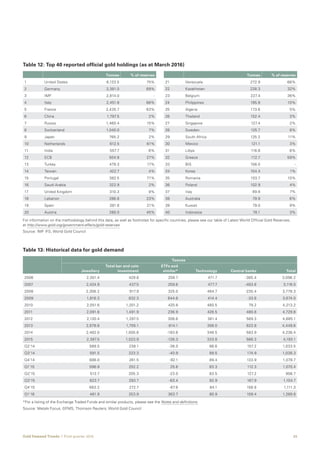
Table 12: Top 40 reported official gold holdings (as at March 2016)
For information on the methodology behind this data, as well as footnotes for specific countries, please see our table of Latest World Official Gold Reserves,
at http://www.gold.org/government-affairs/gold-reserves
Source: IMF IFS; World Gold Council
Table 13: Historical data for gold demand	
Tonnes
Jewellery
Total bar and coin
investment
ETFs and
similar* Technology Central banks Total
2006 2,301.4 429.8 258.7 471.7 -365.4 3,096.2
2007 2,424.9 437.5 259.6 477.7 -483.8 3,116.0
2008 2,306.2 917.9 325.0 464.7 -235.4 3,778.3
2009 1,816.3 832.3 644.6 414.4 -33.6 3,674.0
2010 2,051.6 1,201.2 420.8 460.5 79.2 4,213.2
2011 2,091.6 1,491.9 236.9 428.5 480.8 4,729.8
2012 2,130.4 1,297.5 306.6 381.4 569.3 4,685.1
2013 2,678.8 1,705.1 -914.1 356.0 623.8 4,449.6
2014 2,482.0 1,005.6 -183.6 348.5 583.9 4,236.4
2015 2,397.5 1,023.9 -128.3 333.8 566.3 4,193.1
Q2'14 589.5 238.1 -38.0 86.6 157.2 1,033.5
Q3'14 591.5 223.3 -40.9 89.5 174.9 1,038.3
Q4'14 686.0 261.5 -92.1 89.4 133.9 1,078.7
Q1'15 596.9 252.2 25.6 83.3 112.3 1,070.4
Q2'15 513.7 205.3 -23.0 83.5 127.2 906.7
Q3'15 623.7 293.7 -63.4 82.9 167.9 1,104.7
Q4'15 663.2 272.7 -67.6 84.1 158.8 1,111.3
Q1'16 481.9 253.9 363.7 80.9 109.4 1,289.8
*For a listing of the Exchange Traded Funds and similar products, please see the Notes and definitions.					
Source: Metals Focus; GFMS, Thomson Reuters; World Gold Council
26Gold Demand Trends  |  First quarter 2016
Notes and definitions
All statistics (except where specified) are in weights
of fine gold.
Notes
Revisions to data
All data is subject to revision in the light of new
information.
Historical data series
Demand and supply data from Q1 2014 are provided by
Metals Focus. Data between Q1 2010 and Q4 2013 is a
synthesis of Metals Focus and GFMS, Thomson Reuters
data, which was created using relatively simple statistical
techniques. For more information on this process, please
see Creating a consistent data series by Dr James Abdey
(http://www.gold.org/supply-and-demand/gold-
demand-trends/back-issues/gold-demand-trends-q1-
2015#package)
Definitions
Central banks and other institutions
Net purchases (i.e. gross purchases less gross sales)
by central banks and other official sector institutions,
including supra national entities such as the IMF. Swaps
and the effects of delta hedging are excluded.
Consumer demand
The sum of jewellery consumption and total bar and coin
investment occurring within a country i.e. the amount (in
fine weight) of gold purchased directly by individuals.
Electronics
This measures fabrication of gold into components used
in the production of electronics, including – but not limited
to – semiconductors and bonding wire.
Dentistry
The first transformation of raw gold into intermediate or
final products destined for dental applications such as
dental alloys.
ETFs and similar products
Exchange Traded Funds and similar products including,
but not limited to: SPDR Gold Shares, iShares Gold Trust,
ZKB Gold ETF, ETFS Physical Gold/Jersey, Gold Bullion
Securities Ltd, Central Fund of Canada Ltd, Xetra-Gold,
Julius Baer Precious Metals Fund – JB Physical Gold
Fund, Source Physical Gold P-ETC, Sprott Physical Gold
Trust. Over time, new products may be included when
appropriate. Gold holdings are as reported by the ETF/ETC
issuers and where data is unavailable holdings have been
calculated using reported AUM numbers.
Fabrication
Fabrication is the first transformation of gold bullion into a
semi-finished or finished product.
Gold demand
The total of jewellery fabrication, technology, total bar and
coin demand and demand for ETFs and similar products.
Jewellery
End-user demand for all newly-made carat jewellery and
gold watches, whether plain gold or combined with other
materials. Excluded are: second-hand jewellery; other
metals plated with gold; coins and bars used as jewellery;
and purchases funded by the trading-in of existing carat
gold jewellery.
Jewellery fabrication
Figures for jewellery fabrication – the first transformation
of gold bullion into semi-finished or finished jewellery – are
included in Table 4. Differs from jewellery consumption as
it excludes the impact of imports/exports and stocking/de-
stocking by manufacturers and distributors.
LBMA Gold price PM
Unless otherwise specified, gold price values from
20 March 2015 are based on the LBMA Gold price PM
administered by ICE Benchmark Administration (IBA),
with prior values being based on the London PM Fix.
London PM Fix
Unless otherwise specified, gold price values prior to
20 March 2015 are based on the London PM Fix, with
subsequent values being based on the LBMA Gold price
PM administered by ICE Benchmark Administration (IBA).
Medals/imitation coin
Fabrication of gold coins without a face value, produced
by both private and national mints. India dominates this
category with, on average, around 90% of the total.
‘Medallion’ is the name given to unofficial coins in India.
Medals of at least 99% purity, wires and lumps sold in
small quantities are also included.
Mine production
The volume (in fine weight) of gold mined globally.
This includes an estimate for gold produced as a result
of artisanal and small scale mining (ASM), which is
largely informal.
27Gold Demand Trends  |  First quarter 2016
Net producer hedging
This measures the impact in the physical market of
mining companies’ gold forward sales, loans and options
positions. Hedging accelerates the sale of gold, a
transaction which releases gold (from existing stocks) to
the market. Over time, hedging activity does not generate
a net increase in the supply of gold. De-hedging – the
process of closing out hedged positions – has the opposite
impact and will reduce the amount of gold available to the
market in any given quarter.
Official coin demand
Investment by individuals in gold bullion coins. It equates
to the fabrication by national mints of coins which are,
or have been, legal tender in the country of issue. It is
measured at the country of consumption rather than at the
country of origin (for example, the Perth Mint in Australia,
sells the majority of the coins it produces through its global
distribution network) and is measured on a net basis. In
practice it includes the initial sale of many coins destined
ultimately to be considered as numismatic rather than
bullion.
Other industrial
Gold used in the production of compounds, such as
Gold Potassium Cyanide, for electro-plating in industrial
applications as well as in the production of gold-plated
jewellery and other decorative items such as gold thread.
India accounts for the bulk of demand in this category.
Over-the-counter
Over-the-counter (OTC) transactions (also referred to as
‘off exchange’ trading) take place directly between two
parties, unlike exchange trading which is conducted via
an exchange.
Physical bar demand
Investment by individuals in small (1kg and below)
gold bars in a form widely accepted in the countries
represented within Gold Demand Trends. This also
includes, where identifiable, gold bought and stored via
online vendors. It is measured as net purchases.
Recycled gold
Gold sourced from fabricated products that have been
sold or made ready for sale, which is refined back into
bullion. This specifically refers to gold sold for cash. It does
not include gold traded-in for other gold products (for
example, by consumers at jewellery stores) or process
scrap (working gold that never becomes part of a
fabricated product but instead returns as scrap to a refiner).
The vast majority – around 90% – of recycled gold is
high-value gold (largely jewellery) and the remainder is
gold recovered from industrial waste, including laptops,
mobile phones, circuit boards etc. For more detail on
recycling, refer to The Ups and Downs of Gold Recycling,
Boston Consulting Group and World Gold Council,
March 2015 (www.gold.org/supply-and-demand).
Surplus/deficit
This is the difference between total supply and gold
demand. Partly a statistical residual, this number also
captures demand in the OTC market and changes to
inventories on commodity exchanges, with an additional
contribution from changes to fabrication inventories.
Technology
This captures all gold used in the fabrication of electronics,
dental, medical, decorative and other technological
applications, with electronics representing the largest
component of this category. It includes gold destined for
plating jewellery.
Tonne (Metric)
1,000 kg or 32,151 troy oz of fine gold.
Total bar and coin investment
The total of physical bar demand, official coin demand and
demand for medals/imitation coin.
Total supply
The total of mine production, net producer hedging and
recycling.
Gold Demand Trends  |  First quarter 2016
Copyright and other rights
© 2016 World Gold Council. All rights reserved. World Gold Council and the
Circle device are trademarks of the World Gold Council or its affiliates.
All references to LBMA Gold Price have been provided for informational
purposes only. ICE Benchmark Administration Limited accepts no liability or
responsibility for the accuracy of the prices or the underlying product to which
the prices may be referenced.
Other third party data and content is the intellectual property of the respective
third party and all rights are reserved to them.
Any copying, republication or redistribution of content, to reproduce, distribute
or otherwise use the statistics and information in this report including by
framing or similar means, is expressly prohibited without the prior written
consent of the World Gold Council or the appropriate copyright owners except
as provided below.
The use of the statistics in this report is permitted for the purposes of review
and commentary (including media commentary) in line with fair industry
practice, subject to the following two pre-conditions: (i) only limited extracts
of data or analysis be used; and (ii) any and all use of these statistics is
accompanied by a clear acknowledgement of the World Gold Council and,
where appropriate, of Thomson Reuters, as their source. Brief extracts from
the analysis, commentary and other World Gold Council material are permitted
provided World Gold Council is cited as the source. It is not permitted to
reproduce, distribute or otherwise use the whole or a substantial part of this
report or the statistics contained within it.
While every effort has been made to ensure the accuracy of the information in
this document, the World Gold Council does not warrant or guarantee the
accuracy, completeness or reliability of this information. The World Gold Council
does not accept responsibility for any losses or damages arising directly or
indirectly, from the use of this document.
The material contained in this document is provided solely for general
information and educational purposes and is not, and should not be construed
as, an offer to buy or sell, or as a solicitation of an offer to buy or sell, gold,
any gold related products or any other products, securities or investments.
Nothing in this document should be taken as making any recommendations or
providing any investment or other advice with respect to the purchase, sale
or other disposition of gold, any gold related products or any other products,
securities or investments, including without limitation, any advice to the effect
that any gold related transaction is appropriate for any investment objective or
financial situation of a prospective investor. A decision to invest in gold, any
gold related products or any other products, securities or investments should
not be made in reliance on any of the statements in this document. Before
making any investment decision, prospective investors should seek advice
from their financial advisers, take into account their individual financial needs
and circumstances and carefully consider the risks associated with such
investment decision.
Without limiting any of the foregoing, in no event will the World Gold Council
or any of its affiliates be liable for any decision made or action taken in reliance
on the information in this document and, in any event, the World Gold Council
and its affiliates shall not be liable for any consequential, special, punitive,
incidental, indirect or similar damages arising from, related to or connected
with this document, even if notified of the possibility of such damages.
This document contains forward-looking statements. The use of the words
“believes,” “expects,” “may,” or “suggests,” or similar terminology, identifies
a statement as “forward-looking.” The forward-looking statements included
in this document are based on current expectations that involve a number of
risks and uncertainties. These forward-looking statements are based on the
analysis of World Gold Council of the statistics available to it. Assumptions
relating to the forward-looking statement involve judgments with respect to,
among other things, future economic, competitive and market conditions all of
which are difficult or impossible to predict accurately. In addition, the demand
for gold and the international gold markets are subject to substantial risks
which increase the uncertainty inherent in the forward-looking statements.
In light of the significant uncertainties inherent in the forward-looking
information included herein, the inclusion of such information should not be
regarded as a representation by the World Gold Council that the forward-
looking statements will be achieved.
The World Gold Council cautions you not to place undue reliance on its
forward-looking statements. Except in the normal course of our publication
cycle, we do not intend to update or revise any forward-looking statements,
whether as a result of new information, future events or otherwise, and we
assume no responsibility for updating any forward-looking statements.
I104201605
World Gold Council
10 Old Bailey, London EC4M 7NG
United Kingdom
E	marketintelligence@gold.org
T	 +44 20 7826 4700 
F	 +44 20 7826 4799 
W	www.gold.org
Published: May 2016

Gold Demand Trends Q1 2016 report

  • 1.
    Gold Demand Trends Firstquarter 2016 May 2016 Gold demand’s best ever start to the year Gold demand grew 21% to 1,289.8t – the strongest Q1 on record. Investment drove gains. Jewellery fell sharply on higher prices and market-specific factors. Central bank buying slowed. 40t of hedging lifted mine supply. Key themes (more detail pages 2-5) ETF demand surged: 364 tonnes (t) of inflows more than reversed the cumulative outflows from 2014 and 2015. Investment drove price gains. Investors’ search for security fuelled gold’s Q1 rally, its best performance in almost 30 years. Indian consumers hamstrung. Indian demand was stifled as jewellers went on strike in protest at proposed excise duty. Featured chart Investment growth outweighed declines elsewhere -115.0 -2.4 +1.7 +338.1 -2.9 +219.4 0 200 400 600 800 1,000 1,200 1,400 Q1’15 Jewellery Bar and coin Technology Central banks Q1’16 Net change Q1’16 vs Q1’15 ETFs and similar Source: Metals Focus; World Gold Council Tonnes Gains in investment demand outweighed declines in other sectors 1,070.4 1,289.8 Embargo: Not for release before 12 May 2016, 05.00 hrs BST Tonnes Q1 2016 year-on-year Q1 2016 quarter-on- quarter Gold demand  21%  16% Jewellery  -19%  -27% Technology  -3%  -4% Investment  122%  201% Central banks and other institutions  -3%  -31% Supply  5%  4% Source: Metals Focus; World Gold Council Keychanges Contents Key themes 02 Market commentary 07 Jewellery 07 Investment 10 Central banks and other institutions 13 Technology 14 Supply 16 Gold demand statistics 19 Notes and definitions 26 Contributors Louise Street louise.street@gold.org Krishan Gopaul krishan.gopaul@gold.org Mukesh Kumar mukesh.kumar@gold.org Carol Lu carol.lu@gold.org Alistair Hewitt Director, Market Intelligence alistair.hewitt@gold.org www.gold.org
  • 2.
    02Gold Demand Trends |  First quarter 2016 Key themes ETF investors rekindle their interest Inflows into ETFs of 363.7t were the highest since Q1 2009 as sentiment towards gold improved markedly. Shifts in the global economic and financial landscape have created a positive environment for gold investment in recent months. Uncertainty abounds: • The Negative Interest Rate Policies (NIRP) implemented by central banks in Japan and Europe represent a shift to ‘unconventional policies’ which create ‘great uncertainty’.1 • China’s devaluation of the yuan fuelled fears over the country’s economic health and the potential impact on global growth. • And the pace of US interest rate rises is now widely expected to slow. The swirling uncertainty created by this mix of factors undermined confidence in traditional asset classes. Turbulence hit stock markets around the world. The impact of NIRP in particular significantly reduced the appeal of sovereign bonds as a stable, low-risk asset. Enter gold- backed ETFs. 1 http://www.bis.org/publ/qtrpdf/r_qt1603e.htm Table 1: Data highlights for Q1 2016 demand (see full details on pages 19–25) Tonnes US$mn Q1’15 Q1’16 5-year average Year-on- year change Q1’15 Q1 ’16 5-year average Year-on- year change Demand Gold demand 1,070.4 1,289.8 1,114.7  21% 41,932.2 49,040.2 51,128.1  17% Jewellery 596.9 481.9 589.0  -19% 23,383.0 18,322.3 26,558.5  -22% Technology 83.3 80.9 92.4  -3% 3,263.0 3,074.1 4,242.5  -6% Investment 277.9 617.6 292.1  122% 10,885.7 23,482.7 13,918.3  116% Total bar and coin 252.2 253.9 326.2  1% 9,881.1 9,654.6 15,114.8  -2% ETFs and similar products 25.6 363.7 -34.1  >300% 1,004.6 13,828.1 -1,196.5  >300% Central banks and other institutions 112.3 109.4 141.2  -3% 4,400.5 4,161.2 6,408.8  -5% Consumer demand in selected markets India 191.7 116.5 227.6  -39% 7,509.4 4,427.8 10,377.6  -41% China 275.4 241.3 247.4  -12% 10,788.0 9,174.6 11,210.3  -15% Middle East 86.9 79.3 79.1  -9% 3,403.5 3,016.4 3,601.0  -11% United States 33.9 40.9 45.4  21% 1,326.4 1,555.5 2,062.2  17% Europe ex CIS 70.9 71.1 82.4  0% 2,778.5 2,703.4 3,793.5  -3% Supply Total supply 1,081.0 1,134.9 1,108.8  5% 42,345.5 43,149.5 50,561.9  2% Total mine supply 717.7 774.0 762.9  8% 28,115.8 29,427.0 34,425.1  5% Recycled gold 363.2 360.9 345.9  -1% 14,229.7 13,722.5 16,136.8  -4% Gold price LBMA Gold Price (US$/oz) 1,218.5 1,182.6 -  -3% - - - - Source: Metals Focus; GFMS, Thomson Reuters; ICE Benchmark Administration; World Gold Council
  • 3.
    03Gold Demand Trends |  First quarter 2016 Having seen regular – and at times substantial – outflows over the last three years, ETFs had a stand-out quarter as gold’s investment qualities came back into sharp focus (Chart 1). Inflows reached a seven-year high, close to levels last seen during the Great Recession when the sovereign debt crisis was also in full swing. Gold found favour for its role as an effective risk diversifier, enhanced by its added benefits of liquidity and relatively low volatility. Inflows were reportedly from a broad investor base, from institutional to private. Notably, there is anecdotal evidence that many of these inflows are from investors initiating or rebuilding strategic, long-term holdings after the wash-out of positions since early 2013. While a portion of the inflows were driven by price momentum and likely to be more tactical in nature, latent demand among investors who have been looking for an opportunity to re-enter the market was a key factor. Although largely a Western phenomenon, the appeal of gold ETFs was not limited to these regions. Inflows into gold-backed ETFs in China have risen exponentially in recent months. Although they still only account for a very small proportion of the 1,974t2 held in these products globally, Chinese gold-backed ETFs on aggregate attracted 11.1t of inflows during the first quarter, more than doubling their holdings in the process. Huaan Yifu Gold ETF surpassed all other funds in Asia: total holdings at quarter- end were 13.5t, up 10.3t from the end of 2015. Although institutional investors were reportedly the driving force behind this flood of inflows, retail investors were also a considerable contributor, looking to gold for diversification and wealth protection. 2 Holdings at end-March 2016, correct as per latest available data. • Inflows were global, not restricted to dominant Western markets: volumes of gold held in Chinese products more than doubled during the quarter. • The trend continued into April, particularly in Europe where investors were plagued by lingering ‘Brexit’ fears. -500 -400 -300 -200 -100 0 100 200 300 400 500 600 Inflows Outflows Source: Respective ETP providers; Bloomberg; ICE Benchmark Administration; World Gold Council Q1’09 Q1’10 Q1’11 Q1’12 Q1’13 Q1’14 Q1’15 Q1’16 Chart 1: Investors responded to uncertain economic environment with near-record ETF inflows Tonnes
  • 4.
    04Gold Demand Trends |  First quarter 2016 Investment demand ignites price rally During the first quarter, the US$ gold price appreciated by 17% on the strength of investor conviction. This was matched by local price gains in markets across the globe. The enthusiasm with which investors renewed their appetite for gold ETFs in Q1 was palpable – the gold price surged by 17% in response to such large-scale inflows. This was the best performance in almost three decades and gold ranked as one of the best performing assets globally during the quarter.3 The effect was also felt in the price of gold measured in other currencies, with double digit gains in the euro (+11%), British pound (+20%), Chinese renminbi (+16%), Indian rupee (+17%) and Turkish lira (+13%) (Chart 2). The investment response in the ETF market was echoed in surging physical demand for bars and coins in a handful of markets. US investors in particular were keen to add to their holdings, wanting the security of gold amid economic uncertainty. Demand jumped by 55% to 18.3t, albeit that this was being compared with a particularly weak Q1 2015. Bar and coin demand in the UK grew by a similar magnitude (+61%) although absolute volumes remained low (3.2t). And, powered by a strong German market, European demand remains resolute – at 58.4t it remains one of the largest markets for gold investment. China also increased its demand for bars and coins, encouraged by Chinese New Year festive purchasing and the rising gold price. Demand grew by 5% to 61.9t. For the most part, however, the sharp price rally suppressed demand for bars and coins in the Middle East and Asia. This was to be expected among these particularly price sensitive markets, where demand typically subsides on a strong price rally before picking up again once the price stabilises. Chief among these markets was India, where investment demand slumped in response to the price rally. Bar and coin demand fell by 31% to 28t, the lowest quarterly investment total for India in seven years. But it was Indian jewellery demand that garnered all the headlines. • Gold closed the quarter at US$1,237/oz, 17% above the end-2015 price of US$1,060/oz. Double-digit gains were seen in a range of currencies, too. • Sharp price rise had mixed effects on the market: jewellery demand fell, investment grew and recycling in some markets jumped. January 2015 May 2015 September 2015 January 2016 80 90 100 110 120 130 140 US dollar Euro Indian rupee Chinese renminbi Turkish lira Pound sterling Source: ICE Benchmark Administration; Thomson Reuters Datastream; World Gold Council Chart 2: Gold was a top-performing asset in Q1 Index level 3 World Gold Council, Market update, Gold outshines the market in Q1 2016, April 2016.
  • 5.
    05Gold Demand Trends |  First quarter 2016 Industrial action snuffs Indian jewellery demand Jewellers respond to government tax rises with country-wide strikes, forcing Indian consumers to postpone Q1 demand. India’s jewellery market virtually ground to a halt in March as a combination of surging prices and industrial action in protest at government policy made for an extremely challenging quarter. In mid-January, the local gold price breached the key Rs26,000/10g level, reaching Rs28,000/10g by 10 February before surging higher still, getting close to Rs30,000/10g by the end of the quarter. This sent a strong signal to Indian consumers to hold off on buying gold jewellery until prices stabilised. As demand dried up, the local market quickly moved into a discount to the international price. The discount widened sharply, reaching levels close to US$40/oz (Chart 3). • The discount widened out to almost US$40/oz on challenging market dynamics. • This reflected not only a dearth of consumer demand, but also a drying-up of supply as the market effectively shut down in March. March 2015 June 2015 September 2015 December 2015 March 2016 Source: World Gold Council -50 -40 -30 -20 -10 0 10 20 Chart 3: Price jump and market disruption push India into steep discount US$/oz
  • 6.
    06Gold Demand Trends |  First quarter 2016 Then, in the government’s budget on 29 February, the Finance Ministry announced plans to impose a 1% excise duty on jewellery manufacturing.4 The response from the jewellery sector was swift and decisive: a nationwide strike was called from 2 March with the support of national industry associations.5 While jewellery stores in the south of India re-opened on 19 March, retailers across vast swathes of the country remained shut for the remainder of the quarter and into April. Given the higher penetration of single store retailers in the North, East and West of India, the impact on sales was more prominent for unorganised players, while branded chain stores were relatively resilient. The widespread media coverage of the strike ensured that customers stayed away, even from those shops that chose not to strike. In its quarterly update to investors, jewellery giant Titan noted that it’s premier brand, Tanishq was “not participating in the strike but many of the stores had to be shut down on many occasions across the country due to agitations by striking jewellery associations. The customer walk-ins in the ensuing period have also been poor due to the customer perception that [the] entire industry is on strike due to which the sales performance for the month of March has been affected adversely.” 6 Taken in this context, demand for gold jewellery was unsurprisingly weak. Quarterly demand of 88.4t was down 41% year-on-year and the lowest quarterly total since Q1 2009. Importantly, though, we believe demand from Q1 is postponed rather than lost. Most stores re-opened in the second half of April, ahead of the Akshaya Tritiya festival in early May and the start of the wedding season. This view is also supported by the sharp narrowing of the local discount as manufacturing activity resumed in April.7 The pro-rural budget and expectations for an above-average monsoon should further support rural incomes, which has positive implications for gold demand over the coming quarters. 4 An excise duty of 1% on jewellery manufacturing was proposed in the budget. The introduction of this tax is a prelude to the Goods and Services Tax (GST) Bill. Jewellery manufacturers whose turnover exceeded Rs12 crore during the preceding financial year will be liable to pay this additional tax during current financial year. 5 All India Gems and Jewellery Trade Federation (http://gjf.in/domestic_news.html) and Indian Bullion and Jewellers Association (http://ibja.co/ibja-news.aspx) 6 http://www.titan.co.in/TitanEcom/corporate/pdflinks/Investor%20Update/Q4%20FY%2015-16.pdf 7 The local discount immediately narrowed to US$16/oz as soon as the strike ended on 13 April, shrinking further to US$4/oz by the end of the month.
  • 7.
    07Gold Demand Trends |  First quarter 2016 Market commentary Jewellery Soaring gold prices, market disruption in India and supply-constraints in China combine to impede gold jewellery demand. Global jewellery demand fell 19% year-on-year to 481.9t, 115t below last year’s 596.9t Q1 total. The vast majority (99.3t) of the decline was generated by just two markets: India and China (Chart 4). These two jewellery powerhouses each faced their own particular set of challenging circumstances in the first quarter. The sharp rise in the price of gold during the first quarter of the year was a deterrent to jewellery demand, particularly in the price-sensitive markets of Asia and the Middle East where consumers prefer to buy when prices are less volatile. But the unfolding predicament in India proved by far the greater obstacle. Tonnes Q1’15 Q1’16 Year-on -year change Quarter-on -quarter change World total 596.9 481.9  -19%  -27% India 150.8 88.4  -41%  -51% China 216.3 179.4  -17%  -4% Strikes thwart India’s jewellery market Q1 2016 saw Indian jewellery demand hit a seven-year low of 88.4t, a 41% year-on-year decline. This is 44% below the five-year quarterly average for India of 156.7t and indicates the extent of the troubles faced by that market during the quarter. The sharp rise in the local gold price through a number of key levels was discouraging in itself. The anticipation of a correction in prices and of a reduction in customs duty on gold kept jewellery demand tepid in February. But the final blow came in the budget released on 29 February. In it the government proposed not only an increase in both custom and excise duties on doré (from 8% to 8.75% and from 9% to 9.5% respectively), but also – crucially – a 1% tax to be levied on jewellery manufacturing. Widespread strikes across the jewellery industry ensued. Consumers were unwilling – and largely unable – to buy jewellery at a time of such uncertainty, a fact that is borne out in the demand numbers. This combination of headwinds faced by the industry resulted in swift, and deep, discounts in the local price. For more detail on Q1 Indian demand, see Key themes. • India – down 62t – accounted for over half of the 115t decline in global jewellery demand. • China was also a major contributor, falling by 37t from Q1 2015. India China Rest of world Source: Metals Focus; GFMS, Thomson Reuters; World Gold Council 0 100 200 300 400 500 600 700 800 900 Q1’13 Q3’13 Q1’14 Q3’14 Q1’15 Q3’15 Q1’16 Chart 4: Jewellery demand down 19% to four-year low Tonnes
  • 8.
    08Gold Demand Trends |  First quarter 2016 But the outlook for India is more positive: consumers are waiting for their opportunity to re-enter the market. The steep local price discount has already been largely eradicated. The industry expects the pent-up demand that accumulated during Q1 to be released in the coming weeks as the market adjusts to the new tax structure and buying for the wedding season gathers momentum. In 2015, demand in H1 slumped in the face of numerous challenges before staging a strong recovery in the second half; 2016 is likely to play out in a similar way. China: supply-side crunch Demand for gold jewellery in China fell 17% in Q1, to 179.4t. Appetite for gold jewellery was curbed by the sharply rising gold price against a background of continued economic slowdown. Despite receiving a lift in January and early February from the Chinese New Year effect, jewellery demand tailed off sharply in the second half of the quarter. The sector suffered marked losses as China’s relatively anaemic economic performance weighed on consumer sentiment. Q1 GDP growth of 6.7%, while exceptional by Western standards and within the government’s target range of 6.5%-7%, was the lowest Q1 rate since 2009. This took its toll on consumers: official data showed a drop of 3.9% in retail sales of gold and silver jewellery.8 Meanwhile, a supply-side crunch further hampered China’s jewellery market. A new national standard for hallmarking of gold jewellery (the National Gold Standard Mark) came into force on May 4, which requires that all gold jewellery of 99% purity be hallmarked as Chuk Kam.9 During March, retailers nationwide were busy adjusting their inventories in order to replace existing stocks with inventory that complies with the new requirements, in time for the early May deadline. This surge in stock replacement activity led to a temporary supply squeeze that intensified the slump in demand. But jewellers also took the opportunity to refresh their stocks with more interesting, higher-margin product offerings (e.g. 18k, gem-set, 3-D hard gold etc). These may entice consumers, and help support profits in the coming quarters, but may be detrimental to gold volumes, given that they have largely replaced plain 24k pieces. The supply of gold jewellery in China came under further pressure as lines of available capital were constrained. During the quarter, domestic banks tightened the conditions under which they will lend to jewellery manufacturers and retailers. Retailers are gradually streamlining their operations in response to the tougher business climate and reducing overall inventories and order volumes, adding to the supply side-side pressure in the market. Price rise takes toll in smaller Asian markets Consumers across Asia were largely price-responsive in their behaviour: jewellery demand fell in most of the region’s smaller markets. Of these, Malaysia (-23%) and Indonesia (-10%) were the weakest performers. In the former, the decline was again influenced by the introduction of the GST in April 2015 (consumers made their purchases in advance of the April tax increase, boosting the Q1 2015 number). Going forward, this effect should now begin to drop out of year-on-year comparisons. In Indonesia, despite seasonal factors being supportive of demand, the price rally quickly dampened it, while a continued focus on lower carat jewellery weighed on fine gold volumes. Vietnam was, however, an exception to the depressed regional market, with jewellery demand 6% higher than Q1 2015. Although this can be partly explained by the relatively positive economic scenario (GDP growth in Q1 accelerated to 6.7% from 6.5% in 2015), the numbers are in fact more representative of investment demand. In Vietnam, a large portion of jewellery demand is accounted for by ‘chi’ rings. Although they are classified as jewellery, these crude products have very limited added value above the value of the gold they contain, being of very simple design and requiring limited labour input; the motive for buying them is therefore often investment- driven. As the premium on tael bars remains punitive in Vietnam, domestic consumers are forced to look elsewhere to satisfy their need for an asset that preserves wealth and protects against the ravages of inflation.10 All of the above notwithstanding, de facto jewellery demand was also lifted by the seasonal impact of Vietnamese New Year, as well as the Day of the God of Fortune (10th day of the 1st month of the Lunar Calendar). 8 National Bureau of Statistics of China, http://data.stats.gov.cn/english/easyquery.htm?cn=A01 9 ‘Pure gold’ jewellery, known as Zu Jin in Putonhua and Chuk Kam in Cantonese is 24 carat jewellery, typically of 99.9% gold content (999 fineness). It is the mainstay of Chinese jewellery fabrication and consumption. Under previous hallmarking system, only 24k gold (of 99.9% purity) could be hallmarked as Chuk Kam. 10 State-owned Saigon Jewellery Corporation has the monopoly on the manufacture and sale of government-approved gold bars, of which the supply is limited.
  • 9.
    09Gold Demand Trends |  First quarter 2016 Iran the only bright spot in a Middle Eastern region beset by difficulties Gold jewellery demand in Iran rallied by 10% year-on- year (to 9.9t vs 9t in Q1 2015) as the market continued to feel the benefit of the lifting of Western sanctions. Nevertheless, this growth was tempered by the impact of 9% VAT. The remaining Middle Eastern markets uniformly saw double-digit losses in Q1 jewellery demand, beset as they were by a mix of ongoing geo-political issues, low oil prices and weak tourism revenues. And that’s before the gold price rally is added into the mix. Egypt was the worst casualty: demand fell to a fresh low of 7.7t (-18% year-on- year), slipping below the previous low of 7.9t from Q2 2011. The market was crippled by government restrictions on bank withdrawals. These were limited to no more than US$50k at a time – a relatively paltry sum for jewellery retailers and wholesalers. It was a similar story for Turkey in Q1. Demand of 8.5t (-18% year-on-year) was the lowest quarterly total since Q4 2012 as the high gold price, piled on top of the struggling domestic economy, added to consumer woes. Terrorist atrocities further weighed on sentiment. Startling import growth heralds strong quarter for US jewellery demand In the US, demand for gold jewellery gained 2% year-on- year. This is the ninth consecutive quarter of year-on-year gains, impressive for a market where economic growth has remained relatively anaemic. The industry continues to benefit from retailers re-entering the gold segment, having previously slashed – if not completely eradicated – their gold product offerings. The strength of gold jewellery imports in to the US in January and February was a clear indication of US consumers’ continued desire for gold jewellery. Double digit gains were reported in imports (in fine gold volume terms) in both January and February, reflecting continued restocking among some larger retailers that continue to build up their gold allocation. The positive consumer demand trend was echoed in upbeat official sales data, which showed stronger than expected growth in jewellery sales in January. The outlook for the remainder of the year is cautiously optimistic. While prospects for global personal luxury goods are positive – as highlighted by a report by Bain Co which expects a resurgence in demand for these items over the course of 201611 – the Presidential elections in the second half of the year loom over the market and may increasingly temper consumer enthusiasm as they draw closer. European jewellery demand has less than sterling start to the year In Europe, jewellery demand continued in a similar fashion to the last 4-5 years: after a seasonal jump in Q4, demand subsided straight back to levels that are in line with the 13.3t Q1-Q3 average since 2012. Demand for the quarter amounted to 12.7t. The UK eked out a 1% increase in demand, to 4t. Data on the number of articles being hallmarked by the Birmingham Assay Office suggest that interest picked up in the latter half of the quarter, having been quiet in January after the usual Q4 seasonal rally. 11 Bain Company, Luxury Goods Worldwide Market Study, Fall-Winter 2015.
  • 10.
    10Gold Demand Trends |  First quarter 2016 • Indian investment slowed sharply as investors waited for prices to stabilise and strikes shut off bar and coin sales by jewellery retailers. • ‘Fear factor’ underpinned Western demand; the hunt for security drove investors towards gold. India China US and Europe* Rest of world *Europe comprises France, Germany, United Kingdom, Switzerland, Austria and Other Europe. Source: Metals Focus; World Gold Council -35 -30 -25 -20 -15 -10 -5 0 5 10 15 Chart 5: Global bar and coin demand hugely influenced by events in India YoY% change Investment First quarter gold investment more than doubled: hefty ETF inflows confirmed the positive shift in sentiment noted last quarter. Bar and coin demand steadied. Global investment demand shot up to a seven-year high of 617.6t in the first quarter of the year. This was a 122% increase from the 277.9t of investment in Q1 2015 and the second-highest quarterly total on record. It eclipsed Q2 2010’s 606t total – a time when heightened fear over the Tonnes Q1’15 Q1’16 Year-on -year change Quarter-on -quarter change World total 252.2 253.9  1%  -7% India 40.9 28.0  -31%  -53% China 59.1 61.9  5%  23% sovereign debt crisis fuelled a sharp spike in gold demand – and almost matched the record of 626t from Q1 2009 during the depths of the Great Recession. As discussed in Key themes, ETFs were the main engine of this growth. Inflows into the sector surged to 363.7t after a three-year period of almost uninterrupted outflows. While demand on such a scale is unlikely to be sustained, the sector does appear likely to benefit further from the improved outlook towards gold among a broad investor base. Negative interest rates, stock market volatility and concerns over global economic growth all contributed to the upsurge in demand. Demand for physical gold products held firm at 253.9t, a nominal 1% above last year’s 252.2t. At the more granular level, gold coins outperformed (+17%) – supported by strong US demand – while demand for bars contracted slightly (-2%). Weakness in demand for medals/imitation coins was unsurprising given India’s dominance of this category (Chart 5).
  • 11.
    11Gold Demand Trends |  First quarter 2016 Indian bar and coin demand beats sharp retreat Retail investment in India fell by a third in Q1. Bar and coin demand dropped to 28t from 40.9t in Q1 2015. Investment in January was broadly flat, tapering off in February before coming to a standstill in March. The sharp price increase was the initial reason for the slowdown in demand for bars and coins (Indian consumers are similarly cautious towards purchasing gold investment products during times of price volatility as they are towards jewellery). Subsequently, the disturbances which followed the government’s budget announcement rippled through the investment market. Although the duty hike and strikes were primarily a jewellery issue, the rural population has limited access to the banking system, which means many consumers buy their gold investment products from the broad network of jewellery stores. And nationwide strikes meant that this channel for purchasing was choked. During the quarter, the Reserve Bank of India announced it would permit banks to sell the Indian Gold Coin (IGC) – India’s first official gold coin. These coins are minted at the Indian government mint, hallmarked by the Bureau of Indian Standards (BIS) and the scheme is managed by MMTC Ltd. Indian Overseas Bank was the first to begin distribution of the coins in March and recent announcements have confirmed that the coins will also be distributed through India’s post office network. The developing infrastructure for the sale of the IGC should, in future, help to relieve any such supply-side pressure on investment demand. Chinese investors buy into price rally Chinese investors increased their demand for gold bars and coins. Demand expanded by 5% year-on-year to 61.9t. The usual seasonal uplift from Chinese New Year drove demand in the first six weeks of the quarter, aided by the rising price. Chinese investors differ from others in Asia in their investment attitude in that they tend to prefer to buy into a rising trend, rather than waiting until the price stabilises. Demand then waned as currency volatility subsided: the Chinese yuan stabilised and the currency settled into a relatively steady trading band against the US dollar after the People’s Bank of China intervened to stabilise the currency. A number of major commercial banks reported increases in sales of gold investment products, although regional differences were noted with robust demand in the East of the country countered by relatively subdued demand in the South. US Mint coin sales leap as investors seek safety in gold The behaviour of bar and coin investors closely echoed that of investors in the ETF market in Q1. Demand shot up by 55% year-on-year from 11.8t to 18.3t. This was 11% above the five-year quarterly average of 16.4t. Sales of American Eagle coins by the US Mint jumped by 68% year-on-year, to 245,500oz (7.6t), while sales of 24k American Buffalo coins increased 7% to 60,000oz (1.9t). Imports of other Sovereign minted bullion coins rose by almost 60%. The noxious atmosphere of uncertainty created by global monetary policies and shifting expectations for US interest rate rises were cause for concern. Investors sought the safety of gold. As the price responded, the move was further fuelled by those keen not to miss out on the investment opportunity. This demand momentum then tailed off in March as gold’s price rally ran out of steam at around US$1,275/oz, before holding in a sideways range around US$1,250/oz, where it remained throughout the remainder of the quarter and into April. Europe again a stalwart of gold investment European investment remained strong. Bar and coin demand was steadfast at 58.4t as the negative interest rate environment, migration crisis and rumbling ‘Brexit’ speculation continued to highlight gold’s investment properties, specifically its role as a secure store of wealth. The fear factor underpinning demand reverberated around regional investment markets: there were anecdotal reports of a rise in demand for safety deposit boxes in Germany as some customers looked for alternative options in case of further interest rate cuts. This appears to be backed up by market research. Initial results of a large-scale consumer research programme indicate that German investors are motivated by a desire for low-risk, ‘straightforward,’ tangible investments and feel a strong need to invest in assets that protect their wealth against economic downturn, government policies and currency fluctuations.
  • 12.
    12Gold Demand Trends |  First quarter 2016 Germany accounts for the bulk of the region’s demand and the first quarter was no exception: 31.1t of bar and coin demand equated to 53% of Europe’s total. But the UK was the star performer. Although volumes remain small, demand grew by 61% to 3.2t. That was the highest quarter for UK investment since Q2 2013, when demand totalled 3.7t. Turkish investors focus on profit-taking opportunities The 5% year-on-year decline in Turkish investment demand may, on the face of it, suggest that investment demand was more robust than that for jewellery. But this was largely a function of the comparison being made with a very weak Q1 2015. The rise in the local gold price during the quarter meant that Turkish investors proved to be more interested in opportunities to take profits on their holdings than to add to them, demonstrated by considerable recycling activity. Middle Eastern investors reacted to higher gold prices in a similar way. Investment in Egypt fell by 22% year-on- year. A swift and sharp depreciation in the Egyptian pound versus the dollar caused a surge in recycling, which in turn led to a discount of around 4% in the local price. Asian investors remain on the sidelines as price surges The focus was also on recycling throughout east Asia. Consequently, investment demand saw widespread declines. The largest losses were seen in Malaysia, where demand dropped 40% to 1.5t, the lowest quarter since Q3 2012. The 21% year-on-year fall in Vietnamese investment (to 11.5t) was due to the rising price of – and premiums on – official gold tael bars. Demand instead shifted to quasi-investment jewellery items (packaged ‘chi’ rings of 99.99% purity, which effectively function as low- denomination investment products). A more positive quarter was seen in Japan, which notched up its third successive quarter of positive net investment demand (3.3t vs -3.2t in Q1 2015). However, as the gold price rallied, demand lost momentum as evidenced by the sharp quarter-on-quarter decline from Q4 2015 (-63%). Japanese investors showed a similar inclination to those in Vietnam, with a preference for investment-by-proxy in plain gold jewellery. In Japan’s case, the focus was on kihei chains: low-premium, plain gold chains. Producers of these products reported impressive sales growth. Thailand was the only other east Asian market market to see growth in bar and coin demand: investment here grew by 15% to 22.4t. Festival-related demand from Chinese communities was boosted by stock market turmoil, which drove domestic investors to look for wealth protection. The upsurge in demand was concentrated in the first few weeks of the year before the rallying price prompted profit-taking.
  • 13.
    13Gold Demand Trends |  First quarter 2016 Central banks and other institutions As unconventional monetary policies – including the use of negative interest rates – expand, central banks continue to purchase gold as diversification remains a top priority. There is little doubt that central banks’ enthusiasm for gold remains resolute. Having been particularly evident in the second half of 2015, when purchases amounted to the largest semi-annual total on record, 2016 has begun in similar fashion. In Q1, central banks purchased – on a net basis – 109.4t, slightly lower (-3%) than the 112.3t in the first quarter of 2015. This is now the 21st consecutive quarter of net purchases, dating back to 2011. As discussed in Key themes, the first three months of 2016 were primarily defined by heightened levels of uncertainty amid growing investor concern about the effectiveness of negative interest rate policies, now prevalent throughout Europe and Japan. Aside from reducing the opportunity cost of holding gold, there are three other factors that arise from NIRP which support central bank investment in gold: Tonnes Q1’15 Q1’16 Year-on -year change Quarter-on -quarter change Central banks and other institutions 112.3 109.4  -3%  -31% • Negative rates significantly reduce the pool of assets in which central banks are likely to invest, as many will be hesitant to commit to a loss-making investment strategy. Indeed, about 30% of advanced country sovereign debt currently trades with a negative yield (Chart 6). • Negative rates were partially designed to counter currency appreciation pressures, but thus far the impacted currencies have actually strengthened, prompting concerns of potential intervention measures. • Growing uncertainty about the effectiveness of negative rates has contributed to increased turbulence in financial markets.12 • Negative interest rate policies support central banks’ continued investment in gold in a number of ways. • Gold’s diversification properties remain a top priority for central banks amid financial market turbulence. Chart 6: Around a third of global government debt has a negative yield Less than 0% 30% Between 0-1% 36% Greater than 1% 35% Note: Totals may not equal 100% due to rounding. Source: Bloomberg; World Gold Council 12 World Gold Council, Market Update: Gold in a world of negative interest rates, March 2016.
  • 14.
    14Gold Demand Trends |  First quarter 2016 13 HSBC Reserve Management Trends 2016, April 2016. 14 Lack of data availability means no comparison can be made with Q1 2015. 15 Department of Finance, Official Reserves April 2016. 16 In 1980, Canada initiated a programme to sell its gold reserves“at a gradual and controlled pace,”with the last gold bullion sold in December 2003. Since the end of 2003, Canada’s gold reserves have been entirely in the form of gold coins. Technology Long-term decline in gold used in technology continues, although trend slows as China’s smartphone segment offered some respite. The volume of gold used in technological applications dropped to 80.9t (-3% year-on-year) in the first quarter. Improvements in smartphone shipments in China and an uptick in decorative demand countered declines elsewhere in electronics and buffered the secular downward trend in dentistry. Widespread declines in electronics demand; outlook is bleak Demand for gold in electronics weakened by a further 3%, to 63.9t, the lowest quarter since Q4 2013. Despite positive signs in some segments, global demand remained under pressure as uncertainty over global economic growth, and the rising gold price, drove continued thrifting and substitution. These declines were geographically widespread. Double digit falls were witnessed in the main electronics hubs of Taiwan, Japan and South Korea. Taiwan was impacted by lower-than-expected demand for Apple products. In South Korea, the volume of gold used in LEDs was stagnant. Tonnes Q1’15 Q1’16 Year-on -year change Quarter-on -quarter change Technology 83.3 80.9  -3%  -4% Electronics 66.3 63.9  -3%  -4% Other Industrial 12.3 12.4  1%  -2% Dentistry 4.7 4.5  -4%  -3% According to a recent HSBC survey,13 reserve managers are finding it increasingly difficult to navigate the divergence in monetary policies around the globe. 80% of respondents agreed that negative rates had impacted reserve management, while negative rates we also described as “counterintuitive” to the “first priority of reserve management”– namely, security. The growing use of negative interest rates means reserve managers are having to consider alternative – and potentially less conservative – investments and currencies. The case for diversification of reserves using gold remains as irrefutable as ever. Russia and China – the two largest purchasers last year – continue to accumulate significant quantities of gold. Russia increased its gold reserves by 45.8t in the first quarter, 52% higher than the same period in 2015 (30.1t). And China purchased 35.1t between January-March,14 adding to the 103.9t bought in H2 2015. Kazakhstan’s gold reserves increased in each of the first three months of 2016, extending the country’s impressive buying streak to 42 consecutive months. Conversely, selling activity remains contained. Although Canada sold 1.7t in Q1, notably reducing its gold reserves to a mere 68 ounces,15 this was part of a longer term policy initiated almost four decades ago.16 Malaysia (1.9t), Mozambique (1.9t) and Mongolia (1.3t) were the only other significant net sellers during the quarter.
  • 15.
    15Gold Demand Trends |  First quarter 2016 And the outlook is bleak. Wireless chip manufacturers have lowered their forecasts for gold demand on a subdued outlook for smartphone shipments. And in the LED sector, slowing demand for notebooks is likely to further crimp demand. In a notable development, volumes of gold used in bonding wire production recovered due to strong demand for fingerprint sensors (FPS) in mobile phones and electronic control units (ECUs) in vehicles.17 However, the recovery in this sector is seen as a temporary pause: the medium term outlook is for gold bonding wire to resume its long term downtrend as gold replacement projects remain in place, with new applications tending to use copper wire. Only China bucks the downward trend The only exception in Q1 was China, which recovered some of the lost ground on higher smartphone shipments from domestic vendors. The market also benefited from the trend towards larger mobile phone screen sizes, which require larger Flexible Printed Circuit Boards (FPCBs) – which, in turn, use more gold than rigid PCBs. China is expected to reap further increases as it’s home to much of the new FPCB manufacturing capacity. The amount of gold used in China/HK in industrial fabrication reached 18.2t in the first quarter (+2% year-on-year). Scientists uncover innovative new uses for gold Despite the decline in more ‘traditional’ industrial uses for gold, advances in technology continue to tap into gold’s unique properties, albeit that the volumes involved 17 FPS: fingerprint sensors used in smartphones to access systems. This technology has effectively become the standard for every medium/high-end smartphone. ECUs: As vehicles incorporate ever more electrical systems, these call for more electronic control units to manage functionality. For example, ECUs can control the air/fuel ratio, idle speed and valve timing for different power outputs. 18 http://www.sciencealert.com/this-new-golden-nano-grid-could-lead-to-clearer-more-sensitive-touchscreens 19 http://www.osa.org/en-us/about_osa/newsroom/news_releases/2016/new_technique_for_rapidly_killing_bacteria_using_t/ are negligible. Swiss scientists have introduced a new process – using microscopic 3D printing technology – to create highly responsive touchscreens that balances gold’s conductivity and transparency. An “ink” that contains nanoparticles of gold could be thin enough to make capacitive grids, which are highly conductive and almost invisible, and don’t interfere with the displayed image.18 Gold also continues to prove its suitability for use in medical applications: it has been discovered that gold nanodisks are highly efficient in killing bacteria. After absorbing light, gold nanoparticles could reach temperatures hot enough to destroy bacterial cells.19 This procedure could be easier to implement in hospitals than current methods. Decorative demand recovered; dentistry extended decline Other industrial and decorative demand gained 1% year-on- year to 12.4t. In Europe, production of high-end costume jewellery performed well, outweighing the erosion of lower- end, mass market costume jewellery which has lost out to product manufactured in Asian markets. The higher-quality, better-designed jewellery tends to have thicker platings and therefore absorb greater quantities of gold. The gold-plated accessories space is also seen as an area of growth. Gold used in dentistry retreated further to 4.5t (-4%), the lowest quarter on record. Despite its greater durability and superior qualities compared with alternatives, gold continues to give ground to ceramics for cosmetic reasons.
  • 16.
    16Gold Demand Trends |  First quarter 2016 Supply Increased hedging coupled with a slight uptick in mine production outweighed a marginal decline in recycling. Overall, total gold supply grew 5%. Tonnes Q1’15 Q1’16 Year-on -year change Quarter-on -quarter change Total supply 1,081.0 1,134.9  5%  4% Total mine supply 717.7 774.0  8%  -10% Recycled gold 363.2 360.9  -1%  53% Total supply in Q1 increased 5% year-on-year, the result of an 8% increase in total mine supply – the sum of mine production and net hedging – and a 1% decline in gold recycling. Total mine supply benefitted from a marginal increase in mine production – from both existing projects and recent start-ups – and a renewed interest in hedging from some producers. And while recycling dipped year- on-year, the rapid rise in gold prices at the start of 2016 fuelled strong quarter-on-quarter growth. Mine output up slightly but pipeline remains constrained During the first quarter of 2016, mine production totalled 734t, a modest 5t increase on the 729.4t of output in Q1 2015. Yet, over the long term, global production is plateauing: gold producers continue to trim costs and focus on maximising output from existing assets, while the impact of new mines coming on stream dwindles. Production growth in the first quarter was driven by major operations in a handful of countries. In the United States, increases at Barrick’s Goldstrike (+3.3t) and Cortez (+6.8t) projects led to a year-on-year increase in overall production levels. In Mexico, Fresnillo’s Herradura (+1t) and Noche Buena (+0.6t) pushed production higher. The year-on- year increase in mine production in Indonesia was due to continued strong output from Newmont’s Batu Hijau (+2.6t). Polyus Gold reported a 9% increase in output during the first three months of the year, boosting Russian production. The mild Russian winter was a key factor, as it prolonged the operating window for projects that would normally shut down during the most severe winter weather. The rise in production should not be attributed to established operations alone. New mine starts have also played a part. Torex Gold’s El Limon-Guajes mine in Mexico poured gold for the first time in December 2015, while Goldcorp’s Éléonore and Cochenour mines in Canada are ramping up, having entered production in Q3 and Q4 2015 respectively. In Guyana, output was boosted by Guyana Gold Field’s Aurara project and Troy Resource’s Karouni project entering production in Q4 2015.
  • 17.
    17Gold Demand Trends |  First quarter 2016 But the continued influence of new mines on mine production should not be overstated; the project pipeline is diminishing. In recent years, additional production from new mines brought on stream has declined (Chart 7). And continued cutbacks on sustaining capex by producers (all- in sustaining costs fell 11% year-on-year to US$832/oz in Q4 2015) and the focus on core assets means pressure on the project pipeline will persist. Outright declines in production remain limited as producers are focused on maximising production from their existing portfolio of assets. One notable decline in production was at Yanaccocha in Peru, where output fell 2.1t year-on-year, mainly due to lower ore grades being leached and milled, as well as lower mill recovery. Recycled gold While Q1 recycling fell 1% year-on-year, the rally in the gold price in early 2016 boosted it 53% quarter-on-quarter, as price increases influenced consumers. The strong start for gold in the first three months proved too tempting for some consumers, who took the opportunity to pocket a higher price for their old gold possessions. This behaviour was clearly evident in markets such as Thailand and Indonesia, where prices above US$1,200/oz acted as a strong sell signal. In Turkey, the 13% appreciation in the local gold price during the quarter also encouraged recycling, although not to the same extent as in Q1 2015. The country’s gold market is highly liquid, with an established infrastructure for recycling gold and consumers who are keenly aware of the gold price which means the market (both retailers and consumers) can quickly respond to escalating prices by selling gold back to be refined. India’s recycling market was more subdued. The well- publicised jewellers strike, in response to changes to taxation in February’s budget, restricted recycling activity. With many consumers using jewellers to sell back old gold jewellery, the temporary suspension of trade meant that this recycling channel was significantly curtailed. • The number of new mines coming on-stream has slowed since 2013; these have made a small incremental contribution to global production. • Global production is plateauing as producers continue to focus on minimising capital expenditure and maximising production from existing projects. 2009 2010 2011 2012 2013 2014 2015 2016 Pre-2010 2010 2011 2012 2013 2014 2015 2016 Source: Metals Focus; GFMS, Thomson Reuters; World Gold Council 2,000 2,200 2,400 2,600 2,800 3,000 3,200 3,400 Chart 7: Sharp slowdown in new mine start-ups Tonnes
  • 18.
    18Gold Demand Trends |  First quarter 2016 Hedging finds favour with some Gold hedging totalled 40t in the first quarter of 2016, more than reversing the 11.6t of dehedging in Q1 2015. This increase brings the global hedge book to 253t (Chart 8). Gold’s impressive rise in the first quarter of 2016 was viewed by a small number of mining companies as an opportunity to hedge for tactical purposes. While some entered into contracts to lock-in the price they will receive, others sought to secure the exchange rate. Polyus Gold – the largest producer in Russia – entered into the largest position, hedging 625,000 ounces (19.4t) over the next four years, while Evolution Mining hedged 4.7t out to mid-2020, bringing the company’s total hedgebook to 26t. Both have been relatively active in the hedging space in recent quarters to make the most of the local price advantage. Newcrest also opted to hedge a portion of the future production from its Telfer mine (16.5t) in response to near-record high local gold prices.20 Acacia Mining hedged 4.2t of production from its Buzwagi mine in Tanzania, while New Gold opted to hedge 8.4t of its 2016 production. But both companies made clear they intend to remain unhedged in the long-term. New Gold stated: “Our unique decision to enter into the option contracts is solely a function of 2016 being our most significant year of investment at our Rainy River project. We do not have any plans to enter into any similar contracts beyond this brief nine-month period.”21 While this increase in hedging is certainly notable – both given the companies involved and the size of some of the hedges – we don’t expect to see a substantial shift back towards widespread long-term hedging. The focus in the industry remains on shorter-term hedges (over a time frame of months rather than years).22 Many of the positions appear to be driven by the need to secure cash flow for project-related financing, or debt repayments. Further price appreciation may elicit sporadic hedging, although royalty, and in particular streaming, deals remain an alternative. 20 Newcrest’s Telfer mine has relied largely on fly-in fly-out workers, which has resulted in it being sensitive to the local gold price. The company’s other Australian assets remain unhedged. 21 http://www.newgold.com/investors/NewGoldNews/PressReleaseDetail/2016/New-Gold-further-increases-cash-flow-certainty- with-gold-option-contracts/default.aspx 22 http://www.bloomberg.com/news/articles/2016-02-29/top-performing-gold-miner-adds-to-hedging-reboot-as-price-soars • New hedging activity is largely short-term and project financing-related. • Although notable in recent terms, the uptick in hedging volumes is not significant in a historical context. 1994 1996 1998 2000 2002 2004 2006 2008 2010 2012 2014 Q1 2016 Source: Metals Focus; GFMS, Thomson Reuters; World Gold Council 0 500 1,000 1,500 2,000 2,500 3,000 3,500 Chart 8: 40t of hedging in Q1 took the global hedgebook to 253t, up one third year-on-year Tonnes
  • 19.
    19Gold Demand Trends |  First quarter 2016 Gold demand statistics Table 2: Gold demand (tonnes) 2014 2015 Q2’14 Q3’14 Q4’14 Q1’15 Q2’15 Q3’15 Q4’15 Q1’16 Q1’16 vs Q1’15 % change Jewellery 2,482.0 2,397.5 589.5 591.5 686.0 596.9 513.7 623.7 663.2 481.9  -19 Technology 348.5 333.8 86.6 89.5 89.4 83.3 83.5 82.9 84.1 80.9  -3 Electronics 277.6 264.3 68.6 71.6 71.8 66.3 65.8 65.5 66.8 63.9  -3 Other industrial 51.0 50.6 13.1 13.0 12.8 12.3 13.0 12.7 12.7 12.4  1 Dentistry 19.9 18.9 4.9 4.9 4.8 4.7 4.8 4.7 4.6 4.5  -4 Investment 822.0 895.6 200.1 182.4 169.4 277.9 182.3 230.3 205.2 617.6  122 Total bar and coin demand 1,005.6 1,023.9 238.1 223.3 261.5 252.2 205.3 293.7 272.7 253.9  1 Physical bar demand 726.5 739.8 170.8 166.9 186.9 186.6 151.2 199.8 202.2 183.4  -2 Official coin 202.9 212.4 48.8 35.7 54.5 50.2 40.1 72.6 49.5 58.7  17 Medals/imitation coin 76.2 71.7 18.6 20.8 20.1 15.4 14.0 21.3 21.0 11.8  -24 ETFs and similar products* -183.6 -128.3 -38.0 -40.9 -92.1 25.6 -23.0 -63.4 -67.6 363.7  300 Central banks and other inst. 583.9 566.3 157.2 174.9 133.9 112.3 127.2 167.9 158.8 109.4  -3 Gold demand 4,236.4 4,193.1 1,033.5 1,038.3 1,078.7 1,070.4 906.7 1,104.7 1,111.3 1,289.8  21 LBMA Gold Price, US$/oz 1,266.4 1,160.1 1,288.4 1,281.9 1,201.4 1,218.5 1,192.4 1,124.3 1,106.5 1,182.6  -3 *For a listing of the Exchange Traded Funds and similar products, please see the Notes and definitions. Source: Metals Focus; GFMS, Thomson Reuters; ICE Benchmark Administration; World Gold Council Table 3: Gold demand (US$mn) 2014 2015 Q2’14 Q3’14 Q4’14 Q1’15 Q2’15 Q3’15 Q4’15 Q1’16 Q1’16 vs Q1’15 % change Jewellery 101,054.9 89,417.2 24,419.8 24,378.3 26,495.7 23,383.0 19,693.0 22,543.7 23,591.5 18,322.3  -22 Technology 14,188.6 12,450.2 3,588.7 3,688.2 3,453.5 3,263.0 3,201.5 2,996.0 2,992.5 3,074.1  -6 Electronics 11,301.4 9,858.3 2,843.4 2,950.4 2,771.6 2,595.4 2,521.2 2,366.4 2,377.4 2,430.9  -6 Other industrial 2,076.3 1,888.4 542.6 536.6 495.8 482.3 497.7 458.6 450.0 471.2  -2 Dentistry 811.0 703.5 202.7 201.2 186.0 185.2 182.6 171.0 165.1 172.0  -7 Investment 33,469.7 33,402.3 8,290.1 7,518.9 6,543.0 10,885.7 6,986.7 8,323.4 7,299.0 23,482.7  116 Total bar and coin demand 40,944.2 38,189.1 9,864.1 9,204.7 10,099.6 9,881.1 7,869.7 10,614.9 9,702.3 9,654.6  -2 Physical bar demand 29,581.5 27,590.9 7,074.9 6,877.4 7,218.3 7,311.4 5,795.5 7,221.1 7,192.2 6,973.9  -5 Official coin 8,260.2 7,923.6 2,019.8 1,470.3 2,104.8 1,965.8 1,538.5 2,623.9 1,762.5 2,232.9  14 Medals/imitation coin 3,102.6 2,674.5 769.4 857.0 776.5 604.0 535.7 770.0 747.6 447.8  -26 ETFs and similar products* -7,474.5 -4,786.8 -1,574.0 -1,685.8 -3,556.6 1,004.6 -883.0 -2,291.5 -2,403.3 13,828.1  300 Central banks and other inst. 23,774.0 21,121.3 6,511.7 7,206.5 5,173.5 4,400.5 4,877.9 6,069.2 5,649.8 4,161.2  -5 Gold demand 172,487.2 156,390.9 42,810.3 42,792.0 41,665.6 41,932.2 34,759.1 39,932.4 39,532.8 49,040.2  17 *For a listing of the Exchange Traded Funds and similar products, please see the Notes and definitions. Source: Metals Focus; GFMS, Thomson Reuters; ICE Benchmark Administration; World Gold Council
  • 20.
    20Gold Demand Trends |  First quarter 2016 Table 4: Gold supply and demand World Gold Council presentation 2014 2015 Q2’14 Q3’14 Q4’14 Q1’15 Q2’15 Q3’15 Q4’15 Q1’16 Q1’16 vs Q1’15 % change Supply Mine production 3,153.1 3,211.4 759.6 831.2 845.1 729.4 787.7 847.8 846.4 734.0  1 Net producer hedging 106.5 9.2 50.0 -9.2 51.9 -11.6 -6.9 14.9 13.0 40.0 - - Total mine supply 3,259.6 3,220.6 809.6 822.0 897.0 717.7 780.8 862.7 859.4 774.0  8 Recycled gold 1,202.1 1,127.0 279.9 274.4 270.0 363.2 266.8 261.5 235.5 360.9  -1 Total supply 4,461.7 4,347.6 1,089.5 1,096.4 1,167.1 1,081.0 1,047.6 1,124.2 1,094.9 1,134.9  5 Demand Fabrication – Jewellery1 2,502.7 2,438.5 610.2 639.5 648.6 608.0 542.5 662.6 625.3 478.5  -21 Fabrication – Technology 348.5 333.8 86.6 89.5 89.4 83.3 83.5 82.9 84.1 80.9  -3 Sub-total above fabrication 2,851.1 2,772.3 696.8 729.0 738.0 691.3 626.1 745.5 709.5 559.4  -19 Total bar and coin demand 1,005.6 1,023.9 238.1 223.3 261.5 252.2 205.3 293.7 272.7 253.9  1 ETFs and similar products2 -183.6 -128.3 -38.0 -40.9 -92.1 25.6 -23.0 -63.4 -67.6 363.7  300 Central banks and other inst.3 583.9 566.3 157.2 174.9 133.9 112.3 127.2 167.9 158.8 109.4  -3 Gold demand 4,257.1 4,234.2 1,054.2 1,086.3 1,041.3 1,081.5 935.6 1,143.7 1,073.5 1,286.5  19 Surplus/Deficit4 204.6 113.4 35.3 10.1 125.8 -0.6 112.1 -19.5 21.4 -151.5 - - Total demand 4,461.7 4,347.6 1,089.5 1,096.4 1,167.1 1,081.0 1,047.6 1,124.2 1,094.9 1,134.9  5 LBMA Gold Price, US$/oz 1,266.4 1,160.1 1,288.4 1,281.9 1,201.4 1,218.5 1,192.4 1,124.3 1,106.5 1,182.6  -3 1 For an explanation of jewellery fabrication, please see the Notes and definitions. 2 For a listing of the Exchange Traded Funds and similar products, please see the Notes and definitions. 3 Excluding any delta hedging of central bank options. 4 For an explanation of Surplus/Deficit, please see the Notes and definitions. Source: Metals Focus; GFMS, Thomson Reuters; ICE Benchmark Administration; World Gold Council Table 5: Quarterly average price 2015 Q1'15 Q2'15 Q3'15 Q4'15 Q1'16 Q1’16 vs Q1’15 % change US$/oz 1,160.1 1,218.5 1,192.4 1,124.3 1,106.5 1,182.6  -3 €/oz 1,045.3 1,083.1 1,078.0 1,011.5 1,010.1 1,072.3  -1 £/oz 759.0 804.9 777.7 726.0 728.6 826.9  3 CHF/kg 35,863.3 37,292.5 36,082.7 34,875.9 35,230.2 37,774.4  1 ¥/g 4,513.8 4,666.8 4,656.4 4,416.2 4,320.4 4,374.5  -6 Rs/10g 23,903.2 24,377.9 24,332.8 23,476.1 23,446.0 25,677.0  5 RMB/g 234.2 244.3 237.8 227.8 227.2 248.7  2 TL/g 101.4 96.5 102.3 103.1 103.4 111.9  16 Source: ICE Benchmark Administration; Thomson Reuters Datastream; World Gold Council
  • 21.
    21Gold Demand Trends |  First quarter 2016 Table 6: Jewellery demand in selected countries (tonnes) 2015 Q1'15 Q2'15 Q3'15 Q4'15 Q1'16 Q1’16 vs Q1’15 % change India 668.5 150.8 122.1 215.1 180.4 88.4  -41 Pakistan 23.2 5.3 5.4 5.9 6.6 6.0  13 Sri Lanka 6.8 1.7 2.0 1.3 1.7 1.5  -14 Greater China 811.9 231.7 181.0 196.0 203.1 191.6  -17 China 753.4 216.3 169.0 180.6 187.6 179.4  -17 Hong Kong 51.4 13.6 10.5 13.7 13.6 10.2  -25 Taiwan 7.0 1.8 1.6 1.7 2.0 1.9  6 Japan 16.5 3.2 3.8 4.4 5.1 3.5  10 Indonesia 38.9 12.1 8.5 9.3 9.0 10.8  -10 Malaysia 8.4 2.8 1.7 2.0 1.9 2.2  -23 Singapore 12.2 3.4 2.7 3.0 3.1 3.3  -3 South Korea 14.1 3.7 2.9 3.7 3.9 3.9  8 Thailand 12.2 3.4 2.8 2.9 3.1 3.2  -4 Vietnam 15.6 4.4 3.7 3.5 3.9 4.7  6 Middle East 230.3 63.0 57.7 56.0 53.6 56.5  -10 Saudi Arabia 71.1 17.4 18.8 16.6 18.4 15.3  -12 UAE 51.4 16.3 14.9 10.0 10.2 14.0  -14 Kuwait 12.7 3.6 3.1 2.3 3.7 3.1  -15 Egypt 38.2 9.3 8.9 11.8 8.1 7.7  -18 Iran 37.2 9.0 7.2 11.4 9.5 9.9  10 Other Middle East 19.7 7.3 4.8 3.9 3.7 6.5  -11 Turkey 49.0 10.4 11.6 12.1 15.0 8.5  -18 Russia 41.1 9.2 9.1 12.5 10.3 7.7  -17 Americas 170.5 32.5 39.1 38.2 60.8 32.9  1 United States 119.8 22.1 25.6 26.5 45.6 22.6  2 Canada 14.2 2.7 3.5 2.7 5.3 2.6  -3 Mexico 16.6 4.0 4.2 4.4 4.1 4.1  4 Brazil 19.9 3.8 5.8 4.7 5.7 3.5  -6 Europe ex CIS 75.9 12.8 14.5 12.8 35.8 12.7  -1 France 13.6 2.8 2.6 2.0 6.3 2.7  -2 Germany 10.2 1.7 2.1 1.2 5.2 1.7  -1 Italy 18.0 2.5 3.6 2.8 9.0 2.4  -3 Spain 8.3 1.8 2.1 1.9 2.5 1.9  3 United Kingdom 25.9 4.0 4.1 4.9 12.9 4.0  1 Switzerland - - - - - - - - Austria - - - - - - - - Other Europe - - - - - - - - Total above 2,195.1 550.5 468.5 578.7 597.3 437.5  -21 Other and stock change 202.4 46.4 45.2 44.9 65.9 44.4  -4 World total 2,397.5 596.9 513.7 623.7 663.2 481.9  -19 Source: Metals Focus; World Gold Council
  • 22.
    22Gold Demand Trends |  First quarter 2016 Table 7: Total bar and coin demand in selected countries (tonnes) 2015 Q1'15 Q2'15 Q3'15 Q4'15 Q1'16 Q1’16 vs Q1’15 % change India 195.8 40.9 37.7 57.0 60.2 28.0  -31 Pakistan 14.5 3.1 3.8 3.7 4.0 3.4  11 Sri Lanka - - - - - - - - Greater China 211.1 61.2 43.3 54.3 52.3 63.7  4 China 203.3 59.1 41.6 52.3 50.3 61.9  5 Hong Kong 1.5 0.4 0.3 0.5 0.3 0.4  -3 Taiwan 6.4 1.7 1.4 1.5 1.7 1.4  -17 Japan 16.2 -3.2 -0.2 10.8 8.9 3.3 - - Indonesia 20.1 5.7 4.5 4.6 5.3 5.2  -8 Malaysia 7.3 2.5 1.5 1.7 1.6 1.5  -40 Singapore 5.9 1.6 1.2 1.5 1.6 1.2  -27 South Korea 7.5 1.7 1.3 2.2 2.4 1.2  -26 Thailand 78.0 19.5 16.4 20.5 21.5 22.4  15 Vietnam 47.8 14.4 10.8 11.5 11.1 11.5  -21 Middle East 62.4 23.9 14.5 13.1 10.9 22.9  -4 Saudi Arabia 15.2 4.8 3.2 3.4 3.9 3.9  -19 UAE 8.7 2.9 2.3 1.8 1.8 2.5  -15 Kuwait 0.8 0.2 0.2 0.2 0.2 0.2  -17 Egypt 4.9 1.1 1.2 1.4 1.2 0.9  -22 Iran 30.1 14.2 7.0 5.8 3.1 14.9  5 Other Middle East 2.6 0.8 0.6 0.6 0.6 0.6  -17 Turkey 23.1 5.2 4.5 9.2 4.2 5.0  -5 Russia 4.8 1.3 1.3 1.2 1.1 1.0  -22 Americas 78.0 13.4 13.6 32.7 18.4 20.2  51 United States 71.5 11.8 12.3 30.8 16.6 18.3  55 Canada 2.9 0.7 0.5 0.9 0.8 1.0  42 Mexico 2.2 0.5 0.4 0.7 0.6 0.6  4 Brazil 1.4 0.4 0.4 0.4 0.4 0.3  -10 Europe ex CIS 222.1 58.1 45.3 59.9 58.8 58.4  0 France 1.6 1.0 -0.3 0.4 0.5 0.8  -21 Germany 116.0 30.9 23.1 30.2 31.7 31.1  1 Italy - - - - - - - - Spain - - - - - - - - United Kingdom 9.4 2.0 1.8 2.7 2.9 3.2  61 Switzerland 49.2 13.6 10.7 13.3 11.6 12.7  -7 Austria 12.2 3.0 2.5 3.5 3.2 2.9  -1 Other Europe 33.7 7.7 7.5 9.7 8.9 7.7  0 Total above 994.6 249.2 199.4 283.9 262.1 248.8  0 Other and stock change 29.3 3.0 5.9 9.8 10.6 5.1  71 World total 1,023.9 252.2 205.3 293.7 272.7 253.9  1 Source: Metals Focus; World Gold Council
  • 23.
    23Gold Demand Trends |  First quarter 2016 Table 8: Consumer demand in selected countries (tonnes) 2015 Q1'15 Q2'15 Q3'15 Q4'15 Q1'16 Q1’16 vs Q1’15 % change India 864.3 191.7 159.8 272.1 240.6 116.5  -39 Pakistan 37.6 8.4 9.2 9.6 10.5 9.4  13 Sri Lanka 6.8 1.7 2.0 1.3 1.7 1.5  -14 Greater China 1,023.0 292.9 224.3 250.3 255.4 255.3  -13 China 956.7 275.4 210.6 232.9 237.8 241.3  -12 Hong Kong 52.8 14.0 10.8 14.2 13.9 10.6  -24 Taiwan 13.4 3.6 2.9 3.2 3.7 3.4  -5 Japan 32.8 0.0 3.6 15.2 14.0 6.8  300 Indonesia 59.0 17.8 13.0 14.0 14.3 16.1  -10 Malaysia 15.7 5.3 3.2 3.7 3.5 3.7  -31 Singapore 18.1 5.0 3.9 4.5 4.7 4.5  -11 South Korea 21.6 5.3 4.2 5.9 6.2 5.2  -3 Thailand 90.2 22.9 19.2 23.5 24.6 25.7  12 Vietnam 63.4 18.9 14.5 15.0 15.0 16.2  -14 Middle East 292.7 86.9 72.2 69.1 64.5 79.3  -9 Saudi Arabia 86.3 22.1 22.0 19.9 22.3 19.1  -14 UAE 60.1 19.2 17.2 11.8 12.0 16.5  -14 Kuwait 13.6 3.9 3.3 2.5 3.9 3.3  -15 Egypt 43.1 10.4 10.1 13.3 9.4 8.5  -18 Iran 67.3 23.2 14.3 17.2 12.6 24.7  7 Other Middle East 22.3 8.1 5.4 4.4 4.3 7.2  -12 Turkey 72.1 15.6 16.1 21.2 19.2 13.5  -14 Russia 45.9 10.5 10.3 13.7 11.4 8.7  -18 Americas 248.5 45.9 52.6 70.9 79.1 53.0  16 United States 191.3 33.9 38.0 57.3 62.2 40.9  21 Canada 17.1 3.4 4.0 3.6 6.1 3.6  6 Mexico 18.8 4.5 4.5 5.0 4.7 4.7  4 Brazil 21.3 4.1 6.1 5.0 6.0 3.8  -7 Europe ex CIS 298.1 70.9 59.8 72.7 94.7 71.1  0 France 15.2 3.8 2.3 2.3 6.8 3.5  -7 Germany 126.1 32.7 25.2 31.4 36.9 32.8  1 Italy 18.0 2.5 3.6 2.8 9.0 2.4  -3 Spain 8.3 1.8 2.1 1.9 2.5 1.9  3 United Kingdom 35.3 6.0 6.0 7.6 15.8 7.2  21 Switzerland 49.2 13.6 10.7 13.3 11.6 12.7  -7 Austria 12.2 3.0 2.5 3.5 3.2 2.9  -1 Other Europe 33.7 7.7 7.5 9.7 8.9 7.7  0 Total above 3,189.7 799.8 667.9 862.6 859.4 686.3  -14 Other and stock change 231.7 49.4 51.1 54.7 76.5 49.6  0 World total 3,421.4 849.1 719.0 917.3 935.9 735.8  -13 Source: Metals Focus; World Gold Council
  • 24.
    24Gold Demand Trends |  First quarter 2016 Table 9: Indian supply estimates (tonnes) 2015 Q1'15 Q2'15 Q3'15 Q4'15 Q1'16 Q1’16 vs Q1’15 % change Supply Gross bullion imports 1,065.0 249.2 235.9 304.8 275.1 151.4  -39 of which doré1 229.0 38.6 56.7 67.3 66.5 34.8  -10 Net bullion imports 913.6 220.2 202.9 262.9 227.6 134.4  -39 Scrap 80.2 18.0 24.0 18.2 20.0 14.0  -22 Domestic supply from other sources2 9.2 2.4 2.5 2.2 2.1 3.3  38 Total supply3 1,003.0 240.6 229.4 283.3 249.7 151.7  -37 1 Volume of fine gold material contained in the doré. 2 Domestic supply from local mine production, recovery from imported copper concentrates and disinvestment. 3 This supply can be consumed across the three sectors – jewellery, investment and technology. Consequently, the total supply figure in the table will not add to jewellery plus investment demand for India. Source: Metals Focus; World Gold Council Table 11: Physically-backed gold ETF AuM by region in tonnes Q1'15 Q2'15 Q3'15 Q4'15 Q1'16 Q1’16 vs Q1’15 tonnage change Q1’16 vs Q1’15 % change North America 1,068.6 1,044.8 1,012.3 955.9 1,186.9  118.3  11 Europe 612.0 618.6 583.9 570.2 690.5  78.5  13 Asia 43.3 41.0 42.9 46.0 54.1  10.8  25 Other 40.6 37.0 39.1 38.4 42.8  2.2  5 Global total 1,764.5 1,741.5 1,678.1 1,610.6 1,974.3  209.7  12 Source: Respective ETP providers; Bloomberg; ICE Benchmark Administration; World Gold Council Table 10: Top 10 physically-backed gold ETFs by AuM in tonnes Fund Country Holdings as of end March Q1’16 vs Q1’15 % change 1 SPDR Gold Shares United States 819.3  11 2 iShares Gold Trust United States 186.3  13 3 ZKB Gold ETF Switzerland 137.7  -1 4 ETFS Physical Gold United Kingdom 113.9  2 5 Gold Bullion Securities United Kingdom 92.3  8 6 Source Physical Gold United Kingdom 73.7  51 7 Xetra-Gold Germany 70.7  28 8 Sprott Physical Gold Trust United States 54.8  39 9 Central Fund of Canada Ltd Canada 52.7  0 10 Julius Baer Physical Gold Fund Switzerland 44.2  -10 Global total 1,974.3  12 Source: Respective ETP providers; Bloomberg; ICE Benchmark Administration; World Gold Council
  • 25.
    25Gold Demand Trends |  First quarter 2016 Tonnes % of reserves 21 Venezuela 272.9 66% 22 Kazakhstan 228.3 32% 23 Belgium 227.4 36% 24 Philippines 195.9 10% 25 Algeria 173.6 5% 26 Thailand 152.4 3% 27 Singapore 127.4 2% 28 Sweden 125.7 8% 29 South Africa 125.2 11% 30 Mexico 121.1 3% 31 Libya 116.6 6% 32 Greece 112.7 59% 33 BIS 108.0 - 34 Korea 104.4 1% 35 Romania 103.7 10% 36 Poland 102.9 4% 37 Iraq 89.8 7% 38 Australia 79.9 6% 39 Kuwait 79.0 9% 40 Indonesia 78.1 3% Tonnes % of reserves 1 United States 8,133.5 75% 2 Germany 3,381.0 69% 3 IMF 2,814.0 - 4 Italy 2,451.8 68% 5 France 2,435.7 63% 6 China 1,797.5 2% 7 Russia 1,460.4 15% 8 Switzerland 1,040.0 7% 9 Japan 765.2 2% 10 Netherlands 612.5 61% 11 India 557.7 6% 12 ECB 504.8 27% 13 Turkey 479.3 17% 14 Taiwan 422.7 4% 15 Portugal 382.5 71% 16 Saudi Arabia 322.9 2% 17 United Kingdom 310.3 9% 18 Lebanon 286.8 23% 19 Spain 281.6 21% 20 Austria 280.0 45% Table 12: Top 40 reported official gold holdings (as at March 2016) For information on the methodology behind this data, as well as footnotes for specific countries, please see our table of Latest World Official Gold Reserves, at http://www.gold.org/government-affairs/gold-reserves Source: IMF IFS; World Gold Council Table 13: Historical data for gold demand Tonnes Jewellery Total bar and coin investment ETFs and similar* Technology Central banks Total 2006 2,301.4 429.8 258.7 471.7 -365.4 3,096.2 2007 2,424.9 437.5 259.6 477.7 -483.8 3,116.0 2008 2,306.2 917.9 325.0 464.7 -235.4 3,778.3 2009 1,816.3 832.3 644.6 414.4 -33.6 3,674.0 2010 2,051.6 1,201.2 420.8 460.5 79.2 4,213.2 2011 2,091.6 1,491.9 236.9 428.5 480.8 4,729.8 2012 2,130.4 1,297.5 306.6 381.4 569.3 4,685.1 2013 2,678.8 1,705.1 -914.1 356.0 623.8 4,449.6 2014 2,482.0 1,005.6 -183.6 348.5 583.9 4,236.4 2015 2,397.5 1,023.9 -128.3 333.8 566.3 4,193.1 Q2'14 589.5 238.1 -38.0 86.6 157.2 1,033.5 Q3'14 591.5 223.3 -40.9 89.5 174.9 1,038.3 Q4'14 686.0 261.5 -92.1 89.4 133.9 1,078.7 Q1'15 596.9 252.2 25.6 83.3 112.3 1,070.4 Q2'15 513.7 205.3 -23.0 83.5 127.2 906.7 Q3'15 623.7 293.7 -63.4 82.9 167.9 1,104.7 Q4'15 663.2 272.7 -67.6 84.1 158.8 1,111.3 Q1'16 481.9 253.9 363.7 80.9 109.4 1,289.8 *For a listing of the Exchange Traded Funds and similar products, please see the Notes and definitions. Source: Metals Focus; GFMS, Thomson Reuters; World Gold Council
  • 26.
    26Gold Demand Trends |  First quarter 2016 Notes and definitions All statistics (except where specified) are in weights of fine gold. Notes Revisions to data All data is subject to revision in the light of new information. Historical data series Demand and supply data from Q1 2014 are provided by Metals Focus. Data between Q1 2010 and Q4 2013 is a synthesis of Metals Focus and GFMS, Thomson Reuters data, which was created using relatively simple statistical techniques. For more information on this process, please see Creating a consistent data series by Dr James Abdey (http://www.gold.org/supply-and-demand/gold- demand-trends/back-issues/gold-demand-trends-q1- 2015#package) Definitions Central banks and other institutions Net purchases (i.e. gross purchases less gross sales) by central banks and other official sector institutions, including supra national entities such as the IMF. Swaps and the effects of delta hedging are excluded. Consumer demand The sum of jewellery consumption and total bar and coin investment occurring within a country i.e. the amount (in fine weight) of gold purchased directly by individuals. Electronics This measures fabrication of gold into components used in the production of electronics, including – but not limited to – semiconductors and bonding wire. Dentistry The first transformation of raw gold into intermediate or final products destined for dental applications such as dental alloys. ETFs and similar products Exchange Traded Funds and similar products including, but not limited to: SPDR Gold Shares, iShares Gold Trust, ZKB Gold ETF, ETFS Physical Gold/Jersey, Gold Bullion Securities Ltd, Central Fund of Canada Ltd, Xetra-Gold, Julius Baer Precious Metals Fund – JB Physical Gold Fund, Source Physical Gold P-ETC, Sprott Physical Gold Trust. Over time, new products may be included when appropriate. Gold holdings are as reported by the ETF/ETC issuers and where data is unavailable holdings have been calculated using reported AUM numbers. Fabrication Fabrication is the first transformation of gold bullion into a semi-finished or finished product. Gold demand The total of jewellery fabrication, technology, total bar and coin demand and demand for ETFs and similar products. Jewellery End-user demand for all newly-made carat jewellery and gold watches, whether plain gold or combined with other materials. Excluded are: second-hand jewellery; other metals plated with gold; coins and bars used as jewellery; and purchases funded by the trading-in of existing carat gold jewellery. Jewellery fabrication Figures for jewellery fabrication – the first transformation of gold bullion into semi-finished or finished jewellery – are included in Table 4. Differs from jewellery consumption as it excludes the impact of imports/exports and stocking/de- stocking by manufacturers and distributors. LBMA Gold price PM Unless otherwise specified, gold price values from 20 March 2015 are based on the LBMA Gold price PM administered by ICE Benchmark Administration (IBA), with prior values being based on the London PM Fix. London PM Fix Unless otherwise specified, gold price values prior to 20 March 2015 are based on the London PM Fix, with subsequent values being based on the LBMA Gold price PM administered by ICE Benchmark Administration (IBA). Medals/imitation coin Fabrication of gold coins without a face value, produced by both private and national mints. India dominates this category with, on average, around 90% of the total. ‘Medallion’ is the name given to unofficial coins in India. Medals of at least 99% purity, wires and lumps sold in small quantities are also included. Mine production The volume (in fine weight) of gold mined globally. This includes an estimate for gold produced as a result of artisanal and small scale mining (ASM), which is largely informal.
  • 27.
    27Gold Demand Trends |  First quarter 2016 Net producer hedging This measures the impact in the physical market of mining companies’ gold forward sales, loans and options positions. Hedging accelerates the sale of gold, a transaction which releases gold (from existing stocks) to the market. Over time, hedging activity does not generate a net increase in the supply of gold. De-hedging – the process of closing out hedged positions – has the opposite impact and will reduce the amount of gold available to the market in any given quarter. Official coin demand Investment by individuals in gold bullion coins. It equates to the fabrication by national mints of coins which are, or have been, legal tender in the country of issue. It is measured at the country of consumption rather than at the country of origin (for example, the Perth Mint in Australia, sells the majority of the coins it produces through its global distribution network) and is measured on a net basis. In practice it includes the initial sale of many coins destined ultimately to be considered as numismatic rather than bullion. Other industrial Gold used in the production of compounds, such as Gold Potassium Cyanide, for electro-plating in industrial applications as well as in the production of gold-plated jewellery and other decorative items such as gold thread. India accounts for the bulk of demand in this category. Over-the-counter Over-the-counter (OTC) transactions (also referred to as ‘off exchange’ trading) take place directly between two parties, unlike exchange trading which is conducted via an exchange. Physical bar demand Investment by individuals in small (1kg and below) gold bars in a form widely accepted in the countries represented within Gold Demand Trends. This also includes, where identifiable, gold bought and stored via online vendors. It is measured as net purchases. Recycled gold Gold sourced from fabricated products that have been sold or made ready for sale, which is refined back into bullion. This specifically refers to gold sold for cash. It does not include gold traded-in for other gold products (for example, by consumers at jewellery stores) or process scrap (working gold that never becomes part of a fabricated product but instead returns as scrap to a refiner). The vast majority – around 90% – of recycled gold is high-value gold (largely jewellery) and the remainder is gold recovered from industrial waste, including laptops, mobile phones, circuit boards etc. For more detail on recycling, refer to The Ups and Downs of Gold Recycling, Boston Consulting Group and World Gold Council, March 2015 (www.gold.org/supply-and-demand). Surplus/deficit This is the difference between total supply and gold demand. Partly a statistical residual, this number also captures demand in the OTC market and changes to inventories on commodity exchanges, with an additional contribution from changes to fabrication inventories. Technology This captures all gold used in the fabrication of electronics, dental, medical, decorative and other technological applications, with electronics representing the largest component of this category. It includes gold destined for plating jewellery. Tonne (Metric) 1,000 kg or 32,151 troy oz of fine gold. Total bar and coin investment The total of physical bar demand, official coin demand and demand for medals/imitation coin. Total supply The total of mine production, net producer hedging and recycling.
  • 28.
    Gold Demand Trends |  First quarter 2016 Copyright and other rights © 2016 World Gold Council. All rights reserved. World Gold Council and the Circle device are trademarks of the World Gold Council or its affiliates. All references to LBMA Gold Price have been provided for informational purposes only. ICE Benchmark Administration Limited accepts no liability or responsibility for the accuracy of the prices or the underlying product to which the prices may be referenced. Other third party data and content is the intellectual property of the respective third party and all rights are reserved to them. Any copying, republication or redistribution of content, to reproduce, distribute or otherwise use the statistics and information in this report including by framing or similar means, is expressly prohibited without the prior written consent of the World Gold Council or the appropriate copyright owners except as provided below. The use of the statistics in this report is permitted for the purposes of review and commentary (including media commentary) in line with fair industry practice, subject to the following two pre-conditions: (i) only limited extracts of data or analysis be used; and (ii) any and all use of these statistics is accompanied by a clear acknowledgement of the World Gold Council and, where appropriate, of Thomson Reuters, as their source. Brief extracts from the analysis, commentary and other World Gold Council material are permitted provided World Gold Council is cited as the source. It is not permitted to reproduce, distribute or otherwise use the whole or a substantial part of this report or the statistics contained within it. While every effort has been made to ensure the accuracy of the information in this document, the World Gold Council does not warrant or guarantee the accuracy, completeness or reliability of this information. The World Gold Council does not accept responsibility for any losses or damages arising directly or indirectly, from the use of this document. The material contained in this document is provided solely for general information and educational purposes and is not, and should not be construed as, an offer to buy or sell, or as a solicitation of an offer to buy or sell, gold, any gold related products or any other products, securities or investments. Nothing in this document should be taken as making any recommendations or providing any investment or other advice with respect to the purchase, sale or other disposition of gold, any gold related products or any other products, securities or investments, including without limitation, any advice to the effect that any gold related transaction is appropriate for any investment objective or financial situation of a prospective investor. A decision to invest in gold, any gold related products or any other products, securities or investments should not be made in reliance on any of the statements in this document. Before making any investment decision, prospective investors should seek advice from their financial advisers, take into account their individual financial needs and circumstances and carefully consider the risks associated with such investment decision. Without limiting any of the foregoing, in no event will the World Gold Council or any of its affiliates be liable for any decision made or action taken in reliance on the information in this document and, in any event, the World Gold Council and its affiliates shall not be liable for any consequential, special, punitive, incidental, indirect or similar damages arising from, related to or connected with this document, even if notified of the possibility of such damages. This document contains forward-looking statements. The use of the words “believes,” “expects,” “may,” or “suggests,” or similar terminology, identifies a statement as “forward-looking.” The forward-looking statements included in this document are based on current expectations that involve a number of risks and uncertainties. These forward-looking statements are based on the analysis of World Gold Council of the statistics available to it. Assumptions relating to the forward-looking statement involve judgments with respect to, among other things, future economic, competitive and market conditions all of which are difficult or impossible to predict accurately. In addition, the demand for gold and the international gold markets are subject to substantial risks which increase the uncertainty inherent in the forward-looking statements. In light of the significant uncertainties inherent in the forward-looking information included herein, the inclusion of such information should not be regarded as a representation by the World Gold Council that the forward- looking statements will be achieved. The World Gold Council cautions you not to place undue reliance on its forward-looking statements. Except in the normal course of our publication cycle, we do not intend to update or revise any forward-looking statements, whether as a result of new information, future events or otherwise, and we assume no responsibility for updating any forward-looking statements. I104201605
  • 29.
    World Gold Council 10Old Bailey, London EC4M 7NG United Kingdom E marketintelligence@gold.org T +44 20 7826 4700  F +44 20 7826 4799  W www.gold.org Published: May 2016