God is at 
Work 
Presented By: Jessica 
Markwood
“Those two pioneers of 
civilization – Christianity and 
commerce – should ever be 
inseparable.” 
– David Livingstone
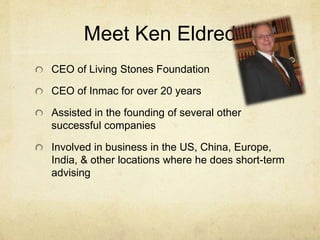
Meet Ken Eldred 
CEO of Living Stones Foundation 
CEO of Inmac for over 20 years 
Assisted in the founding of several other 
successful companies 
Involved in business in the US, China, Europe, 
India, & other locations where he does short-term 
advising
A Quick History of Missions 
God has always communicated his gospel in 
relevant ways 
“Despite an increase in the overall missionary 
effort, the last century has seen Christianity 
achieve no net gain.”
Missions Today 
6% of money given to Christian causes goes to foreign 
missions 
$15.6 billion to 317,000 missionaries in “Christian World” 
$2.1 billion to 106,000 missionaries in “Evangelized Non- 
Christian World” 
1 missionary per 14,000 people and $3.00 per person 
$0.3 billion to 10,500 missionaries in “Unevangelized World” 
1 missionary per 38,000 people and $0.50 per person 
The average missionary budget has not changed in 30 years, 
despite inflation
Barriers to Missions 
It is difficult to enter as a traditional missionary 
It is difficult to conduct evangelism as a traditional 
missionary 
There is a growing distrust for Westerners 
Full-support missionaries in poor nations are 
frequently accused of being everything from CIA 
agents to drug dealers 
Militant & political opposition 
Potential for lifestyle gap
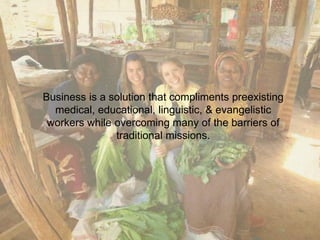
Business is a solution that compliments preexisting 
medical, educational, linguistic, & evangelistic 
workers while overcoming many of the barriers of 
traditional missions.
Why Business People are 
Effective 
Kingdom business is a model for fully self-sustainable business 
Kingdom business brings much needed expertise, technology, & capital 
Kingdom business creates jobs 
Kingdom business builds the local economy & blesses the nation 
Kingdom business provides access to many locations 
Kingdom business presents the gospel by word 
Kingdom business presents the gospel by deed 
Kingdom business enables local funding of the church 
Kingdom business can be a valuable partner for other missions efforts 
Kingdom business taps into an underutilized yet highly capable resource in 
the church
Business for Missions 
Supports functions for 
missions 
Front for missions 
Fundraising source for 
missions
Business and Missions 
Engagement in business and missions as 
separate entities 
“Tentmaking” 
Numerous pitfalls
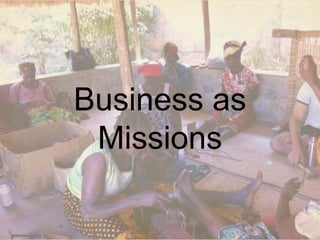
Business as 
Missions
What is Business as 
Missions? 
Kingdom business is for-profit business ventures 
designed to facilitate God’s transformation of people 
and nations spiritually, socially, & economically.
Who’s Involved? 
• Authentic & skilled business 
professionals who use their 
talents to further the 
worldwide mission of the 
Church through Kingdom 
business 
• “The businessperson’s 
ministry is to serve others 
through useful goods & 
helpful services and to 
infuse each personal 
interaction with the 
fragrance of Christ. That is 
his high calling from God.”
Business Missions in 
History 
Business as Mission & Scripture 
Business as Mission has been a constant theme throughout 
the course of history 
“Those engaged in Kingdom business must consider 
themselves agents of transformation rather than agents of 
individual salvation or business development. The difference 
might seem subtle, but I believe it is significant. As agents of 
economic & spiritual transformation, we should seek to 
develop spiritual capital in a nation.”
What is Spiritual Capital? 
Relationship 
s 
Integrity 
Serving 
Quality
Characteristics of Kingdom 
Companies 
Presence of a Christian(s) with a sphere of influence 
A product or service in harmony with God’s creational purpose 
A purpose that is larger and deeper than mere financial profit 
Product and service that is offered with such excellence that it invites 
the opportunity to witness 
Customers are treated with dignity & respect 
Employees are equipped to achieve greater potential in their life and work 
wholeheartedly with faith, hope, and love 
All aspects of business are considered outlets for ministry & subject 
of prayer 
Culture of organizations line up with God’s word & Kingdom purposes 
The business runs on grace 
Servant-leaders
3 Pillars of Kingdom 
Business 
1) Profitability & Sustainability 
2) Local Job & Wealth Creation 
3) Advancement of the Local Church
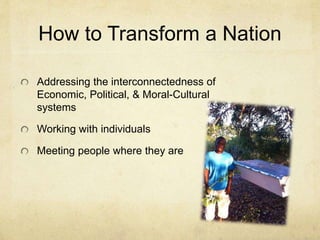
How to Transform a Nation 
Addressing the interconnectedness of 
Economic, Political, & Moral-Cultural 
systems 
Working with individuals 
Meeting people where they are
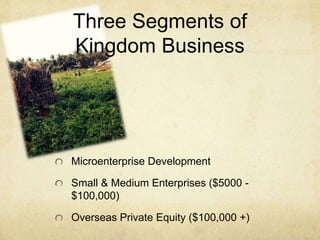
Three Segments of 
Kingdom Business 
Microenterprise Development 
Small & Medium Enterprises ($5000 - 
$100,000) 
Overseas Private Equity ($100,000 +)
Capitalism & Democracy 
On the macro level, Kingdom business should be 
striving toward capitalism & democracy 
The overwhelming advantage to capitalism is the 
notion of inalienable property rights 
Historically, democracies have been more 
profitable in every sphere
Rewards of Kingdom 
Business 
“Businesses that subjected themselves to biblical principles 
were rewarded by the trust, loyalty, & satisfaction of their 
customers.” 
“Kingdom business professionals are uniquely qualified to 
speak about integrity in business and would be remiss to 
repeat the mistake of focusing on transforming economic 
systems without paying attention to the requisite underlying 
moral and spiritual transformation that is needed.”
Arguments 
Obvious bias 
Misinterpretation of Scripture & historical events 
Using Christ as a poster-child for capitalism & 
democracy 
Diminutive Language 
Theology of Retribution
Getting Involved 
Integra Ventures 
World Partners 
Business Professional Network 
Mission India 
International Microenterprise 
Development 
Pura Vida
“God is in the business of doing the outrageous … 
Jesus also compared the kingdom of God to a mustard seed. 
Though originally the smallest of seeds, it grows to become a tree 
larger than all other herbs, such that birds can rest in it. God’s 
Kingdom will grow beyond our expectations. God will do the 
outrageous. We can achieve only the ordinary; only God can do 
the extraordinary. Not even the sky is the limit.”
Are there repercussions of eliminating the environmental 
(“planet”) element? If so, what are they? 
Do we have to change culture to bring about spiritual 
transformation? 
In regards to Eldred’s statement about microenterprise 
being an initial step, but not a long-term solution – do you 
think that certain tactics are more effective for certain 
groups? Should all cultures be pursuing business 
development like the West?

God is at Work by Ken Eldred

  • 1.
    God is at Work Presented By: Jessica Markwood
  • 2.
    “Those two pioneersof civilization – Christianity and commerce – should ever be inseparable.” – David Livingstone
  • 3.
    Meet Ken Eldred CEO of Living Stones Foundation CEO of Inmac for over 20 years Assisted in the founding of several other successful companies Involved in business in the US, China, Europe, India, & other locations where he does short-term advising
  • 4.
    A Quick Historyof Missions God has always communicated his gospel in relevant ways “Despite an increase in the overall missionary effort, the last century has seen Christianity achieve no net gain.”
  • 5.
    Missions Today 6%of money given to Christian causes goes to foreign missions $15.6 billion to 317,000 missionaries in “Christian World” $2.1 billion to 106,000 missionaries in “Evangelized Non- Christian World” 1 missionary per 14,000 people and $3.00 per person $0.3 billion to 10,500 missionaries in “Unevangelized World” 1 missionary per 38,000 people and $0.50 per person The average missionary budget has not changed in 30 years, despite inflation
  • 6.
    Barriers to Missions It is difficult to enter as a traditional missionary It is difficult to conduct evangelism as a traditional missionary There is a growing distrust for Westerners Full-support missionaries in poor nations are frequently accused of being everything from CIA agents to drug dealers Militant & political opposition Potential for lifestyle gap
  • 7.
    Business is asolution that compliments preexisting medical, educational, linguistic, & evangelistic workers while overcoming many of the barriers of traditional missions.
  • 8.
    Why Business Peopleare Effective Kingdom business is a model for fully self-sustainable business Kingdom business brings much needed expertise, technology, & capital Kingdom business creates jobs Kingdom business builds the local economy & blesses the nation Kingdom business provides access to many locations Kingdom business presents the gospel by word Kingdom business presents the gospel by deed Kingdom business enables local funding of the church Kingdom business can be a valuable partner for other missions efforts Kingdom business taps into an underutilized yet highly capable resource in the church
  • 9.
    Business for Missions Supports functions for missions Front for missions Fundraising source for missions
  • 10.
    Business and Missions Engagement in business and missions as separate entities “Tentmaking” Numerous pitfalls
  • 11.
  • 12.
    What is Businessas Missions? Kingdom business is for-profit business ventures designed to facilitate God’s transformation of people and nations spiritually, socially, & economically.
  • 13.
    Who’s Involved? •Authentic & skilled business professionals who use their talents to further the worldwide mission of the Church through Kingdom business • “The businessperson’s ministry is to serve others through useful goods & helpful services and to infuse each personal interaction with the fragrance of Christ. That is his high calling from God.”
  • 14.
    Business Missions in History Business as Mission & Scripture Business as Mission has been a constant theme throughout the course of history “Those engaged in Kingdom business must consider themselves agents of transformation rather than agents of individual salvation or business development. The difference might seem subtle, but I believe it is significant. As agents of economic & spiritual transformation, we should seek to develop spiritual capital in a nation.”
  • 15.
    What is SpiritualCapital? Relationship s Integrity Serving Quality
  • 16.
    Characteristics of Kingdom Companies Presence of a Christian(s) with a sphere of influence A product or service in harmony with God’s creational purpose A purpose that is larger and deeper than mere financial profit Product and service that is offered with such excellence that it invites the opportunity to witness Customers are treated with dignity & respect Employees are equipped to achieve greater potential in their life and work wholeheartedly with faith, hope, and love All aspects of business are considered outlets for ministry & subject of prayer Culture of organizations line up with God’s word & Kingdom purposes The business runs on grace Servant-leaders
  • 17.
    3 Pillars ofKingdom Business 1) Profitability & Sustainability 2) Local Job & Wealth Creation 3) Advancement of the Local Church
  • 18.
    How to Transforma Nation Addressing the interconnectedness of Economic, Political, & Moral-Cultural systems Working with individuals Meeting people where they are
  • 19.
    Three Segments of Kingdom Business Microenterprise Development Small & Medium Enterprises ($5000 - $100,000) Overseas Private Equity ($100,000 +)
  • 20.
    Capitalism & Democracy On the macro level, Kingdom business should be striving toward capitalism & democracy The overwhelming advantage to capitalism is the notion of inalienable property rights Historically, democracies have been more profitable in every sphere
  • 21.
    Rewards of Kingdom Business “Businesses that subjected themselves to biblical principles were rewarded by the trust, loyalty, & satisfaction of their customers.” “Kingdom business professionals are uniquely qualified to speak about integrity in business and would be remiss to repeat the mistake of focusing on transforming economic systems without paying attention to the requisite underlying moral and spiritual transformation that is needed.”
  • 22.
    Arguments Obvious bias Misinterpretation of Scripture & historical events Using Christ as a poster-child for capitalism & democracy Diminutive Language Theology of Retribution
  • 23.
    Getting Involved IntegraVentures World Partners Business Professional Network Mission India International Microenterprise Development Pura Vida
  • 24.
    “God is inthe business of doing the outrageous … Jesus also compared the kingdom of God to a mustard seed. Though originally the smallest of seeds, it grows to become a tree larger than all other herbs, such that birds can rest in it. God’s Kingdom will grow beyond our expectations. God will do the outrageous. We can achieve only the ordinary; only God can do the extraordinary. Not even the sky is the limit.”
  • 25.
    Are there repercussionsof eliminating the environmental (“planet”) element? If so, what are they? Do we have to change culture to bring about spiritual transformation? In regards to Eldred’s statement about microenterprise being an initial step, but not a long-term solution – do you think that certain tactics are more effective for certain groups? Should all cultures be pursuing business development like the West?

Editor's Notes

  • #3 STATEMENT OF MISSION: These two are inseparable. They are needed together & as individual entities working together.
  • #4 Inmac was a public company he founded in India
  • #5 Why is this? I think it’s lack of resources, lack of reception, & lack of relevancy.
  • #7 There are few natural venues for meeting and befriending locals
  • #9 Access: There are only 10,500 missionaries in the unevangelized world, but there are more than 50,000 Christians residing in closed countries doing business there
  • #11 Pitfalls: difficult to deal with the tension between their secular employment & their real purpose; “operating in a framework that ascribes little eternal value to their jobs, tentmakers often view their 9-5 work as a hindrance to ministry”
  • #14 “High callings” are not limited to pastoral roles Sometimes it doesn’t look like preaching at all. Sometimes it means putting on some rice bags & harvesting honey from a bee hive.
  • #15 Paul is the most obvious example of a disciple who used business as mission. He ministered to those in the marketplace. He talked to vendors like Aquila & Priscilla and Lydia, a seller of purple. He also confronts poor business practices like Demetrius the silversmith and slave owners who were making money by manipulating a demon-possessed girl.
  • #18 Job & wealth creation: “We cannot justify support for poor – or illegal – business plans and inexperienced personnel under the guise of some ministry benefit.” (Volunteerism)
  • #19 Economic & Political systems will not change until the moral-cultural system changes Change rarely takes place from the top down. It starts with individuals. (This is Kibonge. He’s learning how to do sustainable beekeeping while learning about the gospel) Though capitalism is most successful in an environment of political freedom, we must begin to bless a nation through Kingdom business just as it is.
  • #20 This tomato farm is a result of Christian microfinance Christian microenterprise development is an initial step, but it is not a long term solution
  • #23 Bias: Eldred is very obviously biased toward business as mission methods of evangelism. He has a tendency to cheapen traditional ministry roles, presenting them as inadequate, and goes so far as to call tentmaking missions “an entry fee” with “little eternal value” and a “distracting hindrance to ministry.” Misinterpretation: “pulling Scripture out of the air” at various times (I Cor 7.20); random parabolic conclusions; Jubilee laws---calls the American Revolution something that had “a passion for personal righteousness & subjection to the authority of God” as opposed to the French Revolution which was built on selfishness, which is why modern France is a secular state (& the only thing worse than the secularization of France is the “aggressive march of Islam”; refers to the Constitution as “a reflection of the law of God written on the hearts of men and women” – the same is the given reason for industrial prosperity in America; Praises the proposed unity of Protestant sects in colonial America and goes on to say that Protestants by nature would be more spiritual and economically successful than Catholics Christ as poster-child: He vaguely points to Scripture & claims Jesus as a capitalist & a democrat; calls capitalism the economic reflection of Judeo-Christian values Diminutive: refers to developing societies as primitive; says developing countries by nature have little to no spiritual capital; communicates that the West is going to be absolutely necessary for any progression in developing nations; “…effective capitalism requires a moral system that nourishes certain values & virtues, & often these are lacking in the cultures of the developing world.”; he seems to have little respect for other cultures (feeding the Muslim pork) & desires to move more toward Western culture than a godly culture; focuses almost entirely on the developing world & pays no attention to the secular West Retribution: It seems a bit much to dedicate so much thought to accumulating spiritual capital in the same way that you accumulate money; “A nation that demonstrates a long pattern of being truthful, of following the rule of law, & of treating others with fairness builds up a huge reserve of spiritual capital.”
  • #24 There are countless churches, educational institutions, & missions organizations getting heavily involved in Business as Missions Integra: raises investment capital & deploys & supports seasoned business professions in Eastern Europe through advising, discipling, and finance promising World Partners: supports local Christian entrepreneurial initiatives in developing nations through financial investment & industry-specific assistance BPN: connects Western Christian professionals with Christian business people in the developing world Mission India: developing a business and ministry matrix that is designed to evaluate Kingdom business IMED: helps impoverished Christians launch & operate microenterprises to the glory of God through a combination of training, consulting, & funding Pura Vida: company that imports, roasts, & distributes coffee from Central America & reinvests the profits in a ministry to at-risk children in San Jose, Costa Rica.
  • #25 Most of the time it would be outrageous to put profit lower on your priority list. It would be outrageous to do business with the poor. It would be outrageous to spend more hours in prayer than in planning. But that’s what business as mission is. It’s a relevant idea with outrageous expectations that are met by an extraordinary God.