MARKETING PRINCIPLES
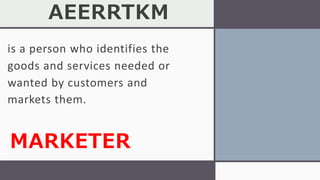
AEERRTKM
is a person who identifies the
goods and services needed or
wanted by customers and
markets them.
MARKETER
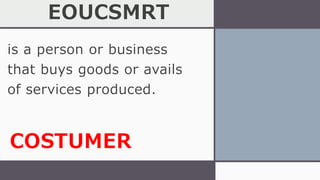
EOUCSMRT
is a person or business
that buys goods or avails
of services produced.
COSTUMER
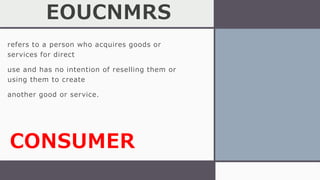
EOUCNMRS
refers to a person who acquires goods or
services for direct
use and has no intention of reselling them or
using them to create
another good or service.
CONSUMER
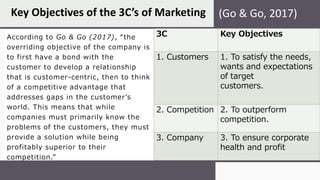
According to Go & Go (2017), “the
overriding objective of the company is
to first have a bond with the
customer to develop a relationship
that is customer-centric, then to think
of a competitive advantage that
addresses gaps in the customer’s
world. This means that while
companies must primarily know the
problems of the customers, they must
provide a solution while being
profitably superior to their
competition.”
3C Key Objectives
1. Customers 1. To satisfy the needs,
wants and expectations
of target
customers.
2. Competition 2. To outperform
competition.
3. Company 3. To ensure corporate
health and profit
Key Objectives of the 3C’s of Marketing (Go & Go, 2017)
The marketing philosophy of “being better
than before, better than others and
better than expected”
can provide a standard for judging
marketing effectiveness.
GOALS OF MARKETING
Goals are aspirations that every company would
like to pursue or the general direction that it
wants to take. Goals serve as the main purpose
of the company and are usually attained in the
long term. Although it is primarily broad, a goal
should not be overly extensive that it becomes
difficult to translate it into specific objectives.
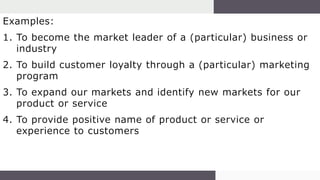
Examples:
1. To become the market leader of a (particular) business or
industry
2. To build customer loyalty through a (particular) marketing
program
3. To expand our markets and identify new markets for our
product or service
4. To provide positive name of product or service or
experience to customers
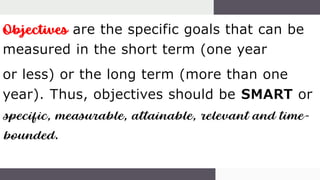
Objectives are the specific goals that can be
measured in the short term (one year
or less) or the long term (more than one
year). Thus, objectives should be SMART or
specific, measurable, attainable, relevant and time-
bounded.
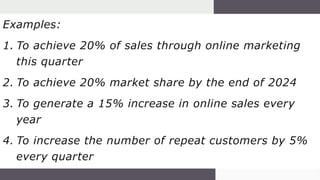
Examples:
1. To achieve 20% of sales through online marketing
this quarter
2. To achieve 20% market share by the end of 2024
3. To generate a 15% increase in online sales every
year
4. To increase the number of repeat customers by 5%
every quarter
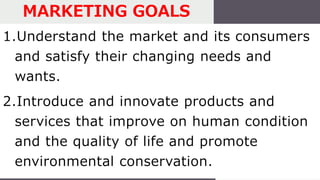
1.Understand the market and its consumers
and satisfy their changing needs and
wants.
2.Introduce and innovate products and
services that improve on human condition
and the quality of life and promote
environmental conservation.
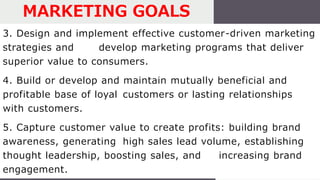
MARKETING GOALS
3. Design and implement effective customer-driven marketing
strategies and develop marketing programs that deliver
superior value to consumers.
4. Build or develop and maintain mutually beneficial and
profitable base of loyal customers or lasting relationships
with customers.
5. Capture customer value to create profits: building brand
awareness, generating high sales lead volume, establishing
thought leadership, boosting sales, and increasing brand
engagement.
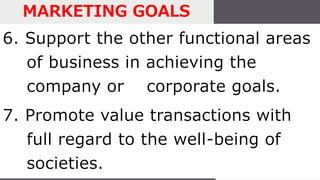
MARKETING GOALS
6. Support the other functional areas
of business in achieving the
company or corporate goals.
7. Promote value transactions with
full regard to the well-being of
societies.
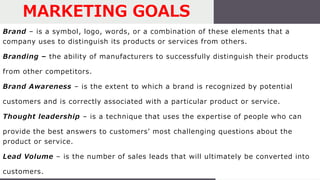
MARKETING GOALS
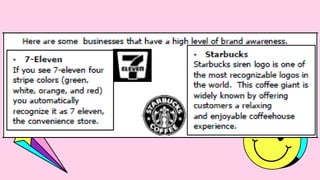
Brand – is a symbol, logo, words, or a combination of these elements that a
company uses to distinguish its products or services from others.
Branding – the ability of manufacturers to successfully distinguish their products
from other competitors.
Brand Awareness – is the extent to which a brand is recognized by potential
customers and is correctly associated with a particular product or service.
Thought leadership – is a technique that uses the expertise of people who can
provide the best answers to customers’ most challenging questions about the
product or service.
Lead Volume – is the number of sales leads that will ultimately be converted into
customers.
MARKETING GOALS
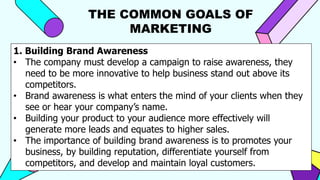
THE COMMON GOALS OF
MARKETING
1. Building Brand Awareness
• The company must develop a campaign to raise awareness, they
need to be more innovative to help business stand out above its
competitors.
• Brand awareness is what enters the mind of your clients when they
see or hear your company’s name.
• Building your product to your audience more effectively will
generate more leads and equates to higher sales.
• The importance of building brand awareness is to promotes your
business, by building reputation, differentiate yourself from
competitors, and develop and maintain loyal customers.
TRADITIONAL AND CONTEMPORARY
MARKETING CONCEPTS,
APPROACHES AND ADVERTISING
CHANNELS
• Marketing’s history has its humble
beginnings of simply trying to sell
goods and services. Activities and
efforts to develop persuasive
communications may have been as old
as civilization itself but may have not
been recognized as a marketing
business at that time.
• Simple marketing activities in the modern
era were first practiced during the Industrial
Revolution. According to (So, Torres, & De
Guzman, 2016), evident up to the late
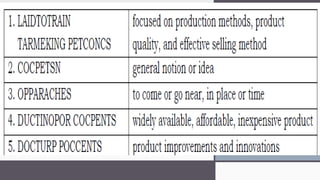
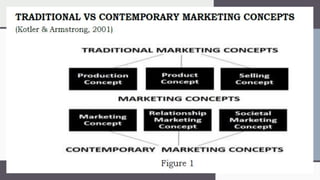
1960s, traditional marketing concepts are
focused on production methods, product
quality, and effective selling methods as
profit drivers in marketing.
According to So, Torres, & De Guzman, 2016,
the production concept assumes
that customers prefer products that are
inexpensive, affordable, and widely
available, and that efforts are focused on
expanding distribution, and improving
production efficiency.
The Production Concept
When a company manufactures only one
product in large quantities and
fails to identify the number of customers who
are willing to buy them, the company
ends up with surplus products. This can also
happen when one believes that one’s
own product is unique.
The Production Concept
The term “Marketing myopia” or
marketing short sightedness, coined by
Theodore Levitt 1960, refers to a near-
sighted focus on selling products and
services, rather than seeing the “big
picture” of what customers really want.
The Production Concept
Levitt encouraged
executives to switch from
production orientation to
consumer orientation.
The Production Concept
This concept focuses on the product and its
improvements and innovations to attract
customers. This concept assumes that
customers will always prefer and patronize
products of high quality, thus, product
attributes and features are continuously
enhanced. This approach was considered a
solution to the limitations of the production
The Product Concept
Limitation of Product Concept:
1. Customers may consider the new features
unnecessary and would therefore not be convinced
to buy the product.
2. Product is often improvised and manufactured
without understanding the needs of the customers
and their willingness to spend for it.
The Product Concept
This concept relies on the strength of the
company’s sales force in convincing the
customers to buy the product even if they
do not need it. According to Theodore C.
Levitt, “selling concerns itself with the
tricks and techniques of getting people to
exchange their cash for a product.”
3. The Selling Concept
The mastery in selling techniques or the use of
aggressive selling tactics and promotional efforts
likely guarantees sales, although this is achieved
through hard selling. This is commonly known as
personal selling – a promotional tool wherein a
salesperson uses selling techniques to persuade a
customer to purchase a good or avail of a service.
It uses sales skills to build a personal relationship
with a customer.
3. The Selling Concept
However, since this orientation prioritizes sales, it
pays little attention to the customers’ actual need
for the product, which results in failure of the
business.
Thus, according to Theodore C. Levitt, selling is
different from marketing’s concern which is to
develop a demand for a product and fulfilling the
customer’s need.
3. The Selling Concept
Contemporary
Marketing Concepts
The Marketing Concept
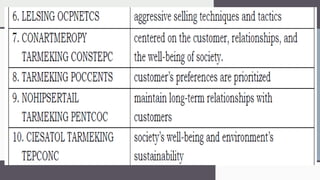
Also known as a customer-centric orientation, this
focuses on the customers’ preferences – what they
want, how much they are willing to pay, what form and
feature they prefer, etc. – are prioritized. The company
researches about the target customers (customers who
would be served best by the company) and matches
the result of their research with the offering (product
or service) of the company.
Its drawback is in the implementation as
follows:
1. If the customers’ needs and wants are satisfied, what happens to
the society and the environment affected by these marketing
activities?
2. Would the product or service be still offered if it harms the
environment?
3. Does the product or service contribute to the customer’s quality
of life?
2. The Relationship Marketing Concept
This concept believes that all marketing activities are for the
purpose of establishing, maintaining, and strengthening
meaningful long-term relationships with customers.
Extensive customer databases are created, maintained, and
updated. Customer profiles, purchase habits, and
preferences are tracked and monitored. This is to ensure
that customers’ needs are fulfilled and the relationship with
them is maintained.
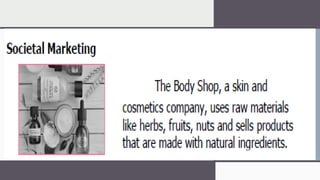
The Societal Marketing Concepts
This is like marketing orientation except that concern
for the society’s well-being and the environment’s
sustainability is prioritized as much as customer’s
preferences. Thus, the evelopment of products that
contribute to the quality of life and the environment is
encouraged and often supported by caused-oriented
groups. This marketing approach is also called green
marketing and the product is called green product.
Customers can be classified as:
1. new-generation customers – are younger and more open
to products and technologies.
2. old-generation customers – tend to be loyal to traditional
products and it would take time for them to adopt new
products associated with technology. They are well
entrenched in their comfort zones and remain reluctant to
embrace new products and technologies.
TRADITIONAL VS CONTEMPORARY MARKETING
APPROACHES / ADVERTISING CHANNELS
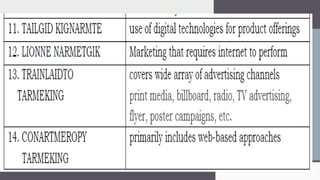
Traditional marketing covers a wide array of
marketing technique and advertising channels before
the rise of technology that include primarily word-of-
mouth marketing, the print media (flyers, brochures,
newspaper articles, magazines, poster campaigns),
out-of-home advertisements (billboards, and public
transport), and broadcast advertising (radio and TV
ads), and direct mail and telephone.
TRADITIONAL VS CONTEMPORARY MARKETING
APPROACHES / ADVERTISING CHANNELS
Contemporary marketing primarily includes web-based
approaches such as digital marketing, online marketing,
email-marketing, and the like.
Marketing with the contemporary methods will revolutionize
the way you do business. The world is constantly changing.
Technological advancements are taking place like electronic
devices, telecommunication services and internet, and now
social media; the global trends; and the customer preferences
have created both business opportunities and threats for
marketers and businesses.
Contemporary Marketing Approaches
Digital Marketing – is an umbrella term that includes
anything that requires the use of an electronic device or
digital technologies, including online marketing,in presenting
the product or service offerings of a company. Electronic
devices include computers, mobile phones, TV, DVD and CD
players, and digital cameras, game systems and MP3, MP4
players, among many others. Digital marketing examples
include broadcasting, podcasts and e-books, digital out-of-
home (OOH) advertisements (like the large screen monitors
that display ads which are placed in strategic places where
there is heavy commuter traffic).
Contemporary Marketing Approaches
Mobile marketing is any advertising activity in which technology can be
used to create personalized promotion of goods or services to a user
who is constantly connected to a network via mobile devices such as
tablets and smartphones. By making use of the mobile devices’ features
such as location services, a marketer can tailor fit marketing campaigns
based on an individual user's location via promotions sent thru SMS
text messaging, MMS multi media messaging, thru apps using push
notifications, thru in-app or in-game marketing, thru scanning QR
codes, etc. Proximity systems and location-based services can alert
users based on geographic location or proximity to a service provider.
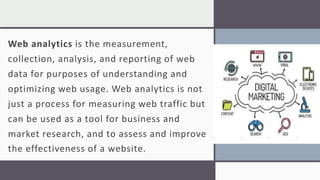
Web analytics is the measurement,
collection, analysis, and reporting of web
data for purposes of understanding and
optimizing web usage. Web analytics is not
just a process for measuring web traffic but
can be used as a tool for business and
market research, and to assess and improve
the effectiveness of a website.
Online Marketing or E-Marketing – this is a
subset of digital marketing and refers to content
delivered via the internet to boost promotional
and marketing efforts. Any marketing that
requires the internet to perform to attract
customers
and build an online presence is considered online marketing.
Examples of methods used are websites, blogs, social media, e-zines,
and emails (for automated emailing of product information to
customers). Today, especially this pandemic, online stores today like
Lazada, Zalora, OLX, Ayosdito, and Pinoydvd have become alternatives
to physical stores in terms of providing customers access to products
and services. Online stores have utilized social media networks to
bolster theiradvertising campaigns.
Search engine marketing (SEM) is the
most prevalent method of building an
online presence. SEM is online marketing
that attempts to increase an organization’s
visibility on search engines. There are two
main methods in SEM:
1. Search Engine Optimization (SEO) - SEO is a long-
term strategy that attempts to make content on web
pages more accessible and discoverable through search
engines. It optimizes websites for targeted keywords
related to the organization, helping the website rank
higher on search engines when the keywords are
searched.
2. Pay-per-click (PPC) ads. PPC ads, such as Google
AdWords, provide guaranteed visibility at a fee. While it
can be more expensive than SEO, you are only charged
when a person clicks on the ad. PPC models allow
organizations to manage their expectations effectively.
Social Media Marketing makes specific use of social networking
websites and relevant applications in promoting a company’s
products and services. It involves creating and sharing content
on social media networks in order to achieve your marketing
and branding goals. Social media marketing includes activities
like posting text and image updates, videos, and other content
that drives audience engagement, as well as paid social media
advertising. Social media marketing is a powerful way for
businesses of all sizes to reach prospects and customers.
Facebook, as we all know, is the most popular form of social
media site that marketers take advantage of among millions of
users. Some create Facebook profile pages where they post links
to their website and other promotional pages. Other social
media platforms are Instagram, LinkedIn, Twitter, YouTube,
Pinterest, Snapchat, Tumblr, etc.
Vlogs & blogging is also a major aspect of social media
websites. Bloggers are now professionally hired by advertising
companies to promote products – they write blog entries
describing certain products or recounting the blogger’s
experiences in using them. These credible bloggers have
practically taken over company websites as the go-to-place to
get information, as boggers are more fun, personalized, and
objective in their information sharing.
Today there are countless digital apps that enable consumers to
live a more convenient life, Lalamove, Maxim, Uber, Angkas for
transportation, Airbnb for renting rooms, Waze for traffic and
route advise, Spotify for music, Pinterest for sharing themes in
digital bulletin board. Even emojis and hashtags are being used
in communicating to customers in making sure their brand stays
on top of the mind of its customers.
Outdoor Promotion/Marketing - refers to
advertising campaigns that employ outdoor
media such as billboards, transit vehicles and
other types of outdoor signs, including the signs
on the outside of businesses. Video walls and
digital billboards are gradually replacing the
traditional billboards to display promotional
materials for products and services outdoors.
The technology uses LED video screen that is
big and bright enough to be clearly seen by the
public. It is normally placed in strategic
locations where a lot of people can view it.
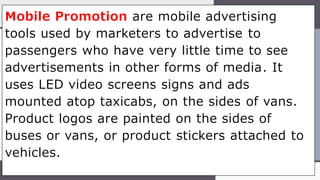
Mobile Promotion are mobile advertising
tools used by marketers to advertise to
passengers who have very little time to see
advertisements in other forms of media. It
uses LED video screens signs and ads
mounted atop taxicabs, on the sides of vans.
Product logos are painted on the sides of
buses or vans, or product stickers attached to
vehicles.
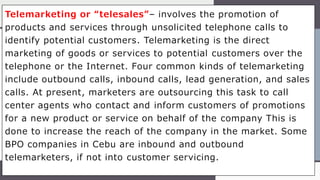
Telemarketing or “telesales”– involves the promotion of
products and services through unsolicited telephone calls to
identify potential customers. Telemarketing is the direct
marketing of goods or services to potential customers over the
telephone or the Internet. Four common kinds of telemarketing
include outbound calls, inbound calls, lead generation, and sales
calls. At present, marketers are outsourcing this task to call
center agents who contact and inform customers of promotions
for a new product or service on behalf of the company This is
done to increase the reach of the company in the market. Some
BPO companies in Cebu are inbound and outbound
telemarketers, if not into customer servicing.
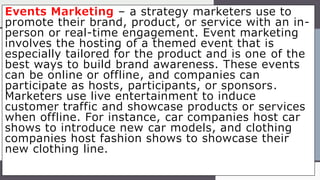
Events Marketing – a strategy marketers use to
promote their brand, product, or service with an in-
person or real-time engagement. Event marketing
involves the hosting of a themed event that is
especially tailored for the product and is one of the
best ways to build brand awareness. These events
can be online or offline, and companies can
participate as hosts, participants, or sponsors.
Marketers use live entertainment to induce
customer traffic and showcase products or services
when offline. For instance, car companies host car
shows to introduce new car models, and clothing
companies host fashion shows to showcase their
new clothing line.
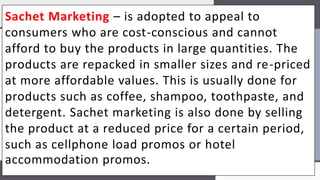
Sachet Marketing – is adopted to appeal to
consumers who are cost-conscious and cannot
afford to buy the products in large quantities. The
products are repacked in smaller sizes and re-priced
at more affordable values. This is usually done for
products such as coffee, shampoo, toothpaste, and
detergent. Sachet marketing is also done by selling
the product at a reduced price for a certain period,
such as cellphone load promos or hotel
accommodation promos.

GOALS-OBJECTIVES-MARKETING-APPROACHES-TYPES.pdf

  • 1.
  • 2.
    AEERRTKM is a personwho identifies the goods and services needed or wanted by customers and markets them. MARKETER
  • 3.
    EOUCSMRT is a personor business that buys goods or avails of services produced. COSTUMER
  • 4.
    EOUCNMRS refers to aperson who acquires goods or services for direct use and has no intention of reselling them or using them to create another good or service. CONSUMER
  • 5.
    According to Go& Go (2017), “the overriding objective of the company is to first have a bond with the customer to develop a relationship that is customer-centric, then to think of a competitive advantage that addresses gaps in the customer’s world. This means that while companies must primarily know the problems of the customers, they must provide a solution while being profitably superior to their competition.” 3C Key Objectives 1. Customers 1. To satisfy the needs, wants and expectations of target customers. 2. Competition 2. To outperform competition. 3. Company 3. To ensure corporate health and profit Key Objectives of the 3C’s of Marketing (Go & Go, 2017)
  • 6.
    The marketing philosophyof “being better than before, better than others and better than expected” can provide a standard for judging marketing effectiveness.
  • 7.
  • 8.
    Goals are aspirationsthat every company would like to pursue or the general direction that it wants to take. Goals serve as the main purpose of the company and are usually attained in the long term. Although it is primarily broad, a goal should not be overly extensive that it becomes difficult to translate it into specific objectives.
  • 9.
    Examples: 1. To becomethe market leader of a (particular) business or industry 2. To build customer loyalty through a (particular) marketing program 3. To expand our markets and identify new markets for our product or service 4. To provide positive name of product or service or experience to customers
  • 10.
    Objectives are thespecific goals that can be measured in the short term (one year or less) or the long term (more than one year). Thus, objectives should be SMART or specific, measurable, attainable, relevant and time- bounded.
  • 11.
    Examples: 1. To achieve20% of sales through online marketing this quarter 2. To achieve 20% market share by the end of 2024 3. To generate a 15% increase in online sales every year 4. To increase the number of repeat customers by 5% every quarter
  • 12.
    1.Understand the marketand its consumers and satisfy their changing needs and wants. 2.Introduce and innovate products and services that improve on human condition and the quality of life and promote environmental conservation. MARKETING GOALS
  • 13.
    3. Design andimplement effective customer-driven marketing strategies and develop marketing programs that deliver superior value to consumers. 4. Build or develop and maintain mutually beneficial and profitable base of loyal customers or lasting relationships with customers. 5. Capture customer value to create profits: building brand awareness, generating high sales lead volume, establishing thought leadership, boosting sales, and increasing brand engagement. MARKETING GOALS
  • 14.
    6. Support theother functional areas of business in achieving the company or corporate goals. 7. Promote value transactions with full regard to the well-being of societies. MARKETING GOALS
  • 15.
    Brand – isa symbol, logo, words, or a combination of these elements that a company uses to distinguish its products or services from others. Branding – the ability of manufacturers to successfully distinguish their products from other competitors. Brand Awareness – is the extent to which a brand is recognized by potential customers and is correctly associated with a particular product or service. Thought leadership – is a technique that uses the expertise of people who can provide the best answers to customers’ most challenging questions about the product or service. Lead Volume – is the number of sales leads that will ultimately be converted into customers. MARKETING GOALS
  • 16.
    THE COMMON GOALSOF MARKETING 1. Building Brand Awareness • The company must develop a campaign to raise awareness, they need to be more innovative to help business stand out above its competitors. • Brand awareness is what enters the mind of your clients when they see or hear your company’s name. • Building your product to your audience more effectively will generate more leads and equates to higher sales. • The importance of building brand awareness is to promotes your business, by building reputation, differentiate yourself from competitors, and develop and maintain loyal customers.
  • 26.
    TRADITIONAL AND CONTEMPORARY MARKETINGCONCEPTS, APPROACHES AND ADVERTISING CHANNELS
  • 28.
    • Marketing’s historyhas its humble beginnings of simply trying to sell goods and services. Activities and efforts to develop persuasive communications may have been as old as civilization itself but may have not been recognized as a marketing business at that time.
  • 29.
    • Simple marketingactivities in the modern era were first practiced during the Industrial Revolution. According to (So, Torres, & De Guzman, 2016), evident up to the late 1960s, traditional marketing concepts are focused on production methods, product quality, and effective selling methods as profit drivers in marketing.
  • 30.
    According to So,Torres, & De Guzman, 2016, the production concept assumes that customers prefer products that are inexpensive, affordable, and widely available, and that efforts are focused on expanding distribution, and improving production efficiency. The Production Concept
  • 31.
    When a companymanufactures only one product in large quantities and fails to identify the number of customers who are willing to buy them, the company ends up with surplus products. This can also happen when one believes that one’s own product is unique. The Production Concept
  • 32.
    The term “Marketingmyopia” or marketing short sightedness, coined by Theodore Levitt 1960, refers to a near- sighted focus on selling products and services, rather than seeing the “big picture” of what customers really want. The Production Concept
  • 33.
    Levitt encouraged executives toswitch from production orientation to consumer orientation. The Production Concept
  • 35.
    This concept focuseson the product and its improvements and innovations to attract customers. This concept assumes that customers will always prefer and patronize products of high quality, thus, product attributes and features are continuously enhanced. This approach was considered a solution to the limitations of the production The Product Concept
  • 36.
    Limitation of ProductConcept: 1. Customers may consider the new features unnecessary and would therefore not be convinced to buy the product. 2. Product is often improvised and manufactured without understanding the needs of the customers and their willingness to spend for it. The Product Concept
  • 38.
    This concept relieson the strength of the company’s sales force in convincing the customers to buy the product even if they do not need it. According to Theodore C. Levitt, “selling concerns itself with the tricks and techniques of getting people to exchange their cash for a product.” 3. The Selling Concept
  • 39.
    The mastery inselling techniques or the use of aggressive selling tactics and promotional efforts likely guarantees sales, although this is achieved through hard selling. This is commonly known as personal selling – a promotional tool wherein a salesperson uses selling techniques to persuade a customer to purchase a good or avail of a service. It uses sales skills to build a personal relationship with a customer. 3. The Selling Concept
  • 40.
    However, since thisorientation prioritizes sales, it pays little attention to the customers’ actual need for the product, which results in failure of the business. Thus, according to Theodore C. Levitt, selling is different from marketing’s concern which is to develop a demand for a product and fulfilling the customer’s need. 3. The Selling Concept
  • 42.
  • 43.
    The Marketing Concept Alsoknown as a customer-centric orientation, this focuses on the customers’ preferences – what they want, how much they are willing to pay, what form and feature they prefer, etc. – are prioritized. The company researches about the target customers (customers who would be served best by the company) and matches the result of their research with the offering (product or service) of the company.
  • 44.
    Its drawback isin the implementation as follows: 1. If the customers’ needs and wants are satisfied, what happens to the society and the environment affected by these marketing activities? 2. Would the product or service be still offered if it harms the environment? 3. Does the product or service contribute to the customer’s quality of life?
  • 46.
    2. The RelationshipMarketing Concept This concept believes that all marketing activities are for the purpose of establishing, maintaining, and strengthening meaningful long-term relationships with customers. Extensive customer databases are created, maintained, and updated. Customer profiles, purchase habits, and preferences are tracked and monitored. This is to ensure that customers’ needs are fulfilled and the relationship with them is maintained.
  • 47.
    The Societal MarketingConcepts This is like marketing orientation except that concern for the society’s well-being and the environment’s sustainability is prioritized as much as customer’s preferences. Thus, the evelopment of products that contribute to the quality of life and the environment is encouraged and often supported by caused-oriented groups. This marketing approach is also called green marketing and the product is called green product.
  • 49.
    Customers can beclassified as: 1. new-generation customers – are younger and more open to products and technologies. 2. old-generation customers – tend to be loyal to traditional products and it would take time for them to adopt new products associated with technology. They are well entrenched in their comfort zones and remain reluctant to embrace new products and technologies.
  • 50.
    TRADITIONAL VS CONTEMPORARYMARKETING APPROACHES / ADVERTISING CHANNELS Traditional marketing covers a wide array of marketing technique and advertising channels before the rise of technology that include primarily word-of- mouth marketing, the print media (flyers, brochures, newspaper articles, magazines, poster campaigns), out-of-home advertisements (billboards, and public transport), and broadcast advertising (radio and TV ads), and direct mail and telephone.
  • 51.
    TRADITIONAL VS CONTEMPORARYMARKETING APPROACHES / ADVERTISING CHANNELS Contemporary marketing primarily includes web-based approaches such as digital marketing, online marketing, email-marketing, and the like. Marketing with the contemporary methods will revolutionize the way you do business. The world is constantly changing. Technological advancements are taking place like electronic devices, telecommunication services and internet, and now social media; the global trends; and the customer preferences have created both business opportunities and threats for marketers and businesses.
  • 52.
    Contemporary Marketing Approaches DigitalMarketing – is an umbrella term that includes anything that requires the use of an electronic device or digital technologies, including online marketing,in presenting the product or service offerings of a company. Electronic devices include computers, mobile phones, TV, DVD and CD players, and digital cameras, game systems and MP3, MP4 players, among many others. Digital marketing examples include broadcasting, podcasts and e-books, digital out-of- home (OOH) advertisements (like the large screen monitors that display ads which are placed in strategic places where there is heavy commuter traffic).
  • 53.
    Contemporary Marketing Approaches Mobilemarketing is any advertising activity in which technology can be used to create personalized promotion of goods or services to a user who is constantly connected to a network via mobile devices such as tablets and smartphones. By making use of the mobile devices’ features such as location services, a marketer can tailor fit marketing campaigns based on an individual user's location via promotions sent thru SMS text messaging, MMS multi media messaging, thru apps using push notifications, thru in-app or in-game marketing, thru scanning QR codes, etc. Proximity systems and location-based services can alert users based on geographic location or proximity to a service provider.
  • 54.
    Web analytics isthe measurement, collection, analysis, and reporting of web data for purposes of understanding and optimizing web usage. Web analytics is not just a process for measuring web traffic but can be used as a tool for business and market research, and to assess and improve the effectiveness of a website.
  • 55.
    Online Marketing orE-Marketing – this is a subset of digital marketing and refers to content delivered via the internet to boost promotional and marketing efforts. Any marketing that requires the internet to perform to attract customers
  • 56.
    and build anonline presence is considered online marketing. Examples of methods used are websites, blogs, social media, e-zines, and emails (for automated emailing of product information to customers). Today, especially this pandemic, online stores today like Lazada, Zalora, OLX, Ayosdito, and Pinoydvd have become alternatives to physical stores in terms of providing customers access to products and services. Online stores have utilized social media networks to bolster theiradvertising campaigns.
  • 57.
    Search engine marketing(SEM) is the most prevalent method of building an online presence. SEM is online marketing that attempts to increase an organization’s visibility on search engines. There are two main methods in SEM:
  • 58.
    1. Search EngineOptimization (SEO) - SEO is a long- term strategy that attempts to make content on web pages more accessible and discoverable through search engines. It optimizes websites for targeted keywords related to the organization, helping the website rank higher on search engines when the keywords are searched. 2. Pay-per-click (PPC) ads. PPC ads, such as Google AdWords, provide guaranteed visibility at a fee. While it can be more expensive than SEO, you are only charged when a person clicks on the ad. PPC models allow organizations to manage their expectations effectively.
  • 59.
    Social Media Marketingmakes specific use of social networking websites and relevant applications in promoting a company’s products and services. It involves creating and sharing content on social media networks in order to achieve your marketing and branding goals. Social media marketing includes activities like posting text and image updates, videos, and other content that drives audience engagement, as well as paid social media advertising. Social media marketing is a powerful way for businesses of all sizes to reach prospects and customers. Facebook, as we all know, is the most popular form of social media site that marketers take advantage of among millions of users. Some create Facebook profile pages where they post links to their website and other promotional pages. Other social media platforms are Instagram, LinkedIn, Twitter, YouTube, Pinterest, Snapchat, Tumblr, etc.
  • 60.
    Vlogs & bloggingis also a major aspect of social media websites. Bloggers are now professionally hired by advertising companies to promote products – they write blog entries describing certain products or recounting the blogger’s experiences in using them. These credible bloggers have practically taken over company websites as the go-to-place to get information, as boggers are more fun, personalized, and objective in their information sharing. Today there are countless digital apps that enable consumers to live a more convenient life, Lalamove, Maxim, Uber, Angkas for transportation, Airbnb for renting rooms, Waze for traffic and route advise, Spotify for music, Pinterest for sharing themes in digital bulletin board. Even emojis and hashtags are being used in communicating to customers in making sure their brand stays on top of the mind of its customers.
  • 61.
    Outdoor Promotion/Marketing -refers to advertising campaigns that employ outdoor media such as billboards, transit vehicles and other types of outdoor signs, including the signs on the outside of businesses. Video walls and digital billboards are gradually replacing the traditional billboards to display promotional materials for products and services outdoors. The technology uses LED video screen that is big and bright enough to be clearly seen by the public. It is normally placed in strategic locations where a lot of people can view it.
  • 62.
    Mobile Promotion aremobile advertising tools used by marketers to advertise to passengers who have very little time to see advertisements in other forms of media. It uses LED video screens signs and ads mounted atop taxicabs, on the sides of vans. Product logos are painted on the sides of buses or vans, or product stickers attached to vehicles.
  • 63.
    Telemarketing or “telesales”–involves the promotion of products and services through unsolicited telephone calls to identify potential customers. Telemarketing is the direct marketing of goods or services to potential customers over the telephone or the Internet. Four common kinds of telemarketing include outbound calls, inbound calls, lead generation, and sales calls. At present, marketers are outsourcing this task to call center agents who contact and inform customers of promotions for a new product or service on behalf of the company This is done to increase the reach of the company in the market. Some BPO companies in Cebu are inbound and outbound telemarketers, if not into customer servicing.
  • 64.
    Events Marketing –a strategy marketers use to promote their brand, product, or service with an in- person or real-time engagement. Event marketing involves the hosting of a themed event that is especially tailored for the product and is one of the best ways to build brand awareness. These events can be online or offline, and companies can participate as hosts, participants, or sponsors. Marketers use live entertainment to induce customer traffic and showcase products or services when offline. For instance, car companies host car shows to introduce new car models, and clothing companies host fashion shows to showcase their new clothing line.
  • 65.
    Sachet Marketing –is adopted to appeal to consumers who are cost-conscious and cannot afford to buy the products in large quantities. The products are repacked in smaller sizes and re-priced at more affordable values. This is usually done for products such as coffee, shampoo, toothpaste, and detergent. Sachet marketing is also done by selling the product at a reduced price for a certain period, such as cellphone load promos or hotel accommodation promos.