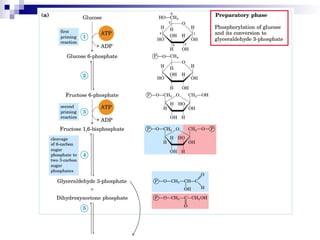
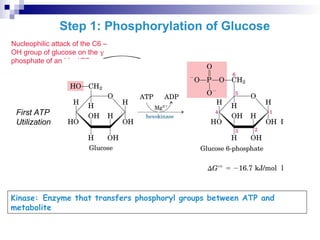
Step 1: Phosphorylationof Glucose
Nucleophilic attack of the C6 –
OH group of glucose on the
phosphate of an Mg-ATP
..
Kinase: Enzyme that transfers phosphoryl groups between ATP and
metabolite
First ATP
Utilization
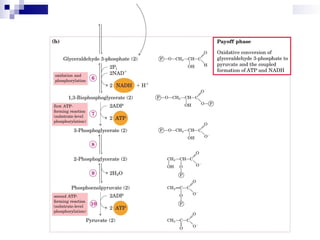
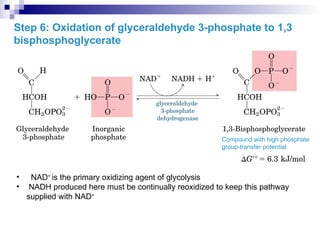
• NAD+
is theprimary oxidizing agent of glycolysis
• NADH produced here must be continually reoxidized to keep this pathway
supplied with NAD+
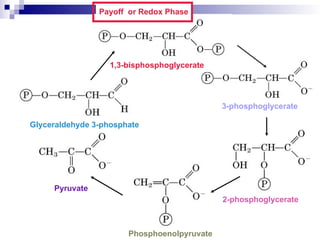
Step 6: Oxidation of glyceraldehyde 3-phosphate to 1,3
bisphosphoglycerate
Compound with high phosphate
group-transfer potential
18.
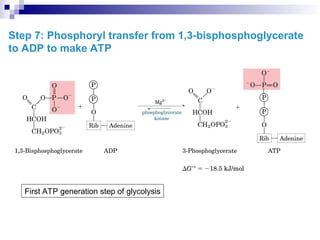
Step 7: Phosphoryltransfer from 1,3-bisphosphoglycerate
to ADP to make ATP
First ATP generation step of glycolysis
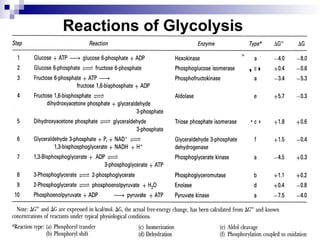
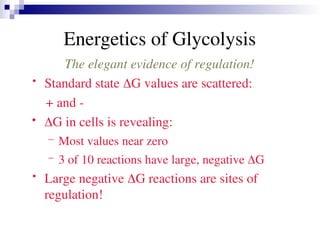
Energetics of Glycolysis
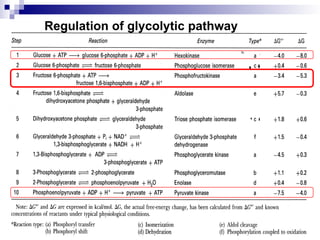
Theelegant evidence of regulation!
• Standard state G values are scattered:
+ and -
G in cells is revealing:
– Most values near zero
– 3 of 10 reactions have large, negative G
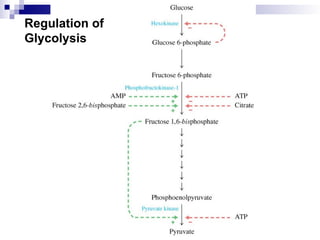
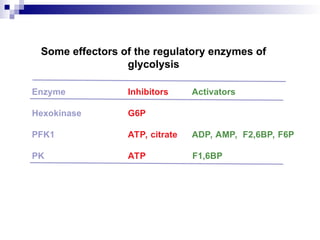
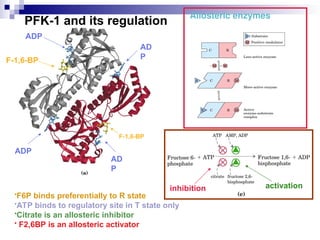
• Large negative G reactions are sites of
regulation!
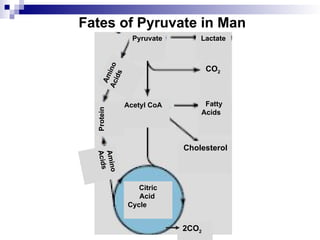
Fates of Pyruvatein Man
2CO2
Cholesterol
CO2
Lactate
Pyruvate
Acetyl CoA
Citric
Acid
Cycle
A
m
i
n
o
A
c
i
d
s
A
m
i
n
o
A
c
i
d
s
Protein Fatty
Acids
33.
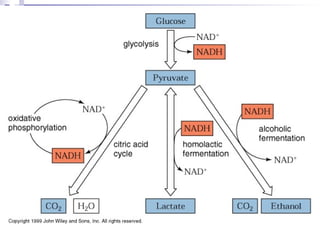
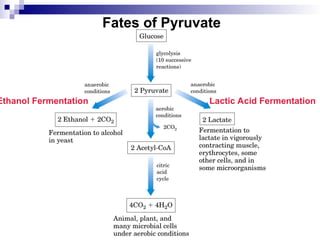
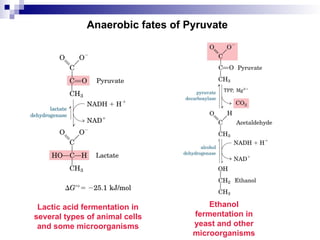
Anaerobic fates ofPyruvate
Ethanol
fermentation in
yeast and other
microorganisms
Lactic acid fermentation in
several types of animal cells
and some microorganisms



![Carbohydrate Metabolism lecture 1 (Glycolysis) [Autosaved].pptx](https://cdn.slidesharecdn.com/ss_thumbnails/carbohydratemetabolismlecture1glycolysisautosaved-250923051041-f5c76835-thumbnail.jpg?width=640&height=640&fit=bounds)


![CTEV [ clubfoot] DR ARUN LAL ,DR MOHAMED ASHRAF travancore medical college k...](https://cdn.slidesharecdn.com/ss_thumbnails/ctevclubfootdrarunlaldrmohamedashraftravancoremedicalcollegekollamkeralaindia-260208063247-18fc466c-thumbnail.jpg?width=640&height=640&fit=bounds)


![PERI-PROSTHETIC FRACTURE NAIL-PLATE CONSTRUCT [NPC].pptx](https://cdn.slidesharecdn.com/ss_thumbnails/drarunkumardrmohamedashrafperiprostheticfrasturenail-plateconstructnpc-260209164459-7e9d15a1-thumbnail.jpg?width=640&height=640&fit=bounds)


