GLUTEAL REGION
DrVishwajit Deshmukh
Anatomy Department
AIIMS Nagpur
• The gluteal region lies posterolateral to the bony pelvis and proximal end
of the femur.
• Muscles in the region mainly abduct, extend, and laterally rotate the femur
relative to the pelvic bone
• The gluteal region communicates anteromedially with the pelvic cavity and
perineum through the greater and lesser sciatic foramina, respectively.
• Inferiorly, it is continuous with the posterior thigh
• The sciatic nerve enters the lower limb from the pelvic cavity by passing
through the greater sciatic foramen and descending through the gluteal
region into the posterior thigh and then into the leg and foot.
Introduction
Communications
Important parts and Gluteal lines
Muscles of the gluteal region are mainly in two groups:
A deep group of small muscles, which are mainly lateral
rotators of the femur at the hip joint and include piriformis,
obturator internus, gemellus superior, gemellus inferior, and
quadratus femoris
A more superficial group of larger muscles, which mainly
abduct and extend the hip and include the gluteus minimus,
gluteus medius, and gluteus maximus-an additional muscle in
this group, the tensor fasciae latae.
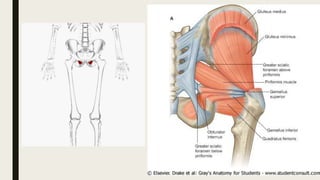
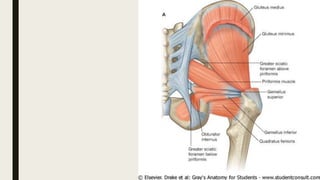
• The piriformis muscle is the most superior of the deep group of muscles and is a
muscle of the pelvic wall and of the gluteal region. It originates from between the
anterior sacral foramina on the anterolateral surface of the sacrum and passes
laterally and inferiorly through the greater sciatic foramen.
• In the gluteal region, piriformis passes posterior
to the hip joint and attaches to a facet on the
upper margin of the greater trochanter of the
femur
• Piriformis externally rotates and abducts the
femur at the hip joint and is innervated in the
pelvic cavity by the nerve to piriformis, which
originates from S1 and S2 of the sacral plexus
Piriformis
• In addition to its action on the hip joint, the piriformis is an
important landmark because it divides the greater sciatic foramen
into two regions, one above and one below the piriformis.
• Vessels and nerves pass between the pelvis and gluteal region by
passing through the greater sciatic foramen either above or below
the piriformis
Piriformis
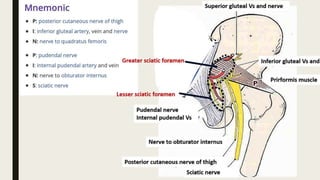
The superior gluteal nerves and vessels pass through the greater
sciatic foramen above piriformis;
All other vessels and nerves passing between the pelvis and the
gluteal region, including the sciatic nerve, pass through the
greater sciatic foramen below the piriformis.
• The obturator internus muscle, like the piriformis muscle, is a muscle of the
pelvic wall and of the gluteal region.
• It is a flat fan-shaped muscle originating from the medial surface of the obturator
membrane and obturator foramen.
Obturator internus
• The muscle fibers of the obturator internus
converge to form a tendon, which bends 90°
around the ischium between the ischial spine
and ischial tuberosity and passes through the
lesser sciatic foramen to enter the gluteal
region.
• The tendon then passes posteroinferiorly to the
hip joint and attaches to the medial surface of
the superior margin of the greater trochanter of
the femur just inferior to the attachment of the
piriformis muscle.
Obturator internus
laterally rotates and
abducts the femur at
the hip joint and is
innervated by the nerve
to the obturator internus
Gemellus superior and inferior
• Gemellus superior and inferior (gemelli is Latin for twins) are a pair of triangular muscles associated
with the upper and lower margins of the obturator internus tendon
 The base of gemellus superior originates from the gluteal surface of the ischial spine
 The base of gemellus inferior originates from the upper gluteal and pelvic surfaces of the
ischial tuberosity.
• Fibers of the gemellus muscles attach along the length of the obturator internus tendon, and the
apices of the two muscles insert with the tendon of obturator internus on the greater trochanter of the
femur
• Gemellus superior is innervated by the nerve to the obturator internus, and the gemellus inferior is
innervated by the nerve to the quadratus femoris.
• The gemellus muscles act with the obturator internus muscle to laterally rotate and abduct the femur
at the hip joint.
• The quadratus femoris muscle is the most inferior of the deep group of muscles
in the gluteal region.
• It is a flat rectangular muscle below the obturator internus muscle and its
associated gemellus muscles.
• Quadratus femoris is attached at one end to a linear roughening on the lateral
aspect of the ischium just anterior to the ischial tuberosity and at the other end to
the quadrate tubercle on the intertrochanteric crest of the proximal femur
• Quadratus femoris laterally rotates the femur at the hip joint and is innervated by
the nerve to the quadratus femoris
Quadratus femoris
• Gluteus minimus is a fan-shaped muscle that originates from the external surface
of the expanded upper part of the ilium, between the inferior gluteal line and the
anterior gluteal line.
• The muscle fibers converge inferiorly and laterally to form a tendon, which inserts
into a broad linear facet on the anterolateral aspect of the greater trochanter.
Gluteus minimus and medius
• Gluteus medius overlies gluteus minimus and is also fan shaped. It has a broad
origin from the external surface of the ilium between the anterior gluteal line and
posterior gluteal line and inserts on an elongate facet on the lateral surface of the
greater trochanter
• The gluteus medius and minimus muscles abduct the lower limb at the hip joint and
reduce pelvic drop over the opposite swing limb during walking by securing the
position of the pelvis on the stance limb.
• Both muscles are innervated by the superior gluteal nerve
Gluteus maximus
• Gluteus maximus is the largest muscle in the gluteal region and overlies most of
the other gluteal muscles
• Gluteus maximus is quadrangular in shape and has a broad origin extending from
a roughened area of the ilium behind the posterior gluteal line and along the
dorsal surface of the lower sacrum and the lateral surface of the coccyx to the
external surface of the sacrotuberous ligament.
• Laterally, the upper and superficial lower parts of the gluteus maximus insert into
the posterior aspect of a tendinous thickening of the fascia lata (the iliotibial tract),
which passes over the lateral surface of the greater trochanter and descends
down the thigh and into the upper leg.
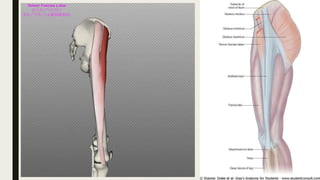
• Gluteus maximus mainly extends the flexed thigh at the hip
joint. Through its insertion into the iliotibial tract, it also
stabilizes the knee and hip joints. It is innervated by the
inferior gluteal nerve
Tensor fasciae latae
• The tensor fasciae latae muscle is the most anterior of the superficial group of
muscles in the gluteal region and overlies the gluteus minimus and the anterior part
of the gluteus medius
• Tensor fasciae latae originates from the outer margin of the iliac crest from the
anterior superior iliac spine to approximately the tubercle of the crest.
• The muscle fibers descend to insert into the anterior aspect of the iliotibial tract of
deep fascia, which runs down the lateral side of the thigh and attaches to the upper
tibia.
• Tensor fasciae latae stabilizes the knee in extension and, working with the gluteus
maximus muscle on the iliotibial tract lateral to the greater trochanter, stabilizes the
hip joint by holding the head of the femur in the acetabulum.
• It is innervated by the superior gluteal nerve
Nerve in the Gluteal region
Seven nerves enter the gluteal region from the pelvis through the greater sciatic foramen:
• The superior gluteal nerve (Gmin &Gmed & TFL),
• Sciatic nerve,
• Nerve to the quadratus femoris,
• Nerve to the obturator internus,
• Posterior cutaneous nerve of the thigh,
• Pudendal nerve,(Pelvic viscera)
• Inferior gluteal nerve (G.max)
Sciatic nerve
• The sciatic nerve enters the gluteal region through the
greater sciatic foramen inferior to the piriformis muscle.
• It descends in the plane between the superficial and deep
group of gluteal region muscles.
• It lies just deep to the gluteus maximus at the midpoint
between the ischial tuberosity and the greater trochanter.
• At the lower margin of the quadratus femoris muscle, the
sciatic nerve enters the posterior thigh
• The sciatic nerve is the largest nerve in the body and innervates all muscles in
the posterior compartment of the thigh that flex the knee and all muscles that
work the ankle and foot.
• It also innervates a large area of skin in the lower limb
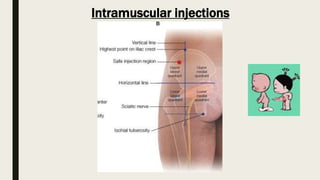
Intramuscular injections
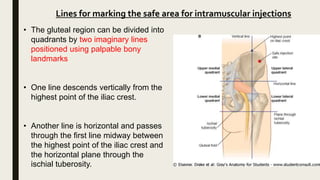
• The gluteal region can be divided into
quadrants by two imaginary lines
positioned using palpable bony
landmarks
• One line descends vertically from the
highest point of the iliac crest.
• Another line is horizontal and passes
through the first line midway between
the highest point of the iliac crest and
the horizontal plane through the
ischial tuberosity.
Lines for marking the safe area for intramuscular injections
In which muscle, intramuscular injection is given>???
• The inferior gluteal artery originates from the anterior trunk of
the internal iliac artery in the pelvic cavity. It leaves the pelvic
cavity with the inferior gluteal nerve through the greater sciatic
foramen inferior to the piriformis muscle
Arteries in the gluteal region
• The superior gluteal artery originates from the posterior trunk
of the internal iliac artery in the pelvic cavity. It leaves the
pelvic cavity with the superior gluteal nerve through the greater
sciatic foramen above the piriformis muscle. In the gluteal
region, it divides into a superficial branch and a deep branch
 The superficial branch passes onto the deep surface of the gluteus maximus
muscle;
 The deep branch passes between the gluteus medius and minimus muscles.
Gluteal region .pptx

Gluteal region .pptx

  • 1.
  • 2.
    • The glutealregion lies posterolateral to the bony pelvis and proximal end of the femur. • Muscles in the region mainly abduct, extend, and laterally rotate the femur relative to the pelvic bone • The gluteal region communicates anteromedially with the pelvic cavity and perineum through the greater and lesser sciatic foramina, respectively. • Inferiorly, it is continuous with the posterior thigh • The sciatic nerve enters the lower limb from the pelvic cavity by passing through the greater sciatic foramen and descending through the gluteal region into the posterior thigh and then into the leg and foot. Introduction
  • 3.
  • 4.
    Important parts andGluteal lines
  • 5.
    Muscles of thegluteal region are mainly in two groups: A deep group of small muscles, which are mainly lateral rotators of the femur at the hip joint and include piriformis, obturator internus, gemellus superior, gemellus inferior, and quadratus femoris A more superficial group of larger muscles, which mainly abduct and extend the hip and include the gluteus minimus, gluteus medius, and gluteus maximus-an additional muscle in this group, the tensor fasciae latae.
  • 7.
    • The piriformismuscle is the most superior of the deep group of muscles and is a muscle of the pelvic wall and of the gluteal region. It originates from between the anterior sacral foramina on the anterolateral surface of the sacrum and passes laterally and inferiorly through the greater sciatic foramen. • In the gluteal region, piriformis passes posterior to the hip joint and attaches to a facet on the upper margin of the greater trochanter of the femur • Piriformis externally rotates and abducts the femur at the hip joint and is innervated in the pelvic cavity by the nerve to piriformis, which originates from S1 and S2 of the sacral plexus Piriformis
  • 9.
    • In additionto its action on the hip joint, the piriformis is an important landmark because it divides the greater sciatic foramen into two regions, one above and one below the piriformis. • Vessels and nerves pass between the pelvis and gluteal region by passing through the greater sciatic foramen either above or below the piriformis Piriformis The superior gluteal nerves and vessels pass through the greater sciatic foramen above piriformis; All other vessels and nerves passing between the pelvis and the gluteal region, including the sciatic nerve, pass through the greater sciatic foramen below the piriformis.
  • 11.
    • The obturatorinternus muscle, like the piriformis muscle, is a muscle of the pelvic wall and of the gluteal region. • It is a flat fan-shaped muscle originating from the medial surface of the obturator membrane and obturator foramen. Obturator internus • The muscle fibers of the obturator internus converge to form a tendon, which bends 90° around the ischium between the ischial spine and ischial tuberosity and passes through the lesser sciatic foramen to enter the gluteal region. • The tendon then passes posteroinferiorly to the hip joint and attaches to the medial surface of the superior margin of the greater trochanter of the femur just inferior to the attachment of the piriformis muscle. Obturator internus laterally rotates and abducts the femur at the hip joint and is innervated by the nerve to the obturator internus
  • 13.
    Gemellus superior andinferior • Gemellus superior and inferior (gemelli is Latin for twins) are a pair of triangular muscles associated with the upper and lower margins of the obturator internus tendon  The base of gemellus superior originates from the gluteal surface of the ischial spine  The base of gemellus inferior originates from the upper gluteal and pelvic surfaces of the ischial tuberosity. • Fibers of the gemellus muscles attach along the length of the obturator internus tendon, and the apices of the two muscles insert with the tendon of obturator internus on the greater trochanter of the femur • Gemellus superior is innervated by the nerve to the obturator internus, and the gemellus inferior is innervated by the nerve to the quadratus femoris. • The gemellus muscles act with the obturator internus muscle to laterally rotate and abduct the femur at the hip joint.
  • 15.
    • The quadratusfemoris muscle is the most inferior of the deep group of muscles in the gluteal region. • It is a flat rectangular muscle below the obturator internus muscle and its associated gemellus muscles. • Quadratus femoris is attached at one end to a linear roughening on the lateral aspect of the ischium just anterior to the ischial tuberosity and at the other end to the quadrate tubercle on the intertrochanteric crest of the proximal femur • Quadratus femoris laterally rotates the femur at the hip joint and is innervated by the nerve to the quadratus femoris Quadratus femoris
  • 17.
    • Gluteus minimusis a fan-shaped muscle that originates from the external surface of the expanded upper part of the ilium, between the inferior gluteal line and the anterior gluteal line. • The muscle fibers converge inferiorly and laterally to form a tendon, which inserts into a broad linear facet on the anterolateral aspect of the greater trochanter. Gluteus minimus and medius • Gluteus medius overlies gluteus minimus and is also fan shaped. It has a broad origin from the external surface of the ilium between the anterior gluteal line and posterior gluteal line and inserts on an elongate facet on the lateral surface of the greater trochanter • The gluteus medius and minimus muscles abduct the lower limb at the hip joint and reduce pelvic drop over the opposite swing limb during walking by securing the position of the pelvis on the stance limb. • Both muscles are innervated by the superior gluteal nerve
  • 20.
    Gluteus maximus • Gluteusmaximus is the largest muscle in the gluteal region and overlies most of the other gluteal muscles • Gluteus maximus is quadrangular in shape and has a broad origin extending from a roughened area of the ilium behind the posterior gluteal line and along the dorsal surface of the lower sacrum and the lateral surface of the coccyx to the external surface of the sacrotuberous ligament. • Laterally, the upper and superficial lower parts of the gluteus maximus insert into the posterior aspect of a tendinous thickening of the fascia lata (the iliotibial tract), which passes over the lateral surface of the greater trochanter and descends down the thigh and into the upper leg. • Gluteus maximus mainly extends the flexed thigh at the hip joint. Through its insertion into the iliotibial tract, it also stabilizes the knee and hip joints. It is innervated by the inferior gluteal nerve
  • 22.
    Tensor fasciae latae •The tensor fasciae latae muscle is the most anterior of the superficial group of muscles in the gluteal region and overlies the gluteus minimus and the anterior part of the gluteus medius • Tensor fasciae latae originates from the outer margin of the iliac crest from the anterior superior iliac spine to approximately the tubercle of the crest. • The muscle fibers descend to insert into the anterior aspect of the iliotibial tract of deep fascia, which runs down the lateral side of the thigh and attaches to the upper tibia. • Tensor fasciae latae stabilizes the knee in extension and, working with the gluteus maximus muscle on the iliotibial tract lateral to the greater trochanter, stabilizes the hip joint by holding the head of the femur in the acetabulum. • It is innervated by the superior gluteal nerve
  • 24.
    Nerve in theGluteal region Seven nerves enter the gluteal region from the pelvis through the greater sciatic foramen: • The superior gluteal nerve (Gmin &Gmed & TFL), • Sciatic nerve, • Nerve to the quadratus femoris, • Nerve to the obturator internus, • Posterior cutaneous nerve of the thigh, • Pudendal nerve,(Pelvic viscera) • Inferior gluteal nerve (G.max)
  • 26.
    Sciatic nerve • Thesciatic nerve enters the gluteal region through the greater sciatic foramen inferior to the piriformis muscle. • It descends in the plane between the superficial and deep group of gluteal region muscles. • It lies just deep to the gluteus maximus at the midpoint between the ischial tuberosity and the greater trochanter. • At the lower margin of the quadratus femoris muscle, the sciatic nerve enters the posterior thigh • The sciatic nerve is the largest nerve in the body and innervates all muscles in the posterior compartment of the thigh that flex the knee and all muscles that work the ankle and foot. • It also innervates a large area of skin in the lower limb
  • 27.
  • 28.
    • The glutealregion can be divided into quadrants by two imaginary lines positioned using palpable bony landmarks • One line descends vertically from the highest point of the iliac crest. • Another line is horizontal and passes through the first line midway between the highest point of the iliac crest and the horizontal plane through the ischial tuberosity. Lines for marking the safe area for intramuscular injections
  • 29.
    In which muscle,intramuscular injection is given>???
  • 30.
    • The inferiorgluteal artery originates from the anterior trunk of the internal iliac artery in the pelvic cavity. It leaves the pelvic cavity with the inferior gluteal nerve through the greater sciatic foramen inferior to the piriformis muscle Arteries in the gluteal region • The superior gluteal artery originates from the posterior trunk of the internal iliac artery in the pelvic cavity. It leaves the pelvic cavity with the superior gluteal nerve through the greater sciatic foramen above the piriformis muscle. In the gluteal region, it divides into a superficial branch and a deep branch  The superficial branch passes onto the deep surface of the gluteus maximus muscle;  The deep branch passes between the gluteus medius and minimus muscles.