What’s New and Where to Find It in V6.5
Q2/3 2016
V6.5 At A Glance (December 2016)
• Restack data while you do velocity analysis (CVA)
• Manage Projects using SeisCat
• iMage platform on the Launcher
• iMage platform extended to include Octave deghosting
• New module to add SPS to seismic data in a flow (ADDSPS)
• Easier QC/Update of existing velocity picks (CVA)
• 6 month release cycle with monthly “beta” releases
Restacking in CVA Velocity Analysis
What it does: Creates a new stack panel with the current velocities
Where to find it: The RESTACK button on the main CVA window
• Restack creates a new “panel” display
• Restack panel updates live while you pick
• Compare with original stack
• Stack is automatically saved for future QC
• Pick better velocities, faster
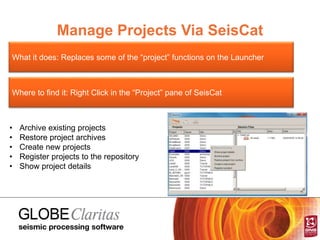
Manage Projects Via SeisCat
What it does: Replaces some of the “project” functions on the Launcher
Where to find it: Right Click in the “Project” pane of SeisCat
• Archive existing projects
• Restore project archives
• Create new projects
• Register projects to the repository
• Show project details
Image Platform On Launcher
What it does: Easier Access to the Image Suite
Where to find it: On the Flows tab of the Launcher
• 3DSRME
• Octave Broadband Deghosting
• Anisotropic 3D PreSTM
• STITCH 5D Interpolation
• Multi-SEGY file input
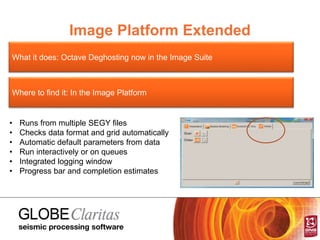
Image Platform Extended
What it does: Octave Deghosting now in the Image Suite
Where to find it: In the Image Platform
• Runs from multiple SEGY files
• Checks data format and grid automatically
• Automatic default parameters from data
• Run interactively or on queues
• Integrated logging window
• Progress bar and completion estimates
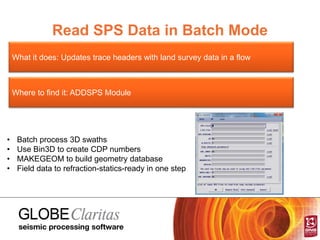
Read SPS Data in Batch Mode
What it does: Updates trace headers with land survey data in a flow
Where to find it: ADDSPS Module
• Batch process 3D swaths
• Use Bin3D to create CDP numbers
• MAKEGEOM to build geometry database
• Field data to refraction-statics-ready in one step
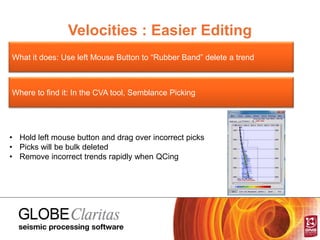
Velocities : Easier Editing
What it does: Use left Mouse Button to “Rubber Band” delete a trend
Where to find it: In the CVA tool, Semblance Picking
• Hold left mouse button and drag over incorrect picks
• Picks will be bulk deleted
• Remove incorrect trends rapidly when QCing
And if you missed it…
V6.4 At A Glance (June 2016)
• New residual moveout (RMO) capability
• New slant / variable cable deghosting technology
• New curved ray/anisotropic 2D/3D PSTM
• iMage Platform standalone extended : 3DSRME, 3DPSTM
• New application for defining 3D grids
• Support for “right handed” 3D geometries
• Easier parallel processing
• Improved 3DSRME performance
• 7 month release cycle with monthly “beta” releases
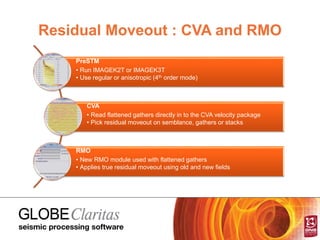
Residual Moveout : CVA and RMO
PreSTM
• Run IMAGEK2T or IMAGEK3T
• Use regular or anisotropic (4th order mode)
CVA
• Read flattened gathers directly in to the CVA velocity package
• Pick residual moveout on semblance, gathers or stacks
RMO
• New RMO module used with flattened gathers
• Applies true residual moveout using old and new fields
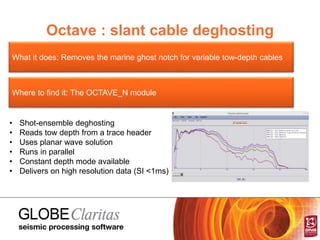
Octave : slant cable deghosting
What it does: Removes the marine ghost notch for variable tow-depth cables
Where to find it: The OCTAVE_N module
• Shot-ensemble deghosting
• Reads tow depth from a trace header
• Uses planar wave solution
• Runs in parallel
• Constant depth mode available
• Delivers on high resolution data (SI <1ms)
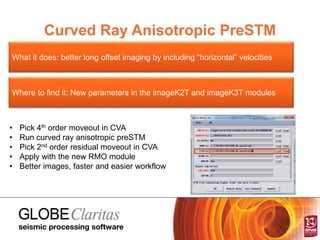
Curved Ray Anisotropic PreSTM
What it does: better long offset imaging by including “horizontal” velocities
Where to find it: New parameters in the imageK2T and imageK3T modules
• Pick 4th order moveout in CVA
• Run curved ray anisotropic preSTM
• Pick 2nd order residual moveout in CVA
• Apply with the new RMO module
• Better images, faster and easier workflow
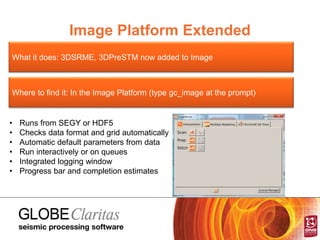
Image Platform Extended
What it does: 3DSRME, 3DPreSTM now added to Image
Where to find it: In the Image Platform (type gc_image at the prompt)
• Runs from SEGY or HDF5
• Checks data format and grid automatically
• Automatic default parameters from data
• Run interactively or on queues
• Integrated logging window
• Progress bar and completion estimates
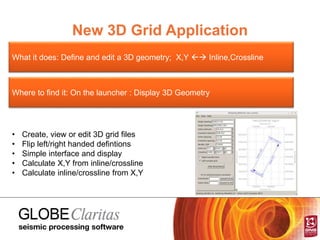
New 3D Grid Application
What it does: Define and edit a 3D geometry; X,Y  Inline,Crossline
Where to find it: On the launcher : Display 3D Geometry
• Create, view or edit 3D grid files
• Flip left/right handed defintions
• Simple interface and display
• Calculate X,Y from inline/crossline
• Calculate inline/crossline from X,Y
Geometry : LH/RH Grids
What it does: More flexibility in geometry definitions
Where to find it: In Geometry, on the 3D Geometry Display Tool
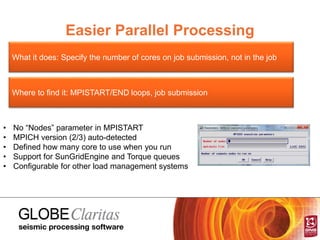
Easier Parallel Processing
What it does: Specify the number of cores on job submission, not in the job
Where to find it: MPISTART/END loops, job submission
• No “Nodes” parameter in MPISTART
• MPICH version (2/3) auto-detected
• Defined how many core to use when you run
• Support for SunGridEngine and Torque queues
• Configurable for other load management systems

Globe claritas v6.5 at a glance

  • 1.
    What’s New andWhere to Find It in V6.5 Q2/3 2016
  • 2.
    V6.5 At AGlance (December 2016) • Restack data while you do velocity analysis (CVA) • Manage Projects using SeisCat • iMage platform on the Launcher • iMage platform extended to include Octave deghosting • New module to add SPS to seismic data in a flow (ADDSPS) • Easier QC/Update of existing velocity picks (CVA) • 6 month release cycle with monthly “beta” releases
  • 3.
    Restacking in CVAVelocity Analysis What it does: Creates a new stack panel with the current velocities Where to find it: The RESTACK button on the main CVA window • Restack creates a new “panel” display • Restack panel updates live while you pick • Compare with original stack • Stack is automatically saved for future QC • Pick better velocities, faster
  • 4.
    Manage Projects ViaSeisCat What it does: Replaces some of the “project” functions on the Launcher Where to find it: Right Click in the “Project” pane of SeisCat • Archive existing projects • Restore project archives • Create new projects • Register projects to the repository • Show project details
  • 5.
    Image Platform OnLauncher What it does: Easier Access to the Image Suite Where to find it: On the Flows tab of the Launcher • 3DSRME • Octave Broadband Deghosting • Anisotropic 3D PreSTM • STITCH 5D Interpolation • Multi-SEGY file input
  • 6.
    Image Platform Extended Whatit does: Octave Deghosting now in the Image Suite Where to find it: In the Image Platform • Runs from multiple SEGY files • Checks data format and grid automatically • Automatic default parameters from data • Run interactively or on queues • Integrated logging window • Progress bar and completion estimates
  • 7.
    Read SPS Datain Batch Mode What it does: Updates trace headers with land survey data in a flow Where to find it: ADDSPS Module • Batch process 3D swaths • Use Bin3D to create CDP numbers • MAKEGEOM to build geometry database • Field data to refraction-statics-ready in one step
  • 8.
    Velocities : EasierEditing What it does: Use left Mouse Button to “Rubber Band” delete a trend Where to find it: In the CVA tool, Semblance Picking • Hold left mouse button and drag over incorrect picks • Picks will be bulk deleted • Remove incorrect trends rapidly when QCing
  • 9.
    And if youmissed it…
  • 10.
    V6.4 At AGlance (June 2016) • New residual moveout (RMO) capability • New slant / variable cable deghosting technology • New curved ray/anisotropic 2D/3D PSTM • iMage Platform standalone extended : 3DSRME, 3DPSTM • New application for defining 3D grids • Support for “right handed” 3D geometries • Easier parallel processing • Improved 3DSRME performance • 7 month release cycle with monthly “beta” releases
  • 11.
    Residual Moveout :CVA and RMO PreSTM • Run IMAGEK2T or IMAGEK3T • Use regular or anisotropic (4th order mode) CVA • Read flattened gathers directly in to the CVA velocity package • Pick residual moveout on semblance, gathers or stacks RMO • New RMO module used with flattened gathers • Applies true residual moveout using old and new fields
  • 12.
    Octave : slantcable deghosting What it does: Removes the marine ghost notch for variable tow-depth cables Where to find it: The OCTAVE_N module • Shot-ensemble deghosting • Reads tow depth from a trace header • Uses planar wave solution • Runs in parallel • Constant depth mode available • Delivers on high resolution data (SI <1ms)
  • 13.
    Curved Ray AnisotropicPreSTM What it does: better long offset imaging by including “horizontal” velocities Where to find it: New parameters in the imageK2T and imageK3T modules • Pick 4th order moveout in CVA • Run curved ray anisotropic preSTM • Pick 2nd order residual moveout in CVA • Apply with the new RMO module • Better images, faster and easier workflow
  • 14.
    Image Platform Extended Whatit does: 3DSRME, 3DPreSTM now added to Image Where to find it: In the Image Platform (type gc_image at the prompt) • Runs from SEGY or HDF5 • Checks data format and grid automatically • Automatic default parameters from data • Run interactively or on queues • Integrated logging window • Progress bar and completion estimates
  • 15.
    New 3D GridApplication What it does: Define and edit a 3D geometry; X,Y  Inline,Crossline Where to find it: On the launcher : Display 3D Geometry • Create, view or edit 3D grid files • Flip left/right handed defintions • Simple interface and display • Calculate X,Y from inline/crossline • Calculate inline/crossline from X,Y
  • 16.
    Geometry : LH/RHGrids What it does: More flexibility in geometry definitions Where to find it: In Geometry, on the 3D Geometry Display Tool
  • 17.
    Easier Parallel Processing Whatit does: Specify the number of cores on job submission, not in the job Where to find it: MPISTART/END loops, job submission • No “Nodes” parameter in MPISTART • MPICH version (2/3) auto-detected • Defined how many core to use when you run • Support for SunGridEngine and Torque queues • Configurable for other load management systems