America’s Competitive Edge
1.2 TransPacific Partinership Pact
Shawn Goh
Key Sectors
Benefits for America
Singaporean	
  Alumni	
  NYU	
  &	
  Columbia	
  ‘15	
  	
  
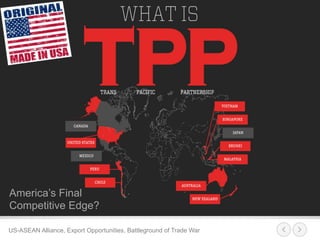
US-ASEAN Alliance, Export Opportunities, Battleground of Trade War
America’s Final
Competitive Edge?
Barriers of Entry
CUSTOMS, TRADE FACILITATION AND RULES OF ORIGIN
•  Commitments that will ensure the quick release of goods through customs, expedited procedures
for express shipments, advance rulings, and transparent and predictable customs regulations;
•  Strong customs cooperation commitments in order to ensure that TPP countries work together to
prevent smuggling, illegal transshipment, and duty evasion, and to guarantee compliance with
trade laws and regulations; and
•  Strong and common rules of origin to ensure that the benefits of TPP go to the United States and
other TPP countries, and also that TPP promotes the development of supply chains in the region
that include companies based in the United States.
DEVELOPMENT AND TRADE CAPACITY-BUILDING
•  Agreement on cooperative development activities TPP countries could conduct to promote broad-
based economic growth and sustainable development, including public-private partnerships,
science and technology cooperation
•  Mechanisms for collaboration and facilitation of capacity-building activities by both TPP
government and non-government representatives, as well as the private sector, in order to help
TPP workers and businesses, including SMEs and micro- enterprises participate in global trade
and take advantage of the agreement.
America’s Competitive Edge
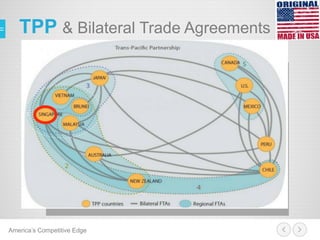
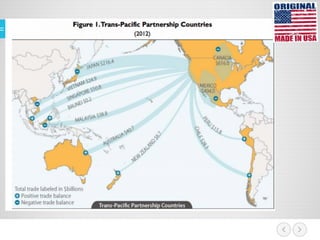
TPP & Bilateral Trade Agreements
America’s Competitive Edge
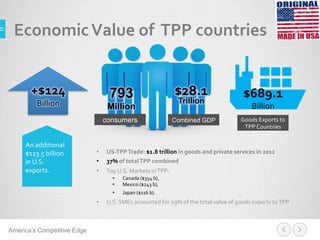
consumers
An	
  additional	
  
$123.5	
  billion	
  
in	
  U.S.	
  
exports.	


+$124	
  
Billion	
  
793
Million
$28.1	
  
Trillion	
   $689.1	
  	
  
Billion
Goods	
  Exports	
  to	
  
TPP	
  Countries
Combined GDP
Economic	
  Value	
  of	
  	
  TPP	
  countries	
  
•  US-­‐TPP	
  Trade:	
  $1.8	
  trillion	
  in	
  goods	
  and	
  private	
  services	
  in	
  2012	
  	
  
•  37%	
  of	
  total	
  TPP	
  combined	
  
•  Top	
  U.S.	
  Markets	
  in	
  TPP:	
  	
  
•  Canada	
  ($354	
  b),	
  	
  
•  Mexico	
  ($243	
  b),	
  	
  
•  Japan	
  ($116	
  b).	
  
•  U.S.	
  SMEs	
  accounted	
  for	
  29%	
  of	
  the	
  total	
  value	
  of	
  goods	
  exports	
  to	
  TPP
America’s Competitive Edge
USA Key Objectives
•  Elimination of tariffs and commercially-meaningful market access for
U.S. products exported to TPP countries
•  Provisions that address longstanding non-tariff barriers, including
import licensing requirements and other restrictions.
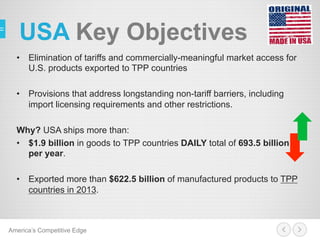
Why? USA ships more than:
•  $1.9 billion in goods to TPP countries DAILY total of 693.5 billion
per year.
•  Exported more than $622.5 billion of manufactured products to TPP
countries in 2013.
America’s Competitive Edge
Elimination of TPP countries’ tariffs
•  Industrial goods
•  Food / Agriculture products
•  Textiles
•  Manufactured products
•  Industrial / Electrical machinery
•  Precision / Scientific instruments
•  Chemicals
•  Plastics
Key US exports
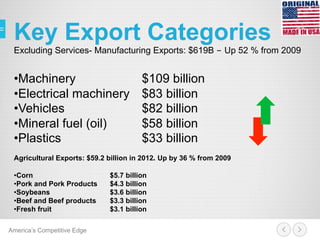
Key Export Categories
Excluding Services- Manufacturing Exports: $619B - Up 52 % from 2009
• Machinery $109 billion
• Electrical machinery $83 billion
• Vehicles $82 billion
• Mineral fuel (oil) $58 billion
• Plastics $33 billion
Agricultural Exports: $59.2 billion in 2012. Up by 36 % from 2009
• Corn $5.7 billion
• Pork and Pork Products $4.3 billion
• Soybeans $3.6 billion
• Beef and Beef products $3.3 billion
• Fresh fruit $3.1 billion
America’s Competitive Edge
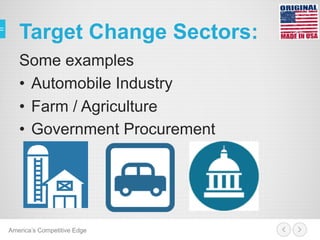
Target Change Sectors:
Some examples
•  Automobile Industry
•  Farm / Agriculture
•  Government Procurement
America’s Competitive Edge
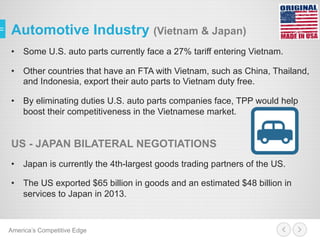
Automotive Industry (Vietnam & Japan)
•  Some U.S. auto parts currently face a 27% tariff entering Vietnam.
•  Other countries that have an FTA with Vietnam, such as China, Thailand,
and Indonesia, export their auto parts to Vietnam duty free.
•  By eliminating duties U.S. auto parts companies face, TPP would help
boost their competitiveness in the Vietnamese market.
US - JAPAN BILATERAL NEGOTIATIONS
•  Japan is currently the 4th-largest goods trading partners of the US.
•  The US exported $65 billion in goods and an estimated $48 billion in
services to Japan in 2013.
America’s Competitive Edge
Farm / Agricultural (Malaysia)
•  20% of U.S. farm income comes from agricultural exports and those
exports support rural communities.
•  In fact, U.S. food and agricultural exports to the world reached an
all-time high in 2013 of over $148 billion.
•  Of that total, we exported more than $58 billion to TPP countries –
a figure that would increase as a result of tariff elimination under
TPP.
•  U.S. poultry currently faces a 40-percent tariff in Malaysia. U.S.
poultry would become more affordable in Malaysia under a TPP
agreement that reduces these duties to zero.
•  Poultry is a key commodity for the region because majority of the
ethnic groups do not consume Pork or Beef (Islamic / Indian).
America’s Competitive Edge
GOVERNMENT PROCUREMENT
•  Government tenders represent an
estimated 5-10% of a country’s
economy with the TPP businesses and
workers.
America’s Competitive Edge
Contrasting Business Culture and
Government policies between USA
and Rest of the world.

FTA, Free trade agreement, TPP

  • 1.
    America’s Competitive Edge 1.2TransPacific Partinership Pact Shawn Goh Key Sectors Benefits for America Singaporean  Alumni  NYU  &  Columbia  ‘15    
  • 2.
    US-ASEAN Alliance, ExportOpportunities, Battleground of Trade War America’s Final Competitive Edge?
  • 3.
    Barriers of Entry CUSTOMS,TRADE FACILITATION AND RULES OF ORIGIN •  Commitments that will ensure the quick release of goods through customs, expedited procedures for express shipments, advance rulings, and transparent and predictable customs regulations; •  Strong customs cooperation commitments in order to ensure that TPP countries work together to prevent smuggling, illegal transshipment, and duty evasion, and to guarantee compliance with trade laws and regulations; and •  Strong and common rules of origin to ensure that the benefits of TPP go to the United States and other TPP countries, and also that TPP promotes the development of supply chains in the region that include companies based in the United States. DEVELOPMENT AND TRADE CAPACITY-BUILDING •  Agreement on cooperative development activities TPP countries could conduct to promote broad- based economic growth and sustainable development, including public-private partnerships, science and technology cooperation •  Mechanisms for collaboration and facilitation of capacity-building activities by both TPP government and non-government representatives, as well as the private sector, in order to help TPP workers and businesses, including SMEs and micro- enterprises participate in global trade and take advantage of the agreement. America’s Competitive Edge
  • 4.
    TPP & BilateralTrade Agreements America’s Competitive Edge
  • 6.
    consumers An  additional   $123.5  billion   in  U.S.   exports.     +$124   Billion   793 Million $28.1   Trillion   $689.1     Billion Goods  Exports  to   TPP  Countries Combined GDP Economic  Value  of    TPP  countries   •  US-­‐TPP  Trade:  $1.8  trillion  in  goods  and  private  services  in  2012     •  37%  of  total  TPP  combined   •  Top  U.S.  Markets  in  TPP:     •  Canada  ($354  b),     •  Mexico  ($243  b),     •  Japan  ($116  b).   •  U.S.  SMEs  accounted  for  29%  of  the  total  value  of  goods  exports  to  TPP America’s Competitive Edge
  • 7.
    USA Key Objectives • Elimination of tariffs and commercially-meaningful market access for U.S. products exported to TPP countries •  Provisions that address longstanding non-tariff barriers, including import licensing requirements and other restrictions. Why? USA ships more than: •  $1.9 billion in goods to TPP countries DAILY total of 693.5 billion per year. •  Exported more than $622.5 billion of manufactured products to TPP countries in 2013. America’s Competitive Edge
  • 8.
    Elimination of TPPcountries’ tariffs •  Industrial goods •  Food / Agriculture products •  Textiles •  Manufactured products •  Industrial / Electrical machinery •  Precision / Scientific instruments •  Chemicals •  Plastics Key US exports
  • 9.
    Key Export Categories ExcludingServices- Manufacturing Exports: $619B - Up 52 % from 2009 • Machinery $109 billion • Electrical machinery $83 billion • Vehicles $82 billion • Mineral fuel (oil) $58 billion • Plastics $33 billion Agricultural Exports: $59.2 billion in 2012. Up by 36 % from 2009 • Corn $5.7 billion • Pork and Pork Products $4.3 billion • Soybeans $3.6 billion • Beef and Beef products $3.3 billion • Fresh fruit $3.1 billion America’s Competitive Edge
  • 11.
    Target Change Sectors: Someexamples •  Automobile Industry •  Farm / Agriculture •  Government Procurement America’s Competitive Edge
  • 12.
    Automotive Industry (Vietnam& Japan) •  Some U.S. auto parts currently face a 27% tariff entering Vietnam. •  Other countries that have an FTA with Vietnam, such as China, Thailand, and Indonesia, export their auto parts to Vietnam duty free. •  By eliminating duties U.S. auto parts companies face, TPP would help boost their competitiveness in the Vietnamese market. US - JAPAN BILATERAL NEGOTIATIONS •  Japan is currently the 4th-largest goods trading partners of the US. •  The US exported $65 billion in goods and an estimated $48 billion in services to Japan in 2013. America’s Competitive Edge
  • 13.
    Farm / Agricultural(Malaysia) •  20% of U.S. farm income comes from agricultural exports and those exports support rural communities. •  In fact, U.S. food and agricultural exports to the world reached an all-time high in 2013 of over $148 billion. •  Of that total, we exported more than $58 billion to TPP countries – a figure that would increase as a result of tariff elimination under TPP. •  U.S. poultry currently faces a 40-percent tariff in Malaysia. U.S. poultry would become more affordable in Malaysia under a TPP agreement that reduces these duties to zero. •  Poultry is a key commodity for the region because majority of the ethnic groups do not consume Pork or Beef (Islamic / Indian). America’s Competitive Edge
  • 14.
    GOVERNMENT PROCUREMENT •  Governmenttenders represent an estimated 5-10% of a country’s economy with the TPP businesses and workers. America’s Competitive Edge Contrasting Business Culture and Government policies between USA and Rest of the world.