www.uneca.org/aisi/nici
www.uneca.org/aisi/nici
Background
Background
Africa stilllags behind in the global transition to
an Information Society – e.g. - lowest rate of
internet users and fixed lines
Lack of basic information on key ICT & related
social indicators, ICT related activities & the
impact of ICT policy decisions & plans
To overcome this gap in information &
technology (for utilisation in the promotion of
social & economic growth), an action framework
to build Africa’s Information & communication
infrastructure was launched - AISI
4.
www.uneca.org/aisi/nici
www.uneca.org/aisi/nici
The AfricanInformation Society Initiative (AISI)
was launched in 1996 by the African Ministers in
charge of planning and economic and social
development
Adopted by the 1996 OAU Summit
It is a vision for ICT development in Africa
It is a cooperation framework for partners to
support ICT development in Africa (PICTA
members)
It also focuses on analysing and evaluating ICT’s
and content trends in Africa – Scan-ICT
What is AISI?
5.
www.uneca.org/aisi/nici
www.uneca.org/aisi/nici
What is Scan-ICT?
Whatis Scan-ICT?
Multi-partnership initiative (Nov 2000) for
building the capacity to define, collect &
manage key information needed to support ICT
investment & transition of Africa to an
Information society.
It monitors the penetration, impact &
effectiveness of ICT applications across Africa.
The goal is to create a pan-Africa ICT network
that would collect, analyse and disseminate ICT
related knowledge.
6.
www.uneca.org/aisi/nici
www.uneca.org/aisi/nici
Scan-ICT project objectives
Scan-ICTproject objectives
Determine ICT status & collect, disseminate
ICT-related information in Africa
Develop & continuously monitor ICT activity &
progress indicators for investment
Develop a benchmarking strategy to improve
ICT performance in Africa
Promote effective use of existing national
capacity & promote public awareness on the
importance of ICT’s for development
www.uneca.org/aisi/nici
www.uneca.org/aisi/nici
Scan-ICT Countries
Scan-ICT Countries
Selection criteria:
Country request for study
In-country capacity to undertake a Scan-
ICT study
Possibility of leading to reform of the ICT
sector
Scan-ICT partner preferences
Geographic/linguistic/cultural balance in
Africa (English, Arabic, French &
Portuguese speaking countries)
9.
www.uneca.org/aisi/nici
www.uneca.org/aisi/nici
Scan-ICT Project activities
Scan-ICTProject activities
Setting up of institutional structures &
organisational mechanisms for
collection of indicators using a
harmonised methodology
Data collection areas: (minimal)
Infrastructure
Sectoral applications (education,
health public administration, private
sector)
Information economy
www.uneca.org/aisi/nici
www.uneca.org/aisi/nici
Methodology 2/3
Methodology 2/3
Quantitative and qualitative approaches
used in generating data from:
Primary sources – data collected by
national networks through interviews &
questionnaires;
Secondary sources - documents from
official, private & international sources
Data collection & analysis through
extensive national consultations.
12.
www.uneca.org/aisi/nici
www.uneca.org/aisi/nici
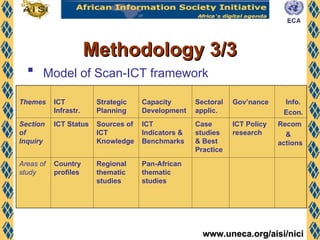
Methodology 3/3
Methodology 3/3
Model of Scan-ICT framework
Themes ICT
Infrastr.
Strategic
Planning
Capacity
Development
Sectoral
applic.
Gov’nance Info.
Econ.
Section
of
Inquiry
ICT Status Sources of
ICT
Knowledge
ICT
Indicators &
Benchmarks
Case
studies
& Best
Practice
ICT Policy
research
Recom
&
actions
Areas of
study
Country
profiles
Regional
thematic
studies
Pan-African
thematic
studies
13.
www.uneca.org/aisi/nici
www.uneca.org/aisi/nici
Major findings 1/2
Majorfindings 1/2
ICT penetration greater in educational &
public administration facilities than in
health institutions
Widely spread individuals using ICT’s due
to lack of knowledge
Shortage of qualified staff critical in all
sectors – low proportion of ICT experts
Computers widely used as traditional
office tools
Low % of institutions with web sites
14.
www.uneca.org/aisi/nici
www.uneca.org/aisi/nici
Major findings 2/2
Majorfindings 2/2
Although there is a demand for skilled ICT
personnel, training institutions are
concentrated in the urban areas
Acute shortage of ICT professionals in rural
or semi-urban areas
On-the–job training opportunities remain
very low across all sectors
Lack of coordination in ICT training
www.uneca.org/aisi/nici
www.uneca.org/aisi/nici
Recommendations 2/4
Recommendations 2/4
Creation of an enabling policy
environment for ICT4D by:
Strengthening regulatory frameworks
Instituting policy reforms in the
telecommunications sector
Instituting measures not only to reduce tax
& duty on computers & accessories, but on
Internet connections & access charges
17.
www.uneca.org/aisi/nici
www.uneca.org/aisi/nici
Recommendations 3/4
Recommendations 3/4
Encourage enterprise development & private
sector investment by increasing credit facility
availability & venture capital creation
Implementation of innovative poverty reduction
programmes which empower citizens &
increase access
Preparation & implementation of ICT4D master
plans (NICI) addressing current & future needs
Prioritising small ICT projects with considerable
& immediate development impact e.g.
telecentres
18.
www.uneca.org/aisi/nici
www.uneca.org/aisi/nici
Recommendations 4/4
Recommendations 4/4
Designing & launching ICT training
programmes at all levels – awareness
creation on ICT issues. Standardisation of
training courses
Encouraging & supporting the private sector
engaged in R&D/software development
Infrastructure expansion & increase in ICT
access points in order to bridge the urban-
rural infrastructure gap
19.
www.uneca.org/aisi/nici
www.uneca.org/aisi/nici
Recommendations from the
Recommendationsfrom the
SCAN-ICT Review Workshop
SCAN-ICT Review Workshop
(17–18 February 2004)
(17–18 February 2004)
There is need to extend the second phase
of the project with inclusion of more
countries
National Statistics Offices should be
included in the next phase of SCAN
ICT practitioners and statisticians
reflected on the first phase of the Scan-
ICT project as follows:
20.
www.uneca.org/aisi/nici
www.uneca.org/aisi/nici
Lessons Learnt
Lessons Learnt
The methodological framework developed
served the intended purpose – research can be
rolled out to more countries by linking existing
methodology with the MDGs
Linkage with various ICT initiatives is needed to
sustain the Scan-ICT process and increase its
responsiveness to strategic planning and ICT
investments
It is crucial to continuously monitor and capture
data to facilitate informed decisions
www.uneca.org/aisi/nici
www.uneca.org/aisi/nici
List of potentialCountries
List of potential Countries
Botswana
Gambia
Mauritius
Niger
Nigeria
Rwanda
Sudan
Tanzania
Tunisia
The Republic of Finland
will be the major Funding
Partner. What about ITU?
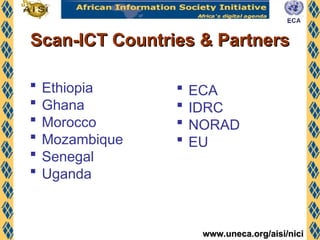
Ethiopia
Ghana
Morocco
Mozambique
Senegal
Uganda
New SCAN
New SCAN
countries
countries
Continuation from Phase 1
Continuation from Phase 1
23.
www.uneca.org/aisi/nici
www.uneca.org/aisi/nici
Expected Outcomes
Expected Outcomes
Linkage with various ICT initiatives such as
national e-strategies, harnessing ICTs for
decentralization of public administration, e-
governance projects, etc.
Gender desegregation of indicators and
Focus on women & ICTs
Inclusion of studies on sectoral applications in
all countries:
Education
Agriculture
Health
Public Administration
e-Commerce
24.
www.uneca.org/aisi/nici
www.uneca.org/aisi/nici
Access to CountryReports
Access to Country Reports
All: http://www.uneca.org/aisi/scanict
Ethiopia: http://network.idrc.ca/ev.php
Ghana:http://network.idrc.ca/ev.php
Morrocco:http//www.scanict.org
Mozambique:http://www.scanict.uem.mz
Senegal:http://www.osiris.sn
Uganda:http://network.idrc.ca/ev.php