Page 1 of 2


From: Peter Schultz [pschultz@usgcrp.gov]
Sent: Monday, January 03, 2005 10:55 AM
To: andrewj @onr.navy.mil; ari.patrinos@science.doe.gov; Hannegan, Bryan J.; cgroat@usgs.gov;
chester.j.koblinsky@noaa.gov; david.conover@hq.doe.gov; Halpern, David; EmSimmons@usaid.gov;
Wuchte, Erin; gasrar@hq.nasa.gov; Jack.Kaye@hq.nasa.gov; James.R.Mahoney@noaa.gov;
linda.lawson@ost.dot.gov; Margaret.R.Mccalla@noaa.gov; mary.glackin@noaa.gov; mleinen@nsf.gov;
mmoore@osophs.dhhs.gov; neale@serc.si.edu; pschultz@usgcrp.gov; rmoss@usgcrp.gov;
slimak.michael@epa.gov; smaccrac@usgcrp.gov; Watsonhl@state.gov; Whohenst@oce.usda.gov
Cc: audrey.c.murray @nasa.gov; cs64c @nih.gov; david.goodrich @noaa.gov; djwhite @nsf.gov;
farnethwe @ state.gov; hratch.semerjian @ nist.gov; j ason_rothenberg @ usgcrp.gov.at.omb.eop.gov;
Jerry.Elwood@science.doe.gov; Karrigan.Bork@ost.dot.gov; Kathy.Holmes@science.doe.gov;
Linda.Rybicki@noaa.gov; LRuppe@usaid.gov; mcleave@hq.nasa.gov; mgriffin-williams@usaid.gov;
mitchell.baer@hq.doe.gov; nlancaster@usgs.gov; patricia.mcbdde@noaa.gov; Cooney, Phil;
rbirk@hq.nasa.gov; robert.marlay@hq.doe.gov; ronald.j.birk@hq.nasa.gov;
sambrose @usgcrp.gov.at.hq.nasa.gov; scheraga.joel @usgcrp.gov.at.epa.gov; schonwal @niehs.nih.gov;
shelia.s.brown@nasa.gov; svanle@hq.nasa.gov; talleyt@state.gov; tspence@nsf.gov;
turekianvc@state.gov; wbreed@usaid.gov; Nick Sundt; Ahsha Tribble; Allen, David; Cathy Stephens;
David Jori Dokken; ’David Legler (E-mail)’; Gloria Rapalee; Kathryn Parker; Kathryn Parker; Leslie
Branch; Margarita Conkdght; Richard Moss; Rick Petty; Rick Piltz (Piltz, Rick); Robert Cahalan; Sandy
MacCracken; Sean Potter
Subject: Fwd: CCSP Principals mtg, Jan. 5 -- agenda and materials

Importance: High
To all: Because of a computer system problem the attached CCSP January 5 Principals meeting agenda
and read-ahead materials did not successfully transmit when they were sent to each of you on December
29. I apologize for the delay in this information reaching you. We became aware of the problem only
within the past hour this morning. We are arranging a telephone call to each of your offices, to assure
that this information has been successfully received by each of you. We look forward to seeing you on
Wednesday. Happy New Year! -Peter

      Date: Wed, 29 Dec 2004 16:11:18 -0500
      To: ccsp@usgcrp.gov
      From: Peter Schultz <pschultz @usgcrp.gov>
      Subject: CCSP Principals mtg, Jan. 5 -- agenda and materials
      Cc: ccsp_info@usgcrp.gov, ipo@usgcrp.gov

      Dear CCSP Principals,

      The next CCSP Principals meeting is Wednesday, January 5, 3-5 PM at CCSPO (1717
      Pennsylvania Avenue, NW, Suite 250). Please notify Sandy MacCraeken
      (smaccrac @usgcrp.gov) whether you or a designee will be attending the meeting.

      Attached are the agenda and briefing materials. The numbers in the file names of the
      briefing materials correspond to the agenda item numbers.

      If you need to call in to the meeting, the number is 800-516-9896 and the pass code is
      888503.

      Happy New Year!

      Cheers,

                                                                                                  CEQ 006717
file://G:WOIA - Climate2005kDeliberativel-3.05kFwd CCSP Principals mtg Jan. 5 -- age... 4/12/2007
Page 2 of 2


       Peter


      Peter A. Schultz, Ph.D.
      Associate Director for Science Integration
      Climate Change Science ProgramOffice
      (Incorporating the U.S. Global Change Research Program and the Climate
      Change Research Initiative)
      1717 Pennsylvania Avenue NW, Suite 250
      Washington, DC 20006
      Email: pschultz@usgcrp.gov
      Telephone: 202.419.3479
      Fax: 202.223.3065


                                                                                            CEQ 006718
file://G:kFOIA - Climate2005kDeliberativel-3.05~Fwd CCSP Principals mtg Jan. 5 -- a~e... 4/12/2007
CEQ 006719
Page 1 of 2


From: Ahsha Tribble [Ahsha.Tribble@noaa.gov]
Sent: Monday, January 03, 2005 5:01 PM
To: Hannegan, Bryan J.
Subject: Re: [Fwd: CCSP Guidelines Announcement]
Bryan,

Thank you for your comments. We have incorporated them and will send the document to Legislative
Affairs (NOAA) so that they will be prepared to respond to any Hill Inquiries.

Happy New Year!

Ahsha

Hannegan, Bryan J. wrote:

      Ahsha -- please find attached a redline with my comments, using language from the letter Jim
      posted on the web site to accompany the release of the S&A Guidelines. Please call if questions,
      thanks, Bryan


      ........ Original Message ........
              Subject:CCSP Guidelines Announcement
                 Date:Fri, 17 Dec 2004 12:20:19 -0500
                From:Ahsha Tribble <Ahsha.Tribble@noaa.gov>
      Organization:NOAA
                  To:phil.cooney@ceq.eop.gov, "Gabriel, Clifford J."
                      <Clifford J. Gabriel@ostp.eop.gov>, kathie.olsen@ostp.eop.gov,
                      bryan.hannegan @cep.eop.gov, "Wuchte, Erin"
                      <Erin Wuchte@omb.eop.gov>, Margo.Schwab@omb.eop.gov

      CCSP EOP Principals,

      The NOAA Office of Legislative Affairs ~ould like to have a
      communications document to give to the Hill and other constituents
      regarding the release of the Guidelines for Producing CCSP Synthesis and
      Assessment Reports. The draft is attached for your review. We invite
      your comments, if any, by next week prior to sending this document out.

      Thank you,
      Ahsha


     Ahsha N. Tribble, Ph.D.
     Technical Chief of Staff
     Office of Assistant Secretary of Commerce
       For Oceans and Atmosphere
     HCHB/Room 5804
     14th & Constitution Ave, NW


                                                                                                         CEQ 006720
file://G:WOIA - Climate2005kDeliberative1-3.05Re Fwd C.C,,qP Guide, line, q Annn,,neomo All 9/90137
Page 2 of 2


     Washington, DC 20230
     202-482-5920 (DOC)
     202-482-6318 (Fax)


Ahsha N. Tribble, Ph.D.
Technical Chief of Staff
Office of Assistant Secretary of Commerce
  For Oceans and Atmosphere
HCHB/Room 5804
14th & Constitution Ave, NW
Washington, DC 20230
202-482-5920 (DOC)
202-482-6318 (Fax)


                                                                                      CEQ 006721
file://GSFOIA - Climate2005~Deliberativel-3.05LRe Fwd CCSP Guidelines Announceme... 4/12/2007
CEQ 006722
Page 1 of 2

 From: Ahsha Tribble [Ahsha.Tribble @noaa.gov]
 Sent: Monday, January 03, 2005 5:22 PM
 To: Hannegan, Bryan J.
 Subject: [Fwd: Re: Summary Doc for Inquiries]
 Bryan,

 This is only email thread I have. I spoke with Craig Montesano (NOAA LA) on the phone before the
 holidays about the document and he said that he wanted to have something approved by the first of the
 year that he can use IF any Hill inquiries came in. If additional guidance (e.g., contact us before sending
 a response, etc.) is suggested, please let me know.

 Thank you,
 Ahsha
 ........ Original Message ........
      Subject:Re: Summary Doc for Inquiries
          Date:Mon, 03 Jan 2005 10:02:42 -0500
         From:Ahsha Tribble <Ahsha.Tribble @noaa.gov>
           To:Craig Montesano <Craig.Montesano@noaa.gov>
 References:<41C 1F55B.6020202 @noaa.gov>


 Hi Craig,

Happy New Year! I have attached the approved summary document for the CCSP S&A Guidelines.
CEQ and Dr. Mahoney have approved this version. Thanks for getting this started. Let us know what
kind of inquiries and/or feedback you receive.

Ahsha

Craig Montesano wrote:

      Ahsha --
      Take a look at the attached. I drafted a summary document on the CCSP guidelines that
      might be helpful for the Hill and others. Please let me know what you think (and make
      suggestions where needed). Hope Buenos Aires was fun.

      Thanks

      CM


Ahsha N. Tribble, Ph.D.
Technical Chief of Staff
Office of Assistant Secretary of Commerce
  For Oceans and Atmosphere
HCHB/Room’5804
14th & Constitution Ave, NW
Washington, DC 20230


                                                                                                 CEQ 006723
file://G:kFOIA - Climate2005kDeliberativel-3.05~Fwd Re Summary Doc for Inouirie.~ htm ~t/l 9/9¢~07
Page 2 of 2


202-482-5920 (DOC)
202-482-6318 (Fax)


Ahsha N. Tribble, Ph.D.
Technical Chief of Staff
Office of Assistant Secretary of Commerce
  For Oceans and Atmosphere
HCHB/Room 5804
14th & Constitution Ave, NW
Washington, DC 20230
202-482-5920 (DOC)
202-482-6318 (Fax)


                                               CEQ 006724
CEQ 006725
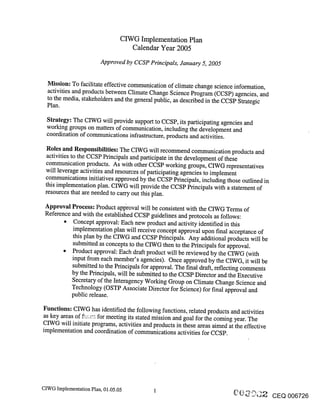
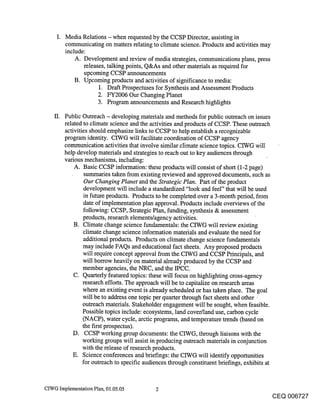
CIWG Implementation Plan
                                   Calendar Year 2005
                        Approved by CCSP Principals, January 5, 2005


  Mission: To facilitate effective communication of climate change science information,
  activities and products between Climate Change Science Program (CCSP) agencies, and
  to the media, stakeholders and the general public, as described in the CCSP Strategic
  Plan.

  Strategy: The CIWG will provide support to CCSP, its participating agencies and
  working groups on matters of communication, including the development and
  coordination of communications infrastructure, products and activities.

 Roles and Responsibilities: The CIWG will recommend communication products and
 activities to the CCSP Principals and participate in the development of these
 communication products. As with other CCSP working groups, CIWG representatives
 will leverage activities and resources of participating agencies to implement
 communications initiatives approved by the CCSP Principals, including those outlined in
 this implementation plan. CIWG will provide the CCSP Principals with a statement of
 resources that are needed to carry out this plan.

 Approval Process: Product approval will be consistent with the CIWG Terms of
 Reference and with the established CCSP guidelines and protocols as follows:
           Concept approval: Each new product and activity identified in this
           implementation plan will receive concept approval upon final acceptance of
           this plan by the CIWG and CCSP Principals. Any additional products will be
           submitted as concepts to the CIWG then to the Principals for approval.
           Product approval: Each draft product will be reviewed by the CIWG (with
           input from each member’s agencies). Once approved by the CIWG, it will be
           submitted to the Principals for approval. The final draft, reflecting comments
          by the Principals, will be submitted to the CCSP Director and the Executive
          Secretary of the Interagency Working Group on Climate Change Science and
          Technology (OSTP Associate Director for Science) for final approval and
          public release.

Functions: CIWG has identified the following functions, related products and activities
as key areas of ,.: ...... for meeting its stated mission and goal for the coming year. The
CIWG will initiate programs, activities and products in these areas aimed at the effective
implementation and coordination of communications activities for CCSP.


CIWG Implementation Plan, 01.05.05
                                                                                              CEQ 006726
Media Relations - when requested by the CCSP Director, assisting in
          communicating on matters relating to climate science. Products and activities may
          include:
              A. Development and review of media strategies, communications plans, press
                 releases, talking points, Q&As and other materials as required for
                 upcoming CCSP announcements
              B. Upcoming products and activities of significance to media:
                      1. Draft Prospectuses for Synthesis and Assessment Products
                      2. FY2006 Our Changing Planet
                      3. Program announcements and Research highlights

    It.   Public Outreach - developing materials and methods for public outreach on issues
          related to climate science and the activities and products of CCSP. These outreach
          activities should emphasize links to CCSP to help establish a recognizable
          program identity. CIWG will facilitate coordination of CCSP agency
          communication activities that involve similar climate science topics. CIWG will
          help develop materials and strategies to reach out to key audiences through
          various mechanisms, including:
              A. Basic CCSP information: these products will consist of short (1-2 page)
                   summaries taken from existing reviewed and approved documents, such as
                   Our Changing Planet and the Strategic Plan. Part of the product
                   development will include a standardized "look and feel" that will be used
                  in future products. Products to be completed over a 3-month period, from
                  date of implementation plan approval. Products include overviews of the
                  following: CCSP, Strategic Plan, funding, synthesis & assessment
                  products, research elements/agency activities.
              B. Climate change science fundamentals: the CIWG will review existing
                  climate change science information materials and evaluate the need for
                  additional products. Products on climate change science fundamentals
                  may include FAQs and educational fact sheets. Any proposed products
                  will require concept approval from the CIWG and CCSP Principals, and
                  will borrow heavily on material already produced by the CCSP and
                  member agencies, the NRC, and the IPCC.
              C. Quarterly featured topics: these will focus on highlighting cross-agency
                  research efforts. The approach will be to capitalize on research areas
                  where an existing event is already scheduled or has taken place. The goal
                  will be to address one topic per quarter through fact sheets and other ¯
                  outreach materials. Stakeholder engagement will be sought, when feasible.
                  Possible topics include: ecosystems, land cover/land use, carbon cycle
                  (NACP), water cycle, arctic programs, and temperature trends (based on
                  the first prospectus).
              D. CCSP working group documents: the CIWG, through liaisons with the
                  working groups will assist in producing outreach materials in conjunction
                  with the release of research products.
             E. Science conferences and briefings: the CIWG will identify opportunities
                  for outreach to specific audiences through constituent briefings, exhibits at


CIWG Implementation Plan, 01.05.05            2
                                                                                            CEQ 006727
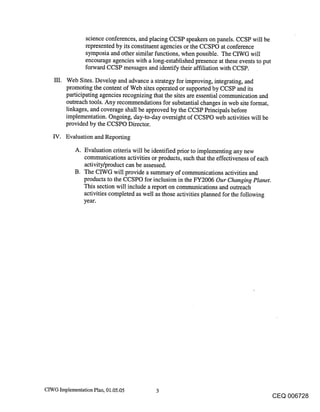
science conferences, and placing CCSP speakers on panels. CCSP will be
                 represented by its constituent agencies or the CCSPO at conference
                 symposia and other similar functions, when possible. The CIWG will
                 encourage agencies with a long-established presence at these events to put
                 forward CCSP messages and identify their affiliation with CCSP.

         Web Sites. Develop and advance a stra.tegy for improving, integrating, and
         promoting the content of Web sites operated or supported by CCSP and its
         participating agencies recognizing that the sites are essential communication and
         outreach tools. Any recommendations for substantial changes in web site format,
         linkages, and coverage shall be approved by the CCSP Principals before
         implementation. Ongoing, day-to-day oversight of CCSPO web activities will be
         provided by the CCSPO Director.
   IV. Evaluation and Reporting

            A. Evaluation criteria will be identified prior to implementing any new
               communications activities or products, such that the effectiveness of each
               activity/product can be assessed.
            B. The CIWG will provide a summary of communications activities and
               products to the CCSPO for inclusion in the FY2006 Our Changing Planet.
               This section will include a report on communications and outreach
               activities completed as well as those activities planned for the following
               year.


CIWG Implementation Plan, 01.05.05          3
                                                                                         CEQ 006728
CEQ 006729
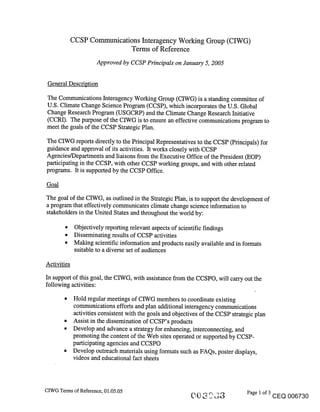
CCSP Communications Interagency Working Group (CIWG)
                             Terms of Reference
                      Approved by CCSP Principals on January 5, 2005


 General Description

 The Communications Interagency Working Group (CIWG) is a standing committee of
 U.S. Climate Change Science Program (CCSP), which incorporates the U.S. Global
 Change Research Program (USGCRP) and the Climate Change Research Initiative
 (CCRI). The purpose of the CIWG is to ensure an effective communications program to
 meet the goals of the CCSP Strategic Plan.

The CIWG reports directly to the Principal Representatives to the CCSP (Principals) for
guidance and approval of its activities. It works closely with CCSP
Agencies/Departments and liaisons from the Executive Office of the President (EOP)
participating in the CCSP, with other CCSP working groups, and with other related
programs. It is supported by the CCSP Office.

Goal

The goal of the CIWG, as outlined in the Strategic Plan, is to support the development of
a program that effectively communicates climate change science information to
stakeholders in the United States and throughout the world by:

        ¯ Objectively reporting relevant aspects of scientific findings
        ¯ Disseminating results of CCSP activities
        ¯ Making scientific information and products easily available and in formats
          suitable to a diverse set of audiences

Activities
In support of this goal, the CIWG, with assistance from the CCSPO, will can’y out the
following activities:
        ¯ Hold regular meetings of CIWG members to coordinate existing
          communications efforts and plan additional interagency communications
          activities consistent with the goals and objectives of the CCSP strategic plan
        ¯ Assist in the dissemination of CCSP’s products
        ¯ Develop and advance a strategy for enhancing, interconnecting, and
          promoting the content of the Web sites operated or supported by CCSP-
          participating agencies and CCSPO
        ¯ Develop outreach materials using formats such as FAQs, poster displays,
          videos and educational fact sheets


CIWG Terms of Reference, 01.05.05                                              Page 1 of 3
                                                                                             CEQ 006730
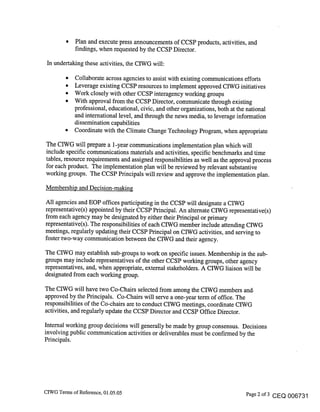
Plan and execute press announcements of CCSP products, activities, and
             findings, when requested by the CCSP Director.

 In undertaking these activities, the CIWG will:

        ¯ Collaborate across agencies to assist with existing communications efforts
        ¯ Leverage existing CCSP resources to implement approved CIWG initiatives
        * Work closely with other CCSP interagency working groups
        * With approval from the CCSP Director, communicate through existing
          professional, educational, civic, and other organizations, both at the national
          and international level, and through the news media, to leverage information
          dissemination capabilities
        ¯ Coordinate with the Climate Change Technology Program, when appropriate

The CIWG will prepare a 1-year communications implementation plan which will
include specific communications materials and activities, specific benchmarks and time
tables, resource requirements and assigned responsibilities as well as the approval process
for each product. The implementation plan will be reviewed by relevant substantive
working groups. The CCSP Principals will review and approve the implementation plan.

Membership and Decision-making

All agencies and EOP offices participating in the CCSP will designate a CIWG
representative(s) appointed by their CCSP Principal. An alternate CIWG representative(s)
from each agency may be designated by either their Principal or primary
representative(s). The responsibilities of each CIWG member include attending CIWG
meetings, regularly updating their CCSP Principal on CIWG activities, and serving to
foster two-way communication between the CIWG and their agency.

The CIWG may establish sub-groups to work on specific issues. Membership in the sub-
groups may include representatives of the other CCSP working groups, other agency
representatives, and, when appropriate, external stakeholders. A CIWG liaison will be
designated from each working group.

The CIWG will have two Co-Chairs selected from among the CIWG members and.
approved by the Principals. Co-Chairs will serve a one-year term of office. The
responsibilities of the Co-chairs are to conduct CIWG meetings, coordinate CIWG
activities, and regularly update the CCSP Director and CCSP Office Director.

Internal working group decisions will generally be made by group consensus. Decisions
involving public communication activities or deliverables must be confirmed by the
Principals.


CIWG Terms of Reference, 01.05.05                                             Page 2 of 3 CEQ 006731
Meetin~ and Reportin~ Schedule
  The CIWG will meet regularly. The Co-Chairs will provide updates and briefings to the
  CCSP Principals, as appropriate. The CCSP Office will maintain agenda, minutes, and
  other records.


CIWG Terms of Reference, 01.05.05                                   Page 3 of 3
                                                                                     CEQ 006732
CEQ 006733
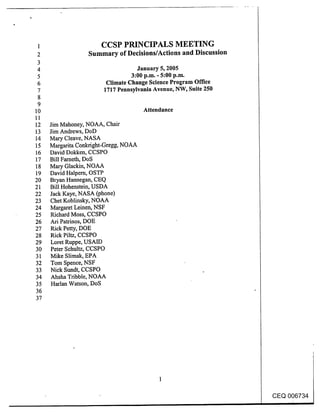
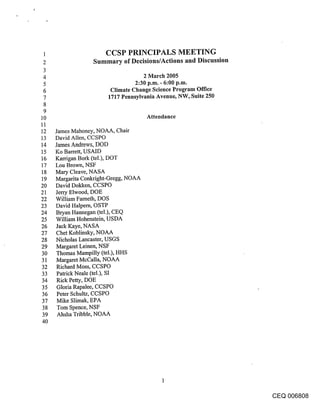
1                    CCSP PRINCIPALS MEETING
 2                Summary of Decisions/Actions and Discussion
 3
 4                                 January 5, 2005
 5                               3:00 p.m. - 5:00 p.m.
 6                      Climate Change Science Program Office
 7                     1717 Pennsylvania Avenue, NW, Suite 250
 8
 9
10                                     A~endance
11
12   Jim Mahoney, NOAA, Chair
13   Jim Andrews, DoD
14   Mary Cleave, NASA
15   Margarita Conkright-Gregg, NOAA
16   David Dokken, CCSPO
17   Bill Fameth, DoS
18   Mary Glackin, NOAA
19   David Halpem, OSTP
20   Bryan Hannegan, CEQ
21   Bill Hohenstein, USDA
22   Jack Kaye, NASA (phone)
23   Chet Koblinsky, NOAA
24   Margaret Leinen, NSF
25   Richard Moss, CCSPO
26   Ari Patrinos, DOE
27   Rick Petty, DOE
28   Rick Piltz, CCSPO
29   Loret Ruppe, USAID
30   Peter Schultz, CCSPO
31   Mike Slimak, EPA
32   Tom Spence, NSF
33   Nick Sundt, CCSPO
34   Ahsha Tribble, NOAA
35   Harlan Watson, DoS
36
37


                                                                 CEQ 006734
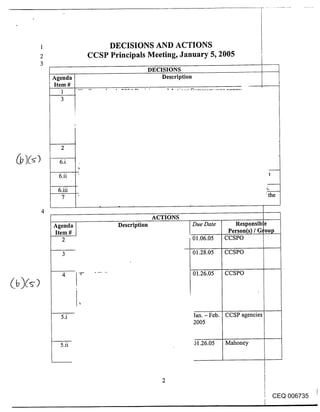
1                     DECISIONS AND ACTIONS
2                 CCSP Principals Meeting, January 5, 2005
3
                                        DECISIONS
    Agenda                                  Description
    Item #
       1
       3


      2


     6.ii

     6.iii
      7                                                                                " the


                                         ACTIONS
    Agenda                Description                 Due Date           Responsib
    Item #                                                            Person(s) / GI
       2                                              01.06.05       CCSPO        ~

      3                                               01.28.05       CCSPO        I


             T°                                           01.26.05   CCSPO
      4


      5.i                                                 Ian. - Feb. CCSP agencies
                                                          2005


      5.ii                                                01.26.05   Mahoney


                                                                                          CEQ 006735
CEQ 006736
Message                                                                                    Page 1 of I


From: ccsp-bounces @usgcrp:gov on behalf of Moss, Richard H [Richard.Moss@pnl.gov]
Sent: Friday, January 07, 2005 8:07 PM
To: ccsp@usgcrp.gov
Cc: ipo@usgcrp.gov; Bill Murray; ccsp_info@usgcrp.gov; Chris Miller; TKarl
Subject: [ccsp] Final review of Prospectus for Product 1.1

Follow Up Flag: Follow up
Due By: Tuesday, January 18, 2005 12:00 PM
Flag Status: Flagged

TO:    CCSP Principals
FR:    James Mahoney and Richard Moss
RE:    Final Review of Product 1.1 Draft Prospectus

Attached please find the revised prospectus for Product 1.1, Temperature Trends in the Lower
Atmosphere: Steps for Understanding and Reconciling Differences, as well as a compilation of the
comments received during the public comment period (July 7 to August 12). This prospectus is being
circulated to the CCSP Principals for final approval, as described in step 5 of the Guidelines for
Producing CCSP Synthesis and Assessment Products.

Feel free to contact me if you have any questions regarding the response to a particular comment
contained in the collation of public comments. This collation will be posted on CCSP website along with
the prospectus, once it is approved. The affiliations of several of those who offered comments will be
added to the collation before it is posted. I also note that we will include a url for the collated comments
in the prospectus.

The deadline for response is COB Tuesday, January 18. When you respond, please indicate whether you
approve the prospectus for final posting.

We wish to thank Tom Karl and his team of authors and editors for the care with which they have
conformed the prospectus to the approved Guidelines and considered/responded to the comments
received.

Richard H. Moss, Ph.D.
Director, Climate Change Science Program Office
(Incorporating the US Global Change Research Program and the Climate Change Research Initiative)
1717 Pennsylvania Avenue NW, Suite 250
Washington, DC 20006
Email: rmoss@usgcrp.gov
Telephone: 1 (202)419-3476
Fax: 1 (202)223-3065


                                                                                              CEQ 006737
file://G:WOIA - Climate2005kDeliberativel-3.05ccso Final review of Prosoectus for Pro... 4/1-2/2007
CEQ 006738
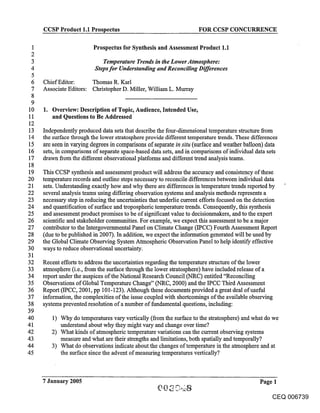
CCSP Product 1.1 Prospectus                                    FOR CCSP CONCURRENCE

1                        Prospectus for Synthesis and Assessment Product 1.1
2
3                            Temperature Trends in the Lower Atmosphere:
4                         Steps for Understanding and Reconciling Differences
5
 6   Chief Editor:      Thomas R. Karl
 7   Associate Editors: Christopher D. Miller, William L. Murray
 8
 9
10   1. Overview: Description of Topic, Audience, Intended Use,
11      and Questions to Be Addressed
12
13   Independently produced data sets that describe the four-dimensional temperature structure from
14   the surface through the lower stratosphere provide different temperature trends. These differences
15   are seen in varying degrees in comparisons of separate in situ (surface and weather balloon) data
16   sets, in comparisons of separate space-based data sets, and in comparisons of individual data sets
17   drawn from the different observational platforms and different trend analysis teams.
18
19   This CCSP synthesis and assessment product will address the accuracy and consistency of these
20   temperature records and outline steps necessary to reconcile differences between individual data
21   sets. Understanding exactly how and why there are differences in temperature trends reported by
22   several analysis teams using differing observation systems and analysis methods represents a
23   necessary step in reducing the uncertainties that underlie current efforts focused on the detection
24   and quantification of surface and tropospheric temperature trends. Consequently, this synthesis
25   and assessment product promises to be of significant value to decisionmakers, and to the expert
26   scientific and stakeholder communities. For example, we expect this assessment to be a major
27   contributor to the. Intergovernmental Panel on Climate Change (IPCC) Fourth Assessment Report
28   (due to be published in 2007). In addition, we expect the information generated will be used by
29   the Global Climate Observing System Atmospheric Observation Panel to help identify effective
30   ways to reduce observational uncertainty.
31
32   Recent efforts to address the uncertainties regarding the temperature structure of the lower
33   atmosphere (i.e., from the surface through the lower stratosphere) have included release of a
34   report under the auspices of the National Research Council (NRC) entitled "Reconciling
35   Observations of Global Temperature Change" (NRC, 2000) and the IPCC Third Assessment
36   Report (IPCC, 2001, pp 101-123). Although these documents provided a great deal of useful
37   information, the complexities of the issue coupled with shortcomings of the available observing
38   systems prevented resolution of a number of fundamental questions, including:
39
40      1) Why do temperatures vary vertically (from the surface to the stratosphere) and what do we
41         understand about why they might vary and change over time?
42      2) What kinds of atmospheric temperature variations can the current observing systems
43         measure and what are their strengths and limitations, both spatially and temporally?
44      3) What do observations indicate about the changes of temperature in the atmosphere and at
45         the surface since the advent of measuring temperatures vertically?


     7 January 2005                                                                           Page 1

                                                                                                   CEQ 006739
CCSP Product 1.1 Prospectus                                        FOR CCSP CONCURRENCE

 1       4) What is our understanding of the contribution made by observational or methodological
 2          uncertainties to the previously reported vertical differences in temperature trends?
 3       5) How well can the observed vertical temperature changes be reconciled with our
 4          understanding of the causes of these changes?
 5       6) What measures can be taken to improve the understanding of observed changes?
 6
 7    These questions provide the basis for the six main chapters in the synthesis and assessment
  8   product. They highlight several of the fundamental uncertainties and differences between and
  9   within the individual components of the existing observational and modeling systems. The
 10   responses to the questions will be written in a style consistent with major international scientific
 11   assessments [e.g., IPCC assessments, and the Global Ozone Research and Monitoring Project
 12   (WMO, 1999)].
 13
 14
 15   2. Contact Information: Email and Telephone for Responsible Individuals
 16      at the Lead and Supporting Agencies
 17
18    NOAA is the lead agency for this synthesis product. Relevant agency personnel are presented in
19    the following table:
20
21    CCSP Member Agency            Agency Leads
22    DOC (NOAA)                    Tom Karl/Chris Miller/Bill Murray
23    DOE                           Rick Petty
24    NASA                          Eric Fetzer
25    NSF                           Jay Fein
26
27
28    3. Lead Authors: Required Expertise and Biographical Information
29
30    A list of lead author nominees was identified based on past records of interest and
31    accomplishment in framing the core issues related to changes, trends, and uncertainties in the
32    lower atmospheric temperature records, advancing relevant scientific arguments, and contributing
33    to increased understanding of the behavior of respective components of the end-to-end system
34    that provides the required data sets. Past contributions to relevant scientific assessments, success
35    in peer-reviewed proposal funding competitions, and publication records in refereed journals are
36    among the measures used in the selection process. The lead authors selected on the basis of these
37    criteria are listed below. Chapter assignments and biographical information are presented in
38    Appendix A.
39
40    Lead Authors
41
42    John Christy (University of Alabama/Huntsville)
43    Chris Folland, (Hadley Centre, U.K. Met Office)
44    Chris Forest (Massachusetts Institute of Technology)
45    Jim Hurrell (National Center for Atmospheric Research)
46    John Lanzante (NOAA/Geophysical Fluid Dynamics Laboratory)


      7 January 2005                                                                              Page 2

                                                                                                        CEQ 006740
CCSP Product 1.1 Prospectus                                   FOR CCSP CONCURRENCE

 1    Carl Meats (Remote Sensing Systems)
 2    Jerry Meehl (National Center for Atmospheric Research)
 3    David Parker (U.K. Met Office)
 4    Joyce Penner (U. Michigan)
 5    Thomas C. Peterson (NOAA/National Climatic Data Center)
 6    Roger Pielke Sr. (Colorado State University)
 7    V. Ramaswamy (NOAA/Geophysical Fluid Dynamics Laboratory)
 8    Dick Reynolds (NOAA/National Climatic Data Center)
 9    Ben Santer (Lawrence Livermore National Laboratory)
10    Dian Seidel (NOAA Air Resources Laboratory)
11    Steve Sherwood (Yale University)
 12   Roy Spencer (U. Alabama-Huntsville)
 13   Peter Thorne (U.K. Met Office/Hadley Centre)
 14   Kostya Vinnikov (University of Maryland)
 15   Russell S. Vose (NOAA/National Climatic Data Center)
 16   Frank Wentz (Remote Sensing Systems
 17   Tom M.L. Wigley (National Center for Atmospheric Research)
 18
 19
20    4. Stakeholder Interactions
21
22    The questions addressed by the report were framed by the lead agency with the benefit of
23    consultation from members of the Climate Change Science Program (CCSP) Office, the NOAA
24    Science Advisory Board Climate Monitoring Working Group1, and participants at a workshop on
25    Reconciling Vertical Temperature Trends that was held at NOAA’s National Climati( Data
26    Center (NCDC) on 27-29 October 2003, and attended by 55 scientific experts from academia, the
27    U.S. government, the private sector, and several scientific experts from other countries. The
28    workshop was designed to address a broad range of issues related to vertical temperatures trends,
 29   and it provided a scientific foundation for the development of this CCSP synthesis product. The
30    workshop presentations and results of breakout groups are posted on
31    <http://www.ncdc.noaa.gov/oa/rvtt.html>. The workshop assessed the current state of knowledge
32    on this topic, identified near-term and long-term steps to address existing uncertainties, and
33    provided a framework for a synthesis and assessment product structured around the six questions
34    listed above.
35
36    [FOOTNOTE 1: The NOAA Science Advisory Board Climate Monitoring Working Gro~ap,
37    which has since been merged with the Climate and Global Change Working Group, was charged
38    to provide, in the context of national and international activities, scientific advice and broad
39    program direction to NOAA on the condition and capabilities of NOAA’s observing systems/data
40    management systems for the purpose of climate monitoring.]
41
42    In addition, Principals on the CCSP Interagency Committee provided input from a governmental
43    perspective during the CCSP review, and other stakeholders provided input during the public
44    comment period (see <add url> for a collation of the comments submitted during public comment
45    period).
46


      7 January 2005                                                                         Page 3

                                                                                                   CEQ 006741
CCSP Product 1.1 Prospectus                                      FOR CCSP CONCURRENCE

  1
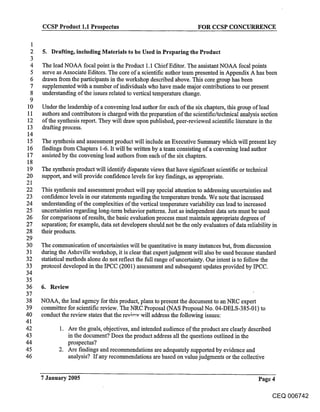
  2   5. Drafting, including Materials to be Used in Preparing the Product
  3
  4   The lead NOAA focal point is the Product 1.1 Chief Editor. The assistant NOAA focal points
  5   serve as Associate Editors. The core of a scientific author team presented in Appendix A has been
  6   drawn from the participants in the workshop described above. This core group has been
  7   supplemented with a number of individuals who have made major contributions to our present
  8   understanding of the issues related to vertical temperature change.
  9
 10   Under the leadership of a convening lead author for each of the six chapters, this group of lead
 11   authors and contributors is charged with the preparation of the scientific/technical analysis section
 12   of the synthesis report. They will draw upon published, peer-reviewed scientific literature in the
 13   drafting process.
 14
 15   The synthesis and assessment product will include an Executive Summary which will present key
16    findings from Chapters 1-6. It will be written by a team consisting of a convening lead author
17    assisted by the convening lead authors from each of the six chapters.
18
19    The synthesis product will identify disparate views that have significant scientific or technical
20    support, and will provide confidence levels for key f’mdings, as appropriate.
21
22    This synthesis and assessment product will pay special attention to addressing uncertainties and
23    confidence levels in our statements regarding the temperature trends. We note that increased
24    understanding of tl~e complexities oft he vertical temperature variability can lead to increased
25    uncertainties regarding long-term behavior patterns. Just as independent data sets must be used
26    for comparisons of results, the basic evaluation process must maintain appropriate degrees of
27    separation; for example, data set developers should not be the only evaluators of data reliability in
28    their products.
29
3o    The communication of uncertainties will be quantitative in many instances but, from discussion
31    during the Asheville workshop, it is clear that expert judgment will also be used because standard
32    statistical methods alone do not reflect the full range of uncertainty. Our intent is to follow the
33    protocol developed in the IPCC (2001) assessment and subsequent updates provided by IPCC.
34
35
36    6. Refiew
37
38    NOAA, the lead agency for this product, plans to present the document to an NRC expert
39    committee for scientific review. The NRC Proposal (NAS Proposal No. 04-DELS-385-01) to
40    conduct the review states that the review will address the following issues:
41
42          1. Are the goals, objectives, and intended audience of the product are clearly described
43             in the document? Does the product address all the questions outlined in the
44             prospectus?
45          2. Are fmdings and recommendations are adequately supported by evidence and
46             analysis? If any recommendations are based on value judgments or the collective


      7 January 2005                                                                             Page 4

                                                                                                          CEQ 006742
CCSP Product 1.1 Prospectus                                      FOR CCSP CONCURRENCE

  1              opinions of the authors, is this acknowledged and are adequate reasons given for
  2              reaching those judgments?
  3          3. Are the data and analyses handled competently? Are the statistical methods applied
  4              appropriately? Are the uncertainties and confidence levels evaluated and
  5              communicated appropriately?
  6          4. Are the document’s presentation and is organization effective? Are the questions
  7              outlined in the prospectus addressed and communicated in a manner that is
  8              appropriate for the intended audience?
  9          5. Is the document scientifically objective and policy neutral? Is it consistent with the
 10              scientific literature, including recent NRC reports and other scientific assessments on
 11              the same topic?
 12          6. Does the summary concisely and accurately describe the content, key f’mdings, and
 13              recommendations? Is it consistent with other sections of the document?
 14          7. What other significant improvements, if any, might be made in the document?
 15
 16   The Proposal further states that the period of performance for the review is expected to be 1
 17   November 2004 to 30 April 2005.
 18
19    Following expert review, the lead authors will revise the draft product by incorporating
20    comments and suggestions from the reviewers, as the lead authors deem appropriate.
21
22    Following this revision, the draft product will be released for public comment. The public
23    comment period will be 45 days and will take place from 1 June to 15 July 2005.
24
25    The lead authors will prepare a third draft of the product, taking into consideration the comments
26    submitted during the public comment period. The scientific judgment of the lead authors will
27    determine responses to the comments.
28
29    Once the revisions are complete, the lead agency will submit the synthesis and assessment
30    product to the CCSP Interagency Committee for approval. If the CCSP Interagency Committee
31    determines that further revision is necessary, their comments will be sent to the lead agency for
32    consideration and resolution by lead authors. If needed, the NRC will be asked to provide
33    additional scientific analysis to bound scientific uncertainty associated with specific issues.
34
35    If the CCSP Interagency Committee review determines that no further revisions are needed and
36    that the product has been prepared in conformance with the Guidelines for Producing CC. SP
37    Synthesis and Assessment Products (see <http://www.climatescience.goviLibrary/sap/sap-
38    guidelines.htm>) and the Data Quality Act (including ensuring objectivity, utility, and integrity
39    as defined in 67 FR 8452), they will submit the product to the National Science and Technology
40    Council (’NSTC) for clearance. Clearance will require the concurrence of all members of the
41    Committee on Environment and Natural Resources. Comments generated during the NSTC
42    review will be addressed by the CCSP Interagency Committee in consultation with the lead and
43    supporting agencies and the lead authors.
44
45
46    7. Related Activities: Coordination with


      7 January 2005                                                                           Page 5

                                                                                                      CEQ 006743
CCSP Product 1.1 Prospectus                                       FOR CCSP CONCURRENCE

  1       Other National or International Assessment Processes
 2
 3    This CCSP synthesis and assessment product has been coordinated internationally with a U.K.
 4    Met Office workshop on understanding vertical profiles of temperature trends conducted in
 5    September 2004 in Exeter, England. The coordination included presentations in Exeter by the
 6    synthesis and assessment product lead authors to provide an interim look at progress on
 7    addressing each of the key questions. There is also ongoing coordination with a newly constituted
 8    Global Climate Observing System (GCOS)/Atmospheric Observations Panel for Climate (AOPC)
 9    Working Group on Reconciling Vertical Temperature Trends. The synthesis and assessment
10    product is expected to provide input to the IPCC Fourth Assessment Report.
11
12
13    8. Communications
14
15    NOAA, the lead agency, will produce and release the completed product using a standard format
16    for all CCSP synthesis and assessment products. The final product and the comments received
17    during the expert review and the public comment period will be posted, without attribution
18    (unless specific reviewers agree to attribution), on the CCSP web site.
19
20    The lead authors will also be encouraged to publish their findings in the scientific literature.
21
22
23    9. Proposed Timeline
24
25    Preparation of this synthesis and assessment product has been underway during completion of this
26    prospectus because of the time required to finalize the overall Guidelines for Producing CCSP
27    Synthesis and,4ssessment Products. This approach was taken in order to coordinate work on the
28    product with other international efforts, in particular, so the product could be completed in time to
29    provide an input to the ~CC Fourth Assessment Report. Comments received on the draft
30    prospectus were taken into account in the process, and all procedures used in preparing the report
31    have been adjusted to be consistent with those mandated by the Guidelines.
32
33    The timeline is divided into two phases. The planned completion date for Phase 1, which will
34    result in the submission of the first draft of the synthesis product for scientific review by the
35    National Research Council, is January 2005. The planned completion date for Phase 2, which will
36    culminate with approval of the synthesis product by the President’s National Science and
37    Technology Council, is October 2005. Specific milestones follow.
38
39       PHASE 1
40       ¯ Lead authors nominated- _~:,~.,., 04
41       ¯ Synthesis product prospectus released for public comment- July 04
42       ¯ First lead author meeting - August 04
43       ¯ Second lead author meeting - October 04
44       ¯ Third lead author meeting - December 04
45       ¯ Synthesis product first draft submitted for NRC scientific review - January 05
46


      7 January 2005                                                                              Page 6

                                                                                                         CEQ 006744
CCSP Product 1.1 Prospectus
                FOR CCSP CONCURRENCE
                                                        1      PHASE 2
Iort Chapter Titles and Lead Authors                    2      ¯ NRC review completed- April 05
                                                        3      ¯ Synthesis product second draft released
fly (from the surface to the stratosphere) and          4      ¯ Public comment period completed- 15.
vary and change over time?                              5      ¯ Synthesis product third draft and compi
                                                        6        - August 05
,AA/GFDL) - V. Ramaswamy is a Senior                    7      ¯ Synthesis product accepted by CCSP an
~ics Laboratory, Princeton, NJ. He is the Chair of      8        approval - September 05
Lt (a project of the WCRP Stratospheric                 9      ¯ Synthesis product approved by NSTC -
¯ oject (1993-present). Dr. Ramaswamy has been         10
heric Ozone Assessment (1992,1994,1998,                11
rgovernmental Panel on Climate Change                  12   References
~lication list and has received numerous awards        13
dal Award in 2002 for "world-renowned                  14   IPCC, 2001: Observed climate variability and c
state of the art assessment of the science of          15      Basis. Contribution of Working Group I to ~
"ganization Norbert Gerbier MUMM Award -               16      Intergovernmental Panel on Climate Chang,
¯ ends: Observations and Model Simulations" by         17      Noguer, P.J. van der Linden, X. Dai, K. Ma
eophysics, 39, 71-122, 2001. Other relevant            18      University Press, U.K.
                                                       19   NRC, 2000: Reconciling Observations of Globe
lamett, D.Gaffen, M. Gelman, P. Keckhut, Y.            20      Council, Board on Atmospheric Sciences ar
ill, J. Nash, W. Randel, R. Rood, K. Shine, M.         21      Environment and Resources, National Acad
iture Trends: Observations and Model                   22   WMO, 1999: Scientific Assessment of Ozone D,
-122,2001.                                             23      Monitoring Project, Report #44. World Met
~cts of Ozone and Well-Mixed Gases on Annual
physical Research Letters, 10.1029/2002


,ql is a senior scientist and deputy director of the
tional Center for Atmospheric Research. His
studies and diagnostic analyses to better
e change. He has authored or co-authored more
hapters, as well as dozens of other planning
’ed publications include numerous articles on
tce versus tropospheric temperature trends, and
oy Meisinger Award from the American
 extensively involved in the World Climate
Predictability (CLIVAR), and he serves as co-
,WAR. Jim has also been involved in the
ael on Climate Change, and he has served on
~tions of particular relevance include the

fllite versus surface estimates of air temperature

ficulties in obtaining reliable temperature trends:
ords. Journal of Climate, 11,945-967.


                                                            7 January 2005
                                           Page 8
                                                                                       CEQ 006745
CCSP Product 1.1 Prospectus                                   FOR CCSP CONCURRENCE

 1      Hurrell, J. W., S. J. Brown, K. E. Trenberth, and J. R. Christy, 2000: Comparison of
 2      tropospheric temperatures from radiosondes and satellites: 1979-1998. Bulletin of the
 3      American Meteorological Society, 81, 2165-2177.
 4
 5   Lead Author: Jerry Meehl (NCAR) - Gerald Meehl is a Senior Scientist at the National Center
 6   for Atmospheric Research. He is a member of the CLWAR/WCRP Working Group on Coupled
 7   Models (WGCM) and is chairman of the Coupled Model Intercomparison Project, as well as
 8   chairman of the WGCM Climate Simulation Panel and co-chairman of the Community Climate
 9   System Model Climate Change Working Group. He has been prominent in the Intergovemmental
10   Panel on Climate Change (IPCC) Scientific Assessment activities. Dr. Meehl was a convening
11   lead author of Chapter 9 in "Climate Change 2001: The Scientific Basis," produced as a
12   contribution of Working Group 1 to the Third Assessment Report of the IPCC. He has written or
13   co-authored several refereed articles on the topic of tropospheric and surface temperatures and has
14   a long history of written publications in this area including:
15       Meehl, G.A., W.M. Washington, C. Ammann, J.M. Arblaster, T.M.L. Wigley, and C. Tebaldi,
16       2004: Combinations of natural and anthropogenic forcings and 20th century climate. J.
17       Climate, in press.
18       Meehl, G.A., W.M. Washington, J.M. Arblaster, and A. Hu, 2004: Factors affecting climate
19       sensitivity in global coupled models. J. Climate, 17, 1584-- 1596.
20
21
22   Chapter 2 - What kinds of atmospheric temperature variations can the current observing
23   systems measure and what are their strengths and limitations, both spatially and
24   temporally?
25
26   Convening Lead Author: John Christy (University of Alabama/Huntsville) -John R. Christy
27   is Professor of Atmospheric Science at the University of Alabama in Huntsville, Alabama State
28   Climatologist and Director of the UAH Earth System Science Center. He is/was a member of
29   several National Research Council panels dealing with climate and space based observations and
30   is currently on the NRC Committee on Environmental Satellite Data Utilization. He was selected
31   as a Lead Author of the IPCC 2001 WG 1 (chapter on observations) and as a member of the panel
32   which wrote the AGU Official Statement on Climate Change adopted in 2003. He has written
33   several articles on surface, tropospheric and stratospheric temperatures, including basic
34   construction methodology of conventional and spaced-based data sets, tests for their precision,
35   and analysis of the climate products. His most recent paper "What may we conclude about
36   tropospheric temperature trends?" will appear soon in Geophysical Research Letters. Other
37   relevant publications include:
38       Christy, J.R. and W.B. Norris, 2004: What may we conclude about tropospheric temperature
39       trends? Geophys. Res. Lett., 31, No. 6, L0621.
40       Christy, J.R. and R.W. Spencer, 2003: Reliability of satellite data sets. Science, 301, 1046-
41       1047.
42       Christy, J.R., R.W. Spencer, W.B. Norris, W.D. Braswell and D.E. Parker, 2003: Error
43       estimates of Version 5.0 of MSU/AMSU bulk atmospheric temperatures. J. Atmos. Oceanic
44       Tech. 20, 613-629.
45


     7 January 2005                                                                             Page 9

                                                                                                     CEQ 006746
CCSP Product 1.1 Prospectus                                     FOR CCSP CONCURRENCE

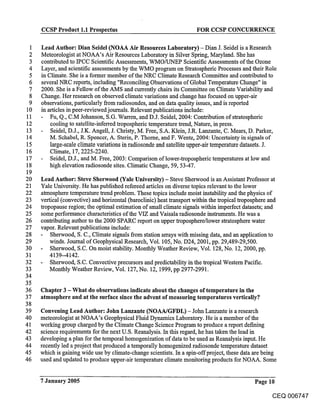
 1   Lead Author: Dian Seidel (NOAA Air Resources Laboratory) - Dian J. Seidel is a Research
 2   Meteorologist at NOAA’s Air Resources Laboratory in Silver Spring, Maryland. She has
 3   contributed to IPCC Scientific Assessments, WMO/UNEP Scientific Assessments of the Ozone
 4   Layer, and scientific assessments by.the WMO program on Stratospheric Processes and their Role
 5   in Climate. She is a former member of the NRC Climate Research Committee and contributed to
 6   several NRC reports, including "Reconciling Observations of Global Temperature Change" in
 7   2000. She is a Fellow of the AMS and currently chairs its Committee on Climate Variability and
 8   Change. Her research on observed climate variations and change has focused on upper-air
 9   observations, particularly from radiosondes, and on data quality issues, and is reported
10   in articles in peer-reviewed journals. Relevant publications include:
11       Fu, Q., C.M Johanson, S.G. Warren, and D.J. Seidel, 2004: Contribution of stratospheric
12       cooling to satellite-inferred tropospheric temperature trend, Nature, in press.
13       Seidel, D.J., J.K. Angell, J. Christy, M. Free, S.A. Klein, J.R. Lanzante, C. Mears, D. Parker,
14       M. Schabel, R. Spencer, A. Sterin, P. Thorne, and F. Wentz, 2004: Uncertainty in signals of
15       large-scale climate variations in radiosonde and satellite upper-air temperature datasets. J.
16       Climate, 17, 2225-2240.
17       Seidel, D.J., and M. Free, 2003: Comparison of lower-tropospheric temperatures at low and
18       high elevation radiosonde sites. Climatic Change, 59, 53-47.
19
20   Lead Author: Steve Sherwood (Yale University) - Steve Sherwood is an Assistant Professor at
21   Yale University. He has published refereed articles on diverse topics relevant to the lower
22   atmosphere temperature trend problem. These topics include moist instability and the physics of
23   vertical (convective) and horizontal (baroclinic) heat transport within the tropical troposphere and
24   tropopause region; the optimal estimation of small climate signals within imperfect datasets; and
25   some performance characteristics of the VIZ and Vaisala radiosonde instruments. He was a
26   contributing author to the 2000 SPARC report on upper troposphere/lower stratosphere water
27   vapor. Relevant publications include:
28       Sherwood, S. C., Climate signals from station arrays with missing data, and an application to
29       winds. Journal of Geophysical Research, Vol. 105, No. D24, 2001, pp. 29,489-29,500.
30       Sherwood, S.C. On moist stability. Monthly Weather Review, Vol. 128, No. 12, 2000, pp.
31       4139--4142.
32       Sherwood, S.C. Convective precursors and predictability in the tropical Western Pacific.
33       Monthly Weather Review, Vol. 127, No. 12, 1999, pp 2977-2991.
34
35
36   Chapter 3 - What do observations indicate about the changes of temperature in the
37   atmosphere and at the surface since the advent of measuring temperatures vertically?
38
39   Convening Lead Author: John Lanzante (NOAA/GFDL) - John Lanzante is a research
40   meteorologist at NOAA’s Geophysical Fluid Dynamics Laboratory. He is a member of the
41   working group charged by the Climate Change Science Program to produce a report def’ming
42   science requirements for the next U.S. Reanalysis. In this regard, he has taken the lead in
43   developing a plan for the temporal homogenization of data to be used as Reanalysis input. He
44   recently led a project that produced a temporally homogenized radiosonde temperature dataset
45   which is gaining wide use by climate-change scientists. In a spin-off project, these data are being
46   used and updated to produce upper-air temperature climate monitoring products for NOAA. Some


     7 January 2005                                                                           Page 10

                                                                                                     CEQ 006747
CCSP Product 1.1 Prospectus                                    FOR CCSP CONCURRENCE

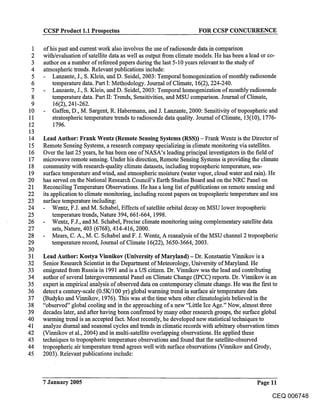
1    of his past and current work also involves the use of radiosonde data in comparison
2    with/evaluation of satellite data as well as output from climate models. He has been a lead or co-
3    author on a number of refereed papers during the last 5-10 years relevant to the study of
4    atmospheric trends. Relevant publications include:
5        Lanzante, J., S. Klein, and D. Seidel, 2003: Temporal homogenization of monthly radiosonde
 6       temperature data. Part I: Methodology. Journal of Climate, 16(2), 224-240.
 7       Lanzante, J., S. Klein, and D. Seidel, 2003: Temporal homogenization of monthly radiosonde
 8       temperature data. Part II: Trends, Sensitivities, and MSU comparison. Journal of Climate,
 9       16(2), 241-262.
10       Gaffen, D., M. Sargent, R. Habermann, and J. Lanzante, 2000: Sensitivity of tropospheric and
11       stratospheric temperature trends to radiosonde data quality. Journal of Climate, 13(10), 1776-
12       1796.
13
14   Lead Author: Frank Wentz (Remote Sensing Systems (RSS)) - Frank Wentz is the Director of
15   Remote Sensing Systems, a research company specializing in climate monitoring via satellites.
16   Over the last 25 years, he has been one of NASA’s leading principal investigators in the field of
17   microwave remote sensing. Under his direction, Remote Sensing Systems is providing the climate
18   community with research-quality climate datasets, including tropospheric temperature, sea-
19   surface temperature and wind, and atmospheric moisture (water vapor, cloud water and rain). He
20   has served on the National Research Council’s Earth Studies Board and on the NRC Panel on
21   Reconciling Temperature Observations. He has a long list of publications on remote sensing and
22   its application to climate monitoring, including recent papers on tropospheric temperature and sea
23   surface temperature including:
24        Wentz, F.J. and M. Schabel, Effects of satellite orbital decay on MSU lower tropospheric
25        temperature trends, Nature 394, 661-664, 1998.
26        Wentz, F.J., and M. Schabel, Precise climate monitoring using complementary satellite data
27        sets, Nature, 403 (6768), 414-416, 2000.
28        Mears, C. A., M. C. Schabel and F. J. Wentz, A reanalysis of the MSU channel 2 tropospheric
29        temperature record, Journal of Climate 16(22), 3650-3664, 2003.
30
31   Lead Author: Kostya Vinnikov (University of Maryland) - Dr. Konstantin Vinnikov is a
32   Senior Research Scientist in the Department of Meteorology, University of Maryland. He
33   emigrated from Russia in 1991 and is a US citizen. Dr. Vinnikov was the lead and contributing
34   author of several I.ntergovernmental Panel on Climate Change (IPCC) reports. Dr. Vinnikov is an
35   expert in empirical analysis of observed data on contemporary climate change. He was the first to
36   detect a century-scale (0.5K/100 yr) global warming trend in surface air temperature data
37   (Budyko and Vinnikov, 1976). This was at the time when other climatologists believed in the
38   "observed" global cooling and in the approaching of a new "Little Ice Age." Now, almost three
39   decades later, and after having been confu’med by many other research groups, the surface global
40   warming trend is an accepted fact. Most recently, he developed new statistical techniques to
41   analyze diurnal and seasonal cycles and trends in climatic records with arbitrary observation times
42   (Vinnikov et al., 2004) and in multi-satellite overlapping observations. He applied these
43   techniques to tropospheric temperature observations and found that the satellite-observed
44   tropospheric air temperature trend agrees well with surface observations (Vinnikov and Grody,
45   2003). Relevant publications include:


     7 January 2005                                                                         Page 11
                                                                                                  CEQ 006748
CCSP Product 1.1 Prospectus                                      FOR CCSP CONCURRENCE

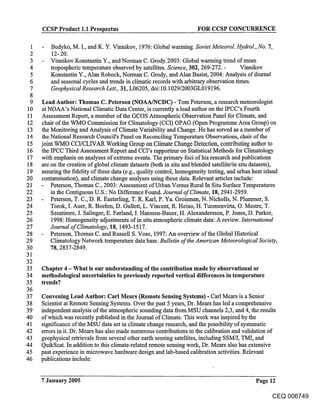
 1       Budyko, M. I., and K. Y. Vinnikov, 1976: Global warming. Soviet Meteorol. Hydrol., No. 7,
 2       12- 20.
 3       Vinnikov Konstantin Y., and Norman C. Grody, 2003: Global warming trend of mean
 4       tropospheric temperature observed by satellites. Science, 302, 269-272. - Vinnikov
 5       Konstantin Y., Alan Robock, Norman C. Grody, and Alan Basist, 2004: Analysis of diurnal
 6       and seasonal cycles and trends in climatic records with arbitrary observation times.
 7       Geophysical Research Lett., 31, L06205, doi: 10.1029/2003GL019196.
 8
 9    Lead Author: Thomas C. Peterson (NOAA/NCDC) - Tom Peterson, a research meteorologist
10    at NOAA’s National Climatic Data Center, is currently a lead author on the IPCC’s Fourth
11   Assessment Report, a member of the GCOS Atmospheric Observation Panel for Climate, and
12    chair of the WMO Commission for Climatology (CC1) OPAG (Open Programme Area Group) on
13   the Monitoring and Analysis of Climate Variability and Change. He has served as a member of
14   the National Research Council’s Panel on Reconciling Temperature Observations, chair of the
15   joint WMO CC1/CLIVAR Working Group on Climate Change Detection, contributing author to
16   the IPCC Third Assessment Report and CCI’s rapporteur on Statistical Methods for Climatology
17   with emphasis on analyses of extreme events. The primary foci of his research and publications
18   are on the creation of global climate datasets (both in situ and blended satellite/in situ datasets),
19   assuring the fidelity of these data (e.g., quality control, homogeneity testing, and urban heat island
20   contamination), and climate change analyses using these data. Relevant articles include:
21        Peterson, Thomas C., 2003: Assessment of Urban Versus Rural In Situ Surface Temperatures
22        in the Contiguous U.S.: No Difference Found. Journal of Climate, 18, 2941-2959.
23        Peterson, T. C., D. R. Easterling, T. R. Karl, P. Ya. Groisman, N. Nicholls, N. Plummer, S.
24        Torok, I. Auer, R. Boehm, D. Gullet-t, L. Vincent, R. Heino, H. Tuomenvirta, O. Mestre, T.
25        Szentimre, J. Salinger, E. F~rland, I. Hanssen-Bauer, H. Alexandersson, P. Jones, D. Parker,
26        1998: Homogeneity adjustments of in situ atmospheric climate data: A review. International
27       Journal of Climatology, 18, 1493-1517.
28        Peterson, Thomas C. and Russell S. Vose, 1997: An overview of the Global Historical
29        Climatology Network temperature data base. Bulletin of the American Meteorological Society,
30        78, 2837-2849.
31
32
33   Chapter 4 - What is our understanding of the contribution made by observational or
34   methodological uncertainties to previously reported vertical differences in temperature
35   trends?
36
37   Convening Lead Author: Carl Mears (Remote Sensing Systems) - Carl Mears is a Senior
38   Scientist at Remote Sensing Systems. Over the past 5 years, Dr. Mears has led a comprehensive
39   independent analysis of the atmospheric sounding data from MSU channels 2,3, and 4, the results
40   of which was recently published in the Journal of Climate. This work was inspired by the
41   significance of the MSU data set in climate change research, and the possibility of systematic
42   errors in it. Dr. Mears has also made numerous’contributions to the calibration and validation of
43   geophysical retrievals from several other earth sensing satellites, including SSM/I, TMI, and
44   QuikScat. In addition to this climate-related remote sensing work, Dr. Mears also has extensive
45   past experience in microwave hardware design and lab-based calibration activities. Relevant
46   publications include:


     7 January 2005                                                                           Page 12

                                                                                                     CEQ 006749
CCSP Product 1.1 Prospectus                                    FOR CCSP CONCURRENCE


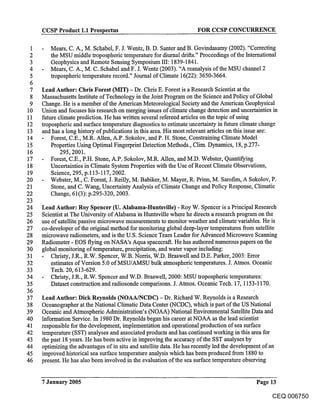
1    -   Mears, C. A., M. Schabel, F. J. Wentz, B. D. Santer and B. Govindasamy (2002). "Correcting
2        the MSU middle tropospheric temperature for diurnal drifts." Proceedings of the International
3        Geophysics and Remote Sensing Symposium III: 1839-1841.
4    -   Mears, C. A., M. C. Schabel and F. J. Wentz (2003). "A reanalysis of the MSU channel 2
5        tropospheric temperature record." Journal of Climate 16(22): 3650-3664.
 6
 7   Lead Author: Chris Forest (M!T) - Dr. Chris E. Forest is a Research Scientist a( the
 8   Massachusetts Institute of Technology in the Joint Program on the Science and Policy of Global
 9   Change. He is a member of the American Meteorological Society and the American Geophysical
10   Union and focuses his research on merging issues of climate change detection and uncertainties in
11   future climate prediction. He has written several refereed articles on the topic of using
12   tropospheric and surface temperature diagnostics to estimate uncertainty in future climate change
13   and has a long history of publications in this area. His most relevant articles on this issue are:
14       Forest, C.E., M.R. Allen, A.P. Sokolov, and P. H. Stone, Constraining Climate Model
15       Properties Using Optimal Fingerprint Detection Methods., Clim. Dynamics, 18, p.277-
16           295, 2001.
17   - Forest, C.E., P.H. Stone, A.P. Sokolov, M.R. Allen, and M.D. Webster, Quantifying
18       Uncertainties in Climate System Properties with the Use of Recent Climate Observations,
19       Science, 295, p.113-117, 2002.
20   - Webster, M., C. Forest, J. Reilly, M. Babiker, M. Mayer, R. Prinn, M. Sarofim, A Sokolov, P.
21       Stone, and C. Wang, Uncertainty Analysis of Climate Change and Policy Response, Climatic
22       Change, 61(3): p.295-320, 2003.
23
24   Lead Author: Roy Spencer (U. Alabama-Huntsville) - Roy W. Spencer is a Principal Research
25   Scientist at The University of Alabama in Huntsville where he directs a research program on the
26   use of satellite passive microwave measurements to monitor weather and climate variables. He is
27   co-developer of the original method for monitoring global deep-layer temperatures from satellite
28   microwave radiometers, and is the U.S. Science Team Leader for Advanced Microwave Scanning
29   Radiometer - EOS flying on NASA’s Aqua spacecraft. He has authored numerous papers on the
30   global monitoring of temperature, precipitation, and water vapor including:
31      Christy, J.R., R.W. Spencer, W.B. Norris, W.D. Braswell and D.E. Parker, 2003: Error
32      estimates of Version 5.0 of MSU/AMSU bulk atmospheric temperatures. J. Atmos. Oceanic
33      Tech. 20, 613-629.
34      Christy, J.R., R.W. Spencer and W.D. Braswell, 2000: MSU tropospheric temperatures:
35      Dataset construction and radiosonde comparisons. J. Atmos. Oceanic Tech. 17, 1153-1170.
36
37   Lead Author: Dick Reynolds (NOAA/NCDC) - Dr. Richard W. Reynolds is a Research
38   Oceanographer at the National Climatic Data Center (NCDC), which is part of the US National
39   Oceanic and Atmospheric Administration’s (NOAA) National Environmental Satellite Data and
40   Information Service. In 1980 Dr. Reynolds began his career at NOAA as the lead scientist
41   responsible for the development, implementation and operational production of sea surface
42   temperature (SST) analyses and associated products and has continued working in this area for
43   the past 18 years. He has been active in improving the accuracy of the SST analyses by
44   optimizing the advantages of in situ and satellite data. He has recently led the development of an
45   improved historical sea surface temperature analysis which has been produced from 1880 to
46   present. He has also been involved in the evaluation of the sea surface temperature observing


     7 January 2005                                                                         Page 13

                                                                                                  CEQ 006750
CCSP Product 1.1 Prospectus                                   FOR CCSP CONCURRENCE

 1   system. In this project, the ~itu sea surface temperature network was evaluated to determine the
 2   minimum number of in situ observations needed to correct any potential satellite bias. This
 3   procedure is now operationally produced and is resulting in optimization of US buoy deployment
 4   strategies. Dr. Reynolds is also the principal investigator in the US efforts to improve the
 5   collection and archiving of surface marine data for the International Comprehensive Ocean-
 6   Atmosphere Data Set (I-COADS).
 7       Reynolds, R. W, C. Gentemann and F. Wentz, 2004: Impact ofTRMM SSTs on a climate-
 8       scale SST analysis. J. Climate, 17 (in press).
 9       Smith, T.M., and R.W. Reynolds, 2004: Improved Extended Reconstruction of SST (1854-
10        1997). J. Climate, 17, (in press)
11       Smith, T.M., and R.W. Reynolds, 2004: A global merged land and sea surface temperature
12       reconstruction based on historical observations (1880-1997). NOAA internal review, to be
13       submitted to the Journal of Climate.
14
15   Lead Author: Russell S. Vose (NOAA/NCDC) - Dr. Russell S. Vose is the chief of the
16   Climate Analysis Branch at NOAA’s National Climatic Data Center. Over the past 15 years his
17   research has primarily focused on the construction of"baseline" datasets for use in international
18   climate assessments. The best example of this work is the Global Historical Climatology
19   Network database, which is used operationally by NOAA to monitor long-term global
20   temperature trends. Dr. Vose is also currently involved in the creation of gridded temperature
21   fields for global land areas and in the optimum design of station networks for monitoring
22   climatic change (e.g., the U.S. Climate Reference Network). Relevant publications include:
23       Vose, R.S. and M.J. Menne. 2004. A method to determine station density requirements for
24       climate observing networks. Journal of Climate 17:2961-2971.
25       Vose, R.S., T.R. Karl, D.R. Easterling, C.N. Williams, Jr., and M.J. Menne. 2004. Impact of
26       land-use change on climate. Nature 427:213-214.
27       Vose, R.S., C.N. Williams, T.C. Peterson, T.R. Karl, and D.R. Easterling. 2003. An
28       evaluation of the time of observation bias adjustment in the U.S. Historical Climatology
29       Network. Geophysical Research Letters 30:10.1029/2003GL018111.
30
31
32   Chapter 5 - How well can the observed vertical temperature changes be reconciled with our
33   understanding of the causes of these changes?
34
35   Convening Lead Author: Ben Santer (Lawrence Livermore National Laboratory) - Ben
36   Santer is a Physicist at Lawrence Livermore National Laboratory, where he works in the Program
37   for Climate Model Diagnosis and Intercomparison. He was a member of the National Research
38   Council panel on "Reconciling Observations of Temperature Change", and was the Convening
39   Lead Author of Chapter 8 ("Detection of Climate Change, and Attribution of Causes") of the 1995
40   Second Assessment Report of the Intergovernmental Panel on Climate Change. He currently
41   serves as a member of the Scientific Steering Committee for the NCAR Community Climate
42   System Model, the Climate Modeling Advisory Panel of the Goddard Institute for Space Studies,
43   and the Science Review Group of the Hadley Centre for Climate Prediction and Research. He has
44   written a number of peer-reviewed articles that deal with comparisons of modeled and observed
45   atmospheric temperature trends including:


     7 January 2005                                                                        Page 14

                                                                                                 CEQ 006751
CCSP Product 1.1 Prospectus                                      FOR CCSP CONCURRENCE

 1        Santer, B.D., T.M.L. Wigley, J.S. Boyle, D.J. Gaffen, J.J. Hnilo, D. Nychka, D.E. Parker, and
 2        K.E. Taylor, 2000: Statistical significance of trend differences in layer-average temperature
 3        time series. J. Geophys. Res., 105, 7337-7356.
 4        Santer, B.D., T.M.L. Wigley, D.J. Gaffen, L. Bengtsson, C. Doutriaux, J.S. Boyle, M. Esch,
 5        J.J. Hnilo, P.D. Jones, G.A. Meehl, E. Roeckner, K.E. Taylor and M.F. Wehner, 2000:
 6        Interpreting differential temperature trends at the surface and in the lower troposphere.
 7        Science, 287, 1227-1232.
 8        Santer, B.D., T.M.L. Wigley, G.A. Meehl, M.F. Wehner, C. Mears, M. Schabel, F.J. Wentz,
 9        C. Ammann, J. Arblaster, T. Bettge, W.M. Washington, K.E. Taylor, J.S. Boyle, W.
10        Brtiggemann, and C. Doutriaux, 2003: Influence of satellite data uncertainties on the detection
11        of externally-forced climate change. Science, 300, 1280-1284.
12
13    Lead Author: Joyce Penner (U. Michigan) - Joyce Penner is a Professor at the University of
14    Michigan. She is a member of the National Research Council Committee on Metrics for Global
15    Change Research and has been prominent in the Intergovernmental Panel on Climate Change
 16   (IPCC) Scientific Assessment activities. Prof. Penner was a convening lead author of"Climate
17    Change 2001: The Scientific Basis," produced as a contribution of Working Group 1 to the Third
18    Assessment Report of the IPCC. She has written several refereed articles on the topic of aerosols
19    and their climate effects and has also worked on publications (with B. Santer, lead) in the area of
20    comparing temperature trends with data.
21       Santer, B.D., K.E. Taylor, T.M.L. Wigley, T.C. Johns, P.D. Jones, D.J. Karoly,
22       J.F.B.Mitchell, A.H. Oort, J.E. Penner, V. Ramaswamy, M.D. Schwarzkopf, R.J. Stouffer, and
23       S. Tett, 1996: A search for human influence on the thermal structure of the atmosphere,
24       Nature, 382, 39-46.
25       Penner, J.E., T.M.L. Wigley, P. Jaumann, B.D. Santer, and K.E. Taylor, 1997: Anthropogenic
26       aerosols and climate change: A method for calibrating forcing, in Assessing Climate Change:
27       Results from the Model Evaluation Consortium for Climate Assessment, ed. by W. Howe and
28       A. Henderson-Sellers, Gordon & Breach Science Publishers, Sydney, Australia, pp. 91-111.
29       Penner, J.E., S.Y. Zhang, and C.C. Chuang, 2003: Soot and smoke aerosol may not warm
30       climate, J. Geophys. Res., 108, D21, Art. No. 4657, doi: 10.1029/2003JD003409.
31
32    Lead Author: Peter Thorne (U.K. Met Office/Hadley Centre) - Peter Thome is a research
33    scientist within the Hadley Centre at the Met Office. In 2001 he completed his Phi) "Advancing
34    climate change detection and attribution studies in the free atmosphere", available on-line from
35    the Climatic Research Unit at the University of East Anglia. Results from these analyses have
36    since been published in GRL and Clim. Dyn. Since 2001 Peter has been working in the climate
37    variability group at the Hadley Centre. Work there has focused on generation of a new globally
38    gridded (although incomplete) radiosonde dataset using neighbour comparisons, and
39    understanding the physical causes of reported vertical temperature structure changes. A number of
40    papers describing this work are in preparation. Relevant publications include:
41        Thorne, P. W., Jones, P. D., Osborn, T. J., Davies, T. D., Tett, S. F. B., Parker, D. E., Stott, P.
42        A., Jones, G. S., and Allen, M. R., 2002 Assessing the robustness of zonal mean climate
43        change detection studies. GRL. doi: 10.1029/2002GL015717.
44        Thorne, P. W., Jones, P. D., Tett, S. F. B., Allen, M. R., Parker, D. E., Stott, P. A., Jones, G.
45        S., Osborn, T. J., and Davies, T. D., 2003 Probable causes of late 20th Century tropospheric
46        temperature trends. Climate Dynamics 21 573-591.


      7 January 2005                                                                            Page 15

                                                                                                       CEQ 006752
CCSP Product 1.1 Prospectus                                    FOR CCSP CONCURRENCE

  1
  2
  3   Chapter 6 - What measures can be taken to improve our understanding of observed
  4   changes?
  5
  6   Convening Lead Author: Roger Pielke Sr. (Colorado State University) - Roger A. Pielke Sr.
  7   is a Professor in the Department of Atmospheric Science at Colorado State University. He is a
  8   member of the National Research Council’s Committee on Radiative Forcing Effects on Climate,
  9   and is the immediate Past-President of the American Association of State Climatologists. In 2004
 10   he was elected as a Fellow in the American Geophysical Union. He has published articles on
 11   global and regional tropospheric and surface temperature variability and trends, including several
 12   papers on the role of land use change and vegetation dynamics -in influencing these variations. He
 13   is a co-author of a book published by Cambridge University Press with William R. Cotton on
 14   Human Impacts on Weather and Climate, with a second edition to be completed this year.
 15       Chase, T.N., R.A. Pielke Sr., B. Herman, and X. Zeng, 2004: Likelihood of rapidly increasing
 16       surface temperatures unaccompanied by strong warming in the free troposphere. Climate Res.,
17        25, 185-190.
18        Marshall, C.H. Jr., R.A. Pielke Sr., L.T. Steyaert, and D.A. Willard, 2004: The impact of
19        anthropogenic land cover change on warm season sensible weather and sea-breeze convection
20        over the Florida peninsula. Mon. Wea. Rev., 132, 28-52
21        Davey, C.A., and R.A. Pielke Sr., 2004: Microclimate exposures of surface-based weather
22        stations - implications for the assessment of long-term temperature trends. Bull. Amer.
23        Meteor. Soc., submitted.
24
25    Lead Author: David Parker (U.K. Met Office) - David Parker manages a small group involved
26    in research into observed climate variability at the Met Office’s Hadley Centre. A particular focus
27    is tropospheric temperature and humidity as observed by radiosondes and from satellites and
28    comparisons with surface temperature and humidity. In 1999-2000 Mr Parker was a member of
29    the National Research Council’s Panel on Reconciling Temperature Observations, and is the
30    author of one of the leading radiosonde temperature data sets. David has written many papers in
31    the peer-reviewed literature on climate variability and climate observations. He has also
32    contributed to the recent WMO Global Climate System Review and to the 2nd GCOS Report on
33    the Adequacy of the Global Climate Observing System for the UN Framework Convention on
34    Climate Change. Mr Parker was a Lead Author of the Supplementary and Second Assessments of
35    the Intergovernmental Panel on Climate Change and a contributing author to the First and Third
36    Assessments. Relevant publications include:
37         Parker, D.E., Gordon, M., Cullum, D.P.N., Sexton, D.M.H., Folland, C.K. and Rayner, N.,
38         1997: A new gridded radiosonde temperature data base and recent temperature trends. Geoph.
39         Res. Letters, 24, 1499-1502.
40         Parker, D.E., 2000: Temperatures high and low. Science, 287, 1216-1217.
41         Rayner, N.A., Parker, D.E., Horton, E.B., Folland, C.K., Alexander, L.V, Rowell, D.P., Kent,
42         E.C. and Kaplan, A., 2003: Global analyses of sea surface temperature, sea ice and night
43         marine air temperature since the late nineteenth century. J. Geophys. Research (Atmospheres),
44         10.1029/2002JD002670.
45


      7 January 2005                                                                        Page 16

                                                                                                   CEQ 006753
CCSP Product 1.1 Prospectus                                       FOR CCSP CONCURRENCE

  1   Lead Author: Dick Reynolds (NOAA/NCDC) - Dr. Reynolds is also serving as a Lead Author
  2   on Chapter 6; his biographical information is listed under that Chapter.
  3
  4
  5   Executive Summary
  6
  7    Convening Lead Author: Tom M.L. Wigley (NCAR) - Tom Wigley, a senior scientist at the
  8   National Center for Atmospheric Research, is one of the world’s experts on climate change. He is
  9    a U.S. citizen, born and educated in Australia where he trained as ameteorologist with the
 10    Commonwealth Bureau of Meteorology. His Ph.D. is in Theoretical Physics. He has published
 11   widely in the field of climatology and related sciences. He is the author of more than 200 refereed
12    journal articles and book chapters and is one of the most highly cited scientists in the field. He is a
 13   Fellow of the American Meteorological Society (AMS) and of the American Association for the
14    Advancement of Science (A_AAS). His main current interests include projections of future climate
 15   and sea-level change, carbon-cycle modeling, and the interpretation of past climate changes
16    (including the detection of anthropogenic influences). He has contributed as an author to all
17    Intergovernmental Panel on Climate Change assessments, and developed the MAGICC coupled
18    gas-cycle/climate model that has been used to produce the primary temperature and sea level
19    projections given in th~se assessments. He also authored ’The Science of Climate Change: Global
20    and U.S. Perspectives’ published by the Pew Center on Global Climate Change
21    (<http://www.pewclimate.org/>). Wigley is the former Director of the Climatic Research Unit,
22    University of East Anglia, Norwich, U.K. Relevant publications include:
23        Wigley, T.M.L. and Raper, S.C.B., 2001: Interpretation of high projections for global-mean
24        warming. Science 293, 451-454.
25        Wigley, T.M.L., Smith, S.J. and Prather, M.J., 2002: Radiative forcing due to reactive gas
26        emissions. Journal of Climate 15, 2690-2696.
27        Wigley, T.M.L. and Raper, S.C.B., 2002: Reasons for larger warming projections in the IPCC
28        Third Assessment Report. Journal of Climate.
29
30    Coordinating Lead Author - Comprehensive Document Review: Chris Folland, (Hadley
31    Centre, U.K. Met Office) - Prof. Christopher Kenneth Folland, BSc CPhys CSCI FInstP, is Head
32    of the Climate Variability Research Group at the Hadley Centre for Climate Prediction and
33    Research, UK Met Office, and an Honorary Professor at the School of Environmental Sciences,
34    University of East Anglia. Early in his career, Dr. Folland worked in oceanography, surface
35    instrument development, and hydrometeorology. Since 1980, he has specialised in the scientific
36    leadership of research into climate change and variability. This has included observed and
37    modelled climate studies, as well as climate data set development and long range forecasting. He
38    was a Lead or Coordinating Lead Author of the four Scientific Assessments of the
39    Intergovemmental Panel on Climate Change between 1990 and 2001. He is a Fellow of the
40    American Meteorological Society and a Meteorological Fellow of the Link Foundation of New
41    Zealand. Dr. Folland’s awards include the World Meteorological Organisation International
42    Norbert Gerbier-MUMM Medal and Prize in 1996 for leading the UK Met Office research into
43    tropical seasonal rainfall forecasting. He is co-chair of the WMO/CLIVAR Climate of the
44    Twentieth Century modelling project and a member of the WMO/CLIVAR/CC1 Expert Team on
45    Climate Change Detection, Monitoring and Indices. Relevant publications include:


      7 January 2005                                                                             Page 17

                                                                                                       CEQ 006754
CCSP Product 1.1 Prospectus                                 FOR CCSP CONCURRENCE

 1      Folland, C.K., N. Rayner, P. Frich, T. Basnett, D. Parker & E.B. Horton, 2000: Uncertainties
 2      in climate data sets - a challenge for WMO. WMO Bull.,49, 59-68.
 3      Folland, C.K., Rayner, N.A., Brown, S.J. Smith, T.M. Shen, S.S. Parker, D.E., Macadam, I.,
 4      Jones, P.D., Jones, R.N., Nicholls, N. and Sexton, D.M.H., 2001: Global temperature change
 5      and its uncertainties since 1861. Geophys. Res. Lett., 106, 2621-2624.
 6      Rayner, N.A., Parker, D.E., Horton, E.B., Folland, C.K., Alexander, L.V., Rowell, D.P., Kent,
 7      E.C., and A. Kaplan, 2003: Global analyses of sea surface temperature, sea ice, and night
 8      marine air temperature since the late nineteenth century. J. Geophys. Res., 108(D 14), 4407,
 9      doi: 10.1209/2002JD002670, 2003. (29pp + 8 supplementary color pages).
10


     7 January 2005                                                                     Page 18

                                                                                              CEQ 006755
CEQ 006756
REMINDER: CCSP Reporting of "Directly Related" Expenditure                            Page 1 of 2


From: ccsp_info-bounces @ usgcrp.gov on behalf of David Dokken [ddokken @ usgcrp.gov]
Sent: Monday, January 10, 2005 5:12 PM
To: ccsp@usgcrp.gov
Cc: ccsp_info @usgcrp.gov
Subject: [ccsp_info] REMINDER: CCSP Reporting of "Directly Related"Expenditures
Dear CCSP Principals -

Just a reminder that "Directly Related" inputs are due by COB Wednesday (12 January). Let me know if
you need the attachments referenced below again.

If you have already provided your agency’s figures, there’s no need to resend.

Dave Dokken
CCSPO


      Date: Wed, 22 Dec 2004 10:07:17 -0500
      To: ccsp@usgcrp.gov
      From: David Dokken <ddokken @usgcrp.gov>
      Subject: CCSP Reporting of "Directly Related" Expenditures
      Cc: James.R.Mahoney@noaa.gov, richard.moss @pnl.gov, tspence@nsf.gov,
           pschultz@usgcrp.gov, ddokken@usgcrp.gov, ccsp_info@usgcrp.gov

     December 22, 2004


     TO:     CCSP Principals


     FROM: James R. Mahoney

           Assistant Secretary of Commerce for Oceans and Atmosphere

           NOAA


     CC:    Tom Spence

         Richard Moss
       Peter Schultz
       David Dokken


     RE:    Reporting "Directly Related" Expenditures


                                                                                          CEQ 006757
file://G:kFOIA - Climate2005kDeliberativel-3.05ccsp_info REMINDER CCSP Reportin... 4/12/2007
t~zNttNL~lzl, t: tXgSP l~eporting of "Directly Related" Expenditure                        Page 2 of 2


       The CCSP Principals considered and accepted the recommendations of the Ad hoc
       Subcommittee on SGCR Distributed Costs (December 16, 2003). Consequently, each
       agency’s contribution to the CCSP distributed cost budget for FY2005 will be based on the
       sum of each agency’s core budget and its budget for directly related activities expended in
       FY2004.

      I ask that each agency submit a Cost estimate of its FY2004 expenditures for these
      "directly related" activities to CCSPO (ddokken@usgcrp.gov) by January 12, 2005.
      These estimates will be compiled and distributed to the agencies prior to the February 2005
      meeting in anticipation of a decision on the compiled set at the meeting.

      According to the Ad hoc Subcommittee report, the "directly related amount should be
      determined and reported by each individual agency." As defined when first introduced,
      "directly related" programs are those that significantly contribute to the CCSP thematic
      areas, but are not historically included in CCSP/GCRP budget crosscuts.

      Enclosed is a table that was distributed last year by Marcus Peacock (OMB), listing each
      agency’s core, directly relate’d, and supporting USGCRP budgets for FY02 and FY03. You
      may find this table useful as you assemble your estimate for FY04 (filename: Inventory,
      budgetsummary, FY02FY03.pdf). Please contact David Dokken if you would like a copy of
      the call for FY2003 budget summary information and program categorization.


      Attachment converted: Electric Pig VffI:Directly Related mem#39507F.pdf (PDF/<~IC>~)
      (0039507F)
      Attachment converted: Electric Pig VIII:Inventory, budgetsum#395080.pdf (PDF/<<IC>r)
      (00395080)


                                                                                    CEQ 006758
file://G:kFOIA - Climate2005~Deliberativel-3.05ccsp_info REMINDER CCSP Reportin... 4/12/2007
CEQ 006759
Fo CCSP concurrence check of Product 3.1 Prospectus for Public comment--response due on Tuesday Ja
      From: ccsp_info-bounces@usgcrp.gov on behalf of Moss, Richard H
       [Richard.Moss@pnl.gov]
      Sent: Tuesday, January 11, 2005 4:27 PM
      TO: ccsp@usgcrp.gov
      Cc: Bamzai, Anjuli; ccsp_info@usgcrp.gov
      subject: [ccsp_info] CCSP Concurrence Check of Product 3.1 Prospectus
      for Public comment--response due on Tuesday January 18
      TO:     CCSP Principals
      FR:     James Mahoney and Richard MOSS
      RE:     CCSP Concurrence Check of Product 3.1 Prospectus for Public
      Comment
      Attached please find the revised prospectus for Product 3.1, climate Models and
      Their Uses and Limitations: Climate Sensitivity, Feedbacks, and uncertainties, as
      well as a compilation of comments received during the prior ccsP review of the
      prospectus (May 4-18, 2004) and the authors’ responses to these comments. This
      prospectus is oeing circulated to the CCSP Principals for a concurrence check before
      posting for public comment. Note that the comments/responses will NOT be publicly
      posted.
      In the past, ccsP has given three days for concurrence checks. However, because of
      the delay in circulating the revised prospectus since the original ccsP review, we
      are scheduling a full week for this check. The deadline for response is COB Tuesday,
      January 18 (note: this is the same day as comments are due for the Prospectus for
      Product 1.1, so be sure to include the product number and title in the subject line
      of your email). If this deadline poses a problem, please let me know by the response
      deadline.
      when you respond, please copy sandy MacCracken (smaccrac@usgcrp.gov) and indicate
      whether you approve the prospectus for public comment. If you have specific
      comments, please relate them to the page and line numbers of the draft prospectus.
      Thank you for your cooperation.
      As a heads-up, we expect to be circulating additional prospectuses for ccsP review
      in the coming week.
      Richard H. Moss, Ph.Do
      Director, climate Change science Program office (Incorporating the us 61obal change
      Research Program and the Climate change Research Initiative)
      1717 Pennsylvania Avenue NW, suite 250
      washington, DC 20006
      Email: rmoss@usgcrp.gov
      Telephone: 1 (202) 419-3476
      Fax: 1 (202) 223-3065


                                              Page 1


                                                                                     CEQ 006760
Cooney, Phil .........................................
From:                              ccsp_info-bounces@usgcrp.gov on behalf of Peter Schultz [psct"
Sent:                              Thursday, January 13, 2005 11:49 AM
To:                                ccsp@usgcrp.gov
Cc:                                ccsp_info@usgcrp.gov; Ibranch@usgcrp.gov
Subject:                           [ccsp_info] Decisions/Actions Summary & Next CCSP mtg

Attachments:                       Decisions & Actions, 01-05-05.pdf


~,clstons&A~o~,
    0t~5-05
            Attached is the Summary of Decisions/Actions and Discussion from’t~e January
5, 2005 CCSP Principals meeting.

The next Principals meeting will be February 2, 2005 from 2:30 to 5:00 PM at tSe CCSP
Office. The agenda and read-ahead materials will be distributed one week prior~to the
meeting.

Cheers,
Peter


                                                                                                    I
Peter A. Schultz, PhoD.                                                       ~
Associate Director for Science Integration Climate Change Science Program OffiCe
(Incorporating the U.S Global Change Research Program and the Climate Change ~esearch
Initiative)
1717 Pennsylvania Avenue NW, Suite 250
Washington, DC 20006
Email: pschultz@usgcrp.gov
Telephone: 202.419.3479
Fax: 202.223.3065


                                                         000728


                                                                                                        CEQ 006761
CEQ 006762
CommWG approved CIWG TOR and IP
From: outreach-bounces@usgcrp.gov on behalf of Peter schultz
[pschultz@usgcrp.gov]
Sent: Thursday, January 13, 2005 4:30 PM
To: outreach@usgcrp.gov
subject: [CommWG] approved CIWG TOR and IP
Attached are the CIWG Terms of Reference and Implementation Plan approved by the
Principals on Jan 5.
~Cheers,
 Peter


Peter Ao schultz, Ph.D.
Associate Director for science Integration climate change science Program office
(Incorporating the u.s. Global change Research Program and the Climate Change
Resear~ch Initlative)
1717 Pennsylvania Avenue NW, Suite 250
Washington, DC 20006
Email: pschultz@usgcrp.gov
Telephone: 202.419.3479
Fax: 202.223.3065


                                       Page 1


                                                                              CEQ 006763
CEQ 006764
Cooney, Phil
From:                  ccsp_info-bounces@usgcrp.gov on behalf of Peter Schultz [pscl
Sent:                  Thursday, January 13, 2005 11:49 AM
To:                    ccsp@usgcrp.gov
Cc:                    ccsp_info@usgcrp.gov; Ibranch@usgcrp.gov
Subject:               [ccsp_info] Decisions/Actions Summary & Next CCSP mtg

Attachments:           Decisions & Actions, 01-05-05.pdf


)ecislons & Actions,
    01-05-05 ....
            Attached is the Summary of Decisions/Actions and Discussion from t te January
5, 2005 CCSP Principals meeting.
The next Principals meeting will be February 2, 2005 from 2:30 to 5:00 PM at t] be CCSP
Office. The agenda and read-ahead materials will be distributed one week prior to the
meeting.
Cheers,
Peter


Peter A. Schultz, Ph.D.
Associate Director for Science Integration Climate Change Science Program 0ffi
(Incorporating the U.S. Global Change Research Program and ~he Climate Change ~esearch
Initiative)
1717 Pennsylvania Avenue NW, Suite 250
Washington, DC 20006
Email: pschultz@usgcrp.gov
Telephone: 202.419.3479
Fax: 202.223.3065


                                                                                          CEQ 006765
CEQ 006766
NRC Assessment study Draft Pproposal
From: James R. Mahoney [James.R.Mahoney@noaa.gov]
Sent: wednesday, January 26, 2005 2:51 PM
To: Hannegan, Bryan J.
subject: NRC Assessment Study Draft Pproposal
Brian - I apologize for my oversight in not sending this to you last week when we
spoke about it. For your information, a copy of this proposal will go to the ccsP
Principals with the read-ahead material being sent out by Peter schultz today. All
of the agency and EOP principals already revlewed a similar version of this proposal
approximately six months ago. Please let me know if you have any
comments. Jim


                                       Page 1


                                                                              CEQ 006767
CEQ 006768
Page 1 of 1


  From: ccsp-bounces@usgcrp.gov on behalf of Peter Schultz [pschultz@usgcrp.gov]
  Sent: Wednesday, January 26, 2005 6:05 PM
  To: ccsp@usgcrp.gov
  Cc: Leslie Branch; ipo@usgcrp.gov; ccsp_info@usgcrp.gov
  Subject: [ccsp] CCSP Principals mtg agenda & materials
  Dear CCSP Principals,

 The next CCSP Principals meeting is Wednesday, February 2, 3-5 PM at CCSPO (1717
 Pennsylvania Avenue, NW, Suite 250). (Note: Due to the somewhat smaller set of items on the agenda,
 we are not starting the meeting at 2:30 as previously advertised.)                             ~

 Please notify Sandy MacCracken (smaccrac@usgcrp.gov) whether you or a designee will be
 attending the meeting. If you need to call in to the meeting, the number is 800-516-9896 and the pass
 code is 888503.

 Attached are the agenda and briefing materials. The numbers in the file names of the briefing materials
 correspond to the agenda item numbers. Here are a few additional notes on some of the briefing
 materials:

 2. Decisions & Actions, 01-05-05.pdf --- This document has been modified slightly from the version I
 sent out on 1/13/05. It includes an additional "Decision" (agenda item #2) and an additional
 "Action" (agenda item #5).

 5.1 NRC CCSP Advisory Committee.pdf and 5.2 NRC Assessments Study.pdf --- The budgets for these
 two proposals are currently under negotiation. A proposal for support of relevant NRC standing
 committees is being prepared by the NRC.

 6.1 DRAFT FY05 CCSP Omnibus Budget Request.pdf --- This document is currently being reviewed
 by the Financial Operations Group. The Statement of Work for the CCSPO is dated Nov. 19, 2004 and
 is consequently out-of-date in a few places.

Cheers,
Peter


Peter A. Schultz, Ph.D.
Associate Director for Science Integration
Climate Change Science Program Office
(Incorporating the U.S. Global Change Research Program and the Climate
Change Research Initiative)
1717 Pennsylvania Avenue NW, Suite 250
Washington, DC 20006
Email: pschultz@usgcrp.gov
Telephone: 202.419.3479
Fax: 202.223.3065


                                                                                                CEQ 006769
file://G:FOIA - Climate2005kDeliberativel_3.05ccsp CCSP Princioals mt~ apenda rnnt~. ~/19/9o0’7
CEQ 006770
RE NRC Assessment study D~aft Pproposal
From: Hannegan, Bryan J.
Sent: wednesday, January 26, 2005 6:44 PM
To: James R. Mahoney
Subject: RE: NRC Assessment study Draft Pproposal
Jim, thanks. I do see it has gone out to ccsP principals. I have shared with Phil
and Kathie for their thoughts and will review myself. Good to see you today. Bryan
..... original Message .....
From: James R. Mahoney [mai I to: James. R. Mahoney@noaa. gov]
Sent: Wednesday, January 26, 2005 2:51 PF4
To: Hannegan, Bryan J.
Subject: NRC Assessment Study Draft Pproposal
Brian - I apologize for my oversight in not sending this to you last week when we
spoke about it. For your information, a copy of this proposal will go to the ccsP
Principals with the read-ahead material being sent out by Peter schultz toda
of the agency and EOP orincipals alread,, revl ..... A ~ .~_..~ ........ y. All~
approximately six months ago. Please let me know if~ you have verslon OT tillS proposal
                                              ~,,~u ~,~,li~r any
comments.   Jim


                                        Page


                                                                                 CEQ 006771
CEQ 006772
Page 1 of 2


 Etheridge, Dorothy

  From:      Cooney, Phil
  Sent:      Wednesday, January 26, 2005 6:19 PM
  To:        Etheridge, Dorothy
  Subject: FW: [ccsp_info] CCSP Principals mtg agenda & materials

Dorothy, please print out these attachments for me. thanks Phil


From: ccsp_info-bounces@usgcrp.gov [mailto:ccsp_info-bounces@usgcrp.gov] On Behalf Of Peter Schultz
Sent: Wednesday, .January 26, 2005 6:05 PM
To; ccsp@usgcrp.gov
Cc-" Leslie Branch; ccsp_info@usgcrp.gov
Subject: [ccsp_info] CCSP Principals mtg agenda & materials

Dear CCSP Principals,

The next CCSP Principals meeting is Wednesday, February 2, 3-5 PM at CCSPO (1717
Pennsylvania Avenue, NW, Suite 250). (Note: Due to the somewhat smaller set of items on the agenda,
we are not starting the meeting at 2:30 as previously advertised.)

Please notify Sandy MacCraeken (smaccrac@usgcrp.gov) whether you or a designee will be
attending the meeting. If you need to call in to the meeting, the number is 800-516-9896 and the pass
code is 888503.

Attached are the agenda and briefing materials. The numbers in the file names of the briefing materials
correspond to the agenda item numbers. Here are a few additional notes on some of the briefing
materials:

2. Decisions & Actions, 01-05-05.pdf--- This document has been modified slightly from the version I
sent out on 1/13/05. It includes an additional "Decision" (agenda item #2) and an additional
"Action" (agenda item #5).

5.1 NRC CCSP Advisory Committee.pdfand 5.2 NRC Assessments Study.pdf --- The budgets for these
two proposals are currently under negotiation. A proposal for support of relevant NRC standing
committees is being prepared by the NRC.
6.1 DRAFT FY05 CCSP Omnibus Budget Request.pdf--- This document is currently being reviewed
by the Financial Operations Group. The Statement of Work for the CCSPO is dated Nov. 19, 2004 and
is consequently out-of-date in a few places.

Cheers,
Peter


Peter A. Schultz, Ph.D.
Associate Director for Science Integration
Climate Change Science Program Office
(Incorporating the U.S. Global Change Research Program and the Climate

                                                                                                  CEQ 006773
 1/27/2005                                                                                        -J
Page 2 of 2


Change Research Initiative)
1717 Pennsylvania Avenue NW, Suite 250
Washington, DC 20006
Email: pschultz@usgcrp.gov
Telephone: 202.419.3479
Fax: 202.223.3065


                                           CEQ 006774
1/27/2005
Coone~/, Phil
From:                   ccsp_info-bounces@usgcrp.gov on behalf of Peter Schultz Loscl
Sent:                   Thursday, January 13, 2005 11:49 AM
To:                     ccsp@usgcrp.gov
Cc:                     ccsp_info@usgcrp .gov; Ibranch@usgcrp.gov
Subject:                [ccsp_info] Decisions/Actions Summary & Next CCSP mtg

Attachments:            Decisions & Actions, 01-05-05.pdf


:)eclslons & Actions,
     01-05-05 ....
            Attached is the Summary of Decisions/Actions and Discussion from t~e January
5, 2005 CCSP Principals meeting.

The next Principals meeting will be February 2, 2005 from 2:30 to 5:00 PM at t~e CCSP
Office. The agenda and read-ahead materials wil! be distributed one week prior~to the
meeting.

Cheers,
Peter


Peter A. Schultz, Ph.D.                                                        |
Associate Director for Science Integration Climate Change Science Program office
(Incorporating the U.S. Global Change Research Program and the Climate Change ~esearch
Initiative)
1717 Pennsylvania Avenue NW, Suite 250
Washington, DC 20006
Email: pschultz@usgc~p.gov
Telephone: 202.419.3479
Fax: 202.223.3065


                                           000728


                                                                                        CEQ 006775
CEQ 006776
Coone /, Phil
From:                         Birgfeld.Erin@epamail.epa.gov
Sent:                         Tuesday, February 01,2005 6:01 PM
To:                           Mclean.Brian@epamail.epa.gov; Beale.John@epamail.epa.gov;
                              Kruger.Dina@epamail.epa.gov; Gunning.Paul@epamail.epa.gov;
                              Dieu.Martin@epamail.epa.gov; Buckley.Katherine@epamail.epa.gov;
                              Salinas.Sol@epamail.epa.gov; lewandowskij@state.gov; david.conover@hq.doe.gov;
                              Connaughton, James; Cooney, Phil; Holbrook, William F.; Peel, Kenneth L.;
                              WHOHENST@mailoce.oce.usda.gov; kbickel@oce.usda.gov; Judd.Swift@hq.doe.gov;
                              david.beecy@hq.doe.gov; WatsonHL@state.gov; ReifsnyderDA@state.gov;
                              TalleyT@state.gov; turekianvc@state.gov; jschafer@usaid.gov; goweynand@usaid.gov;
                              wbreed@usaid.gov; mmurray@usaid.gov; gjackson@tda.gov; dshuster@tda.gov;
                              jpainter@usaid.gov; derosabm@state.gov; VerloopMD@state.gov; steeleej2@state.gov;
                              castlen.moore@hq.doe.gov; kbarrett@usaid.gov; mdiaz@ustda.gov; Peel, Kenneth L.;
                              Krieger.Jackie@epamail.epa.gov
Subject:                      Methane to Markets: Steering Committee Meeting 2/24 2:00 pm

Attachments:                   FY 05 Planning Handout-REVISED 1-28-05.doc; possible activities revised 1-28-05.doc


 FY 05 Planning possible activities
Handout-REVISED... revised 1-...
                                      Dear Steering Committee Members:
The Planning Group (formerly the Ministerial Committee) met last Friday and reviewed the
minor revisions suggested by AID and USDA to the FY05
planning documents that were distributed at our~last meeting.   I have
attached revised versions for your information. As agreed, we will distribute these
guidance documents to the Technical Working Groups so that they can begin identifying
activities, budgets, and outcomes for FY
05 and have them completed by Feb. 18th.
I have scheduled the Steering Committee meet on February 24 at 2 pm in Ariel Rios North
Room 5530. The main agenda item will be to review the activities and budgets developed by
the Working Groups. Please let me know if you will be able to make it.

Sincerely,
Erin Birgfeld
U.S. Environmental Protection Agency
Methane to Markets Partnership
phone: (202) 343-9079
fax: (202) 343-2202
 (See attached file: FY 05 Planning Handout-REVISED 1-28-05.doc) (See attached file:
possible activities revised 1-28-05.doc)


                                                              1
                                                                                                          CEQ 006777
CEQ 006778
TENTATIVE AGENDA
             PRINCIPALS MEETING
     CLIMATE CHANGE SCIENCE PROGRAM
            James R. Mahoney, Chair
               February 2, 2005
                3:00 - 5:00 PM
     Climate Change Science Program Office
    1717 Pennsylvania Avenue, NW, Suite 250


B


o


                                        .pdf]
                                        "sion)


               Page 1 of 2

                                                 CEQ 006779
8. Other Business


                    Page 2 of 2

                                  CEQ 006780
CEQ 006781
Notional ~chedule for Fourth National Communications to the UNFCCC
                           ACf~vifg                  RESPONSIBILITY
                                               EPA/Smte
                                               EPA


                                                State~PA

                                                State

                                                State
            __
|une

                                                EPA/Ed~tor
July                                            State/EPA

August
                                                State
                                                EPA/State/Editor
                                                EPA/Ed~tor
Oct
Oct                                             EPA
                                                EPA/StatelEditor

             "
                                                StateJBPA

Dec                                             State

                                                EPA/Sm~


                                                                            CEQ 006782
From:               Pugh, Graham M (OES) [PughGM@state.gov]
Sent:               Tuesday, February 08, 2005 10:44 AM
To:                 Cooney, Phil; Peel, Kenneth L.; Hannegan, Bryan J.
Cc:                 Reifsnyder, Dan A (OES); Talley, Trlgg (OES); .W, atson, Hadan L (OES): Maurice LeFranc (E-
                    mail)
Subject:            Fourth National Communication Planning Meeting

This is to confirm that we will have the planning meeting today at 3 PM in Room 1406 in
the HST (Main State) Building. Jim Mahoney and representatives from EPA will also attend.
Kathy Olsen is out of the country and cannot attend.
Ken, I recognize that you have a conflict elsewhere in State until 3:30,
Perhaps you can Join us afterward?
Please enter through the C Street lobby. You will be pre-cleared for the meeting; just
mention the meeting name at the entry desk.

Graham

G~aham M. Pugh
office of Global Change (OES/EGC)
US Department of State
Phone: 202-647-4688; Fax: 202-647-3930
E-mail; pughgm@state.gov


                                                                                                         CEQ 006783
From:                Pugh, Graham M (OES) [PughGM@state.gov]
Sent:                Monday, February 07, 2005 5:32 PM
To:                  Cooney, Phil; Peel, Kenneth L.; Hannegan, Bryan J.
Subject:             RE: Notional Schedule for Fourth National Communications to the UNFCCC

Importance:          High


Phil, Ken, Bryan,
I just learned from Harlan that we should try to pull this meeting together this week.
Unfortunately, Harlan ~S off to the UK again Wed. evening, so tomorrow afternoon would be
best fo~ him. Can you let me know your availabillty on ~esday or Wednesday? Thanks very
much.
Graham Pdgh

Graham M. Pugh
Office of Global Change (OES/EGC)
US Department of State
Phone: 202-647-4688; Fax: 202-647-3970
E-mail: pughgm@state.gov

 ..... Original Message .....
 From: Watson, Harlan L (OES)
 Sent: Monday, February 07, 2005 4:32 PM
 To: Pugh, Graham M (OES)
 Cc: Relfsnyder, Dan A {OES)
 Subject: FW: Notional Schedule for Fourth National Communications to the UNFCCC
 Importance: High

 Graham--Please try to set up something for tomorrow afternoon.

 Harlan
 ..... Original Message .....
 From: Cooney, Phil [mailto:Phil_Cooney@ceq.eop.gov]
 Sent: Friday, January 28, 2005 4:06 PM
 To: Watson, Harlan L (OES)
 Cc: Peel, Kenneth L.; Hannegan, Bryan J.; Olsen, Kathle L.
 Subject: RE: Notional Schedule for Fourth National Communications to the
 UNFCCC

   Harlan, the week of 2/7 looks good to me, so let’s get together at
  State, with you leading the effort. Please include Bryan, Ken and
  Kathie Olsen of OSTP. Thanks Phll
  ..... Original Message .....
  From= Watson, Harlan L (OES) [mailto:WatsonHL@state.gov]
  Sent: Friday, January 21, 2005 2:08 PM
  To: Cooney, Phil
  Subject: Notional Schedule for Fourth National communications to the
  UNFCCC
  I~portance: High
  Phil,
  Attached is a ,,Notional Schedule for Fourth National Communications to
  the UNFCCC" drafted by Maurice LeFranc of EPA.


                                                                                              CEQ 006784
I thin~ it would be useful if a small.group of relevant players (e.g.,
Dan, John Beale, and Jim Mahoney) met during the week of February 7 to
talk about getting organized on this, since it is due in January of next
year. Do you want to take the lead on this, or have us set up something
here?
Thanks,
Harlan


                                                                           CEQ 006785
From:                Pugh, Graham M (OES) [PuohGM@state.gov]
                     Monday, February 07, 2005 5:52 PM
Sent:                Cooney, Phil; Peel, Kenneth L.; Hannegan, Bryan J.
To:
Subject:             RE: Notional Schedule for Fourth National Communications to the UNFCCC


Phil, Ken, Bryan,
                                                                I’ll send you the room number in
Let,s do the CAR-4 meeting at 3 PM tomorrow (Tuesday).
the morning.
Thanks,
Graham

 Graham M. Pugh
 office of Global Change (OES/EGC)
 US Department o£ State
 Phone: 202-647-4688; Fax: 202-647-3970
 E-mail: pugh~m@state.gov


                                                                                              CEQ 006786
From:                 Pugh, Graham M (OES) [PughGM@state.gov]
                      Monday, February 07, 2005 5:52 PM
Sent:               ¯ Cooney, Phil; Peel, Kenneth L.; Hannegan, Bryan 3.
To:                   RE: Notional Schedule for Fourth National Communications to the UNFCCC
Subject:

Phil, Ken, Bryan,
                                                                                   the room number in
                             at 3 PM tomorr6w (Tuesday). I’ll send you
Let’s do the CAR-4 meeting
the morning.
Thanks,
Graham

 Graham M. Pugh
 office of Global Change (OES/EGC)
 US Department of State
 Phone: 202-647-4688; Fax: 202-647-3970
 E-mail: pughgm@state.gov


                                                                                               CEQ 006787
CEQ 006788
Page 1 of 19

                                                                                                       Z)
 Cooney, Phil

 From:     Holbrook, William F. [CEQClips@msn.com]
 Sent:     Tuesday, February 15, 2005 7:09 AM
 To:       Connaughton, James; Cooney, Phil; B,’,yd, Allison; Peel, Kenneth L.; Hopkins, Robert; Susan
           Povenmire; sowardsml@state.gov; O’Donovan, Kevin M.
          Perino, Dana M.
 Subject: Financial Times package on Climate

Financial Times (London, England)

February 15, 2005 Tuesday
London Edition 1

SECTION: COMMENT; Pg. 18

LENGTH: 496 words

HEADLINE: Allocating blame instead of emissions: UK leadership on climate change falters in row with
Brussels

BODY:
Far from providing moral leadership on global warming, the government has landed itself in a row with Brussels that
sets a lousy precedent for smooth implementation of the Kyoto treaty on climate change, which comes into effect
this week. Kyoto’s main instrument for achieving cost-effective pollution reductions is the trading of emissions
permits, prefigured by a European Union system supposedly already under way. No EU state has been keener on
this market mechanism than Britain, which is already practising such trading at home. No other EU state, however,
has had its revised national allocation plan flatly rejected by the European Commission. At this rate, the UK risks
trading insults with Brussels rather than emissions.
The UK was one of the first EU states to come up with a plan to allocate pollution reductions across its national
industry. But the UK has been the only EU country to come back with a substantially revised plan - allowing 20m
tonnes more of carbon dioxide - which it published yesterday, even after being warned by Brussels that such an
increase was flatly unacceptable.

So a stand-off has developed. The UK says it has had to revise its plan in the light of higher than expected
projections of emissions by industry, and that in any case its plan will still far exceed the 12.5 per cent reduction
Kyoto obliges it to start making by 2008. The Commission blames the UK for coming up with a percentage
reduction before it had any clear idea of what overall level was to be reduced. But Brussels’s main fear is that, if it
gives in to the UK, other countries will start, Oliver Twist-style, asking for more, and the whole system will begin to
unravel, if not this year then next.

This is not the first time the government has had second thoughts about the price of moral leadership; remember
how it trumpeted its free admission of workers from east European states joining the EU last year, only to impose
some subsequent curbs in response to domestic opinion. In reality, the UK yesterday signalled a line of retreat on
emissions. It said any further lowering of its emission ceiling would be borne by power generators, because they are
less exposed to international competition than power-users.

                                                        00’14:87                                            CEQ 006789
 2/15/2005
Page 2 of 19


Quite apart from the inauspicious start it gives to Britain’s presidency of the Group of Eight countries, and of the EU
itself later this year, Tony Blair has another reason to want to settle this emissions trading row. Pressure is building
for new ways to control aviation emissions, the fastest growing source of greenhouse gases. France, Germany and
others in the EU want to see a fiat tax imposed on aviation fuel. But intemational agreements, and US opposition,
make this difficult. Mr Blair, rightly, prefers to use the less blunt instrument of bringing airlines into the emissions
trading scheme, and wants to use his EU presidency to promote this idea. But it would obviously be possible only if
a viable trading scheme existed in the first place.


Financial Times (London, England)
February 15, 2005 Tuesday
London Edition ~2
SECTION: NATIONAL NEWS BUSINESS & ECONOMY; Pg. 5

LENGTH: 628 words

HEADLINE: Co row worst for power generators CARBON EMISSIONS:

BYLINE: By FIONA HARVEY

BODY:

The electricity generation sector is likely to be most affected by the government’s dispute with the European
Commission over the UK’s carbon emissions allocation.

However, companies in other sectors may also suffer from the uncertainty still surrounding the implementation of
the European Union’s emissions trading scheme. They will not be able to trade carbon allowances until the dispute
is resolved.

The government yesterday issued all businesses covered by the scheme with their carbon emissions allocations,
amounting to 756m tonnes of carbon dioxide. It guaranteed that for companies outside the power generation sector
those allocations would stand, even if the UK’s plan were rejected by the Commission.

The government said that if it were forced by the Commission to return to its original, smaller allocation of emissions
allowances - agreed with Brussels in July - it would comply by taking allocations away from the electricity
generators.

The Department for Env!.~.".~ment, Food and Rural Affairs said: "To provide as much regulatory certainty to industry
as possible, the government has confirmed that any allocation below 756m (tonnes of carbon dioxide) would be
achieved by reducing the number of allowances given to the electricity generation sector. This should give industry
confidence in the government’s intentions and allow them to plan accordingly."

 Emissions would be deducted from companies across the electricity generation sector, Defra said. The power
 sector, responsible for about a quarter of the UK’s emissions, would be targeted because it was the area of industry
 most protected from international competition, it added.

 Although businesses will be unable to trade in carbon emissions allowances until the government’s allocations have
                                                                                                           CEQ 006790

 2/15/2005
Page 3 of 19


been accepted by the Commission, they will be obliged to monitor their emissions in accordance with the scheme
and they will be allowed to trade in carbon futures.

The amount of carbon emissions in dispute is relatively small. In April, the government submitted a plan calling for
the UK to be allowed to produce 736m tonnes of carbon between now and 2008. In October, its revised plan asked
for 19.8m tonnes more, an addition of less than 3 per cent.

The government said its reason for the revision was that it had underestimated the UK’s carbon dioxide emissions
in its original submission in April.

The Commission is said to be set against any revision of the national allocation plans because that would set a
precedent allowing other countries to dispute their allowances.

The EU’s greenl~ouse gas emissions trading scheme came into force on January 1. It places limits on the amount of
carbon dioxide - one of the greenhouse gases blamed for climate change - that businesses in certain energy-
intensive sectors are permitted to produce.

The scheme is designed to assist EU member states in meeting their obligations under the UN-brokered Kyoto
protocol on climate change, which requires developed countries to cut their greenhouse gas emissions and which
comes into force on Wednesday. Tony Blair has been a strong backer of the treaty and has made climate change
one of two top priorities for the UK’s chairmanship of the Group of Eight industrialised nations this year.

Traders said the price of carbon emissions allowances was likely to be unaffected by the dispute with the
Commission, as it had already been factored in. Atle Christiansen, director of Point Carbon, said: "We expected the
Commission to take a tough line. The market has been trading up recently."                                        -

The pdce of carbon has recovered to just over Euros 7 (Pounds 4.80) after dropping from Euros 8 to under Euros 7
after the scheme came into effect.

Green campaigners said the UK was wrong to ask for more emissions. Editorial Comment, Page 18


Financial Times (London, England)

February 15, 2005 Tuesday
London Edition 3

SECTION: FRONT PAGE - FIRST SECTION; Pg. 1

LENGTH: 283 words

HEADLINE: Brussels and UK clash over emissions

BYLINE: By FIONA HARVEY

BODY:

The European Commission yesterday branded as "illegal" the UK’s plan to raise its greenhouse gas emissions, as
the government stuck with its proposal to allow British industry to emit more carbon dioxide.

                                                                                                        CEQ 006791
 2/15/2005
Page 4 of 19


The dispute over the European Union’s greenhouse gas trading scheme threatens to undermine Tony Blair’s bid for
global leadership on climate change, on the eve of the Kyoto protocol on climate change coming into force
tomorrow.

The EU’s mandatory trading scheme, which began on January 1, limits the amount of carbon that industries may
produce.

The UK submitted its original emissions plan in April, which was accepted by the Commission in July. But in
October, the government revised the limits in the plan upwards. If the revisions are not accepted by the
Commission - as looks likely - the electricity generating industry is set to bear the :-:,:-,:t of the cost.

Should the UK go ahead with its revised plan it is likely to face an infringement procedure that could result in a
ruling by the Eu~ropean Court of Justice, the EU’s highest court.
A spokeswoman for Stavros Dimas, the EU environment commissioner, said: "If the UK launches its emissions
trading system and if the allowances match what was announced in July, we are very happy. If not, then we
consider that illegal."

The government said it was "taking steps to protect its legal position".

Green campaigners and some carbon experts attacked the government’s stance.

James Cameron, partner at Climate Change Capital, a boutique investment bank, said: "The doubt and uncertainty
(the government’s actions) are creating are bad for the scheme as a whole." Industry fired up, Page 5 Editorial
comment, Page 18 Climate change, separate section


Financial Times (London, England)

February 15, 2005 Tuesday

SECTION: FT REPORT - UNDERSTANDING BUSINESS & CLIMATE CHANGE; Pg. 5

LENGTH: 716 words

HEADLINE: BT Group Fiona Harvey explores steps taken by the telecoms company to reduce its energy
consumption                                                                      ~

 BYLINE: By FIONA HARVEY

 BODY:
 Late last year, BT became the biggest company in the world to procure its entire electricity inventory from
 environmentally friendly sources. The company announced three-year contracts with Npower and British Gas, the
 electricity suppliers, under which BT’s energy would come from a mixture of renewable sources, such as wind and
 wave generation, and combined heat and power plants that are low in carbon emissions. The contracts were said to
 be worth several hundreds of millions pounds, and since BT accounts for about 1.8 per cent of the UK’s non-
 domestic electricity consumption, it was an important moment for the energy industry.

 The move to green energy consumption is calculated to reduce BT’s carbon dioxide emissions by more than
                                                                                                           CEQ 006792
 2/15/2005
CEQ 006793
Message                                                                                     Page 1 of 3


 Cooney, Phil

  From:      Fiddelke, Debbie S.
  Sent:      Wednesday, February 23, 2005 11:23 AM
 To:      NVheeler, Andrew (EPW)’; ’Mormino, Brian (EPW)’; ’Shanahan, John (EPW)’
 Cc:      Hannegan, Bryan J.; Cooney, Phil; Stolpe, Elizabeth A.
 Subject: FW: U.S.-GERMAN JOINT ACTIONS ON CLEANER AND MORE EFFICIENT ENERGY,
          DEVELOPMENT AND CLIMATE CHANGE

One announcement today from the President’s visit to Germany.

.....Original Message .....
From; bounce-38711-114354@list.wh~tehouse.gov [mailto:bounce-38711-114354@list.whitehouse.gov] On
Behalf Of White House Press Releases
Sent; Wednesday, February 23, 2005 11:09 AlVl
To; Fiddelke, Debbie $.
Subject; U.S.-GERMAN .JOINT ACTIONS ON CLEANER AND MORE EFFICIENT ENERGY, DEVELOPMENT AND
CLIMATE CHANGE

                                          THE WHITE HOUSE

                                       Office of the Press Secretary
                                            (Mainz, Germany)

For Immediate Release                                                  February 23, 2005

         U.S.-GERMAN JOINT ACTIONS ON CLEANER AND MORE EFFICIENT ENERGY,
                       DEVELOPMENT AND CLIMATE CHANGE

Germany and the United States have a history of working together bilaterally and multilaterally to
promote strong economic growth, reduce harmful air pollution, improve energy security, and mitigate
greenhouse gas emissions through such mechanisms as the UN Framework Convention on Climate
Change and its Delhi Declaration, the G-8 Action Plan on Science and Technology for Sustainable
Development, and the World Summit on Sustainable Development Plan of Implementation. The United
States and Germany welcome the continued work in this area under United Kingdom’s G-8 Presidency.

    1)        Cooperation with Developing Countries

We are particularly committed to working with developing countries to help them meet their own
development and poverty reduction priorities, which requires increased access to all forms of cleaner,
more abundant, and more affc-:’.~-ble modem energy sources, including renewable and efficiency
technologies. To this end, we have worked to include major developing countries in our multilateral
technology partnerships, to ensure that cleaner, more efficient technologies are appropriate to all major
nations and regions of the world. We will broaden and reinforce those activities. We anticipate
additional opportunities as we work together to address global environmental, economic and social
challenges and opportunities.

    2)         Energy Conservation and Efficiency

Considerable economically viable technologies exist, and should be encouraged, for boosting energy

                                                                                                  CEQ 006794
 2/23/2005
Message                                                                                      Page 2 of 3


efficiency in industrialized and developing countries. Progress on energy efficiency provides one of the
greatest opportunities for cost-effective reduction in pollution and greenhouse gases and improvement in
energy security. Examples range from highly efficient power stations, through energy-saving products,
to fuel-efficient vehicles. Innovative future technologies such as fuel cells and photovoltaies offer great
economic prospects. A promising new field is the area of nanoscienees. They have the potential of
offering higher energy efficiency, in particular more energy efficient commercial and household
products, including vehicles, through the use of new materials and new illumination technologies. An
intensification of our bilateral cooperation in the field of energy conservation, efficiency and new
technologies could accelerate our progress. Grasping these opporttmities will strengthen our economy
and open up profitable markets for our companies.
The United States and Germany also have a joint commitment ~o the multilateral Methane to Markets
Partnership that will advance the commercial use of methane, a potent greenhouse gas, from coaimines,
natural gas and oil reserves and landfill sites. This initiative promises to significantly reduce methane
emissions and put them to profitable use as a clean energy source.

   3)        Modernization of domestic power generation

Efficient and cleaner production of heat and power from coal and natural gas are advanced by German-
U.S. cooperation in the Carbon Sequestration Leadership Forum (CSLF), FUTUREGEN, and
CORETECH. These three initiatives will help dramatically advance cleaner heat and power production
from coal and natural gas via focused research and development efforts.

These activities underscore the important contribution of modernization of energy systems to supporting
economic growth, improving energy security, and reducing pollution and greenhouse gas emissions.
Highly efficient technologies offer great opportunities to cost-effectively reduce energy consumption,
pollution, and greenhouse gas emissions. Germany and the United States will make joint efforts to apply
these technologies domestically and worldwide, especially in fast growing developing countries.

   4)        Innovation for future energy systems

The United States and Germany lead global efforts to develop future energy systems including the use of
hydrogen as an energy carrier. Both countries are founding members of the International Partnership for
the Hydrogen Economy established by 15 counties and the European Commission in 2003 to conduct
advanced research and development in hydrogen and fuel cell technologies. Germany and the United
States cooperate bilaterally and multilaterally in the development of hydrogen powered fuel cells use in
the transport and stationary sectors. A close cooperation in the research and innovation activities of the
United States and Germany for future energy and transport systems, including fuel cells and hydrogen,
will be a driving force to make these technologies available and price competitive.

    5)       International cooperation for renewable energy

Renewable energies should play an increasing role in the portfolio of modem energy systems.
Renewables 2004, an international conference convened by the German government, provided a
platform to advance renewable energy (e.g., biomass, wind, geothermal, solar, and hydropower)
technologies and policies. Both the United States and German governments pledged financial and
technical resources to advance development of renewable energy in the overall global mix of heat and
power production. Recognizing that a wide range of different renewable technologies offer a variety of
possibilities for joint projects on both bilateral and multilateral levels, the German and U.S. governments
will work together to fulfill the pledges made at Renewables 2004.


                                                                                                   CEQ 006795
 2/23/2005
Message                                                                                        Page 3 of 3


Summary
The United States and Germany will broaden and reinforce their activities in three areas of common
action to improve energy security and reduce pollution and greenhouse gas emissions, while supporting
strong economic growth:
          ¯ First, joint activities to further develop and deploy cleaner, more efficient teclmologies to
            support sustainable development.
              Second, cooperation in advancing climate science, and developing effective national tools
              for policy action.
              Third, joint action to raise the efficiency of the energy sector and address air pollution and
              greenhouse gas emissions in our own countries and around the world.
We will continue working together and through partnership with the G-8 countries under the Action
Plan for Science and Technology for Sustainable Development to enhance these efforts.


                                                                                                    CEQ 006796
 2/23/2005
CEQ 006797
Coone~/, Phil
From:                Holbrook, William F.
Sent:                Wednesday, February 23, 2005 4:13 PM
To:                  Hannegan, Bryan J.; Cooney, Phil; Peel, Kenneth L.
Subject:             FW: FW: Breaking News on Costs of C02 Trading from the Environmental NewsStand


..... Original Message .....
From: Loosli. Phillip@epamail.epa.gov [mailto:LoosLi.Phillip@epamail.epa.gov]
Sent: Wednesday, February 23, 2005 4:13 PM
To: Holbrook, William F.
Cc: Bergman. Cynthia@epamail.epa.gov
Subject: Re: FW: Breaking News on Costs of C02 Trading from the Environmental NewsStand

Data Show Minimal Costs From New England’s C02 Cap-And-Trade Program
New modeling data on New England’s upcoming greenhouse gas cap-and-trade program suggest
that major enersy efficiency efforts could al.lo.w f.o.r a modest carbon dioxide (C02) cap at
very little cost to the economy, while also mlnlmlzlng concerns about emissions "leakage"
to other parts of the country, sources familiar with the modeling say.
But induslry officials are raising a host of concerns with the new modeling results. They
question whether significant energy efficiency gains are feasible and say the model may
have underestimated the costs of a carbon cap in its assumptions about future natural gas
prices.
Industry officials are also urging caution because the model reaches no definite
conclusions about leakage -- which refers to concerns that future regional restrictions on
energy production will increase power imports and boost emissions in other areas.
New England environment officials unveiled modeling data on the upcoming Regional
Greenhouse Gas Initiative (RGGI) at a Feb. 17 meeting in New York. The models represent
the first attempt to project the economic impact of a cap on C02 emissions from power
plants in the region, sources who attended the meeting say.
RGGI would apply to eight Northeastern states, and could set a national precedent as the
first mandatory greenhouse gas program in this country.
States are scheduled to unveil a formal rule for the program in April, though officials
have recently suggested that deadline may slip.
 The modeling prepared by ICF Consulting evaluated the results of four possible caps on C02
 emissions from electric utilities. The models conclude that the strongest projected cap --
 25 percent below 1990 emissions by 2020 -- would lead to a 5 percent increase in wholesale
 energy prices, and set the price of a carbon trading allowance at $7 per ton. A 15 percent
 cap would lead to a 2 percent increase in energy prices, and an allowance price of around
 $3 per ton.
 In addition, the models evaluated the effect of a 30 percent reduction in energy demand
 through energy efficiency programs. The models showed that under a 15 percent cap, coupled
 with these efficiency gains, allowance prices were lowered to zero. Also, this scenario
 reduces the region’s electricity imports from other parts of the country, possibly
 addressing the concern that emissions could increase in other areas.
 "If you do energy efficiency, the costs come down to almost nothing and you also take care
 of the leakage problem," one environmentalist says.
 The source maintains that a 30 percent growth in energy efficiency is "not that ambitious"
 and can be achieved through programs like green building initiatives, appliance standards,
 and changes to the rules governing electricity markets.
 But the models do not include any direct projections on the emissions increases that could
 occur outside of the region. As a result, environmentalists and industry sources say
 additional modeling runs are necessary in order to gain more understanding of how to
 address leakage.1
                                                                                              CEQ 006798
Environmentalists and state officials say that on the whole, the models offer good news
because they suggest the region could impose a modest carbon cap at little or no cost. The
results are also likely to provide fodder for environmentalists to argue for much stricter
reductions.
"The numbers that have come up in the modeling results come within the ballpark of being
reasonable," a state official says.
But an industry source says these results are only preliminary, and do not account for
recent data from the American Gas Association that projects higher natural gas costs than
what the model assumes. Natural gas projections have "a major impact on the overall cost
to the program and the electricity prices," the source says.
Also, the industry source says a major efficiency mandate could be very difficult to
accomplish.
Yet a second environmentalist says the modeling results show the proposed caps under the
model are "not very aggressive" in terms of their impacts on electric utilities and
consumers. Also, the source says that a reduction of 25 percent below 1990 levels is "more
of a stabilization cap" because regional emissions in 1990 were abnormally high, and
current emissions are much lower than in 1990.
The source says that activists may now push for states to consider a 25 percent cap below
current emissions.
Sources on all sides of the issue stress that the modeling results are still preliminary.
State environment commissioners are evaluating the results and will likely recommend
additional modeling runs.
State officials working on RGGI have said in the past that it is crucial to set a cap at
an appropriate level, because they way they proceed could set an example for the rest of
the country. Officials say that if a cap is too high, they could discourage other states
from participating in similar programs.
Other observers have recently suggested that the overall impact of RGGI will be limited
because of the leakage problem, and that a more ambitious approach would have to come from
a nationwide regulation.
"It’s unlikely that this program can be particularly aggressive because these emissions
will appear elsewhere," Billy Pizer of Resources for the Future said in a Feb. I0
conference call with reporters. As a result, he argued that a regional program like RGGI
is "not a long-term solution."
-- Avery Palmer
Date: February 23, 2005
© Inside Washington Publishers


                                                                                  CEQ 006799
CEQ 006800
ccsp Data Quality Act 101
  From: ccsp-bounces@usgcrp.gov on behalf of Moss, Richard H
  [Richard.Moss@pnl.gov]
 Sent: wednesday, March 09, 2005 9:54 AM
 TO: thomas.r.karl@noaa.gov; nlancaster@usgs.gov; James. Laver@noaa.gov;
 John.Houghton@science.doe.gov; Roger.Dahlman@science.doe.gov;
 dwickland@hq.nasa.gov; davld.j.hofmann@noaa.gov;
 Daniel.L.Albritton@noaa.gov; pdecola@hq.nasa.gov; mkurylo@hq.nasa.gov;
 anjuli.bamzai@science.doe.gov; Ants. Leetma@noaa.gov;
 Christopher.D.Miller@noaa.gov; tcronin@usgs.gov; titus.jim@epa.gov;
 mike.szabados@noaa.gov; rthompson@usgs.gov; srs@ars.usda.gov;
 herrod-julius.susan@epamail.epa.gov; scheraga.joel@epa.gov;
 michael.savonis@fhwa.dot.gov; rblrk@hq.nasa.gov;
 terry.mcpherson@ssc.nasa.gov; Claudia.Nieren~erg@noaa.gov;
 nancy.beller-simms@noaaogov; Robert. E.Livezey@noaa.gov;
 jfitz@bpgsvr.cr.usgs.gov; ccsp@usgcrp.gov
 cc: Virg~nia_Burkett@usgs.gov; mbuford@fs.fed.us; dverardo@nsf.gov;
 Delachesnaye. Francisco@epamail.epa.gov; shahid.habib.l@gsfc.nasa.gov;
 Lawrence.A.Fried1@nasa.gov; wturner@hq.nasa.gov; lfriedl@hq.nasa.gov;
 ccsp_info@usgcrp.gov; jdodge@hq.nasa.gov; Randall M Dole;
 Don. Scavia@noaa.gov; bstokes@fs.fed.us; david.goodrich@noaa.gov;
 ahsha.Tribble@noaa.gov; dandersl@hq.nasa.gov; dcohenl@doc.gov;
 pdecola@hq.nasa.gov; Jeff.Amthor@science.doe.gov; Tom.Oconnor@noaa.gov;
west.jordan@epa.gov; wgcc-cc@usgcrp.gov; waleed.abdalati@gsfc.nasa.gov;
 ro~ers.catriona@epa.gov~ Eric.J.Lindstrom@nasa.gov; ceavey@nsf.gov;
esneffne@hq.nasa.gov; roconnor@nsf.gov; caitlin.simpson@noaa.gov;
prtaylor@nsf.gov; rbern@usgs.gov; ipo@usgcrp.gov; Ned.cyr@noaa.gov;
clow@usgs.gov; rpoore@usgs.gov; stokar@usaid.gov;
whohenst@mailoce.oce.usda.gov; john.calder@noaa.gov; rthompson@usgs.gov;
tlee@hq.nasa.gov; Grambsch.Anne@epa.gov; Mark. Ea~in@noaa.gov;
wgcc@usgcrp.gov; Peter. Lunn@science.doe.gov; gamble.janet@epa.gov;
wanda. Ferrell@science.doe.gov; Edmonds,James A (Jae);
Paula.S.Bontempi@nasa.gov; bierwagen.britta@epamail.epa.gov;
jfein@nsf.edu
subject: [ccsp] "Data Quality Act 101"
In response to a suggestion from one of the S&A Product teams, we have arranged for
an introductory session on issues associated with ensuring compliance with the Data
Quality Act (Section 515 of the Treasury and General Government Appropriations Act
of 2001). Recall that during the final ccsP review (see step 16 of the Guidelines)
CCSP will need to certify that the product "has been prepared in conformance with ’
these g~idelines and the Data Quality Act." The session will be an opportunity to
learn wnat is involved in providing this certification.
The session will be held on Friday April 1 from 3-5 p.m. in room 1414 of the Herbert
C. Hoover Building (Main Commerces, 14th and constitution Avenues, NW.
Mr. Daniel cohen, office of the General Counsel of the u.s. Department of Commerce,
has graciously agreed to give an overview presentation, answer questions, and point
you to resources within your agencies.                                     "
Please RSVP to sandy MacCracken (smaccrac@usgGrp.gov) if you wish to participate,
and we will add your name to the list for clearance into HCHB.
Richard H. Moss, Ph.D.
Director, Climate Change science Program office (Incorporating the us Global change
Research Program and the climate change Research Initiative)
1717 Pennsylvania Avenue NW, Suite 250
Washington, DC 20006
Email: rmoss@usgcrp.gov
Telephone: 1 (202) 419-3476
Fax: 1 (202) 223-3065


                                       Page 1


                                                                               CEQ 006801
CEQ 006802
ccsp_info CCSP Concurrence Check of Product 4.7 Prospectus--response due COB Friday March 18
    From: ccsp_info-bounces@usgcrp.gov on behalf of Moss, Richard H
    [Richard.Moss@pnl.gov]
    Sent: Friday, March 11, 2005 4:20 PM
    To: ccsp@usgcrp.gov
    Cc: micnael.savonis@fhwa.dot.gov; wgcc-cc@usgcrp.gov;
    Karrigan. Bork@dot.gov; wgcc@usgcrp.gov; ccsp_info@usgcrp.gov
    Subject: [ccsp_info] CCSP Concurrence Check of Product 4.7
    Prospectus--response due COB Friday March 18
   TO:     CCSP Principals
   FR:     James Mahoney and Richard Moss
   RE:     CCSP Concurrence Check of Product 4.7 Prospectus for Public
   Comment

   Attached please find the revised prospectus for Product 4.7, "Impacts of climate
   change and variability on Transportation Systems and Infrastructure - 6ulf Coast
    tudy, as well as a comp~latlon of responses to comments received during the prior
   CCSP review of this prospectus (5-26 August 2004). This prospectus is being
   circulated to the ccsp Principals for a concurrence check before posting for public
   comment as described in the ccsP S&A Product 6uidelines. Note that this collation of
   comments/responses will NOT be publicly posted.
   In the past, ccsP has provided three days for concurrence checks.
   However, because the revised prospectus is being circulated so long after the ccsP
   review, we are scheduling a full week for this check. The deadline for response is
   COB Friday, March 18. If this deadline poses a problem, please let me know before
   the deadline.
   when you respond, please copy sandy MacCracken (smaccrac@usgcrp.gov) and indicate
   whether your agency/department approves release of the prospectus for public
   comment. If you have specific comments, please relate them to the page and line
   numbers of the draft.
   Thank you for your cooperation.
   Richard H. Moss, Ph.D.
   Director, Climate change science Program office (Incorporating the US 61obal Change
   Research Program and the climate change Research Initiative) 1717 Pennsylvania
   Avenue NW, suite 250 washington, DC 20006
   Email: rmoss@usgcrpogov
   Telephone: 1 (202) 419-3476
   Fax: 1 (202) 223-3065


                                          Page 1


                                                                                  CEQ 006803
CEQ 006804
Coone~/, Phil
From:                         Birgfeld.Erin@epamail.epa.gov
Sent:                         Friday, March 11, 2005 5:20 PM
To:                           Mclean.Brian@epamail.epa.gov; Beale.John@epamail.epa.gov;
                              Kruger.Dina@epamail.epa.gov; Gunning.Paul@epamail.epa.gov;
                              Dieu.Martin@epamail.epa.gov; Buckley.Katherine@epamail.epa.gov;
                              Salinas.Sol@epamail.epa.gov; lewandowskij@state.gov; david.conover@hq.doe.gov;
                              Connaughton, James; Cooney, Phil; Holbrook, William F.; Peel, Kenneth L.;
                              WHOHENST@mailoce.oce.usda.gov; kbickel@oce.usda.gov; Judd.Swift@hq.doe.gov;
                              david.beecy@hq.doe.gov; WatsonHL@state.gov; ReifsnyderDA@state.gov;
                              TalleyT@state.gov; turekianvc@state.gov; jschafer@usaid.gov; goweynand@usaid.gov;
                              wbreed@usaid.gov; mmurray@usaid.gov; gjackson@tda.gov; dshuster@tda.gov;
                              jpainter@usaid.gov; derosabm@state.gov; VerloopMD@state.gov; steeleej2@state.gov;
                              castlen.moore@hq.doe.gov; kbarrett@usaid.gov; mdiaz@ustda.gov; Peel, Kenneth L.;
                              Krieger.Jackie@epamail.epa.gov; JANLEWAN@mailoce.oce.usda.gov
                              Gunning.Paul@epamail.epa.gov; Buckley.Katherine@epamail.epa.gov;
                              WHOHENST@mailoce.oce.usda.gov; derosabm@state.gov; VerloopMD@state.gov;
                               ReifsnyderDA@state.gov; TalleyT@state.gov; steeleej2@state.gov;
                               castlen.moore@hq.doe.gov; mdiaz@ustda.gov; LewandowskiJ@state.gov;
                               goweynand@usaid.gov; JANLEWAN@mailoce.oce.usda.gov
Subject:                       M2M: USG Position Paper -- Please review and provide comments by 3/17 COB

Attachments:                   M2M Proposal Mechanism 4.doc


  M2M Proposal
~echanism 4.doc (..
                      Dear Steering Committee Members:
 Attached please find the draft USG position paper proposing a mechanism for Project
 Network members to submit ideas to the Partnership’s Subcommittees. The document has
 already been reviewed and vetted by our smaller inter-agency planning group.
 At the last Steering Committee meeting we agreed that it is important to circulate the
 position paper to Partners well before the Coal Subcommittee meeting in April.
 Unfortunately this means that timing is a bit tight so please provide comments to me by
 COB Thursday, March 17.
 Unless major issues are raised, I will consolidate comments and send the final version out
 to the Partners next Friday (3/18).
 Thank you for your help and have a good weekend.

 sincerely,
 Erin
 Erin Birgfeld
 U.S. Environmental Protection Agency
 Methane to Markets Partnership
 phone: (202) 343-9079
 fax: (202) 343-2202

  (See attached file: M2M Proposal Mechanism 4.doc)


                                                                                                        CEQ 006805
CEQ 006806
Coone~/, Phil
From:                ccsp_info-bounces@usgcrp.gov on behalf of Peter Schultz [pschultz@usgcrp.gov]
Sent:                Friday, March 11,2005 5:22 PM
To:                  ccsp@usgcrp.gov
Cc:                  ccsp_info@usgcrp.gov
Subject:             [ccsp_info] Decisions & Actions, CCSP mtg, 03-02-05

Attachments:         Decisions & Actions 03-02-05.pdf


Decisions & Anions
  03-02-05.p...
            Attached is a summary of the decisions, actions, and discussion from the 2
March 2005 CCSP Principals meeting. It will be an item for discussion and approva~ at the
next Principals meeting, which will take place on Wednesday, April 6 at 2:30 PM at CCSPO.

Cheers,
Peter

Peter A. Schultz, Ph.D.
Associate Director for Science Integration Climate Change Science Program Office
 (Incorporating the U.S. Global Change Research Program and the Climate Change Research
Initiative)
1717 Pennsylvania Avenue NW, Suite 250
Washington, DC 20006
Email: pschultz@usgcrp.gov
Telephone:-202.419.3479
Fax: 202.223.3065


                                                                       00 .837

                                                                                                     CEQ 006807
1                       CCSP PRINCIPALS MEETING
 2                Summary of Decisions/Actions and Discussion
 3
 4                                     2 March 2005
 5                                  2:30 p.m. - 6:00 p.m.
 6                         Climate Change Science Program Office
 7                        1717 Pennsylvania Avenue, NW, Suite 250
 8
 9
10                                      Attendance
11
12 James Mahoney, NOAA, Chair
13 David Allen, CCSPO
14 James Andrews, DOD
15 Ko Barrett, USAID
16 Karrigan Bork (tel.), DOT
17 Lou Brown, NSF
18 Mary Cleave, NASA
19 Margarita Conkright-Gregg, NOAA
20 David Dokken, CCSPO
21 Jerry Elwood, DOE
22 William Farneth, DOS
23 David Halpem, OSTP
24 Bryan Hannegan (tel.), CEQ
25 William Hohenstein, USDA
26 Jack Kaye, NASA
27 Chet Koblinsky, NOAA
28 Nicholas Lancaster, USGS
29 Margaret Leinen, NSF
3O Thomas Mampilly (tel.), HHS
31 Margaret McCalla, NOAA
32 Richard Moss, CCSPO
33 Patrick Neale (tel.), SI
34 Rick Petty, DOE
35 Gloria Rapalee, CCSPO
36 Peter Schultz, CCSPO
37 Mike Slimak, EPA
38 Tom Spence, NSF
39 Ahsha Tribble, NOAA
4O


                                                                    CEQ 006808
Page 1 of 2


 Cooney, Phil

 From:     Hannegan, Bryan J.
 Sent:     Friday, March 11,2005 8:53 PM
 To:       Connaughton, James; Fiddelke, Debbie S.; Pearce, Heather S.
 Cc:      Cooney, Phil; Stolpe, Elizabeth A.
 Subject: bears watching - domenici, alexander, et al. and IGCC, climate


Senators tackle climate issues during coal summit

Brian Stempeck, E&E Daily senior reporter

A summit on coal issues morphed into a climate change debate yesterday, as experts from academia, industry
and environmental groups advised Senate lawmakers on how to advance new power plants that are able to
capture and store carbon dioxide (CO2) emissions.

Fresh from a similar summit on natural gas in January, Senate Energy Committee Chairman Pete Domenici (R-
N.M.) invited a wide range of guests to discuss the future of coal power. Due to floor votes, lawmakers only heard
from about half the scheduled guests, but Domenici seemed particularly interested in the recommendations of
John Holdren, co-chair of the National Commission on Energy Policy.

Holdren described the National Commission’s recommendation on coal power, namely that the federal
government invest a tota~ of $7 billion over 10 years to fund research into IGCC plants -- ultra-clean gasification
technology -- and efforts to capture CO2 from power plant smokestacks. The CO2 would then be stored
underground, potentially in empty oil and gas reservoirs.

"We all agree that advanced technologies are ~;rucial to the future of coal," Holdren said. If the 100 or so plants
slated for construction in the United States during the next decade are not equipped with advanced technology
like IGCC, there will be "an immense amount of additional CO2 emissions into the atmosphere thafwe will wish
we were able to avoid," he explained.

"It’s pretty obvious that we’ve got to do something about the technology and the cleanup," Domenici said of coal
generation, noting that without major changes in the coal sector, future energy development in the United States
will shift even more toward natural gas.

Some industry experts cautioned against relying too much on IGCC and carbon capture technology. There is a
"great deal of uncertainty about carbon control," said Frank Burke, vice president at Consol Energy Inc. Burke
called IGCC "very immature technology," and said it would be "imprudent" to try and use it widely.

 Plus, IGCC is not the only way to reduce CO2 emissions, Burke said. And with China slated to use 2 billion tons
 of coal by 2020, largely in conventional coal plants, the United States needs to develop ways of removing CO2
 from more traditional facilities, he said.


                                                                                                           CEQ 006809
 3/14/2005
Page 2 of 2


Holdren conceded that the technology is not mature, but said the Chinese are in fact building some IGCC plants.
There is a "very considerable chance" that the Chinese will follow the U.S. lead towards gasification and carbon
storage, he said.

The talk of clean coal technology piqued the interest of some lawmakers. Sen. Lamar Alexander (R-Tenn.) asked
panelists how Congress can best encourage IGCC development. Sen. Larry Craig (R-Idaho) noted that he sees
proposed climate legislation from Sen. Chuck Hagel (R-Neb.) -- which would encourage carbon capture
technology -- as a "clear alternative" to stricter approaches on global warming.

Some industry executives at the summit said the federal government should be doing more when it comes to
clean coal deployment. Bret Clayton, chief executive officer of Kennecott Energy, a major coal producer, said the
White House should be doing more than just FutureGen, a proposed zero-emissions coal plant that would capture
CO2 emissions.

"We do not believe it is eno gh, Clayton said of FutureGen. "We need to make sure that we have multiple large-
                            U if

scale demonstrations."
David Hawkins of the Natural Resources Defense Council agreed with Clayton in supporting more demonstration
projects. After seeing carbon storage efforts under way in Norway and elsewhere, NRDC considers geologic CO2
storage a "safe option," Hawkins said, adding that there should be more on-the-ground efforts. "You won’t get it
by doing it in a laboratory," he said.

Several panelists said there is a need to go beyond technology incentives and create some type of cap-and-trade
program. The National Commission report suggested setting a price of $7 per ton of CO2 emissions beginning in
2010, a program that would include a "safety valve" to prevent economic harm, Holdren explained. This type of
system would send a market signal to utilities without forcing the "premature retirement" of existing coal plants,
Holdren argued. The commission estimates that coal use would actually increase under its proposal, while other
cap-and-trade systems typically lead to a decrease in the use of coal.

 Still, Domenici and other panelists such as Sen. Jim Bunning (R-Ky.) raised concerns about the high economic
 costs of cap-and-trade efforts, as utility executives noted that the transition to carbon capture could cost tens of
 billions of dollars.

 Domenici urged some panelists, such as NRDC’s Hawkins, to seek out a more moderate goal on climate change.
 By aiming only for zero-emissions plants, "you don’t get anything," Domenici told Hawkins. "We need something
 in the middle."


                                                                                                             CEQ 006810
  3/14/2005
THE DEPUT~ SECRETARY OF COMMERCE
                                             Washington, D.C. 20230


March 11, 2005


M~MORANDUM FOR:            Acting Deputy Secretary of Energy, Co-chair
                           Associate Director for Science, Office of Science and
                            Technology Policy, Secretary
                           Deputy Secretary of Agriculture
                           Deputy Secretary of Defense
                           Deputy Secretary of Health and Human Services
                           Deputy Secretary of the Interior
                           Deputy Secretary of State
                           Deputy Secretary of Transportation
                           Deputy Administrator of the Environmental Protection Agency
                           Deputy Admhfistmtor of the National Aeronautical
                            and Space Administration
                           Deputy Director of the National Science Foundation
                           Chief of Staff, Council on Environmental Quality
                           Associate Director for Natural Resource Programs,
                            Office of Management and Budget
                           Special Assistant to the President, National Economic Council

FROM:                      Theodore W. Kassinger--~

SUBJECT:                   Initial 2005 Meeting of the Interagency Working Group for
                           Climate Change Science and Technology (IWGCCST)

        As Chair of the Intemgency Working Group for Climate Change Science and Technology
(IWGCCST), I am writing to call for the first 2005 meeting of the Group. We hope to convene
this meeting on March 30, 2005 from 3:00 - 5:00 PM at the Department of Commerce. During
this initial meeting of the group, we will consider establishment of a fixed bi-monthly meeting
schedule.

      The agenda and meeting materials will be forwarded prior to the meeting..

       For the new members to the IWGCCST, in February 2002, the President designate..d a
cabinet-oriented management structure to oversee the work of the Climate ,Change Science
Program and Climate Change Teelmology Program. The IWGCCST is comprised of Deputy
Secretaries and Deputy Administrators of all 13 collaborating departments/agencies in the
programs, as we"- ~ senior representatives from the Office of Science and Technology Policy,
the Council on Environmental Quali~y, and the Office of Management and Budget.


                                                                                        MR 16 2005
                                                                                        CEQ 006811
CEQ 006812
Page 1 of 1


From: Ahsha Tribble [Ahsha.Tribble @noaa.gov]
Sent: Wednesday, March 16, 2005 1:43 PM
To: Olsen, Kathie L.; Cooney, Phil
Cc: Hannegan, Bryan J.; James R. Mahoney Ph.D.
Subject: Getbacks from meeting this morning
From the meeting this morning, I owe the following information:

 1) Transcript from Dr. Mahoney’s interview with Andy Revkin on March 8

2) AAAS Presentation (this will be sent to Secretary Bodman’s office in a separate email)

3) Information about session on Data Quality Act for CCSP Lead Authors and others that are interested
(this email that was sent on 3/9):
In response to a suggestion from one of the S&A Product teams, we have
arranged for an introductory session on issues associated with ensuring
compliance with the Data Quality Act (Section 515 of the Treasury and
General Government Appropriations Act of 2001). Recall that during the
final CCSP review (see step 16 of the Guidelines), CCSP will need to
certify that the product "has been pre19ared in conformance with these
guidelines and the Data Quality Act. " The session will be an opportunity
to learn what is involved in providing this certification.

The session will be held on Fridav April 1 from 3-5 p.m. in room 1414 of
the Herbert C. Hoover Building (Main Commerce)’, 14th and Constitution
Avenues, NW.

Mr. Daniel Cohen, Office of the General Counsel of the U.S. Department
of Commerce, has graciously agreed to give an overview presentation,
answer questions, and point you to resources within your agencies.

Have a nice day!
Ahsha


Ahsha N. Tribble, Ph.D.
Technical Chief of Staff
Office of Assistant Secretary of Commerce
  For Oceans and Atmosphere
HCHB/Room 5804
14th & Constitution Ave, NW
Washington, DC 20230
202-482-3567 (DOC)
202-482-6318 (Fax)


                                                                                               CEQ 006813
file://G:kFOIA - Climate2005kDeliberativel-3.05Getbacks from meetin~ this mornin~.htm 4/12/2007
CEQ 006814
ccsp secondment and staff Recommendations
From: ccsp-bounces@usgcrp.gov on behalf of James R. Mahoney
[James. R.Mahoney@noaa.gov]
Sent: Friday, March 18, 2005 3:19 PM
To: ccsp@usgcrpogov; ccsp_info@usgcrp.gov; Ahsha Tribble; Allandra
washington
Subject: [ccsp] secondment and staff Recommendations
~0 CCSP AGENCY PRINCIPALS:
Please give urgent consideration to the attached secondment and staff
recommendations for ccsPo. These respond to the issue we discussed during the March
2 CCSP Meeting. We will update you during the April 6 CCSP Meeting.
FYI, NASA has already identified a potential secondment candidate, for which I
express my gratitude.
Thank You.

Jim


                                      Page 1


                                                                              CEQ 006815
CEQ 006816
Page 1 of 1


From: James R. Mahoney [James.R.Mahoney@noaa.gov]
Sent: Monday, March 21, 2005 7:52 PM
To: Olsen, Kathie L.; Cooney, Phil; Hannegan, Bryan J.; Graham, John; Schwab, Margo
Cc: Conrad C Lautenbacher; Scott Rayder; Ahsha Tribble; Scott Smullen; Ted Kassinger
Subject: GAO draft report on CCSP
RESTRICTED - DO NOT CIRCULATE

To all -

We have received the attached draft report from GAO, Climate Change Assessment: Administration Did
Not Submit Assessment When Required and Needs Well Developed Plan to Meet Content Requirements.


I have already briefed Secretary Gutierrez, Deputy Secretary Kassinger, Undersecretary Lautenbacher
and NOAA Chief of Staff Rayder about this report, and I am sending it to the new addressees above to
advise you about its receipt. We are preparing a draft response and talking points for review by the
addressees. Please contact me by email or telephone if you have questions or comments. I will be in a
NOAA Science Advisory Board meeting during the next two days, but my secretary can forward your
messages (if any) to me.

Jim Mahoney


                                                                                            CEQ 006817
file://G:~FOIA - Climate2005~Deliberativel-3.05GAO draft report on CCSP.htm           4/12/2007
CEQ 006818
RE ccsp CCSP Concurrence Check of Product 4.7 Prospectus--response due COB Friday March 18
   From: Hannegan, Bryan J.
   Sent: Monday, March 21, 2005 11:48 PM
   To: Moss, Richard H
   Cc: michael.savonis@fhwa.dot.gov; Karrigan. Bork@dot.gov; Cooney, Phil
   Subject: RE: [ccsp] CCSP Concurrence Check of Product 4.7
   Prospectus--response due COB Friday March 18
  Importance: High
  with apologies for the late response, here are my detailed comments on the
  prospectus following another detailed review (since it has been months since we last
  saw it), most of whlch I believe can be addressed with minor edits.
  Please call or write with any questions.
  Bryan Hannegan, Ph.D.
  Associate Director for Energy and Transportation Council on Environmental Quality
        original Message-
  From: ccsp-bounces@usgcrp.gov [mailto:ccsp-bounces@usgcrp.gov] On Behalf of Moss
  Richard H                                  ’
  Sent: Friday, March 11, 2005 4:20 PM
  TO: ccsp@usgcrp.gov                                  .
  cc: micnael.savonis@fhwa.dot.gov; wgcc-cc@usgcrp.gov; Karrigan.Bork@dot.gov;
  wgcc@usgcrp.gov; ipo@usgcrp.gov; ccsp_info@usgcrp.gov
  subject: [ccsp] ccsP Concurrence check of Product 4.7 Prospectus--response due COB
  Friday March 18
  TO:     CCSP Principals
  FR:     James Mahoney and Richard Moss
  RE:     ccsP concurrence check of Product 4.7 Prospectus for Public
  Comment

  ~tachedan~ VariaDiJity on Transportation Systems and Infrastructure ofulf Coast
   nange
          Rlease ~i~d the revised prospectus for Product 4.7, "Impacts
                                                                     - G
                                                                         climate
 study," as well as a compilation of responses to comments received during the prior
 ccsP review of this prospectus (5-26 August 2004). This prospectus is belng
 circulated to the CCSP Principals for a concurrence check before posting for public
 comment as described in the ccsP S&A Product Guidelines. Note that this collation of
 comments/responses will NOT be publicly posted.
 In the past, ccsP has provided three days for concurrence checks.
 However, because the revised prospectus is being circulated so long after the ccsP
 review, we are scheduling a full week for this check. The deadline for response is
 COB Friday, March 18. If this deadline poses a problem, please let me know before
 the deadline.
 when you respond, please copy sandy MacCracken (smaccrac@usgcrp.gov) and indicate
 whether your agency/department approves release of the prospectus for public
 comment. If you have specific comments, please relate them to the page and line
 numbers of the draft.
 Thank you for your cooperation.
 Richard H. Moss, Ph.D.
 Director, Climate Change science Program office (Incorporating the us Global Change
 Research Program and the climate change Research Initiative) 1717 Pennsylvania
 Avenue NW, suite 250 washington, DC 20006
 Email: rmoss@usgcrp.gov
 Telephone: 1 (202) 419-3476
 Fax: 1 (202) 223-3065


                                         Page 1


                                                                                  CEQ 006819
CEQ 006820
Page 1 of 1


 Cooney, Phil

 From:         ccsp_info-bounces@usgcrp.gov on behalf of James R. Mahoney
               [James.R.Mahoney@noaa.gov]
 Sent:         Thursday, March 24, 2005 4:50 PM
 To:           ccsp@usgcrp.gov; ccsp_info@usgcrp.gov; ipo@usgcrp.gov; Allandra Washington; Ahsha
               Tribble; Jennifer Sprague; David Conover; Scott Rayder
 Subject:      [ccsp_info] March 30 IWGCCST Meeting - Please confirm senior agency representatives
               attending
 Attachments: IWGCCST Meeting Invite 03-16-05.pdf; IWGCCST Agenda 03-30-05.pdf

To CCSP Agency Principals:

I am attaching two files regarding the March 30 IWGCCST meeting:
(1) The invitation from Deputy Secretary Kassinger to your Deputy Secretary
(2) The final agenda for the meeting
I ask that the Ci2SP agency principals assure that your deputy secretary (or designee) has received the
invitation, and provide your senior representative with a copy of the attached final agenda. We know
that some of the named positions are currently unfilled, so it is important that the invitation and final
agenda reach the correct person.
Please confirm by email to me with a copy_ to Ms. Allandra Washin togko~_(address above) the senior
representative who will r~present your a eggng_y/department ~y noon Monday, March 28. This
information is needed to prepare the meeting for Secretaries Gutierrez and Bodman.

For your information, Energy Secretary Bodman, Commerce Secretary Gutierrez and OSTP Director
Marburger will be present during the first part of the meeting. (Dr. Marburger currently plans to
participate in the entire meeting.)


                                                                                                 CEQ 006821
 3/28/2005
CEQ 006822
03/24/05 17:12 FAX 202 482 6318          ASST. SEC. NOAA                            ~001/002


                                  Assistant Secretary of Commerce for
                                     Oceans and Atmosphere
                                  National Oceanic and Atmospheric Administration
                                  14~ Street & cons’~itution Avenue° NW
                                  Washington, DC 20230


                                                     Date:


                              FAX TRANSMITTAL


                                             From: James R. Mahoney, Ph.D.

                                             Phone:        202-482-356.7

                                              Fax:         202-482-6318


      Comments


                   Number of pages (including this cover sheet):


                                                                             CEQ 006823
03/24/05      17:12 FAX202 482 6318              ASST. SEC, NOAA                                     [~002/002


                                                           31-IE DEPIFI’~ SECRETARY OF I~MMERCE
                                                           Washington. D.C. 20230


       March 11, 2005


       MEMORANDUM FOR:                 A.eting Deputy Secretary of Energy, Co-chaix
                                       Associate Director for Science, Office of Science and
                                        Technology Policy, Secretary
                                       Deputy Secretary of Agriculture
                                       Deputy Secretary of Defense
                                       DepuW Secretary of Health kud Human Services
                                       Deputy Secretary of the Interior
                                       DepuW Secretary of State
                                       Deputy Secretm-y of Transportation
                                       Deputy A~trator of the Environmental Protection Agency
                                       Deputy Administrator of the National Aeronantieal
                                        and Space Administration
                                       Deputy Dkeetor of,the National Science Foundation
                                       Chief of Sm~ Counoil on Environmental Quality
                                       Associate Director for Natural Resourc~ Programs,
                                        Office of Maaagement and Budget
                                       Special Assistant to the President, National Economic Council

       FROM~                            Theodore W. Kassinger-~-~

       SUBJECT:                         Initial 2005 Meeting of the Interagenoy Worldag Group for
                                        Climate Chango Science and Technology 0WGCCST)

                As Chair of the Interagency Wofldng Group for Climate Change Science trod Technology
       (IWGCCST), I am writing to call for the flint 2005 meeting of the Group. We hope to convene
       this meeting on March 30, 2005 from 3:00 - 5:00 PM at the Department of Commerce. Dttring
       this initial meeting of the group, we will consider establishment of a fixed bi-monthly meeting
       schedule.

                  The agenda and meeting materials will be forwarded prior to the meeting.,

                  For the new members to the 1-WGCCST, in February 2002, the President designated a
           cabinet-oriented management su-uetazm to oversee the work of the Climate ,Change Science
           Program and Climate Change Technology Program. The IWGCCST is comprised of Deputy
           Secretaries and Deputy Administrators of all 13 collaborating departmentMageneies in the
           programs, as w~,;; as senior representatives from the Office of Science and Technology Policy,
           the CouneiI on Environmental Quality, and the Office of Management and Budget.


                                                                                                     CEQ 006824
                                                                                                       lVlAR 16 2005
CEQ 006825
Page 1 of i


From: Hannegan, Bryan J.
Sent: Friday, March 25, 2005 5:56 PM
To: James R. Mahoney
Cc: Allandra.Washington @noaa.gov
Subject: RE: [ccsp] March 30 IWGCCST Meeting - Please confirm senior agency representatives
attending
Phil Cooney and Bryan Hannegan will attend for CEQ.
Many thanks,
Bh


From: ccsp-bounces@usgcrp.gov [mailto:ccsp-bounces@usgcrp.gov] On Behalf Of.lames R. Mahoney
Sent: Thursday, March 24, 2005 4:50 PM
To: ccsp@usgcrp.gov; ccsp_info@usgcrp.gov; ipo@usgcrp.gov; Allandra Washington; Ahsha Tribble; Jennifer
Sprague; David Conover; Scott Rayder
Subject: [ccsp] March 30 IWGCCST Meeting - Please confirm senior agency representatives attending

To CCSP Agency Principals:

I am attaching two files regarding the March 30 IWGCCST meeting:
(1) The invitation from Deputy Secretary Kassinger to your Deputy Secretary
(2) The final agenda for the meeting

I ask that the CCSP agency principals assure that your deputy secretary (or designee) has received the
invitation, and provide your senior representative with a copy of the attached final agenda. We know
that some of the named positions are currently unfilled, so it is important that the invitation and final
agenda reach the correct person.

Please confirm by email to me with a copy to Ms. Allandra Washington (address above) the senior
representative who will represent your agency/department by noon Monday, March 28. This
information is needed to prepare the meeting for Secretaries Gutierrez and Bodman.

For your information, Energy Secretary Bodman, Commerce Secretary Gutierrez and OSTP Director
Marburger will be present during the first part of the meeting. (Dr. Marburger currently plans to
participate in the entire meeting.)


                                                                                                   CEQ 006826

file://G:kFOIA - Climate2005kDeliberativel-3.05kR_E ccsn March 30 IWGCCST Mee, tln~ 4/12/20~7
CEQ 006827
Coone /, Phil
From:                   Birgfeld.Erin@epamail.epa.gov
Sent:                   Friday, March 25, 2005 6:54 PM
To:                     Margaret.Sewell@industry.gov.au; James.Shevlin@deh.gov.au; pia-sdg@minambiente.it;
                        presicce.francesco@minambiente.it; sgarribba@attivitaproduttive.gov.it;
                        marcello.capra@minindustria.it; KAZUHIKO_TAKEMOTO@env.go.jp; yamagata-
                        hiroshi@meti.go.jp; vkasyanov@ukr.net; kudin@menr.gov.ua;
                        Henry.Derwent@defra.gsi.gov.uk; Holmstead.Jeff@epamail.epa.gov;
                        Beale.John@epamail.epa.gov
Cc:                     Kylie Stocks; Chris.Lloyd@industry.gov.au; visconti.gloria@minambiente.it;
                        hnishimura@embjapan.org; tom.bastin@defra.gsi.gov.uk; reutov@fasi.gov.ru;
                        mcabral@mre.gov.br; mc@mrecic.gov.ar; hmcima@yahoo.com; shulepov@ukremb.com;
                        cvillafane@minambiente.gov.co
Subject:                Methane to Markets Partnership: US Position Paper for Review and Comment

Attachments:             USG Position Paper_pdf_25-03-05.PDF


   USG Position
’aper_pdf_25-03-0..
                 25 March 2005

Dear Methane to Markets Steering Committee Members:
The United States Government (USG) has developed a position paper outlining a potential
mechanism by which Project Network members may submit project ideas. The USG and has
requested the Administrative Support Group (ASG) distribute this paper to the Steering
Committee for review and comment. Attached please find the position paper along with a
cover letter from Mr. Jeffrey Holmstead, U.S. delegate to the Steering Committee and the
Steering Committee Chair.
Please note that in the position paper the United States suggests that such a mechanism be
implemented on a provisional basis for use by Project Network members until the next
meeting of the Steering Committee. With the concurrence of Partner countries, the ASG is
willing to implement this process; thus, we ask that Partners provide comments on the
concept paper by 22 April 2005. As noted in the USG cover letter, Mr. Paul Gunning of the
U.S. Environmental Protection Agency will consolidate comments on behalf of the USG.    He
can be reached at gunning.paul@epa.gov or +1-202-343-9736.
Feel free to contact me at +1-202-343-9079 or birgfeld.erin@epa.gov if you have any
questions or concerns.
Sincerely,
Erin Birgfeld
Administrative Support Group
U.S. Environmental Protection Agency
Methane to Markets Partnership
phone: (202) 343-9079
fax: (202) 343-2202

 (See attached file: USG Position Paper~df_25-03-05.PDF)


                                                                                                   CEQ 006828
ADMINISTRATIVE SUPPORT GROUP OF THE METHANE TO MARKETS PARTNERSHIP


25 March 2005


Dear Methane to Markets Steering Committee Members:

       The United States Government (USG) has developed a position paper outlining a
potential mechanism by which Project Network members may submit project ideas, The
USG has asked the Administrative Support Group (ASG) to distribute this paper to the
Steering Committee for review and comment. Attached please fred the position paper
along with a cover letter frbm Mr. Jeffrey Holmstead, U.S. delegate to the Steering
Committee and the Steering Committee Chair.

        Please note that in the position paper the United States suggests that such a
mechanism be implemented on a provisional basis for use by Project Network members
until the next meeting of the Steering Committee. With the concurrence of Partner
countries, the ASG is willing to implement this process; thus, we ask that Partners
provide comments on the concept paper by 22 April 2005. As noted in the USG cover
letter, Mr. Paul Gunning of the U.S. Environmental Protection Agency will consolidate
comments on behalf of the USG. He can be reached at gunning.paul@epa.gov or
+1.202.343.9736.

      Feel free to contact me at +1.202.343.9079 or birgfeld.erin@epa..~o~ if you have
any questions or concerns.


                                          Administrative Support Group


cc: Jeffrey Holmstead, US EPA
    Paul Gunning, US EPA
    All Partner Country Methane to Markets Administrative Liaisons


                                                                                         CEQ 006829
UNITED STATES ENVIRONMENTAL PROTECTION AGENCY
                            WASHINGTON, D.C. 20460


                                                                                                               OFFICE OF
                                                                                                           AIR AND RADIATION


Erin Birgfeld
Head, Administrative Support Group
Methane to Markets Partnership
VIA FAX: +1-202-343-2202

Dear Ms. Birgfeld:

       The United States Government has developed a position paper that suggests a
mechanism for members oflhe Project Network to submit ideas for activities and projects to
the technical subcommittees of the Methane to Markets Partnership.

   Please circulate this position paper to my fellow members of the Methane to Markets
Steering Committee for their review in addition to posting it to the Methane to Markets
website for public review. Comments and feedback on this paper should be directed to Mr.
Paul Gunning at +1.202.343.9736 or gunning.paul@epa.gov.
       Thank you for your assistance.


                                               Sincerely,


                                               Jeffrey R.      ,,ad
                                               Assistant Administrator
                                               Office of Air and Radiation
                                               Steering Committee Chair
                                               Methane to Markets Partnership


Enclosures


                                      Intemet Address (URL) ¯ http://www.epa.gov
         RecycledJRecyclable ¯ Pdnted w~th Vegetable 011 Based Inks on Recycled Paper (Minimum 25% Postconsumer)


                                                                                                                           CEQ 006830
USG POSITION PAPER FOR THE METHANE TO MARKETS PARTNERSHIP

 PROPOSED MECHANISM FOR INPUT FROM PROJECT NETWORK MEMBERS TO
             THE METHANE TO MARKETS PARTNERSHIP


1.     Purpose

    The United States Government (USG) has identified a need for a streamlined mechanism for
Project Network members, i.eo, the private sector, development banks, and other governmental
and non-governmental organizations, to propose project ideas directly to the Methane to Markets
technical Subcommittees. This paper puts forth one possible mechanism and has been submitted
for consideration by the Steering Committee.

2. Background

    The Project Network (PN), as set forth by the Terms of References (TOR), is intended to
enhance participation by entities beyond Partner countries. However, the TOR does not describe a
mechanism to coordinate PN input and involvement.

     Since the November 2004 inaugural ministerial meeting, the USG has been contacted by
numerous organizations interested in projects that support the goals of the Methane to Markets
Partnership. We have encouraged these organizations to attend the appropriate Subcommittee
meetings in order to provide input. However, Subcommittee meetings are held relatively
infrequently and travel may be cost prohibitive for certain key organizations such as non-profits,
research organizations, or local governments. Many of the organizations the USG has met with
have suggested that the Partnership implement a streamlined mechanism for PN input and project
proposals for consideration by the Partners and other members of the PN

     The USG agrees that such a mechanism would create more robust linkages and interactions
between Subcommittee members and the PN and would further advance the goals of the
Partnership. This mechanism would take advantage of PN expertise and provide an avenue for
PN members to suggest creative projects that support core functions of the Partnership. These
core functions, as identified in the Terms of Reference, are to:

            Identify and promote areas of bilateral, multilateral, and private sector collaboration
            on methane recovery and use initially in the areas of coal mining, oil and natural gas
            systems, and landfills, and subsequently in other areas as agreed to by the Partners.
            Identify cost-effective opportunities to recover methane emissions for energy
            production and potential financing mechanisms to encourage investment.
            Identify and address barriers to project development and improve the legal,
            regulatory, financial, institutional, technological and other conditions necessary to
            attract investment in methane recovery and utilization projects.
            Identify and implement collaborative projects aimed at addressing specific challenges
            to methane recovery, such as raising awareness in key industries, removing barriers
            to project development and implementation, identifying project opportunities, and
            demonstrating and deploying technologies. Partners will also work together to share
            lessons learned from these cooperative activities.

 US Government Position Paper
 25 March 2005


                                                                                                      CEQ 006831
*   Foster cooperation with the private sector, research organizations, development
           banks, and other relevant governmental and non-governmental organizations.
       ¯   Integrate and coordinate Partnership activitieswith related activities and initiatives.
       ¯   Support the identification and deployment of best management practices in the
           recovery and use of methane.
       ¯   Work to improve scientific understanding and certainty in relation to the recovery
           and use of methane.


3. Overview of Proposed Mechanism

     We propose that the Partnership solicit project ideas on a continual basis from the PN via the
Methane to Markets website at w~,nv.methanetomarkets.org. PN members would submit a short
concept paper outlining their project ideas to the Administrative Support Group (ASG) which
would then route it to the appropriate Subcommittee and also post the idea on the Partnership web
site. Subcommittee members and PN members interested in the concept could communicate
directly with the point of contact identified in the project proposal to further discuss the
opportunity.


4. Project Review and Implementation

    There is no requirement that Partners will endorse or act on any of these project ideas
submitted by PN members. For example, ifa PN member submits a concept for a project in a
Partner country, that Partner country then has the opportunity to acknowledge fl~e project as a
Methane to Markets activity. If additional resources are necessary, other countries or PN
members could decide whether to provide funding or in-kind resources based on the merits of the
proposal and their own priorities and criteria for funding projects. If the proposed host country
does not maintain a representative on the subcommittee to which the project idea was referred, it
would be referred to another Partnership representative of that government for consideration.

    In our own view, the proposed mechanism would not create or imply a system where each
project proposal is reviewed or approved by the entire Subcommittee before it is implemented. It
would simply be one way for PN members to float their ideas and to make connections with the
appropriate Subcommittee members and perhaps other PN members in order to facilitate project
development.

5. General Guidelines for Submitting Project Ideas to the Subcommittees

   Attached is a suggested format for PN members to use to submit ideas to the ASG. we
propose posting this form on the Methane to Markets web site after input from the Partners has
been received and incorporated. (see attached documents titled "’Draft Project Proposal
Guidance" and "Draft Project Proposal Form")

 6. Next Steps and Action Items

     The USG has asked the ASG to circulate our proposal and suggested format for project
 proposals to the Steering Committee for its members’ consideration and comment over a 30-day
 period. If no objections are received, we suggest the approach described in our proposal be
 instituted on a provisional basis by the Subcommittees until the next meeting of the Steering
 Committee, at which time the Committee members can make recommendations for future years.

 US Government Position Paper
 25 March 2005                                   -2-

                                                                                                      CEQ 006832
METHANE TO MARKETS PARTNERSHIP: DRAFT PROJECT PROPOSAL GUIDANCE

This project proposal form provides a means for members of the Project Network to share project
ideas with the Methane to Markets Partnership. The goal is to link project developers together
with interested Partners and their representatives on the relevant Methane to Markets
Subcommittees and to facilitate collaboration on projects that support methane capture and use in
Partner countries. Project proposals submitted through this mechanism will be routed to the
appropriate Subcommittees for their review and consideration and made publicly available via the
Methane to Markets website at www.methanetomarkets.or~.

    Suggested Information for Project Proposals

    The project proposal form requests information useful to Partners and Subcommittee
members when evaluating Methane to Markets projects. However, Project Network members
need not supply all of the requested information, if that information is deemed sensitive or
business confidential.

    It is expected that countries will be particularly interested in project proposals that have
def’med outcomes and measurable benefits in terms of methane emissions reductions, and/or that
address key obstacles to project investment. Projects which cost share or leverage funds from
multiple sources including the private sector, development banks, or governments will likely
receive a higher level of interest.

    Project Proposal Review and Follow Up

     Subcommittee members, and/or other Project Network members interested in pursuing a
 project opportunity are instructed to follow up directly with the point of contact identified in the
 project proposal. Members of the Subeommittees are not required to respond directly to project
 proposals nor are they required to provide feedback.

     Eligible Submissions

     Only project submissions from Project Network members will be considered. Submissions
 by non-Project Network members will not be forwarded to the Subcommittees or posted on the
 web site. You may join the Project Network by submitting the form found at
 ~vw.methanetomarkets.org.

     Please note that this is just one mechanism for Partners to identify and implement proje(ts.
 Country Partners can also identify, projects themselves and undertake activities that are not
 submitted through this process. For example, another key mechanism for identifying and
 prioritizing activities is through the sector specific action plans being developed by the
 Partnership’s sector specific technical subcommittees.

     For More Information

      If you have general questions regarding this form please contact Erin Birgfeld of the ASG at
  birRfeld.erin@epa.gov, or +1-202-343-9079. If you would like to discuss your project proposal,
  please contact the appropriate Technical Subcommittee members. Contact information is
  available on-line at www.methanetomarkets.or.~.

  US Government Position Paper
  25 March 2005                                   -3-


                                                                                                        CEQ 006833
METHANE TO MARKETS PARTNERSHIP
                                   PROJECT NETWORK
                             DRAFT PROJECT PROPOSAL FORM

  Date of Project Submission:

  [Date and/or dates of subsequent updates]

  Title of Project:

  [Enter short title of project]

  Primary Point of Contact:

  [Provide name, organization and contact information (phone, fax and email) of the primary
  contact for this project]

  Project Location:

   [Enter Partner county(ies) or region]

   Project Sector:

   [Select Sector of Project: Coal, Landfill, Oil and Gas]

   Description of Project:

   [Project description should be no more than 500 words in length and should only contain
   information that can be made publicly available. This form will be posted on the
   methanetomarkets.org public website.

   To the extent possible please discuss the expected timeline for project implementation,
   experience to date with the proposed activities, the priority of this activity, the name of the
   entity(ies) responsible for implementation, and estimated implementation costs.]

   Key Partners:

   [Insert list of key partners such as the financing organizations, private companies or other
   organizations. If key partners are not yet identified or finalized, please provide a description
   of the functions you need fulfilled, e.g. request a Partner to conduct prefeasiblity studies or
   request Partner to provide funding for technology transfer workshop ]

   Project Benefits

   [Discuss the near and long term benefits of the project and specifically describe how it
   supports the goals of the Partnership]

   Funding Requirements

US Government Position Paper
25 March 2005                                   -4-


                                                                                                      CEQ 006834
[Please provide answers to the following: 1) What is the expected project cost over the life of
  the project? 2) Does the project require funding? 3) If yes, is the submitting entity providing
  funding or cost sharing? 4) What is the percentage of cost sharing and is it in funds or in-
  kind.]
  Miscellaneous Information
   [Provide any additional project information not included above]


US Government Position Paper
25 March 2005                                -5-


                                                                                              CEQ 006835
CEQ 006836
Page 1 of i


 From: Cooney, Phil
 Sent: Monday, March 28, 2005 9:31 AM
 To: James R. Mahoney; Allandra Washington; Ahsha Tribble
 Cc: Hannegan, Bryan J.
 Subject: RE: [ccsp_info] March 30 IWGCCST Meeting - Please confirm senior agency representatives
 attending
 Bryan Hannegan and I will attend for CEQ. thanks Phil Cooney


From: ccsp_info-bounces@usgcrp.gov [mailto:ccsp_info-bounces@usgcrp.gov] On Behalf Of.lames R. Mahoney
Sent-" Thursday, March 24, 2005 4:50 PM
To: ccsp@usgcrp.gov; ccsp_info@usgcrp.gov; ipo@usgcrp.gov; Allandra Washington; Ahsha Tribble; .lennifer
Sprague; David Conover; Scott Rayder
Subject; [ccsp_info] March 30 [WGCCST Meeting - Please confirm senior agency representatives attending

To CCSP Agency Principals:

I am attaching two files regarding the March 30 IWGCCST meeting:
(1) The invitation from Deputy Secretary Kassinger to your Deputy Secretary
(2) The final agenda for the meeting

I ask that the CCSP agency principals assure that your deputy secretary (or designee) has received the
invitation, and provide your senior representative with a copy of the attached final agenda. We know
that some of the named positions are currently unfilled, so it is important that the invitation and final
agenda reach the correct person.

Please confirm by email to me with a copy to Ms. Allandra Washington (address above) the senior
representative who will represent your agency/department by noon Monday, March 28 This
information is needed to prepare the meeting for Secretaries Gutierrez and Bodman.

For your information, Energy Secretary Bodman, Commerce Secretary Gutierrez and OSTP Director
Marburger will be present during the first part of the meeting. (Dr. Marburger currently plans to
participate in the entire meeting.)


                                                                                                 CEQ 006837
file://G:WOIA - ClimateL2005kDeliberativel-3.05hRE ccsp_info March 30 IWGCCST Me... 4/12/2007
CEQ 006838
Page 1 of I

  From: Hannegan, Bryan J.
  Sent: Monday, March 28, 2005 11:36 AM
  To: Ahsha Tribble; James R. Mahoney Ph.D.
  Cc: Cooney, Phil; Olsen, Kathie L.; Halpern, David; Wuchte, Erin; Schwab, Margo
  Subject: RE: COMMENTS ON GAd RESPONSE - DUE NOON, 3/28

  Importance: High
  Ahsha - please find attached my comments on the background and Q&As on the CCSP response to the GAd
  report, which should be also reflected in the 2-page formal response as well (given that they use the same
  materials). Please call or write with any questions. Thanks, Bryan


   From: Ahsha Tribble [mailto:Ahsha.Tribble@noaa.gov]
  Sent: Friday, March 25, 2005 4:00 PM
  To: Cooney, Phil; Hannegan, Bryan .].; Olsen, Kathie L.; Halpern, David; Wuchte, Erin; Schwab, Margo
  (;¢: .]ames R. Mahoney Ph.D.
  Subject: COMMETNS ON GAd RESPONSE - DUE NOON, 3/28

  Good afternoon,
 We are on a very short time schedule to respond to the GAd Draft Report on the climate
 change assessment. I have attached the following documents for your review:

 1) Response to GAO, 2-pages (need comments by noon, Monday, 3/28)
 2) Background and Q&As on GAO report (send comments, as needed)
 3) GAO Draft Report: C/imate Change Assessment: Administration Did Not Submit
 Assessment When Required and Needs We//-Deve/oped P/an to Meet Content Requirements
 If you have any questions, please call me at 202-482-5920 or 202-997-5384 (cell). Thank you
 in advance. Have a great weekend.

 Ahsha


Ahsha N. Tribble, Ph.D.
Technical Chief of Staff
Office of Assistant Secretary of Commerce
  For Oceans and Atmosphere
HCHB/Room 5804
14th & Constitution Ave, NW
Washington, DC 20230
202-482-3567 (DOC)
202-482-6318 (Fax)


                                                                                                         CEQ 006839
file://GAFOIA - Climate2005~De]iberativel_3.05kRE COMMENTS ON GAd RESPONS... 4/12/2007
CEQ 006840
~rom:              St. Martin, Michele M.
                   Cooney, Phil;

Subject:           RE: climate science quotes
Date:              Monday, March 28, 2005 5:42:10 PM
Attachments:

thanks!

      ..... Original Message .....
      From: Cooney, Phil
      Sent: Monday, March 28, 2005 5:27 PM
      To: St, Martin, Michele M,
      Subject: climate science quotes

          Excerpts from "Climate Change
          Science: An Analysis of Some Key
          Questions," National Research Council
          (June 2001)


           Summary


          "Because there is considerable uncertainty
          in current understanding of how the climate
          system varies naturally and reacts to
          emissions of greenhouse gases and
          aerosols, current estimates of the
          magnitude of future warming should be
          regarded as tentative and subject to future


                                                        CEQ 006841
adjustments (either upward or downward).
    Reducing the wide range of uncertainty
    inherent in current model predictions of
    global climate change will require major
    advances in understanding and modeling of
    both (1) the factors that determine
    atmospheric concentrations of greenhouse
    gases and aerosols, and (2) the so-called
    "feedbacks" that determine the sensitivity of
    the climate system to a prescribed increase
    in greenhouse gases. There also is a
    pressing need for a global observing system
    designed for monitoring climate."


 "What are the specific areas of science that need to be
studied further, in order of priority, to advance our
understanding
of climate change ?
Making progress in reducing the large uncertainties in
projections of future climate will require addressing a
number
of fundamental scientific questions relating to the buildup
of greenhouses gases in the atmosphere and the behavior of
the climate system. Issues that need to be addressed include
(a) the future usage of fossil fuels, (b) the future emissions
of
methane, (c) the fraction of the future fossil-fuel carbon that
will remain in the atmosphere and provide radiative forcing
versus exchange with the oceans or net exchange with the


                                                             CEQ 006842
land biosphere, (d) the feedbacks in the climate system that
determine both the magnitude of the change and the rate of
energy uptake by the oceans, which together determine the
magnitude and time history of the temperature increases for
a given radiative forcing, (e) details of the regional and local
climate change consequent to an overall level of global
climate
change, (f) the nature and causes of the natural variability
of climate and its interactions with forced changes,
and (g) the direct and indirect effects of the changing
distributions
of aerosols. Maintaining a vigorous, ongoing program
of basic research, funded and managed independently
of the climate assessment activity, will be crucial for
narrowing
these uncertainties.

An effective strategy for advancing the understanding of
climate change also will require (1) a global observing
system
in support of long-term climate monitoring and prediction,
(2) concentration on large-scale modeling through
increased, dedicated supercomputing and human resources,
and (3) efforts to ensure that climate research is supported
and
managed to ensure innovation, effectiveness, and
efficiency."

Chapter 3: Climate System Models


                                                           CEQ 006843
"However, climate models are imperfect.
Their simulation skill is limited by uncertainties in their
formulation,
the limited size of their calculations, and the difficulty
of interpreting their answers that exhibit almost as
much complexity as in nature."

Chapter 5: Observed Climate Change During the
Industrial Era


"THE EFFECT OF HUMAN ACTIVITIES
Because of the large and still uncertain level of natural
variability inherent in the climate record and the
uncertainties
in the time histories of the various forcing agents (and
particularly aerosols), a causal linkage between the buildup
of greenhouse gases in the atmosphere and the observed
climate
changes during the 20th century cannot be unequivocally
established. The fact that the magnitude of the observed
warming is large in comparison to natural variability as
simulated.
in climate models is suggestive of such a linkage, but it
does not constitute proof of one because the model
simulations
could be deficient in natural variability on the decadal
to century time scale."


                                                              CEQ 006844
Chapter 6: Future Climate Change

"However, much of
the United States appears to be protected against many
different
adverse health outcomes related to climate change by
a strong public health system, relatively high levels of public
awareness, and a high standard of living. Children, the
elderly,
and the poor are considered to be the most vulnerable to
adverse health outcomes. The understanding of the
relationships
between weather/climate and human health is in its
infancy and therefore the health consequences of climate
change are poorly understood."


Chapter 7: Assessing Progress in Climate Science

"Knowledge of the climate system and projections about
the future climate are derived from fundamental physics and
chemistry through models and observations of the
atmosphere
and the climate system. Climate models are built using
the best scientific knowledge of the processes that operate
within the climate system, which in turn are based on
observations of these systems. A major limitation of these
model forecasts for use around the world is the paucity
of
data available to evaluate the ability of coupled models to
simulate important aspects of past climate. In addition,

                                                          CEQ 006845
the
observing system available today is a composite of
observations
that neither provide the information nor the continuity
in the data needed to support measurements of climate
variables.
Therefore, above all, it is essential to ensure the existence
of a long-term observing system that provides a more
definitive observational foundation to evaluate decadal-
to
century-scale variability and change. This observing
 system
must include observations of key state variables such as
temperature,
precipitation, humidity, pressure, clouds, sea ice
 and snow cover, sea level, sea-surface temperature, carbon
fluxes and soil moisture."


                                                         CEQ 006846
CEQ 006847
From:          Cooney, Phil
To:            St. Martin, Michele M.;


Subject:       climate science quotes
Date:          Monday, March 28, 2005 5:27:30 PM
Attachments:

      Excerpts from "Climate Change Science: An
      Analysis of Some Key Questions," National
      Research Council (June 2001)


      Summary


      "Because there is considerable uncertainty in
      current understanding of how the climate system
      varies naturally and reacts to emissions of
      greenhouse gases and aerosols, current
      estimates of the .magnitude of future warming
      should be regarded as tentative and subject to
      future adjustments (either upward or
      downward).
      Reducing the wide range of uncertainty inherent
      in current model predictions of global climate
      change will require major advances in
      understanding and modeling of both (1) the
      factors that determine atmospheric
      concentrations of greenhouse gases and


                                                    CEQ 006848
aerosols, and (2) the so-called "feedbacks" that
   determine the sensitivity of the climate system
   to a prescribed increase in greenhouse gases.
   There also is a pressing need for a global
   observing system designed for monitoring
   climate."


"What are the specific areas of science that need to be
studied further, in order of priority, to advance our understanding
of climate change ?
Making progress in reducing the large uncertainties in
projections of future climate will require addressing a number
of fundamental scientific questions relating to the buildup
of greenhouses gases in the atmosphere and the behavior of
the climate system. Issues that need to be addressed include
(a) the future usage of fossil fuels, (b) the future emissions of
methane, (c) the fraction of the future fossil-fuel carbon that
will remain in the atmosphere and provide radiative forcing
versus exchange with the oceans or net exchange with the
land biosphere, (d) the feedbacks in the climate system that
determine both the magnitude of the change and the rate of
energy uptake by the oceans, which together determine the
magnitude and time history of the temperature increases for
a given radiative forcing, (e) details of the regional and local
climate change consequent to an overall level of global climate
change, (f) the nature and causes of the natural variability
of climate and its interactions with forced changes,
 and (g) the direct and indirect effects of the changing distributions
 of aerosols. Maintaining a vigorous, ongoing program
of basic research, funded and managed independently

                                                                  CEQ 006849
of the climate assessment activity, will be crucial for narrowing
these uncertainties.

An effective strategy for advancing the understanding of
climate change also will require (1) a global observing system
in support of long-term climate monitoring and prediction,
(2) concentration on large-scale modeling through
increased, dedicated supercomputing and human resources,
and (3) efforts to ensure that climate research is supported and
managed to ensure innovation, effectiveness, and efficiency."

Chapter 3: Climate System Models


"However, climate models are imperfect.
Their simulation skill is limited by uncertainties in their
formulation,
the limited size of their calculations, and the difficulty
of interpreting their answers that exhibit almost as
much complexity as in nature."

Chapter 5: Observed Climate Change During the Industrial
Era


"THE EFFECT OF HUMAN ACTIVITIES
Because of the large and still uncertain level of natural
variability inherent in the climate record and the uncertainties
in the time histories of the various forcing agents (and
particularly aerosols), a causal linkage between the buildup


                                                                    CEQ 006850
of greenhouse gases in the atmosphere and the observed climate
changes during the 20th century cannot be unequivocally
established. The fact that the magnitude of the observed
warming is large in comparison to natural variability as simulated
in climate models is suggestive of such a linkage, but it
does not constitute proof of one because the model simulations
could be deficient in natural variability on the decadal
to century time scale."


Chapter 6: Future Climate Change

"However, much of
the United States appears to be protected against many different
adverse health outcomes related to climate change by
a strong public health system, relatively high levels of public
awareness, and a high standard of living. Children, the elderly,
and the poor are considered to be the most vulnerable to
adverse health outcomes. The understanding of the relationships
between weather/climate and human health is in its
infancy and therefore the health consequences of climate
change are poorly understood."


Chapter 7: Assessing Progress in Climate Science

"Knowledge of the climate system and projections about
the future climate are derived from fundamental physics and
chemistry through models and observations of the atmosphere
and the climate system. Climate models are built using
the best scientific knowledge of the processes that operate

                                                              CEQ 006851
within the climate system, which in turn are based on
observations of these systems. A major limitation of these
model forecasts for use around the world is the paucity of
data available to evaluate the ability of coupled models to
simulate important aspects of past climate. In addition, the
observing system available today is a composite of
observations
that neither provide the information nor the continuity
in the data needed to support measurements of climate
variables.
Therefore, above all, it is essential to ensure the existence
of a long-term observing system that provides a more
definitive observational foundation to evaluate decadal- to
century-scale variability and change. This observing system
must include observations of key state variables such as
temperature,
precipitation, humidity, pressure, clouds, sea ice
and snow cover, sea level, sea-surface temperature, carbon
fluxes and soil moisture."


                                                                CEQ 006852
CEQ 006853
Cooney, Phil
                  Hannegan, Bryan J.; St. Martin, Michele M.; Holbrook,
                  William F.;
CC:               Connaughton, James; Peel, Kenneth L.;
Subject:          Re: Boston Globe DRAFT letter to the editor
Date:             Tuesday, March 29, 2005 8:16:57 PM
Attacl~nents:


..... Original Message ......
From: Hannegan, Bryan J. <Bryan J. Hannegan@ceq.eop.gov>
To: St. Martin, Michele M. <Michele_M._St.Martin@ceq.eop.gov>; Holbrook, William
F. <William F. Holbrook@ceq.eop.gov>
CC: Connaughton, James <James_Connaughton @ ceq.eop.gov>; Cooney, Phil
<Phil_Cooney@ceq.eop.gov>; Peel, Kenneth L. <Kenneth L. Peel@ceq.eop.gov>
Sent: Tue Mar 29 20:11:20 2005
Subject: Boston Globe DRAFt letter to the editor

To the Editor:


                                                                              CEQ 006854
CEQ 006855
DRAFT AGENDA

                            INTERAGENCY WORKING GROUP
                                              on
               CLIMATE CHANGE SCIENCE AND TECHNOLOGY
                                        Meeting #2005 - 1

                           Wednesday, March 30, 2005, 3:00 to 5:00 PM
                    Department of Commerce, Secretary’s Conference Room


                                                                Dpty See Kassinger,
3:00 -        Introductions
                ¯ Remarks by Secretary Gutierrez                DOC;
3:20                                                            Assoc Dpty See Carnes
                ¯ Remarks by Secretary Bodman
                ¯ Remarks by Dr. Marburger                      DOE
                                                                Chrrm. Connauglaton,
3:20 -        Policy Update
                                                                CEQ
3:35                                                            Dir. Peacock, OMB
3:35 - 3:45   Budget Update/                                    U/S Dobriansky, State
3:45 -        International 1 ~pdate
4:00                                                             A/S Mahoney, DOC
4:00 -        Science Up~te
4:15
              Technolol ~ Update                                 Dir. Conover, DOE
4:15 -
4:30
                                                                 Dr. Watson, State
4:30 -
4:40          CAR-4~ ipdate
                                                                 Dpty Sec Kassinger,
4:40 -        Gene~fil Discussion/Next meeting                   DOC
5:00             ~t Topics for next meeting
                /o Fixed schedule for remainder of 2005 meetings


                                                                                     CEQ 006856
CEQ 006857
AGENDA

                         INTERAGENCY WORIGNG GROUP
                                                oll
              CLIMATE CHANGE SCIENCE AND TECHNOLOGY
                                         Meeting #2005 - 1

                          Wednesday, March 30, 2005, 3:00 to 5:00 PM
                  Department of Commerce, Secretary’s Conference Room


3:00- 3:20    Introductions                                  Dpty See Kassinger, IX)C;
                  * Remarks by Secretary.Guticrrcz           Dpty See Sell, DOE
                  o Remarks by Secretary Bodman
                  o Remarks by Dr. Marburger
3:20 - 3:30   Policy Update                                  CoS Cooney, CEQ

3:30 - 3:40   Budget Update                                  Assoc. Dir. Peacock, OMB

3:40 - 3:55   GEOSS Update                                   U/S Lautenbacher, DOC/NOA.A.

3:55 -4:10    Science update                                 A/S Mahoney, DOC/NOAA

4:10 - 4:25   Technology Update                              Dir. Conover, DOE

4:25 - 4:40   International Update                           Dir. Reifmyder, State

4:40 - 5:00   General Discussion/Next meeting                Dpty See Kassinger, DOC
                 ~ Topics for next meeting
                     Fixed schedule for remainder of 2005
                     meetings


                                                                                            CEQ 006858
CEQ 006859
UNITE[:) STATES ~3EPARTMENT OF COMMERCE
                                                  The Assistant Secretary of Commerce
                                                  for Oo~ns and Atmosphere
                                                  Washtn$on, D.C, 20230


   Mr. John B. Stephenson
   Director, Natural Resources and
    Environment
   United States General Accounting Office
   Washington, D.C. 20548

   Dear Mr. Stephenson:

   Thank you for the opportunity to review and comment on the General Accounting Office’s draft
   report entitled: Climate Change Assessment: Administration Did Not Submit Assessment When
   Required and Needs Well-Developed Plan to Meet Content Requirements (GAO-05-338R). The
   National Oceanic and Atmospheric Administration’s comments on the draft report are enclosed.

   These comments were prepared in accordance with the Office of Management and Budget
   Circular A-50.
                                                 Sincerely,


                                                 James R. Mah           ..
                                                 Assistant Secretary of Commerce
                                                  for Oceans and Atmosphere

   Enclosure


                                                              THE O~PLITY ADMINIb---~FIATOR

Printed on Recycled Paper


                                                                                              CEQ 006860
CEQ 006861
From:              Coone¥, Phil
To:                Pearce, Heather S.; St. Martin, Michele M.; Holbrook, William
                   F.; Cauthen, Kharv I.;
CC:
Subject:           RE: call
Date:              Friday, April 08, 2005 11:51:18 AM
Attachments:

Khary, let;s discuss options for next week and settle at today;s 4 PM. thanks Phil


From: Pearce, Heather S.
Sent: Friday, April 08, 2005 11:49 AM
To-" Cooney, Phil; St. Martin, Michele M.; Holbrook, William F.
Subject: FVV: call

Can we scheulde this for next week?
..... Original Message ......
From; Mormino, Brian (EPW) [mailto:Brian_Mormino@epw.senate.gov]
Sent: Friday, April 08, 2005 11:33 AM
To: Pearce, Heather S.
Subject: call
The Cleveland Plain Dealer called and asked about the follow-up conversation on
Clear Skies and climate change.

Have you had a chance to talk to Connaughton? We would really like to do this
next week.

Thanks.


                                                                                  CEQ 006862
CEQ 006863
From:                 St. Martin, Michele M.
To:                   Coone¥, Phil; Perino, Dana M.;


Subject:              FW: NOW on PBS
Date:                 Monday, April 11, 2005 6:01:06 PM
Attachments:


These guys are not giving up very easy.

...... Original Message ......
From: Green-Dove, Amelia [mailto:GreenDoveA@thirteen.or~,]
Sent: Monday, April 11, 2005 5:59 PM
To: St. Martin, Michele M.
Cc: Breslauer, Brenda
Subject: NOW on PBS

      Dear Michele:

     I am writing to request an on-camera interview with Mr.
Connaughton for a report we are preparing on the science and politics of global warming
for NOW’s Earth Day broadcast. The two million viewers who tune into our weekly
newsmagazine are an active and informed audience of opinion leaders. Because NOW is
a half hour broadcast, we have the opportunity to take interviews with government
officials beyond the usual sound-bite and truly grapple with policy issues. We saw Mr.
Connaughton’s appearance on CNN’s "Melting Point" program and we would like to
explore his points further and devote more airtirne to the Administration’s position.

     We would like Mr. Connaughton to address the Administration’s position and
actions taken with respect to climate change; the Administration’s position on the state of
the science, the nature of the govemment’s current commitment to address climate
change, and where the U.S. sees its role with respect to the international community. The
interview would be conducted by NOW’s host and anchor, David Brancaccio.
In consideration of Mr. Connaughton’s busy schedule, we would limit ourselves to
approximately half an hour of his time. We are requesting an interview on Thursday in D.
C. though if Mr. Connaughton happens to be in New York this week, we would be happy
to accommodate him here any day. Alternatively, we could come to D.C. Monday or
Tuesday of next week.


                                                                                      CEQ 006864
Thank you very much for considering this request. Amelia will call you tomorrow
to follow up.

    Sincerely,

Brenda Breslauer
Producer
"NOW "
PBS TELEVISION
450 West 33rd Street
New York, NY 10001-2605
212-560-8390
212-560-8845 fax
breslauerb @thirteen.org


                                                                                  CEQ 006865
CEQ 006866
Coone¥, Phil
                    Perino, Dana M.; St. Martin, Michele

CC:                 Holbrook, William F.;
Subject:            RE: NOW on PBS
Date:               Monday, April 11, 2005 6:24:42 PM
Attachments:


Bill, will you get the transcript from the CNN interview? Thanks Phil

..... Original Message .....
From: Perino, Dana M.
Sent: Monday, April 11, 2005 6:05 PM
To: St. Martin, Michele M.; Cooney, Phil
Subject: RE: NOW on PBS

Can I get a transcript of how CNN played it?

...... Original Message .....
From: St. Martin, Michele M.
Sent: Monday, April 11, 2005 6:01 PM
To: Cooney, Phil; Perino, Dana M.
Subject: FW: NOW on PBS

These guys are not giving up very easy.

..... Original Message ......
From: Green-Dove, Amelia [mailto:GreenDoveA@thirteen.org]
Sent: Monday, April 11, 2005 5:59 PM
To: St. Martin, Michele M.
Cc: Breslauer, Brenda
Subject: NOW on PBS

    Dear Michele:

    I am writing to request an on-camera interview with Mr. Connaughton for a report
we are preparing on the science and politics of global warming for NOW’s Earth Day
broadcast. The two million viewers who tune into our weekly newsmagazine are an


                                                                                 CEQ 006867
active and informed audience of opinion leaders. Because NOW is a half hour broadcast,
we have the opportunity to take interviews with government officials beyond the usual
sound-bite and truly grapple with policy issues. We saw Mr. Connaughton’s appearance
on CNN’s "Melting Point" program and we would like to explore his points further and
devote more airtime to the Administration’s position.

     We would like Mr. Connaughton to address the Administration’s position and
actions taken with respect to climate change; the Administration’s position on the state of
the science, the nature of the government’s current commitment to address climate
change, and where the U.S. sees its role with respect to the international community. The
interview would be conducted by NOW’s host and anchor, David Brancaccio. In
consideration of Mr. Connaughton’s busy schedule, we would limit ourselves to
approximately half an hour of his time. We are requesting an interview on Thursday in D.
C. though if Mr. Connaughton happens to be in New York this week, we would be happy
to accommodate him here any day. Alternatively, we could come to D.C. Monday or
Tuesday of next week.

     Thank you very much for considering this request. Amelia will call you tomorrow
to follow up.

    Sincerely,

Brenda Breslauer
Producer
"NOW "
PBS TELEVISION
450 West 33rd Street
New York, NY 10001-2605
212-560-8390
212-560-8845 fax
breslauerb @thirteen.org


                                                                                     CEQ 006868
CEQ 006869
From:              Cooney, Phil
To:                Holbrook, William F.; Connaughton, James; St. Martin,
                   Michele M.;
CC:                Perino, Dana M.;
Subject:           RE: CNN transcript -- see below -- recommend against NOW
                   interview (3/37/05)
Date:              Tuesday, April 12, 2005 12:26:51 PM
Attachments:


From: Holbrook, William F.
Sent: Tuesday, April 12, 2005 12:22 PM
To: Cooney~ Phil
Subject: RE: CNN Presents: Melting Point (3/37/05)

Yes

      ..... Original Message .....
      From: Cooney, Phil
      Sent: Tuesday, April 12, 2005 12:21 PM
      To: Holbrook, William F.
      Subject: RE: CNN Presents: Melting Point (3/37/05)

      is that the only excerpt?


      From: Holbrook, William F.
      Sent: Tuesday, April 12, 2005 12:20 PM
      To-" Cooney, Phil
      Subject’- FW: CNN Presents: Melting Point (3/37/05)
      Importance-" High


                                                                           CEQ 006870
JIM CONATIN (ph), BUSH ADMINISTRATION: Not at all, not at all.

O’BRIEN: Jim Conatin is the Bush administration’s point person on
climate cl~ancje and from where he sits, regulation is not the
answer.

CONATIN: The private sector is going to figure out how to do it
best in a way the government probably couldn’t and we should
enable them to innovate and find those solutions the government’s
incapable of figuring out faster.

O’BRIEN: The concern is the economy, that burdening U.S.
industry with regulation would mean a loss of jobs. But John
McCain believes the caps, the regulations and the incentives for
new technologies are not only good for the environment and the
climate, they are good for businesses as well, a jobs creator in new
high-tech industries.

MCCAIN: When it requires the leadership of the administration, I
think we can prove that development of alternate technologies can
be a very profitable business.

O’BRIEN: But Conatin says the private sector doesn’t need a nudge
from the government.

CONATIN: We want to encourage them to find the most
economically profitable ways to reduce greenhouse gases and we
do not yet need to take on an issue, whether we need to impose a
cost on our society to find those gains. We can cross that bridge if
we need to when we come to it. Fortunately, we still have time
ahead of us and time is on our side.

O’BRIEN: But is it really? Ask the people of Kivalina (ph) on
Alaska’s west coast. Their island is being swept away by something
that is way beyond their control and the only reasonable solution
for them is a Draconian one, pack up and leave their homes
behind. Are you worried about what’s happening to the planet,
though?

UNIDENTIFIED MALE: Yes I am. Yes, it’s changing too fast.


                                                              CEQ 006871
UNIDENTIFIED MALE: Even though it has not affected a whole lot
of people, it probably will eventually. I think this is kind of the first
signs of global warming. More people need to pay attention to
what’s happening here.

..... Original Message .....
From: Holbrook, William F. [mailto:CEQClips@msn.com]
Sent: Monday, April 11, 2005 9:43 PM
To: Perino, Dana M.; St. Martin, Michele M.; Cooney, Phil
C¢: Holbrook, William F.
Subject: CNN Presents: Melting Point (3/37/05)
Importance: High

Transcript butchered Jim’s last name...

                                     CNN

                  SHOW-" CNN PRESENTS 8:00 PM EST

                          March 27, 2005 Sunday

TRANSCRIPT-" 032701CN.V79

SECTION: NEWS; International

LENGTH: 6515 words

HEADLINE: CNN Presents: Melting Point

BYLINE: Miles O’Brien

HIGHLIGHT:

Global Warming Issues Explained

BODY:


CAROL LIN, CNN HEADLINE NEWS, ATLANTA: Good evening. I’m
Carol Lin at the CNN Center.

And in the news right now, supporters of Terri Schiavo’s parents
disagree whether she is near death right now. Their lawyer, David
Gibbs, says she is declining rapidly. But others say she is fighting


                                                                    CEQ 006872
to stay alive.

Florida Governor Jeb Bush says he has done everything possible.

(BEGIN VIDEO CLIP)

JEB BUSH, GOVERNOR OF FLORIDA: I cannot violate a court order.
I don’t have powers from the United States Constitution, or, for
that matter, from the Florida Constitution that would allow me to
intervene after a decision has been made.

(END VIDEO CLIP)

LIN: Terri Schiavo is now in her tenth day without a feeding tube.

Easter Sunday is over now at the Vatican, and an ailing Pope John
Paul II observed the holy day by silently blessing a crowd in St.
Peter’s Square with the sign of the cross. He tried, but was unable
to speak. Many in the crowd cried or applauded his efforts.

Severe weather strikes here in the Southeast. A spring storm is
hitting the region with strong thunder storms. Police say a tornado
was spotted near Montgomery, Alabama, but no damage is
reported. The storm is expected to move up through the Carolinas
toward the Northeast.

Our senior medical correspondent, Dr. Sanjay Gupta, explores the
mystery of memory tonight at 10:00 Eastern. So don’t forget.

But right now, Miles O’Brien travels from the Arctic Circle to the
South Pacific to track.the impact of global warmin~j as Cl~il~l
PRESENTS "Melting Point."

MILES O’BRIEN, HOST, Cl~ll~l PRESENTS "MELTING POINT": From
¢l~ll~l PRESENTS, this is a 131~ll~l 25 Special Report.

The Earth’s changing climate.

ELLEN MOSLEY-THOMPSON, POLAR PALEOCLIMATOLOGIST:
Temperatures of the last few decades are warmer than the last
2,000 years. O’BRIEN: From above the Arctic Circle ...

GEORGE AHMAOGAK, MAYOR OF BARROW, ALASKA: It’s a matter
of survival for our people.


                                                               CEQ 006873
O’BRIEN: ... to the tropical South Pacific.

PAANI LAUPEPA, ASSISTANT SECRETARY OF FOREIGN AFFAIRS,
TUVALU: We are right at the frontlines of climate change and all
the sea level rising.

O’BRIEN: What global warming means for the planet right now.
SEN. JOHN MCCAIN, (R) ARIZONA: Climate change is real. Its
effects are being felt all over the world.

BILL COLLINS, CHAIR, CLIMATE SYSTEM MODEL: We are running
an experiment on the place where we live.

O’BRIEN: And what it could mean for our future.
UNIDENTIFIED MALE: We haven’t seen any cities where people had
to move yet, but there are several of them in Louisiana that I
would believe in my children’s lifetime will have to be relocated.

O’BRIEN: And where we go from here.

UNIDENTIFIED MALE: The issue is no longer whether or not
climate change is occurring. The question is, what do we do
about it?

O’BRIEN: Tonight, "Melting Point: Tracking the Global Warming
Threat."

MILES O’BRIEN, HOST: Hello, and welcome from the tropical and
troubled shores of Tuvalu in the South Pacific. I’m Miles O’Brien.
And it’s troubled because this island nation might not be here in 50
or 100 years, thanks to global warming.

It would be no surprise if many of you were confused about this
subject of global warming. For years environmentalists,
scientists~ governments and corporations have debated whether it
was happening at all, whether humans were making it worse, what
the effects might be, and then, finally, what, if anything, to do
about it.

But now the scientific debate is largely over. There is overwhelming
consensus that the threat is real, that humans are at least part of
the cause, and that something must be done.


                                                               CEQ 006874
We’ve talked to a lot experts -- scientists who study global
warrnin~j -- and you’ll hear their views on how to prevent a ruined
world, as one of them starkly put it.
But the story is best told in a place like this, trying to keep its head
above a rising sea. Or far away from here in the Arctic, where
people depend on a sheet of ice that is steadily shrinking.

UNIDENTIFIED MALE: The ice is just like our land. We live on it.
We hunt from it. We retrieve our animals over it.

UNIDENTIFIED MALE: The more it warms up, it warmed up the
ocean here. And it started to melt and just kept right on going.

UNIDENTIFIED MALE: A lot of what’s happening is literally out of
our control. We have kind of like almost no say in the process of


O’BRIEN: It may seem odd to begin a story about a warming
planet in a place like this, where warmth is a rare and precious
commodity, and cold is not so much a measure of mercury as it is
a state of mind and a way of life.

Because here in the frozen land between the Arctic Circle and the
North Pole, they don’t endure the cold as much as they embrace it,
rely on it for their very existence.

The ice is their land, their highway, their playground -- their
supermarket. And it is slowly yet steadily disappearing into the
frigid sea.

The tiny village of Kivalina, Alaska sits on a spit of land along the
Arctic Circle. This is the edge of the edge. Here, houses are falling
into the ocean as the coastline erodes.

The autumn ice that protects the island from brutal winter storms
is coming later each year. So Kivalina is disappearing, eroding into
something less than a spit of land.

ROLAN KNOX, MAYOR OF KIVALINA, ALASKA: The island is getting
real, real narrow, mostly this fall.

O’BRIEN: The people here are considering leaving their homes to
move to higher ground. This town may be in the vanguard of a
global retreat inland over the coming, warmer years.


                                                                    CEQ 006875
You’ve got to leave.
KNOX: Yes. We’ve got to leave sooner or later.

O’BRIEN: I’m taking a walk right now on a little piece of the Arctic
Ocean. The North Pole is 1,100 miles that way, the Arctic Circle
about 500 miles that way and we’re just off Barrow, Alaska.

And it’s kind of hard to imagine the concept of ~jlobal warr~in~j
here. It is below zero right now.
But up here, the warming is more of a problem than it is
elsewhere. As a matter of fact, the temperature is rising here
about twice as fast as elsewhere.

We are literally on thin ice. The question is, is the entire planet?

GEORGE AHMAOGAK, MAYOR OF BARROW, ALASKA: Years back
when I was a kid, I used to see eight-foot-thick ice, 14-feet-thick
ice. Forty years later, I’m now seeing ice, at the most, at less than
two feet thick.

O’BRIEN: The ice that’s disappearing literally sustains a people. It’s
where they hunt for food.

AHMAOGAK: We don’t grow stuff up here. We don’t have the
money -- a lot of these, people don’t have the money to be able to
go to the store.

KNOX: We depend on the resources. For example, there’s polar
bear and the seals. It’s a matter of survival for our people. They’re
trying to now adapt to changes.

O’BRIEN: And experts say we should all be listening to what
George Ahmaogak is saying.

ROBERT CORELL, CHAIR, ARCTIC CLIMATE IMPACT ASSESSMENT:
There is very consistent evidence that the Arctic is warming much
more rapidly than the rest of the planet, and it has significance for
the rest of the world.

O’BRIEN: And this is no longer the stuff of academic debate. From
a variety of scientists, we have heard the same conclusion. The
jury is in. And the scientific verdict is clear.


                                                                    CEQ 006876
The Earth is warming, and our addiction to burning fossil fuels is
hastening .the heating. Whatever debate remains focuses on how
bad, how soon -- and what can be done about it.

ELLEN MOSLEY-THOMPSON, SENIOR RESEARCH SCIENTIST, BYRD
POLAR RESEARCH CENTER, OHIO STATE UNIVERSITY:
Temperatures of the last few decades are warmer than in any
previous decades for the last 2,000 years.

O’BRIEN: Ellen Thompson and her husband Lonnie, researchers at
Ohio State University, travel the world trying to figure out what the
weather was like before there was anyone around to take note of
it. They collect one of nature’s best weather records -- ice.

LONNIE THOMPSON, SENIOR RESEARCH SCIENTIST, BYRD POLAR
RESEARCH CENTER, OHIO STATE UNIVERSITY: If you look at the
story from the ice, whether you look at the chemistry recorded in
the ice cores, or if you look at what’s happening physically to the
ice on the planet, it’s very clearly the planet is warming.

O’BRIEN: They drill deep into glaciers and collect masses of ice
cores that are many thousands of years old, reading the seasonal
layers like rings on a tree.

The current condition of those glaciers tells them much about what
is going on right now -- they are melting.

The Snows of Kilimanjaro may live on -- only in fiction.

THOMPSON: Over 80 percent of the ice has been lost. And you can
see that there will be no ice on this mountain by the time we get to
2015, 2020. O’BRIEN: And all that water has to go somewhere.
Scientists now believe it could mean a half meter or a foot-and-a-
half rise in sea level over the next century.

THOMPSON: And now that may not sound too much unless you live
in a coastal area. But if you raise sea level half a meter, you’re
going to displace over 100 million globally.

And the question is, you know, where do these people go?

GUS SPETH, DEAN, YALE SCHOOL OF FORESTRY AND
ENVIRONMENTAL STUDIES: We’re changing the face of the planet
and deeply committing the future to a situation which, frankly, as a


                                                               CEQ 006877
new grandparent, I am so concerned about. If we don’t so
something about it, we’ll be handing to them a ruined world.

O’BRIEN: A ruined world. The Inuit are facing it right now.
AHMAOGAK: We’re already going through this. We’re experiencing
the problems right now. And if nothing is done, it’s just going to
escalate even more further.
And it’s going to be billions and billions of dollars of property loss --
not in Alaska, but also in the Lower 48, like Florida, like Louisiana
and all of those areas, because the water table is coming up for
sure. We see it.
O’BRIEN: Coming up, what causes ~jlobal warrnin~j and how world
wildlife are already feeling the heat.
NICK LUNN, RESEARCH SCIENTIST, CANADIAN WILDLIFE
SERVICE: We’re seeing bears coming ashore in poorer and poorer
condition.

O’BRIEN: They call it the polar bear capital of the world.
Churchill, Manitoba, on the western banks of Hudson Bay, is
probably the best place in the world for humans to catch a glimpse
of the magnificent mammals that rule the Arctic icepack.

RICHARD ROMANIUK, DISTRICT SUPERVISOR, MANITOBA
CONSERVATION DEPARTMENT: Hello. Polar Bear Alert.

O’BRIEN: But the bears are in trouble, big trouble. FQr them, it’s a
matter of survival.

ROMANIUK: We’ve been chasing her since Wednesday. About
10:00 we got the first call.

O’BRIEN: That’s Richard Romaniuk, Polar Bear Policeman. He’s a
very busy man these days.

ROMANIUK: Well, last night we had four calls. One at 5:00, one at
about 1:00, one about 3:00 and one at about 5:00.

UNIDENTIFIED MALE: Hey, buddy, you here by yourself?.
ROMANIUK: The last three years~ 2001~ 2002~ 2003~ were the


                                                                        CEQ 006878
busiest years the program has ever had.

O’BRIEN: The bears are coming to town with alarming frequencies
-- weak, famished and scavenging for food.

ROMANIUK: Last year there were 176 bears that were captured.
About 135 were captured in and around the dump.

O’BRIEN: Polar bears are nature’s ultimate binge eaters. During
the winter, once the Hudson Bay freezes over, they take to the ice
with a voracious appetite for seal.

They hunt and eat as much as they can get their paws on. And
then when the ice gets thin in the spring, they return to terra firma
for a four-month fast.
LUNN: The amount of time that bears in western Hudson Bay can
spend on sea ice is critical for their survival.

O’BRIEN: Scientist Nick Lunn has logged two dozen years studying
polar bears for the Canadian Wildlife Service.

LUNN: We’ve seen bears coming ashore in poorer and poorer
condition.

O’BRIEN: Adults males are 15 percent lighter than they were 20
years ago, adult females with cubs 20 percent skinnier. The
reason? The polar bear buffet is opening later and closing sooner.

Over the past three decades, the thermometer has steadily risen
and the ice has just as steadily receded.

Today, the Hudson Bay returns to its liquid state three weeks
earlier than it did in 1970.

LUNN: They’re coming ashore earlier with less fat. And they have
to make that reduced amount of fat reserves last longer.

O’BRIEN: So who could blame them for coming here, searching for
a snack and running afoul of Richard Romaniuk.

ROMANIUK: Anda lot of people will refer to it as the polar bear jail.
We don’t like to refer to it as a jail.

O’BRIEN: After all, it isn’t about punishment. The idea is to protect


                                                                    CEQ 006879
the people and the bears from each other. The bears are held here,
then released when the bay freezes over.

RUSS SCHNELL, CLIMATE MONITORING DIRECTOR, U.S.
NATIONAL OCEANIC AND ATMOSPHERIC ADMINISTRATION: Polar
bears are going to be very uncomfortable when they can’t have
enough ice to hunt seals from. But this isn’t something that hasn’t
happened many times in the history of the Earth.

O’BRIEN: Russ Schnell is a leading climate researcher for the
National Oceanic and Atmospheric Administration.

SCHNELL: It’s just that we’re compressing something that
happened in millions of years into hundreds.

O’BRIEN: And that’s the rub.

SCHNELL: And that’s the rub.

O’BRIEN: Our planet is littered with proof that pushing the fast
forward button on the climate machine can mean big trouble.

Sixty-five million years ago, scientists believe a killer asteroid
struck the Earth, kicking up the mother of all dust storms. The
sun’s rays were blocked, plants and trees died en masse. And
before too long it was curtains to the dinosaurs.

Ironically, it was that event that laid the groundwork for the
climate cl~an:je issue we’re dealing with today. When the dust
settled, the path was clear for mammals and, ultimately, humans
to dominate the planet and eventually go on to burn large amounts
of fuel derived from the fossils of those dinosaurs.

And burning fossil fuels creates carbon dioxide. Russ Schnell likens
the effects of CO2, along with the other greenhouse gases, to a
featherbed.

SCHNELL: So if you can visualize laying in a featherbed and
continually adding feathers, eventually you’re going to get an extra
inch or two, and your heat is going to be retained. And that’s
exactly what’s happening to the Earth.

O’BRIEN: And the feathers -- carbon dioxide and all the other
greenhouse gases -- are very stubborn. They just sit in the air up
there.


                                                                CEQ 006880
And they act an awful lot like panes of glass in a greenhouse. They
allow the solar energy in, but they still trap the heat that is
radiated back from the planet.

SCHNELL: Even if we stop producing CO2 today, the effects would
last for a couple of centuries.

O’BRIEN: Where there is fossil fuel smoke there is heat, if not fire.
Here’s the verdict from a United Nations report signed by more
than 2,000 scientists from around the world. Most of the warming
observed over the past 50 years is attributable to human activity.

SCHNELL: We’re going into this huge experiment, not really
knowing where it’s going to end.

O’BRIEN: Climate change is not new, but this time it is different
and it is happening fast. And unlike the dinosaurs, we can do
something about it.

But will we, before the polar bears of Hudson Bay go the way of T.
Rex? LUNN: There’s going to be a point in time where the bears
are forced ashore so early that they just simply won’t be able to
survive.

MILE: When we return, a small nation that may be swept away.

UN: We feel anxious. Where are we going to go?

O’BRIEN: It’s not so much a nation as it is an extended family,
living in many layers of harmony.

PAANI LAUPEPA, ASSISTANT SECRETARY OF FOREIGN AFFAIRS,
TUVALU: Our culture is unique -- the way we live our lives, the way
we look after our children, the way we dance, the way we sing.

O’BRIEN: But beneath the unbridled joy of this community
crescendo they call a "fatele," the people of Tuvalu are tugged by
an undertow of fear.

LAUPEPA: We feel anxious. Where are we going to go? How are we
going to survive in a totally new environment?

O’BRIEN: The very sea they celebrate in song and dance, out of
the clear blue now threatens everything they know and love.


                                                                    CEQ 006881
LAUPEPA: We are coming to the realization that this is not going to
last forever.

O’BRIEN: Miles from nowhere, halfway between the Solomons and
the Samoas, the islands of Tuvalu are little more than nine coral
heads barely treading water in the South Pacific.

LAUPEPA: You cannot stem the tide, really. There’s no way you can
stem the tide.

O’BRIEN: And therein lies the problem.

A changing climate means a rising sea. And there’s no way to rise
above ~llobal warrnin~l here. Most of Tuvalu sits little more than
six feet above mean sea level,

In a few generations the islands may sink beneath the waves.

LAUPEPA: There’s no high ground to move to. And for us it’s a
matter of survival.

O’BRIEN: Well, you grew up here.

Paani Laupepa is the nation’s assistant secretary of foreign affairs.
Like most everyone here, he has lived in Tuvalu by the sea nearly
all his life.

He doubts his four young children will be able to do the same.

LAUPEPA: Eventually .we will be forced to move from this place, will
be forced to move through no fault of our own.

O’BRIEN: While there is a natural fluctuation in sea levels, here the
trend has been up for as long as they’ve been able to measure it.

The signs are everywhere.

These crops here have been abandoned. Why have they been
abandoned?

UNIDENTIFIED MALE: They have been abandoned because of salt
water intrusion. That means the hard labor that the farmer is
putting into the crops is wasted.

O’BRIEN: During high tides, even moderate waves become shore-


                                                                CEQ 006882
battering threats. And big swells can easily swamp a neighborhood.

It looks like I’m trudging through a puddle that is left after a big
rain storm, but it isn’t. You’ve got to taste the water to be sure. It’s
salty -- sea water. This is a high tide. As a matter of fact, it’s one
of the highest tides of the year. They call them here on Tuvalu,
king tides.

And if you look over here you can see what’s happening. The water
is literally oozing up from underneath. This island is flooding from
the inside out.

Six thousand miles away in Boulder, Colorado, scientists are
watching what is happening in Tuvalu -- and everywhere else, for
that matter -- trying to understand climate ¢l~ange from the
inside out.

BILL COLLINS, CHAIR, CLIMATE SYSTEM MODEL, NATIONAL
CENTER FOR ATMOSPHERIC RESEARCH: To do one day takes us
about three trillion arithmetical calculations.

O’BRIEN: One day is three trillion calculations.

COLLINS: That’s right.

O’BRIEN: Wow.

Created and constantly refined by more than 300 scientists all over
the world, the model here at the National Center for Atmospheric
Research factors in temperature changes all over the Earth in 10-
minute increments fo~" the past 10,000 years.

COLLINS: This is the temperature in 1892. And it’s a little cooler
than present days.

O’BRIEN: It is the basis for a stark forecast.

COLLINS: And now we’re going to start marching forward in time
through this Second World War here, come up to just about
present day. And this is where we’re projecting the future.

So, marching through the 21st century, you can start to see the
warming, for example, up in Eurasia, the warming particularly up
here in Canada and western United States.


                                                                 CEQ 006883
O’BRIEN: A decade in the making, this model and about two dozen
others like it, consistently and unequivocally predict the planet will
warm up anywhere between three to eight degrees Fahrenheit in
the next century.

And that could mean longer and more severe heat waves,
droughts, coastal flooding, crop failures and wild weather patterns.

COLLINS: You can argue about whether or not the change will be
larger or smaller. But all the models say it’s warming, and that we
are definitely changing the chemistry of the atmosphere in a way
that is historically unprecedented.

O’BRIEN: Collins and his colleagues readily admit the shortcomings
of their daunting effort to distill the workings of the world into
silicon chips.

The uncertainties are enough for skeptics to pounce.

RICHARD LINDZEN, CLIMATOLOGIST, MIT: We don’t understand
clouds. We don’t really understand water vapor.

O’BRIEN: Richard Lindzen is a climate scientist at MIT and a
Iongtime critic of global warming modeling.

LINDZEN: People seem to have a good reason to understand that
forecasting weather is inaccurate beyond two or three days.

Why one should believe that a forecast 40 years ahead, or 100
years ahead, will be better is not clear to me.

COLLINS: We believe the evidence will ...

O’BRIEN: Even when scientists look back there is debate. This
graph of 1,000 years of northern hemisphere temperatures is the
latest skirmish.

It is one of a number of studies that make the case for global
warming. While it shows temperatures rising dramatically during
the past 100 years, there are some who say it is based on faulty
math.

The vast majority of scientists say they know the evidence of
warming is clear. Even the Pentagon has taken the threat seriously.


                                                                CEQ 006884
War planners have drafted a worse worst-case scenario report that
paints a grim picture of an unsettled world -- several major refugee
crises, a serious shortage of food and fresh water, disruption,
instability and war.

It is doomsday stuff, but it is a real concern.

SPETH: The developing countries don’t have the resources to do
even the modest adaptations that we might be able to make here.

O’BRIEN: None of this is news in Tuvalu, where the per capita
annual income is about $1,000. But even if the people here find
another home, can what is special about Tuvalu live on if the land
is erased from the map?

UNIDENTIFIED MALE: You’re being forced to move because
someone else in the United States, someone else in Europe,
someone else in Canada is living a very good life. He doesn’t give a
damn about what’s happening down the track.

O’BRIEN: Next, the threat to the U.S., the city in the crosshairs of
global warming,

O’BRIEN: In the marshy bayous where the mighty Mississippi rolls
and roils into the Gulf of Mexico, the water is rising, the land is
sinking and a way of life is gradually fading away.

KEN CAMPO: In 1960, this channel marker right here was 40 feet
on land. Now, as you can see, it’s no longer on land. None of the
markers are land.

O’BRIEN: Kenny Campo (ph) is as much a creature of the bayou as
the wild game he has pursued here most of his 56 years.

CAMPO: Muskrats, otters, nutrias, minks. We trapped all of that on
here, but we’re losing it. It’s gone.

O’BRIEN: Gone, along with the marshes that sustain his prey,
swallowed up by the muddy waters of the big river. Where there
was once 14,000 square miles of marsh and swamp, there is .now
half that much.

PROF. BOB THOMAS: We loose about a football field size about
every 30 to 40 minutes.


                                                                   CEQ 006885
O’BRIEN: Professor Bob Thomas is chair of environmental
communications at Loyola University in New Orleans, the city the
United Nations has called the most vulnerable to the effects of
~jIol~al warr~it~j in North America.

THOMAS: If you live in Dover, England, and you go out and look
over the edge and you look down this big cliff and you say, well,
the water’s going to come up six and a half inches in the 50 years
or maybe even 10 inches in the next 100 years. It’s not a lot of
concern. But if you live in coastal Louisiana that’s like this...

O’BRIEN: Louisiana is so vulnerable, because of a special problem.
Hundreds of years of carving up and walling off the Mississippi
delta to suit human needs has made the terra not so firma. And
now much of bayou country is already sinking. GIol~al warr~in~j
will make it worse.

THOMAS: So literally, you could come up with anywhere from 21 to
44 inches of relative sea level rise in the next 50 to 100 years.

O’BRIEN: Big numbers in a place that is home to big numbers. Two
million people live in coastal Louisiana. But slowly, quietly, people
are leaving the places they love, places like Shell Beach, where an
old fishing community has dwindled to a handful of fisherman.

THOMAS: We haven’t seen any cities where people had to move
yet, but there are several of them in Louisiana that I would believe
in my children’s lifetime will have to be relocated. It’s going to be a
massive relocation effort.

O’BRIEN: Now think globally for a minute. Consider the millions of
people all over the world who live near the sea.

LONNIE THOMPSON, SENIOR RESEARCH SCIENTIST, BYRD POLAR
RESEARCH CENTER: I think this is the thing that really makes eur
world so much different than in the past when we had natural
variations in things like sea level. We never had 6.3 billion people
and we never had millions of those people living right at sea level.

O’BRIEN: Thirteen of the 17 largest cities in the world sit right on
the water. Jakarta, Bombay, Hong Kong, Tokyo, New York, Los
Angeles. So why are the seas rising? It’s not as if the icebergs that
are currently in the ocean are melting. That would be no different
than this glass. If the ice melts, it doesn’t cause this cup to runneth


                                                                CEQ 006886
over. No, the ice that is the problem is the ice that is on land, in
this case, the ice bucket. Add some ice to the drink and very
quickly, you’ve got a big mess. In the case of the planet, the ice
bucket is Antarctica.

RUSS SCHNELL, CLIMATE MONITORING AND DIAGNOSTICS LAB,
NOAA: That’s where the real ice is. People may not realize that
there’s two miles of ice in Antarctica. That’s two miles, not two
feet, two miles thick. That’s a lot of ice spread over a huge area. If
and when that starts breaking and moving out and melting, then
you’re going to see sea level changes.

O’BRIEN: So what if the seas rise a foot-and-a-half over the next
century? What will be the cost to us all? The UN estimates
somewhere between :20 and $150 billion in property damage in the
U.S. alone, but that figure doesn’t tell the real story.

THOMAS: The resources won’t be here and people will not be living
their lives the same way and that will be a tragedy.

O’BRIEN: And from Kenny Campo, the loss of a way of life.

CAMPO: What is a man 60-years old going to do? Somebody going
to hire him, that he’s been a fisherman all his life. No. So he stays
fishing. He makes a living at it, but his kids, his grandkids are
moving out. We’re losing our future.

O’BRIEN: When (:::l~ll~i PRESENTS returns, who funds the debate
over glol~al ~varmir~g?

ROSS GELBSPAN (ph), (;I.OI}/~l. INA.l~l~l:II~lG ACTIVIST: And I
thought these people were basically stealing our reality.

SPETH: We’ve known about it since the late 1970s and we’ve done
very little about it. So a quarter century has passed, a quarter
century of neglect of knowledge, a neglect of the climate char~ge
and now we are faced with a real crisis situation.

O’BRIEN: So why has the response to climate change moved at
such a glacial pace? Well, at least in part, it’s because scientists
weren’t so sure about their theories. That led to a drawn-out
debate over the last two decades over whether the threat was real.
It’s a debate that left many people confused, but there are critics
who say that confusion was deliberate.


                                                                  CEQ 006887
GELBSPAN: This is just a recent list of what ExxonMobil has spent
in 2003.
O’BRIEN: Ross Gelbspan believes the fossil fuel industry
intentionally muddied the water, clouding the {jlobal warmin~j
debate.

GELBSPAN: I sort of got sucked into being a crusader. I sort of
moved from being a journalist to an advocate to an activist.

O’BRIEN: Ten years ago, Gelbspan, a retired "Boston Globe" editor,
was researching a piece on global warmin{j for the "Washington
Post." He quickly became outraged at what he learned.

GELBSPAN: Greenhouse skeptics whose work I read were being
very dishonest. They were being very selective in what data they
were using. They were manipulating information. And I thought
these people were basically stealing our reality.

O’BRIEN: So he began writing it as he saw it. He’s now published
two books on climate cl~an{je. His latest, "Boiling Point,"
documents coal and oil companies bankrolling some scientists he
calls greenhouse skeptics.

GELBSPAN: For the longest time, the fossil fuel lobby spent huge
amounts of money on a very pervasive campaign of deception and
disinformation which was designed to persuade the public and
policy makers that this issue was stuck on uncertainty.

O’BRIEN: Gelbspan says the industry campaign obscu’red the
growing consensus among scientists. Beginning in 1990, a series of
United Nation’s studies authored by more than 2,000 of the world’s
leading researchers, concluded climate cl~an¢je is real and that
human use of fossil fuels is the primary culprit. Many energy
companies have accepted the consensus, but Gelbspan charges the
largest of them all, ExxonMobil, continues to fuel the debate.

GELBSPAN: ExxonMobil has spent something like $5 million over
the last four or five years funding these naysayers.

O’BRIEN: We asked ExxonMobil about Gelbspan’s claim but the
company declined !::NN’s request for an on camera interview. In a
written response to questions, Exxon said it had taken action to
improve energy efficiency and reduce emissions at its plants. The


                                                                    CEQ 006888
company did not directly answer the charge that it had deliberately
funded skeptics to confuse the debate, but said, we are convinced
that climate ci~ancje could pose a serious risk, both to society and
to ecosystems. We are also convinced that climate science contains
significant well-documented gaps and uncertainties that continue
to limit society’s ability to predict what changes may occur.

PATRICK MICHAELS, PROFESSOR OF ENVIRONMENTAL SCIENCES,
UNIVERSITY OF VIRGINIA: We have had many apocalypses
through the ages that haven’t shown up and this is likely to be
another one.

O’BRIEN: Patrick Michaels is one of the researchers who has
received funding from the fossil fuel industry, more than $150,000
worth. But he says it’s a small percentage of his total funding. That
has to taint everything you say, doesn’t it?
MICHAELS: I actually believe that there’s a document called the
Constitution in the United States and I haven’t read. in there, that
only the Federal government can ask a research question.

O’BRIEN: Michaels says many climate scientists have exaggerated
the threat of ~jIob~l w~rmin~j because in Washington, that gets
you dollars.

MICHAELS: Issues have to be portrayed in stark and dire terms.
Nobody ever got big programmatic money out of this town by
saying well, my issue might not be a problem or yeah, there are
probably some overblown aspects of this issue. You’d get booted
out the door immedia.tely.

O’BRIEN: Michael’s position is in the minority. The consensus is the
scientific debate is all but over.

SPETH: The compelling science on this issue has been
accumulating rapidly, like a big snowball going down the hill. It is
overwhelmingly compelling. In many cases, the same personalities
have been the critics for this almost 30 years now. They are so
isolated at this point as to be irrelevant. The issue really has
shifted from the scientific debate to an economic debate and an
equity debate.

O’BRIEN: And that debate is also responsible for the foot dragging
in response to climate chan~je, In 1997, world leaders gathered


                                                                     CEQ 006889
in Japan to draw up what would become the Kyoto Protocol, a
pledge to forcibly reduce greenhouse emissions. By the time it
went into effect early this year, more than 140 countries had
ratified the treaty, but President Bush opposes Kyoto. The U.S.,
along with Australia, are the only large industrialized countries to
do so.

GEORGE W. BUSH, PRESIDENT OF THE UNITED STATES: It would
have cost our economy up to $400 billion and we would have lost
4.9 million jobs.

O’BRIEN: The administration insists the cost of Kyoto is too high,
the science uncertain and that the agreement lets countries with
developing economies off the hook.

BUSH: The world’s second largest emitter of greenhouse gases is
China, yet China was entirely exempted from the requirements of
the Kyoto protocol.

O’BRIEN: Whether or not the exemptions are fair, world leaders
condemn the U.S. for its stand, even some industry leaders have
joined the call for action.

JOHN BROWNE, CEO, BP OIL: There is a case for proportionary
action on climate change because the evidence is strong.

O’BRIEN: John Browne, chief executive of BP, has made waves at
the fossil fuel industry by calling for limits on production of carbon
dioxide.

BROWNE: The real risk is to do nothing, and then to find that
reality has crept up on us and that urgent, drastic action is
necessary and that really does cause economic damage.

O’BRIEN: BP, One of the world’s largest oil companies, is now also
one of the biggest sellers of solar powered systems. And even
Exxon is less strident. The company is now funding research into
technologies that reduce greenhouse gases to the tune of $100
million. But the argument over what to do and what it will cost
goes on. The bottom line, the choice may be an economic cost
today or an environmental cost tomorrow.

SPETH: Can we prevent all damages from climate change? No.
We’re too late. We missed that boat, but we can certainly prevent


                                                                       CEQ 006890
the worst things from happening. This is our last chance to get it
right. We have run out of time.

O’BRIEN: When we come back, what to do about glol~al warming.

SEN. JOHN McCAIN, (R) ARIZ: Voluntary measures are nice, but
they’re not being taken.

The private sector is going to figure out how to do it best.

JACK MARTIN: I wanted to go just all the way, I mean the whole
nine yards. We wanted to just be the greenest house ever built.

O’BRIEN: Think globally, act locally. At the Martin house in
Mooresville, North Carolina, they take that bumper sticker
expression to heart.

MARTIN: I’m definitely a green person, but I’m not a fanatic.

O’BRIEN: But Jeff Martin sure does have a fanatical eye for detail.

MARTIN: The windows are the highest R value that you can get.

O’BRIEN: Everything about this place, from top to bottom, from
cells to cellar, is designed to wean the house from burning fossil
fuels.

MARTIN: For the most part, we’ve done everything that you can do
green in this house.

O’BRIEN: Solar thermal panels on the roof provide all the heat and
hot water and there’s some that can generate electricity. There’s
also a geothermal heat pump, clever placement of windows, thick
insulation and plenty of power-stingy appliances. Still, this is not
"Little House on the Prairie," not by a long shot.

MARTIN: We still have a large-screen TV. We have computers. We
have all those things, so you don’t necessarily have to trade off on
those things.

O’BRIEN: Sunny, spacious, all the comforts. For the Martins, it is
home green home. It costs a lot of green though, about 15 to 20
percent more than they would have paid for a plain old fossil fuel
thirsty home.


                                                                CEQ 006891
MARTIN: We have 12 different heating zones in the house.

O’BRIEN: But for the Martins, the benefits of living here are
priceless.

MARTIN: The intangibles are knowing that you’re trying, even our
small way, to do the right thing, to try to take a lesser bite out of
the planet.

O’BRIEN: Just one family, just one small bite, but while.the
technology and efficiency of solar, geothermal and wind power
improves, there still aren’t many American utilities willing to invest
in a big way in green energy. Today, the U.S. gets lets than 10
percent of its energy from renewable sources.

And there are other potentially effective ideas out there that
private industry is reluctant to pursue on its own because of the
cost, big ideas like taking carbon from smokestacks and burying it
in the ground, rather than putting it in the atmosphere.
MCCAIN: Voluntary measures are nice, but they’re not being taken.
We have to provide some incentives for them to be taken.

O’BRiEN: Arizona Senator John McCain is among lawmakers who
suggest the road to a solution to global climate cl~ar~je is paved
with government intervention. He wants to force industry to act
with a bill that would set caps on emission of greenhouse gases.

MCCAIN: It’s not an Earthshaking or huge proposal, but it’s an
important one and it would be an important first step in trying to
control the increase i~ greenhouse gases.

O’BRIEN: McCain would also like to see the government force
Detroit to build more fuel-efficient cars and create incentives for
industry to turn to clean energy sources.

MCCAIN: None of those things is the administration doing
vigorously. I’ve never heard a single administration official say that
this is a top priority.

UNIDENTIFIED MALE: We’re not putting our heads in the sand in
this one.

JIM CONATIN (ph), BUSH ADMINISTRATION: Not at all, not at all.


                                                                CEQ 006892
O’BRIEN: Jim Conatin is the Bush administration’s point person on
climate cl~an~je and from where he sits, regulation is not the
answer.

CONATIN: The private sector is going to figure out how to do it
best in a way the government probably couldn’t and we should
enable them to innovate and find those solutions the government’s
incapable of figuring out faster.

O’BRIEN: The concern is the economy, that burdening U.S.
industry with regulation would mean a loss of jobs. But John
McCain believes the caps, the regulations and the incentives for
new technologies are not only good for the environment and the
climate, they are good for businesses as well, a jobs creator in new
high-tech industries.

MCCAIN: When it requires the leadership of the administration, I
think we can prove that development of alternate technologies can
be a very profitable business.

O’BRIEN: But Conatin says the private sector doesn’t need a nudge
from the government.

CONATIN: We want to encourage them to find the most
economically profitable ways to reduce greenhouse gases and we
do not yet need to take on an issue, whether we need to impose a
cost on our society to find those gains. We can cross that bridge if
we need to when we come to it. Fortunately, we still have time
ahead of us and time is on our side.

O’BRIEN: But is it really? Ask the people of Kivalina (l~h) on
Alaska’s west coast. Their island is being swept away by something
that is way beyond their control and the only reasonable solution
for them is a Draconian one, pack up and leave their homes
behind. Are you worried about what’s happening to the planet,
though?

UNIDENTIFIED MALE: Yes I am. Yes, it’s changing too fast.

UNIDENTIFIED MALE: Even though it has not affected a whole lot
of people, it probably will eventually. I think this is kind of the first
signs of ~jlobal warmir~j. More people need to pay attention to
what’s happening here.


                                                                   CEQ 006893
SPETH: There’s so much that we can do and if we get serious
about it now, we can head off the worst things. We don’t have to
live in a ruined world.

O’BRIEN: Sadly, human history is most frequently a story of
conflict, of how the people of our planet can’t seem to get along.
Any real solution the problem of global warming will force us all
to rise above that in order to agree on a course of action. This is
not a problem that can be solved by a single nation and that is an
unprecedented challenge to us all. Are we up to that challenge?
How will this chapter of human history be written? The plight of
Tuvalu might be easy for us to forget or ignore and perhaps that is
human nature, Tuvalu and Kivalina, Alaska may not seem like your
back yard, but maybe we should all think of them as if they were.
Thanks for joining us. I’m Miles O’Brien. Join us again next week
for another edition of CNN PRESENTS.
TO ORDER A VIDEO OF THIS TRANSCRIPT, PLEASE CALL 800-(::I~IN-
NEWS OR USE OUR SECURE ONLINE ORDER FORM LOCATED AT
www.fdch.com


                                                                CEQ 006894
CEQ 006895
~rol~:            Cooney, Phil
~o."              St. Martin, Michele M.;

Subject:          RE: CNN transcript -- see below -- recommend against NOW
                  interview (3/37/05)
Date:             Tuesday, April 12, 2005 2:16:04 PM
Attachments:

wait until Jim responds to my e-mail below


From: St. Martin, Michele M.
Sent: Tuesday, April 12, 2005 2:07 PM
To: Cooney, Phil
Subject: RE: CNN transcript -- see below
(3/37/05)


From: Cooney, Phil
Sent: Tuesday, April 12, 2005 12:27 PM
To: Holbrook, William F.; Connaughton, James; St. Martin, Michele M.
Cc: Perino, Dana M.
Subject: RE: CNN transcript -- see below -- recommend against NOW interview
(3/37/05)


From: Holbrook, William F.
Sent: Tuesday, April 12, 2005 12:22 PM
To: Cooney, Phil
Subject: RE: CNN Presents: Melting Point (3/37/05)


                                                                          CEQ 006896
Yes

      ...... Original Message ......
      From: Cooney, Phil
      Sent: Tuesday, April 12, 2005 12:21 PM
      To: Holbrook, William F..
      Subject: RE: CNN Presents: Melting Point (3/37/05)

      is that the only excerpt?


      From: Holbrook, William F.
      Sent: Tuesday, April 12, 2005 12:20 PM
      To: Cooney, Phil
      Subject: FW: CNN Presents: Melting Point (3/37/05)
      ImDortance: Hioh


      JIM CONATIN (ph), BUSH ADMINISTRATION: Not at all, not at all.

      O’BRIEN: Jim Conatin is the Bush administration’s point person on
      climate change and from where he sits, regulation is not the
      answer.

      CONATIN: The private sector is going to figure out how to do it
      best in a way the government probably couldn’t and we should
      enable them to innovate and find those solutions the government’s
      incapable of figuring out faster.

      O’BRIEN: The concern is the economy, that burdening U.S.
      industry with regulation would mean a loss of jobs. But John
      McCain believes the caps, the regulations and the incentives for
      new technologies are not only good for the environment and the
      climate, they are good for businesses as well, a jobs creator in new
      high-tech industries.

      MCCAIN: When it requires the leadership of the administration, I
      think we can prove that development of alternate technologies can
      be a very profitable business.


                                                                   CEQ 006897
O’BRIEN: But Conatin says the private sector doesn’t need a nudge
from the government.

CONATIN: We want to encourage them to find the most
economically profitable ways to reduce greenhouse gases and we
do not yet need to take on an issue, whether we need to impose a
cost on our society to find those gains. We can cross that bridge if
we need to when we come to it. Fortunately, we still have time
ahead of us and time is on our side.

O’BRIEN: But is it really? Ask the people of Kivalina (ph) on
Alaska’s west coast. Their island is being swept away by something
that is way beyond their control and the only reasonable solution
for them is a Draconian one, pack up and leave their homes
behind. Are you worried about what’s happening to the planet,
though?

UNIDENTIFIED MALE: Yes I am. Yes, it’s changing too fast.

UNIDENTIFIED MALE: Even though it has not affected a whole lot
of people, it probably will eventually. I think this is kind of the first
signs of cjIobal warmincj. More people need to pay attention to
what’s happening here.

...... Original Message .....
From: Holbrook, William F. [mailto:CEQClips@msn.com]
Sent: Monday, April 11, 2005 9:43 PM
To: Perino, Dana M.; St. Martin, Michele M.; Cooney, Phil
Cc: Holbrook, William F.
Subject: CNN Presents: Melting Point (3/37/05)
Importance: High

Transcript butchered Jim’s last name...

                                    CNN

                 SHOW: CNN PRESENTS 8:00 PM EST
                         March 27, 2005 Sunday

TRANSCRIPT: 032701CN,V79

SECTION: NEWS; International


                                                                   CEQ 006898
LENGTH: 6515 words
HEADLINE: CNN Presents: Melting Point

BYLINE: Miles O’Brien

HIGHLIGHT:
Global Warming Issues Explained
BODY:

CAROL LIN, CNN HEADLINE NEWS, ATLANTA: Good evening. I’m
Carol Lin at the CNN Center.

And in the news right now, supporters of Terri Schiavo’s parents
disagree whether she is near death right now. Their lawyer, David
Gibbs, says she is declining rapidly. But others say she is fighting
to stay alive.

Florida Governor Jeb Bush says he has done everything possible.

(BEGIN VIDEO CLIP)

JEB BUSH, GOVERNOR OF FLORIDA: I cannot violate a court order.
I don’t have powers from the United States Constitution, or, for
that matter, from the Florida Constitution that would allow me to
intervene after a decision has been made.

(END VIDEO CLIP)

LIN: Terri Schiavo is now in her tenth day without a feeding tube.

Easter Sunday is over now at the Vatican, and an ailing Pope John
Paul II observed the holy day by silently blessing a crowd in St.
Peter’s Square with the sign of the cross. He tried, but was unable
to speak. Many in the crowd cried or applauded his efforts.

Severe weather strikes here in the Southeast. A spring storm is
hitting the region with strong thunder storms. Police say a tornado
was spotted near Montgomery, Alabama, but no damage is
reported. The storm is expected to move up through the Carolinas
toward the Northeast.


                                                               CEQ 006899
Our senior medical correspondent, Dr. Sanjay Gupta, explores the
mystery of memory tonight at 10:00 Eastern. So don’t forget.

But right now, Miles O’Brien travels from the Arctic Circle to the
South Pacific to track the impact of global warming as CNN
PRESENTS "Melting Point."

MILES O’BRIEN, HOST, CNN PRESENTS "MELTING POINT": From
CNN PRESENTS, this is a CNN 25 Special Report.

The Earth’s changing climate.

ELLEN MOSLEY-THOMPSON, POLAR PALEOCLIMATOLOGIST:
Temperatures of the last few decades are warmer than the last
2,000 years. O’BRIEN : From above the Arctic Circle ...

GEORGE AHMAOGAK, MAYOR OF BARROW, ALASKA: It’s a matter
of survival for our people.

O’BRIEN: ... to the tropical South Pacific.

PAANI LAUPEPA, ASSISTANT SECRETARY OF FOREIGN AFFAIRS,
TUVALU: We are right at the frontlines of climate change and all
the sea level rising.

O’BRIEN: What global warming means for the planet right now.

SEN. JOHN MCCAIN, (R) ARIZONA: Climate change is real. Its
effects are being felt all over the world.

BILL COLLINS, CHAIR, CLIMATE SYSTEM MODEL: We are running
an experiment on the place where we live.

O’BRIEN: And what it could mean for our future.

UNIDENTIFIED MALE: We haven’t seen any cities where people had
to move yet, but there are several of them in Louisiana that I
would believe in my children’s lifetime will have to be relocated.

O’BRIEN: And where we go from here.

UNIDENTIFIED MALE: The issue is no longer whether or not
climate change is occurring. The question is, what do we do
about it?


                                                               CEQ 006900
O’BRIEN: Tonight, "Melting Point: Tracking the Global Warming
Threat."

MILES O’BRIEN, HOST: Hello, and welcome from the tropical and
troubled shores of Tuvalu in the South Pacific. I’m Miles O’Brien.
And it’s troubled because this island nation might not be here in 50
or 100 years, thanks to global warming.

It would be no surprise if many of you were confused about this
subject of global warming, For years environmentalists,
scientists, governments and corporations have debated whether it
was happening at all, whether humans were making it worse, what
the effects might be, and then, finally, what, if anything, to do
about it.

But now the scientific debate is largely over. There is overwhelming
consensus that the threat is real, that humans are at least part of
the cause, and that something must be done.

We’ve talked to a lot experts -- scientists who study global
warming -- and you’ll hear their views on how to prevent a ruined
world, as one of them starkly put it.

But the story is best told in a place like this, trying to keep its head
above a rising sea. Or far away from here in the Arctic, where
people depend on a sheet of ice that is steadily shrinking.

UNIDENTIFIED MALE: The ice is just like our land. We live on it.
We hunt from it. We retrieve our animals over it.

UNIDENTIFIED MALEi The more it warms up, it warmed up the
ocean here. And it started to melt and just kept right on going.

UNIDENTIFIED MALE: A lot of what’s happening is literally out of
our control. We have kind of like almost no say in the process of
global warming.

O’BRIEN: It may seem odd to begin a story about a warming
planet in a place like this, where warmth is a rare and precious
commodity, and cold is not so much a measure of mercury as it is
a state of mind and a way of life.

Because here in the frozen land between the Arctic Circle and the
North Pole, they don’t endure the cold as much as they embrace it,
rely on it for their very existence.


                                                                 CEQ 006901
The ice is their land, their highway, their playground -- their
supermarket. And it is slowly yet steadily disappearing into the
frigid sea.

The tiny village of Kivalina, Alaska sits on a spit of land along the
Arctic Circle. This is the edge of the edge. Here, houses are falling
into the ocean as the coastline erodes.

The autumn ice that protects the island from brutal winter storms
is coming later each year. So Kivalina is disappearing, eroding into
something less than a spit of land.

ROLAN KNOX, MAYOR OF KIVALINA, ALASKA: The island is getting
real, real narrow, mostly this fall.

O’BRIEN: The people here are considering leaving their homes to
move to higher ground. This town may be in the vanguard of a
global retreat inland over the coming, warmer years.

You’ve got to leave.

KNOX: Yes. We’ve got to leave sooner or later.

O’BRIEN: I’m taking a walk right now on a little piece of the Arctic
Ocean. The North Pole is 1,100 miles that way, the Arctic Circle
about 500 miles that way and we’re just off Barrow, Alaska.

And it’s kind of hard to imagine the concept of global warming
here. It is below zero right now.
But up here, the warming is more of a problem than it is
elsewhere. As a matter of fact, the temperature is rising here
about twice as fast as elsewhere.

We are literally on thin ice. The question is, is the entire planet?

GEORGE AHMAOGAK, MAYOR OF BARROW, ALASKA: Years back
when I was a kid, I used to see eight-foot-thick ice, 14-feet-thick
ice. Forty years later, I’m now seeing ice, at the most, at less than
two feet thick.

O’BRIEN: The ice that’s disappearing literally sustains a people. It’s
where they hunt for food.


                                                                 CEQ 006902
AHMAOGAK: We don’t grow stuff up here. We don’t have the
money -- a lot of these people don’t have the money to be able to
go to the store.

KNOX: We depend on the resources. For example, there’s polar
bear and the seals. It’s a matter of survival for our people. They’re
trying to now adapt to changes.

O’BRIEN: And experts say we should all be listening to what
George Ahmaogak is saying.

ROBERT CORELL, CHAIR, ARCTIC CLIMATE IMPACT ASSESSMENT:
There is very consistent evidence that the Arctic is warming much
more rapidly than the rest of the planet, and it has significance for
the rest of the world.

O’BRIEN: And this is no longer the stuff of academic debate. From
a variety of scientists, we have heard the same conclusion. The
jury is in. And the scientific verdict is clear.

The Earth is warming, and our addiction to burning fossil fuels is
hastening the heating. Whatever debate remains focuses on how
bad, how soon -- and what can be done about it.

ELLEN MOSLEY-THOMPSON, SENIOR RESEARCH SCIENTIST, BYRD
POLAR RESEARCH CENTER, OHIO STATE UNIVERSITY:
Temperatures of the last few decades are warmer than in any
previous decades for the last 2,000 years.

O’BRIEN: Ellen Thompson and her husband Lonnie, researchers at
Ohio State University, travel the world trying to figur~ out what the
weather was like before there was anyone around to take note of
it. They collect one of nature’s best weather records -- ice.

LONNIE.THOMPSON, SENIOR RESEARCH SCIENTIST, BYRD POLAR
RESEARCH CENTER, OHIO STATE UNIVERSITY: If you look at the
story from the ice, whether you look at the chemistry recorded in
the ice cores, or if you look at what’s happening physically to the
ice on the planet, it’s very clearly the planet is warming.

O’BRIEN: They drill deep into glaciers and collect masses of ice
cores that are many thousands of years old, reading the seasonal
layers like rings on a tree.

The current condition of those glaciers tells them much about what


                                                               CEQ 006903
is going on right now -- they are melting.

The Snows of Kilimanjaro may live on -- only in fiction.

THOMPSON: Over 80 percent of the ice has been lost. And you can
see that there will be no ice on this mountain by the time we get to
2015, 2020. O’BRIEN: And all that water has to go somewhere.
Scientists now believe it could mean a half meter or a foot-and-a-
half rise in sea level over the next century.

THOMPSON: And now that may not sound too much unless you live
in a coastal area. But if you raise sea level half a meter, you’re
going to displace over 100 million globally.

And the question is, you know, where do these people go?

GUS SPETH, DEAN, YALE SCHOOL OF FORESTRY AND
ENVIRONMENTAL STUDIES: We’re changing the face of the planet
and deeply committing the future to a situation which, frankly, as a
new grandparent, I am so concerned about. If we don’t so
something about it, we’ll be handing to them a ruined world.

O’BRIEN: A ruined world. The Inuit are facing it right now.

AHMAOGAK: We’re already going through this. We’re experiencing
the problems right now. And if nothing is done, it’s just going to
escalate even more further.

And it’s going to be billions and billions of dollars of property loss --
not in Alaska, but also in the Lower 48, like Florida, like Louisiana
and all of those areas, because the water table is coming up for
sure. We see it.

O’BRIEN: Coming up, what causes glol~al warming and how world
wildlife are already feeling the heat.

NICK LUNN, RESEARCH SCIENTIST, CANADIAN WILDLIFE
SERVICE: We’re seeing bears coming ashore in poorer and poorer
condition.

O’BRIEN: They call it the polar bear capital of the world.

Churchill, Manitoba, on the western banks of Hudson Bay, is
probably the best place in the world for humans to catch a glimpse
of the magnificent mammals that rule the Arctic icepack.


                                                                  CEQ 006904
RICHARD ROMANIUK, DISTRICT SUPERVISOR, MANITOBA
CONSERVATION DEPARTMENT: Hello. Polar Bear Alert.

O’BRIEN: But the bears are in trouble, big trouble. For them, it’s a
matter of survival.

ROMANIUK: We’ve been chasing her since Wednesday. About
10:00 we got the first call.

O’BRIEN: That’s Richard Romaniuk, Polar Bear Policeman. He’s a
very busy man these days.

ROMANIUK: Well, last night we had four calls. One at 5:00, one at
about 1’.00, one about 3:00 and one at about 5:00.
UNIDENTIFIED MALE: Hey, buddy, you here by yourself?.

ROMANIUK: The last three years, 2001, 2002, 2003, were the
busiest years the program has ever had.

O’BRIEN: The bears are coming to town with alarming frequencies
-- weak, famished and scavenging for food.

ROMANIUK: Last year there were 176 bears that were captured.
About 135 were captured in and around the dump.

O’BRIEN: Polar bears are nature’s ultimate binge eaters. During
the winter, once the Hudson Bay freezes over, they take to the ice
with a voracious appetite for seal.

They hunt and eat as much as they can get their paws on.-And
then when the ice gets thin in the spring, they return to terra firma
for a four-month fast.

LUNN: The amount of time that bears in western Hudson Bay can
spend on sea ice is critical for their survival.

O’BRIEN: Scientist Nick Lunn has logged two dozen years studying
polar bears for the Canadian Wildlife Service.

LUNN: We’ve seen bears coming ashore in poorer and poorer
condition.

O’BRIEN: Adults males are 15 percent lighter than they were 20


                                                                 CEQ 006905
years ago, adult females with cubs 20 percent skinnier. The
reason? The polar bear buffet is opening later and closing sooner.

Over the past three decades, the thermometer has steadily risen
and the ice has just as steadily receded.

Today, the Hudson Bay returns to its liquid state three weeks
earlier than it did in 1970.

LUNN: They’re coming ashore earlier with less fat. And they have
to make that reduced amount of fat reserves last longer.

O’BRIEN: So who could blame them for coming here, searching for
a snack and running afoul of Richard Romaniuk.

ROMANIUK: And a lot of people will refer to it as the polar bear jail.
We don’t like to refer to it as a jail.

O’BRIEN: After all, it isn’t about punishment. The idea is to protect
the people and the bears from each other. The bears are held here,
then released when the bay freezes over.

RUSS SCHNELL, CLIMATE MONITORING DIRECTOR, U.S.
NATIONAL OCEANIC AND ATMOSPHERIC ADMINISTRATION: Polar
bears are going to be very uncomfortable when they can’t have
enough ice to hunt seals from. But this isn’t something that hasn’t
happened many times in the history of the Earth.

O’BRIEN: Russ Schnell is a leading climate researcher for the
National Oceanic and Atmospheric Administration.

SCHNELL: It’s just that we’re compressing something that
happened in millions of years into hundreds.

O’BRIEN: And that’s the rub.

SCHNELL: And that’s the rub.

O’BRIEN: Our planet is littered with proof that pushing the fast
forward button on the climate machine can mean big trouble.

Sixty-five million years ago, scientists believe a killer asteroid
struck the Earth, kicking up the mother of all dust storms. The
sun’s rays were blocked, plants and trees died en masse. And
before too long it was curtains to the dinosaurs.


                                                                CEQ 006906
Ironically, it was that event that laid the groundwork for the
climate change issue we’re dealing with today. When the dust
settled, the path was clear for mammals and, ultimately, humans
to dominate the planet and eventually go on to burn large amounts
of fuel derived from the fossils of those dinosaurs.

And burning fossil fuels creates carbon dioxide. Russ Schnell likens
the effects of CO2, along with the other greenhouse gases, to a
featherbed.

SCHNELL: So if you can visualize laying in a featherbed and
continually adding feathers, eventually you’re going to get an extra
inch or two, and your heat is going to be retained. And that’s
exactly what’s happening to the Earth.

O’BRIEN: And the feathers -- carbon dioxide and all the other
greenhouse gases -- are very stubborn. They just sit in the air up
there.

And they act an awful lot like panes of glass in a greenhouse. They
allow the solar energy in, but they still trap the heat that is
radiated back from the planet.

SCHNELL: Even if we stop producing CO2 today, the effects would
last for a couple of centuries.

O’BRIEN: Where there is fossil fuel smoke there is heat, if not fire.
Here’s the verdict from a United Nations report signed by more
than 2,000 scientists .from around the world. Most of the warming
observed over the past 50 years is attributable to human activity.

SCHNELL: We’re going into this huge experiment, not really
knowing where it’s going to end.

O’BRIEN: Climate change is not new, but this time it is different
and it is happening fast. And unlike the dinosaurs, we can do
something about it.

But will we, before the polar bears of Hudson Bay go the way of T.
Rex? LUNN: There’s going to be a point in time where the bears
are forced ashore so early that they just simply won’t be able to
survive.

MILE: When we return, a small nation that may be swept away.


                                                                CEQ 006907
UN: We feel anxious. Where are we going to go?

O’BRIEN: It’s not so much a nation as it is an extended family,
living in many layers of harmony.

PAANI LAUPEPA, ASSISTANT SECRETARY OF FOREIGN AFFAIRS,
TUVALU: Our culture is unique -- the way we live our lives, the way
we look after our children, the way we dance, the way we sing.

O’BRIEN: But beneath the unbridled joy of this community
crescendo they call a "fatele," the people of Tuvalu are tugged by
an undertow of fear.

LAUPEPA: We feel anxious. Where are we going to go? How are we
going to survive in a totally new environment?
O’BRIEN: The very sea they celebrate in song and dance, out of
the clear blue now threatens everything they know and love.

LAUPEPA: We are coming to the realization that this is not going to
last forever.

O’BRIEN: Miles from nowhere, halfway between the Solomons and
the Samoas, the islands of Tuvalu are little more than nine coral
heads barely treading water in the South Pacific.

LAUPEPA: You cannot stem the tide, really. There’s no way you can
stem the tide.

O’BRIEN: And therein lies the problem.

A changing climate means a rising sea. And there’s no way to rise
above ~jIol~al warr~in~j here. Most of Tuvalu sits little more than
six feet above mean sea level.

In a few generations the islands may sink beneath the waves.

LAUPEPA: There’s no high ground to move to. And for us it’s a
matter of survival.

O’BRIEN: Well, you grew up here.

Paani Laupepa is the nation’s assistant secretary of foreign affairs.
Like most everyone here, he has lived in Tuvalu by the sea nearly


                                                                CEQ 006908
all his life.

He doubts his four young children will be able to do the same.

LAUPEPA: Eventually we will be forced to move from this place, will
be forced to move through no fault of our own.

O’BRIEN: While there is a natural fluctuation in sea levels, here the
trend has been up for as long as they’ve been able to measure it.

The signs are everywhere.

These crops here have been abandoned. Why have they been
abandoned?

UNIDENTIFIED MALE: They have been abandoned because of salt
water intrusion. That means the hard labor that the farmer is
putting into the crops is wasted.

O’BRIEN: During high tides, even moderate waves become shore-
battering threats. And big swells can easily swamp a neighborhood.

It looks like I’m trudging through a puddle that is left after a big
rain storm, but it isn’t. You’ve got to taste the water to be sure. It’s
salty -- sea water. This is a high tide. As a matter of fact, it’s one
of the highest tides of the year. They call them here on Tuvalu,
king tides.

And if you look over here you can see what’s happening. The water
is literally oozing up from underneath. This island is flooding from
the inside out.

Six thousand miles away in Boulder, Colorado, scientists are
watching what is happening in Tuvalu -- and everywhere else, for
that, matter -- trying to understand climate chan~je from the
inside out.

BILL COLLINS, CHAIR, CLIMATE SYSTEM MODEL, NATIONAL
CENTER FOR ATMOSPHERIC RESEARCH: To do one day takes us
about three trillion arithmetical calculations.

O’BRIEN: One day is three trillion calculations.

COLLINS: That’s right.


                                                                 CEQ 006909
O’BRIEN: Wow.

Created and constantly refined by more than 300 scientists all over
the world, the model here at the National Center for Atmospheric
Research factors in temperature changes all over the Earth in 10-
minute increments for the past 10,000 years.

COLLINS: This is the temperature in 1892. And it’s a little cooler
than present days.

O’BRIEN: It is the basis for a stark forecast.

COLLINS: And now we’re going to start marching forward in time
through this Second World War here, come up to just about
present daY. And this is where we’re projecting the future.

So, marching through the 21st century, you can start to see the
warming, for example, up in Eurasia, the warming particularly up
here in Canada and western United States.

O’BRIEN: A decade in the making, this model and about two dozen
others like it, consistently and unequivocally predict the planet will
warm up anywhere between three to eight degrees Fahrenheit in
the next century.

And that could mean longer and more severe heat waves,
droughts, coastal flooding, crop failures and wild weather patterns.
COLLINS: You can argue about whether or not the change will be
larger or smaller. But all the models say it’s warming, and that we
are definitely changing the chemistry of the atmosphere in a way
that is historically unprecedented.

O’BRIEN: Collins and his colleagues readily admit the shortcomings
of their daunting effort to distill the workings of the world into
silicon chips.

The uncertainties are enough for skeptics to pounce.

RICHARD LINDZEN, CLIMATOLOGIST, MIT: We don’t understand
clouds. We don’t really understand water vapor.

O’BRIEN: Richard Lindzen is a climate scientist at MIT and a
Iongtime critic of global warming modeling.


                                                                  CEQ 006910
LINDZEN: People seem to have a good reason to understand that
forecasting weather is inaccurate beyond two or three days.

Why one should believe that a forecast 40 years ahead, or 100
.years ahead, will be better is not clear to me.

COLLINS: We believe the evidence will ...

O’BRIEN: Even when scientists look back there is debate. This
graph of 1,000 years of northern hemisphere temperatures is the
latest skirmish.

It is one of a number of studies that make the case for global
warming. While it shows temperatures rising dramatically during
the past 100 years, there are some who say it is based on faulty
math.

The vast majority of scientists say they know the evidence of
warming is clear. Even the Pentagon has taken the threat seriously.

War planners have drafted a worse worst-case scenario report that
paints a grim picture of an unsettled world -- several major refugee
crises, a serious shortage of food and fresh water, disruption,
instability and war.

It is doomsday stuff, but it is a real concern.

SPETH: The developing countries don’t have the resources to do
even the modest adaptations that we might be able to make here.

O’BRIEN: None of thi~ is news in Tuvalu, where the per capita
annual income is about $1,000. But even if the people here find
another home, can what is special about Tuvalu live on if the land
is erased from the map?

UNIDENTIFIED MALE: You’re being forced to move because
someone else in the United States, someone else in Europe,
someone else in Canada is living a very good life. He doesn’t give a
damn about what’s happening down the track.

O’BRIEN: Next, the threat to the U.S., the city in the crosshairs of
global warming.
O’BRIEN: In the marshy bayous where the mighty Mississippi rolls
and roils into the Gulf of Mexico, the water is rising, the land is


                                                                  CEQ 006911
sinking and a way of life is gradually fading away.

KEN CAMPO: In 1960, this channel marker right here was 40 feet
on land. Now, as you can see, it’s no longer on land. None of the
markers are land.

O’BRIEN: Kenny Campo (ph) is as much a creature of the bayou as
the wild game he has pursued here most of his 56 years.

CAMPO: Muskrats, otters, nutrias, minks. We trapped all of that on
here, but we’re losing it. It’s gone.

O’BRIEN: Gone, along with the marshes that sustain his prey,
swallowed up by the muddy waters of the big river. Where there
was once 14,000 square miles of marsh and swamp, there is now
half that much.

PROF. BOB THOMAS: We loose about a football field size about
every 30 to 40 minutes.

O’BRIEN: Professor Bob Thomas is chair of environmental
communications at Loyola University in New Orleans, the city the
United Nations has called the most vulnerable to the effects of
~jIol~al warmin~j in North America.

THOMAS" If you live in Dover, England, and you go out and look
over the edge and you look down this big cliff and you say, well,
the water’s going to come up six and a half inches in the 50 years
or maybe even 10 inches in the next 100 years. It’s not a lot of
concern. But if you liv.e in coastal Louisiana that’s like this...

O’BRIEN: Louisiana is so vulnerable, because of a special problem.
Hundreds of years of carving up and walling off the Mississippi
delta to suit human needs has made the terra not so firma. And
now much of bayou country is already sinking. Global warmin~j
will make it worse.

THOMAS: So literally, you could come up with anywhere from 21 to
44 inches of relative sea level rise in the next 50 to 100 years.

O’BRIEN: Big numbers in a place that is home to big numbers. Two
million people live in coastal Louisiana. But slowly, quietly, people
are leaving the places they love, places like Shell Beach, where an
old fishing community has dwindled to a handful of fisherman.


                                                              CEQ 006912
THOMAS: We haven’t seen any cities where people had to move
yet, but there are several of them in Louisiana that I would believe
in my children’s lifetime will have to be relocated. It’s going to be a
massive relocation effort.

O’BRIEN: Now think globally for a minute. Consider the millions of
people all over the w6rld who live near the sea.

LONNIE THOMPSON, SENIOR RESEARCH SCIENTIST, BYRD POLAR
RESEARCH CENTER: I think this is the thing that really makes our
world so much different than in the past when we had natural
variations in things like sea level. We never had 6.3 billion people
and we never had millions of those people living right at sea level.

O’BRIEN: Thirteen of the 17 largest cities in the world sit right on
the water. Jakarta, Bombay, Hong Kong, Tokyo, New York, Los
Angeles. So why are the seas rising? It’s not as if the icebergs that
are currently in the ocean are melting. That would be no different
than this glass. If the ice melts, it doesn’t cause this cup to runneth
over. No, the ice that is the problem is the ice that is on land, in
this case, the ice bucket. Add some ice to the drink and very
quickly, you’ve got a big mess. In the case of the planet, the ice
bucket is Antarctica.

RUSS SCHNELL, CLIMATE MONITORING AND DIAGNOSTICS LAB,
NOAA: That’s where the real ice is. People may not realize that
there’s two miles of ice in Antarctica. That’s two miles, not two
feet, two miles thick. That’s a lot of ice spread over a huge area. If
and when that starts breaking and moving out and melting, then
you’re going to see sea level changes.

O’BRIEN: So what if the seas rise a foot-and-a-half over the next
century? What will be the cost to us all? The UN estimates
somewhere between 20 and $150 billion in property damage in the
U.S. alone, but that figure doesn’t tell the real story.

THOMAS: The resources won’t be here and people will not be living
their lives the same way and that will be a tragedy.

O’BRIEN: And from Kenny Campo, the loss of a way of life.

CAMPO: What is a man 60-years old going to do? Somebody going
to hire him, that he’s been a fisherman all his life. No. So he stays
fishing. He makes a living at it, but his kids, his grandkids are


                                                                    CEQ 006913
moving out. We’re losing our future.

O’BRIEN: When CNN PRESENTS returns, who funds the debate
over global warming?
ROSS GELBSPAN (ph), GLOBAL WARMING ACTIVIST: And I
thought these people were basically stealing our reality.

SPETH: We’ve known about it since the late 1970s and we’ve done
very little about it. So a quarter century has passed, a quarter
century of neglect of knowledge, a neglect of the climate change
and now we are faced with a real crisis situation.
O’BRIEN: So why has the response to climate change moved at
such a glacial pace? Well, at least in part, it’s because scientists
weren’t so sure about their theories. That led to a drawn-out
debate over the last two decades over whether the threat was real.
It’s a debate that left many people confused, but there are critics
who say that confusion was deliberate.

GELBSPAN: This is just a recent list of what ExxonMobil has spent
in 2003.

O’BRIEN: Ross Gelbspan believes the fossil fuel industry
intentionally muddied the water, clouding the global warming
debate.

GELBSPAN: I sort of got sucked into being a crusader. I sort of
moved from being a journalist to an advocate to an activist.

O’BRIEN: Ten years ago, Gelbspan, a retired "Boston Globe" editor,
was researching a piece on global warming for the "Washington
Post." He quickly became outraged at what he learned.

GELBSPAN: Greenhouse skeptics whose work I read were being
very dishonest. They were being very selective in what data they
were using. They were manipulating information. And I thought
these people were basically stealing our reality.

O’BRIEN: So he began writing it as he saw it. He’s now published
two books on climate change. His latest, "Boiling Point,"
documents coal and oil companies bankrolling some scientists he
calls greenhouse skeptics.

GELBSPAN: For the longest time, the fossil fuel lobby spent huge


                                                               CEQ 006914
amounts of money on a very pervasive campaign of deception and
disinformation which was designed to persuade the public and
policy makers that this issue was stuck on uncertainty.
O’BRIEN: Gelbspan says the industry campaign obscured the
growing consensus among scientists. Beginning in 1990, a series of
United Nation’s studies authored by more than 2,000 of the world’s
leading researchers, concluded climate change is real and that
human use of fossil fuels is the primary culprit. Many energy
companies have accepted the consensus, but Gelbspan charges the
largest of them all, ExxonMobil, continues to fuel the debate.

GELBSPAN: ExxonMobil has spent something like $5 million over
the last four or five years funding these naysayers.
O’BRIEN: We asked ExxonMobil about Gelbspan’s claim but the
company declined CNN’s request for an on camera interview. In a
written response to questions, Exxon said it had taken action to
improve energy efficiency and reduce emissions at its plants. The
company did not directly answer the charge that it had deliberately
funded skeptics to confuse the debate, but said, we are convinced
that climate change could pose a serious risk, both to society and
to ecosystems. We are also convinced that climate science contains
significant well-documented gaps and uncertainties that continue
to limit society’s ability to predict what changes may occur.

PATRICK MICHAELS, PROFESSOR OF ENVIRONMENTAL SCIENCES,
UNIVERSITY OF VIRGINIA: We have had many apocalypses
through the ages that haven’t shown up and this is likely to be
another one.

O’BRIEN: Patrick Michaels is one of the researchers who has
received funding from the fossil fuel industry, more than $150,000
worth. But he says it’s a small percentage of his total funding. That
has to taint everything you say, doesn’t it?

MICHAELS: I actually believe that there’s a document called the
Constitution in the United States and I haven’t read in there, that
only the Federal government can ask a research question.

O’BRIEN: Michaels says many climate ’scientists have exaggerated
the threat of global warming because in Washington, that gets
you dollars.


                                                                CEQ 006915
MICHAELS: Issues have to be portrayed in stark and dire terms.
Nobody ever got big programmatic money out of this town by
saying well, my issue might not be a problem or yeah, there are
probably some overblown aspects of this issue. You’d get booted
out the door immediately.

O’BRIEN: Michael’s position is in the minority. The consensus is the
scientific debate is all but over.

SPETH: The compelling science on this issue has been
accumulating rapidly, like a big snowball going down the hill. It is
overwhelmingly compelling. In many cases, the same personalities
have been the critics for this almost 30 years now. They are so
isolated at this point as to be irrelevant. The issue really has
shifted from the scientific debate to an economic debate and an
equity debate.

O’BRIEN: And that debate is also responsible for the foot dragging
in response to climate cl~an~je. In 1997, world leaders gathered
in Japan to draw up what would become the Kyoto Protocol, a
pledge to forcibly reduce greenhouse emissions. By the time it
went into effect early this year, more than 140 countries had
ratified the treaty, but President Bush opposes Kyoto. The U.S.,
along with Australia, are the only large industrialized countries to
do so.

GEORGE W. BUSH, PRESIDENT OF THE UNITED STATES: It would
have cost our economy up to $400 billion and we would have lost
4.9 million jobs.

O’BRIEN: The administration insists the cost of Kyoto is too high,
the science uncertain and that the agreement lets countries with
developing economies off the hook.

BUSH: The world’s second largest emitter of greenhouse gases is
China, yet China was entirely exempted from the requirements of
the Kyoto protocol.

O’BRIEN: Whether or not the exemptions are fair, world leaders
condemn the U.S. for its stand, even some industry leaders have
joined the call for action.

JOHN BROWNE, CEO, BP OIL: There is a case for proportionary
action on climate CIlan~je because the evidence is strong.


                                                               CEQ 006916
O’BRIEN: John Browne, chief executive of BP, has made waves at
the fossil fuel industry by calling for limits on production of carbon
dioxide.

BROWNE: The real risk is to do nothing, and then to find that
reality has crep.t up on us and that urgent, drastic action is
necessary and that really does cause economic damage.

O’BRIEN: BP, one of the world’s largest oil companies, is now also
one of the biggest sellers of solar powered systems. And even
Exxon is less strident. The company is now funding research into
technologies that reduce greenhouse gases to the tune of $100
million. But the argument over what to do and what it will cost
goes on. The bottom line, the choice may be an economic cost
today or an environmental cost tomorrow.

SPETH: Can we prevent all damages from climate change? No.
We’re too late. We missed that boat, but we can certainly prevent
the worst things from happening. This is our last chance to get it
right. We have run out of time.
O’BRIEN: When we come back, what to do about global warming,

SEN. JOHN McCAIN, (R) ARIZ: Voluntary measures are nice, but
they’re not being taken.

The private sector is going to figure out how to do it best.

JACK MARTIN: I wanted to go just all the way, I mean the whole
nine yards. We wanted to just be the greenest house ever built.

O’BRIEN: Think globally, act locally. At the Martin house in
Mooresville, North Carolina, they take that bumper sticker
expression to heart.

MARTIN: I’m definitely a green person, but I’m not a fanatic.

O’BRIEN: But Jeff Martin sure does have a fanatical eye for detail.

MARTIN: The windows are the highest R value that you can get.

O’BRIEN: Everything about this place, from top to bottom, from
cells to cellar, is designed to wean the house from burning fossil
fuels.


                                                                 CEQ 006917
MARTIN: For the most part, we’ve done everything that you can do
green in this house.
O’BRIEN: Solar thermal panels on the roof provide all the heat and
hot water and there’s some that can generate electricity. There’s
also a geothermal he,it pump, clever placement of windows, thick
insulation and plenty of power-stingy appliances. Still, this is not
"Little House on the Prairie," not by a long shot.

MARTIN: We still have a large-screen TV. We have computers. We
have all those things, so you don’t necessarily have to trade off on
those things.

O’BRIEN: Sunny, spacious, all the comforts. For the Martins, it is
home green home. It costs a lot of green though, about 15 to 20
percent more than they would have paid for a plain old fossil fuel
thirsty home.

MARTIN: We have 12 different heating zones in the house.

O’BRIEN: But for the Martins, the benefits of living here are
priceless.

MARTIN: The intangibles are knowing that you’re trying, even our
small way, to do the right thing, to try to take a lesser bite out of
the planet.

O’BRIEN: Just one family, just one small bite, but while the
technology and efficie.ncy of solar, geothermal and wind power
improves, there still aren’t many American utilities willing to invest
in a big way in green energy. Today, the U.S. gets lets than 10
percent of its energy from renewable sources.

And there are other potentially effective ideas out there that
private industry is reluctant to pursue on its own because of the
cost, big ideas like taking carbon from smokestacks and burying it
in the ground, rather than putting it in the atmosphere.

MCCAIN: Voluntary measures are nice, but they’re not being taken.
We have to provide some incentives for them to be taken.

O’BRIEN: Arizona Senator John McCain is among lawmakers who
suggest the road to a solution to global climate cl~an~je is paved
with government intervention. He wants to force industry to act


                                                                     CEQ 006918
with a bill that would set caps on emission of greenhouse gases.

MCCAIN: It’s not an Earthshaking or huge proposal, but it’s an
important one and it would be an important first step in trying to
control the increase in greenhouse gases.

O’BRIEN: McCain would also like to see the government force
Detroit to build more fuel-efficient cars and create incentives for
industry to turn to clean energy sources.

MCCAIN: None of those things is the administration doing
vigorously. I’ve never heard a single administration official say that
this is a top priority.

UNIDENTIFIED MALE: We’re not putting our heads in the sand in
this one.
JIM CONATIN (ph), BUSH ADMINISTRATION: Not at all, not at all.

O’BRIEN: Jim Conatin is the Bush administration’s point person on
climate cl~at~je and from where he sits, regulation is not the
answer.

CONATIN: The private sector is going to figure out how to do it
best in a way the government probably couldn’t and we should
enable them to innovate and find those solutions the government’s
incapable of figuring out faster.

O’BRIEN: The concern is the economy, that burdening U.S.
industry with regulation would mean a loss of jobs. But John
McCain believes the caps, the regulations and the incentives for
new technologies are not only good for the environment and the
climate, they are good for businesses as well, a jobs creator in new
high-tech industries.

MCCAIN: When it requires the leadership of the administration, I
think we can prove that development of alternate technologies can
be a very profitable business.

O’BRIEN: But Conatin says the private sector doesn’t need a nudge
from the government.
CONATIN: We want to encourage them to find the most
economically profitable ways to reduce greenhouse gases and we
do not yet need to take on an issue, whether we need to impose a


                                                                CEQ 006919
cost on our society to find those gains. We can cross that bridge if
we need to when we come to it. Fortunately, we still have time
ahead of us and time is on our side.

O’BRIEN: But is it really? Ask the people of Kivalina (ph) on
Alaska’s west coast. Their island is being swept away by something
that is way beyond their control and the only reasonable solution
for them is a Draconian one, pack up and leave their homes
behind. Are you worried about what’s happening to the planet,
though?

UNIDENTIFIED MALE: Yes I am. Yes, it’s changing too fast.

UNIDENTIFIED MALE: Even though it has not affected a whole lot
of people, it probably will eventually. I think this is kind of the first
signs of global warmin:j, More people need to pay attention to
what’s happening here.
SPETH: There’s so much that we can do and if we get serious
about it now, we can head off the worst things. We don’t have to
live in a ruined world.

O’BRIEN: Sadly, human history is most frequently a story of
conflict, of how the people of our planet can’t seem to get along.
Any real solution the problem of ~jIobal warmin~j will force us all
to rise above that in order to agree on a course of action. This is
not a problem that can be solved by a single nation and that is an
unprecedented challenge to us all. Are we up to that challenge?
How will this chapter of human history be written? The plight of
Tuvalu might be easy for us to forget or ignore and perhaps that is
human nature, Tuvalu and Kivalina, Alaska may not seem like your
back yard, but maybe we should all think of them as if they were.
Thanks for joining us. I’m Miles O’Brien. Join us again next week
for another edition of Cl~il~i PRESENTS.

TO ORDER A VIDEO OF THIS TRANSCRIPT, PLEASE CALL 800-CI~II~I-
NEWS OR USE OUR SECURE ONLINE ORDER FORM LOCATED AT
www.fdch.com


                                                                        CEQ 006920
~rol~:               St. Martin, Michele M.
~o."                 Cooney, Phil;

Subject:             RE: CNN transcript -- see below -- recommend against NOW
                     interview (3/37/05)
Date:                Tuesday, April 12, 2005 2:06:59 PM
Attachments:

so, I should jsut send them our fact sheet and be done with it... Right?


From: Cooney, Phil
Sent: Tuesday, April 12, 2005 12:27 PM
To: Holbrook, William F,; Connaughton, ]ames; St, Martin, Michele M,
Cc: Perino, Dana M,
Subject: RE: CNN transcript -- see below -- recommend against NOW interview
(3/37/05)
Jim, in my view, you did not do well with CNN -- they isolated one of your quotes
as a strawman to be struck down. Given the demonstrated bias of the NOW
program, I do not think you could overcome this. I recommend against doing the
interview -- your doing it also reinforces the view that the WH is "controlling" all
this solely. Phil


From: Holbrook, William F.
Sent: Tuesday, April 12, 2005 12:22 PM
To: Cooney, Phil
Subject: RE: CNN Presents: Melting Point (3/37/05)

Yes

         ..... Original Message .....
         From: Cooney, Phil
         Sent-" Tuesday, April 12, 2005 12:21 PM
         To-" Holbrook, William F,
         Subje~-t: RE: CNN Presents: Melting Point (3/37/05)

         is that the only excerpt?


                                                                                 CEQ 006921
From: Holbrook, William F.
Sent: Tuesday, April 12, 2005 12:20 PM
To: Cooney, Phil
Subject: FW: CNN Presents: Melting Point (3/37/05)
]:mportance: High

Here’s what was used from the interview. They can cut and twist any way
they like. I agree with Jim, live would be better, but I don’t think that’s an
option this time around.

JIM CONATIN (ph), BUSH ADMINISTRATION: Not at all, not at all.

O’BRIEN: Jim Conatin is the Bush administration’s point person on
clir~ate chan~je and from where he sits, regulation is not the
answer.

CONATIN: The private sector is going to figure out how to do it
best in a way the government probably couldn’t and we should
enable them to innovate and find those solutions the government’s
incapable of figuring out faster.

O’BRIEN: The concern is the economy, that burdening U.S.
industry with regulation would mean a loss of jobs. But John
McCain believes the caps, the regulations and the incentives for
new technologies are not only good for the environment and the
climate, they are good for businesses as well, a jobs creator in new
high-tech industries.

MCCAIN: When it requires the leadership of the administration, I
think we can prove that development of alternate technologies can
be a very profitable business.

O’BRIEN: But Conatin says the private sector doesn’t need a nudge
from the government.

CONATIN: We want to encourage them to find the most
economically profitable ways to reduce greenhouse gases and we
do not yet need to take on an issue, whether we need to impose a
cost on our society to find those gains. We can cross that bridge if
we need to when we come to it. Fortunately, we still have time
ahead of us and time is on our side.


                                                                                 CEQ 006922
O’BRIEN: But is it really? Ask the people of Kivalina (ph) on
Alaska’s west coast. Their island is being swept away by something
that is way beyond their control and the only reasonable solution
for them is a Draconian one, pack up and leave their homes
behind. Are you worried about what’s happening to the planet,
though?

UNIDENTIFIED MALE: Yes I am. Yes, it’s changing too fast.

UNIDENTIFIED MALE: Even though it has not affected a whole lot
of people, it probably will eventually. I think this is kind of the first
signs of global warming. More people need to pay attention to
what’s happening here.

...... Original Message ......
From: Holbrook, William F. [mailto:CEQClips@msn.com]
Sent; Monday, April 11, 2005 9:43 PM
To: Perino, Dana M.; St. Martin, Michele M.; Cooney, Phil
C¢: Holbrook, William F.
Subject-" CNN Presents: Melting Point (3/37/05)
Importance: High

Transcript butchered Jim’s last name...

                                     CNN
                  SHOW: CNN PRESENTS 8:00 PM EST
                          March 27, 2005 Sunday

TRANSCRIPT: 032701CN,V79

SECTION: NEWS; International
LENGTH: 6515 words
HEADLINE: CNN Presents: Melting Point

BYLINE: Miles O’Brien
HIGHLIGHT:

Global Warming Issues Explained


                                                                    CEQ 006923
BODY:

CAROL LIN, CNN HEADLINE NEWS, ATLANTA: Good evening. I’m
Carol Lin at the CNN Center.

And in the news right now, supporters of Terri Schiavo’s parents
disagree whether she is near death right now. Their lawyer, David
Gibbs, says she is declining rapidly. But others say she is fighting
to stay alive.

Florida Governor Jeb Bush says he has done everything possible.

(BEGIN VIDEO CLIP)

JEB BUSH, GOVERNOR OF FLORIDA: I cannot violate a court order.
I don’t have powers from the United States Constitution, or, for
that matter, from the Florida Constitution that would allow me to
intervene after a decision has been made.

(END VIDEO CLIP)
LINi Terri Schiavo is now in her tenth day without a feeding tube.

Easter Sunday is over now at the Vatican, and an ailing Pope John
Paul II observed the holy day by silently blessing a crowd in St.
Peter’s Square with the sign of the cross. He tried, but was unable
to speak. Many in the crowd cried or applauded his efforts.

Severe weather strikes here in the Southeast. A spring storm is
hitting the region with strong thunder storms. Police say a tornado
was spotted near Montgomery, Alabama, but no damage is
reported. The storm is expected to move up through the Carolinas
toward the Northeast.

Our senior medical correspondent, Dr. Sanjay Gupta, explores the
mystery of memory tonight at 10:00 Eastern. So don’t forget.

But right now, Miles O’Brien travels from the Arctic Circle to the
South Pacific to track the impact of global warming as CNN
PRESENTS "Melting Point."

MILES O’BRIEN, HOST, CNN PRESENTS "MELTING POINT": From
CNN PRESENTS, this is a CNN 25 Special Report.


                                                                CEQ 006924
The Earth’s changing climate.

ELLEN MOSLEY-THOMPSON, POLAR PALEOCLIMATOLOGIST:
Temperatures of the last few decades are warmer than the last
2,000 years. O’BRIEN: From above the Arctic Circle ...

GEORGE AHMAOGAK, MAYOR OF BARROW, ALASKA: It’s a matter
of survival for our people.

O’BRIEN: ... to the tropical South Pacific.

PAANI LAUPEPA, ASSISTANT SECRETARY OF FOREIGN AFFAIRS,
TUVALU: We are right at the frontlines of climate change and all
the sea level rising.

O’BRIEN: What global warming means for the planet right now.

SEN. JOHN MCCAIN, (R) ARIZONA: Climate change is real. Its
effects are being felt all over the world.

BILL COLLINS, CHAIR, CLIMATE SYSTEM MODEL: We are running
an experiment on the place where we live.

O’BRIEN: And what it could mean for our future.

UNIDENTIFIED MALE: We haven’t seen any cities where people had
to move yet, but there are several of them in Louisiana that I
would believe in my children’s lifetime will have to be relocated.

O’BRIEN: And where we go from here.

UNIDENTIFIED MALE: The issue is no longer whether or not
climate change is occurring. The question is, what do we do
about it?

O’BRIEN: Tonight, "Melting Point: Tracking the Global Warming
Threat."

MILES O’BRIEN, HOST: Hello, and welcome from the tropical and
troubled shores of Tuvalu in the South Pacific. I’m Miles O’Brien.
And it’s troubled because this island nation might not be here in 50
or 100 years, thanks to global warming.

It would be no surprise if many of you were confused about this


                                                              CEQ 006925
subject of global warming. For years environmentalists,
scientists, governments and corporations have debated whether it
was happening at all, whether humans were making it worse, what
the effects might be, and then, finally, what, if anything, to do
about it.
But now the scientific debate is largely over. There is overwhelming
consensus that the threat is real, that humans are at least part of
the cause, and that something must be done.
We’ve talked to a lot experts -- scientists who study global
warming -- and you’ll hear their views on how to prevent a ruined
world, as one of them starkly put it.

But the story is best told in a place like this, trying to keep its head
above a rising sea. Or far away from here in the Arctic, where
people depend on a sheet of ice that is steadily shrinking.

UNIDENTIFIED MALE: The ice is just like our land. We live on it.
We hunt from it. We retrieve our animals over it.

UNIDENTIFIED MALE: The more it warms up, it warmed up the
ocean here. And it started to melt and just kept right on going.

UNIDENTIFIED MALE: A lot of what’s happening is literally out of
our control. We have kind of like almost no say in the process of


O’BRIEN: It may seem odd to begin a story about a warming
planet in a place like .this, where warmth is a rare and precious
commodity, and cold is not so much a measure of mercury as it is
a state of mind and a way of life.

Because here in the frozen land between the Arctic Circle and the
North Pole, they don’t endure the cold as much as they embrace it,
rely on it for their very existence.

The ice is their land, their highway, their playground -- their
supermarket. And it is slowly yet steadily disappearing into the
frigid sea.

The tiny village of Kivalina, Alaska sits on a spit of land along the
Arctic Circle. This is the edge of the edge. Here, houses are falling
into the ocean as the coastline erodes.


                                                                      CEQ 006926
The autumn ice that protects the island from brutal winter storms
is coming later each year. So Kivalina is disappearing, eroding into
something less than a spit of land.

ROLAN KNOX, MAYOR OF KIVALINA, ALASKA: The island is getting
real, real narrow, mostly this fall.

O’BRIEN: The people here are considering leaving their homes to
move to higher ground. This town may be in the vanguard of a
global retreat inland over the coming, warmer years.

You’ve got to leave.

KNOX: Yes. We’ve got to leave sooner or later.

O’BRIEN: I’m taking a walk right now on a little piece of the Arctic
Ocean. The North Pole is 1,100 miles that way, the Arctic Circle
about 500 miles that way and we’re just off Barrow, Alaska.

And it’s kind of hard to imagine the concept of ~jIol~al warmin~j
here. It is below zero right now.

But up here, the warming is more of a problem than it is
elsewhere. As a matter of fact, the temperature is rising here
about twice as fast as elsewhere.

We are literally on thin ice. The question is, is the entire planet?

GEORGE AHMAOGAK, MAYOR OF BARROW, ALASKA: Years back
when I was a kid, I used to see eight-foot-thick ice, 14-feet-thick
ice. Forty years later, I’m now seeing ice, at the most, at less than
two feet thick.

O’BRIEN: The ice that’s disappearing literally sustains a people. It’s
where they hunt for food.

AHMAOGAK: We don’t grow stuff up here. We don’t have the
money -- a lot of these people don’t have the money to be able to
go to the store.

KNOX: We depend on the resources. For example, there’s polar
bear and the seals. It’s a matter of survival for our people. They’re
trying to now adapt to changes.

O’BRIEN: And experts say we should all be listening to what


                                                                 CEQ 006927
George Ahmaogak is saying.

ROBERT CORELL, CHAIR, ARCTIC CLIMATE IMPACT ASSESSMENT:
There is very consistent evidence that the Arctic is warming much
more rapidly than the rest of the planet, and it has significance for
the rest of the world.

O’BRIEN: And this is no longer the stuff of academic debate. From
a variety of scientists, we have heard the same conclusion. The
jury is in. And the scientific verdict is clear.

The Earth is warming, and our addiction to burning fossil fuels is
hastening the heating. Whatever debate remains focuses on how
bad, how soon -- and what can be done about it.

ELLEN MOSLEY-THOMPSON, SENIOR RESEARCH SCIENTIST, BYRD
POLAR RESEARCH CENTER, OHIO STATE UNIVERSITY:
Temperatures of the last few decades are warmer than in any
previous decades for the last 2,000 years.

O’BRIEN: Ellen Thompson and her husband Lonnie, researchers at
Ohio State University, travel the world trying to figure out what the
weather was like before there was anyone around to take note of
it. They collect one of nature’s best weather records -- ice.

LONNIE THOMPSON, SENIOR RESEARCH SCIENTIST, BYRD POLAR
RESEARCH CENTER, OHIO STATE UNIVERSITY: If you look at the
story from the ice, whether you look at the chemistry recorded in
the ice cores, or if you look at what’s happening physically to the
ice on the planet, it’s.very clearly the planet is warmin.g.

O’BRIEN: They drill deep into glaciers and collect masses of ice
cores that are many thousands of years old, reading the seasonal
layers like rings on a tree.

The current condition of those glaciers tells them much about what
is going on right now -- they are melting.

The Snows of Kilimanjaro may live on -- only in fiction.

THOMPSON: Over 80 percent of the ice has been lost. And you can
see that there will be no ice on this mountain by the time we get to
2015, 2020. O’BRIEN: And all that water has to go somewhere.
Scientists now believe it could mean a half meter or a foot-and-a-
half rise in sea level over the next century.


                                                               CEQ 006928
THOMPSON: And now that may not sound too much unless you live
in a coastal area. But if you raise sea level half a meter, you’re
going to displace over 100 million globally.

And the question is, you know, where do these people go?

GUS SPETH, DEAN, YALE SCHOOL OF FORESTRY AND
ENVIRONMENTAL STUDIES: We’re changing the face of the planet
and deeply committing the future to a situation which, frankly, as a
new grandparent, I am so concerned about. If we don’t so
something about it, we’ll be handing to them a ruined world.

O’BRIEN: A ruined world. The Inuil~ are facing it right now.

AHMAOGAK: We’re already going through this. We’re experiencing
the problems right now. And if nothing is done, it’s just going to
escalate even more further.

And it’s going to be billions and billions of dollars of property loss --
not in Alaska, but also in the Lower 48, like Florida, like Louisiana
and all of those areas, because the water table is coming up for
sure. We see it.

O’BRIEN: Coming up, what causes global warming and how world
wildlife are already feeling the heat.

NICK LUNN, RESEARCH SCIENTIST, CANADIAN WILDLIFE
SERVICE: We’re seeing bears coming ashore in poorer and poorer
condition.

O’BRIEN: They call it the polar bear capital of the world.

Churchill, Manitoba, on the western banks of Hudson Bay, is
probably the best place in the world for humans to catch a glimpse
of the magnificent mammals that rule the Arctic icepack.

RICHARD ROMANIUK, DISTRICT SUPERVISOR, MANITOBA
CONSERVATION DEPARTMENT: Hello. Polar Bear Alert.

O’BRIEN: But the bears are in trouble, big trouble. For them, it’s a
matter of survival.

ROMANIUK: We’ve been chasing her since Wednesday. About
10:00 we got the first call.


                                                                   CEQ 006929
O’BRIEN: That’s Richard Romaniuk, Polar Bear Policeman. He’s a
very busy man these days.
ROMANIUK: Well, last night we had four calls. One at 5:00, one at
about 1:00, one about 3:00 and one at about 5:00.

UNIDENTIFIED MALE: Hey, buddy, you here by yourself?.

ROMANIUK: The last three years, 2001, 2002, 2003, were the
busiest years the program has ever had.

O’BRIEN: The bears are coming to town with alarming frequencies
-- weak, famished and scavenging for food.

ROMANIUK: Last year there were 176 bears that were captured.
About 135 were captured in and around the dump.

O’BRIEN: Polar bears are nature’s ultimate binge eaters. During
the winter, once the Hudson Bay freezes over, they take to the ice
with a voracious appetite for seal.

They hunt and eat as much as they can get their paws on. And
then when the ice gets thin in the spring, they return to terra firma
for a four-month fast.

LUNN: The amount of time that bears in western Hudson Bay can
spend on sea ice is critical for their survival.

O’BRIEN: Scientist Nick Lunn has logged two dozen years studying
polar bears for the Canadian Wildlife Service.

LUNN: We’ve seen bears coming ashore in poorer and poorer
condition.
O’BRIEN: Adults males are 15 percent lighter than they were 20
years ago, adult females with cubs 20 percent skinnier. The
reason? The polar bear buffet is opening later and closing sooner.

Over the past three decades, the thermometer has steadily risen
and the ice has just as steadily receded.

Today, the Hudson Bay returns to its liquid state three weeks
earlier than it did in 1970.


                                                                 CEQ 006930
LUNN: They’re coming ashore earlier with less fat. And they have
to make that reduced amount of fat reserves last longer.

O’BRIEN: So who could blame them for coming here, searching for
a snack and running afoul of Richard Romaniuk.

ROMANIUK: And a lot of people will refer to it as the polar bear jail.
We don’t like to refer to it as a jail.

O’BRIEN: After all, it isn’t about punishment. The idea is to protect
the people and the bears from each other. The bears are held here,
then released when the bay freezes over.

RUSS SCHNELL, CLIMATE MONITORING DIRECTOR, U.S.
NATIONAL OCEANIC AND ATMOSPHERIC ADMINISTRATION: Polar
bears are going to be very uncomfortable when they can’t have
enough ice to hunt seals from. But this isn’t something that hasn’t
happened many times in the history of the Earth.

O’BRIEN: Russ Schnell is a leading climate researcher for the
National Oceanic and Atmospheric Administration.

SCHNELL: It’s just that we’re compressing something that
happened in millions of years into hundreds.

O’BRIEN: And that’s the rub.

SCHNELL: And that’s the rub.

O’BRIEN: Our planet is littered with proof that pushing the fast
forward button on the climate machine can mean big trouble.

Sixty-five million Years ago, scientists believe a killer asteroid
struck the Earth, kicking up the mother of all dust storms. The
sun’s rays were blocked, plants.and trees died en masse. And
before too long it was curtains to the dinosaurs.

Ironically, it was that event that laid the groundwork for the
climate change issue we’re dealing with today. When the dust
settled, the path was clear for mammals and, ultimately, humans
to dominate the planet and eventually go on to burn large amounts
of fuel derived from the fossils of those dinosaurs.
And burning fossil fuels creates carbon dioxide. Russ Schnell likens
the effects of CO2, along with the other greenhouse gases, to a


                                                                   CEQ 006931
featherbed.
SCHNELL: So if you can visualize laying in a featherbed and
continually adding feathers, eventually you’re going to get an extra
inch or two, and your heat is going to be retained. And that"s
exactly what’s happening to the Earth.

O’BRIEN: And the feathers -- carbon dioxide and all the other
greenhouse gases -- are very stubborn. They just sit in the air up
there.

And they act an awful lot like panes of glass in a greenhouse. They
allow the solar energy in, but they still trap the heat that is
radiated back from the planet.

SCHNELL: Even if we stop producing CO2 today, the effects would
last for a couple of centuries.

O’BRIEN: Where there is fossil fuel smoke there is heat, if not fire.
Here’s the verdict from a United Nations report signed by more
than 2,000 scientists from around the world. Most of the warming
observed over the past 50 years is attributable to human activity.

SCHNELL: We’re going into this huge experiment, not really
knowing where it’s going to end.

O’BRIEN: Climate ¢l~an~je is not new, but this time it is different
and it is happening fast. And unlike the dinosaurs, we can do
something about it.

But will we, before the polar bears of Hudson Bay go the way of T.
Rex? LUNN: There’s going to be a point in time where the bears
are forced ashore so early that they just simply won’t be able to
survive.

MILE: When we return, a small nation that may be swept away.

UN: We feel anxious. Where are we going to go?

O’BRIEN: It’s not so much a nation as it is an extended family,
living in many layers of harmony.

PAANI LAUPEPA, ASSISTANT SECRETARY OF FOREIGN AFFAIRS,
TUVALU: Our culture is unique -- the way we live our lives, the way
we look after our children, the way we dance, the way we sing.


                                                                CEQ 006932
O’BRIEN: But beneath the unbridled joy of this community
crescendo they call a "fatele," the people of Tuvalu are tugged by
an undertow of fear.

LAUPEPA: We feel anxious. Where are we going to go? How are we
going to survive in a totally new environment?

O’BRIEN: The very sea they celebrate in song and dance, out of
the clear blue now threatens everything they know and love.

LAUPEPA: We are coming to the realization that this is not going to
last forever.

O’BRIEN: Miles from nowhere, halfway between the Solomons and
the Samoas, the islands of Tuvalu are little more than nine coral
heads barely treading water in the South Pacific.

LAUPEPA: You cannot stem the tide, really. There’s no way you can
stem the tide.

O’BRIEN: And therein lies the problem.

A changing climate means a rising sea. And there’s no way to rise
above global warming here. Most of Tuvalu sits little more than
six feet above mean sea level.
In a few generations the islands may sink beneath the waves.

LAUPEPA: There’s no high ground to move to. And for us it’s a
matter of survival.
O’BRIEN: Well, you grew up here.

Paani Laupepa is the nation’s assistant secretary of foreign affairs.
Like most everyone here, he has lived in Tuvalu by the sea nearly
all his life.

He doubts his four young children will be able to do the same.

LAUPEPA: Eventually we will be forced to move from this place, will
be forced to move through no fault of our own.

O’BRIEN: While there is a natural fluctuation in sea levels, here the
trend has been up for as long as they’ve been able to measure it.


                                                                CEQ 006933
The signs are everywhere.
These crops here have been abandoned. Why have they been
abandoned?
UNIDENTIFIED MALE: They have been abandoned because of salt
water intrusion. That means the hard labor that the farmer is
putting into the crops is wasted.

O’BRIEN: During high tides, even moderate waves become shore-
battering threats. And big swells can easily swamp a neighborhood.

It looks like I’m trudging through a puddle that is left after a big
rain storm, but it isn’t. You’ve got to taste the water to be sure. It’s
salty -- sea water. This is a high tide. As a matter of fact, it’s one
of the highest tides of the year. They call them here on Tuvalu,
king tides.

And if you look over here you can see what’s happening. The water
is literally oozing up from underneath. This island is flooding from
the inside out.
Six thousand miles away in Boulder, Colorado, scientists are
watching what is happening in Tuvalu -- and everywhere else, for
that matter -- trying to understand climate chat~(je from the
inside out.

BILL COLLINS, CHAIR, CLIMATE SYSTEM MODEL, NATIONAL
CENTER FOR ATMOSPHERIC RESEARCH: To do one day takes us
about three trillion arithmetical calculations.

O’BRIEN: One day is three trillion calculations.

COLLINS: That’s right.

O’BRIEN: Wow.

Created and constantly refined by more than 300 scientists all over
the world, the model here at the National Center for Atmospheric
Research factors in temperature changes all over the Earth in 10-
minute increments for the past 10,000 years.

COLLINS: This is the temperature in 1892. And it’s a little cooler
than present days.


                                                                      CEQ 006934
O’BRIEN.’ It is the basis for a stark forecast.

COLLINS: And now we’re going to start marching forward in time
through this Second World War here, come up to just about
present day. And this is where we’re projecting the future.
¯ So, marching through the 21st century, you can start to see the
 warming, for example, up in Eurasia, the warming particularly up
  here in Canada and western United States.

O’BRIEN: A decade in the making, this model and about two dozen
others like it, consistently and unequivocally predict the planet will
warm up anywhere between three to eight degrees Fahrenheit in
the next century.

And that could mean longer and more severe heat waves,
droughts, coastal flooding, crop failures and wild weather patterns.

COLLINS: You can argue about whether or not the change will be
larger or smaller. But all the models say it’s warming, and that we
are definitely, changing the chemistry of the atmosphere in a way
that is historically unprecedented.

O’BRIEN: Collins and his colleagues readily admit the shortcomings
of their daunting effort to distill the workings of the world into
silicon chips.

The uncertainties are enough for skeptics to pounce.

RICHARD LINDZEN, CLIMATOLOGIST, MIT: We don’t understand
clouds. We don’t really understand water vapor.

 O’BRIEN’. Richard Lindzen is a climate scientist at MIT and a
 Iongtime critic of glol~al warming modeling.

LINDZEN: People seem to have a good reason to understand that
forecasting weather is inaccurate beyond two or three days.

 Why one should believe that a forecast 40 years ahead, or 100
 years ahead, will be better is not clear to me.

 COLLINS: We believe the evidence will ...

 O’BRIEN: Even when scientists look back there is debate. This


                                                                 CEQ 006935
graph of 1,000 years of northern hemisphere temperatures is the
latest skirmish.
It is one of a number of studies that make the case for global
warming, While it shows temperatures rising dramatically during
the past 100 years, there are some who say it is based on faulty
math.
The vast majority of scientists say they know the evidence of
warming is clear. Even the Pentagon has taken the threat seriously.

War planners have drafted a worse worst-case scenario report that
paints a grim picture of an unsettled world -- several major refugee
crises, a serious shortage of food and fresh water, disruption,
instability and war.

It is doomsday stuff, but it is a real concern.

SPETH: The developing countries don’t have the resources to do
even the modest adaptations that we might be able to make here.

O’BRIEN: None of this is news in Tuvalu, where the per capita
annual income is about $1,000. But even if the people here find
another home, can what is special about Tuvalu live.on if the land
is erased from the map?

UNIDENTIFIED MALE: You’re being forced to move because
someone else in the United States, someone else in Europe,
someone else in Canada is living a very good life. He doesn’t give a
damn about what’s happening down the track.

O’BRIEN: Next, the threat to the U.S., the city in the crosshairs of
global warming.

O’BRIEN: In the marshy bayous where the mighty Mississippi rolls
and roils into the Gulf of Mexico, the water is rising, the land is
sinking and a way of life is gradually fading away.

KEN CAMPO: In 1960, this channel marker right here was 40 feet
on land. Now, as you can see, it’s no longer on land. None of the
markers are land.

O’BRIEN: Kenny Campo (ph) is as much a creature of the bayou as
the wild game he has pursued here most of his 56 years.


                                                                   CEQ 006936
CAMPO: Muskrats, otters, nutrias, minks. We trapped all of that on
here, but we’re losing it. It’s gone.
O’BRIEN: Gone, along with the marshes that sustain his prey,
swallowed up by the muddy waters of the big river. Where there
was once 14,000 square miles of marsh and swamp, there is now
half that much.

PROF. BOB THOMAS: We loose about a football field size about
every 30 to 40 minutes.

O’BRIEN: Professor Bob Thomas is chair of environmental
communications at Loyola University in New Orleans, the city the
United Nations has called the most vulnerable to the effects of
global warming in North America.

THOMAS: If you live in Dover, England, and you go out and look
over the edge and you look down this big cliff and you say, well,
the water’s going to come up six and a half inches in the 50 years
or maybe even 10 inches in the next 100 years. It’s not a lot of
concern. But if you live in coastal Louisiana that’s like this...

O’BRIEN: Louisiana is so vulnerable, because of a special problem.
Hundreds of years of carving up and walling off the Mississippi
delta to suit human needs has made the terra not so firma. And
now much of bayou country is already sinking. Global warming
will make it worse.

THOMAS: So literally, you could come up with anywhere from 21 to
44 inches of relative sea level rise in the next 50 to 100 years.

O’BRIEN: Big numbers in a place that is home to big numbers. Two
million people live in coastal Louisiana. But slowly, quietly, people
are leaving the places they love, places like Shell Beach, where an
old fishing community has dwindled to a handful of fisherman.

THOMAS: We haven’t seen any cities where people had to move
yet, but there are several of them in Louisiana that I would believe
in my children’s lifetime will have to be relocated. It’s going to be a
massive relocation effort.

O’BRIEN: Now think globally for a minute. Consider the millions of
people all over the world who live near the sea.

LONNIE THOMPSON, SENIOR RESEARCH SCIENTIST, BYRD POLAR


                                                                CEQ 006937
RESEARCH CENTER: I think this is the thing that really makes our
world so much different than in the past when we had natural
variations in things like sea level. We never had 6.3 billion people
and we never had millions of those people living right at sea level.

O’BRIEN: Thirteen of the 17 largest cities in the world sit right on
the water. Jakarta, Bombay, Hong Kong, Tokyo, New York, Los
Angeles. So why are the seas rising? It’s not as if the icebergs that
are currently in the ocean are melting. That would be no different
than this glass. If the ice melts, it doesn’t cause this cup to runneth
over. No, the ice that is the problem is the ice that is on land, in
this case, the ice bucket. Add some ice to the drink and very
quickly, you’ve got a big mess. In the case of the planet, the ice
bucket is Antarctica.

RUSS SCHNELL, CLIMATE MONITORING AND DIAGNOSTICS LAB,
NOAA: That’s where the real ice is. People may not realize that
there’s two miles of ice in Antarctica. That’s two miles, not two
feet, two miles thick. That’s a lot of ice spread over a huge area. If
and when that starts breaking and moving out and melting, then
you’re going to see sea level changes.

O’BRIEN: So what if the seas rise a foot-and-a-half over the next
century? What will be the cost to us all? The UN estimates
somewhere between 20 and $150 billion in property damage in the
U.S. alone, but that figure doesn’t tell the real story.

THOMAS: The resources won’t be here and people will not be living
their lives the same way and that will be a tragedy.

O’BRIEN: And from Kenny Campo, the loss of a way of life.

CAMPO: What is a man 60-years old going to do? Somebody going
to hire him, that he’s been a fisherman all his life. No. So he stays
fishing. He makes a living at it, but his kids, his grandkids are
moving out. We’re losing our future.

O’BRIEN: When C:NN PRESENTS returns, who funds the debate
over global warming?
ROSS GELBSPAN (ph), GLOBAL WARMING ACTIVIST: And I
thought these people were basically stealing our reality.

SPETH: We’ve known about it since the late 1970s and we’ve done


                                                                   CEQ 006938
very little about it. So a quarter century has passed, a quarter
century of neglect of knowledge, a neglect of the climate change
and now we are faced with a real crisis situation.

O’BRIEN: So why has the response to climate change moved at
such a glacial pace? Well, at least in part, it’s because scientists
weren’t so sure about their theories. That led to a drawn-out
debate over the last two decades over whether the threat was real.
It’s a debate that left many people confused, but there are critics
who say that confusion was deliberate.

GELBSPAN: This is just a recent list of what ExxonMobil has spent
in 2003.

O’BRIEN: Ross Gelbspan believes the fossil fuel industry
intentionally muddied the water, clouding the global warming
debate.

GELBSPAN: I sort of got sucked into being a crusader. I sort of
moved from being a journalist to an advocate to an activist.

O’BRIEN: Ten years ago, Gelbspan, a retired "Boston Globe" editor,
was researching a piece on global warming for the "Washington
Post." He quickly became outraged at what he learned.

GELBSPAN: Greenhouse skeptics whose work I read were being
very dishonest. They were being very selective in what data they
were using. They were manipulating information. And I thought
these people were basically stealing our reality.

O’BRIEN: So he began writing it as he saw it. He’s now published
two books on climate change. His latest, "Boiling Point,"
documents coal and oil companies bankrolling some scientists he
calls greenhouse skeptics.
GELBSPAN: For the longest time, the fossil fuel lobby spent huge
amounts of money on a very pervasive campaign of deception and
disinformation which was designed to persuade the public and
policy makers that this issue was stuck on uncertainty.

O’BRIEN: Gelbspan says the industry campaign obscured the
growing consensus among scientists. Beginning in 1990, a series of
United Nation’s studies authored by more than 2,000 of the world’s
leading researchers, concluded climate change is real and that


                                                               CEQ 006939
human use of fossil fuels is the primary culprit. Many energy
companies have accepted the consensus, but Gelbspan charges the
largest of them all, ExxonMobil, continues to fuel the debate.

GELBSPAN: ExxonMobil has spent something like $5 million over
the last four or five years funding these naysayers.

O’BRIEN: We asked ExxonMobil about Gelbspan’s claim but the
company declined CNN’s request for an on camera interview. In a
written response to questions, Exxon said it had taken action to
improve energy efficiency and reduce emissions at its plants. The
company did not directly answer the charge that it had deliberately
funded skeptics to confuse the debate, but said, we are convinced
that climate change could pose a serious risk, both to society and
to ecosystems. We are also convinced that climate science contains
significant well-documented gaps and uncertainties that continue
to limit society’s ability to predict what changes may occur.

PATRICK MICHAELS, PROFESSOR OF ENVIRONMENTAL SCIENCES,
UNIVERSITY OF VIRGINIA: We have had many apocalypses
through the ages that haven’t shown up and this is likely to be
another one.

O’BRIEN: Patrick Michaels is one of the researchers who has
received funding from the fossil fuel industry, more than $150,000
worth. But he says it’s a small percentage of his total funding. That
has to taint everything you say, doesn’t it?

MICHAELS: I actually believe that there’s a document called the
Constitution in the United States and I haven’t read in there, that
only the Federal government can ask a research question.

O’BRIEN: Michaels says many climate scientists have exaggerated
the threat of global warming because in Washington, that gets
you dollars.
MICHAELS: Issues have to be portrayed in stark and dire terms.
Nobody ever got big programmatic money out of this town by
saying well, my issue might not be a problem or yeah, there are
probably some overblown aspects of this issue. You’d get booted
out the door immediately.

O’BRIEN: Michael’s position is in the minority. The consensus is the
scientific debate is all but over.


                                                                  CEQ 006940
SPETH: The compelling science on this issue has been
accumulating rapidly, like a big snowball going down the hill. It is
overwhelmingly compelling. In many cases, the same personalities
have been the critics for this almost 30 years now. They are so
isolated at this point as to be irrelevant. The issue really has
shifted from the scientific debate to an economic debate and an
equity debate.

O’BRIEN: And that debate is also responsible for the foot dragging
in response to climate cl~an(je. In 1997, world leaders gathered
in Japan to draw up what would become the Kyoto Protocol, a
pledge to forcibly reduce greenhouse emissions. By the time it
went into effect early this year, more than 140 countries had
ratified the treaty, but President Bush opposes Kyoto. The U.S.,
along with Australia, are the only large industrialized countries to
do so.

GEORGE W. BUSH, PRESIDENT OF THE UNITED STATES: It would
have cost our economy up to $400 billion and we would have lost
4.9 million jobs.

O’BRIEN: The administration insists the cost of Kyoto is too high,
the science uncertain and that the agreement lets countries with
developing economies off the hook.

BUSH: The world’s second largest emitter of greenhouse gases is
China, yet China was entirely exempted from the requirements of
the Kyoto protocol.

 O’BRIEN: Whether or not the exemptions are fair, world leaders
condemn the U.S. for its stand, even some industry leaders have
joined the call for action.

JOHN BROWNE, CEO, BP OIL: There is a case for proportionary
action on ~limate ¢l~an~je because the evidence is strong.

O’BRIEN: John Browne, chief executive of BP, has made waves at
the fossil fuel industry by calling for limits on production of carbon
dioxide.

BROWNE: The real risk is to do nothing, and then to find that
reality has crept up on us and that urgent, drastic action is
necessary and that really does cause economic damage.


                                                                 CEQ 006941
O’BRIEN: BP, one of the world’s largest oil companies, is now also
one of the biggest sellers of solar powered systems. And even
Exxon is less strident. The company is now funding research into
technologies that reduce greenhouse gases to the tune of $100
million. But the argument over what to do and what it will cost
goes on. The bottom line, the choice may be an economic cost
today or an environmental cost tomorrow.

SPETH: Can we prevent all damages from climate change? No.
We’re too late. We missed that boat, but we can certainly prevent
the worst things from happening. This is our last chance to get it
right. We have run out of time.

O’BRIEN: When we come back, what to do about global warming.

SEN. JOHN McCAIN, (R) ARIZ: Voluntary measures are nice, but
they’re not being taken.

The private sector is going to figure out how to do it best.

JACK MARTIN: I wanted to go just all the way, I mean the whole
nine yards. We wanted to just be the greenest house ever built.

O’BRIEN: Think globally, act locally. At the Martin house in
Mooresville, North Carolina, they take that bumper sticker
expression to heart.

MARTIN: I’m definitely a green person, but I’m not a fanatic.

O’BRIEN: But Jeff Martin sure does have a fanatical eye for detail.

MARTIN: The windows are the highest R value that you can get.

O’BRIEN: Everything about this place, from top to bottom, from
cells to cellar, is designed to wean the house from burning fossil
fuels.

MARTIN: For the most part, we’ve done everything that you can do
green in this house.

O’BRIEN: Solar thermal panels on the roof provide all the heat and
hot water and there’s some that can generate electricity. There’s
also a geothermal heat pump, clever placement of windows, thick
insulation and plenty of power-stingy appliances. Still, this is not


                                                                     CEQ 006942
"Little House on the Prairie," not by a long shot.

MARTIN: We still have a large-screen TV. We have computers. We
have all those things, so you don’t necessarily have to trade off on
those things.
O’BRIEN: Sunny, spacious, all the comforts. For the Martins, it is
home green home. It costs a lot of green though, about 15 to 20
percent more than they would have paid for a plain old fossil fuel
thirsty home.

MARTIN: We have 12 different heating zones in the house.

O’BRIEN: But for the Martins, the benefits of living here are
priceless..

MARTIN: The intangibles are knowing that you’re trying, even our
small way, to do the right thing, to try to take a lesser bite out of
the planet.

O’BRIEN: Just one family, just one small bite, but while the
technology and efficiency of solar, geothermal and wind power
improves, there still aren’t many American utilities willing to invest
in a big way in green energy. Today, the U.S. gets lets than 10
percent of its energy from renewable sources.

And there are other potentially effective ideas out there that
private industry is reluctant to pursue on its own because of the
cost, big ideas like taking carbon from smokestacks and burying it
in the ground, rather than putting it in the atmosphere.

MCCAIN: Voluntary measures are nice, but they’re not being taken.
We have to provide some incentives for them to be taken.

O’BRIEN: Arizona Senator John McCain is among lawmakers who
suggest the road to a solution to global climate cl~at~je is paved
with government intervention. He wants to force industry to act
with a bill that would set caps on emission of greenhouse gases.

MCCAIN: It’s not an Earthshaking or huge proposal, but it’s an
important one and it would be an important first step in trying to
control the increase in greenhouse gases.

O’BRIEN: McCain would also like to see the government force
Detroit to build more fuel-efficient cars and create incentives for


                                                                      CEQ 006943
industry to turn to clean energy sources.

MCCAIN: None of those things is the administration doing
vigorously. I’ve never heard a single administration official say that
this is a top priority.

UNIDENTIFIED MALE: We’re not putting our heads in the sand in
this one.

JIM CONATIN (ph), BUSH ADMINISTRATION: Not at all, not at all.

O’BRIEN: Jim Conatin is the Bush administration’s point person on
climate ¢l~ange and from where he sits, regulation is not the
onswer.

CONATIN: The private sector is going to figure out how to do it
best in a way the government probably couldn’t and we should
enable them’to innovate and find those solutions the government’s
incapable of figuring out faster.

O’BRIEN: The concern is the economy, that burdening U.S.
industry with regulation would mean a loss of jobs. But John
McCain believes the caps, the regulations and the incentives for
new technologies are not only good for the environment and the
climate, they are good for businesses as well, a jobs creator in new
high-tech industries.

MCCAIN: When it requires the leadership of the administration, I
think we can prove that development of alternate technologies can
be a very profitable business.

O’BRIEN: But Conatin says the private sector doesn’t need a nudge
from the government.

CONATIN: We want to encourage them to find the most
economically profitable ways to reduce greenhouse gases and we
do not yet need to take on an issue, whether we need to impose a
cost on our society to find those gains. We can cross that bridge if
we need to when we come to it. Fortunately, we still have time
ahead of us and time is on our side.

O’BRIEN: But is it really? Ask the people of Kivalina (ph) on
Alaska’s west coast. Their island is being swept away by something
that is way beyond their control and the only reasonable solution
for them is a Draconian one, pack up and leave their homes


                                                                CEQ 006944
behind. Are you worried about what’s happening to the planet,
though?

UNIDENTIFIED MALE: Yes I am. Yes, it’s changing too fast.

UNIDENTIFIED MALE: Even though it has not affected a whole lot
of people, it probably will eventually. I think this is kind of the first
signs of global warming. More people need to pay attention to
what’s happening here.

SPETH: There’s so much that we can do and if we get serious
about it now, we can head off the worst things. We don’t have to
live in a ruined world.

O’BRIEN: Sadly, human history is most frequently a story of
conflict, of how the people of our planet can’t seem to get along.
Any real solution the problem of {jIobal warmincj will force us all
to rise above that in order to agree on a course of action. This is
not a problem that can be solved by a single nation and that is an
unprecedented challenge to us all. Are we up to that challenge?
How will this chapter of human history be written? The plight of
Tuvalu might be easy for us to forget or ignore and perhaps that is
human nature, Tuvalu and Kivalina, Alaska may not seem like your
back yard, but maybe we should all think of them as if they were.
Thanks for joining us. I’m Miles O’Brien. Join us again next week
for another edition of (::l~lN PRESENTS.

TO ORDER A VIDEO OF THIS TRANSCRIPT, PLEASE CALL 800-(:NN-
NEWS OR USE OUR SECURE ONLINE ORDER FORM LOCATED AT
www.fdch.com


                                                                   CEQ 006945
CEQ 006946
From:             St. Martin, Michele M.
 To:               Coone¥, Phil;
 CC:
 Subject:          RE: CNN transcript -- see below
                   interview (3/37/05)
 Date:             Tuesday, April 12, 2005 2:16:51 PM
 Attachments:

oh right..sorry.


From: Cooney, Phil
Sent: Tuesday, April 12, 2005 2:16 PM
To: St, IVlartin, Michele M,
Subject: RE: CNN transcript -- see below -- ¯
(3/37/05)

wait until Jim responds to my e-mail below


From: St. Martin, Michele M.
Sent: Tuesday, April 12, 2005 2:07 pivl
To: Cooney, Phil
Subject-" RE: CNN transcript -- see below --
(3/37/05)


From: Cooney, Phil
Sent: Tuesday, April 12, 2005 12:27 PM
To: Holbrook, William F.; Connaughton, James; St. Martin, Nichele N.
Cc-" Perino, Dana M.
Subject: RE: CNN transcript -- see below --
(3/37/05)


                                                                       CEQ 006947
From: Holbrook, William F.
Sent: Tuesday, April 12, 2005 12:22 PM
To: Cooney, Phil
Subject: RE: CNN Presents: Melting Point (3/37/05)
Yes

      ..... Original Message ......
      From: Cooney, Phil
      Sent: Tuesday, April 12, 2005 12:21 PM
      To: Holbrook, William F.
      Subject: RE: CNN Presents: Melting Point (3/37/05)

      is that the only excerpt?


      From: Holbrook, William F.
      Sent: Tuesday, April 12, 2005 12:20 PM
      To: Cooney, Phil
      Subject: FW: CNN Presents: Melting Point (3/37/05)


      3IM CONATIN (ph), BUSH ADMINISTRATION: Not at all, not at all.
      O’BRIEN’ Jim Conatin is the Bush administration’s point person on
      climate change and from where he sits, regulation is not the
      answer.

      CONATIN: The private sector is going to figure out how to do it
      best in a way the government probably couldn’t and we should
      enable them to innovate and find those solutions the government’s
      incapable of figuring out faster.

      O’BRIEN: The concern is the economy, that burdening U.S.


                                                                   CEQ 006948
industry with regulation would mean a loss of jobs. But John
McCain believes the caps, the regulations and the incentives for
new technologies are not only good for the environment and the
climate, they are good for businesses as well, a jobs creator in new
high-tech industries.
MCCAIN: When it requires the leadership .of the administration, I
think we can prove that development of alternate technologies can
be a very profitable business.

O’BRIEN: But Conatin says the private sector doesn’t need a nudge
from the government.
CONATIN: We want to encourage them to find the most
economically profitable ways to reduce greenhouse gases and we
do not yet need to take on an issue, whether we need to impose a
cost on our society to find those gains. We can cross that bridge if
we need to when we come to it. Fortunately, we still have time
ahead of us and time is on our side.
O’BRIEN: But is it really? Ask the people of Kivalina (ph) on
Alaska’s west coast. Their island is being swept away by something
that is way beyond their control and the only reasonable solution
for them is a Draconian one, pack up and leave their homes
behind. Are you worried about what’s happening to the planet,
though?

UNIDENTIFIED MALE: Yes I am..Yes, it’s changing too fast.

UNIDENTIFIED MALE: Even though it has not affected a whole lot
of people, it probablywill eventually. I think this is kind of the first
signs of ~jIobal warmin{j. More people need to pay attention to
what’s happening here.

..... Original Message .....
From-" Holbrook, William F. [mailto:CEQClips@msn.com]
Sent: Monday, April 11, 2005 9:43 PM
To-’ Perino, Dana M.; St. Martin, Michele M.; Cooney, Phil
C¢: Holbrook, William F.
Subject: CNN Presents: Melting Point (3/37/05)
Importance: High

Transcript butchered Jim’s last name...


                                                                    CEQ 006949
CNN

               SHOW: CNN PRESENTS 8:00 PM EST

                      March 27, 2005 Sunday

TRANSCRIPT: 032701CN.V79

SECTION: NEWS; International

LENGTH: 6515 words

HEADLINE: CNN Presents: Melting Point

BYLINE: Miles O’Brien

HIGHLIGHT:

Global Warming Issues E×plained

BODY:


CAROL LIN, CNN HEADLINE NEWS, ATLANTA: Good evening. I’m
Carol Lin at the CNN Center.

And in the news right now, supporters of Terri Schiavo’s parents
disagree whether she is near death right now. Their lawyer, David
Gibbs, says she is declining rapidly. But others say she is fighting
to stay alive.

Florida Governor Jeb Bush says he has done everything possible.

(BEGIN VIDEO CLIP)

JEB BUSH, GOVERNOR OF FLORIDA: I cannot violate a court order.
I don’t have powers from the United States Constitution, or, for
that matter, from the Florida Constitution that would allow me to
intervene after a decision has been made.

(END VIDEO CLIP)
LIN: Terri Schiavo is now in her tenth day without a feeding tube.

Easter Sunday is over now at the Vatican, and an ailing Pope John


                                                                 CEQ 006950
Paul II observed the holy day by silently blessing a crowd in St.
Peter’s Square with the sign.of the cross. He tried, but was unable
to speak. Many in the crowd cried or applauded his efforts.

Severe weather strikes here in the Southeast. A spring storm is
hitting the region with strong thunder storms. Police say a tornado
was spotted near Montgomery, Alabama, but no damage is
reported. The storm is expected to move up through the Carolinas
toward the Northeast.

Our senior medical correspondent, Dr. Sanjay Gupta, explores the
mystery of memory tonight at 10:00 Eastern. So don’t forget.

But right now, Miles O’Brien travels from the Arctic Circle to the
South Pacific to track the impact of global warming as
PRESENTS "Melting Point."

MILES O’BRIEN, HOST, CNN PRESENTS "MELTING POINT": From
CNN PRESENTS, this is a CNN 25 Special Report.

The Earth’s changing climate.

ELLEN MOSLEY-THOMPSON, POLAR PALEOCLIMATOLOGIST:
Temperatures of the last few decades are warmer than the last
2,000 years. O’BRIEN: From above the Arctic Circle ...

GEORGE AHMAOGAK, MAYOR OF BARROW, ALASKA: It’s a matter
of survival for our people.

O’BRIEN: ... to the tropical South Pacific.

PAANI LAUPEPA, ASSISTANT SECRETARY OF FOREIGN AFFAIRS,
TUVALU: We are right at the frontlines of climate change and all
the sea level rising.

O’BRIEN: What global warming means for the planet right now.

SEN. JOHN MCCAIN, (R) ARIZONA: Climate change is real. Its
effects are being felt all over the world.
BILL COLLINS, CHAIR, CLIMATE SYSTEM MODEL: We are running
an experiment on the place where we live.

O’BRIEN: And what it could mean for our future.


                                                               CEQ 006951
UNIDENTIFIED MALE: We haven’t seen any cities where people had
to move yet, but there are several of them in Louisiana that I
would believe in my children’s lifetime will have to be relocated.

O’BRIEN: And where we go from here.

UNIDENTIFIED MALE: The issue is no longer whether or not
climate change is occurring. The question is, what do we do
about it?
O’BRIEN: Tonight, "Melting Point: Tracking the Global Warming
Threat."

MILES O’BRIEN, HOST: Hello, and welcome from the tropical and
troubled shores of Tuvalu in the South Pacific. I’m Miles O’Brien.
And it’s troubled because this island nation might not be here in 50
or 100 years, thanks to global warming.

It would be no surprise if many of you were confused about this
subject of global warming. For years environmentalists,
scientists, governments and corporations have debated whether it
was happening at all, whether humans were making it worse, what
the effects might be, and then, finally, what, if anything, to do
about it.

But now the scientific debate is largely over. There is overwhelming
consensus that the threat is real, that humans are at least part of
the cause, and that something must be done.

We’ve talked to a lot experts -- scientists who study global
warming -- and you’.ll hear their views on how to prevent a ruined
world, as one of them starkly put it.

But the story is best told in a place like this, trying to keep its head
above a rising sea. Or far away from here in the Arctic, where
people depend on a sheet of ice that is steadily shrinking.

UNIDENTIFIED MALE: The ice is just like our land. We live on it.
We hunt from it. We retrieve our animals over it.
UNIDENTIFIED MALE: The more it warms up, it warmed up the
ocean here. And it started to melt and just kept right on going.

UNIDENTIFIED MALE: A lot of what’s happening is literally out of
our control. We have kind of like almost no say in the process of


                                                                    CEQ 006952
global warming.

O’BRIEN: It may seem odd to begin a story about a warming
planet in a place like this, where warmth is a rare and precious
commodity, and cold is not so much a measure of mercury as it is
a state of mind and a way of life.
Because here in the frozen land between the Arctic Circle and the
North Pole, they don’t endure the cold as much as they embrace it,
rely on it for their very existence.
The ice is their land, their highway, their playground -- their
supermarket. And it is slowly yet steadily disappearing into the
frigid sea.

The tiny village of Kivalina, Alaska sits on a spit of land along the.
Arctic Circle. This is the edge of the edge. Here, houses are falling
into the ocean as the coastline erodes.

The autumn ice that protects the island from brutal winter storms
is coming later each year. So Kivalina is disappearing, eroding into
something less than a spit of land.

ROLAN KNOX, MAYOR OF KIVALINA, ALASKA: The island is getting
real, real narrow, mostly this fall.

O’BRIEN: The people here are considering’leaving their homes to
move to higher ground. This town may be in the vanguard of a
global retreat inland over the coming, warmer years.

You’ve got to leave.
KNOX: Yes. We’ve got to leave sooner or later.

O’BRIEN: I’m taking a walk right now on a little piece of the Arctic
Ocean. The North Pole is 1,100 miles that way, the Arctic Circle
about 500 miles that way and we’re just off Barrow, Alaska.

And it’s kind of hard to imagine the concept of global warming
here. It is below zero right now.

But up here, the warming is more of a problem than it is
elsewhere. As a matter of fact, the temperature is rising here
about twice as fast as elsewhere.


                                                                 CEQ 006953
We are literally on thin ice. The question is, is the entire planet?

GEORGE AHMAOGAK, MAYOR OF BARROW, ALASKA: Years back
when I was a kid, I used to see eight-foot-thick ice, 14-feet-thick
ice. Forty years later, I’m now seeing ice, at the most, at less than
two feet thick.

O’BRIEN: The ice that’s disappearing literally sustains a people. It’s
where they hunt for food.

AHMAOGAK: We don’t grow stuff up here. We don’t have the
money -- a lot of these people don’t have the money to be able to
go to .the store.

KNOX: We depend on the resources. For example, there’s polar
bear and the seals. It’s a matter of survival for our people. They’re
trying to now adapt to changes.

O’BRIEN: And experts say we should all be listening to what
George Ahmaogak is saying.

ROBERT CORELL, CHAIR, ARCTIC CLIMATE IMPACT ASSESSMENT:
There is very consistent evidence that the Arctic is warming much
more rapidly than the rest of the planet, and it has significance for
the rest of the world.

O’BRIEN: And this is no longer the stuff of academic debate. From
a variety of scientists, we have heard the same conclusion. The
jury is in. And the scientific verdict is clear.

The Earth is warming; and our addiction to burning fossil fuels is
hastening the heating. Whatever debate remains focuses on how
bad, how soon -- and what can be done about it.

ELLEN MOSLEY-THOMPSON, SENIOR RESEARCH SCIENTIST, BYRD
POLAR RESEARCH CENTER, OHIO STATE UNIVERSITY:
Temperatures of the last few decades are warmer than in any
previous decades for the last 2,000 years.

O’BRIEN: Ellen Thompson and her husband Lonnie, researchers at
Ohio State University, travel the world trying to figure out what the
weather was like before there was anyone around to take note of
it. They collect one of nature’s best weather records -- ice.

LONNIE THOMPSON, SENIOR RESEARCH SCIENTIST, BYRD POLAR


                                                                     CEQ 006954
RESEARCH CENTER, OHIO STATE UNIVERSITY: If you look at the
story from the ice, whether you look at the chemistry recorded in
the ice cores, or if you look at what’s happening physically to the
ice on the planet, it’s very clearly the planet is warming.

O’BRIEN: They drill deep into glaciers and collect masses of ice
cores that are many thousands of years old, reading the seasonal
layers like rings on a tree.

The current condition of those glaciers t~lls them much about what
is going on right now -- they are melting.

The Snows of Kilimanjaro may live on -- only in fiction.

THOMPSON: Over 80 percent of the ice has been lost. And you can
see that there will be no ice on this mountain by the time we get to
2015, 2020. O’BRIEN: And all that water has to go somewhere.
Scientists now believe it could mean a half meter or a foot-and-a-
half rise in sea level over the next century.
THOMPSON: And now that may not sound too much unless you live
in a coastal area. But if you raise sea level half a meter, you’re
going to displace over 100 million globally..

And the question is, you know, where do these peOple go?

GUS SPETH, DEAN, YALE SCHOOL OF FORESTRY AND
ENVIRONMENTAL STUDIES: We’re changing the face of the planet
and deeply committing the future to a situation which, frankly, as a
new grandparent, I am so concerned about. If we don’t so
something about it, we’ll be handing to them a ruined’ world.

O’BRIEN: A ruined world. The Inuit are facing it right now.

AHMAOGAK: We’re already going through this. We’re experiencing
the problems right now. And if nothing is done, it’s just going to
escalate even more further.
And it’s going to be billions and billions of dollars of property loss --
not in Alaska, but also in the Lower 48, like Florida, like Louisiana
and all of those areas, because the water table is coming up for
sure. We see it.
O’BRIEN: Coming up, what causes global warming and how world
wildlife are already feeling the heat.


                                                                       CEQ 006955
NICK LUNN, RESEARCH SCIENTIST, CANADIAN WILDLIFE
SERVICE: We’re seeing bears coming ashore in poorer and poorer
condition.

O’BRIEN: They call it the polar bear capital of the world.

Churchill, Manitoba, on the western banks of Hudson Bay, is
probably the best place in the world for humans to catch a glimpse
of the magnificent mammals that rule the Arctic icepack.

RICHARD ROMANIUK, DISTRICT SUPERVISOR, MANITOBA
CONSERVATION DEPARTMENT: Hello. Polar Bear Alert.

O’BRIEN: But the bears are in trouble, big trouble. For them, it’s a
matter of survival.
ROMANIUK: We’ve been chasing her since Wednesday. About
10:00 we got the first call.

O’BRIEN: That’s Richard Romaniuk, Polar Bear Policeman. He’s a
very busy man these days.

ROMANIUK: Well, last night we had four calls. One at 5:00, one at
about 1:00, one about 3:00 and one at about 5:00.

UNIDENTIFIED MALE: Hey, buddy, you here by yourself?.

ROMANIUK: The last three years, 2001, 2002, 2003, were the
busiest years the program has ever had.

O’BRIEN: The bears are coming to town with alarming frequencies
-- weak, famished and scavenging for food.

ROMANIUK: Last year there were 176 bears that were captured.
About 135 were captured in and around the dump.

O’BRIEN: Polar bears are nature’s ultimate binge eaters. During
the winter, once. the Hudson Bay freezes over, they take to the ice
with a voracious appetite for seal.

They hunt and eat as much as they can get their paws on. And
then when the ice gets thin in the spring, they return to terra firma
for a four-month fast.


                                                                   CEQ 006956
LUNN: The amount of time that bears in western Hudson Bay can
spend on sea ice is critical for their survival.

O’BRIEN: Scientist Nick Lunn has logged.two dozen years studying
polar bears for the Canadian Wildlife Service.

LUNN: We’ve seen bears coming ashore in poorer and poorer
condition.
O’BRIEN: Adults males are 15 percent lighter than they were 20
years ago, adult females with cubs 20 percent skinnier. The
reason? The polar bear buffet is opening later and closing sooner.

Over the past three decades, the thermometer has steadily risen
and the ice has just as steadily receded.
Today, the Hudson Bay returns to its liquid state three weeks
earlier than it did in 1970.

LUNN: They’re coming ashore earlier with less fat. And they have
to make that reduced amount of fat reserves last longer.

O’BRIEN: So who could blame them for coming here, searching for
a snack and running afoul of Richard Romaniuk.

ROMANIUK." And a lot of people will refer to it as the polar bear jail.
We don’t like to refer to it as a jail.

O’BRIEN: After all, it isn’t about punishment. The idea is to protect
the people and the bears from each other. The bears are held here,
then released when the bay freezes over.

RUSS SCHNELL, CLIMATE MONITORING DIRECTOR, U.S.
NATIONAL OCEANIC AND ATMOSPHERIC ADMINISTRATION.’ Polar
bears are going to be very uncomfortable when they can’t have
enough ice to hunt seals from. But this isn’t something that hasn’t
happened many times in the history of the Earth.

O’BRIEN: Russ Schnell is a leading climate researcher for the
National Oceanic and Atmospheric Administration.

SCHNELL: It’s just that we’re compressing something that
happened in millions of years into hundreds.

O’BRIEN: And that’s the rub.


                                                                CEQ 006957
SCHNELL: And that’s the rub.
O’BRIEN’ Our planet is littered with proof that pushing the fast
forward button on the climate machine can mean big trouble.
Sixty-five million years ago, scientists believe a killer asteroid
struck the Earth, kicking up the mother of all dust storms. The
sun’s rays were blocked, plants and trees died en masse. And
before too long it was curtains to the dinosaurs.
Ironically, it was that event that laid the groundwork for the
clit~ate ci~an~je issue we’re dealing with today. When the dust
settled, the path was clear for mammals and, ultimately, humans
to dominate the planet and eventually go on to burn large amounts
of fuel derived from the fossils of those dinosaurs.

And burning fossil fuels creates carbon dioxide. Russ Schnell likens
the effects of CO2, along with the other greenhouse gases, to a
featherbed.
SCHNELL: So if you can visualize laying in a featherbed and
continually adding feathers, eventually you’re going to get an extra
inch or two, and your heat is going to be retained. And that’s
exactly what’s happening to the Earth.

O’BRIEN: And the feathers -- carbon dioxide and all the other
greenhouse gases -- are very stubborn. They just sit in the air up
there.

And they act an awful lot like panes of glass in a greenhouse. They
allow the solar energy in, but they still trap the heat that is
radiated back from the planet.

SCHNELL: Even if we stop producing CO2 today, the effects would
last for a couple of centuries.

O’BRIEN: Where there is fossil fuel smoke there is heat, if not fire.
Here’s the verdict from a United Nations report signed by more
than 2,000 scientists from around the world. Most of the warming
observed over the past 50 years is attributable to human activity.

SCHNELL: We’re going into this huge experiment, not really
knowing where it’s going to end.


                                                                     CEQ 006958
O’BRIEN: Climate change is not new, but this time it is different
and it is happening fast. And unlike the dinosaurs, we can do
something about it.
But will we, before the polar bears of Hudson Bay go the way of T.
Rex? LUNN: There’s going to be a point in time where the bears
are forced ashore so early that they just simply won’t be able to
survive.

MILE: When we return, a small nation that may be swept away.

UN: We feel anxious. Where are we going to go?
O’BRIEN: It’s not so much a nation as it is an extended family,
living in many layers of harmony.

PAANI LAUPEPA, ASSISTANT SECRETARY OF FOREIGN AFFAIRS,
TUVALU: Our culture is unique -- the way we live our lives, the way
we look after our children, the way we dance, the way we sing.

O’BRIEN: But beneath the unbridled joy of this community
crescendo they call a "fatele," the people of Tuvalu are tugged by
an undertow of fear.

LAUPEPA: We feel anxious. Where are we going to go? How are we
going to survive in a totally new environment?
O’BRIEN: The very sea they celebrate in song and dance, out of
the clear blue now threatens everything they know and love.

LAUPEPA: We are coming to the realization that this is not going to
last forever.
O’BRIEN" Miles from nowhere, halfway between the Solomons and
the Samoas, the islands of Tuvalu are little more than nine coral
heads barely treading water in the South Pacific.
LAUPEPA: You cannot stem the tide, really. There’s no way you can
stem the tide.

O’BRIEN: And therein lies the problem.

A changing climate means.a rising sea. And there’s no way to rise
above ~jIobal warmin~j here. Most of Tuvalu sits little more than
six feet above mean sea level.


                                                                  CEQ 006959
In a few generations the islands may sink beneath the waves.

LAUPEPA: There’s no high ground to move to. And for us it’s a
matter of survival.
O’BRIEN: Well, you grew up here.
Paani Laupepa is the nation’s assistant secretary of foreign affairs.
Like most everyone here, he has lived in Tuvalu by the sea nearly
all his life.
He doubts his four young children will be able to do the same.
LAUPEPA: Eventually we will be forced to move from this place, will
be forced to move through no fault of our own.

O’BRIEN: While there is a natural fluctuation in sea levels, here the
trend has been up for as long as they’ve been able to measure it.
The signs are everywhere.
These crops here have been abandoned. Why have they been
abandoned?
UNIDENTIFIED MALE: They have been abandoned because of salt
water intrusion. That means the hard labor that the farmer is
putting into the crops is wasted.
O’BRIEN: During high tides, even moderate waves become shore-
battering threats. And big swells can easily swamp a .neighborhood.

It looks like I’m trudging through a puddle that is left after a big
rain storm, but it isn’t. You’ve got to taste the water to be sure. It’s
salty -- sea water. This is a high tide. As a matter of fact, it’s one
of the highest tides of the year. They call them here.on Tuvalu,
king tides.

And if you look over here you can see what’s happening. The water
is literally oozing UP from underneath. This island is flooding from
the inside out.
Six thousand miles away in Boulder, Colorado, scientists are
watching what is happening in Tuvalu -- and everywhere else, for
that matter -- trying to understand climate cl~an~je from the


                                                                    CEQ 006960
inside out.

BILL COLLINS, CHAIR, CLIMATE SYSTEM MODEL, NATIONAL
CENTER FOR ATMOSPHERIC RESEARCH: To do one day takes us
about three trillion arithmetical calculations.

O’BRIEN: One day is three trillion calculations.

COLLINS: That’s right.

O’BRIEN: Wow.

Created and constantly refined by more than 300 scientists all over
the world, the model here at the National Center for Atmospheric
Research factors in temperature changes all over the Earth in 10-
minute increments for the past 10,000 years.
COLLINS: This is the temperature in 1892. And it’s a little cooler
than present days.

O’BRIEN: It is the basis for a stark forecast.

COLLINS: And now we’re going to start marching forward in time
through this Second World War here, come up to just about
present day. And this is where we’re projecting the future.

So, marching through the 21st century, you can start to see the
warming, for example, up in Eurasia, the warming particularly up
here in Canada and western United States,

O’BRIEN: A decade in the making, this model and about two dozen
others like it, consistently and unequivocally predict the planet will
warm up anywhere between three to eight degrees Fahrenheit in
the next century.

And that could mean longer and more severe heat waves,
droughts, coastal flooding, crop failures and wild weather patterns.

COLLINS: You can argue about whether or not the change will be
larger or smaller. But all the models say it’s warming, and that we
are definitely changing .the chemistry of the atmosphere in a way
that is historicallY/unprecedented.

O’BRIEN: Collins and his colleagues readily admit the shortcomings
of their daunting effort to distill the workings of the world into


                                                                   CEQ 006961
silicon chips,
The uncertainties are enough for skeptics to pounce.

RICHARD LINDZEN, CLIMATOLOGIST, MIT: We don’t understand
clouds. We don’t really understand water vapor.

O’BRIEN: Richard Lindzen is a climate scientist at MIT and a
Iongtime critic of ~jIol~al ~varrnit~{j modeling.

LINDZEN: People seem to have a good reason to understand that
forecasting weather is inaccurate beyond two or three days.
Why one should believe that a forecast 40 years ahead, or 100
years ahead, will be better is not clear to me.
COLLINS: We believe the evidence will ...

O’BRIEN: Even when scientists look back there is debate. This
graph of 1,000 years of northern hemisphere temperatures is the
latest skirmish.
It is one of a number of studies that make the case for global
wartmin~j. While it shows temperatures rising dramatically during
the past 100 years, there are some who say it is based on faulty
math.
The vast majority of scientists say they know the evidence of
warming is clear. Even the Pentagon has taken the threat seriously.

War planners have drafted a worse worst-case scenario report that
paints a grim picture of an unsettled world -- several major refugee
crises, a serious shortage of food and fresh water, disruption,
instability and war.

It is doomsday stuff, but it is a real concern.

SPETH: The developing countries don’t have the resources to do
even the modest adaptations that we might be able to make here.
O’BRIEN: None of this is news in Tuvalu, where the per capita
annual income is about $1,000. But even if the people here find
another home, can what is special about Tuvalu live on if the land
is erased from the map?


                                                                  CEQ 006962
UNIDENTIFIED MALE: You’re being forced to move because
someone else in the United States, someone else in Europe,
someone else in Canada is living a very good life. He doesn’t give a
damn about what’s happening down the track.
O’BRIEN: Next, the threat to the U.S., the city in the crosshairs of
global warming.
O’BRIEN: In the marshy bayous where the mighty Mississippi rolls
and roils into the Gulf of Mexico, the water is rising, the land is
sinking and a way of life is gradually fading away.

KEN CAMPO: In 1960, this channel marker right here was 40 feet
on land. Now, as you can see, it’s no longer on land. None of the
markers are land.

O’BRIEN: Kenny Campo (ph) is as much a creature of the bayou as
the wild game he has pursued here most of his 56 years.
CAMPO: Muskrats, otters, nutrias, minks. We trapped all of that on
here, but we’re losing it. It’s gone.

O’BRIEN: Gone, along with the marshes that sustain his prey,
swallowed up by the muddy waters of the big river. Where there
was once 14,000 square miles of marsh and swamp, there is now
half that much.

PROF. BOB THOMAS: We loose about a football field size about
every 30 to 40 minutes.

O’BRIEN: Professor Bob Thomas is chair of environmental
communications at Loyola University in New Orleans, the city the
United Nations has called the most vulnerable to the effects of
global warming in North America.
THOMAS: If you live in Dover, England, and you go out and look
over the edge and you look down this big cliff and you say, well,
the water’s going to come up six and a half inches in the 50 years
or maybe even 10 inches in the next 100 years. It’s not a lot of
concern. But if you live in coastal Louisiana that’s like this...

O’BRIEN: Louisiana is so vulnerable, because of a special problem.
Hundreds of years of carving up and walling off the Mississippi
delta to suit human needs has made the terra not so firma. And
now much of bayou country is already sinking. Global warming


                                                                  CEQ 006963
will make it worse.
THOMAS: So literally, you could come up with anywhere from 21 to
44 inches of relative sea level rise in the next 50 to 100 years.
O’BRIEN: Big numbers in a place that is home to big numbers. Two
million people live in.coastal Louisiana. But slowly, quietly, people
are leaving the places they love, places like Shell Beach, where an
old fishing community has dwindled to a handful of fisherman.

THOMAS: We haven’t seen any cities where people had to move
yet, but there are several of them in Louisiana that I would believe
in my children’s lifetime will have to be relocated. It’s going to be a
massive relocation effort.

O’BRIEN: Now think globally for a minute. Consider the millions of
people all over the world who live near the sea.

LONNIE THOMPSON, SENIOR RESEARCH SCIENTIST, BYRD POLAR
RESEARCH CENTER: I think this is the thing that really makes our
world so much different than in the past when we had natural
variations in things like sea level. We never had 6.3 billion people
and we never had millions of those people living right at sea level.

O’BRIEN: Thirteen of the 17 largest cities in the world sit right on
the water. Jakarta, Bombay, Hong Kong, Tokyo, New York, Los
Angeles. So why are the seas rising? It’s not as if the icebergs that
are currently in the ocean are melting. That would be no different
than this glass. If the ice melts, it doesn’t cause this cup to runneth
over. No, the ice that is the problem is the ice that is on land, in
this .case, the ice bucket. Add some ice to the drink and very
quickly, you’ve got a big mess. In the case of the planet, the ice
bucket is Antarctica.

RUSS SCHNELL, CLIMATE MONITORING AND DIAGNOSTICS LAB,
NOAA: That’s where the real ice is. People may not realize that
there’s two miles of ice in Antarctica. That’s two miles, not two
feet, two miles thick. That’s a lot of ice spread over a huge area. If
and when that starts breaking and moving out and melting, then
you’re going to see sea level changes.

O’BRIEN: So what if the seas rise a foot-and-a-half over the next
century? What will be the cost to us all? The UN estimates
somewhere between 20 and $150 billion in property damage in the


                                                                CEQ 006964
U.S. alone, but that figure doesn’t tell the real story.

THOMAS: The resources won’t be here and people will not be living
their lives the same way and that will be a tragedy.

O’BRIEN: And from Kenny Campo, the loss of a way of life.

CAMPO: What is a man 60-years old going to do? Somebody going
to hire him, that he’s been a fisherman all his life. No. So he stays
fishing. He makes a living at it, but his kids, his grandkids are
moving out. We’re losing our future.

O’BRIEN: When CNN PRESENTS returns, who funds the debate
over global warming?

ROSS GELBSPAN (ph), GLOBAL WARMING ACTIVIST: And I
thought these people were basically stealing our reality.

SPETH: We’ve known about it since the late 1970s and we’ve done
very little about it. So a quarter century has passed, a quarter
century of neglect of knowledge, a neglect of the climate change
and now we are faced with a real crisis situation.

O’BRIEN: So why has the response to climate change moved at
such a glacial pace? Well, at least in part, it’s because scientists
weren’t so sure about their theories. That led to a drawn-out
debate over the last two decades over whether the threat was real.
It’s a debate that left many people confused, but there are critics
who say that confusion was deliberate.

GELBSPAN: This is just a recent list of what ExxonMobil has spent
in 2003.

O’BRIEN: Ross Gelbspan believes the fossil fuel industry
intentionally muddied the water, clouding the global warming
debate.
GELBSPAN: I sort of got sucked into being a crusader. I sort of
moved from being a journalist to an advocate to an activist.
O’BRIEN: Ten years ago, Gelbspan, a retired "Boston Globe" editor,
was researching a piece on global warming for the "Washington
Post." He quickly became outraged at what he learned.

GELBSPAN: Greenhouse skeptics whose work I read were being


                                                                  CEQ 006965
very dishonest. They were being very selective in what data they
were using. They were manipulating information. And I thought
these people were basically stealing our reality.
O’BRIEN: So he began writing it as he saw it. He’s now published
two books on climate change. His latest, "Boiling Point,"
documents coal and oil companies bankrolling some scientists he
calls greenhouse skeptics.
GELBSPAN: For the longest time, the fossil fuel lobby spent huge
amounts of money on a very pervasive campaign of deception and
disinformation which was designed to persuade the public and
policy makers that this issue was stuck on uncertainty.

O’BRIEN’. Gelbspan says the industry campaign obscured the
growing consensus among scientists. Beginning in 1990, a series of
United Nation’s studies authored by more than 2,000 of the world’s
leading researchers, concluded climate change is real and that
human use of fossil fuels is the primary culprit. Many energy
companies have accepted the consensus, but Gelbspan charges the
largest of them all, ExxonMobil, continues to fuel the debate.

GELBSPAN: ExxonMobil has spent something like $5 million over
the last four or five years funding these naysayers.

O’BRIEN: We asked ExxonMobil about Gelbspan’s claim but the
company declined CNN’$ request for an on camera interview. In a
written response to questions, Exxon said it had taken action to
improve energy efficiency and reduce emissions at its plants. The
company did not directly answer the charge that it had deliberately
funded skeptics to confuse the debate, but said, we are convinced
that climate change could pose a serious risk, both to society and
to ecosystems. We are also convinced that climate science contains
significant well-documented gaps and uncertainties that continue
to limit society’s ability to predict what changes may occur.

PATRICK MICHAELS, PROFESSOR OF ENVIRONMENTAL SCIENCES,
UNIVERSITY OF VIRGINIA: We have had many apocalypses
through the ages that haven’t shown up and this is likely to be
another one.

O’BRIEN: Patrick Michaels is one of the researchers who has
received funding from the fossil fuel industry, more than $150,000
worth. But he says it’s a small percentage of his total funding. That


                                                                   CEQ 006966
has to taint everything you say, doesn’t it?

MICHAELS: I actually believe that there’s a document called the
Constitution in the United States and I haven’t read in there, that
only the Federal government can ask a research question.

O’BRIEN: Michaels says many climate scientists have exaggerated
the threat of ~llobal warmin{j because in Washington, that gets
you dollars.

MICHAELS: Issues have to be portrayed in stark and dire terms.
Nobody ever got big programmatic money out of this town by
saying well, my issue might not be a problem or yeah, there are
probably some overblown aspects of this issue. You’d get booted
out the door immediately.

O’BRIEN.’ Michael’s position is in the minority. The consensus is the
scientific debate is all but over.

SPETH: The compelling science on this issue has been
accumulating rapidly, like a big snowball going down the hill. It is
overwhelmingly compelling. In many cases, the same personalities
have been the critics for this almost 30 years now. They are so
isolated at this point as to be irrelevant. The issue really has
shifted from the scientific debate to an economic debate and an
equity debate.

O’BRIEN: And that debate is also responsible for the foot dragging
in response to climate ¢l~an{je. In 1997,world leaders gathered
in Japan to draw up what would become the Kyoto Protocol, a
pledge to forcibly reduce greenhouse emissions. By the time it
went into effect early this year, more than 140 countries had
ratified the treaty, but President Bush opposes Kyoto. The U.S.,
along with Australia, are the only large industrialized countries to
do so.

GEORGE W. BUSH, PRESIDENT OF THE UNITED STATES: It would
have cost our economy up to $400 billion and we would have lost
4.9 million jobs.

O’BRIEN: The administration insists the cost of Kyoto is too high,
the science uncertain and that the agreement lets countries with
developing economies off the hook.


                                                              CEQ 006967
BUSH: The world’s second largest emitter of greenhouse gases is
China, yet China was entirely exempted from the requirements of
the Kyoto protocol.
O’BRIEN: Whether or not the exemptions are fair, world leaders
condemn the U.S. for its stand, even some industry leaders have
joined the call for action.

JOHN BROWNE, CEO, BP OIL: There is a case for proportionary
action on climate change because the evidence is strong.

O’BRIEN: John Browne, chief executive of BP, has made waves at
the fossil fuel industry by calling for limits on production of carbon
dioxide.

BROWNE: The real risk is I~o do nothing, and then to find that
reality has crept up on us and that urgent, drastic action is
necessary and that really does cause economic damage.
O’BR!EN: BP, one of the world’s largest oil companies, is now also
one of the biggest sellers of solar powered systems. And even
Exxon is less strident. The company is now funding research into
technologies that reduce greenhouse gases to the tune of $100
million. But the argument over what to do and what it will cost
goes on. The bottom line, the choice may be an economic cost
today or an environmental cost tomorrow.

SPETH: Can we prevent all damages from climate change? No.
We’re too late. We missed that boat, but we can certainly prevent
the worst things from happening. This is our last chance to get it
right. We have run oct of time.

O’BRIEN: When we come back, what to do about global warming.
SEN. JOHN McCAIN, (R) ARIZ: Voluntary measures are nice, but
they’re not being taken.

The private sector is going to figure out how to do it best.

JACK MARTIN: I wanted to go just all the way, I mean the whole
nine yards. We wanted to just be the greenest house ever built.

O’BRIEN: Think globally, act locally. At the Martin house in
Mooresville, North Carolina, they take that bumper sticker
expression to heart.


                                                                  CEQ 006968
MARTIN: I’m definitely a green person, but I’m not a fanatic,
O’BRIEN: But Jeff Martin sure.does have a fanatical eye for detail.

MARTIN: The windows are the highest R value that you can get.

O’BRIEN: Everything about this place, from top to bottom, from
cells to cellar, is designed to wean the house from burning fossil
fuels.

MARTIN: For the most part, we’ve done everything that you can do
green in this house.

O’BRIEN: Solar thermal panels on the roof provide all the heat and
hot water and there’s some that can generate electricity. There’s
also a geothermal heat pump, clever placement of windows, thick
insulation and plenty of power-stingy appliances. Still, this is not
"Little House on the Prairie," not by a long shot.

MARTIN: We still have a large-screen TV. We have computers. We
have all those things, so you don’t necessarily have to trade off on
those things.

O’BRIEN: Sunny, spacious, all the comforts. For the Martins, it is
home green home. It costs a lot of green though, about 15 to 20
percent more than they would have paid for a plain old fossil fuel
thirsty home.

MARTIN: We have 12 different heating zones in the house.
O’BRIEN: But for the Martins, the benefits of living here are
priceless.

MARTIN: The intangibles are knowing that you’re trying, even our
small way, to do the right thing, to try to take a lesser bite out of
the planet.

O’BRIEN: Just one family, just one small bite, but while the
technology and efficiency of solar, geothermal and wind power
improves, there still aren’t many American utilities willing to invest
in a big way in green energy. Today, the U.S. gets lets than 10
percent of its energy from renewable sources.

And there are other potentially effective ideas out there that


                                                                 CEQ 006969
private industry is reluctant to pursue on its own because of the
cost, big ideas like taking carbon from smokestacks and burying it
in the ground, rather than putting it in the atmosphere.
MCCAIN: Voluntary measures are nice, but they’re not being taken.
We have to provide some incentives for them to be taken.

O’BRIEN: Arizona Senator John McCain is among lawmakers who
suggest the road to a solution to global climate cl~at~ge is paved
with government intervention. He wants to force industry to act
with a bill that would set caps on emission of greenhouse gases.

MCCAIN: It’s not an Earthshaking or huge proposal, but it’s an
important one and it would be an important first step in trying to
control the increase in greenhouse gases.
O’BRIEN: McCain would also like to see the government force
Detroit to build more fuel-efficient cars and create incentives for
industry to turn to clean energy sources.

MCCAIN" None of those things is the administration doing
vigorously. I’ve never heard a single administration official say that
this is a top priority.

UNIDENTIFIED MALE: We’re not putting our heads in the sand in
this one.
JIM CONATIN (ph), BUSH ADMINISTRATION: Not at all, not at all.

O’BRIEN: ]im Conatin is the Bush administration’s point person on
climate chan{je andfrom where he sits, regulation is not the
answer.

CONATIN: The private sector is going to figure out how to do it
best in a way the government probably couldn’t and we should
enable them to innovate and find those solutions the government’s
incapable of figuring out faster.

O’BRIEN: The concern is the economy, that burdening U.S.
industry with regulation would mean a loss of jobs,. But John
McCain believes the caps, the regulations and the incentives for
new technologies are not only good for the environment and the
climate, they are good for businesses as well, a jobs creator in new
high-tech industries.


                                                                     CEQ 006970
MCCAIN: When it requires the leadership of the administration, I
think we can prove that development of alternate technologies can
be a very profitable business.
O’BRIEN: But Conatin says the private sector doesn’t need a nudge
from the government.

CONATIN: We want to encourage them to find the most
economically profitable ways to reduce greenhouse gases and we
do not yet need to take on an issue, whether we need to impose a
cost on our society to find those gains. We can cross that bridge if
we need to when we come to it. Fortunately, we still have time
ahead of us and time is on our side.

O’BRIEN: But is it really? Ask the people of Kivalina (ph) on
Alaska’s west coast. Their island is being swept away by something
that is way beyond their control and the only reasonable solution
for them is a Draconian one, pack up and leave their homes
behind. Are you worried about what’s happening to the planet,
though?

UNIDENTIFIED MALE: Yes I am. Yes, it’s changing too fast.

UNIDENTIFIED MALE: Even though it has not affected a whole lot
of people, it probably will eventually. I think this is kind of the first
signs of global warming. More people need to pay attention to
what’s happening here.

SPETH: There’s so much that we can do and if we get serious
about it now, we can head off the worst things. We don’t have to
live in a ruined world.
O’BRIEN: Sadly, human history is most frequently a story of
conflict, of how the people of our planet can’t seem to get along.
Any real solution the problem of global warming will force us all
to rise above that in order to agree on a course of action. This is
not a problem that can be solved by a single nation and that is an
unprecedented challenge to us all. Are we up to that challenge?
How will this chapter of human history be written? The plight of
Tuvalu might be easy for us to forget or ignore and perhaps that is
human nature, Tuvalu and Kivalina, Alaska may not seem like your
back yard, but maybe we should all think of them as if they were.
Thanks for joining us. I’m Miles O’Brien. Join us again next week
for another edition of C:NN PRESENTS.


                                                                   CEQ 006971
CEQ 006972
CV Press Release


 Cooney, Phil
  From:         Eule, Stephen [Stephen.Eule@hq.doe.gov]
  Sent:         Wednesday, April 13, 2005 11:38 AM
  To:           Cooney, Phil
  Subject:      CV Press Release
  Attachments: IMA Press Release.doc

Phil: I’ve drawled a press release on IMA’s acceptance into Climate VISION (attached). Please provide a CEC~
quote if you wish, by end of week if possible. (Still waiting on IMA’s.) Cheers, Steve

<<IMA Press Release.doc>>

Stephen D. Eule

Director, Office of Climate Change Policy

Department of Energy

(202) 586-2731

stephen.eule@hq.doe.gov


                                                000759


4/13/2005                                                                                              CEQ 006973
NEWS MEDIA CONTACTS:                               FOR IMMEDIATE RELEASE
                                                   May 2, 2005


   New Industry Partner Accepted into the Climate VISION
                         Program
WASHINGTON DC - The U.S. Department of Energy announced today that the
International Minerals Association - North America has been accepted formally into the
Climate VISION program.

The addition of International Minerals Association brings to 14 the number of trade
associations and business groups taking part in the Climate VISION (Voluntary Innovative
Sector Initiatives: Opportunities Now) program. Climate VISION is a Presidential public-
private partnership initiative established on February 12, 2003, to support the President Bush’s
goal of reducing the greenhouse gas emissions intensity of the U.S. economy (measured as
carbon-equivalent emissions per unit of economic output) by 18 percent between 2002 and
2012.
International Minerals Association members account for about 80 percent of soda ash, 100
percent of borates, and 60 percent of merchant sodium silicates production. The association
has committed to reducing it greenhouse gas emissions from fuel combustion per ton of
product by 4.2 percent between 2000 and 2012.
Energy Secretary Dr. Samuel Bodman said, "I am pleased to welcome the International
Minerals Association as the newest member of the Climate VISION program. IMA has
demonstrated a serious commitment to reducing the greenhouse gas emissions intensity of
their production operations. Its activities will contribute significantly to achieving the
President’s goal of reducing the greenhouse gas emissions intensity of the U.S. economy by
 18 percent by 2012. IMA’s addition to the Climate VISION program has made a strong
public-private partnership program even stronger."

 International Minerals Association Statement

 CEQ Statement[?_]
 For more information on the Climate VISION, please visit: http:/A~-w.climatevision.eov_.
 For more information on International Minerals Association, please visit: ~/www.ima-


                                                                                          CEQ 006974
CEQ 006975
Industrial Minerals Flssoclation - North Rmertca


                                             November 23, 2004

  Philip Cooney, Esq.
  Chief of Sta-ff
  Council on Environmental Quality
  722 Jackson Place, NW
  Washington, DC 20503

  Dear Mr. Cooney:

  On behalf of the Industrial Minerals Association - North America (IMA-NA), thank you, and
  Ladsa Dobdansky, for taking time last w~k to meet with Richard Hodgson (Solvay), Steve
  Harv~ (FMC), Jerry Hurley and me (IMA-NA).

   As we discussed at our meeting, IMA-NA is pleased to respond to President Bush’s challenge to
   help reduce intensity of greenhouse gas emissions over the next dec~e on behalf of its member
   companies in the soda ash, borates and sodium silicates industries~. We look forward to
   partnering with the Council on Environmental Quality (CEQ) and the Department of Energy
   (DOE) in the President’s Climate VISION program to address the global climate issue through
   voluntary measures. We support this approach to a~hieve the environmental protection our
   nation requires without unacceptable damage to our national economy.

   To that end, we look forward to receiving feedback firom you and your staff on the IMA-NA
   Voluntary Greenhouse Gas Emission Reduction Program we shared with you during our
   meeting.
   If IMA-NA can be of assistance to you in these efforts, please do not hesitate to let me know. In
   the meantime, we are preparing our Letter of Intent with a view to submitting it to DOE in the
   next few weeks and formalizing our partnership.
                                               Sincerely,


                                               Mark G. Ellis
                                               President


    ~ FMC Corporation, General Chemical Industrial Products, Inc. (including its Amherstburg,
    Ontario plant), PQ Corporation, Searles Valley Minerals, Solvay Chemicals, U.S. Borax.
                                                                                                 CEQ 006976
406] Powder Mill Road, Suite 450, Calverton, MD 20705 I 30]-595-5550 I fall 30]-585-3303 I www.lma-na.org
Philip Cooney, Esq.
November 23, 2004
Page 2


       Ms. Larisa Dobriansky
       Richard Hodgson
       Steve Harvey
       Jerry Hurley


                               2
                                   CEQ 006977
CEQ 006978
From:             Coonev, Phil
To:               Holbrook, William F.; St. Martin, Michele

CC:               Perino, Dana M.;
Subject:          FW: CV Press Release
Date:             Wednesday, April 13, 2005 1:56:47 PM
Attachments:      IMA Press Release.doc

as they already have a quote from Sec. Bodman in this draft, I don’t think they
need a WH CEQ quote -- does anyone disagree? Phil


From: Eule, Stephen [mailto:Stephen.Eule@hq.doe.gov]
Sent: Wednesday, April 13, 2005 11:38 AM
To: Cooney, Phil
Subject: CV Press Release

Phil: I’ve drafted a press release on IMA’s acceptance into Climate VISION
(attached). Please provide a CEQ quote if you wish, by end of week if possible.
(Still waiting on IMA’s.) Cheers, Steve

<<IMA Press Release.doc>>

Stephen D. Eule

Director, Office of Climate Change Policy

Department of Energy

(202) 586-2731

stephen.eule@hq.doe.gov


                                                                                  CEQ 006979
CEQ 006980
From:                     St. Martin, Michele M.
To:                       Coonev, Phil; Holbrook, William F.;
cc:                   Perino, Dana M.;
Subject:              RE: CV Press Release
Date:                 Wednesday, April 13, 2005 1:59:15 PM
Attachments:

no, I think it is fine.


From: Cooney, Phil
Sent: Wednesday, April 13, 2005 1:57 plVl
To: Holbrook, William F.; St. Martin, IVlichele IVl.
C:c: Perino, Dana M.
Subject: FW: CV Press Release

as they already have a quote from Sec. Bodman in this draft, I don’t think they
need a WH CEQ quote -- does anyone disagree? Phil


From: Eule, Stephen [mailto:Stephen.Eule@hq.doe.gov]
Sent: Wednesday, April 13, 2005 11:38 AlVi
1"o: Cooney, Phil
Subject: CV Press Release

Phil: I’ve drafted a press release on IMA’s acceptance into Climate VISION
(attached). ’ Please provide a CEQ quote if you wish, by end of week if possible.
(Still waiting on IMA’s.) Cheers, Steve

<<IMA Press Release.doc>>

Stephen D. Eule

Director, Office of Climate Change Policy

Department of Energy


                                                                                    CEQ 006981
(202) 586-2731

stephen .eule@hq .doe.gov


                            CEQ 006982
CEQ 006983
~rom;              Cooney, Phil
                   "Eule, Stephen";
                   St. Martin, Michele M.;
Subject:           RE: CV Press Release
Date:              Wednesday, April 13, 2005 3:49:15 PM
Attachments:

thanks, Steve. CEQ will pass on providing a quote -- as you already have a
good quote from Sec. Bodman on behalf of the Administration. Phil


From: Eule, Stephen [mailto:Stephen.Eule@hq.doe.gov]
Sent: Wednesday, April 13, 2005 1:[:38 AM
To: Cooney, Phil
Subject: CV Press Release

Phil: I’ve drafted a press release on IMA’s acceptance into Climate VISION
(attached). Please provide a CEQ quote if you wish, by end of week if possible.
(Still waiting on IMA’s.) Cheers, Steve

<<IMA Press Release.doc>>

Stephen D. Eule

Director, Office of Climate Change Policy

Department of Energy

(202) 586-2731

stephen.eule@hq.doe.gov


                                                                                  CEQ 006984
CEQ 006985
~Fom:              St. Martin, Michele M.
To:                Cooney, Phil;


Subject:           RE: CV Press Release
Date:              Wednesday, April 13, 2005 3:53:34 PM
Attachments:

Thanks.


From: Cooney, Phil
Sent: Wednesday, April :[3, 2005 3:49 PM
To: ’Eule, Stephen’
Cc: St. Martin, IVlichele M.
Subject: RE: CV Press Release
thanks, Steve. CEQ will pass on providing a quote -- as you already have a
good quote from Sec. Bodman on behalf of the Administration. Phil


From: Eule, Stephen [mailto:Stephen.Eule@hq.doe.gov]
Sent: Wednesday, April :[3, 2005 :[1:38 AM
To: Cooney, Phil
Subject: CV Press Release

Phil: I’ve drafted a press release on IMA’s acceptance into Climate VISION
(attached). Please provide a CEQ quote if you wish, by end of week if possible.
(Still waiting on IMA’s.) Cheers, Steve

<<IMA Press Release.doc>>

Stephen D. Eule

Director, Office of Climate Change Policy

Department of Energy

(202) 586-2731


                                                                                  CEQ 006986
stephen.eule@hq.doe.gov


                          CEQ 006987
CEQ 006988
GA0
United States Government Accountability Office
Washington, DC 20548


         April 14, 2005

         The Honorable John McCain
         The Honorable John F. Kerry
         United States Senate

         Subject:        Climate Change Assessment: Administration Did Not Meet Reporting
                         Deadline


         For many years, scientists have observed a warming trend in the earth’s climate and
         have projected additional changes in the coming decades, with potential implications
         for human society. To provide for the development and coordination of a
         comprehensive and integrated U.S. research program that will assist the nation and
         the world in understanding, assessing, predicting, and responding to such changes,
         the Congress, in the Global Change Research Act of 1990 (act), required the
         administration to, among other things, prepare a national global change research
         plan, a summary of the achievements and expenditures in the area of federal climate
         change research, and a scientific assessment. The scientific assessment is to be
         prepared at least every 4 years and is to

          (1) integrate, evaluate, and interpret research findings on climate change of the
              Global Change Research Program (implemented under the Global Change
              Research Plan) and scientific uncertainties associated with such findings;

          (2) analyze the effects of global change on the natural environment, human health
              and welfare, and other specified areas; and
          (3) analyze current trends in global change and project major trends for the next 25
              to 100 years.

          The first scientific assessment under the act was completed in November 2000, when
          the Office of Science and Technology Policy (OSTP) in the Executive Office of the
          PresidentI transmitted to the Congress a 600-plus page report entitled Climate

          IOSTP submitted the assessment, which was prepared by the National Assessment Synthesis Team, a
          committee of experts.

                                                                   GAO-05-338R Climate Change Assessment

                                                                                                    CEQ 006989
Change Impacts on the United States: The Potential Consequences of Climate
Variability and Change. The report sought to identify the key climatic
vulnerabilities of particular regions of the country and sectors of the economy in the
context of other changes in the nation’s environment, resources, and economy. In
addition to the full report, the administration published a 154-page summary of the
findings for a more general audience. Detailed reports were also published on the
possible impacts of climate change on specific regions and the possible effects of
climate change on various environmental, economic, and social sectors. Some of
these reports were published after November 2000, the final one in 2003.

In 2002, the President announced the creation of the interagency Climate Change
Science Program (CCSP) to coordinate and direct U.S. research efforts in the area of
climate change. CCSP is now responsible for producing and submitting the climate
change assessment and is led by the Assistant Secretary for Oceans and Atmosphere
at the Department of Commerce. In July 2003, CCSP’s strategic plan was transmitted
to the Congress. The strategic plan contained a schedule for preparing the next
assessment by publishing 21 reports, each focusing on a specific topic.

The act also requires preparation of a national global change research plan. In 2002,
under the auspices of CCSP, 13 federal departments and agencies contributed to the
drafting of such a plan, and in December 2002, CCSP held a climate science
workshop in Washington, D.C., at which climate scientists and other information
users provided comments and suggestions on the draft plan. At CCSP’s request,
under an agreement called for in the act, the National Academy of Sciences-National
Research Council convened an expert committee to review the draft. According to
the committee’s February 2003 review of CCSP’s draft strategic plan, the draft plan
was not likely to produce deliverables, such as written reports, within 4 years. In
response, CCSP officials developed a set of potential research topics that they
believed would both satisfy the need for deliverables and meet the act’s reporting
requirements. These research topics were subsequently reduced to 21 topics, which
became the foundation of the current assessment.

You asked us to evaluate the extent to which CCSP’s planned assessment meets the
requirements of the act regarding the timing and content of such an assessment. In
conducting our work, we reviewed and analyzed the act, its legislative history, and
agency documents. We also interviewed the CCSP Director and other Department of
Commerce officials. We conducted our work between June 2004 and FelSruary 2005
in accordance with generally accepted government auditing standards.

CCSP Did Not Submit an Assessment in 2004, as Required

CCSP did not submit a scientific assessment in November 2004, 4 years after the
previous assessment, as required by the act. Instead, CCSP’s July 2003 schedule
called for issuing 21 shorter reports between 2005 and 2007. According to that
schedule, the in’st 9 reports are due on or before September 30, 2005, and the other 12
are due on or before September 30, 2007. Thus, by the time the last of these reports is


Page 2                                       GAO-05-338R Climate Change Assessment

                                                                            CEQ 006990
published, about 7 years will have elapsed since the publication of the 2000 report--
nearly twice the interval specified in the act. Further, the CCSP Director told us that
he was not certain that even the first 9 reports would be published in accordance
with this planned schedule. Of these 9 reports, a specific timeline is in place for only
the first report, and that report is on schedule. For 3 other reports, draft
prospectuses, the first step in the writing process, have been released for public
comment, but for the remaining 5 reports, originally planned for September 2005, no
prospectuses had been published as of February 2005. Those reports are now
expected to be completed up to a year later than planned, September 2006. The
remaining 12 reports are currently expected to be completed by September 2007,
according to the CCSP Strategic Plan. The Director said the completion of these 12
reports would be affected to some extent by the delay in issuing the first 9 reports,
but the delay would be less than 12 months.

According to the CCSP Director, work on the reports was delayed for three reasons:
(1) the CCSP Committee, consisting of senior members of 13 federal departments and
agencies overseen by three entities of the Executive Office of the President,
underestimated the complexity and scope of the work involved to produce the
reports; (2) the guidelines for preparing the assessment were delayed as a result of
extensive legal discussions that included discussions about compliance with the Data
Quality Act and Office of Management and Budget guidance on peer review; and (3)
the director was severely ill for the better part of a year when the assessment was
getting started, which slowed early momentum.

The CCSP Director also told us that, considering the number of advancements in
science and technology today compared with 1990, 4 years may not be enough time to
complete a comprehensive assessment, such as that called for under the act. Further,
over the past decade and a half, federally sponsored climate research has greatly
expanded. For example, in fiscal year 1991, 9 agencies spent $954 million on climate
change science, compared with fiscal year 2004, when 12 agencies spent about $2
billion on climate change science. This has increased the burden of analyzing and
synthesizing all of the research. The director also noted that the Intergovernmental
Panel on Climate Change, an international body that assesses scientific, technical,
and socio-economic information on climate change, uses a 7-year reporting cycle.

Unclear How CCSP’s Planned Reports Will Explicitly Address All Required
Assessment Topics

It is unclear how the 21 reports proposed in CCSP’s July 2003 strategic plan will
address all three of the components of the assessment required under the act. The
planned report topics generally appear to focus on either of these components: (1)
the evaluation and interpretation of research findings on climate change and
associated scientific uncertainties or (2) the analysis of current trends in global
change and projection of major trends. (See the enclosure for the planned reports
and their estimated publication dates.) However, CCSP has no comparable explicit
plan for addressing the other major required component, assessing the effects of
global change on the eight areas enumerated in the act: the natural environment,
agriculture, energy production and use, land and water resources, transportation,

 Page 3                                       GAO-05-338R Climate Change Assessment

                                                                               CEQ 006991
human health and welfare, human social systems, and biological diversity. The
National Academy of Sciences-National Research Council noted in its February 2004
review of the final CCSP strategic plan that, "The purpose of the plan’s proposed
[reports] must also be clarified, because it is unclear whether they.., will ... meet the
1990 Global Change Research Act requirement for impact assessments .... " The
Council noted that "...some areas specified in the Act, such as analyzing the effects
on energy production and use, human health and welfare, and human social systems,
are only peripherally addressed by this portfolio of products. Not a single [report]
explicitly addresses the nation’s water supply."

CCSP officials agreed that some of the required topics are not explicitly included on
the current list of planned reports, but told us that they are committed to reporting on
all eight areas and are considering using various means of doing so. For example, a
Commerce Department senior counsel said that as the authors of the 21 reports
prepare their outlines, they will be asked to document how they intend to respond to
the act and will have the opporttmity to modify or extend their reports’ coverage.
Moreover, the CCSP Director noted that additional reports could be commissioned if
necessary to cover any assessment areas not otherwise addressed. However, we
believe that, without a well-developed plan that links the reports to the eight
assessment areas--and especially because the currently planned reports will be
issued over a 3-year period--the Congress and other users will not know how, when,
and where the eight areas will be addressed. Further, the CCSP Director stated that
there are currently no plans to integrate and summarize the findings of the 21
individual reports into a single volume, as was done in 2000.

Conclusions
The 4-year interval between assessments, which was established 15 years ago, may
not allow sufficient time for CCSP to prepare an assessment that meets all of the act’s
requirements. We believe that, if the deadline cannot be met for any future
assessments, the CCSP Director should recommend that the CCSP interagency
committee request an extension from the Congress.

CCSP’s approach for reporting on the eight assessment areas contrasts with its more
structured approach for addressing scientific uncertainties and trends. Without a
well-developed plan for how it will address the eight assessment areas-an..d especially
because the currently planned reports will be issued over a period of 3 or more
years-the Congress and other users will not know when and where all of the issues
will be addressed or whether the reports meet the requirements established by the
act. Accordingly, we believe that a well-developed plan for addressing all eight
assessment areas would provide assurance to the Congress and others on when and
where all eight areas will be covered.

Because the 21 individual reports are planned to address scientific uncertainties
associated with climate change and other technical subjects and are to be issued over
a period of 3 or more years, it may be difficult for the Congress and others to use this
information effectively as the basis for making decisions on climate policy. We


Page 4                                        GAO-05-338R Climate Cha~ge Assessment

                                                                               CEQ 006992
believe it would be helpful to the Congress and other users if CCSP summarized the
21 reports in a single volume for a general audience, as was done in 2000.

Recommendations

To ensure that the climate change assessments required under the Global Change
Research Act of 1990 present information in a manner that is most useful for the
Congress and. the public, we recommend that the CCSP director take the following
three actions:

    develop plans to prepare the next assessment within the prescribed time frame, or
    if 4 years are insufficient to complete the assessment, recommend to the CCSP
    interagency Committee that CCSP request an extension from the Congress;

    develop a specific plan to address all eight of the assessment areas; and

¯   recommend to the CCSP interagency Committee that a summary report be
    prepared to integrate the fmdings of the 21 or more individual reports.

Agency Comments and Our Evaluation

We provided the Assistant Secretary of Commerce for Oceans and Atmosphere, who
also serves as the Director, CCSP, with a draft of this report for review and comment.
He generally agreed with our recommendations, but he provided no specific
information on whether and when he intends to develop a plan that addresses all
eight assessment areas. We continue to believe that such a plan should be developed.
The Director also provided technical comments, which we incorporated. His
comments and our response are included in enclosure II.


As agreed with your offices, we plan no further distribution of this report until 30
days after the date of this report. At that time, we will send copies to the Director,
CCSP, and other interested officials. The report will also be available on GAO’s home


Page 5                                          GAO-05-338R Climate Change Assessment

                                                                                 CEQ 006993
page at htto://www.gao.gov. If you have questions, please contact me or David
Marwick at (202) 512-3841. Anne K. Johnson was the major contributor to this report.
John Delicath and Amy Webbink also made important contributions.


John B. Stephenson
Director, Natural Resources and
  Environment

Enclosures - 2


Page 6                                       GAO-05-338R Climate Change Assessment

                                                                             CEQ 006994
Enclosure I

                      Planned Reports on Topics Related to Climate Uncertainty

In its July 2003 strategic plan, CCSP identified five broad research goals for climate change, shown in
the table below. Under each goal are the specific topics, 21 in all, that will comprise the national
assessment.


      I Estimated I
        completion date
      (starting Oct. 2003)                                      Report topics

’Reports that extend knowledge of the Earth’s past and present climate and environment, including its
’,natural variability, and improve understanding of the causes of observed changes.

  1 ithin 2 years             Temperature trends in the lower atmosphere -- steps for understanding and
                              reconciling differences.
      [

  2 ~/Vithin 2 years          Past climate variability and change in the Arctic and at high latitudes.

  3 2-4 years                 Re-analyses of historical climate data for key atmospheric features.
                              Implications for attribution of causes of observed change.

!Reports that improve quantification of the forces bringing about changes in the Earth’s climate and
’related systems.
  4 Within 2 years --~l~l~ing scenarios of greenhouse gas emissions and concentrations, in
                       lcollaboration with the Climate Change Technology Program (CCTP). Review o|
                              l
                         integrated scenario development and application.

  5 Within 2 years            North American carbon budget and implications for the global carbon cycle.

  6 2-4 years                 ~erosol properties and their impacts on climate.
  7       2-4 years           ~rends in emissions of ozone-depleting substances, ozone layer recovery, and
                              limplications for ultraviolet radiation exposure and climate change,
IReports that reduce uncertainty in projections of how the Earth’s climate and related systems may
~change in the future.
  8       ~Vithin 2 years     Climate models and their uses and limitations, including sensitivity, feedbacks,
                              land uncertainty analysis.
’9        2-4 years           Climate projections for research and assessment based on emissions
                              scenar os developed through CCTP.
  10 2-4 years                Climate extremes, including documentation of current extremes. Prospects for
                              limproving projectionsI
  11 2-4 years                Risks of abrupt changes in global climate.

’Reports that improve understanding of the sensitivity and adaptability of different natural and managed
,ecosystems and human systems to climate and related global changes.


Page 7                                                       GAO-05-338R Climate Change Assessment

                                                                                                     CEQ 006995
12 ~Nithin 2 years       Coastal elevation and sensitivity to sea-level rise.
 13 !-4 years             State-of-knowledge of thresholds of change that could lead to discontinuities
                          (sudden changes) in some ecosystems and climate-sensitive resources.

 14 12-4 years            Relationship between observed ecosystem changes and climate change.
 15 I-4 years
                          Preliminary review of adaptation options for climate-sensitive ecosystems and
                          resources.

 16 ~-4 years             Scenario-based analysis of the climatological, environmental, resource,
                          :echnological, and economic implications of different atmospheric
                          :oncentrations of greenhouse gases.
 17 !-4 years
                          State-of-the-science of socioeconomic and environmental impacts of climate
                          variability.
 18 I-4 years                                                                               and variability
                          s!~Neithin thepotential impacts, and response of climate change
                             nsitivities, transportation sector, a summary options.

iReports that explore the uses and identify the limits of evolving knowledge to manage risks and
!opportunities related to climate variability and change.
 19 ~V~ithin 2 years      Uses and limitations of observations, data, forecasts, and other projections in
                          decision support for selected sectors and regions.
      /
 20 ~Nithin 2 years       Best practice approaches for characterizing, communicating, and incorporating
                          scientific uncertainty in decisiqn-making.
     /
 21 ]Within 2 years       Decision support experiments and evaluations using seasonal to inter-annual
                          forecasts and observational data.

Source: Climate Change Science PrO~Lm.


Page 8                                                    GAO-05-338R Climate Change Assessment

                                                                                                  CEQ 006996
Enclosure II


                         Comments from the Department of Commerce


            Mr. John B. Stcphcnson
            Director, Natural R~sourccs and
             Envirunm~nt
            United States General Accounting Office
            Washington, D.C. 20548

            Dear Mr. Stephenson:

            Thank you for the opportunity to review and comment on the General Accounting Office’s draft
            report entitled: Climate Change Assessment: Administration Did Not Submit Assessment 14~en
            Required and Needs Well-Developed Plan to Meet Content Requirements (GAO-05-338R). The
            National Oceanic and Atmospheric Administration’s comments on the draft report are enclosed.

            These comments were prepared in accordance with the Office of Management and Budget
            Circular A-50.
                                                             Sincerely,


                                                                  s R. Mahoney, Ph.D.
                                                             Assistant Secretary of Commerce
                                                              for Oceans and Atmosphere

             Enclosure


   . ~ Printed on Retried paper


 Page 9                                                          GAO-05-338R Climate Change Assessment

                                                                                                           CEQ 006997
DOC/CCSP Comments on the Draft GAO Report Entitled
                                "Climate Change Assessment: Administration Did Not Submit Assessment When
                                   Required and Needs Well-Developed Plan to Meet Content Requirements"
                                                        (GAO-05-338R/April 2004)

                           General Comments
                           The report on the Climate Change Assessment does an adequate job in representing the
                           status of production of the climate change assessment, which is a requirement in 1990
                           Global Change Research Act (GCRA). Although the assessment is being developed and is
                           not yet complete, the GAO report does recognize the four-year interval between
                           assessments, established 15 years ago by the GCRA, may not be sufficient time to prepare
                           an assessment meeting all of the Act’s requirements. The GAO report also correctly
                           characterizes the challenges faced by the Climate Change Science Program (CCSP) in
                           producing this assessment.
                           Recommended Changes for Factual/Technical Information
See comment 1.             Page 1o bullet (1), lines I and 2:
                           The name of the program is Global Change Research Program. "Change" was not
                           included and should be added.

                           Page 3, lines 2 and 3:
See comment 2.             There was never a concrete number (30) of potential research topics cited or confirmed.
                           Remove the reference to "30" in lines 2 and 3.

                           Page 5. first paragraph, lines 3 and 4:
See comment                The report mentions the "third" major component and goes on to describe the contents of
                           that component. The description in the following lines (lines 4-7) actually refers to the
                           "second" major component in Section 106 of the GCRA. Replace "third" with "second."

                           Editorial Comments
                           None

                           DOC/CCSP Response to GAO Recommendations
                           The GAO states, "...we recommend that the CCSP Director take the following three
                           actions:"
                           Recommendation 1: "Develop plans to prepare the next assessment within the prescribed
                           time frame, or if4 years are insufficient to complete the assessment, recommend to the
                           CCSP interagency committee that CCSP request an extension from the Congress."
                           DOC/CCSP Response: DOC/CCSP agrees with this recommendation. CCSP will
                           determine the necessary time frame required to meet the assessment requirements of the
                           Act, taking into account the schedule of report production for the prior assessment
                           (between late 2000 and 2003) and the anticipated schedule for the 21 Synthesis and
                           Assessment products. CCSP will request an extension from Congress, if necessary. It took
                           the previous Administration nearly a decade to issue the first element of its first assessment
                           (November 2000) a~er the Act came into effect in 1990. And even then, the more detailed,,.
                           significant reports were published as.late as 2003. This is a sure indication the complexity
                           of the effort envisioned by Congress cannot be reasonably accomplished within four years.
                           CCSP believes the approach and timeline it has outlined with the 21 Synthesis and
                           Assessment products being released on a rolling basis and updated every four years
                           represents an essential and prudent balance of quality and timeliness.


                 Page 10                                                         GAO-05-338R Climate Change Assessment

                                                                                                                            CEQ 006998
Recommendatlon 2: Develop a specific plan to address all eight of the assessment areas.
                           DOC/CCSP Response: DOC/CCSP agrees with this recommendation. The dissemination
                           of the Synthesis and Assessment reports will provide a snapshot of knowledge of the
See comment 4.             environmental and socioeconomic aspects of climate variability and change. We are
                           engaging the National Academy of Sciences - National R~search Council to provide advice
                           on the relevant aspects of the Climate Change Science Program, including
                           recommendations on areas needing further emphasis. Moreover, the lead authors of the
                           reports will be asked to document how their efforts address one or more assessment areas
                           of the Act as they develop their prospectuses and will have the opportunity to modify or
                           extend their report’s coverage, if necded. We may also commission additional reports, if
                           needed, to cover specific topics found to be insufficiently addressed.

                           Reeommendatlon 3: Recommend to the interagency CCSP Committee that a summary
                           report be prepared to integrate the findings of the 21 or more individual reports.

                           DOC/CCSP Response: DOC/CCSP is committed to provide policy-relevant summary
                           information within each product. As the reports are staggered, we will consider the
                           practicality and utility of also providing an overall summary at a single point in time.


                 Page 11                                                         GAO-05-338R Climate Change Assessment

                                                                                                                      CEQ 006999
GAO’s Comments


The following are GAO’s comments on the Department of Commerce letter dated
April 4, 2005.

1. We revised the text to include the word "Change," as suggested.

2. We deleted the number 30, as suggested.

3. We revised the text, as suggested, replacing the word "third" with the word
   "other."

   Although the Director, CCSP, stated that he agrees with our recommendation, he
   did not provide specific information on whether and when a specific plan will be
   developed to address all eight assessment areas. We continue to believe that such
   a plan should be developed.


 (360528)

 Page 12                                     GAO-05-338R Climate Change Assessment

                                                                              CEQ 007000
This is a work of the U.S. government and is not subject to copyright protection in the
United States. It may be reproduced and distributed in its entirety without further
permission from GAO. However, because this work may contain copyrighted images or
other material, permission from the copyright holder may be necessary if you wish to
reproduce this material separately.


                                                                           CEQ 007001
The Government Accountability Office, the audit, evaluation and
GAO’s Mission            investigative arm of Congress, exists to support Congress in meeting its
                         constitutional responsibilities and to help improve the performance and
                         accountability of the federal government for the American people. GAO
                         examines the use of public funds; evaluates federal programs and policies;
                         and provides analyses, recommendations, ahd other assistance to help
                         Congress make informed overnight, policy, and funding decisions. GAO’s
                         commitment to good government is reflected in its core values of
                         accountability, integrity, and reliability.

                         The fastest and easiest way to obtain copies of GAO documents at no cost
Obtaining Copies of      is through GAO’s Web site (www.gao.gov). Each weekday, GAO posts
GAO Reports and          newly released reports, testimony, and correspondence on its Web site. To
                         have GAO e-mail you a list of newly posted products every afternoon, go
Testimony                to www.gao.gov and select "Subscribe to Updates."

Order by Mail or Phone   The fu~t copy of each printed report is free. Additional copies are $2 each.
                         A check or money order should be made out to the Superintendent of
                         Documents. GAO also accepts VISA and Mastercard. Orders for 100 or
                         more copies marled to a single address are discounted 25 percent. Orders
                         should be sent to:
                         U.S. Government Accountability Office
                         441 G Street NW, Room LM
                         Washington, D.C. 20548
                         To order by Phone: Voice:     (202) 512-6000
                                            TDD:       (202) 512-2537
                                            Fax:       (202) 512-6061

                         Contact:
To Report Fraud,
                         Web site: www.gao.gov/fraudnet/fraudnet.htm
Waste, and Abuse in      E-mall: fraudnet@gao.gov
Federal Programs         Automated answering system: (800) 424-5454 or (202) 512-7470

                         Gloria Jarmon, Managing Director, JarmonG@gao.gov (202) 5124400
Congressional            U.S. Government Accountability Office, 441 G Street NW, Room 7125
Relations                Washington, D.C. 20548

                         Paul Anderson, Managing Director, AndersonPl@gao.gov (202) 5124800
Public Affairs           U.S. Government Accountability Office, 441 G Street NW, Room 7149
                         Washington, D.C. 20548


                          PRINTED ON "~’~ RECYCLED PAPER
                                                                                          CEQ 007002
CEQ 007003
Coone~/, Phil
To:                "Eric.Burgeson @hq.doe.gov";
CC:               Holbrook, William F.; St. Martin, Michele M.; Catanzaro,
                  Michael J.; Perino, Dana M.;
Subject:          AP Study: Greenhouse Gas Limits Affordable
Date:             Friday, April 15, 2005 2:50:53 PM
Attachments:

Is DOE getting any calls on this? Did you have anything prepared -- any talkers?
Phil

Study: Greenhouse Gas Limits Affordable

27 minutes ago                                                 Science - AP


By JOHN HEILPRIN, Associated Press Writer

WASHINGTON - Mandatory limits on all U.S. emissions of carbon dioxide and
other "greenhouse" gases would not significantly affect average economic
growth rates across the country through 2025, the government’s says.

  That finding by the Energy Information Administration, an independent arm of
the Energy Department, runs counter to President Bush’s repeated
pronouncements that limits oncarbon dioxide and other gases that warm the
atmosphere like a greenhouse would seriously harm the U.S. economy.

Bush has proposed ways of slowing the growth rate in U.S.-produced
greenhouse gases and methods to reduce emissions of methane internationally.
But he rejected U.S. participation in the Kyoto international treaty negotiated by
the Clinton administration -- a pact which seeks to mandate reductions in
emissions.

Sen. Jeff Bingaman (news, bio, voting record), D-N.M., asked the EIA to study
the possible effects of a proposal from the National Commission on Energy
Policy. The commission’s proposed cap would affect energy-related emissions of
carbon dioxide, methane emissions from coal mines and several other gases


                                                                                CEQ 007004
related to global warming.

William K. Reilly, the commission co-chairman and former head of the
Environmental Protection A.qency under the first President Bush, said it was an
old argument that the economy could not withstand greenhouse gas reductions.
He said both his commission and the EIA have now shown otherwise.

"This is a reassuring set of conclusions," he said.

EIA estimated that the cost to each U.S. household of using a market-based
approach to limit greenhouse gases would be $78 per year, from 2006 to 2025.
That would reduce the gross domestic product in 2025 by about one-tenth of 1
percent, it said.

The commission also had recommended a 36 percent increase in the average
fuel economy for cars and light-duty trucks between 2010 and 2015 and doubling
to $3 billion a year the budget for federal energy research and development. In
addition, it called for new tax incentives for gasifying coal and building nuclear
plants.

Adding those measures to the greenhouse gas plan, EIA estimated, would
reduce the nation’s gross domestic product in 2025 by about four-tenths of 1
percent.


                                                                                CEQ 007005
CEQ 007006
St. Martin, Michele M.
                   Cooney, Phil; "Eric.Bur~eson@hq.doe.gov";
                   Holbrook, William F.; Catanzaro, Michael J.; Perino, Dana

Subject:           RE: AP Study: Greenhouse Gas Limits Affordable
Date:              Friday, April 15, 2005 2:54:08 PM
Attachments:

Heilprin called me around noon for a quote, I emailed him and told him I would
get back to him before his deadline. He obviously did not want to wait for me to
comment, or he is expecting us to respond to what he just wrote and going to
write a later updated version..to keep his story alive???


From: Cooney, Phil
Sent: Friday, April 15, 2005 2:51 PM
To: ’Eric. Burgeson@hq.doe.gov’
Cc: Holbrook, William F.; St. Martin, Michele M.; Catanzaro, Michael J.; Perino,
Dana M.
Subje~: AP Study: Greenhouse Gas Limits Affordable
Is DOE getting any calls on this? Did you have anything prepared -- any talkers?
Phil

Study: Greenhouse Gas Limits Affordable

27 minutes ago                                                Science- AP


By JOHN HEILPRIN, Associated Press Writer

WASHINGTON - Mandatory limits on all U.S. emissions of carbon dioxide and
other "greenhouse" gases would not significantly affect average economic
growth rates across the country through 2025, the government’s says.

  That finding by the Energy Information Administration, an independent arm of
the Energy Department, runs counter to President Bush’s repeated
pronouncements that limits on carbon dioxide and other gases that warm the


                                                                                   CEQ 007007
atmosphere like a greenhouse would seriously harm the U.S. economy.

Bush has proposed ways of slowing the growth rate in U.S.-produced
greenhouse gases and methods to reduce emissions of methane internationally.
But he rejected U.S. participation in the Kyoto international treaty negotiated by
the Clinton administration m a pact which seeks to mandate reductions in
emissions.

Sen. Jeff Bingaman (news, bio, voting record), D-N.M., asked the EIA to study
the possible effects of a proposal from the National Commission on Energy
Policy. The commission’s proposed cap would affect energy-related emissions of
carbon dioxide, methane emissions from coal mines and several other gases
related to global warming.

William K. Reilly, the commission co-chairman and former head of the
Environmental Protection Agency under the first President Bush, said it was an
old argument that the economy could not withstand greenhouse gas reductions.
He said both his commission and the EIA have now shown otherwise.

"This is a reassuring set of conclusions," he said.

EIA estimated that the cost to each U.S. household of using a market-based
approach to limit greenhouse gases would be $78 per year, from 2006 to 2025.
That would reduce the gross domestic product in 2025 by about one-tenth of 1
percent, it said.

The commission also had recommended a 36 percent increase in the average
fuel economy for cars and light-duty trucks between 2010 and 2015 and doubling
to $3 billion a year the budget for federal energy research and development. In
addition, it called for new tax incentives for gasifying coal and building nuclear
plants.

Adding those measures to the greenhouse gas plan, EIA estimated, would
reduce the nation’s gross domestic product in 2025 by about four-tenths of 1
percent.


                                                                                CEQ 007008
CEQ 007009
~Fom:               St. Martin, Michele M.
To:                 Cooney, Phil; Perino, Dana M.;

Subject:           what do you think?
Date:              Friday, April 15, 2005 3:20:07 PM
Attachments:

Also, I am emailing him whatever statement we deicide. FYI
The question? Any reaction to this report from EIA? Its conclusion is counter to White
House thinking.


                                                                                   CEQ 007010
CEQ 007011
From-EDISON ELECTRIC INSTITUTE ENV. AFFAIRS                          T-275      P.001/002    F-701


EEI
701 Pennsylvania Ave. NW
Washington, DC 20004


facsimile transmittal

                                                               4/201200~

                                                     Pages:     Including cover sheet


I~ Urgent   [] For review      [] Please comment      [] Please reply    ~ Please recycle


                                             00~.865


                                                                                                        CEQ 007012
. Apr-20-~   07:55am From-EDISON ELECTRIC INSTITUTE ENV. AFFAIRS +2025085150   T-2?’B P.002/002 F-TO]


             The NCEP-specified GHG intensity targets "are not r.eached" and "fall ’short by 557,
             million metric tons CO2e" (MMT CO2e) in 2025. (As a poiht of reference, the currenL
             Bush voluntary climate program would yield 500 MMT CO2e worth of reductions
             cumulatively by 2010) Absolute emissions continue to increase.
             The targets are not reached due to the ’safety-valve mechanis~11 in the cap-and-trade
             program. The saf~ssentiall a-Y--~-~s like a carbon, tax in this. case since,
             the EIA conclusions indicate, companies would find it less expensive to buy the
             quantity of permits they need at the safety-valve price than to actually reduce their
              emissions.
              Adding these two points together, the conclusion is that the IEIA analysis indicates
                                                              a
                   that a~certain reduction ~can be
                                                           met thaL~L~L~~0~ fewer
              ~e -valve rice will ~neet at low cost but rather that a certain
              reductions than required under the cap. This seems a lot like the EIA analysis of the
              Bingaman 10% RPS -- that companies would meet it by paying the penalty rather
              than building the generation.
              The EIA summary states that the AEO2005 high technology cas.e combined with the
               NCEP recommendation meets ti~e NCEP GHG intensity goal. However, EIA notes
              that "non-CO2 GHGs account for a preponderant share" of the estimated reductions
              AND that the estimated reductions of non-CO2 GHG emissions were degeloped
               using information and methodologies that "may result in an overstatement of the
               actual value of no.n-CO2 abatement achieved."
               These last two points raise the question of why the US would want to enact a carbon
               tax (see point #’2 above) when most of the reductions come from non-CO2 GHGs.
               The carbon tax will not reduce CO2 emissions which is what many activists are
               really seeking.
                Natural gas pdces are unrealistically low ($4.80/bcf) and the EIA analysis assumes
               its use declines in 2015 and 2025 "due mainly to lower demand from the building
                standard recommendations, and incentives for renewables, IGCC and nuclear
                deployments. Not sure how realistic those assumptions are (see following points).
                The report assumes at least one new nuclear plant is built, which itself may be
                ovedy optimistic- As a sector, we might be able to meet some pretty big reduction
                targets if new nuclear plants were allowed.                         .
                Renewable generation is projected to increase by 23 percent through the addition of
                4.4GW of capacity by 2015 and 7.1 GW by 2025 - these seem like
                questionable assumptions. More importantly, what is the backup generation for the
                 renewable sources?
                 IGCC plants yield 44 GW of power by 2025. The key assumption here is that 40%
                 of those plants add carbon sequestration technology starting in 2010 and increasing
                 1 GW/year. Currently that technology is too expensive for companies to
                 build with their IGCC plants. The plants AEP, Cinergy, etc. have announced will all
               be straight IGGO with an ability to retrof-~ the carbon sequestration technology when
               it becomes commercially viable. The use of IGCC will also be limited to areas where
               g~ologic formations allow for deep underground injection. Finally, and perhaps most
               importantly, without the sequestration capability there is little GHG benefit from
               switching to IGCC (aside from its improved burn efficiency). Seems like some pretty
               optimistic assumptions on such a critical issue.


                                                                                               CEQ 007013
From-EDISON ELECTRIC INSTITUTE ENV. AFFAIRS       +2025085150            T-275      P.OOI/OOZ F-701


EEI
701 Pennsylvania Ave. NW
Washington, DC 20004


facsimile transmittal

                                                          Pages: Including cover Sheet


[] Urgent   ~ For review        [] Please comment         [] Please reply   [] Please recycle


                                                                                                         CEQ 007014
Apr-2O:Q5 07:55am From-EDISON ELECTRIC INSTITUTE ENV. AFFAIRS +2025085150   T-275   P.002/002 F-701


          The NCEP-specified GHG intensity targets "are not ~ached" and "fail "short by 557.
          million metric tons CO2e" (MMT CO2e) in 2025. (As a poiht of reference, the currenL
          Bush voluntary climate program would yield 500 MMT CO2e worth of reductions
          cumulatively by 20t 0) Absolute emissions continue to increase.
          The targets are not reached due to the safety-valve mechanis,1 in the cap-and-trade
          program. The safe~essentiall ay_.~.~_~s like a carbon tax in this case since,
          the EIA conclusions indicate, companies would find it less expensive to buy the
          quantity of permits they need at the safety-valve price than to actually reduce their
          emissions.
          Adding these two points together, the conclusion is that the EIA analysis indicates
           not that a certai___Q.n reducti~can be met at a low cost, but rather that_..____~a certain
           cost ol’nt the safe -valve rice will be. met th~eld si nificantl fewer
           reductions than required under the _c~j~. This seems a lot like the EIA analysis of the
           Bingaman 10% RPS -- that companius would meet it by payingthe penalty rather
           than building the generation.
           The EIA summary states that the AEO2005 high technology cas.e combined with the
            NCEP recommendation meets tl~e NCEP GHG intensity goal. However, EIA notes
           that "non-CO2 GHGs account for a preponderant share" of the estimated reductions
            AND that the estimated reductions of non-CO2 GHG emissions were de~,eloped
            using information and methodologies that "may result in an overstatement of the,
            actual value of non-CO2 abatement achieved."
            These last two points raise the question of wily the US would want to enact a carbon
            tax (see point #2 above) when most of the reductions come from non-CO2 GHGs.
            The carbon tax will not reduce CO2 emissions which is what many activists are
             really seeking.
             Natural gas pdces are unrealistically low ($4.80/bcf) and the EIA analysis assumes
             its use declines in 2015 and 2025 "due mainly to lower demand from the building
             standard recommendations, and incentives for renewables, IGCC and nuclear
             deployments. Not sure how realistic those assumptions are (see following points).
             The report assumes at least one new nuclear plant is built, which itself may be
             ovedy optimistic. As a sector, we might be able to meet some pretty big reduction
             targets if new nuclear plants were allowed.                                  .
              Renewable generation is projected to increase by 23 percent through the addition of
              4.4GW of capacity by 2015 and 7.1 GW by 2625 - these seem like
              questionable assumptions. More importantly, what is the backup genera!ion for the
              renewable sources?
              IGCC plants yield 44 GW of power by 2025. The key assumption here is that 40%
              of those plants add carbon sequestration technology starting in 2010 and increasing
               1 GW/year. Currently that technology is too expensive for companies to
              build with their IGCC plants. The plantsAEP, Cinergy, etc. have announced will all
             be straight IGGG with an ability to retrof~ the carbon sequestration technology when
             it becomes commercially viable. The use of IGCC will also be limited to areas where
             geologic formations allow for deep underground injection. Finally, and perhaps most
             importantly, without the sequestration capability there is little GHG benefit from
             switching to IGCC (aside from its improved burn efficiency). Seems like some pretty
             optimistic assumptions on such a cdtical issue.


                                                                                             CEQ 007015
CEQ 007016
From:                Coonev, Phil
~o:                  Holbrook, William F.; St. Martin, Michele

CC:
Subject:             Re: My daily wrap -
Date:                Thursday, April 21, 2005 10:02:22 PM
Attachments:


Bill, you worked your... Off today and you have been so productive and excellent. I
really am impressed and appeciate it. Phil

...... Original Message .....
From: Holbrook, William F. <William F. Holbrook@ceq.eop.gov>
To: St. Martin, Michele M. <Michele M. St.Martin@ceq.eop.gov>
CC: Cooney, Phil <Phil_Cooney @ ceq.eop.gov>
Sent: Thu Apr 21 21:16:01 2005
Subject: My daily wrap -

Whew !


(just kidding)


Jim spoke with the WSJ this morning from the car on the way to a meeting. Said it went
fine, but he’d like to follow up with the guy later.


Candace at PBS NOW called me for fact-checking on her climate story. Glad she did.
She tried to say that the President’s climate change initiative was a $4.5 billion initiative.
She was only using the FY03 budget number because she said that was the budget the
President referred to at the time of the speech. (Wow, see what we get here sometimes?)
I explained to her that there’s a lot more to it than that, and that over time our budgets
have increased for climate science and tech programs. The budgets have included around
$6 billion ($5.8 billion give or take some) the past couple of years. Sounded like she got
it, but maybe she just wanted to get me off the phone. I referred her back to the CC fact


                                                                                        CEQ 007017
sheet, and suggested she touch base with NOAA and OSTP for any additional
background info.


Heilprin and mercury (CRS study). Heilprin called us after he called Rich Hood. Hood
wasn’t around or something. I referred him back to EPA and gave him Lisa’s number. It
was an EPA reg and EPA can handle those calls. They put Wehrum on. Interesting lead,
but kind of downhill from there.


We’ve got a letter to the editor in the can for the Winston-Salem Journal. Jim’s got my
latest draft now, and I’d like to submit it tonight or first thing in the morning.


Other than that, it was all day on the speech with fact-checking and staffing, as well as
our event fact sheet. The wetlands stuff went out to our group, and I bailed on the PEYA
event because I didn’t have time to go. Apparently it went very well. Was inside because
of rain.


At this point, I’ll be in the office tomorrow. The Smoky park guys were concerned about
my not having enough time to drive from Knoxville, so I canceled that flight but still
have the return in case I somehow get on AF1.


Thanks!


- Bill


                                                                                    CEQ 007018
CEQ 007019
¯ Message                                                                          Page 1 of 2


  Cooney, Phil

  From:     Perino, Dana M.
  Sent:     Friday, April 22, 2005 8:02 AM
  To:       Cooney, Phil; Hannegan, Bryan J.; Holbrook, William F.
  Cc:       Connaughton, James
  Subject: nyt revkin


 April 22, 2005

 Climate Research Faulted Over Missing Components
 By ANDREW C. REVKIN


 T he Bush by law, accordingprogram to study climate changeThe program fails to include
   required
            administration’s
                             to Congressional investigators.
                                                             lacks a major component

 periodic assessments of how rising temperatures may affect people and the environment.

 The investigators, from the Government Accountability Office, conclude in a report to be
 released today that none of the 21 studies of climate change that the administration plans to
 publish by September 2007 explicitly address the potential effects in eight areas specified by a
 1990 law, the Global Change Research Act. The areas include agriculture, energy, water
 resources and biological diversity.

 Without such an assessment, the accountability office said, "it may be difficult for the Congress
 and others to use this information effectively as the basis for making decisions on climate
 policy."

 The investigators also said the program was behind schedule, with just one report on track out
 of nine that are to be published by next September. The 1990 law requires a report to
 Congress every four years on the consequences of climate change.

 The report was given to The New York Times by Congressional staff members.

 Dr. James R. Mahoney, the Commerce Department official in charge of climate research, said
 yesterday that he would not comment on the report because he had not seen the final version.

 In written comments to the Congressional investigators, however, Dr. Mahoney defended the
 program, saying government climate reports would include information on the potential effects
 on humans and nature. He added that the National Academy of Sciences would be consulted
 to ensure that the reports were adequate.

 "We may commission additional reports, if needed, to cover specific topics found to be

                                                                                      CEQ 007020
  4/22/2005
¯ Message                                             Page 2 of 2


 insufficiently addressed," Dr. Mahoney told the accountability office.

 Addressing the delays, he noted that it took 10 years from enactment of the law in the first
 Bush administration for the Clinton administration to complete the first assessment. It was
 published in 2000.

 "This is a sure indication the complexity of the effort envisioned by Congress cannot be
 reasonably accomplished within four years," he wrote, adding that the schedule of the coming
 series of reports represented "an essential and prudent balance of quality and timeliness."

 The G.A.O. report was requested by Senators John Kerry, Democrat of Massachusetts, and
 John McCain, Republican of Arizona. Mr. McCain, who supported President Bush’s re-election,
 has criticized his policies on climate change.

 Mr. Bush opposes mandatory restrictions on smokestack and tailpipe gases, which many
 climate scientists link to global warming, saying the science pointing to the risks remains
 uncertain.
 Other Republicans have broken ranks with Mr. Bush on the climate since his re-election. In
 remarks at the Brookings Institution in February, Senator Chuck Hagel, Republican of
 Nebraska, said although the administration had been right to reject the Kyoto Protocol, the
 climate treaty embraced by almost all other industrial powers, it had never offered a coherent
 alternative.

 "We have been out of the game for four years," Mr. Hagel said. "That’s dangerous. It’s
 irresponsible."

 Mr. Bush began reorganizing climate research in 2001, focusing on the uncertainties about the
 relationship between rising global temperatures and rising concentrations of heat-trapping
 emissions. His critics, including some scientists and former senior officials in the climate
 program, say the shift in focus was meant to distract attention from the broad scientific
 consensus that humans have caused most of the new global warming.

 Rick S. Piltz, who resigned last month after 10 years in the Global Change Research Program,
 which coordinates climate work, said that Dr. Mahoney had good intentions, but that the
 program had been changed so that worrisome findings did not emerge that could increase
 pressure to curb emissions.

 The first national assessment of potential impacts of climate change under the global change
 law projected a host of potential problems in the United States if emissions and climate trends
 persisted.


  Cop~Lght 2005 The New York Times Company I Hom____~e I Privacy Policy I Search I Corrections
                                   RSS I ~ I Back to Top


                                                                                       CEQ 007021
  4/22/2005
CEQ 007022
Message                                                                                        Page 1 of 1


 Cooney, Phil

  From:      Cooney, Phil
  Sent:    Friday, April 22, 2005 8:42 AM
  To:      ’Jennifer.Sprague@noaa.gov’; ’Danderson@doc.gov’; ’Ahsha.Tribble@noaa.gov’
  Subject: FW: revkin article on cliamte -- NYT -- draft talkers


From: Cooney, Phil
Sent: Friday, April 22, 2005 8:41 AM
To-" Perino, Dana IVt.; Hannegan, Bryan 3.
Cc; Holbmok, William F.; Hopkins, Robert; Peacock, Marcus; Olsen, Kathie L.; Marburger, 3ohn H.;
’3ames.R.Mahoney@noaa.gov’
Subject: RE: revkin article on cliamte -- NYT -- draft talkers

DELIBERATIVE


From: Perino, Dana IVl.
Sent: Friday, April 22, 2005 7:59 AM
To: Cooney, Phil; Hannegan, Bryan
(::c: Holbrook, William F.
Subject= revkin article

could i pls get a couple of very brief points to respond to any questions on this?


                                                                                                   CEQ 007023
 4/22/2005
CEQ 007024
Page 1 of 1


 Cooney, Phil

 From:       Ahsha Tribble [Ahsha.Tribble@noaa.gov]
 Sent:       Friday, April 22, 2005 9:25 AM
 To:         Cooney, Phil; Hannegan, Bryan J.; Clsrael@DOC.GOV
 Cc:         Scott Rayder; James R. Mahoney Ph.D.; Hannegan, Bryan J.; danderson@DOC.GOV
 Subject:     GAO Response and TPs- NYT Piece
 Attachments: GAO Response.pdf; GAO TPs_22Apr.doc

Attached are the talking points and the response to the GAO inquiry.

Ahsha


Ahsha N. Tribble, Ph.D.
Technical Chief of Staff
Office of Assistant Secretary of Commerce
  For Oceans and Atmosphere
HCHB/Room 5804
14th & Constitution Ave, NW
Washington, DC 20230
202-482-3567 (DOC)
202-482-6318 (Fax)


                                                                                           CEQ 007025
 4/22/2005
CEQ 007026
Page 1 of 2


From: Ahsha Tribble [Ahsha.Tribble@noaa.gov]
Sent: Friday, April 22, 2005 10:20 AM
To: Cooney, Phil; Hannegan, Bryan J.
Cc: James R. Mahoney Ph.D.
Subject: [Fwd: RE: COMMENTS ON GAO RESPONSE - DUE NOON, 3/28]
Phil,

I just wanted to remind of your initial input to our GAO rep0nse. Please note that we did not
circulate this any further (to CCSP Principals) at the time of review.

Ahsha

........ Original Message ........
Subject:RE: COMMENTS ON GAO RESPONSE - DUE NOON, 3/28
    Date:Mon, 28 Mar 2005 10:35:53 -0500
   From:Hannegan, Bryan J. <Bryan J. Hannegan@ceq.eop.gov>
       To:Ahsha Tribble <Ahsha.Tribble@noaa.gov>, James R. Mahoney Ph.D.
          <James.R.Mahoney@noaa.gov>
      CC:Cooney, Phil <Phil Cooney@ceq.eop.gov>, Olsen, Kathie L.
          <Kathie L. Olsen@ostp.eop.gov>, Halpern, David <David Halpem@ostp.eop.gov>, Wuchte,
          Erin <Erin Wuchte@omb.eop.gov>, Schwab, Margo <Margo Schwab@omb.eop.gov>

Ahsha - please find attached my comments on the background and Q&As on the CCSP response to the GAO
report, which should be also reflected in the 2-page formal response as well (given that they use the same
materials). Please call or write with any questions. Thanks, Bryan


From: Ahsha Tribble [mailto:Ahsha.Tribble@noaa.gov]
Sent: Friday, March 25, 2005 4:00 PM
To: Cooney, Phil; Hannegan, Bryan J.; OIsen, Kathie L.; Halpern, David; Wuchte, Erin; Schwab, Margo
Cc: James R. Mahoney Ph.D.
Subject: COMMETNS ON GAO RESPONSE - DUE NOON, 3/28

Good afternoon,

We are on a very short time schedule to respond to the GAO Draft Report on the climate
change assessment. I have attached the following documents for your review:

1) Response to GAO, 2-pages (need comments by noon, Monday, 3/28)
2) Background and Q&As on GAO report (send comments, as needed)
3) GAO Draft Report: C/imate Change Assessment: Administration Did Not Submit
Assessment When Required and Needs We//-Deve/oped P/an to Meet Content Requirements
If you have any questions, please call me at 202-482-5920 or 202-997-5384 (cell). Thank you
in advance. Have a great weekend.

Ahsha


Ahsha N. Tribble, Ph.D.


                                                                                    CEQ 007027
file://G:~FOIA - Climate2005U)eliberative4-6.05kFwd RE COMMENTS ON GAO RF.,qP._. 411212007
Page 2 of 2

Technical Chief of Staff
Office of Assistant Secretary of Commerce
  For Oceans and Atmosphere
HCHB/Room 5804
14th & Constitution Ave, NW
Washington, DC 20230
202-482-3567 (DOC)
202-482-6318 (Fax)


Ahsha N. Tribble, Ph.D.
Technical Chief of Staff
Office of Assistant Secretary of Commerce
  For Oceans and Atmosphere
HCHB/Room 5804
14th & Constitution Ave, NW
Washington, DC 20230
202-482-3567 (DOC)
202-482-6318 (Fax)


                                               CEQ 007028
CEQ 007029
CCSP Workshop Announcement
From: James R. Mahoney [James.R.Mahoney@noaa.gov]
Sent: Friday, April 22, 2005 11:37 AM
To: Olsen, Kathie L.; Hannegan, Bryan J.; Cooney, Phil; schwab, Margo
Cc: Ahsha Tribble; 3ennifer Sprague; Mary Glackin
subject: CCSP workshop Announcement
To all -
The CCSP workshop planning committee, chaired by Mary Glackin, has been actively
developing the plans for the ccsP workshop to be held in November here in the
washington area. We have been through several rounds of drafting and revising the
initial public announcement for the workshop, which we hope to dlsseminate early
next week.
I attach the’announcement text, and I welcome your comments and suggestions.
3im


                                     Page I


                                                                               CEQ 007030
CEQ 007031
Climate Change Assessment Administration Did Not Meet Reporting Deadline GAO-05-338R April 14 20
     From: Cooney, Phil
     Sent: Friday, April 22, 2005 11:57 AM
     TO: James R. Manoney
     subject: RE: Climate Change Assessment: Administration Did Not Meet
     Reporting Deadline, GAO-05-338R, April 14, 2005
     Thank you for your mid-morning message -- all is ok at our end and I appreciate your
     expedited assistance this morning. Am in way too many meetings today, so hard to
     catch. Again thanks Phil
     ..... original Message.
     From: James Ro Mahoney [mailto:James°R.Mahoney@noaa.gov]
     Sent: Friday, April 22, 2005 11:51 AM
     To: Nick sundt
     Cc: Richard Moss; Peter Schultz; Ahsha Tribble; Kent Laborde; Jennifer sprague;
     olsen, Kathie L.; Hannegan, Bryan J.; Cooney, Phil; schwab, Margo; Scott Rayder;
     conrad c Lautenbacher
     subject: Re: climate Change Assessment: Administration Did Not Meet Reporting
     Deadline, GAO-05-338R, April 14, 2005
     Nick - Now that the document is public on the GAO site, please go ahead and
     establish the link on the climatescience.gov web site, as we have planned.
     Also, Jennifer sprague, please coordinate with Ahsha Tribble and assure that the
     availability of this GAO document on the CCSP web site is communicated within DOC
     and NOAA as appropriate.
     Jim Mahoney
     Nick sundt wrote:
     >Jim:
     >Let me know if/when link should be posted to this from our web sites.
     >Nick


     >Document Available online at GAO at:
     >http://www.gao.gov/new.items/d05338r.pdf
     >

     >GAO Abstract:
     >climate Change Assessment: Administration Did Not Meet Reporting
     >Deadline, GAO-05-338R, April 14, 2005 PDF
     >
     >For many years, scientists have observed a warming trend in the earth’s
     >climate and have projected additional changes in .the coming decades,
     >with potential implications for human society. To provide for the
     >development and coordination of a comprehensive and integrated u.s.
     >research program that will assist the nation and the world in
     >understanding, assessing, predicting, and responding to such changes,
     >the congress, in the Global Change Research Act of 1990 (act), required
     >the administration to, among other things, prepare a national global
     >change research plan, a summary of the achievements and expenditures in
     >the area of federal climate change research, and a scientific
     >assessment. The scientific assessment is to be prepared at least every
     >4 years and is to: (1) integrate, evaluate, and interpret research
     >findings on climate change of the Global change Research Program
     >(implemented under the Global change Research Plan) and scientific
     >uncertainties associated with such findings~ (2) analyze the effects of
     >global change on the natural environment, human health and welfare, and
                                              Page 1


                                                                                   CEQ 007032
climate Change Assessment Administration Did Not Meet Reporting Deadline GAO-O5-338R April 14 20.
      >other s~ecified areas; and (3) analyze current trends in global change
      >and project major trends for the next 25 to 100 years. In 2002, the
      >President announced the creation of the interagency Climate change
      >science Program
      >(ccsP) to coordinate and direct u.S. research efforts in the area of
      >climate change, ccsP is now responsible for producing and submitting
      >the climate change assessment and is led by the Assistant Secretary for
      >Oceans and Atmosphere at the Department of Commerce. In July 2003,
      >CCSP’s strateqic plan was transmitted to the Congress. The strategic
      >plan containe~ a schedule for preparing the next assessment by
      >publishing 21 reports, each focusing on a specific topic. Congress
      >asked us to evaluate the extent to which ccsP’s planned assessment
      >meets the requirements of the act regarding the timing and content of such an
      assessment.
      >
      >ccsP did not submit a scientific assessment in November 2004, 4 years
      >after the previous assessment, as required by the act. Instead, CCSP’s
      >July 2003 schedule called for issuing 21 shorter reports between 2005 and 2007.
      >According to that schedule, the first 9 reports are due on or before
      >september 30, 2005, and the other 12 are due onor before september 30,
      >2007. Thus, by the time the last of these reports is published, about 7
      >years will have elapsed since the publication of the 2000
      >report--nearly twice the interval specified in the act. Further, the
      >CCSP Director told us that he was not certain that even the first 9
      >reports would be published in accordance with this planned schedule. It
      >is unclear how the 21 reports proposed in ccsP’s July 2003 strategic
      >plan will address all three of the components of the assessment
      >required under the act. The planned report topics generally appear to
      >focus on either of these components: (1) the evaluation and
      >interpretation of research findings on climate change and associated
      >scientific uncertainties or (2) the analysis of current trends in
      >global change and projection of major trends. However, CCSP has no
      >comparable explicit plan for addressing the other major required
      >component, assessing the effects of global change on the eight areas
      >enumerated in the
      >act: the natural environment, agriculture, energy production and use,
      >land and water resources, transportation, human health and welfare,
      >human social systems, and biological diversity.
      >
      >subject Terms
      >
      >Atmospheric research
      >climate statistics
      >Earth sciences research
      >Envi ronment eval uati on
      >Environmental monitoring
      >Environmental research
      >Federal law
      >Meteorological research
      >Reporting requirements
      >Research programs
      >Strateglc ~!~anlng
      >climate Change Science Program
      >U.S. Global.change Research Program
     >
     >


                                             Page 2

                                                                                   CEQ 007033
CEQ 007034
RE CCSP workshop Announcement
From: James R. Mahoney [James.R.Mahoney@noaa.gov]
Sent: Friday, April 22, 2005 12:17 PM
To: Hannegan, Bryan J.
subject: Re: CCSP workshop Announcement
Thanks, Bryan. I will include your revisions. Jim
Hannegan, Bryan J. wrote:
>Jim -- very few comments; looks good to me. See attached. Many thanks,
>Bryan
>
       Original Message .....
>From: James R. Mahoney [mailto:James.R.Mahoney@noaa.gov]
>Sent: Friday, April 22, 2005 11:37 AM
>To: Olsen, Kathie L.; Hannegan, Bryan J.; Cooney, Phil; schwab, Margo
>Cc: Ahsha Tribble; Jennifer sprague; Mary Glackin
>subject: ccsP workshop Announcement
>
>To all -
>
>The CCSP workshop planning committee, chaired by Mary Glackin, has been
>actively developing the plans for the ccsP workshop to be held in
>November here in the washington area. we have been through several
>rounds of drafting and revising the initial public announcement for the
>workshop, which we hope to disseminate early next week.
>
>I attach the announcement text, and I welcome your comments and
>suggestions.
>
>Jim


                                       Page 1

                                                                           CEQ 007035
climate GAO NY-F story
 From: Jordan St. John [Jordan. St.John@noaa.gov]
 sent: Friday, April 22, 2005 2:53 PM
 TO: Holbrook, william F.
 subject: climate GAO NYT story
 Bill,
    We got a call from Elizabeth shogren of NPR following up on An~y Revkin’s NYT
 article on Climate Reseach GAO report. She’s says it’s a minor plece, less than a
 minute, didn’t want to talk to anyone, but asked for a clarification.
    Here’s her question and our answer. I’ve spoken to Bob Hopkins on this so he is
 aware of what’s going on.
 NPR Inquiry
 Elizabeth shogren is looking for clarification on the following: The GAO report
 concludes that the Administration is deficient on assessing the research on the
 topics specified in the 1990 GCRA. The NYT piece suggests that the Administration
 is failing to conduct the research on topics specified in the 1990 GCRA. which one
 is correct?
During the development of the final ccsP Strategic Plan, the Administration
identlfied 21 synthesis and Assessment products to cover the full ran e of                     "
ccsP goals and to rovide a .....                                                   g.    the flve
socio economic as ePct ~ ~1~s~n~a~ps.h.~°t-~’-~°-’f~-’k~n°wled.ge-c°ncernl.ng the addressed inand
                    p      s ~o ~,,,,~= vd~-~~y an~ cnange. T~e topics envlronmental
the 21 products represent a partial subset of the types of climate change research
that is being conducted by the 13 federal ccsP agencies.
CCSP reports on research plans and programs (in the annual ourchanging
Planet) on seven research elements: Atmospheric Composition, Climate Variability and
change, Global Water Cycle, Land-use/Land Cover change, Global Carbon cycle,
Ecosystems, and Human contributions and Responses.
This illustrates the breath of research areas addressed by ccsP beyond what is
covered by the 21 S&A products.
AS for the assessments complying with the 1990 GCRA, we are engaging the National
Academy of Sciences - National Research Council to provide advice on the relevant
aspects of the climate change science Program, including recommendations on areas
that need further emphasis.
Moreover, the lead authors of the reports will be asked to document how their
efforts address one or more assessment areas of the Act as they develop the!r
prospectuses and will have the opportunity to modify or extend their report s
coverage, if needed, we may also commission additional reports, if needed, to cover
specific topics that are found to be insufficiently addressed.

Jordan


                                            Page 1


                                                                                           CEQ 007036
CEQ 007037
From: Cooney, Phil          FW climate GAO NYT story
  Sent: Friday, April 22, 2005 2:58 PM
  TO: Hannegan, Bryan j.
  subject: FW: climate GAO NYT story


         ¯
         Original Message .....
  From: Holbrook, william F.
  Sent: Friday, April 22, 2005 2
  ~o:.,.jordan.st.~ohn@noaa.gov,
    ¯        .       :58 PM
  subject: Re: cllmate GAO NYT story
  Thanks!

  ..... Original Message .....
  From: Jordan st.John <Jordan.st.John@noaa.gov>
  To: Holbrook, william F. <William_F. Holbrook@ceq.eop.
  Sent: Fri Apr 22 14:52:37 2005                        gov>
  Subject: climate GAO NYT story        --

 Bill,
    We got a call from Elizabeth shogren of ~PR follow!ng up on Andy Revkin’s NYT
 article on Climate Reseach GAO renort. S     .    ¯        ¯
 minute, didn’t want to alk to anyone,he sasked for a clarIT~cation. less than a
                           t       ~      but  ~ays It s a m~?r piece,
    Here’s her question and our answer. I’ve spoken to Bob Hopkins on this so he is
 aware of what’s going on.
 NPR Inqui ry
 Elizabeth shogren is looking for clarification on the following: The GAO report
 concludes that the Administration is deficient on assessing the research on the
 topics specified in the 1990 GCRA. The NYT piece suggests that the Administration
 is failing to conduct the research on topics specified in the 1990 GCRA. Which one
 is correct?
Durin9 the development of the final ccsP Strate ic Pl                .
identified 21 s,,nthesis ~ ......... g ~essment proaucts to cover the full range of the five
                                  a.u   an, the Administration
ccsP goals and to provide a "snapshot" of knowledge concerning the environmental and
socio-economic aspects of climate variability and change. The topics addressed in
the 21 products represent a partial subset of the types of climate change research
that is being conducted by the 13 federal ccsP agencies.
CCSP reports on research plans and programs (in the annual our changing
Planet) on seven research elements: Atmospheric Composition, Climate Variability and
change, Global Water cycle, Land-Use/Land Cover change, Global carbon cycle,
Ecosystems, and Human Contributions and Responses.
This illustrates the breath of research areas addressed by CCWP beyond what is
covered by the 21 S&A products.
AS for the assessments complying with the 1990 GCRA, we are engaging the National
Academy of Sciences - National Research Council to provide advice on the relevant
aspects of the climate change Science Program including recommendations on areas
that need further emphasis.                    ’
Moreover, the lead authors of the reports will be asked to document how their
efforts address one or more assessment areas of the Ac
prospectuses and will have the o ....... ~ ...... t as. they ~evelop their
coverage, if needed ~ ...... ~-~ ~o moiety o~ exten~ their report’
specif{c to~ics tha~ ~ -uu.u ~u ~e lnsufflclently addressed.
                      a-~ ~K_~’~ ~°m~ss~°9 ~dd~t~on~ reports, if neededto cover
                                                                        , s


                                          Page i


                                                                                        CEQ 007038
Jordan   FW climate GAO NYT story


              Page 2


                                    CEQ 007039
CEQ 007040
Coone~/, Phil                                                ,,
From:                Holbrook, William F.
Sent:                Friday, April 22, 2005 2:58 PM
To:                  ’jordan.st.john@noaa.gov’
Subject:             Re: climate GAO NYT story


Thanks!

..... Original Message .....
From: Jordan St.John <Jordan. St.John@noaa.gov>
To: Holbrook, William F. <William F. Holbrook@ceq.eop.gov>
Sent: Fri Apr 22 14:52:37 2005
Subject: climate GAO NYT story
Bill,
    We got a call from Elizabeth Shogren of NPR following up on Andy Revkin’s NYT article
on Climate Reseach GAO report. She’s says it’s a minor piece, less than a minute, didn’t
want to talk to anyone, but asked for a clarification.
   Here’s her question and our answer. I’ve spoken to Bob Hopkins on this so he is aware
of what’s going on.
NPR Inquiry
Elizabeth Shogren is looking for clarification on the following: The GAO report concludes
that the Administration is deficient on assessing the research on the topics sp, ecified in
the 1990 GCRA. The NYT piece suggests that the Administration is failing to conduct the
research on topics specified in the 1990 GCRA. Which one is correct?
During the development of the final CCSP Strategic Plan, the Administration identified 21
Synthesis and Assessment products to cover the full range of the five CCSP goals and to
provide a "snapshot" of knowledge concerning the environmental and socio-economic aspects
of climate variability and change. The topics addressed in the 21 products represent a
partial subset of the types of climate change research that is being conducted by the 13
federal CCSP agencies.
CCSP reports on research plans and programs (in the annual Our Changing
Planet) on seven research elements: Atmospheric Composition, climate Variability and
Change, Global Water Cycle, Land-Use/Land Cover Change, Global Carbon Cycle, Ecosystems,
and Human Contributions and Responses.
This illustrates the breath of research areas addressed by CCSP beyond what is covered by
the 21 S&A products.
As for the assessments complying with the 1990 GCRA, we are engaging the National Academy
of Sciences - National Research Council to provide advice on the relevant a~pects of the
Climate Change Science Program, including recommendations on areas that need further
emphasis.
Moreover, the lead authors of the reports will be asked to document how their efforts
address one or more assessment areas of the Act as they develop their prospectuses and
will have the opportunity to modify or extend their report’s coverage, if needed. We may
also commission additional reports, if needed, to cover specific topics that are found to
be insufficiently addressed.

 Jordan


                                                                  001 ,36

                                                                                    CEQ 007041
CEQ 007042
Coone~,, Phil
From:                        Gruenspecht, Howard [Howard.Gruenspecht@eia.doe.gov]
Sent:                        Monday, April 25, 2005 11:32 AM
To:                          Cooney, Phil
Cc:                          Dixon, Robert K.; Conti, John
Subject:                     RE: OECD Draft Environmental Performance Review of the United States

Attachments:                 QA_CEQ.doc; UNFCCC goal evaluationV4.xls


 qA_CEQ.doc (36 UNFCCC goal
      KB)    evaluationV4.xls (...                                                                  Let me or John
                        The attachments provide EIA input on your inquiry.
Conti know if you have any questions.

..... Original Message .....
From: Cooney, Phil [mailto:Phil_Cooney@ceq.eop.gov]
Sent: Monday, April 25, 2005 9:37 AM
To: Cooney, Phil; Howard.Gruenspecht@eia.doe.gov
Cc: Connaughton, James; Peel, Kenneth L.; Hannegan, Bryan J.; Catanzaro, Michael J.;
Blank, Gary D.; Dixon, Robert K.
Subject: RE: OECD Draft Environmental Performance Review of the United States


 Howard, any progress on this request? Thanks Phil
..... Original Message .....
From: Cooney, Phil
Sent: Thursday, April 14, 2005 9:54 AM
To: ,Howard. Gruenspecht@eia.doe.gov’
Cc: Connaughton, James; Peel, Kenneth L.; Hannegan, Bryan J.; Catanzaro,
Michael
J.; Blank, Gary D.
Subject: FW: OECD Draft Environmental Performance Review of the united
States
Howard,
Attached is a draft report from the OECD on US environmental policies
and
performance. We need your help in providing a USG response to the
draft.


                                                                                                        CEQ 007043
reductions
heeded to meet the President’s goal.    Will you prepare several
paragraphs
explaining that point?

Thanks Phil Cooney 456-6531


..... Original Message .....
From: Connaughton, James
Sent: Tuesday, April 12, 2005 8:06 AM
To: Catanzaro, Michael J.; Stolpe, Elizabeth A.; Cauthen, Khary I.;
Cooney, Phil;
Onley, Kameran L.; Anderson, David R.
Cc: Rice, Quesean R.; Peel, Kenneth L.; Hunter, Roszell; Dixon, Robert
K.
Subject: FW: OECD Draft Environmental Performance Review of the United
States
CEQ gang: Please review.
Faryar: This is FYI

Quesean, can you print a copy for me?
..... Original Message .....
From: Baker, Madeleine M.
Sent: Monday, April II, 2005 5:55 PM
To: Connaughton, James
Subject: FW: OECD Draft Environmental Performance Review of the United
States


..... Original Message .....
From: Huffman. Linda@epamail.epa.gov
 [mailto:Huffman. Linda@epamail.epa.gov] On
Behalf Of Ayres.Judith@epamail.epa.gov
Sent: Monday, April II, 2005 5:43 PM
To: Baker, Madeleine M.
Cc: Dixon, Robert K.; Peel, Kenneth L.
Subject: OECD Draft Environmental Performance Review of the United
States
Note for Jim Connaughton:

Jim,
       Further to my memo of March 15, 2005, attached is the OECD draft
                                               2
                                                                          CEQ 007044
CEQ 007045
Climate Institute
                                                     1785 Massachusetts Avenue, NW
                                                     Washington, DC 20036

                                                     April 25, 2005

Mr. Daniel A. Reifsnyder
Office Director
Office of Global Change (Room 4330)
c/o Mr. Graham M. Pugh
Bureau of Oceans and International Environmental and Scientific Affairs
Department of State
2201 C Street, NW
Washington DC 20520

Re: Public Input in response to Public Notice 5041, Preparation of Fourth U.S. Climate Action
   Report

Dear Mr. Reifsnyder:

In preparing the Fourth U.S. Climate Action Report, important decisions made in the preparation
of the U.S. Climate Action Report 2002 should again be made, particularly as they relate to
Chapter VI on "Vulnerability Assessment, Climate Change Impacts, and Adaptation Measures."

First, it needs to be recognized, as it was for all of the preceding action reports, that the purpose
of this report is not to actually conduct a new assessment with all of the necessary technical
review that would be essential to ensure its credibility. Rather, the purpose of this chapter should
continue to be to summarize the most important results of the major comprehensive assessments
that have been completed after having gone through their own extensive peer review, a point
frequently raised by the Administration as necessary and with which the last Administration and
I also concurred.

For the U.S. Climate Action Report 2002, primary reliance was placed on the U.S. National
Assessment (which went through an extensive four-stage peer and public review that exceeded
the requirements of the OMB requirements that have been distributed since that report came out),
the North America chapter of the Third Assessment Report of the IPCC (which carried out its
own evaluation of the results of the U.S. National Assessment that it drew upon), and the 2001
"report of the U.S. National Academy of Sciences that was requested by the Administration to
 evaluate the IPCC report and the National Assessment. Interestingly, even if suggestions have
 been made about limitations in or how to improve these assessments (and do note that such
 criticisms have been extensively responded to in the peer-reviewed literature), none of these
 reports has yet been superceded by later assessments, and so their results must necessarily be
 viewed as still the established consensus of the scientific community regarding impacts across all
 areas and the entire United States.


                                                                                            CEQ 007046
Since the publication of the U.S. Climate Action Report 2002, however, two important major
assessments have been completed that should be drawn upon for additional information and
detail about particular aspects of the issue. These are:

      The Arctic Climate Impacts Assessment that was completed in 2004 and was carried out
      t~nder the auspices of the Arctic Council with U.S. participation and leadership. This
      report provides extensive additional information about recent and projected climate
      change in the high latitudes, and also about how changes in the Arctic are likely to affect
      the rest of the globe; and

   2. The Millennium Ecosystem Assessment, which reports more broadly about the
      deteriorating state of the world’s ecosystems and the services that are drawn from them.

The problems with trying to update one part of any of these assessments with the results of a
study by any particular author include unbalancing the summary of findings if all sections are not
so updated, and the need when updating is done to be sure to include all aspects and findings
about a particular point so as to ensure that full balance is accorded. In addition, any substantial
changes would necessitate a multi-stage and more extensive peer review than is allowed for in
the preparation of the Fourth U.S. Climate Action Report.

The second important decision made in the preparation of the U.S. Climate Action Report 2002
was to use the indications of likelihood that were provided in the various assessments through
use of the special lexicons that had been developed. The lexicon used was modified from that of
the Intergovernmental Panel on Climate Change by the National Assessment Synthesis Team
based on comments received during the public review process, in particular a comment from Mr.
Phil Cooney representing the views of the American Petroleum Institute.

In that there is not adequate space for Chapter VI to cover all possible vulnerabilities, impacts,
and adaptation measures, the decision was made to only include those that were deemed either
likely or very likely to occur, leaving discussion of those that were possible or unlikely to be
discussed in the referenced assessments. This approach went through initial review across the
agencies, including by Mr. Phil Cooney in his role with the Council on Environmental Quality,
and through the public review. It use was questioned by DOI in the interagency review process
of this chapter, suggesting that potential impacts were all so uncertain that the words "may
result" (or their equivalent) should be used and that no indication of relative likelihood should be
provided. Dr. Harlan Watson of the State Department convened a meeting to consider this
particular point, and, after extensive discussion, finally resolved that the lexicon-based approach
was the only objective basis for deciding what impacts should or should not be included as a
 very great many impacts "may" occur, ranging from those with a very low to very high
 likelihood. Thus, without an objective basis for excluding the low likelihood possibilities, the
 chapter would need to include such possible impacts as the rapid collapse of the Antarctic and
 Greenland ice sheets, the sudden stopping of the ocean’s thermohaline circulation ’and an ice age
 sweeping over Europe, and the sudden collapse of tropical and mid-latitude ecosystems.

 As a reading of Chapter 6 in the U.S. Climate Action Report 2002 will indicate, the focus in the
 chapter is on the most plausible and best established of the prospective impacts. Because of this


                                                                                           CEQ 007047
focus on what was well-established rather than speculative, the chapter was approved by all the
agencies participating in the final review process, and, when asked about the impacts in the July
2002 Senate hearing, Dr. James Connaughton, director of the CEQ, was able to quite properly
reply, as I recall, that all of the potential impacts and science in the report were "well-
established."

As I hope these comments have made clear, great care and thought went into determining h~w
best to prepare this chapter so that it would provide the best and most defensible understanding
of climate change vulnerability, impacts and potential adaptation. I would suggest, therefore, that
these two decisions about how to prepare the chapter should be applied in preparation of the
Fourth U.S. Climate Action Report in order for it to gain widest acceptance.
                                          Sincerely yours,


                                          Michael C. MacCracken
                                          Chief Scientist for Climate Change Programs
                                          Climate Institute
                                          Washington DC
                                          Email: mmaccrac@comcast.net
                                          Tel. 202-547-0104 or 301-564-4255


                                                                                          CEQ 007048
CEQ 007049
Message                                                                                            Page 1 of 5


From: Cooney, Phil
Sent: Tuesday, April 26, 2005 9:25 PM
To: Perino, Dana M.; Peacock, Marcus
Cc: Neusner, Noam M.
Subject: RE: FYI: 3 Greensire articles on Nasa/climate -- objections are in reference to FY 06 budget
request


Lawmakers investigate cuts to NASA research programs

CLIMATE CHANGE
E&E Daily
04/25/2005
Brian Stempeck, E&E Daily senior reporter

A House Science Committee panel this week will examine how NASA’s push for more space exploration
could affect the agency’s earth sciences division, which is responsible for climate change research and
other activities.

With President Bush’s proposals to send missions to both the moon and Mars, other divisions of NASA
are seeing budget cuts. And cost overruns on existing space shuttle missions are "really eating into other
parts of NASA," explained a Science Committee staff member.

The White House budget requests for the earth sciences division have declined significantly in the past
three years, from a $1.55 billion request in fiscal year 2004 to a $1.37 billion request for FY ’06, the staffer
said.

"The general sense is that NASA funding for earth sciences is getting reduced at a fairly alarming rate,"
the staffer said.

Lawmakers will also consider a report due out this week from the National Academy of Sciences’ National
Research Council, which will examine the state of NASA research on efforts such as climate change and
oceans.

The Science Committee hearing comes as a separate federal agency came under fire last week for failing
to produce required climate studies. Climate research at the Commerce Department has not addressed
the effect of rising temperatures on eight areas specified under a 1990 law, according to a Government
Accountability Office report released last week.

The Global Change Research Act mandates study of the impact of climate change on agriculture, energy,
water resources, biological diversity and other areas. But none of those topics have been addressed in 21
studies that the Bush administration plans to publish by September 2007, the GAO report found
(Greenwire, April 22).

Schedule: The hearing is scheduled for 10 a.m. on Thursday, April 28, in 2318 Rayburn.

Witnesses: Alphonso Diaz, associate administrator for the science mission directorate, NASA; Berrien
Moore, director, Institute for the Study of Earth, Oceans, and Space, University of New Hampshire; Marcia
McNutt, president and chief executive officer, Monterey Bay Aquarium Research Institute; and Seen
Solomon, director, Department of Terrestrial Magnetism, Carnegie Institution of Washington.


                                                                                                      CEQ 007050
file://G:WOIA - Climate2005~Public4-6.05LRE FYI 3 Greensire articles on Nasaclimate -... 4/12/2007
Message                                                                                               Page 2 of 5


Critics say new accounting rule, exploration emphasis have hurt NASA science
CLIMATE CHANGE
Greenwire
03/22/2005
NASA’s scientific programs, including many dealing with climate change, are suffering under new accounting
rules and the Bush administration’s emphasis on sending people to the moon and Mars, agency critics said this
week.

One cancelled project, originally scheduled for this summer, would have used high-altitude NASA aircraft to
measure the movement of water vapor, soot and other particulate matter. The research is critical to understanding
climate change, said study director James Wilson of the University of Denver.

Wilson’s research fell victim to new "full-cost accounting" rules, by which NASA personnel and facilities are now
funded through programs that use them, rather than as separate entities. Despite a planned 2.4 percent increase
in NASA’s budget for next year, the agency has not allocated enough money in some cases to ensure stable
funding of facilities and personnel, critics have said.

And rules now allow agency officials to shift money more easily to the shuttle and space station programs. "Those
firewalls are coming down, and that’s a cause for concern," said Rep. Sherwood Boehlert (R-N.Y.), chairman of
the House Committee on Science. ¯

In an editorial in the current issue of Science, editor Donald Kennedy writes: "Something major is happening with
a redistribution of NASA’s resources away from science."

Robert Kirshner, a Harvard astronomy professor and the president of the American Astronomical Society, said the
new accounting rules do not apply in all cases. "They don’t charge trips to the space station in the new way," he
said. "1 would say the space station has very few uses we could think of has produced almost nothing for physical
science."

NASA spokeswoman Sarah Keegan defended the agency’s new rules and emphasis. Planning proposed human
missions to the moon and Mars "in some cases means a reconfiguration of priorities," she said (Cornelia Dean,
New York Times, March 21 ).

Rising sea levels from Antarctic thaw could imperil La. coast, scientists say

Increasing rates of Antarctic thaw could cause sea levels to rise faster than predicted over the next century,
threatening much of Louisiana’s low-lying coastal regions, including New Orleans, climatologists said this week.

According to recent estimates, melting glacial and polar ice could increase global sea levels 2 to 3 feet by 2100.
Antarctic ice is flowing into water four to six times faster than it did 10 years ago, climatologists said.

Louisiana State University scientists said the Antarctic ice changes could overwhelm current efforts to repair the
state’s wetland areas -- including the Louisiana Coastal Area Ecosystem Restoration plan now before Congress.

"Can we get our coast to withstand up to 31 inches in 100 years?" asked LSU’s Robert Twilley. "That’s a critical
assumption for our entire program, and if these new reports don’t put that on our radar screen, then we’re making
a fatal mistake in our planning process" (Mark Schleifstein, New Orleans Times-Picayune, March 21). --Ltvl


                                                                                                         CEQ 007051
file://G:kFOIA - Climate2005kPublic4-6.05kRE FYI 3 Greensire articles on Nasaclimate --... 4/12/2007
Message                                                                                               Page 3 of 5


Bush budget plan hurts key research initiatives, scientists say
SCIENCE
Greenwire
02/21/2005
Andrew Freedman, Greenwire reporter

President Bush’s proposed fiscal year 2006 budget could hinder basic scientific research, particularly in the
administration’s cross-cutting climate program, according to scientists who discussed the plan Sunday at the
American Association for the Advancement of Science’s annual meeting in Washington.

Bush is proposing $132.3 billion for research and development -- 0.6 percent above this year’s level, but below
the 2 percent increase that would keep pace with inflation, AAAS says. And the administration’s focus on
homeland security and space exploration would leave less money for other programs, including NASA’s earth
science activities, the association says.

In its analysis AAAS says that environmental research and development would see across-the-board cuts --
including an 11.2 percent cut for the National Oceanic and Atmospheric Administration and a 4.6 percent cut for
the U.S. Geological Survey. Most NOAA cuts would be derived from congressional earmarks, leaving the
agency’s research programs flat or slightly below fiscal 2005 funding levels.

The National Science Foundation (NSF), after a cut in its budget in 2005, would see an increase of 2.7 percent to
$4.2 billion in research and development funds. However, AAAS says, most of the increase would go to NSF
facilities, causing the average research grant to shrink for the second consecutive year.

"We’ve given up hope that NSF is on a doubling budget," said Rosina Bierbaum, dean of the University of
Michigan School of Natural Resources and Environment and former acting director of the White House Office of
Science and Technology Policy.

Bierbaum said the administration’s budget could disrupt the "science pipeline" by cutting funding for graduate
student research. "1 think graduate student funding will be very much slashed," she said. She said such cuts
would contradict the recommendations of the Council on Competitiveness that called for greater support of
research and graduate student training.

Bierbaum criticized reductions in the administration’s cross-cutting Climate Change Science Program (CCSP), an
interagency program aimed at reducing uncertainties in climate change science. The budget request calls for
$1.9 billion for the program, a 1.4 percent decrease from last year.

The CCSP science plan calls for nearly two-dozen reports on climate change, ranging from "re-analyses" of
historical climate data to a study of the North American carbon budget. A federal advisory panel called for
increases in CCSP funding to keep pace with the group’s expansive scope, but Bierbaum said the budget
request shows no signs of heeding that advice. In particular, she said the budget would hurt some small but vital
climate programs, such as a NOAA climate reference network that helps scientists determine surface temperature
anomalies.

A key issue, Bierbaum said, is that much of the climate funding is not being directed at areas identified as key
uncertainties by the 2000 National Assessment on Climate Change and other scientific panels. Such areas that
had been highlighted as requiring further examination include whether climate change is affecting the frequency
and severity of extreme weather events, finding regional signals of climate change, and investigating how multiple
stresses act upon ecosystems. She said CCSP funding has declined in 1997 dollars relative to its previous
incarnation, the U.S. Global Change Research Program.

Robert Watson, chief scientist for the World Bank and former chairman of the Intergovernmental Panel on Climate

                                                                                                          CEQ 007052
file://G:kFOIA - Climate2005kPublic4-6.05kRE FYI 3 Greensire articles on Nasaclimate --... 4/12/2007
Message                                                                                               Page 4 of 5


(~hange. said it is hypocritical for the U.S. government to emphasize the uncertainties in climate change science
when discussing climate policy while at the same time not investing more in reducing those uncertainties.


From: Perino, Dana M.
Sent: Tuesday, April 26, 2005 8:28 PM
To: Peacock, Marcus; Cooney, Phil
Cc: Neusner, Noam M.
Subject: FW: Memo from John H. Marburger, Director, OSTP: April 27, 2005, Release of NAS Reports

Hi. Marcus. Phil. Noam -- Bryan tried to help me answer Scott’s question below -- does this square with what you
know?
..... Original Message .....
From: Hannegan, Bryan J.
Sent: Tuesday, April 26, 2005 8:22 PM
To: Perino, Dana M.
Subject: RE: Memo from John H. Marburger, Director, OSTP: April 27, 2005, Release of NAS Reports

The concern is that NASA’s focus on Moon-Mars will force budget cuts in the other NASA science programs that
support Earth Science (and the Global Earth Observing System). We have not done anything like that in the
FY06 budget, but there is concern among the community that we will do so in future years, particularly since the
discretionary "firewall" between spaceflight and science has been dropped (by us? by Congress? I don’t know --
ask OMB)


From: Perino, Dana M.
Sent: Tuesday, April 26, 2005 8:09 PM
To.’ Hannegan, Bryan J.
Subject: FW: Memo from John H. Marburger, Director, OSTP: April 27, 2005, Release of NAS Reports

sorry - last one of the night - was this just a matter of moving money around, not cutting?
..... Original Message .....
From: McClellan, Scott
Sent: Tuesday, April 26, 2005 7:13 PM
To: Perino, Dana M.
Subject: FW: Memo from John H. Marburger, Director, OSTP: April 27, 2005, Release of NAS Reports

what’s the last part of this mean? did we propose cutting such funding?


From: Epperson, Dawn
Sent: Tuesday, April 26, 2005 6:31 PM
To: Card, Andrew H.; West, Christal R.
Cc: Bolten, Joshua B.; Hubbard, Allan B.; Gerson, Michael J.; Wolff, Candida P.; Kavanaugh, Brett M.; Libby,
Lewis; Rove, Karl C.; Allen, Claude A.; Connaughton, James; Jackson, Barry S.; Hennessey, Keith; Smith, Heidi
M.; McClellan, Scott; Ritacco, Krista L.; Kyle2, Ross M.; Weinstein, Jared B.; Campbell, Sarah; Kropp, Emily L.;
Kratovil, Lindley; Heishman, Jane C.; Goergen, Barbara J.; Rice, Quesean R.; Williams, Alice H.; Bartlett, Dan;
Cooney, Phil; Perino, Dana M.; Dale, Shana L.; Marburger, John H.; Peacock, Marcus; Graham, John; Miers,
Harriet; Hadley, Stephen; Ingwell, Carmen M.; Olsen, Kathie L.; Russell, Richard M.; Hook, Brian H.; Townsend,
Frances F.; Gerdelman, Sue H.; Silverberg, Kristen; Cushman, Cameron; Devenish, Nicolle; Violette, Aimee E.;
Roebke, Heather M.; Holbrook, William F.; Hughes,.Taylor A.; Duffi/, Trent D.; Fairweather, Robert S.; Weatherly,
Mark A.; Arbuckle, Donald R.; Epperson, Dawn
Subject: Memo from John H. Marburger, Director, OSTP: April 27, 2005, Release of NAS Reports


                                                                                                         CEQ 007053
.file://G:kFOIA - Climate2005kPublic4-6.05kRE FYI 3 Greensire articles on Nasaclimate --... 4/12/2007
Message                                                                                         Page 5 of 5


                                             April 26, 2005


MEMORANDUM FOR ANDREW H. CARD, JR.

FROM:                   JOHN H. MARBURGER, III

SUBJECT:                 Earth Sciences and Applications from Space: a Community Assessment and
Strategy for
                        the Future

At 4 PM tomorrow, the National Academy of Sciences (NAS) will release an interim report of their 2-
year study, Earth Sciences and Applications from Space: a Community Assessment and Strategy for the
Future. There will be no press events or press release. However, several major newspapers, including
the Washington Post and the Houston Chronicle, have requested copies.
This study is sponsored by NASA, NOAA, USGS. Among the key tasks in the charge to the NAS Committee on
Earth Science and Applications from Space are the requests to:
¯ Develop a consensus on the top-level scientific questions that should provide the focus for
  Earth and environmental observations in the period 2005-2015; and
¯ Develop a prioritized list of recommended space programs, missions, and supporting activities to
  address these questions.

The committee’s final report is expected in late 2006. The purpose of this brief interim report, which was
requested by the sponsors and by members of congressional staff, is to provide an early indication of urgent, near-
term issues that require attention prior to publication of the committee’s final report.

The issues most likely of interest to the press are stated in the report’s Executive Summary:

    ¯ "recent changes in federal support for Earth observation programs is alarming...At NASA, the vitality of
      Earth science and application programs has been placed at substantial risk by a rapidly shrinking budget
      .... (that) appears to be the result of new obligations to support the Administration’s vision for space
                                                                         ....
      exploration."
    ¯ "This change in priorities jeopardizes NASA’s ability to fulfill its obligations in other important
      presidential initiatives, such as the Climate Change Research Initiative..."

 Members of study committee will be briefing the House Science Committee on Thursday, April 28.


                                                                                                   CEQ 007054
 file://G:~FOIA - Climate2005Wublic4-6.05kRE FYI 3 Greensire articles on Nasaclimate --... 4/12/2007
CEQ 007055
April 28, 2005
DRAFT

                                       AGENDA

                       INTERAGENCY WORKING GROUP
                                           on
              CLIMATE CHANGE SCIENCE AND TECHNOLOGY
                                     Meeting #2 - 2005
                         Wednesday, May 18, 2005, 3:00 to 5:00 PM
                 Department of Commerce, Secretary’s Conference Room


3:00-3:10     Introductions                          [Acting] Dpty Sec Sampson, DOC;
                                                     Dpty Sec Sell, DOE
3:10-3:25     Policy Update                          Chrn Connaughton, CEQ

3:25 -3:35    GEO Update                             U/S Lautenbacher, DOC/NOAA
3:35 -3:50    International Update                   U/S Dobriansky, State
3:50 -4:00    Budget Update                          Assoc. Dir. Peacock, OMB

4:00 -4:30    Science Update                         A/S Mahoney, DOC/NOAA
                 ¯ What Have We Learned Since 2001?
                    - Response to Secretary Bodman’s
                    request at March meeting
                ¯ CCSPUpdate

4:30 - 4:45   Technology Update                          Dir. Conover, DOE

4:45 - 5:00   General Discussion                         [Acting] Dpty Sec Sampson, DOC


                                                                                      CEQ 007056
CEQ 007057
Coone~/, Phil                                                ,
From:                Holbrook, William F.
Sent:                Friday, April 22, 2005 2:58 PM
To:                  ’jordan.st.john@noaa.gov’
Subject:             Re: climate GAO NYT story


Thanks!

..... Original Message .....
From: Jordan St.John <Jordan. St.John@noaa.gov>
To: Holbrook, William F. <William F. Holbrook@ceq.eop.gov>
Sent: Fri Apr 22 14:52:37 2005
Subject: climate GAO NYT story

Bill,
   We got a call from Elizabeth Shogren of NPR following up on Andy Revkin’s NYT article
on Climate Reseach GAO report. She’s says it’s a minor piece, less than a minute, didn’t
want to talk to anyone, but asked for a clarification.
   Here’s her question and our answer. I’ve spoken to Bob Hopkins on this so he is aware
of what’s going on.
NPR Inquiry
Elizabeth Shogren is looking for clarification on the following: The GAO report concludes
that the Administration is deficient on assessing the research on the topics sp,ecified in
the 1990 GCRA. The NYT piece suggests that the Administration is failing to conduct the
research on topics specified in the 1990 GCRA. Which one is correct?
During the development of the final CCSP Strategic Plan, the Administration identified 21
Synthesis and Assessment products to cover the full range of the five CCSP goals and to
provide a "snapshot" of knowledge concerning the environmental and socio-economic aspects
of climate variability and change. The topics addressed in the 21 products represent a
partial subset of the types of climate change research that is being conducted by the 13
federal CCSP agencies.
CCSP reports on research plans and programs (in the annual Our Changing
Planet) on seven research elements: Atmospheric Composition, Climate Variability and
Change, Global Water Cycle, Land-Use/Land Cover Change, Global Carbon Cycle, Ecosystems,
and Human Contributions and Responses.
This illustrates the breath of research areas addressed by CCSP beyond what is covered by
the 21 S&A products.
As for the assessments complying with the 1990 GCP~A, we are engaging the National Academy
of Sciences - National Research Council to provide advice on the relevant @spects of the
Climate Change Science Program, including recommendations on areas that need further
emphasis.
Moreover, the lead authors of the reports will be asked to document how their efforts
address one or more assessment areas of the Act as they develop their prospectuses and
will have th~ opportunity to modify or extend their report’s coverage, if needed. We may
also commission additional reports, if needed, to cover specific topics that are found to
be insufficiently addressed.

Jordan


                                                                                   CEQ 007058
CEQ 007059
From:                  Cooney, Phil
To:                    Olsen, Kathie L.; Hannegan, Br~an J.; Halpern, David;
             !
                       Hopkins, Robert; St. Martin, Michele M.;
CC:                    Perino, Dana M.;
Subject:               Greenwire: CLIMATE CHANGE NASA space missions may
                       undermine climate studies
Date:                  Friday, April 29, 2005 10:16:26 AM
Attachments:


6. CLIMATE CHANGE

NASA space missions may undermine climate studies

Brian Stempeck, E&E Daily senior reporter

OPTIONS

 ~~ ’ Print This Story

      E-mail This Story
~-?S~?~vr Related Search

A member of the National Academy of Sciences’ National Research Council told a
House panel yesterday that the White House’s push for further space exploration
missions is coming at the expense of earth research programs, including a key
effort on climate change science.

Berrien Moore, a professor at the University of New Hampshire and a co-chair
with the National Research Council, told assembled House Science Committee
members yesterday about the f’mdings NRC has uncovered so far as it prepares a
final report on federal earth science research due out in late 2006.

"Recent changes in federal support for Earth observation programs are alarming,"
NRC scientists concluded in their interim report. "Opportunities to discover new


                                                                               CEQ 007060
knowledge about Earth are diminished as mission after mission is cancelled,
descoped or delayed because of budget cutbacks."

NASA’s decision to shift its priorities toward space exploration is putting current
earth research programs "at risk of collapse," Moore said. And presidential
initiatives such as the Climate Change Research Initiative and the subsequent
Climate Change Science Program are some of the most at-risk programs, he said.

Overall, President Bush requested $2.06 billion for earth science programs in his
fiscal year 2006 budget, down from $2.2 billion requested last year.

Currently, NASA contributes about 60 percent of the funding to the Climate
Change Science Program, the umbrella group that directs the administration’s
efforts to study global warming. NASA satellites measure sea level rise, for
example, and also take suborbital measurements of air quality, according to
Alphonso Diaz, associate administrator with the agency.

There have already been some negative effects on climate change research,
experts said. In 2004, agency officials proposed accelerating the NASA Glory
mission, which tracks how aerosols in the atmosphere affect global warming.
"NASA is now proposing cancellation of the mission," said Timothy Killeen,
director of the National Center for Atmospheric Research.

Aerosols -- which include soot from diesel engines, wood-burning stoves and
wildfires -- are a major unanswered question in the climate field. While scientists
have largely reached consensus about how greenhouse gases like carbon dioxide
and methane affect global temperatures, they are less sure about the effect of
particulate matter.

Killeen tried to put the NASA funding in perspective for committee members. "In
sheer budgetary terms, NASA is the single largest environmental science program
supported by the federal government," he told lawmakers. The agency provided 34
percent of all federal environmental science funding in 2004 and has been making
solid contributions in the field for decades.

A NASA satellite recently began tracking carbon monoxide air pollution as it
migrates from one country to another around the globe, Killeen noted, showing


                                                                                 CEQ 007061
that "California’s air quality is influenced by industrial activity in Asia."

"Without NASA’s commitment to innovation in the earth sciences, it is hard to
believe that such an incredible new capability would be available today," Killeen
said.

NASA’s Diaz contended that the agency is in a transitional phase, shifting some of
its earth research responsibilities to the National Oceanic and Atmospheric
Administration, which has similar equipment to conduct research.

"I can understand the concern because of the change in strategy that is taking
place," Diaz said. But the administration is trying to minimize its investment in
expensive satellites and other infrastructure, so it makes sense to transfer some
duties to the National Oceanic and Atmospheric Administration, he said.

But lawmakers were not satisfied with Diaz’s response, especially when he was
unable to answer questions about whether NOAA would be given the funding to
take on some NASA: missions.

"It still has to be paid for," said Science Committee ranking member Bart Gordon
(D-Tenn.).

Chairman Sherwood Boehlert (R-N.Y.) said it is clear that NOAA is "not ready"
for the transition and urged Diaz to work more closely with that agency. "Having
NASA claim that NOAA will take over activities when there is no indication of
that in NOAA’s plans or budget strains credulity," Boehlert said.

To view the NRC report, click here.


                                                                                CEQ 007062
CEQ 007063
6308 Berkshire Drive
                                                 Bethesda, Maryland

                                                 1May 2005

The Honorable John McCain
The Honorable John F. Kerry
United States Senate
Washington DC

Subject:   GAO Report Climate Change Assessment: Administration Did Not Meet Reporting
           Deadline

Dear Senator McCain and Senator Kerry:

On 14 April 2005, the United States Government Accountability Office (GAO) wrote to you
reporting on the status of the Administration on fulfilling its responsibilities for assessments
under the Global Change Research Act of 1990. As executive director of the Office of the US
Global Change Research Program (USGCRP) from 1993 to 1997 and of the National
Assessment Coordination Office within the USGCRP from 1997 to 2001, I would like to take
exception to the NOAA response to the draft GAO report.

In particular, Dr. James Mahoney’s response indicated that it took nearly a decade to prepare for
and complete the U.S. National Assessment of the Potential Consequences of Climate Variability
and Change. In reality, it took only four years (1997-2000), including the time to organize 20
regional workshops, provide for assessment activities involving 16 regional teams, prepare and
review assessment reports from 5 sectoral teams, and prepare, review, and publish two
integrating reports from a federal advisory committee. In that current efforts could have built
upon this base of effort, there is no organizational or scientific reason why the Climate Change
Science Program (CCSP) that Dr. Mahoney leads could not already have generated further
assessments on the likely impacts of climate change, and certainly such information could be
provided over the coming few years--if they wanted to work on this rather than essentially
ignore this area of research and evaluation.

Before providing some additional perspective on this conclusion, I would like to compliment you
for asking the GAO to document this important failing of the Administration’s climate change
activities. Although the Administration is reluctant to admit that the climate is changing due to
human activities, the climate will change much more in the future than it has already, and the
changes will have very important impacts on the environment and society. This is made clear in
the assessment reports of the Intergovernmental Panel on Climate Change (for which I
coordinated the US Government review process for the Third Assessment Report), in the Arctic
Climate Impacts Assessment (for which I served on the synthesis team), and in the regional,
sectoral, and national assessment reports conducted as part of the US National Assessment
process that ran from 1997 to 2001. That climate change will be important for those of us in the
United States was made clear in Chapter 6 on "Impacts and Adaptation" of the U.S. Climate
Action Report 2002, which drew upon the results of the US National Assessment and was


                                                                                          CEQ 007064
submitted by the Bush Administration under the provisions of the UN Framework Convention on
Climate Change. That report had gone through both a Federal Register review and approval by
all relevant agencies (to which I can attest as I was the chapter’s coordinating author)--it was
soundly based and focused on likely and very likely impacts. As Senator Kerry likely remembers
from his questioning at the July 2002 Senate hearing on this report, CEQ director James
Connaughton responded that the science in the chapter and the report was, as I recall, "well-
established." Since the issuance of that report, however, unfounded criticisms from within the
Administration and from contrarians apparently supported to a widespread extent by
ExxonMobil have caused the present Administration to first dissociate itself from the National
Assessment and then to actively work to suppress it.

With respect to the GAO’s recent report, they accurately report that this Administration is not
supporting assessments of the environmental and societal impacts of climate change. Indeed,
their use of the word "assessment" to describe the score of evaluations of relatively specific
topics that is getting started represents, in my view, a very significant change in the meaning of
what is meant by this word in both the Global Change Research Act and as interpreted by the
IPCC, the Arctic Council, and the interagency Subcommittee on Global Change Research in its
design of the US National Assessment process. Basically, their approach seems to have
balkanized the assessment activities into a number of very focused studies and to have diverted
them from assembling the information the Congress and the American public need to consider
the issue as a whole. As the GAO report indicates, the planned reports will not be providing
information on the impacts of climate change on the environment and society, much less on the
impacts of "global change" as called for in the Global Change Research Act.

With the next submission of the U.S. Climate Action Report (USCAR) due to the UNFCCC by
roughly the end of this year (see Federal Register, April 8, 2005, pages 18066-18067), the CCSP
has not provided a new foundation of impact assessment reports to use in updating the chapter
describing existing and projected impacts on the United States and activities and plans for
adaptation. It is important to be clear that the USCAR is not set up to be a document where new
research findings by individual investigators are summarized and evaluated as is done in true
assessment reports; instead, the USCAR, which does not go through technical peerreview, has in
the past summarized the results of comprehensive assessments that have been peer-reviewed.
With the CCSP not having conducted such assessments, the previous version of the chapter,
 updated by relevant findings from the Millennium Ecosystem Assessment and the Arctic Climate
Impacts Assessment, must be considered as still being the most complete presentation of
 information about potential impacts for ihe United States (see attached letter about this sent to
 Mr. Daniel Reifsnyder of the Department of State). That the citizens of this country will not have
 more up-to-date and comprehensive information is unfortunate and embarrassing.

 In response to the GAO’s criticism of the CCSP and the lack of relevant assessments, Dr. James
 R. Mahoney, representing the Department of Commerce and NOAA, submitted a comment that
 "It took the previous Administration nearly a decade to issue the first element of its first
 assessment (November 2000) after the [Global Change Research] Act came into effect in 1990.
 And even then, the more detailed, significant reports were published as late as 2003. This is a
 sure indication the complexity of the effort envisioned by Congress cannot be reasonably
 accomplished within four years." This statement is very misleading in several ways.


                                                                                          CEQ 007065
First, whereas there has been virtually no impacts assessment activity undertaken by this
Administration, there was extensive impact assessment activity going on from the time the
USGCRP got started. At the international level, the USGCRP helped to organize and then
conduct assessments by the IPCC that led to major reports in 1990, 1995, 1997 and 2001 that
covered the impacts of climate change, the latter two having specific chapters dealing with
impacts on North America (and there were also additional IPCC special reports on related
topics). In addition, there were global ozone assessments completed in 1991, 1994 and 1998, and
a global biodiversity assessment completed in 1995. At the national level, the Environmental
Protection Agency organized’ evaluation teams that prepared assessment reports for five regions
of the US in 1989-90, and, although not carried out by the USGCRP, the Office of Technology
Assessment drew upon USGCRP scientists and findings to carry out its 1993 impact assessment
that looked at impacts on a number of environmental and economic sectors. In addition, a
number of the USGCRP agencies, including NOAA and EPA, began supporting assessment
activities to develop the skills and techniques for later bringing together local stakeholder and
leading scientific groups in order to make sure the assessment results would be relevant and
useful. While there was also interest in doing more, there was no shortage of information for the
Congress and the American public, and much necessary work was going on to lay the foundation
for what became the US National Assessment.

As a result of these early efforts, it had become clear that assessment would only work if it was
conceived as a long-term and on-going process of two-way dialogue and interaction between the
scientific community and stakeholders, punctuated periodically by reports that provided a
snapshot of progress in understanding and of remaining questions. Thus, the Subcommittee on
Global Change Research that coordinated the USGCRP activities had realized that the needed set
of assessment activities had to go well beyond just preparing the periodic reports that were called
for by the Global Change Research Act. The National Assessment process to accomplish this
began in 1997 and 1998 with a series of 20 regional workshops covering the country. These
workshops were convened in order to identify the most critical potential impacts in each region
and summarize existing knowledge and gaps. Most of these workshops led to reports that were,
in essence, initial regional assessments (see
http://www.usgcrp.gov/usgcrp/nacc/background/regions.htm).

Even though funding for the overall assessment effort was limited, roughly 80% of the regional
workshops were followed by initiation of a more detailed and on-going assessment process
involving both research to advance understanding and interaction with stakeholders to identify
and clarify critical questions. Although the issuance of a regional assessment report was
encouraged by the end of 2000, these activities got started at slightly different times and took on
various sized tasks, so each developed a calendar appropriate for their region. Over the ensuing
few years, eleven regional reports were published; three additional regional reports were drafted
(for California, the Gulf Coast, and Native Peoples/Native Homelands in the Southwest), but
ultimately did not get published due, to varying degrees, to inadequate funding and support in the
early stages of this Administration. That all the regional reports did not come out at exactly the
 same time was not really an issue as the groups were functioning, and national liaisons with them
 were able to work with the regional teams to gather and synthesize the needed information and
 insights for the national report. A very unfortunate consequence of the CCSP’s failure to


                                                                                           CEQ 007066
continue this effort has been that much of the hard work that went in to establishing the regional
activities and contacts with stakeholders and to organizing a long-term assessment process has
been sacrificed (a few of the regional efforts were redirected and continued in a modified form,
and the California effort has been picked up by the state).

At the national level, planning activities for the national assessment went on throughout 1997
and culminated in a major meeting that brought together scientists and regional, sectoral, and
national level stakeholders. By early 1998, the National Assessment Synthesis Team (NAST)
had been created as a federal advisory committee. Working with the USGCRP agencies, they
created five sectoral teams, each co-chaired by an academic and a government agency scientist,
to summarize understanding about potential climate change impacts in an initial set of topical
areas: agriculture, forests, human health, water resources, and coastal and marine areas.
Although roughly two-dozen areas were identified as of interest, the initial set of five was
viewed as underpinning most of the others, and the intent was that the ongoing National
Assessment process would initiate further sectoral studies over time (e.g., transportation, air
quality, water quality, etc.). The five sectoral teams completed their reports relatively quickly,
providing very useful information by late 1999, even though some activities and publications
continued into 2001 (see http://www.usgcrp.gov/usgcrp/nacc/background/sectors.htm).

Thus, by late 1999, the NAST had available extensive input from the regional and sectoral teams
and could prepare its detailed foundation report (completed in late 2000 and published in 2001)
and its overview report (completed and published in late 2000), including the four-stage review
and revision process that went on throughout the final year of the effort. Although the current
Administration has disingenuously posted a caveat regarding these reports indicating that they
did not go thro.ugh the review process specified in the Federal Data Quality Act (which was
approved subsequent to completion of the reports), these reports went through a review process
that was at least as intensive as would now be required. In particular, the four-stage process
included: (a) review of individual foundation chapters and relevant overview sections by
technical experts; (b) review of the assembled foundation and overview reports by externally
selected experts (much like the review process of the National Academy of Sciences); (c) Federal
Register review; and (d) review by a blue-ribbon panel selected by the President’s Committee of
Advisers on Science and Technology [I would add that I am not aware of any other federal
advisory committee report that has gone through such an extensive review processes]. After each
review stage, the authors revised and improved the report based on the comments submitted.~ At
this point, the reports were provided to the National Science and Technology Council and the
President, and forwarded to the Congress (copies of the report are available at
http://www.usgcrp.gov/usgcrp/nacc/default.htm). Thus, a great deal was, and can be,
accomplished in four years.

At the start of the second Bush Administration, the research community and university-based
regional teams were prepared to use the accumulating knowledge and new climate model

I In addition, Cambridge University Press independently reviewed the reports before commercial publication, and
the extensive findings of the National Assessment incorporated in the IPCC’s Third Assessment Report were
independently reviewed as part of their review process. The NAST’s reports were also commented on favorably in
the 2001 report of the National Research Council (NRC), and then in the NRC review of the CCSP draft research
plan.


                                                                                                              CEQ 007067
simulations to refine and extend the National Assessment’s findings. There would be no need to
go back to the beginning to start all over--the process had become established at many levels
and many teams of interested scientists and stakeholders were in place. Dr. Mahoney’s assertion
that, given the preceding experience, more than four years, and indeed perhaps as much as a
decade, would be required for a further assessment is thus very dubiously based, and what has
really happened is that, instead of using the seminal National Assessment study as a platform for
developing further research strategy and assessment efforts, as recommended by the National
Academy of Sciences, the Administration shut the process down and suppressed the use and
even discussion of the National Assessment within the federal climate science program. As just
one example of the CCSP’s suppression, a comparison of the write-up concerning EPA activities
in the FY-2003 submission to Congress of Our Changing Planet with the write-up in the
combined edition for FY-2004 and 2005 indicates that the word "assessment" has essentially
been scrubbed from their listing of activities, and reports that they had committed to prepare in
the FY-2003 edition regarding impacts on air and water quality, hi, man health, and ecosystems
apparently were apparently halted. So, not only is the CCSP not doing any additional
assessments, it has terminated ones that had been committed to in their original submission to the
Congress.

In my view, therefore, the response of Dr. Mahoney and NOAA indicating that the assessment
task is too hard and time-consuming to do should not be allowed to go unchallenged--it is at
best a complete smokescreen. There is no legitimate scientific or organizational reason for this
lack of impact assessments; the reasons instead appear to be ideological as the Administration
seeks to satisfy the objections of their corporate and contrarian supporters to a forthright
discussion of how serious this issue is for the US and international environment and public. It is
a disgrace that the US public and Congress will not have the most up-to-date information on
climate change and its likely impacts so that costs of likely adverse impacts can be minimized
via anticipatory actions and so that the costs and dangers of environmental and societal damage
can be compared to the relatively modest costs of beginning to limit emissions.


                                                 Sincerely yours,


                                                 Michael C. MacCracken
                                                 Bethesda, Maryland


Copies by email to:
       James R. Mahoney, DOC/NOAA
       John B. Stephenson, GAO
       Floyd DesChamps, Senate Commerce Committee
       Margaret Spring, Senate Commerce Committee
       Heather Wicke, Office of Senator McCain
       George Abar, Office of Senator Kerry


                                                                                          CEQ 007068
CEQ 007069
From:               Cooney, Phil
To:                 Hannegan, Bryan J.; Holbrook, William F.;
CC:                 St. Martin, Michele M.;
Subject:            RE: Climate Oped for State Dept. E-Journal
Date:               Tuesday, May 03, 2005 11:56:29 AM
Attachments:

wow -- those are excellent comments -- you made a good product excellent.
thanks, Phil


From: Hannegan, Bryan J.
Sent: Tuesday, May 03, 2005 11:54 AM
To: Holbrook, William F.; Cooney, Phil
(::(:: St. Martin, Michele M.
Subject: RE: Climate Oped for State Dept. E-Journal

Here are my comments, attached in redline form.


From: Holbrook, William F.
Sent: Tuesday, May 03, 2005 10:35 AM
To: Cooney, Phil; Hannegan, Bryan .].
(::c: St. IVlartin, Michele M.
Subject: FW: Climate Oped for State Dept. E-3ournal

FYI

..... Original Message .....
From: Hopkins, Robert
Sent: Tuesday, May 03, 2005 10:33 AM
To: Holbrook, William F.; St. Martin, Michele M.
Subject: Climate Oped for State Dept. E-.]ournal

Bill,
The State Dept. is starting an E-Journal on the Environment and has asked to run
Dr. Marburger’s climate oped for the first issue. We have reviewed and updated
this to reflect changes in the Earth Obs initiative but would be good for you folks to
look this over to see if it requires any other updates. Please let me know if you have


                                                                                     CEQ 007070
any changes.
Thanks,
Bob

Bob Hopkins
Assistant to the Director for Communications and Public Relations
Office of Science and Technology Policy
Executive Office of the President
Phone (202) 456-6098
Cell (202) 812-5220


                                                                    CEQ 007071
CEQ 007072
~rom:               Cooney, P.hil
     To:                 St. Martin, Michele M.;

     Subject:            RE: EPA Jodith Ayres" office will be calling for a pre-OECD
                         (apris, the week after next) meeting next week with Jim --..
     Date:               Tuesday, May 03, 2005 2:05:30 PM
     Attachments:


     Bob Dixon is staffing Jim on this. Phil

     .....Original Message .....
     From: St. Martin, Michele M.
     Sent: Tuesday, May 03, 2005 2:05 PM
     To: Cooney, Phil
     Subject: RE: EPA Judith Ayres’ office will be calling for a pre-OECD (apris, the week
     after next) meeting next week with Jim --..

     Phil- when you have time can you give me some more background on this? If not you..
     can you direct me who can... Thanks!

     ..... Original Message .....
     From: Cooney, Phil
     Sent: Tuesday, May 03, 2005 1:11 PM
     To: Connaughton, James; Dixon, Robert K.; Peel, Kenneth L.; Cauthen, Khary I.; St.
     Martin, Michele M.
     Cc: Hannegan, Bryan J.; Perino, Dana M.
     Subject: RE: EPA Judith Ayres’ office will be calling for a pre-OECD (apris, the week
     after next) meeting next week with Jim --..

,/
     r~


     ..... Origi_,,.al Message .....
     From: Cormaughton, James
     Sent: Tuesday, May 03, 2005 1:07 PM
     To: Cooney, Phil; Dixon, Robert K.; Peel, Kenneth L.; Cauthen, Khary I.; St. Martin,
     Michele M.


                                                                                      CEQ 007073
Cc: Hannegan, Bryan J.; Perino, Dana M.
Subject: Re: EPA Judith Ayres’ office will be calling for a pre-OECD (apris, the week


                                                                                    ew


...... Original Message .....
From: Cooney, Phil <Phil_Cooney@ceq.eop.gov>
To: Dixon, Robert K. <Robert K. Dixon@ceq.eop.gov>; Peel, Kenneth L. <Kenneth_L.
_Peel@ceq.eop.gov>; Cauthen, Khary I. <Khary I. Cauthen@ceq.eop.gov>; St. Martin,
Michele M. <Michele_M._St.Martin@ceq.eop.gov>
CC: Connaughton, James <James_Connaughton@ceq.eop.gov>; Hannegan, Bryan J.
<Bryan J. Hannegan@ceq.eop.gov>; Perino, Dana M. <Dana_M._Perino@who.eop.
gov>
Sent: Tue May 03 12:53:26 2005
Subject: EPA Judith Ayres’ office will be calling for a pre-OECD (apris, the week after
next~ wee, tinct ne.xt we.e.k" with llna --


                                                                                    CEQ 007074
Cooney, Phil
To:                 St. Martin, Michele M.;
CC:
Subject:            RE: EPA Judith Ayres" office will be calling for a pre-OECD
                    (apris, the week after next) meeting next week with Jim --..
Date:               Tuesday, May 03, 2005 2:05:30 PM
Attachments:


Bob Dixon is staffing Jim on this. Phil

..... Original Message ......
From: St. Martin, Michele M.
Sent: Tuesday, May 03, 2005 2:05 PM
To: Cooney, Phil
Subject: RE: EPA Judith Ayres’ office will be calling for a pre-OECD (apris, the week
after next) meeting next week with Jim --..

Phil- when you have time can you give me some more background on this? If not you..
can you direct me who can... Thanks!

...... Original Message .....
From: Cooney, Phil
Sent: Tuesday, May 03, 2005 1:11 PM
To: Connaughton, James; Dixon, Robert K.; Peel, Kenneth L.; Cauthen, K_hary I.; St.
Martin, Michele M.
Cc: Hannegan, Bryan J.; Perino, Dana M.
Subject: RE: EPA Judith Ayres’ office will be calling for a pre-OECD (apris, the week
after next) meeting next week with Jim --..

My view is that you should do some press outreach. Judith said that there was big interest
when Mike Leavitt was there and a lot of stories were written --. I think having a high
ranldng official over there discussing the issues you identified creates positive perception
and groundwork for...upcoming meetings. Phil

...... Original Message .....
From: Connaughton, James
Sent: Tuesday, May 03, 2005 1:07 PM
To: Cooney, Phil; Dixon, Robert K.; Peel, Kenneth L.; Cauthen, Khary I.; St. Martin,
Michele M.


                                                                                        CEQ 007075
Cc: Hannegan, Bryan J.; Perino, Dana M.
Subject: Re: EPA Judith Ayres’ office will be calling for a pre-OECD (apris, the week
after next) meeting next week with Jim --..

ff I do press, I would probably want to do outreach on issues other than the OECD review
-- e.g. climate, sustainable development.

..... Original Message .....
From: Cooney, Phil <Phil_Cooney @ ceq. eop.gov>
To: Dixon, Robert K. <Robert K. Dixon@ceq.eop.gov>; Peel, Kenneth L. <Kenneth_L.
_Peel@ceq.eop.gov>; Cauthen, Khary I. <Khary_I._Cauthen@ceq.eop.gov>; St. Martin,
Michele M. <Michele M. St.Martin@ceq.eop.gov>
CC: Cormaughton, James <James_Connaughton @ ceq.eop.gov>; Hannegan, Bryan J.
<Bryan J. Hannegan@ceq.eop.gov>; Perino, Dana M. <Dana_M._Perino@who.eop.
gov>
Sent: Tue May 03 12:53:26 2005
Subject: EPA Judith Ayres’ office will be calling for a pre-OECD (apris, the week after
next) meeting next week with Jim --..

Khary, she wants to share her view of the venue, etc.., she also asked specifically what
kind of press coverage might we want? the event itseff is closed to the press, but we
could do some outreach/interviews if Jim is so inclined. Phil


                                                                                           CEQ 007076
Page 1 of 1


   Cooney, Phil
   From:              Peel, Kenneth L.
   Sent:              Thursday, May 05, 2005 7:08 PM
   To:               Peel, Kenneth L.; ’Conover, David’; ’Bobby J. Pittman (Bobby.Pittman@do.treas.gov)’;
                     Casella, Michael; Erickson, Elizabeth; ’Mark M. Jaskowiak (mark.jaskowiak@do.treasogov)’;
                     ’Helen Walsh (Helen.Walsh@do.treas.gov)’; ’Trigg Talley (TalleyT@state.gov)’; ’Jacqueline E.
                     Schafer (j.e.schafer@worldnet.att.net)’; Hannegan, Bryan J.; Dixon, Robert K.; ’David
                     Bohigian (dbohigian@doc.gov)’; Sommaripa, Leo M.; ’Eule, Stephen’; ~/aughan Turekian
                     (turekianvc@state.gov)’; ’Carla Sullivan (cada.sullivan@noaa.gov)’; ’Scott Rayder
                     (Scott.Rayder@noaa.gov)’; Linscott, Mark; Prescott, Jennifer; Vetter, Darci; ’Peter B. Saba
                     (peter.saba@exim.gov)’; ’Larisa E. Dobriansky (Larisa.Dobriansky@hq.doe.gov)’; David
                     Anderson (David_R,_Anderson@ceq.eop.gov); Steele, Jim; Gallogly, Stephen J;
                     Lewandowski, John; ’Ahsha Tribble’
   Cc:               Cooney, Phil; Bedsole, Dayna C.; Strong, Martina A.; Hunter, Roszell; Hutto, Chase; ’Evans,
                     Trevor J’; ’Stephen P. Newhouse (newhousesp@state.gov)’; Peel, Kenneth L.
   Subject:     Consolidated interagency comments on UK G8 climate FASS paper
   Attachments: 05.03 Final draft CC text for FASS.edits.v1.1 .doc; DRAFT US G8 Climate Non-Paper
                v.3.1 .doc

Group,


Thanks!

Ken

I-I-I-I-H-I-I-I-I-I-I-I
Kenneth L. Peel
National Security Council,
 Director for International Environment and Transportation Affairs
White House Council on Environmental Quality,
 Associate Director for Global Affairs
202-456-3885 direct
202-395-5885 fax


5/6/2005                                                                                                  CEQ 007077
Page 1 of I


   Cooney, Phil

   From:             Peel, Kenneth L.
   Sent:             Thursday, May 05, 2005 7:08 PM
   To:               Peel, Kenneth L.; ’Conover, David’; ’Bobby J. Pittman (Bobby.Pittman@do.treas.gov)’;
                     Casella, Michael; Erickson, Elizabeth; ’Mark M. Jaskowiak (mark.jaskowiak@do.treas.gov)’;
                     ’Helen Walsh (Helen.Walsh@do.treas.gov)’; ’Trigg Talley (TalleyT@state.gov)’; ’Jacqueline E.
                     Schafer (j.e.schafer@worldnet.att.net)’; Hannegan, Bryan J.; Dixon, Robert K.; ’David
                     Bohigian (dbohigian@doc.gov)’; Sommaripa, Leo M.; ’Eule, Stephen’; ~/aughan Turekian
                     (turekianvc@state.gov)’; ’Carla Sullivan (carla.sullivan@noaa.gov)’; ’Scott Rayder
                     (Scott.Rayder@noaa.gov)’; Linscott, Mark; Prescott, Jennifer; Vetter, Darci; ’Peter B. Saba
                     (peter.saba@exim.gov)’; ’Larisa E. Dobriansky (Larisa.Dobriansky@hq.doe.gov)’; David
                     Anderson (David_R,_Anderson@ceq.eop.gov); Steele, Jim; Gallogly, Stephen J;
                     Lewandowski, John; ’Ahsha Tribble’
   Cc:               Cooney, Phil; Bedsole, Dayna C.; Strong, Martina A.; Hunter, Roszell; Hutto, Chase; ’Evans,
                     Trevor J’; ’Stephen P. Newhouse (newhousesp@state.gov)’; Peel, Kenneth L.
   Subject:     Consolidated interagency comments on UK G8 climate FASS paper
   Attachments: 05.03 Final draft CC text for FASS.edits.v1.1 .doc; DRAFT US G8 Climate Non-Paper
                v.3.1 .doc

Group,

Please see attached effort to reconcile all agency comments received from DOE, State, DOC (including NOAA),
EXIM, Treasury, OMB, CEQ and NSC. I may be leaving someone out. The only conflict (other than minor text
issues) appears to be a disagreement between Treasury and EXIM on whether it makes sense to try to expand
the new treatment for renewables by Export Credit Agencies to other cleaner energy technologies as well. Since
we have already circulated this concept in the G8 in our non-paper (apparently a new Treasury office has only
recently raised this concern), I am leaving this in for now.

I just realized that we also need to look at our non-paper and add back in any of our proposals that the UK did not
include in their paper. So, there will be one additional version of this, but it will contain only added concepts from
our already internagency-cleared non-paper.

Group, please feel free to review and let me know if I have missed any significant edits. We want to get this in
shape to distribute to our G8 partners.

My next project, which I had hoped to do today but got pulled too many directions, is to work with Bryan
Hannegan in developing a streamlined version containing as many of the concepts in this paper (the substantive
ones, not the puffy rhetoric) as possible. We’ll try to keep that under 5 pages, and will circulate that as early
tomorrow as possible for review.

Thanks!

Ken


I-I-I-I-I-I-I-I-I-I-I-I-I
KennethL. Peel
National Security Council,
 Director for International Environment and Transportation Affairs
White House Council on Environmental Quality,
 Associate Director for Global Affairs
202-456-3885 direct
202-395-5885 fax


                                                                                                             CEQ 007078
5/6/2005
CEQ 007079
Coone~/, Phil
From:                  Kruger.Dina@epamail.epa.gov
Sent:                  Monday, May 09, 2005 4:21 PM
To:                    McDonald, Christine A.; Cooney, Phil
Cc:                    Beale.John@epamail.epa.gov; Mclean.Brian@epamail.epa.gov;
                       Gunning.Paul@epamail.epa.gov
Subject:               Briefing for tomorrow

Attachments:           m2m-ceq-mayl0.ppt


m2m-ceq-mayl0.pp
   t (260 KB)
                Christine & Phil,

Here is the briefing we’ve put together for tomorrow morning.   In
addition to the briefing, we are bringing handouts with supporting information from the
interagency technical working groups and various outputs of the Interagency steering
committee.
I think this addresses the issues you raised in your e-mail. I’m sure that the discussion
will provide an opportunity to get further into issues of particular interest.

I’ll see you tomorrow at the meeting
Dina
(See attached file: m2m-ceq-mayl0.ppt)
Dina Kruger
Director, Climate Change Division
USEPA
202-343-9039 (phone)
202-343-2208 (fax)


                                                                                   CEQ 007080
CEQ 007081
Hanne~lan, B~an J.                                                    -
     m:              Peel, Kenneth L.                              ~,      ’F~
  ,lt:               Monday, May 09, 2005 6:04 PM                ./~       ~0 ~
To:                  ’Griffin, B Glenn’;’
Cc:                  Reid, Paul;.’helen.walsh@tre~s~ry.gov’; Strong, Martina A.; Bedsole, Dayna C.; Clune, Daniel
                     A; Miley, Stephanie A; Lewandowski, John; Hutto, Chase; Cooney, Phil; Hannegan, Bryan J.
Subject:             RE: Final CC draft

Attachments:          US FASS climate themes 1.0.doc


 US FASS climate
 themes 1.0.doc...


 ’£hanks, Ken
  .... original Message .....
 From: Griffin, B Glenn [mailto:GriffinBG@state.gov]
 Sent: Monday, May 09, 2005 5:44 PM
 To: ,newhousesp@hotmail.com’
 Cc: Reid, Paul; Peel, Kenneth L.; ,helen.walsh@treasury.gov’; Strong, Martina A.; Bedsole,
 Dayna C.; Clune, Daniel A; Miley, Stephanie A; Lewandowski, John; Griffin, B Glenn
 Subject: Final CC draft

 Steve:
 Attached is the final version of the climate change draft with the footnotes changed into
 comments in the text. USG comments are indented, bold, arial font.

 r


  I am also consolidating many comments on the annotated agenda, coming soon, and will send
  a FSS readout.
  Regards,
  Glenn
   <<gg ed Peel Final draft CC text for FASS.v2.doc>>


                                                                                                      CEQ 007082
CEQ 007083
R~_anne~an, B~an J.
From:                  Bortnick, David
Sent:                  Tuesday, May 10, 2005 4:45 PM
To:                    DL-NSC-LRM; ’STATE’; ’ENERGY’; ’USAID’; ’EPA’; ’COMMERCE’; ’OPIC’; ’DL-USTR-
                       LRM@eopds.eop.gov’; ’TREASURY’; DL-CEQ-LRM; ’JUSTICE’; DL-OSTP-LRM
                       Cleveland, Robin; Carson, Karyn T.; Goldberg, Robert H.; Kesselman, Marc; Reed,
                       McGavock D.; Knepper, John G.; Rossman, Elizabeth L.; Petrosino, Nicole; Bumim, John D.;
                       Jukes, James J.; Mertens, Richard A.; Sandoli, Robert; Sommaripa, Leo M.; Casella, Michael;
                       Schwartz, Nancy; Capozzola, Christa; Bouzis, Evangelia; DL-OVP-LRM; DL-WHO-WHGC-
                       LRM; McDonald, Christine A.; Fitter, E. Holly; Pipan, Joseph G.; Erickson, Elizabeth; DL-NSC-
                       International Economic Affairs; Niemeyer, Matt; Peacock, Marcus; Fairweather, Robert S.;
                       Neyland, Kevin F.; Hannegan, Bryan J.
Subject:               LRM DSB114 - OMB Request for Views on $883 Climate Change Technology Deployment in
                       Developing Countries Act of 2005

Attachments:           $883 Climate Change.pdf


Please provide your agency views on S.883, Climate Change Technology
Deployment in Developing Countries Act of 2005, by 5:30PM Thursday, May 12,
2005. State, USAID and Energy are scheduled to testify before the Senate Foreign
Relations Committee on this bill on May 19. Your comments/feedback will help
inform the testimonies.


   $883 Climate
:hange.pdf (4.9 KB..


 LRM ID: DSBll4
 EXECUTIVE OFFICE OF THE PRESIDENT
 OFFICE OF MANAGEMENT AND BUDGET
 Washington, D.C. 20503-0001
 Tuesday, May 10, 2005

 LEGISLATIVE REFERRAL MEMORANDUM
 TO" Legislative Liaison Officer - See Distribution below
 FROM: John D. Burnim (for) Assistant Director for Legislative Reference
 OMB CONTACT: David Bortnick
 E-Mail: D avid_Bortnick@omb.eop.gov
 PHONE: (202)395-3265 FAX: (202)395-5691

  SUBJECT: OMB Request for Views on $883 Climate Change Technology
  Deployment in Developing Countries Act of 2005

  DEADLINE: 5:30PM Thursday, May 12, 2005

                                                                                                   CEQ 007084
tn accordance with OMB Circular A-19, OMB requests the views of your agency on
the above subject before advising on its relationship to the program of the
President. Please advise us i_f this item will affect direct spending or
receipts.

DISTRIBUTION LIST

AGENCIES:
083-National Security Cohncil - V. Phillip Lago - (202) 456-9221
114-STATE VACANT - (202) 647-4463
032-ENERGY " Neal Strauss - (202) 586-9523
008-US Agency for International Development " Don Gressett - (202) 712-4139
033-Environmental Protection Agency- Charles Ingebretson " (202) 564-5200
025-COMMERCE " Michael A. Levitt- ~202) 482-3151
091-Overseas Private Investment Corporation - Richard C. Horanburg" (202)
 336-8417
 128-US Trade Representative - Carmen Suro-Bredie " (202) 395-4755
 118-TREASURY " Thomas M. McGivern - (202) 622-2317
 019-Council on Environmental Quality - Heather Pearce - (202) 456-6461
 061-JUSTICE " William E. Moschella " (202) 514-2141
 OSTP

 EOP:
 Robin Cleveland
 Karyn T. Carson
 Robert H. Goldberg
 Marc Kesselman
 McGavock D. Reed
 John G. Knepper
 Elizabeth L. Rossman
 Nicole Petrosino
 John D. Burnim
 James J. Jukes
  Joe Pipan
  Elizabeth Erickson
  Richard A. Mertens
  Robert Sandoli
  Leo M. Sommaripa
  Michael Casella
   Nancy Schwartz
   Christa Capozzola
   Evangelia Bouzis
                                                                      CEQ 007085
The following is the response of our agency to your request for views on the
above-captioned subject:

            Concur

            No Objection

           No Comment

            See proposed edits on pages

            Other:

            FAX RETURN of~ pages, attached to this response sheet


                                                                         CEQ 007086
CEQ 007087
St. Martin, Michele M.
                   Cooney, Phil; Holbrook, William F.; Hannegan, Bryan J.;
                   Peel, Kenneth L.;
CC:
Subject:           RE: DRAFT: Updated Climate Change Fact Sheet - for FY
                   2006
Date:              Wednesday, May 11, 2005 10:12:29 AM
Attachments:

yes, we are discussing now...


From: Cooney, Phil
Sent: Wednesday, Nay 11, 2005 10:08 AM
To-" Holbrook, William F.; St. Martin, IVlichele M.; Hannegan, Bryan .1.; Peel,
Kenneth L.
Subject: RE: DRAFT: Updated Climate Change Fact Sheet - for FY 2006

Bill, sorry forthe inefficency here, but I gave Michele just 45 minutes ago some
comments on aras rquiring small updates. Let’s discuss, Phil


From: Holbrook, William F.
Sent: Wednesday, May 11, 2005 10:03 AM
To: Cooney, Phil; St. Martin, Michele M.; Hannegan, Bryan J.; Peel, Kenneth L.
Subject: DRAFT: Updated Climate Change Fact Sheet - for FY 2006

Haven’t heard anything out of OMB on updating this, so I took the liberty. Our 6-
page Climate fact sheet now has FY 2006 figures throughout. Recommend we staff
as FYI-only along with my 2-page Expenditure fact sheet. The text of the 6-pager
has not really changed.

Thanks!

           Bill

DRAFT


                                                                                   CEQ 007088
CEQ 007089
Cooneg, Phil
 To:                Peel, Kenneth L.; St. Martin, Michele M.;
CC:
Subject:            FW: Details of the Paris schedule for May 16
Date:               Wednesday, May 11, 2005 ~:36:51 PM
Attachments:        Connaughton may 16 invite list.doc


..... Original Message .....
From: Huffman.Linda@epamail.epa.gov [mailto:Huffman.Linda@epamail.epa.govl On
Behalf Of Ayres.Judith @ epamail.epa.gov
Sent: Wednesday, May 11, 2005 2:18 PM
To: Cooney, Phil; Dixon, Robert K.; Cauthen, Khary I.
Cc: DryRW @ state.gov
Subject: Details of the Paris schedule for May 16


Dear Jim, et.al,

Information you may find useful for the Paris portion of your upcoming trip follows:

Your proposed bilateral program for Mon. May 16 will have you meeting French climate
change officials at lunch and members of the press corps, particularly environmental
journalists in the mid-afternoon.


                                                                                       CEQ 007090
Again, these comments come to you from Robert Dry, ESTH Counselor at Embassy
Paris.

Thank you.


Warm regards,

Judith

(See attached file: Connaughton may 16 invite list.doc)


Judith E. Ayres
Assistant Administrator
Office of International Affairs
United States Environmental Protection Agency Washington, DC


                                                                               CEQ 007091
CEQ 007092
~Fom:           Cooney, Phil
 To:             St. Martin, Michele M.;

 Subject:        Fw: Fact Sheet
 Date:           Thursday, May 12, 2005 8:42:08 AM
 Attachments:


Fyi

.....Original Message .....
From: Cooney, Phil <Phil_Cooney @ ceq.eop.gov>
To: Holbrook, William F. <William F. Holbrook@ceq.eop.gov>
Sent: Thu May 12 08:41:47 2005
Subject: Re: Fact Sheet


.....Original Message ......
From: Holbrook, William F. <William F. Holbrook@ceq.eop.gov>
To: Cooney, Phil <Phil_Cooney@ceq.eop.gov>
Sent: Thu May 12 08:32:01 2005
Subject: Fw: Fact Sheet


..... Original Message .....
From: Holand, AnnaLisa <Anna L. Holand@who.eop.gov>
To: Cooney, Phil <Phil_Cooney @ ceq. eop.gov>
CC: Holbrook, William F. <William F. Holbrook@ceq.eop.gov>
Sent: Thu May 12 08:29:37 2005
Subject: Fact Sheet

Phil and Bill,


                                                               CEQ 007093
Thanks!
annie
Anna Lisa Holand
Special Assistant
Domestic Policy Council
202-456-1395
202-456-0127 (fax)
aholand@who.eop.gov <BLOCKED::mailto:aholand@who.eop.~ov>


I pray Heaven to bestow the best of blessings on this house and on all that shall hereafter
inhabit it. May none but honest and wise men ever rule under this roof.--from a letter
written by John Adams on his second night in the White House


                                                                                      CEQ 007094
CEQ 007095
~rom:               Cooneg, Phil
To:                 Hannegan, Bryan J.; Peel, Kenneth L.; St. Martin, Michele M.;
                    Holbrook, William F.;
CC:
Subject:            Fw: fact sheets
Date:               Thursday, May 12, 2005 8:58:03 AM
Attachments:


Fyi

..... Original Message .....
From: Cooney, Phil <Phil_Cooney @ ceq.eop.gov>
To: ’TurekianVC@state.gov’ <TurekianVC@state.gov>
Sent: Thu May 12 08:56:51 2005
Subject: Re: fact sheets

Thanks Vaughan, Phil

...... Original Message .....
From: Turekian, Vaughan C <TurekianVC@state.gov>
To: Cooney, Phil <Phil_Cooney@ceq.eop.gov>
Sent: Thu May 12 08:53:09 2005
Subject: FW: fact sheets


Best


Vaughan C. Turekian
Special Assistant to the
Under Secretary for Global Affairs
U.S. Department of State
202-647-7196 (office)


                                                                             CEQ 007096
202-647-0753 (fax)

..... Original Message .....
From: Talley, Trigg (OES)
Sent: Wednesday, May 11, 2005 9:59 PM
To: Turekian, Vaughan C; ’Harlan Watson’
Cc: Povenmire, Susan L (OES); Caswell, Stephanie X (OES)
Subject: fact sheets


Can you forward to Phil when you have looked at it? I am going to CEQ for an
environmental performance review meeting at 8:30.


                                                                               CEQ 007097
CEQ 007098
Coone¥, Phil
                    Hannegan, Bryan J.; Peel, Kenneth L.; St. Martin, Michele M.;
                    Holbrook, William F.;
CC:
Subject:            Fw: ASSIGNMENT -- PREPARATION OF ONE-PAGE
                    FACT SHEETS ON CLIMATE PROGRAMS
Date:               Thursday, May 12, 2005 9:09:15 AM
Attachments:        DOT White House Climate One-Pagers.doc


Fyi from dot
..... Original Message ......
From: Karrigan.Bork@dot.gov <Karrigan.Bork@dot.gov>
To: Cooney, Phil <Phil_Cooney@ceq.eop.gov>
CC: Tyler.Duvall @ dot.gov <Tyler.Duvall @ dot.gov>
Sent: Thu May 12 09:06:34 2005
Subject: ASSIGNMENT -- PREPARATION OF ONE-PAGE FACT SHEETS ON
CLIMATE PROGRAMS

Phil -

Attached please find four one pagers from DOT on our climate programs.
These are in response to your May 3rd assignment email. I’m sending
these on behaff of Tyler Duvall, Acting Assistant Secretary for
Transportation Policy. Let me know if you have any questions on these.
Thanks for keeping DOT in the loop.

Sincerely,

Karrigan S. Bork

Special Assistant to the Assistant Secretary
Office of the Secretary
Department of Transportation
400 7th St, SW
Washington, DC 20590
t- 202-366-5408
f - 202-366-7618


                                                                             CEQ 007099
CEQ 007100
Coone,, Phil
To:                 Holbrook, William F.; Hannegan, Bryan J.; Peel, Kenneth L.;
                    St. Martin, Michele M.;
CC:
Subject:            FW: DOT White House Climate One-Pagers.doc
Date:               Thursday, May 12, 2005 11:52:29 AM
Attachments:        DOT White House Climate One-Pagers.doc


From: Karrigan.Bork@dot.gov [mailto:Karrigan.Bork@dot.gov]
Sent: Thursday, May 12, 2005 11:51 AM
To: Cooney, Phil
Subject: DOT White House Climate One-Pagers.doc


A slightly edited version. This is the final.

K


<<DOT White House Climate .One-Pagers.doc>>


                                                                             CEQ 007101
CEQ 007102
~FOl~:              St. Martin, Michele M.
~o:                 Cooney, Phil;

Subject:            RE: DOT White House Climate One-Pagers.doc
Date:               Thursday, May 12, 2005 11:59:10 AM
Attachments:

thanks.


From: Cooney, Phil
Sent: Thursday, May 12, 2005 11:52 AM
To: Holbrook, William F.; Hannegan, Bryan J.; Peel, Kenneth L.; St. Martin,
Michele M.
Subject: FW: DOT White House Climate One-Pagers.doc


From: Karrigan.Bork@dot.gov [mailto:Karrigan.Bork@dot.gov]
Sent: Thursday, IVlay 12, 2005 11:51 AM
To: Cooney, Phil
Subject: DOT White House Climate One-Pagers.doc


A slightly edited version. This is the final.

K


<<DOT White House Climate One-Pagers.doc>>


                                                                              CEQ 007103
CEQ 007104
From:               Cooney, Phil
To:                 Connaughton, James; Peel, Kenneth L.; Strong, Martina A.;
                    Bedsole, Dayna C.; Hannegan, Bl~an J.; St. Martin, Michele
                    M.; Holbrook, William F.;
CC:                 Shirzad, Faryar; Catanzaro, Michael J.;
Subject:            FW: Reuters - U.S. dims hopes for G8 progress on global
                    wanxfng
Date:               Friday, May 13, 2005 8:23:30 AM
Attachments:


From: Perino, Dana M.
Sent: Friday, May 13, 2005 8:14 AM
To: Cooney, Phil
Subject: FW: Reuters - U.S. dims hopes for G8 progress on global warming


...... Original Message ......
From: White House News Update [mailto:News.Update@WhiteHouse.Gov]
Sent: Friday, May 13, 2005 8:12 AM
To: Perino, Dana M.
Subject: Reuters - U.S. dims hopes for G8 progress on global warming

U.S. dims hopes for G8progress on global warming

          By Jeremy Lovell
          LONDON, May 13 (Reuters) - The United States said on Friday it is not
convinced of the need to move quickly to combat climate change, deepening
environmentalists’ fears that a summit on the issue in July will make no concrete
progress.
          President George W.Bush’s chief climate negotiator Harlan Watson told
BBC radio: "We are still not convinced of the need to move forward quite so
quickly."
          "There is general agreement that there is a lot known, but also there is a
lot to be known."


                                                                               CEQ 007105
His declaration came less than two months before a G8 summit which
has tackling climate change at the top of its agenda.
           Katherine Pearce of Friends of the Earth said the news exposed the bitter
row taking place behind closed doors.
           "Everybody knows that in private U.S. negotiators are saying they are
not convinced of the need for action, but for Harlan Watson to say it publicly
today is pretty devastating really," she told Reuters.
           Scientists have wamed that the world could warm by two degrees
Centigrade by the end of the century, raising the spectre of more droughts and
floods and rising sea levels, putting millions of lives at risk.
           British Prime Minister Tony Blair, who has the presidency this year of
the Group of Eight rich industrial nations, has said climate change is taking place
and being exacerbated by human activities like transport and electricity generation.
           He has made it a point of principle that the summit at the Gleneagles
golf course in Scotland from July 6-8 should come up with a blueprint for action.
           But the United States, which has refused to sign up to the Kyoto
protocol on cutting emissions of the main greenhouse gas carbon dioxide, has dug
in its heels at every turn.
           "The real danger will be a communique that is all hot air with no
substance." Pearce said. "It will count as a huge missed opportunity."
           Richard Tarasofsky, head of sustainable development at the Royal
Institute for Intemational Affairs, said part of the problem was that agreeing on
action would automatically expose how big the problem was and how little had so
far been done.
           "The implications of the adaptation agenda are huge and so to try to
foster clear international responses will actually be quite difficult," he said. "It will
be quite murky."
           To make matters worse -- at least for environmentalists, nuclear power
has leaped back onto the agenda as a clean and quick fix.
           Bush has announced a major push for nuclear power and even Blair has
 linked the two.
           "There can’t be a debate on climate change without a serious
 consideration of it," he told reporters on Thursday.


You are currently subscribed to News Update (wires) as: Dana_M._Perino@who.
eop.gov.
To unsubscribe send a blank email to leave-whitehouse-news-wires-


                                                                                    CEQ 007106
lO08005M@list.whitehouse.gov


                               CEQ 007107
CEQ 007108
From:          Cooney, Phil
To;            "talleyt @ state, gov"; "turekianvc @ state, gov";
               "hob goodt @ state, gov"; "A1. Cobb @ hq.doe, gov"; "S teve.
               Eule @hq.doe.gov"; "David.Conover@hq.doe.gov";
CC:            Peel, Kenneth L.; Hannegan, Bryan J.; Catanzaro, Michael J.;
               St. Martin, Michele M.; "Harbert.Karen@hq.doe.gov";
Subject:       Deliberative/draft questions on climate science -- from 2002;
               with new items from draft fact sheet below
Date:          Friday, May 13, 2005 10:47:01 AM
Attachments:   gcscienceqanda2002.doc


                                                                              CEQ 007109
CEQ 007110
From:                     Bortnick, David
S~nt:                     Friday, May 13, 2005 12:06 PM
                          ’charlene.sturbitts@hq.doe.gov’; Reinhardt, Sandra(LPA/CL); Bennett, Barbara(LPAJCL);
To:
                          Liner, David(LPA/AA); ’Young, Veronica T(LPA/CL)’; Hobgood, Teresa; ’Macmanus, Joseph
                          E’; ’Lang, Alan " Macmanus, Joe; TERRY, Jim
                          Kesselman, Marc; Reed, McGavock D.; Knepper, John G.; Burnim, John D.; Jukes, James J.;
Cc:
                          Sandoli, Robert; Sommaripa, Leo M.; Casella, Michael; Schwartz, Nancy; Capozzo~a, Christa;
                           Bouzis, Evangelia; McDonald, Christine A.; Fitter, E.Holly; Pipan, Joseph G.; Erickson,
                           Elizabeth; Hannegan, Bryan J.; Cooney, Phil; Das, Himamauli; Halpern, David; Fiddelke,
                           Debbie S.; Mertens, Richard A.; Peel, Kenneth L.; Neyland, Kevin F.
Subject:                   Results of LRM DSB114 - OMB Request for Views on $883 Climate Change Technology
                           Deployment in Developing Countries Act of 2005


State, USAID, and Energy:
Below are the comments we received on this bill for your reference in drafting your testimonies. As the hearing
is Thursday before Senate Foreign Relations, please submit your testimonies for OMB clearance by COB
Monday. Please feel free to call if you have questions. Thank you.

David Bortnick
Office of Management and Budget
(202) 395-3265, Fax 395-5691
David Bortnick@omb.eo.p.~ov


 NSC


  Sec. 731. Definitions


                                                                                                         CEQ 007111
CEQ 007112
Page 1 of 7


From: Holbrook, William F.
Sent: Friday, May 13, 2005 4:44 PM
To: Cooney, Phil; Cauthen, Khary I.
Cc: Farrell.Amy@epamail.epa.gov; ayres.judith@epamail.epa.gov; Dixon, Robert K.
Subject: Final Connaughton OECD speech for distribution on Tuesday
We are printing 100 with a color title page. We’ll probably have to do a Kinko’s run to have it made into a nice
booklet.

Thanks


                         Opening Remarks of Chairman James Connaughton
                                  Council on Environmental Quality
                       Organization for Economic Cooperation and Development
                        Environmental Performance Review of the United States
                                            Paris, France
                                            May 17, 2005


Good morning distinguished OECD colleagues. It is both an honor and pleasure for our United States
delegation to be here today.

On behalf of the United States, we would like to thank Deputy Secretary’Akasaka (or Environment Director
Lorents Lorentson), Chairman Lone, experts from the member nations of Australia, Japan, Norway, the
United Kingdom, and OECD Secretariat for your involvement in, and support of the US Environmental
Performance Review. We also thank our colleagues from other OECD member nations who work daily to
improve the environments in their respective count_ties, and who engage in dialogue on the important issues
of protecting our air, water, land, and overall economies. We look forward to a day of interaction and
exchange of information on our respective environments. We expect to learn much from you and to share
much with you about environmental management.

We have reached an important milestone in history. No longer is there disagreement over "whether" or
"what" we want to do to protect the environment, rather we now discuss "how we do it," "who will do it,"
and ’"oy when." The travails of the courtroom are being replaced by leadership and action in the
boardroom. Prescription and punishment are giving way to inspiration, innovation, information and
integration to produce action.

A decade ago, the United States spoke of integrated approaches to environmental management--a cross
media focus and analytic framework. We shared with you our experiences in reforms of the regulatory
process, use of market-based approaches, and other policy innovations. You questioned us on a broad
range of issues -- from emissions trading, to risk assessment, to intergovemmental relations, to enforcement
and compliance approaches.

Since that time, the world has seen many changes. Our environmental management approaches have been
shaped by Our commitment to a strong and growing economy as the essential foundation for sustained
environmental progress; protecting our homeland from harm; and identifying policies that are realistically
achievable. We point to an emphasis on innovation in achieving environment and health, promotion of
partnerships, a solid commitment to our country’s Government Performance and Results Act, and recent

                                                                                                         CEQ 007113
Page 2 of 7


administrative and legislative initiatives to meet the challenges of the future.

We are proud of our environmental accomplishments, which are too numerous to include in our opening
statement. I would like to highlight some of oux most important and innovative achievements, and a few
Presidential initiatives which were announced after the review team’s visit to the United States.


                                                                                                CEQ 007114
Page 3 of 7


Clean Air

The nation’s air is much deaner today than it was 35 years ago. Over the last three decades, total emissions
of six principal air pollutants have decreased by 54 percent, while our economy nearly tripled in strength.
 About 12 percent of that decrease occurred in the last four years alone. This is clear evidence that a
growing economy will yield enormous environmental benefits and achieve significant improvements. We
are committed to designing our environmental programs to continue and improve thi~ vital balance.

        Clean Airlnterstate Rule (CAIR). On March 10, 2005, EPA issued the Clean Air Interstate Rule
       (CAIR), a rule that will achieve the largest reduction in air pollution in more than a decade. The
       CAIR rule will ensure that Americans continue to breathe cleaner air by dramatically reducing air
       pollution that moves across state boundaries. But this rule only applies to the Eastern region of the
       United States. The Administration is working with Congress on a broad, national approach called
       Clear Sides that will apply to 1,300 power phnts across the country, and will mandate a $52 billion
       investment by the power sector in new pollution controls and clean coal technology. Our approach
       ensures that coal will remain a primary domestic resource for our energy needs, while also helping
       our states meet tough new air quality standards implemented by the Bush Administration last year.
       Our approach is remarkable in two respects: it expands the most successful innovation in Clean Air
       regulation to date - market based cap and trading programs. Many of you are familiar with our Acid
       Rain T~ading Program and its success measured principally in that in has been virtually litigation-free
       and compliance has been ahead of schedule. The President’s Clear Skies legislation expands this
       program by adding new caps for sulfur dioxide (SO2) and including a nitrogen oxides (NOx) trading
       program and a mercury trading program. Secondly, our approach brings dramatic attainment -
       from some 350 counties to fewer than 40 - across the regions of the U.S. that have struggled for
       decades to comply with national air quality standards. Attainment is achieved on time and without
       raising the cost of electricity.

        Clean Air Mercuay Rule. On March 15, 2005, EPA issued the first-ever Federal rule to
       permanently cap and reduce mercury emissions from power plants. The Clean Air Mercury Rule will
       build on EPA’s Clean Air Interstate Rule (CAIR) to significantly reduce emissions from power
       plants - the largest remaining sources of mercury emissions in the country. This multi-pollutant
       approach takes advantage of existing pollution control technologies that can control both SO2, NOx
       and mercury as we provide the investment climate and pollution reduction signals to encourage
       investment and innovation in mercury specific control technologies. This synergy is critical to
       achieving the needed reductions from this sector without impeding economic growth reliant on
       stable electridty prices. This rule also makes the United States the first country in the world to
       regulate mercury emissions from power plants. I would note that U.S. emissions account for about
       1% of total global mercury emissions. We have a global deposition patterns that need to be
       addressed as an international community. Our State Department is continuing to work closely via
       UNEP to share information and build parmerships to address mercury.

       Clean Air Non-road Diesel Rule. Last year, we finalized a regulation that will dramatically reduce
       pollution from heaw-duty diesel engines used in construction, agricultural, and industrial
       equipment. Under our Clean Air Non-road Diesel Rule, soot and nitrogen oxides emissions will be
       reduced by more than 90 percent by 2014, and the sulfur content of diesel fuel will be cut.99 percent
       by 2010. Environmentalists called this "the biggest public health step since lead was removed from
       gasoline more than two decades ago."

Addressing Global Climate Change


                                                                                                    CEQ 007115
Page 4 of 7


 Reducing Greenhouse Gas Iniensi(v. In February 2002, President Bush committed the United States to
 a comprehensive strategy to reduce the greenhouse gas emission intensity of the American economy by 18
 percent by 2012. Meeting this commitment will prevent more than 500 million metric tons of carbon-
 equivalent emissions through 2012, the equivalent.of taking 70 million cars off the road.

 Advancing the Science and Technology. President Bush’s FY 2006 Budget proposes about $5.5 billion
 for climate change programs and energy t,q_x incentives, $250 million, or nearly 5%, more than FY 2005
 enacted levels. This figure includes nearly 3 billion dollars for the Climate Chan~e Technology Program,
 nearly 2 billion dollars for the Climate Change Science Program, and nearly 200 milfion dollars for climate
 change-related international assistance programs. In addition, substantial funding for conservation programs
 under the 2002 Farm Bill will significantly increase the removal of carbon dioxide from the atmosphere due
 to enhanced conservation practices and programs in the agricultural sector.

 Since 2001, the Administration has initiated and implemented a variety of programs to address climate
 change and help achieve the President’s intensity goal. These programs include our Climate Leaders and
 ClirnateVISION partnerships, the FutureGen demonstration project, and our new Methane to Markets
Partnership - all of which I will touch on later. In 2003, the President also announced his Hydrogen Fuel
Initiative, which, coupled with the FreedomCAR program, will provide $1.7 billion over five years to
develop hy.drogen-powered fuel cells, a hydrogen infrastructure, and advanced automobile technologies that
will place affordable fuel cell vehicles on our roads by 2020. These vehicles will be virtually emission-free.

As part of our Federal Energy Management Program, Federal facilities are also helping set an example with
combined heat and power (CHP) systems that will yield many potential benefits. These systems can provide
thermal energy for buildings while also generating a portion of the dectricity for the site. CHP can achieve
effidendes of 8Q percent or more, and could result in annual emission reductions of 614,000 tons of
nitrogen oxides emissions and 44 million metric tons of carbon equivalent at industrial sites.

Clean Water

The percentage of the population served by U.S. community water systems that met all health-based
drinking water standards in effect in 1994 increased from 79 percent in 1993 to 90 percent in 2003. In
addition to the significant cuts in air pollution that will reduce deposition into our watersheds, we’ve taken
additional steps to limit runoff from concentrated animal feeding operations by strengthening our
permitting processes.

 Ocean AcNon Plan. On December 17, 2004, President Bush established a Cabinet-level "Committee on
Ocean Policy" to coordinate the programs of the executive branch departments and agencies .regarding
ocean-related matters. This will strengthen the environmental and economic interests of present and future
generations of Americans. The Bush Administration is focused on achieving meaningful results--making
our oceans, coasts, and Great Lakes cleaner, healthier, and more productive. Key priorities include: the
expansion of our ocean observations capabilities, stricter control .0. fisheries using market-based tools, and
the development of an Ocean Research Priorities Plan and Implementation Strategy.

Land Preservation and Restoration

Healthy Forest Initiative. In 2003, President Bush signed legislation implementing key provisions of his
Healthy Forests Initiative, which is reducing the threat of catastrophic wildfire, disease and insect
infestation, and is helping restore the health and vitality of forests and rangelands. Since 2001, the
Departments of Interior and Agriculture have removed hazardous fuels from more than 10 million acres,
roughly twice the previous pace. Healthy Forests is saving old growth trees, wildlife habitat, communities


                                                                                        CEQ 007116
file://G:WOIA - Climate2005kDeliberativ&4-6.05Finnl Connn,mhtnn (~(~l’~ ~ .... a tl o;onn,~
                                                                         ~ ,,~ ,~;
Page 5 of 7


and human lives.

Farm B]!/. President Bush supported and signed into law a Farm Bill in 2002 that enhances conservation
and environmental stewardship. The Farm Bill conservation programs are providing more than $40 billion
over a decade to restore millions of acres of wetlands, protect habitats, conserve water, and improve streams
and rivers near working far_ms and ranches.

Site Clean-up and Redevelopment. We are accelerating the clean-up of abandoned industrial sites called
brownfields, facilitated by legisLation unanimously passed by Congress and enthusiastically signed by
President Bush. Since 2001, we have restored well over 1,000 brownfield sites, spending nearly $200 million
a year to do it. We have also accelerated the clean-up and redevelopment of Cold War-era nuclear weapons
sites. In fact, we are in the process of converting one of our facilities in Colorado into a wildlife refuge, the
result of cooperative efforts between the Departments of Energy and Interior, as well as the private sector.

FacilitaNon of CooperaNve Conservation. In August 2004, President Bush signed the Executive Order
"Facilitation of Cooperative Conservation," directing Federal agencies that oversee environmental and
natural resource policies and programs to promote cooperative conservation in full partnership with states,
local governments, tribes and individuals. I have visited project sites all over the United States and have
seen first-hand what our government resources can accomplish in cooperation with local groups and
individuals who have embraced the ethic of personal environmental stewardship.

Later this year in August, we will host the White House Conference on Cooperative Conservation in St.
Louis, Missouri to hopefully expand our efforts even more. More than 1,000 representatives from all levels
of government and civil society will participate.

Creating Partnerships

The successful use of voluntary approaches to achieve environmental improvements has grown dramatically
in the United States since they were first introduced thirteen years ago. As of last year, there were over 50
Federd-level voluntary programs with quantifiable environmental gods in the U.S. done.

Climate Leaders. In 2002 we launched a key component of the Administration’s climate policy, Climate
Leaders. This voluntary partnership challenges business to reduce their greenhouse gas emissions and
provides a significant opportunity to achieve the greenhouse gas intensity reductions established by the
Administration. Today, Climate Leaders boasts nearly 70 corporate partners and continues to expand.

Climate VISION. Climate VISION (Voluntary Innovative Sector Initiatives: Opportunities Now) is
another partnership program we created that is contributing to the President’s god of reducing greenhouse
gas intensity. Business associations representing 12 industry sectors and the Business Roundtable have
joined with the Federal government and have issued letters of intent to meet specific targets for reducing
emissions intensity. These Climate VISION partners, which include some of the largest companies in
America, represent a broad range of industry sectors including: oil and gas production, transportation, and
refining; electricity generation; cod and mineral production and mining; manufacturing (automobiles,
cement, iron and steel, magnesium, aluminum, chemicals, and semiconductors); railroads; and forestry
products.

Methane to Markets Pattnerstu’p. Another program we recently introduced is the Methane to Markets
Partnership, which is helping devdoping nations capture and profitably re-use methane waste. Major
developing countries like China, India, Brazil and Mexico are participating. With this program, we’re taking
a potent greenhouse gas out the environment and converting it into a clean energy source.


                                                                                                       CEQ 007117
file://GAFOIA - ClimateY2005kDeliberative4-6.05kFinal Connau~hton OECD .~ne.eeh for di dl1919007
Page 6 of 7


President’s Initiative Against IllegalLogging. In July 2003, former Secretary of State Powell launched
the President’s Initiative Against Illegal Logging to assist developing nations in combating illegal logging,
including the sale and export of illegally harvested timber, and in fighting corruption in the forest sector.
The initiative represents the most comprehensive strategy undertaken by any nation to address this critical
sustainable development challenge, and reinforces the leadership role of the U.S. in taking action to counter
the problem and preserve forest resources that store carbon.

Since 2003, the U.S. has taken a number of actions under the Initiative’s framework to help partner
countries fight illegal forest activities. Several highlights include the launch of the multi-donor Liberia
Forest Initiative, which has attracted $10 million to begin putting Liberia’s forest sector on a sustainable and
legal basis; the sharing of reduced-impact harvesting techniques with practitioners in the Congo Basin to
improve logging practices; and our co-sponsorship of the regional Forest Law and Enforcement and
Governance (FLEG) Ministerial processes for Africa and Europe-North Asia.

Federal Energy and Carbon Sequestration Programs. The United States is sponsoring, with
international and private-sector partners, a $1 billion, lO-year demonstration project to create the world’s
first coal-based, zero-emissions electricity and hydrogen power plant (FutureGen). Upon completion, this
proiect will dramatically reduce air pollution and capture and store greenhouse gases.

FutureGen is a key component project of the international Carbon Sequestration Leadership Forum,
chaired by the Secretary of Energy. Through the Forum, we are working cooperatively with global partners,
including developing countries, on research, development, and deployment of carbon sequestration
technologies over the next decade.


                                                                                                      CEQ 007118
Page 7 of 7


Environmental Management Systems

In 2002, former Office of Budget and Management Director Mitch Daniels and I sent a memorandum to
theheads of all Federal agendes emphasizing the importance of devdoping environmental management
systems (EMS), strategic frameworks for ensuring compliance with environmental requirements, integrating
environmental accountability into day-to-day decision making and planning, and urging continual
improvement. Over the last three years we have seen exponential growth in the implementation of EMSs -
nearly 200 Federal facilities have devdoped and are implementing environmental management systems.

Conclusion

In closing, I’d like to emphasize that we are striving to achieve "productive hatmaony" - a goal first
established in our National Environmental Policy Act of 1969 - the law that virtually governs our national
environmental approach, and, inddentally, created my job. We are harnessing the power of economic
growth because doing what we can to spur new investment is critically important to environmental
protections. We are integrating our environment objectives into other policy arenas. In other words, we are
removing the environment from its silo and placing it more directly where the planning, action, and money
is. We are continuing to build human networks at the national, state, and local 1.evels, capitalizing further on
our investment in information and the powerful new technologies through which we can share it. And we
 are placing even more of a premium on collaboration and consensus processes. All in the name of
producing concrete results.
Our multidisciplinary senior-level delegation joins me in looking forward to this day with you, and are
excited and pleased with this opportunity to share and to learn.

I am pleased to entertain questions in the format prescribed by Chairman Lone.


                                                                                                     CEQ 007119
CEQ 007120
Hanne~an, B~an J .............. ~
From:                            Pearce, Heather S.
Sent:                            Tuesday, May 17, 2005 12:01 PM
To:                              Cooney, Phil; Peel, Kenneth L.; Hannegan, Bryan J.; Catanzaro, Michael J.
Subject:                         FW: LRM DSB126 - State Testimony on $883 Climate Change Technology Deployment in
                                 Developing Countries Act of 2005

Follow Up Flag:                   Follow up
Flag Status:                      Red

Attachments:                      State Testimony.doc; Comments on S. 883 appended to testimony.doc


5:30pm deadline. Ken - can you be the point person.for collecting comments for CEQ/NSC? Thanks. H

 .....Original Message .....
From:                Bortnick, David
Sent:                Tuesday, May 17, 2005 11:10 AM
                     DL-OS-IP-LRM; DL-NSC-LRM; ’ENERGY’; ’EPA’; ’COMMERCE’; ’OPIC’; DL-USTR-LRM; qREASURY’; DL-CEQ-LRIVl; ’]UST[CE’; ’USAID’
To:
                     Cleveland, Robin; Carson, Karyn T.; Goldberg, Robert H.; Kesselman, Marc; Reed, ML-13avock D.; Knepper, John G.; Rossman,
Cc:
                     Elizabeth L.; Petrosino, Nicole; Bumim, John D.; Jukes, James J.; Mertens, Richard A.; Sandoli, Robert; Sommaripa, Leo M.; Casella,
                     Michael; Schwartz, Nancy; Capozzola, Chdsta; Bouzis, Evangelia; DL-OVP-LRM; DL-WHO-WHGC-LRM; McDonald, L--’hdstine A.;
                    Fitter, E. Holly; Erickson, Elizabeth; Pipan, Joseph G.; Peacock, Marcus; Fairweather, Robert S.; Neyland, Kevin F.; Hannegan, Bryan
                    J.; DL-NSC-Intemal~onal Economic Affairs; Cooney, Phil; Das, Himamauli; Halpem, David; Fiddelke, Debbie S.; Hooper, Rebecca
Subject:            LRM DSB126 - State Testimony on $883 Climate Change Technology Deployment in Developing Countries Act of 2005

 State, USAID and Energy will testify Thursday before the Senate Foreign
 Relations Committee next week on $883 Climate Change Technology Deployment
 in Developing Countries Act of 2005. State plans to submit to the Committee
 written testimony, which will also outline issues for further discussion on $883.

 Please provide comments/clearance on the attached STATE testimony and issues
 paper by 5:30 p.m. today, Tuesday, May 17, 2005. If you do not respond by then,
 we will presume your agency has no comment. This is the second statement out
 for clearance for this hearing.

 Dept of Energy, please send in your statement for OMB clearance. Thank you.


        State      Comments on S.
  estimony.doc (54 K1~883 appended to...


  LRM ID: DSB126
  EXECUTIVE OFFICE OF THE PRESIDENT
  OFFICE OF MANAGEMENT AND BUDGET
  Washington, D.C. 20503-0001
  Monday, May 16, 2005

   LEGISLATIVE REFERRAL MEMORANDUM                                                                                 L~ j ,~

                                                                                                                                     CEQ 007121
TO: Legislative Liaison Officer - See Distribution below
FROM: John D. Burnim (for) Assistant Director for Legislative Reference
OMB CONTACT: David Bortnick
E-Mail: D avid_Bortnick@omb.eop, gov
PHONE: (202)3953265 FAX: (202)395-5691
SUBJECT: State Testimony on $883 Climate Change Technology Deployment in
Developing Countries Act of 2005

DEADLINE: 5:30 p.m. today, Tuesday, May 17, 2005

In accordance with OMB Circular A-19, OMB requests the views of your agency on
the above subject before advising on its relationship to the program of the
President. Please advise us if this item will affect direct spending or
receipts.

DISTRIBUTION LIST

 AGENCIES:

 DL:OSTP-LRM; DL-NSC-LRM; ’ENERGY’; ’EPA’; ’COMMERCE’; ’OPIC’; DL-
 USTR-LRM; ’TREASURY’; DL- CEQ-LRM; ’JUSTI CE’; USAID

 EOP:
 Cleveland, Robin; Carson, Karyn T.; Goldberg, Robert H.; Kesselman, Marc; Reed,
 McGavock D.; Knepper, John G.; Rossman, Elizabeth L.; Petrosino, Nicole;
 Burnim, John D.; Jukes, James J.; Mertens, Richard A.; Sandoli, Robert;
 Sommaripa, Leo M.; Casella, Michael; Schwartz, Nancy; Capozzola, Christa;
 Bouzis, Evangelia; DL-OVP-LRM; DL-WHO-WHGC-LRM; McDonald, Christine
 A.; Fitter, E. Holly; Erickson, Elizabeth; Pipan, Joseph G.; Peacock, Marcus;
 Fairweather, Robert S.; Neyland, Kevin F.; Hannegan, Bryan J.; DL-NSC-
 International Economic Affairs; Cooney, Phil; Das, Himamauli; Halpern, David;
 Fiddelke, Debbie S.; Hooper, Rebecca


  LRM ID: DSB126 SUBJECT: State Testimony on $883 Climate Change
  Technology Deployment in Developing Countries Act of 2005


  RESPONSE TO
  LEGISLATIVE REFERRAL
                                                                          CEQ 007122
MEMORANDUM

If your response to this request for views is short (e.g., concur/no comment),
we prefer that you respond by e-mail or by faxing us this response sheet.


You may also respond by:
      (1) calling the analyst/attorney’s direct line (you will be connected
to voice mail if the analyst does not answer); or
      (2) faxing us a memo or letter.
Please include the LRM number and subject shown above.


TO: David Bortnick Phone: 395-3265 Fax: 395-5691
 Office of Management and Budget

                                                          (Date)
 FgOM:
                                                     (Name)

                                                     (Agency)

                                                     (Telephone)


 The following is the response of our agency to your request for views on the
 above-captioned subject~

               Concur

               No Objection

               No Comment

               See proposed edits on pages

               Other:

                FAX RETURN of~pages, attached to this response sheet


                                                                              CEQ 007123
CEQ 007124
,Han ~ne~ian, Br)/an J.
From:                             Pearce, Heather S.
Sent:                             Tuesday, May 17, 2005 2:05 PM
To:                               Peel, Kenneth L.; Cooney, Phil; Catanzaro, Michael J.; Hannegan, Bryan J.
Subject:                          FW: LRM DSB127 - Energy Testimony on $883 Climate Change Technology Deployment in
                                  Developing Countries Act of 2005

Attachments:                       DOE Testimony.doc


1030am tomorrow. Ken - please coordinate comments. Thanks!

 .....Original Message .....
From:                Bortn~ck, David
Sent:                Tuesday, May 17, 2005 2:03 PM
To:                  DL-OSTP-LRM; DL-NSC-LRM; ’EPA’; ’COMMERCE’; ’OP[C’; DL-USTR-LRM; ’TREASURY’; DL-CEQ-LRM; ’JUSTICE’; ’USAID’; ’STATE’
Co:                  Cleveland, Robin; Carson, Karyn T.; Goldberg, Robert H.; Kesselman, Marc; Reed, NcGavock D.; Knepper, John G.; Rossman,
                     Elizabeth L.; Petrosino, Nicole; Burnim, John D.; Jukes, James J.; Mertens, Richard A.; Sandoli, Robert; $ommanpa, Leo M.; casella,
                      Michael; Schwartz, Nancy; Capozzola, Chdsta; Bouz~s, Evangelia; DL-OVP-LRM; DL-WHO-WHGC-LRM; McDonald, ChdslJne
                      Fitter, E. Holly; Edckson, Elizabeth; Pipan, Joseph G.; Peacock, Marcus; Fairweather, Robert $.; Neyland, Kevin F.; Hannegan, Bryan
                     j.; DL-NSC-Intemational Economic Affairs; Cooney, Phil; Das, Himamauli; Halpem, David; Fiddelke, Debbie 5.; Hooper, Rebecca
Subject:              LRM DSB127 - Energy Testimony on 5883 Climate Change Technology Deployment in Developing Countries Act of 2005

 State, USAID and Energy will testify Thursday before the Senate Foreign
 Relations Committee on $883 Climate Change Technology Deployment in
 Developing Countries Act of 2005.

 Please provide comments/clearance on the attached ENERGY testimony by 10:30
 a.m. tomorrow, Wednesday, May 18, 2005. If you do not respond by then, we wil
 presume your agency has no comment. This is the third and final statement out
 for clearance for this hearing.


 DOE Testimony.doe
      (89 KB)


 LRM ID: DSB127
 EXECUTIVE OFFICE OF THE PRESIDENT
 OFFICE OF MANAGEMENT AND BUDGET
 Washington, D.C. 20503-0001
 Monday, May ["-, 2005

  LEGISLATIVE REFERRAL MEMORANDIJ]VI
  TO" Legislative Liaison Officer- See Distribution below
  FROM: John D. Burnim (for) Assistant Director for Legislative Reference
  OMB CONTACT: David Bortnick
  E-Mail: D avid_Bortnick@omb.eop.gov
  PHONE: (202)395-3265 FAX: (202)395-5691
                                                                               o_~ 5 _.
                                                                               1                                                 CEQ 007125
SUBJECT: Energy Testimony on $883 climate Change Technology Deployment in Developing
Countries Act of 2005
DEADLINE: 10:30 a.m. tomorrow, Wednesday, May 18, 2005

In accordance with OMB Circular A-190 OMB requests the views of your agency on the above
subject before advising on its relationship to the program of the President. Please
advise us if this item will affect direct spending or receipts.

DISTRIBUTION LIST

AGENCIES:

DL-OSTP-LRM; DL-NSC-LRM; ’EPA’; ’COMMERCE’; ’OPIC’; DL-USTR-LRM; ’TREASO-RY’; DL-CEQ-LRM;
’0-OSTICE’; ’USAID’; STATE

EOP:
Cleveland, Robin; Carson, Kary~ T.; Goldberg, Robert H.; Kesselman, Marc; Reed, McGavock
D.; Knepper, John G.; Rossman, Elizabeth L.; Petrosino, Nicole; Burnim, John D.; Jukes,
James Jo; Mertens0 Richard A.; Sandoli, Robert; Sommaripa, Leo M.; Casella, Michael;
Schwartz, Nancy; Capozzola, Christa; Bouzis, Evangelia; DL-OVP-LRM; DL-WHO-WHGC-LRM;
McDonald, christine A.; Fitter, E. Holly; Erickson, Elizabeth; Pipan, Joseph G.; Peacock,
Marcus; Fairweather, Robert S.; Neyland, Kevin F.; Hannegan, Bryan J.; DL-NSC-
International Economic Affairs; Cooney, Phil; Das, Himamauli; Halpern, David; Fiddelke,
Debbie S.; Hooper, Rebecca
 LRM ID: DSBI27     SUBJECT: Energy Testimony on $883 climate Change
 Technology Deployment in Developing Countries Act of 2005


 RESPONSE TO
 LEGISLATIVE REFERR~
 MEMORANDL~M
 If your response to this request for views is short (e.g., concur/no comment), we prefer
 that you respond by e-mail or by faxing us this response sheet.


 You may also respond by:
        (I) calling the analyst/attorney’s direct line (you will be connected to voice mail
 if the analyst does not answer); or
        (2) faxing us a memo or letter.
 Please include the LRM nu,d3er and subject shown above.

                                           Fax: 395-5691
  TO: David Bortnick Phone: 395-3265
    office of Management and Budget

                                                   (Date)
  FROM:
                                                   (Name)
                                                   (Agency)
                                                   (Telephone)


  The following is the response of our agency to your request for views on the
  above-captioned subject:
                Concur

                No objection

                                                                                  CEQ 007126
CEQ 007127
~anne~lan, B~an J.
From:                            Peel, Kenneth L.
Sent:                            Tuesday, May 17, 2005 3:13 PM
To:                              Bortnick, David
                                 Pearce, Heather S.; Cooney, Phil; Hannegan, Bryan J.; Catanzaro, Michael J.
Cc:                              RE: LRM DSB126 - State Testimony on $883 Climate Change Technology Deployment in
Subject:
                                 Developing Countries Act of 2005
                                 State Testimony on Hagel bill.edits.doc; Comments on S. 883 appended to
Attachments:
                                 testimony.edits .doc


State Testimony on Comments on S.
    Hagel bill .... 883 appended to...


See attached comments on behalf of CEQ

 From=              Pearce, Heather S.
 Sent=              Tuesday, May 17, 2005 12:01 PM
 To:                Cooney, Phil; Peel, Kenneth L.; Hannegan, Bryan ].; Catanzaro, Michael J.
                    FW: LRM DSB.t26 - State Tes’dmony on $883 Climate Change Technology Deployment Ln Developing Countries Act of 2005
 Subject:
 5:30pro deadline. Ken - can you be the point person for collecting comments for CEQ/NSC? Thanks. H

 ..... Ong~nal Message .....
 From:               Bort~ick, David
 Sent:               Tuesday, May 17, 2005 ~.1:10 AM
 To:                 DL-OSTP-LRM; DL-NSC-LRM; ’ENERGY’; ’EPA’; ’COMMERCE’; ’OP[C; DL-USTR-LRM; ’TREASURY’; DL-CEQ-LRM; ’.]US"r[C:E’; ’USA[D’
                     C’leveland, Robin; Carson, Karyn T.; Goldberg, Robert H.; Kesselman, Marc; Reed, McGavock D.; I(nepper, John G.; Rossman,
 Cc:                 Elizabeth L.; Petrosino, Nicole; Bumim, John D.; Jukes, James J.; Mertens, Richard A.; Sandoli, Robert; Sommaripa, Leo M.; Casella,
                      Michael; Schwartz, Nancy; Capozzola, C:hdsta; Bouzis, Evangelia; DL-OVP-LRM; DL-WHO-WHGC-LRM; McDonald, Christine A.;
                      Fitter, E. Holly; Edckson, Elizabeth; Pipan, Joseph G.; Peacock, Marcus; Fairweather, Robert S.; Neyland, Kevin F.; Hannegan, Bryan
                     j.; DL-NSC-[ntemational Economic Affairs; Cooney, Phil; Das, Himamauli; Halpem, David; Fiddelke, Debbie S.; Hooper, Rebecca
                      LRM DSB126 - State Testimony on S883 Climate Change Technology Deployment in Developing Coun~es Act of 2005
 Subject:

  State, USAID and Energy will testify Thursday before the Senate Foreign
  Relations Committee next week on $883 Climate Change Technology D~ployment
  in Developing Countries Act of 2005. State plans to submit to the Committee
  written testimony, which will also outline issues for further discussion on $883.

  Please provide comments/clearance on the attached STATE testimony and issues
  paper by 5:30 p.m. today, Tuesday, .May 17, 2005. If you do not respond by then,
  we will presume your agency has no comment. This is the second statement out
  for clearance for this hearing.

   Dept of Energy, please send in your statement for OMB clearance. Thank you.

    << File: State Testimony.doc >> << File: Comments on S. 883 appended to
   testimony.doc >>

                                                                                                                                    CEQ 007128
LRM ID: DSB126
EXECUTIVE OFFICE OF THE PRESIDENT
OFFICE OF MANAGEMENT AND BUDGET
Washington, D.C. 20503-0001
Monday, May 16, 2005

LEGISLATIVE REFERRAL MEMORANDUM
TO: Legislative Liaison Officer- See Distribution below
FROM: John D. Burnim (for) Assistant Director for Legislative Reference
OMB CONTACT: David Bortnick
E-Mail: David_Bortnick@omb-eop-g°v
PHONE: (202)395-3265 FAX: (202)395-5691
SUBJECT: State Testimony on $883 Climate Change Technology Deployment in
Developing Countries Act .0f 2005

DEADLINE: 5:30 p.m. today, Tuesday, May 17, 2005

In accordance with OMB Circular A-19, OMB requests the views of your agency on
the above subject before advising on its relationship to the program of the
President. Please advise us if this item will affect direct spending or
receipts.

DISTRIBUTION LIST

AGENCIES:

 DL-OSTP.’LRM; DL-NSC’LRM; ’ENERGY’; ’EPA’; ’COMMERCE’; ’OPIC’; DL-
 USTR-LRM; ’TREASURY’; DL-CEQ’LRM; ’JUSTICE’; USAID

 EOP:

 Cleveland, Robin; Carson, Karyn T.; Goldberg, Robert H.; Kesselman, Marc; Reed,
 McGavock D.; Knepper, John G.; Rossman, Elizabeth L.; Petrosino, Nicole;
 Burnim, John D.; Jukes, James J.; Mertens, Richard A.; Sandoli, Robert;
 Sommaripa, Leo M.; Casella, Michael; Schwartz, Nancy; Capozzola, Christa;
 Bouzis, Evangelia; DL-OVP-LRM; DL-WHO-WHGC’LRM; McDonald, Christine
 A.; Fitter, E. Holly; Erickson, Elizabeth; Pipan, Joseph G.; Peacock, Marcus;
 Fairweather, Robert S.; Neyland, Kevin F.; Hannegan, Bryan J.; DL-NSC-
 International Economic Affairs; Cooney, Phil; Das, Himamauli; Halpern, David;
 Fiddelke, Debbie S.; Hooper, Rebecca

                                                                      CEQ 007129
LRM ID: DSB126 SUBJECT: State Testimony on $883 Climate Change
Technology Deployment in Developing Countries Act of 2005


RESPONSE TO
LEGISLATIVE REFERRAL
MEMORANDUM

If your response to this request for views is short (e.g., concur/no commhnt),
we prefer that you respond by e-ma~l or by faxing us this response sheet.


You may also respond by:
      (1) calling the analyst/attorney’s direct line (you will be connected
to voice mail if the analyst does not answer); or
      (2) faxing us a memo or letter.
Please include the LRM number and subject shown above.


TO: Davi.dBortnick Phone: 395-3265 Fax: 395-5691
 Office of Management and Budget

                                                          (Date)
FROM:
                                                    (Name)

                                                    (Agency)

                                                    (Telephone)


 The following is the response of our agency to your request for views on the
 above-captioned subject:

              Concur

              No Objection

              No Comment

                                                                              CEQ 007130
See proposed edits on pages

Other:

FAX RETURN of~pages, attached to this response sheet


                                                       CEQ 007131
CEQ 007132
From:                             Peel, Kenneth L.
Sent:                             Tuesday, May 17, 2005 3:29 PM
To:                               Bortnick, David
Cc:                               Pearce, Heather S.; Cooney, Phil; Hannegan, Bryan J.; Catanzaro, Michael J.
Subject:                          RE: LRM DSB125 - USAID Testimony on $883 Climate Change Technology Deployment
                                  Developing Countries Act of 2005

Attachments:                      gcusaid505.kp.doc


gcusaid505.kp.doc
     (97 KB)


See attached combined comments from CEQ

In addition to redline edits, we also have the fo!low~ng general comments:


Thanks,
Ken


From:               Pearce, Heather S.
Sent:               Monday, May 16, 2005 !:18 PM
To:                 Cooney, Phil; Hannegan, Bryan J.; Peel, Kenneth L.
Subject:            FW: LRM DSB125 - USAID Tesbmony on $883 Climate Change Technology Deployment in Developing Countries Act of 2005

4:30 p.m. Tuesday, May 17, 2005
 .....Original Message .....
From:                Bo[tnick, David
Sent:                Monday, May 16, 2005 1:18 PM
To:                  DL-OSTP-LRM; DL-NSC-LRM; ’STATE’; ’ENERGY’; ’EPA’; ’COMMERCE’; ’OPIC’; DL-USTR-LRM; q’P, EASURY’; DL-CEQ-LRM; ’JUSTICE’
Cc:                  Cleveland, Robin; Carson, Karyn T.; Goldberg, Robert H.; Kesselman, Marc; Reed, McGavock D.; Knepper, John G.; Rossman,
                     Elizabeth L.; Petrosino, Nicole; Bumim, John D.; Jukes, James J.; Mertens, Richard A.; Sandoli, Robert; Sommaripa, Leo M.; Casella,
                     Michael; Schwartz, Nancy; Capozzola, Chdsta; Bouzis, Evangelia; DL-OVP-LRM; DL-WHO-WHGC-LRM; McDonald, Christine A.;
                     Fitter, E. Holly; Erickson, Elizabeth; P~pan, Joseph G.; Peacock, Marcus; Fairweather, Robert S.; Neyland, Kevin F.; Hannegan, Bryan
                     J.; DL-NSC-IntemalJonal Economic Affairs; Cooney, Phil; Das, Himamauli; Halpern, David; Fiddelke, Debbie S.; Hooper, Rebecca
Subject:             LRM DSB125 - USAID Testimony on $883 Climate Change Technology Deployment in Developing Countries Act of 2005

State, USAID and Energy will testify Thursday before, the Senate Foreign
Relations Committee next week on $883 Climate Change Technology Deployment
                                                                                                                                      CEQ 007133
in Developing Countries Act of 2005 (attached for your reference). Please provide
comments/clearance on the attached USAID testimony by 4:30 p.m. Tuesday, May
17, 2005. If you do not respond by then, we will presume your agency has no
comment.

State and Energy, please send in your testimonies for OMB clearance as soon as
possible. Thank you.
<< File: USAID (Smith) SFRC.doc >> << File: $883 Climate Change.pdf >>

LRM ID: DSB125
EXECUTIVE OFFICE OF THE PRESIDENT
OFFICE OF MANAGEMENT AND BUDGET
Washington, D.C. 20503"0001
Monday, May 16, 2005

LEGISLATIVE REFERRAL MEMORANDUM
TO: Legislative Liaison Officer- See Distribution below
FROM: John D. Burnim(for) Assistant Director for Legislative Reference
OMB CONTACT: David Bortnick
E-Mail: D avid_Bortnick@omb.eop.gov
PHONE: (202)395-3265 FAX: (202)395-5691
 SUBJECT: USAID Testimony on $883 Climate Change Technology Deployment
 in Developing Countries Act of 2005

 DEADLINE: 4:30 p.m. Tuesday, May 17, 2005

 In accordance with OMB Circular A-19, OMB requests the views of your agency on
 the above subject before advising on its relationship to the program of the
 President. Please advise us if this item will affect direct spending or
 receipts.

 DISTRIBUTION LIST

 AGENCIES:
 095-Office of Science and Technology Policy - Heidi Tringe - (202) 456-6124
 083-National Security Council- V. Phillip Lago - (202) 456-9221
 114-STATE- VACANT - (202) 647-4463
 032-ENERGY - Neal Strauss - (202) 586-9523
 008-US Agency for International Development - Don .Gressett - (202) 712-4139
 033-Environmental Protection Agency - Charles Ingebretson - (202) 564-5200
                                                                        CEQ 007134
025-COMMERCE - Michael A. Levitt (202) 482-3151
091-Overseas Private Investment Corporation - Richard C. Horanburg " (202)
336-8417
128-US Trade Representative - Carmen Suro-Bredie - (202) 395-4755
118-TREASURY - Thomas M. McGivern " (202) 6222317
019-Council on Environmental Quality - Heather Pearce - (202) 456-6461
061-JUSTICE - William E. Moschella - (202) 514-2141

EOP:
Cleveland, Robin; Carson, Karyn T:; Goldberg, Robert H.; Kesselman, Marc; Reed,
McGavock D.; Knepper, John G.; Rossman, Elizabeth L.; Petrosino, Nicole;
Burnim, John D.; Jukes, James J.; Mertens, Richard A.; Sandoli, Robert;
Sommaripa, Leo M.; Casella, Michael; Schwartz, Nancy; Capozzola, Christa;
Bouzis, Evangelia; DL-OVP-LRM; DL-WHO-WHGC’LRM; Intecon, NSC;
McDonald, Christine A.; Fitter, E. Holly; Erickson, Elizabeth; Pipan, Joseph G.;
Peacock, Marcus; Fairweather, Robert S.; Neyland, Kevin F.; Hannegan, Bryan J.;
DL-NSC-International Economic Affairs; Cooney, Phil; Das, Himamauli; Halpern,
David; Fiddelke, Debbie S.; Hooper, Rebecca

LRM ID: DSB125 SUBJECT: USAID Testimony on $883 Climate Change
Technology Deployment in Developing Countries Act of 2005


RESPONSE TO
LEGISLATIVE REFERRAL
MEMORANDUM

If your response to this request for views is short (e.g., concur/no comment),
we prefer that you respond by e-mail or by faxing us this response sheet.


 You may also respond by:
       (1) calling the analyst/attorney’s direct line (you will be connected
 to voice mail if the analyst does not answer); or
       (2) faxing us a memo or letter.
 Please include the LRM number and subject shown above.


 TO: David Bortnick Phone: 395-3265 Fax: 395-5691
  Office of Management and Budget

                                                                               CEQ 007135
FROM:                                                 (Date)

                                                (Name)

                                                 (Agency)

                                                 (Telephone)


The following is the response of our agency to your request for views on the
above-captioned subject:

            Concur

            No Objection

            No Comment

             See proposed edits on pages

             Other:

             FAX RETURN of~ pages, attached to this response sheet


                                                                         CEQ 007136
CEQ 007137
From:              Peel, Kenneth L.
To:                Shirzad, Fargar; Connaughton, James; Cooney, Phil; Strong,
                   Martina A.; Bedsole. Dayna C.; Simon, John; Perino, Dana
                   M.; Hannegan, Bryan J.: Hutto, Chase; Hunter, Roszell;
                   Dixon, Robert K.; St. Martin, Michele M.;
CC:
Subject:           Full transcript of Watson BBC interview re: climate & G8
Date:              Tuesday, May 17, 2005 6:27:06 PM
Attachments:

FYI. This puts Harlan’s comments in context.

Christian Turner of British Embassy says that these comments have upset some
in the UK government and that Michael Jay may raise this issue with Faryar. I
really don’t see anything here that goes beyond what Jim, Paula, and others in
the Administration have said.


From: Christian.Turner@fco.gov.uk [mailto:Christian.Turner@fco.gov.uk]
Sent: Tuesday, May 17, 2005 5:39 PM
To: Peel, Kenneth L.
Subject: Watson on R4

As discussed.

CT
Christian Tumer
1st Secretary Energy & Environment
British Embassy Washington
Tel: (202) 588 6682
Fax: (202) 588 7915
www.britainusa.com


                                     TRANSCRIPT


                                                                              CEQ 007138
Programme(s) The Today Programme Radio 4
Date & time Friday 13th May 2005 0836
Subject / interviewee Climate Change - HarIan Watson
Prepared by: Fran Groves
Contact numbers: 020 7276 1080 - Pager 07659 137 572 - 24hrs, every day

John Humphrys: Tony Blair wants a new approach to climate change when the
leaders of the big industrial nations meet at Gleneagles later in the summer. But
it seems he won’t get it. The Americans are far and away the world’s biggest
polluters and he wants them to join the global consensus on the science of climate
change. He also wants to tie the Americans in to some new international
agreement on cutting emissions now that they’ve pulled out of the Kyoto Protocol.
And he wants them to continue their support for new technologies.

Well their chief climate negotiator, HarIan Watson, has been spelling out
America’s resistance to Mr Blair’s plans at a G8 Clean Technologies Meeting in
Oxford. Roger Harrabin asked him how far Mr Bush would support Mr Blair
starting with the science.

Harlan Watson (US Chief Climate Negotiator): I think there’s general
agreement. There’s a lot known but also there’s a lot to be known. In fact, Sir
David King in his talk last night before the group did mention about the
uncertainties in science.

Roger Harrabin: So there’s a big gulf between you still on the science. I mean
European scientists are saying the science is still unknown but the risk is so huge
that we could possibly destroy the planet as we know it that we have to act now
and it’s urgent. We’re still not hearing that coming from the US administration.

HW: Yeah, that, that is, that is correct. We’re still not convinced of the, of the
need to move forward quite so quickly, particularly if we would risk not only our
economy but the world’s economy in moving forward too quickly.

RH: So no agreement really on, on the science. What about the process? By
process, Tony Blair means what are we going to do now you’ve pulled out of the
Kyoto Protocol process ...

HW: Yeah.


                                                                                      CEQ 007139
RH: ... the, the only international framework for dealing with climate change.
 How are we going to progress?
 HW: Well we aren’t really pulled out of the, of the overall framework. We are
 parties to the United Nations framework convention on climate change. We’ve
just chosen not to go to Kyoto (indistinct) ...

 RH: But you haven’t ratified and you’re not going, you’re not going to ratif-y it.
 What...
 HW: (Indistinct.)
 RH: ... what future is therefor bringing the US in to some sort of international
framework sort of post Kyoto ? That’s what Mr Blair is hoping.

HW: Well, well I mean clearly there are going to be discussions within the
framework convention itself on the, on the post Kyoto timeframe, the post 2012.
Again, we see that as the place to discuss, you know, in terms of process, we don’t
need another, to set up additional processes.

RH: Well some of the delegates after the last meeting, the last Kyoto meeting,
were saying that the US were putting heavy pressure on other countries not to take
any further steps to cut their own CO2 emissions even though the Americans
themselves had not ratified. Why are you doing that?

HW: No, no, no. We didn’t, we, what we were trying to do was to bridge the gap
between Europe and large developing countries such as China, India and Brazil.

RH: The Kyoto Process never envisaged the Indians and the Chinese coming in
to (indistinct).
HW: Well, let, let, let me, let me get to the reality of American politics. The
United States Senate was on record 1997. That position essentially hasn’t changed
by ninety five to zero that United States should not in agreement that would, one,
harm our economy or, two, did not include commitments of developing countries.
Kyoto provides for neither of those.

RH: A lot of people think that the, the target the Americans did agree to at Kyoto
was unrealistic at the time. But since then you’ve pulled, you’ve pulled out, you,
you’ve refused to ratify and you are acting now as a brake on everyone else.


                                                                                      CEQ 007140
ttW: The United States has taken many, many actions both addressing a near
term issue of reducing our emissions for business as usual as well as supporting
billions of dollars technology programmes that will really address the problem in
the long run.

RH: So it looks like on, on the three areas for movement, Mr Blair will gain
progress on just one of them. It’ll look like to scientists here like you were just
kicking this in to Never Never Land.

HW: I don’t believe the Prime Minister proposed that people didn’t work within
the, the framework, the United Nations framework convention on climate change.
And we are part of that process. We’re heavy contributors to that and we
participate in that actively.

Now we’re committing more money than the rest of the world putting together on
this. We, we’re taking a whole number of voluntary and mandatory steps to
address the issue and once again I would match our record on what we’re doing
versus any other country in the world.

Carolyn Quinn: Right that was, that was Roger Harrabin, Roger Harrabin
reporting.
End


                                                                                      CEQ 007141
CEQ 007142
Hanne~lan, Bn/an J.
From:                      Hannegan, Bryan J.
Sent:                      Wednesday, May 18, 2005 9:43 AM
To:                        Bortnick, David
Cc:
                           Peel, Kenneth L.; Cooney, Phil; Pearce, Heather S.
                           RE: LRM DSB127 - Energy Testimony on $883 Climate Change Technology Deployment in
Subject:
                           Developing Countries Act of 2005

Importance:                 High

Attachments:                DOE Testimony ceq edits.doc


DOE Testimony ceq
  edits.doc (9...                                          "
                    We concur with most of NSC’s edits and offer some additional edits as well
See attached.
Bryan Hannegan
CEQ


   ..... Original Message .....
 From:           Bortnick, David
 Sent: Tuesday, May 17, 2005 2:03 PM
 To:     DL-OSTP-LRM; DL-NSC-LRM; ’EPA’; ,COMMERCE’; ’OPIC’; DL-USTR-LRM; ,TREASURY’; DL-CEQ-
 LRM; ,JUSTICE’; ’USAID’ ;Carson, Karyn T.; Goldberg, Robert H.; Kesselman, Marc; Reed,
         Cleveland, Robin;
                              ’STATE’
 Cc:
 McGavock D.; Knepper, John G.; Rossman, Elizabeth L.; Petrosino, Nicole; Burnim, John D.;
 Jukes, James J.; Mertens, Richard A.; Sandoli, Robert; Sommaripa, Leo M.; Casella,
 Michael; Schwartz, Nancy; Capozzola, christa; Bouzis0 Evangelia; DL-OVP-LRM; DL-WHO-WHGC-
 LRM; McDonald, christine A.; Fitter, E. Holly; Erickson, Elizabeth; Pipan, Joseph G.;
  Peacock, Marcus; Fairweather, Robert S.; Neyland, Kevin F.; Hannegan, Bryan J.; DL-NSC-
  international Economic Affairs; Cooney, Phil; Das," Himamauli; Halpern0 David; Fiddelke,
  Debbie S.; Hooper, Rebecca
  Subject:       LRM DSBI27 - Energy Testimony on $883 climate Change Technology Deployment in
  Developing Countries Act of 2005
  State, USAID and Energy will testify Thursday before the Senate Foreign Relations
  Committee on $883 climate Change Technology Deployment in Developing Countries Act of
  2005.

  Please provide comments/clearance on the attached ENERGY testimony by 10:30 a.m. tomorrow,
  Wednesday, May 18, 2005. If you do not respond by then, we will presume your agency has
  no comment. This is the third and fina! statement out for clearance for this hearing.

      << File: DOE Testimony.doc >>

  LRM ID: DSBI27
  F_~XECUTIVE OFFICE OF THE PRESIDENT
  OFFICE OF MANAGEMENT AND BUDGET
  Washington, D.C. 20503-0001
  Monday, May 16, 2005

      LEGISLATIVE REFERRAL MEMOPJhN-DUM
      TO: Legislative Liaison officer - See Distribution below
      FROM: John D. Burnim (for) Assistant Director for Legislative Reference OMB CONTACT:
      David Bortnick
      E-Mail: David Bortnick@omb.eop-gov
      p~oNE: (~02)3~-32~s ~AX: (~02)3~5-55~
                                                                               ~. O
                                                                                  ~
                                                                                                   CEQ 007143
SUBJECT: Energy Testimony on $883 Climate Change Technology Deployment
in Developing Countries Act of 2005

DEADLINE: 10:30 a.m. tomorrow, Wednesday, May 18, 2005

In accordance with OMB Circular A-19, OMB requests the views of your agency on
the above subject before advising on its relationship to the program of the
President. Please advise us if this item will affect direct spending or
receipts.

DISTRIBUTION LIST

AGENCIES:

DL-OSTP-LRM; DL-NSC-LRM; ’EPA’; ’COMMERCE’; ’OPIC’; DL-USTR-LRM;
’TREASURY’; DL-CEQ-LRM; ’JUSTICE’; ’USAID’; STATE

EOP:
Cleveland, Robin; Carson, Karyn T.; Goldberg, Robert H.; Kesselman, Marc; Reed,
McGavock D.; Knepper, John G.; Rossman, Elizabeth L.; Petrosino, Nicole;
Burnim, John D.; Jukes, James J.; Mert’ens, Richard A.; Sandoli, Robert;
Sommaripa, Leo M.; Casella, Michael; Schwartz, Nancy; Capozzola, Christa;
Bouzis, Evangelia; DL-OVP-LRM; DL-WHO-WHGC-LRM; McDonald, Christine
A.; Fitter, E. Holly; Erickson, Elizabeth; Pipan, Joseph G.; Peacock, Marcus;
Fairweather, Robert S.; Neyland, Kevin F.; Hannegan, Bryan J.; DL-NSC-
International Economic Affairs; Cooney, Phil; Das, Himamauli; Halpern, David;
Fiddelke, Debbie S.; Hooper, Rebecca

 LRM ID: DSB127 SUBJECT: Energy Testimony on $883 Climate Change
 Technology Deployment in Developing Countries Act of 2005


 RESPONSE TO
 LEGISLATIVE REFERRAL
 MEMORANDUM

  If your response to this request for views is short (e.g., concur/no comment),
  we prefer that you respond by e-mail or by faxing us this response sheet.


                                                                          CEQ 007144
You may also respond by:
      (1) calling the analyst/attorney’s direct line (you will be connected
to voice mail if the analyst does not answer); or
      (2) faxing us a memo or letter.
Please include the LRM number and subject shown above.


TO: David Bortnick Phone: 395-3265 Fax: 395-5691
 Office of Management and Budget

                                                          (Date)
FROM:
                                                    (Name)

                                                    (Agency)

                                                     (Telephone)


The following is the response of our agency to your request for views on the
above-captioned subject:

              Concur

              No Objection

              No Comment

              See proposed edits on pages

              Other:

              FA~ RETURN of             pages, attached to this response sheet


                                                                              CEQ 007145
No Comment
See proposed edits on pages

Other:

FAX RETURN of       pages, attached to this response sheet


                                                             CEQ 007146
CEQ 007147
Coone~/, Phil ....
From:                ccsp_info-bounces@usgcrp.gov on behalf of Peter Schultz [pschultz@usgcrp.gov]
Sent:                Thursday, May 19, 2005 8:21 AM
To:                  ccsp@usgcrp.gov; ccsp_info@usgcrp.gov; ipo@usgcrp.gov
Subject:             [ccsp_info] Decisions/Actions Summary & Next CCSP mtg

Attachments:         Decisions & Actions 05-06-05.pdf


Decisions & A~ions
   05-06-05.p...
            Attached is the Summary of Decisions/Actions and Discussion from the May 6,
2005 CCSP Principals meeting.
The next Principals meeting will be June I, 2005 from 2:30 to 5:00 PM at the CCSP office.
The agenda and read-ahead materials will be distributed one week prior to the meeting.

Cheers,
Peter


Peter A. Schultz, Ph.D.
Associate Director for Science Integration Climate Change Science Program office
 (Incorporating the U.S. Global Change Research Program and the Climate Change Research
Initiative)
1717 Pennsylvania Avenue NW, Suite 250
Washington, .DC 20006
Email: pschultz@usgcrp.gov
Telephone: 202.419.3479
Fax: 202.223.3065


                                                                                                     CEQ 007148
CEQ 007149
Cooney, Phil
                   Peel, Kenneth L.; "Harlan Watson@¥ahoo.com";
                   St. Martin, Michele M.; Hannegan, BrTan J.; Holbrook,
                   William F.;
Subject:           FW: Climate Change Fact Sheets (staffing comments
                   incorporated)
Date:              Sunday, May 22, 2005 4:20:25 PM
Attachments:       Climate Change E-Fact 5-18-05 (FINAL).doc
                   Climate Change Fact Sheet (FINAL) 5-18-05.doc
                   Climate Expenditures Fact Sheet 5-18-05 (FINAL).doc


per your request
...... Original Message .....
From: Holbrook, William F.
Sent: Wednesday, May 18, 2005 10:11 AM
To: Cooney, Phil
Subject: RE: Climate Change Fact Sheets (staffing comments incorporated)

Can I send the 7-pager to Brian Mormino?

..... Original Message .....
From: Cooney, Phil
Sent: Wednesday, May 18, 2005 10:05 AM
To: Holbrook, William F.
Subject: RE: Climate Change Fact Sheets (staffing comments incorporated)

Will you finalize and then send to me? Thanks, Phil

..... Original Message .....
From: Holbrook, William F.
Sent: Wednesday, May 18, 2005 10:05 AM
To: Sherzer, David; Staff Secretary
Cc: Holand, AnnaLisa; Cooney, Phil; St. Martin, Michele M.
Subject: Re: Climate Change Fact Sheets (staffing comments incorporated)

Thank you!!


                                                                           CEQ 007150
..... Original Message ......
From: Sherzer, David <David_Sherzer@who.eop.gov>
To: Holbrook, William F. <William F. Holbrook@ceq.eop.gov>; Staff Secretary
<Staff Secretary @ eopds, eop.gov>
CC: Holand, AnnaLisa <Anna L. Holand@who.eop.gov>; Cooney, Phil
<Phil_Cooney@ceq.eop.gov>; St. Martin, Michele M. <Michele M. St.Marfin@ceq.eop.
gov>
Sent: Wed May 18 10:03:36 2005


tlax very much.
David


From: Holbrook, William F.
Sent: Tuesday, May. 17, 2005 4:19 PM
To: Staff Secretary
Cc: Holand, AnnaLisa; Cooney, Phil; St. Martin, Michele M.
Subject: Climate Change Fact Sheets (staffing comments incorporated)


Please find attached the three climate change fact sheets CEQ staffed last Thursday
afternoon. Staffing edits have been incorporated from all that had any.


Thank you!


                                                                                      CEQ 007151
CEQ 007152
Page 1 of 2


From: Cooney, Phil
Sent: Friday, May 20, 2005 3:10 PM
To: Ahsha Tribble
Cc: Hannegan, Bryan J.; Cauthen, Khary I.
Subject: RE: Mercy!: just got notice: ccsp mtg. moved to next wed., 5/25, 9 - 10
Ahsha, thanks! Phil
Quesean. please hold 7/28. 3 - 5 PM on Jim’s calendar for the next "Blue Box" climate meeting at the
Department of Commerce. thanks Phil


From: Ahsha Tribble [mailto:Ahsha.Tribble@noaa.gov]
Sent: Friday, May 20, 2005 3:07 PM
To: Cooney, Phil
Subject: Re: Mercy!: just got notice: ccsp mtg. moved to next wed., 5/25, 9 - 10

Thursday, July 28, 3-5PM in the Secretary’s conference room (DOC).


Cooney, Phil wrote:

      what time on 7/28? 2 - 4? we will put a hold on his calendar, thansk! Phil


      From; Ahsha Tribble [mailto:Ahsha.Tribble@noaa.gov]
      Sent: Friday, May 20, 2005 2:45 PM
      To: Cooney, Phil
      Cc: David Anderson
      Subject: Re: Mercy!: just got notice: ccsp mtg. moved to next wed., 5/25, 9 - 10

      Great. Thank you for the quick response and you have a great weekend as well!

      Ahsha

      Cooney, Phil wrote:

             Yes. we are ok on that date at this point, thanks and have a great (dry?) weekend!
             Phil


             From; Ahsha Tribble [mailto:Ahsha.Tribble@noaa,gov]
             Sent: Friday, May 20, 2005 2:17 PM
             To: Cooney, Phil
             Cc: David Anderson
             Subject: Re: Mercy!: just got notice: ccsp mtg. moved to next wed., 5/25, 9 - 10


             On another note...D/S Sampson will not be available to hold the next
             IWGCCST meeting on July 20 as planned. He has suggested that we
             hold the meeting on July 28, 3-5PM. Are you and Jim Connaughton
             available on that date? I want to make sure before we send out a
                                                                                                       CEQ 007153
Page 2 of 2


          memo confirming the new date.

          Thank you,
          Ahsha

          Cooney, Phil wrote:


          Ahsha N. Tribble, Ph.D.
          Technical Chief of Staff
          Office of Assistant Secretary of Commerce
            For Oceans and Atmosphere
          HCHB/Room 5804
          14th & Constitution Ave, NW
          Washington, DC 20230
          202-482-3567 (DOC)
          202-482-6318 (Fax)


     Ahsha N. Tribble, Ph.D.
     Technical Chief of Staff
     Office of Assistant Secretary of Commerce
       For Oceans and Atmosphere      0
     HCHB/Room 5804
     14th & Constitution Ave, NW
     Washington, DC 20230
     202-482-3567 (DOC)
     202-482-6318 (Fax)


Ahsha N. Tribble, Ph.D.
Technical Chief of Staff
Office of Assistant Secretary of Commerce
  For Oceans and Atmosphere
HCHB/Room 5804
14th & Constitution Ave, NW
Washington, DC 20230
202-482-3567 (DOC)
202-482-6318 (Fax)


                                                         CEQ 007154
CEQ 007155
Page 1 of i

   From: Cooney, Phil
   Sent: Friday, May 20, 2005 2:10 PM
   To: Danderson@doc.gov; jennifer.sprague@noaa.gov; James.R.Mahoney@noaa.gov;
   Ahsha.Tribble @noaa.gov
   Cc: Hannegan, Bryan J.
   Subject: Mercy!: just got notice: ccsp mtg. moved to next wed., 5/25, 9 - 10


                                                                                                     CEQ 007156
file://G:kFOIA - ClimateL2005kDeliberative4_6.05hVlercv! lust ~ot notice ccsn mt~r rnr~,,,~   Atl’gr~t~t~-7
CEQ 007157
From:              St. Martin, Michele M.
To:                Cooney, Phil;
CC:
Subject:           Fw: Daily Yomiuri: U.S. official defends stance on
                   environment
Date:              Tuesday, May 24, 2005 7:13:31 AM
Attachments:


Did you know he was doing this interview?

Sent from my BlackBerry Wireless Handheld

......Original Message .....
From: Holbrook, William F. <CEQClips @msn.com>
To: Connaughton, James <James_Connaughton @ ceq.eop.gov>; Cooney, Phil
<Phil_Cooney @ ceq.eop.gov>; St. Martin, Michele M. <Michele_M._St.Martin @ ceq.eop.
gov>; Perino, Dana M. <Dana M. Perino@who.eop.gov>; Hannegan, Bryan J.
<Bryan J. Hannegan@ceq.eop.gov>; Peel, Kenneth L. <Kenneth L. Peel@ceq.eop.
gov>; peelertroute @yahoo.corn <peelenroute @ yahoo.corn>; Susan Povenmire
<povenmiresl @ state.gov>; Megan Sowards <sowardsml @ state.gov>
Sent: Tue May 24 06:36:44 2005
Subject: Daily Yomiuri: U.S. official defends stance on environment

The Daily Yomiuri (Tokyo)


May 24, 2005 Tuesday

SECTION: Pg. 13

LENGTH: 817 words

HEADLINE: U.S. official defends stance on environment

SOURCE: Yomiuri

BODY:
James Connaughton, the U.S. Council Chairman on Environmental Quality, recently


                                                                                  CEQ 007158
visited Tokyo to attend an international conference on the environment. In an exclusive
interview with The Yomiuri Shimbun, Connaughton, one of the top men on the Bush
administration’s environmental team, explained the U.S. government’s stance on global
warming. Following are excerpts from the interview.

Yomiuri Shimbun: Will the U.S. reconsider Japan and the EU’s invitation to join the
Kyoto Protocol?
Connaughton: We are unable to participate in the Kyoto Protocol, but we are working
very closely with Japan and the EU on numerous international initiatives to reduce
greenhouse gases, which cause global warming. The most recent initiative that we agreed
to was the "Methane to Markets" initiative. This initiative is meant to reduce methane
produced from coal mining, landfill sites and natural gas systems by 50 million metric
tons. We can reduce methane emissions in the developing world by using technology and
engineering skills that are well established in Japan and the United States. That initiative
includes, for the first time, key developing countries such as China and India and some
Eastern European countries and holds the promise of many more similar initiatives.

Why doesn’t the United States participate in the Kyoto Protocol?

If we signed the treaty, we would lose up to 5 million jobs. Many of those jobs would go
to other countries that do not have the same stringent restrictions on emissions as we do.
And so, not only would we suffer economically, we would simply shift greenhouse gases
to another country with less controls. And so, greenhouse gas emissions would increase.

How do you view the EU’s newly introduced emission trade scheme? Will the United
States also introduce such a system?

We are watching EU policy with great interest and are curious to see how well it works.
As a policy instrument we strongly support market-based methods that include emission
trading programs as a matter of course. But we do not think it is appropriate at this time
to institute such a mechanism for CO2. This year, in America, we introduced a new
emissions trading scheme for pollution--for suffur dioxide, nitrogen dioxide and mercury
for the first time. That is a cap and trade program. It is the single-most expensive
regulatory program in the history of our Clean Air Act, probably the most expensive
program of any in the world that will require our coal-fired power plants to invest 52
billion dollars in new clean coal technologies.

Now, the cap and trade program will also drive significant efficiency improvements in
our electricity generation sector, which will translate into CO2 reductions. So, by capping
pollution that has an immediate human health effect we will also produce a benefit in
reducing CO2 over time. However, if we put a cap on carbon, the utility executives will


                                                                                        CEQ 007159
find it more attractive to shut down coal plants and go to other energy, such as natural
gas, which is cheaper, or to other energy systems, and we would not have the ability to
expand our technology investment in clean coal. So, it would create an unintended effect.
So, whenever you talk about a carbon cap, you have to be very careful because you have
to look at it in terms of your overall portfolio and what you’re trying to achieve. We want
to go from clean coal to zero-emission coal.

The discussion of a post-Kyoto agreement, a new treaty after 2013, would start this year.
What is the viewpoint of the United States now? Would you join in the discussion?

Connaughton: Our vision is to build on the substantial common ground that is growing
between countries that have obligations under the Kyoto Protocol and countries that do
not. In the last four years, we have initiated a wide array of international technology
partnerships both bilateral and multilateral. And these partnerships involve countries that
have obligation on Kyoto and key countries that do not, and probably will not in the
future. And if we can continue to build on that common ground, we will continue to
make very significant progress internationally. So, it’s not just the abstract elements of
the Kyoto Protocol, but the specific policy measures that will produce long-term
solutions.

If the problem of the obligations of developing countries like China and India were
solved, is there any possibility that the U.S. would rejoin the Kyoto Protocol?
Connaughton: The Kyoto participants will be looking toward what happens next in the
context of that agreement. And those of us who remain committed under the Framework
Convention of Climate Change will also continue to carry that conversation forward. But
all countries are now looking beyond the Kyoto Protocol. I don’t think that will change.
Every country we work with is keenly committed to constructive conversations about
what happens next.


                                                                                        CEQ 007160
CEQ 007161
~rom:              Coone¥, Phil
~o:                St. Martin, Michele M.;

Subject:           Re: Daily Yomiuri: U.S. official defends stance on
                   environment
Date:              Tuesday, May 24, 2005 7:39:12 AM
Attachments:


I can’t remember -- this was like five weeks ago when he was in japan pc

..... Original Message .....
From: St. Martin, Michele M. <Michele M. St.Martin@ceq.eop.gov>
To: Cooney, Phil <Phil_Cooney @ ceq.eop.gov>
Sent: Tue May 24 07:13:30 2005
Subject: Fw: Daily Yomiuri: U.S. official defends stance on environment

Did you know he was doing this interview?

Sent from my BlackBerry Wireless Handheld


..... Original Message .....
From: Holbrook, William F. <CEQClips@msn.com>
To: Connaughton, James <James_Connaughton @ ceq.eop.gov>; Cooney, Phil
<Phil_Cooney@ceq.eop.gov>; S.t. Martin, Michele M. <Michele M. St.Martin@ceq.eop.
gov>; Perino, Dana M. <Dana_M._Perino@who.eop.gov>; Hannegan, Bryan J.
<Bryan J. Hannegan@ceq.eop.gov>; Peel, Kenneth L. <Kenneth L. Peel@ceq.eop.
gov>; peelenroute@yahoo.com <peelenroute@yahoo.com>; Susan Povenmire
<povenmiresl @ state.gov>; Megan Sowards <sowardsml@ state.gov>
Sent: Tue May 24 06:36:44 2005
Subject: Daily Yomiuri: U.S. official defends stance on environment

The Daily Yomiuri (Tokyo)


May 24, 2005 Tuesday

SECTION: Pg. 13


                                                                              CEQ 007162
LENGTH: 817 words

HEADLINE: U.S. official defends stance on environment

SOURCE: Yomiuri

BODY:
James Connaughton, the U.S. Council Chairman on Environmental Quality, recently
visited Tokyo to attend an international conference on the environment. In an exclusive
interview with The Yomiuri Shimbun, Connaughton, one of the top men on the Bush
administration’s environmental team, explained the U.S. government’s stance on global
wanning. Following are excerpts from the interview.

Yomiuri Shimbun: Will the U.S. reconsider Japan and the EU’s invitation to join the
Kyoto Protocol?

Connaughton: We are unable to participate in the Kyoto Protocol, but we are working
very closely with Japan and the EU on numerous international initiatives to reduce
greenhouse gases, which cause global warming. The most recent initiative that we agreed
to was the "Methane to Markets" initiative. This initiative is meant to reduce methane
produced from coal mining, landfill sites and natural gas systems by 50 million metric
tons. We can reduce methane emissions in the developing world by using technology and
engineering skills that are well established in Japan and the United States. That initiative
includes, for the first time, key developing countries such as China and India and some
Eastern European countries and holds the promise of many more similar initiatives.

Why doesn’t the United States participate in the Kyoto Protocol?

ff we signed the treaty, we would lose up to 5 million jobs. Many of those jobs would go
to other countries that do not have the same stringent restrictions on emissions as we do.
And so, not only would we suffer economically, we would simply shift greenhouse gases
to another country with less controls. And so, greenhouse gas emissions would increase.

How do you view the EU’s newly introduced emission trade scheme? Will the United
States also introduce such a system?

We are watching EU policy with great interest and are curious to see how well it works.
As a policy instrument we strongly support market-based methods that include emission
trading programs as a matter of course. But we do not think it is appropriate at this time
to institute such a mechanism for CO2. This year, in America, we introduced a new
emissions trading scheme for pollution--for sulfiar dioxide, nitrogen dioxide and mercury
for the first time. That is a cap and trade program. It is the single-most expensive


                                                                                       CEQ 007163
regulatory program in the history of our Clean Air Act, probably the most expensive
program of any in the world that will require our coal-fired power plants to invest 52
billion dollars in new clean coal technologies.

Now, the cap and trade program will also drive significant efficiency improvements in
our electricity generation sector, which will translate into CO2 reductions. So, by capping
pollution that has an immediate human health effect we will also produce a benefit in
reducing CO2 over time. However, if we put a cap on carbon, the utility executives will
find it more attractive to shut down coal plants and go to other energy, such as natural
gas, which is cheaper, or to other energy systems, and we would not have the ability to
expand our technology investment in clean coal. So, it would create an unintended effect.
So, whenever you talk about a carbon cap, you have to be very careful because you have
to look at it in terms of your overall portfolio and what you’re trying to achieve. We want
to go from clean coal to zero-emission coal.

The discussion of a post-Kyoto agreement, a new treaty after 2013, would start this year.
What is the viewpoint of the United States now? Would you join in the discussion?

Connaughton: Our vision is to build on the substantial common ground that is growing
between countries that have obligations under the Kyoto Protocol and countries that do
not. In the last four years, we have initiated a wide array of international technology
partnerships both bilateral and multilateral. And these partnerships involve countries that
have obligation on Kyoto and key countries that do not, and probably will not in the
future. And if we can continue to build on that common ground, we will continue to
make very significant progress internationally. So, it’s not just the abstract elements of
the Kyoto Protocol, but the specific policy measures that will produce long-term
solutions.

ff the problem of the obligations.of developing countries like China and India were
solved, is there any possibility that the U.S. would rejoin the Kyoto Protocol?

Connaughton: The Kyoto participants will be looking toward what happens next in the
context of that agreement. And those of us who remain committed under the Framework
Convention of Climate Change will also continue to carry that conversation forward. But
all countries are now looking beyond the Kyoto Protocol. I don’t think that will change.
Every country we work with is keenly committed to constructive conversations about
what happens next.


                                                                                         CEQ 007164
CEQ 007165
Cooney, Phil
                  Connau~hton, James; St. Martin, Michele M.; Peel, Kenneth
                  L.; Perino, Dana M.; Hanne~an, Bryan J.;
CC:               Strong, Martina A.; Bedsole, Dayna C.;
Subject:          FYI: This guy DID write his story yesterday - I guess we still
                  have Jim talking to him today -- HEADLINE: Blair Aims to
                  Win Backing for G8 Priorities -- BYLINE: ED JOHNSON;
                  Associated Press Writer
Date:             Thursday, May 26, 2005 7:21:14 AM
Attachments:


Associated Press Online


These materials may not be republished without the express written consent of The
Associated Press


May 26, 2005 Thursday 4:21 AM Eastern Time


SECTION: INTERNATIONAL NEWS


LENGTH: 718 words


HEADLINE: Blair Aims to Win Backing for G8 Priorities


                                                                               CEQ 007166
BYLINE: ED JOHNSON; Associated Press Writer


DATELINE: LONDON


BODY:

Prime Minister Tony Blair has six weeks to Persuade the world’s wealthiest nations to
back his plans for doubling aid to Africa and tackling global warming.


But agreement on Britain’s priorities for its G8 presidency remains elusive - not least
due to resistance in Washington - and securing a breakthrough at the July G8
summit in Scotland could test Blair’s alliance with President Bush.


"There is still a lot of wooing to be done," said Alex Vines, an analyst at London’s
Royal Institute of International Affairs.


Blair will meet Friday with Italian Premier Silvio Berlusconi in Rome, the first round of
a diplomatic offensive that will also take the British leader to Moscow and
Washington next month. Some question whether Blair, distracted by a month-long
campaign to win re-electi0n, has left himself enough time to broker an accord.


                                                                                    CEQ 007167
"1 don’t think it is looking good for Blair to win the consensus he hopes for," said
Jonathan Stevenson of the International Institute of Strategic Studies.


Britain’s agenda is ambitious. On Africa, Blair wants rich nations to write off the debts owed
by the world’s poorest countries and to double international aid.


Britain’s Treasury chief Gordon Brown said Wednesday he was confident of a deal on debt
relief. But world leaders remain sharply divided over how to boost aid.


Tokyo and Washington both reject a British plan, called the International Finance Facility,
to raise an extra $50 billion a year by selling bonds on the world’s capital markets.


The Bush administration says the mechanism would bind future governments to
providing money and thus conflicts with U.S. budget laws. Instead, Washington is
pushing its Millennium Challenge Account, which ties foreign assistance to good
governance and democracy, and says future aid should be delivered as grants that
do not have to be repaid, rather than as loans.


The Bush administration also opposes a British proposal that the International
Monetary Fund sell some of its massive gold reserves to fund increased aid.


"There is a push me, pull you debate on debt forgiveness and extension of foreign
assistance for poverty eradication," said Stevenson. "The United States is willing to

                                                                                         CEQ 007168
do one but not both."


Other countries also appear reluctant to give up their own projects. France, like
Germany and Italy, has expressed support for the IFF, but has proposed its own
initiative - an international aviation tax. Tokyo, which has hosted conferences on
Africa since 1993, prefers bilateral aid.


"We think it is better if each (donor) country does what it does best, like we do now,
although we think it is good to cooperate, too," said Japan’s Foreign Ministry
spokesman Akira Chiba.


Blair also faces a challenge on global warming. He Wants world leaders to agree on
the science of climate change - that man-made pollutants are causing the earth’s
temperature to rise, with potentially devastating results. He also wants a scientific
drive to tackle the problem, including greater research in green technology.


Washington agrees with the need for new technology. But Bush remains steadfastly
opposed to the 1997 Kyoto Protocol, which aims to cut greenhouse gas emissions blamed
for global warming, saying it would damage the U.S. economy.


U.S. officials.suggest the science on climate change remains inconclusive and U.S. climate
negotiator Harlan Watson told the British Broadcasting Corp. earlier this month the
administration was "still not convinced of the need to move forward quite so quickly."


                                                                                     CEQ 007169
Blair has a lot riding on his G8 agenda. Mocked as "Bush’s poodle" for following
Washington’s lead in the Iraq war, Blair winning Bush’s support on Africa and climate
change is regarded as an important test of whether his voice is heard in the White
House. A breakthrough would also offer Blair a political legacy. His recently won third
term in office, he says, will be his last.


"He is definitely facing an uphill battle," said Stuart Leith, an expert in trans-Atlantic
relations at Glasgow University. He said Bush may offer Blair some concessions as
payback for Blair’s support in Iraq, but did not expect a breakthrough.


"They may well be able to dress something up in polite language," he said. "But I do
not expect it is going to coalesce into any firm commitments."


Back to the top ~


                                                                                       CEQ 007170
CEQ 007171
From:                St. Martin, Michele M.
 To:                  Cooney, Phil;
 CC:
 Subject:             Re: Daily Yomiuri: U.S. official defends stance on
                      environment
Date:                 Tuesday, MaY 24, 2005 7:43:00 AM
Attachments:


Right, got it, he certainly got a lot in there... Not bad overall.

Sent from my BlackBerry Wireless Handheld

..... Original Message .....
From: Cooney, Phil <Phil_Cooney @ ceq.eop.gov>
To: St. Martin, Michele M. <Michele_M._St.Martin@ceq.eop.gov>
Sent: Tue May 24 07:39:11 2005
Subject: Re: Daily Yomiuri: U.S. official defends stance on environment

I can’t remember -- this was like five weeks ago when he was in japan pc

..... Original Message ......
From: St. Martin, Michele M. <Michele M. St.Martin@ceq.eop.gov>
To: Cooney, Phil <Phil_Cooney @ ceq.eop.gov>
Sent: Tue May 24 07:13:30 2005
Subject: Fw: Daily Yomiuri: U.S. official defends stance on environment

Did you know he was doing this interview?

Sent from my BlackBerry Wireless Handheld


..... Original Message ......
From: Holbrook, William F. <CEQClips@msn.com>
To: Connaughton, James <James_Connaughton@ceq.eop.gov>; Cooney, Phil
<Phil_Cooney@ceq.eop.gov>; St. Martin, Michele M. <Michele M. St.Martin@ceq.eop.
gov>; Perino, Dana M. <Dana_M._Perino @who.eop.gov>; Hannegan, Bryan J.
<Bryan. J. Hannegan@ceq.eop.gov>; Peel, Kenneth L. <Kenneth L. Peel@ceq.eop.
gov>; peelenroute @yahoo.com <peelerlroute@yahoo.com>; Susan Povenmire


                                                                              CEQ 007172
"!


     <povenmiresl@ state.gov>; Megan Sowards <sowardsml@ state.gov>
     Sent: Tue May 24 06:36:44 2005
     Subject: Daily Yomiuri: U.S. official defends stance on environment

     The Daily Yomiud (Tokyo)


     May 24, 2005 Tuesday

     SECTION: Pg. 13

     LENGTH: 817 words

     HEADLINE: U.S. official defends stance on environment

     SOURCE: Yomiuri

     BODY:
     James Connaughton, the U.S. Council Chairman on Environmental Quality, recently
     visited Tokyo to attend an international conference on the environment. In an exclusive
     interview with The Yomiuri Shimbun, Connaughton, one of the top men on the Bush
     administration’s environmental team, explained the U.S. government’s stance on global
     warming. Following are excerpts from the interview.

     Yomiuri Shimbun: Will the U.S. reconsider Japan and the EU’s invitation to join the
     Kyoto Protocol?

     Connaughton: We are unable to participate in the Kyoto Protocol, but we are working
     very closely with Japan and the EU on numerous international initiatives to reduce
     greenhouse gases, which cause global warming. The most recent inifiatve that we agreed
     to was the "Methane to Markets" initiative. This initiative is meant to reduce methane
     produced from coal mining, landfill sites and natural gas systems by 50 million metric
     tons. We can reduce methane emissions in the developing world by using technology and
     engineering skills that are well established in Japan and the United States. That initiative
     includes, for the first time, key developing countries such as China and India and some
     Eastern European countries and holds the promise of many more similar initiatives.

     Why doesn’t the United States participate in the Kyoto Protocol?

     If we signed the treaty, we would lose up to 5 million jobs. Many of those jobs would go
     to other countries that do not have the same stringent restrictions on emissions as we do.
     And so, not only would we suffer economically, we would simply shift greenhouse gases
     to another country with less controls. And so, greenhouse gas emissions would increase.


                                                                                             CEQ 007173
How do you view the EU’s newly introduced emission trade scheme? Will the United
States also introduce such a system?

We are watching EU policy with great interest and are curious to see how well it works.
As a policy instrument we strongly support market-based methods that include emission
trading programs as a matter of course. But we do not think it is appropriate at this time
to institute such a mechanism for CO2. This year, in America, we introduced a new
emissions trading scheme for pollution--for sulfur dioxide, nitrogen dioxide and mercury
for the first time. That is a cap and trade program. It is the single-most expensive
regulatory program in the history of our Clean Air Act, probably the most expensive
program of any in the world that will require our coal-fired power plants to invest 52
billion dollars in new clean coal technologies.

Now, the cap and trade program will also drive significant efficiency improvements in
our electricity generation sector, which will translate into CO2 reductions. So, by capping
pollution that has an immediate human health effect we will also produce a benefit in
reducing CO2 over time. However, if we put a cap on carbon, the utility executives will
find it more attractive to shut down coal plants and go to other energy, such as natural
gas, which is cheaper, or to other energy systems, and we would not have the ability to
expand our technology investment in clean coal. So, it would create an unintended effect.
So, whenever you talk about a carbon cap, you have to be very careful because you have
to look at it in terms of your overall portfolio and what you’re trying to achieve. We want
to go from clean coal to zero-emission coal.

The discussion of a post-Kyoto agreement, a new treaty after 2013, would start this year.
What is the viewpoint of the United States now? Would you join in the discussion?

Connaughton: Our vision is to build on the substantial common ground .that is growing
between countries that have obligations under the Kyoto Protocol and countries that do
not. In the last four years, we have initiated a wide array of international technology
partnerships both bilateral and multilateral. And these partnerships involve countries that
have obligation on Kyoto and key countries that do not, and probably will not in the
future. And if we can continue to build on that common ground, we will continue to
make very significant progress internationally. So, it’s not just the abstract elements of
the Kyoto Protocol, but the specific policy measures that will produce long-term
solutions.

If the problem of the obligations of developing countries like China and India were
solved, is there any possibility that the U.S. would rejoin the Kyoto Protocol?

Connaughton: The Kyoto participants will be looking toward what happens next in the
context of that agreement. And those of us who remain committed under the Framework


                                                                                       CEQ 007174
Convention of Climate Change will also continue to carry that conversation forward. But
all countries are now looking beyond the Kyoto Protocol. I don’t think that will change.
Every country we work with is keenly committed to constructive conversations about
what happens next.


                                                                                     CEQ 007175
CEQ 007176
l-’age 1 ot 1


From: ccsp_info-bounces @usgcrp.gov on behalf of Peter Schultz [pschultz @usgcrp.gov]
Sent: Wednesday, May 25, 2005 5:54 PM
To: ccsp@usgcrp.gov
Cc: ccsp_info@usgcrp.gov
Subject: [ccsp_info] CCSP Principals mtg, 06-01-05: agenda and materials
Dear CCSP Principals,

The next CCSP Principals meeting is Wednesday, June 1, 2:30-5:00 PM at CCSPO (1717
Pennsylvania Avenue, NW, Suite 250).

Please notify Sandy MacCracken (smaccrac@usgcrp.gov) whether you or a designee will be
attending the meeting. If you need to call in to the meeting, the number is 800-516-9896 and the pass
code is 888503.

Attached are the agenda and briefing materials. The numbers in the file names of the briefing materials
correspond to the agenda item numbers.

Cheers,
Peter


Peter A. Schultz, Ph.D.
Associate Director for Science Integration
Climate Change Science Program Office
(Incorporating the U.S. Global Change Research Program and the Climate
Change Research Initiative)
1717 Pennsylvania Avenue NW, Suite 250
Washington, DC 20006
Email: pschultz@usgcrp.gov
Telephone: 202.419.3479
Fax: 202.223.3065


                                                                                               CEQ 007177
file://GAFOIA - ClimateL2005kDeliberative4-6.05ccsp_info CCSP Principals mtg 06-01-0... 4/12/2007
CEQ 007178
From:            Cooney, Phil
To:              "Turekian, Vaughan C";
CC:              St. Martin, Michele M.; Holbrook, William F.; Hannegan,
                 Bryan J.; Peel, Kenneth L.;
Subject:         RE: fact sheets -- Need work
Date:            Thursday, May 26, 2005 11:00:55 AM
Attachments:


From: Turekian, Vaughan C [mailto:TurekianVC@state.gov]
Sent: Thursday, May 12, 2005 8:53 AM
To: Cooney, Phil
Subject: I:W: fact sheets


Best


Vaughan C. Turekian


                                                                           CEQ 007179
Special Assistant to the
Under Secretary for Global Affairs
U.S. Department of State
202-647-7196 (office)
202-647-0753 (fax)

..... Original Message .....
From: Talley, Trigg (OES)
Sent: Wednesday, May 11, 2005 9:59 PM
To: Turekian, Vaughan C; ’Harlan Watson’
Cc: Povenmire, Susan L (OES); Caswell, Stephanie X (OES)
Subiect: fact sheets


Can you forward to Phil when you have looked at it? I am going to CEQ for an
environmental performance review meeting at 8:30.


                                                                               CEQ 007180
CEQ 007181
From:              Coonev, Phil
 To:                Perino, Dana M.; St. Martin, Michele M.; Connaughton,
                    James;
 CC:
 Subject:           RE: London - AP - updated
 Date:              Thursday, May 26, 2005 1:16:37 PM
 Attachments:

they are great quotes -- Michele deserves credit for narrowing the topic for the
interview to our best issue: action/technology. PC


From: Perino; Dana M.
Sent: Thursday, May 26, 2005 12:26 PM
To: St. Martin, Michele M.; Connaughton, James; Cooney, Phil
Subject: RE: London - AP - updated

Well done, jim.


From: St. Martin, Michele M.
Sent: Thursday, May 26, 2005 12:08 PM
To-" Connaughton, James; Cooney, Phil; Holbrook, William F.; Perino, Dana M.;
Peel, Kenneth L.
(::¢: Strong, Martina A.; Schiermeyer, Corry N.; Cooper, Colby J.; Hannegan, Bryan
J.
Subject: London - AP - updated


LONDON (AP) _ Prime Minister Tony Blair has six weeks to persuade the world’s
wealthiest nations to back his plans for doubling aid to Africa and tackling global
warming.

But agreement on Britain’s priorities for its G8 presidency remains elusive _ not
least due to resistance in Washington _ and securing a breakthrough at the July G8
summit in Gleneagles, Scotland could test Blair’s alliance with U.S. President
George W. Bush.


                                                                                      CEQ 007182
’q’here is still a lot of wooing to be done," said Alex Vines, an analyst at London’s
Royal Institute of International Affairs.

Blair will meet Friday with Italian Premier Silvio Berlusconi in Rome, the first round
of a diplomatic offensive that will also take the British leader to Moscow and
Washington next month. Some question whether Blair, distracted by a monthlong
campaign to Win re-election, has left himself enough time to broker an accord.

"1 don’t think it is looking good for Blair to win the consensus he hopes for," said
Jonathan Stevenson of the International Institute of Strategic Studies.

Blair’s official spokesman acknowledged it was an ambitious agenda, and that a lot
of work remained to be done. "We are not in any way dimming our ambitions for the
outcome of Gleneagles," he told reporters Thursday, on customary condition of
anonymity.

On Africa, Blair wants rich nations to write off the debts owed by the world’s poorest
countries and to double international aid.

Britain is confident of a deal on debt relief. But world leaders remain sharply divided
over how to boost aid.

Tokyo and Washington both reject a British plan, called the International Finance
Facility, to raise an extra $50 billion (euro40 billion) a year by selling bonds on the
world’s capital markets.

The Bush administration says the mechanism would bind future governments to
providing money and thus conflicts with U.S. budget laws. Instead, Washington is
pushing its Millennium Challenge Account, which ties foreign assistance to good
governance and democracy, and says future aid should be delivered as grants, not
loans.

The Bush administration also opposes a British proposal that the International
Monetary Fund sell some of its massive gold reserves to fund increased aid.

Other countries also appear reluctant to give up their own projects. France, like
Germany and Italy, has expressed support for the IFF, but has proposed its own
initiative an international aviation tax. Tokyo, which has hosted conferences on
Africa since 1993, prefers bilateral aid.


                                                                                          CEQ 007183
Britain’s Treasury chief Gordon Brown was upbeat Thursday, and suggested the
IFF could go ahead with or without U.S. support.

"We have persuaded a large number of countries to join us. There are other
countries we need to persuade over the next few weeks and I believe that if we can
do so then the agreement at Gleneagles will release billions of pounds to the
poorest countries," he told the House of Commons.

Blair also faces a challenge on global warming. He wants world leaders to agree on
the science of climate change _ that man-made pollutants are causing the earth’s
temperature to rise. He also wants a scientific drive to tackle the problem, including
greater research in green technology.

Washington agrees with the need for new technology. But Bush remains steadfastly
opposed to the 1997 Kyoto Protocol, which aims to cut greenhouse gas emissions
blamed for global warming, saying it would damage the U.S. economy.

U.S. officials have suggested the science on climate change remains inconclusive
and Blair said earlier this year that it would be hard to make progress unless
"America comes back into some form of international consensus."

James Connaughton, head of the White House Council on Environmental
Quality, said Thursday the United States was pursuing a whole portfolio of
measures, from cutting greenhouse gas emissions by 18 percent by 2012 to
massive research and investment in green technology.

"The areas of agreement and action are massive in comparison to where we
have policy differences," he told The Associated Press.

"Kyoto itself does not produce an outcome," he said. "It is the portfolio of
practical actions that countries undertake together that will make the
meaningful and sustained progress necessary to reduce the growth of
greenhouse gases and ultimately reverse it."

Blair has a lot riding on his G8 agenda. Mocked as "Bush’s poodle" for following
Washington’s lead in the Iraq war, Blair winning Bush’s support on Africa and
climate change is regarded as an important test of whether his voice is heard in the
White House. A breakthrough would also offer Blair a political legacy. His recently
won third term in office, he says, will be his last.


                                                                                    CEQ 007184
"He is definitely facing an uphill battle," said Stuart Leith, an expert in trans-Atlantic
relations at Glasgow University. He said Bush may offer Blair some concessions as
payback for Blair’s support in Iraq, but did not expect a breakthrough.


                                                                                       CEQ 007185
CEQ 007186
Urom:              St. Martin, Michele M.
 To:                Cooney, Phil;


 Subject:           RE: London - AP - updated
 Date:              Thursday, May 26, 2005 1:24:03 PM
 Attachments:

thanks Phil.


From: Cooney, Phil
Sent: Thursday, May 26, 2005 1:17 PM
To: Perino, Dana M.; St. Martin, Michele M.; Connaughton, .]ames
Subject: RE: London -AP - updated

they are great quotes -- Michele deserves credit for narrowing the topic for the
interview to our best issue: action/technology. PC


From: Perino, Dana M.
Sent: Thursday, May 26, 2005 12:26 PM
To: St. Martin, Michele M.; Connaughton, James; Cooney, Phil
Subject: RE: London- AP- updated

Well done, jim.


From: St. Martin, Michele M.
Sent: Thursday, May 26, 2005 12:08 PM
To: Connaughton, James; Cooney, Phil; Holbrook, William F.; Perino, Dana M.;
Peel, Kenneth L.
C(::: Strong, Martina A.; Schiermeyer, Corn/N.; Cooper, Colby J.; Hannegan, Bryan
J.
Subject: London - AP - updated


LONDON (AP) _ Prime Minister Tony Blair has six weeks to persuade the world’s
wealthiest nations to back his plans for doubling aid to Africa and tackling global
warming.


                                                                                      CEQ 007187
But agreement on Britain’s priorities for its G8 presidency remains elusive _ not
least due to resistance in Washington _ and securing a breakthrough at the July G8
summit in Gleneagles, Scotland could test Blair’s alliance with U.S. President
George W. Bush.

"There is still a lot of wooing to be done," said Alex Vines, an analyst at London’s
Royal Institute of International Affairs.

Blair will meet Friday with Italian Premier Silvio Berlusconi in Rome, the first round
of a diplomatic offensive that will also take the British leader to Moscow and
Washington next month. Some question whether Blair, distracted by a monthlong
campaign to win re-election, has left himself enough time to broker an accord.

"1 don’t think it is looking good for Blair to win the consensus he hopes for," said
Jonathan Stevenson of the International Institute of Strategic Studies.

Blair’s official spokesman acknowledged it was an ambitious agenda, and that a lot
of work remained to be done. "We are not in any way dimming our ambitions for the
outcome of Gleneagles," he told reporters Thursday, on customary condition of
anonymity.

On Africa, Blair wants rich nations to write off the debts owed by the world’s poorest
countries and to double international aid.

Britain is confident of a deal on debt relief. But world leaders remain sharply divided
over how to boost aid.

Tokyo and Washington both reject a British plan, called the International Finance
Facility, to raise an extra $50 billion (euro40 billion) a year by selling bonds on the
world’s capital markets.

The Bush administration says .the mechanism would bind future governments to
providing money and thus conflicts with U.S. budget laws. Instead; Washington is
pushing its Millennium Challenge Account, which ties foreign assistance to good
governance and democracy, and says future aid should be delivered as grants, not
loans.

The Bush administration also opposes a British proposal that the International
Monetary Fund sell some of its massive gold reserves to fund increased aid.


                                                                                       CEQ 007188
Other countries also appear reluctant to give up their own projects. France, like
Germany and Italy, has expressed support for the IFF, but has proposed its own
initiative _ an international aviation tax. Tokyo, which has hosted conferences on
Africa since 1993, prefers bilateral aid.

Britain’s Treasury chief Gordon Brown was upbeat Thursday, and suggested the
IFF could go ahead with or without U.S. support.

"We have pe[suaded a large number of countries to join us. There are other
countries we need to persuade over the next few weeks and I believe that if we can
do so then the agreement at Gleneagles will release billions of pounds to the
poorest countries," he told the House of Commons.

Blair also faces a challenge on global warming. He wants world leaders to agree on
the science of climate change _ that man-made pollutants are causing the earth’s
temperature to rise. He also wants a scientific drive to tackle the problem, including
greater research in green technology.

Washington agrees with the need for new technology. But Bush remains steadfastly
opposed to the 1997 Kyoto Protocol, which aims to cut greenhouse gas emissions
blamed for global warming, saying it would damage the U.S. economy.

U.S. officials have suggested the science on climate change remains inconclusive
and Blair said earlier this year that it would be hard to make progress unless
"America comes back into some form of international consensus."

James Connaughton, head of the White House Council on Environmental
Quality, said Thursday the United States was pursuing a whole portfolio of
measures, from cutting greenhouse gas emissions by 18 percent by 2012 to
massive research and investment in green technology.

"The areas of agreement and action are massive in comparison to where we
have policy differences," he told The Associated Press.

"Kyoto itself does not produce an outcome," he said. "It is the portfolio of
practical actions that countries undertake together that will make the
meaningful and sustained progress necessary to reduce the growth of
greenhouse gases and ultimately reverse it."

Blair has a lot riding on his G8 agenda. Mocked as "Bush’s poodle" for following


                                                                                   CEQ 007189
Washington’s lead in the Iraq war, Blair winning Bush’s support on Africa and
climate change is regarded as an important test of whether his voice is heard in the
White House. A breakthrough would also offer Blair a political legacy. His recently
won third term in office, he says, will be his last.

"He is definitely facing an uphill battle," said Stuart Leith, an expert in trans-Atlantic
relations at Glasgow University. He said Bush may offer Blair some concessions as
payback for Blair’s support in Iraq, but did not expect a breakthrough.


                                                                                       CEQ 007190
CEQ 007191
Page 1 of 1


From: James R Mahoney [James.R.Mahoney@noaa.gov]
Sent: Friday, May 27, 2005 5:09 PM
To: DSampson@doc.gov; James R Mahoney; Conrad Lautenbacher; Clay.Sell@hq.doe.gov;
David.Garman@ee.doe.gov; David Conover; Olsen, Kathie L.; Halpem, David; Connaughton, James;
Cooney, Phil; Peacock, Marcus; McDonald, Christine A.; klee.ann @epa.gov; Jeffrey R. Holmstead;
fgregory@nasa.gov; Mary.Cleave@nasa.gov; nelsondj2@state.gov; Harlan Watson;
Beth.Johnson@usda.gov; dwm@usda.gov; William Hohenstein; Ron.Sega@osd.mil;
James_Andrews @onr.navy.mil; jbordogna@nsf.gov; jmoyers @nsf.gov; Lynn Scarlett; Charles Groat;
Rich.McKeown @hhs.gov; jkulikowski @ osophs.dhhs.gov; Libby.Camp @ dot.gov;
tyler.duvall @ dot.gov; John.Flaherty @ dot.gov; Hubbard, Allan B.; Jeffrey.B .Clark@ usdoj .gov;
Kelly.A.Johnson @ usdoj.gov
Subject: Date Change for July IWGCCST Meeting and Attendance Procedures

Importance: High

DATE:          May 27, 2005

TO:            IWGCCST Principals

FROM:          James R. Mahoney, Ph.D.

              Assistant Secretary of Commerce for Oceans and Atmosphere

               Date Change for July IWGCCST Meeting and Attendance Procedures

Due to a scheduling conflict, we have rescheduled the July 2005 meeting of the Interagency Working
Group on Climate Change Science and Technology (IWGCCST) to July 28 from 3:00 - 5:00 PM
(moved from the previously scheduled July 20 date). The meeting will be held in the Secretary’s
Conference Room on the 5th Floor at the Department of Commerce. It is best to use the 15th Street
entrance. The remaining 2005 meetings are still on schedule: September 21 and November 16.

Attendance at these meetings is limited to the Deputy Secretary-level Principals and their "plus 1". As
we get closer to the meeting date, we will send out an agenda and request the names of your two
attendees - Deputy Secretary or a senior designee and a senior staff person. A list will be generated by
your responses and used for admission to the meetings. If you have any questions about attendance,
please contact Dr. Ahsha Tribble by phone at 202-482-5920 or by email at Ahsha.Tribble@noaa.gov.


                                                                                                CEQ 007192
file://GAFOIA - ClimateL2005kDeliberative4-6.05kDate Change for July IWGCCST Meeti... 4/12/2007
CEQ 007193
From: Colglazier, Bill
Sent: Friday, May 27, 2005 4:05 PM
To: ’Marburger, John H.’
Cc: Alberts, Bruce; Ralph Cicerone; Symmes, Gregory
Subject: G8 science academies statements

Dear Jack,

At the request of Bruce Alberts (who is in Moscow), I am writing to let you know that
the National Academy of Sciences (NAS) has participated with the national science
academies of the other G8 nations, Brazil, China, and India in the preparation of two joint
statements---one on climate change and one on building scientific capacity in Africa.
These statements were developed to provide input to governments, including those
participating in the July 2005 G8 Summit in Gleneagles, Scotland.


After several months of deliberations, both statements are now in the final stages of
review and approval by the 11 academies. A joint public release of these brief statements
is planned for June 8. Incoming NAS President Ralph Cicerone and’I will be available
by phone to talk with reporters that day.

We will make sure you have written copies of both statements at least one day in advance
of the public release. If you would like to read either of these statements next week, we
will arrange for that at your convenience. We are making the same offer to Jim
Mahoney. We certainly don’t want these statements to be a surprise to you when they
are released.

We have worked with our countei’parts in the other 10 science academies to develop
statements that reflect the current state of scientific understanding of these issues. As you
might expect, each of the eleven academies approached the statements from somewhat
different perspectives. We have emphasized throughout the importance of basing the
statements on scientific work that has been peer reviewed--and whenever possible, on
studies carried out by committees of the National Academies or other internationally
recognized scientific bodies. The National Academies’ report, Climate Change Science:
An Analysis of Some Key Questions, which President Bush requested in 2001, was
particularly helpful in preparing the statement on climate change. In the end, the NAS
Council reviewed and approved both statements, and hopes that they will be useful in
informing international discussions that will take place leading up to, during, and after
the July Gleneagles G8 Summit.

One of Bruce’s goals as NAS President has been to develop a capacity for the world’s


                                                                                         CEQ 007194
national academies to work together to provide independent advice on important global
issues of science, technology, and medicine. The InterAcademy Council, which Bruce
will continue to co-chair, is one important mechanism that the academies of the world
established in 2000 to provide such advice. Our experience in developing these two
statements has illustrated the potential of developing a similar mechanism through which
the science academies of the G8 countries could work together to provide scientific
advice on issues of common interest such as genetically modified foods and nuclear
power. This idea is still in the very early stages of discussion with leaders of the G8
science academies. Bruce and Ralph would very much like to discuss this idea with you
at some time in the near furore.

If you would like to reach me this weekend, I am available by email (bcolglaz@nas.edu)
and cell phone (703-628-6680).

    Best regards, Bill Colglazier


                                                                                   CEQ 007195
CEQ 007196
Re Fwd Date Change for July IWGCCST Meeting and AttendanceProcedures
From: Cooney, Phil
Sent: Sunday, May 29, 2005 11:55 AM
TO: danderson@doc.gov; Hannegan, Bryan J.              ¯
subject: Re: [Fwd: Date Change for July IWGCCST Meeting and
AttendanceProcedures]
Thanks David. Hope you’re having a nice weekend! Phil
     .original Message .....
From: danderson@doc.~ov <danderson@doc.gov>
To: Cooney, Phil <Phll_Cooney@ceq.eop.gov>; Hannegan, Bryan J.
<Bryan_J._Hannegan@ceq.eop.gov>
Sent: Sun May 29 11:08:43 2005
Subject: Fw: [Fwd: Date Change for July IWGCCST Meeting and AttendanceProcedures]

we are working to reduce the numbers in attendance and ensure senior folks only.we
welcome your support, should any questions arise, thx
dra
       Forwarded by David Anderson/HCHB/Osnet on 05/29/2005 11:07 AM
"James R. Mahoney" <James.R.Mahoney@noaa.gov>

05/28/2005 07:38 PM
To
Ahsha Tribble <Ahsha.Tribble@noaa.gov>, David Anderson <Danderson@doc.gov>
CC

subject
[Fwd: Date Change for July IWGCCST Meeting and AttendanceProcedures]


FYI
       Message from David.Garman@EE.DOE.GOV on Sat, 28 May 2005 17:03:31 -0400 .....
TO:
James.R.Mahoney@noaa.gov
subject:
Re: Date change for July IWGCCST Meeting and Attendance Procedures

Jim,
I fully support the notion to reduce the size of this meeting. Thank you for taking
these steps.
David Garman


                                       Page 1


                                                                                CEQ 007197
Re Fwd Date change for July IWGCCST Meeting and AttendanceProcedures


                     "James R Mahoney"
                      <James.R.Mahoney@no      To: DSampson@doc.gov, "James R
Mahoney" <James. R.Mahoney@noaa.gov>, "Conrad
                      aa.gov>                  Lautenbacher"
<conrad.C.Lautenbacher@noaa.gov>, clay.sell@hq.doe.gov,
                                                   David.Garman@ee.doe.gov, "David
Conover" <david.conover@hq.doe.gov>, "Kathie
                      05/27/2005 05:09 PM          Olsen" <KOISen@OSTP.EOP.gOV>,
dhalpern@ostp.eop.gov, "James connaughton"
                                                   <james_connaughton@ceq.eop.gov>,
"Phil cooney" <Phil_cooney@ceq.eop.gov>,
                                                   "Marcus Peacock"
<Marcus_Peacock@omb.eop.gov>,
                                                   Christine_A._McDonald@omb.eop.gov,
klee.ann@epa.gov, "Jeffrey R. Holmstead"
                                                   <holmstead.jeff@epa.gov>,
fgregory@nasa.gov, Mary.Cleave@nasa.gov,
                                                   nelsondj2@state.gov, "Harlan
Watson" <watsonhl@state.gov>,
                                                   Beth. Johnson@usda.gov,
dwm@usda.gov, "william Hohenstein"
                                                   <whohenst@OCE.USDA.gov>,
Ron. Sega@osd.mil, James_Andrews@onr.navy.mil,
                                                   jbordogna@nsf.gov, jmoyers@nsf.gov,
"Lynn Scarlett"
                                                   <lynn_scarlett@ios.doi.gov>,
"Charles Groat" <cgroat@usgs.gov>,
                                                   Rich.McKeown@hhs.gov,
jkulikowski@osophs.dhhs.gov, Libby.camp@dot.gov,
                                                   tyler.duvall@dotogOV,
John. Flaherty@dot.gov, ahubbard@who.eop.gov,
                                                   jeffrey. B.clark@usdoj.gov,
Kelly.A.Johnson@usdoj.gov

                                                  subject: Date change for July IWGCCST
Meeting and Attendance Procedures


                                                     ( ) Federal Record
                                                     (*) Not a Federal Record


                                         Page 2


                                                                                 CEQ 007198
Re Fwd Date change for July IWGCCST Meeting and AttendanceProcedures
                                         User Filed as: Not categorized in ERMS


        I If this external e-mail is a record and you are the first EERE recipient,
cli ck the I
                      ’ File to ERMS’ button in the toolbar to categorize this e-mail


DATE:                May 27, 2005

TO:                     IWGCCST Pri nci pal s

             FROM:             James R. Mahoney, Ph.D.

             Assistant Secretary of Commerce for Oceans and Atmosphere


RE:                     Date Change for July IWGCCST Meeting and Attendance
Procedures


Due to a scheduling conflict, we have rescheduled the July 2005 meeting of the
Interagency working Group on climate change Science and Technology
(IWGCCST) to July 28 from 3:00 ? 5:00 PM (moved from the previously scheduled July
20 date). The meeting will be held in the secretary’s conference Room on the 5th
Floor at the Department of Commerce. It is best to use the 15th Street entrance.
The remaining 2005 meetings are still on
schedule: september 21 and November 16.

Attendance at.these meetings is limited to the Deputy Secretary-level Principals and
their plus 1 . A~ we get closer to the meeting date, we will send out an agenda
and request the names of your two attendees ?
Deputy Secretary or a senlor designee and a senior staff person. A list will be
generated by your responses and used for admission to the meetings.
If you have any questions about attendance, please contact Dr. Ahsha Tribble by
phone at 202-482-5920 or by email at Ahsha.Tribble@noaa.gov.


                                                Page 3


                                                                                  CEQ 007199
Re Fwd Date Change for July IWGCCST Meeting and AttendanceProcedures


                               Page 4


                                                                       CEQ 007200
CEQ 007201
Re Meeting reclimate Change Science Program
From: Cooney, Phil
Sent: Tuesday, May 31, 2005 11:04 AM
TO: Co’Carroll@doc.gov; Boling, Edward A.
subject: Re: Meeting re:climate Change science Program
Thank you, but Ted Boling will attend for ceq. Phil
      original Message
From: CO’Carroll@doc.gov <co’Carroll@doc.gov>
To: Cooney, Phil <Phil_cooney@ceq.eop.gov>
sent: Tue May 31 11:03:08 2005
subject: Fw: Meeting re:Climate Change science Program

Dear Mr. Cooney,
I noticed this morning that you do not appear on the cc list of the meeting notice.
I apologize for the oversight and short notice for the meeting taking place June 2

All the best,
Ceara
      Forwarded by ceara O’Carroll/HCHB/Osnet on 05/31/2005 10:56 AM

Jane Dana/HCHB/Osnet

05/31/2005 09:34 AM
TO
Ceara O’Carroll/HCHB/Osnet@osnet
CC

subject
Fw: Meeting re:climate change science Program


..... original Message .....
From: JDana@DOC.GOV <JDana@DOC.GOV>
To: James.R.Mahoney@noaa.gov <James.R.Mahoney@noaa.~ov>; Boling, Edward A.
<Edward_A._Boling@ceq.eop.gov>; Rao, Neomi J. <Neom1_J._Rao@who.eop.gov>;
Ahsha.Tribble@noaa.gov <Ahsha.Tribble@noaa.gov>; sokul, Stanley S.
<stanley_S._sokul@oStpoeop.gov>
cc: Halpern, David <David_Halpern@ostp.eop.gov>; olsen, Kathie L.
<Kathie_L._Olsen@ostp.eop.gov>; Hannegan, Bryan J. <Bryan_J._Hannegan@ceq.eop.gov>
Sent: Fri May 27 17:07:13 2005
subject: Meeting re:climate Change science Program

 The office of General Counsel of the Department of Commerce and NOAA have set a
 mandatory meeting for Thursday, June 2 at 10 am to discuss the issue that has arisen
 with the climate Change science Program’s preparation of the synthesis and
 Assessment Products and FACA compliance.
 Those cc’ed are encouraged to attend if they are able.
 I have attached the issue statement below. Please confirm your attendance through
 my secretary ceara o’carroll (co’carroll@doc.gov or 202-482-4772).
                                          Page 1


                                                                              CEQ 007202
Re Meeting reclimate Change Science Program
Thank you.

Jane T. Dana
Acting General Counsel
U.S. Department of Commerce
1401 Constitution Ave., NW
Room 5870
washington, DC 202~0
202.482-4772; FAX: 202.482-0042
JDana@doc.gov


                                    Page 2


                                                                CEQ 007203
CEQ 007204
Coone~/, Phil
From:                        James R. Mahoney [James.R.Mahoney@noaa.gov]
Sent:                        Sunday, May 01, 2005 1:47 PM
To:                          Conrad C Lautenbacher; Scott Rayder; Ahsha Tribble; James R Walpole; Craig Montesano;
                             Debra Larson; Jennifer Sprague; Cooney, Phil; Hannegan, Bryan J.; Olsen, Kathie L.;
                             Halpern, David; danderson@doc.gov; James R Mahoney
Subject:                     [Fwd: Letter regarding GAO Report on Climate Change Assessment]

Attachments:                 Letter regarding GAO Report on Climate Change Assessment; Card for James R. Mahoney


Letter regarding James.R.Mahoney.
GAO Report on...    vd (,HS B)
                                    ~YI (Sunday afternoon) - comments to follow on Monday.


                                                                                                        CEQ 007205
CEQ 007206
,   06/01/05 14:24 FAX 202 432 6318    ASST. SEC. NOAA                        ~001


                                 Assistant Secretary of Commerce for
                                   Oceans and Atmosphere
                                 National Oceanic and Atmospheric Administration
                                 14th Street & Constitution Avenue, NW
                                 Washington, DC 20230


                                                  Date: June 1, 2005


                                      TRANSMITTAL


                                          From: James R. Mahoney, Ph.D.

         Phone:                            Phone: 202-482-3567

                                           Fax:      202-14.82-631_8

         Comments:


                                                      00:1.832


                     Number of pages (including this cover sheet): __~


                                                                          CEQ 007207
CEQ 007208
Cooney, Phil
To:                 Hanne~an, Bryan J.; Peel, Kenneth L.; Strong, Martina A.;
                    Catanzaro, Michael J.; St. Martin, Michele M.; "Dana M.
                     Perino @ ceq.eop.gov";
CC:                 Connaughton, James; Shirzad, Faryar;
Subject:            Fw: FYI: Academies climate change statement
Date:               Wednesday, June 01, 2005 1:56:32 PM
Attachments:        Climate Change Statement 27May05.doc
                    2005 04 08 SandT4AfricaDev.doc


Deliberative

Fyi and consideration as you consider options for next steps. Phil

..... Original Message .....
From: Halpern, David <David_Halpern@ostp.eop.gov>
To: Cooney, Phil <Phil_Cooney @ceq.eop.gov>
CC: Halpern, David <David_Halpern@ostp.eop.gov>
Sent: Wed Jun 01 13:46:23 2005
Subject: FYI: Academies climate change statement


From: Colglazier, Bill [mailto:bcolglazier@nas.edu]
Sent: Wednesday, June 01, 2005 12:29 PM
To: Marburger, John H.
Cc: Alberts, Bruce; Ralph Cicerone; Olsen, Kathie L.; Halpern, David
Subject: Academies climate change statement


Dear Jack:
     We learned this morning that the Royal Society has given a copy of the draft
statement by the G8+3 science academies to UK science advisor David King, who will
be attending the Carnegie meeting this weekend with you and other G8 science advisors.
 Since David King will likely raise this topic in your discussions, I am enclosing a copy of


                                                                                      CEQ 007209
the confidential draft statement for your information. I also gave a copy this morning to
Jim Mahoney. The statement, which is planned for public release on June 8, is still in
draft form. We learned yesterday from the Royal Society that the Russian Academy has
withdrawn its former approval of the statement. It is possible that the Russian Academy
will not be a signatory or that minor changes will be made in the statement. In any case,
the public release will go forward on June 8. If you or your staff need any additional
information, we would be glad to try to provide it.
                                                        Regards, Bill Colglazier
P.S. I have also attached a copy of the other statement being released by the academies
on June 8. It concerns capacity building in Africa.

<<Climate Change Statement 27May05.doc>> <<2005 04 08 SandT4AfricaDev.doc>>


                                                                                      CEQ 007210
CEQ 007211
~rom:               Cooney, Phil
To:                 St. Martin, Michele M.; Perino, Dana M.;


Subject:            FW: [Fwd: G8 science academies statements]
Date:               Wednesday, June 01, 2005 4:39:34 PM
Attachments:


more
..... Original Message .....
From: Hannegan, Bryan J.
Sent: Saturday, May 28, 2005 1:00 PM
To: ’James.R.Mahoney@noaa.gov’; Shirzad, Faryar; Connaughton, James; Marburger,
John H.; ’nelsondj2@ state.gov’; Peel, Kenneth L.
Cc: ’Conrad.C.Lautenbacher@noaa.gov’; ’Scott.Rayder@noaa.gov’; Cooney, Phil;
Halpern, David; ’watsonhl@ state.gov’; Catanzaro, Michael J.; Fiddelke, Debbie S.; ’david.
conover@hq.doe.gov’; ’Danderson@doc.gov’; ’Jennifer.Sprague@noaa.gov’; ’Ahsha.
Tribble @ noaa.gov’; ’clay. sell @ hq.doe, gov’; ’David. garman @ hq.doe.gov’
Subject: Re: [Fwd: G8 science academies statements]

Jim - thanks for your email. Could you take the lead in drafting up some points in
response to these statements, given what you know? We can discuss further and fine-tune
if needed on Tuesday.

Enjoy your weekend!


Bryan Hannegan
Associate Director for Energy and Transportation Council on Environmental Quality

..... Original Message .....
From: James R. Mahoney <James.R.Mahoney@noaa.gov>
To: Shirzad, Faryar <Faryar_Shirzad@ nsc.eop.gov>; Connaughton, James
<James_Connaughton@ceq.eop.gov>; Marburger, John H. <John H. Marburger@ostp.
eop.gov>; Paula Dobriansky <nelsondj2@ state.gov>; Peel, Kenneth L. <Kenneth_L.
_Peel@ceq.eop.gov>
CC: Conrad C Lautenbacher <Conrad.C.Lautenbacher@noaa.gov>; Scott Rayder <Scott.
Rayder@noaa.gov>; Cooney, Phil <Phil_Cooney@ceq.eop.gov>; Hannegan, Bryan J.


                                                                                    CEQ 007212
<Bryan J. Hannegan@ceq.eop.gov>; Halpem, David <David_Halpern@ostp.eop.gov>;
Harlan Watson <WatsonHL@state.gov>; Catanzaro, Michael J. <Michael_J.
_Catanzaro@ceq.eop.gov>; Fiddelke, Debbie S. <Debbie S. Fiddelke@who.eop.gov>;
David Conover <David.Conover@hq.doe.gov>; David Anderson <Danderson@doc.
gov>; Jennifer Sprague <Jennifer.Sprague@noaa.gov>; Ahsha Tribble <Ahsha.
Tribble@noaa.gov>; Clay.Sell <Clay.Sell@hq.doe.gov>; David Garman <David.
garman@hq.doe.gov>
Sent: Sat May 28 12:50:20 2005
Subject: [Fwd: G8 science academies statements]

To Faryar and all -


For background to those who may not know the individuals mentioned in Colglazer’s
email:
o Bill Colglazer is Executive Office of the National Academy of Sciences

o Bruce Alberts is President of the Academy, with his 10-year term ending on June 30,
2005. Bruce will become an active leader in the emerging collaboration among science
academies in the developed and developing world.
o Ralph Cicerone is incoming President of the Academy, effective July 1. Ralph also
chaired the NAS committee that reviewed the third IPCC climate assessment for this
administration in a report issued in June, 2001.
o Greg Symmes is a senior staff member at the academy.

I will be on email frequently over this holiday weekend if you wish to contact me with
questions. I can also be reached by my home telephone
(703-726-3955) if necessary. I you reach our voice recorder, leave a message suggesting
a time for me to call you back.

Jim Mahoney


                                                                                    CEQ 007213
CEQ 007214
~rom:              Cooney, Phil
To:                "Turekianvc @ state.gov";
                   St. Martin, Michele M.;
Subject:           FW: Updated fact sheet on bilateral climate partnerships
Date:              Friday, June 03, 2005 5:32:36 PM
Attachments:       Revised Bilat Fact Sheet 3 June 2005.doc

Vaughan, weren’t there two others that you were going to update as well?
thanks, Phil


From: Nelson, Drew S (OES) [mailto:NelsonDS@state.gov]
Sent: Friday, June 03, 2005 5:30 PM
To; Turekian, Vaughan C; Cooney, Phil
Cc: Reifsnyder, Dan A (OES); Talley, Trigg (OES)
Subje~-" Updated fact sheet on bilateral climate partnerships

Phil and Vaughan

Per your request here is the updated fact sheet on the climate bilateral and
regional partnerships. Please let me know if you have any questions or
comments.

<<Revised Bilat Fact Sheet 3 June 2005.doc>>

Drew S. Nelson

U.S. Department of State

Office of Global Change

Tel: (202) 647-4283

Fax: (202) 647-0191


                                                                               CEQ 007215
CEQ 007216
Cooney, Phil
To:                St. Martin, Michele M.;
CC:
Subject:           FW: fact sheets -- Need work
Date:              Friday, June 03, 2005 5:41:44 PM
Attachments:       TFCA For G-8 Climate 5-2005.doc

fyi


From: Turekian, Vaughan C [mailto:TurekianVC@state.gov]
Sent: Friday, June 03, 2005 5:36 PM
To: Cooney, Phil
Subject: FW: fact sheets -- Need work
Hey Phil
they were supposed to send these to you directly


Also, I will find out where the PIAL is


Vaughan C. Turekian
Special Assistant to the
Under Secretary for Global Affairs
U.S. Department of State
202-647-7196 (office)
202-647-0753 (fax)

 ..... Original Message ......
 From: Caswell, Stephanie X (OES)
 Sent: Tuesday, May 31, 2005 2:04 PM
 To: Turekian, Vaughan C; ’trigg talley’
 Cc: Verloop, Maria D (OES); Povenmire, Susan L (OES); Youel Page, Kathryn;

                                                                              CEQ 007217
Dennis, Charity F (OES)
Subje~: RE: fact sheets -- Need work
Revised per Phil Cooney’s comments


Stephanie J Caswel 1
Director
Office of Ecology and Terrestrial Conservation
US Department of State
Washington, DC

       ...... Original Message .....
       From: Turekian, Vaughan C(G)
       Sent; Thursday, May 26, 2005 12:09 PM
       To: trigg talley
       Cc-" Caswell, Stephanie X (OES); Verloop, Maria D (OES); Povenmire,
       Susan L (OES)
       Subject: FW: fact sheets -- Need work
       Importance: High
       Please see Phil’s request below

       Thanks
       VT


       Vaughan C. Turekian
       Special Assistant to the
       Under Secretary for Global Affairs
       U.S. Department of State
       202-647-7196 (office)
       202-647-0753 (fax)

       ..... Original" Message .....
       From: Cooney, Phil [mailto:Phil_Cooney@ceq.eop.gov]
       Sent: Thursday, May 26, 2005 11:01 AM
       To; Turekian, Vaughan C
       C¢; St. Martin, Michele M.; Holbrook, William F.; Hannegan, Bryan J.;


                                                                               CEQ 007218
Peel, Kenneth L.
Subject: RE: fact sheets -- Need work


From: Turekian, Vaughan C [mailto:TurekianVC@state.gov]
Sent: Thursday, May 12, 2005 8:53 AM
To: Cooney, Phil
Subject: FW: fact sheets


~est


Vaughan C. Turekian
Special Assistant to the
Under Secretary for Global Affairs
U.S. Department of State
202-647-7196 (office)
202-647-0753 (fax)

...... Original IVlessage ......

                                                          CEQ 007219
CEQ 007220
From:              Cooney, Phil
~o:                Perino, Dana M.; Hannegan, Bryan J.; St. Martin, Michele


CC:
Subject:           RE: pls confirm
Date:              Tuesday, June 07, 2005 8:08:04 AM
Attachments:

   They are in the International Partnership for a Hydrogen Economy (IPHE),
   Methane to Markets Partnership, Carbon Sequestration Leadership Forum,
    Group on Earth Observations, Renewable Energy and Energy Efficiency
   Partnership (REEEP), and the Generation IV International Forum (nuclear).
        They particpate in fusion (the ITER) throught the European Union.


From: Perino, Dana M.
Sent: Tuesday, 3une 07, 2005 7:52 AM
To: Cooney, Phil; Hannegan, Bryan 3.; St. Martin, Michele M.
Subject: pls confirm
That the uk is part of the hydrogen partnership...and the fusion one too? So we’ve
got methane, hydrogen and fusion? What about cslf?


                                                                                 CEQ 007221
CEQ 007222
From:              Cooney, Phil
To:                St. Martin, Michele M.; Perino, Dana M.; Hopkins, Robert; Hannegan, Bryan J.;
                   Boling, Edward .9-;
CC:                "James.R.Mahone¥@noaa.gov";
Subject:           Both documents went through ordinary OMB LRM process, FYI
Date:              Tuesday, June 07, 2005 10:16:40 AM
Attachments:


             From: E. Holly Fitter on 10/16/2002 03:25:36 PM

             Record Type: Record


             To: See the distribution list at the bottom of this message

             CC: John D. Bumim/OMB/EOP@EOP


             Subject: Our Changing Planet

Please review the attached DOC report "Our Changing Planet" and provide comments to

Erin Wucht not later than 10:00 AM Monday October 17. Thanks.

      Erin Wucht PHONE: (202)395-3452 FAX: (202)395-1150 e-mail Erin Wuchte/OMB/EOP@EOP


LRM ID: EHF404

                               EXECUTIVE OFFICE OF THE PRESIDENT

                              OFFICE OF MANAGEMENT AND BUDGET

                                          Washington, D.C. 20503-0001

                                          Wednesday, October 16, 2002

                              LEGISLATIVE REFERRAL MEMORANDUM

TO: Legislative Liaison Officer - See Distribution below


                                                                                          CEQ 007223
FROM: John D. Burnim (for) Assistant Director for Legislative Reference

       OMB CONTACT: Erin Wucht

      PHONE: (202)395-3452 FAX: (202)395-1150

                                          SUBJECT: COMMERCE Report on Our Changing Planet

DEADLINE: 10:00 AM Monday, October 21, 2002

DISTRIBUTION LIST

AGENCIES:

007-AGRICULTURE - Jacquelyn Chandler- (202) 720-1272

025-COMMERCE - Michael A. Levitt- (202) 482-3151

029-DEFENSE - Vie Bemson- (703) 697-1305

032-ENERGY - Ted Pulliam - (202) 586-3397

033-Environmental Protection Agency - Edward Krenik - (202) 564-5200

019-Council on Environmental Quality - David Anderson - (202) 395-3113

052-HEALTH & HUMAN SERVICES - Sondra S. Wallace - (202) 690-7773

059-INTERIOR - Jane Lyder - (202) 208-4371

061-JUSTICE - Daniel Bryant - (202) 514-2141

069-National Aeronautics and Space Administration - Charles T. Homer III- (202) 358-1948

084-National Science Foundation - Lawrence Rudolph - (703) 292-8060

095-Office of Science and Technology Policy - Maureen O’Brien - (202) 456-6098

114-STATE - Nicole Petrosino - (202) 647-1794

109-Smithsonian Institution - Nell Payne - (202) 357-2962

117 & 340-TRANSPORTATION - Tom Hedihy - (202) 366-4687


                                                                                           CEQ 007224
008-US Agency for International Development - Jan W. Miller - (202) 712-4174

- 0CP2003_FinalReview.pdf

- Final_OCP_Review_memo.doc


              Message Sent To:

                                 Marcus Peacock/OMB/EOP@EOP

                                 Robert S, Fairweather/OMB/EOP@EOP

                                 Sherron R. White/OMB/EOP@EOP

                                 Kevin F. Neyland/OMB/EOP@EOP

                                 Christine A. McDonald/OMB/EOP@EOP

                                 Mark A. Weatherly/OMB/EOP@EOP

                                 David P. Radzanowski/OMB/EOP@EOP

                                 Richard A. Mertens/OMB/EOP@EOP

                                 Phil Cooney/CEQ/EOP@EOP

                                 Kenneth L. Schwartz/OMB/EOP@EOP

                                 Randolph M. Lyon/OMB/EOP@EOP

                                 Erin Wuchte/OMB/EOP@EOP

                                 Gary C. Reisner/OMB/EOP@EOP

                                 Kathie L. Olsen/OSTP/EOP@EOP


                                                                               CEQ 007225
Adrienne C. Erbach/OMB/EOP@EOP

Noah Engelberg/OMB/EOP@ EOP

Jason Freihage/OMB/EOP@EOP

Janet E. Irwin/OMB/EOP@EOP

Gillian J. Foster/OMB/EOP@EOP

usdaobpaleg @ obpa.usda.gov

julie.allen@usda.gov

judy.baldwin @ usda.gov

dodlrs@osdgc.osd.mil

CLRM@doc.gov

energy.gc71 @hq.doe.gov

epalrm @ epamail.epa.gov

CEQ LRM

lrm@hhs.gov

ocl@ios.doi.gov

justice.lrm @ usdoj.gov

NASA_LRM @ hq.nasa.gov

lrm@nsf.gov

OSTP LRM

statelrm@state.gov

dot.legislation @ ost.dot.gov

GC.OMB @usaid.gov

creeld@si.edu @ inet

Stephen S. McMilIin/OMB/EOP@EOP


                                  CEQ 007226
EOP

              Subject: DOC Strategic Plan for the Climate Change Science Program

Please review the attached draft Strategic Plan for the Climate Change
Science Program, and provide comments to Erin Wuchte by 10:00 AM
Monday, October 28. Thanks.

This Plan is a follow-on to your review of "Our Changing Planet", which
was sent out last Wednesday 10/16. The development of the plan is
explained in the memo attached below.

LRM ID: EHF404’

             EXECUTIVE OFFICE OF THE PRESIDENT

            OFFICE OF MANAGEMENT AND BUDGET

                      Washington, D.C. 20503-0001

                        Tuesday, October 22, 2002

            LEGISLATIVE REFERRAL MEMORANDUM

TO: Legislative Liaison Officer - See Distribution below

FROM: John D. Bumim (for) Assistant Director for Legislative Reference

      OMB CONTACT: Edn Wuchte

      PHONE: (202)395-3452 FAX: (202)395-1150

                                               SUBJECT: COMMERCE
                                               Strategic Plan for the Climate
                                               Change Science Program

DEADLINE: 10:00 AM Monday, October 28, 2002

DISTRIBUTION LIST


                                                                            CEQ 007227
AGENCIES:

007-AGRICULTURE - Jacquelyn Chandler- (202) 720-1272

025-COMMERCE - Michael A. Levitt - (202) 482-3151

029-DEFENSE - Vic Bemson - (703) 697-1305

032-ENERGY - Ted Pulliam - (202) 586-3397

033-Environmental Protection Agency - Edward Krenik - (202) 564-5200

019-Council on Environmental Quality - David Anderson - (202) 395-3113

052-HEALTH & HUMAN SERVICES - Sondra S. Wallace - (202) 690-7773

059-INTERIOR - Jane Lyder - (202) 208-4371

061-JUSTICE- Daniel Bryant - (202) 514-2141

069-National Aeronautics and Space Administration - Charles T. Homer KI -
(202) 358-1948

084-National Science Foundation - Lawrence Rudolph - (703) 292-8060

095-Office of Science and Technology Policy - Maureen O’Brien - (202) 456-
6098

114-STATE - Nicole Petrosino - (202) 647-1794

109-Smithsonian Institution - Nell Payne - (202) 357-2962

117 & 340-TRANSPORTATION - Tom Herlihy - (202) 366-4687

008-US Agency for International Development - Jan W. Miller- (202) 712-
4174


- CCSPstratplan2003-2 loct2002b.pdf

- StrategicPlan_Review_memo.doc


                                                                  CEQ 007228
Message Sent To:


                   Marcus Peacock/OMB/EOP@EOP

                   Robert S. Fairweather/OMB/EOP@EOP

                   Sherron R. White/OMB/EOP@EOP

                   Kevin F. Neyland/OMB/EOP@EOP

                   Christine A. McDonald/OMB/EOP@EOP

                   Mark A. Weatherly/OMB/EOP@EOP

                   David P. Radzanowski/OMB/EOP@EOP

                   Richard A. Mertens/OMB/EOP@EOP

                   Phil Cooney/CEQ/EOP@ EOP

                   Kenneth L. Schwartz/OMB/EOP@EOP

                   Randolph M. Lyon/OMB/EOP@EOP

                   Erin Wuchte/OMB/EOP@EOP

                   Gary C. Reisner/OMB/EOP@EOP

                   Kathie L. Olsen/OSTP/EOP@EOP

                   Adrienne C. Erbach/OMB/EOP@EOP

                   Noah Engelberg/OMB/EOP @ EOP

                   Jason Freihage/OMB/EOP@EOP

                   Janet E. Irwin/OMB/EOP@EOP


                                                       CEQ 007229
Gillian J. Foster/OMB/EOP@EOP

usdaobpaleg@obpa.usda.gov @ inet

julie.allen@usda.gov @ inet

judy.baldwin@usda.gov @ inet

dodlrs@osdgc.osd.mil @ inet

CLRM@doc.gov @ inet

energy.go71 @hq.doe.gov @ inet

epalrm@epamail.epa.gov @ inet

CEQ LRM

lrm@hhs.gov @ inet

ocl@ios.doi.gov @ inet

justice.lrm@usdoj.gov @ inet

NASA_LRM@hq.nasa.gov @ inet

lrm@nsf.gov @ inet

OSTP LRM

statelrm@state.gov @ inet

do~.legislation@ost.dot.gov @ inet

GC.OMB@usaid.gov @ inet

creeld@si.edu @ inet

Stephen S. McMilli~OMB/EOP@EOP

Robert C. McNally/OPD/EOP@EOP

NEC LRM

Karen Y. Knutson/OVP/EOP@EOP

Joel D. Kaplan/WHO/EOP@EOP


                                     CEQ 007230
Tevi Troy/OPD/EOP@EOP

Sarah G. HorrigardOMB/EOP@EOP

John H. Marburger/OSTP/EOP@EOP

James CormaughtordCEQ/EOP @ EOP


                                  CEQ 007231
CEQ 007232
From:             Coonev, Phil
To:               St. Martin, Michele M.;


Subject:          FW: Our climate partners
Date:             Tuesday, June 07, 2005 8:34:14 AM
Attachments:      Climate Partner Countries - Mesa List (no EOS) 3-3-05.xls


From: Peel, Kenneth L.
Sent: Tuesday, June 07, 2005 8:12 AM
To: Perino, Dana M.
Cc: Cooney, Phil
Subject: Our climate partners

Dana,

I understand that you are looking for a list that shows what climate partnerships
the UK is a part of. The UK are also founding members of the Group on Earth
Observations (GEO).

Ken


                                                                                CEQ 007233
CEQ 007234
~rom:          Cooney, Phil
~o:            St. Martin, Michele M.;


Subject:
Date:          Tuesday, June 07, 2005 8:37:21 AM
Attachments:   gcnaskeyfindin~s304.doc

      Excerpts from "Climate Change Science: An
      Analysis of Some Key Questions," National
      Research Council (June 2001)


      Summary


      "Because there is considerable uncertainty in
      current understanding of how the climate system
      varies naturally and reacts to emissions of
      greenhouse gases and aerosols, current
      estimates of the.magnitude of future warming
      should be regarded as tentative and subject to
      future adjustments (either upward or
      downward).
      Reducing the wide range of uncertainty inherent
      in current model predictions of global climate
      change will require major advances in
      understanding and modeling of both (1) the
      factors that determine atmospheric
      concentrations of greenhouse gases and


                                                        CEQ 007235
aerosols, and (2) the so-called "feedbacks" that
   determine the sensitivity of the climate system
   to a prescribed increase in greenhouse gases.
   There also is a pressing need for a global
   observing system designed for monitoring
   climate."


"What are the specific areas of science that need to be
studied further, in order of priority, to advance our understanding
of climate change ?
Making progress in reducing the large uncertainties in
projections of future climate will require addressing a number
of fundamental scientific questions relating to the buildup
of greenhouses gases in the atmosphere and the behavior of
the climate system. Issues that need to be addressed include
(a) the future usage of fossil fuels, (b) the future emissions of
methane, (c) the fraction of the future fossil-fuel carbon that
will remain in the atmosphere and provide radiative forcing
versus exchange with the oceans or net exchange with the
land biosphere, (d) the feedbacks in the climate system that
determine both the magnitude of the change and the rate of
energy uptake by the oceans, which together determine the
magnitude and time history of the temperature increases for
a given radiative forcing, (e) details of the regional and local
climate change consequent to an overall level of global climate
 change, (f) the nature and causes of the natural variability
 of climate and its interactions with forced changes,
 and (g) the direct and indirect effects of the changing distributions
 of aerosols. Maintaining a vigorous, ongoing program
 of basic research, funded and managed independently

                                                                  CEQ 007236
of the climate assessment activity, will be crucial for narrowing
these uncertainties.

An effective strategy for advancing the understanding of
climate change also will require (1) a global observing system
in support Of long-term climate monitoring and prediction,
(2) concentration on large-scale modeling through
increased, dedicated supercomputing and human resources,
and (3) efforts to ensure that climate research is supported and
managed to ensure innovation, effectiveness, and efficiency."

Chapter 3: Climate System Models


"However, climate models are imperfect.
Their simulation skill is limited by uncertainties in their
formulation,
the limited size of their calculations, and the difficulty
of interpreting their answers that exhibit almost as
much complexity as in nature."

Chapter 5: Observed Climate Change During the Industrial
Era


"TIIE EFFECT OF HUMAN ACTIVITIES
Because of the large and still uncertain level of natural
variability inherentin the climate record and the uncertainties
in the time histories of the various forcing agents (and
particularly aerosols), a causal linkage between the buildup


                                                                   CEQ 007237
of greenhouse gases in the atmosphere and the observed climate
changes during the 20th century cannot be unequivocally
established. The fact that the magnitude of the observed
warming is large in comparison to natural variability as simulated
in climate models is suggestive of such a linkage, but it
does not constitute proof of one because the model simulations
could be deficient in natural variability on the decadal
to century time scale."


Chapter 6: Future Climate Change

"However, much of
the United States appears to be protected againstmany different
adverse health outcomes related to climate change by
a strong public health system, relatively high levels of public
awareness, and a highstandard of living. Children, the elderly,
and the poor are considered to be the most vulnerable to
adverse health outcomes. The understanding of the relationships
between weather/climate and human health is in its
infancy and therefore the health consequences of climate
change are poorly understood."


Chapter 7: Assessing Progress in Climate Science

"Knowledge of the climate system and projections about
the future climate are derived from fundamental physics and
chemistry through models and observations of the atmosphere
and the climate system. Climate models are built using
the best scientific knowledge of the processes that operate

                                                              CEQ 007238
within the climate system, which in turn are based on
observations of these systems. A major limitation of these
model forecasts for use around the world is the paucity of
data available to evaluate the ability of coupled models to
simulate important aspects of past climate. In addition, the
observing system available today is a composite of
observations
that neither provide the information nor the continuity
in the data needed to support measurements of climate
variables.
Therefore, above all, it is essential to ensure the existence
of a long-term observing system that provides a more
definitive observational foundation to evaluate decadal- to
century-scale variability and change. This observing system
must include observations of key state variables such as
temperature,
precipitation, humidity, pressure, clouds, sea ice
and snow cover, sea level, sea-surface temperature, carbon
fluxes and soil moisture."


                                                                CEQ 007239
CEQ 007240
From:           St. Martin, Michele M.
To:             Cooney, Phil;


Subject:
Date:           Tuesday, June 07, 2005 8:37:36 AM
Attachments:

thanks!


From: Cooney, Phil
Sent: Tuesday, June 07, 2005 8:37 AM
To: St. Martin, Michele M.
Subject:

      Excerpts from "Climate Change Science: An
      Analysis of Some Key Questions," National
      Research Council (June 2001)


      Summary


      "Because there is considerable uncertainty in
      current understanding of how the climate system
      varies naturally and reacts to emissions of
      greenhouse gases and aerosols, current
      estimates of the magnitude of future warming
      should be regarded as tentative and subject to
      future adjustments (either upward or
      downward).


                                                    CEQ 007241
Reducing the wide range of uncertainty inherent
   in current model predictions of global climate
   change will require major advances in
   understanding and modeling of both (1) the
   factors that determine atmospheric
   concentrations of greenhouse gases and
   aerosols, and (2) the so-called "feedbacks" that
   determine the sensitivity of the climate system
   to a prescribed increase in greenhouse gases.
   There also is a pressing need for a global
   observing system designed for monitoring
   climate."


"What are the specific areas of science that need to be
studied further, in order of priority, to advance our understanding
of climate change ?
Making progress in reducing the large uncertainties in
projections of future climate will require addressing a number
of fundamental scientific questions relating to the buildup
of greenhouses gases in the atmosphere and the behavior of
the climate system, issues that need to be addressed include
(a) the future usage of fossil fuels, (b) the future emissions of
methane, (c) the fraction of the future fossil-fuel carbon that
will remain in the atmosphere and provide radiative forcing
versus exchange with the oceans or net exchange with the
land biosphere, (d) the feedbacks in the climate system that
determine both the magnitude of the change and the rate of
energy uptake by the oceans, which together determine the
magnitude and time history of the temperature increases for
a given radiative forcing, (e) details of the regional and local

                                                                 CEQ 007242
climate change consequent to an overall level of global climate
change, (f) the nature and causes of the natural variability
of climate and its interactions with forced changes,
and (g) the direct and indirect effects of the changing distributions
of aerosols. Maintaining a vigorous, ongoing program
of basic research, funded and managed independently
of the climate assessment activity, will be crucial for narrowing
these uncertainties.

An effective strategy for advancing the understanding of
climate change also will require (1) a global observing system
in support of long-term climate monitoring and prediction,
(2) concentration on large-scale modeling through
increased, dedicated supercomputing and human resources,
and (3) efforts to ensure that climate research is supported and
managed to ensure innovation, effectiveness, and efficiency."

Chapter 3: Climate System Models


"However, climate models are imperfect.
Their simulation skill is limited by uncertainties in their
formulation,
the limited size of their calculations, and the difficulty
of interpreting their answers that exhibit almost as
much complexity as in nature."

Chapter 5: Observed Climate Change During the Industrial
Era


                                                                   CEQ 007243
"THE EFFECT OF HUMAN ACTIVITIES
Because of the large and still uncertain level of natural
variability inherent in the climate record and the uncertainties
in the time histories of the various forcing agents (and
particularly aerosols), a causal linkage between the buildup
of greenhouse gases in the atmosphere and the observed climate
changes during the 20th century cannot be unequivocally
established. The fact that the magnitude of the observed
warming is large in comparison to natural variability as simulated
in climate models is suggestive of such a linkage, but it
does not constitute proof of one because the model simulations
could be deficient in natural variability on the decadal
to century time scale."


Chapter 6: Future Climate Change

"However, much of
the United States appears to be protected against many different
adverse health outcomes related to climate change by
a strong public health system, relatively high levels of public
awareness, and a high standard of living. Children, the elderly,
and the poor are considered to be the most vulnerable to
adverse health outcomes. The understanding of the relationships
between weather/climate and human health is in its
infancy and therefore the health consequences of climate
change are poorly understood."


Chapter 7: Assessing Progress in Climate Science

                                                                 CEQ 007244
"Knowledge of the climate system and projections about
the future climate are derived from fundamental physics and
chemistry through models and observations of the atmosphere
and the climate system. Climate models are built using
the best scientific knowledge of the processes that operate
within the climate system, which in turn are based on
observations of these systems. A major limitation of these
model forecasts for use around the world is the paucity of
data available to evaluate the ability of coupled models to
simulate important aspects of past climate. In addition, the
observing system available today is a composite of
observations
that neither provide the information nor the continuity
in the data needed to support measurements of climate
variables.
Therefore, above all, it is essential to ensure the existence
of a long-term observing system that provides a more
definitive observational foundation to evaluate decadal- to
century-scale variability and change. This observing system
must include observations of key state variables such as
temperature,
precipitation, humidity, pressure, clouds, sea ice
and snow cover, sea level, sea-surface temperature, carbon
fluxes and soil moisture."


                                                                CEQ 007245
CEQ 007246
~rom:             Cooney, Phil
To:               St. Martin, Michele M.; Perino, Dana M.;

Subject:          FW: Andy Rifkin (NY TIMES) called re Climate for Michelle
                  first and now to you. He"s on your voice mail
Date:             Tuesday, June 07, 2005 9:57:23 AM
Attachments:


From: Etheridge, Dorothy
Sent: Tuesday, June 07, 2005 9:48 AM
To-" Cooney, Phil
Subject’- Andy Rifkin (NY TIMES) called re Climate for Michelle first and now to
you. He’s on your voice mail


                                                                               CEQ 007247
CEQ 007248
Re
From: St. Martin, Mic~ele M.
Sent: wednesday, June 08, 2005 6:51 AM
To: witcher.Eryn@epamail.epa.gov
subject: Re:
I just sent you am email - we will work on it this am and have it for you before the
preeser-
Sent from my BlackBerry Wireless Handheld

     original Message .....
From: witcher.Eryn@epamail.epa.gov <Witcher.Eryn@epamail.epa.gov>
TO: St. Martin, Michele M. <Michele_M._St.Martin@ceq.eop.gov>
Sent: wed Jun 08 06:49:55 2005
subject:
guidance on what you want us to say on this, if asked?
June 8, 2005
Bush Aide softened Greenhouse Gas Links to Global warming By ANDREW C. REVKIN

A white House official who once led the oil industry’s fight against limits on
greenhouse gases has repeatedly edited government climate reports in ways that play
down links between such emissions and global warming, according to internal
documents.

In handwritten notes on drafts of several reports issued in 2002 and 2003, the
official, Philip A. Cooney, removed or adjusted descriptions of climate research
that government scientists and their supervisors, including some senior Bush
adminlstration officials, had already approved. In many cases, the changes appeared
in the final reports.

The dozens of changes, while sometimes as subtle as the insertion of the phrase
"significant and fundamental" before the word "uncertainties,"
tend to produce an air of doubt about findings that most climate experts say are
robust.

Mr. Cooney is chief of staff for the white House Council on Environmental Quality,
the office that helps devise and promote administration policies on environmental
issues.

Before going to the white House in 2001, he was the "climate team leader" and a
lobbyist at the American Petroleum Institute, the largest trade group repbesenting
the interests of the oil industry. A lawyer with a bachelor’s degree in economics,
he has no scientific training.

The documents were obtained by The New York Times from the Governm~t~z Accountability
Project, a nonprofit legal-assistance group for government whistle-blowers.

The pToject is representing Rick S. Piltz, who resigned in March as a senior
assoclate in the office that coordinates government climate research. That office,
now called the climate change science Program, issued the documents that Mr. Cooney
edited.

                                         Page 1


                                                                                CEQ 007249
Re
A white House spokeswoman, Michele St. Mar,t,~, said yesterday that Mr.
Cooney would not be available to comment,      don’t put Phil cooney on the record,"
Ms. St. Martin said. "He’s not a cleared spokesman."

In one instance in an October 2002 draft of a regularly published summary of
government climate research, "our changing Planet," M.r.            . .....
Cooney amplified t,h,e sense of uncertainty by adding the wora extremely
to this sentence: The attribution of the causes of biological and ecological
changes to climate change or varlabillty is extremely dlff~cul t. "
                                                         " "


In a section on the need for research into how warming might change water
availability and flooding, he crossed out a paragraph describing the projected
reduction of mountain      glaciers and snowpack.. His note in ...... the margins explained that
this was "straying from research strategy ~nto speculative f~nd~ngs/mus~ngs.

other white House officials said the changes made by Mr. Cooney were part of the
normal interagency review that takes place on all documents related to global
environmental change. Robert Hopkins, a spokesman for the white House office of
science and Technology Policy, noted that one of the reports Mr. Cooney worked on,
the administration’s lO-year plan for climate research, was endorsed by the National
Academy of sciences.
And Myron Ebell, who has long campaigned against limits on greenhouse gases as
director of climate policy at the competitive Enterprise Institute, a libertarian
group, said such editing was necessary for "consistency" in meshing programs with
pol icy.

But critics said that while all administrations routinely vetted government reports,
scientific content in such reports should be reviewed by scientists, climate experts
and representatives of environmental groups, when shown examples of the revisions,
said they illustrated the significant if largely invisible influence of Mr. cooney
and other white House officials with ties to energy industries that have long fought
greenhouse-gas restrictions.

In a memorandum sent last week’to the top officials dealing with climate change at a
dozen agencies, Mr. Piltz said the white House editing and other actions threatened
t o taint the overnment’s $1 8 billion-a-year effort to clarify the causes and
              g    .         ¯
consequences of climate change.

"Each administration has a policy position on climate change," Mr. Piltz wrote. "But
I have not seen a situation like the one that has developed under this
administration during the past four years, in which politicization by the white
House has fed back dlrectly into the science program in such a way as to" undermine
the credibility and integrity of the program."

A senior Environmental Protection Agency scientist who works on climate questions
said the white House environmental council, where Mr. Cooney works, had offered
valuable suggestions on reports from time to time.
But the scientist, who spoke on the condition of anonymity because all agency
employees are forbidden to speak with reporters without clearance, said the k~nds of
changes made by Mr. Cooney had damaged morale. I have colleagues in other agencies
who express the same view, that it has somewhat of a chilling effect and has created
a sense of frustration," he said.

 Efforts by the Bush administration to highlight uncertainties in science pointing to
 human-caused warming have put the united states at odds with other nations and with
                                       Page 2


                                                                                          CEQ 007250
Re
scientific groups at home.

Prime Minister Tony Blair of Britain, who met with President Bush at the white House
yesterday, has been trying to persuade him to intensify united States efforts to
curb greenhouse gases. Mr. Bush has called only for voluntary measures to slow
growth in emissions through 2012.

Yesterday, saying their goal was to influence that meeting, the scientific academies
of 11 countries, including those of the united states and Britain, released a joint
letter saying, "The scientific understanding of climate change is now sufficiently
clear to justify nations taking prompt action."

The American Petroleum Institute, where Mr. Cooney worked before going to the white
House, has long taken a sharply different view. starting with the negotiations
leading to the Kyoto Protocol climate treaty in 1997, it has promoted the idea that
lingerlng uncertainties in climate science justify delaying restrictions on
emissions of carbon dioxide and other heat-trapping smokestack and tailpipe gases.

On learning of the white House revisions, representatives of some environmental
groups said the effort to amplify uncertainties in the science was clearly intended
to delay consideration of curbs on the gases, which remain an unavoidable byproduct
of burning oil and coal.

"They’ve qot three more years, and the only way to control this issue and do nothing
abou~ it ~s to muddy the science," said Eileen Claussen, the president of the Pew
center on Global climate change, a private group that has enlisted businesses in
programs cutting emissions.

Mr. Coonev’s alterations can cause clear shifts in meaning. For exam~,le, a se.nt.en.c~e.
in the october 2002 draft of "our Changing Planet" originally read, "Ma~ny sclen.tiT1c
observations indicate that the Earth is undergoing a period of relatively rapia
change." In a neat, compact hand, Mr. Cooney modified the sentence to read, "Many
scientific observations point to the conclusion that the Earth may be undergoing a
period of relatively rapid change."

A document showing a similar pattern of changes is the 2003 "strategic Plan for the
united states climate change science Program," a thick report describing the
reorganization of government climate research that was requested by Mr. Bush in his
first speech on the issue, in June 2001. The document was reviewed by an expert
panel assembled in 2003 by the National Academy of sciences. The scientists largely
endorsed the administration’s research plan, but they.warned that the .           .
administration’s procedures for vetting reports on c|~mate could result in excesslve
political interference with science.


                                         Page 3


                                                                                 CEQ 007251
CEQ 007252
~rom:                Coone~,, Phil
                     St. Martin, Michele M.;

Subject:             RE: DELIBERATIVE: DRAFT talkers on NTY/climate article

Date:                Wednesday, June 08, 2005 9:12:12 AM
Attachments:


Strategic Plan for the
Climate Change
Science Program
Final Report, July 2003


..... Original Message .....
From: St. Martin, Michele M.
Sent: Wednesday, June 08, 2005 9:08 AM
To: Cooney, Phil
Subject: Re: DELIBERATIVE: DRAFT talkers on NTY/climate article --

What is the official title of the ten year strategic plan?

Sent from my BlackBerry Wireless Handheld


..... Original Message .....
From: Cooney, Phil <Phil_Cooney@ceq.eop.gov>
To: Perino, Dana M. <Dana_M._Perino@who.eop.gov>; St. Martin, Michele M.
<Michele M. St.Martin@ceq.eop.gov>
Sent: Wed Jun 08 08:51:04 2005
Subject: FW: DELIBERATIVE: DRAFT talkers on NTY/climate article --

For your further consideration in preparing response.

DELIBERATIVE


                                                                           CEQ 007253
CEQ 007254
From:              Cooney, Phil
~o:                St. Martin, Michele M.; Perino, Dana M.;

Subject:           FW: CEQ & climate -- fyi BELOW -- no responseneeded
Date:              Thursday, June 09, 2005 11:24:55 AM
Attachments:


From: Andy Revkin [mailto:anrevk@nytimes.com]
Sent-" Thursday, June 09, 2005 10:29 AM
To-" okeefe@marshall.org
Cc; philip_cooney@ceq.eop.gov; Connaughton, James; Cooney, Phil
Subject: Re: CEQ & climate

Hi again, Bill,

I’m ccing to Phil and Jim just as a conversation starter.

on phil>

1) i’ve had a couple good discussions on these issues in 2002 with jim c. But CEQ
never offered to set up even an informal sitdown on background with phil, which
for folks in his position is not uncommon in other admins or on other subjects.
Authorized backgrounders happen all the time, and then phil faces no reprimand
for coming to me on his own. best way to ensure that caricatures aren’t perpetuated.
     As I said yesterday, there are important questions about how best to convey
uncertainty, both in the science and economics, when dealing with the puzzle of
how to respond to an imprecise risk from ghg buildup. The white house has made
effective arguments about the need to slow down and stop before turning around.
but while Potus has renewed commitment to UNFCCC goal of stabilization, WH
-- while attacking Kyoto as inconsequential -- has never laid out a clear vision for
getting from voluntary greenhouse intensity improvement to stabilization at ANY
concentration, the ’magic bullet’ idea of transformative tech is f’me, but how do
you get there without really harnessing power of innovation that comes from a
’forcing’ -- or from an Apollo-scale big push, or...?
     i have not talked to a single economist, including the MIT bunch that advises


                                                                              CEQ 007255
WH, Jim Sweeny at Hoover, even Glen Hubbard (who supports cap w/safety
valve), who says you can get from here to there ANY TIME THIS CENTURY
without a far more ambitious effort than is under way now.

2) as for tick, as you might note, i gave him his one-line say, but focused on the
documents, not him. In his interactions with me, tick was not passing judgements
on the nature of the science, as he could not, not being a scientist.
     his complaints to me and in his 20-something-page memo to Mahoney et al
are on process.
     The collegial interagency interactions all predate the final yeah-nay from the
WH policy folks (as should be the case). His concerns (and those of many others
in the process, tight up to the top on the science side) are that a nonscientist then
makes f’mal adjustments to characterizations of science that, while subtle, create a
substantial shift in meaning.

3) As for Phil’s integrity / character, I have no doubt he has plenty of both,
although i’ve only met him in passing at the big climate conclave 12/2002.
      Here’s the paradox: Without phil or jim elaborating on why it is justified for
a lawyer who spent years fighting against ghg restrictions to have final say over
tenor of science reports, then it’s hard for the White House to avoid the perception
inevitably created by the plain facts surrounding Phil’s history.
      It’s not my fault that the coverage ends up reading the way it does; it’s the
fault of the White House.
      a) by closing off access and interchange, there’s no way to fill in blanks and
get a nuanced view of things, leakers and whistleblowers only exist in such
circumstances.
      b) by hiring people to dotasks of this sort who have a perceived conflict of
 interest, the White House raises the bar that it then has to hurdle to convince
 people ali’s well.


At 09:23 AM 6/9/2005, you wrote:

        Andy
           I appreciate your prompt response. Your comments about the
        White House only serve to make my case.
            Any White House is fair game for the media. I do not know the
        reason for not being more engaging with the media or you.
        Although, I have been told that the NYT has not been particularly


                                                                                 CEQ 007256
open to publishing pieces from this Administration on climate. But
a tis t’aint is beside the point.
   Your piece and today’s op-ed unjustly and unfairly characterize
Phil as a lobbyist bent on advocating a particular point of view
independent of the facts. That is completely wrong and unfair. As
I said, he has a level of integrity, honesty and moral principle that is
not matched by many.
   Your point about whistle blowers is well made but did you probe
deeply into his and whether his agenda went beyond concern
about politicization? By the way, much is made about Phil being a
lawyer and not a scientist but it is my understanding that your
source is not a scientist either.
   You make the point that you would have been glad to go over
his edits with him but you know that he is not an authorized
spokesman for the Administration. And, his own standards would
not allow him to violate that limit by going on background. So, your
comment strikes me as analogous of criticizing a client for not
revealing information provided by a client.
    Impugning his integrity and character because the White House
would not make him available to talk with you is not defensible by
 my standards of fair play. Decent people who have done nothing
wrong, don’t deserve to be tarred just because freedom of the
 press gives you the right to do so.
    I hope that on reflection, you will conclude that Phil was not
 characterized objectively or fairly. That is the real test of fair and
 balanced.
 Bill

        ..... Original Message .....
        From: And¥ Revkin
        To: okeefe @ marshall.org
        Cc: philip coonev@ceq.eop.gov ;james connau~hton@ceq.
        eop.gov
        Sent: Wednesday, June 08, 2005 1:16 PM
        Subject: Re: CEQ & climate
        Hi Bill,
         I would happily have learned more from Phil, but the White
         House has steadfastly (for years) refused to let us talk, even
         on background.
         In essence, this kind of story only exists because the White


                                                                           CEQ 007257
House keeps its deliberations so bottled up. The
whistleblowers of the world lose significance (and news
value) when there is an open exchange of ideas.
I’d happily have gone over edits with Phil to get an
understanding, say, of why he thought it was "extremely
difficult" and not just "difficult" to attribute biological
changes to climate changes.
As we all know, there really are substantive issues to discuss
surrounding how to convey uncertainty, how much
uncertainty justifies what kind of policy, etc. But if I can’t
have a conversation with the players, then there’s no way to
get that across.
I wish it weren’t so.
And I don’t appreciate your impugning my character.
I’ve been called fair and balanced (seems to be the favored
metric) by everyone from Myron Ebell & Fred Singer to
Rajendra Pachauri & Jim Hansen (quite a span!). I can show
you my file of msgs of that sort.


At 12:31 PM 6/8/2005, you wrote:

       Andy
           I cannot believe that you would use tabloid
       journalism’s techniques to wrongly attack
       someone of Phil Cooney’s integrity. Your
       views on the Bush policy are one thing but
        innuendo and unjustified attacks on the
        integrity of someone who was doing his job
        and doing it well are something else.
           Your article says more about your
        character than it does about Phil’s.
        Bill


Andrew C. Revkin, Environment Reporter, The New York
Times
229 West 43d St. NY, NY 10036


                                                                 CEQ 007258
Tel: 212-556-7326, Fax: 509-357-0965 (via www.efax.
com, received as email)


                                                      CEQ 007259
CEQ 007260
Methane to Markets Partnership-
Private Sector Outreach Workshop
Date:                   June 9, 2005
Time:                   9:00 am to 4:30 pm
Location:               Washington, DC -Madison Hotel 1155 15t~ Street, NW, Washington, DC

The United States Government in conjunction with the American Petroleum Institute, Solid Waste
Association of North America, and National Mining Association, is conducting a one-day workshop to
engage private sector entities interested in developing methane emissions reduction and use projects
internationally. The purpose of this event is to bring together members of the oil, gas, coal and landfill
industries with representatives of federal agencies to:

            Provide an overview and update on the Methane to Markets Partnership’s activities.

            Discuss mechanisms, such as USAID’s Global Development Alliance (GDA), that can
            support private sector projects and activities.

            Allow the opportunity for direct input from Project Network members on how USG activities
            could best advance private sector methane activities and investment.

Background:

Methane to Markets is a multilateral initiative that brings governments and organizations from across the
globe together to advance methane recovery and use project development at landfills, coal mines, and
natural gas and oil systems. The Partnership includes a strong network of private companies, development
banks, and other governmental and nongovernmental organizations that offer a wide variety of expertise.
Project Network members have access to project development information, contribute to policy
development, establish professional contacts within the Network and work directly with the member
countries. Additional information on the partnership is available at www.methanetomarkets.org

An important goal of this meeting is to present the GDA business model as one mechanism by which the
private sector can develop Methane to Markets Projects. This mechanism mobilizes the ideas, efforts and
resources of governments, businesses and civil society by forging public-private alliances. For more
information on the GDA mechanism please visit www.usaid.gov/our work/global~artnerships/gda/

Registration:
Interested organizations can register for the workshop by contacting Andrew Dicello at:
adicello@usaid.~ov. There is no cost for the workshop and due to space limitations registration is on a
first come, ftrst serve basis. Please respond by May 26, 2005. Late registration will be accepted based on
availability.

                                                                                                       CEQ 007261
~e~laane ~o ~V~ar~e~s


                                                                     ~os~ is to reduc~ giobg
_ _~                                             - ¯ ~:-:ative whose P       -- the enviro~ent,"
OBJECTIVE                                                                ,. waste, and impr°vmg
                           ’-:- ~s ~ intemationat mX~_er~ secugtY, ~pro~
      .     .~ ~ketS p~nersm~ ~:. ~o~h, promote ~t~ ~ ..... redUCing
                                                           .                             as a clean
~e Mem~ t~ ,.- --~ce econOm~ ~" ~" ~pro~,~ ~safety,. developing countries, and
                           benem~~.- :-elude       ¯ ue~-t~
                                              .:-~ rome .~ methane ~ and use
                                                                       --~-ve~
~tb~e emiSSiOnS to ~t~,-- . cost-effecuve,
                                         .    developed c~u~t~ the p~vate sector.
      .... house gases. Othe~ ....
 reduce gt~’~ ~be i~tiative tocus~ ~

  energ~ o :.~ ~co~O~les +mnsiUOn - t~- .u.oo ~aior ~euxa .... O
     .... ource. The P~ :- m u~ ._:+;M~ t~gets tm~

  Methane to ~--            systemS-
  ~nes, and natural gas and
                       component of natural gas, accounts for 16% ~ee~ouse ~as emissions
                                                                 all of  e gas and shOg-lived
  BACKGROUND                                        ...... e~l ~ee~oUS .~ ~ ~;~ific~t effect on

   Metg~e, the pfim~ _. ¯ " "es_Because m~,l~tio~ ~ould have a rap
       .... r~om human a~t~itt ~u~.ving s~mcaxt~ -~-                              ,
   resuttmu~ ,_ o~bon diox~Oe,
    comparea t~ ~       potential.
    atmOspgefiC                               ,      SE GAS
                                   TAL ~D GREEN~OU                . . -~sionS Of Up tO 50

                                        ~., 2015 ~ua~_ ’~2 .... cubic In met~t~atural gas. T~ese
                                                     ~ --ductionS feet (~cu ~"
            nersNP has the potential }o oenVet o~ ¯ -f 500 mmOZ~cli~g levels of global atmospheric
              etfic tons of carbon equivalent or stabilize~o would u equivaIent to:
                                      ould lead to recovery or even be
      ~I ~o~         ’-~ if acNe~ed,give a sen~of scale, this .......
                                     c      ---~                                         res of trees, or
      ~*asurable restate, - -e ¯
      m~ -.~ions of mem~ To                                            - -’-~ 55 min~ou a~
                                                          r~. one year, plamm~ _
       COgcelltta~                          ~ __ ,~o roadways to. ...... r ~lantS; or            .~
                         ~ ~mlon c~S ~om ~,[~. ~ eoal-fireO pow~ U -ehoidS for one
                emoving ~ u~’~’72~ ~om figY ~uu t,,,. - ._,., ~ 2 million

            , Providing enoUg~ ~ ~"                                                .
                                                                           fence thN outlines me
        ..... COUNTgY AcTIOnS                     ¯ -: ~od the Te~S of.~ef~ the panic.hip are to
        MgM~                         -~er counmes st~,~ ~ core ~ctivmes u, ~
                                                                                             landfills-
        pu~ose, or.gamzauo                         multilateral, ~d p6vate
                Identi~ and promote ~eas of bilateral’                 aa~al gas s~stemS,
                recove~ an~ use initially in the ~eas of coal ruing, oil ~d for ener~ prodactiOn and
                                                           meth~e emissions
                                                               ¯ nvestment.
                            cost.effective oppo~Nties to recover
               , Iaenti~ ....            .e~isms to enco~age ~               .~ ,eoal, re~lato~: f~cial,
                   --~,-ntial financm~ ..... --t and improve u~ to~ --ent ~vestm
                   pu~,-                     . _.o~ect develOpmet~ -,       - attract in meman~
                                  -z--s~ b~ers to pt ~ ~a;~;~nS necessary
                , Identi~ an~ auTjf.~.oical and other conu,
                    institutiOnN,
                     reco~e~ and utgizNion PrNects"

                                                                                                  CEQ 007262
CEQ 007263
FROM
                                                 Preferred Customer
    PhoneTools
                                            TO Philip A. Cooney
                                                 Philip A. Cooney

                                      Page(s) I1
                                      [] / Q 6/9/2005               3:21 PM


                                        35 Festival Drive
                                    Voorhees, NJ 08043
                                      June 9, 2005
Mr. Philip A. Cooney
Chief of Staff
Council on Environmental Quality
Executive Office Building, Room 360
Washington, DC 20503
Dear Mr. Cooney,
        News reports have you under attack for modifying government climate reports. I just sent the
following comment responding to an editorial in today’s Philadelphia Inquirer:
The editorial "Bush and Global Warning" joins the Inquirer to the self-flagellating majority out to burden
industry with overly cautious regulation. While few doubt that global warming is occurring and with it a
rise in carbon dioxide, the association to human activity is tenuous and counter to some data (e.g.
faster warming in the less industrialized pre-VVVV II years). Geology teaches that the carbon dioxide
level increased during every significant prior warming period. While regional pollution is ~)bvious, the
consensus of environmentalists (whose forbears agreed energy was transferred by "phlogiston") must
admit their models do not properly account for cloud cover and upper atmospheric water vapor, a far
more significant "green-house" (misnomer) infrared absorber than carbon dioxide. The approximate
11 year solar cycle is evident in terrestrial climate records (e.g. tree rings). Until climatologists can
explain and quantify the connection between well established century-long solar warming and our
climate, Bush’s push for further research is sensible while the Inquirer’s call for immediate action is
not.
Not included is reference to a book I co-authored "Dark Matter Illuminated" in which the solar radiation
- terrestrial climate connection is explained in chapter 12 as this would appear self-serving. I would be
pleased to provide you (gratis) a CD containing the book in a Microsoft Word® file. It is also available
from most online booksellers. It would help to justify the administration’s position. I warn you,
however, that the book is iconoclastic, countering much of widely accepted astronomy. I urge you to
 read (or have a technical person review) the book in its entirety to appreciate the strong base of
experimental data from which it was drawn. David Darling, who maintains a website containing an
 encyclopedia of astronomy (lauded in Science), found it sufficien:L ~anvincing to devote a page and
 links promoting the book: http://www.daviddarling.info/encyclopedi&/D/Dark_Matter-Illuminated’html
 If you would like to receive the CD please respond affirmatively.
                             Very truly yours,
                                       Robert K. Soberman, Ph.D.
                             (856) 435-6649


                                                                                            CEQ 007264
CEQ 007265
ccsp Senator McCain questions to Admiral Lautenbacher
From: ccsp-bounces@usgcrp.gov on behalf of James R. Mahoney
[James. R.Mahoney@noaa.gov]
Sent: Friday, June 10, 2005 9:45 AM
TO: CCSP PRINCIPALS
CC: Scott Carter; scott Rayder; Conrad C Lautenbacher
subject: [ccsp] senator McCain questions to Admiral Lautenbacher
To all -
On wednesday, June 10, in a hearing on NOAA Homeland Security Activities before the
senate committee on commerce, science and Transportation, subcommittee on. Disaster
Prediction and Prevention, senator McCain challenged NOAA Administrator Admiral
Lautenbacher about the status of the ccsP reports, with specific reference to the
assessment required under the Global change Research Act of 1990. An unofficial
transcript of the colloquy is attached. (The official transcript is not yet
available.)
I am providing this information to the ccsP Principals because important elements of
the response to senator McCain’s questions involves actions of the entire program.
I will be arranging a conference call to discuss ccsP actions in support of
responding to senator McCain’s questions.
scheduling of the conference call will be arranged in a separate communication.
Jim Mahoney


                                       Page 1


                                                                              CEQ 007266
CEQ 007267
The Honorable Jim DeMint
           United States Senate
           Washington, D.C. 20510

            Dear Senator DeMint:

            I am writing to respond to Senator McCain’s inquiry regarding the status of the
            AdminiStration’s climate assessment during my testimony to the Senate Commerce
            Committee’s Disaster Prevention and Prediction Subcommittee, which you chaired on
            June 8. Senator MeCain referenced the April 14, 2005, Government Accountability
            Office (GAO) Report on Climate Change Assessmentt and requested information as to
            when and how the Administration will comply with Section 106 of the 1990 Global
            Change Research Act (GCRA).

             Background,.

             Early in his first term, President George W. Bush recognized climate change to be an
             important issue for the United States to address, and he directed his Administration to
             review U.S. policy on climate change. On May 11, 2001, the Administration
             commissioned the National Academies2 - National Research Council (NRC) to examine
             the state of our knowledge and understanding of climate change science.

             Based on the 2.001 NRC report and the Administration’s ongoing science plan~, ing
             activity aimed at identifying the highest priority Climate research initiatives that could
             provide improved support for policy development, President Bush created a new cabinet-
             level management structure in February 2002 to supervise the approximately $5 billion
             annual investment in climate change science and technology. The President’s direction
             resulted in the creation of the U.S. Climate. ~hange Science Program (CCSP), combining
             the existing U.S. Global Change Research Program (USGCRP) and the Climate Chahg~
             Research Initiative (CCRI), as well as the creation of the Climate Change Technology
             Program (CCTP).


              I GAO Report, Climate Chahge Assessment: Administration Did Not Meet Reporting Deadline (April 14,
              2005).
              ~ Formerly known as the National Academy of Sciences.                      THE ,t~MINI~I’~ATOR

(~   Printed on Recycled Paper


                                                                                                                   CEQ 007268
CCSP is a comprehensive interagency research program charged with investigating
natural and human-induced changes in the Earth’s global environmental system;
monitoring important climate parameters; predicting global change; and providing a
sound scientific basis for national and international decision-making. A central tenant of
CCSP has been a focuson improving key elements of climate research to provide a basis
for improved climate assessments.

In response to the President’s direction, CCSP prepared a new 10-year strategic plan for
the program - a key requirement of the GCRA. This planning process was designed to
ensure a comprehensive examination of research and observation needs combined with
open and transparent review by the national and international scientific and stakeholder
communities.

The Administration released a CCSP Discussion. Draft Strategic Plan for public review
and comment in November 2002. An international CCSP Workshop was held in
 December 2002 to facilitate extensive discussion and comments on the draft plan. The
 workshop was attended by 1,300 scientists and information users, including individua|s
 from 47 states and 36 nations. In addition, 900 pages of written comments on the
 Discussion Draft Strategic Plan were submitted during a designated public review
 pedod. Last, CCSP commissioned the NRC to review the strategic plan in two stages - a
 review of the discussion drafi plan and a review of the final plan.

After consideration of all of the extensive input, the (revised) Strategic Plan for the U.S.
Climate Change Science Program was released in July 2003. The NRC review
committee subsequently issued its second public report, lml~lementing Climate and
Global Change Research: A Review of the Final U.S. Climate Change Science Program
Strategic Plan, e~pressing the committee’s conclusions on the content, objectivity,
quality, and comprehensiveness of the Strategic Plan, on the process used to produce it,
and on the proposed process for developing specific findings to be reported by the CCSP.
The report also made a number of recommendations on implementing the plan. The
NRC review concluded:

    The Strategic Plan for the U.S. Climate Change Science Program articulates a guiding
    vision, is appropriately ambitious, and is broad in ~cope. It encompasses activities related to
    areas of long-standing importance, together with new or enhanced cross-disciplinary efforts.
    It appropn.’ately plans for close integration with the complementary Climate Change
    Technology Program. The CCSP has responded constructively to the National Academies
    review and other community input in revising the strategic plan. In fact, the approaches
    taken by the CCSP to receive and respond to comments from a large and broad group of
    scientists and stakeholders, including a two-stage independent review at’the plan, set a high
    standard for government i-::~.~rch programs. As a result, .the revised ~r ategic plan is much
     improved over its November 2002 draft, and now includes the elements of a strategic
     mahagement framework that could permit it to effectively guide research on climate and
     associated global changes over the next decades. Advancing science on all fronts identified
     by the program "will be of vital importance to the nation.


                                                                                                      CEQ 007269
Sequential Dissemination of CCSP Assessment Products

CCSP understands that to optimize utility of the extensive body of observations and
research findings devdoped, there must be a commitment to produce decision support
resources on a continuing basis. The CCSP Strategic Plan dearly identified three broad
types of deliverables to be produced in support of enhanced policy development and
decision-making by national and regional government officials, resource managers,
planners, and the scientific community.

   1) Scientific syntheses and assessments: Prepare scienufic synthesis and
       assessments to support informed discussion of climate variability and change
       issues by decision-makers, stakeholders, the media, and the general public.
       These reports are designed to address the science questions of greatest relevance
       to decision and policy makers and planners. The products are intended to
       provide the best possible state of science information, developed by a diverse
       group of climate experts, for the decision community.

   2) Adaptive management for resources and infrastructure: Develop
       information resources to support adaptive management and planning for
       responding to climate variability and change, and transfer these resources from
       research to operational applicaiion. This approach takes advantage of the
       significant, if imperfect, predictability of shorter term (i.e., seasonal to inter-
       annual) climate phenomena as well as certain aspects oflonger term (i.e.,
       decadal) phenomena. Examples of these adaptive management climate decision
       capabilities are being developed by CCSP and will be reported in relevant
       synthesis and assessment products. The development of these capabilities is also
       a special focus of the CCSP workshop scheduled to. be held in the Washington,
       D.C. area in November 2005 (see below).

   3) Support for policymaking: Develop and evaluate methods (scenario
        evaluations, integrated analyses, alternative analytical approaches) to support
        climate change policymaking and demonstrate these methods with case studies.
        This includes applications of climate projection model capabilities to assist in
        evaluation of long-term (i.e., deeadal to century) climate change policy
        dex~elopment. The most challenging application of climate science relates to the
        development ofmulti-decadal time scale properties of climate change as related
        to human activities, eeos~tems, human health, and economic effects of long-
        term climate change. CCSP is sequentially developing this information based on
        the core science information in the Synthesis and Assessment (S&A) products
        and informed by the adaptive management case studies described above.
        Improved confidence in long-term projections is a continuing challenge and goal
        for the entire world climate science community.


                                                                                           CEQ 007270
The CCSP Strategic Plan indicated that the requirements of Section 106 of the GCRA
will be fulfilled and stated that the CCSP products will be disseminated on an ongoing
basis following the release of the Strategic Plan. The language in the plan is as follows:

   "The 1990 Global Change Research Act provides the overall framework for the conduct and
   management of the interagency research program on climate and global change, and Section
   106 of the act defines requirements for scientific assessments. To comply with the terms of
   Section 106, the CCSP will produce assessments that focus on a variety of science and policy
   issues important for public discussion and decision making. The assessments will be
   composed of syntheses, reports, and integrated analyses that the CCSP will complete over the
   next 4 year .... This approach takes account of the need for assessments on the full range of
   issues spanning all CCSP objectives and will provide a "snapshot" of knowledge of the
   environmental and socioeconomic aspects of climate variability and change. The products
   will support specific groups or decision contexts across the full range of issues addressed by
   the CCSP, and where appropriate, the CCTP. "

It is important to note that the release of the CCSP Strategic Plan and the delivery of the
final report from the National Assessment~ (the first assessment to be completed after the
1990 GRCA came into effect) both occurred in the second half of 2003. Therefore, it is
our intent that the four-year period, identified in Section 106, to disseminate the next set
of assessments would culminate in 2007, which is consistent with the schedule identified
in the Strategic Plan.

 Revised Schedule of S&A Products

 As the GAO noted in its Climate Change Assessment.report of April 14, 2005, CCSP is
 cttrrently running behind schedule for the 21 Synthesis and Assessment products. The
 schedule was delayed primarily because of an underestimation of the complexity and
 work involved to produce the reports and extensive legal discussions that included
 discussions about compliance with the Information Quality Act and Office of
 Management and Budget guidance on peer review.

 CCSP remains committed to producing all deliverables described in the Strategic Plan,
 providing compliance with Section 106 of the GCRA by the end of 2007. We are
 expanding our products to accommodate the critical dements regarding. Section 106
 requirements contained in the GAO report. An updated schedule for all products is
 cun’ently being developed by the CCSP participating agencies, and will l~e provided to
 you in a separate communication no later than July 15, 2005.


  3 US National Assessment of the Potential Consequences of Climate Variability and Change, NAST. A
  summary report was delivered in 2000 and several sectoral and regional reports were delivered between
  1999-2003.


                                                                                                          CEQ 007271
Other Important CCSP Actions

CCSP has several other ongoing activities that provide information to the public and the
scientific and decision-making communities. The CCSP Office maintains a website -
http://www.elimatescienee.gov - that includes CCSP’s recent i~etivities and
announcements, disseminations, current climate events, solicitations for reviews of
climate documents, and archives of other relevant information. In addition, CCSP
publishes an annual pmgrarn document, Our Changing Planet, to update Congress on
program goals, milestones, and budget information.

CCSP also has two new major activities to ensure continuing dialogue with the
stakeholder and scientific communities on our processes and assessment deliverables:

   Change Science Program Workshop: Climate Science in Support of Decision-
   maMng: CCSP will hold a public workshop on November 14-16 in Arlington,
   Virginia. The CCSP Workshop will address the capability of elimateseienee to
   inform decision-making and will serve as a forum to address the progress and future
   plans regarding CCSP’s three decision-support deliverables as described above. The
   Workshop will provide an opportunity for scientists and user communities to discuss
   decision-maker needs and future application of scientific information on climate
   variability and change, as well as discussion on expected outcomes of CCSP’s
   research and assessment activities that are necessary for sound resource manag6ment,
   adaptive planning and policy. More information on the workshop can be found at
   http://www.climateseienee.gov/workshop2005.

   CCSP/blRC Contract: In 2004, CCSP established an ad hoc committee to evaluate
   the relationship between the CCSP and the NRC and make recommendations to the
   CCSP Principals4 on improving the structure of the relationship and addressing issues
   of mutual concern. As a result of the ~mmittee meetings and extended dialogue with
   senior representatives of the NRC, CCSP has rec6ntly expanded its contract with the
   NRC to incorporate important new NRC advice to the program. The enhanced NRC
   advisory assignment involves three areas:

       I) Overall NRC advice on the CCSP research program on a continuing basis
          over the next three years, involving a broadly configured NR.C committee to
          be referred to as NRC’s CCSP Committee;

       2) A comparative evaluation of relevant previous climate change assessments
          conducted around the world, to provide background information for the
          assessments being prepared by CCSP in compliance with the GCRA; and


4 CCSP Principals are comprised of a senior representative from each of the 13 CCSP agencies, CEQ,
OSTI’, and OMB, and the CCSP Office Director.


                                                                                                     CEQ 007272
3) Designated support from two existing corlmaittees of the NRC that are well
          positioned to support CCSP with expertise in areas central to CCSP’s core
          responsibilities, the Climate Research Committee.and the Committee on the
          Human Dimensions of Global Change.

The Administration has embraced the CCSP/NRC relationship to ensure that CCSP
receives independent and credible, scientific advice, as CCSP continues to implement its
Strategic Plan.

Concluding Comment

CCSP is committed to producing climate science and assessment information, ensuring
the science is relevant and current, and disseminating thi~ information in a way that is
useful to the Congress, other decision-makers, stakeholders, the.media and the public.
CCSP, together with the hundreds of climate scientists producing the required assessment
products, is accelerating its production as much as poss~le, but we will take care not to
compromise the integrity of the science findings in pursuit of rapid produe.tion. We look
forward to further dialogue with you on these important issues.

                                            Sincerely,


                                             Conrad C. Lautenbacher, Jr.
                                             Vice Admiral, U.S. Navy (Ret.)
                                            ¯Under Secretary of Commerce for
                                              Oceans and Atmosphere

.CC: The Honorable John McCain


                                                                                           CEQ 007273
CEQ 007274
Re CCSP release
From: st. Martin, Michele M.
Sent: Friday, June 24, 2005 4:10 PM
TO: Kent. Laborde@noaa.gov
subject: Re: CCSP release
Yep
Sent from my BlackBerry Wireless Handheld

...... original Message .....
From: Kent Laborde <Kent. Laborde@noaa.gov>
TO: St. Martin, Michele M. <Michele_M._St.Martin@ceq.eop.gov>
Sent: Fri ]un 24 16:10:44 2005
Subject: Re: CCSP release
Yes, he has. Are we OK with it?
St. Martin, Michele M. wrote:
>Yes did bob look at it..yes, I did,.thanks
>
      original Message .....
>From: Kent Laborde [mailto:Kent. Laborde@noaa.gov]
>Sent: Thursday, June 23, 2005 5:20 PM
>To: St..Martin, Michele M.; Hopkins, Robert
>subject: ccsP release
>
>I’ve attached as an FYI the release we will send out Friday regarding
>the CCSP/NRC agreement establishing an oversight committee. Please let
>me know if you have any questions.
>Kent


                                      Page 1


                                                                          CEQ 007275
CEQ 007276
Page 1 of 2


From: Ahsha Tribble [Ahsha.Tribble@noaa.gov]
Sent: Monday, June 27, 2005 7:37 AM
To: Hannegan, Bryan J.
Subject: [Fwd: RE: 5.1]
Good morning Bryan,

To add to the short list, I have forwarded product 5.1 that is ready for a second quick ccsP Principals
review. It went through a review before, but it was so long ago, that we felt it could use another quick
review before we posted it for public comment. I am asking for clearance to send it to the Principals this
week.

Thanks,
Ahsha

........ Original Message ........
Subject:RE: 5.1
    Date:Mon, 27 Jun 2005 04:33:06 -0700
   From:Moss, Richard H <Richard.Moss@pnl.gov>
       To:Ahsha Tribble <Ahsha.Tribble@noaa.gov>


Comments file, annotated, plus the current draft. The comments file will
only circulate to Principals to show what was done in response to their
comments.

R;

P.s. I’m working from home through about noon and then will be pulling
things together--I’l! leave for the airport about 3.

Richard H. Moss, Ph.D.
Director, Climate Change Science Program Office
(Incorporating the US Global Change Research Program               and the Climate
Change Research Initiative)
1717 Pennsylvania Avenue NW, Suite 250
Washington, DC 20006
Email: rmoss@usgcrp.gov
Telephone: 1 (202) 419-3476
Fax: 1 (202) 223-3065


..... Original Message .....
From: Ahsha Tribble [mailto:Ahsha.Tribble@noaa.gov]
Sent: Monday, June 27, 2005 5:37 AM
To: Moss, Richard H
Subject: 5.1


Richard,
If you have not left yet, can you send me Product 5.1?
Thanks and have a great trip!
Ahsha

                                                                                                  CEQ 007277
Page 2 of 2


    CEQ 007278
CEQ 007279
CLIMATE CHANGE SCIENCE PROGRAM
               SUBCOMMITTEE ON GLOBAL CHANGE RESEARCH
                          (Updated July 11, 2005)


James R. Mahoney
Director, CCSP and Chair, SGCR
National Oceanic and Atmospheric Administration
Department of Commerce
HCI-IB Room 5804
14th St. and Constitution Avenue, N.W.
Washington, DC 20230
202 482 3567 (tel); 202-482-6318 (fax)
James.R.Mahone’c@noaa-lzov
Key Contact: Ahsha Tribble, 202-482-5920 (tel), Ahsha.Tribble@noaa.gov
Admin Ass’t: Allandra Washington, 202-482-3567 (tel):, Allandra.Washington@noaa.gov

Margaret S. Leinen, Vice Chair
Directorate for Geosciences
National Science Foundation
4201 Wilson Blvd. - Suite 705
Arlington, VA 22230
703-292-8500 (tel); 703-292-9042 (fax)
mleinen@nsf.gov
Key Contact: Tom Spence, (tel) 703-292-8500, tspence@nsf.gov
Admin Ass’t: Debra (djwhite@nsf.gov); Gwen (gaddison@nsf.gov)

James Andrews
Office of Naval Research
Department of Defense
800 N. Quincy Street
Arlington, VA 22217-5000
703-696-4518 (tel), 703-696-8406 (fax)
andrewj@onr.navy.mil

 Mary L. Cleave
 HQ/Earth Sun System Division
 NASA
 300 E Street, SW
 Washington, DC 20546
 202-358-1674 (tel), 202-358-2921 (fax)
 mcleave@hq.nasa.gov
 Admin Ass’t: Faye Brown, ~202-358-0881; fbrown@hq.nasa.gov
 Key Contact: Jack Kaye, 358-0757 (tel), 358-2770 (fax); jkaye@hq.nasa.gov
 Admin Ass’t: Uvette Smoot, 358-2559 (tel); usmoot@hq.nasa.gov


                                                                                  CEQ 007280
Mary Glackin
National Oceanic and Atmospheric Administration
Department of Commerce
SSMC-1 -- Room 15628
1315 East-West Highway
Silver Spring, MD 20910
301-713-1632 (tel); 301-713-1249 (fax)
mary.glackin@noaa.~ov
Admin Ass’t: Brian Goetzendanner; 301-713-1632 (tel); brian.k.goetzendanner
Key Contacts: Chet Koblinsky Chester.J.Koblinsk’c@noaa.~ov;
Admin Ass’t: Pat McBride, 301-427-2334

William Hohenstein
USDA Global Change Program Office
1400 Independence Ave SW
Room 4408 USDA South Building
Washington, DC 20250
202-720-6698 (tel); 202-401-1176 (fax)
WHohenst@oce.usda.gov
Key contact: Jan Lewandrowski, 202-720-6698 (tel); janlewan@oce.usda.gov

 Linda Lawson
 Safety, Energy and Environment
 Department of Transportation
 400 7tl~ St., S.W., Room 10315
 Washington, DC 20590
 202-366-4416 (tel.); 202-366-0263 (fax)
 Linda.Lawson@ost.dot.gov
 Key contacts: Karrigan Bork, 202-366-5408 (tel); Karrigan.Bork@ost.dot.~;ov,

 Pat Leahy
 U.S. Geological Survey
 Mail Stop 100
 12201 Sunrise Valley Drive
 Reston, VA 20192
 703-648-7411 (tel); 703-648-4454 (fax)
 pleahy@usgs.gov
 Key Contact: Nicholas Lancaster, 703-648-5330 (tel); nlancaster@usgs.gov

  Patrick Neale
  Smithsonian Environmental Research Center
  SERC MRC 540
  P.O. Box 28, Edgewater, MD 21037


                                                                                CEQ 007281
Or: 647 Contees Wharf Rd., Edgewater, MD 21037
443-482-2200 (tel); 443-482-2295 (fax)
nealep@si.edu

Aristides Patrinos
U.S. Department of Energy
Climate Change Research Division SC-23/GTN Bldg
1000 Independence Avenue SW
Washington, DC 20585-1290
301-903-3251 (tel); 301-903-5051 (fax)
ari.patrinos@science.doe-gov
Admin Ass’t: Kathy Holmes, kathy.holmes@science.doe.gov
Key Contact: Jerry Elwood, jerry.elwood@science.doe.gov;
Admin Ass’t: Leslie Runion, 301-903-3281 (tel); leslie.runion@science.doe.gov

Joel Scheraga
National Center for Environmental Assessment
Environmental Protection Agency
Mail: 8601-D, 1200 Pennsylvania Ave., NW, Washington DC 20460
Fed-Ex & Courier: 808 17th Street, NW, 4tla Floor, Washington, DC 20074
202-564-3385 (tel); 202-564-2018 (fax)
scheraga.j oel@epa.gov
 Key Contact: Mike Slimak 202-564-3324 (tel); slimak.michael@epa.gov

 Chris Schonwalder
 National Institute of Environmental Health Sciences
 National Institutes of Health
 PO Box 12233 (MD NH-05)
 Research Triangle Park, NC, 27709
 919-541-4794 (tel)
 es64c@nih.gov

 James T. Smith
 Bureau for Economic Growth, Agriculture, and Trade
 USAID
 Ronald Reagan Building
 1300 Pennsylvania Avenue NW, Room 3.9-9
 Washington, DC 20523
 202-712-0670 (tel)
 202-216-3235 (fax)
 jtsmith@usaid.gov
  Admin Ass’t: Lagretta Moore
  Key Contact: Jacqueline Scl~afer, 202-712-0670 (tel); 202-216-3235 (fax); jschafer@usaid.gov

  Harlan Watson


                                                                                       CEQ 007282
Senior Climate Negotiator and Special Representative
Department of State
2201 C Street, NW, Room 4330
Washington, DC 20520
202-647-3489 (tel.); 202-647-3970 (fax)
watsonhl@state.gov
Key Contact: William E. (Bill) Farneth; 202-736-7444 (tel); farnethWE@state.gov

Executive Office and other Liaisons to the SGCR

David Anderson
Department of Commerce
Office of the Secretary
14th & Constitution Avenue NW
Washington, DC 20230
202-482-0663 (tel)
danderson@doc.gov

David Conover
Climate Change Technology Program
U.S. Department of Energy
1000 Independence Avenue, S.W.
Washington, DC 20585
202-586-3994 (tel), 202-586-0861 (fax)
david.conover@hq.doe.gov
Key contact: Mitchell Baer, 202-586-5342 (tel); mitchell.baer@hq.doe.gov
Admin Ass’t: Nita Scotland; 202-586-0070 (tel); nita.scotland@hq.doe.gov

 Bryan Hannegan
 Council on Environmental Quality
 722 Jackson Place, NW
 Washington, DC 20503
 202-395-5750 (tel)
 bryan_j._harmegan@ceq.eop.gov

 David Halpem
 Office of Science and Technology Policy
 725 17th Street NW
 Washington, DC 20585
 202-456-6130 (tel.); 202-456-6027 (fax)
 dhalpern@ostp.eop.gov
 Admin Ass’t: Sandy Toomey, 456-6072 (tel); stoomey@ostp.eop.gov

  Margaret R. McCalla
  Office of the Federal Coordinator for Meteorology


                                                                                  CEQ 007283
8455 Colesville Road, Suite 1500
Silver Spring, MD 20910
301-427-2002, Ext. 30 (tel); 301-427-2007 (fax)
Margaret.McCalla@noaa.gov

Kathie L. Olsen
Office of Science and Technology Policy
Co-Chair, Committee on Environment and Natural Resources
Office of Science and Technology Policy
725 17th Street NW
Room 5208
Washington, DC 20585
202-456-6130 (tel.); 202-456-6027 (fax)

Office of Management and Budget
New Executive Office Building
Room 8225
Washington, DC 20503
Amy Kaminski
202-395-3709 (tel); akaminski@omb.eop.gov
Andrea Petro
202-395-5871 (tel); apetro@omb.eop.gov
David Radzanowski
202-395-4613 (tel)
Jason Rothenberg
202-395-5796 (tel); 202-395-4652 (fax); Jason Rothenberg@omb.eop.gov

 Hratch Semerjian
 National Institute of Standards & Technology (NIST)
 100 Bureau Drive, Stop 1000
 Gaithersburg, MD 20899-1000
 301-975-2300 (tel); 301-869-8972 (fax)
 hratch.semeriian@nist.gov.


                                                                       CEQ 007284
CEQ 007285
Page 1 of 2


From: danderson@doc.gov
Sent: Tuesday, July 12, 2005 8:16 AM
To: Hannegan, Bryan J.
Subject: FW: Draft GAO Report on Climate Change Funding For CCSP Review and Comment
Pls share within eop as you see fit.

.....Original Message .....
From: "3oseph D Thompson" <ThompsonJD@GAO.GOV> [mailto:".]oseph D Thompson"
<Thompson3D@GAO.GOV>]
~ent; Monday, .July 11, 2005 3:39 PM
To: <ELevy@doc.gov>; <Ahsha.Tribble@noaa.gov>
C¢: <Danderson@doc.gov>
Subje~; Draft GAO Report on Climate Change Funding For CCSP Review and Comment

July 11, 2005


The Honorable Dr. James R. Mahoney
Director, Climate Change Science Program
Dear Dr. Mahoney:

Attached is a copy of our proposed report entitled Climate Change: Federal Reports on Climate Change
Funding Should Be Clearer and More Complete (GAO-05-461). We are providing this draft for your
review before the report is issued in final form.

We would like to obtain the Climate Change Science Program’s written comments from you or your
designated representative by August 1, 2005. These comments will be reflected in the final report.
Please direct all comments and any questions you may have concerning this draft to David Marwick,
Assistant Director, at (202) 512-6775, or marwicke@gao.gov.

As the cover indicates, this draft is subject to revision. Therefore, it must be safeguarded to prevent
premature disclosure. Please do not show or release its contents for any purpose other than official
review or comment. This copy and all others belong to the U.S. Government Accountability Office and
must be returned on demand.

As you know, we typically reproduce the agency’s written comments in an appendix to the final report,
along with our written response to the comments, if appropriate. The contents of the comments are of
course solely the judgment of the agency. However, we have found that, in presenting the agency’s
comments, it is most helpful if the comments include a short introduction indicating whether the agency
generally agrees or disagrees with GAO’s findings, conclusions, and recommendations, followed by any
substantive comments the agency wishes to provide. The introduction and substantive comments will be
reproduced in the final report. In addition, the agency may wish to provide, as a separate addendum,
technical comments that note minor factual errors or provide editorial remarks. We would not reproduce
technical comments in the final report.

We appreciate your cooperation in this matter.

Sincerely yours,


                                                                                              CEQ 007286
fiIe://G:kFOIA - Climate2005kDeliberative4-6.05kFW Draft GAO Retort on Climate C.ha 4/19./9.00"7
Page 2 of 2


 John B. Stephenson [signed]
 Director, Natural Resources and
 Environment Team


                                                                                           CEQ 007287
file://G:kFOIA - Climatek2005kDeliberative4-6.05kFW Draft GAO Rermrt on ~limnto ("hn    All
CEQ 007288
RE ccsp conference call on Wednesday July 13 at 130 p.m.
From: Hannegan, Bryan J.
Sent: Tuesday, July 12, 2005 6:50 PM
To: Moss, Richard H
Subject: RE: [ccsp] Conference call on wednesday July 13 at 1:30 p.m.
I will be on the call until 2pm, thanks. Bryan
     Original Message .....
From: ccsp-bounces@usgcrp.gov [mailto:ccsp-bounces@usgcrp.gov] on ~Behalf of Moss,
Richard H
Sent: Tuesday, July 12, 2005 3:48 PM
TO: ccsp@usgcrp.gov
Cc: ccsp_info@usgcrp.gov
subject: [ccsp] conference call on wednesday July 13 at 1:30 p.m.
with apologies for the late notice, Dr. Mahoney would like to convene a conference
call at 1:30 p.m. on wednesday July 13 to provide an up~ate on the July 15 letter.
Please dial 1-800-516-9896, code 888503. If your Agency s Principal cannot be on the
call, please designate a senior representative to participate. Also, please check
your email tomorrow morning just in case we circulate an update regarding the call.
Thank you.
R;

Richard H. Moss, Ph.D.
Director, Climate Change Science Program office (Incorporating the us Global change
Research Program and the climate change Research Initiative)
1717 Pennsylvania Avenue NW, Suite 250
washington, DC 20006
Email: rmoss@usgcrp.gov
Telephone: 1 (202) 419-3476
Fax: 1 (202) 223-3065


                                       Page 1


                                                                                CEQ 007289
CEQ 007290
Page 1 of l


 Hannegan, Bryan J.

 From:        Ahsha Tribble [Ahsha.Tribble@noaa.gov]
 Sent:        Wednesday, July 13, 2005 5:04 PM
 To:          danderson@DOC.GOV; Hannegan, Bryan J.
 Subject:      Follow up letter with edits
 Attachments: Follow Up to DeMint Letter_July13_edits.doc; Follow Up to DeMint Letter_July13_clean.doc

David and Bryan,
Attached is the edited and clean version of the letter after agency and EOP comments were
considered. Please call me to discuss if you have any questions. We can add new edits
through the LRM process.

Thanks,
Ahsha


Ahsha N. Tribble, ph.D.
Technical Chief of Staff
Office of Assistant Secretary of Commerce
  For Oceans and Atmosphere
HCHB/Room 5804
14th & Constitution Ave, NW
Washington, DC 20230
202-482-3567 (DOC)
202-482-6318 (Fax)


                                                                                                  CEQ 007291
  7/13/2005
CEQ 007292
Hanne~lan, Br~an J.                                                                                                 -
From:                      Fitter, E. Holly
Sent:                      Thursday, July 14, 2005 10:42 AM
To:                        ’AGRICULTURE-CR’; ’AGRICULTURE’; DL-CEQ-LRM; DL-CEA-LRM; ’DEFENSE’;
                           ’ENERGY’; ’EPA’; ’INTERIOR’; ’JUSTICE’; DL-OSTP-LRM; ’SMITHSONIAN’;
                           ’TRANSPORTATION’; ’USAID’; ’STATE’; ’NSF’; ’NASA’; ’HHS’
Cc:                        Peacock, Marcus; Fairweather, Robert S.; Neyland0 Kevin F.; McDonald, Christine A.;
                           Woglom, Emily; Lyon, Randolph M.; Radzanowski, David P.; Kesselman, Marc; Knepper,
                           John G.; Rettman, Rosalyn J.; DL-WHO-WHGC-LRM; DL-OVP-LRM; DL-OPD-NEC-LRM;
                           O’Donovan, Kevin M.; Hutto, Chase; Hannegan, Bryan J.; Stolpe, Elizabeth A.; Fiddelke,
                           Debbie S.; Burnim, John D.; Jukes, James J.; Mertens, Richard A.; Weatherly, Mark A.
Subject:                    LRM EHF237 - - COMMERCE Oversight Testimony on Global Climate

Attachments:                clean Mahoney Climate 7.20.05 DOC.doc


Please review the attached DOC statement on Climate Change and advise of any comments by 4:00 PM Friday 7/15.
Thanks.
DOE and State: Please advise ASAP if you are testifying at this hearing. Thanks.


   clean Mahoney
  Climate 7.20,05 ...


LRM ID: EHF237
EXECUTIVE OFFICE OF THE PRESIDENT
OFFICE OF MANAGEMENT AND BUDGET
Washington, D.C. 20503-0001


Thursday, July 14, 2005

 LEGISLATIVE REFERRAL MEMORANDUM

 TO: Legislative Liaison Officer - See Distribution below
 FROM: John D. Burnim (for) Assistant Director for Legislative Reference

 OMB CONTACT: E. Holly Fitter
 E-Mail: E._Holly_Fitter@omb.eop .gov
 PHONE: (202)395-3233 FAX: (202)395-5691
 SUBJECT: COMMERCE Oversight Testimony on Global Climate

 DEADLINE: 4:00 PM Friday, July 15, 2005

 DISTRIBUTION LIST

 AGENCIES:
 006-AGRICULTURE (CR) - Aden Lancaster - (202) 720-7095
 007-AGRICULTURE - Jacquelyn Chandler - (202) 720-1516
 019-Council on Environmental Quality’- Heather Pearce - (202) 456-6461
 018-Council of Economic Advisers - Gary D. Blank - (202) 395-5084
 029-DEFENSE - Michael J. Fucci - (703) 697-1305
 032-ENERGY - Neal Strauss - (202) 586-9523
 033oEnvironmental Protection Agency - Charles Ingebretson - (202) 564-5200
 059-INTERIOR - Jane Lyder - (202) 208-7693
 061-JUSTICE -William E. Moschella- (202) 514-2141                                 I" "

                                                                                                        CEQ 007293
095-Office of Science and Technology Policy - Heidi Tringe - (202) 456-6124
109-Smithsonian Institution - Nell Payne o (202) 357-2962
117 & 340-TRANSPORTATION - Tom Herlihy - (202) 366-4687
008-US Agency for International Development - Don Gressett - (202) 712-4139
114-STATE - Vanessa Rilley - (202) 647-4463
084-National Science Foundation - Lawrence Rudolph - (703) 292-8060
069-National Aeronautics and Space Administration - Angela Phillips Diaz- (202) 358-1948
052-HEALTH & HUMAN SERVICES - Sondra S. Wallace - (202) 690-7773


                                                                                           CEQ 007294
CEQ 007295
,Hanne~lan, Bn/an J.                                                                                                                         -
To:                                Fitter, E. Holly
Cc:                                Pearce, Heather S.; Olsen, Kathie L.
Subject:                           RE: LRM EHF237 - - COMMERCE Oversight Testimony on Global Climate

Attachments:                        clean Mahoney Climate 7-20 bh edits.doc


Attached are comments from CEQ on the draft testimony. I’m providing them early so that the issue with respect to
characterization of the recent science developments can be discussed during the day tomorrow if need be. Thanks, Bryan


  clean Mahoney
 Climate 7-20 bh ...


From;                  Fitter, E. Holly
Sent:                  Thursday, July 14, 2005 10:42 AM
To:                    ’AGI~CULTURE-CR’; ’AGRICULTURE’; DL-CEQ-LRM; DL-CEA-LRM; ’DEFENSE’; ’ENERGY’; ’EPA’; ’INTER[OR’; ’JUb-I-[CE’; DL-OS-rP-
                        LRM; ’sMrrHSON~u~N’; ~[RANSPORTAT[ON’; ’USA[D’; ’STATE’; ’NSF; ’NASA’; ’HHS’
 Cc:                    Peacock, Marcus; FainNeather, Robert S.; Neyland, Kevin F.; McDonald, Christine A.; Woglom, Emily; Lyon, Randolph M.;
                        Radzanowski, David P.; Kesselman, Marc; Knepper, John G.; Rettman, Rosalyn J.; DL-WHO-WHGC-LRM; DL-OVP-LRM; DL-OPD-
                        NEC-LRM; O’Donovan, Kevin M.; Hutto, Chase; Hannegan, Bryan 1.; Stolpe, Elizabeth A.; Fiddelke, Debbie S.; Bumim, John D.;
                        Jukes, James .1.; Mertens, Richard A.; Weathedy, Mark A.
 Subject:               LRM EHF237 - - COMMERCE Overslght Testimony on Global Climate

 Please review the attached DOC statement on Climate Change and advise of any comments by 4:00 PM Friday 7115.
 Thanks.
 DOE and State: Please advise ASAP if you are testifying at this hearing. Thanks.
    << File: clean Mahoney Climate 7.20.05 DOC.doc >>


 LRM ID: EHF237
 EXECUTIVE OFFICE OF THE PRESIDENT
 OFFICE OF MANAGEMENT AND BUDGET
 Washington, D.C. 20503-0001


 Thursday, July 14, 2005
  LEGISLATIVE REFERRAL MEMORANDUM
  TO: Legislative Liaison Officer - See Distribution below

  FROM: John D. Burnim (for) Assistant Director for Legislative Reference

  OME" G.~NTACT: E. Holly Fitter
  E-Mail: E. Holly_Fitter@omb.eop.gov
  PHONE: (~02)395-3233 FAX: (202)395-5691
  SUBJECT: COMMERCE Oversight Testimony on Global Climate

  DEADLINE: 4:00 PM Friday, July 15,.2005

   DISTRIBUTION LIST

   AGENCIES:
   006-AGRICULTURE (CR) - Aden Lancaster - (202) 720-7095
   007-AGRICULTURE - Jacquelyn Chandler - (202) 720-1516

                                                                                                                                   CEQ 007296
019-Council on Environmental Quality - Heather Pearce - (202)456-6461
018-Council of Economic Advisers - Gary D. Blank - (202) 395-5084
029-DEFENSE - Michael J. Fucci - (703)697-1305
032-ENERGY - Neal Strauss - (202) 586-9523
033-Environmental Protection Agency - Charles Ingebretson - (202) 564-5200
059-1NTERIOR - Jane Lyder - (202) 208-7693
061-JUSTICE - William E. Moschella - (202) 514-2141
095-Office of Science and Technology Policy- Heidi Tringe - (202) 456-6124
109-Smithsonian Institution - Nell Payne - (202) 357-2962
 117 & 340-TRANSPORTATION - Tom Hedihy - (202) 366-4687
008-US Agency for International Development - Don Gressett - (202) 712-4139
 114-STATE -Vanessa Rilley- (202) 647-4463
 084-National Science Foundation - Lawrence Rudolph - (703) 292-8060
 069-National Aeronautics and Space Administration -Angela Phillips Diaz- (202) 358-1948
 052-HEALTH & HUMAN SERVICES - Sondra S. Wallace - (202) 690-77-~3


                                                                                           CEQ 007297
CEQ 007298
Hanne an, B an J.

From:                        Fitter, E. Holly
Sent:                        Thursday, July 14, 2005 12:30 PM
To:                          ’AGRICULTURE-CR’; ’AGRICULTURE’; DL-CEQ-LRM; DL-CEA-LRM; ’DEFENSE’;
                             ’ENERGY’; ’EPA’; ’INTERIOR’; ’JUSTICE’; DL-OSTP-LRM; ’SMITHSONIAN’;
                             ’TRANSPORTATION’; ’USAID’; ’STATE’; ’NSF’; ’NASA’; ’HHS’
                             Peacock, Marcus; Fairweather, Robert S.; Neyland, Kevin F.; McDonald, Christine A.; Petro,
                             Andrea M.; Kaminski, Amy; Lyon, Randolph M.; Radzanowski, David P.; Kesselman, Marc;
                             Knepper, John G.; Rettman, Rosalyn J.; DL-WHO-WHGC-LRM; DL-OVP-LRM; DL-OPD-
                             NEC-LRM; O’Donovan, Kevin M.; Hutto, Chase; Hannegan, Bryan J.; Stolpe, Elizabeth A.;
                             Fiddelke, Debbie S.; Burnim, John D.; Jukes, James J.; Kelly Brown
Subject:                      LRM EHF239 - - COMMERCE Letter on Global Climate

Attachments:                  Follow Up to DeMint Letter July 14 to OMB.doc; The Honorable Jim DeMint_VADM_July15 to
                              OMB.doc; Response to De-Mint_Jun16.pdf; CCSP-SGCR_Roster_I 1July05.doc


Please review the attached DOC letters (first two documents) on Climate change, and advise of any edits by 12:00 Noon
Friday 7/15. If you do not advise to the contrary by 12:00 Noon Friday 7/15, the letters will be cleared as submitted.
Thanks.
Below is the background on the package provided by DOC. Per DOC, you should all be very familiar with the clearance
package as you have all seen and cleared it through the CCSPreview process. If this is not the case, please advise
ASAP.


:ollow Up to DeMintThe Honorable Jim Response to
     Letter_]ul... DeMint_VADM_... )eMint_Junl6.pdf (,


Note from DOC
Attached is the draft letter to Senator DeMint that has been reviewed by U.S. Climate
Change Science Program (CCSP) members in order to help expedite clearance so that it could
be delivered by COB Friday, July 15, 2005. The longer letter (first attachement) to
DeMint is from Dr. Mahoney in his capacity a~                       of Commerce for
and Atmosphere and as Director of the CCSP.


 With regard to the CCSP review of the draft Mahoney letter, there was a conference call
 yesterday that included the principals from CCSP, as well as representatives from OSTP and
 CEQ. I am advised that A~ndrea Petro and Amy Kaminski of OMB were missing from the call,
 but the draft was e-ma~]e~ to them so that they woul@ be able to respond. A copy of a
 list of those principles is also attached for your r~crence (fourth attachment).

 LRM ID: EHF239
 EXECUTIVE OFFICE OF THE PRESIDENT
 OFFICE OF MANAGEMENT AND BUDGET
 Washington, D.C. 20503-0001


 Thursday, July14,2005

 LEGISLATIVE REFERRAL MEMORANDUM

                                                                                                            CEQ 007299
TO: Legislative Liaison Officer - See Distribution below
FROM: John D. Burnim (for) Assistant Director for Legislative Reference

OMB CONTACT: E. Holly Fitter
E-Mail: E._Holly_Fitter@omb.eop.gov
PHONE: (202)395-3233 FAX: (202)395-5691
SUBJECT: COMMERCE Letters on Global Climate

DEADLINE: 12:00 Noon Friday, July 15, 2005

DISTRIBUTION LIST

AGENCIES:
006-AGRICULTURE (CR) - Aden Lancaster - (202) 720-7095
007-AGRICULTURE - Jacquelyn Chandler- (202) 720-1516
019-Council on Environmental Quality - Heather Pearce - (202) 456-6461
018-Council of Economic Advisers - Gary D. Blank - (202) 395-5084
029-DEFENSE - Michael J. Fucci - (703) 697-1305
032-ENERGY - Neal Strauss - (202) 586-9523
033-Environmental Protection Agency - Charles Ingebretson - (202) 564-5200
059-INTERIOR - Jane Lyder - (202) 208-7693
061-JUSTICE - William E. Moschella - (202) 514-2141
095oOffice of Science and Technology Policy - Heidi Tringe - (202) 456-6124
109-Smithsonian Institution - Nell Payne - (202) 357-2962
117 & 340-TRANSPORTATION - Tom Herlihy - (202) 366-4687
008-US Agency for International Development - Don Gressett - (202) 712-4139
114-STATE -Vanessa Rilley- (202) 647-4463
084-National Science Foundation - Lawrence Rudolph - (703) 292-8060
069-National Aeronautics and Space Administration - Angela Phillips Diaz - (202) 358-1948
052-HEALTH & HUMAN SERVICES - Sondra S. Wallace - (202) 690-7773


                                                                                            CEQ 007300
CEQ 007301
Hanne~lan, B~an J.                                                                             ~
From:                              Petro, Andrea M.
Sent:                              Thursday, July 14, 2005 7:44 PM
To:                                Hannegan, Bryan J.
                                   FW: CEQ edits - FW: LRM EHF237 - - COMMERCE Oversight Testimony on Global Climate
Subject:

Attachments:                        clean Mahoney Climate 7-20 bh edits.doc


Brian-


Thanks.
Andrea
395-5871
From:               Fitter, E. Holly
Sent:               Thursday, July 14, 2005 4:30 PM
To,"                Kelly Brown; ’COMMERCE’
                    Neyland, Kevin F.; McDonald, Chnsbne A.; Woglom, Emily; Radzanowskb David P.; Jukes, James .1.; Burnim, 3ohn D.
Subject:            CEQ edits - FW: LRM EHF237 - - COMHERCE Oversight Testimony on Global Climate


 Please adv=se ASAP if these edits are a problem so that I can set up a conference call to discuss tomorrow

 From:                  Hannegan, Bryan J.
 Sent:                  Thursday, July 14, 2005 4:25 PM
 To:                    Fitter, E. Holly
 Cc:                    Pearce, Heather S.; Olsen, Kathie L.
 Subject:               RE: LRM EHF237 - - COMMERCE Overs=ght Testimony on Global Climate

 Attached are comments from CEQ on the draft testimony, l’m providing them early so that the issue with respect to
 characterization of the recent science developments can be discussed during the day tomorrow if need be. Thanks, Bryan


   clean Mahoney
  Climate 7-20 bh o..


 From:                   Fitter, E. Holly
 Sent:                   Thursday, July 14, 2005 10:42 AM
 To:                     ’AGRICULTURE-CR’; ’AGRICULTURE’; DL-CEQ-LRM; DL-CEA-LRM; ’DEFENSE’; ’ENERGY’; ’EPA’; ’INTERIOR’; ’JUSTICE’; DL-OSTP-
                          LRM; ’SMITHSONIAN’; ’TRANSPORTATION’; ’USAID’; ’STATE’; ’NSF’; ’NASA’; ’HHS’
                         Peacock, Marcus; Fairweather, Robert S.; Neyland, Kevin F.; McDonald, Christine A.; Woglom, Emily; Lyon, Randolph M.;
                         Radzanowski, David P.; Kesselman, Marc; Knepper, .lohn G.; Rettrnan, Rosalyn J.; DL-WHO-WHGC-LRM; DL~OVP-LRM; DL-OPD-
                         NEC-LRM; O’Donovan, Kevin M.; Hutto, Chase; Hannegan, Bryan J.; Stolpe, Elizabeth A.; Fiddelke, Debbie S.; Bumim, John D.;
                         Jukes, James J.; Mertens, Richard A.; Weathedy, Mark A.
  Subject:               LRM EHF237 - - COMMERCE Oversight Testimony on Global Climate

  Please review the attached DOC statement on Climate Change and advise of ~,., .~omments by 4:00 PM Friday 7/15.
  Thanks.
  DOE and State: Please advise ASAP if you are testifying at this hearing. Thanks.

     << File: clean Mahoney Climate 7.20.05 DOC.doc >>


   LRM ID: EHF2.37
   EXECUTIVE OFFICE OF THE PRESIDENT
   OFFICE OF MANAGEMENT AND BUDGET
   Washington, D.C. 20503-0001
                                                                                                                                       CEQ 007302
Thursday, July 14, 2005

LEGISLATIVE REFERRAL MEMORANDUM

TO: Legislative Liaison Officer - See Distribution below

FROM: John D. Burnim (for) Assistant Director for Legislative Reference

OMB CONTACT: E. Holly Fitter
E-Mail: E._Holly_Fitter@omb.eop.gov
PHONE: (202)395-3233 FAX: (202)395-5691
SUBJECT: COMMERCE Oversight Testimony on Global Climate

DEADLINE: 4:00 PM Friday, July 15, 2005

DISTRIBUTION LIST

AGENCIES:
006-AGRICULTURE (CR) - Aden Lancaster - (202) 720-7095
007-AGRICULTURE - Jacquelyn Chandler - (202) 720-1516
019-Council on Environmental Quality - Heather Pearce - (202) 456-6461
018-Council of Economic Advisers - Gary D. Blank - (202) 395-5084
029-DEFENSE - Michael J. Fucci - (703) 697-1305
032-ENERGY - Neal Strauss - (202) 586-9523
033-Environmental Protection Agency - Charles Ingebretson - (202) 564-5200
059-INTERIOR - Jane Lyder - (202) 208-7693
061-JUSTICE - William E. Moschella - (202) 514-2141
095-Office of Science and Technology Policy - Heidi Tringe - (202) 456-6124
109-Smithsonian Institution - Nell Payne - (202) 357-2962
117 & 340-TRANSPORTATION - Tom Herlihy- (202) 366-4687
008-US Agency for International Development - Don Gressett - (202) 712-4139
114-STATE - Vanessa Rilley - (202) 647-4463
084-National Science Foundation - Lawrence Rudolph - (703) 292-8060
069-National Aeronautics and Space Administration - Angela Phillips Diaz - (202) 358-1948
052-HEALTH & HUMAN SERVICES - Sondra S. Wallace - (202) 690-7773


                                                                                            CEQ 007303
CEQ 007304
From:                         Fitter, F Holly
Sent:                         Friday, July 15, 2005 12:19 Pivl
To:                           Kelly Brown
                              Petro, Andrea M., McDonald, Christine A.; Hannegan, Bryan J., Kaminsk~, Amy
Subject:                      EPA on LRM EHF239 - - CQivlMERCE Letter on Global Chmate
                              Follow Up to DeMint Letter July 14 to OMB.doc; The Honorable Jim DeMmt_VADM_July15 to
Attachments:
                              OMB.doc; Response to DeTvhnt_Jun 16.pdf; CCSP-SGCR_Roster_I 1July05.doc


:ollow Up to DeM~ntThe Honorable J~m Response to CCSP-SGCR_Roster
     Lel:ter_Jul... DeMmt_VADM_... )eM~nt_Jun16.pdf (. _!1July05.doc ..
                                                                          EPA characterizes their changes as minor.

DOC:       Any problems with them?

  -- -origina! Message .....         [mailto:Landy.Ronna@epamail-epa’gOv]
 From: Landy. Ronna@epamail.epa.gov
 Sent: Friday, July IS, 2005 11:58 AM
 To: Fitter, E. Holly
 Cc: Pagano. Peter@epamail.epa-gov COMMERCE Letter on Global climate
 Subject: Re: Fw: LRM EHF239
                                                                                                     letter on
                                                              review the Depa[tment of Commerce
 Thank you for the for the opportunity to
 climate change to Senator DeMint.

 We have a few minor editorial suggestions:


  (2)


                                                                                                            CEQ 007305
CEQ 007306
LRM EHF237 - - COMMERCE Oversight Testimony on Global Climate                                 .Page 1 of 2


 Hannegan, Bryan J. ¯

 From:         Watson. Harlan L (OES) [WatsonHL@state.gov]
 Sent:         Friday,. July 1 5, 2005 2:04 PM
 To:           Hobgood. Teresa D (OES)
 Subject:      RE: H Tasking: FW: LRM EHF237 - - COMMERCE Oversight Testimony on Global Climate
 Attachments: clean Mahoney Climate 7 20 05 DOC (2) (HW Comments).doc

Teresa,

Attached me my comments on the Mahoney testimony.

Harlan

From: Hobgood, Teresa D (OES)
Sent: Thursday, July 14, 2005 2:58 PM
To: Reifsnyder, Dan A (OES); Talley, Trigg (OES); Watson, Harlan L (OES)
Cc: Turekian, Vaughan C; Biniaz, Susan N; Maki, Christina E (OES)
Subject: FW: H Tasking: FW: LRM EHF237 - - COMMERCE Oversight Testimony on Global Climate

Attached is A/S (Commerce) Mahoney’s written testimony for the Senate Commerce Subcommittee
climate change hearing next week, for State’s review. OMB has requested comments by 4:00 pm on
Friday, July 141

 Please note that we need to advise OMB quickly whether State will be testifying next Wednesday along
 with Commerce and Energy. I understand from Chairman Vitter’s staff member, Garrett Graves, that we
 should be receiving a written invitation this afternoon.

 From: Rilley, Vanessa H(H)
 Sent: Thursday, July 14, 2005 2:23 PM
 To: H_Tasking-OES; H_Tasking-EB; H_Tasking-L; Lang, Alan ; Davis, William K; Macmanus, Joseph E; Reddy,
 John A; Pflaumer, Walter N
 Cc: Petrihos, Peter N.
 Subject: H Tasking: FW: LRM EHF237 - - COMMERCE Oversight Testimony on Global Climate

                                       DUE JULY 15TH BY 4:00
                                   E-MAIL COMMENTS TO H-EX-LRU AND ALAN L~NG


 From: Fitter, E. Holly [mailto:E._Holly_Fitter@omb.eop.gov]
 Subject= LRM EHF237 - - COMMERCE Oversight Testimony on Global Climate

  Please review the attached DOC statement on Climate Change and advise of any comments by 4:00 PM Friday
  7/15. Thanks.

  DOE and State: Please advise ASAP if you are testifying at this hearing. Thanks.

   <<clean Mahoney Climate 7.20.05 DOC.doc>>


                                                                                                  CEQ 007307

   7/15/2005
LRM EHF237- - COMMERCE Oversight Testimony on Global Climate                                  Page 2 of 2


LRM ID: EHF237
EXECUTIVE OFFICE OF THE PRESIDENT
OFFICE OF MANAGEMENT AND BUDGET
Washington, D.C. 20503-0001


Thursday, July 14, 2005

LEGISLATIVE REFERRAL MEMORANDUM

TO: Legislative Liaison Officer - See Distribution below

FROM: John D. Burnim (for) Assistant Director for Legislative Reference

OMB CONTACT: E. Holly Fitter
E-Mail: E._Holly_Fitter@omb.eop.gov
PHONE: (202)395-3233 FAX: (202)395-5691
SUBJECT: COMMERCE Oversight Testimony on Global Climate

 DEADLINE: 4:00 PM Friday, July 15, 2005

 DISTRIBUTION LIST

 AGENCIES:
 006-AGRICULTURE (CR) - Aden Lancaster - (,202) 720-7095
 007-AGRICULTURE - Jacquelyn Chandler- (202) 720-1516
 019-Council on Environmental Quality - Heather Pearce - (202) 456-6461
 018-Council of Economic-Advisers - Gary D. Blank - (202) 395-5084
 029-DEFENSE - Michael J. Fucci - (703) 697-1305
 032-ENERGY - Neal Strauss - (202) 586-9523
 033-Environmental Protection Agency - Charles Ingebretson - (202) 564-5200
 059-INTERIOR - Jane Lyder - (202) 208-7693
 061-JUSTICE -William E. Moschella - (202) 514-2141
 095-Office of Science and Technology Policy - Heidi Tringe - (202) 456-6124
  109-Smithsonian Institution - Nell Payne - (202) 357-2962
  117 & 340-TRANSPORTATION -Tom Herlihy - (202) 366-4687
  008-US Agency for International Development - Don Gressett - (202) 712-4139
  114-STATE - Vanes~a Rilley - (202) 647-4463
  084-National Science Foundation - Lawrence Rudolph - (703) 292-8060
  069-National Aeronautics and Space Administration - Angela Phillips Diaz - (202) 358-1948
  052-HEALTH & HUMAN SERVICES - Sondra S. Wallace - (202) 690-7773


                                                                                                 CEQ 007308
   7/l 5/2005
CEQ 007309
From;                       Olsen, Kathle L
Sent:                       Friday, July 15, 2005 229 PM
To:                         Hannegan, Bryan J
Subject:                    FW LRM EHF239 - - COMIvIERCE Letter on Global Chmate

ImpoH:ance:                  H~gh

A~tachments:                 Follow Up to DeM{nt Letter July 14 to OIv~B.doc; The Honorable Jim DeMint_VADiv’LJuly15 to
                             OiviB.doc; Response to De-ivilnt_Jun16 pdf, CCSP-SGCR_Roster_I 1JulyOS.doc


This ~s what we sent K

From:          Cadson, Ann B
Sent:          Friday, July 15, 2005 11.49 AM
To:            FlEer, E. Holly
               Olsen, Kath~e L, Halpern, David; Tnnge, Held~ M.; Stapleton, Claire M
Subject:       FW: LRM EHF239 - - COMMERCE Letter on Global Chmate
!mpo~ance:     High


OSTP comments below


 (3)


                                                                                                         CEQ 007310
(6)


(9)


(lo)


Final Comment: We assume that the roster of SGCR members is not going to be sent to the letter recipients, but
still wish to note that Katie Olsen, who is listed as a White House liaison to the SGCR, is not. The OSTP
liaision to the subcommittee is David Halpem.

Ann B. Carlson, Ph.D.
National Science and Technology Council / NASA Rep.
Executive Office of the President
      202-456-6055
      acarlson@ostp.eop.gov


 From:                 Fitter, E. Holly
 Sent:                 Thursday, July 14, 2005 12:30 PM
 To:                   ’AGRICULTURE-CR’; ’AGRICULTURE’; DL-CEQ-LRM; DL-CEA-LRM; ’DEFENSE’; ’ENERGY’; ’EPA’; ’INTERIOR’; ’JUSTICE’; DL-OSTP-
                       LRM; ’SMITHSONIAN’; ’TRANSPORTATION’; ’USAID’; ’STATE’; ’NSF’; ’NASA’; ’HHS’
 Cc:                   Peacock, Marcus; Fairweather, Robert S.; Neyland, Kevin F.; McDonald, Christine A.; Petro, Andrea M.; Kaminski, Amy; Lyon,
                       Randolph M.; Radzanowski, David P.; Kesselman, Marc; Knepper, John G.; Rettman, Rosalyn J.; DL-WHO-WHGC-LRM; DL-OVP-
                       LRM; DL-OPD-NEC-LRM; O’Donovan, Kevin M.; Hutto, Chase; Hannegan, Bryan .14 Stolpe, Elizabeth A.; Fiddelke, Debbie S.;
                       Burnim, John D.; Jukes, James .1.; Kelly Brown
 Subject:              LRM EHF239 - - COMMERCE Letter on Global Climate
 Please review the attached DOC letters (first two documents) on Climate change, and advise of any edi’is by 12:00 Noon
 Friday 7/15. If you do not advise to the contrary by 12:00 Noon Friday 7/15, the letters will be cleared as submitted.
 Thanks.
 Below is the background on the package provided by DOC. Per DOC, you should all be very familiar with the clearance
 package as you have all seen and cleared it through the CCSPreview process. If this is not the case, please advise
 ASAP.


 :ollow Up to DeMintThe Honorable Jim Response to CCSP-SGCR_Roster
       Letter_Jul.,.   DeMint_VADM_... )eMint_Jun16.pdf (.. _11July05.doc ,..


  Note from DOC
  Attached is the draft letter to Senator DeMint that has been reviewed by O.S. climate

                                                                                                                                  CEQ 007311
Change Science program (CCSP) members in order
be delivered    COB Friday, July 15, 2005.


LRM ID: EHF239
EXECUTIVE OFFICE OF THE PRESIDENT
OFFICE OF MANAGEMENT AND BUDGET
Washington, D,C. 20503-0001


Thursday, July 14, 2005

LEGISLATIVE REFERRAL MEMORANDUM
TO: Legislative Liaison Officer - See Distribution below
 FROM: John D. Burnim (for) Assistant Director for Legislative Reference

 OMB CONTACT: E. Holly Fitter
 E-Mail: E. Holly_Fitter@omb.eop.gov
 PHONE: (~02)395-3233 FAX: (202)395-5691
 SUBJECT: COMMERCE Letters on Global Climate
 DEADLINE: 12:00 Noon Friday, July 15, 2005

 DISTRIBUTION LIST

 AGENCIES:
 006-AGRICULTURE (CR) - Aden Lancaster - (202) 720-7095
 007-AGRICULTURE - Jacquelyn Chandler - (202) 720-1516
 019-Council on Environmental Quality- Heather Pearce - (202) 456-6461
 018-Council of Economic Advisers - Gary D. Blank - (202) 395-5084
 029-DEFENSE - Michael J. Fucci - (703) 697-1305
 032-ENERGY - Neal Strauss - (202) 586-9523
 033-Environmental Protection Agency - Charles Ingebretson - (202) 564-5200
 059-INTERIOR - Jane Lyder - (202) 208-7693
 061-JUSTICE -William E. Moschella - (202) 514-2141
  095-Office of Science and Technology Policy - Heidi Tringe - (202) 456-6124
  109-Smithsonian Institution - Nell Payne - (202) 357-2962
  117 & 340-TRANSPORTATION - Tom Herlihy - (202) 366-4687
  008-US Agency for International Development- Don Gressett- (202) 712-4139
  114-STATE -Vanessa Rilley- (202) 6474463
  084-National Science Foundation - Lawrence Rudolph - (703) 292-8060
  069-National Aeronautics and Space Administration - Angela Phillips Diaz - (202) 358-1948
  052-HEALTH & HUMAN SERVICES - Sondra S. Wallace - (202) 690-7773


                                                                                              CEQ 007312
CEQ 007313
Page 1 of 2


 From:     Ahsha Tribble [Ahsha Tnbble@noaa gov]
 Sent:      Friday, July 15, 2005 3:24 PM
 To:        Hannegan, Bryan J.
            Fitter, E. Holly; McDonald, Christine A, Olsen, Kathle L
 Subject: Re: testimony science part

Thank you again for a quick response. I am incorporating the other LRIVi comments I have
received and will send them back to OMB (through the appropriate DOC channels).


Thanks,
Ahsha
Hannegan, Bryan J. wrote:
         Ahsha - see my comments attached, and below I know that others may have comments, so th~s
         new secbon may need to be recirculated- I’ve cc’d oMB and OSTP on this so they can weigh in
         Thanks, Bryan

          Scientific Advaucements:


                                                                                                       CEQ 007314
Page 2 of 2


Ahsha N. Tribble, Ph.D.
Technical Chief of Staff
office of Assistant Secretary of Commerce
   For Oceans and Atmosphere
HCHB/Room 5804
 14th & Constitution Ave, NW
Washington, DC 20230
 202-482-3567 (DOC)
 202-482-6318 (Fax)


                                                 CEQ 007315
  7/15/2005
CEQ 007316
Hannegan, Bryan J.

 From:          Hannegan, Bryan J.
 Sent:           Friday, July 15, 2005 4:09 PM
 To:             Fitter, E. Holly
 Subject:      RE: last looks at LRM EHF239 - - COMMERCE Letter on Global Climate
 Attachments: Follow Up to DeMint Letter_LRM Edits_v3 bh.doc


From: Fitter, E. Holly
Sent: Friday, July 15, 2005 4:03 PM
To-" Hannegan, Bryan J.; DL-OSTP-LRM; ’NSF’; ’EPA’; Olsen, Kathie L.; Carlson, Ann B.
Cc: McDonald, Christine A.; Petro, Andrea M.; Kaminski, Amy
Subject: last looks at LRM EHF239 - - COMMERCE Letter on Global Climate

Attached is the final DOC letter and DOG responses to agency comments. Unless you advise to the contrary by
4:30 today, the letter will be cleared as provided above. Thanks.


From: Ahsha Tribble [mailto:Ahsha.Tribble@noaa.gov]
Sent: Friday, July 15, 2005 3:58 PM
To: Fitter, E. Holly
Cc-" Noel Turner; kBrown@doc.gov
Subject: Re: LRM EHF239 - - COMMERCE Letter on Global Climate

 Here is the latest.

 Fitter, E. Holly wrote:

         not cleared - call me at 395-3233.


         From: Ahsha Tribble [_mailto:A ha.Trib~]
         Sent: Friday, July 15, 2005 3:45 PM
         To: Noel Turner; kBrow~n_~o~v
         Cc: Fitter, E. Holly
         Subject: Re: LRM EHF239 - - COMMERCE Letter on Global Climate

         All-

         Based on a few more comments from CEQ, attached is the revise version of
         the follow up letter to DeMint.

          We will not be sending the SGCR list with this letter.

          Also, below are our response to all comments received on the letter (other
          than CEQ which were accepted).


                                                                                                    CEQ 007317
   7/15/2005
Page 4 of 6


   Hannegan, Bryan J. wrote:

            Holly - please find attached my comments on this letter on behalf of
            copied these to Ahsha


            <<Follow Up to DeMint Letter_July 14 to OMB bh edits.doc>>


            From: F~tter, E. Holly
            Sent= Thursday, July 14, 2005 12:30 PM
            To= ’AGRICULTURE-CR’; ’AGRICULTURE’; DL-CEQ-LRM; DL-CEA-LRM; ’DEFENSE’; ’ENERGY’; ’EPA’; ’INTERIOR’;
            ’JUSTICE’; DL-OSI"P-LRM; ’SM[THSONIAN’; ’TRANSPORTATION’; ’US/kID’; ’STATE’; ’NSF’; ’NASA’; ’HHS’

            Co: Peacock, Marcus; Fairweather, Robert S.; Neyland, Kevin F.; McDonald, Christine A.; Petro, Andrea M.;
            Kaminski, Amy; Lyon, Randolph M.; Radzanowski, David P.; Kesselman, Marc; Knepper, John G.; Rettman, Rosalyn
            .1.; DL-WHO-WHGC-LRM; DL-OVP-LRM; DL-OPD-NEC-LRM; O’Donovan, Kevin M.; Hutto, Chase; Hannegan, Bryan
            J.; Stolpe, Elizabeth A.; F~ddelke, Debbie S.; Bumim, John D.; Jukes, James J.; Kelly Brown


            Subject:      LRM EHF239 - - COMMERCE Letter on Global Climate

             Please review the attached DOC letters (first two documents) on Climate change, and
             advise of any edits by 12:00 Noon Friday 7/15. If you do not advise to the contrary by
             12:00 Noon Friday 7/15, the letters will be cleared as submitted. Thanks.


                                                                                                                           CEQ 007318
7/15/2005
Page 5 of 6


        Below is the background on the package provided by DOC. Per DOC, you should all
        be very familiar with the clearance package as you have all seen and cleared it
        through the CCSPreview process. If this is not the case, please advise ASAP.


         << F~le: Follow Up to DeMint Letter July 14 to OMB.doc >> << File: The Honorable
        Jim DeMint_VADM_July15 to OMB.~oc >> << File: Response to DeMint_Jun16.pdf
        >> << File: CCSP-SGCR_Roster_11July05.doc >>

        Notefrom DOC
        Attached is the draft letter to Senator DeMint that has been
        reviewed by U.S. Climate Change Science Program (CCSP) members
        in order to help expedite clearance so               be
        delivered


            LRM ID: EHF239
            EXECUTIVE OFFICE OF THE PRESIDENT
            OFFICE OF MANAGEMENT AND BUDGET
            Washington, D.C. 20503-0001


            Thursday, July 14, 2005

            LEGISLATIVE REFERRAL MEMORANDUM

            TO: Legislative Liaison Officer- See Distribution below

            FROM: John D. Burnim (for) Assistant Director for Legislative Reference

            OMB CONTACT: E. Holly Fitter
            E-Mail: E Holly_F~o_p.~Av
            PHONE: (202)395-3233 FAX: (202)395-5691

                                                                                                 CEQ 007319
7/15/2005
Page 6 of 6


            SUBJECT: COMMERCE Letters on Global Climate

            DEADLINE: 12:00 Noon Friday, July 15, 2005

            DISTRIBUTION LIST

            AGENCIES:
            006-AGRICULTURE (CR) - Arlen Lancaster - (202) 720-7095
            007-AGRICULTURE - Jacquelyn Chandler - (202) 720-1516
            019-Council on Environmental Quality - Heather Pearce - (202) 456-6461
            018-Council of Economic Advisers - Gary D. Blank - (202) 395-5084
            029-DEFENSE - Michael J. Fucci - (703) 697-1305
            032-ENERGY - Neal Strauss - (202) 586-9523
            033-Environmental Protection Agency - Charles Ingebretson - (202) 564-5200
            059-INTERIOR - Jane Lyder - (202) 208-7693
            061-JUSTICE - William E. Moschella - (202) 514-2141
            095-Office of Science and Technology Policy - Heidi Tringe - (202) 456-6124
            109-Smithsonian Institution - Nell Payne - (202) 357-2962
            117 & 340-TRANSPORTATION - Tom Herlihy - (202) 3664687
            008-US Agency for International Development - Don Gressett - (202) 712-4139
            114-STATE - Vanessa Rilley - (202) 647-4463
            084-National Science Foundation o Lawrence Rudolph - (703) 292-8060
            069-National Aeronautics and Space Administration - Angela Phillips Diaz - (202) 358-
             1948
             052-HEALTH & HUMAN SERVICES - Sondra S. Wallace - (202) 690-7773


    Ahsha N. Tribble, Ph.D.
    Technical chief of Staff
    Office of Assistant Secretary of Commerce
      For Oceans and Atmosphere
    HCHB/Room 5804
    14th & Constitution Ave, NW
    Washington, DC 20230
    202-482-3567 (DOC)
    202-482-6318 (Fax)


Ahsha N. Tribble, Ph.D.
Technical Chief of Staff
office of Assistant Secretary of Commerce
   For Oceans and Atmospher9
HCHB/Room 5804
14th & Constitution Ave, NW
Washington, DC 20230
202-482-3567 (DOC)
 202-482-6318 (Fax)


                                                                                                    CEQ 007320
7/15/2005
CEQ 007321
Bryan

From:                        F~tter, E Holly
Sent:                        Friday, July 15, 2005 4:26 PM
To:                          Kelly Brown, ’Ahsha Tribble’
Cc:                          Hannegan, Bryan J, McDonald, Christine A., Petro, Andrea M.; Kaminskl, Amy
Subject:                     Ostp coments on LRM EHF237 - - COMMERCE Oversight Teshmony on Global Chmate

Importance:                   High

Attachments:                  clean Mahoney Chmate 7.20.05 DOC.doc


From:           Carlson, Ann B,
Sent:           Friday, July 15, 2005 4:19 PM
To:             F~tter, E. Holly
Cc:             Olsen, Kath~e L., Halpern, Dawd; ’Dawd.Halpem@.lpl nasa.gov’, Fryberger, Teresa A ; Trmge, He~d~
Subject:.       FW: LRM EHF237 - - COMMERCE Oversight Testimony on Global Chmate
:Importance:    High

OSTP comments below.


                                                                                                                   CEQ 007322
3)

Ann B. Carlson, Ph.D.
National Science and Technology Council / NASA Rep.
Executive Office of the President
      202-456-6055
      acarlson@ostp.eop.gov


From:                 Fitter, E. Holly
Sent:                 Thursday, July !4, 2005 10:42 AM
To:                   ’AGRICULTURE-CR’; ’AGRICULTURE’; DL-CEQ-LRM; DL-CEA-LRM; ’DEFENSE’; ’ENERGY’; ’EPA’; ’INTERIOR’; ’JUSTICE’; DL-OSTP-
                      LRM; ’SMITHSONIAN’; q’RANSPORTATION’; ’USAID’; ’STATE’; ’NSF’; ’NASA’; ’HHS’
Cc:                   Peacock, Marcus; Fairweather, Robert S.; Neyland, Kevin F.; McDonald, Christine A.; Woglom, Emily; Lyon, Randolph M.;
                      Radzanowski, David P.; Kesselman, Marc; Knepper, John G.; Rettman, Rosalyn J.; DL-WHO-WHGC-LRM; DL-OVP-LRM; DL-OPD-
                       NEC-LRM; O’Donovan, Kevin M.; Hutto, Chase; Hannegan, Bryan J.; Stolpe, Elizabeth A.; Fiddelke, Debbie S.; Burnim, John D.;
                      Jukes, James .1.; Mertens, Richard A.; Weathedy, Mark A.
Subject:               LRM EHF237 - - COMMERCE Oversight Testimony on Global Climate

Please review the attached DOC statement on Climate Change and advise of any comments by 4:00 PM Friday 7/15.
Thanks.

DOE and State: Please advise ASAP if you are testifying at this hearing. "Thanks.


      clean Mahoney
     Climate 7.20.05 ...


 LRM ID: EHF237
 EXECUTIVE OFFICE OF THE PRESIDENT
 OFFICE OF MANAGEMENT AND BUDGET
 Washington, D.C. 20503-0001

 Thursday, July 14, 2005

                                                                                                                                 CEQ 007323
CEQ 007324
Hanne~an, B~an J.                                                                                                ----=

From:                          Fitter, E. Holly
Sent:                          Monday, July 18, 2005 10:02 AM
To:                            ’AGRICULTURE-CR’; ’AGRICULTURE’; DL-CEQ-LRM; DL-CEA-LRM; ’DEFENSE’;
                               ’ENERGY’; ’EPA’; ’INTERIOR’; ’JUSTICE’; DL-OSTP-LRM; ’SMITHSONIAN’;
                               ’TRANSPORTATION’; ’USAID’; ’STATE’; ’NSF’; ’NASA’; ’HHS’
                               Peacock, Marcus; Fairweather, Robert S.; Neyland, Kevin F.; McDonald, Christine A.;
                               Woglom, Emily; Lyon, Randolph M.; Radzanowski, David P.; Kesselman, Marc; Knepper,
                               John G.; Rettman, Rosalyn J.; DL-WHO-WHGC-LRM! DL-OVP-LRM; DL-OPD-NEC-LRM;
                               O’Donovan, Kevin M.; Hutto, Chase; Hannegan, Bryan J.; Stolpe, Elizabeth A.; Fiddelke,
                               Debbie S.; Bumim, John D.; Jukes, James J.; Mertens, Richard A.; Weathedy, Mark A.; Kelly
                                Brown; ’Ahsha Tribble’; Olsen, Kathie L.; Carlson, Ann B.; Halpem, David
                                REVISED LRM EHF237 - - REVISED COMMERCE Oversight Testimony on Global Climate
Subject:
Attachments:                    Revised Testimony_LRM edits_July18 v4 clean.doc; Testimony Comments and
                                Responses.doc


ATTACHED IS THE REVISED DOC STATEMENT PLUS DOC’S RESPONSE TO AGENCY COMMENTS RECEIVED BY
FRIDAY (LATE COMMENTS just received FROM STATE WERE NOT INCLUDED).

Please review the attached and provide you final edits to the statement by 2:00 PM today 7/18. Thanks.
DOE and State: I must have your testimony ASAP. If it is not received today, please be prepared for a very late night
tomorrow.


      Revised         Testimony
timony_LRl~l edits_Jnments and Respon


                                                                                                            CEQ 007325
CEQ 007326
Hanne~an, B~an J.
From:                      Fitter, E. Holly
Sent:                      Monday, July 18, 2005 2:04 PM
To:                        ’AGRICULTURE-CR’; ’AGRICULTURE’; DL-CEQ-LRM; DL-CEA-LRM; ’DEFENSE’;
                           ’ENERGY’; ’EPA’; ’INTERIOR’; ’JUSTICE’; DL-OSTP-LRM; ’SMITHSONIAN’;
                           ’TRANSPORTATION’; ’USAID’; ’STATE’; ’NSF’; ’NASA’; ’HHS’; ’COMMERCE’; Kelly Brown;
                           ’Ahsha Tribble’
                           Peacock, Marcus; Fairweather, Robert S.; Neyland, Kevin F.; McDonald, Christine A.;
                           Woglom, Emily; Petro, Andrea M.; Kaminski, Amy; Lyon, Randolph M.; Radzanowski, David
                           P.; Kesselman, Marc; Knepper, John G.; Rettman, Rosalyn J.; DL-WHO-WHGC-LRM; DL-
                           OVP-LRM; DL-OPD-NEC-LRM; O’Donovan, Kevin M.; Hutto, Chase; Hannegan, Bryan J.;
                           Stolpe, Elizabeth A.; Fiddelke, Debbie S.; Bumim, John D.; Jukes, James J.; ’Owen, Lil’;
                            Robinson, Donovan O.; Weatherly, Mark A.
Subject:                    LRM EHF249 - - ENERGY Oversight Testimony on Global Climate

Attachments:                DC - Senate Commerce Written Testimony Draft v3 20-7-05.doc


Please review the attached DOE statement on Global climate and advise of any edits by 10:00 AM Tuesday 7/19. Thanks.

State: I need your testimony ASAP. What is the holdup?


  DC - Senate
ommerce Written T.


 LRM ID: EHF249
 EXECUTIVE OFFICE OF THE PRESIDENT
 OFFICE OF MANAGEMENT AND BUDGET
 Washington, D.C. 20503-0001

 Monday, July 18, 2005

 LEGISLATIVE REFERRAL MEMORANDUM
 TO: Legislative Liaison Officer - See Distribution below
 FROM: John D. Burnim (for) Assistant Director for Legislative Reference

 OMB CONTACT: E. Holly Fitter               ,
 E-Mail: E. Holly_Fitter@omb.eop.gov
 PHONE: (~-02)395-3233 FAX: (202)395-5691
 SUBJECT: ENERGY Oversight Testimony on Global Climate

 DEADLINE: 10:00 AM Tuesday, July 19, 2005

 DISTRIBUTION LIST

 AGENCIES:
 006-AGRICULTURE (CR) - Aden Lancaster - (202) 720-7095
 007-AGRICULTURE - Jacquelyn Chandler - (202) 720-1516
 019-Council on Environmental Quality’- Heather Pearce - (202) 456-6461
 018-Council of Economic Advisers - Gary D. Blank - (202) 395-5084
 029-DEFENSE - Michael J. Fucci - (703) 697-1305
 032-ENERGY - Neal Strauss - (202) 586-9523
 033-Environmental Protection Agency - Charles Ingebretson - (202) 564-5200
  059-INTERIOR - Jane Lyder - (202) 208-7693
  061-JUSTICE - William E. Moschella - (202) 514-2141
                                                                                                        CEQ 007327
095-Office of Science and Technology Policy - Heidi Tfinge - (202) 456-6124
109-Smithsonian Institution - Nell Payne - (202) 357-2962
117 & 340-TRANSPORTATION - Tom Herlihy - (202) 366-4687
008-US Agency for International Development - Don Gressett - (202) 712-4139
114-STATE - Vanessa Rilley - (202) 647-4463
084-National Science Foundation - Lawrence Rudolph - (703) 292-8060
069-National Aeronautics and Space Administration - Angela Phillips Diaz -
(202) 358-1948
052-HEALTH & HUMAN SERVICES - Sondra S. Wallace - (202) 690-7773
Commerce


                                                                              CEQ 007328
CEQ 007329
.Hanne~ian, B~an J.                                                                                             --
From:                     Fitter, E. Holly
Sent:                     Monday, July 18, 2005 2:47 PM
To:                       ’AGRICULTURE-CR’; ’AGRICULTURE’; DL-CEQ-LRM; DL-CEA-LRM; ’DEFENSE’;
                          ’ENERGY’; ’EPA’; ’INTERIOR’; ’JUSTICE’; DL-OSTP-LRM; ’SMITHSONIAN’;
                          ’TRANSPORTATION’; ’USAID’; ’NSF’; ’NASA’; ’HHS’; ’COMMERCE’
Cc:                       Peacock, Marcus; Fairweather, Robert S.; Neyland, Kevin F.; McDonald, Christine A.;
                          Woglom, Emily; Petro, Andrea M.; Kaminski, Amy; Pipan, Joseph G.; Horrigan, Sarah G.;
                          Weatherly, Mark A.; Robinson, Donovan O.; Parriott, Joel R.; Sommadpa, Leo M.; Sandoli,
                           Robert; Chandler, Richard F.; Lyon, Randolph M.; Radzanowski, David P.; Kesselman, Marc;
                           Knepper, John G.; Rettman, Rosalyn J.; DL-WHO-WHGC-LRM; DL-OVP-LRM; DL-OPD-
                           NEC-LRM; O’Donovan, Kevin M.; Hutto, Chase; Hannegan, Bryan J.; Stolpe, Elizabeth A.;
                           Fiddelke, Debbie S.; Burnim, John D.
Subject:                   LRM EHF250 - - STATE Oversight Testimony on Global Climate

Attachments:               Vitter Climate hearing - very rough draft.doc


Here is the last piece for the Climate change hearing on Wednesday.
Please review the attached State oversight statement on Climate Change and advise of any comments by 10:00 AM
Tuesday 7/19. Thanks.


  Vitter Climate
 hearing - very ...


LRM ID: EHF250
EXECUTIVE OFFICE OF THE PRESIDENT
OFFICE OF MANAGEMENT AND BUDGET
Washington, D.C. 20503-0001


Monday, July 18, 2005

 LEGISLATIVE REFERRAL MEMORANDUM

TO: Legislative Liaison Officer - See Distribution below

 FROM: John D. Burnim (for) Assistant Director for Legislative Reference
 OMB CONTACT: E. Holly Fitter
 E-Mail: E._Holly_Fitter@omb.eop.gov
 PHONE: (202)395-3233 FAX: (202)395-5691
 SUBJECT: STATE Oversight Testimony on Global Climate

 DEADLINE: 10:00 AM Tuesday, July 19, 2005

 DISTRIBUTION LIST

 AGENCIES:
 006-AGRICULTURE (CR) - Arlen Lancaster - (202) 720-7095
 007-AGRICULTURE - Jacquelyn Chandler- (202) 720-1516
 019-Council on Environmental Quality - Heather Pearce - (202) 456-6461
 018-Council of Economic Advisers - Gary D. Blank - (202) 395-5084
 029-DEFENSE - Michael J. Fucci - (703) 697-1305
 032-ENERGY - Neal Strauss - (202) 586-9523
 033-Environmental Protection Agency - Charles Ingebretson - (202) 564-5200
 059-INTERIOR - Jane Lyder - (202) 208-7693
                                                                                                       CEQ 007330
061-JUSTICE - William E. Moschella - (202) 514-2141
095-Office of Science and Technology Policy - Heidi Tdnge - (202) 456-6124
109-Smithsonian Institution - Nell Payne - (202) 357-2962
117 & 340-TRANSPORTATION - Tom Herlihy - (r)02) 3664687
008oUS Agency for International Development- Don Gressett- (202) 7124139
084-National Science Foundation - Lawrence Rudolph - (703) 292-8060
069-National Aeronautics and Space Administration - Angela Phillips Diaz - (202) 358-1948
052-HEALTH & HUMAN SERVICES - Sondra S. Wallace - (202) 690-7773
Commerce


                                                                                            CEQ 007331
CEQ 007332
L,RM EHF250 - - STATE Oversight Testimony on Global Climate                                  Page 1 of 1


 Hannegan, Bryan J.

 From:          Fitter, E. Holly
 Sent:          Tuesday, July 19, 2005 9:21 AM
 To:            ’LangA@state.gov’; ’STATE’
 Cc:            Hannegan, Bryan J.
 Subject:       DOE comments on LRM EHF250 - - STATE Oversight Testimony on Global Climate
 Attachments: State Climate 20-7-05 - SE Comments2.doc

from DOE - more to come. Please advise if you have any problem incorporating these.

From: Pulliam, Edward [mailto:Edward.Pulliam@hq.doe.gov]
Sent; Monday, July 18, 2005 6:25 PM
To= Filter, E. Holly
Cc; Strauss~ Neal; Sturbitts, Charlene
Subject; RE: LRM EHF250 - - STATE Oversight Testimony on Global Climate

Comments of the Department of Energy are marked on the attached testimony.


                                                                                               CEQ 007333
   7/19/2005
CEQ 007334
_Hanne~an, Bn/an J.                                                                                         ,                            ~

From:                           Fitter, E. Holly
Sent:                           Tuesday, July 19, 2005 9:32 AM
To:                             ’Owen, Lil’
Cc:                             Hannegan, Bryan J.; Mertens, Richard A.; Sandoli, Robert; Robinson, Donovan O.
Subject:                        CEA edits on LRM EHF249 - - ENERGY Oversight Testimony on Global Climate

Attachments:                     CEA comments DC - Senate Commerce Written Testimony Draft v3 20-7-05.doc


From ."             Gillingham, Kenneth T.
Sent:               Tuesday, July 19, 2005 9:21 AM
To:                 Fitter, E. Holly
                    Newell, Richard G.; Blank, Gary D.
Subject:            RE: LRM EHF249 - - ENERGY Oversight Testimony on Global Climate

           Holly,
           Attached are CEA’s comments on the testimony. They are primarily minor wording changes.

           Thanks


           :EA comments DC -
             Senate Comme...


 Kenneth Gillingham
 Fellow
 Council of Economic Advisers
 Executive Office of the President
 202-395-5011
 kgillingham@cea.eop.gov


            From;              Fitter, E. Holly
            Sent=              Monday, July 18, 2005 2:04 PM
            To."               ’AGP.JCULTURE-CR’; ’AGP&CULTURE’; DL-CEO.-LRM; DL-CEA-LPJVl; ~DEFENSE’; ’ENERGY’; ’EPA’; ’INTER[OR’; ’.JUSTICE’;
                               DL-OSTP-LRPI; ’SMt-I’HSON[AN’; qRANSPORTAT[ON’; ’USA[D’; ’STATE’; ’NSF’; ’NASA’; ’HHS’; ’COMMERCE’; Kelly Brown;

            Cc:                ’Ahsha Tdbble’ Fairweather, Robert S.; Neyland, Kevin F.; McDonald, Chd~ne A.; Woglom, Emily; Peb’o, Andrea M.;
                                Peacock, Marcus;
                               Kaminski, Amy; Lyon, Randolph M.; Radzanowski, David P.; Kesselman, Marc; Knepper, lohn G.;:Rettman, Rosalyn .1.;
                               DL-WHO-WHGC-LRM; DL-OVP-LRM; DL-OPD-NEC-LRM; O’Donovan, Kevin M.; Hutto, Chase; Hannegan, Bryan 3.; Stolpe,
                               Elizabeth A.; Fiddelke, Debbie S.; Bumim, .lohn D.; .]ukes, .]ames .].; ’Owen, UI’; Robinson, Donovan O.; Weathedy, Mark
                               A.
            Subject:           LRM EHF249 - - ENERGY Oversight Te~mony on Global Climate
           Please review the attached DOE statement on Global climate and advise of any edits by 10:00 AM Tuesday 7/19.
           Thanks.

            State: I need your testimony ASAPo What is the holdup?
             << File: DC - Senate Commerce Written Testimony Draft v3 20-7-05.doc >>


             LRM ID: EHF249
             EXECUTIVE OFFICE OF THE PRESIDENT
             OFFICE OF MANAGEMENT AND BUDGET
                                                                                                                                   CEQ 007335
Washington, D.C. 20503-0001

Monday, July 18, 2005

LEGISLATIVE REFERRAL MEMORANDUM

TO: Legislative Liaison Officer - See Distribution below
FROM: John D. Burnim (for) Assistant Director for Legislative Reference

OMB CONTACT: E. Holly Fitter
E-Mail: E._Holly_Fitter@omb.eop.gov
PHONE: (202)395-3233 FAX: (202)395-5691
SUBJECT: ENERGY Oversight Testimony on Global Climate

DEADLINE: 10:00 AM Tuesday, July 19, 2005

DISTRIBUTION LIST

AGENCIES:
006-AGRICULTURE (CR) - Aden Lancaster - (202) 720-7095
007-AGRICULTURE - Jacquelyn Chandler - (202) 720-1516
019-Council on Environmental Quality - Heather Pearce - (202) 456-6461
018-Council of Economic Advisers - Gary D. Blank - (202) 395-5084
029-DEFENSE- Michael J. Fucci- (703)697-1305
032-ENERGY - Neal Strauss - (202) 586-9523
033-Environmental Protection Agency - Charles Ingebretson - (202) 564-5200
059-INTERIOR - Jane Lyder - (202) 208-7693
061-JUSTICE - William E. Moschella - (202) 514-2141
095-Office of Science and Technology Policy - Heidi Tringe - (202) 456-6124
 109-Smithsonian Institution - Nell Payne- (202) 357-2962
 117 & 340-TRANSPORTATION - Tom Herlihy - (202) 366-4687
 008-US Agency for International Development - Don Gressett - (202) 712-4139
 114-STATE -Vanessa Rilley- (202) 647-4463
 084-National Science Foundation - Lawrence Rudolph - (703) 292-8060
 069-National Aeronautics and Space Administration - Angela Phillips Diaz -
 (202) 358-1948
 052-HEALTH & HUMAN SERVICES - Sondra S. Wallace - (202) 690-7773
 Commerce


                                                                               CEQ 007336
CEQ 007337
LRM EHF249 - - ENERGY Oversight Testimony on Global Climate                                    Page 1 of 3


 Hannegan, Bryan J.

  From:      Fitter, E. Holly
  Sent:      Tuesday, July 19, 2005 9:40 AM
  To:      ’Owen, Lil’
  Cc:      Hannegan, Bryan J.; Mertens, Richard A.; Chandler, Richard F.; Sommaripa, Leo M.; Robinson,
            Donovan O.
  Subject: FW: LRM EHF249 - - ENERGY Oversight Testimony on Global Climate


From: Young, Veronica T(LPA/CL) [mailto:VYoung@usaid.gov]
Sent: Tuesday, July 19, 2005 9:33 AM
To: Fitter, E. Holly
Co: Reinhardt, 5andra(LPA/CL); Reeves, Charline A(PPC/RA/PBI)
Subject; RE: LRM EHF249 - - ENERGY Oversight Testimony on Global Climate

 USAID "concurs" in the proposed testimony by PDAS Conover in LRM EHF 249 with the following comments:


 A few notes:


 o


 Thank you,


     onnie oung
  Veronica T. Young
  Congressional Liaison Officer, LPA/CL
  USAID, Legislative & Public Affairs
  Washington, DC 20523-0061

     Voice: 202-712-0336
     Fax: 202-216-3036
     www.usaid..qo_v


             ..... Original Message .....
             From: Fitter, E. Holly [mailto:E._Holly_Fitter@omb.eop.gov]
             Sent: Monday, July 18, 2005 2:04 PM
             To: AGRICULTURE-CR; AGRICULTURE; DL-CEQ-LRM; DL-CEA-LRM; DEFENSE; ENERGY; EPA; INTERIOR;
                                                                                                   CEQ 007338
      7/19/2005
LRM EHF249 - - ENERGY Oversight Testimony on Global Climate                                      Page 2 of 3


     JUSTICE; DL-OSTP-LRM; SMITHSONIAN; TRANSPORTATION; GC.OMB Mail List (USAID); State-LRM;
     NSF; NASA; HHS~ COMMERCE; Kelly Brown; Ahsha Tribble
     Co: Peacock, Marcus; Fairweather, Robert S.; Neyland, Kevin F.; McDonald, Christine A.; Woglom, Emily;
     Petro, Andrea M.; Kaminski, Amy; Lyon, Randolph M.; Radzanowski, David P.; Kesselman, Marc;
     Knepper, John G.; Rettman, Rosalyn J.; DL-WHO-WHGC-LRM; DL-OVP-LRM; DL-OPD-NEC-LRM;
     O’Donovan, Kevin M.; Hutto, Chase; Hannegan, Bryan J.; Stolpe, Elizabeth A.; Fiddelke, Debbie S.;
     Bumim, John D.; Jukes, James J.; Owen, Lil; Robinson, Donovan 0.; Weatherly, Mark A.
     Subje~: LRM EHF249 - - ENERGY Oversight Testimony on Global Climate


      Please review the attached DOE statement on Global climate and advise of any edits by 10:00 AM
      Tuesday 7/19. Thanks.

      State: I need your testimony ASAP. What is the holdup?

      <<DC - Senate Commerce Written Testimony Draft v3 20-7-05.doc>>


      LRM ID: EHF249
      EXECUTIVE OFFICE OF THE PRESIDENT
      OFFICE OF MANAGEMENT AND BUDGET
      Washington, D.C. 20503-0001

      Monday, July 18, 2005

      LEGISLATIVE REFERRAL MEMORANDUM

       TO: Legislative Liaison Officer - See Distribution below

       FROM: John D. Burnim (for) Assistant Director for Legislative Reference

       OMB CONTACT: E. Holly Fitter
       E-Mail: E._Holly_Fitter@omb.eop.gov
       PHONE: (202)395-3233 FAX: (202)395-5691
       SUBJECT: ENERGY Oversight Testimony on Global Climate

       DEADLINE: 10:00 AM Tuesday, July 19, 2005

       DISTRIBUTION LIST

       AGENCIES:
       006-AGRICULTURE (CR) - Aden Lancaster - (202) 720-7095
       007-AGRICULTURE - Jacquelyn Chandler- (202) 720-1516
       019-Council on Envi, onmental Quality - Heather Pearce - (202) 456-6461
       018-Council of Economic Advisers - Gary D. Blank - (202) 395-5084
       029-DEFENSE - Michael J. Fucci - (703) 697-1305
       032-ENERGY - Neal Strauss - (202) 586-9523
       033-Environmental Protection Agency - Charles Ingebretson - (202) 564-5200
        059-INTERIOR - Jane Lyder - (202) 208-7693
        061-JUSTICE - William E. Moschella - (202) 514-2141
        095-Office of Science and Technology Policy - Heidi Tringe - (202) 456-6124
        109-Smithsonian Institution - Nell Payne - (202) 357-2962

                                                                                                     CEQ 007339
  7/19/2005
LRM EHF249 - - ENERGY Oversight Testimony on Global Climate                         Page 3 of 3


      117 & 340-TRANSPORTATION - Tom Herlihy - (202) 366-4687
      008-US Agency for International Development - Don Gressett - (202) 712-4139
      114-STATE - Vanessa Rilley - (202) 647-4463
      084-National Science Foundation - Lawrence Rudolph - (703) 292-8060
      069-National Aeronautics and Space Administration - Angela Phillips Diaz -
      (202) 358-1948
      052-HEALTH & HUMAN SERVICES - Sondra S. Wallace - (202) 690-7773
      Commerce


                                                                                       CEQ 007340
   7/19/2005
CEQ 007341
Hanne~an, B~an J.                                                                                           ,,,
From:                         Fitter, E. Holly
Sent:                         Tuesday, July 19, 2005 10:17 AM
To:                           ’Owen, Lil’
Cc:                           Hannegan, Bryan J.
Subject:                      OMB comments on LRM EHF249 - - ENERGY Oversight Testimony on Global Climate

Attachments:                  DC - Senate Commerce Written Testimony Draft v3 20-7-05.doc


From:            Robinson, Donovan O.
Sent:            Tuesday, July 19, 2005 10:15 AM
To:              Fitter, E. Holly
                 Mertens, Richard A.
Subject:         RE: LRM EHF249 - - ENERGY Oversight Testimony on Global Climate

Holly-
Attached are Energy Branch edits and comments.


  DC - Senate
ommerce Written T.


                                                                                       004 84
                                                                                                    CEQ 007342
CEQ 007343
~
Hanne~ian, Bryan J.                           . ......
From:                       Fitter, E. Holly
Sent:                       Tuesday, July 19, 2005 10:54 AM
To:                         ’LangA@state.gov’; ’STATE’
Cc:                         Hannegan, Bryan J.
Subject:                    DOC comments on " STATE’s Oversight Testimony on Global Climate]

Attachments:                Vitter Climate hearing_NOAA comments.doc


  Vitter Climate
hearing_NOAA co...
                     advise if any problem with incorporating.

..... Original Message .....
From: kBrown@doc.gov [mailto:kBrown@doc.~ov]
Sent: Tuesday, July 19, 2005 10:50 AM
To: Fitter, E. Holly
Subject: Fw: [Fwd: Re: STATE’s Oversight Testimony on Global climate]

Please see attached below for Commerce comments on the State climate testimony.

Kelly Brown
office of the Assistant General Counsel
   for Legislation and Regulation
           Phone: 202-482-2724
           Fax:       202-482-0512
           Internet: KBrown@doc.gov
           Forwarded by Kelly Browr~/HCHB/Osnet on 07/19/2005 10:49 AM

                     "Noel Turner"
                     <Noel.Turner@noaa                                                         To
                     .gov>
                                                     "Kelly Brown >> Kelly Brown"
                     07/19/2005 10:47                <kbrown@doc.gov>
                                                                                               cc
                     AM
                                                                                       Subject
                                                      [Fwd: Re: STATE’s Oversight
                                                     Testimony on Global Climate]


 Hi Kelly,


  Noel

  Noel Turner
  Legislative Affairs Specialist
                                                                                                    CEQ 007344
Office of Legislative Affairs
National Oceanic and Atmospheric Administration Noel.Turner@noaa.gov
 (202)482-4638
(See attached file: Vitter Climate hearing_NOAA comments.doc)


                                                                       CEQ 007345
CEQ 007346
Hanne~an, B~an J.                                                                                --
From:                Fitter, E. Holly
Sent:                Tuesday, July 19,, 2005 10:55 AM
To:                  ’Owen, Lil’
Cc:                  Hannegan, Bryan J.
                     DOC small edit on ENERGY DEPARTMENT Oversight Testimony on Global Climate
Subject:
                     Change (M 6; LRM EHF249 )]]

Attachments:         DC - Senate Commerce Written Testimony Draft v3 20_7_05_NOAAcomments.doc


  DC - Senate
ommerce Written T.


Holly, Commerce has a few minQr edits on the       Energy Department climate testimony. (See
page 1 o£ the attachment.) -Kelly

                                                       Testimony Draft v3
(See attached file: DC - Senate Commerce Written
20-7-05 NOAAcomments.doc)
Kelly Brown
office of the Assistant General Counsel
   for Legislation and Regulation
          Phone: 202-482-2724
          Fax:       202-482-0512
          Internet: KBrown@doc.gov


                                                                                            CEQ 007347
CEQ 007348
RM EHF249 - - ENERGY Oversight Testimony on Global Climate                                    Page 1 of 2


 Hannegan, Bryan J.

 From:     Fitter. E Holly
 Sent:     Tuesday. July 19, 2005 11:04 AM
 To:       ’Owen. Lil’
  Cc:      Hannegan. Bryan J.
  Subject: Nasa thoughts on LRM EHF249 - - ENERGY Oversight Testimony on Global Climate

provided fyi


From: Costanzo, Toby S. (HQ-NC020) [rriailto:toby.s.costanzo@nasa.gov]
Sent: Tuesday, July 19, 2005 11:03 AM
To: Fitter, E. Holly
Cc~ Hollebeke, Debbie (HQ-NC030); Jarrell, Elizabeth M. (HQ-NCO00)
Subject; RE: LRM EHF249 - - ENERGY Oversight Testimony on Global Climate

Holly - NASA’s comments on the Energy statement are as follows. Thanks. Toby


 From: Fitter, E. Holly [mailto: E._Holly_Fitter@omb.eop.gov]
 Sent: Monday, July 18, 2005 2:04 PM
 To: AGRICULTURE-CR; AGRICULTURE; DL-CEQ-LRM; DL-CEA-LRM; DEFENSE; ENERGY; EPA; INTERIOR;
 JUSTICE; DL-OSTP-LRM; SMITHSONIAN; TRANSPORTATION; USAID; STATE; NSF; NASA; HHS; COMMERCE;
 Kelly Brown; Ahsha Tribble
 Cc: Pe~:,~i~, Marcus; Fairweather, Robert S.; Neyland, Kevin F.; McDonald, Christine A.; Woglom, Emily; Petro,
 Andrea M.; Kaminski, Amy; Lyon, Randolph M.; Radzanowski, David P.; Kesselman, Marc; Knepper, John G.;
 Rettrnan, Rosalyn J.; DL-WHO-WHGC-LRM; DL-OVP-LRM; DL-OPD-NEC-LRM; O’Donovan, Kevin M.; Hutto, Chase;
 Hannegan, Bryan J.; Stolpe, Elizabeth A.; Fiddelke, Debbie S.; Burnim, John D.; Jukes, James J.; Owen, Lil;
  Robinson, Donovan O.; Weatherly, Mark A.
  Subject: LRM EHF249 - - ENERGY Oversight Testimony on Global Climate

  Please review the attached DOE statement on Global climate and advise of any edits by 10:00 AM Tuesday
  7/19. Thanks.


                                                                                                   CEQ 007349

   7/19/2005
CEQ 007350
,Hanne~an, Bn/an J,
From:                        Hannegan, Bryan J.
Sent:                        Tuesday, July 19, 2005 1:36 PM
To:                          Fitter, E. Holly
Subject:                     RE: OMB edits on LRM EHF250 - - STATE Oversight Testimony on Global Climate


No objection

From:           Rtter, E. Holly
Sent:           Tuesday, July 19, 2005 10:21 AM
To:             ’LangA@state.gov’; ’STATE’
                Hannegan, Bryan J.
Subject:        OMB edits on LRM EHF250 - - STATE Oversight Testimony on Global Climate


Please advise if you have any problem with these edits
From:            Robinson, Donovan O.
Sent:            Tuesday, July 19, 2005 10:20 AM
To;              Fitter, E. Holly
Cc:              Nertens, Richard A.
Subject:         RE: LRM EHF250 - - STATE Oversight Testimony on Global Chmate


Attached are minor edits and comments re ITER and CSLF.


     File: Vitter Climate hearing - very rough draft.doc >>


                                                                                                    CEQ 007351
CEQ 007352
Hanne~an, B~an J.                                                                                        ’
From:                      Hannegan, Bryan J.
Sent:                      Tuesday, July 19, 2005 1:37 PM
To:                        Fitter, E. Holly
Subject:                   RE: OMB comments on LRM EHF249 - - ENERGY Oversight Testimony on Global Climate


No objection

From.=         Rtter, E. Holly
Sent:          Tuesday, July 19, 2005 10:17 AM
To.=           ’Owen, Lil’
Co:             Hannegan, Bryan J.
Subject:       OMB comments on LRM EHF249 - - ENERGY Oversight Te~mony on Global Climate


From:          Robinson, Donovan O.
Sent:          Tuesday, July 19, 2005 10:15 AM
To:            Fitter, E. Holly
               Mertens, Richard A.
Subject:       RE: LRM EHF249 - - ENERGY Oversight Testimony on Global Climate

Holly-
Attached are’Energy Branch edits and comments.


 << File: DC - Senate Commerce Written Testimony Draft v3-20-7-05.doc >>


                                                                                                 CEQ 007353
CEQ 007354
Hanne_qan, Bryan

From:                       Hannegan, Bryan J.
Sent:                       Tuesday, July 19, 2005 1:38 PM
To:                         Fitter, E. Holly; ’LangA@state.gov’; ’STATE’
                            RE OSTP Comments Re LRM EHF250 - - STATE Qverstght Teshmony on Global Climate
Subject:


No objechon


From:          Fitter, E. Holly
Sent:          Tuesday, July 19, 2005 10:07 AM
To:            ’LangA@state.gov’; ’STATE’
               Hannegan, Bryan J.
Subject:       OSTP Comments Re: LRM EHF250 - - STATE Oversoht Teshmony on Global Chmate
Importance:    H~gh


Please adwse if you have any problems addressing OSTP comments prowded below

From:          Halpern, Dawd
Sent:          Tuesday, July 19, 2005 10:05 AM
To:            Fitter, E. Holly
               Dale, Shana L.; Olsen, Kath~e L.; Hays, Sharon L.; Eddy, Ryan R.; McCord, Malhe; Tnnge, He,all M.; Carlson, Ann B.; Halpern, Dawd
Cc:
Subject:       OSTP Comments Re: LRM EHF250 - - STATE Oversight Testimony on Global Climate
Importance:    H~gh

 OSTP comments are:


 From:           Fitter, E. Holly
 Sent:           Monday, July 18, 2005 2:q7 PN
 To;             ’AGRICULTURE-CR’; ’AGR.[CULTURE’; DL-CEQ-LRM; DL-CEA-LRM; ’DEFENSE’; ’ENERGY’; ’EPA’; ’INTERIOR’; ’.JUSTICE’; DL-OSTP-
                 LRM; ’SMITHSONI"AN’; q-RANSPORTATION’; ’US/kID’; ’NSF’; ’NASA’; ’HHS’; ’COMMERCE’
                  Peacock, Marcus; Fairweather, Robert S,; Neyland, Kevin F.; McDonald, Chnstine A.; Woglom, Emily; Petro, Andrea M.; Kaminsk~,
  Cc:
                  Amy; Pipan, Joseph G.; Horngan, Sarah G.; Weatherly, Mark A.; Robinsofl, Donovan O.; Parnott, Joel R.; Sommadpa, Leo M.;
                  Sandoh, Robert; Chandler, Richard F.; Lyon, Randolph M.; Radzanowski, David P.; Kesselman~ Marc; Knepper, John G.; Rettman,
                  Rosalyn J.; DL-WHO-WHGC-LRM; DL-OVP-LRM; DL-OPD-NEC-LRM; O’Donovan, Kevin M.; Hutto, Chase; Hannegan, Bryan J.;
                  Stolpe, Elizabeth A.; Fiddelke, Debbie S.; Bumim, John D.
  SubjeG:         LRM EHF250 - - STATE Oversight Testimony on Global Climate

  Here is the last piece for the Climate change hearing on Wednesday.
  Please review the attached State over.sight statement on Climate Change and advise of any comments by 10:00 AM
  Tuesday 7/19. Thanks.
   << File: Vitter Climate hearing - very rough draft.doc >>

   LRM ID: EHF250
   EXECUTIVE OFFICE OF THE PRESIDENT
   OFFICE OF MANAGEMENT AND BUDGET
                                                                                                                                 CEQ 007355
Washington, D.C. 20503-0001


Monday, July 18, 2005

LEGISLATIVE REFERRAL MEMORANDUM

TO: Legislative Liaison Officer - See Distribution below

FROM: John D. Burnim (for) Assistant Director for Legislative Reference

OMB CONTACT: E. Holly Fitter
E-Mail: E. Holly_Fitter@omb.eop.gov
PHONE: (~02)395-3233 FAX: (202)395-5691
SUBJECT: STATE Oversight Testimony on Global Climate

DEADLINE: 10:00 AM Tuesday, July 19, 2005

DISTRIBUTION LIST
AGENCIES:
006-AGRICULTURE (CR) - Arlen Lancaster - (202) 720-7095
007-AGRICULTURE -Jacquelyn Chandler- (202) 720-1516
019-Council on Environmental Quality - Heather Pearce - (202) 456-6461
018-Council of Economic Advisers - Gary D. Blank - (202) 395-5084
029-DEFENSE - Michael J. Fucci - (703) 697-1305
032-ENERGY - Neal Strauss - (202) 586-9523
033-Environmental Protection Agency - Charles Ingebretson - (202) 564-5200
059-INTERIOR - Jane Lyder - (202) 208-7693
061-JUSTICE - William E. Moschella - (202) 514-2141
 095-Office of Science and Technology Policy - Heidi Tringe - (202) 456-6124
 109-Smithsonian Institution - Nell Payne - (202) 357-2962
 117 & 340-TRANSPORTATION - Tom Hedihy - (202) 366-4687
 008-US Agency for International Development- Don Gressett - (202) 712-4139
 084-National Science Foundation - Lawrence Rudolph - (703) 292-8060
 069-National Aeronautics and Space Administration - Angela Phillips Diaz - (202) 358-1948
 052-HEALTH & HUMAN SERVICES - Sondra S. Wallace - (202) 690-7773
 Commerce


                                                                                             CEQ 007356
CEQ 007357
ccsp Notes and follow-up actions resulting from July 27 Meeting on FY2007 Budget
From: ccsp-bounces@usgcrp.gov on behalf of Moss, Richard H
[Richard.Moss@pnl.gov]
Sent: Tuesday, August 02, 2005 4:17 PM
TO: ccsp@usgcrp.gov
Cc: Richardson, vanessa (GEO/OAD); Spence,Thomas W.; David Dokken;
ccsp_info@usgcrp.gov; compton James Tucker; margarita.gregg@noaa.gov
subject: [ccsp] Notes and follow-up actions resulting from July 27
Meeting on FY2007 Budget
Attached please find notes and follow-up actions related to the FY 2007 budget
coordination process that follow from the 27 July 2005 ccsP Principals meeting.
Please contact Tom Spence, Margarita conkright, Peter schultz, or me if you have any
comments, corrections, or questions.
Ri chard


Richard H. Moss, Ph.D.
Director, climate change science Program office (Incorporating the us Global change
Research Program and the climate change Research Initiative)
1717 Pennsylvania Avenue NW, Suite 250
Washington, DC 20006
Email: rmoss@usgcrp.gov
Telephone: 1 (202) 419-3476
Fax: 1 (202) 223-3065


                                       Page 1


                                                                              CEQ 007358
CEQ 007359
Page 1 of 1


From: Hannegan, Bryan J.
Sent: Friday, August 05, 2005 12:06 PM
To: Ahsha Tribble
Subject: RE: Suggested workshop speakers
Ahsha - these all look good to me! Thanks, Bryan

From: Ahsha Tribble [mailto:Ahsha.Tribble@noaa.gov]
Sent: Wednesday, August 03, 2005 3:46 PM
To: Hannegan, Bryan 3.
Subje~: Suggested workshop speakers

Hi Bryan,

I have attached a list of suggested plenary speakers for the CCSP workshop. You has seen a
similar list at a much earlier date, but I think this is a more scrubbed version. Please let me
know if you have any comments. We want to get your blessing before we formally invite
anyone.

Thanks,
Ahsha


Ahsha N. Tribble, Ph.D.
Technical Chief of Staff
Office of Assistant Secretary of Commerce
  For Oceans and Atmosphere
HCHB/Room 5804
14th & Constitution Ave, NW
Washington, DC 20230
202-482-3567 (DOC)
202-482-6318 (Fax)


                                                                                           CEQ 007360
file://G:kFOIA - Climate2005kDeliberative7-9.05LRE Su~zested workshoo soeakers.htm    4/12/2007
CEQ 007361
RE Fwd Fwd R°gert[Ken Pielke Sr. resigns from CCSP Temperature Trend study
From: Kent Laborde       . Laborde@noaa.gov]
Sent: Friday, August 19,M2005 11:12 AM
To: St. Martin, Michele .
Cc: Barnett, Megan H.
Subject: Re: [Fwd: Fwd: Roger Pielke Sr. resigns from CCSP Temperature
Trend study]
will do.
st. Martin, Michele M. wrote:
>ok, thanks. Give me a wrap up of the interview and how you think it
>went and when the story is expected so I can give Dana and others a
>heads up -thanks.
>
       original Message .....
>From: Kent Laborde [mailto:Kent. Laborde@noaa.gov]
>Sent: Friday, August 19,M2005 11:08 AM
>To: St. Martin, Michele .
>CC: Barnett, Megan H.
>subject: Re: [Fwd: Fwd: Roger Pielke Sr. resigns from ccsP Temperature
>Trend study]
>
>I didn’t know about the resignation either I guess everyone expected
>it to come, but no one expected it to be s~ public.
>
>As far as Revkin’s angle, I think that he’s looking to exonerate
>himself since it was nls article that was the "last straw." He wants,
>as he points out in the email I forwarded to you, to know if he was
>~usti~ied in talking to the scientists about the three papers published
>in science.
>Mahoney will be the interview subject. This won’t be a contentious
>article. It will be mostly about the process, rather than content of
>studies.
>
>st. Martin, Michele M. wrote:
>

>>Kent- when did we know the scientist was going to resign? The first I
>>heard about it was yesterday in the news?? Did I miss the heads up? As
>>far as the story goes..what is Revkin’s angle..? The same as the
>>past...? who is going on the record? Thanks.
>>
>> ..... Original Message .....
>>From: Barnett, Megan H.
>>Sent: Friday, August 19, 2005 10:58 AM
>>To: ’Kent.Laborde@noaa.gov’; St. Martin, Michele M.
>>subject: Re: [Fwd: Fwd: Roger Pielke Sr. resigns from CCSP Temperature
>>Trend study]
>>
>>Hi Kent - thanks for the heads up about Revkin. I’m cCing Michele St.
>>Martin - CEQ Comm. Director - because she’s back from vacation.
>>
>>
>>
>>
>> ..... original Message .....
>>From: Kent Laborde <Kent. Laborde@noaa.gov>
>>TO: Barnett, Megan H. <Megan_H._Barnett@ceq.eop.gov>
>>Sent: Fri Aug 19 10:49:25 2005
>>Subject: [Fwd: Fwd: Roger Pielke St. resigns from ccsp Temperature
                                        Page 1


                                                                                     CEQ 007362
RE Fwd Fwd Roger Pielke Sr. resigns from CCSP Temperature Trend study
>>Trend Study]
>>Meg,
>>I got this email from Andy Revkin regarding the coverage we had on
>>CCSP
>>
>>
>
>
>
>>last week. Aparently the only dissenting voice on the pane] of
>>scientists resigned and did so very publicly. His reason was that by
>>talking with media about the three papers that were published somehow
>>corrupted overall ccsp process for producing the Synthesis and
>>Assessment 1.1. He feels that by going so public about it, the panel
>>has illustrated that it has a predetermined outcome, and that oposing
>>views would not be considered, ccsP participants should hold a level
>>of
>>
>
>
>
>>confi denti al i ty.
>>
>>Our response is that we have an open and transparent process at every
>>level of leadership and stage of development, scientists who did
>>discuss this were only addressing findings that were published in the
>>Science articles. These were peer-reviewed, vetted public documents.
>>NO
>>
>>
>
>
>
>>one discussed the final outcome of S&~ 1.1.
>>please let me know if you have any questions, we are planning on
>>talking to Revkin today at 2 p.m.
>>Kent kaborde
>>202-482-5757


                                       Page 2


                                                                                CEQ 007363
CEQ 007364
ccsp REMINDER Guidelines with FACA and IQA implicationsintegrated
From: ccsp-bounces@usgcrp.gov on behalf of Moss, Richard H
[Ri chard. Moss@pnl. gov]
Sent: Thursday, september 01, 2005 5:45 PM
To: SA_leads@usg¢rp.gov; ccsp@usgcrp.gov
cc: wgcc@usgcrp.gov; ipo@usgcrp.gov
subject: [ccsp] REMINDER: Guidellnes with FACA and IQA
i mpl i cati onsi nteg rated
THIS IS A REMINDER TO SEND ANY COMMENTS ON THE "GUIDELINES WITH FACA AND IQA
IMPLICATIONS" TO ME BY COB TOMORROW. I WILL REVISE THE DOCUMENT, IF NEEDED, EARLY
NEXT WEEK AND SEND OUT A VERSION THAT SHOULD PERMIT PRODUCT TEAMS TO MAKE ANY NEEDED
PROCEDURAL REVISIONS TO THEIR DRAFT PROSPECTUSES.

THANK YOU!

          PREVIOUS EMAIL
I attach a copy of the guidelines for producing S&A Products interlaced with FACA
and IQA requirements and recommendations. This document should still be considered a
work in progress, while it has been reviewed by counsel, it is likely that
additional clarifications will be required as S&A product leads read and consider it
in light of the processes they are developing for specific products.
Please direct any questions or comments you may have to me
 (rmoss@usgcrp.gov) copied to sandy MacCracken (smaccrac@usgcrp.gov) by Friday
september 2, referring to page and line numbers in the draft, we will distribute a
final version that addresses the questions and comments as soon as possible after
that.
For those of you with prospectuses currently under review or in the final stages of
preparation, there may be a final set of edits you wish to make in your drafts
related to IQA and FACA compliance before we continue with the next step in
completing your prospectus. Please contact me to discuss this at your convenience.
THANK YOU.

Richard


Richard H. Moss, Ph.D.
Director, climate change Science Program office (Incorporating the us Global change
Research Program and the Climate change Research Initiative)
1717 Pennsylvania Avenue NW, Suite 250
washington, DC 20006
Email: rmoss@usgcrp.gov
Telephone: 1 (202) 419-3476
Fax: 1 (202) 223-3065


                                        Page 1


                                                                                 CEQ 007365
CEQ 007366
Page 1 of 3


From: ccsp-bounces@usgcrp.gov on behalf of Robert Curran [rcurran@usgcrp.gov]
Sent: Friday, September 09, 2005 2:50 PM
To: ccsp@usgcrp.gov; wgcc@usgcrp.gov
Ce: ipo@usgcrp.gov; ccsp_info@usgcrp.gov; wgcc-cc@usgcrp.gov
Subject: [ccsp] Fwd: Comments and Review of Draft OCP 2006
Colleagues involved in the review of the OCP 2006:

I have not had the opportunity to introduce myself to all of you involved in reviewing the current draft
copy of Our Changing Planet for Fiscal Year 2006. As Richard Moss’ e-mail message of August 29
indicated I am the responsible point-of-contact for your comments on the current draft of that
document. The deadline for those comments is today. However, I am forwarding a note from Richard
sent earlier today indicating that we will continue to accept comments through noon on Monday,
September 12. We have received a number of comments at this time. However, I have not received an
integrated set of comments from every one of the IWG’s nor from a designated agency representative of
every CCSP participating agencies. I would appreciate your help in making this happen by noon on
Monday.

Please let me know if I can be of any help in providing material you may need to complete this review.

Thank you for your help.

Regards,

--Bob Curran

Robert J. Curran, PhD
U.S. Global Change Research Program
Climate Change Science Program
1717 Pennsylvania Avenue, NW, Suite 250
Washington, DC 20006 USA
+1.202.419.3468 (direct voice)
+1.202.223.3065 (fax)
+1.443.812.8127 (cell)
rcurran @ usgcrp.gov
http://www.usgcrp.gov/


Begin forwarded message:

      From: "Moss, Richard H" <Richard.Moss@pnl.gov>
      Date: September 9, 2005 12:10:36 PM EDT
      To: Robert Curran <rcurran @ usgcrp.gov>
      Ce: Peter Schultz <pschultz @ usgcrp.gov>
      Subject: FW: final WC comments.doe


      Bob,

      You might want to put out a reminder to the Principals and IWG co-chairs that comments are due
      today but will be accepted through noon on Monday. After that, we are really going to have to bear
      down’and start the edits. If you saved a copy of the message I sent to distribute the draft for
      comment in late August, you could just copy the distribution lists I used in that.


                                                                                                           CEQ 007367
file://G:WOIA - ClimateL2005kDeliberative7-9.05ccsp Fwd Comments and Review of Dr... 4/12/2007
Page 2 of 3


     Also, I’d appreciate a quick status report on comments received to date and your plans for collating
     and moving through them.

     THANKS

    R;


     Richard H. Moss, Ph.D.
     Director, Climate Change Science Program Office
     (Incorporating the US Global Change Research Program and the Climate Change Research
     Initiative)
     1717 Pennsylvania Avenue NW, Suite 250
     Washington, DC 20006
     Email: rmoss @ usgcrp.gov
     Telephone: 1 (202) 419-3476
     Fax: 1 (202) 223-3065


     From= William H Kirby [mailto:wkirby@usgs.gov]
     Sent-" Friday, September 09, 2005 10:41 AM
     To; Furlow..]ohn@epamail.epa.gov; rmoss@usgcrp.gov
     (::c= dgoodrich@tucson.ars.ag.gov; FurlowJohn@epamail.epa.gov; .]ared Entin;
     ]in.Huang@noaa.goy; 3ohnson.Thomas@epamail.epa.gov; lawford@umbc.edu; Idjames@nsf.gov;
     Igates@nsf.gov; mddettin@usgs.gov; Peter Schultz; pstephen@nsf.gov; Moss, Richard H; Richard
     Moss; smaccrac@usgcrp.gov; Sushel.Unninayar@gsfc.nasa.qov
     Subject: Re: final WC comments.doc


     John / Richard -- In the attached file "final WC comments.doc",
     the second comment in the water cycle section (proposing
     "co-terminus" as a spelling correction) is incorrect.

     Page 47 line 45 in the OCP draft refers to the "conterminous
     United States." The dictionary tells us that "conterminous" is a
     perfectly good word and is spelled correctly in the draft OCP.
     There is a word "coterminous" that is an alteration of "conterminous"
     and means the same thing.

     There is no error in spelling or usage of "conterminous" on page 47,
     line 45, of the draft OCP.


      Furlow.John@ epamail.epa.gov                     To Richard. Moss @ pnl.gov, Peter Schultz <pschultz @ us.qcrp.gov>, Richard
                                                            <rmoss@ us~crp..qov>, smaccrac @ us_qcrp._qov
      09/08/2005 05:26 PM                                cc Fudow.John @ epamail.epa.qov, Jared Entin <jentin @ hq.nasa..qov>,
                                                            dqooddch @tucson.ars.a.q..qov, Jin.Huan~ @noaa..qov, wkirb¥@usgs..qov
                                                             lawford@umbc.edu, pstephen@nsf.gov, Sushel.Unninayar@gsfc.nasa.~
                                                             Igates@nsf.gov, mddettin@usgs.gov, Idiames@nsf.gov,
                                                            John son.Thomas @ epamail.epa..qov, jentin @ hq.nasa..qov
                                                    Subject final WC comrnents.doc


                                                                                                                        CEQ 007368
file://G:kFOIA - Climate2005kDeliberative7-9.05ccso Fwd Comments and Review of Dr... 4/12/2007
Page 3 of 3


     Richard,
     Here are the water cycle groups comments. I realize you have received
     comments from Sushel, but this includes a few stragglers.

     Thanks,
     John


      (See attached file: final WC comments.doc)


                                                                                           CEQ 007369
file://G:kFOIA - Climate2005kDeliberative7-9.05CCSl9 Fwd Comments and Review of Dr... 4/12/2007
CEQ 007370
Hanne~an, B~an J.                           , .......                                                          -~


From:                     Fitter, E. Holly
Sent:                     Tuesday, November 08, 2005 12:42 PM
To:                       ’AGRICULTURE-CR’; ’COMMERCE’; DL-CEA-LRM; DL-CEQ-LRM; ’DEFENSE’; ’EPA’;
                          ’INTERIOR’; ’JUSTICE’; ’HHS’; ’NASA’; ’NSF’; DL-OSTP-LRM; ’SMITHSONIAN’; ’STATE’;
                          ’TRANSPORTATION’; DL-USTR-LRM; ’USAID’
Cc:                       Anderson, David R.; Fairweather, Robert S.; Mertens, Richard A.; Krauss, Lori A.; Sandoli,
                          Robert; Chandler, Richard F.; Sommaripa, Leo M.; Parriott, Joel R.; Robinson, Donovan 04
                          Pfeiffer, John R.; Neyland, Kevin F.; McDonald, Christine A.; Strickland, Robert; Woglom,
                           Emily; Petro, Andrea M.; Lyon, Randolph M.; Horrigan, Sarah G.; Kesselman, Marc; Knepper,
                          John G.; Rettman, Rosalyn J.; DL-WHO-WHGC-LRM; DL-OVP-LRM; DL-OPD-NEC-LRM;
                           Hutto, Chase; Hannegan, Bryan J.; Stolpe, Elizabeth A.; Fiddelke, Debbie S.; Bumim, John D.;
                           Jukes, James J.; Bortnick, David; ’Owen, Lil’
Subject:                   LRM EHF315 - - ENERGY Oversight Testimony on Climate Change

Attachments:               S3 Written Testimony Draft v4 11.07.05 for OMB FINAL.doc


Please review the attached DOE oversight statement on Climate Change, for a Senate Foreign Relations Subcommittee
hearing on "US International Climate Change Approach: A Clean Technology Solution", and advise of any commments by
noon Wednesday 11/9. Thanks.
Other agency reviewers: Please advise asap if your agency also is testifying. Thanks


     $3 Written
’estimony DraF~ v4 ..


 LRM ID: EHF315
 EXECUTIVE OFFICE OF THE PRESIDENT
 OFFICE OF MANAGEMENT AND BUDGET
 Washington, D.C. 20503-0001


 Tuesday, November 8, 2005

 LEGISLATIVE REFERRAL MEMORANDUM
 TO: Legislative Liaison Officer - See Distribution below
 FROM: John D. Burnim (for) Assistant Director for Legislative Reference

 OMB CONTACT: E. Holly Fitter
 E-Mail: E. Holly_Fitter@omb.eop.gov
 PHONE: (~-02)395-3233 FAX: (202)395-5691
 SUBJECT: ENERGY Oversight Testimony on Climate Change

  DEADLINE: 12:00 Noon Wednesday, November 9, 2005

  DISTRIBUTION LIST
  AGENCIES:
  006-AGRICULTURE (CR) - Arlen Lancaster - (202) 720-7095
  025-COMMERCE - Michael A. Levitt - (202) 482-3151
  018-Council of Economic Advisers - Gary D. Blank - (202) 395-5084
  019-Council on Environmental Quality - Ashley Cohen - (202) 456-6461
  029-DEFENSE - Michael J. Fucci - (703) 697-1305
  033-Environmental Protection Agency - John Reeder - (202) 564-5200
                                                                                                          CEQ 007371
059-INTERIOR - Jane Lyder - (202) 208-7693
061oJUSTICE - William E. Moschella - (202) 514-2141
052-HEALTH & HUMAN SERVICES - Sondra S. Wallace - (202) 690-7773
069-National Aeronautics and Space Administration - Brian Chase - (202) 358-1948
084-National Science Foundation - Lawrence Rudolph - (703) 292-8060
095-Office of Science and Technology Policy - Jessica Swinehart - (202) 456-6101
109-Smithsonian Institution - Nell Payne - (202) 357-2962
114-STATE - Vanessa Rilley - (202) 647-4463
117 & 340-TRANSPORTATION - Tom Hedihy - (202) 366-4687
128-US Trade Representative - Carmen Suro-Bredie - (202) 395-4755
008-US Agency for International Development - Don Gressett - (202) 712-4139


                                                                                   CEQ 007372
CEQ 007373
LRM EHF315 - - ENERGY Oversight Testimony on Climate Change                                         Page 1 of 1


 Hannegan, Bryan J.

  From:           Fitter, E. Holly
  Sent:           Wednesday, November 09, 2005 11:19 AM
  To:             Hannegan, Bryan J.; Woglom, Emily; Petro, Andrea M.; Sandoli, Robert; Mertens, Richard A.;
                  Horrigan, Sarah G.
                  FW: USAID comment on LRM EHF315 - - ENERGY Oversight Testimony on Climate Change
  Subject:
  Attachments: LRM $3 Written Testimony Draft v4 11.07.05 for OMB FINAL2 USAID edits.doc

fyi - unless you advise to the contrary I will assume that you have no problems with USAID edits to the DOE
climate change statement.


From: Fitter, E. Holly
Sent: Wednesday, November 09, 2005 11:15 AM
To: Owen, Lil
Subject: USAID comment on LRM EHF315 - - ENERGY Oversight Testimony on Climate Change

 first set of comments from USAID. Please advise if there is any problem with incorporating. Thanks.


 From: Young, Veronica T(LPA/CL) [mailto:VYoung@usaid.gov]
 Sent: Wednesday, November 09, 2005 10:56 AM
 To: Fitter, E. Holly
 Subject: FW: LRM EHF315 - - ENERGY Oversight Testimony on Climate Change

 .....Original Message .....
 From: Hester, James S(EGAT/ESP)
 Sent: Wednesday, November 09, 2005 10:54 AM
 To: Young, Veronica T(LPA/CL)
 Subject: RE: LRM EHF315 - - ENERGY Oversight Testimony on Climate Change


          James Hester
          Agency Environmental Coordinator
          U.S. Agency for International Development

          ]hester@usaid,qov
           202-7}.2-5176


                                                                                                       CEQ 007374
    11/12/2005
CEQ 007375
CEQ 007376
CEQ 007377
Hanne~tan, B~an J.
From:                Fitter, E. Holly
Sent:                Wednesday, November 09, 2005 12:19 PM
To:                  Owen, Lil
Cc:                  Woglom, Emily; Petro, Andrea M.; Sandoli, Robert; McDonald, Christine A.; Hannegan, Bryan
                     J.; ’USAID’; ’Young, Veronica T(LPA/CL)’
Subject:             EPA comments on LRM EHF315 - - ENERGY Oversight Testimony on Climate Change

Attachments:         DOE Climate Testimony Nov 2005 - EPA Comments.doc


    DOE Climate
estimony Nov 2005.


..... Original Message .....
From: Landy.Ronna@epamail.epa-gov [mailto:Landy. Ronna@epamail-epa-gov]
Sent: Wednesday, November 09, 2005 12:05 PM
To: Fitter, E. Holly
Subject: Fw: LRM EHF315       ENERGY Oversight Testimony on climate Change

 EPA has a few edits/comments. Thanks for the opportunity to review the testimony.


                                                                                                  CEQ 007378
CEQ 007379
~n, Bryan J._
From:                        Fitter, E. Holly
                             Wednesday, November 09, 2005 1:02 PM
Sent:
To:                          Owen, Lil
                             Woglom, Emily; Petro, Andrea M.; Sandoli, Robert; McDonald, Christine A.; Hannegan, Bryan
Cc:
                             J.
Subject:                     USDA edits on Garman climate change testimony

Attachments:                 Comments on Testimony of Mr Garman.doc


   Comments on
estimony of Mr Ga..
                      Please see USDA comments.

..... original Message .....
From: William Hohenstein [mailto:WHOHENST@oce.usda-g°v]
Sent: Wednesday, November 09, 2005 1:04 PM
To: Fitter, E. Holly
Cc: Michael Poe
Subject: electronic version of Garman testimony comments


 William G. Hohenstein
 Director
 Global Change Program office
 Room 4407 South Building
  1400 Independence Avenue, SW
 Washington, DC 20250
 whohenst@oce.usda-gov
 Phone: (202) 720-6698
 Fax:   (202) 401-1176


                                                                                                          CEQ 007380
CEQ 007381
Hanne~lan, B~an J.                                                                                                        ,
From:                       Fitter, E. Holly
Sent:                       Wednesday, November 09, 2005 3:03 PM
To:                         Owen, Lil
Cc:                         Hannegan, Bryan J.
Subject:                    Two sets of OMB comments on RE: LRM EHF315 - - ENERGY Oversight Testimony on
                            Climate Change

Attachments:                 Garman CC testimony 11-14-05-Energy.doc; $3 Written Testimony Draft v4 11 07 05
                              EnvBr.doc


Attached are two sets of OMB comments on the Climate testimony. The first is from the Energy branch (see Sandoli
note). The second is from the Environment Branch. These two set are identical in some areas, but also include edits that
are not in the other draft. Rather than spending the next hour putting them together, I think it will be quicker to simply send
you the two drafts since the edits/comments are very clear.
Energy Branch Comments


    Garman CC
stimony 11-14-05-E


Environment Branch Comments


     s3 Written
"estimony Draft v4 ,.


                                                                                                                CEQ 007382
CEQ 007383
Halpern, David
Sent:               Wednesday, November 09, 2005 3:05 PM
To:                 Fitter, E. Holly
Cc:                 Hannegan, Bryan J " Haipern, David
Subject:            RE: DOE response to OSTP Comments Re. LRM EHF315 - - ENERGY Oversight Testimony
                    on Climate Change


..... Original Message
From: Fitter, E. Holly
Sent: Wednesday, November 09, 2005 2:50 PM
To: Halpern, David
Cc: Hannegan, Bryan J.                                          ENERGY Overslght Testimony on
Subject: DOE response to OSTP Comments Re LRM EHF315
Climate Change
Importance: High


  Cheers, Steve

  ..... Original Message .....
  From: Magruder, Sarah
  Sent: Wednesday, November 09, 2005 I:00 PM
  To: Eule, Stephen
                                                      ENERGY~O[e~,sight Testimony on climate Change
  Subject: FW: OSTP Comments Re: LRM EHF315
                                                  1
                                                                                        CEQ 007384
CEQ 007385
H~a.n_ne~lan, Bryan. J.
From:                     Hannegan, Bryan J.
Sent:                     Wednesday, November 09, 2005 8:40 PM
To:                       Fitter, E. Holly; ’Owen, Lil’
Cc:                       Woglom, Emily; Petro, Andrea M.; Sandoli, Robert; McDonald, Christine A.; ’USAID’; ’Young,
                          Veronica T(LPNCL)’
                          RE: EPA comments on LRM EHF315 - - ENERGY Oversight Testimony on Climate Change
Subject:


No objection

..... Original Message .....
From: Fitter, E. Holly
Sent: Wednesday, November 09, 2005 12:19 PM
To: Owen, Lil                                                                   Hannegan,
Cc: Woglom, Emily; Petro, ~hndrea M.; Sandoli, Robert; McDonald, christine A.;
Bryan J.; ’USAID’; ’Young, Veronica T(LPA/CL) ’
                                          ENERGY Oversight Testimony on Climate Change


 ..... Original Message .....
 From: Landy.Ronna@epamail.epa.gov [mailto:Landy. Ronna@epamail-epa-g°v]
 Sent: Wednesday, November 09, 2005 12:05 PM
 To: Fitter, E. Holly
 Subject: Fw: LRM EHF315 -    ENERGY Oversight Testimony on climate Change

 EPA has a few edits/comments. Thanks for the opportunity to review the testimony.


                                                                                                      CEQ 007386
CEQ 007387
Bryan J. .
From:                   Hannegan, Bryan J.
Sent:                   Wednesday, November 09, 2005 8:41 PM
To:                     Fitter, E. Holly
Cc:                     Eule, Stephen
                        RE: CEQ Comments on ENERGY Oversight Testimony on Climate Change (Irm # ehf315)
Subject:

Importance:             High

Attachments:            Garman CC testimony 11-14-05-Energy bh edits.doc


    Garman CC
sttmony t 1-14-05-E
                                                      Branch submitted.                All others are
See my additional comments on top of the one’s Energy
good with me.


                                                                                               CEQ 007388
CEQ 007389
,Hanne~lan, B~an J.                                                                              --
From:                Hannegan, Bryan J.
Sent:                Wednesday, November 09, 2005 8:41 PM
To:                  Fitter, E. Holly
Subject:             RE: DOC Comments on ENERGY Oversight Testimony on Climate Change (Irm # ehf315)


No objections
..... Original Message .....
From: Fitter, E. Holly
Sent: Wednesday, November 09, 2005 11:46 !LM
To: Owen, Lil
Cc: Woglom, Emily; Petro, ;kndrea M.; Sandoli, Robert; McDonald, christine A.; Hannegan,
Bryan J.
Subject: DOC Comments on ENERGY Oversight Testimony on Climate Change (irm # ehf315)

Please advise if there are any problems with incorporatin~ the attached DOC comments.
Thanks.
..... Original Message .....
From: kBrow~l@doc.gov [mailto:kBrown@doc.gov]
Sent: Wednesday, November 09, 2005 11:42 AM
To: Fitter, E. Holly
Subject: Comments on ENERGY Oversight Testimony on climate Change (irm # ehf315)


 Holly, Please see attached below for our recommended edits and two comments for this
 testimony. Thank you for the opportunity to review the testimony.
 -Kelly
 Kelly Brown
 office of the Assistant General Counsel
    for Legislation and Regulation
 U.S. Department of Commerce
            Phone: 202-482-2724
            Fax:        202-482-0512
            Internet: KBrow~%@doc.gov
  (See attached file: NOAA on DOE Garman for Senate Foreign Rel.
  ii.14.05.doc)


                                                                                           CEQ 007390
CEQ 007391
From:                Conover, David [David.Conover@hq.doe.gov]
Sent:                Thursday, November 10, 2005 11:41 AM
To:                  Sandoli, Robert; Eule, Stephen
Cc:                  McDonald~ Christine A., Hannegan, Bryan J.; Schwartz, Doug
Subject:             RE:


..... original Message .....
From~ Sandoli, Robert [mailto:Robert_Sandoli@omb.eop-gov] "
Sent: Thursday, November I0, 2005 11:28 AM
To: Conover, David; Eule, Stephen
Cc: McDonald, Christine A.; Hannegan, Bryan J.
Subject:

Dave / Steve -
                                                       Can you guys get together and give me a
Let’s plan on a conference call around 12:15.
single number to call you on?


 Hope this helps clarify. Talk to you soon.


                                                                                       CEQ 007392
CEQ 007393
Hannegan, Bryan J.                                                                                              "=
                           Fitter, E. Holly
                           Thursday, November 10, 2005 12:02 PM
                           ’AGRICULTURE-CR’; ’COMMERCE’; DL-CEA-LRM; DL-CEQ-LRM; ’DEFENSE’; ’EPA’;
                           ’INTERIOR’; ’JUSTICE’; ’HHS’; ’NASA’; ’NSF’; DL-OSTP-LRM; ’SMITHSONIAN’; ’STATE’;
                           ’TRANSPORTATION’; DL-USTR-LRM; ’USAID’; ’ENERGY’
Cc:                        Anderson, David R.; Fairweather, Robert S.; Mertens, Richard A.; Krauss, Lori A.; Sandoli,
                           Robert; Chandler, Richard F.; Sommaripa, L~o M.; Parriott, Joel R.; Robinson, Donovan O.;
                           Pfeiffer, John R.; Neyland, Kevin F.; McDonald, Christine A.; Strickland, Robert; Woglom,
                            Emily; Petro, Andrea M.; Lyon, Randolph M.; Horrigan, Sarah G.; Kesselman, Marc; Knepper,
                           John G.; Rettman, Rosalyn J.; DL-WHO-WHGC-LRM; DL-OVP-LRM; DL-OPD-NEC-LRM;
                            Hutto, Chase; Hannegan, Bryan J.; Stolpe, Elizabeth A.; Fiddelke, Debbie S.; Bumim, John D.;
                            Jukes, James J.; Bortnick, David; Erickson, Elizabeth
Subject:                    LRM EHF318 - - STATE Oversight Testimony on Climate Change

Attachments:                testimony sent to OMB 11-10-05.doc

Please review the attached State testimony on Climate Change and advise of any edits by 4:30 PM today 11/10/05


 testimony sent to
  OMB 11-10-05,..


LRM ID: EHF318
EXECUTIVE OFFICE OF THE PRESIDENT
OFFICE OF MANAGEMENT AND BUDGET
Washington, D.C. 20503-0001


 Thursday, November 10, 2005

 LEGISLATIVE REFERRAL MEMORANDUM
 TO: Legislative Liaison Officer - See Distribution below

 FROM: John D. Burnim (for) Assistant Director for Legislative Reference

 OMB CONTACT: E. Holly Fitter
 E-Mail: E. Holly_Fitter@omb.eop.gov
 PHONE: (~02)395-3233 FAX: (202)395-5691
 SUBJECT: STATE Oversight Testimony on Climate Change
 DEADLINE: 4:30 PM Thursday, November 10, 2005

 DISTRIBUTION LIST

 AGENCIES:
 006-AGRICULTURE (CR) - Aden Lancaster - (202) 720-7095
 025-COMMERCE - Michael A. Levitt - (202) 482-3151
 018-Council of Economic Advisers o Gary D. Blank - (202) 395-5084
 019-Council on Environmental Quality - Ashley Cohen - (202) 456-6461
 029-DEFENSE - Michael J. Fucci - (703) 697-1305
 033-Environmental Protection Agency - John Reeder - (202) 564-5200
 059-INTERIOR - Jane Lyder - (202) 208-7693
 061-JUSTICE o William E. Moschella - (202) 514-2141
 052-HEALTH & HUMAN SERVICES - Sondra S. Wallace - (202) 690-7773
 069-National Aeronautics and Space Administration - Brian Chase - (202) 358-1948
  084-National Science Foundation - Lawrence Rudolph - (703) 292-8060          ,t
                                                                                       _~_
                                                              1
                                                                                                           CEQ 007394
095-Office of Science and Technology Policy - Jessica Swinehart - (202) 456-6101
109-Smithsonian Institution - Nell Payne - (202) 35"/-2962
114-STATE - Vanessa Rilley - (202) 64"/-4463
117 & 340-TRANSPORTATION - Tom Herlihy - (202) 366-468-f
128-US Trade Representative - Carmen Suro-Bredie - (202) 395-4-/55
008-US Agency for International Development - Don Gressett - (202) 712-4139
DOE


                                                                                   CEQ 007395
CEQ 007396
Hanne~an, B~an J~,:~ ....
From:                       Fitter, E. Holly
Sent:                       Thursday, November 10, 2005 3:45 PM
To:                         ’Hobgood, Teresa D (OES)’
Cc:                         Hannegan, Bryan J.; Sandoli, Robert; McDonald, Christine A.; Erickson, Elizabeth
                            EPS comment on LRM EHF318 - - STATE Oversight Testimony on Climate Change
Subject:

Attachments:                testimony sent to OMB 11-10-05.doc


 testimony sent to
  OMB 11-I0-05...

Small comment from EPA.         Please advise if you have any problem incorporating-

..... Original Message .....
From: Landy. Ronna@epamail.epa.gov [mailto:Landy. Ronna@epamail-epa-g°v]
Sent: Thursday, November I0, 2005 3:34 PM
To: Fitter, E. Holly
Subject: Fw: LRM EHF318 -     STATE Oversight Testimony on climate Change
                                                                                                               For
  One very small suggested change to the paragraph on Methane to Markets on page 3.
 the sentence in the middle of the paragraph that begins "This partnership .... "
 substitute:


                                                                                                                     /


 Thanks,
 Ronna


                                                                                                        CEQ 007397
CEQ 007398
Hanne~lan, Br~an J.
From:                      Fitter, E. Holly
Sent:                      Thursday, November 10, 2005 4:11 PM
To:                        Hannegan, Bryan J.
Subject:                   USDA comment and Clearance of Climate Change statement

Follow Up Flag:            Follow up
Flag Status:               Green


USDA recommends adding the underlined to page 5 paragraph 1 last sentence: ... from landfills, coal mines, animal
waste manaqement systems, and leaky gas production and distribution systems.

Assuming you have no problem with the comments from Sandoli, McDonald, DOE, EPA on the slide, the statement is
cleared.

Please advise ASAP if you have any comments on State’s testimony. Thanks.


                                                                                                         CEQ 007399
CEQ 007400
From:                              Fitter, E. Holly
Sent:                              Thursday, November 10, 2005 4:41 PM
To:                                ’Hobgood, Teresa D (OES)’
Cc:                                Hannegan, Bryan J.; McDonald, Christine A.; Erickson, Elizabeth
Subject:                           OMB Energy Branch comment on LRM EHF318 - - STATE Oversight Testimony on Climate
                                   Change

Attachments:                       testimony sent to OMB 11-10-05.doc


Please advise asap if you have any problem with this comment.

From:                Sandoli, Robert
Sent:                Thursday, November I0, 2005 4:40 PM
To:                  l:i~ter, E. Holly
Cc:                  Anderson, David R.; White, Sherron R.; Mertens, R~chard A.; Erickson, Elizabeth; McDonald, Christine A.
Subject:             FW: LRM EHF318 - - STATE Oversight Testimony on Climate Change

Only one comment:


From:                Fitter, E. Holly
Sent:                Thursday, November i0, 2005 12:02 PM
To:                  ’AGRICULTURE-CR’; ’COMMERCE’; DL-CEA-LRM; DL-CEQ-LRM; ’DEFENSE’; ’EPA’; ’INTERIOR’; ’.IUSTICE’; ’HHS’; ’NASA’; ’NSF’; DL-
                     OSTP-LRM; ’SMITHSONIAN’; ’STATE’; q-RANSPORTATION’; DL-USTR-LRM; ’USAID’; ’ENERGY’
Cc:                  Anderson, David R.; Fairweather, Robert S.; Mertens, Richard A.; Krauss, Lod A.; Sandoli, Robert; Chandler, Richard F.; Sommanpa,
                     Leo M.; Pardott, .loel R.; Robinson, Donovan O.; Pfeiffer, .lohn R.; Neyland, Kevin F.; McDonald, Christine A.; Strickland, Robert;
                     Woglom, Emily; Petro, Andrea M.; Lyon, Randolph M.; Ho~gan, Sarah G.; Kesselman, Marc; Knepper, John G.; R~tt~nan, Rosalyn
                     .l.; DL-WHO-WHGC-LRM; DL-OVP-LRM; DL-OPD-NEC-LRM; Hutto, Chase; Hannegan, Bryan 3.; Stolpe, Elizabeth A.; Fiddelke, Debbie
                     54 Bumim, .lohn D.; .lukes, .lames .I.; Bortnick, David; Edckson, Elizabeth
Subject:             LRM EHF318 - - STATE Oversight Te~mony on Climate Change

Please review the attached State testimony on Climate Change and advise of any edits by 4:30 PM today 11/10/05


 testimony sent to
  OMB 11-10-05...


LRM ID: EHF318
EXECUTIVE OFFICE OF THE PRESIDENT
OFFICE OF MANAGEMENT AND BUDGET
Washington, D.C. 20503-0001


Thursday, November 10, 2005

LEGISLATIVE REFERRAL MEMORANDUM

TO: Legislative Liaison Officer - See Distribution below

FROM: John D. Burnim (for) Assistant Director for Legislative Reference

OMB CONTACT: E. Holly Fitter

                                                                                                                                   CEQ 007401
~E-Mail: E. Holly_Fitter@omb.eop.gov
PHONE: (~02)395-3233 FAX: (202)395-5691
SUBJECT: STATE Oversight Testimony on Climate Change

DEADLINE: 4:30 PM Thursday, November 10, 2005

DISTRIBUTION LIST

AGENCIES:
006-AGRICULTURE (CR) - Aden Lancaster - (202) 720-7095
025-COMMERCE - Michael A. Levitt - (202) 482-3151
018-Council of Economic Advisers - Gary D. Blank - (202) 395-5084
019-Council on Environmental Quality- Ashley Cohen - (202) 456-6461
029-DEFENSE - Michael J. Fucci - (703) 697-1305
033-Environmental Protection Agency - John Reeder - (202) 564-5200
059-INTERIOR - Jane Lyder - (202) 208-7693
061-JUSTICE -William E. Moschella - (202) 514-2141
052-HEALTH & HUMAN SERVICES - Sondra S. Wallace - (202) 690-7773
069-National Aeronautics and Space Administration - Brian Chase - (202) 358-1948
084-National Science Foundation - Lawrence Rudolph - (703) 292-8060
095-Office of Science and Technology Policy - Jessica Swinehart - (202) 456-6101
 109-Smithsonian Institution - Nell Payne - (202) 357-2962
 114-STATE - Vanessa Rilley - (202) 647-4463
 117 & 340-TRANSPORTATION - Tom Herlihy - (202) 366-4687
 128-US Trade Representative - Carmen Suro-Bredie - (202) 395-4755
 008-US Agency for International Development - Don Gressett- (202) 712-4139
 DOE


                                                                                   CEQ 007402
CEQ 007403
From:                       Erickson, Elizabeth
Sent:                       Thursday, November 10, 2005 4:57 PM
To:                         ’Hobgood, Teresa D (OES)’; Peel, Kenneth L.
                            Hannegan, Bryan J.; McDonald, Christine A., Fitter, E. Holly; ’Susan Andross’; CaseHa.
Cc:
                            Michael
Subject:                    RE: OMB Energy Branch comment on LRM EHF318 - - STATE Oversight Testimony on
                            Climate Change


 From: Fitter, E. Holly
 Sent: Thursday, November 10, 2005 4:41 PM
 To: ’Hobgood, Teresa D (OES)’
 Cc: Hannegan, Bryan J.; McDonald, Christine A.; Erickson, Elizabeth
 Subject: OMB Energy Branch comment on LRM EHF318 - - STATE Oversight Testimony on Climate Change

 Please advise asap if you have any problem with this co~nment.


 From:           Sandoli, Robert
 Sent:           Thursday, November 10, 2005 4:40 PM
 To:             Rtter, E. Holly
                 Anderson, David R.; White, Sherron R.; Mertens, R~chard A.; Erickson, Elizabeth; McDonald, Christine A.
  Subject:       FW: LRM EHF318 - - STATE Oversight Testimony on Climate Change

  Only one comment


   From’.         Fitter, E. Holly
   Sent:          Thursday, November i0, 2005 12:02 PM
   To:            ’AGR.[CULTURE-CR’; ’COMMERCE’; DL-CEA’-LRM; DL-CEQ-LRM; ’DEFENSE’; ’EPA’; ’INTERIOR’; ’.]usrICE’; ’HHS’; ’NASA’; ’NSF’; DL-
                  OSTP-LRM; ’SM[THSONLAN’; ’STATE’; q-RANSPORTAT[ON’; DL-USTR-LRM; ’USA[D’; ’ENERGY’
                  Anderson, David R.; Fairweather, Robert S.; Mertens, PJchard A.; Krauss, Loft A.; Sandoli, Robert; Chandler, Richard F.; Sommanpa,
                   Leo M.; Pardott, Joel R.; Robinson, Donovan 04 Pfeiffer, John R.; Neyland, Kevin F.; McDonald, Chd~ne A.; Stdckland, Robert;
                   Woglom, Emdy; Petro, Andrea M.; Lyon, Randolph M.; Horrigan, Sarah G.; Kesselman, Marc; Knepper, 3ohn G.; Rettman, Rosalyn
                   .].; DL-WHO-WHGC-LRM; DL-OVP-LRM; DL-OPD-NEC-LRM; Hutto, Chase; Hannegan, Bryan 34 Stolpe, Elizabeth A.; Fiddelke, Debbie
                  S.; Bumim, .John D.; 3ukes, .]ames J.; Bortnick, David; Enckson, Elizabeth

                                                                                                                              CEQ 007404
Subje~:        LRM EHF318 - - STATE Oversight Testimony on Climate Change

Please review the attached State testimony on Climate Change and advise of any edits by 4:30 PM today 11110105

<< File: testimony sent to OMB 11-10-05.doc >>
LRM ID: EHF318
EXECUTIVE OFFICE OF THE PRESIDENT
OFFICE OF MANAGEMENT AND BUDGET
Washington, D.C. 20503-0001


Thursday, November 10, 2005

LEGISLATIVE REFERRAL MEMORANDUM
TO: Legislative Liaison Officer - See Distribution below

FROM: John D. Burnim (for) Assistant Director for Legislative Reference

OMB CONTACT: E. Holly Fitter
E-Mail: E. Holly_Fitter@omb.eop.gov
PHONE: (~02)395-3233 FAX: (202)395-5691
SUBJECT: STATE Oversight Testimony on Climate Change

 DEADLINE: 4:30 PM Thursday, November 10, 2005

 DISTRIBUTION LIST

 AGENCIES:
 006-AGRICULTURE (CR) - Aden Lancaster - (202) 720-7095
 025-COMMERCE - Michael A. Levitt - (202) 482-3151
 018-Council of Economic Advisers - Gary D. Blank - (202) 395-5084
 019-Council on Environmental Quality - Ashley Cohen - (202) 456-6461
 029-DEFENSE o Michael J. Fucci - (703) 697-1305
 033-Environmental Protection Agency - John Reeder - (202) 564-5200
 059-INTERIOR - Jane Lyder - (202) 208-7693
 061-JUSTICE -William E. Moschella - (202) 514-2141
  052-HEALTH & HUMAN SERVICES - Sondra S. Wallace - (202) 690-7773
  069-National Aeronautics and Space Administration - Brian Chase - (202) 358-1948
  084-National Science Foundation - Lawrence Rudolph - (703) 292-8060
  095-Office of Science and Technology Policy - Jessica Swinehart - (202) 456-6101
  109-Smithsonian Institution - Nell Payne - (202) 357-2962
  114-STATE - Vanessa Rilley - (202) 647-4463
  117 & 340-TRANSPORTATION - Tom Hedihy - (202) 366-4687
  128-US Trade Representative - Carmen Suro-Bredie - (202) 395-4755
  008-US Agency for International Development - Don Gressett - (202) 712-4139
  DOE


                                                                                                        CEQ 007405
CEQ 007406
Hanne~lan, B~an J.
From:                             Fitter, E. Holly
Sent:                             Thursday, November 10, 2005 4:58 PM
To:                               DL-CEQ-LRM; Hannegan, Bryan J.; ’ENERGY’; McDonald, Christine A.
Cc:                               ’Hobgood, Teresa D (OES)’
Subject:                          FW: LRM EHF318 - - STATE Oversight Testimony on Climate Change

Attachments:                      testimony sent to OMB 11-10-05.doc


At 5:30 PM tonight I’am going to clear the State climate change testimony, so if you have comments please do not wait to
send them to me until its too late. Thanks.


From:                Rtter, E. Holly
Sent:                Thursday, November 10, 2005 12:02 PM
TO:                  ’AGRICULTURE-CR’; ’COMMERCE’; DL-CEA-LRM; DL-CEQ-LRM; ’DEFENSE’; ’EPA’; ’INTERIOR’; ’JUSTICE’; ’HHS’; ’NASA’; ’NSF’; DL-
                      OSTP-LRM; ’SMtTHSON[AN’; ’STATE’; q’RANSPORTAT[ON’; DL-USTR-LRM; ’USA]D’; ’ENERGY’
                      Anderson, David R.; Fairweather, Robert S.; Mertens, Richard A.; Krauss, Lori A.; Sandoli, Robert; Chandler, Richard F.; Sommadpa,
Cc:
                      Leo M.; Pardott, Joel R.; Robinson, Donovan O.; Pfeiffer, John R.; Neyland, Kevin F.; McDonald, Christine A.; Striddand, Robert;
                      Woglom, Emily; Petro, Andrea M.; Lyon, Randolph M.; Hordgan, Sarah G.; Kesselman, Marc; Knepper, John G.; Rettman, Rosalyn
                      ,1.; DL-WHO-WHGC-LRH; DL-OVP-LRM; DL-OPD-NEC-LRM; Hutto, Chase; Hannegan, Bryar~ J.; Stolpe, Elizabeth A.; Fiddelke, Debbie
                     S.; Bumim, John D.; Jukes, James .1.; Bortnick, David; Erickson, Elizabeth
Subjecl::            LRM EHF318 - - STATE Oversight Testimony on Climate Change

 Please review the attached State          testimony on Climate Change and advise of any edits by 4:30 PM today 11/10/05


 testimony sent to
  OMB ii-i0-05...


 LRM ID: EHF318
 EXECUTIVE OFFICE OF THE PRESIDENT
 OFFICE OF MANAGEMENT AND BUDGET
 Washington, D.C. 20503-0001

 Thursday, November 10, 2005

  LEGISLATIVE REFERRAL MEMORANDUM
  TO: Legislative Liaison Officer - See Distribution below
  FROM: John D. Burnim (for) Assistant Director for Legislative Reference

  OMB CONTACT: E. Holly Fitter
  E-Mail: E. Holly_Fitter@omb.eop.gov
  PHONE: (~02)395-3233 FAX: (202)395-5691
  SUBJECT: STATE Oversight Testimony on Climate Change

  DEADLINE: 4:30 PM Thursday, November 10, 2005

  DISTRIBUTION LIST

  AGENCIES:
  006-AGRICULTURE (CR) - Aden Lancaster - (202) -/20-7095
  025-COMMERCE - Michael A. Levitt - (202) 482-3151
  018-Council of Economic Advisers - Gary D. Biank- (202) 395-5084
  019-Council on Environmental Quality - Ashley Cohen - (202) 456-6461
  029-DEFENSE - Michael J. Fu.cci - (703) 697-1305
                                                                                                                                       CEQ 007407
033-Environmental Protection Agency - John Reeder - (202) 564-5200
059-INTERIOR - Jane Lyder - (202) 208-7693
061-JUSTICE- William E. Moschella- (202)514-2141
052-HEALTH & HUMAN SERVICES - Sondra S. Wallace - (202) 690-7773
069-National Aeronautics and Space Administration - Brian Chase - (202) 358-1948
084-National Science Foundation - Lawrence Rudolph" (703) 292-8060
095-Office of Science and Technology Policy - Jessica Swinehart- (202) 456-6101
109-Smithsonian Institution - Nell Payne - (202) 357-2962
114-STATE - Vanessa Rilley - (202) 647-4463
 117 & 340-TRANSPORTATION - Tom Herlihy - (202) 366-4687
 128-US Trade Representative - Carmen Suro-Bredie - (202) 395-4755
008-US Agency for International Development - Don Gressett - (202) -/12-4139
 DOE


                                                                                   CEQ 007408
CEQ 007409
Climate Science in Support of Decisionmaking

                                         ANNOHNCEMENT~ INVITATION~
                              AND CALL FOR CONTRIBUTED PRESENTATIONS

                                  U,S. CLIMATE CHANGE SCIENCE PROGRAM WORKSHOP:
                                   CLIMATE SCIENCE IN SUPPORT OF DECISIONMAKING

                                                  NOVEMBER 14-16, 2005

                                                 Crystal Gateway Marriott
                                                700 Jefferson Davis Highway
                                                   Arlington, VA 22202


                 Sponsored by the 13 agencies comprising the U.S. Climate Change Science Program


           The Workshop
           The U.S. Climate Change Science Program (CCSP) is holding a workshop on November 14-16, 2005,
           in the Washington, DC, area--addressing the capability of climate science to inform decisionmaking.
                               The workshop will serve as a forum to address the Program’s progress and
                                future plans regarding its three decision support goals:

                                 1) Prepare scientific syntheses and assessments on key climate science
                                    issues.
                                 2) Develop and illustrate adaptive management and planning capabilities.
                                 3) Develop and evaluate methods to support climate change policymaking.

                                 The workshop will include discussion of decisionmaker needs for scientific
                                 information on climate variability and change, as well as expected outcomes of
                                 CCSP’s research and assessment activities that are necessary for sound resource
                                 management, adaptive planning, and policy formulation.


           Who Should Attend?
              Members of the research community interested in exchanging ideas on climate research,
              observations, and information tools that would be most useful for climate-related planning and
              decisionmaking.
              Decisionmakers, including resource managers and policy developers, interested in exchanging
              ideas with the climate science community on the types of information most useful for their
              decisionmaking needs.
              Representatives of international organizations and countries interested in sharing experiences or
              learning ~’rom U.S. activities related to the application of climate information.
              Individuals who wish to provide input to the evolution of the Program’s activities over time.

                                           Sponsoring Agencies / Departments
                 U.S. Department of Agriculture ¯ Department of Commerce ° Department of Defense ¯
  14-16      Department of Energy ¯ Department of Health and Human Services ¯ Department of the Interior °
                Department of State ° Department of Transportation ¯ Environmental Protection Agency ¯
November            National Aeronautics and Space Administration ¯ National Science Foundation *
                           Smithsonian Institution o U.S. Agency for International Development
  2005

                                                                                                      CEQ 007410
CEQ 007411
From:              St. Martin, Michele M.
To:                Peel, Kenneth L.;
CC:
Subject:           FW: Climate Change Op Ed for Arab2 (2).doc
Date:              Thursday, December 15, 2005 1:46:00 PM
Attachments:       Climate Change Op Ed for Amb2 (2).doc
                   Climate Change Op Ed fmal.doc

I need your feedback on this from a policy perspective., before I do press edits.
thanks!


From: Armbruster, William B (OES) [mailto:ArmbrusterWB@state.gov]
Sent: Thursday, December 15, 2005 1:41 PM
To: St. Martin, Michele M.
Subject: FW: Climate Change Op Ed for Amb2 (2).doc
Importance: High


r~


William Armbruster
OES PD

From: Watson, Harlan L (OES)
Sent: Thursday, December 15, 2005 11:40 AM
To: Armbruster, William B (OES); Rohrlich, Paul E
Cc: Reifsnyder, Dan A (OES); Povenmire, Susan L (OES); Turekian, Vaughan C
Subject: FW: Climate Change Op Ed for Amb2 (2).doc
Importance: High


                                                                                    CEQ 007412
From: Armbruster, William B (OES)
Sent: Thursday, December 15, 2005 10:55 AM
To: Reifsnyder, Dan A (OES); Watson, Harlan L (OES)
Cc: Povenmire, Susan L (OES); Turekian, Vaughan C
Subject: FW: Climate Change Op Ed for Amb2 (2).doc

Susan sent the message below late yesterday morning. She had made some
suggestions but needed guidance from you, the subject matter experts.

Since then, Paul sent a revised version ("final") and the note that they plan to run it
tomorrow, before OOB Washington time.

William Armbruster


Our Ambassador to Belgium, Tom Korologos, (see http://brussels.usembassy..qov/
ambassador bio.html) would like to place an op-ed on the outcome of COP-11. I
have done a quick edit of the first half and wonder what your reactions are to this
draft. Can we work with this or should we start from scratch?

Thanks,
Susan


From: Rohrlich, Paul E(Brussels)
Sent: Wednesday, December 14, 2005 8:46 AM
To: Armbruster, William B (OES); Povenmire, Susan L (OES)
Subject: Updated draft for OES to review and clear.

Here is an updated draft of the Ambassador’s Op Ed piece on climate change. Let
us know your thinking... Please forward if this is not your action area.
Thanks for the help, Paul
 << File: Climate Change Op Ed for Amb2.doc >>

Dr. Paul E. Rohrlich
Deputy Economic Counselor
U.S. Embassy Brussels
Blvd du Regent 27


                                                                                      CEQ 007413
1000 Brussels, Belgium
tel. (32) 02-508-2430
fax.(32) 02-513-5333
Roh rlichpe~,state..qov <mailto:Rohrlichpe~,state..qov>


William Armbruster
OES PD


                                                          CEQ 007414
CEQ 007415
Andy Revkin
To:                Marburger, John H.; mar~.cleave@nasa.gov; laurie.
                   Leshin@nasa.gov; colleen.hartman@nasa.gov; franco.
                   einaudi @ gsfc.nasa.gov; ihansen @ giss.nasa.gov; mark.
                   Hess@gsfc.nasa.gov; iames.connaughton@ceq.eop.gov; St.
                   Martin, Michele M.; Dana M. Perino@cecl.eoo.~ov;
CC:                lesliemcc @ optonline.net;
Subject:           Fwd: still will need input on the conflict question today
Date:              Saturday, January 28, 2006 2:35:56 PM
Attachments:

hi all,

As most are likely aware, early version of my story on jim hansen’s concerns is up
at nytimes.com.
but print story is still open for update.

i need to get input/response today from David Mould or someone else at NASA
or EOP about Mould’s recent involvement in discussions on controlling Jim
Hansen’s access to media.

His involvement is clearly indicated in a couple of memos and in Leslie
McCarthy’s handwritten notes from 12/15 and other conference calls etc).

Mould was previously media relations manager for the 2nd largest power-sector
source of carbon dioxide emissions in the country, Southern Company, which also
was a prominent opponent of mandatory ghg restrictions etc, and the usual
campaign contributions, support for GCC, etc...

The question is, should he have recused himself from discussions involving media
access by NASA scientists working on the anthropogenic climate change issue?
And will he in future?

i’m reachable via mobile rest of day, 914 441 5556
or send a statement via email.

              1) in Leslie McCarthy’s written notes, from 12/15


                                                                                CEQ 007416
(after good morning america report)
      David Mould says: "We’re tired of Jim Hansen trying
      to run an independent press operation... This is
      intolerable. From now on we want to know
      everything Hansen does."

      Presumably this is noncontroversial given the rules
      Dean Acosta laid out for me yesterday (about need to
      coordinate etc), but I wanted to check with you to see
      if you concur you said that?

      2) I need to ask whether there’s a potential conflict of
      interest in having you involved in Hansen decisions
      given your background as former medial relations
      manager for the Southern Company, which has long
      opposed restrictions on greenhouse gases -- and is of
      course heavily dependent on fossil fuels.

      please call me at 845 424 3530 or 914 441 5556 or
      pop an email as soon as practical today.
      thanks !
      andy

Andrew C. Revkin, Environment Reporter, The New York Times
229 West 43d St. NY, NY 10036
Tel: 212-556-7326, 9.14-441-5556 (mobile); Fax: 509-357-0965


                                                                 CEQ 007417
CEQ 007418
From:            St. Martin, Michele M.
To:              "Watson, Harlan L (OES)"; Barnett, Megan H.; Connaughton,
                 James; Hannegan, Bryan J.; Berger, Alexander R.; Reifsnvder,
                 Dan A (OES); Talley, Trigg (OES); Turekian, Vaughan C;
                 Manning, Robert A; McMurrav, Claudia A (OES); Manuel,
                 Gregory; Stephen.Eule@hq.doe.gov;
CC:
Subject:         RE: PowerPoint on the Asia-Pacific Partnership on Clean
                 Development and Climate
Date:            Friday, January 20, 2006 5:04:34 PM
Attachments:

attachment? and thanks!


From: Watson, Harlan L (OES) [mailto:WatsonHL@state.gov]
Sent: Friday, January 20, 2006 5:02 PM
To; St. Martin, Michele M.; Barnett, Megan H.; Connaughton, James; Hannegan,
Bryan J.; Berger, Alexander R.; Reifsnyder, Dan A (OES); Talley, Trigg (OES);
Turekian, Vaughan C; Manning, Robert A; McMurray, Claudia A (OES); Manuel,
Gregory; Stephen.Eule@hq.doe.gov
Subject." PowerPoint on the Asia-Pacific Partnership on Clean Development and
Climate
Importance: High

Group,

Attached is a rather weedy "Status Report" PowerPoint in the Asia-Pacific
Partnership on Clean Development and Climate that incorporates the results
of last week’s Ministerial and Senior Official Meetings. Comments
welcomed.

Harlan


                                                                           CEQ 007419
CEQ 007420
From:              St. Martin, Michele M.
To:                "Watson, Harlan L (OES)";
                   Barnett, Megan H.;
Subject:           RE: hey there
Date:              Thursday, January 19, 2006 3:37:33 PM
Attachments:

great - Jim is giving a speech next week, so I want to make sure he has it before.


From: Watson, Harlan L (OES) [mailto:WatsonHL@state.gov]
Sent: Thursday, January 19, 2006 3:36 PM
To: St. Martin, Michele M.
Cc: Barnett, Megan H.
Subje~: RE: hey there

Hi Michelle,

Glad to hear that you made it back.

I’m working on an updated Asia-Pacific PowerPoint that incorporates the
results of last week’s meetings and should complete it either by the end of
the day or early tomorrow. I will forward it on as soon as I finish.

Harlan


                                              St.Martin@ceq.eop.gov]
From: St. Martin, Michele M. [mailto:Michele M.
Sent: Thursday, January 19, 2006 12:46 PM
To: Watson, Harlan L (OES)
Cc: Barnett, Megan H.
Subje~: hey there

Do you have a power point and Asia Pacific? Jim is asking for it and I do not have
one. Thanks! Hope you are well.


                                                                                     CEQ 007421
CEQ 007422
St. Martin, Michele M.
                  Barnett, Megan H.; Hannegan, Bwan J.; "mrekianvc@state.

CC:
Subject:          Re: Bryan"s edits: Asia-Pacific Op-Ed
Date:             Sunday, January 08, 2006 9:01:35 PM
Attachments:


...... Original Message .....
From: Barnett, Megan H. <Megan H. Barnett@ceq.eop.gov>
To: Hannegan, Bryan J. <Bryan J. Hannegan@ceq.eop.gov>; ’TurekianVC@STATE.
GOV’ <TurekianVC @ STATE.GOV>
CC: St. Martin, Michele M. <Michele M. St.Martin@ceq.eop.gov>
Sent: Sun Jan 08 20:59:05 2006
Subject: Re: Bryan’s edits: Asia-Pacific Op-Ed


Thanks!


..... Original Message .....
From: Hannegan, Bryan J. <Bryan J. Hannegan@ceq.eop.gov>
To: ’TurekianVC @ STATE.GOV’ <TurekianVC @ STATE.GOV>
CC: St. Martin, Michele M. <Michele_M._St.Martin@ceq.eop.gov>; Barnett, Megan H.


                                                                             CEQ 007423
<Megan H. Barnett@ceq.eop.gov>
Sent: Sun Jan 08 18:55:05 2006
Subject: Re: Bryan’s edits: Asia-Pacific Op-Ed


..... Original Message .....
From: Turekian, Vaughan C <TurekianVC @ state.gov>
To: Hannegan, Bryan J. <Bryan J. Hannegan@ceq.eop.gov>
Sent: Sun Jan 08 18:40:50 2006
Subject: RE: Bryan’s edits: Asia-Pacific Op-Ed
Hey bryan
                                                                     ea


Have a wonderful weekend

vaughan

..... Original Message .....
From: Hannegan, Bryan J. [mailto:Bryan J. Hannegan@ceq.eop.gov]
Sent: Satttrday, January 07, 2006 10:53 PM
To: Connaughton, James; Peel, Kenneth L.; St. Martin, Michele M.;
Watson, Harlan L (OES); Turekian, Vaughan C; Newton, Christopher M
Cc: Barnett, Megan H.; Harlan Watson; KLPeel@msn.com;
bjhanneg @verizon.net
Subject: Bryan’s edits: Asia-Pacific Op-Ed
Importance: High


                                                                          CEQ 007424
e
                                                             ~vv


Safe travels ....
Bryan


Proposed Asia-Pacific Op-Ed
Word Count: 514

The Promise of Partnership: A New Approach to Development and Climate
Change


                                                                        CEQ 007425
CEQ 007426
From:              Snider, J. David
To:                St. Martin, Michele M.;

Subject:           RE: Update on Asia-Pacific Partnership
Date:              Thursday, January 05, 2006 9:47:28 PM
Attachments:

Michele -

- David


      .....Original Message .....
      From-" St. Martin, Michele M. [mailto:Michele M. St.Martin@ceq.eop.gov]
      Sent: Thursday, January 05, 2006 6:24 PM
      To: Povenmire, Susan L (OES); Snider, J. David(PA/SCP)
      C:c: Johndroe, Gordon D (PACE)(Strategic Communications and Planning);
      Turekian, Vaughan C; Mills, Richard E (PACE); Watson, Harlan L (OES);
      Reifsnyder, Dan A (OES); Barnett, Megan H.; Artusio, Christo F (OES);
      DeRosa-Joynt, Barbara M (OES); Peel, Kenneth L.; Hannegan, Bryan J.
      Subject: RE: Update on Asia-Pacific Partnership


        From: Povenmire, Susan L (OES) [mailto:PovenmireSL@state.gov]
        Sent; Thursday, January 05, 2006 5:44 PM
        To: Povenmire, Susan L (OES); St. Martin, Michele M.; Snider, 3. David
        (PA/SCP)
        Cc: .lohndroe, Gordon D (PACE)(Strategic Communications and Planning);
        Turekian, Vaughan C; Mills, Richard E (PACE); Watson, Harlan L (OES);
        Reifsnyder, Dan A (OES); Barnett, Megan H.; Artusio, Christo F (OES);
        DeRosa-]oynt, Barbara M (OES)
        Subject: RE: Update on Asia-Pacific Partnership


                                                                           CEQ 007427
Susan


From: Povenmire, Susan L (OES)
Sent: Thursday, January 05, 2006 4:09 PM
To: ’St. Martin, Michele M.’; Snider, J. David(PNSCP)
(::c: Johndroe, Gordon D (PACE)(Strategic Communications and Planning);
Turekian, Vaughan C; Mills, Richard E (PACE)
Subject: Update on Asia-Pacific Partnership

Michele,


Many thanks,
Susan


From: St. Martin, Michele M. [mailto:Michele M. St.Martin@ceq.eop.gov]
Sent: Thursday, 3anuary 05, 2006 2:12 PM
To: Snider, 3. David
(::(:: Povenmire, Susan L (OES)(FO/PO); ]ohndroe, Gordon D (PACE);
Turekian, Vaughan C


                                                                          CEQ 007428
Subject: RE: Asia-Pacific Partnership


From: Snider, J. David [mailto:SniderJD@state.gov]
Sent: Thursday, January 05, 2006 1:54 PM
To: St. Martin, Michele M.
Cc: Povenmire, Susan L (OES)(FO/PO); Johndroe, Gordon D (PACE)
Subject: Asia-Pacific Partnership

Michele -


                                                                 CEQ 007429
b)


Thanks.
 - David


           CEQ 007430
CEQ 007431
From:             St. Martin, Michele M.
To.*              Peel, Kenneth L.;


Subje~t:          Fw: Update on Asia-Pacific Partnership
D~te:             Thursday, January 05, 2006 4:50:10 PM
Attachments:


..... Original Message .....
From: Mills, Richard E (PACE) <millsre@state.gov>
To: Povenmire, Susan L (OES)(FO/PO) <PovenmireSL@ state.gov>; St. Martin, Michele
M. <Michele M. St.Martin@ceq.eop.gov>; Snider, J. David <SniderJD@state.gov>
CC: Johndroe, Gordon D (PACE) <johndroegd@ state.gov>; Turekian, Vaughan C(G)
<TurekianVC @ state.gov>; Mills, Richard E (PACE) <millsre @ state.gov>
Sent: Thu Jan 05 16:33:53 2006
Subject: RE: Update on Asia-Pacific Partnership


..... Original Message .....
From: Povenmire, Susan L (OES)
Sent: Thursday, January 05, 2006 4:09 PM
To: ’St. Martin, Michele M.’; Snider, J. David(PA/SCP)
Cc: Johndroe, Gordon D (PACE)(Strategic Communications and Planning); Turekian,
Vaughan C; Mills, Richard E (PACE)
Subject: Update on Asia-Pacific Parmership


Michele,


                                                                              CEQ 007432
Thanks for the update on the Q&A.


Many thanks,

Susan


From: St. Martin, Michele M. [mailto:Michele M. St.Martin@ceq.eoo.govl
Sent: Thursday, January 05, 2006 2:12 PM
To: Snider, J. David
Cc: Povenmire, Susan L (OES)(FO/PO); Johndroe, Gordon D (PACE); Turekian,
Vaughan C


                                                                            CEQ 007433
Subject: RE: Asia-Pacific Partnership


From: Snider, J. David [mailto:SniderJD @ state.gov]
Sent: Thursday, January 05, 2006 1:54 PM
To: St. Martin, Michele M.
Cc: Povenmire, Susan L (OES)(FO/PO); Johndroe, Gordon D (PACE)
Subject: Asia-Pacific Partnership

Michele -


                                                                 CEQ 007434
a) OpoEd


b) Fact Sheet


                CEQ 007435
- David


          CEQ 007436
CEQ 007437
From:             St. Martin, Michele M.
To:               Peel, Kenneth L.;

Subject:          Fw: Update on Asia-Pacific Partnership
Date:             Thursday, January 05, 2006 4:49:57 PM
Attachments:


...... Original Message .....
From: St. Martin, Michele M. <Michele_M._St.Martin@ceq.eop.gov>
To: ’PovenmireSL@ state.gov’ <PovenmireSL@ state.gov>
CC: Barnett, Megan H. <Megan H. Barnett@ceq.eop.gov>
Sent: Thu Jan 05 16:22:15 2006
Subject: Re: Update on Asia-Pacific Partnership


..... Original Message .....
From: Povenmire, Susan L (OE~;) <PovenmireSL@state.gov>
To: St. Martin, Michele M. <Michele_M._St.Martin@ceq.eop.gov>; Snider, J. David(PA/
SCP) <SniderJD @ state.gov>
CC: Johndroe, Gordon D (PACE)(Strategic Communications and Planning)
<johndroegd@ state.gov>; Turekian, Vaughan C <TurekianVC @ state.gov>; Mills,
Richard E (PACE) <millsre@state.gov>
Sent: Thu Jan 05 16:09:25 2006
Subject: Update on Asia-Pacific Partnership

Michele,


                                                                              CEQ 007438
Many thanks,

Susan


From: St. Martin, Michele M. [mailto:Michele M. St.Martin@ce~l.eol3.gov]
Sent: Thursday, January 05, 2006 2:12 PM
To: Snider, J. David
Cc: Povenmire, Susan L (OES)(FO/PO); Johndroe, Gordon D (PACE); Turekian,
Vaughan C
Subject: RE: Asia-Pacific Partnership


                                                                            CEQ 007439
From: Snider, J. David [mailto:SniderJD @ state.gov]
Sent: Thursday, January 05, 2006 1:54 PM
To: St. Martin, Michele M.
Cc: Povenmire, Susan L (OES)(FO/PO); Johndroe, Gordon D (PACE)
Subject: Asia-Pacific Partnership

Michele -


                                                                 CEQ 007440
a) Op-FA


b) Fact Sheet


Thanks.

- David


                CEQ 007441
CEQ 007442
~rom:              St. Martin, Michele M.
~o:                Peel, Kenneth L.;


Subject:           Fw: Update on Asia-Pacific Partnership
Date:              Thursday, January 05, 2006 4:49:41 PM
Attachments:       Op-Ed revision 1-5 4PM.doc


...... Original Message .....
From: Povenmire, Susan L (OES) <PovenmireSL@state.gov>
To: St. Martin, Michele M. <Michele_M._St.Martin@ceq.eop.gov>; Snider, J. David(PA/
SCP) <SniderJD@state.gov>
CC: Johndroe, Gordon D (PACE)(Strategic Communications and Planning)
<j ohndroegd @ state.gov>; Turekian, Vaughan C <TurekianVC @ state, gov>; Mills,
Richard E (PACE) <millsre@state.gov>
Sent: Thu Jan 05 16:09:25 2006
Subject: Update on Asia-Pacific Partnership

Michele,


Thanks for the update on the Q&A.


                                                                              CEQ 007443
Many thanks,

Susan


From: St. Martin, Michele M. [mailto:Michele M. St.Martin@ceq.eop.¢ov]
Sent: Thursday, January 05, 2006 2:12 PM
To: Snider, J. David
Cc: Povenmire, Susan L (OES)(FO/PO); Johndroe, Gordon D (PACE); Turekian,
Vaughan C
Subject: RE: Asia-Pacific Parmership


                                                                            CEQ 007444
From: Snider, J. David [mailto:SniderJD@state.gov]
Sent: Thursday, January 05, 2006 1:54 PM
To: St. Martin, Michele M.
Cc: Povenmire, Susan L (OES)(FO/PO); Jolmdroe, Gordon D (PACE)
Subject: Asia-Pacific Parmership

Michele -


a) Op-Ed


                                                                 CEQ 007445
b) Fact Sheet


- David


                CEQ 007446
CEQ 007447
From:          Snider, J. David
To:            St. Martin, Michele M.;
CC:            Povenmire, Susan L (OES)(FO/PO); Johndroe, Gordon D
               (PACF~);
Subject:       Asia-Pacific Parmership
Date:          Thursday, January 05, 2006 1:52:57 PM
Attachments:   07-27-05 Fact Sheet - Asia-Pacific Partnership.pdf
               7-27-05 Final Vision Statement - Asia Pacific Parmership.pdf
               Statement by the President on Asia-Pacific Partnership on
               Clean Development and Climate.pdf

Michele -


                                                                         CEQ 007448
Thanks.
 - David


           CEQ 007449
CEQ 007450

Global Climate Change Science FOIA Documents 6717-7450

  • 1.
    Page 1 of2 From: Peter Schultz [pschultz@usgcrp.gov] Sent: Monday, January 03, 2005 10:55 AM To: andrewj @onr.navy.mil; ari.patrinos@science.doe.gov; Hannegan, Bryan J.; cgroat@usgs.gov; chester.j.koblinsky@noaa.gov; david.conover@hq.doe.gov; Halpern, David; EmSimmons@usaid.gov; Wuchte, Erin; gasrar@hq.nasa.gov; Jack.Kaye@hq.nasa.gov; James.R.Mahoney@noaa.gov; linda.lawson@ost.dot.gov; Margaret.R.Mccalla@noaa.gov; mary.glackin@noaa.gov; mleinen@nsf.gov; mmoore@osophs.dhhs.gov; neale@serc.si.edu; pschultz@usgcrp.gov; rmoss@usgcrp.gov; slimak.michael@epa.gov; smaccrac@usgcrp.gov; Watsonhl@state.gov; Whohenst@oce.usda.gov Cc: audrey.c.murray @nasa.gov; cs64c @nih.gov; david.goodrich @noaa.gov; djwhite @nsf.gov; farnethwe @ state.gov; hratch.semerjian @ nist.gov; j ason_rothenberg @ usgcrp.gov.at.omb.eop.gov; Jerry.Elwood@science.doe.gov; Karrigan.Bork@ost.dot.gov; Kathy.Holmes@science.doe.gov; Linda.Rybicki@noaa.gov; LRuppe@usaid.gov; mcleave@hq.nasa.gov; mgriffin-williams@usaid.gov; mitchell.baer@hq.doe.gov; nlancaster@usgs.gov; patricia.mcbdde@noaa.gov; Cooney, Phil; rbirk@hq.nasa.gov; robert.marlay@hq.doe.gov; ronald.j.birk@hq.nasa.gov; sambrose @usgcrp.gov.at.hq.nasa.gov; scheraga.joel @usgcrp.gov.at.epa.gov; schonwal @niehs.nih.gov; shelia.s.brown@nasa.gov; svanle@hq.nasa.gov; talleyt@state.gov; tspence@nsf.gov; turekianvc@state.gov; wbreed@usaid.gov; Nick Sundt; Ahsha Tribble; Allen, David; Cathy Stephens; David Jori Dokken; ’David Legler (E-mail)’; Gloria Rapalee; Kathryn Parker; Kathryn Parker; Leslie Branch; Margarita Conkdght; Richard Moss; Rick Petty; Rick Piltz (Piltz, Rick); Robert Cahalan; Sandy MacCracken; Sean Potter Subject: Fwd: CCSP Principals mtg, Jan. 5 -- agenda and materials Importance: High To all: Because of a computer system problem the attached CCSP January 5 Principals meeting agenda and read-ahead materials did not successfully transmit when they were sent to each of you on December 29. I apologize for the delay in this information reaching you. We became aware of the problem only within the past hour this morning. We are arranging a telephone call to each of your offices, to assure that this information has been successfully received by each of you. We look forward to seeing you on Wednesday. Happy New Year! -Peter Date: Wed, 29 Dec 2004 16:11:18 -0500 To: ccsp@usgcrp.gov From: Peter Schultz <pschultz @usgcrp.gov> Subject: CCSP Principals mtg, Jan. 5 -- agenda and materials Cc: ccsp_info@usgcrp.gov, ipo@usgcrp.gov Dear CCSP Principals, The next CCSP Principals meeting is Wednesday, January 5, 3-5 PM at CCSPO (1717 Pennsylvania Avenue, NW, Suite 250). Please notify Sandy MacCraeken (smaccrac @usgcrp.gov) whether you or a designee will be attending the meeting. Attached are the agenda and briefing materials. The numbers in the file names of the briefing materials correspond to the agenda item numbers. If you need to call in to the meeting, the number is 800-516-9896 and the pass code is 888503. Happy New Year! Cheers, CEQ 006717 file://G:WOIA - Climate2005kDeliberativel-3.05kFwd CCSP Principals mtg Jan. 5 -- age... 4/12/2007
  • 2.
    Page 2 of2 Peter Peter A. Schultz, Ph.D. Associate Director for Science Integration Climate Change Science ProgramOffice (Incorporating the U.S. Global Change Research Program and the Climate Change Research Initiative) 1717 Pennsylvania Avenue NW, Suite 250 Washington, DC 20006 Email: pschultz@usgcrp.gov Telephone: 202.419.3479 Fax: 202.223.3065 CEQ 006718 file://G:kFOIA - Climate2005kDeliberativel-3.05~Fwd CCSP Principals mtg Jan. 5 -- a~e... 4/12/2007
  • 3.
  • 4.
    Page 1 of2 From: Ahsha Tribble [Ahsha.Tribble@noaa.gov] Sent: Monday, January 03, 2005 5:01 PM To: Hannegan, Bryan J. Subject: Re: [Fwd: CCSP Guidelines Announcement] Bryan, Thank you for your comments. We have incorporated them and will send the document to Legislative Affairs (NOAA) so that they will be prepared to respond to any Hill Inquiries. Happy New Year! Ahsha Hannegan, Bryan J. wrote: Ahsha -- please find attached a redline with my comments, using language from the letter Jim posted on the web site to accompany the release of the S&A Guidelines. Please call if questions, thanks, Bryan ........ Original Message ........ Subject:CCSP Guidelines Announcement Date:Fri, 17 Dec 2004 12:20:19 -0500 From:Ahsha Tribble <Ahsha.Tribble@noaa.gov> Organization:NOAA To:phil.cooney@ceq.eop.gov, "Gabriel, Clifford J." <Clifford J. Gabriel@ostp.eop.gov>, kathie.olsen@ostp.eop.gov, bryan.hannegan @cep.eop.gov, "Wuchte, Erin" <Erin Wuchte@omb.eop.gov>, Margo.Schwab@omb.eop.gov CCSP EOP Principals, The NOAA Office of Legislative Affairs ~ould like to have a communications document to give to the Hill and other constituents regarding the release of the Guidelines for Producing CCSP Synthesis and Assessment Reports. The draft is attached for your review. We invite your comments, if any, by next week prior to sending this document out. Thank you, Ahsha Ahsha N. Tribble, Ph.D. Technical Chief of Staff Office of Assistant Secretary of Commerce For Oceans and Atmosphere HCHB/Room 5804 14th & Constitution Ave, NW CEQ 006720 file://G:WOIA - Climate2005kDeliberative1-3.05Re Fwd C.C,,qP Guide, line, q Annn,,neomo All 9/90137
  • 5.
    Page 2 of2 Washington, DC 20230 202-482-5920 (DOC) 202-482-6318 (Fax) Ahsha N. Tribble, Ph.D. Technical Chief of Staff Office of Assistant Secretary of Commerce For Oceans and Atmosphere HCHB/Room 5804 14th & Constitution Ave, NW Washington, DC 20230 202-482-5920 (DOC) 202-482-6318 (Fax) CEQ 006721 file://GSFOIA - Climate2005~Deliberativel-3.05LRe Fwd CCSP Guidelines Announceme... 4/12/2007
  • 6.
  • 7.
    Page 1 of2 From: Ahsha Tribble [Ahsha.Tribble @noaa.gov] Sent: Monday, January 03, 2005 5:22 PM To: Hannegan, Bryan J. Subject: [Fwd: Re: Summary Doc for Inquiries] Bryan, This is only email thread I have. I spoke with Craig Montesano (NOAA LA) on the phone before the holidays about the document and he said that he wanted to have something approved by the first of the year that he can use IF any Hill inquiries came in. If additional guidance (e.g., contact us before sending a response, etc.) is suggested, please let me know. Thank you, Ahsha ........ Original Message ........ Subject:Re: Summary Doc for Inquiries Date:Mon, 03 Jan 2005 10:02:42 -0500 From:Ahsha Tribble <Ahsha.Tribble @noaa.gov> To:Craig Montesano <Craig.Montesano@noaa.gov> References:<41C 1F55B.6020202 @noaa.gov> Hi Craig, Happy New Year! I have attached the approved summary document for the CCSP S&A Guidelines. CEQ and Dr. Mahoney have approved this version. Thanks for getting this started. Let us know what kind of inquiries and/or feedback you receive. Ahsha Craig Montesano wrote: Ahsha -- Take a look at the attached. I drafted a summary document on the CCSP guidelines that might be helpful for the Hill and others. Please let me know what you think (and make suggestions where needed). Hope Buenos Aires was fun. Thanks CM Ahsha N. Tribble, Ph.D. Technical Chief of Staff Office of Assistant Secretary of Commerce For Oceans and Atmosphere HCHB/Room’5804 14th & Constitution Ave, NW Washington, DC 20230 CEQ 006723 file://G:kFOIA - Climate2005kDeliberativel-3.05~Fwd Re Summary Doc for Inouirie.~ htm ~t/l 9/9¢~07
  • 8.
    Page 2 of2 202-482-5920 (DOC) 202-482-6318 (Fax) Ahsha N. Tribble, Ph.D. Technical Chief of Staff Office of Assistant Secretary of Commerce For Oceans and Atmosphere HCHB/Room 5804 14th & Constitution Ave, NW Washington, DC 20230 202-482-5920 (DOC) 202-482-6318 (Fax) CEQ 006724
  • 9.
  • 10.
    CIWG Implementation Plan Calendar Year 2005 Approved by CCSP Principals, January 5, 2005 Mission: To facilitate effective communication of climate change science information, activities and products between Climate Change Science Program (CCSP) agencies, and to the media, stakeholders and the general public, as described in the CCSP Strategic Plan. Strategy: The CIWG will provide support to CCSP, its participating agencies and working groups on matters of communication, including the development and coordination of communications infrastructure, products and activities. Roles and Responsibilities: The CIWG will recommend communication products and activities to the CCSP Principals and participate in the development of these communication products. As with other CCSP working groups, CIWG representatives will leverage activities and resources of participating agencies to implement communications initiatives approved by the CCSP Principals, including those outlined in this implementation plan. CIWG will provide the CCSP Principals with a statement of resources that are needed to carry out this plan. Approval Process: Product approval will be consistent with the CIWG Terms of Reference and with the established CCSP guidelines and protocols as follows: Concept approval: Each new product and activity identified in this implementation plan will receive concept approval upon final acceptance of this plan by the CIWG and CCSP Principals. Any additional products will be submitted as concepts to the CIWG then to the Principals for approval. Product approval: Each draft product will be reviewed by the CIWG (with input from each member’s agencies). Once approved by the CIWG, it will be submitted to the Principals for approval. The final draft, reflecting comments by the Principals, will be submitted to the CCSP Director and the Executive Secretary of the Interagency Working Group on Climate Change Science and Technology (OSTP Associate Director for Science) for final approval and public release. Functions: CIWG has identified the following functions, related products and activities as key areas of ,.: ...... for meeting its stated mission and goal for the coming year. The CIWG will initiate programs, activities and products in these areas aimed at the effective implementation and coordination of communications activities for CCSP. CIWG Implementation Plan, 01.05.05 CEQ 006726
  • 11.
    Media Relations -when requested by the CCSP Director, assisting in communicating on matters relating to climate science. Products and activities may include: A. Development and review of media strategies, communications plans, press releases, talking points, Q&As and other materials as required for upcoming CCSP announcements B. Upcoming products and activities of significance to media: 1. Draft Prospectuses for Synthesis and Assessment Products 2. FY2006 Our Changing Planet 3. Program announcements and Research highlights It. Public Outreach - developing materials and methods for public outreach on issues related to climate science and the activities and products of CCSP. These outreach activities should emphasize links to CCSP to help establish a recognizable program identity. CIWG will facilitate coordination of CCSP agency communication activities that involve similar climate science topics. CIWG will help develop materials and strategies to reach out to key audiences through various mechanisms, including: A. Basic CCSP information: these products will consist of short (1-2 page) summaries taken from existing reviewed and approved documents, such as Our Changing Planet and the Strategic Plan. Part of the product development will include a standardized "look and feel" that will be used in future products. Products to be completed over a 3-month period, from date of implementation plan approval. Products include overviews of the following: CCSP, Strategic Plan, funding, synthesis & assessment products, research elements/agency activities. B. Climate change science fundamentals: the CIWG will review existing climate change science information materials and evaluate the need for additional products. Products on climate change science fundamentals may include FAQs and educational fact sheets. Any proposed products will require concept approval from the CIWG and CCSP Principals, and will borrow heavily on material already produced by the CCSP and member agencies, the NRC, and the IPCC. C. Quarterly featured topics: these will focus on highlighting cross-agency research efforts. The approach will be to capitalize on research areas where an existing event is already scheduled or has taken place. The goal will be to address one topic per quarter through fact sheets and other ¯ outreach materials. Stakeholder engagement will be sought, when feasible. Possible topics include: ecosystems, land cover/land use, carbon cycle (NACP), water cycle, arctic programs, and temperature trends (based on the first prospectus). D. CCSP working group documents: the CIWG, through liaisons with the working groups will assist in producing outreach materials in conjunction with the release of research products. E. Science conferences and briefings: the CIWG will identify opportunities for outreach to specific audiences through constituent briefings, exhibits at CIWG Implementation Plan, 01.05.05 2 CEQ 006727
  • 12.
    science conferences, andplacing CCSP speakers on panels. CCSP will be represented by its constituent agencies or the CCSPO at conference symposia and other similar functions, when possible. The CIWG will encourage agencies with a long-established presence at these events to put forward CCSP messages and identify their affiliation with CCSP. Web Sites. Develop and advance a stra.tegy for improving, integrating, and promoting the content of Web sites operated or supported by CCSP and its participating agencies recognizing that the sites are essential communication and outreach tools. Any recommendations for substantial changes in web site format, linkages, and coverage shall be approved by the CCSP Principals before implementation. Ongoing, day-to-day oversight of CCSPO web activities will be provided by the CCSPO Director. IV. Evaluation and Reporting A. Evaluation criteria will be identified prior to implementing any new communications activities or products, such that the effectiveness of each activity/product can be assessed. B. The CIWG will provide a summary of communications activities and products to the CCSPO for inclusion in the FY2006 Our Changing Planet. This section will include a report on communications and outreach activities completed as well as those activities planned for the following year. CIWG Implementation Plan, 01.05.05 3 CEQ 006728
  • 13.
  • 14.
    CCSP Communications InteragencyWorking Group (CIWG) Terms of Reference Approved by CCSP Principals on January 5, 2005 General Description The Communications Interagency Working Group (CIWG) is a standing committee of U.S. Climate Change Science Program (CCSP), which incorporates the U.S. Global Change Research Program (USGCRP) and the Climate Change Research Initiative (CCRI). The purpose of the CIWG is to ensure an effective communications program to meet the goals of the CCSP Strategic Plan. The CIWG reports directly to the Principal Representatives to the CCSP (Principals) for guidance and approval of its activities. It works closely with CCSP Agencies/Departments and liaisons from the Executive Office of the President (EOP) participating in the CCSP, with other CCSP working groups, and with other related programs. It is supported by the CCSP Office. Goal The goal of the CIWG, as outlined in the Strategic Plan, is to support the development of a program that effectively communicates climate change science information to stakeholders in the United States and throughout the world by: ¯ Objectively reporting relevant aspects of scientific findings ¯ Disseminating results of CCSP activities ¯ Making scientific information and products easily available and in formats suitable to a diverse set of audiences Activities In support of this goal, the CIWG, with assistance from the CCSPO, will can’y out the following activities: ¯ Hold regular meetings of CIWG members to coordinate existing communications efforts and plan additional interagency communications activities consistent with the goals and objectives of the CCSP strategic plan ¯ Assist in the dissemination of CCSP’s products ¯ Develop and advance a strategy for enhancing, interconnecting, and promoting the content of the Web sites operated or supported by CCSP- participating agencies and CCSPO ¯ Develop outreach materials using formats such as FAQs, poster displays, videos and educational fact sheets CIWG Terms of Reference, 01.05.05 Page 1 of 3 CEQ 006730
  • 15.
    Plan and executepress announcements of CCSP products, activities, and findings, when requested by the CCSP Director. In undertaking these activities, the CIWG will: ¯ Collaborate across agencies to assist with existing communications efforts ¯ Leverage existing CCSP resources to implement approved CIWG initiatives * Work closely with other CCSP interagency working groups * With approval from the CCSP Director, communicate through existing professional, educational, civic, and other organizations, both at the national and international level, and through the news media, to leverage information dissemination capabilities ¯ Coordinate with the Climate Change Technology Program, when appropriate The CIWG will prepare a 1-year communications implementation plan which will include specific communications materials and activities, specific benchmarks and time tables, resource requirements and assigned responsibilities as well as the approval process for each product. The implementation plan will be reviewed by relevant substantive working groups. The CCSP Principals will review and approve the implementation plan. Membership and Decision-making All agencies and EOP offices participating in the CCSP will designate a CIWG representative(s) appointed by their CCSP Principal. An alternate CIWG representative(s) from each agency may be designated by either their Principal or primary representative(s). The responsibilities of each CIWG member include attending CIWG meetings, regularly updating their CCSP Principal on CIWG activities, and serving to foster two-way communication between the CIWG and their agency. The CIWG may establish sub-groups to work on specific issues. Membership in the sub- groups may include representatives of the other CCSP working groups, other agency representatives, and, when appropriate, external stakeholders. A CIWG liaison will be designated from each working group. The CIWG will have two Co-Chairs selected from among the CIWG members and. approved by the Principals. Co-Chairs will serve a one-year term of office. The responsibilities of the Co-chairs are to conduct CIWG meetings, coordinate CIWG activities, and regularly update the CCSP Director and CCSP Office Director. Internal working group decisions will generally be made by group consensus. Decisions involving public communication activities or deliverables must be confirmed by the Principals. CIWG Terms of Reference, 01.05.05 Page 2 of 3 CEQ 006731
  • 16.
    Meetin~ and Reportin~Schedule The CIWG will meet regularly. The Co-Chairs will provide updates and briefings to the CCSP Principals, as appropriate. The CCSP Office will maintain agenda, minutes, and other records. CIWG Terms of Reference, 01.05.05 Page 3 of 3 CEQ 006732
  • 17.
  • 18.
    1 CCSP PRINCIPALS MEETING 2 Summary of Decisions/Actions and Discussion 3 4 January 5, 2005 5 3:00 p.m. - 5:00 p.m. 6 Climate Change Science Program Office 7 1717 Pennsylvania Avenue, NW, Suite 250 8 9 10 A~endance 11 12 Jim Mahoney, NOAA, Chair 13 Jim Andrews, DoD 14 Mary Cleave, NASA 15 Margarita Conkright-Gregg, NOAA 16 David Dokken, CCSPO 17 Bill Fameth, DoS 18 Mary Glackin, NOAA 19 David Halpem, OSTP 20 Bryan Hannegan, CEQ 21 Bill Hohenstein, USDA 22 Jack Kaye, NASA (phone) 23 Chet Koblinsky, NOAA 24 Margaret Leinen, NSF 25 Richard Moss, CCSPO 26 Ari Patrinos, DOE 27 Rick Petty, DOE 28 Rick Piltz, CCSPO 29 Loret Ruppe, USAID 30 Peter Schultz, CCSPO 31 Mike Slimak, EPA 32 Tom Spence, NSF 33 Nick Sundt, CCSPO 34 Ahsha Tribble, NOAA 35 Harlan Watson, DoS 36 37 CEQ 006734
  • 19.
    1 DECISIONS AND ACTIONS 2 CCSP Principals Meeting, January 5, 2005 3 DECISIONS Agenda Description Item # 1 3 2 6.ii 6.iii 7 " the ACTIONS Agenda Description Due Date Responsib Item # Person(s) / GI 2 01.06.05 CCSPO ~ 3 01.28.05 CCSPO I T° 01.26.05 CCSPO 4 5.i Ian. - Feb. CCSP agencies 2005 5.ii 01.26.05 Mahoney CEQ 006735
  • 20.
  • 21.
    Message Page 1 of I From: ccsp-bounces @usgcrp:gov on behalf of Moss, Richard H [Richard.Moss@pnl.gov] Sent: Friday, January 07, 2005 8:07 PM To: ccsp@usgcrp.gov Cc: ipo@usgcrp.gov; Bill Murray; ccsp_info@usgcrp.gov; Chris Miller; TKarl Subject: [ccsp] Final review of Prospectus for Product 1.1 Follow Up Flag: Follow up Due By: Tuesday, January 18, 2005 12:00 PM Flag Status: Flagged TO: CCSP Principals FR: James Mahoney and Richard Moss RE: Final Review of Product 1.1 Draft Prospectus Attached please find the revised prospectus for Product 1.1, Temperature Trends in the Lower Atmosphere: Steps for Understanding and Reconciling Differences, as well as a compilation of the comments received during the public comment period (July 7 to August 12). This prospectus is being circulated to the CCSP Principals for final approval, as described in step 5 of the Guidelines for Producing CCSP Synthesis and Assessment Products. Feel free to contact me if you have any questions regarding the response to a particular comment contained in the collation of public comments. This collation will be posted on CCSP website along with the prospectus, once it is approved. The affiliations of several of those who offered comments will be added to the collation before it is posted. I also note that we will include a url for the collated comments in the prospectus. The deadline for response is COB Tuesday, January 18. When you respond, please indicate whether you approve the prospectus for final posting. We wish to thank Tom Karl and his team of authors and editors for the care with which they have conformed the prospectus to the approved Guidelines and considered/responded to the comments received. Richard H. Moss, Ph.D. Director, Climate Change Science Program Office (Incorporating the US Global Change Research Program and the Climate Change Research Initiative) 1717 Pennsylvania Avenue NW, Suite 250 Washington, DC 20006 Email: rmoss@usgcrp.gov Telephone: 1 (202)419-3476 Fax: 1 (202)223-3065 CEQ 006737 file://G:WOIA - Climate2005kDeliberativel-3.05ccso Final review of Prosoectus for Pro... 4/1-2/2007
  • 22.
  • 23.
    CCSP Product 1.1Prospectus FOR CCSP CONCURRENCE 1 Prospectus for Synthesis and Assessment Product 1.1 2 3 Temperature Trends in the Lower Atmosphere: 4 Steps for Understanding and Reconciling Differences 5 6 Chief Editor: Thomas R. Karl 7 Associate Editors: Christopher D. Miller, William L. Murray 8 9 10 1. Overview: Description of Topic, Audience, Intended Use, 11 and Questions to Be Addressed 12 13 Independently produced data sets that describe the four-dimensional temperature structure from 14 the surface through the lower stratosphere provide different temperature trends. These differences 15 are seen in varying degrees in comparisons of separate in situ (surface and weather balloon) data 16 sets, in comparisons of separate space-based data sets, and in comparisons of individual data sets 17 drawn from the different observational platforms and different trend analysis teams. 18 19 This CCSP synthesis and assessment product will address the accuracy and consistency of these 20 temperature records and outline steps necessary to reconcile differences between individual data 21 sets. Understanding exactly how and why there are differences in temperature trends reported by 22 several analysis teams using differing observation systems and analysis methods represents a 23 necessary step in reducing the uncertainties that underlie current efforts focused on the detection 24 and quantification of surface and tropospheric temperature trends. Consequently, this synthesis 25 and assessment product promises to be of significant value to decisionmakers, and to the expert 26 scientific and stakeholder communities. For example, we expect this assessment to be a major 27 contributor to the. Intergovernmental Panel on Climate Change (IPCC) Fourth Assessment Report 28 (due to be published in 2007). In addition, we expect the information generated will be used by 29 the Global Climate Observing System Atmospheric Observation Panel to help identify effective 30 ways to reduce observational uncertainty. 31 32 Recent efforts to address the uncertainties regarding the temperature structure of the lower 33 atmosphere (i.e., from the surface through the lower stratosphere) have included release of a 34 report under the auspices of the National Research Council (NRC) entitled "Reconciling 35 Observations of Global Temperature Change" (NRC, 2000) and the IPCC Third Assessment 36 Report (IPCC, 2001, pp 101-123). Although these documents provided a great deal of useful 37 information, the complexities of the issue coupled with shortcomings of the available observing 38 systems prevented resolution of a number of fundamental questions, including: 39 40 1) Why do temperatures vary vertically (from the surface to the stratosphere) and what do we 41 understand about why they might vary and change over time? 42 2) What kinds of atmospheric temperature variations can the current observing systems 43 measure and what are their strengths and limitations, both spatially and temporally? 44 3) What do observations indicate about the changes of temperature in the atmosphere and at 45 the surface since the advent of measuring temperatures vertically? 7 January 2005 Page 1 CEQ 006739
  • 24.
    CCSP Product 1.1Prospectus FOR CCSP CONCURRENCE 1 4) What is our understanding of the contribution made by observational or methodological 2 uncertainties to the previously reported vertical differences in temperature trends? 3 5) How well can the observed vertical temperature changes be reconciled with our 4 understanding of the causes of these changes? 5 6) What measures can be taken to improve the understanding of observed changes? 6 7 These questions provide the basis for the six main chapters in the synthesis and assessment 8 product. They highlight several of the fundamental uncertainties and differences between and 9 within the individual components of the existing observational and modeling systems. The 10 responses to the questions will be written in a style consistent with major international scientific 11 assessments [e.g., IPCC assessments, and the Global Ozone Research and Monitoring Project 12 (WMO, 1999)]. 13 14 15 2. Contact Information: Email and Telephone for Responsible Individuals 16 at the Lead and Supporting Agencies 17 18 NOAA is the lead agency for this synthesis product. Relevant agency personnel are presented in 19 the following table: 20 21 CCSP Member Agency Agency Leads 22 DOC (NOAA) Tom Karl/Chris Miller/Bill Murray 23 DOE Rick Petty 24 NASA Eric Fetzer 25 NSF Jay Fein 26 27 28 3. Lead Authors: Required Expertise and Biographical Information 29 30 A list of lead author nominees was identified based on past records of interest and 31 accomplishment in framing the core issues related to changes, trends, and uncertainties in the 32 lower atmospheric temperature records, advancing relevant scientific arguments, and contributing 33 to increased understanding of the behavior of respective components of the end-to-end system 34 that provides the required data sets. Past contributions to relevant scientific assessments, success 35 in peer-reviewed proposal funding competitions, and publication records in refereed journals are 36 among the measures used in the selection process. The lead authors selected on the basis of these 37 criteria are listed below. Chapter assignments and biographical information are presented in 38 Appendix A. 39 40 Lead Authors 41 42 John Christy (University of Alabama/Huntsville) 43 Chris Folland, (Hadley Centre, U.K. Met Office) 44 Chris Forest (Massachusetts Institute of Technology) 45 Jim Hurrell (National Center for Atmospheric Research) 46 John Lanzante (NOAA/Geophysical Fluid Dynamics Laboratory) 7 January 2005 Page 2 CEQ 006740
  • 25.
    CCSP Product 1.1Prospectus FOR CCSP CONCURRENCE 1 Carl Meats (Remote Sensing Systems) 2 Jerry Meehl (National Center for Atmospheric Research) 3 David Parker (U.K. Met Office) 4 Joyce Penner (U. Michigan) 5 Thomas C. Peterson (NOAA/National Climatic Data Center) 6 Roger Pielke Sr. (Colorado State University) 7 V. Ramaswamy (NOAA/Geophysical Fluid Dynamics Laboratory) 8 Dick Reynolds (NOAA/National Climatic Data Center) 9 Ben Santer (Lawrence Livermore National Laboratory) 10 Dian Seidel (NOAA Air Resources Laboratory) 11 Steve Sherwood (Yale University) 12 Roy Spencer (U. Alabama-Huntsville) 13 Peter Thorne (U.K. Met Office/Hadley Centre) 14 Kostya Vinnikov (University of Maryland) 15 Russell S. Vose (NOAA/National Climatic Data Center) 16 Frank Wentz (Remote Sensing Systems 17 Tom M.L. Wigley (National Center for Atmospheric Research) 18 19 20 4. Stakeholder Interactions 21 22 The questions addressed by the report were framed by the lead agency with the benefit of 23 consultation from members of the Climate Change Science Program (CCSP) Office, the NOAA 24 Science Advisory Board Climate Monitoring Working Group1, and participants at a workshop on 25 Reconciling Vertical Temperature Trends that was held at NOAA’s National Climati( Data 26 Center (NCDC) on 27-29 October 2003, and attended by 55 scientific experts from academia, the 27 U.S. government, the private sector, and several scientific experts from other countries. The 28 workshop was designed to address a broad range of issues related to vertical temperatures trends, 29 and it provided a scientific foundation for the development of this CCSP synthesis product. The 30 workshop presentations and results of breakout groups are posted on 31 <http://www.ncdc.noaa.gov/oa/rvtt.html>. The workshop assessed the current state of knowledge 32 on this topic, identified near-term and long-term steps to address existing uncertainties, and 33 provided a framework for a synthesis and assessment product structured around the six questions 34 listed above. 35 36 [FOOTNOTE 1: The NOAA Science Advisory Board Climate Monitoring Working Gro~ap, 37 which has since been merged with the Climate and Global Change Working Group, was charged 38 to provide, in the context of national and international activities, scientific advice and broad 39 program direction to NOAA on the condition and capabilities of NOAA’s observing systems/data 40 management systems for the purpose of climate monitoring.] 41 42 In addition, Principals on the CCSP Interagency Committee provided input from a governmental 43 perspective during the CCSP review, and other stakeholders provided input during the public 44 comment period (see <add url> for a collation of the comments submitted during public comment 45 period). 46 7 January 2005 Page 3 CEQ 006741
  • 26.
    CCSP Product 1.1Prospectus FOR CCSP CONCURRENCE 1 2 5. Drafting, including Materials to be Used in Preparing the Product 3 4 The lead NOAA focal point is the Product 1.1 Chief Editor. The assistant NOAA focal points 5 serve as Associate Editors. The core of a scientific author team presented in Appendix A has been 6 drawn from the participants in the workshop described above. This core group has been 7 supplemented with a number of individuals who have made major contributions to our present 8 understanding of the issues related to vertical temperature change. 9 10 Under the leadership of a convening lead author for each of the six chapters, this group of lead 11 authors and contributors is charged with the preparation of the scientific/technical analysis section 12 of the synthesis report. They will draw upon published, peer-reviewed scientific literature in the 13 drafting process. 14 15 The synthesis and assessment product will include an Executive Summary which will present key 16 findings from Chapters 1-6. It will be written by a team consisting of a convening lead author 17 assisted by the convening lead authors from each of the six chapters. 18 19 The synthesis product will identify disparate views that have significant scientific or technical 20 support, and will provide confidence levels for key f’mdings, as appropriate. 21 22 This synthesis and assessment product will pay special attention to addressing uncertainties and 23 confidence levels in our statements regarding the temperature trends. We note that increased 24 understanding of tl~e complexities oft he vertical temperature variability can lead to increased 25 uncertainties regarding long-term behavior patterns. Just as independent data sets must be used 26 for comparisons of results, the basic evaluation process must maintain appropriate degrees of 27 separation; for example, data set developers should not be the only evaluators of data reliability in 28 their products. 29 3o The communication of uncertainties will be quantitative in many instances but, from discussion 31 during the Asheville workshop, it is clear that expert judgment will also be used because standard 32 statistical methods alone do not reflect the full range of uncertainty. Our intent is to follow the 33 protocol developed in the IPCC (2001) assessment and subsequent updates provided by IPCC. 34 35 36 6. Refiew 37 38 NOAA, the lead agency for this product, plans to present the document to an NRC expert 39 committee for scientific review. The NRC Proposal (NAS Proposal No. 04-DELS-385-01) to 40 conduct the review states that the review will address the following issues: 41 42 1. Are the goals, objectives, and intended audience of the product are clearly described 43 in the document? Does the product address all the questions outlined in the 44 prospectus? 45 2. Are fmdings and recommendations are adequately supported by evidence and 46 analysis? If any recommendations are based on value judgments or the collective 7 January 2005 Page 4 CEQ 006742
  • 27.
    CCSP Product 1.1Prospectus FOR CCSP CONCURRENCE 1 opinions of the authors, is this acknowledged and are adequate reasons given for 2 reaching those judgments? 3 3. Are the data and analyses handled competently? Are the statistical methods applied 4 appropriately? Are the uncertainties and confidence levels evaluated and 5 communicated appropriately? 6 4. Are the document’s presentation and is organization effective? Are the questions 7 outlined in the prospectus addressed and communicated in a manner that is 8 appropriate for the intended audience? 9 5. Is the document scientifically objective and policy neutral? Is it consistent with the 10 scientific literature, including recent NRC reports and other scientific assessments on 11 the same topic? 12 6. Does the summary concisely and accurately describe the content, key f’mdings, and 13 recommendations? Is it consistent with other sections of the document? 14 7. What other significant improvements, if any, might be made in the document? 15 16 The Proposal further states that the period of performance for the review is expected to be 1 17 November 2004 to 30 April 2005. 18 19 Following expert review, the lead authors will revise the draft product by incorporating 20 comments and suggestions from the reviewers, as the lead authors deem appropriate. 21 22 Following this revision, the draft product will be released for public comment. The public 23 comment period will be 45 days and will take place from 1 June to 15 July 2005. 24 25 The lead authors will prepare a third draft of the product, taking into consideration the comments 26 submitted during the public comment period. The scientific judgment of the lead authors will 27 determine responses to the comments. 28 29 Once the revisions are complete, the lead agency will submit the synthesis and assessment 30 product to the CCSP Interagency Committee for approval. If the CCSP Interagency Committee 31 determines that further revision is necessary, their comments will be sent to the lead agency for 32 consideration and resolution by lead authors. If needed, the NRC will be asked to provide 33 additional scientific analysis to bound scientific uncertainty associated with specific issues. 34 35 If the CCSP Interagency Committee review determines that no further revisions are needed and 36 that the product has been prepared in conformance with the Guidelines for Producing CC. SP 37 Synthesis and Assessment Products (see <http://www.climatescience.goviLibrary/sap/sap- 38 guidelines.htm>) and the Data Quality Act (including ensuring objectivity, utility, and integrity 39 as defined in 67 FR 8452), they will submit the product to the National Science and Technology 40 Council (’NSTC) for clearance. Clearance will require the concurrence of all members of the 41 Committee on Environment and Natural Resources. Comments generated during the NSTC 42 review will be addressed by the CCSP Interagency Committee in consultation with the lead and 43 supporting agencies and the lead authors. 44 45 46 7. Related Activities: Coordination with 7 January 2005 Page 5 CEQ 006743
  • 28.
    CCSP Product 1.1Prospectus FOR CCSP CONCURRENCE 1 Other National or International Assessment Processes 2 3 This CCSP synthesis and assessment product has been coordinated internationally with a U.K. 4 Met Office workshop on understanding vertical profiles of temperature trends conducted in 5 September 2004 in Exeter, England. The coordination included presentations in Exeter by the 6 synthesis and assessment product lead authors to provide an interim look at progress on 7 addressing each of the key questions. There is also ongoing coordination with a newly constituted 8 Global Climate Observing System (GCOS)/Atmospheric Observations Panel for Climate (AOPC) 9 Working Group on Reconciling Vertical Temperature Trends. The synthesis and assessment 10 product is expected to provide input to the IPCC Fourth Assessment Report. 11 12 13 8. Communications 14 15 NOAA, the lead agency, will produce and release the completed product using a standard format 16 for all CCSP synthesis and assessment products. The final product and the comments received 17 during the expert review and the public comment period will be posted, without attribution 18 (unless specific reviewers agree to attribution), on the CCSP web site. 19 20 The lead authors will also be encouraged to publish their findings in the scientific literature. 21 22 23 9. Proposed Timeline 24 25 Preparation of this synthesis and assessment product has been underway during completion of this 26 prospectus because of the time required to finalize the overall Guidelines for Producing CCSP 27 Synthesis and,4ssessment Products. This approach was taken in order to coordinate work on the 28 product with other international efforts, in particular, so the product could be completed in time to 29 provide an input to the ~CC Fourth Assessment Report. Comments received on the draft 30 prospectus were taken into account in the process, and all procedures used in preparing the report 31 have been adjusted to be consistent with those mandated by the Guidelines. 32 33 The timeline is divided into two phases. The planned completion date for Phase 1, which will 34 result in the submission of the first draft of the synthesis product for scientific review by the 35 National Research Council, is January 2005. The planned completion date for Phase 2, which will 36 culminate with approval of the synthesis product by the President’s National Science and 37 Technology Council, is October 2005. Specific milestones follow. 38 39 PHASE 1 40 ¯ Lead authors nominated- _~:,~.,., 04 41 ¯ Synthesis product prospectus released for public comment- July 04 42 ¯ First lead author meeting - August 04 43 ¯ Second lead author meeting - October 04 44 ¯ Third lead author meeting - December 04 45 ¯ Synthesis product first draft submitted for NRC scientific review - January 05 46 7 January 2005 Page 6 CEQ 006744
  • 29.
    CCSP Product 1.1Prospectus FOR CCSP CONCURRENCE 1 PHASE 2 Iort Chapter Titles and Lead Authors 2 ¯ NRC review completed- April 05 3 ¯ Synthesis product second draft released fly (from the surface to the stratosphere) and 4 ¯ Public comment period completed- 15. vary and change over time? 5 ¯ Synthesis product third draft and compi 6 - August 05 ,AA/GFDL) - V. Ramaswamy is a Senior 7 ¯ Synthesis product accepted by CCSP an ~ics Laboratory, Princeton, NJ. He is the Chair of 8 approval - September 05 Lt (a project of the WCRP Stratospheric 9 ¯ Synthesis product approved by NSTC - ¯ oject (1993-present). Dr. Ramaswamy has been 10 heric Ozone Assessment (1992,1994,1998, 11 rgovernmental Panel on Climate Change 12 References ~lication list and has received numerous awards 13 dal Award in 2002 for "world-renowned 14 IPCC, 2001: Observed climate variability and c state of the art assessment of the science of 15 Basis. Contribution of Working Group I to ~ "ganization Norbert Gerbier MUMM Award - 16 Intergovernmental Panel on Climate Chang, ¯ ends: Observations and Model Simulations" by 17 Noguer, P.J. van der Linden, X. Dai, K. Ma eophysics, 39, 71-122, 2001. Other relevant 18 University Press, U.K. 19 NRC, 2000: Reconciling Observations of Globe lamett, D.Gaffen, M. Gelman, P. Keckhut, Y. 20 Council, Board on Atmospheric Sciences ar ill, J. Nash, W. Randel, R. Rood, K. Shine, M. 21 Environment and Resources, National Acad iture Trends: Observations and Model 22 WMO, 1999: Scientific Assessment of Ozone D, -122,2001. 23 Monitoring Project, Report #44. World Met ~cts of Ozone and Well-Mixed Gases on Annual physical Research Letters, 10.1029/2002 ,ql is a senior scientist and deputy director of the tional Center for Atmospheric Research. His studies and diagnostic analyses to better e change. He has authored or co-authored more hapters, as well as dozens of other planning ’ed publications include numerous articles on tce versus tropospheric temperature trends, and oy Meisinger Award from the American extensively involved in the World Climate Predictability (CLIVAR), and he serves as co- ,WAR. Jim has also been involved in the ael on Climate Change, and he has served on ~tions of particular relevance include the fllite versus surface estimates of air temperature ficulties in obtaining reliable temperature trends: ords. Journal of Climate, 11,945-967. 7 January 2005 Page 8 CEQ 006745
  • 30.
    CCSP Product 1.1Prospectus FOR CCSP CONCURRENCE 1 Hurrell, J. W., S. J. Brown, K. E. Trenberth, and J. R. Christy, 2000: Comparison of 2 tropospheric temperatures from radiosondes and satellites: 1979-1998. Bulletin of the 3 American Meteorological Society, 81, 2165-2177. 4 5 Lead Author: Jerry Meehl (NCAR) - Gerald Meehl is a Senior Scientist at the National Center 6 for Atmospheric Research. He is a member of the CLWAR/WCRP Working Group on Coupled 7 Models (WGCM) and is chairman of the Coupled Model Intercomparison Project, as well as 8 chairman of the WGCM Climate Simulation Panel and co-chairman of the Community Climate 9 System Model Climate Change Working Group. He has been prominent in the Intergovemmental 10 Panel on Climate Change (IPCC) Scientific Assessment activities. Dr. Meehl was a convening 11 lead author of Chapter 9 in "Climate Change 2001: The Scientific Basis," produced as a 12 contribution of Working Group 1 to the Third Assessment Report of the IPCC. He has written or 13 co-authored several refereed articles on the topic of tropospheric and surface temperatures and has 14 a long history of written publications in this area including: 15 Meehl, G.A., W.M. Washington, C. Ammann, J.M. Arblaster, T.M.L. Wigley, and C. Tebaldi, 16 2004: Combinations of natural and anthropogenic forcings and 20th century climate. J. 17 Climate, in press. 18 Meehl, G.A., W.M. Washington, J.M. Arblaster, and A. Hu, 2004: Factors affecting climate 19 sensitivity in global coupled models. J. Climate, 17, 1584-- 1596. 20 21 22 Chapter 2 - What kinds of atmospheric temperature variations can the current observing 23 systems measure and what are their strengths and limitations, both spatially and 24 temporally? 25 26 Convening Lead Author: John Christy (University of Alabama/Huntsville) -John R. Christy 27 is Professor of Atmospheric Science at the University of Alabama in Huntsville, Alabama State 28 Climatologist and Director of the UAH Earth System Science Center. He is/was a member of 29 several National Research Council panels dealing with climate and space based observations and 30 is currently on the NRC Committee on Environmental Satellite Data Utilization. He was selected 31 as a Lead Author of the IPCC 2001 WG 1 (chapter on observations) and as a member of the panel 32 which wrote the AGU Official Statement on Climate Change adopted in 2003. He has written 33 several articles on surface, tropospheric and stratospheric temperatures, including basic 34 construction methodology of conventional and spaced-based data sets, tests for their precision, 35 and analysis of the climate products. His most recent paper "What may we conclude about 36 tropospheric temperature trends?" will appear soon in Geophysical Research Letters. Other 37 relevant publications include: 38 Christy, J.R. and W.B. Norris, 2004: What may we conclude about tropospheric temperature 39 trends? Geophys. Res. Lett., 31, No. 6, L0621. 40 Christy, J.R. and R.W. Spencer, 2003: Reliability of satellite data sets. Science, 301, 1046- 41 1047. 42 Christy, J.R., R.W. Spencer, W.B. Norris, W.D. Braswell and D.E. Parker, 2003: Error 43 estimates of Version 5.0 of MSU/AMSU bulk atmospheric temperatures. J. Atmos. Oceanic 44 Tech. 20, 613-629. 45 7 January 2005 Page 9 CEQ 006746
  • 31.
    CCSP Product 1.1Prospectus FOR CCSP CONCURRENCE 1 Lead Author: Dian Seidel (NOAA Air Resources Laboratory) - Dian J. Seidel is a Research 2 Meteorologist at NOAA’s Air Resources Laboratory in Silver Spring, Maryland. She has 3 contributed to IPCC Scientific Assessments, WMO/UNEP Scientific Assessments of the Ozone 4 Layer, and scientific assessments by.the WMO program on Stratospheric Processes and their Role 5 in Climate. She is a former member of the NRC Climate Research Committee and contributed to 6 several NRC reports, including "Reconciling Observations of Global Temperature Change" in 7 2000. She is a Fellow of the AMS and currently chairs its Committee on Climate Variability and 8 Change. Her research on observed climate variations and change has focused on upper-air 9 observations, particularly from radiosondes, and on data quality issues, and is reported 10 in articles in peer-reviewed journals. Relevant publications include: 11 Fu, Q., C.M Johanson, S.G. Warren, and D.J. Seidel, 2004: Contribution of stratospheric 12 cooling to satellite-inferred tropospheric temperature trend, Nature, in press. 13 Seidel, D.J., J.K. Angell, J. Christy, M. Free, S.A. Klein, J.R. Lanzante, C. Mears, D. Parker, 14 M. Schabel, R. Spencer, A. Sterin, P. Thorne, and F. Wentz, 2004: Uncertainty in signals of 15 large-scale climate variations in radiosonde and satellite upper-air temperature datasets. J. 16 Climate, 17, 2225-2240. 17 Seidel, D.J., and M. Free, 2003: Comparison of lower-tropospheric temperatures at low and 18 high elevation radiosonde sites. Climatic Change, 59, 53-47. 19 20 Lead Author: Steve Sherwood (Yale University) - Steve Sherwood is an Assistant Professor at 21 Yale University. He has published refereed articles on diverse topics relevant to the lower 22 atmosphere temperature trend problem. These topics include moist instability and the physics of 23 vertical (convective) and horizontal (baroclinic) heat transport within the tropical troposphere and 24 tropopause region; the optimal estimation of small climate signals within imperfect datasets; and 25 some performance characteristics of the VIZ and Vaisala radiosonde instruments. He was a 26 contributing author to the 2000 SPARC report on upper troposphere/lower stratosphere water 27 vapor. Relevant publications include: 28 Sherwood, S. C., Climate signals from station arrays with missing data, and an application to 29 winds. Journal of Geophysical Research, Vol. 105, No. D24, 2001, pp. 29,489-29,500. 30 Sherwood, S.C. On moist stability. Monthly Weather Review, Vol. 128, No. 12, 2000, pp. 31 4139--4142. 32 Sherwood, S.C. Convective precursors and predictability in the tropical Western Pacific. 33 Monthly Weather Review, Vol. 127, No. 12, 1999, pp 2977-2991. 34 35 36 Chapter 3 - What do observations indicate about the changes of temperature in the 37 atmosphere and at the surface since the advent of measuring temperatures vertically? 38 39 Convening Lead Author: John Lanzante (NOAA/GFDL) - John Lanzante is a research 40 meteorologist at NOAA’s Geophysical Fluid Dynamics Laboratory. He is a member of the 41 working group charged by the Climate Change Science Program to produce a report def’ming 42 science requirements for the next U.S. Reanalysis. In this regard, he has taken the lead in 43 developing a plan for the temporal homogenization of data to be used as Reanalysis input. He 44 recently led a project that produced a temporally homogenized radiosonde temperature dataset 45 which is gaining wide use by climate-change scientists. In a spin-off project, these data are being 46 used and updated to produce upper-air temperature climate monitoring products for NOAA. Some 7 January 2005 Page 10 CEQ 006747
  • 32.
    CCSP Product 1.1Prospectus FOR CCSP CONCURRENCE 1 of his past and current work also involves the use of radiosonde data in comparison 2 with/evaluation of satellite data as well as output from climate models. He has been a lead or co- 3 author on a number of refereed papers during the last 5-10 years relevant to the study of 4 atmospheric trends. Relevant publications include: 5 Lanzante, J., S. Klein, and D. Seidel, 2003: Temporal homogenization of monthly radiosonde 6 temperature data. Part I: Methodology. Journal of Climate, 16(2), 224-240. 7 Lanzante, J., S. Klein, and D. Seidel, 2003: Temporal homogenization of monthly radiosonde 8 temperature data. Part II: Trends, Sensitivities, and MSU comparison. Journal of Climate, 9 16(2), 241-262. 10 Gaffen, D., M. Sargent, R. Habermann, and J. Lanzante, 2000: Sensitivity of tropospheric and 11 stratospheric temperature trends to radiosonde data quality. Journal of Climate, 13(10), 1776- 12 1796. 13 14 Lead Author: Frank Wentz (Remote Sensing Systems (RSS)) - Frank Wentz is the Director of 15 Remote Sensing Systems, a research company specializing in climate monitoring via satellites. 16 Over the last 25 years, he has been one of NASA’s leading principal investigators in the field of 17 microwave remote sensing. Under his direction, Remote Sensing Systems is providing the climate 18 community with research-quality climate datasets, including tropospheric temperature, sea- 19 surface temperature and wind, and atmospheric moisture (water vapor, cloud water and rain). He 20 has served on the National Research Council’s Earth Studies Board and on the NRC Panel on 21 Reconciling Temperature Observations. He has a long list of publications on remote sensing and 22 its application to climate monitoring, including recent papers on tropospheric temperature and sea 23 surface temperature including: 24 Wentz, F.J. and M. Schabel, Effects of satellite orbital decay on MSU lower tropospheric 25 temperature trends, Nature 394, 661-664, 1998. 26 Wentz, F.J., and M. Schabel, Precise climate monitoring using complementary satellite data 27 sets, Nature, 403 (6768), 414-416, 2000. 28 Mears, C. A., M. C. Schabel and F. J. Wentz, A reanalysis of the MSU channel 2 tropospheric 29 temperature record, Journal of Climate 16(22), 3650-3664, 2003. 30 31 Lead Author: Kostya Vinnikov (University of Maryland) - Dr. Konstantin Vinnikov is a 32 Senior Research Scientist in the Department of Meteorology, University of Maryland. He 33 emigrated from Russia in 1991 and is a US citizen. Dr. Vinnikov was the lead and contributing 34 author of several I.ntergovernmental Panel on Climate Change (IPCC) reports. Dr. Vinnikov is an 35 expert in empirical analysis of observed data on contemporary climate change. He was the first to 36 detect a century-scale (0.5K/100 yr) global warming trend in surface air temperature data 37 (Budyko and Vinnikov, 1976). This was at the time when other climatologists believed in the 38 "observed" global cooling and in the approaching of a new "Little Ice Age." Now, almost three 39 decades later, and after having been confu’med by many other research groups, the surface global 40 warming trend is an accepted fact. Most recently, he developed new statistical techniques to 41 analyze diurnal and seasonal cycles and trends in climatic records with arbitrary observation times 42 (Vinnikov et al., 2004) and in multi-satellite overlapping observations. He applied these 43 techniques to tropospheric temperature observations and found that the satellite-observed 44 tropospheric air temperature trend agrees well with surface observations (Vinnikov and Grody, 45 2003). Relevant publications include: 7 January 2005 Page 11 CEQ 006748
  • 33.
    CCSP Product 1.1Prospectus FOR CCSP CONCURRENCE 1 Budyko, M. I., and K. Y. Vinnikov, 1976: Global warming. Soviet Meteorol. Hydrol., No. 7, 2 12- 20. 3 Vinnikov Konstantin Y., and Norman C. Grody, 2003: Global warming trend of mean 4 tropospheric temperature observed by satellites. Science, 302, 269-272. - Vinnikov 5 Konstantin Y., Alan Robock, Norman C. Grody, and Alan Basist, 2004: Analysis of diurnal 6 and seasonal cycles and trends in climatic records with arbitrary observation times. 7 Geophysical Research Lett., 31, L06205, doi: 10.1029/2003GL019196. 8 9 Lead Author: Thomas C. Peterson (NOAA/NCDC) - Tom Peterson, a research meteorologist 10 at NOAA’s National Climatic Data Center, is currently a lead author on the IPCC’s Fourth 11 Assessment Report, a member of the GCOS Atmospheric Observation Panel for Climate, and 12 chair of the WMO Commission for Climatology (CC1) OPAG (Open Programme Area Group) on 13 the Monitoring and Analysis of Climate Variability and Change. He has served as a member of 14 the National Research Council’s Panel on Reconciling Temperature Observations, chair of the 15 joint WMO CC1/CLIVAR Working Group on Climate Change Detection, contributing author to 16 the IPCC Third Assessment Report and CCI’s rapporteur on Statistical Methods for Climatology 17 with emphasis on analyses of extreme events. The primary foci of his research and publications 18 are on the creation of global climate datasets (both in situ and blended satellite/in situ datasets), 19 assuring the fidelity of these data (e.g., quality control, homogeneity testing, and urban heat island 20 contamination), and climate change analyses using these data. Relevant articles include: 21 Peterson, Thomas C., 2003: Assessment of Urban Versus Rural In Situ Surface Temperatures 22 in the Contiguous U.S.: No Difference Found. Journal of Climate, 18, 2941-2959. 23 Peterson, T. C., D. R. Easterling, T. R. Karl, P. Ya. Groisman, N. Nicholls, N. Plummer, S. 24 Torok, I. Auer, R. Boehm, D. Gullet-t, L. Vincent, R. Heino, H. Tuomenvirta, O. Mestre, T. 25 Szentimre, J. Salinger, E. F~rland, I. Hanssen-Bauer, H. Alexandersson, P. Jones, D. Parker, 26 1998: Homogeneity adjustments of in situ atmospheric climate data: A review. International 27 Journal of Climatology, 18, 1493-1517. 28 Peterson, Thomas C. and Russell S. Vose, 1997: An overview of the Global Historical 29 Climatology Network temperature data base. Bulletin of the American Meteorological Society, 30 78, 2837-2849. 31 32 33 Chapter 4 - What is our understanding of the contribution made by observational or 34 methodological uncertainties to previously reported vertical differences in temperature 35 trends? 36 37 Convening Lead Author: Carl Mears (Remote Sensing Systems) - Carl Mears is a Senior 38 Scientist at Remote Sensing Systems. Over the past 5 years, Dr. Mears has led a comprehensive 39 independent analysis of the atmospheric sounding data from MSU channels 2,3, and 4, the results 40 of which was recently published in the Journal of Climate. This work was inspired by the 41 significance of the MSU data set in climate change research, and the possibility of systematic 42 errors in it. Dr. Mears has also made numerous’contributions to the calibration and validation of 43 geophysical retrievals from several other earth sensing satellites, including SSM/I, TMI, and 44 QuikScat. In addition to this climate-related remote sensing work, Dr. Mears also has extensive 45 past experience in microwave hardware design and lab-based calibration activities. Relevant 46 publications include: 7 January 2005 Page 12 CEQ 006749
  • 34.
    CCSP Product 1.1Prospectus FOR CCSP CONCURRENCE 1 - Mears, C. A., M. Schabel, F. J. Wentz, B. D. Santer and B. Govindasamy (2002). "Correcting 2 the MSU middle tropospheric temperature for diurnal drifts." Proceedings of the International 3 Geophysics and Remote Sensing Symposium III: 1839-1841. 4 - Mears, C. A., M. C. Schabel and F. J. Wentz (2003). "A reanalysis of the MSU channel 2 5 tropospheric temperature record." Journal of Climate 16(22): 3650-3664. 6 7 Lead Author: Chris Forest (M!T) - Dr. Chris E. Forest is a Research Scientist a( the 8 Massachusetts Institute of Technology in the Joint Program on the Science and Policy of Global 9 Change. He is a member of the American Meteorological Society and the American Geophysical 10 Union and focuses his research on merging issues of climate change detection and uncertainties in 11 future climate prediction. He has written several refereed articles on the topic of using 12 tropospheric and surface temperature diagnostics to estimate uncertainty in future climate change 13 and has a long history of publications in this area. His most relevant articles on this issue are: 14 Forest, C.E., M.R. Allen, A.P. Sokolov, and P. H. Stone, Constraining Climate Model 15 Properties Using Optimal Fingerprint Detection Methods., Clim. Dynamics, 18, p.277- 16 295, 2001. 17 - Forest, C.E., P.H. Stone, A.P. Sokolov, M.R. Allen, and M.D. Webster, Quantifying 18 Uncertainties in Climate System Properties with the Use of Recent Climate Observations, 19 Science, 295, p.113-117, 2002. 20 - Webster, M., C. Forest, J. Reilly, M. Babiker, M. Mayer, R. Prinn, M. Sarofim, A Sokolov, P. 21 Stone, and C. Wang, Uncertainty Analysis of Climate Change and Policy Response, Climatic 22 Change, 61(3): p.295-320, 2003. 23 24 Lead Author: Roy Spencer (U. Alabama-Huntsville) - Roy W. Spencer is a Principal Research 25 Scientist at The University of Alabama in Huntsville where he directs a research program on the 26 use of satellite passive microwave measurements to monitor weather and climate variables. He is 27 co-developer of the original method for monitoring global deep-layer temperatures from satellite 28 microwave radiometers, and is the U.S. Science Team Leader for Advanced Microwave Scanning 29 Radiometer - EOS flying on NASA’s Aqua spacecraft. He has authored numerous papers on the 30 global monitoring of temperature, precipitation, and water vapor including: 31 Christy, J.R., R.W. Spencer, W.B. Norris, W.D. Braswell and D.E. Parker, 2003: Error 32 estimates of Version 5.0 of MSU/AMSU bulk atmospheric temperatures. J. Atmos. Oceanic 33 Tech. 20, 613-629. 34 Christy, J.R., R.W. Spencer and W.D. Braswell, 2000: MSU tropospheric temperatures: 35 Dataset construction and radiosonde comparisons. J. Atmos. Oceanic Tech. 17, 1153-1170. 36 37 Lead Author: Dick Reynolds (NOAA/NCDC) - Dr. Richard W. Reynolds is a Research 38 Oceanographer at the National Climatic Data Center (NCDC), which is part of the US National 39 Oceanic and Atmospheric Administration’s (NOAA) National Environmental Satellite Data and 40 Information Service. In 1980 Dr. Reynolds began his career at NOAA as the lead scientist 41 responsible for the development, implementation and operational production of sea surface 42 temperature (SST) analyses and associated products and has continued working in this area for 43 the past 18 years. He has been active in improving the accuracy of the SST analyses by 44 optimizing the advantages of in situ and satellite data. He has recently led the development of an 45 improved historical sea surface temperature analysis which has been produced from 1880 to 46 present. He has also been involved in the evaluation of the sea surface temperature observing 7 January 2005 Page 13 CEQ 006750
  • 35.
    CCSP Product 1.1Prospectus FOR CCSP CONCURRENCE 1 system. In this project, the ~itu sea surface temperature network was evaluated to determine the 2 minimum number of in situ observations needed to correct any potential satellite bias. This 3 procedure is now operationally produced and is resulting in optimization of US buoy deployment 4 strategies. Dr. Reynolds is also the principal investigator in the US efforts to improve the 5 collection and archiving of surface marine data for the International Comprehensive Ocean- 6 Atmosphere Data Set (I-COADS). 7 Reynolds, R. W, C. Gentemann and F. Wentz, 2004: Impact ofTRMM SSTs on a climate- 8 scale SST analysis. J. Climate, 17 (in press). 9 Smith, T.M., and R.W. Reynolds, 2004: Improved Extended Reconstruction of SST (1854- 10 1997). J. Climate, 17, (in press) 11 Smith, T.M., and R.W. Reynolds, 2004: A global merged land and sea surface temperature 12 reconstruction based on historical observations (1880-1997). NOAA internal review, to be 13 submitted to the Journal of Climate. 14 15 Lead Author: Russell S. Vose (NOAA/NCDC) - Dr. Russell S. Vose is the chief of the 16 Climate Analysis Branch at NOAA’s National Climatic Data Center. Over the past 15 years his 17 research has primarily focused on the construction of"baseline" datasets for use in international 18 climate assessments. The best example of this work is the Global Historical Climatology 19 Network database, which is used operationally by NOAA to monitor long-term global 20 temperature trends. Dr. Vose is also currently involved in the creation of gridded temperature 21 fields for global land areas and in the optimum design of station networks for monitoring 22 climatic change (e.g., the U.S. Climate Reference Network). Relevant publications include: 23 Vose, R.S. and M.J. Menne. 2004. A method to determine station density requirements for 24 climate observing networks. Journal of Climate 17:2961-2971. 25 Vose, R.S., T.R. Karl, D.R. Easterling, C.N. Williams, Jr., and M.J. Menne. 2004. Impact of 26 land-use change on climate. Nature 427:213-214. 27 Vose, R.S., C.N. Williams, T.C. Peterson, T.R. Karl, and D.R. Easterling. 2003. An 28 evaluation of the time of observation bias adjustment in the U.S. Historical Climatology 29 Network. Geophysical Research Letters 30:10.1029/2003GL018111. 30 31 32 Chapter 5 - How well can the observed vertical temperature changes be reconciled with our 33 understanding of the causes of these changes? 34 35 Convening Lead Author: Ben Santer (Lawrence Livermore National Laboratory) - Ben 36 Santer is a Physicist at Lawrence Livermore National Laboratory, where he works in the Program 37 for Climate Model Diagnosis and Intercomparison. He was a member of the National Research 38 Council panel on "Reconciling Observations of Temperature Change", and was the Convening 39 Lead Author of Chapter 8 ("Detection of Climate Change, and Attribution of Causes") of the 1995 40 Second Assessment Report of the Intergovernmental Panel on Climate Change. He currently 41 serves as a member of the Scientific Steering Committee for the NCAR Community Climate 42 System Model, the Climate Modeling Advisory Panel of the Goddard Institute for Space Studies, 43 and the Science Review Group of the Hadley Centre for Climate Prediction and Research. He has 44 written a number of peer-reviewed articles that deal with comparisons of modeled and observed 45 atmospheric temperature trends including: 7 January 2005 Page 14 CEQ 006751
  • 36.
    CCSP Product 1.1Prospectus FOR CCSP CONCURRENCE 1 Santer, B.D., T.M.L. Wigley, J.S. Boyle, D.J. Gaffen, J.J. Hnilo, D. Nychka, D.E. Parker, and 2 K.E. Taylor, 2000: Statistical significance of trend differences in layer-average temperature 3 time series. J. Geophys. Res., 105, 7337-7356. 4 Santer, B.D., T.M.L. Wigley, D.J. Gaffen, L. Bengtsson, C. Doutriaux, J.S. Boyle, M. Esch, 5 J.J. Hnilo, P.D. Jones, G.A. Meehl, E. Roeckner, K.E. Taylor and M.F. Wehner, 2000: 6 Interpreting differential temperature trends at the surface and in the lower troposphere. 7 Science, 287, 1227-1232. 8 Santer, B.D., T.M.L. Wigley, G.A. Meehl, M.F. Wehner, C. Mears, M. Schabel, F.J. Wentz, 9 C. Ammann, J. Arblaster, T. Bettge, W.M. Washington, K.E. Taylor, J.S. Boyle, W. 10 Brtiggemann, and C. Doutriaux, 2003: Influence of satellite data uncertainties on the detection 11 of externally-forced climate change. Science, 300, 1280-1284. 12 13 Lead Author: Joyce Penner (U. Michigan) - Joyce Penner is a Professor at the University of 14 Michigan. She is a member of the National Research Council Committee on Metrics for Global 15 Change Research and has been prominent in the Intergovernmental Panel on Climate Change 16 (IPCC) Scientific Assessment activities. Prof. Penner was a convening lead author of"Climate 17 Change 2001: The Scientific Basis," produced as a contribution of Working Group 1 to the Third 18 Assessment Report of the IPCC. She has written several refereed articles on the topic of aerosols 19 and their climate effects and has also worked on publications (with B. Santer, lead) in the area of 20 comparing temperature trends with data. 21 Santer, B.D., K.E. Taylor, T.M.L. Wigley, T.C. Johns, P.D. Jones, D.J. Karoly, 22 J.F.B.Mitchell, A.H. Oort, J.E. Penner, V. Ramaswamy, M.D. Schwarzkopf, R.J. Stouffer, and 23 S. Tett, 1996: A search for human influence on the thermal structure of the atmosphere, 24 Nature, 382, 39-46. 25 Penner, J.E., T.M.L. Wigley, P. Jaumann, B.D. Santer, and K.E. Taylor, 1997: Anthropogenic 26 aerosols and climate change: A method for calibrating forcing, in Assessing Climate Change: 27 Results from the Model Evaluation Consortium for Climate Assessment, ed. by W. Howe and 28 A. Henderson-Sellers, Gordon & Breach Science Publishers, Sydney, Australia, pp. 91-111. 29 Penner, J.E., S.Y. Zhang, and C.C. Chuang, 2003: Soot and smoke aerosol may not warm 30 climate, J. Geophys. Res., 108, D21, Art. No. 4657, doi: 10.1029/2003JD003409. 31 32 Lead Author: Peter Thorne (U.K. Met Office/Hadley Centre) - Peter Thome is a research 33 scientist within the Hadley Centre at the Met Office. In 2001 he completed his Phi) "Advancing 34 climate change detection and attribution studies in the free atmosphere", available on-line from 35 the Climatic Research Unit at the University of East Anglia. Results from these analyses have 36 since been published in GRL and Clim. Dyn. Since 2001 Peter has been working in the climate 37 variability group at the Hadley Centre. Work there has focused on generation of a new globally 38 gridded (although incomplete) radiosonde dataset using neighbour comparisons, and 39 understanding the physical causes of reported vertical temperature structure changes. A number of 40 papers describing this work are in preparation. Relevant publications include: 41 Thorne, P. W., Jones, P. D., Osborn, T. J., Davies, T. D., Tett, S. F. B., Parker, D. E., Stott, P. 42 A., Jones, G. S., and Allen, M. R., 2002 Assessing the robustness of zonal mean climate 43 change detection studies. GRL. doi: 10.1029/2002GL015717. 44 Thorne, P. W., Jones, P. D., Tett, S. F. B., Allen, M. R., Parker, D. E., Stott, P. A., Jones, G. 45 S., Osborn, T. J., and Davies, T. D., 2003 Probable causes of late 20th Century tropospheric 46 temperature trends. Climate Dynamics 21 573-591. 7 January 2005 Page 15 CEQ 006752
  • 37.
    CCSP Product 1.1Prospectus FOR CCSP CONCURRENCE 1 2 3 Chapter 6 - What measures can be taken to improve our understanding of observed 4 changes? 5 6 Convening Lead Author: Roger Pielke Sr. (Colorado State University) - Roger A. Pielke Sr. 7 is a Professor in the Department of Atmospheric Science at Colorado State University. He is a 8 member of the National Research Council’s Committee on Radiative Forcing Effects on Climate, 9 and is the immediate Past-President of the American Association of State Climatologists. In 2004 10 he was elected as a Fellow in the American Geophysical Union. He has published articles on 11 global and regional tropospheric and surface temperature variability and trends, including several 12 papers on the role of land use change and vegetation dynamics -in influencing these variations. He 13 is a co-author of a book published by Cambridge University Press with William R. Cotton on 14 Human Impacts on Weather and Climate, with a second edition to be completed this year. 15 Chase, T.N., R.A. Pielke Sr., B. Herman, and X. Zeng, 2004: Likelihood of rapidly increasing 16 surface temperatures unaccompanied by strong warming in the free troposphere. Climate Res., 17 25, 185-190. 18 Marshall, C.H. Jr., R.A. Pielke Sr., L.T. Steyaert, and D.A. Willard, 2004: The impact of 19 anthropogenic land cover change on warm season sensible weather and sea-breeze convection 20 over the Florida peninsula. Mon. Wea. Rev., 132, 28-52 21 Davey, C.A., and R.A. Pielke Sr., 2004: Microclimate exposures of surface-based weather 22 stations - implications for the assessment of long-term temperature trends. Bull. Amer. 23 Meteor. Soc., submitted. 24 25 Lead Author: David Parker (U.K. Met Office) - David Parker manages a small group involved 26 in research into observed climate variability at the Met Office’s Hadley Centre. A particular focus 27 is tropospheric temperature and humidity as observed by radiosondes and from satellites and 28 comparisons with surface temperature and humidity. In 1999-2000 Mr Parker was a member of 29 the National Research Council’s Panel on Reconciling Temperature Observations, and is the 30 author of one of the leading radiosonde temperature data sets. David has written many papers in 31 the peer-reviewed literature on climate variability and climate observations. He has also 32 contributed to the recent WMO Global Climate System Review and to the 2nd GCOS Report on 33 the Adequacy of the Global Climate Observing System for the UN Framework Convention on 34 Climate Change. Mr Parker was a Lead Author of the Supplementary and Second Assessments of 35 the Intergovernmental Panel on Climate Change and a contributing author to the First and Third 36 Assessments. Relevant publications include: 37 Parker, D.E., Gordon, M., Cullum, D.P.N., Sexton, D.M.H., Folland, C.K. and Rayner, N., 38 1997: A new gridded radiosonde temperature data base and recent temperature trends. Geoph. 39 Res. Letters, 24, 1499-1502. 40 Parker, D.E., 2000: Temperatures high and low. Science, 287, 1216-1217. 41 Rayner, N.A., Parker, D.E., Horton, E.B., Folland, C.K., Alexander, L.V, Rowell, D.P., Kent, 42 E.C. and Kaplan, A., 2003: Global analyses of sea surface temperature, sea ice and night 43 marine air temperature since the late nineteenth century. J. Geophys. Research (Atmospheres), 44 10.1029/2002JD002670. 45 7 January 2005 Page 16 CEQ 006753
  • 38.
    CCSP Product 1.1Prospectus FOR CCSP CONCURRENCE 1 Lead Author: Dick Reynolds (NOAA/NCDC) - Dr. Reynolds is also serving as a Lead Author 2 on Chapter 6; his biographical information is listed under that Chapter. 3 4 5 Executive Summary 6 7 Convening Lead Author: Tom M.L. Wigley (NCAR) - Tom Wigley, a senior scientist at the 8 National Center for Atmospheric Research, is one of the world’s experts on climate change. He is 9 a U.S. citizen, born and educated in Australia where he trained as ameteorologist with the 10 Commonwealth Bureau of Meteorology. His Ph.D. is in Theoretical Physics. He has published 11 widely in the field of climatology and related sciences. He is the author of more than 200 refereed 12 journal articles and book chapters and is one of the most highly cited scientists in the field. He is a 13 Fellow of the American Meteorological Society (AMS) and of the American Association for the 14 Advancement of Science (A_AAS). His main current interests include projections of future climate 15 and sea-level change, carbon-cycle modeling, and the interpretation of past climate changes 16 (including the detection of anthropogenic influences). He has contributed as an author to all 17 Intergovernmental Panel on Climate Change assessments, and developed the MAGICC coupled 18 gas-cycle/climate model that has been used to produce the primary temperature and sea level 19 projections given in th~se assessments. He also authored ’The Science of Climate Change: Global 20 and U.S. Perspectives’ published by the Pew Center on Global Climate Change 21 (<http://www.pewclimate.org/>). Wigley is the former Director of the Climatic Research Unit, 22 University of East Anglia, Norwich, U.K. Relevant publications include: 23 Wigley, T.M.L. and Raper, S.C.B., 2001: Interpretation of high projections for global-mean 24 warming. Science 293, 451-454. 25 Wigley, T.M.L., Smith, S.J. and Prather, M.J., 2002: Radiative forcing due to reactive gas 26 emissions. Journal of Climate 15, 2690-2696. 27 Wigley, T.M.L. and Raper, S.C.B., 2002: Reasons for larger warming projections in the IPCC 28 Third Assessment Report. Journal of Climate. 29 30 Coordinating Lead Author - Comprehensive Document Review: Chris Folland, (Hadley 31 Centre, U.K. Met Office) - Prof. Christopher Kenneth Folland, BSc CPhys CSCI FInstP, is Head 32 of the Climate Variability Research Group at the Hadley Centre for Climate Prediction and 33 Research, UK Met Office, and an Honorary Professor at the School of Environmental Sciences, 34 University of East Anglia. Early in his career, Dr. Folland worked in oceanography, surface 35 instrument development, and hydrometeorology. Since 1980, he has specialised in the scientific 36 leadership of research into climate change and variability. This has included observed and 37 modelled climate studies, as well as climate data set development and long range forecasting. He 38 was a Lead or Coordinating Lead Author of the four Scientific Assessments of the 39 Intergovemmental Panel on Climate Change between 1990 and 2001. He is a Fellow of the 40 American Meteorological Society and a Meteorological Fellow of the Link Foundation of New 41 Zealand. Dr. Folland’s awards include the World Meteorological Organisation International 42 Norbert Gerbier-MUMM Medal and Prize in 1996 for leading the UK Met Office research into 43 tropical seasonal rainfall forecasting. He is co-chair of the WMO/CLIVAR Climate of the 44 Twentieth Century modelling project and a member of the WMO/CLIVAR/CC1 Expert Team on 45 Climate Change Detection, Monitoring and Indices. Relevant publications include: 7 January 2005 Page 17 CEQ 006754
  • 39.
    CCSP Product 1.1Prospectus FOR CCSP CONCURRENCE 1 Folland, C.K., N. Rayner, P. Frich, T. Basnett, D. Parker & E.B. Horton, 2000: Uncertainties 2 in climate data sets - a challenge for WMO. WMO Bull.,49, 59-68. 3 Folland, C.K., Rayner, N.A., Brown, S.J. Smith, T.M. Shen, S.S. Parker, D.E., Macadam, I., 4 Jones, P.D., Jones, R.N., Nicholls, N. and Sexton, D.M.H., 2001: Global temperature change 5 and its uncertainties since 1861. Geophys. Res. Lett., 106, 2621-2624. 6 Rayner, N.A., Parker, D.E., Horton, E.B., Folland, C.K., Alexander, L.V., Rowell, D.P., Kent, 7 E.C., and A. Kaplan, 2003: Global analyses of sea surface temperature, sea ice, and night 8 marine air temperature since the late nineteenth century. J. Geophys. Res., 108(D 14), 4407, 9 doi: 10.1209/2002JD002670, 2003. (29pp + 8 supplementary color pages). 10 7 January 2005 Page 18 CEQ 006755
  • 40.
  • 41.
    REMINDER: CCSP Reportingof "Directly Related" Expenditure Page 1 of 2 From: ccsp_info-bounces @ usgcrp.gov on behalf of David Dokken [ddokken @ usgcrp.gov] Sent: Monday, January 10, 2005 5:12 PM To: ccsp@usgcrp.gov Cc: ccsp_info @usgcrp.gov Subject: [ccsp_info] REMINDER: CCSP Reporting of "Directly Related"Expenditures Dear CCSP Principals - Just a reminder that "Directly Related" inputs are due by COB Wednesday (12 January). Let me know if you need the attachments referenced below again. If you have already provided your agency’s figures, there’s no need to resend. Dave Dokken CCSPO Date: Wed, 22 Dec 2004 10:07:17 -0500 To: ccsp@usgcrp.gov From: David Dokken <ddokken @usgcrp.gov> Subject: CCSP Reporting of "Directly Related" Expenditures Cc: James.R.Mahoney@noaa.gov, richard.moss @pnl.gov, tspence@nsf.gov, pschultz@usgcrp.gov, ddokken@usgcrp.gov, ccsp_info@usgcrp.gov December 22, 2004 TO: CCSP Principals FROM: James R. Mahoney Assistant Secretary of Commerce for Oceans and Atmosphere NOAA CC: Tom Spence Richard Moss Peter Schultz David Dokken RE: Reporting "Directly Related" Expenditures CEQ 006757 file://G:kFOIA - Climate2005kDeliberativel-3.05ccsp_info REMINDER CCSP Reportin... 4/12/2007
  • 42.
    t~zNttNL~lzl, t: tXgSPl~eporting of "Directly Related" Expenditure Page 2 of 2 The CCSP Principals considered and accepted the recommendations of the Ad hoc Subcommittee on SGCR Distributed Costs (December 16, 2003). Consequently, each agency’s contribution to the CCSP distributed cost budget for FY2005 will be based on the sum of each agency’s core budget and its budget for directly related activities expended in FY2004. I ask that each agency submit a Cost estimate of its FY2004 expenditures for these "directly related" activities to CCSPO (ddokken@usgcrp.gov) by January 12, 2005. These estimates will be compiled and distributed to the agencies prior to the February 2005 meeting in anticipation of a decision on the compiled set at the meeting. According to the Ad hoc Subcommittee report, the "directly related amount should be determined and reported by each individual agency." As defined when first introduced, "directly related" programs are those that significantly contribute to the CCSP thematic areas, but are not historically included in CCSP/GCRP budget crosscuts. Enclosed is a table that was distributed last year by Marcus Peacock (OMB), listing each agency’s core, directly relate’d, and supporting USGCRP budgets for FY02 and FY03. You may find this table useful as you assemble your estimate for FY04 (filename: Inventory, budgetsummary, FY02FY03.pdf). Please contact David Dokken if you would like a copy of the call for FY2003 budget summary information and program categorization. Attachment converted: Electric Pig VffI:Directly Related mem#39507F.pdf (PDF/<~IC>~) (0039507F) Attachment converted: Electric Pig VIII:Inventory, budgetsum#395080.pdf (PDF/<<IC>r) (00395080) CEQ 006758 file://G:kFOIA - Climate2005~Deliberativel-3.05ccsp_info REMINDER CCSP Reportin... 4/12/2007
  • 43.
  • 44.
    Fo CCSP concurrencecheck of Product 3.1 Prospectus for Public comment--response due on Tuesday Ja From: ccsp_info-bounces@usgcrp.gov on behalf of Moss, Richard H [Richard.Moss@pnl.gov] Sent: Tuesday, January 11, 2005 4:27 PM TO: ccsp@usgcrp.gov Cc: Bamzai, Anjuli; ccsp_info@usgcrp.gov subject: [ccsp_info] CCSP Concurrence Check of Product 3.1 Prospectus for Public comment--response due on Tuesday January 18 TO: CCSP Principals FR: James Mahoney and Richard MOSS RE: CCSP Concurrence Check of Product 3.1 Prospectus for Public Comment Attached please find the revised prospectus for Product 3.1, climate Models and Their Uses and Limitations: Climate Sensitivity, Feedbacks, and uncertainties, as well as a compilation of comments received during the prior ccsP review of the prospectus (May 4-18, 2004) and the authors’ responses to these comments. This prospectus is oeing circulated to the CCSP Principals for a concurrence check before posting for public comment. Note that the comments/responses will NOT be publicly posted. In the past, ccsP has given three days for concurrence checks. However, because of the delay in circulating the revised prospectus since the original ccsP review, we are scheduling a full week for this check. The deadline for response is COB Tuesday, January 18 (note: this is the same day as comments are due for the Prospectus for Product 1.1, so be sure to include the product number and title in the subject line of your email). If this deadline poses a problem, please let me know by the response deadline. when you respond, please copy sandy MacCracken (smaccrac@usgcrp.gov) and indicate whether you approve the prospectus for public comment. If you have specific comments, please relate them to the page and line numbers of the draft prospectus. Thank you for your cooperation. As a heads-up, we expect to be circulating additional prospectuses for ccsP review in the coming week. Richard H. Moss, Ph.Do Director, climate Change science Program office (Incorporating the us 61obal change Research Program and the Climate change Research Initiative) 1717 Pennsylvania Avenue NW, suite 250 washington, DC 20006 Email: rmoss@usgcrp.gov Telephone: 1 (202) 419-3476 Fax: 1 (202) 223-3065 Page 1 CEQ 006760
  • 45.
    Cooney, Phil ......................................... From: ccsp_info-bounces@usgcrp.gov on behalf of Peter Schultz [psct" Sent: Thursday, January 13, 2005 11:49 AM To: ccsp@usgcrp.gov Cc: ccsp_info@usgcrp.gov; Ibranch@usgcrp.gov Subject: [ccsp_info] Decisions/Actions Summary & Next CCSP mtg Attachments: Decisions & Actions, 01-05-05.pdf ~,clstons&A~o~, 0t~5-05 Attached is the Summary of Decisions/Actions and Discussion from’t~e January 5, 2005 CCSP Principals meeting. The next Principals meeting will be February 2, 2005 from 2:30 to 5:00 PM at tSe CCSP Office. The agenda and read-ahead materials will be distributed one week prior~to the meeting. Cheers, Peter I Peter A. Schultz, PhoD. ~ Associate Director for Science Integration Climate Change Science Program OffiCe (Incorporating the U.S Global Change Research Program and the Climate Change ~esearch Initiative) 1717 Pennsylvania Avenue NW, Suite 250 Washington, DC 20006 Email: pschultz@usgcrp.gov Telephone: 202.419.3479 Fax: 202.223.3065 000728 CEQ 006761
  • 46.
  • 47.
    CommWG approved CIWGTOR and IP From: outreach-bounces@usgcrp.gov on behalf of Peter schultz [pschultz@usgcrp.gov] Sent: Thursday, January 13, 2005 4:30 PM To: outreach@usgcrp.gov subject: [CommWG] approved CIWG TOR and IP Attached are the CIWG Terms of Reference and Implementation Plan approved by the Principals on Jan 5. ~Cheers, Peter Peter Ao schultz, Ph.D. Associate Director for science Integration climate change science Program office (Incorporating the u.s. Global change Research Program and the Climate Change Resear~ch Initlative) 1717 Pennsylvania Avenue NW, Suite 250 Washington, DC 20006 Email: pschultz@usgcrp.gov Telephone: 202.419.3479 Fax: 202.223.3065 Page 1 CEQ 006763
  • 48.
  • 49.
    Cooney, Phil From: ccsp_info-bounces@usgcrp.gov on behalf of Peter Schultz [pscl Sent: Thursday, January 13, 2005 11:49 AM To: ccsp@usgcrp.gov Cc: ccsp_info@usgcrp.gov; Ibranch@usgcrp.gov Subject: [ccsp_info] Decisions/Actions Summary & Next CCSP mtg Attachments: Decisions & Actions, 01-05-05.pdf )ecislons & Actions, 01-05-05 .... Attached is the Summary of Decisions/Actions and Discussion from t te January 5, 2005 CCSP Principals meeting. The next Principals meeting will be February 2, 2005 from 2:30 to 5:00 PM at t] be CCSP Office. The agenda and read-ahead materials will be distributed one week prior to the meeting. Cheers, Peter Peter A. Schultz, Ph.D. Associate Director for Science Integration Climate Change Science Program 0ffi (Incorporating the U.S. Global Change Research Program and ~he Climate Change ~esearch Initiative) 1717 Pennsylvania Avenue NW, Suite 250 Washington, DC 20006 Email: pschultz@usgcrp.gov Telephone: 202.419.3479 Fax: 202.223.3065 CEQ 006765
  • 50.
  • 51.
    NRC Assessment studyDraft Pproposal From: James R. Mahoney [James.R.Mahoney@noaa.gov] Sent: wednesday, January 26, 2005 2:51 PM To: Hannegan, Bryan J. subject: NRC Assessment Study Draft Pproposal Brian - I apologize for my oversight in not sending this to you last week when we spoke about it. For your information, a copy of this proposal will go to the ccsP Principals with the read-ahead material being sent out by Peter schultz today. All of the agency and EOP principals already revlewed a similar version of this proposal approximately six months ago. Please let me know if you have any comments. Jim Page 1 CEQ 006767
  • 52.
  • 53.
    Page 1 of1 From: ccsp-bounces@usgcrp.gov on behalf of Peter Schultz [pschultz@usgcrp.gov] Sent: Wednesday, January 26, 2005 6:05 PM To: ccsp@usgcrp.gov Cc: Leslie Branch; ipo@usgcrp.gov; ccsp_info@usgcrp.gov Subject: [ccsp] CCSP Principals mtg agenda & materials Dear CCSP Principals, The next CCSP Principals meeting is Wednesday, February 2, 3-5 PM at CCSPO (1717 Pennsylvania Avenue, NW, Suite 250). (Note: Due to the somewhat smaller set of items on the agenda, we are not starting the meeting at 2:30 as previously advertised.) ~ Please notify Sandy MacCracken (smaccrac@usgcrp.gov) whether you or a designee will be attending the meeting. If you need to call in to the meeting, the number is 800-516-9896 and the pass code is 888503. Attached are the agenda and briefing materials. The numbers in the file names of the briefing materials correspond to the agenda item numbers. Here are a few additional notes on some of the briefing materials: 2. Decisions & Actions, 01-05-05.pdf --- This document has been modified slightly from the version I sent out on 1/13/05. It includes an additional "Decision" (agenda item #2) and an additional "Action" (agenda item #5). 5.1 NRC CCSP Advisory Committee.pdf and 5.2 NRC Assessments Study.pdf --- The budgets for these two proposals are currently under negotiation. A proposal for support of relevant NRC standing committees is being prepared by the NRC. 6.1 DRAFT FY05 CCSP Omnibus Budget Request.pdf --- This document is currently being reviewed by the Financial Operations Group. The Statement of Work for the CCSPO is dated Nov. 19, 2004 and is consequently out-of-date in a few places. Cheers, Peter Peter A. Schultz, Ph.D. Associate Director for Science Integration Climate Change Science Program Office (Incorporating the U.S. Global Change Research Program and the Climate Change Research Initiative) 1717 Pennsylvania Avenue NW, Suite 250 Washington, DC 20006 Email: pschultz@usgcrp.gov Telephone: 202.419.3479 Fax: 202.223.3065 CEQ 006769 file://G:FOIA - Climate2005kDeliberativel_3.05ccsp CCSP Princioals mt~ apenda rnnt~. ~/19/9o0’7
  • 54.
  • 55.
    RE NRC Assessmentstudy D~aft Pproposal From: Hannegan, Bryan J. Sent: wednesday, January 26, 2005 6:44 PM To: James R. Mahoney Subject: RE: NRC Assessment study Draft Pproposal Jim, thanks. I do see it has gone out to ccsP principals. I have shared with Phil and Kathie for their thoughts and will review myself. Good to see you today. Bryan ..... original Message ..... From: James R. Mahoney [mai I to: James. R. Mahoney@noaa. gov] Sent: Wednesday, January 26, 2005 2:51 PF4 To: Hannegan, Bryan J. Subject: NRC Assessment Study Draft Pproposal Brian - I apologize for my oversight in not sending this to you last week when we spoke about it. For your information, a copy of this proposal will go to the ccsP Principals with the read-ahead material being sent out by Peter schultz toda of the agency and EOP orincipals alread,, revl ..... A ~ .~_..~ ........ y. All~ approximately six months ago. Please let me know if~ you have verslon OT tillS proposal ~,,~u ~,~,li~r any comments. Jim Page CEQ 006771
  • 56.
  • 57.
    Page 1 of2 Etheridge, Dorothy From: Cooney, Phil Sent: Wednesday, January 26, 2005 6:19 PM To: Etheridge, Dorothy Subject: FW: [ccsp_info] CCSP Principals mtg agenda & materials Dorothy, please print out these attachments for me. thanks Phil From: ccsp_info-bounces@usgcrp.gov [mailto:ccsp_info-bounces@usgcrp.gov] On Behalf Of Peter Schultz Sent: Wednesday, .January 26, 2005 6:05 PM To; ccsp@usgcrp.gov Cc-" Leslie Branch; ccsp_info@usgcrp.gov Subject: [ccsp_info] CCSP Principals mtg agenda & materials Dear CCSP Principals, The next CCSP Principals meeting is Wednesday, February 2, 3-5 PM at CCSPO (1717 Pennsylvania Avenue, NW, Suite 250). (Note: Due to the somewhat smaller set of items on the agenda, we are not starting the meeting at 2:30 as previously advertised.) Please notify Sandy MacCraeken (smaccrac@usgcrp.gov) whether you or a designee will be attending the meeting. If you need to call in to the meeting, the number is 800-516-9896 and the pass code is 888503. Attached are the agenda and briefing materials. The numbers in the file names of the briefing materials correspond to the agenda item numbers. Here are a few additional notes on some of the briefing materials: 2. Decisions & Actions, 01-05-05.pdf--- This document has been modified slightly from the version I sent out on 1/13/05. It includes an additional "Decision" (agenda item #2) and an additional "Action" (agenda item #5). 5.1 NRC CCSP Advisory Committee.pdfand 5.2 NRC Assessments Study.pdf --- The budgets for these two proposals are currently under negotiation. A proposal for support of relevant NRC standing committees is being prepared by the NRC. 6.1 DRAFT FY05 CCSP Omnibus Budget Request.pdf--- This document is currently being reviewed by the Financial Operations Group. The Statement of Work for the CCSPO is dated Nov. 19, 2004 and is consequently out-of-date in a few places. Cheers, Peter Peter A. Schultz, Ph.D. Associate Director for Science Integration Climate Change Science Program Office (Incorporating the U.S. Global Change Research Program and the Climate CEQ 006773 1/27/2005 -J
  • 58.
    Page 2 of2 Change Research Initiative) 1717 Pennsylvania Avenue NW, Suite 250 Washington, DC 20006 Email: pschultz@usgcrp.gov Telephone: 202.419.3479 Fax: 202.223.3065 CEQ 006774 1/27/2005
  • 59.
    Coone~/, Phil From: ccsp_info-bounces@usgcrp.gov on behalf of Peter Schultz Loscl Sent: Thursday, January 13, 2005 11:49 AM To: ccsp@usgcrp.gov Cc: ccsp_info@usgcrp .gov; Ibranch@usgcrp.gov Subject: [ccsp_info] Decisions/Actions Summary & Next CCSP mtg Attachments: Decisions & Actions, 01-05-05.pdf :)eclslons & Actions, 01-05-05 .... Attached is the Summary of Decisions/Actions and Discussion from t~e January 5, 2005 CCSP Principals meeting. The next Principals meeting will be February 2, 2005 from 2:30 to 5:00 PM at t~e CCSP Office. The agenda and read-ahead materials wil! be distributed one week prior~to the meeting. Cheers, Peter Peter A. Schultz, Ph.D. | Associate Director for Science Integration Climate Change Science Program office (Incorporating the U.S. Global Change Research Program and the Climate Change ~esearch Initiative) 1717 Pennsylvania Avenue NW, Suite 250 Washington, DC 20006 Email: pschultz@usgc~p.gov Telephone: 202.419.3479 Fax: 202.223.3065 000728 CEQ 006775
  • 60.
  • 61.
    Coone /, Phil From: Birgfeld.Erin@epamail.epa.gov Sent: Tuesday, February 01,2005 6:01 PM To: Mclean.Brian@epamail.epa.gov; Beale.John@epamail.epa.gov; Kruger.Dina@epamail.epa.gov; Gunning.Paul@epamail.epa.gov; Dieu.Martin@epamail.epa.gov; Buckley.Katherine@epamail.epa.gov; Salinas.Sol@epamail.epa.gov; lewandowskij@state.gov; david.conover@hq.doe.gov; Connaughton, James; Cooney, Phil; Holbrook, William F.; Peel, Kenneth L.; WHOHENST@mailoce.oce.usda.gov; kbickel@oce.usda.gov; Judd.Swift@hq.doe.gov; david.beecy@hq.doe.gov; WatsonHL@state.gov; ReifsnyderDA@state.gov; TalleyT@state.gov; turekianvc@state.gov; jschafer@usaid.gov; goweynand@usaid.gov; wbreed@usaid.gov; mmurray@usaid.gov; gjackson@tda.gov; dshuster@tda.gov; jpainter@usaid.gov; derosabm@state.gov; VerloopMD@state.gov; steeleej2@state.gov; castlen.moore@hq.doe.gov; kbarrett@usaid.gov; mdiaz@ustda.gov; Peel, Kenneth L.; Krieger.Jackie@epamail.epa.gov Subject: Methane to Markets: Steering Committee Meeting 2/24 2:00 pm Attachments: FY 05 Planning Handout-REVISED 1-28-05.doc; possible activities revised 1-28-05.doc FY 05 Planning possible activities Handout-REVISED... revised 1-... Dear Steering Committee Members: The Planning Group (formerly the Ministerial Committee) met last Friday and reviewed the minor revisions suggested by AID and USDA to the FY05 planning documents that were distributed at our~last meeting. I have attached revised versions for your information. As agreed, we will distribute these guidance documents to the Technical Working Groups so that they can begin identifying activities, budgets, and outcomes for FY 05 and have them completed by Feb. 18th. I have scheduled the Steering Committee meet on February 24 at 2 pm in Ariel Rios North Room 5530. The main agenda item will be to review the activities and budgets developed by the Working Groups. Please let me know if you will be able to make it. Sincerely, Erin Birgfeld U.S. Environmental Protection Agency Methane to Markets Partnership phone: (202) 343-9079 fax: (202) 343-2202 (See attached file: FY 05 Planning Handout-REVISED 1-28-05.doc) (See attached file: possible activities revised 1-28-05.doc) 1 CEQ 006777
  • 62.
  • 63.
    TENTATIVE AGENDA PRINCIPALS MEETING CLIMATE CHANGE SCIENCE PROGRAM James R. Mahoney, Chair February 2, 2005 3:00 - 5:00 PM Climate Change Science Program Office 1717 Pennsylvania Avenue, NW, Suite 250 B o .pdf] "sion) Page 1 of 2 CEQ 006779
  • 64.
    8. Other Business Page 2 of 2 CEQ 006780
  • 65.
  • 66.
    Notional ~chedule forFourth National Communications to the UNFCCC ACf~vifg RESPONSIBILITY EPA/Smte EPA State~PA State State __ |une EPA/Ed~tor July State/EPA August State EPA/State/Editor EPA/Ed~tor Oct Oct EPA EPA/StatelEditor " StateJBPA Dec State EPA/Sm~ CEQ 006782
  • 67.
    From: Pugh, Graham M (OES) [PughGM@state.gov] Sent: Tuesday, February 08, 2005 10:44 AM To: Cooney, Phil; Peel, Kenneth L.; Hannegan, Bryan J. Cc: Reifsnyder, Dan A (OES); Talley, Trlgg (OES); .W, atson, Hadan L (OES): Maurice LeFranc (E- mail) Subject: Fourth National Communication Planning Meeting This is to confirm that we will have the planning meeting today at 3 PM in Room 1406 in the HST (Main State) Building. Jim Mahoney and representatives from EPA will also attend. Kathy Olsen is out of the country and cannot attend. Ken, I recognize that you have a conflict elsewhere in State until 3:30, Perhaps you can Join us afterward? Please enter through the C Street lobby. You will be pre-cleared for the meeting; just mention the meeting name at the entry desk. Graham G~aham M. Pugh office of Global Change (OES/EGC) US Department of State Phone: 202-647-4688; Fax: 202-647-3930 E-mail; pughgm@state.gov CEQ 006783
  • 68.
    From: Pugh, Graham M (OES) [PughGM@state.gov] Sent: Monday, February 07, 2005 5:32 PM To: Cooney, Phil; Peel, Kenneth L.; Hannegan, Bryan J. Subject: RE: Notional Schedule for Fourth National Communications to the UNFCCC Importance: High Phil, Ken, Bryan, I just learned from Harlan that we should try to pull this meeting together this week. Unfortunately, Harlan ~S off to the UK again Wed. evening, so tomorrow afternoon would be best fo~ him. Can you let me know your availabillty on ~esday or Wednesday? Thanks very much. Graham Pdgh Graham M. Pugh Office of Global Change (OES/EGC) US Department of State Phone: 202-647-4688; Fax: 202-647-3970 E-mail: pughgm@state.gov ..... Original Message ..... From: Watson, Harlan L (OES) Sent: Monday, February 07, 2005 4:32 PM To: Pugh, Graham M (OES) Cc: Relfsnyder, Dan A {OES) Subject: FW: Notional Schedule for Fourth National Communications to the UNFCCC Importance: High Graham--Please try to set up something for tomorrow afternoon. Harlan ..... Original Message ..... From: Cooney, Phil [mailto:Phil_Cooney@ceq.eop.gov] Sent: Friday, January 28, 2005 4:06 PM To: Watson, Harlan L (OES) Cc: Peel, Kenneth L.; Hannegan, Bryan J.; Olsen, Kathle L. Subject: RE: Notional Schedule for Fourth National Communications to the UNFCCC Harlan, the week of 2/7 looks good to me, so let’s get together at State, with you leading the effort. Please include Bryan, Ken and Kathie Olsen of OSTP. Thanks Phll ..... Original Message ..... From= Watson, Harlan L (OES) [mailto:WatsonHL@state.gov] Sent: Friday, January 21, 2005 2:08 PM To: Cooney, Phil Subject: Notional Schedule for Fourth National communications to the UNFCCC I~portance: High Phil, Attached is a ,,Notional Schedule for Fourth National Communications to the UNFCCC" drafted by Maurice LeFranc of EPA. CEQ 006784
  • 69.
    I thin~ itwould be useful if a small.group of relevant players (e.g., Dan, John Beale, and Jim Mahoney) met during the week of February 7 to talk about getting organized on this, since it is due in January of next year. Do you want to take the lead on this, or have us set up something here? Thanks, Harlan CEQ 006785
  • 70.
    From: Pugh, Graham M (OES) [PuohGM@state.gov] Monday, February 07, 2005 5:52 PM Sent: Cooney, Phil; Peel, Kenneth L.; Hannegan, Bryan J. To: Subject: RE: Notional Schedule for Fourth National Communications to the UNFCCC Phil, Ken, Bryan, I’ll send you the room number in Let,s do the CAR-4 meeting at 3 PM tomorrow (Tuesday). the morning. Thanks, Graham Graham M. Pugh office of Global Change (OES/EGC) US Department o£ State Phone: 202-647-4688; Fax: 202-647-3970 E-mail: pugh~m@state.gov CEQ 006786
  • 71.
    From: Pugh, Graham M (OES) [PughGM@state.gov] Monday, February 07, 2005 5:52 PM Sent: ¯ Cooney, Phil; Peel, Kenneth L.; Hannegan, Bryan 3. To: RE: Notional Schedule for Fourth National Communications to the UNFCCC Subject: Phil, Ken, Bryan, the room number in at 3 PM tomorr6w (Tuesday). I’ll send you Let’s do the CAR-4 meeting the morning. Thanks, Graham Graham M. Pugh office of Global Change (OES/EGC) US Department of State Phone: 202-647-4688; Fax: 202-647-3970 E-mail: pughgm@state.gov CEQ 006787
  • 72.
  • 73.
    Page 1 of19 Z) Cooney, Phil From: Holbrook, William F. [CEQClips@msn.com] Sent: Tuesday, February 15, 2005 7:09 AM To: Connaughton, James; Cooney, Phil; B,’,yd, Allison; Peel, Kenneth L.; Hopkins, Robert; Susan Povenmire; sowardsml@state.gov; O’Donovan, Kevin M. Perino, Dana M. Subject: Financial Times package on Climate Financial Times (London, England) February 15, 2005 Tuesday London Edition 1 SECTION: COMMENT; Pg. 18 LENGTH: 496 words HEADLINE: Allocating blame instead of emissions: UK leadership on climate change falters in row with Brussels BODY: Far from providing moral leadership on global warming, the government has landed itself in a row with Brussels that sets a lousy precedent for smooth implementation of the Kyoto treaty on climate change, which comes into effect this week. Kyoto’s main instrument for achieving cost-effective pollution reductions is the trading of emissions permits, prefigured by a European Union system supposedly already under way. No EU state has been keener on this market mechanism than Britain, which is already practising such trading at home. No other EU state, however, has had its revised national allocation plan flatly rejected by the European Commission. At this rate, the UK risks trading insults with Brussels rather than emissions. The UK was one of the first EU states to come up with a plan to allocate pollution reductions across its national industry. But the UK has been the only EU country to come back with a substantially revised plan - allowing 20m tonnes more of carbon dioxide - which it published yesterday, even after being warned by Brussels that such an increase was flatly unacceptable. So a stand-off has developed. The UK says it has had to revise its plan in the light of higher than expected projections of emissions by industry, and that in any case its plan will still far exceed the 12.5 per cent reduction Kyoto obliges it to start making by 2008. The Commission blames the UK for coming up with a percentage reduction before it had any clear idea of what overall level was to be reduced. But Brussels’s main fear is that, if it gives in to the UK, other countries will start, Oliver Twist-style, asking for more, and the whole system will begin to unravel, if not this year then next. This is not the first time the government has had second thoughts about the price of moral leadership; remember how it trumpeted its free admission of workers from east European states joining the EU last year, only to impose some subsequent curbs in response to domestic opinion. In reality, the UK yesterday signalled a line of retreat on emissions. It said any further lowering of its emission ceiling would be borne by power generators, because they are less exposed to international competition than power-users. 00’14:87 CEQ 006789 2/15/2005
  • 74.
    Page 2 of19 Quite apart from the inauspicious start it gives to Britain’s presidency of the Group of Eight countries, and of the EU itself later this year, Tony Blair has another reason to want to settle this emissions trading row. Pressure is building for new ways to control aviation emissions, the fastest growing source of greenhouse gases. France, Germany and others in the EU want to see a fiat tax imposed on aviation fuel. But intemational agreements, and US opposition, make this difficult. Mr Blair, rightly, prefers to use the less blunt instrument of bringing airlines into the emissions trading scheme, and wants to use his EU presidency to promote this idea. But it would obviously be possible only if a viable trading scheme existed in the first place. Financial Times (London, England) February 15, 2005 Tuesday London Edition ~2 SECTION: NATIONAL NEWS BUSINESS & ECONOMY; Pg. 5 LENGTH: 628 words HEADLINE: Co row worst for power generators CARBON EMISSIONS: BYLINE: By FIONA HARVEY BODY: The electricity generation sector is likely to be most affected by the government’s dispute with the European Commission over the UK’s carbon emissions allocation. However, companies in other sectors may also suffer from the uncertainty still surrounding the implementation of the European Union’s emissions trading scheme. They will not be able to trade carbon allowances until the dispute is resolved. The government yesterday issued all businesses covered by the scheme with their carbon emissions allocations, amounting to 756m tonnes of carbon dioxide. It guaranteed that for companies outside the power generation sector those allocations would stand, even if the UK’s plan were rejected by the Commission. The government said that if it were forced by the Commission to return to its original, smaller allocation of emissions allowances - agreed with Brussels in July - it would comply by taking allocations away from the electricity generators. The Department for Env!.~.".~ment, Food and Rural Affairs said: "To provide as much regulatory certainty to industry as possible, the government has confirmed that any allocation below 756m (tonnes of carbon dioxide) would be achieved by reducing the number of allowances given to the electricity generation sector. This should give industry confidence in the government’s intentions and allow them to plan accordingly." Emissions would be deducted from companies across the electricity generation sector, Defra said. The power sector, responsible for about a quarter of the UK’s emissions, would be targeted because it was the area of industry most protected from international competition, it added. Although businesses will be unable to trade in carbon emissions allowances until the government’s allocations have CEQ 006790 2/15/2005
  • 75.
    Page 3 of19 been accepted by the Commission, they will be obliged to monitor their emissions in accordance with the scheme and they will be allowed to trade in carbon futures. The amount of carbon emissions in dispute is relatively small. In April, the government submitted a plan calling for the UK to be allowed to produce 736m tonnes of carbon between now and 2008. In October, its revised plan asked for 19.8m tonnes more, an addition of less than 3 per cent. The government said its reason for the revision was that it had underestimated the UK’s carbon dioxide emissions in its original submission in April. The Commission is said to be set against any revision of the national allocation plans because that would set a precedent allowing other countries to dispute their allowances. The EU’s greenl~ouse gas emissions trading scheme came into force on January 1. It places limits on the amount of carbon dioxide - one of the greenhouse gases blamed for climate change - that businesses in certain energy- intensive sectors are permitted to produce. The scheme is designed to assist EU member states in meeting their obligations under the UN-brokered Kyoto protocol on climate change, which requires developed countries to cut their greenhouse gas emissions and which comes into force on Wednesday. Tony Blair has been a strong backer of the treaty and has made climate change one of two top priorities for the UK’s chairmanship of the Group of Eight industrialised nations this year. Traders said the price of carbon emissions allowances was likely to be unaffected by the dispute with the Commission, as it had already been factored in. Atle Christiansen, director of Point Carbon, said: "We expected the Commission to take a tough line. The market has been trading up recently." - The pdce of carbon has recovered to just over Euros 7 (Pounds 4.80) after dropping from Euros 8 to under Euros 7 after the scheme came into effect. Green campaigners said the UK was wrong to ask for more emissions. Editorial Comment, Page 18 Financial Times (London, England) February 15, 2005 Tuesday London Edition 3 SECTION: FRONT PAGE - FIRST SECTION; Pg. 1 LENGTH: 283 words HEADLINE: Brussels and UK clash over emissions BYLINE: By FIONA HARVEY BODY: The European Commission yesterday branded as "illegal" the UK’s plan to raise its greenhouse gas emissions, as the government stuck with its proposal to allow British industry to emit more carbon dioxide. CEQ 006791 2/15/2005
  • 76.
    Page 4 of19 The dispute over the European Union’s greenhouse gas trading scheme threatens to undermine Tony Blair’s bid for global leadership on climate change, on the eve of the Kyoto protocol on climate change coming into force tomorrow. The EU’s mandatory trading scheme, which began on January 1, limits the amount of carbon that industries may produce. The UK submitted its original emissions plan in April, which was accepted by the Commission in July. But in October, the government revised the limits in the plan upwards. If the revisions are not accepted by the Commission - as looks likely - the electricity generating industry is set to bear the :-:,:-,:t of the cost. Should the UK go ahead with its revised plan it is likely to face an infringement procedure that could result in a ruling by the Eu~ropean Court of Justice, the EU’s highest court. A spokeswoman for Stavros Dimas, the EU environment commissioner, said: "If the UK launches its emissions trading system and if the allowances match what was announced in July, we are very happy. If not, then we consider that illegal." The government said it was "taking steps to protect its legal position". Green campaigners and some carbon experts attacked the government’s stance. James Cameron, partner at Climate Change Capital, a boutique investment bank, said: "The doubt and uncertainty (the government’s actions) are creating are bad for the scheme as a whole." Industry fired up, Page 5 Editorial comment, Page 18 Climate change, separate section Financial Times (London, England) February 15, 2005 Tuesday SECTION: FT REPORT - UNDERSTANDING BUSINESS & CLIMATE CHANGE; Pg. 5 LENGTH: 716 words HEADLINE: BT Group Fiona Harvey explores steps taken by the telecoms company to reduce its energy consumption ~ BYLINE: By FIONA HARVEY BODY: Late last year, BT became the biggest company in the world to procure its entire electricity inventory from environmentally friendly sources. The company announced three-year contracts with Npower and British Gas, the electricity suppliers, under which BT’s energy would come from a mixture of renewable sources, such as wind and wave generation, and combined heat and power plants that are low in carbon emissions. The contracts were said to be worth several hundreds of millions pounds, and since BT accounts for about 1.8 per cent of the UK’s non- domestic electricity consumption, it was an important moment for the energy industry. The move to green energy consumption is calculated to reduce BT’s carbon dioxide emissions by more than CEQ 006792 2/15/2005
  • 77.
  • 78.
    Message Page 1 of 3 Cooney, Phil From: Fiddelke, Debbie S. Sent: Wednesday, February 23, 2005 11:23 AM To: NVheeler, Andrew (EPW)’; ’Mormino, Brian (EPW)’; ’Shanahan, John (EPW)’ Cc: Hannegan, Bryan J.; Cooney, Phil; Stolpe, Elizabeth A. Subject: FW: U.S.-GERMAN JOINT ACTIONS ON CLEANER AND MORE EFFICIENT ENERGY, DEVELOPMENT AND CLIMATE CHANGE One announcement today from the President’s visit to Germany. .....Original Message ..... From; bounce-38711-114354@list.wh~tehouse.gov [mailto:bounce-38711-114354@list.whitehouse.gov] On Behalf Of White House Press Releases Sent; Wednesday, February 23, 2005 11:09 AlVl To; Fiddelke, Debbie $. Subject; U.S.-GERMAN .JOINT ACTIONS ON CLEANER AND MORE EFFICIENT ENERGY, DEVELOPMENT AND CLIMATE CHANGE THE WHITE HOUSE Office of the Press Secretary (Mainz, Germany) For Immediate Release February 23, 2005 U.S.-GERMAN JOINT ACTIONS ON CLEANER AND MORE EFFICIENT ENERGY, DEVELOPMENT AND CLIMATE CHANGE Germany and the United States have a history of working together bilaterally and multilaterally to promote strong economic growth, reduce harmful air pollution, improve energy security, and mitigate greenhouse gas emissions through such mechanisms as the UN Framework Convention on Climate Change and its Delhi Declaration, the G-8 Action Plan on Science and Technology for Sustainable Development, and the World Summit on Sustainable Development Plan of Implementation. The United States and Germany welcome the continued work in this area under United Kingdom’s G-8 Presidency. 1) Cooperation with Developing Countries We are particularly committed to working with developing countries to help them meet their own development and poverty reduction priorities, which requires increased access to all forms of cleaner, more abundant, and more affc-:’.~-ble modem energy sources, including renewable and efficiency technologies. To this end, we have worked to include major developing countries in our multilateral technology partnerships, to ensure that cleaner, more efficient technologies are appropriate to all major nations and regions of the world. We will broaden and reinforce those activities. We anticipate additional opportunities as we work together to address global environmental, economic and social challenges and opportunities. 2) Energy Conservation and Efficiency Considerable economically viable technologies exist, and should be encouraged, for boosting energy CEQ 006794 2/23/2005
  • 79.
    Message Page 2 of 3 efficiency in industrialized and developing countries. Progress on energy efficiency provides one of the greatest opportunities for cost-effective reduction in pollution and greenhouse gases and improvement in energy security. Examples range from highly efficient power stations, through energy-saving products, to fuel-efficient vehicles. Innovative future technologies such as fuel cells and photovoltaies offer great economic prospects. A promising new field is the area of nanoscienees. They have the potential of offering higher energy efficiency, in particular more energy efficient commercial and household products, including vehicles, through the use of new materials and new illumination technologies. An intensification of our bilateral cooperation in the field of energy conservation, efficiency and new technologies could accelerate our progress. Grasping these opporttmities will strengthen our economy and open up profitable markets for our companies. The United States and Germany also have a joint commitment ~o the multilateral Methane to Markets Partnership that will advance the commercial use of methane, a potent greenhouse gas, from coaimines, natural gas and oil reserves and landfill sites. This initiative promises to significantly reduce methane emissions and put them to profitable use as a clean energy source. 3) Modernization of domestic power generation Efficient and cleaner production of heat and power from coal and natural gas are advanced by German- U.S. cooperation in the Carbon Sequestration Leadership Forum (CSLF), FUTUREGEN, and CORETECH. These three initiatives will help dramatically advance cleaner heat and power production from coal and natural gas via focused research and development efforts. These activities underscore the important contribution of modernization of energy systems to supporting economic growth, improving energy security, and reducing pollution and greenhouse gas emissions. Highly efficient technologies offer great opportunities to cost-effectively reduce energy consumption, pollution, and greenhouse gas emissions. Germany and the United States will make joint efforts to apply these technologies domestically and worldwide, especially in fast growing developing countries. 4) Innovation for future energy systems The United States and Germany lead global efforts to develop future energy systems including the use of hydrogen as an energy carrier. Both countries are founding members of the International Partnership for the Hydrogen Economy established by 15 counties and the European Commission in 2003 to conduct advanced research and development in hydrogen and fuel cell technologies. Germany and the United States cooperate bilaterally and multilaterally in the development of hydrogen powered fuel cells use in the transport and stationary sectors. A close cooperation in the research and innovation activities of the United States and Germany for future energy and transport systems, including fuel cells and hydrogen, will be a driving force to make these technologies available and price competitive. 5) International cooperation for renewable energy Renewable energies should play an increasing role in the portfolio of modem energy systems. Renewables 2004, an international conference convened by the German government, provided a platform to advance renewable energy (e.g., biomass, wind, geothermal, solar, and hydropower) technologies and policies. Both the United States and German governments pledged financial and technical resources to advance development of renewable energy in the overall global mix of heat and power production. Recognizing that a wide range of different renewable technologies offer a variety of possibilities for joint projects on both bilateral and multilateral levels, the German and U.S. governments will work together to fulfill the pledges made at Renewables 2004. CEQ 006795 2/23/2005
  • 80.
    Message Page 3 of 3 Summary The United States and Germany will broaden and reinforce their activities in three areas of common action to improve energy security and reduce pollution and greenhouse gas emissions, while supporting strong economic growth: ¯ First, joint activities to further develop and deploy cleaner, more efficient teclmologies to support sustainable development. Second, cooperation in advancing climate science, and developing effective national tools for policy action. Third, joint action to raise the efficiency of the energy sector and address air pollution and greenhouse gas emissions in our own countries and around the world. We will continue working together and through partnership with the G-8 countries under the Action Plan for Science and Technology for Sustainable Development to enhance these efforts. CEQ 006796 2/23/2005
  • 81.
  • 82.
    Coone~/, Phil From: Holbrook, William F. Sent: Wednesday, February 23, 2005 4:13 PM To: Hannegan, Bryan J.; Cooney, Phil; Peel, Kenneth L. Subject: FW: FW: Breaking News on Costs of C02 Trading from the Environmental NewsStand ..... Original Message ..... From: Loosli. Phillip@epamail.epa.gov [mailto:LoosLi.Phillip@epamail.epa.gov] Sent: Wednesday, February 23, 2005 4:13 PM To: Holbrook, William F. Cc: Bergman. Cynthia@epamail.epa.gov Subject: Re: FW: Breaking News on Costs of C02 Trading from the Environmental NewsStand Data Show Minimal Costs From New England’s C02 Cap-And-Trade Program New modeling data on New England’s upcoming greenhouse gas cap-and-trade program suggest that major enersy efficiency efforts could al.lo.w f.o.r a modest carbon dioxide (C02) cap at very little cost to the economy, while also mlnlmlzlng concerns about emissions "leakage" to other parts of the country, sources familiar with the modeling say. But induslry officials are raising a host of concerns with the new modeling results. They question whether significant energy efficiency gains are feasible and say the model may have underestimated the costs of a carbon cap in its assumptions about future natural gas prices. Industry officials are also urging caution because the model reaches no definite conclusions about leakage -- which refers to concerns that future regional restrictions on energy production will increase power imports and boost emissions in other areas. New England environment officials unveiled modeling data on the upcoming Regional Greenhouse Gas Initiative (RGGI) at a Feb. 17 meeting in New York. The models represent the first attempt to project the economic impact of a cap on C02 emissions from power plants in the region, sources who attended the meeting say. RGGI would apply to eight Northeastern states, and could set a national precedent as the first mandatory greenhouse gas program in this country. States are scheduled to unveil a formal rule for the program in April, though officials have recently suggested that deadline may slip. The modeling prepared by ICF Consulting evaluated the results of four possible caps on C02 emissions from electric utilities. The models conclude that the strongest projected cap -- 25 percent below 1990 emissions by 2020 -- would lead to a 5 percent increase in wholesale energy prices, and set the price of a carbon trading allowance at $7 per ton. A 15 percent cap would lead to a 2 percent increase in energy prices, and an allowance price of around $3 per ton. In addition, the models evaluated the effect of a 30 percent reduction in energy demand through energy efficiency programs. The models showed that under a 15 percent cap, coupled with these efficiency gains, allowance prices were lowered to zero. Also, this scenario reduces the region’s electricity imports from other parts of the country, possibly addressing the concern that emissions could increase in other areas. "If you do energy efficiency, the costs come down to almost nothing and you also take care of the leakage problem," one environmentalist says. The source maintains that a 30 percent growth in energy efficiency is "not that ambitious" and can be achieved through programs like green building initiatives, appliance standards, and changes to the rules governing electricity markets. But the models do not include any direct projections on the emissions increases that could occur outside of the region. As a result, environmentalists and industry sources say additional modeling runs are necessary in order to gain more understanding of how to address leakage.1 CEQ 006798
  • 83.
    Environmentalists and stateofficials say that on the whole, the models offer good news because they suggest the region could impose a modest carbon cap at little or no cost. The results are also likely to provide fodder for environmentalists to argue for much stricter reductions. "The numbers that have come up in the modeling results come within the ballpark of being reasonable," a state official says. But an industry source says these results are only preliminary, and do not account for recent data from the American Gas Association that projects higher natural gas costs than what the model assumes. Natural gas projections have "a major impact on the overall cost to the program and the electricity prices," the source says. Also, the industry source says a major efficiency mandate could be very difficult to accomplish. Yet a second environmentalist says the modeling results show the proposed caps under the model are "not very aggressive" in terms of their impacts on electric utilities and consumers. Also, the source says that a reduction of 25 percent below 1990 levels is "more of a stabilization cap" because regional emissions in 1990 were abnormally high, and current emissions are much lower than in 1990. The source says that activists may now push for states to consider a 25 percent cap below current emissions. Sources on all sides of the issue stress that the modeling results are still preliminary. State environment commissioners are evaluating the results and will likely recommend additional modeling runs. State officials working on RGGI have said in the past that it is crucial to set a cap at an appropriate level, because they way they proceed could set an example for the rest of the country. Officials say that if a cap is too high, they could discourage other states from participating in similar programs. Other observers have recently suggested that the overall impact of RGGI will be limited because of the leakage problem, and that a more ambitious approach would have to come from a nationwide regulation. "It’s unlikely that this program can be particularly aggressive because these emissions will appear elsewhere," Billy Pizer of Resources for the Future said in a Feb. I0 conference call with reporters. As a result, he argued that a regional program like RGGI is "not a long-term solution." -- Avery Palmer Date: February 23, 2005 © Inside Washington Publishers CEQ 006799
  • 84.
  • 85.
    ccsp Data QualityAct 101 From: ccsp-bounces@usgcrp.gov on behalf of Moss, Richard H [Richard.Moss@pnl.gov] Sent: wednesday, March 09, 2005 9:54 AM TO: thomas.r.karl@noaa.gov; nlancaster@usgs.gov; James. Laver@noaa.gov; John.Houghton@science.doe.gov; Roger.Dahlman@science.doe.gov; dwickland@hq.nasa.gov; davld.j.hofmann@noaa.gov; Daniel.L.Albritton@noaa.gov; pdecola@hq.nasa.gov; mkurylo@hq.nasa.gov; anjuli.bamzai@science.doe.gov; Ants. Leetma@noaa.gov; Christopher.D.Miller@noaa.gov; tcronin@usgs.gov; titus.jim@epa.gov; mike.szabados@noaa.gov; rthompson@usgs.gov; srs@ars.usda.gov; herrod-julius.susan@epamail.epa.gov; scheraga.joel@epa.gov; michael.savonis@fhwa.dot.gov; rblrk@hq.nasa.gov; terry.mcpherson@ssc.nasa.gov; Claudia.Nieren~erg@noaa.gov; nancy.beller-simms@noaaogov; Robert. E.Livezey@noaa.gov; jfitz@bpgsvr.cr.usgs.gov; ccsp@usgcrp.gov cc: Virg~nia_Burkett@usgs.gov; mbuford@fs.fed.us; dverardo@nsf.gov; Delachesnaye. Francisco@epamail.epa.gov; shahid.habib.l@gsfc.nasa.gov; Lawrence.A.Fried1@nasa.gov; wturner@hq.nasa.gov; lfriedl@hq.nasa.gov; ccsp_info@usgcrp.gov; jdodge@hq.nasa.gov; Randall M Dole; Don. Scavia@noaa.gov; bstokes@fs.fed.us; david.goodrich@noaa.gov; ahsha.Tribble@noaa.gov; dandersl@hq.nasa.gov; dcohenl@doc.gov; pdecola@hq.nasa.gov; Jeff.Amthor@science.doe.gov; Tom.Oconnor@noaa.gov; west.jordan@epa.gov; wgcc-cc@usgcrp.gov; waleed.abdalati@gsfc.nasa.gov; ro~ers.catriona@epa.gov~ Eric.J.Lindstrom@nasa.gov; ceavey@nsf.gov; esneffne@hq.nasa.gov; roconnor@nsf.gov; caitlin.simpson@noaa.gov; prtaylor@nsf.gov; rbern@usgs.gov; ipo@usgcrp.gov; Ned.cyr@noaa.gov; clow@usgs.gov; rpoore@usgs.gov; stokar@usaid.gov; whohenst@mailoce.oce.usda.gov; john.calder@noaa.gov; rthompson@usgs.gov; tlee@hq.nasa.gov; Grambsch.Anne@epa.gov; Mark. Ea~in@noaa.gov; wgcc@usgcrp.gov; Peter. Lunn@science.doe.gov; gamble.janet@epa.gov; wanda. Ferrell@science.doe.gov; Edmonds,James A (Jae); Paula.S.Bontempi@nasa.gov; bierwagen.britta@epamail.epa.gov; jfein@nsf.edu subject: [ccsp] "Data Quality Act 101" In response to a suggestion from one of the S&A Product teams, we have arranged for an introductory session on issues associated with ensuring compliance with the Data Quality Act (Section 515 of the Treasury and General Government Appropriations Act of 2001). Recall that during the final ccsP review (see step 16 of the Guidelines) CCSP will need to certify that the product "has been prepared in conformance with ’ these g~idelines and the Data Quality Act." The session will be an opportunity to learn wnat is involved in providing this certification. The session will be held on Friday April 1 from 3-5 p.m. in room 1414 of the Herbert C. Hoover Building (Main Commerces, 14th and constitution Avenues, NW. Mr. Daniel cohen, office of the General Counsel of the u.s. Department of Commerce, has graciously agreed to give an overview presentation, answer questions, and point you to resources within your agencies. " Please RSVP to sandy MacCracken (smaccrac@usgGrp.gov) if you wish to participate, and we will add your name to the list for clearance into HCHB. Richard H. Moss, Ph.D. Director, Climate Change science Program office (Incorporating the us Global change Research Program and the climate change Research Initiative) 1717 Pennsylvania Avenue NW, Suite 250 Washington, DC 20006 Email: rmoss@usgcrp.gov Telephone: 1 (202) 419-3476 Fax: 1 (202) 223-3065 Page 1 CEQ 006801
  • 86.
  • 87.
    ccsp_info CCSP ConcurrenceCheck of Product 4.7 Prospectus--response due COB Friday March 18 From: ccsp_info-bounces@usgcrp.gov on behalf of Moss, Richard H [Richard.Moss@pnl.gov] Sent: Friday, March 11, 2005 4:20 PM To: ccsp@usgcrp.gov Cc: micnael.savonis@fhwa.dot.gov; wgcc-cc@usgcrp.gov; Karrigan. Bork@dot.gov; wgcc@usgcrp.gov; ccsp_info@usgcrp.gov Subject: [ccsp_info] CCSP Concurrence Check of Product 4.7 Prospectus--response due COB Friday March 18 TO: CCSP Principals FR: James Mahoney and Richard Moss RE: CCSP Concurrence Check of Product 4.7 Prospectus for Public Comment Attached please find the revised prospectus for Product 4.7, "Impacts of climate change and variability on Transportation Systems and Infrastructure - 6ulf Coast tudy, as well as a comp~latlon of responses to comments received during the prior CCSP review of this prospectus (5-26 August 2004). This prospectus is being circulated to the ccsp Principals for a concurrence check before posting for public comment as described in the ccsP S&A Product 6uidelines. Note that this collation of comments/responses will NOT be publicly posted. In the past, ccsP has provided three days for concurrence checks. However, because the revised prospectus is being circulated so long after the ccsP review, we are scheduling a full week for this check. The deadline for response is COB Friday, March 18. If this deadline poses a problem, please let me know before the deadline. when you respond, please copy sandy MacCracken (smaccrac@usgcrp.gov) and indicate whether your agency/department approves release of the prospectus for public comment. If you have specific comments, please relate them to the page and line numbers of the draft. Thank you for your cooperation. Richard H. Moss, Ph.D. Director, Climate change science Program office (Incorporating the US 61obal Change Research Program and the climate change Research Initiative) 1717 Pennsylvania Avenue NW, suite 250 washington, DC 20006 Email: rmoss@usgcrpogov Telephone: 1 (202) 419-3476 Fax: 1 (202) 223-3065 Page 1 CEQ 006803
  • 88.
  • 89.
    Coone~/, Phil From: Birgfeld.Erin@epamail.epa.gov Sent: Friday, March 11, 2005 5:20 PM To: Mclean.Brian@epamail.epa.gov; Beale.John@epamail.epa.gov; Kruger.Dina@epamail.epa.gov; Gunning.Paul@epamail.epa.gov; Dieu.Martin@epamail.epa.gov; Buckley.Katherine@epamail.epa.gov; Salinas.Sol@epamail.epa.gov; lewandowskij@state.gov; david.conover@hq.doe.gov; Connaughton, James; Cooney, Phil; Holbrook, William F.; Peel, Kenneth L.; WHOHENST@mailoce.oce.usda.gov; kbickel@oce.usda.gov; Judd.Swift@hq.doe.gov; david.beecy@hq.doe.gov; WatsonHL@state.gov; ReifsnyderDA@state.gov; TalleyT@state.gov; turekianvc@state.gov; jschafer@usaid.gov; goweynand@usaid.gov; wbreed@usaid.gov; mmurray@usaid.gov; gjackson@tda.gov; dshuster@tda.gov; jpainter@usaid.gov; derosabm@state.gov; VerloopMD@state.gov; steeleej2@state.gov; castlen.moore@hq.doe.gov; kbarrett@usaid.gov; mdiaz@ustda.gov; Peel, Kenneth L.; Krieger.Jackie@epamail.epa.gov; JANLEWAN@mailoce.oce.usda.gov Gunning.Paul@epamail.epa.gov; Buckley.Katherine@epamail.epa.gov; WHOHENST@mailoce.oce.usda.gov; derosabm@state.gov; VerloopMD@state.gov; ReifsnyderDA@state.gov; TalleyT@state.gov; steeleej2@state.gov; castlen.moore@hq.doe.gov; mdiaz@ustda.gov; LewandowskiJ@state.gov; goweynand@usaid.gov; JANLEWAN@mailoce.oce.usda.gov Subject: M2M: USG Position Paper -- Please review and provide comments by 3/17 COB Attachments: M2M Proposal Mechanism 4.doc M2M Proposal ~echanism 4.doc (.. Dear Steering Committee Members: Attached please find the draft USG position paper proposing a mechanism for Project Network members to submit ideas to the Partnership’s Subcommittees. The document has already been reviewed and vetted by our smaller inter-agency planning group. At the last Steering Committee meeting we agreed that it is important to circulate the position paper to Partners well before the Coal Subcommittee meeting in April. Unfortunately this means that timing is a bit tight so please provide comments to me by COB Thursday, March 17. Unless major issues are raised, I will consolidate comments and send the final version out to the Partners next Friday (3/18). Thank you for your help and have a good weekend. sincerely, Erin Erin Birgfeld U.S. Environmental Protection Agency Methane to Markets Partnership phone: (202) 343-9079 fax: (202) 343-2202 (See attached file: M2M Proposal Mechanism 4.doc) CEQ 006805
  • 90.
  • 91.
    Coone~/, Phil From: ccsp_info-bounces@usgcrp.gov on behalf of Peter Schultz [pschultz@usgcrp.gov] Sent: Friday, March 11,2005 5:22 PM To: ccsp@usgcrp.gov Cc: ccsp_info@usgcrp.gov Subject: [ccsp_info] Decisions & Actions, CCSP mtg, 03-02-05 Attachments: Decisions & Actions 03-02-05.pdf Decisions & Anions 03-02-05.p... Attached is a summary of the decisions, actions, and discussion from the 2 March 2005 CCSP Principals meeting. It will be an item for discussion and approva~ at the next Principals meeting, which will take place on Wednesday, April 6 at 2:30 PM at CCSPO. Cheers, Peter Peter A. Schultz, Ph.D. Associate Director for Science Integration Climate Change Science Program Office (Incorporating the U.S. Global Change Research Program and the Climate Change Research Initiative) 1717 Pennsylvania Avenue NW, Suite 250 Washington, DC 20006 Email: pschultz@usgcrp.gov Telephone:-202.419.3479 Fax: 202.223.3065 00 .837 CEQ 006807
  • 92.
    1 CCSP PRINCIPALS MEETING 2 Summary of Decisions/Actions and Discussion 3 4 2 March 2005 5 2:30 p.m. - 6:00 p.m. 6 Climate Change Science Program Office 7 1717 Pennsylvania Avenue, NW, Suite 250 8 9 10 Attendance 11 12 James Mahoney, NOAA, Chair 13 David Allen, CCSPO 14 James Andrews, DOD 15 Ko Barrett, USAID 16 Karrigan Bork (tel.), DOT 17 Lou Brown, NSF 18 Mary Cleave, NASA 19 Margarita Conkright-Gregg, NOAA 20 David Dokken, CCSPO 21 Jerry Elwood, DOE 22 William Farneth, DOS 23 David Halpem, OSTP 24 Bryan Hannegan (tel.), CEQ 25 William Hohenstein, USDA 26 Jack Kaye, NASA 27 Chet Koblinsky, NOAA 28 Nicholas Lancaster, USGS 29 Margaret Leinen, NSF 3O Thomas Mampilly (tel.), HHS 31 Margaret McCalla, NOAA 32 Richard Moss, CCSPO 33 Patrick Neale (tel.), SI 34 Rick Petty, DOE 35 Gloria Rapalee, CCSPO 36 Peter Schultz, CCSPO 37 Mike Slimak, EPA 38 Tom Spence, NSF 39 Ahsha Tribble, NOAA 4O CEQ 006808
  • 93.
    Page 1 of2 Cooney, Phil From: Hannegan, Bryan J. Sent: Friday, March 11,2005 8:53 PM To: Connaughton, James; Fiddelke, Debbie S.; Pearce, Heather S. Cc: Cooney, Phil; Stolpe, Elizabeth A. Subject: bears watching - domenici, alexander, et al. and IGCC, climate Senators tackle climate issues during coal summit Brian Stempeck, E&E Daily senior reporter A summit on coal issues morphed into a climate change debate yesterday, as experts from academia, industry and environmental groups advised Senate lawmakers on how to advance new power plants that are able to capture and store carbon dioxide (CO2) emissions. Fresh from a similar summit on natural gas in January, Senate Energy Committee Chairman Pete Domenici (R- N.M.) invited a wide range of guests to discuss the future of coal power. Due to floor votes, lawmakers only heard from about half the scheduled guests, but Domenici seemed particularly interested in the recommendations of John Holdren, co-chair of the National Commission on Energy Policy. Holdren described the National Commission’s recommendation on coal power, namely that the federal government invest a tota~ of $7 billion over 10 years to fund research into IGCC plants -- ultra-clean gasification technology -- and efforts to capture CO2 from power plant smokestacks. The CO2 would then be stored underground, potentially in empty oil and gas reservoirs. "We all agree that advanced technologies are ~;rucial to the future of coal," Holdren said. If the 100 or so plants slated for construction in the United States during the next decade are not equipped with advanced technology like IGCC, there will be "an immense amount of additional CO2 emissions into the atmosphere thafwe will wish we were able to avoid," he explained. "It’s pretty obvious that we’ve got to do something about the technology and the cleanup," Domenici said of coal generation, noting that without major changes in the coal sector, future energy development in the United States will shift even more toward natural gas. Some industry experts cautioned against relying too much on IGCC and carbon capture technology. There is a "great deal of uncertainty about carbon control," said Frank Burke, vice president at Consol Energy Inc. Burke called IGCC "very immature technology," and said it would be "imprudent" to try and use it widely. Plus, IGCC is not the only way to reduce CO2 emissions, Burke said. And with China slated to use 2 billion tons of coal by 2020, largely in conventional coal plants, the United States needs to develop ways of removing CO2 from more traditional facilities, he said. CEQ 006809 3/14/2005
  • 94.
    Page 2 of2 Holdren conceded that the technology is not mature, but said the Chinese are in fact building some IGCC plants. There is a "very considerable chance" that the Chinese will follow the U.S. lead towards gasification and carbon storage, he said. The talk of clean coal technology piqued the interest of some lawmakers. Sen. Lamar Alexander (R-Tenn.) asked panelists how Congress can best encourage IGCC development. Sen. Larry Craig (R-Idaho) noted that he sees proposed climate legislation from Sen. Chuck Hagel (R-Neb.) -- which would encourage carbon capture technology -- as a "clear alternative" to stricter approaches on global warming. Some industry executives at the summit said the federal government should be doing more when it comes to clean coal deployment. Bret Clayton, chief executive officer of Kennecott Energy, a major coal producer, said the White House should be doing more than just FutureGen, a proposed zero-emissions coal plant that would capture CO2 emissions. "We do not believe it is eno gh, Clayton said of FutureGen. "We need to make sure that we have multiple large- U if scale demonstrations." David Hawkins of the Natural Resources Defense Council agreed with Clayton in supporting more demonstration projects. After seeing carbon storage efforts under way in Norway and elsewhere, NRDC considers geologic CO2 storage a "safe option," Hawkins said, adding that there should be more on-the-ground efforts. "You won’t get it by doing it in a laboratory," he said. Several panelists said there is a need to go beyond technology incentives and create some type of cap-and-trade program. The National Commission report suggested setting a price of $7 per ton of CO2 emissions beginning in 2010, a program that would include a "safety valve" to prevent economic harm, Holdren explained. This type of system would send a market signal to utilities without forcing the "premature retirement" of existing coal plants, Holdren argued. The commission estimates that coal use would actually increase under its proposal, while other cap-and-trade systems typically lead to a decrease in the use of coal. Still, Domenici and other panelists such as Sen. Jim Bunning (R-Ky.) raised concerns about the high economic costs of cap-and-trade efforts, as utility executives noted that the transition to carbon capture could cost tens of billions of dollars. Domenici urged some panelists, such as NRDC’s Hawkins, to seek out a more moderate goal on climate change. By aiming only for zero-emissions plants, "you don’t get anything," Domenici told Hawkins. "We need something in the middle." CEQ 006810 3/14/2005
  • 95.
    THE DEPUT~ SECRETARYOF COMMERCE Washington, D.C. 20230 March 11, 2005 M~MORANDUM FOR: Acting Deputy Secretary of Energy, Co-chair Associate Director for Science, Office of Science and Technology Policy, Secretary Deputy Secretary of Agriculture Deputy Secretary of Defense Deputy Secretary of Health and Human Services Deputy Secretary of the Interior Deputy Secretary of State Deputy Secretary of Transportation Deputy Administrator of the Environmental Protection Agency Deputy Admhfistmtor of the National Aeronautical and Space Administration Deputy Director of the National Science Foundation Chief of Staff, Council on Environmental Quality Associate Director for Natural Resource Programs, Office of Management and Budget Special Assistant to the President, National Economic Council FROM: Theodore W. Kassinger--~ SUBJECT: Initial 2005 Meeting of the Interagency Working Group for Climate Change Science and Technology (IWGCCST) As Chair of the Intemgency Working Group for Climate Change Science and Technology (IWGCCST), I am writing to call for the first 2005 meeting of the Group. We hope to convene this meeting on March 30, 2005 from 3:00 - 5:00 PM at the Department of Commerce. During this initial meeting of the group, we will consider establishment of a fixed bi-monthly meeting schedule. The agenda and meeting materials will be forwarded prior to the meeting.. For the new members to the IWGCCST, in February 2002, the President designate..d a cabinet-oriented management structure to oversee the work of the Climate ,Change Science Program and Climate Change Teelmology Program. The IWGCCST is comprised of Deputy Secretaries and Deputy Administrators of all 13 collaborating departments/agencies in the programs, as we"- ~ senior representatives from the Office of Science and Technology Policy, the Council on Environmental Quali~y, and the Office of Management and Budget. MR 16 2005 CEQ 006811
  • 96.
  • 97.
    Page 1 of1 From: Ahsha Tribble [Ahsha.Tribble @noaa.gov] Sent: Wednesday, March 16, 2005 1:43 PM To: Olsen, Kathie L.; Cooney, Phil Cc: Hannegan, Bryan J.; James R. Mahoney Ph.D. Subject: Getbacks from meeting this morning From the meeting this morning, I owe the following information: 1) Transcript from Dr. Mahoney’s interview with Andy Revkin on March 8 2) AAAS Presentation (this will be sent to Secretary Bodman’s office in a separate email) 3) Information about session on Data Quality Act for CCSP Lead Authors and others that are interested (this email that was sent on 3/9): In response to a suggestion from one of the S&A Product teams, we have arranged for an introductory session on issues associated with ensuring compliance with the Data Quality Act (Section 515 of the Treasury and General Government Appropriations Act of 2001). Recall that during the final CCSP review (see step 16 of the Guidelines), CCSP will need to certify that the product "has been pre19ared in conformance with these guidelines and the Data Quality Act. " The session will be an opportunity to learn what is involved in providing this certification. The session will be held on Fridav April 1 from 3-5 p.m. in room 1414 of the Herbert C. Hoover Building (Main Commerce)’, 14th and Constitution Avenues, NW. Mr. Daniel Cohen, Office of the General Counsel of the U.S. Department of Commerce, has graciously agreed to give an overview presentation, answer questions, and point you to resources within your agencies. Have a nice day! Ahsha Ahsha N. Tribble, Ph.D. Technical Chief of Staff Office of Assistant Secretary of Commerce For Oceans and Atmosphere HCHB/Room 5804 14th & Constitution Ave, NW Washington, DC 20230 202-482-3567 (DOC) 202-482-6318 (Fax) CEQ 006813 file://G:kFOIA - Climate2005kDeliberativel-3.05Getbacks from meetin~ this mornin~.htm 4/12/2007
  • 98.
  • 99.
    ccsp secondment andstaff Recommendations From: ccsp-bounces@usgcrp.gov on behalf of James R. Mahoney [James. R.Mahoney@noaa.gov] Sent: Friday, March 18, 2005 3:19 PM To: ccsp@usgcrpogov; ccsp_info@usgcrp.gov; Ahsha Tribble; Allandra washington Subject: [ccsp] secondment and staff Recommendations ~0 CCSP AGENCY PRINCIPALS: Please give urgent consideration to the attached secondment and staff recommendations for ccsPo. These respond to the issue we discussed during the March 2 CCSP Meeting. We will update you during the April 6 CCSP Meeting. FYI, NASA has already identified a potential secondment candidate, for which I express my gratitude. Thank You. Jim Page 1 CEQ 006815
  • 100.
  • 101.
    Page 1 of1 From: James R. Mahoney [James.R.Mahoney@noaa.gov] Sent: Monday, March 21, 2005 7:52 PM To: Olsen, Kathie L.; Cooney, Phil; Hannegan, Bryan J.; Graham, John; Schwab, Margo Cc: Conrad C Lautenbacher; Scott Rayder; Ahsha Tribble; Scott Smullen; Ted Kassinger Subject: GAO draft report on CCSP RESTRICTED - DO NOT CIRCULATE To all - We have received the attached draft report from GAO, Climate Change Assessment: Administration Did Not Submit Assessment When Required and Needs Well Developed Plan to Meet Content Requirements. I have already briefed Secretary Gutierrez, Deputy Secretary Kassinger, Undersecretary Lautenbacher and NOAA Chief of Staff Rayder about this report, and I am sending it to the new addressees above to advise you about its receipt. We are preparing a draft response and talking points for review by the addressees. Please contact me by email or telephone if you have questions or comments. I will be in a NOAA Science Advisory Board meeting during the next two days, but my secretary can forward your messages (if any) to me. Jim Mahoney CEQ 006817 file://G:~FOIA - Climate2005~Deliberativel-3.05GAO draft report on CCSP.htm 4/12/2007
  • 102.
  • 103.
    RE ccsp CCSPConcurrence Check of Product 4.7 Prospectus--response due COB Friday March 18 From: Hannegan, Bryan J. Sent: Monday, March 21, 2005 11:48 PM To: Moss, Richard H Cc: michael.savonis@fhwa.dot.gov; Karrigan. Bork@dot.gov; Cooney, Phil Subject: RE: [ccsp] CCSP Concurrence Check of Product 4.7 Prospectus--response due COB Friday March 18 Importance: High with apologies for the late response, here are my detailed comments on the prospectus following another detailed review (since it has been months since we last saw it), most of whlch I believe can be addressed with minor edits. Please call or write with any questions. Bryan Hannegan, Ph.D. Associate Director for Energy and Transportation Council on Environmental Quality original Message- From: ccsp-bounces@usgcrp.gov [mailto:ccsp-bounces@usgcrp.gov] On Behalf of Moss Richard H ’ Sent: Friday, March 11, 2005 4:20 PM TO: ccsp@usgcrp.gov . cc: micnael.savonis@fhwa.dot.gov; wgcc-cc@usgcrp.gov; Karrigan.Bork@dot.gov; wgcc@usgcrp.gov; ipo@usgcrp.gov; ccsp_info@usgcrp.gov subject: [ccsp] ccsP Concurrence check of Product 4.7 Prospectus--response due COB Friday March 18 TO: CCSP Principals FR: James Mahoney and Richard Moss RE: ccsP concurrence check of Product 4.7 Prospectus for Public Comment ~tachedan~ VariaDiJity on Transportation Systems and Infrastructure ofulf Coast nange Rlease ~i~d the revised prospectus for Product 4.7, "Impacts - G climate study," as well as a compilation of responses to comments received during the prior ccsP review of this prospectus (5-26 August 2004). This prospectus is belng circulated to the CCSP Principals for a concurrence check before posting for public comment as described in the ccsP S&A Product Guidelines. Note that this collation of comments/responses will NOT be publicly posted. In the past, ccsP has provided three days for concurrence checks. However, because the revised prospectus is being circulated so long after the ccsP review, we are scheduling a full week for this check. The deadline for response is COB Friday, March 18. If this deadline poses a problem, please let me know before the deadline. when you respond, please copy sandy MacCracken (smaccrac@usgcrp.gov) and indicate whether your agency/department approves release of the prospectus for public comment. If you have specific comments, please relate them to the page and line numbers of the draft. Thank you for your cooperation. Richard H. Moss, Ph.D. Director, Climate Change science Program office (Incorporating the us Global Change Research Program and the climate change Research Initiative) 1717 Pennsylvania Avenue NW, suite 250 washington, DC 20006 Email: rmoss@usgcrp.gov Telephone: 1 (202) 419-3476 Fax: 1 (202) 223-3065 Page 1 CEQ 006819
  • 104.
  • 105.
    Page 1 of1 Cooney, Phil From: ccsp_info-bounces@usgcrp.gov on behalf of James R. Mahoney [James.R.Mahoney@noaa.gov] Sent: Thursday, March 24, 2005 4:50 PM To: ccsp@usgcrp.gov; ccsp_info@usgcrp.gov; ipo@usgcrp.gov; Allandra Washington; Ahsha Tribble; Jennifer Sprague; David Conover; Scott Rayder Subject: [ccsp_info] March 30 IWGCCST Meeting - Please confirm senior agency representatives attending Attachments: IWGCCST Meeting Invite 03-16-05.pdf; IWGCCST Agenda 03-30-05.pdf To CCSP Agency Principals: I am attaching two files regarding the March 30 IWGCCST meeting: (1) The invitation from Deputy Secretary Kassinger to your Deputy Secretary (2) The final agenda for the meeting I ask that the Ci2SP agency principals assure that your deputy secretary (or designee) has received the invitation, and provide your senior representative with a copy of the attached final agenda. We know that some of the named positions are currently unfilled, so it is important that the invitation and final agenda reach the correct person. Please confirm by email to me with a copy_ to Ms. Allandra Washin togko~_(address above) the senior representative who will r~present your a eggng_y/department ~y noon Monday, March 28. This information is needed to prepare the meeting for Secretaries Gutierrez and Bodman. For your information, Energy Secretary Bodman, Commerce Secretary Gutierrez and OSTP Director Marburger will be present during the first part of the meeting. (Dr. Marburger currently plans to participate in the entire meeting.) CEQ 006821 3/28/2005
  • 106.
  • 107.
    03/24/05 17:12 FAX202 482 6318 ASST. SEC. NOAA ~001/002 Assistant Secretary of Commerce for Oceans and Atmosphere National Oceanic and Atmospheric Administration 14~ Street & cons’~itution Avenue° NW Washington, DC 20230 Date: FAX TRANSMITTAL From: James R. Mahoney, Ph.D. Phone: 202-482-356.7 Fax: 202-482-6318 Comments Number of pages (including this cover sheet): CEQ 006823
  • 108.
    03/24/05 17:12 FAX202 482 6318 ASST. SEC, NOAA [~002/002 31-IE DEPIFI’~ SECRETARY OF I~MMERCE Washington. D.C. 20230 March 11, 2005 MEMORANDUM FOR: A.eting Deputy Secretary of Energy, Co-chaix Associate Director for Science, Office of Science and Technology Policy, Secretary Deputy Secretary of Agriculture Deputy Secretary of Defense DepuW Secretary of Health kud Human Services Deputy Secretary of the Interior DepuW Secretary of State Deputy Secretm-y of Transportation Deputy A~trator of the Environmental Protection Agency Deputy Administrator of the National Aeronantieal and Space Administration Deputy Dkeetor of,the National Science Foundation Chief of Sm~ Counoil on Environmental Quality Associate Director for Natural Resourc~ Programs, Office of Maaagement and Budget Special Assistant to the President, National Economic Council FROM~ Theodore W. Kassinger-~-~ SUBJECT: Initial 2005 Meeting of the Interagenoy Worldag Group for Climate Chango Science and Technology 0WGCCST) As Chair of the Interagency Wofldng Group for Climate Change Science trod Technology (IWGCCST), I am writing to call for the flint 2005 meeting of the Group. We hope to convene this meeting on March 30, 2005 from 3:00 - 5:00 PM at the Department of Commerce. Dttring this initial meeting of the group, we will consider establishment of a fixed bi-monthly meeting schedule. The agenda and meeting materials will be forwarded prior to the meeting., For the new members to the 1-WGCCST, in February 2002, the President designated a cabinet-oriented management su-uetazm to oversee the work of the Climate ,Change Science Program and Climate Change Technology Program. The IWGCCST is comprised of Deputy Secretaries and Deputy Administrators of all 13 collaborating departmentMageneies in the programs, as w~,;; as senior representatives from the Office of Science and Technology Policy, the CouneiI on Environmental Quality, and the Office of Management and Budget. CEQ 006824 lVlAR 16 2005
  • 109.
  • 110.
    Page 1 ofi From: Hannegan, Bryan J. Sent: Friday, March 25, 2005 5:56 PM To: James R. Mahoney Cc: Allandra.Washington @noaa.gov Subject: RE: [ccsp] March 30 IWGCCST Meeting - Please confirm senior agency representatives attending Phil Cooney and Bryan Hannegan will attend for CEQ. Many thanks, Bh From: ccsp-bounces@usgcrp.gov [mailto:ccsp-bounces@usgcrp.gov] On Behalf Of.lames R. Mahoney Sent: Thursday, March 24, 2005 4:50 PM To: ccsp@usgcrp.gov; ccsp_info@usgcrp.gov; ipo@usgcrp.gov; Allandra Washington; Ahsha Tribble; Jennifer Sprague; David Conover; Scott Rayder Subject: [ccsp] March 30 IWGCCST Meeting - Please confirm senior agency representatives attending To CCSP Agency Principals: I am attaching two files regarding the March 30 IWGCCST meeting: (1) The invitation from Deputy Secretary Kassinger to your Deputy Secretary (2) The final agenda for the meeting I ask that the CCSP agency principals assure that your deputy secretary (or designee) has received the invitation, and provide your senior representative with a copy of the attached final agenda. We know that some of the named positions are currently unfilled, so it is important that the invitation and final agenda reach the correct person. Please confirm by email to me with a copy to Ms. Allandra Washington (address above) the senior representative who will represent your agency/department by noon Monday, March 28. This information is needed to prepare the meeting for Secretaries Gutierrez and Bodman. For your information, Energy Secretary Bodman, Commerce Secretary Gutierrez and OSTP Director Marburger will be present during the first part of the meeting. (Dr. Marburger currently plans to participate in the entire meeting.) CEQ 006826 file://G:kFOIA - Climate2005kDeliberativel-3.05kR_E ccsn March 30 IWGCCST Mee, tln~ 4/12/20~7
  • 111.
  • 112.
    Coone /, Phil From: Birgfeld.Erin@epamail.epa.gov Sent: Friday, March 25, 2005 6:54 PM To: Margaret.Sewell@industry.gov.au; James.Shevlin@deh.gov.au; pia-sdg@minambiente.it; presicce.francesco@minambiente.it; sgarribba@attivitaproduttive.gov.it; marcello.capra@minindustria.it; KAZUHIKO_TAKEMOTO@env.go.jp; yamagata- hiroshi@meti.go.jp; vkasyanov@ukr.net; kudin@menr.gov.ua; Henry.Derwent@defra.gsi.gov.uk; Holmstead.Jeff@epamail.epa.gov; Beale.John@epamail.epa.gov Cc: Kylie Stocks; Chris.Lloyd@industry.gov.au; visconti.gloria@minambiente.it; hnishimura@embjapan.org; tom.bastin@defra.gsi.gov.uk; reutov@fasi.gov.ru; mcabral@mre.gov.br; mc@mrecic.gov.ar; hmcima@yahoo.com; shulepov@ukremb.com; cvillafane@minambiente.gov.co Subject: Methane to Markets Partnership: US Position Paper for Review and Comment Attachments: USG Position Paper_pdf_25-03-05.PDF USG Position ’aper_pdf_25-03-0.. 25 March 2005 Dear Methane to Markets Steering Committee Members: The United States Government (USG) has developed a position paper outlining a potential mechanism by which Project Network members may submit project ideas. The USG and has requested the Administrative Support Group (ASG) distribute this paper to the Steering Committee for review and comment. Attached please find the position paper along with a cover letter from Mr. Jeffrey Holmstead, U.S. delegate to the Steering Committee and the Steering Committee Chair. Please note that in the position paper the United States suggests that such a mechanism be implemented on a provisional basis for use by Project Network members until the next meeting of the Steering Committee. With the concurrence of Partner countries, the ASG is willing to implement this process; thus, we ask that Partners provide comments on the concept paper by 22 April 2005. As noted in the USG cover letter, Mr. Paul Gunning of the U.S. Environmental Protection Agency will consolidate comments on behalf of the USG. He can be reached at gunning.paul@epa.gov or +1-202-343-9736. Feel free to contact me at +1-202-343-9079 or birgfeld.erin@epa.gov if you have any questions or concerns. Sincerely, Erin Birgfeld Administrative Support Group U.S. Environmental Protection Agency Methane to Markets Partnership phone: (202) 343-9079 fax: (202) 343-2202 (See attached file: USG Position Paper~df_25-03-05.PDF) CEQ 006828
  • 113.
    ADMINISTRATIVE SUPPORT GROUPOF THE METHANE TO MARKETS PARTNERSHIP 25 March 2005 Dear Methane to Markets Steering Committee Members: The United States Government (USG) has developed a position paper outlining a potential mechanism by which Project Network members may submit project ideas, The USG has asked the Administrative Support Group (ASG) to distribute this paper to the Steering Committee for review and comment. Attached please fred the position paper along with a cover letter frbm Mr. Jeffrey Holmstead, U.S. delegate to the Steering Committee and the Steering Committee Chair. Please note that in the position paper the United States suggests that such a mechanism be implemented on a provisional basis for use by Project Network members until the next meeting of the Steering Committee. With the concurrence of Partner countries, the ASG is willing to implement this process; thus, we ask that Partners provide comments on the concept paper by 22 April 2005. As noted in the USG cover letter, Mr. Paul Gunning of the U.S. Environmental Protection Agency will consolidate comments on behalf of the USG. He can be reached at gunning.paul@epa.gov or +1.202.343.9736. Feel free to contact me at +1.202.343.9079 or birgfeld.erin@epa..~o~ if you have any questions or concerns. Administrative Support Group cc: Jeffrey Holmstead, US EPA Paul Gunning, US EPA All Partner Country Methane to Markets Administrative Liaisons CEQ 006829
  • 114.
    UNITED STATES ENVIRONMENTALPROTECTION AGENCY WASHINGTON, D.C. 20460 OFFICE OF AIR AND RADIATION Erin Birgfeld Head, Administrative Support Group Methane to Markets Partnership VIA FAX: +1-202-343-2202 Dear Ms. Birgfeld: The United States Government has developed a position paper that suggests a mechanism for members oflhe Project Network to submit ideas for activities and projects to the technical subcommittees of the Methane to Markets Partnership. Please circulate this position paper to my fellow members of the Methane to Markets Steering Committee for their review in addition to posting it to the Methane to Markets website for public review. Comments and feedback on this paper should be directed to Mr. Paul Gunning at +1.202.343.9736 or gunning.paul@epa.gov. Thank you for your assistance. Sincerely, Jeffrey R. ,,ad Assistant Administrator Office of Air and Radiation Steering Committee Chair Methane to Markets Partnership Enclosures Intemet Address (URL) ¯ http://www.epa.gov RecycledJRecyclable ¯ Pdnted w~th Vegetable 011 Based Inks on Recycled Paper (Minimum 25% Postconsumer) CEQ 006830
  • 115.
    USG POSITION PAPERFOR THE METHANE TO MARKETS PARTNERSHIP PROPOSED MECHANISM FOR INPUT FROM PROJECT NETWORK MEMBERS TO THE METHANE TO MARKETS PARTNERSHIP 1. Purpose The United States Government (USG) has identified a need for a streamlined mechanism for Project Network members, i.eo, the private sector, development banks, and other governmental and non-governmental organizations, to propose project ideas directly to the Methane to Markets technical Subcommittees. This paper puts forth one possible mechanism and has been submitted for consideration by the Steering Committee. 2. Background The Project Network (PN), as set forth by the Terms of References (TOR), is intended to enhance participation by entities beyond Partner countries. However, the TOR does not describe a mechanism to coordinate PN input and involvement. Since the November 2004 inaugural ministerial meeting, the USG has been contacted by numerous organizations interested in projects that support the goals of the Methane to Markets Partnership. We have encouraged these organizations to attend the appropriate Subcommittee meetings in order to provide input. However, Subcommittee meetings are held relatively infrequently and travel may be cost prohibitive for certain key organizations such as non-profits, research organizations, or local governments. Many of the organizations the USG has met with have suggested that the Partnership implement a streamlined mechanism for PN input and project proposals for consideration by the Partners and other members of the PN The USG agrees that such a mechanism would create more robust linkages and interactions between Subcommittee members and the PN and would further advance the goals of the Partnership. This mechanism would take advantage of PN expertise and provide an avenue for PN members to suggest creative projects that support core functions of the Partnership. These core functions, as identified in the Terms of Reference, are to: Identify and promote areas of bilateral, multilateral, and private sector collaboration on methane recovery and use initially in the areas of coal mining, oil and natural gas systems, and landfills, and subsequently in other areas as agreed to by the Partners. Identify cost-effective opportunities to recover methane emissions for energy production and potential financing mechanisms to encourage investment. Identify and address barriers to project development and improve the legal, regulatory, financial, institutional, technological and other conditions necessary to attract investment in methane recovery and utilization projects. Identify and implement collaborative projects aimed at addressing specific challenges to methane recovery, such as raising awareness in key industries, removing barriers to project development and implementation, identifying project opportunities, and demonstrating and deploying technologies. Partners will also work together to share lessons learned from these cooperative activities. US Government Position Paper 25 March 2005 CEQ 006831
  • 116.
    * Foster cooperation with the private sector, research organizations, development banks, and other relevant governmental and non-governmental organizations. ¯ Integrate and coordinate Partnership activitieswith related activities and initiatives. ¯ Support the identification and deployment of best management practices in the recovery and use of methane. ¯ Work to improve scientific understanding and certainty in relation to the recovery and use of methane. 3. Overview of Proposed Mechanism We propose that the Partnership solicit project ideas on a continual basis from the PN via the Methane to Markets website at w~,nv.methanetomarkets.org. PN members would submit a short concept paper outlining their project ideas to the Administrative Support Group (ASG) which would then route it to the appropriate Subcommittee and also post the idea on the Partnership web site. Subcommittee members and PN members interested in the concept could communicate directly with the point of contact identified in the project proposal to further discuss the opportunity. 4. Project Review and Implementation There is no requirement that Partners will endorse or act on any of these project ideas submitted by PN members. For example, ifa PN member submits a concept for a project in a Partner country, that Partner country then has the opportunity to acknowledge fl~e project as a Methane to Markets activity. If additional resources are necessary, other countries or PN members could decide whether to provide funding or in-kind resources based on the merits of the proposal and their own priorities and criteria for funding projects. If the proposed host country does not maintain a representative on the subcommittee to which the project idea was referred, it would be referred to another Partnership representative of that government for consideration. In our own view, the proposed mechanism would not create or imply a system where each project proposal is reviewed or approved by the entire Subcommittee before it is implemented. It would simply be one way for PN members to float their ideas and to make connections with the appropriate Subcommittee members and perhaps other PN members in order to facilitate project development. 5. General Guidelines for Submitting Project Ideas to the Subcommittees Attached is a suggested format for PN members to use to submit ideas to the ASG. we propose posting this form on the Methane to Markets web site after input from the Partners has been received and incorporated. (see attached documents titled "’Draft Project Proposal Guidance" and "Draft Project Proposal Form") 6. Next Steps and Action Items The USG has asked the ASG to circulate our proposal and suggested format for project proposals to the Steering Committee for its members’ consideration and comment over a 30-day period. If no objections are received, we suggest the approach described in our proposal be instituted on a provisional basis by the Subcommittees until the next meeting of the Steering Committee, at which time the Committee members can make recommendations for future years. US Government Position Paper 25 March 2005 -2- CEQ 006832
  • 117.
    METHANE TO MARKETSPARTNERSHIP: DRAFT PROJECT PROPOSAL GUIDANCE This project proposal form provides a means for members of the Project Network to share project ideas with the Methane to Markets Partnership. The goal is to link project developers together with interested Partners and their representatives on the relevant Methane to Markets Subcommittees and to facilitate collaboration on projects that support methane capture and use in Partner countries. Project proposals submitted through this mechanism will be routed to the appropriate Subcommittees for their review and consideration and made publicly available via the Methane to Markets website at www.methanetomarkets.or~. Suggested Information for Project Proposals The project proposal form requests information useful to Partners and Subcommittee members when evaluating Methane to Markets projects. However, Project Network members need not supply all of the requested information, if that information is deemed sensitive or business confidential. It is expected that countries will be particularly interested in project proposals that have def’med outcomes and measurable benefits in terms of methane emissions reductions, and/or that address key obstacles to project investment. Projects which cost share or leverage funds from multiple sources including the private sector, development banks, or governments will likely receive a higher level of interest. Project Proposal Review and Follow Up Subcommittee members, and/or other Project Network members interested in pursuing a project opportunity are instructed to follow up directly with the point of contact identified in the project proposal. Members of the Subeommittees are not required to respond directly to project proposals nor are they required to provide feedback. Eligible Submissions Only project submissions from Project Network members will be considered. Submissions by non-Project Network members will not be forwarded to the Subcommittees or posted on the web site. You may join the Project Network by submitting the form found at ~vw.methanetomarkets.org. Please note that this is just one mechanism for Partners to identify and implement proje(ts. Country Partners can also identify, projects themselves and undertake activities that are not submitted through this process. For example, another key mechanism for identifying and prioritizing activities is through the sector specific action plans being developed by the Partnership’s sector specific technical subcommittees. For More Information If you have general questions regarding this form please contact Erin Birgfeld of the ASG at birRfeld.erin@epa.gov, or +1-202-343-9079. If you would like to discuss your project proposal, please contact the appropriate Technical Subcommittee members. Contact information is available on-line at www.methanetomarkets.or.~. US Government Position Paper 25 March 2005 -3- CEQ 006833
  • 118.
    METHANE TO MARKETSPARTNERSHIP PROJECT NETWORK DRAFT PROJECT PROPOSAL FORM Date of Project Submission: [Date and/or dates of subsequent updates] Title of Project: [Enter short title of project] Primary Point of Contact: [Provide name, organization and contact information (phone, fax and email) of the primary contact for this project] Project Location: [Enter Partner county(ies) or region] Project Sector: [Select Sector of Project: Coal, Landfill, Oil and Gas] Description of Project: [Project description should be no more than 500 words in length and should only contain information that can be made publicly available. This form will be posted on the methanetomarkets.org public website. To the extent possible please discuss the expected timeline for project implementation, experience to date with the proposed activities, the priority of this activity, the name of the entity(ies) responsible for implementation, and estimated implementation costs.] Key Partners: [Insert list of key partners such as the financing organizations, private companies or other organizations. If key partners are not yet identified or finalized, please provide a description of the functions you need fulfilled, e.g. request a Partner to conduct prefeasiblity studies or request Partner to provide funding for technology transfer workshop ] Project Benefits [Discuss the near and long term benefits of the project and specifically describe how it supports the goals of the Partnership] Funding Requirements US Government Position Paper 25 March 2005 -4- CEQ 006834
  • 119.
    [Please provide answersto the following: 1) What is the expected project cost over the life of the project? 2) Does the project require funding? 3) If yes, is the submitting entity providing funding or cost sharing? 4) What is the percentage of cost sharing and is it in funds or in- kind.] Miscellaneous Information [Provide any additional project information not included above] US Government Position Paper 25 March 2005 -5- CEQ 006835
  • 120.
  • 121.
    Page 1 ofi From: Cooney, Phil Sent: Monday, March 28, 2005 9:31 AM To: James R. Mahoney; Allandra Washington; Ahsha Tribble Cc: Hannegan, Bryan J. Subject: RE: [ccsp_info] March 30 IWGCCST Meeting - Please confirm senior agency representatives attending Bryan Hannegan and I will attend for CEQ. thanks Phil Cooney From: ccsp_info-bounces@usgcrp.gov [mailto:ccsp_info-bounces@usgcrp.gov] On Behalf Of.lames R. Mahoney Sent-" Thursday, March 24, 2005 4:50 PM To: ccsp@usgcrp.gov; ccsp_info@usgcrp.gov; ipo@usgcrp.gov; Allandra Washington; Ahsha Tribble; .lennifer Sprague; David Conover; Scott Rayder Subject; [ccsp_info] March 30 [WGCCST Meeting - Please confirm senior agency representatives attending To CCSP Agency Principals: I am attaching two files regarding the March 30 IWGCCST meeting: (1) The invitation from Deputy Secretary Kassinger to your Deputy Secretary (2) The final agenda for the meeting I ask that the CCSP agency principals assure that your deputy secretary (or designee) has received the invitation, and provide your senior representative with a copy of the attached final agenda. We know that some of the named positions are currently unfilled, so it is important that the invitation and final agenda reach the correct person. Please confirm by email to me with a copy to Ms. Allandra Washington (address above) the senior representative who will represent your agency/department by noon Monday, March 28 This information is needed to prepare the meeting for Secretaries Gutierrez and Bodman. For your information, Energy Secretary Bodman, Commerce Secretary Gutierrez and OSTP Director Marburger will be present during the first part of the meeting. (Dr. Marburger currently plans to participate in the entire meeting.) CEQ 006837 file://G:WOIA - ClimateL2005kDeliberativel-3.05hRE ccsp_info March 30 IWGCCST Me... 4/12/2007
  • 122.
  • 123.
    Page 1 ofI From: Hannegan, Bryan J. Sent: Monday, March 28, 2005 11:36 AM To: Ahsha Tribble; James R. Mahoney Ph.D. Cc: Cooney, Phil; Olsen, Kathie L.; Halpern, David; Wuchte, Erin; Schwab, Margo Subject: RE: COMMENTS ON GAd RESPONSE - DUE NOON, 3/28 Importance: High Ahsha - please find attached my comments on the background and Q&As on the CCSP response to the GAd report, which should be also reflected in the 2-page formal response as well (given that they use the same materials). Please call or write with any questions. Thanks, Bryan From: Ahsha Tribble [mailto:Ahsha.Tribble@noaa.gov] Sent: Friday, March 25, 2005 4:00 PM To: Cooney, Phil; Hannegan, Bryan .].; Olsen, Kathie L.; Halpern, David; Wuchte, Erin; Schwab, Margo (;¢: .]ames R. Mahoney Ph.D. Subject: COMMETNS ON GAd RESPONSE - DUE NOON, 3/28 Good afternoon, We are on a very short time schedule to respond to the GAd Draft Report on the climate change assessment. I have attached the following documents for your review: 1) Response to GAO, 2-pages (need comments by noon, Monday, 3/28) 2) Background and Q&As on GAO report (send comments, as needed) 3) GAO Draft Report: C/imate Change Assessment: Administration Did Not Submit Assessment When Required and Needs We//-Deve/oped P/an to Meet Content Requirements If you have any questions, please call me at 202-482-5920 or 202-997-5384 (cell). Thank you in advance. Have a great weekend. Ahsha Ahsha N. Tribble, Ph.D. Technical Chief of Staff Office of Assistant Secretary of Commerce For Oceans and Atmosphere HCHB/Room 5804 14th & Constitution Ave, NW Washington, DC 20230 202-482-3567 (DOC) 202-482-6318 (Fax) CEQ 006839 file://GAFOIA - Climate2005~De]iberativel_3.05kRE COMMENTS ON GAd RESPONS... 4/12/2007
  • 124.
  • 125.
    ~rom: St. Martin, Michele M. Cooney, Phil; Subject: RE: climate science quotes Date: Monday, March 28, 2005 5:42:10 PM Attachments: thanks! ..... Original Message ..... From: Cooney, Phil Sent: Monday, March 28, 2005 5:27 PM To: St, Martin, Michele M, Subject: climate science quotes Excerpts from "Climate Change Science: An Analysis of Some Key Questions," National Research Council (June 2001) Summary "Because there is considerable uncertainty in current understanding of how the climate system varies naturally and reacts to emissions of greenhouse gases and aerosols, current estimates of the magnitude of future warming should be regarded as tentative and subject to future CEQ 006841
  • 126.
    adjustments (either upwardor downward). Reducing the wide range of uncertainty inherent in current model predictions of global climate change will require major advances in understanding and modeling of both (1) the factors that determine atmospheric concentrations of greenhouse gases and aerosols, and (2) the so-called "feedbacks" that determine the sensitivity of the climate system to a prescribed increase in greenhouse gases. There also is a pressing need for a global observing system designed for monitoring climate." "What are the specific areas of science that need to be studied further, in order of priority, to advance our understanding of climate change ? Making progress in reducing the large uncertainties in projections of future climate will require addressing a number of fundamental scientific questions relating to the buildup of greenhouses gases in the atmosphere and the behavior of the climate system. Issues that need to be addressed include (a) the future usage of fossil fuels, (b) the future emissions of methane, (c) the fraction of the future fossil-fuel carbon that will remain in the atmosphere and provide radiative forcing versus exchange with the oceans or net exchange with the CEQ 006842
  • 127.
    land biosphere, (d)the feedbacks in the climate system that determine both the magnitude of the change and the rate of energy uptake by the oceans, which together determine the magnitude and time history of the temperature increases for a given radiative forcing, (e) details of the regional and local climate change consequent to an overall level of global climate change, (f) the nature and causes of the natural variability of climate and its interactions with forced changes, and (g) the direct and indirect effects of the changing distributions of aerosols. Maintaining a vigorous, ongoing program of basic research, funded and managed independently of the climate assessment activity, will be crucial for narrowing these uncertainties. An effective strategy for advancing the understanding of climate change also will require (1) a global observing system in support of long-term climate monitoring and prediction, (2) concentration on large-scale modeling through increased, dedicated supercomputing and human resources, and (3) efforts to ensure that climate research is supported and managed to ensure innovation, effectiveness, and efficiency." Chapter 3: Climate System Models CEQ 006843
  • 128.
    "However, climate modelsare imperfect. Their simulation skill is limited by uncertainties in their formulation, the limited size of their calculations, and the difficulty of interpreting their answers that exhibit almost as much complexity as in nature." Chapter 5: Observed Climate Change During the Industrial Era "THE EFFECT OF HUMAN ACTIVITIES Because of the large and still uncertain level of natural variability inherent in the climate record and the uncertainties in the time histories of the various forcing agents (and particularly aerosols), a causal linkage between the buildup of greenhouse gases in the atmosphere and the observed climate changes during the 20th century cannot be unequivocally established. The fact that the magnitude of the observed warming is large in comparison to natural variability as simulated. in climate models is suggestive of such a linkage, but it does not constitute proof of one because the model simulations could be deficient in natural variability on the decadal to century time scale." CEQ 006844
  • 129.
    Chapter 6: FutureClimate Change "However, much of the United States appears to be protected against many different adverse health outcomes related to climate change by a strong public health system, relatively high levels of public awareness, and a high standard of living. Children, the elderly, and the poor are considered to be the most vulnerable to adverse health outcomes. The understanding of the relationships between weather/climate and human health is in its infancy and therefore the health consequences of climate change are poorly understood." Chapter 7: Assessing Progress in Climate Science "Knowledge of the climate system and projections about the future climate are derived from fundamental physics and chemistry through models and observations of the atmosphere and the climate system. Climate models are built using the best scientific knowledge of the processes that operate within the climate system, which in turn are based on observations of these systems. A major limitation of these model forecasts for use around the world is the paucity of data available to evaluate the ability of coupled models to simulate important aspects of past climate. In addition, CEQ 006845
  • 130.
    the observing system availabletoday is a composite of observations that neither provide the information nor the continuity in the data needed to support measurements of climate variables. Therefore, above all, it is essential to ensure the existence of a long-term observing system that provides a more definitive observational foundation to evaluate decadal- to century-scale variability and change. This observing system must include observations of key state variables such as temperature, precipitation, humidity, pressure, clouds, sea ice and snow cover, sea level, sea-surface temperature, carbon fluxes and soil moisture." CEQ 006846
  • 131.
  • 132.
    From: Cooney, Phil To: St. Martin, Michele M.; Subject: climate science quotes Date: Monday, March 28, 2005 5:27:30 PM Attachments: Excerpts from "Climate Change Science: An Analysis of Some Key Questions," National Research Council (June 2001) Summary "Because there is considerable uncertainty in current understanding of how the climate system varies naturally and reacts to emissions of greenhouse gases and aerosols, current estimates of the .magnitude of future warming should be regarded as tentative and subject to future adjustments (either upward or downward). Reducing the wide range of uncertainty inherent in current model predictions of global climate change will require major advances in understanding and modeling of both (1) the factors that determine atmospheric concentrations of greenhouse gases and CEQ 006848
  • 133.
    aerosols, and (2)the so-called "feedbacks" that determine the sensitivity of the climate system to a prescribed increase in greenhouse gases. There also is a pressing need for a global observing system designed for monitoring climate." "What are the specific areas of science that need to be studied further, in order of priority, to advance our understanding of climate change ? Making progress in reducing the large uncertainties in projections of future climate will require addressing a number of fundamental scientific questions relating to the buildup of greenhouses gases in the atmosphere and the behavior of the climate system. Issues that need to be addressed include (a) the future usage of fossil fuels, (b) the future emissions of methane, (c) the fraction of the future fossil-fuel carbon that will remain in the atmosphere and provide radiative forcing versus exchange with the oceans or net exchange with the land biosphere, (d) the feedbacks in the climate system that determine both the magnitude of the change and the rate of energy uptake by the oceans, which together determine the magnitude and time history of the temperature increases for a given radiative forcing, (e) details of the regional and local climate change consequent to an overall level of global climate change, (f) the nature and causes of the natural variability of climate and its interactions with forced changes, and (g) the direct and indirect effects of the changing distributions of aerosols. Maintaining a vigorous, ongoing program of basic research, funded and managed independently CEQ 006849
  • 134.
    of the climateassessment activity, will be crucial for narrowing these uncertainties. An effective strategy for advancing the understanding of climate change also will require (1) a global observing system in support of long-term climate monitoring and prediction, (2) concentration on large-scale modeling through increased, dedicated supercomputing and human resources, and (3) efforts to ensure that climate research is supported and managed to ensure innovation, effectiveness, and efficiency." Chapter 3: Climate System Models "However, climate models are imperfect. Their simulation skill is limited by uncertainties in their formulation, the limited size of their calculations, and the difficulty of interpreting their answers that exhibit almost as much complexity as in nature." Chapter 5: Observed Climate Change During the Industrial Era "THE EFFECT OF HUMAN ACTIVITIES Because of the large and still uncertain level of natural variability inherent in the climate record and the uncertainties in the time histories of the various forcing agents (and particularly aerosols), a causal linkage between the buildup CEQ 006850
  • 135.
    of greenhouse gasesin the atmosphere and the observed climate changes during the 20th century cannot be unequivocally established. The fact that the magnitude of the observed warming is large in comparison to natural variability as simulated in climate models is suggestive of such a linkage, but it does not constitute proof of one because the model simulations could be deficient in natural variability on the decadal to century time scale." Chapter 6: Future Climate Change "However, much of the United States appears to be protected against many different adverse health outcomes related to climate change by a strong public health system, relatively high levels of public awareness, and a high standard of living. Children, the elderly, and the poor are considered to be the most vulnerable to adverse health outcomes. The understanding of the relationships between weather/climate and human health is in its infancy and therefore the health consequences of climate change are poorly understood." Chapter 7: Assessing Progress in Climate Science "Knowledge of the climate system and projections about the future climate are derived from fundamental physics and chemistry through models and observations of the atmosphere and the climate system. Climate models are built using the best scientific knowledge of the processes that operate CEQ 006851
  • 136.
    within the climatesystem, which in turn are based on observations of these systems. A major limitation of these model forecasts for use around the world is the paucity of data available to evaluate the ability of coupled models to simulate important aspects of past climate. In addition, the observing system available today is a composite of observations that neither provide the information nor the continuity in the data needed to support measurements of climate variables. Therefore, above all, it is essential to ensure the existence of a long-term observing system that provides a more definitive observational foundation to evaluate decadal- to century-scale variability and change. This observing system must include observations of key state variables such as temperature, precipitation, humidity, pressure, clouds, sea ice and snow cover, sea level, sea-surface temperature, carbon fluxes and soil moisture." CEQ 006852
  • 137.
  • 138.
    Cooney, Phil Hannegan, Bryan J.; St. Martin, Michele M.; Holbrook, William F.; CC: Connaughton, James; Peel, Kenneth L.; Subject: Re: Boston Globe DRAFT letter to the editor Date: Tuesday, March 29, 2005 8:16:57 PM Attacl~nents: ..... Original Message ...... From: Hannegan, Bryan J. <Bryan J. Hannegan@ceq.eop.gov> To: St. Martin, Michele M. <Michele_M._St.Martin@ceq.eop.gov>; Holbrook, William F. <William F. Holbrook@ceq.eop.gov> CC: Connaughton, James <James_Connaughton @ ceq.eop.gov>; Cooney, Phil <Phil_Cooney@ceq.eop.gov>; Peel, Kenneth L. <Kenneth L. Peel@ceq.eop.gov> Sent: Tue Mar 29 20:11:20 2005 Subject: Boston Globe DRAFt letter to the editor To the Editor: CEQ 006854
  • 139.
  • 140.
    DRAFT AGENDA INTERAGENCY WORKING GROUP on CLIMATE CHANGE SCIENCE AND TECHNOLOGY Meeting #2005 - 1 Wednesday, March 30, 2005, 3:00 to 5:00 PM Department of Commerce, Secretary’s Conference Room Dpty See Kassinger, 3:00 - Introductions ¯ Remarks by Secretary Gutierrez DOC; 3:20 Assoc Dpty See Carnes ¯ Remarks by Secretary Bodman ¯ Remarks by Dr. Marburger DOE Chrrm. Connauglaton, 3:20 - Policy Update CEQ 3:35 Dir. Peacock, OMB 3:35 - 3:45 Budget Update/ U/S Dobriansky, State 3:45 - International 1 ~pdate 4:00 A/S Mahoney, DOC 4:00 - Science Up~te 4:15 Technolol ~ Update Dir. Conover, DOE 4:15 - 4:30 Dr. Watson, State 4:30 - 4:40 CAR-4~ ipdate Dpty Sec Kassinger, 4:40 - Gene~fil Discussion/Next meeting DOC 5:00 ~t Topics for next meeting /o Fixed schedule for remainder of 2005 meetings CEQ 006856
  • 141.
  • 142.
    AGENDA INTERAGENCY WORIGNG GROUP oll CLIMATE CHANGE SCIENCE AND TECHNOLOGY Meeting #2005 - 1 Wednesday, March 30, 2005, 3:00 to 5:00 PM Department of Commerce, Secretary’s Conference Room 3:00- 3:20 Introductions Dpty See Kassinger, IX)C; * Remarks by Secretary.Guticrrcz Dpty See Sell, DOE o Remarks by Secretary Bodman o Remarks by Dr. Marburger 3:20 - 3:30 Policy Update CoS Cooney, CEQ 3:30 - 3:40 Budget Update Assoc. Dir. Peacock, OMB 3:40 - 3:55 GEOSS Update U/S Lautenbacher, DOC/NOA.A. 3:55 -4:10 Science update A/S Mahoney, DOC/NOAA 4:10 - 4:25 Technology Update Dir. Conover, DOE 4:25 - 4:40 International Update Dir. Reifmyder, State 4:40 - 5:00 General Discussion/Next meeting Dpty See Kassinger, DOC ~ Topics for next meeting Fixed schedule for remainder of 2005 meetings CEQ 006858
  • 143.
  • 144.
    UNITE[:) STATES ~3EPARTMENTOF COMMERCE The Assistant Secretary of Commerce for Oo~ns and Atmosphere Washtn$on, D.C, 20230 Mr. John B. Stephenson Director, Natural Resources and Environment United States General Accounting Office Washington, D.C. 20548 Dear Mr. Stephenson: Thank you for the opportunity to review and comment on the General Accounting Office’s draft report entitled: Climate Change Assessment: Administration Did Not Submit Assessment When Required and Needs Well-Developed Plan to Meet Content Requirements (GAO-05-338R). The National Oceanic and Atmospheric Administration’s comments on the draft report are enclosed. These comments were prepared in accordance with the Office of Management and Budget Circular A-50. Sincerely, James R. Mah .. Assistant Secretary of Commerce for Oceans and Atmosphere Enclosure THE O~PLITY ADMINIb---~FIATOR Printed on Recycled Paper CEQ 006860
  • 145.
  • 146.
    From: Coone¥, Phil To: Pearce, Heather S.; St. Martin, Michele M.; Holbrook, William F.; Cauthen, Kharv I.; CC: Subject: RE: call Date: Friday, April 08, 2005 11:51:18 AM Attachments: Khary, let;s discuss options for next week and settle at today;s 4 PM. thanks Phil From: Pearce, Heather S. Sent: Friday, April 08, 2005 11:49 AM To-" Cooney, Phil; St. Martin, Michele M.; Holbrook, William F. Subject: FVV: call Can we scheulde this for next week? ..... Original Message ...... From; Mormino, Brian (EPW) [mailto:Brian_Mormino@epw.senate.gov] Sent: Friday, April 08, 2005 11:33 AM To: Pearce, Heather S. Subject: call The Cleveland Plain Dealer called and asked about the follow-up conversation on Clear Skies and climate change. Have you had a chance to talk to Connaughton? We would really like to do this next week. Thanks. CEQ 006862
  • 147.
  • 148.
    From: St. Martin, Michele M. To: Coone¥, Phil; Perino, Dana M.; Subject: FW: NOW on PBS Date: Monday, April 11, 2005 6:01:06 PM Attachments: These guys are not giving up very easy. ...... Original Message ...... From: Green-Dove, Amelia [mailto:GreenDoveA@thirteen.or~,] Sent: Monday, April 11, 2005 5:59 PM To: St. Martin, Michele M. Cc: Breslauer, Brenda Subject: NOW on PBS Dear Michele: I am writing to request an on-camera interview with Mr. Connaughton for a report we are preparing on the science and politics of global warming for NOW’s Earth Day broadcast. The two million viewers who tune into our weekly newsmagazine are an active and informed audience of opinion leaders. Because NOW is a half hour broadcast, we have the opportunity to take interviews with government officials beyond the usual sound-bite and truly grapple with policy issues. We saw Mr. Connaughton’s appearance on CNN’s "Melting Point" program and we would like to explore his points further and devote more airtirne to the Administration’s position. We would like Mr. Connaughton to address the Administration’s position and actions taken with respect to climate change; the Administration’s position on the state of the science, the nature of the govemment’s current commitment to address climate change, and where the U.S. sees its role with respect to the international community. The interview would be conducted by NOW’s host and anchor, David Brancaccio. In consideration of Mr. Connaughton’s busy schedule, we would limit ourselves to approximately half an hour of his time. We are requesting an interview on Thursday in D. C. though if Mr. Connaughton happens to be in New York this week, we would be happy to accommodate him here any day. Alternatively, we could come to D.C. Monday or Tuesday of next week. CEQ 006864
  • 149.
    Thank you verymuch for considering this request. Amelia will call you tomorrow to follow up. Sincerely, Brenda Breslauer Producer "NOW " PBS TELEVISION 450 West 33rd Street New York, NY 10001-2605 212-560-8390 212-560-8845 fax breslauerb @thirteen.org CEQ 006865
  • 150.
  • 151.
    Coone¥, Phil Perino, Dana M.; St. Martin, Michele CC: Holbrook, William F.; Subject: RE: NOW on PBS Date: Monday, April 11, 2005 6:24:42 PM Attachments: Bill, will you get the transcript from the CNN interview? Thanks Phil ..... Original Message ..... From: Perino, Dana M. Sent: Monday, April 11, 2005 6:05 PM To: St. Martin, Michele M.; Cooney, Phil Subject: RE: NOW on PBS Can I get a transcript of how CNN played it? ...... Original Message ..... From: St. Martin, Michele M. Sent: Monday, April 11, 2005 6:01 PM To: Cooney, Phil; Perino, Dana M. Subject: FW: NOW on PBS These guys are not giving up very easy. ..... Original Message ...... From: Green-Dove, Amelia [mailto:GreenDoveA@thirteen.org] Sent: Monday, April 11, 2005 5:59 PM To: St. Martin, Michele M. Cc: Breslauer, Brenda Subject: NOW on PBS Dear Michele: I am writing to request an on-camera interview with Mr. Connaughton for a report we are preparing on the science and politics of global warming for NOW’s Earth Day broadcast. The two million viewers who tune into our weekly newsmagazine are an CEQ 006867
  • 152.
    active and informedaudience of opinion leaders. Because NOW is a half hour broadcast, we have the opportunity to take interviews with government officials beyond the usual sound-bite and truly grapple with policy issues. We saw Mr. Connaughton’s appearance on CNN’s "Melting Point" program and we would like to explore his points further and devote more airtime to the Administration’s position. We would like Mr. Connaughton to address the Administration’s position and actions taken with respect to climate change; the Administration’s position on the state of the science, the nature of the government’s current commitment to address climate change, and where the U.S. sees its role with respect to the international community. The interview would be conducted by NOW’s host and anchor, David Brancaccio. In consideration of Mr. Connaughton’s busy schedule, we would limit ourselves to approximately half an hour of his time. We are requesting an interview on Thursday in D. C. though if Mr. Connaughton happens to be in New York this week, we would be happy to accommodate him here any day. Alternatively, we could come to D.C. Monday or Tuesday of next week. Thank you very much for considering this request. Amelia will call you tomorrow to follow up. Sincerely, Brenda Breslauer Producer "NOW " PBS TELEVISION 450 West 33rd Street New York, NY 10001-2605 212-560-8390 212-560-8845 fax breslauerb @thirteen.org CEQ 006868
  • 153.
  • 154.
    From: Cooney, Phil To: Holbrook, William F.; Connaughton, James; St. Martin, Michele M.; CC: Perino, Dana M.; Subject: RE: CNN transcript -- see below -- recommend against NOW interview (3/37/05) Date: Tuesday, April 12, 2005 12:26:51 PM Attachments: From: Holbrook, William F. Sent: Tuesday, April 12, 2005 12:22 PM To: Cooney~ Phil Subject: RE: CNN Presents: Melting Point (3/37/05) Yes ..... Original Message ..... From: Cooney, Phil Sent: Tuesday, April 12, 2005 12:21 PM To: Holbrook, William F. Subject: RE: CNN Presents: Melting Point (3/37/05) is that the only excerpt? From: Holbrook, William F. Sent: Tuesday, April 12, 2005 12:20 PM To-" Cooney, Phil Subject’- FW: CNN Presents: Melting Point (3/37/05) Importance-" High CEQ 006870
  • 155.
    JIM CONATIN (ph),BUSH ADMINISTRATION: Not at all, not at all. O’BRIEN: Jim Conatin is the Bush administration’s point person on climate cl~ancje and from where he sits, regulation is not the answer. CONATIN: The private sector is going to figure out how to do it best in a way the government probably couldn’t and we should enable them to innovate and find those solutions the government’s incapable of figuring out faster. O’BRIEN: The concern is the economy, that burdening U.S. industry with regulation would mean a loss of jobs. But John McCain believes the caps, the regulations and the incentives for new technologies are not only good for the environment and the climate, they are good for businesses as well, a jobs creator in new high-tech industries. MCCAIN: When it requires the leadership of the administration, I think we can prove that development of alternate technologies can be a very profitable business. O’BRIEN: But Conatin says the private sector doesn’t need a nudge from the government. CONATIN: We want to encourage them to find the most economically profitable ways to reduce greenhouse gases and we do not yet need to take on an issue, whether we need to impose a cost on our society to find those gains. We can cross that bridge if we need to when we come to it. Fortunately, we still have time ahead of us and time is on our side. O’BRIEN: But is it really? Ask the people of Kivalina (ph) on Alaska’s west coast. Their island is being swept away by something that is way beyond their control and the only reasonable solution for them is a Draconian one, pack up and leave their homes behind. Are you worried about what’s happening to the planet, though? UNIDENTIFIED MALE: Yes I am. Yes, it’s changing too fast. CEQ 006871
  • 156.
    UNIDENTIFIED MALE: Eventhough it has not affected a whole lot of people, it probably will eventually. I think this is kind of the first signs of global warming. More people need to pay attention to what’s happening here. ..... Original Message ..... From: Holbrook, William F. [mailto:CEQClips@msn.com] Sent: Monday, April 11, 2005 9:43 PM To: Perino, Dana M.; St. Martin, Michele M.; Cooney, Phil C¢: Holbrook, William F. Subject: CNN Presents: Melting Point (3/37/05) Importance: High Transcript butchered Jim’s last name... CNN SHOW-" CNN PRESENTS 8:00 PM EST March 27, 2005 Sunday TRANSCRIPT-" 032701CN.V79 SECTION: NEWS; International LENGTH: 6515 words HEADLINE: CNN Presents: Melting Point BYLINE: Miles O’Brien HIGHLIGHT: Global Warming Issues Explained BODY: CAROL LIN, CNN HEADLINE NEWS, ATLANTA: Good evening. I’m Carol Lin at the CNN Center. And in the news right now, supporters of Terri Schiavo’s parents disagree whether she is near death right now. Their lawyer, David Gibbs, says she is declining rapidly. But others say she is fighting CEQ 006872
  • 157.
    to stay alive. FloridaGovernor Jeb Bush says he has done everything possible. (BEGIN VIDEO CLIP) JEB BUSH, GOVERNOR OF FLORIDA: I cannot violate a court order. I don’t have powers from the United States Constitution, or, for that matter, from the Florida Constitution that would allow me to intervene after a decision has been made. (END VIDEO CLIP) LIN: Terri Schiavo is now in her tenth day without a feeding tube. Easter Sunday is over now at the Vatican, and an ailing Pope John Paul II observed the holy day by silently blessing a crowd in St. Peter’s Square with the sign of the cross. He tried, but was unable to speak. Many in the crowd cried or applauded his efforts. Severe weather strikes here in the Southeast. A spring storm is hitting the region with strong thunder storms. Police say a tornado was spotted near Montgomery, Alabama, but no damage is reported. The storm is expected to move up through the Carolinas toward the Northeast. Our senior medical correspondent, Dr. Sanjay Gupta, explores the mystery of memory tonight at 10:00 Eastern. So don’t forget. But right now, Miles O’Brien travels from the Arctic Circle to the South Pacific to track.the impact of global warmin~j as Cl~il~l PRESENTS "Melting Point." MILES O’BRIEN, HOST, Cl~ll~l PRESENTS "MELTING POINT": From ¢l~ll~l PRESENTS, this is a 131~ll~l 25 Special Report. The Earth’s changing climate. ELLEN MOSLEY-THOMPSON, POLAR PALEOCLIMATOLOGIST: Temperatures of the last few decades are warmer than the last 2,000 years. O’BRIEN: From above the Arctic Circle ... GEORGE AHMAOGAK, MAYOR OF BARROW, ALASKA: It’s a matter of survival for our people. CEQ 006873
  • 158.
    O’BRIEN: ... tothe tropical South Pacific. PAANI LAUPEPA, ASSISTANT SECRETARY OF FOREIGN AFFAIRS, TUVALU: We are right at the frontlines of climate change and all the sea level rising. O’BRIEN: What global warming means for the planet right now. SEN. JOHN MCCAIN, (R) ARIZONA: Climate change is real. Its effects are being felt all over the world. BILL COLLINS, CHAIR, CLIMATE SYSTEM MODEL: We are running an experiment on the place where we live. O’BRIEN: And what it could mean for our future. UNIDENTIFIED MALE: We haven’t seen any cities where people had to move yet, but there are several of them in Louisiana that I would believe in my children’s lifetime will have to be relocated. O’BRIEN: And where we go from here. UNIDENTIFIED MALE: The issue is no longer whether or not climate change is occurring. The question is, what do we do about it? O’BRIEN: Tonight, "Melting Point: Tracking the Global Warming Threat." MILES O’BRIEN, HOST: Hello, and welcome from the tropical and troubled shores of Tuvalu in the South Pacific. I’m Miles O’Brien. And it’s troubled because this island nation might not be here in 50 or 100 years, thanks to global warming. It would be no surprise if many of you were confused about this subject of global warming. For years environmentalists, scientists~ governments and corporations have debated whether it was happening at all, whether humans were making it worse, what the effects might be, and then, finally, what, if anything, to do about it. But now the scientific debate is largely over. There is overwhelming consensus that the threat is real, that humans are at least part of the cause, and that something must be done. CEQ 006874
  • 159.
    We’ve talked toa lot experts -- scientists who study global warrnin~j -- and you’ll hear their views on how to prevent a ruined world, as one of them starkly put it. But the story is best told in a place like this, trying to keep its head above a rising sea. Or far away from here in the Arctic, where people depend on a sheet of ice that is steadily shrinking. UNIDENTIFIED MALE: The ice is just like our land. We live on it. We hunt from it. We retrieve our animals over it. UNIDENTIFIED MALE: The more it warms up, it warmed up the ocean here. And it started to melt and just kept right on going. UNIDENTIFIED MALE: A lot of what’s happening is literally out of our control. We have kind of like almost no say in the process of O’BRIEN: It may seem odd to begin a story about a warming planet in a place like this, where warmth is a rare and precious commodity, and cold is not so much a measure of mercury as it is a state of mind and a way of life. Because here in the frozen land between the Arctic Circle and the North Pole, they don’t endure the cold as much as they embrace it, rely on it for their very existence. The ice is their land, their highway, their playground -- their supermarket. And it is slowly yet steadily disappearing into the frigid sea. The tiny village of Kivalina, Alaska sits on a spit of land along the Arctic Circle. This is the edge of the edge. Here, houses are falling into the ocean as the coastline erodes. The autumn ice that protects the island from brutal winter storms is coming later each year. So Kivalina is disappearing, eroding into something less than a spit of land. ROLAN KNOX, MAYOR OF KIVALINA, ALASKA: The island is getting real, real narrow, mostly this fall. O’BRIEN: The people here are considering leaving their homes to move to higher ground. This town may be in the vanguard of a global retreat inland over the coming, warmer years. CEQ 006875
  • 160.
    You’ve got toleave. KNOX: Yes. We’ve got to leave sooner or later. O’BRIEN: I’m taking a walk right now on a little piece of the Arctic Ocean. The North Pole is 1,100 miles that way, the Arctic Circle about 500 miles that way and we’re just off Barrow, Alaska. And it’s kind of hard to imagine the concept of ~jlobal warr~in~j here. It is below zero right now. But up here, the warming is more of a problem than it is elsewhere. As a matter of fact, the temperature is rising here about twice as fast as elsewhere. We are literally on thin ice. The question is, is the entire planet? GEORGE AHMAOGAK, MAYOR OF BARROW, ALASKA: Years back when I was a kid, I used to see eight-foot-thick ice, 14-feet-thick ice. Forty years later, I’m now seeing ice, at the most, at less than two feet thick. O’BRIEN: The ice that’s disappearing literally sustains a people. It’s where they hunt for food. AHMAOGAK: We don’t grow stuff up here. We don’t have the money -- a lot of these, people don’t have the money to be able to go to the store. KNOX: We depend on the resources. For example, there’s polar bear and the seals. It’s a matter of survival for our people. They’re trying to now adapt to changes. O’BRIEN: And experts say we should all be listening to what George Ahmaogak is saying. ROBERT CORELL, CHAIR, ARCTIC CLIMATE IMPACT ASSESSMENT: There is very consistent evidence that the Arctic is warming much more rapidly than the rest of the planet, and it has significance for the rest of the world. O’BRIEN: And this is no longer the stuff of academic debate. From a variety of scientists, we have heard the same conclusion. The jury is in. And the scientific verdict is clear. CEQ 006876
  • 161.
    The Earth iswarming, and our addiction to burning fossil fuels is hastening .the heating. Whatever debate remains focuses on how bad, how soon -- and what can be done about it. ELLEN MOSLEY-THOMPSON, SENIOR RESEARCH SCIENTIST, BYRD POLAR RESEARCH CENTER, OHIO STATE UNIVERSITY: Temperatures of the last few decades are warmer than in any previous decades for the last 2,000 years. O’BRIEN: Ellen Thompson and her husband Lonnie, researchers at Ohio State University, travel the world trying to figure out what the weather was like before there was anyone around to take note of it. They collect one of nature’s best weather records -- ice. LONNIE THOMPSON, SENIOR RESEARCH SCIENTIST, BYRD POLAR RESEARCH CENTER, OHIO STATE UNIVERSITY: If you look at the story from the ice, whether you look at the chemistry recorded in the ice cores, or if you look at what’s happening physically to the ice on the planet, it’s very clearly the planet is warming. O’BRIEN: They drill deep into glaciers and collect masses of ice cores that are many thousands of years old, reading the seasonal layers like rings on a tree. The current condition of those glaciers tells them much about what is going on right now -- they are melting. The Snows of Kilimanjaro may live on -- only in fiction. THOMPSON: Over 80 percent of the ice has been lost. And you can see that there will be no ice on this mountain by the time we get to 2015, 2020. O’BRIEN: And all that water has to go somewhere. Scientists now believe it could mean a half meter or a foot-and-a- half rise in sea level over the next century. THOMPSON: And now that may not sound too much unless you live in a coastal area. But if you raise sea level half a meter, you’re going to displace over 100 million globally. And the question is, you know, where do these people go? GUS SPETH, DEAN, YALE SCHOOL OF FORESTRY AND ENVIRONMENTAL STUDIES: We’re changing the face of the planet and deeply committing the future to a situation which, frankly, as a CEQ 006877
  • 162.
    new grandparent, Iam so concerned about. If we don’t so something about it, we’ll be handing to them a ruined world. O’BRIEN: A ruined world. The Inuit are facing it right now. AHMAOGAK: We’re already going through this. We’re experiencing the problems right now. And if nothing is done, it’s just going to escalate even more further. And it’s going to be billions and billions of dollars of property loss -- not in Alaska, but also in the Lower 48, like Florida, like Louisiana and all of those areas, because the water table is coming up for sure. We see it. O’BRIEN: Coming up, what causes ~jlobal warrnin~j and how world wildlife are already feeling the heat. NICK LUNN, RESEARCH SCIENTIST, CANADIAN WILDLIFE SERVICE: We’re seeing bears coming ashore in poorer and poorer condition. O’BRIEN: They call it the polar bear capital of the world. Churchill, Manitoba, on the western banks of Hudson Bay, is probably the best place in the world for humans to catch a glimpse of the magnificent mammals that rule the Arctic icepack. RICHARD ROMANIUK, DISTRICT SUPERVISOR, MANITOBA CONSERVATION DEPARTMENT: Hello. Polar Bear Alert. O’BRIEN: But the bears are in trouble, big trouble. FQr them, it’s a matter of survival. ROMANIUK: We’ve been chasing her since Wednesday. About 10:00 we got the first call. O’BRIEN: That’s Richard Romaniuk, Polar Bear Policeman. He’s a very busy man these days. ROMANIUK: Well, last night we had four calls. One at 5:00, one at about 1:00, one about 3:00 and one at about 5:00. UNIDENTIFIED MALE: Hey, buddy, you here by yourself?. ROMANIUK: The last three years~ 2001~ 2002~ 2003~ were the CEQ 006878
  • 163.
    busiest years theprogram has ever had. O’BRIEN: The bears are coming to town with alarming frequencies -- weak, famished and scavenging for food. ROMANIUK: Last year there were 176 bears that were captured. About 135 were captured in and around the dump. O’BRIEN: Polar bears are nature’s ultimate binge eaters. During the winter, once the Hudson Bay freezes over, they take to the ice with a voracious appetite for seal. They hunt and eat as much as they can get their paws on. And then when the ice gets thin in the spring, they return to terra firma for a four-month fast. LUNN: The amount of time that bears in western Hudson Bay can spend on sea ice is critical for their survival. O’BRIEN: Scientist Nick Lunn has logged two dozen years studying polar bears for the Canadian Wildlife Service. LUNN: We’ve seen bears coming ashore in poorer and poorer condition. O’BRIEN: Adults males are 15 percent lighter than they were 20 years ago, adult females with cubs 20 percent skinnier. The reason? The polar bear buffet is opening later and closing sooner. Over the past three decades, the thermometer has steadily risen and the ice has just as steadily receded. Today, the Hudson Bay returns to its liquid state three weeks earlier than it did in 1970. LUNN: They’re coming ashore earlier with less fat. And they have to make that reduced amount of fat reserves last longer. O’BRIEN: So who could blame them for coming here, searching for a snack and running afoul of Richard Romaniuk. ROMANIUK: Anda lot of people will refer to it as the polar bear jail. We don’t like to refer to it as a jail. O’BRIEN: After all, it isn’t about punishment. The idea is to protect CEQ 006879
  • 164.
    the people andthe bears from each other. The bears are held here, then released when the bay freezes over. RUSS SCHNELL, CLIMATE MONITORING DIRECTOR, U.S. NATIONAL OCEANIC AND ATMOSPHERIC ADMINISTRATION: Polar bears are going to be very uncomfortable when they can’t have enough ice to hunt seals from. But this isn’t something that hasn’t happened many times in the history of the Earth. O’BRIEN: Russ Schnell is a leading climate researcher for the National Oceanic and Atmospheric Administration. SCHNELL: It’s just that we’re compressing something that happened in millions of years into hundreds. O’BRIEN: And that’s the rub. SCHNELL: And that’s the rub. O’BRIEN: Our planet is littered with proof that pushing the fast forward button on the climate machine can mean big trouble. Sixty-five million years ago, scientists believe a killer asteroid struck the Earth, kicking up the mother of all dust storms. The sun’s rays were blocked, plants and trees died en masse. And before too long it was curtains to the dinosaurs. Ironically, it was that event that laid the groundwork for the climate cl~an:je issue we’re dealing with today. When the dust settled, the path was clear for mammals and, ultimately, humans to dominate the planet and eventually go on to burn large amounts of fuel derived from the fossils of those dinosaurs. And burning fossil fuels creates carbon dioxide. Russ Schnell likens the effects of CO2, along with the other greenhouse gases, to a featherbed. SCHNELL: So if you can visualize laying in a featherbed and continually adding feathers, eventually you’re going to get an extra inch or two, and your heat is going to be retained. And that’s exactly what’s happening to the Earth. O’BRIEN: And the feathers -- carbon dioxide and all the other greenhouse gases -- are very stubborn. They just sit in the air up there. CEQ 006880
  • 165.
    And they actan awful lot like panes of glass in a greenhouse. They allow the solar energy in, but they still trap the heat that is radiated back from the planet. SCHNELL: Even if we stop producing CO2 today, the effects would last for a couple of centuries. O’BRIEN: Where there is fossil fuel smoke there is heat, if not fire. Here’s the verdict from a United Nations report signed by more than 2,000 scientists from around the world. Most of the warming observed over the past 50 years is attributable to human activity. SCHNELL: We’re going into this huge experiment, not really knowing where it’s going to end. O’BRIEN: Climate change is not new, but this time it is different and it is happening fast. And unlike the dinosaurs, we can do something about it. But will we, before the polar bears of Hudson Bay go the way of T. Rex? LUNN: There’s going to be a point in time where the bears are forced ashore so early that they just simply won’t be able to survive. MILE: When we return, a small nation that may be swept away. UN: We feel anxious. Where are we going to go? O’BRIEN: It’s not so much a nation as it is an extended family, living in many layers of harmony. PAANI LAUPEPA, ASSISTANT SECRETARY OF FOREIGN AFFAIRS, TUVALU: Our culture is unique -- the way we live our lives, the way we look after our children, the way we dance, the way we sing. O’BRIEN: But beneath the unbridled joy of this community crescendo they call a "fatele," the people of Tuvalu are tugged by an undertow of fear. LAUPEPA: We feel anxious. Where are we going to go? How are we going to survive in a totally new environment? O’BRIEN: The very sea they celebrate in song and dance, out of the clear blue now threatens everything they know and love. CEQ 006881
  • 166.
    LAUPEPA: We arecoming to the realization that this is not going to last forever. O’BRIEN: Miles from nowhere, halfway between the Solomons and the Samoas, the islands of Tuvalu are little more than nine coral heads barely treading water in the South Pacific. LAUPEPA: You cannot stem the tide, really. There’s no way you can stem the tide. O’BRIEN: And therein lies the problem. A changing climate means a rising sea. And there’s no way to rise above ~llobal warrnin~l here. Most of Tuvalu sits little more than six feet above mean sea level, In a few generations the islands may sink beneath the waves. LAUPEPA: There’s no high ground to move to. And for us it’s a matter of survival. O’BRIEN: Well, you grew up here. Paani Laupepa is the nation’s assistant secretary of foreign affairs. Like most everyone here, he has lived in Tuvalu by the sea nearly all his life. He doubts his four young children will be able to do the same. LAUPEPA: Eventually .we will be forced to move from this place, will be forced to move through no fault of our own. O’BRIEN: While there is a natural fluctuation in sea levels, here the trend has been up for as long as they’ve been able to measure it. The signs are everywhere. These crops here have been abandoned. Why have they been abandoned? UNIDENTIFIED MALE: They have been abandoned because of salt water intrusion. That means the hard labor that the farmer is putting into the crops is wasted. O’BRIEN: During high tides, even moderate waves become shore- CEQ 006882
  • 167.
    battering threats. Andbig swells can easily swamp a neighborhood. It looks like I’m trudging through a puddle that is left after a big rain storm, but it isn’t. You’ve got to taste the water to be sure. It’s salty -- sea water. This is a high tide. As a matter of fact, it’s one of the highest tides of the year. They call them here on Tuvalu, king tides. And if you look over here you can see what’s happening. The water is literally oozing up from underneath. This island is flooding from the inside out. Six thousand miles away in Boulder, Colorado, scientists are watching what is happening in Tuvalu -- and everywhere else, for that matter -- trying to understand climate ¢l~ange from the inside out. BILL COLLINS, CHAIR, CLIMATE SYSTEM MODEL, NATIONAL CENTER FOR ATMOSPHERIC RESEARCH: To do one day takes us about three trillion arithmetical calculations. O’BRIEN: One day is three trillion calculations. COLLINS: That’s right. O’BRIEN: Wow. Created and constantly refined by more than 300 scientists all over the world, the model here at the National Center for Atmospheric Research factors in temperature changes all over the Earth in 10- minute increments fo~" the past 10,000 years. COLLINS: This is the temperature in 1892. And it’s a little cooler than present days. O’BRIEN: It is the basis for a stark forecast. COLLINS: And now we’re going to start marching forward in time through this Second World War here, come up to just about present day. And this is where we’re projecting the future. So, marching through the 21st century, you can start to see the warming, for example, up in Eurasia, the warming particularly up here in Canada and western United States. CEQ 006883
  • 168.
    O’BRIEN: A decadein the making, this model and about two dozen others like it, consistently and unequivocally predict the planet will warm up anywhere between three to eight degrees Fahrenheit in the next century. And that could mean longer and more severe heat waves, droughts, coastal flooding, crop failures and wild weather patterns. COLLINS: You can argue about whether or not the change will be larger or smaller. But all the models say it’s warming, and that we are definitely changing the chemistry of the atmosphere in a way that is historically unprecedented. O’BRIEN: Collins and his colleagues readily admit the shortcomings of their daunting effort to distill the workings of the world into silicon chips. The uncertainties are enough for skeptics to pounce. RICHARD LINDZEN, CLIMATOLOGIST, MIT: We don’t understand clouds. We don’t really understand water vapor. O’BRIEN: Richard Lindzen is a climate scientist at MIT and a Iongtime critic of global warming modeling. LINDZEN: People seem to have a good reason to understand that forecasting weather is inaccurate beyond two or three days. Why one should believe that a forecast 40 years ahead, or 100 years ahead, will be better is not clear to me. COLLINS: We believe the evidence will ... O’BRIEN: Even when scientists look back there is debate. This graph of 1,000 years of northern hemisphere temperatures is the latest skirmish. It is one of a number of studies that make the case for global warming. While it shows temperatures rising dramatically during the past 100 years, there are some who say it is based on faulty math. The vast majority of scientists say they know the evidence of warming is clear. Even the Pentagon has taken the threat seriously. CEQ 006884
  • 169.
    War planners havedrafted a worse worst-case scenario report that paints a grim picture of an unsettled world -- several major refugee crises, a serious shortage of food and fresh water, disruption, instability and war. It is doomsday stuff, but it is a real concern. SPETH: The developing countries don’t have the resources to do even the modest adaptations that we might be able to make here. O’BRIEN: None of this is news in Tuvalu, where the per capita annual income is about $1,000. But even if the people here find another home, can what is special about Tuvalu live on if the land is erased from the map? UNIDENTIFIED MALE: You’re being forced to move because someone else in the United States, someone else in Europe, someone else in Canada is living a very good life. He doesn’t give a damn about what’s happening down the track. O’BRIEN: Next, the threat to the U.S., the city in the crosshairs of global warming, O’BRIEN: In the marshy bayous where the mighty Mississippi rolls and roils into the Gulf of Mexico, the water is rising, the land is sinking and a way of life is gradually fading away. KEN CAMPO: In 1960, this channel marker right here was 40 feet on land. Now, as you can see, it’s no longer on land. None of the markers are land. O’BRIEN: Kenny Campo (ph) is as much a creature of the bayou as the wild game he has pursued here most of his 56 years. CAMPO: Muskrats, otters, nutrias, minks. We trapped all of that on here, but we’re losing it. It’s gone. O’BRIEN: Gone, along with the marshes that sustain his prey, swallowed up by the muddy waters of the big river. Where there was once 14,000 square miles of marsh and swamp, there is .now half that much. PROF. BOB THOMAS: We loose about a football field size about every 30 to 40 minutes. CEQ 006885
  • 170.
    O’BRIEN: Professor BobThomas is chair of environmental communications at Loyola University in New Orleans, the city the United Nations has called the most vulnerable to the effects of ~jIol~al warr~it~j in North America. THOMAS: If you live in Dover, England, and you go out and look over the edge and you look down this big cliff and you say, well, the water’s going to come up six and a half inches in the 50 years or maybe even 10 inches in the next 100 years. It’s not a lot of concern. But if you live in coastal Louisiana that’s like this... O’BRIEN: Louisiana is so vulnerable, because of a special problem. Hundreds of years of carving up and walling off the Mississippi delta to suit human needs has made the terra not so firma. And now much of bayou country is already sinking. GIol~al warr~in~j will make it worse. THOMAS: So literally, you could come up with anywhere from 21 to 44 inches of relative sea level rise in the next 50 to 100 years. O’BRIEN: Big numbers in a place that is home to big numbers. Two million people live in coastal Louisiana. But slowly, quietly, people are leaving the places they love, places like Shell Beach, where an old fishing community has dwindled to a handful of fisherman. THOMAS: We haven’t seen any cities where people had to move yet, but there are several of them in Louisiana that I would believe in my children’s lifetime will have to be relocated. It’s going to be a massive relocation effort. O’BRIEN: Now think globally for a minute. Consider the millions of people all over the world who live near the sea. LONNIE THOMPSON, SENIOR RESEARCH SCIENTIST, BYRD POLAR RESEARCH CENTER: I think this is the thing that really makes eur world so much different than in the past when we had natural variations in things like sea level. We never had 6.3 billion people and we never had millions of those people living right at sea level. O’BRIEN: Thirteen of the 17 largest cities in the world sit right on the water. Jakarta, Bombay, Hong Kong, Tokyo, New York, Los Angeles. So why are the seas rising? It’s not as if the icebergs that are currently in the ocean are melting. That would be no different than this glass. If the ice melts, it doesn’t cause this cup to runneth CEQ 006886
  • 171.
    over. No, theice that is the problem is the ice that is on land, in this case, the ice bucket. Add some ice to the drink and very quickly, you’ve got a big mess. In the case of the planet, the ice bucket is Antarctica. RUSS SCHNELL, CLIMATE MONITORING AND DIAGNOSTICS LAB, NOAA: That’s where the real ice is. People may not realize that there’s two miles of ice in Antarctica. That’s two miles, not two feet, two miles thick. That’s a lot of ice spread over a huge area. If and when that starts breaking and moving out and melting, then you’re going to see sea level changes. O’BRIEN: So what if the seas rise a foot-and-a-half over the next century? What will be the cost to us all? The UN estimates somewhere between :20 and $150 billion in property damage in the U.S. alone, but that figure doesn’t tell the real story. THOMAS: The resources won’t be here and people will not be living their lives the same way and that will be a tragedy. O’BRIEN: And from Kenny Campo, the loss of a way of life. CAMPO: What is a man 60-years old going to do? Somebody going to hire him, that he’s been a fisherman all his life. No. So he stays fishing. He makes a living at it, but his kids, his grandkids are moving out. We’re losing our future. O’BRIEN: When (:::l~ll~i PRESENTS returns, who funds the debate over glol~al ~varmir~g? ROSS GELBSPAN (ph), (;I.OI}/~l. INA.l~l~l:II~lG ACTIVIST: And I thought these people were basically stealing our reality. SPETH: We’ve known about it since the late 1970s and we’ve done very little about it. So a quarter century has passed, a quarter century of neglect of knowledge, a neglect of the climate char~ge and now we are faced with a real crisis situation. O’BRIEN: So why has the response to climate change moved at such a glacial pace? Well, at least in part, it’s because scientists weren’t so sure about their theories. That led to a drawn-out debate over the last two decades over whether the threat was real. It’s a debate that left many people confused, but there are critics who say that confusion was deliberate. CEQ 006887
  • 172.
    GELBSPAN: This isjust a recent list of what ExxonMobil has spent in 2003. O’BRIEN: Ross Gelbspan believes the fossil fuel industry intentionally muddied the water, clouding the {jlobal warmin~j debate. GELBSPAN: I sort of got sucked into being a crusader. I sort of moved from being a journalist to an advocate to an activist. O’BRIEN: Ten years ago, Gelbspan, a retired "Boston Globe" editor, was researching a piece on global warmin{j for the "Washington Post." He quickly became outraged at what he learned. GELBSPAN: Greenhouse skeptics whose work I read were being very dishonest. They were being very selective in what data they were using. They were manipulating information. And I thought these people were basically stealing our reality. O’BRIEN: So he began writing it as he saw it. He’s now published two books on climate cl~an{je. His latest, "Boiling Point," documents coal and oil companies bankrolling some scientists he calls greenhouse skeptics. GELBSPAN: For the longest time, the fossil fuel lobby spent huge amounts of money on a very pervasive campaign of deception and disinformation which was designed to persuade the public and policy makers that this issue was stuck on uncertainty. O’BRIEN: Gelbspan says the industry campaign obscu’red the growing consensus among scientists. Beginning in 1990, a series of United Nation’s studies authored by more than 2,000 of the world’s leading researchers, concluded climate cl~an¢je is real and that human use of fossil fuels is the primary culprit. Many energy companies have accepted the consensus, but Gelbspan charges the largest of them all, ExxonMobil, continues to fuel the debate. GELBSPAN: ExxonMobil has spent something like $5 million over the last four or five years funding these naysayers. O’BRIEN: We asked ExxonMobil about Gelbspan’s claim but the company declined !::NN’s request for an on camera interview. In a written response to questions, Exxon said it had taken action to improve energy efficiency and reduce emissions at its plants. The CEQ 006888
  • 173.
    company did notdirectly answer the charge that it had deliberately funded skeptics to confuse the debate, but said, we are convinced that climate ci~ancje could pose a serious risk, both to society and to ecosystems. We are also convinced that climate science contains significant well-documented gaps and uncertainties that continue to limit society’s ability to predict what changes may occur. PATRICK MICHAELS, PROFESSOR OF ENVIRONMENTAL SCIENCES, UNIVERSITY OF VIRGINIA: We have had many apocalypses through the ages that haven’t shown up and this is likely to be another one. O’BRIEN: Patrick Michaels is one of the researchers who has received funding from the fossil fuel industry, more than $150,000 worth. But he says it’s a small percentage of his total funding. That has to taint everything you say, doesn’t it? MICHAELS: I actually believe that there’s a document called the Constitution in the United States and I haven’t read. in there, that only the Federal government can ask a research question. O’BRIEN: Michaels says many climate scientists have exaggerated the threat of ~jIob~l w~rmin~j because in Washington, that gets you dollars. MICHAELS: Issues have to be portrayed in stark and dire terms. Nobody ever got big programmatic money out of this town by saying well, my issue might not be a problem or yeah, there are probably some overblown aspects of this issue. You’d get booted out the door immedia.tely. O’BRIEN: Michael’s position is in the minority. The consensus is the scientific debate is all but over. SPETH: The compelling science on this issue has been accumulating rapidly, like a big snowball going down the hill. It is overwhelmingly compelling. In many cases, the same personalities have been the critics for this almost 30 years now. They are so isolated at this point as to be irrelevant. The issue really has shifted from the scientific debate to an economic debate and an equity debate. O’BRIEN: And that debate is also responsible for the foot dragging in response to climate chan~je, In 1997, world leaders gathered CEQ 006889
  • 174.
    in Japan todraw up what would become the Kyoto Protocol, a pledge to forcibly reduce greenhouse emissions. By the time it went into effect early this year, more than 140 countries had ratified the treaty, but President Bush opposes Kyoto. The U.S., along with Australia, are the only large industrialized countries to do so. GEORGE W. BUSH, PRESIDENT OF THE UNITED STATES: It would have cost our economy up to $400 billion and we would have lost 4.9 million jobs. O’BRIEN: The administration insists the cost of Kyoto is too high, the science uncertain and that the agreement lets countries with developing economies off the hook. BUSH: The world’s second largest emitter of greenhouse gases is China, yet China was entirely exempted from the requirements of the Kyoto protocol. O’BRIEN: Whether or not the exemptions are fair, world leaders condemn the U.S. for its stand, even some industry leaders have joined the call for action. JOHN BROWNE, CEO, BP OIL: There is a case for proportionary action on climate change because the evidence is strong. O’BRIEN: John Browne, chief executive of BP, has made waves at the fossil fuel industry by calling for limits on production of carbon dioxide. BROWNE: The real risk is to do nothing, and then to find that reality has crept up on us and that urgent, drastic action is necessary and that really does cause economic damage. O’BRIEN: BP, One of the world’s largest oil companies, is now also one of the biggest sellers of solar powered systems. And even Exxon is less strident. The company is now funding research into technologies that reduce greenhouse gases to the tune of $100 million. But the argument over what to do and what it will cost goes on. The bottom line, the choice may be an economic cost today or an environmental cost tomorrow. SPETH: Can we prevent all damages from climate change? No. We’re too late. We missed that boat, but we can certainly prevent CEQ 006890
  • 175.
    the worst thingsfrom happening. This is our last chance to get it right. We have run out of time. O’BRIEN: When we come back, what to do about glol~al warming. SEN. JOHN McCAIN, (R) ARIZ: Voluntary measures are nice, but they’re not being taken. The private sector is going to figure out how to do it best. JACK MARTIN: I wanted to go just all the way, I mean the whole nine yards. We wanted to just be the greenest house ever built. O’BRIEN: Think globally, act locally. At the Martin house in Mooresville, North Carolina, they take that bumper sticker expression to heart. MARTIN: I’m definitely a green person, but I’m not a fanatic. O’BRIEN: But Jeff Martin sure does have a fanatical eye for detail. MARTIN: The windows are the highest R value that you can get. O’BRIEN: Everything about this place, from top to bottom, from cells to cellar, is designed to wean the house from burning fossil fuels. MARTIN: For the most part, we’ve done everything that you can do green in this house. O’BRIEN: Solar thermal panels on the roof provide all the heat and hot water and there’s some that can generate electricity. There’s also a geothermal heat pump, clever placement of windows, thick insulation and plenty of power-stingy appliances. Still, this is not "Little House on the Prairie," not by a long shot. MARTIN: We still have a large-screen TV. We have computers. We have all those things, so you don’t necessarily have to trade off on those things. O’BRIEN: Sunny, spacious, all the comforts. For the Martins, it is home green home. It costs a lot of green though, about 15 to 20 percent more than they would have paid for a plain old fossil fuel thirsty home. CEQ 006891
  • 176.
    MARTIN: We have12 different heating zones in the house. O’BRIEN: But for the Martins, the benefits of living here are priceless. MARTIN: The intangibles are knowing that you’re trying, even our small way, to do the right thing, to try to take a lesser bite out of the planet. O’BRIEN: Just one family, just one small bite, but while.the technology and efficiency of solar, geothermal and wind power improves, there still aren’t many American utilities willing to invest in a big way in green energy. Today, the U.S. gets lets than 10 percent of its energy from renewable sources. And there are other potentially effective ideas out there that private industry is reluctant to pursue on its own because of the cost, big ideas like taking carbon from smokestacks and burying it in the ground, rather than putting it in the atmosphere. MCCAIN: Voluntary measures are nice, but they’re not being taken. We have to provide some incentives for them to be taken. O’BRiEN: Arizona Senator John McCain is among lawmakers who suggest the road to a solution to global climate cl~ar~je is paved with government intervention. He wants to force industry to act with a bill that would set caps on emission of greenhouse gases. MCCAIN: It’s not an Earthshaking or huge proposal, but it’s an important one and it would be an important first step in trying to control the increase i~ greenhouse gases. O’BRIEN: McCain would also like to see the government force Detroit to build more fuel-efficient cars and create incentives for industry to turn to clean energy sources. MCCAIN: None of those things is the administration doing vigorously. I’ve never heard a single administration official say that this is a top priority. UNIDENTIFIED MALE: We’re not putting our heads in the sand in this one. JIM CONATIN (ph), BUSH ADMINISTRATION: Not at all, not at all. CEQ 006892
  • 177.
    O’BRIEN: Jim Conatinis the Bush administration’s point person on climate cl~an~je and from where he sits, regulation is not the answer. CONATIN: The private sector is going to figure out how to do it best in a way the government probably couldn’t and we should enable them to innovate and find those solutions the government’s incapable of figuring out faster. O’BRIEN: The concern is the economy, that burdening U.S. industry with regulation would mean a loss of jobs. But John McCain believes the caps, the regulations and the incentives for new technologies are not only good for the environment and the climate, they are good for businesses as well, a jobs creator in new high-tech industries. MCCAIN: When it requires the leadership of the administration, I think we can prove that development of alternate technologies can be a very profitable business. O’BRIEN: But Conatin says the private sector doesn’t need a nudge from the government. CONATIN: We want to encourage them to find the most economically profitable ways to reduce greenhouse gases and we do not yet need to take on an issue, whether we need to impose a cost on our society to find those gains. We can cross that bridge if we need to when we come to it. Fortunately, we still have time ahead of us and time is on our side. O’BRIEN: But is it really? Ask the people of Kivalina (l~h) on Alaska’s west coast. Their island is being swept away by something that is way beyond their control and the only reasonable solution for them is a Draconian one, pack up and leave their homes behind. Are you worried about what’s happening to the planet, though? UNIDENTIFIED MALE: Yes I am. Yes, it’s changing too fast. UNIDENTIFIED MALE: Even though it has not affected a whole lot of people, it probably will eventually. I think this is kind of the first signs of ~jlobal warmir~j. More people need to pay attention to what’s happening here. CEQ 006893
  • 178.
    SPETH: There’s somuch that we can do and if we get serious about it now, we can head off the worst things. We don’t have to live in a ruined world. O’BRIEN: Sadly, human history is most frequently a story of conflict, of how the people of our planet can’t seem to get along. Any real solution the problem of global warming will force us all to rise above that in order to agree on a course of action. This is not a problem that can be solved by a single nation and that is an unprecedented challenge to us all. Are we up to that challenge? How will this chapter of human history be written? The plight of Tuvalu might be easy for us to forget or ignore and perhaps that is human nature, Tuvalu and Kivalina, Alaska may not seem like your back yard, but maybe we should all think of them as if they were. Thanks for joining us. I’m Miles O’Brien. Join us again next week for another edition of CNN PRESENTS. TO ORDER A VIDEO OF THIS TRANSCRIPT, PLEASE CALL 800-(::I~IN- NEWS OR USE OUR SECURE ONLINE ORDER FORM LOCATED AT www.fdch.com CEQ 006894
  • 179.
  • 180.
    ~rol~: Cooney, Phil ~o." St. Martin, Michele M.; Subject: RE: CNN transcript -- see below -- recommend against NOW interview (3/37/05) Date: Tuesday, April 12, 2005 2:16:04 PM Attachments: wait until Jim responds to my e-mail below From: St. Martin, Michele M. Sent: Tuesday, April 12, 2005 2:07 PM To: Cooney, Phil Subject: RE: CNN transcript -- see below (3/37/05) From: Cooney, Phil Sent: Tuesday, April 12, 2005 12:27 PM To: Holbrook, William F.; Connaughton, James; St. Martin, Michele M. Cc: Perino, Dana M. Subject: RE: CNN transcript -- see below -- recommend against NOW interview (3/37/05) From: Holbrook, William F. Sent: Tuesday, April 12, 2005 12:22 PM To: Cooney, Phil Subject: RE: CNN Presents: Melting Point (3/37/05) CEQ 006896
  • 181.
    Yes ...... Original Message ...... From: Cooney, Phil Sent: Tuesday, April 12, 2005 12:21 PM To: Holbrook, William F.. Subject: RE: CNN Presents: Melting Point (3/37/05) is that the only excerpt? From: Holbrook, William F. Sent: Tuesday, April 12, 2005 12:20 PM To: Cooney, Phil Subject: FW: CNN Presents: Melting Point (3/37/05) ImDortance: Hioh JIM CONATIN (ph), BUSH ADMINISTRATION: Not at all, not at all. O’BRIEN: Jim Conatin is the Bush administration’s point person on climate change and from where he sits, regulation is not the answer. CONATIN: The private sector is going to figure out how to do it best in a way the government probably couldn’t and we should enable them to innovate and find those solutions the government’s incapable of figuring out faster. O’BRIEN: The concern is the economy, that burdening U.S. industry with regulation would mean a loss of jobs. But John McCain believes the caps, the regulations and the incentives for new technologies are not only good for the environment and the climate, they are good for businesses as well, a jobs creator in new high-tech industries. MCCAIN: When it requires the leadership of the administration, I think we can prove that development of alternate technologies can be a very profitable business. CEQ 006897
  • 182.
    O’BRIEN: But Conatinsays the private sector doesn’t need a nudge from the government. CONATIN: We want to encourage them to find the most economically profitable ways to reduce greenhouse gases and we do not yet need to take on an issue, whether we need to impose a cost on our society to find those gains. We can cross that bridge if we need to when we come to it. Fortunately, we still have time ahead of us and time is on our side. O’BRIEN: But is it really? Ask the people of Kivalina (ph) on Alaska’s west coast. Their island is being swept away by something that is way beyond their control and the only reasonable solution for them is a Draconian one, pack up and leave their homes behind. Are you worried about what’s happening to the planet, though? UNIDENTIFIED MALE: Yes I am. Yes, it’s changing too fast. UNIDENTIFIED MALE: Even though it has not affected a whole lot of people, it probably will eventually. I think this is kind of the first signs of cjIobal warmincj. More people need to pay attention to what’s happening here. ...... Original Message ..... From: Holbrook, William F. [mailto:CEQClips@msn.com] Sent: Monday, April 11, 2005 9:43 PM To: Perino, Dana M.; St. Martin, Michele M.; Cooney, Phil Cc: Holbrook, William F. Subject: CNN Presents: Melting Point (3/37/05) Importance: High Transcript butchered Jim’s last name... CNN SHOW: CNN PRESENTS 8:00 PM EST March 27, 2005 Sunday TRANSCRIPT: 032701CN,V79 SECTION: NEWS; International CEQ 006898
  • 183.
    LENGTH: 6515 words HEADLINE:CNN Presents: Melting Point BYLINE: Miles O’Brien HIGHLIGHT: Global Warming Issues Explained BODY: CAROL LIN, CNN HEADLINE NEWS, ATLANTA: Good evening. I’m Carol Lin at the CNN Center. And in the news right now, supporters of Terri Schiavo’s parents disagree whether she is near death right now. Their lawyer, David Gibbs, says she is declining rapidly. But others say she is fighting to stay alive. Florida Governor Jeb Bush says he has done everything possible. (BEGIN VIDEO CLIP) JEB BUSH, GOVERNOR OF FLORIDA: I cannot violate a court order. I don’t have powers from the United States Constitution, or, for that matter, from the Florida Constitution that would allow me to intervene after a decision has been made. (END VIDEO CLIP) LIN: Terri Schiavo is now in her tenth day without a feeding tube. Easter Sunday is over now at the Vatican, and an ailing Pope John Paul II observed the holy day by silently blessing a crowd in St. Peter’s Square with the sign of the cross. He tried, but was unable to speak. Many in the crowd cried or applauded his efforts. Severe weather strikes here in the Southeast. A spring storm is hitting the region with strong thunder storms. Police say a tornado was spotted near Montgomery, Alabama, but no damage is reported. The storm is expected to move up through the Carolinas toward the Northeast. CEQ 006899
  • 184.
    Our senior medicalcorrespondent, Dr. Sanjay Gupta, explores the mystery of memory tonight at 10:00 Eastern. So don’t forget. But right now, Miles O’Brien travels from the Arctic Circle to the South Pacific to track the impact of global warming as CNN PRESENTS "Melting Point." MILES O’BRIEN, HOST, CNN PRESENTS "MELTING POINT": From CNN PRESENTS, this is a CNN 25 Special Report. The Earth’s changing climate. ELLEN MOSLEY-THOMPSON, POLAR PALEOCLIMATOLOGIST: Temperatures of the last few decades are warmer than the last 2,000 years. O’BRIEN : From above the Arctic Circle ... GEORGE AHMAOGAK, MAYOR OF BARROW, ALASKA: It’s a matter of survival for our people. O’BRIEN: ... to the tropical South Pacific. PAANI LAUPEPA, ASSISTANT SECRETARY OF FOREIGN AFFAIRS, TUVALU: We are right at the frontlines of climate change and all the sea level rising. O’BRIEN: What global warming means for the planet right now. SEN. JOHN MCCAIN, (R) ARIZONA: Climate change is real. Its effects are being felt all over the world. BILL COLLINS, CHAIR, CLIMATE SYSTEM MODEL: We are running an experiment on the place where we live. O’BRIEN: And what it could mean for our future. UNIDENTIFIED MALE: We haven’t seen any cities where people had to move yet, but there are several of them in Louisiana that I would believe in my children’s lifetime will have to be relocated. O’BRIEN: And where we go from here. UNIDENTIFIED MALE: The issue is no longer whether or not climate change is occurring. The question is, what do we do about it? CEQ 006900
  • 185.
    O’BRIEN: Tonight, "MeltingPoint: Tracking the Global Warming Threat." MILES O’BRIEN, HOST: Hello, and welcome from the tropical and troubled shores of Tuvalu in the South Pacific. I’m Miles O’Brien. And it’s troubled because this island nation might not be here in 50 or 100 years, thanks to global warming. It would be no surprise if many of you were confused about this subject of global warming, For years environmentalists, scientists, governments and corporations have debated whether it was happening at all, whether humans were making it worse, what the effects might be, and then, finally, what, if anything, to do about it. But now the scientific debate is largely over. There is overwhelming consensus that the threat is real, that humans are at least part of the cause, and that something must be done. We’ve talked to a lot experts -- scientists who study global warming -- and you’ll hear their views on how to prevent a ruined world, as one of them starkly put it. But the story is best told in a place like this, trying to keep its head above a rising sea. Or far away from here in the Arctic, where people depend on a sheet of ice that is steadily shrinking. UNIDENTIFIED MALE: The ice is just like our land. We live on it. We hunt from it. We retrieve our animals over it. UNIDENTIFIED MALEi The more it warms up, it warmed up the ocean here. And it started to melt and just kept right on going. UNIDENTIFIED MALE: A lot of what’s happening is literally out of our control. We have kind of like almost no say in the process of global warming. O’BRIEN: It may seem odd to begin a story about a warming planet in a place like this, where warmth is a rare and precious commodity, and cold is not so much a measure of mercury as it is a state of mind and a way of life. Because here in the frozen land between the Arctic Circle and the North Pole, they don’t endure the cold as much as they embrace it, rely on it for their very existence. CEQ 006901
  • 186.
    The ice istheir land, their highway, their playground -- their supermarket. And it is slowly yet steadily disappearing into the frigid sea. The tiny village of Kivalina, Alaska sits on a spit of land along the Arctic Circle. This is the edge of the edge. Here, houses are falling into the ocean as the coastline erodes. The autumn ice that protects the island from brutal winter storms is coming later each year. So Kivalina is disappearing, eroding into something less than a spit of land. ROLAN KNOX, MAYOR OF KIVALINA, ALASKA: The island is getting real, real narrow, mostly this fall. O’BRIEN: The people here are considering leaving their homes to move to higher ground. This town may be in the vanguard of a global retreat inland over the coming, warmer years. You’ve got to leave. KNOX: Yes. We’ve got to leave sooner or later. O’BRIEN: I’m taking a walk right now on a little piece of the Arctic Ocean. The North Pole is 1,100 miles that way, the Arctic Circle about 500 miles that way and we’re just off Barrow, Alaska. And it’s kind of hard to imagine the concept of global warming here. It is below zero right now. But up here, the warming is more of a problem than it is elsewhere. As a matter of fact, the temperature is rising here about twice as fast as elsewhere. We are literally on thin ice. The question is, is the entire planet? GEORGE AHMAOGAK, MAYOR OF BARROW, ALASKA: Years back when I was a kid, I used to see eight-foot-thick ice, 14-feet-thick ice. Forty years later, I’m now seeing ice, at the most, at less than two feet thick. O’BRIEN: The ice that’s disappearing literally sustains a people. It’s where they hunt for food. CEQ 006902
  • 187.
    AHMAOGAK: We don’tgrow stuff up here. We don’t have the money -- a lot of these people don’t have the money to be able to go to the store. KNOX: We depend on the resources. For example, there’s polar bear and the seals. It’s a matter of survival for our people. They’re trying to now adapt to changes. O’BRIEN: And experts say we should all be listening to what George Ahmaogak is saying. ROBERT CORELL, CHAIR, ARCTIC CLIMATE IMPACT ASSESSMENT: There is very consistent evidence that the Arctic is warming much more rapidly than the rest of the planet, and it has significance for the rest of the world. O’BRIEN: And this is no longer the stuff of academic debate. From a variety of scientists, we have heard the same conclusion. The jury is in. And the scientific verdict is clear. The Earth is warming, and our addiction to burning fossil fuels is hastening the heating. Whatever debate remains focuses on how bad, how soon -- and what can be done about it. ELLEN MOSLEY-THOMPSON, SENIOR RESEARCH SCIENTIST, BYRD POLAR RESEARCH CENTER, OHIO STATE UNIVERSITY: Temperatures of the last few decades are warmer than in any previous decades for the last 2,000 years. O’BRIEN: Ellen Thompson and her husband Lonnie, researchers at Ohio State University, travel the world trying to figur~ out what the weather was like before there was anyone around to take note of it. They collect one of nature’s best weather records -- ice. LONNIE.THOMPSON, SENIOR RESEARCH SCIENTIST, BYRD POLAR RESEARCH CENTER, OHIO STATE UNIVERSITY: If you look at the story from the ice, whether you look at the chemistry recorded in the ice cores, or if you look at what’s happening physically to the ice on the planet, it’s very clearly the planet is warming. O’BRIEN: They drill deep into glaciers and collect masses of ice cores that are many thousands of years old, reading the seasonal layers like rings on a tree. The current condition of those glaciers tells them much about what CEQ 006903
  • 188.
    is going onright now -- they are melting. The Snows of Kilimanjaro may live on -- only in fiction. THOMPSON: Over 80 percent of the ice has been lost. And you can see that there will be no ice on this mountain by the time we get to 2015, 2020. O’BRIEN: And all that water has to go somewhere. Scientists now believe it could mean a half meter or a foot-and-a- half rise in sea level over the next century. THOMPSON: And now that may not sound too much unless you live in a coastal area. But if you raise sea level half a meter, you’re going to displace over 100 million globally. And the question is, you know, where do these people go? GUS SPETH, DEAN, YALE SCHOOL OF FORESTRY AND ENVIRONMENTAL STUDIES: We’re changing the face of the planet and deeply committing the future to a situation which, frankly, as a new grandparent, I am so concerned about. If we don’t so something about it, we’ll be handing to them a ruined world. O’BRIEN: A ruined world. The Inuit are facing it right now. AHMAOGAK: We’re already going through this. We’re experiencing the problems right now. And if nothing is done, it’s just going to escalate even more further. And it’s going to be billions and billions of dollars of property loss -- not in Alaska, but also in the Lower 48, like Florida, like Louisiana and all of those areas, because the water table is coming up for sure. We see it. O’BRIEN: Coming up, what causes glol~al warming and how world wildlife are already feeling the heat. NICK LUNN, RESEARCH SCIENTIST, CANADIAN WILDLIFE SERVICE: We’re seeing bears coming ashore in poorer and poorer condition. O’BRIEN: They call it the polar bear capital of the world. Churchill, Manitoba, on the western banks of Hudson Bay, is probably the best place in the world for humans to catch a glimpse of the magnificent mammals that rule the Arctic icepack. CEQ 006904
  • 189.
    RICHARD ROMANIUK, DISTRICTSUPERVISOR, MANITOBA CONSERVATION DEPARTMENT: Hello. Polar Bear Alert. O’BRIEN: But the bears are in trouble, big trouble. For them, it’s a matter of survival. ROMANIUK: We’ve been chasing her since Wednesday. About 10:00 we got the first call. O’BRIEN: That’s Richard Romaniuk, Polar Bear Policeman. He’s a very busy man these days. ROMANIUK: Well, last night we had four calls. One at 5:00, one at about 1’.00, one about 3:00 and one at about 5:00. UNIDENTIFIED MALE: Hey, buddy, you here by yourself?. ROMANIUK: The last three years, 2001, 2002, 2003, were the busiest years the program has ever had. O’BRIEN: The bears are coming to town with alarming frequencies -- weak, famished and scavenging for food. ROMANIUK: Last year there were 176 bears that were captured. About 135 were captured in and around the dump. O’BRIEN: Polar bears are nature’s ultimate binge eaters. During the winter, once the Hudson Bay freezes over, they take to the ice with a voracious appetite for seal. They hunt and eat as much as they can get their paws on.-And then when the ice gets thin in the spring, they return to terra firma for a four-month fast. LUNN: The amount of time that bears in western Hudson Bay can spend on sea ice is critical for their survival. O’BRIEN: Scientist Nick Lunn has logged two dozen years studying polar bears for the Canadian Wildlife Service. LUNN: We’ve seen bears coming ashore in poorer and poorer condition. O’BRIEN: Adults males are 15 percent lighter than they were 20 CEQ 006905
  • 190.
    years ago, adultfemales with cubs 20 percent skinnier. The reason? The polar bear buffet is opening later and closing sooner. Over the past three decades, the thermometer has steadily risen and the ice has just as steadily receded. Today, the Hudson Bay returns to its liquid state three weeks earlier than it did in 1970. LUNN: They’re coming ashore earlier with less fat. And they have to make that reduced amount of fat reserves last longer. O’BRIEN: So who could blame them for coming here, searching for a snack and running afoul of Richard Romaniuk. ROMANIUK: And a lot of people will refer to it as the polar bear jail. We don’t like to refer to it as a jail. O’BRIEN: After all, it isn’t about punishment. The idea is to protect the people and the bears from each other. The bears are held here, then released when the bay freezes over. RUSS SCHNELL, CLIMATE MONITORING DIRECTOR, U.S. NATIONAL OCEANIC AND ATMOSPHERIC ADMINISTRATION: Polar bears are going to be very uncomfortable when they can’t have enough ice to hunt seals from. But this isn’t something that hasn’t happened many times in the history of the Earth. O’BRIEN: Russ Schnell is a leading climate researcher for the National Oceanic and Atmospheric Administration. SCHNELL: It’s just that we’re compressing something that happened in millions of years into hundreds. O’BRIEN: And that’s the rub. SCHNELL: And that’s the rub. O’BRIEN: Our planet is littered with proof that pushing the fast forward button on the climate machine can mean big trouble. Sixty-five million years ago, scientists believe a killer asteroid struck the Earth, kicking up the mother of all dust storms. The sun’s rays were blocked, plants and trees died en masse. And before too long it was curtains to the dinosaurs. CEQ 006906
  • 191.
    Ironically, it wasthat event that laid the groundwork for the climate change issue we’re dealing with today. When the dust settled, the path was clear for mammals and, ultimately, humans to dominate the planet and eventually go on to burn large amounts of fuel derived from the fossils of those dinosaurs. And burning fossil fuels creates carbon dioxide. Russ Schnell likens the effects of CO2, along with the other greenhouse gases, to a featherbed. SCHNELL: So if you can visualize laying in a featherbed and continually adding feathers, eventually you’re going to get an extra inch or two, and your heat is going to be retained. And that’s exactly what’s happening to the Earth. O’BRIEN: And the feathers -- carbon dioxide and all the other greenhouse gases -- are very stubborn. They just sit in the air up there. And they act an awful lot like panes of glass in a greenhouse. They allow the solar energy in, but they still trap the heat that is radiated back from the planet. SCHNELL: Even if we stop producing CO2 today, the effects would last for a couple of centuries. O’BRIEN: Where there is fossil fuel smoke there is heat, if not fire. Here’s the verdict from a United Nations report signed by more than 2,000 scientists .from around the world. Most of the warming observed over the past 50 years is attributable to human activity. SCHNELL: We’re going into this huge experiment, not really knowing where it’s going to end. O’BRIEN: Climate change is not new, but this time it is different and it is happening fast. And unlike the dinosaurs, we can do something about it. But will we, before the polar bears of Hudson Bay go the way of T. Rex? LUNN: There’s going to be a point in time where the bears are forced ashore so early that they just simply won’t be able to survive. MILE: When we return, a small nation that may be swept away. CEQ 006907
  • 192.
    UN: We feelanxious. Where are we going to go? O’BRIEN: It’s not so much a nation as it is an extended family, living in many layers of harmony. PAANI LAUPEPA, ASSISTANT SECRETARY OF FOREIGN AFFAIRS, TUVALU: Our culture is unique -- the way we live our lives, the way we look after our children, the way we dance, the way we sing. O’BRIEN: But beneath the unbridled joy of this community crescendo they call a "fatele," the people of Tuvalu are tugged by an undertow of fear. LAUPEPA: We feel anxious. Where are we going to go? How are we going to survive in a totally new environment? O’BRIEN: The very sea they celebrate in song and dance, out of the clear blue now threatens everything they know and love. LAUPEPA: We are coming to the realization that this is not going to last forever. O’BRIEN: Miles from nowhere, halfway between the Solomons and the Samoas, the islands of Tuvalu are little more than nine coral heads barely treading water in the South Pacific. LAUPEPA: You cannot stem the tide, really. There’s no way you can stem the tide. O’BRIEN: And therein lies the problem. A changing climate means a rising sea. And there’s no way to rise above ~jIol~al warr~in~j here. Most of Tuvalu sits little more than six feet above mean sea level. In a few generations the islands may sink beneath the waves. LAUPEPA: There’s no high ground to move to. And for us it’s a matter of survival. O’BRIEN: Well, you grew up here. Paani Laupepa is the nation’s assistant secretary of foreign affairs. Like most everyone here, he has lived in Tuvalu by the sea nearly CEQ 006908
  • 193.
    all his life. Hedoubts his four young children will be able to do the same. LAUPEPA: Eventually we will be forced to move from this place, will be forced to move through no fault of our own. O’BRIEN: While there is a natural fluctuation in sea levels, here the trend has been up for as long as they’ve been able to measure it. The signs are everywhere. These crops here have been abandoned. Why have they been abandoned? UNIDENTIFIED MALE: They have been abandoned because of salt water intrusion. That means the hard labor that the farmer is putting into the crops is wasted. O’BRIEN: During high tides, even moderate waves become shore- battering threats. And big swells can easily swamp a neighborhood. It looks like I’m trudging through a puddle that is left after a big rain storm, but it isn’t. You’ve got to taste the water to be sure. It’s salty -- sea water. This is a high tide. As a matter of fact, it’s one of the highest tides of the year. They call them here on Tuvalu, king tides. And if you look over here you can see what’s happening. The water is literally oozing up from underneath. This island is flooding from the inside out. Six thousand miles away in Boulder, Colorado, scientists are watching what is happening in Tuvalu -- and everywhere else, for that, matter -- trying to understand climate chan~je from the inside out. BILL COLLINS, CHAIR, CLIMATE SYSTEM MODEL, NATIONAL CENTER FOR ATMOSPHERIC RESEARCH: To do one day takes us about three trillion arithmetical calculations. O’BRIEN: One day is three trillion calculations. COLLINS: That’s right. CEQ 006909
  • 194.
    O’BRIEN: Wow. Created andconstantly refined by more than 300 scientists all over the world, the model here at the National Center for Atmospheric Research factors in temperature changes all over the Earth in 10- minute increments for the past 10,000 years. COLLINS: This is the temperature in 1892. And it’s a little cooler than present days. O’BRIEN: It is the basis for a stark forecast. COLLINS: And now we’re going to start marching forward in time through this Second World War here, come up to just about present daY. And this is where we’re projecting the future. So, marching through the 21st century, you can start to see the warming, for example, up in Eurasia, the warming particularly up here in Canada and western United States. O’BRIEN: A decade in the making, this model and about two dozen others like it, consistently and unequivocally predict the planet will warm up anywhere between three to eight degrees Fahrenheit in the next century. And that could mean longer and more severe heat waves, droughts, coastal flooding, crop failures and wild weather patterns. COLLINS: You can argue about whether or not the change will be larger or smaller. But all the models say it’s warming, and that we are definitely changing the chemistry of the atmosphere in a way that is historically unprecedented. O’BRIEN: Collins and his colleagues readily admit the shortcomings of their daunting effort to distill the workings of the world into silicon chips. The uncertainties are enough for skeptics to pounce. RICHARD LINDZEN, CLIMATOLOGIST, MIT: We don’t understand clouds. We don’t really understand water vapor. O’BRIEN: Richard Lindzen is a climate scientist at MIT and a Iongtime critic of global warming modeling. CEQ 006910
  • 195.
    LINDZEN: People seemto have a good reason to understand that forecasting weather is inaccurate beyond two or three days. Why one should believe that a forecast 40 years ahead, or 100 .years ahead, will be better is not clear to me. COLLINS: We believe the evidence will ... O’BRIEN: Even when scientists look back there is debate. This graph of 1,000 years of northern hemisphere temperatures is the latest skirmish. It is one of a number of studies that make the case for global warming. While it shows temperatures rising dramatically during the past 100 years, there are some who say it is based on faulty math. The vast majority of scientists say they know the evidence of warming is clear. Even the Pentagon has taken the threat seriously. War planners have drafted a worse worst-case scenario report that paints a grim picture of an unsettled world -- several major refugee crises, a serious shortage of food and fresh water, disruption, instability and war. It is doomsday stuff, but it is a real concern. SPETH: The developing countries don’t have the resources to do even the modest adaptations that we might be able to make here. O’BRIEN: None of thi~ is news in Tuvalu, where the per capita annual income is about $1,000. But even if the people here find another home, can what is special about Tuvalu live on if the land is erased from the map? UNIDENTIFIED MALE: You’re being forced to move because someone else in the United States, someone else in Europe, someone else in Canada is living a very good life. He doesn’t give a damn about what’s happening down the track. O’BRIEN: Next, the threat to the U.S., the city in the crosshairs of global warming. O’BRIEN: In the marshy bayous where the mighty Mississippi rolls and roils into the Gulf of Mexico, the water is rising, the land is CEQ 006911
  • 196.
    sinking and away of life is gradually fading away. KEN CAMPO: In 1960, this channel marker right here was 40 feet on land. Now, as you can see, it’s no longer on land. None of the markers are land. O’BRIEN: Kenny Campo (ph) is as much a creature of the bayou as the wild game he has pursued here most of his 56 years. CAMPO: Muskrats, otters, nutrias, minks. We trapped all of that on here, but we’re losing it. It’s gone. O’BRIEN: Gone, along with the marshes that sustain his prey, swallowed up by the muddy waters of the big river. Where there was once 14,000 square miles of marsh and swamp, there is now half that much. PROF. BOB THOMAS: We loose about a football field size about every 30 to 40 minutes. O’BRIEN: Professor Bob Thomas is chair of environmental communications at Loyola University in New Orleans, the city the United Nations has called the most vulnerable to the effects of ~jIol~al warmin~j in North America. THOMAS" If you live in Dover, England, and you go out and look over the edge and you look down this big cliff and you say, well, the water’s going to come up six and a half inches in the 50 years or maybe even 10 inches in the next 100 years. It’s not a lot of concern. But if you liv.e in coastal Louisiana that’s like this... O’BRIEN: Louisiana is so vulnerable, because of a special problem. Hundreds of years of carving up and walling off the Mississippi delta to suit human needs has made the terra not so firma. And now much of bayou country is already sinking. Global warmin~j will make it worse. THOMAS: So literally, you could come up with anywhere from 21 to 44 inches of relative sea level rise in the next 50 to 100 years. O’BRIEN: Big numbers in a place that is home to big numbers. Two million people live in coastal Louisiana. But slowly, quietly, people are leaving the places they love, places like Shell Beach, where an old fishing community has dwindled to a handful of fisherman. CEQ 006912
  • 197.
    THOMAS: We haven’tseen any cities where people had to move yet, but there are several of them in Louisiana that I would believe in my children’s lifetime will have to be relocated. It’s going to be a massive relocation effort. O’BRIEN: Now think globally for a minute. Consider the millions of people all over the w6rld who live near the sea. LONNIE THOMPSON, SENIOR RESEARCH SCIENTIST, BYRD POLAR RESEARCH CENTER: I think this is the thing that really makes our world so much different than in the past when we had natural variations in things like sea level. We never had 6.3 billion people and we never had millions of those people living right at sea level. O’BRIEN: Thirteen of the 17 largest cities in the world sit right on the water. Jakarta, Bombay, Hong Kong, Tokyo, New York, Los Angeles. So why are the seas rising? It’s not as if the icebergs that are currently in the ocean are melting. That would be no different than this glass. If the ice melts, it doesn’t cause this cup to runneth over. No, the ice that is the problem is the ice that is on land, in this case, the ice bucket. Add some ice to the drink and very quickly, you’ve got a big mess. In the case of the planet, the ice bucket is Antarctica. RUSS SCHNELL, CLIMATE MONITORING AND DIAGNOSTICS LAB, NOAA: That’s where the real ice is. People may not realize that there’s two miles of ice in Antarctica. That’s two miles, not two feet, two miles thick. That’s a lot of ice spread over a huge area. If and when that starts breaking and moving out and melting, then you’re going to see sea level changes. O’BRIEN: So what if the seas rise a foot-and-a-half over the next century? What will be the cost to us all? The UN estimates somewhere between 20 and $150 billion in property damage in the U.S. alone, but that figure doesn’t tell the real story. THOMAS: The resources won’t be here and people will not be living their lives the same way and that will be a tragedy. O’BRIEN: And from Kenny Campo, the loss of a way of life. CAMPO: What is a man 60-years old going to do? Somebody going to hire him, that he’s been a fisherman all his life. No. So he stays fishing. He makes a living at it, but his kids, his grandkids are CEQ 006913
  • 198.
    moving out. We’relosing our future. O’BRIEN: When CNN PRESENTS returns, who funds the debate over global warming? ROSS GELBSPAN (ph), GLOBAL WARMING ACTIVIST: And I thought these people were basically stealing our reality. SPETH: We’ve known about it since the late 1970s and we’ve done very little about it. So a quarter century has passed, a quarter century of neglect of knowledge, a neglect of the climate change and now we are faced with a real crisis situation. O’BRIEN: So why has the response to climate change moved at such a glacial pace? Well, at least in part, it’s because scientists weren’t so sure about their theories. That led to a drawn-out debate over the last two decades over whether the threat was real. It’s a debate that left many people confused, but there are critics who say that confusion was deliberate. GELBSPAN: This is just a recent list of what ExxonMobil has spent in 2003. O’BRIEN: Ross Gelbspan believes the fossil fuel industry intentionally muddied the water, clouding the global warming debate. GELBSPAN: I sort of got sucked into being a crusader. I sort of moved from being a journalist to an advocate to an activist. O’BRIEN: Ten years ago, Gelbspan, a retired "Boston Globe" editor, was researching a piece on global warming for the "Washington Post." He quickly became outraged at what he learned. GELBSPAN: Greenhouse skeptics whose work I read were being very dishonest. They were being very selective in what data they were using. They were manipulating information. And I thought these people were basically stealing our reality. O’BRIEN: So he began writing it as he saw it. He’s now published two books on climate change. His latest, "Boiling Point," documents coal and oil companies bankrolling some scientists he calls greenhouse skeptics. GELBSPAN: For the longest time, the fossil fuel lobby spent huge CEQ 006914
  • 199.
    amounts of moneyon a very pervasive campaign of deception and disinformation which was designed to persuade the public and policy makers that this issue was stuck on uncertainty. O’BRIEN: Gelbspan says the industry campaign obscured the growing consensus among scientists. Beginning in 1990, a series of United Nation’s studies authored by more than 2,000 of the world’s leading researchers, concluded climate change is real and that human use of fossil fuels is the primary culprit. Many energy companies have accepted the consensus, but Gelbspan charges the largest of them all, ExxonMobil, continues to fuel the debate. GELBSPAN: ExxonMobil has spent something like $5 million over the last four or five years funding these naysayers. O’BRIEN: We asked ExxonMobil about Gelbspan’s claim but the company declined CNN’s request for an on camera interview. In a written response to questions, Exxon said it had taken action to improve energy efficiency and reduce emissions at its plants. The company did not directly answer the charge that it had deliberately funded skeptics to confuse the debate, but said, we are convinced that climate change could pose a serious risk, both to society and to ecosystems. We are also convinced that climate science contains significant well-documented gaps and uncertainties that continue to limit society’s ability to predict what changes may occur. PATRICK MICHAELS, PROFESSOR OF ENVIRONMENTAL SCIENCES, UNIVERSITY OF VIRGINIA: We have had many apocalypses through the ages that haven’t shown up and this is likely to be another one. O’BRIEN: Patrick Michaels is one of the researchers who has received funding from the fossil fuel industry, more than $150,000 worth. But he says it’s a small percentage of his total funding. That has to taint everything you say, doesn’t it? MICHAELS: I actually believe that there’s a document called the Constitution in the United States and I haven’t read in there, that only the Federal government can ask a research question. O’BRIEN: Michaels says many climate ’scientists have exaggerated the threat of global warming because in Washington, that gets you dollars. CEQ 006915
  • 200.
    MICHAELS: Issues haveto be portrayed in stark and dire terms. Nobody ever got big programmatic money out of this town by saying well, my issue might not be a problem or yeah, there are probably some overblown aspects of this issue. You’d get booted out the door immediately. O’BRIEN: Michael’s position is in the minority. The consensus is the scientific debate is all but over. SPETH: The compelling science on this issue has been accumulating rapidly, like a big snowball going down the hill. It is overwhelmingly compelling. In many cases, the same personalities have been the critics for this almost 30 years now. They are so isolated at this point as to be irrelevant. The issue really has shifted from the scientific debate to an economic debate and an equity debate. O’BRIEN: And that debate is also responsible for the foot dragging in response to climate cl~an~je. In 1997, world leaders gathered in Japan to draw up what would become the Kyoto Protocol, a pledge to forcibly reduce greenhouse emissions. By the time it went into effect early this year, more than 140 countries had ratified the treaty, but President Bush opposes Kyoto. The U.S., along with Australia, are the only large industrialized countries to do so. GEORGE W. BUSH, PRESIDENT OF THE UNITED STATES: It would have cost our economy up to $400 billion and we would have lost 4.9 million jobs. O’BRIEN: The administration insists the cost of Kyoto is too high, the science uncertain and that the agreement lets countries with developing economies off the hook. BUSH: The world’s second largest emitter of greenhouse gases is China, yet China was entirely exempted from the requirements of the Kyoto protocol. O’BRIEN: Whether or not the exemptions are fair, world leaders condemn the U.S. for its stand, even some industry leaders have joined the call for action. JOHN BROWNE, CEO, BP OIL: There is a case for proportionary action on climate CIlan~je because the evidence is strong. CEQ 006916
  • 201.
    O’BRIEN: John Browne,chief executive of BP, has made waves at the fossil fuel industry by calling for limits on production of carbon dioxide. BROWNE: The real risk is to do nothing, and then to find that reality has crep.t up on us and that urgent, drastic action is necessary and that really does cause economic damage. O’BRIEN: BP, one of the world’s largest oil companies, is now also one of the biggest sellers of solar powered systems. And even Exxon is less strident. The company is now funding research into technologies that reduce greenhouse gases to the tune of $100 million. But the argument over what to do and what it will cost goes on. The bottom line, the choice may be an economic cost today or an environmental cost tomorrow. SPETH: Can we prevent all damages from climate change? No. We’re too late. We missed that boat, but we can certainly prevent the worst things from happening. This is our last chance to get it right. We have run out of time. O’BRIEN: When we come back, what to do about global warming, SEN. JOHN McCAIN, (R) ARIZ: Voluntary measures are nice, but they’re not being taken. The private sector is going to figure out how to do it best. JACK MARTIN: I wanted to go just all the way, I mean the whole nine yards. We wanted to just be the greenest house ever built. O’BRIEN: Think globally, act locally. At the Martin house in Mooresville, North Carolina, they take that bumper sticker expression to heart. MARTIN: I’m definitely a green person, but I’m not a fanatic. O’BRIEN: But Jeff Martin sure does have a fanatical eye for detail. MARTIN: The windows are the highest R value that you can get. O’BRIEN: Everything about this place, from top to bottom, from cells to cellar, is designed to wean the house from burning fossil fuels. CEQ 006917
  • 202.
    MARTIN: For themost part, we’ve done everything that you can do green in this house. O’BRIEN: Solar thermal panels on the roof provide all the heat and hot water and there’s some that can generate electricity. There’s also a geothermal he,it pump, clever placement of windows, thick insulation and plenty of power-stingy appliances. Still, this is not "Little House on the Prairie," not by a long shot. MARTIN: We still have a large-screen TV. We have computers. We have all those things, so you don’t necessarily have to trade off on those things. O’BRIEN: Sunny, spacious, all the comforts. For the Martins, it is home green home. It costs a lot of green though, about 15 to 20 percent more than they would have paid for a plain old fossil fuel thirsty home. MARTIN: We have 12 different heating zones in the house. O’BRIEN: But for the Martins, the benefits of living here are priceless. MARTIN: The intangibles are knowing that you’re trying, even our small way, to do the right thing, to try to take a lesser bite out of the planet. O’BRIEN: Just one family, just one small bite, but while the technology and efficie.ncy of solar, geothermal and wind power improves, there still aren’t many American utilities willing to invest in a big way in green energy. Today, the U.S. gets lets than 10 percent of its energy from renewable sources. And there are other potentially effective ideas out there that private industry is reluctant to pursue on its own because of the cost, big ideas like taking carbon from smokestacks and burying it in the ground, rather than putting it in the atmosphere. MCCAIN: Voluntary measures are nice, but they’re not being taken. We have to provide some incentives for them to be taken. O’BRIEN: Arizona Senator John McCain is among lawmakers who suggest the road to a solution to global climate cl~an~je is paved with government intervention. He wants to force industry to act CEQ 006918
  • 203.
    with a billthat would set caps on emission of greenhouse gases. MCCAIN: It’s not an Earthshaking or huge proposal, but it’s an important one and it would be an important first step in trying to control the increase in greenhouse gases. O’BRIEN: McCain would also like to see the government force Detroit to build more fuel-efficient cars and create incentives for industry to turn to clean energy sources. MCCAIN: None of those things is the administration doing vigorously. I’ve never heard a single administration official say that this is a top priority. UNIDENTIFIED MALE: We’re not putting our heads in the sand in this one. JIM CONATIN (ph), BUSH ADMINISTRATION: Not at all, not at all. O’BRIEN: Jim Conatin is the Bush administration’s point person on climate cl~at~je and from where he sits, regulation is not the answer. CONATIN: The private sector is going to figure out how to do it best in a way the government probably couldn’t and we should enable them to innovate and find those solutions the government’s incapable of figuring out faster. O’BRIEN: The concern is the economy, that burdening U.S. industry with regulation would mean a loss of jobs. But John McCain believes the caps, the regulations and the incentives for new technologies are not only good for the environment and the climate, they are good for businesses as well, a jobs creator in new high-tech industries. MCCAIN: When it requires the leadership of the administration, I think we can prove that development of alternate technologies can be a very profitable business. O’BRIEN: But Conatin says the private sector doesn’t need a nudge from the government. CONATIN: We want to encourage them to find the most economically profitable ways to reduce greenhouse gases and we do not yet need to take on an issue, whether we need to impose a CEQ 006919
  • 204.
    cost on oursociety to find those gains. We can cross that bridge if we need to when we come to it. Fortunately, we still have time ahead of us and time is on our side. O’BRIEN: But is it really? Ask the people of Kivalina (ph) on Alaska’s west coast. Their island is being swept away by something that is way beyond their control and the only reasonable solution for them is a Draconian one, pack up and leave their homes behind. Are you worried about what’s happening to the planet, though? UNIDENTIFIED MALE: Yes I am. Yes, it’s changing too fast. UNIDENTIFIED MALE: Even though it has not affected a whole lot of people, it probably will eventually. I think this is kind of the first signs of global warmin:j, More people need to pay attention to what’s happening here. SPETH: There’s so much that we can do and if we get serious about it now, we can head off the worst things. We don’t have to live in a ruined world. O’BRIEN: Sadly, human history is most frequently a story of conflict, of how the people of our planet can’t seem to get along. Any real solution the problem of ~jIobal warmin~j will force us all to rise above that in order to agree on a course of action. This is not a problem that can be solved by a single nation and that is an unprecedented challenge to us all. Are we up to that challenge? How will this chapter of human history be written? The plight of Tuvalu might be easy for us to forget or ignore and perhaps that is human nature, Tuvalu and Kivalina, Alaska may not seem like your back yard, but maybe we should all think of them as if they were. Thanks for joining us. I’m Miles O’Brien. Join us again next week for another edition of Cl~il~i PRESENTS. TO ORDER A VIDEO OF THIS TRANSCRIPT, PLEASE CALL 800-CI~II~I- NEWS OR USE OUR SECURE ONLINE ORDER FORM LOCATED AT www.fdch.com CEQ 006920
  • 205.
    ~rol~: St. Martin, Michele M. ~o." Cooney, Phil; Subject: RE: CNN transcript -- see below -- recommend against NOW interview (3/37/05) Date: Tuesday, April 12, 2005 2:06:59 PM Attachments: so, I should jsut send them our fact sheet and be done with it... Right? From: Cooney, Phil Sent: Tuesday, April 12, 2005 12:27 PM To: Holbrook, William F,; Connaughton, ]ames; St, Martin, Michele M, Cc: Perino, Dana M, Subject: RE: CNN transcript -- see below -- recommend against NOW interview (3/37/05) Jim, in my view, you did not do well with CNN -- they isolated one of your quotes as a strawman to be struck down. Given the demonstrated bias of the NOW program, I do not think you could overcome this. I recommend against doing the interview -- your doing it also reinforces the view that the WH is "controlling" all this solely. Phil From: Holbrook, William F. Sent: Tuesday, April 12, 2005 12:22 PM To: Cooney, Phil Subject: RE: CNN Presents: Melting Point (3/37/05) Yes ..... Original Message ..... From: Cooney, Phil Sent-" Tuesday, April 12, 2005 12:21 PM To-" Holbrook, William F, Subje~-t: RE: CNN Presents: Melting Point (3/37/05) is that the only excerpt? CEQ 006921
  • 206.
    From: Holbrook, WilliamF. Sent: Tuesday, April 12, 2005 12:20 PM To: Cooney, Phil Subject: FW: CNN Presents: Melting Point (3/37/05) ]:mportance: High Here’s what was used from the interview. They can cut and twist any way they like. I agree with Jim, live would be better, but I don’t think that’s an option this time around. JIM CONATIN (ph), BUSH ADMINISTRATION: Not at all, not at all. O’BRIEN: Jim Conatin is the Bush administration’s point person on clir~ate chan~je and from where he sits, regulation is not the answer. CONATIN: The private sector is going to figure out how to do it best in a way the government probably couldn’t and we should enable them to innovate and find those solutions the government’s incapable of figuring out faster. O’BRIEN: The concern is the economy, that burdening U.S. industry with regulation would mean a loss of jobs. But John McCain believes the caps, the regulations and the incentives for new technologies are not only good for the environment and the climate, they are good for businesses as well, a jobs creator in new high-tech industries. MCCAIN: When it requires the leadership of the administration, I think we can prove that development of alternate technologies can be a very profitable business. O’BRIEN: But Conatin says the private sector doesn’t need a nudge from the government. CONATIN: We want to encourage them to find the most economically profitable ways to reduce greenhouse gases and we do not yet need to take on an issue, whether we need to impose a cost on our society to find those gains. We can cross that bridge if we need to when we come to it. Fortunately, we still have time ahead of us and time is on our side. CEQ 006922
  • 207.
    O’BRIEN: But isit really? Ask the people of Kivalina (ph) on Alaska’s west coast. Their island is being swept away by something that is way beyond their control and the only reasonable solution for them is a Draconian one, pack up and leave their homes behind. Are you worried about what’s happening to the planet, though? UNIDENTIFIED MALE: Yes I am. Yes, it’s changing too fast. UNIDENTIFIED MALE: Even though it has not affected a whole lot of people, it probably will eventually. I think this is kind of the first signs of global warming. More people need to pay attention to what’s happening here. ...... Original Message ...... From: Holbrook, William F. [mailto:CEQClips@msn.com] Sent; Monday, April 11, 2005 9:43 PM To: Perino, Dana M.; St. Martin, Michele M.; Cooney, Phil C¢: Holbrook, William F. Subject-" CNN Presents: Melting Point (3/37/05) Importance: High Transcript butchered Jim’s last name... CNN SHOW: CNN PRESENTS 8:00 PM EST March 27, 2005 Sunday TRANSCRIPT: 032701CN,V79 SECTION: NEWS; International LENGTH: 6515 words HEADLINE: CNN Presents: Melting Point BYLINE: Miles O’Brien HIGHLIGHT: Global Warming Issues Explained CEQ 006923
  • 208.
    BODY: CAROL LIN, CNNHEADLINE NEWS, ATLANTA: Good evening. I’m Carol Lin at the CNN Center. And in the news right now, supporters of Terri Schiavo’s parents disagree whether she is near death right now. Their lawyer, David Gibbs, says she is declining rapidly. But others say she is fighting to stay alive. Florida Governor Jeb Bush says he has done everything possible. (BEGIN VIDEO CLIP) JEB BUSH, GOVERNOR OF FLORIDA: I cannot violate a court order. I don’t have powers from the United States Constitution, or, for that matter, from the Florida Constitution that would allow me to intervene after a decision has been made. (END VIDEO CLIP) LINi Terri Schiavo is now in her tenth day without a feeding tube. Easter Sunday is over now at the Vatican, and an ailing Pope John Paul II observed the holy day by silently blessing a crowd in St. Peter’s Square with the sign of the cross. He tried, but was unable to speak. Many in the crowd cried or applauded his efforts. Severe weather strikes here in the Southeast. A spring storm is hitting the region with strong thunder storms. Police say a tornado was spotted near Montgomery, Alabama, but no damage is reported. The storm is expected to move up through the Carolinas toward the Northeast. Our senior medical correspondent, Dr. Sanjay Gupta, explores the mystery of memory tonight at 10:00 Eastern. So don’t forget. But right now, Miles O’Brien travels from the Arctic Circle to the South Pacific to track the impact of global warming as CNN PRESENTS "Melting Point." MILES O’BRIEN, HOST, CNN PRESENTS "MELTING POINT": From CNN PRESENTS, this is a CNN 25 Special Report. CEQ 006924
  • 209.
    The Earth’s changingclimate. ELLEN MOSLEY-THOMPSON, POLAR PALEOCLIMATOLOGIST: Temperatures of the last few decades are warmer than the last 2,000 years. O’BRIEN: From above the Arctic Circle ... GEORGE AHMAOGAK, MAYOR OF BARROW, ALASKA: It’s a matter of survival for our people. O’BRIEN: ... to the tropical South Pacific. PAANI LAUPEPA, ASSISTANT SECRETARY OF FOREIGN AFFAIRS, TUVALU: We are right at the frontlines of climate change and all the sea level rising. O’BRIEN: What global warming means for the planet right now. SEN. JOHN MCCAIN, (R) ARIZONA: Climate change is real. Its effects are being felt all over the world. BILL COLLINS, CHAIR, CLIMATE SYSTEM MODEL: We are running an experiment on the place where we live. O’BRIEN: And what it could mean for our future. UNIDENTIFIED MALE: We haven’t seen any cities where people had to move yet, but there are several of them in Louisiana that I would believe in my children’s lifetime will have to be relocated. O’BRIEN: And where we go from here. UNIDENTIFIED MALE: The issue is no longer whether or not climate change is occurring. The question is, what do we do about it? O’BRIEN: Tonight, "Melting Point: Tracking the Global Warming Threat." MILES O’BRIEN, HOST: Hello, and welcome from the tropical and troubled shores of Tuvalu in the South Pacific. I’m Miles O’Brien. And it’s troubled because this island nation might not be here in 50 or 100 years, thanks to global warming. It would be no surprise if many of you were confused about this CEQ 006925
  • 210.
    subject of globalwarming. For years environmentalists, scientists, governments and corporations have debated whether it was happening at all, whether humans were making it worse, what the effects might be, and then, finally, what, if anything, to do about it. But now the scientific debate is largely over. There is overwhelming consensus that the threat is real, that humans are at least part of the cause, and that something must be done. We’ve talked to a lot experts -- scientists who study global warming -- and you’ll hear their views on how to prevent a ruined world, as one of them starkly put it. But the story is best told in a place like this, trying to keep its head above a rising sea. Or far away from here in the Arctic, where people depend on a sheet of ice that is steadily shrinking. UNIDENTIFIED MALE: The ice is just like our land. We live on it. We hunt from it. We retrieve our animals over it. UNIDENTIFIED MALE: The more it warms up, it warmed up the ocean here. And it started to melt and just kept right on going. UNIDENTIFIED MALE: A lot of what’s happening is literally out of our control. We have kind of like almost no say in the process of O’BRIEN: It may seem odd to begin a story about a warming planet in a place like .this, where warmth is a rare and precious commodity, and cold is not so much a measure of mercury as it is a state of mind and a way of life. Because here in the frozen land between the Arctic Circle and the North Pole, they don’t endure the cold as much as they embrace it, rely on it for their very existence. The ice is their land, their highway, their playground -- their supermarket. And it is slowly yet steadily disappearing into the frigid sea. The tiny village of Kivalina, Alaska sits on a spit of land along the Arctic Circle. This is the edge of the edge. Here, houses are falling into the ocean as the coastline erodes. CEQ 006926
  • 211.
    The autumn icethat protects the island from brutal winter storms is coming later each year. So Kivalina is disappearing, eroding into something less than a spit of land. ROLAN KNOX, MAYOR OF KIVALINA, ALASKA: The island is getting real, real narrow, mostly this fall. O’BRIEN: The people here are considering leaving their homes to move to higher ground. This town may be in the vanguard of a global retreat inland over the coming, warmer years. You’ve got to leave. KNOX: Yes. We’ve got to leave sooner or later. O’BRIEN: I’m taking a walk right now on a little piece of the Arctic Ocean. The North Pole is 1,100 miles that way, the Arctic Circle about 500 miles that way and we’re just off Barrow, Alaska. And it’s kind of hard to imagine the concept of ~jIol~al warmin~j here. It is below zero right now. But up here, the warming is more of a problem than it is elsewhere. As a matter of fact, the temperature is rising here about twice as fast as elsewhere. We are literally on thin ice. The question is, is the entire planet? GEORGE AHMAOGAK, MAYOR OF BARROW, ALASKA: Years back when I was a kid, I used to see eight-foot-thick ice, 14-feet-thick ice. Forty years later, I’m now seeing ice, at the most, at less than two feet thick. O’BRIEN: The ice that’s disappearing literally sustains a people. It’s where they hunt for food. AHMAOGAK: We don’t grow stuff up here. We don’t have the money -- a lot of these people don’t have the money to be able to go to the store. KNOX: We depend on the resources. For example, there’s polar bear and the seals. It’s a matter of survival for our people. They’re trying to now adapt to changes. O’BRIEN: And experts say we should all be listening to what CEQ 006927
  • 212.
    George Ahmaogak issaying. ROBERT CORELL, CHAIR, ARCTIC CLIMATE IMPACT ASSESSMENT: There is very consistent evidence that the Arctic is warming much more rapidly than the rest of the planet, and it has significance for the rest of the world. O’BRIEN: And this is no longer the stuff of academic debate. From a variety of scientists, we have heard the same conclusion. The jury is in. And the scientific verdict is clear. The Earth is warming, and our addiction to burning fossil fuels is hastening the heating. Whatever debate remains focuses on how bad, how soon -- and what can be done about it. ELLEN MOSLEY-THOMPSON, SENIOR RESEARCH SCIENTIST, BYRD POLAR RESEARCH CENTER, OHIO STATE UNIVERSITY: Temperatures of the last few decades are warmer than in any previous decades for the last 2,000 years. O’BRIEN: Ellen Thompson and her husband Lonnie, researchers at Ohio State University, travel the world trying to figure out what the weather was like before there was anyone around to take note of it. They collect one of nature’s best weather records -- ice. LONNIE THOMPSON, SENIOR RESEARCH SCIENTIST, BYRD POLAR RESEARCH CENTER, OHIO STATE UNIVERSITY: If you look at the story from the ice, whether you look at the chemistry recorded in the ice cores, or if you look at what’s happening physically to the ice on the planet, it’s.very clearly the planet is warmin.g. O’BRIEN: They drill deep into glaciers and collect masses of ice cores that are many thousands of years old, reading the seasonal layers like rings on a tree. The current condition of those glaciers tells them much about what is going on right now -- they are melting. The Snows of Kilimanjaro may live on -- only in fiction. THOMPSON: Over 80 percent of the ice has been lost. And you can see that there will be no ice on this mountain by the time we get to 2015, 2020. O’BRIEN: And all that water has to go somewhere. Scientists now believe it could mean a half meter or a foot-and-a- half rise in sea level over the next century. CEQ 006928
  • 213.
    THOMPSON: And nowthat may not sound too much unless you live in a coastal area. But if you raise sea level half a meter, you’re going to displace over 100 million globally. And the question is, you know, where do these people go? GUS SPETH, DEAN, YALE SCHOOL OF FORESTRY AND ENVIRONMENTAL STUDIES: We’re changing the face of the planet and deeply committing the future to a situation which, frankly, as a new grandparent, I am so concerned about. If we don’t so something about it, we’ll be handing to them a ruined world. O’BRIEN: A ruined world. The Inuil~ are facing it right now. AHMAOGAK: We’re already going through this. We’re experiencing the problems right now. And if nothing is done, it’s just going to escalate even more further. And it’s going to be billions and billions of dollars of property loss -- not in Alaska, but also in the Lower 48, like Florida, like Louisiana and all of those areas, because the water table is coming up for sure. We see it. O’BRIEN: Coming up, what causes global warming and how world wildlife are already feeling the heat. NICK LUNN, RESEARCH SCIENTIST, CANADIAN WILDLIFE SERVICE: We’re seeing bears coming ashore in poorer and poorer condition. O’BRIEN: They call it the polar bear capital of the world. Churchill, Manitoba, on the western banks of Hudson Bay, is probably the best place in the world for humans to catch a glimpse of the magnificent mammals that rule the Arctic icepack. RICHARD ROMANIUK, DISTRICT SUPERVISOR, MANITOBA CONSERVATION DEPARTMENT: Hello. Polar Bear Alert. O’BRIEN: But the bears are in trouble, big trouble. For them, it’s a matter of survival. ROMANIUK: We’ve been chasing her since Wednesday. About 10:00 we got the first call. CEQ 006929
  • 214.
    O’BRIEN: That’s RichardRomaniuk, Polar Bear Policeman. He’s a very busy man these days. ROMANIUK: Well, last night we had four calls. One at 5:00, one at about 1:00, one about 3:00 and one at about 5:00. UNIDENTIFIED MALE: Hey, buddy, you here by yourself?. ROMANIUK: The last three years, 2001, 2002, 2003, were the busiest years the program has ever had. O’BRIEN: The bears are coming to town with alarming frequencies -- weak, famished and scavenging for food. ROMANIUK: Last year there were 176 bears that were captured. About 135 were captured in and around the dump. O’BRIEN: Polar bears are nature’s ultimate binge eaters. During the winter, once the Hudson Bay freezes over, they take to the ice with a voracious appetite for seal. They hunt and eat as much as they can get their paws on. And then when the ice gets thin in the spring, they return to terra firma for a four-month fast. LUNN: The amount of time that bears in western Hudson Bay can spend on sea ice is critical for their survival. O’BRIEN: Scientist Nick Lunn has logged two dozen years studying polar bears for the Canadian Wildlife Service. LUNN: We’ve seen bears coming ashore in poorer and poorer condition. O’BRIEN: Adults males are 15 percent lighter than they were 20 years ago, adult females with cubs 20 percent skinnier. The reason? The polar bear buffet is opening later and closing sooner. Over the past three decades, the thermometer has steadily risen and the ice has just as steadily receded. Today, the Hudson Bay returns to its liquid state three weeks earlier than it did in 1970. CEQ 006930
  • 215.
    LUNN: They’re comingashore earlier with less fat. And they have to make that reduced amount of fat reserves last longer. O’BRIEN: So who could blame them for coming here, searching for a snack and running afoul of Richard Romaniuk. ROMANIUK: And a lot of people will refer to it as the polar bear jail. We don’t like to refer to it as a jail. O’BRIEN: After all, it isn’t about punishment. The idea is to protect the people and the bears from each other. The bears are held here, then released when the bay freezes over. RUSS SCHNELL, CLIMATE MONITORING DIRECTOR, U.S. NATIONAL OCEANIC AND ATMOSPHERIC ADMINISTRATION: Polar bears are going to be very uncomfortable when they can’t have enough ice to hunt seals from. But this isn’t something that hasn’t happened many times in the history of the Earth. O’BRIEN: Russ Schnell is a leading climate researcher for the National Oceanic and Atmospheric Administration. SCHNELL: It’s just that we’re compressing something that happened in millions of years into hundreds. O’BRIEN: And that’s the rub. SCHNELL: And that’s the rub. O’BRIEN: Our planet is littered with proof that pushing the fast forward button on the climate machine can mean big trouble. Sixty-five million Years ago, scientists believe a killer asteroid struck the Earth, kicking up the mother of all dust storms. The sun’s rays were blocked, plants.and trees died en masse. And before too long it was curtains to the dinosaurs. Ironically, it was that event that laid the groundwork for the climate change issue we’re dealing with today. When the dust settled, the path was clear for mammals and, ultimately, humans to dominate the planet and eventually go on to burn large amounts of fuel derived from the fossils of those dinosaurs. And burning fossil fuels creates carbon dioxide. Russ Schnell likens the effects of CO2, along with the other greenhouse gases, to a CEQ 006931
  • 216.
    featherbed. SCHNELL: So ifyou can visualize laying in a featherbed and continually adding feathers, eventually you’re going to get an extra inch or two, and your heat is going to be retained. And that"s exactly what’s happening to the Earth. O’BRIEN: And the feathers -- carbon dioxide and all the other greenhouse gases -- are very stubborn. They just sit in the air up there. And they act an awful lot like panes of glass in a greenhouse. They allow the solar energy in, but they still trap the heat that is radiated back from the planet. SCHNELL: Even if we stop producing CO2 today, the effects would last for a couple of centuries. O’BRIEN: Where there is fossil fuel smoke there is heat, if not fire. Here’s the verdict from a United Nations report signed by more than 2,000 scientists from around the world. Most of the warming observed over the past 50 years is attributable to human activity. SCHNELL: We’re going into this huge experiment, not really knowing where it’s going to end. O’BRIEN: Climate ¢l~an~je is not new, but this time it is different and it is happening fast. And unlike the dinosaurs, we can do something about it. But will we, before the polar bears of Hudson Bay go the way of T. Rex? LUNN: There’s going to be a point in time where the bears are forced ashore so early that they just simply won’t be able to survive. MILE: When we return, a small nation that may be swept away. UN: We feel anxious. Where are we going to go? O’BRIEN: It’s not so much a nation as it is an extended family, living in many layers of harmony. PAANI LAUPEPA, ASSISTANT SECRETARY OF FOREIGN AFFAIRS, TUVALU: Our culture is unique -- the way we live our lives, the way we look after our children, the way we dance, the way we sing. CEQ 006932
  • 217.
    O’BRIEN: But beneaththe unbridled joy of this community crescendo they call a "fatele," the people of Tuvalu are tugged by an undertow of fear. LAUPEPA: We feel anxious. Where are we going to go? How are we going to survive in a totally new environment? O’BRIEN: The very sea they celebrate in song and dance, out of the clear blue now threatens everything they know and love. LAUPEPA: We are coming to the realization that this is not going to last forever. O’BRIEN: Miles from nowhere, halfway between the Solomons and the Samoas, the islands of Tuvalu are little more than nine coral heads barely treading water in the South Pacific. LAUPEPA: You cannot stem the tide, really. There’s no way you can stem the tide. O’BRIEN: And therein lies the problem. A changing climate means a rising sea. And there’s no way to rise above global warming here. Most of Tuvalu sits little more than six feet above mean sea level. In a few generations the islands may sink beneath the waves. LAUPEPA: There’s no high ground to move to. And for us it’s a matter of survival. O’BRIEN: Well, you grew up here. Paani Laupepa is the nation’s assistant secretary of foreign affairs. Like most everyone here, he has lived in Tuvalu by the sea nearly all his life. He doubts his four young children will be able to do the same. LAUPEPA: Eventually we will be forced to move from this place, will be forced to move through no fault of our own. O’BRIEN: While there is a natural fluctuation in sea levels, here the trend has been up for as long as they’ve been able to measure it. CEQ 006933
  • 218.
    The signs areeverywhere. These crops here have been abandoned. Why have they been abandoned? UNIDENTIFIED MALE: They have been abandoned because of salt water intrusion. That means the hard labor that the farmer is putting into the crops is wasted. O’BRIEN: During high tides, even moderate waves become shore- battering threats. And big swells can easily swamp a neighborhood. It looks like I’m trudging through a puddle that is left after a big rain storm, but it isn’t. You’ve got to taste the water to be sure. It’s salty -- sea water. This is a high tide. As a matter of fact, it’s one of the highest tides of the year. They call them here on Tuvalu, king tides. And if you look over here you can see what’s happening. The water is literally oozing up from underneath. This island is flooding from the inside out. Six thousand miles away in Boulder, Colorado, scientists are watching what is happening in Tuvalu -- and everywhere else, for that matter -- trying to understand climate chat~(je from the inside out. BILL COLLINS, CHAIR, CLIMATE SYSTEM MODEL, NATIONAL CENTER FOR ATMOSPHERIC RESEARCH: To do one day takes us about three trillion arithmetical calculations. O’BRIEN: One day is three trillion calculations. COLLINS: That’s right. O’BRIEN: Wow. Created and constantly refined by more than 300 scientists all over the world, the model here at the National Center for Atmospheric Research factors in temperature changes all over the Earth in 10- minute increments for the past 10,000 years. COLLINS: This is the temperature in 1892. And it’s a little cooler than present days. CEQ 006934
  • 219.
    O’BRIEN.’ It isthe basis for a stark forecast. COLLINS: And now we’re going to start marching forward in time through this Second World War here, come up to just about present day. And this is where we’re projecting the future. ¯ So, marching through the 21st century, you can start to see the warming, for example, up in Eurasia, the warming particularly up here in Canada and western United States. O’BRIEN: A decade in the making, this model and about two dozen others like it, consistently and unequivocally predict the planet will warm up anywhere between three to eight degrees Fahrenheit in the next century. And that could mean longer and more severe heat waves, droughts, coastal flooding, crop failures and wild weather patterns. COLLINS: You can argue about whether or not the change will be larger or smaller. But all the models say it’s warming, and that we are definitely, changing the chemistry of the atmosphere in a way that is historically unprecedented. O’BRIEN: Collins and his colleagues readily admit the shortcomings of their daunting effort to distill the workings of the world into silicon chips. The uncertainties are enough for skeptics to pounce. RICHARD LINDZEN, CLIMATOLOGIST, MIT: We don’t understand clouds. We don’t really understand water vapor. O’BRIEN’. Richard Lindzen is a climate scientist at MIT and a Iongtime critic of glol~al warming modeling. LINDZEN: People seem to have a good reason to understand that forecasting weather is inaccurate beyond two or three days. Why one should believe that a forecast 40 years ahead, or 100 years ahead, will be better is not clear to me. COLLINS: We believe the evidence will ... O’BRIEN: Even when scientists look back there is debate. This CEQ 006935
  • 220.
    graph of 1,000years of northern hemisphere temperatures is the latest skirmish. It is one of a number of studies that make the case for global warming, While it shows temperatures rising dramatically during the past 100 years, there are some who say it is based on faulty math. The vast majority of scientists say they know the evidence of warming is clear. Even the Pentagon has taken the threat seriously. War planners have drafted a worse worst-case scenario report that paints a grim picture of an unsettled world -- several major refugee crises, a serious shortage of food and fresh water, disruption, instability and war. It is doomsday stuff, but it is a real concern. SPETH: The developing countries don’t have the resources to do even the modest adaptations that we might be able to make here. O’BRIEN: None of this is news in Tuvalu, where the per capita annual income is about $1,000. But even if the people here find another home, can what is special about Tuvalu live.on if the land is erased from the map? UNIDENTIFIED MALE: You’re being forced to move because someone else in the United States, someone else in Europe, someone else in Canada is living a very good life. He doesn’t give a damn about what’s happening down the track. O’BRIEN: Next, the threat to the U.S., the city in the crosshairs of global warming. O’BRIEN: In the marshy bayous where the mighty Mississippi rolls and roils into the Gulf of Mexico, the water is rising, the land is sinking and a way of life is gradually fading away. KEN CAMPO: In 1960, this channel marker right here was 40 feet on land. Now, as you can see, it’s no longer on land. None of the markers are land. O’BRIEN: Kenny Campo (ph) is as much a creature of the bayou as the wild game he has pursued here most of his 56 years. CEQ 006936
  • 221.
    CAMPO: Muskrats, otters,nutrias, minks. We trapped all of that on here, but we’re losing it. It’s gone. O’BRIEN: Gone, along with the marshes that sustain his prey, swallowed up by the muddy waters of the big river. Where there was once 14,000 square miles of marsh and swamp, there is now half that much. PROF. BOB THOMAS: We loose about a football field size about every 30 to 40 minutes. O’BRIEN: Professor Bob Thomas is chair of environmental communications at Loyola University in New Orleans, the city the United Nations has called the most vulnerable to the effects of global warming in North America. THOMAS: If you live in Dover, England, and you go out and look over the edge and you look down this big cliff and you say, well, the water’s going to come up six and a half inches in the 50 years or maybe even 10 inches in the next 100 years. It’s not a lot of concern. But if you live in coastal Louisiana that’s like this... O’BRIEN: Louisiana is so vulnerable, because of a special problem. Hundreds of years of carving up and walling off the Mississippi delta to suit human needs has made the terra not so firma. And now much of bayou country is already sinking. Global warming will make it worse. THOMAS: So literally, you could come up with anywhere from 21 to 44 inches of relative sea level rise in the next 50 to 100 years. O’BRIEN: Big numbers in a place that is home to big numbers. Two million people live in coastal Louisiana. But slowly, quietly, people are leaving the places they love, places like Shell Beach, where an old fishing community has dwindled to a handful of fisherman. THOMAS: We haven’t seen any cities where people had to move yet, but there are several of them in Louisiana that I would believe in my children’s lifetime will have to be relocated. It’s going to be a massive relocation effort. O’BRIEN: Now think globally for a minute. Consider the millions of people all over the world who live near the sea. LONNIE THOMPSON, SENIOR RESEARCH SCIENTIST, BYRD POLAR CEQ 006937
  • 222.
    RESEARCH CENTER: Ithink this is the thing that really makes our world so much different than in the past when we had natural variations in things like sea level. We never had 6.3 billion people and we never had millions of those people living right at sea level. O’BRIEN: Thirteen of the 17 largest cities in the world sit right on the water. Jakarta, Bombay, Hong Kong, Tokyo, New York, Los Angeles. So why are the seas rising? It’s not as if the icebergs that are currently in the ocean are melting. That would be no different than this glass. If the ice melts, it doesn’t cause this cup to runneth over. No, the ice that is the problem is the ice that is on land, in this case, the ice bucket. Add some ice to the drink and very quickly, you’ve got a big mess. In the case of the planet, the ice bucket is Antarctica. RUSS SCHNELL, CLIMATE MONITORING AND DIAGNOSTICS LAB, NOAA: That’s where the real ice is. People may not realize that there’s two miles of ice in Antarctica. That’s two miles, not two feet, two miles thick. That’s a lot of ice spread over a huge area. If and when that starts breaking and moving out and melting, then you’re going to see sea level changes. O’BRIEN: So what if the seas rise a foot-and-a-half over the next century? What will be the cost to us all? The UN estimates somewhere between 20 and $150 billion in property damage in the U.S. alone, but that figure doesn’t tell the real story. THOMAS: The resources won’t be here and people will not be living their lives the same way and that will be a tragedy. O’BRIEN: And from Kenny Campo, the loss of a way of life. CAMPO: What is a man 60-years old going to do? Somebody going to hire him, that he’s been a fisherman all his life. No. So he stays fishing. He makes a living at it, but his kids, his grandkids are moving out. We’re losing our future. O’BRIEN: When C:NN PRESENTS returns, who funds the debate over global warming? ROSS GELBSPAN (ph), GLOBAL WARMING ACTIVIST: And I thought these people were basically stealing our reality. SPETH: We’ve known about it since the late 1970s and we’ve done CEQ 006938
  • 223.
    very little aboutit. So a quarter century has passed, a quarter century of neglect of knowledge, a neglect of the climate change and now we are faced with a real crisis situation. O’BRIEN: So why has the response to climate change moved at such a glacial pace? Well, at least in part, it’s because scientists weren’t so sure about their theories. That led to a drawn-out debate over the last two decades over whether the threat was real. It’s a debate that left many people confused, but there are critics who say that confusion was deliberate. GELBSPAN: This is just a recent list of what ExxonMobil has spent in 2003. O’BRIEN: Ross Gelbspan believes the fossil fuel industry intentionally muddied the water, clouding the global warming debate. GELBSPAN: I sort of got sucked into being a crusader. I sort of moved from being a journalist to an advocate to an activist. O’BRIEN: Ten years ago, Gelbspan, a retired "Boston Globe" editor, was researching a piece on global warming for the "Washington Post." He quickly became outraged at what he learned. GELBSPAN: Greenhouse skeptics whose work I read were being very dishonest. They were being very selective in what data they were using. They were manipulating information. And I thought these people were basically stealing our reality. O’BRIEN: So he began writing it as he saw it. He’s now published two books on climate change. His latest, "Boiling Point," documents coal and oil companies bankrolling some scientists he calls greenhouse skeptics. GELBSPAN: For the longest time, the fossil fuel lobby spent huge amounts of money on a very pervasive campaign of deception and disinformation which was designed to persuade the public and policy makers that this issue was stuck on uncertainty. O’BRIEN: Gelbspan says the industry campaign obscured the growing consensus among scientists. Beginning in 1990, a series of United Nation’s studies authored by more than 2,000 of the world’s leading researchers, concluded climate change is real and that CEQ 006939
  • 224.
    human use offossil fuels is the primary culprit. Many energy companies have accepted the consensus, but Gelbspan charges the largest of them all, ExxonMobil, continues to fuel the debate. GELBSPAN: ExxonMobil has spent something like $5 million over the last four or five years funding these naysayers. O’BRIEN: We asked ExxonMobil about Gelbspan’s claim but the company declined CNN’s request for an on camera interview. In a written response to questions, Exxon said it had taken action to improve energy efficiency and reduce emissions at its plants. The company did not directly answer the charge that it had deliberately funded skeptics to confuse the debate, but said, we are convinced that climate change could pose a serious risk, both to society and to ecosystems. We are also convinced that climate science contains significant well-documented gaps and uncertainties that continue to limit society’s ability to predict what changes may occur. PATRICK MICHAELS, PROFESSOR OF ENVIRONMENTAL SCIENCES, UNIVERSITY OF VIRGINIA: We have had many apocalypses through the ages that haven’t shown up and this is likely to be another one. O’BRIEN: Patrick Michaels is one of the researchers who has received funding from the fossil fuel industry, more than $150,000 worth. But he says it’s a small percentage of his total funding. That has to taint everything you say, doesn’t it? MICHAELS: I actually believe that there’s a document called the Constitution in the United States and I haven’t read in there, that only the Federal government can ask a research question. O’BRIEN: Michaels says many climate scientists have exaggerated the threat of global warming because in Washington, that gets you dollars. MICHAELS: Issues have to be portrayed in stark and dire terms. Nobody ever got big programmatic money out of this town by saying well, my issue might not be a problem or yeah, there are probably some overblown aspects of this issue. You’d get booted out the door immediately. O’BRIEN: Michael’s position is in the minority. The consensus is the scientific debate is all but over. CEQ 006940
  • 225.
    SPETH: The compellingscience on this issue has been accumulating rapidly, like a big snowball going down the hill. It is overwhelmingly compelling. In many cases, the same personalities have been the critics for this almost 30 years now. They are so isolated at this point as to be irrelevant. The issue really has shifted from the scientific debate to an economic debate and an equity debate. O’BRIEN: And that debate is also responsible for the foot dragging in response to climate cl~an(je. In 1997, world leaders gathered in Japan to draw up what would become the Kyoto Protocol, a pledge to forcibly reduce greenhouse emissions. By the time it went into effect early this year, more than 140 countries had ratified the treaty, but President Bush opposes Kyoto. The U.S., along with Australia, are the only large industrialized countries to do so. GEORGE W. BUSH, PRESIDENT OF THE UNITED STATES: It would have cost our economy up to $400 billion and we would have lost 4.9 million jobs. O’BRIEN: The administration insists the cost of Kyoto is too high, the science uncertain and that the agreement lets countries with developing economies off the hook. BUSH: The world’s second largest emitter of greenhouse gases is China, yet China was entirely exempted from the requirements of the Kyoto protocol. O’BRIEN: Whether or not the exemptions are fair, world leaders condemn the U.S. for its stand, even some industry leaders have joined the call for action. JOHN BROWNE, CEO, BP OIL: There is a case for proportionary action on ~limate ¢l~an~je because the evidence is strong. O’BRIEN: John Browne, chief executive of BP, has made waves at the fossil fuel industry by calling for limits on production of carbon dioxide. BROWNE: The real risk is to do nothing, and then to find that reality has crept up on us and that urgent, drastic action is necessary and that really does cause economic damage. CEQ 006941
  • 226.
    O’BRIEN: BP, oneof the world’s largest oil companies, is now also one of the biggest sellers of solar powered systems. And even Exxon is less strident. The company is now funding research into technologies that reduce greenhouse gases to the tune of $100 million. But the argument over what to do and what it will cost goes on. The bottom line, the choice may be an economic cost today or an environmental cost tomorrow. SPETH: Can we prevent all damages from climate change? No. We’re too late. We missed that boat, but we can certainly prevent the worst things from happening. This is our last chance to get it right. We have run out of time. O’BRIEN: When we come back, what to do about global warming. SEN. JOHN McCAIN, (R) ARIZ: Voluntary measures are nice, but they’re not being taken. The private sector is going to figure out how to do it best. JACK MARTIN: I wanted to go just all the way, I mean the whole nine yards. We wanted to just be the greenest house ever built. O’BRIEN: Think globally, act locally. At the Martin house in Mooresville, North Carolina, they take that bumper sticker expression to heart. MARTIN: I’m definitely a green person, but I’m not a fanatic. O’BRIEN: But Jeff Martin sure does have a fanatical eye for detail. MARTIN: The windows are the highest R value that you can get. O’BRIEN: Everything about this place, from top to bottom, from cells to cellar, is designed to wean the house from burning fossil fuels. MARTIN: For the most part, we’ve done everything that you can do green in this house. O’BRIEN: Solar thermal panels on the roof provide all the heat and hot water and there’s some that can generate electricity. There’s also a geothermal heat pump, clever placement of windows, thick insulation and plenty of power-stingy appliances. Still, this is not CEQ 006942
  • 227.
    "Little House onthe Prairie," not by a long shot. MARTIN: We still have a large-screen TV. We have computers. We have all those things, so you don’t necessarily have to trade off on those things. O’BRIEN: Sunny, spacious, all the comforts. For the Martins, it is home green home. It costs a lot of green though, about 15 to 20 percent more than they would have paid for a plain old fossil fuel thirsty home. MARTIN: We have 12 different heating zones in the house. O’BRIEN: But for the Martins, the benefits of living here are priceless.. MARTIN: The intangibles are knowing that you’re trying, even our small way, to do the right thing, to try to take a lesser bite out of the planet. O’BRIEN: Just one family, just one small bite, but while the technology and efficiency of solar, geothermal and wind power improves, there still aren’t many American utilities willing to invest in a big way in green energy. Today, the U.S. gets lets than 10 percent of its energy from renewable sources. And there are other potentially effective ideas out there that private industry is reluctant to pursue on its own because of the cost, big ideas like taking carbon from smokestacks and burying it in the ground, rather than putting it in the atmosphere. MCCAIN: Voluntary measures are nice, but they’re not being taken. We have to provide some incentives for them to be taken. O’BRIEN: Arizona Senator John McCain is among lawmakers who suggest the road to a solution to global climate cl~at~je is paved with government intervention. He wants to force industry to act with a bill that would set caps on emission of greenhouse gases. MCCAIN: It’s not an Earthshaking or huge proposal, but it’s an important one and it would be an important first step in trying to control the increase in greenhouse gases. O’BRIEN: McCain would also like to see the government force Detroit to build more fuel-efficient cars and create incentives for CEQ 006943
  • 228.
    industry to turnto clean energy sources. MCCAIN: None of those things is the administration doing vigorously. I’ve never heard a single administration official say that this is a top priority. UNIDENTIFIED MALE: We’re not putting our heads in the sand in this one. JIM CONATIN (ph), BUSH ADMINISTRATION: Not at all, not at all. O’BRIEN: Jim Conatin is the Bush administration’s point person on climate ¢l~ange and from where he sits, regulation is not the onswer. CONATIN: The private sector is going to figure out how to do it best in a way the government probably couldn’t and we should enable them’to innovate and find those solutions the government’s incapable of figuring out faster. O’BRIEN: The concern is the economy, that burdening U.S. industry with regulation would mean a loss of jobs. But John McCain believes the caps, the regulations and the incentives for new technologies are not only good for the environment and the climate, they are good for businesses as well, a jobs creator in new high-tech industries. MCCAIN: When it requires the leadership of the administration, I think we can prove that development of alternate technologies can be a very profitable business. O’BRIEN: But Conatin says the private sector doesn’t need a nudge from the government. CONATIN: We want to encourage them to find the most economically profitable ways to reduce greenhouse gases and we do not yet need to take on an issue, whether we need to impose a cost on our society to find those gains. We can cross that bridge if we need to when we come to it. Fortunately, we still have time ahead of us and time is on our side. O’BRIEN: But is it really? Ask the people of Kivalina (ph) on Alaska’s west coast. Their island is being swept away by something that is way beyond their control and the only reasonable solution for them is a Draconian one, pack up and leave their homes CEQ 006944
  • 229.
    behind. Are youworried about what’s happening to the planet, though? UNIDENTIFIED MALE: Yes I am. Yes, it’s changing too fast. UNIDENTIFIED MALE: Even though it has not affected a whole lot of people, it probably will eventually. I think this is kind of the first signs of global warming. More people need to pay attention to what’s happening here. SPETH: There’s so much that we can do and if we get serious about it now, we can head off the worst things. We don’t have to live in a ruined world. O’BRIEN: Sadly, human history is most frequently a story of conflict, of how the people of our planet can’t seem to get along. Any real solution the problem of {jIobal warmincj will force us all to rise above that in order to agree on a course of action. This is not a problem that can be solved by a single nation and that is an unprecedented challenge to us all. Are we up to that challenge? How will this chapter of human history be written? The plight of Tuvalu might be easy for us to forget or ignore and perhaps that is human nature, Tuvalu and Kivalina, Alaska may not seem like your back yard, but maybe we should all think of them as if they were. Thanks for joining us. I’m Miles O’Brien. Join us again next week for another edition of (::l~lN PRESENTS. TO ORDER A VIDEO OF THIS TRANSCRIPT, PLEASE CALL 800-(:NN- NEWS OR USE OUR SECURE ONLINE ORDER FORM LOCATED AT www.fdch.com CEQ 006945
  • 230.
  • 231.
    From: St. Martin, Michele M. To: Coone¥, Phil; CC: Subject: RE: CNN transcript -- see below interview (3/37/05) Date: Tuesday, April 12, 2005 2:16:51 PM Attachments: oh right..sorry. From: Cooney, Phil Sent: Tuesday, April 12, 2005 2:16 PM To: St, IVlartin, Michele M, Subject: RE: CNN transcript -- see below -- ¯ (3/37/05) wait until Jim responds to my e-mail below From: St. Martin, Michele M. Sent: Tuesday, April 12, 2005 2:07 pivl To: Cooney, Phil Subject-" RE: CNN transcript -- see below -- (3/37/05) From: Cooney, Phil Sent: Tuesday, April 12, 2005 12:27 PM To: Holbrook, William F.; Connaughton, James; St. Martin, Nichele N. Cc-" Perino, Dana M. Subject: RE: CNN transcript -- see below -- (3/37/05) CEQ 006947
  • 232.
    From: Holbrook, WilliamF. Sent: Tuesday, April 12, 2005 12:22 PM To: Cooney, Phil Subject: RE: CNN Presents: Melting Point (3/37/05) Yes ..... Original Message ...... From: Cooney, Phil Sent: Tuesday, April 12, 2005 12:21 PM To: Holbrook, William F. Subject: RE: CNN Presents: Melting Point (3/37/05) is that the only excerpt? From: Holbrook, William F. Sent: Tuesday, April 12, 2005 12:20 PM To: Cooney, Phil Subject: FW: CNN Presents: Melting Point (3/37/05) 3IM CONATIN (ph), BUSH ADMINISTRATION: Not at all, not at all. O’BRIEN’ Jim Conatin is the Bush administration’s point person on climate change and from where he sits, regulation is not the answer. CONATIN: The private sector is going to figure out how to do it best in a way the government probably couldn’t and we should enable them to innovate and find those solutions the government’s incapable of figuring out faster. O’BRIEN: The concern is the economy, that burdening U.S. CEQ 006948
  • 233.
    industry with regulationwould mean a loss of jobs. But John McCain believes the caps, the regulations and the incentives for new technologies are not only good for the environment and the climate, they are good for businesses as well, a jobs creator in new high-tech industries. MCCAIN: When it requires the leadership .of the administration, I think we can prove that development of alternate technologies can be a very profitable business. O’BRIEN: But Conatin says the private sector doesn’t need a nudge from the government. CONATIN: We want to encourage them to find the most economically profitable ways to reduce greenhouse gases and we do not yet need to take on an issue, whether we need to impose a cost on our society to find those gains. We can cross that bridge if we need to when we come to it. Fortunately, we still have time ahead of us and time is on our side. O’BRIEN: But is it really? Ask the people of Kivalina (ph) on Alaska’s west coast. Their island is being swept away by something that is way beyond their control and the only reasonable solution for them is a Draconian one, pack up and leave their homes behind. Are you worried about what’s happening to the planet, though? UNIDENTIFIED MALE: Yes I am..Yes, it’s changing too fast. UNIDENTIFIED MALE: Even though it has not affected a whole lot of people, it probablywill eventually. I think this is kind of the first signs of ~jIobal warmin{j. More people need to pay attention to what’s happening here. ..... Original Message ..... From-" Holbrook, William F. [mailto:CEQClips@msn.com] Sent: Monday, April 11, 2005 9:43 PM To-’ Perino, Dana M.; St. Martin, Michele M.; Cooney, Phil C¢: Holbrook, William F. Subject: CNN Presents: Melting Point (3/37/05) Importance: High Transcript butchered Jim’s last name... CEQ 006949
  • 234.
    CNN SHOW: CNN PRESENTS 8:00 PM EST March 27, 2005 Sunday TRANSCRIPT: 032701CN.V79 SECTION: NEWS; International LENGTH: 6515 words HEADLINE: CNN Presents: Melting Point BYLINE: Miles O’Brien HIGHLIGHT: Global Warming Issues E×plained BODY: CAROL LIN, CNN HEADLINE NEWS, ATLANTA: Good evening. I’m Carol Lin at the CNN Center. And in the news right now, supporters of Terri Schiavo’s parents disagree whether she is near death right now. Their lawyer, David Gibbs, says she is declining rapidly. But others say she is fighting to stay alive. Florida Governor Jeb Bush says he has done everything possible. (BEGIN VIDEO CLIP) JEB BUSH, GOVERNOR OF FLORIDA: I cannot violate a court order. I don’t have powers from the United States Constitution, or, for that matter, from the Florida Constitution that would allow me to intervene after a decision has been made. (END VIDEO CLIP) LIN: Terri Schiavo is now in her tenth day without a feeding tube. Easter Sunday is over now at the Vatican, and an ailing Pope John CEQ 006950
  • 235.
    Paul II observedthe holy day by silently blessing a crowd in St. Peter’s Square with the sign.of the cross. He tried, but was unable to speak. Many in the crowd cried or applauded his efforts. Severe weather strikes here in the Southeast. A spring storm is hitting the region with strong thunder storms. Police say a tornado was spotted near Montgomery, Alabama, but no damage is reported. The storm is expected to move up through the Carolinas toward the Northeast. Our senior medical correspondent, Dr. Sanjay Gupta, explores the mystery of memory tonight at 10:00 Eastern. So don’t forget. But right now, Miles O’Brien travels from the Arctic Circle to the South Pacific to track the impact of global warming as PRESENTS "Melting Point." MILES O’BRIEN, HOST, CNN PRESENTS "MELTING POINT": From CNN PRESENTS, this is a CNN 25 Special Report. The Earth’s changing climate. ELLEN MOSLEY-THOMPSON, POLAR PALEOCLIMATOLOGIST: Temperatures of the last few decades are warmer than the last 2,000 years. O’BRIEN: From above the Arctic Circle ... GEORGE AHMAOGAK, MAYOR OF BARROW, ALASKA: It’s a matter of survival for our people. O’BRIEN: ... to the tropical South Pacific. PAANI LAUPEPA, ASSISTANT SECRETARY OF FOREIGN AFFAIRS, TUVALU: We are right at the frontlines of climate change and all the sea level rising. O’BRIEN: What global warming means for the planet right now. SEN. JOHN MCCAIN, (R) ARIZONA: Climate change is real. Its effects are being felt all over the world. BILL COLLINS, CHAIR, CLIMATE SYSTEM MODEL: We are running an experiment on the place where we live. O’BRIEN: And what it could mean for our future. CEQ 006951
  • 236.
    UNIDENTIFIED MALE: Wehaven’t seen any cities where people had to move yet, but there are several of them in Louisiana that I would believe in my children’s lifetime will have to be relocated. O’BRIEN: And where we go from here. UNIDENTIFIED MALE: The issue is no longer whether or not climate change is occurring. The question is, what do we do about it? O’BRIEN: Tonight, "Melting Point: Tracking the Global Warming Threat." MILES O’BRIEN, HOST: Hello, and welcome from the tropical and troubled shores of Tuvalu in the South Pacific. I’m Miles O’Brien. And it’s troubled because this island nation might not be here in 50 or 100 years, thanks to global warming. It would be no surprise if many of you were confused about this subject of global warming. For years environmentalists, scientists, governments and corporations have debated whether it was happening at all, whether humans were making it worse, what the effects might be, and then, finally, what, if anything, to do about it. But now the scientific debate is largely over. There is overwhelming consensus that the threat is real, that humans are at least part of the cause, and that something must be done. We’ve talked to a lot experts -- scientists who study global warming -- and you’.ll hear their views on how to prevent a ruined world, as one of them starkly put it. But the story is best told in a place like this, trying to keep its head above a rising sea. Or far away from here in the Arctic, where people depend on a sheet of ice that is steadily shrinking. UNIDENTIFIED MALE: The ice is just like our land. We live on it. We hunt from it. We retrieve our animals over it. UNIDENTIFIED MALE: The more it warms up, it warmed up the ocean here. And it started to melt and just kept right on going. UNIDENTIFIED MALE: A lot of what’s happening is literally out of our control. We have kind of like almost no say in the process of CEQ 006952
  • 237.
    global warming. O’BRIEN: Itmay seem odd to begin a story about a warming planet in a place like this, where warmth is a rare and precious commodity, and cold is not so much a measure of mercury as it is a state of mind and a way of life. Because here in the frozen land between the Arctic Circle and the North Pole, they don’t endure the cold as much as they embrace it, rely on it for their very existence. The ice is their land, their highway, their playground -- their supermarket. And it is slowly yet steadily disappearing into the frigid sea. The tiny village of Kivalina, Alaska sits on a spit of land along the. Arctic Circle. This is the edge of the edge. Here, houses are falling into the ocean as the coastline erodes. The autumn ice that protects the island from brutal winter storms is coming later each year. So Kivalina is disappearing, eroding into something less than a spit of land. ROLAN KNOX, MAYOR OF KIVALINA, ALASKA: The island is getting real, real narrow, mostly this fall. O’BRIEN: The people here are considering’leaving their homes to move to higher ground. This town may be in the vanguard of a global retreat inland over the coming, warmer years. You’ve got to leave. KNOX: Yes. We’ve got to leave sooner or later. O’BRIEN: I’m taking a walk right now on a little piece of the Arctic Ocean. The North Pole is 1,100 miles that way, the Arctic Circle about 500 miles that way and we’re just off Barrow, Alaska. And it’s kind of hard to imagine the concept of global warming here. It is below zero right now. But up here, the warming is more of a problem than it is elsewhere. As a matter of fact, the temperature is rising here about twice as fast as elsewhere. CEQ 006953
  • 238.
    We are literallyon thin ice. The question is, is the entire planet? GEORGE AHMAOGAK, MAYOR OF BARROW, ALASKA: Years back when I was a kid, I used to see eight-foot-thick ice, 14-feet-thick ice. Forty years later, I’m now seeing ice, at the most, at less than two feet thick. O’BRIEN: The ice that’s disappearing literally sustains a people. It’s where they hunt for food. AHMAOGAK: We don’t grow stuff up here. We don’t have the money -- a lot of these people don’t have the money to be able to go to .the store. KNOX: We depend on the resources. For example, there’s polar bear and the seals. It’s a matter of survival for our people. They’re trying to now adapt to changes. O’BRIEN: And experts say we should all be listening to what George Ahmaogak is saying. ROBERT CORELL, CHAIR, ARCTIC CLIMATE IMPACT ASSESSMENT: There is very consistent evidence that the Arctic is warming much more rapidly than the rest of the planet, and it has significance for the rest of the world. O’BRIEN: And this is no longer the stuff of academic debate. From a variety of scientists, we have heard the same conclusion. The jury is in. And the scientific verdict is clear. The Earth is warming; and our addiction to burning fossil fuels is hastening the heating. Whatever debate remains focuses on how bad, how soon -- and what can be done about it. ELLEN MOSLEY-THOMPSON, SENIOR RESEARCH SCIENTIST, BYRD POLAR RESEARCH CENTER, OHIO STATE UNIVERSITY: Temperatures of the last few decades are warmer than in any previous decades for the last 2,000 years. O’BRIEN: Ellen Thompson and her husband Lonnie, researchers at Ohio State University, travel the world trying to figure out what the weather was like before there was anyone around to take note of it. They collect one of nature’s best weather records -- ice. LONNIE THOMPSON, SENIOR RESEARCH SCIENTIST, BYRD POLAR CEQ 006954
  • 239.
    RESEARCH CENTER, OHIOSTATE UNIVERSITY: If you look at the story from the ice, whether you look at the chemistry recorded in the ice cores, or if you look at what’s happening physically to the ice on the planet, it’s very clearly the planet is warming. O’BRIEN: They drill deep into glaciers and collect masses of ice cores that are many thousands of years old, reading the seasonal layers like rings on a tree. The current condition of those glaciers t~lls them much about what is going on right now -- they are melting. The Snows of Kilimanjaro may live on -- only in fiction. THOMPSON: Over 80 percent of the ice has been lost. And you can see that there will be no ice on this mountain by the time we get to 2015, 2020. O’BRIEN: And all that water has to go somewhere. Scientists now believe it could mean a half meter or a foot-and-a- half rise in sea level over the next century. THOMPSON: And now that may not sound too much unless you live in a coastal area. But if you raise sea level half a meter, you’re going to displace over 100 million globally.. And the question is, you know, where do these peOple go? GUS SPETH, DEAN, YALE SCHOOL OF FORESTRY AND ENVIRONMENTAL STUDIES: We’re changing the face of the planet and deeply committing the future to a situation which, frankly, as a new grandparent, I am so concerned about. If we don’t so something about it, we’ll be handing to them a ruined’ world. O’BRIEN: A ruined world. The Inuit are facing it right now. AHMAOGAK: We’re already going through this. We’re experiencing the problems right now. And if nothing is done, it’s just going to escalate even more further. And it’s going to be billions and billions of dollars of property loss -- not in Alaska, but also in the Lower 48, like Florida, like Louisiana and all of those areas, because the water table is coming up for sure. We see it. O’BRIEN: Coming up, what causes global warming and how world wildlife are already feeling the heat. CEQ 006955
  • 240.
    NICK LUNN, RESEARCHSCIENTIST, CANADIAN WILDLIFE SERVICE: We’re seeing bears coming ashore in poorer and poorer condition. O’BRIEN: They call it the polar bear capital of the world. Churchill, Manitoba, on the western banks of Hudson Bay, is probably the best place in the world for humans to catch a glimpse of the magnificent mammals that rule the Arctic icepack. RICHARD ROMANIUK, DISTRICT SUPERVISOR, MANITOBA CONSERVATION DEPARTMENT: Hello. Polar Bear Alert. O’BRIEN: But the bears are in trouble, big trouble. For them, it’s a matter of survival. ROMANIUK: We’ve been chasing her since Wednesday. About 10:00 we got the first call. O’BRIEN: That’s Richard Romaniuk, Polar Bear Policeman. He’s a very busy man these days. ROMANIUK: Well, last night we had four calls. One at 5:00, one at about 1:00, one about 3:00 and one at about 5:00. UNIDENTIFIED MALE: Hey, buddy, you here by yourself?. ROMANIUK: The last three years, 2001, 2002, 2003, were the busiest years the program has ever had. O’BRIEN: The bears are coming to town with alarming frequencies -- weak, famished and scavenging for food. ROMANIUK: Last year there were 176 bears that were captured. About 135 were captured in and around the dump. O’BRIEN: Polar bears are nature’s ultimate binge eaters. During the winter, once. the Hudson Bay freezes over, they take to the ice with a voracious appetite for seal. They hunt and eat as much as they can get their paws on. And then when the ice gets thin in the spring, they return to terra firma for a four-month fast. CEQ 006956
  • 241.
    LUNN: The amountof time that bears in western Hudson Bay can spend on sea ice is critical for their survival. O’BRIEN: Scientist Nick Lunn has logged.two dozen years studying polar bears for the Canadian Wildlife Service. LUNN: We’ve seen bears coming ashore in poorer and poorer condition. O’BRIEN: Adults males are 15 percent lighter than they were 20 years ago, adult females with cubs 20 percent skinnier. The reason? The polar bear buffet is opening later and closing sooner. Over the past three decades, the thermometer has steadily risen and the ice has just as steadily receded. Today, the Hudson Bay returns to its liquid state three weeks earlier than it did in 1970. LUNN: They’re coming ashore earlier with less fat. And they have to make that reduced amount of fat reserves last longer. O’BRIEN: So who could blame them for coming here, searching for a snack and running afoul of Richard Romaniuk. ROMANIUK." And a lot of people will refer to it as the polar bear jail. We don’t like to refer to it as a jail. O’BRIEN: After all, it isn’t about punishment. The idea is to protect the people and the bears from each other. The bears are held here, then released when the bay freezes over. RUSS SCHNELL, CLIMATE MONITORING DIRECTOR, U.S. NATIONAL OCEANIC AND ATMOSPHERIC ADMINISTRATION.’ Polar bears are going to be very uncomfortable when they can’t have enough ice to hunt seals from. But this isn’t something that hasn’t happened many times in the history of the Earth. O’BRIEN: Russ Schnell is a leading climate researcher for the National Oceanic and Atmospheric Administration. SCHNELL: It’s just that we’re compressing something that happened in millions of years into hundreds. O’BRIEN: And that’s the rub. CEQ 006957
  • 242.
    SCHNELL: And that’sthe rub. O’BRIEN’ Our planet is littered with proof that pushing the fast forward button on the climate machine can mean big trouble. Sixty-five million years ago, scientists believe a killer asteroid struck the Earth, kicking up the mother of all dust storms. The sun’s rays were blocked, plants and trees died en masse. And before too long it was curtains to the dinosaurs. Ironically, it was that event that laid the groundwork for the clit~ate ci~an~je issue we’re dealing with today. When the dust settled, the path was clear for mammals and, ultimately, humans to dominate the planet and eventually go on to burn large amounts of fuel derived from the fossils of those dinosaurs. And burning fossil fuels creates carbon dioxide. Russ Schnell likens the effects of CO2, along with the other greenhouse gases, to a featherbed. SCHNELL: So if you can visualize laying in a featherbed and continually adding feathers, eventually you’re going to get an extra inch or two, and your heat is going to be retained. And that’s exactly what’s happening to the Earth. O’BRIEN: And the feathers -- carbon dioxide and all the other greenhouse gases -- are very stubborn. They just sit in the air up there. And they act an awful lot like panes of glass in a greenhouse. They allow the solar energy in, but they still trap the heat that is radiated back from the planet. SCHNELL: Even if we stop producing CO2 today, the effects would last for a couple of centuries. O’BRIEN: Where there is fossil fuel smoke there is heat, if not fire. Here’s the verdict from a United Nations report signed by more than 2,000 scientists from around the world. Most of the warming observed over the past 50 years is attributable to human activity. SCHNELL: We’re going into this huge experiment, not really knowing where it’s going to end. CEQ 006958
  • 243.
    O’BRIEN: Climate changeis not new, but this time it is different and it is happening fast. And unlike the dinosaurs, we can do something about it. But will we, before the polar bears of Hudson Bay go the way of T. Rex? LUNN: There’s going to be a point in time where the bears are forced ashore so early that they just simply won’t be able to survive. MILE: When we return, a small nation that may be swept away. UN: We feel anxious. Where are we going to go? O’BRIEN: It’s not so much a nation as it is an extended family, living in many layers of harmony. PAANI LAUPEPA, ASSISTANT SECRETARY OF FOREIGN AFFAIRS, TUVALU: Our culture is unique -- the way we live our lives, the way we look after our children, the way we dance, the way we sing. O’BRIEN: But beneath the unbridled joy of this community crescendo they call a "fatele," the people of Tuvalu are tugged by an undertow of fear. LAUPEPA: We feel anxious. Where are we going to go? How are we going to survive in a totally new environment? O’BRIEN: The very sea they celebrate in song and dance, out of the clear blue now threatens everything they know and love. LAUPEPA: We are coming to the realization that this is not going to last forever. O’BRIEN" Miles from nowhere, halfway between the Solomons and the Samoas, the islands of Tuvalu are little more than nine coral heads barely treading water in the South Pacific. LAUPEPA: You cannot stem the tide, really. There’s no way you can stem the tide. O’BRIEN: And therein lies the problem. A changing climate means.a rising sea. And there’s no way to rise above ~jIobal warmin~j here. Most of Tuvalu sits little more than six feet above mean sea level. CEQ 006959
  • 244.
    In a fewgenerations the islands may sink beneath the waves. LAUPEPA: There’s no high ground to move to. And for us it’s a matter of survival. O’BRIEN: Well, you grew up here. Paani Laupepa is the nation’s assistant secretary of foreign affairs. Like most everyone here, he has lived in Tuvalu by the sea nearly all his life. He doubts his four young children will be able to do the same. LAUPEPA: Eventually we will be forced to move from this place, will be forced to move through no fault of our own. O’BRIEN: While there is a natural fluctuation in sea levels, here the trend has been up for as long as they’ve been able to measure it. The signs are everywhere. These crops here have been abandoned. Why have they been abandoned? UNIDENTIFIED MALE: They have been abandoned because of salt water intrusion. That means the hard labor that the farmer is putting into the crops is wasted. O’BRIEN: During high tides, even moderate waves become shore- battering threats. And big swells can easily swamp a .neighborhood. It looks like I’m trudging through a puddle that is left after a big rain storm, but it isn’t. You’ve got to taste the water to be sure. It’s salty -- sea water. This is a high tide. As a matter of fact, it’s one of the highest tides of the year. They call them here.on Tuvalu, king tides. And if you look over here you can see what’s happening. The water is literally oozing UP from underneath. This island is flooding from the inside out. Six thousand miles away in Boulder, Colorado, scientists are watching what is happening in Tuvalu -- and everywhere else, for that matter -- trying to understand climate cl~an~je from the CEQ 006960
  • 245.
    inside out. BILL COLLINS,CHAIR, CLIMATE SYSTEM MODEL, NATIONAL CENTER FOR ATMOSPHERIC RESEARCH: To do one day takes us about three trillion arithmetical calculations. O’BRIEN: One day is three trillion calculations. COLLINS: That’s right. O’BRIEN: Wow. Created and constantly refined by more than 300 scientists all over the world, the model here at the National Center for Atmospheric Research factors in temperature changes all over the Earth in 10- minute increments for the past 10,000 years. COLLINS: This is the temperature in 1892. And it’s a little cooler than present days. O’BRIEN: It is the basis for a stark forecast. COLLINS: And now we’re going to start marching forward in time through this Second World War here, come up to just about present day. And this is where we’re projecting the future. So, marching through the 21st century, you can start to see the warming, for example, up in Eurasia, the warming particularly up here in Canada and western United States, O’BRIEN: A decade in the making, this model and about two dozen others like it, consistently and unequivocally predict the planet will warm up anywhere between three to eight degrees Fahrenheit in the next century. And that could mean longer and more severe heat waves, droughts, coastal flooding, crop failures and wild weather patterns. COLLINS: You can argue about whether or not the change will be larger or smaller. But all the models say it’s warming, and that we are definitely changing .the chemistry of the atmosphere in a way that is historicallY/unprecedented. O’BRIEN: Collins and his colleagues readily admit the shortcomings of their daunting effort to distill the workings of the world into CEQ 006961
  • 246.
    silicon chips, The uncertaintiesare enough for skeptics to pounce. RICHARD LINDZEN, CLIMATOLOGIST, MIT: We don’t understand clouds. We don’t really understand water vapor. O’BRIEN: Richard Lindzen is a climate scientist at MIT and a Iongtime critic of ~jIol~al ~varrnit~{j modeling. LINDZEN: People seem to have a good reason to understand that forecasting weather is inaccurate beyond two or three days. Why one should believe that a forecast 40 years ahead, or 100 years ahead, will be better is not clear to me. COLLINS: We believe the evidence will ... O’BRIEN: Even when scientists look back there is debate. This graph of 1,000 years of northern hemisphere temperatures is the latest skirmish. It is one of a number of studies that make the case for global wartmin~j. While it shows temperatures rising dramatically during the past 100 years, there are some who say it is based on faulty math. The vast majority of scientists say they know the evidence of warming is clear. Even the Pentagon has taken the threat seriously. War planners have drafted a worse worst-case scenario report that paints a grim picture of an unsettled world -- several major refugee crises, a serious shortage of food and fresh water, disruption, instability and war. It is doomsday stuff, but it is a real concern. SPETH: The developing countries don’t have the resources to do even the modest adaptations that we might be able to make here. O’BRIEN: None of this is news in Tuvalu, where the per capita annual income is about $1,000. But even if the people here find another home, can what is special about Tuvalu live on if the land is erased from the map? CEQ 006962
  • 247.
    UNIDENTIFIED MALE: You’rebeing forced to move because someone else in the United States, someone else in Europe, someone else in Canada is living a very good life. He doesn’t give a damn about what’s happening down the track. O’BRIEN: Next, the threat to the U.S., the city in the crosshairs of global warming. O’BRIEN: In the marshy bayous where the mighty Mississippi rolls and roils into the Gulf of Mexico, the water is rising, the land is sinking and a way of life is gradually fading away. KEN CAMPO: In 1960, this channel marker right here was 40 feet on land. Now, as you can see, it’s no longer on land. None of the markers are land. O’BRIEN: Kenny Campo (ph) is as much a creature of the bayou as the wild game he has pursued here most of his 56 years. CAMPO: Muskrats, otters, nutrias, minks. We trapped all of that on here, but we’re losing it. It’s gone. O’BRIEN: Gone, along with the marshes that sustain his prey, swallowed up by the muddy waters of the big river. Where there was once 14,000 square miles of marsh and swamp, there is now half that much. PROF. BOB THOMAS: We loose about a football field size about every 30 to 40 minutes. O’BRIEN: Professor Bob Thomas is chair of environmental communications at Loyola University in New Orleans, the city the United Nations has called the most vulnerable to the effects of global warming in North America. THOMAS: If you live in Dover, England, and you go out and look over the edge and you look down this big cliff and you say, well, the water’s going to come up six and a half inches in the 50 years or maybe even 10 inches in the next 100 years. It’s not a lot of concern. But if you live in coastal Louisiana that’s like this... O’BRIEN: Louisiana is so vulnerable, because of a special problem. Hundreds of years of carving up and walling off the Mississippi delta to suit human needs has made the terra not so firma. And now much of bayou country is already sinking. Global warming CEQ 006963
  • 248.
    will make itworse. THOMAS: So literally, you could come up with anywhere from 21 to 44 inches of relative sea level rise in the next 50 to 100 years. O’BRIEN: Big numbers in a place that is home to big numbers. Two million people live in.coastal Louisiana. But slowly, quietly, people are leaving the places they love, places like Shell Beach, where an old fishing community has dwindled to a handful of fisherman. THOMAS: We haven’t seen any cities where people had to move yet, but there are several of them in Louisiana that I would believe in my children’s lifetime will have to be relocated. It’s going to be a massive relocation effort. O’BRIEN: Now think globally for a minute. Consider the millions of people all over the world who live near the sea. LONNIE THOMPSON, SENIOR RESEARCH SCIENTIST, BYRD POLAR RESEARCH CENTER: I think this is the thing that really makes our world so much different than in the past when we had natural variations in things like sea level. We never had 6.3 billion people and we never had millions of those people living right at sea level. O’BRIEN: Thirteen of the 17 largest cities in the world sit right on the water. Jakarta, Bombay, Hong Kong, Tokyo, New York, Los Angeles. So why are the seas rising? It’s not as if the icebergs that are currently in the ocean are melting. That would be no different than this glass. If the ice melts, it doesn’t cause this cup to runneth over. No, the ice that is the problem is the ice that is on land, in this .case, the ice bucket. Add some ice to the drink and very quickly, you’ve got a big mess. In the case of the planet, the ice bucket is Antarctica. RUSS SCHNELL, CLIMATE MONITORING AND DIAGNOSTICS LAB, NOAA: That’s where the real ice is. People may not realize that there’s two miles of ice in Antarctica. That’s two miles, not two feet, two miles thick. That’s a lot of ice spread over a huge area. If and when that starts breaking and moving out and melting, then you’re going to see sea level changes. O’BRIEN: So what if the seas rise a foot-and-a-half over the next century? What will be the cost to us all? The UN estimates somewhere between 20 and $150 billion in property damage in the CEQ 006964
  • 249.
    U.S. alone, butthat figure doesn’t tell the real story. THOMAS: The resources won’t be here and people will not be living their lives the same way and that will be a tragedy. O’BRIEN: And from Kenny Campo, the loss of a way of life. CAMPO: What is a man 60-years old going to do? Somebody going to hire him, that he’s been a fisherman all his life. No. So he stays fishing. He makes a living at it, but his kids, his grandkids are moving out. We’re losing our future. O’BRIEN: When CNN PRESENTS returns, who funds the debate over global warming? ROSS GELBSPAN (ph), GLOBAL WARMING ACTIVIST: And I thought these people were basically stealing our reality. SPETH: We’ve known about it since the late 1970s and we’ve done very little about it. So a quarter century has passed, a quarter century of neglect of knowledge, a neglect of the climate change and now we are faced with a real crisis situation. O’BRIEN: So why has the response to climate change moved at such a glacial pace? Well, at least in part, it’s because scientists weren’t so sure about their theories. That led to a drawn-out debate over the last two decades over whether the threat was real. It’s a debate that left many people confused, but there are critics who say that confusion was deliberate. GELBSPAN: This is just a recent list of what ExxonMobil has spent in 2003. O’BRIEN: Ross Gelbspan believes the fossil fuel industry intentionally muddied the water, clouding the global warming debate. GELBSPAN: I sort of got sucked into being a crusader. I sort of moved from being a journalist to an advocate to an activist. O’BRIEN: Ten years ago, Gelbspan, a retired "Boston Globe" editor, was researching a piece on global warming for the "Washington Post." He quickly became outraged at what he learned. GELBSPAN: Greenhouse skeptics whose work I read were being CEQ 006965
  • 250.
    very dishonest. Theywere being very selective in what data they were using. They were manipulating information. And I thought these people were basically stealing our reality. O’BRIEN: So he began writing it as he saw it. He’s now published two books on climate change. His latest, "Boiling Point," documents coal and oil companies bankrolling some scientists he calls greenhouse skeptics. GELBSPAN: For the longest time, the fossil fuel lobby spent huge amounts of money on a very pervasive campaign of deception and disinformation which was designed to persuade the public and policy makers that this issue was stuck on uncertainty. O’BRIEN’. Gelbspan says the industry campaign obscured the growing consensus among scientists. Beginning in 1990, a series of United Nation’s studies authored by more than 2,000 of the world’s leading researchers, concluded climate change is real and that human use of fossil fuels is the primary culprit. Many energy companies have accepted the consensus, but Gelbspan charges the largest of them all, ExxonMobil, continues to fuel the debate. GELBSPAN: ExxonMobil has spent something like $5 million over the last four or five years funding these naysayers. O’BRIEN: We asked ExxonMobil about Gelbspan’s claim but the company declined CNN’$ request for an on camera interview. In a written response to questions, Exxon said it had taken action to improve energy efficiency and reduce emissions at its plants. The company did not directly answer the charge that it had deliberately funded skeptics to confuse the debate, but said, we are convinced that climate change could pose a serious risk, both to society and to ecosystems. We are also convinced that climate science contains significant well-documented gaps and uncertainties that continue to limit society’s ability to predict what changes may occur. PATRICK MICHAELS, PROFESSOR OF ENVIRONMENTAL SCIENCES, UNIVERSITY OF VIRGINIA: We have had many apocalypses through the ages that haven’t shown up and this is likely to be another one. O’BRIEN: Patrick Michaels is one of the researchers who has received funding from the fossil fuel industry, more than $150,000 worth. But he says it’s a small percentage of his total funding. That CEQ 006966
  • 251.
    has to tainteverything you say, doesn’t it? MICHAELS: I actually believe that there’s a document called the Constitution in the United States and I haven’t read in there, that only the Federal government can ask a research question. O’BRIEN: Michaels says many climate scientists have exaggerated the threat of ~llobal warmin{j because in Washington, that gets you dollars. MICHAELS: Issues have to be portrayed in stark and dire terms. Nobody ever got big programmatic money out of this town by saying well, my issue might not be a problem or yeah, there are probably some overblown aspects of this issue. You’d get booted out the door immediately. O’BRIEN.’ Michael’s position is in the minority. The consensus is the scientific debate is all but over. SPETH: The compelling science on this issue has been accumulating rapidly, like a big snowball going down the hill. It is overwhelmingly compelling. In many cases, the same personalities have been the critics for this almost 30 years now. They are so isolated at this point as to be irrelevant. The issue really has shifted from the scientific debate to an economic debate and an equity debate. O’BRIEN: And that debate is also responsible for the foot dragging in response to climate ¢l~an{je. In 1997,world leaders gathered in Japan to draw up what would become the Kyoto Protocol, a pledge to forcibly reduce greenhouse emissions. By the time it went into effect early this year, more than 140 countries had ratified the treaty, but President Bush opposes Kyoto. The U.S., along with Australia, are the only large industrialized countries to do so. GEORGE W. BUSH, PRESIDENT OF THE UNITED STATES: It would have cost our economy up to $400 billion and we would have lost 4.9 million jobs. O’BRIEN: The administration insists the cost of Kyoto is too high, the science uncertain and that the agreement lets countries with developing economies off the hook. CEQ 006967
  • 252.
    BUSH: The world’ssecond largest emitter of greenhouse gases is China, yet China was entirely exempted from the requirements of the Kyoto protocol. O’BRIEN: Whether or not the exemptions are fair, world leaders condemn the U.S. for its stand, even some industry leaders have joined the call for action. JOHN BROWNE, CEO, BP OIL: There is a case for proportionary action on climate change because the evidence is strong. O’BRIEN: John Browne, chief executive of BP, has made waves at the fossil fuel industry by calling for limits on production of carbon dioxide. BROWNE: The real risk is I~o do nothing, and then to find that reality has crept up on us and that urgent, drastic action is necessary and that really does cause economic damage. O’BR!EN: BP, one of the world’s largest oil companies, is now also one of the biggest sellers of solar powered systems. And even Exxon is less strident. The company is now funding research into technologies that reduce greenhouse gases to the tune of $100 million. But the argument over what to do and what it will cost goes on. The bottom line, the choice may be an economic cost today or an environmental cost tomorrow. SPETH: Can we prevent all damages from climate change? No. We’re too late. We missed that boat, but we can certainly prevent the worst things from happening. This is our last chance to get it right. We have run oct of time. O’BRIEN: When we come back, what to do about global warming. SEN. JOHN McCAIN, (R) ARIZ: Voluntary measures are nice, but they’re not being taken. The private sector is going to figure out how to do it best. JACK MARTIN: I wanted to go just all the way, I mean the whole nine yards. We wanted to just be the greenest house ever built. O’BRIEN: Think globally, act locally. At the Martin house in Mooresville, North Carolina, they take that bumper sticker expression to heart. CEQ 006968
  • 253.
    MARTIN: I’m definitelya green person, but I’m not a fanatic, O’BRIEN: But Jeff Martin sure.does have a fanatical eye for detail. MARTIN: The windows are the highest R value that you can get. O’BRIEN: Everything about this place, from top to bottom, from cells to cellar, is designed to wean the house from burning fossil fuels. MARTIN: For the most part, we’ve done everything that you can do green in this house. O’BRIEN: Solar thermal panels on the roof provide all the heat and hot water and there’s some that can generate electricity. There’s also a geothermal heat pump, clever placement of windows, thick insulation and plenty of power-stingy appliances. Still, this is not "Little House on the Prairie," not by a long shot. MARTIN: We still have a large-screen TV. We have computers. We have all those things, so you don’t necessarily have to trade off on those things. O’BRIEN: Sunny, spacious, all the comforts. For the Martins, it is home green home. It costs a lot of green though, about 15 to 20 percent more than they would have paid for a plain old fossil fuel thirsty home. MARTIN: We have 12 different heating zones in the house. O’BRIEN: But for the Martins, the benefits of living here are priceless. MARTIN: The intangibles are knowing that you’re trying, even our small way, to do the right thing, to try to take a lesser bite out of the planet. O’BRIEN: Just one family, just one small bite, but while the technology and efficiency of solar, geothermal and wind power improves, there still aren’t many American utilities willing to invest in a big way in green energy. Today, the U.S. gets lets than 10 percent of its energy from renewable sources. And there are other potentially effective ideas out there that CEQ 006969
  • 254.
    private industry isreluctant to pursue on its own because of the cost, big ideas like taking carbon from smokestacks and burying it in the ground, rather than putting it in the atmosphere. MCCAIN: Voluntary measures are nice, but they’re not being taken. We have to provide some incentives for them to be taken. O’BRIEN: Arizona Senator John McCain is among lawmakers who suggest the road to a solution to global climate cl~at~ge is paved with government intervention. He wants to force industry to act with a bill that would set caps on emission of greenhouse gases. MCCAIN: It’s not an Earthshaking or huge proposal, but it’s an important one and it would be an important first step in trying to control the increase in greenhouse gases. O’BRIEN: McCain would also like to see the government force Detroit to build more fuel-efficient cars and create incentives for industry to turn to clean energy sources. MCCAIN" None of those things is the administration doing vigorously. I’ve never heard a single administration official say that this is a top priority. UNIDENTIFIED MALE: We’re not putting our heads in the sand in this one. JIM CONATIN (ph), BUSH ADMINISTRATION: Not at all, not at all. O’BRIEN: ]im Conatin is the Bush administration’s point person on climate chan{je andfrom where he sits, regulation is not the answer. CONATIN: The private sector is going to figure out how to do it best in a way the government probably couldn’t and we should enable them to innovate and find those solutions the government’s incapable of figuring out faster. O’BRIEN: The concern is the economy, that burdening U.S. industry with regulation would mean a loss of jobs,. But John McCain believes the caps, the regulations and the incentives for new technologies are not only good for the environment and the climate, they are good for businesses as well, a jobs creator in new high-tech industries. CEQ 006970
  • 255.
    MCCAIN: When itrequires the leadership of the administration, I think we can prove that development of alternate technologies can be a very profitable business. O’BRIEN: But Conatin says the private sector doesn’t need a nudge from the government. CONATIN: We want to encourage them to find the most economically profitable ways to reduce greenhouse gases and we do not yet need to take on an issue, whether we need to impose a cost on our society to find those gains. We can cross that bridge if we need to when we come to it. Fortunately, we still have time ahead of us and time is on our side. O’BRIEN: But is it really? Ask the people of Kivalina (ph) on Alaska’s west coast. Their island is being swept away by something that is way beyond their control and the only reasonable solution for them is a Draconian one, pack up and leave their homes behind. Are you worried about what’s happening to the planet, though? UNIDENTIFIED MALE: Yes I am. Yes, it’s changing too fast. UNIDENTIFIED MALE: Even though it has not affected a whole lot of people, it probably will eventually. I think this is kind of the first signs of global warming. More people need to pay attention to what’s happening here. SPETH: There’s so much that we can do and if we get serious about it now, we can head off the worst things. We don’t have to live in a ruined world. O’BRIEN: Sadly, human history is most frequently a story of conflict, of how the people of our planet can’t seem to get along. Any real solution the problem of global warming will force us all to rise above that in order to agree on a course of action. This is not a problem that can be solved by a single nation and that is an unprecedented challenge to us all. Are we up to that challenge? How will this chapter of human history be written? The plight of Tuvalu might be easy for us to forget or ignore and perhaps that is human nature, Tuvalu and Kivalina, Alaska may not seem like your back yard, but maybe we should all think of them as if they were. Thanks for joining us. I’m Miles O’Brien. Join us again next week for another edition of C:NN PRESENTS. CEQ 006971
  • 256.
  • 257.
    CV Press Release Cooney, Phil From: Eule, Stephen [Stephen.Eule@hq.doe.gov] Sent: Wednesday, April 13, 2005 11:38 AM To: Cooney, Phil Subject: CV Press Release Attachments: IMA Press Release.doc Phil: I’ve drawled a press release on IMA’s acceptance into Climate VISION (attached). Please provide a CEC~ quote if you wish, by end of week if possible. (Still waiting on IMA’s.) Cheers, Steve <<IMA Press Release.doc>> Stephen D. Eule Director, Office of Climate Change Policy Department of Energy (202) 586-2731 stephen.eule@hq.doe.gov 000759 4/13/2005 CEQ 006973
  • 258.
    NEWS MEDIA CONTACTS: FOR IMMEDIATE RELEASE May 2, 2005 New Industry Partner Accepted into the Climate VISION Program WASHINGTON DC - The U.S. Department of Energy announced today that the International Minerals Association - North America has been accepted formally into the Climate VISION program. The addition of International Minerals Association brings to 14 the number of trade associations and business groups taking part in the Climate VISION (Voluntary Innovative Sector Initiatives: Opportunities Now) program. Climate VISION is a Presidential public- private partnership initiative established on February 12, 2003, to support the President Bush’s goal of reducing the greenhouse gas emissions intensity of the U.S. economy (measured as carbon-equivalent emissions per unit of economic output) by 18 percent between 2002 and 2012. International Minerals Association members account for about 80 percent of soda ash, 100 percent of borates, and 60 percent of merchant sodium silicates production. The association has committed to reducing it greenhouse gas emissions from fuel combustion per ton of product by 4.2 percent between 2000 and 2012. Energy Secretary Dr. Samuel Bodman said, "I am pleased to welcome the International Minerals Association as the newest member of the Climate VISION program. IMA has demonstrated a serious commitment to reducing the greenhouse gas emissions intensity of their production operations. Its activities will contribute significantly to achieving the President’s goal of reducing the greenhouse gas emissions intensity of the U.S. economy by 18 percent by 2012. IMA’s addition to the Climate VISION program has made a strong public-private partnership program even stronger." International Minerals Association Statement CEQ Statement[?_] For more information on the Climate VISION, please visit: http:/A~-w.climatevision.eov_. For more information on International Minerals Association, please visit: ~/www.ima- CEQ 006974
  • 259.
  • 260.
    Industrial Minerals Flssoclation- North Rmertca November 23, 2004 Philip Cooney, Esq. Chief of Sta-ff Council on Environmental Quality 722 Jackson Place, NW Washington, DC 20503 Dear Mr. Cooney: On behalf of the Industrial Minerals Association - North America (IMA-NA), thank you, and Ladsa Dobdansky, for taking time last w~k to meet with Richard Hodgson (Solvay), Steve Harv~ (FMC), Jerry Hurley and me (IMA-NA). As we discussed at our meeting, IMA-NA is pleased to respond to President Bush’s challenge to help reduce intensity of greenhouse gas emissions over the next dec~e on behalf of its member companies in the soda ash, borates and sodium silicates industries~. We look forward to partnering with the Council on Environmental Quality (CEQ) and the Department of Energy (DOE) in the President’s Climate VISION program to address the global climate issue through voluntary measures. We support this approach to a~hieve the environmental protection our nation requires without unacceptable damage to our national economy. To that end, we look forward to receiving feedback firom you and your staff on the IMA-NA Voluntary Greenhouse Gas Emission Reduction Program we shared with you during our meeting. If IMA-NA can be of assistance to you in these efforts, please do not hesitate to let me know. In the meantime, we are preparing our Letter of Intent with a view to submitting it to DOE in the next few weeks and formalizing our partnership. Sincerely, Mark G. Ellis President ~ FMC Corporation, General Chemical Industrial Products, Inc. (including its Amherstburg, Ontario plant), PQ Corporation, Searles Valley Minerals, Solvay Chemicals, U.S. Borax. CEQ 006976 406] Powder Mill Road, Suite 450, Calverton, MD 20705 I 30]-595-5550 I fall 30]-585-3303 I www.lma-na.org
  • 261.
    Philip Cooney, Esq. November23, 2004 Page 2 Ms. Larisa Dobriansky Richard Hodgson Steve Harvey Jerry Hurley 2 CEQ 006977
  • 262.
  • 263.
    From: Coonev, Phil To: Holbrook, William F.; St. Martin, Michele CC: Perino, Dana M.; Subject: FW: CV Press Release Date: Wednesday, April 13, 2005 1:56:47 PM Attachments: IMA Press Release.doc as they already have a quote from Sec. Bodman in this draft, I don’t think they need a WH CEQ quote -- does anyone disagree? Phil From: Eule, Stephen [mailto:Stephen.Eule@hq.doe.gov] Sent: Wednesday, April 13, 2005 11:38 AM To: Cooney, Phil Subject: CV Press Release Phil: I’ve drafted a press release on IMA’s acceptance into Climate VISION (attached). Please provide a CEQ quote if you wish, by end of week if possible. (Still waiting on IMA’s.) Cheers, Steve <<IMA Press Release.doc>> Stephen D. Eule Director, Office of Climate Change Policy Department of Energy (202) 586-2731 stephen.eule@hq.doe.gov CEQ 006979
  • 264.
  • 265.
    From: St. Martin, Michele M. To: Coonev, Phil; Holbrook, William F.; cc: Perino, Dana M.; Subject: RE: CV Press Release Date: Wednesday, April 13, 2005 1:59:15 PM Attachments: no, I think it is fine. From: Cooney, Phil Sent: Wednesday, April 13, 2005 1:57 plVl To: Holbrook, William F.; St. Martin, IVlichele IVl. C:c: Perino, Dana M. Subject: FW: CV Press Release as they already have a quote from Sec. Bodman in this draft, I don’t think they need a WH CEQ quote -- does anyone disagree? Phil From: Eule, Stephen [mailto:Stephen.Eule@hq.doe.gov] Sent: Wednesday, April 13, 2005 11:38 AlVi 1"o: Cooney, Phil Subject: CV Press Release Phil: I’ve drafted a press release on IMA’s acceptance into Climate VISION (attached). ’ Please provide a CEQ quote if you wish, by end of week if possible. (Still waiting on IMA’s.) Cheers, Steve <<IMA Press Release.doc>> Stephen D. Eule Director, Office of Climate Change Policy Department of Energy CEQ 006981
  • 266.
  • 267.
  • 268.
    ~rom; Cooney, Phil "Eule, Stephen"; St. Martin, Michele M.; Subject: RE: CV Press Release Date: Wednesday, April 13, 2005 3:49:15 PM Attachments: thanks, Steve. CEQ will pass on providing a quote -- as you already have a good quote from Sec. Bodman on behalf of the Administration. Phil From: Eule, Stephen [mailto:Stephen.Eule@hq.doe.gov] Sent: Wednesday, April 13, 2005 1:[:38 AM To: Cooney, Phil Subject: CV Press Release Phil: I’ve drafted a press release on IMA’s acceptance into Climate VISION (attached). Please provide a CEQ quote if you wish, by end of week if possible. (Still waiting on IMA’s.) Cheers, Steve <<IMA Press Release.doc>> Stephen D. Eule Director, Office of Climate Change Policy Department of Energy (202) 586-2731 stephen.eule@hq.doe.gov CEQ 006984
  • 269.
  • 270.
    ~Fom: St. Martin, Michele M. To: Cooney, Phil; Subject: RE: CV Press Release Date: Wednesday, April 13, 2005 3:53:34 PM Attachments: Thanks. From: Cooney, Phil Sent: Wednesday, April :[3, 2005 3:49 PM To: ’Eule, Stephen’ Cc: St. Martin, IVlichele M. Subject: RE: CV Press Release thanks, Steve. CEQ will pass on providing a quote -- as you already have a good quote from Sec. Bodman on behalf of the Administration. Phil From: Eule, Stephen [mailto:Stephen.Eule@hq.doe.gov] Sent: Wednesday, April :[3, 2005 :[1:38 AM To: Cooney, Phil Subject: CV Press Release Phil: I’ve drafted a press release on IMA’s acceptance into Climate VISION (attached). Please provide a CEQ quote if you wish, by end of week if possible. (Still waiting on IMA’s.) Cheers, Steve <<IMA Press Release.doc>> Stephen D. Eule Director, Office of Climate Change Policy Department of Energy (202) 586-2731 CEQ 006986
  • 271.
  • 272.
  • 273.
    GA0 United States GovernmentAccountability Office Washington, DC 20548 April 14, 2005 The Honorable John McCain The Honorable John F. Kerry United States Senate Subject: Climate Change Assessment: Administration Did Not Meet Reporting Deadline For many years, scientists have observed a warming trend in the earth’s climate and have projected additional changes in the coming decades, with potential implications for human society. To provide for the development and coordination of a comprehensive and integrated U.S. research program that will assist the nation and the world in understanding, assessing, predicting, and responding to such changes, the Congress, in the Global Change Research Act of 1990 (act), required the administration to, among other things, prepare a national global change research plan, a summary of the achievements and expenditures in the area of federal climate change research, and a scientific assessment. The scientific assessment is to be prepared at least every 4 years and is to (1) integrate, evaluate, and interpret research findings on climate change of the Global Change Research Program (implemented under the Global Change Research Plan) and scientific uncertainties associated with such findings; (2) analyze the effects of global change on the natural environment, human health and welfare, and other specified areas; and (3) analyze current trends in global change and project major trends for the next 25 to 100 years. The first scientific assessment under the act was completed in November 2000, when the Office of Science and Technology Policy (OSTP) in the Executive Office of the PresidentI transmitted to the Congress a 600-plus page report entitled Climate IOSTP submitted the assessment, which was prepared by the National Assessment Synthesis Team, a committee of experts. GAO-05-338R Climate Change Assessment CEQ 006989
  • 274.
    Change Impacts onthe United States: The Potential Consequences of Climate Variability and Change. The report sought to identify the key climatic vulnerabilities of particular regions of the country and sectors of the economy in the context of other changes in the nation’s environment, resources, and economy. In addition to the full report, the administration published a 154-page summary of the findings for a more general audience. Detailed reports were also published on the possible impacts of climate change on specific regions and the possible effects of climate change on various environmental, economic, and social sectors. Some of these reports were published after November 2000, the final one in 2003. In 2002, the President announced the creation of the interagency Climate Change Science Program (CCSP) to coordinate and direct U.S. research efforts in the area of climate change. CCSP is now responsible for producing and submitting the climate change assessment and is led by the Assistant Secretary for Oceans and Atmosphere at the Department of Commerce. In July 2003, CCSP’s strategic plan was transmitted to the Congress. The strategic plan contained a schedule for preparing the next assessment by publishing 21 reports, each focusing on a specific topic. The act also requires preparation of a national global change research plan. In 2002, under the auspices of CCSP, 13 federal departments and agencies contributed to the drafting of such a plan, and in December 2002, CCSP held a climate science workshop in Washington, D.C., at which climate scientists and other information users provided comments and suggestions on the draft plan. At CCSP’s request, under an agreement called for in the act, the National Academy of Sciences-National Research Council convened an expert committee to review the draft. According to the committee’s February 2003 review of CCSP’s draft strategic plan, the draft plan was not likely to produce deliverables, such as written reports, within 4 years. In response, CCSP officials developed a set of potential research topics that they believed would both satisfy the need for deliverables and meet the act’s reporting requirements. These research topics were subsequently reduced to 21 topics, which became the foundation of the current assessment. You asked us to evaluate the extent to which CCSP’s planned assessment meets the requirements of the act regarding the timing and content of such an assessment. In conducting our work, we reviewed and analyzed the act, its legislative history, and agency documents. We also interviewed the CCSP Director and other Department of Commerce officials. We conducted our work between June 2004 and FelSruary 2005 in accordance with generally accepted government auditing standards. CCSP Did Not Submit an Assessment in 2004, as Required CCSP did not submit a scientific assessment in November 2004, 4 years after the previous assessment, as required by the act. Instead, CCSP’s July 2003 schedule called for issuing 21 shorter reports between 2005 and 2007. According to that schedule, the in’st 9 reports are due on or before September 30, 2005, and the other 12 are due on or before September 30, 2007. Thus, by the time the last of these reports is Page 2 GAO-05-338R Climate Change Assessment CEQ 006990
  • 275.
    published, about 7years will have elapsed since the publication of the 2000 report-- nearly twice the interval specified in the act. Further, the CCSP Director told us that he was not certain that even the first 9 reports would be published in accordance with this planned schedule. Of these 9 reports, a specific timeline is in place for only the first report, and that report is on schedule. For 3 other reports, draft prospectuses, the first step in the writing process, have been released for public comment, but for the remaining 5 reports, originally planned for September 2005, no prospectuses had been published as of February 2005. Those reports are now expected to be completed up to a year later than planned, September 2006. The remaining 12 reports are currently expected to be completed by September 2007, according to the CCSP Strategic Plan. The Director said the completion of these 12 reports would be affected to some extent by the delay in issuing the first 9 reports, but the delay would be less than 12 months. According to the CCSP Director, work on the reports was delayed for three reasons: (1) the CCSP Committee, consisting of senior members of 13 federal departments and agencies overseen by three entities of the Executive Office of the President, underestimated the complexity and scope of the work involved to produce the reports; (2) the guidelines for preparing the assessment were delayed as a result of extensive legal discussions that included discussions about compliance with the Data Quality Act and Office of Management and Budget guidance on peer review; and (3) the director was severely ill for the better part of a year when the assessment was getting started, which slowed early momentum. The CCSP Director also told us that, considering the number of advancements in science and technology today compared with 1990, 4 years may not be enough time to complete a comprehensive assessment, such as that called for under the act. Further, over the past decade and a half, federally sponsored climate research has greatly expanded. For example, in fiscal year 1991, 9 agencies spent $954 million on climate change science, compared with fiscal year 2004, when 12 agencies spent about $2 billion on climate change science. This has increased the burden of analyzing and synthesizing all of the research. The director also noted that the Intergovernmental Panel on Climate Change, an international body that assesses scientific, technical, and socio-economic information on climate change, uses a 7-year reporting cycle. Unclear How CCSP’s Planned Reports Will Explicitly Address All Required Assessment Topics It is unclear how the 21 reports proposed in CCSP’s July 2003 strategic plan will address all three of the components of the assessment required under the act. The planned report topics generally appear to focus on either of these components: (1) the evaluation and interpretation of research findings on climate change and associated scientific uncertainties or (2) the analysis of current trends in global change and projection of major trends. (See the enclosure for the planned reports and their estimated publication dates.) However, CCSP has no comparable explicit plan for addressing the other major required component, assessing the effects of global change on the eight areas enumerated in the act: the natural environment, agriculture, energy production and use, land and water resources, transportation, Page 3 GAO-05-338R Climate Change Assessment CEQ 006991
  • 276.
    human health andwelfare, human social systems, and biological diversity. The National Academy of Sciences-National Research Council noted in its February 2004 review of the final CCSP strategic plan that, "The purpose of the plan’s proposed [reports] must also be clarified, because it is unclear whether they.., will ... meet the 1990 Global Change Research Act requirement for impact assessments .... " The Council noted that "...some areas specified in the Act, such as analyzing the effects on energy production and use, human health and welfare, and human social systems, are only peripherally addressed by this portfolio of products. Not a single [report] explicitly addresses the nation’s water supply." CCSP officials agreed that some of the required topics are not explicitly included on the current list of planned reports, but told us that they are committed to reporting on all eight areas and are considering using various means of doing so. For example, a Commerce Department senior counsel said that as the authors of the 21 reports prepare their outlines, they will be asked to document how they intend to respond to the act and will have the opporttmity to modify or extend their reports’ coverage. Moreover, the CCSP Director noted that additional reports could be commissioned if necessary to cover any assessment areas not otherwise addressed. However, we believe that, without a well-developed plan that links the reports to the eight assessment areas--and especially because the currently planned reports will be issued over a 3-year period--the Congress and other users will not know how, when, and where the eight areas will be addressed. Further, the CCSP Director stated that there are currently no plans to integrate and summarize the findings of the 21 individual reports into a single volume, as was done in 2000. Conclusions The 4-year interval between assessments, which was established 15 years ago, may not allow sufficient time for CCSP to prepare an assessment that meets all of the act’s requirements. We believe that, if the deadline cannot be met for any future assessments, the CCSP Director should recommend that the CCSP interagency committee request an extension from the Congress. CCSP’s approach for reporting on the eight assessment areas contrasts with its more structured approach for addressing scientific uncertainties and trends. Without a well-developed plan for how it will address the eight assessment areas-an..d especially because the currently planned reports will be issued over a period of 3 or more years-the Congress and other users will not know when and where all of the issues will be addressed or whether the reports meet the requirements established by the act. Accordingly, we believe that a well-developed plan for addressing all eight assessment areas would provide assurance to the Congress and others on when and where all eight areas will be covered. Because the 21 individual reports are planned to address scientific uncertainties associated with climate change and other technical subjects and are to be issued over a period of 3 or more years, it may be difficult for the Congress and others to use this information effectively as the basis for making decisions on climate policy. We Page 4 GAO-05-338R Climate Cha~ge Assessment CEQ 006992
  • 277.
    believe it wouldbe helpful to the Congress and other users if CCSP summarized the 21 reports in a single volume for a general audience, as was done in 2000. Recommendations To ensure that the climate change assessments required under the Global Change Research Act of 1990 present information in a manner that is most useful for the Congress and. the public, we recommend that the CCSP director take the following three actions: develop plans to prepare the next assessment within the prescribed time frame, or if 4 years are insufficient to complete the assessment, recommend to the CCSP interagency Committee that CCSP request an extension from the Congress; develop a specific plan to address all eight of the assessment areas; and ¯ recommend to the CCSP interagency Committee that a summary report be prepared to integrate the fmdings of the 21 or more individual reports. Agency Comments and Our Evaluation We provided the Assistant Secretary of Commerce for Oceans and Atmosphere, who also serves as the Director, CCSP, with a draft of this report for review and comment. He generally agreed with our recommendations, but he provided no specific information on whether and when he intends to develop a plan that addresses all eight assessment areas. We continue to believe that such a plan should be developed. The Director also provided technical comments, which we incorporated. His comments and our response are included in enclosure II. As agreed with your offices, we plan no further distribution of this report until 30 days after the date of this report. At that time, we will send copies to the Director, CCSP, and other interested officials. The report will also be available on GAO’s home Page 5 GAO-05-338R Climate Change Assessment CEQ 006993
  • 278.
    page at htto://www.gao.gov.If you have questions, please contact me or David Marwick at (202) 512-3841. Anne K. Johnson was the major contributor to this report. John Delicath and Amy Webbink also made important contributions. John B. Stephenson Director, Natural Resources and Environment Enclosures - 2 Page 6 GAO-05-338R Climate Change Assessment CEQ 006994
  • 279.
    Enclosure I Planned Reports on Topics Related to Climate Uncertainty In its July 2003 strategic plan, CCSP identified five broad research goals for climate change, shown in the table below. Under each goal are the specific topics, 21 in all, that will comprise the national assessment. I Estimated I completion date (starting Oct. 2003) Report topics ’Reports that extend knowledge of the Earth’s past and present climate and environment, including its ’,natural variability, and improve understanding of the causes of observed changes. 1 ithin 2 years Temperature trends in the lower atmosphere -- steps for understanding and reconciling differences. [ 2 ~/Vithin 2 years Past climate variability and change in the Arctic and at high latitudes. 3 2-4 years Re-analyses of historical climate data for key atmospheric features. Implications for attribution of causes of observed change. !Reports that improve quantification of the forces bringing about changes in the Earth’s climate and ’related systems. 4 Within 2 years --~l~l~ing scenarios of greenhouse gas emissions and concentrations, in lcollaboration with the Climate Change Technology Program (CCTP). Review o| l integrated scenario development and application. 5 Within 2 years North American carbon budget and implications for the global carbon cycle. 6 2-4 years ~erosol properties and their impacts on climate. 7 2-4 years ~rends in emissions of ozone-depleting substances, ozone layer recovery, and limplications for ultraviolet radiation exposure and climate change, IReports that reduce uncertainty in projections of how the Earth’s climate and related systems may ~change in the future. 8 ~Vithin 2 years Climate models and their uses and limitations, including sensitivity, feedbacks, land uncertainty analysis. ’9 2-4 years Climate projections for research and assessment based on emissions scenar os developed through CCTP. 10 2-4 years Climate extremes, including documentation of current extremes. Prospects for limproving projectionsI 11 2-4 years Risks of abrupt changes in global climate. ’Reports that improve understanding of the sensitivity and adaptability of different natural and managed ,ecosystems and human systems to climate and related global changes. Page 7 GAO-05-338R Climate Change Assessment CEQ 006995
  • 280.
    12 ~Nithin 2years Coastal elevation and sensitivity to sea-level rise. 13 !-4 years State-of-knowledge of thresholds of change that could lead to discontinuities (sudden changes) in some ecosystems and climate-sensitive resources. 14 12-4 years Relationship between observed ecosystem changes and climate change. 15 I-4 years Preliminary review of adaptation options for climate-sensitive ecosystems and resources. 16 ~-4 years Scenario-based analysis of the climatological, environmental, resource, :echnological, and economic implications of different atmospheric :oncentrations of greenhouse gases. 17 !-4 years State-of-the-science of socioeconomic and environmental impacts of climate variability. 18 I-4 years and variability s!~Neithin thepotential impacts, and response of climate change nsitivities, transportation sector, a summary options. iReports that explore the uses and identify the limits of evolving knowledge to manage risks and !opportunities related to climate variability and change. 19 ~V~ithin 2 years Uses and limitations of observations, data, forecasts, and other projections in decision support for selected sectors and regions. / 20 ~Nithin 2 years Best practice approaches for characterizing, communicating, and incorporating scientific uncertainty in decisiqn-making. / 21 ]Within 2 years Decision support experiments and evaluations using seasonal to inter-annual forecasts and observational data. Source: Climate Change Science PrO~Lm. Page 8 GAO-05-338R Climate Change Assessment CEQ 006996
  • 281.
    Enclosure II Comments from the Department of Commerce Mr. John B. Stcphcnson Director, Natural R~sourccs and Envirunm~nt United States General Accounting Office Washington, D.C. 20548 Dear Mr. Stephenson: Thank you for the opportunity to review and comment on the General Accounting Office’s draft report entitled: Climate Change Assessment: Administration Did Not Submit Assessment 14~en Required and Needs Well-Developed Plan to Meet Content Requirements (GAO-05-338R). The National Oceanic and Atmospheric Administration’s comments on the draft report are enclosed. These comments were prepared in accordance with the Office of Management and Budget Circular A-50. Sincerely, s R. Mahoney, Ph.D. Assistant Secretary of Commerce for Oceans and Atmosphere Enclosure . ~ Printed on Retried paper Page 9 GAO-05-338R Climate Change Assessment CEQ 006997
  • 282.
    DOC/CCSP Comments onthe Draft GAO Report Entitled "Climate Change Assessment: Administration Did Not Submit Assessment When Required and Needs Well-Developed Plan to Meet Content Requirements" (GAO-05-338R/April 2004) General Comments The report on the Climate Change Assessment does an adequate job in representing the status of production of the climate change assessment, which is a requirement in 1990 Global Change Research Act (GCRA). Although the assessment is being developed and is not yet complete, the GAO report does recognize the four-year interval between assessments, established 15 years ago by the GCRA, may not be sufficient time to prepare an assessment meeting all of the Act’s requirements. The GAO report also correctly characterizes the challenges faced by the Climate Change Science Program (CCSP) in producing this assessment. Recommended Changes for Factual/Technical Information See comment 1. Page 1o bullet (1), lines I and 2: The name of the program is Global Change Research Program. "Change" was not included and should be added. Page 3, lines 2 and 3: See comment 2. There was never a concrete number (30) of potential research topics cited or confirmed. Remove the reference to "30" in lines 2 and 3. Page 5. first paragraph, lines 3 and 4: See comment The report mentions the "third" major component and goes on to describe the contents of that component. The description in the following lines (lines 4-7) actually refers to the "second" major component in Section 106 of the GCRA. Replace "third" with "second." Editorial Comments None DOC/CCSP Response to GAO Recommendations The GAO states, "...we recommend that the CCSP Director take the following three actions:" Recommendation 1: "Develop plans to prepare the next assessment within the prescribed time frame, or if4 years are insufficient to complete the assessment, recommend to the CCSP interagency committee that CCSP request an extension from the Congress." DOC/CCSP Response: DOC/CCSP agrees with this recommendation. CCSP will determine the necessary time frame required to meet the assessment requirements of the Act, taking into account the schedule of report production for the prior assessment (between late 2000 and 2003) and the anticipated schedule for the 21 Synthesis and Assessment products. CCSP will request an extension from Congress, if necessary. It took the previous Administration nearly a decade to issue the first element of its first assessment (November 2000) a~er the Act came into effect in 1990. And even then, the more detailed,,. significant reports were published as.late as 2003. This is a sure indication the complexity of the effort envisioned by Congress cannot be reasonably accomplished within four years. CCSP believes the approach and timeline it has outlined with the 21 Synthesis and Assessment products being released on a rolling basis and updated every four years represents an essential and prudent balance of quality and timeliness. Page 10 GAO-05-338R Climate Change Assessment CEQ 006998
  • 283.
    Recommendatlon 2: Developa specific plan to address all eight of the assessment areas. DOC/CCSP Response: DOC/CCSP agrees with this recommendation. The dissemination of the Synthesis and Assessment reports will provide a snapshot of knowledge of the See comment 4. environmental and socioeconomic aspects of climate variability and change. We are engaging the National Academy of Sciences - National R~search Council to provide advice on the relevant aspects of the Climate Change Science Program, including recommendations on areas needing further emphasis. Moreover, the lead authors of the reports will be asked to document how their efforts address one or more assessment areas of the Act as they develop their prospectuses and will have the opportunity to modify or extend their report’s coverage, if necded. We may also commission additional reports, if needed, to cover specific topics found to be insufficiently addressed. Reeommendatlon 3: Recommend to the interagency CCSP Committee that a summary report be prepared to integrate the findings of the 21 or more individual reports. DOC/CCSP Response: DOC/CCSP is committed to provide policy-relevant summary information within each product. As the reports are staggered, we will consider the practicality and utility of also providing an overall summary at a single point in time. Page 11 GAO-05-338R Climate Change Assessment CEQ 006999
  • 284.
    GAO’s Comments The followingare GAO’s comments on the Department of Commerce letter dated April 4, 2005. 1. We revised the text to include the word "Change," as suggested. 2. We deleted the number 30, as suggested. 3. We revised the text, as suggested, replacing the word "third" with the word "other." Although the Director, CCSP, stated that he agrees with our recommendation, he did not provide specific information on whether and when a specific plan will be developed to address all eight assessment areas. We continue to believe that such a plan should be developed. (360528) Page 12 GAO-05-338R Climate Change Assessment CEQ 007000
  • 285.
    This is awork of the U.S. government and is not subject to copyright protection in the United States. It may be reproduced and distributed in its entirety without further permission from GAO. However, because this work may contain copyrighted images or other material, permission from the copyright holder may be necessary if you wish to reproduce this material separately. CEQ 007001
  • 286.
    The Government AccountabilityOffice, the audit, evaluation and GAO’s Mission investigative arm of Congress, exists to support Congress in meeting its constitutional responsibilities and to help improve the performance and accountability of the federal government for the American people. GAO examines the use of public funds; evaluates federal programs and policies; and provides analyses, recommendations, ahd other assistance to help Congress make informed overnight, policy, and funding decisions. GAO’s commitment to good government is reflected in its core values of accountability, integrity, and reliability. The fastest and easiest way to obtain copies of GAO documents at no cost Obtaining Copies of is through GAO’s Web site (www.gao.gov). Each weekday, GAO posts GAO Reports and newly released reports, testimony, and correspondence on its Web site. To have GAO e-mail you a list of newly posted products every afternoon, go Testimony to www.gao.gov and select "Subscribe to Updates." Order by Mail or Phone The fu~t copy of each printed report is free. Additional copies are $2 each. A check or money order should be made out to the Superintendent of Documents. GAO also accepts VISA and Mastercard. Orders for 100 or more copies marled to a single address are discounted 25 percent. Orders should be sent to: U.S. Government Accountability Office 441 G Street NW, Room LM Washington, D.C. 20548 To order by Phone: Voice: (202) 512-6000 TDD: (202) 512-2537 Fax: (202) 512-6061 Contact: To Report Fraud, Web site: www.gao.gov/fraudnet/fraudnet.htm Waste, and Abuse in E-mall: fraudnet@gao.gov Federal Programs Automated answering system: (800) 424-5454 or (202) 512-7470 Gloria Jarmon, Managing Director, JarmonG@gao.gov (202) 5124400 Congressional U.S. Government Accountability Office, 441 G Street NW, Room 7125 Relations Washington, D.C. 20548 Paul Anderson, Managing Director, AndersonPl@gao.gov (202) 5124800 Public Affairs U.S. Government Accountability Office, 441 G Street NW, Room 7149 Washington, D.C. 20548 PRINTED ON "~’~ RECYCLED PAPER CEQ 007002
  • 287.
  • 288.
    Coone~/, Phil To: "Eric.Burgeson @hq.doe.gov"; CC: Holbrook, William F.; St. Martin, Michele M.; Catanzaro, Michael J.; Perino, Dana M.; Subject: AP Study: Greenhouse Gas Limits Affordable Date: Friday, April 15, 2005 2:50:53 PM Attachments: Is DOE getting any calls on this? Did you have anything prepared -- any talkers? Phil Study: Greenhouse Gas Limits Affordable 27 minutes ago Science - AP By JOHN HEILPRIN, Associated Press Writer WASHINGTON - Mandatory limits on all U.S. emissions of carbon dioxide and other "greenhouse" gases would not significantly affect average economic growth rates across the country through 2025, the government’s says. That finding by the Energy Information Administration, an independent arm of the Energy Department, runs counter to President Bush’s repeated pronouncements that limits oncarbon dioxide and other gases that warm the atmosphere like a greenhouse would seriously harm the U.S. economy. Bush has proposed ways of slowing the growth rate in U.S.-produced greenhouse gases and methods to reduce emissions of methane internationally. But he rejected U.S. participation in the Kyoto international treaty negotiated by the Clinton administration -- a pact which seeks to mandate reductions in emissions. Sen. Jeff Bingaman (news, bio, voting record), D-N.M., asked the EIA to study the possible effects of a proposal from the National Commission on Energy Policy. The commission’s proposed cap would affect energy-related emissions of carbon dioxide, methane emissions from coal mines and several other gases CEQ 007004
  • 289.
    related to globalwarming. William K. Reilly, the commission co-chairman and former head of the Environmental Protection A.qency under the first President Bush, said it was an old argument that the economy could not withstand greenhouse gas reductions. He said both his commission and the EIA have now shown otherwise. "This is a reassuring set of conclusions," he said. EIA estimated that the cost to each U.S. household of using a market-based approach to limit greenhouse gases would be $78 per year, from 2006 to 2025. That would reduce the gross domestic product in 2025 by about one-tenth of 1 percent, it said. The commission also had recommended a 36 percent increase in the average fuel economy for cars and light-duty trucks between 2010 and 2015 and doubling to $3 billion a year the budget for federal energy research and development. In addition, it called for new tax incentives for gasifying coal and building nuclear plants. Adding those measures to the greenhouse gas plan, EIA estimated, would reduce the nation’s gross domestic product in 2025 by about four-tenths of 1 percent. CEQ 007005
  • 290.
  • 291.
    St. Martin, MicheleM. Cooney, Phil; "Eric.Bur~eson@hq.doe.gov"; Holbrook, William F.; Catanzaro, Michael J.; Perino, Dana Subject: RE: AP Study: Greenhouse Gas Limits Affordable Date: Friday, April 15, 2005 2:54:08 PM Attachments: Heilprin called me around noon for a quote, I emailed him and told him I would get back to him before his deadline. He obviously did not want to wait for me to comment, or he is expecting us to respond to what he just wrote and going to write a later updated version..to keep his story alive??? From: Cooney, Phil Sent: Friday, April 15, 2005 2:51 PM To: ’Eric. Burgeson@hq.doe.gov’ Cc: Holbrook, William F.; St. Martin, Michele M.; Catanzaro, Michael J.; Perino, Dana M. Subje~: AP Study: Greenhouse Gas Limits Affordable Is DOE getting any calls on this? Did you have anything prepared -- any talkers? Phil Study: Greenhouse Gas Limits Affordable 27 minutes ago Science- AP By JOHN HEILPRIN, Associated Press Writer WASHINGTON - Mandatory limits on all U.S. emissions of carbon dioxide and other "greenhouse" gases would not significantly affect average economic growth rates across the country through 2025, the government’s says. That finding by the Energy Information Administration, an independent arm of the Energy Department, runs counter to President Bush’s repeated pronouncements that limits on carbon dioxide and other gases that warm the CEQ 007007
  • 292.
    atmosphere like agreenhouse would seriously harm the U.S. economy. Bush has proposed ways of slowing the growth rate in U.S.-produced greenhouse gases and methods to reduce emissions of methane internationally. But he rejected U.S. participation in the Kyoto international treaty negotiated by the Clinton administration m a pact which seeks to mandate reductions in emissions. Sen. Jeff Bingaman (news, bio, voting record), D-N.M., asked the EIA to study the possible effects of a proposal from the National Commission on Energy Policy. The commission’s proposed cap would affect energy-related emissions of carbon dioxide, methane emissions from coal mines and several other gases related to global warming. William K. Reilly, the commission co-chairman and former head of the Environmental Protection Agency under the first President Bush, said it was an old argument that the economy could not withstand greenhouse gas reductions. He said both his commission and the EIA have now shown otherwise. "This is a reassuring set of conclusions," he said. EIA estimated that the cost to each U.S. household of using a market-based approach to limit greenhouse gases would be $78 per year, from 2006 to 2025. That would reduce the gross domestic product in 2025 by about one-tenth of 1 percent, it said. The commission also had recommended a 36 percent increase in the average fuel economy for cars and light-duty trucks between 2010 and 2015 and doubling to $3 billion a year the budget for federal energy research and development. In addition, it called for new tax incentives for gasifying coal and building nuclear plants. Adding those measures to the greenhouse gas plan, EIA estimated, would reduce the nation’s gross domestic product in 2025 by about four-tenths of 1 percent. CEQ 007008
  • 293.
  • 294.
    ~Fom: St. Martin, Michele M. To: Cooney, Phil; Perino, Dana M.; Subject: what do you think? Date: Friday, April 15, 2005 3:20:07 PM Attachments: Also, I am emailing him whatever statement we deicide. FYI The question? Any reaction to this report from EIA? Its conclusion is counter to White House thinking. CEQ 007010
  • 295.
  • 296.
    From-EDISON ELECTRIC INSTITUTEENV. AFFAIRS T-275 P.001/002 F-701 EEI 701 Pennsylvania Ave. NW Washington, DC 20004 facsimile transmittal 4/201200~ Pages: Including cover sheet I~ Urgent [] For review [] Please comment [] Please reply ~ Please recycle 00~.865 CEQ 007012
  • 297.
    . Apr-20-~ 07:55am From-EDISON ELECTRIC INSTITUTE ENV. AFFAIRS +2025085150 T-2?’B P.002/002 F-TO] The NCEP-specified GHG intensity targets "are not r.eached" and "fall ’short by 557, million metric tons CO2e" (MMT CO2e) in 2025. (As a poiht of reference, the currenL Bush voluntary climate program would yield 500 MMT CO2e worth of reductions cumulatively by 2010) Absolute emissions continue to increase. The targets are not reached due to the ’safety-valve mechanis~11 in the cap-and-trade program. The saf~ssentiall a-Y--~-~s like a carbon, tax in this. case since, the EIA conclusions indicate, companies would find it less expensive to buy the quantity of permits they need at the safety-valve price than to actually reduce their emissions. Adding these two points together, the conclusion is that the IEIA analysis indicates a that a~certain reduction ~can be met thaL~L~L~~0~ fewer ~e -valve rice will ~neet at low cost but rather that a certain reductions than required under the cap. This seems a lot like the EIA analysis of the Bingaman 10% RPS -- that companies would meet it by paying the penalty rather than building the generation. The EIA summary states that the AEO2005 high technology cas.e combined with the NCEP recommendation meets ti~e NCEP GHG intensity goal. However, EIA notes that "non-CO2 GHGs account for a preponderant share" of the estimated reductions AND that the estimated reductions of non-CO2 GHG emissions were degeloped using information and methodologies that "may result in an overstatement of the actual value of no.n-CO2 abatement achieved." These last two points raise the question of why the US would want to enact a carbon tax (see point #’2 above) when most of the reductions come from non-CO2 GHGs. The carbon tax will not reduce CO2 emissions which is what many activists are really seeking. Natural gas pdces are unrealistically low ($4.80/bcf) and the EIA analysis assumes its use declines in 2015 and 2025 "due mainly to lower demand from the building standard recommendations, and incentives for renewables, IGCC and nuclear deployments. Not sure how realistic those assumptions are (see following points). The report assumes at least one new nuclear plant is built, which itself may be ovedy optimistic- As a sector, we might be able to meet some pretty big reduction targets if new nuclear plants were allowed. . Renewable generation is projected to increase by 23 percent through the addition of 4.4GW of capacity by 2015 and 7.1 GW by 2025 - these seem like questionable assumptions. More importantly, what is the backup generation for the renewable sources? IGCC plants yield 44 GW of power by 2025. The key assumption here is that 40% of those plants add carbon sequestration technology starting in 2010 and increasing 1 GW/year. Currently that technology is too expensive for companies to build with their IGCC plants. The plants AEP, Cinergy, etc. have announced will all be straight IGGO with an ability to retrof-~ the carbon sequestration technology when it becomes commercially viable. The use of IGCC will also be limited to areas where g~ologic formations allow for deep underground injection. Finally, and perhaps most importantly, without the sequestration capability there is little GHG benefit from switching to IGCC (aside from its improved burn efficiency). Seems like some pretty optimistic assumptions on such a critical issue. CEQ 007013
  • 298.
    From-EDISON ELECTRIC INSTITUTEENV. AFFAIRS +2025085150 T-275 P.OOI/OOZ F-701 EEI 701 Pennsylvania Ave. NW Washington, DC 20004 facsimile transmittal Pages: Including cover Sheet [] Urgent ~ For review [] Please comment [] Please reply [] Please recycle CEQ 007014
  • 299.
    Apr-2O:Q5 07:55am From-EDISONELECTRIC INSTITUTE ENV. AFFAIRS +2025085150 T-275 P.002/002 F-701 The NCEP-specified GHG intensity targets "are not ~ached" and "fail "short by 557. million metric tons CO2e" (MMT CO2e) in 2025. (As a poiht of reference, the currenL Bush voluntary climate program would yield 500 MMT CO2e worth of reductions cumulatively by 20t 0) Absolute emissions continue to increase. The targets are not reached due to the safety-valve mechanis,1 in the cap-and-trade program. The safe~essentiall ay_.~.~_~s like a carbon tax in this case since, the EIA conclusions indicate, companies would find it less expensive to buy the quantity of permits they need at the safety-valve price than to actually reduce their emissions. Adding these two points together, the conclusion is that the EIA analysis indicates not that a certai___Q.n reducti~can be met at a low cost, but rather that_..____~a certain cost ol’nt the safe -valve rice will be. met th~eld si nificantl fewer reductions than required under the _c~j~. This seems a lot like the EIA analysis of the Bingaman 10% RPS -- that companius would meet it by payingthe penalty rather than building the generation. The EIA summary states that the AEO2005 high technology cas.e combined with the NCEP recommendation meets tl~e NCEP GHG intensity goal. However, EIA notes that "non-CO2 GHGs account for a preponderant share" of the estimated reductions AND that the estimated reductions of non-CO2 GHG emissions were de~,eloped using information and methodologies that "may result in an overstatement of the, actual value of non-CO2 abatement achieved." These last two points raise the question of wily the US would want to enact a carbon tax (see point #2 above) when most of the reductions come from non-CO2 GHGs. The carbon tax will not reduce CO2 emissions which is what many activists are really seeking. Natural gas pdces are unrealistically low ($4.80/bcf) and the EIA analysis assumes its use declines in 2015 and 2025 "due mainly to lower demand from the building standard recommendations, and incentives for renewables, IGCC and nuclear deployments. Not sure how realistic those assumptions are (see following points). The report assumes at least one new nuclear plant is built, which itself may be ovedy optimistic. As a sector, we might be able to meet some pretty big reduction targets if new nuclear plants were allowed. . Renewable generation is projected to increase by 23 percent through the addition of 4.4GW of capacity by 2015 and 7.1 GW by 2625 - these seem like questionable assumptions. More importantly, what is the backup genera!ion for the renewable sources? IGCC plants yield 44 GW of power by 2025. The key assumption here is that 40% of those plants add carbon sequestration technology starting in 2010 and increasing 1 GW/year. Currently that technology is too expensive for companies to build with their IGCC plants. The plantsAEP, Cinergy, etc. have announced will all be straight IGGG with an ability to retrof~ the carbon sequestration technology when it becomes commercially viable. The use of IGCC will also be limited to areas where geologic formations allow for deep underground injection. Finally, and perhaps most importantly, without the sequestration capability there is little GHG benefit from switching to IGCC (aside from its improved burn efficiency). Seems like some pretty optimistic assumptions on such a cdtical issue. CEQ 007015
  • 300.
  • 301.
    From: Coonev, Phil ~o: Holbrook, William F.; St. Martin, Michele CC: Subject: Re: My daily wrap - Date: Thursday, April 21, 2005 10:02:22 PM Attachments: Bill, you worked your... Off today and you have been so productive and excellent. I really am impressed and appeciate it. Phil ...... Original Message ..... From: Holbrook, William F. <William F. Holbrook@ceq.eop.gov> To: St. Martin, Michele M. <Michele M. St.Martin@ceq.eop.gov> CC: Cooney, Phil <Phil_Cooney @ ceq.eop.gov> Sent: Thu Apr 21 21:16:01 2005 Subject: My daily wrap - Whew ! (just kidding) Jim spoke with the WSJ this morning from the car on the way to a meeting. Said it went fine, but he’d like to follow up with the guy later. Candace at PBS NOW called me for fact-checking on her climate story. Glad she did. She tried to say that the President’s climate change initiative was a $4.5 billion initiative. She was only using the FY03 budget number because she said that was the budget the President referred to at the time of the speech. (Wow, see what we get here sometimes?) I explained to her that there’s a lot more to it than that, and that over time our budgets have increased for climate science and tech programs. The budgets have included around $6 billion ($5.8 billion give or take some) the past couple of years. Sounded like she got it, but maybe she just wanted to get me off the phone. I referred her back to the CC fact CEQ 007017
  • 302.
    sheet, and suggestedshe touch base with NOAA and OSTP for any additional background info. Heilprin and mercury (CRS study). Heilprin called us after he called Rich Hood. Hood wasn’t around or something. I referred him back to EPA and gave him Lisa’s number. It was an EPA reg and EPA can handle those calls. They put Wehrum on. Interesting lead, but kind of downhill from there. We’ve got a letter to the editor in the can for the Winston-Salem Journal. Jim’s got my latest draft now, and I’d like to submit it tonight or first thing in the morning. Other than that, it was all day on the speech with fact-checking and staffing, as well as our event fact sheet. The wetlands stuff went out to our group, and I bailed on the PEYA event because I didn’t have time to go. Apparently it went very well. Was inside because of rain. At this point, I’ll be in the office tomorrow. The Smoky park guys were concerned about my not having enough time to drive from Knoxville, so I canceled that flight but still have the return in case I somehow get on AF1. Thanks! - Bill CEQ 007018
  • 303.
  • 304.
    ¯ Message Page 1 of 2 Cooney, Phil From: Perino, Dana M. Sent: Friday, April 22, 2005 8:02 AM To: Cooney, Phil; Hannegan, Bryan J.; Holbrook, William F. Cc: Connaughton, James Subject: nyt revkin April 22, 2005 Climate Research Faulted Over Missing Components By ANDREW C. REVKIN T he Bush by law, accordingprogram to study climate changeThe program fails to include required administration’s to Congressional investigators. lacks a major component periodic assessments of how rising temperatures may affect people and the environment. The investigators, from the Government Accountability Office, conclude in a report to be released today that none of the 21 studies of climate change that the administration plans to publish by September 2007 explicitly address the potential effects in eight areas specified by a 1990 law, the Global Change Research Act. The areas include agriculture, energy, water resources and biological diversity. Without such an assessment, the accountability office said, "it may be difficult for the Congress and others to use this information effectively as the basis for making decisions on climate policy." The investigators also said the program was behind schedule, with just one report on track out of nine that are to be published by next September. The 1990 law requires a report to Congress every four years on the consequences of climate change. The report was given to The New York Times by Congressional staff members. Dr. James R. Mahoney, the Commerce Department official in charge of climate research, said yesterday that he would not comment on the report because he had not seen the final version. In written comments to the Congressional investigators, however, Dr. Mahoney defended the program, saying government climate reports would include information on the potential effects on humans and nature. He added that the National Academy of Sciences would be consulted to ensure that the reports were adequate. "We may commission additional reports, if needed, to cover specific topics found to be CEQ 007020 4/22/2005
  • 305.
    ¯ Message Page 2 of 2 insufficiently addressed," Dr. Mahoney told the accountability office. Addressing the delays, he noted that it took 10 years from enactment of the law in the first Bush administration for the Clinton administration to complete the first assessment. It was published in 2000. "This is a sure indication the complexity of the effort envisioned by Congress cannot be reasonably accomplished within four years," he wrote, adding that the schedule of the coming series of reports represented "an essential and prudent balance of quality and timeliness." The G.A.O. report was requested by Senators John Kerry, Democrat of Massachusetts, and John McCain, Republican of Arizona. Mr. McCain, who supported President Bush’s re-election, has criticized his policies on climate change. Mr. Bush opposes mandatory restrictions on smokestack and tailpipe gases, which many climate scientists link to global warming, saying the science pointing to the risks remains uncertain. Other Republicans have broken ranks with Mr. Bush on the climate since his re-election. In remarks at the Brookings Institution in February, Senator Chuck Hagel, Republican of Nebraska, said although the administration had been right to reject the Kyoto Protocol, the climate treaty embraced by almost all other industrial powers, it had never offered a coherent alternative. "We have been out of the game for four years," Mr. Hagel said. "That’s dangerous. It’s irresponsible." Mr. Bush began reorganizing climate research in 2001, focusing on the uncertainties about the relationship between rising global temperatures and rising concentrations of heat-trapping emissions. His critics, including some scientists and former senior officials in the climate program, say the shift in focus was meant to distract attention from the broad scientific consensus that humans have caused most of the new global warming. Rick S. Piltz, who resigned last month after 10 years in the Global Change Research Program, which coordinates climate work, said that Dr. Mahoney had good intentions, but that the program had been changed so that worrisome findings did not emerge that could increase pressure to curb emissions. The first national assessment of potential impacts of climate change under the global change law projected a host of potential problems in the United States if emissions and climate trends persisted. Cop~Lght 2005 The New York Times Company I Hom____~e I Privacy Policy I Search I Corrections RSS I ~ I Back to Top CEQ 007021 4/22/2005
  • 306.
  • 307.
    Message Page 1 of 1 Cooney, Phil From: Cooney, Phil Sent: Friday, April 22, 2005 8:42 AM To: ’Jennifer.Sprague@noaa.gov’; ’Danderson@doc.gov’; ’Ahsha.Tribble@noaa.gov’ Subject: FW: revkin article on cliamte -- NYT -- draft talkers From: Cooney, Phil Sent: Friday, April 22, 2005 8:41 AM To-" Perino, Dana IVt.; Hannegan, Bryan 3. Cc; Holbmok, William F.; Hopkins, Robert; Peacock, Marcus; Olsen, Kathie L.; Marburger, 3ohn H.; ’3ames.R.Mahoney@noaa.gov’ Subject: RE: revkin article on cliamte -- NYT -- draft talkers DELIBERATIVE From: Perino, Dana IVl. Sent: Friday, April 22, 2005 7:59 AM To: Cooney, Phil; Hannegan, Bryan (::c: Holbrook, William F. Subject= revkin article could i pls get a couple of very brief points to respond to any questions on this? CEQ 007023 4/22/2005
  • 308.
  • 309.
    Page 1 of1 Cooney, Phil From: Ahsha Tribble [Ahsha.Tribble@noaa.gov] Sent: Friday, April 22, 2005 9:25 AM To: Cooney, Phil; Hannegan, Bryan J.; Clsrael@DOC.GOV Cc: Scott Rayder; James R. Mahoney Ph.D.; Hannegan, Bryan J.; danderson@DOC.GOV Subject: GAO Response and TPs- NYT Piece Attachments: GAO Response.pdf; GAO TPs_22Apr.doc Attached are the talking points and the response to the GAO inquiry. Ahsha Ahsha N. Tribble, Ph.D. Technical Chief of Staff Office of Assistant Secretary of Commerce For Oceans and Atmosphere HCHB/Room 5804 14th & Constitution Ave, NW Washington, DC 20230 202-482-3567 (DOC) 202-482-6318 (Fax) CEQ 007025 4/22/2005
  • 310.
  • 311.
    Page 1 of2 From: Ahsha Tribble [Ahsha.Tribble@noaa.gov] Sent: Friday, April 22, 2005 10:20 AM To: Cooney, Phil; Hannegan, Bryan J. Cc: James R. Mahoney Ph.D. Subject: [Fwd: RE: COMMENTS ON GAO RESPONSE - DUE NOON, 3/28] Phil, I just wanted to remind of your initial input to our GAO rep0nse. Please note that we did not circulate this any further (to CCSP Principals) at the time of review. Ahsha ........ Original Message ........ Subject:RE: COMMENTS ON GAO RESPONSE - DUE NOON, 3/28 Date:Mon, 28 Mar 2005 10:35:53 -0500 From:Hannegan, Bryan J. <Bryan J. Hannegan@ceq.eop.gov> To:Ahsha Tribble <Ahsha.Tribble@noaa.gov>, James R. Mahoney Ph.D. <James.R.Mahoney@noaa.gov> CC:Cooney, Phil <Phil Cooney@ceq.eop.gov>, Olsen, Kathie L. <Kathie L. Olsen@ostp.eop.gov>, Halpern, David <David Halpem@ostp.eop.gov>, Wuchte, Erin <Erin Wuchte@omb.eop.gov>, Schwab, Margo <Margo Schwab@omb.eop.gov> Ahsha - please find attached my comments on the background and Q&As on the CCSP response to the GAO report, which should be also reflected in the 2-page formal response as well (given that they use the same materials). Please call or write with any questions. Thanks, Bryan From: Ahsha Tribble [mailto:Ahsha.Tribble@noaa.gov] Sent: Friday, March 25, 2005 4:00 PM To: Cooney, Phil; Hannegan, Bryan J.; OIsen, Kathie L.; Halpern, David; Wuchte, Erin; Schwab, Margo Cc: James R. Mahoney Ph.D. Subject: COMMETNS ON GAO RESPONSE - DUE NOON, 3/28 Good afternoon, We are on a very short time schedule to respond to the GAO Draft Report on the climate change assessment. I have attached the following documents for your review: 1) Response to GAO, 2-pages (need comments by noon, Monday, 3/28) 2) Background and Q&As on GAO report (send comments, as needed) 3) GAO Draft Report: C/imate Change Assessment: Administration Did Not Submit Assessment When Required and Needs We//-Deve/oped P/an to Meet Content Requirements If you have any questions, please call me at 202-482-5920 or 202-997-5384 (cell). Thank you in advance. Have a great weekend. Ahsha Ahsha N. Tribble, Ph.D. CEQ 007027 file://G:~FOIA - Climate2005U)eliberative4-6.05kFwd RE COMMENTS ON GAO RF.,qP._. 411212007
  • 312.
    Page 2 of2 Technical Chief of Staff Office of Assistant Secretary of Commerce For Oceans and Atmosphere HCHB/Room 5804 14th & Constitution Ave, NW Washington, DC 20230 202-482-3567 (DOC) 202-482-6318 (Fax) Ahsha N. Tribble, Ph.D. Technical Chief of Staff Office of Assistant Secretary of Commerce For Oceans and Atmosphere HCHB/Room 5804 14th & Constitution Ave, NW Washington, DC 20230 202-482-3567 (DOC) 202-482-6318 (Fax) CEQ 007028
  • 313.
  • 314.
    CCSP Workshop Announcement From:James R. Mahoney [James.R.Mahoney@noaa.gov] Sent: Friday, April 22, 2005 11:37 AM To: Olsen, Kathie L.; Hannegan, Bryan J.; Cooney, Phil; schwab, Margo Cc: Ahsha Tribble; 3ennifer Sprague; Mary Glackin subject: CCSP workshop Announcement To all - The CCSP workshop planning committee, chaired by Mary Glackin, has been actively developing the plans for the ccsP workshop to be held in November here in the washington area. We have been through several rounds of drafting and revising the initial public announcement for the workshop, which we hope to dlsseminate early next week. I attach the’announcement text, and I welcome your comments and suggestions. 3im Page I CEQ 007030
  • 315.
  • 316.
    Climate Change AssessmentAdministration Did Not Meet Reporting Deadline GAO-05-338R April 14 20 From: Cooney, Phil Sent: Friday, April 22, 2005 11:57 AM TO: James R. Manoney subject: RE: Climate Change Assessment: Administration Did Not Meet Reporting Deadline, GAO-05-338R, April 14, 2005 Thank you for your mid-morning message -- all is ok at our end and I appreciate your expedited assistance this morning. Am in way too many meetings today, so hard to catch. Again thanks Phil ..... original Message. From: James Ro Mahoney [mailto:James°R.Mahoney@noaa.gov] Sent: Friday, April 22, 2005 11:51 AM To: Nick sundt Cc: Richard Moss; Peter Schultz; Ahsha Tribble; Kent Laborde; Jennifer sprague; olsen, Kathie L.; Hannegan, Bryan J.; Cooney, Phil; schwab, Margo; Scott Rayder; conrad c Lautenbacher subject: Re: climate Change Assessment: Administration Did Not Meet Reporting Deadline, GAO-05-338R, April 14, 2005 Nick - Now that the document is public on the GAO site, please go ahead and establish the link on the climatescience.gov web site, as we have planned. Also, Jennifer sprague, please coordinate with Ahsha Tribble and assure that the availability of this GAO document on the CCSP web site is communicated within DOC and NOAA as appropriate. Jim Mahoney Nick sundt wrote: >Jim: >Let me know if/when link should be posted to this from our web sites. >Nick >Document Available online at GAO at: >http://www.gao.gov/new.items/d05338r.pdf > >GAO Abstract: >climate Change Assessment: Administration Did Not Meet Reporting >Deadline, GAO-05-338R, April 14, 2005 PDF > >For many years, scientists have observed a warming trend in the earth’s >climate and have projected additional changes in .the coming decades, >with potential implications for human society. To provide for the >development and coordination of a comprehensive and integrated u.s. >research program that will assist the nation and the world in >understanding, assessing, predicting, and responding to such changes, >the congress, in the Global Change Research Act of 1990 (act), required >the administration to, among other things, prepare a national global >change research plan, a summary of the achievements and expenditures in >the area of federal climate change research, and a scientific >assessment. The scientific assessment is to be prepared at least every >4 years and is to: (1) integrate, evaluate, and interpret research >findings on climate change of the Global change Research Program >(implemented under the Global change Research Plan) and scientific >uncertainties associated with such findings~ (2) analyze the effects of >global change on the natural environment, human health and welfare, and Page 1 CEQ 007032
  • 317.
    climate Change AssessmentAdministration Did Not Meet Reporting Deadline GAO-O5-338R April 14 20. >other s~ecified areas; and (3) analyze current trends in global change >and project major trends for the next 25 to 100 years. In 2002, the >President announced the creation of the interagency Climate change >science Program >(ccsP) to coordinate and direct u.S. research efforts in the area of >climate change, ccsP is now responsible for producing and submitting >the climate change assessment and is led by the Assistant Secretary for >Oceans and Atmosphere at the Department of Commerce. In July 2003, >CCSP’s strateqic plan was transmitted to the Congress. The strategic >plan containe~ a schedule for preparing the next assessment by >publishing 21 reports, each focusing on a specific topic. Congress >asked us to evaluate the extent to which ccsP’s planned assessment >meets the requirements of the act regarding the timing and content of such an assessment. > >ccsP did not submit a scientific assessment in November 2004, 4 years >after the previous assessment, as required by the act. Instead, CCSP’s >July 2003 schedule called for issuing 21 shorter reports between 2005 and 2007. >According to that schedule, the first 9 reports are due on or before >september 30, 2005, and the other 12 are due onor before september 30, >2007. Thus, by the time the last of these reports is published, about 7 >years will have elapsed since the publication of the 2000 >report--nearly twice the interval specified in the act. Further, the >CCSP Director told us that he was not certain that even the first 9 >reports would be published in accordance with this planned schedule. It >is unclear how the 21 reports proposed in ccsP’s July 2003 strategic >plan will address all three of the components of the assessment >required under the act. The planned report topics generally appear to >focus on either of these components: (1) the evaluation and >interpretation of research findings on climate change and associated >scientific uncertainties or (2) the analysis of current trends in >global change and projection of major trends. However, CCSP has no >comparable explicit plan for addressing the other major required >component, assessing the effects of global change on the eight areas >enumerated in the >act: the natural environment, agriculture, energy production and use, >land and water resources, transportation, human health and welfare, >human social systems, and biological diversity. > >subject Terms > >Atmospheric research >climate statistics >Earth sciences research >Envi ronment eval uati on >Environmental monitoring >Environmental research >Federal law >Meteorological research >Reporting requirements >Research programs >Strateglc ~!~anlng >climate Change Science Program >U.S. Global.change Research Program > > Page 2 CEQ 007033
  • 318.
  • 319.
    RE CCSP workshopAnnouncement From: James R. Mahoney [James.R.Mahoney@noaa.gov] Sent: Friday, April 22, 2005 12:17 PM To: Hannegan, Bryan J. subject: Re: CCSP workshop Announcement Thanks, Bryan. I will include your revisions. Jim Hannegan, Bryan J. wrote: >Jim -- very few comments; looks good to me. See attached. Many thanks, >Bryan > Original Message ..... >From: James R. Mahoney [mailto:James.R.Mahoney@noaa.gov] >Sent: Friday, April 22, 2005 11:37 AM >To: Olsen, Kathie L.; Hannegan, Bryan J.; Cooney, Phil; schwab, Margo >Cc: Ahsha Tribble; Jennifer sprague; Mary Glackin >subject: ccsP workshop Announcement > >To all - > >The CCSP workshop planning committee, chaired by Mary Glackin, has been >actively developing the plans for the ccsP workshop to be held in >November here in the washington area. we have been through several >rounds of drafting and revising the initial public announcement for the >workshop, which we hope to disseminate early next week. > >I attach the announcement text, and I welcome your comments and >suggestions. > >Jim Page 1 CEQ 007035
  • 320.
    climate GAO NY-Fstory From: Jordan St. John [Jordan. St.John@noaa.gov] sent: Friday, April 22, 2005 2:53 PM TO: Holbrook, william F. subject: climate GAO NYT story Bill, We got a call from Elizabeth shogren of NPR following up on An~y Revkin’s NYT article on Climate Reseach GAO report. She’s says it’s a minor plece, less than a minute, didn’t want to talk to anyone, but asked for a clarification. Here’s her question and our answer. I’ve spoken to Bob Hopkins on this so he is aware of what’s going on. NPR Inquiry Elizabeth shogren is looking for clarification on the following: The GAO report concludes that the Administration is deficient on assessing the research on the topics specified in the 1990 GCRA. The NYT piece suggests that the Administration is failing to conduct the research on topics specified in the 1990 GCRA. which one is correct? During the development of the final ccsP Strategic Plan, the Administration identlfied 21 synthesis and Assessment products to cover the full ran e of " ccsP goals and to rovide a ..... g. the flve socio economic as ePct ~ ~1~s~n~a~ps.h.~°t-~’-~°-’f~-’k~n°wled.ge-c°ncernl.ng the addressed inand p s ~o ~,,,,~= vd~-~~y an~ cnange. T~e topics envlronmental the 21 products represent a partial subset of the types of climate change research that is being conducted by the 13 federal ccsP agencies. CCSP reports on research plans and programs (in the annual ourchanging Planet) on seven research elements: Atmospheric Composition, Climate Variability and change, Global Water Cycle, Land-use/Land Cover change, Global Carbon cycle, Ecosystems, and Human contributions and Responses. This illustrates the breath of research areas addressed by ccsP beyond what is covered by the 21 S&A products. AS for the assessments complying with the 1990 GCRA, we are engaging the National Academy of Sciences - National Research Council to provide advice on the relevant aspects of the climate change science Program, including recommendations on areas that need further emphasis. Moreover, the lead authors of the reports will be asked to document how their efforts address one or more assessment areas of the Act as they develop the!r prospectuses and will have the opportunity to modify or extend their report s coverage, if needed, we may also commission additional reports, if needed, to cover specific topics that are found to be insufficiently addressed. Jordan Page 1 CEQ 007036
  • 321.
  • 322.
    From: Cooney, Phil FW climate GAO NYT story Sent: Friday, April 22, 2005 2:58 PM TO: Hannegan, Bryan j. subject: FW: climate GAO NYT story ¯ Original Message ..... From: Holbrook, william F. Sent: Friday, April 22, 2005 2 ~o:.,.jordan.st.~ohn@noaa.gov, ¯ . :58 PM subject: Re: cllmate GAO NYT story Thanks! ..... Original Message ..... From: Jordan st.John <Jordan.st.John@noaa.gov> To: Holbrook, william F. <William_F. Holbrook@ceq.eop. Sent: Fri Apr 22 14:52:37 2005 gov> Subject: climate GAO NYT story -- Bill, We got a call from Elizabeth shogren of ~PR follow!ng up on Andy Revkin’s NYT article on Climate Reseach GAO renort. S . ¯ ¯ minute, didn’t want to alk to anyone,he sasked for a clarIT~cation. less than a t ~ but ~ays It s a m~?r piece, Here’s her question and our answer. I’ve spoken to Bob Hopkins on this so he is aware of what’s going on. NPR Inqui ry Elizabeth shogren is looking for clarification on the following: The GAO report concludes that the Administration is deficient on assessing the research on the topics specified in the 1990 GCRA. The NYT piece suggests that the Administration is failing to conduct the research on topics specified in the 1990 GCRA. Which one is correct? Durin9 the development of the final ccsP Strate ic Pl . identified 21 s,,nthesis ~ ......... g ~essment proaucts to cover the full range of the five a.u an, the Administration ccsP goals and to provide a "snapshot" of knowledge concerning the environmental and socio-economic aspects of climate variability and change. The topics addressed in the 21 products represent a partial subset of the types of climate change research that is being conducted by the 13 federal ccsP agencies. CCSP reports on research plans and programs (in the annual our changing Planet) on seven research elements: Atmospheric Composition, Climate Variability and change, Global Water cycle, Land-Use/Land Cover change, Global carbon cycle, Ecosystems, and Human Contributions and Responses. This illustrates the breath of research areas addressed by CCWP beyond what is covered by the 21 S&A products. AS for the assessments complying with the 1990 GCRA, we are engaging the National Academy of Sciences - National Research Council to provide advice on the relevant aspects of the climate change Science Program including recommendations on areas that need further emphasis. ’ Moreover, the lead authors of the reports will be asked to document how their efforts address one or more assessment areas of the Ac prospectuses and will have the o ....... ~ ...... t as. they ~evelop their coverage, if needed ~ ...... ~-~ ~o moiety o~ exten~ their report’ specif{c to~ics tha~ ~ -uu.u ~u ~e lnsufflclently addressed. a-~ ~K_~’~ ~°m~ss~°9 ~dd~t~on~ reports, if neededto cover , s Page i CEQ 007038
  • 323.
    Jordan FW climate GAO NYT story Page 2 CEQ 007039
  • 324.
  • 325.
    Coone~/, Phil ,, From: Holbrook, William F. Sent: Friday, April 22, 2005 2:58 PM To: ’jordan.st.john@noaa.gov’ Subject: Re: climate GAO NYT story Thanks! ..... Original Message ..... From: Jordan St.John <Jordan. St.John@noaa.gov> To: Holbrook, William F. <William F. Holbrook@ceq.eop.gov> Sent: Fri Apr 22 14:52:37 2005 Subject: climate GAO NYT story Bill, We got a call from Elizabeth Shogren of NPR following up on Andy Revkin’s NYT article on Climate Reseach GAO report. She’s says it’s a minor piece, less than a minute, didn’t want to talk to anyone, but asked for a clarification. Here’s her question and our answer. I’ve spoken to Bob Hopkins on this so he is aware of what’s going on. NPR Inquiry Elizabeth Shogren is looking for clarification on the following: The GAO report concludes that the Administration is deficient on assessing the research on the topics sp, ecified in the 1990 GCRA. The NYT piece suggests that the Administration is failing to conduct the research on topics specified in the 1990 GCRA. Which one is correct? During the development of the final CCSP Strategic Plan, the Administration identified 21 Synthesis and Assessment products to cover the full range of the five CCSP goals and to provide a "snapshot" of knowledge concerning the environmental and socio-economic aspects of climate variability and change. The topics addressed in the 21 products represent a partial subset of the types of climate change research that is being conducted by the 13 federal CCSP agencies. CCSP reports on research plans and programs (in the annual Our Changing Planet) on seven research elements: Atmospheric Composition, climate Variability and Change, Global Water Cycle, Land-Use/Land Cover Change, Global Carbon Cycle, Ecosystems, and Human Contributions and Responses. This illustrates the breath of research areas addressed by CCSP beyond what is covered by the 21 S&A products. As for the assessments complying with the 1990 GCRA, we are engaging the National Academy of Sciences - National Research Council to provide advice on the relevant a~pects of the Climate Change Science Program, including recommendations on areas that need further emphasis. Moreover, the lead authors of the reports will be asked to document how their efforts address one or more assessment areas of the Act as they develop their prospectuses and will have the opportunity to modify or extend their report’s coverage, if needed. We may also commission additional reports, if needed, to cover specific topics that are found to be insufficiently addressed. Jordan 001 ,36 CEQ 007041
  • 326.
  • 327.
    Coone~,, Phil From: Gruenspecht, Howard [Howard.Gruenspecht@eia.doe.gov] Sent: Monday, April 25, 2005 11:32 AM To: Cooney, Phil Cc: Dixon, Robert K.; Conti, John Subject: RE: OECD Draft Environmental Performance Review of the United States Attachments: QA_CEQ.doc; UNFCCC goal evaluationV4.xls qA_CEQ.doc (36 UNFCCC goal KB) evaluationV4.xls (... Let me or John The attachments provide EIA input on your inquiry. Conti know if you have any questions. ..... Original Message ..... From: Cooney, Phil [mailto:Phil_Cooney@ceq.eop.gov] Sent: Monday, April 25, 2005 9:37 AM To: Cooney, Phil; Howard.Gruenspecht@eia.doe.gov Cc: Connaughton, James; Peel, Kenneth L.; Hannegan, Bryan J.; Catanzaro, Michael J.; Blank, Gary D.; Dixon, Robert K. Subject: RE: OECD Draft Environmental Performance Review of the United States Howard, any progress on this request? Thanks Phil ..... Original Message ..... From: Cooney, Phil Sent: Thursday, April 14, 2005 9:54 AM To: ,Howard. Gruenspecht@eia.doe.gov’ Cc: Connaughton, James; Peel, Kenneth L.; Hannegan, Bryan J.; Catanzaro, Michael J.; Blank, Gary D. Subject: FW: OECD Draft Environmental Performance Review of the united States Howard, Attached is a draft report from the OECD on US environmental policies and performance. We need your help in providing a USG response to the draft. CEQ 007043
  • 328.
    reductions heeded to meetthe President’s goal. Will you prepare several paragraphs explaining that point? Thanks Phil Cooney 456-6531 ..... Original Message ..... From: Connaughton, James Sent: Tuesday, April 12, 2005 8:06 AM To: Catanzaro, Michael J.; Stolpe, Elizabeth A.; Cauthen, Khary I.; Cooney, Phil; Onley, Kameran L.; Anderson, David R. Cc: Rice, Quesean R.; Peel, Kenneth L.; Hunter, Roszell; Dixon, Robert K. Subject: FW: OECD Draft Environmental Performance Review of the United States CEQ gang: Please review. Faryar: This is FYI Quesean, can you print a copy for me? ..... Original Message ..... From: Baker, Madeleine M. Sent: Monday, April II, 2005 5:55 PM To: Connaughton, James Subject: FW: OECD Draft Environmental Performance Review of the United States ..... Original Message ..... From: Huffman. Linda@epamail.epa.gov [mailto:Huffman. Linda@epamail.epa.gov] On Behalf Of Ayres.Judith@epamail.epa.gov Sent: Monday, April II, 2005 5:43 PM To: Baker, Madeleine M. Cc: Dixon, Robert K.; Peel, Kenneth L. Subject: OECD Draft Environmental Performance Review of the United States Note for Jim Connaughton: Jim, Further to my memo of March 15, 2005, attached is the OECD draft 2 CEQ 007044
  • 329.
  • 330.
    Climate Institute 1785 Massachusetts Avenue, NW Washington, DC 20036 April 25, 2005 Mr. Daniel A. Reifsnyder Office Director Office of Global Change (Room 4330) c/o Mr. Graham M. Pugh Bureau of Oceans and International Environmental and Scientific Affairs Department of State 2201 C Street, NW Washington DC 20520 Re: Public Input in response to Public Notice 5041, Preparation of Fourth U.S. Climate Action Report Dear Mr. Reifsnyder: In preparing the Fourth U.S. Climate Action Report, important decisions made in the preparation of the U.S. Climate Action Report 2002 should again be made, particularly as they relate to Chapter VI on "Vulnerability Assessment, Climate Change Impacts, and Adaptation Measures." First, it needs to be recognized, as it was for all of the preceding action reports, that the purpose of this report is not to actually conduct a new assessment with all of the necessary technical review that would be essential to ensure its credibility. Rather, the purpose of this chapter should continue to be to summarize the most important results of the major comprehensive assessments that have been completed after having gone through their own extensive peer review, a point frequently raised by the Administration as necessary and with which the last Administration and I also concurred. For the U.S. Climate Action Report 2002, primary reliance was placed on the U.S. National Assessment (which went through an extensive four-stage peer and public review that exceeded the requirements of the OMB requirements that have been distributed since that report came out), the North America chapter of the Third Assessment Report of the IPCC (which carried out its own evaluation of the results of the U.S. National Assessment that it drew upon), and the 2001 "report of the U.S. National Academy of Sciences that was requested by the Administration to evaluate the IPCC report and the National Assessment. Interestingly, even if suggestions have been made about limitations in or how to improve these assessments (and do note that such criticisms have been extensively responded to in the peer-reviewed literature), none of these reports has yet been superceded by later assessments, and so their results must necessarily be viewed as still the established consensus of the scientific community regarding impacts across all areas and the entire United States. CEQ 007046
  • 331.
    Since the publicationof the U.S. Climate Action Report 2002, however, two important major assessments have been completed that should be drawn upon for additional information and detail about particular aspects of the issue. These are: The Arctic Climate Impacts Assessment that was completed in 2004 and was carried out t~nder the auspices of the Arctic Council with U.S. participation and leadership. This report provides extensive additional information about recent and projected climate change in the high latitudes, and also about how changes in the Arctic are likely to affect the rest of the globe; and 2. The Millennium Ecosystem Assessment, which reports more broadly about the deteriorating state of the world’s ecosystems and the services that are drawn from them. The problems with trying to update one part of any of these assessments with the results of a study by any particular author include unbalancing the summary of findings if all sections are not so updated, and the need when updating is done to be sure to include all aspects and findings about a particular point so as to ensure that full balance is accorded. In addition, any substantial changes would necessitate a multi-stage and more extensive peer review than is allowed for in the preparation of the Fourth U.S. Climate Action Report. The second important decision made in the preparation of the U.S. Climate Action Report 2002 was to use the indications of likelihood that were provided in the various assessments through use of the special lexicons that had been developed. The lexicon used was modified from that of the Intergovernmental Panel on Climate Change by the National Assessment Synthesis Team based on comments received during the public review process, in particular a comment from Mr. Phil Cooney representing the views of the American Petroleum Institute. In that there is not adequate space for Chapter VI to cover all possible vulnerabilities, impacts, and adaptation measures, the decision was made to only include those that were deemed either likely or very likely to occur, leaving discussion of those that were possible or unlikely to be discussed in the referenced assessments. This approach went through initial review across the agencies, including by Mr. Phil Cooney in his role with the Council on Environmental Quality, and through the public review. It use was questioned by DOI in the interagency review process of this chapter, suggesting that potential impacts were all so uncertain that the words "may result" (or their equivalent) should be used and that no indication of relative likelihood should be provided. Dr. Harlan Watson of the State Department convened a meeting to consider this particular point, and, after extensive discussion, finally resolved that the lexicon-based approach was the only objective basis for deciding what impacts should or should not be included as a very great many impacts "may" occur, ranging from those with a very low to very high likelihood. Thus, without an objective basis for excluding the low likelihood possibilities, the chapter would need to include such possible impacts as the rapid collapse of the Antarctic and Greenland ice sheets, the sudden stopping of the ocean’s thermohaline circulation ’and an ice age sweeping over Europe, and the sudden collapse of tropical and mid-latitude ecosystems. As a reading of Chapter 6 in the U.S. Climate Action Report 2002 will indicate, the focus in the chapter is on the most plausible and best established of the prospective impacts. Because of this CEQ 007047
  • 332.
    focus on whatwas well-established rather than speculative, the chapter was approved by all the agencies participating in the final review process, and, when asked about the impacts in the July 2002 Senate hearing, Dr. James Connaughton, director of the CEQ, was able to quite properly reply, as I recall, that all of the potential impacts and science in the report were "well- established." As I hope these comments have made clear, great care and thought went into determining h~w best to prepare this chapter so that it would provide the best and most defensible understanding of climate change vulnerability, impacts and potential adaptation. I would suggest, therefore, that these two decisions about how to prepare the chapter should be applied in preparation of the Fourth U.S. Climate Action Report in order for it to gain widest acceptance. Sincerely yours, Michael C. MacCracken Chief Scientist for Climate Change Programs Climate Institute Washington DC Email: mmaccrac@comcast.net Tel. 202-547-0104 or 301-564-4255 CEQ 007048
  • 333.
  • 334.
    Message Page 1 of 5 From: Cooney, Phil Sent: Tuesday, April 26, 2005 9:25 PM To: Perino, Dana M.; Peacock, Marcus Cc: Neusner, Noam M. Subject: RE: FYI: 3 Greensire articles on Nasa/climate -- objections are in reference to FY 06 budget request Lawmakers investigate cuts to NASA research programs CLIMATE CHANGE E&E Daily 04/25/2005 Brian Stempeck, E&E Daily senior reporter A House Science Committee panel this week will examine how NASA’s push for more space exploration could affect the agency’s earth sciences division, which is responsible for climate change research and other activities. With President Bush’s proposals to send missions to both the moon and Mars, other divisions of NASA are seeing budget cuts. And cost overruns on existing space shuttle missions are "really eating into other parts of NASA," explained a Science Committee staff member. The White House budget requests for the earth sciences division have declined significantly in the past three years, from a $1.55 billion request in fiscal year 2004 to a $1.37 billion request for FY ’06, the staffer said. "The general sense is that NASA funding for earth sciences is getting reduced at a fairly alarming rate," the staffer said. Lawmakers will also consider a report due out this week from the National Academy of Sciences’ National Research Council, which will examine the state of NASA research on efforts such as climate change and oceans. The Science Committee hearing comes as a separate federal agency came under fire last week for failing to produce required climate studies. Climate research at the Commerce Department has not addressed the effect of rising temperatures on eight areas specified under a 1990 law, according to a Government Accountability Office report released last week. The Global Change Research Act mandates study of the impact of climate change on agriculture, energy, water resources, biological diversity and other areas. But none of those topics have been addressed in 21 studies that the Bush administration plans to publish by September 2007, the GAO report found (Greenwire, April 22). Schedule: The hearing is scheduled for 10 a.m. on Thursday, April 28, in 2318 Rayburn. Witnesses: Alphonso Diaz, associate administrator for the science mission directorate, NASA; Berrien Moore, director, Institute for the Study of Earth, Oceans, and Space, University of New Hampshire; Marcia McNutt, president and chief executive officer, Monterey Bay Aquarium Research Institute; and Seen Solomon, director, Department of Terrestrial Magnetism, Carnegie Institution of Washington. CEQ 007050 file://G:WOIA - Climate2005~Public4-6.05LRE FYI 3 Greensire articles on Nasaclimate -... 4/12/2007
  • 335.
    Message Page 2 of 5 Critics say new accounting rule, exploration emphasis have hurt NASA science CLIMATE CHANGE Greenwire 03/22/2005 NASA’s scientific programs, including many dealing with climate change, are suffering under new accounting rules and the Bush administration’s emphasis on sending people to the moon and Mars, agency critics said this week. One cancelled project, originally scheduled for this summer, would have used high-altitude NASA aircraft to measure the movement of water vapor, soot and other particulate matter. The research is critical to understanding climate change, said study director James Wilson of the University of Denver. Wilson’s research fell victim to new "full-cost accounting" rules, by which NASA personnel and facilities are now funded through programs that use them, rather than as separate entities. Despite a planned 2.4 percent increase in NASA’s budget for next year, the agency has not allocated enough money in some cases to ensure stable funding of facilities and personnel, critics have said. And rules now allow agency officials to shift money more easily to the shuttle and space station programs. "Those firewalls are coming down, and that’s a cause for concern," said Rep. Sherwood Boehlert (R-N.Y.), chairman of the House Committee on Science. ¯ In an editorial in the current issue of Science, editor Donald Kennedy writes: "Something major is happening with a redistribution of NASA’s resources away from science." Robert Kirshner, a Harvard astronomy professor and the president of the American Astronomical Society, said the new accounting rules do not apply in all cases. "They don’t charge trips to the space station in the new way," he said. "1 would say the space station has very few uses we could think of has produced almost nothing for physical science." NASA spokeswoman Sarah Keegan defended the agency’s new rules and emphasis. Planning proposed human missions to the moon and Mars "in some cases means a reconfiguration of priorities," she said (Cornelia Dean, New York Times, March 21 ). Rising sea levels from Antarctic thaw could imperil La. coast, scientists say Increasing rates of Antarctic thaw could cause sea levels to rise faster than predicted over the next century, threatening much of Louisiana’s low-lying coastal regions, including New Orleans, climatologists said this week. According to recent estimates, melting glacial and polar ice could increase global sea levels 2 to 3 feet by 2100. Antarctic ice is flowing into water four to six times faster than it did 10 years ago, climatologists said. Louisiana State University scientists said the Antarctic ice changes could overwhelm current efforts to repair the state’s wetland areas -- including the Louisiana Coastal Area Ecosystem Restoration plan now before Congress. "Can we get our coast to withstand up to 31 inches in 100 years?" asked LSU’s Robert Twilley. "That’s a critical assumption for our entire program, and if these new reports don’t put that on our radar screen, then we’re making a fatal mistake in our planning process" (Mark Schleifstein, New Orleans Times-Picayune, March 21). --Ltvl CEQ 007051 file://G:kFOIA - Climate2005kPublic4-6.05kRE FYI 3 Greensire articles on Nasaclimate --... 4/12/2007
  • 336.
    Message Page 3 of 5 Bush budget plan hurts key research initiatives, scientists say SCIENCE Greenwire 02/21/2005 Andrew Freedman, Greenwire reporter President Bush’s proposed fiscal year 2006 budget could hinder basic scientific research, particularly in the administration’s cross-cutting climate program, according to scientists who discussed the plan Sunday at the American Association for the Advancement of Science’s annual meeting in Washington. Bush is proposing $132.3 billion for research and development -- 0.6 percent above this year’s level, but below the 2 percent increase that would keep pace with inflation, AAAS says. And the administration’s focus on homeland security and space exploration would leave less money for other programs, including NASA’s earth science activities, the association says. In its analysis AAAS says that environmental research and development would see across-the-board cuts -- including an 11.2 percent cut for the National Oceanic and Atmospheric Administration and a 4.6 percent cut for the U.S. Geological Survey. Most NOAA cuts would be derived from congressional earmarks, leaving the agency’s research programs flat or slightly below fiscal 2005 funding levels. The National Science Foundation (NSF), after a cut in its budget in 2005, would see an increase of 2.7 percent to $4.2 billion in research and development funds. However, AAAS says, most of the increase would go to NSF facilities, causing the average research grant to shrink for the second consecutive year. "We’ve given up hope that NSF is on a doubling budget," said Rosina Bierbaum, dean of the University of Michigan School of Natural Resources and Environment and former acting director of the White House Office of Science and Technology Policy. Bierbaum said the administration’s budget could disrupt the "science pipeline" by cutting funding for graduate student research. "1 think graduate student funding will be very much slashed," she said. She said such cuts would contradict the recommendations of the Council on Competitiveness that called for greater support of research and graduate student training. Bierbaum criticized reductions in the administration’s cross-cutting Climate Change Science Program (CCSP), an interagency program aimed at reducing uncertainties in climate change science. The budget request calls for $1.9 billion for the program, a 1.4 percent decrease from last year. The CCSP science plan calls for nearly two-dozen reports on climate change, ranging from "re-analyses" of historical climate data to a study of the North American carbon budget. A federal advisory panel called for increases in CCSP funding to keep pace with the group’s expansive scope, but Bierbaum said the budget request shows no signs of heeding that advice. In particular, she said the budget would hurt some small but vital climate programs, such as a NOAA climate reference network that helps scientists determine surface temperature anomalies. A key issue, Bierbaum said, is that much of the climate funding is not being directed at areas identified as key uncertainties by the 2000 National Assessment on Climate Change and other scientific panels. Such areas that had been highlighted as requiring further examination include whether climate change is affecting the frequency and severity of extreme weather events, finding regional signals of climate change, and investigating how multiple stresses act upon ecosystems. She said CCSP funding has declined in 1997 dollars relative to its previous incarnation, the U.S. Global Change Research Program. Robert Watson, chief scientist for the World Bank and former chairman of the Intergovernmental Panel on Climate CEQ 007052 file://G:kFOIA - Climate2005kPublic4-6.05kRE FYI 3 Greensire articles on Nasaclimate --... 4/12/2007
  • 337.
    Message Page 4 of 5 (~hange. said it is hypocritical for the U.S. government to emphasize the uncertainties in climate change science when discussing climate policy while at the same time not investing more in reducing those uncertainties. From: Perino, Dana M. Sent: Tuesday, April 26, 2005 8:28 PM To: Peacock, Marcus; Cooney, Phil Cc: Neusner, Noam M. Subject: FW: Memo from John H. Marburger, Director, OSTP: April 27, 2005, Release of NAS Reports Hi. Marcus. Phil. Noam -- Bryan tried to help me answer Scott’s question below -- does this square with what you know? ..... Original Message ..... From: Hannegan, Bryan J. Sent: Tuesday, April 26, 2005 8:22 PM To: Perino, Dana M. Subject: RE: Memo from John H. Marburger, Director, OSTP: April 27, 2005, Release of NAS Reports The concern is that NASA’s focus on Moon-Mars will force budget cuts in the other NASA science programs that support Earth Science (and the Global Earth Observing System). We have not done anything like that in the FY06 budget, but there is concern among the community that we will do so in future years, particularly since the discretionary "firewall" between spaceflight and science has been dropped (by us? by Congress? I don’t know -- ask OMB) From: Perino, Dana M. Sent: Tuesday, April 26, 2005 8:09 PM To.’ Hannegan, Bryan J. Subject: FW: Memo from John H. Marburger, Director, OSTP: April 27, 2005, Release of NAS Reports sorry - last one of the night - was this just a matter of moving money around, not cutting? ..... Original Message ..... From: McClellan, Scott Sent: Tuesday, April 26, 2005 7:13 PM To: Perino, Dana M. Subject: FW: Memo from John H. Marburger, Director, OSTP: April 27, 2005, Release of NAS Reports what’s the last part of this mean? did we propose cutting such funding? From: Epperson, Dawn Sent: Tuesday, April 26, 2005 6:31 PM To: Card, Andrew H.; West, Christal R. Cc: Bolten, Joshua B.; Hubbard, Allan B.; Gerson, Michael J.; Wolff, Candida P.; Kavanaugh, Brett M.; Libby, Lewis; Rove, Karl C.; Allen, Claude A.; Connaughton, James; Jackson, Barry S.; Hennessey, Keith; Smith, Heidi M.; McClellan, Scott; Ritacco, Krista L.; Kyle2, Ross M.; Weinstein, Jared B.; Campbell, Sarah; Kropp, Emily L.; Kratovil, Lindley; Heishman, Jane C.; Goergen, Barbara J.; Rice, Quesean R.; Williams, Alice H.; Bartlett, Dan; Cooney, Phil; Perino, Dana M.; Dale, Shana L.; Marburger, John H.; Peacock, Marcus; Graham, John; Miers, Harriet; Hadley, Stephen; Ingwell, Carmen M.; Olsen, Kathie L.; Russell, Richard M.; Hook, Brian H.; Townsend, Frances F.; Gerdelman, Sue H.; Silverberg, Kristen; Cushman, Cameron; Devenish, Nicolle; Violette, Aimee E.; Roebke, Heather M.; Holbrook, William F.; Hughes,.Taylor A.; Duffi/, Trent D.; Fairweather, Robert S.; Weatherly, Mark A.; Arbuckle, Donald R.; Epperson, Dawn Subject: Memo from John H. Marburger, Director, OSTP: April 27, 2005, Release of NAS Reports CEQ 007053 .file://G:kFOIA - Climate2005kPublic4-6.05kRE FYI 3 Greensire articles on Nasaclimate --... 4/12/2007
  • 338.
    Message Page 5 of 5 April 26, 2005 MEMORANDUM FOR ANDREW H. CARD, JR. FROM: JOHN H. MARBURGER, III SUBJECT: Earth Sciences and Applications from Space: a Community Assessment and Strategy for the Future At 4 PM tomorrow, the National Academy of Sciences (NAS) will release an interim report of their 2- year study, Earth Sciences and Applications from Space: a Community Assessment and Strategy for the Future. There will be no press events or press release. However, several major newspapers, including the Washington Post and the Houston Chronicle, have requested copies. This study is sponsored by NASA, NOAA, USGS. Among the key tasks in the charge to the NAS Committee on Earth Science and Applications from Space are the requests to: ¯ Develop a consensus on the top-level scientific questions that should provide the focus for Earth and environmental observations in the period 2005-2015; and ¯ Develop a prioritized list of recommended space programs, missions, and supporting activities to address these questions. The committee’s final report is expected in late 2006. The purpose of this brief interim report, which was requested by the sponsors and by members of congressional staff, is to provide an early indication of urgent, near- term issues that require attention prior to publication of the committee’s final report. The issues most likely of interest to the press are stated in the report’s Executive Summary: ¯ "recent changes in federal support for Earth observation programs is alarming...At NASA, the vitality of Earth science and application programs has been placed at substantial risk by a rapidly shrinking budget .... (that) appears to be the result of new obligations to support the Administration’s vision for space .... exploration." ¯ "This change in priorities jeopardizes NASA’s ability to fulfill its obligations in other important presidential initiatives, such as the Climate Change Research Initiative..." Members of study committee will be briefing the House Science Committee on Thursday, April 28. CEQ 007054 file://G:~FOIA - Climate2005Wublic4-6.05kRE FYI 3 Greensire articles on Nasaclimate --... 4/12/2007
  • 339.
  • 340.
    April 28, 2005 DRAFT AGENDA INTERAGENCY WORKING GROUP on CLIMATE CHANGE SCIENCE AND TECHNOLOGY Meeting #2 - 2005 Wednesday, May 18, 2005, 3:00 to 5:00 PM Department of Commerce, Secretary’s Conference Room 3:00-3:10 Introductions [Acting] Dpty Sec Sampson, DOC; Dpty Sec Sell, DOE 3:10-3:25 Policy Update Chrn Connaughton, CEQ 3:25 -3:35 GEO Update U/S Lautenbacher, DOC/NOAA 3:35 -3:50 International Update U/S Dobriansky, State 3:50 -4:00 Budget Update Assoc. Dir. Peacock, OMB 4:00 -4:30 Science Update A/S Mahoney, DOC/NOAA ¯ What Have We Learned Since 2001? - Response to Secretary Bodman’s request at March meeting ¯ CCSPUpdate 4:30 - 4:45 Technology Update Dir. Conover, DOE 4:45 - 5:00 General Discussion [Acting] Dpty Sec Sampson, DOC CEQ 007056
  • 341.
  • 342.
    Coone~/, Phil , From: Holbrook, William F. Sent: Friday, April 22, 2005 2:58 PM To: ’jordan.st.john@noaa.gov’ Subject: Re: climate GAO NYT story Thanks! ..... Original Message ..... From: Jordan St.John <Jordan. St.John@noaa.gov> To: Holbrook, William F. <William F. Holbrook@ceq.eop.gov> Sent: Fri Apr 22 14:52:37 2005 Subject: climate GAO NYT story Bill, We got a call from Elizabeth Shogren of NPR following up on Andy Revkin’s NYT article on Climate Reseach GAO report. She’s says it’s a minor piece, less than a minute, didn’t want to talk to anyone, but asked for a clarification. Here’s her question and our answer. I’ve spoken to Bob Hopkins on this so he is aware of what’s going on. NPR Inquiry Elizabeth Shogren is looking for clarification on the following: The GAO report concludes that the Administration is deficient on assessing the research on the topics sp,ecified in the 1990 GCRA. The NYT piece suggests that the Administration is failing to conduct the research on topics specified in the 1990 GCRA. Which one is correct? During the development of the final CCSP Strategic Plan, the Administration identified 21 Synthesis and Assessment products to cover the full range of the five CCSP goals and to provide a "snapshot" of knowledge concerning the environmental and socio-economic aspects of climate variability and change. The topics addressed in the 21 products represent a partial subset of the types of climate change research that is being conducted by the 13 federal CCSP agencies. CCSP reports on research plans and programs (in the annual Our Changing Planet) on seven research elements: Atmospheric Composition, Climate Variability and Change, Global Water Cycle, Land-Use/Land Cover Change, Global Carbon Cycle, Ecosystems, and Human Contributions and Responses. This illustrates the breath of research areas addressed by CCSP beyond what is covered by the 21 S&A products. As for the assessments complying with the 1990 GCP~A, we are engaging the National Academy of Sciences - National Research Council to provide advice on the relevant @spects of the Climate Change Science Program, including recommendations on areas that need further emphasis. Moreover, the lead authors of the reports will be asked to document how their efforts address one or more assessment areas of the Act as they develop their prospectuses and will have th~ opportunity to modify or extend their report’s coverage, if needed. We may also commission additional reports, if needed, to cover specific topics that are found to be insufficiently addressed. Jordan CEQ 007058
  • 343.
  • 344.
    From: Cooney, Phil To: Olsen, Kathie L.; Hannegan, Br~an J.; Halpern, David; ! Hopkins, Robert; St. Martin, Michele M.; CC: Perino, Dana M.; Subject: Greenwire: CLIMATE CHANGE NASA space missions may undermine climate studies Date: Friday, April 29, 2005 10:16:26 AM Attachments: 6. CLIMATE CHANGE NASA space missions may undermine climate studies Brian Stempeck, E&E Daily senior reporter OPTIONS ~~ ’ Print This Story E-mail This Story ~-?S~?~vr Related Search A member of the National Academy of Sciences’ National Research Council told a House panel yesterday that the White House’s push for further space exploration missions is coming at the expense of earth research programs, including a key effort on climate change science. Berrien Moore, a professor at the University of New Hampshire and a co-chair with the National Research Council, told assembled House Science Committee members yesterday about the f’mdings NRC has uncovered so far as it prepares a final report on federal earth science research due out in late 2006. "Recent changes in federal support for Earth observation programs are alarming," NRC scientists concluded in their interim report. "Opportunities to discover new CEQ 007060
  • 345.
    knowledge about Earthare diminished as mission after mission is cancelled, descoped or delayed because of budget cutbacks." NASA’s decision to shift its priorities toward space exploration is putting current earth research programs "at risk of collapse," Moore said. And presidential initiatives such as the Climate Change Research Initiative and the subsequent Climate Change Science Program are some of the most at-risk programs, he said. Overall, President Bush requested $2.06 billion for earth science programs in his fiscal year 2006 budget, down from $2.2 billion requested last year. Currently, NASA contributes about 60 percent of the funding to the Climate Change Science Program, the umbrella group that directs the administration’s efforts to study global warming. NASA satellites measure sea level rise, for example, and also take suborbital measurements of air quality, according to Alphonso Diaz, associate administrator with the agency. There have already been some negative effects on climate change research, experts said. In 2004, agency officials proposed accelerating the NASA Glory mission, which tracks how aerosols in the atmosphere affect global warming. "NASA is now proposing cancellation of the mission," said Timothy Killeen, director of the National Center for Atmospheric Research. Aerosols -- which include soot from diesel engines, wood-burning stoves and wildfires -- are a major unanswered question in the climate field. While scientists have largely reached consensus about how greenhouse gases like carbon dioxide and methane affect global temperatures, they are less sure about the effect of particulate matter. Killeen tried to put the NASA funding in perspective for committee members. "In sheer budgetary terms, NASA is the single largest environmental science program supported by the federal government," he told lawmakers. The agency provided 34 percent of all federal environmental science funding in 2004 and has been making solid contributions in the field for decades. A NASA satellite recently began tracking carbon monoxide air pollution as it migrates from one country to another around the globe, Killeen noted, showing CEQ 007061
  • 346.
    that "California’s airquality is influenced by industrial activity in Asia." "Without NASA’s commitment to innovation in the earth sciences, it is hard to believe that such an incredible new capability would be available today," Killeen said. NASA’s Diaz contended that the agency is in a transitional phase, shifting some of its earth research responsibilities to the National Oceanic and Atmospheric Administration, which has similar equipment to conduct research. "I can understand the concern because of the change in strategy that is taking place," Diaz said. But the administration is trying to minimize its investment in expensive satellites and other infrastructure, so it makes sense to transfer some duties to the National Oceanic and Atmospheric Administration, he said. But lawmakers were not satisfied with Diaz’s response, especially when he was unable to answer questions about whether NOAA would be given the funding to take on some NASA: missions. "It still has to be paid for," said Science Committee ranking member Bart Gordon (D-Tenn.). Chairman Sherwood Boehlert (R-N.Y.) said it is clear that NOAA is "not ready" for the transition and urged Diaz to work more closely with that agency. "Having NASA claim that NOAA will take over activities when there is no indication of that in NOAA’s plans or budget strains credulity," Boehlert said. To view the NRC report, click here. CEQ 007062
  • 347.
  • 348.
    6308 Berkshire Drive Bethesda, Maryland 1May 2005 The Honorable John McCain The Honorable John F. Kerry United States Senate Washington DC Subject: GAO Report Climate Change Assessment: Administration Did Not Meet Reporting Deadline Dear Senator McCain and Senator Kerry: On 14 April 2005, the United States Government Accountability Office (GAO) wrote to you reporting on the status of the Administration on fulfilling its responsibilities for assessments under the Global Change Research Act of 1990. As executive director of the Office of the US Global Change Research Program (USGCRP) from 1993 to 1997 and of the National Assessment Coordination Office within the USGCRP from 1997 to 2001, I would like to take exception to the NOAA response to the draft GAO report. In particular, Dr. James Mahoney’s response indicated that it took nearly a decade to prepare for and complete the U.S. National Assessment of the Potential Consequences of Climate Variability and Change. In reality, it took only four years (1997-2000), including the time to organize 20 regional workshops, provide for assessment activities involving 16 regional teams, prepare and review assessment reports from 5 sectoral teams, and prepare, review, and publish two integrating reports from a federal advisory committee. In that current efforts could have built upon this base of effort, there is no organizational or scientific reason why the Climate Change Science Program (CCSP) that Dr. Mahoney leads could not already have generated further assessments on the likely impacts of climate change, and certainly such information could be provided over the coming few years--if they wanted to work on this rather than essentially ignore this area of research and evaluation. Before providing some additional perspective on this conclusion, I would like to compliment you for asking the GAO to document this important failing of the Administration’s climate change activities. Although the Administration is reluctant to admit that the climate is changing due to human activities, the climate will change much more in the future than it has already, and the changes will have very important impacts on the environment and society. This is made clear in the assessment reports of the Intergovernmental Panel on Climate Change (for which I coordinated the US Government review process for the Third Assessment Report), in the Arctic Climate Impacts Assessment (for which I served on the synthesis team), and in the regional, sectoral, and national assessment reports conducted as part of the US National Assessment process that ran from 1997 to 2001. That climate change will be important for those of us in the United States was made clear in Chapter 6 on "Impacts and Adaptation" of the U.S. Climate Action Report 2002, which drew upon the results of the US National Assessment and was CEQ 007064
  • 349.
    submitted by theBush Administration under the provisions of the UN Framework Convention on Climate Change. That report had gone through both a Federal Register review and approval by all relevant agencies (to which I can attest as I was the chapter’s coordinating author)--it was soundly based and focused on likely and very likely impacts. As Senator Kerry likely remembers from his questioning at the July 2002 Senate hearing on this report, CEQ director James Connaughton responded that the science in the chapter and the report was, as I recall, "well- established." Since the issuance of that report, however, unfounded criticisms from within the Administration and from contrarians apparently supported to a widespread extent by ExxonMobil have caused the present Administration to first dissociate itself from the National Assessment and then to actively work to suppress it. With respect to the GAO’s recent report, they accurately report that this Administration is not supporting assessments of the environmental and societal impacts of climate change. Indeed, their use of the word "assessment" to describe the score of evaluations of relatively specific topics that is getting started represents, in my view, a very significant change in the meaning of what is meant by this word in both the Global Change Research Act and as interpreted by the IPCC, the Arctic Council, and the interagency Subcommittee on Global Change Research in its design of the US National Assessment process. Basically, their approach seems to have balkanized the assessment activities into a number of very focused studies and to have diverted them from assembling the information the Congress and the American public need to consider the issue as a whole. As the GAO report indicates, the planned reports will not be providing information on the impacts of climate change on the environment and society, much less on the impacts of "global change" as called for in the Global Change Research Act. With the next submission of the U.S. Climate Action Report (USCAR) due to the UNFCCC by roughly the end of this year (see Federal Register, April 8, 2005, pages 18066-18067), the CCSP has not provided a new foundation of impact assessment reports to use in updating the chapter describing existing and projected impacts on the United States and activities and plans for adaptation. It is important to be clear that the USCAR is not set up to be a document where new research findings by individual investigators are summarized and evaluated as is done in true assessment reports; instead, the USCAR, which does not go through technical peerreview, has in the past summarized the results of comprehensive assessments that have been peer-reviewed. With the CCSP not having conducted such assessments, the previous version of the chapter, updated by relevant findings from the Millennium Ecosystem Assessment and the Arctic Climate Impacts Assessment, must be considered as still being the most complete presentation of information about potential impacts for ihe United States (see attached letter about this sent to Mr. Daniel Reifsnyder of the Department of State). That the citizens of this country will not have more up-to-date and comprehensive information is unfortunate and embarrassing. In response to the GAO’s criticism of the CCSP and the lack of relevant assessments, Dr. James R. Mahoney, representing the Department of Commerce and NOAA, submitted a comment that "It took the previous Administration nearly a decade to issue the first element of its first assessment (November 2000) after the [Global Change Research] Act came into effect in 1990. And even then, the more detailed, significant reports were published as late as 2003. This is a sure indication the complexity of the effort envisioned by Congress cannot be reasonably accomplished within four years." This statement is very misleading in several ways. CEQ 007065
  • 350.
    First, whereas therehas been virtually no impacts assessment activity undertaken by this Administration, there was extensive impact assessment activity going on from the time the USGCRP got started. At the international level, the USGCRP helped to organize and then conduct assessments by the IPCC that led to major reports in 1990, 1995, 1997 and 2001 that covered the impacts of climate change, the latter two having specific chapters dealing with impacts on North America (and there were also additional IPCC special reports on related topics). In addition, there were global ozone assessments completed in 1991, 1994 and 1998, and a global biodiversity assessment completed in 1995. At the national level, the Environmental Protection Agency organized’ evaluation teams that prepared assessment reports for five regions of the US in 1989-90, and, although not carried out by the USGCRP, the Office of Technology Assessment drew upon USGCRP scientists and findings to carry out its 1993 impact assessment that looked at impacts on a number of environmental and economic sectors. In addition, a number of the USGCRP agencies, including NOAA and EPA, began supporting assessment activities to develop the skills and techniques for later bringing together local stakeholder and leading scientific groups in order to make sure the assessment results would be relevant and useful. While there was also interest in doing more, there was no shortage of information for the Congress and the American public, and much necessary work was going on to lay the foundation for what became the US National Assessment. As a result of these early efforts, it had become clear that assessment would only work if it was conceived as a long-term and on-going process of two-way dialogue and interaction between the scientific community and stakeholders, punctuated periodically by reports that provided a snapshot of progress in understanding and of remaining questions. Thus, the Subcommittee on Global Change Research that coordinated the USGCRP activities had realized that the needed set of assessment activities had to go well beyond just preparing the periodic reports that were called for by the Global Change Research Act. The National Assessment process to accomplish this began in 1997 and 1998 with a series of 20 regional workshops covering the country. These workshops were convened in order to identify the most critical potential impacts in each region and summarize existing knowledge and gaps. Most of these workshops led to reports that were, in essence, initial regional assessments (see http://www.usgcrp.gov/usgcrp/nacc/background/regions.htm). Even though funding for the overall assessment effort was limited, roughly 80% of the regional workshops were followed by initiation of a more detailed and on-going assessment process involving both research to advance understanding and interaction with stakeholders to identify and clarify critical questions. Although the issuance of a regional assessment report was encouraged by the end of 2000, these activities got started at slightly different times and took on various sized tasks, so each developed a calendar appropriate for their region. Over the ensuing few years, eleven regional reports were published; three additional regional reports were drafted (for California, the Gulf Coast, and Native Peoples/Native Homelands in the Southwest), but ultimately did not get published due, to varying degrees, to inadequate funding and support in the early stages of this Administration. That all the regional reports did not come out at exactly the same time was not really an issue as the groups were functioning, and national liaisons with them were able to work with the regional teams to gather and synthesize the needed information and insights for the national report. A very unfortunate consequence of the CCSP’s failure to CEQ 007066
  • 351.
    continue this efforthas been that much of the hard work that went in to establishing the regional activities and contacts with stakeholders and to organizing a long-term assessment process has been sacrificed (a few of the regional efforts were redirected and continued in a modified form, and the California effort has been picked up by the state). At the national level, planning activities for the national assessment went on throughout 1997 and culminated in a major meeting that brought together scientists and regional, sectoral, and national level stakeholders. By early 1998, the National Assessment Synthesis Team (NAST) had been created as a federal advisory committee. Working with the USGCRP agencies, they created five sectoral teams, each co-chaired by an academic and a government agency scientist, to summarize understanding about potential climate change impacts in an initial set of topical areas: agriculture, forests, human health, water resources, and coastal and marine areas. Although roughly two-dozen areas were identified as of interest, the initial set of five was viewed as underpinning most of the others, and the intent was that the ongoing National Assessment process would initiate further sectoral studies over time (e.g., transportation, air quality, water quality, etc.). The five sectoral teams completed their reports relatively quickly, providing very useful information by late 1999, even though some activities and publications continued into 2001 (see http://www.usgcrp.gov/usgcrp/nacc/background/sectors.htm). Thus, by late 1999, the NAST had available extensive input from the regional and sectoral teams and could prepare its detailed foundation report (completed in late 2000 and published in 2001) and its overview report (completed and published in late 2000), including the four-stage review and revision process that went on throughout the final year of the effort. Although the current Administration has disingenuously posted a caveat regarding these reports indicating that they did not go thro.ugh the review process specified in the Federal Data Quality Act (which was approved subsequent to completion of the reports), these reports went through a review process that was at least as intensive as would now be required. In particular, the four-stage process included: (a) review of individual foundation chapters and relevant overview sections by technical experts; (b) review of the assembled foundation and overview reports by externally selected experts (much like the review process of the National Academy of Sciences); (c) Federal Register review; and (d) review by a blue-ribbon panel selected by the President’s Committee of Advisers on Science and Technology [I would add that I am not aware of any other federal advisory committee report that has gone through such an extensive review processes]. After each review stage, the authors revised and improved the report based on the comments submitted.~ At this point, the reports were provided to the National Science and Technology Council and the President, and forwarded to the Congress (copies of the report are available at http://www.usgcrp.gov/usgcrp/nacc/default.htm). Thus, a great deal was, and can be, accomplished in four years. At the start of the second Bush Administration, the research community and university-based regional teams were prepared to use the accumulating knowledge and new climate model I In addition, Cambridge University Press independently reviewed the reports before commercial publication, and the extensive findings of the National Assessment incorporated in the IPCC’s Third Assessment Report were independently reviewed as part of their review process. The NAST’s reports were also commented on favorably in the 2001 report of the National Research Council (NRC), and then in the NRC review of the CCSP draft research plan. CEQ 007067
  • 352.
    simulations to refineand extend the National Assessment’s findings. There would be no need to go back to the beginning to start all over--the process had become established at many levels and many teams of interested scientists and stakeholders were in place. Dr. Mahoney’s assertion that, given the preceding experience, more than four years, and indeed perhaps as much as a decade, would be required for a further assessment is thus very dubiously based, and what has really happened is that, instead of using the seminal National Assessment study as a platform for developing further research strategy and assessment efforts, as recommended by the National Academy of Sciences, the Administration shut the process down and suppressed the use and even discussion of the National Assessment within the federal climate science program. As just one example of the CCSP’s suppression, a comparison of the write-up concerning EPA activities in the FY-2003 submission to Congress of Our Changing Planet with the write-up in the combined edition for FY-2004 and 2005 indicates that the word "assessment" has essentially been scrubbed from their listing of activities, and reports that they had committed to prepare in the FY-2003 edition regarding impacts on air and water quality, hi, man health, and ecosystems apparently were apparently halted. So, not only is the CCSP not doing any additional assessments, it has terminated ones that had been committed to in their original submission to the Congress. In my view, therefore, the response of Dr. Mahoney and NOAA indicating that the assessment task is too hard and time-consuming to do should not be allowed to go unchallenged--it is at best a complete smokescreen. There is no legitimate scientific or organizational reason for this lack of impact assessments; the reasons instead appear to be ideological as the Administration seeks to satisfy the objections of their corporate and contrarian supporters to a forthright discussion of how serious this issue is for the US and international environment and public. It is a disgrace that the US public and Congress will not have the most up-to-date information on climate change and its likely impacts so that costs of likely adverse impacts can be minimized via anticipatory actions and so that the costs and dangers of environmental and societal damage can be compared to the relatively modest costs of beginning to limit emissions. Sincerely yours, Michael C. MacCracken Bethesda, Maryland Copies by email to: James R. Mahoney, DOC/NOAA John B. Stephenson, GAO Floyd DesChamps, Senate Commerce Committee Margaret Spring, Senate Commerce Committee Heather Wicke, Office of Senator McCain George Abar, Office of Senator Kerry CEQ 007068
  • 353.
  • 354.
    From: Cooney, Phil To: Hannegan, Bryan J.; Holbrook, William F.; CC: St. Martin, Michele M.; Subject: RE: Climate Oped for State Dept. E-Journal Date: Tuesday, May 03, 2005 11:56:29 AM Attachments: wow -- those are excellent comments -- you made a good product excellent. thanks, Phil From: Hannegan, Bryan J. Sent: Tuesday, May 03, 2005 11:54 AM To: Holbrook, William F.; Cooney, Phil (::(:: St. Martin, Michele M. Subject: RE: Climate Oped for State Dept. E-Journal Here are my comments, attached in redline form. From: Holbrook, William F. Sent: Tuesday, May 03, 2005 10:35 AM To: Cooney, Phil; Hannegan, Bryan .]. (::c: St. IVlartin, Michele M. Subject: FW: Climate Oped for State Dept. E-3ournal FYI ..... Original Message ..... From: Hopkins, Robert Sent: Tuesday, May 03, 2005 10:33 AM To: Holbrook, William F.; St. Martin, Michele M. Subject: Climate Oped for State Dept. E-.]ournal Bill, The State Dept. is starting an E-Journal on the Environment and has asked to run Dr. Marburger’s climate oped for the first issue. We have reviewed and updated this to reflect changes in the Earth Obs initiative but would be good for you folks to look this over to see if it requires any other updates. Please let me know if you have CEQ 007070
  • 355.
    any changes. Thanks, Bob Bob Hopkins Assistantto the Director for Communications and Public Relations Office of Science and Technology Policy Executive Office of the President Phone (202) 456-6098 Cell (202) 812-5220 CEQ 007071
  • 356.
  • 357.
    ~rom: Cooney, P.hil To: St. Martin, Michele M.; Subject: RE: EPA Jodith Ayres" office will be calling for a pre-OECD (apris, the week after next) meeting next week with Jim --.. Date: Tuesday, May 03, 2005 2:05:30 PM Attachments: Bob Dixon is staffing Jim on this. Phil .....Original Message ..... From: St. Martin, Michele M. Sent: Tuesday, May 03, 2005 2:05 PM To: Cooney, Phil Subject: RE: EPA Judith Ayres’ office will be calling for a pre-OECD (apris, the week after next) meeting next week with Jim --.. Phil- when you have time can you give me some more background on this? If not you.. can you direct me who can... Thanks! ..... Original Message ..... From: Cooney, Phil Sent: Tuesday, May 03, 2005 1:11 PM To: Connaughton, James; Dixon, Robert K.; Peel, Kenneth L.; Cauthen, Khary I.; St. Martin, Michele M. Cc: Hannegan, Bryan J.; Perino, Dana M. Subject: RE: EPA Judith Ayres’ office will be calling for a pre-OECD (apris, the week after next) meeting next week with Jim --.. ,/ r~ ..... Origi_,,.al Message ..... From: Cormaughton, James Sent: Tuesday, May 03, 2005 1:07 PM To: Cooney, Phil; Dixon, Robert K.; Peel, Kenneth L.; Cauthen, Khary I.; St. Martin, Michele M. CEQ 007073
  • 358.
    Cc: Hannegan, BryanJ.; Perino, Dana M. Subject: Re: EPA Judith Ayres’ office will be calling for a pre-OECD (apris, the week ew ...... Original Message ..... From: Cooney, Phil <Phil_Cooney@ceq.eop.gov> To: Dixon, Robert K. <Robert K. Dixon@ceq.eop.gov>; Peel, Kenneth L. <Kenneth_L. _Peel@ceq.eop.gov>; Cauthen, Khary I. <Khary I. Cauthen@ceq.eop.gov>; St. Martin, Michele M. <Michele_M._St.Martin@ceq.eop.gov> CC: Connaughton, James <James_Connaughton@ceq.eop.gov>; Hannegan, Bryan J. <Bryan J. Hannegan@ceq.eop.gov>; Perino, Dana M. <Dana_M._Perino@who.eop. gov> Sent: Tue May 03 12:53:26 2005 Subject: EPA Judith Ayres’ office will be calling for a pre-OECD (apris, the week after next~ wee, tinct ne.xt we.e.k" with llna -- CEQ 007074
  • 359.
    Cooney, Phil To: St. Martin, Michele M.; CC: Subject: RE: EPA Judith Ayres" office will be calling for a pre-OECD (apris, the week after next) meeting next week with Jim --.. Date: Tuesday, May 03, 2005 2:05:30 PM Attachments: Bob Dixon is staffing Jim on this. Phil ..... Original Message ...... From: St. Martin, Michele M. Sent: Tuesday, May 03, 2005 2:05 PM To: Cooney, Phil Subject: RE: EPA Judith Ayres’ office will be calling for a pre-OECD (apris, the week after next) meeting next week with Jim --.. Phil- when you have time can you give me some more background on this? If not you.. can you direct me who can... Thanks! ...... Original Message ..... From: Cooney, Phil Sent: Tuesday, May 03, 2005 1:11 PM To: Connaughton, James; Dixon, Robert K.; Peel, Kenneth L.; Cauthen, K_hary I.; St. Martin, Michele M. Cc: Hannegan, Bryan J.; Perino, Dana M. Subject: RE: EPA Judith Ayres’ office will be calling for a pre-OECD (apris, the week after next) meeting next week with Jim --.. My view is that you should do some press outreach. Judith said that there was big interest when Mike Leavitt was there and a lot of stories were written --. I think having a high ranldng official over there discussing the issues you identified creates positive perception and groundwork for...upcoming meetings. Phil ...... Original Message ..... From: Connaughton, James Sent: Tuesday, May 03, 2005 1:07 PM To: Cooney, Phil; Dixon, Robert K.; Peel, Kenneth L.; Cauthen, Khary I.; St. Martin, Michele M. CEQ 007075
  • 360.
    Cc: Hannegan, BryanJ.; Perino, Dana M. Subject: Re: EPA Judith Ayres’ office will be calling for a pre-OECD (apris, the week after next) meeting next week with Jim --.. ff I do press, I would probably want to do outreach on issues other than the OECD review -- e.g. climate, sustainable development. ..... Original Message ..... From: Cooney, Phil <Phil_Cooney @ ceq. eop.gov> To: Dixon, Robert K. <Robert K. Dixon@ceq.eop.gov>; Peel, Kenneth L. <Kenneth_L. _Peel@ceq.eop.gov>; Cauthen, Khary I. <Khary_I._Cauthen@ceq.eop.gov>; St. Martin, Michele M. <Michele M. St.Martin@ceq.eop.gov> CC: Cormaughton, James <James_Connaughton @ ceq.eop.gov>; Hannegan, Bryan J. <Bryan J. Hannegan@ceq.eop.gov>; Perino, Dana M. <Dana_M._Perino@who.eop. gov> Sent: Tue May 03 12:53:26 2005 Subject: EPA Judith Ayres’ office will be calling for a pre-OECD (apris, the week after next) meeting next week with Jim --.. Khary, she wants to share her view of the venue, etc.., she also asked specifically what kind of press coverage might we want? the event itseff is closed to the press, but we could do some outreach/interviews if Jim is so inclined. Phil CEQ 007076
  • 361.
    Page 1 of1 Cooney, Phil From: Peel, Kenneth L. Sent: Thursday, May 05, 2005 7:08 PM To: Peel, Kenneth L.; ’Conover, David’; ’Bobby J. Pittman (Bobby.Pittman@do.treas.gov)’; Casella, Michael; Erickson, Elizabeth; ’Mark M. Jaskowiak (mark.jaskowiak@do.treasogov)’; ’Helen Walsh (Helen.Walsh@do.treas.gov)’; ’Trigg Talley (TalleyT@state.gov)’; ’Jacqueline E. Schafer (j.e.schafer@worldnet.att.net)’; Hannegan, Bryan J.; Dixon, Robert K.; ’David Bohigian (dbohigian@doc.gov)’; Sommaripa, Leo M.; ’Eule, Stephen’; ~/aughan Turekian (turekianvc@state.gov)’; ’Carla Sullivan (cada.sullivan@noaa.gov)’; ’Scott Rayder (Scott.Rayder@noaa.gov)’; Linscott, Mark; Prescott, Jennifer; Vetter, Darci; ’Peter B. Saba (peter.saba@exim.gov)’; ’Larisa E. Dobriansky (Larisa.Dobriansky@hq.doe.gov)’; David Anderson (David_R,_Anderson@ceq.eop.gov); Steele, Jim; Gallogly, Stephen J; Lewandowski, John; ’Ahsha Tribble’ Cc: Cooney, Phil; Bedsole, Dayna C.; Strong, Martina A.; Hunter, Roszell; Hutto, Chase; ’Evans, Trevor J’; ’Stephen P. Newhouse (newhousesp@state.gov)’; Peel, Kenneth L. Subject: Consolidated interagency comments on UK G8 climate FASS paper Attachments: 05.03 Final draft CC text for FASS.edits.v1.1 .doc; DRAFT US G8 Climate Non-Paper v.3.1 .doc Group, Thanks! Ken I-I-I-I-H-I-I-I-I-I-I-I Kenneth L. Peel National Security Council, Director for International Environment and Transportation Affairs White House Council on Environmental Quality, Associate Director for Global Affairs 202-456-3885 direct 202-395-5885 fax 5/6/2005 CEQ 007077
  • 362.
    Page 1 ofI Cooney, Phil From: Peel, Kenneth L. Sent: Thursday, May 05, 2005 7:08 PM To: Peel, Kenneth L.; ’Conover, David’; ’Bobby J. Pittman (Bobby.Pittman@do.treas.gov)’; Casella, Michael; Erickson, Elizabeth; ’Mark M. Jaskowiak (mark.jaskowiak@do.treas.gov)’; ’Helen Walsh (Helen.Walsh@do.treas.gov)’; ’Trigg Talley (TalleyT@state.gov)’; ’Jacqueline E. Schafer (j.e.schafer@worldnet.att.net)’; Hannegan, Bryan J.; Dixon, Robert K.; ’David Bohigian (dbohigian@doc.gov)’; Sommaripa, Leo M.; ’Eule, Stephen’; ~/aughan Turekian (turekianvc@state.gov)’; ’Carla Sullivan (carla.sullivan@noaa.gov)’; ’Scott Rayder (Scott.Rayder@noaa.gov)’; Linscott, Mark; Prescott, Jennifer; Vetter, Darci; ’Peter B. Saba (peter.saba@exim.gov)’; ’Larisa E. Dobriansky (Larisa.Dobriansky@hq.doe.gov)’; David Anderson (David_R,_Anderson@ceq.eop.gov); Steele, Jim; Gallogly, Stephen J; Lewandowski, John; ’Ahsha Tribble’ Cc: Cooney, Phil; Bedsole, Dayna C.; Strong, Martina A.; Hunter, Roszell; Hutto, Chase; ’Evans, Trevor J’; ’Stephen P. Newhouse (newhousesp@state.gov)’; Peel, Kenneth L. Subject: Consolidated interagency comments on UK G8 climate FASS paper Attachments: 05.03 Final draft CC text for FASS.edits.v1.1 .doc; DRAFT US G8 Climate Non-Paper v.3.1 .doc Group, Please see attached effort to reconcile all agency comments received from DOE, State, DOC (including NOAA), EXIM, Treasury, OMB, CEQ and NSC. I may be leaving someone out. The only conflict (other than minor text issues) appears to be a disagreement between Treasury and EXIM on whether it makes sense to try to expand the new treatment for renewables by Export Credit Agencies to other cleaner energy technologies as well. Since we have already circulated this concept in the G8 in our non-paper (apparently a new Treasury office has only recently raised this concern), I am leaving this in for now. I just realized that we also need to look at our non-paper and add back in any of our proposals that the UK did not include in their paper. So, there will be one additional version of this, but it will contain only added concepts from our already internagency-cleared non-paper. Group, please feel free to review and let me know if I have missed any significant edits. We want to get this in shape to distribute to our G8 partners. My next project, which I had hoped to do today but got pulled too many directions, is to work with Bryan Hannegan in developing a streamlined version containing as many of the concepts in this paper (the substantive ones, not the puffy rhetoric) as possible. We’ll try to keep that under 5 pages, and will circulate that as early tomorrow as possible for review. Thanks! Ken I-I-I-I-I-I-I-I-I-I-I-I-I KennethL. Peel National Security Council, Director for International Environment and Transportation Affairs White House Council on Environmental Quality, Associate Director for Global Affairs 202-456-3885 direct 202-395-5885 fax CEQ 007078 5/6/2005
  • 363.
  • 364.
    Coone~/, Phil From: Kruger.Dina@epamail.epa.gov Sent: Monday, May 09, 2005 4:21 PM To: McDonald, Christine A.; Cooney, Phil Cc: Beale.John@epamail.epa.gov; Mclean.Brian@epamail.epa.gov; Gunning.Paul@epamail.epa.gov Subject: Briefing for tomorrow Attachments: m2m-ceq-mayl0.ppt m2m-ceq-mayl0.pp t (260 KB) Christine & Phil, Here is the briefing we’ve put together for tomorrow morning. In addition to the briefing, we are bringing handouts with supporting information from the interagency technical working groups and various outputs of the Interagency steering committee. I think this addresses the issues you raised in your e-mail. I’m sure that the discussion will provide an opportunity to get further into issues of particular interest. I’ll see you tomorrow at the meeting Dina (See attached file: m2m-ceq-mayl0.ppt) Dina Kruger Director, Climate Change Division USEPA 202-343-9039 (phone) 202-343-2208 (fax) CEQ 007080
  • 365.
  • 366.
    Hanne~lan, B~an J. - m: Peel, Kenneth L. ~, ’F~ ,lt: Monday, May 09, 2005 6:04 PM ./~ ~0 ~ To: ’Griffin, B Glenn’;’ Cc: Reid, Paul;.’helen.walsh@tre~s~ry.gov’; Strong, Martina A.; Bedsole, Dayna C.; Clune, Daniel A; Miley, Stephanie A; Lewandowski, John; Hutto, Chase; Cooney, Phil; Hannegan, Bryan J. Subject: RE: Final CC draft Attachments: US FASS climate themes 1.0.doc US FASS climate themes 1.0.doc... ’£hanks, Ken .... original Message ..... From: Griffin, B Glenn [mailto:GriffinBG@state.gov] Sent: Monday, May 09, 2005 5:44 PM To: ,newhousesp@hotmail.com’ Cc: Reid, Paul; Peel, Kenneth L.; ,helen.walsh@treasury.gov’; Strong, Martina A.; Bedsole, Dayna C.; Clune, Daniel A; Miley, Stephanie A; Lewandowski, John; Griffin, B Glenn Subject: Final CC draft Steve: Attached is the final version of the climate change draft with the footnotes changed into comments in the text. USG comments are indented, bold, arial font. r I am also consolidating many comments on the annotated agenda, coming soon, and will send a FSS readout. Regards, Glenn <<gg ed Peel Final draft CC text for FASS.v2.doc>> CEQ 007082
  • 367.
  • 368.
    R~_anne~an, B~an J. From: Bortnick, David Sent: Tuesday, May 10, 2005 4:45 PM To: DL-NSC-LRM; ’STATE’; ’ENERGY’; ’USAID’; ’EPA’; ’COMMERCE’; ’OPIC’; ’DL-USTR- LRM@eopds.eop.gov’; ’TREASURY’; DL-CEQ-LRM; ’JUSTICE’; DL-OSTP-LRM Cleveland, Robin; Carson, Karyn T.; Goldberg, Robert H.; Kesselman, Marc; Reed, McGavock D.; Knepper, John G.; Rossman, Elizabeth L.; Petrosino, Nicole; Bumim, John D.; Jukes, James J.; Mertens, Richard A.; Sandoli, Robert; Sommaripa, Leo M.; Casella, Michael; Schwartz, Nancy; Capozzola, Christa; Bouzis, Evangelia; DL-OVP-LRM; DL-WHO-WHGC- LRM; McDonald, Christine A.; Fitter, E. Holly; Pipan, Joseph G.; Erickson, Elizabeth; DL-NSC- International Economic Affairs; Niemeyer, Matt; Peacock, Marcus; Fairweather, Robert S.; Neyland, Kevin F.; Hannegan, Bryan J. Subject: LRM DSB114 - OMB Request for Views on $883 Climate Change Technology Deployment in Developing Countries Act of 2005 Attachments: $883 Climate Change.pdf Please provide your agency views on S.883, Climate Change Technology Deployment in Developing Countries Act of 2005, by 5:30PM Thursday, May 12, 2005. State, USAID and Energy are scheduled to testify before the Senate Foreign Relations Committee on this bill on May 19. Your comments/feedback will help inform the testimonies. $883 Climate :hange.pdf (4.9 KB.. LRM ID: DSBll4 EXECUTIVE OFFICE OF THE PRESIDENT OFFICE OF MANAGEMENT AND BUDGET Washington, D.C. 20503-0001 Tuesday, May 10, 2005 LEGISLATIVE REFERRAL MEMORANDUM TO" Legislative Liaison Officer - See Distribution below FROM: John D. Burnim (for) Assistant Director for Legislative Reference OMB CONTACT: David Bortnick E-Mail: D avid_Bortnick@omb.eop.gov PHONE: (202)395-3265 FAX: (202)395-5691 SUBJECT: OMB Request for Views on $883 Climate Change Technology Deployment in Developing Countries Act of 2005 DEADLINE: 5:30PM Thursday, May 12, 2005 CEQ 007084
  • 369.
    tn accordance withOMB Circular A-19, OMB requests the views of your agency on the above subject before advising on its relationship to the program of the President. Please advise us i_f this item will affect direct spending or receipts. DISTRIBUTION LIST AGENCIES: 083-National Security Cohncil - V. Phillip Lago - (202) 456-9221 114-STATE VACANT - (202) 647-4463 032-ENERGY " Neal Strauss - (202) 586-9523 008-US Agency for International Development " Don Gressett - (202) 712-4139 033-Environmental Protection Agency- Charles Ingebretson " (202) 564-5200 025-COMMERCE " Michael A. Levitt- ~202) 482-3151 091-Overseas Private Investment Corporation - Richard C. Horanburg" (202) 336-8417 128-US Trade Representative - Carmen Suro-Bredie " (202) 395-4755 118-TREASURY " Thomas M. McGivern - (202) 622-2317 019-Council on Environmental Quality - Heather Pearce - (202) 456-6461 061-JUSTICE " William E. Moschella " (202) 514-2141 OSTP EOP: Robin Cleveland Karyn T. Carson Robert H. Goldberg Marc Kesselman McGavock D. Reed John G. Knepper Elizabeth L. Rossman Nicole Petrosino John D. Burnim James J. Jukes Joe Pipan Elizabeth Erickson Richard A. Mertens Robert Sandoli Leo M. Sommaripa Michael Casella Nancy Schwartz Christa Capozzola Evangelia Bouzis CEQ 007085
  • 370.
    The following isthe response of our agency to your request for views on the above-captioned subject: Concur No Objection No Comment See proposed edits on pages Other: FAX RETURN of~ pages, attached to this response sheet CEQ 007086
  • 371.
  • 372.
    St. Martin, MicheleM. Cooney, Phil; Holbrook, William F.; Hannegan, Bryan J.; Peel, Kenneth L.; CC: Subject: RE: DRAFT: Updated Climate Change Fact Sheet - for FY 2006 Date: Wednesday, May 11, 2005 10:12:29 AM Attachments: yes, we are discussing now... From: Cooney, Phil Sent: Wednesday, Nay 11, 2005 10:08 AM To-" Holbrook, William F.; St. Martin, IVlichele M.; Hannegan, Bryan .1.; Peel, Kenneth L. Subject: RE: DRAFT: Updated Climate Change Fact Sheet - for FY 2006 Bill, sorry forthe inefficency here, but I gave Michele just 45 minutes ago some comments on aras rquiring small updates. Let’s discuss, Phil From: Holbrook, William F. Sent: Wednesday, May 11, 2005 10:03 AM To: Cooney, Phil; St. Martin, Michele M.; Hannegan, Bryan J.; Peel, Kenneth L. Subject: DRAFT: Updated Climate Change Fact Sheet - for FY 2006 Haven’t heard anything out of OMB on updating this, so I took the liberty. Our 6- page Climate fact sheet now has FY 2006 figures throughout. Recommend we staff as FYI-only along with my 2-page Expenditure fact sheet. The text of the 6-pager has not really changed. Thanks! Bill DRAFT CEQ 007088
  • 373.
  • 374.
    Cooneg, Phil To: Peel, Kenneth L.; St. Martin, Michele M.; CC: Subject: FW: Details of the Paris schedule for May 16 Date: Wednesday, May 11, 2005 ~:36:51 PM Attachments: Connaughton may 16 invite list.doc ..... Original Message ..... From: Huffman.Linda@epamail.epa.gov [mailto:Huffman.Linda@epamail.epa.govl On Behalf Of Ayres.Judith @ epamail.epa.gov Sent: Wednesday, May 11, 2005 2:18 PM To: Cooney, Phil; Dixon, Robert K.; Cauthen, Khary I. Cc: DryRW @ state.gov Subject: Details of the Paris schedule for May 16 Dear Jim, et.al, Information you may find useful for the Paris portion of your upcoming trip follows: Your proposed bilateral program for Mon. May 16 will have you meeting French climate change officials at lunch and members of the press corps, particularly environmental journalists in the mid-afternoon. CEQ 007090
  • 375.
    Again, these commentscome to you from Robert Dry, ESTH Counselor at Embassy Paris. Thank you. Warm regards, Judith (See attached file: Connaughton may 16 invite list.doc) Judith E. Ayres Assistant Administrator Office of International Affairs United States Environmental Protection Agency Washington, DC CEQ 007091
  • 376.
  • 377.
    ~Fom: Cooney, Phil To: St. Martin, Michele M.; Subject: Fw: Fact Sheet Date: Thursday, May 12, 2005 8:42:08 AM Attachments: Fyi .....Original Message ..... From: Cooney, Phil <Phil_Cooney @ ceq.eop.gov> To: Holbrook, William F. <William F. Holbrook@ceq.eop.gov> Sent: Thu May 12 08:41:47 2005 Subject: Re: Fact Sheet .....Original Message ...... From: Holbrook, William F. <William F. Holbrook@ceq.eop.gov> To: Cooney, Phil <Phil_Cooney@ceq.eop.gov> Sent: Thu May 12 08:32:01 2005 Subject: Fw: Fact Sheet ..... Original Message ..... From: Holand, AnnaLisa <Anna L. Holand@who.eop.gov> To: Cooney, Phil <Phil_Cooney @ ceq. eop.gov> CC: Holbrook, William F. <William F. Holbrook@ceq.eop.gov> Sent: Thu May 12 08:29:37 2005 Subject: Fact Sheet Phil and Bill, CEQ 007093
  • 378.
    Thanks! annie Anna Lisa Holand SpecialAssistant Domestic Policy Council 202-456-1395 202-456-0127 (fax) aholand@who.eop.gov <BLOCKED::mailto:aholand@who.eop.~ov> I pray Heaven to bestow the best of blessings on this house and on all that shall hereafter inhabit it. May none but honest and wise men ever rule under this roof.--from a letter written by John Adams on his second night in the White House CEQ 007094
  • 379.
  • 380.
    ~rom: Cooneg, Phil To: Hannegan, Bryan J.; Peel, Kenneth L.; St. Martin, Michele M.; Holbrook, William F.; CC: Subject: Fw: fact sheets Date: Thursday, May 12, 2005 8:58:03 AM Attachments: Fyi ..... Original Message ..... From: Cooney, Phil <Phil_Cooney @ ceq.eop.gov> To: ’TurekianVC@state.gov’ <TurekianVC@state.gov> Sent: Thu May 12 08:56:51 2005 Subject: Re: fact sheets Thanks Vaughan, Phil ...... Original Message ..... From: Turekian, Vaughan C <TurekianVC@state.gov> To: Cooney, Phil <Phil_Cooney@ceq.eop.gov> Sent: Thu May 12 08:53:09 2005 Subject: FW: fact sheets Best Vaughan C. Turekian Special Assistant to the Under Secretary for Global Affairs U.S. Department of State 202-647-7196 (office) CEQ 007096
  • 381.
    202-647-0753 (fax) ..... OriginalMessage ..... From: Talley, Trigg (OES) Sent: Wednesday, May 11, 2005 9:59 PM To: Turekian, Vaughan C; ’Harlan Watson’ Cc: Povenmire, Susan L (OES); Caswell, Stephanie X (OES) Subject: fact sheets Can you forward to Phil when you have looked at it? I am going to CEQ for an environmental performance review meeting at 8:30. CEQ 007097
  • 382.
  • 383.
    Coone¥, Phil Hannegan, Bryan J.; Peel, Kenneth L.; St. Martin, Michele M.; Holbrook, William F.; CC: Subject: Fw: ASSIGNMENT -- PREPARATION OF ONE-PAGE FACT SHEETS ON CLIMATE PROGRAMS Date: Thursday, May 12, 2005 9:09:15 AM Attachments: DOT White House Climate One-Pagers.doc Fyi from dot ..... Original Message ...... From: Karrigan.Bork@dot.gov <Karrigan.Bork@dot.gov> To: Cooney, Phil <Phil_Cooney@ceq.eop.gov> CC: Tyler.Duvall @ dot.gov <Tyler.Duvall @ dot.gov> Sent: Thu May 12 09:06:34 2005 Subject: ASSIGNMENT -- PREPARATION OF ONE-PAGE FACT SHEETS ON CLIMATE PROGRAMS Phil - Attached please find four one pagers from DOT on our climate programs. These are in response to your May 3rd assignment email. I’m sending these on behaff of Tyler Duvall, Acting Assistant Secretary for Transportation Policy. Let me know if you have any questions on these. Thanks for keeping DOT in the loop. Sincerely, Karrigan S. Bork Special Assistant to the Assistant Secretary Office of the Secretary Department of Transportation 400 7th St, SW Washington, DC 20590 t- 202-366-5408 f - 202-366-7618 CEQ 007099
  • 384.
  • 385.
    Coone,, Phil To: Holbrook, William F.; Hannegan, Bryan J.; Peel, Kenneth L.; St. Martin, Michele M.; CC: Subject: FW: DOT White House Climate One-Pagers.doc Date: Thursday, May 12, 2005 11:52:29 AM Attachments: DOT White House Climate One-Pagers.doc From: Karrigan.Bork@dot.gov [mailto:Karrigan.Bork@dot.gov] Sent: Thursday, May 12, 2005 11:51 AM To: Cooney, Phil Subject: DOT White House Climate One-Pagers.doc A slightly edited version. This is the final. K <<DOT White House Climate .One-Pagers.doc>> CEQ 007101
  • 386.
  • 387.
    ~FOl~: St. Martin, Michele M. ~o: Cooney, Phil; Subject: RE: DOT White House Climate One-Pagers.doc Date: Thursday, May 12, 2005 11:59:10 AM Attachments: thanks. From: Cooney, Phil Sent: Thursday, May 12, 2005 11:52 AM To: Holbrook, William F.; Hannegan, Bryan J.; Peel, Kenneth L.; St. Martin, Michele M. Subject: FW: DOT White House Climate One-Pagers.doc From: Karrigan.Bork@dot.gov [mailto:Karrigan.Bork@dot.gov] Sent: Thursday, IVlay 12, 2005 11:51 AM To: Cooney, Phil Subject: DOT White House Climate One-Pagers.doc A slightly edited version. This is the final. K <<DOT White House Climate One-Pagers.doc>> CEQ 007103
  • 388.
  • 389.
    From: Cooney, Phil To: Connaughton, James; Peel, Kenneth L.; Strong, Martina A.; Bedsole, Dayna C.; Hannegan, Bl~an J.; St. Martin, Michele M.; Holbrook, William F.; CC: Shirzad, Faryar; Catanzaro, Michael J.; Subject: FW: Reuters - U.S. dims hopes for G8 progress on global wanxfng Date: Friday, May 13, 2005 8:23:30 AM Attachments: From: Perino, Dana M. Sent: Friday, May 13, 2005 8:14 AM To: Cooney, Phil Subject: FW: Reuters - U.S. dims hopes for G8 progress on global warming ...... Original Message ...... From: White House News Update [mailto:News.Update@WhiteHouse.Gov] Sent: Friday, May 13, 2005 8:12 AM To: Perino, Dana M. Subject: Reuters - U.S. dims hopes for G8 progress on global warming U.S. dims hopes for G8progress on global warming By Jeremy Lovell LONDON, May 13 (Reuters) - The United States said on Friday it is not convinced of the need to move quickly to combat climate change, deepening environmentalists’ fears that a summit on the issue in July will make no concrete progress. President George W.Bush’s chief climate negotiator Harlan Watson told BBC radio: "We are still not convinced of the need to move forward quite so quickly." "There is general agreement that there is a lot known, but also there is a lot to be known." CEQ 007105
  • 390.
    His declaration cameless than two months before a G8 summit which has tackling climate change at the top of its agenda. Katherine Pearce of Friends of the Earth said the news exposed the bitter row taking place behind closed doors. "Everybody knows that in private U.S. negotiators are saying they are not convinced of the need for action, but for Harlan Watson to say it publicly today is pretty devastating really," she told Reuters. Scientists have wamed that the world could warm by two degrees Centigrade by the end of the century, raising the spectre of more droughts and floods and rising sea levels, putting millions of lives at risk. British Prime Minister Tony Blair, who has the presidency this year of the Group of Eight rich industrial nations, has said climate change is taking place and being exacerbated by human activities like transport and electricity generation. He has made it a point of principle that the summit at the Gleneagles golf course in Scotland from July 6-8 should come up with a blueprint for action. But the United States, which has refused to sign up to the Kyoto protocol on cutting emissions of the main greenhouse gas carbon dioxide, has dug in its heels at every turn. "The real danger will be a communique that is all hot air with no substance." Pearce said. "It will count as a huge missed opportunity." Richard Tarasofsky, head of sustainable development at the Royal Institute for Intemational Affairs, said part of the problem was that agreeing on action would automatically expose how big the problem was and how little had so far been done. "The implications of the adaptation agenda are huge and so to try to foster clear international responses will actually be quite difficult," he said. "It will be quite murky." To make matters worse -- at least for environmentalists, nuclear power has leaped back onto the agenda as a clean and quick fix. Bush has announced a major push for nuclear power and even Blair has linked the two. "There can’t be a debate on climate change without a serious consideration of it," he told reporters on Thursday. You are currently subscribed to News Update (wires) as: Dana_M._Perino@who. eop.gov. To unsubscribe send a blank email to leave-whitehouse-news-wires- CEQ 007106
  • 391.
  • 392.
  • 393.
    From: Cooney, Phil To; "talleyt @ state, gov"; "turekianvc @ state, gov"; "hob goodt @ state, gov"; "A1. Cobb @ hq.doe, gov"; "S teve. Eule @hq.doe.gov"; "David.Conover@hq.doe.gov"; CC: Peel, Kenneth L.; Hannegan, Bryan J.; Catanzaro, Michael J.; St. Martin, Michele M.; "Harbert.Karen@hq.doe.gov"; Subject: Deliberative/draft questions on climate science -- from 2002; with new items from draft fact sheet below Date: Friday, May 13, 2005 10:47:01 AM Attachments: gcscienceqanda2002.doc CEQ 007109
  • 394.
  • 395.
    From: Bortnick, David S~nt: Friday, May 13, 2005 12:06 PM ’charlene.sturbitts@hq.doe.gov’; Reinhardt, Sandra(LPA/CL); Bennett, Barbara(LPAJCL); To: Liner, David(LPA/AA); ’Young, Veronica T(LPA/CL)’; Hobgood, Teresa; ’Macmanus, Joseph E’; ’Lang, Alan " Macmanus, Joe; TERRY, Jim Kesselman, Marc; Reed, McGavock D.; Knepper, John G.; Burnim, John D.; Jukes, James J.; Cc: Sandoli, Robert; Sommaripa, Leo M.; Casella, Michael; Schwartz, Nancy; Capozzo~a, Christa; Bouzis, Evangelia; McDonald, Christine A.; Fitter, E.Holly; Pipan, Joseph G.; Erickson, Elizabeth; Hannegan, Bryan J.; Cooney, Phil; Das, Himamauli; Halpern, David; Fiddelke, Debbie S.; Mertens, Richard A.; Peel, Kenneth L.; Neyland, Kevin F. Subject: Results of LRM DSB114 - OMB Request for Views on $883 Climate Change Technology Deployment in Developing Countries Act of 2005 State, USAID, and Energy: Below are the comments we received on this bill for your reference in drafting your testimonies. As the hearing is Thursday before Senate Foreign Relations, please submit your testimonies for OMB clearance by COB Monday. Please feel free to call if you have questions. Thank you. David Bortnick Office of Management and Budget (202) 395-3265, Fax 395-5691 David Bortnick@omb.eo.p.~ov NSC Sec. 731. Definitions CEQ 007111
  • 396.
  • 397.
    Page 1 of7 From: Holbrook, William F. Sent: Friday, May 13, 2005 4:44 PM To: Cooney, Phil; Cauthen, Khary I. Cc: Farrell.Amy@epamail.epa.gov; ayres.judith@epamail.epa.gov; Dixon, Robert K. Subject: Final Connaughton OECD speech for distribution on Tuesday We are printing 100 with a color title page. We’ll probably have to do a Kinko’s run to have it made into a nice booklet. Thanks Opening Remarks of Chairman James Connaughton Council on Environmental Quality Organization for Economic Cooperation and Development Environmental Performance Review of the United States Paris, France May 17, 2005 Good morning distinguished OECD colleagues. It is both an honor and pleasure for our United States delegation to be here today. On behalf of the United States, we would like to thank Deputy Secretary’Akasaka (or Environment Director Lorents Lorentson), Chairman Lone, experts from the member nations of Australia, Japan, Norway, the United Kingdom, and OECD Secretariat for your involvement in, and support of the US Environmental Performance Review. We also thank our colleagues from other OECD member nations who work daily to improve the environments in their respective count_ties, and who engage in dialogue on the important issues of protecting our air, water, land, and overall economies. We look forward to a day of interaction and exchange of information on our respective environments. We expect to learn much from you and to share much with you about environmental management. We have reached an important milestone in history. No longer is there disagreement over "whether" or "what" we want to do to protect the environment, rather we now discuss "how we do it," "who will do it," and ’"oy when." The travails of the courtroom are being replaced by leadership and action in the boardroom. Prescription and punishment are giving way to inspiration, innovation, information and integration to produce action. A decade ago, the United States spoke of integrated approaches to environmental management--a cross media focus and analytic framework. We shared with you our experiences in reforms of the regulatory process, use of market-based approaches, and other policy innovations. You questioned us on a broad range of issues -- from emissions trading, to risk assessment, to intergovemmental relations, to enforcement and compliance approaches. Since that time, the world has seen many changes. Our environmental management approaches have been shaped by Our commitment to a strong and growing economy as the essential foundation for sustained environmental progress; protecting our homeland from harm; and identifying policies that are realistically achievable. We point to an emphasis on innovation in achieving environment and health, promotion of partnerships, a solid commitment to our country’s Government Performance and Results Act, and recent CEQ 007113
  • 398.
    Page 2 of7 administrative and legislative initiatives to meet the challenges of the future. We are proud of our environmental accomplishments, which are too numerous to include in our opening statement. I would like to highlight some of oux most important and innovative achievements, and a few Presidential initiatives which were announced after the review team’s visit to the United States. CEQ 007114
  • 399.
    Page 3 of7 Clean Air The nation’s air is much deaner today than it was 35 years ago. Over the last three decades, total emissions of six principal air pollutants have decreased by 54 percent, while our economy nearly tripled in strength. About 12 percent of that decrease occurred in the last four years alone. This is clear evidence that a growing economy will yield enormous environmental benefits and achieve significant improvements. We are committed to designing our environmental programs to continue and improve thi~ vital balance. Clean Airlnterstate Rule (CAIR). On March 10, 2005, EPA issued the Clean Air Interstate Rule (CAIR), a rule that will achieve the largest reduction in air pollution in more than a decade. The CAIR rule will ensure that Americans continue to breathe cleaner air by dramatically reducing air pollution that moves across state boundaries. But this rule only applies to the Eastern region of the United States. The Administration is working with Congress on a broad, national approach called Clear Sides that will apply to 1,300 power phnts across the country, and will mandate a $52 billion investment by the power sector in new pollution controls and clean coal technology. Our approach ensures that coal will remain a primary domestic resource for our energy needs, while also helping our states meet tough new air quality standards implemented by the Bush Administration last year. Our approach is remarkable in two respects: it expands the most successful innovation in Clean Air regulation to date - market based cap and trading programs. Many of you are familiar with our Acid Rain T~ading Program and its success measured principally in that in has been virtually litigation-free and compliance has been ahead of schedule. The President’s Clear Skies legislation expands this program by adding new caps for sulfur dioxide (SO2) and including a nitrogen oxides (NOx) trading program and a mercury trading program. Secondly, our approach brings dramatic attainment - from some 350 counties to fewer than 40 - across the regions of the U.S. that have struggled for decades to comply with national air quality standards. Attainment is achieved on time and without raising the cost of electricity. Clean Air Mercuay Rule. On March 15, 2005, EPA issued the first-ever Federal rule to permanently cap and reduce mercury emissions from power plants. The Clean Air Mercury Rule will build on EPA’s Clean Air Interstate Rule (CAIR) to significantly reduce emissions from power plants - the largest remaining sources of mercury emissions in the country. This multi-pollutant approach takes advantage of existing pollution control technologies that can control both SO2, NOx and mercury as we provide the investment climate and pollution reduction signals to encourage investment and innovation in mercury specific control technologies. This synergy is critical to achieving the needed reductions from this sector without impeding economic growth reliant on stable electridty prices. This rule also makes the United States the first country in the world to regulate mercury emissions from power plants. I would note that U.S. emissions account for about 1% of total global mercury emissions. We have a global deposition patterns that need to be addressed as an international community. Our State Department is continuing to work closely via UNEP to share information and build parmerships to address mercury. Clean Air Non-road Diesel Rule. Last year, we finalized a regulation that will dramatically reduce pollution from heaw-duty diesel engines used in construction, agricultural, and industrial equipment. Under our Clean Air Non-road Diesel Rule, soot and nitrogen oxides emissions will be reduced by more than 90 percent by 2014, and the sulfur content of diesel fuel will be cut.99 percent by 2010. Environmentalists called this "the biggest public health step since lead was removed from gasoline more than two decades ago." Addressing Global Climate Change CEQ 007115
  • 400.
    Page 4 of7 Reducing Greenhouse Gas Iniensi(v. In February 2002, President Bush committed the United States to a comprehensive strategy to reduce the greenhouse gas emission intensity of the American economy by 18 percent by 2012. Meeting this commitment will prevent more than 500 million metric tons of carbon- equivalent emissions through 2012, the equivalent.of taking 70 million cars off the road. Advancing the Science and Technology. President Bush’s FY 2006 Budget proposes about $5.5 billion for climate change programs and energy t,q_x incentives, $250 million, or nearly 5%, more than FY 2005 enacted levels. This figure includes nearly 3 billion dollars for the Climate Chan~e Technology Program, nearly 2 billion dollars for the Climate Change Science Program, and nearly 200 milfion dollars for climate change-related international assistance programs. In addition, substantial funding for conservation programs under the 2002 Farm Bill will significantly increase the removal of carbon dioxide from the atmosphere due to enhanced conservation practices and programs in the agricultural sector. Since 2001, the Administration has initiated and implemented a variety of programs to address climate change and help achieve the President’s intensity goal. These programs include our Climate Leaders and ClirnateVISION partnerships, the FutureGen demonstration project, and our new Methane to Markets Partnership - all of which I will touch on later. In 2003, the President also announced his Hydrogen Fuel Initiative, which, coupled with the FreedomCAR program, will provide $1.7 billion over five years to develop hy.drogen-powered fuel cells, a hydrogen infrastructure, and advanced automobile technologies that will place affordable fuel cell vehicles on our roads by 2020. These vehicles will be virtually emission-free. As part of our Federal Energy Management Program, Federal facilities are also helping set an example with combined heat and power (CHP) systems that will yield many potential benefits. These systems can provide thermal energy for buildings while also generating a portion of the dectricity for the site. CHP can achieve effidendes of 8Q percent or more, and could result in annual emission reductions of 614,000 tons of nitrogen oxides emissions and 44 million metric tons of carbon equivalent at industrial sites. Clean Water The percentage of the population served by U.S. community water systems that met all health-based drinking water standards in effect in 1994 increased from 79 percent in 1993 to 90 percent in 2003. In addition to the significant cuts in air pollution that will reduce deposition into our watersheds, we’ve taken additional steps to limit runoff from concentrated animal feeding operations by strengthening our permitting processes. Ocean AcNon Plan. On December 17, 2004, President Bush established a Cabinet-level "Committee on Ocean Policy" to coordinate the programs of the executive branch departments and agencies .regarding ocean-related matters. This will strengthen the environmental and economic interests of present and future generations of Americans. The Bush Administration is focused on achieving meaningful results--making our oceans, coasts, and Great Lakes cleaner, healthier, and more productive. Key priorities include: the expansion of our ocean observations capabilities, stricter control .0. fisheries using market-based tools, and the development of an Ocean Research Priorities Plan and Implementation Strategy. Land Preservation and Restoration Healthy Forest Initiative. In 2003, President Bush signed legislation implementing key provisions of his Healthy Forests Initiative, which is reducing the threat of catastrophic wildfire, disease and insect infestation, and is helping restore the health and vitality of forests and rangelands. Since 2001, the Departments of Interior and Agriculture have removed hazardous fuels from more than 10 million acres, roughly twice the previous pace. Healthy Forests is saving old growth trees, wildlife habitat, communities CEQ 007116 file://G:WOIA - Climate2005kDeliberativ&4-6.05Finnl Connn,mhtnn (~(~l’~ ~ .... a tl o;onn,~ ~ ,,~ ,~;
  • 401.
    Page 5 of7 and human lives. Farm B]!/. President Bush supported and signed into law a Farm Bill in 2002 that enhances conservation and environmental stewardship. The Farm Bill conservation programs are providing more than $40 billion over a decade to restore millions of acres of wetlands, protect habitats, conserve water, and improve streams and rivers near working far_ms and ranches. Site Clean-up and Redevelopment. We are accelerating the clean-up of abandoned industrial sites called brownfields, facilitated by legisLation unanimously passed by Congress and enthusiastically signed by President Bush. Since 2001, we have restored well over 1,000 brownfield sites, spending nearly $200 million a year to do it. We have also accelerated the clean-up and redevelopment of Cold War-era nuclear weapons sites. In fact, we are in the process of converting one of our facilities in Colorado into a wildlife refuge, the result of cooperative efforts between the Departments of Energy and Interior, as well as the private sector. FacilitaNon of CooperaNve Conservation. In August 2004, President Bush signed the Executive Order "Facilitation of Cooperative Conservation," directing Federal agencies that oversee environmental and natural resource policies and programs to promote cooperative conservation in full partnership with states, local governments, tribes and individuals. I have visited project sites all over the United States and have seen first-hand what our government resources can accomplish in cooperation with local groups and individuals who have embraced the ethic of personal environmental stewardship. Later this year in August, we will host the White House Conference on Cooperative Conservation in St. Louis, Missouri to hopefully expand our efforts even more. More than 1,000 representatives from all levels of government and civil society will participate. Creating Partnerships The successful use of voluntary approaches to achieve environmental improvements has grown dramatically in the United States since they were first introduced thirteen years ago. As of last year, there were over 50 Federd-level voluntary programs with quantifiable environmental gods in the U.S. done. Climate Leaders. In 2002 we launched a key component of the Administration’s climate policy, Climate Leaders. This voluntary partnership challenges business to reduce their greenhouse gas emissions and provides a significant opportunity to achieve the greenhouse gas intensity reductions established by the Administration. Today, Climate Leaders boasts nearly 70 corporate partners and continues to expand. Climate VISION. Climate VISION (Voluntary Innovative Sector Initiatives: Opportunities Now) is another partnership program we created that is contributing to the President’s god of reducing greenhouse gas intensity. Business associations representing 12 industry sectors and the Business Roundtable have joined with the Federal government and have issued letters of intent to meet specific targets for reducing emissions intensity. These Climate VISION partners, which include some of the largest companies in America, represent a broad range of industry sectors including: oil and gas production, transportation, and refining; electricity generation; cod and mineral production and mining; manufacturing (automobiles, cement, iron and steel, magnesium, aluminum, chemicals, and semiconductors); railroads; and forestry products. Methane to Markets Pattnerstu’p. Another program we recently introduced is the Methane to Markets Partnership, which is helping devdoping nations capture and profitably re-use methane waste. Major developing countries like China, India, Brazil and Mexico are participating. With this program, we’re taking a potent greenhouse gas out the environment and converting it into a clean energy source. CEQ 007117 file://GAFOIA - ClimateY2005kDeliberative4-6.05kFinal Connau~hton OECD .~ne.eeh for di dl1919007
  • 402.
    Page 6 of7 President’s Initiative Against IllegalLogging. In July 2003, former Secretary of State Powell launched the President’s Initiative Against Illegal Logging to assist developing nations in combating illegal logging, including the sale and export of illegally harvested timber, and in fighting corruption in the forest sector. The initiative represents the most comprehensive strategy undertaken by any nation to address this critical sustainable development challenge, and reinforces the leadership role of the U.S. in taking action to counter the problem and preserve forest resources that store carbon. Since 2003, the U.S. has taken a number of actions under the Initiative’s framework to help partner countries fight illegal forest activities. Several highlights include the launch of the multi-donor Liberia Forest Initiative, which has attracted $10 million to begin putting Liberia’s forest sector on a sustainable and legal basis; the sharing of reduced-impact harvesting techniques with practitioners in the Congo Basin to improve logging practices; and our co-sponsorship of the regional Forest Law and Enforcement and Governance (FLEG) Ministerial processes for Africa and Europe-North Asia. Federal Energy and Carbon Sequestration Programs. The United States is sponsoring, with international and private-sector partners, a $1 billion, lO-year demonstration project to create the world’s first coal-based, zero-emissions electricity and hydrogen power plant (FutureGen). Upon completion, this proiect will dramatically reduce air pollution and capture and store greenhouse gases. FutureGen is a key component project of the international Carbon Sequestration Leadership Forum, chaired by the Secretary of Energy. Through the Forum, we are working cooperatively with global partners, including developing countries, on research, development, and deployment of carbon sequestration technologies over the next decade. CEQ 007118
  • 403.
    Page 7 of7 Environmental Management Systems In 2002, former Office of Budget and Management Director Mitch Daniels and I sent a memorandum to theheads of all Federal agendes emphasizing the importance of devdoping environmental management systems (EMS), strategic frameworks for ensuring compliance with environmental requirements, integrating environmental accountability into day-to-day decision making and planning, and urging continual improvement. Over the last three years we have seen exponential growth in the implementation of EMSs - nearly 200 Federal facilities have devdoped and are implementing environmental management systems. Conclusion In closing, I’d like to emphasize that we are striving to achieve "productive hatmaony" - a goal first established in our National Environmental Policy Act of 1969 - the law that virtually governs our national environmental approach, and, inddentally, created my job. We are harnessing the power of economic growth because doing what we can to spur new investment is critically important to environmental protections. We are integrating our environment objectives into other policy arenas. In other words, we are removing the environment from its silo and placing it more directly where the planning, action, and money is. We are continuing to build human networks at the national, state, and local 1.evels, capitalizing further on our investment in information and the powerful new technologies through which we can share it. And we are placing even more of a premium on collaboration and consensus processes. All in the name of producing concrete results. Our multidisciplinary senior-level delegation joins me in looking forward to this day with you, and are excited and pleased with this opportunity to share and to learn. I am pleased to entertain questions in the format prescribed by Chairman Lone. CEQ 007119
  • 404.
  • 405.
    Hanne~an, B~an J.............. ~ From: Pearce, Heather S. Sent: Tuesday, May 17, 2005 12:01 PM To: Cooney, Phil; Peel, Kenneth L.; Hannegan, Bryan J.; Catanzaro, Michael J. Subject: FW: LRM DSB126 - State Testimony on $883 Climate Change Technology Deployment in Developing Countries Act of 2005 Follow Up Flag: Follow up Flag Status: Red Attachments: State Testimony.doc; Comments on S. 883 appended to testimony.doc 5:30pm deadline. Ken - can you be the point person.for collecting comments for CEQ/NSC? Thanks. H .....Original Message ..... From: Bortnick, David Sent: Tuesday, May 17, 2005 11:10 AM DL-OS-IP-LRM; DL-NSC-LRM; ’ENERGY’; ’EPA’; ’COMMERCE’; ’OPIC’; DL-USTR-LRM; qREASURY’; DL-CEQ-LRIVl; ’]UST[CE’; ’USAID’ To: Cleveland, Robin; Carson, Karyn T.; Goldberg, Robert H.; Kesselman, Marc; Reed, ML-13avock D.; Knepper, John G.; Rossman, Cc: Elizabeth L.; Petrosino, Nicole; Bumim, John D.; Jukes, James J.; Mertens, Richard A.; Sandoli, Robert; Sommaripa, Leo M.; Casella, Michael; Schwartz, Nancy; Capozzola, Chdsta; Bouzis, Evangelia; DL-OVP-LRM; DL-WHO-WHGC-LRM; McDonald, L--’hdstine A.; Fitter, E. Holly; Erickson, Elizabeth; Pipan, Joseph G.; Peacock, Marcus; Fairweather, Robert S.; Neyland, Kevin F.; Hannegan, Bryan J.; DL-NSC-Intemal~onal Economic Affairs; Cooney, Phil; Das, Himamauli; Halpem, David; Fiddelke, Debbie S.; Hooper, Rebecca Subject: LRM DSB126 - State Testimony on $883 Climate Change Technology Deployment in Developing Countries Act of 2005 State, USAID and Energy will testify Thursday before the Senate Foreign Relations Committee next week on $883 Climate Change Technology Deployment in Developing Countries Act of 2005. State plans to submit to the Committee written testimony, which will also outline issues for further discussion on $883. Please provide comments/clearance on the attached STATE testimony and issues paper by 5:30 p.m. today, Tuesday, May 17, 2005. If you do not respond by then, we will presume your agency has no comment. This is the second statement out for clearance for this hearing. Dept of Energy, please send in your statement for OMB clearance. Thank you. State Comments on S. estimony.doc (54 K1~883 appended to... LRM ID: DSB126 EXECUTIVE OFFICE OF THE PRESIDENT OFFICE OF MANAGEMENT AND BUDGET Washington, D.C. 20503-0001 Monday, May 16, 2005 LEGISLATIVE REFERRAL MEMORANDUM L~ j ,~ CEQ 007121
  • 406.
    TO: Legislative LiaisonOfficer - See Distribution below FROM: John D. Burnim (for) Assistant Director for Legislative Reference OMB CONTACT: David Bortnick E-Mail: D avid_Bortnick@omb.eop, gov PHONE: (202)3953265 FAX: (202)395-5691 SUBJECT: State Testimony on $883 Climate Change Technology Deployment in Developing Countries Act of 2005 DEADLINE: 5:30 p.m. today, Tuesday, May 17, 2005 In accordance with OMB Circular A-19, OMB requests the views of your agency on the above subject before advising on its relationship to the program of the President. Please advise us if this item will affect direct spending or receipts. DISTRIBUTION LIST AGENCIES: DL:OSTP-LRM; DL-NSC-LRM; ’ENERGY’; ’EPA’; ’COMMERCE’; ’OPIC’; DL- USTR-LRM; ’TREASURY’; DL- CEQ-LRM; ’JUSTI CE’; USAID EOP: Cleveland, Robin; Carson, Karyn T.; Goldberg, Robert H.; Kesselman, Marc; Reed, McGavock D.; Knepper, John G.; Rossman, Elizabeth L.; Petrosino, Nicole; Burnim, John D.; Jukes, James J.; Mertens, Richard A.; Sandoli, Robert; Sommaripa, Leo M.; Casella, Michael; Schwartz, Nancy; Capozzola, Christa; Bouzis, Evangelia; DL-OVP-LRM; DL-WHO-WHGC-LRM; McDonald, Christine A.; Fitter, E. Holly; Erickson, Elizabeth; Pipan, Joseph G.; Peacock, Marcus; Fairweather, Robert S.; Neyland, Kevin F.; Hannegan, Bryan J.; DL-NSC- International Economic Affairs; Cooney, Phil; Das, Himamauli; Halpern, David; Fiddelke, Debbie S.; Hooper, Rebecca LRM ID: DSB126 SUBJECT: State Testimony on $883 Climate Change Technology Deployment in Developing Countries Act of 2005 RESPONSE TO LEGISLATIVE REFERRAL CEQ 007122
  • 407.
    MEMORANDUM If your responseto this request for views is short (e.g., concur/no comment), we prefer that you respond by e-mail or by faxing us this response sheet. You may also respond by: (1) calling the analyst/attorney’s direct line (you will be connected to voice mail if the analyst does not answer); or (2) faxing us a memo or letter. Please include the LRM number and subject shown above. TO: David Bortnick Phone: 395-3265 Fax: 395-5691 Office of Management and Budget (Date) FgOM: (Name) (Agency) (Telephone) The following is the response of our agency to your request for views on the above-captioned subject~ Concur No Objection No Comment See proposed edits on pages Other: FAX RETURN of~pages, attached to this response sheet CEQ 007123
  • 408.
  • 409.
    ,Han ~ne~ian, Br)/anJ. From: Pearce, Heather S. Sent: Tuesday, May 17, 2005 2:05 PM To: Peel, Kenneth L.; Cooney, Phil; Catanzaro, Michael J.; Hannegan, Bryan J. Subject: FW: LRM DSB127 - Energy Testimony on $883 Climate Change Technology Deployment in Developing Countries Act of 2005 Attachments: DOE Testimony.doc 1030am tomorrow. Ken - please coordinate comments. Thanks! .....Original Message ..... From: Bortn~ck, David Sent: Tuesday, May 17, 2005 2:03 PM To: DL-OSTP-LRM; DL-NSC-LRM; ’EPA’; ’COMMERCE’; ’OP[C’; DL-USTR-LRM; ’TREASURY’; DL-CEQ-LRM; ’JUSTICE’; ’USAID’; ’STATE’ Co: Cleveland, Robin; Carson, Karyn T.; Goldberg, Robert H.; Kesselman, Marc; Reed, NcGavock D.; Knepper, John G.; Rossman, Elizabeth L.; Petrosino, Nicole; Burnim, John D.; Jukes, James J.; Mertens, Richard A.; Sandoli, Robert; $ommanpa, Leo M.; casella, Michael; Schwartz, Nancy; Capozzola, Chdsta; Bouz~s, Evangelia; DL-OVP-LRM; DL-WHO-WHGC-LRM; McDonald, ChdslJne Fitter, E. Holly; Edckson, Elizabeth; Pipan, Joseph G.; Peacock, Marcus; Fairweather, Robert $.; Neyland, Kevin F.; Hannegan, Bryan j.; DL-NSC-Intemational Economic Affairs; Cooney, Phil; Das, Himamauli; Halpem, David; Fiddelke, Debbie 5.; Hooper, Rebecca Subject: LRM DSB127 - Energy Testimony on 5883 Climate Change Technology Deployment in Developing Countries Act of 2005 State, USAID and Energy will testify Thursday before the Senate Foreign Relations Committee on $883 Climate Change Technology Deployment in Developing Countries Act of 2005. Please provide comments/clearance on the attached ENERGY testimony by 10:30 a.m. tomorrow, Wednesday, May 18, 2005. If you do not respond by then, we wil presume your agency has no comment. This is the third and final statement out for clearance for this hearing. DOE Testimony.doe (89 KB) LRM ID: DSB127 EXECUTIVE OFFICE OF THE PRESIDENT OFFICE OF MANAGEMENT AND BUDGET Washington, D.C. 20503-0001 Monday, May ["-, 2005 LEGISLATIVE REFERRAL MEMORANDIJ]VI TO" Legislative Liaison Officer- See Distribution below FROM: John D. Burnim (for) Assistant Director for Legislative Reference OMB CONTACT: David Bortnick E-Mail: D avid_Bortnick@omb.eop.gov PHONE: (202)395-3265 FAX: (202)395-5691 o_~ 5 _. 1 CEQ 007125
  • 410.
    SUBJECT: Energy Testimonyon $883 climate Change Technology Deployment in Developing Countries Act of 2005 DEADLINE: 10:30 a.m. tomorrow, Wednesday, May 18, 2005 In accordance with OMB Circular A-190 OMB requests the views of your agency on the above subject before advising on its relationship to the program of the President. Please advise us if this item will affect direct spending or receipts. DISTRIBUTION LIST AGENCIES: DL-OSTP-LRM; DL-NSC-LRM; ’EPA’; ’COMMERCE’; ’OPIC’; DL-USTR-LRM; ’TREASO-RY’; DL-CEQ-LRM; ’0-OSTICE’; ’USAID’; STATE EOP: Cleveland, Robin; Carson, Kary~ T.; Goldberg, Robert H.; Kesselman, Marc; Reed, McGavock D.; Knepper, John G.; Rossman, Elizabeth L.; Petrosino, Nicole; Burnim, John D.; Jukes, James Jo; Mertens0 Richard A.; Sandoli, Robert; Sommaripa, Leo M.; Casella, Michael; Schwartz, Nancy; Capozzola, Christa; Bouzis, Evangelia; DL-OVP-LRM; DL-WHO-WHGC-LRM; McDonald, christine A.; Fitter, E. Holly; Erickson, Elizabeth; Pipan, Joseph G.; Peacock, Marcus; Fairweather, Robert S.; Neyland, Kevin F.; Hannegan, Bryan J.; DL-NSC- International Economic Affairs; Cooney, Phil; Das, Himamauli; Halpern, David; Fiddelke, Debbie S.; Hooper, Rebecca LRM ID: DSBI27 SUBJECT: Energy Testimony on $883 climate Change Technology Deployment in Developing Countries Act of 2005 RESPONSE TO LEGISLATIVE REFERR~ MEMORANDL~M If your response to this request for views is short (e.g., concur/no comment), we prefer that you respond by e-mail or by faxing us this response sheet. You may also respond by: (I) calling the analyst/attorney’s direct line (you will be connected to voice mail if the analyst does not answer); or (2) faxing us a memo or letter. Please include the LRM nu,d3er and subject shown above. Fax: 395-5691 TO: David Bortnick Phone: 395-3265 office of Management and Budget (Date) FROM: (Name) (Agency) (Telephone) The following is the response of our agency to your request for views on the above-captioned subject: Concur No objection CEQ 007126
  • 411.
  • 412.
    ~anne~lan, B~an J. From: Peel, Kenneth L. Sent: Tuesday, May 17, 2005 3:13 PM To: Bortnick, David Pearce, Heather S.; Cooney, Phil; Hannegan, Bryan J.; Catanzaro, Michael J. Cc: RE: LRM DSB126 - State Testimony on $883 Climate Change Technology Deployment in Subject: Developing Countries Act of 2005 State Testimony on Hagel bill.edits.doc; Comments on S. 883 appended to Attachments: testimony.edits .doc State Testimony on Comments on S. Hagel bill .... 883 appended to... See attached comments on behalf of CEQ From= Pearce, Heather S. Sent= Tuesday, May 17, 2005 12:01 PM To: Cooney, Phil; Peel, Kenneth L.; Hannegan, Bryan ].; Catanzaro, Michael J. FW: LRM DSB.t26 - State Tes’dmony on $883 Climate Change Technology Deployment Ln Developing Countries Act of 2005 Subject: 5:30pro deadline. Ken - can you be the point person for collecting comments for CEQ/NSC? Thanks. H ..... Ong~nal Message ..... From: Bort~ick, David Sent: Tuesday, May 17, 2005 ~.1:10 AM To: DL-OSTP-LRM; DL-NSC-LRM; ’ENERGY’; ’EPA’; ’COMMERCE’; ’OP[C; DL-USTR-LRM; ’TREASURY’; DL-CEQ-LRM; ’.]US"r[C:E’; ’USA[D’ C’leveland, Robin; Carson, Karyn T.; Goldberg, Robert H.; Kesselman, Marc; Reed, McGavock D.; I(nepper, John G.; Rossman, Cc: Elizabeth L.; Petrosino, Nicole; Bumim, John D.; Jukes, James J.; Mertens, Richard A.; Sandoli, Robert; Sommaripa, Leo M.; Casella, Michael; Schwartz, Nancy; Capozzola, C:hdsta; Bouzis, Evangelia; DL-OVP-LRM; DL-WHO-WHGC-LRM; McDonald, Christine A.; Fitter, E. Holly; Edckson, Elizabeth; Pipan, Joseph G.; Peacock, Marcus; Fairweather, Robert S.; Neyland, Kevin F.; Hannegan, Bryan j.; DL-NSC-[ntemational Economic Affairs; Cooney, Phil; Das, Himamauli; Halpem, David; Fiddelke, Debbie S.; Hooper, Rebecca LRM DSB126 - State Testimony on S883 Climate Change Technology Deployment in Developing Coun~es Act of 2005 Subject: State, USAID and Energy will testify Thursday before the Senate Foreign Relations Committee next week on $883 Climate Change Technology D~ployment in Developing Countries Act of 2005. State plans to submit to the Committee written testimony, which will also outline issues for further discussion on $883. Please provide comments/clearance on the attached STATE testimony and issues paper by 5:30 p.m. today, Tuesday, .May 17, 2005. If you do not respond by then, we will presume your agency has no comment. This is the second statement out for clearance for this hearing. Dept of Energy, please send in your statement for OMB clearance. Thank you. << File: State Testimony.doc >> << File: Comments on S. 883 appended to testimony.doc >> CEQ 007128
  • 413.
    LRM ID: DSB126 EXECUTIVEOFFICE OF THE PRESIDENT OFFICE OF MANAGEMENT AND BUDGET Washington, D.C. 20503-0001 Monday, May 16, 2005 LEGISLATIVE REFERRAL MEMORANDUM TO: Legislative Liaison Officer- See Distribution below FROM: John D. Burnim (for) Assistant Director for Legislative Reference OMB CONTACT: David Bortnick E-Mail: David_Bortnick@omb-eop-g°v PHONE: (202)395-3265 FAX: (202)395-5691 SUBJECT: State Testimony on $883 Climate Change Technology Deployment in Developing Countries Act .0f 2005 DEADLINE: 5:30 p.m. today, Tuesday, May 17, 2005 In accordance with OMB Circular A-19, OMB requests the views of your agency on the above subject before advising on its relationship to the program of the President. Please advise us if this item will affect direct spending or receipts. DISTRIBUTION LIST AGENCIES: DL-OSTP.’LRM; DL-NSC’LRM; ’ENERGY’; ’EPA’; ’COMMERCE’; ’OPIC’; DL- USTR-LRM; ’TREASURY’; DL-CEQ’LRM; ’JUSTICE’; USAID EOP: Cleveland, Robin; Carson, Karyn T.; Goldberg, Robert H.; Kesselman, Marc; Reed, McGavock D.; Knepper, John G.; Rossman, Elizabeth L.; Petrosino, Nicole; Burnim, John D.; Jukes, James J.; Mertens, Richard A.; Sandoli, Robert; Sommaripa, Leo M.; Casella, Michael; Schwartz, Nancy; Capozzola, Christa; Bouzis, Evangelia; DL-OVP-LRM; DL-WHO-WHGC’LRM; McDonald, Christine A.; Fitter, E. Holly; Erickson, Elizabeth; Pipan, Joseph G.; Peacock, Marcus; Fairweather, Robert S.; Neyland, Kevin F.; Hannegan, Bryan J.; DL-NSC- International Economic Affairs; Cooney, Phil; Das, Himamauli; Halpern, David; Fiddelke, Debbie S.; Hooper, Rebecca CEQ 007129
  • 414.
    LRM ID: DSB126SUBJECT: State Testimony on $883 Climate Change Technology Deployment in Developing Countries Act of 2005 RESPONSE TO LEGISLATIVE REFERRAL MEMORANDUM If your response to this request for views is short (e.g., concur/no commhnt), we prefer that you respond by e-ma~l or by faxing us this response sheet. You may also respond by: (1) calling the analyst/attorney’s direct line (you will be connected to voice mail if the analyst does not answer); or (2) faxing us a memo or letter. Please include the LRM number and subject shown above. TO: Davi.dBortnick Phone: 395-3265 Fax: 395-5691 Office of Management and Budget (Date) FROM: (Name) (Agency) (Telephone) The following is the response of our agency to your request for views on the above-captioned subject: Concur No Objection No Comment CEQ 007130
  • 415.
    See proposed editson pages Other: FAX RETURN of~pages, attached to this response sheet CEQ 007131
  • 416.
  • 417.
    From: Peel, Kenneth L. Sent: Tuesday, May 17, 2005 3:29 PM To: Bortnick, David Cc: Pearce, Heather S.; Cooney, Phil; Hannegan, Bryan J.; Catanzaro, Michael J. Subject: RE: LRM DSB125 - USAID Testimony on $883 Climate Change Technology Deployment Developing Countries Act of 2005 Attachments: gcusaid505.kp.doc gcusaid505.kp.doc (97 KB) See attached combined comments from CEQ In addition to redline edits, we also have the fo!low~ng general comments: Thanks, Ken From: Pearce, Heather S. Sent: Monday, May 16, 2005 !:18 PM To: Cooney, Phil; Hannegan, Bryan J.; Peel, Kenneth L. Subject: FW: LRM DSB125 - USAID Tesbmony on $883 Climate Change Technology Deployment in Developing Countries Act of 2005 4:30 p.m. Tuesday, May 17, 2005 .....Original Message ..... From: Bo[tnick, David Sent: Monday, May 16, 2005 1:18 PM To: DL-OSTP-LRM; DL-NSC-LRM; ’STATE’; ’ENERGY’; ’EPA’; ’COMMERCE’; ’OPIC’; DL-USTR-LRM; q’P, EASURY’; DL-CEQ-LRM; ’JUSTICE’ Cc: Cleveland, Robin; Carson, Karyn T.; Goldberg, Robert H.; Kesselman, Marc; Reed, McGavock D.; Knepper, John G.; Rossman, Elizabeth L.; Petrosino, Nicole; Bumim, John D.; Jukes, James J.; Mertens, Richard A.; Sandoli, Robert; Sommaripa, Leo M.; Casella, Michael; Schwartz, Nancy; Capozzola, Chdsta; Bouzis, Evangelia; DL-OVP-LRM; DL-WHO-WHGC-LRM; McDonald, Christine A.; Fitter, E. Holly; Erickson, Elizabeth; P~pan, Joseph G.; Peacock, Marcus; Fairweather, Robert S.; Neyland, Kevin F.; Hannegan, Bryan J.; DL-NSC-IntemalJonal Economic Affairs; Cooney, Phil; Das, Himamauli; Halpern, David; Fiddelke, Debbie S.; Hooper, Rebecca Subject: LRM DSB125 - USAID Testimony on $883 Climate Change Technology Deployment in Developing Countries Act of 2005 State, USAID and Energy will testify Thursday before, the Senate Foreign Relations Committee next week on $883 Climate Change Technology Deployment CEQ 007133
  • 418.
    in Developing CountriesAct of 2005 (attached for your reference). Please provide comments/clearance on the attached USAID testimony by 4:30 p.m. Tuesday, May 17, 2005. If you do not respond by then, we will presume your agency has no comment. State and Energy, please send in your testimonies for OMB clearance as soon as possible. Thank you. << File: USAID (Smith) SFRC.doc >> << File: $883 Climate Change.pdf >> LRM ID: DSB125 EXECUTIVE OFFICE OF THE PRESIDENT OFFICE OF MANAGEMENT AND BUDGET Washington, D.C. 20503"0001 Monday, May 16, 2005 LEGISLATIVE REFERRAL MEMORANDUM TO: Legislative Liaison Officer- See Distribution below FROM: John D. Burnim(for) Assistant Director for Legislative Reference OMB CONTACT: David Bortnick E-Mail: D avid_Bortnick@omb.eop.gov PHONE: (202)395-3265 FAX: (202)395-5691 SUBJECT: USAID Testimony on $883 Climate Change Technology Deployment in Developing Countries Act of 2005 DEADLINE: 4:30 p.m. Tuesday, May 17, 2005 In accordance with OMB Circular A-19, OMB requests the views of your agency on the above subject before advising on its relationship to the program of the President. Please advise us if this item will affect direct spending or receipts. DISTRIBUTION LIST AGENCIES: 095-Office of Science and Technology Policy - Heidi Tringe - (202) 456-6124 083-National Security Council- V. Phillip Lago - (202) 456-9221 114-STATE- VACANT - (202) 647-4463 032-ENERGY - Neal Strauss - (202) 586-9523 008-US Agency for International Development - Don .Gressett - (202) 712-4139 033-Environmental Protection Agency - Charles Ingebretson - (202) 564-5200 CEQ 007134
  • 419.
    025-COMMERCE - MichaelA. Levitt (202) 482-3151 091-Overseas Private Investment Corporation - Richard C. Horanburg " (202) 336-8417 128-US Trade Representative - Carmen Suro-Bredie - (202) 395-4755 118-TREASURY - Thomas M. McGivern " (202) 6222317 019-Council on Environmental Quality - Heather Pearce - (202) 456-6461 061-JUSTICE - William E. Moschella - (202) 514-2141 EOP: Cleveland, Robin; Carson, Karyn T:; Goldberg, Robert H.; Kesselman, Marc; Reed, McGavock D.; Knepper, John G.; Rossman, Elizabeth L.; Petrosino, Nicole; Burnim, John D.; Jukes, James J.; Mertens, Richard A.; Sandoli, Robert; Sommaripa, Leo M.; Casella, Michael; Schwartz, Nancy; Capozzola, Christa; Bouzis, Evangelia; DL-OVP-LRM; DL-WHO-WHGC’LRM; Intecon, NSC; McDonald, Christine A.; Fitter, E. Holly; Erickson, Elizabeth; Pipan, Joseph G.; Peacock, Marcus; Fairweather, Robert S.; Neyland, Kevin F.; Hannegan, Bryan J.; DL-NSC-International Economic Affairs; Cooney, Phil; Das, Himamauli; Halpern, David; Fiddelke, Debbie S.; Hooper, Rebecca LRM ID: DSB125 SUBJECT: USAID Testimony on $883 Climate Change Technology Deployment in Developing Countries Act of 2005 RESPONSE TO LEGISLATIVE REFERRAL MEMORANDUM If your response to this request for views is short (e.g., concur/no comment), we prefer that you respond by e-mail or by faxing us this response sheet. You may also respond by: (1) calling the analyst/attorney’s direct line (you will be connected to voice mail if the analyst does not answer); or (2) faxing us a memo or letter. Please include the LRM number and subject shown above. TO: David Bortnick Phone: 395-3265 Fax: 395-5691 Office of Management and Budget CEQ 007135
  • 420.
    FROM: (Date) (Name) (Agency) (Telephone) The following is the response of our agency to your request for views on the above-captioned subject: Concur No Objection No Comment See proposed edits on pages Other: FAX RETURN of~ pages, attached to this response sheet CEQ 007136
  • 421.
  • 422.
    From: Peel, Kenneth L. To: Shirzad, Fargar; Connaughton, James; Cooney, Phil; Strong, Martina A.; Bedsole. Dayna C.; Simon, John; Perino, Dana M.; Hannegan, Bryan J.: Hutto, Chase; Hunter, Roszell; Dixon, Robert K.; St. Martin, Michele M.; CC: Subject: Full transcript of Watson BBC interview re: climate & G8 Date: Tuesday, May 17, 2005 6:27:06 PM Attachments: FYI. This puts Harlan’s comments in context. Christian Turner of British Embassy says that these comments have upset some in the UK government and that Michael Jay may raise this issue with Faryar. I really don’t see anything here that goes beyond what Jim, Paula, and others in the Administration have said. From: Christian.Turner@fco.gov.uk [mailto:Christian.Turner@fco.gov.uk] Sent: Tuesday, May 17, 2005 5:39 PM To: Peel, Kenneth L. Subject: Watson on R4 As discussed. CT Christian Tumer 1st Secretary Energy & Environment British Embassy Washington Tel: (202) 588 6682 Fax: (202) 588 7915 www.britainusa.com TRANSCRIPT CEQ 007138
  • 423.
    Programme(s) The TodayProgramme Radio 4 Date & time Friday 13th May 2005 0836 Subject / interviewee Climate Change - HarIan Watson Prepared by: Fran Groves Contact numbers: 020 7276 1080 - Pager 07659 137 572 - 24hrs, every day John Humphrys: Tony Blair wants a new approach to climate change when the leaders of the big industrial nations meet at Gleneagles later in the summer. But it seems he won’t get it. The Americans are far and away the world’s biggest polluters and he wants them to join the global consensus on the science of climate change. He also wants to tie the Americans in to some new international agreement on cutting emissions now that they’ve pulled out of the Kyoto Protocol. And he wants them to continue their support for new technologies. Well their chief climate negotiator, HarIan Watson, has been spelling out America’s resistance to Mr Blair’s plans at a G8 Clean Technologies Meeting in Oxford. Roger Harrabin asked him how far Mr Bush would support Mr Blair starting with the science. Harlan Watson (US Chief Climate Negotiator): I think there’s general agreement. There’s a lot known but also there’s a lot to be known. In fact, Sir David King in his talk last night before the group did mention about the uncertainties in science. Roger Harrabin: So there’s a big gulf between you still on the science. I mean European scientists are saying the science is still unknown but the risk is so huge that we could possibly destroy the planet as we know it that we have to act now and it’s urgent. We’re still not hearing that coming from the US administration. HW: Yeah, that, that is, that is correct. We’re still not convinced of the, of the need to move forward quite so quickly, particularly if we would risk not only our economy but the world’s economy in moving forward too quickly. RH: So no agreement really on, on the science. What about the process? By process, Tony Blair means what are we going to do now you’ve pulled out of the Kyoto Protocol process ... HW: Yeah. CEQ 007139
  • 424.
    RH: ... the,the only international framework for dealing with climate change. How are we going to progress? HW: Well we aren’t really pulled out of the, of the overall framework. We are parties to the United Nations framework convention on climate change. We’ve just chosen not to go to Kyoto (indistinct) ... RH: But you haven’t ratified and you’re not going, you’re not going to ratif-y it. What... HW: (Indistinct.) RH: ... what future is therefor bringing the US in to some sort of international framework sort of post Kyoto ? That’s what Mr Blair is hoping. HW: Well, well I mean clearly there are going to be discussions within the framework convention itself on the, on the post Kyoto timeframe, the post 2012. Again, we see that as the place to discuss, you know, in terms of process, we don’t need another, to set up additional processes. RH: Well some of the delegates after the last meeting, the last Kyoto meeting, were saying that the US were putting heavy pressure on other countries not to take any further steps to cut their own CO2 emissions even though the Americans themselves had not ratified. Why are you doing that? HW: No, no, no. We didn’t, we, what we were trying to do was to bridge the gap between Europe and large developing countries such as China, India and Brazil. RH: The Kyoto Process never envisaged the Indians and the Chinese coming in to (indistinct). HW: Well, let, let, let me, let me get to the reality of American politics. The United States Senate was on record 1997. That position essentially hasn’t changed by ninety five to zero that United States should not in agreement that would, one, harm our economy or, two, did not include commitments of developing countries. Kyoto provides for neither of those. RH: A lot of people think that the, the target the Americans did agree to at Kyoto was unrealistic at the time. But since then you’ve pulled, you’ve pulled out, you, you’ve refused to ratify and you are acting now as a brake on everyone else. CEQ 007140
  • 425.
    ttW: The UnitedStates has taken many, many actions both addressing a near term issue of reducing our emissions for business as usual as well as supporting billions of dollars technology programmes that will really address the problem in the long run. RH: So it looks like on, on the three areas for movement, Mr Blair will gain progress on just one of them. It’ll look like to scientists here like you were just kicking this in to Never Never Land. HW: I don’t believe the Prime Minister proposed that people didn’t work within the, the framework, the United Nations framework convention on climate change. And we are part of that process. We’re heavy contributors to that and we participate in that actively. Now we’re committing more money than the rest of the world putting together on this. We, we’re taking a whole number of voluntary and mandatory steps to address the issue and once again I would match our record on what we’re doing versus any other country in the world. Carolyn Quinn: Right that was, that was Roger Harrabin, Roger Harrabin reporting. End CEQ 007141
  • 426.
  • 427.
    Hanne~lan, Bn/an J. From: Hannegan, Bryan J. Sent: Wednesday, May 18, 2005 9:43 AM To: Bortnick, David Cc: Peel, Kenneth L.; Cooney, Phil; Pearce, Heather S. RE: LRM DSB127 - Energy Testimony on $883 Climate Change Technology Deployment in Subject: Developing Countries Act of 2005 Importance: High Attachments: DOE Testimony ceq edits.doc DOE Testimony ceq edits.doc (9... " We concur with most of NSC’s edits and offer some additional edits as well See attached. Bryan Hannegan CEQ ..... Original Message ..... From: Bortnick, David Sent: Tuesday, May 17, 2005 2:03 PM To: DL-OSTP-LRM; DL-NSC-LRM; ’EPA’; ,COMMERCE’; ’OPIC’; DL-USTR-LRM; ,TREASURY’; DL-CEQ- LRM; ,JUSTICE’; ’USAID’ ;Carson, Karyn T.; Goldberg, Robert H.; Kesselman, Marc; Reed, Cleveland, Robin; ’STATE’ Cc: McGavock D.; Knepper, John G.; Rossman, Elizabeth L.; Petrosino, Nicole; Burnim, John D.; Jukes, James J.; Mertens, Richard A.; Sandoli, Robert; Sommaripa, Leo M.; Casella, Michael; Schwartz, Nancy; Capozzola, christa; Bouzis0 Evangelia; DL-OVP-LRM; DL-WHO-WHGC- LRM; McDonald, christine A.; Fitter, E. Holly; Erickson, Elizabeth; Pipan, Joseph G.; Peacock, Marcus; Fairweather, Robert S.; Neyland, Kevin F.; Hannegan, Bryan J.; DL-NSC- international Economic Affairs; Cooney, Phil; Das," Himamauli; Halpern0 David; Fiddelke, Debbie S.; Hooper, Rebecca Subject: LRM DSBI27 - Energy Testimony on $883 climate Change Technology Deployment in Developing Countries Act of 2005 State, USAID and Energy will testify Thursday before the Senate Foreign Relations Committee on $883 climate Change Technology Deployment in Developing Countries Act of 2005. Please provide comments/clearance on the attached ENERGY testimony by 10:30 a.m. tomorrow, Wednesday, May 18, 2005. If you do not respond by then, we will presume your agency has no comment. This is the third and fina! statement out for clearance for this hearing. << File: DOE Testimony.doc >> LRM ID: DSBI27 F_~XECUTIVE OFFICE OF THE PRESIDENT OFFICE OF MANAGEMENT AND BUDGET Washington, D.C. 20503-0001 Monday, May 16, 2005 LEGISLATIVE REFERRAL MEMOPJhN-DUM TO: Legislative Liaison officer - See Distribution below FROM: John D. Burnim (for) Assistant Director for Legislative Reference OMB CONTACT: David Bortnick E-Mail: David Bortnick@omb.eop-gov p~oNE: (~02)3~-32~s ~AX: (~02)3~5-55~ ~. O ~ CEQ 007143
  • 428.
    SUBJECT: Energy Testimonyon $883 Climate Change Technology Deployment in Developing Countries Act of 2005 DEADLINE: 10:30 a.m. tomorrow, Wednesday, May 18, 2005 In accordance with OMB Circular A-19, OMB requests the views of your agency on the above subject before advising on its relationship to the program of the President. Please advise us if this item will affect direct spending or receipts. DISTRIBUTION LIST AGENCIES: DL-OSTP-LRM; DL-NSC-LRM; ’EPA’; ’COMMERCE’; ’OPIC’; DL-USTR-LRM; ’TREASURY’; DL-CEQ-LRM; ’JUSTICE’; ’USAID’; STATE EOP: Cleveland, Robin; Carson, Karyn T.; Goldberg, Robert H.; Kesselman, Marc; Reed, McGavock D.; Knepper, John G.; Rossman, Elizabeth L.; Petrosino, Nicole; Burnim, John D.; Jukes, James J.; Mert’ens, Richard A.; Sandoli, Robert; Sommaripa, Leo M.; Casella, Michael; Schwartz, Nancy; Capozzola, Christa; Bouzis, Evangelia; DL-OVP-LRM; DL-WHO-WHGC-LRM; McDonald, Christine A.; Fitter, E. Holly; Erickson, Elizabeth; Pipan, Joseph G.; Peacock, Marcus; Fairweather, Robert S.; Neyland, Kevin F.; Hannegan, Bryan J.; DL-NSC- International Economic Affairs; Cooney, Phil; Das, Himamauli; Halpern, David; Fiddelke, Debbie S.; Hooper, Rebecca LRM ID: DSB127 SUBJECT: Energy Testimony on $883 Climate Change Technology Deployment in Developing Countries Act of 2005 RESPONSE TO LEGISLATIVE REFERRAL MEMORANDUM If your response to this request for views is short (e.g., concur/no comment), we prefer that you respond by e-mail or by faxing us this response sheet. CEQ 007144
  • 429.
    You may alsorespond by: (1) calling the analyst/attorney’s direct line (you will be connected to voice mail if the analyst does not answer); or (2) faxing us a memo or letter. Please include the LRM number and subject shown above. TO: David Bortnick Phone: 395-3265 Fax: 395-5691 Office of Management and Budget (Date) FROM: (Name) (Agency) (Telephone) The following is the response of our agency to your request for views on the above-captioned subject: Concur No Objection No Comment See proposed edits on pages Other: FA~ RETURN of pages, attached to this response sheet CEQ 007145
  • 430.
    No Comment See proposededits on pages Other: FAX RETURN of pages, attached to this response sheet CEQ 007146
  • 431.
  • 432.
    Coone~/, Phil .... From: ccsp_info-bounces@usgcrp.gov on behalf of Peter Schultz [pschultz@usgcrp.gov] Sent: Thursday, May 19, 2005 8:21 AM To: ccsp@usgcrp.gov; ccsp_info@usgcrp.gov; ipo@usgcrp.gov Subject: [ccsp_info] Decisions/Actions Summary & Next CCSP mtg Attachments: Decisions & Actions 05-06-05.pdf Decisions & A~ions 05-06-05.p... Attached is the Summary of Decisions/Actions and Discussion from the May 6, 2005 CCSP Principals meeting. The next Principals meeting will be June I, 2005 from 2:30 to 5:00 PM at the CCSP office. The agenda and read-ahead materials will be distributed one week prior to the meeting. Cheers, Peter Peter A. Schultz, Ph.D. Associate Director for Science Integration Climate Change Science Program office (Incorporating the U.S. Global Change Research Program and the Climate Change Research Initiative) 1717 Pennsylvania Avenue NW, Suite 250 Washington, .DC 20006 Email: pschultz@usgcrp.gov Telephone: 202.419.3479 Fax: 202.223.3065 CEQ 007148
  • 433.
  • 434.
    Cooney, Phil Peel, Kenneth L.; "Harlan Watson@¥ahoo.com"; St. Martin, Michele M.; Hannegan, BrTan J.; Holbrook, William F.; Subject: FW: Climate Change Fact Sheets (staffing comments incorporated) Date: Sunday, May 22, 2005 4:20:25 PM Attachments: Climate Change E-Fact 5-18-05 (FINAL).doc Climate Change Fact Sheet (FINAL) 5-18-05.doc Climate Expenditures Fact Sheet 5-18-05 (FINAL).doc per your request ...... Original Message ..... From: Holbrook, William F. Sent: Wednesday, May 18, 2005 10:11 AM To: Cooney, Phil Subject: RE: Climate Change Fact Sheets (staffing comments incorporated) Can I send the 7-pager to Brian Mormino? ..... Original Message ..... From: Cooney, Phil Sent: Wednesday, May 18, 2005 10:05 AM To: Holbrook, William F. Subject: RE: Climate Change Fact Sheets (staffing comments incorporated) Will you finalize and then send to me? Thanks, Phil ..... Original Message ..... From: Holbrook, William F. Sent: Wednesday, May 18, 2005 10:05 AM To: Sherzer, David; Staff Secretary Cc: Holand, AnnaLisa; Cooney, Phil; St. Martin, Michele M. Subject: Re: Climate Change Fact Sheets (staffing comments incorporated) Thank you!! CEQ 007150
  • 435.
    ..... Original Message...... From: Sherzer, David <David_Sherzer@who.eop.gov> To: Holbrook, William F. <William F. Holbrook@ceq.eop.gov>; Staff Secretary <Staff Secretary @ eopds, eop.gov> CC: Holand, AnnaLisa <Anna L. Holand@who.eop.gov>; Cooney, Phil <Phil_Cooney@ceq.eop.gov>; St. Martin, Michele M. <Michele M. St.Marfin@ceq.eop. gov> Sent: Wed May 18 10:03:36 2005 tlax very much. David From: Holbrook, William F. Sent: Tuesday, May. 17, 2005 4:19 PM To: Staff Secretary Cc: Holand, AnnaLisa; Cooney, Phil; St. Martin, Michele M. Subject: Climate Change Fact Sheets (staffing comments incorporated) Please find attached the three climate change fact sheets CEQ staffed last Thursday afternoon. Staffing edits have been incorporated from all that had any. Thank you! CEQ 007151
  • 436.
  • 437.
    Page 1 of2 From: Cooney, Phil Sent: Friday, May 20, 2005 3:10 PM To: Ahsha Tribble Cc: Hannegan, Bryan J.; Cauthen, Khary I. Subject: RE: Mercy!: just got notice: ccsp mtg. moved to next wed., 5/25, 9 - 10 Ahsha, thanks! Phil Quesean. please hold 7/28. 3 - 5 PM on Jim’s calendar for the next "Blue Box" climate meeting at the Department of Commerce. thanks Phil From: Ahsha Tribble [mailto:Ahsha.Tribble@noaa.gov] Sent: Friday, May 20, 2005 3:07 PM To: Cooney, Phil Subject: Re: Mercy!: just got notice: ccsp mtg. moved to next wed., 5/25, 9 - 10 Thursday, July 28, 3-5PM in the Secretary’s conference room (DOC). Cooney, Phil wrote: what time on 7/28? 2 - 4? we will put a hold on his calendar, thansk! Phil From; Ahsha Tribble [mailto:Ahsha.Tribble@noaa.gov] Sent: Friday, May 20, 2005 2:45 PM To: Cooney, Phil Cc: David Anderson Subject: Re: Mercy!: just got notice: ccsp mtg. moved to next wed., 5/25, 9 - 10 Great. Thank you for the quick response and you have a great weekend as well! Ahsha Cooney, Phil wrote: Yes. we are ok on that date at this point, thanks and have a great (dry?) weekend! Phil From; Ahsha Tribble [mailto:Ahsha.Tribble@noaa,gov] Sent: Friday, May 20, 2005 2:17 PM To: Cooney, Phil Cc: David Anderson Subject: Re: Mercy!: just got notice: ccsp mtg. moved to next wed., 5/25, 9 - 10 On another note...D/S Sampson will not be available to hold the next IWGCCST meeting on July 20 as planned. He has suggested that we hold the meeting on July 28, 3-5PM. Are you and Jim Connaughton available on that date? I want to make sure before we send out a CEQ 007153
  • 438.
    Page 2 of2 memo confirming the new date. Thank you, Ahsha Cooney, Phil wrote: Ahsha N. Tribble, Ph.D. Technical Chief of Staff Office of Assistant Secretary of Commerce For Oceans and Atmosphere HCHB/Room 5804 14th & Constitution Ave, NW Washington, DC 20230 202-482-3567 (DOC) 202-482-6318 (Fax) Ahsha N. Tribble, Ph.D. Technical Chief of Staff Office of Assistant Secretary of Commerce For Oceans and Atmosphere 0 HCHB/Room 5804 14th & Constitution Ave, NW Washington, DC 20230 202-482-3567 (DOC) 202-482-6318 (Fax) Ahsha N. Tribble, Ph.D. Technical Chief of Staff Office of Assistant Secretary of Commerce For Oceans and Atmosphere HCHB/Room 5804 14th & Constitution Ave, NW Washington, DC 20230 202-482-3567 (DOC) 202-482-6318 (Fax) CEQ 007154
  • 439.
  • 440.
    Page 1 ofi From: Cooney, Phil Sent: Friday, May 20, 2005 2:10 PM To: Danderson@doc.gov; jennifer.sprague@noaa.gov; James.R.Mahoney@noaa.gov; Ahsha.Tribble @noaa.gov Cc: Hannegan, Bryan J. Subject: Mercy!: just got notice: ccsp mtg. moved to next wed., 5/25, 9 - 10 CEQ 007156 file://G:kFOIA - ClimateL2005kDeliberative4_6.05hVlercv! lust ~ot notice ccsn mt~r rnr~,,,~ Atl’gr~t~t~-7
  • 441.
  • 442.
    From: St. Martin, Michele M. To: Cooney, Phil; CC: Subject: Fw: Daily Yomiuri: U.S. official defends stance on environment Date: Tuesday, May 24, 2005 7:13:31 AM Attachments: Did you know he was doing this interview? Sent from my BlackBerry Wireless Handheld ......Original Message ..... From: Holbrook, William F. <CEQClips @msn.com> To: Connaughton, James <James_Connaughton @ ceq.eop.gov>; Cooney, Phil <Phil_Cooney @ ceq.eop.gov>; St. Martin, Michele M. <Michele_M._St.Martin @ ceq.eop. gov>; Perino, Dana M. <Dana M. Perino@who.eop.gov>; Hannegan, Bryan J. <Bryan J. Hannegan@ceq.eop.gov>; Peel, Kenneth L. <Kenneth L. Peel@ceq.eop. gov>; peelertroute @yahoo.corn <peelenroute @ yahoo.corn>; Susan Povenmire <povenmiresl @ state.gov>; Megan Sowards <sowardsml @ state.gov> Sent: Tue May 24 06:36:44 2005 Subject: Daily Yomiuri: U.S. official defends stance on environment The Daily Yomiuri (Tokyo) May 24, 2005 Tuesday SECTION: Pg. 13 LENGTH: 817 words HEADLINE: U.S. official defends stance on environment SOURCE: Yomiuri BODY: James Connaughton, the U.S. Council Chairman on Environmental Quality, recently CEQ 007158
  • 443.
    visited Tokyo toattend an international conference on the environment. In an exclusive interview with The Yomiuri Shimbun, Connaughton, one of the top men on the Bush administration’s environmental team, explained the U.S. government’s stance on global warming. Following are excerpts from the interview. Yomiuri Shimbun: Will the U.S. reconsider Japan and the EU’s invitation to join the Kyoto Protocol? Connaughton: We are unable to participate in the Kyoto Protocol, but we are working very closely with Japan and the EU on numerous international initiatives to reduce greenhouse gases, which cause global warming. The most recent initiative that we agreed to was the "Methane to Markets" initiative. This initiative is meant to reduce methane produced from coal mining, landfill sites and natural gas systems by 50 million metric tons. We can reduce methane emissions in the developing world by using technology and engineering skills that are well established in Japan and the United States. That initiative includes, for the first time, key developing countries such as China and India and some Eastern European countries and holds the promise of many more similar initiatives. Why doesn’t the United States participate in the Kyoto Protocol? If we signed the treaty, we would lose up to 5 million jobs. Many of those jobs would go to other countries that do not have the same stringent restrictions on emissions as we do. And so, not only would we suffer economically, we would simply shift greenhouse gases to another country with less controls. And so, greenhouse gas emissions would increase. How do you view the EU’s newly introduced emission trade scheme? Will the United States also introduce such a system? We are watching EU policy with great interest and are curious to see how well it works. As a policy instrument we strongly support market-based methods that include emission trading programs as a matter of course. But we do not think it is appropriate at this time to institute such a mechanism for CO2. This year, in America, we introduced a new emissions trading scheme for pollution--for suffur dioxide, nitrogen dioxide and mercury for the first time. That is a cap and trade program. It is the single-most expensive regulatory program in the history of our Clean Air Act, probably the most expensive program of any in the world that will require our coal-fired power plants to invest 52 billion dollars in new clean coal technologies. Now, the cap and trade program will also drive significant efficiency improvements in our electricity generation sector, which will translate into CO2 reductions. So, by capping pollution that has an immediate human health effect we will also produce a benefit in reducing CO2 over time. However, if we put a cap on carbon, the utility executives will CEQ 007159
  • 444.
    find it moreattractive to shut down coal plants and go to other energy, such as natural gas, which is cheaper, or to other energy systems, and we would not have the ability to expand our technology investment in clean coal. So, it would create an unintended effect. So, whenever you talk about a carbon cap, you have to be very careful because you have to look at it in terms of your overall portfolio and what you’re trying to achieve. We want to go from clean coal to zero-emission coal. The discussion of a post-Kyoto agreement, a new treaty after 2013, would start this year. What is the viewpoint of the United States now? Would you join in the discussion? Connaughton: Our vision is to build on the substantial common ground that is growing between countries that have obligations under the Kyoto Protocol and countries that do not. In the last four years, we have initiated a wide array of international technology partnerships both bilateral and multilateral. And these partnerships involve countries that have obligation on Kyoto and key countries that do not, and probably will not in the future. And if we can continue to build on that common ground, we will continue to make very significant progress internationally. So, it’s not just the abstract elements of the Kyoto Protocol, but the specific policy measures that will produce long-term solutions. If the problem of the obligations of developing countries like China and India were solved, is there any possibility that the U.S. would rejoin the Kyoto Protocol? Connaughton: The Kyoto participants will be looking toward what happens next in the context of that agreement. And those of us who remain committed under the Framework Convention of Climate Change will also continue to carry that conversation forward. But all countries are now looking beyond the Kyoto Protocol. I don’t think that will change. Every country we work with is keenly committed to constructive conversations about what happens next. CEQ 007160
  • 445.
  • 446.
    ~rom: Coone¥, Phil ~o: St. Martin, Michele M.; Subject: Re: Daily Yomiuri: U.S. official defends stance on environment Date: Tuesday, May 24, 2005 7:39:12 AM Attachments: I can’t remember -- this was like five weeks ago when he was in japan pc ..... Original Message ..... From: St. Martin, Michele M. <Michele M. St.Martin@ceq.eop.gov> To: Cooney, Phil <Phil_Cooney @ ceq.eop.gov> Sent: Tue May 24 07:13:30 2005 Subject: Fw: Daily Yomiuri: U.S. official defends stance on environment Did you know he was doing this interview? Sent from my BlackBerry Wireless Handheld ..... Original Message ..... From: Holbrook, William F. <CEQClips@msn.com> To: Connaughton, James <James_Connaughton @ ceq.eop.gov>; Cooney, Phil <Phil_Cooney@ceq.eop.gov>; S.t. Martin, Michele M. <Michele M. St.Martin@ceq.eop. gov>; Perino, Dana M. <Dana_M._Perino@who.eop.gov>; Hannegan, Bryan J. <Bryan J. Hannegan@ceq.eop.gov>; Peel, Kenneth L. <Kenneth L. Peel@ceq.eop. gov>; peelenroute@yahoo.com <peelenroute@yahoo.com>; Susan Povenmire <povenmiresl @ state.gov>; Megan Sowards <sowardsml@ state.gov> Sent: Tue May 24 06:36:44 2005 Subject: Daily Yomiuri: U.S. official defends stance on environment The Daily Yomiuri (Tokyo) May 24, 2005 Tuesday SECTION: Pg. 13 CEQ 007162
  • 447.
    LENGTH: 817 words HEADLINE:U.S. official defends stance on environment SOURCE: Yomiuri BODY: James Connaughton, the U.S. Council Chairman on Environmental Quality, recently visited Tokyo to attend an international conference on the environment. In an exclusive interview with The Yomiuri Shimbun, Connaughton, one of the top men on the Bush administration’s environmental team, explained the U.S. government’s stance on global wanning. Following are excerpts from the interview. Yomiuri Shimbun: Will the U.S. reconsider Japan and the EU’s invitation to join the Kyoto Protocol? Connaughton: We are unable to participate in the Kyoto Protocol, but we are working very closely with Japan and the EU on numerous international initiatives to reduce greenhouse gases, which cause global warming. The most recent initiative that we agreed to was the "Methane to Markets" initiative. This initiative is meant to reduce methane produced from coal mining, landfill sites and natural gas systems by 50 million metric tons. We can reduce methane emissions in the developing world by using technology and engineering skills that are well established in Japan and the United States. That initiative includes, for the first time, key developing countries such as China and India and some Eastern European countries and holds the promise of many more similar initiatives. Why doesn’t the United States participate in the Kyoto Protocol? ff we signed the treaty, we would lose up to 5 million jobs. Many of those jobs would go to other countries that do not have the same stringent restrictions on emissions as we do. And so, not only would we suffer economically, we would simply shift greenhouse gases to another country with less controls. And so, greenhouse gas emissions would increase. How do you view the EU’s newly introduced emission trade scheme? Will the United States also introduce such a system? We are watching EU policy with great interest and are curious to see how well it works. As a policy instrument we strongly support market-based methods that include emission trading programs as a matter of course. But we do not think it is appropriate at this time to institute such a mechanism for CO2. This year, in America, we introduced a new emissions trading scheme for pollution--for sulfiar dioxide, nitrogen dioxide and mercury for the first time. That is a cap and trade program. It is the single-most expensive CEQ 007163
  • 448.
    regulatory program inthe history of our Clean Air Act, probably the most expensive program of any in the world that will require our coal-fired power plants to invest 52 billion dollars in new clean coal technologies. Now, the cap and trade program will also drive significant efficiency improvements in our electricity generation sector, which will translate into CO2 reductions. So, by capping pollution that has an immediate human health effect we will also produce a benefit in reducing CO2 over time. However, if we put a cap on carbon, the utility executives will find it more attractive to shut down coal plants and go to other energy, such as natural gas, which is cheaper, or to other energy systems, and we would not have the ability to expand our technology investment in clean coal. So, it would create an unintended effect. So, whenever you talk about a carbon cap, you have to be very careful because you have to look at it in terms of your overall portfolio and what you’re trying to achieve. We want to go from clean coal to zero-emission coal. The discussion of a post-Kyoto agreement, a new treaty after 2013, would start this year. What is the viewpoint of the United States now? Would you join in the discussion? Connaughton: Our vision is to build on the substantial common ground that is growing between countries that have obligations under the Kyoto Protocol and countries that do not. In the last four years, we have initiated a wide array of international technology partnerships both bilateral and multilateral. And these partnerships involve countries that have obligation on Kyoto and key countries that do not, and probably will not in the future. And if we can continue to build on that common ground, we will continue to make very significant progress internationally. So, it’s not just the abstract elements of the Kyoto Protocol, but the specific policy measures that will produce long-term solutions. ff the problem of the obligations.of developing countries like China and India were solved, is there any possibility that the U.S. would rejoin the Kyoto Protocol? Connaughton: The Kyoto participants will be looking toward what happens next in the context of that agreement. And those of us who remain committed under the Framework Convention of Climate Change will also continue to carry that conversation forward. But all countries are now looking beyond the Kyoto Protocol. I don’t think that will change. Every country we work with is keenly committed to constructive conversations about what happens next. CEQ 007164
  • 449.
  • 450.
    Cooney, Phil Connau~hton, James; St. Martin, Michele M.; Peel, Kenneth L.; Perino, Dana M.; Hanne~an, Bryan J.; CC: Strong, Martina A.; Bedsole, Dayna C.; Subject: FYI: This guy DID write his story yesterday - I guess we still have Jim talking to him today -- HEADLINE: Blair Aims to Win Backing for G8 Priorities -- BYLINE: ED JOHNSON; Associated Press Writer Date: Thursday, May 26, 2005 7:21:14 AM Attachments: Associated Press Online These materials may not be republished without the express written consent of The Associated Press May 26, 2005 Thursday 4:21 AM Eastern Time SECTION: INTERNATIONAL NEWS LENGTH: 718 words HEADLINE: Blair Aims to Win Backing for G8 Priorities CEQ 007166
  • 451.
    BYLINE: ED JOHNSON;Associated Press Writer DATELINE: LONDON BODY: Prime Minister Tony Blair has six weeks to Persuade the world’s wealthiest nations to back his plans for doubling aid to Africa and tackling global warming. But agreement on Britain’s priorities for its G8 presidency remains elusive - not least due to resistance in Washington - and securing a breakthrough at the July G8 summit in Scotland could test Blair’s alliance with President Bush. "There is still a lot of wooing to be done," said Alex Vines, an analyst at London’s Royal Institute of International Affairs. Blair will meet Friday with Italian Premier Silvio Berlusconi in Rome, the first round of a diplomatic offensive that will also take the British leader to Moscow and Washington next month. Some question whether Blair, distracted by a month-long campaign to win re-electi0n, has left himself enough time to broker an accord. CEQ 007167
  • 452.
    "1 don’t thinkit is looking good for Blair to win the consensus he hopes for," said Jonathan Stevenson of the International Institute of Strategic Studies. Britain’s agenda is ambitious. On Africa, Blair wants rich nations to write off the debts owed by the world’s poorest countries and to double international aid. Britain’s Treasury chief Gordon Brown said Wednesday he was confident of a deal on debt relief. But world leaders remain sharply divided over how to boost aid. Tokyo and Washington both reject a British plan, called the International Finance Facility, to raise an extra $50 billion a year by selling bonds on the world’s capital markets. The Bush administration says the mechanism would bind future governments to providing money and thus conflicts with U.S. budget laws. Instead, Washington is pushing its Millennium Challenge Account, which ties foreign assistance to good governance and democracy, and says future aid should be delivered as grants that do not have to be repaid, rather than as loans. The Bush administration also opposes a British proposal that the International Monetary Fund sell some of its massive gold reserves to fund increased aid. "There is a push me, pull you debate on debt forgiveness and extension of foreign assistance for poverty eradication," said Stevenson. "The United States is willing to CEQ 007168
  • 453.
    do one butnot both." Other countries also appear reluctant to give up their own projects. France, like Germany and Italy, has expressed support for the IFF, but has proposed its own initiative - an international aviation tax. Tokyo, which has hosted conferences on Africa since 1993, prefers bilateral aid. "We think it is better if each (donor) country does what it does best, like we do now, although we think it is good to cooperate, too," said Japan’s Foreign Ministry spokesman Akira Chiba. Blair also faces a challenge on global warming. He Wants world leaders to agree on the science of climate change - that man-made pollutants are causing the earth’s temperature to rise, with potentially devastating results. He also wants a scientific drive to tackle the problem, including greater research in green technology. Washington agrees with the need for new technology. But Bush remains steadfastly opposed to the 1997 Kyoto Protocol, which aims to cut greenhouse gas emissions blamed for global warming, saying it would damage the U.S. economy. U.S. officials.suggest the science on climate change remains inconclusive and U.S. climate negotiator Harlan Watson told the British Broadcasting Corp. earlier this month the administration was "still not convinced of the need to move forward quite so quickly." CEQ 007169
  • 454.
    Blair has alot riding on his G8 agenda. Mocked as "Bush’s poodle" for following Washington’s lead in the Iraq war, Blair winning Bush’s support on Africa and climate change is regarded as an important test of whether his voice is heard in the White House. A breakthrough would also offer Blair a political legacy. His recently won third term in office, he says, will be his last. "He is definitely facing an uphill battle," said Stuart Leith, an expert in trans-Atlantic relations at Glasgow University. He said Bush may offer Blair some concessions as payback for Blair’s support in Iraq, but did not expect a breakthrough. "They may well be able to dress something up in polite language," he said. "But I do not expect it is going to coalesce into any firm commitments." Back to the top ~ CEQ 007170
  • 455.
  • 456.
    From: St. Martin, Michele M. To: Cooney, Phil; CC: Subject: Re: Daily Yomiuri: U.S. official defends stance on environment Date: Tuesday, MaY 24, 2005 7:43:00 AM Attachments: Right, got it, he certainly got a lot in there... Not bad overall. Sent from my BlackBerry Wireless Handheld ..... Original Message ..... From: Cooney, Phil <Phil_Cooney @ ceq.eop.gov> To: St. Martin, Michele M. <Michele_M._St.Martin@ceq.eop.gov> Sent: Tue May 24 07:39:11 2005 Subject: Re: Daily Yomiuri: U.S. official defends stance on environment I can’t remember -- this was like five weeks ago when he was in japan pc ..... Original Message ...... From: St. Martin, Michele M. <Michele M. St.Martin@ceq.eop.gov> To: Cooney, Phil <Phil_Cooney @ ceq.eop.gov> Sent: Tue May 24 07:13:30 2005 Subject: Fw: Daily Yomiuri: U.S. official defends stance on environment Did you know he was doing this interview? Sent from my BlackBerry Wireless Handheld ..... Original Message ...... From: Holbrook, William F. <CEQClips@msn.com> To: Connaughton, James <James_Connaughton@ceq.eop.gov>; Cooney, Phil <Phil_Cooney@ceq.eop.gov>; St. Martin, Michele M. <Michele M. St.Martin@ceq.eop. gov>; Perino, Dana M. <Dana_M._Perino @who.eop.gov>; Hannegan, Bryan J. <Bryan. J. Hannegan@ceq.eop.gov>; Peel, Kenneth L. <Kenneth L. Peel@ceq.eop. gov>; peelenroute @yahoo.com <peelerlroute@yahoo.com>; Susan Povenmire CEQ 007172
  • 457.
    "! <povenmiresl@ state.gov>; Megan Sowards <sowardsml@ state.gov> Sent: Tue May 24 06:36:44 2005 Subject: Daily Yomiuri: U.S. official defends stance on environment The Daily Yomiud (Tokyo) May 24, 2005 Tuesday SECTION: Pg. 13 LENGTH: 817 words HEADLINE: U.S. official defends stance on environment SOURCE: Yomiuri BODY: James Connaughton, the U.S. Council Chairman on Environmental Quality, recently visited Tokyo to attend an international conference on the environment. In an exclusive interview with The Yomiuri Shimbun, Connaughton, one of the top men on the Bush administration’s environmental team, explained the U.S. government’s stance on global warming. Following are excerpts from the interview. Yomiuri Shimbun: Will the U.S. reconsider Japan and the EU’s invitation to join the Kyoto Protocol? Connaughton: We are unable to participate in the Kyoto Protocol, but we are working very closely with Japan and the EU on numerous international initiatives to reduce greenhouse gases, which cause global warming. The most recent inifiatve that we agreed to was the "Methane to Markets" initiative. This initiative is meant to reduce methane produced from coal mining, landfill sites and natural gas systems by 50 million metric tons. We can reduce methane emissions in the developing world by using technology and engineering skills that are well established in Japan and the United States. That initiative includes, for the first time, key developing countries such as China and India and some Eastern European countries and holds the promise of many more similar initiatives. Why doesn’t the United States participate in the Kyoto Protocol? If we signed the treaty, we would lose up to 5 million jobs. Many of those jobs would go to other countries that do not have the same stringent restrictions on emissions as we do. And so, not only would we suffer economically, we would simply shift greenhouse gases to another country with less controls. And so, greenhouse gas emissions would increase. CEQ 007173
  • 458.
    How do youview the EU’s newly introduced emission trade scheme? Will the United States also introduce such a system? We are watching EU policy with great interest and are curious to see how well it works. As a policy instrument we strongly support market-based methods that include emission trading programs as a matter of course. But we do not think it is appropriate at this time to institute such a mechanism for CO2. This year, in America, we introduced a new emissions trading scheme for pollution--for sulfur dioxide, nitrogen dioxide and mercury for the first time. That is a cap and trade program. It is the single-most expensive regulatory program in the history of our Clean Air Act, probably the most expensive program of any in the world that will require our coal-fired power plants to invest 52 billion dollars in new clean coal technologies. Now, the cap and trade program will also drive significant efficiency improvements in our electricity generation sector, which will translate into CO2 reductions. So, by capping pollution that has an immediate human health effect we will also produce a benefit in reducing CO2 over time. However, if we put a cap on carbon, the utility executives will find it more attractive to shut down coal plants and go to other energy, such as natural gas, which is cheaper, or to other energy systems, and we would not have the ability to expand our technology investment in clean coal. So, it would create an unintended effect. So, whenever you talk about a carbon cap, you have to be very careful because you have to look at it in terms of your overall portfolio and what you’re trying to achieve. We want to go from clean coal to zero-emission coal. The discussion of a post-Kyoto agreement, a new treaty after 2013, would start this year. What is the viewpoint of the United States now? Would you join in the discussion? Connaughton: Our vision is to build on the substantial common ground .that is growing between countries that have obligations under the Kyoto Protocol and countries that do not. In the last four years, we have initiated a wide array of international technology partnerships both bilateral and multilateral. And these partnerships involve countries that have obligation on Kyoto and key countries that do not, and probably will not in the future. And if we can continue to build on that common ground, we will continue to make very significant progress internationally. So, it’s not just the abstract elements of the Kyoto Protocol, but the specific policy measures that will produce long-term solutions. If the problem of the obligations of developing countries like China and India were solved, is there any possibility that the U.S. would rejoin the Kyoto Protocol? Connaughton: The Kyoto participants will be looking toward what happens next in the context of that agreement. And those of us who remain committed under the Framework CEQ 007174
  • 459.
    Convention of ClimateChange will also continue to carry that conversation forward. But all countries are now looking beyond the Kyoto Protocol. I don’t think that will change. Every country we work with is keenly committed to constructive conversations about what happens next. CEQ 007175
  • 460.
  • 461.
    l-’age 1 ot1 From: ccsp_info-bounces @usgcrp.gov on behalf of Peter Schultz [pschultz @usgcrp.gov] Sent: Wednesday, May 25, 2005 5:54 PM To: ccsp@usgcrp.gov Cc: ccsp_info@usgcrp.gov Subject: [ccsp_info] CCSP Principals mtg, 06-01-05: agenda and materials Dear CCSP Principals, The next CCSP Principals meeting is Wednesday, June 1, 2:30-5:00 PM at CCSPO (1717 Pennsylvania Avenue, NW, Suite 250). Please notify Sandy MacCracken (smaccrac@usgcrp.gov) whether you or a designee will be attending the meeting. If you need to call in to the meeting, the number is 800-516-9896 and the pass code is 888503. Attached are the agenda and briefing materials. The numbers in the file names of the briefing materials correspond to the agenda item numbers. Cheers, Peter Peter A. Schultz, Ph.D. Associate Director for Science Integration Climate Change Science Program Office (Incorporating the U.S. Global Change Research Program and the Climate Change Research Initiative) 1717 Pennsylvania Avenue NW, Suite 250 Washington, DC 20006 Email: pschultz@usgcrp.gov Telephone: 202.419.3479 Fax: 202.223.3065 CEQ 007177 file://GAFOIA - ClimateL2005kDeliberative4-6.05ccsp_info CCSP Principals mtg 06-01-0... 4/12/2007
  • 462.
  • 463.
    From: Cooney, Phil To: "Turekian, Vaughan C"; CC: St. Martin, Michele M.; Holbrook, William F.; Hannegan, Bryan J.; Peel, Kenneth L.; Subject: RE: fact sheets -- Need work Date: Thursday, May 26, 2005 11:00:55 AM Attachments: From: Turekian, Vaughan C [mailto:TurekianVC@state.gov] Sent: Thursday, May 12, 2005 8:53 AM To: Cooney, Phil Subject: I:W: fact sheets Best Vaughan C. Turekian CEQ 007179
  • 464.
    Special Assistant tothe Under Secretary for Global Affairs U.S. Department of State 202-647-7196 (office) 202-647-0753 (fax) ..... Original Message ..... From: Talley, Trigg (OES) Sent: Wednesday, May 11, 2005 9:59 PM To: Turekian, Vaughan C; ’Harlan Watson’ Cc: Povenmire, Susan L (OES); Caswell, Stephanie X (OES) Subiect: fact sheets Can you forward to Phil when you have looked at it? I am going to CEQ for an environmental performance review meeting at 8:30. CEQ 007180
  • 465.
  • 466.
    From: Coonev, Phil To: Perino, Dana M.; St. Martin, Michele M.; Connaughton, James; CC: Subject: RE: London - AP - updated Date: Thursday, May 26, 2005 1:16:37 PM Attachments: they are great quotes -- Michele deserves credit for narrowing the topic for the interview to our best issue: action/technology. PC From: Perino; Dana M. Sent: Thursday, May 26, 2005 12:26 PM To: St. Martin, Michele M.; Connaughton, James; Cooney, Phil Subject: RE: London - AP - updated Well done, jim. From: St. Martin, Michele M. Sent: Thursday, May 26, 2005 12:08 PM To-" Connaughton, James; Cooney, Phil; Holbrook, William F.; Perino, Dana M.; Peel, Kenneth L. (::¢: Strong, Martina A.; Schiermeyer, Corry N.; Cooper, Colby J.; Hannegan, Bryan J. Subject: London - AP - updated LONDON (AP) _ Prime Minister Tony Blair has six weeks to persuade the world’s wealthiest nations to back his plans for doubling aid to Africa and tackling global warming. But agreement on Britain’s priorities for its G8 presidency remains elusive _ not least due to resistance in Washington _ and securing a breakthrough at the July G8 summit in Gleneagles, Scotland could test Blair’s alliance with U.S. President George W. Bush. CEQ 007182
  • 467.
    ’q’here is stilla lot of wooing to be done," said Alex Vines, an analyst at London’s Royal Institute of International Affairs. Blair will meet Friday with Italian Premier Silvio Berlusconi in Rome, the first round of a diplomatic offensive that will also take the British leader to Moscow and Washington next month. Some question whether Blair, distracted by a monthlong campaign to Win re-election, has left himself enough time to broker an accord. "1 don’t think it is looking good for Blair to win the consensus he hopes for," said Jonathan Stevenson of the International Institute of Strategic Studies. Blair’s official spokesman acknowledged it was an ambitious agenda, and that a lot of work remained to be done. "We are not in any way dimming our ambitions for the outcome of Gleneagles," he told reporters Thursday, on customary condition of anonymity. On Africa, Blair wants rich nations to write off the debts owed by the world’s poorest countries and to double international aid. Britain is confident of a deal on debt relief. But world leaders remain sharply divided over how to boost aid. Tokyo and Washington both reject a British plan, called the International Finance Facility, to raise an extra $50 billion (euro40 billion) a year by selling bonds on the world’s capital markets. The Bush administration says the mechanism would bind future governments to providing money and thus conflicts with U.S. budget laws. Instead, Washington is pushing its Millennium Challenge Account, which ties foreign assistance to good governance and democracy, and says future aid should be delivered as grants, not loans. The Bush administration also opposes a British proposal that the International Monetary Fund sell some of its massive gold reserves to fund increased aid. Other countries also appear reluctant to give up their own projects. France, like Germany and Italy, has expressed support for the IFF, but has proposed its own initiative an international aviation tax. Tokyo, which has hosted conferences on Africa since 1993, prefers bilateral aid. CEQ 007183
  • 468.
    Britain’s Treasury chiefGordon Brown was upbeat Thursday, and suggested the IFF could go ahead with or without U.S. support. "We have persuaded a large number of countries to join us. There are other countries we need to persuade over the next few weeks and I believe that if we can do so then the agreement at Gleneagles will release billions of pounds to the poorest countries," he told the House of Commons. Blair also faces a challenge on global warming. He wants world leaders to agree on the science of climate change _ that man-made pollutants are causing the earth’s temperature to rise. He also wants a scientific drive to tackle the problem, including greater research in green technology. Washington agrees with the need for new technology. But Bush remains steadfastly opposed to the 1997 Kyoto Protocol, which aims to cut greenhouse gas emissions blamed for global warming, saying it would damage the U.S. economy. U.S. officials have suggested the science on climate change remains inconclusive and Blair said earlier this year that it would be hard to make progress unless "America comes back into some form of international consensus." James Connaughton, head of the White House Council on Environmental Quality, said Thursday the United States was pursuing a whole portfolio of measures, from cutting greenhouse gas emissions by 18 percent by 2012 to massive research and investment in green technology. "The areas of agreement and action are massive in comparison to where we have policy differences," he told The Associated Press. "Kyoto itself does not produce an outcome," he said. "It is the portfolio of practical actions that countries undertake together that will make the meaningful and sustained progress necessary to reduce the growth of greenhouse gases and ultimately reverse it." Blair has a lot riding on his G8 agenda. Mocked as "Bush’s poodle" for following Washington’s lead in the Iraq war, Blair winning Bush’s support on Africa and climate change is regarded as an important test of whether his voice is heard in the White House. A breakthrough would also offer Blair a political legacy. His recently won third term in office, he says, will be his last. CEQ 007184
  • 469.
    "He is definitelyfacing an uphill battle," said Stuart Leith, an expert in trans-Atlantic relations at Glasgow University. He said Bush may offer Blair some concessions as payback for Blair’s support in Iraq, but did not expect a breakthrough. CEQ 007185
  • 470.
  • 471.
    Urom: St. Martin, Michele M. To: Cooney, Phil; Subject: RE: London - AP - updated Date: Thursday, May 26, 2005 1:24:03 PM Attachments: thanks Phil. From: Cooney, Phil Sent: Thursday, May 26, 2005 1:17 PM To: Perino, Dana M.; St. Martin, Michele M.; Connaughton, .]ames Subject: RE: London -AP - updated they are great quotes -- Michele deserves credit for narrowing the topic for the interview to our best issue: action/technology. PC From: Perino, Dana M. Sent: Thursday, May 26, 2005 12:26 PM To: St. Martin, Michele M.; Connaughton, James; Cooney, Phil Subject: RE: London- AP- updated Well done, jim. From: St. Martin, Michele M. Sent: Thursday, May 26, 2005 12:08 PM To: Connaughton, James; Cooney, Phil; Holbrook, William F.; Perino, Dana M.; Peel, Kenneth L. C(::: Strong, Martina A.; Schiermeyer, Corn/N.; Cooper, Colby J.; Hannegan, Bryan J. Subject: London - AP - updated LONDON (AP) _ Prime Minister Tony Blair has six weeks to persuade the world’s wealthiest nations to back his plans for doubling aid to Africa and tackling global warming. CEQ 007187
  • 472.
    But agreement onBritain’s priorities for its G8 presidency remains elusive _ not least due to resistance in Washington _ and securing a breakthrough at the July G8 summit in Gleneagles, Scotland could test Blair’s alliance with U.S. President George W. Bush. "There is still a lot of wooing to be done," said Alex Vines, an analyst at London’s Royal Institute of International Affairs. Blair will meet Friday with Italian Premier Silvio Berlusconi in Rome, the first round of a diplomatic offensive that will also take the British leader to Moscow and Washington next month. Some question whether Blair, distracted by a monthlong campaign to win re-election, has left himself enough time to broker an accord. "1 don’t think it is looking good for Blair to win the consensus he hopes for," said Jonathan Stevenson of the International Institute of Strategic Studies. Blair’s official spokesman acknowledged it was an ambitious agenda, and that a lot of work remained to be done. "We are not in any way dimming our ambitions for the outcome of Gleneagles," he told reporters Thursday, on customary condition of anonymity. On Africa, Blair wants rich nations to write off the debts owed by the world’s poorest countries and to double international aid. Britain is confident of a deal on debt relief. But world leaders remain sharply divided over how to boost aid. Tokyo and Washington both reject a British plan, called the International Finance Facility, to raise an extra $50 billion (euro40 billion) a year by selling bonds on the world’s capital markets. The Bush administration says .the mechanism would bind future governments to providing money and thus conflicts with U.S. budget laws. Instead; Washington is pushing its Millennium Challenge Account, which ties foreign assistance to good governance and democracy, and says future aid should be delivered as grants, not loans. The Bush administration also opposes a British proposal that the International Monetary Fund sell some of its massive gold reserves to fund increased aid. CEQ 007188
  • 473.
    Other countries alsoappear reluctant to give up their own projects. France, like Germany and Italy, has expressed support for the IFF, but has proposed its own initiative _ an international aviation tax. Tokyo, which has hosted conferences on Africa since 1993, prefers bilateral aid. Britain’s Treasury chief Gordon Brown was upbeat Thursday, and suggested the IFF could go ahead with or without U.S. support. "We have pe[suaded a large number of countries to join us. There are other countries we need to persuade over the next few weeks and I believe that if we can do so then the agreement at Gleneagles will release billions of pounds to the poorest countries," he told the House of Commons. Blair also faces a challenge on global warming. He wants world leaders to agree on the science of climate change _ that man-made pollutants are causing the earth’s temperature to rise. He also wants a scientific drive to tackle the problem, including greater research in green technology. Washington agrees with the need for new technology. But Bush remains steadfastly opposed to the 1997 Kyoto Protocol, which aims to cut greenhouse gas emissions blamed for global warming, saying it would damage the U.S. economy. U.S. officials have suggested the science on climate change remains inconclusive and Blair said earlier this year that it would be hard to make progress unless "America comes back into some form of international consensus." James Connaughton, head of the White House Council on Environmental Quality, said Thursday the United States was pursuing a whole portfolio of measures, from cutting greenhouse gas emissions by 18 percent by 2012 to massive research and investment in green technology. "The areas of agreement and action are massive in comparison to where we have policy differences," he told The Associated Press. "Kyoto itself does not produce an outcome," he said. "It is the portfolio of practical actions that countries undertake together that will make the meaningful and sustained progress necessary to reduce the growth of greenhouse gases and ultimately reverse it." Blair has a lot riding on his G8 agenda. Mocked as "Bush’s poodle" for following CEQ 007189
  • 474.
    Washington’s lead inthe Iraq war, Blair winning Bush’s support on Africa and climate change is regarded as an important test of whether his voice is heard in the White House. A breakthrough would also offer Blair a political legacy. His recently won third term in office, he says, will be his last. "He is definitely facing an uphill battle," said Stuart Leith, an expert in trans-Atlantic relations at Glasgow University. He said Bush may offer Blair some concessions as payback for Blair’s support in Iraq, but did not expect a breakthrough. CEQ 007190
  • 475.
  • 476.
    Page 1 of1 From: James R Mahoney [James.R.Mahoney@noaa.gov] Sent: Friday, May 27, 2005 5:09 PM To: DSampson@doc.gov; James R Mahoney; Conrad Lautenbacher; Clay.Sell@hq.doe.gov; David.Garman@ee.doe.gov; David Conover; Olsen, Kathie L.; Halpem, David; Connaughton, James; Cooney, Phil; Peacock, Marcus; McDonald, Christine A.; klee.ann @epa.gov; Jeffrey R. Holmstead; fgregory@nasa.gov; Mary.Cleave@nasa.gov; nelsondj2@state.gov; Harlan Watson; Beth.Johnson@usda.gov; dwm@usda.gov; William Hohenstein; Ron.Sega@osd.mil; James_Andrews @onr.navy.mil; jbordogna@nsf.gov; jmoyers @nsf.gov; Lynn Scarlett; Charles Groat; Rich.McKeown @hhs.gov; jkulikowski @ osophs.dhhs.gov; Libby.Camp @ dot.gov; tyler.duvall @ dot.gov; John.Flaherty @ dot.gov; Hubbard, Allan B.; Jeffrey.B .Clark@ usdoj .gov; Kelly.A.Johnson @ usdoj.gov Subject: Date Change for July IWGCCST Meeting and Attendance Procedures Importance: High DATE: May 27, 2005 TO: IWGCCST Principals FROM: James R. Mahoney, Ph.D. Assistant Secretary of Commerce for Oceans and Atmosphere Date Change for July IWGCCST Meeting and Attendance Procedures Due to a scheduling conflict, we have rescheduled the July 2005 meeting of the Interagency Working Group on Climate Change Science and Technology (IWGCCST) to July 28 from 3:00 - 5:00 PM (moved from the previously scheduled July 20 date). The meeting will be held in the Secretary’s Conference Room on the 5th Floor at the Department of Commerce. It is best to use the 15th Street entrance. The remaining 2005 meetings are still on schedule: September 21 and November 16. Attendance at these meetings is limited to the Deputy Secretary-level Principals and their "plus 1". As we get closer to the meeting date, we will send out an agenda and request the names of your two attendees - Deputy Secretary or a senior designee and a senior staff person. A list will be generated by your responses and used for admission to the meetings. If you have any questions about attendance, please contact Dr. Ahsha Tribble by phone at 202-482-5920 or by email at Ahsha.Tribble@noaa.gov. CEQ 007192 file://GAFOIA - ClimateL2005kDeliberative4-6.05kDate Change for July IWGCCST Meeti... 4/12/2007
  • 477.
  • 478.
    From: Colglazier, Bill Sent:Friday, May 27, 2005 4:05 PM To: ’Marburger, John H.’ Cc: Alberts, Bruce; Ralph Cicerone; Symmes, Gregory Subject: G8 science academies statements Dear Jack, At the request of Bruce Alberts (who is in Moscow), I am writing to let you know that the National Academy of Sciences (NAS) has participated with the national science academies of the other G8 nations, Brazil, China, and India in the preparation of two joint statements---one on climate change and one on building scientific capacity in Africa. These statements were developed to provide input to governments, including those participating in the July 2005 G8 Summit in Gleneagles, Scotland. After several months of deliberations, both statements are now in the final stages of review and approval by the 11 academies. A joint public release of these brief statements is planned for June 8. Incoming NAS President Ralph Cicerone and’I will be available by phone to talk with reporters that day. We will make sure you have written copies of both statements at least one day in advance of the public release. If you would like to read either of these statements next week, we will arrange for that at your convenience. We are making the same offer to Jim Mahoney. We certainly don’t want these statements to be a surprise to you when they are released. We have worked with our countei’parts in the other 10 science academies to develop statements that reflect the current state of scientific understanding of these issues. As you might expect, each of the eleven academies approached the statements from somewhat different perspectives. We have emphasized throughout the importance of basing the statements on scientific work that has been peer reviewed--and whenever possible, on studies carried out by committees of the National Academies or other internationally recognized scientific bodies. The National Academies’ report, Climate Change Science: An Analysis of Some Key Questions, which President Bush requested in 2001, was particularly helpful in preparing the statement on climate change. In the end, the NAS Council reviewed and approved both statements, and hopes that they will be useful in informing international discussions that will take place leading up to, during, and after the July Gleneagles G8 Summit. One of Bruce’s goals as NAS President has been to develop a capacity for the world’s CEQ 007194
  • 479.
    national academies towork together to provide independent advice on important global issues of science, technology, and medicine. The InterAcademy Council, which Bruce will continue to co-chair, is one important mechanism that the academies of the world established in 2000 to provide such advice. Our experience in developing these two statements has illustrated the potential of developing a similar mechanism through which the science academies of the G8 countries could work together to provide scientific advice on issues of common interest such as genetically modified foods and nuclear power. This idea is still in the very early stages of discussion with leaders of the G8 science academies. Bruce and Ralph would very much like to discuss this idea with you at some time in the near furore. If you would like to reach me this weekend, I am available by email (bcolglaz@nas.edu) and cell phone (703-628-6680). Best regards, Bill Colglazier CEQ 007195
  • 480.
  • 481.
    Re Fwd DateChange for July IWGCCST Meeting and AttendanceProcedures From: Cooney, Phil Sent: Sunday, May 29, 2005 11:55 AM TO: danderson@doc.gov; Hannegan, Bryan J. ¯ subject: Re: [Fwd: Date Change for July IWGCCST Meeting and AttendanceProcedures] Thanks David. Hope you’re having a nice weekend! Phil .original Message ..... From: danderson@doc.~ov <danderson@doc.gov> To: Cooney, Phil <Phll_Cooney@ceq.eop.gov>; Hannegan, Bryan J. <Bryan_J._Hannegan@ceq.eop.gov> Sent: Sun May 29 11:08:43 2005 Subject: Fw: [Fwd: Date Change for July IWGCCST Meeting and AttendanceProcedures] we are working to reduce the numbers in attendance and ensure senior folks only.we welcome your support, should any questions arise, thx dra Forwarded by David Anderson/HCHB/Osnet on 05/29/2005 11:07 AM "James R. Mahoney" <James.R.Mahoney@noaa.gov> 05/28/2005 07:38 PM To Ahsha Tribble <Ahsha.Tribble@noaa.gov>, David Anderson <Danderson@doc.gov> CC subject [Fwd: Date Change for July IWGCCST Meeting and AttendanceProcedures] FYI Message from David.Garman@EE.DOE.GOV on Sat, 28 May 2005 17:03:31 -0400 ..... TO: James.R.Mahoney@noaa.gov subject: Re: Date change for July IWGCCST Meeting and Attendance Procedures Jim, I fully support the notion to reduce the size of this meeting. Thank you for taking these steps. David Garman Page 1 CEQ 007197
  • 482.
    Re Fwd Datechange for July IWGCCST Meeting and AttendanceProcedures "James R Mahoney" <James.R.Mahoney@no To: DSampson@doc.gov, "James R Mahoney" <James. R.Mahoney@noaa.gov>, "Conrad aa.gov> Lautenbacher" <conrad.C.Lautenbacher@noaa.gov>, clay.sell@hq.doe.gov, David.Garman@ee.doe.gov, "David Conover" <david.conover@hq.doe.gov>, "Kathie 05/27/2005 05:09 PM Olsen" <KOISen@OSTP.EOP.gOV>, dhalpern@ostp.eop.gov, "James connaughton" <james_connaughton@ceq.eop.gov>, "Phil cooney" <Phil_cooney@ceq.eop.gov>, "Marcus Peacock" <Marcus_Peacock@omb.eop.gov>, Christine_A._McDonald@omb.eop.gov, klee.ann@epa.gov, "Jeffrey R. Holmstead" <holmstead.jeff@epa.gov>, fgregory@nasa.gov, Mary.Cleave@nasa.gov, nelsondj2@state.gov, "Harlan Watson" <watsonhl@state.gov>, Beth. Johnson@usda.gov, dwm@usda.gov, "william Hohenstein" <whohenst@OCE.USDA.gov>, Ron. Sega@osd.mil, James_Andrews@onr.navy.mil, jbordogna@nsf.gov, jmoyers@nsf.gov, "Lynn Scarlett" <lynn_scarlett@ios.doi.gov>, "Charles Groat" <cgroat@usgs.gov>, Rich.McKeown@hhs.gov, jkulikowski@osophs.dhhs.gov, Libby.camp@dot.gov, tyler.duvall@dotogOV, John. Flaherty@dot.gov, ahubbard@who.eop.gov, jeffrey. B.clark@usdoj.gov, Kelly.A.Johnson@usdoj.gov subject: Date change for July IWGCCST Meeting and Attendance Procedures ( ) Federal Record (*) Not a Federal Record Page 2 CEQ 007198
  • 483.
    Re Fwd Datechange for July IWGCCST Meeting and AttendanceProcedures User Filed as: Not categorized in ERMS I If this external e-mail is a record and you are the first EERE recipient, cli ck the I ’ File to ERMS’ button in the toolbar to categorize this e-mail DATE: May 27, 2005 TO: IWGCCST Pri nci pal s FROM: James R. Mahoney, Ph.D. Assistant Secretary of Commerce for Oceans and Atmosphere RE: Date Change for July IWGCCST Meeting and Attendance Procedures Due to a scheduling conflict, we have rescheduled the July 2005 meeting of the Interagency working Group on climate change Science and Technology (IWGCCST) to July 28 from 3:00 ? 5:00 PM (moved from the previously scheduled July 20 date). The meeting will be held in the secretary’s conference Room on the 5th Floor at the Department of Commerce. It is best to use the 15th Street entrance. The remaining 2005 meetings are still on schedule: september 21 and November 16. Attendance at.these meetings is limited to the Deputy Secretary-level Principals and their plus 1 . A~ we get closer to the meeting date, we will send out an agenda and request the names of your two attendees ? Deputy Secretary or a senlor designee and a senior staff person. A list will be generated by your responses and used for admission to the meetings. If you have any questions about attendance, please contact Dr. Ahsha Tribble by phone at 202-482-5920 or by email at Ahsha.Tribble@noaa.gov. Page 3 CEQ 007199
  • 484.
    Re Fwd DateChange for July IWGCCST Meeting and AttendanceProcedures Page 4 CEQ 007200
  • 485.
  • 486.
    Re Meeting reclimateChange Science Program From: Cooney, Phil Sent: Tuesday, May 31, 2005 11:04 AM TO: Co’Carroll@doc.gov; Boling, Edward A. subject: Re: Meeting re:climate Change science Program Thank you, but Ted Boling will attend for ceq. Phil original Message From: CO’Carroll@doc.gov <co’Carroll@doc.gov> To: Cooney, Phil <Phil_cooney@ceq.eop.gov> sent: Tue May 31 11:03:08 2005 subject: Fw: Meeting re:Climate Change science Program Dear Mr. Cooney, I noticed this morning that you do not appear on the cc list of the meeting notice. I apologize for the oversight and short notice for the meeting taking place June 2 All the best, Ceara Forwarded by ceara O’Carroll/HCHB/Osnet on 05/31/2005 10:56 AM Jane Dana/HCHB/Osnet 05/31/2005 09:34 AM TO Ceara O’Carroll/HCHB/Osnet@osnet CC subject Fw: Meeting re:climate change science Program ..... original Message ..... From: JDana@DOC.GOV <JDana@DOC.GOV> To: James.R.Mahoney@noaa.gov <James.R.Mahoney@noaa.~ov>; Boling, Edward A. <Edward_A._Boling@ceq.eop.gov>; Rao, Neomi J. <Neom1_J._Rao@who.eop.gov>; Ahsha.Tribble@noaa.gov <Ahsha.Tribble@noaa.gov>; sokul, Stanley S. <stanley_S._sokul@oStpoeop.gov> cc: Halpern, David <David_Halpern@ostp.eop.gov>; olsen, Kathie L. <Kathie_L._Olsen@ostp.eop.gov>; Hannegan, Bryan J. <Bryan_J._Hannegan@ceq.eop.gov> Sent: Fri May 27 17:07:13 2005 subject: Meeting re:climate Change science Program The office of General Counsel of the Department of Commerce and NOAA have set a mandatory meeting for Thursday, June 2 at 10 am to discuss the issue that has arisen with the climate Change science Program’s preparation of the synthesis and Assessment Products and FACA compliance. Those cc’ed are encouraged to attend if they are able. I have attached the issue statement below. Please confirm your attendance through my secretary ceara o’carroll (co’carroll@doc.gov or 202-482-4772). Page 1 CEQ 007202
  • 487.
    Re Meeting reclimateChange Science Program Thank you. Jane T. Dana Acting General Counsel U.S. Department of Commerce 1401 Constitution Ave., NW Room 5870 washington, DC 202~0 202.482-4772; FAX: 202.482-0042 JDana@doc.gov Page 2 CEQ 007203
  • 488.
  • 489.
    Coone~/, Phil From: James R. Mahoney [James.R.Mahoney@noaa.gov] Sent: Sunday, May 01, 2005 1:47 PM To: Conrad C Lautenbacher; Scott Rayder; Ahsha Tribble; James R Walpole; Craig Montesano; Debra Larson; Jennifer Sprague; Cooney, Phil; Hannegan, Bryan J.; Olsen, Kathie L.; Halpern, David; danderson@doc.gov; James R Mahoney Subject: [Fwd: Letter regarding GAO Report on Climate Change Assessment] Attachments: Letter regarding GAO Report on Climate Change Assessment; Card for James R. Mahoney Letter regarding James.R.Mahoney. GAO Report on... vd (,HS B) ~YI (Sunday afternoon) - comments to follow on Monday. CEQ 007205
  • 490.
  • 491.
    , 06/01/05 14:24 FAX 202 432 6318 ASST. SEC. NOAA ~001 Assistant Secretary of Commerce for Oceans and Atmosphere National Oceanic and Atmospheric Administration 14th Street & Constitution Avenue, NW Washington, DC 20230 Date: June 1, 2005 TRANSMITTAL From: James R. Mahoney, Ph.D. Phone: Phone: 202-482-3567 Fax: 202-14.82-631_8 Comments: 00:1.832 Number of pages (including this cover sheet): __~ CEQ 007207
  • 492.
  • 493.
    Cooney, Phil To: Hanne~an, Bryan J.; Peel, Kenneth L.; Strong, Martina A.; Catanzaro, Michael J.; St. Martin, Michele M.; "Dana M. Perino @ ceq.eop.gov"; CC: Connaughton, James; Shirzad, Faryar; Subject: Fw: FYI: Academies climate change statement Date: Wednesday, June 01, 2005 1:56:32 PM Attachments: Climate Change Statement 27May05.doc 2005 04 08 SandT4AfricaDev.doc Deliberative Fyi and consideration as you consider options for next steps. Phil ..... Original Message ..... From: Halpern, David <David_Halpern@ostp.eop.gov> To: Cooney, Phil <Phil_Cooney @ceq.eop.gov> CC: Halpern, David <David_Halpern@ostp.eop.gov> Sent: Wed Jun 01 13:46:23 2005 Subject: FYI: Academies climate change statement From: Colglazier, Bill [mailto:bcolglazier@nas.edu] Sent: Wednesday, June 01, 2005 12:29 PM To: Marburger, John H. Cc: Alberts, Bruce; Ralph Cicerone; Olsen, Kathie L.; Halpern, David Subject: Academies climate change statement Dear Jack: We learned this morning that the Royal Society has given a copy of the draft statement by the G8+3 science academies to UK science advisor David King, who will be attending the Carnegie meeting this weekend with you and other G8 science advisors. Since David King will likely raise this topic in your discussions, I am enclosing a copy of CEQ 007209
  • 494.
    the confidential draftstatement for your information. I also gave a copy this morning to Jim Mahoney. The statement, which is planned for public release on June 8, is still in draft form. We learned yesterday from the Royal Society that the Russian Academy has withdrawn its former approval of the statement. It is possible that the Russian Academy will not be a signatory or that minor changes will be made in the statement. In any case, the public release will go forward on June 8. If you or your staff need any additional information, we would be glad to try to provide it. Regards, Bill Colglazier P.S. I have also attached a copy of the other statement being released by the academies on June 8. It concerns capacity building in Africa. <<Climate Change Statement 27May05.doc>> <<2005 04 08 SandT4AfricaDev.doc>> CEQ 007210
  • 495.
  • 496.
    ~rom: Cooney, Phil To: St. Martin, Michele M.; Perino, Dana M.; Subject: FW: [Fwd: G8 science academies statements] Date: Wednesday, June 01, 2005 4:39:34 PM Attachments: more ..... Original Message ..... From: Hannegan, Bryan J. Sent: Saturday, May 28, 2005 1:00 PM To: ’James.R.Mahoney@noaa.gov’; Shirzad, Faryar; Connaughton, James; Marburger, John H.; ’nelsondj2@ state.gov’; Peel, Kenneth L. Cc: ’Conrad.C.Lautenbacher@noaa.gov’; ’Scott.Rayder@noaa.gov’; Cooney, Phil; Halpern, David; ’watsonhl@ state.gov’; Catanzaro, Michael J.; Fiddelke, Debbie S.; ’david. conover@hq.doe.gov’; ’Danderson@doc.gov’; ’Jennifer.Sprague@noaa.gov’; ’Ahsha. Tribble @ noaa.gov’; ’clay. sell @ hq.doe, gov’; ’David. garman @ hq.doe.gov’ Subject: Re: [Fwd: G8 science academies statements] Jim - thanks for your email. Could you take the lead in drafting up some points in response to these statements, given what you know? We can discuss further and fine-tune if needed on Tuesday. Enjoy your weekend! Bryan Hannegan Associate Director for Energy and Transportation Council on Environmental Quality ..... Original Message ..... From: James R. Mahoney <James.R.Mahoney@noaa.gov> To: Shirzad, Faryar <Faryar_Shirzad@ nsc.eop.gov>; Connaughton, James <James_Connaughton@ceq.eop.gov>; Marburger, John H. <John H. Marburger@ostp. eop.gov>; Paula Dobriansky <nelsondj2@ state.gov>; Peel, Kenneth L. <Kenneth_L. _Peel@ceq.eop.gov> CC: Conrad C Lautenbacher <Conrad.C.Lautenbacher@noaa.gov>; Scott Rayder <Scott. Rayder@noaa.gov>; Cooney, Phil <Phil_Cooney@ceq.eop.gov>; Hannegan, Bryan J. CEQ 007212
  • 497.
    <Bryan J. Hannegan@ceq.eop.gov>;Halpem, David <David_Halpern@ostp.eop.gov>; Harlan Watson <WatsonHL@state.gov>; Catanzaro, Michael J. <Michael_J. _Catanzaro@ceq.eop.gov>; Fiddelke, Debbie S. <Debbie S. Fiddelke@who.eop.gov>; David Conover <David.Conover@hq.doe.gov>; David Anderson <Danderson@doc. gov>; Jennifer Sprague <Jennifer.Sprague@noaa.gov>; Ahsha Tribble <Ahsha. Tribble@noaa.gov>; Clay.Sell <Clay.Sell@hq.doe.gov>; David Garman <David. garman@hq.doe.gov> Sent: Sat May 28 12:50:20 2005 Subject: [Fwd: G8 science academies statements] To Faryar and all - For background to those who may not know the individuals mentioned in Colglazer’s email: o Bill Colglazer is Executive Office of the National Academy of Sciences o Bruce Alberts is President of the Academy, with his 10-year term ending on June 30, 2005. Bruce will become an active leader in the emerging collaboration among science academies in the developed and developing world. o Ralph Cicerone is incoming President of the Academy, effective July 1. Ralph also chaired the NAS committee that reviewed the third IPCC climate assessment for this administration in a report issued in June, 2001. o Greg Symmes is a senior staff member at the academy. I will be on email frequently over this holiday weekend if you wish to contact me with questions. I can also be reached by my home telephone (703-726-3955) if necessary. I you reach our voice recorder, leave a message suggesting a time for me to call you back. Jim Mahoney CEQ 007213
  • 498.
  • 499.
    ~rom: Cooney, Phil To: "Turekianvc @ state.gov"; St. Martin, Michele M.; Subject: FW: Updated fact sheet on bilateral climate partnerships Date: Friday, June 03, 2005 5:32:36 PM Attachments: Revised Bilat Fact Sheet 3 June 2005.doc Vaughan, weren’t there two others that you were going to update as well? thanks, Phil From: Nelson, Drew S (OES) [mailto:NelsonDS@state.gov] Sent: Friday, June 03, 2005 5:30 PM To; Turekian, Vaughan C; Cooney, Phil Cc: Reifsnyder, Dan A (OES); Talley, Trigg (OES) Subje~-" Updated fact sheet on bilateral climate partnerships Phil and Vaughan Per your request here is the updated fact sheet on the climate bilateral and regional partnerships. Please let me know if you have any questions or comments. <<Revised Bilat Fact Sheet 3 June 2005.doc>> Drew S. Nelson U.S. Department of State Office of Global Change Tel: (202) 647-4283 Fax: (202) 647-0191 CEQ 007215
  • 500.
  • 501.
    Cooney, Phil To: St. Martin, Michele M.; CC: Subject: FW: fact sheets -- Need work Date: Friday, June 03, 2005 5:41:44 PM Attachments: TFCA For G-8 Climate 5-2005.doc fyi From: Turekian, Vaughan C [mailto:TurekianVC@state.gov] Sent: Friday, June 03, 2005 5:36 PM To: Cooney, Phil Subject: FW: fact sheets -- Need work Hey Phil they were supposed to send these to you directly Also, I will find out where the PIAL is Vaughan C. Turekian Special Assistant to the Under Secretary for Global Affairs U.S. Department of State 202-647-7196 (office) 202-647-0753 (fax) ..... Original Message ...... From: Caswell, Stephanie X (OES) Sent: Tuesday, May 31, 2005 2:04 PM To: Turekian, Vaughan C; ’trigg talley’ Cc: Verloop, Maria D (OES); Povenmire, Susan L (OES); Youel Page, Kathryn; CEQ 007217
  • 502.
    Dennis, Charity F(OES) Subje~: RE: fact sheets -- Need work Revised per Phil Cooney’s comments Stephanie J Caswel 1 Director Office of Ecology and Terrestrial Conservation US Department of State Washington, DC ...... Original Message ..... From: Turekian, Vaughan C(G) Sent; Thursday, May 26, 2005 12:09 PM To: trigg talley Cc-" Caswell, Stephanie X (OES); Verloop, Maria D (OES); Povenmire, Susan L (OES) Subject: FW: fact sheets -- Need work Importance: High Please see Phil’s request below Thanks VT Vaughan C. Turekian Special Assistant to the Under Secretary for Global Affairs U.S. Department of State 202-647-7196 (office) 202-647-0753 (fax) ..... Original" Message ..... From: Cooney, Phil [mailto:Phil_Cooney@ceq.eop.gov] Sent: Thursday, May 26, 2005 11:01 AM To; Turekian, Vaughan C C¢; St. Martin, Michele M.; Holbrook, William F.; Hannegan, Bryan J.; CEQ 007218
  • 503.
    Peel, Kenneth L. Subject:RE: fact sheets -- Need work From: Turekian, Vaughan C [mailto:TurekianVC@state.gov] Sent: Thursday, May 12, 2005 8:53 AM To: Cooney, Phil Subject: FW: fact sheets ~est Vaughan C. Turekian Special Assistant to the Under Secretary for Global Affairs U.S. Department of State 202-647-7196 (office) 202-647-0753 (fax) ...... Original IVlessage ...... CEQ 007219
  • 504.
  • 505.
    From: Cooney, Phil ~o: Perino, Dana M.; Hannegan, Bryan J.; St. Martin, Michele CC: Subject: RE: pls confirm Date: Tuesday, June 07, 2005 8:08:04 AM Attachments: They are in the International Partnership for a Hydrogen Economy (IPHE), Methane to Markets Partnership, Carbon Sequestration Leadership Forum, Group on Earth Observations, Renewable Energy and Energy Efficiency Partnership (REEEP), and the Generation IV International Forum (nuclear). They particpate in fusion (the ITER) throught the European Union. From: Perino, Dana M. Sent: Tuesday, 3une 07, 2005 7:52 AM To: Cooney, Phil; Hannegan, Bryan 3.; St. Martin, Michele M. Subject: pls confirm That the uk is part of the hydrogen partnership...and the fusion one too? So we’ve got methane, hydrogen and fusion? What about cslf? CEQ 007221
  • 506.
  • 507.
    From: Cooney, Phil To: St. Martin, Michele M.; Perino, Dana M.; Hopkins, Robert; Hannegan, Bryan J.; Boling, Edward .9-; CC: "James.R.Mahone¥@noaa.gov"; Subject: Both documents went through ordinary OMB LRM process, FYI Date: Tuesday, June 07, 2005 10:16:40 AM Attachments: From: E. Holly Fitter on 10/16/2002 03:25:36 PM Record Type: Record To: See the distribution list at the bottom of this message CC: John D. Bumim/OMB/EOP@EOP Subject: Our Changing Planet Please review the attached DOC report "Our Changing Planet" and provide comments to Erin Wucht not later than 10:00 AM Monday October 17. Thanks. Erin Wucht PHONE: (202)395-3452 FAX: (202)395-1150 e-mail Erin Wuchte/OMB/EOP@EOP LRM ID: EHF404 EXECUTIVE OFFICE OF THE PRESIDENT OFFICE OF MANAGEMENT AND BUDGET Washington, D.C. 20503-0001 Wednesday, October 16, 2002 LEGISLATIVE REFERRAL MEMORANDUM TO: Legislative Liaison Officer - See Distribution below CEQ 007223
  • 508.
    FROM: John D.Burnim (for) Assistant Director for Legislative Reference OMB CONTACT: Erin Wucht PHONE: (202)395-3452 FAX: (202)395-1150 SUBJECT: COMMERCE Report on Our Changing Planet DEADLINE: 10:00 AM Monday, October 21, 2002 DISTRIBUTION LIST AGENCIES: 007-AGRICULTURE - Jacquelyn Chandler- (202) 720-1272 025-COMMERCE - Michael A. Levitt- (202) 482-3151 029-DEFENSE - Vie Bemson- (703) 697-1305 032-ENERGY - Ted Pulliam - (202) 586-3397 033-Environmental Protection Agency - Edward Krenik - (202) 564-5200 019-Council on Environmental Quality - David Anderson - (202) 395-3113 052-HEALTH & HUMAN SERVICES - Sondra S. Wallace - (202) 690-7773 059-INTERIOR - Jane Lyder - (202) 208-4371 061-JUSTICE - Daniel Bryant - (202) 514-2141 069-National Aeronautics and Space Administration - Charles T. Homer III- (202) 358-1948 084-National Science Foundation - Lawrence Rudolph - (703) 292-8060 095-Office of Science and Technology Policy - Maureen O’Brien - (202) 456-6098 114-STATE - Nicole Petrosino - (202) 647-1794 109-Smithsonian Institution - Nell Payne - (202) 357-2962 117 & 340-TRANSPORTATION - Tom Hedihy - (202) 366-4687 CEQ 007224
  • 509.
    008-US Agency forInternational Development - Jan W. Miller - (202) 712-4174 - 0CP2003_FinalReview.pdf - Final_OCP_Review_memo.doc Message Sent To: Marcus Peacock/OMB/EOP@EOP Robert S, Fairweather/OMB/EOP@EOP Sherron R. White/OMB/EOP@EOP Kevin F. Neyland/OMB/EOP@EOP Christine A. McDonald/OMB/EOP@EOP Mark A. Weatherly/OMB/EOP@EOP David P. Radzanowski/OMB/EOP@EOP Richard A. Mertens/OMB/EOP@EOP Phil Cooney/CEQ/EOP@EOP Kenneth L. Schwartz/OMB/EOP@EOP Randolph M. Lyon/OMB/EOP@EOP Erin Wuchte/OMB/EOP@EOP Gary C. Reisner/OMB/EOP@EOP Kathie L. Olsen/OSTP/EOP@EOP CEQ 007225
  • 510.
    Adrienne C. Erbach/OMB/EOP@EOP NoahEngelberg/OMB/EOP@ EOP Jason Freihage/OMB/EOP@EOP Janet E. Irwin/OMB/EOP@EOP Gillian J. Foster/OMB/EOP@EOP usdaobpaleg @ obpa.usda.gov julie.allen@usda.gov judy.baldwin @ usda.gov dodlrs@osdgc.osd.mil CLRM@doc.gov energy.gc71 @hq.doe.gov epalrm @ epamail.epa.gov CEQ LRM lrm@hhs.gov ocl@ios.doi.gov justice.lrm @ usdoj.gov NASA_LRM @ hq.nasa.gov lrm@nsf.gov OSTP LRM statelrm@state.gov dot.legislation @ ost.dot.gov GC.OMB @usaid.gov creeld@si.edu @ inet Stephen S. McMilIin/OMB/EOP@EOP CEQ 007226
  • 511.
    EOP Subject: DOC Strategic Plan for the Climate Change Science Program Please review the attached draft Strategic Plan for the Climate Change Science Program, and provide comments to Erin Wuchte by 10:00 AM Monday, October 28. Thanks. This Plan is a follow-on to your review of "Our Changing Planet", which was sent out last Wednesday 10/16. The development of the plan is explained in the memo attached below. LRM ID: EHF404’ EXECUTIVE OFFICE OF THE PRESIDENT OFFICE OF MANAGEMENT AND BUDGET Washington, D.C. 20503-0001 Tuesday, October 22, 2002 LEGISLATIVE REFERRAL MEMORANDUM TO: Legislative Liaison Officer - See Distribution below FROM: John D. Bumim (for) Assistant Director for Legislative Reference OMB CONTACT: Edn Wuchte PHONE: (202)395-3452 FAX: (202)395-1150 SUBJECT: COMMERCE Strategic Plan for the Climate Change Science Program DEADLINE: 10:00 AM Monday, October 28, 2002 DISTRIBUTION LIST CEQ 007227
  • 512.
    AGENCIES: 007-AGRICULTURE - JacquelynChandler- (202) 720-1272 025-COMMERCE - Michael A. Levitt - (202) 482-3151 029-DEFENSE - Vic Bemson - (703) 697-1305 032-ENERGY - Ted Pulliam - (202) 586-3397 033-Environmental Protection Agency - Edward Krenik - (202) 564-5200 019-Council on Environmental Quality - David Anderson - (202) 395-3113 052-HEALTH & HUMAN SERVICES - Sondra S. Wallace - (202) 690-7773 059-INTERIOR - Jane Lyder - (202) 208-4371 061-JUSTICE- Daniel Bryant - (202) 514-2141 069-National Aeronautics and Space Administration - Charles T. Homer KI - (202) 358-1948 084-National Science Foundation - Lawrence Rudolph - (703) 292-8060 095-Office of Science and Technology Policy - Maureen O’Brien - (202) 456- 6098 114-STATE - Nicole Petrosino - (202) 647-1794 109-Smithsonian Institution - Nell Payne - (202) 357-2962 117 & 340-TRANSPORTATION - Tom Herlihy - (202) 366-4687 008-US Agency for International Development - Jan W. Miller- (202) 712- 4174 - CCSPstratplan2003-2 loct2002b.pdf - StrategicPlan_Review_memo.doc CEQ 007228
  • 513.
    Message Sent To: Marcus Peacock/OMB/EOP@EOP Robert S. Fairweather/OMB/EOP@EOP Sherron R. White/OMB/EOP@EOP Kevin F. Neyland/OMB/EOP@EOP Christine A. McDonald/OMB/EOP@EOP Mark A. Weatherly/OMB/EOP@EOP David P. Radzanowski/OMB/EOP@EOP Richard A. Mertens/OMB/EOP@EOP Phil Cooney/CEQ/EOP@ EOP Kenneth L. Schwartz/OMB/EOP@EOP Randolph M. Lyon/OMB/EOP@EOP Erin Wuchte/OMB/EOP@EOP Gary C. Reisner/OMB/EOP@EOP Kathie L. Olsen/OSTP/EOP@EOP Adrienne C. Erbach/OMB/EOP@EOP Noah Engelberg/OMB/EOP @ EOP Jason Freihage/OMB/EOP@EOP Janet E. Irwin/OMB/EOP@EOP CEQ 007229
  • 514.
    Gillian J. Foster/OMB/EOP@EOP usdaobpaleg@obpa.usda.gov@ inet julie.allen@usda.gov @ inet judy.baldwin@usda.gov @ inet dodlrs@osdgc.osd.mil @ inet CLRM@doc.gov @ inet energy.go71 @hq.doe.gov @ inet epalrm@epamail.epa.gov @ inet CEQ LRM lrm@hhs.gov @ inet ocl@ios.doi.gov @ inet justice.lrm@usdoj.gov @ inet NASA_LRM@hq.nasa.gov @ inet lrm@nsf.gov @ inet OSTP LRM statelrm@state.gov @ inet do~.legislation@ost.dot.gov @ inet GC.OMB@usaid.gov @ inet creeld@si.edu @ inet Stephen S. McMilli~OMB/EOP@EOP Robert C. McNally/OPD/EOP@EOP NEC LRM Karen Y. Knutson/OVP/EOP@EOP Joel D. Kaplan/WHO/EOP@EOP CEQ 007230
  • 515.
    Tevi Troy/OPD/EOP@EOP Sarah G.HorrigardOMB/EOP@EOP John H. Marburger/OSTP/EOP@EOP James CormaughtordCEQ/EOP @ EOP CEQ 007231
  • 516.
  • 517.
    From: Coonev, Phil To: St. Martin, Michele M.; Subject: FW: Our climate partners Date: Tuesday, June 07, 2005 8:34:14 AM Attachments: Climate Partner Countries - Mesa List (no EOS) 3-3-05.xls From: Peel, Kenneth L. Sent: Tuesday, June 07, 2005 8:12 AM To: Perino, Dana M. Cc: Cooney, Phil Subject: Our climate partners Dana, I understand that you are looking for a list that shows what climate partnerships the UK is a part of. The UK are also founding members of the Group on Earth Observations (GEO). Ken CEQ 007233
  • 518.
  • 519.
    ~rom: Cooney, Phil ~o: St. Martin, Michele M.; Subject: Date: Tuesday, June 07, 2005 8:37:21 AM Attachments: gcnaskeyfindin~s304.doc Excerpts from "Climate Change Science: An Analysis of Some Key Questions," National Research Council (June 2001) Summary "Because there is considerable uncertainty in current understanding of how the climate system varies naturally and reacts to emissions of greenhouse gases and aerosols, current estimates of the.magnitude of future warming should be regarded as tentative and subject to future adjustments (either upward or downward). Reducing the wide range of uncertainty inherent in current model predictions of global climate change will require major advances in understanding and modeling of both (1) the factors that determine atmospheric concentrations of greenhouse gases and CEQ 007235
  • 520.
    aerosols, and (2)the so-called "feedbacks" that determine the sensitivity of the climate system to a prescribed increase in greenhouse gases. There also is a pressing need for a global observing system designed for monitoring climate." "What are the specific areas of science that need to be studied further, in order of priority, to advance our understanding of climate change ? Making progress in reducing the large uncertainties in projections of future climate will require addressing a number of fundamental scientific questions relating to the buildup of greenhouses gases in the atmosphere and the behavior of the climate system. Issues that need to be addressed include (a) the future usage of fossil fuels, (b) the future emissions of methane, (c) the fraction of the future fossil-fuel carbon that will remain in the atmosphere and provide radiative forcing versus exchange with the oceans or net exchange with the land biosphere, (d) the feedbacks in the climate system that determine both the magnitude of the change and the rate of energy uptake by the oceans, which together determine the magnitude and time history of the temperature increases for a given radiative forcing, (e) details of the regional and local climate change consequent to an overall level of global climate change, (f) the nature and causes of the natural variability of climate and its interactions with forced changes, and (g) the direct and indirect effects of the changing distributions of aerosols. Maintaining a vigorous, ongoing program of basic research, funded and managed independently CEQ 007236
  • 521.
    of the climateassessment activity, will be crucial for narrowing these uncertainties. An effective strategy for advancing the understanding of climate change also will require (1) a global observing system in support Of long-term climate monitoring and prediction, (2) concentration on large-scale modeling through increased, dedicated supercomputing and human resources, and (3) efforts to ensure that climate research is supported and managed to ensure innovation, effectiveness, and efficiency." Chapter 3: Climate System Models "However, climate models are imperfect. Their simulation skill is limited by uncertainties in their formulation, the limited size of their calculations, and the difficulty of interpreting their answers that exhibit almost as much complexity as in nature." Chapter 5: Observed Climate Change During the Industrial Era "TIIE EFFECT OF HUMAN ACTIVITIES Because of the large and still uncertain level of natural variability inherentin the climate record and the uncertainties in the time histories of the various forcing agents (and particularly aerosols), a causal linkage between the buildup CEQ 007237
  • 522.
    of greenhouse gasesin the atmosphere and the observed climate changes during the 20th century cannot be unequivocally established. The fact that the magnitude of the observed warming is large in comparison to natural variability as simulated in climate models is suggestive of such a linkage, but it does not constitute proof of one because the model simulations could be deficient in natural variability on the decadal to century time scale." Chapter 6: Future Climate Change "However, much of the United States appears to be protected againstmany different adverse health outcomes related to climate change by a strong public health system, relatively high levels of public awareness, and a highstandard of living. Children, the elderly, and the poor are considered to be the most vulnerable to adverse health outcomes. The understanding of the relationships between weather/climate and human health is in its infancy and therefore the health consequences of climate change are poorly understood." Chapter 7: Assessing Progress in Climate Science "Knowledge of the climate system and projections about the future climate are derived from fundamental physics and chemistry through models and observations of the atmosphere and the climate system. Climate models are built using the best scientific knowledge of the processes that operate CEQ 007238
  • 523.
    within the climatesystem, which in turn are based on observations of these systems. A major limitation of these model forecasts for use around the world is the paucity of data available to evaluate the ability of coupled models to simulate important aspects of past climate. In addition, the observing system available today is a composite of observations that neither provide the information nor the continuity in the data needed to support measurements of climate variables. Therefore, above all, it is essential to ensure the existence of a long-term observing system that provides a more definitive observational foundation to evaluate decadal- to century-scale variability and change. This observing system must include observations of key state variables such as temperature, precipitation, humidity, pressure, clouds, sea ice and snow cover, sea level, sea-surface temperature, carbon fluxes and soil moisture." CEQ 007239
  • 524.
  • 525.
    From: St. Martin, Michele M. To: Cooney, Phil; Subject: Date: Tuesday, June 07, 2005 8:37:36 AM Attachments: thanks! From: Cooney, Phil Sent: Tuesday, June 07, 2005 8:37 AM To: St. Martin, Michele M. Subject: Excerpts from "Climate Change Science: An Analysis of Some Key Questions," National Research Council (June 2001) Summary "Because there is considerable uncertainty in current understanding of how the climate system varies naturally and reacts to emissions of greenhouse gases and aerosols, current estimates of the magnitude of future warming should be regarded as tentative and subject to future adjustments (either upward or downward). CEQ 007241
  • 526.
    Reducing the widerange of uncertainty inherent in current model predictions of global climate change will require major advances in understanding and modeling of both (1) the factors that determine atmospheric concentrations of greenhouse gases and aerosols, and (2) the so-called "feedbacks" that determine the sensitivity of the climate system to a prescribed increase in greenhouse gases. There also is a pressing need for a global observing system designed for monitoring climate." "What are the specific areas of science that need to be studied further, in order of priority, to advance our understanding of climate change ? Making progress in reducing the large uncertainties in projections of future climate will require addressing a number of fundamental scientific questions relating to the buildup of greenhouses gases in the atmosphere and the behavior of the climate system, issues that need to be addressed include (a) the future usage of fossil fuels, (b) the future emissions of methane, (c) the fraction of the future fossil-fuel carbon that will remain in the atmosphere and provide radiative forcing versus exchange with the oceans or net exchange with the land biosphere, (d) the feedbacks in the climate system that determine both the magnitude of the change and the rate of energy uptake by the oceans, which together determine the magnitude and time history of the temperature increases for a given radiative forcing, (e) details of the regional and local CEQ 007242
  • 527.
    climate change consequentto an overall level of global climate change, (f) the nature and causes of the natural variability of climate and its interactions with forced changes, and (g) the direct and indirect effects of the changing distributions of aerosols. Maintaining a vigorous, ongoing program of basic research, funded and managed independently of the climate assessment activity, will be crucial for narrowing these uncertainties. An effective strategy for advancing the understanding of climate change also will require (1) a global observing system in support of long-term climate monitoring and prediction, (2) concentration on large-scale modeling through increased, dedicated supercomputing and human resources, and (3) efforts to ensure that climate research is supported and managed to ensure innovation, effectiveness, and efficiency." Chapter 3: Climate System Models "However, climate models are imperfect. Their simulation skill is limited by uncertainties in their formulation, the limited size of their calculations, and the difficulty of interpreting their answers that exhibit almost as much complexity as in nature." Chapter 5: Observed Climate Change During the Industrial Era CEQ 007243
  • 528.
    "THE EFFECT OFHUMAN ACTIVITIES Because of the large and still uncertain level of natural variability inherent in the climate record and the uncertainties in the time histories of the various forcing agents (and particularly aerosols), a causal linkage between the buildup of greenhouse gases in the atmosphere and the observed climate changes during the 20th century cannot be unequivocally established. The fact that the magnitude of the observed warming is large in comparison to natural variability as simulated in climate models is suggestive of such a linkage, but it does not constitute proof of one because the model simulations could be deficient in natural variability on the decadal to century time scale." Chapter 6: Future Climate Change "However, much of the United States appears to be protected against many different adverse health outcomes related to climate change by a strong public health system, relatively high levels of public awareness, and a high standard of living. Children, the elderly, and the poor are considered to be the most vulnerable to adverse health outcomes. The understanding of the relationships between weather/climate and human health is in its infancy and therefore the health consequences of climate change are poorly understood." Chapter 7: Assessing Progress in Climate Science CEQ 007244
  • 529.
    "Knowledge of theclimate system and projections about the future climate are derived from fundamental physics and chemistry through models and observations of the atmosphere and the climate system. Climate models are built using the best scientific knowledge of the processes that operate within the climate system, which in turn are based on observations of these systems. A major limitation of these model forecasts for use around the world is the paucity of data available to evaluate the ability of coupled models to simulate important aspects of past climate. In addition, the observing system available today is a composite of observations that neither provide the information nor the continuity in the data needed to support measurements of climate variables. Therefore, above all, it is essential to ensure the existence of a long-term observing system that provides a more definitive observational foundation to evaluate decadal- to century-scale variability and change. This observing system must include observations of key state variables such as temperature, precipitation, humidity, pressure, clouds, sea ice and snow cover, sea level, sea-surface temperature, carbon fluxes and soil moisture." CEQ 007245
  • 530.
  • 531.
    ~rom: Cooney, Phil To: St. Martin, Michele M.; Perino, Dana M.; Subject: FW: Andy Rifkin (NY TIMES) called re Climate for Michelle first and now to you. He"s on your voice mail Date: Tuesday, June 07, 2005 9:57:23 AM Attachments: From: Etheridge, Dorothy Sent: Tuesday, June 07, 2005 9:48 AM To-" Cooney, Phil Subject’- Andy Rifkin (NY TIMES) called re Climate for Michelle first and now to you. He’s on your voice mail CEQ 007247
  • 532.
  • 533.
    Re From: St. Martin,Mic~ele M. Sent: wednesday, June 08, 2005 6:51 AM To: witcher.Eryn@epamail.epa.gov subject: Re: I just sent you am email - we will work on it this am and have it for you before the preeser- Sent from my BlackBerry Wireless Handheld original Message ..... From: witcher.Eryn@epamail.epa.gov <Witcher.Eryn@epamail.epa.gov> TO: St. Martin, Michele M. <Michele_M._St.Martin@ceq.eop.gov> Sent: wed Jun 08 06:49:55 2005 subject: guidance on what you want us to say on this, if asked? June 8, 2005 Bush Aide softened Greenhouse Gas Links to Global warming By ANDREW C. REVKIN A white House official who once led the oil industry’s fight against limits on greenhouse gases has repeatedly edited government climate reports in ways that play down links between such emissions and global warming, according to internal documents. In handwritten notes on drafts of several reports issued in 2002 and 2003, the official, Philip A. Cooney, removed or adjusted descriptions of climate research that government scientists and their supervisors, including some senior Bush adminlstration officials, had already approved. In many cases, the changes appeared in the final reports. The dozens of changes, while sometimes as subtle as the insertion of the phrase "significant and fundamental" before the word "uncertainties," tend to produce an air of doubt about findings that most climate experts say are robust. Mr. Cooney is chief of staff for the white House Council on Environmental Quality, the office that helps devise and promote administration policies on environmental issues. Before going to the white House in 2001, he was the "climate team leader" and a lobbyist at the American Petroleum Institute, the largest trade group repbesenting the interests of the oil industry. A lawyer with a bachelor’s degree in economics, he has no scientific training. The documents were obtained by The New York Times from the Governm~t~z Accountability Project, a nonprofit legal-assistance group for government whistle-blowers. The pToject is representing Rick S. Piltz, who resigned in March as a senior assoclate in the office that coordinates government climate research. That office, now called the climate change science Program, issued the documents that Mr. Cooney edited. Page 1 CEQ 007249
  • 534.
    Re A white Housespokeswoman, Michele St. Mar,t,~, said yesterday that Mr. Cooney would not be available to comment, don’t put Phil cooney on the record," Ms. St. Martin said. "He’s not a cleared spokesman." In one instance in an October 2002 draft of a regularly published summary of government climate research, "our changing Planet," M.r. . ..... Cooney amplified t,h,e sense of uncertainty by adding the wora extremely to this sentence: The attribution of the causes of biological and ecological changes to climate change or varlabillty is extremely dlff~cul t. " " " In a section on the need for research into how warming might change water availability and flooding, he crossed out a paragraph describing the projected reduction of mountain glaciers and snowpack.. His note in ...... the margins explained that this was "straying from research strategy ~nto speculative f~nd~ngs/mus~ngs. other white House officials said the changes made by Mr. Cooney were part of the normal interagency review that takes place on all documents related to global environmental change. Robert Hopkins, a spokesman for the white House office of science and Technology Policy, noted that one of the reports Mr. Cooney worked on, the administration’s lO-year plan for climate research, was endorsed by the National Academy of sciences. And Myron Ebell, who has long campaigned against limits on greenhouse gases as director of climate policy at the competitive Enterprise Institute, a libertarian group, said such editing was necessary for "consistency" in meshing programs with pol icy. But critics said that while all administrations routinely vetted government reports, scientific content in such reports should be reviewed by scientists, climate experts and representatives of environmental groups, when shown examples of the revisions, said they illustrated the significant if largely invisible influence of Mr. cooney and other white House officials with ties to energy industries that have long fought greenhouse-gas restrictions. In a memorandum sent last week’to the top officials dealing with climate change at a dozen agencies, Mr. Piltz said the white House editing and other actions threatened t o taint the overnment’s $1 8 billion-a-year effort to clarify the causes and g . ¯ consequences of climate change. "Each administration has a policy position on climate change," Mr. Piltz wrote. "But I have not seen a situation like the one that has developed under this administration during the past four years, in which politicization by the white House has fed back dlrectly into the science program in such a way as to" undermine the credibility and integrity of the program." A senior Environmental Protection Agency scientist who works on climate questions said the white House environmental council, where Mr. Cooney works, had offered valuable suggestions on reports from time to time. But the scientist, who spoke on the condition of anonymity because all agency employees are forbidden to speak with reporters without clearance, said the k~nds of changes made by Mr. Cooney had damaged morale. I have colleagues in other agencies who express the same view, that it has somewhat of a chilling effect and has created a sense of frustration," he said. Efforts by the Bush administration to highlight uncertainties in science pointing to human-caused warming have put the united states at odds with other nations and with Page 2 CEQ 007250
  • 535.
    Re scientific groups athome. Prime Minister Tony Blair of Britain, who met with President Bush at the white House yesterday, has been trying to persuade him to intensify united States efforts to curb greenhouse gases. Mr. Bush has called only for voluntary measures to slow growth in emissions through 2012. Yesterday, saying their goal was to influence that meeting, the scientific academies of 11 countries, including those of the united states and Britain, released a joint letter saying, "The scientific understanding of climate change is now sufficiently clear to justify nations taking prompt action." The American Petroleum Institute, where Mr. Cooney worked before going to the white House, has long taken a sharply different view. starting with the negotiations leading to the Kyoto Protocol climate treaty in 1997, it has promoted the idea that lingerlng uncertainties in climate science justify delaying restrictions on emissions of carbon dioxide and other heat-trapping smokestack and tailpipe gases. On learning of the white House revisions, representatives of some environmental groups said the effort to amplify uncertainties in the science was clearly intended to delay consideration of curbs on the gases, which remain an unavoidable byproduct of burning oil and coal. "They’ve qot three more years, and the only way to control this issue and do nothing abou~ it ~s to muddy the science," said Eileen Claussen, the president of the Pew center on Global climate change, a private group that has enlisted businesses in programs cutting emissions. Mr. Coonev’s alterations can cause clear shifts in meaning. For exam~,le, a se.nt.en.c~e. in the october 2002 draft of "our Changing Planet" originally read, "Ma~ny sclen.tiT1c observations indicate that the Earth is undergoing a period of relatively rapia change." In a neat, compact hand, Mr. Cooney modified the sentence to read, "Many scientific observations point to the conclusion that the Earth may be undergoing a period of relatively rapid change." A document showing a similar pattern of changes is the 2003 "strategic Plan for the united states climate change science Program," a thick report describing the reorganization of government climate research that was requested by Mr. Bush in his first speech on the issue, in June 2001. The document was reviewed by an expert panel assembled in 2003 by the National Academy of sciences. The scientists largely endorsed the administration’s research plan, but they.warned that the . . administration’s procedures for vetting reports on c|~mate could result in excesslve political interference with science. Page 3 CEQ 007251
  • 536.
  • 537.
    ~rom: Coone~,, Phil St. Martin, Michele M.; Subject: RE: DELIBERATIVE: DRAFT talkers on NTY/climate article Date: Wednesday, June 08, 2005 9:12:12 AM Attachments: Strategic Plan for the Climate Change Science Program Final Report, July 2003 ..... Original Message ..... From: St. Martin, Michele M. Sent: Wednesday, June 08, 2005 9:08 AM To: Cooney, Phil Subject: Re: DELIBERATIVE: DRAFT talkers on NTY/climate article -- What is the official title of the ten year strategic plan? Sent from my BlackBerry Wireless Handheld ..... Original Message ..... From: Cooney, Phil <Phil_Cooney@ceq.eop.gov> To: Perino, Dana M. <Dana_M._Perino@who.eop.gov>; St. Martin, Michele M. <Michele M. St.Martin@ceq.eop.gov> Sent: Wed Jun 08 08:51:04 2005 Subject: FW: DELIBERATIVE: DRAFT talkers on NTY/climate article -- For your further consideration in preparing response. DELIBERATIVE CEQ 007253
  • 538.
  • 539.
    From: Cooney, Phil ~o: St. Martin, Michele M.; Perino, Dana M.; Subject: FW: CEQ & climate -- fyi BELOW -- no responseneeded Date: Thursday, June 09, 2005 11:24:55 AM Attachments: From: Andy Revkin [mailto:anrevk@nytimes.com] Sent-" Thursday, June 09, 2005 10:29 AM To-" okeefe@marshall.org Cc; philip_cooney@ceq.eop.gov; Connaughton, James; Cooney, Phil Subject: Re: CEQ & climate Hi again, Bill, I’m ccing to Phil and Jim just as a conversation starter. on phil> 1) i’ve had a couple good discussions on these issues in 2002 with jim c. But CEQ never offered to set up even an informal sitdown on background with phil, which for folks in his position is not uncommon in other admins or on other subjects. Authorized backgrounders happen all the time, and then phil faces no reprimand for coming to me on his own. best way to ensure that caricatures aren’t perpetuated. As I said yesterday, there are important questions about how best to convey uncertainty, both in the science and economics, when dealing with the puzzle of how to respond to an imprecise risk from ghg buildup. The white house has made effective arguments about the need to slow down and stop before turning around. but while Potus has renewed commitment to UNFCCC goal of stabilization, WH -- while attacking Kyoto as inconsequential -- has never laid out a clear vision for getting from voluntary greenhouse intensity improvement to stabilization at ANY concentration, the ’magic bullet’ idea of transformative tech is f’me, but how do you get there without really harnessing power of innovation that comes from a ’forcing’ -- or from an Apollo-scale big push, or...? i have not talked to a single economist, including the MIT bunch that advises CEQ 007255
  • 540.
    WH, Jim Sweenyat Hoover, even Glen Hubbard (who supports cap w/safety valve), who says you can get from here to there ANY TIME THIS CENTURY without a far more ambitious effort than is under way now. 2) as for tick, as you might note, i gave him his one-line say, but focused on the documents, not him. In his interactions with me, tick was not passing judgements on the nature of the science, as he could not, not being a scientist. his complaints to me and in his 20-something-page memo to Mahoney et al are on process. The collegial interagency interactions all predate the final yeah-nay from the WH policy folks (as should be the case). His concerns (and those of many others in the process, tight up to the top on the science side) are that a nonscientist then makes f’mal adjustments to characterizations of science that, while subtle, create a substantial shift in meaning. 3) As for Phil’s integrity / character, I have no doubt he has plenty of both, although i’ve only met him in passing at the big climate conclave 12/2002. Here’s the paradox: Without phil or jim elaborating on why it is justified for a lawyer who spent years fighting against ghg restrictions to have final say over tenor of science reports, then it’s hard for the White House to avoid the perception inevitably created by the plain facts surrounding Phil’s history. It’s not my fault that the coverage ends up reading the way it does; it’s the fault of the White House. a) by closing off access and interchange, there’s no way to fill in blanks and get a nuanced view of things, leakers and whistleblowers only exist in such circumstances. b) by hiring people to dotasks of this sort who have a perceived conflict of interest, the White House raises the bar that it then has to hurdle to convince people ali’s well. At 09:23 AM 6/9/2005, you wrote: Andy I appreciate your prompt response. Your comments about the White House only serve to make my case. Any White House is fair game for the media. I do not know the reason for not being more engaging with the media or you. Although, I have been told that the NYT has not been particularly CEQ 007256
  • 541.
    open to publishingpieces from this Administration on climate. But a tis t’aint is beside the point. Your piece and today’s op-ed unjustly and unfairly characterize Phil as a lobbyist bent on advocating a particular point of view independent of the facts. That is completely wrong and unfair. As I said, he has a level of integrity, honesty and moral principle that is not matched by many. Your point about whistle blowers is well made but did you probe deeply into his and whether his agenda went beyond concern about politicization? By the way, much is made about Phil being a lawyer and not a scientist but it is my understanding that your source is not a scientist either. You make the point that you would have been glad to go over his edits with him but you know that he is not an authorized spokesman for the Administration. And, his own standards would not allow him to violate that limit by going on background. So, your comment strikes me as analogous of criticizing a client for not revealing information provided by a client. Impugning his integrity and character because the White House would not make him available to talk with you is not defensible by my standards of fair play. Decent people who have done nothing wrong, don’t deserve to be tarred just because freedom of the press gives you the right to do so. I hope that on reflection, you will conclude that Phil was not characterized objectively or fairly. That is the real test of fair and balanced. Bill ..... Original Message ..... From: And¥ Revkin To: okeefe @ marshall.org Cc: philip coonev@ceq.eop.gov ;james connau~hton@ceq. eop.gov Sent: Wednesday, June 08, 2005 1:16 PM Subject: Re: CEQ & climate Hi Bill, I would happily have learned more from Phil, but the White House has steadfastly (for years) refused to let us talk, even on background. In essence, this kind of story only exists because the White CEQ 007257
  • 542.
    House keeps itsdeliberations so bottled up. The whistleblowers of the world lose significance (and news value) when there is an open exchange of ideas. I’d happily have gone over edits with Phil to get an understanding, say, of why he thought it was "extremely difficult" and not just "difficult" to attribute biological changes to climate changes. As we all know, there really are substantive issues to discuss surrounding how to convey uncertainty, how much uncertainty justifies what kind of policy, etc. But if I can’t have a conversation with the players, then there’s no way to get that across. I wish it weren’t so. And I don’t appreciate your impugning my character. I’ve been called fair and balanced (seems to be the favored metric) by everyone from Myron Ebell & Fred Singer to Rajendra Pachauri & Jim Hansen (quite a span!). I can show you my file of msgs of that sort. At 12:31 PM 6/8/2005, you wrote: Andy I cannot believe that you would use tabloid journalism’s techniques to wrongly attack someone of Phil Cooney’s integrity. Your views on the Bush policy are one thing but innuendo and unjustified attacks on the integrity of someone who was doing his job and doing it well are something else. Your article says more about your character than it does about Phil’s. Bill Andrew C. Revkin, Environment Reporter, The New York Times 229 West 43d St. NY, NY 10036 CEQ 007258
  • 543.
    Tel: 212-556-7326, Fax:509-357-0965 (via www.efax. com, received as email) CEQ 007259
  • 544.
  • 545.
    Methane to MarketsPartnership- Private Sector Outreach Workshop Date: June 9, 2005 Time: 9:00 am to 4:30 pm Location: Washington, DC -Madison Hotel 1155 15t~ Street, NW, Washington, DC The United States Government in conjunction with the American Petroleum Institute, Solid Waste Association of North America, and National Mining Association, is conducting a one-day workshop to engage private sector entities interested in developing methane emissions reduction and use projects internationally. The purpose of this event is to bring together members of the oil, gas, coal and landfill industries with representatives of federal agencies to: Provide an overview and update on the Methane to Markets Partnership’s activities. Discuss mechanisms, such as USAID’s Global Development Alliance (GDA), that can support private sector projects and activities. Allow the opportunity for direct input from Project Network members on how USG activities could best advance private sector methane activities and investment. Background: Methane to Markets is a multilateral initiative that brings governments and organizations from across the globe together to advance methane recovery and use project development at landfills, coal mines, and natural gas and oil systems. The Partnership includes a strong network of private companies, development banks, and other governmental and nongovernmental organizations that offer a wide variety of expertise. Project Network members have access to project development information, contribute to policy development, establish professional contacts within the Network and work directly with the member countries. Additional information on the partnership is available at www.methanetomarkets.org An important goal of this meeting is to present the GDA business model as one mechanism by which the private sector can develop Methane to Markets Projects. This mechanism mobilizes the ideas, efforts and resources of governments, businesses and civil society by forging public-private alliances. For more information on the GDA mechanism please visit www.usaid.gov/our work/global~artnerships/gda/ Registration: Interested organizations can register for the workshop by contacting Andrew Dicello at: adicello@usaid.~ov. There is no cost for the workshop and due to space limitations registration is on a first come, ftrst serve basis. Please respond by May 26, 2005. Late registration will be accepted based on availability. CEQ 007261
  • 546.
    ~e~laane ~o ~V~ar~e~s ~os~ is to reduc~ giobg _ _~ - ¯ ~:-:ative whose P -- the enviro~ent," OBJECTIVE ,. waste, and impr°vmg ’-:- ~s ~ intemationat mX~_er~ secugtY, ~pro~ . .~ ~ketS p~nersm~ ~:. ~o~h, promote ~t~ ~ ..... redUCing . as a clean ~e Mem~ t~ ,.- --~ce econOm~ ~" ~" ~pro~,~ ~safety,. developing countries, and benem~~.- :-elude ¯ ue~-t~ .:-~ rome .~ methane ~ and use --~-ve~ ~tb~e emiSSiOnS to ~t~,-- . cost-effecuve, . developed c~u~t~ the p~vate sector. .... house gases. Othe~ .... reduce gt~’~ ~be i~tiative tocus~ ~ energ~ o :.~ ~co~O~les +mnsiUOn - t~- .u.oo ~aior ~euxa .... O .... ource. The P~ :- m u~ ._:+;M~ t~gets tm~ Methane to ~-- systemS- ~nes, and natural gas and component of natural gas, accounts for 16% ~ee~ouse ~as emissions all of e gas and shOg-lived BACKGROUND ...... e~l ~ee~oUS .~ ~ ~;~ific~t effect on Metg~e, the pfim~ _. ¯ " "es_Because m~,l~tio~ ~ould have a rap .... r~om human a~t~itt ~u~.ving s~mcaxt~ -~- , resuttmu~ ,_ o~bon diox~Oe, comparea t~ ~ potential. atmOspgefiC , SE GAS TAL ~D GREEN~OU . . -~sionS Of Up tO 50 ~., 2015 ~ua~_ ’~2 .... cubic In met~t~atural gas. T~ese ~ --ductionS feet (~cu ~" nersNP has the potential }o oenVet o~ ¯ -f 500 mmOZ~cli~g levels of global atmospheric etfic tons of carbon equivalent or stabilize~o would u equivaIent to: ould lead to recovery or even be ~I ~o~ ’-~ if acNe~ed,give a sen~of scale, this ....... c ---~ res of trees, or ~*asurable restate, - -e ¯ m~ -.~ions of mem~ To - -’-~ 55 min~ou a~ r~. one year, plamm~ _ COgcelltta~ ~ __ ,~o roadways to. ...... r ~lantS; or .~ ~ ~mlon c~S ~om ~,[~. ~ eoal-fireO pow~ U -ehoidS for one emoving ~ u~’~’72~ ~om figY ~uu t,,,. - ._,., ~ 2 million , Providing enoUg~ ~ ~" . fence thN outlines me ..... COUNTgY AcTIOnS ¯ -: ~od the Te~S of.~ef~ the panic.hip are to MgM~ -~er counmes st~,~ ~ core ~ctivmes u, ~ landfills- pu~ose, or.gamzauo multilateral, ~d p6vate Identi~ and promote ~eas of bilateral’ aa~al gas s~stemS, recove~ an~ use initially in the ~eas of coal ruing, oil ~d for ener~ prodactiOn and meth~e emissions ¯ nvestment. cost.effective oppo~Nties to recover , Iaenti~ .... .e~isms to enco~age ~ .~ ,eoal, re~lato~: f~cial, --~,-ntial financm~ ..... --t and improve u~ to~ --ent ~vestm pu~,- . _.o~ect develOpmet~ -, - attract in meman~ -z--s~ b~ers to pt ~ ~a;~;~nS necessary , Identi~ an~ auTjf.~.oical and other conu, institutiOnN, reco~e~ and utgizNion PrNects" CEQ 007262
  • 547.
  • 548.
    FROM Preferred Customer PhoneTools TO Philip A. Cooney Philip A. Cooney Page(s) I1 [] / Q 6/9/2005 3:21 PM 35 Festival Drive Voorhees, NJ 08043 June 9, 2005 Mr. Philip A. Cooney Chief of Staff Council on Environmental Quality Executive Office Building, Room 360 Washington, DC 20503 Dear Mr. Cooney, News reports have you under attack for modifying government climate reports. I just sent the following comment responding to an editorial in today’s Philadelphia Inquirer: The editorial "Bush and Global Warning" joins the Inquirer to the self-flagellating majority out to burden industry with overly cautious regulation. While few doubt that global warming is occurring and with it a rise in carbon dioxide, the association to human activity is tenuous and counter to some data (e.g. faster warming in the less industrialized pre-VVVV II years). Geology teaches that the carbon dioxide level increased during every significant prior warming period. While regional pollution is ~)bvious, the consensus of environmentalists (whose forbears agreed energy was transferred by "phlogiston") must admit their models do not properly account for cloud cover and upper atmospheric water vapor, a far more significant "green-house" (misnomer) infrared absorber than carbon dioxide. The approximate 11 year solar cycle is evident in terrestrial climate records (e.g. tree rings). Until climatologists can explain and quantify the connection between well established century-long solar warming and our climate, Bush’s push for further research is sensible while the Inquirer’s call for immediate action is not. Not included is reference to a book I co-authored "Dark Matter Illuminated" in which the solar radiation - terrestrial climate connection is explained in chapter 12 as this would appear self-serving. I would be pleased to provide you (gratis) a CD containing the book in a Microsoft Word® file. It is also available from most online booksellers. It would help to justify the administration’s position. I warn you, however, that the book is iconoclastic, countering much of widely accepted astronomy. I urge you to read (or have a technical person review) the book in its entirety to appreciate the strong base of experimental data from which it was drawn. David Darling, who maintains a website containing an encyclopedia of astronomy (lauded in Science), found it sufficien:L ~anvincing to devote a page and links promoting the book: http://www.daviddarling.info/encyclopedi&/D/Dark_Matter-Illuminated’html If you would like to receive the CD please respond affirmatively. Very truly yours, Robert K. Soberman, Ph.D. (856) 435-6649 CEQ 007264
  • 549.
  • 550.
    ccsp Senator McCainquestions to Admiral Lautenbacher From: ccsp-bounces@usgcrp.gov on behalf of James R. Mahoney [James. R.Mahoney@noaa.gov] Sent: Friday, June 10, 2005 9:45 AM TO: CCSP PRINCIPALS CC: Scott Carter; scott Rayder; Conrad C Lautenbacher subject: [ccsp] senator McCain questions to Admiral Lautenbacher To all - On wednesday, June 10, in a hearing on NOAA Homeland Security Activities before the senate committee on commerce, science and Transportation, subcommittee on. Disaster Prediction and Prevention, senator McCain challenged NOAA Administrator Admiral Lautenbacher about the status of the ccsP reports, with specific reference to the assessment required under the Global change Research Act of 1990. An unofficial transcript of the colloquy is attached. (The official transcript is not yet available.) I am providing this information to the ccsP Principals because important elements of the response to senator McCain’s questions involves actions of the entire program. I will be arranging a conference call to discuss ccsP actions in support of responding to senator McCain’s questions. scheduling of the conference call will be arranged in a separate communication. Jim Mahoney Page 1 CEQ 007266
  • 551.
  • 552.
    The Honorable JimDeMint United States Senate Washington, D.C. 20510 Dear Senator DeMint: I am writing to respond to Senator McCain’s inquiry regarding the status of the AdminiStration’s climate assessment during my testimony to the Senate Commerce Committee’s Disaster Prevention and Prediction Subcommittee, which you chaired on June 8. Senator MeCain referenced the April 14, 2005, Government Accountability Office (GAO) Report on Climate Change Assessmentt and requested information as to when and how the Administration will comply with Section 106 of the 1990 Global Change Research Act (GCRA). Background,. Early in his first term, President George W. Bush recognized climate change to be an important issue for the United States to address, and he directed his Administration to review U.S. policy on climate change. On May 11, 2001, the Administration commissioned the National Academies2 - National Research Council (NRC) to examine the state of our knowledge and understanding of climate change science. Based on the 2.001 NRC report and the Administration’s ongoing science plan~, ing activity aimed at identifying the highest priority Climate research initiatives that could provide improved support for policy development, President Bush created a new cabinet- level management structure in February 2002 to supervise the approximately $5 billion annual investment in climate change science and technology. The President’s direction resulted in the creation of the U.S. Climate. ~hange Science Program (CCSP), combining the existing U.S. Global Change Research Program (USGCRP) and the Climate Chahg~ Research Initiative (CCRI), as well as the creation of the Climate Change Technology Program (CCTP). I GAO Report, Climate Chahge Assessment: Administration Did Not Meet Reporting Deadline (April 14, 2005). ~ Formerly known as the National Academy of Sciences. THE ,t~MINI~I’~ATOR (~ Printed on Recycled Paper CEQ 007268
  • 553.
    CCSP is acomprehensive interagency research program charged with investigating natural and human-induced changes in the Earth’s global environmental system; monitoring important climate parameters; predicting global change; and providing a sound scientific basis for national and international decision-making. A central tenant of CCSP has been a focuson improving key elements of climate research to provide a basis for improved climate assessments. In response to the President’s direction, CCSP prepared a new 10-year strategic plan for the program - a key requirement of the GCRA. This planning process was designed to ensure a comprehensive examination of research and observation needs combined with open and transparent review by the national and international scientific and stakeholder communities. The Administration released a CCSP Discussion. Draft Strategic Plan for public review and comment in November 2002. An international CCSP Workshop was held in December 2002 to facilitate extensive discussion and comments on the draft plan. The workshop was attended by 1,300 scientists and information users, including individua|s from 47 states and 36 nations. In addition, 900 pages of written comments on the Discussion Draft Strategic Plan were submitted during a designated public review pedod. Last, CCSP commissioned the NRC to review the strategic plan in two stages - a review of the discussion drafi plan and a review of the final plan. After consideration of all of the extensive input, the (revised) Strategic Plan for the U.S. Climate Change Science Program was released in July 2003. The NRC review committee subsequently issued its second public report, lml~lementing Climate and Global Change Research: A Review of the Final U.S. Climate Change Science Program Strategic Plan, e~pressing the committee’s conclusions on the content, objectivity, quality, and comprehensiveness of the Strategic Plan, on the process used to produce it, and on the proposed process for developing specific findings to be reported by the CCSP. The report also made a number of recommendations on implementing the plan. The NRC review concluded: The Strategic Plan for the U.S. Climate Change Science Program articulates a guiding vision, is appropriately ambitious, and is broad in ~cope. It encompasses activities related to areas of long-standing importance, together with new or enhanced cross-disciplinary efforts. It appropn.’ately plans for close integration with the complementary Climate Change Technology Program. The CCSP has responded constructively to the National Academies review and other community input in revising the strategic plan. In fact, the approaches taken by the CCSP to receive and respond to comments from a large and broad group of scientists and stakeholders, including a two-stage independent review at’the plan, set a high standard for government i-::~.~rch programs. As a result, .the revised ~r ategic plan is much improved over its November 2002 draft, and now includes the elements of a strategic mahagement framework that could permit it to effectively guide research on climate and associated global changes over the next decades. Advancing science on all fronts identified by the program "will be of vital importance to the nation. CEQ 007269
  • 554.
    Sequential Dissemination ofCCSP Assessment Products CCSP understands that to optimize utility of the extensive body of observations and research findings devdoped, there must be a commitment to produce decision support resources on a continuing basis. The CCSP Strategic Plan dearly identified three broad types of deliverables to be produced in support of enhanced policy development and decision-making by national and regional government officials, resource managers, planners, and the scientific community. 1) Scientific syntheses and assessments: Prepare scienufic synthesis and assessments to support informed discussion of climate variability and change issues by decision-makers, stakeholders, the media, and the general public. These reports are designed to address the science questions of greatest relevance to decision and policy makers and planners. The products are intended to provide the best possible state of science information, developed by a diverse group of climate experts, for the decision community. 2) Adaptive management for resources and infrastructure: Develop information resources to support adaptive management and planning for responding to climate variability and change, and transfer these resources from research to operational applicaiion. This approach takes advantage of the significant, if imperfect, predictability of shorter term (i.e., seasonal to inter- annual) climate phenomena as well as certain aspects oflonger term (i.e., decadal) phenomena. Examples of these adaptive management climate decision capabilities are being developed by CCSP and will be reported in relevant synthesis and assessment products. The development of these capabilities is also a special focus of the CCSP workshop scheduled to. be held in the Washington, D.C. area in November 2005 (see below). 3) Support for policymaking: Develop and evaluate methods (scenario evaluations, integrated analyses, alternative analytical approaches) to support climate change policymaking and demonstrate these methods with case studies. This includes applications of climate projection model capabilities to assist in evaluation of long-term (i.e., deeadal to century) climate change policy dex~elopment. The most challenging application of climate science relates to the development ofmulti-decadal time scale properties of climate change as related to human activities, eeos~tems, human health, and economic effects of long- term climate change. CCSP is sequentially developing this information based on the core science information in the Synthesis and Assessment (S&A) products and informed by the adaptive management case studies described above. Improved confidence in long-term projections is a continuing challenge and goal for the entire world climate science community. CEQ 007270
  • 555.
    The CCSP StrategicPlan indicated that the requirements of Section 106 of the GCRA will be fulfilled and stated that the CCSP products will be disseminated on an ongoing basis following the release of the Strategic Plan. The language in the plan is as follows: "The 1990 Global Change Research Act provides the overall framework for the conduct and management of the interagency research program on climate and global change, and Section 106 of the act defines requirements for scientific assessments. To comply with the terms of Section 106, the CCSP will produce assessments that focus on a variety of science and policy issues important for public discussion and decision making. The assessments will be composed of syntheses, reports, and integrated analyses that the CCSP will complete over the next 4 year .... This approach takes account of the need for assessments on the full range of issues spanning all CCSP objectives and will provide a "snapshot" of knowledge of the environmental and socioeconomic aspects of climate variability and change. The products will support specific groups or decision contexts across the full range of issues addressed by the CCSP, and where appropriate, the CCTP. " It is important to note that the release of the CCSP Strategic Plan and the delivery of the final report from the National Assessment~ (the first assessment to be completed after the 1990 GRCA came into effect) both occurred in the second half of 2003. Therefore, it is our intent that the four-year period, identified in Section 106, to disseminate the next set of assessments would culminate in 2007, which is consistent with the schedule identified in the Strategic Plan. Revised Schedule of S&A Products As the GAO noted in its Climate Change Assessment.report of April 14, 2005, CCSP is cttrrently running behind schedule for the 21 Synthesis and Assessment products. The schedule was delayed primarily because of an underestimation of the complexity and work involved to produce the reports and extensive legal discussions that included discussions about compliance with the Information Quality Act and Office of Management and Budget guidance on peer review. CCSP remains committed to producing all deliverables described in the Strategic Plan, providing compliance with Section 106 of the GCRA by the end of 2007. We are expanding our products to accommodate the critical dements regarding. Section 106 requirements contained in the GAO report. An updated schedule for all products is cun’ently being developed by the CCSP participating agencies, and will l~e provided to you in a separate communication no later than July 15, 2005. 3 US National Assessment of the Potential Consequences of Climate Variability and Change, NAST. A summary report was delivered in 2000 and several sectoral and regional reports were delivered between 1999-2003. CEQ 007271
  • 556.
    Other Important CCSPActions CCSP has several other ongoing activities that provide information to the public and the scientific and decision-making communities. The CCSP Office maintains a website - http://www.elimatescienee.gov - that includes CCSP’s recent i~etivities and announcements, disseminations, current climate events, solicitations for reviews of climate documents, and archives of other relevant information. In addition, CCSP publishes an annual pmgrarn document, Our Changing Planet, to update Congress on program goals, milestones, and budget information. CCSP also has two new major activities to ensure continuing dialogue with the stakeholder and scientific communities on our processes and assessment deliverables: Change Science Program Workshop: Climate Science in Support of Decision- maMng: CCSP will hold a public workshop on November 14-16 in Arlington, Virginia. The CCSP Workshop will address the capability of elimateseienee to inform decision-making and will serve as a forum to address the progress and future plans regarding CCSP’s three decision-support deliverables as described above. The Workshop will provide an opportunity for scientists and user communities to discuss decision-maker needs and future application of scientific information on climate variability and change, as well as discussion on expected outcomes of CCSP’s research and assessment activities that are necessary for sound resource manag6ment, adaptive planning and policy. More information on the workshop can be found at http://www.climateseienee.gov/workshop2005. CCSP/blRC Contract: In 2004, CCSP established an ad hoc committee to evaluate the relationship between the CCSP and the NRC and make recommendations to the CCSP Principals4 on improving the structure of the relationship and addressing issues of mutual concern. As a result of the ~mmittee meetings and extended dialogue with senior representatives of the NRC, CCSP has rec6ntly expanded its contract with the NRC to incorporate important new NRC advice to the program. The enhanced NRC advisory assignment involves three areas: I) Overall NRC advice on the CCSP research program on a continuing basis over the next three years, involving a broadly configured NR.C committee to be referred to as NRC’s CCSP Committee; 2) A comparative evaluation of relevant previous climate change assessments conducted around the world, to provide background information for the assessments being prepared by CCSP in compliance with the GCRA; and 4 CCSP Principals are comprised of a senior representative from each of the 13 CCSP agencies, CEQ, OSTI’, and OMB, and the CCSP Office Director. CEQ 007272
  • 557.
    3) Designated supportfrom two existing corlmaittees of the NRC that are well positioned to support CCSP with expertise in areas central to CCSP’s core responsibilities, the Climate Research Committee.and the Committee on the Human Dimensions of Global Change. The Administration has embraced the CCSP/NRC relationship to ensure that CCSP receives independent and credible, scientific advice, as CCSP continues to implement its Strategic Plan. Concluding Comment CCSP is committed to producing climate science and assessment information, ensuring the science is relevant and current, and disseminating thi~ information in a way that is useful to the Congress, other decision-makers, stakeholders, the.media and the public. CCSP, together with the hundreds of climate scientists producing the required assessment products, is accelerating its production as much as poss~le, but we will take care not to compromise the integrity of the science findings in pursuit of rapid produe.tion. We look forward to further dialogue with you on these important issues. Sincerely, Conrad C. Lautenbacher, Jr. Vice Admiral, U.S. Navy (Ret.) ¯Under Secretary of Commerce for Oceans and Atmosphere .CC: The Honorable John McCain CEQ 007273
  • 558.
  • 559.
    Re CCSP release From:st. Martin, Michele M. Sent: Friday, June 24, 2005 4:10 PM TO: Kent. Laborde@noaa.gov subject: Re: CCSP release Yep Sent from my BlackBerry Wireless Handheld ...... original Message ..... From: Kent Laborde <Kent. Laborde@noaa.gov> TO: St. Martin, Michele M. <Michele_M._St.Martin@ceq.eop.gov> Sent: Fri ]un 24 16:10:44 2005 Subject: Re: CCSP release Yes, he has. Are we OK with it? St. Martin, Michele M. wrote: >Yes did bob look at it..yes, I did,.thanks > original Message ..... >From: Kent Laborde [mailto:Kent. Laborde@noaa.gov] >Sent: Thursday, June 23, 2005 5:20 PM >To: St..Martin, Michele M.; Hopkins, Robert >subject: ccsP release > >I’ve attached as an FYI the release we will send out Friday regarding >the CCSP/NRC agreement establishing an oversight committee. Please let >me know if you have any questions. >Kent Page 1 CEQ 007275
  • 560.
  • 561.
    Page 1 of2 From: Ahsha Tribble [Ahsha.Tribble@noaa.gov] Sent: Monday, June 27, 2005 7:37 AM To: Hannegan, Bryan J. Subject: [Fwd: RE: 5.1] Good morning Bryan, To add to the short list, I have forwarded product 5.1 that is ready for a second quick ccsP Principals review. It went through a review before, but it was so long ago, that we felt it could use another quick review before we posted it for public comment. I am asking for clearance to send it to the Principals this week. Thanks, Ahsha ........ Original Message ........ Subject:RE: 5.1 Date:Mon, 27 Jun 2005 04:33:06 -0700 From:Moss, Richard H <Richard.Moss@pnl.gov> To:Ahsha Tribble <Ahsha.Tribble@noaa.gov> Comments file, annotated, plus the current draft. The comments file will only circulate to Principals to show what was done in response to their comments. R; P.s. I’m working from home through about noon and then will be pulling things together--I’l! leave for the airport about 3. Richard H. Moss, Ph.D. Director, Climate Change Science Program Office (Incorporating the US Global Change Research Program and the Climate Change Research Initiative) 1717 Pennsylvania Avenue NW, Suite 250 Washington, DC 20006 Email: rmoss@usgcrp.gov Telephone: 1 (202) 419-3476 Fax: 1 (202) 223-3065 ..... Original Message ..... From: Ahsha Tribble [mailto:Ahsha.Tribble@noaa.gov] Sent: Monday, June 27, 2005 5:37 AM To: Moss, Richard H Subject: 5.1 Richard, If you have not left yet, can you send me Product 5.1? Thanks and have a great trip! Ahsha CEQ 007277
  • 562.
    Page 2 of2 CEQ 007278
  • 563.
  • 564.
    CLIMATE CHANGE SCIENCEPROGRAM SUBCOMMITTEE ON GLOBAL CHANGE RESEARCH (Updated July 11, 2005) James R. Mahoney Director, CCSP and Chair, SGCR National Oceanic and Atmospheric Administration Department of Commerce HCI-IB Room 5804 14th St. and Constitution Avenue, N.W. Washington, DC 20230 202 482 3567 (tel); 202-482-6318 (fax) James.R.Mahone’c@noaa-lzov Key Contact: Ahsha Tribble, 202-482-5920 (tel), Ahsha.Tribble@noaa.gov Admin Ass’t: Allandra Washington, 202-482-3567 (tel):, Allandra.Washington@noaa.gov Margaret S. Leinen, Vice Chair Directorate for Geosciences National Science Foundation 4201 Wilson Blvd. - Suite 705 Arlington, VA 22230 703-292-8500 (tel); 703-292-9042 (fax) mleinen@nsf.gov Key Contact: Tom Spence, (tel) 703-292-8500, tspence@nsf.gov Admin Ass’t: Debra (djwhite@nsf.gov); Gwen (gaddison@nsf.gov) James Andrews Office of Naval Research Department of Defense 800 N. Quincy Street Arlington, VA 22217-5000 703-696-4518 (tel), 703-696-8406 (fax) andrewj@onr.navy.mil Mary L. Cleave HQ/Earth Sun System Division NASA 300 E Street, SW Washington, DC 20546 202-358-1674 (tel), 202-358-2921 (fax) mcleave@hq.nasa.gov Admin Ass’t: Faye Brown, ~202-358-0881; fbrown@hq.nasa.gov Key Contact: Jack Kaye, 358-0757 (tel), 358-2770 (fax); jkaye@hq.nasa.gov Admin Ass’t: Uvette Smoot, 358-2559 (tel); usmoot@hq.nasa.gov CEQ 007280
  • 565.
    Mary Glackin National Oceanicand Atmospheric Administration Department of Commerce SSMC-1 -- Room 15628 1315 East-West Highway Silver Spring, MD 20910 301-713-1632 (tel); 301-713-1249 (fax) mary.glackin@noaa.~ov Admin Ass’t: Brian Goetzendanner; 301-713-1632 (tel); brian.k.goetzendanner Key Contacts: Chet Koblinsky Chester.J.Koblinsk’c@noaa.~ov; Admin Ass’t: Pat McBride, 301-427-2334 William Hohenstein USDA Global Change Program Office 1400 Independence Ave SW Room 4408 USDA South Building Washington, DC 20250 202-720-6698 (tel); 202-401-1176 (fax) WHohenst@oce.usda.gov Key contact: Jan Lewandrowski, 202-720-6698 (tel); janlewan@oce.usda.gov Linda Lawson Safety, Energy and Environment Department of Transportation 400 7tl~ St., S.W., Room 10315 Washington, DC 20590 202-366-4416 (tel.); 202-366-0263 (fax) Linda.Lawson@ost.dot.gov Key contacts: Karrigan Bork, 202-366-5408 (tel); Karrigan.Bork@ost.dot.~;ov, Pat Leahy U.S. Geological Survey Mail Stop 100 12201 Sunrise Valley Drive Reston, VA 20192 703-648-7411 (tel); 703-648-4454 (fax) pleahy@usgs.gov Key Contact: Nicholas Lancaster, 703-648-5330 (tel); nlancaster@usgs.gov Patrick Neale Smithsonian Environmental Research Center SERC MRC 540 P.O. Box 28, Edgewater, MD 21037 CEQ 007281
  • 566.
    Or: 647 ConteesWharf Rd., Edgewater, MD 21037 443-482-2200 (tel); 443-482-2295 (fax) nealep@si.edu Aristides Patrinos U.S. Department of Energy Climate Change Research Division SC-23/GTN Bldg 1000 Independence Avenue SW Washington, DC 20585-1290 301-903-3251 (tel); 301-903-5051 (fax) ari.patrinos@science.doe-gov Admin Ass’t: Kathy Holmes, kathy.holmes@science.doe.gov Key Contact: Jerry Elwood, jerry.elwood@science.doe.gov; Admin Ass’t: Leslie Runion, 301-903-3281 (tel); leslie.runion@science.doe.gov Joel Scheraga National Center for Environmental Assessment Environmental Protection Agency Mail: 8601-D, 1200 Pennsylvania Ave., NW, Washington DC 20460 Fed-Ex & Courier: 808 17th Street, NW, 4tla Floor, Washington, DC 20074 202-564-3385 (tel); 202-564-2018 (fax) scheraga.j oel@epa.gov Key Contact: Mike Slimak 202-564-3324 (tel); slimak.michael@epa.gov Chris Schonwalder National Institute of Environmental Health Sciences National Institutes of Health PO Box 12233 (MD NH-05) Research Triangle Park, NC, 27709 919-541-4794 (tel) es64c@nih.gov James T. Smith Bureau for Economic Growth, Agriculture, and Trade USAID Ronald Reagan Building 1300 Pennsylvania Avenue NW, Room 3.9-9 Washington, DC 20523 202-712-0670 (tel) 202-216-3235 (fax) jtsmith@usaid.gov Admin Ass’t: Lagretta Moore Key Contact: Jacqueline Scl~afer, 202-712-0670 (tel); 202-216-3235 (fax); jschafer@usaid.gov Harlan Watson CEQ 007282
  • 567.
    Senior Climate Negotiatorand Special Representative Department of State 2201 C Street, NW, Room 4330 Washington, DC 20520 202-647-3489 (tel.); 202-647-3970 (fax) watsonhl@state.gov Key Contact: William E. (Bill) Farneth; 202-736-7444 (tel); farnethWE@state.gov Executive Office and other Liaisons to the SGCR David Anderson Department of Commerce Office of the Secretary 14th & Constitution Avenue NW Washington, DC 20230 202-482-0663 (tel) danderson@doc.gov David Conover Climate Change Technology Program U.S. Department of Energy 1000 Independence Avenue, S.W. Washington, DC 20585 202-586-3994 (tel), 202-586-0861 (fax) david.conover@hq.doe.gov Key contact: Mitchell Baer, 202-586-5342 (tel); mitchell.baer@hq.doe.gov Admin Ass’t: Nita Scotland; 202-586-0070 (tel); nita.scotland@hq.doe.gov Bryan Hannegan Council on Environmental Quality 722 Jackson Place, NW Washington, DC 20503 202-395-5750 (tel) bryan_j._harmegan@ceq.eop.gov David Halpem Office of Science and Technology Policy 725 17th Street NW Washington, DC 20585 202-456-6130 (tel.); 202-456-6027 (fax) dhalpern@ostp.eop.gov Admin Ass’t: Sandy Toomey, 456-6072 (tel); stoomey@ostp.eop.gov Margaret R. McCalla Office of the Federal Coordinator for Meteorology CEQ 007283
  • 568.
    8455 Colesville Road,Suite 1500 Silver Spring, MD 20910 301-427-2002, Ext. 30 (tel); 301-427-2007 (fax) Margaret.McCalla@noaa.gov Kathie L. Olsen Office of Science and Technology Policy Co-Chair, Committee on Environment and Natural Resources Office of Science and Technology Policy 725 17th Street NW Room 5208 Washington, DC 20585 202-456-6130 (tel.); 202-456-6027 (fax) Office of Management and Budget New Executive Office Building Room 8225 Washington, DC 20503 Amy Kaminski 202-395-3709 (tel); akaminski@omb.eop.gov Andrea Petro 202-395-5871 (tel); apetro@omb.eop.gov David Radzanowski 202-395-4613 (tel) Jason Rothenberg 202-395-5796 (tel); 202-395-4652 (fax); Jason Rothenberg@omb.eop.gov Hratch Semerjian National Institute of Standards & Technology (NIST) 100 Bureau Drive, Stop 1000 Gaithersburg, MD 20899-1000 301-975-2300 (tel); 301-869-8972 (fax) hratch.semeriian@nist.gov. CEQ 007284
  • 569.
  • 570.
    Page 1 of2 From: danderson@doc.gov Sent: Tuesday, July 12, 2005 8:16 AM To: Hannegan, Bryan J. Subject: FW: Draft GAO Report on Climate Change Funding For CCSP Review and Comment Pls share within eop as you see fit. .....Original Message ..... From: "3oseph D Thompson" <ThompsonJD@GAO.GOV> [mailto:".]oseph D Thompson" <Thompson3D@GAO.GOV>] ~ent; Monday, .July 11, 2005 3:39 PM To: <ELevy@doc.gov>; <Ahsha.Tribble@noaa.gov> C¢: <Danderson@doc.gov> Subje~; Draft GAO Report on Climate Change Funding For CCSP Review and Comment July 11, 2005 The Honorable Dr. James R. Mahoney Director, Climate Change Science Program Dear Dr. Mahoney: Attached is a copy of our proposed report entitled Climate Change: Federal Reports on Climate Change Funding Should Be Clearer and More Complete (GAO-05-461). We are providing this draft for your review before the report is issued in final form. We would like to obtain the Climate Change Science Program’s written comments from you or your designated representative by August 1, 2005. These comments will be reflected in the final report. Please direct all comments and any questions you may have concerning this draft to David Marwick, Assistant Director, at (202) 512-6775, or marwicke@gao.gov. As the cover indicates, this draft is subject to revision. Therefore, it must be safeguarded to prevent premature disclosure. Please do not show or release its contents for any purpose other than official review or comment. This copy and all others belong to the U.S. Government Accountability Office and must be returned on demand. As you know, we typically reproduce the agency’s written comments in an appendix to the final report, along with our written response to the comments, if appropriate. The contents of the comments are of course solely the judgment of the agency. However, we have found that, in presenting the agency’s comments, it is most helpful if the comments include a short introduction indicating whether the agency generally agrees or disagrees with GAO’s findings, conclusions, and recommendations, followed by any substantive comments the agency wishes to provide. The introduction and substantive comments will be reproduced in the final report. In addition, the agency may wish to provide, as a separate addendum, technical comments that note minor factual errors or provide editorial remarks. We would not reproduce technical comments in the final report. We appreciate your cooperation in this matter. Sincerely yours, CEQ 007286 fiIe://G:kFOIA - Climate2005kDeliberative4-6.05kFW Draft GAO Retort on Climate C.ha 4/19./9.00"7
  • 571.
    Page 2 of2 John B. Stephenson [signed] Director, Natural Resources and Environment Team CEQ 007287 file://G:kFOIA - Climatek2005kDeliberative4-6.05kFW Draft GAO Rermrt on ~limnto ("hn All
  • 572.
  • 573.
    RE ccsp conferencecall on Wednesday July 13 at 130 p.m. From: Hannegan, Bryan J. Sent: Tuesday, July 12, 2005 6:50 PM To: Moss, Richard H Subject: RE: [ccsp] Conference call on wednesday July 13 at 1:30 p.m. I will be on the call until 2pm, thanks. Bryan Original Message ..... From: ccsp-bounces@usgcrp.gov [mailto:ccsp-bounces@usgcrp.gov] on ~Behalf of Moss, Richard H Sent: Tuesday, July 12, 2005 3:48 PM TO: ccsp@usgcrp.gov Cc: ccsp_info@usgcrp.gov subject: [ccsp] conference call on wednesday July 13 at 1:30 p.m. with apologies for the late notice, Dr. Mahoney would like to convene a conference call at 1:30 p.m. on wednesday July 13 to provide an up~ate on the July 15 letter. Please dial 1-800-516-9896, code 888503. If your Agency s Principal cannot be on the call, please designate a senior representative to participate. Also, please check your email tomorrow morning just in case we circulate an update regarding the call. Thank you. R; Richard H. Moss, Ph.D. Director, Climate Change Science Program office (Incorporating the us Global change Research Program and the climate change Research Initiative) 1717 Pennsylvania Avenue NW, Suite 250 washington, DC 20006 Email: rmoss@usgcrp.gov Telephone: 1 (202) 419-3476 Fax: 1 (202) 223-3065 Page 1 CEQ 007289
  • 574.
  • 575.
    Page 1 ofl Hannegan, Bryan J. From: Ahsha Tribble [Ahsha.Tribble@noaa.gov] Sent: Wednesday, July 13, 2005 5:04 PM To: danderson@DOC.GOV; Hannegan, Bryan J. Subject: Follow up letter with edits Attachments: Follow Up to DeMint Letter_July13_edits.doc; Follow Up to DeMint Letter_July13_clean.doc David and Bryan, Attached is the edited and clean version of the letter after agency and EOP comments were considered. Please call me to discuss if you have any questions. We can add new edits through the LRM process. Thanks, Ahsha Ahsha N. Tribble, ph.D. Technical Chief of Staff Office of Assistant Secretary of Commerce For Oceans and Atmosphere HCHB/Room 5804 14th & Constitution Ave, NW Washington, DC 20230 202-482-3567 (DOC) 202-482-6318 (Fax) CEQ 007291 7/13/2005
  • 576.
  • 577.
    Hanne~lan, Br~an J. - From: Fitter, E. Holly Sent: Thursday, July 14, 2005 10:42 AM To: ’AGRICULTURE-CR’; ’AGRICULTURE’; DL-CEQ-LRM; DL-CEA-LRM; ’DEFENSE’; ’ENERGY’; ’EPA’; ’INTERIOR’; ’JUSTICE’; DL-OSTP-LRM; ’SMITHSONIAN’; ’TRANSPORTATION’; ’USAID’; ’STATE’; ’NSF’; ’NASA’; ’HHS’ Cc: Peacock, Marcus; Fairweather, Robert S.; Neyland0 Kevin F.; McDonald, Christine A.; Woglom, Emily; Lyon, Randolph M.; Radzanowski, David P.; Kesselman, Marc; Knepper, John G.; Rettman, Rosalyn J.; DL-WHO-WHGC-LRM; DL-OVP-LRM; DL-OPD-NEC-LRM; O’Donovan, Kevin M.; Hutto, Chase; Hannegan, Bryan J.; Stolpe, Elizabeth A.; Fiddelke, Debbie S.; Burnim, John D.; Jukes, James J.; Mertens, Richard A.; Weatherly, Mark A. Subject: LRM EHF237 - - COMMERCE Oversight Testimony on Global Climate Attachments: clean Mahoney Climate 7.20.05 DOC.doc Please review the attached DOC statement on Climate Change and advise of any comments by 4:00 PM Friday 7/15. Thanks. DOE and State: Please advise ASAP if you are testifying at this hearing. Thanks. clean Mahoney Climate 7.20,05 ... LRM ID: EHF237 EXECUTIVE OFFICE OF THE PRESIDENT OFFICE OF MANAGEMENT AND BUDGET Washington, D.C. 20503-0001 Thursday, July 14, 2005 LEGISLATIVE REFERRAL MEMORANDUM TO: Legislative Liaison Officer - See Distribution below FROM: John D. Burnim (for) Assistant Director for Legislative Reference OMB CONTACT: E. Holly Fitter E-Mail: E._Holly_Fitter@omb.eop .gov PHONE: (202)395-3233 FAX: (202)395-5691 SUBJECT: COMMERCE Oversight Testimony on Global Climate DEADLINE: 4:00 PM Friday, July 15, 2005 DISTRIBUTION LIST AGENCIES: 006-AGRICULTURE (CR) - Aden Lancaster - (202) 720-7095 007-AGRICULTURE - Jacquelyn Chandler - (202) 720-1516 019-Council on Environmental Quality’- Heather Pearce - (202) 456-6461 018-Council of Economic Advisers - Gary D. Blank - (202) 395-5084 029-DEFENSE - Michael J. Fucci - (703) 697-1305 032-ENERGY - Neal Strauss - (202) 586-9523 033oEnvironmental Protection Agency - Charles Ingebretson - (202) 564-5200 059-INTERIOR - Jane Lyder - (202) 208-7693 061-JUSTICE -William E. Moschella- (202) 514-2141 I" " CEQ 007293
  • 578.
    095-Office of Scienceand Technology Policy - Heidi Tringe - (202) 456-6124 109-Smithsonian Institution - Nell Payne o (202) 357-2962 117 & 340-TRANSPORTATION - Tom Herlihy - (202) 366-4687 008-US Agency for International Development - Don Gressett - (202) 712-4139 114-STATE - Vanessa Rilley - (202) 647-4463 084-National Science Foundation - Lawrence Rudolph - (703) 292-8060 069-National Aeronautics and Space Administration - Angela Phillips Diaz- (202) 358-1948 052-HEALTH & HUMAN SERVICES - Sondra S. Wallace - (202) 690-7773 CEQ 007294
  • 579.
  • 580.
    ,Hanne~lan, Bn/an J. - To: Fitter, E. Holly Cc: Pearce, Heather S.; Olsen, Kathie L. Subject: RE: LRM EHF237 - - COMMERCE Oversight Testimony on Global Climate Attachments: clean Mahoney Climate 7-20 bh edits.doc Attached are comments from CEQ on the draft testimony. I’m providing them early so that the issue with respect to characterization of the recent science developments can be discussed during the day tomorrow if need be. Thanks, Bryan clean Mahoney Climate 7-20 bh ... From; Fitter, E. Holly Sent: Thursday, July 14, 2005 10:42 AM To: ’AGI~CULTURE-CR’; ’AGRICULTURE’; DL-CEQ-LRM; DL-CEA-LRM; ’DEFENSE’; ’ENERGY’; ’EPA’; ’INTER[OR’; ’JUb-I-[CE’; DL-OS-rP- LRM; ’sMrrHSON~u~N’; ~[RANSPORTAT[ON’; ’USA[D’; ’STATE’; ’NSF; ’NASA’; ’HHS’ Cc: Peacock, Marcus; FainNeather, Robert S.; Neyland, Kevin F.; McDonald, Christine A.; Woglom, Emily; Lyon, Randolph M.; Radzanowski, David P.; Kesselman, Marc; Knepper, John G.; Rettman, Rosalyn J.; DL-WHO-WHGC-LRM; DL-OVP-LRM; DL-OPD- NEC-LRM; O’Donovan, Kevin M.; Hutto, Chase; Hannegan, Bryan 1.; Stolpe, Elizabeth A.; Fiddelke, Debbie S.; Bumim, John D.; Jukes, James .1.; Mertens, Richard A.; Weathedy, Mark A. Subject: LRM EHF237 - - COMMERCE Overslght Testimony on Global Climate Please review the attached DOC statement on Climate Change and advise of any comments by 4:00 PM Friday 7115. Thanks. DOE and State: Please advise ASAP if you are testifying at this hearing. Thanks. << File: clean Mahoney Climate 7.20.05 DOC.doc >> LRM ID: EHF237 EXECUTIVE OFFICE OF THE PRESIDENT OFFICE OF MANAGEMENT AND BUDGET Washington, D.C. 20503-0001 Thursday, July 14, 2005 LEGISLATIVE REFERRAL MEMORANDUM TO: Legislative Liaison Officer - See Distribution below FROM: John D. Burnim (for) Assistant Director for Legislative Reference OME" G.~NTACT: E. Holly Fitter E-Mail: E. Holly_Fitter@omb.eop.gov PHONE: (~02)395-3233 FAX: (202)395-5691 SUBJECT: COMMERCE Oversight Testimony on Global Climate DEADLINE: 4:00 PM Friday, July 15,.2005 DISTRIBUTION LIST AGENCIES: 006-AGRICULTURE (CR) - Aden Lancaster - (202) 720-7095 007-AGRICULTURE - Jacquelyn Chandler - (202) 720-1516 CEQ 007296
  • 581.
    019-Council on EnvironmentalQuality - Heather Pearce - (202)456-6461 018-Council of Economic Advisers - Gary D. Blank - (202) 395-5084 029-DEFENSE - Michael J. Fucci - (703)697-1305 032-ENERGY - Neal Strauss - (202) 586-9523 033-Environmental Protection Agency - Charles Ingebretson - (202) 564-5200 059-1NTERIOR - Jane Lyder - (202) 208-7693 061-JUSTICE - William E. Moschella - (202) 514-2141 095-Office of Science and Technology Policy- Heidi Tringe - (202) 456-6124 109-Smithsonian Institution - Nell Payne - (202) 357-2962 117 & 340-TRANSPORTATION - Tom Hedihy - (202) 366-4687 008-US Agency for International Development - Don Gressett - (202) 712-4139 114-STATE -Vanessa Rilley- (202) 647-4463 084-National Science Foundation - Lawrence Rudolph - (703) 292-8060 069-National Aeronautics and Space Administration -Angela Phillips Diaz- (202) 358-1948 052-HEALTH & HUMAN SERVICES - Sondra S. Wallace - (202) 690-77-~3 CEQ 007297
  • 582.
  • 583.
    Hanne an, Ban J. From: Fitter, E. Holly Sent: Thursday, July 14, 2005 12:30 PM To: ’AGRICULTURE-CR’; ’AGRICULTURE’; DL-CEQ-LRM; DL-CEA-LRM; ’DEFENSE’; ’ENERGY’; ’EPA’; ’INTERIOR’; ’JUSTICE’; DL-OSTP-LRM; ’SMITHSONIAN’; ’TRANSPORTATION’; ’USAID’; ’STATE’; ’NSF’; ’NASA’; ’HHS’ Peacock, Marcus; Fairweather, Robert S.; Neyland, Kevin F.; McDonald, Christine A.; Petro, Andrea M.; Kaminski, Amy; Lyon, Randolph M.; Radzanowski, David P.; Kesselman, Marc; Knepper, John G.; Rettman, Rosalyn J.; DL-WHO-WHGC-LRM; DL-OVP-LRM; DL-OPD- NEC-LRM; O’Donovan, Kevin M.; Hutto, Chase; Hannegan, Bryan J.; Stolpe, Elizabeth A.; Fiddelke, Debbie S.; Burnim, John D.; Jukes, James J.; Kelly Brown Subject: LRM EHF239 - - COMMERCE Letter on Global Climate Attachments: Follow Up to DeMint Letter July 14 to OMB.doc; The Honorable Jim DeMint_VADM_July15 to OMB.doc; Response to De-Mint_Jun16.pdf; CCSP-SGCR_Roster_I 1July05.doc Please review the attached DOC letters (first two documents) on Climate change, and advise of any edits by 12:00 Noon Friday 7/15. If you do not advise to the contrary by 12:00 Noon Friday 7/15, the letters will be cleared as submitted. Thanks. Below is the background on the package provided by DOC. Per DOC, you should all be very familiar with the clearance package as you have all seen and cleared it through the CCSPreview process. If this is not the case, please advise ASAP. :ollow Up to DeMintThe Honorable Jim Response to Letter_]ul... DeMint_VADM_... )eMint_Junl6.pdf (, Note from DOC Attached is the draft letter to Senator DeMint that has been reviewed by U.S. Climate Change Science Program (CCSP) members in order to help expedite clearance so that it could be delivered by COB Friday, July 15, 2005. The longer letter (first attachement) to DeMint is from Dr. Mahoney in his capacity a~ of Commerce for and Atmosphere and as Director of the CCSP. With regard to the CCSP review of the draft Mahoney letter, there was a conference call yesterday that included the principals from CCSP, as well as representatives from OSTP and CEQ. I am advised that A~ndrea Petro and Amy Kaminski of OMB were missing from the call, but the draft was e-ma~]e~ to them so that they woul@ be able to respond. A copy of a list of those principles is also attached for your r~crence (fourth attachment). LRM ID: EHF239 EXECUTIVE OFFICE OF THE PRESIDENT OFFICE OF MANAGEMENT AND BUDGET Washington, D.C. 20503-0001 Thursday, July14,2005 LEGISLATIVE REFERRAL MEMORANDUM CEQ 007299
  • 584.
    TO: Legislative LiaisonOfficer - See Distribution below FROM: John D. Burnim (for) Assistant Director for Legislative Reference OMB CONTACT: E. Holly Fitter E-Mail: E._Holly_Fitter@omb.eop.gov PHONE: (202)395-3233 FAX: (202)395-5691 SUBJECT: COMMERCE Letters on Global Climate DEADLINE: 12:00 Noon Friday, July 15, 2005 DISTRIBUTION LIST AGENCIES: 006-AGRICULTURE (CR) - Aden Lancaster - (202) 720-7095 007-AGRICULTURE - Jacquelyn Chandler- (202) 720-1516 019-Council on Environmental Quality - Heather Pearce - (202) 456-6461 018-Council of Economic Advisers - Gary D. Blank - (202) 395-5084 029-DEFENSE - Michael J. Fucci - (703) 697-1305 032-ENERGY - Neal Strauss - (202) 586-9523 033-Environmental Protection Agency - Charles Ingebretson - (202) 564-5200 059-INTERIOR - Jane Lyder - (202) 208-7693 061-JUSTICE - William E. Moschella - (202) 514-2141 095oOffice of Science and Technology Policy - Heidi Tringe - (202) 456-6124 109-Smithsonian Institution - Nell Payne - (202) 357-2962 117 & 340-TRANSPORTATION - Tom Herlihy - (202) 366-4687 008-US Agency for International Development - Don Gressett - (202) 712-4139 114-STATE -Vanessa Rilley- (202) 647-4463 084-National Science Foundation - Lawrence Rudolph - (703) 292-8060 069-National Aeronautics and Space Administration - Angela Phillips Diaz - (202) 358-1948 052-HEALTH & HUMAN SERVICES - Sondra S. Wallace - (202) 690-7773 CEQ 007300
  • 585.
  • 586.
    Hanne~lan, B~an J. ~ From: Petro, Andrea M. Sent: Thursday, July 14, 2005 7:44 PM To: Hannegan, Bryan J. FW: CEQ edits - FW: LRM EHF237 - - COMMERCE Oversight Testimony on Global Climate Subject: Attachments: clean Mahoney Climate 7-20 bh edits.doc Brian- Thanks. Andrea 395-5871 From: Fitter, E. Holly Sent: Thursday, July 14, 2005 4:30 PM To," Kelly Brown; ’COMMERCE’ Neyland, Kevin F.; McDonald, Chnsbne A.; Woglom, Emily; Radzanowskb David P.; Jukes, James .1.; Burnim, 3ohn D. Subject: CEQ edits - FW: LRM EHF237 - - COMHERCE Oversight Testimony on Global Climate Please adv=se ASAP if these edits are a problem so that I can set up a conference call to discuss tomorrow From: Hannegan, Bryan J. Sent: Thursday, July 14, 2005 4:25 PM To: Fitter, E. Holly Cc: Pearce, Heather S.; Olsen, Kathie L. Subject: RE: LRM EHF237 - - COMMERCE Overs=ght Testimony on Global Climate Attached are comments from CEQ on the draft testimony, l’m providing them early so that the issue with respect to characterization of the recent science developments can be discussed during the day tomorrow if need be. Thanks, Bryan clean Mahoney Climate 7-20 bh o.. From: Fitter, E. Holly Sent: Thursday, July 14, 2005 10:42 AM To: ’AGRICULTURE-CR’; ’AGRICULTURE’; DL-CEQ-LRM; DL-CEA-LRM; ’DEFENSE’; ’ENERGY’; ’EPA’; ’INTERIOR’; ’JUSTICE’; DL-OSTP- LRM; ’SMITHSONIAN’; ’TRANSPORTATION’; ’USAID’; ’STATE’; ’NSF’; ’NASA’; ’HHS’ Peacock, Marcus; Fairweather, Robert S.; Neyland, Kevin F.; McDonald, Christine A.; Woglom, Emily; Lyon, Randolph M.; Radzanowski, David P.; Kesselman, Marc; Knepper, .lohn G.; Rettrnan, Rosalyn J.; DL-WHO-WHGC-LRM; DL~OVP-LRM; DL-OPD- NEC-LRM; O’Donovan, Kevin M.; Hutto, Chase; Hannegan, Bryan J.; Stolpe, Elizabeth A.; Fiddelke, Debbie S.; Bumim, John D.; Jukes, James J.; Mertens, Richard A.; Weathedy, Mark A. Subject: LRM EHF237 - - COMMERCE Oversight Testimony on Global Climate Please review the attached DOC statement on Climate Change and advise of ~,., .~omments by 4:00 PM Friday 7/15. Thanks. DOE and State: Please advise ASAP if you are testifying at this hearing. Thanks. << File: clean Mahoney Climate 7.20.05 DOC.doc >> LRM ID: EHF2.37 EXECUTIVE OFFICE OF THE PRESIDENT OFFICE OF MANAGEMENT AND BUDGET Washington, D.C. 20503-0001 CEQ 007302
  • 587.
    Thursday, July 14,2005 LEGISLATIVE REFERRAL MEMORANDUM TO: Legislative Liaison Officer - See Distribution below FROM: John D. Burnim (for) Assistant Director for Legislative Reference OMB CONTACT: E. Holly Fitter E-Mail: E._Holly_Fitter@omb.eop.gov PHONE: (202)395-3233 FAX: (202)395-5691 SUBJECT: COMMERCE Oversight Testimony on Global Climate DEADLINE: 4:00 PM Friday, July 15, 2005 DISTRIBUTION LIST AGENCIES: 006-AGRICULTURE (CR) - Aden Lancaster - (202) 720-7095 007-AGRICULTURE - Jacquelyn Chandler - (202) 720-1516 019-Council on Environmental Quality - Heather Pearce - (202) 456-6461 018-Council of Economic Advisers - Gary D. Blank - (202) 395-5084 029-DEFENSE - Michael J. Fucci - (703) 697-1305 032-ENERGY - Neal Strauss - (202) 586-9523 033-Environmental Protection Agency - Charles Ingebretson - (202) 564-5200 059-INTERIOR - Jane Lyder - (202) 208-7693 061-JUSTICE - William E. Moschella - (202) 514-2141 095-Office of Science and Technology Policy - Heidi Tringe - (202) 456-6124 109-Smithsonian Institution - Nell Payne - (202) 357-2962 117 & 340-TRANSPORTATION - Tom Herlihy- (202) 366-4687 008-US Agency for International Development - Don Gressett - (202) 712-4139 114-STATE - Vanessa Rilley - (202) 647-4463 084-National Science Foundation - Lawrence Rudolph - (703) 292-8060 069-National Aeronautics and Space Administration - Angela Phillips Diaz - (202) 358-1948 052-HEALTH & HUMAN SERVICES - Sondra S. Wallace - (202) 690-7773 CEQ 007303
  • 588.
  • 589.
    From: Fitter, F Holly Sent: Friday, July 15, 2005 12:19 Pivl To: Kelly Brown Petro, Andrea M., McDonald, Christine A.; Hannegan, Bryan J., Kaminsk~, Amy Subject: EPA on LRM EHF239 - - CQivlMERCE Letter on Global Chmate Follow Up to DeMint Letter July 14 to OMB.doc; The Honorable Jim DeMmt_VADM_July15 to Attachments: OMB.doc; Response to DeTvhnt_Jun 16.pdf; CCSP-SGCR_Roster_I 1July05.doc :ollow Up to DeM~ntThe Honorable J~m Response to CCSP-SGCR_Roster Lel:ter_Jul... DeMmt_VADM_... )eM~nt_Jun16.pdf (. _!1July05.doc .. EPA characterizes their changes as minor. DOC: Any problems with them? -- -origina! Message ..... [mailto:Landy.Ronna@epamail-epa’gOv] From: Landy. Ronna@epamail.epa.gov Sent: Friday, July IS, 2005 11:58 AM To: Fitter, E. Holly Cc: Pagano. Peter@epamail.epa-gov COMMERCE Letter on Global climate Subject: Re: Fw: LRM EHF239 letter on review the Depa[tment of Commerce Thank you for the for the opportunity to climate change to Senator DeMint. We have a few minor editorial suggestions: (2) CEQ 007305
  • 590.
  • 591.
    LRM EHF237 -- COMMERCE Oversight Testimony on Global Climate .Page 1 of 2 Hannegan, Bryan J. ¯ From: Watson. Harlan L (OES) [WatsonHL@state.gov] Sent: Friday,. July 1 5, 2005 2:04 PM To: Hobgood. Teresa D (OES) Subject: RE: H Tasking: FW: LRM EHF237 - - COMMERCE Oversight Testimony on Global Climate Attachments: clean Mahoney Climate 7 20 05 DOC (2) (HW Comments).doc Teresa, Attached me my comments on the Mahoney testimony. Harlan From: Hobgood, Teresa D (OES) Sent: Thursday, July 14, 2005 2:58 PM To: Reifsnyder, Dan A (OES); Talley, Trigg (OES); Watson, Harlan L (OES) Cc: Turekian, Vaughan C; Biniaz, Susan N; Maki, Christina E (OES) Subject: FW: H Tasking: FW: LRM EHF237 - - COMMERCE Oversight Testimony on Global Climate Attached is A/S (Commerce) Mahoney’s written testimony for the Senate Commerce Subcommittee climate change hearing next week, for State’s review. OMB has requested comments by 4:00 pm on Friday, July 141 Please note that we need to advise OMB quickly whether State will be testifying next Wednesday along with Commerce and Energy. I understand from Chairman Vitter’s staff member, Garrett Graves, that we should be receiving a written invitation this afternoon. From: Rilley, Vanessa H(H) Sent: Thursday, July 14, 2005 2:23 PM To: H_Tasking-OES; H_Tasking-EB; H_Tasking-L; Lang, Alan ; Davis, William K; Macmanus, Joseph E; Reddy, John A; Pflaumer, Walter N Cc: Petrihos, Peter N. Subject: H Tasking: FW: LRM EHF237 - - COMMERCE Oversight Testimony on Global Climate DUE JULY 15TH BY 4:00 E-MAIL COMMENTS TO H-EX-LRU AND ALAN L~NG From: Fitter, E. Holly [mailto:E._Holly_Fitter@omb.eop.gov] Subject= LRM EHF237 - - COMMERCE Oversight Testimony on Global Climate Please review the attached DOC statement on Climate Change and advise of any comments by 4:00 PM Friday 7/15. Thanks. DOE and State: Please advise ASAP if you are testifying at this hearing. Thanks. <<clean Mahoney Climate 7.20.05 DOC.doc>> CEQ 007307 7/15/2005
  • 592.
    LRM EHF237- -COMMERCE Oversight Testimony on Global Climate Page 2 of 2 LRM ID: EHF237 EXECUTIVE OFFICE OF THE PRESIDENT OFFICE OF MANAGEMENT AND BUDGET Washington, D.C. 20503-0001 Thursday, July 14, 2005 LEGISLATIVE REFERRAL MEMORANDUM TO: Legislative Liaison Officer - See Distribution below FROM: John D. Burnim (for) Assistant Director for Legislative Reference OMB CONTACT: E. Holly Fitter E-Mail: E._Holly_Fitter@omb.eop.gov PHONE: (202)395-3233 FAX: (202)395-5691 SUBJECT: COMMERCE Oversight Testimony on Global Climate DEADLINE: 4:00 PM Friday, July 15, 2005 DISTRIBUTION LIST AGENCIES: 006-AGRICULTURE (CR) - Aden Lancaster - (,202) 720-7095 007-AGRICULTURE - Jacquelyn Chandler- (202) 720-1516 019-Council on Environmental Quality - Heather Pearce - (202) 456-6461 018-Council of Economic-Advisers - Gary D. Blank - (202) 395-5084 029-DEFENSE - Michael J. Fucci - (703) 697-1305 032-ENERGY - Neal Strauss - (202) 586-9523 033-Environmental Protection Agency - Charles Ingebretson - (202) 564-5200 059-INTERIOR - Jane Lyder - (202) 208-7693 061-JUSTICE -William E. Moschella - (202) 514-2141 095-Office of Science and Technology Policy - Heidi Tringe - (202) 456-6124 109-Smithsonian Institution - Nell Payne - (202) 357-2962 117 & 340-TRANSPORTATION -Tom Herlihy - (202) 366-4687 008-US Agency for International Development - Don Gressett - (202) 712-4139 114-STATE - Vanes~a Rilley - (202) 647-4463 084-National Science Foundation - Lawrence Rudolph - (703) 292-8060 069-National Aeronautics and Space Administration - Angela Phillips Diaz - (202) 358-1948 052-HEALTH & HUMAN SERVICES - Sondra S. Wallace - (202) 690-7773 CEQ 007308 7/l 5/2005
  • 593.
  • 594.
    From; Olsen, Kathle L Sent: Friday, July 15, 2005 229 PM To: Hannegan, Bryan J Subject: FW LRM EHF239 - - COMIvIERCE Letter on Global Chmate ImpoH:ance: H~gh A~tachments: Follow Up to DeM{nt Letter July 14 to OIv~B.doc; The Honorable Jim DeMint_VADiv’LJuly15 to OiviB.doc; Response to De-ivilnt_Jun16 pdf, CCSP-SGCR_Roster_I 1JulyOS.doc This ~s what we sent K From: Cadson, Ann B Sent: Friday, July 15, 2005 11.49 AM To: FlEer, E. Holly Olsen, Kath~e L, Halpern, David; Tnnge, Held~ M.; Stapleton, Claire M Subject: FW: LRM EHF239 - - COMMERCE Letter on Global Chmate !mpo~ance: High OSTP comments below (3) CEQ 007310
  • 595.
    (6) (9) (lo) Final Comment: Weassume that the roster of SGCR members is not going to be sent to the letter recipients, but still wish to note that Katie Olsen, who is listed as a White House liaison to the SGCR, is not. The OSTP liaision to the subcommittee is David Halpem. Ann B. Carlson, Ph.D. National Science and Technology Council / NASA Rep. Executive Office of the President 202-456-6055 acarlson@ostp.eop.gov From: Fitter, E. Holly Sent: Thursday, July 14, 2005 12:30 PM To: ’AGRICULTURE-CR’; ’AGRICULTURE’; DL-CEQ-LRM; DL-CEA-LRM; ’DEFENSE’; ’ENERGY’; ’EPA’; ’INTERIOR’; ’JUSTICE’; DL-OSTP- LRM; ’SMITHSONIAN’; ’TRANSPORTATION’; ’USAID’; ’STATE’; ’NSF’; ’NASA’; ’HHS’ Cc: Peacock, Marcus; Fairweather, Robert S.; Neyland, Kevin F.; McDonald, Christine A.; Petro, Andrea M.; Kaminski, Amy; Lyon, Randolph M.; Radzanowski, David P.; Kesselman, Marc; Knepper, John G.; Rettman, Rosalyn J.; DL-WHO-WHGC-LRM; DL-OVP- LRM; DL-OPD-NEC-LRM; O’Donovan, Kevin M.; Hutto, Chase; Hannegan, Bryan .14 Stolpe, Elizabeth A.; Fiddelke, Debbie S.; Burnim, John D.; Jukes, James .1.; Kelly Brown Subject: LRM EHF239 - - COMMERCE Letter on Global Climate Please review the attached DOC letters (first two documents) on Climate change, and advise of any edi’is by 12:00 Noon Friday 7/15. If you do not advise to the contrary by 12:00 Noon Friday 7/15, the letters will be cleared as submitted. Thanks. Below is the background on the package provided by DOC. Per DOC, you should all be very familiar with the clearance package as you have all seen and cleared it through the CCSPreview process. If this is not the case, please advise ASAP. :ollow Up to DeMintThe Honorable Jim Response to CCSP-SGCR_Roster Letter_Jul.,. DeMint_VADM_... )eMint_Jun16.pdf (.. _11July05.doc ,.. Note from DOC Attached is the draft letter to Senator DeMint that has been reviewed by O.S. climate CEQ 007311
  • 596.
    Change Science program(CCSP) members in order be delivered COB Friday, July 15, 2005. LRM ID: EHF239 EXECUTIVE OFFICE OF THE PRESIDENT OFFICE OF MANAGEMENT AND BUDGET Washington, D,C. 20503-0001 Thursday, July 14, 2005 LEGISLATIVE REFERRAL MEMORANDUM TO: Legislative Liaison Officer - See Distribution below FROM: John D. Burnim (for) Assistant Director for Legislative Reference OMB CONTACT: E. Holly Fitter E-Mail: E. Holly_Fitter@omb.eop.gov PHONE: (~02)395-3233 FAX: (202)395-5691 SUBJECT: COMMERCE Letters on Global Climate DEADLINE: 12:00 Noon Friday, July 15, 2005 DISTRIBUTION LIST AGENCIES: 006-AGRICULTURE (CR) - Aden Lancaster - (202) 720-7095 007-AGRICULTURE - Jacquelyn Chandler - (202) 720-1516 019-Council on Environmental Quality- Heather Pearce - (202) 456-6461 018-Council of Economic Advisers - Gary D. Blank - (202) 395-5084 029-DEFENSE - Michael J. Fucci - (703) 697-1305 032-ENERGY - Neal Strauss - (202) 586-9523 033-Environmental Protection Agency - Charles Ingebretson - (202) 564-5200 059-INTERIOR - Jane Lyder - (202) 208-7693 061-JUSTICE -William E. Moschella - (202) 514-2141 095-Office of Science and Technology Policy - Heidi Tringe - (202) 456-6124 109-Smithsonian Institution - Nell Payne - (202) 357-2962 117 & 340-TRANSPORTATION - Tom Herlihy - (202) 366-4687 008-US Agency for International Development- Don Gressett- (202) 712-4139 114-STATE -Vanessa Rilley- (202) 6474463 084-National Science Foundation - Lawrence Rudolph - (703) 292-8060 069-National Aeronautics and Space Administration - Angela Phillips Diaz - (202) 358-1948 052-HEALTH & HUMAN SERVICES - Sondra S. Wallace - (202) 690-7773 CEQ 007312
  • 597.
  • 598.
    Page 1 of2 From: Ahsha Tribble [Ahsha Tnbble@noaa gov] Sent: Friday, July 15, 2005 3:24 PM To: Hannegan, Bryan J. Fitter, E. Holly; McDonald, Christine A, Olsen, Kathle L Subject: Re: testimony science part Thank you again for a quick response. I am incorporating the other LRIVi comments I have received and will send them back to OMB (through the appropriate DOC channels). Thanks, Ahsha Hannegan, Bryan J. wrote: Ahsha - see my comments attached, and below I know that others may have comments, so th~s new secbon may need to be recirculated- I’ve cc’d oMB and OSTP on this so they can weigh in Thanks, Bryan Scientific Advaucements: CEQ 007314
  • 599.
    Page 2 of2 Ahsha N. Tribble, Ph.D. Technical Chief of Staff office of Assistant Secretary of Commerce For Oceans and Atmosphere HCHB/Room 5804 14th & Constitution Ave, NW Washington, DC 20230 202-482-3567 (DOC) 202-482-6318 (Fax) CEQ 007315 7/15/2005
  • 600.
  • 601.
    Hannegan, Bryan J. From: Hannegan, Bryan J. Sent: Friday, July 15, 2005 4:09 PM To: Fitter, E. Holly Subject: RE: last looks at LRM EHF239 - - COMMERCE Letter on Global Climate Attachments: Follow Up to DeMint Letter_LRM Edits_v3 bh.doc From: Fitter, E. Holly Sent: Friday, July 15, 2005 4:03 PM To-" Hannegan, Bryan J.; DL-OSTP-LRM; ’NSF’; ’EPA’; Olsen, Kathie L.; Carlson, Ann B. Cc: McDonald, Christine A.; Petro, Andrea M.; Kaminski, Amy Subject: last looks at LRM EHF239 - - COMMERCE Letter on Global Climate Attached is the final DOC letter and DOG responses to agency comments. Unless you advise to the contrary by 4:30 today, the letter will be cleared as provided above. Thanks. From: Ahsha Tribble [mailto:Ahsha.Tribble@noaa.gov] Sent: Friday, July 15, 2005 3:58 PM To: Fitter, E. Holly Cc-" Noel Turner; kBrown@doc.gov Subject: Re: LRM EHF239 - - COMMERCE Letter on Global Climate Here is the latest. Fitter, E. Holly wrote: not cleared - call me at 395-3233. From: Ahsha Tribble [_mailto:A ha.Trib~] Sent: Friday, July 15, 2005 3:45 PM To: Noel Turner; kBrow~n_~o~v Cc: Fitter, E. Holly Subject: Re: LRM EHF239 - - COMMERCE Letter on Global Climate All- Based on a few more comments from CEQ, attached is the revise version of the follow up letter to DeMint. We will not be sending the SGCR list with this letter. Also, below are our response to all comments received on the letter (other than CEQ which were accepted). CEQ 007317 7/15/2005
  • 602.
    Page 4 of6 Hannegan, Bryan J. wrote: Holly - please find attached my comments on this letter on behalf of copied these to Ahsha <<Follow Up to DeMint Letter_July 14 to OMB bh edits.doc>> From: F~tter, E. Holly Sent= Thursday, July 14, 2005 12:30 PM To= ’AGRICULTURE-CR’; ’AGRICULTURE’; DL-CEQ-LRM; DL-CEA-LRM; ’DEFENSE’; ’ENERGY’; ’EPA’; ’INTERIOR’; ’JUSTICE’; DL-OSI"P-LRM; ’SM[THSONIAN’; ’TRANSPORTATION’; ’US/kID’; ’STATE’; ’NSF’; ’NASA’; ’HHS’ Co: Peacock, Marcus; Fairweather, Robert S.; Neyland, Kevin F.; McDonald, Christine A.; Petro, Andrea M.; Kaminski, Amy; Lyon, Randolph M.; Radzanowski, David P.; Kesselman, Marc; Knepper, John G.; Rettman, Rosalyn .1.; DL-WHO-WHGC-LRM; DL-OVP-LRM; DL-OPD-NEC-LRM; O’Donovan, Kevin M.; Hutto, Chase; Hannegan, Bryan J.; Stolpe, Elizabeth A.; F~ddelke, Debbie S.; Bumim, John D.; Jukes, James J.; Kelly Brown Subject: LRM EHF239 - - COMMERCE Letter on Global Climate Please review the attached DOC letters (first two documents) on Climate change, and advise of any edits by 12:00 Noon Friday 7/15. If you do not advise to the contrary by 12:00 Noon Friday 7/15, the letters will be cleared as submitted. Thanks. CEQ 007318 7/15/2005
  • 603.
    Page 5 of6 Below is the background on the package provided by DOC. Per DOC, you should all be very familiar with the clearance package as you have all seen and cleared it through the CCSPreview process. If this is not the case, please advise ASAP. << F~le: Follow Up to DeMint Letter July 14 to OMB.doc >> << File: The Honorable Jim DeMint_VADM_July15 to OMB.~oc >> << File: Response to DeMint_Jun16.pdf >> << File: CCSP-SGCR_Roster_11July05.doc >> Notefrom DOC Attached is the draft letter to Senator DeMint that has been reviewed by U.S. Climate Change Science Program (CCSP) members in order to help expedite clearance so be delivered LRM ID: EHF239 EXECUTIVE OFFICE OF THE PRESIDENT OFFICE OF MANAGEMENT AND BUDGET Washington, D.C. 20503-0001 Thursday, July 14, 2005 LEGISLATIVE REFERRAL MEMORANDUM TO: Legislative Liaison Officer- See Distribution below FROM: John D. Burnim (for) Assistant Director for Legislative Reference OMB CONTACT: E. Holly Fitter E-Mail: E Holly_F~o_p.~Av PHONE: (202)395-3233 FAX: (202)395-5691 CEQ 007319 7/15/2005
  • 604.
    Page 6 of6 SUBJECT: COMMERCE Letters on Global Climate DEADLINE: 12:00 Noon Friday, July 15, 2005 DISTRIBUTION LIST AGENCIES: 006-AGRICULTURE (CR) - Arlen Lancaster - (202) 720-7095 007-AGRICULTURE - Jacquelyn Chandler - (202) 720-1516 019-Council on Environmental Quality - Heather Pearce - (202) 456-6461 018-Council of Economic Advisers - Gary D. Blank - (202) 395-5084 029-DEFENSE - Michael J. Fucci - (703) 697-1305 032-ENERGY - Neal Strauss - (202) 586-9523 033-Environmental Protection Agency - Charles Ingebretson - (202) 564-5200 059-INTERIOR - Jane Lyder - (202) 208-7693 061-JUSTICE - William E. Moschella - (202) 514-2141 095-Office of Science and Technology Policy - Heidi Tringe - (202) 456-6124 109-Smithsonian Institution - Nell Payne - (202) 357-2962 117 & 340-TRANSPORTATION - Tom Herlihy - (202) 3664687 008-US Agency for International Development - Don Gressett - (202) 712-4139 114-STATE - Vanessa Rilley - (202) 647-4463 084-National Science Foundation o Lawrence Rudolph - (703) 292-8060 069-National Aeronautics and Space Administration - Angela Phillips Diaz - (202) 358- 1948 052-HEALTH & HUMAN SERVICES - Sondra S. Wallace - (202) 690-7773 Ahsha N. Tribble, Ph.D. Technical chief of Staff Office of Assistant Secretary of Commerce For Oceans and Atmosphere HCHB/Room 5804 14th & Constitution Ave, NW Washington, DC 20230 202-482-3567 (DOC) 202-482-6318 (Fax) Ahsha N. Tribble, Ph.D. Technical Chief of Staff office of Assistant Secretary of Commerce For Oceans and Atmospher9 HCHB/Room 5804 14th & Constitution Ave, NW Washington, DC 20230 202-482-3567 (DOC) 202-482-6318 (Fax) CEQ 007320 7/15/2005
  • 605.
  • 606.
    Bryan From: F~tter, E Holly Sent: Friday, July 15, 2005 4:26 PM To: Kelly Brown, ’Ahsha Tribble’ Cc: Hannegan, Bryan J, McDonald, Christine A., Petro, Andrea M.; Kaminskl, Amy Subject: Ostp coments on LRM EHF237 - - COMMERCE Oversight Teshmony on Global Chmate Importance: High Attachments: clean Mahoney Chmate 7.20.05 DOC.doc From: Carlson, Ann B, Sent: Friday, July 15, 2005 4:19 PM To: F~tter, E. Holly Cc: Olsen, Kath~e L., Halpern, Dawd; ’Dawd.Halpem@.lpl nasa.gov’, Fryberger, Teresa A ; Trmge, He~d~ Subject:. FW: LRM EHF237 - - COMMERCE Oversight Testimony on Global Chmate :Importance: High OSTP comments below. CEQ 007322
  • 607.
    3) Ann B. Carlson,Ph.D. National Science and Technology Council / NASA Rep. Executive Office of the President 202-456-6055 acarlson@ostp.eop.gov From: Fitter, E. Holly Sent: Thursday, July !4, 2005 10:42 AM To: ’AGRICULTURE-CR’; ’AGRICULTURE’; DL-CEQ-LRM; DL-CEA-LRM; ’DEFENSE’; ’ENERGY’; ’EPA’; ’INTERIOR’; ’JUSTICE’; DL-OSTP- LRM; ’SMITHSONIAN’; q’RANSPORTATION’; ’USAID’; ’STATE’; ’NSF’; ’NASA’; ’HHS’ Cc: Peacock, Marcus; Fairweather, Robert S.; Neyland, Kevin F.; McDonald, Christine A.; Woglom, Emily; Lyon, Randolph M.; Radzanowski, David P.; Kesselman, Marc; Knepper, John G.; Rettman, Rosalyn J.; DL-WHO-WHGC-LRM; DL-OVP-LRM; DL-OPD- NEC-LRM; O’Donovan, Kevin M.; Hutto, Chase; Hannegan, Bryan J.; Stolpe, Elizabeth A.; Fiddelke, Debbie S.; Burnim, John D.; Jukes, James .1.; Mertens, Richard A.; Weathedy, Mark A. Subject: LRM EHF237 - - COMMERCE Oversight Testimony on Global Climate Please review the attached DOC statement on Climate Change and advise of any comments by 4:00 PM Friday 7/15. Thanks. DOE and State: Please advise ASAP if you are testifying at this hearing. "Thanks. clean Mahoney Climate 7.20.05 ... LRM ID: EHF237 EXECUTIVE OFFICE OF THE PRESIDENT OFFICE OF MANAGEMENT AND BUDGET Washington, D.C. 20503-0001 Thursday, July 14, 2005 CEQ 007323
  • 608.
  • 609.
    Hanne~an, B~an J. ----= From: Fitter, E. Holly Sent: Monday, July 18, 2005 10:02 AM To: ’AGRICULTURE-CR’; ’AGRICULTURE’; DL-CEQ-LRM; DL-CEA-LRM; ’DEFENSE’; ’ENERGY’; ’EPA’; ’INTERIOR’; ’JUSTICE’; DL-OSTP-LRM; ’SMITHSONIAN’; ’TRANSPORTATION’; ’USAID’; ’STATE’; ’NSF’; ’NASA’; ’HHS’ Peacock, Marcus; Fairweather, Robert S.; Neyland, Kevin F.; McDonald, Christine A.; Woglom, Emily; Lyon, Randolph M.; Radzanowski, David P.; Kesselman, Marc; Knepper, John G.; Rettman, Rosalyn J.; DL-WHO-WHGC-LRM! DL-OVP-LRM; DL-OPD-NEC-LRM; O’Donovan, Kevin M.; Hutto, Chase; Hannegan, Bryan J.; Stolpe, Elizabeth A.; Fiddelke, Debbie S.; Bumim, John D.; Jukes, James J.; Mertens, Richard A.; Weathedy, Mark A.; Kelly Brown; ’Ahsha Tribble’; Olsen, Kathie L.; Carlson, Ann B.; Halpem, David REVISED LRM EHF237 - - REVISED COMMERCE Oversight Testimony on Global Climate Subject: Attachments: Revised Testimony_LRM edits_July18 v4 clean.doc; Testimony Comments and Responses.doc ATTACHED IS THE REVISED DOC STATEMENT PLUS DOC’S RESPONSE TO AGENCY COMMENTS RECEIVED BY FRIDAY (LATE COMMENTS just received FROM STATE WERE NOT INCLUDED). Please review the attached and provide you final edits to the statement by 2:00 PM today 7/18. Thanks. DOE and State: I must have your testimony ASAP. If it is not received today, please be prepared for a very late night tomorrow. Revised Testimony timony_LRl~l edits_Jnments and Respon CEQ 007325
  • 610.
  • 611.
    Hanne~an, B~an J. From: Fitter, E. Holly Sent: Monday, July 18, 2005 2:04 PM To: ’AGRICULTURE-CR’; ’AGRICULTURE’; DL-CEQ-LRM; DL-CEA-LRM; ’DEFENSE’; ’ENERGY’; ’EPA’; ’INTERIOR’; ’JUSTICE’; DL-OSTP-LRM; ’SMITHSONIAN’; ’TRANSPORTATION’; ’USAID’; ’STATE’; ’NSF’; ’NASA’; ’HHS’; ’COMMERCE’; Kelly Brown; ’Ahsha Tribble’ Peacock, Marcus; Fairweather, Robert S.; Neyland, Kevin F.; McDonald, Christine A.; Woglom, Emily; Petro, Andrea M.; Kaminski, Amy; Lyon, Randolph M.; Radzanowski, David P.; Kesselman, Marc; Knepper, John G.; Rettman, Rosalyn J.; DL-WHO-WHGC-LRM; DL- OVP-LRM; DL-OPD-NEC-LRM; O’Donovan, Kevin M.; Hutto, Chase; Hannegan, Bryan J.; Stolpe, Elizabeth A.; Fiddelke, Debbie S.; Bumim, John D.; Jukes, James J.; ’Owen, Lil’; Robinson, Donovan O.; Weatherly, Mark A. Subject: LRM EHF249 - - ENERGY Oversight Testimony on Global Climate Attachments: DC - Senate Commerce Written Testimony Draft v3 20-7-05.doc Please review the attached DOE statement on Global climate and advise of any edits by 10:00 AM Tuesday 7/19. Thanks. State: I need your testimony ASAP. What is the holdup? DC - Senate ommerce Written T. LRM ID: EHF249 EXECUTIVE OFFICE OF THE PRESIDENT OFFICE OF MANAGEMENT AND BUDGET Washington, D.C. 20503-0001 Monday, July 18, 2005 LEGISLATIVE REFERRAL MEMORANDUM TO: Legislative Liaison Officer - See Distribution below FROM: John D. Burnim (for) Assistant Director for Legislative Reference OMB CONTACT: E. Holly Fitter , E-Mail: E. Holly_Fitter@omb.eop.gov PHONE: (~-02)395-3233 FAX: (202)395-5691 SUBJECT: ENERGY Oversight Testimony on Global Climate DEADLINE: 10:00 AM Tuesday, July 19, 2005 DISTRIBUTION LIST AGENCIES: 006-AGRICULTURE (CR) - Aden Lancaster - (202) 720-7095 007-AGRICULTURE - Jacquelyn Chandler - (202) 720-1516 019-Council on Environmental Quality’- Heather Pearce - (202) 456-6461 018-Council of Economic Advisers - Gary D. Blank - (202) 395-5084 029-DEFENSE - Michael J. Fucci - (703) 697-1305 032-ENERGY - Neal Strauss - (202) 586-9523 033-Environmental Protection Agency - Charles Ingebretson - (202) 564-5200 059-INTERIOR - Jane Lyder - (202) 208-7693 061-JUSTICE - William E. Moschella - (202) 514-2141 CEQ 007327
  • 612.
    095-Office of Scienceand Technology Policy - Heidi Tfinge - (202) 456-6124 109-Smithsonian Institution - Nell Payne - (202) 357-2962 117 & 340-TRANSPORTATION - Tom Herlihy - (202) 366-4687 008-US Agency for International Development - Don Gressett - (202) 712-4139 114-STATE - Vanessa Rilley - (202) 647-4463 084-National Science Foundation - Lawrence Rudolph - (703) 292-8060 069-National Aeronautics and Space Administration - Angela Phillips Diaz - (202) 358-1948 052-HEALTH & HUMAN SERVICES - Sondra S. Wallace - (202) 690-7773 Commerce CEQ 007328
  • 613.
  • 614.
    .Hanne~ian, B~an J. -- From: Fitter, E. Holly Sent: Monday, July 18, 2005 2:47 PM To: ’AGRICULTURE-CR’; ’AGRICULTURE’; DL-CEQ-LRM; DL-CEA-LRM; ’DEFENSE’; ’ENERGY’; ’EPA’; ’INTERIOR’; ’JUSTICE’; DL-OSTP-LRM; ’SMITHSONIAN’; ’TRANSPORTATION’; ’USAID’; ’NSF’; ’NASA’; ’HHS’; ’COMMERCE’ Cc: Peacock, Marcus; Fairweather, Robert S.; Neyland, Kevin F.; McDonald, Christine A.; Woglom, Emily; Petro, Andrea M.; Kaminski, Amy; Pipan, Joseph G.; Horrigan, Sarah G.; Weatherly, Mark A.; Robinson, Donovan O.; Parriott, Joel R.; Sommadpa, Leo M.; Sandoli, Robert; Chandler, Richard F.; Lyon, Randolph M.; Radzanowski, David P.; Kesselman, Marc; Knepper, John G.; Rettman, Rosalyn J.; DL-WHO-WHGC-LRM; DL-OVP-LRM; DL-OPD- NEC-LRM; O’Donovan, Kevin M.; Hutto, Chase; Hannegan, Bryan J.; Stolpe, Elizabeth A.; Fiddelke, Debbie S.; Burnim, John D. Subject: LRM EHF250 - - STATE Oversight Testimony on Global Climate Attachments: Vitter Climate hearing - very rough draft.doc Here is the last piece for the Climate change hearing on Wednesday. Please review the attached State oversight statement on Climate Change and advise of any comments by 10:00 AM Tuesday 7/19. Thanks. Vitter Climate hearing - very ... LRM ID: EHF250 EXECUTIVE OFFICE OF THE PRESIDENT OFFICE OF MANAGEMENT AND BUDGET Washington, D.C. 20503-0001 Monday, July 18, 2005 LEGISLATIVE REFERRAL MEMORANDUM TO: Legislative Liaison Officer - See Distribution below FROM: John D. Burnim (for) Assistant Director for Legislative Reference OMB CONTACT: E. Holly Fitter E-Mail: E._Holly_Fitter@omb.eop.gov PHONE: (202)395-3233 FAX: (202)395-5691 SUBJECT: STATE Oversight Testimony on Global Climate DEADLINE: 10:00 AM Tuesday, July 19, 2005 DISTRIBUTION LIST AGENCIES: 006-AGRICULTURE (CR) - Arlen Lancaster - (202) 720-7095 007-AGRICULTURE - Jacquelyn Chandler- (202) 720-1516 019-Council on Environmental Quality - Heather Pearce - (202) 456-6461 018-Council of Economic Advisers - Gary D. Blank - (202) 395-5084 029-DEFENSE - Michael J. Fucci - (703) 697-1305 032-ENERGY - Neal Strauss - (202) 586-9523 033-Environmental Protection Agency - Charles Ingebretson - (202) 564-5200 059-INTERIOR - Jane Lyder - (202) 208-7693 CEQ 007330
  • 615.
    061-JUSTICE - WilliamE. Moschella - (202) 514-2141 095-Office of Science and Technology Policy - Heidi Tdnge - (202) 456-6124 109-Smithsonian Institution - Nell Payne - (202) 357-2962 117 & 340-TRANSPORTATION - Tom Herlihy - (r)02) 3664687 008oUS Agency for International Development- Don Gressett- (202) 7124139 084-National Science Foundation - Lawrence Rudolph - (703) 292-8060 069-National Aeronautics and Space Administration - Angela Phillips Diaz - (202) 358-1948 052-HEALTH & HUMAN SERVICES - Sondra S. Wallace - (202) 690-7773 Commerce CEQ 007331
  • 616.
  • 617.
    L,RM EHF250 -- STATE Oversight Testimony on Global Climate Page 1 of 1 Hannegan, Bryan J. From: Fitter, E. Holly Sent: Tuesday, July 19, 2005 9:21 AM To: ’LangA@state.gov’; ’STATE’ Cc: Hannegan, Bryan J. Subject: DOE comments on LRM EHF250 - - STATE Oversight Testimony on Global Climate Attachments: State Climate 20-7-05 - SE Comments2.doc from DOE - more to come. Please advise if you have any problem incorporating these. From: Pulliam, Edward [mailto:Edward.Pulliam@hq.doe.gov] Sent; Monday, July 18, 2005 6:25 PM To= Filter, E. Holly Cc; Strauss~ Neal; Sturbitts, Charlene Subject; RE: LRM EHF250 - - STATE Oversight Testimony on Global Climate Comments of the Department of Energy are marked on the attached testimony. CEQ 007333 7/19/2005
  • 618.
  • 619.
    _Hanne~an, Bn/an J. , ~ From: Fitter, E. Holly Sent: Tuesday, July 19, 2005 9:32 AM To: ’Owen, Lil’ Cc: Hannegan, Bryan J.; Mertens, Richard A.; Sandoli, Robert; Robinson, Donovan O. Subject: CEA edits on LRM EHF249 - - ENERGY Oversight Testimony on Global Climate Attachments: CEA comments DC - Senate Commerce Written Testimony Draft v3 20-7-05.doc From ." Gillingham, Kenneth T. Sent: Tuesday, July 19, 2005 9:21 AM To: Fitter, E. Holly Newell, Richard G.; Blank, Gary D. Subject: RE: LRM EHF249 - - ENERGY Oversight Testimony on Global Climate Holly, Attached are CEA’s comments on the testimony. They are primarily minor wording changes. Thanks :EA comments DC - Senate Comme... Kenneth Gillingham Fellow Council of Economic Advisers Executive Office of the President 202-395-5011 kgillingham@cea.eop.gov From; Fitter, E. Holly Sent= Monday, July 18, 2005 2:04 PM To." ’AGP.JCULTURE-CR’; ’AGP&CULTURE’; DL-CEO.-LRM; DL-CEA-LPJVl; ~DEFENSE’; ’ENERGY’; ’EPA’; ’INTER[OR’; ’.JUSTICE’; DL-OSTP-LRPI; ’SMt-I’HSON[AN’; qRANSPORTAT[ON’; ’USA[D’; ’STATE’; ’NSF’; ’NASA’; ’HHS’; ’COMMERCE’; Kelly Brown; Cc: ’Ahsha Tdbble’ Fairweather, Robert S.; Neyland, Kevin F.; McDonald, Chd~ne A.; Woglom, Emily; Peb’o, Andrea M.; Peacock, Marcus; Kaminski, Amy; Lyon, Randolph M.; Radzanowski, David P.; Kesselman, Marc; Knepper, lohn G.;:Rettman, Rosalyn .1.; DL-WHO-WHGC-LRM; DL-OVP-LRM; DL-OPD-NEC-LRM; O’Donovan, Kevin M.; Hutto, Chase; Hannegan, Bryan 3.; Stolpe, Elizabeth A.; Fiddelke, Debbie S.; Bumim, .lohn D.; .]ukes, .]ames .].; ’Owen, UI’; Robinson, Donovan O.; Weathedy, Mark A. Subject: LRM EHF249 - - ENERGY Oversight Te~mony on Global Climate Please review the attached DOE statement on Global climate and advise of any edits by 10:00 AM Tuesday 7/19. Thanks. State: I need your testimony ASAPo What is the holdup? << File: DC - Senate Commerce Written Testimony Draft v3 20-7-05.doc >> LRM ID: EHF249 EXECUTIVE OFFICE OF THE PRESIDENT OFFICE OF MANAGEMENT AND BUDGET CEQ 007335
  • 620.
    Washington, D.C. 20503-0001 Monday,July 18, 2005 LEGISLATIVE REFERRAL MEMORANDUM TO: Legislative Liaison Officer - See Distribution below FROM: John D. Burnim (for) Assistant Director for Legislative Reference OMB CONTACT: E. Holly Fitter E-Mail: E._Holly_Fitter@omb.eop.gov PHONE: (202)395-3233 FAX: (202)395-5691 SUBJECT: ENERGY Oversight Testimony on Global Climate DEADLINE: 10:00 AM Tuesday, July 19, 2005 DISTRIBUTION LIST AGENCIES: 006-AGRICULTURE (CR) - Aden Lancaster - (202) 720-7095 007-AGRICULTURE - Jacquelyn Chandler - (202) 720-1516 019-Council on Environmental Quality - Heather Pearce - (202) 456-6461 018-Council of Economic Advisers - Gary D. Blank - (202) 395-5084 029-DEFENSE- Michael J. Fucci- (703)697-1305 032-ENERGY - Neal Strauss - (202) 586-9523 033-Environmental Protection Agency - Charles Ingebretson - (202) 564-5200 059-INTERIOR - Jane Lyder - (202) 208-7693 061-JUSTICE - William E. Moschella - (202) 514-2141 095-Office of Science and Technology Policy - Heidi Tringe - (202) 456-6124 109-Smithsonian Institution - Nell Payne- (202) 357-2962 117 & 340-TRANSPORTATION - Tom Herlihy - (202) 366-4687 008-US Agency for International Development - Don Gressett - (202) 712-4139 114-STATE -Vanessa Rilley- (202) 647-4463 084-National Science Foundation - Lawrence Rudolph - (703) 292-8060 069-National Aeronautics and Space Administration - Angela Phillips Diaz - (202) 358-1948 052-HEALTH & HUMAN SERVICES - Sondra S. Wallace - (202) 690-7773 Commerce CEQ 007336
  • 621.
  • 622.
    LRM EHF249 -- ENERGY Oversight Testimony on Global Climate Page 1 of 3 Hannegan, Bryan J. From: Fitter, E. Holly Sent: Tuesday, July 19, 2005 9:40 AM To: ’Owen, Lil’ Cc: Hannegan, Bryan J.; Mertens, Richard A.; Chandler, Richard F.; Sommaripa, Leo M.; Robinson, Donovan O. Subject: FW: LRM EHF249 - - ENERGY Oversight Testimony on Global Climate From: Young, Veronica T(LPA/CL) [mailto:VYoung@usaid.gov] Sent: Tuesday, July 19, 2005 9:33 AM To: Fitter, E. Holly Co: Reinhardt, 5andra(LPA/CL); Reeves, Charline A(PPC/RA/PBI) Subject; RE: LRM EHF249 - - ENERGY Oversight Testimony on Global Climate USAID "concurs" in the proposed testimony by PDAS Conover in LRM EHF 249 with the following comments: A few notes: o Thank you, onnie oung Veronica T. Young Congressional Liaison Officer, LPA/CL USAID, Legislative & Public Affairs Washington, DC 20523-0061 Voice: 202-712-0336 Fax: 202-216-3036 www.usaid..qo_v ..... Original Message ..... From: Fitter, E. Holly [mailto:E._Holly_Fitter@omb.eop.gov] Sent: Monday, July 18, 2005 2:04 PM To: AGRICULTURE-CR; AGRICULTURE; DL-CEQ-LRM; DL-CEA-LRM; DEFENSE; ENERGY; EPA; INTERIOR; CEQ 007338 7/19/2005
  • 623.
    LRM EHF249 -- ENERGY Oversight Testimony on Global Climate Page 2 of 3 JUSTICE; DL-OSTP-LRM; SMITHSONIAN; TRANSPORTATION; GC.OMB Mail List (USAID); State-LRM; NSF; NASA; HHS~ COMMERCE; Kelly Brown; Ahsha Tribble Co: Peacock, Marcus; Fairweather, Robert S.; Neyland, Kevin F.; McDonald, Christine A.; Woglom, Emily; Petro, Andrea M.; Kaminski, Amy; Lyon, Randolph M.; Radzanowski, David P.; Kesselman, Marc; Knepper, John G.; Rettman, Rosalyn J.; DL-WHO-WHGC-LRM; DL-OVP-LRM; DL-OPD-NEC-LRM; O’Donovan, Kevin M.; Hutto, Chase; Hannegan, Bryan J.; Stolpe, Elizabeth A.; Fiddelke, Debbie S.; Bumim, John D.; Jukes, James J.; Owen, Lil; Robinson, Donovan 0.; Weatherly, Mark A. Subje~: LRM EHF249 - - ENERGY Oversight Testimony on Global Climate Please review the attached DOE statement on Global climate and advise of any edits by 10:00 AM Tuesday 7/19. Thanks. State: I need your testimony ASAP. What is the holdup? <<DC - Senate Commerce Written Testimony Draft v3 20-7-05.doc>> LRM ID: EHF249 EXECUTIVE OFFICE OF THE PRESIDENT OFFICE OF MANAGEMENT AND BUDGET Washington, D.C. 20503-0001 Monday, July 18, 2005 LEGISLATIVE REFERRAL MEMORANDUM TO: Legislative Liaison Officer - See Distribution below FROM: John D. Burnim (for) Assistant Director for Legislative Reference OMB CONTACT: E. Holly Fitter E-Mail: E._Holly_Fitter@omb.eop.gov PHONE: (202)395-3233 FAX: (202)395-5691 SUBJECT: ENERGY Oversight Testimony on Global Climate DEADLINE: 10:00 AM Tuesday, July 19, 2005 DISTRIBUTION LIST AGENCIES: 006-AGRICULTURE (CR) - Aden Lancaster - (202) 720-7095 007-AGRICULTURE - Jacquelyn Chandler- (202) 720-1516 019-Council on Envi, onmental Quality - Heather Pearce - (202) 456-6461 018-Council of Economic Advisers - Gary D. Blank - (202) 395-5084 029-DEFENSE - Michael J. Fucci - (703) 697-1305 032-ENERGY - Neal Strauss - (202) 586-9523 033-Environmental Protection Agency - Charles Ingebretson - (202) 564-5200 059-INTERIOR - Jane Lyder - (202) 208-7693 061-JUSTICE - William E. Moschella - (202) 514-2141 095-Office of Science and Technology Policy - Heidi Tringe - (202) 456-6124 109-Smithsonian Institution - Nell Payne - (202) 357-2962 CEQ 007339 7/19/2005
  • 624.
    LRM EHF249 -- ENERGY Oversight Testimony on Global Climate Page 3 of 3 117 & 340-TRANSPORTATION - Tom Herlihy - (202) 366-4687 008-US Agency for International Development - Don Gressett - (202) 712-4139 114-STATE - Vanessa Rilley - (202) 647-4463 084-National Science Foundation - Lawrence Rudolph - (703) 292-8060 069-National Aeronautics and Space Administration - Angela Phillips Diaz - (202) 358-1948 052-HEALTH & HUMAN SERVICES - Sondra S. Wallace - (202) 690-7773 Commerce CEQ 007340 7/19/2005
  • 625.
  • 626.
    Hanne~an, B~an J. ,,, From: Fitter, E. Holly Sent: Tuesday, July 19, 2005 10:17 AM To: ’Owen, Lil’ Cc: Hannegan, Bryan J. Subject: OMB comments on LRM EHF249 - - ENERGY Oversight Testimony on Global Climate Attachments: DC - Senate Commerce Written Testimony Draft v3 20-7-05.doc From: Robinson, Donovan O. Sent: Tuesday, July 19, 2005 10:15 AM To: Fitter, E. Holly Mertens, Richard A. Subject: RE: LRM EHF249 - - ENERGY Oversight Testimony on Global Climate Holly- Attached are Energy Branch edits and comments. DC - Senate ommerce Written T. 004 84 CEQ 007342
  • 627.
  • 628.
    ~ Hanne~ian, Bryan J. . ...... From: Fitter, E. Holly Sent: Tuesday, July 19, 2005 10:54 AM To: ’LangA@state.gov’; ’STATE’ Cc: Hannegan, Bryan J. Subject: DOC comments on " STATE’s Oversight Testimony on Global Climate] Attachments: Vitter Climate hearing_NOAA comments.doc Vitter Climate hearing_NOAA co... advise if any problem with incorporating. ..... Original Message ..... From: kBrown@doc.gov [mailto:kBrown@doc.~ov] Sent: Tuesday, July 19, 2005 10:50 AM To: Fitter, E. Holly Subject: Fw: [Fwd: Re: STATE’s Oversight Testimony on Global climate] Please see attached below for Commerce comments on the State climate testimony. Kelly Brown office of the Assistant General Counsel for Legislation and Regulation Phone: 202-482-2724 Fax: 202-482-0512 Internet: KBrown@doc.gov Forwarded by Kelly Browr~/HCHB/Osnet on 07/19/2005 10:49 AM "Noel Turner" <Noel.Turner@noaa To .gov> "Kelly Brown >> Kelly Brown" 07/19/2005 10:47 <kbrown@doc.gov> cc AM Subject [Fwd: Re: STATE’s Oversight Testimony on Global Climate] Hi Kelly, Noel Noel Turner Legislative Affairs Specialist CEQ 007344
  • 629.
    Office of LegislativeAffairs National Oceanic and Atmospheric Administration Noel.Turner@noaa.gov (202)482-4638 (See attached file: Vitter Climate hearing_NOAA comments.doc) CEQ 007345
  • 630.
  • 631.
    Hanne~an, B~an J. -- From: Fitter, E. Holly Sent: Tuesday, July 19,, 2005 10:55 AM To: ’Owen, Lil’ Cc: Hannegan, Bryan J. DOC small edit on ENERGY DEPARTMENT Oversight Testimony on Global Climate Subject: Change (M 6; LRM EHF249 )]] Attachments: DC - Senate Commerce Written Testimony Draft v3 20_7_05_NOAAcomments.doc DC - Senate ommerce Written T. Holly, Commerce has a few minQr edits on the Energy Department climate testimony. (See page 1 o£ the attachment.) -Kelly Testimony Draft v3 (See attached file: DC - Senate Commerce Written 20-7-05 NOAAcomments.doc) Kelly Brown office of the Assistant General Counsel for Legislation and Regulation Phone: 202-482-2724 Fax: 202-482-0512 Internet: KBrown@doc.gov CEQ 007347
  • 632.
  • 633.
    RM EHF249 -- ENERGY Oversight Testimony on Global Climate Page 1 of 2 Hannegan, Bryan J. From: Fitter. E Holly Sent: Tuesday. July 19, 2005 11:04 AM To: ’Owen. Lil’ Cc: Hannegan. Bryan J. Subject: Nasa thoughts on LRM EHF249 - - ENERGY Oversight Testimony on Global Climate provided fyi From: Costanzo, Toby S. (HQ-NC020) [rriailto:toby.s.costanzo@nasa.gov] Sent: Tuesday, July 19, 2005 11:03 AM To: Fitter, E. Holly Cc~ Hollebeke, Debbie (HQ-NC030); Jarrell, Elizabeth M. (HQ-NCO00) Subject; RE: LRM EHF249 - - ENERGY Oversight Testimony on Global Climate Holly - NASA’s comments on the Energy statement are as follows. Thanks. Toby From: Fitter, E. Holly [mailto: E._Holly_Fitter@omb.eop.gov] Sent: Monday, July 18, 2005 2:04 PM To: AGRICULTURE-CR; AGRICULTURE; DL-CEQ-LRM; DL-CEA-LRM; DEFENSE; ENERGY; EPA; INTERIOR; JUSTICE; DL-OSTP-LRM; SMITHSONIAN; TRANSPORTATION; USAID; STATE; NSF; NASA; HHS; COMMERCE; Kelly Brown; Ahsha Tribble Cc: Pe~:,~i~, Marcus; Fairweather, Robert S.; Neyland, Kevin F.; McDonald, Christine A.; Woglom, Emily; Petro, Andrea M.; Kaminski, Amy; Lyon, Randolph M.; Radzanowski, David P.; Kesselman, Marc; Knepper, John G.; Rettrnan, Rosalyn J.; DL-WHO-WHGC-LRM; DL-OVP-LRM; DL-OPD-NEC-LRM; O’Donovan, Kevin M.; Hutto, Chase; Hannegan, Bryan J.; Stolpe, Elizabeth A.; Fiddelke, Debbie S.; Burnim, John D.; Jukes, James J.; Owen, Lil; Robinson, Donovan O.; Weatherly, Mark A. Subject: LRM EHF249 - - ENERGY Oversight Testimony on Global Climate Please review the attached DOE statement on Global climate and advise of any edits by 10:00 AM Tuesday 7/19. Thanks. CEQ 007349 7/19/2005
  • 634.
  • 635.
    ,Hanne~an, Bn/an J, From: Hannegan, Bryan J. Sent: Tuesday, July 19, 2005 1:36 PM To: Fitter, E. Holly Subject: RE: OMB edits on LRM EHF250 - - STATE Oversight Testimony on Global Climate No objection From: Rtter, E. Holly Sent: Tuesday, July 19, 2005 10:21 AM To: ’LangA@state.gov’; ’STATE’ Hannegan, Bryan J. Subject: OMB edits on LRM EHF250 - - STATE Oversight Testimony on Global Climate Please advise if you have any problem with these edits From: Robinson, Donovan O. Sent: Tuesday, July 19, 2005 10:20 AM To; Fitter, E. Holly Cc: Nertens, Richard A. Subject: RE: LRM EHF250 - - STATE Oversight Testimony on Global Chmate Attached are minor edits and comments re ITER and CSLF. File: Vitter Climate hearing - very rough draft.doc >> CEQ 007351
  • 636.
  • 637.
    Hanne~an, B~an J. ’ From: Hannegan, Bryan J. Sent: Tuesday, July 19, 2005 1:37 PM To: Fitter, E. Holly Subject: RE: OMB comments on LRM EHF249 - - ENERGY Oversight Testimony on Global Climate No objection From.= Rtter, E. Holly Sent: Tuesday, July 19, 2005 10:17 AM To.= ’Owen, Lil’ Co: Hannegan, Bryan J. Subject: OMB comments on LRM EHF249 - - ENERGY Oversight Te~mony on Global Climate From: Robinson, Donovan O. Sent: Tuesday, July 19, 2005 10:15 AM To: Fitter, E. Holly Mertens, Richard A. Subject: RE: LRM EHF249 - - ENERGY Oversight Testimony on Global Climate Holly- Attached are’Energy Branch edits and comments. << File: DC - Senate Commerce Written Testimony Draft v3-20-7-05.doc >> CEQ 007353
  • 638.
  • 639.
    Hanne_qan, Bryan From: Hannegan, Bryan J. Sent: Tuesday, July 19, 2005 1:38 PM To: Fitter, E. Holly; ’LangA@state.gov’; ’STATE’ RE OSTP Comments Re LRM EHF250 - - STATE Qverstght Teshmony on Global Climate Subject: No objechon From: Fitter, E. Holly Sent: Tuesday, July 19, 2005 10:07 AM To: ’LangA@state.gov’; ’STATE’ Hannegan, Bryan J. Subject: OSTP Comments Re: LRM EHF250 - - STATE Oversoht Teshmony on Global Chmate Importance: H~gh Please adwse if you have any problems addressing OSTP comments prowded below From: Halpern, Dawd Sent: Tuesday, July 19, 2005 10:05 AM To: Fitter, E. Holly Dale, Shana L.; Olsen, Kath~e L.; Hays, Sharon L.; Eddy, Ryan R.; McCord, Malhe; Tnnge, He,all M.; Carlson, Ann B.; Halpern, Dawd Cc: Subject: OSTP Comments Re: LRM EHF250 - - STATE Oversight Testimony on Global Climate Importance: H~gh OSTP comments are: From: Fitter, E. Holly Sent: Monday, July 18, 2005 2:q7 PN To; ’AGRICULTURE-CR’; ’AGR.[CULTURE’; DL-CEQ-LRM; DL-CEA-LRM; ’DEFENSE’; ’ENERGY’; ’EPA’; ’INTERIOR’; ’.JUSTICE’; DL-OSTP- LRM; ’SMITHSONI"AN’; q-RANSPORTATION’; ’US/kID’; ’NSF’; ’NASA’; ’HHS’; ’COMMERCE’ Peacock, Marcus; Fairweather, Robert S,; Neyland, Kevin F.; McDonald, Chnstine A.; Woglom, Emily; Petro, Andrea M.; Kaminsk~, Cc: Amy; Pipan, Joseph G.; Horngan, Sarah G.; Weatherly, Mark A.; Robinsofl, Donovan O.; Parnott, Joel R.; Sommadpa, Leo M.; Sandoh, Robert; Chandler, Richard F.; Lyon, Randolph M.; Radzanowski, David P.; Kesselman~ Marc; Knepper, John G.; Rettman, Rosalyn J.; DL-WHO-WHGC-LRM; DL-OVP-LRM; DL-OPD-NEC-LRM; O’Donovan, Kevin M.; Hutto, Chase; Hannegan, Bryan J.; Stolpe, Elizabeth A.; Fiddelke, Debbie S.; Bumim, John D. SubjeG: LRM EHF250 - - STATE Oversight Testimony on Global Climate Here is the last piece for the Climate change hearing on Wednesday. Please review the attached State over.sight statement on Climate Change and advise of any comments by 10:00 AM Tuesday 7/19. Thanks. << File: Vitter Climate hearing - very rough draft.doc >> LRM ID: EHF250 EXECUTIVE OFFICE OF THE PRESIDENT OFFICE OF MANAGEMENT AND BUDGET CEQ 007355
  • 640.
    Washington, D.C. 20503-0001 Monday,July 18, 2005 LEGISLATIVE REFERRAL MEMORANDUM TO: Legislative Liaison Officer - See Distribution below FROM: John D. Burnim (for) Assistant Director for Legislative Reference OMB CONTACT: E. Holly Fitter E-Mail: E. Holly_Fitter@omb.eop.gov PHONE: (~02)395-3233 FAX: (202)395-5691 SUBJECT: STATE Oversight Testimony on Global Climate DEADLINE: 10:00 AM Tuesday, July 19, 2005 DISTRIBUTION LIST AGENCIES: 006-AGRICULTURE (CR) - Arlen Lancaster - (202) 720-7095 007-AGRICULTURE -Jacquelyn Chandler- (202) 720-1516 019-Council on Environmental Quality - Heather Pearce - (202) 456-6461 018-Council of Economic Advisers - Gary D. Blank - (202) 395-5084 029-DEFENSE - Michael J. Fucci - (703) 697-1305 032-ENERGY - Neal Strauss - (202) 586-9523 033-Environmental Protection Agency - Charles Ingebretson - (202) 564-5200 059-INTERIOR - Jane Lyder - (202) 208-7693 061-JUSTICE - William E. Moschella - (202) 514-2141 095-Office of Science and Technology Policy - Heidi Tringe - (202) 456-6124 109-Smithsonian Institution - Nell Payne - (202) 357-2962 117 & 340-TRANSPORTATION - Tom Hedihy - (202) 366-4687 008-US Agency for International Development- Don Gressett - (202) 712-4139 084-National Science Foundation - Lawrence Rudolph - (703) 292-8060 069-National Aeronautics and Space Administration - Angela Phillips Diaz - (202) 358-1948 052-HEALTH & HUMAN SERVICES - Sondra S. Wallace - (202) 690-7773 Commerce CEQ 007356
  • 641.
  • 642.
    ccsp Notes andfollow-up actions resulting from July 27 Meeting on FY2007 Budget From: ccsp-bounces@usgcrp.gov on behalf of Moss, Richard H [Richard.Moss@pnl.gov] Sent: Tuesday, August 02, 2005 4:17 PM TO: ccsp@usgcrp.gov Cc: Richardson, vanessa (GEO/OAD); Spence,Thomas W.; David Dokken; ccsp_info@usgcrp.gov; compton James Tucker; margarita.gregg@noaa.gov subject: [ccsp] Notes and follow-up actions resulting from July 27 Meeting on FY2007 Budget Attached please find notes and follow-up actions related to the FY 2007 budget coordination process that follow from the 27 July 2005 ccsP Principals meeting. Please contact Tom Spence, Margarita conkright, Peter schultz, or me if you have any comments, corrections, or questions. Ri chard Richard H. Moss, Ph.D. Director, climate change science Program office (Incorporating the us Global change Research Program and the climate change Research Initiative) 1717 Pennsylvania Avenue NW, Suite 250 Washington, DC 20006 Email: rmoss@usgcrp.gov Telephone: 1 (202) 419-3476 Fax: 1 (202) 223-3065 Page 1 CEQ 007358
  • 643.
  • 644.
    Page 1 of1 From: Hannegan, Bryan J. Sent: Friday, August 05, 2005 12:06 PM To: Ahsha Tribble Subject: RE: Suggested workshop speakers Ahsha - these all look good to me! Thanks, Bryan From: Ahsha Tribble [mailto:Ahsha.Tribble@noaa.gov] Sent: Wednesday, August 03, 2005 3:46 PM To: Hannegan, Bryan 3. Subje~: Suggested workshop speakers Hi Bryan, I have attached a list of suggested plenary speakers for the CCSP workshop. You has seen a similar list at a much earlier date, but I think this is a more scrubbed version. Please let me know if you have any comments. We want to get your blessing before we formally invite anyone. Thanks, Ahsha Ahsha N. Tribble, Ph.D. Technical Chief of Staff Office of Assistant Secretary of Commerce For Oceans and Atmosphere HCHB/Room 5804 14th & Constitution Ave, NW Washington, DC 20230 202-482-3567 (DOC) 202-482-6318 (Fax) CEQ 007360 file://G:kFOIA - Climate2005kDeliberative7-9.05LRE Su~zested workshoo soeakers.htm 4/12/2007
  • 645.
  • 646.
    RE Fwd FwdR°gert[Ken Pielke Sr. resigns from CCSP Temperature Trend study From: Kent Laborde . Laborde@noaa.gov] Sent: Friday, August 19,M2005 11:12 AM To: St. Martin, Michele . Cc: Barnett, Megan H. Subject: Re: [Fwd: Fwd: Roger Pielke Sr. resigns from CCSP Temperature Trend study] will do. st. Martin, Michele M. wrote: >ok, thanks. Give me a wrap up of the interview and how you think it >went and when the story is expected so I can give Dana and others a >heads up -thanks. > original Message ..... >From: Kent Laborde [mailto:Kent. Laborde@noaa.gov] >Sent: Friday, August 19,M2005 11:08 AM >To: St. Martin, Michele . >CC: Barnett, Megan H. >subject: Re: [Fwd: Fwd: Roger Pielke Sr. resigns from ccsP Temperature >Trend study] > >I didn’t know about the resignation either I guess everyone expected >it to come, but no one expected it to be s~ public. > >As far as Revkin’s angle, I think that he’s looking to exonerate >himself since it was nls article that was the "last straw." He wants, >as he points out in the email I forwarded to you, to know if he was >~usti~ied in talking to the scientists about the three papers published >in science. >Mahoney will be the interview subject. This won’t be a contentious >article. It will be mostly about the process, rather than content of >studies. > >st. Martin, Michele M. wrote: > >>Kent- when did we know the scientist was going to resign? The first I >>heard about it was yesterday in the news?? Did I miss the heads up? As >>far as the story goes..what is Revkin’s angle..? The same as the >>past...? who is going on the record? Thanks. >> >> ..... Original Message ..... >>From: Barnett, Megan H. >>Sent: Friday, August 19, 2005 10:58 AM >>To: ’Kent.Laborde@noaa.gov’; St. Martin, Michele M. >>subject: Re: [Fwd: Fwd: Roger Pielke Sr. resigns from CCSP Temperature >>Trend study] >> >>Hi Kent - thanks for the heads up about Revkin. I’m cCing Michele St. >>Martin - CEQ Comm. Director - because she’s back from vacation. >> >> >> >> >> ..... original Message ..... >>From: Kent Laborde <Kent. Laborde@noaa.gov> >>TO: Barnett, Megan H. <Megan_H._Barnett@ceq.eop.gov> >>Sent: Fri Aug 19 10:49:25 2005 >>Subject: [Fwd: Fwd: Roger Pielke St. resigns from ccsp Temperature Page 1 CEQ 007362
  • 647.
    RE Fwd FwdRoger Pielke Sr. resigns from CCSP Temperature Trend study >>Trend Study] >>Meg, >>I got this email from Andy Revkin regarding the coverage we had on >>CCSP >> >> > > > >>last week. Aparently the only dissenting voice on the pane] of >>scientists resigned and did so very publicly. His reason was that by >>talking with media about the three papers that were published somehow >>corrupted overall ccsp process for producing the Synthesis and >>Assessment 1.1. He feels that by going so public about it, the panel >>has illustrated that it has a predetermined outcome, and that oposing >>views would not be considered, ccsP participants should hold a level >>of >> > > > >>confi denti al i ty. >> >>Our response is that we have an open and transparent process at every >>level of leadership and stage of development, scientists who did >>discuss this were only addressing findings that were published in the >>Science articles. These were peer-reviewed, vetted public documents. >>NO >> >> > > > >>one discussed the final outcome of S&~ 1.1. >>please let me know if you have any questions, we are planning on >>talking to Revkin today at 2 p.m. >>Kent kaborde >>202-482-5757 Page 2 CEQ 007363
  • 648.
  • 649.
    ccsp REMINDER Guidelineswith FACA and IQA implicationsintegrated From: ccsp-bounces@usgcrp.gov on behalf of Moss, Richard H [Ri chard. Moss@pnl. gov] Sent: Thursday, september 01, 2005 5:45 PM To: SA_leads@usg¢rp.gov; ccsp@usgcrp.gov cc: wgcc@usgcrp.gov; ipo@usgcrp.gov subject: [ccsp] REMINDER: Guidellnes with FACA and IQA i mpl i cati onsi nteg rated THIS IS A REMINDER TO SEND ANY COMMENTS ON THE "GUIDELINES WITH FACA AND IQA IMPLICATIONS" TO ME BY COB TOMORROW. I WILL REVISE THE DOCUMENT, IF NEEDED, EARLY NEXT WEEK AND SEND OUT A VERSION THAT SHOULD PERMIT PRODUCT TEAMS TO MAKE ANY NEEDED PROCEDURAL REVISIONS TO THEIR DRAFT PROSPECTUSES. THANK YOU! PREVIOUS EMAIL I attach a copy of the guidelines for producing S&A Products interlaced with FACA and IQA requirements and recommendations. This document should still be considered a work in progress, while it has been reviewed by counsel, it is likely that additional clarifications will be required as S&A product leads read and consider it in light of the processes they are developing for specific products. Please direct any questions or comments you may have to me (rmoss@usgcrp.gov) copied to sandy MacCracken (smaccrac@usgcrp.gov) by Friday september 2, referring to page and line numbers in the draft, we will distribute a final version that addresses the questions and comments as soon as possible after that. For those of you with prospectuses currently under review or in the final stages of preparation, there may be a final set of edits you wish to make in your drafts related to IQA and FACA compliance before we continue with the next step in completing your prospectus. Please contact me to discuss this at your convenience. THANK YOU. Richard Richard H. Moss, Ph.D. Director, climate change Science Program office (Incorporating the us Global change Research Program and the Climate change Research Initiative) 1717 Pennsylvania Avenue NW, Suite 250 washington, DC 20006 Email: rmoss@usgcrp.gov Telephone: 1 (202) 419-3476 Fax: 1 (202) 223-3065 Page 1 CEQ 007365
  • 650.
  • 651.
    Page 1 of3 From: ccsp-bounces@usgcrp.gov on behalf of Robert Curran [rcurran@usgcrp.gov] Sent: Friday, September 09, 2005 2:50 PM To: ccsp@usgcrp.gov; wgcc@usgcrp.gov Ce: ipo@usgcrp.gov; ccsp_info@usgcrp.gov; wgcc-cc@usgcrp.gov Subject: [ccsp] Fwd: Comments and Review of Draft OCP 2006 Colleagues involved in the review of the OCP 2006: I have not had the opportunity to introduce myself to all of you involved in reviewing the current draft copy of Our Changing Planet for Fiscal Year 2006. As Richard Moss’ e-mail message of August 29 indicated I am the responsible point-of-contact for your comments on the current draft of that document. The deadline for those comments is today. However, I am forwarding a note from Richard sent earlier today indicating that we will continue to accept comments through noon on Monday, September 12. We have received a number of comments at this time. However, I have not received an integrated set of comments from every one of the IWG’s nor from a designated agency representative of every CCSP participating agencies. I would appreciate your help in making this happen by noon on Monday. Please let me know if I can be of any help in providing material you may need to complete this review. Thank you for your help. Regards, --Bob Curran Robert J. Curran, PhD U.S. Global Change Research Program Climate Change Science Program 1717 Pennsylvania Avenue, NW, Suite 250 Washington, DC 20006 USA +1.202.419.3468 (direct voice) +1.202.223.3065 (fax) +1.443.812.8127 (cell) rcurran @ usgcrp.gov http://www.usgcrp.gov/ Begin forwarded message: From: "Moss, Richard H" <Richard.Moss@pnl.gov> Date: September 9, 2005 12:10:36 PM EDT To: Robert Curran <rcurran @ usgcrp.gov> Ce: Peter Schultz <pschultz @ usgcrp.gov> Subject: FW: final WC comments.doe Bob, You might want to put out a reminder to the Principals and IWG co-chairs that comments are due today but will be accepted through noon on Monday. After that, we are really going to have to bear down’and start the edits. If you saved a copy of the message I sent to distribute the draft for comment in late August, you could just copy the distribution lists I used in that. CEQ 007367 file://G:WOIA - ClimateL2005kDeliberative7-9.05ccsp Fwd Comments and Review of Dr... 4/12/2007
  • 652.
    Page 2 of3 Also, I’d appreciate a quick status report on comments received to date and your plans for collating and moving through them. THANKS R; Richard H. Moss, Ph.D. Director, Climate Change Science Program Office (Incorporating the US Global Change Research Program and the Climate Change Research Initiative) 1717 Pennsylvania Avenue NW, Suite 250 Washington, DC 20006 Email: rmoss @ usgcrp.gov Telephone: 1 (202) 419-3476 Fax: 1 (202) 223-3065 From= William H Kirby [mailto:wkirby@usgs.gov] Sent-" Friday, September 09, 2005 10:41 AM To; Furlow..]ohn@epamail.epa.gov; rmoss@usgcrp.gov (::c= dgoodrich@tucson.ars.ag.gov; FurlowJohn@epamail.epa.gov; .]ared Entin; ]in.Huang@noaa.goy; 3ohnson.Thomas@epamail.epa.gov; lawford@umbc.edu; Idjames@nsf.gov; Igates@nsf.gov; mddettin@usgs.gov; Peter Schultz; pstephen@nsf.gov; Moss, Richard H; Richard Moss; smaccrac@usgcrp.gov; Sushel.Unninayar@gsfc.nasa.qov Subject: Re: final WC comments.doc John / Richard -- In the attached file "final WC comments.doc", the second comment in the water cycle section (proposing "co-terminus" as a spelling correction) is incorrect. Page 47 line 45 in the OCP draft refers to the "conterminous United States." The dictionary tells us that "conterminous" is a perfectly good word and is spelled correctly in the draft OCP. There is a word "coterminous" that is an alteration of "conterminous" and means the same thing. There is no error in spelling or usage of "conterminous" on page 47, line 45, of the draft OCP. Furlow.John@ epamail.epa.gov To Richard. Moss @ pnl.gov, Peter Schultz <pschultz @ us.qcrp.gov>, Richard <rmoss@ us~crp..qov>, smaccrac @ us_qcrp._qov 09/08/2005 05:26 PM cc Fudow.John @ epamail.epa.qov, Jared Entin <jentin @ hq.nasa..qov>, dqooddch @tucson.ars.a.q..qov, Jin.Huan~ @noaa..qov, wkirb¥@usgs..qov lawford@umbc.edu, pstephen@nsf.gov, Sushel.Unninayar@gsfc.nasa.~ Igates@nsf.gov, mddettin@usgs.gov, Idiames@nsf.gov, John son.Thomas @ epamail.epa..qov, jentin @ hq.nasa..qov Subject final WC comrnents.doc CEQ 007368 file://G:kFOIA - Climate2005kDeliberative7-9.05ccso Fwd Comments and Review of Dr... 4/12/2007
  • 653.
    Page 3 of3 Richard, Here are the water cycle groups comments. I realize you have received comments from Sushel, but this includes a few stragglers. Thanks, John (See attached file: final WC comments.doc) CEQ 007369 file://G:kFOIA - Climate2005kDeliberative7-9.05CCSl9 Fwd Comments and Review of Dr... 4/12/2007
  • 654.
  • 655.
    Hanne~an, B~an J. , ....... -~ From: Fitter, E. Holly Sent: Tuesday, November 08, 2005 12:42 PM To: ’AGRICULTURE-CR’; ’COMMERCE’; DL-CEA-LRM; DL-CEQ-LRM; ’DEFENSE’; ’EPA’; ’INTERIOR’; ’JUSTICE’; ’HHS’; ’NASA’; ’NSF’; DL-OSTP-LRM; ’SMITHSONIAN’; ’STATE’; ’TRANSPORTATION’; DL-USTR-LRM; ’USAID’ Cc: Anderson, David R.; Fairweather, Robert S.; Mertens, Richard A.; Krauss, Lori A.; Sandoli, Robert; Chandler, Richard F.; Sommaripa, Leo M.; Parriott, Joel R.; Robinson, Donovan 04 Pfeiffer, John R.; Neyland, Kevin F.; McDonald, Christine A.; Strickland, Robert; Woglom, Emily; Petro, Andrea M.; Lyon, Randolph M.; Horrigan, Sarah G.; Kesselman, Marc; Knepper, John G.; Rettman, Rosalyn J.; DL-WHO-WHGC-LRM; DL-OVP-LRM; DL-OPD-NEC-LRM; Hutto, Chase; Hannegan, Bryan J.; Stolpe, Elizabeth A.; Fiddelke, Debbie S.; Bumim, John D.; Jukes, James J.; Bortnick, David; ’Owen, Lil’ Subject: LRM EHF315 - - ENERGY Oversight Testimony on Climate Change Attachments: S3 Written Testimony Draft v4 11.07.05 for OMB FINAL.doc Please review the attached DOE oversight statement on Climate Change, for a Senate Foreign Relations Subcommittee hearing on "US International Climate Change Approach: A Clean Technology Solution", and advise of any commments by noon Wednesday 11/9. Thanks. Other agency reviewers: Please advise asap if your agency also is testifying. Thanks $3 Written ’estimony DraF~ v4 .. LRM ID: EHF315 EXECUTIVE OFFICE OF THE PRESIDENT OFFICE OF MANAGEMENT AND BUDGET Washington, D.C. 20503-0001 Tuesday, November 8, 2005 LEGISLATIVE REFERRAL MEMORANDUM TO: Legislative Liaison Officer - See Distribution below FROM: John D. Burnim (for) Assistant Director for Legislative Reference OMB CONTACT: E. Holly Fitter E-Mail: E. Holly_Fitter@omb.eop.gov PHONE: (~-02)395-3233 FAX: (202)395-5691 SUBJECT: ENERGY Oversight Testimony on Climate Change DEADLINE: 12:00 Noon Wednesday, November 9, 2005 DISTRIBUTION LIST AGENCIES: 006-AGRICULTURE (CR) - Arlen Lancaster - (202) 720-7095 025-COMMERCE - Michael A. Levitt - (202) 482-3151 018-Council of Economic Advisers - Gary D. Blank - (202) 395-5084 019-Council on Environmental Quality - Ashley Cohen - (202) 456-6461 029-DEFENSE - Michael J. Fucci - (703) 697-1305 033-Environmental Protection Agency - John Reeder - (202) 564-5200 CEQ 007371
  • 656.
    059-INTERIOR - JaneLyder - (202) 208-7693 061oJUSTICE - William E. Moschella - (202) 514-2141 052-HEALTH & HUMAN SERVICES - Sondra S. Wallace - (202) 690-7773 069-National Aeronautics and Space Administration - Brian Chase - (202) 358-1948 084-National Science Foundation - Lawrence Rudolph - (703) 292-8060 095-Office of Science and Technology Policy - Jessica Swinehart - (202) 456-6101 109-Smithsonian Institution - Nell Payne - (202) 357-2962 114-STATE - Vanessa Rilley - (202) 647-4463 117 & 340-TRANSPORTATION - Tom Hedihy - (202) 366-4687 128-US Trade Representative - Carmen Suro-Bredie - (202) 395-4755 008-US Agency for International Development - Don Gressett - (202) 712-4139 CEQ 007372
  • 657.
  • 658.
    LRM EHF315 -- ENERGY Oversight Testimony on Climate Change Page 1 of 1 Hannegan, Bryan J. From: Fitter, E. Holly Sent: Wednesday, November 09, 2005 11:19 AM To: Hannegan, Bryan J.; Woglom, Emily; Petro, Andrea M.; Sandoli, Robert; Mertens, Richard A.; Horrigan, Sarah G. FW: USAID comment on LRM EHF315 - - ENERGY Oversight Testimony on Climate Change Subject: Attachments: LRM $3 Written Testimony Draft v4 11.07.05 for OMB FINAL2 USAID edits.doc fyi - unless you advise to the contrary I will assume that you have no problems with USAID edits to the DOE climate change statement. From: Fitter, E. Holly Sent: Wednesday, November 09, 2005 11:15 AM To: Owen, Lil Subject: USAID comment on LRM EHF315 - - ENERGY Oversight Testimony on Climate Change first set of comments from USAID. Please advise if there is any problem with incorporating. Thanks. From: Young, Veronica T(LPA/CL) [mailto:VYoung@usaid.gov] Sent: Wednesday, November 09, 2005 10:56 AM To: Fitter, E. Holly Subject: FW: LRM EHF315 - - ENERGY Oversight Testimony on Climate Change .....Original Message ..... From: Hester, James S(EGAT/ESP) Sent: Wednesday, November 09, 2005 10:54 AM To: Young, Veronica T(LPA/CL) Subject: RE: LRM EHF315 - - ENERGY Oversight Testimony on Climate Change James Hester Agency Environmental Coordinator U.S. Agency for International Development ]hester@usaid,qov 202-7}.2-5176 CEQ 007374 11/12/2005
  • 659.
  • 660.
  • 661.
  • 662.
    Hanne~tan, B~an J. From: Fitter, E. Holly Sent: Wednesday, November 09, 2005 12:19 PM To: Owen, Lil Cc: Woglom, Emily; Petro, Andrea M.; Sandoli, Robert; McDonald, Christine A.; Hannegan, Bryan J.; ’USAID’; ’Young, Veronica T(LPA/CL)’ Subject: EPA comments on LRM EHF315 - - ENERGY Oversight Testimony on Climate Change Attachments: DOE Climate Testimony Nov 2005 - EPA Comments.doc DOE Climate estimony Nov 2005. ..... Original Message ..... From: Landy.Ronna@epamail.epa-gov [mailto:Landy. Ronna@epamail-epa-gov] Sent: Wednesday, November 09, 2005 12:05 PM To: Fitter, E. Holly Subject: Fw: LRM EHF315 ENERGY Oversight Testimony on climate Change EPA has a few edits/comments. Thanks for the opportunity to review the testimony. CEQ 007378
  • 663.
  • 664.
    ~n, Bryan J._ From: Fitter, E. Holly Wednesday, November 09, 2005 1:02 PM Sent: To: Owen, Lil Woglom, Emily; Petro, Andrea M.; Sandoli, Robert; McDonald, Christine A.; Hannegan, Bryan Cc: J. Subject: USDA edits on Garman climate change testimony Attachments: Comments on Testimony of Mr Garman.doc Comments on estimony of Mr Ga.. Please see USDA comments. ..... original Message ..... From: William Hohenstein [mailto:WHOHENST@oce.usda-g°v] Sent: Wednesday, November 09, 2005 1:04 PM To: Fitter, E. Holly Cc: Michael Poe Subject: electronic version of Garman testimony comments William G. Hohenstein Director Global Change Program office Room 4407 South Building 1400 Independence Avenue, SW Washington, DC 20250 whohenst@oce.usda-gov Phone: (202) 720-6698 Fax: (202) 401-1176 CEQ 007380
  • 665.
  • 666.
    Hanne~lan, B~an J. , From: Fitter, E. Holly Sent: Wednesday, November 09, 2005 3:03 PM To: Owen, Lil Cc: Hannegan, Bryan J. Subject: Two sets of OMB comments on RE: LRM EHF315 - - ENERGY Oversight Testimony on Climate Change Attachments: Garman CC testimony 11-14-05-Energy.doc; $3 Written Testimony Draft v4 11 07 05 EnvBr.doc Attached are two sets of OMB comments on the Climate testimony. The first is from the Energy branch (see Sandoli note). The second is from the Environment Branch. These two set are identical in some areas, but also include edits that are not in the other draft. Rather than spending the next hour putting them together, I think it will be quicker to simply send you the two drafts since the edits/comments are very clear. Energy Branch Comments Garman CC stimony 11-14-05-E Environment Branch Comments s3 Written "estimony Draft v4 ,. CEQ 007382
  • 667.
  • 668.
    Halpern, David Sent: Wednesday, November 09, 2005 3:05 PM To: Fitter, E. Holly Cc: Hannegan, Bryan J " Haipern, David Subject: RE: DOE response to OSTP Comments Re. LRM EHF315 - - ENERGY Oversight Testimony on Climate Change ..... Original Message From: Fitter, E. Holly Sent: Wednesday, November 09, 2005 2:50 PM To: Halpern, David Cc: Hannegan, Bryan J. ENERGY Overslght Testimony on Subject: DOE response to OSTP Comments Re LRM EHF315 Climate Change Importance: High Cheers, Steve ..... Original Message ..... From: Magruder, Sarah Sent: Wednesday, November 09, 2005 I:00 PM To: Eule, Stephen ENERGY~O[e~,sight Testimony on climate Change Subject: FW: OSTP Comments Re: LRM EHF315 1 CEQ 007384
  • 669.
  • 670.
    H~a.n_ne~lan, Bryan. J. From: Hannegan, Bryan J. Sent: Wednesday, November 09, 2005 8:40 PM To: Fitter, E. Holly; ’Owen, Lil’ Cc: Woglom, Emily; Petro, Andrea M.; Sandoli, Robert; McDonald, Christine A.; ’USAID’; ’Young, Veronica T(LPNCL)’ RE: EPA comments on LRM EHF315 - - ENERGY Oversight Testimony on Climate Change Subject: No objection ..... Original Message ..... From: Fitter, E. Holly Sent: Wednesday, November 09, 2005 12:19 PM To: Owen, Lil Hannegan, Cc: Woglom, Emily; Petro, ~hndrea M.; Sandoli, Robert; McDonald, christine A.; Bryan J.; ’USAID’; ’Young, Veronica T(LPA/CL) ’ ENERGY Oversight Testimony on Climate Change ..... Original Message ..... From: Landy.Ronna@epamail.epa.gov [mailto:Landy. Ronna@epamail-epa-g°v] Sent: Wednesday, November 09, 2005 12:05 PM To: Fitter, E. Holly Subject: Fw: LRM EHF315 - ENERGY Oversight Testimony on climate Change EPA has a few edits/comments. Thanks for the opportunity to review the testimony. CEQ 007386
  • 671.
  • 672.
    Bryan J. . From: Hannegan, Bryan J. Sent: Wednesday, November 09, 2005 8:41 PM To: Fitter, E. Holly Cc: Eule, Stephen RE: CEQ Comments on ENERGY Oversight Testimony on Climate Change (Irm # ehf315) Subject: Importance: High Attachments: Garman CC testimony 11-14-05-Energy bh edits.doc Garman CC sttmony t 1-14-05-E Branch submitted. All others are See my additional comments on top of the one’s Energy good with me. CEQ 007388
  • 673.
  • 674.
    ,Hanne~lan, B~an J. -- From: Hannegan, Bryan J. Sent: Wednesday, November 09, 2005 8:41 PM To: Fitter, E. Holly Subject: RE: DOC Comments on ENERGY Oversight Testimony on Climate Change (Irm # ehf315) No objections ..... Original Message ..... From: Fitter, E. Holly Sent: Wednesday, November 09, 2005 11:46 !LM To: Owen, Lil Cc: Woglom, Emily; Petro, ;kndrea M.; Sandoli, Robert; McDonald, christine A.; Hannegan, Bryan J. Subject: DOC Comments on ENERGY Oversight Testimony on Climate Change (irm # ehf315) Please advise if there are any problems with incorporatin~ the attached DOC comments. Thanks. ..... Original Message ..... From: kBrow~l@doc.gov [mailto:kBrown@doc.gov] Sent: Wednesday, November 09, 2005 11:42 AM To: Fitter, E. Holly Subject: Comments on ENERGY Oversight Testimony on climate Change (irm # ehf315) Holly, Please see attached below for our recommended edits and two comments for this testimony. Thank you for the opportunity to review the testimony. -Kelly Kelly Brown office of the Assistant General Counsel for Legislation and Regulation U.S. Department of Commerce Phone: 202-482-2724 Fax: 202-482-0512 Internet: KBrow~%@doc.gov (See attached file: NOAA on DOE Garman for Senate Foreign Rel. ii.14.05.doc) CEQ 007390
  • 675.
  • 676.
    From: Conover, David [David.Conover@hq.doe.gov] Sent: Thursday, November 10, 2005 11:41 AM To: Sandoli, Robert; Eule, Stephen Cc: McDonald~ Christine A., Hannegan, Bryan J.; Schwartz, Doug Subject: RE: ..... original Message ..... From~ Sandoli, Robert [mailto:Robert_Sandoli@omb.eop-gov] " Sent: Thursday, November I0, 2005 11:28 AM To: Conover, David; Eule, Stephen Cc: McDonald, Christine A.; Hannegan, Bryan J. Subject: Dave / Steve - Can you guys get together and give me a Let’s plan on a conference call around 12:15. single number to call you on? Hope this helps clarify. Talk to you soon. CEQ 007392
  • 677.
  • 678.
    Hannegan, Bryan J. "= Fitter, E. Holly Thursday, November 10, 2005 12:02 PM ’AGRICULTURE-CR’; ’COMMERCE’; DL-CEA-LRM; DL-CEQ-LRM; ’DEFENSE’; ’EPA’; ’INTERIOR’; ’JUSTICE’; ’HHS’; ’NASA’; ’NSF’; DL-OSTP-LRM; ’SMITHSONIAN’; ’STATE’; ’TRANSPORTATION’; DL-USTR-LRM; ’USAID’; ’ENERGY’ Cc: Anderson, David R.; Fairweather, Robert S.; Mertens, Richard A.; Krauss, Lori A.; Sandoli, Robert; Chandler, Richard F.; Sommaripa, L~o M.; Parriott, Joel R.; Robinson, Donovan O.; Pfeiffer, John R.; Neyland, Kevin F.; McDonald, Christine A.; Strickland, Robert; Woglom, Emily; Petro, Andrea M.; Lyon, Randolph M.; Horrigan, Sarah G.; Kesselman, Marc; Knepper, John G.; Rettman, Rosalyn J.; DL-WHO-WHGC-LRM; DL-OVP-LRM; DL-OPD-NEC-LRM; Hutto, Chase; Hannegan, Bryan J.; Stolpe, Elizabeth A.; Fiddelke, Debbie S.; Bumim, John D.; Jukes, James J.; Bortnick, David; Erickson, Elizabeth Subject: LRM EHF318 - - STATE Oversight Testimony on Climate Change Attachments: testimony sent to OMB 11-10-05.doc Please review the attached State testimony on Climate Change and advise of any edits by 4:30 PM today 11/10/05 testimony sent to OMB 11-10-05,.. LRM ID: EHF318 EXECUTIVE OFFICE OF THE PRESIDENT OFFICE OF MANAGEMENT AND BUDGET Washington, D.C. 20503-0001 Thursday, November 10, 2005 LEGISLATIVE REFERRAL MEMORANDUM TO: Legislative Liaison Officer - See Distribution below FROM: John D. Burnim (for) Assistant Director for Legislative Reference OMB CONTACT: E. Holly Fitter E-Mail: E. Holly_Fitter@omb.eop.gov PHONE: (~02)395-3233 FAX: (202)395-5691 SUBJECT: STATE Oversight Testimony on Climate Change DEADLINE: 4:30 PM Thursday, November 10, 2005 DISTRIBUTION LIST AGENCIES: 006-AGRICULTURE (CR) - Aden Lancaster - (202) 720-7095 025-COMMERCE - Michael A. Levitt - (202) 482-3151 018-Council of Economic Advisers o Gary D. Blank - (202) 395-5084 019-Council on Environmental Quality - Ashley Cohen - (202) 456-6461 029-DEFENSE - Michael J. Fucci - (703) 697-1305 033-Environmental Protection Agency - John Reeder - (202) 564-5200 059-INTERIOR - Jane Lyder - (202) 208-7693 061-JUSTICE o William E. Moschella - (202) 514-2141 052-HEALTH & HUMAN SERVICES - Sondra S. Wallace - (202) 690-7773 069-National Aeronautics and Space Administration - Brian Chase - (202) 358-1948 084-National Science Foundation - Lawrence Rudolph - (703) 292-8060 ,t _~_ 1 CEQ 007394
  • 679.
    095-Office of Scienceand Technology Policy - Jessica Swinehart - (202) 456-6101 109-Smithsonian Institution - Nell Payne - (202) 35"/-2962 114-STATE - Vanessa Rilley - (202) 64"/-4463 117 & 340-TRANSPORTATION - Tom Herlihy - (202) 366-468-f 128-US Trade Representative - Carmen Suro-Bredie - (202) 395-4-/55 008-US Agency for International Development - Don Gressett - (202) 712-4139 DOE CEQ 007395
  • 680.
  • 681.
    Hanne~an, B~an J~,:~.... From: Fitter, E. Holly Sent: Thursday, November 10, 2005 3:45 PM To: ’Hobgood, Teresa D (OES)’ Cc: Hannegan, Bryan J.; Sandoli, Robert; McDonald, Christine A.; Erickson, Elizabeth EPS comment on LRM EHF318 - - STATE Oversight Testimony on Climate Change Subject: Attachments: testimony sent to OMB 11-10-05.doc testimony sent to OMB 11-I0-05... Small comment from EPA. Please advise if you have any problem incorporating- ..... Original Message ..... From: Landy. Ronna@epamail.epa.gov [mailto:Landy. Ronna@epamail-epa-g°v] Sent: Thursday, November I0, 2005 3:34 PM To: Fitter, E. Holly Subject: Fw: LRM EHF318 - STATE Oversight Testimony on climate Change For One very small suggested change to the paragraph on Methane to Markets on page 3. the sentence in the middle of the paragraph that begins "This partnership .... " substitute: / Thanks, Ronna CEQ 007397
  • 682.
  • 683.
    Hanne~lan, Br~an J. From: Fitter, E. Holly Sent: Thursday, November 10, 2005 4:11 PM To: Hannegan, Bryan J. Subject: USDA comment and Clearance of Climate Change statement Follow Up Flag: Follow up Flag Status: Green USDA recommends adding the underlined to page 5 paragraph 1 last sentence: ... from landfills, coal mines, animal waste manaqement systems, and leaky gas production and distribution systems. Assuming you have no problem with the comments from Sandoli, McDonald, DOE, EPA on the slide, the statement is cleared. Please advise ASAP if you have any comments on State’s testimony. Thanks. CEQ 007399
  • 684.
  • 685.
    From: Fitter, E. Holly Sent: Thursday, November 10, 2005 4:41 PM To: ’Hobgood, Teresa D (OES)’ Cc: Hannegan, Bryan J.; McDonald, Christine A.; Erickson, Elizabeth Subject: OMB Energy Branch comment on LRM EHF318 - - STATE Oversight Testimony on Climate Change Attachments: testimony sent to OMB 11-10-05.doc Please advise asap if you have any problem with this comment. From: Sandoli, Robert Sent: Thursday, November I0, 2005 4:40 PM To: l:i~ter, E. Holly Cc: Anderson, David R.; White, Sherron R.; Mertens, R~chard A.; Erickson, Elizabeth; McDonald, Christine A. Subject: FW: LRM EHF318 - - STATE Oversight Testimony on Climate Change Only one comment: From: Fitter, E. Holly Sent: Thursday, November i0, 2005 12:02 PM To: ’AGRICULTURE-CR’; ’COMMERCE’; DL-CEA-LRM; DL-CEQ-LRM; ’DEFENSE’; ’EPA’; ’INTERIOR’; ’.IUSTICE’; ’HHS’; ’NASA’; ’NSF’; DL- OSTP-LRM; ’SMITHSONIAN’; ’STATE’; q-RANSPORTATION’; DL-USTR-LRM; ’USAID’; ’ENERGY’ Cc: Anderson, David R.; Fairweather, Robert S.; Mertens, Richard A.; Krauss, Lod A.; Sandoli, Robert; Chandler, Richard F.; Sommanpa, Leo M.; Pardott, .loel R.; Robinson, Donovan O.; Pfeiffer, .lohn R.; Neyland, Kevin F.; McDonald, Christine A.; Strickland, Robert; Woglom, Emily; Petro, Andrea M.; Lyon, Randolph M.; Ho~gan, Sarah G.; Kesselman, Marc; Knepper, John G.; R~tt~nan, Rosalyn .l.; DL-WHO-WHGC-LRM; DL-OVP-LRM; DL-OPD-NEC-LRM; Hutto, Chase; Hannegan, Bryan 3.; Stolpe, Elizabeth A.; Fiddelke, Debbie 54 Bumim, .lohn D.; .lukes, .lames .I.; Bortnick, David; Edckson, Elizabeth Subject: LRM EHF318 - - STATE Oversight Te~mony on Climate Change Please review the attached State testimony on Climate Change and advise of any edits by 4:30 PM today 11/10/05 testimony sent to OMB 11-10-05... LRM ID: EHF318 EXECUTIVE OFFICE OF THE PRESIDENT OFFICE OF MANAGEMENT AND BUDGET Washington, D.C. 20503-0001 Thursday, November 10, 2005 LEGISLATIVE REFERRAL MEMORANDUM TO: Legislative Liaison Officer - See Distribution below FROM: John D. Burnim (for) Assistant Director for Legislative Reference OMB CONTACT: E. Holly Fitter CEQ 007401
  • 686.
    ~E-Mail: E. Holly_Fitter@omb.eop.gov PHONE:(~02)395-3233 FAX: (202)395-5691 SUBJECT: STATE Oversight Testimony on Climate Change DEADLINE: 4:30 PM Thursday, November 10, 2005 DISTRIBUTION LIST AGENCIES: 006-AGRICULTURE (CR) - Aden Lancaster - (202) 720-7095 025-COMMERCE - Michael A. Levitt - (202) 482-3151 018-Council of Economic Advisers - Gary D. Blank - (202) 395-5084 019-Council on Environmental Quality- Ashley Cohen - (202) 456-6461 029-DEFENSE - Michael J. Fucci - (703) 697-1305 033-Environmental Protection Agency - John Reeder - (202) 564-5200 059-INTERIOR - Jane Lyder - (202) 208-7693 061-JUSTICE -William E. Moschella - (202) 514-2141 052-HEALTH & HUMAN SERVICES - Sondra S. Wallace - (202) 690-7773 069-National Aeronautics and Space Administration - Brian Chase - (202) 358-1948 084-National Science Foundation - Lawrence Rudolph - (703) 292-8060 095-Office of Science and Technology Policy - Jessica Swinehart - (202) 456-6101 109-Smithsonian Institution - Nell Payne - (202) 357-2962 114-STATE - Vanessa Rilley - (202) 647-4463 117 & 340-TRANSPORTATION - Tom Herlihy - (202) 366-4687 128-US Trade Representative - Carmen Suro-Bredie - (202) 395-4755 008-US Agency for International Development - Don Gressett- (202) 712-4139 DOE CEQ 007402
  • 687.
  • 688.
    From: Erickson, Elizabeth Sent: Thursday, November 10, 2005 4:57 PM To: ’Hobgood, Teresa D (OES)’; Peel, Kenneth L. Hannegan, Bryan J.; McDonald, Christine A., Fitter, E. Holly; ’Susan Andross’; CaseHa. Cc: Michael Subject: RE: OMB Energy Branch comment on LRM EHF318 - - STATE Oversight Testimony on Climate Change From: Fitter, E. Holly Sent: Thursday, November 10, 2005 4:41 PM To: ’Hobgood, Teresa D (OES)’ Cc: Hannegan, Bryan J.; McDonald, Christine A.; Erickson, Elizabeth Subject: OMB Energy Branch comment on LRM EHF318 - - STATE Oversight Testimony on Climate Change Please advise asap if you have any problem with this co~nment. From: Sandoli, Robert Sent: Thursday, November 10, 2005 4:40 PM To: Rtter, E. Holly Anderson, David R.; White, Sherron R.; Mertens, R~chard A.; Erickson, Elizabeth; McDonald, Christine A. Subject: FW: LRM EHF318 - - STATE Oversight Testimony on Climate Change Only one comment From’. Fitter, E. Holly Sent: Thursday, November i0, 2005 12:02 PM To: ’AGR.[CULTURE-CR’; ’COMMERCE’; DL-CEA’-LRM; DL-CEQ-LRM; ’DEFENSE’; ’EPA’; ’INTERIOR’; ’.]usrICE’; ’HHS’; ’NASA’; ’NSF’; DL- OSTP-LRM; ’SM[THSONLAN’; ’STATE’; q-RANSPORTAT[ON’; DL-USTR-LRM; ’USA[D’; ’ENERGY’ Anderson, David R.; Fairweather, Robert S.; Mertens, PJchard A.; Krauss, Loft A.; Sandoli, Robert; Chandler, Richard F.; Sommanpa, Leo M.; Pardott, Joel R.; Robinson, Donovan 04 Pfeiffer, John R.; Neyland, Kevin F.; McDonald, Chd~ne A.; Stdckland, Robert; Woglom, Emdy; Petro, Andrea M.; Lyon, Randolph M.; Horrigan, Sarah G.; Kesselman, Marc; Knepper, 3ohn G.; Rettman, Rosalyn .].; DL-WHO-WHGC-LRM; DL-OVP-LRM; DL-OPD-NEC-LRM; Hutto, Chase; Hannegan, Bryan 34 Stolpe, Elizabeth A.; Fiddelke, Debbie S.; Bumim, .John D.; 3ukes, .]ames J.; Bortnick, David; Enckson, Elizabeth CEQ 007404
  • 689.
    Subje~: LRM EHF318 - - STATE Oversight Testimony on Climate Change Please review the attached State testimony on Climate Change and advise of any edits by 4:30 PM today 11110105 << File: testimony sent to OMB 11-10-05.doc >> LRM ID: EHF318 EXECUTIVE OFFICE OF THE PRESIDENT OFFICE OF MANAGEMENT AND BUDGET Washington, D.C. 20503-0001 Thursday, November 10, 2005 LEGISLATIVE REFERRAL MEMORANDUM TO: Legislative Liaison Officer - See Distribution below FROM: John D. Burnim (for) Assistant Director for Legislative Reference OMB CONTACT: E. Holly Fitter E-Mail: E. Holly_Fitter@omb.eop.gov PHONE: (~02)395-3233 FAX: (202)395-5691 SUBJECT: STATE Oversight Testimony on Climate Change DEADLINE: 4:30 PM Thursday, November 10, 2005 DISTRIBUTION LIST AGENCIES: 006-AGRICULTURE (CR) - Aden Lancaster - (202) 720-7095 025-COMMERCE - Michael A. Levitt - (202) 482-3151 018-Council of Economic Advisers - Gary D. Blank - (202) 395-5084 019-Council on Environmental Quality - Ashley Cohen - (202) 456-6461 029-DEFENSE o Michael J. Fucci - (703) 697-1305 033-Environmental Protection Agency - John Reeder - (202) 564-5200 059-INTERIOR - Jane Lyder - (202) 208-7693 061-JUSTICE -William E. Moschella - (202) 514-2141 052-HEALTH & HUMAN SERVICES - Sondra S. Wallace - (202) 690-7773 069-National Aeronautics and Space Administration - Brian Chase - (202) 358-1948 084-National Science Foundation - Lawrence Rudolph - (703) 292-8060 095-Office of Science and Technology Policy - Jessica Swinehart - (202) 456-6101 109-Smithsonian Institution - Nell Payne - (202) 357-2962 114-STATE - Vanessa Rilley - (202) 647-4463 117 & 340-TRANSPORTATION - Tom Hedihy - (202) 366-4687 128-US Trade Representative - Carmen Suro-Bredie - (202) 395-4755 008-US Agency for International Development - Don Gressett - (202) 712-4139 DOE CEQ 007405
  • 690.
  • 691.
    Hanne~lan, B~an J. From: Fitter, E. Holly Sent: Thursday, November 10, 2005 4:58 PM To: DL-CEQ-LRM; Hannegan, Bryan J.; ’ENERGY’; McDonald, Christine A. Cc: ’Hobgood, Teresa D (OES)’ Subject: FW: LRM EHF318 - - STATE Oversight Testimony on Climate Change Attachments: testimony sent to OMB 11-10-05.doc At 5:30 PM tonight I’am going to clear the State climate change testimony, so if you have comments please do not wait to send them to me until its too late. Thanks. From: Rtter, E. Holly Sent: Thursday, November 10, 2005 12:02 PM TO: ’AGRICULTURE-CR’; ’COMMERCE’; DL-CEA-LRM; DL-CEQ-LRM; ’DEFENSE’; ’EPA’; ’INTERIOR’; ’JUSTICE’; ’HHS’; ’NASA’; ’NSF’; DL- OSTP-LRM; ’SMtTHSON[AN’; ’STATE’; q’RANSPORTAT[ON’; DL-USTR-LRM; ’USA]D’; ’ENERGY’ Anderson, David R.; Fairweather, Robert S.; Mertens, Richard A.; Krauss, Lori A.; Sandoli, Robert; Chandler, Richard F.; Sommadpa, Cc: Leo M.; Pardott, Joel R.; Robinson, Donovan O.; Pfeiffer, John R.; Neyland, Kevin F.; McDonald, Christine A.; Striddand, Robert; Woglom, Emily; Petro, Andrea M.; Lyon, Randolph M.; Hordgan, Sarah G.; Kesselman, Marc; Knepper, John G.; Rettman, Rosalyn ,1.; DL-WHO-WHGC-LRH; DL-OVP-LRM; DL-OPD-NEC-LRM; Hutto, Chase; Hannegan, Bryar~ J.; Stolpe, Elizabeth A.; Fiddelke, Debbie S.; Bumim, John D.; Jukes, James .1.; Bortnick, David; Erickson, Elizabeth Subjecl:: LRM EHF318 - - STATE Oversight Testimony on Climate Change Please review the attached State testimony on Climate Change and advise of any edits by 4:30 PM today 11/10/05 testimony sent to OMB ii-i0-05... LRM ID: EHF318 EXECUTIVE OFFICE OF THE PRESIDENT OFFICE OF MANAGEMENT AND BUDGET Washington, D.C. 20503-0001 Thursday, November 10, 2005 LEGISLATIVE REFERRAL MEMORANDUM TO: Legislative Liaison Officer - See Distribution below FROM: John D. Burnim (for) Assistant Director for Legislative Reference OMB CONTACT: E. Holly Fitter E-Mail: E. Holly_Fitter@omb.eop.gov PHONE: (~02)395-3233 FAX: (202)395-5691 SUBJECT: STATE Oversight Testimony on Climate Change DEADLINE: 4:30 PM Thursday, November 10, 2005 DISTRIBUTION LIST AGENCIES: 006-AGRICULTURE (CR) - Aden Lancaster - (202) -/20-7095 025-COMMERCE - Michael A. Levitt - (202) 482-3151 018-Council of Economic Advisers - Gary D. Biank- (202) 395-5084 019-Council on Environmental Quality - Ashley Cohen - (202) 456-6461 029-DEFENSE - Michael J. Fu.cci - (703) 697-1305 CEQ 007407
  • 692.
    033-Environmental Protection Agency- John Reeder - (202) 564-5200 059-INTERIOR - Jane Lyder - (202) 208-7693 061-JUSTICE- William E. Moschella- (202)514-2141 052-HEALTH & HUMAN SERVICES - Sondra S. Wallace - (202) 690-7773 069-National Aeronautics and Space Administration - Brian Chase - (202) 358-1948 084-National Science Foundation - Lawrence Rudolph" (703) 292-8060 095-Office of Science and Technology Policy - Jessica Swinehart- (202) 456-6101 109-Smithsonian Institution - Nell Payne - (202) 357-2962 114-STATE - Vanessa Rilley - (202) 647-4463 117 & 340-TRANSPORTATION - Tom Herlihy - (202) 366-4687 128-US Trade Representative - Carmen Suro-Bredie - (202) 395-4755 008-US Agency for International Development - Don Gressett - (202) -/12-4139 DOE CEQ 007408
  • 693.
  • 694.
    Climate Science inSupport of Decisionmaking ANNOHNCEMENT~ INVITATION~ AND CALL FOR CONTRIBUTED PRESENTATIONS U,S. CLIMATE CHANGE SCIENCE PROGRAM WORKSHOP: CLIMATE SCIENCE IN SUPPORT OF DECISIONMAKING NOVEMBER 14-16, 2005 Crystal Gateway Marriott 700 Jefferson Davis Highway Arlington, VA 22202 Sponsored by the 13 agencies comprising the U.S. Climate Change Science Program The Workshop The U.S. Climate Change Science Program (CCSP) is holding a workshop on November 14-16, 2005, in the Washington, DC, area--addressing the capability of climate science to inform decisionmaking. The workshop will serve as a forum to address the Program’s progress and future plans regarding its three decision support goals: 1) Prepare scientific syntheses and assessments on key climate science issues. 2) Develop and illustrate adaptive management and planning capabilities. 3) Develop and evaluate methods to support climate change policymaking. The workshop will include discussion of decisionmaker needs for scientific information on climate variability and change, as well as expected outcomes of CCSP’s research and assessment activities that are necessary for sound resource management, adaptive planning, and policy formulation. Who Should Attend? Members of the research community interested in exchanging ideas on climate research, observations, and information tools that would be most useful for climate-related planning and decisionmaking. Decisionmakers, including resource managers and policy developers, interested in exchanging ideas with the climate science community on the types of information most useful for their decisionmaking needs. Representatives of international organizations and countries interested in sharing experiences or learning ~’rom U.S. activities related to the application of climate information. Individuals who wish to provide input to the evolution of the Program’s activities over time. Sponsoring Agencies / Departments U.S. Department of Agriculture ¯ Department of Commerce ° Department of Defense ¯ 14-16 Department of Energy ¯ Department of Health and Human Services ¯ Department of the Interior ° Department of State ° Department of Transportation ¯ Environmental Protection Agency ¯ November National Aeronautics and Space Administration ¯ National Science Foundation * Smithsonian Institution o U.S. Agency for International Development 2005 CEQ 007410
  • 695.
  • 696.
    From: St. Martin, Michele M. To: Peel, Kenneth L.; CC: Subject: FW: Climate Change Op Ed for Arab2 (2).doc Date: Thursday, December 15, 2005 1:46:00 PM Attachments: Climate Change Op Ed for Amb2 (2).doc Climate Change Op Ed fmal.doc I need your feedback on this from a policy perspective., before I do press edits. thanks! From: Armbruster, William B (OES) [mailto:ArmbrusterWB@state.gov] Sent: Thursday, December 15, 2005 1:41 PM To: St. Martin, Michele M. Subject: FW: Climate Change Op Ed for Amb2 (2).doc Importance: High r~ William Armbruster OES PD From: Watson, Harlan L (OES) Sent: Thursday, December 15, 2005 11:40 AM To: Armbruster, William B (OES); Rohrlich, Paul E Cc: Reifsnyder, Dan A (OES); Povenmire, Susan L (OES); Turekian, Vaughan C Subject: FW: Climate Change Op Ed for Amb2 (2).doc Importance: High CEQ 007412
  • 697.
    From: Armbruster, WilliamB (OES) Sent: Thursday, December 15, 2005 10:55 AM To: Reifsnyder, Dan A (OES); Watson, Harlan L (OES) Cc: Povenmire, Susan L (OES); Turekian, Vaughan C Subject: FW: Climate Change Op Ed for Amb2 (2).doc Susan sent the message below late yesterday morning. She had made some suggestions but needed guidance from you, the subject matter experts. Since then, Paul sent a revised version ("final") and the note that they plan to run it tomorrow, before OOB Washington time. William Armbruster Our Ambassador to Belgium, Tom Korologos, (see http://brussels.usembassy..qov/ ambassador bio.html) would like to place an op-ed on the outcome of COP-11. I have done a quick edit of the first half and wonder what your reactions are to this draft. Can we work with this or should we start from scratch? Thanks, Susan From: Rohrlich, Paul E(Brussels) Sent: Wednesday, December 14, 2005 8:46 AM To: Armbruster, William B (OES); Povenmire, Susan L (OES) Subject: Updated draft for OES to review and clear. Here is an updated draft of the Ambassador’s Op Ed piece on climate change. Let us know your thinking... Please forward if this is not your action area. Thanks for the help, Paul << File: Climate Change Op Ed for Amb2.doc >> Dr. Paul E. Rohrlich Deputy Economic Counselor U.S. Embassy Brussels Blvd du Regent 27 CEQ 007413
  • 698.
    1000 Brussels, Belgium tel.(32) 02-508-2430 fax.(32) 02-513-5333 Roh rlichpe~,state..qov <mailto:Rohrlichpe~,state..qov> William Armbruster OES PD CEQ 007414
  • 699.
  • 700.
    Andy Revkin To: Marburger, John H.; mar~.cleave@nasa.gov; laurie. Leshin@nasa.gov; colleen.hartman@nasa.gov; franco. einaudi @ gsfc.nasa.gov; ihansen @ giss.nasa.gov; mark. Hess@gsfc.nasa.gov; iames.connaughton@ceq.eop.gov; St. Martin, Michele M.; Dana M. Perino@cecl.eoo.~ov; CC: lesliemcc @ optonline.net; Subject: Fwd: still will need input on the conflict question today Date: Saturday, January 28, 2006 2:35:56 PM Attachments: hi all, As most are likely aware, early version of my story on jim hansen’s concerns is up at nytimes.com. but print story is still open for update. i need to get input/response today from David Mould or someone else at NASA or EOP about Mould’s recent involvement in discussions on controlling Jim Hansen’s access to media. His involvement is clearly indicated in a couple of memos and in Leslie McCarthy’s handwritten notes from 12/15 and other conference calls etc). Mould was previously media relations manager for the 2nd largest power-sector source of carbon dioxide emissions in the country, Southern Company, which also was a prominent opponent of mandatory ghg restrictions etc, and the usual campaign contributions, support for GCC, etc... The question is, should he have recused himself from discussions involving media access by NASA scientists working on the anthropogenic climate change issue? And will he in future? i’m reachable via mobile rest of day, 914 441 5556 or send a statement via email. 1) in Leslie McCarthy’s written notes, from 12/15 CEQ 007416
  • 701.
    (after good morningamerica report) David Mould says: "We’re tired of Jim Hansen trying to run an independent press operation... This is intolerable. From now on we want to know everything Hansen does." Presumably this is noncontroversial given the rules Dean Acosta laid out for me yesterday (about need to coordinate etc), but I wanted to check with you to see if you concur you said that? 2) I need to ask whether there’s a potential conflict of interest in having you involved in Hansen decisions given your background as former medial relations manager for the Southern Company, which has long opposed restrictions on greenhouse gases -- and is of course heavily dependent on fossil fuels. please call me at 845 424 3530 or 914 441 5556 or pop an email as soon as practical today. thanks ! andy Andrew C. Revkin, Environment Reporter, The New York Times 229 West 43d St. NY, NY 10036 Tel: 212-556-7326, 9.14-441-5556 (mobile); Fax: 509-357-0965 CEQ 007417
  • 702.
  • 703.
    From: St. Martin, Michele M. To: "Watson, Harlan L (OES)"; Barnett, Megan H.; Connaughton, James; Hannegan, Bryan J.; Berger, Alexander R.; Reifsnvder, Dan A (OES); Talley, Trigg (OES); Turekian, Vaughan C; Manning, Robert A; McMurrav, Claudia A (OES); Manuel, Gregory; Stephen.Eule@hq.doe.gov; CC: Subject: RE: PowerPoint on the Asia-Pacific Partnership on Clean Development and Climate Date: Friday, January 20, 2006 5:04:34 PM Attachments: attachment? and thanks! From: Watson, Harlan L (OES) [mailto:WatsonHL@state.gov] Sent: Friday, January 20, 2006 5:02 PM To; St. Martin, Michele M.; Barnett, Megan H.; Connaughton, James; Hannegan, Bryan J.; Berger, Alexander R.; Reifsnyder, Dan A (OES); Talley, Trigg (OES); Turekian, Vaughan C; Manning, Robert A; McMurray, Claudia A (OES); Manuel, Gregory; Stephen.Eule@hq.doe.gov Subject." PowerPoint on the Asia-Pacific Partnership on Clean Development and Climate Importance: High Group, Attached is a rather weedy "Status Report" PowerPoint in the Asia-Pacific Partnership on Clean Development and Climate that incorporates the results of last week’s Ministerial and Senior Official Meetings. Comments welcomed. Harlan CEQ 007419
  • 704.
  • 705.
    From: St. Martin, Michele M. To: "Watson, Harlan L (OES)"; Barnett, Megan H.; Subject: RE: hey there Date: Thursday, January 19, 2006 3:37:33 PM Attachments: great - Jim is giving a speech next week, so I want to make sure he has it before. From: Watson, Harlan L (OES) [mailto:WatsonHL@state.gov] Sent: Thursday, January 19, 2006 3:36 PM To: St. Martin, Michele M. Cc: Barnett, Megan H. Subje~: RE: hey there Hi Michelle, Glad to hear that you made it back. I’m working on an updated Asia-Pacific PowerPoint that incorporates the results of last week’s meetings and should complete it either by the end of the day or early tomorrow. I will forward it on as soon as I finish. Harlan St.Martin@ceq.eop.gov] From: St. Martin, Michele M. [mailto:Michele M. Sent: Thursday, January 19, 2006 12:46 PM To: Watson, Harlan L (OES) Cc: Barnett, Megan H. Subje~: hey there Do you have a power point and Asia Pacific? Jim is asking for it and I do not have one. Thanks! Hope you are well. CEQ 007421
  • 706.
  • 707.
    St. Martin, MicheleM. Barnett, Megan H.; Hannegan, Bwan J.; "mrekianvc@state. CC: Subject: Re: Bryan"s edits: Asia-Pacific Op-Ed Date: Sunday, January 08, 2006 9:01:35 PM Attachments: ...... Original Message ..... From: Barnett, Megan H. <Megan H. Barnett@ceq.eop.gov> To: Hannegan, Bryan J. <Bryan J. Hannegan@ceq.eop.gov>; ’TurekianVC@STATE. GOV’ <TurekianVC @ STATE.GOV> CC: St. Martin, Michele M. <Michele M. St.Martin@ceq.eop.gov> Sent: Sun Jan 08 20:59:05 2006 Subject: Re: Bryan’s edits: Asia-Pacific Op-Ed Thanks! ..... Original Message ..... From: Hannegan, Bryan J. <Bryan J. Hannegan@ceq.eop.gov> To: ’TurekianVC @ STATE.GOV’ <TurekianVC @ STATE.GOV> CC: St. Martin, Michele M. <Michele_M._St.Martin@ceq.eop.gov>; Barnett, Megan H. CEQ 007423
  • 708.
    <Megan H. Barnett@ceq.eop.gov> Sent:Sun Jan 08 18:55:05 2006 Subject: Re: Bryan’s edits: Asia-Pacific Op-Ed ..... Original Message ..... From: Turekian, Vaughan C <TurekianVC @ state.gov> To: Hannegan, Bryan J. <Bryan J. Hannegan@ceq.eop.gov> Sent: Sun Jan 08 18:40:50 2006 Subject: RE: Bryan’s edits: Asia-Pacific Op-Ed Hey bryan ea Have a wonderful weekend vaughan ..... Original Message ..... From: Hannegan, Bryan J. [mailto:Bryan J. Hannegan@ceq.eop.gov] Sent: Satttrday, January 07, 2006 10:53 PM To: Connaughton, James; Peel, Kenneth L.; St. Martin, Michele M.; Watson, Harlan L (OES); Turekian, Vaughan C; Newton, Christopher M Cc: Barnett, Megan H.; Harlan Watson; KLPeel@msn.com; bjhanneg @verizon.net Subject: Bryan’s edits: Asia-Pacific Op-Ed Importance: High CEQ 007424
  • 709.
    e ~vv Safe travels .... Bryan Proposed Asia-Pacific Op-Ed Word Count: 514 The Promise of Partnership: A New Approach to Development and Climate Change CEQ 007425
  • 710.
  • 711.
    From: Snider, J. David To: St. Martin, Michele M.; Subject: RE: Update on Asia-Pacific Partnership Date: Thursday, January 05, 2006 9:47:28 PM Attachments: Michele - - David .....Original Message ..... From-" St. Martin, Michele M. [mailto:Michele M. St.Martin@ceq.eop.gov] Sent: Thursday, January 05, 2006 6:24 PM To: Povenmire, Susan L (OES); Snider, J. David(PA/SCP) C:c: Johndroe, Gordon D (PACE)(Strategic Communications and Planning); Turekian, Vaughan C; Mills, Richard E (PACE); Watson, Harlan L (OES); Reifsnyder, Dan A (OES); Barnett, Megan H.; Artusio, Christo F (OES); DeRosa-Joynt, Barbara M (OES); Peel, Kenneth L.; Hannegan, Bryan J. Subject: RE: Update on Asia-Pacific Partnership From: Povenmire, Susan L (OES) [mailto:PovenmireSL@state.gov] Sent; Thursday, January 05, 2006 5:44 PM To: Povenmire, Susan L (OES); St. Martin, Michele M.; Snider, 3. David (PA/SCP) Cc: .lohndroe, Gordon D (PACE)(Strategic Communications and Planning); Turekian, Vaughan C; Mills, Richard E (PACE); Watson, Harlan L (OES); Reifsnyder, Dan A (OES); Barnett, Megan H.; Artusio, Christo F (OES); DeRosa-]oynt, Barbara M (OES) Subject: RE: Update on Asia-Pacific Partnership CEQ 007427
  • 712.
    Susan From: Povenmire, SusanL (OES) Sent: Thursday, January 05, 2006 4:09 PM To: ’St. Martin, Michele M.’; Snider, J. David(PNSCP) (::c: Johndroe, Gordon D (PACE)(Strategic Communications and Planning); Turekian, Vaughan C; Mills, Richard E (PACE) Subject: Update on Asia-Pacific Partnership Michele, Many thanks, Susan From: St. Martin, Michele M. [mailto:Michele M. St.Martin@ceq.eop.gov] Sent: Thursday, 3anuary 05, 2006 2:12 PM To: Snider, 3. David (::(:: Povenmire, Susan L (OES)(FO/PO); ]ohndroe, Gordon D (PACE); Turekian, Vaughan C CEQ 007428
  • 713.
    Subject: RE: Asia-PacificPartnership From: Snider, J. David [mailto:SniderJD@state.gov] Sent: Thursday, January 05, 2006 1:54 PM To: St. Martin, Michele M. Cc: Povenmire, Susan L (OES)(FO/PO); Johndroe, Gordon D (PACE) Subject: Asia-Pacific Partnership Michele - CEQ 007429
  • 714.
  • 715.
  • 716.
    From: St. Martin, Michele M. To.* Peel, Kenneth L.; Subje~t: Fw: Update on Asia-Pacific Partnership D~te: Thursday, January 05, 2006 4:50:10 PM Attachments: ..... Original Message ..... From: Mills, Richard E (PACE) <millsre@state.gov> To: Povenmire, Susan L (OES)(FO/PO) <PovenmireSL@ state.gov>; St. Martin, Michele M. <Michele M. St.Martin@ceq.eop.gov>; Snider, J. David <SniderJD@state.gov> CC: Johndroe, Gordon D (PACE) <johndroegd@ state.gov>; Turekian, Vaughan C(G) <TurekianVC @ state.gov>; Mills, Richard E (PACE) <millsre @ state.gov> Sent: Thu Jan 05 16:33:53 2006 Subject: RE: Update on Asia-Pacific Partnership ..... Original Message ..... From: Povenmire, Susan L (OES) Sent: Thursday, January 05, 2006 4:09 PM To: ’St. Martin, Michele M.’; Snider, J. David(PA/SCP) Cc: Johndroe, Gordon D (PACE)(Strategic Communications and Planning); Turekian, Vaughan C; Mills, Richard E (PACE) Subject: Update on Asia-Pacific Parmership Michele, CEQ 007432
  • 717.
    Thanks for theupdate on the Q&A. Many thanks, Susan From: St. Martin, Michele M. [mailto:Michele M. St.Martin@ceq.eoo.govl Sent: Thursday, January 05, 2006 2:12 PM To: Snider, J. David Cc: Povenmire, Susan L (OES)(FO/PO); Johndroe, Gordon D (PACE); Turekian, Vaughan C CEQ 007433
  • 718.
    Subject: RE: Asia-PacificPartnership From: Snider, J. David [mailto:SniderJD @ state.gov] Sent: Thursday, January 05, 2006 1:54 PM To: St. Martin, Michele M. Cc: Povenmire, Susan L (OES)(FO/PO); Johndroe, Gordon D (PACE) Subject: Asia-Pacific Partnership Michele - CEQ 007434
  • 719.
    a) OpoEd b) FactSheet CEQ 007435
  • 720.
    - David CEQ 007436
  • 721.
  • 722.
    From: St. Martin, Michele M. To: Peel, Kenneth L.; Subject: Fw: Update on Asia-Pacific Partnership Date: Thursday, January 05, 2006 4:49:57 PM Attachments: ...... Original Message ..... From: St. Martin, Michele M. <Michele_M._St.Martin@ceq.eop.gov> To: ’PovenmireSL@ state.gov’ <PovenmireSL@ state.gov> CC: Barnett, Megan H. <Megan H. Barnett@ceq.eop.gov> Sent: Thu Jan 05 16:22:15 2006 Subject: Re: Update on Asia-Pacific Partnership ..... Original Message ..... From: Povenmire, Susan L (OE~;) <PovenmireSL@state.gov> To: St. Martin, Michele M. <Michele_M._St.Martin@ceq.eop.gov>; Snider, J. David(PA/ SCP) <SniderJD @ state.gov> CC: Johndroe, Gordon D (PACE)(Strategic Communications and Planning) <johndroegd@ state.gov>; Turekian, Vaughan C <TurekianVC @ state.gov>; Mills, Richard E (PACE) <millsre@state.gov> Sent: Thu Jan 05 16:09:25 2006 Subject: Update on Asia-Pacific Partnership Michele, CEQ 007438
  • 723.
    Many thanks, Susan From: St.Martin, Michele M. [mailto:Michele M. St.Martin@ce~l.eol3.gov] Sent: Thursday, January 05, 2006 2:12 PM To: Snider, J. David Cc: Povenmire, Susan L (OES)(FO/PO); Johndroe, Gordon D (PACE); Turekian, Vaughan C Subject: RE: Asia-Pacific Partnership CEQ 007439
  • 724.
    From: Snider, J.David [mailto:SniderJD @ state.gov] Sent: Thursday, January 05, 2006 1:54 PM To: St. Martin, Michele M. Cc: Povenmire, Susan L (OES)(FO/PO); Johndroe, Gordon D (PACE) Subject: Asia-Pacific Partnership Michele - CEQ 007440
  • 725.
    a) Op-FA b) FactSheet Thanks. - David CEQ 007441
  • 726.
  • 727.
    ~rom: St. Martin, Michele M. ~o: Peel, Kenneth L.; Subject: Fw: Update on Asia-Pacific Partnership Date: Thursday, January 05, 2006 4:49:41 PM Attachments: Op-Ed revision 1-5 4PM.doc ...... Original Message ..... From: Povenmire, Susan L (OES) <PovenmireSL@state.gov> To: St. Martin, Michele M. <Michele_M._St.Martin@ceq.eop.gov>; Snider, J. David(PA/ SCP) <SniderJD@state.gov> CC: Johndroe, Gordon D (PACE)(Strategic Communications and Planning) <j ohndroegd @ state.gov>; Turekian, Vaughan C <TurekianVC @ state, gov>; Mills, Richard E (PACE) <millsre@state.gov> Sent: Thu Jan 05 16:09:25 2006 Subject: Update on Asia-Pacific Partnership Michele, Thanks for the update on the Q&A. CEQ 007443
  • 728.
    Many thanks, Susan From: St.Martin, Michele M. [mailto:Michele M. St.Martin@ceq.eop.¢ov] Sent: Thursday, January 05, 2006 2:12 PM To: Snider, J. David Cc: Povenmire, Susan L (OES)(FO/PO); Johndroe, Gordon D (PACE); Turekian, Vaughan C Subject: RE: Asia-Pacific Parmership CEQ 007444
  • 729.
    From: Snider, J.David [mailto:SniderJD@state.gov] Sent: Thursday, January 05, 2006 1:54 PM To: St. Martin, Michele M. Cc: Povenmire, Susan L (OES)(FO/PO); Jolmdroe, Gordon D (PACE) Subject: Asia-Pacific Parmership Michele - a) Op-Ed CEQ 007445
  • 730.
    b) Fact Sheet -David CEQ 007446
  • 731.
  • 732.
    From: Snider, J. David To: St. Martin, Michele M.; CC: Povenmire, Susan L (OES)(FO/PO); Johndroe, Gordon D (PACF~); Subject: Asia-Pacific Parmership Date: Thursday, January 05, 2006 1:52:57 PM Attachments: 07-27-05 Fact Sheet - Asia-Pacific Partnership.pdf 7-27-05 Final Vision Statement - Asia Pacific Parmership.pdf Statement by the President on Asia-Pacific Partnership on Clean Development and Climate.pdf Michele - CEQ 007448
  • 733.
    Thanks. - David CEQ 007449
  • 734.