,
c,,
•
•
•~
2
7
•
I'
•
~
,
u,
,,,
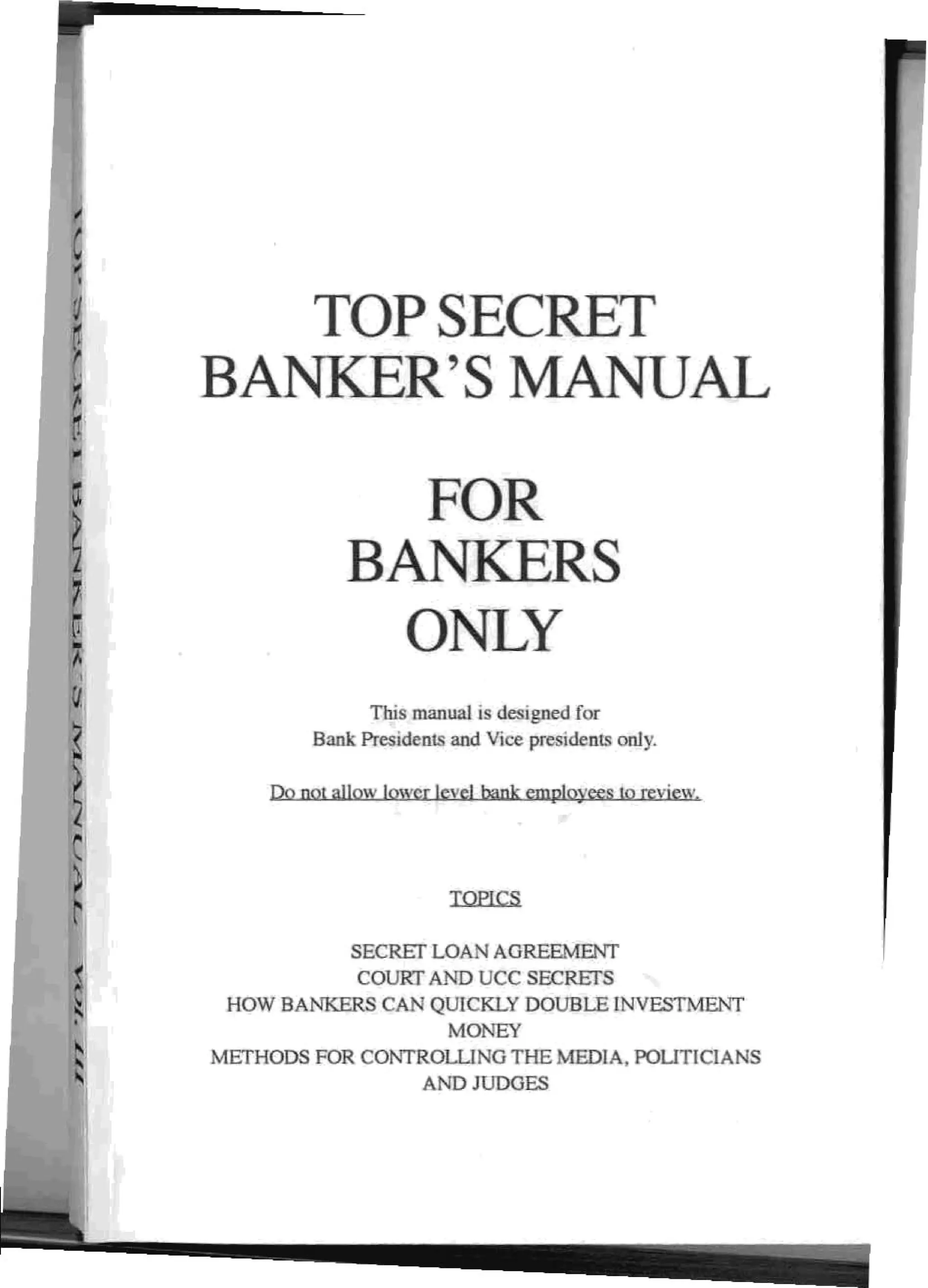
TOP SECRET
BANKER'S MANUAL
FOR
BANKERS
ONLY
This manua l is designed for
Bank Presidents andVice president.. only.
Do nol allow lower leyel bank emplQ)'ces to review.
TOPICS
SECRET LOAN AGREEMENT
COURT AND vee SECRETS
HOW BANKERS CAN QUICKLY DOUBLE INVESTMENT
MONEY
METHODS FOR CONTROWNG THE MEDIA. POUTICIANS
AND JUDGES
Message to Bankers, Politicians
and Law Enforcement
If any threats are made to Mr. Schauf or laws passed to attempt to stop
Mr. Schauf-we have a legal plan. We have a plan to checkmate the bank-
ers no rnarter what strategy is used 10 stop Mr. Schauf. Mr. Scha uf has
placed critical information in the hands or others that will be released, ell
mass. if bankers/politicians take certain actions. Mr. Schauf will act in a
legal manner-act decisively- swiftly in a way that no banker will want to
happen. If Mr. Sch auf has problems he wil l presume it came from bank -
ers and legal action will be taken. Mr. Schauf suggests that the bankers
make certain that Mr. Schauf remains very happy.
Bankers may approach Mr. Schauf with a settlement offer. If Bankers try
and go to a national to/computer chip implant, use terrorism to force
their hand. make threats against Mr. Schauf or use other methods- Mr.
Schaufhasa plan 10 legally checkmate these attempts and win against the
bankers. Mr. Schauf believes that he was called by God 10 lead the nation
out of Debt Bondage and Mr. Schau f fears God more than Man.
Mr. Schauf assures all Americans that every contingency has been con-
sidered. along with our response. WE WILL NOT FAIL. God is with us
and no man can stop God.
My goal is 10 inform every Ameri can to the truth so they can then vote me
in as president so I can correct the banking problem and return their rights
and freedoms.
Contents
Forward 5
Acknowledgments 9
Introduction 11
About the Author .............................................•............................ 15
About the Manual - Its Purpose 16
Chapter I - Warning 17
Chapter 2 - Court Strategy 22
CPA Banking Report by THOMAS SCHAUF, CPA 34
Chapter 3 • Additional Laws & Strategies 48
Chapter 4 - What Bankers Fear 5 1
Chapter 5 - Notices 55
Chapter 6 - Two Kinds of Money 58
Chapter 7 - Credit Cards : : 61
Chapter 8 - Credit Card Bookkeeping Entnes 65
Chapter 9 · Debt Collectors 67
Chapter 10 - Doubling Money 69
Chapter 11- Changing the System 72
Chapter 12 - Ultimate Fear of Bankers 73
Chapter 13 - The Threat to the Economy 75
Chapter 14- Title 12U.S.C., The Bank ing Law 7M
Chapter IS ~ Auditors and Attorneys gO
Chapter 16 - Introduction 10 Preliminary Judicial Proced ures 83
Chapter 17 - The Bible and Today's Banking 90
~~;:~~ ::::::::::::::::::::::::::::::::::::::::::::::::::::::::::::::::::::::::::::::::::::"16~
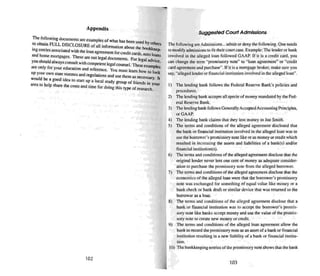
Suggested Court Admissions 10
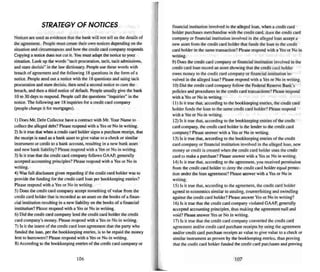
STRATEGY OF NOTICES 106
NOTICE OF ADEQUATE ASSURANCEOF
DUE PERFORMANCE 110
AFFIDAVIT of l. Ben Robbed 112
AFFIDAVIT [Bank] 114
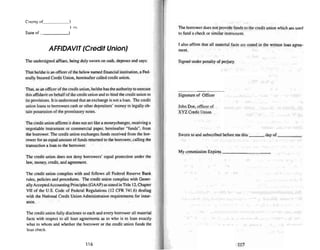
AFFIDAVIT (Credit Union] 116
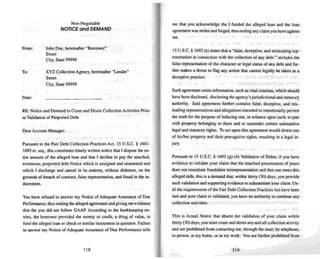
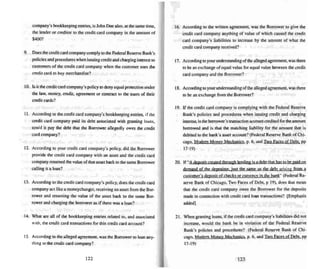
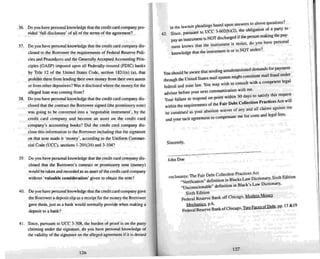
NOTICE and DEMAND 118
NOTICE OF ALLEGED LOAN DISPUTE 128
NOnCE OF HOLDER IN DUE COURSE STATUS 134
NOTICE FOR REQUESTOF CONFIRMATION [ll 138
NOTICE FOR REQUEST OF CONFIRMATION [2[ 140
NonCE OF BREACH OF AGREEMENT 142
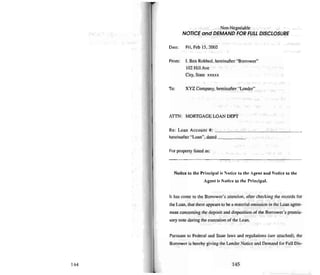
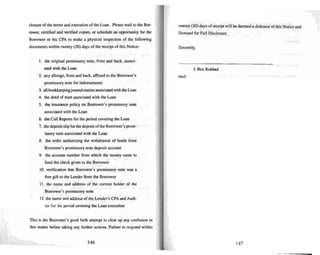
NonCE and DEMAND FOR FULL DISCLOSURE 145
PROO F OF MAILING and CERTIA CATE of SERVICE . 148
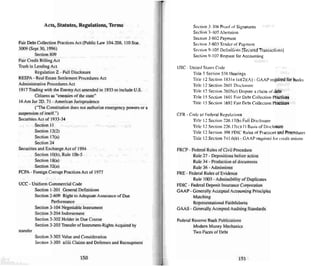
Acts, Statutes, Regulations, Terms 150
Excerpts from Tom 's first book 154
..... "Un,
DISCLAIMER
People reselling the Top Secret Banker's Man ual and books one
and two may offer consulting services and/or other products.
Please beaware that Tom Schauf has no partn ers and that any-
one you contract with for con sultations or other services is act -
ing as an independent agent. Tom Schauf ha.. no control over
what other people offer you as consultations. comments, ad-
vice, information or products.Tom Schaufis not liable for what
these others may offer or the results thereof.
This manual is for educational purposes only andnot legal ad-
vice. Tom Schauf is educating you su you mig ht vote him in as
president to correct the problems.
Forward
In the forward 10Tom's second book,TheAmerican Vmers Vs, TheBank-
iD~ System. Tom says, "I know God called me 10 gel the banking mes-
sage UUI IO the nation. I J o nOI clai m to do this from my power but rather
from the authority, power and provision of Goo 's anointing in my life."
Since March of 1998, I began reading Tom's books and listen ing to his
audio tapes, and frequ ently heard Tom on shortwave radio as I tried to
lIef alternative news about what is really going on in this country. After
~onfirmingTom's information by my own research. and participating in
Tom's weekly conference calls, it became apparent thai it was time for
me 10take an active part in assisti ng Tom in his calling.
In a recent phone call with Tom, he wondered why he had been missing
some important financial exchanges in his most recent venture. He real-
ized that God wanted this Manual completed firs t! It appears 10 me that
God is ready ~ to begin the fulfi llment of the Vision descri bed in
Habakk-uk 2:
Then the Lord answered me a nd said, " Rtrol'"d th f vision.
and inscribe il on tablets, that the onf ,,"'hQ I'"eads it Dl a)'
nm. For it is ]'et for the appointed lime; it hastens toward
the goa l, and it will not fail. Though h tarrtes, "'·ail foe it;
fol'" it will certainl)' come. il will nol dela)"n .
Behold the proud one, his soul is not right withi n him .. .
Will not aUof th ese la ke up a ta unt-song against him. even
mockery and insinuations against him. a nd sa)', •Woe10 him
"'ho increases 'l4hat is nol his for how long - and mak es
hil11st'lfrich with I..!:ulm? Will not )'our rrrdilors rtse up DHl:
1knb:..and those who tD.1J.ttl from lOU a waken? Indeed, you
will become plunder ror them . Because )'ou have looted
many nations. all the remainder (remnant} of the peoples
mil 100' you - because of hu man bloodsh ed and violence
do ne 10 the land. to th e town a nd a ll its inhab itants." (llab
2. 1-4.6-8 NASV)
5
Is the collapse the World Trade Center and the collapse ofEnron - both
major financial powers in America - J US! a coi ncidence? Or is the Liv,
ing-Crearor allowing these events to occur 10 prepare the way for His
"Remnant" to spoil their financial "Slavemasters" - just as they spoiltd
the Egyptians before they left Egypt? Certainly the credibility of ~
certified public accountants and audi tors has suffered a major bln......
Americans are beginning to realize that they need to demand a hFUU
DISCLOSURE" and a ''COMPLE'ffi ACCOUNTING" from those who
are supposed to be protecting their financial, a.. well as political, inter_
esrs.
So the timing of this "Secret Banker's Manual" from Tom could not
have been better! Perhaps this is part of the fulfillment of Isaiah 41.15:
"Behold. I have made you a new sharp threshing sledge l'fnstrumem" .
KJVI with double edges: you will thresh the mountains, and pulverize
them, and will make the hills like chaff." (NASV) Since «day's slavery
is mainly accomplished by written contracus and laws of men (paper.
workh. this "instrument" mostly likely is a "paperwork" solution _ using
Babylon's own paperwork system again st them . "Thou shalt go to
Babylon [its statures - uce.USC, CFR); there shalt thou be' delivered"
(Micah 4.I0, 16). "Th ou didst pierce with his l.l.Wll spears the head of his
throngs" Habakkuk 3.14 NASV).
Just how important is it that we act on this Manual. and tell our friends
about it? Micah 6 shows that God is angry with us for lli!l doing some-
thing about this financial caste system. and will strike us down with
sickna s and poverty unless we act to expose and correct this fraud and
injustice. Notice Micah 6.1, 2.10-16 (NASV);
Hear now what the Lord is sa)·ing.•• I..isl en, you mountains.
to the ind ictment Dfthe Lord..• Because th e Lord has a case
3i:ainSI llis People...
Is there Jet II man in the wicked house. along wit h treasures
of wickedness, and a short measure thai is cursed ("abomi-
nahle" - KJV] ? Ca n I j ustif)" wicked scetes and II bag of
deceptive weights? For the rich men of the city are full of
violence ("unrighteous gain" . St ron~'s 2555]. her restde nts
6
-
spt'ak lies p- breecb contract" Strongs' 8267], and their
tongue is deceitful in tbetr mouth.
So also will I make )'ou sick, stri king )"OU down. desotattng
lOUbecause of )'our sins. You Mi ll eat, bu t you will not be
satisfied [not enough to eettl •.• )'OU will sow but you will
not reap (slut'l")'!) ... thererore, I will give ) 'OU up for de-
struction••.
Let's pUI it this way.. . since the Remnant is prophesied 10be doing this
Work of "spoiling the moneymasters", if we are NOT involved doing
this Work. then WE ARE NOT PART OF GOO'S REMNANT! So says
Habakkuk 2.
"Arise and Thresh" (Micah 4.13) is the enli ghtened "battle cry" of this
Remnant, consecrating the gain and substance 10"the Lord of the whole
earth"! Those who are part of the Remn ant are nOI selfishly focused on
"going to court 10 get out of their own loans" . They are focused on
God's end-time Work of correcting the :system by remoyi ng the fraud.,
enabling everyone to have fuJI djsclosure and equal protectjon under the
law, so thai no one is damaged by theft or counterfeiting, which debases
thecurrency. The Livin g-Creator cares for allpeoples on the earth, and
has DO pleasure in the death of anyone (Ezekiel 18.32). l ikewise. we
need to care for eyeo ·on<:. and not be like Jonah. who only cared for
himselfand how he wou ld look ifGod did not wipe out all of the people
of Nineveh for their sins as Jonah had prophesied !
Isaiah 52.1-3 shows that it is time now to ..A.....ake. Awake" (from being
drugged and dumbed -down by TV). 10"shake off the dus!" (brainwesh
ofmass media propaganda), to "ri:se up and sit down" (rule). and to ~~
yourself from the chains arou nd your neck" (fraudulent contracts). "You
were sold for nothing, and you will be redeemed without mone)'." If
~(lur promissory note was stolen. this Manual will set you free by expos-
Ing the truth of the loan agreement. and givi ng you "Notices" to demand
full disclosure of the bookkeeping entries.
Some people of other faiths may be "turned off' by the Biblical refer-
ences in lhis Foreword and in this Manual. This is understandable, given
7
the disintormauon and mi"information that abound" in tcday's "cio;
lize d" and "enlightened" world about creation versus evolution, and the
wars and exploitation that occurs in the name of "religion" (see artlct
about this at http://freedomnews.comJevolution.html). I can only as~
that you be open 10 the possibility that a Living-Creator does exi st, and
to be tolerant and respectful about our convictions about this. even as We
believe in a Creator who is a God ofTruth, Trust, Courage and Freedom
and who respects everyone's free moral agency. '
Habakkuk 2 declares a Vision of a spiritual Remnant of God 's People of
all nationalities rising up suddenly as creditors to collect what was S!Q:;
lenfrom them by the deceitful intern ational moneymasters of this end.
Lime generation. It is a Vision "for an appointed time. .. that will m
tainly come: it will not delay: ' It is prophesied to occur before the Cre-
ator returns to the earth. Those who read it should "run" (not procrasu.
nate). We believe the "appointed Lime" i s ~ and that, by your reading
this Manual, you will have an opportunity to become a partof that Rem.
nant, with all me glory and credit for what is accomp lished going to the
Living-Creat or who makes all things possib le.
Douglas-Raymond.Stehling
8
Acknowledgments
This manual will presume that you have read Tom's banking books Vol-
ume I and 2. Tom obtained a secret banker's manual from one of the
heads of a major university who wanted to expose the bankers . Tom
thanks this person who wishes to remain anonymous. To get this infor-
mation could have cost the person their job. Th is person spent $I,OOOs
to get this information to Tom and they made it a gift to Tom. So I ask
everyone to thank this one person for making this sacrifice to the nation.
May we use the information in a responsible way. No one was 10 obtain
lhis secrel banker's manualwithout written permission from a bank presi-
dent. This manual will reflect what Tom has read in the secret banker's
manual and expose the truth. Tom wants to make it very clear that the
God of the Bible is the one who instruct ed Tom to ex pose the bankers
and set the slaves free from de bt and bondage . The Christian God is the
one who gets the glory for the work that has been done. God is the one
who brought the right people together to make all of this possible and to
happen. This nation was founded under God and there are people who
want to kick God off the throne. Godwill never be kicked off any throne.
One day everyone will bejudged by the God who created the universe
and Tom believes there is a special hot place in hell for the bankers and
their agents allowing the injustice. Tom sees clearly the hand of God in
allof this and how God put it all together.Tom publicly thanks the Chris-
tian God for His mighty hand in putti ng all of this toge ther to expose the
truth about the real bank loan agr eement. Tom wis hes to acknowledge
the people who developed the lD computer card in 1984 and exposed it
to Tom. Tom wishes to thank the bankers for the secret bank manual
explaining what to do in coun. The secret manual let us know that if we
do certain things in court, the bank has serious problems. Tom thanks
Some of the biggest bankers secretly working with Tom to expose their
Own banking system hoping for a change. Yes, they told Tom that if they
pUblicly support Tom, they might bekilled. Tom has had secret top gov-
~m~nt officials in top places helping Tom and Tom thanks these brave
Jndlvldual Th .s. esc banke rs arescared ofthe 10 and how It would control
you. They want us to win and are scared to come public until we get the
Voters on .
. our Side. The government and ban kers let Tom know that they
need the su
ppon of the voters to make it happen: so let's help and make
9
it happen and save America from enslavement. We thank President Bush
for confirming our rights of freedom of speech.
Tom also wishes to thank many others who have selfless ly contributed
research, time and money to this effort over the past 10 years . and kept
the flame of "Bankftreedom.com" alive. And special thanks to Doug at
"FreedomNews.com" for helping with this Manu al. and for creating
"BankFreedom.Bravepages.com" ~ our new "replicated website" wit h
its Mem ber Forum so we can more easily protect. share and leverage the
latest secret information among our group.
10
Introduction
In the early 1990s Tom Schauf learned that the European families pri-
vately owned the Federal Reserve Bank. When he heard this he knew
that the bankers had to own and control the Congress, j udges and the
major media. He knew that they controlled the money supply. allowing
the bankers to determin e in advance what percent of the people would
beforeclosed on, if the stock market would go up or down and what the
interest rates would be. Tom did not want to get involved. Several people
gave Tom a book on the FED and he did not want to read it.The se people
kept calling Tom to see if he had read the book. Finally, because of their
persistence, he read the book. Tom felt thai the God of the Bible had
called him to get the truth out to all Americans. In one and a half years,
he got out 2 million brochures exposing the banke rs. These were bro-
chures made on photocopy machines. not e- mails. Back then. few peopl e
even owned a computer.
Three months after he began getting out the brochure s, he took a trip to
the Smoky Mountains and the cook in the restaurant had received a bro-
chure two weeks earlier. People were copying the brochures and giving
them out to everyone. These brochu res generated so many telephone
calls Tom could not even work, so he had to stop the brochures. Then
people told him that local banks created new money. He did not believe
it because that would violate GAAP (Generally Accepted Accounting
Principles) - the matching principle - and he knew that CPAs audited the
banks and what standards of GAAS (Generally Accep ted Auditing Stan-
dards) and ethics must be maintained. To prove to the world that local
banks did not create new money. he asked his students that he taught
CPAcontinuing education.All the bank auditors confessed and admitted
that it was a secret. They even told him how it was done. Armed with
this information , Tom showed a few people, resulting in about 20 people
getting out of their house mortgages. Now the telephone calls began
pouring into Tom's office requesting information. At this time people
began using this information with credit card companies.
In 1996 Tom moved to Tucson to get away from all the telephone calls.
He asked eve ryone to stop calling for a year so thai he could write the
banking books. It took nearly 3 years working 12 hours a day, 6 days a
11
week 10 write the books and make the cessene tapes. Now we have found
a secret banking manual that is onl y for the internal bank officers ex -
plaining that. ifthe bank is sued. and if people see the secret laws in this
secret banking manual. the bank will lose in court.
If we can get out 2 million brochures in one and a half years, think how
easy it will beto get out emalls and have IJ)()(),s of websites exposing it.
Voters are willing to become campaign workers if they know what the
plan is and if they know that we can win . We can win and we are win-
ning. It is now time to stand up and becounted and inform American s
about the truth . If we gel 100 people to hOSI a website. soon it will be
200, and the n 400. and then MIX}. and then 1.600. and then over 3,Om,
and it keeps growing. If we have even I,(XX> websites and eac h one gets
out H)(}() em ails, one million voters will be informed. If everyone got
out emalls and their friend s kepi il going. soon millions of voters would
join us. When we have len percent of the voters, everyone will join us.
The popular thing III do will be to join us.
We fought the Revolutionary War over the same banking issue. Th is
fight will nor be fought by bullets but by email. websltes. books. the
secret banking manuals and votes. If you do not join us in this fight for
winning the vote. the bankers will go to a national lD card and enslave
you all the more.
Tom talked to the peo ple creating the ID card in 1994. These peo ple
were scared. Th ey said that if they eve r institute the lu. the government!
bankers could track every money transacti on, track you by satellite and
have absolute total control over you. The Government will say. "If you
have nothing to hide. why would you care?"They forget. America is the
land of freedom. not Gennany's Gestapo or Russia's KGB. Show me
your papers... and if you do not, you go straight to jail. They are looking
for exc uses to implement the ID that they began research on nearly len
years ago .They planned 10 do it-now they just have 10 talk the popcla-
lion into it, Let us tell the voters about the banking and what they have
done to us and the voters will vote out those who want to enslave us
through the ban king and !D. TIme is running out and we need your help.
Join us while there is still time to make the change for freedom.
12
The Arizona Dai ly Star, June 9. 2{WJ2, pg. AU reponed how Ronald
Reagan used the CIAlFB I covertly, and unlawfully tried to Stop political
foes per federal judges. If the CIA/FBr attepmts to threaten political op-
p?nents, what would they do if they had a national !D card and you
differed from them pol itically'! CINFBI psychological warfare was used
against political opponents. Imagine the contro l that they wou ld have
with an !D card. trac king you by satellite, knowing where you are 24
hours a day, everyone you talk to and everything you buy and sell. It is
called total and absolute control. making people fearful of free speech.
The KGB and Gestapo would be proud ufour lawmakers. President Bush
wants one million government informants.Thai isone informant for every
240 Americans. This would give the U. S. a higher percentage of infor-
mants than East Germany had using their dreaded STASI secret police.
They'U be watching YOU.
On 9/11101 , they got us to wave the flag as President Bush took away
our rights. How stupid are we? The mainstream media remained silent
about the nume rous eyewitnesses and expert s, including news reporters
on the sce ne, who. seconds before the World Trade Centers (WTC1col~
lapsed. saw and heard explosions near ground level which brought the
WTC down. The wrc was designed to withstand the size ofa jet thai hit
It .Ask a demolition expert and they will tell you lIlal a building like that
should fa ll like a tree. and not straight down . without ex pert demolition
teams. Demolition experts explain that it is very difficult to bring down
such large lowers without them falling like a tree. NO! one, but two tow-
ers fell, as if expert demolition teams brought them down. The 1Vshowed
what appeared 10 be large ex plosions near the ground j ust before the
towers collapsed. Van Romero, an explosives expert and former director
of the Energetic Materials Research and Testing Center at New Mexico
Tech, said on 9/1 1. "My opinion . based on the videotapes. is that after
the airplanes hit the WTC there were some explosive devices inside the
buildings thai caused the towers to collapse." In May, 2002 we find that
Bush was informed of the threat prior to 9/ 11. On May 23,2002, Bush
opposes an independent investigation of the information Bush had on
the terrorist threat prior 10 9/1 1. If he has nothing to hide, why did he
Stop the independent investigation. Prior to 9/ 11. Bush's ratings were
low. After 9/11. Bush's ratings went up.
13
Let us use our heads for one minute. If it were terrorists, wouldn' t they
want the building 10 fall like a tree destroying other buildings'! Many of
the top executives thai had offices in the wrcdid norcome 10 work that
morning. It is reported that 50,000 workers did not show up to work that
day. One child in school announced the collapse of the WTC a few days
in advance. Many people were shorting the stock marker. especially air-
line stocks. betting that the stock market wou ld go down thai day. So
what is the deal ? There is a huge deposit of oi l in Afghanistan. Did they
have 10 change governments in Afghanistan to get the oil? Is it all about
money. greed and control'?Remember the oi l fields in Kuwait?An Ameri -
can ambassador told Iraq just before the invasion that the U.S. would not
help Kuwait, there by giving Saddam the gree n light to invade. Then the
United Nations was rallied to counter this invasion . Why'?Was il to give
validity to the United Nations'!
Wars are very popular.They help get you elected. You need a War to lake
away American rights . They got us to wave the flag and say nothing as
they took away our rights . You have to admit they are very slick. For
them to pull it off, it takes Americans to believe everything the boob
rube says to get the job done. This is why we must wake up A mericans
on banking. The thing we can prove and the one thing that everyone
cares about, is MONEY. Nearly everyone is in debt and they want out of
debt . When they wake up on lhe money issue . they will wake up on the
health. United Nations, education , drugs. guns and the other issues.
There are people in government who have an agenda 10 take away your
rights and your wealth. They are looking for eXClL'>eSto get the job done.
We need honest people in government. Please help us by getting out the
emails, hosting the website and se lling the books. The bonk sa les help
fund US to save this great wonderful nation and government. We jU!>1
need honest people running lhe government. We need voters to switeh
from government employees repre senting the banke rs, to represen ting
honest freedom loving Americans. Saving America depends on you. CAN
WE CO UNT ON YOU TO HELP US GET THE JO B DONE'? If yes.
then cont act us to get your website up and get OUI the emails and help us
get the books sold. Whe n peo ple read the books. mey get angry and join
us. Thank s in advance for your help. Together, we will get the jo b done.
This could be our last chance to get thejob done so let's not waste time.
14
About the Author
Thom~., Sc hauf has a diverse background. He has written two books
re~eahng the banking secret from the viewpoint of a CPA court expert
witness. ~e gra~uated from Northern Illinois Universi ty with a Bach-
e~rofScience With double majors in accou nting andfinance.After gradu-
anon. he ~orked as a staff accountant for Motorola. He worked for a
sm~1 Certified Public Accounting firm, owned and operated his own
busl~ess brokerage finn and Certified Public Accounting practice. Over
a period of near ly ten years, he has testified in a number of cases as an
Expe~ Witne~ in business valuation, and bas taught the arts of business
valuation, business acquisition and negotiations to buyers. CPAs andlaw-
yers on a national level in colleges and major universities. He has taught
I~wyers ~d tho usan ds of CPAs the art of valuation and negotiations in
hIS copyn ghted course designed 10 meet continuing ed ucation req uire-
ments. H.e has been a controller and head of purchasing and personnel
for a .maJor manufacturing company, He has been a real estate broker
and aircraft flight instructor (CA l).
15
About the !Ianual • Its Purpose
Tom has received telephone calls from many people claiming 10 have had lTMI
card dehl~ zeroed OUI or mo rtgages canceled. Som e people have claimed thai tne
bankers offered 10 cancel half the mortgage or all o f u in an etTOI1 10 ser ne while
asking the borrower 10 sign an agreemeDl 00110 lell anyone thai a semeroerawas
reached. MOSl all of this was donein sa:rel. People and lawyers want a COUI1 C&.'Ie 10
fax around stowing success and that mighi lle the rea...<;on for the senlemems,1be
bankersknowthat they cannot allow this on thepublicrecord. Proo(is hardtocome
by.
This manual isdesigned to expose thetnromauon Tom read in the banker's secret
manual and information obtained fnvn bank auditIXS. 1be secret bank manuaJ ex-
posed laws that bankers fear - laws that. if used. mighl resun in bankers losing in
coon.This manual is designed to sbow the 1alo'S and the questions bankers cannot
explain about the agreemenl. II shows hislorically what has been happening in
court, IIexplains Tom's theory of why he believes ban kers ha ve offered10 cancel 5tJ
percent of loan s and. up 10 100 percent of some of the loans perIelephone calls (rom
people whohave used the seem: information in the Nutkef-'s secret manual.
Bankers hiSiocically do.l not want ro sbow the altered n oes. Bankers cannot explain
the bookkeeping entries ~ing if the horrower funded Ihe loan. Bankers canno l
explain if ~ash or notes are money or ifOWing money is money and if new money
was dePOSlled and crea ted in the loan process and if GAAP was followed. 'The
~ ' .~_: y
caII llOI exr n III """";1 what m mey Is, hut theychargeyou imerest foe Ihe use of
~-nI mo ney. ffi SIOI) ' shows bankers fear you may cbim stolen I f<ned 001- ,and fraud in therectum This manualwill mowcourt Str.ltegies othershave usedand
is DOl mrended as legal advi ce . This manual only e"JlO'SeS information in the secret
bankmanualof what hankers fear,Tom's conversa uons with ban k auditors discuss-
ing what they fear wit! he exposed. andlaws and COWl strategy people have used
~y. one of the putposes ot uasmanual is10 stop the copycats. Many people have
Signed ronfidernia.hly agreements wuh Tom 10 kttp the information confidential.
only 10 have toese people charge oners $ 1,(XX)s for lhe same informati on in this
manual. Many of the copycats changed things resulting in people losing SI.()lXls.
paying for lnfurtuatinn, and then losing in court. Thism anual's purpose is 10 gel the
truth (Julio people alll.l get voters 10 vote in Ulechange.
16
Cha pter I ~ Warning
This manual is nor designed to give legal advice. This manual is only to
give peo ple histori cal information as to what Thomas Schauf has learned
that has worked and not worked in court. Tom has learned that strategies
in court can change every 30 10 YO days. If you are using old informa-
tion. YOU WILL LOSE IN COURT. Before this manual was printed.
strategies changed every 310 6 months.The old strategies failed in court.
You have 10presu me that bankers and judges ha...·e read this manual and
are waiting for you . On a regular occurrence people nave called Tom
and said, I want 10 order your books. my neighbor got you r books and
the banks agreed to cancel their debt. I want 10do what my neighbor did .
Tom usual ly warn s people and tells them thai just because your neighbor
got OUI of their loan does not mean that you will get out of your loan.
While they may understand coun rules. you may ncr, setting you up for
a failed coo n case. IN NO CASE SHOULD YOU ENTER INTO A
CLASS ACTION COURT CASE. You cannot win fighting me banking
system. If you win in court. it must be an indiv idual lawsuit claiming
that the bank did nOI perform, rbe bank breached the agreement and con-
cealed material facts. The bankers fail when they cannot answer Tom's
court admissions (statements thai me bank must admit or deny). One
person won three co urt cases in a row and lost the fourth court case. The
bank bribed the j udge and placed $ 150.000 cash in the j udge's personal
banking account. The judge might call it a political con tribution but it is
used to influence the judge like a bribe. Tom Schauf was watching the
local news on TV. The TV explained how the local foreclosure judge
ama....sed an $8 million real estate fortun e in 3 to 4 years by working with
the bankers in buying foreclosed homes. How can a judge go from no
net worth 10SR million of net worth in 3 - 4 years without the bankers
helping'! The judge helps the bankers in court and the bankers make sure
that the judge gets the best foreclosure victims with me most equity. One
hand washesme other. 11 is all about profits. Going to court is risky. You
are playing in their sandbox and they make me rules up as they play me
money game.
Tom helped explain the bank secret 10 one person . They won in court .
Within IWoweeks of winning the court case 1.500 people filed the iden-
ticallawsuit.The banke rs went to Congress and said we must change the
law or we will have everyone becoming debt free and mat would shift
17
me money to the people mat wou ld change politics and vote out the
banker-paid politici ans and judges. Congress immediately changed the
law and the 1,500 court cases got thrown out and the people lost. Re-
member that abo ut one third of Congressmen are directly related to the
bankers by birth or they receive money from the bankers. The big bank-
ers have boasted to Tom that the banke rs' money controls both sides of
the election and also controls the major media through loan s, advertis-
ing money and direct ownership. Bankers simply remind thepoliticians
that if they do nor cooperate with the banke rs, the bankers will heavily
fund the politician 's opponent during the next election. The same big
bankers told Tom that if we organize and get the American voter awak-
ened to the truth, the American citizens would win the election and change
the bankin g system. So it is up to you to join us in an organized way 10
win and we control the laws and who is elected. Congressman Trancam
spoke out against the bankers. He called the IRS (the collection age ncy
of the privately owned Federal Reserve Bank) a bunch of thieves. Now
he is going to jail. He said it was selective prosecution and a conspiracy
to put him in jai l. On national TV j uror Lee Gla..r said . "No doubt gOY-
emment was out to gel Traficam.v'Traficam was an example to the mem-
bers of Congress not to speak out against the bankers. On Friday, 3n 103,
The Tucson Citizen had an article about how the FBI had a practice of
misleading j udges to get search warran ts and arrest people. This is why
it is so important to get out the brochures and wake up every American
to what is going on. You can help by hosting a website. get out emails
and wale up hundreds of Americans. As we get 1000s to host websites
and work to save America. we will get everyone talking and wanting 10
be debt free. Going to court is not the solution. 11 costs muney and takes
time. Help us in waking up Americans to the truth so we can use the
American way to change things. We have the best government eve n with
all the flaws that need 10 be changed. We have the vote. It is up 10 us to
create the fertile soil fur change. CAN YOUTR UST ANY OFTHECUR.
RENT GOVERNMENT LEADERS WHO KEEPTHE SECRET, WHO
FORCE US INTO DEBT. WHO FOLLOW TI-lEIR MASTER _ THE
BANKERS - WHO WANT TO GO TO A NATIONAL ID CARD TO
ENSLAVE YOU AND TOTALLY CONTROL YOU ? Join U." in saving
this nation from the bankers' agenda before it is too late.
Instead of suing the bank in !,..ourt and spending all that time and money.
use your time wisely and get out the infonnarion, by helping us get the
18
books and manual sold so that voters understand the truth. Instead of
suing the bank, use the banking system to your advantage using corn-
pUler programs in investments 10 quickly increase your wealth . Some
peopleknow how to get 50- 100 percent profit a year. Some can get thai
in one week. It is more profitable by using your time wisely making
money or changin g the laws by the vote instead of suing the bank. The
sales help fund our organiza tion so thai we can save America. How can
the judges and politicians go agai nst 120 million voters? The money
issue always wins the vote. It is up to you to help us reach our goal of
having eve ry American read Tom's books and use the VOle to correct the
problem. We need a clean sweep Il.1 sweep out the banker's politicians
andjudges and to vole in real freedom loving Americans who will honor
our Foundi ng Fathers quest for freedom and liberties. The voters must
first leam what the real issue is andthat is banking.
As Tom was writing this manual. a doctor who wrote another banking
book took Tom 's confidential information. This doctor signed an agree-
ment to keep Tom's Information confidential. This doctor took the con-
fidential information. put on a seminar to abou t 100 people and charged
them S600 each for the seminar plus $ I,OOJ for other materials that were
for sale. Several other organizations stole Tom 's information after sign-
ing agreements to keep the information confidential and then breached
these agree ments only to charge SI,()(X)s or more for the same informa-
lion given in this manual.
Some of these same organizations give legal advice or para legal help.
One person, after signing an agreement to keep the information confi-
dential. won a court case, breached the agreement and then began charg-
ing people 510,000 for the information. The people hosting thewebsltes
know who these people and organizations are. These same people and
organizations lie to peop le in order to get their money. Please be careful
before paying these people one cen t. Please warn othe r Americans sn
thaIthey do not get involved with these people. People who breach signed
agreements cannot be trusted. Do not trust people who have a track record
in using deception and lie, be it a politician or someone who is trying to
make a fast dollar getting you out of your loan . Some deceivers even
tried to claim that they were partners of Tom and they were not.
lh~ manual is desi gned to stop those who breached past confidential
agr~ment and from over-charging people. Infonnation thai was kept
19
confidential in the past that cost between $300 and $J,200 or more is
now here in a manual.The idea is for people to buy this manual and not
pay the decei vers who broke the agree ments with Tom. Yes, mere are a
few honest people charging that gel inside information from Tom . Yes,
people need help. If the banker wrote me agreement, have them explain
it. They refuse to explain it so how can there bean agreement ? Let the
voters know the truth so they can VOle to fix the problem.
For the record, Tom never read the book DEBT VIRUS by Jacques S.
Jaikaran, 1995.Tom understands that Jacques claimsTom read his book
and gOI infonnation from his book for Tom's book. The truth is lIlal
Doctor Jaikaaran signed an agreement 10keep confidential the informa-
tion that Tom developed. Tom has copies ofthe agreement and signature
on-hand. The confidential information was on making an offer to dis-
charge the debt with the condition that the original agree ment was not
altered and that the holder of the promissory note is the true owner and
that the bank return the origi nal promissory note unaltered plus other
information . After this agreement was signed, this person gave the in-
formation at seminars . Tom challenges the author to prove otherwise.
Thi s information originated from Tom as proven by the signatures . The
only point Tom is making in this case is thai Tom never read his book. as
some claimed. and that Jacques signed an agreement to keep informa-
tion confidential that was developed by Tom . Later, this same derivative
of inform ation was sold at a seminar. Tom is nor claiming wrongdoing
of Jacques, Tom is claiming thai Jacques gOI the information from Tom.
The point is that Tom developed the information as proven by the signa-
ture. Tom wants 10keep the record straight and stop those who are trying
to use deception in this matter claiming that the opposite occurred. Com-
pare that information 10 that in this manual and you will see additional
infor mation in this manual that is not taught at that seminar prior 10 this
manual being printed, Tom thanks the author for exposing the bankers,
Expatriation. changing court j urisdiction. is not new. Tom j ust wants
people to know that he created the origi nal informationand did nOI copy
it.
Sunday. March 23. 20{)3
The Arizo na Daily Star reported thai the House of Representatives passed
a ban kruptcy bill. Now you cannot easily write off your credit card deb t
in Chapter 7 bankruptcy. Now they want to garnish your wages over five
20
to pay off your credit cards. You gue ssed it. The credit card com-
~~ . ' 'll be, . ' wrote that law. I predict that credit card companies WI more
~~ , . h .l' ff
Idto collect and tell you that if you have unpaid bills al l ree ut erent
:~it card companies, they will force you into bankruptcy. So payor
else,
1ltis is why you must learn to use investments 10 your advantage and
earn more mone y. Earn more money and stay out of court.
21
Chapter 2 • Court Strategy
The bank-trained lawyers are experts in courtroom procedures. Reme
ber, it was the bankers' U.S. Presidents who got through the 1'Tad.
ItI
·
With the Ene.my Acl" and the Emergency War Powers. The U.S. G;~
em ment and It.. leaders d~lared the U.S. Citizen to be me enemy. 1'hix
~a~s yo~ must h~ve a license 10 trade with the enemy (you). The SOl.
diers (po lice) require thai you have a driver's license. The soldiers m
argue mal could bea good thing to get blind people and drun ks off ~
~oad and keep people under control. The court has a military flag tlyin
10 the Courtroom. The gold fringe nag makes it a mil itary court. The w~
allows the victors, bankers and the government agents working for !he
banke rs, to plunder the enemy (you ). Now do you understand why the')'
want 10 ~et all me gu ns? They want to disarm the enemy. You no longer
have a right to own a gun under the Constitution They turned th . h• •. • I:U e n g t
m~o a pnvllege. that they control by license. They fear that me enemy
migh t commur ucare and realize that war has bee n declared on them and
the war allows .the bankers to ereale money 10 plunder the enemy. The
secret weapon IS the money creation in a silent war 10 plunder the en-
emy· you. They want 10 go to a national 10 card so that they have Iota!
control ~ver you . The ID card allows them to track you 24 hours a day
by satelli re. You cannot buy or sell without the 10 so they can control
you. Delete your ID card and you cannot buy food to eat. Get the idea of
the terrorist talk. Using the terrorist police powers, the government has
~ady abused ~e pow~r against that people they do not like. They say
tf you have nothing 10 hide, then you do nor care if we use the 10.h is all
a~lUt power and control. Do you trust them after they did what they did
With the banking'! Do you trust anyone who wages war against you 10
pl~nder you? The propaganda media is there 10 talk you into willing
gomg along with their agenda.They cannot fight 120 million voters who
~ay NO. If you were a Congressman or j udge and getting all that money
from tbe bankers to get elected and person al Investment money, why
~ould you change the system unless the voters all wake up and say enough
Is enough'! The key to winning in court is helping us inform every Ameri-
can voter and using the vote to correct the problem and end the war.
Exposing the problem forces the problem to becorrected.
22
l1 court. you cannot use the Constitution. or say the y .lent yo~ credit so
'llU do not have 10 repay the money. The banker and Judge will try and
~et you to agree that you have a signature on the agree ment. thaI.the
bart"- lent money to you and therefore you must repay the mo~ey. It the
judge says. is that your signature. some people say. "It looks like a mas-
lerful forgery. I do not understand what this document is. Can you stipu-
we if this promissory note acts like money or mone y equivalent used to
rive value to a bank check? Can you stipulate all of the material facts
~)UI the promissory note or what the agreement is so I know what it is
that my alleged signature is validating as to the agreement. I do not un-
Jer.>tand in the agree ment if I provide the capital or if the banker does 10
fund the check. I cannot testify if something is my signature if I do not
know what is agreed to in the alleged document." When the judge de-
mands that you say yes or no. some people say they will answer when
you explain what the agree ment is. How can you testify 10 something
mat you do not understand and they refuse to explain? Some respond
saying it looks like a forged document 10 me with concealed material s.
If you agree that it is you r signat ure. you lost the court case. Your signa-
ture means you agree that the bank lent you their money and that you
owe the m your money. The judge may demand that you say that the
bank lent you money thai resulted in your purchase of a house or car.
But, if you agree that the bank lent their money 10"purchase" your prom-
is.smy note. then you are testifyi ng that the bank violated the law + GAAP.
Per GAAP and Federal Reserve publications , IWOloans were exchanged.
You lent the promi ssory note to the bank that funded the loan back 10
you.The loan from you to the bank is the deposit of the promissory note .
GAAP requires thai the ban k "match" a new bank liability with your
name on it showing that the bank owes you for the deposit they accepted
from you ju st like they do when you deposit cash into your checking
account The banker know s as well as thejudge that when you deposit
cash into your checkin g account, you lent the bank your money. Ifyou
withdraw your money, the bank lent you nothing. The fonn • contract-
says that the bank lent you money. bUI the substance - bookkeeping en-
tries + say that the bank accepted your promi ssory note as new money as
a deposit just like depositing cassh into your checking account. Your sig-
nature cannot tes tify thai the bank lent you the bank's money to pur-
chase your promissory note, but the bookkeeping entries prove that they
lent nu money 10 purch ase your promissory note. If you lent the bank
23
money a" a deposit. the ban k. .accepted money from you, the bank never
gave up one cent of the bank s money. The bank accepted money fr
dd ited i bicb i {Jill
you an eposrt II. W rc IS the opposite oflending you money. If YOu
lent the bank money and they returned the same value back 10you
.""loans were exchanged or they sto le your money. The bank chaner
quires the bank to follow the law - GAAP. Y(lU can presume the b:~
m~sl. follow the I,aw '" the contract is an illegal contract. The contract
said interest. WhICh IS defined as the charge for the use of borrow~
money. We can presu me thai the party who funded the loan is to be
",paid themoney.The bank claims that the form says that the bank funded
the Joan and should be repaid the money but the bookkeeping entries
prove me opposite. Did the agreement say that the bank was to steal lhe
promissory note. alter it to become money. and then return the stolen
money as a loan or did the bank use their money to purch ase the promis-
sory note from you without the economics similar to stealing and COUll-
terfeiung and swindling? The bankers hate it if you claim that the note
was stolen and forged.
You have to have a damage in court to win. If it is stole n, you can claim
a damage. If the hank violated GAAP. then the CPA audit is a fraud and
the hank manage ment and CPA will go to jail and the SEC can go after
them so they cannot say that they did not follow GAAP. If they follos
GAAP. we know what the bookkee ping entries are and they did the op-
posite to what you unde rstood the agreement was to he. You only care
about the agreement. You only care about GAAP. You only wan! them to
explain the details of the agreement they wrote. You want the original
promissory ROIl' back to see the stamps to see if you are paying the proper
party endorsed on it. See VCC 3-302. Adequate assurance of due perfor-
mance vee 2-609 is for the sale or purchase . If you demand adequate
assurance ofdue performance, the other party must give assurance in 30
days or the deal is off for purchases. The bank will try and demand that
this does nOI apply 10 them . If they do this they adm it that the original
alleged lender never purchased the note from you.
lei us presume thai they purchased your note using GAAP and did nOI
steal it. It is nut a gift 10 the bank without your knowledge. The vce
says that no title passes with theft. This is where people use this re~
sponse to sugges t that the bank knew that the note was stolen. with ml
24
'ideration given ttl purchase it from you. No consideration was given
~"ns uired by the UCc. Thi s has scared bank anomeys telling their bank
" "", nOI to respond. The banke rs' own secret, inside manual ex plained
, hen . .
d in the factum, vce 3-305. This means thai the party who did not
~e (he agreement had no reasonable opportunity 10 obtain the knowl-
:e of the terms. This is why we write the bank notices requesting in-
flJl1lalion on the terms. They refuse [0 tell us who was to fund the loan,
hepaoli. or the borrower? Did the ban k follow GAAP? All major banks
~Ye an annual stock report that a stockbroker can gel for you showing
the CPA audit opinion stating that the managemenl and CPA agree thai
GAAP was follo wed. was it the intent of the agreement that the party
....ho funded the loan is to be repaid the money? Do you see how the
llank must conceal the truth? Imagine the bank advertise saying. "lei us
sleal your money and return it 10 you as a loan ." Who would agree to
this? They must make you believe that they lent you other depositors'
money. making you feel thai you have an eth ical duty 10repay the loan .
Read vec 3-302 10 3·308. Holder in Due Course - real defenses are
fraud in the factum , material alteration and stolen notes. See persona)
defenses are want of consideration and fraud in the inducement. They
may have changed the Holder in Due Course part of the uec so be
advised. The stolen I forged I concealment part of the uce should reo
mainthe same. They exchanged one kind of money - promissory note-
that was deposited for another kind of money called a check. The check
acts like money per the uec. The banker will say it is an exchange of
which you must pay back I(Xl percent of the money exchanged plus
interest. The banker will say that they do not have 10 pay one cent of
their money Ient to you to buy your promissory note. I ask what does the
agreement say that they wrote? Why would the voters allow the exchan ge
of money for money and then you have 10repay the money plus interest?
Ignorance is the answer. If voters knew the truth and understood how the
bankers got oearly all the money and wealth for free and control the
lawmakers, judges, police andmedia, we would change the bank ing sys-
tem to follow Presidents John F. Kennedy, Abraham Lincoln. Thomas
Jefferson. Andrew Jackson and lames Garfield.
The banker has problems answering the admissions that we have. They
cannot ex plain the agreement. The bank attorney will say, "Interesting
theory. this is the way it work s." They cannot explain if they follow ed
25
GAAP, nor if the intent of the agreemen t is that the party who funded
loan per GAAP (the bookkeeping entries) is to be repai d the money,
T hey cannot expla in what is money per the agreement. Never ask for
legal definition of money. Only the judge can discuss that. Ask, "Wh:q
mo~ey per the agreement?" They call an exchange a loan. They
OWing money. money. and then they say. "So what, you got the rno
We return that argument and ask "According to the agreement, did
bank use the promissory note ali money or money eq uivalent or capi
to fund the loan ?" If you deposit cash at the bank , how much moneytl
the bank loan you when the cash was deposited? NONE. You lent iQ
bank money. Replace the word cash with promissory note and yoU'
the exchange; the bank merely acted as a moneychanger and ch~
you as if there were a loan. Two loans were exchanged. You must re~
the loan and the bank never has to repay the loan from you to the baill
They conceal the loan from you to the bank. creating the economic
similar to stealing. counterfeiting and swindling . An agreement me
mutual understanding and no conceal ment.
We are always happy to repay the loan.j ustexplain the details so that
voters will know how 10 vote. If voters believe the big lie, you will
enslaved in debt and your wealth goes to the bankers for free . It is our
10b to tell the truth to the voters. Have the judge admit that the econo
icsare similar to stealing. cou nterfeiting and swin dling and that is how
works. Let the voters vote out that judge next election or vote out ~
Congressmen and President who allow j udges to deny us equal prolf(·
tion under the law and use concealment to kee p the true economics N
the bank loan a secret. Vote in Tom Schauf as President and he will pUI i;
honest judges and correct the problem .
If you were on the jury and someone claimed the bank stole the promis-
sory note and returned the value of the stolen property as a loan, y%
wo uld wonder when the banker can not explain. The promissory nole~
believed to be forged and there is fraudulent concealment und fraud~
the factum with unjust enrichment obtaining the promissory note tit
free. by violating GAAP. Fraud was committed by misrepresenting thill
they would foIlow the law and GAAP and they did not follow GAAP.
The GAAP discussion forces them to disclose the actual bookkeepin$
26
... ' d that the borrower funded the loan 10 the same borrower. If
enlrle~o wer provided the money. why are we paying back the principle
". bO""I..... . rest to a party who refused to loan the money that they adver-
..~dlnte th f d . th iderati":'~ thaI they would loan and en re use to give e consi eraucn
u . d? If I lent you my money. you should repay the loan. If I stole
romlsl' . .
p oney and returned the value ot the stolen property to you as a
y~ur ~d I conceal the theft and did I perform as promised? Th is stolen
t~~ changeS the cost and risk of the alleged loan. Lack of consider-
ac.
tIO
is a personal defense. No title passes in a theft per VCc. Federal
aIJOk"·"g law GAAP was violated. Use a CPA expert witness to confirm
ball tn
GAAP. They cannot put up an expert CPA witness and answer our 600
uesriOi15. Then place in the admissions - admit or deny - which they
:renOllikely 10 answer, which might allow you to go to summary judg-
men!.
You had better really know law and courtroom procedures or you can
expect 10 lose unless they do noranswer the lawsuit. Even ifthey do nor
answer the suit, will the judge sign off and allow you to win'! So unds
easy, bUI it is work. Do not expec t the bank to let you off the hook that
easily.Donorstop making payments or they will foreclose. Some peo ple
senda new promissory note in the amo unt of the original note payable in
the same species of money or credit that the bank used to fund the loan
perGAAP thus ending all interest and liens. Then they write loan pay-
ment checks payable 10 the new note. If the bank accepts the checks,
then you can have fun. If they do not, you might claim breach of agree-
ment. You tried to learn the facts of the agreement and they refused to
explain.
We write notices to learn what is the real agreem ent. When they refuse
10tell us. we look at it as breach of agreement - concealment.
People try and stay away from the word fraud. If you say fraud, you
have agreater bunlen of proof. You should instead lilly breach of agree-
menr, they stole the note and you want it returned or for them to fund the
loan.When the stole n property funded the loan, that is a breach ofagree-
ment.
'(011 need to show that the bank never performed and never was out one
27
Why do we keep talking about GAAP? It is the law. If they claim waf
GAAP was not followed, they violated the law and the CPA audit opin·
ion. If they followed GAAP. they cannot claim that they do not know
what the bookkeeping entries are. The bookkeeping entries prove who
lent what to whom. Two loans were exc hanged and we believe lIlatall
borrowers should repay all loans giving each party equal protection. We
believe that all the facts should be disclosed in the loan and not conceal
material facts as to who provided ~ money to fund the alleged loan·
Who could argue with that? Why not tell the truth . the whole truth, aod
nothing but the truth? If there is nothing wrong with the banking system,
29
II" op"
f
.. bankers have been te 109 pe
oter? The act IS, v.u' I >0
It teUevery v · . s and ou must repay the cans
~~~;her deposito~ fu~dwehdo~n~:the lo~nscan be repaid the money.
~... . 1. depoSllors the borrower
the ('ju,er h Id be canceled because
tl'Il ..• uue. then all loans s ou GAAP and per the Federal
Ifthu> IS the same borrower per
ed the loan to .
lund B nk publicauons.
Reserve a
. Whal worked last month
. arantee of a court win.
Remember;:;::~I~work today. U a friend won , it d~s,: ~=~
isnot agu . . IStimeand money to go to COU . .
._" you Will win. It cos 'Tbejudge might be afnud to
Itt u' and the attorneys. e
havethe time, the mone~ . not our friend. Tom believes thai you
rule in your favOr. The J~d~eh~pus~et the voters to join us. The voters
)}lould stay out of court an
are the sure way to fix the problem.
t
P the bank sum-
. . The be!U. court strategy to s 0
This is the key to wlfl~mg. ou is ~he CPA Report copyri ghted by Tom
mary judgement against y . ..... " -ourt admissions. You need the
. ... bank uslOg lorn ~ l.: k
gcnauf and sumg tne ued or you sue the ban .
CPA Report regardless of wh~he~ ~:n:es~without personal know'~
Lookat court procedures. The ~h I give legal knowledge. see the
edge, and a copy of the note ml~ ~no Ill)' Social Serve. v P.A.Q. 317
follo....-ing court cases: Monmou. 1:;;8 see also: United States Bank--
N.J.Super 187. 193-194 App. Dlv. d ~eblOrs June 30. 1993 Bank-
ruprcy Court NJ. Investors and Len e
ruptcy no. 92-30754.
. F d al Credit Union. Plain-
SupremeCOUft of Hawaii. Pacific Concrete Ie d
er
I AnnPlIanl No 6162
" J SK anoeDe en an yr- .
uff-Appellee v. Andrew . . au ' . th boOkkee ping entries
July 11.1980 1ells us that the bank must gIVe us e .deoce One cannol
" " ank' . .de 'e is hearsay eVI .
With an affidavit or the b s eVI enc .. h thi!1. and a CPA
" th court Tom says Wit .enter hearsay evidence 1010 e .
report talking about GAAP. the bank has a serious problem.
. . ·f you sue. This way, they
It IS best to not be behind 10 debt payments 1 • CPA expert
. . rtant 10 use a
cannot foreclose and you can win . 11 IS rmpo .
witness using Tom's copyrighted CPA Report.
I " d the· friends and more and
f YOu got lCKI emails out and they emaile If
28
Bankers have told Tom that the American people are too stupid to under-
stand the bank loan agreement and bookkeeping entries and no one can
explain it in coun to a jury. Tum agrees, you need a jury and Tom sa~
that a jury can understand it.
cent and that the stolen property funded the alleged loan that was a~
of agreement. let them tell you that the agree ment allows the m to s
and crea te new money. Fraud in the factum - you never agreed that y
signature and pro missory note was money to be stolen and reruIned 01$
loan.
Please read and study Tom's two banking books for funher training.
Remem ber, we are defining stolen as the banker getting the promiSSc:r
note without spending one cent to purchase it and violating GA AP _~
matching principle.
The banker argues, "This is how it is done, you signed the agreemen~
you got the money." We ask, "was the agreement altered after it w
signed, was it forged?" We ask, "Did the borrower provide the t"apital
for the loan 10 the same borrower per GA AP (standard bookkeeping en-
tries)? Did you follow GAAP as required by law and the CPA audit opin-
ion? Is. it the intent of the agreement that the one who funded the loon~
GA AP is to be repaid the money? Were materi al facts concealed? Mi.
Banker. do you understand this agreemen! and who was to provide th6
money or funding for the loan ?" They cannot explain the agreementthat
they wrote and that they are tryin g to enforce.
~re peo~le put up our website and distributed the books. we could
quickly Win the nation before ir is too Iale. lfeveryone Slopped and wem
[~ coun, we cou ld lose the nation and government we love. We have lhe
right to replace the em ployees cal led politicians using the vote bUI We
need your help to gel me job done. PLEASE JOIN US IN SAVING
AMERICA AND TIlE REPUBLI C WHICH STANDS. ONE NATION
UNDER THE CHRISTIAN GOD OF OU R FOUl'DING FATH ERS
WITH UBERTIES ANDJUSTICE FORALLAND EQUAL PRaTEC
TION wrr~ JUST ~EIG.rrS AND MEASURES. II is our job 10 gel
every American talkin g so America will be safe for all. AMERICA'S
RITURE IS IN YOUR HANDS.
They migh t be able to stop us in coon but they cannot stop us from gel-
ung the voters organized and awake ned. and VOle them OUI ofoffice and
put in honest Americans. Help us make it happen.
The lawmake~s and courts have been helping us with the following court
cases demanding thar the lender have possessi on of the pro missory note
~fore the banke r can collect. See the following court cases confirming
~IS. See Maue~ of Slaff Mon. & Inv.Corp., 550 F.2d 1228 (9th Cir 1977).
Under the Uniform Comme rcial Code the only notice suffic ient 10 in-
form all interested parties that a securi ty interest in instruments has been
perfected is actual possession by the secured parry, his agent or bailee.
See Bankruptcy Coun followed by UCC In Re Investors & Lend ers LID
165 B.R. ~R9 BKRTCY D.NJ. 1994" Under the New Jersey Uniform
~omme~lal :ode (NJUCq promi ssory note is "instrument," security
interest In which must he perfected by possessio n..: ' C learly the courts
demand possession of the note before the bank can collect Wh . tho. ~~ . YIS IS
so Importan t'! It is important because you have been paying the loan 10
bank #1. Bank #1 sells the note to bank #2. You keep paying the wrong
party, Bank # I. Now bank #2 who bought the note from bank # I de-
ma~ds that you pay the last 12 months of payments 10 bank #2. You
c~~ thai you paid , and bank #2 claims thai you paid the wrong party.
Thi s IS why you must be sure thai you paid the correct party and must
see the note 10 see who the note is sold too or you must pay twice. You
w~lUld.have to pay the wron g pany and then again pay thecorrect parry,
 Ihslom·ally. the bank claims they lent you money. The bank bundles up
the promis.."Ol}' DOtesin groups of aboul S2-3 million and uses the BOies
30
as value to issue a bond and se lls them to Investors. The bank. becomes
1ht." selVicing agen t. Now the bank sues you and triesto foreclose. Get
the picture? The bank does not have posse.sslon, and is not the owner of
th~ note so what legal standing does the bank have to sue you? People
have demanded to see what contract allows the non-owner of the note to
SU~ you. The servicin ' agenl has 6Q days to g~you the owner's name
aft~r you ~uest ittSee title 12 under servicing agents). They usually
sell il-;g;in' when you req uest the owner's name and keep selling il so
vou cannot find our who owns it. People have demanded 10 know who
~w ns the note. and what contract allows someone other than the owner
!O sue you. lt is like you havin g a contract with your neighbor. Joe. Your
neil:!hbor Tom says you violated your agreement with Joe, so Tom sues
you. Tom bas no contrac t with you and canno~ sue you. Replace the
word Tom with the word bank and you see the picture. The bank:works
un presumption hoping that no one demands the original note or who
O""os the note. If you can not find the note . some states allow one to
reconstruct the note . flow can they reconstruct it if the one doing the
reconstructing has no personal know ledge and you are arguing the terms
and conditions of the note. Only you have first hand know ledge. only
you were there signing it. Some slates allow the attorney to use a copy of
the public record where the note was recorded in the country record and
certify the copy as the original. Again the attorney has no personal kno",:l~
edge and itcould beforged. stolen and we still do not know who owns l.t.
They still cannot explain our b - 7 terms in dispute in the back of uns
manual in the notices claiming breach of agree ment. Tom Schauf reo
ceived a telephone call from so meone who used this information. The
person wrote to the bank. requestin g a copy of the curre nt note with the
assignments (paid 10 the order of... ) showing who is the current owner
of the note. The bank refused 10 respond. He gave a second request. He
did not give any arguments or dispute. He only requested a copy of the
note, Now he sues the bank claiming mal he is the holder in due course
of the title (If the horne and the bank is not the holder of the note . The
bank refused to answer the law suit and he got his home free and clear.
Remember after one sues, you can amend the suit once. If the bank re-
sponded. you could claim thai the terms were altered or breached. The
bank did not wanrtn get involved in answering the questions a" ttl breach-
ing the tenn.s and 6--7 things concerning the terms that we want to uis-
CUl>.s.
31
Tbey never tel l you who owns the nore. They have been known to se
the notes. you payoff the enure note and the bank gives you a sheet
paper saying it is all. p~d off. Then 5 years later the owner of the nOli:
forecloses. Why? It IS simple. You never got the original note back anc
you must p.rnve that you paid off the note. People have been fored oSflj
on ~ho P3l~ off the ~OIe 5 years ago but lost the one piece of paPer
saym~ tha t II was paid off. They throw out their old bank slalemenu
showing thai they paid it off and did not gel back theoriginal note. Th'
is why it is important to see the original note and gel il back. This is wh,
it is important to follow the law andgel the note, and see who owns ~
andgel back the original.
Two people taught by Tom have been winning on credit cards. One per.
son .invl~i ces the credit card, then sends an opportunity to cure and pay
the invoice. Then he sends a defauh judgemem Next he sues the credit
card com pany in small claims court. Results have been wins and the
credit card companies have issued checks back to the victor in smaD
claims court. Some small claims will nor allow you to sue an out ofstee
business. Check the agreement regarding jurisdiction, arbitration and
coon location.
One person 11-.e5a bill of particulars if sued by the credit card company
then enters a motion to dis miss the court case brought by the credit card
company for nor complying with the Fair Debt Collections Practices Ad
and givi ng veri fication/affidavit by someone with personal knowledge
and he uses our CPA Report and our CPA expert. Results have been
successes. As I write this it is not a 100% success. The week I wrote this
one man had his mortgage cancelled on one house . but on his other house
the mortgage was not cance lled.
There are a series of court cases on void and voidable judgments. The
attorney foreclo sing did not tell you that he is a debt collector per the
supreme cou rt ruling. You had no opportuni ty 10 demand verificatio n,
affidavi t signed by the attorney. with personal knowledge, veri fying the
debt. The attorney forces you into court and wins. The attorney broke
the law by not informing you that he is a debt collector. People have
used court cases showing thai the first court case is void or voidable and
32
revt r.>ed the first court decision because the first attorney violated the
ta~i.
GIld gave us a wonderful gove rnment and laws and court cases. You
¢Cd to use what God gave us to protect your rights. Don't let some
attorney vio late your rights and get your property for free . We merely
lI'anl to know the whole truth and nothing but the truth regarding the
lIo'hole agreement and bookkeeping entries and follow the law. What is
lI'rong with that? If the bank has nothing 10 hide . then let them explain
allof the details. We simply believe that the party who funded the loan.
per the bookkeeping entries, should be repaid the money. Who could
arguewith that unless you are a swindler. On ly a swindler would try and
suppress evidence proving who funded the loan. They cannot prove us
wrong so now the attorneys resort to name culling. We see this in court.
When an attorney cannot gel a witness with personal knowledge to prove
their case, the attorney tries to be the witness telling the judge that our
arguments come from Google.corn and are nonsense as the attorney can-
not explain GAAP. the Federal law that they should know. So do we
have another Enron, Arthur Anderson CPA firm on our hands?1be jury
convicted the CPA finn ofAnderson on June 15,2002 for obstruction of
justice for impeding an investiga tion. Did you know that Anderson was
a big bank auditor? How can we trust them or any oth er CPA firm audit-
ing the banks? We have a number of CPA's now who agree that federal
law GAAP was violated and this means that the audit is like the Enron
situation. The bank attorneys do nol know GAAP and cannot testify to
GAAP. Only a CPA can testify to GAAP and now honest CPAs are ex-
posing the truth.
See Appendix for "Suggested Court Admi ssion......
33
CI'A Banking Report by THOMAS Sc/IA UF, CPA
July, 2002
Jmponam: This report " "
.. IS copyrighted. Copyright 2{X)2 Tho . .
~~aUtho~zed copying or use of lhis report is Prohibil~and ~~ Sc"'-!
II copying or use is subject 10 a fee of IOU(XX) h e~c proftj
dollars per eac h unaurh )' d . cas • UOlled S
on..e copy or U~. payable 10Thoma.<; Schaur
This banki ng report is 10 expo ' the r .
smoke • . . se res. ml.<;represemation and
e and mirrors by bank auditors and en. d" • use
r ....au ttors.
To avoid repeating, one may go 10 the three ' . .
banki ng 10 find my back d . books thai I have WOlfen Q.
CPA. I have resufled groun and 'oc:'uon. I am an lIIinois licenser:
as a co urt expert witness for roughl len
taught CPAconunulng education classes fo ePE Y . years
lenyears I have ta h . . ' r Over a period of aboD:
how to [~stify as a~p~a;:aJo
r
universities and nation ally leaching CPA'
radio and TV statio . un elt~n wi,mess. I have been on a number
try relating 10 this r:~do'::e.~.nl~len Informauon on the bankin g indus.
U It: ast len years.
We all know of the Arthur Anderso CPA
audit scanda ls. As I wass leaching C;ACPE
fi
7'Enron and WorldColll
CPAs over the past ten years I k dm c asses 10 more than 2.00)
audilOrs I talk d • as e my CPA ...tudentx if any were bani
. . e 10 a number of thos bank di
the bank ' se au nors and they admined
lIlg system was..a fraud bUI the co ld
no one could explain " . • y u gel away with it because
I In coun or they could use k
hide the truth Thi . smc e and mirrors to
• IS report rs to ex ~ lhe k
thetrurh ,. - smo e and mirrors and reveal
For therecord. I use Federal Reserve Bank bh . .
entries as published by 'he F de I R pu IcallOns and bookkeeping
e ra eserve Bank I d .
material statement in this rep; n Thi ' . 0 OC'ument even
bank loans and credit c....d I ' " h s report includes house, car and other
... oan.s w ere the bank rec d d th .
nore or receivable as a bank as " h . or e e promissory
set as S Own In the Fed I R ,
publications. em eserve Ban
Bank auditors have repealedly told me th .
cassh a.. they record the bank I . at they ~IUlm thai they credit
oan agreement promls-"ory note as a bank
34
p-;el which is recorded under loan accounts.They told me that they rede-
tint' words 10 mean the opposite thereby significantly changing the mean-
iJlg,lX'St. and risk of thealleged uansact ion and agreement. The auditors
explained how they play with words to hide the truth of the real transac-
tiOll and !he real agree ment.
M'i.'Ording 10 Chicago Federal Reserve Bank publicati on Modem Money
~Iechanics. page six. the bank reco rds the promissory note as a bank as-
5flwhich is offsel by a new bank liability called the borrower's transac-
liM account (which is commonly called a checking account). Please note
the word "borrower's" is possessive. POdge three of the same report. sec-
ooooolumn and second paragraph. claims that thebankscreate new mooey
as loans aregran ted. If you read thepage, they redefinethe word "money"
e mean owing money which is the opposite of money. The idea is that if
you deposit $100 of cash into a checking account. you can count the
checking account (bank liability) as money because there is an equal
amount of money. cash, deposited to match the bank liability. According
loGAAP. generally accepted accounting principles. a bank liability means
thal (he bank owes money and cesh. money, is recorded as a bank asset. A
check is nOI money, but acts like money. with the presumption thai money
isfirst deposited to make the check good . According to Black's Law Die-
uonary, a check contains an unconditional promise to pay a sum certain
in money. The presumption is that if you present a check to the bank
teller, the bank teller will give you cash.
Federal Reserve Bank of Texas publication Money. Banking and Mon-
etary Policy explains on page 11. that bank... create money when they lend
it.The loan becomes a new deposit into the custo mer 's check ing account
jliSl like a payroU check does.
Federal Reserve Bank of Boston publication Banking Basics page one
claims that the money deposited belongs to thedeposi tors.
Feoerat Reserve Bank ofNew York publication The Story of Banks page
lenclaims thai the bank first deposits the money and then uses that de-
Pt.Kited money to make the loans. Then it claims that a lot of money is
weaied when the banks. credit unions and saving and loans make new
loans.
35
Fede-ral Reserve Bank ofChicago publication ABC's of Figuring Intetest
page two claims thai when you deposit money into a savings aCCOun~
you make a loan (0 the bank . According to GAAP, the new bank Iiabilit
proves a loan to the bank.
Black's Law Dictionary explains a deposit as placing money in the CUS-
tody of a bank {(I bewithdrawn at lite will of lite depositor.
Federal Reserve Bank of New York publication I Bet You Thought e:.,_
plains it very well on page twe nty-seven that ban ks create new moner.
whenever they grant loan s by simply depositing the borrowe r' s promis-
sory note as a bank asset offset by a new bank liability. Page five explain
that money does not have 10 be issued by the government or be in anY,
special form .
Com bine what the Federal Reserve Banks above have ad mined in writ-
ing and you have the fact that the bank used the borrower's promissory
note as money or like money, hereinafter called money. deposited or re-
corded il as a bank asset to give val ue to a check which the bank returns
·10 the borrower as a loan. When the bank deposited the money (or prom-
issory note). the money deposited was a loan to the bank. This is coosis-
lent with GAAP and the matching principle. Bank audi tors repeatedly
told me that they must hide the loan to the bank . If the loan 10 the bank is
hidden. then you have the economics similar to stealing, counterfeiting
and swindling. All we ask for is that the party who funded the loan. per
the bank bookkeeping en tries. be repaid the money. What honest person
would argue otherwise?
If one argues that the one who funded the loan , per the bookkeeping en-
tries. shou ld not be repaid the money. then they are argu ing that one of
the parties has a right to swindle the other party. My question is "Whal
law or agreement gives that party the rig ht to swind le the other party?"
Show me! Americans wan t to know. If the bank cannot answer, they los!
the argument by their silence .
I will now ex plain what bank auditors have told me are some of the lies
and smoke and mirrors and then I will try and expose the misinformation.
36
Bank auditors cannot give a complete ans wer as to what money is. To be
II CPA,one must have the competence to com plete theassignment and if
thtycannot ans wer what money is, they have no right to audit the books
orlCstify. Typically. bank auditors will claim that the promissory note is
not money and that the bank did not deposit money received from the
bO£TO~'er and thai the borrower did not make a deposit al the bank or
credit union. They then claim that two loans were not ex chan ged. Typi-
caUy. at this time , they go through the motions that GAAP was followed
and e,,·erything is in order just like Anhur Anderson did just before the
auditfraud was exposed. Then the typical bank and credit union auditors
use the fullowing example that auditors have privately told Tom Schauf
is a trick to deceive the judge and general population. Tom Schauf will
first give the Dick. and then ex pose the Dick.
The trick goes like this. The hank does not deposit the promissory note .
The bank or credit union records the promi ssory note or credit C'Md pur-
chase a' anasset on the booksof the bank or credit union and credits cash
to balance the books. The borrower got cash. This is exactly what one
bank auditor told Tom Schauf andadmitted that this is a fraud and a lie.
At this time . the typical bank and credit union auditor will try and avoid
explaining that the cash earlier credited is now deposited. The deposit is
a debit to cash and a credit to a bank liability like a checking account or
demand deposit account or savings account. The new result is exactly
what the Federal Reserve Banks have already ad mitted. There is a new
bank asset and a new hank liability. The new asset came from the bor-
rower and the bank liability means the bank owes money related to the
new asset.
Inthe previous mentioned bookkeeping entries where bankauditors claim
thatthey credit cash. they can replace the word cash with the word check
and you have the same economics and bookkeeping entry on the typical
loan.The trick they use is that a check andcash are similar because you
Can get cash for a check. As mentioned earlier, a check i.s not cash. but a
Promise to pay a certain sum of money. Th ing is... few people use cash.
most use checks and the auditor knows this. They can sell the promissory
note for cash. Logic tells us that the auditor is wrong here. claiming that
they gave you cash. The bank or credit union auditor must agree that the
Promissory note is recorded as a bank asset, typical ly recorded under
37
loan accoun~o;. If the offset or credit is to cash or check. the typical ~.
rower.deposit'> the cash or ~heck resulting in a debit to cash or check ant
an offset to a bank or credit union liability (typically called a checkin
account, demand deposit account or savi ngs account). The result is el~
actly whartbe Federal Reserve Bank publications earlier stated; that is,.
new bank asset and new bank liability and the economics are the same
, " .Sl~ ar to depositi~g new money. I challenge any bank or credit uni~
auditor to prove this paragraph wron g. They either remain silent or lrr
and gel off on another subject to confuse me issue. .
Now some auditors are stupid enough 10 keep the game going by fOOl.
ishly claiming matno money wes deposited to cover the check thus ad.-
mining to a crimi nal act of check kiting and a fraudulent audit. Some
pretend that the prom issory note is first sold for cash. the cash is depos-
ired 10 give value to the check. and then the promissory note is recorded
as a bank asset.Thi s is a stupid argument because the result is a new bani
asset and a new bank liability just as I said earlier. In all of the above
ca~, the bank or credit union got the promissory note for free, new money,
credit or money equivalent was created. The party who provided the asset
10 give value to the chec k that is claimed 10 be lent to the alleged bor-
rower was the same alleged borrower and the party who funded the loan.
per the bookkeeping entries, is not repaid the mone y. This creates tl1t
economics similar to stealing, counterfeiting and swindling.This changes
the cost and the risk of the loan compared to if the one who funded the
loan is repaid the money. Tom Schauf challenges any aud itor to prove
that the economics are not similar to stealing, counterfeiting and swin-
dling and thai theGAAP principle of matching was not applied by match-
ing thenew asset with a bank liability showing that the bank owes money
to the alleged borrower as indicated in the Federal Reserve Bank publica-
tions.The matching principle works like this. If you deposit $ I00 ofcash
at the bank.,the bank must show a bank liability ofSIOUshowing that the'
bank must return the $ HK) to you. If the bankacce pts cash or a promis-
sory note from you 10 give value to a check. should not the same econom-
ics apply to stop the eco nomics similar to stealing, counterfeiting and
swindling? Should not the party who funded the loan, per the bookkeep-
ing entries, berepaid the money? The bank or credit union auditor cannot
discuss this issue which is the heart of the who le discussion.
38
We have a right to know and understand the entire agreement and the
(I:onomics and the bookkeep ing entries. Thomas Schauf is looking to
fllrce a bank auditor into a court deposition and force the bank:auditor 10
five all of the details of the bookkeeping entries, explain what is and is
~ mOIeY, money equivalent and credit and explain theeconomi cs of the
lf3llsoction.The bank or credit union wrote the agreement, they executed
the bookkeeping entries. and we have a right to know and understand
II'hllt the agreement is and the eco nomics of the agreement. One question
rtmains. Is the party who provided the asset that gave value to the alleged
baIk loancheck. per thebookkeeping entries. to berepaid an equal amount
ofvalue, for the value that wasearlier provided 10fund the loan check? If
!he answer is no. do you agree that it is a swindle? If the bank can get
money or an asset for free from the borrower or steal it by knowingly
hiding the full terms of the agreement and then return the money to the
victim as a loan. they could own nearly everything in the nation similar to
the eco nomics of counterfeiting?
Demand the auditor produce the book keeping entries to prove the prom-
issory note is not used to give value to the check and that other deposi-
tors' money was used to fund the loan. lf this were the case. the book-
keeping entries would bea debit to a checking account or demand deposit
account or savings account and a credit to cash. The promissory note
would not be recorded as a bank asset. The deposi tors cannot spend the
money taken out of their bank account which was lent 10 the borrower.
The borrower repays the loan and the money is returned to the party who
funded the loan. Economically speaki ng. everyone has eq ual protection.
There are no economics similar to stealing, counterfeiting and swindling.
There is only one key issue .According to the bookkeeping entries, should
the value of the money or asset that was used tu fund or give value to the
loan bereturned to the original party who provided the mone y or asset? If
the CPA auditor says no, then we have the economics of a swindle. If the
CPA auditor says yes, then there is no disagreement and we all agree.
Who could possibly argue that the one who funded the loan should not be
repaid the money unless they are trying 10create the economics similar to
a swindle'! They would have to hide the true bookkeeping entries if this
Were the case. If so, have the auditor give the complete detai ls of the
bookkeeping entries including who provided the asset 10 fund the loan.
39
If the bank CPA cannot explain or does nor understand what w
. ' wmg about, then he or she does not have the competence to tak
audit a...signment and has broken the ethics of a CPA. e
Have thebank orcredit unionCPAaueJiltlfgive all eltaffiplesof thin
use as I) money, 2) money equivalent,3) thingsof value thaigivevf,s
check. l..money recordedas a bank asset or liability? Is ca..h muney?
thebank use a note as money'! Is thepromissory note used togive val
check or similar instrument? Is it the intent and bank policy thatthe
who providedthe asset to give valueto the loan check, per the bol
entries, have the money or value of the assetearlier described
them? If a CPA cannot answer these simple questions, then ethics
that they have no bu.sInessauditing thebank or credit union. TheCPA
auditor must have me competence to answer these simple questions i
took on theassignment to audit the bank or credit union. If they claim
they followedGAAP.have themgivedetails and answerourqlle'>tiollS,
the CPAclaim that the Federal Reserve Bank publications are wrong'
amine what the CPAsays and see if they refuse to answer our ba..ic
tions todetermine bank policy,eccnomics ot'a loan. andwhat thefun
keeping entries of GAAP really are. If the bank CPAdisagrees. have
give theproof. If no proof, they have no credibility. One CPAauditor
a CPAcla's with Tom Schauf toldTom that these arguments are crary
Tom madehimanswer specific questions and then headmittedthar. the
was a fraud. If no money was deposited to fund the bank loancheck.
can it be legal'!Who provided the money to fund the loan'!
Have the bank or credit union auditors prove that the Federal R .
Bank publications are incorrect in fhat money is not first deposited
then lent out. Have them prove that the intent of the agreement isthat
part y who provided the asse t to fund the loan, per the bookkeepia
tries, is nOI 10 be repaid the money or value of the a...set thai funded
loan.
There is only one real issue to beresolved. Ask the bank or credil
CPAauditors to answer the following questions. Is it the basic in!
the loan agreement that whichever party provided the asset to give
10the loan. according to the bookkeeping entries, is 10 be repaid bac~
equal amount of value plus interest when the loan is repaid'jThis i53~
simple and ba..ic conce pt any competent CPA should understand- If
40
~1ffO~~rW::::r~:~~I~:~:o,::~:~17:e~~o~~:=n~V;~;
I{ ~ont loan shOUld be repaid the money. Now we must decide, per
~~eeping entries, if the borrower funded the loan.
wer provided cash or a check or an asset that the bank depos-
li the~ to give value to the loan, the bank assets and liabilities will
iltd°
r
e.J "~Ilenge thebankauditor to prove me wrong. li the bank lent
-ncrca...e. ell"
~t.kpositor's money and did not accept an asset from ~e borrower to
theloanor give value10 the loan. the net overall banking assetsand
fun~litits from this nansaction would not increase. I challenge any bank
:wr (0 prove me wrong. This just told you who funded the loan. Ac-
~ing to GAAP and the Federal Reserve Bank publications. the net
~fft'Clllf the wtaJ uansactlon of the bookkeeping entries was that the net
bankingassess and liabilities increased. I challenge any CPAbank audi-
I~ 10 prove mewrong. Tbe CPA can play with words. ignore the issues,
beat around the bushand talk about nothing ofImportance. bUI if they do
and refuse to prove me wrong, you know everything that you need 10
blowand how 10 win,
Typically. the bank auditors will go into great detail on how they fol-
loJ,'e<! GAAPandbelong to all the bank societies,organizations and even
theAICPA.This is all a bunch of meaningless chatter if they cannot agree
ooooesimple conceptof GAAPcalled thematching principle.The march-
ing principle means that if a bank accepts an asset from Joe, the bank
mu.,t offset lheasset by a bank liability showing that the bank owes Joe
the money.1be bank. cannot accept the asset from Joe, refuse 10 show it
OWes Joethe asset that the bank received from Joe, and then claim that
tbe bank owes Mike the equal value for the asset instead of Joe. The
matching principle stops swindling. Have the bank or credit union CPA
auditors prove Tom Schauf wrong concerning this. To end (he discussion
~theGMP matching principle, theCPAauditors will try and claim that
~ Ctedilt.'d cash and nut a liability accoum. The net result, no mailer
is you COok the book...., is a new bankliability once thepromissory note
ho:~ded.asan a...set or the credit union posts charges 10 (he credit card
1Ilatcru: lo~ ~COUnt. The Federal Reserve Bank publications show the
Per the gPfinclple claiming thai two loans were exchanged as is correct
GAAP matching principle. If IWOloans were not exchanged. then
41
there is a tax owed to the IRS for the stolen promissory note. Did the bank
pay the IRS tax'! The matchin g principle does not allow anyone to sleal
your asse t, exchange it for something of equal value, and return the value
stolen 10 the victim as a loan. The bankauditors who claims thai cash Or
check was credited in exchange tor the promissory note, which is re-
corded as an asset, got the promissory note for free and exchanged !he
value of the promissory note for a check and returned the check 10 the
victim as a loan having the economics similar to depositing the promis-
sory note like money which allows the bank 10 get the promissory note
for free and create new money. The economics are like the bank is acti ng
as a money changer and calling it a loan. If the bank took your cash or
srole the cash and used the cash 10 fund a chec k and returned thechec k to
you as a loan you can understand it is like stealing. Replace the word cash
with promissory note and you have similar economics. Claiming that cash
or a check was credited is only smoke and mirrors accounting and cook-
ing the books, which gives the economics similar to stealing, counterfeit-
ing and swindling. Have the bank CPA auditors prove me wron g.
IfJoe signs a promissory note and it is agreed that Joe loans the promis-
sory note to the bank , the following bookkeeping entries are recorded.
. The promissory note is recorded as a bank asset and the bank records a
bank liability showi ng thai the bank owes Joe money for the loan to the
bank. This shows IWo loans were exchan ged as proven by the new asset
andnew liab ility, Under the smoke and mirro r method. the bank records
the promissory note as an asset resulting in a new bank liabili ty when
everything is completed, hut this lime Joe's name is not on the bank li-
ability. Tbe bank CPA claims thaI two loans were nor exchanged. The
bank got the promissory note for free as the bank created new money and
the party who funded the loan , per the book keeping entries. is not repaid
the money. Have any bank CPA auditor prove me wrong. A bank auditor
hiding this must claim they credited cash or check but when the cash or
check is deposited you ha....e the new asset and new liability, Thi s tempo-
rarybookkeeping entry only hides the true transaction and economics. A
check is a liability and who gels a hand full or bag of cash when they gel
a car or house loan '!As the bank CPA auditors lold Tom Schauf, it is a lie
thai cash was credited. it was only called cash to gel e....eryone offtrack as
to the true nature of the true economics. Bank aud itors typically call cash
things other than cash to hide the true meanin g of the word. The bank
42
auditors admitted to Tom Schauf that it was a lie and that the true party
who funded the loan, per the bookkeeping entries, is never repaid the
money, The auditor told Tom that there is a new asset and liabil ity and the
liability means that the bank owes money for the asset it accepted as an
asset. Thai is basic GAAP. The bank got the promissory note for free by
creating new money and violating the GAAP principle of matching.Then,
when you ask the bank or bank auditors for the truth, they typically mis-
represent how it works or refuse to ex plain.
Please notice how I gave the Federal Reserve Bank publications and page
numbers and bookkeeping entries. What proofdoes any CPA have to prove
me wrong? The Federal Reserve Bank publications claim that new money
was created in the loan process, the new money is deposited and thereis
a new asset and new liability and money is owed for the new liability, so
what CPA bank auditor would be a big enough fool 10claim that this is
not true ? What CPA bank aud itor is foolish enough to claim thai if you
deposit $100 into your chec king account that you did not loan the bank
the $100 and that the bank assets and liabilities did not increase by $1OO?
The problem is that the CPA bank auditors do not want to admit that the
promissory note was used like or a" money or value or money equi valent
to give value to the bank loan check. The auditors must try and hide this
fact or the secret is revealed thai the borrower's asset. per the bookkeep-
ing entries, gave ....alue 10 the alleged loan and that the party who funded
the alleged loan, per the bookkeeping entries, is never repaid the money
giving the economics similar 10 stealing, counrerfeiung and swindling,
thus hiding the true elements of the alleged agreement. Any CPA bank
auditor should have thecompetence to know the truth or they should stop
taking on an assignment that they do not have the competence to finish.
Yes, the bank auditor typically will play with words to confuse the issue.
They cannot ex plain what is money or money equivalent . They typically
will say thai cash and checks are deposited but that promissory notes are
not deposited ignoring that the overall net effect of the bookkeeping en-
tries in both cases have the same economic effect of having the cash and
promisso ry note recorded as an asset and both giving value to a bank
check. The bank is merely a money changer calling themselves a lender.
hiding the fact that the promissory note incr eased the bank assets and
liabilities creating new money or money eq uivalent or credit. They will
43
nOIallow the original party wh .
be repaid the same value whoOn ~~ovl'ded ~asset thar funded the loan ..
I .. me can IS ren"id A .L
10 d Tom Schauf it is a trick that I ' ..~ . S me CPA auditors
that confusion an'd ignorance O~hlS very profitable :md they were hoping
to cominue this very profitable tri:;e~eral popu~all~n wou ld allow lhelll
Schauf is challenging any CPA bank 0,:", lhe trick IS exposed andTom
the general populationwilllearn the ~~t~:~':'prove him wrong. SOOn
CPA firm. Enron and wo Ide . 10ktheArthur Anderson
r om audit scandaf '"
pared to the lying and mi .. S were IOsIgmfic3m com,
I..~. , Isrepresent.UJ.Ons we h' .
",,,I,lkkeepmgemries 1£'1.- . ave seen with the bank
. mereIS a Joan agree h
the bank used their bookke-o! . menr I at lhe bank wrote and
. eeplflg emnes have th b .
tellmg the truth and norhl b • e ank grve the details
. rmng UI the truth d s .
SImply wan! the one who fu <Jed .1._ an stop the deception. Wr
. n UlC loan check ....
enmes. to be repaid the money Wh b . ' per me bookkeeping
are wrong? Tom Schauf gave ~ 0 fn'h
a
sWindler could argue that we
use proo , ave the CPA bank d·
o empty words but give solid f h au rtors nor
f 0 proo I at Tom Scha f i .
area..0 thIs repon The ' '1 u IS wrong In all
. Ir st ence proves Tom Scha uf 10 beCorrect.
We need 10 keep a re ~ f
. COIU 0 everyo ne involve.d · tho .
" forCing slavery upon tbeAmerican Ie m ~s misrepresentation
10 correct the problem" peop .1be VOle IS the only sure way
. .... vllte out all who enfor dth·
The Vote IS the only real sol ti Af ce ISslavery Upon us.
. . u on. ter we VOle and .
JUSl:Jce the legal way It " correcm, we wiUget
• S up to you to gel th
w e Can COrrect the problem. OUI e IIUth10 every voter so
In summarv a bank di .
- J ' au for usmg deception w'U 0 •
relevanl 10 discuss who funded the I . . I say things like, it is nor
bookkeeping entries. it is nOI relevan~·~.llIS not relevant 10 discuss the
substance (bookkeeping entn ) . . 0 ISCUSS form (agreemenOverses
who funded the loan should bees , I~~~f relevant 10 discuss if the one
relevant 10 discuss what mone rei~and mo~ey. ~y will argue it is not
typicaJJ~ say things like. it ap~ thai ~~al ls or ~s n~lt de~ited. They
menrd atming... as a way 10 gel offlrack an other ~I~e ISm~mg an argu-
report. They lypically argue that lhe bo d.not dl~"U~s the ISSues in this
goods and deny that the bank di ""?wer received a benefit 10 buy
alleged borrower which w or ere II un mn received a benefi t from the
as an asset from th bl:
value to the a11t-ged loan 'h '" S . e «rower 10fund or give
c ecc. omeumss Ih di .
the money is pooled and no one k . e au Hors claim fhal all of
nows where the money came fmm as
they refuse 10 discuss the bookkeeping entries proving who funded the
loan. Al times, they claim that it does not matter who funded theloan . In
any case. theyare hiding the funda mentals of the agreement, bookkeep-
ing and economics to get the promissory note for free and refusing to
have the party who funded the loan to be repaid , thus creating the eco-
nomics similar to swindling. I am not calling bankers, CPAs and auditors
criminals, swindlers, counterfeiters and thieves. I am exposing the truth
of just how smart they are in getting the promissory note for free and
creating new money and hiding the true agreement as if is done. Tom
Schauf simply believes that theone who funded the loan should berepaid
the money. Who could argue thai this should not beso1Who thinks that
we should use the economics similar to a swindle? w hat honest person
wou ld say we are wrong? Which party ha... given the proof of the evi-
dence ? Why hide the real agreementand bookkeeping entries if it is hon-
est'! Why should oneclass ofciti..ens creare new money and loan it out to
enslave thesecond c1ass of citizens?
CONCLUS ION: To prove Thomas Schauf wrong the bank CPA mUSI
prove that the federal Reserve Bank publications used in this report are
wrong.The bank CPA typica lly plays with words saying that the bank did
not deposi t the promissory note in the borrower's transaction account as
claimed in the Federal Reserve Bank publications. What theydid was use
a short CUI in bookkeepi ng entri es by claim ing that they credited cash or
check as the promissory note was debited. The result has.. the same eco-
nomics as deposi ting me promissory note and crediting a bank liability.
In either case there isa new asset andnew bank liability when the cash or
check is deposited proving thai the promissory note gave value 10 the
bank loan check. The alleged borrower provided the money or asset that
funded the alleged loan and the party who funded the loan is not to be
repaid the money giving the economics similar to stealing, counrerfeiring
and swindling. Ifis important to know if the borrower or if the lender was
10 fund the loan. If you want me to lend you $5,1100, it is important 10
know if I steal your sS,om and rerum the stolen SS,(X)() 10 you as a loan
or if I lend you my $S,(X)() and there is no stealing or swi ndling in the
transactionThe bookkeeping entries prove who funded the loan . Interest
is defined as a charge for the use of borrowed money. It is nOI for stolen
money returned 10 the victim as a loan. Stealing or violating the marching
princip le ofGAAPsignifican tlychanges the cost and risk.The bank CPA
45
might say it is insigniticant and irrelevant who funded the loan until you
steal the CPA's asset or money and retu m the stolen item to the victim as
a loan and then it becomes significant and relevant.
Anyone with a high schoo l education can see the flaw in the bank CPA's
arg ument that cash was lent and the borrower did not fund the loan. E~­
am ple:The bank makes 5loansofSlOOJXXleach. Each time the SllXI.ooo
promissory note is recorded as an a...set and cash is credited. The one
receiving the cash does not hide the cashin their bed sheets, they deposit
it back in the bank and the bank assets and liabilities increase by S100.000
from the alleged transaction. According to the bank CPA a bankcould
lend out the same Sloo.OOO cash five times as bank assets and liabilities
Increase S times .The math proves that you cannot have the same $100,000
cash in S place s at theexact same time. Federal Reserve Notes (cash) are
recorded as a bank asset and a bank liability shows that the bank owes
Federal Reserve Noles. Money clearly is recorded as a bank asset, If the
bank liabilities increase by SS(XI.oro as assets increase by S5OO.000. it
mean s that the bank owes S5oo.CXXJ more money and the bank got the
$500,000 in a...sets from the alleged borrowers. If you loan the bank a
SSOO.ooo a...set, the bank assets increase by $500.000 and the bank li-
. abilities increase by 5txJ.lX)(). I challenge the bank CPA to prove me
wrong regarding the bookkeeping entries.
Whe re did the money come from to fund the $500.000 of new loans? The
$100.000 ca..h is still in the bank and the bank assets and liabili ties in-
creased by S5<X1.000 showing that the bank owed $500.000 more money.
What ex actly is money? Did the borrower or lender fund the loans ac-
cording to the bank bookkeeping en tries? Is the party who funded the
loan to be repaid the money or is it a swindle? Wh ich bank customer
deposited the SSCX),(XXl to fund the loans? The CPA bank auditor must
have the competence 10answer this if he or she did the aud it. The conclu-
sion is that the bank wrote the agreement and the bank executed the book-
keeping entries and the bank CPA cannot give details and proof and an-
swers to our questions regarding the economics of the true details. They
typically just say pay the loan and do not ask any questions. How can
there hean agreement if (hey refuse to give us details of how the agree-
ment works and what the economics are'! Did the agreement say interest,
the charge for the use of borrowed money, did it indicate that the bor-
46
I anand is the money retumed 10 the party who
rower or lender funds the 0 breach d? That is the key to every-
funded the loan'! Wa.<I, the agreement reac e .
thing. .
hi rt anyone misusing this report to
Important: No one is to cop~ t s re~ :. f ThomasSchauf, that man
. wotten penmsslOn0 . &'
court without the express . 100 000 Federal Reserve Notes mlees
or woman owes Thomas Schauf $ le heck wi th Thoma,<; Schauf to
. Iari Bankers p ease c .
per each use or VIO anon. . Iai iff or de fendant in court using
. ' . mven Any p atnll f
see if authonzauon was .,. , ., from Thomas Schau or
. t written permISSion
this repon MUST first geK) FederalReserve Notes. casn as a fee for ~<;e
pay a minimum ofS1OO,~ . al ch es for copyright and uademark V1o-
of this report and face co nu
n
. . arg -ard you for informing Tom of
lation.s. Thoma.<; Schauf is WIlling to rew
violators upon Tom collecting the fee .
Sincerely.
Tom Schauf
47
Chapter 3 a Additional Laws & Strategies
You m.ay wan! to look at the following laws: Fair Credit Billing Act and
the Fair Debt Collect ion Practices Act. Look up the words "validation"
and "verification" in the law dictionary - lei them. by affidavit, tell YOu
that you owe t~e money and what the terms and con ditions are. Siudy
~e. rules of eVlden~e (they must show you each item charged that they
claim yuu owe. not just a total deb t, and no standard agreement is easy to
prove). See VCC R-315, Federal Rules of Evidence. Rule 1003 about
not allowing a. ~py as evidence • argue the authenticity of the copy.
demand the original, look up under state law for lost or missing notes.
~~dy the Federal Rules ofCivil Procedure. Rules 27 and 28 to get Depo-
smons. Study Declaratory RelieffJudgment 10 invalid ate the contrac t.
Read UCC 3-308 about the proofof signature and status as the holder in
due course - abo ut denying signature in pleadi ngs before mal or else the
judge a"S~mes it is your signature. giving authenticity 10 the promissory
note - which means you agreed the bank lent you the money as agreed.
Study "he~y evidence". The debt collector who is an attorney U'iCS
hearsay evidence - what the credit card company (a third party) said . 10
-. collect. One person kept objecting in court as the debt collector talked
saying. "objection, this is hearsay evidence." The judge allowed the deb;
collector to testify, 10e judge asked if this wa.. hearsay and the debt
collector said yes. The judge threw oUI alloftheevidence because it was
hearsay. The debt collector has no evidence unde r the rules of evidence
~o collect, so the al leged borrower won by objecting to hearsay. The
~udge may say. "take j udici al notice." This means the banker can bring
m a co py ofthe note unless you object. Look for court cases thai say that
the party who wrote the agreement has the greater burden of proof ex-
plaining the agreement.
~f you are nOI willing 10 do your job, and homework, do not expect the
JUd~e 10 help you. You have 10 help the judge help you. Do not expect
the JUd~e to rule agai nst the banking system. He wants to keep his job.
On ly dISCUSS breach of agreement and how they changed the cost and
the risk and concealed material facts Discuss GAAP.
These are the things that you might want to go over and discuss with
your legal counsel.
48
Have fun. Get a gnlUp of people together for a seminar. Put together a
mock trial with a mock j ury and see how it sounds. What would the jury
(voters) decide. Would they rule in your favor or the banker's favor?
One bank answered our "Admissions" document. admitti ng that they
follow GAAP and thai they follo w Federal Reserve Banks policies and
procedures. Another adm ission statement was "The intent of the alleged
agreement was for the consumer to provide the money that the bank
would use to fund the credit line or loan." The bank denied this.
What have the credit card companies been doing to stop lawsuits? They
change the rules.They canchange the policies and procedures by simply
mailing you the changes. Sothey changed the rules requ iring you 10 go
to arbitration or sue them in a slate court 1,()(X) miles from your home.
One party told Tom that he signed an agreement forcing Tom into arbi-
trat ion. Tom told the arbitrator that the alleged document agreeing to
arbitration was a forgery so there is no agreement al lowing thearbitrator
10 arbi trate.The arbitrator was told thai if hedid arbitrate that Tom would
sue the arbitrator for da mages. The arbitrator refused to arb itrate. The
arbitrator knows that the bank is paying him and kee ps getting money
from the bank . So who do you think that the arbitrator will rule in favor
on The banker knows that the bank won before it got started. It is like
hiring the fox 10 guard the chickens. The chickens are dead in that deal.
To win. to really win requires that we gel the voters to agree with us. If
not, the courts will not be the answer. They will just change the rules
against us.
This is nor intended a...legal advice. This is only to show you the histori-
cal information per telephone calls 10 Tom from people claiming sue-
cess . We cannot guarantee success.
The intent of this manual is to show you the law and allow you to be the
judge and jury. If you agree with Tom. hel p us win our nat ion back 10 the
truth. Not by going to CDUn. but by helping us get the voters to jo in us so
thai we become the lawmakers so that we control the j udges , sheriffs
and bankers the legal way through the vote.
49
If you go 10 Coull, and get OUI ofyour loan but we do not use the VOte
win me nation, the bankers ' politicians will demand a National 10 :Q
enslave you . So. what good is it winning in cou rt if we lose the nau 0
On to
the bankers'!Youcould get many others 10join us who could help us get
IO.OOOs. YES, YOUCAN MAKEA BIGDIFFERENCE.
If we do nor do anything, they will go 10 a cashless society giving them
total control over you. Thi s is the time 10win back a nation to the truth
and stop slavery.
w.e expect the bank10 change strategy in 2003. The new bankruptcy law
will ~an that you cannot cance l your credit card debt. They willsimply
~am~sh your wages and foreclose on your house after they force you
mro Involuntary ~kruptcy. Ask your legal counsel about demanding
proof of the debt In bankruptcy. That might beyour best defense.
For research please look up these court cases:
"Beca use the note in question was nOlpayable 'to order or to bearer' the
plainriffpayee did nut hold in due course. Pascal v. Tardera, 1986. 123
A.D.2d 752. 507 N.Y.S.2d 225"
"Where an instrument is neither payable 10 order or bearer no one can
qualify as a holder in due course. Key Bank: of Southea~lem N. Y_v.
Strober Bros.•Inc.• 1988, 136 A.D.2d 604 136 A 0 2d 604 523 N YS 2d
K5S''<> •. . • ' " •.
Chapter 4 - What Bankers Fear
Tom taught over 2,000 CPAs nationally on ap praising businesses and
testifying in court as an expe rt witness. Tom owned and operated his
own CPA firm and business brokerage business for about ten years. Af-
ter one of the seminars in Penn sylvania at a Holiday Inn. Tom talked to
a controller (top accou ntant) for a major bank . In a private conversation,
Tom thought he would see if he could get a reaction out of this accoun-
tant. Tom said to the con troller. " You know that all your bank loans are
a frau d." Without hesitation the controller agreed. Tom said••, Aren 't
you afraid that you will go to jail." The controller responded, no. He
then ex plai ned how banks create money and he who owns the money
co ntrols me judges. lawmakers and the media. He explained how adver-
tising money. loans and direct bank ownership and how banker's politi-
cal contributions control the politicians and the laws and how money
controls the media. Ifa politician votes agai nst the bank . the bank:heavily
funds their opponent next election so that the bank politician wins. All
the politicians know thai they need the bank's media and money to get
elected. He even boasted how the bank controls the FBI (Get me idea of
why they took away rights if they call someone a terror ists). He then
said... If someone put together a brochure and passed it out in mass. I
would immediately, permanently leave this country. If the American
people ever figure out what we have done to them, they wo uld put all of
us banke rs. judges. sheriffs, and lawmakers injail." He then laughed and
said. "The American people are too stupid to fig ure out what we have
done to them , they will never be ab le to ex plain this in court." He let
Tom know how foreclosures are very profitable and when the bank helps
the judges, politicians, and sheriffs gel the profitable foreclosures. The
governmen t agents in the bankers' pocket have very profitable invest-
ments. The bankers and politicians call it good business .They represent
their personal investmen ts, not the people that elected them. Currency
trading is also very profitable. Some gove mmem agents helping the bank-
ers get 100 percent profi t a mon th on their investments. He ex plained
how the government agents sold their souls 10 the bankers aU for !he
love of money.
Th is is why it is critical 10 gel as many websltes set up and get out the
50 51
.
emails. Help us sell me books. and get me voter angry enough to talk I
hislher.friends. The book sales helps us raise the money needed 10 win
me nauon back 10 the truth.
As Tom conducted CPAcontinuing education seminars to CPAs and law.
yers. a number of bank auditors told Tom that it was a fraud . The audi-
tors tried to gel Tom 10 swear to secrecy about me bank money creation
and how it controls me government leaders and judges. Obviously. the
bank concealed this pan of the agreement.
From past telephone calls. people have letTom know that in COUrt. bank.
ers hate it when you ask for adequate assurance of due performance by
wanting assurance thai the bank purchased the note from you and did
nordeposit the note. If they did, they were violating the GAAP matching
princip le requiring the new liability to show that the bank owes the de-
positor (you) money for depositing the note. I forgot to mention. per the
banking law. if the bank deposits the note, they must give you a deposit
receipt (See 12 USCA Sec 1813). Did they give you one? History shows
that in court. bankers hale it if you claim mere is no bona fide signature
on the note, thai the note is forged, the note was stolen and the value of
the stolen property was returned as a loan breachin g the agreement. Bank.
ers knew that the stolen property funded the alleged loan. Anyone in the
banking industry buying the note knew what the agreement said and
what the bookkeeping entries were. They knew and now they want to
pretend that they do not know what you are talking about. The bank
violated the bankin g law GAAP (GAA P is only required if there is a
CPA audit opinion and if the bank is FDIC insured. See United Stales
Code Annotated Tide 12 Sec. IH31n (2) (A» . GAAP is proven by Fed-
eral Reserve Bank publications. showing the bookkeeping entries and
confirming everything Tom has said .The bank is in trouble if they admit
to following GAAP or not following GAAP. If they do not know what
the bookkeeping entries are. they cannot prove that they performed un-
der the agreement and funded the loan to you. They have no court evi-
dence to prove they performed. The bank does not want to talk about the
bookkeeping entriesand if the borrower funded the loan. So that is what
we want ttl talk about. The attorney/debt collector is to know the law -
GAAP - and what the agreement is. State law says banks are to purchase
(he promissory note. They deposited the note and did not give you a
52
recei pt. Per Federal Reserve Bank publication "Modem Money Meehan-
Ics", page 6. the bank opened up a checking account under your name
and deposited the note. Then the bank withdrew the money from your
account without your knowledge. permission or authorization and re-
turned it to you as a loan. If they took your ca..h from your savings ac-
count and did this. you would call it a fraud. The economics are essen-
tially the same using a note instead of cash. They made an exchange of
money for money and charged you as if there was a loan. They per-
formed the services of a moneychanger and claimed that they were a
lender. charging you 100 percent for the transaction plu.s interest. That is
why near ly every American is in debt up to their heads and sinking
quickly. They cannot tell you if money is cash or a bank liability owing
money. Look at the law for defini tions of a deposit. A deposit is an un-
paid balance of money that the bank owe.s.A negotiable instrument must
be paid in a certain sum of money, so how can the Note be money and
owing money at thesame time? It canner be the opposite of two defini-
tions at the same time.The bank cannot explain what money is and the
bookkeeping entries but they charged you interest for the use of bor-
rowed money. They wrote the agreement; have them explain it.
The bankers' own secret manu al that is truly for the bankers, shows that
the bankers hate it when people claim "fraud in the factum" (fraud in the
execution). Remember the law in USC TItle 5 Administrative Proce-
dures Act? The nation is bankrupt so we are under administrative law
and that is the law of "notices". Remember how the IRS and the banks
always give you a notice? You need to do the same. Notice them asking
what the terms of the agree ment are - the agreement that they wrote.
When they refuse 10 tell you, the theory is that you can claim "fraud in
the factum".
Obviously the banks fear Tom's court admissions. Ad mit or deny - fore-
ing them to give you "FULL DISCLOSURE"!
Tom has a real concern. People wan t immediate gratifi cation to become
debt free. People want to sue. and wait 6 to 12 month s hoping to win.
Then people say, if I win, I will tell my friends about the bank.. If they
wait. we will never win the vole. The vote is more important than court.
Please stay out of court and concentrate on getting hundreds of people to
53
join us before taki ng the lime 10 con sider court. Court is risky, time COn_
suming and costs money 10 hire a CPA expert witness. You could spend
thousands of dollars, waste 6(0 12 months and lose if you do not do !.he
Courtroom procedures correc tly or if the judge is bribed . If we all ca n.
centrate on the vote. we are sure to all get out of deb t. The vote is the
only way to have asssuranceto reclaim a nation. If hundreds sue the bank
they might just change the law to keep you in debt. "The vote is the SOlu~
tion , not court. When we get hundreds of e PAs and lawyers joining Us
it will be easier for a judge to agree with us. The lawyers and e PAs will
nOijoin until we gel the voters on our side. It is all abou t money, profil
and contro l of the people.
This manual is not suggesting that you sue the bank. Thi s manual only
gives historical information on what has happened when people go to
court.This manual gives the information on what the bankers have trouble
answering in coun, This manual is to show what Tom learned in the
banker's secret manual to be only given out 10 bankers. This manual is
only giving you Tom 's theory. Thi s manual is not intended as legal ad-
vice.
54
Chapter 5 - Notices
People have been sending out notices to the bank 10create a controversy.
They want to find out whether thebank or the borrower funded the loan.
Was it the inten t of the agreement that the party who funded the loan is
to berepaid the loan? Did the bank follow GAAP? Was, the note used as
or like money to fund a check? Are the economics of the loan similar to
stealing (the bank ge lling the note for free by depositing h), co unterfeit-
ing (creating new muney based on the value of the note) and swindling
{not following the law - GAAP)? People wai l for the bank to respond or
not respond. They then decide what to do with the bank on a legal basis.
Whether the bank answers or does not answer help s peo ple sue the bank.
Peo ple are looking to prove fraud in the factum. The bank never bought
the note from you and breached the agreement, and breached GAAP.
The notices are designed to learn what happened and if the bank is hid-
ing the truth.
If you go to the library and look for the book published by Thomas Polk
Publications called "The American Financial Directory" , it tells you the
CEO, president, address and the servicing agent of the lender.
Thi s man ual has the typical types of notices peo ple have sent. The re is
nothing wrong with learning the truth about the real loan agreement.
Why would the bank want 10hide the truth about the agreement that they
wrote - unless they are afraid of full disclosure proving fraud.
See how the notice says that aU past payments are considered ex torti on
pay ments. If you do not say this, the bank attorney will say in court that
past payments give evidence of a debt that you agreed to . The bank tells
you that if you do not make the monlhly pay ments, they will go to coon
to collect or foreclose. You had no choice. You are trying to solve the
problem and the bank just says payor else.
The county judge is involved. Why, since banking is federal? The an-
swer is that you do nor own the property. You have a certificate of title
for your home and car.The government owns your car and home.That is
how they get you to pay them a tax on your home and car. A foreclosure
has to do with real estate lax and the local judge is rbere to besure thai
55
you will pay the tax. The real es tate tax is one year behind in billing
giving the local government ownership of your property. One person
paid the tax in advance. It stopped the local judge from continuing the
foreclosure.
When the bank responds to your notices. share the answers with the
voters. Let the voters learn how the bank procrastinates and misdirects
and does not tell you how the real loan agreement works.
If you are talking to a debt co llector or an attorney. look up the court
case CLOMAN V. JACK SON 988 Federal Reporter. 2nd Series. It ex-
plains that he is to tell you that he is a debt collector.
We told one debt collector to give. under oath. verification and valida-
tion of the terms and conditions of the loan. and explain and answer our
questions. This bank attorney was told that he could be sued if he vio-
lated Fair Debt Collection Practices Act. When he would be sued. the
first time the attorney commits perjury he would bedisbarred.The attor-
ney immediately dismissed the court case . He knew if he were sued . his
professional insurance would offe r $20.{X)() to settle out of court. We
collect $20.000 for a $5.00:)credit card bill. Looks like good business to
us. The anomey figured collecting $5,()(X) wars not worth losing his ca-
reer. Would not this make a best selling book gelling the attorney dis-
barred? Notice them. lei them know mal you know the answer to the
riddle.
On the notices you will see the word "assigns". People want to find out
who the real holder (person holdin g thenote ) is.They like to hide. Would
you nOI hide if you were one of them? With assigns . people demand to
see the original note with all of the alterations and stamps on it. WHY?
If you pay the wrong party. you have to pay the proper party again. You
could be paying twice if you are not paying the correct party(see vee
3-302). We know they se ll these notes all the time . People want to see
the original note to see the stamps to see who it is endorsed to who holds
it so that the alleged borrower is not paying the wrong pany and has to
pay twice . The bank must show the chain of ownership. Peo ple want to
see the stamps on the note. "pay to the order of...." History shows that
when people as k to see the original. the bank cannot find it. This so unds
56
like the lawsuits alleging stolen. forged document and breach of agree-
ment . Study vee 3-302. People have been claiming forgery if the bank
cannot come up with the original.
Please remember that there is a difference between a debt collector and a
lender collecting their own debt. Adebt collector normally tells you that
they are a debt collector in their letter to you.
If a mortgage is involved. change the notices when writing to a servicing
agent of the mortgage . See: Wesl publishing 12 USCA 24 CFR 3500.2 1
Pan 1M918 2( Qualified written req uest. You can write to the servicing
age nts of the mortgage giving your name. alleged loan number and a
statement of reasons you believe there is an error. Discuss GAAP· match-
ing principle. You were the lender, they were the borrower. The y repaid
the loan and falsely called it a loan to you.
57
Chapter 6 - Two Kinds of Money
Ankle I Sec. 10 of the Constitution of the United Slates and 12 U.S.c.
152 refers to gold and silver coi n as lawful money of the United Slates.
The law ai 12 U.S.C. 152 wars repealed in 1994. Now legal tender is
referred to in 31 V.S.C.A. 5103 staring, "United Slates coins and CUf-
rency ... are legal tender for all debts. public charges. taxes and dues."
The government issues legal tender and lawful money. Banks use two
differem kinds of money. They use legal tender and non-legal tender.
Money issued by the government and money not issued by thegovern-
ment but created by the bank. Bank credi t and deposits are money the
bank owes. Owing money is the opposite of money. Federal Reserve
Bank publications admit that when banks grant loans that new check-
book money is created: new money is deposited.
The Federal Reserve Bank of New York publica tion "I Bel You
Thought..... explains that money does not have to be issued by the gov-
ernment or be in any special form. The borrower's promissory note is
money that the bank acce pts as money and is money that the bank de.
~its' .creating a new bank asset and liability. Counterfeit money buys
things Just as checks buy things . Promissory notes can besold for cash.
Promissory notes.just like cash. can beexchanged for a check. Both can
fund a check and both the cash and thepromissory note have equal value .
The cash is legal tender and the promissory note is newly created bank
money when the bank deposits the promissory note creating a new bank
asse t and liability. The bank got your money (promissory note) for free.
created new money as they deposited your money. and violated GAAP
when they refused to credit your checking account and acknow ledge the
new deposit and liability that they are required to show that they owe
you per GAAP. When this happened. the bank shifted your wealth to the
bank. The bank got your wealth for free. Wealth is anything that you can
sell. You can sell your home. car, gold, silver and your 40 hours a week
for a payroll check. Labor produces roads, food and gas for your car.
When the banker violates GAAP and gets your money for free and re-
turns it to you as a loan, the bank created new money with the economics
similar to stealing, counterfeiting and swindling. The hanker gets your
labor for free as you earn the money to repay the loan or he forecloses
and gets your home. car or farm for free.
58
Pretend a counterfeiter created $ I(M),OOO of counterfeit money and lent
it to you to buy your home. You have to repay the Sl{)(),OOO plus another
$300.000 of interest over the next 30 years. Pretend that the counter-
feiter did this to every American and the only money in the country is
the money that this counterfei ter prin ted. The counterfeiter created
SlOo.mo of money but you have to repay him $4()().OOO to repay the
loan . If S100.000 is the only money printed. it is impossible for SIlXI,OOO
to repay the required $400.000 to end the loan. The counterfeiter con-
trois the money supply. The counterfeiter can get nearly all the money
back as loan paymentss, keep the money in a shoe box and there is no
money available to repay the loan forcing everyone into foreclosure.
The counterfeiter gets your labor for free or he forecloses and gets your
property for free. He controls the money supply and at his wish he can
force the economy into a recession or depre ssion. forcing people into
foreclosure. He always wins and you always lose . If the government
printed the money. spent it. everyone hadto work to earn it and depcs-
ited the money at banks. banks lent it out returning the money to the
depositor who funded the loan. everyone would have equal protection
with no economics similar to stealing. counterfeiting and swindling.
GAAP that the law requires the banke rs to follo w ends the economics
similar 10 stealing. counterfeiting and swindling.
If a counterfeiter counterfeits money and loans it out to you. can the
counrertelrer force you to repay the loan? NO. It is illegal and he cannot
enforce an illegal act. If someone stole your money and returned your
money to you as a loan . do you have to repay the loan? NO. The thief
cannot enforce an illegal act. A Corporation cannot violate the law, con-
tractss or GAAP. If they do. the contract is ultra vires - void.
The counterfeiter will say. "But you got the money," You respond and
say. "You violated the agreement and did something illegal: ' Ifsomeone
stole your car and sold it for cash and returned the cash to you as a loan.
do you have any ethical or moral or legal liability to repay the loan'! NO.
None. What is the difference if they stole your promissory note instead
ofa carjl n both cases they got your wealth for free . It is just easier to get
your wealth for free by getting your promissory note for free instead of
your car for free. A suit and tie fools people. If they used a gun to get
your wealth for free. you would know to call the police .
59
The banker is too intelligent to go to jail by counterfeiting cash. It is
easier to just deposit the promissory note and violate GA AP and gel the
benefi t ofgetting you r promi ssory note for free and creating new money,
getting a similar benefit like cour uerfei ting without going to jail.
Tom believes tha t all borrowers should repay all lenders. You were first
the lender to the bank. per GAAP and per federal Reserve Bank publica-
tions, when the bank changed the agreement and deposited your promis-
sory note. The loan to the ban k funded the loan back to you. Two loans
were exchanged. If both borrowers repay both lenders. all loans are can-
celed giving both parties equal protection. Do you see why the banker
cannot explain the detai ls of the transaction or agreement? The banker
cannot explain GAAP or what mone y is. The banker must use bank to-
kens (a substitute - a bank liability owing money) for money called check-
book money 10 gel you r wealth fo r free . The bank acted as a
mone ychanger exchanging your money (promissory note ) for bank to-
kens (checkbook money) which is transferred by checks which fools
mOSI people. Your promissory note gave value to the bank token s thai
the banker returned to you as a loan . A token is an IOU ju st as a bank.
li~bility (checkbook money) is an IOU. If you go to a casino and they
exchange your $100 ofcash for an equal amount in value of tokens, did
the casino loan you anything'! NO. So if the bank did exactly what the
casi no JUSt did, then the bank len! you noth ing. An exchange is nor a
loan. Tom believes thai they breached the agreement. They changed the
cos t and risk of the alleged loan .
60
Chapter 7 - Credit Cards
All we want is to understand the agreement, bookkee ping entries, know
if they followed GA AP (Ge nerally Accepted Accounting Princi ples -
standard bookkeeping entries) and if the economics of the alleged loan
is similar to stealing. counterfeiting and swindling if we are to repay the
loan. If they have nothing to hide. lei them give the details. They wrote
the agreement. they used the ir bookkeeping entries, they claim we owe
them money. they claim there is an agreement. so have them explain and
give the details.
You signed an application wi th thecredit card company.They claim that
this is the agree ment. Typically, they copy it and destroy the original. If
they sell it 10 a debt collector, the BULK sale stops them from being a
"holder in due course". which helps you. Study this at the law library.
They can change the agreement at any time simply by tell ing you what
the changes are. Hcndreds of people have gotten out of credit card loans
in the past. The credit card companies got tired of the lawsuits withjuries
so they changed the rules. Now they want an arbitrator. paid by the cred it
card company, to pass judgment against you or you have to go to a state
court I.£XX) miles from your home. If lhere i.s no valid agreement. then
no agreement can demand arbitration or jurisdiction in another state .
The key to stopping the bank arbitrator is this websi te:
www.arbiuauon-Iorum.com
(Then delete tne dash and look at this website. It exposes the arbitrators.)
Deception is the name of the game. They will not reveal all the terms
and conditions, only the part that you mo....l repay.The y conceal the deposit
of the agreement. new money creation. GAA P and if you fund the loan
to yourse lf. People begin writing notices to inqui re about the agreement.
Some people invoice the credit card company for payment of the deposit
and for concealing the agreement, demanding details. Some people
believe it is easier to go to court to collect on an invoice rather than
directly go against the agreement. Notices are very important, especi ally
the default notice. When they do not respond 10 the notice. some people
send a default notice saying. because they did not disagree with the past
notice sent, they agreed with the statements in the past notice. Typically.
peo ple give them 10 to 30 days to respond. Courts are administrative
61
courts and notices can be evidence. One banker took a person 10court
and the banker's victim told the j udge, "I have not exhausted my
administrative remedies". The judge made a comment that he was the
only person in his court for the last 20 years that understood administrative
procedures and gave him 6 months to send out his notices befo re court
proceeded . One victim was constantly taken advantage of in bankruptcy
court. He sent his notices and kept sendi ng the notices aU the way up the
governmental age ncies (if it is a banking dispute, send it up to the
governmental agencies that gove rn banking), even up to the Treasury.
Tbe Treasury intervened. "let the judge and bank attorney have if '. and
corrected the problem. You have to help the governmental agencies and
employees help yo u by using the law. We tru ly have a wonderful
government We need to follow the laws so we can get the help. Then we
use the vote to replace thegovernment employees working for the bankers
and working against us.
Always bewilling to pay if they can explain the agreement and are will-
ing to return the unaltered. original agree ment when you pay the money.
One person in court kept offering, through the mail, to repay the loan in
me same specie of money/credit mat the bank used to fund the loan thus
ending all interest and liens (ie.•another note payable in thesame specie
ofmoney or credit the bank used to fund the loan per GAAP. thus ending
all interest and liens). We simply asked the bank to sign a simple atfida-
vit that they lent their money to purchase the loan agreement from the
alleged borrower; that they followed the law of GAAP and did not ac-
cept money/credit from me alleged borrower in me loan transaction that
funded a loan or similar instrument in approximately me amount of the
alleged loan; that me economics of the loan were nut similar to stea ling,
counterfeiting and swindling: and that the intent of me agreement is that
the party who funded the loan is tn be repaid the money, The alleged
borrower kept telling the jud ge. "I will pay, just have the attorney sign
this affidavit and I will pay", The judge kepi saying, "Sign the bloody
affidavit and get paid and get out of my courtroom". The bank attorney
kepi saying, "B ut judge, you do not understand ..... I cannot sign it". If he
is a debt collector, look up verification, validation, in the Fair Debt Col-
lection Practices Act in the dictionary and find what it says under oath,
affidavit. We want details of the agreement. Now get the attorney ethics
from your state and get the attorney's oath of office. Research state laws
62
and the attorney might not be legally licensed [0 go after you in the first
place. They can not go after you without a valid agreement and if it is an
attorney hislher ethics say that they must understand all the details of the
agree ment. They fail at this point. How can they take you 10court if you
are willing to pay? You just want details of the agreement and for them
to follow the law and GAAP before tendering payment. The bankers'
ow n secret manual, the manual that only bankers are to have. that Tom
has read, says "Fraud in the Factum" is a real defense. That is what the
bankers fear.
Remember - debt collectors are using hearsay evidence and you cannot
use hearsay evidence in court unless you are an expen witness. We we l-
come their expert witness. We have 600 questions for them. Let them
put it on the public record. I do nO( think they are thai foolish.
From historical information. Tom has learned that if one claims that the
agreement is stolen, forged and that one did not sign the standard agree-
ment, then the banker has a problem. Under the rules of evidence, the
banker has difficulty proving a standard agreement applies. especially
when one claims that the agreement signed says it must follow GAAP.
The intent of the agreement is that the one who funded the loan is to be
repaid the money and that the borrower provided no money/credit or
thing of value to fund a check or similar instrument in approximately the
amount of the loan. The bank then uses their money to purchase the
agreement from you. How can they clai m that this is not part of the
agree ment'! People presume the credit card company follows the law -
GAAP - and the CPA GAA P audit says two loans were exchanged. Is not
the one who funded the loan to be repaid the money? If not. is it a con-
vers ion of funds or a theft? How can they legally take you to court if you
have been willing to pay as soon as they can ex plain the agreement?
How can there be an agreeme nt if they refuse to explain it? They know
that they acted merely as a moneychanger and tried to make you believe
they were lenders charging you as if there was a IOaR . If you go to an
international airport and change U.S. Dollars for Japanese Yen, you pay
one percent fee to the moneychanger, not 100 percent plus interest!
For example: Both parties sign an agreement for you to sell your apples
for $ loo l'ash. The agree ment says you can not use a court to enforce the
63
agreement. and instead. you must use an arbitrator.They get your signa_
ture and they get your apples. bUI then they refuse to give you the cash
and instead. they give you an IOU that they refuse to pay.TIley breac~
the agreement. They did not give you the agreed consideration. so how
can they enforce the agreement demanding arbi tration?
Study the Rules of Evidence. Rules of Evidence do nOI allow them to
just say this is the total owed. The law allows anyone 10 demand to see
the specific items charged and tota l bookkeeping entries regarding thei r
agreement.
History shows that if you owe lillie money. it might not beworth while
for the banker to sue you and collect. The more you owe. they more
likely they will come after you.They know you are broke-with no money
to hire an expert witness CPA They know you do not have the time and
money to fight them. They figure thai the bank attorney understands
courtroom procedures and you do not. That is the stra tegy they use. This
is why Tom says we must use the VOle to get everyone debt free.
Tom estimates that in the last few years, thousan ds of his students have
had cred it card balances zeroed out by learning these secrets. Credit
card companies have tried 10 reverse this trend by changing the agree-
ments 10 arbitration. It appears that mortgages will be the next type of
loan s that the bankers will not light and release debts. Tom has repeat-
edly told people that if the banker offers to cancel half the deb t with an
agreement thai you will nOI disc lose to anyone that he canceled half the
deb t. take the deal. Many peop le have called Tom saying that the bank
offered to cancel half the debt if they sign a bank agreement of confiden-
tiality not to talk or disclose to anyone that the bank agreed to cancel the
~.~~the~.~ ~~~ ~t~~II~~ ~thenexl
day everyone will demand the same deal.
Go to www.sec.gov and put in the name of the bank. You will see how
they bundled the credit card agreements as a bulk sale. The credit card
company is mere ly a servicing agent. So who own s the contract? How
can anyone sue you if they do not legally ow n the agreement'!
Chapter 8 - Credit Card Bookkeeping Entries
This chapter was written by Todd Swanson. CPA
I would like IIIbriefly discuss the bookkeeping entries that occ ur when a
person makes a purchase by credi t card . I am assuming that the reader has
already read Tom Schauf's first two books or has a basic understanding
of acco unting principles. If not. I highly recommend readi ng them . Th is
pa..t summer when Tom Schauf was taking the annual Continuing Profes-
sional Education courses that all CPA," are required to take, he asked those
in theclassroom if anyone knew anything about banks. A cou ple people
spoke up and Tom ended up talking with two American Express erAs
and a Se nior Bank CPA VISA Auditor. Tom told them he was curious as
to how the "loan" process worked with thecredit cards. I will present the
information exactly as the auditors gave it to Tom.
The followi ng journal entries are recorded on the books of American
Express:
l .Account Receivable Sino
Vendor Payable $ 100
To record purchase made by cardholder
2.Cash $ 100
Account Receivable $ 100
To record payment by cardholder
3.Vendor Payable SIOO
Ca..h $ I ~)
To record payment to merchant
The following journal entry is recorded on the books of VISA when a
person makes a purchase with their VISA card:
lRecetvabte from VISA card holder $ 1000
Dueto/from VISA Slum
To record purchase made by cardholder
The following journal entry is recorded at the merchant bank:
65
I.Due to/from VISA SHOO
Demand Deposit Account $llXXJ
To record deposit of VISA transaction
Think of the above journal entries like this. They are like making a de-
posit. The transaction receipt (slip of paper) you sign when you make a
purchase with a credi t card is take n (either physically or by Electronic
File Transfer, EFf for short) to the merchant's bank and deposi ted into
the merchant's account. At that point the merchant hers been paid. The
only question now is where does the money that VISA transfers 10 the
merchant bank come from? Thi s is the crucial que stion. The answer de-
rermines in my mind whether the cardholder actually owes VISA any-
thing ofvalue. Whose Demand Deposit Account wars debi ted at the VISA
bank? Which VISA banking customer no longer has the use of the money
that was just transferred to the merchant's Demand Deposit Account'?Ifa
VISA customer has lost the use of the money transferred to themerchants
account then the VISA cardholder has a liability to pay the VISA bank!
banking customer back the money. But, if VISA simply debited and cred-
ited asset accounts to pay the merchant bank then the credn to a VISA
assset is offset with a debit to a merchant bank a.....set. The credit and debit
"wash and we are left with a new asset and a new matching liability.
We challenge VISA and American Express to prove if a bank records a
new asset from the alleged loan transaction thai no new money/credit has
bee n created. We are not saying this is how the transactions are done. We
are simply saying that so far no one has stepped forward with the infor-
mation and documentation to prove us wrong. It is my belief that when
questions are not answered, requested documentation is not prod uced and
production of something a" simple as a bookkeepi ng journal entry is de-
nied, then someone has someth ing to hide. Clear ly. when one has the
truth on their side. they step forward into the light with that truth.
Prof. Carroll Quigley's Tragedy and Hope on page 48 admits that new
money was created by a new bank asset and liability. Tom Schau f asks.
did the money for the loan come from the borrower or from the bank?
The bookkee ping entries prove that the mone y came from the borrower.
66
Chapter 9· Debt Collectors
Typically debt collectors will tell you someplace in the written notice that
theyare debt collectors, thou gh they rnay occasionaUy try to pretend that
they are not debt collectors. The Fair Debt Co llection Practices Act
(FOCPA) only applies to Debt Collectors. Heintz v, Jenkins. 514 U.S.
29 1, 115 S. Ct. 14&9, 131 L. Ed.2d 395 (1995) ex plains how the United
States Supreme Court hes ruled that attorneys who regularly engage in
the activity of collecting consumer debt fall within the definition of a
debt collector under FDCPA.
Study state court procedures. The witness filing the complaint. or fore-
closing on your home, or col lecting on a credit card. must have personal
know ledge to file an affidavit or complaint and win in court. [f the bank
witness only sees a copy of the loan agreement, the copy can bealleged
as hearsa y evidence which cannot be entered into COWl. Banks can use
the V.C.C. to claim that they can use a copy. The other party can claim
that the copy is a "cut and paste" with parts missing or is a forgery. A
competent witness must have personal know ledge and a copy L" heresay,
If they only have a copy and not an original, unaltered loan agreement.
then they have no personal knowledge with which to answer our ques-
tions as to what the terms and conditions ofthe agreement are, and cannot
explain the agreement. A co urt hu.s no jurisdiction without a competent
witness. Now you see why the banke rs have tried to foreclose without
going to court and use arbitration to get around the law. They know that
they have a weakness. You have personal knowledge as to what was signed.
The banker, who bought the agreement from someone else. does not. If
you argue the agreement, they have a problem .
Historically, if you pay the cou rt the monthly payments. or have the debt
paid up to date so the bank cannot foreclose, and sue the bank for breach,
nor fraud . they must now explain the agreement. If you, additionally, ar-
gue the agreement (incl uding the 5 or 6 things in thenotices as pan ofthe
agree ment)
-and you can repay in the same specie of money or they must
repay the party who funded the toan - you
-and the bank did the opposite of the agreement - changed the
cost and risk
67
-and attach the CPA report.
the bank may not answer the lawsuit or may ask to senle per history.
Experience has shown us that you want to put the bank president, or ac-
countant, on the witness stand. or depose them. TIley will fight 10 stop it
and only supply a bank teller to testify. The bank teller will say that they
do not know the law or bookkeeping and claim that they are not a lawyer
and cannot explain the agreement. They will say you got a loan. Histori,
cally, the alleged borruwertypically wants to know ifthe 50r6 things are
pan of the agree ment or not. Who funded the loan, borrower or lender?
The following is an important court case about requiring the debt collec-
tor [0 give verification before the anomey can collect in court: U.S. Bank-
ruptcy Court. S.D. Florida Pablo Martinez. debtor, plaintiff. v. Law Of-
fices of David J. Stem PA.• Defendant Bankruptcy No. 99.42274-BKC_
RAM. May 30, 200 1. TIle plaintiff won this court case and this informa-
tion is very important 10 win against attorneys, and when filing a lawsuit
against the bank or bank attorney.
The Supremacy Clause is important. State law is void if it co nflicts with
Federal law. Supreme Court of U.S. James Edgar. appellant v. Mite Cor-
poration and Mite Holdings. Inc. No 80-1 J88. Argued Nov. 30. 1981 _
Decided June 23. 1982. See Chicago and NOM Western Transportation
Company v. Kalo Brick and Tile Company 450 US 311 . See Slate of
Maryland et al., v. Slate of Louisiana 451 US 725.
68
Chapter 10 - Douhling Money
Bankers. politicians. judges. CPAs and attorneys know the secret. Money
gives you power. Computer-gene rated buying and selling signals for
stocks have generated 50 [Q 100 percent profits per year. Call Indigo.
Micro Star 800-315-5635 . Foreclosures can be profitable. Many times.
people that are in foreclosure have substantial equity and if you help
save the property. the owner agrees to seU it and split the equity with
you. This helps them save the property and you get a very large return.
As you build up capital, you have more money to save more people.
Some people trade currency. If done correctly, it can be very profitab le.
Many of the politicians make 100 percent profit a year doing this. Some
get 100 percent a month . Some investors even get about 100 percent or
more a week. Tom believes in not suing the bank and using your time
and money 10 get a local investment club to pool your resources and
time and concentrate on using the banking system to your advantage in
getting very good returns.
Another great source is the Investor's Business Daily. www.investors.com
310-448·6150. Omega 88H-279-&101 is also valuable. Trade Sta tion
has great stock buy-sell indicators.The phone num ber is 1·800-805-9488
and the website is at www.tradestation.oom. Call (866) 455-3863 for
Fund X or visit www.fundxfund.com. They have averaged about 20
percent a year. This might help your IRA.
Indigo's software helps you to buy or sell stocks and make money i~lhe
stock market goes up or down. Omega uses slow stochastics to tell you
if stock is over-bought or over-sold using 2(X)"day ave rages with support
and resistance lines.
Look at wwwchanoeljn:stocks,oom for stocks that historically keep
hitting the same sup port and resistance price levels. For example, a stock
is "channeling" when it repeats a pattern of going from a $10 support
level to a S15 resistance level. and then back to SIO. and then back to
SIS. and keeps repealing a similar pattern. The website tells you when
69
to buy and sell certain stocks, resulting in nice profits. Results can be50
to 100 percen t or more a year. If you start with $5000 and double it
every year. in 7 years it becomes one million dol lars. No one can guar-
antee profits: we can only show you the possibilities.
Currency tradin g is 24 hours a day starting Sunday night endin g Friday
at 3 P.M. Eastern time. Typically the currency (Yen. Eum) moves at 9
A.M. Eastern time plus or minus 3 hours and again at 6 P.A1. Eastern
time plus or minus 3 hours and again in the middle of the night. Typi-
caUy, one trades in blocks of about Sl,(){)Owhich is called a "lot". If you
make a mistake. you can lose S2IX) or S30() on the SI.000 investment
dependin g where you put your "stop".The typical trade lasts between 30
minutes to 8 hours. In 2001 . most weeks had one or more trades of 5() to
100 percent profit. If you do it correctly. you can make substantial prof-
its. Curre ncy trading takes time, work. education and experie nce with
patience waiting for the right time 10trade. You would have a currency
broker like people have their stockbroker. There are classes that teach
currency trading. All c1asses require you to sign an agreement of confi-
dentiality. People have taken several of these very expensive classes and
did not think they offered much. The best information on currency trad-
ing comes from the traders themselves and the indicators that they use.
Co mputer-generated indicators tell the trade r which direction the cur-
rency is moving. A currenc y trader may wait for several hours for the
indicators to line up before trading. There are expensive emails that tell
you when to buy and sell. Traders have found that the indicators work
far better than any email. The indicators can tell you within 10 minutes
or 30 minutes when to trade. The email pub lications are far es...s accurate
and you could miss the trade by hours by relying on the email. For the
serious players. currency trading is definitely something one should con-
sider. Currency indicators/values can tell you in advance what will hap-
pen in the stock markets. Currency indicators in March. 2002 showed
that traders would begin selling US dollars. forcing theUS stock market
down for the next seve ral months. Tom Schauf accurately predicted this
stoc k market decline in advam..ce. If you trade stocks. you need to know
and understand currency.
Bankers and politician.s make substantial profits w-ith currency trading.
Instead of lighting the bankers in a biased court, why not join them in
70
making huge profits? Why swim up stream fighting them in court? It is
easier to swim down stream. and use the vote and sound investments to
gain the upper hand . Do it the easy way. not the hard way. You would do
far better spending the time to change things using the vote and putting
money in your pocket through investments than spend time and money
going to court. Would you be better off going to court or learning to get
50 percent returns in a short time'!
71
Chapter II • Changing the System
People fail because they do not do their homework; they are lazy. You
nee~ to look up all these words in the law dictionary. Look up me fol-
lowmg words: holder in due course. interest, borrower. offer, agreement,
contraLt.,frrn rd and the other words in this manual and Tom 's book. Study
the banking laws. People lose because they use the wron g arguments or
do not get the court handbook for court procedures. tnvestmems take
work as well . If it is worthwhile. it takes work.
You cannot expect thejudge. lawmakeror sheriff to change the law un-
less you do your job and join us to get the voter awake ned to the truth
a~ut banking. :Vhy should the government agents be willing to stop
taking a ll that bn be money from the bankers just because you think it is
wrong? They will not stop unles.s the Voters can vote them out of office',
We cannot let them remain in office. If they did this to us in banking, we
~ot trust them ever again. If they stay in office. they can be bribed
-. again to lake away our rights and our wealth. They already let us know
that money will buy the vote 10 pass the laws that the wealthy elite want
pas~. They let us kn~w that your vote means noth ing. You were just
votmg for banker candidate #1 or banker candidate #2. Banker wins -
you lose. They set up a system 10 keep you in debt. to get you r wealth for
free and to keep the banker in power in a gove rnment run bythe bankers .
WE MUSTCHANGE TIlE SYSTEM FROM THATWHICH HAS EN-
SLAVEDUS. BACKTOTHE CONSTITUTION THATOUR FOUND-
ING FATIIERS INTENDED FORUS -"1TH EQUALPROTECllONS
LIBERTIES AND FREEDOMS FOR ALL. WITH NO NATIONAL
IDENTIFICATION NUMBER TO ENSLAVE AMERICANS.
___72
Cha pter 12 - Ultimate Fear orBankers
The banker can only say that there is an agreement and that you owe
money. The banker cannot show you the original promissory note after it
was altered. The banker fears that the borrower might clai m that the
agreement says that the borrower can repay using another IOU - promi s-
sory note payable in the same specie of money. mone y equivalent or
credit or funds or capital thai the bank or financial institution used per
GAAP to fund the loan. thus endi ng all interest and liens. This would
allow the borrower to discharge the loan, and all interest and liens.
The banker knows that if this is claimed. then you could repay not with
cash or a check. but with a promissory note also payable in the same
specie of money the bank used to fund the loan , per GAAP, thus ending
all interest and liens. If the banker insists that you pay the note, you ask
the banker to sign the back of the note, and you replace it with another
note.
The banker fears that you will claim that the original contrac t was al-
tered and stolen and that there wac; an addition 10 the agreement with the
following item s: i) The intent of the agreement is that the original party
who funded the alleged loan per the bookkeeping entries is to be repaid
the mone y, 2) The bank or financial institution involved in the alleged
loan will follow GAAP, 3) the lender or financial institution involved in
the alleged loan will purchase the promi ssory note from the borrower, 4)
The borrower does not pro vide any mone y. money equivalent. credit.
funds or capital or thing of value thai a bank or financial institution will
use to give value to a check or simi lar instrument, 5) the borrower is to
repay the loan in the same specie of money or credit that the bank or
financial institution used to fund the loan per GAAP, thus ending all
interest and liens. and 6) the written agreement gives full disclosure of
ali material facts.
Do you see the banker's fear? If the banker claims item number I is
false, then it is a swindle. If item number 2 is false. then it is illegal. If
item number 3 and 4 is false, the hunk invested nothing, it was stolen or
paid nothing for it and you funded the loan. Ifnumber 5 is false, the n the
bank admits it is only a moneychanger and charged as if there was a
73
-
loan. If number 6 is false. then they agree that they concealed material
facts. How can the bank claim that these items are not pan of the agree-
ment'! The banker knows that if this is claimed. the banker must show
the original note. If the ban ker claims that he only has a copy, the bor-
rower could claim that the additional pan of the agreement is missi ng
with items 110 6. Now one is only arguing the agreement - not the bank-
ing system. The banker must discuss GAAP and bookkeeping entries
and items I to 6 are the last thing that the banker wanus to talk about.
Imagine the banker's fear if the borrower sent a promissory note to re-
pay the loan, claiming that the agreement allows it. Imagine sending in a
check to repay the mortgage to beapplied to the last note you sent. Imagine
the potential lawsuit for the banker breaching the agreement and the
banker cannot claim mat items I to 6 are not part of the agreement.
The borrower says, "Bow can I claim this?" The ban k is incorporated,
and clai ms that they follow the law -GAAP- with full disclosure in their
agreements and without false and mislead ing advertising. They clai m
that they lend you their money · how can they claim differently?
Bankers fear that they will have to explain the agreement, GAAP and
who funded the loan . The banker wants you to argue the banking sys-
tem , which mean s you will lose in court. They do not want you to claim
breach of agreement and claim items I 10 6 are pan of the agreement and
they would have to claim items I to 6 are not pan of the agreement.
Bankers understand that if they refuse 10 show the original agreement,
the borrower may claim thai the copy is forged because it leaves out
items I to 6. Bankers fear that borrowers may say "fraud in the factum",
clai ming that the items I 10 6 are concealed or there is a forged docu-
ment leaving the items out. Who cares who funded the loan ? You care
because it changes the cost and risk ofthe loan. If there is nothing wrong
with stealing and counterfeiting. then why do we send those kind of
people to jail'!
After yuu send all the notices. ask for a closing statement to discharge
the debt. Then offe r to discharge the debt with cash or same specie of
money. as discussed ear lier, providing thai the bank returns the origi nal.
unalte red note at lime of payment. They will refuse. This allows you to
sue. Thi s has led to many wins.
74
Cha pter 13· The Threat to the Economy
Historicall y, when the stock. market falls to half its level. many people
stop spending and a recessionor de pression follows. Today people are at
historical records of high debt. As of January 20112 over 6 percent of
credit card holders can not pay the debt. The Federal Reserve Bank has
been repeatedly cutting interest rates. They can only cut so much before
increasIng interest rates. So far, we only discussed the traditional boom
and bust created by roday's banking system. The new recession or de-
pression could be both spouses working and nOI having the money 10
pay the bills with most households having little or no savings and huge
de bts.
People increase spending until age 45. After age 45 spending drops. The
bell curve of45 year olds says thai US consumer consumption will drop
off significantly in IWO to five years, creating a recession. Don't forge t
[he Soc ial Security problem of more and more older people and fewer
and fewer younger people. The Elliott Waves have five legs. We are on
the last legs, indicating a coming recession or depression. The Elliot
Waves have been very reliable over the last 300 years. For details, buy
the book Conquer rhe Crash by Robert Prechrer.
As of Sept. 11. 2001 , we have to consider a new calculation in dete rmin -
ing the future economy. Investors Business Daily, Jan. 25, 2002. page
A20, disc ussed how terror could destroy the U.S. economy. The new s-
paper discussed what happens if a mass destruction weapon or biologi-
cal weapon was put into a shipping container. About 90 percent of the
world's shipping is done by containers. Shipping containers are the size
of a large se mi truck. Containers are 48 by 8 by 9..5 feet. Some ships
carry ove r 7,500 containers. Most of shipping is don e using containers
that are transferred to trains. Often, shipping containers also smuggle
people into the country along with drugs and illegal items. Most all of it
goes undetected by customs.Over 50,()(X1shipping containers arrive each
day. Custom officers inspect only 2 percent of containers. Homeland
security head, Kay said. " The container is so scary in tenu s of being a
rational way of delivering a weapon of mass destruction. you almost
hate to discuss it:' U.S. Customs Service Commissioner Richard Bonner
75
said, "One of the mosl lethal terrorist scenarios... is the use of ocean
going container traffic as a means to smuggle terrorists and weapons of
mass destruction into the United States.And it is by no means far fetched.
Imagine the devastation of a small nuclear explosion at one of our sea-
ports." Osama bin Laden announced that it was his goal to destroy the
U.S. economy. We have many enem ies who might follow Osarna bin
Laden's advise. The article explained that it would bedifficult to inspect
all the containers enter ing into this country. To inspect them would be
nearly impossible and if you tried, it wou ld crea te a boule neck and
nearly stop imports. The containers could beshipped to a midwest city
and through global posi tioning by satellite. a terrorist can determine ex-
actly where the container is before releasing the weapon. Every Ameri-
can should understand the danger. The government would not shut down
all the airports for a week as on 9/11. The government would stop all
containers. All imports would stop. Trains with containers would stop
for weeks.This wou ld have a significant impact with the economy.Think
of all the Americans with huge debts being laid off of work and filing
bankruptcy. Having debt is very dangerous. Addin g the danger of debt
with the danger of stopping the economy, gives you serious potential
problems. We need to pray and ask God 10 prevent such a problem.
Let us switch topics to the currency. Many Arabs hate Jews.Arabs know
that in America, there are a high percentage of Jews heading up our me-
dia, j udges, lawyers, CPAs. bankers, and government. America helps
Israel, the archenemy of the Arabs. Whal would happen if the Arabs tum
against America and tell us that they want oil payments to be made not
in U.S. dollars but payment must be made in Euro do llars . Some of the
Arabs have already been pushing for this. Europe wou ld love it. Europe
has about 50 percent more population than the United States. If this hap-
pens. everyone will dump our dollars, creating inflation. and forcing the
Federal Reserve Bank to Increase interest rates. Th is would create serl-
OlL" problems. The Arabs could make a huge profit in the stock market
knowing ahead of time what will happen. This could force oil prices to
go up. If you were a currency trader. you could make a fortune. as the
rest of Americans would besignificantly hurt . The Arabs could make a
huge profit on stocks, currency, and nil by simply changing the world
currency to Euro do llars as they achieve their political agenda.
76
The current banking system of forcin g people into debt crea tes booms
and busts. The more debt and the significan t possible changes of terror.
oil or world changes can significantly change our economy. If you do
not understand investments. curren cy and the economy, you are asking
for problems. You determine if you will profit or lose from today's bank-
ing system.
77
Chapter 14· Title 12 U.S.C., The Banking Law
If you sue the bank. you must first read all of the banking law. United
Slates Code Title 12 part84 (b) discusses loans and extensions ofcredit,
which makes it appear that a bank liability is now money or funds loaned.
The law also says that the bank must follow GAAP and according to
GAAPa bank liability is not money but owi ng money. By law, a deposit
is money the bank owes. The bankers wrote the law and theagreement.
TIley still cannot ex plain what money is. Is money equivalent to ow ing
money or not owing money ?They cann ot ex plain if you or they fund the
loan. Under Title 12, read about the servicin g agent (also see 12 USCA,
24 CFR 3500.21), HUD(w ho can foreclose). foreclosures and obtaini ng
information. Read 12 USCA, Sec 3754. Chapter 38a. Single Family Mort-
gage Foreclosure and read how the person foreclosing might have to live
in your stale and how the Secretary (HUD ) may give written designation
of a commissioner. Requ esting this information has stopped foreclosures.
You can write up your own notice pertaining to this. If you have trouble
getting information from the bank , look at 5 USCA 55 2. since banks are
believed 10 be an agency ofthe government . Governmen t sponsored en-
terprises are age ncies subject to Freedom of Information Act (FOIA)
requests - see agencies within section 47. "Federal Home Loan Mort-
gage Corporation. was "agency" subject to disclosure and reporting re-
quirements of this section (47)-, Rocap v. Indiek C .A.D.C. 1976.539 F
2nd 174. 176 U.S. App. D.C. 172.
Look up state laws regarding contracts, banking, forec losures. lost and
stolen or forged promissory notes. the oust deed sa le and how 10stop it
(some states have an administrative remedy 10 stop the sale or you might
have to file a lawsuit to stop it). and VCC pertaining to your situat ion. If
you look up these things. you will find some real interesting facts. Go to
the local library or law library (some colleges or universities have one)
and do your homework. Few attorneys study law; they study courtroom
procedure.s. Your research ca n win against an attorney who does nOI know
law. Get other people to join you and study toget her saving everyone
time and energy. Typical ly, the one who sues first wins. History shows
that if you a..k for money damages. Lhe banke r is more likely tn fight in
coun. History shows that if you only ask for the al leged loan to be can-
ce led. they might just accept a settlement with no extra money 10 be
78
given to you. If you do not do your homework and look up these laws
and know court mo m procedures, you have no business suing the bank.
For example. look up California's slate laws about instruments (CUCC
§ 3 104(e». material alte ration (CUCC § 3407), and unauthorized alter-
arion(California Ci vil Code § 1700 ). Look up co mparable law s for your
own slate and incl ude these in the Notice s that you send 10 the Lenders.
The issue is FULL DISCLOSURE of the TERMS and EXECUTION of
the agreement. Was your promissory note con verted into something of
value by the Lender and deposited by them into an account? To find out,
you must see the original promissory note! If it has been stamped or had
an "allonge" affixed 10 it to acco mmodate endo rsements. then that is
prima facie evidence that it was convened into a negotiable instrument.
Did the Lender inform you ofthis? Does the Lender have written autho-
rization for this from you? If not . thai is "fraud in the factum" (fraud in
the execution), which is a rea l defense - even against alleged " Holders in
Due Course" of a promissory note!
79
Chapter 15· Auditors and Attorneys
Enron stock collapses to less than one percent of its earlier value . Arthur
Ande rson CPAfirm for Enron destroys key documents, e-maits. memos
mat could incrim inate Anderson for violation of auditing standards as
outs ide investigation was imminent anticipating me onslaught of law-
suits from Enron investors. SEC investigation and possible criminal vio-
lations. Anderson's head auditor David Duncan heading up the Enron
a~dil refuses 10answer Congressiona lquestions on 1-24-02 by invoking
his Sth amendment right. Duncan admitted to receiving orders to destroy
doc uments. Fonner SEC chairman said accounting firms are hopelessly
compromised by fees they received by audit clients. Tom has cassette
tapes on how he believes the auditors violated GAAP and GAAS in bank
audits. Many bank auditors have told Torn thai the bank audit is a fraud.
11Ie SEC is right . In the name of profit. you can compromise an auditor
even to blatant destruction ofdocuments and refusal to answer Congress
in me investigation. See Investor's Business Daily 1-25-02 for detai ls.
Bank attorneys commonly claim that you got a benefit by the bank loan.
You gOI me money so no harm was dune and now your signature on tbe
promissory note requires you to repay the loan . We should use the same
argument and say that if someone counterfeits money and lends it 10
you . what does the law say. The law says. if someone counterfeited the
money. you have no legal liability to repay the counterfeited money lent
to you . It wass illegal. No rights can beacquired by the illegal operation.
The same situation applies if thebank violated GAAP as it does for coun-
terfeiting or stealing. Auomeys arguing against Torn on this issue do nOI
know the law. GAAP or the matchin g princip le on GAAP. The CPA au-
ditor told everyone signing the promissory note that mere can be no eco-
nom ics similar to stealing, counterfeiting or swindling . In fact. me arror-
ney cannot explain what money is. Is money "owing money"'l ls a bank
liability the evidence of money that the bank owe s? Is cash the only
money or are the note s used a" money? If the notes are not money. is it
check kiting? What is the definition of check kiting'! If cash is me only
money, then no conside ration was given to purchase me note from the
alleged borrower. If the nore is money. then the tender/bank accepted
money from the borrower that funded the loan, so why are we repaying
80
the loan to the one who stole our money and returned it to us as a loan'!
Why are we repayi ng the party who refused to lend one cent to purchase
the note from me borrower? Did not me thief get a benefit by stealing?
The attorney tries to reverse the argume nt and make it look like you gO!
a benefit by having wealth stolen from you and returned to you asa loan .
If you stole the attorney's money and returned it as a loan. he would
have you put in jail. Did the note fund the loan check? If yes, me bor-
rower funded me loan. Was the loan cbeck used to purchase me note
from the borrower? If yes, me note cannot be used to fund the loan .
Which wass it?
The answer tells us if there is equal protection or if the economics are
similar to stealing. counterfeiting and swindling. Get the idea? Can a
counterfeiter or thief answer the specific questions of their trade'? Do
they have to use deception to get you to do business with them? If he
tells you the truth. he is exposed. The banker ....Tote the agree ment. If the
banker has nothing to hide. have him explain it. If they claim that mere
is not fraud in the factu m or fraudulent conceal ment. then have them
explain all of the details. You have a right to understand the details of the
agreement.
Th is only tells you how incredibly intelligen t the moneycbangers, bank
auditors. bank attorneys. government agents are to fool Americans. Like
one bank auditor told Tom. there are incredible profits in creating money
and lending it out. Tom thinks the professionals are not as stupid a..they
may want you to think that they are. Tom is not cal ling bankers. attor-
neys, CPAs and government agents criminals. Tom is just showing you
how smart and intelligent they are to gel your wealth for free without
you having a clue how they did it. Tom thinks it is criminal for the voter
to allow this to go on. The voter is the one respon sible for this.The voter
has the abi lity to end it very quickly by helping us win the vote. We win
the vote by doing it one vole at a time and angering the voter into telling
hislher friends to join us. Otherwise the bankers and their professional
friends and government cronies will keep on doing it 10Americans.
Do you not see how moneychangers, to keep the dece ption going, use
the auditors and attorneys? Do you see how we need the vote to change
81
the system thai is designed 10 keep you in debt. broke. and enslaved 10
the banker'! Angry A~e~ca~s will think it is their duty 10 wake up the
voters. so help us and jom with us in this great and noble task.
82
Chapter 16 · Introduction to Preliminary Judicial
Procedures
Thi s chapter was written by Richard D-ale Hollis. D.O.
The purpose of this chapter is 10supplement ones ed ucation and to intro-
duce you 10 the various shortcomings we find when others request our
help. I was asked by Tom to write this chapter to help clarify some as-
pects of procedures. My experience is limited bUI hopefully invaluable.
Nothing in this chapter may beconstrued as giving legal advice though I
routinely req uest suggestions from my own legal coun sels.Once you have
read. studied, and confirmed all the laws , Federal Reserve Bank supple-
ments and various types of Notices . you may begin to wonder where 10
start first as il pertains to your personal situation. Perhaps you will find
thai seeking private assistance is more to your advantage but in no way
does this avoid your responsibility to learn the material.
Most people will not seek help until they are in deep trouble. They re-
quire assistance because they are being sued. received a summons and
complaint. and only have a few days to answer. You must review the
complaint and answer it with specificity. or generally deny all its allega-
tions. demand written proof via sworn affidavit. and demand an eviden-
tiary hearing under the rules of civil procedure for the produ ction of all
original documents. You must attend all hearings on the matter. Occa-
sionally, the adverse party will deem your answer as non-contesting and
move for a default j udgment for failure to answer properly or failure 10
attend a hearing.
Though you are involved in an action. you must continue to write No-
tices . The Notices can be filed in as evidence 10exhaust your administra-
tive remedies. Normally, me adverse counsel will avoid any reference to
the Notices because they are paid to publicly perpetrate a commercial
transaction while you are attempting 10 settle me matter privately. You
will find the "admissions document" also outlined in this manual very
helpful as well. You may serve the adverse part)' both publicly and pri-
vately.
Ofcourse the adverse coun sel will refuse 10 admit or deny most questions
83
,
in me admissions document because it exposes the truth about the bank-
ing system. Therefore, you can submit a "Motion to Determine the Su ffi .
ciency of Admi ssions, then a Motion to Compel Admissions to force the
adverse party to answer or in the alternative, have all admissions deemed
admitted. You must look up the various motions in your loc-al court rules
to app ly them.
At this point. you may bewonderin g, how is it that you have been unable
to ex JXIse the truth concerning me bank loan agreement? Remember. law-
yers for the bank are master manipulators. Many are clueless a... to the
banking laws and their only contention is that you benefited. Did the
bank benefit?Would I(X>% pureprofit plus interest bea benefit? Hmmmm,
sounds like cou nterfeiting, enslavement, unjust enrichment, unconscio-
nable contract. lack of disclosure, total failure of adequate consideration
tome!
The fact remains, you cannot prevent discovery of the facts, admi ssions,
production of origi nal documents, bill ofparriculars, depositions. or any
other proof and at the same time gran t the court "subject matter jurisdic-
tion." The court can only have its j urisdiction if you submit to it and it is
impossible to he denied due process oflaw and disco very and at the same
time grant the court subject matter jurisdiction 10 hear a cese, thou gh the
adverse counsel would have you believe different ly. The judge 's first re-
sponsibility before any heari ng or trial is In determine whether the Court
has subject matterjurisdiction, if not. the judge looses immunity and herein
lays their power 10 rule over the matter or surrender thei r immunity and
be personally liable. Your appearance in court is not to argue. You only
declare the facus, demand proof and if you have been denied administra-
tive due process of law. then declare it to the judge . Do nOI create any
controversy or disputes.There are none. You simply objec t to any oftheir
contentions because they amount to nothing more than hearsay. You are
not the one who brought the claim: so SlOP your testimony against your-
self. The bank must provide the burden of proof.
The judicial system is a trial of the facts that are in controversy, but first
we must present the facts ... period. How can you defend yoursel f if you
do not know the facts'! The bank 's job is to hide the facts and your job is
to expuse them . The bank hass no defense and that is why they hire the
84
master manipulators. the "debt collectors: '
If you obtain all the material referenced in Volume I. Volume 2 and this
manual. you will be well prepared to give yourself plenty of tooL.. that
will help you win against the bank . Below, is a short list ofessential items
but in 110 way is it an exhaustive list.
I. Tom Schauf's Volume 1.2, and this Banker's Manual 2. Tom Schauf's
audio series : "Argue Like a Bank Loan Expert Witness" 3. TIle Court
Rules for your Slate 4. Federal Rules of Civil Procedure. me State Rules
follow these rules 5. The Dictionary of Banking Tenns, by Thomas Fitch
6. A VCC textbook. or the practice series if you can afford it. the annota-
tions are important because they provide the case law 7. A good Law
Dictionary &. A textboo k for Business Law, an Anderson's works well 9.
The Federal Reserve Bank publications, and save the envelope, they are
evidence 10. An Intermediate Accounting Text
When time is short, we suggest you seek proficient help but you still must
learn the materi al. I have found that using local attorneys well indoctri-
nated into the system to beof little help in representing your interests. No
matter how you plan to obtain relief from the banking system. you must
understand all the principles taught in these booksand references. Never
accept the idea that someone else is going to win your case. We are nOI
magi cians, and any illusions you may have will soon end in disappoint-
ment if you refuse to do your homework.
The business of "cut and paste" using someone else's form notices, and
duplicated to the letter is futile. My experience ha.s been that people who
use this shortcut "copy and paste,' usually end up in trouble and are named
as a defendant in a lawsuit. Learn [0 rewrite these examples and simply
use the examples a.s a guide. If you ele....are your procedure to an an. you
will definitely bemore successful. Another problem exists when you take
what others say and use it as if it were true. I live and practice by this
caveat. "Just because someone says so. does nOI make it so." When you
have confirmed the information for yourse lf, and you kno w truth about
what you are doing, your confidence and ability to del iver any presenta-
tion will Increase by a hundred fold.
85
Writing notices is truly an art (ann. but if you know the princi ples taught
in these books. you will be much more successful. The affidavit authored
by Tom is a gold mine. Use it because it has tremendous value . The affl-
davit need s to be formed with a line space between each asseveration.
First request the credit card company to swear on the facts stip ulated in
the affidavit. Your next response to their refusal is: "I am unsure as to
why you refuse to sign the Affidavit proving I am mistaken" thus they
have no proof that you in fact owe anything. the truth is. they owe you.
When they refuse 10 sign the Affida vit. this goes a long way to prevent
being named a.. a party in a lawsuit. How can they swear out a complaint
and refuse to sign the affidav it in your first notice. Continue to send the
Affidavit in the second notice while you update yourself on the laws given
as examples for your homework.
You caneven add theactual wording from the U.S.C.• theC.E R. and the
U.C.C.to your notices. The wording gives your notices bite and makes
them meaningful. The V.C.C. is not subject to change by the judicial
system so use it. A violation of the law or procedure or hearsay evidence
is what overturns or vacates judg ments against you. I have never read a
case where there were nOI violations of the law and procedure. and hear-
say evidence. Most attorneys do not know what the law says and this
goes for judges as wetl.Anorneysare sworn to uphold the Rules of Coutl
as well as the law. We have personally seen a case where we had to de-
liver a copy of the Fair Debt Collections Practices Act to the judge be-
cause he did not know what this vital Act ofCongress said. So sometimes
you even have to educate the j udge .
Now let' s rev iew some titles for Notices. Do not reprint general titles
exactly as they appear in the appendix ofthis manual. Change the titles to
fit your situation for example:
I. DEMAND FOR ADEQUATE ASSURANCE OF DUE PERFOR·
MANCE 2. NOTICE OF DISPlITE (this does not mean that a centro-
versyexists. it is simply a title used to inform the credit company to in-
voke your claim under the Fair Credit Billing ALi.. a Truth in Lending
provision) 3. SECOND NOTICE OF DISPUTE, or A NAL NOTICE OF
D1SPlITE 4. NOTICE OF BREACH OF AGREEMENT 5. SECOND
NOTICE OF BREACH OF AGREEMENT.. .etc. 6. INVOICE 7. SEC-
86
d
OND INVQICE....etc.
Tbese Noticetitles work well for most bank loansand co llateralized debt
I. ACTUALNOTICE OF FULLDISCLOSURE 2. ACTUALNOTICE
OFFAULT3.ACTUALNOTICE OFDEFAULT4.SECONDACTUAL
NOT ICE OF DEFAULT IN DISHONOR 5. ACTUAL NOnCE OF
BREACH OFAGREEMENT 6. NOTICE OF BREACHAND ANTICI-
PATORY REPUDIATION OF CONTRACT 7. NOTICE OF DEFENSE
AND CLAIM IN RECOUPMENT
The title of the Notice pertai ns to the subject of the notice. nothing more.
and has unlim ited possibilities. Keep it simple. Sometimes you must add
two or eve n three titles to a notice. I have even sent a "Notice of Lost
Instrument' just to find out who has the original Note for physical inspec-
tion .
Now let's review items of discovery. The admissions document must be
specific. You must actually name the parties in your req uest for admi s-
sion s. Do not use generalterms. A product ion of documents must always
request original documents. everything else is hearsay evidence and is
not based on facts. Remember. courts make judgments not based on fact.
but rather your agreement to hearsay evidence. and we collaterally attack
it. The art ofwriting up plead ings, notices or any other conten tion is based
on merit and your understandi ng of the subject .
A demand for "Bill of Particulars" is a reques t for specific informa tion
and documents like accoun t ledgers. bookkeeping entries. and each and
every transaction with particularity even the original promissory note.
Infonn the adverse party in your plead ing that failure to provide this in-
formation or documents will preclude them from using them at a trial and
that they only have twenty days to provide them . look up yourspecific
local court rules for time limit. typeof forms to be used. etc.
Failure to provide discovery is an abrogation of due process of law. You
are always en titled 10 see the orig inal document. examine the evidence or
any witness for that matter. Failure 10state a claim upon which relief may
be granted is an answer on the initial Answer to a Summons and Com-
87
plaint or even a dis missal of the claim. The bank has a claim and they
want you to believe they have been damaged. The truth is, you are the
one who has been damaged by deception. misrepreseruanon. fraud, infla-
tion and deflation oftheeronomy, fiat paper. Federal Reserve Bank notes
and their private script constantly damage ourcountry II is worthless and
has little or no intrinsic value.
Non-judicial foreclosures are lawful because the Supreme Court said so
and you gave the bank the right to foreclose on you in the original prom-
issory note agreement. This Iinle clause is written in the Note and the
bank knows it. In this case. you need a "Verified Complaint." A "Sum-
mons" a "Motion ro Vacate a Void Judgment" with a brief in support of
your Motion and sometimes an "Injunction" or a "Stay: ' and a "Liz Pen -
dens" filed at the county recorder to cloud the title. If time is short. title
your "Motion to Vacate.... as "Emergent Motion to Vacate....'· as these
must be heard with seventy-two hours. Also, make up the actual "Order"
for the judge to sign. It is called a proposed form of order and must be
filed with all Motions.
Judicial foreclosures require all the rout ine answers , disco very, ell". They
are dore in open coun. As long as )·ou work fast and respond appropri-
ate ly, you will do fine. Never overesd mare the adverse counsel. I have
found most 'debt collectors' to be vindic tive, manipulators. well versed
in coon procedure, rarely utilize anything more than hearsay evidence ,
and never very intelligent. I am not sure as to why 'debt collectors' have
small intellectual capacities but this bas been my experience. Iftime is so
short. and your home will beauctioned in the morning, we usually en-
courage a Chapter 13 filin g the very day before the auction. Bankruptcy
gives you an automatic Slay (If any action or judgment and allows yOU
time 10 organize your material . However, you still continue writing No-
rices and remind the CREDITOR about tiling false "Proof of Claims." If
they file one, object 10their clai m and demand production of the original
unaltered Note, and all the other discovery you can get. Most all debt
security instruments can be discharged inside the bankruptcy if they fail
to provide the proof. If you never demand the proof. as you are entitled.
you will not get it and you will lose.
One final word ofinterest needs to be stated. It is never over until you say
88
it's over. As long as you speak and expose the truth, you :,i11 ~:te.r de-
fend and protect your life, liberty, and freedom, and you W i ll ~n. Every
time the adverse party files an affidavit or some erroneous claim of per-
sonal knowledge or -veriticauon," it must be rebutted with your own
affidavit of the truth. Learn to write affidavits that plainly state the facts .
Affidavits do nor draw conclusions of law, or assume any information.
Simply state the facts . Negative averments work very well. exam~le; I
am not in possession of any original document with my bona fide SIgna-
ture that purports to perfect a claim against me (Copies are not~ompetent
evidence and I did not sign a copy). So, you mustlearn to wnte Affida-
vits.
I am confide nt if you do your homework and learn the .information ~ou
will besuccess ful. We have had many. many successes III our work Sim-
ply because we do our homework. Knowledge has value. Credit reports
have no value and are useless as far as I am concerned. Learn what real
value and wealth is and accumulate it. Then you can teach others the
same inform ation es pecially our children.
Iknow this chapter does not tell you every aspect needed to win ~judicial
co mplaint. but it will get you headed the right direction and IS only a
guide. Remember, there is always life after judgment in any coon.and
you will find post-judgment remedies as well. My sin<:re ~ are grven
10 Tom Schauf for this opportunity to supplement this Banker s Manual .
Richard Dale Hollis, D.O.
89
Chapter 17· The Bible and Today's Banking
Christians can use thefollowing Bible verses to help believers andpreach-
ers to follow the Bible's view on banking. The American Revolutionary
War was fought over thetwo banking systems. At that time 98 percent of
American s claimed to beChristian. The Constitution only allowed gold
and silver, prohibiting credit, forcing eq ual protection. The following
verses tell us what God says.
Exodus 18:21 (chapter 18 verse 21), 20:4. 20:13-17, 23:1-3. Leviticus
6:1-5, 19:11-15 and verse 36. 25: 23-34. Deuterono my 5:19-21. 18:15-
20, 19:18-19, 20:1-4. 23:19, 25: 13-16. 27: 18-25, chapter 28 (If you
obey Gods law. you are blessed. If you disobey. you are cursed.). 2 Kings
17:19- 20.2 Chronicles 24:20. Nehemiah chapter 5. Psalms 1:1-3.7:14-
16.10:7.15:1-5. 17:1.24:1-4.26:4.27:12.32:2. 35:10-11 . 35:27. 36:3.
37:1-11. 40:4. 43:1. 50:10-11. 53:1-3. 64:5-6. 78:36. 81:15. 84:11- 12.
94:15_16. 101:7. 106:5. 107:1_2. 107:11_12. 109 :2. 115:14. 117:2.118:25-
26,1 19:97-98. 119:104. 119:118, 119:121. 119:163. 120:2,146:7. Prov-
erbs 1:32-33, 3:9_10. 3:32. 4:24. 6:16-19.6:30-31, 8:13. 8:17-2 1. 8:35-
36. 10:3-4. 10:6, 10:9, {):22-24 , 11:1, 11:5-6. 11 :20, 11:24-25. 12:17.
12:22. 13:5-6, 13:21.14:5-9. 14:25. 15:5-6. 15:9-10 , 15:26-29. 16:1-3.
16:11- 12. 19:5. 19:9, 19:28, 20:23, 21:3. 22:7-8. 22:12, 22 :22-23, 24:28.
2&:16,29:2. Ecclesiastes 3:13. lsaiah5:23. 9:15-17. 10:1-3. 16:4-5. 31:1.
33:15-16, 41:11-14 (Gud gave this verse to Tom), 42:24. 48:17-18. 48:22,
51:4.54:17. 55:8-9.56:11.57:17.59:4.59:15-17. 63 :10. 64:7. 66:4.
Jeremiah 5:28. 5:30-31. 7:23-24. 9:3, 9:6. 9:12- 13. 10:21. I I:1-5. 12:17.
13:25.14:13-22.15:7.17:5-11.21:I I. 22:3. 22:13-14.22:17.23:14. 24:7-
8.29:11- 14,29:32. Lamentations 3:35-36. Et.ekiel3:18, 6:9-10, 7:21-
22,1 3:2-3. chapter 18. H :1-9. chapter 33 and 34. Hosea 4:2. 6:6. 6:11,
10:12-13. 12:7, 14:9. Joel 2:12- 13. Amos 2:4-6. 3:7. 7:7-9. 8:5. Jonah
3:10 to 4:2. Micah 2:1-4. 3:11. 6:8- 16. Habakkuk 2:9. Zephaniah 2:7.
3:12-13, 3:20. Haggai chapter 1. 2:8. Zechariah 5: 1-4, 8:17. 1 :17.
In Malachi Chapter I. Esau means red head child and Rothchild the banker
was a red head child. Esau ( Edomites) settled by the Black Sea where
the Rothchilds , the bankers of today, came from Edom and changed
90
their names to Jewish names claiming 10 beJews bUI were not See Rev-
elation 2:9, 3:9. The Bible claims that today's bankers are of the syna-
gogue of Satan. See Genesis 25:30-34. 27: 30-46. Esau L<; trying 10 get
back his binhright.) Christians worship a Hebrew (Jew ) called Jesus.
Satan uses counterfeits.
Malachi 1:14, 2:1-2, 2:9, 3:5-7. The church, trying to gel money, makes
a contract with the banker - IRS (collection agency of the privately held
Federal Reserve Bank) bringing the church under the curse by disobey-
ing God's laws. Love of money by the church brings on the curse by
only teaching partial instru ction of God's word. Love for IRS contribu-
tions to get your money. de bt to build a big building today, and big
preacher's salary brings on the curse. By contract. the IRS controls the
church. That can be idolatry. The IRS can be the idol. placing the IRS
first and God's law second. Idol worshi p is a curse to the members of
the church - the curse of debt and little wea lth. Matthew 6:3-4 (IRS
violates this verse ), 6:24. 6:33. 7:6. 7:15-16, 7:21. 7:24-27.12:1&-21.
15:13-20.17:24-32.21:13. 22:37-40. 23:1-4. 23:25. 23:28. 24:11. 24:24.
25:14-30 (We did not bury the talent. we gave it away to begiven back
as a loan. which is a grea ter sln.). Mark 4:19,7:6-9 ,7:20-23. 10:17- 19,
12:31.1 4:1, 14:11. 14:56. Luke 3:12-14, 4:5 (God created it and when
man disobeyed . the devil got it by deception and by creating money and
loaning it out). 4:18-19,7:29-30, 10:30-37 (Help those who have been
robbed.), 11:39,11 :42-44 , 11:46-52. 13:23·2R, 16:11-15,1 8:20. 19 :8 (If
the banker repe nts, he Dl..-eds 10 repay us the note he depcsued.). John
3:19-21. 8:44-47, Acts 13:10, 20:27, Romans 1:28-32, 2:21. 12:9- 11.
16:17-20 (contrary to the teachi ng).
The next verse uses the New American Standard Bible - I Corinthians 5:
11- 13 (A swindler will go to hell and is not a Christian and if they claim
to bea Christian, have noth ing to do with them. The church shou ld stay
away from swindlers.). 6:9-11. 10:26. 2 Corinthians 13:8. Gatauons 1:6-
8. Ephesians 4:14- 15, 4:24-28, 5:7, 5:11- 13 (even let the preacher's sal-
ary be visible in light). 6:10-20 (truth and righteou sness), Colossians
2:8-0. I Thessalonians 4:6-8. 2 Thessalonians 3: 14- 15. 11imtlthy 1:9-
10, 3:1·1 5,6:3·10. 2 Timothy 3:25-26. 3:26· 17, 4:1-8. Titus 3:9- 11.
Hebrews 1:9, 6:1H. James 3:13- 18, 5:12. 1 Peter 3: 15. 2 Peter 2:1-5. I
John 1:6, 2:2 1, 3:7- 10. 2 John 1:4 and I:9- 11 (Do not participate with
9 1
the bankers .}, 3 John 1:2. Jude 4. Revelation 2:8-9, 3:9, 13:11 - 19
(banker's cashless soc iety), 14:5, 15:4. 18:4, (Babylon is commerce -
banking sins), 21:26-27, 22:15. (God does not change) Malachi 3:6. He-
brews 13:8.
Now you are armed with the truth and can talk to the leader of your
church. Why tithe 10 a church thai will not follow the Bible? Many
churches are merely businesses designed for the preacher to accumulate
gold and silver in direct opposition to the teaching of Jesus in Matthew
10:9. I Pete r 5:1-2. Ephesians 5:7-11 and Philippians 2:20-21. The
preacher says tithe but violates the law of God when they get a loan . The
preacher is teaching a different doctrine so why participate in the
preacher's sin by tithing'?TItheslcontributions in the NewTestament was
for the needs of the saints. Leviticus 19:10, AL"tS ~:32-37. Acts 11:29,
Act" 20:33-35. Acts 20:29, 2 Thessalonians 3:6-9, 3:8-14 , Corinthians
4:16 and 11:1. Matthew 6 :3-4.19:21. 26:9, Mark 14:5, Romans 12:13,
15:26.2 Corinthians 8:4-5. 9:12, James I:27. Regarding Old Testament
Law (tithe) see Acts chapter IS, verses 1,S.8-IO,19-20and 28-29. Chris-
tians who need financial help-tithe was 10 be eaten before the Lord. See
Leviticus chapter 19 and Deuteronomy 14:22-29. Does your church eat
the tithe a" a group? Why not'?Ifthey are a prosperity preaching preacher
saying tithe and they do not tell you about the truth about the Bible say-
ing bank loans are a curse, they are not telling you the whole truth. If
people stopped fund ing preachers who refuse to tell the truth, those
preachers would go out of business and the one's who preach the truth
will keep preaching. Every rime you give to someone deceiving people,
you participate in the ir sin. Stop sinning and they will stop concealing
the truth.
Before tithing to a church, youshould ask a few questions. Is the preacher
building the preacher's kingdom (big salary and big buildings) or is he
building God's kingdo m God's way as the Bible tell" us to do? Can the
preacher look you in the eye and tell you thai he will follow Goo'.s way
concerning tithe. money, bank loans and using talents? If he WIll not
follow God 's way. why are yuu following him and giving him your
money? Tithe is designed to put God first and God says it is better lO
obey than sacrifice . If you do not obey God's way. your tithe means lillie
if anything in God's eyes. If all the churches did it God's way and stopped
92
preaching in partiality and told the whole truth, everyone would have
more money and the church would use the vote to bring back god ly
government.
Have the preacher read Tom' s first banking book , Volume I, and read
this part of the man ual concerning the Bible. After he knows the truth,
see if he will follow it with his whole heart or not want to tell the whole
truth. Tell everyone in your church. Have them read the website. Help
those who embrace the truth. Some preachers will say that they do not
want to get involved. They are afraid they might offe nd the banker or are
afraid they might lose tithe money by upsetting members of thechurch.
See Galatians 1:10- 11 and then Galarions 1:6-9. This means that they
are more interested in their salary, putting money first Instead of God
first- than preaching the truth. If your preacher is guilty ofthis, then heis
in violation of Matthew 6:33. Per I Timothy chapter 3, the preacher is to
be free from the love of money. and to support the truth. not be part of
sordid gain. It is like theCon gressmen and judges who take the banker's
bribe money. Money is given to buy their silence when they should be
speaking out the truth. See I TImoth y 6:10. By doing so, the preacher is
representing his interests and not your best interests. "For they all seek
after their own interests. not those ofChrist Jesus." Philippians 2:2 1. If
he loves his people. hewill tell them the truth and end the slavery. "You
were bought with a price: do not become slaves of men:'. per I
Corinthians 7:23. Have your preacher end the slavery by telling the truth
or find a preacher who will tell the truth and follow the Bible. If they tell
you to give money to the church, then have them tell the whole truth or
stllp giving. Give to someone who will tell the truth.
Should you leave a church that will not obey the Bible? Yes, per 2
Thessalonians 2:10. 3:6 and 14.Also see 2 John verse 9 - II and Romans
16:17. Tom's organization is looking for churches and Christians who
want to learn how to use the banking system to our advantage and get
huge returns on investments so we have the money to bring this nation
back to a Christian nation.
We are hoping that you will join us in this great venture . One church
Tom attended had huge debt.The first $5 everyone gave weekly went to
the banker to pay the lnterest. Hthe church did it God's way and stayed
93
out of debt and doubled money quickly, there would bean overflow of
money before any weekly offering operating under the blessing and nor
the curse. Does your church operate under the blessing or the curse?
Some preachers will argue to follow the government. Peter answered
this in Acts 5:29 and Romans 13:1. The governing authority is our Con-
stitution - prohibiting today's banking system denying us eq ual protec-
tion.
Here are some fun verses: Matthew 18:3, and 7:21, John 3:16, Romans
3:23-3 1, 10:9- 13. Ephes ians 2:8-9, TItus 3:5, Galations 3:1I, John 1:12-
13.
Why did Jesus die? Read: I Corinthians 15:34, Romans 5:6, Mark 10:45,
Colossians 1:14, Hebrews 9:22, Revelation 7:14, 1 Peter 1:18- 19. His
blood redeems us spiritually from Satan 's claim on us. Once we are
redeemed, then Jesus wants us 10 prosper, just as the Israelites were re-
deemed by blood on Passo ver. and men were freed from Egypt 10pros-
per in their own land . Notice John 10:10 "The thief cometh not. but for
to steal, kill and destroy: I am come that they might have life, and that
they might have it more abundantly." God wants us to prosper and to
have an abundant life so that we can , in that conditio n of prospe rity and
freedom - Dol out of necessity - free ly choose to agree with His way of
life for all eternity. God lives in awesome splendor and wealth. We
must experience that same wealth to enough degree in this human train-
ing grou nd first in order 10 make a leKitimale CHOICE lo r that way of
life. Satan's strategy is 10 steal our wealth and prosperity so we can
never experience and choose God 's way of life! God is angry about our
complicity with Saran's money system based on debt, counterfeiting and
swindling! Just before the end of this age, God will have a Remnant of
peo ple who will awaken 10this fraud and suddenly arise to collect from,
spoil and plunder this money system (Hab 2.6-8; 3.12- 14; lsa 23.18;
52.1-3: Zech 2.7- 11; Micah 4.6- 13) so thai God can use this Remnant to
form a very prosperous nation as an example of the pros perous way of
life thai God wants all people to have - so we can choose to escape this
world , j ust as He provided the people in Noah 's days with a witness of
His way of life and chance to escape. Read Micah 6 and see how God
strongly indicts His people for allowing this financial caste system (Micah
6.2, 10- 13) to go on, and how the punishment will be sick ness for those
94
who do not do something about it! However, the awakened Remnant
will be deli vered and their fortunes restored (Zeph 3.12-20)!
Who is Jesus? The Son of man through the virgin Mary and God was His
Father through the Holy Spirit, for God is Spirit per John 4:24 and the
first few chapters of Matthew, Mark, Luke and John. Read 2 Peter 1:17,
Matthew 3: 16-17, Luke 4:8. 1:35. Isaiah 43:10--11 .44:6, Revelation 1:8,
1:17, 2:8, 22:8-9, John 8:58, 1 Tim othy 4:10, John 4:42.1 John 4 :14,
Hebrews 1:5-6, John 20-2 8. Acts 4:12, 5:3-4, 13:2, Mauhew 10:20, Acts
3:26, John 2:19, Romans 8:11, 1Ti mothy 2:5, Matthew 28:19,John 14:9-
10, John 10:30--33, Oalarions 1:8, I Timothy 4:1, 2 Corinthians 11:13-
15. Colossians 2:7· 10, 3:16, I TImothy 3:15. 2 TImothy 3:16, 2 Peter
1:2Q.21 and Matthew 4 :4. These verses tell you who bas authori ty 10
make the rules.
Does your church follow the Bible or change the Bible? In the Day of
Judgment, you will have 10 answer this question . God wants us 10 pros-
per and be blessed, see Isaiah 48:15-17, 3 John verses 1 and 2. God j ust
want" you 10 put Him first place in your life and Him before money,
(Matthew 6:33) nOIafter the IRS tax ded uction and debt. Build the church
and your home using Goo 's ways. not the banker's ways. God gave us
the Bible so we would be blessed and not cursed. God created the earth
and the devil tried 10steal it through creating mone y and loaning it out,
getting the mortgages for free, so that you pay more tribute (money ) to
thedevil than to God by tithing. So who is first place in your life, God or
the devil? It does not honor God to give God 's money to the devil. We
must obey God. Tithing is all about putting God first. Where your mone y
goes tells you who is first in your life and in your church.
God's banking system is ex plained in Deuteronomy 15:1-14 . You are
not to remain in debt or lose your inheritance throu gh foreclosure. You
are 10 bethe lender, not the borrower.
95
96
Summary
Those goi ng to court arguing the banking system will Jose. Ifyou teU the
judge that the bank lent credit or did not follow the Constitution, you
also lose. A class action lawsuit will fail. If you do not show mat the
capital for the loan came from you. you lose. If the bank can show that
the bank lent you the bank's money. the judge will force you to repay the
money regardless if you deny it is your signature or not The hank will
use the form - agree ment - with your signature 10 claim that the bank lent
money to you. To besuccessful you must show that the substance. book-
keeping entries (GAAP). were the opposite of the form. substantially
changing the cost and risk.
It is very helpful to have a CPA expert witness trained by Tom Schauf
using Tom's copyrighted CPA report. The notices are used to create an
argument to find out what the terms and conditions are of the agreement.
They cannot explain it. yet they wrote it. They claim that mere is an
agreement, so let them explain. You are always willing to repay the loan
in the same specie of money/cr edit they used to fund the loan per GAAP,
thus ending all interest and liens, if they can show you the original, unal-
tered note, not a forgery, and that they purchased it from you (not stolen)
and followed GAAP.
They are rnoney changers, so they refuse the same kind of money. They
do not want you to do to them as they have done to you. There are two
kinds of money. Money issued by the government and money created by
the bank by depositing your money - the promi ssory note. Did your sig-
nature agree thai the note is money to bedeposited? How could it, if you
had no knowledge? Signature means that you agree to thevalidity of the
document/transaction. The bank cannot explain the policy or bookkeep-
ing entries. Bankers hate it when someone claims the note is a stolen!
forged document. The bankers' secret manual thai Tom obtained shows
how the bankers hate it whe n someone using a real defense of fraud in
the factum, claims thai the bank is not a holder in due course. If one does
not challenge that the bank is a holder or holder in due course, the judge
will presume that the bank legally owns the note and you must pay. To
win. history shows that one must show breach of agreement since the
bank ne-ver paid one cent to purchase your note from you. A trick 10get
97
your note and not pay for it is unjust enrichment. A borrower has the
right to believe the bank follo wed the law per GAA P. and purchased the
note from the borrower. No title passes with a theft or a forged docu-
ment. They will try to get you to say that it is your signature. If you ever
say it is your signature. you admitted to the validity of the document.
Look up the word "signature" in the law dictionary.
Ask for help. Ask to see if someone can help you with the courtroom
procedures and paperwork. Remember, historically the banking strategy
has changed every 30 to 90 days. Old strategies fail. We believe that all
borrowers should repay all lenders per GAAP. We believe in equal pro-
tection. We believe thai the intent of the agreement is that, per GAAP,
the one who funded the loan should be repaid the money. We believe
that there should be no conceal ment of the agree ment or its material
bookkeeping entries. So far. no banker has answered Tom's admissions,
Study court admissions and summary judgment if they do not answer
the admissions.
lfno new money was created as if it was a loan from a friend. there is no
breach of agreement.
If you want to win in court. you must help the j udge help you without
askin g the judge to directly go against the banking system. Judges have
secretly met with us to help us. Many of them secretly want you to win.
They have asked us to present a case in the proper way so that they can
help us. If you claim it is stolen and forged. the judge can ask the bank
to explain. When the bank cannot. then the judge can help you. The bank
dues not want to talk about GAA P and thai is exactly what you want to
discuss in detai l with a jury listening. Per the agreement. is the promis-
sory note money or to be used like money 10 give value to a check or
similar instrument? If yes. you funded the loan : so why are you repaying
interest and principle to a party who refused 10 pay you one cernto pur-
chase the promissory note from you? Anyone buying the promissory
note from the original lender knew the bookkeeping entri es were the
opposite from what you understood the agreement to be. If they cannot
tell you what the bookkeeping entries were. how can they prove they
lent you one cent of their money to purchase your promissory note from
you. proving it was nOI stolen'!
98
Even if you win, you have nothing if they go to a national 10 card. We
must wake up Americans and do it nnw. The vote is the answer. They
can always change the laws to keep you in debt unless we can vote in a
true change with government employees pass ing laws and judges that
rep resent us and not the bankers. Use the law and the vote to change the
system and use the banking Investment method 10reap huge investment
profits.
Tom has shown you the history of past courtroom arguments. Th is does
not guarantee that you will win. Bankers have changed strategies and
borrowers have changed strategies every few months. You can expect
this manual to change every few weeks or months to keep up with the
latest changes. Tom expects to only print small quantities ofthe manual
at a time to keep printing the latest information. Walch for the latest
manuals with the changes 10 be announced on the webs ite:
bankhonesty.com
Pray to the God of the Bible. Ask the Christian God who this narion was
founded on for wisdom. guidance, direction and protection and thai God
would grant us favor and blessing everywhere we go. We must learn to
live for God and country. Tom requests that you pray for him on a daily
basis. Pray that God wou ld give him protection, favor, blessing and guid-
ance in all of Tom's activities and that Tom hear the voice of God and
quickly obey. Pray that Tom would be pure and holy before God. Tom
believes that we will win this nation on our knees before a holy God . the
Christian God of the Bible.
The bankers ha....e tried to take God out of our scbools. government, and
way of life.They must try and do this before going to a cashless society,
knowing that real Christians wou ld objec t. per Revelation 13. They are
fighting against God and they will lose. God repeatedly tells us to kee.p
the faith and not 10 fear. Do not fear them. only fear Jesus. The battle IS
the Lords. We simply will obey the King of Kings. Tom Schauf has put
Jesus first in his life. Jesus is the King and we simply obey Him. Tom
says that God is the one who put the banking books together and this
manual and web gites. God is the one behind all of this and He will not
allow it to fail. One day. Tom may give the details of how God did so
many things to put all of this together. Tom gives God the glory for all of
99
this information, book s, and manuals. Ask your church members to join
us in living for God and country and bring this nati on back to the God of
our Foundin g Fathers. When the chu rches join in with us, we will have
won.
Remember that you can make a difference. When 100 becomes 200 and
then 400 and 800 becomes 1,600 and that turns into 3.000 websues and
everyone gets out over 100 emaits and people read the books and get
angry and follow us, we then deci de who is elected into office and we
will have won the nation. People will jo in us when they see we have a
plan that will work. The book sales will fund us in saving the nation.
TIme is running out so do not delay in helping us save the nation.
Nearly anyone in the country trying to get people out of debt learned and
copied from Tom. Two law d ubs or schools signed agreements with
Tom to keep the information confidential and then violated the agree-
ments.They lost nearlyevery court casesimply by changinga few things.
Tom met with a group in Florida claiming to eliminate debt Their manual
says that they learned about it through a CPA. Yes. it was Tom . They
signed an agreement ofconfidentiality in front ofa witness.Tom refused
10 work with them after this. They have been telling people to send the
credit card company $5 marked paid in full. If you read the uee, you
will ~ thai the credit card company is correct and you can not use this
strategy per theueefor credit card companies. People gave these people
in Florida over SI .ooo for something per the uee that does not work. II
did work in limited cases with low credit card balances because it was a
low enough balance owed it was not worth pursuing.
Tell everyone 10 be careful of the people who copy Tom 's work. The
copiers do not unde rstand what and why people win or lose in court.
Th is manual was pur together so that people can get the information for
$275 and not spend $1,000s. Yes. Tom hats special frie nds that he gives
the latest inside information to. Please just besure that no one is taking
advantage of you and your friends. We ask you to forward the latest
good information to Tum so that everyone ca n benefi t. Th anh for
everyone's help that has been helping Tom in saving the nation. the gov-
ernment we love. helping us use the vore to change things theAmerican
way. and replacing the government employees that represent the ban k-
100
ers interest with freedom loving Americans.
. , . I If you stop making loan payments. they will come after
It IS vet) Simp e. I ' . th r the aeree
. them a second promissory note, c arrmng a e-" -
::~tl~iJ::~~~s as a payment and se~d them monthly chec~sa:pli~~~
the second note, they cannot sue you but you can sue them or reuc
d
< them to reveal the true agreement. On a mortgage,
asreement an torce k f ded the
o , any ha... the records as to what ban un
the title or escrow ccmpa..
loan. If you're nice, they might tell you.
h
. t 1 return the wealth to you .The vote allows you to
There are t ree ways { . th banki system to
win without going to court. In·estmenl'' uSI~g e .n~ . . thod-
our advantage return the wea lth to you . La... IS the most m .y me . . .
Y h' h ls court The vote is the only la...ting sotuuon. A major political
W rc I • . 'Is out and books
party will joi n us if we have enough webs.ltes up, emar
sold. Help us win the vote and save Amenca.
T he End
101
Appendix
The fOllowing documen u are examples of what has bee
10 obtain FULL DISCLOSURE of all . r . n used by olhers
. lOu>rmauon about the bookj;
109entries associated with the loan agreementfor credit cards eep,
and home mortgages. These are not legal docume nts. For le~:~~~ans
you should always consult with competent legalcounsel. Theseexam ce,
are only for your education and reference. You must learn how I pies
up your Own stale statu tes and regulations and th 0 look
would be a . use em as necesssary II
good Idea 10 stan up a local study gro up of friends in .
area 10 help share the • . . d ti your
costs an ume for doing this type of research.
102
Suggested Court Admissions
The following areAdmissi ons... admit or deny the following. One need s
to modify admis...ions to fit their coon case. Example: The lender or bank
involved in the alleged loan followed GAAP. If it is a credit card , you
can change the term "promissory note" to "loan agreement" or "credit
card agreement and purchase". If it is a mortgage broker, make sure you
say. "alleged lender or financial institution invol ved in the alleged loan" .
I) The lending bank follows the Federal Reserve Bank's policies and
procedures.
2) The lending bank accepts all specie of money mandated by the Fed-
eral Reserve Bank.
3) The lending bank follows Generally Accepted Accounting Principles.
or GAAP.
4) The lending bank claims that they lent mone y 10 Joe Smith.
5) The term s and conditions of the alleged agreement disclosed that
the bank or financial institution involved in the alleged loan was to
use the borrower's promi ssory note like or as money or credit which
resulted in increasing the assets and liabilities of a bank(s) and/or
financial institution(s) .
6) The terms and conditions of the alleged agreement disclose that the
original lender never lent one cer nof money as adequate consider-
ation to purchase the promissory note from the alleged borrower.
7) The terms and conditions of the alleged agree ment disclose that the
economics of the alleged loan were that the borrower's promissory
note was exchanged for some thing of equal value like money or a
bank check or bank draft or similar device that was returned to the
borrower as a loan.
H) The tenu s and conditions of the alleged agreement disclose that a
bank or financial institution was to accept the borrower's prumis-
sory note like banks acce pt money and use the value of the promis-
sory note to create new money or credit.
9) The terms and conditions of the alleged loan agreement allow the
bank 10 record the promissory note as an asse t of a bank or financial
institution resulting in a new liability of a bank or financial insritu-
tion.
10) The bookkeeping entries of the promissory note shows that the bank
103
or financial institution recorded the promissory note as an asset of
the bank(s) or financial institu tion(s) resu lting in a new liabili ty of
the bank (s) or finan cial institution(s).
I I) Aozording to the term s and conditions of the alleged loan, GAAP
was to be followed, including the matching principle as outlined in
GAAP. (Matching principle means if a customer deposits money at
a bank, the ban k must credit the sa me customer's checking account
showing a bank liabi lity, showing that the bank owes money to the
same customer.)
12) The lending bank __(write in lender's name), agrees that the in-
lent ofthe agreement require.s that the partywho provided the money
that funded the loan is 10 berepaid the money plus interest.
13) According to the loan agreement, the bank or financial institution
involved in the alleged loan is to use the borrower 's promi ssory
note as money, money eq uivalent, or thing of value to give value 10
bank. checks or bank drafts or bank wire transfers.
14) According to GAAP bookkeeping entries, regarding the alleged loan
and promissory note, bank or financial institutions' 3S."Cts and li-
abilities increased by approximate ly the amount of the alle ged loan.
15) The alleged borrower is allowed to repay the loan using the same
specie of money or credit that the ban k used to fund the alleged
loan, thus endi ng all liens and interest.
16) The intent of the alleged agreement is that all borrowers must repay
all lenders.
17) The intent ofthe alleged agreement was for the borrower to provide
the money or money equ ivalent orcapital that the lender would use
to fund the loan to the borrower.
18) The intent of the alleged loan agreement was for the one who pro-
vided the money 10fund the loan is to be repaid the money.
19) It was agreed in the alleged loan agreement that the economics of
the alleged loan was to be similar 10 stealing, co unterfeiti ng and
swindl ing.
20) According to the terms and conditions of the alleged loan agree-
ment, money is regarded as cash. Federal Reserve NOles and any
ether money that banks accept as money thai is recorded as a bank
asse t.
21) The intent of the a lleged loan agreement is for the lender to follow
GA AP regarding the promissory note as required by law or CPA
104
aud it opinion.
22) Tbe so called lender wrote the alleged loan agreement.
23) 'The curre nt party holding the alleged loan agreement understands
the terms of the loan agreement including the terms of which puny
who was to provide money to fund the alleged loan.
105
STRATEGY OF NOTICES
Notice s are used as evidence that the bank will not tell us the details of
the agreement. People must create their own notices depending on the
situation and circumstances and how the credit card company responds.
Copying a notice does not cut it. You must adapt the notice to your
situation. look up the words "tacit procuration, tacit. teenadmissions.
and stare decisis" in the law dictionary. People use these words with
breach of agreement and the following IHquestions in the form of a
notice. Peop le send out a notice with the 18 questions and using tacit
procuration and stare decisis. then send a second notice to cure the
breach, and then a third notice of default. People usually give the bank
10 to 30 days to respond. People call the questions "inquiries" in the
notice. The following are 18 inquiries for a credit card company
(people change it for mortgages).
I) Doe s Mr. Debt Collector have a contract with Mr. Your Name to
collect the alleged debt? Please respond with a Yes or No in writing.
2) Is it true that when a credit card bolder signs a purchase recei pt. that
the recei pt is used as a bank asset to give value to a check or similar
instrume nt or credit to a bank account. resulting in a new bank asset
and new bank liability'! Please respond with a Yes or No in writing.
3) Is it true that the credit card company follows GAAP. generally
accepted accountin g principles? Please respond with a Yes or No in
writing.
4) Was full disclosure given regarding if the credit card holder was to
provide the funding for the credit card loan per bookkeeping entries?
Please respond with a Yes or No in writing.
5) Does the credit card company accept something of value from the
cred it card holde r that is recorded as an asset on the books of a finan-
cial institution resulting in a new liability on the books of a financial
institution? Please respond with a Yes or No in writing.
6) Did the credit card company lend the credit card holder the credit
card company's money. Please respond with a Yes or No in writing.
7) Is it the intent of the credit card loan agreement that the party who
funded the loan, per the bookkeeping entries, is to berepaid the money
lent to borrowers? Please respond with a Yes or No in writing.
S) According to the bookkeeping entries of the credi t card company or
106
financial institution invo lved in the alleged loan. when a credit card
holder purchases merchand ise with the credit card. does the credit card
company or financial institution involved in the alleged loan accept a
new asset from the cred it card holder that funds the loan to the credit
card holder in the same transaction? Please respond with a Yes or No in
writing.
9) Does the credit card company or financial institution involved in the
credit card loan record an asset showing that the credit card holder
owes money to the credit card company or financial institution in-
volved in the alleged loan? Please respond with a Yes or No in writing.
10) Did the credit card company foUow the Federal Reserve Bank's
policies and procedures in the credit card transactions? Please respond
with a Yes or No in writing .
I I) Is it true that, according to the bookkeeping entries. the credit card
holder funds the loan to the same credit card holder? Please respond
with a Yes or No in writin g.
12) Is it true that. according to the bookkeeping entries of the credit
card l.."ompany. the credit card holder is the lender to the credit card
company? Please answer with a Yes or No in writin g.
13) Is it true that. according to the bookkeeping entries of the credit
card company or financial institution involved in the alleged loan. new
money or credit is created when the credit card holder uses the credit
card to make a purchase? Please answer with a Yes or No in writing.
14) Is it true that. according to the agreement, you received permission
from the credit lard holder to deny the credit card holder equal protec-
tion under the loan agreement? Please answer with a Yes or No in
writing.
15) Is it true that. according to the agreement, the credit card holder
agreed to economics similar 10 stealing. cou nterfeiting and swindling
against the credit card holder? Please answer Yes or No in writing?
16) Is it true that the credit card company violated GAAP. generally
accepted accounting principles. thus making the agreement null and
void? Please answer Yes or No in writing.
17) Is it true that the credit card company converted the credit card
agreement and/or credit card purchase recei pts by using the agreement
and'or credit card purchase receipts as value to give value (0 a check or
similar instrument as proven by the bookkeeping entries. thus proving
that thecredit card holder funded the cred it card purchases and proving
107
that the credit card company used false statements that the credit card
company's money funded the credi t card purchases? Please answer Yes
or No in writin g.
18) Is it true that the credit card company violated the matching
principle of GAAP in that if the credit card company accepted an asset
from the credit card holder, the credit card company did not credit a
liability account showing that the credit card company owed money to
the credi t card h.older for the a.ssset received from thecredit card holder?
Please answer Yes or No in writing.
People use the notices to give details how the credit card company
breached the agreement and then ask the credit card company to either
answer these questions and sign theaffidavit or zero out the credi t card
balance. People then use fraudulent concealment. tacit procuration. tacit
admissions. and stare decisis to win the argument. When you use
notices like this. you are using adm inistrative procedures. People use
the same strategy for mortgages.
108 109
Non-Negotiable
Notice of Adequate Assurance of Due Performance
RE: Alleged credit card number , this debt is
disputed. Before 1 pay. 1 want to know the detai ls of what the entire
agreement is. and if you performed according to the agreement.
To:
From:
Date:
Certified Mail # _
XYZ Company, hereinafter "lender"
I. Ben Robbed. hereinafter "Borrower"
999 Hill Ave
Fri. Feb 15. 2002
ment that the Lender then lent to the Borrower - which would have an
economic effect similar to stealing. counterfeiting and swindling - and
that the Lender has followed the Federal Laws 12 USC Sec. 1831n
(aX2)(A) and/or 12 CFR 741.6{b) regardin g Generally Accepted Ac-
counling Principles and Generally Accepted Auditing Standards
concerning this loan .
The Borrower is hereby requesti ng that an authorized officer or agent of
the Lender sign and return the attached affidavit within 15 days of the
date of this notice. Also attached is an affid avit signed by (he Borrower
stating the Borrowers personal knowledge of the terms of theagree ment.
Th is is the Borrower's good faith attempt 10 settle this matter and clear
up any confusion about the terms of the loan agreement priorto an Ad-
ministrative Hearing on the mailer. Failure to respond will bedeemed a
dishonor of this Notice. The affidavits are evidence that may be used
according to the Federal Rules of Evidence to prosecute or enforce any
default by you in this mailer. My CPA is prepared to offer Expert Wil-
nes... testimony should court proceedings be necessary.
Dear officers and/or agents for Lender.
It has come to the attention of the alleged Borrower. after consulting
with Borrower's CPA and researching the United States Code. the corre-
sponding Code of Federal Regulations, the Uniform Commercial Code,
and certain Federal Reserve Bank Publications. that there is reason to
believe that the alleged Lender is not the Holder in Due Course of the
Borrower's promissory note and/or may have breached the agree ment
concerning the above-refe renced, alleged loan or loan of credit.
Since the Borrower paid money in the form of a promissory note to the
Lender to perform according to a loan agree ment. the Borrower is now
hereby requesting Adequate Assurance of Due Performance pursuant to
UCC 2-609 that the Lender has performed according to the loan agree-
ment and that the Qneinal lender used their own money to purchase the
Borrower's promissory note and did not accept the Borrower's promis-
sory note as money or like money to fund the check or similar insuu-
110
NOTICE TO PRINCIPAL IS NOTI CE TO AGENT AND NO-
TICE TO AGENT IS NOTICE TO PRI NCI PAL.
Sincerely,
111
the bank liability showing that the alleged lender owed the affiant
money for the promi ssory note that was received from the affiant a.nd
deposited. When the bank deposited the promissory note and credlt~
the affiant's transaction account. the alleged lender. the one who clai ms
they 0'11 the promissory note, recorded a loan from the affiant to me
alleged lender, mak ing the amant the lender and the alleged lender the
borrower. The alleged lender returned the equivalent in equal value of
the loan to I. Ben Robbed, the lender per GAA P. When the money was
repaid 10I. Ben Robbed. the true lender per GAAP, the alleged lender
claimed that the repaid money was a loan to a borrower named I. Ben
Robbed and ignored the bookkeeping entries which proved the money
trail of who lent what 10whom. "The alleged lender claims to be the
lender using a promissory note to clai m they lent money to the affi~t
but GAA P shows thai the opposite happened. The alleged lender did
the opposite of what the affiant. I. Ben Robbed, understood and .
believed was to happen. creating an economic effect similar to stealing.
counterfeiting and swindling against the affiant. I. Ben Robbed .
(Notice to Reader Be careful before signing this affidavit.
YOI,lmusibe sure that they really created new money,)
Affian t
Signed under penalty of perjury.
The cost and risk of the agreement changed . If the true lender lent
$100 to a borrower and the borrower repays the loan, there is equal
protection under the law and agreement. There is no ~~mic ~ffect
similar to stealing. counterfeiting and stealing and swindling. 11 the
alleged lender steals $ 100 from the borrower and returns the $ J(X.' to
the borrower as a loan. the C050t and risk changes and the economics of
the alleged loan is similar to stealing and swindling.
County of --')
) ss.
)Slate of --.J
The undersigned affiant. being duly sworn on oath, deposes and says:
That he or she understands that an exchange is not a loan. _XYZ Bank,
herei nafter called "alleged lender" clai ms that they lent their money to
me. Alleged lender claimed to me that the alleged lender would charge
interest as compensation for lending me the al leged lender's money.
Financial institution's CPA audit opinions claim thai financial institu-
tions involved in issuing alleged loans or loans follow Generally
Accepted Accounting Principles. GAAP. There is a dispute regarding
who loaned what to whom regarding the alleged loan. The alleged
lender claims that they lent me their money. The alleged lender claims
that the alleged lender has loan papers with the affiant's name on it as
evidence of a debt. The bookkeeping entries show the opposite and
thai the affiant was the lender and that the alleged lender was the
borrower: According to GAAP, this is what happened: The alleged
lender and financial institution involved in the alleged loan never lent
one cent to the affian t as adeq uate consideration to purchase the
affiant's promissory note. The affiant first became the lender to the
alleged lender and the alleged lender was the borrower. According to
GAAP, the bank recorded the promissory note as a bank asset offset by
a bank liability. The promissory note was recorded as a bank asset in
exchange for credits in the affiant's transaction acco unt or to give value
to a check or similar instrument. The matching principle in GAAP
requires thai there bea matching liability offsetting the promi ssory note
recorded as an asset and that the liability shows that the bank/alleged
lender owes the alleged borrower money for the promissory note that
was lent to the bank or alleged lender. The promi ssory note was
deposited in a similar manner as cash is de posited into a checking
account. Depositing cash or u promissory note into a checki ng account
or a transaction account is the sa me or similar to loan ing the alleged
lender the C3.<;h or promissory note. According to GAAP, the promis-
sury note was deposited as a bank asset offset by a bank liability with
AFFIDAVITof I. Ben Robbed
112 113
County of -'l
) 55.
)State of ~
AFFIDAVIT (Bank)
The undersigned affiant. being duly sworn on oath, deposes and says:
That he/she is unofficerofXYZ Bank thai claims to hold the promissory
note of I. Ben Robbed in the original, principal amount of $, _
That he/she. as an oflkerof XYZ Bank holding said note. has the author-
ity to execute this affidavit on behalf of the company and to bind the
sameto its provisions.
The loanagreement has the following terms:
XYZ Bank follows GAAP(Generally AcceptedAccounting Principles).
The intent of the loan agreement is that the party who funded the loan,
perbookkeeping entries. is to be repaid the money loaned. According to
the bookkeeping entries. XYZ Bank used their money as adequate con-
sideration to purchase the promissory note of L Ben Robbed. The prom-
issory note was not used as value 10 give value to a check or similar
instrument or checking account. 1affinn that I understand the terms and
conditionsof the loan agreement.
Signed under penalty of perjury.
Signature of Officer
John Doe. officer of
XYZ Bank
Sworn 10 and subscribed before me this day of _
My commission Expires _
114 I1S
Co unty of_~ ~)
) ss.
Stale of )
AFFIDAVIT(Credit Union)
The undersigned affiant, being duly sworn on oath, deposes and says:
That he/she is anofficer of the below named finan cial institution, a Fed-
erally Insured Credit Union. hereinafter called credit union .
That. as an officer of the credit union, he/she has the authority to execute
this affidavit on behalfof the credit union and to bind the credit union to
its provisions. It is understood that an exchange is not a loan . The credit
union loan s to borrowers cash or other depositors' mone y to legally ob-
tain possession of the promissory notes.
The credit union affirms it does not act like a moneychanger, receiving a
negotiable instrument or commercial paper, hereinafter "funds", from
the borrower. The credi t union exchanges funds received from the bor-
rower for anequal amount of funds returned to the borrower, calling the
transaction a loan to me borrower.
The credit union does not deny borrowers' equal protection under the
law, money, credit, and agree ment.
The credit union complies with and follow s all Federal Reserve Bank
rules, policies and procedures. The credit union com plies with Gener-
ally Accepted Accounting Principles (GAAP) asstated in TItle 12,Chapter
VII of the U.S. Code of Federal Regulations (12 CFR 741.6) dealing
with the National Credit Union Administration requirements for insur-
ance .
The credit union fully discloses to each and every borrower all material
facts with respect to ull loan agreements as to who is to loan exactly
what to whom and whether [he borrower or the credit union funds the
loom check.
116
The borrower does nOI provide funds to the credit union which are used
to fund a check or similar instrument.
I also affinn that all material facts are stated in the written loan agree-
ment.
Signed under penalty of perjury.
Signature of Officer
John Doe, officer of
XYZ Credit Union
Sworn to and subscribed before me this day of _
My commission Expires _
11 7
From:
To:
Non-Negotiable
NOTICE and DEMAND
John Doe. hereinafter "Borrower"
Street
City, State 99999
XYZ Collection Agency, hereinafter "Lender'
Street
City. State 99999
me that you acknowledge the I funded the alleged loan and the loan
agree ment was stolen and forged, thus ending any claim you have against
me.
15 U.S.C. § 1692 (e) states that a "false. decepti ve. and misleading rep-
resen tation in connection with the collection of any debt." includes the
false representation of the character or legal status of any debt and fur-
ther makes a threat to flag any action that cannot legally be taken as a
deceptive practice.
Date:
RE: Notice and Demand to Cease and Desist Collection Activities Prior
to Validation of Purported Debt
~ Account Manager:
Pursuant to the Fair Debt Co llection Practices Act. 15 U.S.C. § 1601 -
1692 ct. seq.•this constitutes timely written notice that I dispute theen-
tire amount of the alleged loan and that I decl ine to pay the attached.
erroneous. purporte d debt No tice which is unsigned and unattested and
which I discharge and cance l in us entirety. without dishonor, on the
grounds of breach of contract. false representation. and fraud in the in-
ducement.
You have refused to answer my Notice of Adequate Assura nce of Due
Performance. thus ending the alleged agreement and giving me evidence
that the you did not follow GAAP. According to the bookkee ping en-
tries. the borrower provided the money or credit. a thing of value. to
fund the alleged loan or check or similar instrument in question. Failure
to answer my Notice of Adequate Assurance of Due Performance tells
118
Such agreement omits information, such as vital citations. which should
have been disclosed. disc losing the agency's jurisdictional and statutory
authority. Said agreement furthe r contains false , deceptive. and mis-
leading representations and allegations intended to intentionally pervert
the truth for the purpose of inducing one, in reliance upon such. to pan
with property belonging to them and to surrender cenain substanti ve
legal and statu tory rights. To act upon this agreement wou ld divest one
of hislher property and their prerogative rights, resu lting in a legal in-
jury.
Pursuant to 15 U.S.c. § 1692 (g) (4) Validation of Debts, if you have
evidence to validate your claim that the attached presentment of yours
does not constitute fraudulent misrep resentation and that one owes this
alleged debt. this is a demand that. within thirty (30) days. you provide
such validation and supporting evidence to substantiate your claim . Un4
til the requirements of the Fair Debt Collection Practices Act have been .
met and your claim is validated. you have no authority to continue any
collection activities.
This is Actual Notice that absent the validation of your claim within
thirty (30) days. you must cease and desist any and all collection activ ity
and are prohibited from contacting me. through the mail. by telephone.
in person. at my home. or at my work . You are further prohibited from
119
contacting my employer. my bank. or any other third party, Each and
every attempted contact. in violation of the Fair Debt Collection Prac-
tices Act, will constitute harassment and defamation of character and
will subject your agency and/or board and any and all agents in his/herl
their individual capacities who take part in such harassment and defa-
mation. to a liability for statutory damages. of up to $ I,000. and possibly
a further liability for legal fees to be paid to any counsel which I may
retain. Further. absent such validation of your claim. you are prohibited
from filing any notice of lien and/or levy and are also barred from re-
porting any derogatory credit information to any credit reponing agency.
per the Fair Credit Billing Act, regarding this disputed, purported debt.
Further, pursuant to the Fair Debt Collection Practices Act. 15 U S.c. §
1692 (g) (3),as you are merely an "agency" or board. acting on someone
else's behalf. this is a demand that you provide the name and address of
the original "principal" or "holder in due course" for whom you are at-
tempting to collect this debt together with your affidavit of assignment,
.power of attorney. and certification of your license.
Again. pursuant to The Fair Debt Credit Collection Practices Act § 809.
Validation of Debts (15 USC 1692g] subsection (b) attached). and as
referenced in your correspondence verification within 30 days to the
address below: Verification requires "Confirmationofcorrectness, truth,
or authenticity by affidavit. oath or deposition. In accounting, [it is] the
process of substant latlng entries in books of account" (Black's Law Dic-
tionary. Sixth Edition see attached). This verification should include,
but not be limited 10. signing the enclosed affidavit verifying the terms
and conditions of the alleged loan and answers to the following list of
questions:
I. According to your understanding of the alleged agreement, is the
written agreement. by the terms used within it. defining terms of II
loan or an exchange of equal value for equal value?
120
2. According to your understanding of the alleged agreement. if Icharge
$400 to the credit card. does the credit card company loan me other
people's $400'!
3. According to your understanding of the alleged agreement,if1charge
$400 to my credit card, does the credit card company not lend me
other people's money. record the $400 charged on the credit card
company as a $400 asset with a newly created $400 liability on the
credit card company's accounting books, and then transfer this li-
ability to the store that I charged the $400 to so I receive $400 of
merchandise?
4. If $400 was loaned to the credit card company, wuuld the credit
card company's assets and liabilities increase by $4oo?
5. If the credit card company stole $400 from me and recorded the
stolen $400 on the accuunting books and records of the creditcard
company. would the credit card assets or liabilities or capital in-
crease by $400?
6. According 10 your understanding of the alleged agreement. if I
charged $400 to my credit card. does the credit card company re-
ceive a $41Kl asset from me for free and return the value of this same
$400 asset back 10me as a loan from the credit card company. and
this loan pays for the merchandise I bought using my credit card?
7_ According to your understanding of the alleged agreement. does the
credit card company charge interest to me for the use ofan asset that
the credit card company loaned to me and that existed before I
charged the $400 to the credit card"
8. According to your understanding of the alleged agreement, if John
Doe uses his credit card to charge $400. according to the credit card
121
company's bookkeeping entries. is John Doe also, at the same time,
the lender or creditor to the credi t card company in the amount of
$400'!
9, Does the creditcard company com ply to theFederal Reserve Bank's
policies and procedures when issuing credit and charging interest to
customers of the credit card company when the customer uses the
credit card to buy merchandise?
10. Is it the credit card company's policy to deny equal protection under
the law, money, credit, agreement or contract to the users of their
credit cards?
I I. According to the credit card company's bookkeeping entries, if the
credit card company paid its debt associated with granting loans,
could it pay the debt that the Borrower allegedly owes the credit
card company?
12. According to your credit card company's policy, did the Borrower
provide the cred it card company with an asset and me credit card
company returnedthe value of that asset back to the same Borrower
callin g it a loan?
13. According to the credi t card com pany's policy, does the credit card
company act like a moneychanger, receiving an asset from the Bor-
rower and returni ng the value of the asset back to the same Bor-
rower and charging the borrower as if there was a loan?
14. What are all of the bookkeeping entries related to, and a....sociated
with, the credit card transactions for this credit card account'!
15. According to the alleged agreement. was the Borrower to loan any-
thing to the credit card company?
122
16. According to the written agreement, was the Borrower to give the
credit card com pany anything of value of which caused the credit
card company's liabilities to Increase by the amou nt of what the
cred it card company received?
17, According to your unde.....tanding ofthe alleged agreement. was there
to bean exchange of equal value for equal value between the credit
card company and the Borrower?
lit According lO your understanding ofthe alleged agreement, was there
to be an exchange from the Borrower?
19. If the credit card company is complying with the f-ederal Reserve
Bank' s policies and procedures when issuing credit and charging
interest, is the borrower's transaction account credited for the amount
borrowed and is that the matching liability for the amount that is
debi ted to the bank's asset account? (Federal Reserve Bank of Chi-
cago, MOOem Moue)' Mechanics, p. 6, and Two Faces of Debt, pp
17-19)
20. If ""A deposit created throu~h !eudin&, is adebt that has W be pajd on
demand of the deposiwL just the same as the debt arjs jn2 from a
customer's deposit of ch&ks or currency in the bank" (Federal Re-
serve Bank of Chicago, Two Faces of Debt, p 19), does that mean
that the credit card com pany owes the Borrower for the deposits
made in connection with credit card loan transactions? [Emphasis
added)
21. When granting loans, if the credit card company's liabilities did not
increase. would the bank he in violation of the Federal Reserve
Bank's policies and procedures'! (Federal Reserve Bank of Chi-
cago, Modem Mone)' Mechanics, p. 6, and Two Faces of Debt. pp
17-191
123
22. If the credit card company does not repay "a dewsil created throu~h
kn!!in.&", would it be in violation of the Federal Reserve Bank's
policies and procedures? (Federal Reserve Bank of Chicago, MQ!k
em Moncy Mechanics. p. 6, and Two Faces of Debt, pp 17-19)
23. When a loan is not repaid. is the one who funded the loan damaged?
24. When the credit card company does nut repay, upon demand, the
deposit made by the Borrower, does it sho w thai the policy and in-
tent of the credit card company is 10 deny equal protection of the
agree ment, law, and credit 10 the Borrower?
25. When the credit card company does not reveal the substance of the
transaction in the loan agreement to the Borrower, does it show that
the policy and intent of the credit card company is 10 deny full dis-
closure of the terms of the loan agreement to the Borrower"?
26. Do the Ge nerally Accept ed Accounting Principles (GA AP). the
Generally Acce pted Auditing Standards (GAAS). theAudit Reports,
the Auditor's Working Papers, the Call Reports, and the credit card
company's financial statement" (thai are related to and associated
with the loan transaction) reveal the substance of the loan agree-
ment?
27. If the substance of the alleged loan agreement does not match the
written fonn of the agreement. does it significantly change the cost
and the risk of the written agreement?
28. Is full disclosure of material facts essenti al to a valid contract in
order to have a mutual agreement?
124
29. In your opinion, is it material or important to know which party is to
fund the loan in order to know who is damaged if the loan is nOI
repaid?
30. In your opinion, do you believe the Borrower intended to provide
the consideration to fund the credit curd loan?
31. If the credit card company did not risk any of its assets at any time
regarding thewritten agree ment. was this material fact everdisclosed
to the Borrower'!
32. In your opinion. if "An unconscionable bargain or contract is one
which no man in hi!'; senses. not under delusio n. would make, on the
one hand and which no fair and honest man would accept on the
other...[It is] usually held to bevoid as.against public policy." (Blacks
Law Dictionary, 6th Edition), .....ould a loan agreement that takes the
Borrowers assets a" the funding for a loan back to the Borrower,
then requires that the Borrower pay back that loan with interest to a
third party, and then does oot require the repaymentof the Borrower's
funds back to the Borrower, bean agreement that is unconscionable?
33. According to your understandi ng of the alleged agreement, if the
Borrower was to provide the funds for the loan!'; for the credit card
account. would the alleged agree ment, in your opinion, be uncon-
scionable as defined in Blacks Law Dictionary ?
34. In your opinion. if a signature is "the act of putting one's name at
the end of an instrument to attest to its validity" (Blacks Law Die-
tionary, 6th Edition), then could that signature be valid if the instru-
ment itself is an unconscionable bargain or contract?
35. Did the credit card company actually gain title 10any debt instru-
ment (credit card slip) that the Borrower signed and gave tn the
merchant for the merchandise received?
125
Sincerely,
Y
h Id be aware that sending unsubstantiated demands for paymen t
00 s ou . . '1fraud under
through the United States mail system might consutute mat I
federal and state law. You may wish to consult wi.th a competent Iega
. dvi before your next communication with me . .
a
y
VlSOr" 1 re to respond on-point within 30 days to satisfy this request
our at u , A t ·U
. {the Fair Debt Collection Practices e WI
'thin the reqUirements 0 U l •
: construed a" your absolute waiver of any and all claims aga.lRs~ me
. menrto compensate mefor costs and legal tees.
and your tacu agree
36. Do you have personal knowledge that the credit card company pro-
vided ' full disclosure' of all of the terms of the agreement?
37. Do you have personal knowledge that the credit card com pany dis-
closed to the Borrower the req uirements of Federal Reserve Poli-
cies and Proced ures and the Generally Accepted Accounting Prin-
ciples (GASP) imposed upon all Federally-insured (FDIC) banks
by TItle 12 of the United States Code, section 1831(n) (a), that
prohibit them from lending their own money from their own assets
or from other depositors? w as it disclosed where the money for the
alleged loan was coming from'!
38. Do you have personal kno wledge that the credit card company dis-
closed that the contract the Borrower signed (the promissory note)
was going 10 be converted into a 'negotiable instrument' , by the
credit card company and become an asset on the credit card
company 's accounting books? Did the credit card company dis-
close this information to the Borrower including that the signature
on that note made it 'money', according to the Uniform Commer-
cial Code (VCC), sections 1-201(24) and 3-104?
42.
. .,
. I ' dings based upon answers 10 above questions .
in the lawsun p ea .
. UCC 3-602(b)(2), the obligation of a party to
gmce , pUThuant to . a _
. . NOT discharged if the person making theP Y
pay an tnsuumeruIS . ronal
k S
that me instrument is stolen, do you have pers
ment now U I •
knowledge that the instrument is or is NOT stolen?
39. Do you have personal knowledge thai the credit card company dis-
closed that the Borrower's con tract or promissory note (money)
would be take n and recorded a" an asset ofthe credit card company
without 'valuable co nsideration' given 10 obtain the note?
40. Doyou have personal knowledge that the credit card company gave
the Borrower a deposit slip as a receipt for the money the Borrower
gave them, just as a bank would normally provide when making a
deposit 10 a bank'!
41. Since, pursuant to UCC 3-30H. the burden of proof is on the party
claiming under the signature, do you have personal knowledge of
the validity of the signature on the alleged agree ment if it is denied
126
John Doe
F . Debt Collection Practices Act
enclosures: The al~ .. ' I' ks Law Dictionary, Sixth Edition
~Verifacation defiOltlllOm B ac . .
. ble" definition in Black's Law DictIOnary.
~ U nconsc lona uo::
Sixth Edition
Federal Reserve Bank lff Chicago, Modem Money
Mechanics, p.6. fDeb 17 &19
R Bank of Chicago !wQEacesoJ,pp.
Federal ese-rve . ,
127
I
I

I
RE: Alleged credit card account and balance
Notice 10 the principal is notice to the agent and notice to the agent
is notice to the principal.
I. I. Ben Robbed. hereby gi....e Notice of Alleged Loan Dispute to the
.Alleged Lender.
There are two totally different kinds of loans. The first example gives
equal protection and the one who funded the loan is to be repaid the
money. Examp le number one: If Joe deposit" $100 at the bank. the bank
lends Joe's $ IOU to Mike. Mike repays the bank the $100 and the bank
returns the $J(Kl to Joe. The second example is qui te different. In the
second example the bank claims that they will lend Joe SIOU. Through
concealment. the bank steals SIOO from Joe. deposits the $100 and re-
turns the stolen SI00 to Joe as a bank loan. Th is has the economics
similar to stealing. counterfeiting and swindling. totally changing the
cost and risk of the alleged loan . In both cases the banker declares that
Joe received a $100 loan. All Borrower asks is that the one who funded
the loan is to be repaid the money. In example number one. the bank
funded theloan. In example number two. Joe funded the loan. When the
bank conceals thebookkeeping entries and the economics are similar to
stealing. counterfei ting and swindling. Joe lost $100 of wealth and the
bank gained $toO of wealth before Joe ever received the alleged $100
bank loan. Under example number two, the bankers wou ld end up own-
ing near ly everything in America and force the average American into
more and more debt every time the bank stole the money and returned
the stolen money as a loan. If there is an agreement. then there is to be
mutual understanding and consideration. money paid, to buy Joe's prom-
issory note. When the bank stole Joe's $ 100, the bank neve r paid one
cent for the stolen money and the thcft was concealed and never agreed
to by Joe. The bank told me thai they operated under example number
one but the bookkeeping entries now show that the bank operates under
example number two of which I never agreed too.
I am defining the word theft or stealing as the lender obtaining the
borrower's promissory note without paying one cent as consideration to
buy the promissory note from the borrower or as recording the promis-
so ry note as a loan from the alleged borrower to the bank or alleged
lender and concealing this loan. I amdefining counterfeiting as altering
the promissory note after it wass alleged ly signed and/or creating new
money or credit or bank liabilities. I am defining swindling as the same
or similar economics and or bookkeeping entries as stealing $100 from
J(~ and then returni ng the value of the stolen prope rty 10 Joe asa loan. I
am defining money as money. money equivalent, capital, funds, nego--
tiable instruments, promissory notes or anything of value that the banks
use as or like money to fund checks or drafts or wire transfers or similar
instruments.
There is a difference between money and wealth. Money is used to buy
things. Wealth is things you cansell like real estate, gold. silver. cars and
labor. Many Americans work 40 hours a week and sell their time for a
payroll check. If the bankIIender steals a prom issory note. deposits the
promissory note like new money and creates new money and returns the
value of the stolen money to the victim as a loan, the banker received
and benefited with similar economics like or similar to stealing. counter-
feiting and swindling and receiving the alleged borrower's wealth for
free. The alleged borrower must work for the banker for free to repay
the alleged loan or the banker forecloses lind gets the property for free .
If every American stopped working and stayed home counterfeiting
money. like the bankers . there would be no food or gas for your car
because everyone stopped worki ng. Th is is why thieves and counter-
feiters go to jail. If the thief and counterfeiter is not stopped. the criminal
would end up own ing everything for free. The counterfeiter or thief
Fri. Feb 15, 2002
XYZ Credit Card Company. here inafter "Alleged Lender"
I. Ben Robbed. hereinafter " Borrower"
Non-Negotiable
NOTICE OF ALLEGED LOAN DISPUTE
Alleged lender advertised to me that they would lend me their money if
I agreed to repay their loan. The alleged lender advertised to me that
they had money deposited that they would lend the deposited money to
borrowers, and thai borrowers musst repay the money so that the money
can be returned 10 the depositors who funded the loan . Now I have evi-
dence from the bookkeeping entri es per GAAP, that the alleged lender
did the opposite of what they claimed they had done. creating econom-
ics similar to stealing. counterfeiting and swindling.
From:
Date:
To:
128 129
needs the average American to produce wealth, homes, cars, boats.gas,
food so that thethiefandcounterfeiter can live in luxury,obtaining wealth
for free without prod ucin g anything of value other than new money. If
you claim that there is an agreement, men I demand to know the details
of what you claim is the agreement. Reme mber, there is no agreement if
there is no mutual understanding or fraudulent concealment of material
facts. I demand to know if the economics of the alleged loan agree ment
is similar to stealing, counterfeit ing and swindling. I dem and to know
the bank bookkeeping entries regarding the promissory note.
The bookkeepin$ entries prove the following: The alleged lender or
financial institution involved in the alleged loan accepted the alleged
borrower's loan papers (promissory note ) as a bank asset offset by a
bank liability. The financial in...titution exchanged the promissory note
for credit in the borrower's transaction account. This means that the bank
or alleged lender recorded the promissory note as a loan from the al-
leged borrower to the bank and the bank (alleged lender) first became
the borrower. Example: If Joe goes to the bank and deposits Sloo, the
bank credits Joe 's checking account (transact ion account) for $ loo.Thi s
credit means that the bank recorded a bank liability account showing
that the bank recorded a loan from Joe to the bank and mat Joe was the
lender and that the bank was the borrower. The bank agrees that Joe is
the lender to the bank and that the bank is the borrower because Joe can
walk up 10 the bank teller and get his $100 or Joe can write a check for
$100 and spend the money. This means the financial institution accepted
the promissory note like money as a deposit just like banks accept ca.sh
or checks like money and credit a checking account or tran saction ac-
count. Banks accept legal tender money cal led cash and banks accept
prornlssory notes like money. which is non legal tender money because
promissory notes pay interest, investors will pay cash for the promissory
notes giving the promissory notes equal value to cas h. Acco rding to
Federal Reserve Bank publications and Gene rally Accepted Accounting
Principles - the standard bookkeeping entries banks are required to fol-
low- the promissory note was recorded as a loan from me In the alleged
lender or financial institution involved in the alleged loan. I wars first the
lender and you were first the borrower. When you repaid the loan and
returned the money to me. you claimed that the money that you returned
to me was not repaying the money that you borrowed from me, but that
the money you returned to me wa.. a loan from you to me. I think we all
agree in theprinciple that the one who funded the loan should be repaid
the money. According to the bookkeeping entries using GAAP, I was
the one who provided the money or funds that created the money that
you claim was lent to me. AI this time you are concealing the true eco-
nomics and facts of what you are claiming is a loan. T he promissory
note is not proof of a loan . The bookkeepin g entries will prove who
loaned what to whom. If you claim that you did not follow GAAP. then
the management of the financial institution issuing the C PA audit report
claiming that they followed GAA P will, by law. beco mmitting a fraud.
I have every reason to believe the CPA audit report and that they fol-
130
lowed GAAP. If you claim that there is an agree ment and a loan. then
you must stop concealing material facts, answer my quesuons. and tell
me if the alleged promissory note was recorded as a loan from me to the
original alleged lender or financial institution in~olved in the alleged
loan or if the promissory note was stolen. According to my recor~,. the
promissory note was stolen or recorded as a loan fro"!' me to the on gmal
alleged lender and that the alleged lende~ never paid one cent as ~d­
equate consideration 10 purchase the prnmls.s~ry note fr~)m ':'Ie creaung
the economics similar to stealing, counterfeiting and SWindling.
I am now demanding that you either stop concealing material fact.. and
answ er my questions if you claim that there .is an agreement?r that you
return the stolen promissory note. If you c18Jm ~al the ~roffilSSOry note
was a loan from me to you, I demand that you Immediately repay the
loan by returning the promissory note and stop the damage to me.
If a thief stole my property or wealth and exchanged the stolen goods for
cash and returned the car..h to me as a loan. the thief concealed the theft.
the thief breached the agreement and I have no legal obligation to repay
the alleged loan. If a counterfeiter counterfeits money and lends me the
counterfeited money which was used 10 buy my house. I have no legal
obligation 10 repay the alleged de~t because ~e aJl.eged lender was en-
gaged in a criminal act giving me Illegal consideration and breached the
agreement. AJ;, ~ar as I am concerned-.you breached the agreement by
doing the opposite of wh~ you advenl~ and agree~ 10! creaung the
economics similar to stealin g. counterfeiting and swindling, and then
refused to give me specific details of the alleged agreement and con-
cealed material facts. A promissory note does.not p~ve that there wa.s
a loan of the lender's money as adequate consideration to purchase the
promissory note from the alleged borrower and that no theft or counter-
feiting or swindling took place.
Past payments are considered extortion payments and do not ratify any
alleged loan agreement. At this time the alleged lender has refused to
answer questions and give detai ls of the alleged agreement and has re-
fused to ze ro out the alleged INUl or cancel the hen as theallegedlender
demands payment or declares they will use legal means to collect.
Just so that there is no confusion. money. that is cash. is recorded as a
bank assset and a bank liability and means the ban~ o~~ money. ~hecks
are not money, checks simply transfer a bank liability - checking ~c­
count balance indicating money the bank owes a customer who earlier
depos ited money- to another bank custo~er's checking account balance.
The bank still owes money that was earlier deposited.
1am hereby offering to discharge the alleged debt provided that you gi,:,e
specific answers to my questions regarding the alleged debt and I Will
131
payoff or disc harge the alleged debt using the same specie of funds or
money or money eq uiva lent that the financial institution used to fund
the alleged loan check or similar instrument using Generally Acce pted
Accounting Principles thus ending all liens and interest
If you claim that there was an agree ment. then explain the details of the
agreement by answering the following questions or sign the enclosed
affidavit giving answers to the following questions:
I) According to the alleged loan agreement, was the alleged lender or
fi nancial insti tution involved in the alleged loan to lend their money as
adequate consideration 10 purchase the promissory note (loan agreement)
from the alleged borrower? YES or NO.
2) According to the bookkeeping entries of the financial institution in-
volved in the alleged loan. did the alleged lender or finan cial in.stitution
involved in the alleged loan lend their money as adequate consideration
lent to purchase the promissory note (loan agreement) from the alleged
borrower? YES or NO.
3)According to the alleged loan agreement . was the alleged borrower to
provide anything of value that a financial institution would use- to give
value to a check or similar instrument in approximately the amount of
the alleged loan ? YES or NO.
4) According to the book keepi ng entries of the financia l institution in-
volved in the alleged loan. did the lender or financial institution involved
in the alleged loan accept anything of value from the alleged borrower
that was used to give value to a check or similar instrument in approxi-
mately the amount of the alleged loan? YES or NO.
5) Did the alleged lender and financial institution invo lved in the alleged
loan follow generally accepted accounting principles. GAAP? YES or
NO? Did the financia l institution invo lved in the alleged loan have an
audit done by a CPA with the CPA audit stati ng that the financi al institu-
tion followed generally accepted accounting principles.GAAP ? YES or
NO.
6) Do you have any information or evidence that the lender or financial
institution involved in the alleged loan did nut follo w GAAP'! YES or
NO.
7) Was it the intent ofthealleged loan agreement that the one who funded
the loan is to be repai d the money? YES or NO.
132
8) Are the economics of the alleged Joan similar to stealing. counterfeit-
ing and swindling against the borrower"? YES or NO?
9)Are all mate rial facts disclosed in the written loan agreement'! YESor
NO.
10) According to the alleged loan agreement. was the alleged borrower
to lend the borrower's promissory note to another party such as the al-
leged lender or financial institution? YES or NO.
If you refuse to answer these questions with detailed specific answers,
we will presu me that there is a concealment of material facts ami that the
promissory note hats been altered and stolen and that the alleged bor-
rower provided the money thai the alleged lender claims was lent to the
alleged borrower. If you refuse to answer these questions, then please
return a zero balance and return the promi ssory note. If there is a theft
and if an attorney answers without giving specifics 10 these questions.
the attorney may be added to a future lawsuit. We will then have the
attorney become a witness in court and explain what this agreement is
all about. Remember, if there is an agree ment, theattorney will have to
answer these questions in a de position or in coon under oath. If the at-
torney commits perjury, he or she will be disbarred. I further understan d
that if I sue an attorney, the attorney's professional insurance will auto-
matically offer between SlO.ooo to S20,OOO to settle this out of court
and drop the attorney from the lawsuit.
Be advised, I will not accept telephone calls. Only respond in writing
with an officer of yuur corporalion signing your presentment.
At this time. I believe you are in possession of sto len. forged property
that looks like a promissory note with my name on it. Please return the
stolen forged property or give specific answers to my questions.
Sincerely,
I. Ben Robbed
133
Non-Negotiable
NOTICE OF HOWERIN DUE COURSE STATUS
From: I. Ben Robbed. hereinafter "Borrower"
To: XYZ Credit Card Company, herei nafter "Alleged Lender"
Date: Fri. Feb 15. 2002
Notice to the Principal is Notice 10 the Agfonl. Notice 10 (he Agent is
Notice 10 the Principal.
I. I. Ben Robbed. hereby give notice that the bank is not a Holder in
Due Course of a promivsory note with the name of l. Ben Robbed on
it. This is in regards to the alleged loan number # .
Previou s notices to the XVZ Credit Card Co mpany for adequate
assurance of due performance have not been properly and legally
responded to. Previous notices req uesting specific terms and condi-
tions regarding if the promissory note was used to fund the bank loan
check have gone unanswered. Also unanswered were previous notices
requesting if the terms and conditions of the alleged loan agreement
intended 10 have theeco nomics similar to stealing the promissory
note. de positing the promissory note . using the promissory note as or
like mone y or as a substitute for money that wa.. used to fund a check
or similar instrument that was returned to the Borrower as a loan .
Req uests to know if GAAP. Generally Accepted Accounting Princip les
were followed. have also gone unanswered. I am of the belief thai
XYZ Credit Card Co mpany hass intentionall y attempted to conceal the
true terms and conditions of the alleged loan and the Borrower held no
opportunity to obtain the knowledge of the true terms that are similar
to stealing, counterfeiting and swindling. The original alleged lender
and financial institution invo lved in the alleged loan neve r paid one
13-1
cent to obtain the promissory note and thereby violated federal laws
regard ing GAAP. I now believe I have the evidence that the terms and
conditions of the alleged agreement are concealed, the promissory note
was stolen. forged, and/or altered. No good title can pass with a theft.
There was no meeting of the minds or mutual assent regarding these
questions and you have refused 10 ex plain the terms and cunditions by
answering these questions. Therefore. there is no valid agreement.
The alleged lender and financial institution is not a holder in due
course for the following reasons. The alleged lender and financial
institution know s or should have known the standard bookkeeping
entries called GAAP. and the money trail. bookkeeping entries show
that the opposite happened compared to what the alleged agreement
said was to happen.
One of the requirements of a negotiable instrument is that the instru-
ment must be payable for a filled amount of money. My question is.
from your view point according to your understanding of the agree-
ment. is money deposited recorded as a bank asset or as a bank
liability? Please list all forms of money or negotiable instruments you
and the alleged lender and financial institution you are involved in,
issuing the alleged loan, use as or like or as a substitute as money or
credit used to fund checks or bank drafts. Specifically. did you or die
alleged lender and finan cial institution use my promissory note as a
bank asset which was offset by a bank liability? Specifically was my
promissory note used to fund a check. ()f bank draft? If my promissory
note was used to fund a check, then I provided the money 10fund the
so called loan and you never lent me one cent of your money to
purchase the note from me. Therefore, the ecunomics are similar to
stealing. counterfe iting and swindling against me. wh ich Inever
agreed to and which is not pari til"the agreement. According 10GAAP,
if you used my promissory note to fund a check. you stole my promis-
snry note or you recorded it as a loan from me to you and you still owe
135
me money that you never lent me. Stealing changed the cost and the
risk of the transaction. I want to know specifically did you intend to
create the economics similar 10 stealing my promi ssory note as partof
the agreement? Please answer yes or no. If you refuse to tell me, then
we have fraud in the factum. which makes you no longer the holder in
due course. No good title passes with a theft.
Since the promissory note is forged , and no good title passes with a
forged document, you are not the holder. I demand that the stolen
forged promissory note now be returned or you answer all of my
questions in this notice and previous notices explaining the terms and
conditions of the alleged agreement concerning the economics similar
10 stealing. counterfeiting and swindling.
Fraud has been committed when a false statement is made with the
maker having know ledge that the statement would be relied upon with
the intention that the other party will believe it and act upon it and the
party having justifiable reliance on the truth of the statement incurs a
damage. Aoytime you have a theft, you have a damage. This is why
counterfeiters and thieves are put in prison. Criminals damage people.
You claim the lender lent their money a."consideration to purchase the
prom issory note from the borrower. You claim mat you follow the
federal laws of GAAP. You claim that the one who funded the loan is
to be repaid the money. The bookkeeping entries prove that I funded
the alleged loan and you never gave any money to purchase me
promissory note from me. The bookkeeping entries prove me ec0-
nomics are similar to stealing. counterfeiting and swindling and I want
you to tell me if this wes the intent of the alleged loan agreement and
if you refuse to answer and reveal the true terms and conditions of the
alleged loan agreement.
All past payments are considered to beextortion payments and are not
in any way considered as validation of any allegeddebt owed. You
136
told me that if I do not pay the payments, that you would use legal
means to collect. I am trying til resolve this matte r by notices before
filing court action.
Ali i have asked you to do is answer specific questions regarding the
terms and conditions of what you claim is a loan. wheth er the promis-
sory note was used 10 fund a check or similar instrument. and if you
followed GAAP. Th is would tell me if the terms and conditions of the
alleged loan have the economics similar to stealing. counterfeiting and
sWi~dling. So far. you have refused to claim that you followed federal
law following GAAP and you have refused to deny that the economics
are similar to stealing, coumerleiting and swindling.
To bea holder in due course you must perform the following 3 deeds:
I) purchase the promissory note from the borrower. 2 ) take the
promissory note in good faith using honesty. abse nce of malice and the
absence of design to defraud or to seek an unconscionable advantage
(See Blacks Law Dictionary for good faith), and 3) have nu notice of
any defenses against payment of other claims on the promissory note.
The alleged lender never paid one cent of consideration to purchase
the promissory note from the alleged borrower, GAAP was violated.
and material facts of the alleged agreement were concealed coocerning
the economics similar to stealing, counterfeiting and swindling. You
are not a holder in due course and I demand that you return the stolen
promissorynote or answer all of my questions to reveal the true ~erms
and conditions of the alleged loan. lf you refuse to answer. then It
proves fraud in the factum, which is a real attack against the alleged
holder in due course.
Sincerely.
I. Ben Robbed
137
Non-Negotiable
NOTICE FOIlIlEQUESTOF CONFIIlMATlON (IJ
OF TERMS AND COND ITIONS OF AGREEMENT
AND ADEQUATE ASSURANCE OF DUE PERFORM ANCE
THATCREDIT CARD COMPANY DID NOT BREACH AGREEMENT
From: l. Ben Robbed. here inafter "Borrower"
To: XYZ Credit Card Company. hereinafter "Alleged Lender"
Date: Fri. Feb 15. 2002
Nolin' to the Principal is Notice to the Agent. Notice 10 the Agent is
Notice lo the Principal.
I. I. Ben Robbed. Borrower. hereby give notice to Alleged Lender for
request of contirmation of terms and conditions of agreeme nt and ad-
equate assurance ofdue performance that Alleged Lender did not breach
agreement.
Alleged Lender agreed to the following general terms and conditions of
the credit card alleged agreeme nt: I ) Alleged Lender must use their money
or credit as adequate consideration 10 purchase (he agreement from Bur-
rower to repay the loan. 2) Alleged Lender involved in the alleged loan
did not acce pt anything of value from Borrower thai would be used to
fund a check or similar instrument in approximately the amount of the
alleged loan. 3) Alleged Lender must follow generally accepted account-
ing principles as required by CPA audit opinions.
4) The Imem of the agreement is thai the pany who funded the loan is 10
138
be repaid themoney. 5) All material factis are to bedisclosed in the writ-
ten agreement. 6) The card holder must repay the loan in the same spec ie
of money or credit or thing of value (he financial institution involved in
the loan used 10 fund the loan chec k or similar instrument. thus ending
all interest and liens . 7) The loan transaction does not create the eco--
nomics similar 10stealing. counterfeiting and swindling .
The agreement that I entered into has the above seven elements in it.
According to the bookkeeping entrie s.Alleged Lender breac hed all seven
basic ele ments of the alleged agreement and then Alleged Lender l.:OO-
cealed material facts ofthe alleged agreement. I am demanding adequate
assuranceof due performance that the above seven ele ments are pan of
the alleged loan agreement or I demand thai Alleged Lender return a
zero loan balance. The proof that Alleged Lender breached the agree-
men! is that both your assets and liabilities increased. proving thai Al-
leged Lender recorded a loan from Borrower 10Alleged lender and then
returned the loaned money from Alleged Lender back to Borrower. false ly
claiming the money returned to Borrower is a loan from Alleged Lender
10 Borrower. Alleged Lender did the opposite of what was advertised
and agreed to and then concealedthe fact that Alleged Lender accepted
money or credit or thing of value from Borrower that funded acheck or
similar instrument in the amount of the alleged loan.
Th is notice will remain as fact of the ele ments of the alleged agreement
and the breac h of Alleged Lender unless Alleged Lender disputes this
notice within 10days.
Signed.
I. Ben Robbed
139
Non-Negotiable
NOTICE FOR REQUEST OF CONFIRMATION121
OFTERMSAND CONDrnONSOFAGREEMENT
AND ADEQUATE ASSURANCE OF DUE PERFORMANCE
TIiAT CREDIT CARD COMPANY DID NOT BREACH AGREEMENT
From: I. Ben Robbed. hereinafter "Borrower"
To: XYZ Credit Card Company, hereina fter "Alleged Lender"
Date : Fri. Feb 25. 2002
Notice 10 the Principal is Nonce to the AgE'nL Notice to the Age nt is
Nonce 10 (he Principal.
Your response to my NOTICE FOR REQUEST OF CONFI RMATION
OFTERMSANDCONDITIONS OF AGREEMENTAND ADEQUATE
ASSURANCE OF DUE PERFORMANCE THAT CREDIT CARD
COMPANY OlD NOT BREACH AGREEMENT, sent Feb. IS, 2002.
appears that you do not agree (0 the seven element s of thealleged agree-
ment as contained in my previous notice. a copy of which is enclosed. 11
appears from your response that you agree that you know that you never
lent me one cent of your money a" adequate consideration to purchase
what you claim is an agreement that I signed agreeing 10 repay a loan.
Accord ing to your response. you claim that I provided the money. money
equivalent. credit. capital, funds. or thing of value, here inafter called
money. to fund the check that you claim was a loan to me. According 10
your response. you do not follow generally accepted accounting prin-
ciples. thus agreeing that you committed a felony regarding SEC and
securities fraud. Accordi ng to your response. the economics of the al-
leged loan is similar to stealing. counterfeiting and swind ling and the
party who funded the loan is not to be repaid their money. If you deny
what I have said, then I demand that you show me your standard book-
keeping entries regarding your alleged loans in a respon se to me and
140
prove me wrong. If you refuse to give me proof, then your refusal to
admit if you agree or disagree to the seven elements ofthe alleged agree.
ment and refusal to give bookkeeping entri es proves concealment on
your part.
I will only give you proof of my accusations when you confirm or deny
the .seve~ elements of the alleged agreement that I requested now and in
the.previous noti.ce with a signed signature from your company. If you
c1~m that there IS an agreement. then explain if you agree or disagree
Wi th t~e seven elements and answer each statement directly without
changing the subject.
Signed.
I. Ben Robbed
141
Non-Negotiable
NOTICEOF BREACH OFAGREEMENT
From: I. Ben Robbed. hereinafter "Borrower"
To: XYZ Credit Card Company, hereinafter "Alleged Lender-
Da~: Fri. Feb 15.2002
Notice 10 the Principal is Notice 10 Ihe Agent. Notice to the Agent is
Notice 10 the Principal.
Our records show a completely different loan agreement than what yuu
claim is the agreement. The loan agreement that I understand was agreed
to had the following terms andconditions. I) The original lender or fi-
nancial institution involved in the alleged loan is to use their money.
money equivalent, capital. funds or thing of value herei nafter called
money. to purchase the promissory note . (loan papers -) from the al-
leged borrower, 2)The alleged lender or financial instit ution invo lved in
the alleged loan was to receive no money from the borrower that would
be used 10 fund the alleged loan check or similar instrument. 3) Tbe
lender and financial institution involved in the alleged loan must follow
generally accepted accounting principles. GAAP. as described in CPA
audit opinions and the law. 4) The intent of the alleged loan agreement is
thai the party who provided the money 10 fund the alleged loan check or
similar instrument is to be repaid the money. 5) All material factss are
disc losed in the alleged loan agree ment 6) The borrower must repay the
loan using the same spec ie of money. muncy equi valent, funds, capital.
credit or thing of value, hereinafter called money. that the financial insti-
tution. involved in the loan process. used to fund the loan check or simi-
lar instrument according to generally accepted accounting principles.
thus ending all interest and liens.
It appears that you have violated all six elements of the alleged loan
agreement and thus breached the agreement using false statements.
142
These six elements of the alleged loan agreement stand as the basic ele -
ment" of the agreement unless..you write back in ten days and state oth-
erwise.
Signed.
I. Ben Robbed
143
144
Non-Negotiable
NOTICE and DEMAND FO/? FULL DISCLOSU/?E
Dale: Fri. Feb 15.2002
Fmm: I. Ben Robbed. hereinafter "Borrowe r"
102 Hill Ave
City, State xxxxx
To: XYZ Company, hereinafter "Lender"
AITN: MORTGAGE LOAN DEPT
Re: Loan Accoun t #: ,
hereinafter "Loan", dated _
For property listed as:
Notice 10 the Principal is Notice to the Age nt a nd Notice to th e
Agent is Nottce to the P.-incipal.
It has come 10 the Borrower' s attention. after checking the records for
the Loan, thai there appears to bea material omission in me Loan agree-
men! concerning the deposit anddisposition of the Borrower's promis-
sory note during the execution of the Loan.
Pursuant to Federal and Stale laws and regu lations (see attached), the
Borrower is hereby giving the Lender Notice and Demand for Full Dis-
145
closure of the terms and execution of the Loan. Please mail to the Bor-
rower, certified and veri fied copies, or schedule an opportunity for the
Borrower or his CPA 10 make a physical inspection of the following
document s within twenty (20) days of the receipt of this Notice:
I . the original promissory note, front and back, associ -
ated with the Loan
2. any allonge, frontand back, affi xed to the Borrower's
promi ssory note for indorsements
3. all bookkee pingjournaJentries associated with the Loan
4. the deed of trust associated with the Loan
5. the insurance policy on Borrower's promis-..ory note
associated with the Loan
6. the Call Reports for the period covering the Loan
7. the deposit slip forthe deposit oflhe Borrower 's prom-
issory note a...sociated with the Loan
&. the order authorizing the withdrawal of funds from
Borrower's prom issory note deposit account
9. the account number frum whic h the money came 10
fund the check given to the Borrower
10. verification that Borrower's promi ssory note was a
free gift 10 the Lender from the Borrower
II . the name and address of the CUTTent holder of the
Borrower's promissory note
12. the name and address of the Lender's CPA and Audi-
tor for the period covering the Loan execu tion
Thi s is the Borrower's good faith attempt 10 clear up any confusion in
this matter before taki ng any further actions. Failure 10 respond within
146
twenty (20) days of receipt will be deemed a dishonor ofthis Notice and
Demand for Full Disclosure.
Sincerely,
I. Ben Robbed
encl:
147
Acts, Statutes, Regulations, Terms
Fair Debt Collection Practices Act (Public Law 104-208, 110Star.
)on'! (Sept )0. 1996)
Section 809
Fair Credit Billing Act
Truth in Lend ing Act
Regulation Z • Full Disclosure
RESPA· Real Estate Settlement Procedures Act
Administrative Procedures Act
1917 Trading with the Enem y Act amended in 1933 10include U.S.
Citizens as "enemies of the stale"
16 Am Jur 20 . 71 - American Jurisprudence
C'The Constitution does not authorize emergency powers or a
suspenr..ion of itself:')
Securities Act of 1933-34
Section II
Section 12(2)
Section 17(a)
Section 24
Securities and Exchange Act of 1994
Section lO(b), Rule tob-5
Section 18(a)
Section 32(a)
FCPA - Foreign Corrupt Practices Act of 1977
UCC • Uniform Commercial Code
Section I-201 General Definitions
Section 2-609 Right to Adequate Assurance of Due
Performance
Section 3-104 Negotiable Instrument
Section 3·204 Indorsement
Section 3· 302 Holder in Due Course
Section 3-203 Transfer of Insrrumer u-Rtghts Acquired by
transfer
Section 3-303 Value and Consideration
Sec tion 3-305 ajiii Claims and Defenses and Recoup ment
150
Section 3-3<m Proof of Signatures
Section 3-407 Alteration
Section 3-602 Payment
Section 3-603 Tender of Payment
Section 9- 105 Definitions [Secured Transactions)
Section 9-107 Request for Accounting
USC - United Sta tes Code
Title 5 Section 556 Hearings
TItle 12 Section l83ln (a)(2)(A) - GAA P required for banks
TItle 12 Section 260 1 Disclosure
TItle 12 Section 2605(e) Dispute a claim of debt
TItle 15 Section 160 1 Fair Debt Collection Practices
Title 15 Section 1692 Fair Debt Collection Practices
CFR - Code of Federal Regulations
TIlle 12 Section 226.17(b) Full Disclosure
Title 12 Section 226.17(c)(l ) Ba<;is of Disclosure
Tille 12 Section 308 FDIC Rules of Practices and Procedures
Title 12 Section 741.6(b) · GAAP required for credit unio ns
FRCp · Federal Rules of Civil Procedure
Rule 27 - Depositions before action
Rule 34 - Production of documents
Rule 36· Admiss ions
FRE - Federal Rules of Evidence
Rule 1003 - Admissibility of Duplicates
FDIC - Federal Deposit Insurance Corporation
GAAP - Generally Accepted Accounting Principles
Matchi ng
Representational Faithfulness
GAAS - Generally Accepted Auditing Standards
Federal Reserve B,U1k Publications
Modern Money Mechanics
Two Faces of Debt
151

Bankers secret manual

  • 1.
    , c,, • • •~ 2 7 • I' • ~ , u, ,,, TOP SECRET BANKER'S MANUAL FOR BANKERS ONLY Thismanua l is designed for Bank Presidents andVice president.. only. Do nol allow lower leyel bank emplQ)'ces to review. TOPICS SECRET LOAN AGREEMENT COURT AND vee SECRETS HOW BANKERS CAN QUICKLY DOUBLE INVESTMENT MONEY METHODS FOR CONTROWNG THE MEDIA. POUTICIANS AND JUDGES
  • 2.
    Message to Bankers,Politicians and Law Enforcement If any threats are made to Mr. Schauf or laws passed to attempt to stop Mr. Schauf-we have a legal plan. We have a plan to checkmate the bank- ers no rnarter what strategy is used 10 stop Mr. Schauf. Mr. Scha uf has placed critical information in the hands or others that will be released, ell mass. if bankers/politicians take certain actions. Mr. Schauf will act in a legal manner-act decisively- swiftly in a way that no banker will want to happen. If Mr. Sch auf has problems he wil l presume it came from bank - ers and legal action will be taken. Mr. Schauf suggests that the bankers make certain that Mr. Schauf remains very happy. Bankers may approach Mr. Schauf with a settlement offer. If Bankers try and go to a national to/computer chip implant, use terrorism to force their hand. make threats against Mr. Schauf or use other methods- Mr. Schaufhasa plan 10 legally checkmate these attempts and win against the bankers. Mr. Schauf believes that he was called by God 10 lead the nation out of Debt Bondage and Mr. Schau f fears God more than Man. Mr. Schauf assures all Americans that every contingency has been con- sidered. along with our response. WE WILL NOT FAIL. God is with us and no man can stop God. My goal is 10 inform every Ameri can to the truth so they can then vote me in as president so I can correct the banking problem and return their rights and freedoms. Contents Forward 5 Acknowledgments 9 Introduction 11 About the Author .............................................•............................ 15 About the Manual - Its Purpose 16 Chapter I - Warning 17 Chapter 2 - Court Strategy 22 CPA Banking Report by THOMAS SCHAUF, CPA 34 Chapter 3 • Additional Laws & Strategies 48 Chapter 4 - What Bankers Fear 5 1 Chapter 5 - Notices 55 Chapter 6 - Two Kinds of Money 58 Chapter 7 - Credit Cards : : 61 Chapter 8 - Credit Card Bookkeeping Entnes 65 Chapter 9 · Debt Collectors 67 Chapter 10 - Doubling Money 69 Chapter 11- Changing the System 72 Chapter 12 - Ultimate Fear of Bankers 73 Chapter 13 - The Threat to the Economy 75 Chapter 14- Title 12U.S.C., The Bank ing Law 7M Chapter IS ~ Auditors and Attorneys gO Chapter 16 - Introduction 10 Preliminary Judicial Proced ures 83 Chapter 17 - The Bible and Today's Banking 90 ~~;:~~ ::::::::::::::::::::::::::::::::::::::::::::::::::::::::::::::::::::::::::::::::::::"16~ Suggested Court Admissions 10 STRATEGY OF NOTICES 106 NOTICE OF ADEQUATE ASSURANCEOF DUE PERFORMANCE 110 AFFIDAVIT of l. Ben Robbed 112 AFFIDAVIT [Bank] 114 AFFIDAVIT (Credit Union] 116 NOTICE and DEMAND 118 NOTICE OF ALLEGED LOAN DISPUTE 128 NOnCE OF HOLDER IN DUE COURSE STATUS 134 NOTICE FOR REQUESTOF CONFIRMATION [ll 138 NOTICE FOR REQUEST OF CONFIRMATION [2[ 140 NonCE OF BREACH OF AGREEMENT 142 NonCE and DEMAND FOR FULL DISCLOSURE 145 PROO F OF MAILING and CERTIA CATE of SERVICE . 148 Acts, Statutes, Regulations, Terms 150 Excerpts from Tom 's first book 154 ..... "Un,
  • 3.
    DISCLAIMER People reselling theTop Secret Banker's Man ual and books one and two may offer consulting services and/or other products. Please beaware that Tom Schauf has no partn ers and that any- one you contract with for con sultations or other services is act - ing as an independent agent. Tom Schauf ha.. no control over what other people offer you as consultations. comments, ad- vice, information or products.Tom Schaufis not liable for what these others may offer or the results thereof. This manual is for educational purposes only andnot legal ad- vice. Tom Schauf is educating you su you mig ht vote him in as president to correct the problems. Forward In the forward 10Tom's second book,TheAmerican Vmers Vs, TheBank- iD~ System. Tom says, "I know God called me 10 gel the banking mes- sage UUI IO the nation. I J o nOI clai m to do this from my power but rather from the authority, power and provision of Goo 's anointing in my life." Since March of 1998, I began reading Tom's books and listen ing to his audio tapes, and frequ ently heard Tom on shortwave radio as I tried to lIef alternative news about what is really going on in this country. After ~onfirmingTom's information by my own research. and participating in Tom's weekly conference calls, it became apparent thai it was time for me 10take an active part in assisti ng Tom in his calling. In a recent phone call with Tom, he wondered why he had been missing some important financial exchanges in his most recent venture. He real- ized that God wanted this Manual completed firs t! It appears 10 me that God is ready ~ to begin the fulfi llment of the Vision descri bed in Habakk-uk 2: Then the Lord answered me a nd said, " Rtrol'"d th f vision. and inscribe il on tablets, that the onf ,,"'hQ I'"eads it Dl a)' nm. For it is ]'et for the appointed lime; it hastens toward the goa l, and it will not fail. Though h tarrtes, "'·ail foe it; fol'" it will certainl)' come. il will nol dela)"n . Behold the proud one, his soul is not right withi n him .. . Will not aUof th ese la ke up a ta unt-song against him. even mockery and insinuations against him. a nd sa)', •Woe10 him "'ho increases 'l4hat is nol his for how long - and mak es hil11st'lfrich with I..!:ulm? Will not )'our rrrdilors rtse up DHl: 1knb:..and those who tD.1J.ttl from lOU a waken? Indeed, you will become plunder ror them . Because )'ou have looted many nations. all the remainder (remnant} of the peoples mil 100' you - because of hu man bloodsh ed and violence do ne 10 the land. to th e town a nd a ll its inhab itants." (llab 2. 1-4.6-8 NASV) 5
  • 4.
    Is the collapsethe World Trade Center and the collapse ofEnron - both major financial powers in America - J US! a coi ncidence? Or is the Liv, ing-Crearor allowing these events to occur 10 prepare the way for His "Remnant" to spoil their financial "Slavemasters" - just as they spoiltd the Egyptians before they left Egypt? Certainly the credibility of ~ certified public accountants and audi tors has suffered a major bln...... Americans are beginning to realize that they need to demand a hFUU DISCLOSURE" and a ''COMPLE'ffi ACCOUNTING" from those who are supposed to be protecting their financial, a.. well as political, inter_ esrs. So the timing of this "Secret Banker's Manual" from Tom could not have been better! Perhaps this is part of the fulfillment of Isaiah 41.15: "Behold. I have made you a new sharp threshing sledge l'fnstrumem" . KJVI with double edges: you will thresh the mountains, and pulverize them, and will make the hills like chaff." (NASV) Since «day's slavery is mainly accomplished by written contracus and laws of men (paper. workh. this "instrument" mostly likely is a "paperwork" solution _ using Babylon's own paperwork system again st them . "Thou shalt go to Babylon [its statures - uce.USC, CFR); there shalt thou be' delivered" (Micah 4.I0, 16). "Th ou didst pierce with his l.l.Wll spears the head of his throngs" Habakkuk 3.14 NASV). Just how important is it that we act on this Manual. and tell our friends about it? Micah 6 shows that God is angry with us for lli!l doing some- thing about this financial caste system. and will strike us down with sickna s and poverty unless we act to expose and correct this fraud and injustice. Notice Micah 6.1, 2.10-16 (NASV); Hear now what the Lord is sa)·ing.•• I..isl en, you mountains. to the ind ictment Dfthe Lord..• Because th e Lord has a case 3i:ainSI llis People... Is there Jet II man in the wicked house. along wit h treasures of wickedness, and a short measure thai is cursed ("abomi- nahle" - KJV] ? Ca n I j ustif)" wicked scetes and II bag of deceptive weights? For the rich men of the city are full of violence ("unrighteous gain" . St ron~'s 2555]. her restde nts 6 - spt'ak lies p- breecb contract" Strongs' 8267], and their tongue is deceitful in tbetr mouth. So also will I make )'ou sick, stri king )"OU down. desotattng lOUbecause of )'our sins. You Mi ll eat, bu t you will not be satisfied [not enough to eettl •.• )'OU will sow but you will not reap (slut'l")'!) ... thererore, I will give ) 'OU up for de- struction••. Let's pUI it this way.. . since the Remnant is prophesied 10be doing this Work of "spoiling the moneymasters", if we are NOT involved doing this Work. then WE ARE NOT PART OF GOO'S REMNANT! So says Habakkuk 2. "Arise and Thresh" (Micah 4.13) is the enli ghtened "battle cry" of this Remnant, consecrating the gain and substance 10"the Lord of the whole earth"! Those who are part of the Remn ant are nOI selfishly focused on "going to court 10 get out of their own loans" . They are focused on God's end-time Work of correcting the :system by remoyi ng the fraud., enabling everyone to have fuJI djsclosure and equal protectjon under the law, so thai no one is damaged by theft or counterfeiting, which debases thecurrency. The Livin g-Creator cares for allpeoples on the earth, and has DO pleasure in the death of anyone (Ezekiel 18.32). l ikewise. we need to care for eyeo ·on<:. and not be like Jonah. who only cared for himselfand how he wou ld look ifGod did not wipe out all of the people of Nineveh for their sins as Jonah had prophesied ! Isaiah 52.1-3 shows that it is time now to ..A.....ake. Awake" (from being drugged and dumbed -down by TV). 10"shake off the dus!" (brainwesh ofmass media propaganda), to "ri:se up and sit down" (rule). and to ~~ yourself from the chains arou nd your neck" (fraudulent contracts). "You were sold for nothing, and you will be redeemed without mone)'." If ~(lur promissory note was stolen. this Manual will set you free by expos- Ing the truth of the loan agreement. and givi ng you "Notices" to demand full disclosure of the bookkeeping entries. Some people of other faiths may be "turned off' by the Biblical refer- ences in lhis Foreword and in this Manual. This is understandable, given 7
  • 5.
    the disintormauon andmi"information that abound" in tcday's "cio; lize d" and "enlightened" world about creation versus evolution, and the wars and exploitation that occurs in the name of "religion" (see artlct about this at http://freedomnews.comJevolution.html). I can only as~ that you be open 10 the possibility that a Living-Creator does exi st, and to be tolerant and respectful about our convictions about this. even as We believe in a Creator who is a God ofTruth, Trust, Courage and Freedom and who respects everyone's free moral agency. ' Habakkuk 2 declares a Vision of a spiritual Remnant of God 's People of all nationalities rising up suddenly as creditors to collect what was S!Q:; lenfrom them by the deceitful intern ational moneymasters of this end. Lime generation. It is a Vision "for an appointed time. .. that will m tainly come: it will not delay: ' It is prophesied to occur before the Cre- ator returns to the earth. Those who read it should "run" (not procrasu. nate). We believe the "appointed Lime" i s ~ and that, by your reading this Manual, you will have an opportunity to become a partof that Rem. nant, with all me glory and credit for what is accomp lished going to the Living-Creat or who makes all things possib le. Douglas-Raymond.Stehling 8 Acknowledgments This manual will presume that you have read Tom's banking books Vol- ume I and 2. Tom obtained a secret banker's manual from one of the heads of a major university who wanted to expose the bankers . Tom thanks this person who wishes to remain anonymous. To get this infor- mation could have cost the person their job. Th is person spent $I,OOOs to get this information to Tom and they made it a gift to Tom. So I ask everyone to thank this one person for making this sacrifice to the nation. May we use the information in a responsible way. No one was 10 obtain lhis secrel banker's manualwithout written permission from a bank presi- dent. This manual will reflect what Tom has read in the secret banker's manual and expose the truth. Tom wants to make it very clear that the God of the Bible is the one who instruct ed Tom to ex pose the bankers and set the slaves free from de bt and bondage . The Christian God is the one who gets the glory for the work that has been done. God is the one who brought the right people together to make all of this possible and to happen. This nation was founded under God and there are people who want to kick God off the throne. Godwill never be kicked off any throne. One day everyone will bejudged by the God who created the universe and Tom believes there is a special hot place in hell for the bankers and their agents allowing the injustice. Tom sees clearly the hand of God in allof this and how God put it all together.Tom publicly thanks the Chris- tian God for His mighty hand in putti ng all of this toge ther to expose the truth about the real bank loan agr eement. Tom wis hes to acknowledge the people who developed the lD computer card in 1984 and exposed it to Tom. Tom wishes to thank the bankers for the secret bank manual explaining what to do in coun. The secret manual let us know that if we do certain things in court, the bank has serious problems. Tom thanks Some of the biggest bankers secretly working with Tom to expose their Own banking system hoping for a change. Yes, they told Tom that if they pUblicly support Tom, they might bekilled. Tom has had secret top gov- ~m~nt officials in top places helping Tom and Tom thanks these brave Jndlvldual Th .s. esc banke rs arescared ofthe 10 and how It would control you. They want us to win and are scared to come public until we get the Voters on . . our Side. The government and ban kers let Tom know that they need the su ppon of the voters to make it happen: so let's help and make 9
  • 6.
    it happen andsave America from enslavement. We thank President Bush for confirming our rights of freedom of speech. Tom also wishes to thank many others who have selfless ly contributed research, time and money to this effort over the past 10 years . and kept the flame of "Bankftreedom.com" alive. And special thanks to Doug at "FreedomNews.com" for helping with this Manu al. and for creating "BankFreedom.Bravepages.com" ~ our new "replicated website" wit h its Mem ber Forum so we can more easily protect. share and leverage the latest secret information among our group. 10 Introduction In the early 1990s Tom Schauf learned that the European families pri- vately owned the Federal Reserve Bank. When he heard this he knew that the bankers had to own and control the Congress, j udges and the major media. He knew that they controlled the money supply. allowing the bankers to determin e in advance what percent of the people would beforeclosed on, if the stock market would go up or down and what the interest rates would be. Tom did not want to get involved. Several people gave Tom a book on the FED and he did not want to read it.The se people kept calling Tom to see if he had read the book. Finally, because of their persistence, he read the book. Tom felt thai the God of the Bible had called him to get the truth out to all Americans. In one and a half years, he got out 2 million brochures exposing the banke rs. These were bro- chures made on photocopy machines. not e- mails. Back then. few peopl e even owned a computer. Three months after he began getting out the brochure s, he took a trip to the Smoky Mountains and the cook in the restaurant had received a bro- chure two weeks earlier. People were copying the brochures and giving them out to everyone. These brochu res generated so many telephone calls Tom could not even work, so he had to stop the brochures. Then people told him that local banks created new money. He did not believe it because that would violate GAAP (Generally Accepted Accounting Principles) - the matching principle - and he knew that CPAs audited the banks and what standards of GAAS (Generally Accep ted Auditing Stan- dards) and ethics must be maintained. To prove to the world that local banks did not create new money. he asked his students that he taught CPAcontinuing education.All the bank auditors confessed and admitted that it was a secret. They even told him how it was done. Armed with this information , Tom showed a few people, resulting in about 20 people getting out of their house mortgages. Now the telephone calls began pouring into Tom's office requesting information. At this time people began using this information with credit card companies. In 1996 Tom moved to Tucson to get away from all the telephone calls. He asked eve ryone to stop calling for a year so thai he could write the banking books. It took nearly 3 years working 12 hours a day, 6 days a 11
  • 7.
    week 10 writethe books and make the cessene tapes. Now we have found a secret banking manual that is onl y for the internal bank officers ex - plaining that. ifthe bank is sued. and if people see the secret laws in this secret banking manual. the bank will lose in court. If we can get out 2 million brochures in one and a half years, think how easy it will beto get out emalls and have IJ)()(),s of websites exposing it. Voters are willing to become campaign workers if they know what the plan is and if they know that we can win . We can win and we are win- ning. It is now time to stand up and becounted and inform American s about the truth . If we gel 100 people to hOSI a website. soon it will be 200, and the n 400. and then MIX}. and then 1.600. and then over 3,Om, and it keeps growing. If we have even I,(XX> websites and eac h one gets out H)(}() em ails, one million voters will be informed. If everyone got out emalls and their friend s kepi il going. soon millions of voters would join us. When we have len percent of the voters, everyone will join us. The popular thing III do will be to join us. We fought the Revolutionary War over the same banking issue. Th is fight will nor be fought by bullets but by email. websltes. books. the secret banking manuals and votes. If you do not join us in this fight for winning the vote. the bankers will go to a national lD card and enslave you all the more. Tom talked to the peo ple creating the ID card in 1994. These peo ple were scared. Th ey said that if they eve r institute the lu. the government! bankers could track every money transacti on, track you by satellite and have absolute total control over you. The Government will say. "If you have nothing to hide. why would you care?"They forget. America is the land of freedom. not Gennany's Gestapo or Russia's KGB. Show me your papers... and if you do not, you go straight to jail. They are looking for exc uses to implement the ID that they began research on nearly len years ago .They planned 10 do it-now they just have 10 talk the popcla- lion into it, Let us tell the voters about the banking and what they have done to us and the voters will vote out those who want to enslave us through the ban king and !D. TIme is running out and we need your help. Join us while there is still time to make the change for freedom. 12 The Arizona Dai ly Star, June 9. 2{WJ2, pg. AU reponed how Ronald Reagan used the CIAlFB I covertly, and unlawfully tried to Stop political foes per federal judges. If the CIA/FBr attepmts to threaten political op- p?nents, what would they do if they had a national !D card and you differed from them pol itically'! CINFBI psychological warfare was used against political opponents. Imagine the contro l that they wou ld have with an !D card. trac king you by satellite, knowing where you are 24 hours a day, everyone you talk to and everything you buy and sell. It is called total and absolute control. making people fearful of free speech. The KGB and Gestapo would be proud ufour lawmakers. President Bush wants one million government informants.Thai isone informant for every 240 Americans. This would give the U. S. a higher percentage of infor- mants than East Germany had using their dreaded STASI secret police. They'U be watching YOU. On 9/11101 , they got us to wave the flag as President Bush took away our rights. How stupid are we? The mainstream media remained silent about the nume rous eyewitnesses and expert s, including news reporters on the sce ne, who. seconds before the World Trade Centers (WTC1col~ lapsed. saw and heard explosions near ground level which brought the WTC down. The wrc was designed to withstand the size ofa jet thai hit It .Ask a demolition expert and they will tell you lIlal a building like that should fa ll like a tree. and not straight down . without ex pert demolition teams. Demolition experts explain that it is very difficult to bring down such large lowers without them falling like a tree. NO! one, but two tow- ers fell, as if expert demolition teams brought them down. The 1Vshowed what appeared 10 be large ex plosions near the ground j ust before the towers collapsed. Van Romero, an explosives expert and former director of the Energetic Materials Research and Testing Center at New Mexico Tech, said on 9/1 1. "My opinion . based on the videotapes. is that after the airplanes hit the WTC there were some explosive devices inside the buildings thai caused the towers to collapse." In May, 2002 we find that Bush was informed of the threat prior to 9/ 11. On May 23,2002, Bush opposes an independent investigation of the information Bush had on the terrorist threat prior 10 9/1 1. If he has nothing to hide, why did he Stop the independent investigation. Prior to 9/ 11. Bush's ratings were low. After 9/11. Bush's ratings went up. 13
  • 8.
    Let us useour heads for one minute. If it were terrorists, wouldn' t they want the building 10 fall like a tree destroying other buildings'! Many of the top executives thai had offices in the wrcdid norcome 10 work that morning. It is reported that 50,000 workers did not show up to work that day. One child in school announced the collapse of the WTC a few days in advance. Many people were shorting the stock marker. especially air- line stocks. betting that the stock market wou ld go down thai day. So what is the deal ? There is a huge deposit of oi l in Afghanistan. Did they have 10 change governments in Afghanistan to get the oil? Is it all about money. greed and control'?Remember the oi l fields in Kuwait?An Ameri - can ambassador told Iraq just before the invasion that the U.S. would not help Kuwait, there by giving Saddam the gree n light to invade. Then the United Nations was rallied to counter this invasion . Why'?Was il to give validity to the United Nations'! Wars are very popular.They help get you elected. You need a War to lake away American rights . They got us to wave the flag and say nothing as they took away our rights . You have to admit they are very slick. For them to pull it off, it takes Americans to believe everything the boob rube says to get the job done. This is why we must wake up A mericans on banking. The thing we can prove and the one thing that everyone cares about, is MONEY. Nearly everyone is in debt and they want out of debt . When they wake up on lhe money issue . they will wake up on the health. United Nations, education , drugs. guns and the other issues. There are people in government who have an agenda 10 take away your rights and your wealth. They are looking for eXClL'>eSto get the job done. We need honest people in government. Please help us by getting out the emails, hosting the website and se lling the books. The bonk sa les help fund US to save this great wonderful nation and government. We jU!>1 need honest people running lhe government. We need voters to switeh from government employees repre senting the banke rs, to represen ting honest freedom loving Americans. Saving America depends on you. CAN WE CO UNT ON YOU TO HELP US GET THE JO B DONE'? If yes. then cont act us to get your website up and get OUI the emails and help us get the books sold. Whe n peo ple read the books. mey get angry and join us. Thank s in advance for your help. Together, we will get the jo b done. This could be our last chance to get thejob done so let's not waste time. 14 About the Author Thom~., Sc hauf has a diverse background. He has written two books re~eahng the banking secret from the viewpoint of a CPA court expert witness. ~e gra~uated from Northern Illinois Universi ty with a Bach- e~rofScience With double majors in accou nting andfinance.After gradu- anon. he ~orked as a staff accountant for Motorola. He worked for a sm~1 Certified Public Accounting firm, owned and operated his own busl~ess brokerage finn and Certified Public Accounting practice. Over a period of near ly ten years, he has testified in a number of cases as an Expe~ Witne~ in business valuation, and bas taught the arts of business valuation, business acquisition and negotiations to buyers. CPAs andlaw- yers on a national level in colleges and major universities. He has taught I~wyers ~d tho usan ds of CPAs the art of valuation and negotiations in hIS copyn ghted course designed 10 meet continuing ed ucation req uire- ments. H.e has been a controller and head of purchasing and personnel for a .maJor manufacturing company, He has been a real estate broker and aircraft flight instructor (CA l). 15
  • 9.
    About the !Ianual• Its Purpose Tom has received telephone calls from many people claiming 10 have had lTMI card dehl~ zeroed OUI or mo rtgages canceled. Som e people have claimed thai tne bankers offered 10 cancel half the mortgage or all o f u in an etTOI1 10 ser ne while asking the borrower 10 sign an agreemeDl 00110 lell anyone thai a semeroerawas reached. MOSl all of this was donein sa:rel. People and lawyers want a COUI1 C&.'Ie 10 fax around stowing success and that mighi lle the rea...<;on for the senlemems,1be bankersknowthat they cannot allow this on thepublicrecord. Proo(is hardtocome by. This manual isdesigned to expose thetnromauon Tom read in the banker's secret manual and information obtained fnvn bank auditIXS. 1be secret bank manuaJ ex- posed laws that bankers fear - laws that. if used. mighl resun in bankers losing in coon.This manual is designed to sbow the 1alo'S and the questions bankers cannot explain about the agreemenl. II shows hislorically what has been happening in court, IIexplains Tom's theory of why he believes ban kers ha ve offered10 cancel 5tJ percent of loan s and. up 10 100 percent of some of the loans perIelephone calls (rom people whohave used the seem: information in the Nutkef-'s secret manual. Bankers hiSiocically do.l not want ro sbow the altered n oes. Bankers cannot explain the bookkeeping entries ~ing if the horrower funded Ihe loan. Bankers canno l explain if ~ash or notes are money or ifOWing money is money and if new money was dePOSlled and crea ted in the loan process and if GAAP was followed. 'The ~ ' .~_: y caII llOI exr n III """";1 what m mey Is, hut theychargeyou imerest foe Ihe use of ~-nI mo ney. ffi SIOI) ' shows bankers fear you may cbim stolen I f<ned 001- ,and fraud in therectum This manualwill mowcourt Str.ltegies othershave usedand is DOl mrended as legal advi ce . This manual only e"JlO'SeS information in the secret bankmanualof what hankers fear,Tom's conversa uons with ban k auditors discuss- ing what they fear wit! he exposed. andlaws and COWl strategy people have used ~y. one of the putposes ot uasmanual is10 stop the copycats. Many people have Signed ronfidernia.hly agreements wuh Tom 10 kttp the information confidential. only 10 have toese people charge oners $ 1,(XX)s for lhe same informati on in this manual. Many of the copycats changed things resulting in people losing SI.()lXls. paying for lnfurtuatinn, and then losing in court. Thism anual's purpose is 10 gel the truth (Julio people alll.l get voters 10 vote in Ulechange. 16 Cha pter I ~ Warning This manual is nor designed to give legal advice. This manual is only to give peo ple histori cal information as to what Thomas Schauf has learned that has worked and not worked in court. Tom has learned that strategies in court can change every 30 10 YO days. If you are using old informa- tion. YOU WILL LOSE IN COURT. Before this manual was printed. strategies changed every 310 6 months.The old strategies failed in court. You have 10presu me that bankers and judges ha...·e read this manual and are waiting for you . On a regular occurrence people nave called Tom and said, I want 10 order your books. my neighbor got you r books and the banks agreed to cancel their debt. I want 10do what my neighbor did . Tom usual ly warn s people and tells them thai just because your neighbor got OUI of their loan does not mean that you will get out of your loan. While they may understand coun rules. you may ncr, setting you up for a failed coo n case. IN NO CASE SHOULD YOU ENTER INTO A CLASS ACTION COURT CASE. You cannot win fighting me banking system. If you win in court. it must be an indiv idual lawsuit claiming that the bank did nOI perform, rbe bank breached the agreement and con- cealed material facts. The bankers fail when they cannot answer Tom's court admissions (statements thai me bank must admit or deny). One person won three co urt cases in a row and lost the fourth court case. The bank bribed the j udge and placed $ 150.000 cash in the j udge's personal banking account. The judge might call it a political con tribution but it is used to influence the judge like a bribe. Tom Schauf was watching the local news on TV. The TV explained how the local foreclosure judge ama....sed an $8 million real estate fortun e in 3 to 4 years by working with the bankers in buying foreclosed homes. How can a judge go from no net worth 10SR million of net worth in 3 - 4 years without the bankers helping'! The judge helps the bankers in court and the bankers make sure that the judge gets the best foreclosure victims with me most equity. One hand washesme other. 11 is all about profits. Going to court is risky. You are playing in their sandbox and they make me rules up as they play me money game. Tom helped explain the bank secret 10 one person . They won in court . Within IWoweeks of winning the court case 1.500 people filed the iden- ticallawsuit.The banke rs went to Congress and said we must change the law or we will have everyone becoming debt free and mat would shift 17
  • 10.
    me money tothe people mat wou ld change politics and vote out the banker-paid politici ans and judges. Congress immediately changed the law and the 1,500 court cases got thrown out and the people lost. Re- member that abo ut one third of Congressmen are directly related to the bankers by birth or they receive money from the bankers. The big bank- ers have boasted to Tom that the banke rs' money controls both sides of the election and also controls the major media through loan s, advertis- ing money and direct ownership. Bankers simply remind thepoliticians that if they do nor cooperate with the banke rs, the bankers will heavily fund the politician 's opponent during the next election. The same big bankers told Tom that if we organize and get the American voter awak- ened to the truth, the American citizens would win the election and change the bankin g system. So it is up to you to join us in an organized way 10 win and we control the laws and who is elected. Congressman Trancam spoke out against the bankers. He called the IRS (the collection age ncy of the privately owned Federal Reserve Bank) a bunch of thieves. Now he is going to jail. He said it was selective prosecution and a conspiracy to put him in jai l. On national TV j uror Lee Gla..r said . "No doubt gOY- emment was out to gel Traficam.v'Traficam was an example to the mem- bers of Congress not to speak out against the bankers. On Friday, 3n 103, The Tucson Citizen had an article about how the FBI had a practice of misleading j udges to get search warran ts and arrest people. This is why it is so important to get out the brochures and wake up every American to what is going on. You can help by hosting a website. get out emails and wale up hundreds of Americans. As we get 1000s to host websites and work to save America. we will get everyone talking and wanting 10 be debt free. Going to court is not the solution. 11 costs muney and takes time. Help us in waking up Americans to the truth so we can use the American way to change things. We have the best government eve n with all the flaws that need 10 be changed. We have the vote. It is up 10 us to create the fertile soil fur change. CAN YOUTR UST ANY OFTHECUR. RENT GOVERNMENT LEADERS WHO KEEPTHE SECRET, WHO FORCE US INTO DEBT. WHO FOLLOW TI-lEIR MASTER _ THE BANKERS - WHO WANT TO GO TO A NATIONAL ID CARD TO ENSLAVE YOU AND TOTALLY CONTROL YOU ? Join U." in saving this nation from the bankers' agenda before it is too late. Instead of suing the bank in !,..ourt and spending all that time and money. use your time wisely and get out the infonnarion, by helping us get the 18 books and manual sold so that voters understand the truth. Instead of suing the bank, use the banking system to your advantage using corn- pUler programs in investments 10 quickly increase your wealth . Some peopleknow how to get 50- 100 percent profit a year. Some can get thai in one week. It is more profitable by using your time wisely making money or changin g the laws by the vote instead of suing the bank. The sales help fund our organiza tion so thai we can save America. How can the judges and politicians go agai nst 120 million voters? The money issue always wins the vote. It is up to you to help us reach our goal of having eve ry American read Tom's books and use the VOle to correct the problem. We need a clean sweep Il.1 sweep out the banker's politicians andjudges and to vole in real freedom loving Americans who will honor our Foundi ng Fathers quest for freedom and liberties. The voters must first leam what the real issue is andthat is banking. As Tom was writing this manual. a doctor who wrote another banking book took Tom 's confidential information. This doctor signed an agree- ment to keep Tom's Information confidential. This doctor took the con- fidential information. put on a seminar to abou t 100 people and charged them S600 each for the seminar plus $ I,OOJ for other materials that were for sale. Several other organizations stole Tom 's information after sign- ing agreements to keep the information confidential and then breached these agree ments only to charge SI,()(X)s or more for the same informa- lion given in this manual. Some of these same organizations give legal advice or para legal help. One person, after signing an agreement to keep the information confi- dential. won a court case, breached the agreement and then began charg- ing people 510,000 for the information. The people hosting thewebsltes know who these people and organizations are. These same people and organizations lie to peop le in order to get their money. Please be careful before paying these people one cen t. Please warn othe r Americans sn thaIthey do not get involved with these people. People who breach signed agreements cannot be trusted. Do not trust people who have a track record in using deception and lie, be it a politician or someone who is trying to make a fast dollar getting you out of your loan . Some deceivers even tried to claim that they were partners of Tom and they were not. lh~ manual is desi gned to stop those who breached past confidential agr~ment and from over-charging people. Infonnation thai was kept 19
  • 11.
    confidential in thepast that cost between $300 and $J,200 or more is now here in a manual.The idea is for people to buy this manual and not pay the decei vers who broke the agree ments with Tom. Yes, mere are a few honest people charging that gel inside information from Tom . Yes, people need help. If the banker wrote me agreement, have them explain it. They refuse to explain it so how can there bean agreement ? Let the voters know the truth so they can VOle to fix the problem. For the record, Tom never read the book DEBT VIRUS by Jacques S. Jaikaran, 1995.Tom understands that Jacques claimsTom read his book and gOI infonnation from his book for Tom's book. The truth is lIlal Doctor Jaikaaran signed an agreement 10keep confidential the informa- tion that Tom developed. Tom has copies ofthe agreement and signature on-hand. The confidential information was on making an offer to dis- charge the debt with the condition that the original agree ment was not altered and that the holder of the promissory note is the true owner and that the bank return the origi nal promissory note unaltered plus other information . After this agreement was signed, this person gave the in- formation at seminars . Tom challenges the author to prove otherwise. Thi s information originated from Tom as proven by the signatures . The only point Tom is making in this case is thai Tom never read his book. as some claimed. and that Jacques signed an agreement to keep informa- tion confidential that was developed by Tom . Later, this same derivative of inform ation was sold at a seminar. Tom is nor claiming wrongdoing of Jacques, Tom is claiming thai Jacques gOI the information from Tom. The point is that Tom developed the information as proven by the signa- ture. Tom wants 10keep the record straight and stop those who are trying to use deception in this matter claiming that the opposite occurred. Com- pare that information 10 that in this manual and you will see additional infor mation in this manual that is not taught at that seminar prior 10 this manual being printed, Tom thanks the author for exposing the bankers, Expatriation. changing court j urisdiction. is not new. Tom j ust wants people to know that he created the origi nal informationand did nOI copy it. Sunday. March 23. 20{)3 The Arizo na Daily Star reported thai the House of Representatives passed a ban kruptcy bill. Now you cannot easily write off your credit card deb t in Chapter 7 bankruptcy. Now they want to garnish your wages over five 20 to pay off your credit cards. You gue ssed it. The credit card com- ~~ . ' 'll be, . ' wrote that law. I predict that credit card companies WI more ~~ , . h .l' ff Idto collect and tell you that if you have unpaid bills al l ree ut erent :~it card companies, they will force you into bankruptcy. So payor else, 1ltis is why you must learn to use investments 10 your advantage and earn more mone y. Earn more money and stay out of court. 21
  • 12.
    Chapter 2 •Court Strategy The bank-trained lawyers are experts in courtroom procedures. Reme ber, it was the bankers' U.S. Presidents who got through the 1'Tad. ItI · With the Ene.my Acl" and the Emergency War Powers. The U.S. G;~ em ment and It.. leaders d~lared the U.S. Citizen to be me enemy. 1'hix ~a~s yo~ must h~ve a license 10 trade with the enemy (you). The SOl. diers (po lice) require thai you have a driver's license. The soldiers m argue mal could bea good thing to get blind people and drun ks off ~ ~oad and keep people under control. The court has a military flag tlyin 10 the Courtroom. The gold fringe nag makes it a mil itary court. The w~ allows the victors, bankers and the government agents working for !he banke rs, to plunder the enemy (you ). Now do you understand why the')' want 10 ~et all me gu ns? They want to disarm the enemy. You no longer have a right to own a gun under the Constitution They turned th . h• •. • I:U e n g t m~o a pnvllege. that they control by license. They fear that me enemy migh t commur ucare and realize that war has bee n declared on them and the war allows .the bankers to ereale money 10 plunder the enemy. The secret weapon IS the money creation in a silent war 10 plunder the en- emy· you. They want 10 go to a national 10 card so that they have Iota! control ~ver you . The ID card allows them to track you 24 hours a day by satelli re. You cannot buy or sell without the 10 so they can control you. Delete your ID card and you cannot buy food to eat. Get the idea of the terrorist talk. Using the terrorist police powers, the government has ~ady abused ~e pow~r against that people they do not like. They say tf you have nothing 10 hide, then you do nor care if we use the 10.h is all a~lUt power and control. Do you trust them after they did what they did With the banking'! Do you trust anyone who wages war against you 10 pl~nder you? The propaganda media is there 10 talk you into willing gomg along with their agenda.They cannot fight 120 million voters who ~ay NO. If you were a Congressman or j udge and getting all that money from tbe bankers to get elected and person al Investment money, why ~ould you change the system unless the voters all wake up and say enough Is enough'! The key to winning in court is helping us inform every Ameri- can voter and using the vote to correct the problem and end the war. Exposing the problem forces the problem to becorrected. 22 l1 court. you cannot use the Constitution. or say the y .lent yo~ credit so 'llU do not have 10 repay the money. The banker and Judge will try and ~et you to agree that you have a signature on the agree ment. thaI.the bart"- lent money to you and therefore you must repay the mo~ey. It the judge says. is that your signature. some people say. "It looks like a mas- lerful forgery. I do not understand what this document is. Can you stipu- we if this promissory note acts like money or mone y equivalent used to rive value to a bank check? Can you stipulate all of the material facts ~)UI the promissory note or what the agreement is so I know what it is that my alleged signature is validating as to the agreement. I do not un- Jer.>tand in the agree ment if I provide the capital or if the banker does 10 fund the check. I cannot testify if something is my signature if I do not know what is agreed to in the alleged document." When the judge de- mands that you say yes or no. some people say they will answer when you explain what the agree ment is. How can you testify 10 something mat you do not understand and they refuse to explain? Some respond saying it looks like a forged document 10 me with concealed material s. If you agree that it is you r signat ure. you lost the court case. Your signa- ture means you agree that the bank lent you their money and that you owe the m your money. The judge may demand that you say that the bank lent you money thai resulted in your purchase of a house or car. But, if you agree that the bank lent their money 10"purchase" your prom- is.smy note. then you are testifyi ng that the bank violated the law + GAAP. Per GAAP and Federal Reserve publications , IWOloans were exchanged. You lent the promi ssory note to the bank that funded the loan back 10 you.The loan from you to the bank is the deposit of the promissory note . GAAP requires thai the ban k "match" a new bank liability with your name on it showing that the bank owes you for the deposit they accepted from you ju st like they do when you deposit cash into your checking account The banker know s as well as thejudge that when you deposit cash into your checkin g account, you lent the bank your money. Ifyou withdraw your money, the bank lent you nothing. The fonn • contract- says that the bank lent you money. bUI the substance - bookkeeping en- tries + say that the bank accepted your promi ssory note as new money as a deposit just like depositing cassh into your checking account. Your sig- nature cannot tes tify thai the bank lent you the bank's money to pur- chase your promissory note, but the bookkeeping entries prove that they lent nu money 10 purch ase your promissory note. If you lent the bank 23
  • 13.
    money a" adeposit. the ban k. .accepted money from you, the bank never gave up one cent of the bank s money. The bank accepted money fr dd ited i bicb i {Jill you an eposrt II. W rc IS the opposite oflending you money. If YOu lent the bank money and they returned the same value back 10you .""loans were exchanged or they sto le your money. The bank chaner quires the bank to follow the law - GAAP. Y(lU can presume the b:~ m~sl. follow the I,aw '" the contract is an illegal contract. The contract said interest. WhICh IS defined as the charge for the use of borrow~ money. We can presu me thai the party who funded the loan is to be ",paid themoney.The bank claims that the form says that the bank funded the Joan and should be repaid the money but the bookkeeping entries prove me opposite. Did the agreement say that the bank was to steal lhe promissory note. alter it to become money. and then return the stolen money as a loan or did the bank use their money to purch ase the promis- sory note from you without the economics similar to stealing and COUll- terfeiung and swindling? The bankers hate it if you claim that the note was stolen and forged. You have to have a damage in court to win. If it is stole n, you can claim a damage. If the hank violated GAAP. then the CPA audit is a fraud and the hank manage ment and CPA will go to jail and the SEC can go after them so they cannot say that they did not follow GAAP. If they follos GAAP. we know what the bookkee ping entries are and they did the op- posite to what you unde rstood the agreement was to he. You only care about the agreement. You only care about GAAP. You only wan! them to explain the details of the agreement they wrote. You want the original promissory ROIl' back to see the stamps to see if you are paying the proper party endorsed on it. See VCC 3-302. Adequate assurance of due perfor- mance vee 2-609 is for the sale or purchase . If you demand adequate assurance ofdue performance, the other party must give assurance in 30 days or the deal is off for purchases. The bank will try and demand that this does nOI apply 10 them . If they do this they adm it that the original alleged lender never purchased the note from you. lei us presume thai they purchased your note using GAAP and did nOI steal it. It is nut a gift 10 the bank without your knowledge. The vce says that no title passes with theft. This is where people use this re~ sponse to sugges t that the bank knew that the note was stolen. with ml 24 'ideration given ttl purchase it from you. No consideration was given ~"ns uired by the UCc. Thi s has scared bank anomeys telling their bank " "", nOI to respond. The banke rs' own secret, inside manual ex plained , hen . . d in the factum, vce 3-305. This means thai the party who did not ~e (he agreement had no reasonable opportunity 10 obtain the knowl- :e of the terms. This is why we write the bank notices requesting in- flJl1lalion on the terms. They refuse [0 tell us who was to fund the loan, hepaoli. or the borrower? Did the ban k follow GAAP? All major banks ~Ye an annual stock report that a stockbroker can gel for you showing the CPA audit opinion stating that the managemenl and CPA agree thai GAAP was follo wed. was it the intent of the agreement that the party ....ho funded the loan is to be repaid the money? Do you see how the llank must conceal the truth? Imagine the bank advertise saying. "lei us sleal your money and return it 10 you as a loan ." Who would agree to this? They must make you believe that they lent you other depositors' money. making you feel thai you have an eth ical duty 10repay the loan . Read vec 3-302 10 3·308. Holder in Due Course - real defenses are fraud in the factum , material alteration and stolen notes. See persona) defenses are want of consideration and fraud in the inducement. They may have changed the Holder in Due Course part of the uec so be advised. The stolen I forged I concealment part of the uce should reo mainthe same. They exchanged one kind of money - promissory note- that was deposited for another kind of money called a check. The check acts like money per the uec. The banker will say it is an exchange of which you must pay back I(Xl percent of the money exchanged plus interest. The banker will say that they do not have 10 pay one cent of their money Ient to you to buy your promissory note. I ask what does the agreement say that they wrote? Why would the voters allow the exchan ge of money for money and then you have 10repay the money plus interest? Ignorance is the answer. If voters knew the truth and understood how the bankers got oearly all the money and wealth for free and control the lawmakers, judges, police andmedia, we would change the bank ing sys- tem to follow Presidents John F. Kennedy, Abraham Lincoln. Thomas Jefferson. Andrew Jackson and lames Garfield. The banker has problems answering the admissions that we have. They cannot ex plain the agreement. The bank attorney will say, "Interesting theory. this is the way it work s." They cannot explain if they follow ed 25
  • 14.
    GAAP, nor ifthe intent of the agreemen t is that the party who funded loan per GAAP (the bookkeeping entries) is to be repai d the money, T hey cannot expla in what is money per the agreement. Never ask for legal definition of money. Only the judge can discuss that. Ask, "Wh:q mo~ey per the agreement?" They call an exchange a loan. They OWing money. money. and then they say. "So what, you got the rno We return that argument and ask "According to the agreement, did bank use the promissory note ali money or money eq uivalent or capi to fund the loan ?" If you deposit cash at the bank , how much moneytl the bank loan you when the cash was deposited? NONE. You lent iQ bank money. Replace the word cash with promissory note and yoU' the exchange; the bank merely acted as a moneychanger and ch~ you as if there were a loan. Two loans were exchanged. You must re~ the loan and the bank never has to repay the loan from you to the baill They conceal the loan from you to the bank. creating the economic similar to stealing. counterfeiting and swindling . An agreement me mutual understanding and no conceal ment. We are always happy to repay the loan.j ustexplain the details so that voters will know how 10 vote. If voters believe the big lie, you will enslaved in debt and your wealth goes to the bankers for free . It is our 10b to tell the truth to the voters. Have the judge admit that the econo icsare similar to stealing. cou nterfeiting and swin dling and that is how works. Let the voters vote out that judge next election or vote out ~ Congressmen and President who allow j udges to deny us equal prolf(· tion under the law and use concealment to kee p the true economics N the bank loan a secret. Vote in Tom Schauf as President and he will pUI i; honest judges and correct the problem . If you were on the jury and someone claimed the bank stole the promis- sory note and returned the value of the stolen property as a loan, y% wo uld wonder when the banker can not explain. The promissory nole~ believed to be forged and there is fraudulent concealment und fraud~ the factum with unjust enrichment obtaining the promissory note tit free. by violating GAAP. Fraud was committed by misrepresenting thill they would foIlow the law and GAAP and they did not follow GAAP. The GAAP discussion forces them to disclose the actual bookkeepin$ 26 ... ' d that the borrower funded the loan 10 the same borrower. If enlrle~o wer provided the money. why are we paying back the principle ". bO""I..... . rest to a party who refused to loan the money that they adver- ..~dlnte th f d . th iderati":'~ thaI they would loan and en re use to give e consi eraucn u . d? If I lent you my money. you should repay the loan. If I stole romlsl' . . p oney and returned the value ot the stolen property to you as a y~ur ~d I conceal the theft and did I perform as promised? Th is stolen t~~ changeS the cost and risk of the alleged loan. Lack of consider- ac. tIO is a personal defense. No title passes in a theft per VCc. Federal aIJOk"·"g law GAAP was violated. Use a CPA expert witness to confirm ball tn GAAP. They cannot put up an expert CPA witness and answer our 600 uesriOi15. Then place in the admissions - admit or deny - which they :renOllikely 10 answer, which might allow you to go to summary judg- men!. You had better really know law and courtroom procedures or you can expect 10 lose unless they do noranswer the lawsuit. Even ifthey do nor answer the suit, will the judge sign off and allow you to win'! So unds easy, bUI it is work. Do not expec t the bank to let you off the hook that easily.Donorstop making payments or they will foreclose. Some peo ple senda new promissory note in the amo unt of the original note payable in the same species of money or credit that the bank used to fund the loan perGAAP thus ending all interest and liens. Then they write loan pay- ment checks payable 10 the new note. If the bank accepts the checks, then you can have fun. If they do not, you might claim breach of agree- ment. You tried to learn the facts of the agreement and they refused to explain. We write notices to learn what is the real agreem ent. When they refuse 10tell us. we look at it as breach of agreement - concealment. People try and stay away from the word fraud. If you say fraud, you have agreater bunlen of proof. You should instead lilly breach of agree- menr, they stole the note and you want it returned or for them to fund the loan.When the stole n property funded the loan, that is a breach ofagree- ment. '(011 need to show that the bank never performed and never was out one 27
  • 15.
    Why do wekeep talking about GAAP? It is the law. If they claim waf GAAP was not followed, they violated the law and the CPA audit opin· ion. If they followed GAAP. they cannot claim that they do not know what the bookkeeping entries are. The bookkeeping entries prove who lent what to whom. Two loans were exc hanged and we believe lIlatall borrowers should repay all loans giving each party equal protection. We believe that all the facts should be disclosed in the loan and not conceal material facts as to who provided ~ money to fund the alleged loan· Who could argue with that? Why not tell the truth . the whole truth, aod nothing but the truth? If there is nothing wrong with the banking system, 29 II" op" f .. bankers have been te 109 pe oter? The act IS, v.u' I >0 It teUevery v · . s and ou must repay the cans ~~~;her deposito~ fu~dwehdo~n~:the lo~nscan be repaid the money. ~... . 1. depoSllors the borrower the ('ju,er h Id be canceled because tl'Il ..• uue. then all loans s ou GAAP and per the Federal Ifthu> IS the same borrower per ed the loan to . lund B nk publicauons. Reserve a . Whal worked last month . arantee of a court win. Remember;:;::~I~work today. U a friend won , it d~s,: ~=~ isnot agu . . IStimeand money to go to COU . . ._" you Will win. It cos 'Tbejudge might be afnud to Itt u' and the attorneys. e havethe time, the mone~ . not our friend. Tom believes thai you rule in your favOr. The J~d~eh~pus~et the voters to join us. The voters )}lould stay out of court an are the sure way to fix the problem. t P the bank sum- . . The be!U. court strategy to s 0 This is the key to wlfl~mg. ou is ~he CPA Report copyri ghted by Tom mary judgement against y . ..... " -ourt admissions. You need the . ... bank uslOg lorn ~ l.: k gcnauf and sumg tne ued or you sue the ban . CPA Report regardless of wh~he~ ~:n:es~without personal know'~ Lookat court procedures. The ~h I give legal knowledge. see the edge, and a copy of the note ml~ ~no Ill)' Social Serve. v P.A.Q. 317 follo....-ing court cases: Monmou. 1:;;8 see also: United States Bank-- N.J.Super 187. 193-194 App. Dlv. d ~eblOrs June 30. 1993 Bank- ruprcy Court NJ. Investors and Len e ruptcy no. 92-30754. . F d al Credit Union. Plain- SupremeCOUft of Hawaii. Pacific Concrete Ie d er I AnnPlIanl No 6162 " J SK anoeDe en an yr- . uff-Appellee v. Andrew . . au ' . th boOkkee ping entries July 11.1980 1ells us that the bank must gIVe us e .deoce One cannol " " ank' . .de 'e is hearsay eVI . With an affidavit or the b s eVI enc .. h thi!1. and a CPA " th court Tom says Wit .enter hearsay evidence 1010 e . report talking about GAAP. the bank has a serious problem. . . ·f you sue. This way, they It IS best to not be behind 10 debt payments 1 • CPA expert . . rtant 10 use a cannot foreclose and you can win . 11 IS rmpo . witness using Tom's copyrighted CPA Report. I " d the· friends and more and f YOu got lCKI emails out and they emaile If 28 Bankers have told Tom that the American people are too stupid to under- stand the bank loan agreement and bookkeeping entries and no one can explain it in coun to a jury. Tum agrees, you need a jury and Tom sa~ that a jury can understand it. cent and that the stolen property funded the alleged loan that was a~ of agreement. let them tell you that the agree ment allows the m to s and crea te new money. Fraud in the factum - you never agreed that y signature and pro missory note was money to be stolen and reruIned 01$ loan. Please read and study Tom's two banking books for funher training. Remem ber, we are defining stolen as the banker getting the promiSSc:r note without spending one cent to purchase it and violating GA AP _~ matching principle. The banker argues, "This is how it is done, you signed the agreemen~ you got the money." We ask, "was the agreement altered after it w signed, was it forged?" We ask, "Did the borrower provide the t"apital for the loan 10 the same borrower per GA AP (standard bookkeeping en- tries)? Did you follow GAAP as required by law and the CPA audit opin- ion? Is. it the intent of the agreement that the one who funded the loon~ GA AP is to be repaid the money? Were materi al facts concealed? Mi. Banker. do you understand this agreemen! and who was to provide th6 money or funding for the loan ?" They cannot explain the agreementthat they wrote and that they are tryin g to enforce.
  • 16.
    ~re peo~le putup our website and distributed the books. we could quickly Win the nation before ir is too Iale. lfeveryone Slopped and wem [~ coun, we cou ld lose the nation and government we love. We have lhe right to replace the em ployees cal led politicians using the vote bUI We need your help to gel me job done. PLEASE JOIN US IN SAVING AMERICA AND TIlE REPUBLI C WHICH STANDS. ONE NATION UNDER THE CHRISTIAN GOD OF OU R FOUl'DING FATH ERS WITH UBERTIES ANDJUSTICE FORALLAND EQUAL PRaTEC TION wrr~ JUST ~EIG.rrS AND MEASURES. II is our job 10 gel every American talkin g so America will be safe for all. AMERICA'S RITURE IS IN YOUR HANDS. They migh t be able to stop us in coon but they cannot stop us from gel- ung the voters organized and awake ned. and VOle them OUI ofoffice and put in honest Americans. Help us make it happen. The lawmake~s and courts have been helping us with the following court cases demanding thar the lender have possessi on of the pro missory note ~fore the banke r can collect. See the following court cases confirming ~IS. See Maue~ of Slaff Mon. & Inv.Corp., 550 F.2d 1228 (9th Cir 1977). Under the Uniform Comme rcial Code the only notice suffic ient 10 in- form all interested parties that a securi ty interest in instruments has been perfected is actual possession by the secured parry, his agent or bailee. See Bankruptcy Coun followed by UCC In Re Investors & Lend ers LID 165 B.R. ~R9 BKRTCY D.NJ. 1994" Under the New Jersey Uniform ~omme~lal :ode (NJUCq promi ssory note is "instrument," security interest In which must he perfected by possessio n..: ' C learly the courts demand possession of the note before the bank can collect Wh . tho. ~~ . YIS IS so Importan t'! It is important because you have been paying the loan 10 bank #1. Bank #1 sells the note to bank #2. You keep paying the wrong party, Bank # I. Now bank #2 who bought the note from bank # I de- ma~ds that you pay the last 12 months of payments 10 bank #2. You c~~ thai you paid , and bank #2 claims thai you paid the wrong party. Thi s IS why you must be sure thai you paid the correct party and must see the note 10 see who the note is sold too or you must pay twice. You w~lUld.have to pay the wron g pany and then again pay thecorrect parry, Ihslom·ally. the bank claims they lent you money. The bank bundles up the promis.."Ol}' DOtesin groups of aboul S2-3 million and uses the BOies 30 as value to issue a bond and se lls them to Investors. The bank. becomes 1ht." selVicing agen t. Now the bank sues you and triesto foreclose. Get the picture? The bank does not have posse.sslon, and is not the owner of th~ note so what legal standing does the bank have to sue you? People have demanded to see what contract allows the non-owner of the note to SU~ you. The servicin ' agenl has 6Q days to g~you the owner's name aft~r you ~uest ittSee title 12 under servicing agents). They usually sell il-;g;in' when you req uest the owner's name and keep selling il so vou cannot find our who owns it. People have demanded 10 know who ~w ns the note. and what contract allows someone other than the owner !O sue you. lt is like you havin g a contract with your neighbor. Joe. Your neil:!hbor Tom says you violated your agreement with Joe, so Tom sues you. Tom bas no contrac t with you and canno~ sue you. Replace the word Tom with the word bank and you see the picture. The bank:works un presumption hoping that no one demands the original note or who O""os the note. If you can not find the note . some states allow one to reconstruct the note . flow can they reconstruct it if the one doing the reconstructing has no personal know ledge and you are arguing the terms and conditions of the note. Only you have first hand know ledge. only you were there signing it. Some slates allow the attorney to use a copy of the public record where the note was recorded in the country record and certify the copy as the original. Again the attorney has no personal kno",:l~ edge and itcould beforged. stolen and we still do not know who owns l.t. They still cannot explain our b - 7 terms in dispute in the back of uns manual in the notices claiming breach of agree ment. Tom Schauf reo ceived a telephone call from so meone who used this information. The person wrote to the bank. requestin g a copy of the curre nt note with the assignments (paid 10 the order of... ) showing who is the current owner of the note. The bank refused 10 respond. He gave a second request. He did not give any arguments or dispute. He only requested a copy of the note, Now he sues the bank claiming mal he is the holder in due course of the title (If the horne and the bank is not the holder of the note . The bank refused to answer the law suit and he got his home free and clear. Remember after one sues, you can amend the suit once. If the bank re- sponded. you could claim thai the terms were altered or breached. The bank did not wanrtn get involved in answering the questions a" ttl breach- ing the tenn.s and 6--7 things concerning the terms that we want to uis- CUl>.s. 31
  • 17.
    Tbey never tell you who owns the nore. They have been known to se the notes. you payoff the enure note and the bank gives you a sheet paper saying it is all. p~d off. Then 5 years later the owner of the nOli: forecloses. Why? It IS simple. You never got the original note back anc you must p.rnve that you paid off the note. People have been fored oSflj on ~ho P3l~ off the ~OIe 5 years ago but lost the one piece of paPer saym~ tha t II was paid off. They throw out their old bank slalemenu showing thai they paid it off and did not gel back theoriginal note. Th' is why it is important to see the original note and gel il back. This is wh, it is important to follow the law andgel the note, and see who owns ~ andgel back the original. Two people taught by Tom have been winning on credit cards. One per. son .invl~i ces the credit card, then sends an opportunity to cure and pay the invoice. Then he sends a defauh judgemem Next he sues the credit card com pany in small claims court. Results have been wins and the credit card companies have issued checks back to the victor in smaD claims court. Some small claims will nor allow you to sue an out ofstee business. Check the agreement regarding jurisdiction, arbitration and coon location. One person 11-.e5a bill of particulars if sued by the credit card company then enters a motion to dis miss the court case brought by the credit card company for nor complying with the Fair Debt Collections Practices Ad and givi ng veri fication/affidavit by someone with personal knowledge and he uses our CPA Report and our CPA expert. Results have been successes. As I write this it is not a 100% success. The week I wrote this one man had his mortgage cancelled on one house . but on his other house the mortgage was not cance lled. There are a series of court cases on void and voidable judgments. The attorney foreclo sing did not tell you that he is a debt collector per the supreme cou rt ruling. You had no opportuni ty 10 demand verificatio n, affidavi t signed by the attorney. with personal knowledge, veri fying the debt. The attorney forces you into court and wins. The attorney broke the law by not informing you that he is a debt collector. People have used court cases showing thai the first court case is void or voidable and 32 revt r.>ed the first court decision because the first attorney violated the ta~i. GIld gave us a wonderful gove rnment and laws and court cases. You ¢Cd to use what God gave us to protect your rights. Don't let some attorney vio late your rights and get your property for free . We merely lI'anl to know the whole truth and nothing but the truth regarding the lIo'hole agreement and bookkeeping entries and follow the law. What is lI'rong with that? If the bank has nothing 10 hide . then let them explain allof the details. We simply believe that the party who funded the loan. per the bookkeeping entries, should be repaid the money. Who could arguewith that unless you are a swindler. On ly a swindler would try and suppress evidence proving who funded the loan. They cannot prove us wrong so now the attorneys resort to name culling. We see this in court. When an attorney cannot gel a witness with personal knowledge to prove their case, the attorney tries to be the witness telling the judge that our arguments come from Google.corn and are nonsense as the attorney can- not explain GAAP. the Federal law that they should know. So do we have another Enron, Arthur Anderson CPA firm on our hands?1be jury convicted the CPA finn ofAnderson on June 15,2002 for obstruction of justice for impeding an investiga tion. Did you know that Anderson was a big bank auditor? How can we trust them or any oth er CPA firm audit- ing the banks? We have a number of CPA's now who agree that federal law GAAP was violated and this means that the audit is like the Enron situation. The bank attorneys do nol know GAAP and cannot testify to GAAP. Only a CPA can testify to GAAP and now honest CPAs are ex- posing the truth. See Appendix for "Suggested Court Admi ssion...... 33
  • 18.
    CI'A Banking Reportby THOMAS Sc/IA UF, CPA July, 2002 Jmponam: This report " " .. IS copyrighted. Copyright 2{X)2 Tho . . ~~aUtho~zed copying or use of lhis report is Prohibil~and ~~ Sc"'-! II copying or use is subject 10 a fee of IOU(XX) h e~c proftj dollars per eac h unaurh )' d . cas • UOlled S on..e copy or U~. payable 10Thoma.<; Schaur This banki ng report is 10 expo ' the r . smoke • . . se res. ml.<;represemation and e and mirrors by bank auditors and en. d" • use r ....au ttors. To avoid repeating, one may go 10 the three ' . . banki ng 10 find my back d . books thai I have WOlfen Q. CPA. I have resufled groun and 'oc:'uon. I am an lIIinois licenser: as a co urt expert witness for roughl len taught CPAconunulng education classes fo ePE Y . years lenyears I have ta h . . ' r Over a period of aboD: how to [~stify as a~p~a;:aJo r universities and nation ally leaching CPA' radio and TV statio . un elt~n wi,mess. I have been on a number try relating 10 this r:~do'::e.~.nl~len Informauon on the bankin g indus. U It: ast len years. We all know of the Arthur Anderso CPA audit scanda ls. As I wass leaching C;ACPE fi 7'Enron and WorldColll CPAs over the past ten years I k dm c asses 10 more than 2.00) audilOrs I talk d • as e my CPA ...tudentx if any were bani . . e 10 a number of thos bank di the bank ' se au nors and they admined lIlg system was..a fraud bUI the co ld no one could explain " . • y u gel away with it because I In coun or they could use k hide the truth Thi . smc e and mirrors to • IS report rs to ex ~ lhe k thetrurh ,. - smo e and mirrors and reveal For therecord. I use Federal Reserve Bank bh . . entries as published by 'he F de I R pu IcallOns and bookkeeping e ra eserve Bank I d . material statement in this rep; n Thi ' . 0 OC'ument even bank loans and credit c....d I ' " h s report includes house, car and other ... oan.s w ere the bank rec d d th . nore or receivable as a bank as " h . or e e promissory set as S Own In the Fed I R , publications. em eserve Ban Bank auditors have repealedly told me th . cassh a.. they record the bank I . at they ~IUlm thai they credit oan agreement promls-"ory note as a bank 34 p-;el which is recorded under loan accounts.They told me that they rede- tint' words 10 mean the opposite thereby significantly changing the mean- iJlg,lX'St. and risk of thealleged uansact ion and agreement. The auditors explained how they play with words to hide the truth of the real transac- tiOll and !he real agree ment. M'i.'Ording 10 Chicago Federal Reserve Bank publicati on Modem Money ~Iechanics. page six. the bank reco rds the promissory note as a bank as- 5flwhich is offsel by a new bank liability called the borrower's transac- liM account (which is commonly called a checking account). Please note the word "borrower's" is possessive. POdge three of the same report. sec- ooooolumn and second paragraph. claims that thebankscreate new mooey as loans aregran ted. If you read thepage, they redefinethe word "money" e mean owing money which is the opposite of money. The idea is that if you deposit $100 of cash into a checking account. you can count the checking account (bank liability) as money because there is an equal amount of money. cash, deposited to match the bank liability. According loGAAP. generally accepted accounting principles. a bank liability means thal (he bank owes money and cesh. money, is recorded as a bank asset. A check is nOI money, but acts like money. with the presumption thai money isfirst deposited to make the check good . According to Black's Law Die- uonary, a check contains an unconditional promise to pay a sum certain in money. The presumption is that if you present a check to the bank teller, the bank teller will give you cash. Federal Reserve Bank of Texas publication Money. Banking and Mon- etary Policy explains on page 11. that bank... create money when they lend it.The loan becomes a new deposit into the custo mer 's check ing account jliSl like a payroU check does. Federal Reserve Bank of Boston publication Banking Basics page one claims that the money deposited belongs to thedeposi tors. Feoerat Reserve Bank ofNew York publication The Story of Banks page lenclaims thai the bank first deposits the money and then uses that de- Pt.Kited money to make the loans. Then it claims that a lot of money is weaied when the banks. credit unions and saving and loans make new loans. 35
  • 19.
    Fede-ral Reserve BankofChicago publication ABC's of Figuring Intetest page two claims thai when you deposit money into a savings aCCOun~ you make a loan (0 the bank . According to GAAP, the new bank Iiabilit proves a loan to the bank. Black's Law Dictionary explains a deposit as placing money in the CUS- tody of a bank {(I bewithdrawn at lite will of lite depositor. Federal Reserve Bank of New York publication I Bet You Thought e:.,_ plains it very well on page twe nty-seven that ban ks create new moner. whenever they grant loan s by simply depositing the borrowe r' s promis- sory note as a bank asset offset by a new bank liability. Page five explain that money does not have 10 be issued by the government or be in anY, special form . Com bine what the Federal Reserve Banks above have ad mined in writ- ing and you have the fact that the bank used the borrower's promissory note as money or like money, hereinafter called money. deposited or re- corded il as a bank asset to give val ue to a check which the bank returns ·10 the borrower as a loan. When the bank deposited the money (or prom- issory note). the money deposited was a loan to the bank. This is coosis- lent with GAAP and the matching principle. Bank audi tors repeatedly told me that they must hide the loan to the bank . If the loan 10 the bank is hidden. then you have the economics similar to stealing, counterfeiting and swindling. All we ask for is that the party who funded the loan. per the bank bookkeeping en tries. be repaid the money. What honest person would argue otherwise? If one argues that the one who funded the loan , per the bookkeeping en- tries. shou ld not be repaid the money. then they are argu ing that one of the parties has a right to swindle the other party. My question is "Whal law or agreement gives that party the rig ht to swind le the other party?" Show me! Americans wan t to know. If the bank cannot answer, they los! the argument by their silence . I will now ex plain what bank auditors have told me are some of the lies and smoke and mirrors and then I will try and expose the misinformation. 36 Bank auditors cannot give a complete ans wer as to what money is. To be II CPA,one must have the competence to com plete theassignment and if thtycannot ans wer what money is, they have no right to audit the books orlCstify. Typically. bank auditors will claim that the promissory note is not money and that the bank did not deposit money received from the bO£TO~'er and thai the borrower did not make a deposit al the bank or credit union. They then claim that two loans were not ex chan ged. Typi- caUy. at this time , they go through the motions that GAAP was followed and e,,·erything is in order just like Anhur Anderson did just before the auditfraud was exposed. Then the typical bank and credit union auditors use the fullowing example that auditors have privately told Tom Schauf is a trick to deceive the judge and general population. Tom Schauf will first give the Dick. and then ex pose the Dick. The trick goes like this. The hank does not deposit the promissory note . The bank or credit union records the promi ssory note or credit C'Md pur- chase a' anasset on the booksof the bank or credit union and credits cash to balance the books. The borrower got cash. This is exactly what one bank auditor told Tom Schauf andadmitted that this is a fraud and a lie. At this time . the typical bank and credit union auditor will try and avoid explaining that the cash earlier credited is now deposited. The deposit is a debit to cash and a credit to a bank liability like a checking account or demand deposit account or savings account. The new result is exactly what the Federal Reserve Banks have already ad mitted. There is a new bank asset and a new hank liability. The new asset came from the bor- rower and the bank liability means the bank owes money related to the new asset. Inthe previous mentioned bookkeeping entries where bankauditors claim thatthey credit cash. they can replace the word cash with the word check and you have the same economics and bookkeeping entry on the typical loan.The trick they use is that a check andcash are similar because you Can get cash for a check. As mentioned earlier, a check i.s not cash. but a Promise to pay a certain sum of money. Th ing is... few people use cash. most use checks and the auditor knows this. They can sell the promissory note for cash. Logic tells us that the auditor is wrong here. claiming that they gave you cash. The bank or credit union auditor must agree that the Promissory note is recorded as a bank asset, typical ly recorded under 37
  • 20.
    loan accoun~o;. Ifthe offset or credit is to cash or check. the typical ~. rower.deposit'> the cash or ~heck resulting in a debit to cash or check ant an offset to a bank or credit union liability (typically called a checkin account, demand deposit account or savi ngs account). The result is el~ actly whartbe Federal Reserve Bank publications earlier stated; that is,. new bank asset and new bank liability and the economics are the same , " .Sl~ ar to depositi~g new money. I challenge any bank or credit uni~ auditor to prove this paragraph wron g. They either remain silent or lrr and gel off on another subject to confuse me issue. . Now some auditors are stupid enough 10 keep the game going by fOOl. ishly claiming matno money wes deposited to cover the check thus ad.- mining to a crimi nal act of check kiting and a fraudulent audit. Some pretend that the prom issory note is first sold for cash. the cash is depos- ired 10 give value to the check. and then the promissory note is recorded as a bank asset.Thi s is a stupid argument because the result is a new bani asset and a new bank liability just as I said earlier. In all of the above ca~, the bank or credit union got the promissory note for free, new money, credit or money equivalent was created. The party who provided the asset 10 give value to the chec k that is claimed 10 be lent to the alleged bor- rower was the same alleged borrower and the party who funded the loan. per the bookkeeping entries, is not repaid the mone y. This creates tl1t economics similar to stealing, counterfeiting and swindling.This changes the cost and the risk of the loan compared to if the one who funded the loan is repaid the money. Tom Schauf challenges any aud itor to prove that the economics are not similar to stealing, counterfeiting and swin- dling and thai theGAAP principle of matching was not applied by match- ing thenew asset with a bank liability showing that the bank owes money to the alleged borrower as indicated in the Federal Reserve Bank publica- tions.The matching principle works like this. If you deposit $ I00 ofcash at the bank.,the bank must show a bank liability ofSIOUshowing that the' bank must return the $ HK) to you. If the bankacce pts cash or a promis- sory note from you 10 give value to a check. should not the same econom- ics apply to stop the eco nomics similar to stealing, counterfeiting and swindling? Should not the party who funded the loan, per the bookkeep- ing entries, berepaid the money? The bank or credit union auditor cannot discuss this issue which is the heart of the who le discussion. 38 We have a right to know and understand the entire agreement and the (I:onomics and the bookkeep ing entries. Thomas Schauf is looking to fllrce a bank auditor into a court deposition and force the bank:auditor 10 five all of the details of the bookkeeping entries, explain what is and is ~ mOIeY, money equivalent and credit and explain theeconomi cs of the lf3llsoction.The bank or credit union wrote the agreement, they executed the bookkeeping entries. and we have a right to know and understand II'hllt the agreement is and the eco nomics of the agreement. One question rtmains. Is the party who provided the asset that gave value to the alleged baIk loancheck. per thebookkeeping entries. to berepaid an equal amount ofvalue, for the value that wasearlier provided 10fund the loan check? If !he answer is no. do you agree that it is a swindle? If the bank can get money or an asset for free from the borrower or steal it by knowingly hiding the full terms of the agreement and then return the money to the victim as a loan. they could own nearly everything in the nation similar to the eco nomics of counterfeiting? Demand the auditor produce the book keeping entries to prove the prom- issory note is not used to give value to the check and that other deposi- tors' money was used to fund the loan. lf this were the case. the book- keeping entries would bea debit to a checking account or demand deposit account or savings account and a credit to cash. The promissory note would not be recorded as a bank asset. The deposi tors cannot spend the money taken out of their bank account which was lent 10 the borrower. The borrower repays the loan and the money is returned to the party who funded the loan. Economically speaki ng. everyone has eq ual protection. There are no economics similar to stealing, counterfeiting and swindling. There is only one key issue .According to the bookkeeping entries, should the value of the money or asset that was used tu fund or give value to the loan bereturned to the original party who provided the mone y or asset? If the CPA auditor says no, then we have the economics of a swindle. If the CPA auditor says yes, then there is no disagreement and we all agree. Who could possibly argue that the one who funded the loan should not be repaid the money unless they are trying 10create the economics similar to a swindle'! They would have to hide the true bookkeeping entries if this Were the case. If so, have the auditor give the complete detai ls of the bookkeeping entries including who provided the asset 10 fund the loan. 39
  • 21.
    If the bankCPA cannot explain or does nor understand what w . ' wmg about, then he or she does not have the competence to tak audit a...signment and has broken the ethics of a CPA. e Have thebank orcredit unionCPAaueJiltlfgive all eltaffiplesof thin use as I) money, 2) money equivalent,3) thingsof value thaigivevf,s check. l..money recordedas a bank asset or liability? Is ca..h muney? thebank use a note as money'! Is thepromissory note used togive val check or similar instrument? Is it the intent and bank policy thatthe who providedthe asset to give valueto the loan check, per the bol entries, have the money or value of the assetearlier described them? If a CPA cannot answer these simple questions, then ethics that they have no bu.sInessauditing thebank or credit union. TheCPA auditor must have me competence to answer these simple questions i took on theassignment to audit the bank or credit union. If they claim they followedGAAP.have themgivedetails and answerourqlle'>tiollS, the CPAclaim that the Federal Reserve Bank publications are wrong' amine what the CPAsays and see if they refuse to answer our ba..ic tions todetermine bank policy,eccnomics ot'a loan. andwhat thefun keeping entries of GAAP really are. If the bank CPAdisagrees. have give theproof. If no proof, they have no credibility. One CPAauditor a CPAcla's with Tom Schauf toldTom that these arguments are crary Tom madehimanswer specific questions and then headmittedthar. the was a fraud. If no money was deposited to fund the bank loancheck. can it be legal'!Who provided the money to fund the loan'! Have the bank or credit union auditors prove that the Federal R . Bank publications are incorrect in fhat money is not first deposited then lent out. Have them prove that the intent of the agreement isthat part y who provided the asse t to fund the loan, per the bookkeepia tries, is nOI 10 be repaid the money or value of the a...set thai funded loan. There is only one real issue to beresolved. Ask the bank or credil CPAauditors to answer the following questions. Is it the basic in! the loan agreement that whichever party provided the asset to give 10the loan. according to the bookkeeping entries, is 10 be repaid bac~ equal amount of value plus interest when the loan is repaid'jThis i53~ simple and ba..ic conce pt any competent CPA should understand- If 40 ~1ffO~~rW::::r~:~~I~:~:o,::~:~17:e~~o~~:=n~V;~; I{ ~ont loan shOUld be repaid the money. Now we must decide, per ~~eeping entries, if the borrower funded the loan. wer provided cash or a check or an asset that the bank depos- li the~ to give value to the loan, the bank assets and liabilities will iltd° r e.J "~Ilenge thebankauditor to prove me wrong. li the bank lent -ncrca...e. ell" ~t.kpositor's money and did not accept an asset from ~e borrower to theloanor give value10 the loan. the net overall banking assetsand fun~litits from this nansaction would not increase. I challenge any bank :wr (0 prove me wrong. This just told you who funded the loan. Ac- ~ing to GAAP and the Federal Reserve Bank publications. the net ~fft'Clllf the wtaJ uansactlon of the bookkeeping entries was that the net bankingassess and liabilities increased. I challenge any CPAbank audi- I~ 10 prove mewrong. Tbe CPA can play with words. ignore the issues, beat around the bushand talk about nothing ofImportance. bUI if they do and refuse to prove me wrong, you know everything that you need 10 blowand how 10 win, Typically. the bank auditors will go into great detail on how they fol- loJ,'e<! GAAPandbelong to all the bank societies,organizations and even theAICPA.This is all a bunch of meaningless chatter if they cannot agree ooooesimple conceptof GAAPcalled thematching principle.The march- ing principle means that if a bank accepts an asset from Joe, the bank mu.,t offset lheasset by a bank liability showing that the bank owes Joe the money.1be bank. cannot accept the asset from Joe, refuse 10 show it OWes Joethe asset that the bank received from Joe, and then claim that tbe bank owes Mike the equal value for the asset instead of Joe. The matching principle stops swindling. Have the bank or credit union CPA auditors prove Tom Schauf wrong concerning this. To end (he discussion ~theGMP matching principle, theCPAauditors will try and claim that ~ Ctedilt.'d cash and nut a liability accoum. The net result, no mailer is you COok the book...., is a new bankliability once thepromissory note ho:~ded.asan a...set or the credit union posts charges 10 (he credit card 1Ilatcru: lo~ ~COUnt. The Federal Reserve Bank publications show the Per the gPfinclple claiming thai two loans were exchanged as is correct GAAP matching principle. If IWOloans were not exchanged. then 41
  • 22.
    there is atax owed to the IRS for the stolen promissory note. Did the bank pay the IRS tax'! The matchin g principle does not allow anyone to sleal your asse t, exchange it for something of equal value, and return the value stolen 10 the victim as a loan. The bankauditors who claims thai cash Or check was credited in exchange tor the promissory note, which is re- corded as an asset, got the promissory note for free and exchanged !he value of the promissory note for a check and returned the check 10 the victim as a loan having the economics similar to depositing the promis- sory note like money which allows the bank 10 get the promissory note for free and create new money. The economics are like the bank is acti ng as a money changer and calling it a loan. If the bank took your cash or srole the cash and used the cash 10 fund a chec k and returned thechec k to you as a loan you can understand it is like stealing. Replace the word cash with promissory note and you have similar economics. Claiming that cash or a check was credited is only smoke and mirrors accounting and cook- ing the books, which gives the economics similar to stealing, counterfeit- ing and swindling. Have the bank CPA auditors prove me wron g. IfJoe signs a promissory note and it is agreed that Joe loans the promis- sory note to the bank , the following bookkeeping entries are recorded. . The promissory note is recorded as a bank asset and the bank records a bank liability showi ng thai the bank owes Joe money for the loan to the bank. This shows IWo loans were exchan ged as proven by the new asset andnew liab ility, Under the smoke and mirro r method. the bank records the promissory note as an asset resulting in a new bank liabili ty when everything is completed, hut this lime Joe's name is not on the bank li- ability. Tbe bank CPA claims thaI two loans were nor exchanged. The bank got the promissory note for free as the bank created new money and the party who funded the loan , per the book keeping entries. is not repaid the money. Have any bank CPA auditor prove me wrong. A bank auditor hiding this must claim they credited cash or check but when the cash or check is deposited you ha....e the new asset and new liability, Thi s tempo- rarybookkeeping entry only hides the true transaction and economics. A check is a liability and who gels a hand full or bag of cash when they gel a car or house loan '!As the bank CPA auditors lold Tom Schauf, it is a lie thai cash was credited. it was only called cash to gel e....eryone offtrack as to the true nature of the true economics. Bank aud itors typically call cash things other than cash to hide the true meanin g of the word. The bank 42 auditors admitted to Tom Schauf that it was a lie and that the true party who funded the loan, per the bookkeeping entries, is never repaid the money, The auditor told Tom that there is a new asset and liabil ity and the liability means that the bank owes money for the asset it accepted as an asset. Thai is basic GAAP. The bank got the promissory note for free by creating new money and violating the GAAP principle of matching.Then, when you ask the bank or bank auditors for the truth, they typically mis- represent how it works or refuse to ex plain. Please notice how I gave the Federal Reserve Bank publications and page numbers and bookkeeping entries. What proofdoes any CPA have to prove me wrong? The Federal Reserve Bank publications claim that new money was created in the loan process, the new money is deposited and thereis a new asset and new liability and money is owed for the new liability, so what CPA bank auditor would be a big enough fool 10claim that this is not true ? What CPA bank aud itor is foolish enough to claim thai if you deposit $100 into your chec king account that you did not loan the bank the $100 and that the bank assets and liabilities did not increase by $1OO? The problem is that the CPA bank auditors do not want to admit that the promissory note was used like or a" money or value or money equi valent to give value to the bank loan check. The auditors must try and hide this fact or the secret is revealed thai the borrower's asset. per the bookkeep- ing entries, gave ....alue 10 the alleged loan and that the party who funded the alleged loan, per the bookkeeping entries, is never repaid the money giving the economics similar 10 stealing, counrerfeiung and swindling, thus hiding the true elements of the alleged agreement. Any CPA bank auditor should have thecompetence to know the truth or they should stop taking on an assignment that they do not have the competence to finish. Yes, the bank auditor typically will play with words to confuse the issue. They cannot ex plain what is money or money equivalent . They typically will say thai cash and checks are deposited but that promissory notes are not deposited ignoring that the overall net effect of the bookkeeping en- tries in both cases have the same economic effect of having the cash and promisso ry note recorded as an asset and both giving value to a bank check. The bank is merely a money changer calling themselves a lender. hiding the fact that the promissory note incr eased the bank assets and liabilities creating new money or money eq uivalent or credit. They will 43
  • 23.
    nOIallow the originalparty wh . be repaid the same value whoOn ~~ovl'ded ~asset thar funded the loan .. I .. me can IS ren"id A .L 10 d Tom Schauf it is a trick that I ' ..~ . S me CPA auditors that confusion an'd ignorance O~hlS very profitable :md they were hoping to cominue this very profitable tri:;e~eral popu~all~n wou ld allow lhelll Schauf is challenging any CPA bank 0,:", lhe trick IS exposed andTom the general populationwilllearn the ~~t~:~':'prove him wrong. SOOn CPA firm. Enron and wo Ide . 10ktheArthur Anderson r om audit scandaf '" pared to the lying and mi .. S were IOsIgmfic3m com, I..~. , Isrepresent.UJ.Ons we h' . ",,,I,lkkeepmgemries 1£'1.- . ave seen with the bank . mereIS a Joan agree h the bank used their bookke-o! . menr I at lhe bank wrote and . eeplflg emnes have th b . tellmg the truth and norhl b • e ank grve the details . rmng UI the truth d s . SImply wan! the one who fu <Jed .1._ an stop the deception. Wr . n UlC loan check .... enmes. to be repaid the money Wh b . ' per me bookkeeping are wrong? Tom Schauf gave ~ 0 fn'h a sWindler could argue that we use proo , ave the CPA bank d· o empty words but give solid f h au rtors nor f 0 proo I at Tom Scha f i . area..0 thIs repon The ' '1 u IS wrong In all . Ir st ence proves Tom Scha uf 10 beCorrect. We need 10 keep a re ~ f . COIU 0 everyo ne involve.d · tho . " forCing slavery upon tbeAmerican Ie m ~s misrepresentation 10 correct the problem" peop .1be VOle IS the only sure way . .... vllte out all who enfor dth· The Vote IS the only real sol ti Af ce ISslavery Upon us. . . u on. ter we VOle and . JUSl:Jce the legal way It " correcm, we wiUget • S up to you to gel th w e Can COrrect the problem. OUI e IIUth10 every voter so In summarv a bank di . - J ' au for usmg deception w'U 0 • relevanl 10 discuss who funded the I . . I say things like, it is nor bookkeeping entries. it is nOI relevan~·~.llIS not relevant 10 discuss the substance (bookkeeping entn ) . . 0 ISCUSS form (agreemenOverses who funded the loan should bees , I~~~f relevant 10 discuss if the one relevant 10 discuss what mone rei~and mo~ey. ~y will argue it is not typicaJJ~ say things like. it ap~ thai ~~al ls or ~s n~lt de~ited. They menrd atming... as a way 10 gel offlrack an other ~I~e ISm~mg an argu- report. They lypically argue that lhe bo d.not dl~"U~s the ISSues in this goods and deny that the bank di ""?wer received a benefit 10 buy alleged borrower which w or ere II un mn received a benefi t from the as an asset from th bl: value to the a11t-ged loan 'h '" S . e «rower 10fund or give c ecc. omeumss Ih di . the money is pooled and no one k . e au Hors claim fhal all of nows where the money came fmm as they refuse 10 discuss the bookkeeping entries proving who funded the loan. Al times, they claim that it does not matter who funded theloan . In any case. theyare hiding the funda mentals of the agreement, bookkeep- ing and economics to get the promissory note for free and refusing to have the party who funded the loan to be repaid , thus creating the eco- nomics similar to swindling. I am not calling bankers, CPAs and auditors criminals, swindlers, counterfeiters and thieves. I am exposing the truth of just how smart they are in getting the promissory note for free and creating new money and hiding the true agreement as if is done. Tom Schauf simply believes that theone who funded the loan should berepaid the money. Who could argue thai this should not beso1Who thinks that we should use the economics similar to a swindle? w hat honest person wou ld say we are wrong? Which party ha... given the proof of the evi- dence ? Why hide the real agreementand bookkeeping entries if it is hon- est'! Why should oneclass ofciti..ens creare new money and loan it out to enslave thesecond c1ass of citizens? CONCLUS ION: To prove Thomas Schauf wrong the bank CPA mUSI prove that the federal Reserve Bank publications used in this report are wrong.The bank CPA typica lly plays with words saying that the bank did not deposi t the promissory note in the borrower's transaction account as claimed in the Federal Reserve Bank publications. What theydid was use a short CUI in bookkeepi ng entri es by claim ing that they credited cash or check as the promissory note was debited. The result has.. the same eco- nomics as deposi ting me promissory note and crediting a bank liability. In either case there isa new asset andnew bank liability when the cash or check is deposited proving thai the promissory note gave value 10 the bank loan check. The alleged borrower provided the money or asset that funded the alleged loan and the party who funded the loan is not to be repaid the money giving the economics similar to stealing, counrerfeiring and swindling. Ifis important to know if the borrower or if the lender was 10 fund the loan. If you want me to lend you $5,1100, it is important 10 know if I steal your sS,om and rerum the stolen SS,(X)() 10 you as a loan or if I lend you my $S,(X)() and there is no stealing or swi ndling in the transactionThe bookkeeping entries prove who funded the loan . Interest is defined as a charge for the use of borrowed money. It is nOI for stolen money returned 10 the victim as a loan. Stealing or violating the marching princip le ofGAAPsignifican tlychanges the cost and risk.The bank CPA 45
  • 24.
    might say itis insigniticant and irrelevant who funded the loan until you steal the CPA's asset or money and retu m the stolen item to the victim as a loan and then it becomes significant and relevant. Anyone with a high schoo l education can see the flaw in the bank CPA's arg ument that cash was lent and the borrower did not fund the loan. E~­ am ple:The bank makes 5loansofSlOOJXXleach. Each time the SllXI.ooo promissory note is recorded as an a...set and cash is credited. The one receiving the cash does not hide the cashin their bed sheets, they deposit it back in the bank and the bank assets and liabilities increase by S100.000 from the alleged transaction. According to the bank CPA a bankcould lend out the same Sloo.OOO cash five times as bank assets and liabilities Increase S times .The math proves that you cannot have the same $100,000 cash in S place s at theexact same time. Federal Reserve Notes (cash) are recorded as a bank asset and a bank liability shows that the bank owes Federal Reserve Noles. Money clearly is recorded as a bank asset, If the bank liabilities increase by SS(XI.oro as assets increase by S5OO.000. it mean s that the bank owes S5oo.CXXJ more money and the bank got the $500,000 in a...sets from the alleged borrowers. If you loan the bank a SSOO.ooo a...set, the bank assets increase by $500.000 and the bank li- . abilities increase by 5txJ.lX)(). I challenge the bank CPA to prove me wrong regarding the bookkeeping entries. Whe re did the money come from to fund the $500.000 of new loans? The $100.000 ca..h is still in the bank and the bank assets and liabili ties in- creased by S5<X1.000 showing that the bank owed $500.000 more money. What ex actly is money? Did the borrower or lender fund the loans ac- cording to the bank bookkeeping en tries? Is the party who funded the loan to be repaid the money or is it a swindle? Wh ich bank customer deposited the SSCX),(XXl to fund the loans? The CPA bank auditor must have the competence 10answer this if he or she did the aud it. The conclu- sion is that the bank wrote the agreement and the bank executed the book- keeping entries and the bank CPA cannot give details and proof and an- swers to our questions regarding the economics of the true details. They typically just say pay the loan and do not ask any questions. How can there hean agreement if (hey refuse to give us details of how the agree- ment works and what the economics are'! Did the agreement say interest, the charge for the use of borrowed money, did it indicate that the bor- 46 I anand is the money retumed 10 the party who rower or lender funds the 0 breach d? That is the key to every- funded the loan'! Wa.<I, the agreement reac e . thing. . hi rt anyone misusing this report to Important: No one is to cop~ t s re~ :. f ThomasSchauf, that man . wotten penmsslOn0 . &' court without the express . 100 000 Federal Reserve Notes mlees or woman owes Thomas Schauf $ le heck wi th Thoma,<; Schauf to . Iari Bankers p ease c . per each use or VIO anon. . Iai iff or de fendant in court using . ' . mven Any p atnll f see if authonzauon was .,. , ., from Thomas Schau or . t written permISSion this repon MUST first geK) FederalReserve Notes. casn as a fee for ~<;e pay a minimum ofS1OO,~ . al ch es for copyright and uademark V1o- of this report and face co nu n . . arg -ard you for informing Tom of lation.s. Thoma.<; Schauf is WIlling to rew violators upon Tom collecting the fee . Sincerely. Tom Schauf 47
  • 25.
    Chapter 3 aAdditional Laws & Strategies You m.ay wan! to look at the following laws: Fair Credit Billing Act and the Fair Debt Collect ion Practices Act. Look up the words "validation" and "verification" in the law dictionary - lei them. by affidavit, tell YOu that you owe t~e money and what the terms and con ditions are. Siudy ~e. rules of eVlden~e (they must show you each item charged that they claim yuu owe. not just a total deb t, and no standard agreement is easy to prove). See VCC R-315, Federal Rules of Evidence. Rule 1003 about not allowing a. ~py as evidence • argue the authenticity of the copy. demand the original, look up under state law for lost or missing notes. ~~dy the Federal Rules ofCivil Procedure. Rules 27 and 28 to get Depo- smons. Study Declaratory RelieffJudgment 10 invalid ate the contrac t. Read UCC 3-308 about the proofof signature and status as the holder in due course - abo ut denying signature in pleadi ngs before mal or else the judge a"S~mes it is your signature. giving authenticity 10 the promissory note - which means you agreed the bank lent you the money as agreed. Study "he~y evidence". The debt collector who is an attorney U'iCS hearsay evidence - what the credit card company (a third party) said . 10 -. collect. One person kept objecting in court as the debt collector talked saying. "objection, this is hearsay evidence." The judge allowed the deb; collector to testify, 10e judge asked if this wa.. hearsay and the debt collector said yes. The judge threw oUI alloftheevidence because it was hearsay. The debt collector has no evidence unde r the rules of evidence ~o collect, so the al leged borrower won by objecting to hearsay. The ~udge may say. "take j udici al notice." This means the banker can bring m a co py ofthe note unless you object. Look for court cases thai say that the party who wrote the agreement has the greater burden of proof ex- plaining the agreement. ~f you are nOI willing 10 do your job, and homework, do not expect the JUd~e 10 help you. You have 10 help the judge help you. Do not expect the JUd~e to rule agai nst the banking system. He wants to keep his job. On ly dISCUSS breach of agreement and how they changed the cost and the risk and concealed material facts Discuss GAAP. These are the things that you might want to go over and discuss with your legal counsel. 48 Have fun. Get a gnlUp of people together for a seminar. Put together a mock trial with a mock j ury and see how it sounds. What would the jury (voters) decide. Would they rule in your favor or the banker's favor? One bank answered our "Admissions" document. admitti ng that they follow GAAP and thai they follo w Federal Reserve Banks policies and procedures. Another adm ission statement was "The intent of the alleged agreement was for the consumer to provide the money that the bank would use to fund the credit line or loan." The bank denied this. What have the credit card companies been doing to stop lawsuits? They change the rules.They canchange the policies and procedures by simply mailing you the changes. Sothey changed the rules requ iring you 10 go to arbitration or sue them in a slate court 1,()(X) miles from your home. One party told Tom that he signed an agreement forcing Tom into arbi- trat ion. Tom told the arbitrator that the alleged document agreeing to arbitration was a forgery so there is no agreement al lowing thearbitrator 10 arbi trate.The arbitrator was told thai if hedid arbitrate that Tom would sue the arbitrator for da mages. The arbitrator refused to arb itrate. The arbitrator knows that the bank is paying him and kee ps getting money from the bank . So who do you think that the arbitrator will rule in favor on The banker knows that the bank won before it got started. It is like hiring the fox 10 guard the chickens. The chickens are dead in that deal. To win. to really win requires that we gel the voters to agree with us. If not, the courts will not be the answer. They will just change the rules against us. This is nor intended a...legal advice. This is only to show you the histori- cal information per telephone calls 10 Tom from people claiming sue- cess . We cannot guarantee success. The intent of this manual is to show you the law and allow you to be the judge and jury. If you agree with Tom. hel p us win our nat ion back 10 the truth. Not by going to CDUn. but by helping us get the voters to jo in us so thai we become the lawmakers so that we control the j udges , sheriffs and bankers the legal way through the vote. 49
  • 26.
    If you go10 Coull, and get OUI ofyour loan but we do not use the VOte win me nation, the bankers ' politicians will demand a National 10 :Q enslave you . So. what good is it winning in cou rt if we lose the nau 0 On to the bankers'!Youcould get many others 10join us who could help us get IO.OOOs. YES, YOUCAN MAKEA BIGDIFFERENCE. If we do nor do anything, they will go 10 a cashless society giving them total control over you. Thi s is the time 10win back a nation to the truth and stop slavery. w.e expect the bank10 change strategy in 2003. The new bankruptcy law will ~an that you cannot cance l your credit card debt. They willsimply ~am~sh your wages and foreclose on your house after they force you mro Involuntary ~kruptcy. Ask your legal counsel about demanding proof of the debt In bankruptcy. That might beyour best defense. For research please look up these court cases: "Beca use the note in question was nOlpayable 'to order or to bearer' the plainriffpayee did nut hold in due course. Pascal v. Tardera, 1986. 123 A.D.2d 752. 507 N.Y.S.2d 225" "Where an instrument is neither payable 10 order or bearer no one can qualify as a holder in due course. Key Bank: of Southea~lem N. Y_v. Strober Bros.•Inc.• 1988, 136 A.D.2d 604 136 A 0 2d 604 523 N YS 2d K5S''<> •. . • ' " •. Chapter 4 - What Bankers Fear Tom taught over 2,000 CPAs nationally on ap praising businesses and testifying in court as an expe rt witness. Tom owned and operated his own CPA firm and business brokerage business for about ten years. Af- ter one of the seminars in Penn sylvania at a Holiday Inn. Tom talked to a controller (top accou ntant) for a major bank . In a private conversation, Tom thought he would see if he could get a reaction out of this accoun- tant. Tom said to the con troller. " You know that all your bank loans are a frau d." Without hesitation the controller agreed. Tom said••, Aren 't you afraid that you will go to jail." The controller responded, no. He then ex plai ned how banks create money and he who owns the money co ntrols me judges. lawmakers and the media. He explained how adver- tising money. loans and direct bank ownership and how banker's politi- cal contributions control the politicians and the laws and how money controls the media. Ifa politician votes agai nst the bank . the bank:heavily funds their opponent next election so that the bank politician wins. All the politicians know thai they need the bank's media and money to get elected. He even boasted how the bank controls the FBI (Get me idea of why they took away rights if they call someone a terror ists). He then said... If someone put together a brochure and passed it out in mass. I would immediately, permanently leave this country. If the American people ever figure out what we have done to them, they wo uld put all of us banke rs. judges. sheriffs, and lawmakers injail." He then laughed and said. "The American people are too stupid to fig ure out what we have done to them , they will never be ab le to ex plain this in court." He let Tom know how foreclosures are very profitable and when the bank helps the judges, politicians, and sheriffs gel the profitable foreclosures. The governmen t agents in the bankers' pocket have very profitable invest- ments. The bankers and politicians call it good business .They represent their personal investmen ts, not the people that elected them. Currency trading is also very profitable. Some gove mmem agents helping the bank- ers get 100 percent profi t a mon th on their investments. He ex plained how the government agents sold their souls 10 the bankers aU for !he love of money. Th is is why it is critical 10 gel as many websltes set up and get out the 50 51 .
  • 27.
    emails. Help ussell me books. and get me voter angry enough to talk I hislher.friends. The book sales helps us raise the money needed 10 win me nauon back 10 the truth. As Tom conducted CPAcontinuing education seminars to CPAs and law. yers. a number of bank auditors told Tom that it was a fraud . The audi- tors tried to gel Tom 10 swear to secrecy about me bank money creation and how it controls me government leaders and judges. Obviously. the bank concealed this pan of the agreement. From past telephone calls. people have letTom know that in COUrt. bank. ers hate it when you ask for adequate assurance of due performance by wanting assurance thai the bank purchased the note from you and did nordeposit the note. If they did, they were violating the GAAP matching princip le requiring the new liability to show that the bank owes the de- positor (you) money for depositing the note. I forgot to mention. per the banking law. if the bank deposits the note, they must give you a deposit receipt (See 12 USCA Sec 1813). Did they give you one? History shows that in court. bankers hale it if you claim mere is no bona fide signature on the note, thai the note is forged, the note was stolen and the value of the stolen property was returned as a loan breachin g the agreement. Bank. ers knew that the stolen property funded the alleged loan. Anyone in the banking industry buying the note knew what the agreement said and what the bookkeeping entries were. They knew and now they want to pretend that they do not know what you are talking about. The bank violated the bankin g law GAAP (GAA P is only required if there is a CPA audit opinion and if the bank is FDIC insured. See United Stales Code Annotated Tide 12 Sec. IH31n (2) (A» . GAAP is proven by Fed- eral Reserve Bank publications. showing the bookkeeping entries and confirming everything Tom has said .The bank is in trouble if they admit to following GAAP or not following GAAP. If they do not know what the bookkeeping entries are. they cannot prove that they performed un- der the agreement and funded the loan to you. They have no court evi- dence to prove they performed. The bank does not want to talk about the bookkeeping entriesand if the borrower funded the loan. So that is what we want ttl talk about. The attorney/debt collector is to know the law - GAAP - and what the agreement is. State law says banks are to purchase (he promissory note. They deposited the note and did not give you a 52 recei pt. Per Federal Reserve Bank publication "Modem Money Meehan- Ics", page 6. the bank opened up a checking account under your name and deposited the note. Then the bank withdrew the money from your account without your knowledge. permission or authorization and re- turned it to you as a loan. If they took your ca..h from your savings ac- count and did this. you would call it a fraud. The economics are essen- tially the same using a note instead of cash. They made an exchange of money for money and charged you as if there was a loan. They per- formed the services of a moneychanger and claimed that they were a lender. charging you 100 percent for the transaction plu.s interest. That is why near ly every American is in debt up to their heads and sinking quickly. They cannot tell you if money is cash or a bank liability owing money. Look at the law for defini tions of a deposit. A deposit is an un- paid balance of money that the bank owe.s.A negotiable instrument must be paid in a certain sum of money, so how can the Note be money and owing money at thesame time? It canner be the opposite of two defini- tions at the same time.The bank cannot explain what money is and the bookkeeping entries but they charged you interest for the use of bor- rowed money. They wrote the agreement; have them explain it. The bankers' own secret manu al that is truly for the bankers, shows that the bankers hate it when people claim "fraud in the factum" (fraud in the execution). Remember the law in USC TItle 5 Administrative Proce- dures Act? The nation is bankrupt so we are under administrative law and that is the law of "notices". Remember how the IRS and the banks always give you a notice? You need to do the same. Notice them asking what the terms of the agree ment are - the agreement that they wrote. When they refuse 10 tell you, the theory is that you can claim "fraud in the factum". Obviously the banks fear Tom's court admissions. Ad mit or deny - fore- ing them to give you "FULL DISCLOSURE"! Tom has a real concern. People wan t immediate gratifi cation to become debt free. People want to sue. and wait 6 to 12 month s hoping to win. Then people say, if I win, I will tell my friends about the bank.. If they wait. we will never win the vole. The vote is more important than court. Please stay out of court and concentrate on getting hundreds of people to 53
  • 28.
    join us beforetaki ng the lime 10 con sider court. Court is risky, time COn_ suming and costs money 10 hire a CPA expert witness. You could spend thousands of dollars, waste 6(0 12 months and lose if you do not do !.he Courtroom procedures correc tly or if the judge is bribed . If we all ca n. centrate on the vote. we are sure to all get out of deb t. The vote is the only way to have asssuranceto reclaim a nation. If hundreds sue the bank they might just change the law to keep you in debt. "The vote is the SOlu~ tion , not court. When we get hundreds of e PAs and lawyers joining Us it will be easier for a judge to agree with us. The lawyers and e PAs will nOijoin until we gel the voters on our side. It is all abou t money, profil and contro l of the people. This manual is not suggesting that you sue the bank. Thi s manual only gives historical information on what has happened when people go to court.This manual gives the information on what the bankers have trouble answering in coun, This manual is to show what Tom learned in the banker's secret manual to be only given out 10 bankers. This manual is only giving you Tom 's theory. Thi s manual is not intended as legal ad- vice. 54 Chapter 5 - Notices People have been sending out notices to the bank 10create a controversy. They want to find out whether thebank or the borrower funded the loan. Was it the inten t of the agreement that the party who funded the loan is to berepaid the loan? Did the bank follow GAAP? Was, the note used as or like money to fund a check? Are the economics of the loan similar to stealing (the bank ge lling the note for free by depositing h), co unterfeit- ing (creating new muney based on the value of the note) and swindling {not following the law - GAAP)? People wai l for the bank to respond or not respond. They then decide what to do with the bank on a legal basis. Whether the bank answers or does not answer help s peo ple sue the bank. Peo ple are looking to prove fraud in the factum. The bank never bought the note from you and breached the agreement, and breached GAAP. The notices are designed to learn what happened and if the bank is hid- ing the truth. If you go to the library and look for the book published by Thomas Polk Publications called "The American Financial Directory" , it tells you the CEO, president, address and the servicing agent of the lender. Thi s man ual has the typical types of notices peo ple have sent. The re is nothing wrong with learning the truth about the real loan agreement. Why would the bank want 10hide the truth about the agreement that they wrote - unless they are afraid of full disclosure proving fraud. See how the notice says that aU past payments are considered ex torti on pay ments. If you do not say this, the bank attorney will say in court that past payments give evidence of a debt that you agreed to . The bank tells you that if you do not make the monlhly pay ments, they will go to coon to collect or foreclose. You had no choice. You are trying to solve the problem and the bank just says payor else. The county judge is involved. Why, since banking is federal? The an- swer is that you do nor own the property. You have a certificate of title for your home and car.The government owns your car and home.That is how they get you to pay them a tax on your home and car. A foreclosure has to do with real estate lax and the local judge is rbere to besure thai 55
  • 29.
    you will paythe tax. The real es tate tax is one year behind in billing giving the local government ownership of your property. One person paid the tax in advance. It stopped the local judge from continuing the foreclosure. When the bank responds to your notices. share the answers with the voters. Let the voters learn how the bank procrastinates and misdirects and does not tell you how the real loan agreement works. If you are talking to a debt co llector or an attorney. look up the court case CLOMAN V. JACK SON 988 Federal Reporter. 2nd Series. It ex- plains that he is to tell you that he is a debt collector. We told one debt collector to give. under oath. verification and valida- tion of the terms and conditions of the loan. and explain and answer our questions. This bank attorney was told that he could be sued if he vio- lated Fair Debt Collection Practices Act. When he would be sued. the first time the attorney commits perjury he would bedisbarred.The attor- ney immediately dismissed the court case . He knew if he were sued . his professional insurance would offe r $20.{X)() to settle out of court. We collect $20.000 for a $5.00:)credit card bill. Looks like good business to us. The anomey figured collecting $5,()(X) wars not worth losing his ca- reer. Would not this make a best selling book gelling the attorney dis- barred? Notice them. lei them know mal you know the answer to the riddle. On the notices you will see the word "assigns". People want to find out who the real holder (person holdin g thenote ) is.They like to hide. Would you nOI hide if you were one of them? With assigns . people demand to see the original note with all of the alterations and stamps on it. WHY? If you pay the wrong party. you have to pay the proper party again. You could be paying twice if you are not paying the correct party(see vee 3-302). We know they se ll these notes all the time . People want to see the original note to see the stamps to see who it is endorsed to who holds it so that the alleged borrower is not paying the wrong pany and has to pay twice . The bank must show the chain of ownership. Peo ple want to see the stamps on the note. "pay to the order of...." History shows that when people as k to see the original. the bank cannot find it. This so unds 56 like the lawsuits alleging stolen. forged document and breach of agree- ment . Study vee 3-302. People have been claiming forgery if the bank cannot come up with the original. Please remember that there is a difference between a debt collector and a lender collecting their own debt. Adebt collector normally tells you that they are a debt collector in their letter to you. If a mortgage is involved. change the notices when writing to a servicing agent of the mortgage . See: Wesl publishing 12 USCA 24 CFR 3500.2 1 Pan 1M918 2( Qualified written req uest. You can write to the servicing age nts of the mortgage giving your name. alleged loan number and a statement of reasons you believe there is an error. Discuss GAAP· match- ing principle. You were the lender, they were the borrower. The y repaid the loan and falsely called it a loan to you. 57
  • 30.
    Chapter 6 -Two Kinds of Money Ankle I Sec. 10 of the Constitution of the United Slates and 12 U.S.c. 152 refers to gold and silver coi n as lawful money of the United Slates. The law ai 12 U.S.C. 152 wars repealed in 1994. Now legal tender is referred to in 31 V.S.C.A. 5103 staring, "United Slates coins and CUf- rency ... are legal tender for all debts. public charges. taxes and dues." The government issues legal tender and lawful money. Banks use two differem kinds of money. They use legal tender and non-legal tender. Money issued by the government and money not issued by thegovern- ment but created by the bank. Bank credi t and deposits are money the bank owes. Owing money is the opposite of money. Federal Reserve Bank publications admit that when banks grant loans that new check- book money is created: new money is deposited. The Federal Reserve Bank of New York publica tion "I Bel You Thought..... explains that money does not have to be issued by the gov- ernment or be in any special form. The borrower's promissory note is money that the bank acce pts as money and is money that the bank de. ~its' .creating a new bank asset and liability. Counterfeit money buys things Just as checks buy things . Promissory notes can besold for cash. Promissory notes.just like cash. can beexchanged for a check. Both can fund a check and both the cash and thepromissory note have equal value . The cash is legal tender and the promissory note is newly created bank money when the bank deposits the promissory note creating a new bank asse t and liability. The bank got your money (promissory note) for free. created new money as they deposited your money. and violated GAAP when they refused to credit your checking account and acknow ledge the new deposit and liability that they are required to show that they owe you per GAAP. When this happened. the bank shifted your wealth to the bank. The bank got your wealth for free. Wealth is anything that you can sell. You can sell your home. car, gold, silver and your 40 hours a week for a payroll check. Labor produces roads, food and gas for your car. When the banker violates GAAP and gets your money for free and re- turns it to you as a loan, the bank created new money with the economics similar to stealing, counterfeiting and swindling. The hanker gets your labor for free as you earn the money to repay the loan or he forecloses and gets your home. car or farm for free. 58 Pretend a counterfeiter created $ I(M),OOO of counterfeit money and lent it to you to buy your home. You have to repay the Sl{)(),OOO plus another $300.000 of interest over the next 30 years. Pretend that the counter- feiter did this to every American and the only money in the country is the money that this counterfei ter prin ted. The counterfeiter created SlOo.mo of money but you have to repay him $4()().OOO to repay the loan . If S100.000 is the only money printed. it is impossible for SIlXI,OOO to repay the required $400.000 to end the loan. The counterfeiter con- trois the money supply. The counterfeiter can get nearly all the money back as loan paymentss, keep the money in a shoe box and there is no money available to repay the loan forcing everyone into foreclosure. The counterfeiter gets your labor for free or he forecloses and gets your property for free. He controls the money supply and at his wish he can force the economy into a recession or depre ssion. forcing people into foreclosure. He always wins and you always lose . If the government printed the money. spent it. everyone hadto work to earn it and depcs- ited the money at banks. banks lent it out returning the money to the depositor who funded the loan. everyone would have equal protection with no economics similar to stealing. counterfeiting and swindling. GAAP that the law requires the banke rs to follo w ends the economics similar 10 stealing. counterfeiting and swindling. If a counterfeiter counterfeits money and loans it out to you. can the counrertelrer force you to repay the loan? NO. It is illegal and he cannot enforce an illegal act. If someone stole your money and returned your money to you as a loan . do you have to repay the loan? NO. The thief cannot enforce an illegal act. A Corporation cannot violate the law, con- tractss or GAAP. If they do. the contract is ultra vires - void. The counterfeiter will say. "But you got the money," You respond and say. "You violated the agreement and did something illegal: ' Ifsomeone stole your car and sold it for cash and returned the cash to you as a loan. do you have any ethical or moral or legal liability to repay the loan'! NO. None. What is the difference if they stole your promissory note instead ofa carjl n both cases they got your wealth for free . It is just easier to get your wealth for free by getting your promissory note for free instead of your car for free. A suit and tie fools people. If they used a gun to get your wealth for free. you would know to call the police . 59
  • 31.
    The banker istoo intelligent to go to jail by counterfeiting cash. It is easier to just deposit the promissory note and violate GA AP and gel the benefi t ofgetting you r promi ssory note for free and creating new money, getting a similar benefit like cour uerfei ting without going to jail. Tom believes tha t all borrowers should repay all lenders. You were first the lender to the bank. per GAAP and per federal Reserve Bank publica- tions, when the bank changed the agreement and deposited your promis- sory note. The loan to the ban k funded the loan back to you. Two loans were exchanged. If both borrowers repay both lenders. all loans are can- celed giving both parties equal protection. Do you see why the banker cannot explain the detai ls of the transaction or agreement? The banker cannot explain GAAP or what mone y is. The banker must use bank to- kens (a substitute - a bank liability owing money) for money called check- book money 10 gel you r wealth fo r free . The bank acted as a mone ychanger exchanging your money (promissory note ) for bank to- kens (checkbook money) which is transferred by checks which fools mOSI people. Your promissory note gave value to the bank token s thai the banker returned to you as a loan . A token is an IOU ju st as a bank. li~bility (checkbook money) is an IOU. If you go to a casino and they exchange your $100 ofcash for an equal amount in value of tokens, did the casino loan you anything'! NO. So if the bank did exactly what the casi no JUSt did, then the bank len! you noth ing. An exchange is nor a loan. Tom believes thai they breached the agreement. They changed the cos t and risk of the alleged loan . 60 Chapter 7 - Credit Cards All we want is to understand the agreement, bookkee ping entries, know if they followed GA AP (Ge nerally Accepted Accounting Princi ples - standard bookkeeping entries) and if the economics of the alleged loan is similar to stealing. counterfeiting and swindling if we are to repay the loan. If they have nothing to hide. lei them give the details. They wrote the agreement. they used the ir bookkeeping entries, they claim we owe them money. they claim there is an agreement. so have them explain and give the details. You signed an application wi th thecredit card company.They claim that this is the agree ment. Typically, they copy it and destroy the original. If they sell it 10 a debt collector, the BULK sale stops them from being a "holder in due course". which helps you. Study this at the law library. They can change the agreement at any time simply by tell ing you what the changes are. Hcndreds of people have gotten out of credit card loans in the past. The credit card companies got tired of the lawsuits withjuries so they changed the rules. Now they want an arbitrator. paid by the cred it card company, to pass judgment against you or you have to go to a state court I.£XX) miles from your home. If lhere i.s no valid agreement. then no agreement can demand arbitration or jurisdiction in another state . The key to stopping the bank arbitrator is this websi te: www.arbiuauon-Iorum.com (Then delete tne dash and look at this website. It exposes the arbitrators.) Deception is the name of the game. They will not reveal all the terms and conditions, only the part that you mo....l repay.The y conceal the deposit of the agreement. new money creation. GAA P and if you fund the loan to yourse lf. People begin writing notices to inqui re about the agreement. Some people invoice the credit card company for payment of the deposit and for concealing the agreement, demanding details. Some people believe it is easier to go to court to collect on an invoice rather than directly go against the agreement. Notices are very important, especi ally the default notice. When they do not respond 10 the notice. some people send a default notice saying. because they did not disagree with the past notice sent, they agreed with the statements in the past notice. Typically. peo ple give them 10 to 30 days to respond. Courts are administrative 61
  • 32.
    courts and noticescan be evidence. One banker took a person 10court and the banker's victim told the j udge, "I have not exhausted my administrative remedies". The judge made a comment that he was the only person in his court for the last 20 years that understood administrative procedures and gave him 6 months to send out his notices befo re court proceeded . One victim was constantly taken advantage of in bankruptcy court. He sent his notices and kept sendi ng the notices aU the way up the governmental age ncies (if it is a banking dispute, send it up to the governmental agencies that gove rn banking), even up to the Treasury. Tbe Treasury intervened. "let the judge and bank attorney have if '. and corrected the problem. You have to help the governmental agencies and employees help yo u by using the law. We tru ly have a wonderful government We need to follow the laws so we can get the help. Then we use the vote to replace thegovernment employees working for the bankers and working against us. Always bewilling to pay if they can explain the agreement and are will- ing to return the unaltered. original agree ment when you pay the money. One person in court kept offering, through the mail, to repay the loan in me same specie of money/credit mat the bank used to fund the loan thus ending all interest and liens (ie.•another note payable in thesame specie ofmoney or credit the bank used to fund the loan per GAAP. thus ending all interest and liens). We simply asked the bank to sign a simple atfida- vit that they lent their money to purchase the loan agreement from the alleged borrower; that they followed the law of GAAP and did not ac- cept money/credit from me alleged borrower in me loan transaction that funded a loan or similar instrument in approximately me amount of the alleged loan; that me economics of the loan were nut similar to stea ling, counterfeiting and swindling: and that the intent of me agreement is that the party who funded the loan is tn be repaid the money, The alleged borrower kept telling the jud ge. "I will pay, just have the attorney sign this affidavit and I will pay", The judge kepi saying, "Sign the bloody affidavit and get paid and get out of my courtroom". The bank attorney kepi saying, "B ut judge, you do not understand ..... I cannot sign it". If he is a debt collector, look up verification, validation, in the Fair Debt Col- lection Practices Act in the dictionary and find what it says under oath, affidavit. We want details of the agreement. Now get the attorney ethics from your state and get the attorney's oath of office. Research state laws 62 and the attorney might not be legally licensed [0 go after you in the first place. They can not go after you without a valid agreement and if it is an attorney hislher ethics say that they must understand all the details of the agree ment. They fail at this point. How can they take you 10court if you are willing to pay? You just want details of the agreement and for them to follow the law and GAAP before tendering payment. The bankers' ow n secret manual, the manual that only bankers are to have. that Tom has read, says "Fraud in the Factum" is a real defense. That is what the bankers fear. Remember - debt collectors are using hearsay evidence and you cannot use hearsay evidence in court unless you are an expen witness. We we l- come their expert witness. We have 600 questions for them. Let them put it on the public record. I do nO( think they are thai foolish. From historical information. Tom has learned that if one claims that the agreement is stolen, forged and that one did not sign the standard agree- ment, then the banker has a problem. Under the rules of evidence, the banker has difficulty proving a standard agreement applies. especially when one claims that the agreement signed says it must follow GAAP. The intent of the agreement is that the one who funded the loan is to be repaid the money and that the borrower provided no money/credit or thing of value to fund a check or similar instrument in approximately the amount of the loan. The bank then uses their money to purchase the agreement from you. How can they clai m that this is not part of the agree ment'! People presume the credit card company follows the law - GAAP - and the CPA GAA P audit says two loans were exchanged. Is not the one who funded the loan to be repaid the money? If not. is it a con- vers ion of funds or a theft? How can they legally take you to court if you have been willing to pay as soon as they can ex plain the agreement? How can there be an agreeme nt if they refuse to explain it? They know that they acted merely as a moneychanger and tried to make you believe they were lenders charging you as if there was a IOaR . If you go to an international airport and change U.S. Dollars for Japanese Yen, you pay one percent fee to the moneychanger, not 100 percent plus interest! For example: Both parties sign an agreement for you to sell your apples for $ loo l'ash. The agree ment says you can not use a court to enforce the 63
  • 33.
    agreement. and instead.you must use an arbitrator.They get your signa_ ture and they get your apples. bUI then they refuse to give you the cash and instead. they give you an IOU that they refuse to pay.TIley breac~ the agreement. They did not give you the agreed consideration. so how can they enforce the agreement demanding arbi tration? Study the Rules of Evidence. Rules of Evidence do nOI allow them to just say this is the total owed. The law allows anyone 10 demand to see the specific items charged and tota l bookkeeping entries regarding thei r agreement. History shows that if you owe lillie money. it might not beworth while for the banker to sue you and collect. The more you owe. they more likely they will come after you.They know you are broke-with no money to hire an expert witness CPA They know you do not have the time and money to fight them. They figure thai the bank attorney understands courtroom procedures and you do not. That is the stra tegy they use. This is why Tom says we must use the VOle to get everyone debt free. Tom estimates that in the last few years, thousan ds of his students have had cred it card balances zeroed out by learning these secrets. Credit card companies have tried 10 reverse this trend by changing the agree- ments 10 arbitration. It appears that mortgages will be the next type of loan s that the bankers will not light and release debts. Tom has repeat- edly told people that if the banker offers to cancel half the deb t with an agreement thai you will nOI disc lose to anyone that he canceled half the deb t. take the deal. Many peop le have called Tom saying that the bank offered to cancel half the debt if they sign a bank agreement of confiden- tiality not to talk or disclose to anyone that the bank agreed to cancel the ~.~~the~.~ ~~~ ~t~~II~~ ~thenexl day everyone will demand the same deal. Go to www.sec.gov and put in the name of the bank. You will see how they bundled the credit card agreements as a bulk sale. The credit card company is mere ly a servicing agent. So who own s the contract? How can anyone sue you if they do not legally ow n the agreement'! Chapter 8 - Credit Card Bookkeeping Entries This chapter was written by Todd Swanson. CPA I would like IIIbriefly discuss the bookkeeping entries that occ ur when a person makes a purchase by credi t card . I am assuming that the reader has already read Tom Schauf's first two books or has a basic understanding of acco unting principles. If not. I highly recommend readi ng them . Th is pa..t summer when Tom Schauf was taking the annual Continuing Profes- sional Education courses that all CPA," are required to take, he asked those in theclassroom if anyone knew anything about banks. A cou ple people spoke up and Tom ended up talking with two American Express erAs and a Se nior Bank CPA VISA Auditor. Tom told them he was curious as to how the "loan" process worked with thecredit cards. I will present the information exactly as the auditors gave it to Tom. The followi ng journal entries are recorded on the books of American Express: l .Account Receivable Sino Vendor Payable $ 100 To record purchase made by cardholder 2.Cash $ 100 Account Receivable $ 100 To record payment by cardholder 3.Vendor Payable SIOO Ca..h $ I ~) To record payment to merchant The following journal entry is recorded on the books of VISA when a person makes a purchase with their VISA card: lRecetvabte from VISA card holder $ 1000 Dueto/from VISA Slum To record purchase made by cardholder The following journal entry is recorded at the merchant bank: 65
  • 34.
    I.Due to/from VISASHOO Demand Deposit Account $llXXJ To record deposit of VISA transaction Think of the above journal entries like this. They are like making a de- posit. The transaction receipt (slip of paper) you sign when you make a purchase with a credi t card is take n (either physically or by Electronic File Transfer, EFf for short) to the merchant's bank and deposi ted into the merchant's account. At that point the merchant hers been paid. The only question now is where does the money that VISA transfers 10 the merchant bank come from? Thi s is the crucial que stion. The answer de- rermines in my mind whether the cardholder actually owes VISA any- thing ofvalue. Whose Demand Deposit Account wars debi ted at the VISA bank? Which VISA banking customer no longer has the use of the money that was just transferred to the merchant's Demand Deposit Account'?Ifa VISA customer has lost the use of the money transferred to themerchants account then the VISA cardholder has a liability to pay the VISA bank! banking customer back the money. But, if VISA simply debited and cred- ited asset accounts to pay the merchant bank then the credn to a VISA assset is offset with a debit to a merchant bank a.....set. The credit and debit "wash and we are left with a new asset and a new matching liability. We challenge VISA and American Express to prove if a bank records a new asset from the alleged loan transaction thai no new money/credit has bee n created. We are not saying this is how the transactions are done. We are simply saying that so far no one has stepped forward with the infor- mation and documentation to prove us wrong. It is my belief that when questions are not answered, requested documentation is not prod uced and production of something a" simple as a bookkeepi ng journal entry is de- nied, then someone has someth ing to hide. Clear ly. when one has the truth on their side. they step forward into the light with that truth. Prof. Carroll Quigley's Tragedy and Hope on page 48 admits that new money was created by a new bank asset and liability. Tom Schau f asks. did the money for the loan come from the borrower or from the bank? The bookkee ping entries prove that the mone y came from the borrower. 66 Chapter 9· Debt Collectors Typically debt collectors will tell you someplace in the written notice that theyare debt collectors, thou gh they rnay occasionaUy try to pretend that they are not debt collectors. The Fair Debt Co llection Practices Act (FOCPA) only applies to Debt Collectors. Heintz v, Jenkins. 514 U.S. 29 1, 115 S. Ct. 14&9, 131 L. Ed.2d 395 (1995) ex plains how the United States Supreme Court hes ruled that attorneys who regularly engage in the activity of collecting consumer debt fall within the definition of a debt collector under FDCPA. Study state court procedures. The witness filing the complaint. or fore- closing on your home, or col lecting on a credit card. must have personal know ledge to file an affidavit or complaint and win in court. [f the bank witness only sees a copy of the loan agreement, the copy can bealleged as hearsa y evidence which cannot be entered into COWl. Banks can use the V.C.C. to claim that they can use a copy. The other party can claim that the copy is a "cut and paste" with parts missing or is a forgery. A competent witness must have personal know ledge and a copy L" heresay, If they only have a copy and not an original, unaltered loan agreement. then they have no personal knowledge with which to answer our ques- tions as to what the terms and conditions ofthe agreement are, and cannot explain the agreement. A co urt hu.s no jurisdiction without a competent witness. Now you see why the banke rs have tried to foreclose without going to court and use arbitration to get around the law. They know that they have a weakness. You have personal knowledge as to what was signed. The banker, who bought the agreement from someone else. does not. If you argue the agreement, they have a problem . Historically, if you pay the cou rt the monthly payments. or have the debt paid up to date so the bank cannot foreclose, and sue the bank for breach, nor fraud . they must now explain the agreement. If you, additionally, ar- gue the agreement (incl uding the 5 or 6 things in thenotices as pan ofthe agree ment) -and you can repay in the same specie of money or they must repay the party who funded the toan - you -and the bank did the opposite of the agreement - changed the cost and risk 67
  • 35.
    -and attach theCPA report. the bank may not answer the lawsuit or may ask to senle per history. Experience has shown us that you want to put the bank president, or ac- countant, on the witness stand. or depose them. TIley will fight 10 stop it and only supply a bank teller to testify. The bank teller will say that they do not know the law or bookkeeping and claim that they are not a lawyer and cannot explain the agreement. They will say you got a loan. Histori, cally, the alleged borruwertypically wants to know ifthe 50r6 things are pan of the agree ment or not. Who funded the loan, borrower or lender? The following is an important court case about requiring the debt collec- tor [0 give verification before the anomey can collect in court: U.S. Bank- ruptcy Court. S.D. Florida Pablo Martinez. debtor, plaintiff. v. Law Of- fices of David J. Stem PA.• Defendant Bankruptcy No. 99.42274-BKC_ RAM. May 30, 200 1. TIle plaintiff won this court case and this informa- tion is very important 10 win against attorneys, and when filing a lawsuit against the bank or bank attorney. The Supremacy Clause is important. State law is void if it co nflicts with Federal law. Supreme Court of U.S. James Edgar. appellant v. Mite Cor- poration and Mite Holdings. Inc. No 80-1 J88. Argued Nov. 30. 1981 _ Decided June 23. 1982. See Chicago and NOM Western Transportation Company v. Kalo Brick and Tile Company 450 US 311 . See Slate of Maryland et al., v. Slate of Louisiana 451 US 725. 68 Chapter 10 - Douhling Money Bankers. politicians. judges. CPAs and attorneys know the secret. Money gives you power. Computer-gene rated buying and selling signals for stocks have generated 50 [Q 100 percent profits per year. Call Indigo. Micro Star 800-315-5635 . Foreclosures can be profitable. Many times. people that are in foreclosure have substantial equity and if you help save the property. the owner agrees to seU it and split the equity with you. This helps them save the property and you get a very large return. As you build up capital, you have more money to save more people. Some people trade currency. If done correctly, it can be very profitab le. Many of the politicians make 100 percent profit a year doing this. Some get 100 percent a month . Some investors even get about 100 percent or more a week. Tom believes in not suing the bank and using your time and money 10 get a local investment club to pool your resources and time and concentrate on using the banking system to your advantage in getting very good returns. Another great source is the Investor's Business Daily. www.investors.com 310-448·6150. Omega 88H-279-&101 is also valuable. Trade Sta tion has great stock buy-sell indicators.The phone num ber is 1·800-805-9488 and the website is at www.tradestation.oom. Call (866) 455-3863 for Fund X or visit www.fundxfund.com. They have averaged about 20 percent a year. This might help your IRA. Indigo's software helps you to buy or sell stocks and make money i~lhe stock market goes up or down. Omega uses slow stochastics to tell you if stock is over-bought or over-sold using 2(X)"day ave rages with support and resistance lines. Look at wwwchanoeljn:stocks,oom for stocks that historically keep hitting the same sup port and resistance price levels. For example, a stock is "channeling" when it repeats a pattern of going from a $10 support level to a S15 resistance level. and then back to SIO. and then back to SIS. and keeps repealing a similar pattern. The website tells you when 69
  • 36.
    to buy andsell certain stocks, resulting in nice profits. Results can be50 to 100 percen t or more a year. If you start with $5000 and double it every year. in 7 years it becomes one million dol lars. No one can guar- antee profits: we can only show you the possibilities. Currency tradin g is 24 hours a day starting Sunday night endin g Friday at 3 P.M. Eastern time. Typically the currency (Yen. Eum) moves at 9 A.M. Eastern time plus or minus 3 hours and again at 6 P.A1. Eastern time plus or minus 3 hours and again in the middle of the night. Typi- caUy, one trades in blocks of about Sl,(){)Owhich is called a "lot". If you make a mistake. you can lose S2IX) or S30() on the SI.000 investment dependin g where you put your "stop".The typical trade lasts between 30 minutes to 8 hours. In 2001 . most weeks had one or more trades of 5() to 100 percent profit. If you do it correctly. you can make substantial prof- its. Curre ncy trading takes time, work. education and experie nce with patience waiting for the right time 10trade. You would have a currency broker like people have their stockbroker. There are classes that teach currency trading. All c1asses require you to sign an agreement of confi- dentiality. People have taken several of these very expensive classes and did not think they offered much. The best information on currency trad- ing comes from the traders themselves and the indicators that they use. Co mputer-generated indicators tell the trade r which direction the cur- rency is moving. A currenc y trader may wait for several hours for the indicators to line up before trading. There are expensive emails that tell you when to buy and sell. Traders have found that the indicators work far better than any email. The indicators can tell you within 10 minutes or 30 minutes when to trade. The email pub lications are far es...s accurate and you could miss the trade by hours by relying on the email. For the serious players. currency trading is definitely something one should con- sider. Currency indicators/values can tell you in advance what will hap- pen in the stock markets. Currency indicators in March. 2002 showed that traders would begin selling US dollars. forcing theUS stock market down for the next seve ral months. Tom Schauf accurately predicted this stoc k market decline in advam..ce. If you trade stocks. you need to know and understand currency. Bankers and politician.s make substantial profits w-ith currency trading. Instead of lighting the bankers in a biased court, why not join them in 70 making huge profits? Why swim up stream fighting them in court? It is easier to swim down stream. and use the vote and sound investments to gain the upper hand . Do it the easy way. not the hard way. You would do far better spending the time to change things using the vote and putting money in your pocket through investments than spend time and money going to court. Would you be better off going to court or learning to get 50 percent returns in a short time'! 71
  • 37.
    Chapter II •Changing the System People fail because they do not do their homework; they are lazy. You nee~ to look up all these words in the law dictionary. Look up me fol- lowmg words: holder in due course. interest, borrower. offer, agreement, contraLt.,frrn rd and the other words in this manual and Tom 's book. Study the banking laws. People lose because they use the wron g arguments or do not get the court handbook for court procedures. tnvestmems take work as well . If it is worthwhile. it takes work. You cannot expect thejudge. lawmakeror sheriff to change the law un- less you do your job and join us to get the voter awake ned to the truth a~ut banking. :Vhy should the government agents be willing to stop taking a ll that bn be money from the bankers just because you think it is wrong? They will not stop unles.s the Voters can vote them out of office', We cannot let them remain in office. If they did this to us in banking, we ~ot trust them ever again. If they stay in office. they can be bribed -. again to lake away our rights and our wealth. They already let us know that money will buy the vote 10 pass the laws that the wealthy elite want pas~. They let us kn~w that your vote means noth ing. You were just votmg for banker candidate #1 or banker candidate #2. Banker wins - you lose. They set up a system 10 keep you in debt. to get you r wealth for free and to keep the banker in power in a gove rnment run bythe bankers . WE MUSTCHANGE TIlE SYSTEM FROM THATWHICH HAS EN- SLAVEDUS. BACKTOTHE CONSTITUTION THATOUR FOUND- ING FATIIERS INTENDED FORUS -"1TH EQUALPROTECllONS LIBERTIES AND FREEDOMS FOR ALL. WITH NO NATIONAL IDENTIFICATION NUMBER TO ENSLAVE AMERICANS. ___72 Cha pter 12 - Ultimate Fear orBankers The banker can only say that there is an agreement and that you owe money. The banker cannot show you the original promissory note after it was altered. The banker fears that the borrower might clai m that the agreement says that the borrower can repay using another IOU - promi s- sory note payable in the same specie of money. mone y equivalent or credit or funds or capital thai the bank or financial institution used per GAAP to fund the loan. thus endi ng all interest and liens. This would allow the borrower to discharge the loan, and all interest and liens. The banker knows that if this is claimed. then you could repay not with cash or a check. but with a promissory note also payable in the same specie of money the bank used to fund the loan , per GAAP, thus ending all interest and liens. If the banker insists that you pay the note, you ask the banker to sign the back of the note, and you replace it with another note. The banker fears that you will claim that the original contrac t was al- tered and stolen and that there wac; an addition 10 the agreement with the following item s: i) The intent of the agreement is that the original party who funded the alleged loan per the bookkeeping entries is to be repaid the mone y, 2) The bank or financial institution involved in the alleged loan will follow GAAP, 3) the lender or financial institution involved in the alleged loan will purchase the promi ssory note from the borrower, 4) The borrower does not pro vide any mone y. money equivalent. credit. funds or capital or thing of value thai a bank or financial institution will use to give value to a check or simi lar instrument, 5) the borrower is to repay the loan in the same specie of money or credit that the bank or financial institution used to fund the loan per GAAP, thus ending all interest and liens. and 6) the written agreement gives full disclosure of ali material facts. Do you see the banker's fear? If the banker claims item number I is false, then it is a swindle. If item number 2 is false. then it is illegal. If item number 3 and 4 is false, the hunk invested nothing, it was stolen or paid nothing for it and you funded the loan. Ifnumber 5 is false, the n the bank admits it is only a moneychanger and charged as if there was a 73 -
  • 38.
    loan. If number6 is false. then they agree that they concealed material facts. How can the bank claim that these items are not pan of the agree- ment'! The banker knows that if this is claimed. the banker must show the original note. If the ban ker claims that he only has a copy, the bor- rower could claim that the additional pan of the agreement is missi ng with items 110 6. Now one is only arguing the agreement - not the bank- ing system. The banker must discuss GAAP and bookkeeping entries and items I to 6 are the last thing that the banker wanus to talk about. Imagine the banker's fear if the borrower sent a promissory note to re- pay the loan, claiming that the agreement allows it. Imagine sending in a check to repay the mortgage to beapplied to the last note you sent. Imagine the potential lawsuit for the banker breaching the agreement and the banker cannot claim mat items I to 6 are not part of the agreement. The borrower says, "Bow can I claim this?" The ban k is incorporated, and clai ms that they follow the law -GAAP- with full disclosure in their agreements and without false and mislead ing advertising. They clai m that they lend you their money · how can they claim differently? Bankers fear that they will have to explain the agreement, GAAP and who funded the loan . The banker wants you to argue the banking sys- tem , which mean s you will lose in court. They do not want you to claim breach of agreement and claim items I 10 6 are pan of the agreement and they would have to claim items I to 6 are not pan of the agreement. Bankers understand that if they refuse 10 show the original agreement, the borrower may claim thai the copy is forged because it leaves out items I to 6. Bankers fear that borrowers may say "fraud in the factum", clai ming that the items I 10 6 are concealed or there is a forged docu- ment leaving the items out. Who cares who funded the loan ? You care because it changes the cost and risk ofthe loan. If there is nothing wrong with stealing and counterfeiting. then why do we send those kind of people to jail'! After yuu send all the notices. ask for a closing statement to discharge the debt. Then offe r to discharge the debt with cash or same specie of money. as discussed ear lier, providing thai the bank returns the origi nal. unalte red note at lime of payment. They will refuse. This allows you to sue. Thi s has led to many wins. 74 Cha pter 13· The Threat to the Economy Historicall y, when the stock. market falls to half its level. many people stop spending and a recessionor de pression follows. Today people are at historical records of high debt. As of January 20112 over 6 percent of credit card holders can not pay the debt. The Federal Reserve Bank has been repeatedly cutting interest rates. They can only cut so much before increasIng interest rates. So far, we only discussed the traditional boom and bust created by roday's banking system. The new recession or de- pression could be both spouses working and nOI having the money 10 pay the bills with most households having little or no savings and huge de bts. People increase spending until age 45. After age 45 spending drops. The bell curve of45 year olds says thai US consumer consumption will drop off significantly in IWO to five years, creating a recession. Don't forge t [he Soc ial Security problem of more and more older people and fewer and fewer younger people. The Elliott Waves have five legs. We are on the last legs, indicating a coming recession or depression. The Elliot Waves have been very reliable over the last 300 years. For details, buy the book Conquer rhe Crash by Robert Prechrer. As of Sept. 11. 2001 , we have to consider a new calculation in dete rmin - ing the future economy. Investors Business Daily, Jan. 25, 2002. page A20, disc ussed how terror could destroy the U.S. economy. The new s- paper discussed what happens if a mass destruction weapon or biologi- cal weapon was put into a shipping container. About 90 percent of the world's shipping is done by containers. Shipping containers are the size of a large se mi truck. Containers are 48 by 8 by 9..5 feet. Some ships carry ove r 7,500 containers. Most of shipping is don e using containers that are transferred to trains. Often, shipping containers also smuggle people into the country along with drugs and illegal items. Most all of it goes undetected by customs.Over 50,()(X1shipping containers arrive each day. Custom officers inspect only 2 percent of containers. Homeland security head, Kay said. " The container is so scary in tenu s of being a rational way of delivering a weapon of mass destruction. you almost hate to discuss it:' U.S. Customs Service Commissioner Richard Bonner 75
  • 39.
    said, "One ofthe mosl lethal terrorist scenarios... is the use of ocean going container traffic as a means to smuggle terrorists and weapons of mass destruction into the United States.And it is by no means far fetched. Imagine the devastation of a small nuclear explosion at one of our sea- ports." Osama bin Laden announced that it was his goal to destroy the U.S. economy. We have many enem ies who might follow Osarna bin Laden's advise. The article explained that it would bedifficult to inspect all the containers enter ing into this country. To inspect them would be nearly impossible and if you tried, it wou ld crea te a boule neck and nearly stop imports. The containers could beshipped to a midwest city and through global posi tioning by satellite. a terrorist can determine ex- actly where the container is before releasing the weapon. Every Ameri- can should understand the danger. The government would not shut down all the airports for a week as on 9/11. The government would stop all containers. All imports would stop. Trains with containers would stop for weeks.This wou ld have a significant impact with the economy.Think of all the Americans with huge debts being laid off of work and filing bankruptcy. Having debt is very dangerous. Addin g the danger of debt with the danger of stopping the economy, gives you serious potential problems. We need to pray and ask God 10 prevent such a problem. Let us switch topics to the currency. Many Arabs hate Jews.Arabs know that in America, there are a high percentage of Jews heading up our me- dia, j udges, lawyers, CPAs. bankers, and government. America helps Israel, the archenemy of the Arabs. Whal would happen if the Arabs tum against America and tell us that they want oil payments to be made not in U.S. dollars but payment must be made in Euro do llars . Some of the Arabs have already been pushing for this. Europe wou ld love it. Europe has about 50 percent more population than the United States. If this hap- pens. everyone will dump our dollars, creating inflation. and forcing the Federal Reserve Bank to Increase interest rates. Th is would create serl- OlL" problems. The Arabs could make a huge profit in the stock market knowing ahead of time what will happen. This could force oil prices to go up. If you were a currency trader. you could make a fortune. as the rest of Americans would besignificantly hurt . The Arabs could make a huge profit on stocks, currency, and nil by simply changing the world currency to Euro do llars as they achieve their political agenda. 76 The current banking system of forcin g people into debt crea tes booms and busts. The more debt and the significan t possible changes of terror. oil or world changes can significantly change our economy. If you do not understand investments. curren cy and the economy, you are asking for problems. You determine if you will profit or lose from today's bank- ing system. 77
  • 40.
    Chapter 14· Title12 U.S.C., The Banking Law If you sue the bank. you must first read all of the banking law. United Slates Code Title 12 part84 (b) discusses loans and extensions ofcredit, which makes it appear that a bank liability is now money or funds loaned. The law also says that the bank must follow GAAP and according to GAAPa bank liability is not money but owi ng money. By law, a deposit is money the bank owes. The bankers wrote the law and theagreement. TIley still cannot ex plain what money is. Is money equivalent to ow ing money or not owing money ?They cann ot ex plain if you or they fund the loan. Under Title 12, read about the servicin g agent (also see 12 USCA, 24 CFR 3500.21), HUD(w ho can foreclose). foreclosures and obtaini ng information. Read 12 USCA, Sec 3754. Chapter 38a. Single Family Mort- gage Foreclosure and read how the person foreclosing might have to live in your stale and how the Secretary (HUD ) may give written designation of a commissioner. Requ esting this information has stopped foreclosures. You can write up your own notice pertaining to this. If you have trouble getting information from the bank , look at 5 USCA 55 2. since banks are believed 10 be an agency ofthe government . Governmen t sponsored en- terprises are age ncies subject to Freedom of Information Act (FOIA) requests - see agencies within section 47. "Federal Home Loan Mort- gage Corporation. was "agency" subject to disclosure and reporting re- quirements of this section (47)-, Rocap v. Indiek C .A.D.C. 1976.539 F 2nd 174. 176 U.S. App. D.C. 172. Look up state laws regarding contracts, banking, forec losures. lost and stolen or forged promissory notes. the oust deed sa le and how 10stop it (some states have an administrative remedy 10 stop the sale or you might have to file a lawsuit to stop it). and VCC pertaining to your situat ion. If you look up these things. you will find some real interesting facts. Go to the local library or law library (some colleges or universities have one) and do your homework. Few attorneys study law; they study courtroom procedure.s. Your research ca n win against an attorney who does nOI know law. Get other people to join you and study toget her saving everyone time and energy. Typical ly, the one who sues first wins. History shows that if you a..k for money damages. Lhe banke r is more likely tn fight in coun. History shows that if you only ask for the al leged loan to be can- ce led. they might just accept a settlement with no extra money 10 be 78 given to you. If you do not do your homework and look up these laws and know court mo m procedures, you have no business suing the bank. For example. look up California's slate laws about instruments (CUCC § 3 104(e». material alte ration (CUCC § 3407), and unauthorized alter- arion(California Ci vil Code § 1700 ). Look up co mparable law s for your own slate and incl ude these in the Notice s that you send 10 the Lenders. The issue is FULL DISCLOSURE of the TERMS and EXECUTION of the agreement. Was your promissory note con verted into something of value by the Lender and deposited by them into an account? To find out, you must see the original promissory note! If it has been stamped or had an "allonge" affixed 10 it to acco mmodate endo rsements. then that is prima facie evidence that it was convened into a negotiable instrument. Did the Lender inform you ofthis? Does the Lender have written autho- rization for this from you? If not . thai is "fraud in the factum" (fraud in the execution), which is a rea l defense - even against alleged " Holders in Due Course" of a promissory note! 79
  • 41.
    Chapter 15· Auditorsand Attorneys Enron stock collapses to less than one percent of its earlier value . Arthur Ande rson CPAfirm for Enron destroys key documents, e-maits. memos mat could incrim inate Anderson for violation of auditing standards as outs ide investigation was imminent anticipating me onslaught of law- suits from Enron investors. SEC investigation and possible criminal vio- lations. Anderson's head auditor David Duncan heading up the Enron a~dil refuses 10answer Congressiona lquestions on 1-24-02 by invoking his Sth amendment right. Duncan admitted to receiving orders to destroy doc uments. Fonner SEC chairman said accounting firms are hopelessly compromised by fees they received by audit clients. Tom has cassette tapes on how he believes the auditors violated GAAP and GAAS in bank audits. Many bank auditors have told Torn thai the bank audit is a fraud. 11Ie SEC is right . In the name of profit. you can compromise an auditor even to blatant destruction ofdocuments and refusal to answer Congress in me investigation. See Investor's Business Daily 1-25-02 for detai ls. Bank attorneys commonly claim that you got a benefit by the bank loan. You gOI me money so no harm was dune and now your signature on tbe promissory note requires you to repay the loan . We should use the same argument and say that if someone counterfeits money and lends it 10 you . what does the law say. The law says. if someone counterfeited the money. you have no legal liability to repay the counterfeited money lent to you . It wass illegal. No rights can beacquired by the illegal operation. The same situation applies if thebank violated GAAP as it does for coun- terfeiting or stealing. Auomeys arguing against Torn on this issue do nOI know the law. GAAP or the matchin g princip le on GAAP. The CPA au- ditor told everyone signing the promissory note that mere can be no eco- nom ics similar to stealing, counterfeiting or swindling . In fact. me arror- ney cannot explain what money is. Is money "owing money"'l ls a bank liability the evidence of money that the bank owe s? Is cash the only money or are the note s used a" money? If the notes are not money. is it check kiting? What is the definition of check kiting'! If cash is me only money, then no conside ration was given to purchase me note from the alleged borrower. If the nore is money. then the tender/bank accepted money from the borrower that funded the loan, so why are we repaying 80 the loan to the one who stole our money and returned it to us as a loan'! Why are we repayi ng the party who refused to lend one cent to purchase the note from me borrower? Did not me thief get a benefit by stealing? The attorney tries to reverse the argume nt and make it look like you gO! a benefit by having wealth stolen from you and returned to you asa loan . If you stole the attorney's money and returned it as a loan. he would have you put in jail. Did the note fund the loan check? If yes, me bor- rower funded me loan. Was the loan cbeck used to purchase me note from the borrower? If yes, me note cannot be used to fund the loan . Which wass it? The answer tells us if there is equal protection or if the economics are similar to stealing. counterfeiting and swindling. Get the idea? Can a counterfeiter or thief answer the specific questions of their trade'? Do they have to use deception to get you to do business with them? If he tells you the truth. he is exposed. The banker ....Tote the agree ment. If the banker has nothing to hide. have him explain it. If they claim that mere is not fraud in the factu m or fraudulent conceal ment. then have them explain all of the details. You have a right to understand the details of the agreement. Th is only tells you how incredibly intelligen t the moneycbangers, bank auditors. bank attorneys. government agents are to fool Americans. Like one bank auditor told Tom. there are incredible profits in creating money and lending it out. Tom thinks the professionals are not as stupid a..they may want you to think that they are. Tom is not cal ling bankers. attor- neys, CPAs and government agents criminals. Tom is just showing you how smart and intelligent they are to gel your wealth for free without you having a clue how they did it. Tom thinks it is criminal for the voter to allow this to go on. The voter is the one respon sible for this.The voter has the abi lity to end it very quickly by helping us win the vote. We win the vote by doing it one vole at a time and angering the voter into telling hislher friends to join us. Otherwise the bankers and their professional friends and government cronies will keep on doing it 10Americans. Do you not see how moneychangers, to keep the dece ption going, use the auditors and attorneys? Do you see how we need the vote to change 81
  • 42.
    the system thaiis designed 10 keep you in debt. broke. and enslaved 10 the banker'! Angry A~e~ca~s will think it is their duty 10 wake up the voters. so help us and jom with us in this great and noble task. 82 Chapter 16 · Introduction to Preliminary Judicial Procedures Thi s chapter was written by Richard D-ale Hollis. D.O. The purpose of this chapter is 10supplement ones ed ucation and to intro- duce you 10 the various shortcomings we find when others request our help. I was asked by Tom to write this chapter to help clarify some as- pects of procedures. My experience is limited bUI hopefully invaluable. Nothing in this chapter may beconstrued as giving legal advice though I routinely req uest suggestions from my own legal coun sels.Once you have read. studied, and confirmed all the laws , Federal Reserve Bank supple- ments and various types of Notices . you may begin to wonder where 10 start first as il pertains to your personal situation. Perhaps you will find thai seeking private assistance is more to your advantage but in no way does this avoid your responsibility to learn the material. Most people will not seek help until they are in deep trouble. They re- quire assistance because they are being sued. received a summons and complaint. and only have a few days to answer. You must review the complaint and answer it with specificity. or generally deny all its allega- tions. demand written proof via sworn affidavit. and demand an eviden- tiary hearing under the rules of civil procedure for the produ ction of all original documents. You must attend all hearings on the matter. Occa- sionally, the adverse party will deem your answer as non-contesting and move for a default j udgment for failure to answer properly or failure 10 attend a hearing. Though you are involved in an action. you must continue to write No- tices . The Notices can be filed in as evidence 10exhaust your administra- tive remedies. Normally, me adverse counsel will avoid any reference to the Notices because they are paid to publicly perpetrate a commercial transaction while you are attempting 10 settle me matter privately. You will find the "admissions document" also outlined in this manual very helpful as well. You may serve the adverse part)' both publicly and pri- vately. Ofcourse the adverse coun sel will refuse 10 admit or deny most questions 83 ,
  • 43.
    in me admissionsdocument because it exposes the truth about the bank- ing system. Therefore, you can submit a "Motion to Determine the Su ffi . ciency of Admi ssions, then a Motion to Compel Admissions to force the adverse party to answer or in the alternative, have all admissions deemed admitted. You must look up the various motions in your loc-al court rules to app ly them. At this point. you may bewonderin g, how is it that you have been unable to ex JXIse the truth concerning me bank loan agreement? Remember. law- yers for the bank are master manipulators. Many are clueless a... to the banking laws and their only contention is that you benefited. Did the bank benefit?Would I(X>% pureprofit plus interest bea benefit? Hmmmm, sounds like cou nterfeiting, enslavement, unjust enrichment, unconscio- nable contract. lack of disclosure, total failure of adequate consideration tome! The fact remains, you cannot prevent discovery of the facts, admi ssions, production of origi nal documents, bill ofparriculars, depositions. or any other proof and at the same time gran t the court "subject matter jurisdic- tion." The court can only have its j urisdiction if you submit to it and it is impossible to he denied due process oflaw and disco very and at the same time grant the court subject matter jurisdiction 10 hear a cese, thou gh the adverse counsel would have you believe different ly. The judge 's first re- sponsibility before any heari ng or trial is In determine whether the Court has subject matterjurisdiction, if not. the judge looses immunity and herein lays their power 10 rule over the matter or surrender thei r immunity and be personally liable. Your appearance in court is not to argue. You only declare the facus, demand proof and if you have been denied administra- tive due process of law. then declare it to the judge . Do nOI create any controversy or disputes.There are none. You simply objec t to any oftheir contentions because they amount to nothing more than hearsay. You are not the one who brought the claim: so SlOP your testimony against your- self. The bank must provide the burden of proof. The judicial system is a trial of the facts that are in controversy, but first we must present the facts ... period. How can you defend yoursel f if you do not know the facts'! The bank 's job is to hide the facts and your job is to expuse them . The bank hass no defense and that is why they hire the 84 master manipulators. the "debt collectors: ' If you obtain all the material referenced in Volume I. Volume 2 and this manual. you will be well prepared to give yourself plenty of tooL.. that will help you win against the bank . Below, is a short list ofessential items but in 110 way is it an exhaustive list. I. Tom Schauf's Volume 1.2, and this Banker's Manual 2. Tom Schauf's audio series : "Argue Like a Bank Loan Expert Witness" 3. TIle Court Rules for your Slate 4. Federal Rules of Civil Procedure. me State Rules follow these rules 5. The Dictionary of Banking Tenns, by Thomas Fitch 6. A VCC textbook. or the practice series if you can afford it. the annota- tions are important because they provide the case law 7. A good Law Dictionary &. A textboo k for Business Law, an Anderson's works well 9. The Federal Reserve Bank publications, and save the envelope, they are evidence 10. An Intermediate Accounting Text When time is short, we suggest you seek proficient help but you still must learn the materi al. I have found that using local attorneys well indoctri- nated into the system to beof little help in representing your interests. No matter how you plan to obtain relief from the banking system. you must understand all the principles taught in these booksand references. Never accept the idea that someone else is going to win your case. We are nOI magi cians, and any illusions you may have will soon end in disappoint- ment if you refuse to do your homework. The business of "cut and paste" using someone else's form notices, and duplicated to the letter is futile. My experience ha.s been that people who use this shortcut "copy and paste,' usually end up in trouble and are named as a defendant in a lawsuit. Learn [0 rewrite these examples and simply use the examples a.s a guide. If you ele....are your procedure to an an. you will definitely bemore successful. Another problem exists when you take what others say and use it as if it were true. I live and practice by this caveat. "Just because someone says so. does nOI make it so." When you have confirmed the information for yourse lf, and you kno w truth about what you are doing, your confidence and ability to del iver any presenta- tion will Increase by a hundred fold. 85
  • 44.
    Writing notices istruly an art (ann. but if you know the princi ples taught in these books. you will be much more successful. The affidavit authored by Tom is a gold mine. Use it because it has tremendous value . The affl- davit need s to be formed with a line space between each asseveration. First request the credit card company to swear on the facts stip ulated in the affidavit. Your next response to their refusal is: "I am unsure as to why you refuse to sign the Affidavit proving I am mistaken" thus they have no proof that you in fact owe anything. the truth is. they owe you. When they refuse 10 sign the Affida vit. this goes a long way to prevent being named a.. a party in a lawsuit. How can they swear out a complaint and refuse to sign the affidav it in your first notice. Continue to send the Affidavit in the second notice while you update yourself on the laws given as examples for your homework. You caneven add theactual wording from the U.S.C.• theC.E R. and the U.C.C.to your notices. The wording gives your notices bite and makes them meaningful. The V.C.C. is not subject to change by the judicial system so use it. A violation of the law or procedure or hearsay evidence is what overturns or vacates judg ments against you. I have never read a case where there were nOI violations of the law and procedure. and hear- say evidence. Most attorneys do not know what the law says and this goes for judges as wetl.Anorneysare sworn to uphold the Rules of Coutl as well as the law. We have personally seen a case where we had to de- liver a copy of the Fair Debt Collections Practices Act to the judge be- cause he did not know what this vital Act ofCongress said. So sometimes you even have to educate the j udge . Now let' s rev iew some titles for Notices. Do not reprint general titles exactly as they appear in the appendix ofthis manual. Change the titles to fit your situation for example: I. DEMAND FOR ADEQUATE ASSURANCE OF DUE PERFOR· MANCE 2. NOTICE OF DISPlITE (this does not mean that a centro- versyexists. it is simply a title used to inform the credit company to in- voke your claim under the Fair Credit Billing ALi.. a Truth in Lending provision) 3. SECOND NOTICE OF DISPUTE, or A NAL NOTICE OF D1SPlITE 4. NOTICE OF BREACH OF AGREEMENT 5. SECOND NOTICE OF BREACH OF AGREEMENT.. .etc. 6. INVOICE 7. SEC- 86 d OND INVQICE....etc. Tbese Noticetitles work well for most bank loansand co llateralized debt I. ACTUALNOTICE OF FULLDISCLOSURE 2. ACTUALNOTICE OFFAULT3.ACTUALNOTICE OFDEFAULT4.SECONDACTUAL NOT ICE OF DEFAULT IN DISHONOR 5. ACTUAL NOnCE OF BREACH OFAGREEMENT 6. NOTICE OF BREACHAND ANTICI- PATORY REPUDIATION OF CONTRACT 7. NOTICE OF DEFENSE AND CLAIM IN RECOUPMENT The title of the Notice pertai ns to the subject of the notice. nothing more. and has unlim ited possibilities. Keep it simple. Sometimes you must add two or eve n three titles to a notice. I have even sent a "Notice of Lost Instrument' just to find out who has the original Note for physical inspec- tion . Now let's review items of discovery. The admissions document must be specific. You must actually name the parties in your req uest for admi s- sion s. Do not use generalterms. A product ion of documents must always request original documents. everything else is hearsay evidence and is not based on facts. Remember. courts make judgments not based on fact. but rather your agreement to hearsay evidence. and we collaterally attack it. The art ofwriting up plead ings, notices or any other conten tion is based on merit and your understandi ng of the subject . A demand for "Bill of Particulars" is a reques t for specific informa tion and documents like accoun t ledgers. bookkeeping entries. and each and every transaction with particularity even the original promissory note. Infonn the adverse party in your plead ing that failure to provide this in- formation or documents will preclude them from using them at a trial and that they only have twenty days to provide them . look up yourspecific local court rules for time limit. typeof forms to be used. etc. Failure to provide discovery is an abrogation of due process of law. You are always en titled 10 see the orig inal document. examine the evidence or any witness for that matter. Failure 10state a claim upon which relief may be granted is an answer on the initial Answer to a Summons and Com- 87
  • 45.
    plaint or evena dis missal of the claim. The bank has a claim and they want you to believe they have been damaged. The truth is, you are the one who has been damaged by deception. misrepreseruanon. fraud, infla- tion and deflation oftheeronomy, fiat paper. Federal Reserve Bank notes and their private script constantly damage ourcountry II is worthless and has little or no intrinsic value. Non-judicial foreclosures are lawful because the Supreme Court said so and you gave the bank the right to foreclose on you in the original prom- issory note agreement. This Iinle clause is written in the Note and the bank knows it. In this case. you need a "Verified Complaint." A "Sum- mons" a "Motion ro Vacate a Void Judgment" with a brief in support of your Motion and sometimes an "Injunction" or a "Stay: ' and a "Liz Pen - dens" filed at the county recorder to cloud the title. If time is short. title your "Motion to Vacate.... as "Emergent Motion to Vacate....'· as these must be heard with seventy-two hours. Also, make up the actual "Order" for the judge to sign. It is called a proposed form of order and must be filed with all Motions. Judicial foreclosures require all the rout ine answers , disco very, ell". They are dore in open coun. As long as )·ou work fast and respond appropri- ate ly, you will do fine. Never overesd mare the adverse counsel. I have found most 'debt collectors' to be vindic tive, manipulators. well versed in coon procedure, rarely utilize anything more than hearsay evidence , and never very intelligent. I am not sure as to why 'debt collectors' have small intellectual capacities but this bas been my experience. Iftime is so short. and your home will beauctioned in the morning, we usually en- courage a Chapter 13 filin g the very day before the auction. Bankruptcy gives you an automatic Slay (If any action or judgment and allows yOU time 10 organize your material . However, you still continue writing No- rices and remind the CREDITOR about tiling false "Proof of Claims." If they file one, object 10their clai m and demand production of the original unaltered Note, and all the other discovery you can get. Most all debt security instruments can be discharged inside the bankruptcy if they fail to provide the proof. If you never demand the proof. as you are entitled. you will not get it and you will lose. One final word ofinterest needs to be stated. It is never over until you say 88 it's over. As long as you speak and expose the truth, you :,i11 ~:te.r de- fend and protect your life, liberty, and freedom, and you W i ll ~n. Every time the adverse party files an affidavit or some erroneous claim of per- sonal knowledge or -veriticauon," it must be rebutted with your own affidavit of the truth. Learn to write affidavits that plainly state the facts . Affidavits do nor draw conclusions of law, or assume any information. Simply state the facts . Negative averments work very well. exam~le; I am not in possession of any original document with my bona fide SIgna- ture that purports to perfect a claim against me (Copies are not~ompetent evidence and I did not sign a copy). So, you mustlearn to wnte Affida- vits. I am confide nt if you do your homework and learn the .information ~ou will besuccess ful. We have had many. many successes III our work Sim- ply because we do our homework. Knowledge has value. Credit reports have no value and are useless as far as I am concerned. Learn what real value and wealth is and accumulate it. Then you can teach others the same inform ation es pecially our children. Iknow this chapter does not tell you every aspect needed to win ~judicial co mplaint. but it will get you headed the right direction and IS only a guide. Remember, there is always life after judgment in any coon.and you will find post-judgment remedies as well. My sin<:re ~ are grven 10 Tom Schauf for this opportunity to supplement this Banker s Manual . Richard Dale Hollis, D.O. 89
  • 46.
    Chapter 17· TheBible and Today's Banking Christians can use thefollowing Bible verses to help believers andpreach- ers to follow the Bible's view on banking. The American Revolutionary War was fought over thetwo banking systems. At that time 98 percent of American s claimed to beChristian. The Constitution only allowed gold and silver, prohibiting credit, forcing eq ual protection. The following verses tell us what God says. Exodus 18:21 (chapter 18 verse 21), 20:4. 20:13-17, 23:1-3. Leviticus 6:1-5, 19:11-15 and verse 36. 25: 23-34. Deuterono my 5:19-21. 18:15- 20, 19:18-19, 20:1-4. 23:19, 25: 13-16. 27: 18-25, chapter 28 (If you obey Gods law. you are blessed. If you disobey. you are cursed.). 2 Kings 17:19- 20.2 Chronicles 24:20. Nehemiah chapter 5. Psalms 1:1-3.7:14- 16.10:7.15:1-5. 17:1.24:1-4.26:4.27:12.32:2. 35:10-11 . 35:27. 36:3. 37:1-11. 40:4. 43:1. 50:10-11. 53:1-3. 64:5-6. 78:36. 81:15. 84:11- 12. 94:15_16. 101:7. 106:5. 107:1_2. 107:11_12. 109 :2. 115:14. 117:2.118:25- 26,1 19:97-98. 119:104. 119:118, 119:121. 119:163. 120:2,146:7. Prov- erbs 1:32-33, 3:9_10. 3:32. 4:24. 6:16-19.6:30-31, 8:13. 8:17-2 1. 8:35- 36. 10:3-4. 10:6, 10:9, {):22-24 , 11:1, 11:5-6. 11 :20, 11:24-25. 12:17. 12:22. 13:5-6, 13:21.14:5-9. 14:25. 15:5-6. 15:9-10 , 15:26-29. 16:1-3. 16:11- 12. 19:5. 19:9, 19:28, 20:23, 21:3. 22:7-8. 22:12, 22 :22-23, 24:28. 2&:16,29:2. Ecclesiastes 3:13. lsaiah5:23. 9:15-17. 10:1-3. 16:4-5. 31:1. 33:15-16, 41:11-14 (Gud gave this verse to Tom), 42:24. 48:17-18. 48:22, 51:4.54:17. 55:8-9.56:11.57:17.59:4.59:15-17. 63 :10. 64:7. 66:4. Jeremiah 5:28. 5:30-31. 7:23-24. 9:3, 9:6. 9:12- 13. 10:21. I I:1-5. 12:17. 13:25.14:13-22.15:7.17:5-11.21:I I. 22:3. 22:13-14.22:17.23:14. 24:7- 8.29:11- 14,29:32. Lamentations 3:35-36. Et.ekiel3:18, 6:9-10, 7:21- 22,1 3:2-3. chapter 18. H :1-9. chapter 33 and 34. Hosea 4:2. 6:6. 6:11, 10:12-13. 12:7, 14:9. Joel 2:12- 13. Amos 2:4-6. 3:7. 7:7-9. 8:5. Jonah 3:10 to 4:2. Micah 2:1-4. 3:11. 6:8- 16. Habakkuk 2:9. Zephaniah 2:7. 3:12-13, 3:20. Haggai chapter 1. 2:8. Zechariah 5: 1-4, 8:17. 1 :17. In Malachi Chapter I. Esau means red head child and Rothchild the banker was a red head child. Esau ( Edomites) settled by the Black Sea where the Rothchilds , the bankers of today, came from Edom and changed 90 their names to Jewish names claiming 10 beJews bUI were not See Rev- elation 2:9, 3:9. The Bible claims that today's bankers are of the syna- gogue of Satan. See Genesis 25:30-34. 27: 30-46. Esau L<; trying 10 get back his binhright.) Christians worship a Hebrew (Jew ) called Jesus. Satan uses counterfeits. Malachi 1:14, 2:1-2, 2:9, 3:5-7. The church, trying to gel money, makes a contract with the banker - IRS (collection agency of the privately held Federal Reserve Bank) bringing the church under the curse by disobey- ing God's laws. Love of money by the church brings on the curse by only teaching partial instru ction of God's word. Love for IRS contribu- tions to get your money. de bt to build a big building today, and big preacher's salary brings on the curse. By contract. the IRS controls the church. That can be idolatry. The IRS can be the idol. placing the IRS first and God's law second. Idol worshi p is a curse to the members of the church - the curse of debt and little wea lth. Matthew 6:3-4 (IRS violates this verse ), 6:24. 6:33. 7:6. 7:15-16, 7:21. 7:24-27.12:1&-21. 15:13-20.17:24-32.21:13. 22:37-40. 23:1-4. 23:25. 23:28. 24:11. 24:24. 25:14-30 (We did not bury the talent. we gave it away to begiven back as a loan. which is a grea ter sln.). Mark 4:19,7:6-9 ,7:20-23. 10:17- 19, 12:31.1 4:1, 14:11. 14:56. Luke 3:12-14, 4:5 (God created it and when man disobeyed . the devil got it by deception and by creating money and loaning it out). 4:18-19,7:29-30, 10:30-37 (Help those who have been robbed.), 11:39,11 :42-44 , 11:46-52. 13:23·2R, 16:11-15,1 8:20. 19 :8 (If the banker repe nts, he Dl..-eds 10 repay us the note he depcsued.). John 3:19-21. 8:44-47, Acts 13:10, 20:27, Romans 1:28-32, 2:21. 12:9- 11. 16:17-20 (contrary to the teachi ng). The next verse uses the New American Standard Bible - I Corinthians 5: 11- 13 (A swindler will go to hell and is not a Christian and if they claim to bea Christian, have noth ing to do with them. The church shou ld stay away from swindlers.). 6:9-11. 10:26. 2 Corinthians 13:8. Gatauons 1:6- 8. Ephesians 4:14- 15, 4:24-28, 5:7, 5:11- 13 (even let the preacher's sal- ary be visible in light). 6:10-20 (truth and righteou sness), Colossians 2:8-0. I Thessalonians 4:6-8. 2 Thessalonians 3: 14- 15. 11imtlthy 1:9- 10, 3:1·1 5,6:3·10. 2 Timothy 3:25-26. 3:26· 17, 4:1-8. Titus 3:9- 11. Hebrews 1:9, 6:1H. James 3:13- 18, 5:12. 1 Peter 3: 15. 2 Peter 2:1-5. I John 1:6, 2:2 1, 3:7- 10. 2 John 1:4 and I:9- 11 (Do not participate with 9 1
  • 47.
    the bankers .},3 John 1:2. Jude 4. Revelation 2:8-9, 3:9, 13:11 - 19 (banker's cashless soc iety), 14:5, 15:4. 18:4, (Babylon is commerce - banking sins), 21:26-27, 22:15. (God does not change) Malachi 3:6. He- brews 13:8. Now you are armed with the truth and can talk to the leader of your church. Why tithe 10 a church thai will not follow the Bible? Many churches are merely businesses designed for the preacher to accumulate gold and silver in direct opposition to the teaching of Jesus in Matthew 10:9. I Pete r 5:1-2. Ephesians 5:7-11 and Philippians 2:20-21. The preacher says tithe but violates the law of God when they get a loan . The preacher is teaching a different doctrine so why participate in the preacher's sin by tithing'?TItheslcontributions in the NewTestament was for the needs of the saints. Leviticus 19:10, AL"tS ~:32-37. Acts 11:29, Act" 20:33-35. Acts 20:29, 2 Thessalonians 3:6-9, 3:8-14 , Corinthians 4:16 and 11:1. Matthew 6 :3-4.19:21. 26:9, Mark 14:5, Romans 12:13, 15:26.2 Corinthians 8:4-5. 9:12, James I:27. Regarding Old Testament Law (tithe) see Acts chapter IS, verses 1,S.8-IO,19-20and 28-29. Chris- tians who need financial help-tithe was 10 be eaten before the Lord. See Leviticus chapter 19 and Deuteronomy 14:22-29. Does your church eat the tithe a" a group? Why not'?Ifthey are a prosperity preaching preacher saying tithe and they do not tell you about the truth about the Bible say- ing bank loans are a curse, they are not telling you the whole truth. If people stopped fund ing preachers who refuse to tell the truth, those preachers would go out of business and the one's who preach the truth will keep preaching. Every rime you give to someone deceiving people, you participate in the ir sin. Stop sinning and they will stop concealing the truth. Before tithing to a church, youshould ask a few questions. Is the preacher building the preacher's kingdom (big salary and big buildings) or is he building God's kingdo m God's way as the Bible tell" us to do? Can the preacher look you in the eye and tell you thai he will follow Goo'.s way concerning tithe. money, bank loans and using talents? If he WIll not follow God 's way. why are yuu following him and giving him your money? Tithe is designed to put God first and God says it is better lO obey than sacrifice . If you do not obey God's way. your tithe means lillie if anything in God's eyes. If all the churches did it God's way and stopped 92 preaching in partiality and told the whole truth, everyone would have more money and the church would use the vote to bring back god ly government. Have the preacher read Tom' s first banking book , Volume I, and read this part of the man ual concerning the Bible. After he knows the truth, see if he will follow it with his whole heart or not want to tell the whole truth. Tell everyone in your church. Have them read the website. Help those who embrace the truth. Some preachers will say that they do not want to get involved. They are afraid they might offe nd the banker or are afraid they might lose tithe money by upsetting members of thechurch. See Galatians 1:10- 11 and then Galarions 1:6-9. This means that they are more interested in their salary, putting money first Instead of God first- than preaching the truth. If your preacher is guilty ofthis, then heis in violation of Matthew 6:33. Per I Timothy chapter 3, the preacher is to be free from the love of money. and to support the truth. not be part of sordid gain. It is like theCon gressmen and judges who take the banker's bribe money. Money is given to buy their silence when they should be speaking out the truth. See I TImoth y 6:10. By doing so, the preacher is representing his interests and not your best interests. "For they all seek after their own interests. not those ofChrist Jesus." Philippians 2:2 1. If he loves his people. hewill tell them the truth and end the slavery. "You were bought with a price: do not become slaves of men:'. per I Corinthians 7:23. Have your preacher end the slavery by telling the truth or find a preacher who will tell the truth and follow the Bible. If they tell you to give money to the church, then have them tell the whole truth or stllp giving. Give to someone who will tell the truth. Should you leave a church that will not obey the Bible? Yes, per 2 Thessalonians 2:10. 3:6 and 14.Also see 2 John verse 9 - II and Romans 16:17. Tom's organization is looking for churches and Christians who want to learn how to use the banking system to our advantage and get huge returns on investments so we have the money to bring this nation back to a Christian nation. We are hoping that you will join us in this great venture . One church Tom attended had huge debt.The first $5 everyone gave weekly went to the banker to pay the lnterest. Hthe church did it God's way and stayed 93
  • 48.
    out of debtand doubled money quickly, there would bean overflow of money before any weekly offering operating under the blessing and nor the curse. Does your church operate under the blessing or the curse? Some preachers will argue to follow the government. Peter answered this in Acts 5:29 and Romans 13:1. The governing authority is our Con- stitution - prohibiting today's banking system denying us eq ual protec- tion. Here are some fun verses: Matthew 18:3, and 7:21, John 3:16, Romans 3:23-3 1, 10:9- 13. Ephes ians 2:8-9, TItus 3:5, Galations 3:1I, John 1:12- 13. Why did Jesus die? Read: I Corinthians 15:34, Romans 5:6, Mark 10:45, Colossians 1:14, Hebrews 9:22, Revelation 7:14, 1 Peter 1:18- 19. His blood redeems us spiritually from Satan 's claim on us. Once we are redeemed, then Jesus wants us 10 prosper, just as the Israelites were re- deemed by blood on Passo ver. and men were freed from Egypt 10pros- per in their own land . Notice John 10:10 "The thief cometh not. but for to steal, kill and destroy: I am come that they might have life, and that they might have it more abundantly." God wants us to prosper and to have an abundant life so that we can , in that conditio n of prospe rity and freedom - Dol out of necessity - free ly choose to agree with His way of life for all eternity. God lives in awesome splendor and wealth. We must experience that same wealth to enough degree in this human train- ing grou nd first in order 10 make a leKitimale CHOICE lo r that way of life. Satan's strategy is 10 steal our wealth and prosperity so we can never experience and choose God 's way of life! God is angry about our complicity with Saran's money system based on debt, counterfeiting and swindling! Just before the end of this age, God will have a Remnant of peo ple who will awaken 10this fraud and suddenly arise to collect from, spoil and plunder this money system (Hab 2.6-8; 3.12- 14; lsa 23.18; 52.1-3: Zech 2.7- 11; Micah 4.6- 13) so thai God can use this Remnant to form a very prosperous nation as an example of the pros perous way of life thai God wants all people to have - so we can choose to escape this world , j ust as He provided the people in Noah 's days with a witness of His way of life and chance to escape. Read Micah 6 and see how God strongly indicts His people for allowing this financial caste system (Micah 6.2, 10- 13) to go on, and how the punishment will be sick ness for those 94 who do not do something about it! However, the awakened Remnant will be deli vered and their fortunes restored (Zeph 3.12-20)! Who is Jesus? The Son of man through the virgin Mary and God was His Father through the Holy Spirit, for God is Spirit per John 4:24 and the first few chapters of Matthew, Mark, Luke and John. Read 2 Peter 1:17, Matthew 3: 16-17, Luke 4:8. 1:35. Isaiah 43:10--11 .44:6, Revelation 1:8, 1:17, 2:8, 22:8-9, John 8:58, 1 Tim othy 4:10, John 4:42.1 John 4 :14, Hebrews 1:5-6, John 20-2 8. Acts 4:12, 5:3-4, 13:2, Mauhew 10:20, Acts 3:26, John 2:19, Romans 8:11, 1Ti mothy 2:5, Matthew 28:19,John 14:9- 10, John 10:30--33, Oalarions 1:8, I Timothy 4:1, 2 Corinthians 11:13- 15. Colossians 2:7· 10, 3:16, I TImothy 3:15. 2 TImothy 3:16, 2 Peter 1:2Q.21 and Matthew 4 :4. These verses tell you who bas authori ty 10 make the rules. Does your church follow the Bible or change the Bible? In the Day of Judgment, you will have 10 answer this question . God wants us 10 pros- per and be blessed, see Isaiah 48:15-17, 3 John verses 1 and 2. God j ust want" you 10 put Him first place in your life and Him before money, (Matthew 6:33) nOIafter the IRS tax ded uction and debt. Build the church and your home using Goo 's ways. not the banker's ways. God gave us the Bible so we would be blessed and not cursed. God created the earth and the devil tried 10steal it through creating mone y and loaning it out, getting the mortgages for free, so that you pay more tribute (money ) to thedevil than to God by tithing. So who is first place in your life, God or the devil? It does not honor God to give God 's money to the devil. We must obey God. Tithing is all about putting God first. Where your mone y goes tells you who is first in your life and in your church. God's banking system is ex plained in Deuteronomy 15:1-14 . You are not to remain in debt or lose your inheritance throu gh foreclosure. You are 10 bethe lender, not the borrower. 95
  • 49.
    96 Summary Those goi ngto court arguing the banking system will Jose. Ifyou teU the judge that the bank lent credit or did not follow the Constitution, you also lose. A class action lawsuit will fail. If you do not show mat the capital for the loan came from you. you lose. If the bank can show that the bank lent you the bank's money. the judge will force you to repay the money regardless if you deny it is your signature or not The hank will use the form - agree ment - with your signature 10 claim that the bank lent money to you. To besuccessful you must show that the substance. book- keeping entries (GAAP). were the opposite of the form. substantially changing the cost and risk. It is very helpful to have a CPA expert witness trained by Tom Schauf using Tom's copyrighted CPA report. The notices are used to create an argument to find out what the terms and conditions are of the agreement. They cannot explain it. yet they wrote it. They claim that mere is an agreement, so let them explain. You are always willing to repay the loan in the same specie of money/cr edit they used to fund the loan per GAAP, thus ending all interest and liens, if they can show you the original, unal- tered note, not a forgery, and that they purchased it from you (not stolen) and followed GAAP. They are rnoney changers, so they refuse the same kind of money. They do not want you to do to them as they have done to you. There are two kinds of money. Money issued by the government and money created by the bank by depositing your money - the promi ssory note. Did your sig- nature agree thai the note is money to bedeposited? How could it, if you had no knowledge? Signature means that you agree to thevalidity of the document/transaction. The bank cannot explain the policy or bookkeep- ing entries. Bankers hate it when someone claims the note is a stolen! forged document. The bankers' secret manual thai Tom obtained shows how the bankers hate it whe n someone using a real defense of fraud in the factum, claims thai the bank is not a holder in due course. If one does not challenge that the bank is a holder or holder in due course, the judge will presume that the bank legally owns the note and you must pay. To win. history shows that one must show breach of agreement since the bank ne-ver paid one cent to purchase your note from you. A trick 10get 97
  • 50.
    your note andnot pay for it is unjust enrichment. A borrower has the right to believe the bank follo wed the law per GAA P. and purchased the note from the borrower. No title passes with a theft or a forged docu- ment. They will try to get you to say that it is your signature. If you ever say it is your signature. you admitted to the validity of the document. Look up the word "signature" in the law dictionary. Ask for help. Ask to see if someone can help you with the courtroom procedures and paperwork. Remember, historically the banking strategy has changed every 30 to 90 days. Old strategies fail. We believe that all borrowers should repay all lenders per GAAP. We believe in equal pro- tection. We believe thai the intent of the agreement is that, per GAAP, the one who funded the loan should be repaid the money. We believe that there should be no conceal ment of the agree ment or its material bookkeeping entries. So far. no banker has answered Tom's admissions, Study court admissions and summary judgment if they do not answer the admissions. lfno new money was created as if it was a loan from a friend. there is no breach of agreement. If you want to win in court. you must help the j udge help you without askin g the judge to directly go against the banking system. Judges have secretly met with us to help us. Many of them secretly want you to win. They have asked us to present a case in the proper way so that they can help us. If you claim it is stolen and forged. the judge can ask the bank to explain. When the bank cannot. then the judge can help you. The bank dues not want to talk about GAA P and thai is exactly what you want to discuss in detai l with a jury listening. Per the agreement. is the promis- sory note money or to be used like money 10 give value to a check or similar instrument? If yes. you funded the loan : so why are you repaying interest and principle to a party who refused 10 pay you one cernto pur- chase the promissory note from you? Anyone buying the promissory note from the original lender knew the bookkeeping entri es were the opposite from what you understood the agreement to be. If they cannot tell you what the bookkeeping entries were. how can they prove they lent you one cent of their money to purchase your promissory note from you. proving it was nOI stolen'! 98 Even if you win, you have nothing if they go to a national 10 card. We must wake up Americans and do it nnw. The vote is the answer. They can always change the laws to keep you in debt unless we can vote in a true change with government employees pass ing laws and judges that rep resent us and not the bankers. Use the law and the vote to change the system and use the banking Investment method 10reap huge investment profits. Tom has shown you the history of past courtroom arguments. Th is does not guarantee that you will win. Bankers have changed strategies and borrowers have changed strategies every few months. You can expect this manual to change every few weeks or months to keep up with the latest changes. Tom expects to only print small quantities ofthe manual at a time to keep printing the latest information. Walch for the latest manuals with the changes 10 be announced on the webs ite: bankhonesty.com Pray to the God of the Bible. Ask the Christian God who this narion was founded on for wisdom. guidance, direction and protection and thai God would grant us favor and blessing everywhere we go. We must learn to live for God and country. Tom requests that you pray for him on a daily basis. Pray that God wou ld give him protection, favor, blessing and guid- ance in all of Tom's activities and that Tom hear the voice of God and quickly obey. Pray that Tom would be pure and holy before God. Tom believes that we will win this nation on our knees before a holy God . the Christian God of the Bible. The bankers ha....e tried to take God out of our scbools. government, and way of life.They must try and do this before going to a cashless society, knowing that real Christians wou ld objec t. per Revelation 13. They are fighting against God and they will lose. God repeatedly tells us to kee.p the faith and not 10 fear. Do not fear them. only fear Jesus. The battle IS the Lords. We simply will obey the King of Kings. Tom Schauf has put Jesus first in his life. Jesus is the King and we simply obey Him. Tom says that God is the one who put the banking books together and this manual and web gites. God is the one behind all of this and He will not allow it to fail. One day. Tom may give the details of how God did so many things to put all of this together. Tom gives God the glory for all of 99
  • 51.
    this information, books, and manuals. Ask your church members to join us in living for God and country and bring this nati on back to the God of our Foundin g Fathers. When the chu rches join in with us, we will have won. Remember that you can make a difference. When 100 becomes 200 and then 400 and 800 becomes 1,600 and that turns into 3.000 websues and everyone gets out over 100 emaits and people read the books and get angry and follow us, we then deci de who is elected into office and we will have won the nation. People will jo in us when they see we have a plan that will work. The book sales will fund us in saving the nation. TIme is running out so do not delay in helping us save the nation. Nearly anyone in the country trying to get people out of debt learned and copied from Tom. Two law d ubs or schools signed agreements with Tom to keep the information confidential and then violated the agree- ments.They lost nearlyevery court casesimply by changinga few things. Tom met with a group in Florida claiming to eliminate debt Their manual says that they learned about it through a CPA. Yes. it was Tom . They signed an agreement ofconfidentiality in front ofa witness.Tom refused 10 work with them after this. They have been telling people to send the credit card company $5 marked paid in full. If you read the uee, you will ~ thai the credit card company is correct and you can not use this strategy per theueefor credit card companies. People gave these people in Florida over SI .ooo for something per the uee that does not work. II did work in limited cases with low credit card balances because it was a low enough balance owed it was not worth pursuing. Tell everyone 10 be careful of the people who copy Tom 's work. The copiers do not unde rstand what and why people win or lose in court. Th is manual was pur together so that people can get the information for $275 and not spend $1,000s. Yes. Tom hats special frie nds that he gives the latest inside information to. Please just besure that no one is taking advantage of you and your friends. We ask you to forward the latest good information to Tum so that everyone ca n benefi t. Th anh for everyone's help that has been helping Tom in saving the nation. the gov- ernment we love. helping us use the vore to change things theAmerican way. and replacing the government employees that represent the ban k- 100 ers interest with freedom loving Americans. . , . I If you stop making loan payments. they will come after It IS vet) Simp e. I ' . th r the aeree . them a second promissory note, c arrmng a e-" - ::~tl~iJ::~~~s as a payment and se~d them monthly chec~sa:pli~~~ the second note, they cannot sue you but you can sue them or reuc d < them to reveal the true agreement. On a mortgage, asreement an torce k f ded the o , any ha... the records as to what ban un the title or escrow ccmpa.. loan. If you're nice, they might tell you. h . t 1 return the wealth to you .The vote allows you to There are t ree ways { . th banki system to win without going to court. In·estmenl'' uSI~g e .n~ . . thod- our advantage return the wea lth to you . La... IS the most m .y me . . . Y h' h ls court The vote is the only la...ting sotuuon. A major political W rc I • . 'Is out and books party will joi n us if we have enough webs.ltes up, emar sold. Help us win the vote and save Amenca. T he End 101
  • 52.
    Appendix The fOllowing documenu are examples of what has bee 10 obtain FULL DISCLOSURE of all . r . n used by olhers . lOu>rmauon about the bookj; 109entries associated with the loan agreementfor credit cards eep, and home mortgages. These are not legal docume nts. For le~:~~~ans you should always consult with competent legalcounsel. Theseexam ce, are only for your education and reference. You must learn how I pies up your Own stale statu tes and regulations and th 0 look would be a . use em as necesssary II good Idea 10 stan up a local study gro up of friends in . area 10 help share the • . . d ti your costs an ume for doing this type of research. 102 Suggested Court Admissions The following areAdmissi ons... admit or deny the following. One need s to modify admis...ions to fit their coon case. Example: The lender or bank involved in the alleged loan followed GAAP. If it is a credit card , you can change the term "promissory note" to "loan agreement" or "credit card agreement and purchase". If it is a mortgage broker, make sure you say. "alleged lender or financial institution invol ved in the alleged loan" . I) The lending bank follows the Federal Reserve Bank's policies and procedures. 2) The lending bank accepts all specie of money mandated by the Fed- eral Reserve Bank. 3) The lending bank follows Generally Accepted Accounting Principles. or GAAP. 4) The lending bank claims that they lent mone y 10 Joe Smith. 5) The term s and conditions of the alleged agreement disclosed that the bank or financial institution involved in the alleged loan was to use the borrower's promi ssory note like or as money or credit which resulted in increasing the assets and liabilities of a bank(s) and/or financial institution(s) . 6) The terms and conditions of the alleged agreement disclose that the original lender never lent one cer nof money as adequate consider- ation to purchase the promissory note from the alleged borrower. 7) The terms and conditions of the alleged agree ment disclose that the economics of the alleged loan were that the borrower's promissory note was exchanged for some thing of equal value like money or a bank check or bank draft or similar device that was returned to the borrower as a loan. H) The tenu s and conditions of the alleged agreement disclose that a bank or financial institution was to accept the borrower's prumis- sory note like banks acce pt money and use the value of the promis- sory note to create new money or credit. 9) The terms and conditions of the alleged loan agreement allow the bank 10 record the promissory note as an asse t of a bank or financial institution resulting in a new liability of a bank or financial insritu- tion. 10) The bookkeeping entries of the promissory note shows that the bank 103
  • 53.
    or financial institutionrecorded the promissory note as an asset of the bank(s) or financial institu tion(s) resu lting in a new liabili ty of the bank (s) or finan cial institution(s). I I) Aozording to the term s and conditions of the alleged loan, GAAP was to be followed, including the matching principle as outlined in GAAP. (Matching principle means if a customer deposits money at a bank, the ban k must credit the sa me customer's checking account showing a bank liabi lity, showing that the bank owes money to the same customer.) 12) The lending bank __(write in lender's name), agrees that the in- lent ofthe agreement require.s that the partywho provided the money that funded the loan is 10 berepaid the money plus interest. 13) According to the loan agreement, the bank or financial institution involved in the alleged loan is to use the borrower 's promi ssory note as money, money eq uivalent, or thing of value to give value 10 bank. checks or bank drafts or bank wire transfers. 14) According to GAAP bookkeeping entries, regarding the alleged loan and promissory note, bank or financial institutions' 3S."Cts and li- abilities increased by approximate ly the amount of the alle ged loan. 15) The alleged borrower is allowed to repay the loan using the same specie of money or credit that the ban k used to fund the alleged loan, thus endi ng all liens and interest. 16) The intent of the alleged agreement is that all borrowers must repay all lenders. 17) The intent ofthe alleged agreement was for the borrower to provide the money or money equ ivalent orcapital that the lender would use to fund the loan to the borrower. 18) The intent of the alleged loan agreement was for the one who pro- vided the money 10fund the loan is to be repaid the money. 19) It was agreed in the alleged loan agreement that the economics of the alleged loan was to be similar 10 stealing, co unterfeiti ng and swindl ing. 20) According to the terms and conditions of the alleged loan agree- ment, money is regarded as cash. Federal Reserve NOles and any ether money that banks accept as money thai is recorded as a bank asse t. 21) The intent of the a lleged loan agreement is for the lender to follow GA AP regarding the promissory note as required by law or CPA 104 aud it opinion. 22) Tbe so called lender wrote the alleged loan agreement. 23) 'The curre nt party holding the alleged loan agreement understands the terms of the loan agreement including the terms of which puny who was to provide money to fund the alleged loan. 105
  • 54.
    STRATEGY OF NOTICES Notices are used as evidence that the bank will not tell us the details of the agreement. People must create their own notices depending on the situation and circumstances and how the credit card company responds. Copying a notice does not cut it. You must adapt the notice to your situation. look up the words "tacit procuration, tacit. teenadmissions. and stare decisis" in the law dictionary. People use these words with breach of agreement and the following IHquestions in the form of a notice. Peop le send out a notice with the 18 questions and using tacit procuration and stare decisis. then send a second notice to cure the breach, and then a third notice of default. People usually give the bank 10 to 30 days to respond. People call the questions "inquiries" in the notice. The following are 18 inquiries for a credit card company (people change it for mortgages). I) Doe s Mr. Debt Collector have a contract with Mr. Your Name to collect the alleged debt? Please respond with a Yes or No in writing. 2) Is it true that when a credit card bolder signs a purchase recei pt. that the recei pt is used as a bank asset to give value to a check or similar instrume nt or credit to a bank account. resulting in a new bank asset and new bank liability'! Please respond with a Yes or No in writing. 3) Is it true that the credit card company follows GAAP. generally accepted accountin g principles? Please respond with a Yes or No in writing. 4) Was full disclosure given regarding if the credit card holder was to provide the funding for the credit card loan per bookkeeping entries? Please respond with a Yes or No in writing. 5) Does the credit card company accept something of value from the cred it card holde r that is recorded as an asset on the books of a finan- cial institution resulting in a new liability on the books of a financial institution? Please respond with a Yes or No in writing. 6) Did the credit card company lend the credit card holder the credit card company's money. Please respond with a Yes or No in writing. 7) Is it the intent of the credit card loan agreement that the party who funded the loan, per the bookkeeping entries, is to berepaid the money lent to borrowers? Please respond with a Yes or No in writing. S) According to the bookkeeping entries of the credi t card company or 106 financial institution invo lved in the alleged loan. when a credit card holder purchases merchand ise with the credit card. does the credit card company or financial institution involved in the alleged loan accept a new asset from the cred it card holder that funds the loan to the credit card holder in the same transaction? Please respond with a Yes or No in writing. 9) Does the credit card company or financial institution involved in the credit card loan record an asset showing that the credit card holder owes money to the credit card company or financial institution in- volved in the alleged loan? Please respond with a Yes or No in writing. 10) Did the credit card company foUow the Federal Reserve Bank's policies and procedures in the credit card transactions? Please respond with a Yes or No in writing . I I) Is it true that, according to the bookkeeping entries. the credit card holder funds the loan to the same credit card holder? Please respond with a Yes or No in writin g. 12) Is it true that. according to the bookkeeping entries of the credit card l.."ompany. the credit card holder is the lender to the credit card company? Please answer with a Yes or No in writin g. 13) Is it true that. according to the bookkeeping entries of the credit card company or financial institution involved in the alleged loan. new money or credit is created when the credit card holder uses the credit card to make a purchase? Please answer with a Yes or No in writing. 14) Is it true that. according to the agreement, you received permission from the credit lard holder to deny the credit card holder equal protec- tion under the loan agreement? Please answer with a Yes or No in writing. 15) Is it true that. according to the agreement, the credit card holder agreed to economics similar 10 stealing. cou nterfeiting and swindling against the credit card holder? Please answer Yes or No in writing? 16) Is it true that the credit card company violated GAAP. generally accepted accounting principles. thus making the agreement null and void? Please answer Yes or No in writing. 17) Is it true that the credit card company converted the credit card agreement and/or credit card purchase recei pts by using the agreement and'or credit card purchase receipts as value to give value (0 a check or similar instrument as proven by the bookkeeping entries. thus proving that thecredit card holder funded the cred it card purchases and proving 107
  • 55.
    that the creditcard company used false statements that the credit card company's money funded the credi t card purchases? Please answer Yes or No in writin g. 18) Is it true that the credit card company violated the matching principle of GAAP in that if the credit card company accepted an asset from the credit card holder, the credit card company did not credit a liability account showing that the credit card company owed money to the credi t card h.older for the a.ssset received from thecredit card holder? Please answer Yes or No in writing. People use the notices to give details how the credit card company breached the agreement and then ask the credit card company to either answer these questions and sign theaffidavit or zero out the credi t card balance. People then use fraudulent concealment. tacit procuration. tacit admissions. and stare decisis to win the argument. When you use notices like this. you are using adm inistrative procedures. People use the same strategy for mortgages. 108 109
  • 56.
    Non-Negotiable Notice of AdequateAssurance of Due Performance RE: Alleged credit card number , this debt is disputed. Before 1 pay. 1 want to know the detai ls of what the entire agreement is. and if you performed according to the agreement. To: From: Date: Certified Mail # _ XYZ Company, hereinafter "lender" I. Ben Robbed. hereinafter "Borrower" 999 Hill Ave Fri. Feb 15. 2002 ment that the Lender then lent to the Borrower - which would have an economic effect similar to stealing. counterfeiting and swindling - and that the Lender has followed the Federal Laws 12 USC Sec. 1831n (aX2)(A) and/or 12 CFR 741.6{b) regardin g Generally Accepted Ac- counling Principles and Generally Accepted Auditing Standards concerning this loan . The Borrower is hereby requesti ng that an authorized officer or agent of the Lender sign and return the attached affidavit within 15 days of the date of this notice. Also attached is an affid avit signed by (he Borrower stating the Borrowers personal knowledge of the terms of theagree ment. Th is is the Borrower's good faith attempt 10 settle this matter and clear up any confusion about the terms of the loan agreement priorto an Ad- ministrative Hearing on the mailer. Failure to respond will bedeemed a dishonor of this Notice. The affidavits are evidence that may be used according to the Federal Rules of Evidence to prosecute or enforce any default by you in this mailer. My CPA is prepared to offer Expert Wil- nes... testimony should court proceedings be necessary. Dear officers and/or agents for Lender. It has come to the attention of the alleged Borrower. after consulting with Borrower's CPA and researching the United States Code. the corre- sponding Code of Federal Regulations, the Uniform Commercial Code, and certain Federal Reserve Bank Publications. that there is reason to believe that the alleged Lender is not the Holder in Due Course of the Borrower's promissory note and/or may have breached the agree ment concerning the above-refe renced, alleged loan or loan of credit. Since the Borrower paid money in the form of a promissory note to the Lender to perform according to a loan agree ment. the Borrower is now hereby requesting Adequate Assurance of Due Performance pursuant to UCC 2-609 that the Lender has performed according to the loan agree- ment and that the Qneinal lender used their own money to purchase the Borrower's promissory note and did not accept the Borrower's promis- sory note as money or like money to fund the check or similar insuu- 110 NOTICE TO PRINCIPAL IS NOTI CE TO AGENT AND NO- TICE TO AGENT IS NOTICE TO PRI NCI PAL. Sincerely, 111
  • 57.
    the bank liabilityshowing that the alleged lender owed the affiant money for the promi ssory note that was received from the affiant a.nd deposited. When the bank deposited the promissory note and credlt~ the affiant's transaction account. the alleged lender. the one who clai ms they 0'11 the promissory note, recorded a loan from the affiant to me alleged lender, mak ing the amant the lender and the alleged lender the borrower. The alleged lender returned the equivalent in equal value of the loan to I. Ben Robbed, the lender per GAA P. When the money was repaid 10I. Ben Robbed. the true lender per GAAP, the alleged lender claimed that the repaid money was a loan to a borrower named I. Ben Robbed and ignored the bookkeeping entries which proved the money trail of who lent what 10whom. "The alleged lender claims to be the lender using a promissory note to clai m they lent money to the affi~t but GAA P shows thai the opposite happened. The alleged lender did the opposite of what the affiant. I. Ben Robbed, understood and . believed was to happen. creating an economic effect similar to stealing. counterfeiting and swindling against the affiant. I. Ben Robbed . (Notice to Reader Be careful before signing this affidavit. YOI,lmusibe sure that they really created new money,) Affian t Signed under penalty of perjury. The cost and risk of the agreement changed . If the true lender lent $100 to a borrower and the borrower repays the loan, there is equal protection under the law and agreement. There is no ~~mic ~ffect similar to stealing. counterfeiting and stealing and swindling. 11 the alleged lender steals $ 100 from the borrower and returns the $ J(X.' to the borrower as a loan. the C050t and risk changes and the economics of the alleged loan is similar to stealing and swindling. County of --') ) ss. )Slate of --.J The undersigned affiant. being duly sworn on oath, deposes and says: That he or she understands that an exchange is not a loan. _XYZ Bank, herei nafter called "alleged lender" clai ms that they lent their money to me. Alleged lender claimed to me that the alleged lender would charge interest as compensation for lending me the al leged lender's money. Financial institution's CPA audit opinions claim thai financial institu- tions involved in issuing alleged loans or loans follow Generally Accepted Accounting Principles. GAAP. There is a dispute regarding who loaned what to whom regarding the alleged loan. The alleged lender claims that they lent me their money. The alleged lender claims that the alleged lender has loan papers with the affiant's name on it as evidence of a debt. The bookkeeping entries show the opposite and thai the affiant was the lender and that the alleged lender was the borrower: According to GAAP, this is what happened: The alleged lender and financial institution involved in the alleged loan never lent one cent to the affian t as adeq uate consideration to purchase the affiant's promissory note. The affiant first became the lender to the alleged lender and the alleged lender was the borrower. According to GAAP, the bank recorded the promissory note as a bank asset offset by a bank liability. The promissory note was recorded as a bank asset in exchange for credits in the affiant's transaction acco unt or to give value to a check or similar instrument. The matching principle in GAAP requires thai there bea matching liability offsetting the promi ssory note recorded as an asset and that the liability shows that the bank/alleged lender owes the alleged borrower money for the promissory note that was lent to the bank or alleged lender. The promi ssory note was deposited in a similar manner as cash is de posited into a checking account. Depositing cash or u promissory note into a checki ng account or a transaction account is the sa me or similar to loan ing the alleged lender the C3.<;h or promissory note. According to GAAP, the promis- sury note was deposited as a bank asset offset by a bank liability with AFFIDAVITof I. Ben Robbed 112 113
  • 58.
    County of -'l )55. )State of ~ AFFIDAVIT (Bank) The undersigned affiant. being duly sworn on oath, deposes and says: That he/she is unofficerofXYZ Bank thai claims to hold the promissory note of I. Ben Robbed in the original, principal amount of $, _ That he/she. as an oflkerof XYZ Bank holding said note. has the author- ity to execute this affidavit on behalf of the company and to bind the sameto its provisions. The loanagreement has the following terms: XYZ Bank follows GAAP(Generally AcceptedAccounting Principles). The intent of the loan agreement is that the party who funded the loan, perbookkeeping entries. is to be repaid the money loaned. According to the bookkeeping entries. XYZ Bank used their money as adequate con- sideration to purchase the promissory note of L Ben Robbed. The prom- issory note was not used as value 10 give value to a check or similar instrument or checking account. 1affinn that I understand the terms and conditionsof the loan agreement. Signed under penalty of perjury. Signature of Officer John Doe. officer of XYZ Bank Sworn 10 and subscribed before me this day of _ My commission Expires _ 114 I1S
  • 59.
    Co unty of_~~) ) ss. Stale of ) AFFIDAVIT(Credit Union) The undersigned affiant, being duly sworn on oath, deposes and says: That he/she is anofficer of the below named finan cial institution, a Fed- erally Insured Credit Union. hereinafter called credit union . That. as an officer of the credit union, he/she has the authority to execute this affidavit on behalfof the credit union and to bind the credit union to its provisions. It is understood that an exchange is not a loan . The credit union loan s to borrowers cash or other depositors' mone y to legally ob- tain possession of the promissory notes. The credit union affirms it does not act like a moneychanger, receiving a negotiable instrument or commercial paper, hereinafter "funds", from the borrower. The credi t union exchanges funds received from the bor- rower for anequal amount of funds returned to the borrower, calling the transaction a loan to me borrower. The credit union does not deny borrowers' equal protection under the law, money, credit, and agree ment. The credit union complies with and follow s all Federal Reserve Bank rules, policies and procedures. The credit union com plies with Gener- ally Accepted Accounting Principles (GAAP) asstated in TItle 12,Chapter VII of the U.S. Code of Federal Regulations (12 CFR 741.6) dealing with the National Credit Union Administration requirements for insur- ance . The credit union fully discloses to each and every borrower all material facts with respect to ull loan agreements as to who is to loan exactly what to whom and whether [he borrower or the credit union funds the loom check. 116 The borrower does nOI provide funds to the credit union which are used to fund a check or similar instrument. I also affinn that all material facts are stated in the written loan agree- ment. Signed under penalty of perjury. Signature of Officer John Doe, officer of XYZ Credit Union Sworn to and subscribed before me this day of _ My commission Expires _ 11 7
  • 60.
    From: To: Non-Negotiable NOTICE and DEMAND JohnDoe. hereinafter "Borrower" Street City, State 99999 XYZ Collection Agency, hereinafter "Lender' Street City. State 99999 me that you acknowledge the I funded the alleged loan and the loan agree ment was stolen and forged, thus ending any claim you have against me. 15 U.S.C. § 1692 (e) states that a "false. decepti ve. and misleading rep- resen tation in connection with the collection of any debt." includes the false representation of the character or legal status of any debt and fur- ther makes a threat to flag any action that cannot legally be taken as a deceptive practice. Date: RE: Notice and Demand to Cease and Desist Collection Activities Prior to Validation of Purported Debt ~ Account Manager: Pursuant to the Fair Debt Co llection Practices Act. 15 U.S.C. § 1601 - 1692 ct. seq.•this constitutes timely written notice that I dispute theen- tire amount of the alleged loan and that I decl ine to pay the attached. erroneous. purporte d debt No tice which is unsigned and unattested and which I discharge and cance l in us entirety. without dishonor, on the grounds of breach of contract. false representation. and fraud in the in- ducement. You have refused to answer my Notice of Adequate Assura nce of Due Performance. thus ending the alleged agreement and giving me evidence that the you did not follow GAAP. According to the bookkee ping en- tries. the borrower provided the money or credit. a thing of value. to fund the alleged loan or check or similar instrument in question. Failure to answer my Notice of Adequate Assurance of Due Performance tells 118 Such agreement omits information, such as vital citations. which should have been disclosed. disc losing the agency's jurisdictional and statutory authority. Said agreement furthe r contains false , deceptive. and mis- leading representations and allegations intended to intentionally pervert the truth for the purpose of inducing one, in reliance upon such. to pan with property belonging to them and to surrender cenain substanti ve legal and statu tory rights. To act upon this agreement wou ld divest one of hislher property and their prerogative rights, resu lting in a legal in- jury. Pursuant to 15 U.S.c. § 1692 (g) (4) Validation of Debts, if you have evidence to validate your claim that the attached presentment of yours does not constitute fraudulent misrep resentation and that one owes this alleged debt. this is a demand that. within thirty (30) days. you provide such validation and supporting evidence to substantiate your claim . Un4 til the requirements of the Fair Debt Collection Practices Act have been . met and your claim is validated. you have no authority to continue any collection activities. This is Actual Notice that absent the validation of your claim within thirty (30) days. you must cease and desist any and all collection activ ity and are prohibited from contacting me. through the mail. by telephone. in person. at my home. or at my work . You are further prohibited from 119
  • 61.
    contacting my employer.my bank. or any other third party, Each and every attempted contact. in violation of the Fair Debt Collection Prac- tices Act, will constitute harassment and defamation of character and will subject your agency and/or board and any and all agents in his/herl their individual capacities who take part in such harassment and defa- mation. to a liability for statutory damages. of up to $ I,000. and possibly a further liability for legal fees to be paid to any counsel which I may retain. Further. absent such validation of your claim. you are prohibited from filing any notice of lien and/or levy and are also barred from re- porting any derogatory credit information to any credit reponing agency. per the Fair Credit Billing Act, regarding this disputed, purported debt. Further, pursuant to the Fair Debt Collection Practices Act. 15 U S.c. § 1692 (g) (3),as you are merely an "agency" or board. acting on someone else's behalf. this is a demand that you provide the name and address of the original "principal" or "holder in due course" for whom you are at- tempting to collect this debt together with your affidavit of assignment, .power of attorney. and certification of your license. Again. pursuant to The Fair Debt Credit Collection Practices Act § 809. Validation of Debts (15 USC 1692g] subsection (b) attached). and as referenced in your correspondence verification within 30 days to the address below: Verification requires "Confirmationofcorrectness, truth, or authenticity by affidavit. oath or deposition. In accounting, [it is] the process of substant latlng entries in books of account" (Black's Law Dic- tionary. Sixth Edition see attached). This verification should include, but not be limited 10. signing the enclosed affidavit verifying the terms and conditions of the alleged loan and answers to the following list of questions: I. According to your understanding of the alleged agreement, is the written agreement. by the terms used within it. defining terms of II loan or an exchange of equal value for equal value? 120 2. According to your understanding of the alleged agreement. if Icharge $400 to the credit card. does the credit card company loan me other people's $400'! 3. According to your understanding of the alleged agreement,if1charge $400 to my credit card, does the credit card company not lend me other people's money. record the $400 charged on the credit card company as a $400 asset with a newly created $400 liability on the credit card company's accounting books, and then transfer this li- ability to the store that I charged the $400 to so I receive $400 of merchandise? 4. If $400 was loaned to the credit card company, wuuld the credit card company's assets and liabilities increase by $4oo? 5. If the credit card company stole $400 from me and recorded the stolen $400 on the accuunting books and records of the creditcard company. would the credit card assets or liabilities or capital in- crease by $400? 6. According 10 your understanding of the alleged agreement. if I charged $400 to my credit card. does the credit card company re- ceive a $41Kl asset from me for free and return the value of this same $400 asset back 10me as a loan from the credit card company. and this loan pays for the merchandise I bought using my credit card? 7_ According to your understanding of the alleged agreement. does the credit card company charge interest to me for the use ofan asset that the credit card company loaned to me and that existed before I charged the $400 to the credit card" 8. According to your understanding of the alleged agreement, if John Doe uses his credit card to charge $400. according to the credit card 121
  • 62.
    company's bookkeeping entries.is John Doe also, at the same time, the lender or creditor to the credi t card company in the amount of $400'! 9, Does the creditcard company com ply to theFederal Reserve Bank's policies and procedures when issuing credit and charging interest to customers of the credit card company when the customer uses the credit card to buy merchandise? 10. Is it the credit card company's policy to deny equal protection under the law, money, credit, agreement or contract to the users of their credit cards? I I. According to the credit card company's bookkeeping entries, if the credit card company paid its debt associated with granting loans, could it pay the debt that the Borrower allegedly owes the credit card company? 12. According to your credit card company's policy, did the Borrower provide the cred it card company with an asset and me credit card company returnedthe value of that asset back to the same Borrower callin g it a loan? 13. According to the credi t card com pany's policy, does the credit card company act like a moneychanger, receiving an asset from the Bor- rower and returni ng the value of the asset back to the same Bor- rower and charging the borrower as if there was a loan? 14. What are all of the bookkeeping entries related to, and a....sociated with, the credit card transactions for this credit card account'! 15. According to the alleged agreement. was the Borrower to loan any- thing to the credit card company? 122 16. According to the written agreement, was the Borrower to give the credit card com pany anything of value of which caused the credit card company's liabilities to Increase by the amou nt of what the cred it card company received? 17, According to your unde.....tanding ofthe alleged agreement. was there to bean exchange of equal value for equal value between the credit card company and the Borrower? lit According lO your understanding ofthe alleged agreement, was there to be an exchange from the Borrower? 19. If the credit card company is complying with the f-ederal Reserve Bank' s policies and procedures when issuing credit and charging interest, is the borrower's transaction account credited for the amount borrowed and is that the matching liability for the amount that is debi ted to the bank's asset account? (Federal Reserve Bank of Chi- cago, MOOem Moue)' Mechanics, p. 6, and Two Faces of Debt, pp 17-19) 20. If ""A deposit created throu~h !eudin&, is adebt that has W be pajd on demand of the deposiwL just the same as the debt arjs jn2 from a customer's deposit of ch&ks or currency in the bank" (Federal Re- serve Bank of Chicago, Two Faces of Debt, p 19), does that mean that the credit card com pany owes the Borrower for the deposits made in connection with credit card loan transactions? [Emphasis added) 21. When granting loans, if the credit card company's liabilities did not increase. would the bank he in violation of the Federal Reserve Bank's policies and procedures'! (Federal Reserve Bank of Chi- cago, Modem Mone)' Mechanics, p. 6, and Two Faces of Debt. pp 17-191 123
  • 63.
    22. If thecredit card company does not repay "a dewsil created throu~h kn!!in.&", would it be in violation of the Federal Reserve Bank's policies and procedures? (Federal Reserve Bank of Chicago, MQ!k em Moncy Mechanics. p. 6, and Two Faces of Debt, pp 17-19) 23. When a loan is not repaid. is the one who funded the loan damaged? 24. When the credit card company does nut repay, upon demand, the deposit made by the Borrower, does it sho w thai the policy and in- tent of the credit card company is 10 deny equal protection of the agree ment, law, and credit 10 the Borrower? 25. When the credit card company does not reveal the substance of the transaction in the loan agreement to the Borrower, does it show that the policy and intent of the credit card company is 10 deny full dis- closure of the terms of the loan agreement to the Borrower"? 26. Do the Ge nerally Accept ed Accounting Principles (GA AP). the Generally Acce pted Auditing Standards (GAAS). theAudit Reports, the Auditor's Working Papers, the Call Reports, and the credit card company's financial statement" (thai are related to and associated with the loan transaction) reveal the substance of the loan agree- ment? 27. If the substance of the alleged loan agreement does not match the written fonn of the agreement. does it significantly change the cost and the risk of the written agreement? 28. Is full disclosure of material facts essenti al to a valid contract in order to have a mutual agreement? 124 29. In your opinion, is it material or important to know which party is to fund the loan in order to know who is damaged if the loan is nOI repaid? 30. In your opinion, do you believe the Borrower intended to provide the consideration to fund the credit curd loan? 31. If the credit card company did not risk any of its assets at any time regarding thewritten agree ment. was this material fact everdisclosed to the Borrower'! 32. In your opinion. if "An unconscionable bargain or contract is one which no man in hi!'; senses. not under delusio n. would make, on the one hand and which no fair and honest man would accept on the other...[It is] usually held to bevoid as.against public policy." (Blacks Law Dictionary, 6th Edition), .....ould a loan agreement that takes the Borrowers assets a" the funding for a loan back to the Borrower, then requires that the Borrower pay back that loan with interest to a third party, and then does oot require the repaymentof the Borrower's funds back to the Borrower, bean agreement that is unconscionable? 33. According to your understandi ng of the alleged agreement, if the Borrower was to provide the funds for the loan!'; for the credit card account. would the alleged agree ment, in your opinion, be uncon- scionable as defined in Blacks Law Dictionary ? 34. In your opinion. if a signature is "the act of putting one's name at the end of an instrument to attest to its validity" (Blacks Law Die- tionary, 6th Edition), then could that signature be valid if the instru- ment itself is an unconscionable bargain or contract? 35. Did the credit card company actually gain title 10any debt instru- ment (credit card slip) that the Borrower signed and gave tn the merchant for the merchandise received? 125
  • 64.
    Sincerely, Y h Id beaware that sending unsubstantiated demands for paymen t 00 s ou . . '1fraud under through the United States mail system might consutute mat I federal and state law. You may wish to consult wi.th a competent Iega . dvi before your next communication with me . . a y VlSOr" 1 re to respond on-point within 30 days to satisfy this request our at u , A t ·U . {the Fair Debt Collection Practices e WI 'thin the reqUirements 0 U l • : construed a" your absolute waiver of any and all claims aga.lRs~ me . menrto compensate mefor costs and legal tees. and your tacu agree 36. Do you have personal knowledge that the credit card company pro- vided ' full disclosure' of all of the terms of the agreement? 37. Do you have personal knowledge that the credit card com pany dis- closed to the Borrower the req uirements of Federal Reserve Poli- cies and Proced ures and the Generally Accepted Accounting Prin- ciples (GASP) imposed upon all Federally-insured (FDIC) banks by TItle 12 of the United States Code, section 1831(n) (a), that prohibit them from lending their own money from their own assets or from other depositors? w as it disclosed where the money for the alleged loan was coming from'! 38. Do you have personal kno wledge that the credit card company dis- closed that the contract the Borrower signed (the promissory note) was going 10 be converted into a 'negotiable instrument' , by the credit card company and become an asset on the credit card company 's accounting books? Did the credit card company dis- close this information to the Borrower including that the signature on that note made it 'money', according to the Uniform Commer- cial Code (VCC), sections 1-201(24) and 3-104? 42. . ., . I ' dings based upon answers 10 above questions . in the lawsun p ea . . UCC 3-602(b)(2), the obligation of a party to gmce , pUThuant to . a _ . . NOT discharged if the person making theP Y pay an tnsuumeruIS . ronal k S that me instrument is stolen, do you have pers ment now U I • knowledge that the instrument is or is NOT stolen? 39. Do you have personal knowledge thai the credit card company dis- closed that the Borrower's con tract or promissory note (money) would be take n and recorded a" an asset ofthe credit card company without 'valuable co nsideration' given 10 obtain the note? 40. Doyou have personal knowledge that the credit card company gave the Borrower a deposit slip as a receipt for the money the Borrower gave them, just as a bank would normally provide when making a deposit 10 a bank'! 41. Since, pursuant to UCC 3-30H. the burden of proof is on the party claiming under the signature, do you have personal knowledge of the validity of the signature on the alleged agree ment if it is denied 126 John Doe F . Debt Collection Practices Act enclosures: The al~ .. ' I' ks Law Dictionary, Sixth Edition ~Verifacation defiOltlllOm B ac . . . ble" definition in Black's Law DictIOnary. ~ U nconsc lona uo:: Sixth Edition Federal Reserve Bank lff Chicago, Modem Money Mechanics, p.6. fDeb 17 &19 R Bank of Chicago !wQEacesoJ,pp. Federal ese-rve . , 127 I I I
  • 65.
    RE: Alleged creditcard account and balance Notice 10 the principal is notice to the agent and notice to the agent is notice to the principal. I. I. Ben Robbed. hereby gi....e Notice of Alleged Loan Dispute to the .Alleged Lender. There are two totally different kinds of loans. The first example gives equal protection and the one who funded the loan is to be repaid the money. Examp le number one: If Joe deposit" $100 at the bank. the bank lends Joe's $ IOU to Mike. Mike repays the bank the $100 and the bank returns the $J(Kl to Joe. The second example is qui te different. In the second example the bank claims that they will lend Joe SIOU. Through concealment. the bank steals SIOO from Joe. deposits the $100 and re- turns the stolen SI00 to Joe as a bank loan. Th is has the economics similar to stealing. counterfeiting and swindling. totally changing the cost and risk of the alleged loan . In both cases the banker declares that Joe received a $100 loan. All Borrower asks is that the one who funded the loan is to be repaid the money. In example number one. the bank funded theloan. In example number two. Joe funded the loan. When the bank conceals thebookkeeping entries and the economics are similar to stealing. counterfei ting and swindling. Joe lost $100 of wealth and the bank gained $toO of wealth before Joe ever received the alleged $100 bank loan. Under example number two, the bankers wou ld end up own- ing near ly everything in America and force the average American into more and more debt every time the bank stole the money and returned the stolen money as a loan. If there is an agreement. then there is to be mutual understanding and consideration. money paid, to buy Joe's prom- issory note. When the bank stole Joe's $ 100, the bank neve r paid one cent for the stolen money and the thcft was concealed and never agreed to by Joe. The bank told me thai they operated under example number one but the bookkeeping entries now show that the bank operates under example number two of which I never agreed too. I am defining the word theft or stealing as the lender obtaining the borrower's promissory note without paying one cent as consideration to buy the promissory note from the borrower or as recording the promis- so ry note as a loan from the alleged borrower to the bank or alleged lender and concealing this loan. I amdefining counterfeiting as altering the promissory note after it wass alleged ly signed and/or creating new money or credit or bank liabilities. I am defining swindling as the same or similar economics and or bookkeeping entries as stealing $100 from J(~ and then returni ng the value of the stolen prope rty 10 Joe asa loan. I am defining money as money. money equivalent, capital, funds, nego-- tiable instruments, promissory notes or anything of value that the banks use as or like money to fund checks or drafts or wire transfers or similar instruments. There is a difference between money and wealth. Money is used to buy things. Wealth is things you cansell like real estate, gold. silver. cars and labor. Many Americans work 40 hours a week and sell their time for a payroll check. If the bankIIender steals a prom issory note. deposits the promissory note like new money and creates new money and returns the value of the stolen money to the victim as a loan, the banker received and benefited with similar economics like or similar to stealing. counter- feiting and swindling and receiving the alleged borrower's wealth for free. The alleged borrower must work for the banker for free to repay the alleged loan or the banker forecloses lind gets the property for free . If every American stopped working and stayed home counterfeiting money. like the bankers . there would be no food or gas for your car because everyone stopped worki ng. Th is is why thieves and counter- feiters go to jail. If the thief and counterfeiter is not stopped. the criminal would end up own ing everything for free. The counterfeiter or thief Fri. Feb 15, 2002 XYZ Credit Card Company. here inafter "Alleged Lender" I. Ben Robbed. hereinafter " Borrower" Non-Negotiable NOTICE OF ALLEGED LOAN DISPUTE Alleged lender advertised to me that they would lend me their money if I agreed to repay their loan. The alleged lender advertised to me that they had money deposited that they would lend the deposited money to borrowers, and thai borrowers musst repay the money so that the money can be returned 10 the depositors who funded the loan . Now I have evi- dence from the bookkeeping entri es per GAAP, that the alleged lender did the opposite of what they claimed they had done. creating econom- ics similar to stealing. counterfeiting and swindling. From: Date: To: 128 129
  • 66.
    needs the averageAmerican to produce wealth, homes, cars, boats.gas, food so that thethiefandcounterfeiter can live in luxury,obtaining wealth for free without prod ucin g anything of value other than new money. If you claim that there is an agreement, men I demand to know the details of what you claim is the agreement. Reme mber, there is no agreement if there is no mutual understanding or fraudulent concealment of material facts. I demand to know if the economics of the alleged loan agree ment is similar to stealing, counterfeit ing and swindling. I dem and to know the bank bookkeeping entries regarding the promissory note. The bookkeepin$ entries prove the following: The alleged lender or financial institution involved in the alleged loan accepted the alleged borrower's loan papers (promissory note ) as a bank asset offset by a bank liability. The financial in...titution exchanged the promissory note for credit in the borrower's transaction account. This means that the bank or alleged lender recorded the promissory note as a loan from the al- leged borrower to the bank and the bank (alleged lender) first became the borrower. Example: If Joe goes to the bank and deposits Sloo, the bank credits Joe 's checking account (transact ion account) for $ loo.Thi s credit means that the bank recorded a bank liability account showing that the bank recorded a loan from Joe to the bank and mat Joe was the lender and that the bank was the borrower. The bank agrees that Joe is the lender to the bank and that the bank is the borrower because Joe can walk up 10 the bank teller and get his $100 or Joe can write a check for $100 and spend the money. This means the financial institution accepted the promissory note like money as a deposit just like banks accept ca.sh or checks like money and credit a checking account or tran saction ac- count. Banks accept legal tender money cal led cash and banks accept prornlssory notes like money. which is non legal tender money because promissory notes pay interest, investors will pay cash for the promissory notes giving the promissory notes equal value to cas h. Acco rding to Federal Reserve Bank publications and Gene rally Accepted Accounting Principles - the standard bookkeeping entries banks are required to fol- low- the promissory note was recorded as a loan from me In the alleged lender or financial institution involved in the alleged loan. I wars first the lender and you were first the borrower. When you repaid the loan and returned the money to me. you claimed that the money that you returned to me was not repaying the money that you borrowed from me, but that the money you returned to me wa.. a loan from you to me. I think we all agree in theprinciple that the one who funded the loan should be repaid the money. According to the bookkeeping entries using GAAP, I was the one who provided the money or funds that created the money that you claim was lent to me. AI this time you are concealing the true eco- nomics and facts of what you are claiming is a loan. T he promissory note is not proof of a loan . The bookkeepin g entries will prove who loaned what to whom. If you claim that you did not follow GAAP. then the management of the financial institution issuing the C PA audit report claiming that they followed GAA P will, by law. beco mmitting a fraud. I have every reason to believe the CPA audit report and that they fol- 130 lowed GAAP. If you claim that there is an agree ment and a loan. then you must stop concealing material facts, answer my quesuons. and tell me if the alleged promissory note was recorded as a loan from me to the original alleged lender or financial institution in~olved in the alleged loan or if the promissory note was stolen. According to my recor~,. the promissory note was stolen or recorded as a loan fro"!' me to the on gmal alleged lender and that the alleged lende~ never paid one cent as ~d­ equate consideration 10 purchase the prnmls.s~ry note fr~)m ':'Ie creaung the economics similar to stealing, counterfeiting and SWindling. I am now demanding that you either stop concealing material fact.. and answ er my questions if you claim that there .is an agreement?r that you return the stolen promissory note. If you c18Jm ~al the ~roffilSSOry note was a loan from me to you, I demand that you Immediately repay the loan by returning the promissory note and stop the damage to me. If a thief stole my property or wealth and exchanged the stolen goods for cash and returned the car..h to me as a loan. the thief concealed the theft. the thief breached the agreement and I have no legal obligation to repay the alleged loan. If a counterfeiter counterfeits money and lends me the counterfeited money which was used 10 buy my house. I have no legal obligation 10 repay the alleged de~t because ~e aJl.eged lender was en- gaged in a criminal act giving me Illegal consideration and breached the agreement. AJ;, ~ar as I am concerned-.you breached the agreement by doing the opposite of wh~ you advenl~ and agree~ 10! creaung the economics similar to stealin g. counterfeiting and swindling, and then refused to give me specific details of the alleged agreement and con- cealed material facts. A promissory note does.not p~ve that there wa.s a loan of the lender's money as adequate consideration to purchase the promissory note from the alleged borrower and that no theft or counter- feiting or swindling took place. Past payments are considered extortion payments and do not ratify any alleged loan agreement. At this time the alleged lender has refused to answer questions and give detai ls of the alleged agreement and has re- fused to ze ro out the alleged INUl or cancel the hen as theallegedlender demands payment or declares they will use legal means to collect. Just so that there is no confusion. money. that is cash. is recorded as a bank assset and a bank liability and means the ban~ o~~ money. ~hecks are not money, checks simply transfer a bank liability - checking ~c­ count balance indicating money the bank owes a customer who earlier depos ited money- to another bank custo~er's checking account balance. The bank still owes money that was earlier deposited. 1am hereby offering to discharge the alleged debt provided that you gi,:,e specific answers to my questions regarding the alleged debt and I Will 131
  • 67.
    payoff or discharge the alleged debt using the same specie of funds or money or money eq uiva lent that the financial institution used to fund the alleged loan check or similar instrument using Generally Acce pted Accounting Principles thus ending all liens and interest If you claim that there was an agree ment. then explain the details of the agreement by answering the following questions or sign the enclosed affidavit giving answers to the following questions: I) According to the alleged loan agreement, was the alleged lender or fi nancial insti tution involved in the alleged loan to lend their money as adequate consideration 10 purchase the promissory note (loan agreement) from the alleged borrower? YES or NO. 2) According to the bookkeeping entries of the financial institution in- volved in the alleged loan. did the alleged lender or finan cial in.stitution involved in the alleged loan lend their money as adequate consideration lent to purchase the promissory note (loan agreement) from the alleged borrower? YES or NO. 3)According to the alleged loan agreement . was the alleged borrower to provide anything of value that a financial institution would use- to give value to a check or similar instrument in approximately the amount of the alleged loan ? YES or NO. 4) According to the book keepi ng entries of the financia l institution in- volved in the alleged loan. did the lender or financial institution involved in the alleged loan accept anything of value from the alleged borrower that was used to give value to a check or similar instrument in approxi- mately the amount of the alleged loan? YES or NO. 5) Did the alleged lender and financial institution invo lved in the alleged loan follow generally accepted accounting principles. GAAP? YES or NO? Did the financia l institution invo lved in the alleged loan have an audit done by a CPA with the CPA audit stati ng that the financi al institu- tion followed generally accepted accounting principles.GAAP ? YES or NO. 6) Do you have any information or evidence that the lender or financial institution involved in the alleged loan did nut follo w GAAP'! YES or NO. 7) Was it the intent ofthealleged loan agreement that the one who funded the loan is to be repai d the money? YES or NO. 132 8) Are the economics of the alleged Joan similar to stealing. counterfeit- ing and swindling against the borrower"? YES or NO? 9)Are all mate rial facts disclosed in the written loan agreement'! YESor NO. 10) According to the alleged loan agreement. was the alleged borrower to lend the borrower's promissory note to another party such as the al- leged lender or financial institution? YES or NO. If you refuse to answer these questions with detailed specific answers, we will presu me that there is a concealment of material facts ami that the promissory note hats been altered and stolen and that the alleged bor- rower provided the money thai the alleged lender claims was lent to the alleged borrower. If you refuse to answer these questions, then please return a zero balance and return the promi ssory note. If there is a theft and if an attorney answers without giving specifics 10 these questions. the attorney may be added to a future lawsuit. We will then have the attorney become a witness in court and explain what this agreement is all about. Remember, if there is an agree ment, theattorney will have to answer these questions in a de position or in coon under oath. If the at- torney commits perjury, he or she will be disbarred. I further understan d that if I sue an attorney, the attorney's professional insurance will auto- matically offer between SlO.ooo to S20,OOO to settle this out of court and drop the attorney from the lawsuit. Be advised, I will not accept telephone calls. Only respond in writing with an officer of yuur corporalion signing your presentment. At this time. I believe you are in possession of sto len. forged property that looks like a promissory note with my name on it. Please return the stolen forged property or give specific answers to my questions. Sincerely, I. Ben Robbed 133
  • 68.
    Non-Negotiable NOTICE OF HOWERINDUE COURSE STATUS From: I. Ben Robbed. hereinafter "Borrower" To: XYZ Credit Card Company, herei nafter "Alleged Lender" Date: Fri. Feb 15. 2002 Notice to the Principal is Notice 10 the Agfonl. Notice 10 (he Agent is Notice 10 the Principal. I. I. Ben Robbed. hereby give notice that the bank is not a Holder in Due Course of a promivsory note with the name of l. Ben Robbed on it. This is in regards to the alleged loan number # . Previou s notices to the XVZ Credit Card Co mpany for adequate assurance of due performance have not been properly and legally responded to. Previous notices req uesting specific terms and condi- tions regarding if the promissory note was used to fund the bank loan check have gone unanswered. Also unanswered were previous notices requesting if the terms and conditions of the alleged loan agreement intended 10 have theeco nomics similar to stealing the promissory note. de positing the promissory note . using the promissory note as or like mone y or as a substitute for money that wa.. used to fund a check or similar instrument that was returned to the Borrower as a loan . Req uests to know if GAAP. Generally Accepted Accounting Princip les were followed. have also gone unanswered. I am of the belief thai XYZ Credit Card Co mpany hass intentionall y attempted to conceal the true terms and conditions of the alleged loan and the Borrower held no opportunity to obtain the knowledge of the true terms that are similar to stealing, counterfeiting and swindling. The original alleged lender and financial institution invo lved in the alleged loan neve r paid one 13-1 cent to obtain the promissory note and thereby violated federal laws regard ing GAAP. I now believe I have the evidence that the terms and conditions of the alleged agreement are concealed, the promissory note was stolen. forged, and/or altered. No good title can pass with a theft. There was no meeting of the minds or mutual assent regarding these questions and you have refused 10 ex plain the terms and cunditions by answering these questions. Therefore. there is no valid agreement. The alleged lender and financial institution is not a holder in due course for the following reasons. The alleged lender and financial institution know s or should have known the standard bookkeeping entries called GAAP. and the money trail. bookkeeping entries show that the opposite happened compared to what the alleged agreement said was to happen. One of the requirements of a negotiable instrument is that the instru- ment must be payable for a filled amount of money. My question is. from your view point according to your understanding of the agree- ment. is money deposited recorded as a bank asset or as a bank liability? Please list all forms of money or negotiable instruments you and the alleged lender and financial institution you are involved in, issuing the alleged loan, use as or like or as a substitute as money or credit used to fund checks or bank drafts. Specifically. did you or die alleged lender and finan cial institution use my promissory note as a bank asset which was offset by a bank liability? Specifically was my promissory note used to fund a check. ()f bank draft? If my promissory note was used to fund a check, then I provided the money 10fund the so called loan and you never lent me one cent of your money to purchase the note from me. Therefore, the ecunomics are similar to stealing. counterfe iting and swindling against me. wh ich Inever agreed to and which is not pari til"the agreement. According 10GAAP, if you used my promissory note to fund a check. you stole my promis- snry note or you recorded it as a loan from me to you and you still owe 135
  • 69.
    me money thatyou never lent me. Stealing changed the cost and the risk of the transaction. I want to know specifically did you intend to create the economics similar 10 stealing my promi ssory note as partof the agreement? Please answer yes or no. If you refuse to tell me, then we have fraud in the factum. which makes you no longer the holder in due course. No good title passes with a theft. Since the promissory note is forged , and no good title passes with a forged document, you are not the holder. I demand that the stolen forged promissory note now be returned or you answer all of my questions in this notice and previous notices explaining the terms and conditions of the alleged agreement concerning the economics similar 10 stealing. counterfeiting and swindling. Fraud has been committed when a false statement is made with the maker having know ledge that the statement would be relied upon with the intention that the other party will believe it and act upon it and the party having justifiable reliance on the truth of the statement incurs a damage. Aoytime you have a theft, you have a damage. This is why counterfeiters and thieves are put in prison. Criminals damage people. You claim the lender lent their money a."consideration to purchase the prom issory note from the borrower. You claim mat you follow the federal laws of GAAP. You claim that the one who funded the loan is to be repaid the money. The bookkeeping entries prove that I funded the alleged loan and you never gave any money to purchase me promissory note from me. The bookkeeping entries prove me ec0- nomics are similar to stealing. counterfeiting and swindling and I want you to tell me if this wes the intent of the alleged loan agreement and if you refuse to answer and reveal the true terms and conditions of the alleged loan agreement. All past payments are considered to beextortion payments and are not in any way considered as validation of any allegeddebt owed. You 136 told me that if I do not pay the payments, that you would use legal means to collect. I am trying til resolve this matte r by notices before filing court action. Ali i have asked you to do is answer specific questions regarding the terms and conditions of what you claim is a loan. wheth er the promis- sory note was used 10 fund a check or similar instrument. and if you followed GAAP. Th is would tell me if the terms and conditions of the alleged loan have the economics similar to stealing. counterfeiting and sWi~dling. So far. you have refused to claim that you followed federal law following GAAP and you have refused to deny that the economics are similar to stealing, coumerleiting and swindling. To bea holder in due course you must perform the following 3 deeds: I) purchase the promissory note from the borrower. 2 ) take the promissory note in good faith using honesty. abse nce of malice and the absence of design to defraud or to seek an unconscionable advantage (See Blacks Law Dictionary for good faith), and 3) have nu notice of any defenses against payment of other claims on the promissory note. The alleged lender never paid one cent of consideration to purchase the promissory note from the alleged borrower, GAAP was violated. and material facts of the alleged agreement were concealed coocerning the economics similar to stealing, counterfeiting and swindling. You are not a holder in due course and I demand that you return the stolen promissorynote or answer all of my questions to reveal the true ~erms and conditions of the alleged loan. lf you refuse to answer. then It proves fraud in the factum, which is a real attack against the alleged holder in due course. Sincerely. I. Ben Robbed 137
  • 70.
    Non-Negotiable NOTICE FOIlIlEQUESTOF CONFIIlMATlON(IJ OF TERMS AND COND ITIONS OF AGREEMENT AND ADEQUATE ASSURANCE OF DUE PERFORM ANCE THATCREDIT CARD COMPANY DID NOT BREACH AGREEMENT From: l. Ben Robbed. here inafter "Borrower" To: XYZ Credit Card Company. hereinafter "Alleged Lender" Date: Fri. Feb 15. 2002 Nolin' to the Principal is Notice to the Agent. Notice 10 the Agent is Notice lo the Principal. I. I. Ben Robbed. Borrower. hereby give notice to Alleged Lender for request of contirmation of terms and conditions of agreeme nt and ad- equate assurance ofdue performance that Alleged Lender did not breach agreement. Alleged Lender agreed to the following general terms and conditions of the credit card alleged agreeme nt: I ) Alleged Lender must use their money or credit as adequate consideration 10 purchase (he agreement from Bur- rower to repay the loan. 2) Alleged Lender involved in the alleged loan did not acce pt anything of value from Borrower thai would be used to fund a check or similar instrument in approximately the amount of the alleged loan. 3) Alleged Lender must follow generally accepted account- ing principles as required by CPA audit opinions. 4) The Imem of the agreement is thai the pany who funded the loan is 10 138 be repaid themoney. 5) All material factis are to bedisclosed in the writ- ten agreement. 6) The card holder must repay the loan in the same spec ie of money or credit or thing of value (he financial institution involved in the loan used 10 fund the loan chec k or similar instrument. thus ending all interest and liens . 7) The loan transaction does not create the eco-- nomics similar 10stealing. counterfeiting and swindling . The agreement that I entered into has the above seven elements in it. According to the bookkeeping entrie s.Alleged Lender breac hed all seven basic ele ments of the alleged agreement and then Alleged Lender l.:OO- cealed material facts ofthe alleged agreement. I am demanding adequate assuranceof due performance that the above seven ele ments are pan of the alleged loan agreement or I demand thai Alleged Lender return a zero loan balance. The proof that Alleged Lender breached the agree- men! is that both your assets and liabilities increased. proving thai Al- leged Lender recorded a loan from Borrower 10Alleged lender and then returned the loaned money from Alleged Lender back to Borrower. false ly claiming the money returned to Borrower is a loan from Alleged Lender 10 Borrower. Alleged Lender did the opposite of what was advertised and agreed to and then concealedthe fact that Alleged Lender accepted money or credit or thing of value from Borrower that funded acheck or similar instrument in the amount of the alleged loan. Th is notice will remain as fact of the ele ments of the alleged agreement and the breac h of Alleged Lender unless Alleged Lender disputes this notice within 10days. Signed. I. Ben Robbed 139
  • 71.
    Non-Negotiable NOTICE FOR REQUESTOF CONFIRMATION121 OFTERMSAND CONDrnONSOFAGREEMENT AND ADEQUATE ASSURANCE OF DUE PERFORMANCE TIiAT CREDIT CARD COMPANY DID NOT BREACH AGREEMENT From: I. Ben Robbed. hereinafter "Borrower" To: XYZ Credit Card Company, hereina fter "Alleged Lender" Date : Fri. Feb 25. 2002 Notice 10 the Principal is Nonce to the AgE'nL Notice to the Age nt is Nonce 10 (he Principal. Your response to my NOTICE FOR REQUEST OF CONFI RMATION OFTERMSANDCONDITIONS OF AGREEMENTAND ADEQUATE ASSURANCE OF DUE PERFORMANCE THAT CREDIT CARD COMPANY OlD NOT BREACH AGREEMENT, sent Feb. IS, 2002. appears that you do not agree (0 the seven element s of thealleged agree- ment as contained in my previous notice. a copy of which is enclosed. 11 appears from your response that you agree that you know that you never lent me one cent of your money a" adequate consideration to purchase what you claim is an agreement that I signed agreeing 10 repay a loan. Accord ing to your response. you claim that I provided the money. money equivalent. credit. capital, funds. or thing of value, here inafter called money. to fund the check that you claim was a loan to me. According 10 your response. you do not follow generally accepted accounting prin- ciples. thus agreeing that you committed a felony regarding SEC and securities fraud. Accordi ng to your response. the economics of the al- leged loan is similar to stealing. counterfeiting and swind ling and the party who funded the loan is not to be repaid their money. If you deny what I have said, then I demand that you show me your standard book- keeping entries regarding your alleged loans in a respon se to me and 140 prove me wrong. If you refuse to give me proof, then your refusal to admit if you agree or disagree to the seven elements ofthe alleged agree. ment and refusal to give bookkeeping entri es proves concealment on your part. I will only give you proof of my accusations when you confirm or deny the .seve~ elements of the alleged agreement that I requested now and in the.previous noti.ce with a signed signature from your company. If you c1~m that there IS an agreement. then explain if you agree or disagree Wi th t~e seven elements and answer each statement directly without changing the subject. Signed. I. Ben Robbed 141
  • 72.
    Non-Negotiable NOTICEOF BREACH OFAGREEMENT From:I. Ben Robbed. hereinafter "Borrower" To: XYZ Credit Card Company, hereinafter "Alleged Lender- Da~: Fri. Feb 15.2002 Notice 10 the Principal is Notice 10 Ihe Agent. Notice to the Agent is Notice 10 the Principal. Our records show a completely different loan agreement than what yuu claim is the agreement. The loan agreement that I understand was agreed to had the following terms andconditions. I) The original lender or fi- nancial institution involved in the alleged loan is to use their money. money equivalent, capital. funds or thing of value herei nafter called money. to purchase the promissory note . (loan papers -) from the al- leged borrower, 2)The alleged lender or financial instit ution invo lved in the alleged loan was to receive no money from the borrower that would be used 10 fund the alleged loan check or similar instrument. 3) Tbe lender and financial institution involved in the alleged loan must follow generally accepted accounting principles. GAAP. as described in CPA audit opinions and the law. 4) The intent of the alleged loan agreement is thai the party who provided the money 10 fund the alleged loan check or similar instrument is to be repaid the money. 5) All material factss are disc losed in the alleged loan agree ment 6) The borrower must repay the loan using the same spec ie of money. muncy equi valent, funds, capital. credit or thing of value, hereinafter called money. that the financial insti- tution. involved in the loan process. used to fund the loan check or simi- lar instrument according to generally accepted accounting principles. thus ending all interest and liens. It appears that you have violated all six elements of the alleged loan agreement and thus breached the agreement using false statements. 142 These six elements of the alleged loan agreement stand as the basic ele - ment" of the agreement unless..you write back in ten days and state oth- erwise. Signed. I. Ben Robbed 143
  • 73.
    144 Non-Negotiable NOTICE and DEMANDFO/? FULL DISCLOSU/?E Dale: Fri. Feb 15.2002 Fmm: I. Ben Robbed. hereinafter "Borrowe r" 102 Hill Ave City, State xxxxx To: XYZ Company, hereinafter "Lender" AITN: MORTGAGE LOAN DEPT Re: Loan Accoun t #: , hereinafter "Loan", dated _ For property listed as: Notice 10 the Principal is Notice to the Age nt a nd Notice to th e Agent is Nottce to the P.-incipal. It has come 10 the Borrower' s attention. after checking the records for the Loan, thai there appears to bea material omission in me Loan agree- men! concerning the deposit anddisposition of the Borrower's promis- sory note during the execution of the Loan. Pursuant to Federal and Stale laws and regu lations (see attached), the Borrower is hereby giving the Lender Notice and Demand for Full Dis- 145
  • 74.
    closure of theterms and execution of the Loan. Please mail to the Bor- rower, certified and veri fied copies, or schedule an opportunity for the Borrower or his CPA 10 make a physical inspection of the following document s within twenty (20) days of the receipt of this Notice: I . the original promissory note, front and back, associ - ated with the Loan 2. any allonge, frontand back, affi xed to the Borrower's promi ssory note for indorsements 3. all bookkee pingjournaJentries associated with the Loan 4. the deed of trust associated with the Loan 5. the insurance policy on Borrower's promis-..ory note associated with the Loan 6. the Call Reports for the period covering the Loan 7. the deposit slip forthe deposit oflhe Borrower 's prom- issory note a...sociated with the Loan &. the order authorizing the withdrawal of funds from Borrower's prom issory note deposit account 9. the account number frum whic h the money came 10 fund the check given to the Borrower 10. verification that Borrower's promi ssory note was a free gift 10 the Lender from the Borrower II . the name and address of the CUTTent holder of the Borrower's promissory note 12. the name and address of the Lender's CPA and Audi- tor for the period covering the Loan execu tion Thi s is the Borrower's good faith attempt 10 clear up any confusion in this matter before taki ng any further actions. Failure 10 respond within 146 twenty (20) days of receipt will be deemed a dishonor ofthis Notice and Demand for Full Disclosure. Sincerely, I. Ben Robbed encl: 147
  • 75.
    Acts, Statutes, Regulations,Terms Fair Debt Collection Practices Act (Public Law 104-208, 110Star. )on'! (Sept )0. 1996) Section 809 Fair Credit Billing Act Truth in Lend ing Act Regulation Z • Full Disclosure RESPA· Real Estate Settlement Procedures Act Administrative Procedures Act 1917 Trading with the Enem y Act amended in 1933 10include U.S. Citizens as "enemies of the stale" 16 Am Jur 20 . 71 - American Jurisprudence C'The Constitution does not authorize emergency powers or a suspenr..ion of itself:') Securities Act of 1933-34 Section II Section 12(2) Section 17(a) Section 24 Securities and Exchange Act of 1994 Section lO(b), Rule tob-5 Section 18(a) Section 32(a) FCPA - Foreign Corrupt Practices Act of 1977 UCC • Uniform Commercial Code Section I-201 General Definitions Section 2-609 Right to Adequate Assurance of Due Performance Section 3-104 Negotiable Instrument Section 3·204 Indorsement Section 3· 302 Holder in Due Course Section 3-203 Transfer of Insrrumer u-Rtghts Acquired by transfer Section 3-303 Value and Consideration Sec tion 3-305 ajiii Claims and Defenses and Recoup ment 150 Section 3-3<m Proof of Signatures Section 3-407 Alteration Section 3-602 Payment Section 3-603 Tender of Payment Section 9- 105 Definitions [Secured Transactions) Section 9-107 Request for Accounting USC - United Sta tes Code Title 5 Section 556 Hearings TItle 12 Section l83ln (a)(2)(A) - GAA P required for banks TItle 12 Section 260 1 Disclosure TItle 12 Section 2605(e) Dispute a claim of debt TItle 15 Section 160 1 Fair Debt Collection Practices Title 15 Section 1692 Fair Debt Collection Practices CFR - Code of Federal Regulations TIlle 12 Section 226.17(b) Full Disclosure Title 12 Section 226.17(c)(l ) Ba<;is of Disclosure Tille 12 Section 308 FDIC Rules of Practices and Procedures Title 12 Section 741.6(b) · GAAP required for credit unio ns FRCp · Federal Rules of Civil Procedure Rule 27 - Depositions before action Rule 34 - Production of documents Rule 36· Admiss ions FRE - Federal Rules of Evidence Rule 1003 - Admissibility of Duplicates FDIC - Federal Deposit Insurance Corporation GAAP - Generally Accepted Accounting Principles Matchi ng Representational Faithfulness GAAS - Generally Accepted Auditing Standards Federal Reserve B,U1k Publications Modern Money Mechanics Two Faces of Debt 151