SYED BASHA S
RA1852001020084
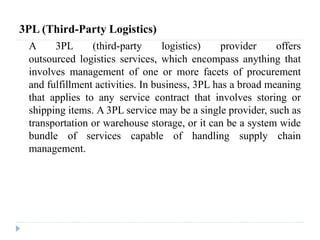
3PL (Third-Party Logistics)
A 3PL (third-party logistics) provider offers
outsourced logistics services, which encompass anything that
involves management of one or more facets of procurement
and fulfillment activities. In business, 3PL has a broad meaning
that applies to any service contract that involves storing or
shipping items. A 3PL service may be a single provider, such as
transportation or warehouse storage, or it can be a system wide
bundle of services capable of handling supply chain
management.
Why Choose 3PL?
 There are many reasons why companies choose to go the
3PL service route. Often, as a company grows, the need
for warehouse space increases beyond that business’
ability to manage it. 3PL warehousing can be a good
option for companies facing storage capacity issues. Other
companies may be challenged with increasing
transportation costs and investment in equipment and
vehicles. The large fleets of modern vehicles and
equipment that are available through 3PL providers are
often a much more cost-effective solution. Then there are
US businesses looking to expand into the Canadian market
– a good 3PL will have the depth of experience to help
solve many logistics challenges involved with these
scenarios.
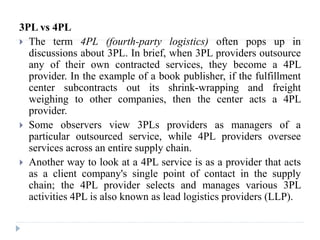
3PL vs 4PL
 The term 4PL (fourth-party logistics) often pops up in
discussions about 3PL. In brief, when 3PL providers outsource
any of their own contracted services, they become a 4PL
provider. In the example of a book publisher, if the fulfillment
center subcontracts out its shrink-wrapping and freight
weighing to other companies, then the center acts a 4PL
provider.
 Some observers view 3PLs providers as managers of a
particular outsourced service, while 4PL providers oversee
services across an entire supply chain.
 Another way to look at a 4PL service is as a provider that acts
as a client company's single point of contact in the supply
chain; the 4PL provider selects and manages various 3PL
activities 4PL is also known as lead logistics providers (LLP).
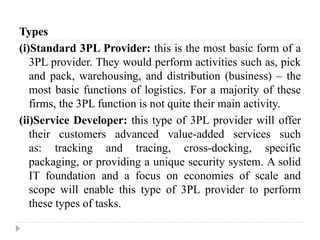
Types
(i)Standard 3PL Provider: this is the most basic form of a
3PL provider. They would perform activities such as, pick
and pack, warehousing, and distribution (business) – the
most basic functions of logistics. For a majority of these
firms, the 3PL function is not quite their main activity.
(ii)Service Developer: this type of 3PL provider will offer
their customers advanced value-added services such
as: tracking and tracing, cross-docking, specific
packaging, or providing a unique security system. A solid
IT foundation and a focus on economies of scale and
scope will enable this type of 3PL provider to perform
these types of tasks.
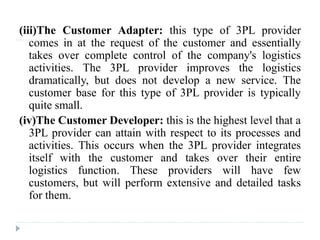
(iii)The Customer Adapter: this type of 3PL provider
comes in at the request of the customer and essentially
takes over complete control of the company's logistics
activities. The 3PL provider improves the logistics
dramatically, but does not develop a new service. The
customer base for this type of 3PL provider is typically
quite small.
(iv)The Customer Developer: this is the highest level that a
3PL provider can attain with respect to its processes and
activities. This occurs when the 3PL provider integrates
itself with the customer and takes over their entire
logistics function. These providers will have few
customers, but will perform extensive and detailed tasks
for them.
What services are included in 3PL?
 The transportation
One of the major services provided by third-party logistics
is transportation. By using different trucks and other
vehicles, these logistics make use of their own fleet to
deliver your product at your customer’s doorsteps. There
is an optimized route for transportation. This helps in
reducing confusion. The process also ensures faster
delivery.
 The warehousing
 Different third party logistics own their personal warehouses.
There are different distribution points for these warehouses, as
per the distribution area. These warehouses act as a storehouse
of all types of goods. The shipment from the warehouse takes
place after order placement
 These third-party logistics also provides different types of
equipment including cranes and lifts for an easy product
movement. These services can be provided by multiple e-
commerce companies. A particular business can also take up
logistics services.
 Various e-commerce giants often take up dedicated
warehouses, but mostly, these logistics are available for all.
 The freight forwarding
 Sometimes the third party logistics don’t possess an asset of
their own. What they do is basically connect with
other logistics service provider to deliver a particular product
for their client. They basically act a medium of connection for
shipping different merchandises on the behalf of their shippers.
These are applicable mostly for international logistics service.
 There is a constant and fluctuating change in demand for this
type of shipping and it often becomes difficult for an e-
commerce business to carry out the entire freight shipping all
by themselves.
 These logistics takes care of everything in a timely manner.
They also ensure the safe delivery of the products, through
efficient freight shipping.
 Reverse logistics services
 In the logistics sector, errors and confusions are common.
With different products traveling miles, to reach different
customers might often reach broken or damaged. In such
cases, apart from the refund, there is another thing that
needs to be get done.
 It is reverse logistics. A 3PL takes care of all the disposal
and inventory cleaning functions and makes sure the
unwanted items are not present in the warehouse.
 Courier Shipping Services
 A courier shipping is comparatively faster than freight shipping
and requires a great level of management. A slight mistake in
details might lead to misrouting of the product and can end up
in a great loss for both the customer and the seller.
 Different logistics also provides quality courier service and
delivers your products on time. Most of the e-commerce
companies consider couriers as the last options since it is a bit
expensive.
 In this process, the item reaches directly to the customer from
the buyer. They take help of these logistics. The packaging
contains the company name.
Advantages
 Cost reduction
 Improved efficiency, service and flexibility
 Focus on core competency
 Freeing up resources
 Elimination of infrastructure resources
 Risk-sharing
 Better cash flow
 Access to resources not available at one’s own
organization
Disadvantages
 Loss of control over the logistics function
 Impact on in-house workforce
 More distance from clients- loss of personal touch
 Discontinuity of services of a 3PL provider
 Differences of opinion or perception of the service level of
the 3PL provider
3 pl

3 pl

  • 1.
  • 2.
    3PL (Third-Party Logistics) A3PL (third-party logistics) provider offers outsourced logistics services, which encompass anything that involves management of one or more facets of procurement and fulfillment activities. In business, 3PL has a broad meaning that applies to any service contract that involves storing or shipping items. A 3PL service may be a single provider, such as transportation or warehouse storage, or it can be a system wide bundle of services capable of handling supply chain management.
  • 3.
    Why Choose 3PL? There are many reasons why companies choose to go the 3PL service route. Often, as a company grows, the need for warehouse space increases beyond that business’ ability to manage it. 3PL warehousing can be a good option for companies facing storage capacity issues. Other companies may be challenged with increasing transportation costs and investment in equipment and vehicles. The large fleets of modern vehicles and equipment that are available through 3PL providers are often a much more cost-effective solution. Then there are US businesses looking to expand into the Canadian market – a good 3PL will have the depth of experience to help solve many logistics challenges involved with these scenarios.
  • 4.
    3PL vs 4PL The term 4PL (fourth-party logistics) often pops up in discussions about 3PL. In brief, when 3PL providers outsource any of their own contracted services, they become a 4PL provider. In the example of a book publisher, if the fulfillment center subcontracts out its shrink-wrapping and freight weighing to other companies, then the center acts a 4PL provider.  Some observers view 3PLs providers as managers of a particular outsourced service, while 4PL providers oversee services across an entire supply chain.  Another way to look at a 4PL service is as a provider that acts as a client company's single point of contact in the supply chain; the 4PL provider selects and manages various 3PL activities 4PL is also known as lead logistics providers (LLP).
  • 5.
    Types (i)Standard 3PL Provider:this is the most basic form of a 3PL provider. They would perform activities such as, pick and pack, warehousing, and distribution (business) – the most basic functions of logistics. For a majority of these firms, the 3PL function is not quite their main activity. (ii)Service Developer: this type of 3PL provider will offer their customers advanced value-added services such as: tracking and tracing, cross-docking, specific packaging, or providing a unique security system. A solid IT foundation and a focus on economies of scale and scope will enable this type of 3PL provider to perform these types of tasks.
  • 6.
    (iii)The Customer Adapter:this type of 3PL provider comes in at the request of the customer and essentially takes over complete control of the company's logistics activities. The 3PL provider improves the logistics dramatically, but does not develop a new service. The customer base for this type of 3PL provider is typically quite small. (iv)The Customer Developer: this is the highest level that a 3PL provider can attain with respect to its processes and activities. This occurs when the 3PL provider integrates itself with the customer and takes over their entire logistics function. These providers will have few customers, but will perform extensive and detailed tasks for them.
  • 7.
    What services areincluded in 3PL?  The transportation One of the major services provided by third-party logistics is transportation. By using different trucks and other vehicles, these logistics make use of their own fleet to deliver your product at your customer’s doorsteps. There is an optimized route for transportation. This helps in reducing confusion. The process also ensures faster delivery.
  • 8.
     The warehousing Different third party logistics own their personal warehouses. There are different distribution points for these warehouses, as per the distribution area. These warehouses act as a storehouse of all types of goods. The shipment from the warehouse takes place after order placement  These third-party logistics also provides different types of equipment including cranes and lifts for an easy product movement. These services can be provided by multiple e- commerce companies. A particular business can also take up logistics services.  Various e-commerce giants often take up dedicated warehouses, but mostly, these logistics are available for all.
  • 9.
     The freightforwarding  Sometimes the third party logistics don’t possess an asset of their own. What they do is basically connect with other logistics service provider to deliver a particular product for their client. They basically act a medium of connection for shipping different merchandises on the behalf of their shippers. These are applicable mostly for international logistics service.  There is a constant and fluctuating change in demand for this type of shipping and it often becomes difficult for an e- commerce business to carry out the entire freight shipping all by themselves.  These logistics takes care of everything in a timely manner. They also ensure the safe delivery of the products, through efficient freight shipping.
  • 10.
     Reverse logisticsservices  In the logistics sector, errors and confusions are common. With different products traveling miles, to reach different customers might often reach broken or damaged. In such cases, apart from the refund, there is another thing that needs to be get done.  It is reverse logistics. A 3PL takes care of all the disposal and inventory cleaning functions and makes sure the unwanted items are not present in the warehouse.
  • 11.
     Courier ShippingServices  A courier shipping is comparatively faster than freight shipping and requires a great level of management. A slight mistake in details might lead to misrouting of the product and can end up in a great loss for both the customer and the seller.  Different logistics also provides quality courier service and delivers your products on time. Most of the e-commerce companies consider couriers as the last options since it is a bit expensive.  In this process, the item reaches directly to the customer from the buyer. They take help of these logistics. The packaging contains the company name.
  • 12.
    Advantages  Cost reduction Improved efficiency, service and flexibility  Focus on core competency  Freeing up resources  Elimination of infrastructure resources  Risk-sharing  Better cash flow  Access to resources not available at one’s own organization
  • 13.
    Disadvantages  Loss ofcontrol over the logistics function  Impact on in-house workforce  More distance from clients- loss of personal touch  Discontinuity of services of a 3PL provider  Differences of opinion or perception of the service level of the 3PL provider