UK’s Experience: Measuring 
Subjective (Personal) Well-being 
Glenn Everett 
Director, 
Measuring National Well-being programme 
ONS, UK 
Turin, Italy 
30-31 October 2014
Background 
• Traditional measures of progress such as GDP are 
increasingly considered an incomplete picture of the state of 
the nation. 
• Additional economic, social and environmental measures are 
needed alongside GDP to provide a complete picture of how 
society is doing. 
• UK’s Measuring National Well-being (MNW) Programme was 
launched by the Prime Minister, David Cameron, and the 
National Statistician in November 2010.
National Debate 
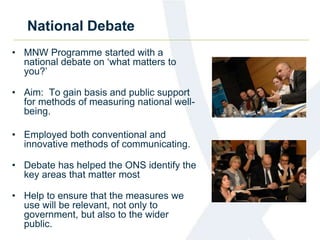
• MNW Programme started with a 
national debate on ‘what matters to 
you?’ 
• Aim: To gain basis and public support 
for methods of measuring national well-being. 
• Employed both conventional and 
innovative methods of communicating. 
• Debate has helped the ONS identify the 
key areas that matter most 
• Help to ensure that the measures we 
use will be relevant, not only to 
government, but also to the wider 
public.
Developing the domains and measures 
• We listened… 
…to the nearly 34,000 responses and considered relevant academic 
research on the area. 
• We have…. 
…developed a framework for measuring national well-being, including 
headline measures. 
• We used.... 
...the National Statistician’s Advisory Forum and a Technical Advisory 
Group for advice and support. 
• We added... 
...4 questions on individual’s subjective assessment of their personal 
well-being. 
• We publish… 
…10 domains with 3 to 5 headline measures each, mixture of both 
objective and subjective measures.
UK’s 4 Subjective Well-being Questions 
1. Overall, how satisfied are you with your life nowadays? 
(Evaluative) 
2. Overall, to what extent do you feel the things you do in your life 
are worthwhile? (Eudemonic) 
3. Overall, how happy did you feel yesterday? (Experience or affect - 
positive) 
4. Overall, how anxious did you feel yesterday? (Experience or affect 
- negative) 
All answered using a 0 to 10 scale where 0 is ‘not at all’ and 10 is 
‘completely’
How did we choose the measures? 
What to use/who can help? 
• Existing research 
• Questions used in national/ international surveys 
• Advice from academic community 
• Technical Advisory Group 
How many questions? 
• Balance cost versus usable information 
• Cost of collection 
• Respondent burden 
Which survey? 
• New or existing 
• Impact on other questions (order)
OECD guidance versus UK practice 
Core questions: 
The following question asks how satisfied you feel, on a scale from 0 to 10. Zero 
means you feel “not at all satisfied” and 10 means you feel “completely 
satisfied”. 
 Overall, how satisfied are you with life as a whole these days? [0-10] – 
primary measure. 
The following question asks how worthwhile you feel the things you do in your 
life are, on a scale from 0 to 10. Zero means you feel the things you do in your 
life are “not at all worthwhile”, and 10 means “completely worthwhile”. 
 Overall, to what extent do you feel the things you do in your life are 
worthwhile? [0-10] – eudaimonic. 
The following questions ask about how you felt yesterday on a scale from 0 to 
10. Zero means you did not experience the feeling “at all” yesterday while 10 
means you experienced the feeling “all of the time” yesterday. I will now read out 
a list of ways you might have felt yesterday. 
 How about happy? [0-10] – affect, positive 
 How about worried? [0-10] – affect, negative 
 How about depressed? [0-10] – affect, negative
Ensured infrastructure in place 
For measurement: 
• set up a National Statistician’s Advisory Forum, of 
interested parties across business, academia and beyond 
to help shape overall thinking and direction; 
• established a Technical Advisory Group (TAG) of 
academic specialists to help with measurement issues. 
For implementation, set up: 
• cross-Government senior analysts group (Social Impacts 
Taskforce); 
• cross-Government senior policy makers group (cross- 
Whitehall steering group).
Engaged with key influencers 
• Worked hard with media to convey well-being more 
than happiness, e.g. media briefings accompanying 
outputs to reiterate broader message 
• Identified early media supporters to host events at 
the national debate 
• Invited external parties, e.g. members of the NS 
Advisory Forum to endorse our message via blogs 
and act as spokespersons to the press on our behalf 
• Engaged with All Party Parliamentary Group on Well-being 
Economics to help establish cross party 
support – avoid topic being ‘politicised’.
What do we know so far? 
• Focus has shifted from deciding whether to keep 
these questions to knowing how best to use them 
• Testing programme is a work in progress, but findings 
suggest… 
• Mode of interview matters 
• Asking the questions in different ways matters- but 
which way is best? 
• Day of the week matters 
• There are fluctuations over the year, but is this in 
response to events or seasonal or both? 
• A closer look is needed at panel effects
What is important to Subjective Well-being? 
Latest findings from regression analysis of subjective well-being 
found: 
• Self-reported health, employment status and relationship 
status most important aspects of subjective well-being. 
• Higher earnings don’t necessarily lead to higher feelings of 
happiness but do increase people’s life satisfaction. 
• People in higher occupations or higher qualifications more 
anxious than lower occupations or qualifications. 
• Choice important – people working in a job that they are 
content with have higher life satisfaction than those wanting 
an additional or different job.
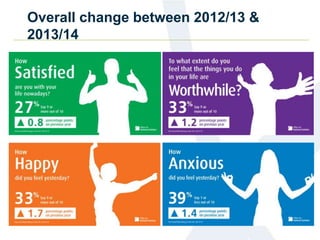
Overall change between 2012/13 & 
2013/14
National Statistics 
• ONS PWB statistics 
recently gained National 
Statistics status in 
August 2014. 
The benefits of National 
Statistics status include: 
•NS kitemark – independence, 
integrity, etc. 
Designation can mean that the 
statistics: 
• meet identified user needs; 
• are well explained and readily 
accessible; 
• are produced according to 
sound methods; and 
• are managed impartially and 
objectively in the public 
interest.
Policy Appraisal 
• It is important these new measures are 
not just published but become part of 
public debate and are used to improve the 
development, implementation and 
evaluation of policies 
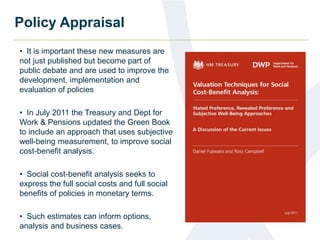
• In July 2011 the Treasury and Dept for 
Work & Pensions updated the Green Book 
to include an approach that uses subjective 
well-being measurement, to improve social 
cost-benefit analysis. 
• Social cost-benefit analysis seeks to 
express the full social costs and full social 
benefits of policies in monetary terms. 
• Such estimates can inform options, 
analysis and business cases.
Uses 
Government departments: 
• Dept of Health’s alcohol strategy - considered national well-being. 
• Civil Service People survey - insights into staff well-being help steer HR 
policies. 
• Dept of Work & Pensions assessing impact on the well-being of the very-long- 
term unemployed. 
• UK about to launch ‘What Works Centre for Well-being’ partnership 
between ESRC and UK Government departments 
Outside Gov: 
• UK Housing developer, Berkeley Homes is building “sustainable places” 
as opposed to housing estates 
• British Red Cross using ONS 4 personal well-being questions to help 
evaluate impact of services for refugees
Subjective Well-being 
• Not just about personal well-being 
• Need objective and subjective measures 
• Subjective measures of: 
Health (satisfaction with health) 
Personal Finance (finding it difficult to get by 
financially) 
 Crime (safe walking alone after dark) 
• Need both measures to provide best 
evidence for making decisions
What’s next... 
• Encourage use of well-being data in policy. 
• Review and refine domains and measures of well-being, including 
assessment of change 
• Further research drivers of well-being. 
• Review framework for presenting well-being data to cover 
sustainability, equity and sub-national information. 
• Further development of the SWB questions and other indicators (eg 
human, social & natural capitals, non-market production, etc). 
• Continued input on International developments (UN, OECD, EU). 
• The programme will continue to consult widely.
Key messages 
• Long-term development project – still learning... 
• NOT a ‘happiness index’ 
• Consider importance of distributions not just averages 
• Not a single measure – need both objective and 
subjective data 
• Supplements – not supplants GDP 
• Use for better targeting of scarce resources 
• ‘Use it or lose it’. 
See more: www.ons.gov.uk/well-being
Measuring National Well-being 
To be continued......

HLEG thematic workshop on "Multidimensional Subjective Well-being", Glenn Everett, ONS

  • 1.
    UK’s Experience: Measuring Subjective (Personal) Well-being Glenn Everett Director, Measuring National Well-being programme ONS, UK Turin, Italy 30-31 October 2014
  • 2.
    Background • Traditionalmeasures of progress such as GDP are increasingly considered an incomplete picture of the state of the nation. • Additional economic, social and environmental measures are needed alongside GDP to provide a complete picture of how society is doing. • UK’s Measuring National Well-being (MNW) Programme was launched by the Prime Minister, David Cameron, and the National Statistician in November 2010.
  • 3.
    National Debate •MNW Programme started with a national debate on ‘what matters to you?’ • Aim: To gain basis and public support for methods of measuring national well-being. • Employed both conventional and innovative methods of communicating. • Debate has helped the ONS identify the key areas that matter most • Help to ensure that the measures we use will be relevant, not only to government, but also to the wider public.
  • 4.
    Developing the domainsand measures • We listened… …to the nearly 34,000 responses and considered relevant academic research on the area. • We have…. …developed a framework for measuring national well-being, including headline measures. • We used.... ...the National Statistician’s Advisory Forum and a Technical Advisory Group for advice and support. • We added... ...4 questions on individual’s subjective assessment of their personal well-being. • We publish… …10 domains with 3 to 5 headline measures each, mixture of both objective and subjective measures.
  • 5.
    UK’s 4 SubjectiveWell-being Questions 1. Overall, how satisfied are you with your life nowadays? (Evaluative) 2. Overall, to what extent do you feel the things you do in your life are worthwhile? (Eudemonic) 3. Overall, how happy did you feel yesterday? (Experience or affect - positive) 4. Overall, how anxious did you feel yesterday? (Experience or affect - negative) All answered using a 0 to 10 scale where 0 is ‘not at all’ and 10 is ‘completely’
  • 6.
    How did wechoose the measures? What to use/who can help? • Existing research • Questions used in national/ international surveys • Advice from academic community • Technical Advisory Group How many questions? • Balance cost versus usable information • Cost of collection • Respondent burden Which survey? • New or existing • Impact on other questions (order)
  • 7.
    OECD guidance versusUK practice Core questions: The following question asks how satisfied you feel, on a scale from 0 to 10. Zero means you feel “not at all satisfied” and 10 means you feel “completely satisfied”.  Overall, how satisfied are you with life as a whole these days? [0-10] – primary measure. The following question asks how worthwhile you feel the things you do in your life are, on a scale from 0 to 10. Zero means you feel the things you do in your life are “not at all worthwhile”, and 10 means “completely worthwhile”.  Overall, to what extent do you feel the things you do in your life are worthwhile? [0-10] – eudaimonic. The following questions ask about how you felt yesterday on a scale from 0 to 10. Zero means you did not experience the feeling “at all” yesterday while 10 means you experienced the feeling “all of the time” yesterday. I will now read out a list of ways you might have felt yesterday.  How about happy? [0-10] – affect, positive  How about worried? [0-10] – affect, negative  How about depressed? [0-10] – affect, negative
  • 8.
    Ensured infrastructure inplace For measurement: • set up a National Statistician’s Advisory Forum, of interested parties across business, academia and beyond to help shape overall thinking and direction; • established a Technical Advisory Group (TAG) of academic specialists to help with measurement issues. For implementation, set up: • cross-Government senior analysts group (Social Impacts Taskforce); • cross-Government senior policy makers group (cross- Whitehall steering group).
  • 9.
    Engaged with keyinfluencers • Worked hard with media to convey well-being more than happiness, e.g. media briefings accompanying outputs to reiterate broader message • Identified early media supporters to host events at the national debate • Invited external parties, e.g. members of the NS Advisory Forum to endorse our message via blogs and act as spokespersons to the press on our behalf • Engaged with All Party Parliamentary Group on Well-being Economics to help establish cross party support – avoid topic being ‘politicised’.
  • 10.
    What do weknow so far? • Focus has shifted from deciding whether to keep these questions to knowing how best to use them • Testing programme is a work in progress, but findings suggest… • Mode of interview matters • Asking the questions in different ways matters- but which way is best? • Day of the week matters • There are fluctuations over the year, but is this in response to events or seasonal or both? • A closer look is needed at panel effects
  • 11.
    What is importantto Subjective Well-being? Latest findings from regression analysis of subjective well-being found: • Self-reported health, employment status and relationship status most important aspects of subjective well-being. • Higher earnings don’t necessarily lead to higher feelings of happiness but do increase people’s life satisfaction. • People in higher occupations or higher qualifications more anxious than lower occupations or qualifications. • Choice important – people working in a job that they are content with have higher life satisfaction than those wanting an additional or different job.
  • 12.
    Overall change between2012/13 & 2013/14
  • 13.
    National Statistics •ONS PWB statistics recently gained National Statistics status in August 2014. The benefits of National Statistics status include: •NS kitemark – independence, integrity, etc. Designation can mean that the statistics: • meet identified user needs; • are well explained and readily accessible; • are produced according to sound methods; and • are managed impartially and objectively in the public interest.
  • 14.
    Policy Appraisal •It is important these new measures are not just published but become part of public debate and are used to improve the development, implementation and evaluation of policies • In July 2011 the Treasury and Dept for Work & Pensions updated the Green Book to include an approach that uses subjective well-being measurement, to improve social cost-benefit analysis. • Social cost-benefit analysis seeks to express the full social costs and full social benefits of policies in monetary terms. • Such estimates can inform options, analysis and business cases.
  • 15.
    Uses Government departments: • Dept of Health’s alcohol strategy - considered national well-being. • Civil Service People survey - insights into staff well-being help steer HR policies. • Dept of Work & Pensions assessing impact on the well-being of the very-long- term unemployed. • UK about to launch ‘What Works Centre for Well-being’ partnership between ESRC and UK Government departments Outside Gov: • UK Housing developer, Berkeley Homes is building “sustainable places” as opposed to housing estates • British Red Cross using ONS 4 personal well-being questions to help evaluate impact of services for refugees
  • 16.
    Subjective Well-being •Not just about personal well-being • Need objective and subjective measures • Subjective measures of: Health (satisfaction with health) Personal Finance (finding it difficult to get by financially)  Crime (safe walking alone after dark) • Need both measures to provide best evidence for making decisions
  • 17.
    What’s next... •Encourage use of well-being data in policy. • Review and refine domains and measures of well-being, including assessment of change • Further research drivers of well-being. • Review framework for presenting well-being data to cover sustainability, equity and sub-national information. • Further development of the SWB questions and other indicators (eg human, social & natural capitals, non-market production, etc). • Continued input on International developments (UN, OECD, EU). • The programme will continue to consult widely.
  • 18.
    Key messages •Long-term development project – still learning... • NOT a ‘happiness index’ • Consider importance of distributions not just averages • Not a single measure – need both objective and subjective data • Supplements – not supplants GDP • Use for better targeting of scarce resources • ‘Use it or lose it’. See more: www.ons.gov.uk/well-being
  • 19.
    Measuring National Well-being To be continued......