Measuring National Well-being in
the UK
Glenn Everett, Director
Measuring National Well-being Programme, ONS
22 April 2013 www.ons.gov.uk/well-being
London Well-being Conference 2013:
Creating Communities
Presentation
• Background to MNW programme
• Programme aims
• Achievements so far
• Some results
• What’s next
Background
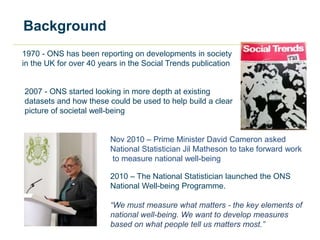
1970 - ONS has been reporting on developments in society
in the UK for over 40 years in the Social Trends publication
2007 - ONS started looking in more depth at existing
datasets and how these could be used to help build a clear
picture of societal well-being
2010 – The National Statistician launched the ONS
National Well-being Programme.
“We must measure what matters - the key elements of
national well-being. We want to develop measures
based on what people tell us matters most.”
Nov 2010 – Prime Minister David Cameron asked
National Statistician Jil Matheson to take forward work
to measure national well-being
Consultation on domains and measures
• We’ve listened…
…to initially nearly 34,000 responses to ‘what matters to you?’
• We have….
…revised some of the measures in light of almost 1,800
responses to the consultation on domains and measures
• We propose…
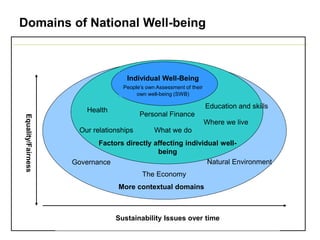
…10 domains with 3 to 5 headline measures each
• We received...
,,, broad support for approach taken and are continuing to
evaluate feasibility of other suggestions
Domains of National Well-being
Sustainability Issues over time
Equality/Fairness
More contextual domains
The Economy
Governance
Education and skills
Natural Environment
Factors directly affecting individual well-
being
Personal Finance
Our relationships What we do
Where we live
Health
Individual Well-Being
People’s own Assessment of their
own well-being (SWB)
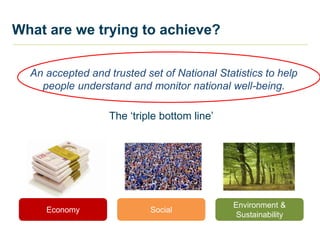
What are we trying to achieve?
Social
Environment &
Sustainability
The ‘triple bottom line’
Economy
An accepted and trusted set of National Statistics to help
people understand and monitor national well-being.
What we are doing..
Added 4 questions to household surveys:
• Overall, how satisfies are you with your life
nowadays?
• Overall, to what extent do you feel the things
you do in your life are worthwhile?
• Overall, how happy did you feel yesterday?
• Overall, how anxious did you feel yesterday?
Findings analysed alongside other information
from 21 sources to help understand what
strengthens or weakens well-being
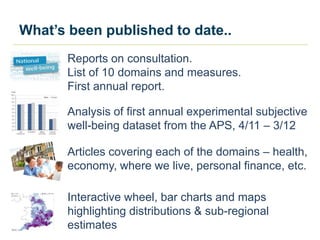
What’s been published to date..
Reports on consultation.
List of 10 domains and measures.
First annual report.
Analysis of first annual experimental subjective
well-being dataset from the APS, 4/11 – 3/12
Interactive wheel, bar charts and maps
highlighting distributions & sub-regional
estimates
Articles covering each of the domains – health,
economy, where we live, personal finance, etc.
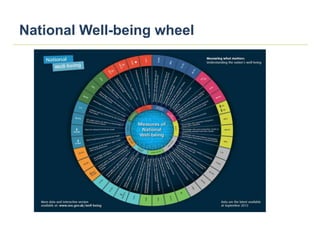
National Well-being wheel
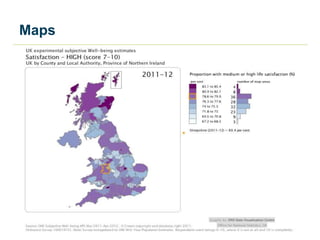
Maps
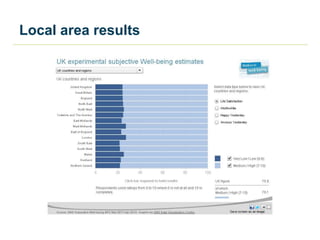
Local area results
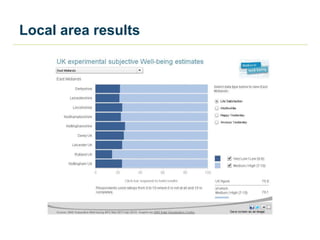
Local area results
Local area results
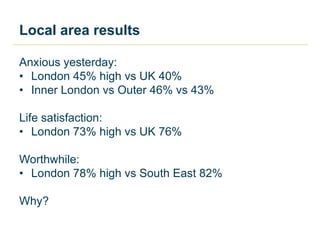
Anxious yesterday:
• London 45% high vs UK 40%
• Inner London vs Outer 46% vs 43%
Life satisfaction:
• London 73% high vs UK 76%
Worthwhile:
• London 78% high vs South East 82%
Why?
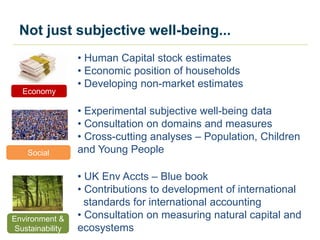
Not just subjective well-being...
Social
• Experimental subjective well-being data
• Consultation on domains and measures
• Cross-cutting analyses – Population, Children
and Young People
Environment &
Sustainability
• UK Env Accts – Blue book
• Contributions to development of international
standards for international accounting
• Consultation on measuring natural capital and
ecosystems
• Human Capital stock estimates
• Economic position of households
• Developing non-market estimates
Economy
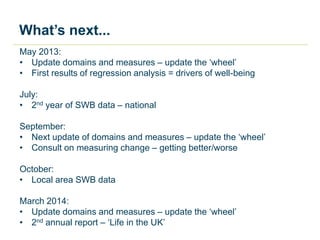
What’s next...
May 2013:
• Update domains and measures – update the ‘wheel’
• First results of regression analysis = drivers of well-being
July:
• 2nd year of SWB data – national
September:
• Next update of domains and measures – update the ‘wheel’
• Consult on measuring change – getting better/worse
October:
• Local area SWB data
March 2014:
• Update domains and measures – update the ‘wheel’
• 2nd annual report – ‘Life in the UK’
Key messages
• NOT a ‘happiness index’
• Importance of distributions not just the averages
• Not a single measure – need both objective and
subjective data
• Supplements – not supplants GDP
• Use for ‘Better policies for better lives’ (OECD) –
help target scarce resources
• Long-term development project

Glenn Everett -Opening Plenary

  • 1.
    Measuring National Well-beingin the UK Glenn Everett, Director Measuring National Well-being Programme, ONS 22 April 2013 www.ons.gov.uk/well-being London Well-being Conference 2013: Creating Communities
  • 2.
    Presentation • Background toMNW programme • Programme aims • Achievements so far • Some results • What’s next
  • 3.
    Background 1970 - ONShas been reporting on developments in society in the UK for over 40 years in the Social Trends publication 2007 - ONS started looking in more depth at existing datasets and how these could be used to help build a clear picture of societal well-being 2010 – The National Statistician launched the ONS National Well-being Programme. “We must measure what matters - the key elements of national well-being. We want to develop measures based on what people tell us matters most.” Nov 2010 – Prime Minister David Cameron asked National Statistician Jil Matheson to take forward work to measure national well-being
  • 4.
    Consultation on domainsand measures • We’ve listened… …to initially nearly 34,000 responses to ‘what matters to you?’ • We have…. …revised some of the measures in light of almost 1,800 responses to the consultation on domains and measures • We propose… …10 domains with 3 to 5 headline measures each • We received... ,,, broad support for approach taken and are continuing to evaluate feasibility of other suggestions
  • 5.
    Domains of NationalWell-being Sustainability Issues over time Equality/Fairness More contextual domains The Economy Governance Education and skills Natural Environment Factors directly affecting individual well- being Personal Finance Our relationships What we do Where we live Health Individual Well-Being People’s own Assessment of their own well-being (SWB)
  • 6.
    What are wetrying to achieve? Social Environment & Sustainability The ‘triple bottom line’ Economy An accepted and trusted set of National Statistics to help people understand and monitor national well-being.
  • 7.
    What we aredoing.. Added 4 questions to household surveys: • Overall, how satisfies are you with your life nowadays? • Overall, to what extent do you feel the things you do in your life are worthwhile? • Overall, how happy did you feel yesterday? • Overall, how anxious did you feel yesterday? Findings analysed alongside other information from 21 sources to help understand what strengthens or weakens well-being
  • 8.
    What’s been publishedto date.. Reports on consultation. List of 10 domains and measures. First annual report. Analysis of first annual experimental subjective well-being dataset from the APS, 4/11 – 3/12 Interactive wheel, bar charts and maps highlighting distributions & sub-regional estimates Articles covering each of the domains – health, economy, where we live, personal finance, etc.
  • 9.
  • 10.
  • 11.
  • 12.
  • 13.
    Local area results Anxiousyesterday: • London 45% high vs UK 40% • Inner London vs Outer 46% vs 43% Life satisfaction: • London 73% high vs UK 76% Worthwhile: • London 78% high vs South East 82% Why?
  • 14.
    Not just subjectivewell-being... Social • Experimental subjective well-being data • Consultation on domains and measures • Cross-cutting analyses – Population, Children and Young People Environment & Sustainability • UK Env Accts – Blue book • Contributions to development of international standards for international accounting • Consultation on measuring natural capital and ecosystems • Human Capital stock estimates • Economic position of households • Developing non-market estimates Economy
  • 15.
    What’s next... May 2013: •Update domains and measures – update the ‘wheel’ • First results of regression analysis = drivers of well-being July: • 2nd year of SWB data – national September: • Next update of domains and measures – update the ‘wheel’ • Consult on measuring change – getting better/worse October: • Local area SWB data March 2014: • Update domains and measures – update the ‘wheel’ • 2nd annual report – ‘Life in the UK’
  • 16.
    Key messages • NOTa ‘happiness index’ • Importance of distributions not just the averages • Not a single measure – need both objective and subjective data • Supplements – not supplants GDP • Use for ‘Better policies for better lives’ (OECD) – help target scarce resources • Long-term development project

Editor's Notes

  • #4  Long history of measuringwell-being 40 years of social trends Compendia publication from various sources 2007 – more detailed analysis of societal well-being, considering more of the economic impact 2010 – PM asked NS Nov 2010 MNW programme began
  • #5 ONS is proposing 10 domains (or aspects) that are important to measuring National Well-being with 3 to 5 headline measures within each of these domains to illustrate overall National Well-being.
  • #8 Questions on APS – approx 160,000 surveyed Scale of 0-10Life satisfaction – evaluativeWorthwhile – eudomoniaHappy / Anxious – positive/negative emotions
  • #10  ONS has reinvented the wheel An illustrated all national well-being measure (i.e. 10 domains and 40 indicators)
  • #11 Use maps – help targeting
  • #12 Northern Ireland had the lowest percentage of people rating their life satisfaction as below 7 out of 10 compared with the other countries of the UKLondon (& West Midlands) the highest
  • #13 Variations within a region important - East MidlandsOctober for more local area results (including London Boroughs) - caution
  • #14 Why is London different?Regression analysis published end May – drivers of well-being
  • #15 Subjective AND objective measures importantHow the nation is doing ‘in the round’
  • #16  Case studies important Testing and development of SWB questions – do 4 questions work? Experimental – sharing development of measures – review the framework Regression analyses – to be published - important to separate rlationships and links from causes Huge international interest – reflect Paris and Delhi Aid interpretation – traffic light sand/or arrows - statistically significant change or all indicators (annual or latest).