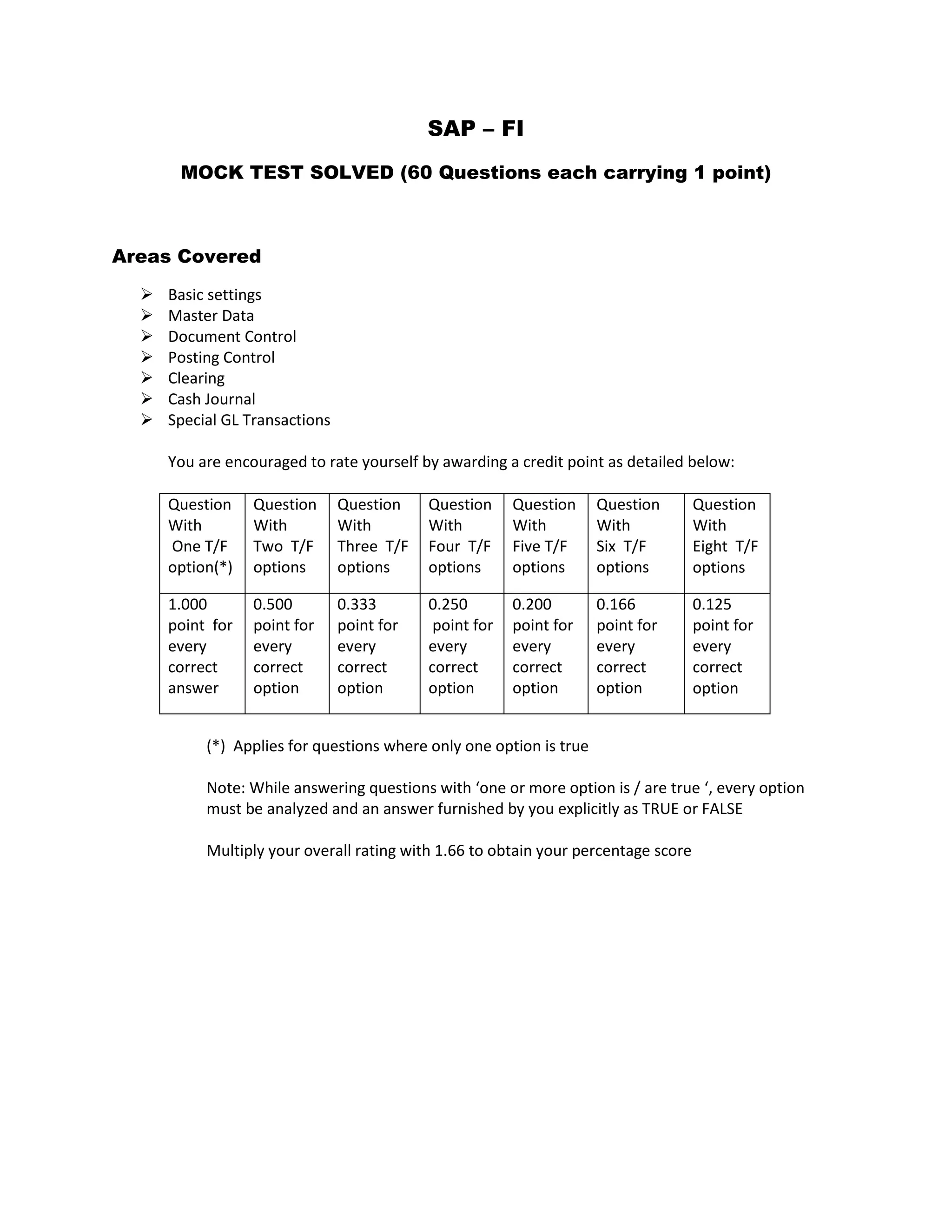
SAP – FI
MOCK TEST SOLVED (60 Questions each carrying 1 point)
Areas Covered
 Basic settings
 Master Data
 Document Control
 Posting Control
 Clearing
 Cash Journal
 Special GL Transactions
You are encouraged to rate yourself by awarding a credit point as detailed below:
Question
With
One T/F
option(*)
Question
With
Two T/F
options
Question
With
Three T/F
options
Question
With
Four T/F
options
Question
With
Five T/F
options
Question
With
Six T/F
options
Question
With
Eight T/F
options
1.000
point for
every
correct
answer
0.500
point for
every
correct
option
0.333
point for
every
correct
option
0.250
point for
every
correct
option
0.200
point for
every
correct
option
0.166
point for
every
correct
option
0.125
point for
every
correct
option
(*) Applies for questions where only one option is true
Note: While answering questions with ‘one or more option is / are true ‘, every option
must be analyzed and an answer furnished by you explicitly as TRUE or FALSE
Multiply your overall rating with 1.66 to obtain your percentage score
1. Data or Specifications which can be valid for all organizational units are defined at the Top most
level named CLIENT (T/F)
2. COMPANY CODE, which is the minimum structure necessary for external reporting , is not below
the Client level (T/F) =
3. BUSINESS AREAS , used for internal reporting, cannot be assigned to Company Codes directly
(T/F)
4. A Company Code in SAP is represented by an alphanumeric key which cannot be greater than
Two Characters (T/F)
5. It is mandatory that a LANGUAGE KEY and LOCAL CURRENCY KEY be specified upon creation of
your Company code (T/F)
6. A FISCAL YEAR VARIANT is a generic two character alphanumeric key which defines properties
such as posting periods and / special periods required for posting business transactions (T/F)
7. Your Fiscal year Variant can accommodate a maximum of FOUR SPECIAL PERIODS for posting
YEAR END CLOSING transactions (T/F)
8. A Fiscal year is said to be YEAR-SPECIFIC if 1) the start and end dates of posting periods vary
from year to year or 2) the number of posting periods vary from year to year (T/F)
9. A SHORTENED FISCAL YEAR has more number of posting periods than the usual 12 posting
periods (T/F)
10. NON CALENDAR YEARS cannot be reckoned as Fiscal Years (T/F)
11. YEAR SHIFT INDICATOR of +1 or -1 are used if a non calendar year which does not start on
January 1st
. (T/F)
12. Definition of a CHART OF ACCOUNTS includes the following :( One or more option(s) is / are
true)
a. Chart of Accounts Key which is cannot be greater than 4 alpha numeric Characters (T/F)
b. Description of the Chart of Accounts (T/F)
c. Maintenance Language (T/F)
d. Maximum length of GL account code ( 1- 10 digits) proposed by you (T/F)
e. Option to choose creation of cost elements (T/F)
f. Group chart of Accounts , if you desire consolidation (T/F)
g. Blocked indicator (T/F)
h. Fiscal Year (T/F)
13. Each Chart of Accounts contains two segments namely a Chart of Accounts Segment and b) a
Company Code Segment. State which of the following two options is true (Only one option is
true)
a. Data captured in the Company Code segment can be freely shared by all Company
Codes (T/F)
b. Data captured in the Chart of Accounts segment can be freely shared by all Company
Codes (T/F)
Ref. page 47 of your Book
14. The Company Code segment does not determine whether the GL Account mastered belongs to
the Balance Sheet or the Profit and Loss Account (T/F)
15. At the time of Account Closure, the net balances in Balance Sheet Accounts are carried forward
to their respective accounts where as net balances of Profit and Loss Accounts is carried forward
to a RETAINED EARNINGS ACCOUNT (T/F)
16. While defining GL ACCOUNT GROUPS the following things happen :( One or more option(s) is /
are true)
a. A linkage does not exist between the Chart of Accounts and the Account Group (T/F)
b. You assign the range of GL account numbers (viz. starting account number – ending
account number) (T/F)
c. You have the option to choose internal numbering of GL Accounts (T/F)
d. Number intervals can overlap (T/F)
17. Identify as to which of the following statements are True :( One or more option(s) is / are true)
a. The FIELD STATUS of each field in the GL Master record (Hidden/Optional / required/
Display) can be set in the GL Account Group (T/F)
b. Control of the Field status in the GL Master record may also be TRANSACTION SPECIFIC
(T/F)
c. Maintenance of Transaction specific control is mandatory (T/F)
d. Field Status Priority is ordered as Required / Optional / Display / Hidden (T/F)
18. Accounts Receivable and Accounts Payable (viz. debtors and creditors) are defined in the
General Ledger as Reconciliation Accounts (T/F)
19. Identify as to which of the following statements are True :(One or more option(s) is / are true)
a. Every account with LINE ITEM display must have OPEN ITEM Management (T/F)
b. Every account with OPEN ITEM Management must have LINE ITEM display (T/F)
c. If Account currency is LOCAL CURRENCY, posting to the respective GL Account must be
in Local Currency only (T/F)
d. If Account currency is not LOCAL CURRENCY, posting to the respective GL Account must
be in Local Currency only (T/F)
20. Information from Two Company Codes which use different OPERATIONAL CHART OF ACCOUNTS
can be consolidated using a common GROUP CHART OF ACCOUNTS for Internal Reporting (T/F)
21. Information from Two Company Codes which use different COUNTRY CHART OF ACCOUNTS can
be consolidated using a common OPERATIONAL chart of accounts for Internal Reporting (T/F)
22. CROSS COMPANY CONTROLLING, a process by which intercompany transactions can be carried
out, is not possible when two companies use the same Operational Chart of Account (T/F)
23. Identify as to which of the following statement(s) is / are True :( One or more option(s) is / are
true)
a. It is not essential to create ACCOUNT GROUPS for creating CUSTOMER and / VENDOR
MASTER RECORDS (T/F)
b. Customer Master Records comprise three segments namely a. GENERAL DATA SEGMENT b.
COMPANY CODE SEGMENT and c. SALES AREA SEGMENT (T/F)
c. Unlike Customer Master Records, Vendor Master Records are not made up of two segments
only namely a. General Data Segment and b. Company Code Segment (T/F)
d. Unlike GL Master codes( which are External and alphanumeric ) , Customer and Vendor
Master codes can be Internal ( with numeric codes assigned by the system) or External
(with manual assignment of alphanumeric codes) (T/F)
24. You are aware that a generic Customer / Vendor Group can be created for One Time Customers
/ Vendors, comprising a single master record (one for customers and another for vendors).
Capture of customer/ vendor details in such cases, for future follow up, is made at the time of
Transaction posting only (T/F)
25. You are aware that Field Status is an important parameter determining the status of every field
relating to GL Masters and GL related transactions.
Customer and Vendor records (at the master level as well as at transactional level) do not
require any Field Status (T/F)
26. BANK Master Data can be created in four ways (T/F)
27. If Bank Data is defined in the Bank Master, there is no need for you to create a Bank Account in
the General Ledger (T/F)
28. Bank Accounts can be identified using a Bank ID which must be unique per HOUSE BANK (T/F)
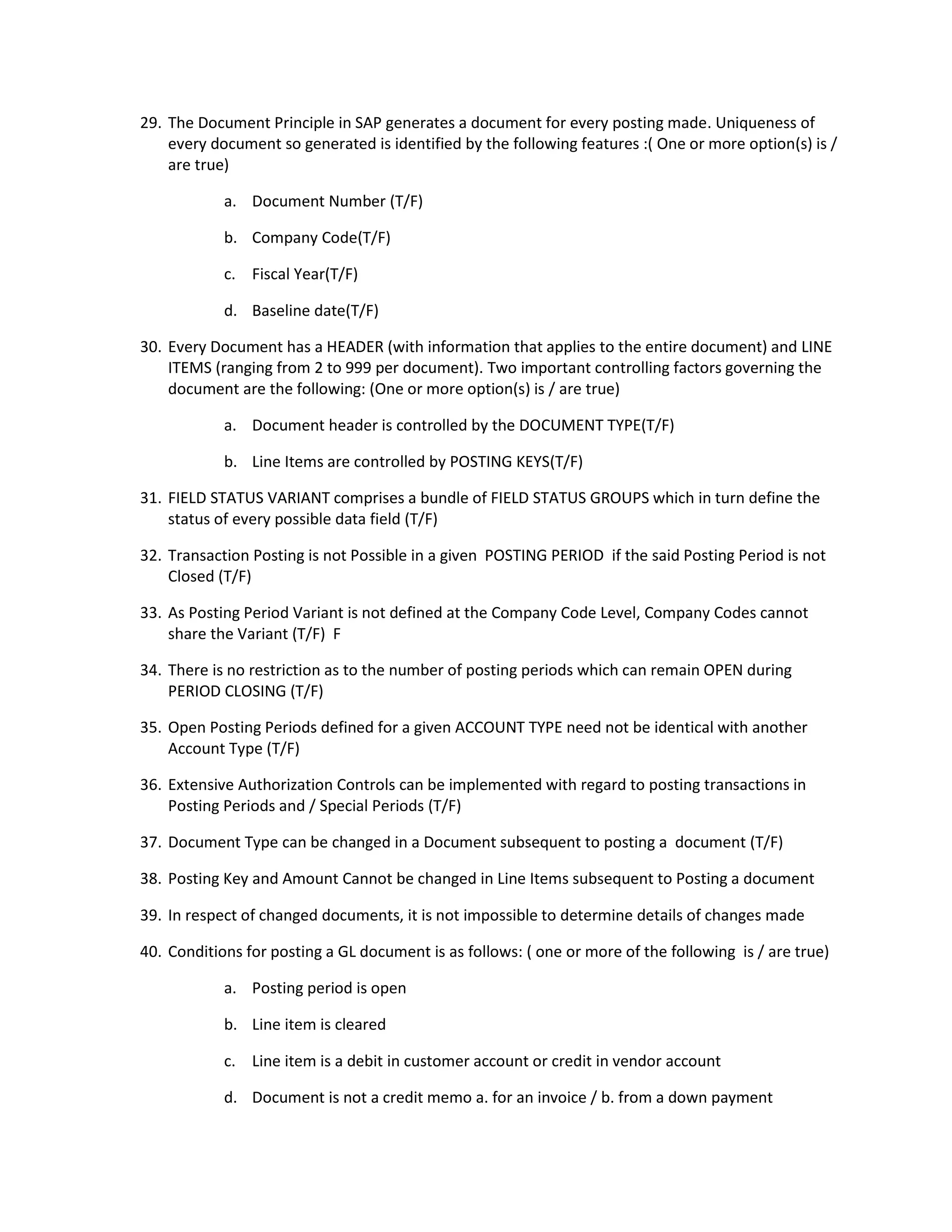
29. The Document Principle in SAP generates a document for every posting made. Uniqueness of
every document so generated is identified by the following features :( One or more option(s) is /
are true)
a. Document Number (T/F)
b. Company Code(T/F)
c. Fiscal Year(T/F)
d. Baseline date(T/F)
30. Every Document has a HEADER (with information that applies to the entire document) and LINE
ITEMS (ranging from 2 to 999 per document). Two important controlling factors governing the
document are the following: (One or more option(s) is / are true)
a. Document header is controlled by the DOCUMENT TYPE(T/F)
b. Line Items are controlled by POSTING KEYS(T/F)
31. FIELD STATUS VARIANT comprises a bundle of FIELD STATUS GROUPS which in turn define the
status of every possible data field (T/F)
32. Transaction Posting is not Possible in a given POSTING PERIOD if the said Posting Period is not
Closed (T/F)
33. As Posting Period Variant is not defined at the Company Code Level, Company Codes cannot
share the Variant (T/F) F
34. There is no restriction as to the number of posting periods which can remain OPEN during
PERIOD CLOSING (T/F)
35. Open Posting Periods defined for a given ACCOUNT TYPE need not be identical with another
Account Type (T/F)
36. Extensive Authorization Controls can be implemented with regard to posting transactions in
Posting Periods and / Special Periods (T/F)
37. Document Type can be changed in a Document subsequent to posting a document (T/F)
38. Posting Key and Amount Cannot be changed in Line Items subsequent to Posting a document
39. In respect of changed documents, it is not impossible to determine details of changes made
40. Conditions for posting a GL document is as follows: ( one or more of the following is / are true)
a. Posting period is open
b. Line item is cleared
c. Line item is a debit in customer account or credit in vendor account
d. Document is not a credit memo a. for an invoice / b. from a down payment
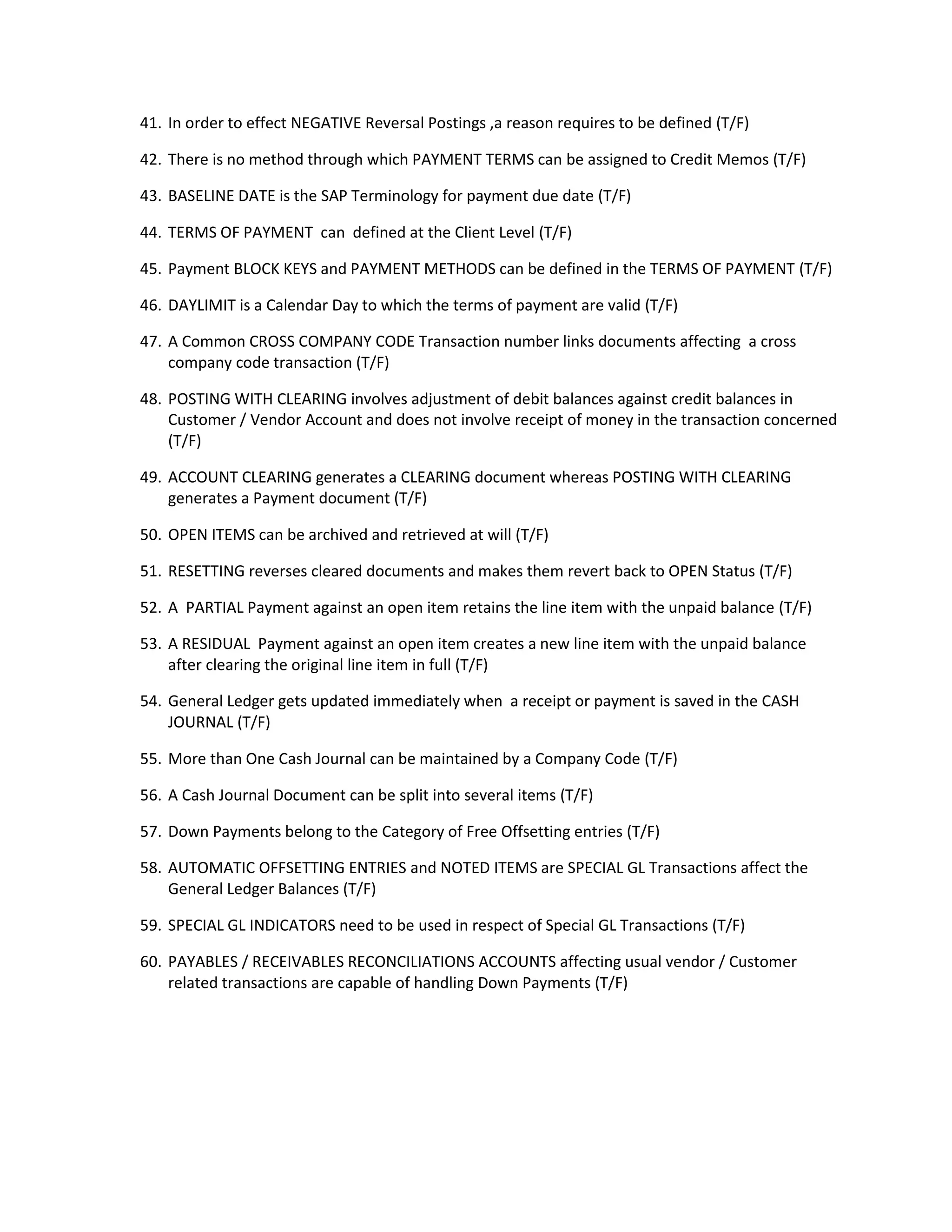
41. In order to effect NEGATIVE Reversal Postings ,a reason requires to be defined (T/F)
42. There is no method through which PAYMENT TERMS can be assigned to Credit Memos (T/F)
43. BASELINE DATE is the SAP Terminology for payment due date (T/F)
44. TERMS OF PAYMENT can defined at the Client Level (T/F)
45. Payment BLOCK KEYS and PAYMENT METHODS can be defined in the TERMS OF PAYMENT (T/F)
46. DAYLIMIT is a Calendar Day to which the terms of payment are valid (T/F)
47. A Common CROSS COMPANY CODE Transaction number links documents affecting a cross
company code transaction (T/F)
48. POSTING WITH CLEARING involves adjustment of debit balances against credit balances in
Customer / Vendor Account and does not involve receipt of money in the transaction concerned
(T/F)
49. ACCOUNT CLEARING generates a CLEARING document whereas POSTING WITH CLEARING
generates a Payment document (T/F)
50. OPEN ITEMS can be archived and retrieved at will (T/F)
51. RESETTING reverses cleared documents and makes them revert back to OPEN Status (T/F)
52. A PARTIAL Payment against an open item retains the line item with the unpaid balance (T/F)
53. A RESIDUAL Payment against an open item creates a new line item with the unpaid balance
after clearing the original line item in full (T/F)
54. General Ledger gets updated immediately when a receipt or payment is saved in the CASH
JOURNAL (T/F)
55. More than One Cash Journal can be maintained by a Company Code (T/F)
56. A Cash Journal Document can be split into several items (T/F)
57. Down Payments belong to the Category of Free Offsetting entries (T/F)
58. AUTOMATIC OFFSETTING ENTRIES and NOTED ITEMS are SPECIAL GL Transactions affect the
General Ledger Balances (T/F)
59. SPECIAL GL INDICATORS need to be used in respect of Special GL Transactions (T/F)
60. PAYABLES / RECEIVABLES RECONCILIATIONS ACCOUNTS affecting usual vendor / Customer
related transactions are capable of handling Down Payments (T/F)

Gl test without answers

  • 1.
    SAP – FI MOCKTEST SOLVED (60 Questions each carrying 1 point) Areas Covered  Basic settings  Master Data  Document Control  Posting Control  Clearing  Cash Journal  Special GL Transactions You are encouraged to rate yourself by awarding a credit point as detailed below: Question With One T/F option(*) Question With Two T/F options Question With Three T/F options Question With Four T/F options Question With Five T/F options Question With Six T/F options Question With Eight T/F options 1.000 point for every correct answer 0.500 point for every correct option 0.333 point for every correct option 0.250 point for every correct option 0.200 point for every correct option 0.166 point for every correct option 0.125 point for every correct option (*) Applies for questions where only one option is true Note: While answering questions with ‘one or more option is / are true ‘, every option must be analyzed and an answer furnished by you explicitly as TRUE or FALSE Multiply your overall rating with 1.66 to obtain your percentage score
  • 2.
    1. Data orSpecifications which can be valid for all organizational units are defined at the Top most level named CLIENT (T/F) 2. COMPANY CODE, which is the minimum structure necessary for external reporting , is not below the Client level (T/F) = 3. BUSINESS AREAS , used for internal reporting, cannot be assigned to Company Codes directly (T/F) 4. A Company Code in SAP is represented by an alphanumeric key which cannot be greater than Two Characters (T/F) 5. It is mandatory that a LANGUAGE KEY and LOCAL CURRENCY KEY be specified upon creation of your Company code (T/F) 6. A FISCAL YEAR VARIANT is a generic two character alphanumeric key which defines properties such as posting periods and / special periods required for posting business transactions (T/F) 7. Your Fiscal year Variant can accommodate a maximum of FOUR SPECIAL PERIODS for posting YEAR END CLOSING transactions (T/F) 8. A Fiscal year is said to be YEAR-SPECIFIC if 1) the start and end dates of posting periods vary from year to year or 2) the number of posting periods vary from year to year (T/F) 9. A SHORTENED FISCAL YEAR has more number of posting periods than the usual 12 posting periods (T/F) 10. NON CALENDAR YEARS cannot be reckoned as Fiscal Years (T/F) 11. YEAR SHIFT INDICATOR of +1 or -1 are used if a non calendar year which does not start on January 1st . (T/F) 12. Definition of a CHART OF ACCOUNTS includes the following :( One or more option(s) is / are true) a. Chart of Accounts Key which is cannot be greater than 4 alpha numeric Characters (T/F) b. Description of the Chart of Accounts (T/F) c. Maintenance Language (T/F) d. Maximum length of GL account code ( 1- 10 digits) proposed by you (T/F) e. Option to choose creation of cost elements (T/F) f. Group chart of Accounts , if you desire consolidation (T/F) g. Blocked indicator (T/F) h. Fiscal Year (T/F)
  • 3.
    13. Each Chartof Accounts contains two segments namely a Chart of Accounts Segment and b) a Company Code Segment. State which of the following two options is true (Only one option is true) a. Data captured in the Company Code segment can be freely shared by all Company Codes (T/F) b. Data captured in the Chart of Accounts segment can be freely shared by all Company Codes (T/F) Ref. page 47 of your Book 14. The Company Code segment does not determine whether the GL Account mastered belongs to the Balance Sheet or the Profit and Loss Account (T/F) 15. At the time of Account Closure, the net balances in Balance Sheet Accounts are carried forward to their respective accounts where as net balances of Profit and Loss Accounts is carried forward to a RETAINED EARNINGS ACCOUNT (T/F) 16. While defining GL ACCOUNT GROUPS the following things happen :( One or more option(s) is / are true) a. A linkage does not exist between the Chart of Accounts and the Account Group (T/F) b. You assign the range of GL account numbers (viz. starting account number – ending account number) (T/F) c. You have the option to choose internal numbering of GL Accounts (T/F) d. Number intervals can overlap (T/F) 17. Identify as to which of the following statements are True :( One or more option(s) is / are true) a. The FIELD STATUS of each field in the GL Master record (Hidden/Optional / required/ Display) can be set in the GL Account Group (T/F) b. Control of the Field status in the GL Master record may also be TRANSACTION SPECIFIC (T/F) c. Maintenance of Transaction specific control is mandatory (T/F) d. Field Status Priority is ordered as Required / Optional / Display / Hidden (T/F) 18. Accounts Receivable and Accounts Payable (viz. debtors and creditors) are defined in the General Ledger as Reconciliation Accounts (T/F) 19. Identify as to which of the following statements are True :(One or more option(s) is / are true) a. Every account with LINE ITEM display must have OPEN ITEM Management (T/F) b. Every account with OPEN ITEM Management must have LINE ITEM display (T/F)
  • 4.
    c. If Accountcurrency is LOCAL CURRENCY, posting to the respective GL Account must be in Local Currency only (T/F) d. If Account currency is not LOCAL CURRENCY, posting to the respective GL Account must be in Local Currency only (T/F) 20. Information from Two Company Codes which use different OPERATIONAL CHART OF ACCOUNTS can be consolidated using a common GROUP CHART OF ACCOUNTS for Internal Reporting (T/F) 21. Information from Two Company Codes which use different COUNTRY CHART OF ACCOUNTS can be consolidated using a common OPERATIONAL chart of accounts for Internal Reporting (T/F) 22. CROSS COMPANY CONTROLLING, a process by which intercompany transactions can be carried out, is not possible when two companies use the same Operational Chart of Account (T/F) 23. Identify as to which of the following statement(s) is / are True :( One or more option(s) is / are true) a. It is not essential to create ACCOUNT GROUPS for creating CUSTOMER and / VENDOR MASTER RECORDS (T/F) b. Customer Master Records comprise three segments namely a. GENERAL DATA SEGMENT b. COMPANY CODE SEGMENT and c. SALES AREA SEGMENT (T/F) c. Unlike Customer Master Records, Vendor Master Records are not made up of two segments only namely a. General Data Segment and b. Company Code Segment (T/F) d. Unlike GL Master codes( which are External and alphanumeric ) , Customer and Vendor Master codes can be Internal ( with numeric codes assigned by the system) or External (with manual assignment of alphanumeric codes) (T/F) 24. You are aware that a generic Customer / Vendor Group can be created for One Time Customers / Vendors, comprising a single master record (one for customers and another for vendors). Capture of customer/ vendor details in such cases, for future follow up, is made at the time of Transaction posting only (T/F) 25. You are aware that Field Status is an important parameter determining the status of every field relating to GL Masters and GL related transactions. Customer and Vendor records (at the master level as well as at transactional level) do not require any Field Status (T/F) 26. BANK Master Data can be created in four ways (T/F) 27. If Bank Data is defined in the Bank Master, there is no need for you to create a Bank Account in the General Ledger (T/F) 28. Bank Accounts can be identified using a Bank ID which must be unique per HOUSE BANK (T/F)
  • 5.
    29. The DocumentPrinciple in SAP generates a document for every posting made. Uniqueness of every document so generated is identified by the following features :( One or more option(s) is / are true) a. Document Number (T/F) b. Company Code(T/F) c. Fiscal Year(T/F) d. Baseline date(T/F) 30. Every Document has a HEADER (with information that applies to the entire document) and LINE ITEMS (ranging from 2 to 999 per document). Two important controlling factors governing the document are the following: (One or more option(s) is / are true) a. Document header is controlled by the DOCUMENT TYPE(T/F) b. Line Items are controlled by POSTING KEYS(T/F) 31. FIELD STATUS VARIANT comprises a bundle of FIELD STATUS GROUPS which in turn define the status of every possible data field (T/F) 32. Transaction Posting is not Possible in a given POSTING PERIOD if the said Posting Period is not Closed (T/F) 33. As Posting Period Variant is not defined at the Company Code Level, Company Codes cannot share the Variant (T/F) F 34. There is no restriction as to the number of posting periods which can remain OPEN during PERIOD CLOSING (T/F) 35. Open Posting Periods defined for a given ACCOUNT TYPE need not be identical with another Account Type (T/F) 36. Extensive Authorization Controls can be implemented with regard to posting transactions in Posting Periods and / Special Periods (T/F) 37. Document Type can be changed in a Document subsequent to posting a document (T/F) 38. Posting Key and Amount Cannot be changed in Line Items subsequent to Posting a document 39. In respect of changed documents, it is not impossible to determine details of changes made 40. Conditions for posting a GL document is as follows: ( one or more of the following is / are true) a. Posting period is open b. Line item is cleared c. Line item is a debit in customer account or credit in vendor account d. Document is not a credit memo a. for an invoice / b. from a down payment
  • 6.
    41. In orderto effect NEGATIVE Reversal Postings ,a reason requires to be defined (T/F) 42. There is no method through which PAYMENT TERMS can be assigned to Credit Memos (T/F) 43. BASELINE DATE is the SAP Terminology for payment due date (T/F) 44. TERMS OF PAYMENT can defined at the Client Level (T/F) 45. Payment BLOCK KEYS and PAYMENT METHODS can be defined in the TERMS OF PAYMENT (T/F) 46. DAYLIMIT is a Calendar Day to which the terms of payment are valid (T/F) 47. A Common CROSS COMPANY CODE Transaction number links documents affecting a cross company code transaction (T/F) 48. POSTING WITH CLEARING involves adjustment of debit balances against credit balances in Customer / Vendor Account and does not involve receipt of money in the transaction concerned (T/F) 49. ACCOUNT CLEARING generates a CLEARING document whereas POSTING WITH CLEARING generates a Payment document (T/F) 50. OPEN ITEMS can be archived and retrieved at will (T/F) 51. RESETTING reverses cleared documents and makes them revert back to OPEN Status (T/F) 52. A PARTIAL Payment against an open item retains the line item with the unpaid balance (T/F) 53. A RESIDUAL Payment against an open item creates a new line item with the unpaid balance after clearing the original line item in full (T/F) 54. General Ledger gets updated immediately when a receipt or payment is saved in the CASH JOURNAL (T/F) 55. More than One Cash Journal can be maintained by a Company Code (T/F) 56. A Cash Journal Document can be split into several items (T/F) 57. Down Payments belong to the Category of Free Offsetting entries (T/F) 58. AUTOMATIC OFFSETTING ENTRIES and NOTED ITEMS are SPECIAL GL Transactions affect the General Ledger Balances (T/F) 59. SPECIAL GL INDICATORS need to be used in respect of Special GL Transactions (T/F) 60. PAYABLES / RECEIVABLES RECONCILIATIONS ACCOUNTS affecting usual vendor / Customer related transactions are capable of handling Down Payments (T/F)