Gifts of Tangible
Personal Property
How do you handle that gift of Hummels?
What is tangible personal property
 Is anything you can touch
 Includes furniture, clothing, artwork and cars
 Wills often define what is personal property.
 The term “tangible personal property” means all personal
and household effects, jewelry, automobiles, collections,
and other tangible personal property that I own at my
death (including insurance thereon).
Examples of what
is not TPP
 Land and buildings are real property
 Anything attached to a building is usually real estate
unless it is detached.
 Example: chandelier
 Stocks, bonds, and other investments are personal
property but…
 They represent rights to something else, usually
ownership of something
 These are examples of intangible personal property.
This Photo by Unknown Author is
Advantages of donating TPP
 Includes broad asset categories, including collectables, artwork,
vehicles, jewelry, coins, and timber
 You can structure it as outright gift, an undivided fractional interest,
or gifts generating an income stream or deferred gifts, etc.
 Fair market value deduction available for donations meeting the
related use requirements.
 Charities often us TPP for public or educational purposes, which
donors often like.
 Some tangible personal property (collectibles) is subject to a 28%
capital gains rate so avoiding income recognition is advantageous.
What are collectibles?
 Any work of art
 Any rug or antique
 Any metal or gem
 Any stamp or coin
 Any alcoholic beverage
 Any musical instrument
 Historical objects, such as documents and clothes
Disadvantages
 Fair market value deduction is not always available.
 Certain split interest gifts, such as CGAs, CRTs and CLTs required
evaluation for tax issues, marketability and suitability.
 It is often difficult to value and requires a specialist to appraise it.
 If donors have an emotional attachment to it, they may not want
charity to liquidate or use it in a desired way.
 For donated artwork, you must discuss blockage, buyer’s premiums
and independent IRS valuation rules
 Donors frequently do not have basis evidence for inherited property or
pieces purchased a long time ago
Examples of related use
 An item of tangible personal property is donated for the related use of
the organization if the organization can and does use it for its tax-
exempt purpose.
 Example: If the organization receives a piano for use in its music
school , that donor would be eligible for a fair market value
deduction. This would be a related use. On the other hand, if the
recipient was going to resell the piano, the organization would have
to tell the donor that he gets only a cost basis deduction.
 If unsure of what is related use, IRS has issued many private letter
rulings.
 The donor gets a deduction equal to 30% of adjusted gross income.
Unrelated use
 If the recipient organization will not be using the tangible personal
property, the donor gets a cost basis deduction.
 Example: gift of antique automobile was not a related use because
the car was not used by the school but was stored in a professor's
garage and the college did not offer course in antique car restoration
or similar programs.
 Letter ruling 8009027.
Gifts of undivided fractional interests
 Is not the same as a future interest
 Fractional interest means 2 or more individuals or entities own it
jointly.
 The donor and the charity together must own 100% of the asset.
 A gift agreement is essential.
 Example: Individual donates a ¼ interest in a piece of artwork.
Donee is entitled to possession 3 months of the year. There is a
formally executed gift agreement. Donor gets deduction for ¼
interest in the painting, but possession by the donee cannot be
deferred more than one year.
Gifts of Inventory
 Inventory is an asset held primarily for sale to
customers in the ordinary course of business
 Is not capital gain property.
 Is ordinary income regardless of holding period.
 Deduction is based on the lesser of fair market
value or cost of goods sold.
 Can deduct up to 50% of the contribution base.
Gifts of inventory for care of ill, needy
or infants
 If a C corporation contributes inventory to a charity for the use of for
the care of ill the needy or infants, the calculation is different.
 A corporation can claim a charitable contribution income tax
deduction is
 the lesser of cost basis plus 50% of list price minus cost basis, or
 200% of cost basis.
 Corporation must obtain a statement from the charity confirming that
the use of property meets those requirements
Gift of future interest to charity
 A charitable contribution of a future interest in TPP is subject to
special rules
 Future interest consists of a remainder interest, reversion or other
estate or interest that will commence in use at a future time
 Gift of future interest is made when all intervening interests lapse and
charity has use and enjoyment of the property,
 Unless interests are held by people other than taxpayer or those
mentioned in IRC section 267(b) (most relatives).
 Can include a verbal understanding with the donor.
Examples of future interests
 On 12/31/2018 John conveys a painting, by gift agreement, but keeps
the right to use and possess during his lifetime. Value of the gift is
$90,000. No deduction in 2019 because donor retained an intervening
interest.
 Same facts as previous example, but on 12/31/2019 he gives up
possession. Value on 12/31/2019 is $95,000. John gets a deduction in
2019 for $95,000.
 If John dies in 2019, he gets no income tax deduction.
Qualified
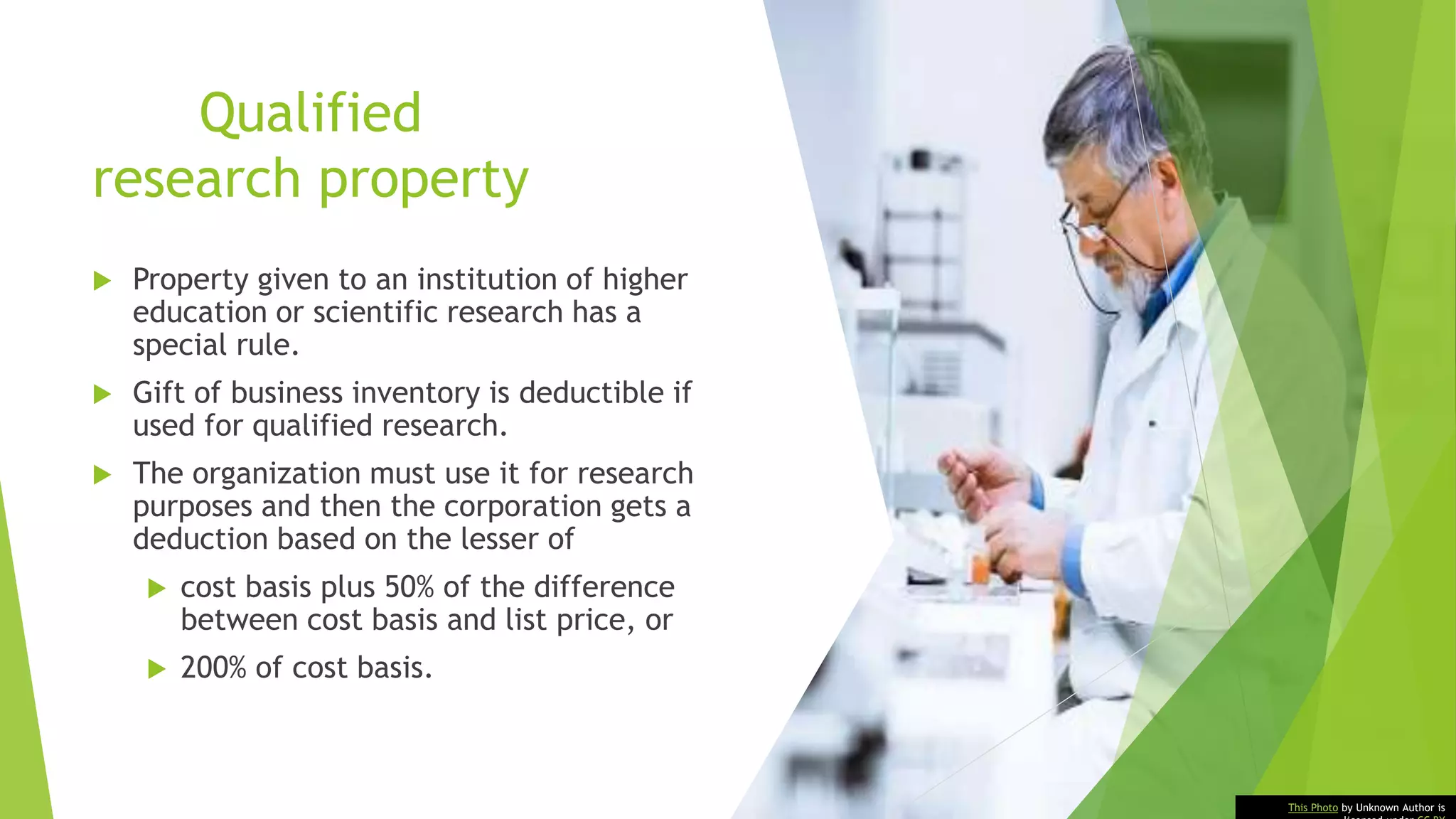
research property
 Property given to an institution of higher
education or scientific research has a
special rule.
 Gift of business inventory is deductible if
used for qualified research.
 The organization must use it for research
purposes and then the corporation gets a
deduction based on the lesser of
 cost basis plus 50% of the difference
between cost basis and list price, or
 200% of cost basis.
This Photo by Unknown Author is
Application to charitable gift annuities
 Is permissible in most states (except NY) to fund a gift annuity with
TPP
 Is considered part gift and part sale.
 Gift portion is a present interest
 Are no rulings on point.
 If property placed in a related use, donor should be able to claim
deduction based on related use percentage
 Need to consider how you would fund the cash payments.
Application to Charitable Remainder
Trust
 Gift of TPP to a charitable remainder trust is unrelated use if gift to
the organization would have been an unrelated use.
 Charitable remainder trust would not normally put the TPP to a
related use.
 Charitable remainder trust would normally sell the property to fund
the CRT payments.
 Possible exception: Donor gives cash to the CRT in addition to the
tangible personal property.
Application to charitable lead trusts
 Remember that charitable lead trust is taxable.
 Transfer of highly appreciated and non-income producing property will cause
either donor or trust to pay capital gains tax on the sale.
 Consider a CLAT because tangible personal property can be hard to value.
 Avoids need to get new appraisal each year.
Special rules apply to certain assets
 Artwork
 Jewelry and gems
 Coins
 Cars, boats and aircraft
 Livestock
 Crops
 Timber
Artwork-collections
 Artwork is broadly described as objects with visual content that elicit
an aesthetic response from viewers while also providing a social
function.
 Examples include paintings, drawings and sculptures
 A collection without its copyright can be contributed to a related use
charity for a full fair market value deduction.
Original works of art
 An original work of art is separate from its copyright for gift and
estate tax deduction purposes.
 If donor retains copyright but gives the artwork, donor gets no
deduction.
 Is considered a gift of a non-qualified partial interest.
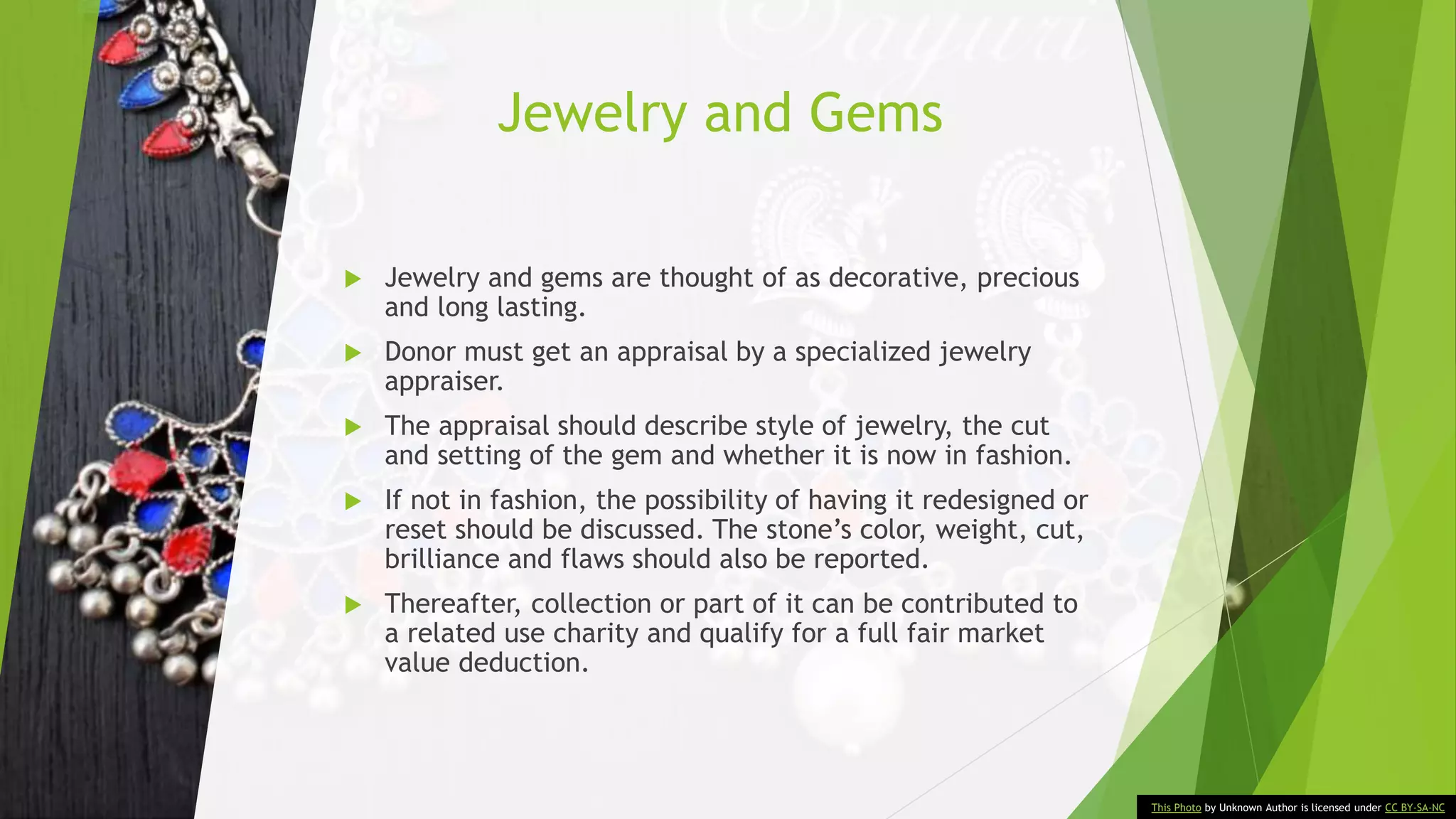
Jewelry and Gems
 Jewelry and gems are thought of as decorative, precious
and long lasting.
 Donor must get an appraisal by a specialized jewelry
appraiser.
 The appraisal should describe style of jewelry, the cut
and setting of the gem and whether it is now in fashion.
 If not in fashion, the possibility of having it redesigned or
reset should be discussed. The stone’s color, weight, cut,
brilliance and flaws should also be reported.
 Thereafter, collection or part of it can be contributed to
a related use charity and qualify for a full fair market
value deduction.
This Photo by Unknown Author is licensed under CC BY-SA-NC
Coins
 Coins are valuable for two reasons:
 They function as money and
 They are issued with the image of a ruler leader or other
important figure
 You need to distinguish between coins that are currency and those
that are tangible personal property
 Coins that are tangible personal property can be contributed to a
related use charity and qualify for full fair market value deduction
 For two examples, look at revenue ruling 69-63 and private letter
ruling 9225036
Cars, boats and
aircraft
 Donors should consult market
guides, such as Kelly’s blue
book, for approximate values
for cars, boats and aircraft.
 The prices are not official,
however, and where the value
exceeds the appraisal
requirement donors will need to
get an appraisal by an expert
that specializes in the area.
 With careful planning, a
donation can to a related use
charity can qualify for the full
fair market value deduction.
This Photo by Unknown Author is licensed under CC BY-SA
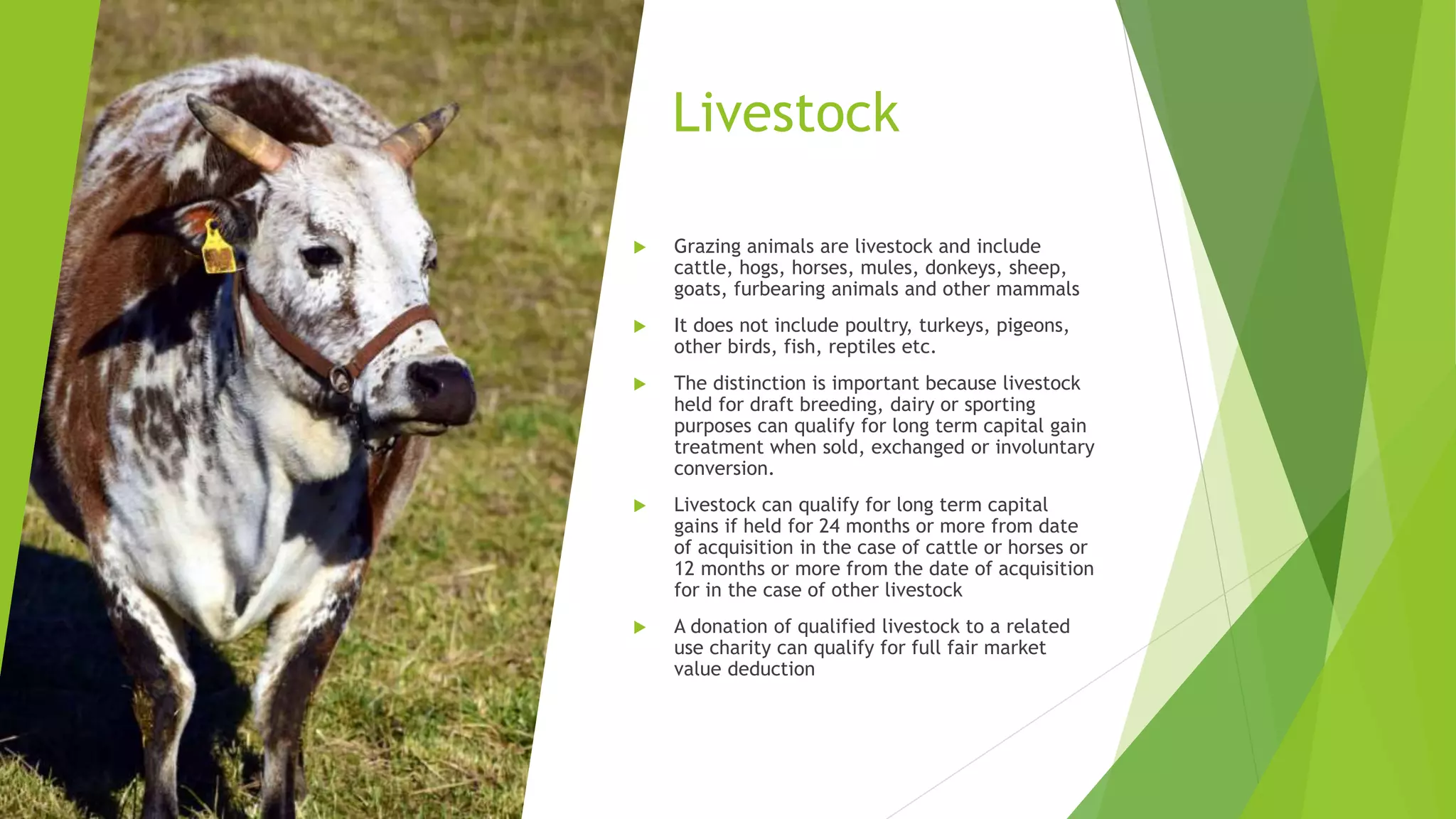
Livestock
 Grazing animals are livestock and include
cattle, hogs, horses, mules, donkeys, sheep,
goats, furbearing animals and other mammals
 It does not include poultry, turkeys, pigeons,
other birds, fish, reptiles etc.
 The distinction is important because livestock
held for draft breeding, dairy or sporting
purposes can qualify for long term capital gain
treatment when sold, exchanged or involuntary
conversion.
 Livestock can qualify for long term capital
gains if held for 24 months or more from date
of acquisition in the case of cattle or horses or
12 months or more from the date of acquisition
for in the case of other livestock
 A donation of qualified livestock to a related
use charity can qualify for full fair market
value deduction
Crops
 Crops are plants grown and harvested or picked to be consumed or
sold.
 Crops that are harvested are tangible personal property
 Harvested crops sold with the land on which located and which was
owned by the seller for more than a year, can qualify for long term
capital gain treatment.
 If the sale results in a net loss it can be an ordinary loss.
 Holding period of the crop compared to the land is not important
 In some cases, income from the crops could be classified as UBIT
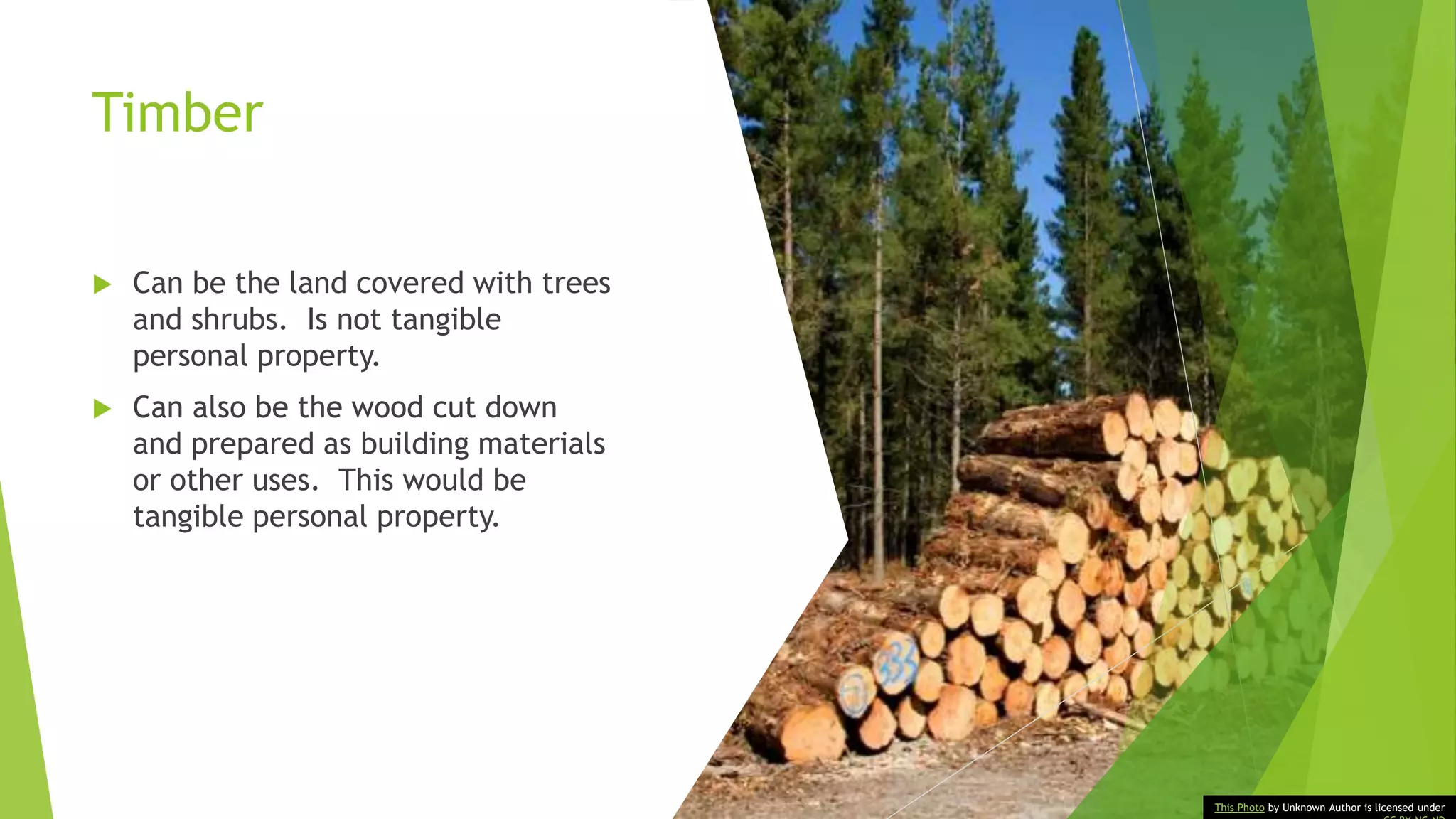
Timber
 Can be the land covered with trees
and shrubs. Is not tangible
personal property.
 Can also be the wood cut down
and prepared as building materials
or other uses. This would be
tangible personal property.
This Photo by Unknown Author is licensed under
Factors in classifying timber
 Is it standing and being contributed with the land?
 Has it been cut down and being donated separately?
 Is it being held for investment?
 Is it being held for sale in the ordinary course of business?
Appraisal rules
 If the tangible personal property
has a fair market value of $5,000
or more, donor must get an
appraisal.
 The rule is no appraisal, no
deduction.
 Remember that certain types of
property required specialized
appraisers.
What does the donor want to
accomplish?
 Donors often don’t understand the special rules that can apply to
tangible personal property.
 They often believe they can get a fair market value tax deduction
even if it something that you don’t want.
 Does the donor have evidence of ownership?
Considerations when accepting a gift
 Does it comply with related use rule?
 Is there a qualified appraisal?
 How do you confirm ownership? Get a written assignment or signed
gift agreement.
 What does your gift acceptance policy say?
 Is it inventory?
Documentation: form 8283
 Noncash contribution of $500 or less. The taxpayer must obtain a receipt from the organization
showing the organization’s name, date and location of the contribution, and a sufficiently detailed
description of the property.
 Noncash contribution of more than $500. The taxpayer must have a written record showing the
method of acquisition, the approximate date of acquisition, and the cost or adjusted basis, plus attach
form 8283 to return for the year in which donation is made.
 Donations of more than $5,000. The taxpayer must obtain an appraisal of the property, attach a
completed form 8283 (which the organization must sign) to the tax return on which the deduction is
claimed. An appraisal must meet certain requirements and is not optional. The donor must obtain
the appraisal.
 The donor must have the receipt in hand before filing his or her tax return. If obtained after filing, it is
not contemporaneous. If the donor has no timely receipt, then the donor gets no deduction.
 New IRS rule: If donor must carry over the charitable contribution, they must attach a form
8283 and the appraisal in future years as well as the year of the initial donation
Documentation: Form 8282
 The tattle tale form
 Charity must file if it sells a donated asset requiring an appraisal
within 3 years of the gift.
 If the IRS deems the difference between donor’s deduction and
charity’s sale price too large, donor will get audited.
Summary
 There are many types of tangible personal property
 Special rules apply to specific types of tangible personal property.
 Donor may not understand the rules.
Contact information
 James Provenza
 James C Provenza & Associates, PC
 1701 E Lake Avenue, #260
 Glenview, IL 60025
 Phone 847-729-3939
 E-mail: jprovenza@provenzalaw.com

Gifts of Tangible Personal Property

  • 1.
    Gifts of Tangible PersonalProperty How do you handle that gift of Hummels?
  • 2.
    What is tangiblepersonal property  Is anything you can touch  Includes furniture, clothing, artwork and cars  Wills often define what is personal property.  The term “tangible personal property” means all personal and household effects, jewelry, automobiles, collections, and other tangible personal property that I own at my death (including insurance thereon).
  • 3.
    Examples of what isnot TPP  Land and buildings are real property  Anything attached to a building is usually real estate unless it is detached.  Example: chandelier  Stocks, bonds, and other investments are personal property but…  They represent rights to something else, usually ownership of something  These are examples of intangible personal property. This Photo by Unknown Author is
  • 4.
    Advantages of donatingTPP  Includes broad asset categories, including collectables, artwork, vehicles, jewelry, coins, and timber  You can structure it as outright gift, an undivided fractional interest, or gifts generating an income stream or deferred gifts, etc.  Fair market value deduction available for donations meeting the related use requirements.  Charities often us TPP for public or educational purposes, which donors often like.  Some tangible personal property (collectibles) is subject to a 28% capital gains rate so avoiding income recognition is advantageous.
  • 5.
    What are collectibles? Any work of art  Any rug or antique  Any metal or gem  Any stamp or coin  Any alcoholic beverage  Any musical instrument  Historical objects, such as documents and clothes
  • 6.
    Disadvantages  Fair marketvalue deduction is not always available.  Certain split interest gifts, such as CGAs, CRTs and CLTs required evaluation for tax issues, marketability and suitability.  It is often difficult to value and requires a specialist to appraise it.  If donors have an emotional attachment to it, they may not want charity to liquidate or use it in a desired way.  For donated artwork, you must discuss blockage, buyer’s premiums and independent IRS valuation rules  Donors frequently do not have basis evidence for inherited property or pieces purchased a long time ago
  • 7.
    Examples of relateduse  An item of tangible personal property is donated for the related use of the organization if the organization can and does use it for its tax- exempt purpose.  Example: If the organization receives a piano for use in its music school , that donor would be eligible for a fair market value deduction. This would be a related use. On the other hand, if the recipient was going to resell the piano, the organization would have to tell the donor that he gets only a cost basis deduction.  If unsure of what is related use, IRS has issued many private letter rulings.  The donor gets a deduction equal to 30% of adjusted gross income.
  • 8.
    Unrelated use  Ifthe recipient organization will not be using the tangible personal property, the donor gets a cost basis deduction.  Example: gift of antique automobile was not a related use because the car was not used by the school but was stored in a professor's garage and the college did not offer course in antique car restoration or similar programs.  Letter ruling 8009027.
  • 9.
    Gifts of undividedfractional interests  Is not the same as a future interest  Fractional interest means 2 or more individuals or entities own it jointly.  The donor and the charity together must own 100% of the asset.  A gift agreement is essential.  Example: Individual donates a ¼ interest in a piece of artwork. Donee is entitled to possession 3 months of the year. There is a formally executed gift agreement. Donor gets deduction for ¼ interest in the painting, but possession by the donee cannot be deferred more than one year.
  • 10.
    Gifts of Inventory Inventory is an asset held primarily for sale to customers in the ordinary course of business  Is not capital gain property.  Is ordinary income regardless of holding period.  Deduction is based on the lesser of fair market value or cost of goods sold.  Can deduct up to 50% of the contribution base.
  • 11.
    Gifts of inventoryfor care of ill, needy or infants  If a C corporation contributes inventory to a charity for the use of for the care of ill the needy or infants, the calculation is different.  A corporation can claim a charitable contribution income tax deduction is  the lesser of cost basis plus 50% of list price minus cost basis, or  200% of cost basis.  Corporation must obtain a statement from the charity confirming that the use of property meets those requirements
  • 12.
    Gift of futureinterest to charity  A charitable contribution of a future interest in TPP is subject to special rules  Future interest consists of a remainder interest, reversion or other estate or interest that will commence in use at a future time  Gift of future interest is made when all intervening interests lapse and charity has use and enjoyment of the property,  Unless interests are held by people other than taxpayer or those mentioned in IRC section 267(b) (most relatives).  Can include a verbal understanding with the donor.
  • 13.
    Examples of futureinterests  On 12/31/2018 John conveys a painting, by gift agreement, but keeps the right to use and possess during his lifetime. Value of the gift is $90,000. No deduction in 2019 because donor retained an intervening interest.  Same facts as previous example, but on 12/31/2019 he gives up possession. Value on 12/31/2019 is $95,000. John gets a deduction in 2019 for $95,000.  If John dies in 2019, he gets no income tax deduction.
  • 14.
    Qualified research property  Propertygiven to an institution of higher education or scientific research has a special rule.  Gift of business inventory is deductible if used for qualified research.  The organization must use it for research purposes and then the corporation gets a deduction based on the lesser of  cost basis plus 50% of the difference between cost basis and list price, or  200% of cost basis. This Photo by Unknown Author is
  • 15.
    Application to charitablegift annuities  Is permissible in most states (except NY) to fund a gift annuity with TPP  Is considered part gift and part sale.  Gift portion is a present interest  Are no rulings on point.  If property placed in a related use, donor should be able to claim deduction based on related use percentage  Need to consider how you would fund the cash payments.
  • 16.
    Application to CharitableRemainder Trust  Gift of TPP to a charitable remainder trust is unrelated use if gift to the organization would have been an unrelated use.  Charitable remainder trust would not normally put the TPP to a related use.  Charitable remainder trust would normally sell the property to fund the CRT payments.  Possible exception: Donor gives cash to the CRT in addition to the tangible personal property.
  • 17.
    Application to charitablelead trusts  Remember that charitable lead trust is taxable.  Transfer of highly appreciated and non-income producing property will cause either donor or trust to pay capital gains tax on the sale.  Consider a CLAT because tangible personal property can be hard to value.  Avoids need to get new appraisal each year.
  • 18.
    Special rules applyto certain assets  Artwork  Jewelry and gems  Coins  Cars, boats and aircraft  Livestock  Crops  Timber
  • 19.
    Artwork-collections  Artwork isbroadly described as objects with visual content that elicit an aesthetic response from viewers while also providing a social function.  Examples include paintings, drawings and sculptures  A collection without its copyright can be contributed to a related use charity for a full fair market value deduction.
  • 20.
    Original works ofart  An original work of art is separate from its copyright for gift and estate tax deduction purposes.  If donor retains copyright but gives the artwork, donor gets no deduction.  Is considered a gift of a non-qualified partial interest.
  • 21.
    Jewelry and Gems Jewelry and gems are thought of as decorative, precious and long lasting.  Donor must get an appraisal by a specialized jewelry appraiser.  The appraisal should describe style of jewelry, the cut and setting of the gem and whether it is now in fashion.  If not in fashion, the possibility of having it redesigned or reset should be discussed. The stone’s color, weight, cut, brilliance and flaws should also be reported.  Thereafter, collection or part of it can be contributed to a related use charity and qualify for a full fair market value deduction. This Photo by Unknown Author is licensed under CC BY-SA-NC
  • 22.
    Coins  Coins arevaluable for two reasons:  They function as money and  They are issued with the image of a ruler leader or other important figure  You need to distinguish between coins that are currency and those that are tangible personal property  Coins that are tangible personal property can be contributed to a related use charity and qualify for full fair market value deduction  For two examples, look at revenue ruling 69-63 and private letter ruling 9225036
  • 23.
    Cars, boats and aircraft Donors should consult market guides, such as Kelly’s blue book, for approximate values for cars, boats and aircraft.  The prices are not official, however, and where the value exceeds the appraisal requirement donors will need to get an appraisal by an expert that specializes in the area.  With careful planning, a donation can to a related use charity can qualify for the full fair market value deduction. This Photo by Unknown Author is licensed under CC BY-SA
  • 24.
    Livestock  Grazing animalsare livestock and include cattle, hogs, horses, mules, donkeys, sheep, goats, furbearing animals and other mammals  It does not include poultry, turkeys, pigeons, other birds, fish, reptiles etc.  The distinction is important because livestock held for draft breeding, dairy or sporting purposes can qualify for long term capital gain treatment when sold, exchanged or involuntary conversion.  Livestock can qualify for long term capital gains if held for 24 months or more from date of acquisition in the case of cattle or horses or 12 months or more from the date of acquisition for in the case of other livestock  A donation of qualified livestock to a related use charity can qualify for full fair market value deduction
  • 25.
    Crops  Crops areplants grown and harvested or picked to be consumed or sold.  Crops that are harvested are tangible personal property  Harvested crops sold with the land on which located and which was owned by the seller for more than a year, can qualify for long term capital gain treatment.  If the sale results in a net loss it can be an ordinary loss.  Holding period of the crop compared to the land is not important  In some cases, income from the crops could be classified as UBIT
  • 26.
    Timber  Can bethe land covered with trees and shrubs. Is not tangible personal property.  Can also be the wood cut down and prepared as building materials or other uses. This would be tangible personal property. This Photo by Unknown Author is licensed under
  • 27.
    Factors in classifyingtimber  Is it standing and being contributed with the land?  Has it been cut down and being donated separately?  Is it being held for investment?  Is it being held for sale in the ordinary course of business?
  • 28.
    Appraisal rules  Ifthe tangible personal property has a fair market value of $5,000 or more, donor must get an appraisal.  The rule is no appraisal, no deduction.  Remember that certain types of property required specialized appraisers.
  • 29.
    What does thedonor want to accomplish?  Donors often don’t understand the special rules that can apply to tangible personal property.  They often believe they can get a fair market value tax deduction even if it something that you don’t want.  Does the donor have evidence of ownership?
  • 30.
    Considerations when acceptinga gift  Does it comply with related use rule?  Is there a qualified appraisal?  How do you confirm ownership? Get a written assignment or signed gift agreement.  What does your gift acceptance policy say?  Is it inventory?
  • 31.
    Documentation: form 8283 Noncash contribution of $500 or less. The taxpayer must obtain a receipt from the organization showing the organization’s name, date and location of the contribution, and a sufficiently detailed description of the property.  Noncash contribution of more than $500. The taxpayer must have a written record showing the method of acquisition, the approximate date of acquisition, and the cost or adjusted basis, plus attach form 8283 to return for the year in which donation is made.  Donations of more than $5,000. The taxpayer must obtain an appraisal of the property, attach a completed form 8283 (which the organization must sign) to the tax return on which the deduction is claimed. An appraisal must meet certain requirements and is not optional. The donor must obtain the appraisal.  The donor must have the receipt in hand before filing his or her tax return. If obtained after filing, it is not contemporaneous. If the donor has no timely receipt, then the donor gets no deduction.  New IRS rule: If donor must carry over the charitable contribution, they must attach a form 8283 and the appraisal in future years as well as the year of the initial donation
  • 32.
    Documentation: Form 8282 The tattle tale form  Charity must file if it sells a donated asset requiring an appraisal within 3 years of the gift.  If the IRS deems the difference between donor’s deduction and charity’s sale price too large, donor will get audited.
  • 33.
    Summary  There aremany types of tangible personal property  Special rules apply to specific types of tangible personal property.  Donor may not understand the rules.
  • 34.
    Contact information  JamesProvenza  James C Provenza & Associates, PC  1701 E Lake Avenue, #260  Glenview, IL 60025  Phone 847-729-3939  E-mail: jprovenza@provenzalaw.com

Editor's Notes

  • #5 Tangible personal property subject to 28% capital gains rate: certain collectibles,
  • #6 Defined in section 408(m).
  • #7 Fair market value deduction is available only for related use. Makes it different from other types of non-cash gifts. Specialist required for jewelry, real estate as two examples Blockage discount is a term of art that refers to a money discount assigned to a group of artworks by a single artist when the group of artworks is to be released all at one time. Blockage re: artwork: Buyer’s premium in artwork:
  • #10 What if a 3rd party owns a fraction? Is a discount figured in or required by section 170?
  • #11 Define contribution base: contribution base is for most people adjusted gross income. There are certain adjustments, such as NOL.
  • #12 A C corporation is one that pays tax on its own return. In an S corporation, the next income flows through to the shareholders.
  • #15 Research or experimentation under section 174 or Research training in physical or biological sciences.
  • #17 Deduction may not be available if charitable remainderman purchases property from trust and related individual or entity under IRC section 267 has direct or indirect control over the tax-exempt organization.
  • #22 Are of such a specialized nature, not just any appraiser will do.
  • #23 Revenue Ruling 69-63: taxpayer transferred collection of rare coins and cash to predecessor of a CRT. IRS held that since it wasn’t held as a medium of exchange, but had value as collector’s items, collection was TPP. The cash was not TPP. Value of the collection had to wait for expiration of the donor’s interest, but remainder interest in the cash was deductible in the year of transfer. PLR 9225036 IRS held South African Krugerrands, which are gold coins, are more akin to currency and had no value as a collection. We equivalent to cash and were not TPP.
  • #24 If it is sold, donation is the amount realized but donor can deduct $500, even if sold for less. Would report to donor on 1098-c.
  • #26 Example of when crop income is UBIT
  • #28 Deduction is based on value of entire property, subject to 30% deduction limitation. Standing timber is not TPP. Rules for donation of timber that is inventory are very complicated.
  • #30 I ask this because donors often want to get a tax write off (at FMV) even when it is not possible to do so.