p. 1
© Fraunhofer
RESEARCH FOR A MOBILE FUTURE
Project ITHAM
Intermodal Transport of Hazardous Materials
DRESDEN
p. 2
© Fraunhofer
Agenda
Overview
 Project partner
 Project scope
Modules
 Data capturing
 Data science
 Alerting
p. 3
© Fraunhofer
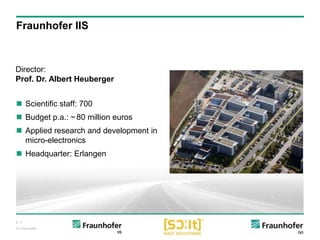
 Scientific staff: 700
 Budget p.a.: ~80 million euros
 Applied research and development in
micro-electronics
 Headquarter: Erlangen
Director:
Prof. Dr. Albert Heuberger
Fraunhofer IIS
p. 4
© Fraunhofer
Research Areas
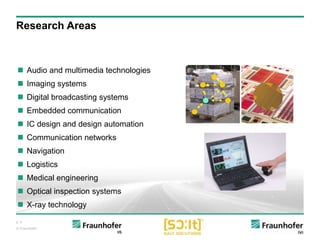
 Audio and multimedia technologies
 Imaging systems
 Digital broadcasting systems
 Embedded communication
 IC design and design automation
 Communication networks
 Navigation
 Logistics
 Medical engineering
 Optical inspection systems
 X-ray technology
p. 5
© Fraunhofer
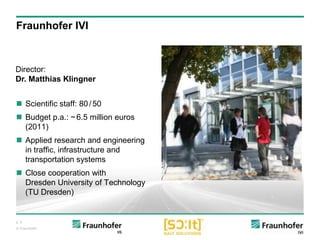
 Scientific staff: 80/50
 Budget p.a.: ~6.5 million euros
(2011)
 Applied research and engineering
in traffic, infrastructure and
transportation systems
 Close cooperation with
Dresden University of Technology
(TU Dresden)
Director:
Dr. Matthias Klingner
Fraunhofer IVI
p. 6
© Fraunhofer
Research Areas
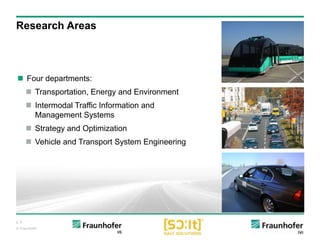
 Four departments:
 Transportation, Energy and Environment
 Intermodal Traffic Information and
Management Systems
 Strategy and Optimization
 Vehicle and Transport System Engineering
p. 7
© Fraunhofer
SALT Solutions GmbH
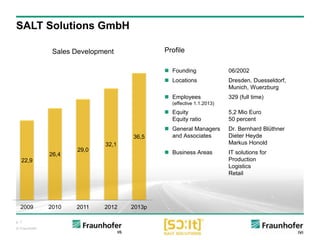
 Founding 06/2002
 Locations Dresden, Duesseldorf,
Munich, Wuerzburg
 Employees 329 (full time)
(effective 1.1.2013)
 Equity 5,2 Mio Euro
Equity ratio 50 percent
 General Managers Dr. Bernhard Blüthner
and Associates Dieter Heyde
Markus Honold
 Business Areas IT solutions for
Production
Logistics
Retail
Profile
22,9
26,4
29,0
32,1
36,5
2009 2010 2011 2012 2013p
Sales Development
p. 8
© Fraunhofer
Business Services
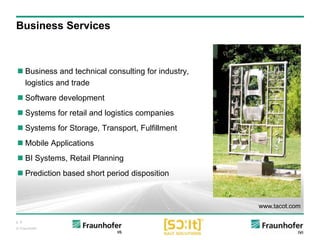
 Business and technical consulting for industry,
logistics and trade
 Software development
 Systems for retail and logistics companies
 Systems for Storage, Transport, Fulfillment
 Mobile Applications
 BI Systems, Retail Planning
 Prediction based short period disposition
www.tacot.com
p. 9
© Fraunhofer
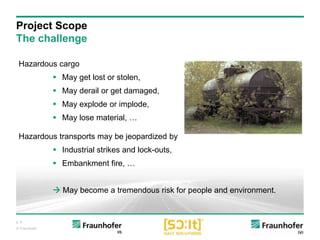
Hazardous cargo
 May get lost or stolen,
 May derail or get damaged,
 May explode or implode,
 May lose material, …
Hazardous transports may be jeopardized by
 Industrial strikes and lock-outs,
 Embankment fire, …
 May become a tremendous risk for people and environment.
Project Scope
The challenge
p. 10
© Fraunhofer
Tracking and tracing of container cargo mainly for rail and street transport.
Robust, safe and maintenance free on board units that collect a bulk of
conditions like location, velocity, temperature, pressure, humidity, shocks,
vibrations and sealing states.
Secured and energy optimized real time transmission of the collected and
preprocessed data via cellular and satellite networks.
Integrated into public and industry systems and automated real time processing
in a centralized data warehouse.
Enhancement of alerting with current situations overviews.
Project Scope
The solution proposal
p. 11
© Fraunhofer
Module1 – Data Capturing: Collecting position and environment data (e.g.
temperature, humidity, vibration) of each unit and sends this information via
mobile and satellite networks.
Project Scope
A unique combination of edge technology
Module 2 – Data Science: Data is processed with fast in memory databases and
compared with patterns and alerting rules. Alerts rise if risk patterns are
detected or rules are broken.
Module 3 – Alerting: Continuously analyses regional public information. In case
of an alert samples a situation overview valid for the disaster management.
Informs the global transport management and the local administration in the
affected region.
p. 12
© Fraunhofer
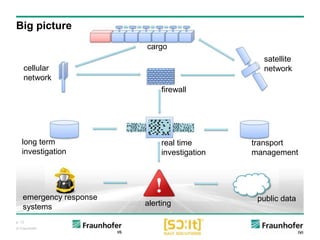
cargo
cellular
network
satellite
network
firewall
real time
investigation
transport
management
long term
investigation
alerting
public dataemergency response
systems
Big picture
p. 13
© Fraunhofer
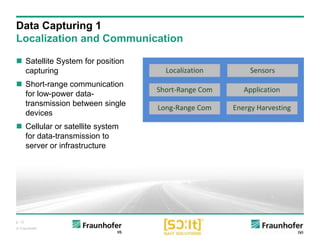
 Satellite System for position
capturing
 Short-range communication
for low-power data-
transmission between single
devices
 Cellular or satellite system
for data-transmission to
server or infrastructure
Data Capturing 1
Localization and Communication
p. 14
© Fraunhofer
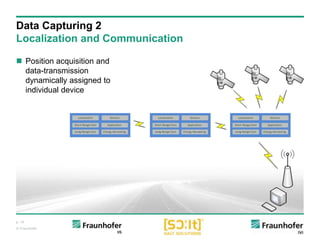
 Position acquisition and
data-transmission
dynamically assigned to
individual device
Data Capturing 2
Localization and Communication
p. 15
© Fraunhofer
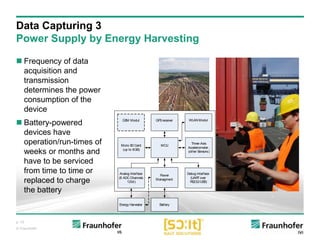
 Frequency of data
acquisition and
transmission
determines the power
consumption of the
device
 Battery-powered
devices have
operation/run-times of
weeks or months and
have to be serviced
from time to time or
replaced to charge
the battery
Data Capturing 3
Power Supply by Energy Harvesting
MCUMicro SD Card
(up to 8GB)
WLAN Modul
Analog Interface
(8 ADC Channels
12bit)
Three-Axis
Accelerometer,
(other Sensors)
Debug Interface
(UARTover
RS232/USB)
Power
Managment
BatteryEnergy Harvester
GPSreceiverGSM Modul
p. 16
© Fraunhofer
Data Capturing 4
Power Supply by Energy Harvesting
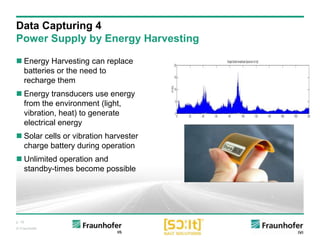
 Energy Harvesting can replace
batteries or the need to
recharge them
 Energy transducers use energy
from the environment (light,
vibration, heat) to generate
electrical energy
 Solar cells or vibration harvester
charge battery during operation
 Unlimited operation and
standby-times become possible
p. 17
© Fraunhofer
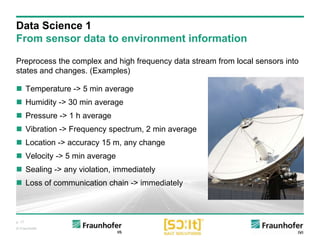
Preprocess the complex and high frequency data stream from local sensors into
states and changes. (Examples)
Data Science 1
From sensor data to environment information
 Temperature -> 5 min average
 Humidity -> 30 min average
 Pressure -> 1 h average
 Vibration -> Frequency spectrum, 2 min average
 Location -> accuracy 15 m, any change
 Velocity -> 5 min average
 Sealing -> any violation, immediately
 Loss of communication chain -> immediately
p. 18
© Fraunhofer
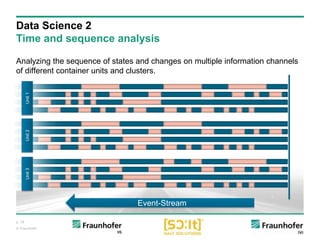
Analyzing the sequence of states and changes on multiple information channels
of different container units and clusters.
Data Science 2
Time and sequence analysis
Event-Stream
Unit1Unit2Unit3
p. 19
© Fraunhofer
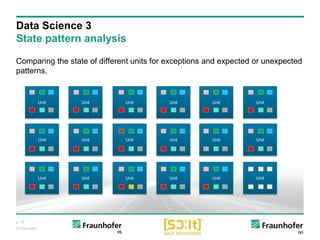
Comparing the state of different units for exceptions and expected or unexpected
patterns.
Data Science 3
State pattern analysis
Unit
Unit
Unit
Unit
Unit
Unit
Unit
Unit
Unit
Unit
Unit
Unit
Unit
Unit
Unit
Unit
Unit
Unit
p. 20
© Fraunhofer
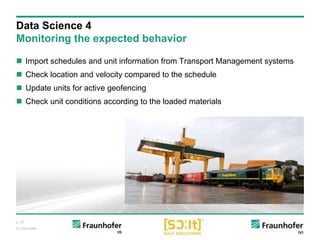
 Import schedules and unit information from Transport Management systems
 Check location and velocity compared to the schedule
 Update units for active geofencing
 Check unit conditions according to the loaded materials
Data Science 4
Monitoring the expected behavior
p. 21
© Fraunhofer
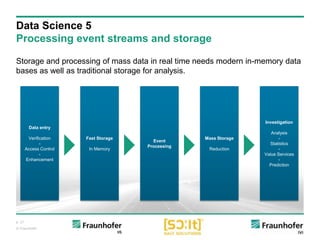
Storage and processing of mass data in real time needs modern in-memory data
bases as well as traditional storage for analysis.
Data Science 5
Processing event streams and storage
Data entry
Verification
-
Access Control
-
Enhancement
Fast Storage
In Memory
Event
Processing
Mass Storage
Reduction
Investigation
Analysis
-
Statistics
-
Value Services
-
Prediction
p. 22
© Fraunhofer
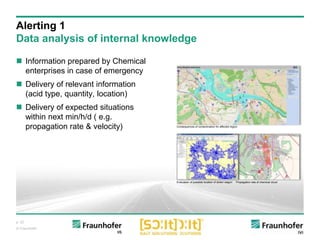
 Information prepared by Chemical
enterprises in case of emergency
 Delivery of relevant information
(acid type, quantity, location)
 Delivery of expected situations
within next min/h/d ( e.g.
propagation rate & velocity)
Alerting 1
Data analysis of internal knowledge
Evaluation of possible location of stolen wagon Propagation rate of chemical cloud
Consequences of contamination for affected region
p. 23
© Fraunhofer
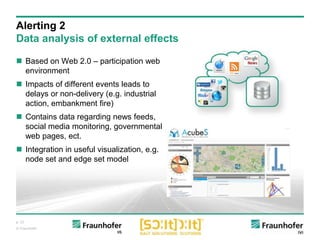
 Based on Web 2.0 – participation web
environment
 Impacts of different events leads to
delays or non-delivery (e.g. industrial
action, embankment fire)
 Contains data regarding news feeds,
social media monitoring, governmental
web pages, ect.
 Integration in useful visualization, e.g.
node set and edge set model
Alerting 2
Data analysis of external effects
p. 24
© Fraunhofer
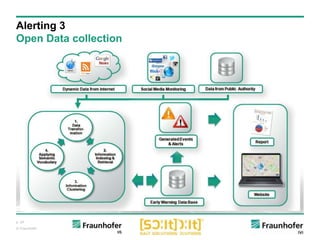
Alerting 3
Open Data collection
p. 25
© Fraunhofer
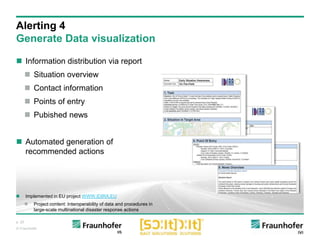
 Information distribution via report
 Situation overview
 Contact information
 Points of entry
 Pubished news
 Automated generation of
recommended actions
 Implemented in EU project WWW.IDIRA.EU
 Project content: Interoperability of data and procedures in
large-scale multinational disaster response actions
Alerting 4
Generate Data visualization
p. 26
© Fraunhofer
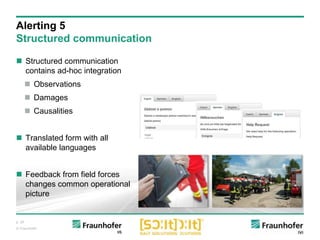
 Structured communication
contains ad-hoc integration
 Observations
 Damages
 Causalities
 Translated form with all
available languages
 Feedback from field forces
changes common operational
picture
Alerting 5
Structured communication
p. 27
© Fraunhofer
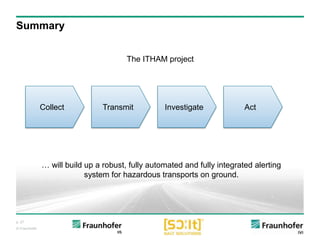
Summary
InvestigateCollect Transmit Act
The ITHAM project
… will build up a robust, fully automated and fully integrated alerting
system for hazardous transports on ground.
p. 28
© Fraunhofer
Dipl.-Inform. Martin Pätzug (Speaker)
SALT Solutions GmbH
Charlottenstraße 34, D - 01099 Dresden
Email: martin.paetzug@salt-solutions.de
www.salt-solutions.de
Dr.-Ing. Peter Spies
Fraunhofer-Institut Integrierte Schaltungen IIS
Nordostpark 93, D - 90411 Nürnberg
Email: peter.spies@iis.fraunhofer.de
www.iis.fraunhofer.de
Dipl.-Med.-wirt, MBA Andre Rauschert
Fraunhofer-Institut für Verkehrs- und Infrastruktursysteme IVI
Zeunerstraße 38, D - 01069 Dresden
Email: andre.rauschert@ivi.fraunhofer.de
www.ivi.fraunhofer.de
Contact Information

GI2013 ppt paetzug+rauschert_project_itham

  • 1.
    p. 1 © Fraunhofer RESEARCHFOR A MOBILE FUTURE Project ITHAM Intermodal Transport of Hazardous Materials DRESDEN
  • 2.
    p. 2 © Fraunhofer Agenda Overview Project partner  Project scope Modules  Data capturing  Data science  Alerting
  • 3.
    p. 3 © Fraunhofer Scientific staff: 700  Budget p.a.: ~80 million euros  Applied research and development in micro-electronics  Headquarter: Erlangen Director: Prof. Dr. Albert Heuberger Fraunhofer IIS
  • 4.
    p. 4 © Fraunhofer ResearchAreas  Audio and multimedia technologies  Imaging systems  Digital broadcasting systems  Embedded communication  IC design and design automation  Communication networks  Navigation  Logistics  Medical engineering  Optical inspection systems  X-ray technology
  • 5.
    p. 5 © Fraunhofer Scientific staff: 80/50  Budget p.a.: ~6.5 million euros (2011)  Applied research and engineering in traffic, infrastructure and transportation systems  Close cooperation with Dresden University of Technology (TU Dresden) Director: Dr. Matthias Klingner Fraunhofer IVI
  • 6.
    p. 6 © Fraunhofer ResearchAreas  Four departments:  Transportation, Energy and Environment  Intermodal Traffic Information and Management Systems  Strategy and Optimization  Vehicle and Transport System Engineering
  • 7.
    p. 7 © Fraunhofer SALTSolutions GmbH  Founding 06/2002  Locations Dresden, Duesseldorf, Munich, Wuerzburg  Employees 329 (full time) (effective 1.1.2013)  Equity 5,2 Mio Euro Equity ratio 50 percent  General Managers Dr. Bernhard Blüthner and Associates Dieter Heyde Markus Honold  Business Areas IT solutions for Production Logistics Retail Profile 22,9 26,4 29,0 32,1 36,5 2009 2010 2011 2012 2013p Sales Development
  • 8.
    p. 8 © Fraunhofer BusinessServices  Business and technical consulting for industry, logistics and trade  Software development  Systems for retail and logistics companies  Systems for Storage, Transport, Fulfillment  Mobile Applications  BI Systems, Retail Planning  Prediction based short period disposition www.tacot.com
  • 9.
    p. 9 © Fraunhofer Hazardouscargo  May get lost or stolen,  May derail or get damaged,  May explode or implode,  May lose material, … Hazardous transports may be jeopardized by  Industrial strikes and lock-outs,  Embankment fire, …  May become a tremendous risk for people and environment. Project Scope The challenge
  • 10.
    p. 10 © Fraunhofer Trackingand tracing of container cargo mainly for rail and street transport. Robust, safe and maintenance free on board units that collect a bulk of conditions like location, velocity, temperature, pressure, humidity, shocks, vibrations and sealing states. Secured and energy optimized real time transmission of the collected and preprocessed data via cellular and satellite networks. Integrated into public and industry systems and automated real time processing in a centralized data warehouse. Enhancement of alerting with current situations overviews. Project Scope The solution proposal
  • 11.
    p. 11 © Fraunhofer Module1– Data Capturing: Collecting position and environment data (e.g. temperature, humidity, vibration) of each unit and sends this information via mobile and satellite networks. Project Scope A unique combination of edge technology Module 2 – Data Science: Data is processed with fast in memory databases and compared with patterns and alerting rules. Alerts rise if risk patterns are detected or rules are broken. Module 3 – Alerting: Continuously analyses regional public information. In case of an alert samples a situation overview valid for the disaster management. Informs the global transport management and the local administration in the affected region.
  • 12.
    p. 12 © Fraunhofer cargo cellular network satellite network firewall realtime investigation transport management long term investigation alerting public dataemergency response systems Big picture
  • 13.
    p. 13 © Fraunhofer Satellite System for position capturing  Short-range communication for low-power data- transmission between single devices  Cellular or satellite system for data-transmission to server or infrastructure Data Capturing 1 Localization and Communication
  • 14.
    p. 14 © Fraunhofer Position acquisition and data-transmission dynamically assigned to individual device Data Capturing 2 Localization and Communication
  • 15.
    p. 15 © Fraunhofer Frequency of data acquisition and transmission determines the power consumption of the device  Battery-powered devices have operation/run-times of weeks or months and have to be serviced from time to time or replaced to charge the battery Data Capturing 3 Power Supply by Energy Harvesting MCUMicro SD Card (up to 8GB) WLAN Modul Analog Interface (8 ADC Channels 12bit) Three-Axis Accelerometer, (other Sensors) Debug Interface (UARTover RS232/USB) Power Managment BatteryEnergy Harvester GPSreceiverGSM Modul
  • 16.
    p. 16 © Fraunhofer DataCapturing 4 Power Supply by Energy Harvesting  Energy Harvesting can replace batteries or the need to recharge them  Energy transducers use energy from the environment (light, vibration, heat) to generate electrical energy  Solar cells or vibration harvester charge battery during operation  Unlimited operation and standby-times become possible
  • 17.
    p. 17 © Fraunhofer Preprocessthe complex and high frequency data stream from local sensors into states and changes. (Examples) Data Science 1 From sensor data to environment information  Temperature -> 5 min average  Humidity -> 30 min average  Pressure -> 1 h average  Vibration -> Frequency spectrum, 2 min average  Location -> accuracy 15 m, any change  Velocity -> 5 min average  Sealing -> any violation, immediately  Loss of communication chain -> immediately
  • 18.
    p. 18 © Fraunhofer Analyzingthe sequence of states and changes on multiple information channels of different container units and clusters. Data Science 2 Time and sequence analysis Event-Stream Unit1Unit2Unit3
  • 19.
    p. 19 © Fraunhofer Comparingthe state of different units for exceptions and expected or unexpected patterns. Data Science 3 State pattern analysis Unit Unit Unit Unit Unit Unit Unit Unit Unit Unit Unit Unit Unit Unit Unit Unit Unit Unit
  • 20.
    p. 20 © Fraunhofer Import schedules and unit information from Transport Management systems  Check location and velocity compared to the schedule  Update units for active geofencing  Check unit conditions according to the loaded materials Data Science 4 Monitoring the expected behavior
  • 21.
    p. 21 © Fraunhofer Storageand processing of mass data in real time needs modern in-memory data bases as well as traditional storage for analysis. Data Science 5 Processing event streams and storage Data entry Verification - Access Control - Enhancement Fast Storage In Memory Event Processing Mass Storage Reduction Investigation Analysis - Statistics - Value Services - Prediction
  • 22.
    p. 22 © Fraunhofer Information prepared by Chemical enterprises in case of emergency  Delivery of relevant information (acid type, quantity, location)  Delivery of expected situations within next min/h/d ( e.g. propagation rate & velocity) Alerting 1 Data analysis of internal knowledge Evaluation of possible location of stolen wagon Propagation rate of chemical cloud Consequences of contamination for affected region
  • 23.
    p. 23 © Fraunhofer Based on Web 2.0 – participation web environment  Impacts of different events leads to delays or non-delivery (e.g. industrial action, embankment fire)  Contains data regarding news feeds, social media monitoring, governmental web pages, ect.  Integration in useful visualization, e.g. node set and edge set model Alerting 2 Data analysis of external effects
  • 24.
    p. 24 © Fraunhofer Alerting3 Open Data collection
  • 25.
    p. 25 © Fraunhofer Information distribution via report  Situation overview  Contact information  Points of entry  Pubished news  Automated generation of recommended actions  Implemented in EU project WWW.IDIRA.EU  Project content: Interoperability of data and procedures in large-scale multinational disaster response actions Alerting 4 Generate Data visualization
  • 26.
    p. 26 © Fraunhofer Structured communication contains ad-hoc integration  Observations  Damages  Causalities  Translated form with all available languages  Feedback from field forces changes common operational picture Alerting 5 Structured communication
  • 27.
    p. 27 © Fraunhofer Summary InvestigateCollectTransmit Act The ITHAM project … will build up a robust, fully automated and fully integrated alerting system for hazardous transports on ground.
  • 28.
    p. 28 © Fraunhofer Dipl.-Inform.Martin Pätzug (Speaker) SALT Solutions GmbH Charlottenstraße 34, D - 01099 Dresden Email: martin.paetzug@salt-solutions.de www.salt-solutions.de Dr.-Ing. Peter Spies Fraunhofer-Institut Integrierte Schaltungen IIS Nordostpark 93, D - 90411 Nürnberg Email: peter.spies@iis.fraunhofer.de www.iis.fraunhofer.de Dipl.-Med.-wirt, MBA Andre Rauschert Fraunhofer-Institut für Verkehrs- und Infrastruktursysteme IVI Zeunerstraße 38, D - 01069 Dresden Email: andre.rauschert@ivi.fraunhofer.de www.ivi.fraunhofer.de Contact Information